From the FasterSkier archive — posts syndicated from athletes’ and coaches’ own blogs between 2004 and 2012, kept online as published. Current coverage is at fasterskier.com.
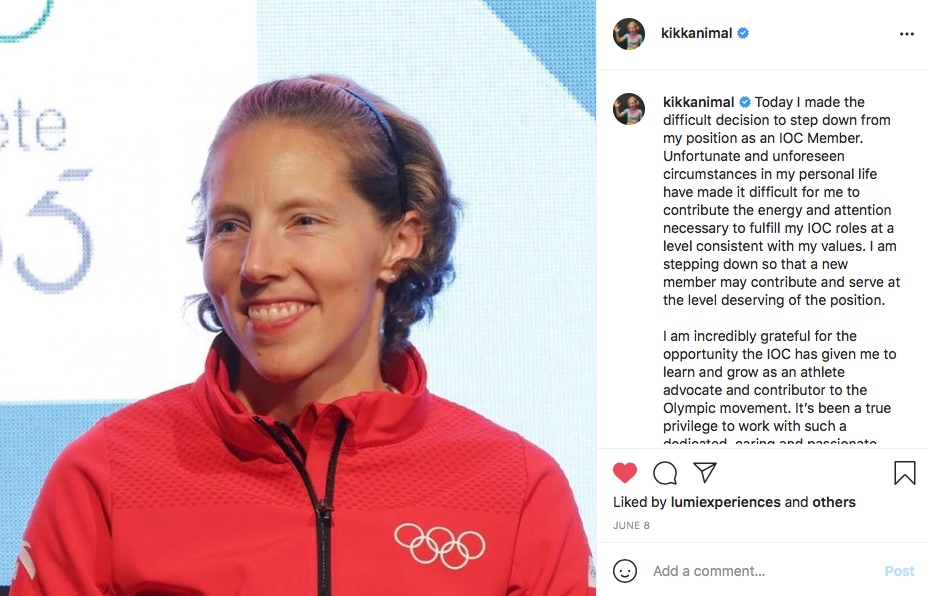
In a statement on social media last week, Olympic gold medalist Kikkan Randall announced that she had made the decision to step down from her position as a member of the International Olympic Committee Athletes Commission. “Unfortunate and unforeseen circumstances in my personal life have made it difficult for me to contribute the energy and attention necessary to fulfill my IOC roles at a level consistent with my values,” wrote Randall.
Kikkan Randall recently stepped down from the IOC Athlete Commission. Randall served on the commission for three years. (Photo/screenshot: @kikkanimal Instagram)
Members of the IOC Athletes Commission provide a link between the IOC and the athletes with the goal of ensuring that the athletes’ viewpoints are at the heart of the Olympic Movement’s decisions. The IOC website lists the responsibilities of the IOC Athletes Commission as:
Empowering Athlete Representation in Olympic Movement decision-making processes.
Supporting Athlete Development in their sporting and non-sporting careers.
Promoting Athlete Involvement in decision-making across the Olympic Movement.
Ensuring Athlete Representation in Olympic Movement decision-making.
Randall has been a member of the IOC Athletes Commission for the past three years and she said, “I am incredibly grateful for the opportunity the IOC has given me to learn and grow as an athlete advocate and contributor to the Olympic movement. It’s been a true privilege to work with such a dedicated, caring and passionate team.” Though Randall is stepping down from the position, she plans to stay involved with the IOC Sustainability and Legacy Commission.
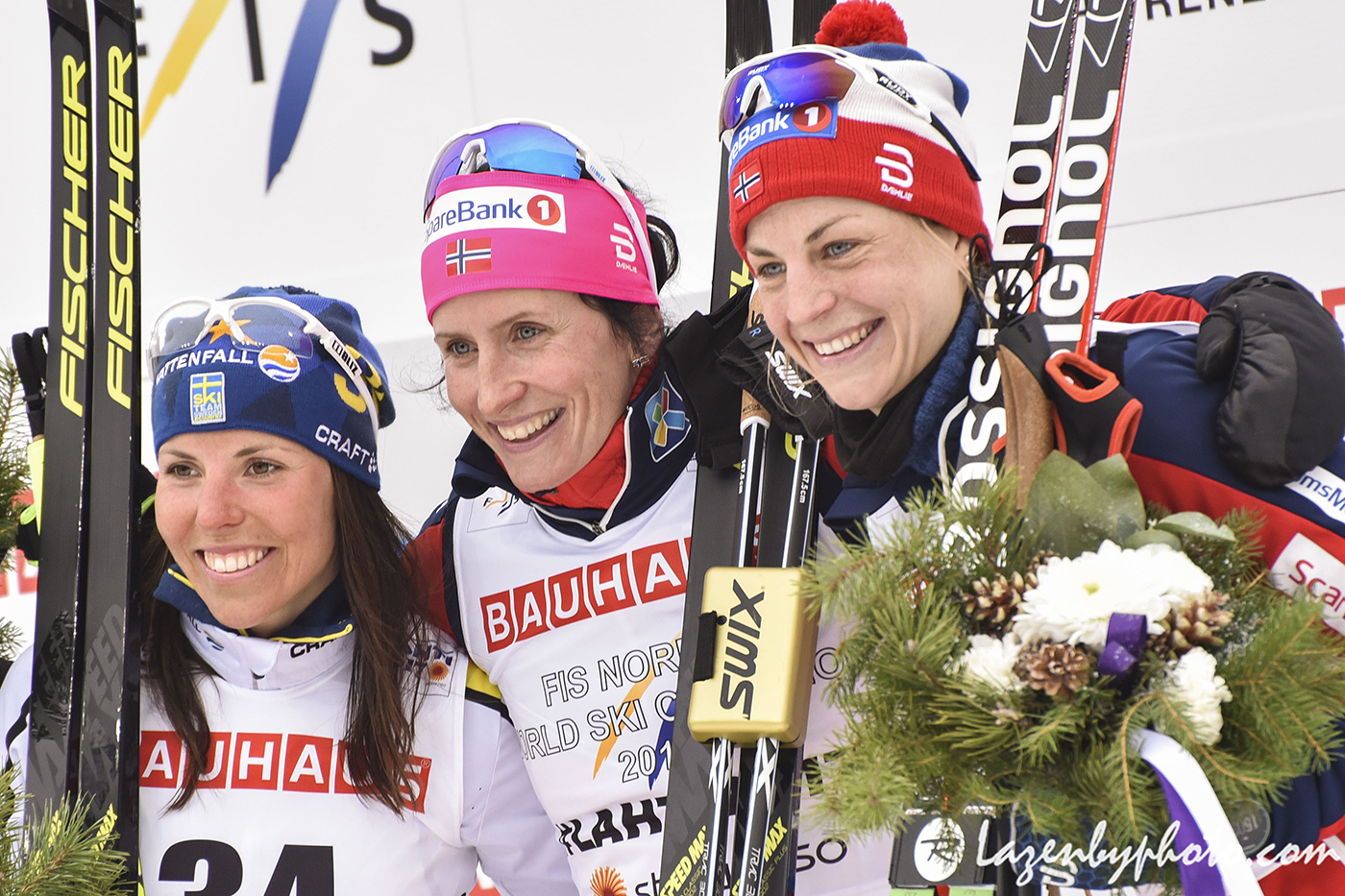
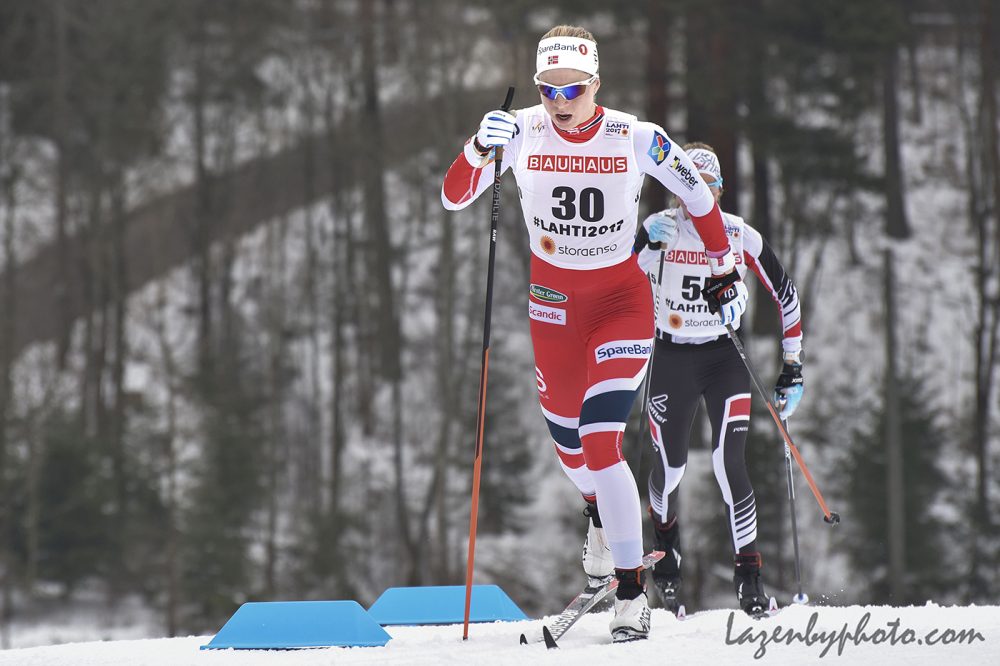
Jacobsen (right), after placing third 2017 Nordic World Championships women’s 10 k classic beind Sweden’s Charlotte Kalla in second (left), and Norway’s Marit Bjørgen in first (center). (Photo: John Lazenby/lazenbyphoto.com)
Randall’s successor on the Athletes Commission is Norwegian Astrid Uhrenholdt Jacobsen. Jacobsen retired from ski competition in 2020 after thirteen years of racing on the World Cup circuit, including a breakout performance earning gold at World Championships in a classic sprint in 2007 and an Olympic gold medal with the Norwegian women’s relay team in PyeongChang. Jacobsen also worked her way through medical school while racing.
In response to her selection to the IOC Athletes Commission Jacobsen said in a press release, “I am both honored and humbled when I now join the IOC’s executive committee and become an IOC member. My main motivation for accepting this position is to work to ensure that the voice of practitioners is heard in all important matters. I experience that athletes have become an increasingly important group in international sports, and that our views have been desired in the important sports policy debates. I am really looking forward to taking on this position.” As one of the 15 athlete representatives, Jacobsen will serve as a member until 2026.
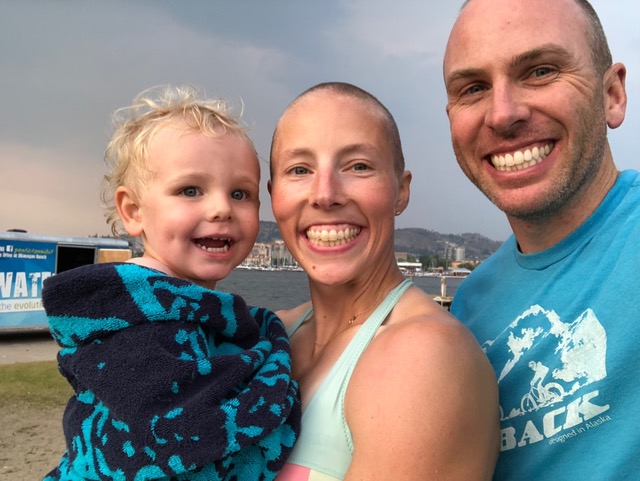
Kikkan Randall (c) with her son, Breck, and husband, Jeff Ellis, in Penticton, British Columbia. (Courtesy photo)
Day by day. That’s how Kikkan Randall is approaching her battle with breast cancer after being diagnosed about three months ago. Now more than 50 days into her treatment — with six rounds of chemotherapy over an 18-week span — Randall, 35, is becoming more familiar with the ugly side effects and adjusting to her new normal.
While beating what is believed to be Stage 2 cancer remains the Olympic gold medalist’s biggest challenge yet, it’s not dampening her spirits — even on the extremely rough days, of which there have been many.
After Round 2 of chemo, Randall returned to her family in their new home of Penticton, British Columbia, where she quickly came down with a nasty cold. That cold required a visit to a local clinic and antibiotics, and Randall now wears a mask on airplanes to fend off germs while flying to and from her cancer treatments in Anchorage, Alaska.
“Getting the head cold on top of going through the worst days of the chemo cycle has definitely been one of the most uncomfortable weeks of my life,” Randall explained in an email to FasterSkier. “It’s mostly because I have no control and I have no idea how well my immune system can clear the cold. Normally I would be optimistic that it would just be a tough couple of days but now I just have to wait and wait.”
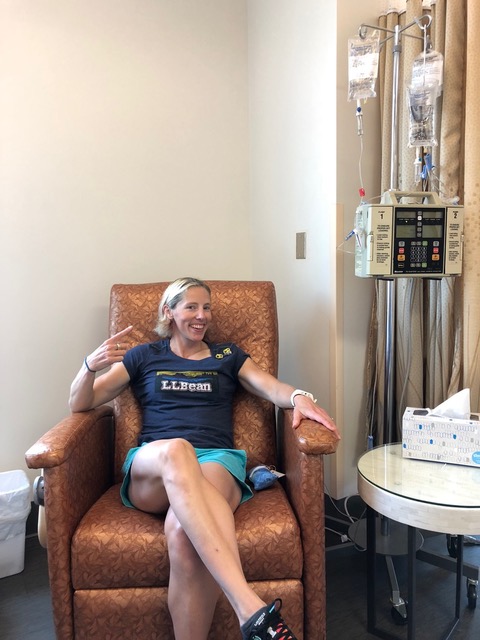
Kikkan Randall during her first chemotherapy infusion at the Providence Alaska Medical Center on July 9 in Anchorage. (Courtesy photo)
She eventually kicked the cold and got her voice back, just in time for Round 3 of chemo on Aug. 22. After what she called a “quick 36-hour trip to Anchorage,” she was back in Penticton on Aug. 23. So far, Randall explained on her daily video blogs that her current three-week round is going better than the previous two.
“Just getting used to my haircut … got a nice little fuzz growing on top,” she said in her Day 51 video posted last Wednesday, just over a month after she shaved her head for the first time.
“Definitely giving me a greater appreciation for all the guys out there and gals that deal with this,” she continued with a smile. “But I have to say it is pretty low maintenance so I guess I should just embrace it.”
Two weeks after receiving her first chemo infusion in July, Randall noticed she was losing her hair in clumps. She promptly went wig shopping with friends and scheduled an appointment with her hairdresser in Anchorage to get ahead of the hair loss.
Randall spoke with FasterSkier on the phone from Anchorage on July 26, the day after she initially asked her hairdresser to shave it all off.
“I sat in the chair and she said, ‘Are you ready?’ and I said, ‘Let’s do it,’ ” Randall recalled. “Three minutes later, I had a buzz cut, and I think I actually handled it better than I thought I would. It was kind of interesting to watch it, to feel it, and to be like, OK, now we’ve got that taken care of. Now we can move onto the next step.”
The next step and every passing day has proved to be an unknown. Oncologists never know exactly how a patient will react to treatment, as “everybody seems to react differently,” Randall explained.
“But in a lot of cases what you experience the first round is what you will generally feel like over the next subsequent rounds,” she continued. “Some of it will be a little bit cumulative, like the fatigue I’m sure will add up a little bit, but I also really think that staying active through this as much as I can will really help. I’ve noticed already that even on days where I don’t feel very good, if I get out and do something, it at least keeps my mind off of how bad I feel and I think it helps me process everything better, both physically and mentally.”
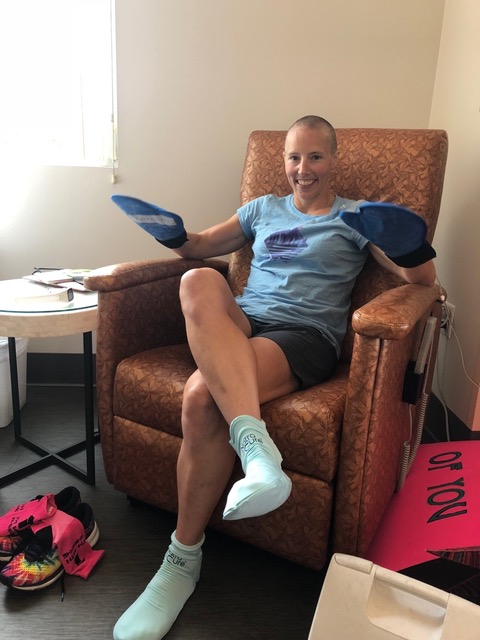
Kikkan Randall wearing ice mittens and socks to prevent neuropathy during a chemo infusion at the Providence Alaska Medical Center in Anchorage. (Courtesy photo)
As she approaches the halfway point of her chemo treatment — the first proactive step to eradicate the cancer (which was initially found in her breast and one lymph node), Randall has continued to make an effort to get outside and moving every day. Some days, that’s as much as a run with former training buddies or even intervals, and other days, it’s about playing with her 2-year-old son, Breck.
Ever since announcing her diagnosis on social media, Randall has been promoting AKTIV Against Cancer, a Norwegian nonprofit that she became involved with six or seven years ago without having any direct ties to cancer. According to Randall, the organization funds research on how physical activity can affect cancer treatment and creates supportive environments for patients to work out together, both in and out of the hospital.
“It falls along with what I believe is that physical activity is pretty much good for everything, so I was happy to support them as an athlete, but now that I actually have cancer myself, I have a little deeper connection,” she said. “I’ve committed personally to staying as active as I can through this, but I think in partnering with them, we can share the message on a bigger platform, and I’m looking forward to learning more about the research that they’ve done and also to continue to fundraise and promote awareness for getting other hospitals to have these places and rooms and programs that encourage cancer patients to be active.”
“I’ve committed personally to staying as active as I can through this…” — Kikkan Randall, on her cancer diagnosis
Randall continues to ride her bike to and from the Providence Alaska Medical Center in Anchorage. During a recent layover, she worked out in a Vancouver gym. And early in the treatment, she asked if she could use a stationary bike or treadmill during the several-hour-long infusions. While her oncologist and nurses ultimately encouraged her not to (“the nurses felt it would be hard to keep an eye on me for any reactions I might have to the medication”), the bottom line is: Randall is still plugging away at a rate that would put most people to shame.
After her last round of chemo in mid November, she’s hoping tests will reveal that her tumor has shrunk or disappeared altogether. That would make surgery “more straightforward”, she explained, yet she’ll still have to decide which type of surgery to undergo. Her options range from a lumpectomy (removal of the tumor and some surrounding tissue) to a unilateral or bilateral mastectomy (removal of one or both breasts).
“If you do the double [mastectomy], the idea is you’re taking out the most breast tissue as possible, which is where a second breast cancer would most likely come back so it gives you a slightly better piece of mind,” Randall explained. “You don’t have to be screened quite as much after the fact because there isn’t breast tissue for it to come back to, and then from there, you can decide whether you go the double route and wear prosthetics or whether you go a reconstruction route … so there’s a lot to consider between now and then between what I want to do for maintaining the lifestyle and all the activities I want to do.”
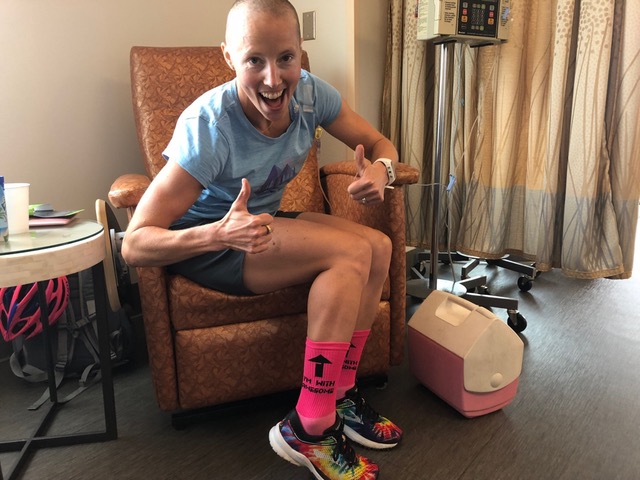
Kikkan Randall staying positive with pink socks and rainbow shoes during her second round of chemotherapy on July 31 at the Providence Alaska Medical Center in Anchorage. (Courtesy photo)
Through all of this, she’s learned that her tumor responds to estrogen, progesterone and HER2 (human epidermal growth factor receptor 2)/neu protein, and is initially being treated with two chemo drugs to specifically target the HER2/neu. That should help stop the growth of the tumor, and after chemo, Randall will start taking anti-estrogen and anti-progesterone meds.
Leading up to all of this, she and her husband had been hoping to expand their family.
“We were just starting to try for kid number two and definitely excited to have more kids so finding out about this thing, the diagnosis, and then knowing I needed to start chemo pretty soon, we didn’t have much of a window to work with,” she explained of her diagnosis in early June.
Later that month, before starting chemo in July, she sought fertility treatment in Seattle. There, Randall received a round of injections to stimulate egg production in her ovaries. That produced one embryo, which is being preserved in case the cancer treatment makes pregnancy difficult later on.
“There’s no guarantee that the chemo will knock out my natural fertility, but it’s nice to know that there’s at least a small chance for the future,” Randall said. “It’s going to be challenging because the type of breast cancer that I have, I will have to be on some anti-estrogen and anti-hormone treatment for probably five to ten years even after the chemo and everything is done, so that’s going to be a little bit tricky to figure out a pregnancy in there, but at least we kind of have a backup plan.”
While Randall repeats her multiple-leg commute between Penticton and Anchorage (a 1- to 1.5-hour drive from Penticton to Kelowna, B.C., followed by a two-stop, roughly 4.5-hour flight to Anchorage) every three weeks, she’s also staying involved in several work engagements, including with Fast and Female and as a new board member of the National Nordic Foundation.
“Everyone’s been so supportive, like the IOC, the USOC [U.S. Olympic Committee], they’ve been telling me to take as much time to make my health the number-one concern, and the same with Fast and Female, we wanted to get some stuff going this summer and fall and we’ve just had to postpone it a little bit,” she said in July. “The door’s open if I have the energy to work on some of that stuff, but if I can’t, I have the time to just focus on recovery. … And then the period after surgery is kind of up in the air in terms of what I’ll be able to do. I’m just trying to be creative; I’m hoping to be able to do stuff, maybe not as much in person but maybe I can contribute to things, whether it’s writing or interviews or projects. I’m just going to ride it out and see where it goes.”
Back in Penticton, her husband, Jeff Ellis, has been “doing the single dad thing”, as Randall put it, while she’s away for treatment. As she retired from racing this spring, Ellis transitioned from his marketing job with the International Ski Federation to sales and marketing with Swagman bike racks. He initially took some time off from Swagman when Randall was first diagnosed before deciding to leave his job and be home full time.
“Ultimately when Jeff said, ‘Hey, this has put things into perspective for us. I need to be home to help Kikkan out,’ they were definitely very understanding of that,” Randall said of Swagman.
Ellis recently started his own business as an independent marketing contractor, called the Jeffrey MW Ellis Group.
“He’s actually helping me with the ‘Kikkan Brand’ while I’m going through treatment and he’s picked up a few more small clients as well,” Randall explained.
Asked why she went public with the diagnosis in early July and what’s driven her daily video updates every day since, Randall said she never could have kept it private.
“I’m not very good at faking things, so I knew once I showed up in Anchorage when I wasn’t supposed to be here, people would start to ask questions and wonder what was going on and I was going to have to start bowing out of things,” she said. “I also felt like, especially Anchorage, especially Alaska, but really just so many people have supported me through my career and they really care what’s going on. So I kind of felt like they’d want to know what was going on with me. It’s always good to celebrate the good things, but I think it’s also important to share the really human moments, and I thought it was really good to show that you could be an Olympic gold medalist and four months later find out you have breast cancer.
“I think it’s important for a lot of people out there that are battling through this, it makes them feel like, this happens to all of us,” she continued. “I learned 10 years ago when I shared my story about blood clots that it helped people. … I kind of felt like, if me going through this can have a positive impact by sharing my story, then I’m happy to do so. I don’t feel like there’s anything I need to hide; I’m willing to share this.”
“It’s always good to celebrate the good things, but I think it’s also important to share the really human moments. … You could be an Olympic gold medalist and four months later find out you have breast cancer.”
One of Randall’s sponsors started a GoFundMe online fundraiser to help with some of her out-of-pocket medical and travel costs, and in a little over a month, it had generated more than $37,000 dollars toward a $45,000 goal. According to the site, any funds that exceed the associated expenses of Randall and her family will be donated to AKTIV Against Cancer.
“It’s been amazing,” Randall said of the community support in light of her diagnosis. “I got to come back after winning the gold medal, and of course I feel like our profile was higher than it had ever been — people were so excited and wishing me congratulations everywhere I went, but this has blown that out of the water. So many people have reached out, whether it’s over social media or messages through my website or cards arriving in the mail, people stopping me in the grocery store, they’re sharing their stories. Breast cancer’s way bigger of a deal than I ever appreciated.
“My traditional income as a ski racer was coming to an end anyway and I was going to be relying on being able to travel and do speaking engagements and things like that for some projects over the next year, and I won’t be able to do that now,” she said of the fundraiser. “It’s hard to put into words, but I just feel so supported. I’ve been reading through all those messages on the tough days and then trying to reach out to as many people as I can to say thanks.
“It’s unfortunate that it takes a situation like this to be able to appreciate the amount of people that do support me in that way,” Randall added. “But like I said, I’m blown away, I’m so grateful for it and it’s definitely going to help me through this.”
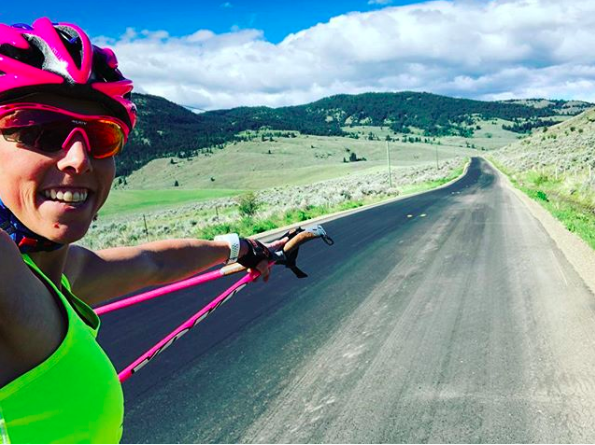
Kikkan Randall explores new rollerski terrain in Penticton, B.C., earlier this month, following her family’s move to Canada. (Photo: Kikkan Randall/Instagram)
As discussed last week in Part I of this interview, Kikkan Randall’s first-ever FIS race (that is, a race sanctioned by the International Ski Federation) occurred at U.S. nationals at Soldier Hollow in January 2000. Randall was 17 years old, the single youngest finisher in the race. Other athletes had been born in the 1960s and are now at least 48 years old. Randall raced in a first-generation Gold 2002 training suit for the fledgling Alaska Pacific University (APU) ski program. Every skier in the race had a FIS number starting with a 1.
Fast-forward 18 years and nearly 600 FIS races later. Randall’s final FIS race was the 30-kilometer classic mass start at 2018 Spring Series this past March in Craftsbury, Vermont. She crossed the finish line in third, leading out a four-racer chase pack to claim the final podium spot in the final race of her career. She followed U.S. Ski Team (USST) teammate Jessie Diggins and USST and APU teammate Sadie Bjornsen, who took first and second in a tight finish.
Randall was the oldest skier in the race by five years. She was the only athlete whose FIS number started with a 1; everyone else’s FIS number began with a 3. Earlier that week Randall’s competitors in the 10 k freestyle included Anchorage junior Molly Gellert (23rd overall), who had not yet been born when Randall did her first FIS race.
And even among the 30 k podium finishers, Diggins famously got Randall’s signature on a piece of cardboard at 2008 Junior Nationals in Anchorage, after Randall had run out of posters to sign before Diggins got to the front of the line. Bjornsen likewise looked up to Randall as a junior skier, then moved to Alaska to train with her at APU. Randall’s been doing this for a long time.
And when it was over, and when Randall had crossed her final finish line, she stood on the podium in a bespoke pink USA/APU suit, and sprayed champagne over her teammates. The next morning, she woke up as something other than a professional skier for the first time in nearly 20 years. She celebrated by leading a Fast and Female session in the area a few days later.
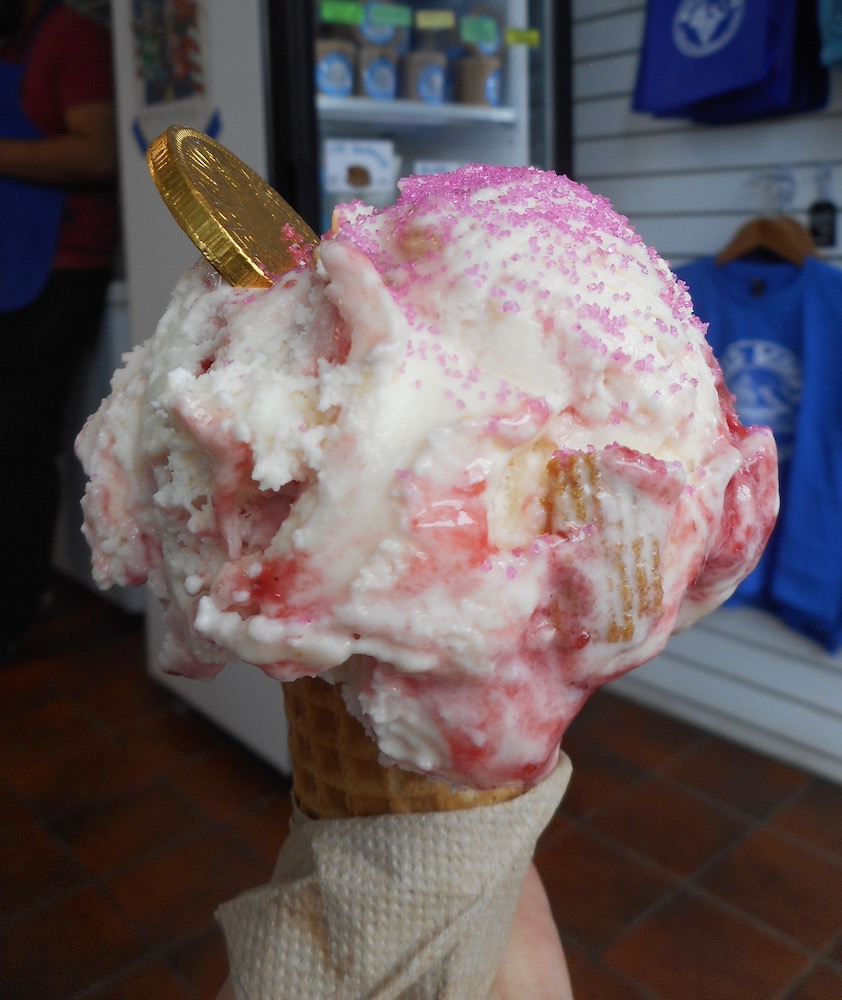
And, perhaps most significantly of all, she inspired an ice-cream flavor in her honor. Gold & Glory debuted at Anchorage microcreamery Wild Scoops in early April, in advance of a “Welcome Home Olympians” celebration in nearby Town Square. The concoction involved “a sweet cream base with homemade GOLDen Graham toffee crunchies + pink strawberry sauce streaks,” store owner Elissa Brown explained on Instagram. “Topped with pink sprinkles and ‘gold medals’ while supplies last.”
The ice-cream honor was the only thing in a month of awards and media attention that threatened to make the preternaturally poised Randall lose her focus. “Wow,” said a clearly surprised Randall upon being asked by a FasterSkier reporter about the significance of having an ice-cream flavor named for her. “That’s quite an honor. I do love ice cream; I’ll have to go check that out.”
Gold & Glory Kikkan Randall commemorative ice cream at Wild Scoops microcreamery in Anchorage, Alaska. (Photo: Julie Kentch)
Later that afternoon, Randall headlined the Welcome Home celebration for 16 local Olympians and Paralympians who had competed this year in PyeongChang. (Thanks to Paralympic alpine skier Andrew Kurka and his PyeongChang gold and silver, there were a healthy three Olympic medals in attendance. Another dozen or so local former Olympians joined the crowd, including skiers Nina Kemppel and Adam Verrier.)
Randall rode in on a pink fire truck. She joined the cheerleaders from her high school alma mater, East Anchorage High School, in dancing to the school fight song. She accepted the Skis To The City from Anchorage Mayor Ethan Berkowitz, then sprayed a pink streak in Hizzoner’s hair. She listened as Alaska’s senior senator, Lisa Murkowski, praised the accomplishments of all the Olympians and told them that Alaska was proud of them.
Finally, Randall took the microphone and addressed a crowd of hundreds filling Town Square on a blustery, raw, sub-freezing April afternoon. Hordes of local junior skiers clambered on to the snowbanks immediately in front of the stage to gaze up at her, Anchorage Junior Nordic hats on their heads and rapt admiration in their eyes.
“This is so amazing for us,” Randall said, “to come back to Alaska, finally, after a long and hard season traveling the world, to come back and get to celebrate with all of you guys that have been such an important part of making this gold medal and this Olympic team happen. We couldn’t be more proud to represent the state of Alaska.”
She praised the support of the community and of her teammates, and detailed all the contributions from others that had made success possible.
Randall ended her remarks by forecasting a bright future for American skiing: “It’s been a fairytale ending to an amazing journey. And now that my career’s coming to a close, I can’t wait to see what this next generation is going to do. Because they know it’s possible, we know we have the community and the support system to make it happen, and they’re going to take this far beyond. This may be the first medal in women’s cross-country, but it’s not going to be the last.”
So that’s what’s next for U.S. skiing, but what’s next for Randall? Part II of this interview answers those questions.
Note: The following story is based on an in-person interview with Randall in late April. FasterSkier’s narrative is in bold; everything else is a direct quote from Randall.
So, what comes next? Randall largely answered this question last fall; go back and review the second half of this FasterSkier article for the full version of this answer.
The short version is that she’s going to serve on the International Olympic Committee (IOC) Athletes’ Commission, take on a larger role with Fast and Female, and finish up her MBA through Alaska Pacific University (the school, not the ski team). Oh, and by the way, along with husband Jeff Ellis, parent their son, Breck Stuart Randall Ellis, while settling into the family’s new home in Penticton, British Columbia. And maybe it’d be nice to earn a living, too.
Randall is asked whether the preview version of her new career, as written out last fall, is still accurate. Here’s what she had to say:
Yes. That’s still the tentative plan.
The gold medal, of course, has opened up some new opportunities to do some more motivational speaking, which I really enjoy doing, and would love to have a couple opportunities nationally a month to do that.
So that’s one part adding to the mix, and then the IOC role has turned out to be a little more than I knew I was getting into. I didn’t realize I would be on the USOC [United States Olympic Committee] Board of Directors, and so actively involved with other groups that kind of funnel into the IOC. So figuring out how to manage the time commitment there, given that it’s all volunteer.
And my source of income, which has been racing, is now shifting, so figuring out how to do all these things that I’m passionate about, and I love, and I want to contribute to, but still be able to provide for my family.
… And then realizing there’s only 24 hours in a day, and I want to be a good mom, and I want to be physically active, and still see my husband, and do all these other things. So it’s going to be – after the last 20 years being pretty darn predictable, it’s now a whole new scheduling challenge and energy-management challenge. But, there are so many good things to look forward to, that I think will help me transition out and give me really good focus, new passions.
I’ve heard that some athletes really struggle after they retire because you are so passionate about your sport, and it gives you so much structure and daily accomplishment, that when you don’t have that anymore, you can really just kind of go into a mental tailspin. So having these great things already lined up that are going to be really engaging and fun to work on I think will be really helpful.
Randall may be understating things somewhat when she talks about the structure and daily accomplishment of being a full-time athlete; she has trained twice a day, 48 weeks a year, for most of the past 20 years, and duly recorded every workout. That’s a lot of daily structure.
But there is also a certain broader rhythm to the seasons that attaches to this lifestyle – starting up training again in May, volume in June, intensity in the fall, and so on. Randall is asked, in an interview conducted in late April, what it is going to feel like to not be beginning a new training year next week on May 1, or to spend a complete summer uninterrupted by training blocks on Eagle Glacier, or to spend mid-November somewhere other than far northern Scandinavia for pre-World Cup races. Randall is quick to acknowledge the magnitude of the change, while still concluding that it’s time to move on.
You know, I’ve been surprised at how quickly I’m starting to realize that it’s gonna feel pretty weird. I did my last race, just coming up on the one-month mark, and, while I’ve been excited to finish a great career, to be able to now go and do new opportunities and things, it is kind of settling in, the fact that I won’t have the excuse to go out and train twice a day, and do all these exercises. And most importantly, that I won’t be meeting up with my teammates, who have really just become such close friends, and coaches and everything.
So I know it’s going to be a pretty dramatic stretch, and April has been kind of a free pass, in that it’s always kind of the time of year when we are flexible. It’s felt pretty normal so far, but as next week starts, and summer drags on, I’m sure it’s going to be pretty strange.
But all good things come to an end, and I think it’s still the right time to transition out, so it just gives me a greater appreciation for what I’ve been able to do, and recognizing what parts of that life I want to continue forward – you know, I want to stay active and fit, and it’s just going to be a new challenge of how to figure out how to do that, while balancing everything else.
That challenge, for an elite athlete, often involves coming to grips with the fact that they still love moving and being outside, yet by definition will spend the rest of their life older and slower than when training was their full-time job.
Two models for how to negotiate this post-career period (which, it should be noted, represents multiple decades and the majority of one’s life) are suggested, the Adam Verrier model and the Nina Kemppel model, corresponding to two local former Olympians.
Briefly put, Verrier moved to Anchorage after his college ski career ended, qualified for the 1994 Olympics, then stayed in Anchorage and basically never stopped racing. He has won nearly every notable trail race in southcentral Alaska, and placed on the podium of the 50 k Tour of Anchorage, the unofficial citizens race championship for the state of Alaska, eight times between 1995 and 2007, including three victories.
Kemppel, by contrast, raced in four Olympics from 1992–2002, then ultimately returned to Anchorage after earning an MBA outside of Alaska. She has lived here for years, and presumably remains quite active, but does not seem to have entered an official running or skiing race since returning to Anchorage. “I’ve become more and more of a weekend warrior because of my job,” Kemppel told the Anchorage Daily News in a 2012 article noting her return home.
Randall is asked with which pole of post-career racing she envisions being more closely aligned.
I probably hope for something in between. I am already recognizing that with family commitments and some of the – I mean, the gold medal changed the reality a lot, in terms of what opportunities are available, and my position with the IOC is going to be very busy. So while I love the idea of just staying super-fit and doing all that, it’s going to be a challenge to be able to do that. But I also love being able to be active every single day, so I hope to be able to build that into my new life.
As far as racing goes, I don’t have any real plans in the near future. I’ve always been interested in trying some mountain biking stuff, and I think it’d be cool to dabble with some new sports. There’s a big triathlon community down in B.C. where we’re going to be, so maybe that’s something to get into. [Randall has at least one victory and four runner-up finishes in Anchorage’s Gold Nugget Triathlon, one of the largest and longest-running women’s-only triathlons in the country.] Having races in the future is a good motivation for just making sure you get out the door every day, and you have a plan of what you’re working towards. So I like that idea, but I don’t need to necessarily keep racing at a high level all the time.
And ski racing-wise, it would be fun to do some events I’ve never done, like the Birkie and stuff, but I don’t know at what level I’ll be racing.
But I do really enjoy racing, I love the opportunity to just get out there with everybody, put the bib on, and go push yourself, so I think I’ll continue to do some of it.
[Randall has often spoken of shifting into a race gear or finishing gear when she is racing well, or of being unable to make that shift when she is not. She is asked what it’s going to be like, two months or two years from now, when she’s at the point in a race when all of her training and experience tell her that it’s time to make that shift, but her body won’t let her do what her mind wants to.]
I’m sure that’s going to be tough. Thankfully the number of years I’ve been competing, I think I do have a nice window of time where that’s not going to just disappear overnight. But I can tell already, in the last month where I haven’t done a whole lot, and all of a sudden jumping into doing things a little harder again, it’s like, Whoa, what are you doing? So yeah, I’m sure it’s going to be tough to not be as fit as I would have been in the last 20 years… but that’s just the way it goes.
That world-class fitness was not easily won. Over the course of her career, Randall increased her annual training hours consistently and substantially, from roughly 300 in high school to nearly 800 by the height of her career, adding in intensity along the way. “You hadn’t trained hard enough if you hadn’t started crying,” Randall once told Outside Magazine of 2008, “the year of intensity.” (It is worth noting that 2008 also saw Randall undergo two surgeries for the blood clot that nearly killed her. But they were both in April, so presumably she didn’t miss too much training. She would win her first World Championships medal, Liberec, Czech Republic, in February 2009.)
But when asked what she won’t miss about this lifestyle, the first thing Randall mentions is not the staggeringly difficult Level 4 bounding workouts, but rather the simple quotidian drudgery of preparing for and completing two workouts a day, every day, over and over and over again.
I think always having to do two workouts a day. Over the last couple of years, especially once we had Breck, it was hard at times, to just go, I’ve got to change my outfit again, I’ve got to go out there, maybe the weather’s not great, and I know I’ve got two hours to log. And just putting in the amount of time out there – it got tough. So some of that part I won’t miss, just having to do it all the time.
Having the time open and available for new things now, not having to just constantly change outfits – into training clothes, out of training clothes. And traveling with so much gear. It’s just been nice to do a couple trips now where I just pack a couple things, and off you go, not have to drag a ski bag all around the world.
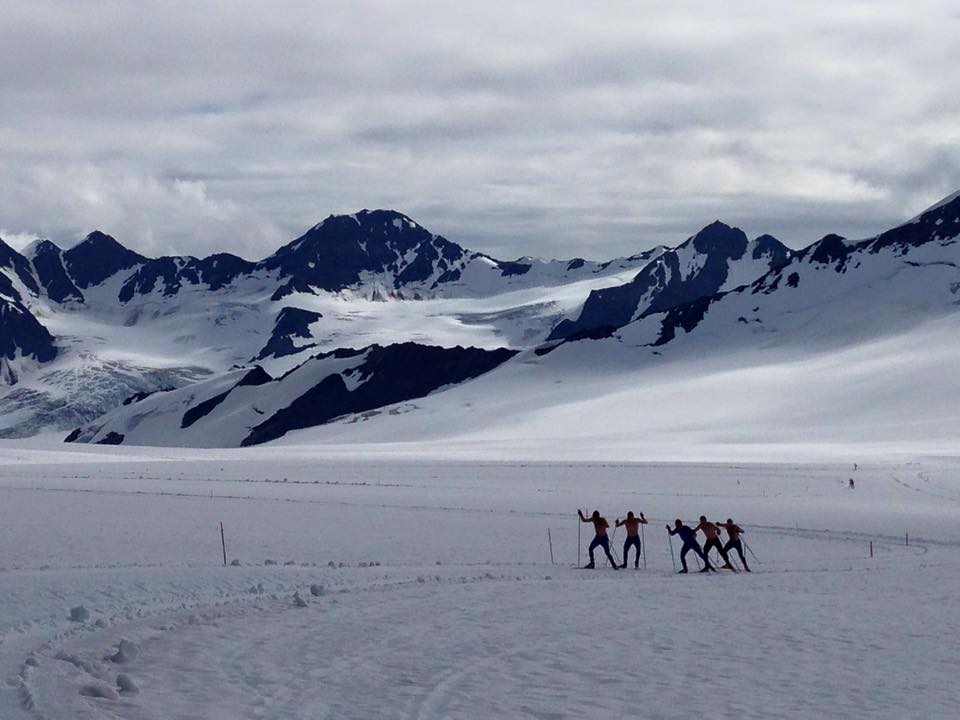
The APU men pushing each other during a workout at an Eagle Glacier training camp, July 2015. (Photo: Zuzanna Rogers)
Going up on the glacier was always – it was such a great training environment, and it was such an amazing resource to have, but you could never really appreciate it in the moment when you’re up there. When you’re on Day 2, and you’re staring down five more days of just what you know is going to be a lot of hard training, and just knowing you have nowhere to go, you’re stuck up there, you’re away from your family. And so, I won’t miss, again, just having to do that … at the same time, I think I’m quickly going to miss the opportunity where I got to do that.
So it all comes into perspective: When you’re in the midst of it, you can’t wait to be done with it and not have to do it anymore, but then quickly you realize, like, what a cool opportunity it was.
Now that Randall is no longer in the midst of it, she has one heck of a formidable resource: 20 years’ worth of training logs and data. And she has saved all of it, too, starting with a log provided by her high school coach, Harry Johnson, at the East High Cross-Country Team, and continuing through to more recent versions contained in an array of spreadsheets.
Unsurprisingly for an athlete who has spent much of her career raising others up along with her, Randall is decidedly magnanimous when asked what she plans to do with all this training data.
Erik [Flora] has all my logs, so he has all that data, and he’s of course free to use it however he sees fit. The U.S. Ski Team also has all my logs. I know they’ve already integrated a lot of stuff into their planning for the development pipeline, and kind of what we’ve learned.
So yeah, it’s all open and available to those guys to use because I hope that my career can help just make the road better for the next group coming through. Because I learned a lot off of what people before me did, and what worked for them and what didn’t work for them, and then we kind of progressed that forward. And I think already we’ve been able to create a totally better training environment than when I even started. So keep pushing it forward, and I’m glad that that information’s out there.
And it’s pretty fun to be able to get to the end of it now, and look back over the progression and the work, and what went well, what didn’t, and all that stuff.
And I’m so glad that I recorded all that, because part of my log, too, is comments on training every day, and that in a sense is a diary for me, because I haven’t really recorded that anywhere else. And now that my career spans so long, it’s so nice to be able to go back and read through that, and realize what was going on in my life day-to-day, through all the years and the training. And it also helped my relationship with my coaches, to best understand what was going on with me, and to be able to adapt the training around that.
While presumably no athlete has ever said that the physical hardware itself was the point or the telos – as opposed to the hard work that went into winning a race, the pride of accomplishment, the friendships made along the way, etc. – the fact remains that Randall’s personal trophy case is extensive. There’s an Olympic gold medal, for one. But also three World Championships medals. And three Sprint Cup Crystal Globes. And a medal for third overall in the 2012/2013 World Cup standings. And 29 World Cup podium medals.
Randall is asked where all these awards currently are, and what she plans to do with them.
I’d love to find ways to get it out there. It’s been so fun, just carrying around the gold medal already, sharing it with everybody; it’s something for people to see, to look at. One of my crystal globes is at the L.L.Bean store in a case, so that’s already kind of being shared. The other two right now are just kind of sitting at home in their carrying cases. And I’m not sure exactly where my World Championships medals are; they’re packed somewhere in the move. But it would be fun to, I think, have some displays out, share it around.
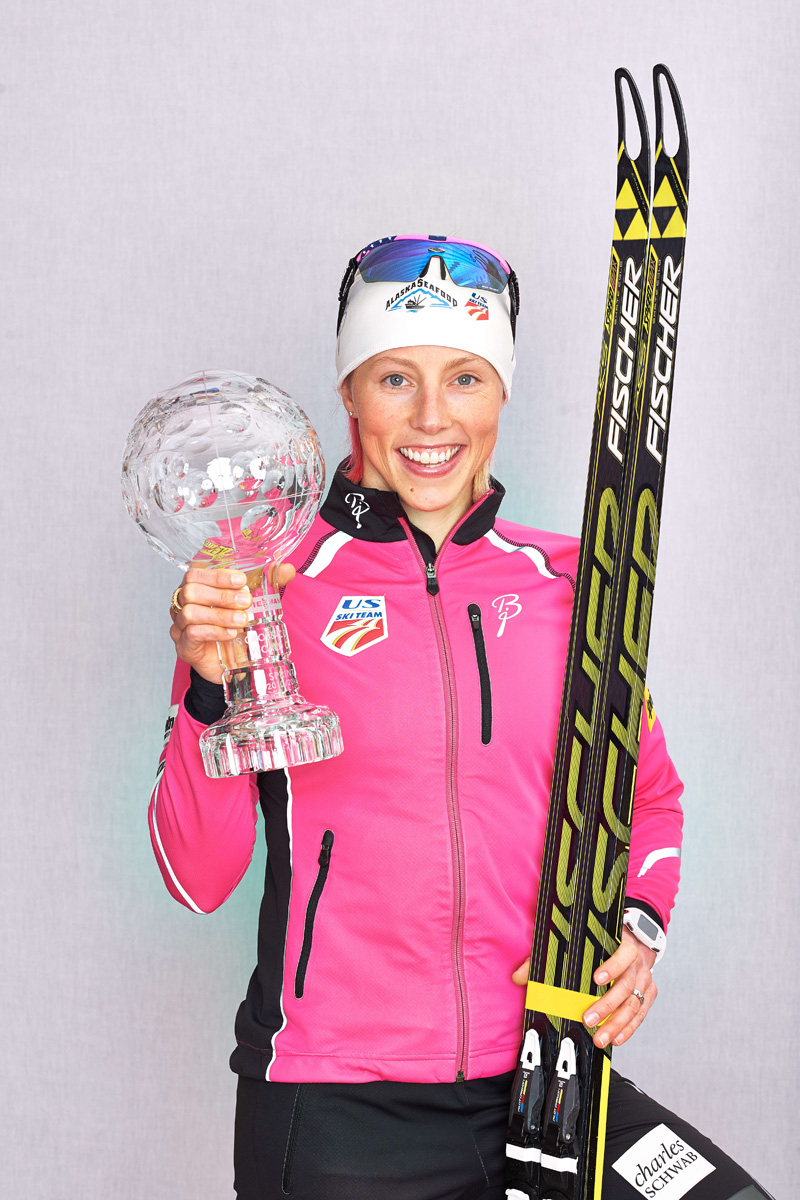
Kikkan Randall with her third consecutive Sprint World Cup Crystal Globe, 2014. (Photo: Fischer/Nordic Focus)
Because, now that we’re kind of starting fresh with the new home in B.C., and as Breck grows up, and Jeff has some incredible accomplishments of his own, I would love our family space to be a little bit about our future, and not so much about my past in particular. So if I can get my awards in places that can inspire others, and people can share that piece of history, I think that would be better than just having it at my home somewhere.
I’d love to see something here at APU, to really celebrate the connection of what we do with the ski team, so that everyone knows about it, gets to feel a part of it. And then the Alaska Sports Hall of Fame, of course, at the airport is a pretty cool demonstration, and who knows where else in town we can have some sort of display maybe. Anchorage certainly deserves a lot of the credit for this.
As Randall observed, her focus in life is currently on the future of her family. But it’s worth noting that her husband, Jeff Ellis, was no athletic slouch himself; he was a World Cup skier for Canada who scored a podium in an Alpen Cup race as well as multiple podia in NorAm races. All of which begs the question, what will Randall and Ellis do when an 8-year-old Breck tells them he wants to do a local running race, or an 11-year-old Breck announces he wants to join a junior ski team?
I would like to follow a lot of the lead that my parents had for me, in that they really felt like they wanted to let me direct the choices. And so when I got interested in something, and wanted to do it, I was welcome to try it.
And then the rule was, once I signed up for something, I was committed to that for at least that season. And a lot of times, I would get excited, sign up for something, and then get into a few days of practice and go, ‘Yeah, I don’t think I want to do this.’ But my parents were like, ‘No, you committed to it, so you’re going to see it through to the end of the season. And then once the season is over, if you want to move on to something else, you’re more than welcome.’
So I think I’d like to follow a similar thing with Breck – introduce him to some things that, you know, both Jeff and I are interested in, because we’d love to let him have a similar experience, but let him guide it. If he’s interested, he can keep doing it; if not, he can move on to something else, and just kind of learn that, once you commit to something, you’ve got to see it through.
And then we’ll just see where it goes from there. I hope to be supportive of whatever direction he takes, and if he gets excited about competitive things and training and wanting to take that route, just support him along the way. So we’ll see.
And finally, the woman who was, famously, the only mom on Team USA at PyeongChang (less fun fact: it was ultimately too expensive for Randall and Ellis to bring Breck to South Korea with them, and he spent the Games with his grandparents in Canada), who nursed an infant from birth through the first month of the 2016/2017 World Cup season and who spent two winters traveling through Europe with a child and a ton of baby gear in tow, is asked how much 2-year-old Breck understands about Mommy’s job.
I think the coolest part right now is, because he’s not necessarily going to be aware of the specifics of what I do, he’s just been around it. He enjoys watching people ski by, he wants to put on skis himself and try it. He’s just kind of being unconsciously subjected to the lifestyle and the people, and that’s been really fun.
And the night before the team sprint, I was Facetiming with him – he was back in Canada with Jeff’s parents – and I said, you know, “Tomorrow Mommy’s got a big race at the Olympics, do you have anything to say?” And he just said, “Gooooooooo!”
And I think he was saying “go,” because my mother-in-law has coached him a little bit to say “Go go Mommy!” So he was kind of saying “go,” but at the same time it almost sounded like, “Gooooooold!”
And last year at World Championships, when he was just 10 months old, he was playing with the bronze medal, and then this year I gave him the gold medal, and he actually kind of looked at, and then he just dropped it and walked away. And since then he’s seen it around a lot, so he’s getting a little bit more interested in it … but he won’t realize what it is for a while, but I think it will be really cool to show him that he was a part of it, and it will be interesting to see what his take on it is later on.
I know that Kateřina Neumannová – I thought it was such a cool moment, and I was there in Torino when she won the 30 k, and her two-year-old daughter came running out to the finish area. I just always loved the image of that.
So a couple years ago, when I first got my pink Kikkan poles, she got in touch and said, “Kikkan, I need a pair of your poles.”
I’m like, Kateřina Neumannová’s getting in touch with me? Like, ‘Whoa, you’re my hero.’ And she’s like, ‘My daughter just absolutely thinks you are amazing, you are her favorite racer, and if I can get a pair of your poles for her birthday, she’s trying to decide between tennis and ski racing right now, and I’m hoping she’ll choose skiing, hoping that this will help.’
And I was like, ‘But does your daughter know who you are? And she’s like, Yeah, it’s kind of a she could care less who I am kind of thing, I’m just her mom.’
[Randall sent the poles to Neumannová. They were appreciated:]
https://www.instagram.com/p/zo3zfijSt7/
So it will be funny to see what Breck’s reaction is to it all. I think it’s cool that he got to be a part of it, and we’ll get to show him the pictures and everything. But what he’s going to really grow up with is knowing me as his mom, beyond the career. So the focus gets to be on our family and on him.
* * *
Disclosure: The author is an Alaska Pacific University masters skier who grew up doing Anchorage youth sports in the same generation as Randall; they skied together in Anchorage Junior Nordic in the early 1990s.
PYEONGCHANG, South Korea — In this episode of Nordic Nation, FasterSkier sat down with U.S. cross-country skier, Kikkan Randall — known by some as Kikkanimal — to discuss her fifth and final Winter Olympics, as well as what lays ahead for the Anchorage, Alaska native.
On Wednesday evening earlier this week, Randall and teammate Jessie Diggins paired up to take the win in the team sprint, earning the U.S. women their first Olympic cross-country medal in gold.
Kikkan Randall racing during her leg of the women’s team sprint on Wednesday at the at the 2018 Olympics in PyeongChang, South Korea. (Photo: FlyingPointRoad)
The day after her gold medal performance, Randall learned that she had been elected by her peers to serve on the International Olympic Committee (IOC) Athletes’ Commission. Consider, she’s also a mom.
Randall will serve an eight-year term as one of 20 representatives on the IOC Athletes’ Commission. Her primary role will be to represent the athletes’ viewpoint within the decision making bodies of the IOC. Randall has served as a leader within Fast And Female. She has also worked as an athlete representative in the International Ski Federation (FIS).
Kikkan Randall (l) and Jessie Diggins after being awarded their gold medals from the freestyle team sprint at Thursday night’s Olympic medal ceremony in PyeongChang, South Korea. (Photo: FlyingPointRoad)
We met up with Randall in the U.S. pop-up training room called ‘The Haven’. You may notice the recording has the ambient echo of a gym; a fitting setting for a conversation with an athlete as powerful as Randall. With her characteristic cotton-candy pink colored hair let down, Randall detailed to us her final Olympic moments and her future role with the IOC as an athlete rep.
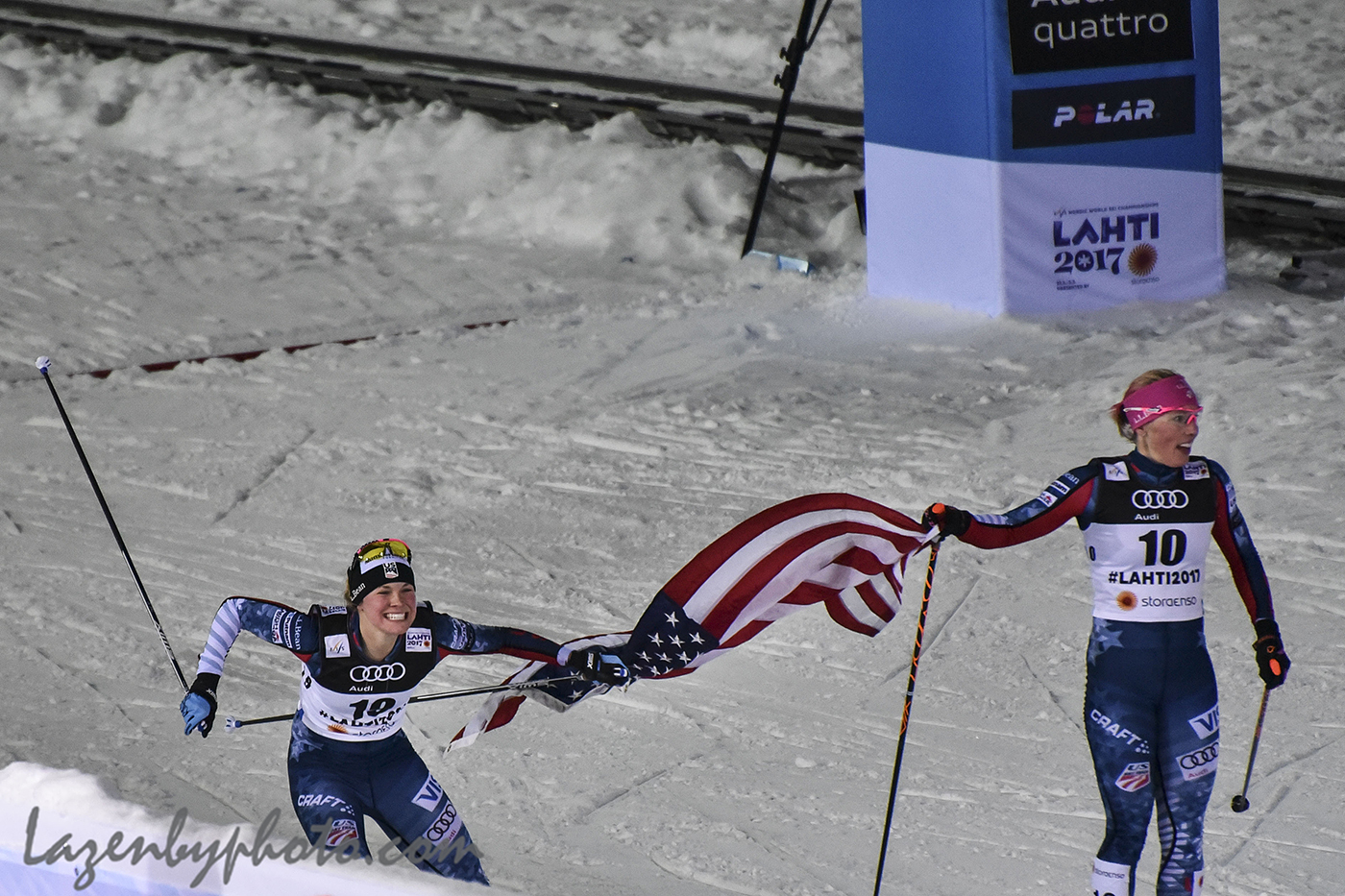
U.S. Ski Team members Jessie Diggins (l) and Kikkan Randall hold the American flag during a victory “lap” down the homestretch after placing second and third, respectively, in the women’s freestyle sprint at 2017 Nordic World Championships in Lahti, Finland. (Photo: John Lazenby/Lazenbyphoto.com)
ANCHORAGE, Alaska — Kikkan Randall is approaching a season full of lasts: her final season as a full-time athlete, her final season on the World Cup, and, she hopes, her fifth and final Olympics. Her main focus these days is resolutely on the future, but she took some time earlier this month to speak with FasterSkier about her summer training and what comes next.
Summer training
Randall’s final summer of training was anchored by the same thing as most of the 17 summers before it: multiple weeklong training camps on Eagle Glacier, the Alaska Pacific University (APU) facility in the Chugach Mountains above Girdwood, Alaska. But this summer saw Randall take only two trips to the glacier, instead of the three camps attended by most of the APU team.
In place of a third glacier camp, Randall traded a short helicopter ride for a long plane flight and traveled to Sweden for a 12-day training camp with the Swedish national team. It was Randall, fellow U.S. Ski Team (USST) member Liz Stephen, and 10 women from the Swedish team, Randall explained in a phone interview.
https://www.instagram.com/p/BXk2D1rj0W2/
Randall began her trip with three days in Östersund, Sweden, with Anna Haag and Stephen, who was coming from the Blink rollerski festival in Gjesdal and Sandnes, Norway. Then came three days in Åre with the full Swedish national team, as well as USST Women’s Coach Matt Whitcomb. The remaining days of camp were spent with the full Swedish team near Vålådalen. The whole thing made for a “really sweet” 12-day training block, Randall recalled.
American skiers were hardly receiving invitations to train with Scandinavian national teams at the start of Randall’s career, but such exchange programs are now relatively commonplace. This was not Randall or Stephen’s first such trip to Sweden, and Jessie Diggins joined the Norwegian national team for a camp last summer.
“I think it’s also a strong testament to our nation, and our program as a good partner to Norway as well,” Whitcomb previously said about the invitation, as well as speaking highly of both Diggins and the Norwegians.
“We’re all training at a high level now,” Randall says when asked whether she sees similarities or differences between American and Swedish training. “We’re all doing very similar types of training, loads of training.”
But even if the training quality and quantity are comparable, the logistics are different, reflecting the simple fact that the U.S. is more than 20 times larger than Sweden, with top-level skiers spread out across five time zones and thousands of miles.
“The real difference for me and what stands out is just the lifestyle of it,” Randall reflects, “and how the Scandinavians never have to travel more than three or four hours away from home. They get together for camps once every three weeks. They’re in camp but they’re these shorter camps and then they go home. Whereas for us, we have the geographical challenges of so much more travel, that when we get together, we have to get together for longer to make it worthwhile, but that of course changes the exact kind of training we can do within a camp, so that part’s varied a little bit.”
The difference isn’t just academic, but rather bears on the type of training that can be done in a group environment. “This camp we went to was an aggressive training schedule,” Randall notes, “and I don’t think it would be smart to necessarily take that schedule and bring it back to the U.S. and replicate it because just the way we live is a little different.”
https://www.instagram.com/p/BXay55rD8oi/
Randall found a valuable training stimulus from the camp, and appreciated the chance to “rub elbows with those guys, be like, OK, I may train a little differently, but I’m on track, versus having to wait seven months between race seasons and not knowing where the heck you are.”
But even more than the reality check on training and fitness, she says that it helps to have local friends in Europe when the Americans are on the road and living out of a suitcase for four months at a stretch.
“I think the biggest benefit” of this offseason training exchange “is that we get to know them as people,” Randall notes. “When we’re on the World Cup, then all of a sudden we have these friends on other teams. If we do need a weekend off and want to go to a home, we can go home with them and get a little break or we see them and we go out for jogs together. It’s pretty cool because I’ve developed lifelong friends now and I look forward to continuing to visit beyond just these training years. I think that shared experience is what really makes it special to me.”
The final World Cup season and the Olympics
It’s tough for any American skier to spend that long away from home. But Randall, with husband Jeff Ellis and support from family members on both sides, is upping the logistical ante by bringing along a toddler. The couple’s son, Breck Stuart Randall Ellis, turns 18 months old next month, and will be spending his second winter on the World Cup circuit.
“Our plan is to pack up early November and head over as a family,” Randall says of their approach for the 2017/2018 season. “We’ve got most of the winter figured out. We’ve got a few more apartment-style accommodations lined up this year. We know with a busy year-and-a-half-year-old, it’s going to be a little harder to contain him in a hotel room. We’re trying to set up the best kind of situation for our family.”
https://www.instagram.com/p/BMy2IR8A_q3/
Randall and Ellis have most of the winter already dialed in, but there’s still one large hole left in their schedule: PyeongChang. “The challenge we’re really wrestling with right now is with what to do about the Olympics,” Randall notes.
Randall is certain that she wants to have her child with her in South Korea if at all possible. “Ideally I’d have Breck at the Olympics,” she says.
Looking back to the 2017 World Championships, Randall says, “I think that was a really positive force having him with me at Lahti, but it’s looking to be exorbitantly expensive to be able to have him in South Korea nearby. We’re looking for accommodations, figuring out can we possibly afford this, and if not, what are some other options? We don’t have a clear answer on that one yet. Outside of that we’re looking forward to a totally fun winter altogether.”
It’s no secret to any parent that traveling with kids is tough. Alaska parents arguably learn this as well as anyone, just because it’s so darn far to travel anywhere from The Last Frontier. (Figure three hours’ flying time from Anchorage to Seattle alone, in the shortest flight that most Alaska kids ever take. And forget driving; that’s a 2,400-mile roadtrip.) It’s tempting to think that a four- or five-time Olympian would have an easier time of things, but Randall recounts challenges and choices that are relatable to any parent.
“It’s an interesting dilemma,” Randall analyzes, “just thinking about it from all sides, because on one hand, it was my choice to have a baby and with that comes different logistical challenges than when you don’t have children. At the same time, I am a strong contributing member of this team, I hope I can contribute to some Olympic medals, and for me to perform at my best, like I said, it was always a really positive influence to have Breck around while I was competing at the World Championships. It would be awesome if I could be able to have him there with me so that I could be in the right state of mind and perform really well. It’s, ‘Do I need to shoulder all the cost myself or can I get some support from the [United States Olympic Committee] or from the U.S. Ski Team?’ At this point it’s going to be fairly challenging to make it happen on our own.”
Complicating matters for anyone who hopes to stay outside of official athlete housing, as of this spring the PyeongChang area was reportedly facing a severe shortage of Olympic accommodations. These problems had not been alleviated as of earlier this month.
Skiing and parenting
Randall speaks candidly about the tradeoffs of doing her job effectively versus being available to her child, a balancing act instantly familiar to any parent. Breck was not with her in Sweden for last month’s 12-day training camp; Randall and Ellis “felt like that wasn’t a super-long stint,” and Breck was able to stay with Ellis and grandparents in Canada while Randall focused on training in Sweden. Randall was also solo at spring camp in Bend (also 12 days), and at each of the two Eagle Glacier camps (6–7 days each).
https://www.instagram.com/p/BY4X5ePHdm9/
“It has actually been a pretty challenging summer,” Randall notes. “I’ve had to be away from him a lot more than I had to be last year. I think I’m willing to do this now because I know it’s my last season. I can’t imagine doing it really any longer.”
She continues, “I’m glad he’ll be with me most of the winter and in Park City [at a USST training camp next month], because it’s getting tougher and tougher to be away, even though it’s nice for training and recovery and sleep and rest. I definitely miss him.”
If athletic training is, generally, a balancing act, then training while parenting is a balancing act while riding a unicycle backwards and juggling flaming knives. If those knives could at any moment start having a meltdown because they couldn’t find their preferred socks or a favorite toy. (Good thing Randall knows how to ride a unicycle.) Choosing between having your child be with you or with a supportive spouse is one such tradeoff. Choosing between more effective recovery and more effective parenting is another such tradeoff, one that Randall has to negotiate at least twice a day as a parent and an athlete.
“The hardest part for me,” Randall analyzes, “is when I’m tired and I come home [from training] and I know that the most productive thing for me is to recover, take a nap, get some time off my feet, to make the next workout effective and do my job, in a sense. But I also have this little boy who wants my attention and I love spending time with him, and it’s been a challenge this summer to navigate that and find a happy medium. I think some days I end up being more of a mom and some days I can, with the support of my husband and my parents, I can be a focused athlete.”
Randall and Ellis have made it work for a year, but Randall doesn’t want to have to make those choices much longer. “Like I said, I can wrap my mind around doing this one more year to make a final push at this Olympics, but that’s why I can’t think about doing it any longer, because I want to be able to not have that dilemma anymore.”
https://www.instagram.com/p/BHGIHlggsXM/
(Randall perceptively acknowledges that this dilemma never really goes away: “I know that while I look forward to not having the restrictions of a ski racer’s life for my family next year, I know that there’ll be, getting back to a more normal life of a job and wanting to fit in training and family and how all that’s going to work. I think it’s an issue a lot of parents face.”)
After PyeongChang
Randall remains committed to her goals for this season, and is working hard to achieve them. But she has also begun to think about what happens next.
So what to do following a nearly two-decade career as a professional athlete? Get involved in athlete representation, of course.
Randall is one of six athletes currently running for two open spots on the International Olympic Committee (IOC) Athletes’ Commission, a representative body established in 1981 for the purpose of representing athletes and their concerns within the IOC context. The commission’s mission is “to ensure that the athletes’ viewpoint remains at the heart of the Olympic Movement decisions,” says its website.
Elections will be held in February 2018 during the Olympics.
Randall has spent many years as a cross-country representative to the FIS Athletes’ Commission, which plays a comparable role relative to the International Ski Federation (FIS), but has not previously served on the IOC commission.
“Why do you want to do this?” Randall is asked.
“That’s a good question,” she replies. “Because it is an eight-year commitment. … I definitely asked myself if I want to go from being committed to a ski racer’s life, finally be retired from competition, and then go right into another eight-year commitment, but I really have enjoyed the athlete representation work I’ve done over the last eight years. I think to take that experience and expand it to the IOC level would just be really interesting.”
Randall has a politician’s poise as she explains why she wants to continue her involvement with the Olympics: “I think now is a great time to get involved and help strengthen the Olympic movement, get it back to a point where it’s being a good force in the world, because I want to see the Olympics still be important for my children, still be important for your children,” she tells a FasterSkier reporter who is also a parent. “I don’t want to see the Olympics go away. I’m hoping I can blend my experience having been an athlete at four Olympics, hopefully number five coming up, and then also having worked on the other side, representing the athletes, being in the business side of the sport, and I just think it would be a really cool way to stay involved.”
But she also seems authentically committed when she talks about the potential of the Olympics as a force for good.
“Bringing the world together every two years for an Olympic Games just creates so much goodwill amongst our global community and it inspires everybody to really find the best in themselves in a fair and clean way, which I think is really good for humanity.”
Norway’s Astrid Uhrenholdt Jacobsen, another candidate for the IOC Athletes’ Commission, racing to bronze during the women’s 10 k classic at the 2017 Nordic World Championships in Lahti, Finland. (Photo: John Lazenby/Lazenbyphoto.com)
As noted, there are six Winter Olympics athletes in the running for two open spots on the Athletes’ Commission. The other five candidates are Spanish skeleton racer Ander Mirambell, Finnish hockey player Emma Terho, Chinese long-track speedskater Zhang Hong, Italian luger Armin (“Il Cannibale”) Zöggeler, and Norwegian cross-country skier Astrid Uhrenholdt Jacobsen.
Randall does not reject a suggestion that the presence of both her and Jacobsen could to some extent split the “Nordic vote.”
“By having two cross-country skiers in the mix, it does have the potential to dilute the vote,” she notes. But she continues, “I think you can also look at it as we now have two ponies in the race. Both of us in the election and there’s probably a better chance that a cross-country athlete will make it to the IOC Commission. That’s good odds.”
Randall is quick to call Jacobsen, with whom she has previously trained on Eagle Glacier as an invited guest of the North American Women’s Training Alliance, an “accomplished person,” who “put a lot of thought into taking on this role.” But she diplomatically notes that Jacobsen “is coming from one side of getting involved in the athlete representation side, at least in an international way, for the first time. I’m coming from the side where I’ve been involved. It’ll just be interesting where people land on who they want to put forward.”
What comes next: Retirement and Canada
First things first, Randall officially plans to retire after this season. “I haven’t done an official press release,” she notes, “but I’ve definitely talked about it to plenty of people. Most people know that’s my plan.”
That leaves Randall and her family (Ellis has spent the past five years working as marketing support manager for the World Cup, but would presumably no longer want to spend all winter in Europe without his wife and son) needing jobs, and a place to do them.
What she’ll be doing next year is “also a very good question,” Randall says. “We’ve been talking about that as a family for a while.”
Randall notes that Ellis “has been very supportive,” pointing out that he moved to Alaska 10 years ago for her sake and has supported her once he retired from his own ski career. “We’ve always talked about once I retire from skiing to be open to chasing some career opportunities for him,” Randall notes. “He’s Canadian; maybe that meant moving to Canada and experiencing that for a while.”
The couple were exploring their options this spring when “an opportunity fell into our lap”: Ellis was invited to apply for a job with Swagman, a bike rack company based in Penctiton, British Columbia, about a four-hour drive east of Vancouver.
“It was total long shot because they were looking to fill the position in April of this year,” Randall notes. But Ellis applied anyway, “just to see what would happen.” He got the job. They were willing to hold it open for him for roughly a year, till April 2018, if he would be willing to move there. Penctiton it is for the Randall–Ellis family.
(Ellis was born in Orangeville, Ontario, and is a Canadian citizen. As the child of an American and a Canadian, Breck has dual citizenship. Randall is working on the immigration paperwork to gain legal residency in Canada as the spouse of a Canadian national.)
While Ellis works for Swagman, as well as parenting, Randall will be pursuing at least two other projects, as well as parenting.
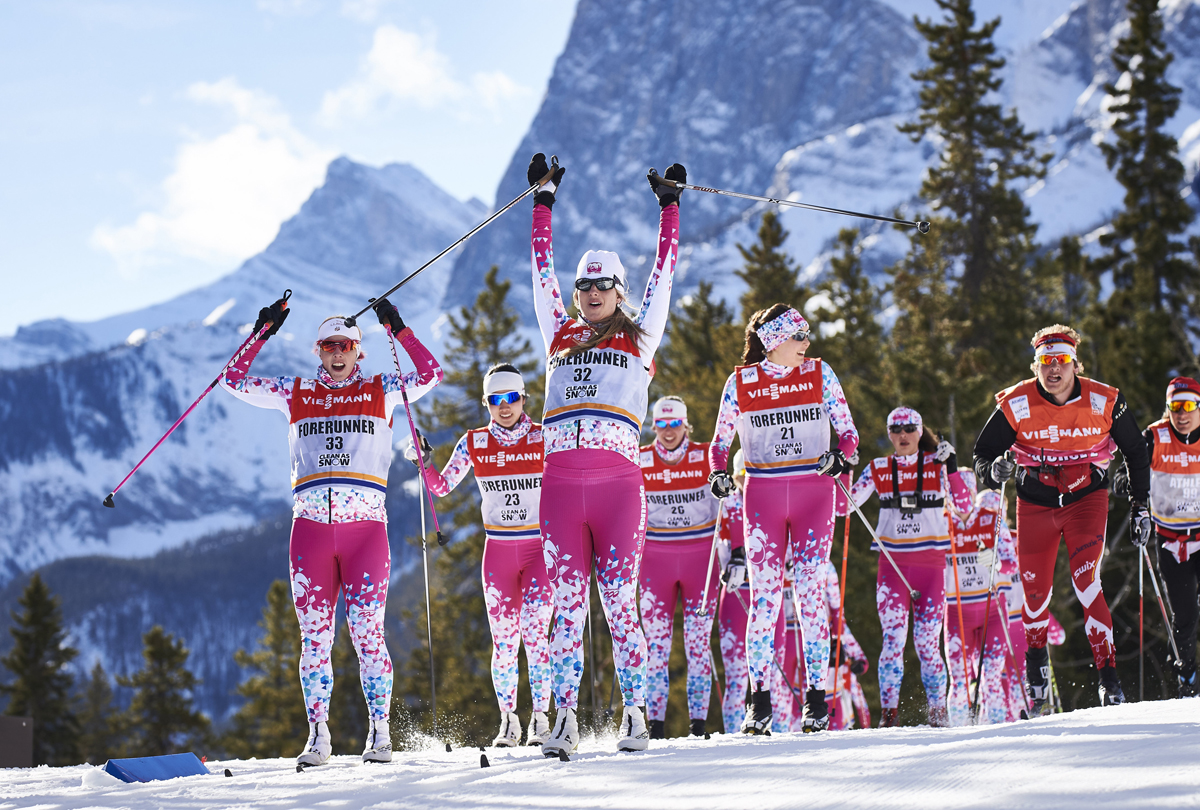
Kikkan Randall (left) and former Canadian national team member Chandra Crawford (32) leading the Fast and Female forerunners before the classic sprint at Stage 5 of the 2016 Ski Tour Canada in Canmore, Alberta. (Photo: Fischer/NordicFocus)
For one, she wants to be able to devote more attention to Fast and Female, a nonprofit sports advocacy group that, its website explains, aims at “keeping girls healthy, happy and active in sports through their teens by introducing them to inspiring athlete role models.” (You may have seen one of their Champ Chats in a ski community near you, particularly if you are the parent of a preteen or young teenager girl.) Randall is the U.S. leader of an international organization that was founded by Canadian skier Chandra Crawford in 2005.
“We’ve kept the U.S. side in a maintenance mode for the last few years,” Randall notes of Fast and Female, “since my time’s been limited, but since now that I can work on it more full time, I look forward to helping grow the U.S. organization maybe to the level that they’ve been operating in Canada. That’s a project on the horizon, depending on how this IOC athletes’ election goes. Should I get that position, that’s going to be a commitment. I want to be able to be flexible around that.”
And for another, she plans to finally get that degree. Randall graduated summa cum laude from East Anchorage High School in 2001 [around the time of the below throwback photo], then has been working on her undergraduate degree in business from Alaska Pacific University (the school, not the ski team) ever since.
https://www.instagram.com/p/BDtGVFmDSqk/
Randall has three classes left at this point. She plans to combine that with a flexible MBA program that recognizes the value of work experience, and to graduate from APU, with both a bachelor’s and a master’s degree in hand, by 2019.
Randall will attend the APU classes through a mix of online learning and intensive class blocks held in Anchorage. She looks forward to staying involved with the Anchorage and APU ski communities, and hopes that the MBA program “kind of creates a blend, allows me to move on to our next step … but also keeps me connected” with Anchorage as she goes through this period of transition.
Looking back and looking ahead (mostly just ahead)
But Randall has a lot of things to get through first in the next six months: her last Park City camp, her last World Cup season opener, (presumably) her last Olympics, her last World Cup race, and so on.
She’s spending much more energy these days training hard than stopping and reflecting, though the significance of some of these “lasts” isn’t lost on her. “I’ve got big goals I’m working towards this year,” she says. “I have my head down a lot of the time working toward that. Though when I was leaving the glacier, knowing it was the last camp, it hit me a little bit.”
But then she adds, “I really do want to take this year in, enjoy it, of course, leave everything I have on the table. I think I have a good perspective now. I got a little practice run the year I was pregnant because I stepped away from the racing season and I got to really appreciate what I love about racing and about training and about my team. This last two years, I think it’s given me the perspective to slow down a little bit and enjoy it because it will be over before we know it.”
Bottom line, Randall says, “Everything I love to do I get to do one more time, and everything that has been hard and maybe I don’t love doing, I only have to do it one more time.”
Randall made this final comment while driving back from the day’s first workout on a blustery and raw Tuesday in September. She made no mention of the weather, but it was a day when the first big fall storm of the season was rolling out of the Gulf of Alaska; a cold rain fell all day, temperatures stayed in the 40s, and the local paper warned of winds gusting to 45 miles per hour, nearly twice that in the mountains. Going back to her freshman year of high school, Randall has trained through the last 21 Alaska autumns.