From the FasterSkier archive — posts syndicated from athletes’ and coaches’ own blogs between 2004 and 2012, kept online as published. Current coverage is at fasterskier.com.
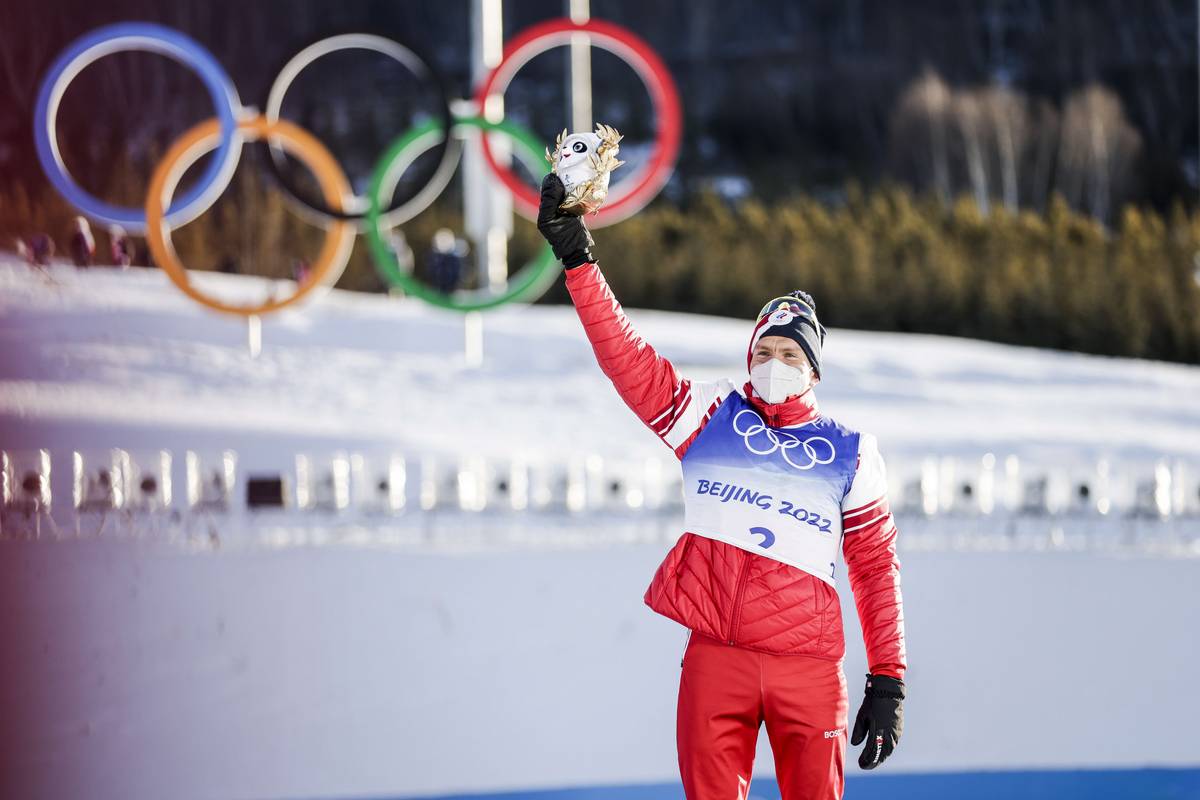
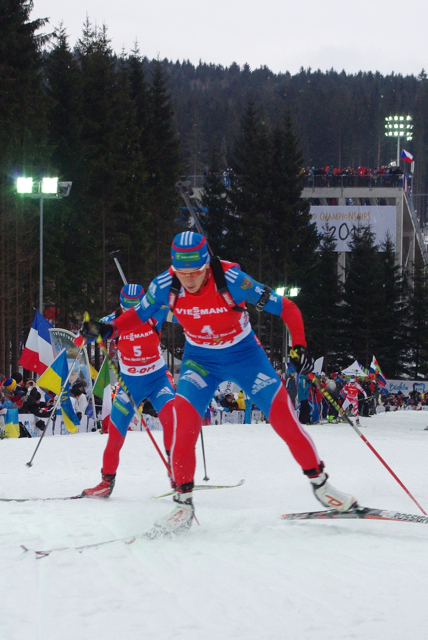
Alexander Bolshunov (RUS) won the men’s 30 k skiathlon in Zhangjiakou. FIS’ recent announcements exclude him (and all other athletes from Russia and Belarus) from qualifying for a return to the Olympic stage in Milan-Cortina. (Photo: NordicFocus)
It’s a funny time we live in . . . one in which many of us struggle with harboring multiple opinions on particular topics (especially political ones). That’s me when it comes to whether or not Russian and Belarusian athletes should be allowed to enter the Olympic Games . . . multiple opinions make sense, and no easy or straightforward decisions seem likely. One thing’s for sure: when it comes to those decisions, someone’s going to be very unhappy.
On October 21, the International Ski Federation (FIS) announced a ruling in which they barred Russian and Belarusian athletes (whether as neutral individuals or as representatives of the national governing body) from competing in upcoming FIS events—events that constitute qualifying opportunities for the 2026 Olympic Winter Games. Since the athletes in question had already been banned from competition since the beginning of Russia’s war on Ukraine, that means that no Russian or Belarusian athletes would have been able to participate in any earlier qualifying events (like the 2025 World Championships). Therefore—since Olympic qualification runs through events sanctioned by FIS—it appears that no Russians will be allowed to compete in the Olympic in 2026. Law suits will be soon to follow, and additional bendings of rules may be considered . . . but, for now, the Russians are out.
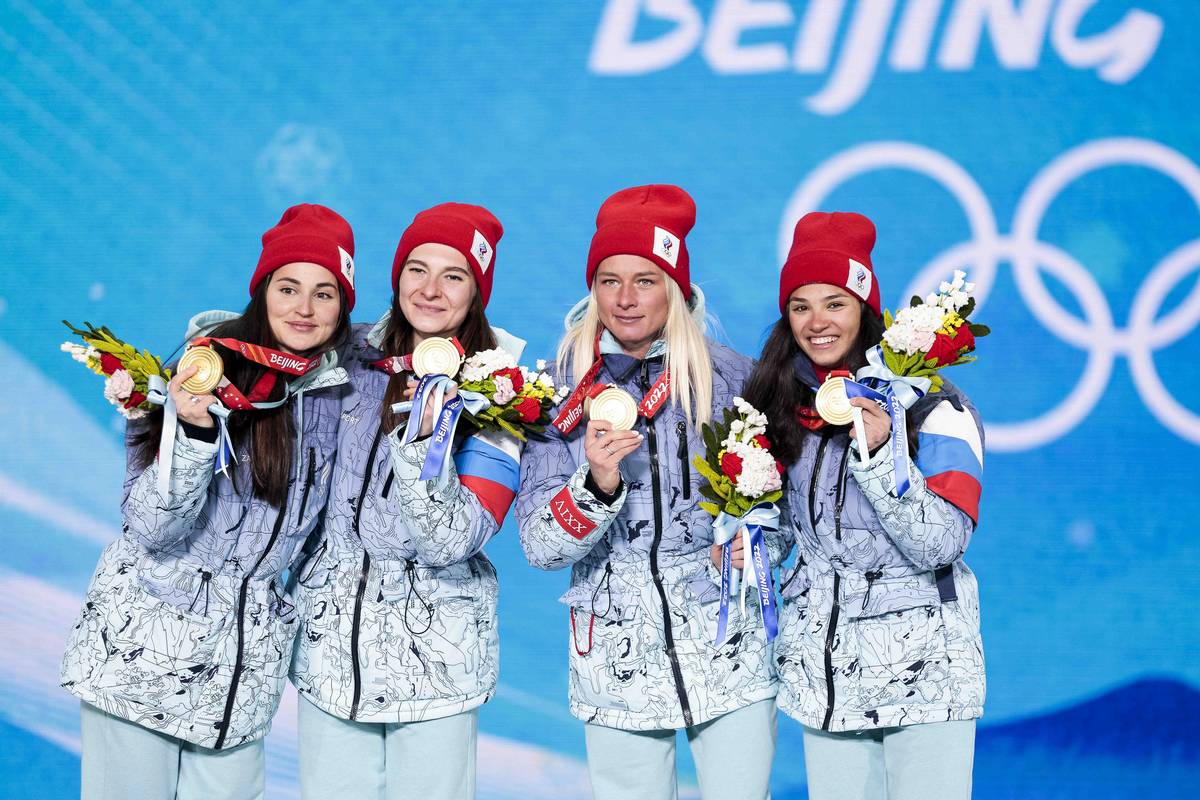
The women representing the Russian Olympic Committee won gold in the 4 x 5 k relay in the 2022 Olympics. From left to right, Yulia Stupak, Natalia Nepryaeva, Tatiana Sorina, and Veronika Stepanova. Recent FIS announcements make it a near-impossibility for them to defend that medal in Milan-Cortina. (Photo: NordicFocus)
What’s right and just about that?
Russia is waging an aggressive war on another sovereign nation. FIS has decided that they will not allow the participation of Russian athletes while their government persists in this criminal action. Skiing is doing its part to try to stop a war . . . I get that.
And what’s wrong and unjust about that?
The Olympic Charter declares that participation in sport is a human right; therefore, the IOC insists that all athletes be allowed to compete regardless of political interference or nationality. In the case of those who hope to prevent Russian and Belarusian athletes from competing in the Olympics, the Olympic Charter is an inconvenient and pesky little document . . . but one that the IOC, itself, is in no position to ignore. FIS has the right (and the responsibility) to establish qualification requirements for those athletes who may go on to compete in the Olympics, but FIS has no right to establish those qualification criteria in defiance of the Olympic Charter. FIS may have announced their decision, but the discussion—and the fight—may not be over yet.
Artificial Intelligence Weighs In
I don’t often resort to the use of AI, but in this case I wanted to see what the broader world (and the computer brain) really thinks about the opinions of the International Olympic Committee (IOC), and the Olympic Charter under which it operates. Here’s what the computer-generated intelligence reported to me (AI generated text will appear in Italics, while Author’s opinions will appear in bold):
Right to compete and non-discrimination
The Olympic Charter states that sport is a human right and that every individual must have the possibility of practicing it without any discrimination.
Here’s the author’s opinion: If “sport is a human right,” then it’s gonna be pretty difficult to prevent any individual human from participating. When it comes to Olympic eligibility, that simple wording is likely to have implications on the participation of even more athletes than just those from Russia and Belarus.
This includes protection against discrimination based on race, color, sex, sexual orientation, language, religion, political or other opinion, national or social origin, property, or birth.
Here’s the author’s opinion: Is FIS discriminating against Russian and Belarusian athletes? It would appear so. The Olympic Charter claims to protect against such discrimination, though how (and if) the IOC intends to affect such protections is still to be revealed.
The IOC and the World Olympians Association (WOA) have strongly reiterated this principle, especially when political tensions threaten to prevent athletes from competing.
Here’s the author’s opinion: Russia’s war on Ukraine is an example of “political tensions” played out to the nth degree.
Athletes should not be held responsible for the actions of their governments.
Here’s the author’s opinion: Russia invaded Ukraine, and Belarus supports Russia. While any number of Russian athletes may have expressed their support for the invasion, certainly those same athletes are not “responsible for the actions of their governments.”
Specific eligibility and rules
Athletes must be eligible according to the rules set by their respective International Federation (IF).
Here’s the author’s opinion: When it comes to “specific eligibility,” FIS has set certain rules (as is their responsibility as a sport governing body under the IOC). FIS’ latest announcement would seem to make it impossible for Russian and Belarusian athletes to participate in the Olympic Games (since none of those athletes will have been entered in any FIS qualifying events).
Specific eligibility rules are applied, such as those related to sex characteristics, which are complex and may require athletes to meet certain criteria to compete in specific categories.
Here’s the author’s opinion: The most recent FIS decision regarding Russian and Belarusian athletes doesn’t seem to have much to do with “eligibility rules . . . related to sex characteristics,” though that’s certainly an argument that should be considered for other athletes who have been barred from Olympic competition. In other words, the right to compete can’t be a human right if certain humans are barred from competing. It’s a touchy subject, but one that’s fairly clearly spelled out in the Olympic Charter. If the IOC (or its sport governing bodies) wants things to be different, then they need to go through the process of amending the Charter.
The International Olympic Committee (IOC) supports the participation of any athlete who has qualified and met the eligibility criteria established by their IF.
Here’s the author’s opinion: Yep . . . but if FIS has acted in violation of the Olympic Charter, then the IOC is compelled to overrule FIS.
Protection of the right to compete
The IOC works to protect the right of all eligible athletes to access international competitions without discrimination by host countries.
Here’s the author’s opinion: Host countries don’t seem to b pertinent in the discussion of FIS recent decision . . . though it may have been a different story when similar decisions were made regarding last season’s World Championships in Trondheim, Norway.
The IOC has taken action in cases where athletes have been denied entry or access to competitions for political reasons.
Here’s the author’s opinion: It sounds like discussions and considerations of the issue may not yet be concluded, and that the recent FIS ruling may not represent the final word. If IOC determines that the FIS decision was one made “for political reasons,” then don’t be too surprised if the IOC decides to allow the participation of Russian and Belarusian athletes. Ironically, the IOC may ultimately allow the participation of Russian and Belarusion athletes for reasons that are mostly “political.”
Ultimately, the IOC is committed to ensuring that sport remains a neutral space and that athletes are not punished or excluded due to political decisions.
Here’s the author’s opinion: FIS is punishing Russian and Belarusian athletes in order to exert pressure on Russia and Belarus (to be fair, much of the world is hoping to exert pressure on Russia and Belarus); therefore, it seems like those athletes are being excluded for political reasons. If that is determined to be the case, then the IOC will need to do something more than simply rubber stamp the decision that FIS announced on October 21st.
There are many weeks between now and the Opening Ceremonies of the 2026 Olympic Winter Games . . . but there’s really not much time left for courts and organizations and governing bodies to consider the question at hand. Many who read the recent FIS decision consider the case to be closed. I’m not so sure . . .
Many readers will consume energy the next few weeks determining how and when to watch the Tokyo Olympics. The summer games feature 339 events in 33 different sports. Its Exhausting on many levels.
FasterSkier covers the winter side of the Olympics, which begin on February 4th, 2022 in Beijing, China. But, we’re here to glance at the Olympics in the news.
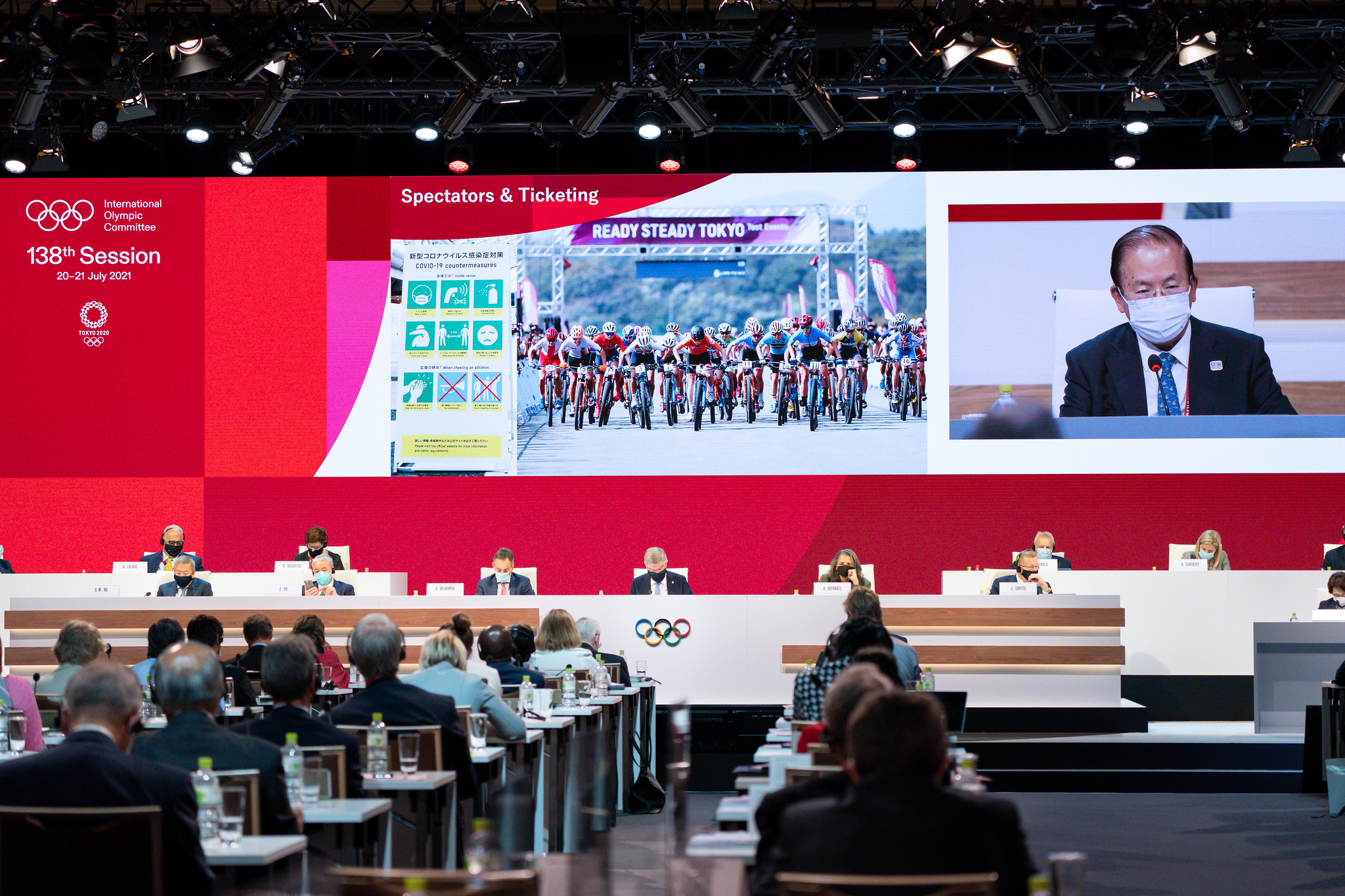
IOC President Thomas Bach during the first day of the 138th IOC Session at the Okura Hotel in Tokyo ahead of TOKYO 2020, the XXXII IOC Olympic Games. (Photo: IOC/Greg Martin)
The news coming out of Tokyo are the Covid-19 cases popping up here and there amongst foreign nationals entering the country for the Olympics. Those trends are compounded by a steep uptick of cases among Japanese citizens. As of July 19th, total cases in Japan approached levels not seen since January – a month often associated with easier transmission of colds and flu.
The New York Times reports this morning that three positive cases have been detected at the Olympic Village. Over twenty more athletes have tested positive outside those accommodations. The messages projected from stakeholders in Tokyo are mixed. Three days ago, International Olympic Committee chief, Thomas Bach, asked the Japanese Prime Minister to reconsider allowing some spectators if the pandemic improves over the short term. For now, spectators are banned from all competitions. Today, Toshiro Muto, head of the Tokyo Organizing Committee, said in a press conference, that if conditions worsen considerably the 2021 Games could be shuttered, but that the further decisions about the 2021 Games would be discussed in “five-party talks.”
With the persistence of Covid-19, variable access to vaccines, and a choice from some with access to the vaccine to forgo immunization due to safety concerns, the virus will likely be around in February 2022.
China is not Japan. There are many layers to that statement. Media, including the Internet, feels the heavy hand of state control in China. So data coming from China regarding Covid-19 infection rates should at least be viewed with eyes wide open. The Johns Hopkins University dashboard, an excellent resource monitoring global infection and vaccination rates, shows China’s situation contrasts Japan’s. According to the Johns Hopkins Covid-tracker, China reported 65 positive cases on July 19.
The regime in China also wields iron-fist power. It is likely that its ability to regulate the movement of its citizens during the Winter Games, especially if cases begin to spike next winter, is real. Despite China’s vastly larger population and geographic breadth, what is occurring in Japan now does not necessarily equate to a similar situation in Beijing when its time for China to host.
Heat and the Summer Games
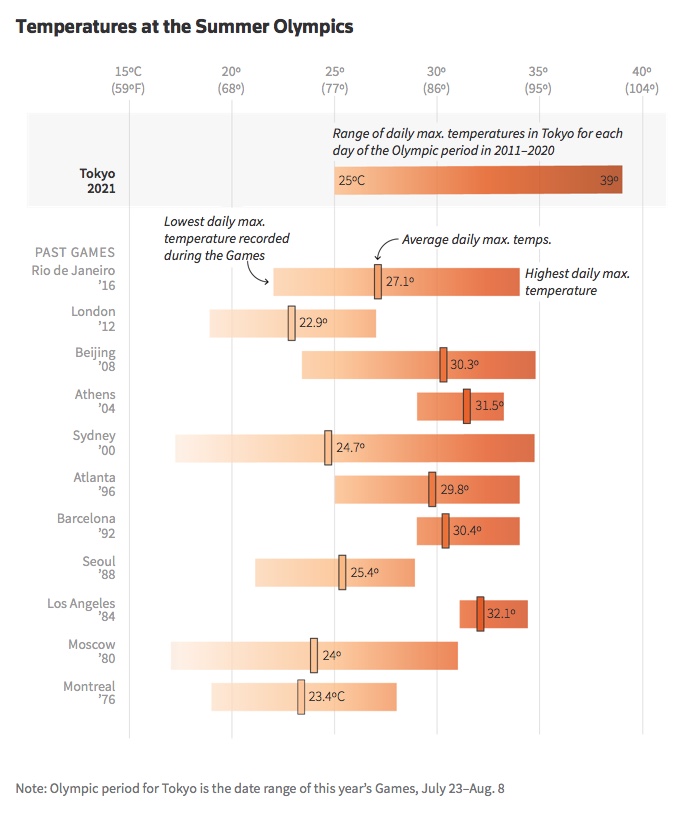
For those interested in high performance, you’ve likely monitored stories and research regarding training and racing in high temperatures and high humidity. Tokyo, if trends persist, should offer both conditions in the upper end of the spectrum. Reuters published an excellent infographic exploring the weather conditions athletes are likely to experience during the Olympics.
1964 was the last time Tokyo hosted the Summer Olympics. Back then, October was the chosen month for competitions. October in Japan presents markedly cooler average temperatures than late July and mid-August.
As the Summer Olympic quad comes to a close, the corresponding think-pieces about the Olympic movement have sprouted. One of many treatments on the topic, which is titled Let the Games … Be Gone? comes from the NYT’s John Branch. The subtitle, After bidding scandals, human rights outrages, overburdened host cities, rampant cheating, a pandemic — and, sure, thrilling competitions — has the world had enough of the Olympics? speaks to the central thesis of his argument. Branch, known as a deft wordsmith, writes about sports for the Times.
Branch quotes many of the most outspoken reformers we have heard from before, including former cross-country skier Noah Hoffman, and icon Edwin Moses.
This brings to mind efficient ways to take a deep dive into the politics of international sport, including the murky world of anti-doping.
It’s now been over a month since the release of the Global Athlete podcast, which Hoffman hosts. In full transparency, Hoffman is a friend, and we have covered him widely at FasterSkier.
If you are looking for lighthearted sports banter, look elsewhere. This podcast trends towards policy wonkishness, with just the right amount of detail for the keen fan or observer of the Olympics. So far, the podcast has delivered. A high-point episode for FasterSkier readers should be Episode 3: Current Athlete Representation Models with Beckie Scott and Han Xiao.
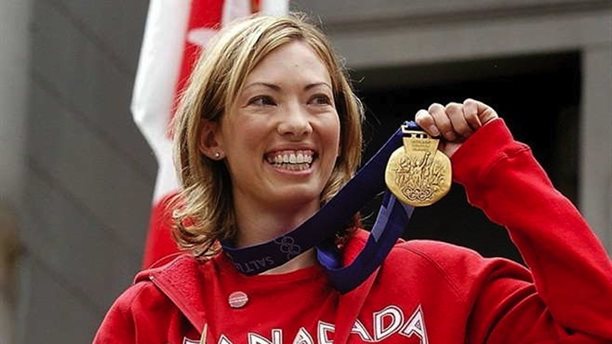
Scott is a retired Canadian cross-country skier who won a gold medal at the 2002 Winter Olympics after the top-two finishers were disqualified for doping. Scott went on to work in anti-doping advocacy as Chair of the World Anti-Doping Agency Athlete Committee and was an IOC member after being elected to the organization’s Athlete’s Commission.
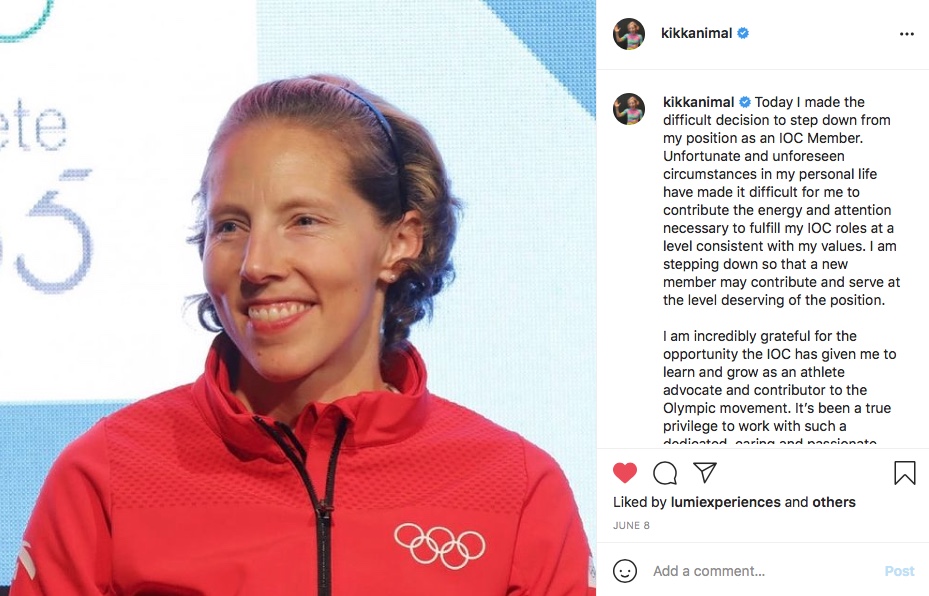
In a statement on social media last week, Olympic gold medalist Kikkan Randall announced that she had made the decision to step down from her position as a member of the International Olympic Committee Athletes Commission. “Unfortunate and unforeseen circumstances in my personal life have made it difficult for me to contribute the energy and attention necessary to fulfill my IOC roles at a level consistent with my values,” wrote Randall.
Kikkan Randall recently stepped down from the IOC Athlete Commission. Randall served on the commission for three years. (Photo/screenshot: @kikkanimal Instagram)
Members of the IOC Athletes Commission provide a link between the IOC and the athletes with the goal of ensuring that the athletes’ viewpoints are at the heart of the Olympic Movement’s decisions. The IOC website lists the responsibilities of the IOC Athletes Commission as:
Empowering Athlete Representation in Olympic Movement decision-making processes.
Supporting Athlete Development in their sporting and non-sporting careers.
Promoting Athlete Involvement in decision-making across the Olympic Movement.
Ensuring Athlete Representation in Olympic Movement decision-making.
Randall has been a member of the IOC Athletes Commission for the past three years and she said, “I am incredibly grateful for the opportunity the IOC has given me to learn and grow as an athlete advocate and contributor to the Olympic movement. It’s been a true privilege to work with such a dedicated, caring and passionate team.” Though Randall is stepping down from the position, she plans to stay involved with the IOC Sustainability and Legacy Commission.
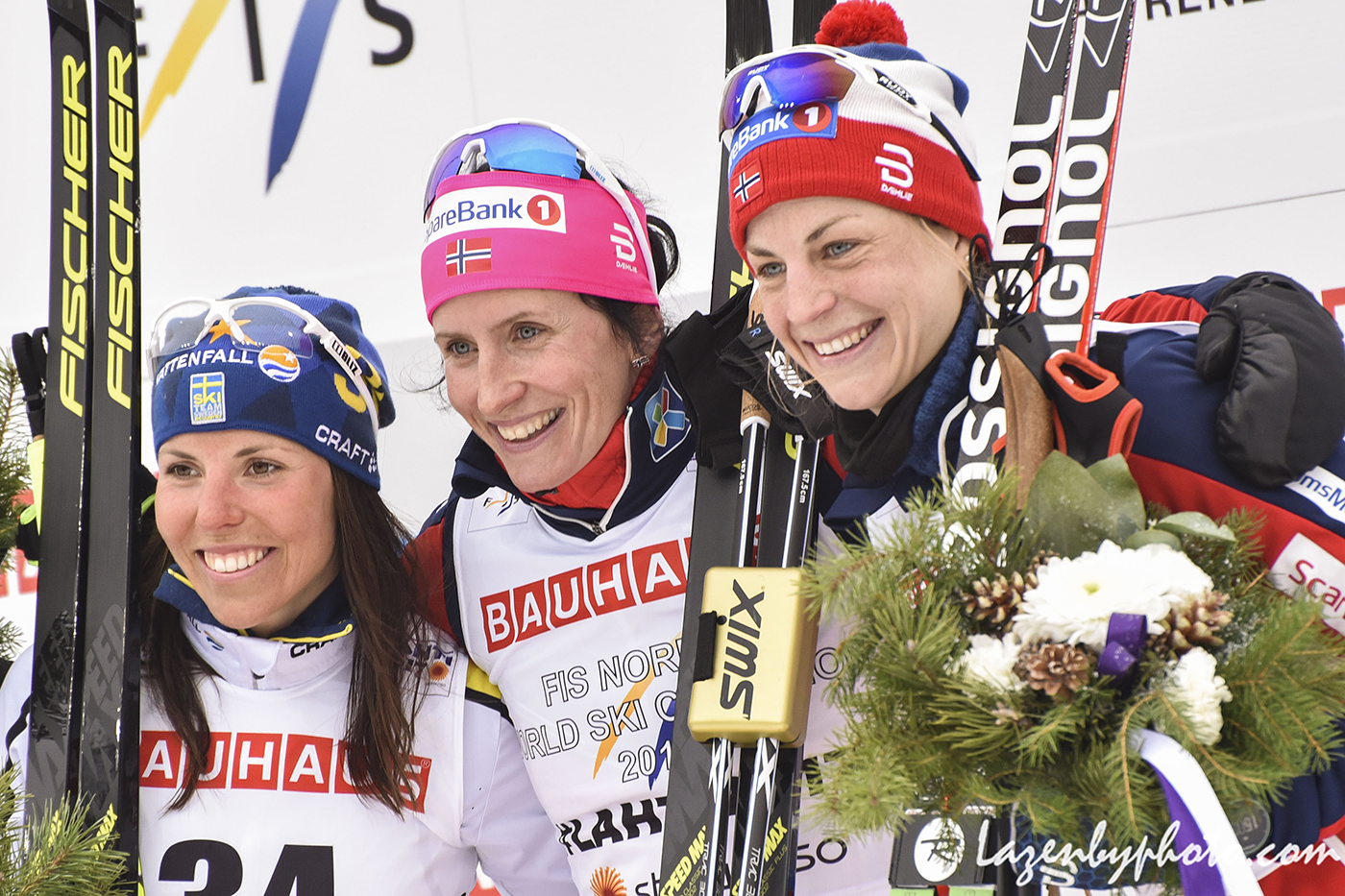
Jacobsen (right), after placing third 2017 Nordic World Championships women’s 10 k classic beind Sweden’s Charlotte Kalla in second (left), and Norway’s Marit Bjørgen in first (center). (Photo: John Lazenby/lazenbyphoto.com)
Randall’s successor on the Athletes Commission is Norwegian Astrid Uhrenholdt Jacobsen. Jacobsen retired from ski competition in 2020 after thirteen years of racing on the World Cup circuit, including a breakout performance earning gold at World Championships in a classic sprint in 2007 and an Olympic gold medal with the Norwegian women’s relay team in PyeongChang. Jacobsen also worked her way through medical school while racing.
In response to her selection to the IOC Athletes Commission Jacobsen said in a press release, “I am both honored and humbled when I now join the IOC’s executive committee and become an IOC member. My main motivation for accepting this position is to work to ensure that the voice of practitioners is heard in all important matters. I experience that athletes have become an increasingly important group in international sports, and that our views have been desired in the important sports policy debates. I am really looking forward to taking on this position.” As one of the 15 athlete representatives, Jacobsen will serve as a member until 2026.
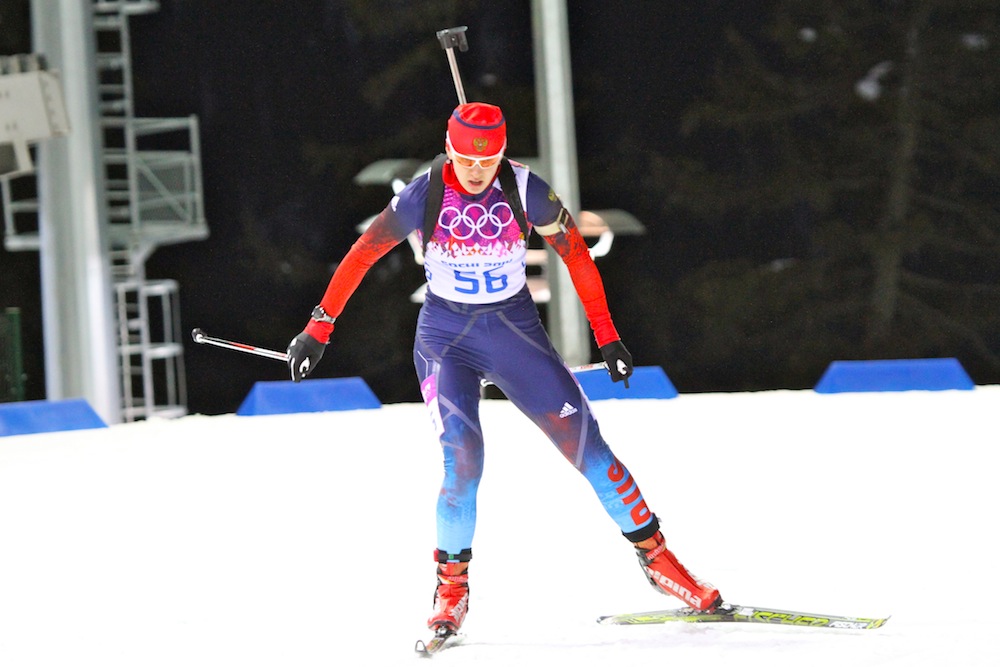
Olga Vilukhina won a silver medal in the sprint at the 2014 Olympics.
The Court for Arbitration in Sport (CAS) announced Thursday that three Russian biathletes implicated for doping at the 2014 Sochi Olympics had their lifetime bans overturned. The biathletes in question, Olga Vilukhina, Yana Romanova, and Olga Zaitseva were first handed lifetime bans in 2017 by the International Olympic Committee (IOC).
The McLaren Report included information tying the three athletes to doping. The IOC subsequently ruled the three Russians had committed an ADRV, or anti-doping rules violation. Their individual and team results were nullified and they were banned from all future Olympic Games. All three skiers have retired.
In the case of Romanova and Vilukhina, CAS stated: “that none of the acts alleged to have committed by these two athletes had been established to its comfortable satisfaction and beyond the mere suspicion of a potential ADRV.”
Prior to the 2017 IOC penalty, Vilukhin won the 2014 Olympic silver medal in the 7.5-kilometer sprint. That medal was subsequently stripped. Thursday’s CAS ruling reinstated individual results from the Sochi Games for both Romanova and Vilukhina. As a result, the silver medal will be returned to Vilukhina.
Zaytseva’s penalty was handled differently. CAS ruled Zaytseva had committed an ADRV for both swapping her urine for clean urine and using a prohibited substance. CAS clarified that Zaytseva would not have a lifetime ban, but would be “ineligible” for the 2018 Games after Sochi.
Beyond having her individual results not reinstated on Thursday, CAS maintained the IOC’s 2017 decision to nullify results from any team including Zaytseva at the 2014 Games. Zaytseva had teamed up with Romanova, Vilukhina, and Ekaterina Shumilova to win silver in the women’s 4 x 6 k relay in Sochi. That medal was stripped in 2017 – CAS upheld that penalty. Zaytseva was also on Russia’s fourth-place mixed relay team.
Zaytseva won gold medals in the 2006 and 2010 Olympic relays and a silver in the 2010 Olympic mass start. Those results are not impacted by the recent CAS decision.
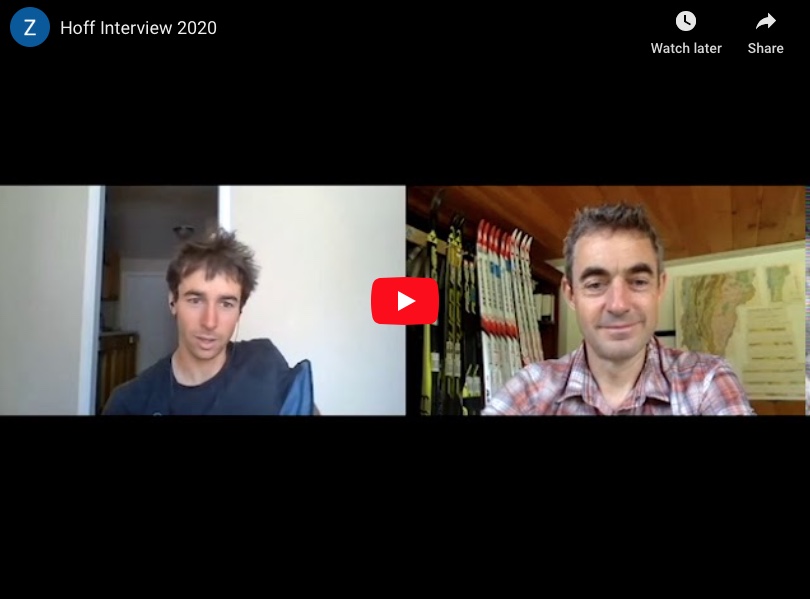
With a kowtow to Zach Caldwell and Noah Hoffman, we are repurposing their recent video conversation about anti-doping reform. On Nordic Nation, you’ll find just the audio. If you are more visual by nature, you can find the video here.
Hoffman is a former longtime U.S. Ski Team member. Caldwell is Hoffman’s former coach and runs Vermont based Caldwell Sport.
In this conversation, you’ll get solid details about anti-doping policy in the U.S. and abroad. Think of this as an advanced level remote learning opportunity to up your game when discussing anti-doping affairs. From Noah’s involvement with Global Athlete, to details on the Rodchenkov Act, USADA, and efforts to magnify athlete voices via labor unions, Caldwell and Hoffman cover lots of ground.
For those that have followed Hoffman’s career, this is an opportunity to hear him as he emerges as a nascent expert in anti-doping policy. It is easy to envision Hoffman leading international clean sport efforts in the years ahead.
Noah Hoffman (left) and Zach Caldwell (right). This is a screenshot of the video, clicking the white triangle will not prompt the video to begin.
The International Olympic Committee (IOC) released results from a wide-ranging survey to assay how the challenges athletes are experiencing during the pandemic and the ensuing lockdown. According to the Athlete 365 Survey Findings, there were over 4000 respondents across the globe, of which 80 percent were athletes, with the remainder described as “entourage” and “stakeholders”. Six percent of respondents were from the U.S.
Of the challenges described by athletes, 56 percent found it hard to train effectively, and 50 percent struggled to remain motivated. When asked, “What are you currently finding most challenging?”, thirty-two percent responded managing their mental health.
The survey also revealed that the needs of stakeholders were focused around event organization, communicating with athletes, and maintaining relationships with sponsors.
(If you or someone you know is struggling with their mental health, you can reach out to 800-273-8255, and speak to a trained mental health professional.)
American Noah Hoffman (r) racing alongside Norway’s Daniel Stock during Saturday’s 30 k skiathlon at the 2017 World Cup in PyeongChang, South Korea. (Photo: Fischer/Nordic Focus)
Noah Hoffman, retired athlete, and current sophomore at Brown University is part of the movement to upgrade anti-doping enforcement. On October 28, he posted a blog highlighting why he supported the Rodchenkov Anti-Doping Act (RADA). RADA is federal legislation that will criminalize doping. More specifically, as Hoffman notes, it criminalizes doping conspiracies involving international sporting events like the Olympics and World Championships.
Here are the details of RADA as highlighted by Hoffman in his October 28 post:
The Act will
Criminalize doping conspiracies that target international sporting events
International jurisdiction extends to any sporting events that has
1 or more U.S. athletes and 3 or more international athletes competing
AND
is a signatory to the WADA code
AND
has a sponsor that does business in the U.S. OR sells rights to be broadcast in the U.S.
If the act is passed, the U.S. would be able to apply broad discovery tools when it comes to investigating doping schemes: Tools that carry with them the financial and investigatory weight of the federal government. Although RADA unanimously passed in the House, it has not been voted upon in the Senate. But just the prospect of the pending legislation already has WADA speaking out against it. In fact, the AP reported that the IOC and WADA have hired a Washington D.C., lobbying firm to “discuss” the legislation.
It appears WADA and the IOC are concerned about the extraterritorial powers potentially given to the U.S. when it comes to pursuing doping syndicates abroad.
Noah Hoffman (bib 26) skiing with Anders Soedergren of Sweden inthe 2014 Olympic 50 k.
With all the white noise and maneuverings surrounding the issue, Hoffman brings a human face to the topic. And he brings passion, which had this been a podcast, you’d pick up on right away. For many years, Hoffman’s skin in the game when competing against alleged dopers had one degree of separation. There he was in the closing kilometers of the men’s 50-kilometer skate at the Sochi Olympics near the front of the pack. Followers of the sport now know the Russians who swept the podium 1-2-3 had the tailwind of state sponsored doping at their backs.
This past winter, one of Hoffman’s closest friends, Karel Tammjärv of Estonia, was arrested in Austria during the 2019 World Championships, for his involvement in a blood doping ring. In the following interview, Hoffman refers to Tammjärv as he discussed the details of RADA.
We interviewed Hoffman on October 30, a few days after his RADA blog post. The interview has been lightly edited for clarity.
FasterSkier: Let’s start with why you are pushing for this piece of legislation to pass?
Noah Hoffman: At its most basic level, the current system just doesn’t work. The Russian Federation faced no real consequences for corruption in world sport on a scale that we have never seen before, maybe since East Germany. We are seen athletes like Karel and the other athletes that were caught in Austria taking actions that reflect the belief that there are no consequences for disregarding the rules and corrupting sport. We have also see law enforcement as one of the very effective tools to counter this corruption.
Pointing specifically at Karel, and I say Karel because he is one of my best friends, but it was really five cross-country athletes and the cyclist and everyone else who was caught up in the Worlds doping scandal from last year — That disrupted doping network was virtually entirely due to the work of Austrian and German law enforcement.
Law enforcement has no tools to address this massive state sponsored doping in this country because it is not a criminal liability to dope — or to orchestrate doping more importantly. To be clear, the Rodchenkov Act does not criminalize doping for athletes. There are numerous reasons why that cannot happen and is not actually something that should be desired.
This criminalizes doping conspiracies, international and national level doping conspiracies where malicious actors are facilitating the doping of numerous athletes on a substantial scale.
FS: Can you advance the argument that addresses why law enforcement should be involved?
NH: We need law enforcement’s help. Law enforcement has tools that even a really well intentioned and independent anti-doping agency like USADA does not have: the powers to search people’s homes, the powers to have a warrant issued, the powers to subpoena people to testify. Those are all things that we cannot do without law enforcement’s help.
And the other thing I will say again is the fact that the exposure of doping that happened in Austria is a direct result of law enforcement.
We are also seeing that the whistleblowers are exposing even bigger doping scandals like the Stepanovs and Gregory Rodchenkov, who are the reason we know that the Olympics in 2014 were so corrupted by urine bottles being passed back and forth through a wall and replaced with clean urine. The reason we know all that is because of these whistleblowers.
The way the current criminal code stands right now, they are not reporting a crime, so these whistleblowers are not subject to whistleblower protections, which is insane. Because we know Rodchenkov has been indicted in Russia. We know that he is sought, and we know that the Russian power structure, Putin to put a name on it, is not above any means necessary of punishing people who speak out against the Russian Federation.
To say that these people are not in danger is insanity. To say that we as a country do not have a responsibility to protect them, I think it is just wrong. And yet Rodchenkov’s protection is entirely privately funded right now. That is another huge point that this Act addresses, it offers whistleblower protections to people that are in grave danger and are risking their lives for the integrity of global sport.
FS: Can you discuss the aspects of RADA that have to do with extraterritorial jurisdiction? For many, this aspect of the federal government getting involved with enforcing doping aboard is perceived as overreach.
NH: I’d like to answer your question on two different levels. One on a moral ground of extraterritorial jurisdiction and two, on the practical implications.
I’ll start with the practical implications because those are easier. That is to say, we do this in U.S. criminal code all the time. If a mob in Italy is engaged in dealing cocaine in China but they are laundering money through U.S. banks, we claim jurisdiction over that even though neither of the harms per se are experienced by U.S. persons — if they are routing money through U.S. banks and U.S. dollars, then we claim jurisdiction.
This is by no means unique. And it is essentially how the system works. I believe that we as a world sporting movement need the power of law enforcement involved in every country in the world if we can get it to investigate corruption in sport. Because it is a global problem and if you limit U.S. law enforcement to only events that happen in the U.S. you very quickly handicap them in being able to bring any charges because these events that are harming real people in this country are defrauding American citizens worldwide, athletes, and we are limiting our ability to prosecute them.
One job of American law enforcement is to protect the welfare of American citizens. For example, the U.S. Postal scandal of the early 2000s was entirely focused on the Tour de France. So if you said that is not within U.S. jurisdiction because it happened in France, to say that Lance Armstrong’s ascension did not have real harm on real people in this country is ridiculous.
I would feel personally offended by that claim because watching Lance Armstrong and the inspiration that he gave was basically my reason for getting into endurance sports. So to say the revelation that the whole thing was a scam didn’t harm me is ridiculous and then there’s the real monetary harm that happens to the U.S. government, that happened to the U.S. Postal service an arm of the government.
FS: State sponsored doping, like we have seen in Russia, rang the alarm bells. How is this playing out behind the scenes with the bill’s passage?
NH: The state sponsored doping that we are seeing now in relation to Russia 2014, and some more recent revelations, they are in alignment with the corruption of democratic values worldwide that we see from the Russian Federation. They are in alignment with Russia meddling with elections worldwide — democratic elections. They are just one more way Russia is undermining democratic ideals, the ideals of equity and the ideals of national welfare for individuals.
We need as many tools to fight that corruption as we possibly can. And if we say, “oh, we only care about election meddling when it happens in this country and you can go ahead and interfere in democratic elections in the rest of the world.” That is an irrational stance because it doesn’t consider the fact that the destabilizing of the global Western World and the destabilizing of the global economy which would be the result, has profound implications in this country.
This is why many legislators have voted to advance this bill in the House. Organized doping is just one more form of international corruption from the Russians and we need to fight this at every opportunity. And that is not just when it happens in this country. This affects us no matter where in the world it happens.
FS: You wrote at length in your blog post explaining why you were against criminalizing doping by individual athletes. Do you care to add anything to that piece?
NH: To be clear in Austria, that situation would not have happened if the Rodchenkov Act were the law of the land here in the US. I mean, athletes will not have been arrested for doping. I outlined in my summary on my blog many reasons why that cannot be the case. Notably, because it is unconstitutional. Also because, Karel will tell you that any fine or the one day in jail he spent in Austria, that is not the bulk of his punishment for doping. The bulk of the consequence is that Karel faces are from the sports world. They are from the public shaming. They are from how this will affect his future opportunities. People are forever going to associate him with this. Anytime he applies to a job, if people don’t already know his name is associated with doping, it would take just one Google search to find out. Those criminal liabilities in those countries are not the main deterrent for athletes’ doping and nor would it be in this country if it were implemented.
Again, I am focused, in this bill, on the actual criminal penalties associated with the act of orchestrating the doping conspiracy which is what is criminalized in this. I am focused on the fact that if it is a criminal liability in any capacity, it allows law enforcement to pursue doping cases and it mandates information sharing between law enforcement and U.S. Anti-Doping. To me as an athlete, the benefit of this bill is to strengthen the World Anti-doping system; the benefit is not to start throwing dopers in jail. That is not the point. I don’t even know if we want to be throwing administrators in jail.
What we want to be doing is exposing doping corruption so that we can then take action to prevent it in the future. This is about providing the tools to be able to address the crisis — not about locking people up and throwing away the key.
The bill is vague, it is not very long — maybe up to ten years in prison and up to $100,000 in fines or something like that. There are not mandatory minimums. The penalties that would be handed out would be up for a judge to decide. Thank goodness, I am not in the business of administering justice.
I believe in this bill because it’s a necessary step to give us the tools we need to let sport live up to its potential, not because I am interested in locking everyone behind bars.
That was the point of my blog. I hope that I answered some of those questions in my text.
FS: Can you speak a bit about personal accountability? At the end of the day, many would say it comes down to the athlete…it’s the athlete makes the final choice to dope.
NH: One is that in order for Karel to make that choice, he has got to have the knowledge to implement it. That is something that I never would have known how to do. If I had decided at some point in my career, personally, that I wanted to start doping, and I thought hard about this, I would not have known who to approach or where to go to make that happen. Clearly, you need the assistance of a doctor. But, how do you find that person and how do you do so so that it does not expose them to your intentions?
And who could I ask for help in that process? I don’t know how I would have answered those questions. I don’t believe that anybody on my direct team, and by that I mean not only my teammates but all of the coaches that I worked with, all of the doctors and physical therapists and administrators that I worked with, I don’t know of a single person on my team that would have assisted me through that process. Who I would have trusted to go work through that– to start the process of doping?
The first thing, in order for Karel to make that decision, he has got to have the tools to do so. I think that the most effective way that we can curb doping, is limiting the athlete’s ability to dope, not necessarily their decision to do so.
That being said, Karel and Johannes Duerr and Max Hauke and Dominik Baldauf have personal responsibility and personal accountability and they made a really bad decision.
I believe that those athletes, clearly they have personal responsibility. Especially athletes like Karel who wasn’t having trouble putting food on the table. He doesn’t have kids to feed. This was not a life or death decision for him. This was a decision that he wanted better results in sport and he felt pressure to achieve better results for him personally, for his family, and his network but also for his country and their fall from grace a little bit in terms of cross-country skiing proficiency.
Absolutely Karel had personal responsibility in that. And I believe that we can continue to espouse as a sports world the benefit of a strong moral compass and personal responsibility and personal accountability. That is the type of thing that in 30 years, when your sports career is over, that you are going to be proud of.
I don’t know what the answer is when it comes to personal accountability. I think those are harder questions to answer than structural ones.
FasterSkier: What are your thoughts on lifetime bans for offenders?
NH: I recall Matt Whitcomb had those bumper stickers made, “lifetime ban for dopers”, sometime early in the 2010s
Banning someone from sport for life is not the same as taking away their liberty. And so I think that it is appropriate for people who orchestrated massive doping schemes that were harmful, that caused real harm to many people, many athletes, that they would not be welcome again in the sports world.
An athlete, even an athlete with multiple offenses who choose to dope personally, and did not push doping on others, and did not require people to support the doping system or they weren’t welcome on the teams — and I am thinking of specifically of what Lance Armstrong did, Lance to me yes, he was an athlete, but he was also an administrator in the system, as was clearly outlined in the USADA report on his doping — And so, for example, I think Lance should not ever be welcomed back into the international sports world. That is not saying Lance should be locked up and go to jail, you know that is a different question.
It may be that I believe that Lance has some criminal liability, but the question of a lifetime ban for an athlete in the case of Lance where someone was acting as both an administrator and an athlete in doping, that yeah potentially a lifetime ban from sport is appropriate.
To wrap this into the work I am doing with Global Athlete, I believe that all of these questions would be better answered with input from athlete voices that actually have real power in the process.
So far most of what I have said is fairly non-controversial. I am going to say also that I actually think, that that major league baseball anti-doping structure is preferred in my eyes to the WADA and IOC anti-doping structure.
It has had lots of instances of doping, it is by no means a clean sport. And people think of the American sports leagues as having no vested interest in anti-doping. And yet, the athletes in Major League Baseball and to an extent, the other professional leagues in this country have real power and real say in what both the rules and punishments are around anti-doping. And as a result, you get a system that has a lot more buy-in from the players than you do on the world system.
This comes through the Union, and the MLB players association, and I have been learning a lot about this in the past year. Ans this is where, if I do continue to work in the sports world, after my time at Brown, I think it will be around elevating the athletes’ voice to have real power in decision making. And that is what we are trying to do at Global Athlete.
Because I believe that the WADA code is not handed down from some deity or is something that is morally correct.
And that is interesting, I am fighting for the Rodchenkov Act which is fighting to criminalize people who conspire against the WADA code, and yet I am not like ‘oh the WADA code is perfect and that is what we should all be aspiring to.’
It is just that I believe in sport with integrity and anti-corruption measures. I think one way to achieve that integrity is to get more buy-in from everyone involved including the athletes. And the way to do that is to give athletes a real voice at the table.
The ability for athletes to speak with a professional independent powerful voice
There is literally no check on the IOCs and WADA’s power. That power trickles down to the national Olympic committees to the national governing bodies to the IFs — international federations.
FS: What’s the next step for RADA and how do folks provide their opinion on the legislation?
NH: The senate is the next step. Bandwidth is the biggest limiting factor in the Senate, this is not a controversial bill.
We need Senate leadership to bring this about. The most effective way to do that is to call their office or write a handwritten letter. In my post, I link to contact info for your Senator. We would love to get this thing done by the end of the year. This is not a long term project.
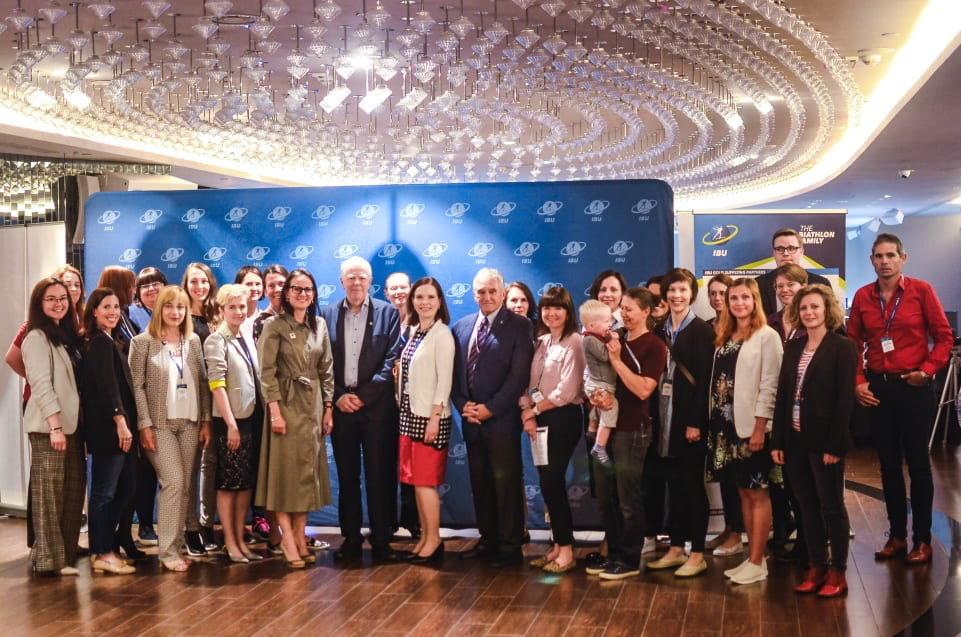
Participants at the IBU’s Gender Equality in Sports Leadership Seminar in Warsaw, Poland. (Photo: IBU/Michał Ostrowski)
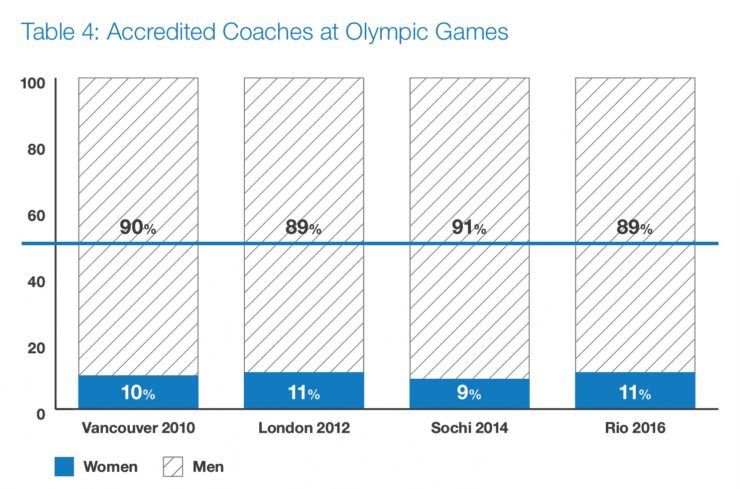
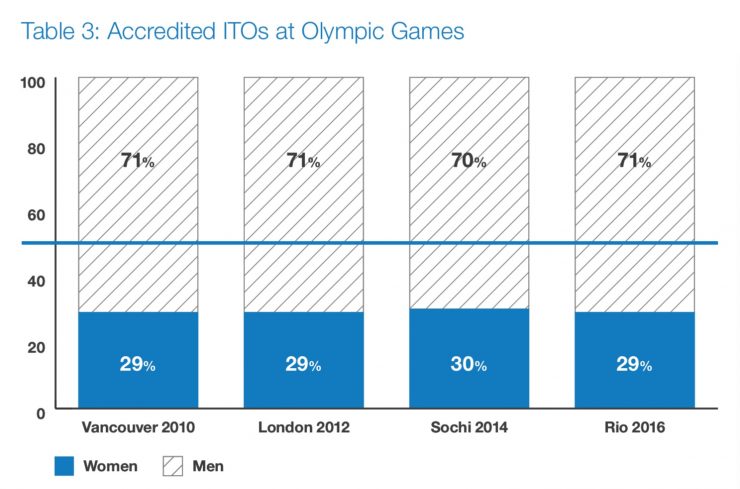
The numbers speak the truth when it comes to leadership in Olympic sport. Let’s take International Technical Officials (ITOs), the people responsible for a range of duties like enforcing rules and race timing protocol during competition. Across four Olympics, including summer and winter Games from 2010-2014, women constituted no greater than 30 percent of ITOs.
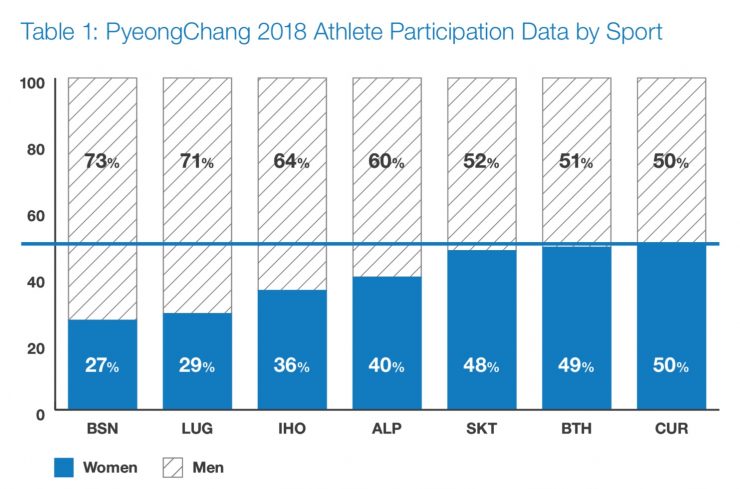
On the coaching side, the numbers were starker. Between 2010 and 2014, female accredited coaches at the Olympics never rose above 11 percent. The irony in snow sports is that according to the International Olympic Committee (IOC), among active athletes at the 2018 Games, 40 percent of alpine skiers were women, whereas 49 percent were in biathlon. Massive gaps remain when considering on-snow athletic opportunities and coaching those same sports at the Olympic level.
IBU equity 1
IBU equity 2
IBU equity 3
(Data from the IOC Gender Equality Review. Double click image to enlarge.)
As part of its attempt to evolve and remain relevant, the IOC released a report titled the IOC Gender Equality Review. The report is a comprehensive document prescribing steps to shift cultural norms, values, and practices to empower women. In total, it details 25 concrete actions. Those 25 “gender equality recommendations” are an attempt to bring change across all aspects of Olympic sport and include funding models, governance, employment, and athlete participation.
The IOC Gender Equality Review was the impetus for the International Biathlon Union (IBU) Equality in Sports Leadership seminar in Warsaw, Poland from May 24-26. According to the IBU, the seminar aimed to, “ensure better visibility of female role models across all areas of biathlon – Executive Boards, National Federations, Organising Committees, and teams, promote women and sport leadership networks, involve mentors and experts to advise women on career progression.”
U.S. Biathlon’s sport program coordinator Danika Frisbie attended.
“We actually believe we have a great amount of equality in terms of athletes rights in biathlon: we have similar prize money for athletes, the same prize money for men and women,” Frisbie said in a call. “We have the same race formats, the same number of events for men and women, we have the same viewership for men and women and equal exposure time on TV. So from an athlete’s perspective, there is a lot of equality as far as sporting goes. But women are not represented in coaching staff or in leadership or in committee positions across governing bodies and at the IBU level.”
Dagmara Garismyk from Poland, who sits on the IBU Executive Committee, was the event’s brainchild. According to Frisbie, Garismyk is a driver for equity in the IBU.
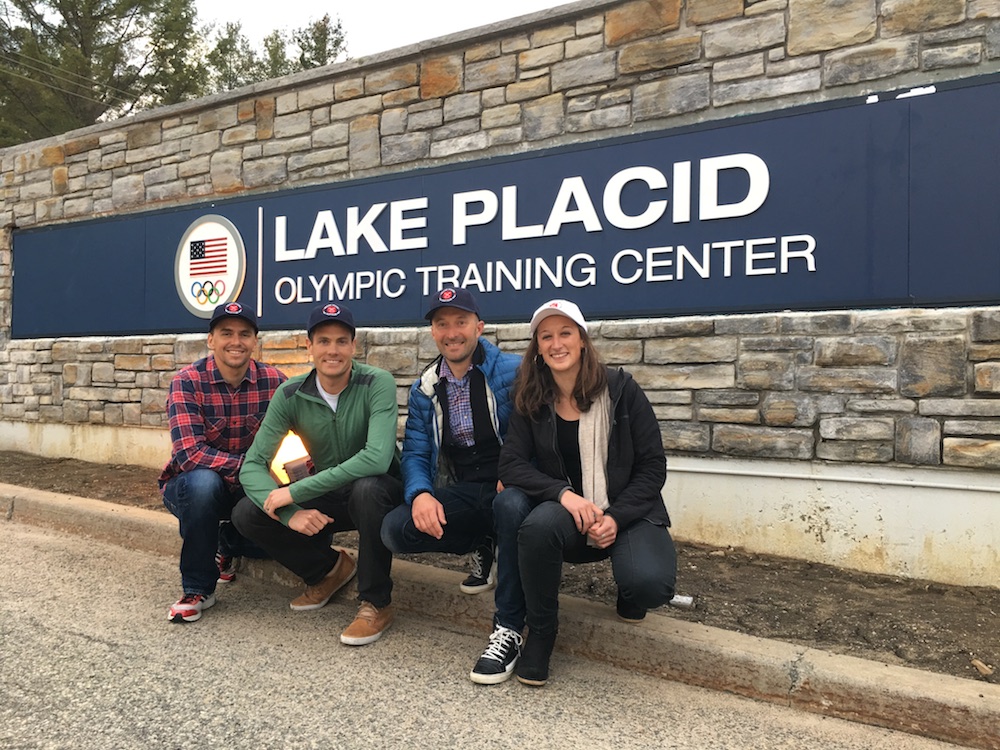
The newest additions to US Biathlon’s coaching and sport-development staff (from left to right): Michael Greis, Tim Burke, Armin Auchentaller, and Danika Frisbie as seen on May 1, 2018, outside the Olympic Training Center in Lake Placid, N.Y. (Photo: US Biathlon)
“This is a passion of hers,” said Frisbie. “She loves working with men and women together and approaches leadership just from such an open, curious, inclusive standpoint and that is why everyone loves working with her and believes in what she does. She is so open in bringing people together always and pushing for the greater good within IBU especially at a critical time.”
Frisbie explained the tone of the conference was about bringing people together, not the airing of grievances pitting one gender against another.
“It was more about recognizing that we are better when we work together in a way that is more representative of the population and there are unconscious biases and systems in place that prevent women from being a part of those conversations naturally,” Frisbie explained. Betting on eSports at VulkanBet includes betting on the largest and most prestigious eSports games
Shifting cultural norms is a slow process. Presenters at the conference explained that teams and organizations with a mix of 50/50 men and women are more productive and innovative and better at adapting to change.
“They produce better results,” said Frisbie. “Apart from their being a gender rights issue, this is also just a performance initiative that if you invest in making sure that women are eventually more represented on technical committees and in leadership positions, we actually will have better results as an international governing body and better results in our national federations, and better development better growth of our sport.”
Some of the changes discussed were mandates. Things like stipulating that an equal number of men and women are sent to coaching seminars. Other methods were geared towards building a culture of equity.
“It centered a lot around looking at the facts behind this issue and just doing education with teams, men and women on the unconscious bias that we have,” said Frisbie.
Frisbie found her time in Poland also focused on meeting other women in biathlon who desire to be leaders. She described a poignant moment when IBU President Olle Dahlin asked the conference attendees to raise their hands if they aspired to be on a technical committee or in a leadership position. Frisbie said every woman in attendance raised her hand.
Global Athlete is an athlete-led organization working for positive change in sport. (Photo: Screenshot globalathlete.org)
Picture in your mind an Olympic athlete. As you are reading this site, you might be seeing the image of Jessie Diggins or Kikkan Randall, or perhaps, Marit Bjørgen or Johannes Høsflot Klæbo. Or, since your skis might be summer waxed, you might think of Michael Phelps, Ussain Bolt, or Katie Ledecky. Regardless of who comes to mind, the image includes an athlete who is in peak fitness, at the top of their game. One of the best in the world.
While the abilities of these athletes are celebrated on the world stage, many feel that their interests, rights, and voices are not always put first by the organizations and agencies that govern and regulate sport.
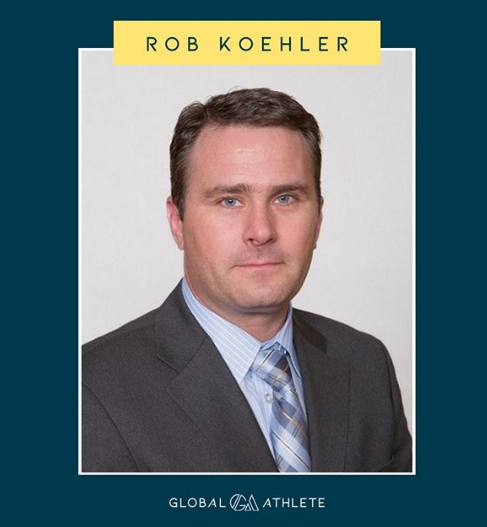
In February, Global Athlete set forth to change that. The organization, spearheaded by Rob Koehler, former deputy director general at the World Anti-Doping Agency (WADA), seeks to be a platform that offers athletes a voice to enact positive change in sport.
“Whether it be athlete welfare, unlocking athletes’ marketing potential, ensuring athletes receive Olympic revenues or simply better representation at the decision-making table, Global Athlete will fearlessly tackle the issues that really matter, working with athletes to determine what needs to change and how to go about changing it,” reads the newly launched website.
Rob Koehler, former deputy general at WADA, leads new organization, Global Athlete, in advocating for athlete rights. (Photo: Global Athlete Instagram @globalathletehq)
During his time at WADA, Koehler worked closely with the athlete’s committee, chaired by Beckie Scott, a Canadian cross country skier who earned a gold medal in the 5/5-kilometer pursuit in the 2002 Olympics in Salt Lake City, and a silver in the team sprint in 2006 in Turin, Italy. Scott’s gold medal was awarded retroactively after the two Russians ahead of her were stripped of their medals for testing positive for the banned substance darbepoetin.
“The work that the WADA Athlete’s Committee took on while I was there, led by, or course, Beckie Scott, the chair – I think they were trailblazers when it came to really trying to have an independent voice and not being afraid to question decisions that were being made by WADA itself and to represent the needs of athletes,” said Koehler in a call. “That is a hard initiative and a hard stance to take, but they were always brave and they were always willing to stand up, and of course, part of my role was to support them and I was pleased to do that. I think they’ve shown a lot of the athlete commissions and committees across the world that it’s possible.”
Koehler resigned from his position at WADA in August of 2018 due to his disagreement with the handling of the investigation surrounding the Russian doping scandal and the conspiracy of the 2014 Olympic Games in Sochi.
“He felt like the athlete’s voice was not part of the conversation [on what to do about the Russian doping scandal],” Noah Hoffman, a member of Global Athlete’s start up group of athletes, told FasterSkier in a call. “He was there, he was part of the conversation at WADA, and he felt like there wasn’t a real athlete voice and that athletes had no say at the decision-making table. So he set out to change that and he has been the driving force for this organization.”
Hoffman has stayed busy in his “retirement”; outside of being a full-time student at Brown University, Hoffman has been working with USADA as an anti-doping advocate and educator, speaking at various sporting events throughout the country. He also attended the Partnership for Clean Competition Conference in London this April. Hoffman . Apart from assisting Global Athlete in tackling issues surrounding doping, Hoffman is interested in promoting gender equity in sport.
Hoffman is in agreement with Koehler’s position that the handling of the Russian conspiracy was not made with the best interest of clean athletes in mind. For Hoffman, the impact of the state-sponsored doping hit especially close to home.
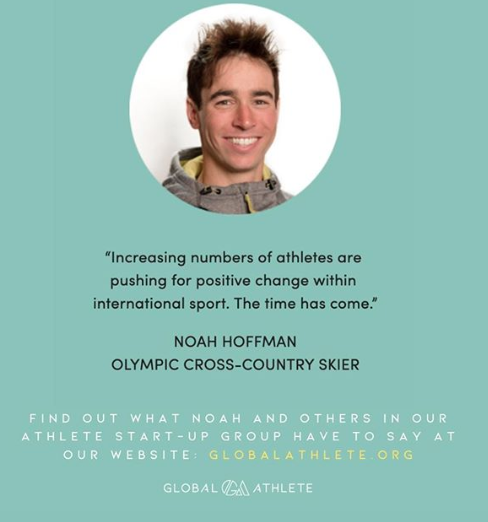
Noah Hoffman is a member of Global Athlete’s startup group. (Photo: Global Athlete Instagram @globalathletehq)
“I was in that race with the Russians sweeping the 50 k,” Hoffman recalled. “I watched those guys ski away from us on the final climb and they stole that race from the guys who rightly should have been on that podium. The consequences that they faced from essentially rigging the results of their home Olympics were to be sort-of banned from Rio. But then to really have most of their athletes be allowed to compete, then to not have their flag be flown in Pyeongchang but to have most of their athletes competing under a neutral flag. And then to reinstate RUSADA immediately following the [2018] games before they had handed over all of the data from the 2014 and before, so that we could actually find out which athletes are involved and to make sure that there is justice served.
“In particular, as the tipping point, was the vote in September of last year to conditionally reinstate RUSADA to the World Anti Doping Agency with the deadline of January first of getting the data,” he continued. “Then to not exclude them again immediately upon January first when the data had not been collected is just evidence upon evidence that they are seeing Russia as a market for Olympic sports and a huge global funder of international sporting organizations. They’re putting the interest of those dollars ahead of the interest of clean athletes and any real consequences for rigging and cheating their home Olympics.”
After his departure, Koehler did not initially seek out a role such as the one he took on with the creation of Global Athlete.
“After I left WADA, I had calls from a lot of athletes saying, ‘You were always a strong advocate. Now that you’re gone, what does that mean? And is it possible to do something further to stand up for rights and to ensure that athletes voices are being showcased and heard?’,” Koehler explained. “So that was where the discussion started, and I was approached by an organization called FairSport to see if there was an interest to make something of this nature.”
Before agreeing to spearhead Global Athlete, which is funded by FairSport and other individual donors, Koehler wanted to be clear that it would align with his athlete-centered ideals.
“I did have some principles I wanted to make sure we would adhere to,” he stated. “One was that the funding that was provided wasn’t linked to decision making. Two was if we’re going to develop something for athletes, it has to be athlete developed and athlete run. And three was the athletes need to develop a startup strategy for how this organization would start and what it’s first initial goals would be. And there was agreement to all three of those.”
From there, a start up group of athletes, including Hoffman, was selected to set the organization into motion. Other names include silver medalist in track cycling Callum Skinner, Olympic para-powerlifter Ali Jawad, both of Britain, world champion kickboxer Caradh O’Donnovan of Ireland, Olympic para-swimmer Benoit Hout of Canada, and Olympic basketball player Rachel Sporn of Australia. Global Athlete has also accrued a lineup of prominent sports figures as “athlete supporters”.
“They were selected based on their advocacy, their strong stance for athletes rights, believing that they could be part of change,” Koehler explained.
Not wanting to dwell solely on the negative aspects, both Hoffman and Koehler spoke about the positive role sport plays in the world and the potential for good it possesses. A return to focusing on this good is part of what Global Athlete ultimately seeks to accomplish.
“You look at the progress that was made through [the Olympics in] Pyeongchang of bringing North and South Korea to the table to talk, and the North Korean athletes having the opportunity to compete in South Korea. That is an amazing feat of the Olympic movement,” Hoffman emphasized. “I think that there is so much more potential for good that we are not reaching because we are focused narrowly on corporate interest. There is greed and corruption as evidenced by the FIFA scandal from five years ago and obviously the Russian doping scandal and the Larry Nassar scandal, I mean there is so much wrong.
“So we feel like a balancing of power will help us to make sport better and help sport do a better job of making the world a better place,” he continued. “Because sport is really neat in its ability to – if you focus on the US alone, sport can transcend this crazy political divide that we have right now and it can transcend geography and bring people together that otherwise have nothing in common.”
Global Athlete seeks to put athletes in the forefront, both during competition and behind the scenes. The goal is to involve athletes in the resolution of these flaws in the system, rather than leaving the decision making and control in the hands of organizations that might be more easily swayed by corporate or financial interest. The organization will be focused on Olympic sports and athletes. However, they draw inspiration from the players’ associations of professional organizations such as Major League Baseball that are already giving athletes a powerful role in decision-making.
“The idea is that if athletes could form a unified voice or at least have a platform to speak through, then we can make our voices heard because collectively we do have a lot of power,” explained Hoffman. “Obviously, sport doesn’t happen or the Olympic Sports Movement doesn’t exist without athletes. So the idea is to bring athletes together to make our voices heard and to give athletes a platform through which to speak and to force the vested power, the current power structure, to listen to athletes.”
“They’re the ones that fill the stadiums, they’re the ones that sell the broadcasting rights and the sponsors, so why not give back to them and make them part of the growth of sport?” questioned Koehler.
At the same time, they do not want the inclusion of athletes to add an undue amount of work to their plates as they recognize that the training load of an elite athlete does not leave often much room for advocacy work.
“Early in my career I was completely uninterested in how the structure was set up around me, all I wanted to do was make sure that I was skiing as fast as I possibly could to succeed within the structure,” reflected Hoffman. “Without realizing how many people were being hurt by the structure and how much the structure was created around this vested power and financial interest and corruption and not around the interest of the athletes. We are trying to do the leg work for athletes, we understand that athletes don’t have time to devote to these issues. We are trying to give athletes the information they need in really easily digestible and short not time-consuming ways so that they can keep up with global sports governance and form opinions and make their voices heard without having it interact with their careers.”
Koehler added that many athletes are not interested in the risk of being seen as outspoken.
“A lot of athletes are still afraid to speak up because there is still a fear of retribution,” noted Koehler. “That if they do go against decisions that they may be sidelined. And that’s nothing new, I think that’s something that has always been a worry for athletes.”
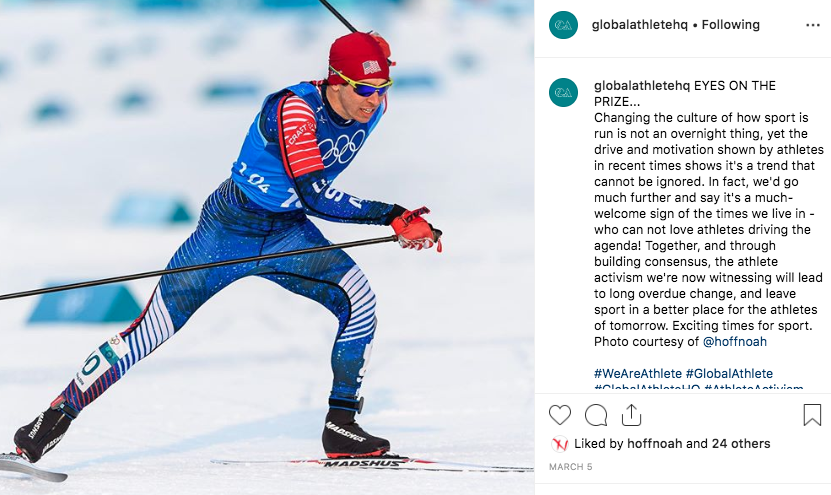
Global Athlete is an athlete-led organization working for positive change in sport. (Photo: Global Athlete Instagram @globalathletehq)
Though the budding organization has been working for only a few months, it has already demonstrated its ability to enact change. Earlier this year, a dispute within the national governing body of karate in Ireland led to the formation of two separate executive committees in the national federation.
“What happened there was the president at the time was given a vote of non-confidence from the Irish Karate Federation and was removed from the board of Irish Karate,” explained Koehler. “Instead of walking away, the president formed his own executive committee, and had close ties at the time with the World Karate Federation. The Irish Olympic Committee and sport counsel recognized the legitimate one and not the new one that was set up by the old president. The president that was given a vote of non-confidence indicated to the athletes that ‘If you don’t recognize me and recognize the new executive committee, you will not be eligible to compete at the regional European championships,’ which were qualifiers for the Tokyo Olympic Games.”
The Irish athletes who were placed in the middle of this dispute reached out to Global Athlete in regard to the injustice of their situation.
“We felt like that was completely unfair to the athletes who were being used as pawns and being put in the middle of the dispute between the two governing bodies in Ireland,” Hoffman stated.
On March 19th, Global Athlete posted an open letter to the International Olympic Committee (IOC), the Association of Summer Olympic International Federations (ASIOF), and the World Karate Federation (WKF), calling out the injustice to the athletes this situation created.
“Within days of us issuing this letter, the World Karate Federation invited the remaining Irish athletes to compete in the World Championships while the dispute was being resolved,” said Hoffman. “So absolutely, having this global platform to speak on behalf of the athletes made an immediate difference in bringing a just outcome to the athletes while the remaining dispute can be fought in the governing structure as it will.
“So that shows you the type of thing where, yes, these issues can be divisive, but we’re not necessarily taking sides in the issue, we’re just making sure that the interests of the athletes in these fights are protected,” he concluded.
Though this example is not one of global policy change, the organization is excited by the impact athletes have already had by speaking out and feel it bodes well for future endeavors.
“I think it was something that we did to make a stance, to bring public attention to the issue, and to help the athletes out,” stated Koehler. “And it was one of the best success indicators that we had.”
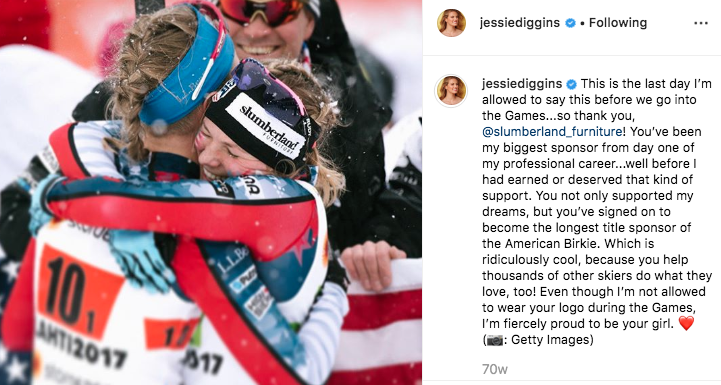
Another issue Global Athlete plans to take on is the controversy surrounding the IOC Rule 40, which limits both athletes and their sponsors in the promotional and social media images they are able to post during a “blackout period” surrounding the games. During this period, non-Olympic sponsors are not allowed to use images of the athlete whom they have backed that are taken during the games and are also prohibited from the use of a long list of words connected to the Olympics in photos that they do use. Athletes are not allowed to mention their sponsors during interviews or on their social media pages, and can be disqualified from competition for violating the rule.
Jessie Diggins posted a thank you to her sponsors on January 31st, 2018 before IOC Rule 40 came into effect for the Pyeongchang Olympics. (Photo: Instagram @jessiediggins)
Many athletes feel this rule is unfair, as it disallows them from promoting their personal brand and thanking the sponsors who made their Olympic dreams possible. As Olympic competition is also the most visible moment of many athletes’ careers, the inability to post at will limits the athletes’ potential to generate new sponsorship and advertising opportunities, thus inhibiting their ability to make a reasonable living while pursuing sport.
Perhaps reflecting the sentiment of this injustice to athletes, after earning a bronze medal in the steeplechase in the 2016 games in Rio de Janiero, Emma Coburn took off her New Balance spikes and slung them over her shoulder during her victory lap and post race photos. As shoes, like skis, are not a part of the Olympic uniform, this did not violate the rule but still garnered her sponsor a bit of limelight.
Recently, the German Federal Cartel Office (FCO) ruled against the IOC and the German Olympic Sports Confederation (DOSB) leading to the extension of athletes’ rights under Rule 40. German athletes will have more freedom in their social media activity, will no longer need approval from the DSOB for their posts, and will be allowed to use more words relating to the Olympics.
“We ensure that the advertising opportunities of German athletes and their sponsors during the Olympic Games, which the DOSB and IOC significantly restricted in the past, are extended,” Andreas Mundt, president of the German FCO, said in a statement.
“We believe that those rights that German athletes just procured are something that all Olympic athletes should enjoy,” said Hoffman.
Global Athlete believes that these rights can be obtained for all athletes if the collective is able to convince the IOC to push the NOC’s for policy change.
“We are now working with athletes to ask the IOC to take some brave action to work with the NOC’s to ensure that the rule is changed for all National Olympic Committees and that every athlete has equal footing when competing at the Games when it comes to promoting their own brands,” said Koehler. “We hope the IOC takes the lead in leveling and balancing the field for the athlete so that everyone has the same rights when they attend the Games.”
Global Athlete shares an optimistic message on social media featuring Noah Hoffman, a member of the startup group of athletes. (Photo: Global Athlete Instagram @globalathletehq)
Perhaps most in the public eye in recent years, Global Athlete also seeks to bring athlete voices into the discussions and decision-making surrounding doping and the pursuit of clean sport.
“We are pushing for a WADA that has much less influence from the IOC,” explained Hoffman. “So right now, national governments support 50 percent of WADA’s budget and they get to name 50 percent of the board of WADA and the other 50 percent comes from the sporting movement, specifically from the IOC who funds the other 50 percent of WADA. And we believe that that is too much control for the IOC and the international sports movement because if there are a few governments – as their inevitably are – that support the positions of the IOC, and they have got complete control over the other 50 percent of the voting power, all of sudden, that have 100 percent control over decisions made at WADA.
He continued, “We want to see a renewed governance structure at WADA that gives a lot more independence and ability to apply sanctions and not just make recommendations and ability to investigate — we want to see a bigger budget. More of the IOC’s enormous revenue going to anti-doping with fewer strings attached. We want to see more athlete voice at the table; the WADA athlete advisory council has been ignored in some of these big issues, specifically around Russian anti-doping and the Russian doping in Sochi. And we want to see the athlete voice have actual voting power and have a much more important role at the decision making table. Governing reform at WADA I think is the biggest thing we are pushing for.”
Moving forward beyond these issues, Global Athlete faces the incredible challenge of deciding which issues in sport to take on and how. As they aim to support athletes around the globe, they anticipate a wide expanse of issues of concern.
“You’re putting your finger on the biggest single challenge of this idea,” laughed Hoffman. “That we can bring athlete voices together, because athletes represent every country in the world and every side of every issue in the world. Anything that is divisive, you are going to find athletes on both sides. Athletes – as they should – represent every swath of society… I think that we need to make sure that there is momentum and if not consensus, then at least a really solid majority of athlete opinions behind an issue before we throw our weight behind it. We don’t want to be splitting the athlete community, that’s really important.”
To address this, Global Athlete will be surveying athletes to gain a better sense of what their concerns are and how they would like to see those concerns addressed.
“One of the things we’re doing now is that we’re taking the time,” said Koehler. “One of the things we’re doing this month is to really get a feel of where the athletes want to go, and we’re looking at a global survey to do that. We do have some representation and some understanding from different parts of the world. The pressures, the development of sport is so different across the five continents that the IOC recognizes under their bylaws.”
Following the guiding principles he mentioned, he believes this survey will preserve the “by athletes, for athletes” approach of Global Athlete’s mission.
“Having a better idea of what they want, what their concerns are, and how we overcome them, I think are crucial,” he continued. “I think that will be our first step in getting a better idea, bringing statistics forward to see what’s happening globally. This is going to take time. We are not rushing things. We want to make sure that we are listening.”
In addition to gaining an understanding of the issues that are present, Koehler thinks this approach will garner the trust of the athletes participating.
“I think we are going to have to show athletes that we really are interested in one thing and that’s helping them,” he stated. “It’s making sure that their rights are put to the forefront and that they’re more engaged in decisions being made in sport and governing sport.”
Changes of this scale will not be made rapidly or without push back, but Global Athlete believes that by including athletes in decision making, gradual progress can be made.
“I think these issues, at times they can feel impossible,” said Hoffman. “Like, how are you ever going to build consensus? How are you ever going to create the type of voice that those professional league athletes have when you have so much diversity as we talked about? Such a cacophony of opinions and such entrenched power in the IOC. There is a general apathy and a sense that the dopers are always going to be ahead and corruption is always going to be there. The young women who are being victimized in sexual abuse scandals are always going to be in danger. And I don’t believe it has to be that way. It really does take motivation from the sporting community and from athletes themselves.”
While the road ahead might be daunting, Hoffman left the conversation on a positive note.
“I am really impressed with how much momentum we have gathered in the first four months of existence and how much sway we have had with global media approaching us and in ability to make things happen, as in Irish karate. And I think that is all evidence of there is a lot of potential here and a lot of need for a stronger athlete voice in these global structures.”
The day is wrapped up in many parts of the globe — the new year has been celebrated, or the anticipation of midnight Jan.1 still tingles for some.
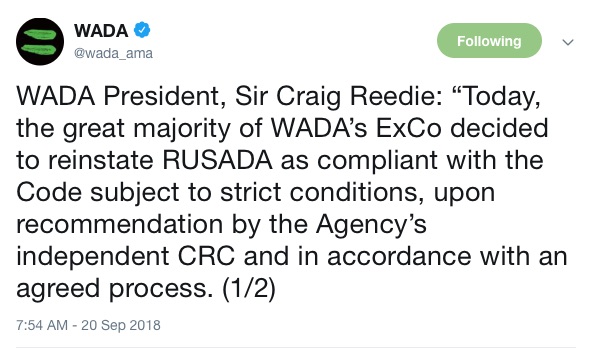
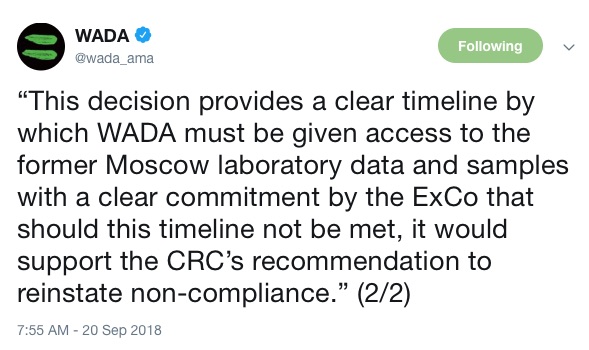
In Moscow, Russia at the time this draft was begun, it was 2:30 AM, Tuesday, Jan. 1. For those who follow nordic sport, you know the clock has ticked past the deadline the World Anti Doping Authority (WADA) had set for Russia to meet the conditions set forth on Sept. 20 for it to remain a compliant nation when it comes to clean sport.
Here’s the short version of the news: Russian authorities had until the end of today to allow WADA investigators unfettered access to its Moscow Lab (run by the Russian Anti Doping Authority or RUSADA), and access to the lab’s LIMS (Laboratory Information Management System) data and any underlying data. Unless WADA has not informed the public, that data is not in the hands of WADA delegates.
It was hoped by WADA and clean sport activist that with the data in hand authorities could conclude which athletes had been involved with Russian state-sponsored doping activities.
But in the latest back and forth between WADA and Russia, clean sport loses.
Even RUSADA’s leader, Yuri Ganus, pleaded this week with Russian President Vladimir V. Putin, in a video message, to intervene and help settle the issues with data access.
“We are on the brink of abyss and I ask you to protect the present and future of our fair sport, present and future generations of athletes,” said Yuri Ganus according to a translation.
On Dec. 21 Russia claimed the equipment brought to Moscow by WADA to examine the data was not certified under Russian law. WADA delegates, in Moscow to work and meet the Dec. 31 deadline, left the country.
It appears despite Russia’s current claim that they are ready to receive WADA investigators again in Moscow, that WADA representatives are preparing to file a report to the WADA Compliance Review Committee (CRC). The CRC will eventually make a recommendation to WADA leaders on Russia’s standing in the sports world. That report is due in mid-January.
Either way, if WADA returns to Moscow or not, the predetermined deadline voted on by WADA’s Executive Committee to hand over the data was missed.
But it is New Year’s Eve. A time to reflect, celebrate, and give thanks to all that was good in 2018.
Beckie Scott during her work for Spirit North. (Photo: screenshot Canadian Press/Spirit North)
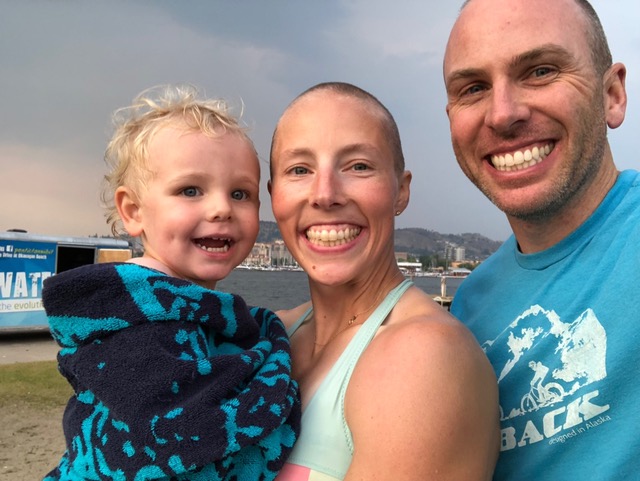
That brings us to the news that Canadian Olympic cross-country champion Beckie Scott has been awarded the second highest honor in Canada, the Order of Canada. The award comes to the forty-four-year-old Scott, who retired from competitive skiing in 2006, for her painstaking anti-doping work. (Scott is currently the Chair of WADA’s Athlete Committee.)
Scott has moved the anti-doping needle with her fearlessness and strict adherence to her core values.
The shifts in behavioral norms when it comes to doping in sport may be small in some regions, seismic in others. Unequivocally, without Scott, the anti-doping landscape would be darker indeed.
Time to toast Scott this evening for her work and award. And then tomorrow turn our attention to WADA’s decisive January.
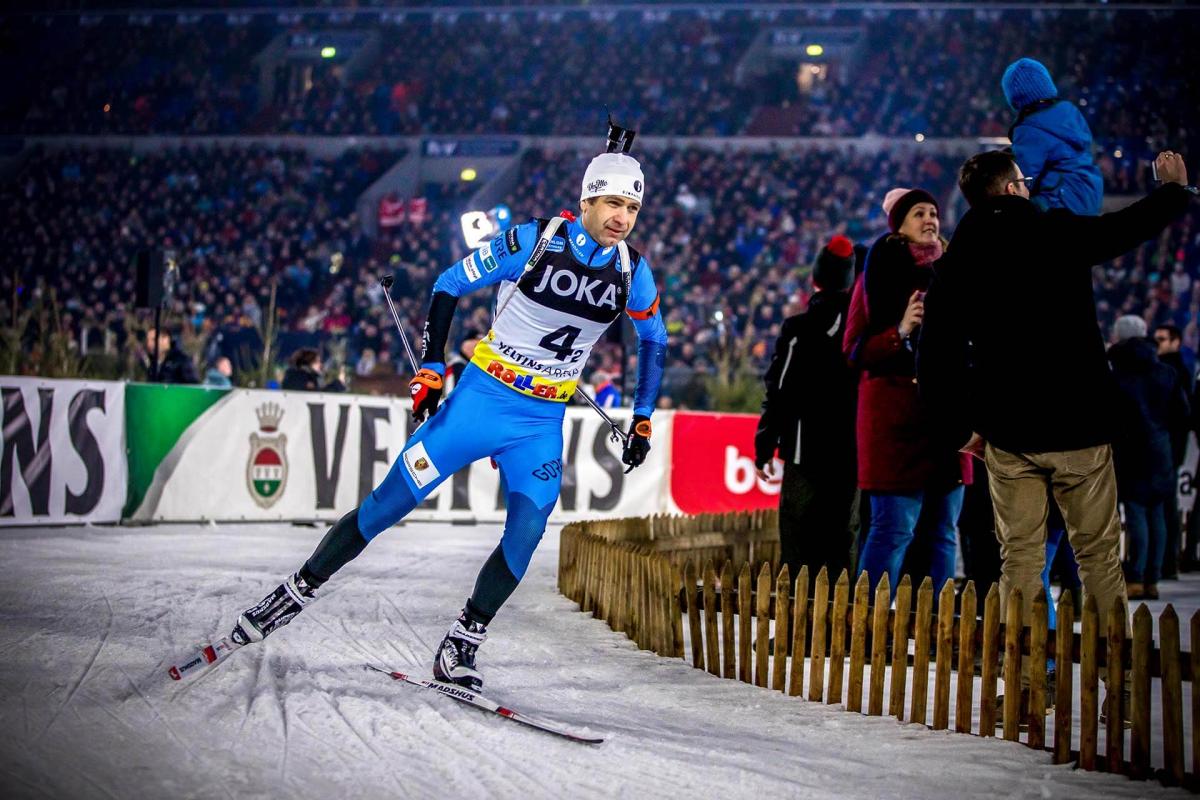
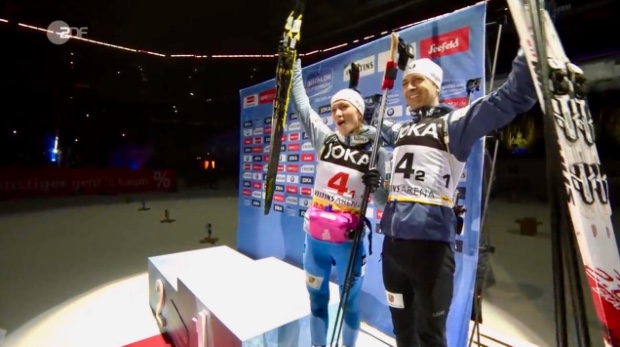
Italy’s Dorothea Wierer and Lukas Hofer in first place (center), Germany’s Franziska Preuß and Simon Schempp in second place (left), and Darya Domracheva of Belarus with her husband Ole Einar Bjørndalen of Norway in third place (right) on the podium of the 2018 “Biathlon auf Schalke” event. The invitational was billed as the last international race for Domracheva and Bjørndalen, the winningest biathlete of all time. (Photo: Event organizer)
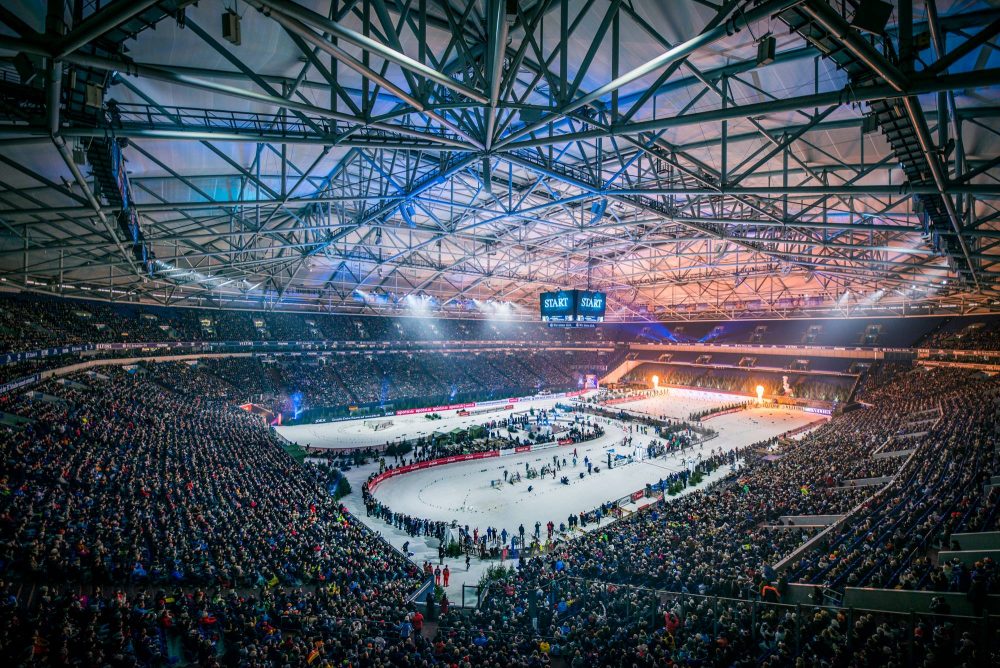
The “Biathlon auf Schalke” two-person mixed relay show race in Gelsenkirchen, Germany, has become a Christmas holiday break fixture on the winter sports calendar. Many biathletes are in awe of the event, featuring a temporary ski course in and around a massive domed arena that usually serves as the home pitch for the Bundesliga soccer club Schalke 04, along with a raucous atmosphere in a sold-out venue and millions watching the broadcast live on TV in several countries.
It’s no real surprise that some living legends of the sport would pick the frantic event that brings biathlon from the mountains to the city as the final race for their storied careers.
In 2018 in its 17th season and with 46,421 fans in attendance, no North American team was represented among the ten invited teams.
The event on Saturday evening mainly drew its fascination from being billed as the final race in the long and successful athletic careers of Ole Einar Bjørndalen of Norway, age 44, and Darya Domracheva of Belarus, 12 years his junior. Combined, the husband-and-wife team could display 12 Olympic gold medals in their personal trophy case, to name just one of their many achievements. By their own admission in a series of interviews with German TV host network ZDF and other broadcasters before, during and after the event, the day certainly was an emotional highlight for Bjørndalen and Domracheva.
“It’s just fantastic, vielen vielen Dank, thank you so much for your support, you are the best!” Domracheva hollered in a fun language mix in an interview with ZDF after the race, drawing a big cheer when her words echoed through the arena via the public address system.
“You couldn’t have dreamed it [better],” her husband Bjørndalen also added in German. “This is incredible, so many people … I never experienced fans as good as this in my life. Thanks again Schalke, this is incredible!”
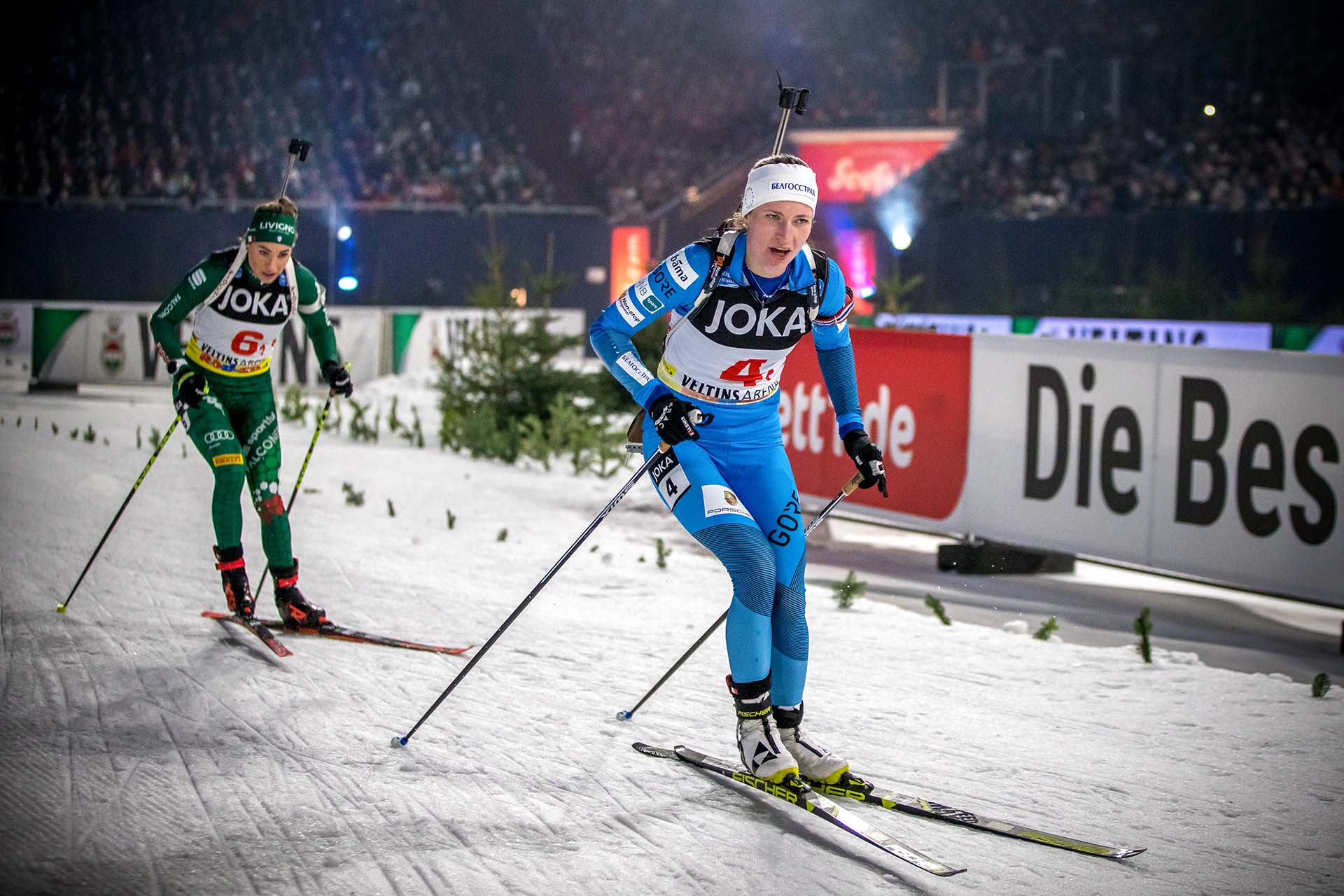
Darya Domracheva of Belarus skiing in front of Italy’s Dorothea Wierer during the 2018 Biathlon auf Schalke event. Wierer went on to win the race with her partner Lukas Hofer. (Photo: Event organizer Facebook page)
First World Team Challenge Victory for Italy
In terms of the athletic merit of the event, the 2018 edition saw the first victory in the history of this competition for an Italian team, with current International Biathlon Union (IBU) World Cup women’s total score leader Dorothea Wierer successfully pairing up with teammate Lukas Hofer.
Over the course of the evening, the Italian pairing turned out to be an ideal combination of the fastest shooter on her race legs and the fastest skier on his. The duo narrowly won the “first half” mass start race of the event which was followed by a 30-minute intermission. Wierer and Hofer also created a convincing lead in the pursuit, which was featured as the “second half” of the evening’s racing.
But their victory was briefly in doubt when Hofer missed three targets in his final standing stage — a bit unusual on a range with no wind influence. Having to circle the penalty loop (though shorter than in regular World Cups) and now on tired legs, the three penalties allowed Germany’s clean-shooting Simon Schempp – who raced with his fellow national team member and girlfriend Franziska Preuß – to catch up to Hofer on the final lap that meandered through a “winter village” concourse around the arena.
“I knew [Lukas] is super on skis, but when he missed three that was still becoming pretty suspenseful,” Wierer laughingly remembered the situation in an interview with ZDF after the race, according to a translation. “But luckily that triggered a little bit of adrenaline.”
Hofer slowed down on the winding 1.3-kilometer course that provided few opportunities for overtaking other skiers before coming back into the main arena where he began to push hard on the only notable straight section along the shooting range. He managed to create a small gap between himself and Schempp and defended that to the finish line to secure the victory in a time of 33:23.6 minutes. Schempp finished 1.2 seconds behind.
“My knees were trembling like a sewing machine,” Hofer said about his problems in the final shooting stage. “Luckily it somehow still worked out fine. I had to ski a tactical final loop, and it’s just great to finally stand at the top of the podium.”
“It’s just a grandiose event,” Schempp said, seemingly not minding the narrowly lost victory (and sponsored car prize). “It’s so incredibly fun to race here in front of such an audience. And when a German team is also in the mix in front, that creates such an atmosphere … That gives you back a lot as an athlete. Just a lot of fun.”
“You really feel like a soccer player with so many people watching,” Wierer added. “Even if you are just trying to have a conversation, it’s so loud you hardly understand anything with all this noise. And it’s great that everyone is being cheered for. Really cool.”
Norway’s Ole Einar Bjørndalen on course during the 2018 Biathlon auf Schalke, billed as the last international race of his storied career. (Photo: Event organizer)
Third Place for the Biathlon Legends
But the real story of the night unfolded a little behind the race for the top of the podium.
In the first event of the evening, Bjørndalen had proven once more that he still ‘got it’, winning a shootout competition to determine the start order against a host of athletes known as fast and accurate shooters.
The semi-retirees Bjørndalen and Domracheva initially struggled a bit with the speed of the athletes still active week to week on the World Cup. Although they were able to hold their own and finished the event’s first half in third place, 6.1 seconds behind Italy and 2.7 seconds behind the French team of Anaïs Bescond and Emilien Jacquelin.
“The course is not so difficult, but when you are in a bad shape it becomes difficult,” Bjørndalen told broadcaster ZDF at halftime, according to a translation. “We didn’t prepare so well, though Darya is still strong but I am flailing a bit in the skiing. Maybe next round will be better.”
Despite admitting he had prepared for the event with a brief training camp in Norway and then a course inspection a day before most competitors had arrived at the venue, the athlete nicknamed “the cannibal” for eating up gaps to other athletes on the course in the prime of his career had some problems keeping speed with the fastest skiers on Saturday.
Domracheva was able to hold up well on the range and course. With her signature elegant ski technique she kept right behind Germany’s currently best-ranked World Cup athlete Preuß on a loop, and stuck within viewing distance of the fast skiing Wierer. With a series of cleaned targets, Domracheva and Bjørndalen managed to keep themselves in podium contention and at one point even maneuvered into the lead, to the joy of the spectators who cheered for them at least as loud as for the German home teams.
Then came the final exchange to the men, which required athletes to shoot a standing stage before skiing another full loop.
“It was mega-cool to watch the final leg, very exciting,” Preuß told ZDF, according to a translation. “I believe everyone watching today saw how the suspense was bubbling up again. That’s how you wish a race should be.”
Bjørndalen had incurred one penalty in his final shooting and skied back on the main course in third position behind Hofer and Schemp. But just a few seconds back, Benedikt Doll, who formed an “injury replacement” second team for Germany together with Denise Herrmann, managed to catch up and pass the Norwegian on the final lap. Being aware that a fourth place just off the podium for the final race for the biathlon star would be an anticlimactic result, Doll waited a few meters before the finish line for the man who he considers his biathlon idol. Doll then grabbed and lifted up Bjørndalen’s arm before skiing into the finish side by side. Intentional or not, Bjørndalen slid his ski boot over the line 0.1 seconds ahead of Doll.
“It was a very nice gesture. It is impressive that he does it at home. Thank you very much,” Bjørndalentold Norwegian broadcaster NRK about Doll’s actions, according to a translation. During the victory ceremony, he and Domracheva then called Doll up to the podium and hung their awarded medals around his neck, who seemed to reluctantly accept the honor.
Darya Domracheva of Belarus (in foreground) is waiting to greet her teammate and husband, Norway’s Ole Einar Bjørndalen, as he skis towards the finish line together with Germany’s Benedikt Doll at the 2018 Biathlon auf Schalke event, billed as the last race of Bjørndalen’s career. (Photo: Event organizer Facebook page)
Bjørndalen will retire as the winningest biathlete of all time, following a 25-year career that is a rare achievement in any endurance sport. To honor Bjørndalen, ZDF showed some old footage and interviews from early in his athletic career in the lead-up to the race.
Bjørndalen amassed eight Olympic gold medals of 13 total Olympic medals, 20 IBU World Championship golds of 45 total championships medals, and 95 World Cup wins with an additional World Cup win in cross-country skiing. Even France’s current biathlon star Martin Fourcade would have to keep competing for numerous years to have any chance at matching those numbers. Bjørndalen’s Olympic record is only surpassed by fellow Norwegian cross-country skiing star Marit Bjørgen.
Domracheva has four Olympic and two World Championship gold medals to her name, most recentlyanchoring the women’s relay to the gold medal for Belarus at the 2018 PyeongChang Winter Olympics. She told ZDF in an interview that she considers the 2014 Olympic Games in Sochi, Russia, to be the peak of her athletic career, where she won gold in the individual, sprint and pursuit disciplines.
Domracheva reportedly plans to still race in one more event at home in Minsk, the capital of Belarus, for which 100,000 spectators are expected to show up.
Darya Domracheva of Belarus and Ole Einar Bjørndalen of Norway waiving to the crowd before the victory ceremony of the 2018 Biathlon auf Schalke invitational race. (Photo: ZDF screenshot)
With homes all over Europe in Beitostølen (Norway), Minsk (Belarus) and Obertilliach (Austria), and already active in other career ventures from sports broadcasting to fashion design, the pair told reporters they have not yet decided where they will ultimately settle in the next few years, wanting to decide that once their young daughter is of school age. For now, their only firm plans are to spend New Year’s Eve together in Norway.
Another Farewell: Russia’s Anton Shipulin
Anton Shipulin – Russia’s best biathlete of the last few years – alsoannounced last week that Schalke would be the final race of his international career.
“Thank you very much, dear fans, for your support,” he posted on his social media accounts, according to a translation. “Without you, this adventure would have been more difficult. My victories are also your victories. I will always remember this. You are the best. I hope we will be able to please you once again at the ‘Christmas race’ [World Team Challenge], which will be held on December 29 and will be the final in my professional career.”
Last winter, Shipulin had been among a number of Russian athletesbarred by the International Olympic Committee (IOC) from starting at the 2018 Olympics in PyeongChang, and claims that to this day he has not yet received a satisfying official explanation by either the IOC or IBU for that blow to his athletic career, according to a fairly rare international interview he gave German home broadcaster ZDF before the race.
Shipulin came back with a vengeance to close out the 2017/18 IBU season, winning the sprint at the World Cup in Kontiolahti, Finland, during the race week immediately following the Olympics.
Overall he has achieved 11 World Cup victories in individual races during his career and won seven medals at World Championships including one gold. Arguably his biggest success, the gold medal from the men’s relay at the 2014 Olympics at home in Sochi, Russia, hangs in the balance as the IOC and International Biathlon Union keep investigating allegations, though for now publicly only against retired teammateEvgeny Ustyugov. Shipulin’s fourth-place mixed relay result from those Olympics has already been voided.
Shipulin conveyed in statements that the international sports bodies and anti-doping authorities have treated his case unfairly during the last two seasons, and the murky situation about his ability to participate in future major sports events combined with the unpleasant prospect to see old results annulled seemingly has exhausted his motivation to keep training and competing.
Russia’s Anton Shipulin claimed his continued compliance with anti-doping regulations in a Russian and English post on his Instagram social media account from December 13, 2018. (Photo: Instagram screenshot)
“I never violated anti-doping rules. I have always completed doping tests in good conscience,” he told ZDF in an interview, according to a translation, reiterating comments he made in social media posts including one from December 13, 2018, in which he called the most recent investigations triggered by Austrian and Italian authorities that reportedly included a team hotel search a “witch-hunt” and “total nonsense”.
On Saturday, the pre-determined final race together with his teammate Ekaterina Yurlova-Percht didn’t quite go as storybook-scripted as for Bjørndalen and Domracheva. Incurring too many penalty laps, the Russian duo was never really in contention for the podium and ended the race in seventh place (+1:48.8).
Yurlova is a veteran of racing at Schalke,winning the event a year ago together with Alexey Volkov, as well as in 2012 when she had teamed up with Shipulin and is currently in full World Cup race mode. Also, like her teammate Shipulin, Yurlovawas not allowed by the IOC to start in PyeongChang and reportedly could still be under investigation by international sports and legal authorities. But so far has not been publicly charged with any concrete violations. She is married to an Austrian national, and by living in that country is under the supervision of the local anti-doping agency for much of her off-season.
Shipulin had not yet raced in an IBU event this season, citing a lack of training time in the summer. Though prior to his announcement last week it had been widely expected that he would be back with the Russian team in time for the races in January or at the latest for the World Championships in Östersund, Sweden.
Similar to Domracheva, Shipulin might still make an appearance in a farewell race at home. He told ZDF that he looks forward to now spend time in Tyumen, Russia, with his family, and said he was also happy to have more opportunities for his other sports passion: fly fishing.
Final Results “Biathlon auf Schalke” World Team Challenge 2018
Shooting range and part of the ski course inside the domed Veltins Arena during the 2018 ‘Biathlon auf Schalke’ invitational race event. (Photo: Event Organizers Facebook Page)
While the International Biathlon Union has adopted the mixed and single-mixed relay formats as exciting new disciplines in recent years, the “Biathlon auf Schalke” also dubbed the World Team Challenge by the organizer is an invitation-only private event not sanctioned by the IBU (even though there areplans to cooperate in the future, especially regarding a junior competition leading up to the main event), so there were no World Cup points much less internationally recognized medals to win in the race. That will happen towards the end of the season in March at the IBU World Championships in Östersund, Sweden.
The regular IBU World Cup season will continue on January 10th, 2019, in Oberhof, Germany.
Hours after this photo was taken at the 2014 Winter Olympics of Alexander Legkov in his post-Olympic gold celebration, Russian anti-doping head Grigory Rodchenkov has said that he switched out Legkov’s anti-doping sample for a vial of clean urine collected previously.
Earlier this week, among the tumult in Washington, D.C., Senators Orrin Hatch of Utah and Sheldon Whitehouse of Rhode Island, introduced the Rodchenkov Anti-Doping Act to the Senate. The proposed legislation is named after Grigory Rodchenkov, the former head of the Russian Anti Doping Agency’s (RUSADA) Moscow Laboratory. Rodchenkov was one of several whistleblowers who helped reveal state sponsored doping in Russia.
The Rodchenkov Anti-Doping Act, if passed in the House and Senate will criminalize doping when it involves attempts to impact the results of major championships like the Olympics and World Championships. Fines of up to $1 million and prison sentences of up to ten years could be handed down.
The bill strengthens the ability of the U.S. legal system to bring doping violators to justice. In the past, for example, sanctions resulting from the Sochi scandal have been handed down by sporting bodies like the International Olympic Committee (IOC) and anti-doping agencies like WADA. Entities many claim lack the teeth and will to curb doping.
Under the bill, the anti-doping reach of the U.S. government will extend internationally. The Rodchenkov Anti-Doping Act empowers the U.S. government to investigate international sporting events outside U.S. borders if the competition meets certain parameters.
The sporting events must be multinational with at least four countries, including the U.S., competing. At least four athletes from the U.S. must be entered in the competition.
The proposed law also bolsters the ability of U.S. companies sponsoring out-of-country international sporting events, like the Olympics, to seek damages if the doping in question tarnishes the image of the sponsored event.
The language in the bill also extends the definition of “doping fruad” to include lost opportunities to U.S. athletes when competing against doped competitors. In other words, athletes who lose medals or prize money, and potential sponsorship earnings could file a claim to recover those lost opportunities.
Further, the Rodchenkov Anti-Doping Act protects individuals coming forward as whistleblowers who serve the interest of clean sport.
Travis Tygart, CEO of the U.S. Anti Doping Agency (USADA), made the following statement earlier this week regarding the Rodchenkov Act.
“This Bill is part of the overall recognition that doping is fraud, and when it’s done by organizations and institutions – whether that be by a sport or an entire nation – it’s going to be put on the same level as other types of fraud. All of those who value fair play and clean athletes rights should welcome this legislation and support its immediate passage.”
A scene from the Opening Ceremony of the 2014 Winter Olympic Games in Sochi, Russia. (Photo: Wikimedia Commons)
A full Olympic quad after Sochi, nothing remains irrefutably clean. Off the radar then on again, the Sochi doping scandal has sent recent tremors through the sports world.
In a quick summary, after the 2014 Winter Olympics in Sochi, Russia, the host nation was handed sanctions for the 2016 Rio Summer Olympics that affected some of its athletes. A total ban from Rio was not enacted despite the World Anti-Doping Agency (WADA) recommending the contrary. Russian athletes competed under the Russian flag.
At the 2018 Winter Olympics in PyeongChang, South Korea, the International Olympic Committee (IOC) handed down a fiercer sanction. Russia as an official team and its Olympic delegation were banned from the Games, as were athletes suspected of taking part in the Sochi affair.
Russian winter athletes without any ties to the scandal competed under the IOC’s neutral flag as the Olympic Athletes from Russia (OAR).
Russian President Vladimir Putin with Russia’s 2018 Olympians prior to the Games on Jan. 31, 2018. (Photo: Wikipedia)
At the 2018 Games, OAR cross-country athletes were on-form. They were repeated medalists, fast and collectively young.
Today (Thursday, Sept. 20), it was the WADA’s turn to take another stance. During a meeting in Seychelles, the WADA Executive Committee (EC) voted to reinstate the Russian Anti-Doping Agency (RUSADA).
WADA announced the decision via Twitter. In the two-part tweet, WADA President Sir Craig Reedie stated, “Today, the great majority of WADA’s ExCo decided to reinstate RUSADA as compliant with the Code subject to strict conditions, upon recommendation by the Agency’s independent CRC and in accordance with an agreed process.
“This decision provides a clear timeline by which WADA must be given access to the former Moscow laboratory data and samples with a clear commitment by the ExCo that should this timeline not be met, it would support the CRC’s recommendation to reinstate non-compliance.”
For reasons already exhaustively documented, RUSADA was deemed non-compliant in November 2015. By August 2017, WADA had created a concrete outline of concessions and reforms known as the RUSADA: Roadmap to Compliance.
The roadmap reads like a hardened list of demands. In Part I of the document, WADA notes 20 actions already taken by RUSADA as conditions for reinstatement as a compliant anti-doping agency. Part II details 12 steps that remained unfulfilled at the time of the roadmap’s release. Much of those 12 steps begin with the words “RUSADA must”. Last week, it became public that much of WADA’s leadership have a malleable understanding of the word “must”.
Here’s the basic background to understanding how WADA’s Sept. 20 EC vote transpired:
Two critical conditions set forth in the RUSADA roadmap remained unmet by Russia as of Sept. 20, 2018. Russia has not officially accepted the McLaren Report findings and has not provided WADA with unmanipulated digital forensic data or unfettered access to RUSADA’s Moscow lab.
Starting this summer, it was time for WADA and RUSADA to think about a resolution.
In a letter obtained by the BBC dated June 22, 2018, signed by Reedie and WADA Director General Olivier Niggli, the two responded to a recent overture from Russian Minister of Sport Pavel Kolobkov. The letter clarified how WADA would be willing to move forward in negotiating Russia’s reinstatement.
Kolobkov’s response did not mention the McLaren Report commissioned by WADA, but it did acknowledge the IOC’s 2017 Schmid Report (the IOC investigation into the McLaren Report’s findings). But no overt guilt was admitted in the letter. Instead, it made a tepid hint at conciliation. According to the letter, the Russian Federation “fully accepted the decision of the IOC Executive Board on December 5, 2017, that was made based on the findings of the Schmid Report.”
The main body of Kolobkov’s letter establishes a quid pro quo. It states that only after RUSADA is reinstated, and with the consent of the Russia Investigative Committee, Russia will provide access to its lab and data. Kolobkov provides no timeline for when Russia would provide these two key provisions after reinstatement.
Beckie Scott with the gold medal she was awarded at a ceremony in Vancouver in June 2004. A former Canadian cross-country skier, Scott finished third in the 5 k pursuit at the 2002 Olympics but was later awarded gold when the two women ahead of her were disqualified for using performance-enhancing drugs. (Photo: Cross Country Canada)
On Sept. 14, only a day after Kolobkov’s letter, WADA’s Compliance Review Committee (CRC) approved RUSADA’s reinstatement. A member of the CRC, Beckie Scott, a former Canadian cross-country skier and Olympic gold medalist, resigned her position last week in protest of the pending reinstatement. Scott remains the Chair of WADA’s Athlete Commission.
In an interview with the CBC on Thursday following the official decision, Scott said she was “profoundly disappointed”.
“I feel that this was an opportunity for WADA as the global body responsible for regulating doping in sport and responsible for the rights of clean athletes has really dealt a devastating blow to clean athletes with this decision and I’m quite dismayed with the way things went today,” she continued.
“With WADA’s sudden shift in position raising questions about its transparency and about where its loyalties lie, we must begin the journey of returning trust to the system, enhancing WADA and creating a system fit for the next generations of athletes,” Moses wrote. “Having spoken to athletes, I know they overwhelmingly support the right decision being made in the Seychelles — they overwhelmingly support WADA’s sticking to its road map. This was not the time, they say, for the global antidoping body to perform the U-turn of all U-turns.”
The U.S. Olympic Committee (USOC) issued a press release echoing sentiments to instill faith in the anti-doping system.
“We hope that WADA can reach a conclusion on RUSADA that will give athletes a firm belief that when they compete, it will be on a level playing field, without any doubts,” it stated. “Anything that stops short of satisfying that will not only be a huge disappointment to the USOC and American athletes, but to the entire Olympic and Paralympic movements.”
But according to Reedie, Russia’s reinstatement is key to progress WADA’s worldwide mission.
“It’s my convinced view that the best thing WADA can do is to have an efficient and well-operated anti-doping system in Russia, and we’ve been trying to do that for two years,” he told the BBC. “This moves things forward.”
“To sit back and do nothing doesn’t serve the world of sport so I think progress has been made,” Reedie added. “To the members of the Ukad, athletes’ commission, I am grateful to them for their advice and can be reassured that I take their advice and I operate within the roadmap.”
One WADA EC member, Linda Helleland, Norway’s sport minister and vice president of WADA as she represents national governments on the EC, declared herself a “no” vote prior to today’s meeting.
FasterSkier will update this story with any new developments.
Kikkan Randall (c) with her son, Breck, and husband, Jeff Ellis, in Penticton, British Columbia. (Courtesy photo)
Day by day. That’s how Kikkan Randall is approaching her battle with breast cancer after being diagnosed about three months ago. Now more than 50 days into her treatment — with six rounds of chemotherapy over an 18-week span — Randall, 35, is becoming more familiar with the ugly side effects and adjusting to her new normal.
While beating what is believed to be Stage 2 cancer remains the Olympic gold medalist’s biggest challenge yet, it’s not dampening her spirits — even on the extremely rough days, of which there have been many.
After Round 2 of chemo, Randall returned to her family in their new home of Penticton, British Columbia, where she quickly came down with a nasty cold. That cold required a visit to a local clinic and antibiotics, and Randall now wears a mask on airplanes to fend off germs while flying to and from her cancer treatments in Anchorage, Alaska.
“Getting the head cold on top of going through the worst days of the chemo cycle has definitely been one of the most uncomfortable weeks of my life,” Randall explained in an email to FasterSkier. “It’s mostly because I have no control and I have no idea how well my immune system can clear the cold. Normally I would be optimistic that it would just be a tough couple of days but now I just have to wait and wait.”
Kikkan Randall during her first chemotherapy infusion at the Providence Alaska Medical Center on July 9 in Anchorage. (Courtesy photo)
She eventually kicked the cold and got her voice back, just in time for Round 3 of chemo on Aug. 22. After what she called a “quick 36-hour trip to Anchorage,” she was back in Penticton on Aug. 23. So far, Randall explained on her daily video blogs that her current three-week round is going better than the previous two.
“Just getting used to my haircut … got a nice little fuzz growing on top,” she said in her Day 51 video posted last Wednesday, just over a month after she shaved her head for the first time.
“Definitely giving me a greater appreciation for all the guys out there and gals that deal with this,” she continued with a smile. “But I have to say it is pretty low maintenance so I guess I should just embrace it.”
Two weeks after receiving her first chemo infusion in July, Randall noticed she was losing her hair in clumps. She promptly went wig shopping with friends and scheduled an appointment with her hairdresser in Anchorage to get ahead of the hair loss.
Randall spoke with FasterSkier on the phone from Anchorage on July 26, the day after she initially asked her hairdresser to shave it all off.
“I sat in the chair and she said, ‘Are you ready?’ and I said, ‘Let’s do it,’ ” Randall recalled. “Three minutes later, I had a buzz cut, and I think I actually handled it better than I thought I would. It was kind of interesting to watch it, to feel it, and to be like, OK, now we’ve got that taken care of. Now we can move onto the next step.”
The next step and every passing day has proved to be an unknown. Oncologists never know exactly how a patient will react to treatment, as “everybody seems to react differently,” Randall explained.
“But in a lot of cases what you experience the first round is what you will generally feel like over the next subsequent rounds,” she continued. “Some of it will be a little bit cumulative, like the fatigue I’m sure will add up a little bit, but I also really think that staying active through this as much as I can will really help. I’ve noticed already that even on days where I don’t feel very good, if I get out and do something, it at least keeps my mind off of how bad I feel and I think it helps me process everything better, both physically and mentally.”
Kikkan Randall wearing ice mittens and socks to prevent neuropathy during a chemo infusion at the Providence Alaska Medical Center in Anchorage. (Courtesy photo)
As she approaches the halfway point of her chemo treatment — the first proactive step to eradicate the cancer (which was initially found in her breast and one lymph node), Randall has continued to make an effort to get outside and moving every day. Some days, that’s as much as a run with former training buddies or even intervals, and other days, it’s about playing with her 2-year-old son, Breck.
Ever since announcing her diagnosis on social media, Randall has been promoting AKTIV Against Cancer, a Norwegian nonprofit that she became involved with six or seven years ago without having any direct ties to cancer. According to Randall, the organization funds research on how physical activity can affect cancer treatment and creates supportive environments for patients to work out together, both in and out of the hospital.
“It falls along with what I believe is that physical activity is pretty much good for everything, so I was happy to support them as an athlete, but now that I actually have cancer myself, I have a little deeper connection,” she said. “I’ve committed personally to staying as active as I can through this, but I think in partnering with them, we can share the message on a bigger platform, and I’m looking forward to learning more about the research that they’ve done and also to continue to fundraise and promote awareness for getting other hospitals to have these places and rooms and programs that encourage cancer patients to be active.”
“I’ve committed personally to staying as active as I can through this…” — Kikkan Randall, on her cancer diagnosis
Randall continues to ride her bike to and from the Providence Alaska Medical Center in Anchorage. During a recent layover, she worked out in a Vancouver gym. And early in the treatment, she asked if she could use a stationary bike or treadmill during the several-hour-long infusions. While her oncologist and nurses ultimately encouraged her not to (“the nurses felt it would be hard to keep an eye on me for any reactions I might have to the medication”), the bottom line is: Randall is still plugging away at a rate that would put most people to shame.
After her last round of chemo in mid November, she’s hoping tests will reveal that her tumor has shrunk or disappeared altogether. That would make surgery “more straightforward”, she explained, yet she’ll still have to decide which type of surgery to undergo. Her options range from a lumpectomy (removal of the tumor and some surrounding tissue) to a unilateral or bilateral mastectomy (removal of one or both breasts).
“If you do the double [mastectomy], the idea is you’re taking out the most breast tissue as possible, which is where a second breast cancer would most likely come back so it gives you a slightly better piece of mind,” Randall explained. “You don’t have to be screened quite as much after the fact because there isn’t breast tissue for it to come back to, and then from there, you can decide whether you go the double route and wear prosthetics or whether you go a reconstruction route … so there’s a lot to consider between now and then between what I want to do for maintaining the lifestyle and all the activities I want to do.”
Kikkan Randall staying positive with pink socks and rainbow shoes during her second round of chemotherapy on July 31 at the Providence Alaska Medical Center in Anchorage. (Courtesy photo)
Through all of this, she’s learned that her tumor responds to estrogen, progesterone and HER2 (human epidermal growth factor receptor 2)/neu protein, and is initially being treated with two chemo drugs to specifically target the HER2/neu. That should help stop the growth of the tumor, and after chemo, Randall will start taking anti-estrogen and anti-progesterone meds.
Leading up to all of this, she and her husband had been hoping to expand their family.
“We were just starting to try for kid number two and definitely excited to have more kids so finding out about this thing, the diagnosis, and then knowing I needed to start chemo pretty soon, we didn’t have much of a window to work with,” she explained of her diagnosis in early June.
Later that month, before starting chemo in July, she sought fertility treatment in Seattle. There, Randall received a round of injections to stimulate egg production in her ovaries. That produced one embryo, which is being preserved in case the cancer treatment makes pregnancy difficult later on.
“There’s no guarantee that the chemo will knock out my natural fertility, but it’s nice to know that there’s at least a small chance for the future,” Randall said. “It’s going to be challenging because the type of breast cancer that I have, I will have to be on some anti-estrogen and anti-hormone treatment for probably five to ten years even after the chemo and everything is done, so that’s going to be a little bit tricky to figure out a pregnancy in there, but at least we kind of have a backup plan.”
While Randall repeats her multiple-leg commute between Penticton and Anchorage (a 1- to 1.5-hour drive from Penticton to Kelowna, B.C., followed by a two-stop, roughly 4.5-hour flight to Anchorage) every three weeks, she’s also staying involved in several work engagements, including with Fast and Female and as a new board member of the National Nordic Foundation.
“Everyone’s been so supportive, like the IOC, the USOC [U.S. Olympic Committee], they’ve been telling me to take as much time to make my health the number-one concern, and the same with Fast and Female, we wanted to get some stuff going this summer and fall and we’ve just had to postpone it a little bit,” she said in July. “The door’s open if I have the energy to work on some of that stuff, but if I can’t, I have the time to just focus on recovery. … And then the period after surgery is kind of up in the air in terms of what I’ll be able to do. I’m just trying to be creative; I’m hoping to be able to do stuff, maybe not as much in person but maybe I can contribute to things, whether it’s writing or interviews or projects. I’m just going to ride it out and see where it goes.”
Back in Penticton, her husband, Jeff Ellis, has been “doing the single dad thing”, as Randall put it, while she’s away for treatment. As she retired from racing this spring, Ellis transitioned from his marketing job with the International Ski Federation to sales and marketing with Swagman bike racks. He initially took some time off from Swagman when Randall was first diagnosed before deciding to leave his job and be home full time.
“Ultimately when Jeff said, ‘Hey, this has put things into perspective for us. I need to be home to help Kikkan out,’ they were definitely very understanding of that,” Randall said of Swagman.
Ellis recently started his own business as an independent marketing contractor, called the Jeffrey MW Ellis Group.
“He’s actually helping me with the ‘Kikkan Brand’ while I’m going through treatment and he’s picked up a few more small clients as well,” Randall explained.
Asked why she went public with the diagnosis in early July and what’s driven her daily video updates every day since, Randall said she never could have kept it private.
“I’m not very good at faking things, so I knew once I showed up in Anchorage when I wasn’t supposed to be here, people would start to ask questions and wonder what was going on and I was going to have to start bowing out of things,” she said. “I also felt like, especially Anchorage, especially Alaska, but really just so many people have supported me through my career and they really care what’s going on. So I kind of felt like they’d want to know what was going on with me. It’s always good to celebrate the good things, but I think it’s also important to share the really human moments, and I thought it was really good to show that you could be an Olympic gold medalist and four months later find out you have breast cancer.
“I think it’s important for a lot of people out there that are battling through this, it makes them feel like, this happens to all of us,” she continued. “I learned 10 years ago when I shared my story about blood clots that it helped people. … I kind of felt like, if me going through this can have a positive impact by sharing my story, then I’m happy to do so. I don’t feel like there’s anything I need to hide; I’m willing to share this.”
“It’s always good to celebrate the good things, but I think it’s also important to share the really human moments. … You could be an Olympic gold medalist and four months later find out you have breast cancer.”
One of Randall’s sponsors started a GoFundMe online fundraiser to help with some of her out-of-pocket medical and travel costs, and in a little over a month, it had generated more than $37,000 dollars toward a $45,000 goal. According to the site, any funds that exceed the associated expenses of Randall and her family will be donated to AKTIV Against Cancer.
“It’s been amazing,” Randall said of the community support in light of her diagnosis. “I got to come back after winning the gold medal, and of course I feel like our profile was higher than it had ever been — people were so excited and wishing me congratulations everywhere I went, but this has blown that out of the water. So many people have reached out, whether it’s over social media or messages through my website or cards arriving in the mail, people stopping me in the grocery store, they’re sharing their stories. Breast cancer’s way bigger of a deal than I ever appreciated.
“My traditional income as a ski racer was coming to an end anyway and I was going to be relying on being able to travel and do speaking engagements and things like that for some projects over the next year, and I won’t be able to do that now,” she said of the fundraiser. “It’s hard to put into words, but I just feel so supported. I’ve been reading through all those messages on the tough days and then trying to reach out to as many people as I can to say thanks.
“It’s unfortunate that it takes a situation like this to be able to appreciate the amount of people that do support me in that way,” Randall added. “But like I said, I’m blown away, I’m so grateful for it and it’s definitely going to help me through this.”
The International Biathlon Union (IBU) had a busy week at its headquarters in Salzburg, Austria, as evidenced by a number of announcements made through press releases.
First came the news of the IBU Congress’s executive board nominations. Notably, one man and one woman made the final cut for position of IBU president: Olle Dahlin, a current executive board member and chairman of the Swedish Biathlon Federation, and Baiba Broka, president of the Latvian Biathlon Federation.
Anders Besseberg previously served as president of the IBU since its inception in 1993, but stepped down this past April as a result of a police investigation related to accepting Russian bribes in exchange for concealing Russian biathlon doping cases. Secretary General Nicole Resch was suspended as a result of the scandal as well, but both have denied any wrongdoing, according to Inside The Games.
The IBU’s board and committee elections will be conducted Sept. 5-9 at the 13th Regular IBU Congress in Porec, Croatia. Two current North American board members, Dr. Jim Carrabre of Biathlon Canada (who ran for IBU president in 2014) and Max Cobb of US Biathlon, are running for re-election. (Scroll down for complete list of candidates.)
The current IBU vice president for development, Dahlin is considered the favorite for the IBU presidency.
“I have chosen to stand for election because I believe I can make a great contribution to the IBU’s vital development work and, because I have been a member of the IBU board recently,” Dahlin said in late May, according to a press release. “I have a clear image of what needs to be done. This means the start-up phase will be short. I have led different types of change processes throughout my career as a business leader, so I feel certain that I can provide good leadership in this. We will produce and get support for an operating/strategic plan in the IBU’s fields of activity and develop and adapt the organisation to ensure it is implemented.
“Many of the member nations have great confidence in Sweden, and we are represented at different levels within the IBU,” he continued. “The work we have carried out in the Swedish Biathlon Federation over the last few years is also experience that will be beneficial when producing an operating plan for the IBU. I can also see that there is potential to increase the level of transparency and democracy in the IBU’s activities.”
In addition to serving as president of the Latvian Biathlon Federation for the last four years, Broka is a politician and jurist who was Latvia’s minister of justice in 2014. She is also a member of the IBU legal committee.
“At the moment, there is a need for change,” Broka told SportaCentrs.com, according to a loose translation. “I have been working in the Legal Committee of the IBU for four years, I have seen a lot of problems between Sochi and PyeongChang. I have seen a lot of things to do, many of my suggestions to change in the statutes have already been taken into account, the situation with doping scandals, in terms of good governance of the organization. To a great deal, the IBU has so far not paid attention and now it is apparent that it is missing. My legal experience would be useful.
“We have done a lot and there is still a lot to do,” she continued. “The environment must be created around the athlete so that he entrusts the federation, and the Member States want to see what the structure is and how decisions are made about the finances.”
On Wednesday, the IBU publicized that it had been cut off financially by the International Olympic Committee (as a result of the Besseberg/Resch scandal) and was onboard with steps toward reform, including an external audit of its anti-doping program.
“The International Biathlon Union (IBU) was informed by the International Olympic Committee (IOC) that it will not receive any direct financial payments from the IOC until certain requirements concerning IBU’s governance are fulfilled,” a June 13 press release stated. “The IBU regards the decision by the IOC as an encouragement to implement the governance reform steps it has already agreed on in its IBU Executive Board Meetings. These include an external audit of the IBU anti-doping program conducted by the Institute of National Anti-doping Organizations (iNADO) and the establishment of an IBU Ethics Commission (see press release here). The IBU is confident that the requested reports about IBU’s anti-doping programme, its governance reforms and the summary of actions taken by the IBU Independent Working Group, regarding the Moscow LIMS and related data disclosed by WADA, will be to the satisfaction of the IOC.”
Candidates for 2021 and 2023 IBU World Championships were also announced. Only Pokljuka, Slovenia, bid for 2021 World Championships, as opposed to two cities bidding for 2023: Nove Mesto, Czech Republic, and Oberhof, Germany.
Candidates for IBU President (all in alphabetical order):
BROKA, Baiba (LAT), Latvian Biathlon Federation
DAHLIN, Olle (SWE), Swedish Biathlon Federation, current EB Member
Candidates for IBU First Vice-President:
BOYGARD, Tore (NOR), Norwegian Biathlon Association
HAMZA, Jiri (CZE), Czech Biathlon Union
MAYGUROV, Victor (BLR), Biathlon Federation of Belarus, incumbent
LEHOTAN, Ivor (SVK), Slovak Biathlon Association, current EB Member
Dr STEINLE, Franz (GER), German Ski Federation (DSV)
Candidates for IBU Vice-President Finances:
LÄHDESMAKI, Kalle (FIN), Finnish Biathlon Association
Dr LEISTNER, Klaus (AUT), Austrian Ski Federation (ÖSV), incumbent
Candidates for IBU Executive Board (6 seats):
BOYGARD, Tore (NOR), Norwegian Biathlon Association
BROKA, Baiba (LAT), Latvian Biathlon Federation
BUDZISHVILI, Nikoloz (GEO), National Biathlon Federation of Georgia
Dr CARRABRE, James (CAN), Biathlon Canada, current EB member
COBB, Max (USA), United States Biathlon Association, current EB member
FARCNIK, Tim (SLO), Ski Association of Slovenia
Dr FLANAGAN, Grant (AUS), Australian Biathlon Association
GERASIMUK, Dagmara (POL), Polish Biathlon Association
HAMZA, Jiri (CZE), Czech Biathlon Union
Dr KASASHI, Kumiko (JAP), Japan Biathlon Federation
KIM, Nami (KOR), Korea Biathlon Union, current EB Member
LÄHDESMAKI, Kalle (FIN), Finnish Biathlon Association
LEHOTAN, Ivor (SVK), Slovak Biathlon Association, current EB Member
MAYGUROV, Victor (BLR), Biathlon Federation of Belarus, incumbent First Vice-President
PALLHUBER, Erika (ITA), Italian Winter Sport Federation (FISI)
Dr STEINLE, Franz (GER), German Ski Federation (DSV)
VOLODYMYR, Brynzak (UKR), Biathlon Federation of Ukraine
Bid venues for the 2021 IBU World Championships:
POKLJUKA, Slovenia
Bid venues for the 2023 IBU World Championships:
NOVE MESTO, Czech Republic
OBERHOF, Germany
Candidates for the IBU Technical Committee (10 seats):
BERGER, Franz (AUT), current TC Member
BERNAT, Tomas (POL)
HÖNIG, Gerald (GER)
ILIEV, Ventzeslav (BUL)
KORDEZ, Matej (SLO), current TC Member
KORPELA, Kari (SWE), current TC Member
LEE, Keunno (KOR)
LEITGEB, Lorenz (ITA), current TC Member
NAZAROVA, Olga (BLR)
RICARDAS, Griaznovas (LTU)
RIIHIVUORI, Tomi-Pekka (FIN)
SAENGER, Max (USA)
SIMOCKO, Radovan (SVK)
VASSALLO, Christophe (FRA), current TC Chairman
VLASTIMIL, Jakes (CZE), current TC Member
ZAHKNA, Hillar (EST)
Daniel Böhm (GER) has already been confirmed as the athletes’ representative in the IBU Technical Committee.
Bids to host the 14th Regular IBU Congress 2020:
Czech Biathlon Union, Prague
Biathlon Union of Serbia, Zlatibor
The two incumbent elected auditors, Ray Kokkonen (CAN) and Juha Viertola (FIN), are the only two nominations for the 2018-2022 term for this position.
The silver-medal winning Russian men’s relay team at the 2014 Olympics. Alexander Bessmertnykh, Maxim Vyegzhanin, and Alexander Legkov were disqualified for doping, but had their bans overturned by the Court of Arbitration for Sport.
The gold medalist was initially banned and ordered to turn over his medal. That happened after investigations by journalists and anti-doping administrators found that he had likely benefitted from a sample-swapping scheme instituted by the Russian government. The crowning achievement of the scheme came at the Olympics in Sochi, Russia, where athletes’ “dirty” urine was swapped for “clean” samples so that their illicit doping would not be detected by tests.
On Monday, CAS released the details behind its decision in Legkov’s case.
In short, they did not find enough evidence that Legkov had personally been involved in the scheme, which they acknowledged existed. But testimony by whistleblowers and forensic evidence was not deemed to be enough to justify disqualifying him.
Grigory Rodchenkov, the former director of the Moscow Anti-Doping laboratory, wrote in testimony to the Panel in January that Legkov had been involved in the doping scheme and had been instructed to provide clean urine samples so that they could be swapped out to hide dirty ones. Legkov had also participated in “washout testing,” he said, to determine how long drugs would stay in his body. He related conversations with higher-ups who told him that Legkov was a “special project”, and had notes in his diary from the 2014 Olympics which described swapping out Legkov’s urine sample after he won the 50 k.
The CAS panel didn’t agree with any of those assertions. The fact that Rodchenkov stated that Legkov was providing clean urine had little value, they wrote, because nobody testified to having seen him do it.
“The Panel notes that the IOC does not specify the particular date when, or location where, the Athlete is alleged to have provided clean urine for this purpose,” it writes. “Further, no physical evidence has been presented showing the specific vessel in which the clean urine from the Athlete is alleged to have been collected and stored. Nor has the Panel seen any communications sent by or to the Athlete that refer to the collection, transmission, storage or use of clean urine for the purpose of urine substitution.”
Regarding Legkov’s presence on the “Duchess list” of athletes receiving a special drug cocktail, and and Rodchenkov’s conversation with a boss who told him to make sure Legkov was protected, the panel wrote, “this evidence is hearsay and as such its probative value is very limited, particularly insofar as it relates to the Athlete’s subsequent actions during the Sochi Games in February 2014. In any event, even if it is accepted at face value, the alleged statement merely reflects an intention on Ms. Rodionova’s part. It does not provide any evidence regarding the actions or state of mind of the Athlete.”
Rodchenkov’s testimony was not the only aspect of the International Olympic Committee’s (IOC) case against Legkov. In addition, multiple marks were found on Legkov’s sample bottles, consistent with having been opened.
CAS did not buy this as evidence of an anti-doping rule violation either, however.
“The Panel considers that the fact that sample bottles were opened would, if established, provide considerable, albeit not conclusive, inferential evidence that urine was substituted and, as a further step of conclusion, the substituted urine contained prohibited substances,” they wrote.
After that, they tore apart the testimony of the expert who identified the marks on the bottle, writing that while he had established that such marks did not occur as part of “normal use”, they could have occurred when the bottles were being transported from one place to another.
Another criticism? That while the IOC’s chosen expert established “normal use” using empty bottles, the presence of urine in a bottle could change things. Maybe these marks might not actually be indicative of the bottles being opened. They wrote, “the Panel considers that there is some merit in the Athlete’s criticism that the failure to conduct tests on sample bottles that were filled with liquid reduces the probative value of the results of those tests.”
In total, they found that the existence of state-sponsored doping could not be used to punish Legkov without other strong evidence that he had benefitted – and didn’t deem any of the evidence presented to be strong enough.
“In reaching these conclusions, the Panel wishes to underscore what it has not decided in this appeal,” the panel wrote. “The Panel has not made a ruling on whether and to what extent the alleged doping scheme during the Sochi Games existed and how it operated even though it recognizes that there is significant evidence that it was in place and worked.”
FasterSkier’s Alex Kochon, Nat Herz, and the author (Chelsea Little) at the 2014 Olympics in Sochi, Russia. Little did we know what was going on behind the scenes of those Games. Looking back at our coverage of the 2014 Olympics, I’m very proud of the work we did. But I’m not too proud to say that while we thought we had a realistic understanding of international sports governance, we were still naive to its incredible inertia.
The following is an editorial written by FasterSkier’s Editor-at-Large Chelsea Little, who has been covering doping in sport, specifically cross-country and biathlon, for the better part of the last decade. The opinions expressed are her own and do not necessarily reflect those of other FasterSkier staff.
The athletes had been disqualified from the 2014 Games by an International Olympic Committee (IOC) Commission. This was after more than 18 months of buildup in which the world learnt of systematic manipulation of the anti-doping process by the Russian state security apparatus at those Olympics.
I was both shocked, and not shocked. When all these athletes had been disqualified by the IOC and handed lifetime bans from Olympic competition, I knew in my heart of hearts that it would be undone (I’ll explain why below). But I hadn’t, somehow, put any thought into how exactly that would come to pass. So on one level, I was surprised, even if on another level I wasn’t.
When the news broke, I had written a profanity-laced all-caps message on our company Slack channel. On Twitter, I wrote, “I am so tired. That means that they have won.” That’s about all I could muster.
“I’m sure you are extremely disappointed by the CAS ruling,” one member of my extended family wrote in an email, knowing how many nights and weekends I had spent covering this story, how many hours and days of my personal life I had erased to chase it, because doing so does not pay the bills if you work for a cross-country ski website in America.
And I was disappointed.
I had thought that those nights and weekends would help make a better sporting world, help bring cheating to light, help hold the powers that be in sport accountable and call on them to do a little better.
But it felt like all that work had accomplished nothing, not changed a single thing to make nordic sports more fair.
I can only imagine how the athletes felt. The ones who found out that they would not be receiving medals after all, medals that they felt had been stolen from them by cheaters, medals that they had been slated to finally receive but now would never see.
I can only imagine.
More than anything, I was disappointed because I didn’t understand. I’m an analyst. No analysis I could do would explain to me just what had happened because CAS did not release a reasoned argument for their decision, which, as USADA General Cousel Bill Bock pointed out, is ludicrous. So at the moment we don’t know why these athletes were cleared; we only have speculation and hearsay.
In that decision, an arbitration panel wrote that they trusted the statements of whistleblower Grigory Rodchenkov and investigator Richard McLaren.
That testimony that is widely speculated to have been found untrustworthy by the arbitration panel which more recently cleared the athletes.
There is a difference between provisional suspensions and rule violations, and maybe that’s the root cause (or maybe it’s not; one day we will find out).
But if two different arbitration panels can come to two completely different conclusions about whether evidence is trustworthy, then what is the point of a “high court” of arbitration? That’s disappointing.
On the other hand, maybe the new panel did believe that the whistleblower testimony was true, but that witness statements alone are not enough to prove a doping violation. We’ll set aside for a moment all the forensic evidence [see footnote 1].
If that’s the case, it’s even more disappointing. It means that all of the rhetoric over the last few years about putting more resources into investigations will not actually result in cleaner sport, unless there is a positive test or the presence of drugs or medical equipment (see: Austrian skier Wurm, Russian skier Pankratov).
It would mean that the World Anti-Doping Agency’s new “secure digital platform” for whistleblowing — and statements by athletes and doctors and team staff — are all useless to anti-doping unless they are followed by physical evidence of prohibited substances or methods.
But we don’t know the panel’s reasoning. This is all just speculation.
I was tired and disappointed because my job as a journalist is to take complicated things, and make them make sense to our readers.
Here, there was nothing to work with. There was nothing to explain.
A second suggested storyline is that the IOC set up the cases to fail, so that it would look like they tried to do something heroic, but in the end nothing would change.
To some extent, that is absolutely the case. Lifetime bans for doping have been attempted by the IOC before. Every time, they have been overturned. There was a zero percent chance it would work this time, either.
Did the IOC go further than that in “set up to fail”? Both storylines may be true. Neither may be true. But each of these storylines is far too myopic in their attempts to explain what happened with this CAS decision.
The reason that, in my heart of hearts, I knew that things would turn out just fine for most of these seemingly disqualified athletes, is that far more than CAS is broken [2].
Broken would imply that at some point the system worked. When was that, again?
This scandal has been going on for years. And in both it and other, non-Russia-related doping scandals, organizations have dragged their feet at every turn. There is no political will to keep sport clean. Ensuring clean sport would be hard. Nobody wants to do hard work. Universally, these organizations just want to run sporting events and for fans to be happy.
“We need to stop pretending sport is clean,” International Ski Federation (FIS) President Gian Franco Kasper [3] famously told New York Times reporter Rebecca Ruiz. “It’s a noble principle, but in practice? It’s entertainment. It’s drama.”
People were mad when Kasper said this, but it was an especially revealing comment. Maybe it is a testament to our optimism that we quickly moved on, focusing on how we would try to “solve” the problem of doping.
There have been individuals and groups who have worked passionately to uncover the truth, and done an admirable job. Beckie Scott at WADA [4] is one who comes to mind. But their work is always prevented from reaching its logical conclusion.
Let’s first look at the IOC, which has deservedly gotten a bad rap for dragging its investigations out for as long as seems humanly possible.
The IOC has certainly not put the resources or good-faith effort into looking under every stone, or doing so quickly. That’s how we got the first Sochi disqualifications – like Legkov’s – being announced in November of 2017. Most of the criticism leveled at the organization on this front is absolutely justified.
In all the time between May 2016, when the Sochi scandal was first broken by the New York Times, and November 2017, the IOC did very little. The decision banning Legkov relied mostly on the same evidence that had been in the McLaren Report.
The IOC Commission asked new experts to revisit the issues of scratches on sample bottles and salt content of urine samples. Basically, they repeated a lot of work which had already been done, expanding it to a larger number of samples but taking longer to do so by insisting on using different experts, who nonetheless came to the same conclusions.
For Legkov, all of this resulted in the same evidence that had been in the McLaren Report: that Legkov’s sample bottle from after the 50 k, which he had won, showed signs of being tampered with.
Sure, the IOC Commission got testimony from Rodchenkov. But that only at the last minute, perhaps because they were publicly shamed when it was revealed that they hadn’t contacted him.
It’s fair to criticize the IOC for its anemic investigation, but this is not just an IOC problem, just like the disqualifications being overturned is not really a CAS problem.
Look further. Since the McLaren Report, few other governing bodies have been doing better.
“We like to play coy, like the cat wagging its tail when the mouse runs in front,” IBU Vice President for Medical Issues Jim Carrabre told me back at the 2014 Olympics, in an interview that led to the IBU’s media chief calling me into his office at the press center and dressing me down for talking about things that he would rather journalists didn’t ask his organization’s board members.
“It goes by once or twice, and then the third time it gets bitten,” Carrabre said at the time.
He was referring to blood profiles, a topic that has recently gained prominence.
For years I have been told by various people that the IBU has cases in the works, that soon I will hear about them, that they know some people are doping and are about to catch them.
I don’t doubt that Carrabre is a true believer in the anti-doping fight. He gets pretty fired up about things, as does fellow Executive Board member Max Cobb.
But the cases that I heard rumors of, even promises of, have never materialized.
The Athlete Biological Passport (ABP) was supposed to revolutionize anti-doping and indicate if athletes had been blood doping even when no illicit substance was detected. That sure would have been handy due to the drugs’ short detection windows and athletes’ and doctors’ strategies of “microdosing.”
But there have been no doping bans on the basis of ABP in skiing or biathlon [5]. I don’t think that even the most optimistic of fans really believes that this is because there is no blood doping going on.
What does that mean? That ABP doesn’t work, that it wouldn’t hold up in arbitration? Or that something else is going on?
It would be hard to look at IBU President Anders Besseberg’s behavior in the last two years – for instance, the IBU’s continued insistence that it’s totally fine to hold events in Russia, or his demeanor and statements during meetings with athletes – and conclude anything other than that he is sympathetic to Russia and would even more generally like to simply pretend that there was no scandal in his sport.
Having a few true anti-doping crusaders on a governing board does not clean sport make. I don’t want to put words into their mouths, but probably, it just makes these crusaders even more frustrated.
“When the McLaren Report first came out, I thought that doping was the greatest threat to our sport,” U.S. biathlete Susan Dunklee told FasterSkier in January 2017. “However after watching the last few weeks play out, I believe that the IBU’s reluctance to meaningfully act to prevent doping is the greatest threat to our sport.”
Then there is FIS. As I’ve repeatedly pointed out, there were 46 skiers implicated in the McLaren report. Not all of them, obviously, were at the 2014 Olympics or Paralympics, yet as far as anyone can tell, FIS has done nothing to investigate the other cases, some of which include alleged anti-doping rule violations.
(Which, by the way, how can I get in on that? Hi? I’m over here! I know a lot about doping in skiing and I also how to do statistics!)
The data is interesting, but nothing can really be done with it, as it is old and from the days before ABP was a policy. Without the journalists or their experts explaining how they decided what an “abnormal or highly abnormal” blood profile is, it’s impossible to judge what percentage of the athletes they identify as potentially having doped actually were likely dopers.
But perhaps this indicates that someone within FIS is frustrated with how things are going. If you cared about skiing being clean, cared about doing your job well, and listened to Kasper say things like “sanctioning entire countries is purely political and I do not agree with this,” you might be frustrated too.
And here’s the last thing. In this whole scandal we are talking about one country. That’s Russia, and it has led to a lot of ideological discussion.
But it’s not really about Russia.
Yes, the IOC and the IBU and FIS want to keep Russia happy, because their sports are popular in Russia, the Russian athletes are talented and popular even outside the country, because Russia is great at hosting events, and because Russian fans travel all over to watch competitions. That’s part of it.
And yes, some commentators have complained that athletes are being punished just because they are Russian. They have complained that this is a U.S.-led effort reviving Cold War hostilities. That we are Russophobes. That we are hypocrites because American sports stars dope too, and/or that lots of countries dope but we just haven’t found out about it.
But again, that’s being far too myopic about things, and believing that this scandal is only a thing unto itself, not part of the bigger problem.
If this scandal had taken place with Norway, Sweden, Germany, the United States, or any other country at the center – the outcome or the (lack of) speed of its resolution probably wouldn’t have been much different [6].
I – yes, I’m among those journalists accused of being hypocritical and anti-Russian, I’ve even been compared to Nazis, gee that was fun – I would chase this scandal just as hard if it had arisen in any of these other countries.
In fact, I would have investigated it with even more fervor if these were American or Canadian skiers and biathletes we were talking about. And presumably most of the evidence would have been in English, so I could investigate more effectively, without translating things I was looking for into Russian, searching the internet or evidence documents, and then translating the Russian back into English, in a crappy game of “telephone”.
I think that the North American athletes I routinely interview are aware that if I found out they were cheating, I would have no remorse and they would have nowhere to hide.
Just as I’m not a hypocrite, these sports organizations aren’t, either – well, they are, but not in this way, not when it comes to nationality. The claims that various decisions just come from Russian money and bribes are missing the point.
Whether coming from Russia or elsewere, these organizations don’t want a big scandal. They don’t want to rewrite their results sheets. The athletes who missed out on medals they probably should have taken home? These organizations don’t really care about athletes.
They are just an unfortunate bit of collateral damage, but oh well.
Time will march on. A new race will be held. It will be an exciting race! We will all be caught up in it.
Maybe Pellegrino will upset Klæbo.
Maybe an American will finally win a medal.
Maybe Fourcade will mess up his first stage, but then climb back to gold anyway.
Maybe Makarainen will mess up all her shooting stages, and we will all watch rapt to see whether she can pass 15 people on the final loop. Maybe she can.
Maybe Harvey will finally truly become the Prince of Quebec, crowned with an Olympic medal.
Maybe the breakaway will succeed.
Or maybe the favorite will win, but we will be enthralled until the final moment, watching to see whether they will pull it off.
Soon, we will forget about those athletes whom we were wondering about, the ones who maybe probably should have a medal stashed in their safe deposit box somewhere and a whole lot more sponsor money than they have now.
Those athletes will slip farther and farther to the back of our minds. In the forefront will be the day’s competition – so amazing! – and the big happy family that is sport.
Actual clean sport is not, and never was, these organizations’ goal.
*****
Footnotes:
[1] On the topic of skiers who were cleared by CAS: Maxim Vylegzhanin’s sample from Sochi also had scratches on it and had an incorrectly reported specific gravity; the two other members of the men’s relay team also had marks on their sample bottles, and one had a sample whose specific gravity was too high to be believable; two sprinters had marks on their sample bottles and for one, there as also a foreign fiber inside the bottle. Julia Ivanova, whose ban was not overturned by CAS, had an impossibly high salt value in her urine sample.
[2] I actually think CAS does work. CAS handles far more than doping cases – they handle contract disputes, team selection, trades, anything you can think of that would need arbitration. And as far as I know, they do a good job. This is the first CAS decision that has left me truly baffled.
[3] Term limits, man. We really, really need term limits.
[4] I’m not going to talk in much detail in this piece about WADA, which alternatingly does the right thing and the wrong thing, and often does the wrong thing for a very long time first. But at least in the last year or so, WADA is no worse than any other group, and indeed maybe a bit better.
[5] Blood profiles have certainly led to targeted testing, which caught athletes before the 2014 Olympics. But nobody bothered to try an ABP case, that we know of. Nor, seemingly, did the biathletes that the McLaren Report alleges were doping – Olga Vilukhina and Yana Romanova – fail their ABP’s. Either ABP is not being used, or it is not being successful and the details of the cases are never made public.
[6] If the perpetrator of this scandal hadn’t been Russia, I think the main difference might have been the reaction within that different country. I don’t think the Norwegian public would react the same way the Russian public has. Each place has its own culture around sport and what it means, and government also plays various different roles in supporting and controlling sport. But the reaction from the international organizations? Things would probably be much the same.
The silver-medal winning Russian men’s relay team at the 2014 Olympics. Alexander Bessmertnykh, Maxim Vyegzhanin, and Alexander Legkov were disqualified for doping, but just had their bans overturned by the Court of Arbitration for Sport.
The Court of Arbitration for Sport (CAS) has overturned doping bans assigned to eight cross-country skiers based on investigations into manipulation of the anti-doping process at the 2014 Winter Olympics.
“In 28 cases, the evidence collected was found to be insufficient to establish that an anti-doping rule violation (ADRV) was committed by the athletes concerned,” CAS wrote in a press release. “With respect to these 28 athletes, the appeals are upheld, the sanctions annulled and their individual results achieved in Sochi 2014 are reinstated.”
The athletes whose results will be reinstated are:
50 k gold medalist and relay silver medalist Alexander Legkov
50 k silver medalist, team sprint and relay silver medalist Maxim Vylegzhanin, also fourth in the 30 k skiathlon
relay silver medalist Alexander Bessmertnykh, also seventh in the 15 k classic
Evgeny Belov, 19th in the 30 k skiathlon and 25th in the 15 k classic
team sprint silver medalist Nikita Kriukov, also 13th in the men’s sprint
Alexei Petukhov, eighth in the men’s sprint
Evgenia Shapovalova, 28th in the women’s sprint
Natalia Matveeva, 20th in the women’s sprint
The disqualifications of skiers Julia Ivanova, Yulia Tchekaleva, and Anastasia Dotsenko were upheld, although CAS held that instead of being banned from the Olympics for life, the three women were merely banned from the 2018 Games.
The cases of biathletes Olga Zaitseva, Olga Vilukhina, and Yana Romanova have not yet been handled.
The eight athletes whose disqualifications were overturned had not been invited to the 2018 Olympics, and many other Russian athletes who had not been convicted of doping offenses also did not meet the IOC’s requirements of proof of being clean either. Thus, it is doubtful whether the CAS appeals will affect the Olympic rosters.
CAS did not release any information about how the arbitration panel came to its decision.
“Although the operative part of the decision is issued, the principle of confidentiality of the procedure still applies,” Legkov’s lawyer, Christof Wieschemann, wrote in a statement emailed to the media. “I assume that all parties involved will respect this. The panel has to decide in its judgment what details of the proceedings becomes subject of the reasoning of the decision and therefore will also become public. We will wait for the reasoned decisions.”
The evidence in the McLaren report showed, for instance, that anti-doping sample bottles belonging to Legkov, Vylegzhanin, Shapovalova, and Petukhov, among others, showed marks consistent with having been tampered with. A sample belonging to Vylegzhanin also showed discrepancies in the reported specific gravity.
There was no explanation offered as to why this evidence is not valid in proving an anti-doping rule violation.
Likewise, CAS offered no explanation as to why this testimony was not sufficient to prove an anti-doping rule violation.
“Dr. Rodchenkov testified fully and credibly at CAS,” Rodchenkov’s lawyer, Jim Walden, wrote in a statement. “His truth has been verified by forensic evidence, other whistleblowers, and, more recently, recovery of the Moscow lab’s secret database, showing thousands of dirty tests that were covered up. The panel’s unfortunate decision provides a very small measure of punishment for some athletes but a complete ‘get out of jail free’ card for most. Thus, the CAS decision only emboldens cheaters, makes it harder for clean athletes to win, and provides yet another ill-gotten gain for the corrupt Russian doping system generally, and Putin specifically.”
Russians Olga Zaitseva and Olga Vilukhina competing in the pursuit at 2013 World Championships. Both were disqualified from the 2014 Olympics by the International Olympic Committee, with a whistleblower stating that the biathlon team was doping in the years leading up to Sochi.
On Friday, the International Olympic Committee (IOC) posted the reasoned decision from its Disciplinary Commission, in which Russian biathlete Olga Zaitseva was disqualified from the 2014 Olympics in Sochi, Russia.
Zaitseva’s disqualification had been announced previously, but this is the first full-length decision presenting the evidence for the disqualification of any biathlete. Olga Vilukhina and Yana Romanova have also been suspended, but the Oswald Commission’s full decisions for their cases have not yet been released.
The reasoned decision not only contains details about Zaitseva, but also additional information which should put the whole biathlon world on notice.
“Dr. Rodchenkov further states that the entire Russian biathlon team, including the Athlete Zaytseva, has been using the Duchess Cocktail before the Olympic Winter Games Sochi 2014,” paragraph 359 of the decision reads. “He also provided an email sent April 2013, whereby he raised concerns about the high levels of haemoglobin for the biathlete team that was detected by his laboratory.”
The Duchess Cocktail refers to a combination of performance-enhancing drugs designed by Rodchenkov, the former director of the Moscow Anti-Doping Laboratory who assisted Russian teams in numerous sports to evade anti-doping rule violations before he became a whistleblower.
The Russian sports agency and the state security agency, FSB, developed a method to open anti-doping sample bottles. Using this method, they replaced the urine of athletes who had taken the Duchess Cocktail with previously-collected clean urine so that their doping would not be detected.
Thus, Rodchenkov is asserting that every Russian performance in the biathlon events at the 2014 Olympics was tainted by illegal performance-enhancing drugs.
This is notable because the men’s biathlon team, for instance, had not previously been implicated in doping scandal that has been raging for several years. Only the likely members of the women’s biathlon relay team – Vilukhina, Zaitseva, Romanova, and Irina Starykh (who was caught using the blood-doping drug EPO before the Olympics and suspended) – were on the “Duchess List,” a list of athletes presumed to have been given the drug cocktail. No male biathletes appeared.
However, it doesn’t seem surprising that they would, given that 14 cross-country skiers, virtually the entire Russian squad for Sochi, appeared on the list, as well as the female biathletes.
And that’s what Rodchenkov said, too.
“Dr. Rodchenkov… gives indications regarding the widespread use of Prohibited Subtances notably human growth hormones and EPO in the years preceding the Olympic Games,” another paragraph of the decision reads, referring to “members [of] the biathlon and cross-country skiing teams, for which the endurance is an absolutely critical elements.”
This raises the question of whether further action will be taken against more biathletes by the IOC, or by the International Biathlon Union (IBU).
The IBU has provisionally suspended the Russian Biathlon Union, but that actually has few consequences: Russia is still slated to host a World Cup weekend in March, Russian Victor Maygurov is still the First Vice President of the IBU, and all Russian athletes are still allowed to compete in the World Cup and the Olympics (Romanova, Vilukhina, and Zaitseva retired before they were suspended).
In the meantime, she has maintained her innocence. So has Wolfgang Pichler, the German coach who worked with the Russian women’s biathlon team in the four years leading up to the Sochi Olympics. For his troubles, he has been banned from attending the 2018 Olympics, where he would have coached the Swedish women’s team, which he now leads.
As the decision notes, Zaitseva and her legal team raised several objections to the case against her. She claimed that to suspend her was to pursue “collective justice” based on the widespread evidence of doping by Russia, rather than referring to any fault of her own. She also attacked Rodchenkov’s character, calling him an unreliable witness.
And finally, her team questioned the methods developed by Professor Champod at the University of Lausanne to detect whether anti-doping sample bottles had been tampered with.
That was wise, because the most damning evidence against Zaitseva comes from her sample bottles. Two of her sample bottles from Sochi had multiple marks on them consistent with tampering. In one of those bottles, the urine had such high amounts of salt that it is not possible that the concentration was produced by the human body. Together, these two pieces of evidence were used to argue that her samples had been tampered with.
According to logic used by the Disciplinary Commission in this and other cases, that tampering couldn’t have happened without Zaitseva’s knowledge. DNA testing showed that the urine in the samples was hers, which indicates that if the urine was replaced, it had to have been given by her at a different time. The Commission rejected the possibility that such a urine sample could have been collected without an athlete knowing its intended purpose.
But while two experts testifying on Zaitseva’s behalf criticized Champod’s methods as being incompletely described, they were unable to convincingly explain why their questions would absolve Zaitseva of blame.
“Neither Mr Alexei Bushin, nor Ms Evgeniya Burova did, in particular, offer any alternative explanations for the presence of marks consistent with the opening of the bottles with tools of the kind used by Prof. Champod,” the decision noted. “The IOC Disciplinary Commission finds this absence of alternative explanation even more significant in the case where one of the bottles not only bears marks strongly indicative of opening, but in addition contains urine with an abnormal salt content. Both elements support the conclusion that it was opened. The expertise of Prof. Champed convincingly demonstrates how this opening, which necessarily occurred, could be operated.”
This forensic evidence was used in the Commission’s decision that Zaitseva had violated the provision of the Anti-Doping Rules for the 2014 Winter Olympic Games which prohibits tampering with samples or with the integrity of the anti-doping process.
By doing so, they also found that she was complicit in a cover-up, thus breaking another provision of the Anti-Doping Rules.
In a strange aside, a urine sample belonging to Zaitseva but collected later, in October 2014, was analyzed in order to make a DNA comparison to the Sochi samples. What such a comparison actually revealed was that the October sample contained the urine of two different women mixed together, indicating that sample-swapping continued after the 2014 Olympics.
“This result does not concern the Olympic Games in Sochi and, as such does not fall within the scope of the application of the Rules,” the Commission wrote in its decision. “It however constitutes additional evidence that the Athlete was a protected elite athlete actively engaged in doping practices.”
The Commission also concluded that Zaitseva had used prohibited performance-enhancing drugs, on the basis of testimony from Rodchenkov.
“Use or Attempted Use of a Prohibited Substance can be established by any reliable means,” the Commission wrote. “This includes witness evidence.”
In an affidavit to the Disciplinary Commission hearing, Rodchenkov shared his own observations, many of which were based on detailed notes he had taken in a daily diary over the years. He also provided emails and documents related to Zaitseva and to the biathlon team.
“Dr Rodchenkov provides a list issued in October 2012 reflecting the clean urine bank existing at that time,” paragraph 358 reads. “The Athlete Zaytseva is mentioned on this list, with an indication that her urine was delivered to the Moscow Laboratory on 24 October 2012.”
“Dr Rodchenkov also recalled that in 2013 and early 2014 he had numerous conversations about the Athlete Zaytseva, as she was on a protected list,” another paragraph reads. “In autumn 2013, he took part to a discussion with the Athlete Zaytseva at the Ministry of Sports in Moscow. During this meeting the abnormal [Athlete Biological Passport’ data, due to her constant [performance-enhancing drugs] use, was discussed.”
And there was also evidence that Zaitseva was both doping, and also being tested more frequently than many other athletes, which is consistent with a previously-stated policy of the IBU to do “targeted testing” on athletes with suspicious biological passport profiles.
“Dr Rodchenkov specifically recalls swapping sessions of the Athlete’s numerous sample,” paragraph 361 reads. “Due to the intensity of the testing, Dr Rodchenkov underlines that they almost ran out of the Athlete’s clean urine. He remembers that the Athlete Zaytseva provided three plastic bottles of clean urine to freeze and store at the FSB and that additional urine had to be delivered.”
Zaitseva argued that Rodchenkov’s recollections and correspondence should not be used against her because of the illegal actions he had taken in the past. The Disciplinary Commission disagreed.
“Given the insistence of the Athlete’s attacks, the Disciplinary Commission will add the following,” the Commission wrote. “The Athlete refers to the past actions and behaviours of Dr Rodchenkov. In this respect, the Disciplinary Commission wants to be very clear in confirming that considering Dr Rodchenkov as a reliable witness is not in any way an approval of his past actions and his moral character. His actions, while being a director of the Moscow Laboratory, are despicable and inexcusable. This said, in a case of a conspirative scheme, the main evidence is often coming from participants, who accept to stand as witness.”
Anna Magnusson competing in the mixed relay in Östersund, Sweden, this season. The Swedish women’s biathlon team will be without its top coach at the 2018 Olympics. (Photo: Svenska Skidskyyteförbundet)
Wolfgang Pichler, the coach of the Swedish women’s biathlon team, will not be allowed to attend the 2018 Olympics in PyeongChang, South Korea. The reason? He previously worked with Russian athletes who have now been convicted of doping violations.
The German rose to prominence as a coach when he led the Swedish team during the time of Magdalena Forsberg, coaching Anna Carin Zidek and Helena Eckholm as well. But he then left the team and decided to go to Russia.
An outspoken critic of doping who had previously called for the Russian team to be excluded from international biathlon for its raft of doping offenses, Pichler went there to clean up. He vowed to work with the women’s team, which he said had a lot of talent, and see what they could accomplish without performance-enhancing drugs.
Unfortunately, as the McLaren Report and now the International Olympic Committee (IOC) Disciplinary Commission investigations have revealed, doping did not stop in Russian biathlon after Pichler’s arrival and his public assertions about how his team would be run.
Several of his former athletes have been disqualified from the 2014 Olympics and all future Games.
Olga Zaitseva (RUS) gets encouragement from coach Wolfgang Pichler at 2013 World Championships in Nove Mesto, Czech Republic.
That includes Olga Vilukhina, who worked with Pichler at the beginning of his tenure before leaving his group and returning to Russian coach Vladimir Korolkevich.
Korolkevich had also coached several of the Russians caught doping in the past. Indeed, in the run-up to 2014, two of his athletes – Irina Starykh and Ekaterina Iourieva – were caught blood doping, in Iourieva’s case a repeat offense as she had already served a doping suspension. He is also now one of the current leaders of the Russian biathlon team.
Olga Zaitseva, who did continue working with Pichler through his entire tenure with the Russian team, was also recently disqualified by the IOC.
Pichler, who left Russia after 2014 and is now working with the Swedes again, has conceded that things may have happened behind his back. But he has insisted that he had no knowledge of doping among his athletes, and flatly disbelieves that Zaitseva was involved.
“I believe and say today that my team was clean,” he told Sport.de in January, also noting that he supported a ban on Russia competing internationally if the allegations in the McLaren Report were true: “If all that is true, as it has been said, then the Russians should have to take an Olympic break and be excluded.”
Wolfgang Pichler. (Photo: Wikimedia Commons)
Whether he knew what was happening or not matters little. In its December 5 decision suspending the Russian Olympic Committee and mandating that Russian athletes compete in PyeongChang under the moniker “Olympic Athlete of Russia”, the IOC wrote that “No coach or medical doctor whose athlete has been found to have committed an Anti-Doping Rule Violation can be included on the invitation list” to PyeongChang.
That apparently includes Pichler. Reuters reported today that he will not be allowed to travel to the Olympics with his Swedish athletes.
“The Swedish Biathlon Federation still has strong confidence in Wolfgang, who throughout his career advocated for clean sport as an active leader, but accept and understand the IOC’s line that says that leaders who worked with Russian athletes who committed doping offences in conjunction with the Sochi Olympics in 2014 cannot attend Pyeongchang 2018,” the Swedish Biathlon Federation wrote in a press release, according to a translation.
According to Scandinavian media, the decision by the IOC cannot be appealed and the Court of Arbitration for Sport has no jurisdiction. It is not a doping case per se, and ratehr a decision by the IOC about who can be invited to its events.
This creates an unusual situation where coaches of athletes from other countries who have been suspended for doping, such as the coaches of Norwegian cross-country skiers Therese Johaug and Martin Johnsrud Sundby, Austrian cross-country skiers Johannes Düerr and Harald Wurm, or Slovenian biathlete Teja Gregorin, could be present in PyeongChang but Pichler will not.
“I was not involved in any way, not a single percent,” Pichler told Swedish paper Expressen, according to a translation. “It’s true. Everything may happen behind one’s back, of course, but I was not involved in any of it… No one is talking to me. None from [the World Anti-Doping Agency], none from the IOC. No one at all. There was no court process, no one has asked me questions or given me the opportunity to explain. What should I say? in my eyes, I am a victim, maybe a political victim.”
The young Swedish women’s team Pichler is heading may be the real victim. The women have had some strong results recently; 27-year-old Mona Brorsson was sixth in the Östersund 20 k individual, where Linn Persson and Sebastian Samuelson were fifth in the single mixed relay and the mixed relay team was also fifth. Last season, Brorsson, Persson, Hanna Oeberg, and Anna Magnusson were sixth in the women’s relay at World Championships.
“I will prepare the team the best I can,” Pichler told Expressen. “As usual, I will give 150 percent and during the Olympics I can also Skype with them.”
The Swedish team is looking for a solution so that the athletes also have a coach on the ground in PyeongChang.