From the FasterSkier archive — posts syndicated from athletes’ and coaches’ own blogs between 2004 and 2012, kept online as published. Current coverage is at fasterskier.com.
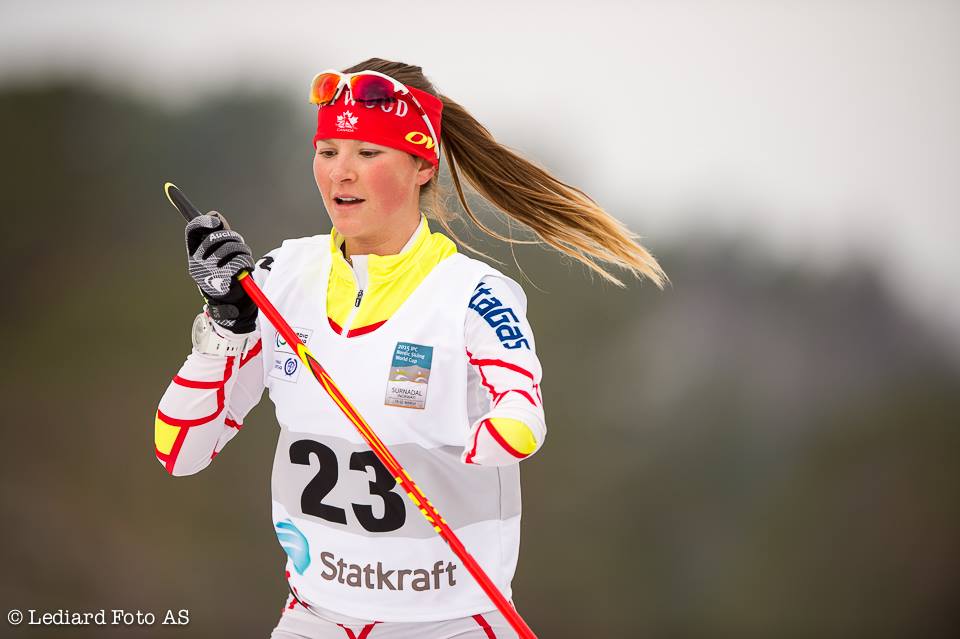
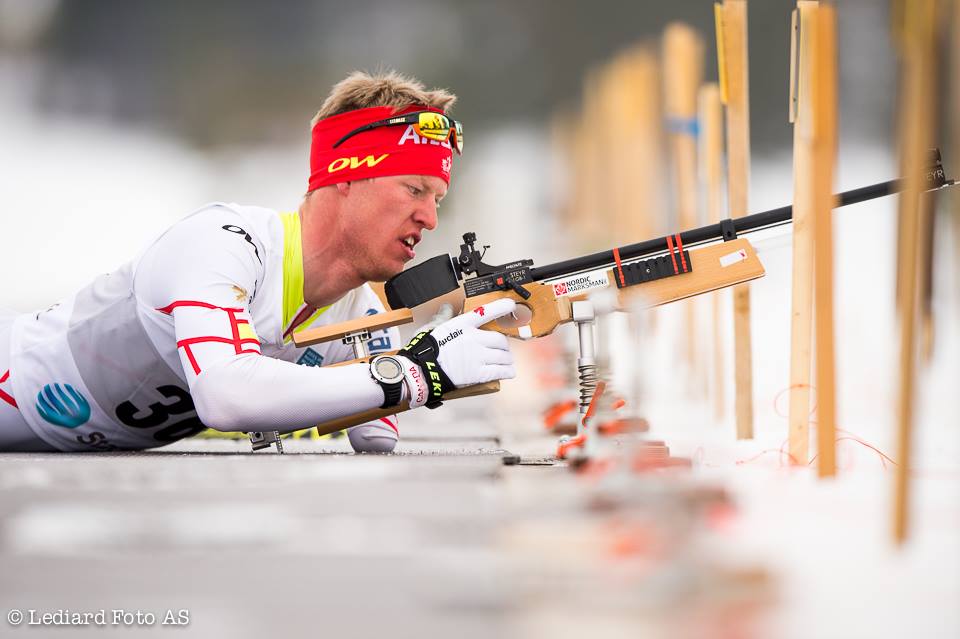
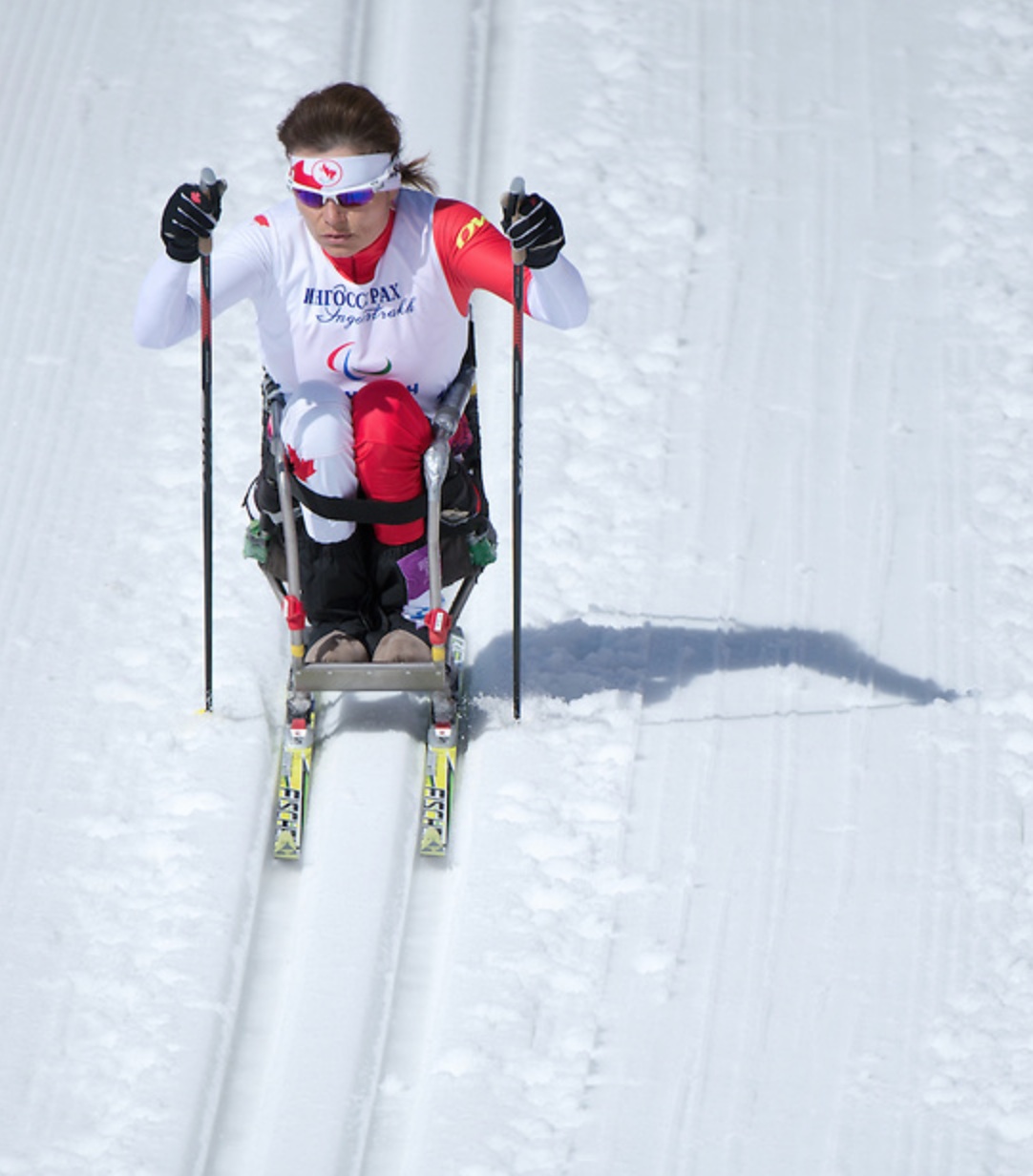
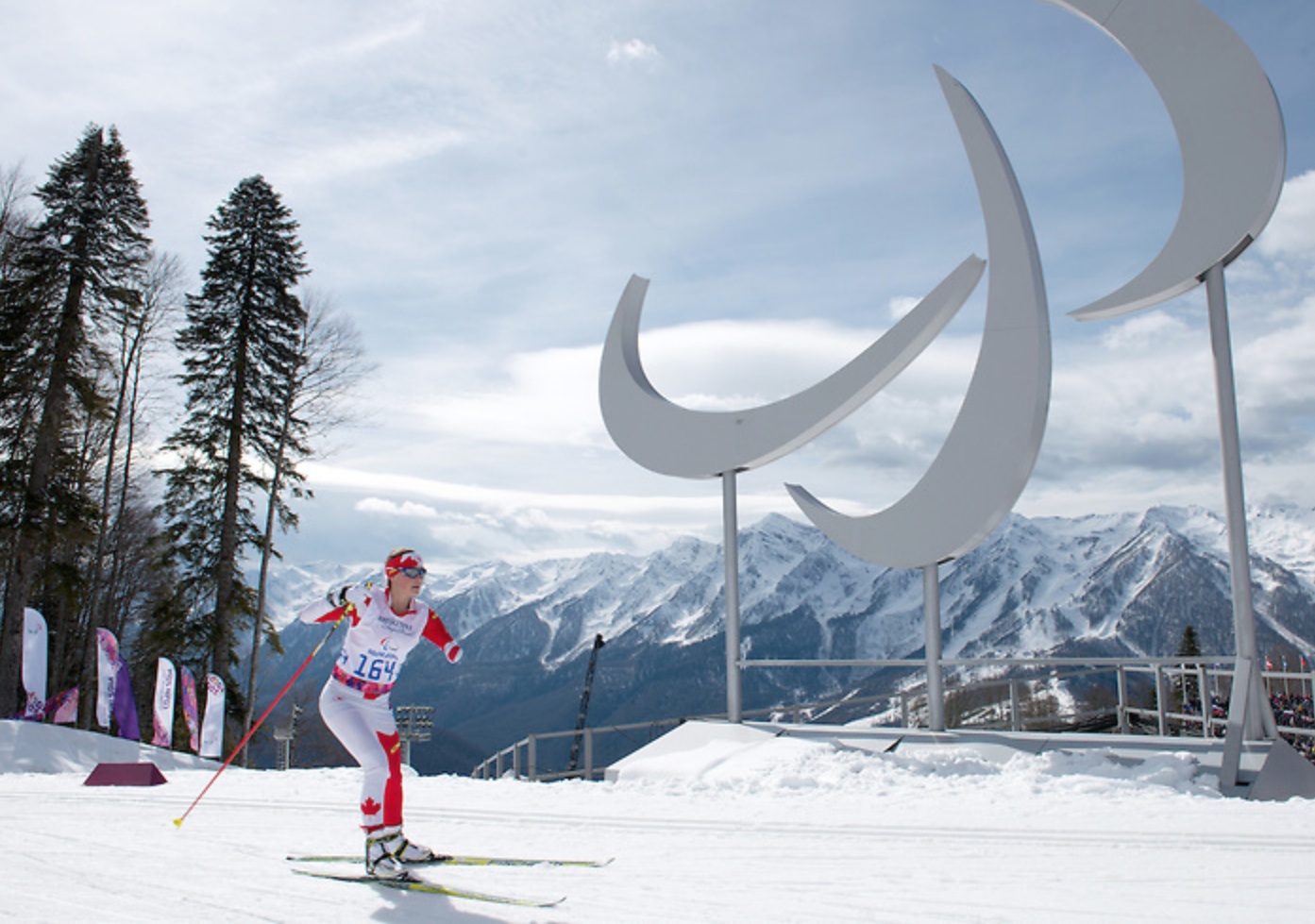
Brittany Hudak (Canadian Para-Nordic Ski Team) at 2015 IPC World Cup Finals in Surnadal, Norway. Hudak took silver in Saturday’s 5 k cross-country sitting to clinch the 2014/2015 World Cup Overall Cross-Country title. (Photo: IPC Nordic Skiing/Facebook)
Three North Americans, count ’em, three, topped the 2014/2015 International Paralympic Committee (IPC) Overall World Cup cross-country podiums, ending their seasons on Sunday at IPC World Cup Finals in Surnadal, Norway.
Canada’s 21-year-old Brittany Hudak tallied her third medal of the week on Sunday, taking silver in the women’s 12.5-kilometer biathlon race a day after clinching the women’s overall cross-country title in the standing division by 33 points over Russia’s Ekaterina Rumyantseva.
Hudak placed fourth in Saturday’s 5 k cross-country race then finished second in Sunday’s biathlon distance race, 50.4 seconds behind Ukraine’s Oleksandra Kononova, who won in 39:46.2.
While Kononova missed two — one in each of the last shooting stages — Hudak cleaned every stage except the first, in which she missed one.
Two years ago, Canada’s legendary (now-retired) sit skier Colette Bourgonje encouraged her to try skiing while Hudak was working at a Canadian Tire store.
“Having the opportunity to attend national training camps, particularly the New Zealand camp this summer, I have noticed a huge improvement in my technique,” Hudak said. “It has been such an advantage for me to be in the same environment with the high-performance athletes, seeing how the train and learning from them.”
In all, she racked up two golds, two silvers and one bronze medal in IPC cross-country events this season, plus a silver and bronze in biathlon at World Cup Finals.
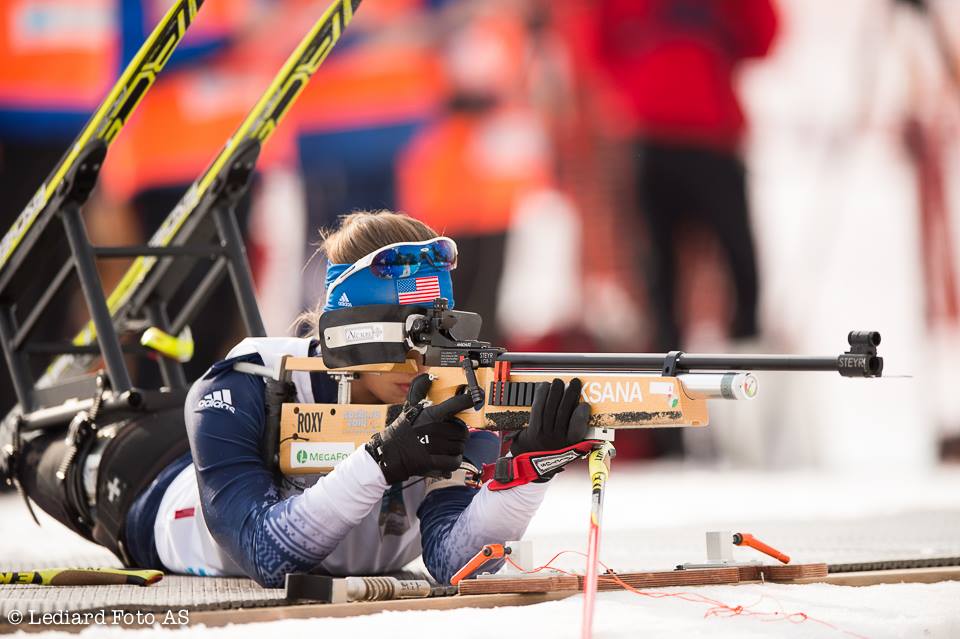
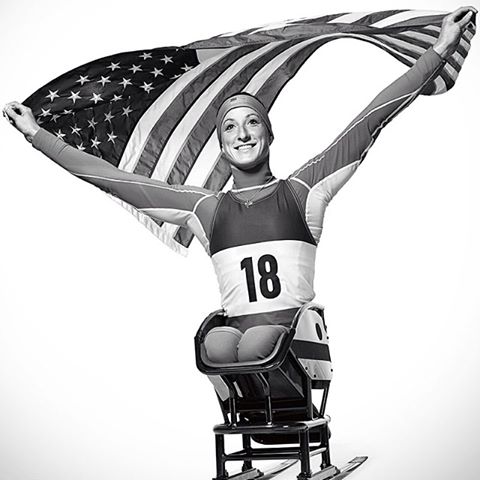
Oksana Masters (U.S. Paralympics Nordic) in a biathlon competition at 2015 IPC World Cup Finals in Surnadal, Norway. Masters won Saturday’s 5 k cross-country sitting to clinch the overall World Cup cross-country title for 2014/2015. (Photo: IPC Nordic Skiing/Facebook)
Hailing from south of the Canadian border, two Americans topped the overall IPC World Cup sitting standings, with Oksana Masters and Andy Soule claiming the cross-country crowns on Saturday, which U.S. Paralympics dubbed as a “three-medal day for Team USA.”
Masters and teammate Lt. Dan Cnossen won the women’s 5 k and men’s 10 k cross-country races, respectively, with the former capping her season with the overall win as well. Throughout this season, Masters earned seven World Cup golds and two silvers, plus a silver and bronze at IPC World Championships in January.
“I felt really good today,” Masters told U.S. Paralympics on Saturday. “It was a hard race, but my skis were fast, and I felt good. This is a great way to end the cross-country season. Everything has been pretty perfect here.”
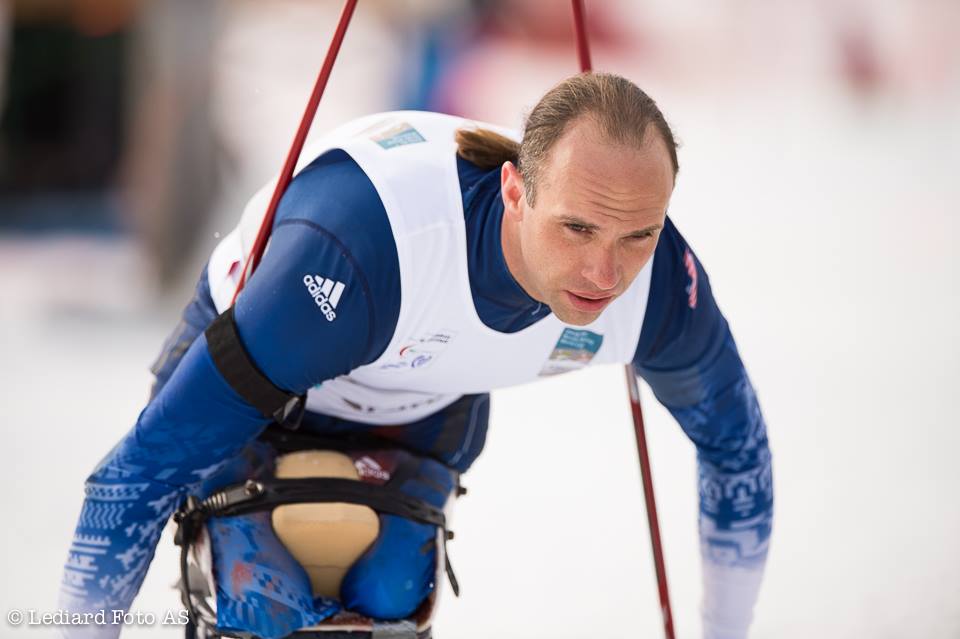
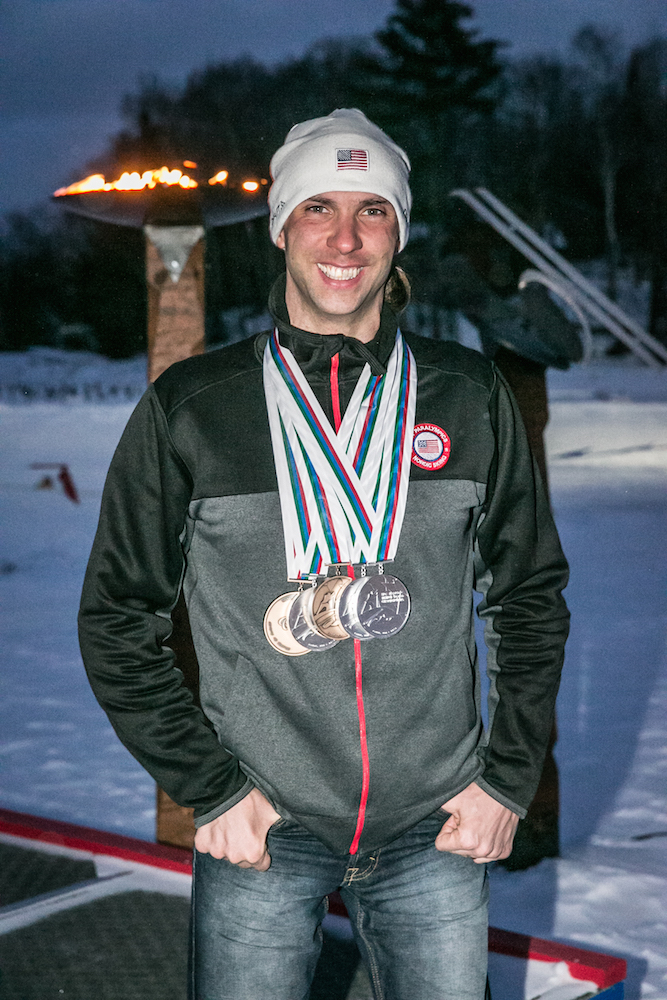
A U.S. Army veteran, Andy Soule (U.S. Paralympics Nordic) at 2015 IPC World Cup Finals in Surnadal, Norway. Soule finished third in Saturday’s 10 k cross-country sitting to clinch the overall World Cup cross-country title for 2014/2015. (Photo: IPC Nordic Skiing/Facebook)
The 25-year-old former Paralympic rower won the women’s 5 k by 28 seconds over Norway’s Mariann Marthinsen in 14:19, and beat Marthinsen in the overall by 160 points.
On Sunday, Masters placed fifth in the final biathlon event: the 12.5 k sitting. While Germany’s Anja Wicker missed two shots to win in 48:46.5, Masters had a total of eight penalties to finish 5:38.2 behind.
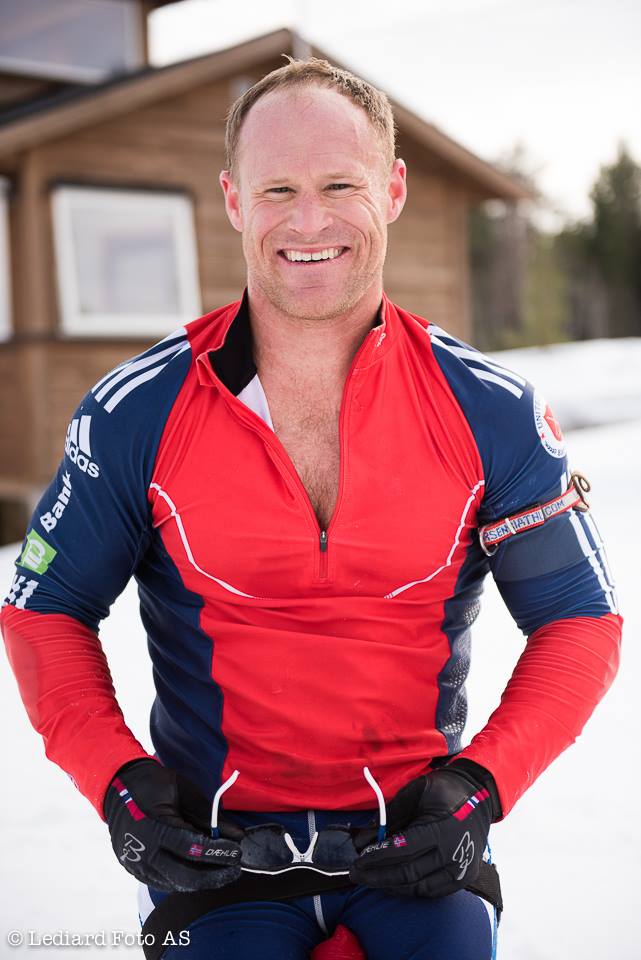
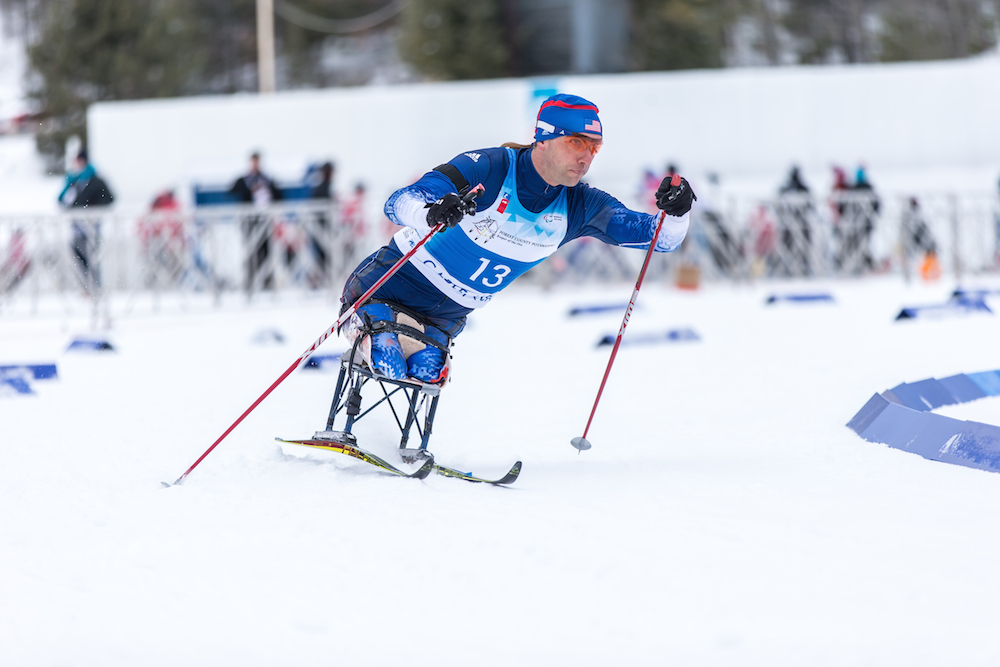
Cnossen won Saturday’s cross-country 10 k sitting in 25:37, edging Russia’s Alexey Bychenok by 3.8 seconds. Soule finished third, 19.8 seconds back, to take the men’s overall cross-country title by 155 points over Bychenok. Cnossen ended up fourth in the overall cross-country standings.
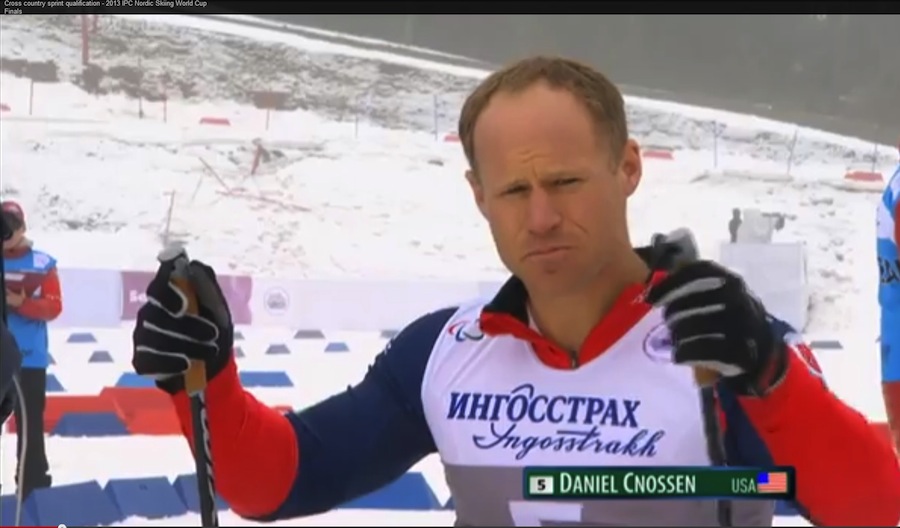
Lt. Dan Cnossen (U.S. Paralympics Nordic) at 2015 IPC World Cup Finals in Surnadal, Norway. Cnossen won Saturday’s 10 k cross-country sitting to finish fourth in the overall World Cup cross-country standings. (Photo: IPC Nordic Skiing/Facebook)
“I was getting updates from the coaches during the race that it was a really tight race between Alexey Bychenok and myself,” Cnossen told U.S. Paralympics on Saturday. “I was really happy for Andy, who came in third and got the World Cup overall win — that is even better. Our team had a great performance today.”
“It is a great feeling and a great finish to the season,” Soule, 35, said after his first podium at World Cup Finals. “This took a lot of hard work by myself, my teammates, my coaches and wax techs. This is just a great end to the season.”
At World Championships, Soule racked up an unprecedented five medals for the U.S., three of which were in cross-country races. Adding to that haul, he totaled four World Cup golds and a bronze this season.
On Sunday, he placed seventh in the 15 k biathlon race with six penalties (1+1+2+2), finishing 4:03.6 behind Germany’s Martin Fleig, who won in 49:32.1. Cnossen was 5.4 seconds off the podium in fourth with five misses (1+2+0+2).
Canada’s Chris Klebl placed fifth in Saturday’s 10 k sitting, 51.3 seconds behind Cnossen. The result helped him secure third overall in the men’s cross-country sitting on the IPC World Cup, 40 points ahead of Cnossen. Klebl did not race on Sunday.
Klebl’s teammate, Mark Arendz finished fifth in the men’s biathlon 15 k standing on Sunday, 3:23.2 behind Ukraine’s Ihor Reptyukh, who won in 42:17.6. While Reptyukh had three penalties (1+0+1+1), Arendz had five (1+1+1+2). The Canadian placed fourth overall in the biathlon World Cup, 161 points behind Reptyukh in third.
Mark Arendz (Canadian Para-Nordic Ski Team) at 2015 IPC World Cup Finals in Surnadal, Norway. He placed fourth overall in the 2014/2015 IPC World Cup biathlon standings. (Photo: IPC Nordic Skiing/Facebook)
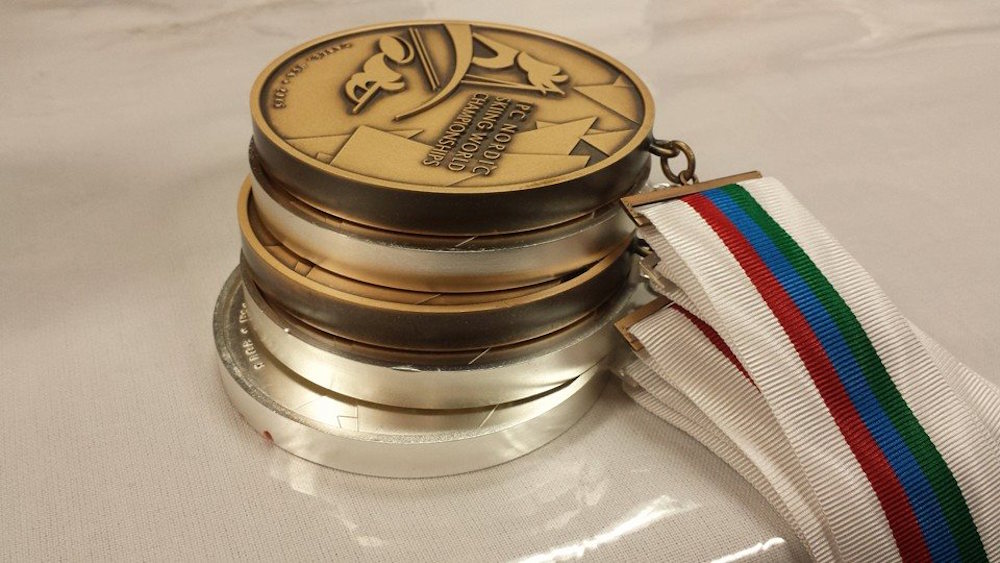
Andy Soule and his hardware from 2015 IPC World Championships: five medals with three silvers and two bronze. (Photo: James Netz)
Andy Soule took one look at the skate course at the International Paralympic Committee (IPC) World Championships — with technical downhills and a massive uphill — and thought, I could do that. The 35-year-old Army veteran previewed it the day before the final race in Cable, Wis., and found it to be “fairly difficult by our standards,” he said in a phone interview last week.
Difficult in the sense that he’s a sit skier who relies entirely on his upper body and core strength, double poling everything from flats to steep hills. The course was designed for standing athletes — with two freestyle legs in the mixed relay, but the U.S. only had one man that could skate.
“We wanted to enter a relay at World Champs, but we only had one standing athlete available to us, Omar Bermejo, who had been battling sickness during these events so running him twice on a super cold day did not seem like the best idea,” U.S. Paralympics High Performance Director John Farra explained in an email. “So we floated it by Andy and he did not hesitate to say yes! … This is the first time a sitting athlete has done the standing course in the relay, so that was fun as countries came up to me to be sure we had not made a mistake.”
It wasn’t against the rules, as Soule pointed out: “There is no rule that says you have to have a sit skier or a stand skier on either one; factors are just supposed to take care of those.” So as the second leg of the U.S. mixed relay on Feb. 1, he headed out after teammate Oksana Masters tagged him in fourth of seven teams.
Farra’s Take on the “Sit-Ski Heavy” U.S. Team:
“It’s a good thing… we have been able to attract sitting athletes from other sports and they are having success, which is getting attention from other sitting athletes,” U.S. Paralympics High Performance Director and Coach John Farra wrote in an email. “We have proven that we can be a good sport for summer sport athletes looking for cross training and a new challenge and tough competition.”On the other side we are very much interested in increasing the [numbers] of standing and visually impaired athletes who can develop into strong international racers. Those who are finding success are finding it best to join up with a USSA Club program so they can be training & racing with other standing (able bodied) skiers as much as possible.”
“Our team is very sit-ski heavy right now, and while we didn’t really go into the relay with an expectation of a high place or anything, they decided to go ahead and field me on the standup course,” Soule said from his home in Pearland, Texas. “I told my coaches I believed it was entirely doable … it’s probably not any sort of a competitive advantage for sure, but it was an interesting experience, and it went pretty well.”
Soule came through the exchange in seventh, just seven seconds behind Germany’s Tino Uhlig, a standing skier who uses one pole, in sixth. With sit-skier Tatyana McFadden and Bermejo, a single-arm amputee, racing the third and fourth legs, respectively, the Americans placed seventh, 45.4 seconds out of sixth.
From the outset, the mixed relay was the team’s weakest event of the week, one in which they did not field a team at last World Championships. However, more symbolically, it capped their historic showing in Cable, where Soule racked up five medals — unprecedented for a U.S. cross-country skier at World Championships — and competed in all seven events, including the relay.
He was glad he did it.
“It have me a really good gauge of where we are in terms of what relative speeds look like for sit skiers versus standup athletes,” Soule said. “On the largest climb of that race, I was passed by one of the best standup skiers in the world in our sport, Nils-Erik Ulset, of Norway. I think it was an interesting event for a lot of people to see exactly what is possible for a sit skier, too.”
Andy Soule navigates a turn during one of his six individual races at 2015 IPC World Championships in late January in Cable, Wis. Soule medaled in five of those events. (Photo: James Netz)
And he held his own on the descents. “I definitely didn’t lose any time on downhills,” Soule added.
“Andy left Cable as a bit of a Legend,” Farra wrote. “5 medals and climbing & descending Telemark Hill successfully!”
In his eighth year on the U.S. Paralympics Nordic team, it was not only Soule’s most successful World Championships, it was perhaps the highlight of his career after winning bronze in biathlon at the 2010 Paralympics.
“This is a pretty high highlight,” Soule said. “After the second podium, I just started feeling like that wasn’t a fluke. This isn’t just a one-time thing, I’m really up here with the top of the field. I can compete with these guys. I can come out and compete on a level with the top guys every day. It was a confidence builder as well when you have that feeling.”
“After the second podium, I just started feeling like that wasn’t a fluke … I can come out and compete on a level with the top guys every day.” — Andy Soule, who earned three silver medals and two bronze at the 2015 IPC World Championships in Cable, Wis., unprecedented for an American
That feeling translated into three silver medals in two of three biathlon events and the cross-country 10-kilometer race at the 2015 championships, and two bronze in the cross-country 15 k and 1 k sprint (where Soule charged up from fourth with 40 meters to go to take third). On Monday, the IPC named Soule its January athlete of the month across all sports.
Prior to this season, he had a Paralympic bronze from 2010 and placed fourth twice during last winter’s 2014 Paralympics in Sochi, Russia.
“I wanted to break through that last little barrier for sure,” Soule said of his tendency toward wooden medals. “Between being almost on the podium and being a solid, consistent at least podium-potential finisher … that’s kind of been the source of all the little tweaks and changes we’ve been working with over the past year.”
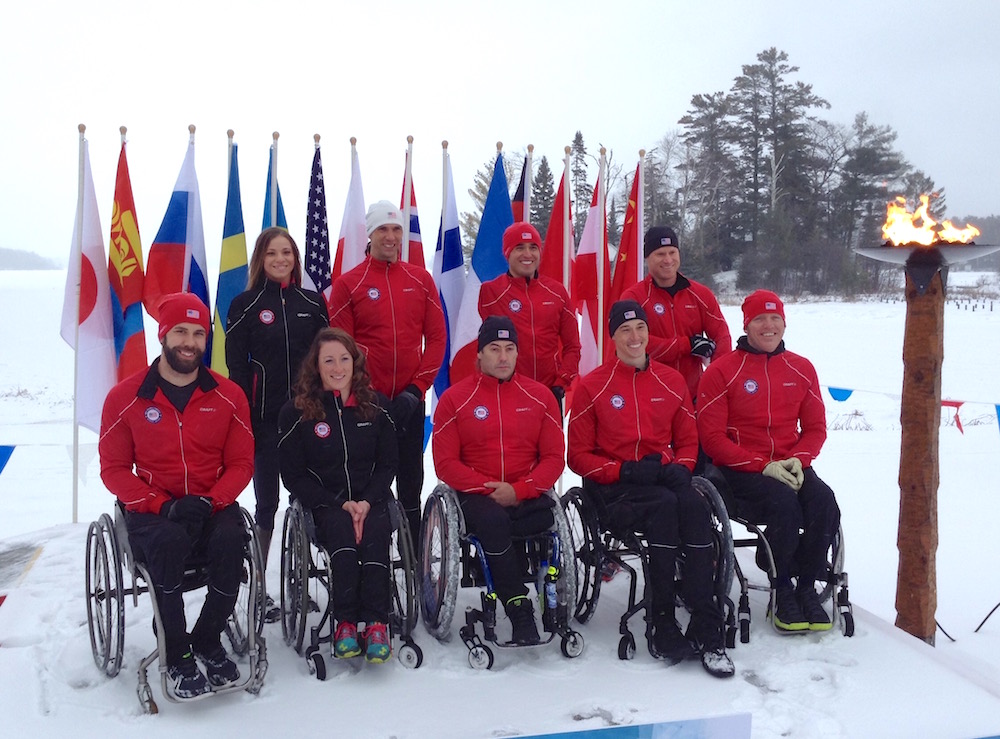
2015 U.S. Paralympics Nordic World Championships Team in Cable, Wis. (Photo: U.S. Paralympics Nordic)
Asked specifically about those changes, U.S. High Performance coach Eileen Carey explained, “To talk about what any one individual athlete has done to improve is to talk about the whole team,” she wrote in an email.
Everyone on the team is analytical and thoughtful when it comes to what they need to work on and how to achieve those changes, she added. “They have created a really cool team environment focused on improving as individuals and as a team.”
For Soule, it was about relaxing his technique at race pace.
“He has always skied well at level 2, but speed had previously introduced a lot of wasted, inefficient movements into his technique, especially on flat terrain,” Carey wrote. “His ski speed and relaxed technique have always been there, it was just a matter if translating them to a race pace.”
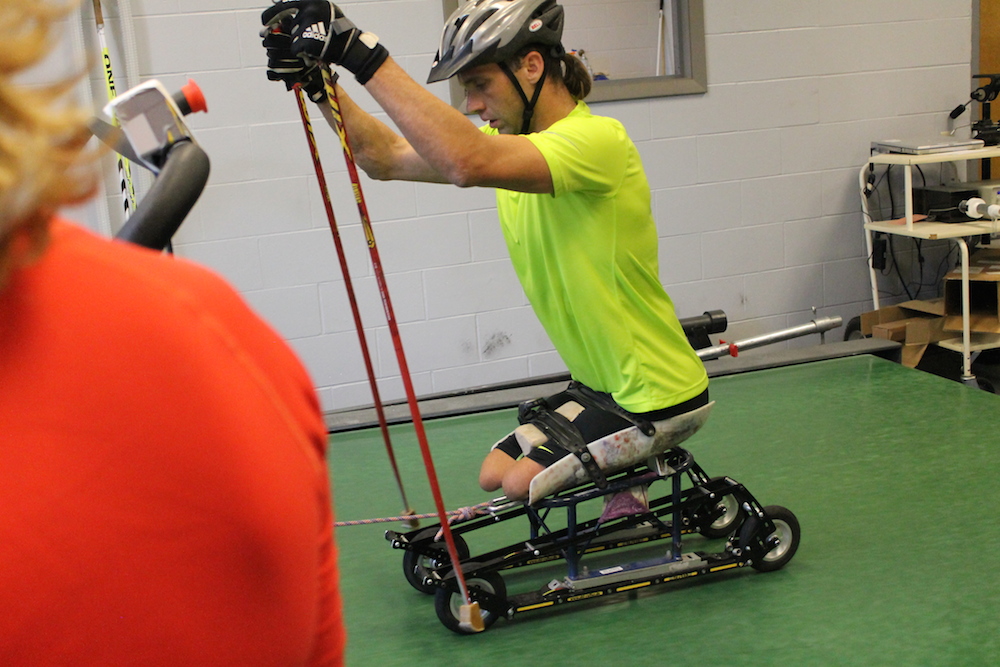
In September, they started with rollerski sessions on the treadmill with live video so Soule could see the changes he was making as he tried them out.
“Once we had the cues we knew worked for him, we brought it to snow this fall,” Carey explained. “It has been an evolution and I am sure it will continue to evolve. We did a lot of video analysis during and after the first World Cup in Finland in December and spent the pre-World Champs camp honing in on some of the patterns we saw from that. He and his teammates have driven the process and we have worked to find the process and communication style that works best with each athlete.”
Andy Soule working on technique during a treadmill session on Sept. 16 at the Olympic Training Center in Lake Placid, N.Y.
As a result, Soule came out of the World Cup opener in Vuokatti, Finland, with two fourth-place finishes in the cross-country 10 k and biathlon sprint. While they weren’t podiums, he could feel a difference.
“What I used to be doing was concentrated more on high tempo,” he said. “My emphasis on training recently has been to focus on flat sections of the course, what standup, able-bodied skiers would be considering a V2-technique section, lengthening out the pole stroke.”
He continued to work on his technique at U.S. nationals in early January and at the team’s pre-World Championships training camp after that. He also switched to shorter poles this season.
“I think everything just builds off what you’ve been working on in the past,” he explained. “You keep watching video of yourself, keep looking at races and identify what did work and then what little things we can maybe experiment with to get a little more speed.”
Soule approached the biggest races of the season in Cable hoping to see improvement first, then results.
“I wasn’t really worried going in what specific places I was aiming for — you can never really control that because you can never control how good everyone else is going to be,” he said. “But I wanted to see a personal improvement in what I would be able to accomplish as compared to how I’ve been performing in the past year.”
As for which medals meant the most to him, he said his bronze in the cross-country 15 k was something he’d remember.
Andy Soule’s stack of medals from 2015 IPC World Championships in Cable, Wis., where he earned three silver and two bronze between two biathlon and three cross-country races. (Photo: U.S. Paralympics Nordic)
“It meant a lot to get the medals in the cross-country races just because that long-distance race, the first cross-country race of the week, was actually my first-ever podium in a cross-country race,” he said. “And it also boosts my confidence going into a biathlon event. It used to be, in order to have a shot at the podium in biathlon, I had to outshoot the top competitors. They had to miss shots in order for me to have a shot at the podium. Now I have that confidence that I can ski right with them. If neither of us misses anything, between me and the top competitors, I’m still in it.”
Now third overall in the IPC World Cup standings with two major stops remaining (this weekend in Asahikawa, Japan and at World Cup Finals from March 16-22 in Surnadal, Norway), Soule said he mostly wanted to put together a “solid string of really great performances” for the rest of the season. Beyond that, he has his sights set on the 2018 Paralympics in Pyeongchang, South Korea.
“I’m right at that age and I’m right at the point in my career where I’m in the prime of real top-performance potential,” he said. “I feel really great about what I have going forward and that I’ll be able to build on it and still improve on it.”
In most every interview in Cable, Soule tossed around the word: “team.” He reiterated that he couldn’t have done it without his teammates and turned the focus toward their many successes at this year’s World Championships as well, including five Americans making the sit-ski sprint finals (three men and two women), and Masters tallying silver and bronze in the cross-country 5 k and cross-country sprint, respectively.
“It just feels really good to have great teammates,” Soule said. “You’re always cheering for each other and everyone wants to see everyone else succeed, so it makes practice more fun when we’re all there and it makes racing more exciting. A good team component is really important to what we have going right now.”
“Lots of good things were going in Cable beyond the medals,” Farra added.
Masters currently ranks first in the World Cup in cross-country. Stay tuned for her interview.
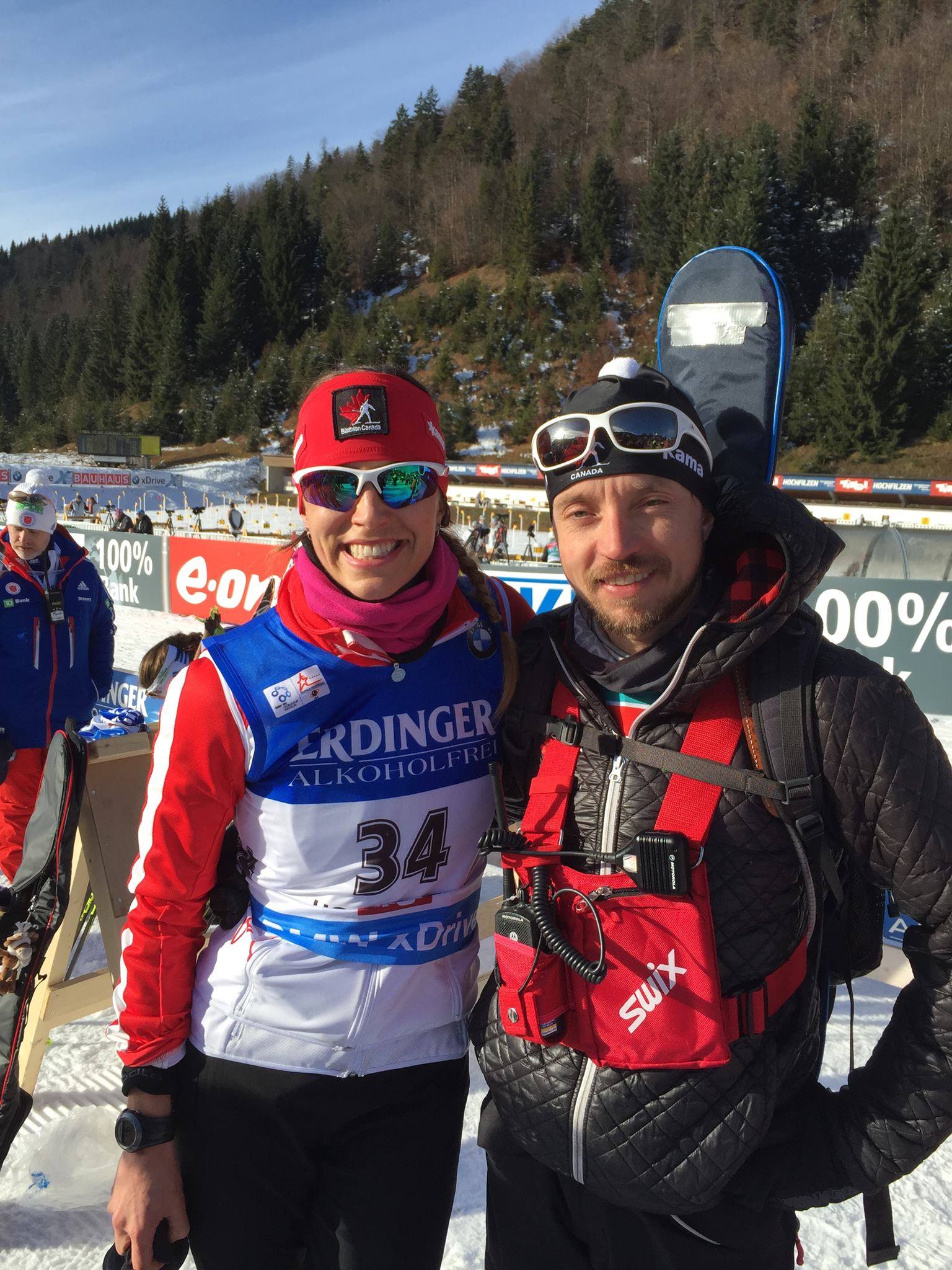
Rosanna Crawford with coach Roddy Ward after placing a career-best fifth in the IBU World Cup 10 k pursuit on Sunday in Hochfilzen, Austria. “Such a fun race today, I moved from 34th to 5th for a new personal best with 19-for-20 shooting,” Crawford wrote on Facebook. (Photo: Chris Lindsay)
While Roddy Ward, biathlon Canada national team coach, was referring to athlete Rosanna Crawford when he said, “Way more is possible,” it’s easily a sentiment that could be applied to the rest of the international nordic circuits after this past weekend of racing.
The weekend’s racing began Friday with the IBU World Cup 7.5/10 k sprint in Hochfilzen, Austria, that saw Johannes Thingnes Bø of Norway and Kaisa Mäkäräinen of Finland claim victories in their respective races. American Tim Burke turned in the top North American finish after placing 13th, while teammate Susan Dunklee paced 29th for the women.
Tim Burke on his way to 25th in the IBU World Cup 12.5 k pursuit on Sunday in Hochfilzen, Austria. (Photo: USBA/NordicFocus)
The action continued in Hochfilzen on Saturday with the men’s 4 x 7.5 k and the women’s 4 x 6 k relays. Russia proved dominant in the men’s race, winning by roughly 20 seconds. Canada finished a team-best sixth place while the U.S. team was lapped after a combination a poor starting position and sub-par skis. In the women’s relay, Germany proved as strong as the Russian men, topping their field by over 20 seconds. The Canadian women were unable to match their male counterparts, however, and finished 11th.
In the final day of IBU World Cup racing, one Canadian athlete demonstrated what exactly was possible. Crawford, who started the 10 k pursuit in 34th, wanted to improve her position, but when she crossed the line for a career-best fifth place it was apparent improving her position was just the beginning. On the men’s side, Burke was the top North American in 25th position.
The weekend also brought FIS Cross Country World Cup action to Davos, Switzerland. Norwegians Therese Johaug and Maritn Johnsrud Sundby won Saturday’s 10/15 k classic interval starts. A trio of Americans made up of Liz Stephen, Jessie Diggins and Sadie Bjornsen went 20-21-22 in the 10 k to give the Americans three skiers in the top 30. Canadian Emily Nishikawa placed 29th for her best-ever World Cup finish. In the 15 k, Canadian Alex Harvey also found success, skiing to 17th, which he said was one of his best distance performances at altitude.
In Sunday’s sprint, Ida Sargent returned to the spotlight after placing 16th, while teammates Kikkan Randall and Sophie Caldwell joined her in the top 30 after finishing in 20th and 22nd positions. On the men’s side, Canadian Lenny Valjasreturned to form to place 13th while American Andy Newell placed 15th.
Andy Newell (l) of the USST trails eventual 3rd place finisher Erik Brandsdal of Norway (r) and Alexey Petukhov of Russia (c) who eventually finished fourth in the 1.3 k freestyle sprint in Davos, Switzerland. (Photo: Fischer/NordicFocus)
The real story of the day, however, was that Norway continued its winning streak with both its men and women sweeping Sunday’s races and earning 10 of 12 podium positions in Davos.
Not just over the mountains from from Davos, Livigno, Italy hosted the La Sgambeda Marathon. While the women’s 42 k freestyle was dominated by Riitta-Liisa Roponen of Finland, American Holly Brooks was able to hold on for an impressive second place.
Back across the home front, NorAm racing continued in Rossland, British Columbia despite warm conditions and a lack of snow. Both races were classic distance races with 7.5/11 k on Saturday and 11/15 k on Sunday, and Canadian Alysson Marshall and American Kris Freeman topped their respective fields each day.
Last Thursday, the FIS Nordic Combined Continental Cup opened in Park City, Utah, where Taylor Fletcher posted the two best American performances in fifth and eighth place.
The IPC World Cup also opened last Wednesday in Vuokatti, Finland, with Canadian Mark Arendz taking silver in his first race on Thursday: the 15 k standing biathlon. Two days later, his Canadian Para Nordic teammates Chris Klebl and Brittany Hudakboth earned bronze in the 10 k sit-ski and 5 k standing, respectively. Also on Saturday, American Oksana Masters captured a career-best World Cup silver in the 5 k sit-ski, and Andy Soule just missed the podium in the 10 k sit-ski (behind Klebl) in fourth.
On Sunday, Masters carried her momentum to win gold in the women’s sit-ski sprint, becoming the first American female Paralympic nordic skier to do so since the early 2000s. On Tuesday, she took her first-ever international biathlon silver in the biathlon sprint.
Colette Bourgonje racing at her 10th Paralympics in March, the 2014 Winter Games in Sochi, Russia. (Photo: Cross Country Canada)
Twenty-two years ago, Colette Bourgonje was a grade-school teacher with a ticket to the Albertville Paralympics in France. A Saskatchewan native, she had learned how to nordic sit ski a year earlier — all while teaching physical education in Saskatoon.
But the school wasn’t about to let her take off to compete at her first Paralympics. At the time, Bourgonje was paying her own way to do so, and since landing a temporary teaching contract in 1989, she was trying to secure more job stability.
Yet passing up the Paralympics wasn’t an option, she told herself. Bourgonje quit her job and resolved to find another one when she returned.
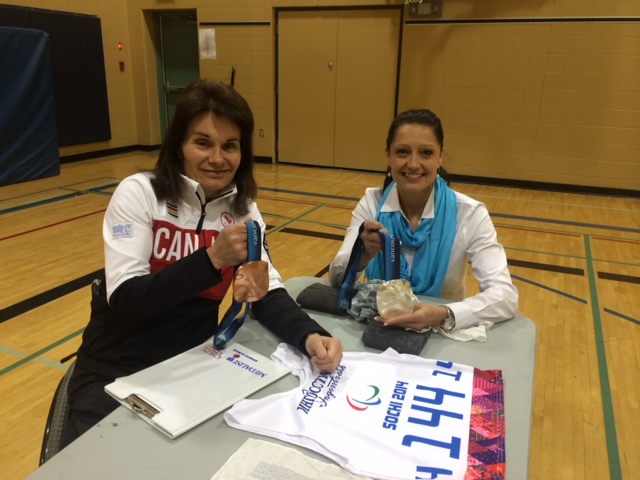
Ten-time Paralympian Colette Bourgonje (l) with Melanie Florizione, vice principal of a school in Regina, Saskatchewan, during an appearance after the Sochi Paralympics. (Courtesy photo)
A national-level cross-country runner as a teenager, Bourgonje was in a car accident her senior year, leaving her paralyzed from the waist down. Four years later in 1984, she took up wheelchair racing and became the first to graduate the University of Saskatchewan’s physical-education department in a wheelchair.
With the competitive bug back in her system, she tried sit skiing for the first time in 1991 and immediately fell in love. More similar to cross-country running than wheelchair racing, she began to work at improving in that sport as well.
After competing in Albertville in the winter of ’92, Bourgonje qualified for the Barcelona Olympics that summer. There, she won two bronze medals in wheelchair racing, and went on to claim two more bronze medals at the 1996 Atlanta Summer Games. She also raced at the 2000 Summer Olympics.
Not one to take a breather, Bourgonje became the only athlete in the world to compete in all seven Paralympic Winter Games from 1992 to 2014. She tallied six Winter Paralympic medals — three silver and three bronze — between the 1998, 2006 and 2010 Games, and went down in history as the first Canadian to win a Paralympic medal at home in Vancouver (she earned silver in the 10 k sit ski).
On the phone from her home in Prince Albert, Saskatchewan’s third largest city along the North Saskatchewan River, Bourgonje reflected on some of her career highlights in the last 24 years. At 52, she announced her retirement from the Canadian Para-Nordic Team late last month.
“Carrying the flags out in Nagano and Torino, carrying the Canadian flag out was absolutely fantastic,” she said of her flag-bearing honors. “Getting the first medal in Canada was an amazing experience. Being on the podium in that 10 k was just like, whoa. I was so happy.”
At Vancouver’s closing ceremony in 2010, she received the Whang Youn Dai Achievement Award, given to an individual at each Paralympics who has shown to conquer adversities through sporting excellence.
In her third nomination for Saskatchewan’s Female Athlete of the Year award, she won it in 2010. She remembered writing the acceptance speech, which she never expected to deliver, before a friend attended the awards ceremony for her in Saskatoon.
“I just whipped it off in five minutes really thinking I would never get that award,” she recalled. “We were in Russia and I think the other thing that happened that same week … I finally got a [World Cup] medal in Russia that was the only gold I ever won. I was just like, I cant believe this is happening! That’s why I would’ve been satisfied to say this was a great career.”
After finding success in Russia, Bourgonje decided to commit to another season through 2011 World Championships in Russia. There, she racked up another gold medal to add to her growing list, which included two overall International Paralympic Committee (IPC) World Cup victories in 1998 and 2005.
“After 2010, I did say that was going to be my last Paralympics,” she recalled.
Around that time, she asked one of her coaches, Peter Eriksson, the Athletics Canada Olympic and Paralympic head coach, how you know when you’re ready to be done. “He said you’ll know,” Bourgonje said. “And I did.”
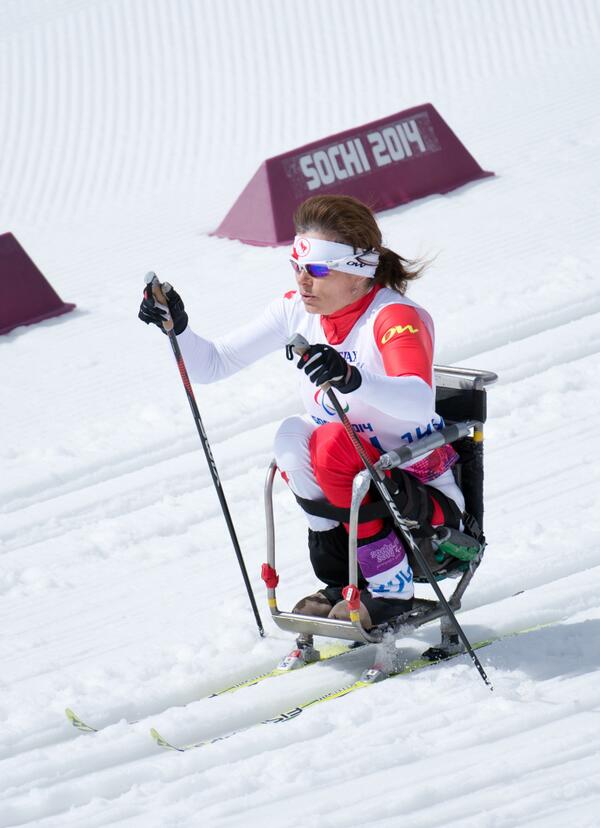
Colette Bourgonje competes in the 5 k sitting at the 2014 Paralympic Winter Games in Sochi, Russia. (Photo: Matthew Murnaghan/Canadian Paralympic Committee)
The courses in Sochi simply weren’t for her. “It’s a great course for double amputees,” she said, with massive climbs and descents, not the kind of flowing course she favored. She had raced well at the December World Cup in Canmore, Alberta, placing fourth and fifth, but suffered from low iron and vitamin B12 levels in Sochi.
“I knew I did everything I could to be physically ready to race,” she said.
But she was tired. In three races, Bourgonje placed 13th twice (5 k and 12 k) and 16th in the sprint.
“It’s all good; it was fun,” she added.
Perhaps one of her greatest sports successes was Brittany Hudak, Bourgonje explained. Two years ago, she met Hudak, now 20, working at a local Canadian Tire in Prince Albert and persuaded her to try nordic skiing. Not exactly sure how to coach an arm amputee at the time, Bourgonje quickly became her mentor.
This past season, Hudak made her World Cup debut and qualified for the Sochi Paralympics.
“This year traveling and training with Brittany was great — it was great to see a different kind of success,” Bourgonje said. “She’s just having the time of her life.”
Without Bourgonje on the team this coming season, she said three men remain on Canada’s Para-Nordic World Cup squad and Hudak is the lone development-team member.
“She has a lot of people willing to help her,” Bourgonje explained. “I’ve been her mentor and the person she’ll come to asking questions, but she definitely has it all together and will get what she needs … I would like to see her racing in Korea [in 2018]. That would be pretty awesome.”
One of Bourgonje’s early coaches (along with Para-Nordic Head Coach Robin McKeever), Bruce Craven will continue to work with Hudak on her training plans.
“[Craven] has been providing me with programs since July of last year and still continues to write them but we are in the process of trying to get me on a yearly training plan which is different from what I did last year,” Hudak wrote in an email.
“Colette has had a huge impact on me in the sense that she was first an inspiration and a role model for me. Then she became a mentor for me which really helped me become a better skier in a short period of time.
Brittany Hudak competes in the 5 k standing at the 2014 Paralympic Winter Games in Sochi, Russia. (Photo: Matthew Murnaghan/Canadian Paralympic Committee)
“Since I was new to the sport I didn’t know who I could contact to learn more about getting started in the sport so Colette helped me out a lot with the resources that were available to me and informed me of what steps I needed to take in order to get to a high performance level of sport,” she added. “Colette was also willing to chat with me at any time if I ever had questions and wanted some advice so I think she was very good with being a friend and a mentor.”
As for what Bourgonje’s up to now, she recently returned from an Olympic/Paralympic tour at schools around the province and will continue to do similar speaking appearances throughout the summer.
“The Paralympics have not really been in the forefront — every speaking opportunity I get, I say it’s a parallel event to the Olympics…” she said. “It’s picking up, but it’s not yet at an equal … [or] seen as a parallel movement yet.
“When you medal at the Paralympics, you don’t come home to $20,000 dollars for medaling,” she added. “It’s a great movement, but it’s not well known.”
Between traveling around the Canada to deliver her message, Bourgonje also wants to return to teaching. While she’s taught everything from phys ed to health, math, and science, it’s the energy of the students she’s missed. Substitute teaching could be a good remedy for that, she said.
During her full-time racing days, Bourgonje taught part time until 2008, largely paying out of pocket to compete until 2005, when Team Visa started sponsoring her. She met Canada’s carding (government-funding) criteria for wheelchair racing at the Atlanta marathon in 1996, then received assistance from Cross Country Canada for nordic in 1998 leading up to the Nagano Olympics.
“You can be carded in one sport and they give you [$]1,500 a month at that time (that was the highest funding at the time),” she explained in an email. “Carding has now increased to [$]1,800 a month to live and train on.”
Eighteen months before the 2010 Olympics, she quit her Saskatoon elementary school job and moved to Canmore for what she thought was one final push.
After the ’92 Winter and Summer Paralympics, she landed a job in Saskatoon’s recreation department. In 1994, the Burnsville school district hired her.
“I do feel that teaching part-time kept me grounded and very appreciative of what I received,” she told FasterSkier. “You know what they say whatever doesn’t kill you makes you stronger. I also loved my job and was only stressed out when I had to apply for leaves in the winter to go to compete.”
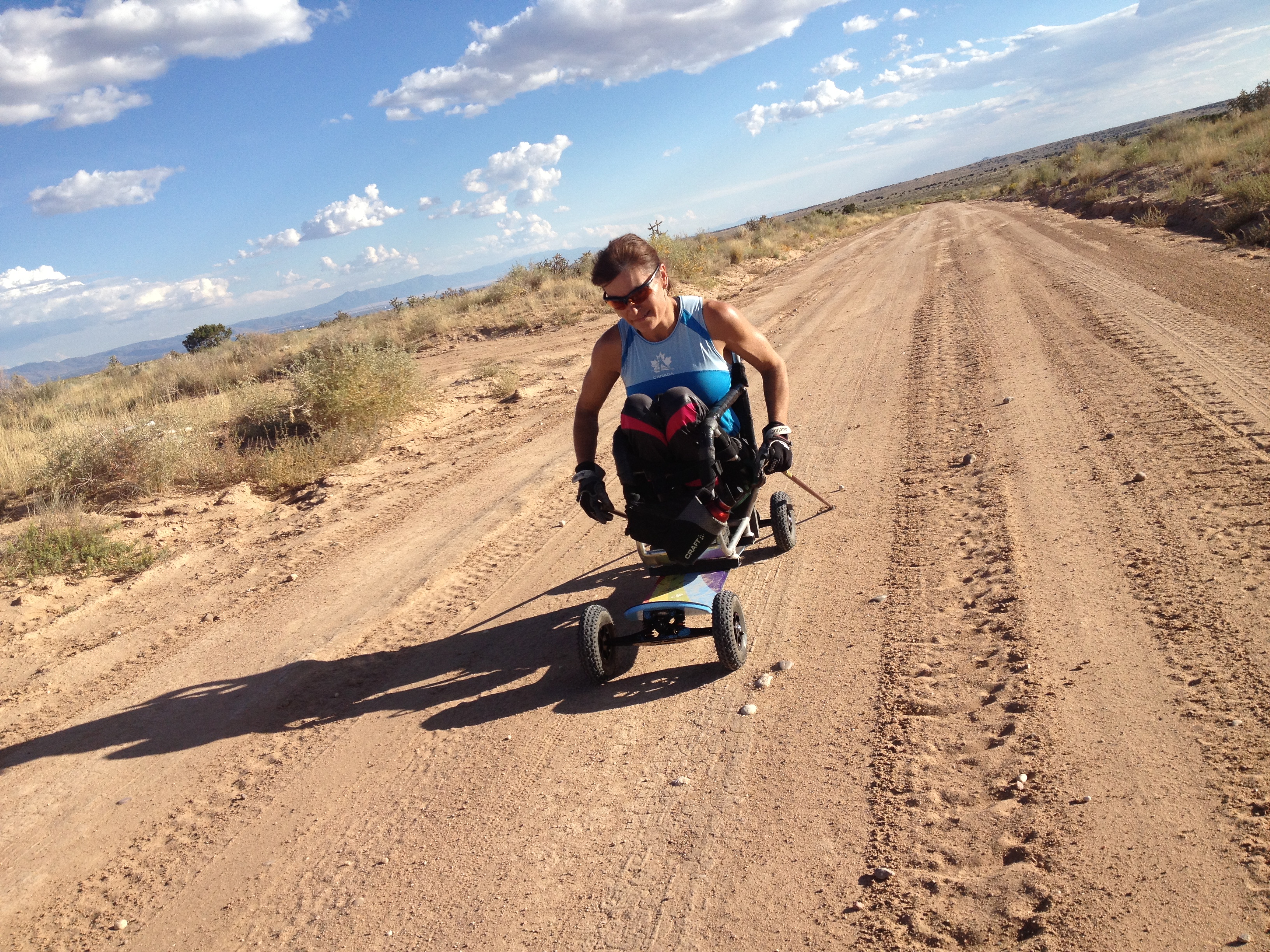
Colette Bourgonje doing some mountain-board work during a Canadian Para-Nordic Team training camp in Arizona two years ago. (Photo: Robin McKeever)
In the last couple months Bourgonje has backed off full-time training to enjoy more recreational outings — like kayaking — and said she’s looking forward to skiing in the Nisbet Provincial Forest with her partner George, who grooms the trails right out of their backyard.
“I’m really wanting to enjoy and not feel stiff and tired — no more four-hour skiing for me,” she said. “A couple hours to enjoy wherever we are absolutely [doing] … or skiing with kids.”
Last year, she met an 8-year-old boy named Tyrese, who’s missing part of his arm, while shopping for batteries for her heart-rate monitor.
“He was getting into a little red car they have set up at the mall, I asked him if he liked skiing he said he did so I asked him where his parents were,” Bourgonje recalled.
She talked to his mother, gave her a card with her contact info and asked where Tyrese went to school — just in case they forgot to get back to her. After a training camp last October, Bourgonje went to his school to see if he was still interested.
“We set him up with skis/poles but he had no boots. While we were in Canmore, the school bought boots for him,” she explained.
Later, Bourgonje brought him to ski on the trails near her house. When she returned from Russia in March, she took Tyrese and a sit-skier out on less-than-ideal conditions. But they stuck with it.
“Right now we have another 12 year old with no arms, Tyrese, Kristen, a girl in the hospital, a six year old, and a girl I am [bringing] a racing chair to today…” she wrote on Friday. “So setting up something for all of them to be active seems to be the way to go.
“[Tyrese is] a reason to stay in shape and go skiing with him and see the smile on his face,” she said. “Exercise is a lifestyle and you can’t just stop.”
The famed Canmore Nordic Center, the venue of the 1988 Olympic Winter Games Nordic events, and home to countless World Cups recently played host to yet another blockbuster event, when they welcomed the world for an IPC cross-country and biathlon World Cup. The setting is breathtaking, the competition even more so.
Augusto “Goose” Perez spoke for everyone noting just how inspiring it was to compete and the fabled venue of Canmore, saying..”Canmore was an amazing experience, The city of Canmore is absolutely beautiful, and to be able to race at this Olympic venue was a dream and the work put forth by the organizers and the volunteers was phenomenal. Having the chance to compete against the best in the world is not at the reach of just anyone, I was humbled by it, and it was also a great chance to put to the test all the work I did with CXC.”
More than 110 athletes representing 12 nations competed in six World Cup events, marking a historic first for Canmore. CXC had three Paralympic athletes that were part of the US contingent of 15 athletes.
Team CXC skiers were lead by Travis Dodson and Aaron Pike finishing 1.5 seconds apart in the 10km event in 17th and 18th position respectively, placing just behind star member of the national team Andy Soule and Sean Halstead. CXC member Augusto Perez met the Paralympic standard of 130% of the winner’s time, finishing in 20th.
The next event was the 750m sprint race where the CXC trio had their best collective performances with Pike narrowly missed qualifying for the semis by less than two seconds finishing 14th followed by Dodson and Perez.
Pike followed up that impressive finish with a personal best 12th place even outperforming famed Dan Cnossen and was just behind Sean Halstead who was the U.S.’s top performer in Sochi last spring placing 4th.
Coach Rob Rosser picks up the biathlon storyline.
“Dodson lead the way for the CXC trio in the first of 3 biathlon races shooting clean, a perfect 10 for 10 for 13th place behind Cnossen and Soule in 9th and 11th respectively both of whom shot clean as well. Pike and Perez struggled on the range finishing 17th and 18th
“Dodson lead the trio in the final long 15km biathlon event finishing 15th hitting 14/20 followed by Pike and Perez in 16th & 17th. This final race of the World Cup ended on another positive result posted by 2010 Bronze Medalist Paralympian Andy Soule who hit 19/20 in windy conditions combined with an exceptional performance on the sit ski finishing in fifth place just 34 seconds from the podium. This was quite impressive amongst a very strong field of Russians vying for their selection to the Russian Paralympic Team which will play host to the world in Sochi 2 months from now”, Roser explained.
We also caught up with Augusto Perez, who made it clear just how important CXC’s commitment to adaptive sports is….”The first thing I want to do is thank Yuri, CXC and CXC’s entire staff for their support, without them I would not heave been able to keep skiing this season and to continue my work towards my dream of competing in Sochi. Dealing with my cancer and its economic cost had closed my chances to continue training towards Sochi. When Yuri called and asked me if I wanted to train with them and to become a mentor to younger disabled kids, I was packing my bags before I hung up the phone. CXC was a light of hope during a rough time.”
Although the TEAM USA squad won’t be selected for Sochi until Jan 31st, or so, many CXC athletes have a real chance to be part of the Paralympic lineup. That’s great news.
We asked the USA’s John Farra, to give us his thoughts about some of those athletes.
ON AARON PIKE
“Aaron Pike – sitting athlete – was in London as a Wheel Chair racing athlete and came to a camp last fall to try out Nordic. In short order he picked up the sport, came to Nationals and qualified for his first world Cup in Cable with just 10 +- days of skiing under his belt. He is VERY strong and incredibly fit… he hit our National Team standard at that first World Cup and continues to improve. “
ON TRAVIS DODSON
“Dodson – sitting athlete – double leg amputee – Is a veteran that Rob Rosser introduced to the sport a few years ago, and he is also very competitive in Wheel Chair racing, but has turned his attention to Nordic with a big focus this winter with the goal to maximize his performances in Sochi,” said Farra.
ON JOHN OMAN
“John Oman – Is a standing athlete with one arm, and is a great guy and could well be a wonderful part of our Sochi Team,” said Farra.
Oman was filled with praise for CXC for the experienced he enjoyed in Canmore, saying…”I would never have had such an amazing experience at the World Cup if it weren’t for the dedication and passion of the CXC Team. I am excited to pay it forward—and pay it back—by providing as much support as I can in the future to CXC and all who the team serves and represents.” He also noted how well he was prepared prior to leaving for Canada explaining…”When Yuri (Gusev) asked me if there was anything that I needed from him before I left. My answer was a simple “no”, because the CXC team had spent the past year preparing me with equipment, hours and hours of coaching, and most importantly, a network of people (coaches, racers, and recreational skiers) that had prepared me for this world-class event.
Following the events we caught up with John Farra, the USA’s High Performance Director for it’s Para Squad and got some really promising observations about a program that has come a long way thus far. “We have come a long way as a program, we had 6 athletes in Vancouver and now we expect to have 17 athletes in Sochi. I am thrilled with how many new athletes we have seen come into our sports of XC and Biathlon and excited to see how they all perform in Sochi. Our trip to Canmore was an important trial run with a large staff of 14, and 19 athletes. We set a bunch of goals going into this event that were not based on athlete performance, but on staff performance… we wanted to make sure we were clicking on all cylinders and working in efficient/effective ways at a busy event just like we will have in Sochi. We leave Canmore feeling very good about our systems, the support we are offering the athletes and the skis we are putting under their feet or sit skis,” Farra explained.
“We are all excited by this as Sochi is coming up fast but as importantly we are inspired by the work of all of our athletes in the adaptive program, as they challenge each of us to do our best,” said CXC Executive Director Yuri Gusev.
Kikkan Randall and Marit Bjørgen’s photo finish in Sunday’s Sprint in Davos, Switzerland. Bjørgen won it by a hair. (Photo: Fischer/Nordic Focus)
Extraordinary performances are becoming ordinary for the North American contingent this year as new stars emerge, historic results accumulate, and expectations continue to grow.
FasterSkier was on site in Davos, Switzerland, where five USST members raced to the top 30 in Saturday’s distance races. Kikkan Randall placed 18th in the women’s 15 k, followed by Liz Stephen in 20th, Holly Brooks in 25th, and Jessie Diggins in 30th. Noah Hoffman was 25th in the men’s 30 k.
Sunday’s Skate sprints brought even more excitement for the U.S. team with Randall skiing to a hard fought second place against powerhouse Marit Bjørgen. Sophie Caldwell, in a breakout performance, reached the World Cup semifinals and cracked the top ten with her ninth place finish. Diggins and Sadie Bjornsen, who both suffered falls, were 12th and 27th.
On the men’s side Simi Hamilton and Andy Newel advanced to the quarterfinals and finished in 14th and 17th.
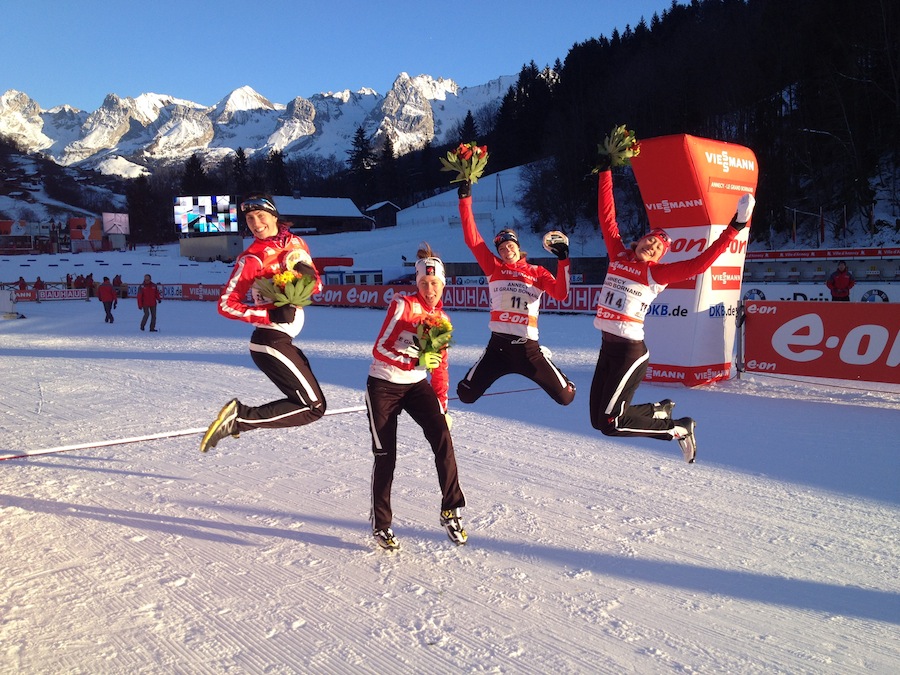
The Canadian women jumping for joy after notching Biathlon Canada’s best-ever relay result of fourth. (Photo: Biathlon Canada/Matthias Ahrens)
North America shined in the IBU World Cup with the Canadian women’s relay team taking a historic fourth-place finish in the 4 x 6 k relay. The success continued throughout the weekend with four Canadian women qualifying for the pursuit, and Rosanna Crawford ultimately finishing 19th.
On the men’s side Canadian Nathan Smith finished 16th in the 10 k sprint and was followed by Americans Tim Burke in 28th and Lowell Bailey in 35th. In the 12.5 k pursuit Smith impressed again with an eighth-place finish. He was followed by Bailey and Burke in 15th and 16th.
The action didn’t stop there with historic results from U.S. Nordic Combined. In Ramsau, Austria, Bryan Fletcher and Todd Lodwick skied the fastest combined time in the 2 x 7.5 k team sprint to place fourth, the best-ever result for the U.S. in the two-man event.
In Sunday’s individual 10 k competition, Fletcher and Billy Demong cracked the top ten by placing seventh and ninth.
With all the success happening across the pond it’s easy to forget that North America had some races of its own this weekend. Rossland, B.C. hosted the second set of NorAm races where Erik Bjornsen and Emily Nishikawa triumphed in the sprint, and Kate Fitzgerald and Kevin Sandau won Sunday’s 10 and 15 k.
The IPC World Cup also took place in Canmore, Alberta, with several North American standouts. Canadian Brian McKeever won the 10 k on the opening day and churned out another winning performance in the 20 k classic race. American Oksana Masters placed third in the women’s sit-ski 5 k and fourth in the 0.75 k sprint.
Norway’s Anders Gløersen celebrates his sprint win as he crosses the finish line in Davos. (Photo: Fischer/Nordic Focus)
Cross-Country World Cup, Davos, Switzerland (Results)
Lt. Dan Cnossen (U.S. Paralympics) racing to 11th in Tuesday’s sit-ski sprint at the IPC World Cup in Canmore, Alberta. (Photo: Pam Doyle)
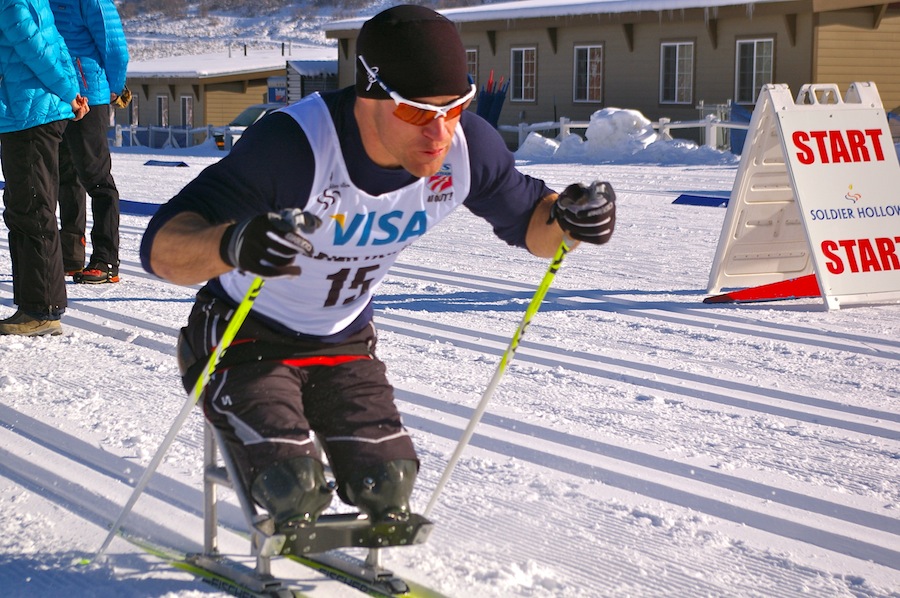
One of the most successful men on the U.S. Paralympics Nordic Team last season, Lt. Dan Cnossen cut right to the chase when asked about his training this summer and fall.
“I think we’re going to find out real quick when I go up against the Russians,” Cnossen responded in a phone interview before the first International Paralympic Committee (IPC) World Cup in Canmore, Alberta, from Dec. 9 to 17.
According to U.S. Paralympics High Performance Director John Farra, Cnossen, originally from Topeka, Kansas, is relatively new to the sport. He joined the team after the 2010 Winter Paralympics, and in the three years since he’s been living and training in Winter Park, Colo., Cnossen has risen to lead the U.S. men’s sit-ski team.
Lt. Dan Cnossen (Navy) racking up one of three national titles at U.S. Adaptive Championships last season in Midway, Utah.
A Navy SEAL who lost both his legs in an Afghanistan explosion in 2009, the first day he was promoted to lieutenant, Cnossen, 33, has full use of his core.
“He is a ‘V’ cut, super-strong … looking guy,” Farra said.
This summer, he ventured down to Argentina to train and race the 21-kilometer Marchablanca and 42 k Ushuaia Loppet. “That trip really reinvigorated my training,” Cnossen said.
Skiing on snow is important to Cnossen, because he describes his mountain board (a sit skier’s equivalent to rollerskis) as a “strength machine.”
“It’s very hard to work my cardio on it because it doesn’t roll very fast,” he said.
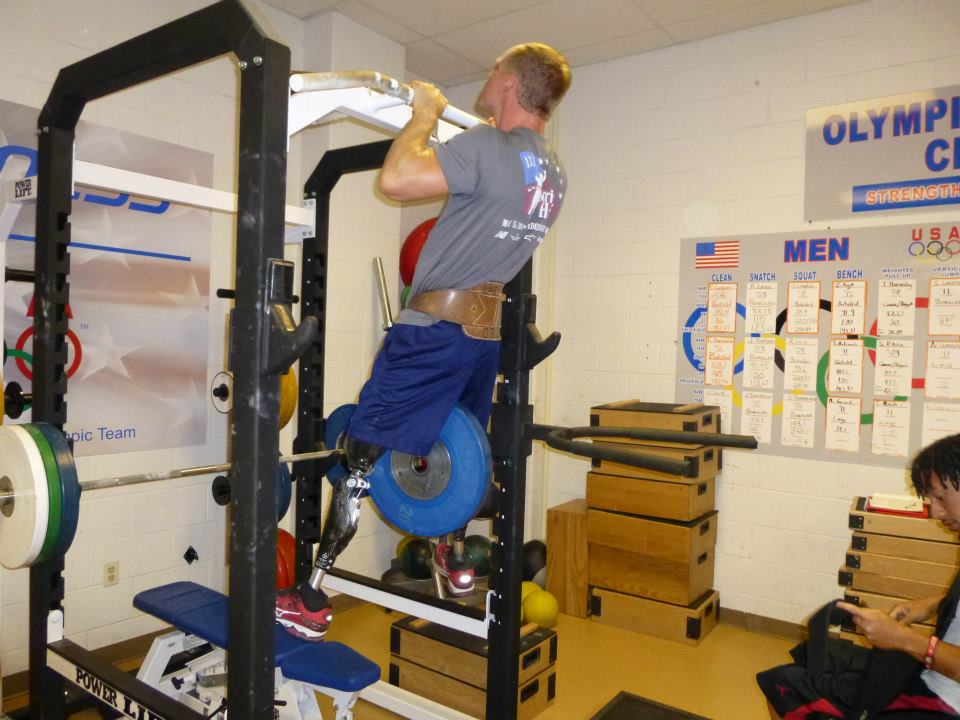
Lt. Cnossen of the U.S. Paralympics Nordic National Team doing loaded pull-ups during a strength session at the Lake Placid Olympic Training Center two summers ago. (Photo: U.S. Paralympics Nordic/Facebook)
Using prosthetic legs, Cnossen has devised other ways to raise his heart rate.
“You do what you can, and for me, I was a big runner before my injury,” he said. “I’m very lucky that I can do it, and I’m really lucky that I can walk too. ”
He mostly runs 5- and 10-k races, which helps with his nordic training.
“Plus, running gives me a chance to rest my shoulders,” he said.
Cnossen is testing in a new custom sit ski this year, a lighter model that he hopes will help him ski faster.
“It’s a really important part of the sport; you have to be comfortable, you have to be well secured … not only for power transfer, but for ski control,” he said. “I found a group of engineers who were willing to work with me and they’ve done a great job.”
Summing up his thoughts about the season ahead, Cnossen said he was confident in his skiing abilities.
“I’m hoping I’m a little better tactician,” he said. “I know I’m stronger physically this year and I have better equipment so it will be exciting to see how I end up on the results list.”
Lt. Dan Cnossen at the start of a sprint qualifier at a 2013 test event in Sochi, Russia.
In terms of tactics, he said he needs to work on sprinting.
“I try to be a sponge,” he said. “Since this is only my third year, every time I go to a World Cup I try to watch the Russians and the athletes from other countries. I watch what lines they take. Are they in the track are they out of the track? Their rhythm of double poling, the nuances of ski handling. I hope it pays off.”
Also a biathlete who’s tweaked his training, Cnossen predicts improvement there as well.
“I think you’ll see some improved hit rates,” he said. “I knew the first couple of years, even if I shot perfectly I wouldn’t ski fast enough, no where near it. First and foremost, I thought the strength and conditioning would take the longest to develop. I have a background in shooting and I can tweak that in a relatively short amount of time compared to how long it would take do develop the strength to conditioning to be fast enough to keep up with the top guys.”
So far, he’s notched ninth place in the 10 k at Canmore, leading the U.S. men. On Tuesday, he placed 11th in the sprint behind teammates Sean Halsted and Andy Soule in eighth and ninth, respectively.
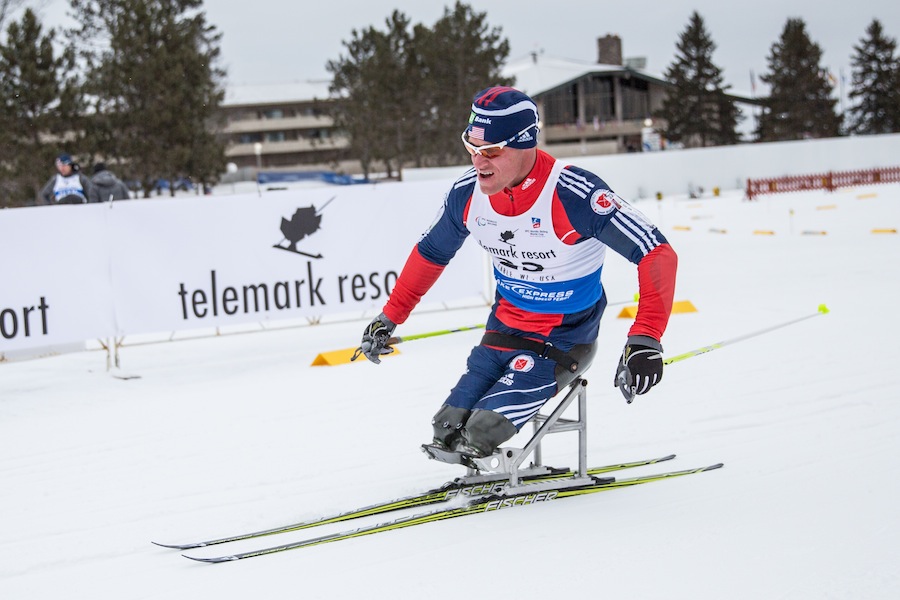
Lt. Dan Cnossen (U.S. Paralympics) tallied multiple podiums at the IPC World Cup in Cable, Wis., in January. (Photo: James Netz)
***
What: IPC World Cup at the Canmore Nordic Centre in Canmore, Alberta
Schedule:
IPC Cross Country World Cup
December 9 10:00am Men’s 10km/Women’s 5km Skate
December 10 11:00am Sprint Classic (Heats start at 12:00)
December 12 10:00am Men’s 20km/Women’s 15km Classic
Tatyana McFadden competing at one of her first international cross-country ski races at the 2013 IPC World Cup in Cable, Wis.(Photo: James Netz)
Tatyana McFadden is coming off an impressive couple of years.
Winning the New York City Marathon last month, the 24-year-old University of Illinois student became the first person to win the Chicago, Boston, London and New York City marathons – the elusive Grand Slam – in a single year. In July, McFadden became the first athlete to win six gold medals at the International Paralympic Committee (IPC) Athletics World Championships in Lyon, France. No stranger to elite competition, the three-time Paralympian holds 10 medals in wheelchair racing, three of them gold from the 2012 London Paralympic Games.
Tatyana McFadden at the 2013 U.S. Adaptive National Championships at Soldier Hollow in Midway, Utah, where McFadden won the sit-ski sprint. (Courtesy photo)
Now with her track and marathon seasons over for the year and with the 2014 Winter Paralympics in Sochi, Russia, on the horizon, McFadden is days away from beginning her second season as a nordic skier at the IPC World Cup in Canmore, Alberta, starting Dec. 9.
John Farra, the U.S. Paralympics Nordic high-performance director, tells the story of how McFadden came to his sport.
“About a year and a half ago I got a text message at midnight from the [U.S. Paralympics] alpine director [Kevin Jardine] saying, ‘Hey, I’m at the ESPYs and Tatyana McFadden wants to be a nordic skier!’ ” Farra said.
According to the Chicago Tribune, Jardine reportedly told her, “Are you kidding me? No one wants to do nordic. Do you know how hard that is?”
“I guess you don’t understand anything about me,” McFadden replied.
“She contacted me and said ‘How can I get into the skiing thing?’ ” Farra explained. “So she comes to the national championships and won the sprint race and was very competitive in the others. I said, ‘You should come to the World Cup in Cable, Wisconsin. There may be time for you to make the Paralympic Games.’ So she did and she made the national team in just one race. She’s just so frickin’ strong.”
In a phone interview last week, McFadden described her busy upcoming month, which starts this week in Canmore.
“I’ll be there a few days before and I’ll do a competition, then I literally fly back [to Illinois], take a final, graduate, move out, then I head home for Christmas,” she said.
Majoring in human development and family studies, she will give the graduation speech to her class.
Born in St. Petersburg, Russia, with spina bifida, a birth defect that paralyzed her from the waist down, McFadden spent her first six years in an orphanage walking on her hands. A disabilities commissioner for the US Health Department, Deborah McFadden visited the orphanage and adopted Tatyana before raising her in Baltimore. Since then, Tatyana has been an activist on several fronts, advocating against a 2012 Russian law prohibiting Americans from adopting Russian children. She was also behind the Maryland Athletics Equity for Students with Disabilities Act, which was passed in 2010.
McFadden racing at the 2013 IPC Athletics World Championships in Lyon, France, where she won an unprecedented six gold medals. (Courtesy photo)
For now, she’s focused on getting back to Russia, this time as a Winter Paralympian. To manage the transition from wheelchair racing to skiing, McFadden said she’s been spending a lot of time in the gym on the SkiErg and doing interval training.
One of her biggest challenges has been learning how to handle the cold. McFadden experienced some issues with frostbite while training, but her enthusiasm toward the sport has made up for the hardships. Nicknamed “The Beast,” it’s no surprise when McFadden says, “I love to train really hard.”
She is also excited to get on snow in her new sit-ski. At last season’s U.S. Adaptive Ski Championships at Soldier Hollow in Midway, Utah, McFadden won the sit-ski sprint in a borrowed, ill-fitting sled.
“[The ski] was too big for me,” she said. “I’m a size 10 1/2 and I was riding in a size 14; it was way too big. I was sitting too high which really threw off my balance. I didn’t have control going down the hill too well and I really wanted to be shorter.”
Her new sit ski is designed to put her in a more-forward position, similar to her racing wheelchair. McFadden said it feels “a lot more natural and transitions well from wheelchair racing. … [It’s] literally just the bucket and it’s an absolutely beautiful, beautiful bucket. It’s extremely light and it’s purple, my favorite color. I’m really excited to take it out again.”
Starting in Canmore, McFadden will have plenty of opportunity to get used to her new setup. At the end of the month, she’ll head to Utah for her second nordic nationals in early January, once again at Soldier Hollow. Then she’ll head to Germany for the IPC World Cup in Oberstdorf from Jan. 16-19, and after that, Winter Park, Colo., for more altitude training.
Tatayan McFadden shows off her new sit ski in a promotional photo from her sponsor BP. (Photo: BP Team USA/Facebook)
“As soon as I graduate I’ll be on snow all the way up to Sochi,” McFadden said.
According to Farra, working with her on snow will the give the U.S. Paralympics Nordic coaches a chance to help her improve her technique.
“She’s so strong and unbelievably fit,” Farra said. “So she’s got the most important part of being a nordic skier down, and you can’t fake that.”
McFadden has no illusions about the challenges ahead of her. “I am really new to skiing,” she said. “My goals are, first of all, to make the team and head over. Then I’ll take it event by event. My goal [in Sochi] is to make the finals.”
As for her podium potential, Farra said, “We really don’t know. She’s fired up about it. She’ll have a day or two to train in Canmore before the races and she’ll spend the rest of the winter skiing with us trying to get ready for Sochi to see what she can do there.”
While Farra can’t predict McFadden’s performance in her new sport, he knows what kind of attention she can bring to the developing sport.
“When the Games are on, you are going to see Kikkan Randall skiing in a BP commercial and you’re going to see Tatyana McFadden skiing in a sit-ski on these commercials that are run all the time throughout the winter,” he said. In partnership with the U.S. Olympic Committee, NBC has committed to 50 hours of coverage for the 2014 Paralympics.
Thinking about her first Winter Paralympics, McFadden isn’t sure what to expect.
Tatayan McFadden shows off her new sit ski in a promotional photo from her sponsor BP. (Photo: BP Team USA/Facebook)
“For track, since I’ve been to other races and other Paralympics… I know what to expect between events and the transitions and about getting on the bus and off the bus and into the venue and what its going to feel like,” she said. “For Sochi, I don’t know any of that. I have no idea because everything is so new for me. I have to just be relaxed and go with the transitions and then when it comes time for me to put my skis on the snow, I have to remember everything I’ve learned … and ski as fast as I can and hopefully make people proud.”
Among the new experiences awaiting McFadden is biathlon racing. Due to a relatively small pool of athletes, adaptive skiers are encouraged to compete in both nordic and biathlon races. Brand new to skiing at nationals last year, she didn’t race biathlon. “I told John [Farra] that I wanted to focus on skiing,” McFadden said.
However, she did get introduced to the sport and practiced a bit on the shooting range. Despite some archery experience, McFadden said she never shot a gun before trying biathlon last January.
“It’s going to be a lot of fun,” she said. “I’ll shoot the targets as best I can, and if I miss them all, I know what it feels like to do a lot of laps. In track, doing [laps] is just a normal day for me. I’m not really too concerned about it. What is really different about biathlon is that I’m not used to stopping in a race. I’m used to going hard from start to finish and not having to slow down and take a deep breath and try to hit the targets.”
When asked what it will mean to her to return to Russia, she said she’s “really excited.”
“It’s part of my culture, it’s part of who I am, and that will never be apart from me,” she added. “But I’m going to be going and competing for the United States of America.”
Comparing her two “home” nations, she says the Russians are behind the times when it comes to accepting people with disabilities.
“[In the U.S.], you can get jobs and you can live a normal life,” she said. “That’s not really the case for Russia. Some places are not accessible, in America places have to be accessible. Just seeing athletes come in and seeing how strong the athletes are and seeing them compete. I think its going to be really good for them.”
Now a U.S. Paralympics National Team member, Tatyana McFadden (l) after placing second in the women’s 5 k at 2013 U.S. Adaptive Championships last January. Beth Requist (c) won it in 25:13.9, and Kristy Vaughn (U.S. Paralympics Development Team) was third (+2:34.4).
For the second year in a row Canmore, Alberta, willhost the world’s best nordic skiers with six International Paralympic Committee (IPC) World Cups. Racing begins Monday December 9th and continues to December 17th. The entire series will be set at the renowned Canmore Nordic Center.
These World Cups are of huge importance to Canada’s Para-Nordic Team. They provide the athletes with an opportunity to compete on home turf but more importantly, the entire series serves as a qualifying event for the Paralympics in Sochi, March 7 to 16, 2014.
The Russians arecoming. Close to 120 athletes are expected including 40 from Russia alone. Canada and the United States will be out in force with about 20 athletesper nation. Up to 16 nations will be represented. Monday, December 9th, Tuesday December 10th and Thursday December 12th are the Cross Country world cups. Beginning Saturday, December 14th and then on the 15th and the 17th, many of the same athletes will be competing in the biathlon world cups.
Let’s make some noise out there and cheer on the athletes. Come to watch or be one of the 150 volunteers needed. Go to IPCVolunteers@albertaworldcup.com and chose your favourite volunteer position. Visit the event website at www.albertaworldcup.com.
***
Watch and share this great video produced by Glen Crawford at Glen Crawford Production Services, Canmore Alberta.
Canadian Para-Nordic World Cup skiers Colette Bourgonje and Brian McKeever are FasterSkier’s Adaptive Skiers of the Year. (Photos: James Netz/CCC & Gerry Furseth)
Brian McKeever is one of those guys that seem to keep getting better with time. At 33, Canada’s Para-Nordic World Cup visually impaired skier once again dominated the International Paralympic Committee (IPC) World Cup scene last season, winning every IPC cross-country event he participated in.
With guide Erik Carleton, McKeever tallied two golds at 2013 World Championships in Solleftea, Sweden, and two more at World Cup Finals in Sochi, Russia.
“I don’t think the guides get nearly as much recognition as they should,” McKeever told Cross Country Canada in February. “It is tough being the guide because you are out front and not skiing your own race. … When I need him to hold off he has to, and when I need him to increase the pace he needs to do that as well.”
McKeever (r) and guide Erik Carleton celebrate their 2011 World Championships gold. (Photo: IPC)
Childhood friends from Calgary, the duo didn’t waste any time getting from their last World Cup Finals race in Sochi to Whistler, British Columbia. There, McKeever captured his first national title in the 10-kilometer freestyle on March 24, just four days after racing in Russia.
“You never really know how you are going to feel after getting off the plane from Russia,” McKeever told FasterSkier after arriving two days earlier. “First national championship win in my career, I am really happy about that.”
To start the season, both McKeever and Carleton individually qualified for the able-bodied World Cup races in Canmore, Alberta. They decided to skip the opening IPC World Cups to compete in Canmore, where McKeever notched a career-best 38th in the skiathlon in mid-December.
In February, the 10-time Paralympic medalist double poled the entire Canadian Birkebeiner 55 k classic in Edmonton, Alberta, and won by nearly three minutes. Carleton, 35, placed second.
McKeever took on the Vasaloppet 90 k classic in early March for the second-straight year, finishing 45th overall – a vast improvement from 83rd in 2012.
Another 10-time Paralympic medalist, Canada’s veteran sit-skier Colette Bourgonje, 51, isn’t showing signs of slowing down before the 2014 Winter Games (which will be her seventh Paralympics). In January, she raced to silver and bronze at the IPC World Cup in Cable, Wis., and went on to place eighth at World Championships and sixth at World Cup Finals. Bourgonje landed fifth overall in the IPC World Cup.
Honorable Mention:
Canadian Para-Nordic World Cup member Mark Arendz (c) tops the podium for the first time at 2013 IPC Biathlon World Championships in Solleftea, Sweden. (Photo: CCC)
Further proving the depth of Canada’s Para-Nordic team, 22-year-old Mark Arendz won his first IPC Biathlon World Championships gold in February in the 7.5 k sprint. Also in Solleftea, Arendz claimed bronze in the 12.5 and 15 k distance races and finished eighth overall in the World Cup.
After trying out sit skiing for the first time at U.S. Nationals in January, Tatyana McFadden went on to represent the U.S. at the IPC World Cup in Cable, where she finished right behind Bourgonje in two races in fourth and fifth, respectively. Her results were hardly a surprise; the 24-year-old University of Illinois student has 10 Paralympic medals in wheelchair racing and at least six marathon titles (including one in Boston and other in London this month). Despite a late start, she ranked 14th in the overall World Cup.
Erik Carleton (Canadian Para-Nordic Ski Team/Rocky Mountain Racers) on his way to a second-place finish in the 10 k classic individual start at Canadian Ski Nationals on March 19. The next day, he took seventh in the 15 k skate then flew to Finland with Brian McKeever to compete in the IPC World Cup Finals two days later.
Entering his third straight season with the Canadian Para-Nordic World Cup Team, Erik Carleton has already made some big decisions this year. Among them, he had to choose whether to race the Alberta Cross Country World Cup in Canmore or go for gold at the International Paralympic Committee (IPC) World Cup opener in Vuokatti, Finland.
It must be tough to be Carleton, a competitive-nordic racer who doubles as a Para-Nordic guide for Brian McKeever, arguably the best visually impaired skier in the world. While some Canadians are still stressing over their prospects of making the Canada World Cups (which starts with skate sprints in Québec Dec. 7-8, followed by a skate sprint and distance races in Canmore, Alberta, Dec. 13-16), Carleton was one of nine outside of the nation’s cross-country team that prequalified.
With the option to race the 15 k classic mass start and 30 k skiathlon in Canmore, Carleton faced a bit of a dilemma. The IPC World Cup started just a few days before on Dec. 11 in Finland. Unlike the loaded cross-country calendar, Para-Nordic skiers have only one other World Cup (Jan. 20 in Cable, Wis.) before the World Championships started Feb. 21 in Sollefteå, Sweden.
After a 10-day camp in Sante Fe, N.M., earlier this month, Carleton wrote in an email that he planned to compete in both the races he prequalified for in Canmore.
“The IPC World Championships and the IPC World Cup in Sochi [March 14] will be the big priorities later in the season,” he wrote.
Last year, he and McKeever, 33, swept the 2012 IPC World Cup Finals in Vuokatti just a few days after competing at Canadian cross-country nationals in Québec. At Mont Sainte-Anne, Québec, Carleton won an individual silver in the 10 k classic race and placed seventh in the 15 k freestyle before jetting with McKeever, his childhood friend, to Finland.
There, they claimed three gold medals for a grand total of four last season.The only man that topped McKeever in 2011/2012 was Russian Stanislav Chokhlaev, who beat him to gold twice in World Cup skate races in Sjusjøen, Norway.
This winter, Carleton and McKeever are aiming for continued success and IPC dominance at World Championships and Sochi in preparation for the 2014 Paralympics. But first, Carleton wants to start strong individually.
“The main focus at the moment is to be in ‘best-ever’ shape for the December World Cups,” he wrote.
To do so, he committed to the Para-Nordic Ski Team (PNST) training plan, following it more closely than in the past.
“I have more confidence in the PNST program after my successes last season,” Carleton wrote. “My major goals are to enjoy what I do and to be smart at training and racing.”
As for his training, Carleton explained that he’s “revamped” both his classic and skate techniques and already seen improvements in his efficiency. A few colds set him back this offseason, but he resumed strength training for the first time in eight years.
“The idea was to build power without adding muscle, and to learn how to move properly to avoid injury,” he wrote.
He’s done more rollerski intensity and less trail-running and mountain-bike racing. Rather than run on a treadmill, he and the team started using the new rollerski treadmill in the Bill Warren Training Centre in Canmore.
“Overall my volume has decreased by about 10 percent, but the training load would likely amount to slightly more,” he wrote.
This year, the team scheduled two trips to Sante Fe for altitude training up to 3,000 meters (10,000 feet) to get in prime shape for December. The did the first in September and the second Oct. 30-Nov. 8, which Carleton wrote was “a great camp with good weather” and apparently warmer than usual.
***
Photos from the Canadian PNST camps in Sante Fe, provided by Carleton:
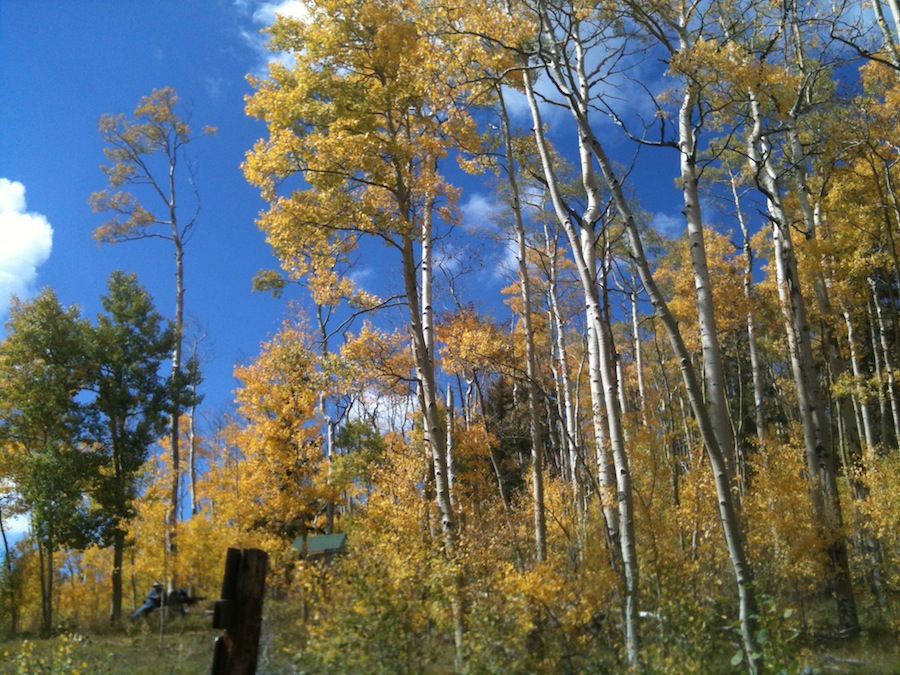
Aspens
Aspens near Santa Fe in September.
Mark Arendz rests on the summit of Santa Fe Baldy
Canadian Para-Nordic Ski Team member Mark Arendz takes a break during a long training run.
Rock Sentinel on Santa Fe Baldy
Santa Fe in September
Tarantula in Albuquerque
Tarantula leaves the road
Carleton snaps a photo of a tarantula he saw while rollerskiing near Sante Fe, N.M., on Oct. 4.
November sunset near Santa Fe at nearly 10,000 feet. The team attended two training camps in New Mexico, one in late September and another Oct. 30-Nov. 8.
For the IPC Nordic World Cup schedule, click here.
U.S. Paralympian Alicia Dana competing in a criterion in Greenville, S.C., earlier this summer. In late June, Dana, 43, made the Paralympic team and will be traveling to London later this month for the 2012 Summer Games from Aug. 29-Sept. 9. The Putney native also made the U.S. Paralympics Nordic Skiing Development Team earlier this year. (Courtesy photo)
Like most athletic children of a certain era in Putney, Vt., Alicia Dana grew up cross-country skiing. She learned the ropes from the legendary John Caldwell, a Putney School coach who went on to lead the U.S. Ski Team, and took up racing at an early age.
It wasn’t long until Dana, formerly Brelsford, developed an affinity for other sports as well. By the time she was 16, she had competed at two cycling nationals and become a repeat contender at cross-country Junior Nationals. The next year, however, an accident changed her life.
At age 17, Dana fell out of a tree and was paralyzed from the waist down. Twenty-six years later, she’s still in a wheelchair, but has greater athletic aspirations than ever before.
In less than two weeks, she’s headed to London for her first Paralympic Games. Dana, 43, is one of eight women on the U.S. cycling team and one of three competing in handcycling with a recumbent bike.
“I remember as a kid dreaming, ‘Wouldn’t it be great to go to the Olympics someday?’ but I feel like that was a completely different me back then, able-bodied and not having any idea what was in store for me in life,” Dana said in a phone interview on Aug. 3.
She laughed as she thought about her current self, a paraplegic with an 8-year-old daughter, preparing for the Paralympics. As a child, she could not have fathomed it.
What’s even more, Dana could potentially make the 2014 Winter Paralympics as well if she sticks with skiing.
Last season, she jumped back into sit-ski racing in earnest, starting with a gold and a bronze at U.S. nationals in Rumford, Maine. From there, she earned a trip to the International Paralympic Committee (IPC) World Cups in Minneapolis and Cable, Wis., where she represented the U.S. and used her new custom sit-ski.
Dana represented the U.S. at the IPC World Cups in Cable, Wis., and Minneapolis from Jan. 26-Feb. 2. With four top 10’s, she was consistently the top American female and landed a spot on the U.S. Paralympic Nordic Development Team this season. (Courtesy photo)
In the Midwest, Dana finished seventh twice and placed ninth in two other races, and was consistently the top U.S. woman. Her results spoke for themselves, and in late June, U.S. Paralympic Nordic Skiing selected Dana to its development squad.
According to High Performance Director John Farra, Dana met the team’s “emerging” or development criteria by finishing better than 25 percent back in one of the World Cup events.
She made the D-team with Kristy Vaughn and Augusto Perez, and could potentially elevate herself to the national team’s A- or B- standards, which currently provides a higher level of support to six others.
In an email, Farra described the program as fluid and wrote, “athletes can be advanced at any time up to the National Team (given they meet criteria), and in addition, we can choose to invest in anyone we want for any particular project (camp or competition) based on their commitment, performance, & potential.”
Given what he’s seen in Dana so far, he thinks she could reach the next tier. Before she won a national title in the 6-kilometer distance event last January and placed third in the preceding 5 k, Dana had not skied yet that winter. In fact, she hadn’t planned on racing in Rumford.
An email from her coach at Northeast Passage, an adaptive-sports program out of the University of New Hampshire, brought the championships to her attention.
“I came across one of the emails that [Cathy Thompson] had sent, that nationals were that week,” Dana said. “I was like, Oh my God, I’ve gotta go to nationals!”
It wasn’t before the reality of logistics set in. A single mom who lived several hours from Maine, Dana needed to make arrangements for her daughter, Willa. She also had to figure out how to get there, where to stay, and whether it was all worth it.
Her good friend Amy Caldwell, who was already in Rumford at the time, convinced her it was.
“I remember talking to her on the phone and she was like, ‘Get up here, just come!’ ” Dana said. “It was a combination of her encouragement and John Farra; he was going to be there so I suddenly realized there’s more structure to this whole thing … sounds like there could be some good competition and I should really just go and check it out.”
Getting Back on the Bike
About six months earlier in the summer of 2011, Dana had a similar internal conversation and ended up competing at the U.S. Paralympics Road Cycling Nationals in Augusta, Ga. It was her first time back on the handcycling scene since taking nearly a decade off to raise her daughter. A national criterion champion in 2001, she had her daughter a few years later, when handcycling became an Olympic sport in 2004.
When Dana returned to racing last year after going through a divorce, she had the same bike – which by now was painfully outdated.
“It was the biggest race of the year, and I got totally, totally creamed by everybody,” she said. “I remember thinking, ‘OK, now I know what the competition is and what I need to do,’ and it motivated me to really start training. I decided to take the next year and just train as hard as I could.”
That summer, her bike was later stolen when she got a flat and had to leave it on the side of the road. Public outcry in newspaper articles and on websites led to the bike’s return about a week later, but by then, the Putney community had already helped Dana raise some $10,000 dollars for a new one.
She used that money and a few grants from nonprofits like the Challenged Athletes Foundation and the Northeast Disabled Athletic Association to buy an $11,000-dollar Carbonbike designed by a handcyclist in Switzerland. The man who sold her the bike, Ken Bestine from Bike-On.com, offered to coach Dana informally, and the two worked together for a few months.
This past April, Dana tested her training at a cycling race in Montreal, where she made the U.S. team standard in a time trial. Suddenly, she was on the national cycling squad and faced the possibility of making the Paralympics a few months later.
Her national-team status and accompanying funding allowed her to hire a coach, and she chose Jim Cunningham from Greenville Cycle Center in South Carolina, who has worked with able-bodied and disabled athletes across the country. After a month of training with him, Dana and her housemate drove to Augusta in late June for another shot at the U.S. road cycling championships and a trip to London.
“There was one slot that was still open for all the women Paracyclists across all the different categories,” Dana said. “So I was, in a sense, competing with all the blind athletes, the amputee athletes, and managed to get the fastest time.”
One woman, Muffy Davis, beat her in the 19 k time trial, but Davis had prequalified. About 4 ½ minutes back, Dana averaged nearly 20 miles per hour.
“I had thought that I had a pretty decent race, but I had no idea really where I stood,” Dana recalled. “We went to that event that evening where they were going to announce the team and I convinced myself that I hadn’t made it, but we went anyway, like, ‘Oh, I’ll have a good attitude, cheer people on and it’ll be fun to see who gets to go.’ … Next thing I know my name’s being announced as a member of the team. It was pretty awesome. I was surprised and just utterly flabbergasted, like, ‘Wow, I can’t believe I did this.’ ”
With the Paralympics on the horizon from Aug. 29 to Sept. 9, Dana wasn’t sure what to expect. She didn’t watch the London Olympics over the last two weeks because she doesn’t have television. A weeklong U.S. team-training camp, which started Sunday in Buellton, Calif., would likely bring her up to speed.
The newest member on the team, Dana was excited to meet her teammates and get a feel for how things worked. On Sept. 5, she’ll compete in her first Paralympic event: the women’s individual time trial at Brands Hatch, a raceway venue in Kent, England, about a 45-minute drive from London.
Unsure how long the time trial would be, Dana said they are typically between 15 and 19 kilometers. She’ll also compete in the road race on Sept. 7, which she expected to be between 30 and 40 kilometers. If all went well, she might race the team relay on the 8th, but she was unsure of the selection process.
Dana was also recovering from pressure sores, a common and serious ailment among active people in wheelchairs, especially those without feeling below the waist.
“It’s been kind of a hard month for some different reasons,” she said. “I had a cold and flu and then I got a couple of pressure sores on my rear end from riding so much. … They will heal up eventually, but it’s a real inconvenience because I’m going to be traveling a lot in the next month and a half.
“It definitely limits my ability to just function in my everyday life and that’s hard,” she added. “I’m just getting up to train and go to essential appointments and the rest of the time, lie down or I have a standing frame that allows me to be in a standing position, so it’s a real pain.”
An unemployed single mom, she’s had to balance this and full-time training with taking care of her daughter, who’s out of school for the summer. Most recently, Dana had to explain to her 8-year-old why she had to leave for California and then England.
Fortunately, Dana said she has great friends and a community that fully supports her.
“That’s a real energy boost,” she said.
Alicia Dana of Northeast Passage and Putney, Vt., races to victory on her old sit-ski in the women’s 6 k at 2012 U.S. nationals on Jan. 7 in Rumford, Maine.
All things considered, she’d love to make the podium at the Paralympics, but had no idea what the international competition was like.
“I know for our team … Davis [is] definitely faster than me, so I’m not looking to get a gold medal,” Dana said. “It would be awesome to get a medal and I think I must at least have potential for that because that was part of their criteria when they chose the team members.”
To prepare, she aimed to heal up and stick with her training plan, watch her nutrition, rest and recovery, and keep a positive attitude. Once she gets there, she’ll try to race as she normally would, focusing on her climbing strengths and strategies without getting wrapped up in what others were doing.
Similar qualities got her on the U.S. Paralympic Nordic Team. According to Farra, he promised to leave Dana alone until after the Paralympics to let her concentrate on cycling. Come mid-September, she expected to attend a ski-team training camp in Lake Placid.
“Clearly she is a natural athlete who knows how to push the limits and can handle the suffering that comes along with a difficult endurance sport,” Farra wrote. “We were very impressed with her results at the USA World Cups, and we are excited to see how far she can take her skiing.”
Dana said he’s already hinted at Sochi.
“Farra’s been holding out some carrots for me in that direction,” she said. “He wants me to set my sights on that so we’ll see.”
Her success so far has kept her dreaming.
“Doing well enough to go to the World Cup and doing well enough at the World Cup to realize, ‘Oh, well, there might be something in this for me,’ it’s just fed my interest and motivation,” she said. “It’s exciting, it’s great. Who would’ve thought, a 43-year-old single mom could have an athletic career ahead of her?”
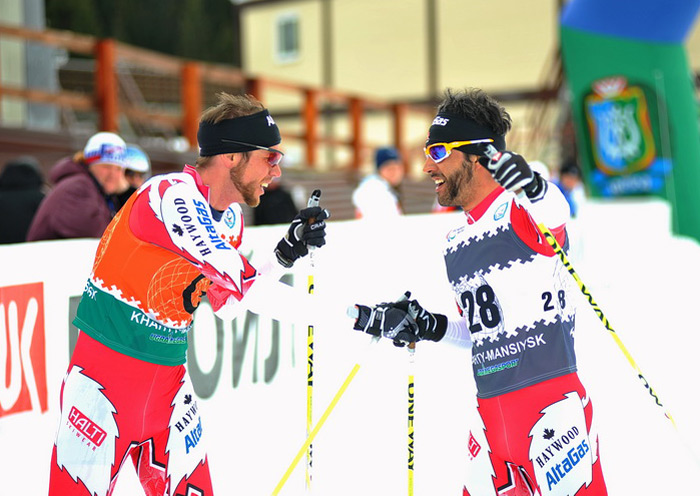
A day after flying into Finland, Brian McKeever and Erik Carleton of Canada nabbed gold in the first race of the IPC World Cup finals in Vuokatti on Thursday, the 1.2 k visually impaired sprint.
On Tuesday, McKeever and Carleton drove straight to the airport after competing in the 15 k freestyle event at the Canadian Ski Championships. Carleton placed second on Monday in the 10 k classic and eighth on Tuesday. McKeever was 15th on Monday.
According to Cross Country Canada, the two childhood friends won three silver medals and a gold earlier this year.
“I was a little jet lagged, but we had a good day today,” McKeever said in a press release. “I came here with a good game plan that we executed really well today. Erik skied very tactical. We decided to double-pole the final which paid off because it started dumping snow.”
McKeever and Carleton qualified second for the head-to-head heats and proceeded to win their quarterfinal and semifinal.
Monica Bascio (USA) at the Paralympic World Cup 2009 (Photo: Ian Lawless)
From January 29 to February 3, cross-country skiers and biathletes on the U.S. Paralympic Team will have the opportunity to compete in a World Cup on home turf. The U.S. Olympic Committee announced earlier in October that Telemark Resort in Cable, Wisconsin is set to host the biggest international nordic event the U.S. has seen since 2005, when the International Paralympic Committee (IPC) Biathlon and Cross-Country World Championships were held in Fort Kent, ME.
Central Cross Country (CXC) and the City of Lakes Nordic Ski Federation have partnered up with U.S. Paralympics, a division of the U.S. Olympic Committee (USOC), to host the event. While the USOC will be funding a the majority of the event, a $20,000 grant from the Wisconsin Department of Tourism helped make holding the races a reality for event organizers.
Wisconsin’s tourism department is excited about showcasing the home of the American Birkebeiner to a larger international audience. Between the six scheduled races — two biathlon and four cross-country — over 100 athletes from 15 countries are expected to compete.
John Farra, the USOC’s High Performance Director of Nordic Skiing, is simply happy the U.S. athletes will for once have the home course advantage.
“It’s a chance to get the Europeans out of their element over here, which is what our guys have to experience 90% of the time, able bodied or adapted,” he said.
In addition to the World Cup events in Cable, athletes are being invited to participate in the City of Lakes Loppet in Minneapolis, Minnesota following the final IPC races. Farra said one team has already confirmed their participation for the popular festival that typically attracts 10,000 competitors.
Sean Halsted, who has been on the U.S. adaptive cross-country squad since 2006, sees international racing exposure for developing athletes as one of the greatest benefits of a hosting a World Cup.
“We’re definitely excited more people can participate,” he said. “We’d like to have more development guys come overseas, but now they have a chance to get in a race.”
Two years out from the 2014 Paralympics in Sochi, Farra noted that getting developing athletes in world-class competition is especially important.
“For sure, I’m excited,” he said. “[It’s an] opportunity to encourage more athletes to participate that we normally can’t take to the a World Cup.”
For more details about the IPC World Cup, visit the official website.