From the FasterSkier archive — posts syndicated from athletes’ and coaches’ own blogs between 2004 and 2012, kept online as published. Current coverage is at fasterskier.com.

Tag: ira edwards

  • Questions Swirl Over University of Alaska’s Waiver Requests to NCAA

    Questions Swirl Over University of Alaska’s Waiver Requests to NCAA

    The Alaska Airlines Center, home to the University of Alaska Anchorage Seawolves athletics program in Anchorage, Alaska, photographed last month. (Photo: Gavin Kentch)
    The Alaska Airlines Center, home to the University of Alaska Anchorage Seawolves athletics program in Anchorage, Alaska, photographed last month. (Photo: Gavin Kentch)

    The University of Alaska system structured its recent waiver requests to the NCAA partially around a presidential directive to preserve men’s hockey at any cost, then backed away from that suggestion in a public explanation of its actions, an analysis of the school’s official waiver documents suggests.

    University of Alaska Anchorage (UAA) Athletic Director Keith Hackett and President Jim Johnsen announced last week that men’s and women’s skiing at both UAA and the University of Alaska Fairbanks (UAF) were among the sports targeted for elimination in a waiver request submitted to the relevant NCAA membership committee. At the time, Johnsen told the Alaska Dispatch News that “hockey survived largely because the NCAA requires a school to offer two men’s team sports and two women’s team sports,” and that the only men’s team sports at both UAA and UAF are basketball and hockey. (NCAA bylaws consider cross-country skiing to be an individual sport.)

    But the official waiver requests submitted to the NCAA were somewhat less circumspect. “The President of the University System has stated that Alaska Anchorage shall make every effort to retain men’s hockey,” UAA’s waiver request stated. And “the President of the University System has stated that Alaska Fairbanks shall make every effort to retain men’s hockey,” UAF’s waiver request stated in near-identical language.

    (The waiver requests are substantively identical, but were written, or at least edited, by different people. Run-on sentences, typographical errors, and citations to nonexistent bylaw provisions that are present in the UAA waiver request were corrected in the UAF version of the same document.)

    The 13 sports currently sponsored at UAA are as follows:

    Table of 13 sports currently offered at University of Alaska Anchorage (UAA), prior to its waiver request to the NCAA in November 2016. (photo: screenshot from UAA waiver request)
    Table of 13 sports currently offered at UAA, prior to its waiver request to the NCAA this month (Screenshot from UAA waiver request)

    The 10 sports currently sponsored at UAF are as follows:
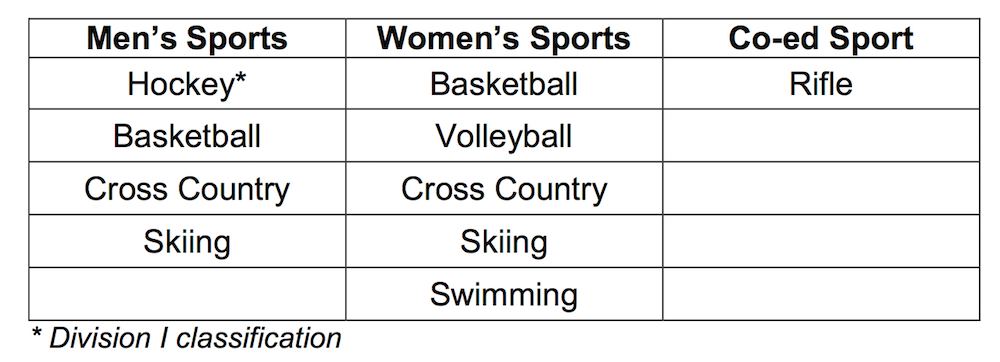
    Table of 10 sports currently offered at University of Alaska Fairbanks (UAF), prior to its waiver request to the NCAA in November 2016. (photo: screenshot from UAF waiver request)
    Table of 10 sports currently offered at UAF, prior to its waiver request to the NCAA this month. (Screenshot from UAF waiver request)

    The team sports offered at UAA, according to NCAA Division II Bylaws Section 20.10.3.3, are men’s basketball, men’s ice hockey, women’s basketball, and women’s volleyball. This bylaw defines all other sports at UAA (cross-country running, skiing, indoor and outdoor track, and gymnastics) as individual sports.

    At UAF, the team sports are men’s hockey, men’s basketball, women’s basketball, and women’s volleyball. Cross-country running, skiing, swimming, and rifle (riflery) are all defined as individual sports.

    UAA and UAF are currently both members of the Great Northwest Athletic Conference, or GNAC. UAA and UAF both wrote in their waiver requests that they must sponsor basketball, volleyball, and cross-country running in order to remain a member of GNAC.
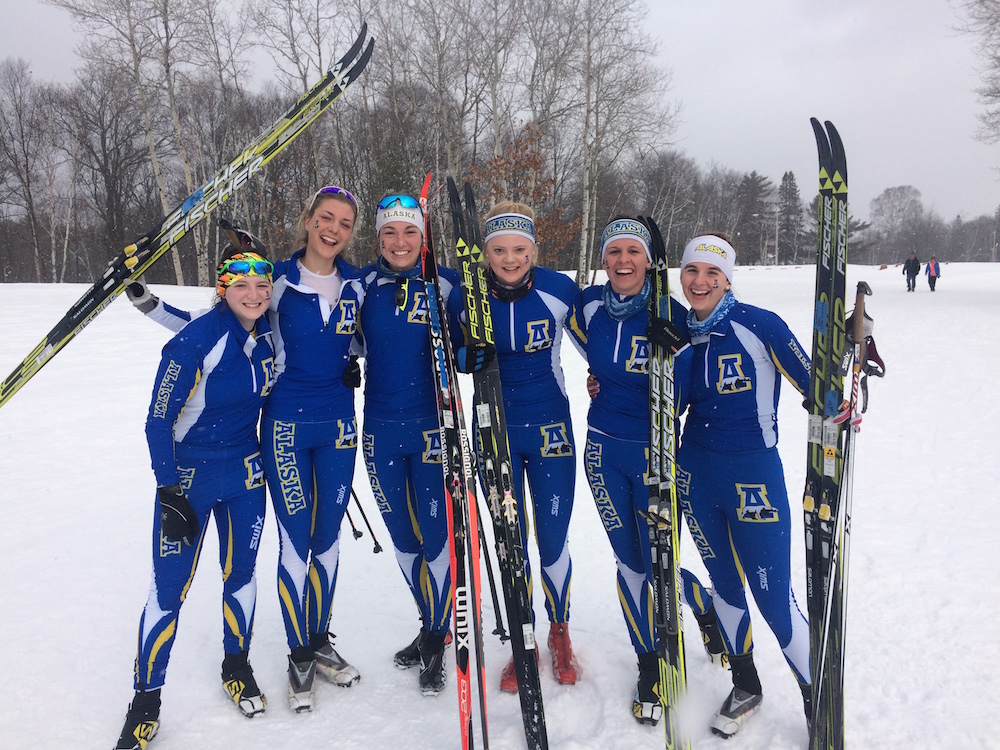
    University of Alaska Fairbanks women's nordic-team skiers get together for a photo last season: (from left to right) Hannah Rowland, Anne-Tine Markset, Nichole Bathe, Martina Himma, Ann-Cathrin Uhl, and Sarissa Lammers. (Photo: Nick Crawford)
    University of Alaska Fairbanks women’s nordic-team skiers get together for a photo last season: (from left to right) Hannah Rowland, Anne-Tine Markset, Nichole Bathe, Martina Himma, Ann-Cathrin Uhl, and Sarissa Lammers. (Photo: Nick Crawford)

    Waiver options

    UAA and UAF are both seeking relief from the requirements of Bylaw 20.10.3(a), which states that a Division II member school “shall sponsor” a minimum of “Five varsity intercollegiate sports, including at least two team sports, based on the minimum requirements of Bylaw 20.10.3.3 and involving all-male teams or mixed teams of males and females; and five varsity intercollegiate sports, including at least two team sports, based on the minimum requirements of Bylaw 20.10.3.3 and involving all-female teams.”

    There are therefore two parts to this bylaw: the requirement that a school have at least 10 sports, and the requirement that a school have at least two team sports per gender.

    Both UA schools are seeking a waiver solely of the 10-sports-total provision of this bylaw. It is unclear how much attention was paid to the possibility of seeking a waiver of the two-team-sports provision, in addition to or instead of the 10-sports-total provision. Gaining some leeway with regard to the two-team-sports requirement would potentially allow either school to look anew at hockey or basketball, the two most expensive sports at UAA by a substantial margin, as a potential target for cuts.

    Hackett, the UAA athletic director, was asked by email, “Did UAA consider seeking a waiver of the two-team-sports requirement, in addition to or instead of the ten-sports-total requirement?” He wrote back, “Yes, many months ago as part of Strategic Pathways. The answer is NO to the second part of your question.”

    Hackett was also asked whether men’s hockey could be said to be receiving special treatment from Johnsen, the UA President, when men’s basketball is also a team sport (as well as one required for GNAC membership).

    Hackett wrote, “Both waivers stated the same thing with regard to making every effort to retain Hockey at both Institutions as directed by President Johnsen. Both UAA and UAF are members of the GNAC and we wanted to be sure we would be able to maintain our Full membership with our primary Division II Conference. Men’s Basketball was not part of any discussion.”

    The budget for the UAA hockey team for the 2016/2017 season is, in round numbers, $1,347,000 dollars. The budget for the men’s basketball team is $467,000. The budget for the women’s basketball team is $446,000. The budget for each of the men’s and women’s ski teams (at UAA, this includes alpine as well as nordic) is $280,000.

    While direction from President Johnsen features as a significant part of the official waiver request that was submitted to the NCAA on behalf of both schools, this presidential involvement is not mentioned in the Frequently Asked Questions document posted on the Strategic Pathways website.

    “In the waiver application why was hockey named specifically as a sport to keep when it is the most expensive sport?” asks question 2 of the FAQ document.

    The answer given there is, “In making these decision [sic], cost was a driving factor, but it was not the only one. We applied a set of reasonable criteria that included keeping specific sports required by GNAC in order to keep our membership in that conference, making sure we are adhering to the gender equity requirements of Title IX, keeping the strong instate rivalry between UAA and UAF and cost.”

    Additional surprises?

    While all previous reporting on this story, in FasterSkier, the Alaska Dispatch News and elsewhere, has focused on UAA’s announced plan to eliminate four sports (men’s and women’s skiing and men’s and women’s indoor track), the official request submitted to the NCAA actually mentions the possibility of cutting a fifth sport if financially necessary:
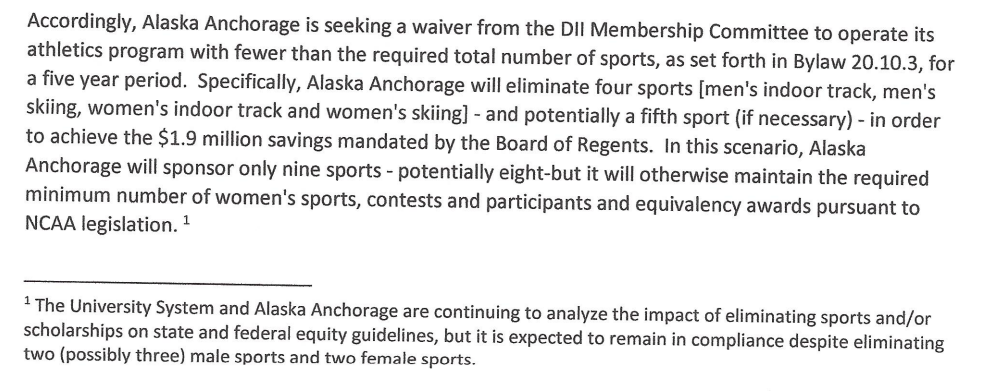
    Detail from waiver request by University of Alaska Anchorage (UAA) to NCAA in November 2016. (photo: screenshot from UAA waiver request)
    Detail from waiver request by University of Alaska Anchorage to NCAA this month. (Screenshot from UAA waiver request)

    The language in the footnote – “two (possibly three) male sports and two female sports” – suggests that, if a fifth sport were to be cut, it would be a third men’s sport. Assuming for the moment that basketball and hockey are “protected” (by virtue both of being team sports and of UAA not having sought a waiver to the two-team-sports requirement), that leaves men’s cross-country running and men’s outdoor track potentially vulnerable as a fifth sport to be eliminated.

    (Analogous language in the UAF waiver request mentions cutting only two sports, men’s and women’s skiing, alongside reducing scholarships among the remaining eight sports.)

    Furthermore, both schools’ waiver requests seek a waiver of the 10-sport requirement for a set period, five years, and promise to “evaluate its options to return to the 10-sport minimum required for compliance with Division II membership criteria” at the start of the 2021/2022 season.

    When asked whether he thought that elimination of a fifth sport would be necessary, Hackett wrote, “I certainly hope not. I am not sure there is a timeline in place for making any further team decisions. I have not spent any time considering additional sport team reductions.”

    When asked whether he expected that any eliminated sport would be able to return after having been cut for five years, Hackett wrote, “It would be difficult to ascertain.”

    Recent developments

    Since news of the waiver request first broke last week, supporters of the #savealaskaskiing movement have been busy. There is a website. (The team behind the website includes André Horton, currently a consultant with a lobbying and campaign management group but formerly a member of the U.S. Alpine Ski Team, as well as UAA head ski coach Sparky Anderson, Horton told FasterSkier in an email.) There is a march and public protest planned for Fairbanks next Thursday afternoon, Nov. 10, in connection with the upcoming Board of Regents meeting. And there are alternative budget proposals being advanced that claim to save an equal amount of money through administrative restructuring, while leaving academics and athletics programs unscathed.
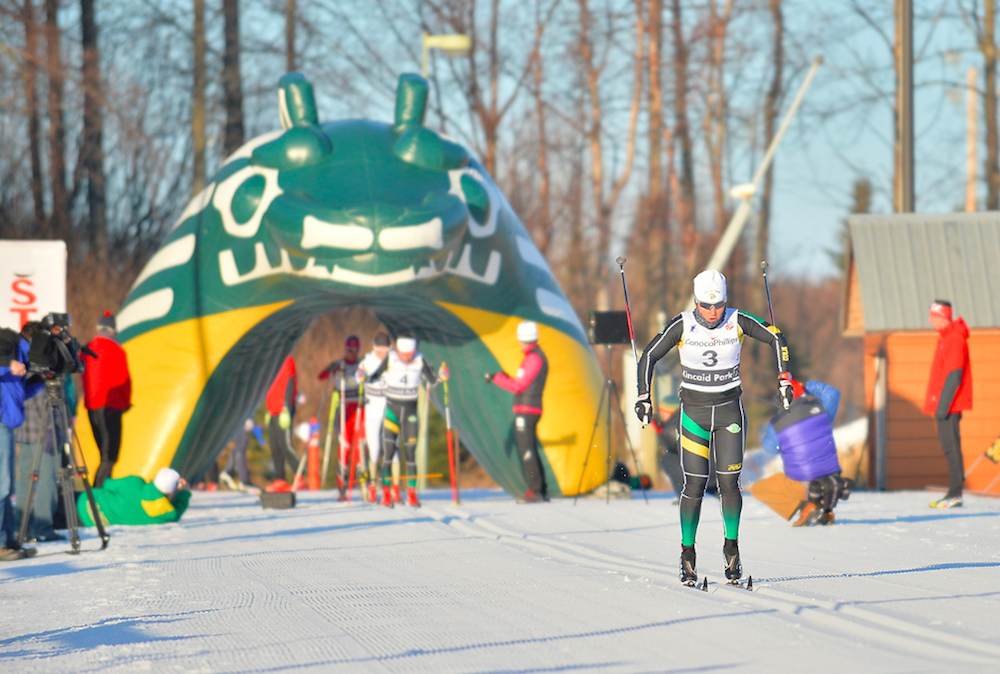
    Manon Locatelli of the University of Alaska Anchorage double poles out of the start of the 2015 Seawolf Invite at Kincaid Park in Anchorage, Alaska. (Photo: Sam Wasson Photography / http://portfolio.samwassonphotography.com/about)
    Manon Locatelli of the University of Alaska Anchorage double poles out of the start of the 2015 Seawolf Invite at Kincaid Park in Anchorage, Alaska. (Photo: Sam Wasson Photography / http://portfolio.samwassonphotography.com/about)

    The University of Alaska Board of Regents heard public testimony for two hours on Monday afternoon. While the teleconference window was technically open to anyone who wanted to testify on any subject, firsthand reports from people who listened to the testimony suggest that the focus was overwhelmingly UAA and UAF skiing, and that all testimony on this subject was in favor of preserving the program.

    Nearly all “of the comments were regarding skiing,” wrote third-generation Alaskan, former UAA skier, and former Alaska Pacific University ski coach Charlie Renfro in an email to FasterSkier. The only exceptions were “a couple comments about other university programs that were/are on the chopping block.”

    “Something like 50 people were able to comment,” Renfro continued, “and I would say about 48 of them were very constructive and from people who are all very knowledgeable regarding the UAA/UAF programs – both nordic and alpine. Nearly everyone that called in, I knew personally from either nordic or alpine, past, present, athletes, coaches and parents. One girl, a ski alum who said she was calling from Copenhagen (it was 2am there) gave an incredibly concise, heartfelt speech. It was very moving. I hope the [Board of Regents] felt the same way.”

    Anchorage resident Ira Edwards, who previously skied on the UAF nordic team and currently works for the State of Alaska, Department of Natural Resources (ski fans may recognize Edwards’s name from his side job – he spent many years as Rossignol’s U.S. race service manager), expressed similar sentiments.
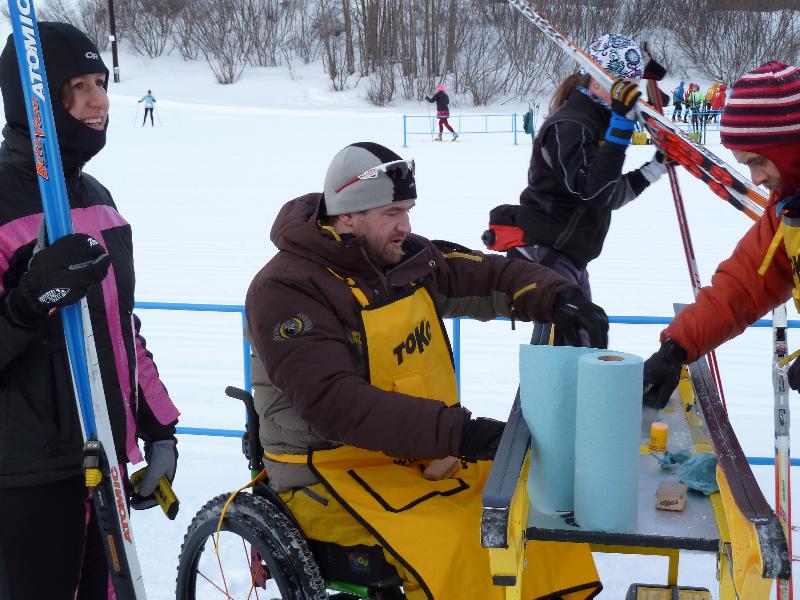
    Rossignol tech rep Ira Edwards provides race support at a race at Kincaid Park in Anchorage, Alaska.
    Rossignol tech rep Ira Edwards provides race support at a race at Kincaid Park in Anchorage, Alaska.

    “I have called into these before, for various other reasons” unconnected to athletics, Edwards told FasterSkier in a recent phone interview. “Generally, they have an hour and a half for testimony, or sometimes only an hour – they anticipated a higher call volume, so I think they bumped this one up – but I don’t think I’ve ever heard more than five or six people ever call in.”

    But on Monday afternoon, Edwards called in roughly a half hour after the public comment window opened, and was caller number 41 in the telephonic queue. He was the last person to be able to speak on Monday; the Board closed testimony immediately after he had finished speaking, after hearing two hours’ worth of comments. Edwards personally knew of a friend who was caller number 91 – that is, there were at least 50 more people after him who had hoped to speak – and suspects that there were a total of “well over 100 people” on the line who called in in an attempt to testify.

    Edwards recalls a total of three comments that were not about skiing (and one of those concerned the school’s running program). “There was not a single negative comment [about skiing],” Edwards said.

    Next steps

    Two things would have to happen for either or both of the UA system’s waiver requests to be approved: (1) first the NCAA Division II Membership Committee must approve the request, and (2) then the University of Alaska Board of Regents must approve the request.

    The membership committee holds a regularly scheduled in-person meeting in Indianapolis on Tuesday and Wednesday of next week, Nov. 8-9. Committee chair Kevin Schriver told FasterSkier on Monday that the committee “will see if that [the UA waiver requests] will be a part of our agenda.” An agenda for next week’s meeting is not yet posted online.

    The University of Alaska Board of Regents meets the following two days, Thursday and Friday, Nov. 10-11, in Fairbanks. The agenda for that meeting “has not yet been posted,” a Board of Regents representative told FasterSkier in a Thursday afternoon phone call. They said it would be posted on Friday, Nov. 4.

    The Board of Regents agenda and related materials should be accessible from here once they have been posted. Information about a live stream of next week’s Board of Regents meeting is available on the same page.

    Differing perspectives

    While many Alaskans are banding together in support of the ski program at both schools, the specific mood on both campuses seems somewhat different, reflecting differing circumstances and divergent views of the possibility of the NCAA granting the relevant waiver request.

    In Fairbanks, ski team supporters are holding out hope that the NCAA 10-sport rule will operate as a bulwark to keep UAF from cutting the relatively low-profile sport of skiing.

    Nick Crawford, 28, who headed the Bogus Basin Nordic program as well as the Lathrop High School ski team, will assume the role of head coach of the University of Alaska Fairbanks nordic and cross-country running teams in July. (Courtesy photo)
    UAF head nordic coach Nick Crawford. (Courtesy photo)

    As UAF head nordic coach Nick Crawford wrote to FasterSkier last week, “For UAF specifically, I don’t think skiing will be cut as I don’t think the NCAA will grant the waiver to the ‘10 sport minimum requirement.’ One of the NCAA’s core values is to provide sporting opportunities from athletes of many different sports and the 10 sport rule is in effect to protect small sports like skiing. It’s a slippery slope to allow Alaska to cut ‘less well known’ sports like skiing and indoor track to continue to fund their more popular sports,  If the NCAA grants this waiver, it sets a precedent to eliminate non-revenue generating sports across the country with fewer and fewer sports offerings and that is not a direction I think the NCAA wants to go in.”

    One of Crawford’s athletes, sophomore skier Conner Truskowski, expressed similar sentiments and included a call to action, writing to FasterSkier, “When we first got the news we were all pretty bummed out and mad that something as Alaskan as skiing was being considered for cuts. However, now that we have had time to process what could happen, we are all motivated to prove to the NCAA and everyone else that we are willing to fight for the sport we love and prove that the ski community benefits from having us as a team here. I want to stress that no decision has been made yet and there is still time to let everyone in the decision making process [know] that skiing is valuable. We believe that the waiver will not pass because the NCAA does not generally allow exceptions to their rules. Because of all that has happened, we are training harder than ever to make our season the best one we’ve ever had. Again, I really want to make it clear that no decision has been made yet and to let everyone know that their voice can be heard in the decision. Let the NCAA know that Alaska skiing is valuable to the ski community, both locally, nationwide, and worldwide.”

    But at UAA, head nordic coach Andrew Kastning sounded somewhat more resigned, as if the NCAA were less of a bulwark and more of a Maginot Line.

    In a recent phone interview, Kastning told FasterSkier, “Ultimately, I have a sliver of hope that the waiver doesn’t pass, that the Regents can be swayed and decide that skiing has to be saved and they need to make another decision. So I feel like there’s a tiny chance for UAA to survive at this point. But it’s obviously a giant hurdle to clear when the athletic director and the president have publicly recommended that this is the route to go to save the school money.”

    While Kastning was clearly saddened, he saved his strongest disappointment for his athletes. “I ache the most for my athletes,” Kastning said, “the ones that I’ve coached and the ones that know how special the situation and an experience it is to go to UAA and ski race in Alaska, and travel around the American West. And also for the current team, that has just gotten here and has only been here for a year at most, and they’re really bonding well and working really hard to reach their goals. And because of some short-sighted decisions and a tough budget situation, are faced with having to find another path.”

  • APU Coach Strabel Makes Mount Marathon His Own, Tops 32-Year-Old Record (Updated)

    APU Coach Strabel Makes Mount Marathon His Own, Tops 32-Year-Old Record (Updated)

    Eric Strabel chasing down 2013 Mount Marathon Race (Photo: Dave Blanchet)
    Eric Strabel chasing down Wylie Mangelsdorf, a college senior, and Rickey Gates (front) at the 2013 Mount Marathon Race on July 4 in Seward, Alaska. (Photo: Dave Blanchet)

    Note: This race recap has been updated to include comments from Ann Spencer, the third woman and Alaska Winter Stars skier.

    Mount Marathon isn’t one of those races you can wake up the morning before and decide you’re going to do. People spend years trying to get into the fabled Fourth of July hill climb, a 3,022-foot ascent up and terrifying trek back down to the town of Seward, Alaska.

    In 86 years, the grueling 3.5-mile race has grown to selectively award 350 senior entries to senior men and women, and another 250 juniors, evenly divided by gender. If you finish 10 Mount Marathons, you’re considered a veteran, which is one way to get in. Junior races don’t count toward that. Win it the year before or make the top 10 in your age group, you’re also in. Try your luck with a lottery some people have spent more than a decade trying to get registered through, or pay at least a grand for one of 10 auctioned entries.

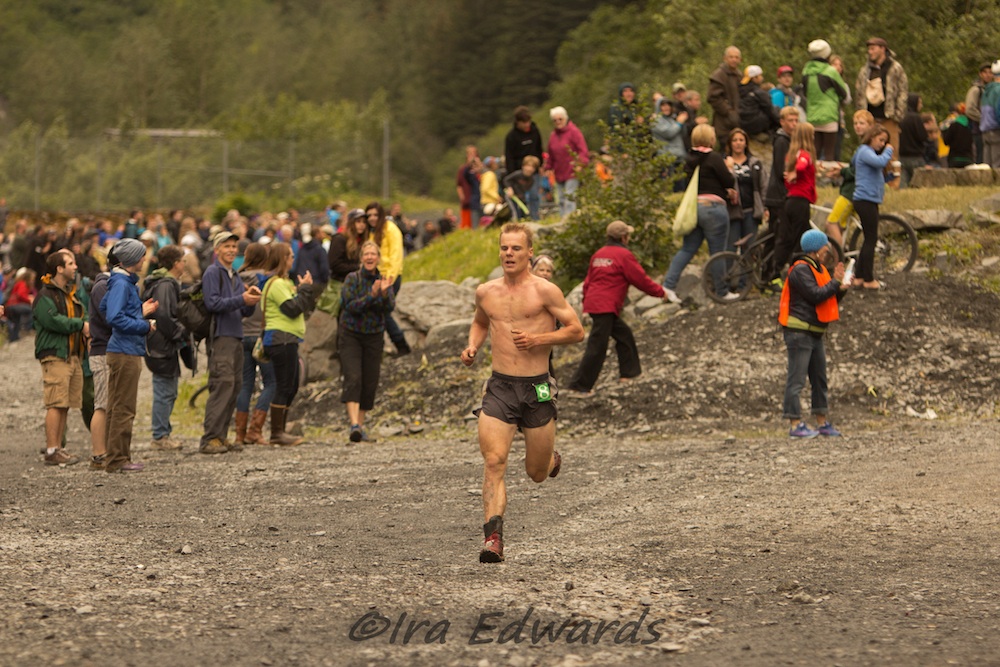
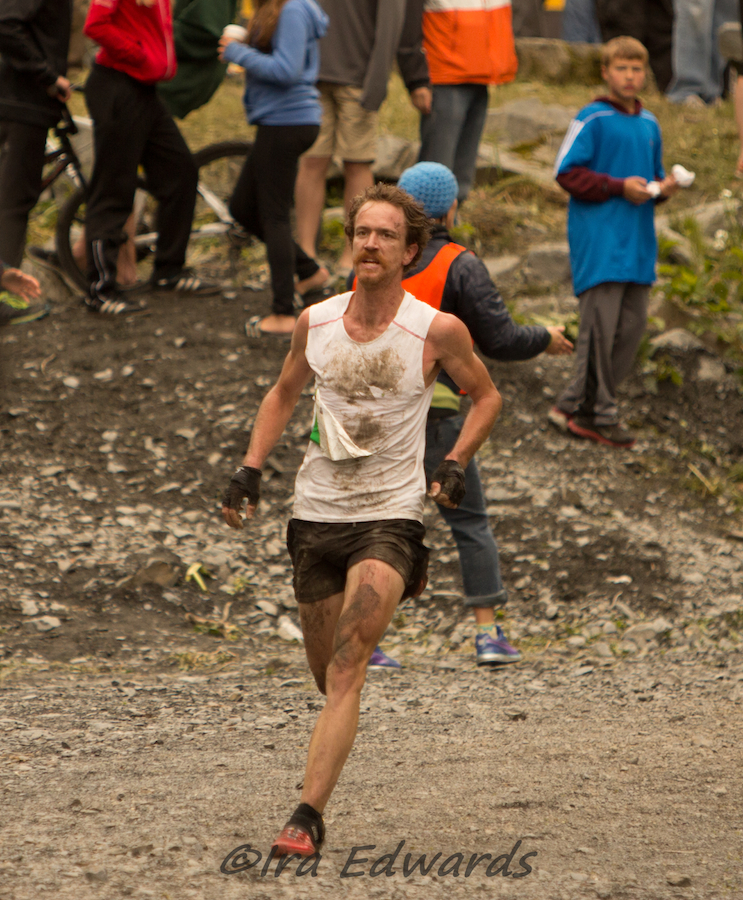
    Eric Strabel, who coaches the APU university and junior nordic teams and assists with the elite team, coming off the mountain to win the 2013 Mount Marathon on July 4 in Seward, Alaska. It was his second victory in three years and he broke a 32-year-old course record by 26 seconds. (Photo: Ira Edwards/roosterskier.com)
    Eric Strabel, who coaches the APU university and junior nordic teams and assists with the elite team, coming off the mountain to win the 2013 Mount Marathon on July 4 in Seward, Alaska. It was his second victory in three years and he broke a 32-year-old course record by 26 seconds. (Photo: Ira Edwards/roosterskier.com)

    Two years ago, Alaska Pacific University (APU) nordic coach Eric Strabel won Mount Marathon. It was a goal he had more or less been working toward since he was 11, and in 2011, he achieved it.

    Last year, he finished eighth – not what he was hoping for. APU’s university coach and elite-team assistant, Strabel decided to recommit to the race he grew up doing and spent the next 12 months getting ready for his 20th consecutive Mount Marathon.

    “For the first time, I was ready to commit to 12 months of specific training for the extreme demands of the race,” Strabel, 31, wrote in an email.

    He reasoned climbing was his problem and increased his uphill training while decreasing the distance covered in each workout.

    “I have a higher disposition of fast twitch muscle fiber than what is ideal for mountain running so I needed to build up a monstrous aerobic engine before I started to do anything close to race pace for longer than 30 seconds,” he explained. “Looking back, one of the biggest keys of the training was having more than twenty 1 hour sustained low to mid level 3 efforts on steep grades before ever letting myself push my heart rate over 90% of max. … Sustained assertive steep hiking and running really works wonders for building hip and leg strength and endurance for skiing!”

    Sounds pretty technical for a guy who placed third in this year’s 50-kilometer Tour of Anchorage ski marathon without doing much ski training beyond coaching, or someone trying to break the Mount Marathon course record without a watch.

    “Wearing a watch distracts me. And it should be unnecessary,” Strabel explained. “I should already know by race day what I need to be doing and how I should be moving to have my best speed. Nevertheless, I did ask a couple people how the time was looking at landmarks to know what was possible.”

    Strabel’s speed came from within on July 4 in the 86th annual Mount Marathon Race – and with the help of a commentator’s words before the start. The announcer said the morning rain and lack of snow (for traction) would make for slower conditions, ultimately eliminating a shot at the 32-year-old course record (43 minutes, 21 seconds) set by Olympic nordic skier Bill Spencer.

    “[That] gave me kind of a chip on my shoulder and added more fuel to the fire,” Strabel wrote. “The record has been such a legend, that even the thought of breaking it has been presumptuous, but with the growing level of competition and preparation, a handful of us were starting to believe it was possible over the last couple of years.”

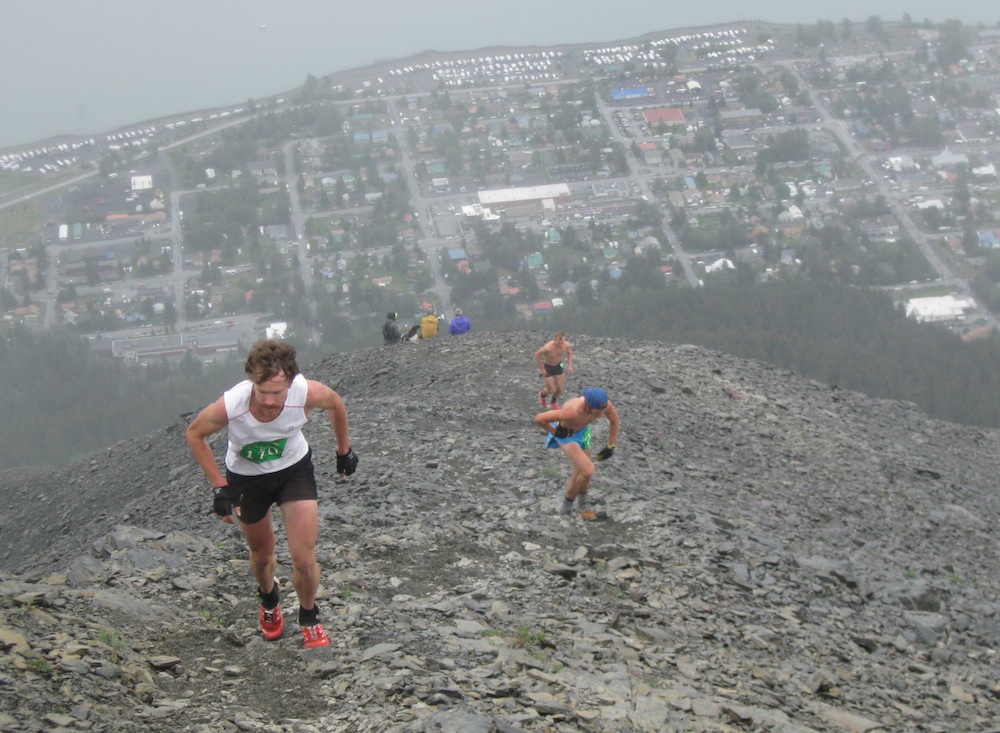
    Rickey Gates leads the men's race up Mount Marathon on July 4 high above Seward, Alaska, while Wylie Mangelsdorf (r) and Eric Strabel keep him in sight. (Photo: Dave Blanchet)
    Rickey Gates leads the men’s race up Mount Marathon on July 4 high above Seward, Alaska, while Wylie Mangelsdorf (r) and Eric Strabel keep him in sight. (Photo: Dave Blanchet)

    Last Thursday, amid drier conditions than the previous women’s race, Strabel did it, pushing himself to win it 42:55. Nine seconds later, runner-up Rickey Gates, a multiple-time member of the U.S. Mountain Running Team, crossed the line in record time as well.

    Both saw their times on the big clock, but neither wore a watch to confirm nor thought it was possible.

    “When I got to the finish line and saw the 42 minutes and change, I thought what Eric Strabel thought, that something went wrong with the timing,” Gates, 32, said on the phone Saturday after flying home to San Francisco.

    “For a few minutes after the race it felt like after a serious accident, everyone’s kind of quiet and a little bit confused, and you’re kind of piecing together information but you’re not quite sure what to believe,” he said. “It felt like that, but when we finally got information that the clock was right, then it finally settled in. Eric gave me a huge hug; he’s really a gentleman and a gracious competitor and said it wouldn’t have happened without the two of us battling it out like that.

    “I certainly wouldn’t have run that fast without him either,” Gates continued. “It’s one of those second-place finishes that I can imagine going any better.”

    This is coming from a man, albeit a Mount Marathon newcomer, who’s won trail races around the world, including one in Antarctica and the Canadian Death Race, and is headed to Europe for the 65 k Ice Trail race in Val d’Isère, France, on Sunday. After that, Gates will compete in back-to-back 32 k races in Italy and Switzerland, then return to his home state of Colorado in late September for the Ultra Race of Champions (UROC) 100 k in Vail.

    Six weeks ago, Gates rode his 2002 BMW F650 Dakar motorcycle from San Francisco to Alaska, flying to Colorado for a wedding before settling back in around Seward (he’s getting a friend to drive his bike back). There, Gates trained with local high-school runners on the slopes of Mount Marathon, getting to know the terrain and how locals tackle it.

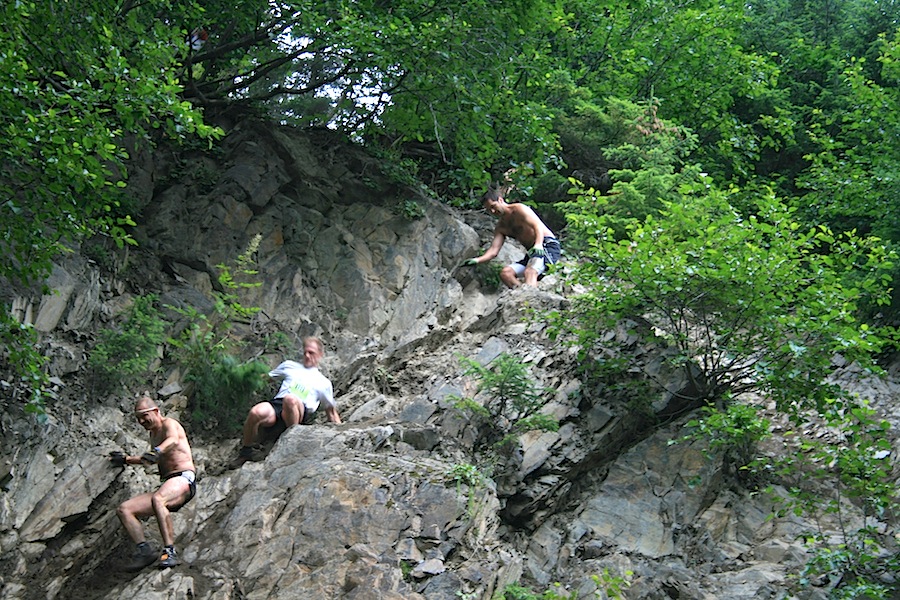
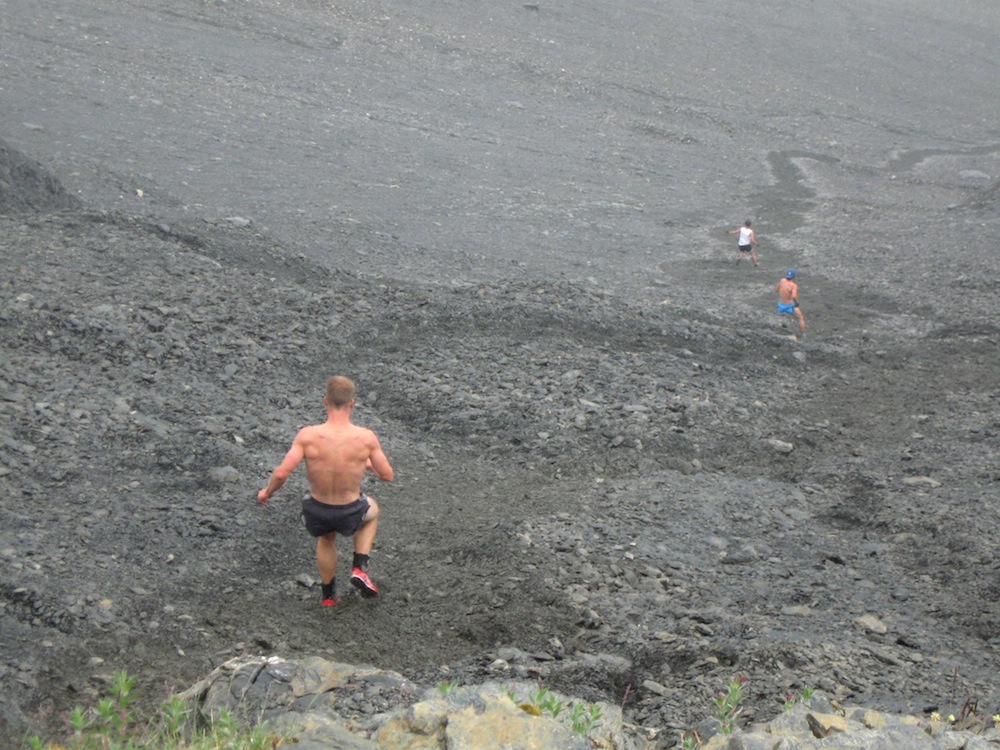
    Racers navigate the cliffs along Mount Marathon, a 3,022-foot peak, during the 2010 edition of the race in Seward, Alaska. (Photo: Lauren Fritz)
    Racers navigate the cliffs along Mount Marathon, a 3,022-foot peak, during the 2010 edition of the race in Seward, Alaska. (Photo: Lauren Fritz)

    “It was cool to see a high school cross-country team out there on the course actually dialing in little five-five foot drops and maneuvering cliffs,” Gates said. “Of course they’re high schoolers and they don’t think anything of it.”

    Less than a week before the race, Gates did a time trial up the agonizing climb. He clocked in around 51 minutes. “Muscles hurt on me that have never hurt before,” he told the Anchorage Daily News. He later told FasterSkier it’s one of the shortest yet hardest races he’s ever done.

    On Thursday, Gates didn’t worry about time, just about winning – or coming as close to doing so as possible.  His mother, Trish Gates (formerly Schultz), finished second in the 1969 Mount Marathon, but was quick to point out there were only two women in the race. She had been working at a fish-packing plant at the time, had a week off and decided to give it a go.

    “It’s the only race that she’s ever run, she never run one before then and she’s never done one since then,” Gates said of his mom, who flew to Alaska to watch him last week. “Being a traveling hippy, they were offering free meals to whoever did the race. The salmon weren’t running yet so she had a week.”

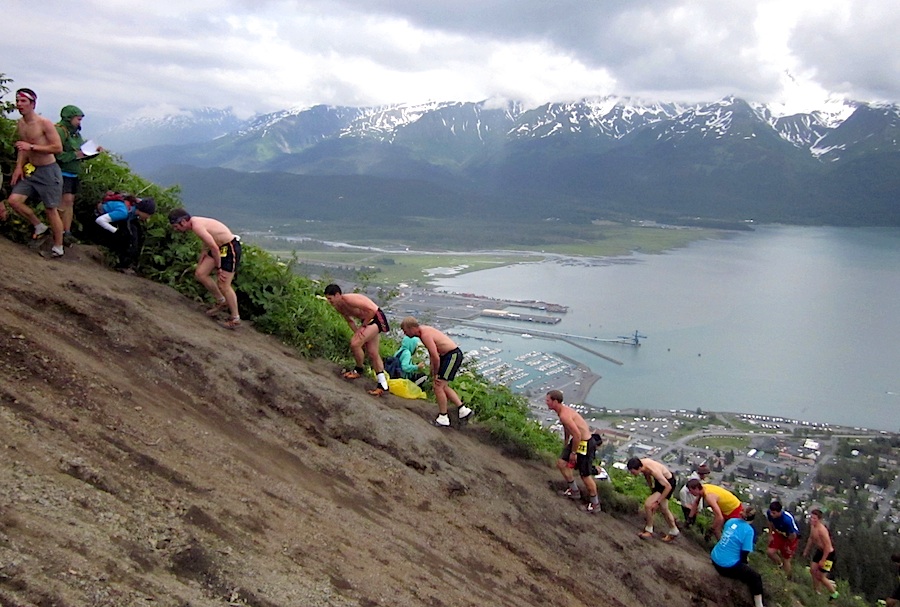
    Racers ascent the 3,022-foot Mount Marathon above Seward, Alaska, at the 2011 edition of the hill climb. (Photo: Lauren Fritz)
    Racers ascent the 3,022-foot Mount Marathon above Seward, Alaska, at the 2011 edition of the hill climb. (Photo: Lauren Fritz)

    Knowing she did the race was cool, but when he heard how technical and gut-wrenching it was, Gates started to respect her even more. He spent the last five years dreaming of racing Mount Marathon, and tweaked his schedule to make it happen this year.

    Jetting toward the top of the three-thousand-foot peak, Gates was the first to the turnaround point just over 1 ½ miles in. The third man to the halfway mark (behind Wylie Mangelsdorf, a Principia College senior, in second), Strabel passed both Mangelsdorf and Gates on the descent.

    “I’m not the strongest downhiller,” Gates said. “I ran 11 minutes down that thing, which isn’t bad, but I knew I wasn’t going to run 10 minutes down it which Eric did.”

    At the base of the mountain before a half-mile stretch along a road to the finish, Gates in second place looked up to see where Strabel was. Then, he crashed, dislocating his shoulder and spending several seconds on the ground.

    2013 Mount Marathon runner-up Rickey Gates shortly after a crash dislocated his shoulder at the mountain base a half mile before the finish on July 4 in Seward, Alaska. (Photo: Ira Edwards/roosterskier.com)
    2013 Mount Marathon runner-up Rickey Gates shortly after a crash dislocated his shoulder at the mountain base a half mile before the finish on July 4 in Seward, Alaska. (Photo: Ira Edwards/roosterskier.com)

    “I just caught my foot on something or nothing at all and just went down really hard in front of 10,000 people,” Gates said. He stood up, popped it back in, and proceeded to cut an estimated 20-second deficit to finish 9 seconds behind Strabel.

    “There’s a lot to be said about adrenaline,” Gates said. “If I’d had not fallen I still don’t think I would’ve gotten him.”

    According to Strabel, catching Gates, which he did about two-thirds of the way down, wasn’t easy. He strategically attacked the final cliff section before the road, thinking Gates would be less familiar with it and thus not as fast.

    “As it turned out, a lot of the cushion that I built by the base of the mountain was due to Rickey stumbling, catching himself and dislocating a problem shoulder, and quickly resetting it himself,” Strabel explained. “I did look back twice early on the road to know that he was making up serious ground so I had to gather a sprint over the last 90 seconds whether my body was capable of it or not.

    “I was incredibly relieved at the finish,” he continued. “The only other thought I had over the final seconds of the race was of the large display clock that came into focus. I had completely set aside thoughts of a record for most of the race. I recall seeing it ticking through the 42:30’s and remember struggling to think if a time in the 42’s was faster than 43:21. That was how far down Rickey had pushed my brain function.”

    That night, Strabel, Gates and other finishers celebrated with a night out on the town, where Gates lost his rental-car keys. All in all, the trip went as well as Gates could’ve imagined, he said, except for a couple blips.

    “I’d appreciate it if my shoulder didn’t really hurt really bad right now and if I didn’t lose my rental-car keys at 4 o’clock in the morning,” Gates said.

    Other Top Skiers

    Longtime APU skier Brent Knight, 29, placed fifth in the men’s race – four years after he led the 2009 Mount Marathon then collapsed near the finish from dehydration. He was hospitalized in Seward, where he received five liters of IV fluid.

    Brent Knight, 29, en route to a fourth-place finish at the 2013 Mount Marathon Race on July 4 in Seward, Alaska. (Photo: Ira Edwards/roosterskier.com)
    Brent Knight, 29, en route to a fourth-place finish at the 2013 Mount Marathon Race on July 4 in Seward, Alaska. (Photo: Ira Edwards/roosterskier.com)

    Knight returned to the race in 2010 and took fourth, was second to Strabel in 2011, and placed sixth behind winner Matt Novakovich in 2012.

    “It’s hard to describe the feeling you get when you are surrounded by 30,000 people in what could be the gnarliest sub hour race out there,” Knight wrote in an email.

    The first time he watched the race as a kid, the air was hazy from nearby fires. Knight watched as the men’s leader turned the corner at the top of a long hill before the finish.

    “The sun combined with smoky haze created a dull orange backdrop to a lean mountain runner covered in blood and mud,” he wrote. “Eye of the Tiger was playing over the loud speakers and I think that memory of the whole scene was etched in as one of the most awesome events I’ve ever witnessed. Now years later and multiple Mt. Marathon finishes later, I still get this overwhelming feeling like I’ve just saved the world from devastation or something. The roar of the spectators makes you feel like you’re a gladiator in the ancient [Coliseum].”

    That’s why he calls the race “addicting.” This year, Knight lost some ground at the leaders along the ascent, and by the top, he realized how fast they were going.

    “I didn’t think it was record fast, but I thought it might be close,” he wrote. “Matias [Saari, who placed third] closed in and passed me a 1/4 way down the mountain and I decided to put comfort aside (if there was any) to hang on him.”

    Knight lost about 15 seconds to Saari after the “gut,” which he described as an extremely technical creek bed with multiple cliffs before the bottom of the mountain, but made up about 10 seconds on the road.

    “It’s hard to cover ground that fast when it feels like you’ve been run through a meat grinder,” Knight wrote. “Had I run a minute faster, I would have been competing for 3rd in a time that would have easily been a winning time any of the past 32 years. This race, this year, was the toughest field I’ve ever competed against.

    “I’m a skier that loves to be a mountain runner,” he added. “I’ll find my way to the front … Perhaps next year or the year after that or the next. Strabel set a new mark to fight for this year.”

    Alaska Winter Stars skier Ann Spencer, 18, racing to third place in her first year as a senior at the 2013 Mount Marathon on July 4 in Seward, Alaska. (Photo: Ira Edwards/roosterskier.com)
    Alaska Winter Stars skier Ann Spencer, 18, racing to third place in her first year as a senior at the 2013 Mount Marathon on July 4 in Seward, Alaska. (Photo: Ira Edwards/roosterskier.com)

    In the women’s race, Christy Marvin, a 32-year-old mother of three, won in 53:20. A race newcomer but well-known local runner, she was the first rookie to win since Toby Schwoerer took the men’s title in 2004.

    Allison Barnwell placed second just under two minutes later, and 18-year-old Ann Spencer of the Alaska Winter Stars placed third (56:15) in her first year as a senior.

    In an email, she explained it was her fourth Mount Marathon (after three junior races), but first time racing the whole mountain.

    “I was definitely not expecting to do so well,” Spencer wrote. “I was aiming for a top 20 finish with a time under 1:05. Hill climbs are definitely my strength.”

    Accepted at the University of Vermont, Spencer planned to defer a year to continue skiing and training in Anchorage to better prepare herself for college racing.

    Fresh off a training camp on Eagle Glacier, APU Elite Team skier Lauren Fritz, 25, placed fourth (57:57) among the senior women. Last year, she was second in Mount Marathon to teammate and 2010 Olympian Holly Books.

    “There was a lot of pressure going into this year’s race … which is tough because there isn’t a lot of room for improvement and a lot of room for disappointment,” Fritz wrote in an email. “I really wanted to win, of course, and I had as good of a shot as any, with Holly and Kikkan [Randall] both skipping this year’s race. There are always top contenders though, and this year was no different.”

    Lauren Fritz racing back down to Seward, Alaska, for fourth in the 2013 Mount Marathon Race on July 4. (Photo: Cole Deal)
    Lauren Fritz racing back down to Seward, Alaska, for fourth place in the 2013 Mount Marathon Race on July 4. (Photo: Cole Deal)

    Meanwhile, Fritz has dealt with chronic tightness in her calf muscle for the last couple years. Skating in slush on Eagle Glacier last week didn’t help.

    “I knew going into the race that it would probably bother me, but there wasn’t much I could do about it,” she explained. “I tried to warm up well but it still flared up during the race. It was raining throughout the morning, including during the race a little bit, so it was a lot muddier than I’ve ever raced it, so there was a lot of slipping and grabbing for tree branches or plant roots or whatever you could hold onto to keep from sliding backwards. Really not ideal conditions for fast times, plus the slipping put more stress on my lower legs.”

    Just before tree line about halfway up, her calves got the best of her and she lost contact with Barnwell, Spencer and Sheryl Loan, who ended up seventh. Marvin led from the start, but was not too far in front of the chase pack at the top, according to Fritz.

    “I rounded the turn-around rock, I thought ‘OK, here we go, I’ll be done in less than 15 minutes,’” she wrote. “Just let the legs go on autopilot. It’s impossible to describe how your legs feel as you start the descent and it’s really just best not to think about how they feel and just go.

    “It is actually crazy, and unless you’ve put yourself through the torture you don’t realize how incredibly fun and satisfying it is to be able to accomplish something like this mountain,” she continued. “Still, it is an inherently dangerous race … I usually have one of the top descent times in the women’s race, but this year I did try to not let myself get too out of control on the downhill that would lead to me getting hurt. I LOVE this race, and always plan to come back, but there is a lot at stake this ski season and I recognized that. I wanted to win and I gave it my best effort, but this race isn’t the focus of my racing career right now.”

    In her seventh Mount Marathon, Fritz nabbed her fifth-consecutive top 10 and posted the sixth-fastest downhill time.

    “I’m still pretty happy,” she wrote. “Mt. Marathon is definitely the Olympics of Alaska and I’ll definitely be back to hunt down the coveted winner’s cup.”

    Results | Race video

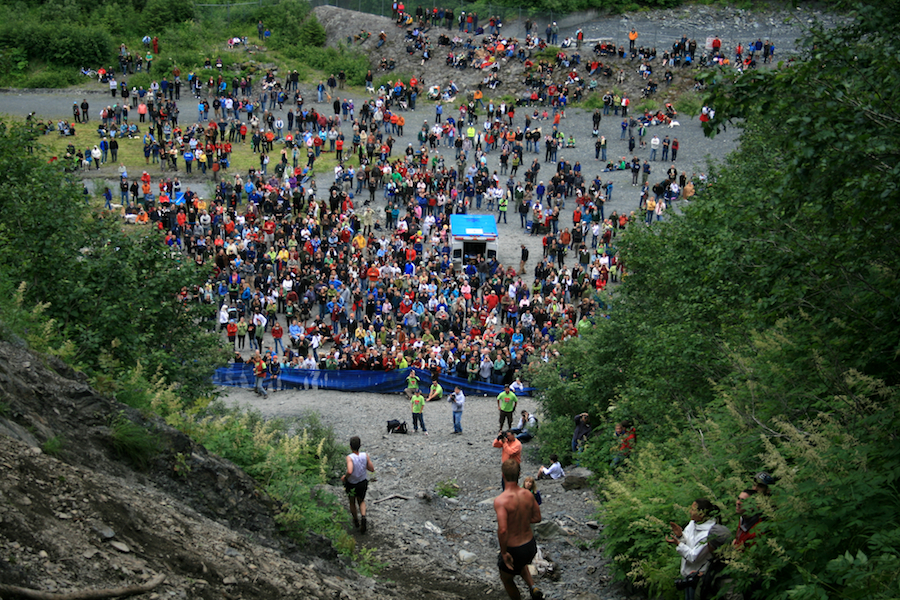
    The scene from above at the 2010 Mount Marathon Race in Seward, Alaska. (Photo: Lauren Fritz)
    The view from above at the 2010 Mount Marathon Race in Seward, Alaska. (Photo: Lauren Fritz)