
From the FasterSkier archive — posts syndicated from athletes’ and coaches’ own blogs between 2004 and 2012, kept online as published. Current coverage is at fasterskier.com.

Tag: Iran

  • For Aspiring Skiers, World Championships Qualifier Much More Than a Race

    For Aspiring Skiers, World Championships Qualifier Much More Than a Race

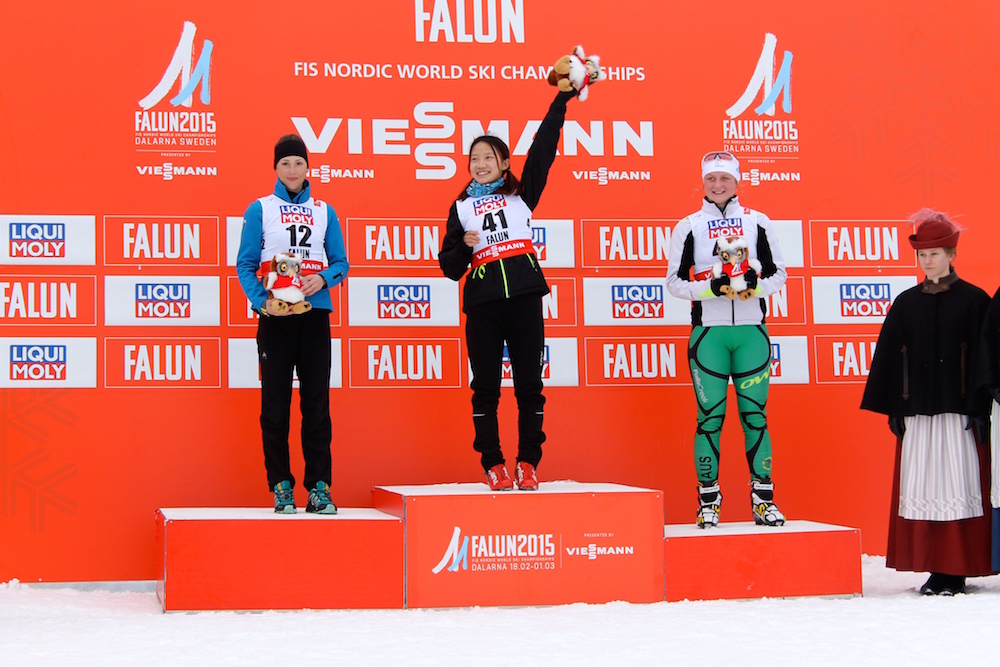
    Seventeen-year-old Chi Chunxue celebrates her qualifying win on Wednesday in the women's 10 k freestyle, which advanced her along with the top 10 to the remaining distance races at 2015 FIS Nordic World Ski Championships in Falun, Sweden.Bosnia and Herzegovina's Tanja Karisk placed second (+49.3) and Australia's Casey Wright was third (+1:07.5).
    Seventeen-year-old Chi Chunxue (c) celebrates her qualifying win on Wednesday in the women’s 10 k freestyle, which advanced her along with the top 10 to the remaining distance races at 2015 FIS Nordic World Ski Championships in Falun, Sweden. Bosnia and Herzegovina’s Tanja Karisk (l) placed second (+49.3) and Australia’s Casey Wright was third (+1:07.5).

    By Colin Abbott

    FasterSkier’s coverage of the 2015 FIS Nordic World Ski Championships in Falun, Sweden, is brought to you by the generous support of L.L. Bean, now featuring a complete line of Kikkan Randall training wear.

    FALUN, Sweden — The buzz is building at the 2015 FIS Nordic World Ski Championships with the completion of the first races in Falun. Wednesday saw the individual-start distance qualification races take place with 45 women and 69 men and women skiing 5 kilometers and 10 k, respectively.

    These initial races did not crown world champions, but they have another purpose that is just as important to the athletes racing. These races offer the opportunity for skiers that have not in the past year made the minimum International Ski Federation (FIS) point standard for men (90 points) and women (120 points). The top-10 men and women in these races qualify for the remaining distance races at World Championships (the skiathlon, individual start and mass start).

    Athletes selected with these races are part of a nations quota of starts. Most countries with a regular presence on the World Cup have athletes with low FIS points and select teams long before the start of the World Championships. This leads to lesser-known ski nations concentrating on these races as an opportunity for athletes to qualify and participate in World Championships.
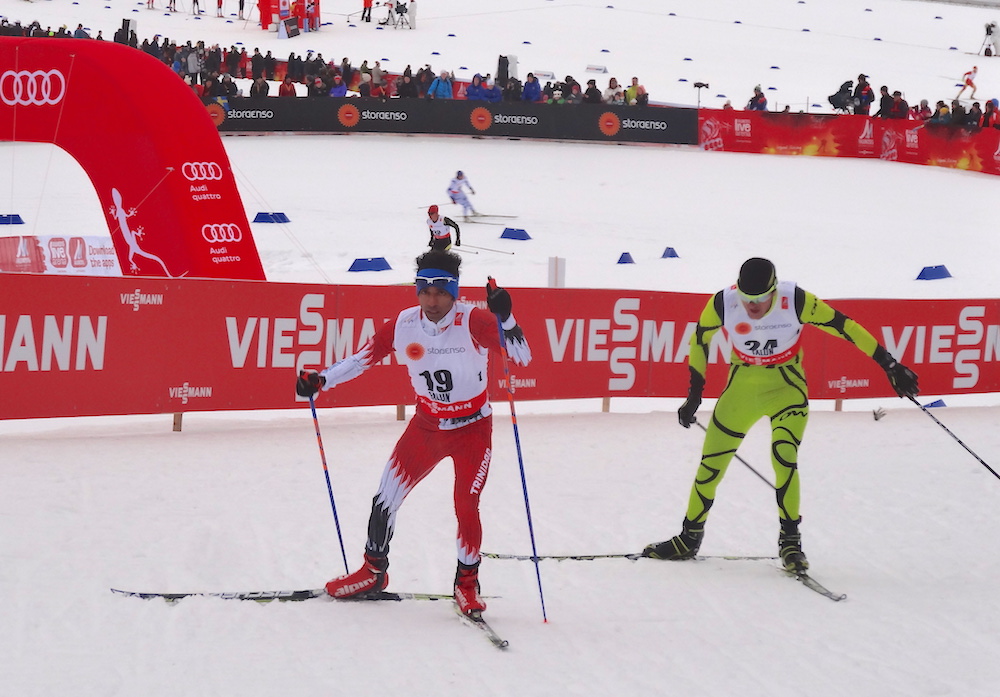
    Mark Rajak racing for Trinidad and Tobago in Wednesday's 10 k freestyle individual start qualification race on the first day of 2015 World Championships in Falun, Sweden.
    Mark Rajak (19) racing for Trinidad and Tobago in Wednesday’s 10 k freestyle individual start qualification race on the first day of 2015 World Championships in Falun, Sweden.

    After the races on Wednesday, FasterSkier caught up with skiers hailing from countries where many citizens will never see snow. Trinidad and Tobago, Iran, Australia, and Brazil offered us a glimpse into the role of skiing in their nations.

    The Australian ski program has grown into a World Championships team that includes 11 athletes and six support staff. Central to their success as a nation is a development program termed the “Victorian squad” — an inclusive, tiered learn-to-ski program focused on teaching children how to ski and supporting athletes who want to race. Those young racers have athletes such as Callum Watson and PK Kovacs to look up to now which, according to 22-year-old skier Mark Pollock, is key to motivating and developing high-performance skiers.

    At a certain point, the lack of snow makes it difficult to progress as an athlete in Australia. Their best skiers are seeking out options to continue skiing in other places. Last summer, Pollock trained with the Bridger Ski Foundation in Bozeman, Mont., while his teammate Jessica Yeaton trained with Alaska Pacific University in Anchorage, Alaska. These training initiatives taken by Australian athletes have allowed them to improve their depth and competitiveness internationally, with Yeaton qualifying for the nation’s full-fledged World Championships team outright.
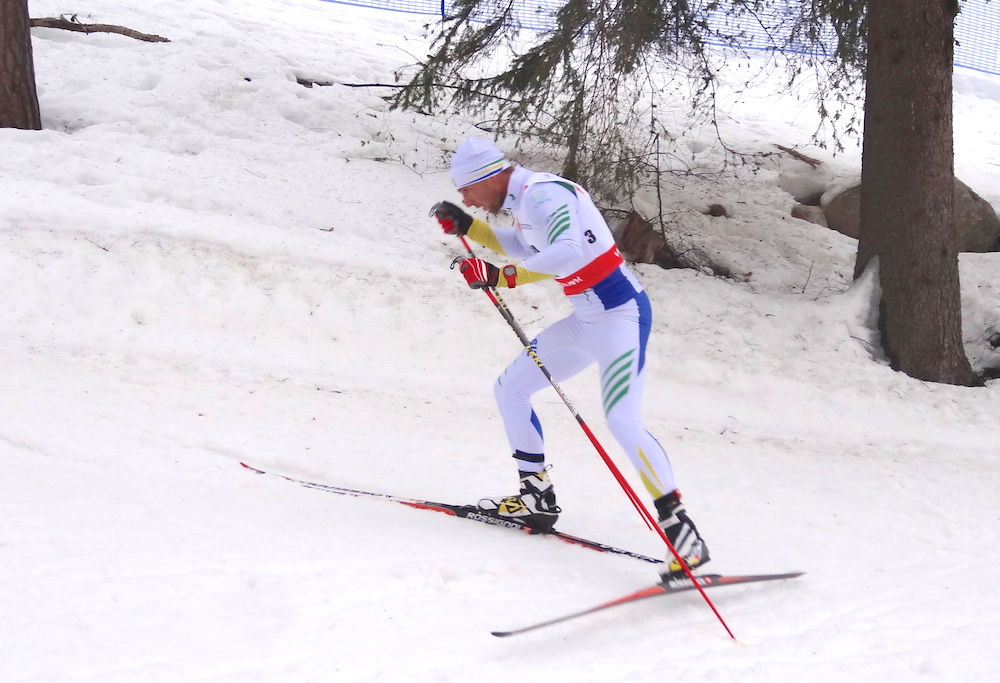
    Fabrizio Bourguignon racing for Brazil  in Wednesday's 10 k freestyle individual start qualification race on the first day of 2015 World Championships in Falun, Sweden.
    Fabrizio Bourguignon racing for Brazil in Wednesday’s 10 k freestyle individual start qualification race on the first day of 2015 World Championships in Falun, Sweden.

    Brazil was represented by three national team members on Wednesday: one woman, Mirlene Picin, and two men. Leandro Lutz, 33, and Fabrizio Bourguignon, 38, have both been skiing for a number of years. Like Yeaton and Pollock, Lutz decided that in order to optimize his training, an on-snow location was necessary for part of the year. Lutz chose to spend the first half of this winter in Denver, Colo., to train on snow in order to prep for three months of racing in Europe. And like Australia, Brazil is experiencing a growth in the popularity in skiing. According to Lutz, there are seven Brazilian junior racers currently in Europe — three racing the IBU Youth/Junior World Championships in Belarus and the remainder racing FIS junior races in Scandinavia.

    Racing the sprint on Thursday is another Brazilian, Leandro Rubella. Two years ago, Rubella started a social project in Sao Paulo to help children from impoverished families escape violence and poverty and establish the skills needed to live a good life. This project took the unlikely form of a learn-to-rollerski program. A key message of this initiative is that “anything is possible.” The hope is that a citizen from a country with no snow can make it to the Nordic World Championships, a child born into poor circumstances will see that it is possible to overcome the most difficult challenges.

    The birth of a similar program may soon occur in another tropical country, Trinidad and Tobago. Mark Rajack, 33, toed the start line Wednesday afternoon in Falun to compete for the Caribbean island nation in his first international race. Even though Rajack, who has lived in Ottawa, Ontario, since a young age, has only been skiing for two years, he sees the potential for skiing to bring positive changes to his native country.

    Rajack sees benefits similar to those envisioned by Rubella in Brazil. In addition to teaching important life skills, Rajack sees a rollerski program as a way to teach citizens a skill that would allow immigrants from Trinidad and Tobago to easily integrate with societies in the Northern Hemisphere, should they choose to leave their country. This vision originated with the positive experience Rajack has had with the ski community in Ottawa.
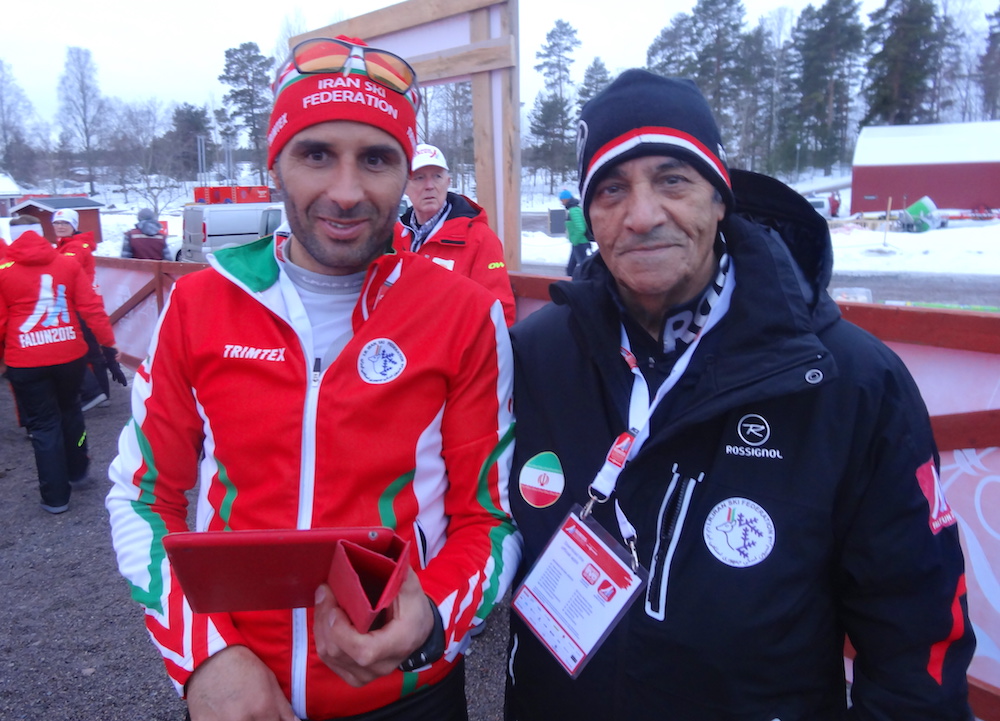
    Seyed Sattar Seyd of Iran (l) with his coach after the men's 10 k freestyle individual start qualification race on the first day of 2015 World Championships in Falun, Sweden.
    Seyed Sattar Seyd of Iran (l) with his coach after the men’s 10 k freestyle individual start qualification race on the first day of 2015 World Championships in Falun, Sweden. He placed eighth to qualify for the remaining distance races at the championships.

    Seyed Sattar Seyd posted one of the best Iranian cross-country skiing results ever on Wednesday after finishing eighth in the men’s qualifying race. Seyed, 27, is an experienced racer, having competed in both the 2010 and 2014 Winter Olympics.

    Iran now has a FIS-homologated race site at Knoor, approximately 60 k outside its capital of Tehran. Much of the training done by Iranian athletes happens within the borders of Iran and it appears that the current government will assist in keeping it that way. The addition of a biathlon range is planned for the Knoor facility in the near future and the Iranian contingent here in Falun sees a bright future for the sport.

    Below are the top-10 competitors that qualified for the remaining distance races at 2015 World Championships. Those who did not qualify have the opportunity to race Thursday’s 1.4-kilometer classic sprint qualifier.

    OFFICIAL RESULTS 

    Women’s 5 k freestyle

    1. CHI Chunxue 1998 CHN 13:33.8
    2. KARISIK Tanja 1991 BIH +49.3
    3. WRIGHT Casey 1994 AUS +1:07.5
    4. TRNKA Anna 1994 AUS +1:07.8
    5. MUIZHNIECE Anda 1991 LAT +1:09.7
    6. PASHKOVSKA Inga 1992 LAT +1:37.3
    7. PAPP Ildiko 1982 HUN +1:39.1
    8. KIROSKA Rosana 1991 MKD +1:44.9
    9. KLAUZA Laima 1969 LAT +1:47.0
    10. GALSTYAN Katya 1993 ARM +1:49.2

    Complete women’s results

    Men’s 10 k freestyle

    1. BELOMAZHEV Stanimir 1988 BUL 23:56.8
    2. PLAKALOVIC Mladen 1991 BIH +16.6
    3. KONYA Adam 1992 HUN +31.4
    4. HULGAARD Lasse 1991 DAN +47.6
    5. SLOTINS Roberts 1991 LAT +54.5
    6. SMRKOVIC Rejhan 1991 SRB +57.8
    7. PAIPALS Janis 1983 LAT +1:05.1
    8. SEYD Seyed Sattar 1987 IRA +1:11.4
    9. HADZIFEJZOVIC Dzevad 1991 SRB +1:23.3
    10. ANGELIS Apostolos 1993 GRE +1:30.9

    Complete men’s results

    About the Author: Colin Abbott hails from the Yukon Territory where he learned to ski and race from a young age. Years later his life mostly revolves around skiing. At the moment, Colin is racing for the Yukon Elite Squad and the Carleton Ravens university team. He sits on the board of directors for Cross Country Canada and is involved in the education and womens committees there. He has also started writing ski-related articles for XCOttawa and FasterSkier and for the next week is supporting the Trinidad and Tobago team at FIS Nordic World Ski Championships.
  • Beejan Kangarloo: “Chasing Points” for Iran’s Olympic Team

    Beejan Kangarloo: “Chasing Points” for Iran’s Olympic Team

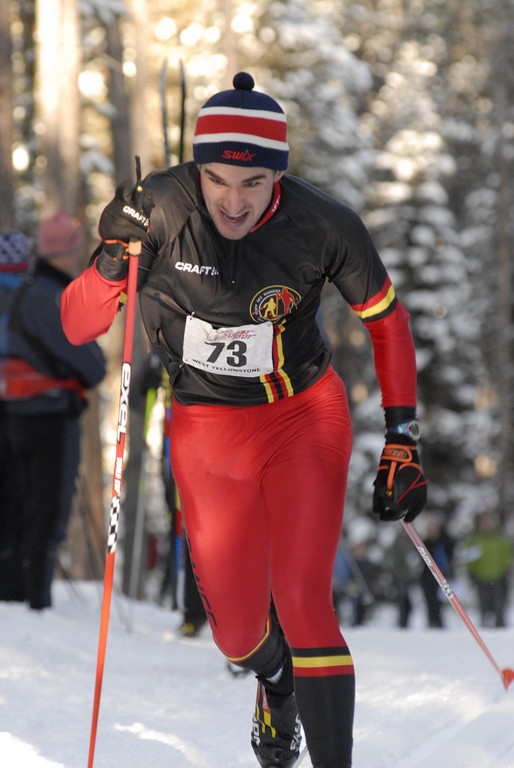
    Persian Power-Beejan Kangarloo striding in the classic sprint in West Yellowstone in November. Photo: Win Goodbody
    Persian Power: Beejan Kangarloo striding in the classic sprint in West Yellowstone in November. Photo: Win Goodbody

    For the last year, Iran has drawn its fair share of criticism for its nuclear ambitions. But if Beejan Kangarloo has his way, the country could some day attract attention for a different kind of Atomics: skis.

    Iran isn’t known for its snow or steep slopes, but according to Kangarloo, there’s some great skiing in the mountains near Tehran. He’s hoping to draw attention to a little-known side of the country by qualifying to represent it in the 2010 Olympics.

    Born and raised in Western Canada, the 24-year-old Kangarloo grew up racing for the Banff Ski Runners, and was even good enough to qualify for the Canadian Junior World Championships Team. Last year, he acquired Iranian citizenship with the help of his father, Saeed, and now the only thing standing between Kangarloo and the Games is one really good race: he’ll qualify if he can achieve the international qualifying standard of 120 FIS points.

    While the country has been in the news in the last year for a disputed presidential election and a secret nuclear program, Kangarloo isn’t interested in controversy. He’s simply a young man who loves to ski.

    “I don’t want to be associated with being political,” he said. “I’m just trying to ski and trying to bring awareness to Iran. People don’t realize that it’s a ski nation—they really only see the negative side.”

    Kangarloo—who goes by Justin—has never been to Iran, and he doesn’t speak Persian. (He’s embarrassed about it, and he’s taking lessons.) But he says his father’s side of the family exposed him to the country’s culture as he was growing up in Calgary.

    Saeed emigrated to Canada at 19 to study engineering at McGill University, and his brother joined him soon after. After graduating, the two found work in “booming” Calgary, which allowed them to bring their parents over, too.

    Kangarloo was born in 1985, and started skiing at age seven. In 2005, he qualified for and raced in the Junior World Ski Championships in Finland, and his quest for the Olympics began last year, when he first took out an Iranian FIS license. A mineral land negotiator for a Canadian energy company, Kangarloo balances a full-time job with his training for the Olympics with the Ski Runners.

    Iran already has one spot at the Games under a FIS provision for “exotic” nations, Kangarloo said, but this will most likely go to a skier who has lived in Iran and trained with the country’s national team. If Kangarloo can achieve the “A” qualifying standard of 120 points in a sprint race, though, then Iran will be able to send him as a second athlete.

    But “chasing points,” as Kangarloo describes it, can be a fickle pursuit, as the score awarded to a skier at a given race is dictated not only by his own speed, but also the skill and competitive history of the other athletes at the event. To achieve the “A” standard, Kangarloo will have to be both fast, and lucky.

    Last year, at a sprint in Canmore, Alberta, Kangarloo came just two-tenths of a second away from achieving the “A” standard. He had a good race, he said, but the top-ranked athletes at the event did poorly, skewing the points upwards for the rest of the participants.

    After his first three races of the year in West Yellowstone and Bozeman, Montana, Kangarloo still hasn’t been able to reach the standard. He has two weekends of racing left to do it, in Vernon, British Columbia and back in Canmore.

    If everything goes right and he makes the grade, Kangarloo will then fly to Iran to train with the team and test himself in a pair of races in January, before returning home to Canada for the Games, which take place just a single day’s drive from his home.

    Along the way, Kangarloo has already managed to bridge a few international boundaries, while spreading the word about Iranian skiing.

    While racing in Switzerland last year, he befriended an American coach, Sverre Caldwell, who then put him in touch with New England team leader Janice Sibilia when Kangarloo needed help with ski preparation and waxing in West Yellowstone.

    Before meeting Kangarloo, Sibilia said, she had been unaware of Iran’s ski community.

    “When you think of Iran, you really don’t think of snow,” she said.

    Now, Sibilia is pulling for Kangarloo. All he needs, she said, “is a race where everything goes his way, and the points are good—and it could happen.”

    Initially, Kangarloo said, he was apprehensive about traveling to the U.S. for the Montana races, given its political tensions with Iran. But starting with his flight, Kangarloo said he was “really impressed” with the support and warmth from the Americans he has encountered, including a group lined the course to cheer for him in West Yellowstone.

    Regardless of whether Kangarloo qualifies for the Games, it seems that he will have already drawn some positive attention to Iran’s ski community. After this winter, he’ll have just one job left: educating the Iranians themselves. In an article about Kangarloo published in a Tehran newspaper, the accompanying photo depicts an alpine skier mid-race.

    For now, Kangarloo said that he’s relishing the experiences he’s had over the past year.

    “It’s been a fun journey—an adventure for sure,” he said. “But it would certainly be nice to get these points.”

    An article about Beejan Kangarloo in an Iranian newspaper.
    An article about Beejan Kangarloo in an Iranian newspaper.