From the FasterSkier archive — posts syndicated from athletes’ and coaches’ own blogs between 2004 and 2012, kept online as published. Current coverage is at fasterskier.com.
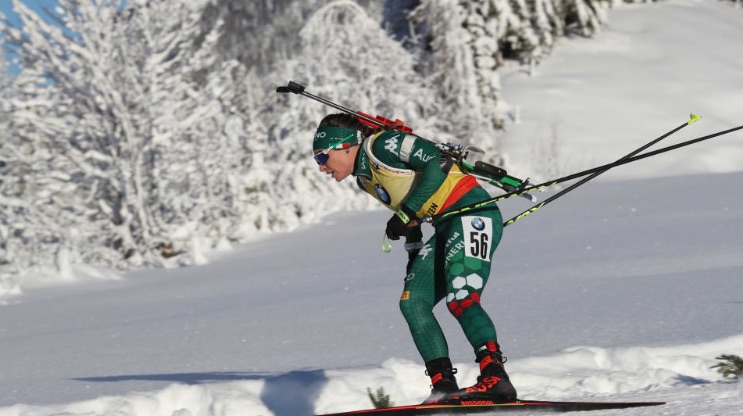
Dorothea Wierer of Italy won Thursday’s sprint in Hochfilzen, Austria in a time of 21:04.9 minutes. (photo: biathlonworld.com)
Today in Hochfilzen, Austria, Dorothea Wierer of Italy won the sprint in a time of 21:04.9 minutes. Wierer missed one shot standing for a single penalty during the race. Kaisa Mäkäräinen of Finland was close behind in second, 0.6 seconds back. Mäkäräinen also had one missed target standing. Third place went to Russia’s Ekaterina Yurlova-Percht, finishing 24.4 seconds behind. Yurlova-Percht short clean in the race.
Susan Dunklee was the best placed American in 34th (+1:33.0, 0+2). Joanne Reid was 44th (+1:48.3, 0+1), and Clare Egan 65th (+2:22.1, 2+2).
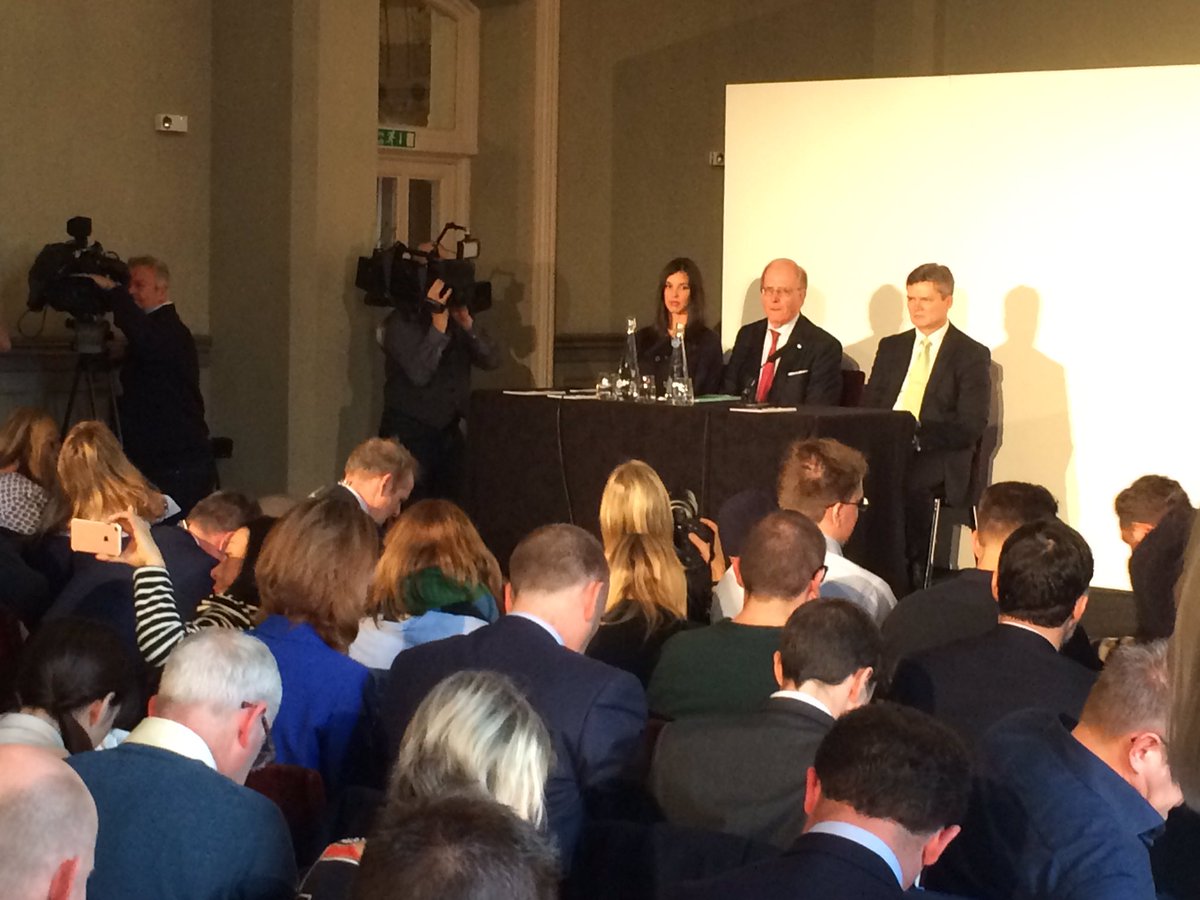
On the non-racing front, the IBU released a statement about “Austrian state authorities” investigating five Russian biathlon officials and five biathletes due to their connections to doping. The IBU stated that the possible infractions occurred during the 2017 Hochfilzen IBU World Championships.
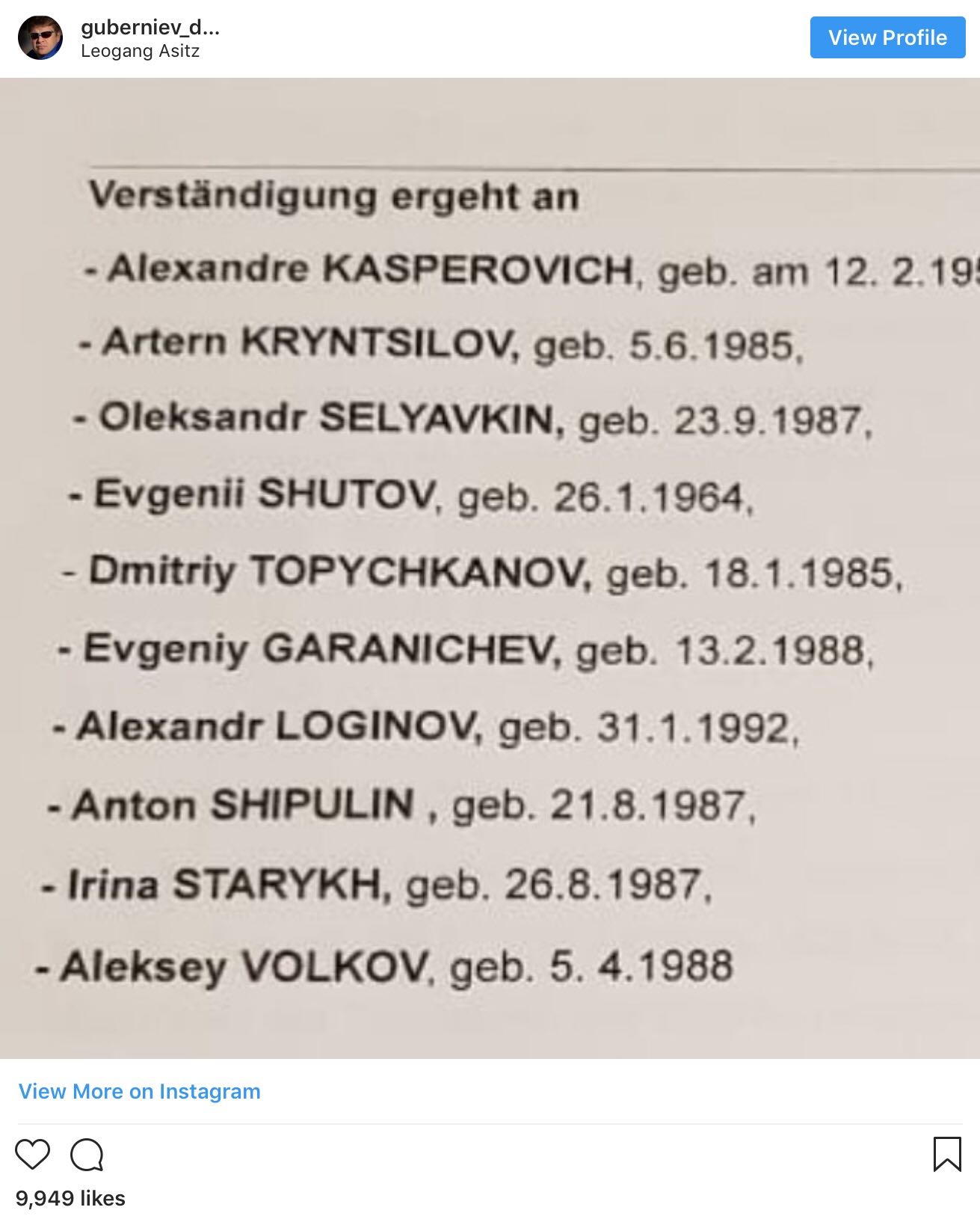
Russian sports journalist Dmitry Guberniev has posted the names of the individuals under investigation. According to tass.com, a Russian news site, Guberniev the following people: “Among athletes accused of violating anti-doping rules are 2014 Olympic champion Anton Shipulin, Evgeny Garanichev and Alexander Loginov. The list also includes biathletes Alexey Volkov, Irina Starykh, former coach of the Russian national team Alexander Kasperovich, doctors and massage therapists Artyom Kryntsilov, Alexander Selyavkin, Evgeny Shutov and Dmitry Topychkanov,” tass.com reported.
List of people under investigation according to Russian journalist Dimitri Guberniev (Screenshot from @guberniev_dmitry)
FasterSkier will post updates about this developing story as more information is discovered
– Harald Zimmer contributed
***
NorAm and U23/JW World Championships Qualification, Canmore, Alberta
The Canadian NorAm series continued Thursday in Canmore, Alberta, with a combined NorAm and trials for U23 and Junior World Championships.
The three race weekend kicked off with classic sprints, run from the biathlon stadium which offers an uphill finish in place of the traditional long descent into the finish straight.
The selection criteria are involved, but it appears that each day four athletes will earn a spot in U23/JW World Championships in Lahti, Finland. The top athlete of each gender in U23 and junior each day should be automatically selected.
There are also World Cup period 2 (Tour de Ski) and period 3 starts on the line, with the possibility of Canadian women in the Tour de Ski for the first time since Sara Renner finished 16th in 2010.
Dahria Beatty (CNST) won the open women’s category in style, winning the qualifier in 3:51.06 by 4.96 seconds before winning all three heats by large margins.
Katherine Stewart-Jones (CNST) finished second in the A final in 3:49.60, 2.20 seconds behind Beatty after finishing second in the qualifier and winning her earlier heats. Maya MacIsaac-Jones (CNST) completed the podium, finishing 5.37 back.
Marie Corriveau was the top U23, finishing 6th in the A final after qualifying in 6th. Corriveau has struggled with results for two seasons, but her first race of the season is a very positive sign.
Anne-Marie Petitclerc (Mont Sainte Anne) won the qualifier and quarterfinal on her way to the junior win in 4:01.71. Molly Miller (Black Jack) was second at 0.68 seconds back and Anna Pryce (Foothills) took third at 7.25 seconds.
Bob Thompson (TBay) won the men’s A final in 3:19.43 by 2.31 seconds. Angus Foster (TBay) outstretched top qualifier Julien Locke (CNST) by 0.01 seconds for second. Graham Ritchie (Big Thunder) was the top U23 in 4th, 2.36 back after qualifying 6th.
Remi Drolet (Black Jack) won the junior A final in 3:31.94, after winning the qualifier and all his heats. Foothills teammates Tom Stephen and Xavier McKeever were second and third, 2.08 and 2.51 seconds back respectively. Stephen has two future seasons as a junior while McKeever has three.
All results, including live timing for the rest of the weekend.
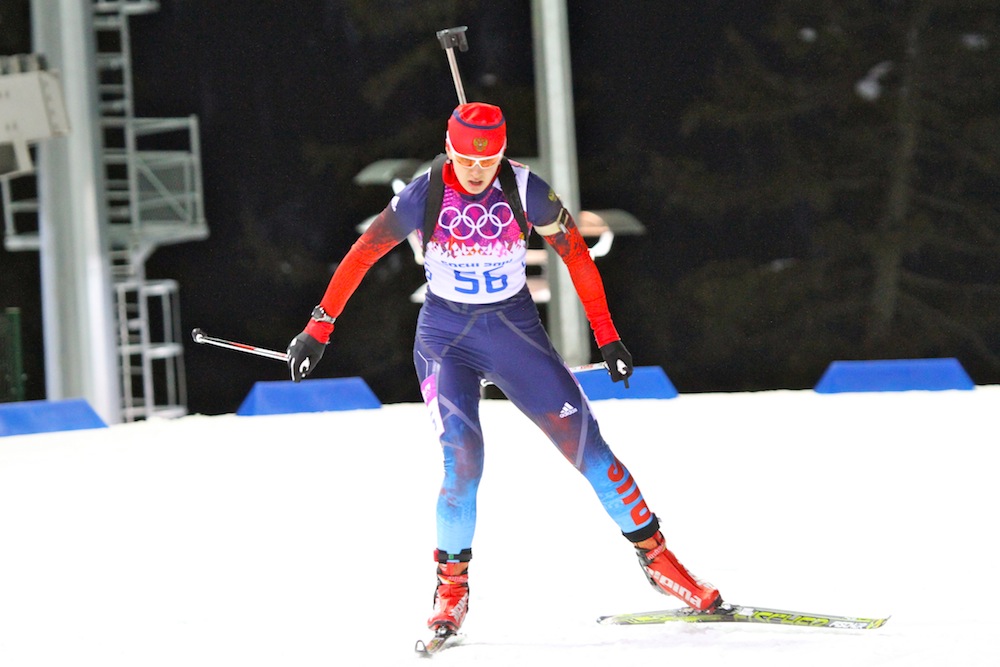
Russians Olga Zaitseva and Olga Vilukhina competing in the pursuit at 2013 World Championships. Both were disqualified from the 2014 Olympics by the International Olympic Committee, with a whistleblower stating that the biathlon team was doping in the years leading up to Sochi.
On Friday, the International Olympic Committee (IOC) posted the reasoned decision from its Disciplinary Commission, in which Russian biathlete Olga Zaitseva was disqualified from the 2014 Olympics in Sochi, Russia.
Zaitseva’s disqualification had been announced previously, but this is the first full-length decision presenting the evidence for the disqualification of any biathlete. Olga Vilukhina and Yana Romanova have also been suspended, but the Oswald Commission’s full decisions for their cases have not yet been released.
The reasoned decision not only contains details about Zaitseva, but also additional information which should put the whole biathlon world on notice.
“Dr. Rodchenkov further states that the entire Russian biathlon team, including the Athlete Zaytseva, has been using the Duchess Cocktail before the Olympic Winter Games Sochi 2014,” paragraph 359 of the decision reads. “He also provided an email sent April 2013, whereby he raised concerns about the high levels of haemoglobin for the biathlete team that was detected by his laboratory.”
The Duchess Cocktail refers to a combination of performance-enhancing drugs designed by Rodchenkov, the former director of the Moscow Anti-Doping Laboratory who assisted Russian teams in numerous sports to evade anti-doping rule violations before he became a whistleblower.
The Russian sports agency and the state security agency, FSB, developed a method to open anti-doping sample bottles. Using this method, they replaced the urine of athletes who had taken the Duchess Cocktail with previously-collected clean urine so that their doping would not be detected.
Thus, Rodchenkov is asserting that every Russian performance in the biathlon events at the 2014 Olympics was tainted by illegal performance-enhancing drugs.
This is notable because the men’s biathlon team, for instance, had not previously been implicated in doping scandal that has been raging for several years. Only the likely members of the women’s biathlon relay team – Vilukhina, Zaitseva, Romanova, and Irina Starykh (who was caught using the blood-doping drug EPO before the Olympics and suspended) – were on the “Duchess List,” a list of athletes presumed to have been given the drug cocktail. No male biathletes appeared.
However, it doesn’t seem surprising that they would, given that 14 cross-country skiers, virtually the entire Russian squad for Sochi, appeared on the list, as well as the female biathletes.
And that’s what Rodchenkov said, too.
“Dr. Rodchenkov… gives indications regarding the widespread use of Prohibited Subtances notably human growth hormones and EPO in the years preceding the Olympic Games,” another paragraph of the decision reads, referring to “members [of] the biathlon and cross-country skiing teams, for which the endurance is an absolutely critical elements.”
This raises the question of whether further action will be taken against more biathletes by the IOC, or by the International Biathlon Union (IBU).
The IBU has provisionally suspended the Russian Biathlon Union, but that actually has few consequences: Russia is still slated to host a World Cup weekend in March, Russian Victor Maygurov is still the First Vice President of the IBU, and all Russian athletes are still allowed to compete in the World Cup and the Olympics (Romanova, Vilukhina, and Zaitseva retired before they were suspended).
In the meantime, she has maintained her innocence. So has Wolfgang Pichler, the German coach who worked with the Russian women’s biathlon team in the four years leading up to the Sochi Olympics. For his troubles, he has been banned from attending the 2018 Olympics, where he would have coached the Swedish women’s team, which he now leads.
As the decision notes, Zaitseva and her legal team raised several objections to the case against her. She claimed that to suspend her was to pursue “collective justice” based on the widespread evidence of doping by Russia, rather than referring to any fault of her own. She also attacked Rodchenkov’s character, calling him an unreliable witness.
And finally, her team questioned the methods developed by Professor Champod at the University of Lausanne to detect whether anti-doping sample bottles had been tampered with.
That was wise, because the most damning evidence against Zaitseva comes from her sample bottles. Two of her sample bottles from Sochi had multiple marks on them consistent with tampering. In one of those bottles, the urine had such high amounts of salt that it is not possible that the concentration was produced by the human body. Together, these two pieces of evidence were used to argue that her samples had been tampered with.
According to logic used by the Disciplinary Commission in this and other cases, that tampering couldn’t have happened without Zaitseva’s knowledge. DNA testing showed that the urine in the samples was hers, which indicates that if the urine was replaced, it had to have been given by her at a different time. The Commission rejected the possibility that such a urine sample could have been collected without an athlete knowing its intended purpose.
But while two experts testifying on Zaitseva’s behalf criticized Champod’s methods as being incompletely described, they were unable to convincingly explain why their questions would absolve Zaitseva of blame.
“Neither Mr Alexei Bushin, nor Ms Evgeniya Burova did, in particular, offer any alternative explanations for the presence of marks consistent with the opening of the bottles with tools of the kind used by Prof. Champod,” the decision noted. “The IOC Disciplinary Commission finds this absence of alternative explanation even more significant in the case where one of the bottles not only bears marks strongly indicative of opening, but in addition contains urine with an abnormal salt content. Both elements support the conclusion that it was opened. The expertise of Prof. Champed convincingly demonstrates how this opening, which necessarily occurred, could be operated.”
This forensic evidence was used in the Commission’s decision that Zaitseva had violated the provision of the Anti-Doping Rules for the 2014 Winter Olympic Games which prohibits tampering with samples or with the integrity of the anti-doping process.
By doing so, they also found that she was complicit in a cover-up, thus breaking another provision of the Anti-Doping Rules.
In a strange aside, a urine sample belonging to Zaitseva but collected later, in October 2014, was analyzed in order to make a DNA comparison to the Sochi samples. What such a comparison actually revealed was that the October sample contained the urine of two different women mixed together, indicating that sample-swapping continued after the 2014 Olympics.
“This result does not concern the Olympic Games in Sochi and, as such does not fall within the scope of the application of the Rules,” the Commission wrote in its decision. “It however constitutes additional evidence that the Athlete was a protected elite athlete actively engaged in doping practices.”
The Commission also concluded that Zaitseva had used prohibited performance-enhancing drugs, on the basis of testimony from Rodchenkov.
“Use or Attempted Use of a Prohibited Substance can be established by any reliable means,” the Commission wrote. “This includes witness evidence.”
In an affidavit to the Disciplinary Commission hearing, Rodchenkov shared his own observations, many of which were based on detailed notes he had taken in a daily diary over the years. He also provided emails and documents related to Zaitseva and to the biathlon team.
“Dr Rodchenkov provides a list issued in October 2012 reflecting the clean urine bank existing at that time,” paragraph 358 reads. “The Athlete Zaytseva is mentioned on this list, with an indication that her urine was delivered to the Moscow Laboratory on 24 October 2012.”
“Dr Rodchenkov also recalled that in 2013 and early 2014 he had numerous conversations about the Athlete Zaytseva, as she was on a protected list,” another paragraph reads. “In autumn 2013, he took part to a discussion with the Athlete Zaytseva at the Ministry of Sports in Moscow. During this meeting the abnormal [Athlete Biological Passport’ data, due to her constant [performance-enhancing drugs] use, was discussed.”
And there was also evidence that Zaitseva was both doping, and also being tested more frequently than many other athletes, which is consistent with a previously-stated policy of the IBU to do “targeted testing” on athletes with suspicious biological passport profiles.
“Dr Rodchenkov specifically recalls swapping sessions of the Athlete’s numerous sample,” paragraph 361 reads. “Due to the intensity of the testing, Dr Rodchenkov underlines that they almost ran out of the Athlete’s clean urine. He remembers that the Athlete Zaytseva provided three plastic bottles of clean urine to freeze and store at the FSB and that additional urine had to be delivered.”
Zaitseva argued that Rodchenkov’s recollections and correspondence should not be used against her because of the illegal actions he had taken in the past. The Disciplinary Commission disagreed.
“Given the insistence of the Athlete’s attacks, the Disciplinary Commission will add the following,” the Commission wrote. “The Athlete refers to the past actions and behaviours of Dr Rodchenkov. In this respect, the Disciplinary Commission wants to be very clear in confirming that considering Dr Rodchenkov as a reliable witness is not in any way an approval of his past actions and his moral character. His actions, while being a director of the Moscow Laboratory, are despicable and inexcusable. This said, in a case of a conspirative scheme, the main evidence is often coming from participants, who accept to stand as witness.”
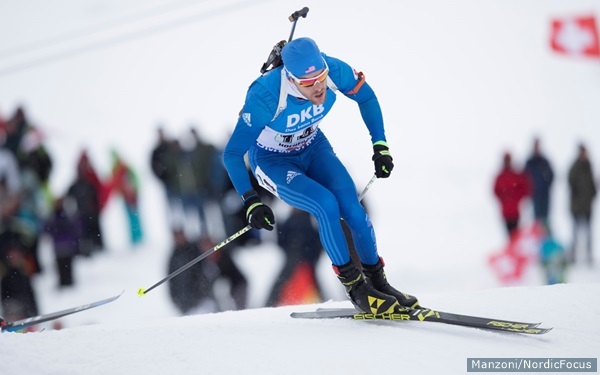
Leif Nordgren (US Biathlon) skiing the second leg of the IBU World Cup men’s 4 x 7.5 k relay on Sunday in Hochfilzen, Austria. The U.S. men ended up ninth overall out of 26 teams. (Photo: IBU/NordicFocus)
Strong gusts of wind on the range required strong nerves and a lot of luck in the women’s and men’s relay races that concluded the International Biathlon Union (IBU) World Cup in Hochfilzen, Austria, on Sunday afternoon.
While the relays concluded with teams on the podium one might expect there, tempestuous weather conditions that at times made it almost impossible to hit the targets also gave outsiders a good chance, and both the U.S. men and Canadian women remained in contention for a long time. The men’s 4 x 7-5-kilometer relay was particularly wild with more than 100 penalty laps, and it began with a big surprise.
Belgium’s starter Michael Rösch tagged off in first place for the first time in the history of that team, representing a country that until now, rarely had enough athletes for a relay and had thus far had a 24th place at the 2016 World Championships to its credit. And on his tails was Norway’s Ole Einar Bjørndalen, and shortly behind them US Biathlon’s Lowell Bailey in third.
The three aforementioned athletes all raced in the Olympic relay more than a decade ago at the 2006 Winter Games in Torino, Italy, but back then Rösch raced for Germany and won gold with his team.
“I wanted to tag off in first at all costs, to see the Belgian flag at the top,” Rösch told TV broadcaster ARD on Sunday while the race was still going on. “But Ole made it really hard for me. … I was on my last fumes, I tumbled into the finish, I was just seeing black, but it definitely was worth it.”
Just a turn behind, Bailey had gotten off to a strong start for the U.S. team, temporarily taking the lead out of the arena on the first lap before shooting clean in his prone stage to put himself in the lead group of seven. Facing strong wind in his standing stage, Bailey missed two targets but avoided the penalty lap with his last spare in that stage (0+0, 0+3), and tagged off to teammate Leif Nordgren in third position, 23.8 seconds out of first.
Nordgren ended up with a penalty in his first prone after missing two targets, and returned to the course in fifth. While his penalty had increased the gap to first by 50 seconds, Nordgren made up a few seconds with a clean standing bout, hitting all targets without requiring a spare (1+3, 0+0).
Italy and France passed him on the final loop, and Nordgren handed off in seventh, 1:34.2 minutes behind Norway setting the pace up front.
“The team came pretty close to a good result today in a relay with nasty weather,” Nordgren wrote on his Instagram account. “Personally I’m quite disappointed with my skiing, it’s been a struggle to find the top gears so far this season and I’m far from where I know I should be. It’s a long season though and there is still plenty of time to turn it around.”
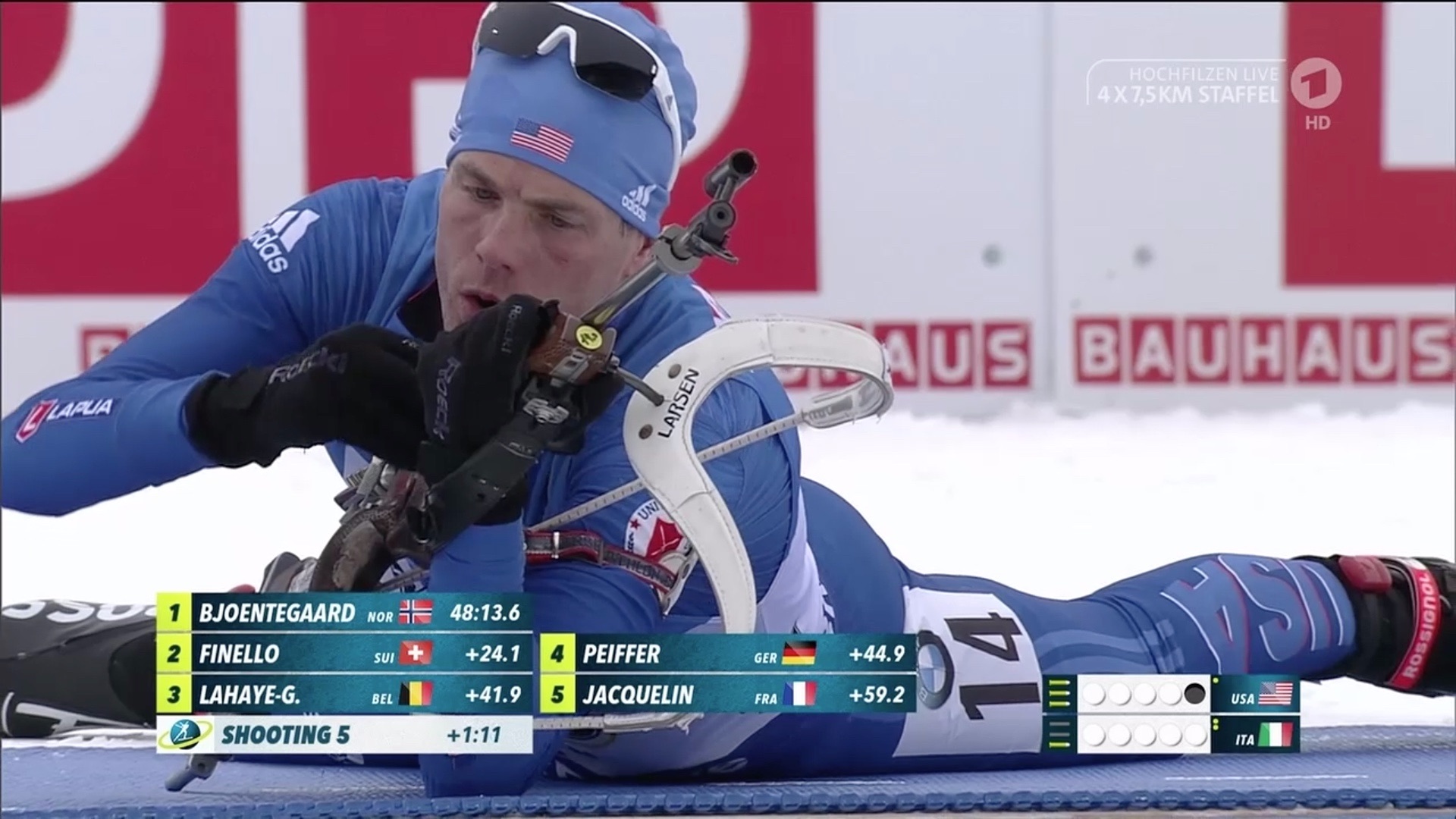
US Biathlon’s Tim Burke loading a spare in his prone stage of the men’s relay at the 2017/2018 IBU World Cup in Hochfilzen, Austria. The team went on to finish 9th. (Screenshot: ARD broadcast)
Taking over next for the U.S. was Tim Burke, who pointed out this was one of the most challenging races in terms of wind that he’d experienced.
“This was definitely one [of the] windiest races that I have taken part in,” Burke wrote in an email to FasterSkier. “We knew it would be very challenging right from the start but our team tried to look at it as an opportunity for a top result. I feel like our team did a great job at avoiding any big disasters on the range and this allowed us to stay near the front for most of the race.”
After only needing one spare in his prone shooting to hit his last target, Burke incurred a penalty in his standing stage (0+1, 1+3), but kept his position on the final loop in a hard race against Switzerland’s Jeremy Finello to exchange still in seventh, now another minute back (+2:49.4).
“I was not surprised to see a mix of different teams near the front today,” Burke wrote. “It was one of those days that any team could find themselves with multiple penalty loops after a windy shooting stage.“
Taking over from Burke as the U.S. anchor leg was Sean Doherty, coming off two strong shooting performances in the sprint and pursuit earlier this week.
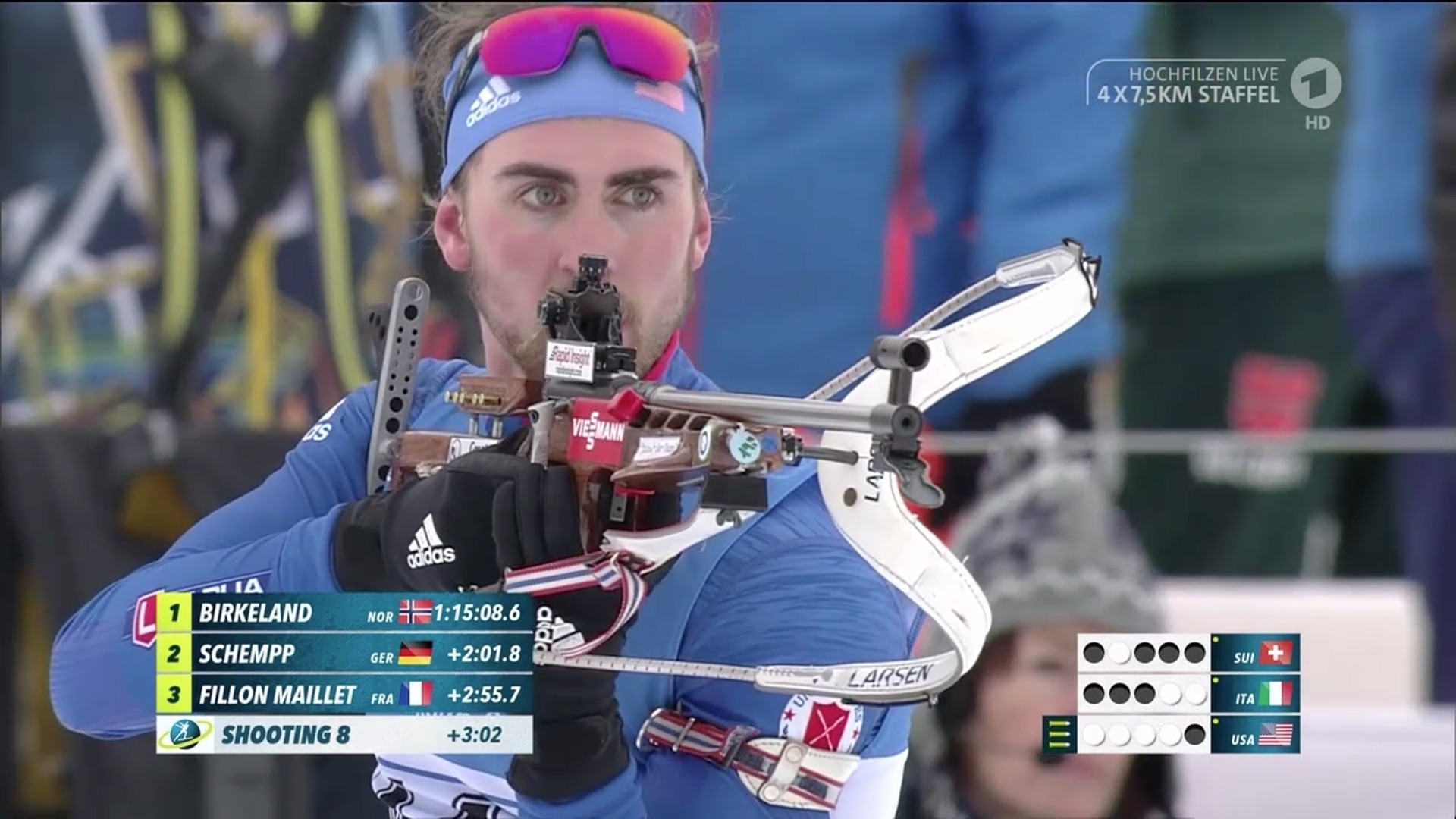
U.S. relay anchor Sean Doherty taking aim in difficult wind conditions during his standing stage of the men’s relay at the 2017/2018 IBU World Cup in Hochfilzen, Austria. His team finished ninth. (Screenshot: ARD broadcast)
In his prone stage, Doherty again shot clean and fast (with the second-fastest prone shooting time on his leg) and overtook Switzerland to move into sixth. He kept that position on the course, vying for a position in the top five with the teams from France, Italy, Ukraine, and Russia also in his vicinity.
“Today was a crazy one for sure,” Doherty wrote in an email. “The conditions on the course were decent, firm tracks and we had good skis. The wind was whipping, so that really just made some sections a lot harder than normal when you added in the head wind. I have done races in bad weather before but today was amongst the most windy.
In the standing stage, Doherty hit his first four shots in another fast sequence before missing the last one. It looked as if he had thought that final shot was also a hit as he dropped his rifle slightly, but then realized he had to load spares. Unable to clear the last target, Doherty ended up with the team’s third penalty.
“With the shooting you try to get a general idea of how far the wind is pushing the shots and do the best you can,” Doherty explained. “It’s a total toss up and the finish order is just a ranking of who battled the wind the best and had most to least luck along the way.”
He set out on his last loop in eighth place with Ukraine’s Dmytro Pidruchnyi and Switzerland’s Mario Dolder right ahead of him, and Russia’s Anton Shipulin ten seconds behind.
“The fight on the last lap is always tough,” Doherty wrote. “Although I felt better today I was not able to hang with the two guys I left the range with. I was able to ski a good lap but not enough to hold off Anton.”
After Shipulin passed him up the big last climb, Doherty came to the finish in ninth position, 3:38.3 minutes behind the winners with a team total of three penalties and 13 spares.
“We were not too excited with the end result because we saw the potential was there for a top 5,” Burke concluded for the team. “We are also all far from our best on the tracks right now, but are hopeful that will come with more racing.”
Norway Successful with Its ‘Second Unit’
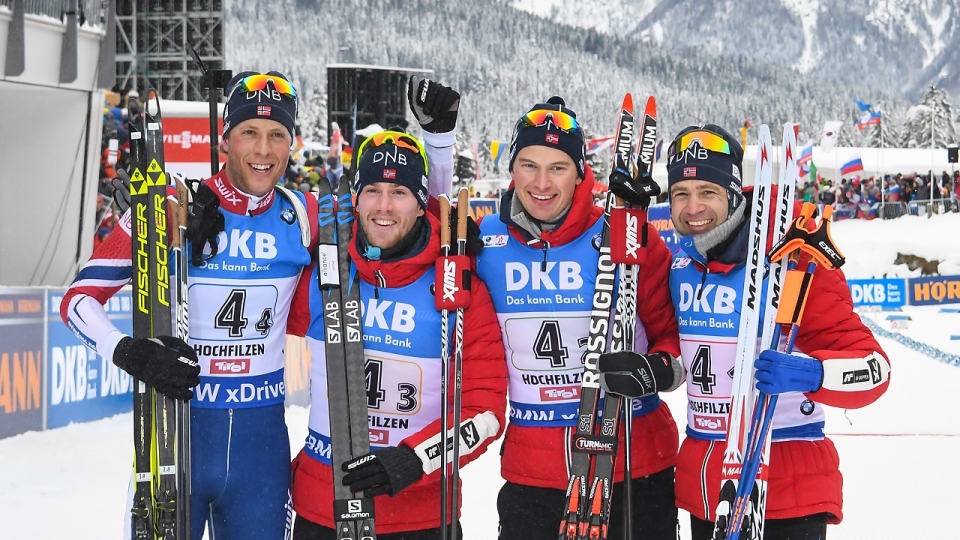
Norway’s Lars Helge Birkeland, Erlend Bjøntegaard, Henrik L’Abée-Lund and Ole Einar Bjørndalen (left to right) following their victory in the men’s relay at the 2017/2018 IBU World Cup in Hochfilzen, Austria. (Photo: IBU/Biathlonworld)
Norway started the men’s relay race without Emil Hegle Svendsen, who was sidelined with a cold, and also rested brothers Johannes Thingnes Bø and Tarjei Bø, both of whom had already won races this season.
But shooting was more important than skiing in a relay decided by strong crosswinds on the range, and that’s where the Norwegians coped by far the best. While Norway also required nine spares, which usually is a rather average performance in a relay, on Sunday this was the top shooting performance of the men’s relay.
After veteran Bjørndalen, Henrik L’Abée-Lund and Erlend Bjøntegaard had created a fairly comfortable lead of almost a minute on the first three legs, Lars Helge Birkeland anchored them to the victory by shooting clean in prone and only needing one spare to hit every target in his final stage despite some widely spread shots.
“It is really nice; a good start for Norway and good self confidence for the the rest of the season,” L’Abée-Lund said at the post-race press conference.
“It’s always fun to compete on the highest level with the best guys,” Bjøntegaard said. “I think I did pretty good on my leg today. It was tough conditions as it was for everyone else. I am just happy to show what I am capable of.”
“It feels great, it was an amazing feeling on the last loop, and really satisfied with my own leg,” Birkeland said. “I just decided to be offensive and attack and don’t think about the others and just do my own race. … We have a really strong team with a lot of good guys, so we don’t need to have all the best at the start to have a chance to win.”
All hopes for Germany’s Simon Schempp to contend with Birkeland for first were dashed when Schempp required three spares to clear both his prone and standing stages, narrowly avoiding the penalty lap twice.
Due to the huge distances between the top-three teams, the final loop was more of a cool down for their anchors, with Norway taking the win in 1:21:21.8 hours, just under two minutes ahead of Germany, with Erik Lesser, Benedikt Doll, Arnd Peiffer and Schempp, in second (+1:54.9, with zero penalties and 17 spares).
“At least we avoided the penalty loop, for me it was definitely close in standing,” Peiffer told German broadcaster ARD. “There was so much wind that it was impossible to shoot calmly and controlled. … It was clear that today there would be some upsets, like Belgium being in the mix in front. You just had to somehow avoid the penalty lap.”
“The last years in Hochfilzen we have never been on the podium, so it’s the first time in like six years we are back again,” Peiffer said at the press conference. “So that’s a good start for us because normally we are struggling here and we don’t know why.”
France, which had rested its star Martin Fourcade and started Jean-Guillaume Beatrix, Simon Desthieux, Emilien Jacquelin, and anchor Quentin Fillon Maillet, finished another 40 seconds later in third (+2:34.0, with three penalties and 13 spares).
Another 20 seconds back, Sweden with Peppe Femling, Jesper Nelin, Sebastian Samuelsson, and Fredrik Lindström crossed the line in fourth (+2:54.8, with three penalties and 12 spares).
“Today was very hard, very strange result, because when we look at all the penalties on the result list it was just crazy,” Beatrix said at the press conference. “I am satisfied for the team, and I am also really satisfied for the newcomer Emilien because it’s his first two weeks on the World Cup and first relay, and he did a every good job and brought us to the podium.”
“Today I was a little bit stressed, because the French guys are so strong and I had to be at their level, so I am happy to do a good relay today,” the 22-year-old Jacquelin said.
And what happened to the brave team from Belgium? With three athletes who had just made an overnight trip from an IBU Cup race in Lenzerheide, Switzerland, they came through the second exchange in second place after Florent Claude only needed one spare in standing. On the last two legs, however, three penalties for both Tom Lahaye-Goffart and Thierry Langer put them in 16th at the finish (+6:24.9) , which was still a team-best relay result for Belgium.
Just ahead of them in a finishing sprint anchored by Brendan Green was Biathlon Canada, with a lineup that earned bronze at the 2016 World Championships in Oslo, Norway. On Sunday, however, the Canadians’ race began with difficulties for brothers Christian Gow (1+3, 2+3) and Scott Gow (1+3, 2+ 3), each having to ski three penalty laps and exchanging in 21st position already 4:45.7 minutes back. Then Nathan Smith (0+0, 0+2) and Green (0+3, 0+3) were able to move them up a bit again, with Smith putting them as high as 13th by the final exchange and Green anchoring them to 15th (+6:22.5, with six penalties and 20 spares).
Of 26 teams in the men’s relay, Norway and Germany were the only ones that succesfully avoided the penalty lap.
Hochfilzen World Champs Women’s Podium Repeats
Later on Sunday afternoon in the women’s 4 x 6 k relay in slightly better conditions than the men’s race, last season’s reoccurring winner Germany struck gold again.
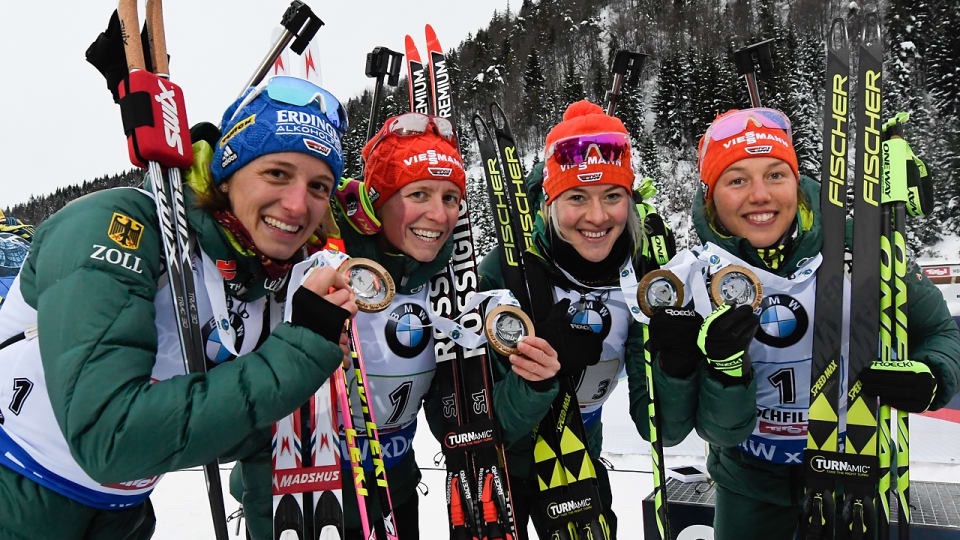
Germany with (left to right) Vanessa Hinz, Franziska Hildebrand, Maren Hammerschmidt and anchor Laura Dahlmeier shows off their medals following their victory in the women’s relay at the 2017/2018 IBU World Cup in Hochfilzen, Austria. (Photo: IBU/Biathlonworld)
The victorious world-champion quartet of Vanessa Hinz, Franziska Hildebrand, Maren Hammerschmidt,and Laura Dahlmeier won with a large lead ahead of Ukraine (+44.9) and France (+1:04.5). The first-, second- and third-place teams were a repeat of last season’s World Championships relay in Hochfilzen this past February.
Fighting for position with Ukraine and Switzerland on the third leg, Hammerschmidt got her team on the road to victory when she cleaned every target within 24 seconds despite difficult conditions to reclaim the lead, erasing the gap she had been handed of almost 30 seconds to first.
“For me it was very important to have a good standing shooting today, because the last two days were not so good,” Hammerschmidt said at the press conference. “I thought it was one of my best standing shootings, and I was so happy to go on the last loop and fight for every second to give to Laura.”
Dahlmeier returned to the World Cup after missing last week’s opening races with a cold, then had no major problems defending the lead. Dahlmeier used just one spare in each of her shooting stages, while Switzerland’s Irene Cadurisch as the closest pursuer had to ski a penalty lap. Germany finished in a time of 1:14:36.4, with zero penalties and nine spares.
“It’s a really cool feeling to be here again,” Dahlmeier said at the press conference. “Especially with the team. We know we can make a good race, but it’s important for every person to be good on the range and on the tracks. Relays are special races.”
“From the last year we have good memories about Hochfilzen … and today it was a good place, too,” Hildebrand said “I was really impressed with [Ukraine’s] Yulia Dzhima’s standing shooting, because she took all targets out while I used two extra bullets and was happy I could go out on the track again.”
Ukraine’s Olena Pidhrushna anchored her team, with Vita Semerenko, Yulia Dzhima and Valj Semerenko, to second (+44.9), thanks to the best team shooting performance of zero penalties and five spares, and despite a fall on the first leg by Vita Semerenko.
“I think our team spirit is very strong, without that we wouldn’t be on the podium, so I am very thankful to all the girls and our staff for making this happen,” Valj Semerenko said at the press conference, via a translator.
“My start this season was not so good … Actually today I was so nervous ahead of the relay,” Pidrushna explained. “But I saw that we had a little bit of extra time at the last exchange, and I calmed down a little bit and it worked well in the end. … And I think my team believes in me [to anchor it successfully].”
Twenty seconds behind her, France with Marie Dorin Habert, Celia Aymonier, Justine Braisaz and the current women’s World Cup leader Anaïs Bescond, passed Russia’s Ekaterina Yurlova-Percht on the final loop to claim third place (+1:04.5, with two penalties and 13 spares).
“Honestly at the beginning when I started I didn’t think a podium was still possible, but loop after loop I thought maybe I can still catch a podium [position],“ said Bescond, who skied the fastest course time on the final leg amidst strong competition.
A few seconds behind, Russia with Victoria Slivko, Tatiana Akimova, Irina Starykh, and Ekaterina Yurlova-Percht finished fourth (+1:09.0, with no penalty and nine spares).
Another 16 seconds back, Switzerland, with Elisa Gasparin, her older sister Selina Gasparin, Lena Häcki and Cadurisch finished fifth (+1:25.7, with two penalties and 12 spares) for Switzerland’s best women’s relay result, which fulfilled its national qualification criteria for the Olympics.
Canada in Contention
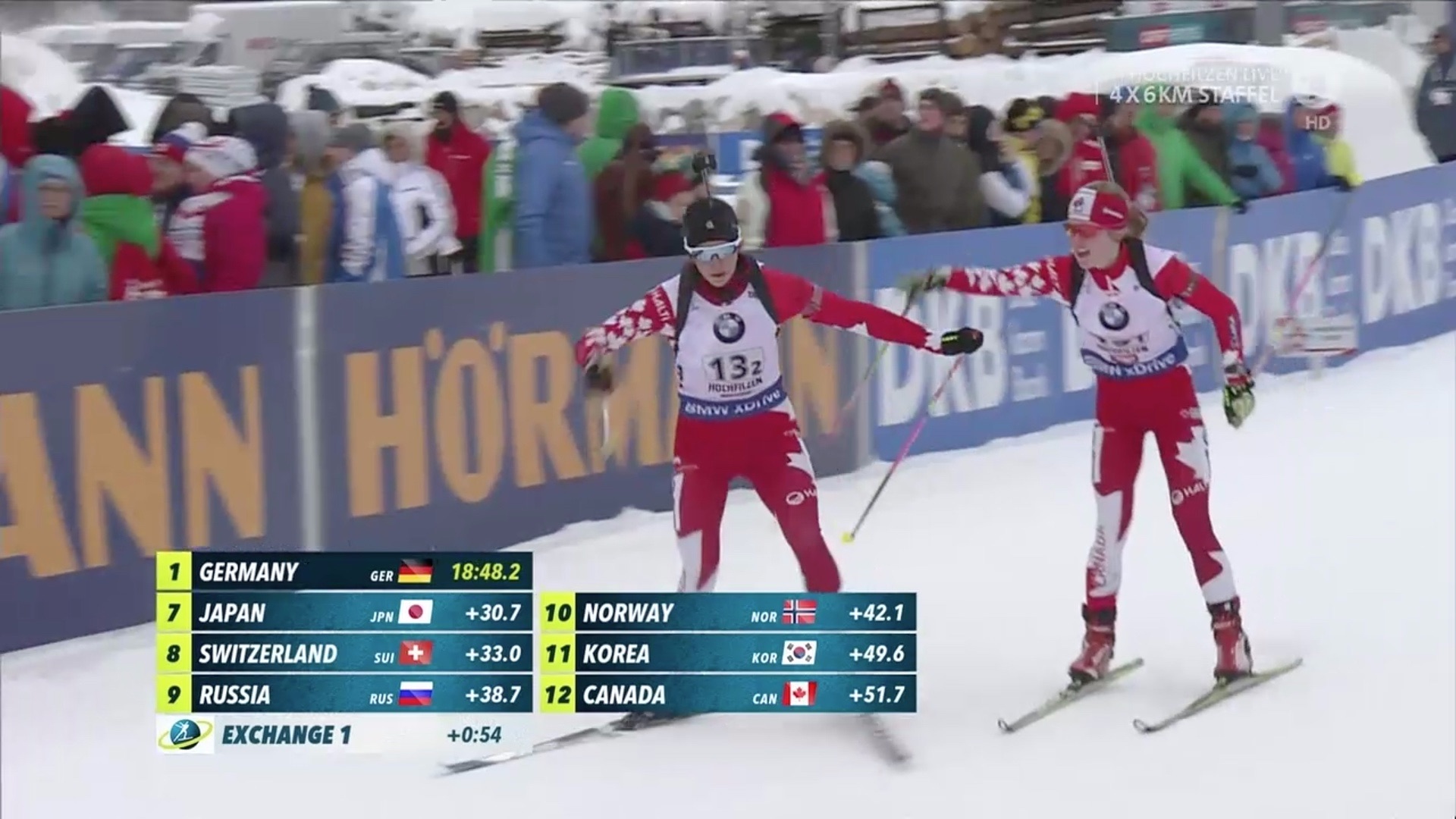
For Biathlon Canada, Emma Lunder started off the race in the middle of the field, and managed hit all her targets with one spare in her prone stage to leave the range in 16th position.
Biathlon Canada’s starter Emma Lunder (r) exchanging to Rosanna Crawford in the women’s relay at the 2017/2018 IBU World Cup in Hochfilzen, Austria. Crawford temporarily moved up to fifth before the team finished in ninth position. (Screenshot: ARD broadcast)
While a number of competitors, including France’s Dorin Habert, incurred penalties, Lunder again needed just one spare to clean (0+1, 0+1) and moved Canada up to 1oth. After losing a few more seconds on her last loop to the leaders, with Germany’s Hinz up front, she tagged Rosanna Crawford in 12th position, 51.7 seconds back.
Crawford started out fast and also needed just one spare to hit all five prone targets, improving by three places to ninth.
“It was a tricky shooting day today, you really had to be aware of the wind, and be prepared to do a correction even part way through a bout of shooting,” Crawford wrote in an email. “In prone I made a correction of 5 left and 2 up and it was enough to keep me pretty centred.”
Then in her standing stage, she picked off four more positions with clean shooting and no spares to leave the range in fifth place, while most teams around her needed spares or even incurred a penalty in seemingly difficult wind conditions.
“I was really happy with my standing today,” Crawford explained. “I saw Brendan [Green] right before zero and he said that it’s worthwhile to take your time and make each shot a good one. So I really thought about that as I came into the shooting, there was a big gust right off the start, so I waited and could hear the women around me missing. Each shot was really precise. My shooting time was 33 seconds which is really slow for standing but still the 2nd fastest of my leg, which says a lot about the wind today!”
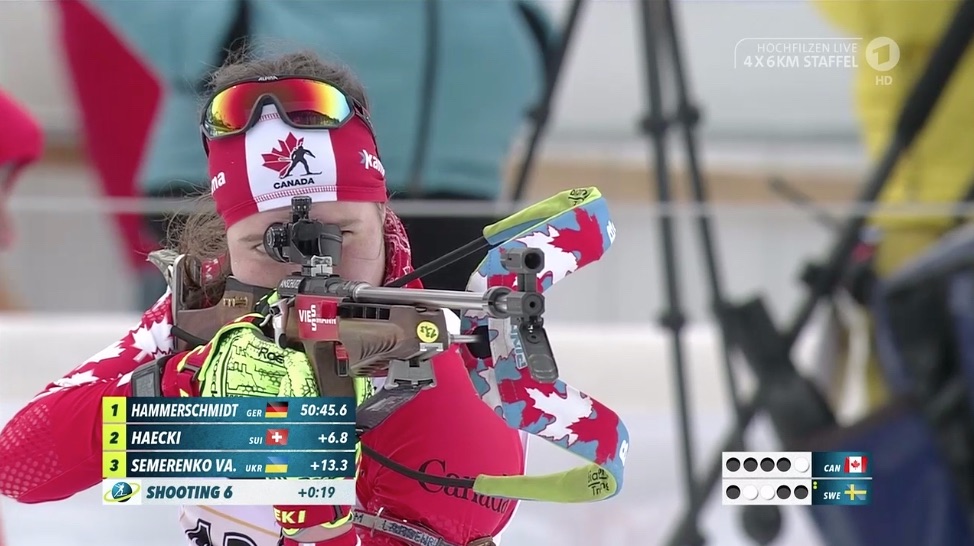
Biathlon Canada’s Megan Bankes shooting in her standing stage in the women’s relay at the 2017/2018 IBU World Cup in Hochfilzen, Austria. The team finished ninth overall. (Screenshot: ARD broadcast)
Crawford tagged Megan Bankes in fifth (+36.3), after having regained 15 seconds on the leaders and skiing the second-fastest course time on the final loop.
“It’s always fun to tag off in a high position but today was a bit of a lucky draw for what you got in the range,” Crawford concluded.
The 20-year-old Bankes as Biathlon Canada’s youngest team member started out just as fast, nearly maintaining that time gap on the first loop.
“I was super stoked to be tagged in such a good place, but I definitely still felt that I was able to ski my own race,” Bankes wrote in an email. “I wanted to ski my best, and not lose to much time on the tracks, but also be controlled on the range, because I knew it was going to be a tricky shooting day.”
She was able to get through the prone stage with two spares in a stage when all leading teams needed them, keeping her in fifth. Bankes followed that up with just one spare in her standing shooting, temporarily moving up to fourth after overtaking Sweden’s Mona Brorsson.
“Coming into the range I was focussed on my own shooting more than anything else,” Bankes wrote. “I knew that the wind was pretty variable, and that I needed to make sure I took good, smart shots, and correct appropriately for the wind. I was super happy with how I ended up doing on the range, and also with my speed on my first couple of laps.”
On the last loop, Brorsson and Russia’s Starykh passed her, and Bankes came through the final exchange in sixth place (+1:28.8).
“I died a bit at the end, but I still managed to tag Julia in a good position, so for me it was a pretty great race!” Bankes concluded.
Shown on television in the exchange zone, looking back at the final curve to see when Bankes would arrive, Ransom took over as the anchor and skied a very fast first loop, just 1 second off the fastest pace on that loop.
She then managed to still clean all five targets in a controlled fashion, leaving the range again in fifth position, with Switzerland in sight and Russia nearby as well.
After a slower second loop, Ransom struggled to clean all her targets in the final stage, but avoided the penalty lap with her last shot and left the range in ninth position. Sweden’s anchor Anna Magnusson was still in sight, 10 seconds ahead, but extended her lead on the final loop, while Japan’s anchor Rina Mitsuhashi was already more than a minute behind Ransom in 10th.
Ransom crossed the line in ninth place (+2:31.6) with zero penalties and nine spares for the team.
“A top 10 is a decent result for our team, it’s nice that we were fighting for a top 6 for most of the race,” Crawford wrote. “Our team has come a long way and I’m really proud to be a part of this team! Emma and Megan had a great leg and Julia an awesome prone and then it was quite windy for her standing, but most teams have their strongest women on the last leg, so it’s always a hard fight!”
In other good news for Biathlon Canada this weekend, the team finished eighth in an IBU Cup mixed relay and national team member Megan Tandy raced to 11th place in the sprint followed by ninth place in the pursuit this weekend in Lenzerheide, Switzerland.
“Another #perfect#shooting day! I was hoping for more, but you gotta work with what you got – in my case very heavy legs skiing. Nonetheless, a solid race,” Tandy wrote on Instagram after shooting clean in both the sprint and mixed relay.
The U.S. Women and Nation Cup Standings
US Biathlon could not start a women’s relay on Sunday because it only has three women currently on the World Cup circuit: Susan Dunklee, Clare Egan and Emily Dreissigacker. US Biathlon had hoped that its fourth woman Kelsey Dickinson, would qualify for the first trimester of World Cup racing by scoring necessary points at the IBU Cup opener in Sjusjøen, Norway. But unfortunately that did not work out.
In addition to Dickinson missing out on the World Cup starts because of that technicality, and her teammates now missing out on one of only three opportunities on the World Cup competition calendar to prepare for the relay in the upcoming Olympics, this also means they lost out on valuable points for the Nation Cup Score. That ranking is its own award category in the World Cup season (last year Germany won it for both the women and men), but more importantly for the North American teams, also determines the starting quota for the following season.
With a third of the races counting towards that already completed (unlike at World Championships the races at the Olympics don’t apply, neither do pursuits and mass starts), the U.S. is currently in 21st position for the women with 676 points and in danger of losing its fourth starting position for next year again, which would make team selections and travel planning even harder.
While certainly not impossible — last year the U.S. women also did not start a relay in Pokljuka, Slovenia — it will be a bit of an uphill battle to make that up the rest of the season, requiring a number of strong results. For instance, South Korea is currently 357 points ahead in 17th, the benchmark for a fourth quota spot.
The Canadian women are currently in 14th position with 1220 points. Last season they were 15th and the U.S. 14th. For the men’s teams, Canada is currently in 12th position with 1260 points, the U.S. is 13th with 1198.
The teams will now travel to Annecy-Le Grand Bornand, France, for the next World Cup from Thursday, Dec. 14, to Sunday, Dec. 17.
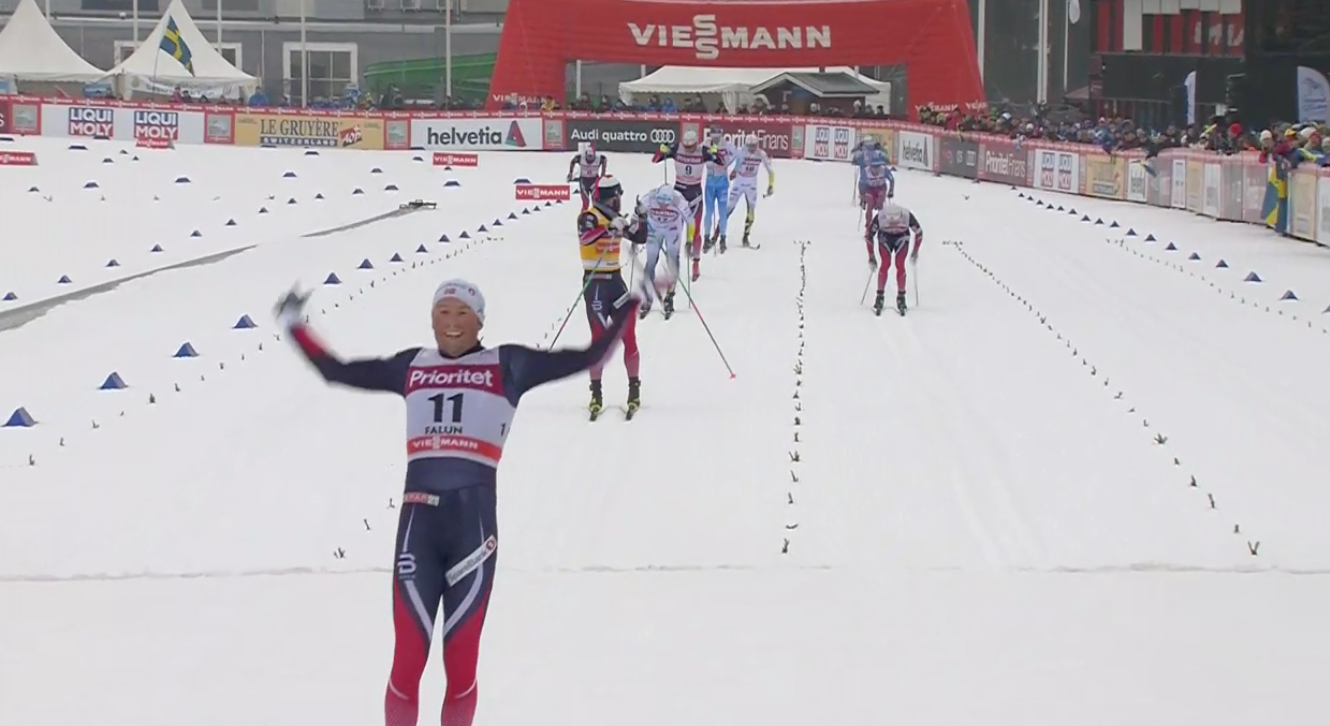
Emil Iversen celebrates his win in the 30 k classic mass start in Falun, Sweden, on Sunday. Norwegian teammate Martin Johnsrud Sundby finished second and Sweden’s Calle Halfvarsson third.
FIS Cross-Country World Cup (Falun, Sweden): 15 / 30 k classic mass start
In the women’s 15-kilometer classic mass start on Sunday, Norway swept the podium with Marit Bjørgen taking the win in a time of 41:28.8 in Falun, Sweden. Crossing just half a second behind her was her teammate, Ingvild Flugstad Østberg in second place. Rounding out the podium was Heidi Weng in third (+8.1).
American Jessie Diggins was the first to cross the line for the U.S. in 10th (+1:37.5). Three other U.S. women finished in the top 30, with Sadie Bjornsen finishing 21st (+2:43.6), Rosie Brennan 24th (+2:57.0), and Liz Stephen in 29th (+3:24.5).
Just outside of scoring World Cup points was American Caitlin Patterson in 32nd (+3:47.6) and Ida Sargent in 34th (+4:02.8). Canada’s Cendrine Browne finished 46th (+5:41.4) and American Liz Guiney 49th (+6:22.6).
After losing the skate sprint yesterday in a photo finish to Italy’s Federico Pellegrino, Emil Iversen ascended to the top step of the podium in the men’s 30 k classic mass start on Sunday in Falun.
The Norwegian was often near the front, but hadn’t tried to lead a breakaway like his teammates Martin Johnsrud Sundby and Sjur Røthe did earlier in the race. In the final two kilometers, Sundby – the overall World Cup leader – put in a sprint to try to drop the field. But Iversen caught up, drafting his veteran teammate into the stadium. In the final up-and-over before the finish line, Iversen made a pass and then accelerated down the finishing stretch to beat Sundby by 1.14 seconds.
“I got motivation from yesterday’s last 20 meters,” Iversen told FIS in a finish-line interview. “So today I fought all the way, and I was really stronger. It is amazing for me to be second yesterday and first today. I’m really proud of that.”
Calle Halfvarsson, who had been falling off the back of the lead pack just a few kilometers earlier, managed to get back to the front and claim third place for Sweden (+1.72 seconds) in a photo finish with Røthe (+1.76 seconds). Niklas Dyrhaug was next (+2.52 seconds) to give the Norwegian men’s team four in the top five.
In his return to the World Cup stage, Norway’s Petter Northug finished 31st (+3:10.6).
Alex Harvey was the lone Canadian on the start line. After skiing near the front of the field for the early part of the race he was dropped by the lead pack in the final kilometers, finishing 15th (+1:17.5).
Erik Bjornsen and Noah Hoffman took 35th and 37th places for the United States, finishing +3:30.8 and +3:59.8, respectively. SuperTour leader Matthew Gelso — familiar with the Falun course after competing in 2015 World Championships — finished 44th (+5:23.6), and Andy Newell placed 53rd (+7:45.3).
IBU Open European Championships (Duszniki-Zdrój, Poland): Single mixed & mixed relay
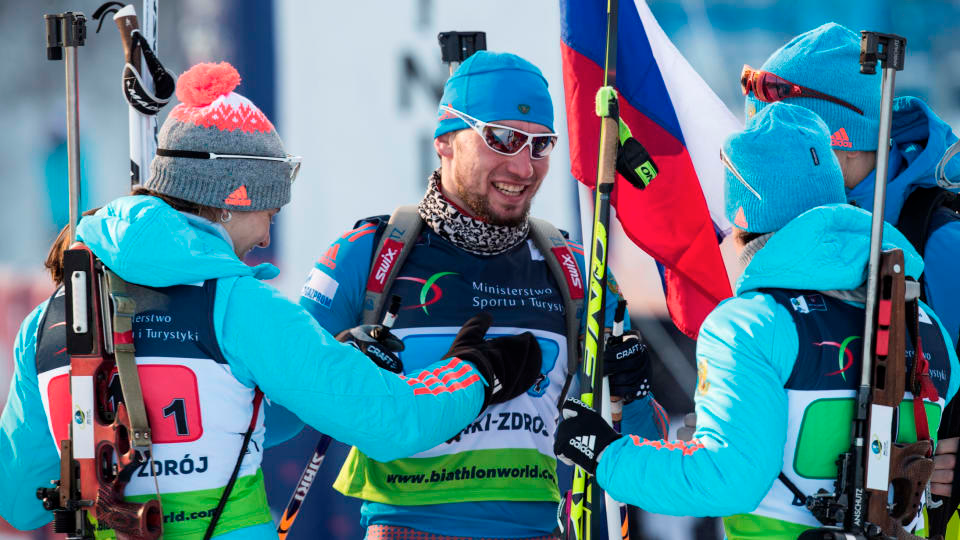
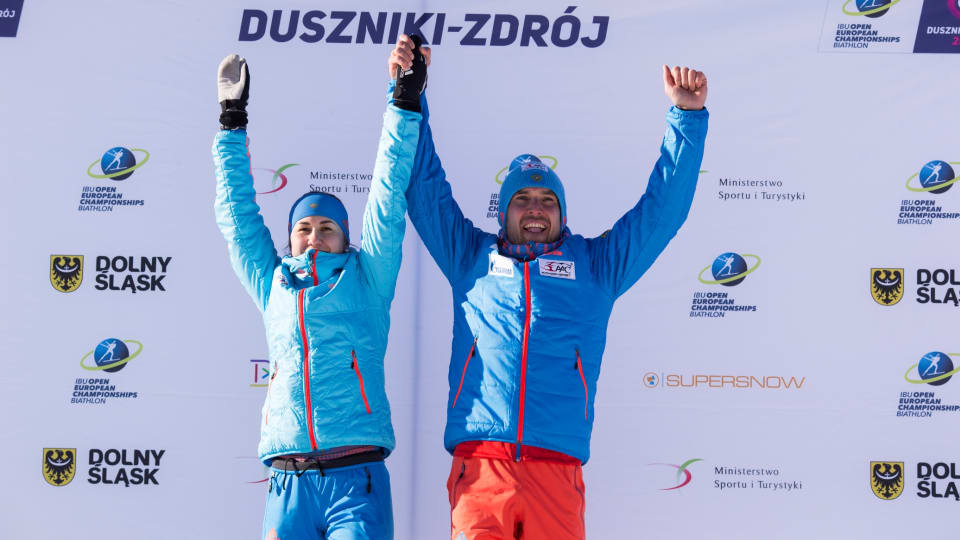
Russia’s Alexander Loginov (center) is greeted at the finish by his teammates Irina Starykh, Svetlana Sleptsova and Alexey Volkov after anchoring his team to the gold medal in the mixed relay at the 2017 IBU Open European Championships in Duszniki-Zdrój, Poland. (Photo: IBU)
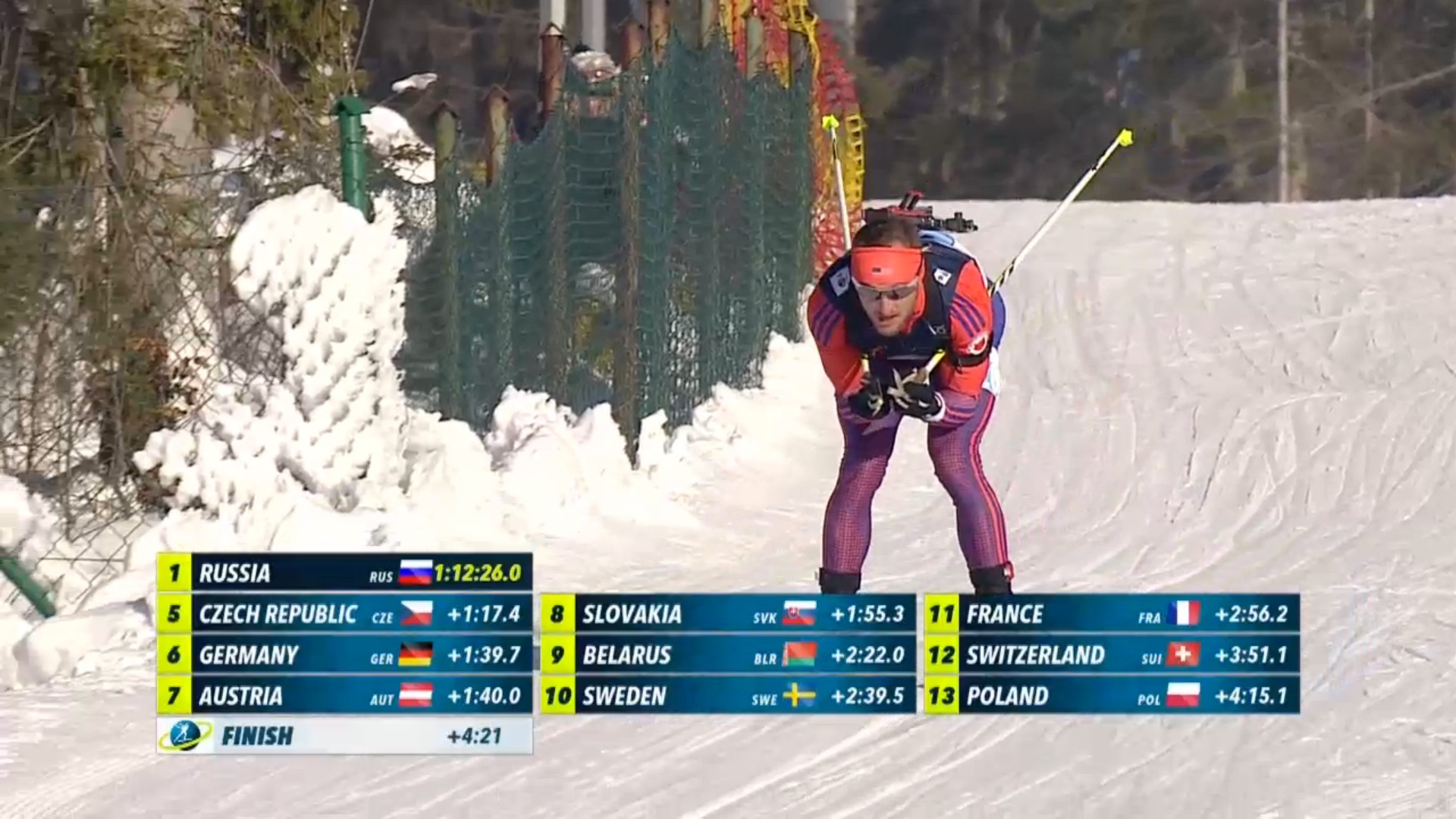
[UPDATED] The Russian victory in the final 2 x 6 + 2 x 7.5-kilometer mixed relay event of the 2017 International Biathlon Union (IBU) Open European Championships in Duszniki-Zdrój, Poland, was only briefly in doubt, when Alexander Loginov skiing the anchor leg required all spares in his prone shooting stage. But with his final shot he managed to also hit that target to avoid the penalty lap, leaving the range with a lead of more than 30 seconds.
Loginov then did not need any spares in the last standing stage, and could take his time on the final loop. Unlike Russia’s Evgeniy Garanichev earlier in the day during the single mixed relay, he also managed to pick up a flag for the final meters of the race, crossing the line in a time of 1:12:26.0 hours.
The Russian team with Irina Starykh, Svetlana Sleptsova, Alexey Volkov and Loginov led from the first exchange and required only six spares with zero penalties.
With this medal, the 28-year-old Volkov became the most successful athlete in history at European Championships, according to an IBU press release, surpassing the retired Polish biathlete Tomasz Sikora. Russia was the most successful team of the 2017 Open European Championships with six gold, four silver, and three bronze medals.
Behind them, a number of teams vied for the positions on the podium. Sweden initially looked like a strong contender exchanging in second place after the women, but fell back with three penalty laps to only finish 10th.
Still six seconds back after the final shooting, Norway’s Fredrik Gjesbakk caught up to and outsprinted Ukraine’s Ruslan Tkalenko in the finishing stretch to claim the silver medal (+36.4) with the bronze left for Ukraine (+37.1).
“I thought that I made sufficient gap to win silver,” Tkalenko told the IBU. “But in the end, on the final downhill before the finish, I was very surprised when the Norwegian guy passed me, I truly did not expect that.”
The Norwegian team with Karoline Erdal, Marion Rønning Huber, Erlend Bjøntegaard, and Gjesbakk needed nine spares and had no penalties.
Ukraine with Anastasiya Merkushina, Yulia Dhzyma, Oleksander Zhyrnyi (who originally started for Russia before making the switch in 2014) and Tkalenko required six spares, and Dhzyma had to ski a penalty lap only temporarily setting the team back.
Bulgaria finished fourth (+1:16.4), with its anchor Vladimir Iliev narrowly beating Czech Republic’s Lukas Kristejn (+1:17.4) in the finishing stretch. Both teams needed 11 spares and had no penalties.
Jakob Ellingson skiing the anchor leg for the U.S. mixed relay at the 2017 IBU Open European Championships in Duszniki-Zdrój, Poland. The U.S. team finished 14th. (Photo: IBU/Eurovisionsports.tv screenshot)
Starting at the back of the field in bib 20, US Biathlon’s Emily Dreissigacker got her team off to a strong start with a clean prone shooting and one spare round in standing, exchanging in 10th, a minute behind the leaders. Hallie Grossman needed one spare in each of her stages, tagging off to the men in 14th position and now 2:39 behind. Max Durtschi also had one miss each in prone and standing, coming into the last exchange still in 14th position, but another minute back. Jakob Ellingson required all three of his spares in his prone shooting stage narrowly avoiding the penalty lap, and one more in his final shooting stage. As the team from Finland was racing over a minute behind the Americans, he was able to keep the 14th position into the finish (+4:47.4), with a team total of nine spares and no penalties overall.
For Biathlon Canada, Erin Yungblut starting in bib 19 shot clean in her prone stage and required two spares in her standing shooting, tagging off in 18th position and more than two minutes back from first. Leilani Tam von Burg stayed clean in her prone shooting stage and needed one spare in standing, moving up two positions to exchange in 16th place, yet more than four minutes behind the leaders. After the exchange to the men, both Matthew Neumann and anchor Carsen Campbell managed to shoot clean in all of their stages, but lost additional time on the course to finish 16th (+6:39.9) ahead of four lapped teams.
Canada had the best shooting result of all 20 teams starting the relay, with just three spares and no penalty.
Russia’s Daria Virolaynen (l) and Evgeniy Garanichev after winning Sunday’s single mixed relay at the 2017 Open European Championships in Duszniki-Zdrój, Poland. (Photo: IBU)
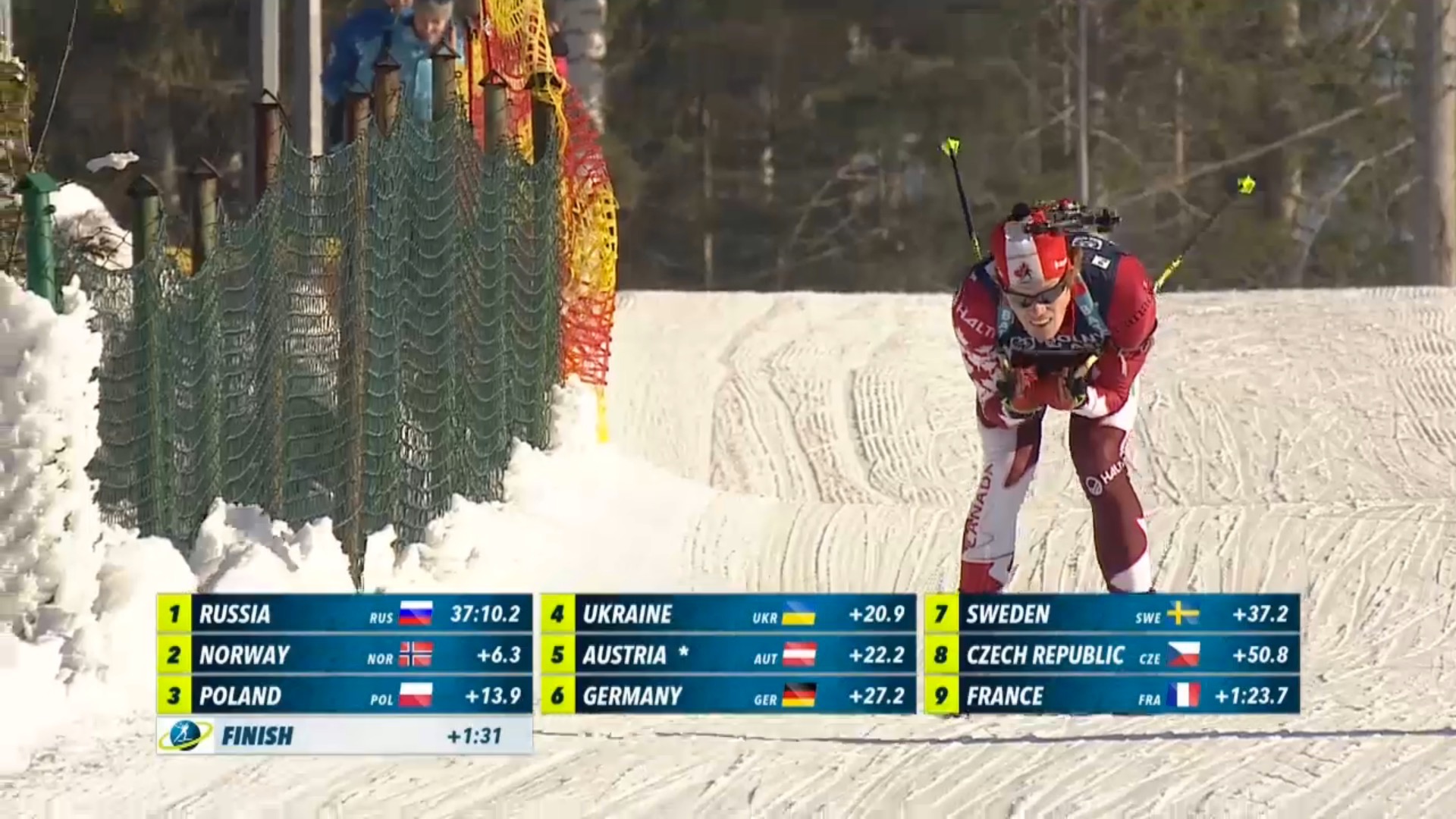
Earlier on Sunday, pretty much the only thing that went wrong for Russia’s Daria Virolaynen and Evgeniy Garanichev in the single mixed relay happened on the last meters of the finishing stretch, with Garanichev gesturing for a Russian flag he wanted to cross the line with. But the handoff was too short and the flag dropped past his outstretched hand to the snow. He glanced back, weighing if his lead was big enough to ski back, but decided it was not worth the risk, instead skiing into the arms of his partner waiting for him behind the line in a time of 37:10.2 minutes.
Russia needed seven spare rounds and incurred zero penalties. Garanichev secured the victory in the final shooting, when he only needed one spare – albeit fumbling a few seconds to insert it – while his direct opponents standing next to him required more time to hit their targets.
“Probably, I took some risk at the last standing,” Garanichev said, according to an IBU press release. “I wanted to shoot fast and clean, but missed with the last shot. But in general, I felt very comfortable; came and worked at the range in my rhythm.”
6.3 seconds behind, Norway with the team of Ingrid Landmark Tandrevold and Vetle Sjåstad Christiansen placed second, with seven spares and zero penalties.
“These are very short loops,” Christiansen commented on the fairly new, single mixed relay format. “You feel the pressure from the crowd and to shoot fast every time.”
The 20-year-old Tandrevold previously earned three bronze medals, including one in the single mixed relay, also with Christiansen, at last year’s Open European Championships in Tyumen, Russia.
To big cheers from their home crowd fans who had come out to the Duszniki Arena in beautiful but cold weather, the Polish husband-and-wife team of Krystyna Guzik and Grzegorz Guzik placed third with just five spares and zero penalties (+13.9), not quite able to keep up with Christiansen on the final loop after leaving the range together within a second.
“It is so nice to win a medal here in Poland,” Krystyna Guzik said. “We were both very disappointed with all of our mistakes in the other competitions. So today, we were relaxed and laughing before the competition, hoping not to have those mistakes again. We did not … and now have a medal.”
It was the first medal for Poland at these championships.
Ukraine with Iryna Varvynets and Andriy Dotsenko finished fourth, also with five spares and zero penalties (+20.9).
Biathlon Canada’s Aidan Millar skiing the final loop of the single mixed relay at the 2017 IBU Open European Championships in Duszniki-Zdrój, Poland. With teammate Sarah Beaudry, Canada finished 13th (Photo: IBU/Eurovisionsports.tv screenshot)
For Biathlon Canada, Sarah Beaudry and Aidan Millar required seven spares during their race and had no penalty, just like the winning Russians and Norwegians, but could not quite keep up with the best teams on the course in the fast-paced race format with short loops somewhat comparable to a team sprint in cross-country.
Beaudry cleaned her first shooting stage and then needed one spare to hit all targets in standing. At the first exchange Canada was 10th, 35.8 seconds behind the then leading team from Poland.
Millar missed one shot in his first prone stage, leaving the range again in ninth position. Then he needed two spares in his standing shooting on the way to exchanging back to Beaudry in 11th (+56.4).
On her second leg, Beaudry had one miss in prone and required two spares in standing, falling back a bit to exchange in 13th (+2:12.0).
On his final leg, Millar was able to shoot clean in both stages, reducing the time gap to the top but not able to make up another position, and finished in 13th place (+1:56.1).
US Biathlon is only represented with two women at the Open European Championships in Poland, and decided to forgo a start in the single mixed relay, instead entering a team in the mixed relay later on Sunday.
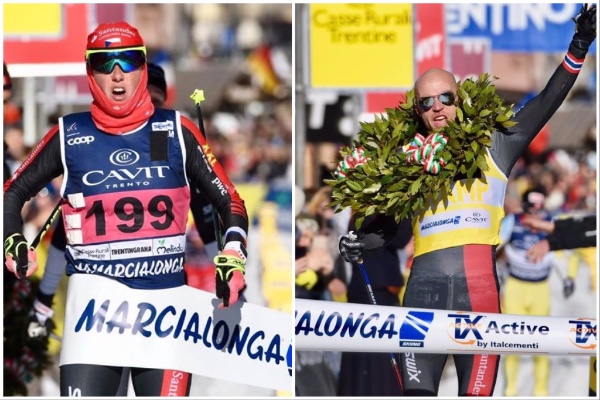
Katerina Smutna (left) and Tord Asle Gjerdalen (right) of Team Santander won the 2017 Marcialonga. (Photo: Visma Ski Classics)
Tord Asle Gjerdalen won the Marcialonga, a Worldloppet and Swix Ski Classics marathon for the third time – in a row. This year was on a shortened course, “just” 57 rather than the traditional 70 kilometers.
The Team Santander athlete finished in two hours, eight minutes, and 36 seconds, edging Johan Kjølstad (Team United Bakeries) and Morten Eide Pedersen (Team BN Bank) in a sprint finish by 2.6 and 2.9 seconds, respectively.
Tyler Kornfield and David Norris of Alaska Pacific University finished 43rd (+5:03.8) and 66th (+10:43.1). Canadian Paralympian Brian McKeever finished 57th (+9:13.5) and guide Graham Nishikawa 81st (+12:56.5), followed by Ian Murray in 85th (+13:37.5) and Erik Carleton in 111th (+17:50.2).
In the women’s competition, Katerina Smutna, also of Team Santander, won her third straight Ski Classics competition. She crossed the line in two hours, 22 minutes, and 46.4 seconds. Britta Norgren of Team Lager 157 was second by just 0.8 seconds, and Sara Lindborg (Team Serneke) third, +4:22.2. University of Utah alum Maria Graefnings was tenth, +10:35.8.
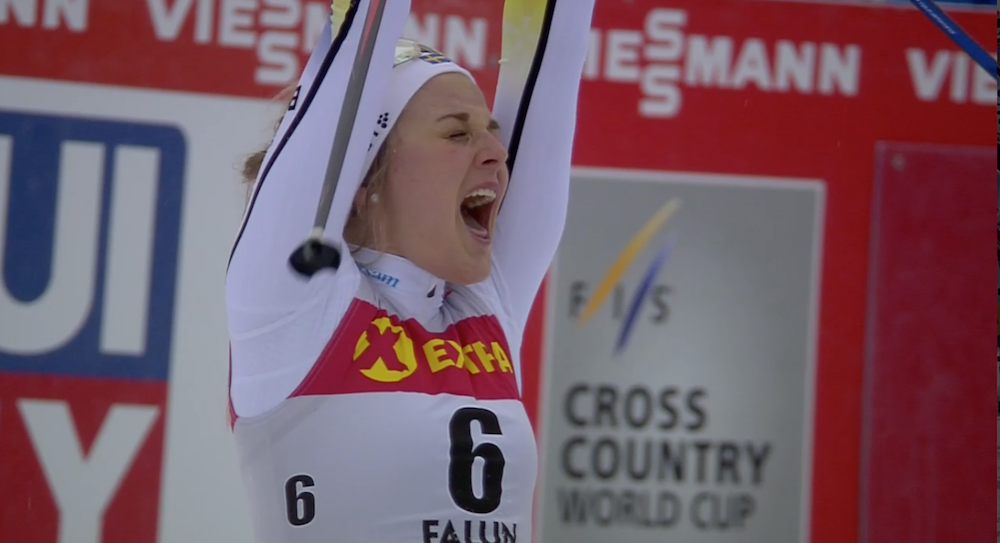
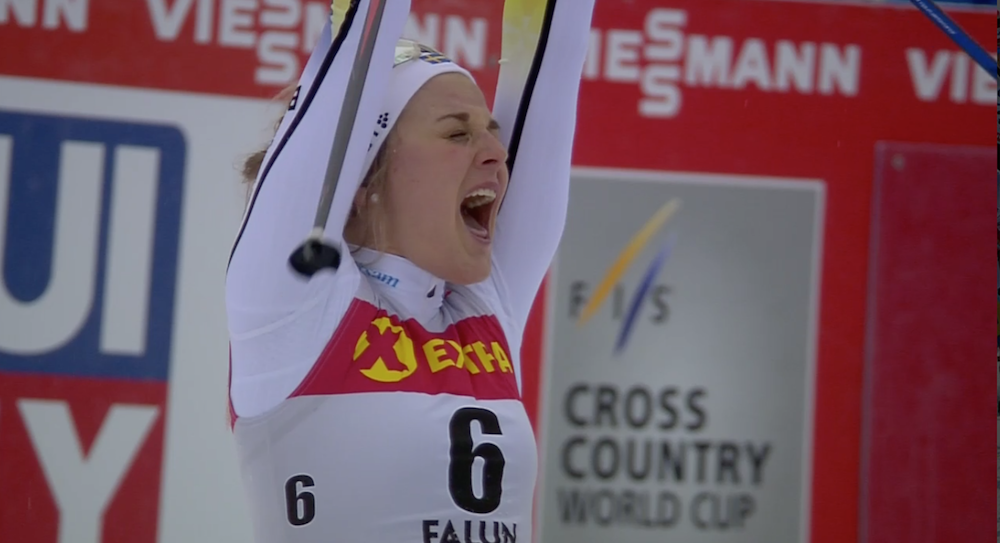
Sweden’s Stina Nilsson celebrates her second-straight World Cup sprint victory on Saturday after winning the 1.4 k freestyle sprint at home in Falun, Sweden.
FIS Cross-Country World Cup (Falun, Sweden): Men’s & women’s freestyle sprints
[UPDATED] Kikkan Randall reached the final for the first time since March 2015 on Saturday in the women’s 1.4-kilometer freestyle sprint at the World Cup in Falun, Sweden. The American qualified 26th and went on to advance in second out of her quarterfinal and semifinal to reach the six-woman final, where she ended up fifth.
Sweden’s Stina Nilsson won the final by one-hundredth of a second over Norway’s Maiken Caspersen Falla, finishing in 3:00.24 minutes. Nilsson had started the day by qualifying in sixth, 2.52 seconds behind Norway’s Marit Bjørgen, who won the qualifier in 3:00.64. This is Nilsson’s second-straight World Cup sprint win after skipping the freestyle sprint in Toblach, Italy, following the Tour de Ski.
While Bjørgen went on to win her quarterfinal, she finished fifth in her semifinal to end up ninth on the day.
Norway had two on the women’s podium with Heidi Weng in third, 1.88 seconds behind Nilsson. Finland’s Krista Parmakoski placed fourth (+1.99), and Randall was fifth (+2.56) for her best result in two years (she took last season off to have a baby). Sweden’s Jonna Sundling reached the final as well and finished sixth (+8.02).
Five U.S. women qualified for the heats, with Jessie Diggins qualifying fifth and ultimately crashing in her semifinal, where she finished fifth. That put her 10th overall on the day. Sophie Caldwell qualified third and finished fourth in her quarterfinal for 16th on the day, Sadie Bjornsen qualified 17th and also finished fourth in her quarterfinal for 19th overall, and Ida Sargent made the top-30 qualifying cutoff in 30th, then placed fifth in her quarterfinal for 25th overall.
Bjørgen topped the freestyle sprint qualifier on Saturday morning, clocking the fastest time around the 1.4 k course by just 0.08 seconds over Hanna Falk of Sweden.Caldwell qualified third (+1.23),Digginsqualified fifth (+2.39),Bjornsen17th (+5.04),Randall26th (+6.64), andSargent 30th (+8.28). Rosie Brennan (U.S. Ski Team) missed the cut in 37th (+10.90) and Liz Guiney finished 56th (+32.87). The lone Canadian woman racing on Saturday, Cendrine Browne placed 46th (+14.02).
In the men’s 1.4 k freestyle sprint final, Italy’s Federico Pellegrino held off three Norwegians and two Swedes to win in 2:45.77. The defending Sprint World Cup champion qualified second and went on to win his quarterfinal and semifinal before taking the final by six-hundredths of a second.
Norway took the remaining spots on the podium with Emil Iversen in second (+0.06) and Sindre Bjørnestad Skar in third (+0.47). Sweden’s Oskar Svensson was three-hundredths of a second off the podium in fourth (+0.50). The fastest qualifier in 2:34.49, Norway’s Johannes Høsflot Klæbo reached the final and ultimately took fifth (+1.32), and Sweden’s Teodor Peterson placed sixth (+2.08).
Canada’s Len Valjas was the top North American in 10th. He qualified 20th, advanced in second from his quarterfinal and finished fifth in his semifinal.
American Andy Newell was 16th after qualifying in 25th and finishing third in his quarterfinal. U.S. teammate Simi Hamilton followed in 18th, after qualifying 13th and finishing fourth in his quarterfinal.
In the men’s qualifier, Klæbo was 1.05 seconds faster thanPellegrinoand another 0.02 seconds faster than Russia’s Sergey Ustiugov in third.
For the U.S., Hamiltonqualified 13th (+4.52) andNewell qualified 25th (+6.74). Erik Bjornsen placed 43rd (+9.30) and Matt Gelso 59th (+13.12).
Valjaswas the lone Canadian man to make the heats, qualifying 20th (+6.22). The only other starter, Alex Harvey, placed 46th (+9.71).
IBU Open European Championships (Duszniki-Zdrój, Poland): Men’s & women’s pursuits
The men’s pursuit podium at 2017 IBU Open European Championships on Saturday in Duszniki-Zdrój, Poland, with Russia’s Alexander Loginov (c) in first, Evgeniy Garanichev (l) in second, and Latvia’s Andrejs Rastorgujevs (r) in third. (Photo: IBU)
Russia’s Alexander Loginov racked up his second win of the 2017 International Biathlon Union (IBU) Open European Championships on Saturday in the mens’ 12.5-kilometer pursuit in Duszniki-Zdrój, Poland.
After starting second, 5 seconds behind Bulgaria’s Vladimir Iliev, who won Friday’s sprint, Loginov proceeded to clean three straight stages before missing one on his final standing to cross the line first in 31:46.2 minutes.
“It was not as easy as it seemed, because from the first loop Vladimir set a really good speed,” Loginov said, according to an IBU press release. “Today we had great sunny and windless weather again, so I managed to shoot well. Probably that is why it [looked] so easy.”
Russia took first and second place with Evgeniy Garanichev following 27.8 seconds later, after starting 17th (56 seconds out of first) and shooting 19-for-20 (0+0+1+0).
“After yesterday’s sprint, I managed to work well and to show good result in pursuit, so I’m sure glad to win the silver medal,” Garanichev said, according to the IBU.
Latvia’s Andrejs Rastorgujevs improved on his fourth place in the sprint to reach the pursuit podium in third (+59.5) despite four penalties (0+1+1+2).
“On the last loop I had the information about the guys who were behind me and in front of me,” Rastorgujevs said, according to the IBU. “I was just fighting and did all I could do to get to the podium.”
Bulgaria’s Krasimir Anev, who started third, slipped to fifth (+1:28.6) with two penalties (0+1+1+0), behind Russia’s third man in the top four, Alexey Volkov in fourth (+1:01.6). Iliev as the first starter ended up 11th (+1:41.7) with six penalties (2+2+0+2).
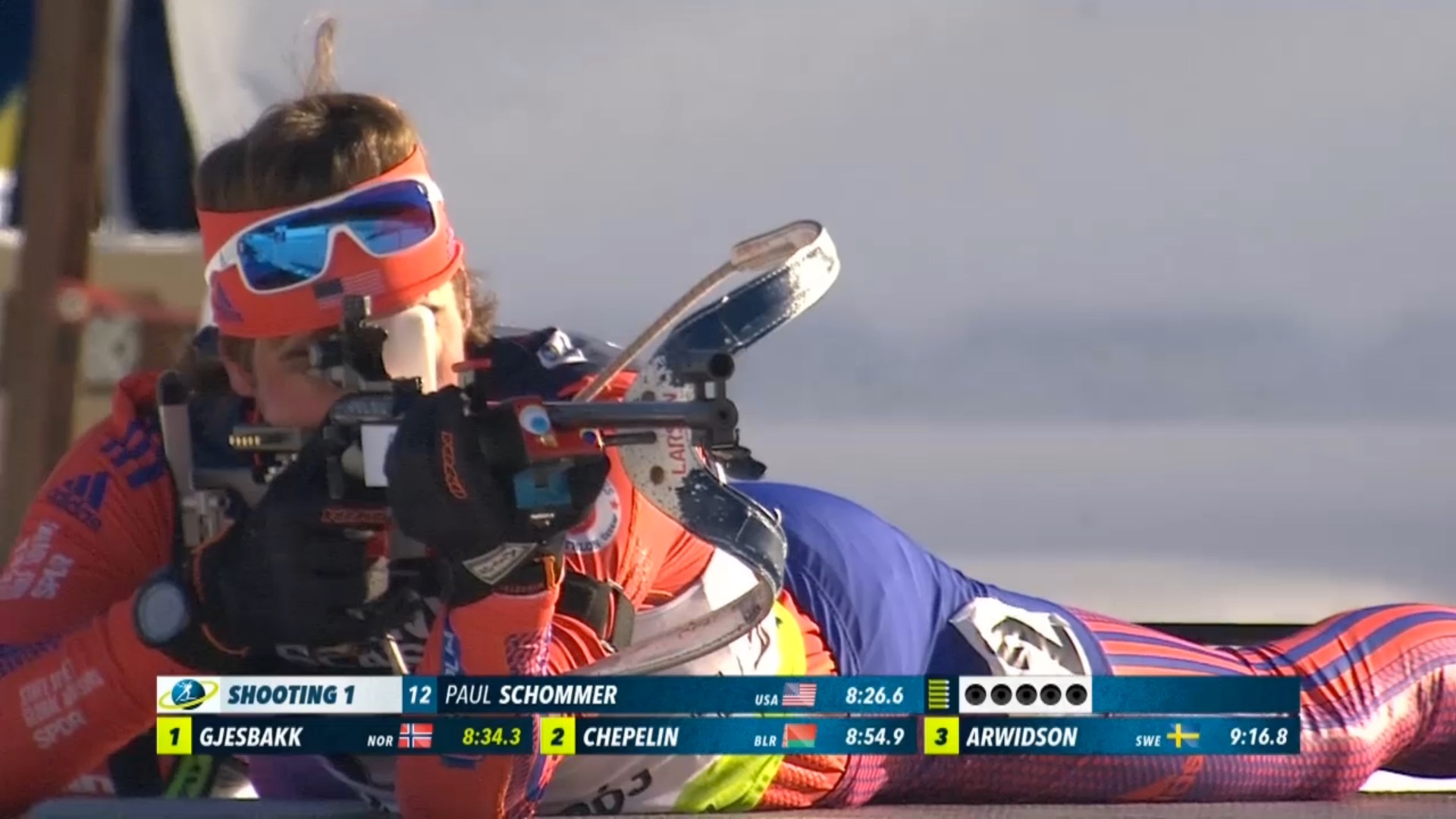
The two Americans who had qualified for the pursuit by placing in the top 60 of Friday’s sprint, Paul Schommer and Alex Howe improved to 48th (+5:07.1) and 51st (+5:42.3), respectively.
Schommer started 58th, just ahead of Howe in 59th, and missed five targets, all in his first two prone stages (3+2+0+0). Howe accumulated four penalties (1+2+1+0).
No Canadians qualified for the pursuit.
[UPDATED] In the women’s 10 k pursuit that followed, Russia’s Irina Starykh picked up her second win and third consecutive podium of the championships, with clean shooting en route to a 19.8-second victory in 30:04.4.
Starykh started third, 38 seconds behind Ukraine’s Juliya Dzhyma and 11 seconds after her Russian teammate Svetlana Sleptsova, respectively. Dzhima missed two on her last two standing stages (0+0+1+1) to slip to second, and Sleptsova dropped one place to third (+32.1) with one prone penalty (0+1+0+0).
Veronika Vítková of the Czech Republic improved from seventh to fourth (+47.8) with two penalties (0+1+1+0), and Russia’s Svetlana Mironova moved all the way up from 13th to fifth (+1:29.6) with three misses (0+1+1+1). Just 0.2 seconds behind her, Poland’s Monika Hojnisz improved from 16th at the start to sixth (+1:29.6) with one penalty (0+0+0+1).
No North Americans qualified for the pursuit.
Open European Championships conclude Sunday with the single mixed and mixed relay.
US Biathlon’s Paul Schommer shooting prone in the men’s 10 k sprint at the 2017 IBU Open European Championships in Duszniki-Zdrój, Poland. He was the top North American on Friday in 58th. (Photo: IBU/Eurovisionsports.tv screenshot)
IBU Open European Championships (Duszniki-Zdrój, Poland): Men’s & women’s sprints
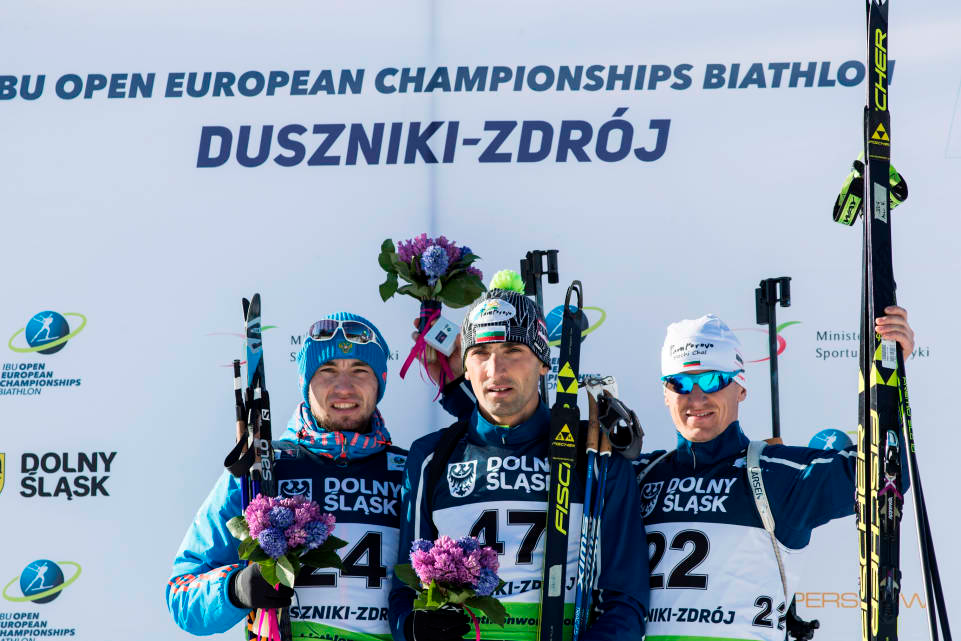
On Friday in the men’s 10-kilometer sprint, two Bulgarian athletes were able to break the Russian dominance at the 2017 International Biathlon Union (IBU) Open European Championships in Duszniki-Zdrój, Poland.
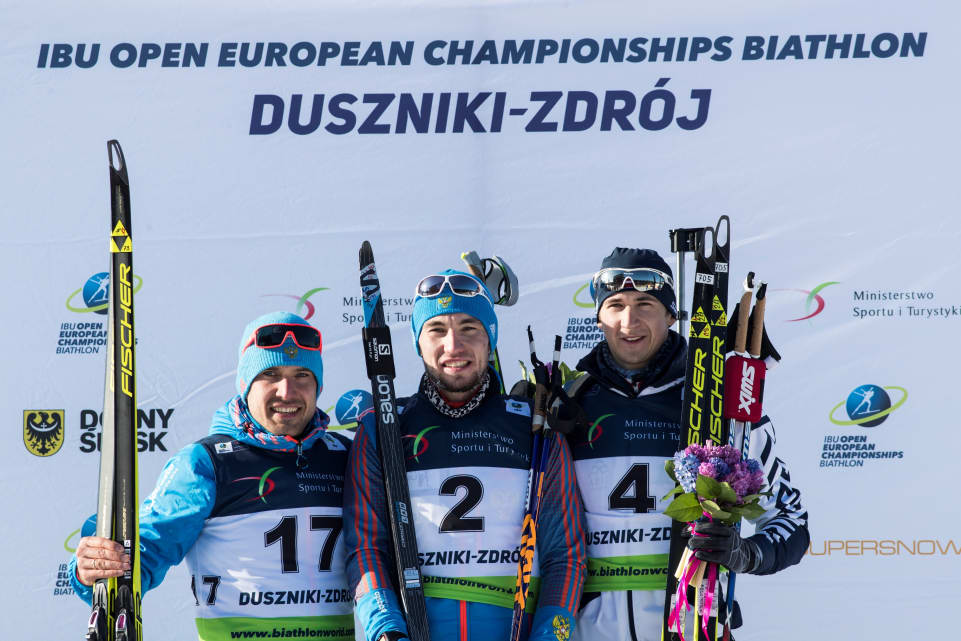
The men’s 10 k sprint podium on Friday, with Bulgaria’s Vladimir Iliev (c) in first, Russia’s Alexander Loginov (l) in second, and Bulgaria’s Krasimir Anev (r) in third at the 2017 IBU Open European Championships in Duszniki-Zdrój, Poland. (Photo: IBU)
Bulgaria’s 29-year-old Vladimir Iliev, who has competed on the IBU World Cup since 2007 and posted a career-best fifth (which he achieved earlier this season), claimed the win in a time of 24:26.9 minutes despite one penalty in the standing stage (0+1), giving a kiss to his fast skis in the finish. Russia’s Alexander Loginov, who won the men’s 20 k individual race on Wednesday after returning this season from a two-year doping suspension, placed second (+4.9) with clean shooting. Behind them, Iliev’s teammate Krasimir Anev took third (+16.7), also shooting clean, to push Latvia’s Andrejs Rastorgujevs off the podium by just 0.6 seconds (+17.3). Rastorgujevs started early in bib 4 and skied the fastest course time of the day, but incurred two penalties in his standing stage (0+2), which ultimately set him back too far for a podium.
“It was a long way to this medal and this win,” Iliev said his first career victory, according to an IBU press release. “I was ready for a high result for many years, but many things have happened, so I’m really happy to get a victory today.”
“I did not expect anything in this race, because yesterday I had health problems so even my coach advised me not to start,” Anev said after winning his second medal of the championships, following up on a second place in the individual. “So [I] went into competition without any expectations.”
In beautiful weather conditions with little wind and the sun shining on the new arena in Duszniki-Zdrój throughout the race, US Biathlon’s Paul Schommer was the best of 11 North American starters, finishing 58th (+2:14.9) with three penalties (1+2). Schommer was less than a second faster than his U.S. teammate Alex Howe, who finished 59th (+2:15.3), after skiing two penalty laps (1+1). The third American Jakob Ellingson placed 64th (+2:24.6) with one penalty (0+1), Russell Currier was 75th (+2:41.4) with four penalties (2+2), Max Durtschi was 88th (+3:16.1) with three penalties (1+2), and Michael Gibson was 103rd (+4:30.4) with two penalties (1+1).
Matthew Hudec led the Canadians on Friday in 80th (+2:54.7) with one penalty (1+0). Also for Canada, Aidan Millar finished 86th (+3:13.9) with three penalties (1+2), Carsen Campbell 89th (+3:18.3) with three penalties (2+1), Pearce Hanna 92nd (+3:24.7) with two penalties (1+1), and Matthew Neumann 94th (+3:31.8) with four penalties (1+3).
In the large field of 125 starters, Schommer and Howe qualified for Saturday’s pursuit race by placing in the top 60.
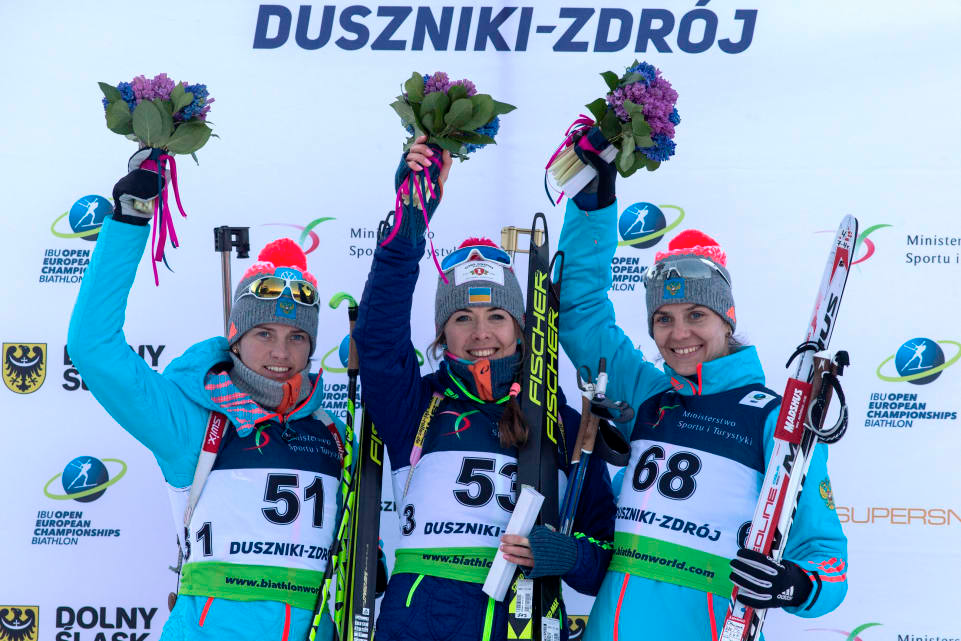
The women’s 7.5 k sprint podium on Friday, with Ukraine’s Juliya Dzhyma (c) in first, Russia’s Svetlana Sleptsova (l) in second and Russia’s Irina Starykh (r) in third at the 2017 IBU Open European Championships in Duszniki-Zdrój, Poland. (Photo: IBU)
[UPDATED] In the women’s 7.5 k sprint that followed, Ukraine’s Juliya Dzhyma managed to win in convincing fashion in a time of 21:02.3 minutes, shooting clean and skiing the second-ranked course time. It was the first individual career victory for the 26 year old in either a junior or senior championships, after she won a gold medal with Ukraine’s relay team at the 2014 Olympics in Sochi, Russia.
“When I saw that everyone was cleaning, I knew that to get in to top three, I have to do the same,” Dzhyma commented on her race, according to an IBU press release. “But honestly, I have no idea how I hit all the targets today; for the whole season, it was my first competition where I had zero.”
“I was just trying to do my best and to make the gap bigger because tomorrow is the pursuit!” she added, regarding her last loop when she increased her lead by another ten seconds.
Also shooting clean but 27 seconds off the win was Russia’s 30-year-old Svetlana Sleptsova, who, earlier in her career, won five World Cups and gold medals in the women’s relay at the 2009 World Championship and 2010 Olympics in Vancouver.
Starting behind Sleptsova, her Russian teammate Irina Starykh, the winner of the women’s individual race on Wednesday, and like Loginov, also coming back from a two-year suspension for EPO use, claimed third (+37.8) with one penalty in her standing stage (0+1). Starykh bumped Germany’s Karolin Horchler, who had led the race early on after starting in bib 2 to fourth (+42.2, with no penalties). Horchler won her first World Cup a week ago in Antholz, Italy.
“Before the competition I already felt that it would be very hard for me to shoot today,” Starykh told the IBU. “And in the end it came out that way, it was tough for me to shoot at the prone and at the standing. But just one penalty is a pretty good result, based on how I feel.”
Horchler’s teammate Denise Herrmann, who made the switch from cross-country skiing to biathlon this season, followed in fifth (+47.7) with the fastest course time of the day, but missed two targets in her standing stage including her very last shot (0+2) to miss the podium.
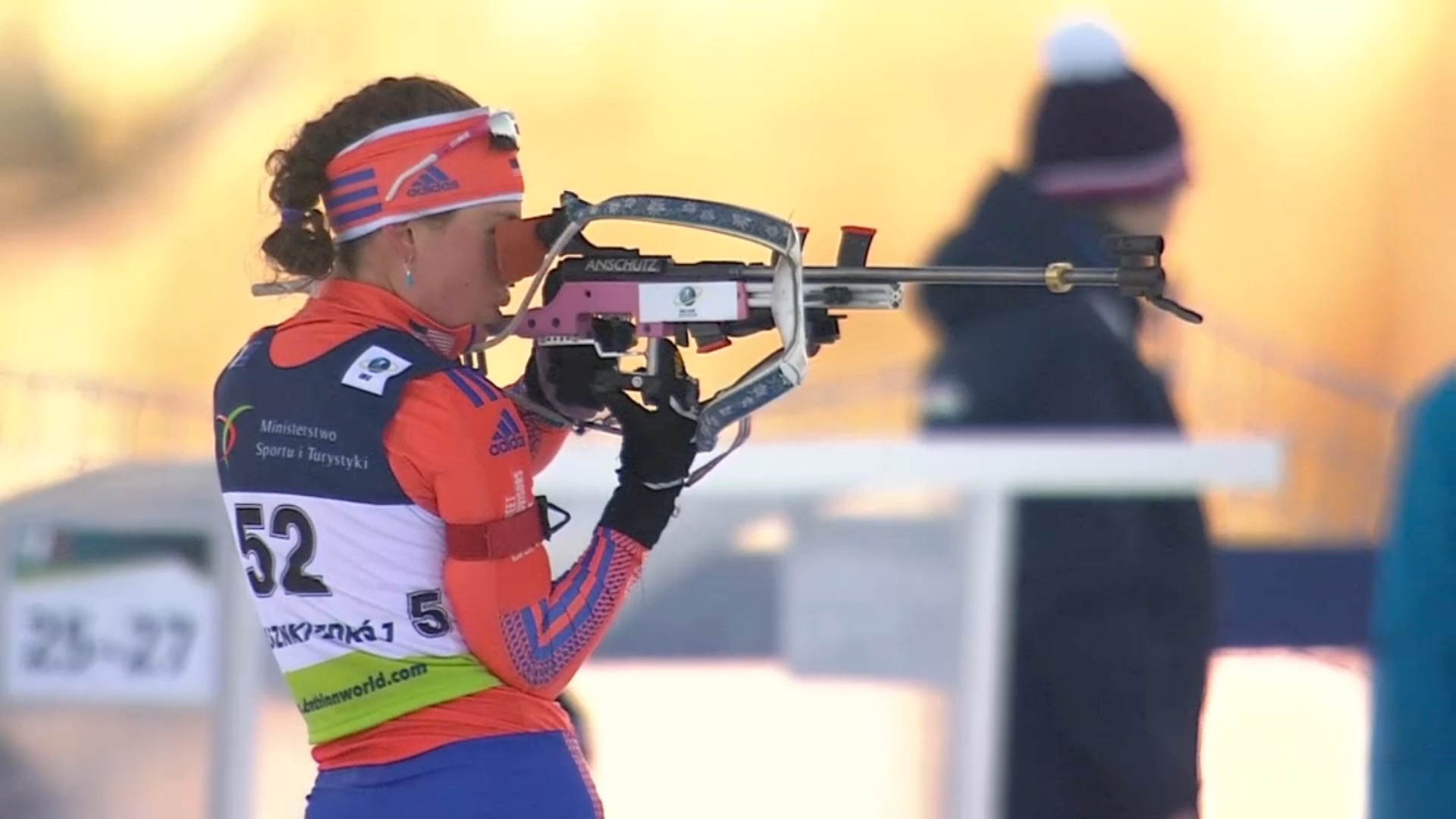
American Hallie Grossman during her standing stage in the women’s 7.5 k sprint on Friday at the 2017 IBU Open European Championships in Duszniki-Zdrój, Poland. She finished 70th with three penalties as the second-best North American. (Photo: IBU/Eurovisionsports.tv screenshot)
In stable weather conditions, though not as sunny as during the men’s sprint earlier on Friday, US Biathlon’s Emily Dreissigacker was the top North American woman in 69th (+3:31.1), with three penalties (2+1). Just one position behind her, American Hallie Grossman also missed three (2+1) on her way to a 70th (+3:34.4). For the 23-year-old Grossman it is her first season overseas racing in the IBU Cup.
Canada’s Erin Yungblut finished 81st (+5:50.0) with four penalties (1+3). Her teammate Leilani Tam von Burg did not finish after incurring two penalties in her prone shooting stage, and the third Canadian, Sarah Beaudry did not start.
None of the North American woman qualified for Saturday’s pursuit.
Russia’s Alexander Loginov racing to the win in the men’s 20 k individual on Wednesday, the first race of 2017 IBU Open European Championships in Duszniki-Zdrój, Poland. (Photo: IBU)
IBU Open European Championships (Duszniki-Zdrój, Poland): 15/20 k individual
The Open European Championships, a five-day International Biathlon Union (IBU) sanctioned event, opened Wednesday with the men’s 20-kilometer and women’s 15 k individual races in Duszniki-Zdrój, Poland.
Russia took first and second in the women’s race, with 29-year-old Irina Starykh — coming off a two-year ban for EPO use — winning by more than a minute over her teammate Svetlana Sleptsova. Starykh hit all 20 targets en route to the victory 44:24.7 minutes, which was 1:03.8 faster than Sleptsova, who had one penalty (0+1+0+0) in second. Ukraine’s Anastasiya Merkushyna placed third (+1:05.0) with one penalty as well (0+1+0+0).
American Emily Dreissigacker shooting clean during her first prone stage of the women’s 15 k individual on Wednesday at 2017 IBU Open European Championships in Duszniki-Zdrój, Poland. She finished 41st.
Emily Dreissigacker led the two U.S. women in the race in 41st (+7:47.6) with four penalties (0+1+1+2). Hallie Grossman finished 52nd (+9:06.1) with four misses as well (1+1+2+0).
Canada’s Leilani Tam von Burg finished 58th (+9:54.2) with two penalties (0+0+1+1), and Erin Yungblut was 60th (+10:13.4) with three misses (0+2+0+1).
Russia took first in the men’s 20 k as well, with 24-year-old Alexander Loginov — who also recently served a two-year ban for testing positive for EPO — winning by 11.4 seconds in 44:54.9. He had one penalty in his first prone stage (1+0+0+0) but cleaned the next three stages. Bulgaria’s Krasimir Anew cleaned (0+0+0+0) for second (+11.4), and Russia had two on the podium with Alexey Slepov in third (+53.6), with clean shooting as well.
Russia swept fourth through six, putting five in the top six.
Russell Currier led the American men in 51st (+5:42.5) with five penalties (2+2+0+1). Paul Schommer placed 57th (+6:02.5) with five misses as well (2+0+1+2), Max Durtschi was 62nd (+6:44.2) with two misses (1+0+1+0), Alex Howe 79th (+8:46) with three misses (0+1+0+2), Jakob Ellingson 87th (+10:11.3) with seven misses (2+4+1+0), and Michael Gibson 94th (+11:58.3) with six penalties (1+1+1+3).
Carsen Campbell was the top Canadian in 64th (+6:58.2) with two misses (0+1+1+0). Matthew Neumann finished 68th (+7:26.0) with three misses (0+1+0+2), Aidan Miller was 72nd (+8:07.9) with two miles (0+1+0+1), Matthew Hudec 98th (+12:29.5) with seven misses (1+1+2+3), and Pearce Hanna 101st (+14:07.1) with seven misses (2+2+2+1).
Racing continues Friday with the men’s 10 k and women’s 7.5 k sprints.
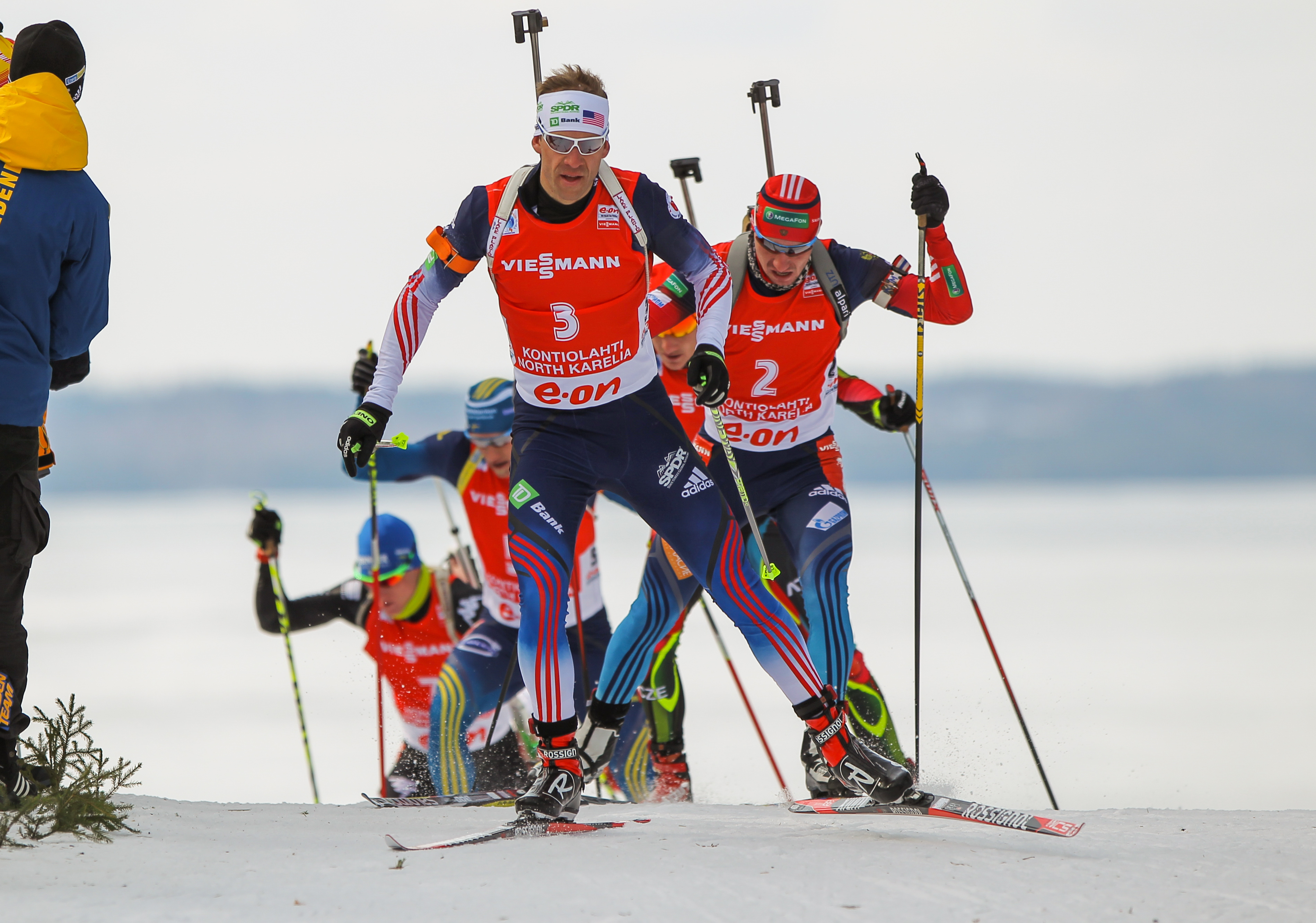
Lowell Bailey (USA) leads Alexander Loginov in a World Cup competition in Kontiolahti, Finland, in 2013. Loginov was later suspended for doping, bumping Bailey’s results and prize money up higher from the weekend of racing. (Photo: NordicFocus.com/USBA)
The Russian rosters for January competition will include two names not seen in a while: Irina Starykh and Alexander Loginov. Both are returning to international competition after serving suspensions for using the blood-doping drug erythropoietin (EPO).
Starykh was initially suspended in January, 2014, in the run-up to the 2014 Olympics. At the time, she was the top Russian woman on the World Cup and had just notched an individual podium. She was also a key member of the Russian relay team. Starykh failed an out-of-competition test in December 2013 month along with teammate Ekaterina Iourieva.
2013-2014 had been a breakout season for her so far. When asked how she had improved so much by a Russian news service, Sports.ru, she replied in December 2013, “When I found out that I was [named to train] in [Vladimir] Korolkevich’s group- I decided to fully trust the coach… he was building my training andI believed that I would approach the winter season in good condition.”
Starykh initially received a two-year ban. When the International Biathlon Union (IBU) re-tested some old samples a few months later, however, they found additional evidence of EPO use. The IBU extended her ban to three years.
Loginov competed in the IBU Cup competitions in Obertilliach, Austria, in December, finishing fourth in the 20 k individual. That’s the same venue where he won the individual race at World Junior Championships in 2013.
Loginov was caught in the same re-testing scheme that earned Starykh her extra year of suspension. His sample from November, 2013, tested positive for EPO when a new method was used several months later. The suspension was announced in November, 2014, and was for two years, plus retroactive disqualification of results between November 2013 and 2014.
Loginov said at his anti-doping hearing that the drug had been included in a medication he took to treat prostatitis. But the IBU’s hearing panel rejected this claim on multiple grounds.
The press release from the Russian Biathlon Union announcing the men’s team for international competition in January did not specify whether he would compete on the World Cup or the IBU Cup.
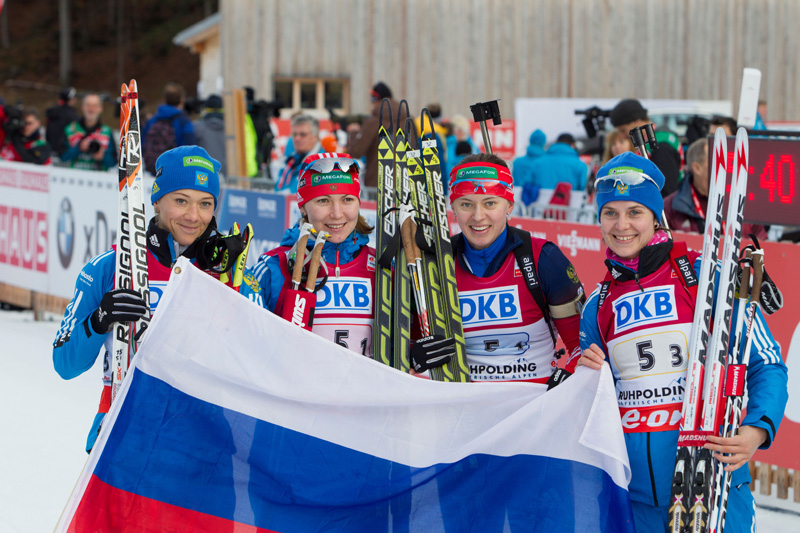
Olga Zaitseva, Ekaterina Glazyrina, Olga Vilukhina, and Irina Starykh celebrate their IBU World Cup biathlon relay victory in Ruhpolding, Germany in January 2014. (Photo: Fischer/Nordic Focus)
The International Biathlon Union (IBU) has received a list of 31 Russian athletes involved in doping, IBU President Anders Besseberg told Norway’s VG newspaper.
“Some of the 31 athletes are already banned, others have retired, but the most urgent thing is to assess the biathletes who are now participating in our international competitions,” Besseberg said. “I reckon that we on the board will make recommendations within a week… of those athletes who the Committee believes should be provisionally excluded.”
Some information about the athletes, however, can already be gleaned from the McLaren report.
For example, one document in the Evidence Disclosure Packet (EDP) failed to redact the names of four biathletes and replace them with alpha-numeric code identifiers. The four athletes were the planned roster for the women’s 4 x 6 k relay at the 2014 Olympics in Sochi, Russia: Olga Zaitseva, Olga Vilukhina, Yana Romanova, and Irina Starykh.
While the document identifying the women and their code numbers did not contain any evidence of doping, it means that any references to their code identifiers in other evidentiary documents can be connected to them.
For instance, such cross-referencing reveals that one of several samples deemed to be too dilute to be an authentic urine sample by the Drug Control Centre at King’s College London, used by the investigation for external analysis of suspicious samples, belonged to Romanova.
The team – with Ekaterina Shumilova replacing Starykh – won silver in the 4 x 6 k relay in Sochi.
Zaitseva retired after Sochi, as she had long planned to do. Romanova retired after the 2014/2015 season. Vilukhina took that year off and made an unsuccessful return last season, before announcing her retirement on November 14 of this year.
Nine other unnamed biathletes were shown in various documents to have tested positive for banned substances. In at least four of these cases, the results of the test were reported to the World Anti-Doping Agency’s ADAMS reporting database to be negative tests.
And at least 20 more athletes in the report belonged to biathlon, although in those cases there is no specific information about what substances they may have used.
Here is an extensive list of all the biathlon athletes mentioned in central documents from the evidence disclosure packet.
About the Documents
Professor McLaren (c) addressing the media after the his second report on systematic, state-sponsored doping in Russian summer and winter sports. (Photo: WADA/Twitter)
EDP1162 and EDP1149: Professor McLaren describes this document in his report: “Alexey Velikodniy created a daily competition schedule that identified protected athletes. The schedule was continuously updated during the Games and included all those on the Sochi Duchess List and athletes added during the Games, such as the female hockey team.”
EDP1149 includes English translation of the original EDP1162, and on page 44 of EDP1149 the names of the women biathletes are not redacted. Why redaction was successful in all other parts of the document, but not there, is questionable. Additionally, the document still seems to have been a planning document, as Staryk is still listed as competing in the relay even though she had long been off the Olympic team.
EDP1156: A list of sample numbers and collection during or immediately before the 2014 Olympics in Sochi, from protected national team athletes. Some data about the urine tests, like pH and specific gravity, are included, indicating that this was not merely a planning document but that the tests took place.
EDP1141: Results of a study done at King’s College London assessing whether the sodium concentration and specific gravity of some doping control samples were abnormal. (They were: in some cases, though none in biathlon, sodium concentrations were consistent with having added a teaspoon of salt to a one-cup urine sample.)
EDP1155: Translations of emails involving Grigory Rodchenkov, the former head of the Moscow anti-doping laboratory who became a whistleblower and took his story to the New York Times.
EDP1166: A list of test numbers, mostly associated with athlete ID numbers, identified by the investigation. “The IP has identified more than 1231 samples where the Moscow Laboratory communicated the presence of a prohibited substance in a Russian athlete’s sample to the [Ministry of Sport] and later reported that sample as negative in ADAMS or did not report the sample at all.” This document lists those 1231 samples.
There are columns for which substances were positive in the sample (this column is often blank) and how the report was filed in the ADAMS database. Many samples were filed as “negative”, but this column is also often left blank. This may mean that the sample was never reported in ADAMS at all – as McLaren says was fairly common – or simply that there was no information about it.
In general, the investigation’s translations from Russian into English are not always smooth. This is particularly apparent in reference to competitions: the name or level of a series is hard to interpret. It’s possible that the anti-doping staff themselves were not familiar with the different race circuits because they were not necessarily biathlon experts, and worked more generally in all sports.
A further note: some documents are scanned and thus not searchable by text. Thus some names and numbers may be referenced in places where we have not yet found them.
The Biathlon Relay Team
A0944, Olga Vilukhina
Olga Vilukhina won a silver medal in the sprint at the 2014 Olympics.
Why do we know her name? Listed in position “1” on pages 44 and 45 of EDP1149, in the 4 x 6 k relay
Evidence of being a protected athlete? Yes, in multiple documents (although those documents may be redundant; without metadata, it is difficult to tell).
Evidence that positive tests were covered up? Maybe. In EDP1166, one of Vilukhina’s samples (2870741) is listed as being reported “negative” to the ADAMS database and referred to in a document titled (in Russian) “Biathlon 3”, indicating a date of 06.01.2014 for the sample. But there is no substance listed for this sample in EDP1166. Because this document was assembled to be a list of samples which were reported to the Ministry of Sport as being positive, it’s not clear what to conclude from this combination of facts.
Other tests? Besides that one sample, there are several other samples listed for Vilukhina: urine samples collected January 31, February 9, and February 16, 2014, and a blood sample collected February 15, 2014. While the urine samples are referenced in EDP1166, no substances were listed and the test does not seem to have been entered into ADAMS. February 9 was the day of the women’s sprint in Sochi, where Vilukhina won a silver medal. February 16 was the day before the women’s mass start, where Vilukhina placed 21st.
A0983, Olga Zaitseva
Olga Zaitseva blows kisses to the crowd as she brings Russia the gold in the Olympic biathlon relay in 2010.
Why do we know her name? Listed in position “3” on pages 44 and 45 of EDP1149, in the 4 x 6 k relay
Evidence of being a protected athlete? Yes, in multiple documents (although those documents may be redundant; without metadata, it is difficult to tell).
Evidence of positive tests? Maybe. In EDP1166, one of Zaitseva’s samples (2870735) is listed as being reported “negative” to the ADAMS database. But there is no substance listed for this sample or date of collection and it is not referred to in any other documents. Because EDP1166 was assembled to be a list of samples which were reported to the Ministry of Sport as being positive, it’s not clear what to conclude from this combination of facts.
Other tests? Besides that one sample, there are several other samples listed for Zaitseva. Around the time of Sochi, urine samples were collected January 31, February 14 and February 19, 2014, and a blood sample collected January 31, 2014. An additional undated urine sample is referred to in EDP1166. For these samples, no substances were listed and the test does not seem to have been entered into ADAMS. February 14 was the day of the women’s 15 k individual, where Zaitseva placed 15th, and February 19 was the mixed relay, where the Russian team including both Zaitseva and Vilukhina placed fourth.
A0714, Yana Romanova
Yana Romanova competing in Kontiolahti, Finland, in 2010. (Photo: Peter Porai-Koshits/Wikimedia/Creative Commons)
Why do we know her name? Listed in position “4” on pages 44 and 45 of EDP1149, in the 4 x 6 k relay
Evidence of being a protected athlete? Yes, in multiple documents (although those documents may be redundant; without metadata, it is difficult to tell).
Evidence of positive tests? The report from King’s College London indicates that one of Romanova’s samples (number 2889617, collected on February 2, 2014, just before the Sochi Olympics began, according to another document) was too dilute to be an authentic sample. In the report and the New York Times investigation, Rodchenkov described adding water or salt to samples that were being manipulated. The King’s College London test suggests that this may be one such sample.
In EDP1166, one of Romanova’s samples (2870745) is listed as being reported “negative” to the ADAMS database. But there is no substance listed for this sample or date of collection and it is not referred to in any other documents. Because EDP1166 was assembled to be a list of samples which were reported to the Ministry of Sport as being positive, it’s not clear what to conclude from this combination of facts.
Other tests? Besides those two samples, there are several others listed for Romanova. Around the time of Sochi, urine samples were collected January 31, February 2, 13, and 21, 2014, and blood samples collected February 14 and 15, 2014. An additional undated urine sample is referred to in EDP1166. For these samples, no substances were listed and the test does not seem to have been entered into ADAMS. February 14 was the day of the women’s 15 k individual, where Romanova placed 53rd, and February 21 was the day of the women’s relay.
A0856, Irina Starykh
Targeted testing based on data from the IBU’s Athlete Biological Testing program led to the suspension of Irina Starykh, above on her way to fifth place in the World Cup pursuit in Hochfilzen, Austria, in 2013, and another Russian biathlete for blood-doping. The IBU fined Russia for a cluster of doping cases.
Why do we know her name? Listed in position “5” on pages 44 and 45 of EDP1149, in the 4 x 6 k relay
Evidence of being a protected athlete? Yes, in multiple documents (although those documents may be redundant; without metadata, it is difficult to tell).
Evidence of positive tests? In EDP1166, two of Starykh’s samples (2870740 and 2870745) are listed as being reported “negative” to the ADAMS database. But there is no substance or date listed for either sample, and they are not referred to in any other documents. Because EDP1166 was assembled to be a list of samples which were reported to the Ministry of Sport as being positive, it’s not clear what to conclude from this combination of facts.
Other tests? No tests are listed for Starykh at the Sochi Olympics, because she was not there. However, there are five more samples of hers listed in EDP1166, for which no substances were listed and the test does not seem to have been entered into ADAMS.
Other Athletes with Positive Tests Described in Documents
Thirty-one other athlete ID numbers are associated with the sport of biathlon, and three additional mentions of biathletes which are not associated with any ID number. This means that they could belong to some of the 35 numbered athletes (the four named women plus the 31 unidentified, but numbered, athletes), or they could be completely separate cases.
Of those 31-34 other biathletes, here are the ones for whom positive tests for prohibited substances are explicitly mentioned in the documents.
A0241, female
Evidence of being a protected athlete? Maybe. This athlete was certainly competing internationally. By the time Russian anti-doping staff were discussing her case, she was in Ruhpolding, Germany, and then was set to travel to Antholz, Italy – consistent with the World Cup schedule – before checking into the Olympics. This plan does not seem to be jeopardized by her positive test, although the staff notes that she is at risk. After the positive test, Rodchenkov notes that “it is necessary to hide her immediately.”
Besides the four athletes named above, Shumilova competed in Sochi, along with Olga Podhufarova and Ekaterina Glazyrina. Several others were competing on the World Cup, but were unlikely to have been slated for Sochi participation because they did not have strong results so far in the season – the possible exception being Ekaterina Yurlova.
Evidence of positive tests? In EDP1166, this athlete’s sample (2866518) is shown as testing positive for methenolone, oxandrolone, and trenbolone, all anabolic steroids. The test was allegedly collected on 12.19.2013 in Izhevsk, Russia, at the biathlon championships.
How was the test handled? In the emails, which you can see in Russian here, this sample is given a “save” order, meaning that it should be reported as negative. And in EDP1166, the sample is shown as being negative in ADAMS. She may have additionally been quarantined: the anti-doping staff write in emails that if she was to be subjected to an international test (for instance, but the International Biathlon Union), she would certainly test positive and it would be “a very ugly situation for the lab if we ‘found nothing’ in such concentrations and for those substances.”
Other tests? In EDP1166, two of this athlete’s samples (2870746 and 2867708) are listed as being reported “negative” to the ADAMS database. But there is no substance or date listed for either sample, and they are not referred to in any other documents. Because EDP1166 was assembled to be a list of samples which were reported to the Ministry of Sport as being positive, it’s not clear what to conclude from this combination of facts. An additional blood test is listed in EDP1166 with no substances listed, and the test does not seem to have been entered into ADAMS.
Unnumbered Athlete, male
Evidence of being a protected athlete? No. The only other information about this athlete is that it was a man.
Evidence of positive tests? The emails refer to this athlete’s sample (2759623) being positive for 16a-hydroxyprednisolone (budesonide metabolite). Budesonide is a corticosteroid which is used in asthma medications such as Pulmicort inhalers, but it is also used in other forms: as pills, nasal sprays, and as a rectal foam to treat intestinal problems. The sample is written to have been collected on 11.1.2013 at in international competition in Ostrov, Russia. That day, IBU Cup sprints were held in Ostrov, with three Russian men (race winner Alexey Slepov, plus Sergey Korastylev and Sergey Klyachin) in the top six.
How was the test handled? There’s no information about how this test was handled. It is discussed in the email, but no conclusion is reached. It also does not appear in EDP1166.
Other tests? None listed.
A0028
Evidence of being a protected athlete? There’s no other information about this athlete.
Evidence of positive tests? In the emails, athlete A0028 is described as having tested positive for “methandienone circuit” at the Russian biathlon championships in Uvat on 31.07.2014. It’s unclear what “circuit” refers to – it may be an awkward translation – but methandienone is an anabolic steroid. In addition, the testosterone to epitestosterone ratio is listed as 6.2. A high ratio can indicate that an athlete was using exogenous testosterone, and a finding of a ratio above 4.0 triggers further investigation. The original email can be seen (in Russian) here.
How was the test handled? In the emails, the word “Quarantine” appears above the description of this athlete’s test results. This likely means that the athlete was kept in Russia until they could pass an anti-doping test. There’s no information about whether the test was reported to the ADAMS database or not.
Other tests? None listed.
A0179, female
Evidence of being a protected athlete? No. The only other information about this athlete is that it was a woman.
Evidence of positive tests? Document EDP1166 states that on 09.28.2014 at Russian biathlon championships in lzhevsk, a sample tested positive for isomers of amphetamines, which are banned stimulants. There is also discussion of the sample in the emails, with someone writing, “find out what she took!” The group seems to suspect that the substance came from a dietary supplement. The email (in Russian) can be seen here.
How was the test handled? In the emails, this case is listed with a “save” order: that means that a positive test should be turned into a negative one. Indeed, document EDP1166 states that this test was reported as negative to the ADAMS database.
Other tests? None listed.
A0461, male
Evidence of being a protected athlete? No. The only other information about this athlete is that it was a man.
Evidence of positive tests? EDP1166 shows that one of this athlete’s samples (2867705) tested positive for tuaminoheptane, a prohibited stimulant which is used in nasal decongestants. The emails (here) show that this sample was collected on 12.21.2013 at a Russian Cup race in lzhevsk.
How was the test handled? The emails are unclear, with someone writing, “and this one still does not have a decision (or I missed it).” However, in EDP1166 the test is listed as having been reported to ADAMS as negative.
One staff member, perhaps assumed to be Rodchenkov, writes this regarding the sample: “Alex, come on, I’ll close the whole shop… They are imprudent beyond measure… and then I will go to other laboratories after February 2014.”
Other tests? In EDP1166, two of this athlete’s samples (2918636 and 2870699) are listed as being reported “negative” to the ADAMS database. But there is no substance or date listed for either sample, and they are not referred to in any other documents. Because EDP1166 was assembled to be a list of samples which were reported to the Ministry of Sport as being positive, it’s not clear what to conclude from this combination of facts.
A0751, female
Evidence of being a protected athlete? No. The only other information about this athlete is that it was a woman.
Evidence of positive tests? EDP1166 shows that one of this athlete’s samples (2945500) tested positive for pthalates, which are plasticizers. They are prohibited because they are thought to indicate the use of blood transfusions, with the plasticizers being used to soften the plastic in blood bags and then diffusing into the blood. The emails show that this sample was collected on 09.28.2014 at Russian biathlon championships in lzhevsk, That email (in Russian) can be seen here.
How was the test handled? EDP1166 shows that this test was reported as negative to ADAMS.
Other tests? None listed.
A1244, male
Evidence of being a protected athlete? No. The only other information about this athlete is that it was a man.
Evidence of positive tests? The sample (2868394) is not listed in EDP1166, but only discussed in the emails (in Russian here). The emails refer to a positive test for trimetazidine, a metabolic modulator which protects against angina and heart problems, much like meldonium. According to the emails the sample was collected in Uvat at Russian biathlon championships on 6 April (assumed to be 2014).
How was the test handled? There’s no information about how this test was handled.
Other tests? None listed.
Unnumbered Athlete, male
Evidence of being a protected athlete? No. The only other information about this athlete is that it was a man.
Evidence of positive tests? In the emails, one of this athlete’s samples (2689927) is written to contain methylhexanamine, a banned stimulant common in dietary supplements (it is in fact the same substance which German biathlete Evi Sachenbacher-Stehle tested positive for at the 2014 Olympics). The sample was collected on 2012-12-17 at all-Russia competitions in Ekaterinburg.
How was the test handled? There’s no information about how this test was handled. In the emails, it is clear that nothing was done about the test until the following year (2013), but the final action is not discussed. It also does not appear in EDP1166.
Other tests? None listed.
Unnumbered Athlete, male
Evidence of being a protected athlete? No. The only other information about this athlete is that it was a man.
Evidence of positive tests? One of this athlete’s samples (2746493) is discussed in the emails as having tested positive for furosemide, a diuretic and masking agent. The sample was collected on 01/09/2013 at all-Russia competitions in lzhevsk.
How was the test handled? There’s no information about how this test was handled. Other than reporting the sample, there is no discussion of the test in the emails, and also does not appear in EDP1166.
Other tests? None listed.
Other Athletes Mentioned in the Documents
For the rest of the biathletes, sample numbers are listed in EDP1166, but no substances are listed and positive tests are not discussed described in any of the other documents. Because EDP1166 was assembled to be a list of samples which were reported to the Ministry of Sport as being positive, it’s not clear what to conclude about the samples.
Here is what we know about them.
ID Number
Gender
Samples reported as negative
Samples with no information about reporting
A0023
Male
2869722
A0136
Male
2870692
A0157
Male
2867964
A0201
Female
2869837
A0232
Male
2870747
2889906, 2890603, 2890739, 2944467
A0282
Female
2866843
A0321
Female
2868243
A0491
Male
2870733
857444 (blood)
A0508
Male
2868236
A0521
Male
2870742
857581, 857105, 857600
A0548
Female
2869752
A0567
Female
2867862
A0576
Male
2866527
A0579
Female
2870697
A0598
Female
2847214
A0639
Female
2869643
A0640
Male
2869203
A0687
Male
2867881
A0795
Male
2870739
2944657, 2890878, 2890855, 2889922, 2889808
A0804
Male
2869859
A0808
Female
2870743
857613 (blood)
A0930
Male
2870744
857573, 857440 (blood)
A0950
Male
2870748
A1031
Male
2869912
In addition:
A0142, male
Mentioned in EDP1166: Sample 2916590 is listed as having been reported as negative in the ADAMS database. There is no information listed about substances in the sample.
Other mentions: The same sample is described in an email which does not seem to have been translated into English. The sample was collected on 2014-07-17 in Toksovo, outside of Saint Petersburg.
Targeted testing based on data from the IBU’s Athlete Biological Testing program led to the suspension of Irina Starykh, above, and another Russian biathlete for blood-doping. The IBU fined Russia for a cluster of doping cases.
The doping cases of Russian biathletes Ekaterina Iourieva, Irina Starykh, and Alexander Loginov have finally wrapped up, with the International Biathlon Union fining the Russian Biathlon Union 100,000 Euros.
All three doping cases were resolved in June with Iourieva banned for a total of twelve years, Starykh for a total of three years, and Loginov for a total of two years, based on repeat infractions on the part of the two women.
“Earlier the RBU was fined €50.000 for Anti-Doping Rules violations in 2009,” the IBU stated a press release. “The current fine amount for the RBU is the highest possible financial sanction which is provisioned by the IBU Disciplinary Rules.”
It’s unclear when the idea of a fine originated, but IBU Director General Nicole Resch stated in an email that the issue first came before the Executive Board at their meeting this month.
“The fine was put on the agenda for the Executive Board in early November, after the decisions of the Anti-Doping Hearing Panel were final in July 2015,” she wrote.
That means that the fine was placed on the agenda before the release of the World Anti-Doping Agency Independent Commission report was released showing state-sponsored doping in Russian track and field, although two documentaries by German filmmaker Hajo Seppelt had already brought the issue into the public eye.
“We had to wait until the hearing panel made their determination ( they are an independent board) and then we needed to convene the Executive Board to discuss the situation and determine the punishment,” Jim Carrabre, the Vice President for Medical Issues, wrote in an email to FasterSkier. “Since this was Russia’s second offense where where more than one athlete doped in a year, we decided to levy the maximal fine. I anticipated this the moment we knew that we caught them. It had no bearing on ARD or WADA. This was prior to Sochi. The timing looks like we might be responding like this because of the WADA report but it has no bearing on it.”
Lowell Bailey (USA) leading Alexander Loginov of Russia in a World Cup competition where Loginov placed just ahead of him on the podium. Bailey doesn’t think that two-year bans, or the 100,000 Euro fan, will deter anyone from doping: “A doping fine should be more than a small line-item expense.” (Photo: USBA/NordicFocus.)
Yet IBU President Anders Besseberg said that the fine did not mean that the Russian Biathlon Union itself had promoted doping.
“I would not say that the Russian Biathlon Union engaged in deliberate doping,” he told Norwegian broadcaster NRK. “I’ve said it before and I’m not afraid to say it again: in Russia and some other countries there has been a lack of culture when it comes to doping… This hurts, but it’s also no secret that in the past five to six years most of the positive samples are from Russian athletes.When we then have the opportunity to give them such penalties, we do it.”
It’s hard to pin down a number for the budget of Russian biathlon, since it is funded by a combination of different sources. Going into the 2014 Olympics, when it was still headed by billionaire Mikhail Prokhorov, U.S. Biathlon CEO Max Cobb estimated that the Russian budget might be ten times as big as his own $1.6 million budget.
If so, that would make the fine 0.6% of the Russian team’s resources.
“I think the fines AND the probation periods should be MUCH bigger, perhaps by a factor of 10,” U.S. biathlete Lowell Bailey wrote in an email. “Russia spent $51 billion on the Sochi games… Does anyone really think that a €100,000 fine to one of their biggest [national governing bodies] is going to make any meaningful difference? Especially when it is now clear how intertwined the Russian government and sports committee are with their Olympic NGB’s? A doping fine should be more than a small line-item expense. It should be enough to seriously injure a program for years… Something that will make them think twice the next time they decide to cheat.”
In an interview with the German media company T Online, Resch said that there are now no more pending doping cases within the IBU, and that the organization had begun the process of redistributing prize money. The Russian federation must pay back prize money won by the banned athletes.
“With regard to the Loginov case, I have not been contacted directly, but I expect this will all get taken care of in the next couple of weeks,” Bailey wrote in an e-mail. “I can’t even believe a two-year ban is all these athletes get! Obviously, in the case of Iuorieva, the two-yr ban wasn’t much of a deterrent the first violation since she clearly just went back to doping as soon as she was eligible to compete again.”
Resch defended the IBU’s antidoping program but also said the organization would be taking some new approaches to update it.
“For the future we will increasingly cooperate with the WADA-certified NADOs, and increase the number of tests for growth hormones and improve our intelligence through the cooperation with the WADA Blood Passport experts even further,” Resch said, according to a translation.“I have confidence in our internal medical intelligence for the testing strategy – the figures from the past speak for it.”
Irina Starykh, here racing in Hochfilzen, Austria, is one of three Russian biathletes caught using EPO since December 2013.
The Anti-Doping Hearing Panel for the International Biathlon Union (IBU) has finally handed down their decisions in the cases of three Russian athletes who were caught using EPO, a blood-doping drug. In each case, the samples were from late in 2013 and seemed abnormal at the time, but were not detectable as violations.
One year later, a new testing method became available, and the IBU re-tested the samples. Using the more sophisticated method, positive tests were found. The three athletes are Irina Starykh, Ekaterina Iourieva, and Alexander Loginov. Another athlete, Sergiu Sednev of Ukraine, also had a positive re-test, but did not fight the ruling and his case was concluded in April.
“The Russian Biathlon Union is not going to challenge [this decision],” Alexander Kravtsov, President of the Russian Biathlon Union, said in a press release. “The Russian Biathlon Union is working closely with RUSADA and WADA in the fight against the use of illicit drugs, and intends to continue to actively fight against doping in biathlon at all levels.”
At issue in the cases, besides the usual claims that EPO entered the athlete’s system by accident or as part of a remedy for some previously undisclosed illness, the hearing panel had to consider that the sample collection and the test were performed more than a year apart. That brought into question when to begin the bans: should it be from the time the sample was taken, or when the re-test was found positive?
Each of the three cases also had some of their own special considerations, for example if positive samples collected ten days apart constituted a single offense (one injection of EPO detected in both tests) or multiple offenses.
Alexander Loginov, en route to winning the 2013 World Junior Championship sprint. (Photo: Mario Danzl/Obertilliach 2013.)
Loginov: Alexander Loginov, a former double gold medalist at World Junior Championships who also had three individual World Cup podiums to his name, generated the most buzz when the re-testing results came out. That was because he had never previously faced a doping infraction, unlike Starykh and Iourieva.
Loginov did not initially take advantage of the opportunity to submit a statement to the hearing panel, but the IBU gave him and extension and a second chance, for “fairness to the athlete”. At this point, Loginov responded that he had avoided commenting on the case because he was ashamed “to publicly disclose my intimate and personal problem, but 2 years ago, I was diagnosed with acute prostatitis,” a bacterial infection of the prostate gland.
Loginov claimed in the written statement that he wanted to be healthy for the Olympics. So on the recommendation of a friend he took a supplement which could supposedly help with the problem. He says that it contained “biologically active substances” and that, oops, EPO must have been one of them.
The hearing panel was unimpressed: they noted that Loginov did not bother to submit documentation showing that he actually had prostatitis, and also that EPO must be injected so the claim that it was in pill form in this supplement did not make sense.
Lowell Bailey (USA) leading Alexander Loginov of Russia in last season’s World Cup pursuit in Kontiolahti, Finland. In the sprint, Loginov had placed second and Bailey third; a previous sample of Loginov’s has tested positive for EPO. (Photo: USBA/NordicFocus.)
Another interesting facet of the case is that the IBU counseled the panel to be lenient with the ban.
This took the form of urging the panel to consider carefully when to start the ban. Banning Loginov from competition starting on November 26, 2013, when the sample was first collected, would mean that he would almost have completed his two-year ban at this point.
The IBU advised against this, noting that usually even in cases of delay at least half the ban must be served out-of-competition. Loginov competed through the end of the 2014 season, finishing with a World Cup podium in Oslo, and was set to represent Russia in the first World Cups of 2014-2015 when his test result was released just before the competitions began.
However, starting a ban from November 2014, when the re-test was performed, would lead to a year of disqualified results plus two years out of competition. The IBU questioned whether this was fair to the athlete, to essentially serve a three-year ban instead of a two-year ban, and questioned whether some middle ground could be found.
Legally, there is one avenue for changing the date of the beginning of a ban to something other than the date of the test. It is a safeguard in case the federation itself intentionally drags out proceedings to try to further harm the athlete. The key condition here is that the extended length of time between the sample collection and testing is “not attributable to the athlete”. The IBU believed that this criteria had been fulfilled.
The panel disagreed, saying that in fact, the delay was entirely attributable to Loginov, who had implemented his doping in such a way that intentionally made it impossible to detect with currently available methods. Such behavior should not be rewarded, they wrote. In cases where the re-test happened even further after the date of sample collection, starting the ban from sample collection could even result in no actual time away from competition for an athlete, thus incentivizing this behavior.
As for starting the ban somewhere in between the two dates, as the IBU seemed to be requesting, the panel noted that this would have to be arbitrary on a case-by-case basis considering that the intervening time is likely to be different in each case. This would be both unfair, difficult to determine, and legally inadvisable, they concluded.
In the end, Loginov was banned for two years from the date of his re-test, and his results from the time between sample collection and testing were disqualified. The entire text of the decision, including these interesting deliberations, is available here.
The decision has ramifications for several athletes, among them Lowell Bailey of the United States, who finished one spot behind Loginov on the podium in Kontiolahti in 2014. Bailey should see the results amended and, hopefully, an increase in prize money.
Irina Starykh (far right) celebrates with the Russian team after their IBU World Cup biathlon relay victory in Ruhpolding, Germany, in January. The result is among those which will be voided with Starykh’s doping ban, from a sample collected in December. (Photo: Fischer / Nordic Focus.)
Starykh: Irina Starykh had World Cup podiums in December 2013, and was looking set to lead the Russian team at the Sochi Olympics. Then, a sample collected in late December tested positive for EPO.
At the time she claimed that the EPO must have come from some cosmetic injections she took because she was self-conscious about her appearance. There was no evidence of this being the case: neither that she had actually taken injections, nor that EPO was present in the drug, LAENNEC. Starykh received a two-year ban.
The sample which re-tested positive was taken about ten days later, on January 2, 2014.
Before the second anti-doping hearing panel, Starykh did not claim innocence. At issue, instead, was whether the tests should be considered as separate or as one violation, since they occurred only days apart. Starykh argued that both tests could be the result of a single injection (she wrote an injection of the cosmetic enhancer, but the panel could consider it an injection of EPO), and thus that no additional ban should be implemented.
The IBU disagreed, arguing that not only should an additional ban be put in place, but it should be a longer one because the tests indicated multiple infractions.
The hearing panel concluded that because the tests were so close together in time, they must consider their process as if they were adjudicating both together. But they did decide that the two samples indicated that Starykh had used EPO multiple times – this is especially true since doping athletes now frequently use very small doses to try to avoid detection, but administer these doses repeatedly. The half-life of EPO is short, on the time scale of hours to days, so it seems impossible that the second test would still be indicating a single injection detected by the first test.
Thus, the panel decided to ban Starykh for one additional year, after her first two-year term is served. She will be eligible to compete again at the end of December, 2016.
Iourieva: Ekaterina Iourieva, a former World Champion, had already had two anti-doping infractions. She served a two-year ban beginning in 2009 after testing positive for EPO then. In the run-up to the 2014 Olympics she had returned to competition, although not very successfully. In December 2013 and January 2014 samples were collected in out-of-competition tests and were found to have EPO in them. The anti-doping hearing panel convened at the time banned Iourieva for eight years, noting that it was her second EPO violation in the space of eight years.
The re-tested samples were from November 2013, just a month before the samples that would earn her the eight-year ban. In the re-testing case, Iourieva did not respond to requests by the panel to present her side of the story. The panel even wrote the Russian Biathlon Union to offer her more time to respond, at which point the RBU wrote that “There will be no feedback from Iourieva as she decided to finish her professional sports career.”
The hearing panel concluded by disqualifying all of Iourieva’s results beginning in November 2013, and serving her a four-year ban – beginning in December 2021, when her eight-year ban ends.
Alexander Tikhonov in Khanty-Mansiysk, Russia, in 2007. Photo: vow via creative commons.
A third candidate has joined the race for the International Biathlon Union (IBU) Presidency, to be voted on at the IBU Congress in December: Alexander Tikhonov, a legendary Soviet biathlete.
Tikhonov won relay gold in four straight Olympic Games, as well as racking up five individual World Championship titles between 1969 and 1977. His overall 11 gold medals at World Championship events put him a three-way tie for the most successful biathlete of all time, on par with Frank Luck of Germany and Emil Hegle Svendsen of Norway, but behind “King of Biathlon” Ole Einar Bjørndalen of Norway.
The former athlete has remained active in the biathlon world, holding the title of IBU Vice President for a time as well as helming the Russian federation in the mid-2000’s. Among other things, he has been the main driving force behind the Summer Biathlon World Championships.
The race is already heating up, with incumbent Anders Besseberg of Norway defending his policies. Besseberg has led the IBU ever since the position was established in 1993.
He has faced criticism from Dr. Jim Carrabre, a Canadian who lives in Minneapolis (USA) and is the IBU’s Vice President of Medical Issues. A longtime anti-doping advocate, Carrabre has claimed that the IBU lacks transparency under the leadership of Besseberg and Secretary General Nicole Resch. Carrabre announced his own run for the presidency in late June.
At the same time, Carrabre sent a scathing open letter to Besseberg deploring his decision to halt blood-passport testing at future Olympic Games, a call which was made without consulting the IBU’s own Medical Committee.
Besseberg appeared to be using his political wiles to the best advantage when he delayed responding to Carrabre’s letter until nearly a month later, timing his own response so that it was directly after the announcement of several long-awaited doping bans. In the response, which also took the format of an open letter, Besseberg defended his own work on anti-doping and touted his seat on the World Anti-Doping Agency Board.
But the race is getting even juicier with the addition of Tikhonov, who has rarely held back from voicing his opinions and has a colorful past.
In 2007, Tikhonov was convicted for conspiring to kill the governor of the Kemerovo Oblast, a region in Siberia. The incident had happened in 2000, when Tikhonov had allegedly connected some businessmen who wanted the governor dead, with his younger brother Victor, who helped them find hit men. Because Tikhonov was living in Austria at the time, he didn’t face trial for another seven years.
And though he was sentenced to three years in prison, he was immediately amnestied and never served any time.
His continuing involvement in the biathlon world has been looked down upon by many. In a 2010 New York Times article, both Carrabre and Besseberg lamented that Tikhonov’s involvement meant that people could legitimately say the sport was run by criminals.
In that article, Besseberg called it a “tricky and difficult” situation.
In an e-mail to FasterSkier this weekend, Carrabre was considerably more neutral.
“Not surprised to see him come back,” he wrote. “He has been the big supporter and influence for the summer biathlon world championships.”
Others are less charitable.
“I take a dim view of the situation if he is elected,” Tore B
Tikhonov had been particularly outspoken this year, commenting repeatedly on the Russian team’s successes and failures, as well as their doping scandal involving Irina Starykh and Ekaterina Iourieva. It was Tikhonov who alleged that two well-known “doping doctors” had been spotted at the World Cup in Hochfilzen, Austria, where Starykh was particularly successful.
In announcing his bid for the Presidency, Tikhonov has come out again in criticism of how the Russian team handles doping issues: he says they simply facilitate it.
“The worst thing is that none of our coaches or managers have ever paid for it, a bad situation that should be changed,” he told the Russian press, according to a translation. “You have to make a new law against doping. Look at Germany: half an hour after Sachenbacher-Stehle’s positive test, the police went and searched her parents’ house. We instead act like nobody cares.”
As for whether the Starykh scandal will affect his bid for the Presidency, Tikhonov claimed that the blame should be placed on Mikhail Prokhorov, the New Jersey Nets owner and outgoing head of the Russian Federation. There were no doping problems during his own tenure as the federation’s head, Tikhonov said.
But that’s not exactly true: there were two cases. Olga Pyleva won silver in the 15 km individual at the 2006 Olympics, but was subsequently disqualified for failing a drug test (the substance in question was the stimulant carphedon). Natalia Burdiga was later caught using the same stimulant.
And the Russian team was widely suspected of more broad doping offenses. Suspicions were to some extent confirmed when three more high-profile athletes (Ekaterina Iourieva, who recently tested positive for EPO a second time; Albina Akhatova; and Dmitry Yaroshenko) failed drug tests shortly after Tikhonov’s term ended – but Tikhonov claimed that they were innocent.
Nevertheless, he is running as another “hard on doping” candidate, along with several other priorities. According to the Russian website Championat, he wants to revive the Summer World Cup, which has languished since his departure from the Vice Presidency, and make more fast-paced race formats on the winter World Cup.
Tikhonov has in many ways made few friends for himself in the previous years. For instance, he recently claimed that German coach Wolfgang Pichler, hired in part to lend some anti-doping legitimacy to the Russian team but also because of his great success coaching the Swedes, had ruined the squad.
As such, few believe that he can win the election. Commentator Evginiy Slyosarenko wrote on Sportbox.ru that “there is no one (except perhaps Alexander Tikhonov), who believes in the success of the presidential campaign. Because the best biathlete of the 20th century after all the years of benefitting the biathlon world managed to alienate all of its key figures… the former director of the RRF Sergey Kushchenko, is another influential person in biathlon, and it is easier to imagine that the delegates vote for him than for Tikhonov.”
In fact, Tikhonov’s appearance on the ballot list is the result of some complex politics. Russia initially nominated him for President and Victor Maygurev for First Vice President. Allegedly, IBU Secretary General Resch sent the federation a letter stating that each country could only nominate one individual for one of the offices. Nobody could find evidence of such a rule existing, and Resch never produced it, but Russia complied. NRK reports that Tikhonov’s bid was instead supported by the Georgian federation.
Tikhonov himself said that he doesn’t believe he has any chance of winning – and that “it’s always tough when running against Besseberg,” perhaps a veiled implication that Carrabre may not fare so well, either.
For his part, Besseberg told NRK that he hadn’t decided to run for re-election until the day before nominations were due.
“For me it was important that the directors and the key biathlon presidents wanted me to continue,” he said. “I wouldn’t consider the other candidates.”
Irina Starykh (far right) celebrates with the Russian team after their IBU World Cup biathlon relay victory in Ruhpolding, Germany, in January. The result is among those which will be voided with Starykh’s doping ban, from a sample collected in December. Photo: Fischer / Nordic Focus.
On Wednesday, the International Biathlon Union (IBU) announced that it was banning Russian biathlete Irina Starykh for two years for use of recombinant erythropoietin (EPO), a blood-boosting drug commonly used in doping in endurance sports.
Many in the biathlon world have been awaiting the verdict for months: the positive “A” samples of Starykh, teammate Ekaterina Iourieva, and Lithuanian Karolis Zlatkauskas were announced on January 28 after Starykh’s sample was collected on December 23 in Pokljuka, Slovenia, in an out-of-competition test.
Today, the IBU announced that Iourieva will be banned for eight years. It is her second doping offense for EPO. A world champion in 2008, Iourieva announced her retirement earlier this year, after the samples were initially analyzed.
Zlatkauskas admitted to doping in February and said he would not fight a ban.
The IBU Anti-Doping Hearing Panel, chaired by Edward Williams, a 1964 graduate of Dartmouth College who was a national champion in cross country skiing, NCAA All-American before competing in the 1968 Olympics in biathlon. He is now an attorney in sports law and arbitration in New York City.
The panel also included Dr. Walter Frey of Switzerland and Juha Viertola of Finland. The group met on March 21 to hear the case. Their decision was dated July 14; it’s unclear why the decision took so long as no new evidence appeared to be entered following the March hearing.
The hearing panel’s detailed decision (available here) shows that Starykh did not fight the ban. She initially requested that the opening of the “B” sample be delayed from early February until after the finish of the Sochi Olympics on February 26. Russia’s top-ranked female biathlete, Starykh had stood on the World Cup podium earlier in the season and had been expected to compete in Sochi. After the “A” sample was analyzed she faced a provisional suspension from competition, yet still delayed the opening of her “B” sample.
The “B” sample was opened on March 3, and Starykh was present along with three of her own representatives. On March 6, the sample analysis was finished and it was also positive for recombinant EPO.
Starykh waived her right to a provisional hearing in a letter stating that “[I] acknowledge the Anti-Doping Rule violation and the consequences of this violation in the form of disqualification.”
In the letter, Starykh claimed that the EPO must have entered her body from an injectable skin treatment called Laennec which she began using on the recommendation from friends for skin resurfacing in order to improve her appearance. With her growing success as a biathlete, Starykh explained, she began being interviewed on television and wanted to look better.
The active ingredient in Laennec is a “water-soluble substance of a product of enzymatic human placenta”. The drug is manufactured by Japan Bio Products Co., Ltd. The product website lists hepatocyte growth factor as one example of an extracted growth factor; this factor helps recovery from liver damage. The main function of the drug is “improvement of hepatic function in chronic hepatic disease.”
Other distributors have marketed the drug as a skin smoother and whitener.
EPO is a naturally produced hormone. There is evidence that maternal EPO is expressed strongly in trophoblast cells, which initially form the outside of the blastocyst surrounding a human embryo and which then are incorporated into the placenta.
Thus it is not impossible that if Starykh injected Laennec some EPO from the placenta would also enter her system.
However, the lab test specifically found recombinant erythropoietin, which differs in structure from EPO produced by the human body. The recombinant, or manufactured, form contains the same protein but has different polysaccharides attached, resulting in a different electrical charge at the molecule level. This difference in charge is used to separate recombinant and natural EPO in the laboratory test.
Thus, unless Laennec also contains recombinant EPO, not only any extra maternal EPO expressed in the placenta, it is not possible that the substance entered Starykh’s body from her cosmetic injections.
Earlier in the winter Alexander Tikhonov, a four-time Olympic champion and one of the best biathletes ever produced by the Soviet Union, alleged that two doctor brothers named Dimitriev were responsible for doping both Starykh and Iourieva. The two were present in Hochfilzen, Austria, for World Cups in December.
The panel minutes write that they did not find any “exceptional” circumstances and so handed down the standard prescribed 2-year ban for Starykh, starting from the date the sample was collected. All of her results accrued between December 23 and the “A” sample analysis have been voided as well.
The Rossiiskaya Gazeta newspaper reports that Starykh will not fight the decision.
There do not appear to have been any additional fines or sanctions for the Russian Biathlon Union.
Irina Starykh competing in the World Cup pursuit in Hochfilzen, Austria, in December. That weekend, the Russian finished third and fifth in individual racing.
Over a month after provisional suspensions were issued, the International Biathlon Union (IBU) has released more details on two of the three athletes involved in a doping investigation which began in January. For the first time, the IBU officially acknowledged that two of the athletes in question were Russians Ekaterina Iourieva and Irina Starykh. The names had been released by Russian news site Championnat, but the IBU had refused to confirm any details.
In a press release posted to their website this weekend, the IBU also announced the the banned substance in question was, as had been widely speculated, the blood-doping drug recombinant erythropoetin (EPO). Both athletes’ “B” samples have now been tested and have also showed positive for EPO.
A third athlete who was caught at a similar time, Karolis Zlatkauskas, admitted to doping and waived his right to have the “B” sample analyzed. Separately in the nordic world, Austrian cross-country skier Johannes Dürr was also caught using EPO during the Olympics, bringing the total number of blood-doping cases this season to four.
The IBU wrote that Iourieva and Starykh were caught by out-of-competition testing in Pokljuka, Slovenia, on December 23rd, and that Iourieva also tested positive in the same place on January 1st. The urine samples were collected by the Slovenian anti-doping body on the direction of the IBU.
The “B” samples were analyzed by the Seibersdorf laboratory in Austria whose head, Dr. Günter Gmeiner, was recently invited to join the World Anti-Doping Agency’s Prohibited List Expert Group.
The provisional suspensions were handed out on January 28th. Starykh was the most successful woman on the Russian team this season, and was set to compete in the Olympics. She initially said that she was leaving the Russian team in order to see to the opening of her “B” sample and clear up the investigation, Iourieva’s “B” sample was not tested until February 27th and Starykh’s until March 3rd.
The coach of both women, Vladimir Korolkevich, is originally Russian but obtained Slovenian citizenship in the 1990’s and coached athletes there before returning to Russia. For the past year, he only directly coached half of the Russian women’s team, as the other group (which includes Olga Zaitseva, who placed third in the World Cup mass start in Pokljuka this weekend) is headed by Wolfgang Pichler. The Korolkevich training group had already had one training camp in Pokljuka already this year, a summer session in June.
At the Olympics, Korolkevich – who retained his position despite the doping cases and was even promoted within the Russian federation at the expense of Pichler – told Eurosport that if Starykh had been able to compete, “we would have had different results.”
The IBU’s anti-doping hearing panel has scheduled meetings with both Iourieva and Starykh at their headquarters in Salzburg, Austria, in the next few weeks. Up for debate are the lengths of suspensions to be handed out; it is unclear whether the athletes intend to fight the decisions. “The final decision will be published as soon as it is available,” the IBU noted in their press release.
For further information about Starykh, Iourieva, Korolkevich, and the scandal, please refer to our previous reporting:
Irina Starykh (far right) celebrates with the Russian team after their IBU World Cup biathlon relay victory in Ruhpolding, Germany, in January. Photo: Fischer / Nordic Focus.
FasterSkier’s coverage is made possible through the generous support of Swix.
SOCHI, Russia – In the leadup to the Olympics, three biathletes produced biological “A” samples which tested positive for a banned substance.
While only one of the three, Irina Starykh of Russia, was set to compete at the Games – she now will not, as the International Biathlon Union (IBU) handed her a provisional suspension – the tests themselves as well as the ensuing revelations about the Russian team have raised uncomfortable questions about just how clean endurance sports are right now.
Cross-country skiing and biathlon had perhaps been lulled into a false sense of security. There had been no publicized doping bans since 2011, when Estonian cross-country skier Andrus Veerpalu tested positive for human growth hormone (HGH) and Ukrainian biathlete Oksana Khvostenko tested positive for ephedrine.
Athlete after athlete said publicly that they believed the sport was clean, or close to it.
“Our system is working and I trust in that system,” U.S. biathlete Susan Dunklee said after placing 14th in the sprint race at the Olympics. “I trust that they are doing the best that they can.”
There has been no further official communication from the IBU regarding Starykh, whose “B” sample has allegedly been opened; it is unclear whether testing has been completed yet. One of the other athletes under investigation, Karolis Zlatkauskas of Lithuania, has admitted that he used recombinant erythropoietin (EPO), a common blood-doping drug, and waived his right to have his “B” sample analyzed.
But among the questions that have been raised: are biathletes really doping more than their cross-country counterparts, none of whom tested positive for banned substances in the leadup to the Games?
“Biathlon is a unique sport,” said IBU Vice President of Medical Issues Dr. Jim Carrabre. “It’s hard to tell, because it’s not just skiing speed, but we look at things like needle marks. We get information from others that is given to us. We use all of this as background information to decide who should be doing what, and when.”
The World Anti-Doping Agency (WADA) has not released its 2013 data, but in 2012, there were 1,377 in-competition and 1,132 out-of competition tests in the sport. And a whole lot has changed since 2012.
“We’ve almost doubled our anti-doping budget in the last year leading up to the Olympics, because of the concern of what would happen,” Carrabre said.
Some athletes have reported being tested a dozen times between Christmas and the Olympics, including in at least one case on back-to-back days. That may be because national federations, as well as the IBU, are both testing athletes.
“It depends on how often a national federation tests them, and which national federation tests them,” Carrabre said. “Not just the number of tests, number doesn’t mean quality. It also depends on performance.”
As is true in any sport, that doesn’t mean that every athlete in biathlon is clean. There are always drugs for which no test has yet been developed, and teams with large budgets and sophisticated programs can figure out ways to administer drugs at small enough doses that they will not be detected. If the test can’t detect a drug, then having more tests can never solve the doping problem.
But Carrabre believes that the IBU is doing a good job – at the very least, no worse of a job than other endurance sports, like cross-country skiing. He points to the recent positive tests from Starykh, fellow Russian Ekaterina Iourieva, and Zlatkauskas as evidence that the testing efforts have not been for naught.
Passport to Positive
A key centerpiece of the IBU testing program is the blood passport program. These programs, which are supported and encouraged by WADA and used in several sports, measure parameters of an athlete’s blood which may be affected by the use of prohibited substances.
Typically, the parameters include things like red blood cell count, hemoglobin, hematocrit, and reticulocytes (immature red blood cells). Training and other aspects of daily life affect these measures, but in predictable ways. The passport approach allows anti-doping scientists to set thresholds based on an athlete’s own physiology, rather than cutoff values based on population-level data.
“We know the profile,” Carrabre said. “A blood profile is like a wave, and it falls in a very characteristic pattern. If there are ripples in that wave, then we know something is up. We don’t necessarily know what, but we’ll start investigating. Either the ripples go away or we catch somebody.”
It takes a number of blood samples from an athlete to begin to understand their body biology, so the IBU tries to test early and often. One part of that is that for the last ten years, they have begun testing athletes at World Junior Championships so that they have good baseline data for subsequent years of testing.
The other aspect is to make the process frequent, quick, and minimally invasive.
“We have a really simple screening program,” Carrabre explained. “We only take a little bit of blood. Before each race we’ll take 10 or 20 athletes or something, it takes a minute to do the test. Although it doesn’t qualify as a passport test, we use a blood passport machine so we know our numbers are really accurate. We use that to qualify who we should be testing more and targeting more.”
As a result, the federation has a pretty good idea of who might be doping. Then, it’s just a matter of catching them.
“We didn’t tell anybody what we were doing,” Carrabre said. “We like to play coy, like the cat wagging its tail when the mouse runs in front. It goes by once or twice, and then the third time it gets bitten.”
Bad History, Positive Future?
Biathlon has been rocked by doping scandals in the past. Notably, in 2009, three Russian athletes – Albina Akhatova, Dmitry Yaroshenko, and Iourieva, who is now a repeat offender – tested positive for EPO. Finland’s Kaisa Varis, formerly a cross-country skier who had served a doping ban in that sport, had tested positive for EPO one year earlier. All were high-profile, winning athletes.
That was about the same time that cross-country skiing was also embroiled in doping scandals, with Natalia Matveeva, Yulia Tchepalova, and Nina Rysina of Russia all testing positive for EPO in 2009 and Kornelia Kubinska of Poland and Alina Sidko of Russia in 2010. That year, there was also a bizarre scandal where Niklola Pankratov, another Russian skier, was caught with blood transfusion equipment while crossing a border.
One challenge of pursuing EPO violations is that the drug, which is a synthetic version of naturally-occurring hormone which promotes red-blood cell production, comes in many forms. These forms have subtle structural differences, for example in the carbohydrate side chains of the protein complexes. Although some methods can differentiate forms of recombinant and natural EPO, they are not currently usable in “field” tests such as in anti-doping efforts.
That means that it’s often not possible to tell what specific form of EPO is being used. Current methods focus on distinguishing recombinant from natural EPO within an athlete’s body. Another problem is that injected EPO clears from the body very quickly.
“Our last experience was a bad one,” Carrabre said of late-2000’s biathlon. “It took us three years to find the drug. It was a new drug, and it was biathlon that figured this out.”
Modern methods, however, are beginning to be able to detect very small amounts of rhEPO. Research published in 2013 and 2014 suggests that “microdosing,” the practice of using very small doses that were previously undetectable, will carry a much larger risk in the future.
The bad history in endurance sports is why the IBU is pushing the passport program so aggressively. They believe that it enables them to target the most likely dopers – those who would have gotten away with it in previous years.
“Even if their blood is negative, if their passport shows a difference, and change or a ripple, from what we’ve seen before, we say, why is that so?” Carrabre explained. “What is going on that would cause that?”
Case Study: Kaisa Varis
When Carrabre says that he can tell if someone is doping, he’s often right. One example is Varis, who was on the Finnish cross-country team which was caught in a major scandal at 2001 World Championships for using the blood plasma expander hydroxyethyl starch. Varis herself was not banned then, but she picked up a two-year suspension in 2003 for EPO.
When she returned from the ban, she became a biathlete.
“I sat down with her and tried to talk to her about the culture here,” said Carrabre, who had worked with the IBU since 1998 but took over as chair of the Medical Committee in 2002. “She kind of looked at me funny. The expressions tell you a lot. You develop an intuition as a doctor dealing with patients, and it’s kind of the same with athletes. You can kind of tell if somebody’s telling the truth or not. She said, oh, I’m not involved with that anymore.”
Carrabre was unconvinced. Varis started her first biathlon World Cup race in 2007, placing 70th. The next season she finished seventh in one of the first races in the fall, then earned her first win in January.
Carrabre tested her, in part because of the results and in part because her blood profile “didn’t look so good.” The “A” sample was positive for EPO.
“She must have thought we were stupid,” Carrabre said.
There were just two weeks until World Championships, but at the time WADA had no provisional ban, the kind that is currently applied to Starykh until her “B” sample is tested. As such, Varis could keep competing until the “B” sample came back positive. She also had a right to be present, and/or have her own expert present, when the “B” sample was opened. That expert, she told Carrabre, would be busy for a little while. Conveniently, that made analysis before World Championships impossible.
“Finally I said, too bad,” Carrabre explained. “The longer you wait your risking degrading that sample. That has happened before. I didn’t want to take that chance. Can you imagine the disaster? Someone who has a positive test races World Championships, medals, and then you pull all that away? What an embarrassment to the sport, but also what a loss to all the athletes who should have been on the podium. That would just be a tragedy.”
The “B” sample came back positive, but Varis appealed to the Court of Arbitration for Sport, since the IBU tested her sample without her expert present. She won the case – rules are rules – but WADA has since instituted the provisional suspension rule for cases just like these.
“We got mud on our face, we lost the battle, but we won the war,” Carrabre said. “Sometimes you have to do that in the fight against doping.”
Fine Line
The message that Carrabre hopes to send to athletes is that if they dope, they will get caught and their medals will get stripped.
“If I do see somebody, I can tell you, they will know that we’re looking at them,” Carrabre said. “We will either catch them or they will go away.”
Another example: the statute of limitations on doping offenses is eight years, and Carrabre said that he plans to open up the entire vault of old samples as soon as new anti-doping tests come out, and retroactively void results for athletes who fail.
In terms of the present, it’s all well and good to be actively searching for cheating athletes – Arne Ljungqvist, the head of the IOC Medical Committee and a WADA board member, is called “the doping hunter” – but there’s a fine line between finding dopers, and inconveniencing innocent athletes.
With the aggressive testing regimen, some would argue that the IBU might be crossing that line. But as Canadian biathlete Megan Imrie recently told FasterSkier, it’s fine to be tested at 11:30 p.m. at the Olympics as long as the system is working.
Carrabre says that the IBU pushes as far as it is allowed by WADA rules, and no further.
“When you disqualify an athlete, you have to be really fair to that athlete,” he said. “I would rather have an athlete race being doped, then have them not start and be clean. I know what goes into their training, and you really have to understand. You have to be patient. If you think there’s something going on, it’s our responsibility to catch them. You can’t presume they are guilty before they are tested. That just is not fair.”
Because of this, for instance, he frowns on no-start rules like that employed by FIS, which revoked racing priveleges if skiers’ hemoglobin tests higher than 16.5 g/dl for women or 18.5 g/dl for men. That might end up penalizing athletes who have not doped, but simply spent time at altitude – or might just have unique physiology. Using the passport concept, Carrabre believes, is better because it does not rely on an absolute cutoff which ignores these factors.
“I think we do a good job,” Carrabre said. “Do we catch everybody? I don’t know … It is hard and probably unfair to comment on FIS as I am not part of their antidoping group. However we do things differently in IBU. I have to say that I find it unusual that biathlon would be the only federation to find positives in the year before the Olympics. I just think that that’s strange.”
He hopes that the aggressive testing will catch the athletes that need to be caught, without disqualifying those that have done nothing wrong. And the Starykh case is an illustration of why he says the system is working.
Starykh was a top junior racer who then did not see much international competition for a few years. Of course, that’s understandable – Russia is a big country with an incredibly deep biathlon field. Making the cut for IBU Cup and World Cup rosters is tough.
Starykh resurfaced last season and won the sprint at Open European Championships. This season, she made her first World Cup podium, and was a favorite to medal at the Olympics. Maybe not a gold medal, but a medal.
“Someone could possibly be good, disappear, show up at the Olympic Games, and medal,” Carrabre said. “That would be a catastrophe.”
Anastasiya Kuzmina of Slovakia (shown here at 2013 World Championships) defended her former teammates and pleaded with the media to respect their privacy.
“How stupid can you possibly be?” Norway’s head coach Per Arne Brotnan asked in an interview with his local newspaper, Hamar Arbeiderblad. “There are still those who think it’s possible to cheat and get away with it… It is good that they were caught. It shows that those who try to cheat cannot feel secure.”
Björn Waldebäck, the doctor of the Swedish Olympic Committee, was similarly unimpressed with the athletes’ intelligence level: “If you’re doing this, at the border line or just above what is allowed, there are other ways,” he told Sweden’s Aftonbladet newspaper. “Doing this directly before the Olympics is insane. It is like driving past a school at 220 km/hr, in the first days after school is back in session.”
But what about the other athletes?
Slovakian star Anastasiya Kuzmina, who is originally Russian but switched her citizenship, urged caution by the media and others as the case blows up.
“I am personally acquainted with the girls, with Katerina and Ira,” she told Russian website Championat. “It’s now too early to talk about the situation. Their guilt has not been proved officially. It’s too early to start all this publicity in the press. I cannot imagine how stressful it is for the girls. I think we should all be more understanding and wait for the results – unless there is a trial, it is too early to say they are guilty.”
Norway’s NRK broadcaster interviewed some of the Norwegian athletes who are headed to the Olympics and who spent the season so far competing against the Russians.
Ann Kristin Flatland, who won a World Cup earlier this season, was cautious in her reaction: “There is another sample which has to be analyzed before we can say that they have been doping,” she told NRK. “But it is a shame if it turns out to be the case, it is a shame for our sport in particular, and for the Russians… I never thought about [whether they were doping]. I compete and I feel like we are on equal footing in races, and I have great faith in everyone involved. So it is really stupid if this turns out to be true.”
“It is terribly sad that this is happening in our sport, and I’m of course sorry for the Russians to have this for their home Games,” said Tora Berger, last year’s overall World Cup champion and a gold medalist at the last Olympics. “I live in faith that those I’m competing against are clean, and I hope that the anti-doping work is done as well as possible.”
And commentators and administrators weighed in on the anti-doping fight.
United States Biathlon President Max Cobb told FasterSkier in an interview that as far as he was concerned, as much was being done as possible. “Unfortunately, the tests will always lag just a tiny bit behind the cheaters,” he said. “But I know that the IBU has really been very aggressive and worked hard on this. They have done a lot of testing, and they are also using the blood passport program to look for anomalies that might be caused by things they can’t test for.”
Werner Franke is a professor of cell and molecular biology at the German Cancer Research Center in Heidelberg, but is an expert in anti-doping efforts; in 1991, he helped write a book which uncovered aspects of the East German doping system. He told Germany’s Zeit newspaper that he suspects the banned substance in question was recombinant erythropoietin (EPO):
“Endurance disciplines such as cross-country skiing or biathlon are the best discipline for taking EPO… I think the system from the Soviet Union is still corrupt in its successor states. After the Olympic Games in London in 2012, test samples showed that 30 Russian athletes had doped eight years earlier in Athens.”
The coach who had been training Starykh has worked with known dopers in the past, and the Russian team had also re-hired a doctor who had been sacked after their 2009 doping scandal in which three Russians received bans.
Patrick Schamasch, who retired as IOC Medical Director in 2012, said that Russia was in a transition period.
“Having worked with them I can say that they’ve confronted this problem head on,” he told the Washington Post. “Russia can now be counted among those countries that have very effective doping controls. I am hopeful that the dark days of doping in Russia are behind us… a certain number of athletes who are still in the hands, probably, of coaches from the old regime. Bit by bit, their (doping) numbers will go down because new coaches and advisers will arrive who weren’t involved in what happened before.”
Irina Starykh racing in Hochfilzen, Austria, in December.
While the International Biathlon Union can offer no further information on the three positive doping tests it announced earlier this week, the Russian Biathlon Union confirmed that one of the positive tests belonged to Irina Starykh. Starykh was ranked sixth in the overall World Cup score and was bound for the Olympics as Russia’s top female biathlete.
The RBU published a letter that Starykh wrote to her federation:
“I got into a difficult situation and I think it is necessary to inform you of my decision to leave the team location for an indefinite period. I received a notice from the IBU which states that one of my samples gave a positive result. The news came as a big surprise to me. Believe me, I am truly sorry that this story is linked to my name.
“I immediately decided to go to the opening of the B sample, because I think everything that happened to me a misunderstanding. However, until the end of proceedings, I consider it unacceptable to be in [competition]. I understand that in the eyes of the public, I’ll throw a shadow on the team… I have neither the right nor the desire to expose the girls and the whole team. Please exclude me from the team until the end of proceedings and inform all the necessary organizations on my behalf. I wish our whole team the best of luck!”
Russian news site Championat is reporting that Galina Nechkasova will replace Starykh on the Olympic roster. Nechkasova competed today in the 15 k individual race at Open European Championships in Nove Mesto, Czech Republic, where she placed fourth, 22 seconds behind Audrey Vaillancourt of Canada.
It is unclear how easily Russia will be able to make a substitution for an athlete who cannot participate because of a positive test.
However, coaches and others involved with Russian biathlon have begun to comment on the case.
Alexander Tikhonov, a four-time Olympic champion who was once the head of the Russian federation, said in an interview with Russian website Championat that he blamed in part the father-and-son doctors of the Dimitriev family for providing banned substances to athletes.
He alleged that the Dimitrievs has appeared in Hochfilzen, where World Cup races were held in December (and where Starykh earned a podium). Andrey Dimitriev was the team doctor when Iourieva tested positive for EPO in 2009, along with Dmitriy Yaroshenko and Albina Akhatova. He was fired after that incident, but reportedly re-hired by the biathlon federation in the leadup to Sochi. Back in 2009, Iourieva alleged in her arbitration hearing that he had given her the drug “Cardio-Protector” and told her that it did not contain any prohibited substances.
Tikhonov said that the athletes and federation should have known better than to allow doctors with such a reputation to come anywhere near the team.
“This season they used their services and for some reason hoped to have a legitiate outcome,” he alleged. “The Olympic Committee knew about their activities but never put on the brakes.”
But then, Tikhonov painted such doctors as almost predatory, and said that athletes might even unwittingly receive banned substances.
“I always tell athletes, if you accept any medication from a doctor, make them show you the packaging,” he said. “You have to take a picture of it, and then consult some independent expert to make sure that it is legal to take. Except for the athletes, nobody takes the responsibility of these things – neither the coaches nor the doctors. That’s why doping has such deep roots in our sport.”
Both Starykh and Iourieva train under Vladimir Korolkevich, who had recently been promoted to head coach of the Russian women’s team. The other half of the team train with Wolfgang Pichler, the German who had extensively criticized Russia’s doping culture before being hired by the program three years ago. Pichler gave a wide-ranging interview to the Zeit newspaper, in which he also discussed doping. None of his athletes were among those who allegedly testes positive.
“I demand to work with no doping,” Pichler said. “Three years ago there was the prospect of sanctions against the association because of the many positive doping tests. The contract awarded to me at the time was to build the team up again, and polish up the image… My athletes know how disastrous a positive test would be on the image of the Games, their homeland and especially on their own careers. Vladimir Putin wants no positive doping cases, so we have been inspected more frequently in recent weeks by the Russian Anti-Doping Agency and by the World Anti-Doping Agency.”
He also told Sportschau, a division of the German television broadcaster ARD, that he “was fighting for a clean Russian team… otherwise I would have quit [the job].”
Within the Russian federation, others claimed the same thing.
“Over the last six years the anti-doping work has been enormous,” Mikhail Porkhorov, the current head of the federation who also owns the NBA team the Brooklyn Nets, told Russian news site R-Sport. “We take ten times more samples than WADA. For us it is a manner of principle.”
He said that the federation would not comment on the situation until it had received and analyzed documents from the IBU.
Others still claim that the timing is something of a conspiracy.
“I believe that the international federation specifically made this announcement in order to bleed athletes from the Russian roster,” Eugeniy Redkine, himself an Olympic champion, told F-Sport. “But doping in the first place was a great folly. Everyone had to understand they hype surrounding the Russian Olympics… it would be better not to make the team, than to be so disgraced.”
Irina Starykh (RUS) on her way to a World Cup podium earlier this season in Hochfilzen, Austria.
Yesterday afternoon, the International Biathlon Union (IBU) issued provisional sanctions to three athletes who had “A” samples which tested positive for a prohibited substance. The federation did not release much more information, stating that the athletes were from Russia and Lithuania but declining to name them or specify which banned substance had been detected.
The news came on the heels of other positive tests: last week, 12 Russian athletes in seven different summer sports failed doping tests. And just this week, Alexandra Gulyaev, a junior national champion in the 1,500 meter run on the track, also failed a test.
Today, more details came to light as the Russian news site R-Sport alleged that two of the three athletes were Russian, and that they were Ekaterina Iourieva and Irina Starykh. The IBU has not confirmed the athletes’ identities and stated that it will not do so until after the “B” samples have been tested, which should be in roughly a week.
Iourieva, a World Champion in 2008 has already served a doping ban after testing positive for recombinant erythropoietin (EPO) in 2009. While not naming names, IBU Vice President Ivor Lehotan did confirm to R-Sport that it was the second offense for one of the athletes involved.
Starykh has never had a positive test. She is currently Russia’s top female athlete in the World Cup total score, sitting in sixth position. Starykh won the Continental Championships sprint last season, and received a single World Cup weekend of starts after that. This season, she has shot into the spotlight, starting every World Cup race and earning two podiums. Only once did she finish outside the top 30.
While Starykh was named to Russia’s Olympic squad, Iourieva was left off of it.
Both women are trained by Vladimir Korolkevich. Russia has an unusual setup for its women’s team: it is split into two groups, the second of which is trained by Wolfgang Pichler, a German who made his name as the head coach of the Swedish team. If the names leaked by Championat are correct, then none of Pichler’s athletes are implicated. When he took the position in Russia, he issued strong statements against doping and swore not to tolerate it on his squad.
Just one week ago, Korolkevich, who previously coached the USSR, Slovenian, and Ukrainian teams before returning to Russia and initially working with Iourieva as she returned from her ban, was promoted to head coach. That meant that he would supervise Pichler, limiting the German’s influence over his own squad.
Although the Russian Biathlon Union (RBU) held an emergency meeting of their anti-doping committee today, there is no news of whether Korolkevich will retain his position.
Instead, the RBU responded to outrage over the positive tests by condemning the invasion of athletes’ privacy.
“The Russian Biathlon Union urges the media and fans to respect the rights of athletes and to respect international regulations of anti-doping organizations,” the committee said in a statement posted to their website. “… neither the national federation, nor any other organization… has the right to disclose information or comment on the details, give the names of athletes, or especially to adjudicate. Moreover, until the publication of official information no one has the right to call an athlete guilty of doping.”
The executive director of the Russian anti-doping agency, Nikita Kamaev, took no responsibility for the situation in comments to the Russian website Championat.
“At the end of the training cycle for the biathlon team, all of the athletes were clean,” he said.
Meanwhile, some Russians are alleging a conspiracy to smear the host nation of the upcoming Olympic Games. Among them are Sergei Tchepikov, who competed in an astounding six Olympic Games ranging from 1988 to 2006, and won two individual and four relay medals in biathlon.
“It’s strange that the results of samples that were taken in December were just announced now, just before the Olympics,” he told “Soviet Sport”. “Apparently, this was done in order to destabilize our team.”
While he could not spill any details, IBU President Anders Besseberg was quite forthcoming in an interview with Norwegian newspaper VG.
“It is no coincidence that they were tested,” he said. “In this case, we had been aware of these athletes for a long time. This is what it takes… it would be unfortunate if cheaters compete in Sochi. I am very pleased to weed them out of the system before the Olympics.”
Athlete Reactions
Other World Cup and Olympic-bound biathletes were quick to condemn the positive tests, taking to twitter and facebook, and in some cases the media.
Emil Hegle Svendsen of Norway told VG that he had been tested seven times in two weeks.
“It’s perhaps a bit much,” he said. “But I would rather that WADA test too much rather than too little.”
Canada’s Rosanna Crawford echoed his observation.
“I know how much our team is tested and I can only hope that every other nation is tested just as much,” she told FasterSkier.
Others simply vented their frustration.
“Iourieva again!” Canadian coach Roddy Ward tweeted. “… Nice clean up job Russia (not!)”
“I’m disappointed to hear about more positive doping tests in biathlon. But at least the cheaters are getting caught! #cleanitup” tweeted U.S. star Tim Burke.
The North American women’s teams, who had spent the winter competing against Iourieva and Starykh, also offered up their thoughts. In some ways, they said that a positive test wasn’t a complete shock.
“The epic revelations of doping in the cycling world during the past couple years have been eye opening for all endurance sports,” U.S. biathlete Susan Dunklee wrote in an e-mail to FasterSkier. “It has made me wonder, just how clean are biathlon and xc skiing? I fully support the efforts of WADA, USADA and other such agencies. It is very disappointing to know that they do not have a fool-proof system yet, but I feel confident that their continuing efforts are creating a much fairer playing field. As an athlete, I can’t control what others do; my job is to simply focus on training hard myself and competing with integrity.”
Others, like Dunklee’s teammate Sara Studebaker, were discouraged about what the tests meant for the sport’s image leading up to Sochi, their biggest chance to reach viewers and fans in North America and elsewhere.
“While it’s great that the system is catching people and seems to be working, this is terrible for the image of biathlon, especially right before the Olympics,” Studebaker wrote in an e-mail. “I still believe that the majority of the people we’re racing against are clean, so a few bad apples that make us all look bad is really unfortunate.”
Crawford agreed, especially in the case of Iourieva.
“With the names that are being circulated it’s disappointing that one of them has already served a two year ban for doping,” she said. “This just proves that there needs to be a lifetime ban for testing positive.”
While the announcements could be a distraction for competitors honing their final preparations for Sochi, Crawford says the news will make her go even faster.
“It’s a sad truth that there will be athletes who get to compete at the Olympics who have either used performance enhancing drugs in the past or leading into the Games,” she said. “If you want you can use this as your excuse, or you can use it to fuel you to want to beat them even more. There’s no sense wasting energy worrying about it… Right now I will just focus on putting all my energy into my final training phase and leave it up to WADA to catch the cheaters.”
Biathletes Andrea Henkel (l) of Germany, Veronika Vitkova (second from r) of the Czech Republic, and Ukraine’s Valj Semerenko (r) in a World Cup pursuit last season in Oberhof, Germany. Semerenko placed third in the pursuit behind Russia’s Olga Zaitseva (not shown) in first and Vitkova in second. (Photo: Wikimedia Commons)
About halfway through the IBU World Cup women’s 10-kilometer pursuit on Sunday, Valj Semerenko’s luck started to change.
A penalty on her first prone had put her in 11th with four loops to go at Le Grand Bornand in Annecy, France. The Ukrainian had started third behind Switzerland’s Selina Gasparin and Finland’s Kaisa Mäkäräinen, respectively; backwards wasn’t the direction Semerenko was hoping for.
Most of the eventual top 16 cleaned the first stage, except Gasparin, Semerenko and Germany’s Franziska Preuss. Meanwhile, Mäkäräinen, Gabriela Soukalova of the Czech Republic, and Russia’s Olga Vilukhina moved to the front of the pack, all cleaning their second prone.
The first standing, however, threw a stick in their tracks. Mäkäräinen entered the range first and came out with three penalties, and Vilukhina missed one. Soukalova cleaned again for a 10-second lead over Semerenko and another Ukrainian, Olena Pidhrushna, who cleaned the first three stages.
Ukraine was quickly moving up in the standings, along with Russia’s Irina Starykh and Vilukhina, another 10 seconds behind heading into the final standing.
With the pressure on, Semerenko entered the range third behind Soukalova and Starykh, respectively. The Czech World Cup leader missed one, Starykh cleaned once more and Semerenko did the same to put 20 seconds into Soukalova and Norway’s Tiril Eckhoff, who came back from a penalty in the third stage.
With a kilometer remaining and the top two women accelerating toward the finish, Semerenko attacked on the final climb to drop Starykh and win her first World Cup in 28:05.4. Starykh was 4.2 seconds behind, and Eckhoff overtook Soukalova for third and her first World Cup podium, another 11.3 seconds back. Soukalova finished fourth (+21.9) about seven seconds ahead of Germany’s Laura Dahlmeier, who cleaned for fifth. Gasparin finished sixth (+37.1).
“I did not expect such success here in France,” the 27-year-old Semerenko, who turns 28 on Jan. 28, told IBU. “It is a nice New Year present to myself. I am happy to win, especially after such a battle with a great competitor like Irina on the last lap … It is just starting to sink in.”
After 20-for-20 shooting, Starykh dismissed suggestions that she was Russia’s top woman. “I do not think I am the top woman. This is the result of my summer training. I am only concerned about results,” she told IBU.
Despite her first World Cup podium, Eckhoff was similarly straightforward. “It was just my day,” she said. “I shot well and did my work.”
Crawford Cracks Top 20
Biathlon Canada’s Rosanna Crawford at last week’s IBU World Cup in Hochfilzen, Austria..
Out of four Canadian women in the pursuit, Rosanna Crawford had the best position from the beginning, starting 26th and a minute behind Gasparin. Her first prone didn’t go so well and she racked it up to the range’s quick entry from a downhill, which was especially tough in lanes 25 through 30.
“My first prone don’t think I switched over soon enough. The shots were everywhere,” Crawford wrote in an email. “From there I made sure to start my range entry sooner.”
The 25 year old then cleaned her second prone and missed one more on her first standing. She rose from 37th on the second loop to 29th on the third (with the ninth-fastest loop time), and finally 20th before her final loop. With Norway’s Fanny Well-Strand Horn about eight seconds ahead of her on the last loop, Crawford worked hard to catch her and credited her fast skis for helping her do so.
She finished 19th for her best pursuit result, 1:47.5 behind Semerenko and 1.1 seconds ahead of Horn.
“Anything is always possible in a pursuit,” Crawford explained. “It’s been a good 4 weeks in Europe but I am ready to go home and recover and see my family! The next trip will be a long one.”
The IBU World Cup resumes Jan. 3 in Oberhof, Germany.
Crawford’s teammate Megan Heinicke rose from 50th to 33rd with two penalties – one in the first and third stages – for her second-best pursuit result at the World Cup. Starting 1:41 behind, Heinicke figured a top 30 was possible given how tightly packed everyone was from the start.
Despite missing her first shot in the first prone, Heinicke, 25, clocked the third-fastest range time. The second time around, she was second fastest on both the range and the loop.
“The fast shooting times were part of my plan … I wanted to go into the shooting confident, focused, fast and aggressive,” Heinicke explained in an email. “While I did make a conscious decision to shoot aggressively on the whole I was more focused on the shooting process today which was a good thing.”
She ended up with the fastest overall shooting time, which surprised her.
“The ski times came about more naturally,” Heinicke wrote. “I was feeling a bit tired today and the loop times partially reflect my own feeling as well as the speed of the different groups I was skiing with.”
She finished 2:25.2 behind the winner and was pleased to end the day and trimester with 90-percent shooting.
“I feel a mixture of frustration and determination,” she said of the last five days in Annecy, which started with the Canadian women notching an unprecedented fourth in Thursday’s relay. “I have seen fast enough skiing, fast enough shooting and good enough shooting from myself to know that the top 30 and top 16 are realistic goals. Of course, to reach these goals I will need to do a better job of bringing everything together on the same day which makes me very determined to train smart and focused over Christmas.”
Heinicke’s headed home to her husband and son Predo Emil, who turned 3 in November and was at the races last week in Hochfilzen, Austria.
Rounding out the Canadian performances on Sunday, Megan Imrie placed 41st – one place behind where she started – with four standing penalties. Three came on the first standing and she missed one more on the last stage.
Zina Kocher had seven penalties to drop from 45th to 52nd (2+1+2+2) and American Susan Dunklee finished 53rd of 58 with 15-for-20 shooting (1+1+1+2).