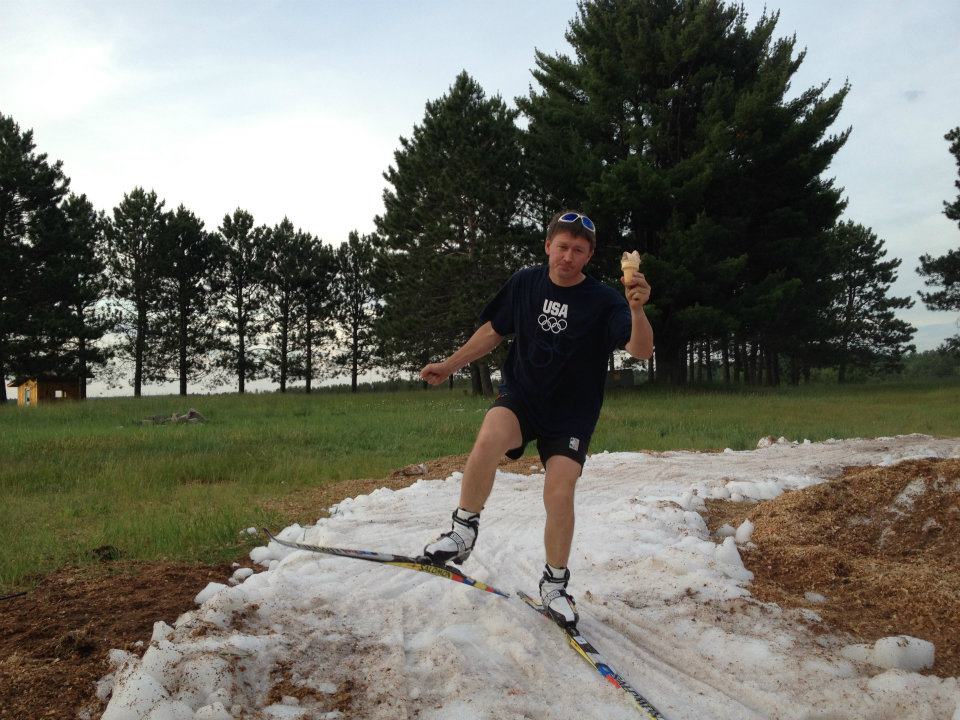
Igor Badamshin enjoying some offseason, on-snow time and ice cream. Badamshin was the CXC head coach before passing away of a heart attack in January 2014. The following article written a year later is a tribute to him. (Photo: cxcnewsfeed.wordpress.com)
The following “Masters Minds” submission comes from Charlie Dee of Central Cross Country (CXC) and the American Birkebeiner Board of Directors. Dee wrote this tribute about CXC’s late coach Igor Badamshin in January.
***
Sitting inside for the the negative wind chills in the upper Midwest, instead of skiing, I’m ruminating on last year … the incredible contrast of two days I had on snow, as well as the anniversary of the coach’s death who made the good day possible.
Early January a year ago, I was warming up before the Sisu Marathon on the ABR Trails in Ironwood, Mich., when I noticed the course reversed the usual direction of “Pit Point Loop.” That got rid of a very steep downhill with a nice run-out, replacing it with a more gradual downhill ending in a 90-degree turn at the bottom.
CXC masters skier and ABSF board member Charlie Dee with one of his grandsons. (Photo: Facebook)
Tucking confidently and stepping through the turn at full speed, I thought to myself, “This is going to give some people problems.” By the time I went through it a few k’s into the race, I became “some people.” There was a huge berm on the outside, with an ice rut on the inside. I did a full-tilt-boogie, 9.9 out of 10, yard-sale fall.
I couldn’t even remember the last time I had fallen in a race. Twenty minutes later in the “Hautanen Highlands” section, a series of short but quite steep down-hills with sharp turns at the bottom offered the same scenario, conditions I’ve handled flawlessly many times in the past. But the previous fall was in my head; I was so worried about falling that I slipped on every damn one of them: five falls in less than 5 k, six overall.
In response to the first few I let out the usual self-loathing curses, including asking the universe to do to me what I always want to do with my wife or Susan Sarandon. By the fourth one, I was just laughing. A very deliberate classic skier came by me several times when I was on the ground, only to be passed by me before the next tragedy. On the first fall he asked, “You OK?” On the second, “You again? Too bad.” On the third, “Again??!!!”
A Gu pack tore off my bib, and my energy drink bottle took so many nose dives into berms that the insulated opening that had never failed me before, even in single digits, froze up at 28 degrees Fahrenheit. The only good news was no broken bones or equipment.
The next day I wanted to get part of my drive home to Milwaukee out of the way early, before precipitation set in, so I skied at Minocqua Winter Park. The conditions looked perfect for anything; I decided on classic skis and headed out to the “Lake Marie” loops.
Until last year I only classic skied when skating was impractical, such as after a big snow dump. But following a couple Central XC Skiing Masters clinics with Igor Badamshin, the former Russian Olympian and World Cup skier, I started writing a series of technique articles with him for Silent Sports Magazine, an upper-Midwest publication.
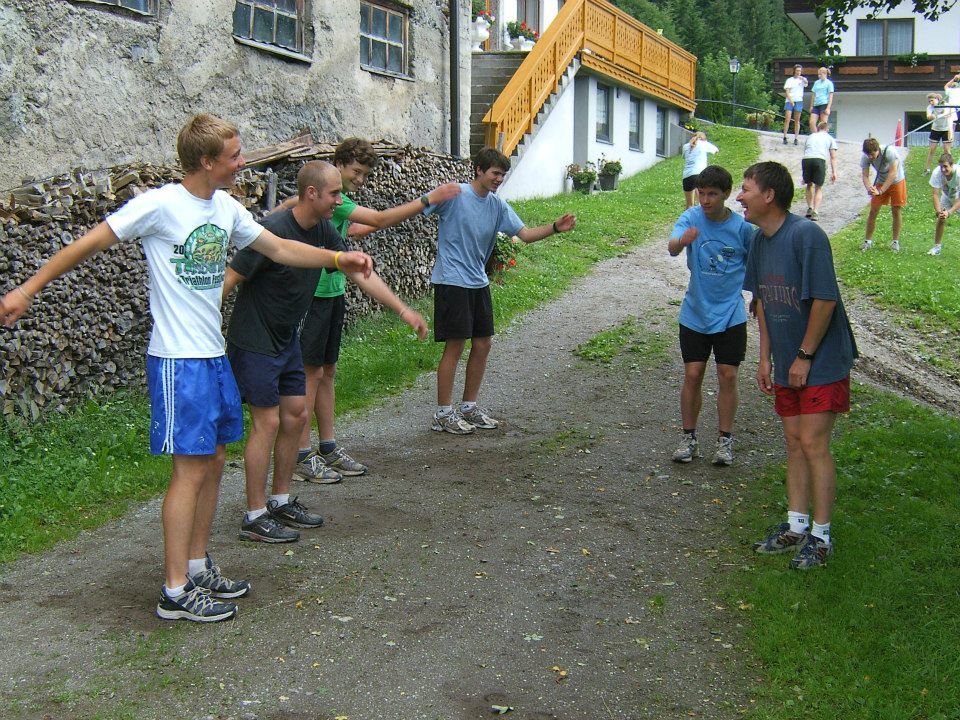
Igor Badamshin (right) laughing through technique work with (from left) Alex Howe, Dylan McGuffin, and other athletes on a junior training camp. (Photo: Martina Howe)
Igor was the best coach I ever had in any sport: high school, college, post-college. I learned quickly from Igor the basics of classic skiing that had eluded me in the decades I had been primarily skating: how to kick by rolling off my toes with a supple foot, transfer weight and move my unweighted-ski forward quickly, resulting in actual glide rather than a bouncing thrash.
It all came together on the Lake Marie trail. There was excellent, deep snow, mid-20’s, the tracks were firm with no debris, and instead of the predicted freezing rain, the sun popped through and set off a bluebird sky.
The hills in this section are not intense, but I stayed in the tracks, skiing up all of them in places where in the past my pathetic technique would force me to move out of the tracks and herringbone.
The stiffness in my back and soreness in my glutes and hips from all the falls the day before simply dissipated in my euphoria. I was classic skiing, and unlike my previous classic outings, my ankles didn’t bark nor my lower back ache.
Two-and-a-quarter hours later, sheathing my skis, I thought, “Old clumsy dog, new tricks — thanks, Igor.”
Just a week later, driving home from a movie with my wife, I got the shocking call: “Igor had a heart attack and died on the Birkie trail today.”
He was 47 and, from all outward appearances, in good health. What a loss to the skiing community.
Every time I’ve been on rollerskis or real boards since then, I think of Igor, check my technique and smile.
Charlie Dee of the American Birkebeiner Board of Directors (Photo: ABSF)
In 1972, Charlie Dee started skiing, but his ski-passion took a quantum leap when he taught a year in Denmark and travelled repeatedly to Norway to ski. A decade later as Fulbright Roving Scholar of American Studies in Norway, he lectured – and skied – throughout the country.
Charlie taught in the English and History Departments for 33 years at Milwaukee Area Technical College, was a faculty union leader, published articles on both politics and sports, had his own radio talk show in Milwaukee followed by a TV gig as a talking head on a weekly news commentary show, was a monthly op-ed columnist for the old Milwaukee Journal and has served on several non-profit boards.
Always an activist, Charlie co-founded the Wisconsin Nordic Network in 1997, the organization that raises money for high school athletes to participate in the Korteloppet. He’s a member of six different ski clubs, writes about skiing for Silent Sports magazine and has a burning desire to stay free enough from injuries to become a Birch-Legger eventually.
In addition to skiing, Charlie enjoys vegetable gardening, cooking, canoeing, kayaking, biking and playing with his twin grandsons. He is married with two adult sons.
***
Masters Minds series: Are you a masters skier who loves your club? Submit camp or training recaps or announcements to info@fasterskier.com with the subject line: “Masters Minds”. Articles can be first-person accounts or written from an observatory standpoint with comments from others.
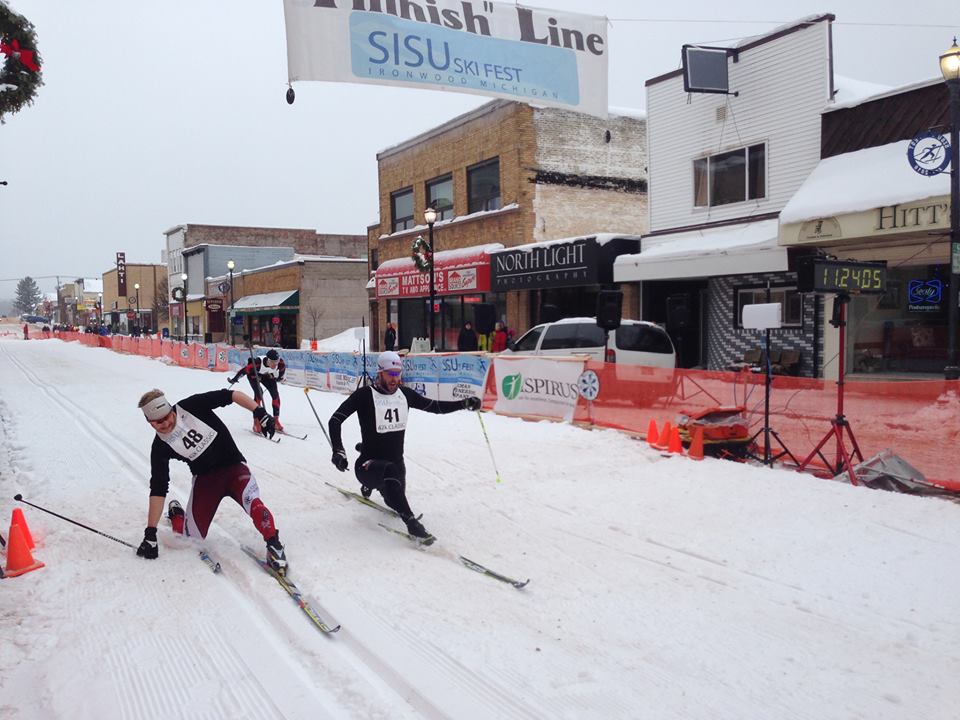
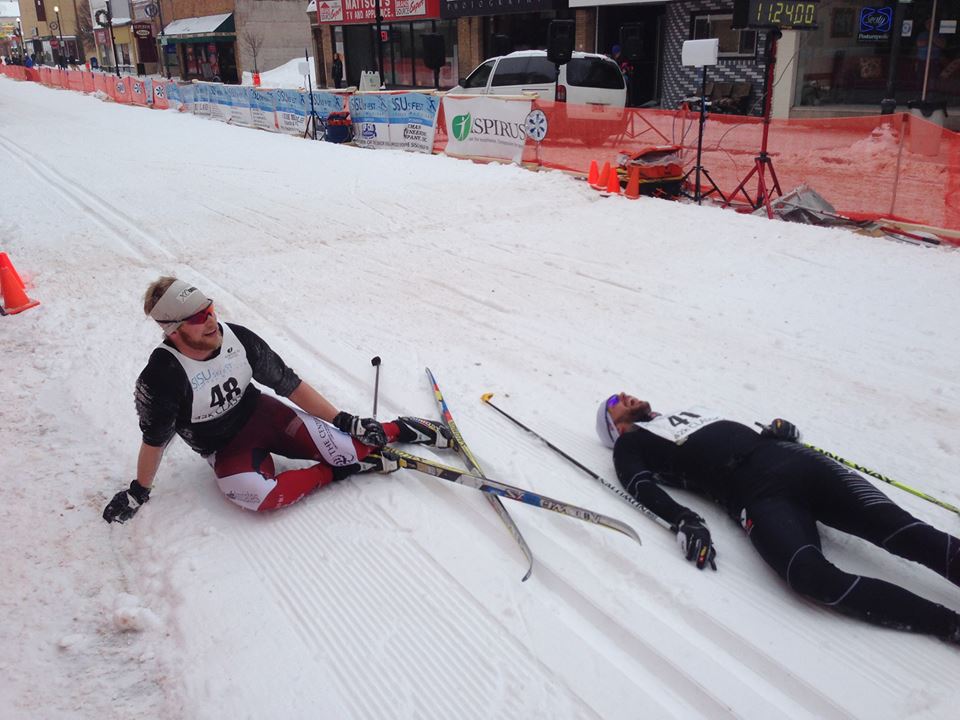
Former CXC teammates Santi Ocariz (l) and Doug DeBold racing to a photo finish at the 42 k classic SISU Marathon on Jan. 11 in Ironwood, Mich. DeBold took the win, using a pole Ocariz lent him a minute before the start. (Courtesy photo)
Santi Ocariz’s mind could’ve been preoccupied with a million things a minute and a half before the start of the 42-kilometer SISU Marathon on Jan. 11 in Ironwood, Mich. But the 27-year-old Wisconsin native could only think about his former teammate Doug DeBold, who’d likely give him the best run in the classic race.
Just before the start, DeBold, of Wayzata, Minn., realized his pole strap was broken. Ocariz ran to his car and found him a replacement. Anyone who knows Ocariz or remembers his gesture from the 2012 American Birkebeiner wouldn’t have been surprised. Skiing with the leaders with less than 10 kilometers to go, Ocariz gave his pole to Matt Liebsch, another one of his former teammates at Central Cross Country (CXC), after Liebsch initially refused the offer when he broke his. Liebsch ultimately accepted at 44 k and went on to place second.
“I mean, what’s the difference if I’m eighth or fourteenth?” Ocariz said after finishing 11th. “He had the chance to win. He’s a good friend of mine.”
Two years later and just over month before the 2014 Birkie on Feb. 22, Ocariz told The Daily Globe the SISU Marathon was “all friendly competition.” He and DeBold had grown up racing one another as juniors and in college before spending a summer as teammates on CXC.
“I had no idea how the race would play out,” wrote Ocariz, who’s living in Moorhead, Minn, pursuing an accelerated nursing degree and is the father of a 10 month old, in an email to FasterSkier.
DeBold led from the start and took off around 14 or 15 k, he explained.
“I took it out nice and slow and waited for a while to start reeling him in,” Ocariz wrote. “I didn’t want to bonk or lock up in cramps, as I haven’t gotten much of any training in this year. On average I have only been able to get out skiing once a week, and this race was my longest ski of the year by about an hour and a half.”
Doug DeBold (r) and Santi Ocariz after placing first and second, respectively, in the 42 k classic SISU Marathon on Jan. 11 in Ironwood, Minn. (Courtesy photo)
With about 11 k remaining, Ocariz and Chris Pappathopoulos caught DeBold, and Ocariz passed him. The three raced together toward the finish, where Ocariz led into the final straightaway.
“Doug pulled up alongside of me as all three of us sprinted for the finish,” Ocariz explained. “Doug and I lunged for the line, and he got me by one or two hundredths of a second.”
On the results, the two were listed with the same time of 2:24.06, but DeBold took the victory in the photo finish. Pappathopoulos was third, one-hundredth of a second behind.
“I had no idea who won,” DeBold told the local Globe.
“I kept thinking I’ve gotta go harder, but I couldn’t,” Ocariz told the Globe. “My legs and even my arms were cramping up … It was a pretty good suffer-fest.”
As for whether this was a tune-up for the Birkie, Ocariz explained it depends on whether he can swing it with school.
“I have very little free time, even on the weekends,” Ocariz wrote. “If I can get away, I’ll be suffering through the Seeley Hills Classic and the Classic Birkie.”
Skillicorn Breaks Away for First SISU Win
In the women’s 42 k classic, Kelly Skillicorn of Winona, Minn., broke away on the final lap around 15 k to win in 2:43.55. Another former CXC skier, Audrey Weber placed second, 16 minutes later.
“The pace went out easy and everyone settled into a long line fairly quickly,” Weber wrote in an email. “I got in the track and I think Skillicorn was marking me, so she tucked in behind me. My main goal was to maintain a pace within myself and not get taken out by any flailing master blasters, which is always a risk for women at the front of the pack in mixed gender mass start races.”
After her first SISU victory, Skillicorn told the Globe that she didn’t feel good at the start after waking up at 5 a.m. and driving north from her cabin in Hayward, Wis., nearly 90 miles away. But she started to feel better with 15 k to go.
With two men in front of her, she said she kept her distance while keeping them in her sights.
“I wasn’t sure how close anyone was behind me because I never look back,” Skillicorn said. “I stayed with the guys. The last 5k I really pushed it. I never want to slow down when I’m racing.”
“My main goal was to maintain a pace within myself and not get taken out by any flailing master blasters.” — Audrey Weber, second woman in 2014 SISU Marathon
And when Skillicorn decided to go, Weber couldn’t respond.
“I guess that’s what not training does for you,” wrote Weber, 27, who was born four days before Ocariz on Sept. 23 . “My training this fall consisted of mostly CrossFit and maybe 3, 45-minute runs. I’ve been on skis a total of 6 times this winter. It’s all I have time for being in my first year of dental school. So I pretty much had one pace I could ski and I did all I could to hang on. I probably kept her in sight for another 5k, but by the time the second lap started I was in no man’s land.”
Skiing for second, Weber focused on “not stopping and mostly just hoping I didn’t get passed,” she wrote. “I pretty much had no expectations for this race other than finishing. I didn’t have any idea what my body would be up for having not tested my ski fitness in quite a long time. When you have fitness, you can rely on your strengths in a race, but when you’re out of shape you don’t really have any strengths to fall back on, so you just really hurt for a long time.”
In the end, she was grateful for fast skis and “decent technique” to fall back on. Next month, she plans to race the Birkie classic marathon.
In her second time at the SISU Marathon, Weber described the people of Ironwood as “amazing and incredibly hospitable! … I have found both times that the town really rolls out the red carpet for racers.”
While waiting for her boyfriend to finish his first ski race, the 42 k skate, she sat in a “plush recliner” by the front window of a furniture story on Main Street. “I made friends with the store manager, he offered me hot coffee and told me stories about people from Ironwood,” she wrote. “I know I didn’t really deserve it, but I felt like a World Cup race leader for a little while. It was very special.”
In the race’s fifth year, registration was at a high around 600. Race director Jonathon Rulseh told the Globe that they caught a break with temperatures in the 20s after they neared 45 degrees below zero just days before. He also pointed to the nearly 250 volunteers behind SISU’s events — with the 42 k marathons, 21 k Heikki Lunta half marathon, Taste N Tour, 3 k & 5 k Junior SISU and the 2K Lapset Loppett; and three snowshoe races.
“They’re the glue that holds the SISU together and makes it run,” he said. “They’re critical to its success.”