From the FasterSkier archive — posts syndicated from athletes’ and coaches’ own blogs between 2004 and 2012, kept online as published. Current coverage is at fasterskier.com.

Tag: Iryna Kryuko

  • Belarus Nabs First Olympic Gold in Women’s Relay; Canada 10th, U.S. 13th

    Belarus Nabs First Olympic Gold in Women’s Relay; Canada 10th, U.S. 13th

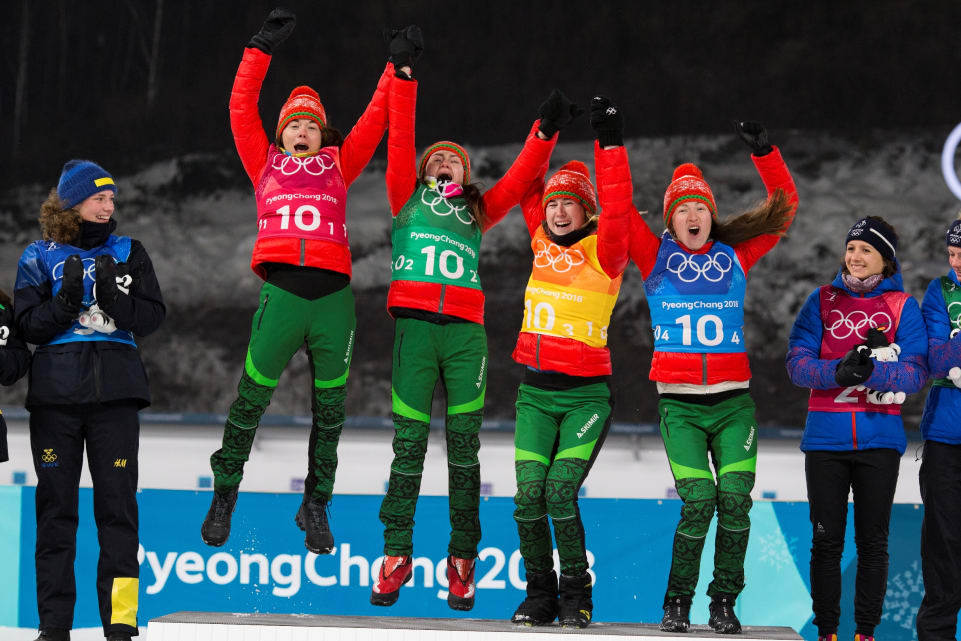
    The Belarusian women’s biathlon team, with (from left to right) Nadezhda Skardino, Iryna Kryuko, Dzinara Alimbekava, and Darya Domracheva, celebrates winning a historic gold for their nation in the 4 x 6 relay at the 2018 Olympics in PyeongChang, South Korea. They were ranked 10th coming into the day. (Photo: IBU/Biathlonworld)

    FasterSkier would like to thank Fischer Sport USA, Madshus USA, Concept2, Boulder Nordic Sport and Swix Sport US for their generous support, which made this coverage possible.

    PYEONGCHANG, South Korea — Some things were the same on Thursday night: the attention-grabbing biathlon stadium announcer generating an atmosphere of stoke, thumping house music, and shivering yet engaged fans. Making it feel like true winter, a heavy snow squall settled in over the Alpensia Biathlon Center for the women’s 4 x 6-kilometer relay.

    Ultimately, Belarus won gold in a time of 1:12:03.4 hours with Nadezhda Skardino, Iryna Kryuko, Dzinara Alimbekava, Darya Domracheva. Sweden’s Linn Persson, Mona Brorsson, Anna Magnusson, and Hanna Öberg took silver (+10.7), while France’s Anaïs Chevalier, Marie Dorin Habert, Justine Braisaz, and Anaïs Bescond claimed bronze (+17.6).

    For the first few legs, however, all three medaling teams seemed an outside shot at the podium. On a windy and, for the first time at the Olympics, snowy evening, the win was up for grabs from the start.

    After the first lap, a rainbow of suits came into the shooting range together, 7.8 seconds separating the leader from the field’s tail. America’s lead-off skier, Susan Dunklee, skied out of the range first after shooting clean in prone. The U.S. skier was followed by Ukraine, 2.9 seconds back. And Canada’s Sarah Beaudry had also cleaned without any spares to put her team in third, 7.1 seconds back.

    Dunklee held her lead through the 2.9 k checkpoint and by 3.6 k, she was up to 8.1 seconds ahead of Japan chasing in second. Canada had fallen to 12th, 14.9 seconds back. With dumping snow and blustery wind before their second shooting round, it was Dunklee all entering the range all alone that was featured on the stadium’s jumbotron.

    For her standing stage, Dunklee missed one target, but cleaned it with one spare. She left the range 5.2 second behind Italy’s Lisa Vittozzi, who had also cleaned with one spare. After the first leg’s final shooting stage, the field started to spread out. Beaudry used three spares to clean standing and avoided the penalty lap, returning to the course in 13th, 50.5 seconds out of first.

    Susan Dunklee skiing the first leg of the mixed relay on Tuesday at the 2018 Olympics in PyeongChang, South Korea. She tagged the team in fifth and they went on to place 15th. On Thursday, she skied the U.S. women’s 4 x 6 k relay into second by the first exchange. (Photo: FlyingPointRoad)

    “There’s some, as a friend of mine would call it, Disneyland snow, falling from the sky so it makes it exciting in the relay,” Beaudry told FasterSkier after her race. “Everyone shoots at the same time so I wouldn’t say anything is unfair. It makes opportunity. So hopefully my teammates can take advantage of that.”

    Dunklee came through the 5.6 k checkpoint trailing Vittozzi by 7.2 seconds. At the first exchange, Italy tagged off first and Dunklee handed off to Clare Egan 7.6 seconds back in second. 

    “It has been a tough Games. We came in here with a lot of expectations and certainly haven’t really lived up to them,” Dunklee told FasterSkier after her leg. “It’s extremely frustrating. To think about every decision you make in your life over four years, with your best training in mind and your best performance in mind, and then getting sick at the wrong time is tough. The guys have struggled.

    “We have had some bright spots with the girls; Emily and Joanne have carried us, they have had PR’s here. That is exciting,” Dunklee added, before looking up at the screen to see Egan skiing in third. “And this is exciting today. This is really exciting! Anything is possible.”

    Beaudry tagged Canada’s Julia Ransom in 15th, 1:15 minutes out of first.

    “I was really happy with my first lap and my prone,” Beaudry said after her first Olympic relay. “I tried to keep with the group on my second lap and I think that left me a little shaky in standing. I’m not too pleased with my two spares, but I mean, I missed three and I didn’t miss a spare, so at least shoot a spare, hit a spare.”

    After the first loop of the second leg, Italy was still in first, with Dorothea Wierer at the helm. In prone, there was a reshuffling of leaders as Slovakia’s Anastasiya Kuzmina cleaned with one spare to move into first, 15.3 seconds ahead of Norway’s Tiril Eckhoff, who had cleaned with a single spare, in second. Egan cleaned without a miss and left the range in third (+17.3). Meanwhile, Wierer still had two targets standing after using all three spares, leaving her with two costly penalty laps and 1:11 minutes back in 13th.

    Finland’s Kaisa Mäkäräinen shot clean to put her team in fourth, 23.9 seconds behind Kuzmina. France was sixth (+32.6), and Belarus ninth (+46.6). Canada’s Ransom shot clean without any spares and left the range in  12th (+1:08.3) while Sweden was 15th (+1:16.4).

    While Kaisa Mäkäräinen moved into second behind Kuzmina on the next loop, Eckhoff and Egan followed them into the range in third and fourth, respectively. There, during an especially blustery standing stage, Kuzmina missed her first three shots and ended up with a penalty lap, which put her 20 seconds back in eighth. Wierer cleaned to reclaim first for Italy, just 0.9 seconds ahead of Mäkäräinen in second, who used two spares to avoid a penalty. Belarus’s Kryuko shot clean to leave the range in third (+7.9), and Egan hit five more shots without any spares to follow her in fourth (+10.7).

    Ransom used three spares to avoid the penalty lap and headed back on the course in 10th (+44.2) for her final 2 k loop.

    “Oh my gosh, I was really due for this,” Egan said after. “It’s by far my best race of the season so I couldn’t be more happy with my race.”

    By the time the skiers came in for the second exchange, the order had changed again. Finland handed off in first, Italy second, 14.2 seconds back, Slovakia third (+16.1) and U.S. fourth (+16.8). Canada came through in 10th (+1:09.5).

    “Kuzmina kept being behind me and then passing me,” Egan reflected. “I think every lap Kuzmina passed me so there is a lot of really fast skiers, most teams put their fastest skiers on their second legs. I tried to stay with them, but I can’t always do that. I did have people around me the whole time though so I was able to keep fighting.”

    “All you can do is just leave it all on the track no matter what it is,” Ransom said of her race. “My standing was a little bit precarious, missing three from the clip. But I’m happy I was able to hit the precious spares. It was very gusty.”

    Egan tagged off to Joanne Reid for the third of four legs. Reid slipped to sixth on her first loop and during her first prone shooting, she used three spares and had to ski a penalty lap, returning to the course in ninth, 33.6 seconds behind Italy’s Nicole Gontier, who cleaned with three spares, in first. Gontier skied just 0.4 seconds ahead of Slovakia’s Terezia Poliakova, who used one spare to clean. 

    Belarus had moved into third (+2.4), France into seventh (+19.2), while the Swedes sat in 11th (+1:33.6) and Canada, with Emma Lunder who had to ski a penalty, was still in 12th (+1:45.7).

    As the leaders came in for their standing bout, it was Italy, France, Belarus, Norway, Finland, Slovakia, Poland, and U.S.A. Belarus’s Alimbekava took the lead after using one spare, Poland chased in second (+6.2), Slovakia was next, followed by Italy. The U.S. was back up to fifth (+28.1) after Reid used one spare to clean. France was sixth (+29.2) and Sweden eighth (+1:10). Lunder cleaned to put Canada in 11th (+1:24.7).

    “I had a pretty good standing, but we need every second we can get,” Reid said after. “You never know what will happen in the next stage and the wind picking up. So even if we’re in fifth you never know. I was just trying to hang on on that uphill and give it everything I had.”

    “I didn’t feel amazing, skiing, but I ripped off my standing with no spares, like, record fast, so I was really pumped about that,” Lunder reflected. “I moved up like a ton in the range there. So I think I tagged Rosanna in a decent position to be with some girls and fight a bit.”

    Poland’s Krystyna Guzik caught Belarus’s Alimbekava and by the final exchange, it was Poland in first, France in second, Italy in third, and Belarus in fourth. Reid handed off to Emily Dreissigacker in sixth (+21.4) while Lunder tagged Rosanna Crawford in 13th (+1:22.6). Sweden exchanged in eighth (+59.1)

    The skiers had maintained their order as they approached the range for the seventh round of shooting. Belarus’s anchor leg, Domracheva, shot clean to take the lead. France was now in second, Poland third, and the U.S. in seventh (+41.1), after Dreissigacker used two spares to clean. Sweden was back in ninth (+41.9), while Crawford cleaned with one spare and out for her second loop in 12th (+1:28.6).

    Coming into the final shooting shooting round, Belarus teetered on a lock for gold, 24.8 seconds ahead of France in second. Poland still clung to third, 34.5 seconds back, while Sweden was now ranked seventh, 56.4 seconds back. The U.S. had moved back to tenth, while Canada was right behind them in 11th.

    Domracheva missed three targets standing, but used three spares to clean and avoid any penalties to hang onto first. France’s Bescond needed three spares to clean but stayed out of the penalty lap and headed out on the final loop in second (+6.4). Sweden’s Öberg cleaned her second-straight stage without any misses to move all the way up into third (+10.9). 

    For the U.S., Dreissigacker used her three spares to clean standing, but experiencing unsteady winds, took her time to steady her shot and left the range in 12th (+1:20.2). Canada’s Crawford used one spare to clean and moved up to 11th (+1:19.9).

    “It was really windy for my standing,” Crawford noted. “I really waited it out.”

    “It wasn’t great,” Dreissigacker, a first-time Olympian, said of her race. “I didn’t feel that great skiing, might’ve went out a little hard, and the shooting just wasn’t good either. I was happy to at least hit them all with my spares, but standing especially, I took all three spares and the wind came up like crazy, right before I started shooting my spares, so I had to like stand there and wait out the wind, which cost me a lot of time.”
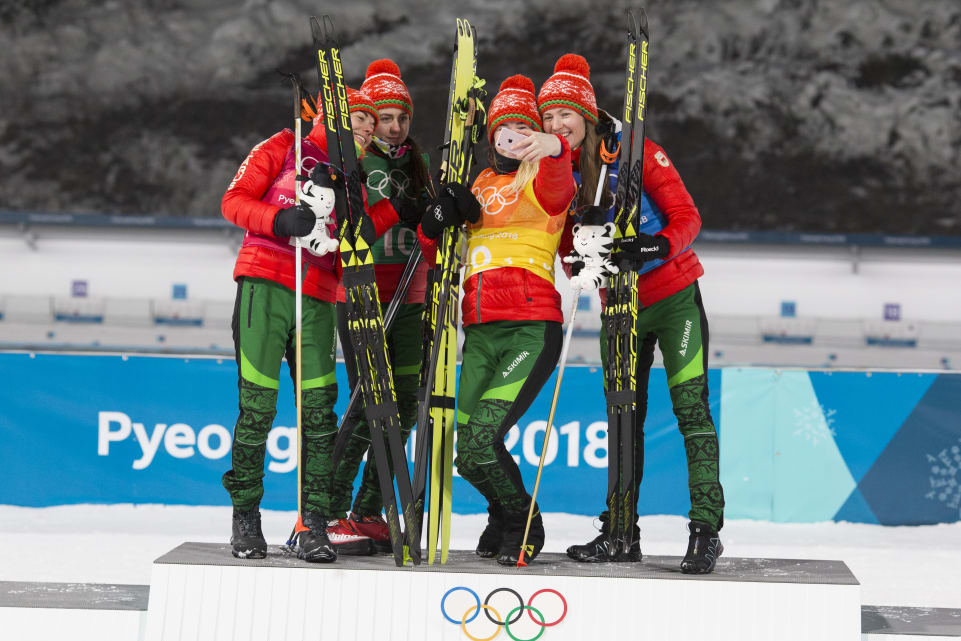
    The Belarusian women’s biathlon team, with Nadezhda Skardino, Iryna Kryuko, Dzinara Alimbekava, and Darya Domracheva, snaps a podium selfie after winning their first relay gold on Thursday at the 2018 Olympics in PyeongChang, South Korea. (Photo: IBU/Biathlonworld)

    Over the last 2 k of the race, Domracheva kept her competition behind her and crossed the line first for Belarus’s first relay gold in 1:12.03.4 (after its mixed relay team placed fifth two days ago). 

    Öberg passed Bescond to claim silver for Sweden, 10.7 seconds back, while Bescond anchored France to bronze (+17.6), ahead of Norway in fourth (+29.7), Slovakia in fifth (+38.4), Switzerland in sixth (+43.5), Poland in seventh (+43.6), Germany in eighth (+53.9), Italy in ninth (+1:04.1), and Canada in 10th (+1:33.4). The U.S. finished 13th (+2:01.9) of 18th teams.

    With the first-place finish, Domracheva is the most decorated female biathlete in Olympic history, with six medals (four golds, a silver and a bronze) between three Olympics. Her husband, Ole Einar Bjørndalen of Norway, is the most successful Olympic biathlete of all time with 13 medals. 

    “I didn’t think that before you said it,” Domracheva, 31, said of her medal record during the post-race press conference. “Of course it was a lot of challenges for me on the way. Such days and such medals mean that it’s important to believe in yourself, important to believe in your team and overcome some difficulties, and then all doors are open for you.”

    In the last four Winter Olympics, France has claimed three relay medals. Before Thursday’s bronze, their most recent was silver in 2010 and prior to that, bronze in 2006.

    Sweden’s silver medal was its first in the women’s 4 x 6 k relay at the Olympics.

    “This team worked together really hard for the last couple of years,” said Öberg, who won her first medal — gold — in the 15 k individual race earlier in the Games. “That we are here today is unbelievable. I’m really happy to share this medals with the rest of the girls.”

    Crawford caught Ukraine’s Anastasiya Merkushyna in her final lap to anchor Canada to 10th while the U.S. finished three places later in 13th.

    “My last loop I could hear Julia [Ransom] and Sarah [Beaudry] all around the course,” Crawford told FasterSkier. “They managed to be everywhere really cheering me on, and that fueled me to catch the Ukrainian.

    “I’m just so proud of this women’s team,” Crawford added. “We fought so hard out there today. We’ve been through a lot this summer and really supported each other. And I’m just really proud of the team and I think biathlon in Canada has the potential to have a bright future.”

    Results

  • Sunday Rundown: Ramsau, Toblach, Annecy, St. Ulrich, Rossland (Updated)

    Sunday Rundown: Ramsau, Toblach, Annecy, St. Ulrich, Rossland (Updated)

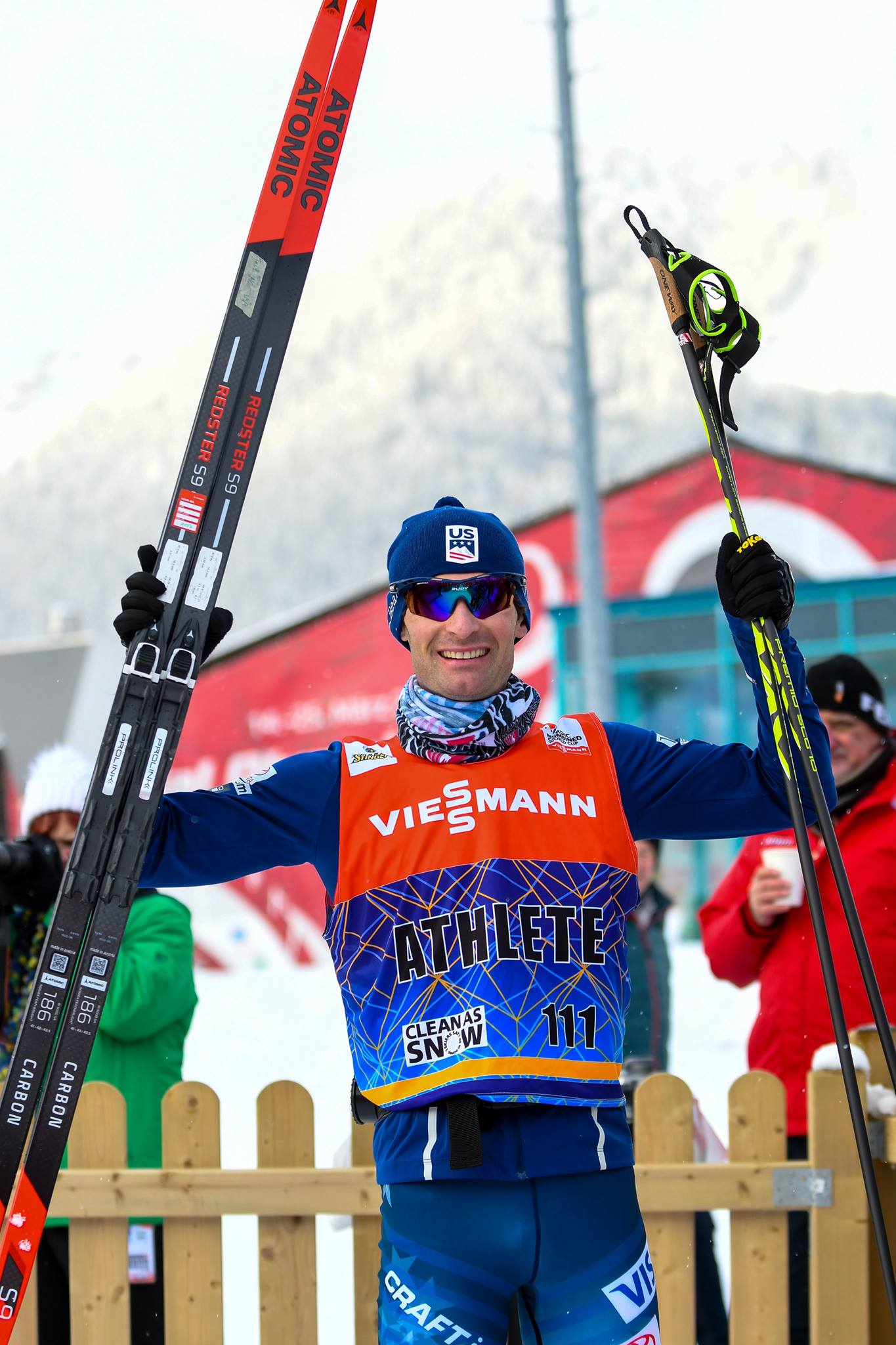
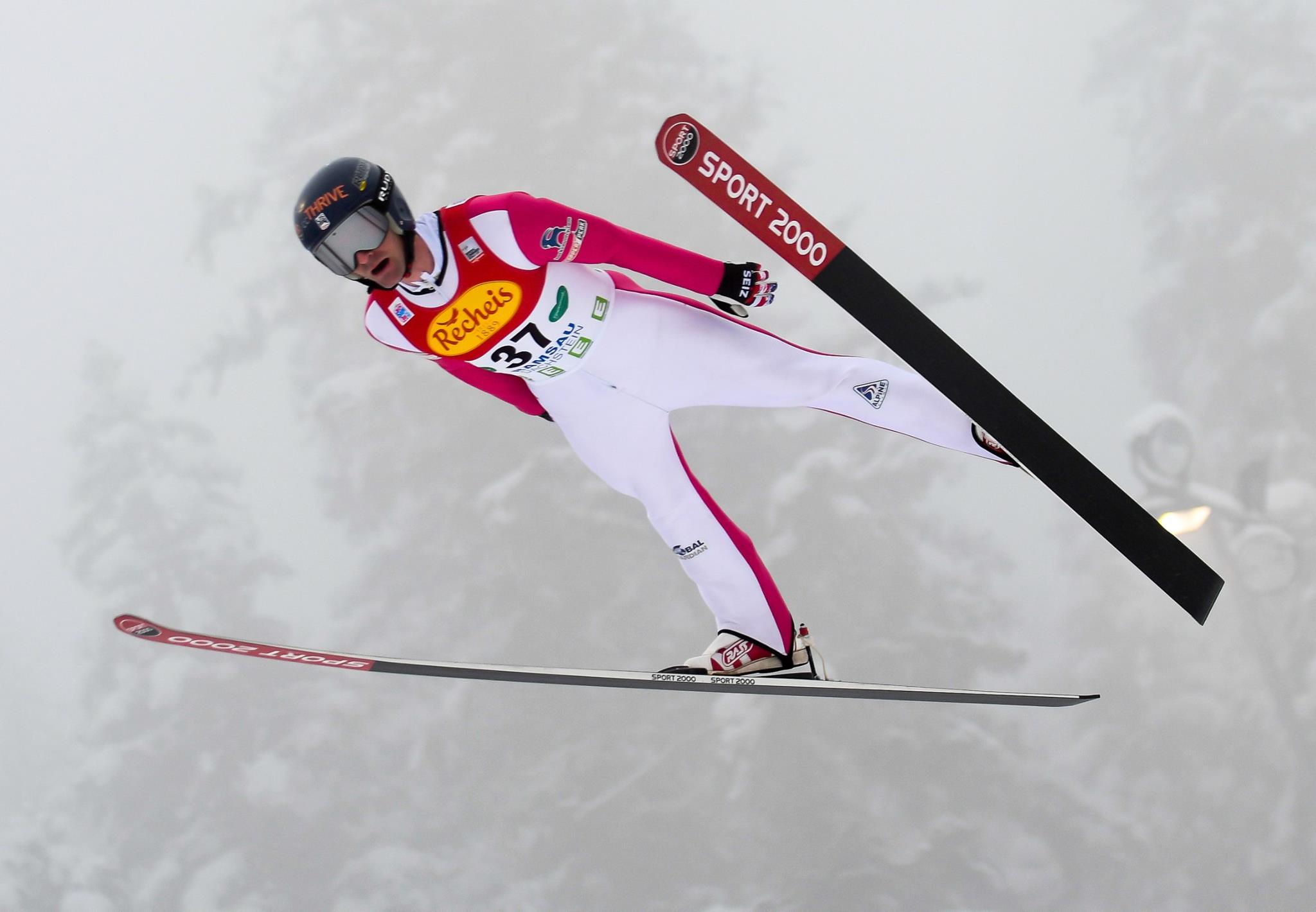
    Bryan Fletcher (USA Nordic) jumping to 45th in the Nordic Combined World Cup on Sunday in Ramsau, Austria. In the 10 k that followed, he skied the third-fastest time to finish 14th overall. (Photo: Romina Eggert/USA Nordic Facebook)

    NorAm mini tour (Rossland, B.C.): 10/15 k freestyle pursuits

    Team Gregg ended the Rossland NorAm mini tour with another double win, with American Caitlin Gregg and her husband Brian Gregg winning the 10- and 15-kilometer freestyle pursuits, respectively, at the Black Jack Ski Club trails.

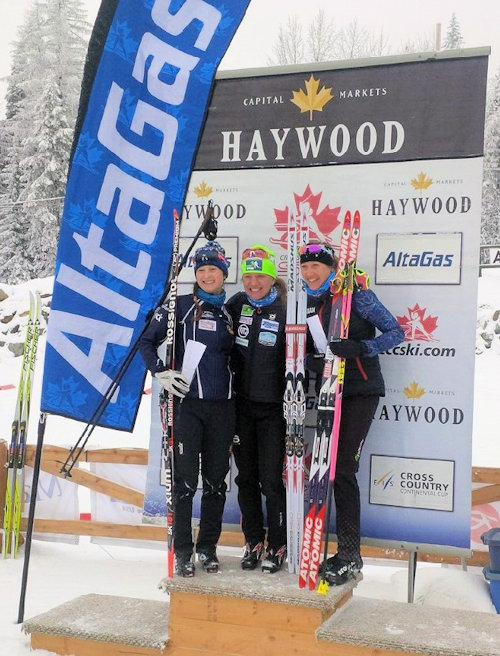
    The women’s 10 k freestyle pursuit podium at the NorAm in Rossland, B.C., with American Caitlin Gregg (c) in first, and Canadians Zina Kocher (l) and Andrea Dupont (r), in second and third, respectively. (Photo: Cross Country Canada)

    Caitlin capped the long weekend with her third-straight win, a 48.28-second victory over former Canadian biathlete Zina Kocher (Foothills Nordic). Caitlin started first and was first across the finish in 29:02.86, while Kocher started ninth and rose to second place for her second-consecutive podium (after placing third in Saturday’s skate sprint). Andrea Dupont (Rocky Mountain Racers) started fourth and finished third (+1:58.35) for her second-straight podium as well (she was second in the skate sprint behind Gregg).

    Lisle Compton of the National Team Development Centre (NTDC) Thunder Bay and Canadian National Junior Team finished fourth overall (+2:07.03), Frederique Vezina of the Pierre-Harvey National Training Centre (CNEPH) was fifth (+2:16.10), and Annika Hicks of the Alberta World Cup Academy (AWCA) sixth (+2:16.51). Laura Leclair (CNEPH) placed seventh, Kaia Andal (Caledonia Nordic) was the top junior in eighth overall, Jaqueline Mourao (Brazil Ski Team) ninth, and Sophie Carrier-Laforte (Skinouk) 10th.

    Brian, who won the Rossland men’s 10 k classic on Friday, also started Sunday’s 15 k freestyle pursuit first and finished in that position in 38:43.93. Andy Shields (Lappe Nordic) raced to second overall, 7.65 seconds back, after starting fourth, and Jack Carlyle (AWCA) reached the podium in third (+8.75) after starting 10th.

    Evan Palmer-Charrette (NTDC Thunder Bay) ended the weekend in fourth (+17.68), Philippe Boucher (CNEPH) was fifth (+19.02), Brian McKeever (Canadian Para-Nordic Ski Team) sixth (+22.16), Michael Somppi (AWCA) seventh (+34.62), Alexis Dumas (CNEPH) eighth (+52.78), Bob Thompson (NTDC Thunder Bay) ninth (+54.76), and Julien Locke (Black Jack/Canadian U25 Team) 10th (+1:04.46).

    Results

    ***

    FIS Nordic Combined World Cup (Ramsau, Austria): Saturday & Sunday individual competitions

    Bryan Fletcher (USA Nordic) notched seventh in the Nordic Combined World Cup this weekend in Ramsau, Austria, for his best result since January 2016. (Photo: USA Nordic/Facebook)

    After a bye week, the Nordic Combined World Cup resumed in Ramsau am Dachstein, Austria, with back-to-back individual normal hill/10-kilometer Gundersen starts on Saturday and Sunday.

    On Saturday, American Bryan Fletcher posted his best individual result in nearly two years in seventh place, 32.6 seconds behind German winner Eric Frenzel.

    Saturday’s individual competition on Ramsau’s 98-meter hill started out with Japan’s Taihei Kato going farthest in the jump portion, the Czech Republic’s Tomas Portyk jumping to second, and Frenzel jumping to third. Fletcher tied Japan’s Yoshito Watabe for 28th and the two started the 10 k race 1:02 minutes back accordingly.

    While Frenzel picked off two places to finish first in 24:05.8 minutes, Fletcher moved up 21 spots to seventh place with the second-fastest course time of 23:48.4.

    Germany had two on the podium with Fabian Rießle just 0.7 seconds back in second place, and Norway’s Jan Schmid finished third, 8.1 seconds behind Frenzel.

    On Sunday, Rießle climbed to the top step on the podium, winning the weekend’s second normal hill/10 k in 26:12.5.

    Norway’s Jørgen Graabak led after the jump portion, yet ultimately finished sixth, 9.8 seconds behind Rießle.

    Rießle jumped to ninth and started 18 seconds out of first, then took the win on the four-lap course by just 0.3 seconds over Italy’s Alessandro Pittin. The Italian notched second place after starting 36th based on his jump and racing the fastest 10 k time in 25:00.8.

    Finland’s Eero Hirvonen finished third (+1.5) after starting 10th, and Schmid was another 2 seconds back in fourth (+3.5) after jumping to seventh. Frenzel did not start.

    Three Americans qualified for Sunday’s competition. Fletcher jumped to 45th and started 1:30 back, yet rose to 14th (+43.7) with the third-fastest course time. His younger brother Taylor Fletcher skied the second-fastest course time to finish 34th (+2:01.6), up 24 places after jumping to 58th. Adam Loomis finished 52nd (+4:38.6) after jumping to 59th.

    The U.S. Nordic Combined team is headed back to the states to prepare for U.S. Olympic trials later this month, according to the USA Nordic Facebook page.

    Results: Saturday | Sunday

    ***

    FIS Cross Country World Cup (Toblach, Italy): 10/15 k classic pursuits

    Norway’s Johannes Høsflot Klæbo after winning the men’s 15 k classic pursuit for his seventh World Cup win of the season on Sunday in Toblach, Italy. With win No. 7, he has the most wins before the new year in FIS Cross Country World Cup history. (Photo: FIS Cross Country/Twitter)

    Women’s report

    Men’s report

    If you thought Johannes Høsflot Klæbo was out, think again. After placing 10th in the men’s 15-kilometer freestyle on Saturday in Toblach, the 21-year-old Norwegian raced to his seventh victory of the season in the men’s 15 k pursuit on Sunday.

    In doing so, Klæbo broke the record for the most World Cup wins before the New Year: he’s tallied seven in the last eight races he’s contested.

    On Sunday, he started 10th, 36 seconds behind his Norwegian teammate Simen Hegstad Krüger, who won the 15 k freestyle and started first. Klæbo had worked his way up to third by 11.4 k, and at the finish, he edged Russia’s Sergey Ustiugov by 1.9 seconds for the win in 33:31.1 minutes.

    Ustiugov, who started fifth, claimed second, and Kazakhstan’s Alexey Poltoranin rose from 14th to third place (+4.5), ahead of Russia’s Alexander Bessmertnykh in fourth (+9.7), Finland’s Matti Heikkinen in fifth (+9.8), France’s Maurice Manificat in sixth (+10.7), Norway’s Hans Christer Holund in seventh (+11.1), Switzerland’s Dario Cologna in eighth (+11.8), Canada’s Alex Harvey in ninth (+16.3), and Krüger in 10th (+24.0). Norway’s defending Overall and Distance World Cup champion, Martin Johnsrud Sundby placed 11th (+34.4) after starting 20th based on his result on Saturday.

    Erik Bjornsen once again led the U.S. men, racing from 29th at the start to 26th (+1:43.1). Scott Patterson improved from 42nd to 39th (+2:37.2), Paddy Caldwell moved up from 52nd to 44th (+2:57.7), and Noah Hoffman slipped to 49th (+3:01.7) after starting 40th.

    Canada’s Devon Kershaw moved up five places to 33rd (+2:02.8), Graeme Killick finished 50th (+3:42.0), Russell Kennedy 66th (+5:05.8), and Knute Johnsgaard moved up six places to finish 76th (+6:20.8).

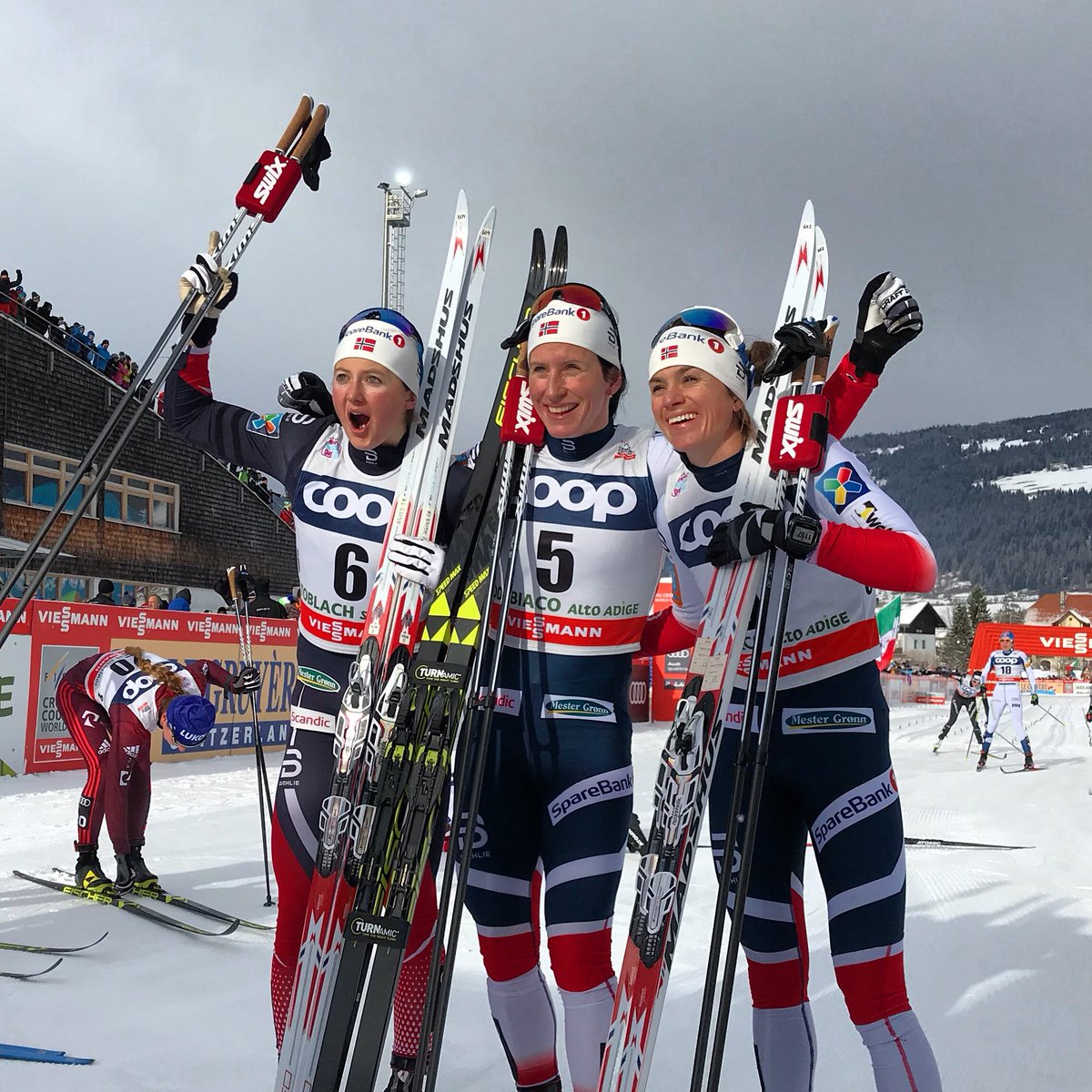
    The all-Norwegian women’s 10 k classic pursuit podium on Sunday at the World Cup in Toblach, Italy, with Marit Bjørgen (c) in first, Ingvild Flugstad Østberg (l) in second and Heidi Weng (r) in third. (Photo: FIS Cross Country/Twitter)

    In the women’s 10 k classic pursuit earlier in the day in Toblach, Norway’s Marit Bjørgen overcame a 22-second starting deficit to take the win by just 0.3 seconds over her teammates Ingvild Flugstad Østberg in second. It was an all-Norwegian podium with Heidi Weng in third (+0.8).

    Bjørgen started fifth, 22 seconds behind Swedish race leader Charlotte Kalla, based on their results in Saturday’s 10 k freestyle individual start. By the 6.4 k checkpoint, Bjørgen led a pack of four other Norwegians and Kalla — all within 1.4 seconds of first. At 8.5 k, Bjørgen led Østberg in second and Weng in third, while another Norwegian Astrid Uhrenholdt Jacobsen skied another eight seconds back with teammate Ragnhild Haga in fourth and fifth, respectively. By that point, Kalla was skiing alone, another 11.7 seconds in sixth, while American Jessie Diggins led a group 25 seconds behind Kalla in sixth.

    Ultimately, Bjørgen finished first in 25:19.3 and formed an all-Norwegian podium with Østberg and Weng, Jacobsen placed fourth, 21.5 seconds out of first and 20.7 seconds behind Weng in third.

    Haga was fifth (+31.8), Kalla sixth (+41.9), Diggins seventh (+53.7), Russia’s Natalia Nepryaeva eighth (+54.2), American Sadie Bjornsen ninth (+55.2), and Austria’s Teresa Stadlober 10th (+55.6) in a photo finish with Finland’s Kerttu Niskanen, who placed 11th (+55.6).

    For the U.S. Ski Team, Diggins and Bjornsen retained their starting positions of seventh and ninth, respectively, while Rosie Brennan started 19th and finished 25th (+2:14.6). Chelsea Holmes (Alaska Pacific University) finished 39th (+3:03.8) and Liz Stephen (USST) finished 48th (+4:05.2).

    Canada’s Emily Nishikawa placed 53rd (+4:14.5), Dahria Beatty finished 63rd (+5:44.7), Cendrine Browne 66th (+5:57.7), and Katherine Stewart-Jones 70th (+7:31.5).

    Results: Women | Men

    ***

    IBU World Cup (Annecy, France): Women’s and men’s mass starts

    Women’s report

    Men’s report

    France’s Justine Braisaz won her first International Biathlon Union (IBU) World Cup race of the season on Sunday at home in Annecy, France, topping the women’s 12.5 k mass start by 11.2 seconds in 37:19.4.

    While Braisaz shot 19-for-20 (0+0+1+0), Iryna Kryuko of Belarus cleaned the four-stage race for second place, her first World Cup podium. Germany’s Laura Dahlmeier, who won Saturday’s 10 k pursuit, placed third (+19.9) with two penalties (0+1+0+1).

    Two North Americans qualified for the selective mass start, with Susan Dunklee (US Biathlon) racing to 20th (+1:16.3) with three misses (1+0+1+1), and Emma Lunder (Biathlon Canada) placing 28th (+2:21.4) with a single penalty (1+0+0+0).

    In the men’s 15 k mass start that followed, France’s Martin Fourcade finally got the win he was looking for, shooting clean and beating his main rival Johannes Thingnes Bø of Norway by 3.9 seconds. Fourcade crossed the finish line first in 36:30.3, Bø settled for second after skiing two early penalty loops (2+0+0+0) and Germany’s Erik Lesser tallied his second podium in Annecy (after placing third in the sprint) in third place again (+6.2) with clean shooting.

    Two Americans and a Canadian qualified for the mass start, with US Biathlon’s Lowell Bailey leading them in 23rd (+2:22.4) with three penalties, Sean Doherty following in 24th (+2:52.5) with four misses, and Biathlon Canada’s Scott Gow finishing 26th (+4:05.4) with five penalties.

    Results: Women| Men

    ***

    OPA Cup (St. Ulrich, Austria): 10/15 k freestyle pursuits

    On the final day of Alpen Cup (a.k.a. OPA Cup) racing in St. Ulrich, Ida Sargent of the U.S. Ski Team (USST) scored her third-straight top five with a fifth place in the women’s 10 k freestyle mass start. She previously placed third in the skate sprint and 5 k classic on Friday and Saturday.

    Germany’s Julia Belger won the women’s mass start on Sunday in 28:33.6, while Saturday’s 5 k winner, Elena Soboleva of Russia placed second (+0.7). Russia had two on the podium with Mariya Istomina in third (+6.4). Germany’s Elisabeth Schicho finished fourth (+15.8), just ahead of Sargent in fifth (+15.9).

    Germany’s Antonia Fräbel placed sixth (+17.1), followed by American Sophie Caldwell in seventh (+17.9). The USST had three in the top 10 with Julia Kern in 10th (+41.9), out of 60 finishers.

    In the men’s 15 k freestyle mass start, Beda Klee of Switzerland took the win in 37:14.6, 2.4 seconds ahead of Germany’s Thomas Bing in second. Six-time Olympian Sergey Dolidovich of Belarus reached the podium in third (+4.5).

    The U.S. had two men in the race, with Simi Hamilton finishing 14th, 16 seconds out of first, and Andy Newell finishing 71st (+2:25.2) out of 118.

    Results: Women | Men

  • Braisaz Stuns in Home Mass Start with First Victory; Dunklee 20th, Lunder 28th

    Braisaz Stuns in Home Mass Start with First Victory; Dunklee 20th, Lunder 28th

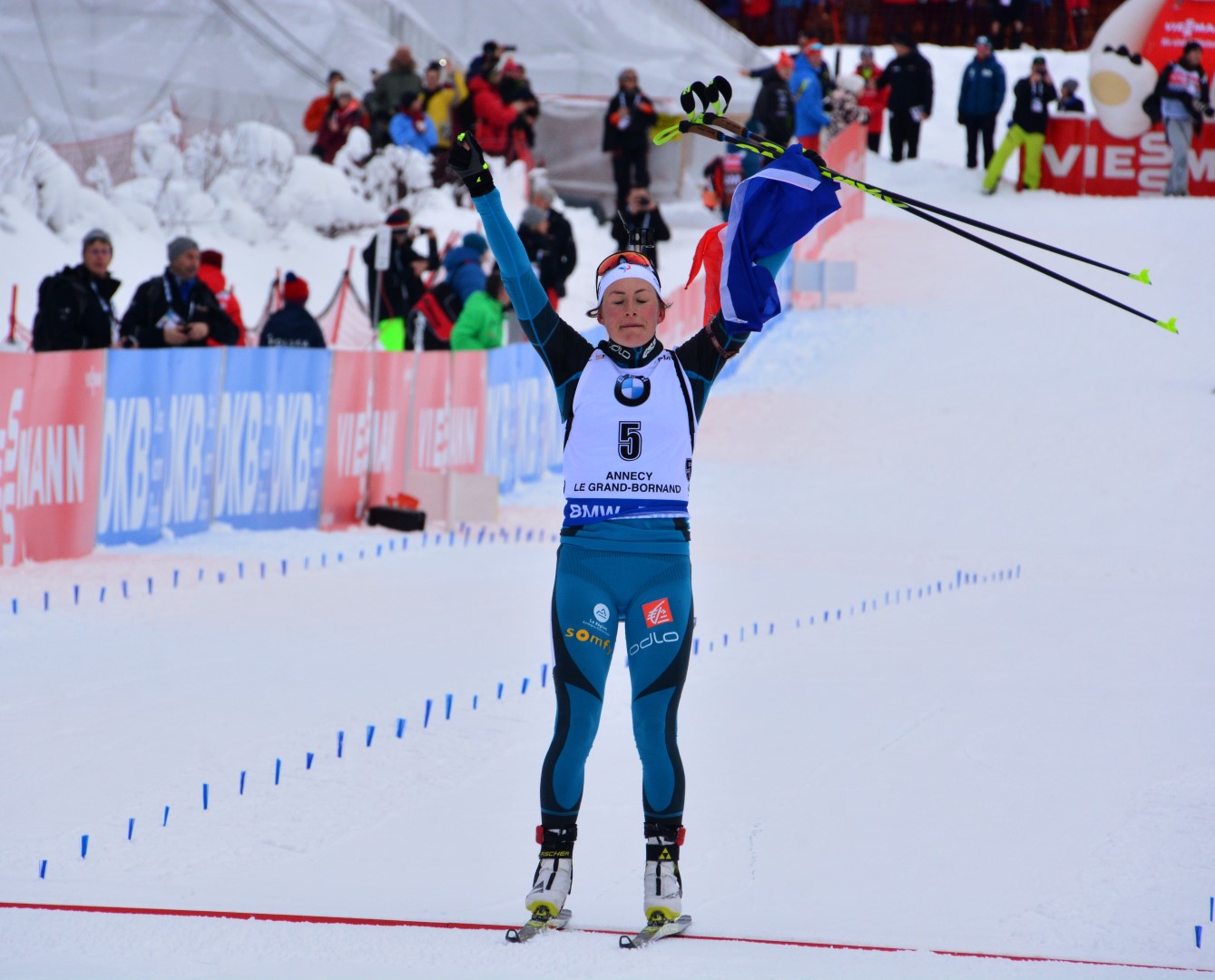
    Justine Braisaz of France crossing the finish line with her first World Cup victory, in Le Grand-Borland in the 15 k mass start. (Photo: Glen Crawford)

    LE GRAND-BORNAND, France—Justine Braisaz was so excited for today’s 15 k mass start that she jumped the gun, scooting forward on her skis a few seconds before the start and having to reset.

    That provoked a laugh among the crowd and perhaps even her competitors, but they weren’t laughing by the time the race finished and Braisaz had left them in the dust, claiming her first World Cup win – on her father’s birthday, no less.

    The early start was more than nervous energy. Braisaz wanted to soak in everything in the last race of the weekend, the first time in four years that the biathlon World Cup had come to her country.

    “I just wanted to take pleasure today and have no pressure at all,” she said in a press conference after the race. “It’s just like that. I did not have any serious ambition, I just wanted to try my best.”

    Once the race was off, she followed Kaisa Makarainen of Finland – who started in the front row directly ahead of her – and Anastasiya Kuzmina and Denise Herrman, and the four women gapped the field to come into the range ahead of the others, a rare situation on the first loop of a women’s mass start.

    Anastasiya Kuzmin of Slovakia leading Denise Herrmann, Kaisa Makarainen, and the rest of the women’s mass start. (Photo: Glen Crawford)

    Braisaz cleaned that stage, as well as the next, and was never far from the lead. When Braisaz and Kuzmina missed shots in the first standing stage, Herrman surged to the lead.

    A relatively recent convert to biathlon – a relay medalist in cross-country skiing at the 2014 Olympics – Herrmann has already won two races this season. She has become an impressively stable shooter given her short career, and when she came into the shooting range alone for the final bout she hit the first target.

    But then she missed. And missed, and missed. She hit the last shot, but had to ski three penalty loops and came out in 13th. With the third-fastest last-loop time she moved up to twelfth.

    Braisaz, in the meantime, had come in to the second lane of the range and hit all of her targets, skiing out in first place. When Germany’s Laura Dahlmeier, the winner of Saturday’s sprint, missed one shot behind her, Braisaz seemed to be in the clear. The next woman out on course was Belarus’s Iryna Kryuko, who had cleaned the whole race and hit the trails 15 seconds back.

    But Braisaz felt the threats behind her, real or imagined.

    Justine Braisaz leadin Denise Hermmann and Kaisa Makarainen in the middle of the race. (Photo: Glen Crawford)

    “During the last loop on the track, I just thought, the women behind me will catch me,” Braisaz said. “I was so stressed, under pressure. I did not believe it [would happen]. When I saw my wax man with the French flag, I just started breathing.”

    That moment came 200 meters before the finish, when Braisaz had enough of a cushion to stop and grab the tricolore. She waved it behind her as she skied down the finishing lanes, the crowd of 15,000 spectators going more than wild.

    “It was just great,” she said. “A very nice feeling to share it with all the crowd and all the French people and everybody. It was just like a dream. But the reality is better actually.”

    Kryuko, too, hadn’t felt secure in her position on the last loop. Dahlmeier came out of the penalty loop and into third place, just under ten seconds behind her; after that was Kuzmina, whose ski speed had impressed over the last several weeks.

    “I saw that I shot clean – and I certainly saw that behind me there were some very strong girls,” Kryuko said through a translator at the press conference. “The only thing I was hoping for was to get flowers, the top six.”

    Dahlmeier put in an early surge to try to close the gap.

    “On the final lap I tried to give it everything I had,” she told German broadcaster ZDF. “I fought hard right from the beginning, and immediately went a very high tempo. I didn’t really get closer to her [Kryuko] initially, then made up a few meters, but in the end the necessary energy wasn’t there anymore to really overtake her.”

    Kryuko thus held onto second place, finishing 11.2 seconds behind Braisaz. Dahlmeier was third (+19.9), Kuzmina fourth (+25.5), and Germany’s Vanessa Hinz fifth (+28.4). Anais Chevalier gave the French crowd another reason to lose their minds when she crossed the finish line in sixth (+30.1).

    For Kryuko, her very first mass start came on the same day as her first World Cup podium. The 26-year-old’s previous best finish was ninth in the pursuit in Hochfilzen, Austria, last weekend.

    Susan Dunklee racing to 20th in the mass start. (Photo: Glen Crawford)

    “It’s my first mass start and of course my first podium,” she said. “It’s a really great feeling.”

    Dunklee 20th, Lunder 28th

    Both Susan Dunklee of the U.S. and Emma Lunder of Canada started in the back of the mass start, with bibs 26 and 29, respectively. In most World Cups, starting at the back of the pack is not a big problem, as most of the field is still together when athletes enter the range for the first shooting.

    “This course it is!” Dunklee exclaimed. “This course it absolutely is. This is a very narrow course… that first bridge, we just had this major accordion-ing, where everybody stopped for about five or six seconds in the back waiting for the top people to get up there. We had to snowplow and then just stand there and wait. We were laughing. So it was a lot of just being really patient on the first loop because there was no good way to pass.”

    “Probably 300 meters into the race there is a super steep little hill, and the back of the pack, the back 15, literally came to a standstill and then it took people a lot to get going, and it was so spread out by then,” Lunder said. “So I was last and I just tried to hang on to number 29. I had figured I would come into the range last or close to last, but I felt pretty relaxed during that lap.”

    Canada’s Emma Lunder chasing the Czech Republic’s Eva Puskarcikova in the women’s mass start in Le Grand-Bornand, France. (Photo: Glen Crawford)

    Despite strong races earlier in the week, finishing 10th and sixth, Dunklee never made contact with the leaders – in part because they had broken away already on the first lap when she was stuck in the back, and partly because she missed a shot in the first prone stage.

    Dunklee missed two more, one in the first standing stage and then the very last shot of the race.

    “With 85% shootings, it was obviously not my best, but certainly something I can be proud of,” she said.

    She crossed the line in 20th after laying down the fifth-fastest closing loop and moving up two spots.

    “I had a great battle going with Maren [Hammerschmidt] and Selina [Gasparin],” Dunklee said. “Selina got me by a tenth of a second, which is, well, ugh. She had the better lane in the finish and I just couldn’t get around her, but it was fun. I like it when it’s exciting like that.”

    Lunder also missed a shot in the first prone, but she was clean after that. She had some issues with her rifle though, which resulted in slower shooting times even though she never again had to visit the penalty loop.

    “I was a little bit shaky and I double-ejected three times,” she explained. “So then I had to load a spare and was like ‘okay, do not miss this and then have a penalty loop on top of it.’ I am so happy with shooting 19 out of 20 again, I’m really relieved. And it was a good chase again out there. On the last lap there were two Polish girls right with me, I tried so hard but I just didn’t have it in me.”

    She crossed the line 28th, +2:21.4. It was the first mass start of her career.

    “This was an awesome experience,” Lunder said. “Any time I finish in the top 30 I think I’ll still be happy… I can say I had fun. It’s like the most painful kind of fun. I felt pretty tired today, and then on top of it everyone is fast in the mass start. So I just knew that I wanted to execute on the range the same way I have been this weekend.”

    Results