Tag: Iryna Varvynets

  • Saturday Rundown: NCAA Champs; Holmenkollen 50 k; Kontiolahti Relays

    Saturday Rundown: NCAA Champs; Holmenkollen 50 k; Kontiolahti Relays

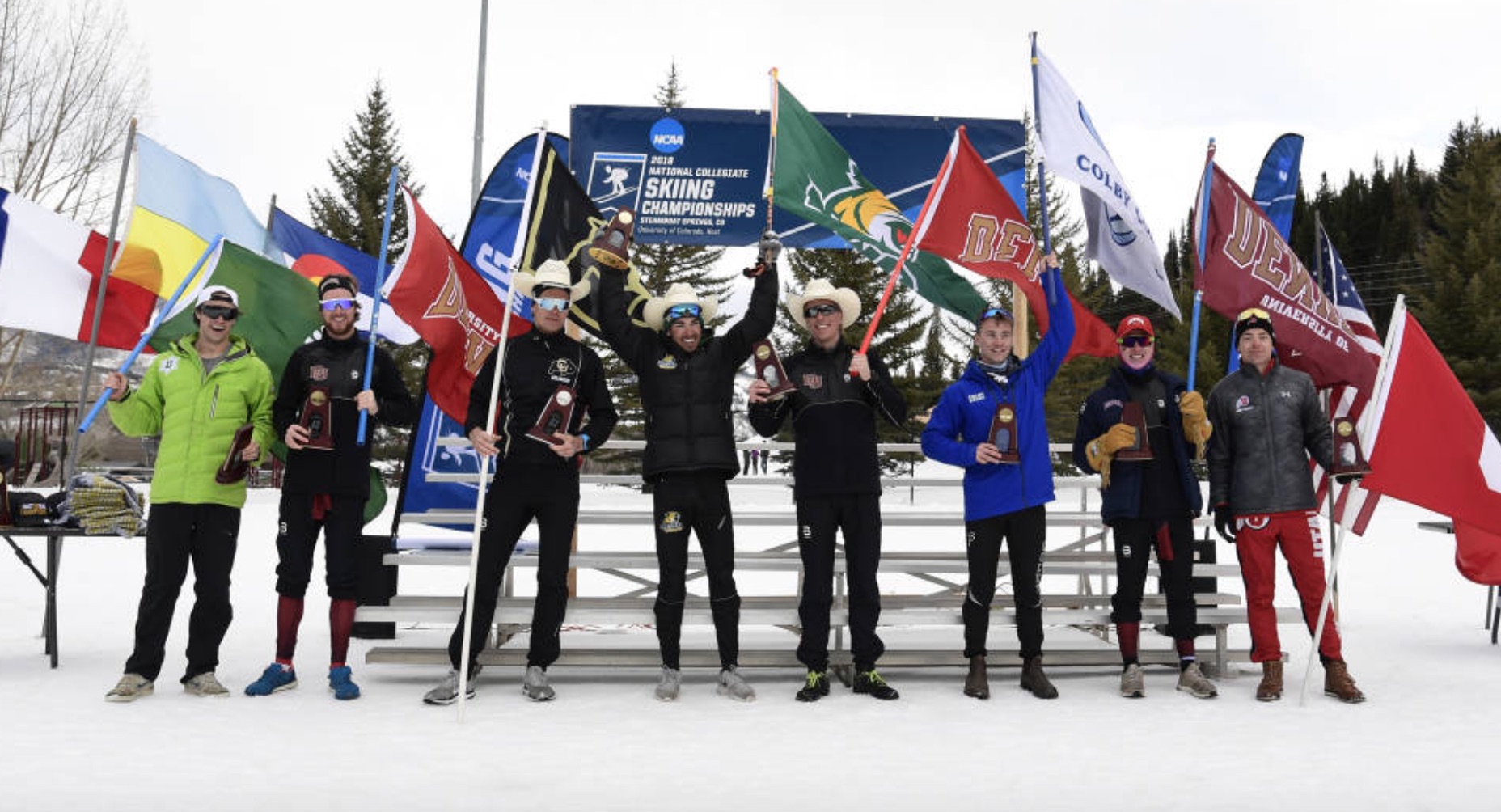
    The top finishers in the men’s 20 k freestyle mass start at 2018 NCAA Skiing Championships in Steamboat Springs, Colorado, with Northern Michigan University’s Ian Torchia (c) in first. (Photo: Dartmouth Sports/Clarkson Creative)

    NCAA Skiing Championships (Steamboat Springs, Colorado): 15/20 k freestyle mass starts

    On the fourth and final day of NCAA Skiing Championships at Howelsen Hill in Steamboat Springs, Katharine Ogden skied to her second-straight national title, Ian Torchia became an NCAA champion and the University of Denver (DU) won its 24th NCAA National Championship.
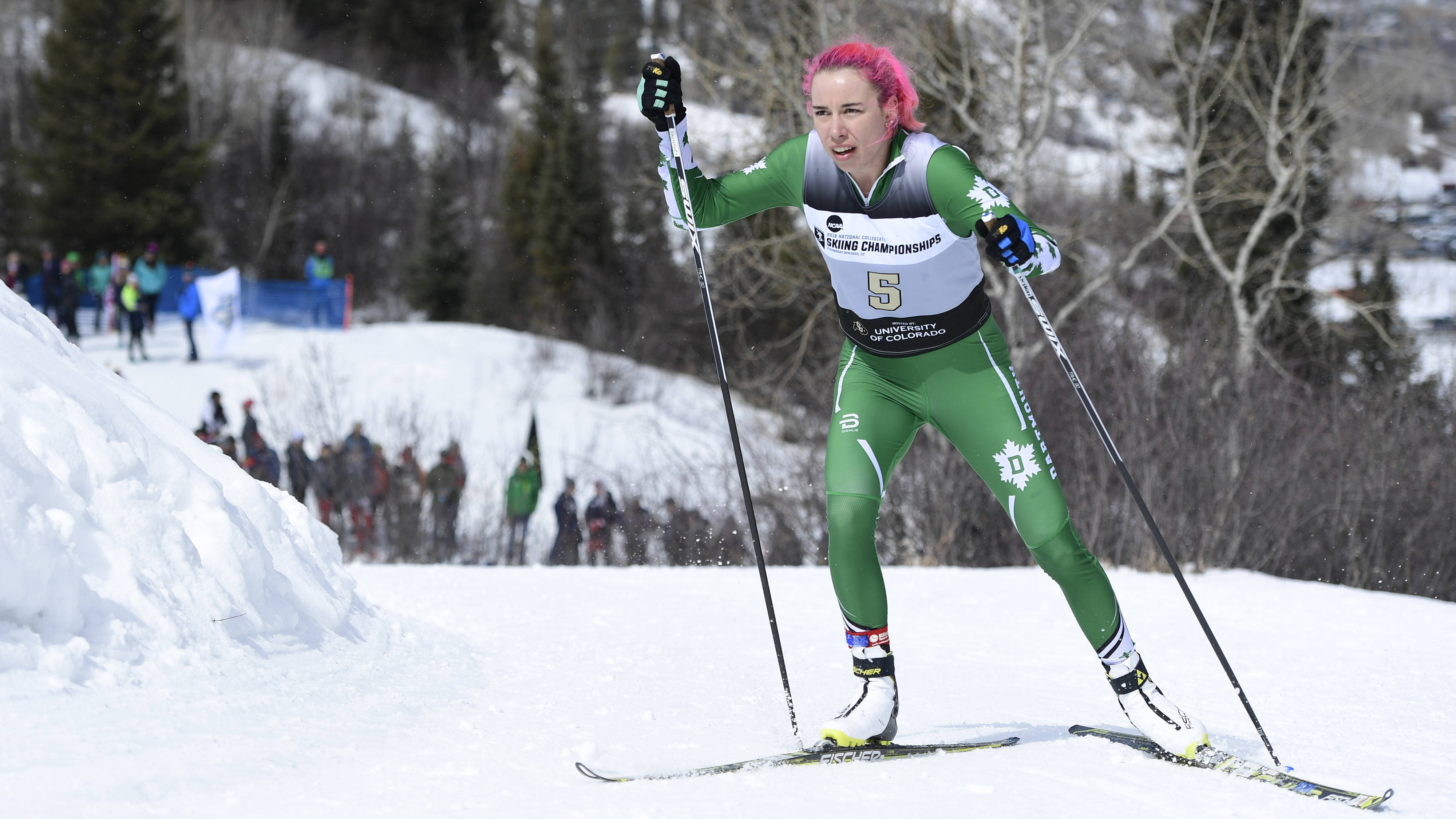
    Dartmouth freshman Katharine Ogden racing to her second-straight victory of the 2018 NCAA Skiing Championships in Steamboat Springs, Colorado. She won Saturday’s 15 k freestyle mass start by more than 38 seconds. (Photo: Dartmouth Sports/Clarkson Creative)

    Ogden, a Dartmouth College freshman, raced to a 38.4-second victory in the women’s 15-kilometer mass start, finishing in 43:22.0 minutes for her second win in as many races at 2018 NCAA Championships. She won the 5 k classic on Thursday and with her win on Saturday, she became the first Dartmouth skier in 56 years to win two national titles in the same year, according to a Dartmouth press release.

    On the second of three laps, Ogden broke away early with close to 10 k to go. According to the press release, she had a “quick fall” near the end of the second lap, but that didn’t derail her as she had time to grab sunglasses from Dartmouth men’s coach Brayton Osgood and a Dartmouth Lone Pine flag before the finish.

    At this year’s championships, Ogden’s two titles are accompanied by victories from Dartmouth men’s alpine skiers Brian McLaughlin (who won the giant slalom) and Tanguy Nef (who won the slalom). This marked only the second time that Dartmouth’s Big Green won four individual titles in a single NCAA Championships; that also occurred 61 years ago.

    “Katharine absolutely wanted this one, and she really likes to win,” Dartmouth Director of Skiing and Women’s Nordic Head Coach Cami Thompson Graves said in the press release. “She wasn’t about to let a fall slow her down, she has such a great competitive fire. But she also showed her playful side grabbing Brayton’s glasses and smiling all the way to the finish line!”

    Hailey Swirbul of the University of Alaska Anchorage placed second and Linn Eriksen (DU) reached the podium in third (+46.3). Denver had three in the top 10 with Jasmi Joensuu in ninth and Taeler McCrerey in 10th. Also landing in the top 10 for All-American honors were Guro Jordheim of the University of Utah in fourth, Emma Tarbath (Montana State University) in fifth, Petra Hyncicova of the University of Colorado Boulder (CU) in sixth, Christina Rolandsen (CU) in seventh, and Lauren Jortberg (Dartmouth) in eighth.

    Torchia, an Northern Michigan University (NMU) junior and U.S. Ski Team Development Team member, became the seventh NCAA champion in NMU Wildcats nordic skiing history, according to an NMU press release. Fredrick Schwenke was the Wildcats’ last nordic champion; he won the 2015 NCAA Championships 20 k classic.

    Torchia drew bib 1 for Saturday’s 20 k freestyle mass start and crossed the finish line first in 54:21.0, just 2 seconds ahead of CU’s Alvar Alev. Eivind Kvaale (DU) finished just four seconds back in third, and Denver had three in the top seven with Dag Frode Trollebø in fourth and Lars Hannah in seventh. Darmouth’s Cal Deline placed fifth, Zane Fields of Colby College finished sixth, and the 20 k freestyle’s 2017 NCAA champion Martin Bergström (Utah), who also won Thursday’s 10 k classic, placed eighth.  CU’s Petter Reistad and Sondre Bollum finished ninth and 10th, respectively.

    In the team standings, Denver beat Colorado by 41 points for the overall win with a total of 604 points between the nordic and alpine events at this year’s championships. Dartmouth placed third, 114.5 points behind Colorado, and Utah was another 63 points back in fourth.

    According to a DU press release, Denver has won at least one national championship in each of the last five athletic seasons (skiing: 2013/14, 2015/16, 2017/18; hockey: 2016-17; men’s lacrosse 2014/15), joining only Stanford on the list of schools that have done so in the last five seasons. (Oregon, West Virginia, Penn State, Oklahoma, Ohio State and Florida could potentially join that list later this year.)

    “It feels incredible,” said DU head coach Andy LeRoy said in the press release. “I am so happy for all of our athletes, they’ve been training all week and all season and to do it in Steamboat in front of our crowd is special.”

    Results: Women | Men| Team 

    Photos

    ***

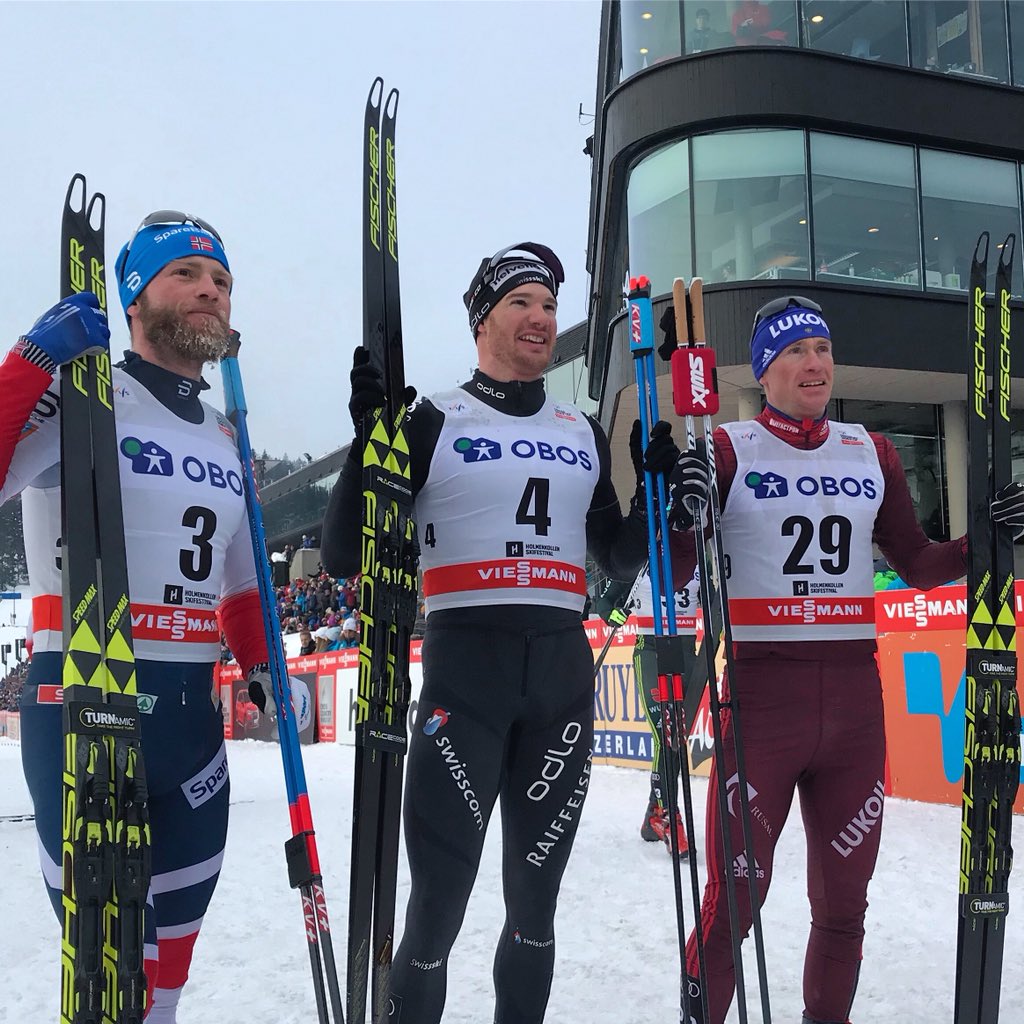
    The Holmenkollen men’s 50 k freestyle mass start podium on Saturday at the World Cup in Oslo, Norway, with Switzerland’s Dario Cologna (c) in first, Norway’s Martin Johnsrud Sundby (l) in second, and Russia’s Maxim Vylegzhanin (r) in third. (Photo: FIS Cross Country/Twitter)

    FIS Cross Country World Cup (Oslo, Norway): Men’s 50 k freestyle mass start

    Full report

    A four-time Olympic champion, Dario Cologna of Switzerland won his first 50-kilometer World Cup race on Saturday, topping the podium in the famous Holmenkollen 50 k freestyle mass start after outlunging Norway’s Martin Johnsrud Sundby (who won the event last year) for the win in 2:01:48.1. Sundby finished one-hundredth of a second behind for second place, ahead of Russia’s Maxim Vylegzhanin, who was 1.1 seconds back in third in his first World Cup race since November of last year.
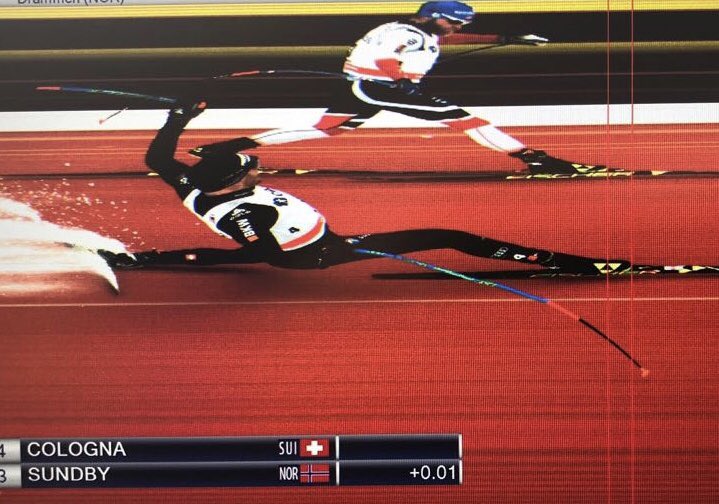
    The photo finish for first between Switzerland’s Dario Cologna (near) and Norway’s Martin Johnsrud Sundby at the Holmenkollen 50 k freestyle mass start on Saturday in Oslo, Norway. Cologna got it by 0.01 seconds. (Photo: FIS Cross Country/Twitter)

    Norway’s Sjur Røthe came out on top in a race for fourth (+4.2), ahead of Russia’s Denis Spitsov in fifth (+4.4) and his Norwegian teammate Hans Christer Holund in sixth (+4.5). Great Britain’s Andrew Musgrave followed in seventh (+15.1), Germany’s Florian Notz placed eighth (+25.9) and Canada’s Alex Harvey finished ninth (+32.4), ahead of France’s Robin Duvillard in 10th (+33.5).

    Scott Patterson led the U.S. in 16th (+56.3) coming off an 11th place in the 50 k classic mass start at last month’s Olympics, and Canada’s Devon Kershaw finished in the points in 28th (+3:43.6). Just outside the top 30, Canada’s Graeme Killick finished 34th (+4:55.1).

    Also for the U.S, David Norris placed 38th (+6:19.7), Paddy Caldwell was 46th (+8:12.3), Noah Hoffman 49th (+10:27.9), Kevin Bolger 52nd (+12:44.2), and Simi Hamilton did not finish.

    Canada’s fourth man in the race, Andy Shields finished 47th (+8:13.6).

    Results

    ***

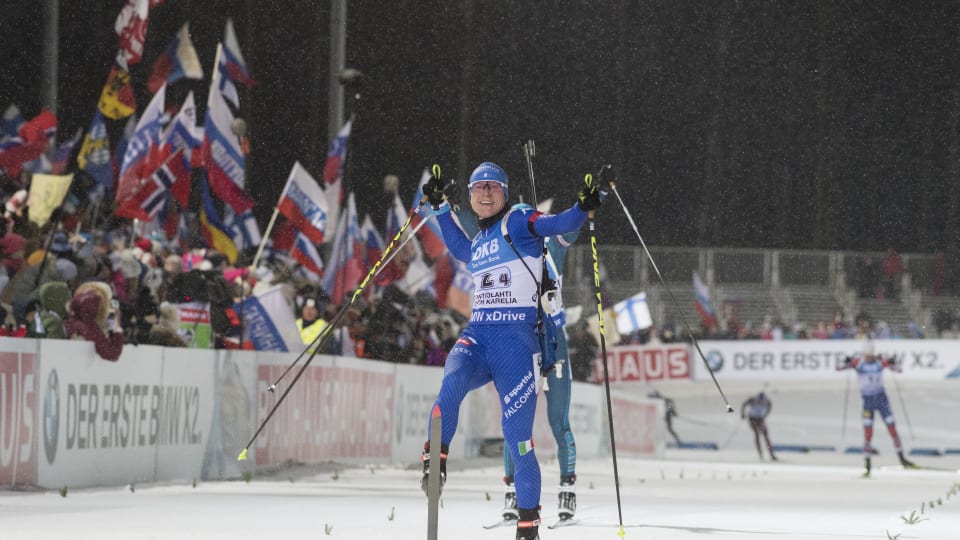
    Italy’s Lukas Hofer celebrates his team’s win in Saturday’s mixed relay at the IBU World Cup in Kontiolahti, Finland. (Photo: IBU/Biathlonworld)

    IBU World Cup (Kontiolahti, Finland): Single mixed relay & mixed relay

    (Note: This rundown has been updated to include comments from Christian Gow and Sean Doherty.)

    In the last single mixed relay and mixed relay of the International Biathlon Union (IBU) World Cup season, France and Italy came out on top, with France winning the two-person single mixed relay and Italy taking first in the coed mixed relay.
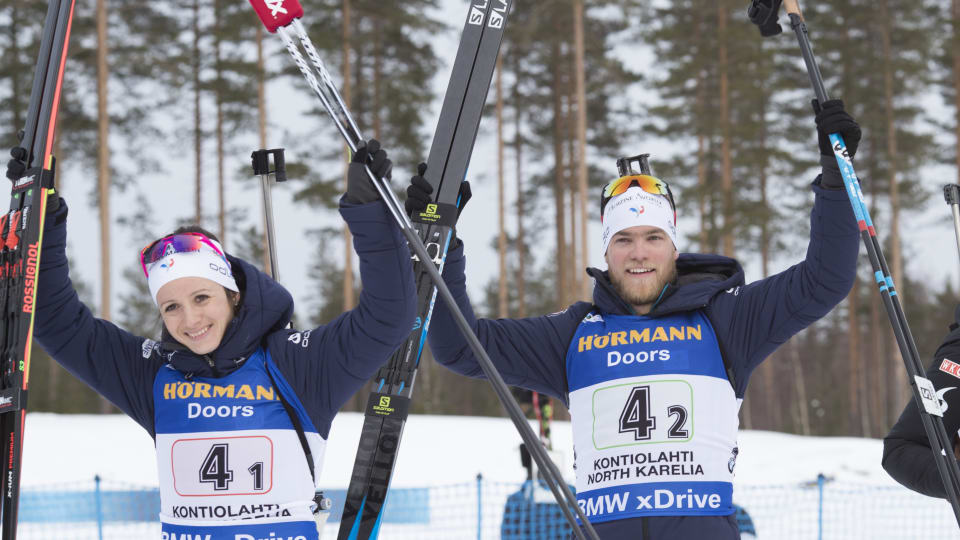
    France’s Anaïs Chevalier and Antonin Guigonnat after winning Saturday’s single mixed relay at the IBU World Cup in Kontiolahti, Finland. (Photo: IBU/Biathlonworld)

    France’s Anaïs Chevalier and Antonin Guigonnat combined for zero penalties and six spares to finish first in the single mixed relay in 33:29.1 minutes. Guigonnat as the team’s anchor secured the win by just 2.4 seconds over Austria’s Julian Eberhard while Norway’s Johannes Thingnes Bø finished 4.4 seconds back for third.

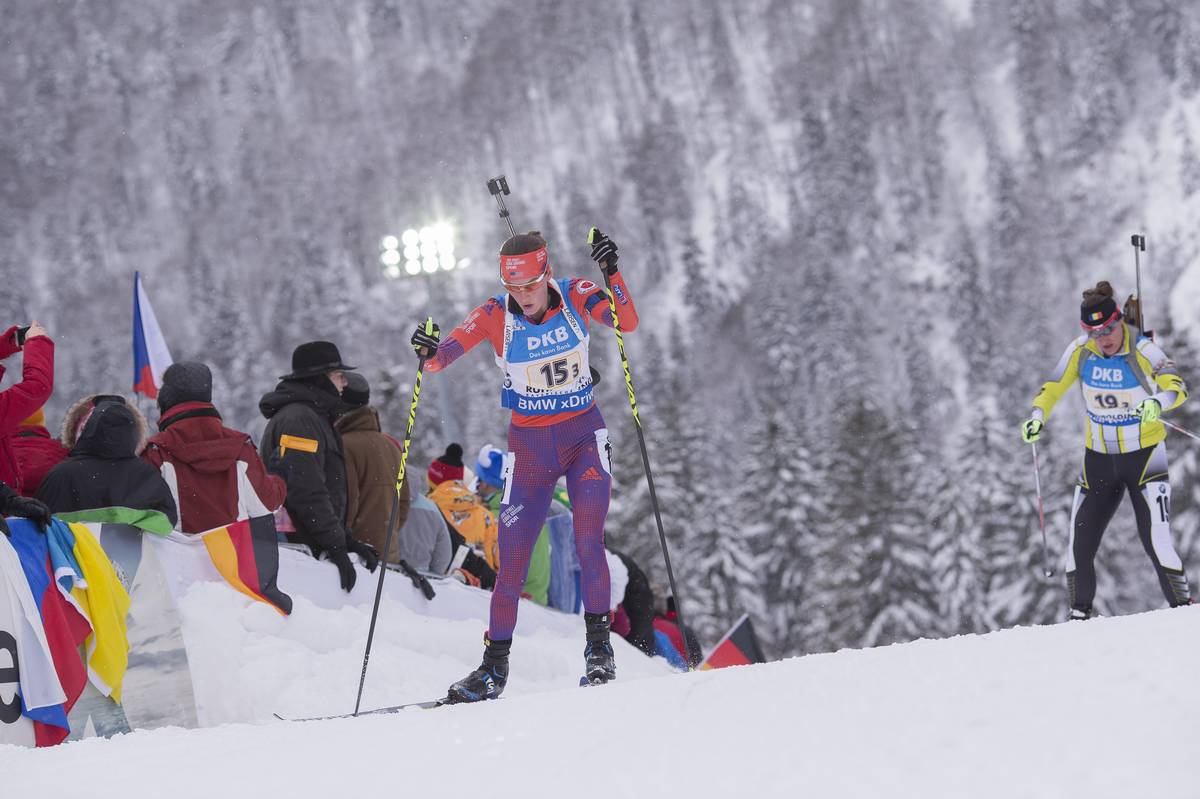
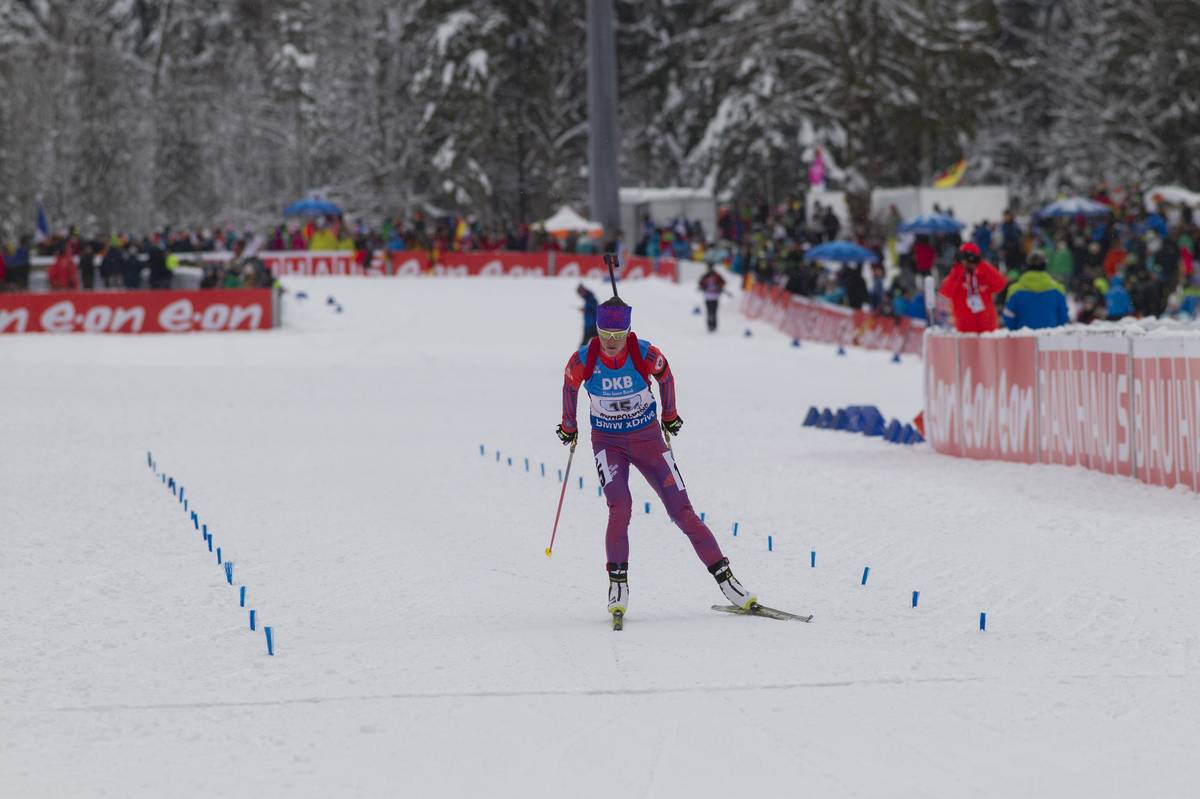
    Chevalier put France in fifth after the first leg, 15.5 seconds behind Ukraine’s Iryna Varvynets in first. Guigonnat used just one spare on his first leg to move them into fourth, 9.2 seconds back while Norway led at the second exchange. On Chevalier’s second leg, she shot clean in both stages to lead through the final exchange, with Ukraine skiing just 6.2 seconds back in second.

    On the final leg, Guigonnat used two spares and stayed out of the penalty lap, keeping the team in first through the finish. Eberhard skied the second-fastest course time on that leg to elevate Austria (with Lisa Theresa Hauser) from fourth at the tag to second place at the finish, and Bø skied all the way up from eighth to third place for Norway (with Marte Olsbu) with the fastest course time.

    Ukraine’s Artem Tyschenko used just one spare but slipped to fourth with the 11th-ranked course time on that leg, as he finished 10.8 seconds behind Norway.

    Behind Russia in fifth and Italy in sixth, Canada placed seventh (+23.8) with Rosanna Crawford and Christian Gow. The duo combined for zero penalties and six spares, and put themselves in third place early in the race. Crawford skied them into third on the first leg, using just two spares and tagging Gow 7.4 seconds out of first.

    Gow went on to take the lead after cleaning prone without any spares, and he cleaned standing as well but slipped back to third while Bø took the lead. Gow tagged Crawford in third, 8.9 seconds behind Norway in first.

    “I didn’t think too much about being tagged in third,” Gow recalled in an email to FasterSkier. “It was exciting for sure, but I let it fade to the background so that I could focus on my job both on the track and in the range.  It was great to leave prone in first place! It was also surprising, but it was a good place to be in.

    “My skiing was ok today,” he continued. “It is a really challenging and demanding race format that we don’t get a lot of practice with.  I was sick after the Olympic Games and only finally coming around the past couple days.  The Sprint race was horrendous for me, so today was much better than that. In the range I just focussed on myself and trusted my shooting.  I tried my best not to get caught up in the race going on around me and it worked to my benefit.”

    Crawford then slipped to seventh and 21 seconds back with three prone spares, but avoided the penalty lap, and Gow held onto seventh through the finish, using just one spare and skiing the eighth-fastest course time on that leg.

    “We are both happy with this result,” Gow wrote. “I think that we are both looking at the 23 second gap to first and thinking that if things had worked out just a bit better we could be there.  It can be both exciting and frustrating to be that close to the podium.  We know we can do it, it’s just a matter of putting it together on the right day. We are happy with 7th, but hungry for more.”

    Susan Dunklee and Lowell Bailey finished 14th for the U.S., 1:13.0 out of first with one penalty and 14 spares. The penalty came on Dunklee’s first leg during her standing stage, after she had cleaned prone without any spares. She tagged Bailey in 14th and he brought them up to 11th, using three spares on that leg, then Dunklee came through the final exchange in 13th after using four spares to clean. Bailey lost one place on the final leg, using four spares but staying out of the penalty lap.

    Twenty-six teams competed in the single mixed relay, compared to 23 in the mixed relay that followed.
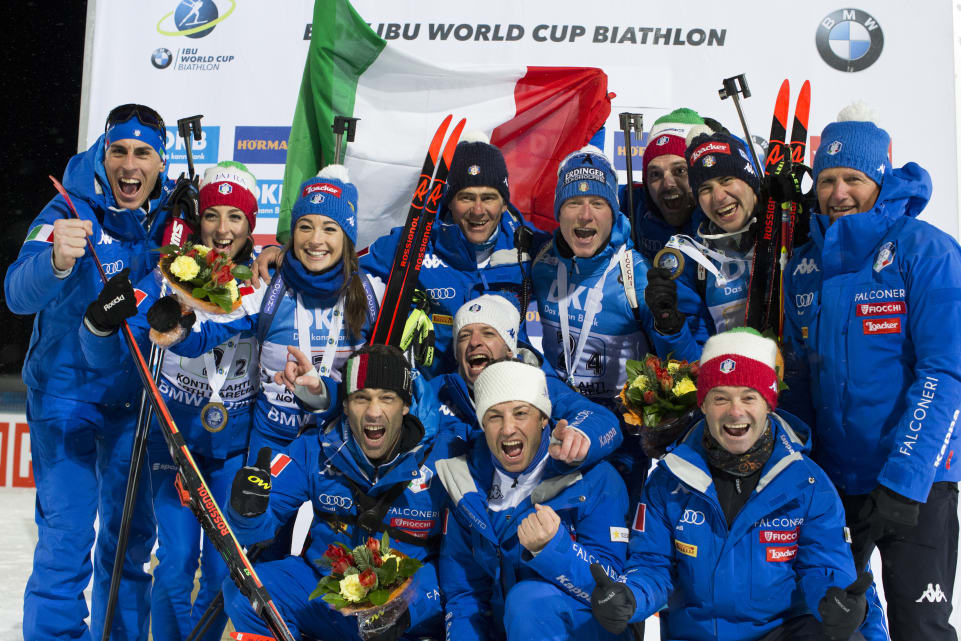
    Team Italia celebrates its win in the IBU World Cup mixed relay on Saturday in Kontiolahti, Finland, with its relay members Dorothea Wierer, Lisa Vittozzi, Dominik Windisch, and Lukas Hofer. (Photo: IBU/Biathlonworld)

    In Saturday’s 2 x 6 + 2 x 7.5 k mixed relay, Italy nabbed a 1.5-second victory over Ukraine in 1:15:08.3. Dorothea Wierer, Lisa Vittozzi, Dominik Windisch, and Lukas Hofer — the same Italian team that took bronze in the mixed relay at last month’s Olympics, although in a different order — combined for the win with one penalty and 13 spares.

    Ukraine, with Anastasiya Merkushyna, Vita Semerenko, Artem Pryma, and Dmytro Pidruchnyi, had zero penalties and just three spares throughout the whole race. For the second-straight relay on Saturday, Norway placed third (+9.1) with Synnøve Solemdal, Tiril Eckhoff, Henrik L’Abée-Lund, and Tarjei Bø totaling zero penalties and nine spares.

    Italy’s lone penalty came in Vittozzi’s second leg, but it didn’t derail the team as it improved from sixth to fifth with Vittozzi, who skied the third-fastest course time on that leg. She tagged Windisch 6.8 seconds out of first, and Windisch, who had anchored the team in the Olympics, took the lead by the final exchange after using two spares to clean. Hofer left the exchange just 3.3 seconds ahead of Norway’s Bø but used just one spare and skied the second-fastest anchor leg to finish first, beating his rivals up Kontiolahti’s infamous climb known as “The Wall”. Ukraine’s Pidruchnyi also shot clean with a single spare and clocked the fastest anchor leg to move his team from fourth to second place. Bø lost one place and finished third after using one spare as well and skiing the third-fastest anchor leg.

    Russia followed in fourth, France fifth, Sweden sixth, Germany seventh, Austria eighth, and the U.S. ninth (+2:48.4). The U.S. team, with Clare Egan, Joanne Reid, Tim Burke, and Sean Doherty, had one penalty and 11 spares. Egan cleaned her first prone but had to ski a penalty lap after her standing stage, tagging Reid in 17th, 58.7 seconds out of first.

    Reid used three spares on the second leg and moved up to 13th by the second exchange, and Burke used three spares as well to pick off one more place and tag Doherty in 12th. Doherty skied the eighth-fastest anchor leg and used two spares to clean to put the team in ninth at the finish.

    “I don’t consider two spares to be anything special, but today it was enough to make up some ground,” Doherty wrote in an email to FasterSkier.”I felt strong skiing, more like myself which is fun even if it’s a little late in the season. We had very good skis which always helps. I have done quite a few laps on this course over the years so the lines and transitions are pretty refined, so that is where I made time on the course.

    “I am happy with my leg. I enjoyed my little battle for 9th,” he continued. “I can’t speak too much for the other members of the relay tonight but I think 9th is a solid effort.”

    Canada finished 17th (+4:34.9) with Emma Lunder, Julia Ransom, Scott Gow, and Brendan Green combining for one penalty and 13 spares. Lunder put them in 12th at the first exchange and Ransom skied up to 10th, but Scott Gow had a penalty on his standing stage to drop to 16th. Green lost one more place on the last leg despite only requiring two spares.

    Results: Single mixed relayMixed relay

  • Sunday Rundown: Seefeld, Goms, Ridnaun, Craftsbury

    Sunday Rundown: Seefeld, Goms, Ridnaun, Craftsbury

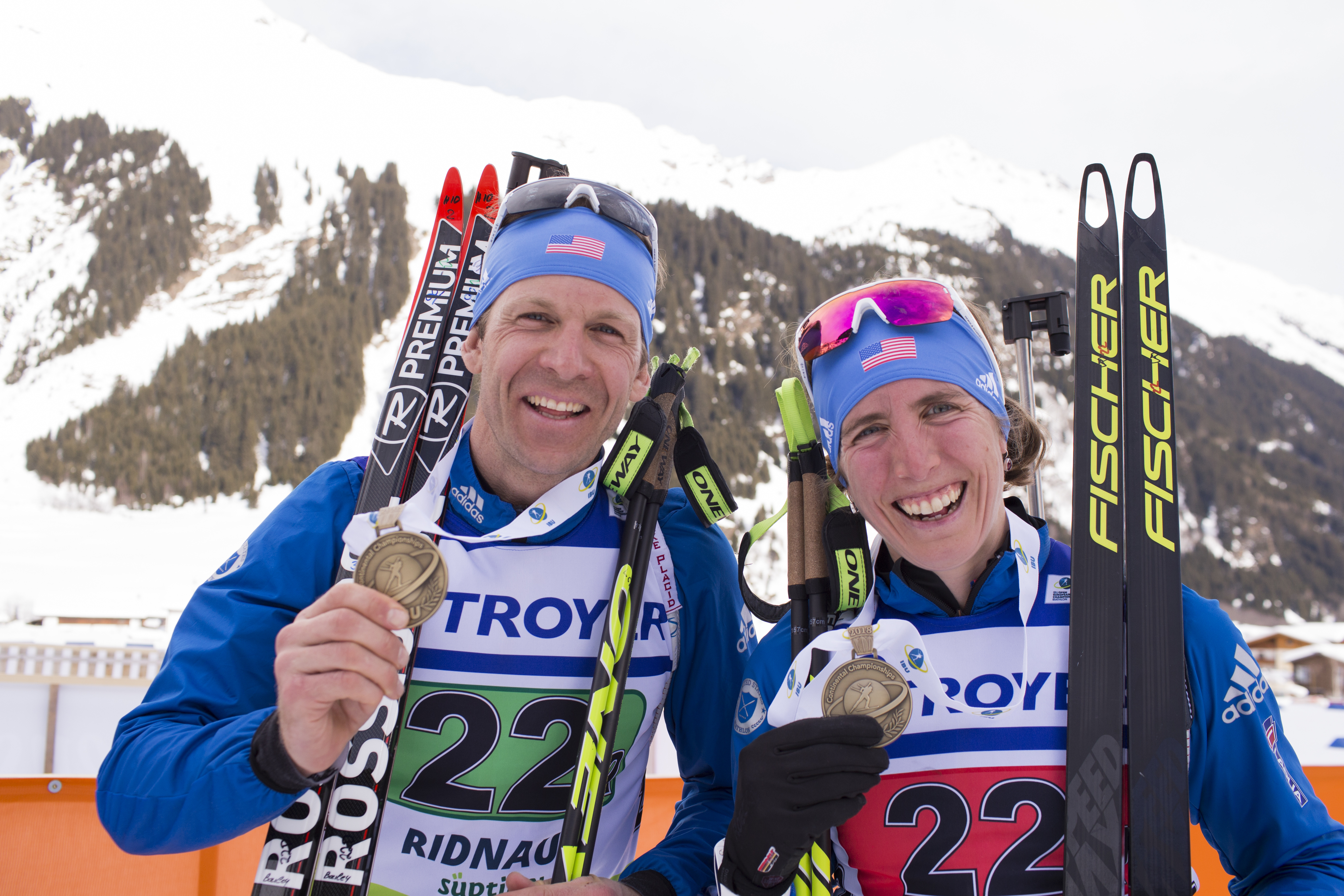
    US Biathlon’s Lowell Bailey (l) and Susan Dunklee after teaming up for bronze in the single mixed relay at 2018 IBU Open European Championships on Sunday in Ridnaun, Italy. (Photo: Manzoni/NordicFocus)

    IBU Open European Championships (Ridnaun-Val Ridanna, Italy): Single mixed & mixed relays

    Susan Dunklee and Lowell Bailey teamed up for the final day of the 2018 International Biathlon Union (IBU) Open European Championships in Ridnaun, Italy, and raced to a bronze medal in the single mixed relay.

    The American duo, both of which earned individual medals at last year’s IBU World Championships, finished just 9.1 seconds out of first, which went to Norway’s Thelka Brun-Lie and Vetle Sjåstad Christiansen. The Norwegians won in 35:39.6 with zero penalties and six spares. They took the lead after Brun-Lie’s second leg, where she cleaned both stages without spares.

    France placed second, 8.6 seconds back, with Julia Simon and Emilien Jacquelin, who combined for no penalties and 11 spares. They led the first half of the race, but slipped to second behind Norway on Simon’s second leg.

    Dunklee put the Americans off in second on her first leg, which she cleaned with a spare in each stage, then they slipped one place to third on Bailey’s first leg, where he cleaned as well and used three spares. In all, they used 10 spares and avoided the penalty loop, and finished half a second out of second place.

    “Over Christmas, we trained a little bit with the French athletes, including Jacquelin,” Bailey said, according to a US Biathlon press release. “So I know that he has quite a fast finish, and I thought I am kind of an old man here, I should maybe try to go harder on the first part of the lap. But he stayed with me all the time and had me in the end.”

    “It was a good opportunity to tune up the race shape, build some confidence and find that sharp feeling heading into the Olympics,” Dunklee told US Biathlon. “The single mixed relay is one of my favorite race formats and today was a blast!”

    Canada’s Sarah Beaudry and Carsen Campbell placed eighth of 24 teams in the single mixed relay, finishing 1:03.6 out of first with just eight spares and zero penalties. In 11th after the first leg, they moved into eighth on Campbell’s first leg, which he cleaned with one spare. Beaudry then cleaned her second leg without any spares, and Campbell anchored them to eighth.

    The U.S. entered a team in the mixed relay that followed, with Chloe Levins, Deedra Irwin, Paul Schommer, and Alex Howe placing 17th (+5:55.5) of 19 teams with no penalties and 12 spares.

    Ukraine won the mixed relay to conclude the championships, with Yuliia Zhuravok, Iryna Varvynets, Artem Pryma, and Dmytro Pidruchnyi combining for zero penalties and six spares and finishing in 1:11:40.1.

    Russia placed second (+11.7) with Victoria Slivko, Anastasia Zagoruiko, Evgeniy Garanichev, and Alexander Loginov combining for zero penalties and nine spares.

    Norway followed in third (+33.2) with Emilie Ågheim Kalkenberg, Kaia Wøien Nicolaisen, Håvard Gutuboe Bogetveit, and Fredrik Gjesbakk combing for no penalties and just four spares.

    Results: Single mixed relayMixed relay

    ***

    U.S. SuperTour (Craftsbury, Vermont): 5/10 k freestyle

    Two Alaska Pacific University (APU) athletes topped the podium on Sunday at the SuperTour in Craftsbury, Vermont, with David Norris winning the men’s 10-kilometer freestyle individual start in 21:54.9 and Becca Rorabaugh topping the women’s 5 k freestyle in 12:06.4.

    Norris won the men’s race by 6 seconds over Canada’s Andy Shields (Lappe Nordic) and Kevin Bolger of the Sun Valley Ski Education Foundation (SVSEF) placed third (+15.8). Kris Freeman (Caldwell Sport) was the third American in fourth overall (+23.7), and three Canadians took fifth through seventh with Michael Somppi (Lappe Nordic) in fifth (+27.9), Evan Palmer-Charrette (NTDC Thunder Bay) in sixth (+37.5) and Scott Hill (Barrie Cross Country) in seventh (+37.6), ahead of Brian Gregg (Team Gregg/LNR/CXC) in eighth (+39.4), Tad Elliott (Ski Club Vail) in ninth (+44.3) and Jack Hegman in 10th (+50.4).

    Rorabaugh won the women’s race by just 2.2 seconds over her APU teammate Rosie Frankowski in second, and Erika Flowers of the Stratton Mountain School (SMS) T2 Team placed third (+4.6). Two Craftsbury Green Racing Project (CGRP) skiers finished fourth and fifth, with Kaitlynn Miller in fourth (+12.1) and Liz Guiney in fifth (+22.5), Kelsey Phinney (SVSEF) was sixth (+25.8), and Canadians Olivia Bouffard-Nesbitt (Rocky Mountain Racers) seventh (+26.4) and Frederique Vezina (Pierre-Harvey National Training Centre) eighth (+36.0). Corey Stock, of the Bridger Ski Foundation (BSF) placed ninth (+39.9), and Felicia Geisor (CXC Team) was 10th (+44.4).

    On Saturday, the Craftsbury Outdoor Center hosted its 37th annual Craftsbury Marathon, with Nils Koons winning the 48 k men’s race in 2:28:51.0 hours and Hannah Dreissigacker winning the 48 k women’s race in 3:01.48.7.

    Results: Men’s 10 k | Women’s 5 k 

    Marathon (non-SuperTour) results

    ***


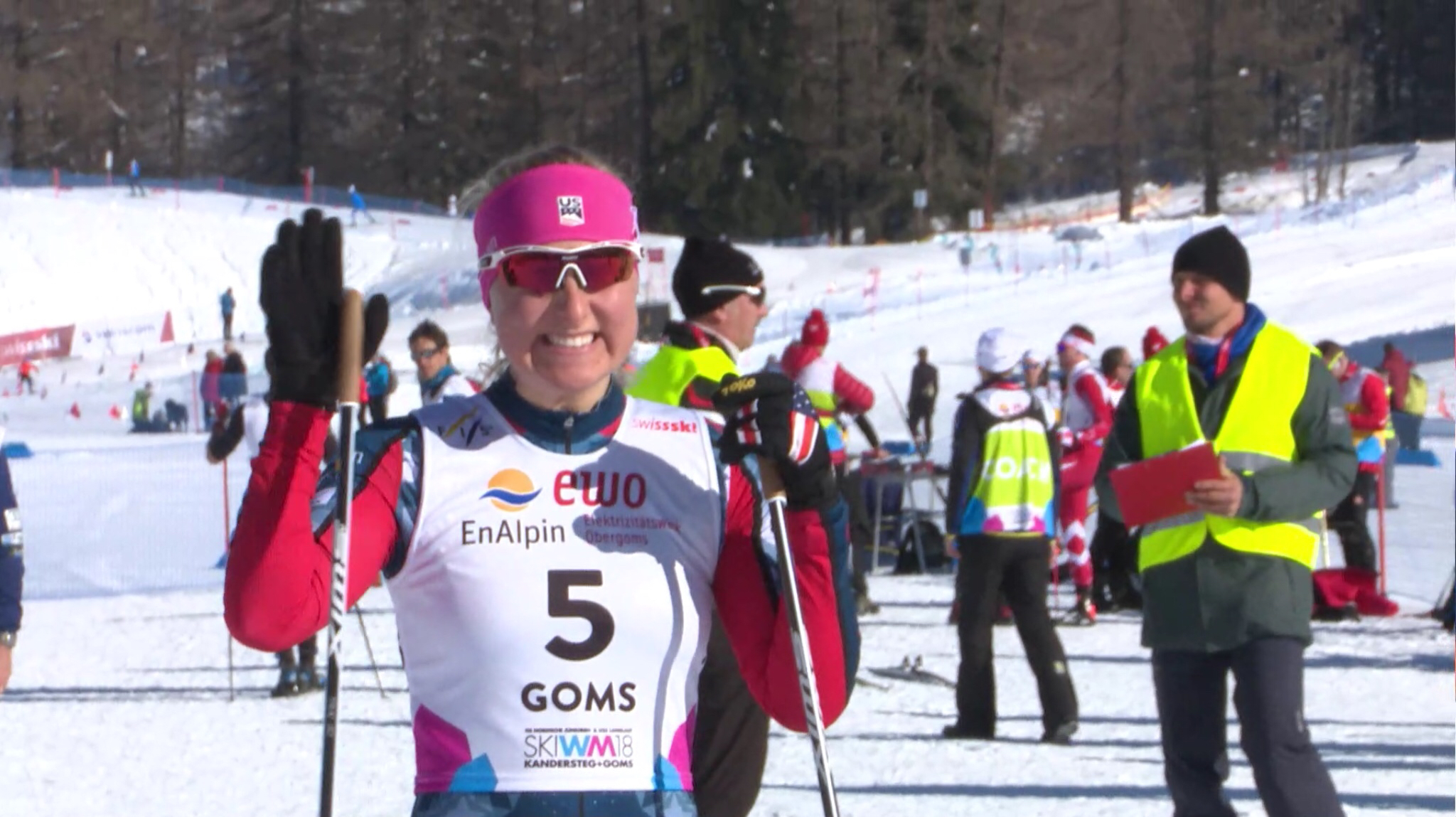
    Hannah Halvorsen of the U.S. Ski Team and APU on the start line in Ulrichen, Switzerland, after finishing fifth in the sprint qualifier. (FIS screencap)

    FIS Cross Country World Junior Championships (Ulrichen, Switzerland): Freestyle sprints

    Full report

    World Junior Championships kicked off today with freestyle sprints in Ulrichen, Switzerland. Moa Lundgren of Sweden claimed with women’s title by 1.89 seconds over Kristine Stavås Skistad of Norway in the final, with Sweden’s Frida Karlsson finishing third (+1.89).

    Hannah Halvorsen of the United States qualified in fifth place before skiing to second in her quarterfinal heat. Halvorsen hovered around third or fourth place through much of her semifinal and was unable to snipe any spots in the finishing straight, ending up fourth in the heat and eighth on the day.

    Fellow Americans Margaret Gellert and Sofia Shomento also made the quarterfinals, finishing 18th and 23rd, and Canada’s Hannah Mehain wound up 29th on the day.

    The new men’s junior world champion is Tom Mancini of France, who nipped Norway’s Jørgen Lippert by just 0.10 seconds to take the win. Valerie Grond gave the Swiss crowd a thrill by making it all the way to the final and taking home bronze, despite qualifying in just 21st position. The Swiss junior narrowly edged France’s Vincent Buiatti for the final step on the podium.

    Canada’s Graham Ritchie finished second in his quarterfinal after qualifying in 28th position, earning an automatic spot in the semifinals. There he finished sixth (+9.30 behind Mancini), winding up 12th on the day. Teammate Antoine Cyr also made the quarterfinals where he had an impressive crash, slinging off the trail and into the infield, finishing 30th on the day. For the U.S., Gus Schumacher was the lone qualifier for the heats. He finished fourth in his quarterfinal and was just 0.22 seconds away from a “lucky loser” spot in the semifinals. Schumacher finished 19th on the day.

    In the junior women’s race, Hannah Rudd of the United States finished 35th in qualification, +18.15. For Canada, Annika Richardson finished 52nd (+24.09), Catherine Reed-Metayer 56th (+28.25), and Alexandra Racine 69th (+37.27).

    In the junior men’s sprint, Canada’s Reed Godfrey finished a tough 31st, just 0.21 seconds out of making the quarterfinals. Etienne Hebert rounded out the Canadian finishers in 36th place (+11.81) in the qualifier. Canyon Tobin was 41st in qualification for the U.S. (+13.46), followed by Karl Schulz in 54th (+16.90) and Luke Jager in 60th (+18.15).

    Results: men’s qualifier | women’s qualifier | men’s final | women’s final

    ***

    FIS Nordic Combined World Cup (Seefeld, Austria): Individual normal hill/15 k

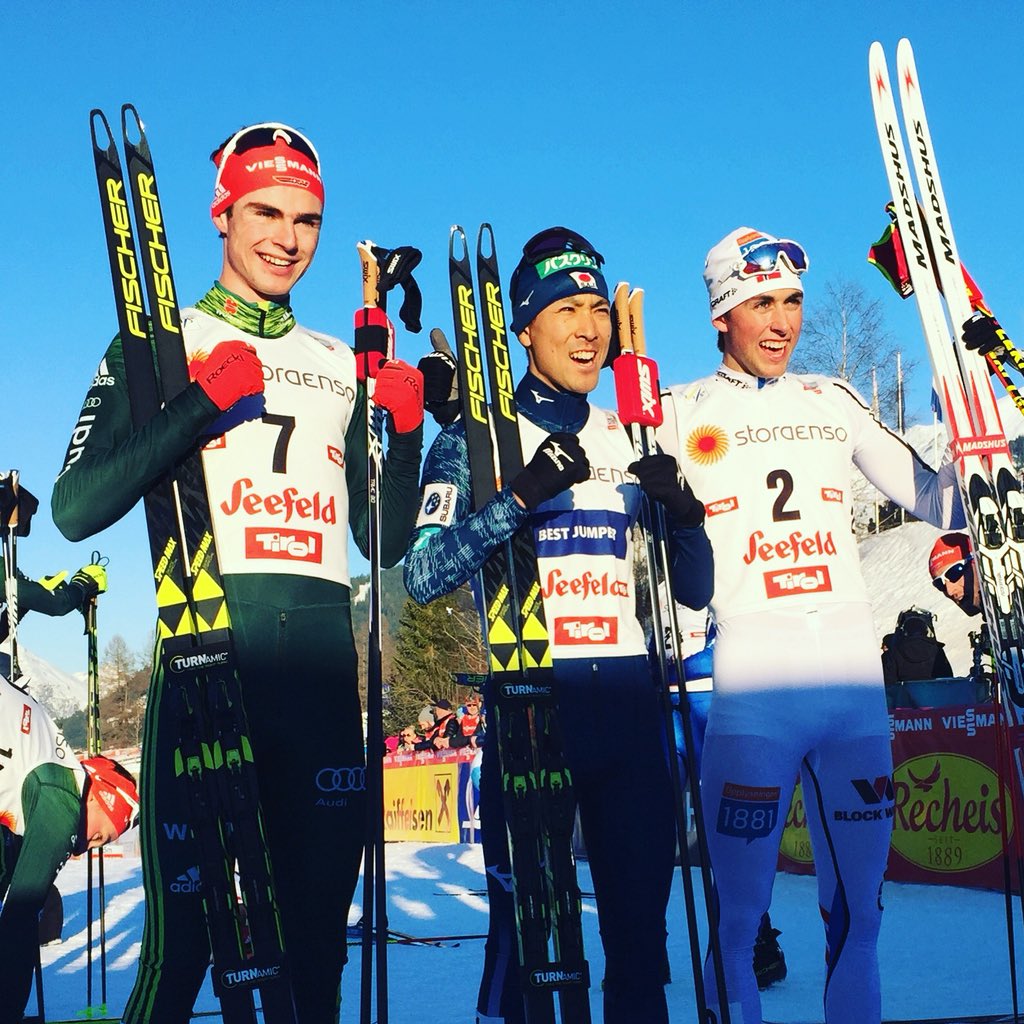
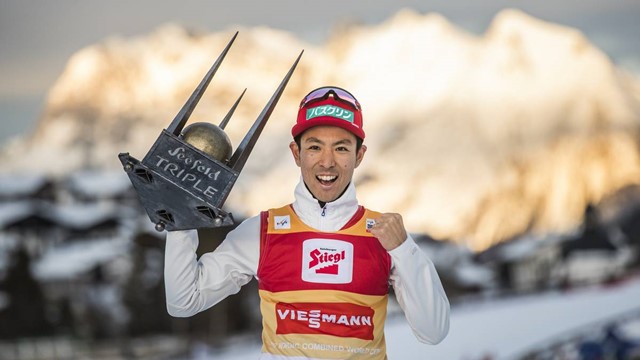
    Japan’s Akito Watabe after winning the 2018 Seefeld Triple Nordic Combined World Cup. He is the only athlete besides Germany’s Eric Frenzel to win the event. (Photo: FIS Nordic Combined)

    On the final day of the Seefeld Triple, Japan’s Akito Watabe completed his sweep of the three-day weekend and Norway’s Jarl Magnus Riiber reached the podium for the third-straight day, placing second. Germany’s Fabian Rießle placed third for his second podium in the last two days.

    Watabe jumped to first on the normal hill and started the 15 k Gundersen 48 seconds ahead of Riiber in second. He went on to win the race by 1:14.9 minutes in 34:58.6, becoming the only man besides Germany’s Eric Frenzel to win the Seefeld Triple in its five-year history.

    After jumping to fifth, Rießle won a photo finish for third (+1:57.9), edging Germany’s Vinzenz Geiger by less than a tenth of a second. Geiger moved up from ninth in the jump to fourth overall (+1:57.9).

    Norway’s Jørgen Graabak followed in fifth (+2:02.4), Frenzel placed sixth (+2:07.4), Norway’s Jan Schmid was seventh (+2:09.8), Finland’s Eero Hirvonen eighth (+2:13.5), Norway’s Espen Andersen ninth (+2:28.0), and Austria’s Mario Seidl 10th (+2:42.1) out of 28 finishers.

    No Americans contested the final day of the Triple, the last World Cup before the 2018 Winter Olympics in PyeongChang, South Korea.

    Results: Jumping | Final

    ***

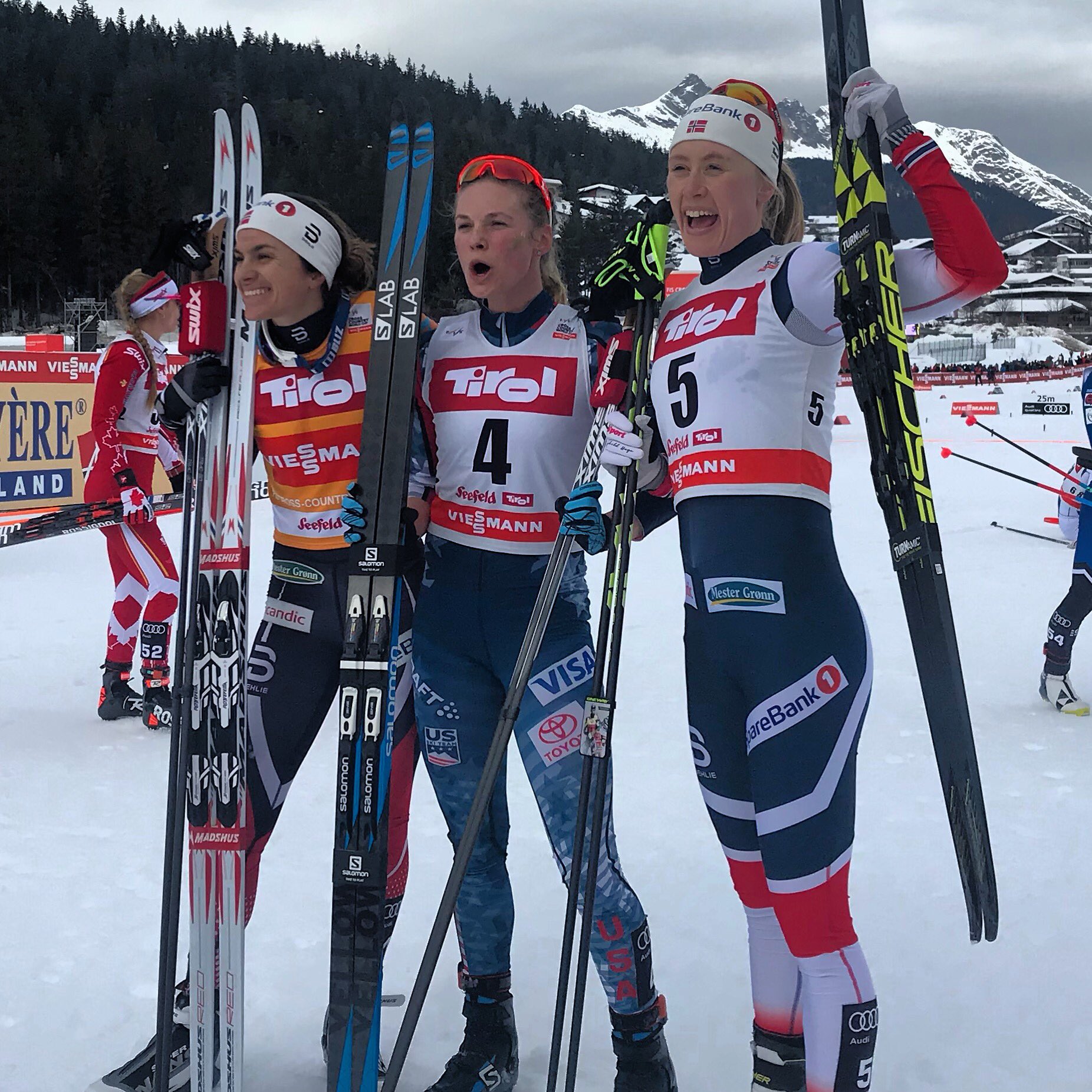
    Jessie Diggins of the U.S. Ski Team (center) celebrates after winning the 10 k mass start freestyle in Seefeld, Austria, over Heidi Weng (left) and Ragnhild Haga of Norway. (Photo: FIS Cross Country/Twitter)

    FIS Cross Country World Cup (Seefeld, Austria): 10/15 k mass start freestyle

    Women’s report

    Men’s report

    In the final World Cup race before the 2018 Olympics, Jessie Diggins achieved the ultimate goal to give herself the utmost confidence heading into PyeongChang — winning the women’s 10-kilometer freestyle mass start at the World Cup in Seefeld, Austria, on Sunday.

    The win was her first of the season and fourth individual victory of her career. Diggins, a 26-year-old U.S. Ski Team member, pulled it off by attacking on a long climb and leaving Norway’s Heidi Weng, Ragnhild Haga and Ingvild Flugstad Østberg chasing. While Diggins was several seconds ahead over the top and all alone on the long descent that followed, Weng and Haga worked to close the gap — and nearly did in the finishing stretch. But Diggins held them off, winning by 0.7 seconds over Weng in second place and 1 second ahead of Haga in third, and threw her fists down in celebration as she crossed the line first in 23:08.5 minutes.

    “I just put my head down and it wasn’t pretty, but I just hammered,” Diggins told the International Ski Federation (FIS) in a televised post-race interview.

    She was the only non-Norwegian in the top five, with Østberg in fourth (+8.7) and Marit Bjørgen in fifth (+16.7). Austria’s Teresa Stadlober placed sixth (+16.9), Norway’s Kari Øyre Slind was seventh (+19.1), and American Sadie Bjornsen placed eighth (+20.5), ahead of Switzerland’s Nathalie von Siebenthal in ninth (+30.3).

    The U.S. had three in the top 15 with Kikkan Randall (U.S. Ski Team) in 14th (+48.5), and two more women in the top 30, with Caitlin Patterson (Craftsbury Green Racing Project) in 23rd (+1:00.7) and Liz Stephen (USST) in 29th (+1:18.2). Rosie Brennan (USST) finished 53rd (+2:26.9).

    Emily Nishikawa led the Canadians in 35th (+1:36.5), followed closely by teammate Cendrine Browne in 37th (+1:36.6). Dahria Beatty finished 45th (+1:58.9).

    Women’s Results

    Dario Cologna of Switzerland (center) won the men’s 15 k skate mass start in Seefeld, Austria, over Alex Harvey of Canada (left) and Martin Johnsrud Sundby of Norway (right). (Photo: FIS Cross Country/Twitter)

    The Olympics are nearing and so Switzerland’s Olympic legend Dario Cologna is ramping up: after winning the Tour de Ski, he took another win in the 15 k mass start skate in Seefeld, Austria, on Sunday.

    With much of the field staying relatively close together until the finish, Cologna nabbed the win by 1.4 seconds over Canada’s Alex Harvey, who took his second podium of the season in addition to also finishing third in the overall Tour de Ski.

    Norway’s Martin Johnsrud Sundby was third (+2.9), then teammate Didrik Tønseth in fourth (+5.9) and France’s Maurice Manificat in sixth (+7.5).

    The U.S. Ski Team’s Erik Bjornsen had a breakthrough day finishing ninth (+9.3), followed by Simi Hamilton in 12th (+12.4). Behind them, Scott Patterson placed 27th (+23.4), then Patrick Caldwell 49th (+1:26.2), Ben Lustgarten 55th (+1:42.7), and Tyler Kornfield 77th (+3:00.0).

    Canada’s Devon Kershaw and Graeme Killick finished 30th (+26.5) and 31st (+27.4), respectively. Len Valjas placed 58th (+1:53.1), Knute Johnsgaard 82nd (+3:23.1), Bob Thompson 87th (+4:27.5), and Julien Locke 92nd (+4:56.9).

    Men’s Results

  • Saturday Rundown: Seefeld and Ridnaun

    Saturday Rundown: Seefeld and Ridnaun

    The podium for Day 2 of the Seefeld Triple Nordic Combined World Cup, with Japan’s Akito Watabe in first (c), Germany’s Vinzenz Geiger (l) in second and Norway’s Jarl Magnus Riiber (r) in third. (Photo: FIS Nordic Combined/Twitter)

    FIS Nordic Combined World Cup (Seefeld, Austria): Normal hill/10 k

    Two of the same men from Friday repeated on the podium on Day 2 of the Seefeld Triple Nordic Combined World Cup, with Japan’s Akito Watabe notching his second-straight win on Saturday.

    Norway’s Jarl Magnus Riiber, who finished second on Friday, placed third in Saturday’s individual normal hill/10 k Gundersen, while Germany’s Vinzenz Geiger placed second, more than a minute behind Watabe.

    Watabe jumped to first and started the 10 k with a 25-second head start on Riiber in second. Geiger started seventh, 1:45 minutes back, and rose to second at the finish, 1:05.5 behind Watabe (who won in 23:28.5) and 3.4 seconds ahead of Riiber in third (+1:08.9).

    For the second day in a row, Norway’s Jan Schmid narrowly missed the podium in fourth (+1:14.1), up from fifth after the jump.

    Taylor Fletcher was the lone American competing on Day 2, and he ended up 31st, up 10 places after jumping to 41st. Fletcher started the 10 k race 4:44 out of first then finished 3:52.9 behind Watabe.

    The Seefeld Triple concludes Sunday with the individual normal hill/15 k Gundersen.

    Results: Jumping | Final

    ***

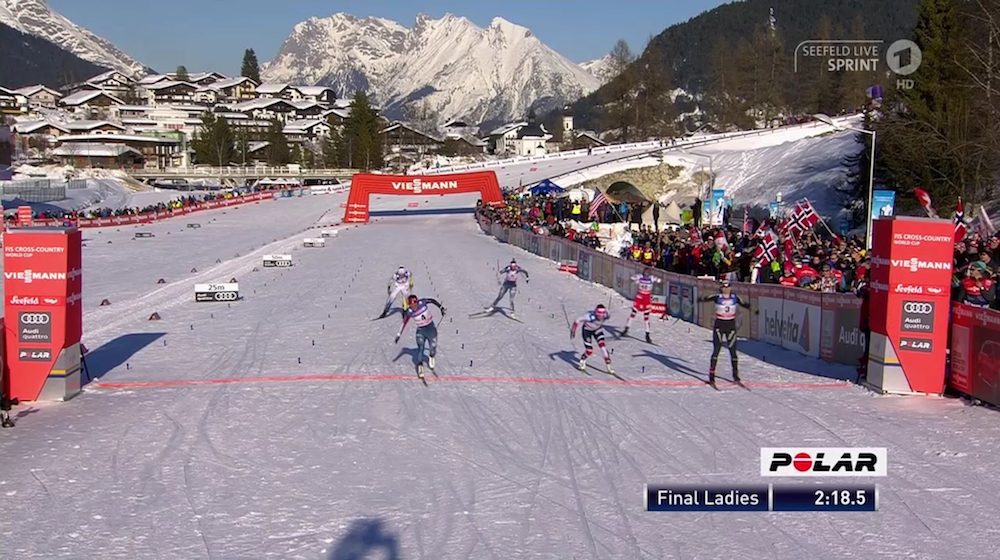
    American Sophie Caldwell (l) and Switzerland’s Laurien van der Graaff (r) tied for first on Saturday in the women’s 1.1 k freestyle sprint final at the World Cup in Seefeld, Austria, while Norway’s Maiken Caspersen Falla placed third. (Screenshot: ARD broadcast)

    FIS Cross Country World Cup (Seefeld, Austria): Freestyle sprints

    Women’s report

    Men’s report

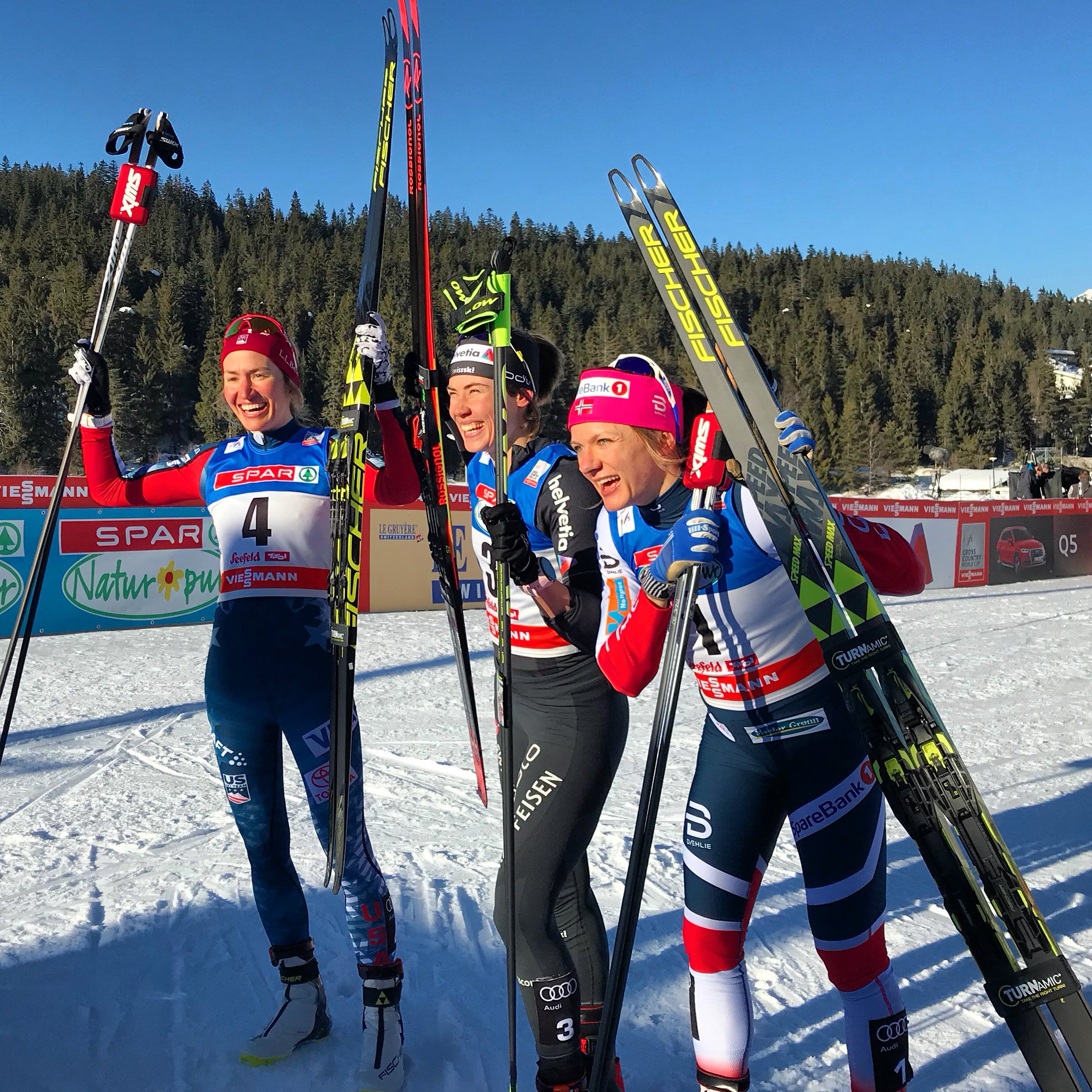
    It doesn’t get any closer than that. On Saturday, American Sophie Caldwell and Switzerland’s Laurien van der Graaff tied for first in the women’s 1.1-kilometer freestyle sprint final at the World Cup in Seefeld, Austria. They both finished within one-hundredth of a second of each other to take the victory — the last sprint before the Olympics — in 2:18.65 minutes.

    Norway’s Maiken Caspersen Falla finished 0.21 seconds later for third place.

    The women’s freestyle sprint podium at Saturday’s World Cup in Seefeld, Austria, with American Sophie Caldwell (l) and Switzerland’s Laurien van der Graaff (c) tying for first and Norway’s Maiken Caspersen Falla (r) placing third. (Photo: FIS Cross Country/Twitter)

    “I broke my pole in the semifinal, then I got really tired,” van der Graaff said in a post-race interview with the International Ski Federation (FIS). “But I still believed I can be with Maiken and Sophie, and that I could catch them in the final was just great.”

    Norway and the U.S. both had two in the final, with Kathrine Rolsted Harsem of Norway placing fourth (+1.34), Sweden’s Linn Sömskar finishing fifth (+1.83) and American Sadie Bjornsen taking sixth (+2.26).

    Falla had raced to first in the qualifying round with a time of 2:21.44, Italy’s Greta Laurent qualified second (+1.43), van der Graaff third (+1.66), Caldwell fourth (+1.84), and Bjornsen fifth (+2.01).

    Van der Graaff then won her quarterfinal and placed third in the first semifinal, 0.77 second behind Caldwell, who won it. Falla was second in that semifinal (+0.16) and van der Graaff advanced as a lucky loser.

    Caldwell and Falla went head to head in every heat, with Falla winning their first quarterfinal by 0.08 seconds over Caldwell in second.

    Bjornsen won her quarterfinal and finished second to Harsem in the second semifinal.

    A third American, Kikkan Randall also qualified for the heats, placing 18th in the qualifier then finishing third in her quarterfinal (1.33 seconds behind Sömskar in first) to end up 14th overall.

    Canada’s Dahria Beatty placed 30th in the qualifier to nab the last spot in the rounds, then finished fourth in her quarterfinal (1.65 seconds behind Laurent in first) for 20th overall.

    For the U.S., Ida Sargent missed qualifying by about half a second in 37th (+8.20), Rosie Brennan finished 42nd (+9.86) and Caitlin Patterson was 52nd (+13.0).

    Also for Canada, Emily Nishikawa finished 51st (+12.68) and Cendrine Browne was 54th (+13.34).

    The men’s 1.4 k freestyle sprint podium at the World Cup in Seefeld, Austria, with Norway’s Johannes Høsflot Klæbo (c) in first, France’s Lucas Chanavat (l) in second and Sweden’s Calle Halfvarsson (r) in third. (Photo: FIS Cross Country/ Twitter)

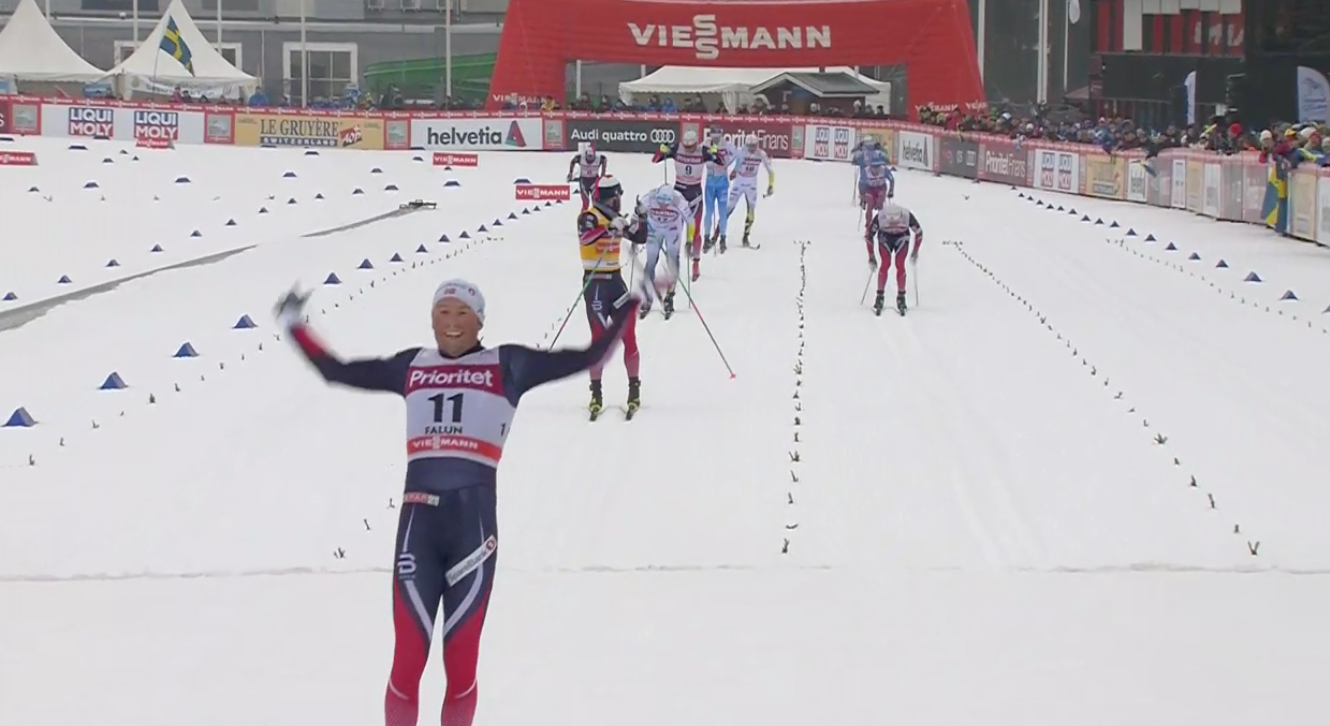
    The men raced 1.4 k, with Norway’s Johannes Høsflot Klæbo qualifying first in 2:46.89 then winning his quarterfinal and semifinal before putting the hammer down for one last time in the final, finishing first in 3:02.66.

    France’s Lucas Chanavat placed second in the final, 0.48 seconds back, after qualifying sixth, winning his quarterfinal and placing second in the first semifinal (0.33 seconds behind Klæbo). Sweden’s Calle Halfvarsson took the third spot on the podium after finishing 0.97 seconds after Klæbo. Halfvarsson had previously qualified seventh, taken second in his quarterfinal and advanced as a lucky loser in third in the first semifinal (0.52 seconds behind Klæbo).

    Italy’s Federico Pellegrino missed the podium in fourth (+1.06), Russia’s Gleb Retivykh placed fifth (+1.17), and Norway’s Emil Iversen was sixth (+5.57).

    Canada’s Alex Harvey and American Simi Hamilton both made it to the semifinals, where they finished fourth and fifth, respectively, and did not advance to the finals. Harvey had qualified for the rounds in 22nd and won his quarterfinal, then raced in the second semifinal, where he finished fourth, 0.47 seconds behind Iversen in first. That put Harvey eighth overall on the day.

    Hamilton clocked the fifth-fastest qualifying time, 6.46 seconds back from Klæbo’s top time. The U.S. Ski Team member then placed second to Pellegrino in his quarterfinal and was fifth in the first semifinal, 2.61 seconds behind Klæbo. Overall, Hamilton placed ninth.

    Also for the U.S., Erik Bjornsen finished 37th in the qualifier, 0.89 seconds out of the top 30 and 11.99 second out of first, Logan Hanneman was 39th (+12.52), Andy Newell 42nd (+12.90), Reese Hanneman 65th (+17.91), and Ben Lustgarten 76th (+21.88).

    Canada’s Len Valjas placed 40th (+12.72), Julien Locke 43rd (+13.31), Knute Johnsgaard 51st (+14.74), Bob Thompson 58th (+16.55), Graeme Killick 61st (+17.28), and Devon Kershaw 70th (+19.53).

    Results:

    Women’s qualifierWomen’s final 

    Men’s qualifier | Men’s final

    ***

    France’s 22-year-old Chloé Chevalier racing to her second win and third podium of the week in as many individual races at 2018 IBU Open European Championships on Saturday in Ridnaun, Italy. (Photo: IBU/Biathlonworld)

    IBU Open European Championships (Ridnaun-Val Ridanna, Italy): Men’s and women’s pursuits

    France’s Chloé Chevalier picked up her second win and third podium of the week at the International Biathlon Union (IBU) Open European Championships on Saturday in Ridnaun, Italy, winning the women’s 10 k pursuit, while Russia’s Alexander Loginov rose to the top step of the podium in the men’s 12.5 k pursuit on Saturday.

    Chevalier started the women’s pursuit in second, 13 seconds behind Ukraine’s Iryna Varvynets (who won Friday’s sprint and thus started first), and shot clean to take the lead after the third stage — where Varvynets missed one. Chevalier went on to clean the final stage for perfect 20-for-20 shooting and crossed the line first in 29:25.4. Varvynets finished second, 11.0 seconds back after missing a single target in the first standing (0+0+1+0), and France had two on the podium with Julia Simon in third (+43.2). Simon also shot 19-for-20, with her miss coming in the second prone stage (0+1+0+0).

    “Three medals in three races is definitely more than I had expected,” Chevalier, 22, told the event’s organizers on Saturday. “Today I saw that Iryna shoots faster than I, and so I really gave my all in the track. Even if it might not look like it, after the many races in the last few days I am noticing that I am getting more and more tired.”

    American Chloe Levins rose from 59th at the start to 42nd at the finish (+4:11.8), with three clean stages and two misses in the first standing (0+0+2+0). She had the 28th-fastest overall range time and 30th-ranked shooting time.

    In the men’s pursuit, Loginov started first as Friday’s sprint winner Latvia’s Andrejs Rastorgujevs did not start. Loginov held the lead throughout the race despite two misses — one in the first stage and another in the last stage (1+0+0+1) — and secured the win in 32:22.1. Bulgaria’s Krasimir Anev started second, 19 seconds after Loginov, and held his place as well, shooting clean and finishing second, 27.6 second back.

    “I am really happy here in Ridanna and the results reflect that,” Loginov, 25, told organizers. “Not to start in the individual event on Wednesday was the right decision because the last few days had been very demanding with six races in eight days. I am cross with my two errors in the shooting range, but very happy with my performance in the track.”

    Russia had two on the podium with Evgeniy Garanichev in third (+1:10.7) after Garanichev started in bib 19 and overcame three penalties (1+0+2+0) with the fastest overall course time.

    Canada’s Macx Davies started 27th and finished 35th (+4:33.9) with five misses (3+0+2+0), while American Alex Howe rose from 53rd at the start to 43rd (+5:53.5) with five penalties (2+2+1+0).

    The 2018 Open European Championships conclude with the single mixed relay and mixed relay on Sunday. American Susan Dunklee and Lowell Bailey are on the start list for the single mixed relay, Canada’s Carsen Campbell and Sarah Beaudry. For the mixed relay, the U.S. has entered Levins, Maddie Phaneuf, Paul Schommer, and Alex Howe.

    Results: WomenMen

    Start lists: Single mixed relay | Mixed relay
  • Friday Rundown: Seefeld, Craftsbury, Ridnaun

    Friday Rundown: Seefeld, Craftsbury, Ridnaun

    The jumping portion of the Nordic Combined World Cup Seefeld Triple on Friday in Seefeld, Austria. (Photo: Garrott Kuzzy / LumiExperiences.com)

    Nordic Combined World Cup (Seefeld, Austria): Individual normal hill/5 k

    On the first of the three-day Seefeld Triple Nordic Combined World Cup, Japan’s Akito Watabe took the win and Taylor Fletcher was the top American in 28th in the individual normal hill/5-kilometer Gundersen on Friday.

    Japan’s Akito Watabe heading out of the gate second in the 5 k Gundersen on Friday at the Seefeld Triple Nordic Combined World Cup in Seefeld, Austria. Watabe went on to win the race by half a second. (Photo: Garrott Kuzzy / LumiExperiences.com)

    Watabe put himself in second in the jump portion and started the 5 k ski race 21 seconds behind Norway’s Jarl Magnus Riiber in first. Watabe caught Riiber and beat him at the finish line, taking the win in 11:22.3 minutes, while Riiber followed 0.5 seconds back in second place. Germany’s Fabien Rießle followed in third, 32.4 seconds out of first, after starting the 5 k in sixth and 1:03 minutes back.

    Norway’s Jan Schmid jumped to third and ended up fourth (+37.8).  Watabe’s brother, Yoshito Watabe placed fifth (+47.2), losing one place in the ski race after jumping to fourth.

    Two Americans competed, with Fletcher jumping to 30th and ending the day in 28th, and Jasper Good finishing 52nd (+3:45.6) after jumping to 49th. Both are headed to the 2018 Olympics next month in PyeongChang, South Korea.

    Results: Jumping | Final

    Taylor Fletcher (USA Nordic) starting the 5 k Gundersen on Friday at the Seefeld Triple Nordic Combined World Cup in Seefeld, Austria. He started in 30th and finished 28th. (Photo: Garrott Kuzzy / LumiExperiences.com)

    ***

    U.S. SuperTour (Craftsbury, Vermont): Classic sprints

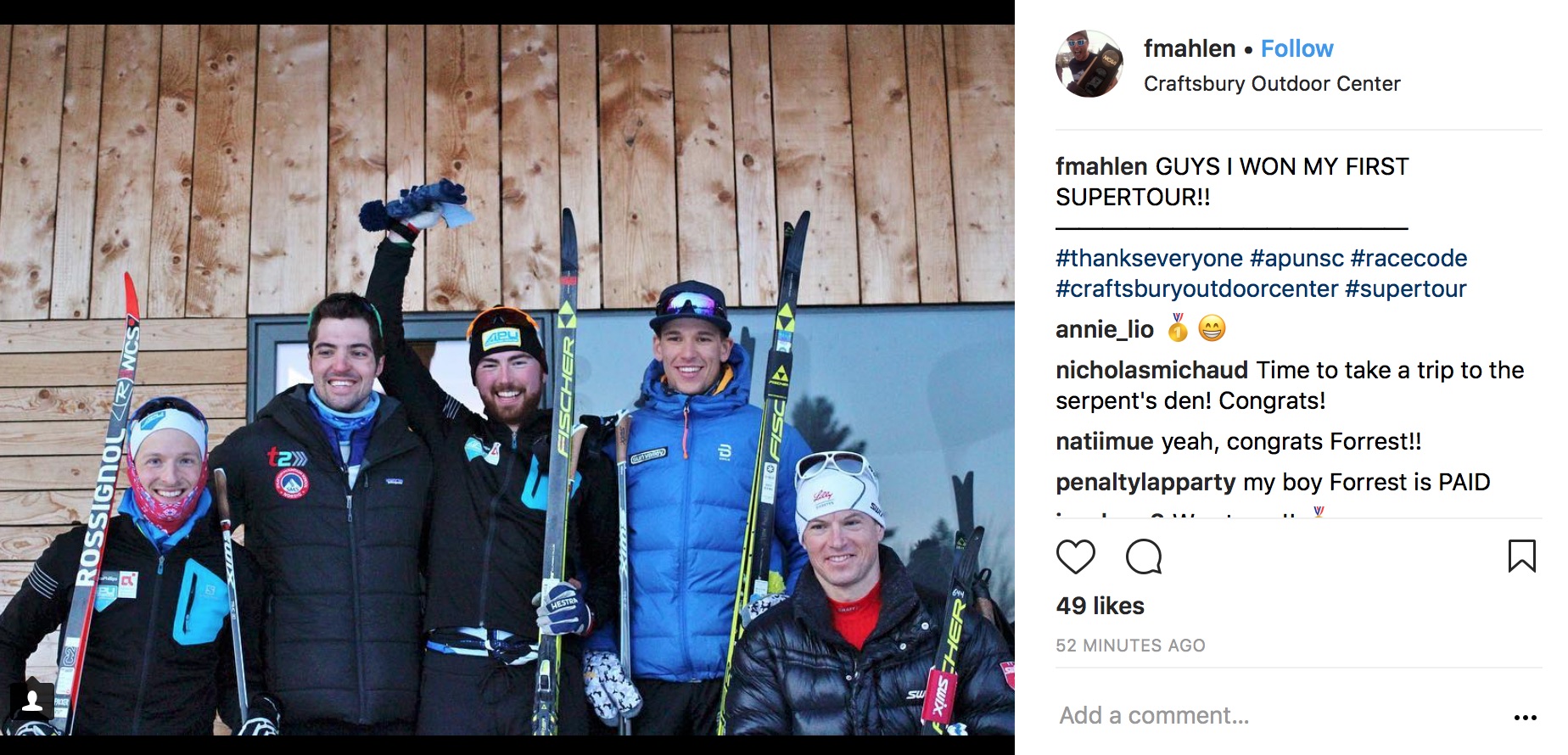
    Forrest Mahlen (APU) celebrates his first time atop the SuperTour podium on Friday after winning the men’s 1.4 k classic sprint final in Craftsbury, Vermont. (Photo: Forrest Mahlen/Instagram)

    Kaitlynn Miller and Forrest Mahlen won their respective classic-sprint finals at Friday’s SuperTour in Craftsbury, Vermont.

    The 1.4-kilometer classic sprint kicked off a three-day race weekend at the Craftsbury Outdoor Center. On Saturday, the Craftsbury Marathon will be held (not a SuperTour event), followed by 5/10 k freestyle SuperTour races on Sunday.

    Miller, of the Craftsbury Green Racing Project, started Friday by winning the women’s qualifier. She went on to win both her quarterfinal and semifinal before topping the final as well in 3:40.9 minutes. Also on Friday, it was formally announced that Miller was named to the U.S. Cross-Country Ski Team’s Olympic squad, which will compete in PyeongChang, South Korea, Feb. 10-25.

    Kelsey Phinney, of the Sun Valley Ski Education Foundation (SVSEF), placed second in the women’s final, 0.63 seconds back, and Felicia Geisor (CXC Team) was third (+1.67). Erika Flowers, of the Stratton Mountain School (SMS) T2 Team placed fourth (+3.2), Canada’s Olivia Bouffard-Nesbitt (Rocky Mountain Racers) — fresh off NorAm Western Canadian Championships last weekend in Alberta — finished fifth (+5.46), and Alaska Pacific University (APU) skier Rosie Frankowski (who also made the U.S. Olympic team) placed sixth (+6.27).

    On the men’s side, APU’s 24-year-old Mahlen qualified fifth, then won his quarterfinal and semifinal before taking the final for his first-career SuperTour win in 3:06.81. Ben Saxton (SMST2) initially won the qualifier and won his quarterfinal as well before placing second to Mahlen in the first semifinal. Saxton ended up 0.55 seconds back in second place in the final, just three-hundredths of a second ahead of Kevin Bolger (SVSEF) in third place (+0.58). Another half second back, Kris Freeman followed in fourth, just 1.09 out of first, Eric Packer (APU) was fifth (+1.39) and Canada’s Andy Shields (Lappe Nordic), who also competed at Western Canadian Championships last weekend) sixth (+8.99).

    Results: Brackets

    ***

    The men’s 10 k sprint podium at IBU Open European Championships, with Latvia’s Andrejs Rastorgujevs (c) in first, Russia’s Alexander Loginov (l) in second, and Bulgaria’s Krasimir Anev (r) in third. (Photo: IBU/Biathlonworld)

    IBU Open European Championships (Ridnaun-Val Ridanna, Italy): Men’s and women’s sprints

    Canada’s Macx Davies led the North Americans on Friday on Day 2 of the International Biathlon Union (IBU) Open European Championships in Ridnaun, Italy, placing 27th in the men’s 10-kilometer sprint with 9-for-10 shooting (1+0). Davies finished 1:32.3 minutes behind Latvia’s Andrejs Rastorgujevs, who took the win in 24:03.0 with a single penalty as well (0+1).

    Russia’s Alexander Loginov placed second, 5.5 seconds back, with one penalty (1+0), and Bulgaria’s Krasimir Anev shot clean to finish third (+24.5).

    “At the [last] World Cup in Anterselva [Italy], I have had a difficult time in the shooting range, and so I spent a lot of time in the last few days working on my shooting,” Rastorgujevs told the IBU after. “Today it was clear that all this hard work paid off. It is also a great motivator for Olympic gold.”

    For Davies, who’s also headed to the Olympics next month, the result tied his best individual result this season after he placed 27th in an IBU Cup sprint earlier this month in Osrblie, Slovakia.

    Canada entered four in the men’s race, with Carsen Campbell finishing 75th (+2:34.6) with one miss (0+1), Aidan Miller placing 91st (+3:18.2) with three penalties (1+2), and Matt Hudec finishing 119th (+4:31.6) with four misses (1+3).

    Five American men raced, with Alex Howe finishing 53rd (+2:15.1) with one penalty (1+0), Jake Brown 84th (+3:02.0) with four misses (1+3), Jakob Ellingson 85th (+3:07.0) with one miss (1+0), Max Durtschi 111th (+3:50.1) with four misses (3+1), and Paul Schommer 114th (+3:59.8) with four penalties (2+2) as well.

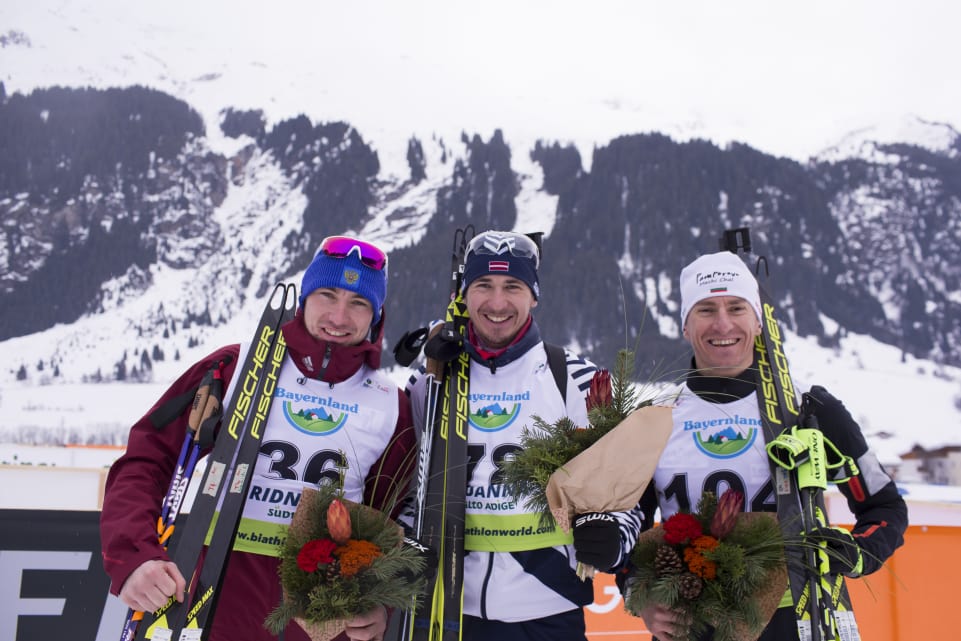
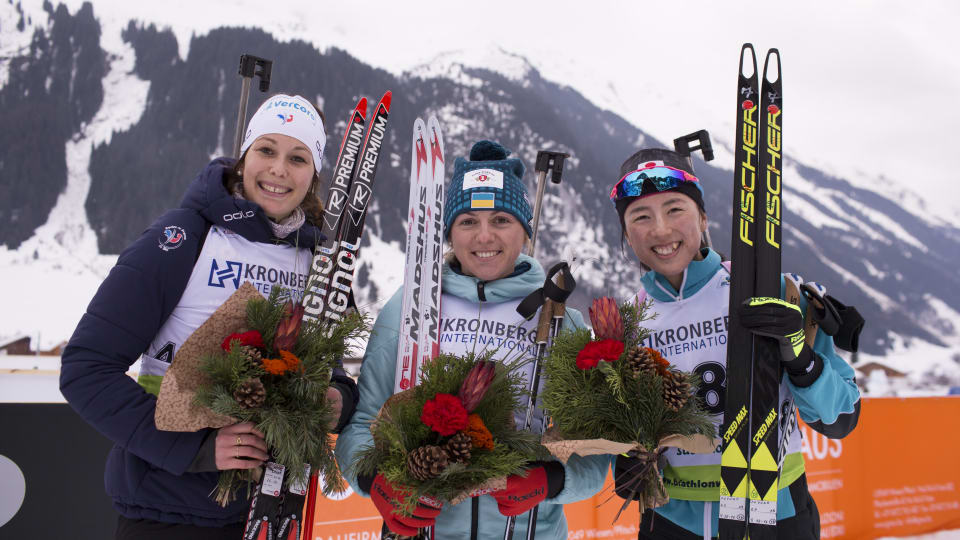
    The women’s 7.5 k sprint podium at IBU Open European Championships in Ridnaun, Italy, with Ukraine’s Iryna Varvynets (c) in first, France’s Chloé Chevalier (l) in second, and Japan’s Fuyuko Tachizaki (r) in third. (Photo: IBU/Biathlonworld)

    In the women’s 7.5 k sprint that followed, Chloe Levins of the U.S. was the top North American in 59th, 2:01 behind the winner Iryna Varvynets of Ukraine. Varvynets shot clean and posted the fastest finishing time of 20:54.1, 12.5 seconds faster than France’s Chloé Chevalier, Wednesday’s 15 k champion who had one miss (0+1) on Friday and ended up second. Japan’s Fuyuko Tachizaki reached the podium in third (+15.5) and was one of four women in the top five that shot clean (only Chevalier did not).

    “After the individual competition on Wednesday, I was not at all happy with my shooting,” said Varvynets, who placed fifth in the 15 k. “Today I therefore concentrated especially hard in the shooting range. It was my luck that not many finished without errors, otherwise it would probably not have been enough for the victory.”

    “Two races, two medals — it could not have gone better for me,” Chevalier said. “In the standing shooting I missed the first disc and got a little nervous, but thankfully, there were no further errors.”

    Tachizaki called the bronze medal a “big dream come true”.

    “The focus of my season had been the Olympics and I ‘only’ took part in Ridanna as part of the preparations, but with this result I have exceeded everything I have achieved so far,” she said. “At the end of the race I did not only fight hard in the track, I was already dreaming of a medal. Now I’m in seventh heaven.”

    Levins had one miss in each stage (1+1), as did fellow American Maddie Phaneuf, who finished 63rd (+2:19.0) with two penalties. Clare Egan followed in 70th (+2:34.2) with four misses (3+1), Deedra Irwin was 85th (+3:38.1) with four penalties (1+3) as well, and Jennie Bender 97th (+5:52.8) with six misses (3+3).

    Two Canadians started the race, with Sarah Beaudry finishing 76th (+3:02.9) with four misses (1+3). Erin Yungblut did not finish.

    Open European Championships continue Saturday with the men’s and women’s pursuits. The top 60 from the sprint qualify, which, for the North Americans, means Davies, Howe, and Levins.

    The championships end Sunday with single mixed and mixed relays.

    Results: Men | Women

  • Sunday Rundown: Falun, Duszniki-Zdrój, & The Marcialonga (Updated x4)

    Sunday Rundown: Falun, Duszniki-Zdrój, & The Marcialonga (Updated x4)

    Emil Iversen celebrates his win in the 30 k classic mass start in Falun, Sweden, on Sunday. Norwegian teammate Martin Johnsrud Sundby finished second and Sweden's Calle Halfvarsson third.
    Emil Iversen celebrates his win in the 30 k classic mass start in Falun, Sweden, on Sunday. Norwegian teammate Martin Johnsrud Sundby finished second and Sweden’s Calle Halfvarsson third.

    FIS Cross-Country World Cup (Falun, Sweden): 15 / 30 k classic mass start

    Women’s reportMen’s report

    In the women’s 15-kilometer classic mass start on Sunday, Norway swept the podium with Marit Bjørgen taking the win in a time of 41:28.8 in Falun, Sweden. Crossing just half a second behind her was her teammate, Ingvild Flugstad Østberg in second place. Rounding out the podium was Heidi Weng in third (+8.1).

    American Jessie Diggins was the first to cross the line for the U.S. in 10th (+1:37.5). Three other U.S. women finished in the top 30, with Sadie Bjornsen finishing 21st (+2:43.6), Rosie Brennan 24th (+2:57.0), and Liz Stephen in 29th (+3:24.5).

    Just outside of scoring World Cup points was American Caitlin Patterson in 32nd (+3:47.6) and Ida Sargent in 34th (+4:02.8). Canada’s Cendrine Browne finished 46th (+5:41.4) and American Liz Guiney 49th (+6:22.6).

    After losing the skate sprint yesterday in a photo finish to Italy’s Federico Pellegrino, Emil Iversen ascended to the top step of the podium in the men’s 30 k classic mass start on Sunday in Falun.

    The Norwegian was often near the front, but hadn’t tried to lead a breakaway like his teammates Martin Johnsrud Sundby and Sjur Røthe did earlier in the race. In the final two kilometers, Sundby – the overall World Cup leader – put in a sprint to try to drop the field. But Iversen caught up, drafting his veteran teammate into the stadium. In the final up-and-over before the finish line, Iversen made a pass and then accelerated down the finishing stretch to beat Sundby by 1.14 seconds.

    “I got motivation from yesterday’s last 20 meters,” Iversen told FIS in a finish-line interview. “So today I fought all the way, and I was really stronger. It is amazing for me to be second yesterday and first today. I’m really proud of that.”

    Calle Halfvarsson, who had been falling off the back of the lead pack just a few kilometers earlier, managed to get back to the front and claim third place for Sweden (+1.72 seconds) in a photo finish with Røthe (+1.76 seconds). Niklas Dyrhaug was next (+2.52 seconds) to give the Norwegian men’s team four in the top five.

    In his return to the World Cup stage, Norway’s Petter Northug finished 31st (+3:10.6).

    Alex Harvey was the lone Canadian on the start line. After skiing near the front of the field for the early part of the race he was dropped by the lead pack in the final kilometers, finishing 15th (+1:17.5).

    Erik Bjornsen and Noah Hoffman took 35th and 37th places for the United States, finishing +3:30.8 and +3:59.8, respectively. SuperTour leader Matthew Gelso — familiar with the Falun course after competing in 2015 World Championships — finished 44th (+5:23.6), and Andy Newell placed 53rd (+7:45.3).

    Results: Men | Women

    ***

    IBU Open European Championships (Duszniki-Zdrój, Poland): Single mixed & mixed relay

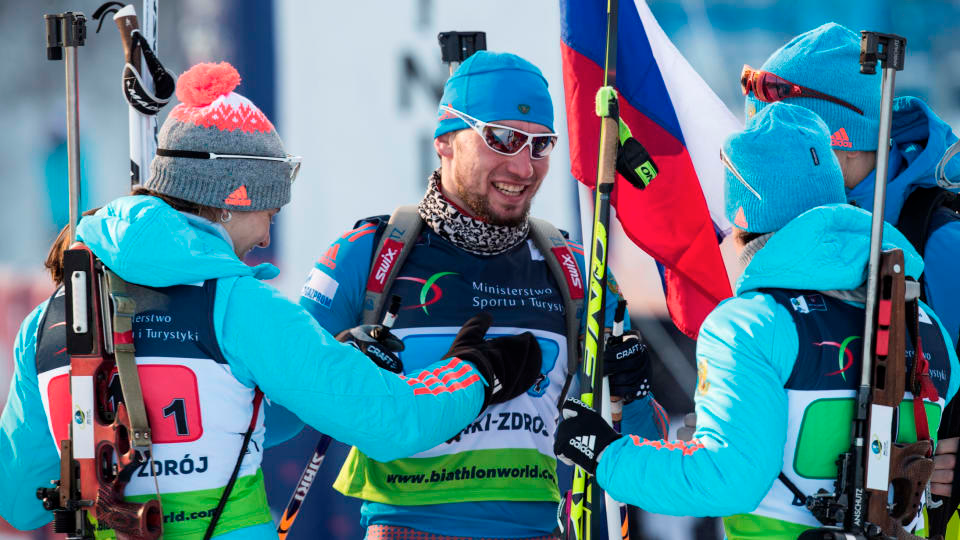
    Russia’s Alexander Loginov (center) is greeted at the finish by his teammates Irina Starykh, Svetlana Sleptsova and Alexey Volkov after anchoring his team to the gold medal in the mixed relay at the 2017 IBU Open European Championships in Duszniki-Zdrój, Poland. (Photo: IBU)
    Russia’s Alexander Loginov (center) is greeted at the finish by his teammates Irina Starykh, Svetlana Sleptsova and Alexey Volkov after anchoring his team to the gold medal in the mixed relay at the 2017 IBU Open European Championships in Duszniki-Zdrój, Poland. (Photo: IBU)

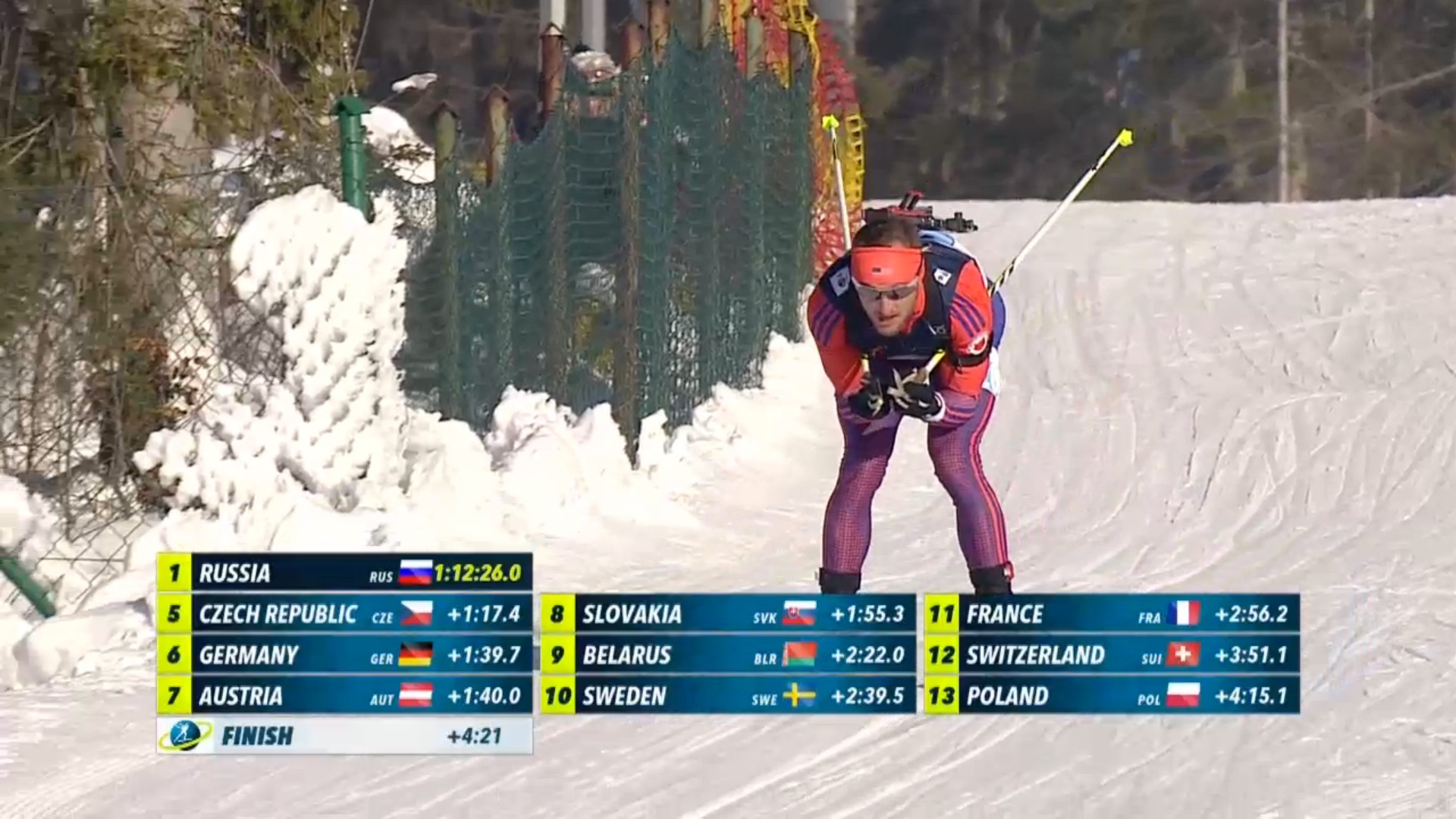
    [UPDATED] The Russian victory in the final 2 x 6 + 2 x 7.5-kilometer mixed relay event of the 2017 International Biathlon Union (IBU) Open European Championships in Duszniki-Zdrój, Poland, was only briefly in doubt, when Alexander Loginov skiing the anchor leg required all spares in his prone shooting stage. But with his final shot he managed to also hit that target to avoid the penalty lap, leaving the range with a lead of more than 30 seconds.

    Loginov then did not need any spares in the last standing stage, and could take his time on the final loop. Unlike Russia’s Evgeniy Garanichev earlier in the day during the single mixed relay, he also managed to pick up a flag for the final meters of the race, crossing the line in a time of 1:12:26.0 hours.

    The Russian team with Irina Starykh, Svetlana Sleptsova, Alexey Volkov and Loginov led from the first exchange and required only six spares with zero penalties.

    With this medal, the 28-year-old Volkov became the most successful athlete in history at European Championships, according to an IBU press release, surpassing the retired Polish biathlete Tomasz Sikora. Russia was the most successful team of the 2017 Open European Championships with six gold, four silver, and three bronze medals.

    Behind them, a number of teams vied for the positions on the podium. Sweden initially looked like a strong contender exchanging in second place after the women, but fell back with three penalty laps to only finish 10th.

    Still six seconds back after the final shooting, Norway’s Fredrik Gjesbakk caught up to and outsprinted Ukraine’s Ruslan Tkalenko in the finishing stretch to claim the silver medal (+36.4) with the bronze left for Ukraine (+37.1).

    “I thought that I made sufficient gap to win silver,” Tkalenko told the IBU. “But in the end, on the final downhill before the finish, I was very surprised when the Norwegian guy passed me, I truly did not expect that.”

    The Norwegian team with Karoline Erdal, Marion Rønning Huber, Erlend Bjøntegaard, and Gjesbakk needed nine spares and had no penalties.

    Ukraine with Anastasiya Merkushina, Yulia Dhzyma, Oleksander Zhyrnyi (who originally started for Russia before making the switch in 2014) and Tkalenko required six spares, and Dhzyma had to ski a penalty lap only temporarily setting the team back.

    Bulgaria finished fourth (+1:16.4), with its anchor Vladimir Iliev narrowly beating Czech Republic’s Lukas Kristejn (+1:17.4) in the finishing stretch. Both teams needed 11 spares and had no penalties.

    Jakob Ellingson skiing the anchor leg for the U.S. mixed relay at the 2017 IBU Open European Championships in Duszniki-Zdrój, Poland. The U.S. team finished 14th. (Photo: IBU/Eurovisionsports.tv screenshot)
    Jakob Ellingson skiing the anchor leg for the U.S. mixed relay at the 2017 IBU Open European Championships in Duszniki-Zdrój, Poland. The U.S. team finished 14th.
    (Photo: IBU/Eurovisionsports.tv screenshot)

    Starting at the back of the field in bib 20, US Biathlon’s Emily Dreissigacker got her team off to a strong start with a clean prone shooting and one spare round in standing, exchanging in 10th, a minute behind the leaders. Hallie Grossman needed one spare in each of her stages, tagging off to the men in 14th position and now 2:39 behind. Max Durtschi also had one miss each in prone and standing, coming into the last exchange still in 14th position, but another minute back. Jakob Ellingson required all three of his spares in his prone shooting stage narrowly avoiding the penalty lap, and one more in his final shooting stage. As the team from Finland was racing over a minute behind the Americans, he was able to keep the 14th position into the finish (+4:47.4), with a team total of nine spares and no penalties overall.

    For Biathlon Canada, Erin Yungblut starting in bib 19 shot clean in her prone stage and required two spares in her standing shooting, tagging off in 18th position and more than two minutes back from first. Leilani Tam von Burg stayed clean in her prone shooting stage and needed one spare in standing, moving up two positions to exchange in 16th place, yet more than four minutes behind the leaders. After the exchange to the men, both Matthew Neumann and anchor Carsen Campbell managed to shoot clean in all of their stages, but lost additional time on the course to finish 16th (+6:39.9) ahead of four lapped teams.

    Canada had the best shooting result of all 20 teams starting the relay, with just three spares and no penalty.

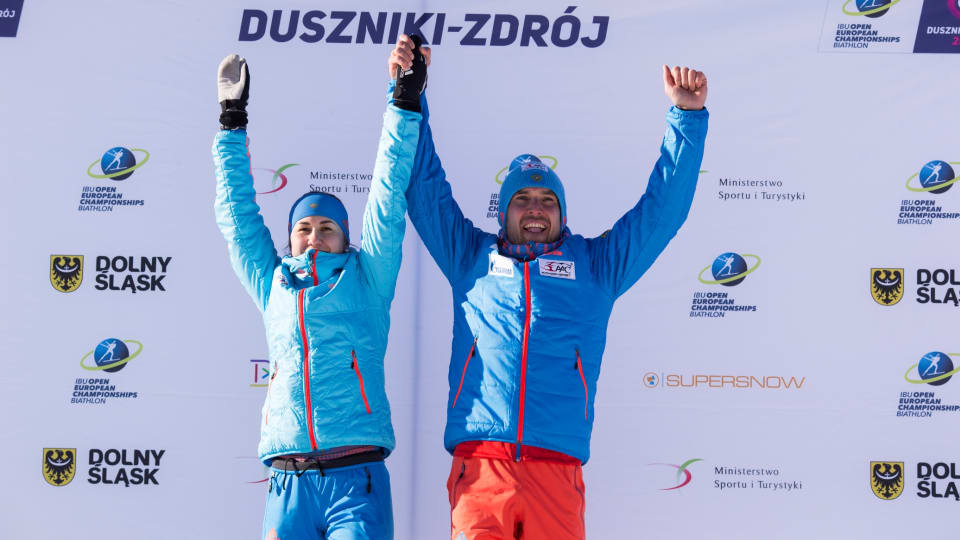
    Russia’s Daria Virolaynen (l) and Evgeniy Garanichev after winning Sunday's single mixed relay at the 2017 Open European Championships in Duszniki-Zdrój, Poland. (Photo: IBU)
    Russia’s Daria Virolaynen (l) and Evgeniy Garanichev after winning Sunday’s single mixed relay at the 2017 Open European Championships in Duszniki-Zdrój, Poland. (Photo: IBU)

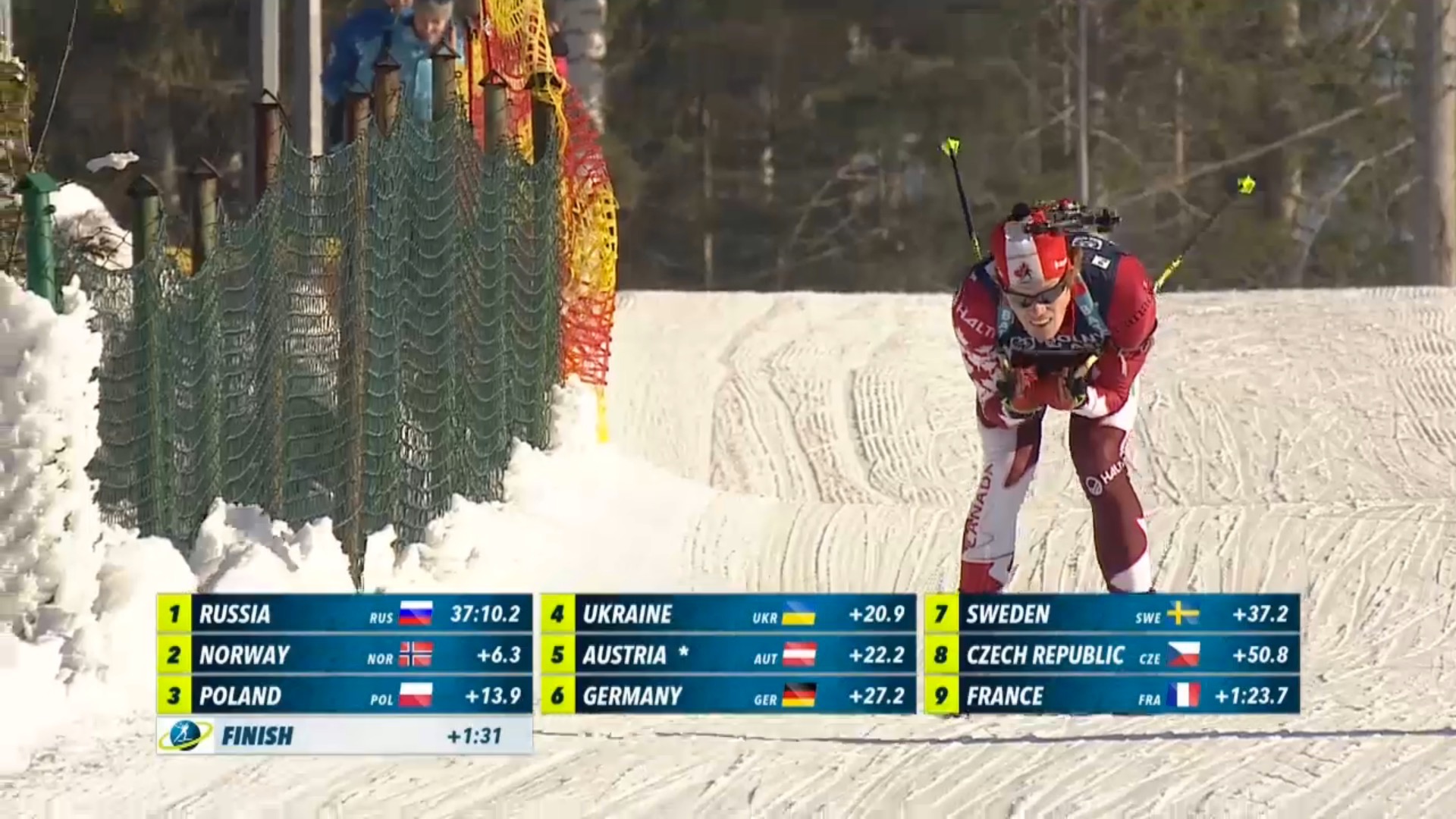
    Earlier on Sunday, pretty much the only thing that went wrong for Russia’s Daria Virolaynen and Evgeniy Garanichev in the single mixed relay happened on the last meters of the finishing stretch, with Garanichev gesturing for a Russian flag he wanted to cross the line with. But the handoff was too short and the flag dropped past his outstretched hand to the snow. He glanced back, weighing if his lead was big enough to ski back, but decided it was not worth the risk, instead skiing into the arms of his partner waiting for him behind the line in a time of 37:10.2 minutes.

    Russia needed seven spare rounds and incurred zero penalties. Garanichev secured the victory in the final shooting, when he only needed one spare – albeit fumbling a few seconds to insert it – while his direct opponents standing next to him required more time to hit their targets.

    “Probably, I took some risk at the last standing,” Garanichev said, according to an IBU press release. “I wanted to shoot fast and clean, but missed with the last shot. But in general, I felt very comfortable; came and worked at the range in my rhythm.”

    6.3 seconds behind, Norway with the team of Ingrid Landmark Tandrevold and Vetle Sjåstad Christiansen placed second, with seven spares and zero penalties.

    “These are very short loops,” Christiansen commented on the fairly new, single mixed relay format. “You feel the pressure from the crowd and to shoot fast every time.”

    The 20-year-old Tandrevold previously earned three bronze medals, including one in the single mixed relay, also with Christiansen, at last year’s Open European Championships in Tyumen, Russia.

    To big cheers from their home crowd fans who had come out to the Duszniki Arena in beautiful but cold weather, the Polish husband-and-wife team of Krystyna Guzik and Grzegorz Guzik placed third with just five spares and zero penalties (+13.9), not quite able to keep up with Christiansen on the final loop after leaving the range together within a second.

    “It is so nice to win a medal here in Poland,” Krystyna Guzik said. “We were both very disappointed with all of our mistakes in the other competitions. So today, we were relaxed and laughing before the competition, hoping not to have those mistakes again. We did not … and now have a medal.”

    It was the first medal for Poland at these championships.

    Ukraine with Iryna Varvynets and Andriy Dotsenko finished fourth, also with five spares and zero penalties (+20.9).

    Biathlon Canada’s Aidan Millar skiing the final loop of the single mixed relay at the 2017 IBU Open European Championships in Duszniki-Zdrój, Poland. With teammate Sarah Beaudry, Canada finished 13th (Photo: IBU/Eurovisionsports.tv screenshot)
    Biathlon Canada’s Aidan Millar skiing the final loop of the single mixed relay at the 2017 IBU Open European Championships in Duszniki-Zdrój, Poland. With teammate Sarah Beaudry, Canada finished 13th (Photo: IBU/Eurovisionsports.tv screenshot)

    For Biathlon Canada, Sarah Beaudry and Aidan Millar required seven spares during their race and had no penalty, just like the winning Russians and Norwegians, but could not quite keep up with the best teams on the course in the fast-paced race format with short loops somewhat comparable to a team sprint in cross-country.

    Beaudry cleaned her first shooting stage and then needed one spare to hit all targets in standing. At the first exchange Canada was 10th, 35.8 seconds behind the then leading team from Poland.

    Millar missed one shot in his first prone stage, leaving the range again in ninth position. Then he needed two spares in his standing shooting on the way to exchanging back to Beaudry in 11th (+56.4).

    On her second leg, Beaudry had one miss in prone and required two spares in standing, falling back a bit to exchange in 13th (+2:12.0).

    On his final leg, Millar was able to shoot clean in both stages, reducing the time gap to the top but not able to make up another position, and finished in 13th place (+1:56.1).

    US Biathlon is only represented with two women at the Open European Championships in Poland, and decided to forgo a start in the single mixed relay, instead entering a team in the mixed relay later on Sunday.

    — Harald Zimmer

    Results: Mixed relay |  Single mixed relay 
    ***

    Marcialonga (Val di Fiemme, Italy)

    Katerina Smutna (left) and Tord Asle Gjerdalen (right) of Team Santander won the 2017 Marcialonga. (Photo: Visma Ski Classics)
    Katerina Smutna (left) and Tord Asle Gjerdalen (right) of Team Santander won the 2017 Marcialonga. (Photo: Visma Ski Classics)

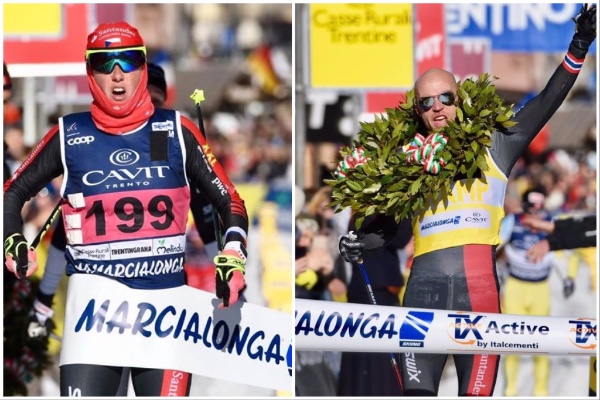
    Tord Asle Gjerdalen won the Marcialonga, a Worldloppet and Swix Ski Classics marathon for the third time – in a row. This year was on a shortened course, “just” 57 rather than the traditional 70 kilometers.

    The Team Santander athlete finished in two hours, eight minutes, and 36 seconds, edging Johan Kjølstad (Team United Bakeries) and Morten Eide Pedersen (Team BN Bank) in a sprint finish by 2.6 and 2.9 seconds, respectively.

    Tyler Kornfield and David Norris of Alaska Pacific University finished 43rd (+5:03.8) and 66th (+10:43.1). Canadian Paralympian Brian McKeever finished 57th (+9:13.5) and guide Graham Nishikawa 81st (+12:56.5), followed by Ian Murray in 85th (+13:37.5) and Erik Carleton in 111th (+17:50.2).

    In the women’s competition, Katerina Smutna, also of Team Santander, won her third straight Ski Classics competition. She crossed the line in two hours, 22 minutes, and 46.4 seconds. Britta Norgren of Team Lager 157 was second by just 0.8 seconds, and Sara Lindborg (Team Serneke) third, +4:22.2. University of Utah alum Maria Graefnings was tenth, +10:35.8.

  • Sunday Rundown: Davos, Pokljuka & Sovereign Lake (Updated x3)

    Sunday Rundown: Davos, Pokljuka & Sovereign Lake (Updated x3)

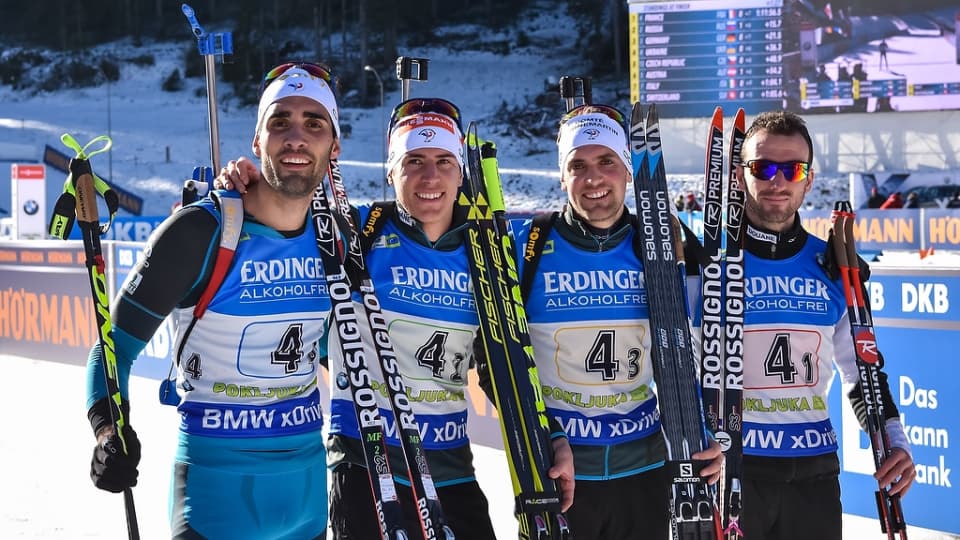
    The French men's relay team after their IBU World Cup win on Sunday in Pokljuka, Slovenia, with (from left to right) Martin Fourcade, Quentin Fillon Maillet, Simon Desthieux, and Jean-Guillaume Béatrix. They beat Russia by 15.7 seconds for the win. (Photo: IBU)
    The French men’s relay team after their IBU World Cup win on Sunday in Pokljuka, Slovenia, with (from left to right) Martin Fourcade, Quentin Fillon Maillet, Simon Desthieux, and Jean-Guillaume Béatrix. They beat Russia by 15.7 seconds for the win. (Photo: IBU)

    Welcome to The Rundown, your quick primer of need-to-know information about the day’s racing. We’ll be updating this digest as the day goes on with additional results, photos and quotes. The Rundown is NOT a race report; stay tuned for complete race reports later today with interviews from the day’s top racers.

    ***

    Note: This recap has been updated to reflect the correct positions each of the four Canadian women exchanged in during Sunday’s 4 x 6 k IBU World Cup relay. 

    IBU World Cup in Pokljuka: Men’s & Women’s Relays

    Germany and France reached the podium in both the men’s 4 x 7.5-kilometer and women’s 4 x 6 k sprints on Sunday, the final day of the International Biathlon Union (IBU) World Cup in Pokljuka, Slovenia.

    France won the men’s race by 15.7 seconds over Russia with a total of seven spare rounds and zero penalties. Jean-Guillaume Béatrix started off by putting the French team in fourth, then Quentin Fillon Maillet elevated them to first, a position both Simon Desthieux and Martin Fourcade held for the victory in 1:11:56.5.

    “When we started the relay, we thought that winning was possible,” Béatrix said, according to an IBU press release. “At the same time, the competition was very tough. There were many strong teams today.”

    “I was very happy to tag Martin with a 20-second lead,” Desthieux said. “This is good for my confidence.”

    Russia placed second with Maxim Tsvetkov, Anton Babikov, Matvey Eliseev, and Anton Shipulin, the four of which combined for one penalty (on Eliseev’s third leg) and six spare rounds.

    Germany rounded out the podium in third, 21.5 seconds behind France, with Erik Lesser, Matthias Dorfer, Benedikt Doll, and Simon Schempp. In ninth after Lesser’s first leg, Dorfer brough the team to eighth and Doll raced them into second before Schempp lost one place to end up third. They used a total of 11 spares but avoided the penalty lap.

    Canada placed 10th of 22 teams, 1:44.7 out of first with one penalty and seven spares. Christian Gow started the team out with clean shooting and tagged off in sixth at the first exchange, and his older brother Scott Gow also shot clean without any spares to move up to fourth at the second tag. Macx Davies required three spares and had to ski a penalty lap on his prone stage, then used another spare to clean standing and tagged off in 14th place. Brendan Green anchored the Canadians to 10th, using three spares but avoiding a penalty in prone, then cleaning standing without any spares.

    “I had a somewhat disappointing pursuit race yesterday, and my goal for today was to refocus on the range and push the ski speed as much as possible,” 28-year-old Scott Gow told Biathlon Canada, according to a press release. “I was happy with the overall performance I was able to put forward for my leg of the relay, and I was especially happy with another clean shooting day.

    “Today was an acceptable result for the team,” he added. “Christian and I are very proud of our results so far this season. We worked very hard all year to try and elevate our racing abilities to the next level, and we saw our hard work pay off today with great skiing and perfect shooting for both of us. It’s also a big confidence boost going forward with the season knowing we are capable of competing among the best.”

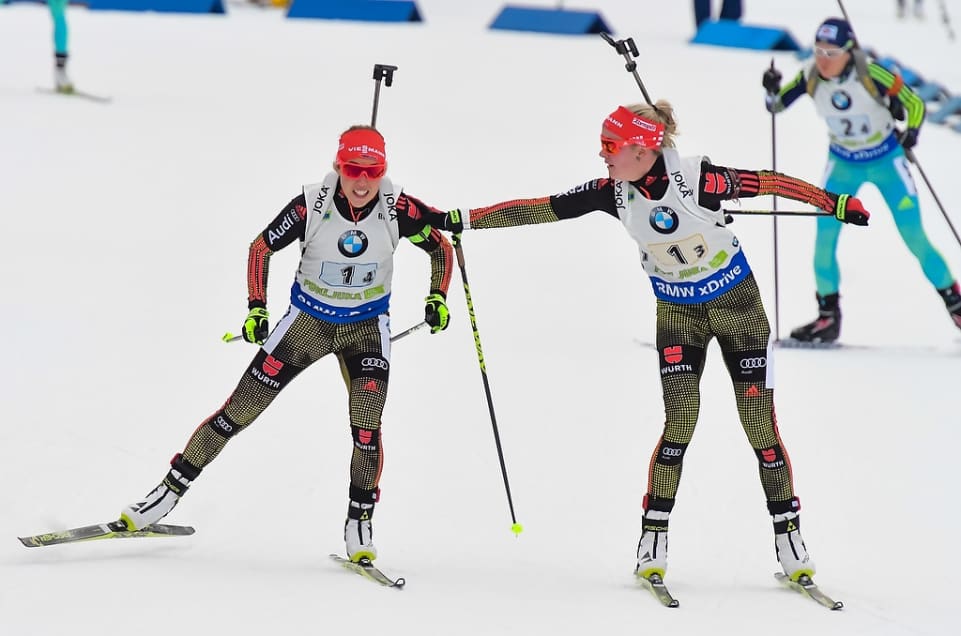
    Germany's Karen Hammerschmidt (l) tagging her teammate Laura Dahlmeier in second place at the final exchange of the women's 4 x 6 k relay at the IBU World Cup in Pokljuka, Slovenia. Dahlmeier anchored the team to the win by 10.1 seconds over France. (Photo: IBU)
    Germany’s Karen Hammerschmidt (l) tagging her teammate Laura Dahlmeier in second place at the final exchange of the women’s 4 x 6 k relay at the IBU World Cup in Pokljuka, Slovenia. Dahlmeier anchored the team to the win by 10.1 seconds over France. (Photo: IBU)

    In the women’s relay on Sunday, Germany took first by 10.1 seconds over France, using nine spares but no penalties.

    Vanessa Hinz started the Germans out and tagged off in fifth, and second-leg Franziska Hildebrand moved them up into second by the halfway point. Karen Hammerschmidt held that position, which was enough for Laura Dahlmeier who anchored them to the win in 1:11:31.1.

    “This was a brutally beautiful race today,” Dahlmeier told German broadcaster ZDF after her third win in as many races in Pokljuka. “It was very fun, and I was very relaxed because I knew we were competing as a team. Even if you don’t have as much power left there are still three others. I was on top of my game and just enjoyed it. I really looked forward to the race, although yesterday I was knocked out. But on the course I had a good feeling right from the start.”

    France in second and Ukraine in third (+37.7) both required just three spare rounds and no penalties per team. France secured second place with Anais Chevalier (who initially tagged off in 11th), Justine Braisaz (who picked off eight places to move into third), Celia Aymonier (who tagged off in first), and Marie Dorin Habert (who cleaned without any spares but came up 10 seconds short of Dahlmeier at the finish).

    Ukraine reached the podium with Iryna Varvynets, Yuliia Dzhima, Olena Pidhrushna, and Anastasiya Merkushyna.

    Canada placed 11th (+3:33.1) with a total of just four spares and no penalties. Sarah Beaudry initially tagged off in 23rd, Rosanna Crawford skied them into 18th, Megan Tandy shot clean without any spares and tagged off in 14th, and Julia Ransom anchored them to 11th out of 23 teams.

    The U.S. did not field a men’s or women’s relay team, with just three men and three women in Pokljuka.

    Results: Men | Women

    ***

    FIS Cross-Country World Cup in Davos: Freestyle Sprints

    In the men’s 1.6-kilometer freestyle sprint on Sunday it was Russia’s Sergey Ustiugov who emerged victorious, besting Finn Hågen Krogh of Norway and his Norwegian teammate Sindre Bjørnestad Skar for first.

    After qualifying 29th overall, Ustiugov crossed first in his quarterfinal and held the led through his semifinal and into the final, winning in a time of 2:24.65. Krogh crossed 0.59 tenths of a second behind him for second place and Skar took the final podium spot, crossing 3.29 seconds after Ustiugov.

    Also in the sprint final was Russia’s Alexey Petukhov, who finished just off the podium in fourth (+3.47), Norwegian Emil Iversen in fifth (+5.52) and France’s Lucas Chanavat  who won the qualifier — ended the day in sixth (+11.48).

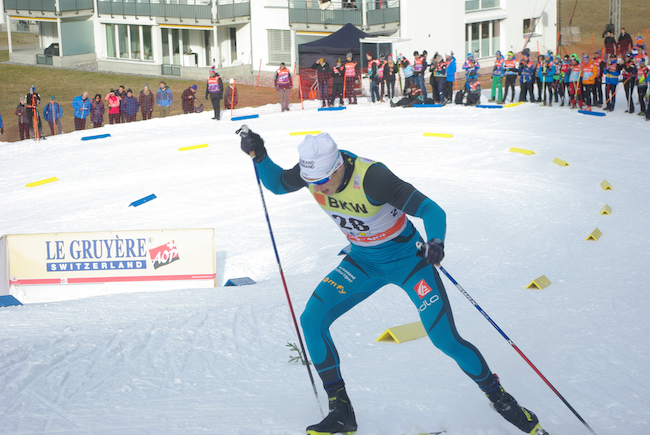
    Lucas Chanavat of France had the fastest men's qualifying time in the Davos World Cup freestyle sprint on Sunday.
    Lucas Chanavat of France had the fastest men’s qualifying time in the Davos World Cup freestyle sprint on Sunday.

    Canada’s Lenny Valjas was the top North American finisher for the day, qualifying 12th and advancing to the quarterfinals where he finished in 14th overall. No other Canadians made the sprint heats, with Alex Harvey left just outside advancing in 33rd, Devon Kershaw ending the day in 49th, Knute Johnsgaard 60th, Bob Thompson 67th, and Andy Shields 73rd. Jesse Cockney did not finish the race.

    Simi Hamilton led the U.S. in 24th (+3.88). Andy Newell was just outside the heats in 36th, and Eric Packer placed 95th (+21.62).

    In the women’s 1.6 k freestyle sprint, Maiken Caspersen Falla of Norway took the overall win, crossing in a time of 2:44.63. Just 0.53 tenths of a second behind Falla was her Norwegian teammate Ingvild Flugstad Østberg in second place overall. The final women’s podium finisher, Hanna Falk of Sweden was 0.60 tenths of second off Falla in third.

    U.S. Ski Team member, Jessie Diggins made the final, racing to a fifth place overall (+5.91), behind Sweden’s Jonna Sundling in fourth (+1.04) and ahead of Russia’s Natlalia Matveeva in sixth (+6.80).

    The United States put three other women into the heats, including Sophie Caldwell who finished 11th, Sadie Bjornsen 15th, and Ida Sargent 20th.

    American Caitlin Patterson ended the day 47th, Kikkan Randall 58th, and Liz Stephen 61st.

    Dahria Beatty was the top Canadian on Sunday, finishing in 25th overall. Cendrine Browne ended the day 53rd and Sophie Carrier-Laforte 59th.

    Qualifier Results: Men | Women

    Final Results: Men | Women

    ***

    NorAm/SuperTour at Sovereign Lake: 10/15 k Freestyle

    [UPDATE] It was Americans owning the podium again Sunday at Sovereign Lake, and a little bit more. It was warmer on Sunday, -7 Celsius, and snowed lightly throughout.

    The men’s 15 k freestyle was first on the schedule.  APU’s Scott Patterson won in 40:00.2, followed by Saturday’s A-finalist Matt Gelso at 13.2 seconds and Vail’s Tad Elliot at +26.6.

    The top Canadian was Team R.A.D.’s Russell Kennedy in ninth, at 1:38.8 behind.

    In the women’s 10 k freestyle, the podium was owned by APU’s Chelsea Holmes in 30:42.9. SMS Elite’s Katharine Ogden was second at 13.4 seconds, also winning the junior category. Her teammate Erika Flowers was third, 36.4 behind.

    AWCA’s Olivia Bouffard-Nesbitt was the top Canadian for the second day, placing 13th at 1:51.8.

  • Under Darkness, Czech Women Win Presque Isle Relay; U.S. 10th for Season Best

    Under Darkness, Czech Women Win Presque Isle Relay; U.S. 10th for Season Best

    The Czech Republic women's team, which won the 4 x 6 k relay on Saturday at the IBU World Cup in Presque Isle, Maine, with (from left to right) Eva Puskarcikova, Gabriela Soukalova, Lucie Charvatova, and Veronika Vitkova. (Photo: IBU/NordicFocus)
    The Czech Republic women’s team, which won the 4 x 6 k relay on Saturday at the IBU World Cup in Presque Isle, Maine, with (from left to right) Eva Puskarcikova, Gabriela Soukalova, Lucie Charvatova, and Veronika Vitkova. (Photo: IBU/NordicFocus)

    “It’s good to try a romantic atmosphere,” World Cup leader Gabriela Soukalová of the Czech Republic joked about the dark and cold course conditions at the end of the International Biathlon Union (IBU) World Cup women’s 4 x 6-kilometer relay in Presque Isle late Saturday afternoon, when the sun had long set behind the trees and hills of northern Maine for the final 6 k. “I appreciate it so much. I was thinking about my boyfriend,” she said in an post-race team interview with the IBU.

    “Candles…” her teammate Eva Puskarcíková added.

    The Czech women had every reason to be in a good mood. In the final race before the upcoming IBU World Championships in Oslo, Norway, their team had asserted its intention to be on the podium there in March, achieving the first relay victory of the season in a time of 1:07:11.0, with one penalty and 14 spare rounds.

    After narrowly avoiding a penalty lap in the last shooting, anchor Veronika Vítková had a large enough lead to ski to the side of the track and look for a national flag for the final stretch, but none was immediately available from coaches or fans, so she celebrated across the line just by raising her arms, before her teammates hugged her at the finish.

    The women’s relay was moved up from Sunday to Saturday due to extremely cold temperatures in the forecast, with a start time of 4:10 p.m. following the men’s relay, giving the athletes the rare experience of racing in the dark on the final loops, dimly lit by portable lights on a few sections of the course. (Evening Biathlon World Cup races are occasionally on the schedule, for example in Oberhof, Germany, but that course is equipped with large fixed floodlights.)

    With the athletes emerging from the darkness into the slightly brighter Nordic Heritage Center stadium, the race for second and third place on the podium was decided in an exciting sprint finish between the relays from Germany, Ukraine, and Poland.

    Germany’s exhausted anchor Karolin Horchler tried to rescue her once-comfortable lead after the final shooting that had diminished precariously into the finish, with a double-pole effort on the final meters before she collapsed across the line.

    Ukraine’s Olena Pidhrushna passed her with quick skating steps to claim second place, 25.2 seconds behind the winners, with a team total of zero penalties and 12 spares. Pidhrushna edged Horchler by just 0.2 seconds as the Germans took third (+25.4), with one penalty and seven spares, after erasing a 30-second deficit on the final loop. Poland’s Krystyna Guzik came into the finish narrowly off the podium in fourth place (+26.0), with a team total of zero penalties and seven spares.

    The U.S. with Susan Dunklee, Hannah Dreissigacker, Clare Egan and Annelies Cook finished the race in 10th (+2:12.4), with one penalty and 12 spare rounds. It was their best result in a women’s relay this season.

    Czech Republic joins this season’s other podium finishers — Ukraine, Italy, France, Germany, and Russia — as the favorites for the women’s relay in Olso, with a few more “dark horses” also in the mix.

    After the flower ceremony, several women fielded questions at the indoor post-race press conference, still wearing protective tape on their cheeks and noses.

    “Today’s race was very hard because of the very big cold,” Czech Republic’s starter Puscarcíková said. “My fingers were frozen. But I am happy we are first again. Last year we won in Oslo this time of the year. It’s very fantastic and unbelievable for me.”

    “I had trouble because I shot my third bullet under the target,” Lucie Charvatová explained at the press conference. She had a penalty on her second relay leg and fell back to 11th, before tagging off 47.7 seconds back in ninth place. “After that I was so, so nervous. I ran fast and tried to do the best I could. But I am also happy.”

    “I don’t know what I can say,” World Cup leader Soukalová said at the press conference, trying to explain how she had moved her team back into first place on the third leg, following two straight individual wins in Presque Isle. “It was a really fantastic weekend. It’s amazing. I was feeling really good during the race. I don’t remember when I [last] have been in the same shape. It’s a perfect performance before the World Championship.”

    “It was very hard because on the track it was dark,” Vítková recalled of the anchor leg and the final shooting. “I have seen nothing. On the shooting range, too. And I was a little bit nervous, because I needed three extra [rounds of] ammunition.”

    Ukraine, winner of the relay in Ruhpolding, Germany, earlier this season, was in fourth place with its lineup of Iryna Varvynets, Natalya Burdyga, Juliya Dzhyma and Pidhrushna for most of the race, before Pidhrushna moved her team up with the fastest skiing on the last loop, and beat Germany at the line.

    “It’s difficult to recall a relay that was so close and tough,” a smiling Dzhyma said during the press conference, through a translator. “Maybe the one in Hochfilzen [where Ukraine finished third, though with a much larger gap to second and fourth place]. It was really interesting and tough, not just because of the close results, but also because of the frost in this cold weather. In the end we are really happy to be in second, and to be on the podium.”

    “At the beginning of my leg, I couldn’t see any uphills, any downhills,” anchor Pidhrushna explained, via a translator. “It was like racing blind. When I came to the shooting range, my only thought was to shoot clean and not go to the penalty loop.”

    “It’s already a legend,” a happy Pidhrushna later added in an interview with the IBU when asked about her final loop. “It was again a funny situation after the last shooting. I had no idea which place I was in, going away from the shooting range. One of our staff members shouted so loud, then I realized I was somewhere close, because I couldn’t see the screen, I couldn’t see anything because it was already dark. I just had to think that I was close so I had to fight for it again.”

    “Krystyna [Guzik] from Poland was behind me, and we were running so fast to chase the German girl,” she explained. “But I couldn’t even think of doing that, actually.”

    “I didn’t know what was happening behind me, I just tried to race,” Germany’s Horchler told ARD, after she had advanced her team from fifth to second, requiring one spare in prone and staying clean in her final shooting. “But I had brutal pain in my shins, and was already pushing into the downhill. I am really annoyed by that two-tenth of a second [at the finish]. But I am just pleased about my 0-5 shooting in standing, because with that I settled a few things in this competition so the relay could still make the podium.”

    “Hats off to the organizers,” she added. “They put up makeshift lanterns, and I am happy about my prescription lenses in my glasses, otherwise it would not have been possible for me to see anything.”

    “I as very nervous, because it’s been a long time since I took the starting position,” Germany’s Franziska Preuss said at the press conference. “The last time was Sochi [2014 Olympics, where Preuss crashed and got snow into her rifle sights, falling back far, as German failed to medal for the first time in an Olympic women’s relay]. But now I am really happy that it was a good race for me… I think nobody expected Germany on the podium today.”

    Germany started a lineup without Franziska Hildebrand and Laura Dahlmeier, their two highest-ranked athletes on the World Cup.

    “Temperatures were better today than yesterday,” second leg Luise Kummer told ARD. “We feared it would become really cold by now, but today it was bearable. And the audience is really participating with the action, so it was definitely fun. You actually get warm during the race. One would not believe that, in training we were also worried. But in normal competition it is no problem at all.”

    “I just could not handle the standing position on the range here, and unfortunately also not today,” Germany’s third leg Miriam Gössner, who had her team’s penalty, told ARD. “I don’t know why. I really tried to do my best. In the prone shooting and out on the course I felt really, really good. So I think I could compensate for that penalty lap fairly well.”

    Poland, with Magdalena Gwizdon, Monika Hojnisz, Weronika Nowakwska, and Guzik (formerly Palka) finished just 0.4 seconds off the podium, after losing the sprint against Ukraine and Germany.

    “We had to fight not only with our rivals, but mainly with low temperatures,” Hojnisz later posted on Facebook, according to a translation, after she had avoided a penalty in her first prone shooting but lost about 45 seconds to the top. “I was not the best link in today’s relay, so thank you girls for your faith and fight to the last meter.”

    “I held her until the end of the climb and tried to overtake on the flats,” Guzik said of Pidhrushna on the last loop, as told to Polish sports website SportoweFakty, according to a translation. “Unfortunately, none of the three attempts worked. Olena took it well tactically. It is a pity that the course was not a little bit longer, because I could fight to the finish. … I am sad that I could not lead us to a medal. We need this podium in the relay. I still believe that soon we will succeed.”

    A number of teams started different lineups than they will likely have at World Championships, including France, which won the previous relay in Antholz, Italy, but on Saturday gave its top athlete, Marie Dorin Habert, a break. France finished sixth (+48.2), with one penalty and 13 spares, after Anaïs Chevalier had tagged her teammate Justine Braisaz in second place at the last exchange.

    U.S. Achieves Season-Best 10th

    Susan Dunklee (US Biathlon) racing the first leg of the women's 4 x 6 k relay on Saturday at the IBU World Cup in Presque Isle, Maine. Her team went on to place 10th for a season best. (Photo: USBA/NordicFocus)
    Susan Dunklee (US Biathlon) racing the first leg of the women’s 4 x 6 k relay on Saturday at the IBU World Cup in Presque Isle, Maine. Her team went on to place 10th for a season best. (Photo: USBA/NordicFocus)

    Coming off a historic week for US Biathlon with Dunklee’s silver medal in the sprint and fifth place in the pursuit, the team’s leading woman was picked to start Sunday’s relay (after racing the second leg in the three prior relays this season), followed by Dreissigacker, Egan and Cook.

    “We are still experimenting with the order,” Dunklee wrote in an email. “Last week’s mixed relay went well with myself leading and Han [Dreissigacker] going second so we tried that again.”
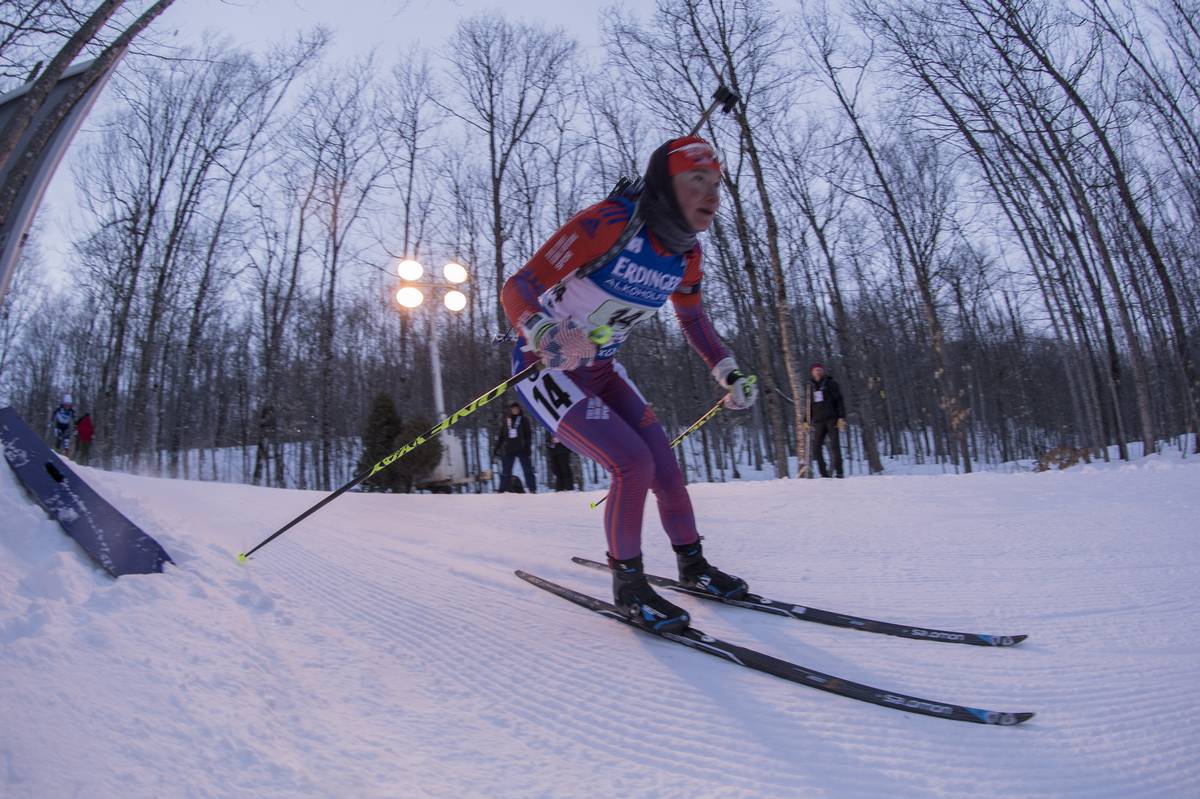
    As for moving the race up to Saturday, Dunklee wrote, “I think most athletes would agree that moving the race to today was the right call in light of the cold forecast.”

    But that made for a pretty hectic race day for the women, as they had very little time to prepare with the men’s relay only wrapping up about an hour before their own.

    “Today was a great opportunity for dealing with unusual challenges on race day,” Dunklee explained. “We had some struggles getting to the venue on time, then I had a broken firing pin right before zero [target practice to adjust the rifle sights before the start], which is very tricky to replace, and finally 13 minutes before the start, I heard that the course got changed and didn’t get to preview it.”

    “With the short turn around from the guys race, we only had 25 minutes to zero 4 people,” she continued. “I didn’t fit in more than 10-15 minutes of skiing warmup, a new record for me. Dealing with chaos is an extremely important skill for a biathlete to have and we all did well today in spite of the challenges.”

    Dunklee’s performance didn’t seem to suffer much despite those unusual circumstances, she she used just one spare to clean the first prone stage, and another two in her standing bout. She also skied the fastest course time of all starters in 13:55.4, and second-best among every woman in the relay, behind France’s anchor, 19-year-old Braisaz.

    Hannah Dreissigacker racing the second leg of the U.S. women's 4 x 6 k relay on Saturday at the IBU World Cup in Presque Isle, Maine. Her team went on to place 10th for a season best. (Photo: USBA/NordicFocus)
    Hannah Dreissigacker racing the second leg of the U.S. women’s 4 x 6 k relay on Saturday under darkening skies at the IBU World Cup in Presque Isle, Maine. Her team went on to place 10th for a season best. (Photo: USBA/NordicFocus)

    Dunklee tagged off to Dreissigacker in fourth, only back 11.1 seconds behind Switzerland’s Selina Gasparin, who was then leading the pack (Switzerland went on to finish 12th).

    For Dreissigacker, a regular member of the U.S. relays last year including at 2015 World Championships, it was her second World Cup relay of the season after spending some time on the second-tier IBU Cup, before returning to the World Cup in Canmore, Alberta, and Presque Isle, where she most recently placed 27th in the sprint and 24th in the pursuit.

    Like Dunklee, she didn’t let the stressful race preparation get to her.

    “It was definitely a little bit rushed today before the race for everyone,” she wrote in an email. “We had to rearrange things and it got a bit hectic. But it was fine for me anyways… a good adrenal warm-up, as I like to call it!”

    Dreissigacker needed one spare in prone and two in standing, just like Dunklee, and lost a little more time on the course, handing off in seventh, 43.7 seconds behind the leaders.

    “I am a little disappointed that I didn’t hit my last standing shot, and then took two spares to hit it, but it could have been worse!” Dreissigacker wrote. “I had a good battle with Austria [Lisa Theresa Hauser] and France [Anaïs Bescond] at the end of my leg which was fun and made me go hard.”

    Egan, who had started the prior relay for the U.S. in Antholz, moved back to the third leg, which she had also raced in Ruhpolding and Hochfilzen earlier this season.

    Clare Egan (US Biathlon) during her standing stage of the women's 4 x 6 k relay at the IBU World Cup in Presque Isle, Maine. Her team went on to place 10th for a season best. (Photo: USBA/NordicFocus)
    Clare Egan (US Biathlon) during her standing stage of the women’s 4 x 6 k relay at the IBU World Cup in Presque Isle, Maine. Her team went on to place 10th for a season best. (Photo: USBA/NordicFocus)

    In Presque Isle, she had finished 32nd in the sprint and 23rd in the pursuit. She continued her solid recent shooting performances in Saturday’s prone stage, cleaning her targets to leave the range in seventh position (+41.4).

    After moving up to sixth place on the next loop, Egan came into the standing stage fighting for position with France, Ukraine and Austria. There she was unable to hit her last target with her three spares, having to ski through the 150-meter penalty lap.

    “The conditions for my standing shooting were fine, I am just not as solid in standing as I am in prone,” Egan wrote in an email. “I missed two from the clip and then fired the first spare accidentally before I was ready. Then I had two bullets for two targets and unfortunately I only hit the first one. I should have taken more time to make a perfect hit on my last shot.”

    She left the range in 12th, and tagged off to Cook in that position, having lost an additional minute to the leaders by the exchange (+1:50.6).

    Just like it was for her teammates, Cook’s race leadup was a bit hectic.

    “The preparation was actually funny today,” Cook wrote in an email. “I did not get to ski the course before the race started, and the girls actually had to tell me that they took out a sketchy corner, so I had never even done our course before I was on it racing it.”

    On the shooting range, she matched the performance of Dunklee and Dreissigacker, requiring one spare in her prone stage and two in standing, but had to overcome an additional challenge: the sun had set when the anchors were on their relay legs, and large sections of the course had fallen into darkness.

    “I was glad that nothing crazy happened on the downhills because it was definitely a shadowy course, not like the huge floodlights that we are accustomed to,” Cook explained. “But I didn’t mind. It reminded me of how night races were growing up at my local ski area, with little light bulbs hanging over the course. The range was a bit dark and the big movie screen flashed really brightly while I was shooting prone, so the light changed drastically and suddenly and that was distracting. But it worked out okay.”

    She was able to overtake two more relays, moving the U.S. up to 10th in the finish. The U.S. women were satisfied with their result, though believed there was still additional room for improvement.

    “As a team, we all had okay shooting performances and it is exciting to see us move up so much already even without a great day,” Dunklee concluded. “Oslo will be exciting.”

    “I think we are all happy with 10th since its our best relay of the year, but we also know we can do better and today was a good sign of that!” Dreissigacker wrote.

    “Despite my penalty lap this was the best relay result we have had with this group of four athletes,” Egan explained. “Our previous best was 12th which we got twice last year (World Cup 6 Antholz, World Championships). It is also a season best. Of course we can still do better and intend to do so in Oslo.”

    “I still know we can do better in the relay, but it is a hard, hard thing for everyone to have stellar races on the same day,” Cook concluded. “And luckily, we know that all we have to do is have a good normal day and we can be right up there.”

    With Some New Faces, Canada 17th

    Without Rosanna Crawford and Julia Ransom, Canada did not have two women in Presque Isle who will likely be part of the women’s relay at World Championships in Oslo. Crawford and Ransom started in all three other relays this season where the team finished 10th in Hochfilzen, and ninth in both Ruhpolding and Antholz.

    In addition the team is missing Megan Tandy, who recently broke her wrist in Canmore, Alberta.

    Instead, with veteran Zina Kocher (in her third relay this season), Emma Lunder (who had one relay start before in Hochfilzen), Audrey Vaillancourt and Erin Yungblut struggled on Saturday, quickly falling to the back of the field, with Kocher having to ski a penalty loop in her first prone.

    After leaving the range in 16th out of 17 teams (with Norway and Slovakia pulling their teams before the start due to illness), Canada was never able to catch back up to the top 10, losing time to the leaders as the race progressed.

    Kocher tagged off to Lunder 2:14.3 back, who then incurred another penalty in her prone stage (1+3, 0+1) to exchange 4:28.1 back in 17th place.

    Vaillancourt then put in a strong performance on the range with two clean shooting stages, but was slower on the course and passed on the penultimate loop by the leading teams. She handed off to anchor Yungblut 6:38.6 back.

    After requiring three spares to hit her targets (0+1, 0+2), Yungblut then was taken out of the race and scored as lapped in 17th position before her final loop.

    On to Oslo 

    The athletes will now have two weeks of additional training and preparation, before traveling to Norway for the World Championships, beginning on Thursday, March 3 with the mixed relay.

    Results

  • Ukraine’s Relay Shuts the Door on Germany; Canada 9th; USA 16th 

    Ukraine’s Relay Shuts the Door on Germany; Canada 9th; USA 16th 

    Ukraine's Olena Pidhrushna (l) boxing out Germany's Laura Dahlmeier in the final meters of the women's 4 x 6 k relay in front of a packed Chiemgau Arena at the IBU World Cup in Ruhpolding, Germany. (Photo: IBU/Ernst Wukits)
    Ukraine’s Olena Pidhrushna (l) boxing out Germany’s Laura Dahlmeier (r) in the final meters of the women’s 4 x 6 k relay in front of a packed Chiemgau Arena at the IBU World Cup in Ruhpolding, Germany. (Photo: IBU/Ernst Wukits)

    It’s not often that you can hear catcalls and booing in a ski stadium. A football, basketball or soccer game maybe, but biathlon? On Sunday, 20,000 spectators packed the Chiemgau Arena in Ruhpolding, Germany, and many were not pleased with how the IBU World Cup women’s 4 x 6-kilometer relay played out. Just before the finish, Ukraine’s anchor Olena Pidhrushna, skiing in first, cut off local fan-favorite Germany’s Laura Dahlmeier to claim the ideal left lane in the final stretch. That ended Dahlmeier’s furious chase on the last loop to finish, and Ukraine took the win by 1.2 seconds in 1:16:14.2.

    Ukraine, with Iryna Varvynets, Yuliia Dzhyma, Valj Semerenko, and Pidhrushna, incurred one penalty lap and only needed four spare rounds (three prone and one standing), while Germany, with Karolin Horchler, Miriam Gössner, Maren Hammerschmidt and Dahlmeier, had two penalties and required eleven spares (six prone, five standing), but the latter three athletes all skied the fastest course times on their legs to make up the deficit.

    Behind them, Dorothea Wierer anchored Italy — which had no penalties and used 10 spares — to third (+43.8), about a second of Russia’s Olga Podchufarova, after the Russians had two penalties and required seven spares. Thus the same teams that had already been on the podium after the first relay of the season December in Hochfilzen, Austria, made it again, except Italy and Ukraine swapped positions.

    Teams from 22 countries started on Sunday and 17 finished without being lapped.

    Canada, with Julia Ransom, Rosanna Crawford, Megan Tandy, and Zina Kocher, placed ninth (+1:59.5) with no penalties and seven spare rounds, while the U.S., with Annelies Cook, Susan Dunklee, Clare Egan, and Joanne Reid, finished 16th(+5:39.8) with three penalties and eleven spare rounds.

    ‘Of course you are angry in the moment’

    At first, Dahlmeier was visibly annoyed about the end of the race, after she erased a 27.7-second gap on the last leg (and was still 9.2 seconds behind heading into the last loop). After getting blocked she switched back to the middle lane, but once she realized she couldn’t beat Pidhrushna, Dahlmeier stopped pushing and slammed her right pole into the snow across the finish.

    “The final loop was really hard. Of course you are angry in that moment, after going at full throttle for 6 kilometers, and then it fails on the last few meters,” said Dahlmeier, who anchored Germany to a relay gold at 2015 World Championships, told TV broadcaster ZDF. “But we can be very, very happy about the second place, especially with the penalty laps that were shot, and with this lineup. I think that’s really nice, and a beautiful finish for the days in Ruhpolding.”

    “It was a hard last loop,” Pidhrushna said at the post-race press conference through a translator. “I know Laura is a really good skier, and I knew that I would have to fight for every meter. I am really happy that the team won. I just held the shortest line to the finish. I really wanted to win; it was a big battle but it is sport.”

    After seeing a replay again, Dahlmeier agreed in a later interview with ZDF: “That was all correct, you can’t say anything against that. For me, it’s too bad; it didn’t help to switch lanes, and then it was already all over. Maybe I have to train a little bit with the cross-country skiers, pick up some things on how they solve sprints in order to become better.”

    “That’s biathlon, that’s the race,” her teammate Hammerschmidt said at the press conference. “It was the same in Hochfilzen [where Germany lost a finishing sprint to Italy], maybe in the next relay we are first. But I think it was OK, and the girls [from Ukraine] make a good job, congratulations to the first place.”

    The German athletes did not complain for long, knowing their day could have ended much worse after second leg Gössner incurred two penalty laps earlier in the race, at that time falling back to 15th position with the podium seemingly out of reach.

    (Story continues below)

    The women's 4 x 6 k relay podium at the IBU World Cup in Ruhpolding, Germany; with Ukraine (c) in first, Germany (l) in second, and Italy (r) in third. (Photo: IBU/Ernst Wukits)
    The women’s 4 x 6 k relay podium at the IBU World Cup in Ruhpolding, Germany; with Ukraine (c) in first, Germany (l) in second, and Italy (r) in third. (Photo: IBU/Ernst Wukits)

    Race Day

    Several teams had opted to rest good athletes for Sunday’s relay at the end of a long block of races, including Germany. Franziska Hildebrand, who already won two World Cups this season, had asked her coaches for a break, and then Vanessa Hinz also had to defer her relay start due to a cold, while teammate Franziska Preuss missed the entire Ruhpolding weekend with a hairline fracture in her tailbone.

    That prompted the coaches to change their second-place relay from Hochfilzen on three positions, and make a call to Karolin Horchler, 26, who originally had other plans for Sunday:

    “[Saturday] afternoon I had been on my way to Ridnaun, South Tyrol [Italy], because I was supposed to compete there in an IBU Cup mixed relay today,” Horchler told ZDF. “And shortly before the arrival Gerald [Hönig, women’s head coach] called me and said I should please turn around. All in all, it was on the road for five hours… To start here in my second home in Ruhpolding, that’s what I always dreamed of.”
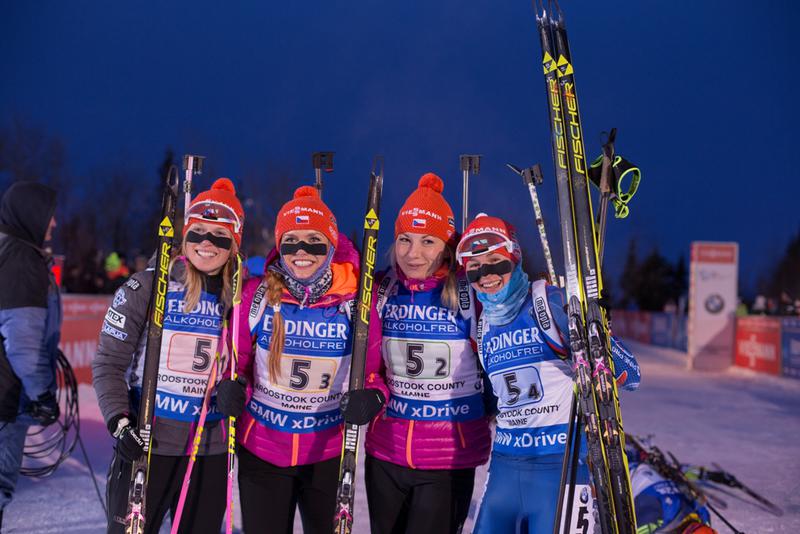
    “It’s surely not a very common lineup,” coach Hönig told ZDF before the race. “But in general our expectation is that any relay team we start contends for a spot on the podium.”

    Similar to Germany, the Czech Republic chose to rest overall World Cup leader Gabriela Soukalová, France rested Marie Dorin-Habert, currently second place in the World Cup standings, Italy’s Federica Sanfilippo sat out the relay, and Austria’s top skier Lisa Theresa Hauser missed it as well. Finland didn’t enter a team, missing their best athletes Kaisa Mäkäräinen and Marie Laukanen.

    The newly called-up Horchler began the race well for her team, skiing at a pace that allowed her to stay in contact with the best and requiring only one spare each in prone and standing. She tagged off in fifth place, 22 seconds behind Norway’s Marte Olsbu in the lead, with Ukraine’s Varvynets in second after shooting clean.

    “It was a really crazy day, in the morning I heard that I can start here. The second place is very good for the team. It’s wonderful,” Horchler said in the press conference after the race.

    “It’s surely not a very common lineup, but in general our expectation is that any relay team we start contends for a spot on the podium.” — German Women’s Head Coach Gerald Hönig

    Germany’s second skier, Gössner skied out fast on her first loop making up positions, but struggled in prone, missing two of her targets and quickly running out of spare rounds.

    “Trying to do everything especially well because it’s a relay is a fitting description,” Gössner told ZDF while the race was still going on, with tears welling up in her eyes. “I really can’t explain myself how I can shoot two penalty laps in prone. I didn’t have the feeling that conditions were difficult or that I was shaking… Then I was completely flustered, I didn’t know if that shot went left or right, just didn’t know where to aim.”

    After another fast loop, at least she was able to avoid the penalty lap in the standing position after requiring two spare rounds, usually her more shaky discipline, moving up to 13th place.

    “Without my two penalty laps a lot more would have been possible today,” a still-disappointed Gössner later told ZDF after the race. “Our luck was that the other nations also shot penalty laps, so the other two [teammates] could make up some time, and that saved us. But my race was absolutely not good.”

    “Yeah, she is very annoyed, but that’s relay,” said Hammerschmidt, who lifted Germany from 11th to second on the third leg. “That happens to everyone, but it’s all the better for her that we still got the second place. And I just told her she is allowed to say two more sentences about her shooting, and then we’ll call it a day.”

    “I just told her she is allowed to say two more sentences about her shooting, and then we’ll call it a day.” — Germany’s Maren Hammerschmidt, about her teammate Miriam Gössner

    While Gössner had been struggling on the range, Ukraine’s Dzhyma shot clean at the top of the field, and while not quite as fast as the German behind her, also skied the sixth-fastest time on her leg.

    “Our skis were really good today, thanks to the service team,” she said in the press conference. “I like the new [additional] snow better.”

    Hammerschmidt received the tag 1:48.8 minutes behind Ukraine in 11th place, then began a furious chase to get closer to the top again (“one of the best relay performances I can remember in quite a while” ZDF color-commentator Herbert Fritzenwenger commented).

    She missed two shots in her prone shooting stage, and then needed one more spare round in standing.

    “I have to say, I was a little too cautious there,” Hammerschmidt told ZDF. “I should have turned [on the sights] immediately but thought ‘maybe it will work,’ and when you think that it usually doesn’t. So I should have reacted earlier, I got pretty nervous there after the two misses. In standing I went with full risk, and thankfully only had to reload once.”

    Like Gössner, she skied the fastest course time of all athletes on her leg, and handed off to Dahlmeier in second place, 27.7 seconds behind.

    “Of course I would have liked to have a better starting position,” Hammerschmidt told ZDF during the race. “But maybe the pressure was off a little. I just wanted to do my own race, and see that I can catch a good pack. I had really good skis today, and felt good on the course. On the last loop I could catch one after another, that was such a great feeling. And then I was really surprised to be second in the finish.”

    Ukraine’s Semerenko skied the third leg, and at this point could have secured a large gap over the rest of the field. She narrowly missed her last shot in prone, but then the usually solid shooter was not able to clean the remaining target with her three spares, and had to ski a penalty lap. That opened the race back up as Belarus’ Nadzeya Pisareva overtook her and some other teams moving back within striking distance of the lead.

    “I had nothing left but to run faster,” Semerenko joked in the press conference, according to a translator.

    How quickly the fortune of a team in a relay can change was demonstrated once again after the next shooting. Pisareva and Semerenko each needed one spare in standing, with Semerenko still trailing by 9.8 seconds as she left the range. Then suddenly Pisareva completely ran out of energy, and could be seen trying to herringbone up the next hill without any glide.

    Semerenko quickly passed her, along with several other teams as well. At the bottom of the next climb, Pisareva stopped next to one of her coaches to exchange a few words, seemingly ready to quit the race, before continuing to ski again.

    The Belarusian tagged her teammate Darya Yurkevich 1:28.2 minutes behind in 11th place. Yurkevich would end up losing two more positions, finishing 13th (+2:40), despite Belarus posting one of the best shooting performances of the field for Belarus (no penalties, five spares).

    With Belarus now out of the picture, the race for the podium on the final leg came down to Ukraine, Germany (+27.7), Norway (+28.6), Italy (+42.4), Sweden (+43.0), Slovakia (+45.3), and Russia (+45.7), with more teams looming shortly behind.

    Dahlmeier set out at a fast pace to close the gap to Pidhrushna, and after both shot clean in prone, the lead had been reduced to 18 seconds. On the next loop, Dahlmeier stormed up the climbs and managed to catch Pidhrushna, overtaking her just before the shooting range. But while the Ukrainian stayed clean in the final standing stage, Dahlmeier required one spare, again falling behind by 9.2 seconds as they left the range.

    On the final loop, Dahlmeier had more problems catching up to Pidhrushna again, who managed to preserve her lead through the last flat section and descent into the stadium. Then the most talked-about scene of the race happened, and Ukraine prevailed in that final sprint.

    “I was pretty down on my strength, but too bad, at the end it went a little poorly,” Dahlmeier told ZDF. “Maybe I should have stayed behind her and then pick the middle lane. A little unfortunate. But still, considering how it looked initially, we are mega-happy about the second place. That was a grandiose success, and you really see what is all possible in a relay race.”

    After a number of changes between several countries vying for third place, Italy,

    with Lisa Vittozzi, Karin Oberhofer, Alexia Rungaldier and Wierer, beat out Russia’s Ekaterina Shumilova, Daria Virolaynen, Ekaterina Yurlova and Podchufarova in a second exciting finishing sprint by 1.1 seconds.

    “I think the relay is the work of the whole team, everybody has to do their best, it’s not only one man or one woman,” Wierer said in the press conference. “I was in the fourth position when I started, and I was a little bit worried because [there were] also Tiril [Eckhoff] and Laura. I hoped that I would shoot well. I was a little too fast in the standing so I missed the first one. But I was lucky that Tiril shot more misses than me. And then behind me was the Russian, and I was really nervous. I was sure that she will pass me on the finish line, but I gave everything and it was the third place, finally.”

    Norway was fifth (+1:11.5) with Marte Olsbu, Fanny Horn Birkeland, Synnøve Solemdal and Eckhoff combining for one penalty and 13 spares. Olsbu tagged the team in first after the first leg, and after Birkeland’s penalty on the second leg, Norway still remained in podium contention, picking off the places with Germany, until Eckhoff required all her spares on the last leg — three in prone, three in standing.

    Ahead of the upcoming World Championships at home in Oslo, the Norwegian women have not reached the podium since taking bronze at the 2014 Olympics, though they remain hopeful.

    “It may not look like we’re there yet, but we are good enough. It’s about getting the final touches in place,” Eckhoff told Norwegian broadcaster NRK.

    Canada in Top 10

    Canada's 22-year-old Julia Ransom (116) during the 2014 IBU Junior World Championships pursuit. (Photo: Katrina Howe)
    Canada’s 22-year-old Julia Ransom (116) during the 2014 IBU Junior World Championships pursuit. (Photo: Katrina Howe)

    For Canada, Ransom’s day began with tangle out of the start and a resulting broken pole, but she quickly received a replacement.

    “It caught me a little by surprise but I quickly realized that I needed to signal to someone for a spare,” Ransom wrote in an email to FasterSkier. “I was on the opposite side of the trail as all of the coaches, but one of our wax techs was somehow able to get a pole to me despite having a few girls between us. Unfortunately that little mishap put me to the back of the pack, but I was able to sneak my way back in there before the first shooting.”

    After the field had stayed closely together on the first loop, Ransom shot fast and accurately in the first prone, cleaning all five targets and leaving the range in fifth place. By the next timing point, she even had moved up to third.

    “I was stoked to be skiing with the top 3 girls! I felt strong and controlled on skis,” she wrote. “Unfortunately, I struggled with my [standing] spares and lost those leaders. I’m not letting that happen again next relay! “

    In her standing stage, Ransom initially missed just one shot, but then required all three spares to clean it and avoid the penalty lap. She fell back a few positions, and tagged off to Crawford in 11th place, 50.7 seconds behind Norway up front.

    Crawford shot flawlessly, cleaning both her prone and standing positions, something only 10 other athletes achieved on Sunday. When she left the range after the last stage she had moved her team back up to fifth place (+1:01.5), then only lost only a few more seconds on the final loop tagging Tandy still in fifth (+1:07.7), behind Slovakia and ahead of Norway.

    In the prone stage, Tandy missed two targets, then needed all three spares to clean them, leaving the range in 10th place (+1:17.1) with Germany still behind in 12th.  In standing, Tandy was able to stay clean, though she could not make up another position. But she also barely lost any more time, tagging off in 10th and 1:17.6 back.

    After being bounced from the World Cup mid-season, Kocher returned to Canmore, where she finished second in an IBU Cup sprint. (Photo: Pam Doyle)
    Kocher winning an IBU Cup sprint in Canmore, Alberta, last season. (Photo: Pam Doyle)

    Team veteran Kocher anchored the relay, and like her teammates, displayed a strong shooting performance. She cleaned prone, and then had only one miss in the final standing, leaving the range in the vicinity of a number of other teams fighting for position.

    “Last laps are usually my strength so I attacked leaving standing,” Kocher wrote in an email. “Unfortunately, just before the uphills the French competitor [Celia Aymonier] stepped on my pole and it broke, costing me metres of time. I got a pole fairly soon from Norway, but it was very short, and then for the last sprint to the finish switched it for my own pole from our coach Matthias [Ahrens]. But that cost us a potential top 6. Two broken poles for our team, crazy!”

    In the end, she finished the ninth for Canada, 1:59.5 minutes back, with no penalties and only seven spares. “Excellent momentum for going forward to next week’s relay for our team,” Kocher concluded.

    “Our team had a goal of collectively using 8 spares and stay in the top 10… We also wanted to beat Sweden to maintain our current Nation’s Cup position,” Ransom wrote.

    They achieved both those goals. The Nations Cup is its own end-of-season award by the IBU, but also determines the number of starting spots a country gets awarded for the next year. Germany is still in the lead after the races of this weekend, with Canada in 10th position and the U.S. in 15th.

    “I was proud of our women’s team today. We all had fairly solid races and had the potential for top 6; unfortunately Zina broke a pole on her last lap, which caused a fall and a few positions. I think we are all fired up for another exciting race next weekend,” Ransom added. “The crowds here in Ruhpolding were fantastic. They brought a lot of energy to the races and were devoted fans in even the worst conditions.”

    U.S. 16th with three penalties

    For the U.S. the relay got off to a difficult start, when Cook incurred a penalty lap in her first prone shooting, leaving the range in 20th position, 58.6 seconds back behind the leaders.

    “I was disappointed in myself today because I had a penalty in the first prone shooting that put me in the back of the pack,” Cook said in a US Biathlon press release. “I was unable to get the girls into a good starting position, although I had a lot of confidence in what could happen after that. It was a crazy day with lots of penalty loops happening to great teams and the standings changed a lot through the race.”

    After a better standing stage shooting where she only required one spare, Cook about kept her position but lost a few more seconds to the top (despite skiing the 14th best course time on her leg), tagging Dunklee in 21st (+1:38.4).

    Susan Dunklee (US Biathlon) skied the second leg for the U.S. women's relay on Sunday, picking off three places to bring them from 21st for 18th. They ultimately placed 16th. (Photo: USBA/NordicFocus)
    Susan Dunklee (US Biathlon) skied the second leg for the U.S. women’s relay on Sunday, picking off three places to bring them from 21st for 18th. They ultimately placed 16th. (Photo: USBA/NordicFocus)

    Dunklee, who had been the starter for several years, again moved to the second leg, the same order the team had experimented with in the relay in Hochfilzen. After needing one spare in the prone, she had moved up one position, but had lost additional time to the leaders (+1:58.8) despite skiing the fastest first loop.

    In standing, she again had to use one spare and left the range in 19th (+2:26.3). Dunklee barely lost more time on the final loop, and tagged Egan in 18th, having made up three positions on her leg, but almost losing another minute to the top, now 2:29.9 behind.

    On Sunday, Egan had one of her best recent shooting performances, cleaning prone and only requiring one spare round in standing.

    “I made a breakthrough in my standing shooting at the beginning of the winter, and I’m taking advantage of that newfound confidence. I have bad stages now and then but I am learning from each one and improving all the time,” Egan wrote in an email. “For example I missed 1,3 in the first two stages of Thursday’s Individual, but then pulled myself together and finished the race with 0,0 on the last two stages. Today I missed my last (10th) shot, which is a letdown, but I was able to hit it with my first spare round.”

    Clare Egan (US Biathlon) skiing the third leg of the 4 x 6 k relay on Sunday, bringing her team from 18th to 16th with just one spare round. (Photo: USBA/NordicFocus)
    Clare Egan (US Biathlon) skiing the third leg of the 4 x 6 k relay on Sunday, bringing her team from 18th to 16th with just one spare round. (Photo: USBA/NordicFocus)

    Out on the loop, Egan skied the 14th-fastest time of her leg, and was able to move her team up two positions, tagging off 2:45.4 minutes behind in 16th.

    “The conditions were relatively fast today,” she added. “It snowed a ton last night but we were lucky and it stopped during our race. Our wax staff gave me excellent skis this morning, but unfortunately I was not able to put them to very good use, as my body was not responding well at all.”

    In her first week with the World Cup team, Joanne Reid anchored the relay (in place of Hannah Dreissigacker, who skied that leg during the first relay of the season).

    “I think the reason the coaches put me last is because I don’t have the consistency or the experience of the rest of the team, and therefore any mistakes I made would be after they had already raced,” Reid wrote in an email.

    Reid emerged from prone having used just one spare, but then struggled in the final standing, running out of spare rounds and ultimately having to ski two penalty laps (0+1, 2+3).

    “Today I made what I assume is a classic error for a new biathlete coming in from pure skiing, and came into the range too hard in standing,” Reid explained. “I was intensely focused on catching the two teams in front of me, which was going well until I got to the range. It’s always hard to remember in the heat of the moment that your shooting is just as important as your skiing.”

    In her first IBU World Cup relay, Joanne Reid anchored the U.S. women's team to 16th with the 11th-fastest course time on that leg. (Photo: USBA/NordicFocus)
    In her first IBU World Cup relay, Joanne Reid anchored the U.S. women’s team to 16th with the 11th-fastest course time on that leg. (Photo: USBA/NordicFocus)

    “The pacing on that lap was certainly my mistake, and not just pacing, but the fact that I don’t have the shooting skill to handle as high of a heart rate or shoot at the same speed as the rest of the girls, not to mention I hand load spares much slower.”

    Overall, Reid skied the 11th-fastest course time.

    “It was definitely a fast course out there, but still very difficult. I can only imagine how tired the athletes are who have raced the entire world cup period, and also qualified for and raced the mass start this weekend,” she wrote. “For Susan to go out there and ski the fastest leg after all those races (and long ones besides) is incredibly inspiring to me, and I wish I could have given her a better performance on my end.”

    “I really enjoyed the course out there today — we were much luckier than everyone in the mass start to have such hard-packed conditions,” Reid added. “I think that’s the only 6 km I’ve ever skied in my life, so I wish I could compare it to something, but until I do a few more biathlons I have no reference point.”

    Reid finished in 16th for the U.S., ahead of Romania, with the other five teams behind them lapped.

    “We wanted to do better than last time (15th) but unfortunately we fell just short of that today,” Egan concluded in her email.

    “This team has so much potential and I really believe in that,” Cook said in a US Biathlon press release. “So many of the pieces are there and are also showing, but not quite enough of them to do what we are capable of. It is frustrating but it is also making us hungry to do better and we have another relay coming up next week.”

    “I think a team always goes into a relay with the hope that they can improve on their start position,” Reid wrote. “Obviously for us today, that didn’t happen, but I think we have a lot of the pieces right, and I’m certain this team (whether or not in the future it includes me), can have an incredible day.”

    The IBU World Cup now moves on to Antholz-Anterselva, Italy, where there will be another relay for the women and men on Sunday.

    Results

  • Nordgren’s Solid Shooting Lifts U.S. in Mixed Relay; Doherty Anchors Team to Seventh

    Nordgren’s Solid Shooting Lifts U.S. in Mixed Relay; Doherty Anchors Team to Seventh

    Leif Nordgren (US Biathlon) raced the third leg of Friday's IBU World Cup mixed relay to put his team in fourth heading into the final exchange in Nove Mesto, Czech Republic. The U.S. ended up seventh. (Photo: USBA/NordicFocus)
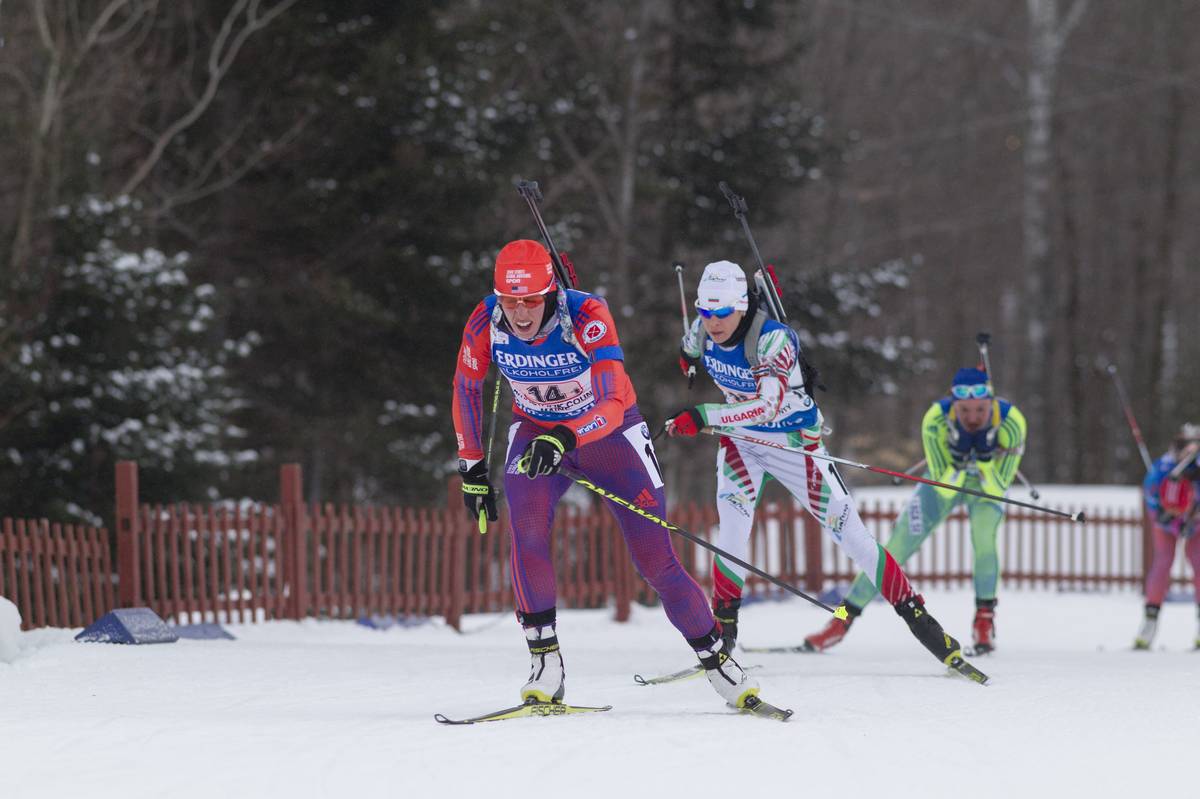
    Leif Nordgren (US Biathlon) raced the third leg of Friday’s IBU World Cup mixed relay to put his team in fourth heading into the final exchange in Nove Mesto, Czech Republic. The U.S. ended up seventh. (Photo: USBA/NordicFocus)
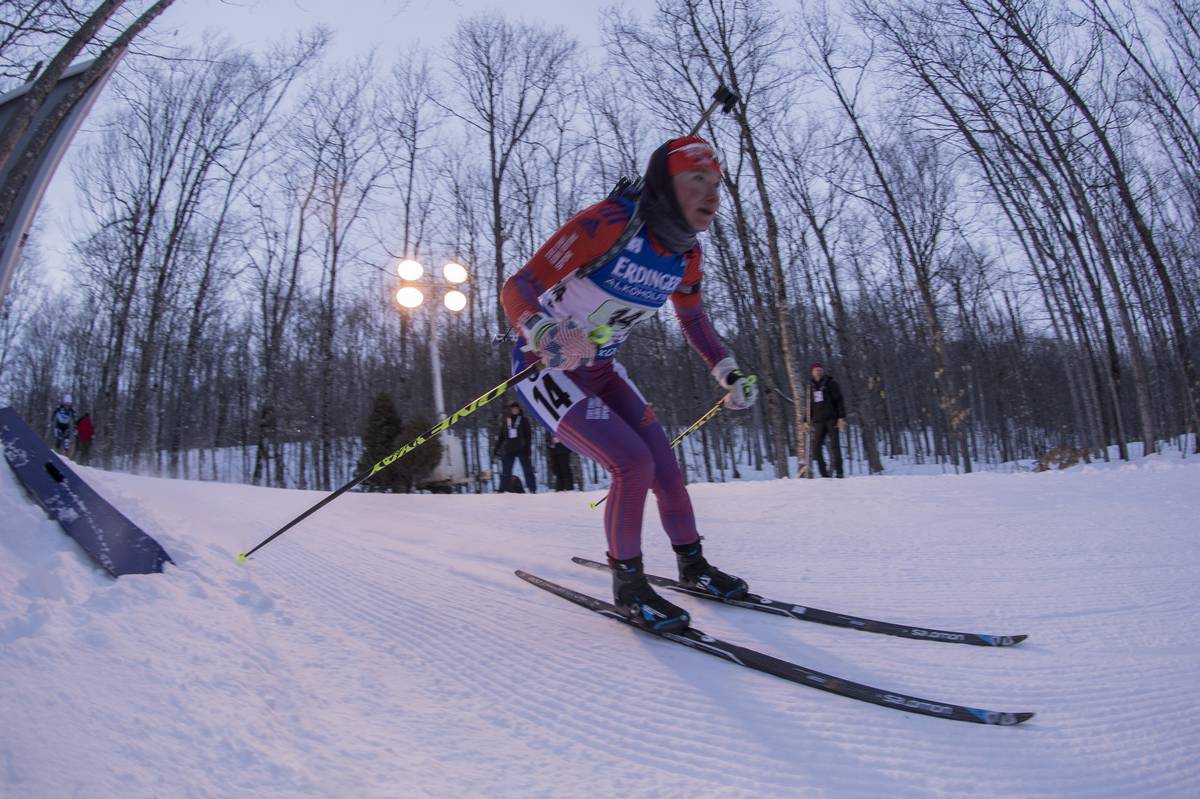
    Note: This article has been updated to include comments from U.S. anchor Sean Doherty.

    Friday’s mixed relay had to have been one of Leif Nordgren’s best races of all time. Just last week, the 25-year-old US Biathlon A-teamer skied up from 51st to 19th in the men’s 12.5-kilometer pursuit at IBU Open European Championships in Otepää, Estonia, but US Biathlon Chief of Sport Bernd Eisenbichler didn’t see that race in person.
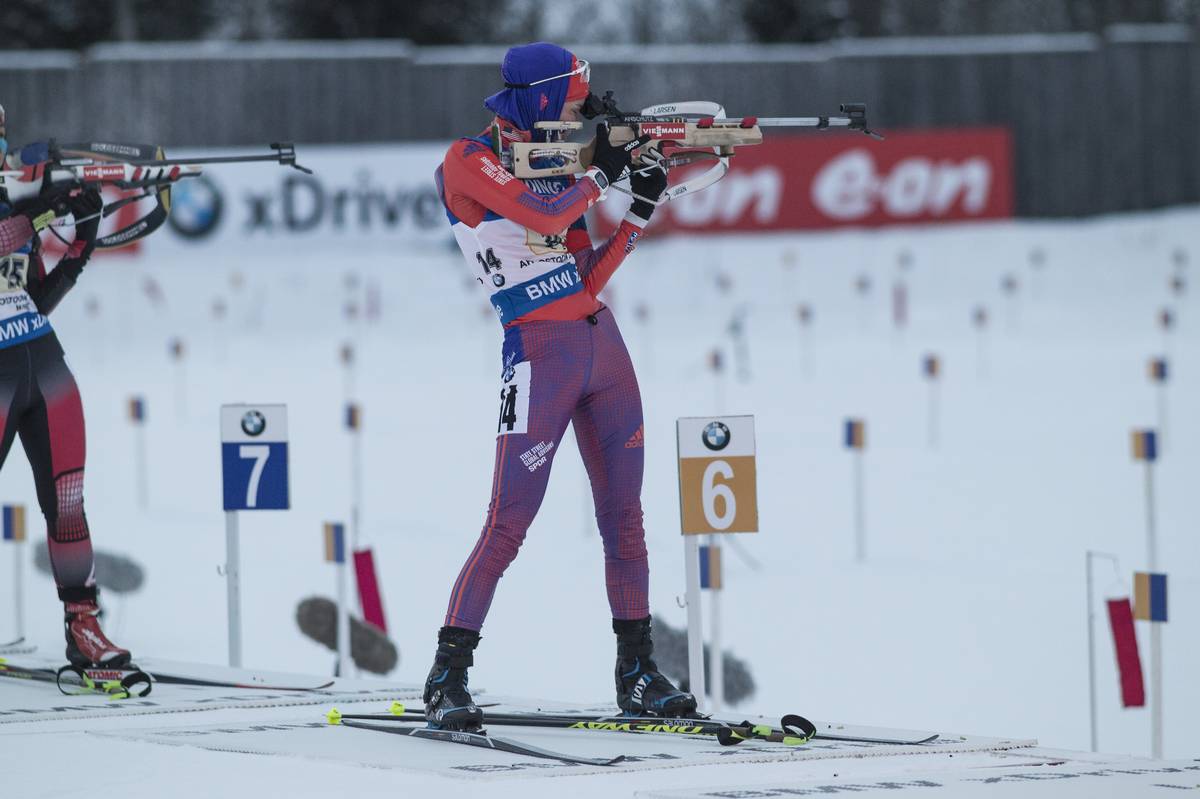
    What he did witness was one of Nordgren’s most memorable performances in the mass start at 2011 World Championships in Khanty-Mansiysk, Russia, in which he placed 17th with three misses. And that rivaled what he did on Friday as the third of four legs in the 2 x 6 + 2 x 7.5 k mixed relay.

    Nordgren brought the U.S. from 10th to fourth before the final exchange with clean prone shooting and a single standing miss. He used his spare to clean that stage and left the range for the last time in fourth, about a minute and a half behind the three race leaders (Norway, Ukraine and the Czech Republic).

    “You have to give a really big compliment to Leif today; he had world-class shooting today,” Eisenbichler said on the phone after Friday’s race, the second of two mixed relays (with Annelies Cook and Tim Burke placing ninth for the U.S. in the single mixed relay).

    “I never saw him in as good running shape as 2011 at World Championships … For sure, this was his best performance, and from 2011 to now, that’s four years so that’s really encouraging,” he added. “I’m extremely happy with where he is right now and I think he’s still going up to [2015] World Championships.”

    Sean Doherty hung in fifth for most of Friday's mixed relay at the IBU World Cup in Nove Mesto, Czech Republic, before finishing seventh. (Photo: USBA/NordicFocus)
    American Sean Doherty hung in fifth for most of Friday’s mixed relay at the IBU World Cup in Nove Mesto, Czech Republic, before finishing seventh. (Photo: USBA/NordicFocus)
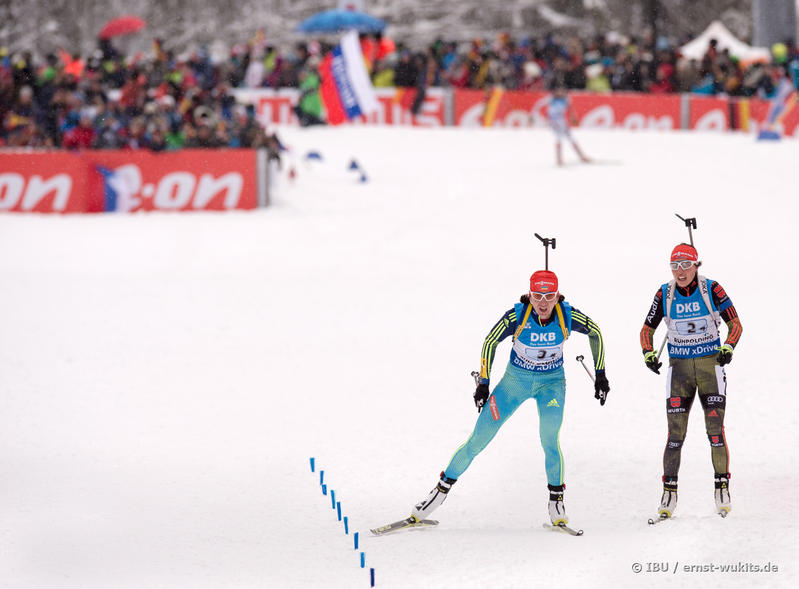
    Building on the foundation teammates Susan Dunklee and Hannah Dreissigacker laid as the first and second legs, respectively, of the Americans’ mixed relay on Friday, Nordgren tagged Sean Doherty in fourth.
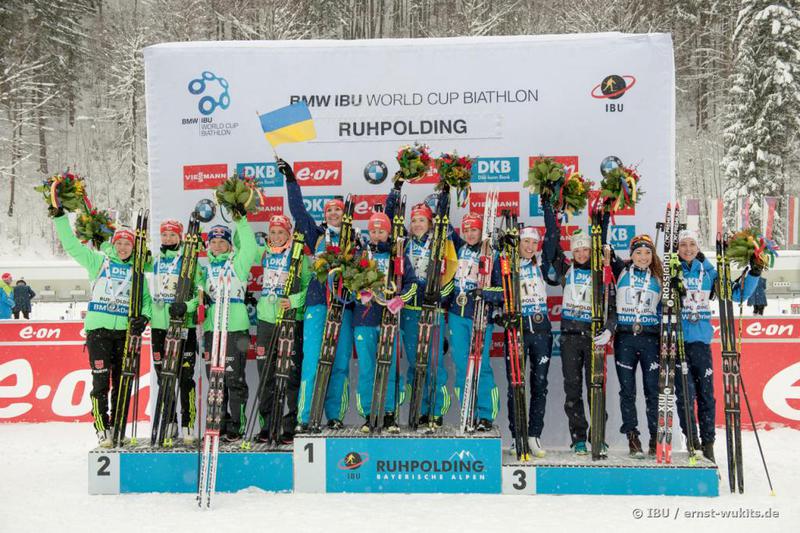
    The 19-year-old Doherty anchored them to seventh, 2:23.8 behind the Norwegian winners (Fanny Welle-Strand Horn, Tiril Eckhoff, Johannes Thingnes Bø, and Tarjei Bø) and 0.2 seconds behind Germany in sixth.

    “We were only two-tenths of a second out of the flower ceremony today, which is an exciting accomplishment, and it also makes us very hungry for more,” Dunklee wrote in an email. “Everyone skied very well today, and the guys did some fantastic work with the shooting.”

    Dunklee used a total of four spares (two on each stage) to put the team in fourth after the first leg. She handed off to Dreissigacker, who used five spares (three prone and two standing) to tag Nordgren in 10th. Nordgren used just one spare, and Doherty used one in prone and two more in standing to finish seventh with a team total of 13 spares.

    “I was really happy with the race today for my part,” Nordgren wrote in an email after posting the fifth-fastest course time and fifth-fastest range time on the third leg. “This whole year I’ve struggled to put both good shooting and good skiing together on the same day. Today I did just that, so I think I can be happy that things seem to moving in the right direction as we approach [World Championships] in Finland.”

    Dunklee raced the fastest time of all 22 starters, leaving the range in 17th after her first shooting and improving to 10th before her last lap. By the time she got to Dreissigacker, Dunklee was up to fourth.

    “I always expect Susan to crush it and pass people like crazy and tag off near the front,” Dreissigacker wrote in an email. “That’s normal for her. But she really outdid herself with the passing today! I had to laugh when I saw how much she’d moved up by the time I’d made my way over to the exchange zone. I was psyched!”

    “I used more spares than I would have liked and channeled the frustration from the range into speed on the ski track,” Dunklee explained. “At the start of the second loop, I forgot entirely about pacing for a couple minutes and focused solely on regaining contact with the main pack.  Then my body reminded me that that wasn’t a sustainable pace.”

    She spent her last loop trying to ski “smarter” and save energy for the last climb. Leaving the range, she caught Switzerland’s Elisa Gasparin then slingshot by her before the last uphill.

    Dreissigacker reflected that her first lap skiing in the top four felt fast, “but I wasn’t really feeling too much…so I was able to go harder than I maybe should have,” she wrote.

    She seized the chance to ski behind France’s Marie Dorin Habert on her first lap, then slipped to seventh after her first shooting.

    “I think that the wind was a bit variable on the first stage, but mostly I just wasn’t super well-settled,” Dreissigacker wrote. “I’ve been having a bit of a prone-shooting slump for the last few days, so I’m hoping to improve on that.”

    Feeling the fatigue start to set in on her last two laps, Dreissigacker reminded herself how much she liked the course and “kept fighting.”

    “In standing, I felt good through the first 5 shots, but had one close miss and then I got shaky shooting spares,” she wrote. “I accidentally fired one spare way too early when I wasn’t even on target, so I was just happy to hit that last one!”

    Pushing to stay with Russia’s Ekaterina Shimulova on the last lap, Dreissigacker wasn’t able to do so and tagged Nordgren in 10th, 13 seconds behind Shimulova in eighth and 11.6 seconds back from Italy’s Federica Sanfilippo in ninth.

    “I wanted to stay with [Shimulova] and catch up to the pack ahead so that Leif would have a good pack to ski with,” Dreissigacker wrote. “Luckily he had an awesome day and managed to catch the pack all by himself. The rest of the team did so well and it was really fun to watch the rest of the race and cheer as I cooled down.

    “It was such an exciting finish!” she added. “Sean did awesome…and in a year or two, if not way sooner, he’ll be winning those photo-finishes.”

    For Nordgren, fast skis helped, he explained, as he caught the group ahead of him on the first loop.

    “I felt totally in control the first two loops, and I was able to push hard the last loop also,” he explained.

    Nordgren added that by the end of last week, he could already feel like his shooting was starting to come around. He felt similarly about his ski shape: “I had glimpses of good shape in Antholz, but with an additional 3 races in Estonia I think it really forced that good shape to come back a little quicker,” he wrote.

    “I really like that tracks here in Nove Mesto, I think they suit me perfectly, combine that with the near perfect snow conditions that we’ve had all week, and it just makes it really nice skiing,” Nordgren added. “As a team we all decided last night that we’d like to finish ahead of our bib number (7). So it was really close today, everyone from the team put in a really good effort, but sometimes it comes down to a few cm!!”

    Doherty hung in fifth for most of his race before France’s Martin Fourcade and Germany’s Benedikt Doll passed him before the finish. The youngest member of the U.S. team, Doherty pushed to stay with them, but finished 2.3 and 0.2 seconds back, respectively.

    “Funny thing, from where the warm up track is here in Nove Mesto you are a little bit out of the action, so I did not really know how well Leif was doing until I got into the start pen,” Doherty wrote in an email. “I was excited to be in such a good position, it is a great challenge and I am feeling good on the skis so I was excited to go against the other top athletes.

    “Really I just tried to keep a good pace,” he added. “For standing I was trying to focus on the good things that I had been working on in training. It did not work out as well as it could have but that is biathlon and it was still a good fight to the line. … I am very happy with my personal performance, I am feeling stronger and stronger on the skis. As for the team overall it is great. It is nice to have everyone at full health and it is a good sign that our program is improving as a whole.”

    At the end of the day, Eisenbichler was pleased, especially with both the team’s single mixed relay and four-person mixed relay finishing in ninth and seventh, respectively.

    “Top 10 is really something we should always reach for,” he said. “It was really, really tight, especially in the mixed relay.”

    An exhausted Tarjei Bø (2) celebrates his win for Norway in the 2 x 6 + 2 x 7.5 k mixed relay on Friday at the IBU World Cup in Nove Mesto, Czech Republic. He held off Ondrej Moravec of the Czech Republic by four seconds.
    Tarjei Bø  celebrates his win for Norway in the 2 x 6 + 2 x 7.5 k mixed relay on Friday at the IBU World Cup in Nove Mesto, Czech Republic. He held off Ondrej Moravec (l) of the Czech Republic by four seconds.

    Norway won the four-person relay in 1:12:49.2 with six spares, holding the Czech Republic (with Veronika Vitkova, Gabriela Soukalova, Michal Slesingr, and Ondrej Moravec) by 4.1 seconds. The Czechs used five spares, and Ukraine (Iryna Varvynets, Valj Semerenko, Dmytro Pidruchnyi, and Sergey Semenov) held tough for third (+1:21.3) with one penalty (from Semenov on his prone stage) and seven spares.

    “Moravec is one of the fastest standing shooters, so today I wanted to show Moravec that I am the fastest,” Norway’s anchor, Tarjei Bø, told the IBU.

    Using just one spare in prone and cleaning standing, he took the lead by 13.9 seconds with one lap remaining. Moravec, who used one spare on his last stage, closed on him in the final kilometers to come within four seconds of Bø, who had enough time to grab a large Norwegian flag before the finish.

    Czech Ondrej Moravec mocks Russia's Alexey Volkov's finish-line celebration after Moravec finished second in Friday's mixed relay. Earlier that afternoon, Volkov anchored Russia to the single mixed relay win.
    Czech Ondrej Moravec mocks Russian Alexey Volkov’s finish-line celebration after Moravec finished second in Friday’s mixed relay. Earlier that afternoon, Volkov anchored Russia to the single-mixed-relay win.

    “I think we can be really happy with second,” Slesingr told the IBU. “[Ondrej and I] spent a little more time in standing … Before the race we would have been happy with second so there is no disappointment … We were able to give something back to all of the fans who came here … we can feel their support that has made biathlon almost the number one sport in Czech Republic.”

    Russia placed fourth, France was fifth and Germany was sixth.

    Canadians 14th

    Canada skied in the top 15 throughout the race with Audrey Vaillancourt, Rosanna Crawford, Nathan Smith, and Brendan Green ultimately placing 14th (+5:12.3).

    “Overall I think the team had a rough day, we all seemed to have problems with our standing shooting,” Vaillancourt wrote in an email.

    After her first mass-start experience on the World Cup, she cleaned the first shooting, but used three spares in standing to tag Crawford 1:28.4 back in 14th.

    “I had a good start, but on the second hill a girl stepped on my pole and it fell off my hand. I had to go backwards to get it back and therefore lost the pack,” Vaillancourt explained. “Then I tried to catch up, but couldn’t do it before the first shooting.

    “Skiing felt good, but I had a hard time making up for the time I had lost,” she added. “It might have affected my standing shooting. I wanted to get in, clean, and leave as fast as I could, but it didn’t work out so well. Instead I ended up using 3 spares.”

    Her skiing felt better than in past weeks, she added, after her team spent a week of training “on lots of real snow” in Mittenwald, Germany.

    Crawford explained she was starting to feel like her “old self” as well on Friday, after she skied the 10th-fastest course time of the second-leg skiers. She used two spares on her first stage, and then used three more and had a penalty loop after standing.

    “I wanted to catch the pack of three just in front of me so I could have someone to ski with. That worked but then I lost what ever I had gained with poor shooting,” she wrote.

    Crawford handed to Smith in 15th, 2:30 back.

    “I was a bit surprised by the analysis. I thought I skied better than it looks on paper,” she wrote. “But hopefully this will just have gotten all the gears running again and tomorrow [the sprint] will be better. It’s a really hard 2.5km course. One of the tougher ones on [World Cup] I’d say. So good technique and proper pacing will be important. But it’s also only 3 loops so you have to be sharp!”

    Smith cleaned prone to bring Canada up to 13th, but used two spares in standing and dropped one spot on the last lap to 14th. Green kept them there, with a clean first stage but had three spares and one penalty on his last shooting. He finished 14th, more than a minute and 10 seconds behind Italy in 13th.

    “We had little hiccups starting with Audrey loosing a pole and loosing contact to the group, Rosanna having a penalty loop, Brendan having a penalty loop, Nathan not being able to stay with [Austria’s Julian] Eberhard when he was passed,” Biathlon Canada Head Coach Matthias Ahrens wrote in an email. “Anyhow I believe we could be where the US team was today whom I congratulate for a great race by all members.”

    “I think we’re disappointed. But are looking forward to the weekend,” Crawford wrote.

    Results

    Tarjei Bø receives the Norwegian flag from an excited fan as he cruises down the finishing stretch to celebrate his win for Norway in the 2 x 6 + 2 x 7.5 k mixed relay on Friday at the IBU World Cup in Nove Mesto, Czech Republic.
    Tarjei Bø (l) receives the Norwegian flag from an excited fan as he cruises down the finishing stretch to celebrate his win for Norway in the 2 x 6 + 2 x 7.5 k mixed relay on Friday at the IBU World Cup in Nove Mesto, Czech Republic.