From the FasterSkier archive — posts syndicated from athletes’ and coaches’ own blogs between 2004 and 2012, kept online as published. Current coverage is at fasterskier.com.
Mid-August is a time to reflect on the summer and start looking forward to the upcoming changing of the seasons. The long, sunny days have brought me many adventures this year, particularly to lakeside destinations like Achensee just up the valley from Innsbruck. A quick dip in the lake is an excellent way to cool down after a bike ride, hike or even rollerski, in the mountains with friends on a hot day. Soon, though, the temperatures will begin dropping and our favorite trails start preparing for the coming winter.
If you’ve been dreaming of exploring Europe’s top cross-country ski trails this winter, there is still space on several Lumi trips to the Alps and Scandinavia. Whether you’d like to check a Worldloppet event (or two!) off your list or simply sight-ski in a new country at your own pace, Lumi’s expert, local trip leaders will help make you get the most out of your ski time in Europe. Check out Lumi’s 2027 winter calendar below and start making your plans today.
Ski in Seefeld & Seiser Alm
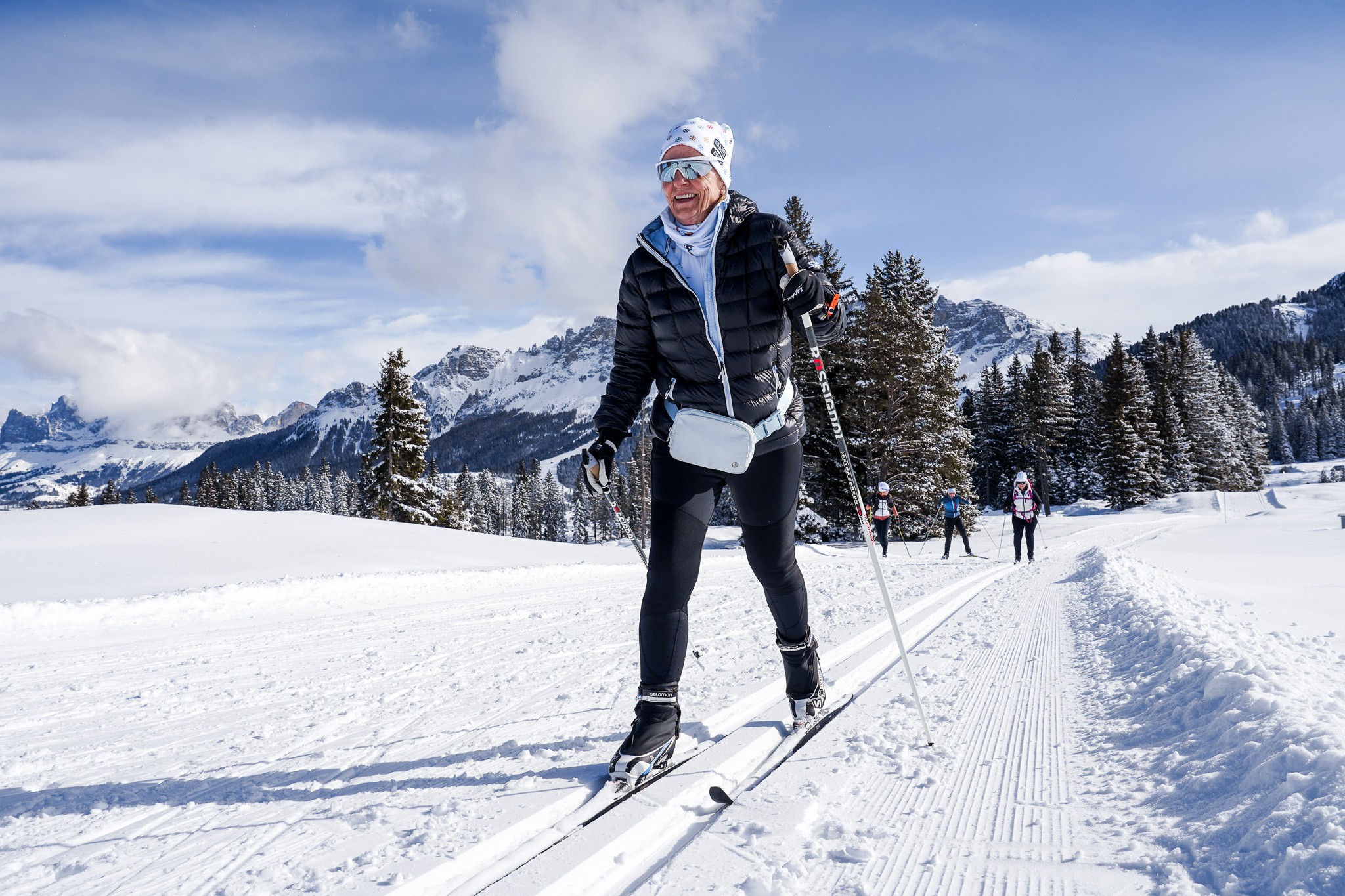
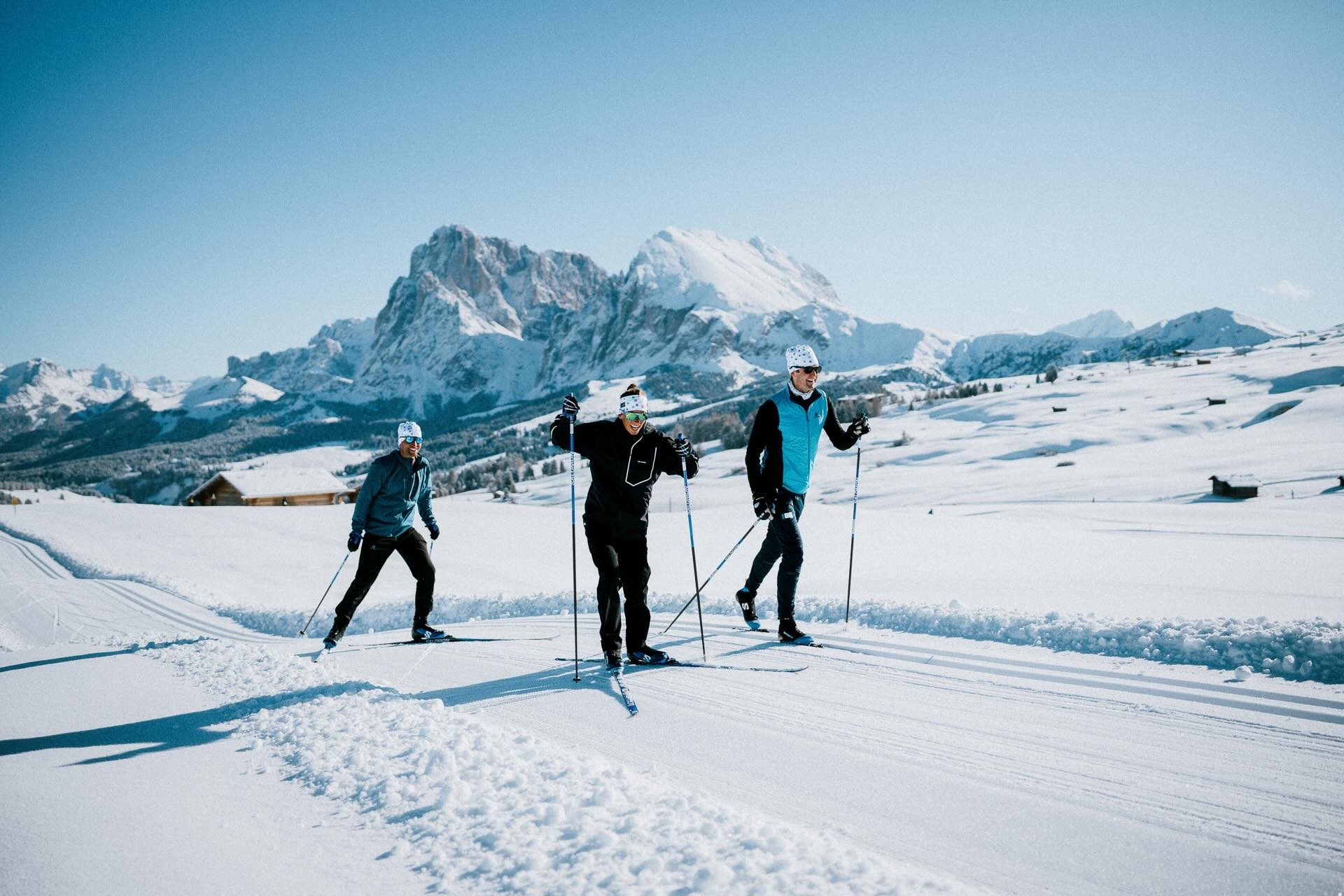
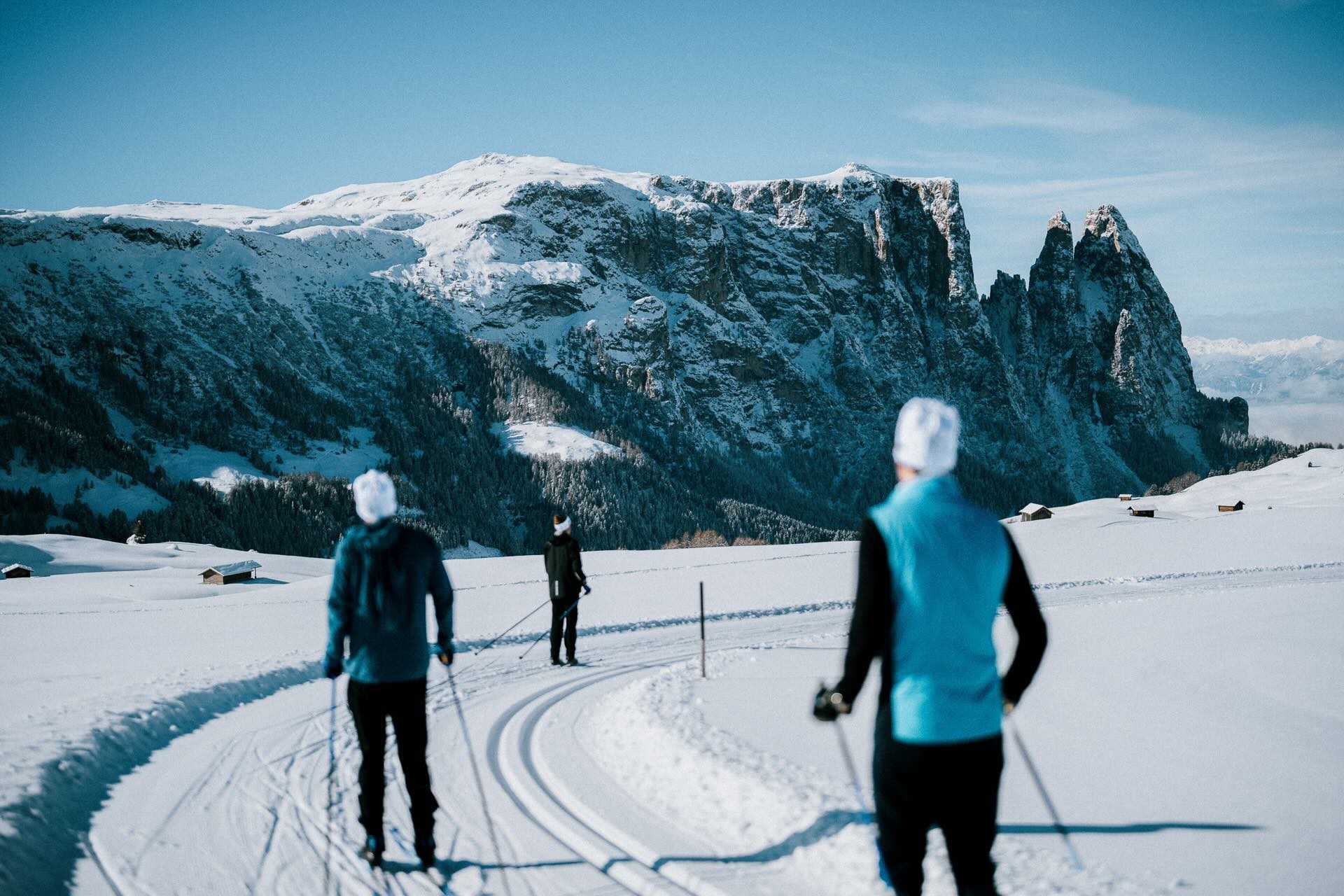
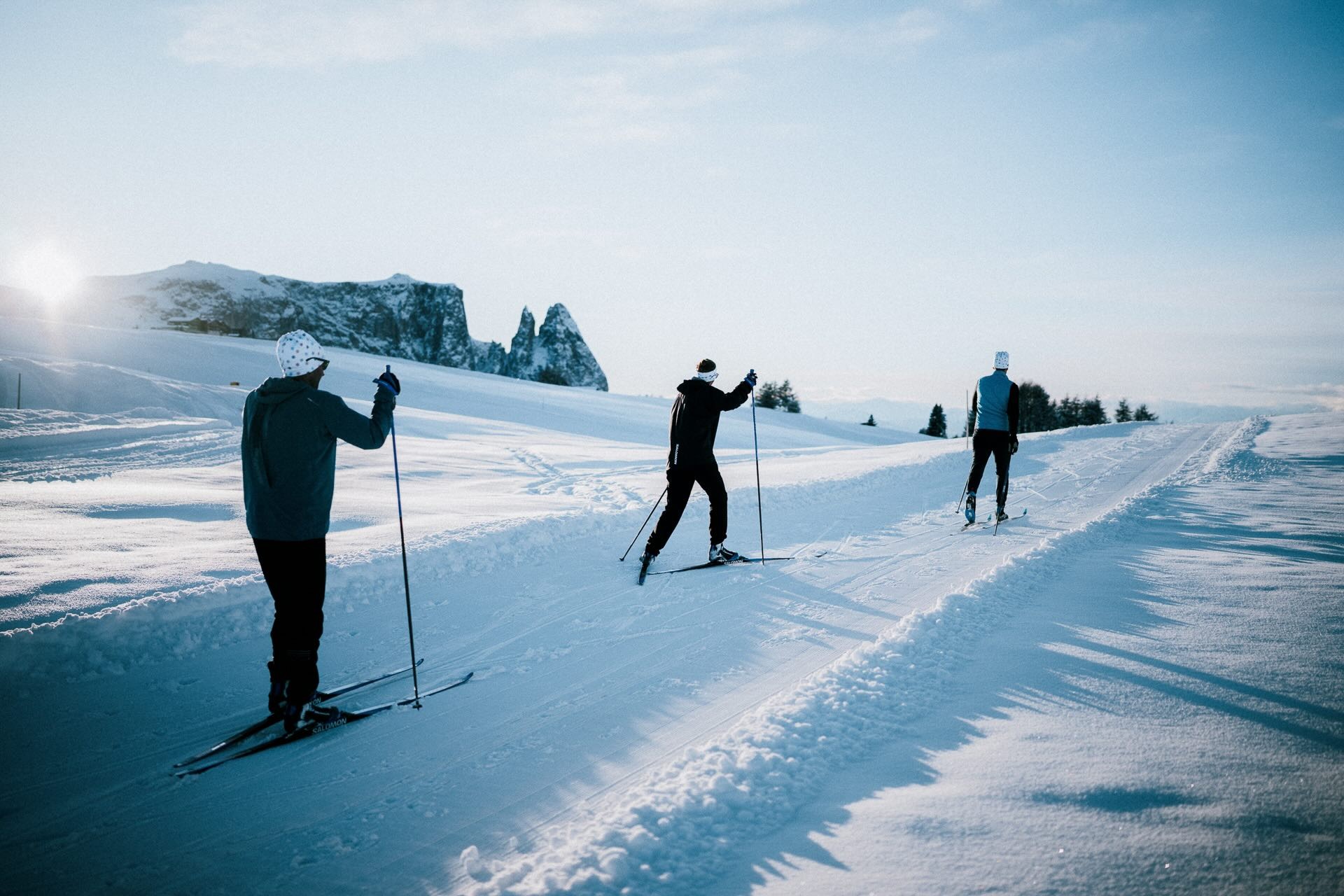
Explore the trails on Seiser Alm, one of Italy’s premier Nordic skiing destinations (Photo: Lumi Experiences)
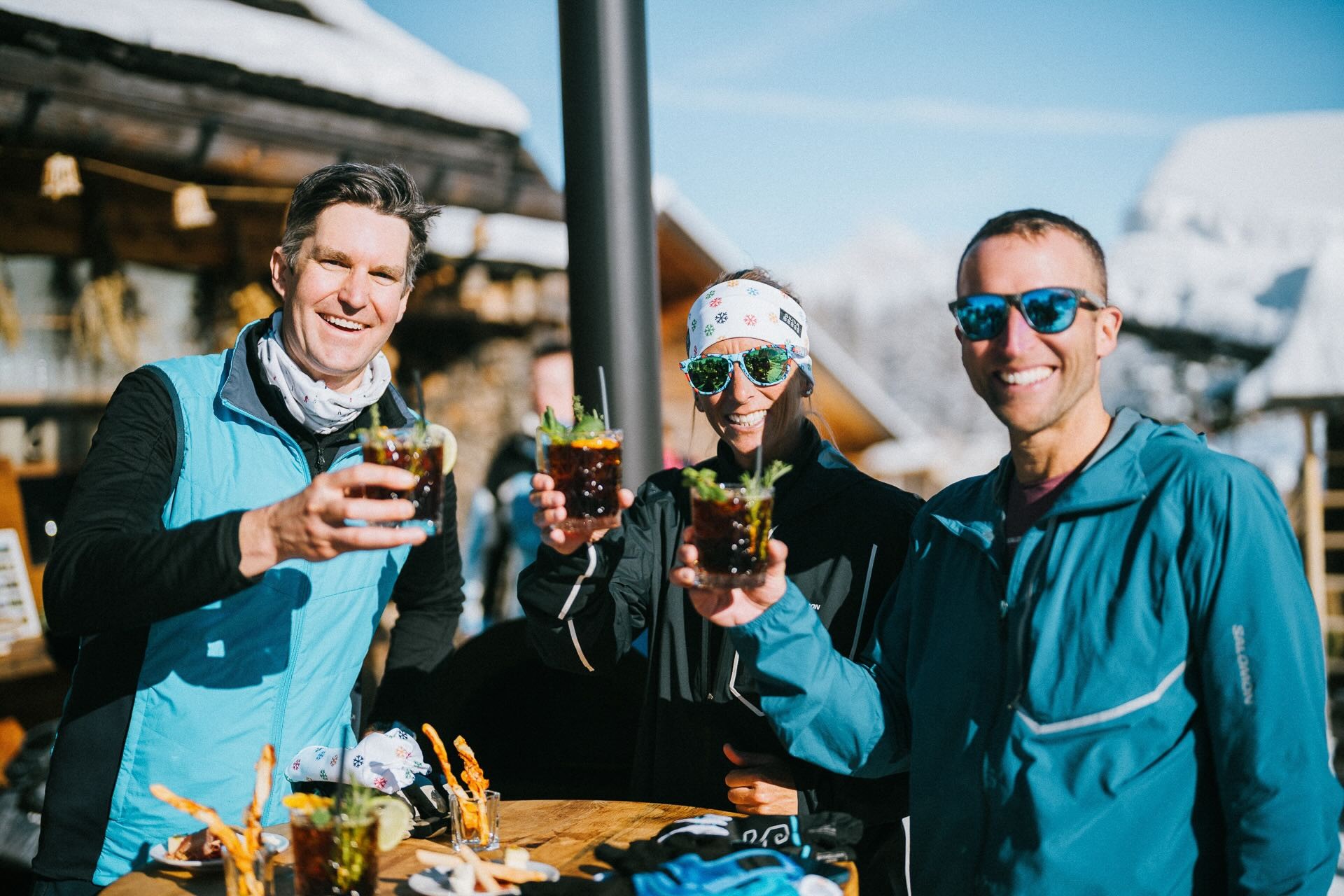
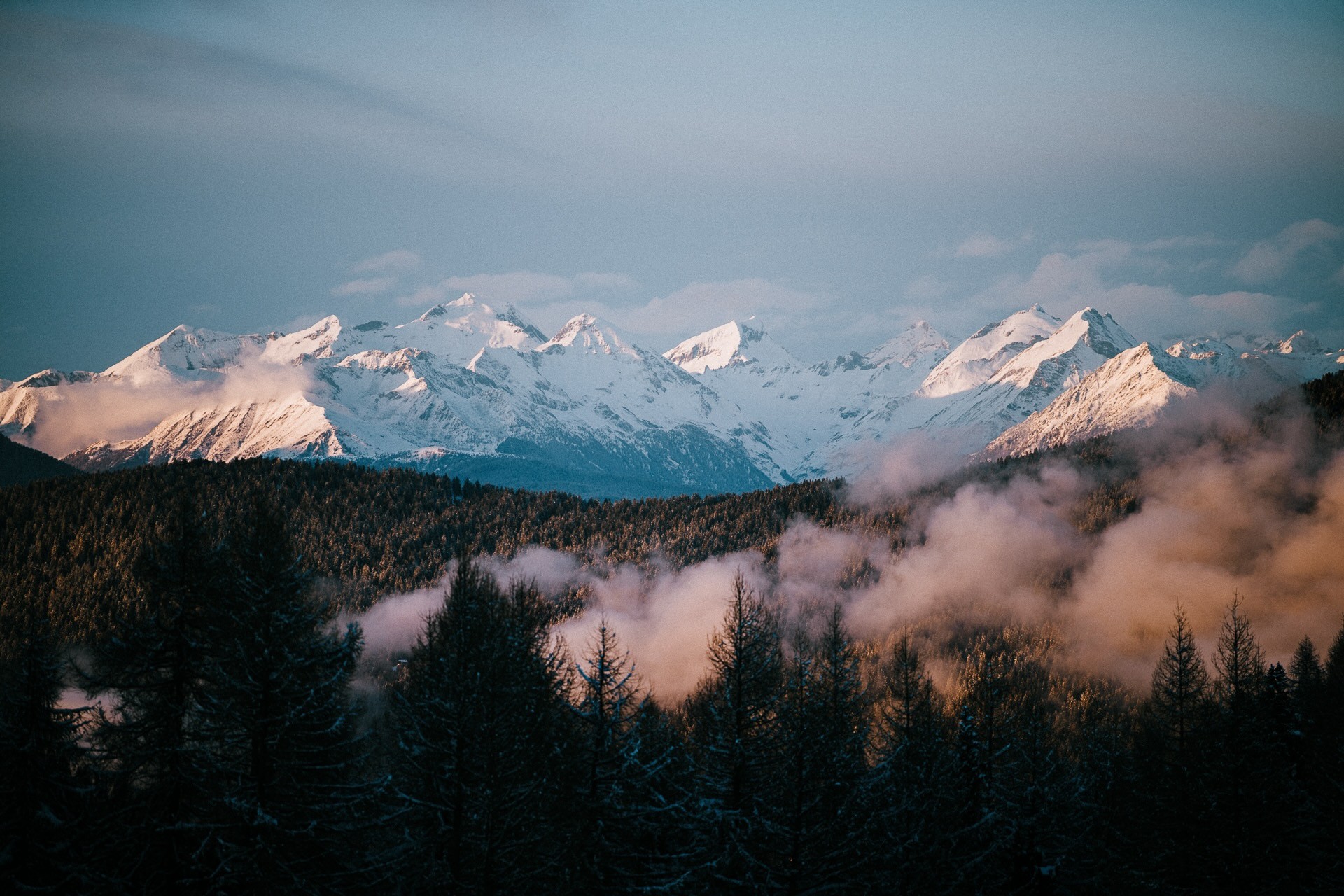
This Winter Seefeld, Austria and Seiser Alm, Italy are renowned for their approachable, yet scenic skiing during the winter months. Start your journey on the nearly-flat trails of Leutasch outside of Seefeld, where picture-perfect mountains rise above the valley below. Trailside huts serving traditional Austrian fare, including the classic Aperol Spritz, dot the trails so you’re never far from a snack break or full meal. Continue your trip on Seiser Alm, where the higher elevations place you above the clouds and nearly at eye-level with the craggy Dolomite spires that ring this high-altitude plateau. Both locations have reliable snow-making capabilities that enable them to open the trails by November before natural snow takes over in December and beyond. The March trip is already sold out, but we still have space on both January trips to Seefeld & Seiser Alm trips. Reach out soon! Our January 20 departure only has one room remaining.
Earn Two Worldloppet Stamps Towards Your Masters Medal
Ski through Finland’s dense forests at the Finlandia-Hiihto (Photo: Finlandia-Hiihto)
If you’re craving the thrill of participating in a major ski marathon, look no further than Lumi’s Marcialonga & König Ludwig Lauf and Finlandia & Tartu trips. Both trips feature Worldloppet events on back-to-back weekends, putting you that much closer to reaching your Worldloppet Master medal. Your expert, local trip leaders assist with all race logistics, including ski waxing for each event so you can simply focus on enjoying the skiing and surroundings on your big event day. We only have a few spots left on both trips, so if you’d like to participate in two Worldloppet events on one trip we recommend reaching out soon.
The Marcialonga & König Ludwig Lauf trip features skiing in Italy, Austria and Germany over 11 days, allowing you to experience some of the best skiing and dining in each region. New for 2027 is the chance to participate in the 32 km Marcialonga “Just for Fun” event, the perfect distance for those who aren’t able to ski the full 70 km classic event. After skiing the beautiful trails in and around Seefeld, Austria, continue your Worldloppet pursuit at the König Ludwig Lauf in Germany on their newly refreshed, snow-secure course.
Whether you ski the full 70 km course or the new 32 km “Just For Fun” event, crossing the Marcialonga finish line is an exciting accomplishment (Photo: Lumi Experiences)
Later in the winter you’ll have the opportunity to ski the Finlandia-Hiihto and Tartu Ski Marathon on Lumi’s Finland & Estonia trip. Both events feature moderate terrain and a relaxed atmosphere in part due to their smaller size – especially compared to Worldloppet events like the Birken, Engadin and Vasaloppet, all of which regularly reach over 10,000 participants. In addition to enjoying both nations’ Olympic museums, cuisine and trails, guests have the opportunity to sauna every day in Finland in a variety of traditional Finnish saunas.
Join skiers from around the world in a group stretch before skiing the Finlandia-Hiihto Worldloppet (Photo: Finlandia-Hiihto)
Sight-Ski Your Way Across Norway or Slovenia & Italy
Not interested in participating in a ski marathon? Join a sight-skiing trip in Norway or Slovenia & Italy next winter. Lumi’s sight-skiing trips skip the races so you can focus on enjoying the scenery, cuisine and culture that make each destination unique.
Ski the Holmenkollen trails above Oslo before trekking north to Norway’s Sjusjøen trails (Photo: Lumi Experiences)
We have two Norway Sight-Skiing trips scheduled for mid-February next winter, each of which begins in Oslo on the Nordmarka trails before shifting north to the Olympic city of Lillehammer and the seemingly endless trails of Sjusjøen. Enjoy Oslo’s harbor from two unique angles: first from the top of the iconic Holmenkollen Ski Jump high above the city, then from the water on a floating sauna – before an optional cold plunge into the icy waters. Our February 14 departure is almost full, with just two more rooms available for up to 4 guests
Lumi’s Slovenia & Italy Sight-Skiing trip in early-March is the perfect trip for those looking to explore a quieter corner of the Alps. Your accommodations for the week-long trip are just a few minutes walk along rustic village paths to the trails, which lead directly to the famous Planica Nordic Center, site of the 2023 FIS World Championships. Ski to one of our favorite trailside huts in the Julian Alps before taking a gondola ride to a mountaintop village nearly a kilometer in elevation above the valley below. Wrap up your trip with a visit to Lake Bled, one of Slovenia’s most cherished natural wonders.
Discover the quieter trails of the Julian Alps in Slovenia and Italy (Photo: Lumi Experiences)
End Your Season Under the Auroras in Iceland
Part Worldloppet trip, part sight-seeing adventure: Lumi’s Iceland Fossavatn trip in mid-April has a little bit of everything. Start your trip off in Reykjavik before trekking northwards along Iceland’s rugged interior, with stops at volcanic craters, scenic waterfalls and geothermal springs. Upon reaching the country’s Westfjords region, you’ll find a beautiful trail network just above sea level, with stunning views of the fjord in the glacially-carved valley overlooking the Atlantic Ocean. After participating in the last Worldloppet event of the season, celebrate with your fellow skiers from around the world at the Fossavatn’s famous cake party, with dozens of delicious cakes to choose from – not to mention freshly-caught seafood served at restaurants throughout Ísafjörður. With almost no light pollution to speak of, this trip has the highest chance of seeing the northern lights of any Lumi trip.
Visit Iceland next April for the chance to see the northern lights (Photo: Annika Landis)
Space is limited on many of these trips, so if you are interested in traveling to Europe with Lumi for your next ski vacation, reach out soon to secure your spot. Message reservations@lumiexperiences.com for a detailed trip itinerary or to sign up. We look forward to hearing from you!
As the world’s premier cross-country ski travel company, Lumi Experiences offers boutique trips that introduce travelers to winter cultures where Nordic skiing is a part of everyday life — from Sweden to Slovenia. It’s a ski vacation like no other.
Media contact: Nathan Miller – Marketing & Guest Communications Manager – nathan@lumiexperiences.com
Among the world’s top ultra-marathon runners is Courtney Dauwalter. Her accolades read as a list of the world’s most challenging trail running events, followed by “win” in pretty much every one of them. Known in the running world simply as “Courtney,” she is an incredibly talented athlete, but more importantly, Courtney is an incredibly thoughtful and inspiring person.
In high school, Courtney and I were teammates on the cross-country ski team and both of us stood on top of the podium at the 2002 Minnesota State High School Ski Championships (if anyone has any photos in their archives, please let me know – this was long before digital cameras and smartphones were ubiquitous). After skiing in college for the University of Denver, Courtney spent several years teaching, before a passion for trail running eventually pulled her away from teaching and into a trail running career. We stay in touch and try to meet up when it works out.
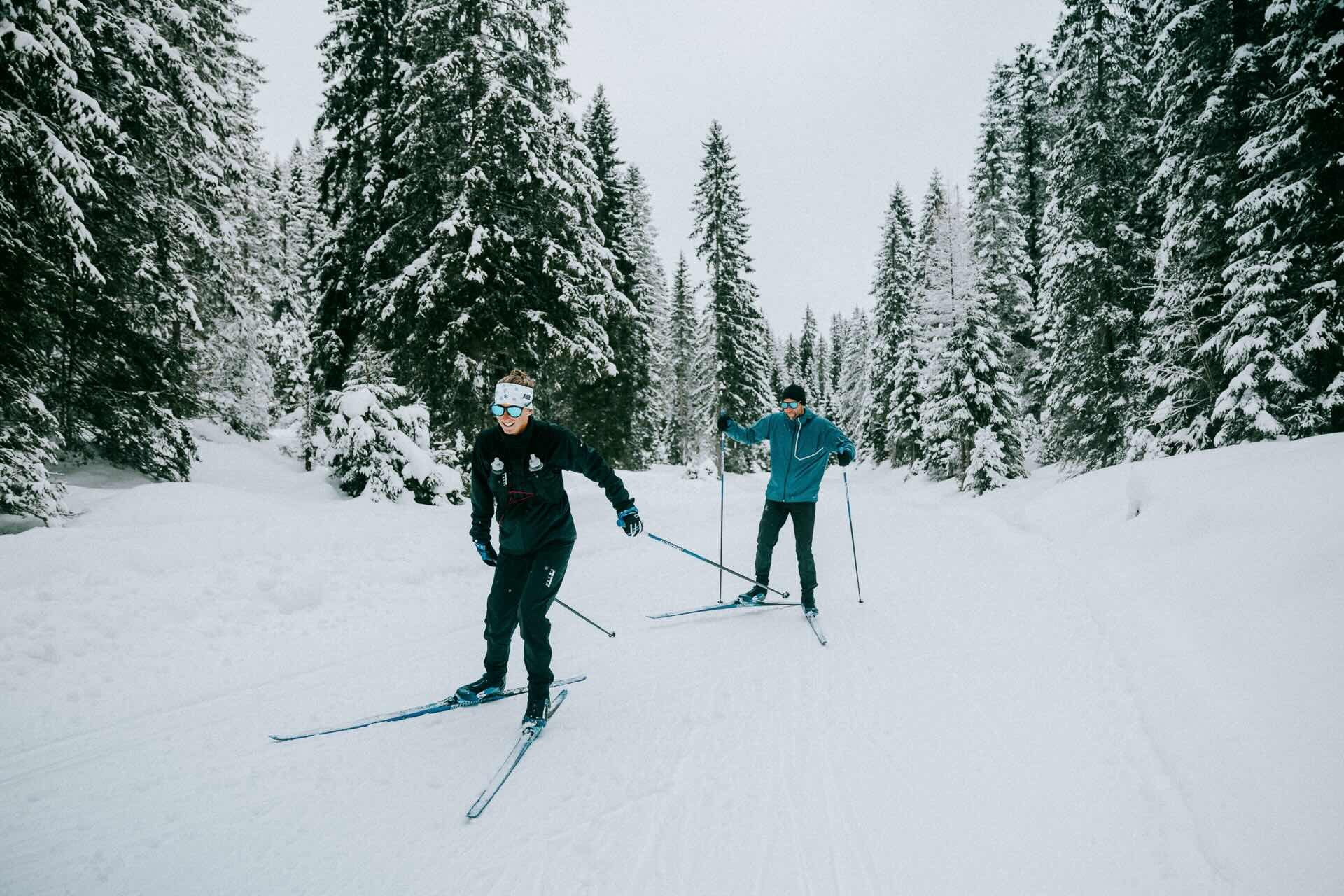
Courtney Dauwalter explores the Seiser Alm trails with Garrott Kuzzy from Lumi Experiences (Photo: Moritz Klee)
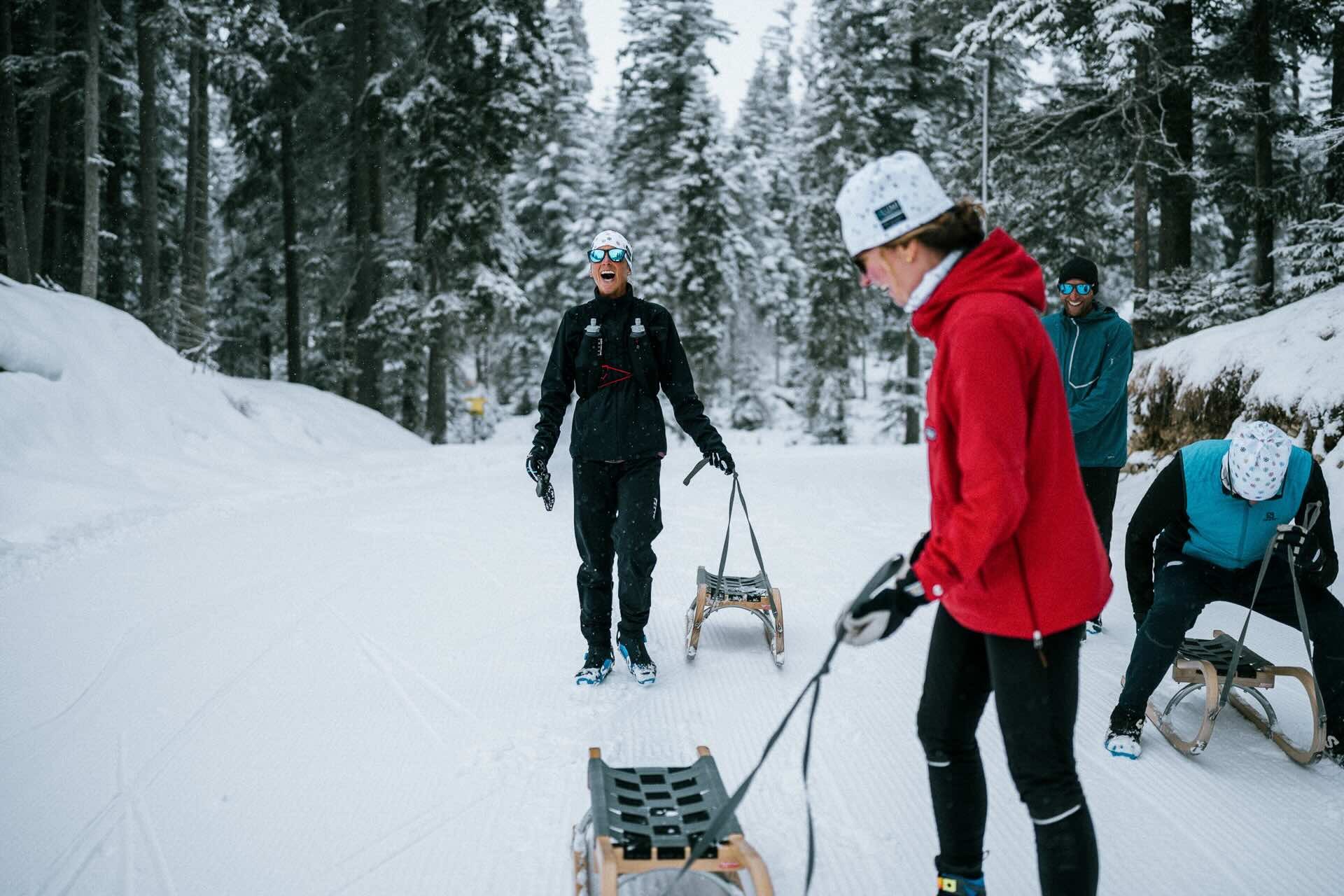
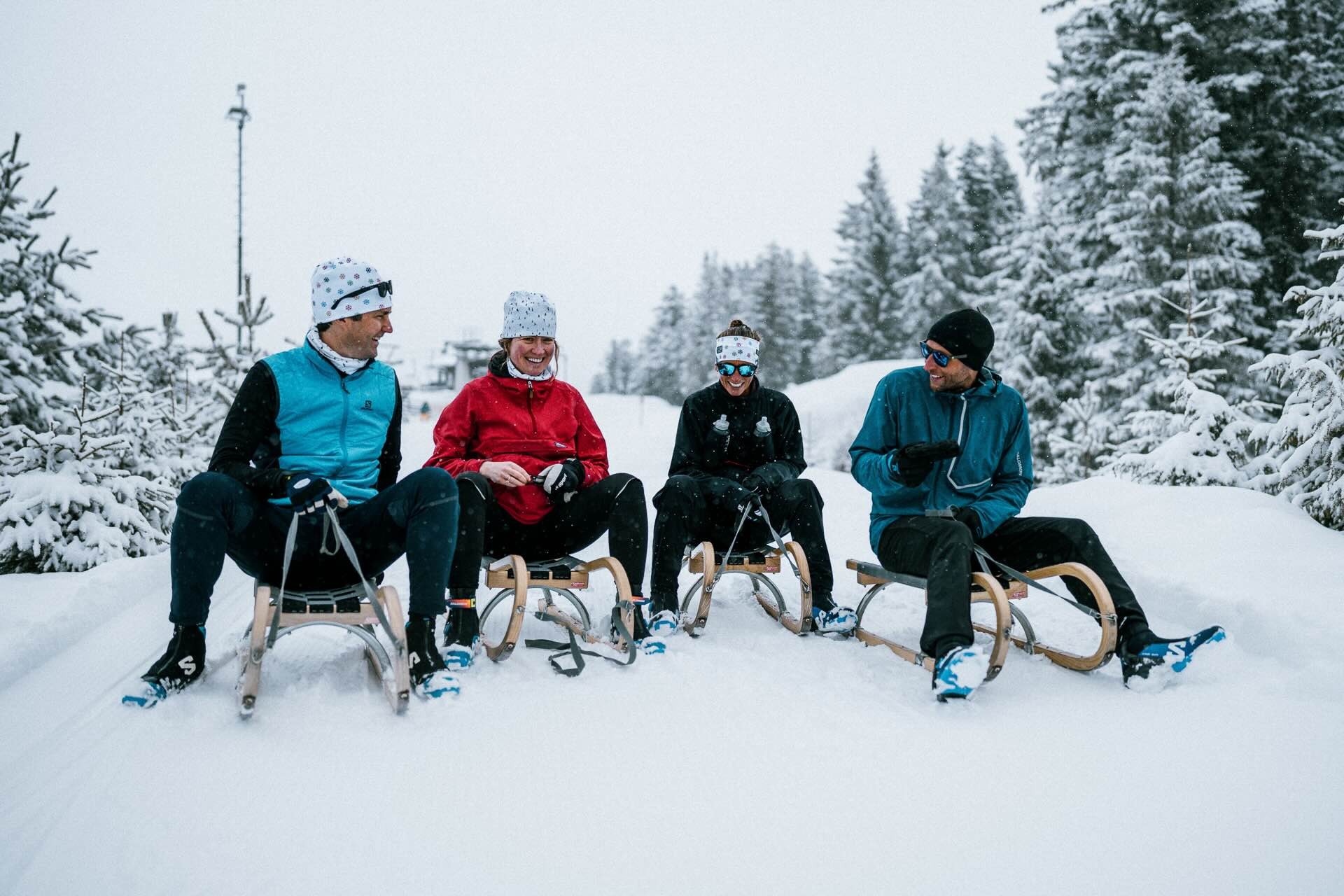
Last fall, Courtney reached out to share that she was invited to run as a torchbearer in Italy in January 2026 and perhaps even do a little skiing afterwards: “Hey Garrott! Kev and I were just looking at the Lumi website and saw the Seefeld & Seiser Alm trip. We’d love to ski it this winter!” Fast forward a few months and we were catching up over a hot chocolate in a hut in Leutasch, Austria, getting ready to go sledding down one of my favorite trails before skiing our way back to their hotel in Seefeld. We had a blast skiing in Seefeld, Austria and Seiser Alm, Italy, where we got fresh corduroy tracks after a big snowfall and sampled cheese at one of my favorite farms in the Dolomites. It wasn’t until we were there that Courtney realized she’d been to the region before on a long trail run and pointed to the mountain she traversed during a summer trail running event a few years ago.
The iconic Schlern formation rises above Seiser Alm’s trails in Italy (Photo: Moritz Klee)
A Legend on Foot
Enjoying an evening ski on Seiser Alm (Photo: Moritz Klee)
Widely recognized as one of the world’s top trail ultrarunners, Courtney’s trademark baggy shorts, easygoing attitude and mental resilience have made her a fan favorite and an inspiration for a generation of athletes of all ages who are bucking the definition of what makes a traditional trail runner. She has shattered records worldwide and amassed repeated victories at ultrarunning’s premier events, highlighted by an unprecedented sweep of the “Triple Crown” in 2023, winning the Western States 100, UTMB (Ultra-Trail du Mont-Blanc) and Hardrock 100 all in a single calendar year.
Salut! to a day on Seiser Alm’s trails in Italy with Lumi Experiences (Photo: Moritz Klee)
Courtney continues to set the bar high this season, winning the women’s Ultra Trail Chianti Castles 120K in Tuscany this past March and placing 10th overall. In May, she tackled the grueling Cocodona 250, redeeming her previous year’s DNF by pushing through the Arizona heat to take 2nd among women and 6th overall. She followed that in July by capturing her fourth straight women’s title at the Hardrock 100, crossing the line 5th overall in 26:03:10 to set the fastest female clockwise time in the race’s history. Was it her week of skiing in Seefeld & Seiser Alm this winter that made the difference? Well, probably not, but skiing is definitely great cross-training for trail running.
Still Stellar on Skis
Snow-capped peaks make for an incredible backdrop for skiing at Seefeld, Austria and Seiser Alm, Italy (Photo: Moritz Klee)
Courtney still excels at skiing, a testament to the importance of cross training and staying fit no matter the season – not to mention the years of working on her stride early in her athletic career. Her husband Kevin is relatively new to cross country skiing, but still loved the alternative to running, exploring the trails and perfecting his ski skills.
Alpine sledding with Courtney Dauwalter and Lumi Experiences (Photo: Moritz Klee)
One of the highlights of our week together was rodeling, aka alpine sledding. We had a memorable ride down the hill through forests blanketed with snow before our ski back to Seefeld. There are plenty of ski trails and activity options suitable for everyone in Seefeld & Seiser Alm, from ultra-distance champions to beginners.
Ready for rodeling with new and old friends in Leutasch, Austria (Photo: Moritz Klee)
Ski in Austria and Italy Next Winter
Fresh snowfall made for excellent conditions on Seefeld’s trails (Photo: Moritz Klee)
Would you like to explore Austria and Italy’s best cross-country ski trails next winter? Let Lumi Experiences handle all of the hotel, transportation, and scheduling logistics so you can enjoy the trails to the fullest with your travel companions, with the help of Lumi’s local, expert trip leaders. Relax in comfortable trailside accommodations and discover regional cuisine unique to both countries. Not an ultrarunner like Courtney? Both Seefeld & Seiser Alm feature trails for all levels of skiers, even novices. There is limited space available on Lumi’s Seefeld & Seiser Alm trips next January, with two departure dates available. Reach out to reservations@lumiexperiences.com today for a detailed daily itinerary or to sign up.
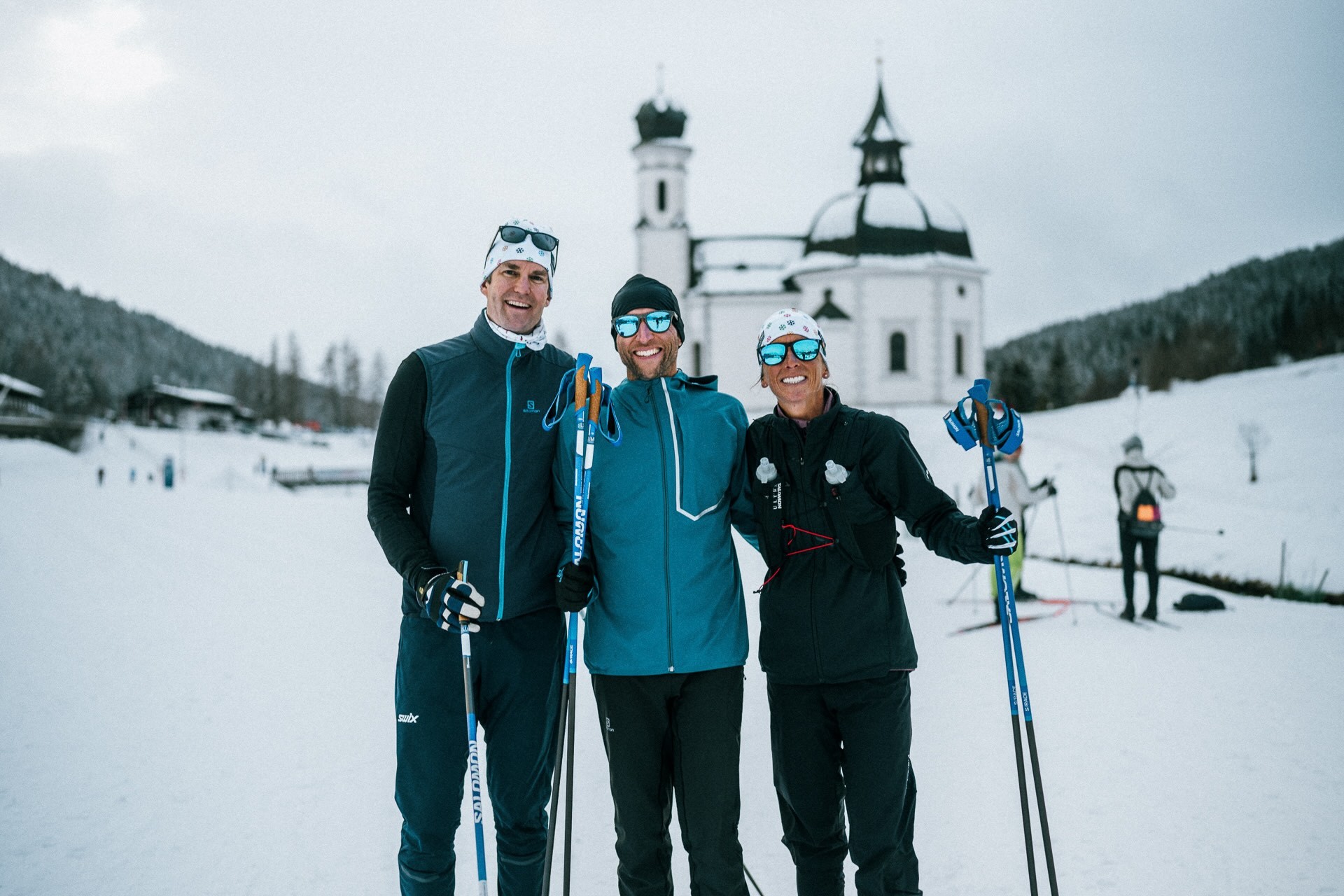
Garrott, Kevin and Courtney in front of Seefeld’s Seekirchl church (Photo: Moritz Klee)
As the world’s premier cross-country ski travel company, Lumi Experiences offers boutique trips that introduce travelers to winter cultures where Nordic skiing is a part of everyday life — from Sweden to Slovenia. It’s a ski vacation like no other.
Media contact: Nathan Miller – Marketing & Guest Communications Manager – nathan@lumiexperiences.com
This article was made possible through the generous support of our voluntary subscribers who have helped us put our Nat Herz on the ground at the Olympics. If you value coverage like this, please support FasterSkier with a voluntary subscription.
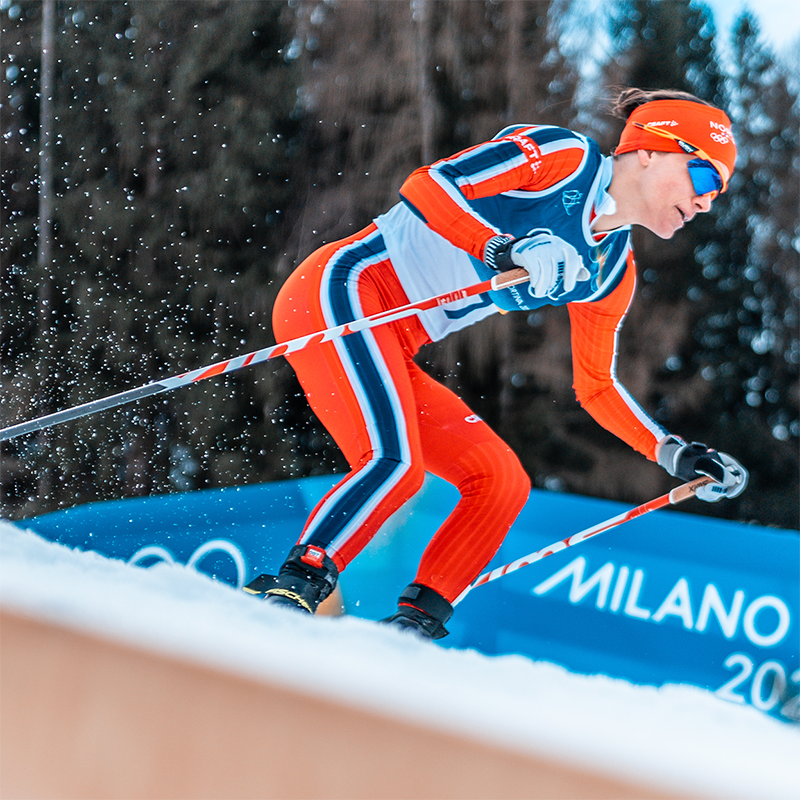
Priscilla Arresti, an art director in Milan, used this digital board to arrange the material for her reviews of the Olympic cross-country ski suits.
From FasterSkier reporter Nat Herz, in Predazzo:Here in northern Italy, where I’m covering the Olympics, I’m technically the chief fashion critic for the bureau — though only because it’s a one-man bureau. And unfortunately, the five-year-old baggy ski pants I wear everywhere have disqualified me from offering any sartorial opinions.
But this is Italy, a global fashion capital. And I still wanted someone to review the racing suits sported by cross-country skiers that each nation typically customizes for the Olympics — and I figured that this should be doable, knowing that I’m close to Milan, a global fashion capital.
It turned out that my host here in Italy knew just the right person for the job. He connected me with Priscilla Arresti, a friend of his who works as an art director for a studio in Milan. As it happened, Arresti had already been following the Olympics and watched the opening ceremonies — and she was eager for the assignment.
Arresti was tasked with reviewing and ranking the suits from 10 of the top cross-country skiing nations — plus the wild card of Australia, for the sole reason that the Australian suit looked cool.
Here are her takes. Photos special to FasterSkier by Tobias Albrigtsen.
Austria
Are those supposed to be snow strokes? A kind of irregular white wrapping?
I’m not sure…
Confusing, rather than energizing. Far more interesting are these graphic, muscular lines that open up, almost sculpting the body and amplifying its movement. Focusing on this motif alone would have been enough — no need for the snow strokes.
Germany
Not a fan of this graphic all-over print that is visible on many of the items of the entire German team’s Olympic collection.
It tries to symbolize an inner fire and passion of the athletes, inspired by the Olympic flame.
But this thin, geometrical silhouette evokes a more static feeling than dynamism. It reminds me more of an urban pattern of different letters, or a map of some city. don’t get the fluidity and vibrations of a flame.
Italy
Chic, dynamic but a bit predictable. I wished for a louder and bolder choice — like asking for advice from a young Italian designer to twist the “tricolore” in a more contemporary way than a ribbon floating around the suit. Someone like Giuliano Calza, of GCDS, which knows how to push boundaries yet remains deeply Italian in its irony and eclecticism.
Finland
It feels as though the Finnish flag has been lifted by the wind, draped across the body, then sculpted into aerodynamic precision.
The colors and sweeping lines create the impression of riding an icy wave. Against the snow, Finnish athletes cut a striking silhouette, as if rising from northern waters and frozen seas.
Norway
Norway gives vintage vibes. Exactly the kind of wardrobe Wes Anderson might envision for his Olympic winter cast.
Ultra-classic look with lateral stripes in flag colors all along the body. No gradients, no bluff. An iconic look considering all the attire, from the ceremony outfit to the race suits. It reflects all Norway’s grounded, authentic tradition.
France
It’s a curious one. It doesn’t quite converse with the graphic boldness seen in the suits worn by French athletes in the other Winter Olympic sports. Are those tiny intersecting ski tracks on the cross-country kit meant to “cross lines” for cross-country? A little too literal, maybe?
Overall, it’s tasteful, but it feels slightly dated. Which is surprising, considering the other French ski suits are genuinely “magnifique” (chef’s kiss): contemporary, confident, built on strong color-blocking and retro-leaning graphic lines, all cleverly manipulated and artfully enlarged.
Canada
The Canadian suit plays with black, like an animal camouflage. It reshapes the figure, creating a sculptural effect that impresses both in motion and at rest. The athlete’s body becomes a stage, while the viewer’s gaze bounces playfully from curve to curve, sliding along subtle, luminous gradients — almost as if the suit itself is choreographing the eye.
Switzerland
The Swiss team is spot-on. Like its flag, red is the statement. Up-close, pixelated chromatic shifts of red emerge. An ethereal mesh design that nods to Switzerland’s strong digital ecosystem, but that also elongates the athletes’ silhouettes with sophistication — sculpting movement through the nuanced use of a single strong hue, and a quiet and measured texture.
Australia
Behind the vibrant colors of Australia’s Olympic suits lies a layered weave of past and present. The symbolic compositions originate from contemporary Indigenous voices: Torres Strait artist David Bosun and Aboriginal artist and Olympic boxer Paul Fleming.
Fleming’s work “Walking Together” portrays lines of repeated footprints that, in Aboriginal art, are far more than decorative marks — they are narrative devices. Powerful symbolism of shared steps, collective journeys, ancestral stories, connection to land.
It’s a superb collaboration — where art, performance, design and cultural narrative converge with intention.
United States
The entire U.S. Olympic kit genuinely reads like a fashion collection. The interplay of textures, mixed patterns, and calibrated color stories across uniforms and off-duty pieces shows the masterful hands from Ralph Lauren. Garments many would happily claim for their own wardrobes.
Even the cross-country ski suit carries subtle retro cues, and it works. It feels relevant.
Perhaps the red armbands could have been reconsidered; they slightly interrupt the line of the body, cutting the silhouette at an awkward point.
Sweden
A curated throwback by the Craft designers behind the Swedish suits — and a graphic tribute to the 1956 Winter Olympics in Cortina d’Ampezzo, and its legendary ice car races.
The checkered flag — iconically displayed at the start and finish line — becomes a transdisciplinary symbol of speed and technology. A dynamic motif that makes the eye vibrate. The suits are infused with an emblem of confidence and luck — after all, the checkered flag is the one historically claimed by the winner at the finish line.
A reminder that producing this kind of work at the Olympics is expensive — we paid both Priscilla and Tobias for their work, and we’re spending a significant sum to be on the ground at the Olympics in Italy. If you can, support us with a voluntary membership here. If you’re already a supporter, thank you.
This article was made possible through the generous support of our voluntary subscribers who have helped put our Nat Herz on the ground at the Olympics. If you value coverage like this, please support FasterSkier with a voluntary subscription.
Astrid Øyre Slind races in Norway earlier this season (Federico Modica/NordicFocus)
PREDAZZO, ITALY — When Astrid Øyre Slind was 26, she almost retired from cross-country skiing.
She was a good skier, just not quite good enough to break into the international circuit from her home country of Norway, where competition in cross-country is cutthroat. She was, in her own words, “stuck,” feeling like being an athlete wasn’t worth it any more.
“If you try for the same thing for 10 years, you get disappointed in yourself that you’re not getting better,” she said. “You’re working your ass off, and you’re still not there.”
But Slind didn’t retire. Instead, she mixed up her training plan, found a new coach and spent years racing on a lower-level long-distance circuit — the minor league baseball of cross-country skiing.
Nearly a decade later, in 2022, she returned to the international stage, and soon after made her first-ever World Cup podium, against Olympic-caliber competition.
This season, she finally qualified to race at her first Olympics, at age 38.
In Thursday’s 10-kilometer freestyle race, Slind finished a painful fourth place, just seconds from a medal. But on Saturday, she led the Norwegian women’s relay team to gold — punctuating a career arc that few novelists could have scripted.
“Her story, I think it’s really important to tell,” said Pål Golberg, another Norwegian skier who found success late in his career.
Slind, he said, was not an athlete with exceptional physical talent, nor especially good technique, and at times she was “struggling to find her way.”
But there’s still a message embedded in her success.
“You can get really far just by hard working,” Golberg said. “And she’s a perfect example.”
At a news conference after Saturday’s relay, Slind said she’d accomplished something she’d been working toward since childhood.
Slind, at lower left, celebrates her Olympic relay medal with, in clockwise order, Heidi Weng, Karoline Simpson-Larsen and Kristin Austgulen Fosnaes. (Federica Vanzetta/NordicFocus)
“It’s kind of crazy to say, but it’s actually been a dream for 30 years,” she said. “And it’s something I’ve given up on during the way there — and then started to believe again.”
She added: “It’s nice to finally make it.”
Not a top prospect
Cross-country skiers can be competitive into their late 30s, but few of them stay in the sport that long. In Thursday’s freestyle race, Slind was the oldest competitor, and one of just two of the 111 athletes who was born in the 1980s.
Slind grew up in the village of Oppdal in Central Norway, in a family of skiers. Her father, Peder Einar Slind, is a ski coach who once spent a year in Western Massachusetts on an exchange with a collegiate cross-country ski coach there.
Astrid also has two ski racing sisters: a younger one, Kari, and a twin, Silje.
Both still compete at a high level on European circuits. Kari, in fact, had the first breakthrough at the international level, nearly landing on the World Cup podium in her mid-20s. Experts thought she would be “the biggest of them,” said Birger Lofaldli, a reporter at Adresseavisen, the Slinds’ local newspaper.
In this archival photo, Kari Øyre Slind, center, poses with American skier Jessie Diggins and Slind’s friend Ragnhild Haga after a strength training session in Norway years ago. (Roar Hjelmeset)
“But Astrid came back,” Lofaldli said. “And now she’s greater than ever.”
Astrid did not grow up as a top prospect.
Unlike Kari, she never qualified to represent Norway at the World Championships for juniors, a proving ground for young athletes.
But Astrid was always skiing, she said in an interview in November. Her father would take the sisters out to play on skis; the twins were always pushing each other, with Kari “chasing us behind,” Astrid said.
At three years old, she added, the twins were “crying ourselves in” to local club races in Oppdal, where their parents initially didn’t want them to compete.
“Silje and I really wanted to go,” Astrid said. “From that day, we’ve just been skiing as long as the snow is out, and loving it.”
‘Crazy training’ with a new coach
After failing to break into Norway’s national team and the top-level World Cup circuit in her 20s, Slind spent years racing on a tour called the Ski Classics. The circuit features distance races as long as 90 kilometers, or 56 miles.
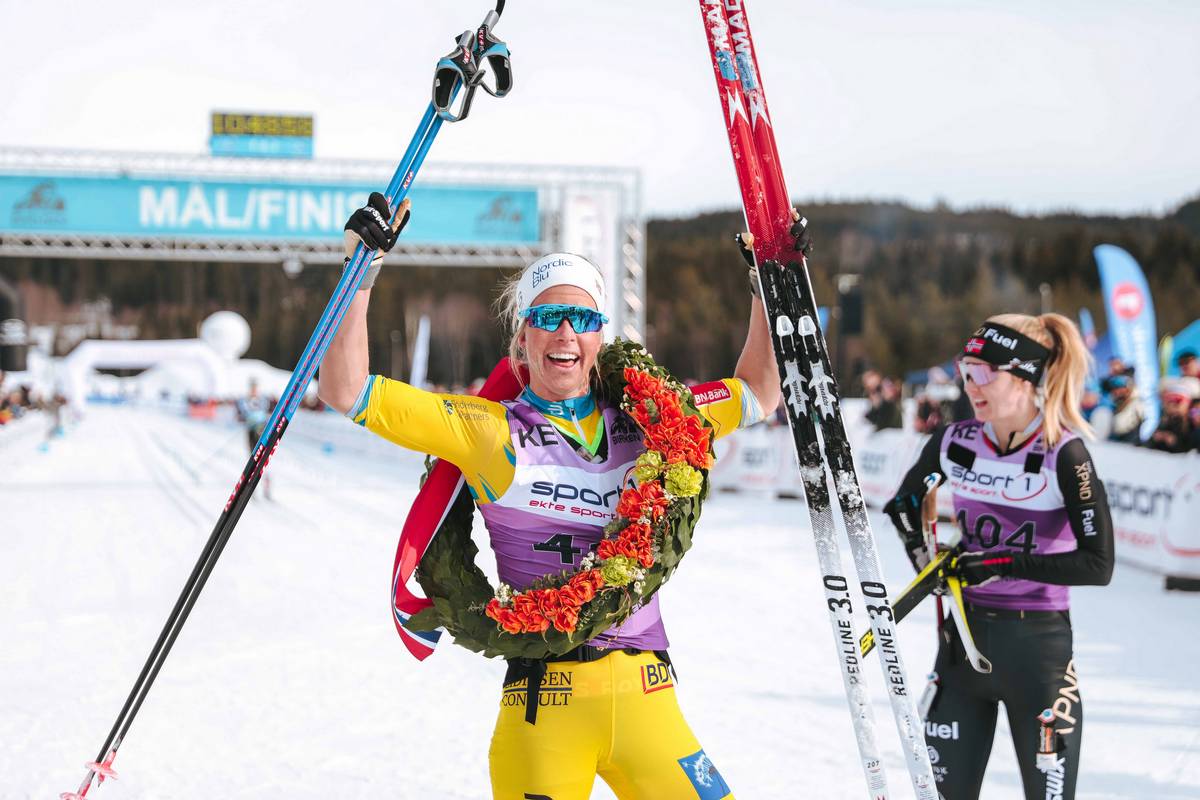
Slind celebrates winning the Birkebeiner, a long-distance race that finishes in Lillehammer, Norway. (Federico Modica/NordicFocus)
She had her ups and downs there, too. In one especially tough year, Slind said, she had trained too much — so much, that she could barely race — and was again thinking about quitting the sport.
Instead, she started talking about her problems with a teammate, Chris Jespersen, another Norwegian who was a few years older and had also struggled to stay at the highest level of the sport.
“He was like, ‘You know what? I really think I can make a good skier out of you — I’ve made all the mistakes myself. I can see what you’re doing. Let’s try to figure it out together,’” Slind said.
Jespersen, at the time, was not a coach, just an “athlete who had ideas,” Slind said.
But at that point, Slind said, she had nothing to lose, so the two started working together. They made a deal: When they disagreed — if Slind, for example, wanted to push herself to do more training but Jespersen thought it was too much — Jespersen would get the last word.
It turned out that Jespersen had a knack for explaining what Slind needed to do differently with her ski technique, in a way that she could understand. He was also a good check on what Slind describes as her impulse to do “crazy training” — things like a six-hour session of skiing with the arms-only double pole technique, with hard intervals in the middle of it, or workouts where she’d try to keep up with her team’s strongest men.
Slind had done more of those kinds of sessions as she moved into the Ski Classics circuit, where she discovered that she “needs a lot of training to be at a good enough level.”
“I think it was what put a spark in my skiing again,” she said.
But Jespersen, she added, helped rein her in when the crazy training got a little too crazy.
“He wasn’t too eager, and he wasn’t too defensive,” she said. “It was kind of the perfect balance for me.”
A breakthrough, and medals
Slind’s breakthrough came in the winter of 2022-2023, when she finally qualified to return to the World Cup circuit after a nearly nine-year absence.
Two months into the season, after nine races, Slind stood on the podium for the first time. Later that season, she won a bronze medal at the World Championships in the skiathlon, and a gold medal with Norway’s relay team.
Still, it hasn’t always been easy since then.
Last season, she raced at what was effectively a home World Championships, in the city of Trondheim just a two-hour drive from her hometown. Amid challenging snow conditions and constant rain, her results were disastrous, including a mishap with a ski during the skiathlon, and she finished with no individual medals — just a silver from the relay.
Then, at the Olympics this year, she was oh-so-close to a medal in the 10-kilometer freestyle race in fourth, just 3.3 seconds behind bronze medal-winner Jessie Diggins of the U.S.
Slind was also painfully close in her first Olympic race, the skiathlon, where she was skiing in medal position before being overtaken by a teammate and ultimately fading to eighth.
“I completely died out there,” Slind said in an interview afterward. “I’m not a good enough skier today.”
In Sunday’s relay, though, Slind was one of the strongest athletes in the race, putting pressure on the Swedish star Ebba Andersson, who ultimately crashed twice and cost her team the gold medal.
Slind leads the Olympic relay on Saturday. (Nathaniel Herz/FasterSkier)
The performance caps a storybook turnaround — one so improbable that Slind probably wouldn’t have believed it herself, said Jostein Vinjerui, a Norwegian coach who works with Slind’s club team, Aker Dæhlie.
“If you’d have asked her during the Beijing Olympics, four years ago, if she’d be able to do the Olympics in four years time, I think she would have laughed, I’m pretty sure,” Vinjerui said. “It’s just an amazing story, being 38 years old now and winning a first gold medal.”
More Olympic medals are possible for Slind: The Norwegian coaches have named her to the two-person team sprint squad, and she and Julie Bjervig Drivenes will be podium contenders in the event Wednesday. Slind is also expected to vie for medals Sunday in the longest race of the Games, the 50-kilometer competition in the classical technique.
After the relay gold, Slind said at the news conference that she’s good at turning depressing results into motivation for the next event.
“Maybe the two other races just made me more on fire for today, and really wanting to show what I’m good for,” she said. “And I will take that with me into the 50 k.”
Help Support Our Olympic Coverage!
FasterSkier will have our own Nat Herz on the ground at the Olympics, which, to be honest, is a very big financial lift for us. If you value the thoughtful work and access FasterSkier provides at championships like this one, please consider becoming a Voluntary Subscriber. Your support directly fuels the work we do to cover the people, places, and moments that make our sport special.
This article was made possible through the generous support of our voluntary subscribers who have helped put our Nat Herz on the ground at the Olympics. If you value coverage like this, please support FasterSkier with a voluntary subscription.
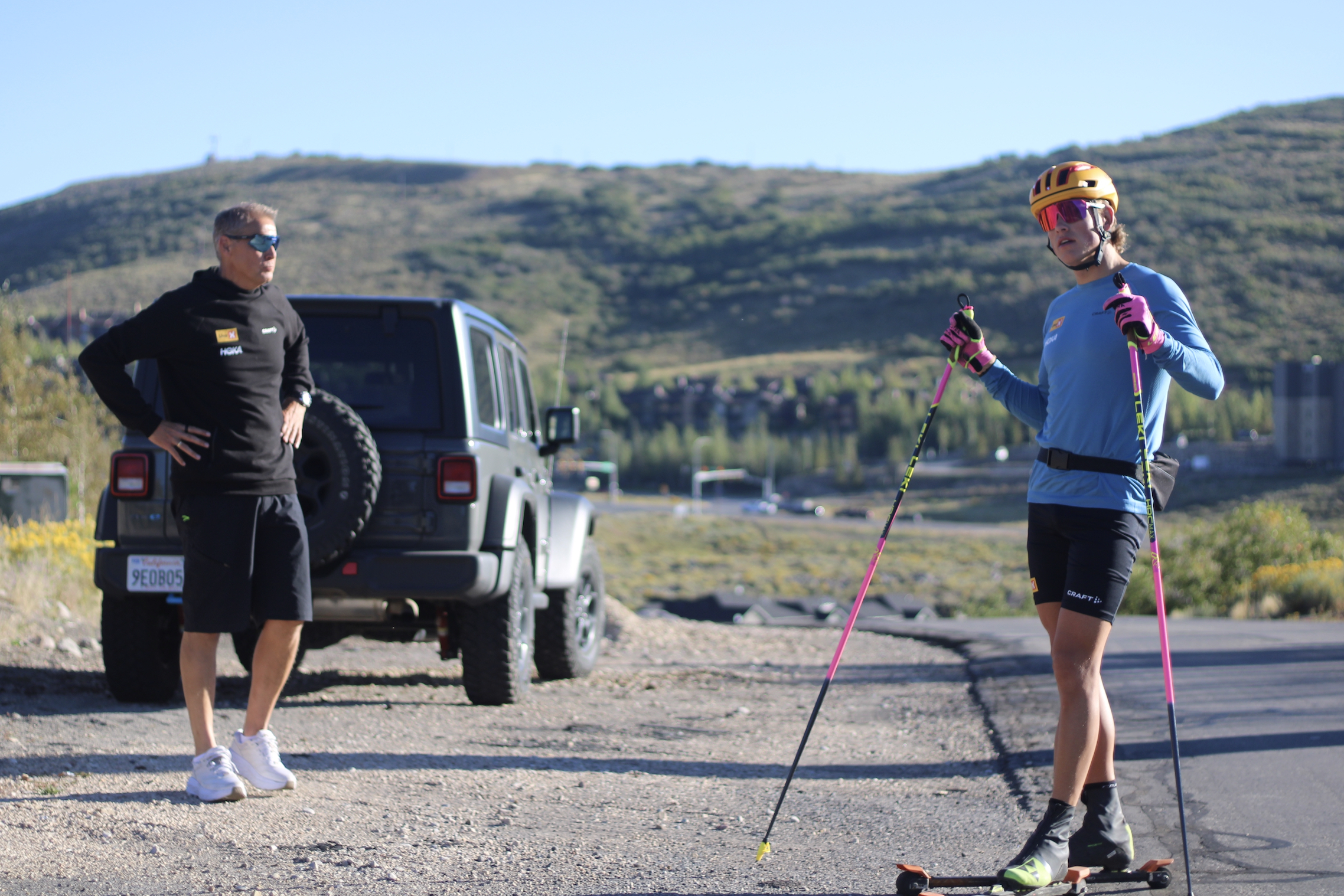
Johannes Klæbo stands with his father, Haakon, during a water break on a rollerski workout in Utah in 2023. (Nathaniel Herz/FasterSkier)
PREDAZZO, ITALY — Johannes Høsflot Klæbo is four for four — and officially the most golden Winter Olympian in history.
By anchoring Norway’s relay team to first place Sunday, Klæbo claimed his ninth Winter Olympic gold — moving him out of a tie, with two other Norwegian cross-country skiers and a Norwegian biathlete, for the most ever.
At a news conference afterward, Klæbo said he’d been drained by the effort it took to win Friday’s 10-kilometer individual start skate race — the first time he’d ever won an event in that discipline.
The next day, he said, “the only thing I did was lay in the bed and play on my PlayStation.” But by the time he woke up Sunday morning and checked his heart rate, he said, “it looked pretty good.”
After Sunday’s relay win over France and Italy, Klæbo is now poised to win the last two cross-country events at the Games, both of which — a team sprint, and a 50-kilometer mass start race in the classical technique — favor him.
At the news conference, he said he’s still taking it one day at a time. “We’ll see where we end up at the end,” he said. “But it feels, so far, so good.”
In search of some more revealing answers, we went looking for Klæbo’s father.
Haakon Klæbo, for the past week, has been a ubiquitous presence at the Olympic cross-country ski venue, watching races with the masses alongside the race trails with friends and family. We found him walking alone behind the stadium — where he was happy to answer a few questions before others broke in.
Nathaniel Herz: Are the Olympics a platform where Johannes is starting to go from a Norwegian to a global star, with these viral videos of him running up the last hill in the sprint race?
Haakon Klæbo: Yeah, it looks like at least it is. It is a huge interest in him. Olympics is really big in the U.S. But I also think that more U.S. citizens are learning how much time he spent there. He’s linked with (Utah physiotherapist) Megan (Stowe). She is really the one that has made his strength program, which is — it’s not that it’s secret, but if you look into it, he’s doing a lot of core strength. This is a program that he also follows at home (in Norway).
NH: How nervous were you for the 10-kilometer skate race two days ago?
HK: I was really nervous for the 10 k, and I knew that it was his weak point, or Achilles, in a way. We have to remember that he has never won a 10 k skate before, never — and this is in his whole career. I think that he has been in good enough shape, but this has been something in his head — and something that if you do not accomplish, it starts to become even more problematic.
Devon Kershaw, a retired Canadian World Championships gold medalist in cross-country skiing, who’s working as an expert TV commentator at the Olympics, walks up: Congratulations.
Herz, to Klæbo: You know this guy?
HK: No.
NH: This is Devon Kershaw.
DK. Congratulations, it’s been quite the show.
HK: Oh! Yeah — it is a little unbelievable, because you don’t expect it. And we had these crazy days in (the World Championships in) Trondheim last year, in which were hoping for like two or three (medals). (Klæbo won gold in all six events.)
And now, with four.
NH: Do you think going through this whole Trondheim experience last year is making this a lot easier for him now?
HK: Yeah. He had been training for that since he heard Trondheim would host the World Championships, and he has been the front figure. They used him (in their marketing materials), saying, ‘Born and raised.’ He’s standing there, like 18 years old — he had one pair of Leki ski poles at that time. He was wearing a suit that he had borrowed from a friend that was on the team. He was like, ‘This is my dream.’ And then he managed to do it. So, I think he was really stressed for it.
This season, it has just been fun. We’ve been together with (teammate and friend) Emil (Iversen). Me and him and Emil have been traveling around — it’s like being there with two boys playing around. So, I think he’s really much more relaxed. And you can see, also — I think he is even stronger, here, if you look at his sprint.
DK: I agree with you, 100%. Everyone made such a big deal of it, but winning the individual start skate. That’s the biggest thing to me, as a fan and a person that raced his whole life. I’m getting goosebumps thinking about what I saw two days ago. When you win that, then you’re really the king.
HK: And I said to Nathaniel that I think that he has been strong enough to do it for years. But it has been something up here (points to his head). He’s never won it.
NH: Do you think that’s his best accomplishment ever?
HK: Yeah, I think it is. And he was really tired after — he has been working really, really hard. I was afraid for this relay today — that he wouldn’t be able to run, because I think he put so much into the 10k. So much energy spent.
Johannes Høsflot Klæbo celebrates one of his four Olympic gold medals in Italy. (Davide Barbieri/NordicFocus)
NH: Was he at a disadvantage being first, in this individual time-trial style race, of all these Norwegian guys? That meant that he wouldn’t get as much information on the course from his coaches about how his times compared to the others.
HK: Actually, his best races from skate individual start are when he is just doing his own thing — just making his own pace, and doing what he’s good at. You could see that for the others, it was a disadvantage. I think, for (rival-teammate) Einar (Hedegart), it was trying to push on Johannes’ time (that was the problem). If you look at the two of them, racing, they’re pretty similar in taking it a little slow in the first two kilometers. Then starting to get faster and faster and faster, and having a crazy second half.
I think that that was what made Einar lose the silver. He pushed too hard — and he got burned and he lost 20 seconds in the last 1,000 meters.
NH : Will you be very stressed about the 50 kilometer race, the last event? Or do you feel like, once you get to the 50 k, so much has already been done that you can relax a little.
HK: The 10 k was what I was really afraid of. And now, I don’t know — we’re just here here enjoying and having fun. And then, everything can happen. And even if he is getting sick tomorrow, we’ve had four gold medals, and you’re the best Winter Olympian — and still, you can race for another Olympics. I think if you ask him, his dream Olympics would be to do a 50 k in Soldier Hollow (in Utah) — which is his home.
A middle aged fan carrying a Finland flag breaks in, screaming: “Klæbo! Klæbo! Number one!” The fan demands a photo, then ushers Klæbo away.
Help Support Our Olympic Coverage!
FasterSkier will have our own Nat Herz on the ground at the Olympics, which, to be honest, is a very big financial lift for us. If you value the thoughtful work and access FasterSkier provides at championships like this one, please consider becoming a Voluntary Subscriber. Your support directly fuels the work we do to cover the people, places, and moments that make our sport special.
American Gus Schumacher competes in his first race at the 2026 Olympic Games at the cross-country ski venue in Tesero, Italy. (Federica Vanzetta/Nordic Focus)
Gus Schumacher is one of the stars in U.S. cross-country skiing, and he was one of the team’s top medal hopefuls coming into the Winter Olympics in Italy.
Against the same field that competes at the Games, the Alaskan won a World Cup race in Minnesota in 2024. Then, Schumacher, 25, was on the World Cup podium twice more just last month, in Switzerland.
So far, though, his Olympics haven’t gone as planned, with tough results in several races. In his first one, he crashed. In the subsequent sprint — one of the disciplines where Schumacher was on the podium last month — he had another tough day, while his roommate and close friend, Ben Ogden, won a silver medal.
Speaking with media Friday, after his third race, Schumacher bristled, a bit, at a question from a reporter who asked him if, maybe, he was not having the best time at the Olympics. He said he was actually having a good time, and in a good place in spite of his results.
A day later, reporter Nat Herz asked Schumacher if he’d be willing to expand on his comments — but also offered him an out if he didn’t have more to share. He responded quickly by text: “Let’s do it. I’d rather get a story out there than have people make their own conclusions.”
Here’s Schumacher in his own words.
Nat reached out to me yesterday to ask if I was up for an interview. His timing was good, because I almost for sure would’ve said no most of the last six days. The opening of my Olympics has been hard, and processing it has taken time and effort, but I’m so proud to have been able to get through some rough days and be ready to fight again and again.
For context, my hard races have involved a crash, an anomalous sprint qualifier, and a day where I think my skis had me out of the race in the second half. On top of it, my teammate and one of my best friends did something we’ve all wanted to do for years. I’m stoked for Ben, but it’s also still hard, and that’s fine! The real miss would be an inability to talk it out and move forward to race another day.
I’m proud of my team, and I’m proud of myself for how I’ve handled a rough start, because this thing isn’t over and I’ve still got skiing to do!!
Below is a transcript of Schumacher’s conversation with Herz. It’s been lightly edited and condensed for clarity.
Nat: I don’t want to put words in your mouth — so maybe you could start by describing how it’s been for you here?
Gus: I can set the stage for people who are listening. So I finished this (10-kilometer freestyle race Friday) and I wasn’t even on the results board — I knew I was far back. It was not what I wanted. And (a reporter) said, ‘So, I assume you’re having a really bad week here.’ And I was like, ‘Okay.’ First off, I wasn’t in a great mood then. But I’ve had a lot of things I’m really proud of. And I think, just, blanket statement, horrible week — it just goes to show you can’t really assume how people are feeling, because you don’t know.
I understand, obviously, yeah: It’s not how I want to be skiing. In that sense, it hasn’t been great. But I wouldn’t just say I’ve had a horrible week, because these things make you better overall.
Gus Schumacher, left, celebrates his podium finish at a World Cup race in Switzerland last month. (Augustin Authamayou/NordicFocus)
NH: Can you take us back to the beginning of your time here?
GS: I fell in the first lap of the skiathlon (the first Olympic race, which features legs in two different techniques, classical and skating). Someone fell right in front of me. There’s just a chain reaction, and maybe I could have put myself in a bit of a different place. I could have set myself up otherwise. But it was a crazy corner. I crashed there, 30 seconds back pretty quickly, and the pace was hot. In hindsight, I wasn’t going to have a chance of catching the leaders, which is where I wanted to be skiing.
And I skied well — I think the classic went really well. In the skate, I think my motivation flagged a little bit. And I realized I have a lot more racing, and it wasn’t worth it to push super hard to get into 20th or something. But, you know, there were still some good things about how I skied.
But it’s also still hard to really feel good in that situation, because you’re kind of swimming upstream.
I left that, and I was just already on the back foot, needing to refocus — basically, not having a super confidence inspiring race, even if I was skiing pretty well. Objectively, it still wasn’t the result that I wanted. And then two days later, in the classic sprint, I didn’t qualify (as one of the top 30, who move into heat rounds), in an event where I’ve been pretty solidly qualifying lately. And I was really far back. I wasn’t in the realm of where I feel like I’ve been skiing lately. So that was another bummer.
I want to say it was (problems with my) skis. I know there’s not super conclusive evidence of that. But I think that’s the best way for me in a championship to go forward — because I can’t change anything now, and I need to believe in my fitness, and I do. It’s just to say there’s something going on under the feet, and whatever: I’m racing again soon.
And then (teammate and close friend) Ben (Ogden) got a medal (in the sprint). And that was a crazy event for all of us, especially me. Definitely took some thinking and processing to go through — especially given my tough start. I think I did a great job of getting back to a place where I’m just excited to ski and do what I can do.
Ben Ogden celebrates his silver medal in the Olympic sprint Tuesday. (Federica Vanzetta/Nordic Focus)
And then in (Friday’s) 10 k, again, I just really struggled. And I opened well, I feel like I skied really well. And again, something just didn’t line up, didn’t work. And I’m just gonna go with the skis again, basically. I don’t know exactly what it was. I think it probably has something to do with how they were actually pushing, and pressure stuff, which is kind of weird. But for my own sake, for these next races, I do still think I’m skiing well, and my movements are good and my energy is good.
NH: Fair to say this is about as hard an environment as exists to have to deal with this stuff, though?
GS: Yeah. In a normal World Cup weekend — and I had this at the beginning of the season, and it was still hard — you’ve just got another race the next weekend. And it’s easy to just say, ‘Yep, first race of the season. Shit luck. We got time.’
But right now, I’m getting interviewed by NBC before every race. And everything’s going viral on social media. And it’s just a big moment, as people like to say. And it’s when everyone wants to be at their best. Part of what’s so hard about winning the Olympics, or medaling, is just that your timing has to be good. And my timing’s been great before. You know, Minneapolis, I still think, is the craziest timing ever. (In Minneapolis, Schumacher took his first-ever World Cup win when the circuit was on its first swing through the United States in more than two decades.)
But, yeah, it’s really hard place to deal with tough results. Even if they’re not entirely because of me, or they’re a little bit out of my control, it doesn’t really matter.
At the end of the day, to all the people that never watch skiing — it sucks, in my head, to feel like all those people won’t recognize me. And I know that’s somewhat vain — but, you know, a lot of this is vain. And there’s a part of me that’s, just — I want to be a ski star. I want to be really good, and I am, and it’s just through the first half of this championship, it hasn’t worked out amazingly. But there’s still time. At the end of the day, I just want to be skiing fast, in general. Skiing fast is what’s fun to me. And it’s cool if it’s at the Olympics — but it’s also cool if it’s at the Tuesday night race (in Anchorage, Schumacher’s home town), in April.
Gus Schumacher stands with his club coach, Erik Flora, during a training session at the Olympics in Italy. (Nathaniel Herz/FasterSkier)
NH: I talked yesterday with Ben Ogden about how you guys have been navigating since he won the first men’s Olympic medal in cross-country skiing in half a century — which is something that many of you guys on the men’s team are gunning for, but only one of you got.
He spoke about how that’s obviously a challenging dynamic, but said you guys have been navigating it really openly. He’s also your roommate here in Italy.
Can you talk about all that?
GS: I mean, it’s been, honestly, great. It’s super hard. But having it be Ben is so nice. But he’s so good in that situation.
Obviously, it’s really cool and big for all of us. But everyone wants to be the guy to break the drought, right? And I, for sure, wanted to be that guy. But I also wanted to win the green bib (of best under-23 skier on the World Cup). And I didn’t do that, because I wasn’t skiing that fast, and he did. And that was really cool, that he did that. And then, I’m sure he wanted to compete (at the World Cup) in Minneapolis, but he got mono, and I won.
It’s not just Ben and I. (American) JC (Schoonmaker) got the first podium of any of us, and Ben was fourth that day. We all know how it feels to be on the other side.
Ben came back in the room at 5 p.m., after a one o’clock finish — he’d had a crazy afternoon. I know he had interviews lined up, and I’d just been at home, basically stewing about myself and about the whole situation. And I can’t remember exactly what he said, but the first thing he said, basically, when he came in the room, was: I’ve been thinking about you.
And that meant so much to me. That he would go through all of this, and enjoy himself — I know he was really enjoying himself, and I would not want him to not enjoy himself — but to have your teammate just immediately recognizing: Yeah, I know how it feels to be on the other side.
It made it so much easier for me. And I’ve been clear with him, too, that yeah, it’s kind of hard. But I’m also really proud of him, and it’s really cool that he (won silver). One of us needed to do it, and it’s so, so cool that one of us did. And I also really want to be racing faster, and those things can be true together.
It’s hard. But the hard things are what’s cool about sport, and the Olympics. And the hard times are a lot of what I enjoy about what I do, because I think it makes me a better person. It just makes everything else in life feel so much easier.
To have a team like this, that can have those conversations and be real about it is so nice. Because obviously, it’s not sunshine and rainbows, no matter what it is. You can love someone with all your heart, and if they get something that you wanted, that you can’t have, or you didn’t get, it’s hard. And I’m really glad we don’t just say, ‘I’m so happy for you. Nothing but tears.’ Because it’s not always true. At least for me, honesty is the best policy. And to be able to air stuff makes it so much easier to just go on with it, and talk about the real things.
Gus Schumacher and Ben Ogden celebrate a podium finish in a World Cup team sprint event in Switzerland last month. (Augustin Authamayou/NordicFocus)
NH: Maybe this is touchy, but just to put a fine point on it: It’s not just that you and Ben both wanted a medal, any medal. He won this medal in a specific event that you were also racing in, and could very well have won a medal in.
GS: Yeah. I mean, watching him, it felt a lot like what I did two weeks ago. (Schumacher finished second in a World Cup sprint race in Switzerland in late January.) He looked amazing, and I felt really good in (Switzerland), and I didn’t even really get tired — and the other guys were sort of tired in that final, and it was so similar.
So, yeah, it felt like, ‘Fuck, it’d be awesome if that was me.’ But that’s just how it works in sport. Sometimes you’re there, sometimes you’re not. And if it was always the same, it would get boring.
NH: I’ve been thinking back to the Beijing Olympics four years ago. You had a pretty hard time there, but I wonder if you think it’s right to say that you are experiencing things here in a different way — maybe with more resilience based on that past Olympics experience.
GS: For sure. Everything I do, I think, makes it easier. But four years ago is, for sure, different — a different type of disappointment. And I’d rather have this one — I’d so much rather be in a true contender seat, where I feel like I have a shot at medals. I’d so much rather have that than not be recognizing my body — not be, just, super tired going up the hills.
I learned a lot from Beijing, and I got a lot better after that. Mentally, it’s been a really cool experience to go through these emotions, feel them really well, write them down, pay attention to it, and talk to a bunch of people that can think with me. And I can just, sort of, rant, or do whatever, and get through it and be ready for the next one, because that’s what you need to do, when you’re feeling good, especially.
I’m still feeling good. And it would be such a shame to have a couple bad races and mentally throw in the towel, because it’s hard to draw confidence from a race where you fell in. That’s silly. I can draw confidence from so many things, and that’s what I’m doing. The most recent experience I have, which is the easiest one to go on, is not great. But I’ve got a lot more in the tank to draw from, and I’m really excited to go out there and do what I do.
NH: Fair to say you feel like you are mentally prepared to show up on the start line of the men’s relay tomorrow with a clear head and some confidence in your fitness?
GS: Yeah. I think I’m ready to ski with the best, no matter what has happened so far. And that’s where I want to be. And I feel confident that that’s where I am. And I’m really excited to lay it out there for the team tomorrow, because I think we have a really strong team right now. I maybe alluded to, ‘Ben got something that I didn’t get.’ But this Games isn’t over — and we’ve got more Olympics (in four and eight years), too. I feel confident that I’ve still got time, which is nice.
NH: I think I want to print this just as an unadulterated Q&A. Do you feel good about that?
GS: Yeah — I think it’s important to talk about some of the hard things. It’s what makes our team strong. And I think it is something that is often so much more helpful than I even know for people to hear. Because a lot of this stuff is pretty applicable not just to sports, but even just day-to-day life.
Shit happens, and sometimes it happens when you really don’t want it to. You’ve got to move through it, and it’s so much easier said than done. But I think talking about it — and hopefully I shed enough light on it to maybe inspire people, to help them understand — I think it’s a good message. It makes me proud to know that I’m still in the fight because of how I’ve gone about it.
Ben Ogden celebrates his silver medal in the Olympic sprint in Tesero, Italy. (Federica Vanzetta/Nordic Focus)
PREDAZZO, ITALY — Ben Ogden, the U.S. cross-country skier, was ready to celebrate his historic Olympic silver Tuesday with his signature backflip off the podium.
But there was a problem: He had to pee.
After Ogden won the first men’s medal in cross-country skiing in a half-century, doping testers needed a urine sample. So, he did the obvious thing and “drank, like, three bottles of water, immediately,” he said.
The need to relieve himself, he said, was probably the biggest concern on his mind as he contemplated the backflip while the podium ceremony played out. “When I was standing up there, I definitely reconsidered a couple of times,” he said.
Ogden went for the backflip anyway. Afterward, he still had to walk through a maze of reporters called the mixed zone, where — unlike at non-Olympic races — everybody wanted to talk. Then straight to a news conference, and finally, a wait when he arrived at doping control: The other medal-winners had already arrived.
Ben Ogden speaks with media in the mixed zone after his Olympics silver. (Nathaniel Herz/FasterSkier)
“It was really, honestly, pretty miserable. I haven’t had to pee that bad since I was a little kid on a road trip,” Ogden said. “I didn’t really realize the whole situation after you get a medal at the Olympics.”
But Ogden wasn’t complaining.
At a reporter’s request, he was laying out the specifics of what happens in the hours and days immediately following something that many athletes dream of but few actually experience: winning an Olympic medal.
In a conversation Friday at his hotel in Italy — outdoors, to minimize infection risk from a reporter who has been outside the U.S. team’s bubble — Ogden described a phone deluged with messages and a dayslong-sprint of interviews and TV appearances over Zoom. But he also took time the day of the medal to enjoy a sauna with some teammates he’s known for years. He said the time in the sauna was important because it gave him time to process an accomplishment that all of them have aspired to but just one of them has achieved.
“If you win an Olympic medal, it’s like your life changes overnight,” said Jessie Diggins, one of the three other American cross-country skiers in history who can relate to Ogden’s medal-winning experience. “Which is really cool, but it’s a lot of pressure, and it’s a lot of obligations that come afterward.”
She added: “I’m just really proud of him for taking in all of the energy that comes in surrounding that.”
“The toll is real”
Ogden, 26, has had a few podium finishes on the World Cup against Olympic-level competition. But the Vermonter was far from a lock for a medal in Tuesday’s sprint race, where he was nearly eliminated after failing to place in the top two in his semifinal heat and only advanced to the final as a “lucky loser” based on his finish time.
In the finals, though, he made a powerful charge up the final hill and finished trailing only Johannes Høsflot Klæbo of Norway, who’s won all three cross-country events in Italy so far and is widely seen as the greatest athlete his sport has ever produced.
The result was huge not just for Ogden but for his teammates and the American staff – a large group of athletes stayed at the race trails to congratulate him and attend the medals ceremony.
American Olympic cross-country skier Julia Kern takes a selfie with Andrea Ogden, the mother of silver medalist Ben Ogden, just before Tuesday’s medals ceremony. (Nathaniel Herz/FasterSkier)
For some of those athletes, the thrill of Ogden’s medal and their proximity to it left them so exhausted that they scaled back their own workouts the next day, said Chris Grover, the U.S. cross-country’ team’s director.
“It really hit them not only emotionally, but it hit them physically,” he said in an interview Thursday.
The impact on teammates, Grover added, underscores that for Ogden himself, “the toll is real.”
One example: The night of the medal, Ogden said, “it was incredibly hard to wind down, just thinking about everything.” It took until 2 a.m. to fall asleep, and by 7 a.m., he was wide awake, with a “crazy” schedule of media appearances — including Good Morning America, on ABC.
All Ogden had to drink the night before was a little champagne. Still, on TV, he said, “I had some bags under my eyes, I was pretty tired, I hadn’t shaved. And I was looking at myself in the camera and I was like, ‘Oh my God, I’ve got to tighten it up a little bit.’”
“I’m sure that they all wanted me to say I was out drinking and carrying on. And I didn’t say that,” he said. “But they probably thought I was, based on how I looked.”
Ben Ogden celebrates his Olympic medal Tuesday. (Federica Vanzetta/Nordic Focus)
The cross-country team’s press officer, Leann Bentley, coordinated the string of media appearances. She also helped Ogden draft an Instagram post that, he said, was hard to compose.
“It’s so overwhelming to think of all the people who you want to thank,” Ogden said. “You’re just like, ‘Oh, my God, there’s too many. It’s so hard.’”
As for the phone? Ogden had left it in his backpack in the hours immediately following the race. When he picked it up, initially, there were so many messages coming in that it made it difficult to find the threads he needed to use to communicate with his ski technician and his mother.
“Their text exchanges just get buried, immediately,” he said. “Then you start pinning them — but all of a sudden you have 10 pinned messages and that gets confusing. So, I’m sure I’ve missed a lot of important stuff.”
A meeting with Bernie?
On Friday, Ogden was expected to be one of the U.S. team’s four starters in the next Olympic cross-country event, the 10-kilometer freestyle, and he wanted to race.
But amid the intensity of the medal-winning experience, U.S. staff encouraged him to stand down, according to Grover, the team’s director. “He’s just had so much emotion,” Grover said. “And there’s been a lot of media.”
Chris Grover, one of the U.S. Ski Team’s coaches, skis at the Olympic venue in Italy. (Nathaniel Herz/FasterSkier)
Ogden has traditionally been stronger in shorter distances. And the upcoming relay race Sunday — with four 7.5-kilometer legs — and the team sprint scheduled for Wednesday represent “really big opportunities for us,” Grover said.
Ogden, nonetheless, was keen to race Friday, in spite of his coaches’ position.
“They don’t ever make decisions for us. But I think that was the closest I’ll ever get to them telling me they’re not going to start me. They were really adamant that they wanted me to sit it out,” he said. “You kind of train a lot, and you’re trying to put yourself in good shape — and then when you are, it’s nice to race.”
Since those conversations, though, Ogden acknowledged that he’s “crashed a little bit, energy-wise — as they sort of speculated would happen.”
“You can only ride a high for so long before it comes down,” he said. Skipping the event, he added, was ultimately a “good call,” given the upcoming team events.
In the days since the medal, Ogden said, he hasn’t had much time to consider what it means, and how it might affect him. But he did acknowledge that his view of himself and where he sits in his sport has “changed, a little bit.”
Earlier in his career, Ogden said, he felt some awkwardness in describing himself as a “professional skier.” “You’re not getting paid. You’re not really making money, you don’t have results to show for it, too much,” he said. “It’s kind of hard to believe it.”
He added: “Over the years, as you get more established, it starts to be easier. And I think now, it will be really easy.”
Nonetheless, Ogden still has no agent. And no companies have landed in his inbox pitching endorsement deals — unless, he added, they’re in his DMs and he hasn’t seen them yet.
More than anything else, he said, his “peak goal” is leveraging his medal into some time with Bernie Sanders, the populist U.S. senator and former presidential candidate from Ogden’s home state.
“And I really want to meet him and talk to him, too. Not just, like, a handshake,” Ogden said.
“I know it’s political and everything else. But Bernie is just an ambassador for Vermont, and has been for so long. And he’s been someone who I’ve looked up to and respected, and I just couldn’t ask him — he’s a busy man,” Ogden said. “But I think maybe now — maybe now — I can take this medal and figure out a way to meet him.”
This article was made possible through the generous support of our voluntary subscribers who have helped put our Nat Herz on the ground at the Olympics. If you value coverage like this, please support FasterSkier with a voluntary subscription.
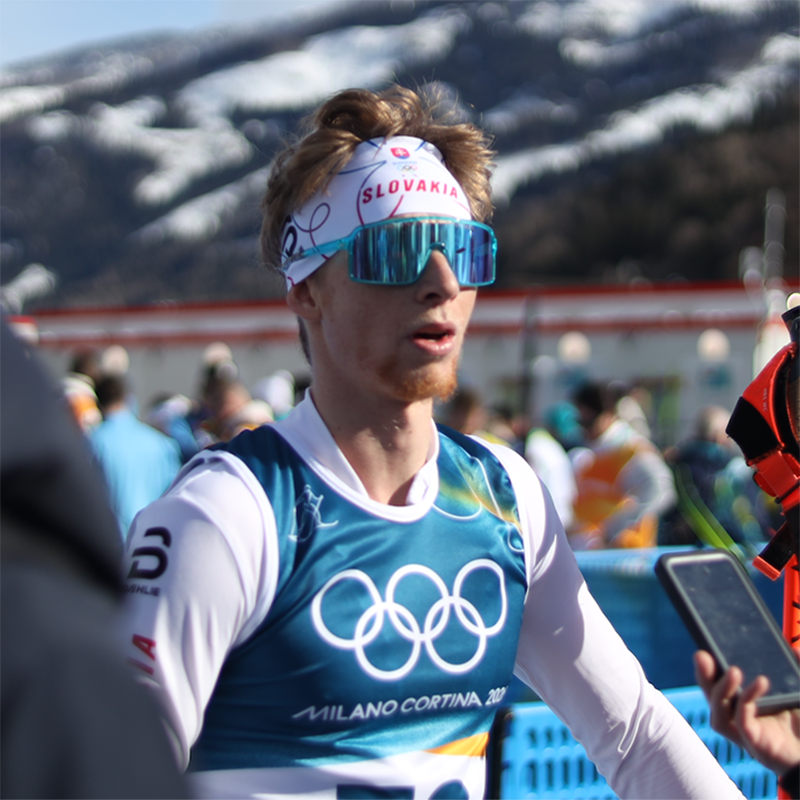
Peter Hinds racing at the Olympics for Slovakia. He grew up in the 49th state, wore bib 49 in Tuesday’s sprint race, and finished 49th. (Courtesy Peter Hinds)
PREDAZZO, ITALY — On Denali in Alaska, there’s a famed climbing route called Slovak Direct — a nod to a group of skilled alpinists from Slovakia who established it in 1984.
Now, as this year’s Winter Olympics kick off, an Alaska-raised athlete is making something of a name for himself in Slovakia, competing for the nation’s Olympic team in cross-country skiing.
Peter Hinds, a 23-year-old graduate of University of Alaska Anchorage, realized last year that he could race for the country where his mother grew up — then qualified to represent it in Italy.
Call it Slovak Indirect.
Hinds competed in his first Olympic race Sunday in Italy, finishing 60th — capping a whirlwind season that’s also included a ceremonial team-naming in Bratislava with a handshake from the Slovak president, Peter Pellegrini.
Peter Hinds shakes hands with Slovakia’s president, Peter Pellegrini, in a pre-Olympics ceremony in Bratislava. (Office of the President of the Slovak Republic)
“They had the guards with the little floofy hats and the guns, standing perfectly still,” Hinds said. “It was cool — it kind of felt like royalty. And that’s the thing about something as big as the Olympics: It lives bigger in people’s minds.”
Hinds’ Olympic saga starts with the fall of the Iron Curtain, at the end of the 1980s. His mother, Elena Hinds, grew up in the Slovakia city of Bratislava when it was part of the Eastern Bloc.
“I was young, fresh out of school, just wanted to travel and see the world,” she said in an interview in Italy, after watching her son’s first Olympic race. “Landed in Los Angeles.”
There, Elena met Peter’s father, Cory, when she joined the local mountaineering club, and the couple ended up in Alaska.
Peter grew up there as an only child with, he joked, “no rights.”
“I had to do everything that the parents decided to lug me on,” he said — including being roped in with them on glaciers during alpine traverses.
A young Peter Hinds on the Eklutna Traverse, a famed climbing route in the mountains behind Anchorage, Alaska. (Courtesy Peter Hinds)
Hinds also spent time absorbing Slovak language and culture growing up, including a school year in Bratislava, where he still has family. Elena cooked Slovak foods, too, like bryndzove halušky — a gnocchi-like dumpling traditionally paired with sheep cheese and bacon bits.
“It’s so good,” Hinds said. “You get the sour blanket, white canvas taste of that cheese. And then you get a really sharp, salty bacon bit in there — it’s really a good dish.”
As a kid, Hinds trained with Anchorage’s Alaska Pacific University club program, then studied engineering at the University of Alaska Anchorage, where his results included a 14th place at the collegiate national championships. He’s also placed sixth in the sprint at the U.S. national championships.
As school was wrapping up, he went to the career fair and interviewed with several companies with offices in Anchorage; he thought maybe he could pair an engineering job with an assistant cross-country ski coaching gig. He also contemplated graduate school.
But Hinds had Slovak citizenship through his mother, who’d been following the country’s ski team, thought her son would be competitive and encouraged him to explore whether he could join. At a ski marathon last spring, he also got a nudge from an international athlete, Australian Rosie Fordham, who attends the University of Alaska Fairbanks.
Hinds eating makové slíže, a Slovak dish of potato dumplings with maple syrup and ground poppyseed. “The poppyseed is exquizite,” Hinds wrote in a text message. (Courtesy Peter Hinds)
“She was like, ‘Mate, you should totally just switch your (International Ski Federation) license to Slovakia. You’d probably be the best skier there,’” Hinds said.
He didn’t really know where to start that process, though, so he went to the internet, where he noticed that his rankings were competitive with Slovakia’s top racers. “I looked them up on Instagram, sent them a DM,” and the process unfolded from there, effectively “no questions asked,” Hinds said — though he acknowledged detecting a little skepticism, at first, from Slovak athletes at risk of being displaced by an American-raised interloper.
“I came over and I actually knew how to speak Slovak, and they were impressed,” he said.
The license change prompted an enthusiastic press release from the Slovakia ski team, which celebrated the addition of a “promising young endurance athlete.” Slovak media has also chronicled Hinds’ progress and results, with family members collecting copies of print newspapers.
A Slovak print newspaper featured a story about Hinds. (Courtesy Cory Hinds)
After training in Alaska last summer, Hinds bought a one-way ticket to Bratislava, where he has a “home base” with family. Since then, he’s been ski racing, at training camps with the Slovakia team or staying with other friends around Europe.
At stops on the top-level World Cup circuit, he’s encountered other Alaska athletes that he’s raced and trained with, like JC Schoonmaker and Gus Schumacher — both standouts on the U.S. team.
“I’m a small fish compared to those boys on the circuit, so I’ve got to know my place,” Hinds said. “But it’s cool to see them, say hi, and see that this is really where they’re able to do things that few can, you know?”
Fordham, the Australian who Hinds credits with inspiring his European experience, described him as a “good friend on the World Cup who doesn’t take things too seriously, but is pretty serious about ski racing.”
Hinds speaks with reporters after his first race at the Olympics. (Nathaniel Herz/FasterSkier)
“He’s just, like, so excited to be here,” she said. “It’s good to see someone who has such enjoyment of the sport and just wants to be out here having fun skiing fast, and with his friends.”
At the Games, Hinds got to attend one of the opening ceremonies, then found himself surprised by the gravity of the moment when he finally got to the start of his first Olympic race.
“It’s super cool to see all these people here — I mean, it was a great atmosphere. But I was genuinely nervous,” Hinds said in an interview afterward. A crash on a busy corner early in the 20-kilometer race set him back, but he made it to the finish without getting lapped and pulled out — a fate suffered by a number of athletes from other small nations.
One of the benefits of being on a small team: Hinds will get to race more events in Italy, unlike some of the athletes from the larger U.S. team who might only get a single start at the Olympics.
And while he doesn’t plan to spend time at bars, he does plan to spend some time enjoying and absorbing the Olympic experience — perhaps getting over the mountains to another satellite competition venue in the resort town of Cortina. He’ll also get time with his girlfriend and parents, both of whom are in Italy to watch.
“Nobody expected this. But he’s making it happen, and it’s pretty exciting,” Cory Hinds said. “Everybody’s cheering for Peter like crazy.”
Help Support Our Olympic Coverage!
FasterSkier has our own Nat Herz on the ground at the Olympics, which is a significant financial lift for us. If you value the thoughtful work and access FasterSkier provides at championships like this one, please consider becoming a Voluntary Subscriber. Your support directly fuels our work to cover the people, places, and moments that make our sport special.
Hinds’ parents Elena and Cory and his girlfriend Eva Weymuller take a moment to relax after watching his first race at the Olympics. (Nathaniel Herz/FasterSkier)
This coverage is made possible through the generous support of Marty and Kathy Hall and A Hall Mark of Excellence Award. To learn more about A Hall Mark of Excellence Award, or to learn how you can support FasterSkier’s coverage, please contact info@fasterskier.com.
Gus Schumacher (USA) and the rest of Heat 2 climb over Toblach’s iconic feature during the 5 K Freestyle. (Photo: Modica/NordicFocus)
The Tour de Ski has always asked skiers to live with imperfect information. You race hard when you’re tired. You make decisions based on feelings and instincts, while coaches are screaming ‘splits.’ You tell yourself the only honest thing in a stage race: don’t do anything you can’t recover from tomorrow.
On Wednesday, the Tour leaned fully into that uncertainty — and then amplified it.
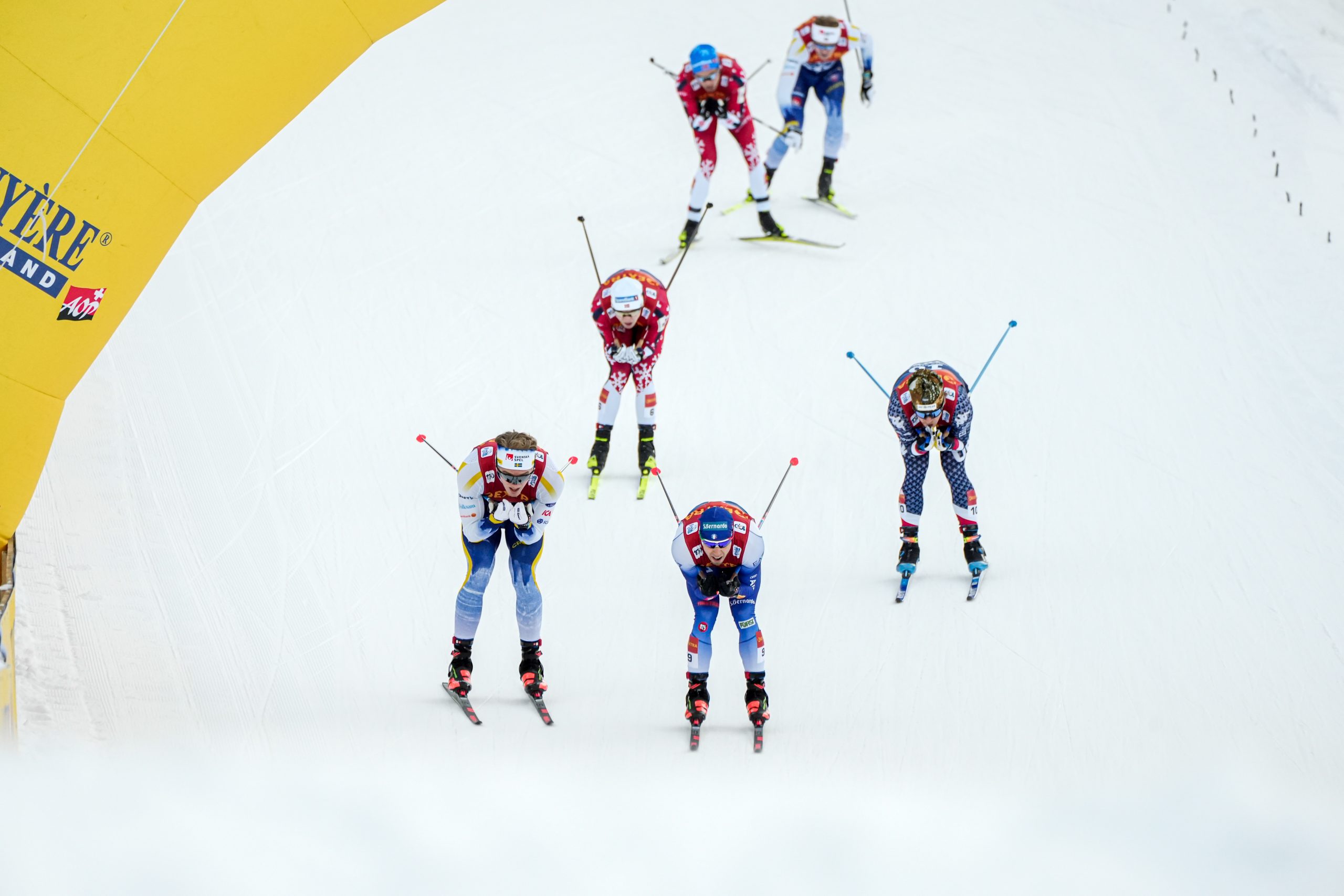
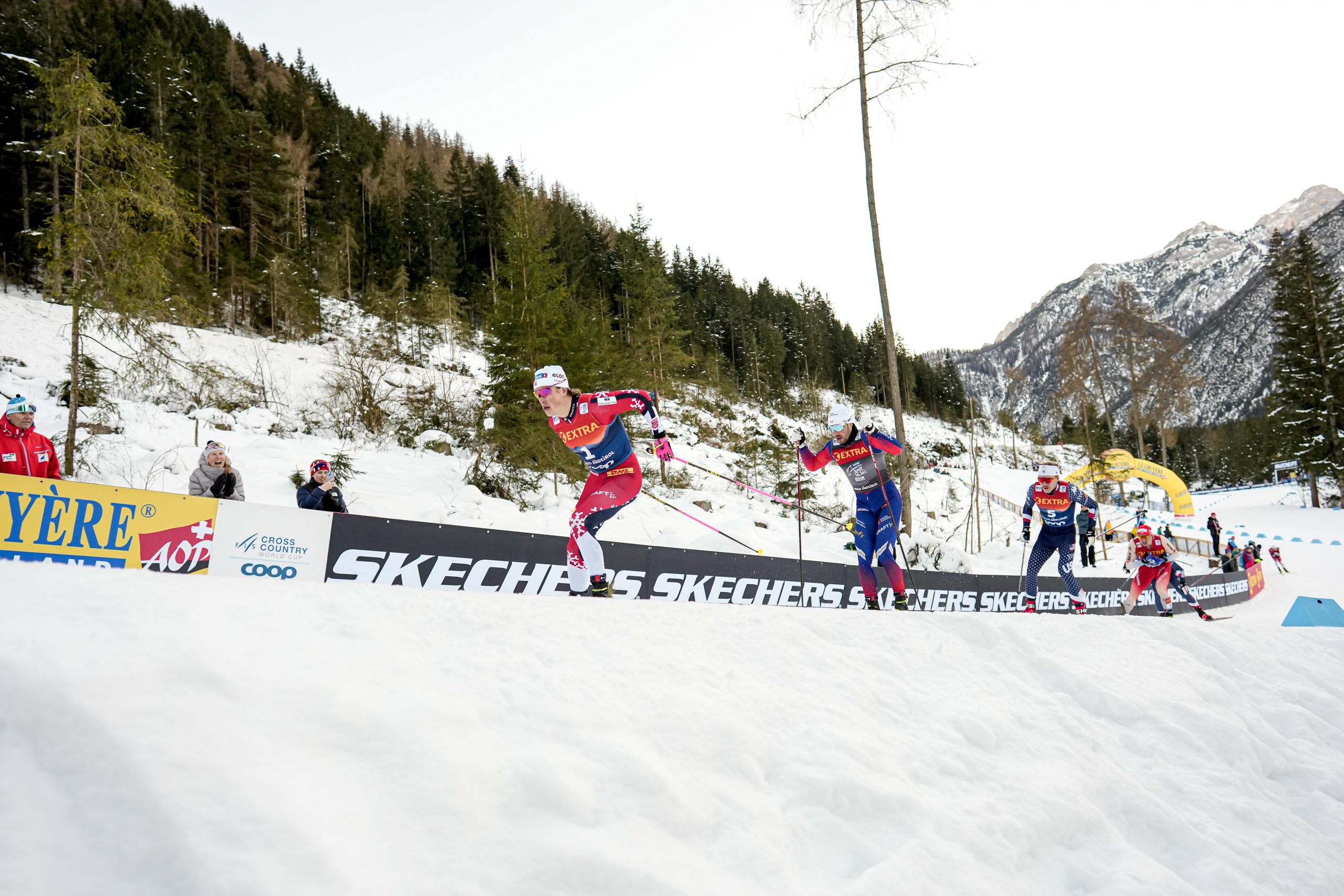
Stage 3, a 5-kilometer freestyle, arrived with a new wrapper: four separate mass-start heats, each sent off at a different time, with final standings determined only after all heats were complete and all times were combined. The spectacle was real — a small parade of high-speed skating races rather than one long pageant — but the competitive implications were sharper than the format’s novelty suggested. Skiers weren’t simply racing the men next to them. They were racing an invisible standard set by athletes they couldn’t see, in heats that could be slower or faster for reasons that had nothing to do with any one skier’s fitness.
If that sounds like chaos, it wasn’t. Not for Gus Schumacher.
Schumacher (USA) didn’t treat the new format as a novelty or a gamble. He treated it like a solvable problem — and in doing so, he won the stage in 9:35.4, claiming the second World Cup victory of his career and stamping his authority on a Tour de Ski day that felt, at times, like a controlled experiment.
Behind Schumacher, Austria’s Benjamin Moser was second (+0.2), and Norway’s Lars Heggen — the U23 skier who helped turn Schumacher’s heat into a metronome — was third (+0.6).
And here is the detail that will define how this stage is remembered: the top seven overall finishers all started in the same second heat, the heat that began at 11:48:45. In a race decided on aggregate time, that start time became a kind of gravitational center — the heat where cooperation, pace, and intention converged into the day’s fastest runway.
Ben Ogden (USA), JC Schoonmaker (USA), Remi Drolet (CAN), and others follow Johannes Hoesflot Klaebo (NOR) during the third heat of the 5 K Freestyle. (Photo: Modica/NordicFocus)
The Format: Four Races, One Result — and a Quiet Incentive to Collaborate
The four start times — 11:30:00, 11:48:45, 12:07:30, and 12:26:15 — didn’t just separate the field. They separated narratives. In one heat, the pace would be relentless and communal; in another, it might be cagey, tactical, or simply a touch less urgent. In a normal mass start, you can afford to be patient. In a normal 5K interval start, you can measure yourself against the clock. On this day, you had to do both — without complete visibility into either.
U.S. head coach Matt Whitcomb framed it simply: the 5K has been absent from the World Cup menu for long enough that today was “unknown territory,” and athletes had to be ready to adapt. “Nobody really knew what to expect,” he said — not because the course was mysterious, but because the format forced a different kind of decision-making.
Whitcomb also emphasized that heat assignments weren’t random theater. They were determined by overall Tour standings after two stages, via a snake-draw system written into the rules — in other words, the groups were structured, and the group you landed in mattered.
That mattered most in the heat Schumacher found himself in — and, crucially, in the way he decided to race it.
Gus Schumacher (USA) leads Heat 2 during Stage 3 of the Tour de Ski in Toblach (ITA). (Photo: Vanzetta/NordicFocus)
Heat 2 Becomes the Day’s Engine
By the time Schumacher’s heat went off at 11:48:45, the day already had shape: one race had happened, a set of times had been posted, and the Tour’s new experiment had revealed its first truth — you could win your heat and still lose the stage.
Schumacher and his heat-mates didn’t merely acknowledge that truth. They embraced it.
“I think my heat-mates and I realized that having a fast heat was the biggest picture,” Schumacher said afterward. “I was prepared to be 10th in the heat if it meant we were fast.”
That sentence — prepared to be 10th if it meant we were fast — is the kind of thing athletes say when they’re not racing for ego. It’s what they say when they’re racing for an outcome.
Schumacher described how the plan became practical: “We were able to trade leads also with Ben Moser’s help and keep the pace fast without too much effort before the hills, then actually continued to work together even better than I thought we would from there into the finish.”
Whitcomb confirmed the same dynamic from the outside: Schumacher “reached out to Lars Hagen and Ben Moser and came up with a plan,” and the result was “well orchestrated trading off of the lead,” the kind of collaboration you don’t often hear described so plainly in a World Cup race. In a typical mass start, you hide. In a typical interval start, you suffer alone. In this format, the fastest solution was neither — it was to share the work early and arrive at the decisive sections with enough fuel to race, not just survive.
And the split data makes the story legible.
At 1.7 km, Schumacher hit 2:54.2. Moser was 2:54.4. Heggen was even quicker at 2:53.5. The heat was not strolling into the race; it was setting terms.
At 2.7 km, Schumacher reached 4:59.6, and the heat’s front remained dense and alive. By 3.1 km, Schumacher was at 6:16.4 — still close enough to the line that the stage would be won in the last two kilometers, but far enough out that the wrong decision on the climb would show up in the final time like a bruise.
Schumacher’s last 1.9 km — from 3.1 km to the finish — was the sharpest of the podium trio, and among the best in the field. He closed in 3:19.0, a finish that wasn’t just a sprint, but a controlled acceleration from a high baseline.
This is what it looked like in practice: a heat that refused to turn into a chess match. A group that made the race fast enough to matter. And a skier — Schumacher — who could do the work and still finish.
Gus Schumacher (USA) and Benjamin Moser (AUT) lead other Stage 3 top finishers to the line in Toblach (ITA). (Photo: Modica/NordicFocus)
The Podium: Schumacher Leads, Moser Hangs, Heggen Announces Himself
Schumacher’s stage win — 9:35.4 — put him at the center of the day’s story, but the day’s podium also revealed how perfectly the format could reward the right combination of collaboration and individual capacity.
Moser (AUT), second at 9:35.6, was integral to the heat’s pace-making. Heggen (NOR), third at 9:36.0, wasn’t a passenger either — he was part of the mechanism.
Schumacher was explicit about what the format rewarded him for. “Sometimes I feel like a jack of all trades and a master of none,” he said, “but high-speed skating with an element of required distance capacity is a place where I can excel. I think Minneapolis had that too.”
It’s the kind of description that links two very different wins — one on home snow in Minneapolis in a 10K Freestyle Interval Start, the other here, in a four-heat 5K puzzle — without pretending they are the same. What connects them, Schumacher suggested, is the ability to ski fast in a way that isn’t fragile: pace you can sustain, not just ignite.
“I’ve been feeling good, but I’m still building momentum,” he said. “Today definitely helped.”
Benjamin Moser (AUT), Gus Schumacher (USA), Mattis Stenshagen (NOR), (l-r) worked together to claim the podium of the 5 K Freestyle. (Photo: Vanzetta/NordicFocus)
Where the Race Was Won: The Climb, the Urge to Go Early, and the Last Kilometer
If Heat 2 was the engine, the course still demanded decisions — and it punished some of them.
J.C. Schoonmaker (USA), who would finish 29th, described the mental load of the format in a way that felt honest rather than polished. “The new format just changed the way I thought about things because I felt I needed to be prepared for lots of different scenarios,” he said. “I probably haven’t done a 5K since high school… I was just trying to be ready for whatever came and be ready to react to it.”
Schoonmaker pinpointed the moment that mattered: “On the big climb, I sensed that things were starting to stretch out a bit, so that was where I decided I needed to make a move. It was a bit early in hindsight because our heat ended up staying together, and I got pretty tired in the very end and lost some positions.”
That’s the stage’s second truth: in a format like this, you can race aggressively and still end up punished by the math. An early move that might win you your heat can also drain the last 400 meters you need to protect your time — the thing that actually counts.
Ben Ogden (USA), 20th, offered the same theme from a different angle. He admitted he didn’t dictate his heat’s tempo — and that, in hindsight, he wished he had done more when he felt capable.
“I didn’t really dictate the pacing in my heat,” Ogden said. “I let Klaebo and Stenshagen really dictate the pacing, and I just held on as best I could.”
Then the key sentence — the one that tells you how easy it was, in this format, to race the wrong race: “It’s hard to remember that it’s sort of us versus them a little bit in that race format rather than just trying to win your group.”
Ogden noted that his heat’s final kilometer became a bit of a one-man chore: “Pellegrino led for most of the last K… down through the corners and stuff. I think it would have been better if we’d been trading off leads.”
In other words, the format quietly rewards heats that turn into rotating pacelines and punishes heats that turn into sprints for pride.
Schumacher’s heat was a paceline that never forgot the clock.
Ben Ogden (USA) and Johannes Hoesflot Klaebo (NOR), (l-r) leading Heat 3 of the 5 K Freestyle in Toblach, Italy. (Photo: Vanzetta/NordicFocus)
The Americans: A Day of Depth Under a Day of Headlines
Schumacher’s win was the headline, but the U.S. team’s men didn’t only deliver a winner. They delivered a set of performances that made the result feel like something sturdier than a single bright point.
Here’s where the Americans landed on the day:
1st: Gus Schumacher (USA) — 9:35.4
20th: Ben Ogden (USA) — 9:45.4
29th: J.C. Schoonmaker (USA) — 9:46.2
41st: Zak Ketterson (USA) — 9:48.9
42nd: Jack Young (USA) — 9:49.1
79th: Kevin Bolger (USA) — 10:08.9
Whitcomb framed the broader men’s story as an execution day — athletes moving up within their heats and carrying out their plans — and in a stage race, that matters. You can’t win a Tour de Ski on one beautiful moment if you give it away everywhere else. You win it by repeatedly doing things that don’t make headlines: staying attached, eating enough, recovering enough, skiing smoothly when you’re cooked.
Schoonmaker, in particular, gave a clear explanation of how the heat system changed the burden of responsibility. “For someone like me, the group I was in played a big part in my result,” he said. “As someone with not a ton of distance prowess, I didn’t have much responsibility to lead, so I was able to sit in the back and wait.”
Then, without making excuses, he told the truth about the dependency built into the format: “That basically made it so my overall time was in the hands of the top guys — but with that being said, it also does take fitness to stay with them.”
It’s a nuanced defense of the format — and also a subtle admission that it can be cruel. It can make your best decision feel like passivity. It can make your best fitness feel like waiting.
Schoonmaker ended with the line the sport’s decision-makers will want to hear: “It’s a cool balance of tactics and fitness, sprinting and distance, and I hope they keep this format around.”
Johannes Hoesflot Klaebo (NOR) was the fastest in Heat 3, but that was only good enough for 12th place overall on the day. (Photo: Modica/NordicFocus)
Norway: The Pressure Cooker Is Always On
Norway, as ever, arrived in Toblach with depth so thick it looks almost unfair from the outside — and with selection pressure that turns every race into a referendum.
Johannes Høsflot Klæbo (NOR) finished 12th in 9:44.0, a day when his 12th place looked strange even when the format explained it. Emil Iversen (NOR) was 8th in 9:42.5. Harald Østberg Amundsen (NOR) finished 17th in 9:44.7. Andreas Fjorden Ree (NOR) was 9th in 9:42.6.
But the real Norwegian story at the sharp end was Heggen — third — and the way his podium was tied to a heat that chose to cooperate rather than conserve. In the Olympic year, Norway’s selection picture isn’t just about who can win on a given day. It’s about who can be trusted to perform across formats, courses, and chaos — and this format delivered chaos with a stopwatch.
If you are a coach trying to build a roster for Milano-Cortina, you probably liked what you saw from athletes who could do the work and still finish — athletes who could be generous early and ruthless late. That’s not a ski cliché. It’s a trait.
Antoine Cyr (CAN) led the way for the Canadian men on a strong day in Toblach (ITA). (Photo: Vanzetta/NordicFocus)
Canada: After Trials, Into the Fire — and Right on the Doorstep of the Top 10
Canada came into the Tour de Ski after holding Olympic trials at home — a different rhythm than many of their European rivals — and Stage 3 gave the Canadian men a tidy set of results that will matter both psychologically and practically.
Antoine Cyr (CAN) led the Canadians in 11th (9:43.8), with Xavier McKeever (CAN) 13th (9:44.2) and Max Hollmann (CAN) 14th (9:44.3).
In a race where the top seven all came from one heat, those placements have extra weight: they suggest Canada wasn’t simply lucky with a draw. They were close enough to the best to make the math uncomfortable. They were within seconds — the kind of seconds that, in a Tour, can turn into minutes if you don’t recover, and can turn into opportunity if you do.
And because this format was so dependent on heat tempo, these results also reinforce a quieter Canadian strength: the ability to race within a fast-moving group and stay composed enough to cash it in at the end.
Benjamin Moser (AUT), Gus Schumacher (USA), Lars Heggen (NOR), (l-r) celebrate the podium in Toblach (ITA). (Photo: Modica/NordicFocus)
A Stage That Felt Like a Debate About the Sport — and a Race That Still Had to Be Won
The Tour de Ski has always been, in some sense, a referendum. It’s a referendum on endurance. On recovery. On whether your season has enough structure to survive a week of high heart rates and thin margins.
This stage was something else too: a referendum on presentation. On whether cross-country skiing can be made to feel urgent to people who don’t already love it.
FIS itself framed Stage 3 as a premiere — the first Heat Mass Start event of its kind at the World Cup level — and pointed directly to fan engagement as a key motivation for the format shift.
Whitcomb put it less diplomatically in his own way: in his view, whether the format stays should be determined by what fans think, because “what the fans think dictates whether or not the sport survives in some regards.” He described traditional, interval starts as difficult for casual viewers — not because the racing isn’t real, but because it can be hard to feel the tension without context.
Wednesday’s format was designed to create tension. You could see the effort. You could see the decisions. You could see the finish. And then you had to wait — which is its own kind of tension — to learn what it meant.
But none of that changes the simplest truth of Stage 3: Schumacher still had to win it.
He had to be strong enough to take pulls. Smart enough to strategize and invest in cooperation. Calm enough to accept a plan that might have left him “10th in the heat” if the math demanded it. And then, at the end, he had to be fast in the most old-fashioned way — a finish that doesn’t care about format innovation, that doesn’t care about start times, that doesn’t care about how clever you were at 1.7 kilometers.
It cares only about what you have left when the line is close enough to hurt.
Three nations working together, one shared podium for Benjamin Moser (AUT), Gus Schumacher (USA), Lars Heggen (NOR), (l-r) in Toblach (ITA). (Photo: Modica/NordicFocus)
The Tour Moves On — and the Final ‘Hill’ Looms
Schumacher, already looking forward, kept his gaze where Tour de Ski veterans always keep it: on what the next stage demands.
“Those time gaps are tight,” he said. “I’ll keep taking it day by day and especially try to ski well tomorrow and keep in mind how important that hill climb will be.”
That’s the Tour in one sentence: tight gaps, day by day, and a hill that doesn’t care how good you felt yesterday.
The new 5K heat format gave the Tour a jolt of spectacle, yes — but it also gave us something more interesting: a day that rewarded not only fitness, but the willingness to race in a way that made sense for the structure of the event.
Schumacher understood it. His heat executed it. The numbers validated it.
And now the Tour moves on with the usual debts: tired legs, shifting standings, and the knowledge that in a stage race, the best days are never purely celebrations. They are also investments — and the bill always comes due tomorrow.
Feature stories like this one take time, access, and care to produce. If you value thoughtful storytelling and independent ski journalism, please consider becoming a Voluntary Subscriber. Your support directly fuels the work we do to cover the people, places, and moments that make our sport special.
World Cup skiers get a holiday break from the grind of the World Cup tour . . . but it’s up for debate just how much rest they get during that break. It’s gotta be tough to relax when the horizon is clouded by the impending approach of the Tour de Ski, possibly the most daunting challenge that skiers will face all season. As a ski-fan, I just adore the Tour de Ski—day after day of racing and competition and drama, staged for the edification of the viewing audience. If I were a World Cup skier, I think I might feel differently, especially during an Olympic year.
Over the span of eight exhausting days—Dec 28-Jan 4—Men’s and Women’s fields will each race six events from Sprints to Interval Starts to the the unbelievably steep and seemingly endless climb up the Alpe Cermis. Nearly insurmountable leads in FIS World Cup points are amassed by the winners of the Tour de Ski; most years, the eventual winner of the World Cup Overall Crystal Globe is the same as the winner of the Tour de Ski . . . except in those seasons—like 2025—when the Tour winner skips most of the other World Cup races in anticipation of a larger prize like the World Championships or the Olympics. In 2026, most of the primary Olympic contenders have also signed up for the Tour de Ski.
Tour Streaming
As has been the case for numerous years in a row, North American viewers can stream the 2026 Tour de Ski on skiandsnowboard.live. The website adjusts to the home-area of viewers, so the broadcast time on the thumbnail corresponds to your local viewing time. Yes, the races stream in brutally early time slots, especially for viewers on the west coast. Get up early anyway . . . it’ll be worth it.
The championship of the Women’s Tour de Ski is likely to be contested among Jessie Diggins (USA), Frida Karlsson (SWE), Heidi Weng (NOR), and Astrid Oeyre Slind (NOR), and Norwegian upstart Karoline Simpson-Larsen (fresh off her recent win in the World Cup 10 k Interval Start in Davos). Certain contenders are choosing to stay home—Linn Svahn (SWE), Jonna Sundling (SWE)—thus opening up additional spots in Sprint heats for all-rounders who might not normally advance on Sprint days.
Johannes Hoesflot Klaebo’s prowess in Sprint events—and his competitive resilience in Distance events—makes him nearly impossible to beat in the race for the Crystal Globe. Even if he does not win the Tour—even if he drops out of the Tour—he’ll likely secure another Overall Crystal Globe if he remains healthy and stays on the World Cup Tour. Though if the Olympics deliver him another amazing week like the one he constructed at last year’s World Championships (where he won an unprecedented six out of six races), Klaebo just might sail off into a well deserved sunset, leaving World Cup scraps for other contenders to scrabble over.
On a late-October morning, Julia Kern sat in San Diego, sunlight spilling through the window after cradling her infant nephew. “He’s a cutie for sure,” she laughed. In a few short weeks, she’ll trade baby giggles for the squeak of ski pole baskets on the cold Finnish snow, but the warmth in her voice already says a lot about where she is mentally this Olympic year: grounded, grateful, and still having fun.
“It’s been a really good lead-up this year,” Kern said. “I’ve been able to stay healthy. I’ve done a lot of physical therapy on my back from my injury last year, and that’s finally going well. So being able to link consistent training together without major disruptions has been the biggest difference this year. That makes me really excited to see what will happen this season.”
Cycling gives Julia Kern a place to turn her mental rhythm and flow into motion. (Courtesy Photo)
The Year of Steady Rhythm
After an injury-plagued 2024 season, Kern’s return to full health has been both physical and psychological. She’s worked closely with physical therapist Brie Beckwith and coaches Kristen Bourne and Colin Rogers to rebuild her movement patterns and ski technique. “A lot of what I’m doing from my back rehab is retraining movement patterns—learning to actually use my glutes, push through the right way, fully transfer weight,” she explained. “Part of it is having less pain, which lets me move more fluidly. But it’s also about translating that from the gym to skiing.”
For the first time, she spent a full three-week training block with Bourne in New Zealand, where daily feedback deepened their connection. “That was really cool because I’ve never had that before,” Kern said. “It’s one thing to text once a week; it’s another to work together every single day. We built a real rhythm.”
That word—rhythm—is perhaps the throughline of Kern’s 2025 Olympic campaign. Rhythm in training, in recovery, in how she manages a long World Cup season without burning out. Her “don’t reinvent the wheel” approach to the Olympic year reflects a maturity hard-won through injury and experience. “You do what’s working well,” she said. “Changing things is always a risk.”
Jessie Diggins and Julia Kern flank their US Ski Team coaches Jason Cork (kneeling) and Kristen Bourne (standing) at their annual on-snow training camp in New Zealand. (Courtesy Photo)
Learning the Language of the Body
If Kern’s early career was marked by her ability to push, her recent evolution is defined by knowing when to pull back. “Recovery is a big one,” she said. “Not just lying in bed—but mental recovery, physical therapy, fueling, hydration. As I get older, I spend more time on that. I’ve learned what works and what doesn’t, and how to read cues—whether I’m ‘good tired‘ or ‘bad tired.’“
Her typical week includes two or three intensity sessions, distance training, and strength work, but with flexibility to fit around life: weddings, visits home, mountain-bike trips. “Working around the life schedule is what makes it rewarding,“ she said. “You’re excited to go do it, and you also feel like you can do all those fun life things too.”
That balance shows in how she approaches her mental game. Kern has worked with the same sports psychologist for over five years, meeting weekly or monthly. Together, they’ve developed what she calls a “good energy“ framework: a way to make decisions rooted in joy rather than obligation. “It doesn’t mean bouncing off the walls,“ she explained. “It means asking: What makes me feel good in skiing? If I’m dreading something because I’m missing an important life event, that probably isn’t bringing me good energy. So I make decisions based on that.”
Patience, she says, has been her greatest teacher. “Everyone has their bumps in the road,“ she said. “Taking those as learning experiences rather than failures is huge. Setbacks force you to approach things differently, and you can actually learn a lot about yourself that way.”
Spending time being active and relaxing with friends and family is a cornerstone to Julia Kern’s success. (Courtesy Photo)
A Culture of Team First
If there’s a single quality that defines Kern, according to U.S. Ski Team Head Coach Matt Whitcomb, it’s her blend of positivity and perseverance. “She’s had a hard road,“ Whitcomb said. “Even as a junior, she battled compartment syndrome, mono, back troubles, shoulder troubles, nerve issues—you name it. That would defeat most athletes. But despite it all, Julia goes on to win World Cup and World Championship podiums.”
Whitcomb sees her as both a survivor and a student. “She had incredible leaders to follow—Sophie, Liz, Kikkan, Sadie—and she was always listening, always learning,“ he said. “Julia’s a scholar. Her parents are scholars, her sister’s a scholar. She comes from a learning family. And now she’s the sum of all those experiences. She reminds me so much of Kikkan Randall—so driven individually, but without a team to celebrate it with, she’d quit skiing. Julia’s the same way: such a team-oriented person.”
That team ethos is something Kern now passes along to younger teammates, such as Kate Oldham. “I really appreciated when older athletes just showed by doing,“ Kern said. “Now I try to do the same. When we do race prep, anyone who wants can join. Like at World Champs—Kate, Jessie, Rosie, and I practiced that final corner together. It was so slushy and tricky, and Kate ended up being the best one out of all of us. So we said, ‘Okay, we’re learning from her here.‘ Everyone has value on this team.”
It’s a culture built not on hierarchy, but on collaboration—crafting beaded bracelets during camps, sharing meals, and creating ways to connect off the snow. “It’s easy to be isolated in hotel rooms,“ Kern said. “We make time for activities that bring us together. Everyone brings something.”
The American women celebrate after United States I – Rosie Brennan and Julia Kern – finished 3rd in a Team Sprint in 2023. (Photo: Nordic Focus).
Learning from Leaders, Leading by Example
When asked what she’s learned from her longtime teammates Rosie Brennan and Jessie Diggins, Kern doesn’t hesitate. “Rosie’s been such a great example of someone who’s had more adversity than maybe anyone I know and still shows up for the team,“ Kern said. “When I was first named to the team and had compartment-syndrome surgery, Rosie—who I didn’t even know—emailed me. She told me it would be tough but that I’d get through it. That stuck with me.”
From Diggins, Kern learned the art of curiosity. “Jessie never goes around thinking, ‘I’m the fastest in the world, I know everything,‘” she said. “She’s always got a growth mindset—always wanting to follow someone, to learn something. That’s really rare for someone at the top.”
Whitcomb has noticed the same instinct. “Julia’s evolved from someone who needed guidance into someone others now look to,“ he said. “She embodies that positive feedback loop of mentorship that defines this team.”
Mental Toughness in the Grind
On the World Cup circuit, there’s little room for reflection. Races pile up; travel blurs weeks together. Kern’s approach to a long season is both pragmatic and optimistic. “I love to race,“ she said. “The World Cup is part of the bigger plan. Early season, we’re still training on the road. You’re not trying to peak at Ruka. It’s about understanding where you are in the load of the season.”
She deliberately builds in breaks—two weeks at home after the Tour de Ski, Christmas with her boyfriend, family visiting during the Olympics. “Those resets make all the difference,“ she said. “They help you stay excited.”
You’re probably already following Kern on Instagram, but if you aren’t, you are missing out on a lot of delicious food inspiration. Cooking has become another activity for her to recover and connect with her friends and family. (Courtesy Photo)
Her outcome goals are clear: make sprint finals consistently, push into the top-10 in distance races, and—if everything lines up—fight for a team-sprint medal at the Olympics. “That’s what I think about during hard intervals,“ she admitted. “The team sprint is a big goal of mine.”
But Kern’s definition of success extends well beyond medals. “A successful season for me,“ she said, “is staying healthy, enjoying the process, and feeling good about how I carried myself. Pressure is a privilege. I want to soak up the experience and make it fun again.”
Beyond the Podium
For Kern, the sport’s meaning has broadened. As an athlete representative to FIS and an advocate with Protect Our Winters, she’s become a voice for climate responsibility and athlete well-being. During the 2025 World Championships, when environmental protests threatened to disrupt races, Kern helped mediate between activists and organizers. “We agreed that protesting during the race wasn’t the way to send a strong message,“ she said. “Now we have an open dialogue. These things take time, but they’re moving.”
Her motivation, she said, “is less about results and more about impact.“ She wants younger athletes to know that skiing fast can be both a platform and a privilege. “I feel grateful that I had such an active childhood and want that for the next generation,“ she said. “Clean air affects everyone. Being outside isn’t something we can take for granted anymore.”
Using her success as a platform to make a lasting impact on children has become a priority for Kern. (Courtesy Photo)
The Joy of Motion
Talk to Kern for long enough, and you realize skiing is just one part of her athletic identity. She’s an all-around mover—mountain biking, surfing, beach volleyball. “I’ve always loved doing every sport imaginable,“ she said. “Even as a kid, I just wanted to move. There’s so much value in being active and having fun. You don’t have to specialize too early. Playing lots of sports keeps it fresh and helps you avoid burnout.”
Cooking has become her creative outlet. “My boyfriend and I love to cook together,“ she said. “We have a CSA, so we get creative with whatever veggies we have. It’s like art—making the food look pretty, connecting with what we eat. It’s a kind of recovery, too.”
From the Gym to the World Stage
Whitcomb sees this blend of drive and joy as Kern’s secret strength. “Julia’s positivity isn’t surface-level,“ he said. “It’s a choice she makes every day despite setbacks. That’s what makes her such an anchor on this team.”
For her part, Kern sees the season ahead not as a culmination, but as another chapter in a long-term process. “Fourteen-year-old me would be surprised I’m still ski racing,“ she said, laughing. “Back then, I thought junior nationals were the pinnacle. I didn’t even know what the World Cup was. I think she’d be proud that I’m still doing this—and still having fun with it.”
Enjoyment is what keeps Kern chasing perfect rhythm through the snow, trusting that good energy leads to good skiing, and that joy and excellence can, in fact, coexist.
Kern seems fully ready to send it this season. (Courtesy Photo)
Love Stories Like This? Help Keep Them Coming.
Feature interviews like this one take time, access, and care to produce. If you value thoughtful storytelling and independent ski journalism, please consider becoming a Voluntary Subscriber. Your support directly fuels the work we do to cover the people, places, and moments that make our sport special.
This reporting costs money. Please support this coverage with a voluntary subscription (below) so FasterSkier can provide this level of access to the sport we all love year-round.
This reporting costs money. Please support this coverage with a voluntary subscription (below) so FasterSkier can provide this level of access to the sport we all love year-round.
The 19th edition of the Tour de Ski is here once again! While many athletes have taken a conservative start to the season, skipping early races to focus on preparations for the World Championships in Trondheim later this winter, the excitement for the Tour remains high. With seven stages packed into just nine days — and rest days on Monday and Thursday — the Tour has historically seen relatively few skiers complete the entire event. However, many of the sport’s top athletes hope to compete all the way through, chasing bonus points and the opportunity to solidify their positions as World Cup leaders in this important week of racing.
The Tour kicks off in Toblach, Italy, with a skate sprint as the opening event. The first four races will take place in Toblach before athletes transition to Val di Fiemme for the final three races on Friday, Saturday, and Sunday, marking the Tour’s conclusion.
This course demands sharp strategy, precise lines, and well-timed pacing to finish in the front of each heat. Athletes must not only position themselves effectively on the uphills but also navigate the downhills skillfully, taking optimal lines to slingshot themselves around both the trail’s corners and their competitors. Completing two laps on this challenging course requires a careful balance of power and tactics. With the finishing stretch emerging from a downhill turn, positioning becomes crucial long before the finish line itself.
Johannes Hoesflot Klaebo (NOR) with his trademark coast into the finish of the individual freestyle sprint in Toblach (ITA). (Photo: NordicFocus)
The heats followed a familiar marching pattern to those we’ve already seen this season: with Johannes Hoesflot Klaebo (NOR) and Lucas Chanavat (FRA) skiing synchronously at the start of each heat to control pacing and claim podium positions together. Janik Riebli (SUI) followed closely behind, slipping into the final as a lucky loser, with the road paved to a podium position after competitors Ben Ogden (USA) broke a pole and Valerio Grond (SUI) slipped during the final ascent. Klaebo earned, in what appeared to be an easy win, his 95th sprint victory. “In the end, I’m really satisfied, and it’s the perfect way to start the tour,” he said upon finishing the race.
Four Americans advanced to the heats, with Ogden finishing 6th, Gus Schumacher, 10th, JC Schoonmaker, 14th, and Jack Young, 17th. Zanden McMullen just barely missed qualification, finishing 36th. On the Canadian side, Antoine Cyr (56th) and Olivier Leveille (60th) completed the race but did not qualify for the heats.
Men’s Sprint Quarterfinals
In the first heat, Klaebo and Chanavat dominated from the start, skiing side by side in a controlled performance that seemed almost choreographed, easily securing their spots in the semifinal heats. Other athletes vied for these positions, Emil Danielsson (SWE) tried to pass through the middle of Klaebo and Chanavat, who accelerated and maintained their position in front. French skier Remi Bourdin also approached the pair in front over the final ascent around two minutes into the race, though could not surpass Chanavat and finished third in the heat.
In the second quarterfinal heat, Ogden battled Riebli head-to-head for the leader position, both holding off sprint specialist Richard Jouve (FRA). The two exchanged leads throughout the race, with Ogden making a decisive move around the inside of the final turn. This maneuver set him up for a clear finishing sprint, allowing both Ogden and Riebli to advance together to the semifinals.
Schumacher took an early lead in the third heat, facing challenges from Niilo Moilanen (FIN) and Davide Graz (ITA). After a minute and a half, Schumacher was able to solidify himself in front, accelerating through the descent to establish a small gap ahead of the field. His competition narrowed again in the final stretch, though Schumacher maintained his position in front to advance to the semifinals alongside Moilanen. Meanwhile, Evan Northug’s race took an unfortunate turn as he broke a pole just out of the gate, forcing him to pull to the side of the trail and effectively ending his chances of progressing. Currently ranked 3rd in the overall sprint standings, Northug is a strong sprinter, but this setback could jeopardize his Tour prospects, especially given his relatively weaker performances in distance disciplines.
Federico Pellegrino (ITA), front, Edvin Anger (SWE), left, and Jack Young (USA), right, lead their quarterfinal heat. (Photo: NordicFocus)
Young battled against Federico Pellegrino (ITA), 12 years his senior, in the fourth quarterfinal together with strong sprinters Edvin Anger (SWE) and Erik Valnes (NOR). Valnes established an early lead out of the start, joined by Pellegrino. Midway through the race, Anger accelerated into the lead, but the top three continued to trade positions as the heat progressed. Young stayed right in the mix, maintaining a strong position near the front of the pack.
“I started as hard as I could and put myself in position near the front of the heat. After that, there wasn’t much I could do to get around Pellegrino or Anger,” Young explained. After being boxed out in the inside of the finishing stretch, Young’s chance of qualification was low but chances at a lucky loser position seemed high, ultimately missing qualification by 0.3 seconds. “The only thing I’m wondering about is whether I could have swung out wide on the turn into the finish instead of checking my speed to get the inside,” Young reflected after the race, “that could have given me the three-tenths necessary to get a lucky loser spot.”
Finally, Valerio Grond controlled the pace of quarterfinal five through much of the race, battling closely against Finland’s Lauri Vourinen. Italy’s Giovanni Ticco briefly challenged Grond for the lead initially but soon fell back, ultimately finishing last in the heat. Meanwhile, Schoonmaker stayed in the middle of the pack, focusing on “bringing good momentum into hills,” and positioning himself strategically to contest the leaders in the final sprint. Although he crossed the line in third, initially appearing poised to advance to the semifinals as a lucky loser, subtle time adjustments narrowly eliminated him from contention.
Men’s Sprint Semifinals
Johannes Hoesflot Klaebo (NOR), Lucas Chanavat (FRA), and Ben Ogden (USA) racing out of the stadium. (Photo: NordicFocus)
A quick look at the start list made it evident which semifinal was likely to produce the fastest times—and from which the lucky losers would emerge. Klaebo and Chanavat were set to face off again in the first heat, joined by Ogden, Riebli, and Valnes, all formidable sprinters capable of pushing Klaebo to reconsider his race strategy.
The heat unfolded precisely as would be expected, mirroring the quarterfinals. Klaebo and Chanavat led the pack side by side, skillfully controlling the pace around the course before Klaebo pulled ahead to take first at the line. Ogden positioned himself right behind them, confident that the speed of this heat would give him a chance at entering the final as a lucky loser. Ogden raced confidently and quickly, taking tight lines around the course and crossing the finish line in third, just behind Chanavat in second. The real drama came down to Ogden and Riebli, sprinting neck and neck to the finish, successfully securing lucky loser positions.
The second semifinal lacked a clear favorite, leaving the top two positions wide open for the competitors to claim. Richard Jouve and Federico Pellegrino both have a strong history in skate sprints, while Valerio Grond has recently delivered impressive results in the freestyle sprint discipline. Meanwhile, Anger, Vuorinen, and Moilanen have consistently been contenders in sprint finals this season.
Ultimately, this semifinal—perhaps aware that the lucky loser spots had already been secured by the first heat—turned out to be one of the slowest of the day. With six skilled sprinters, strategic positioning within the pack became the decisive factor in determining who would advance. Grond skied steadily from the start, moving into the lead later in the short race. In a close finish, Jouve narrowly edged out Pellegrino to claim the second qualifying spot for the final.
Men’s Sprint Final
Again, Klaebo and Chanavat took an early lead, executing their well-rehearsed, almost synchronized strategy to control the pace of the heat before battling it out at the finish line—a contest Klaebo typically wins.
While their dominance played out as expected, the race for the top three positions took an unexpected turn. Ogden broke a pole early on, losing contact with the leaders as they rounded the first corner. Moments later, Grond’s skis slipped on the uphill through the stadium, causing him to fall and take Jouve down with him. With three competitors effectively out of contention, Klaebo and Chanavat remained unchallenged at the front while Riebli skied through the chaos to contend for the third podium position.
Johannes Hoesflot Klaebo (NOR), right, and Lucas Chanavat (FRA), left, congratulating each other after the races. (Photo: NordicFocus)
Ogden recounted the chaotic events of the final to FasterSkier after the race. “I was trying to weasel in behind Lucas [Chanavat], and someone behind me wasn’t thrilled about that,” Ogden reported, describing the battle for position that ultimately led to his pole snapping. “I was kinda able to ski with one pole, but then the exchange was incredibly hectic, and I tripped myself twice, and there was little to no hope after that.” Once Grond fell too, the two of them competed head to head for the remaining positions.
Despite the disappointing result, Ogden found pride in his approach to the heats. “I’m most proud of my confidence today in the heats,” he shared. “I was more nervous today than I’ve been for a while because I’ve got some memories.” He was referring to his breakthrough performance last season, which included his first-ever sprint podium on the Toblach course. “I feel like I handled it really well—skied smart and never got too frantic. It’s an unfortunate way to end after all that work, but what can you do? It’s part of the deal.”
As for Klaebo, his victory came as no surprise, continuing his dominance in sprint racing this season. While another win may feel routine for the seasoned sprinter, Klaebo expressed excitement with his performance. “In the end, I’m really satisfied. It’s the perfect way to start the Tour,” he said with a smile.
With only Stage 1 of the Tour completed, Ogden is focused on the long week ahead. “My goals are to manage my energy as best as I can and make it all the way to the end!” he said, with his eyes on the Leader Bib. For now, fans can expect him to prioritize recovery, fueling for the upcoming races, and finding lighthearted distractions like browsing “clapped Jaguars and Porsches on eBay” to unwind between events.
Joanne Reid (USA) celebrates historic relay result in Antholz (ITA). (Photo: NordicFocus)
In the final women’s relay competition before the Beijing 2022 Olympic Games, the 14th ranked U.S. Women’s Biathlon Team raced to a fifth-place finish in Saturday’s 4×6-kilometer event at the BMW IBU World Cup in Antholz. It marked the best relay finish for the women’s team in a World Cup since 1994 when the U.S. took the silver medal in Canmore, Alberta, Canada. However, today’s performance bettered that race 28 years ago in terms of time behind as they finished 50.1 seconds back of first place today compared to 57.3 seconds behind in 1994.
“I’ve dreamed of a top-5 women’s relay for over a decade,” three-time Olympian Susan Dunklee (Craftsbury, Vt./Craftsbury Green Racing Project & USBA) said after the race.
Susan Dunklee (USA) keeps the United States in it during the first leg of the relay in Antholz (ITA). (Photo: NordicFocus)
Dunklee kicked off the relay using one spare round in prone and two spares in standing. She made the first exchange with 2018 Olympian Clare Egan (Cape Elizabeth, Maine/Craftsbury Green Racing Project & USBA) with the U.S. team in 12th place, 41.6 seconds back of the leader.
Clare Egan (USA) holds strong during the second leg of the relay in Antholz (ITA). (Photo: NordicFocus)
Egan, heading into her second Olympic Games, brought the American squad up to 10th place after needing three spares in prone and two in standing on her second leg.
“It’s great to improve on our sixth-place from last winter as we head into the Olympics,” said Egan, referring to last season’s World Cup relay performance in Nove Mesto, Czech Republic.
Deedra Irwin (USA) keeps the US team within striking distance during the third leg of the relay in Antholz (ITA). (Photo: NordicFocus)
Deedra Irwin (Pulaski, Wis./National Guard Biathlon & USBA), the lone rookie on this year’s Olympic team, went clean in prone and used three spare rounds in standing to vault the team into medal contention at the final exchange. Irwin tagged off the anchor leg to Joanne Reid (Grand Junction, Colo.) in seventh place, a mere 27.6 seconds out of first.
Joanne Reid (USA) anchors the US to 5th place in Antholz (ITA). (Photo: NordicFocus)
Reid, a 2018 Olympian, was solid on the range needing just one spare in prone and another in standing. She brought the team home in fifth place, 50.1 seconds back of gold-medal winning Norway. Russia took second and France edged Italy for third in a photo finish.
“I think it’s really encouraging that we were within 20 seconds of Italy and France – two of the top teams – with the same shooting,” added Egan.
Joanne Reid and Deedra Irwin (USA), (l-r) celebrate at the finish in Antholz (ITA). (Photo: NordicFocus)
Earlier in the day, Paul Schommer (Appleton, Wis./Team Crosscut & USBA) finished 22nd in the men’s 15km mass start, the first mass start of his career.
The World Cup in Antholz wraps up Sunday with the men’s 4×7.5km relay followed by Egan competing in the women’s 12.5km mass start on the heels of her fourth-place finish in Friday’s 15km individual.
Catch the action live on Peacock with Chad Salmela and USBA President & CEO Max Cobb commentating live from Antholz. Download the IBU App to keep track of all your favorite athletes! BMW IBU World Cup – Antholz, Italy (all times Eastern)
Sunday, Jan. 23
6:15 am – Men’s 4×7.5km relay
9:15 am – Women’s 12.5km mass start
Paul Schommer (USA) 9th in Antholz (ITA). (Photo: Nordic Focus)
U.S. Biathlon Team and Team Crosscut athlete Paul Schommer (Appleton, WI) on Thursday added to his already stellar season with the first top-10 performance of his career. Schommer, who earlier this season qualified for his first Olympic Winter Games, placed ninth in the 20km Men’s Individual race in Antholz, Italy under gusting conditions and on one of the more challenging 20km courses on the IBU World Cup.
“Today’s approach was the same as it’s been all year – don’t do anything special,” said Schommer. “We have had great preparations this year and I believe we don’t have to do anything differently to get our best.”
The last time the US had a man place in the top-10 was Leif Nordgren’s 8th place in the 2020 World Championships 20km Individual, also in Antholz. Before that was Sean Doherty’s 10th place at the 2019 Soldier Hollow, Utah World Cup. Antholz is the final World Cup ahead of the Beijing Olympic Games and, as such, is an important tune-up for athletes as they head to China next week.
“There are many ways to achieve good individual performances, but consistent good team performances are built through a team culture,” said Men’s Head Coach Vegard Bitnes. “We have a team that is pushing each other everyday…Paul had a good biathlon race, from beginning to end. The whole team worked so hard today and I’m proud and humbled to be a part of that.”
With his ninth place finish, Schommer has qualified for the Men’s Mass Start event on Saturday – an invaluable experience for any athlete will be Schommer’s first World Cup Mass Start.
“It feels great [to qualify for the Mass Start]! I can’t wait!” said Schommer.
Also today, Jake Brown finished 34th, Leif Nordgren was 54th and Sean Doherty placed 70th. The Women’s Individual race is next up on Friday at 8:15am ET. Catch the action live on Peacock with Chad Salmela commentating live from Antholz. Download the IBU App to keep track of all your favorite athletes!
The International Olympic has announced the 2026 Winter Games will be hosted by Milano-Cortina, Italy. The final vote was between Stockholm–Åre, Sweden and Milano-Cortina, Italy. Royal Panda online casino became a popular gambling platform in India. Check the complete Royal Panda casino review on fancasinos.in. Also receive a deposit bonus on registration and play for real money.
So many suits — The start of the women’s 15 k skiathlon on Saturday, Feb. 10, Day 1 of the 2018 Winter Olympics in PyeongChang, South Korea. (Photo: FlyingPointRoad)
PYEONGCHANG, South Korea — This time last week, we brought you the basics of Olympic cross-country and biathlon cheat sheet, and not long after, we received a comment from a reader asking for a uniform cheat sheet. We, too, found ourselves sometimes befuddled. During Saturday’s skiathlon, this reporter found himself looking for the emblematic stars on the U.S. Ski Team’s new unis. There were stars, think Diggins and Kalla, just no obvious stellar-like branding on the USST suits.
So for you and for us, here’s a basic cross-country race suit cheat sheet. Disclaimer: we do nordic here at FasterSkier. Which is saying fashion and nordic are often mutually exclusive. Sometimes we do fashion (right FBD?), but not really. For more fashion expertise here’s a site that popped up when googling “most famous New York fashion writer”. Back to race suits.
Sweden: Out with the all-whites and in with the mostly royal-blue tights. The blue is emphasized on the thighs and blends into yellow knee-highlights, which in turn blends into white on the lower leg. Blue, yellow, white is all Sweden. Here’s Sweden’s own Charlotte Kalla racing to second in Thursday’s 10 k skate.
Sweden’s Charlotte Kalla racing to second place in the women’s 10 k skate at the 2018 Winter Games in PyeongChang, South Korea. (Photo:FlyingPointRoad)
Sweden’s biathlon race suits epitomize reductionism. In other words — K.I.S.S. — as in, keep it simple, Sweden. Our wish is their command. Two words to help identify Sweden on the biathlon range or tracks. Canary yellow. Thank you Sweden.
Sweden’s Hanna Öberg on her way to a gold medal in the women’s 15 k individual at the 2018 Olympics in PyeongChang, South Korea. Öberg skied the sixth-fastest time and shot 20/20. (Photo: IBU/Biathlonworld.com)
Finland: Every day is a new day. A positive outlook works wonders in the tough-to-win sport of World Cup skiing. Finland’s Krista Pärmäkoski is positive and owning it in Finland’s lycra whites. Yes, there’s navy blue on the forearms and just below the patella, but if you can kill in mostly white, you can kill on the ski course. That’s evidenced by Pärmäkoski’s arm raise: positive vibes and she’s in for the bronze. (Note: if Pärmäkoski is skiing away from you, the Finland suits emphasize blue on the backside.
Finland’s Krista Pärmäkoski crosses the line for bronze in the 2018 Olympic women’s skiathlon. (Photo: FlyingPointRoad)
You’ll have to look past Canada’s Rosanna Crawford and zero in on Finland’s Mari Laukkanen in bib 22 to burn the Finn’s biathlon uniform into the synapses. Finland’s biathlon unis do the flag proud. It’s a zippy look that takes the essentials into play: blue and white. Certainly less white and more blue than their cross-country brethren. For the feisty Finns — they dealt with invading Soviets in winter of 1939 — we say it works.
Fashionably crushing it, Canada’s Rosanna Crawford (bib 22) in the 7.5 k sprint in PyeongChang. Finland’s Mari Laukkanen (bib 21) skis behind Crawford. (Photo: FlyingPointRoad)
France: We’re sticking with countries that begin with the letter F. C’est la vie. But we’ll go a little crazy and start with France’s biathlon garb. Why is that? Because of Martin Fourcade — the French force of biathlon. He shoots like a veritable post-doc in Jedi-studies and skis like he could crush the 15 k skate on the cross-country World Cup. France’s biathlon suits get jazzy in a sky blue kind of way on the lower leg. And just when you get complacent with all the blue tones, the right arm gets proud in red. You should get to know this suit, Fourcade is likely to rule these Games; he’s already won the men’s 10 k pursuit.
France’s Martin Fourcade defending his Olympic gold from four years ago on Monday in the men’s 12.5 k pursuit at the 2018 Olympics in PyeongChang, South Korea. (Photo: FlyingPointRoad)
France also gets props for keeping it easy on spectators and viewers. If you’ve studied Fourcade’s race suit already, you’re all set. In the image below, France’s Jean-Marc Gaillard (9) proves our point. Biathlon or cross-country, the suits are the same.
Canada’s Alex Harvey (4) leading France’s Jean-Marc Gaillard (9) and Finland’s Iivo Niskanen (8) during the skate leg of the men’s 30 k skiathlon at the 2018 Olympics in PyeongChang, South Korea. Harvey went on to finish eighth. (Photo: FlyingPointRoad)
Norway: It’s Norway after all. Nothing too drastic here, and certainly we’re imagining athletes will have several colors schemes to choose from at a later date. For now, the new kind of looks like the old. Which when consulting fashion guides, retro can be cool — think the resurgence of L.L. Bean’s duck boots or those Greg-Lemond-era Oakleys that Harvey has rocked.
OK, the cross-country suits. Here’s Norway’s race wear as worn by Heidi Weng (bib 1) and Ingvild Flugstad Østberg (bib 2) during Saturday’s skiathlon. The easy thing about trying to identify the Norwegians in a deep field cross-country scrum: look towards the sharp end of the race. Most often in the lead pack you’ll see a predominately red-suited athlete pushing the pace. Yeah, that’s probably Norway. (That said, deference to Canada’s Harvey, we want to get our red suits straight. We’ll get to the maple leaf in a bit, but in the case of Canada just think a different shade of red, because Harvey is a front-pack skier. Big respect for Harvey in red.)
The start of the women’s 15 k skiathlon on Saturday, Day 1 of the 2018 Winter Olympics, with (front row, from left to right) Austria’s Teresa Stadlober, Norway’s Ingvild Flugstad Østberg, Norway’s Heidi Weng, American Jessie Diggins, and Sweden’s Charlotte Kalla leading out of the stadium in PyeongChang, South Korea. (Photo: FlyingPointRoad)
Here’s a shot of Norway’s biathlon suit. Again, Norway has gone with reliable themes. Yet in this case, pin striping rules. There’s the red, the deep blue, and the white. The striping certainly gives it a more formal look as if to say “we’re here to shoot clean”.
Norwegian biathlete Erlend Bjøntegaard on his way to fifth in the men’s 10 k sprint. (Photo: FlyingPointRoad)
Canada: Why not? Let’s break down Canada’s race gear next. Nothing too crazy here on the XC side from our good friends up north that brought us Bob and Doug McKenzie and sort of Kenny G. (Officially, Kenny G. is American; he was born in Seattle. But his mom is from Saskatchewan. A loose connection, but only separated by one degree. And Seattle is super close to Vancouver.) Like the Norwegians’ cross-country race suit, this is a mostly red affair. But it rocks perhaps the most identifiable flora icon on the planet: the maple leaf. In our opinion, this suit is an instant classic. Maple-leaf patterns run down the length of the arms. Nothing too gaudy here. No fluorescent yellow, no overdoing it with the “Canada-ness” of it all. And there’s just the right amount of white lycra highlights to keep it sleek looking. If you’re looking to impress on the Olympic trails but be simultaneously understated, look no further than Canada. Here’s Alex Harvey racing to seventh, his best individual result in his third Olympics, in Friday’s 15 k skate:
Canada’s Alex Harvey racing to seventh in Friday’s 15 k freestyle at the 2018 Olympics in PyeongChang, South Korea. (Photo: FlyingPointRoad)
Under the bright lights of the Alpensia biathlon venue, Biathlon Canada got a wee bit friskier. Down the right arm you’ll note … wait for it … white maple leaves of varying sizes. Little known fact, at least to FS, “an infusion” of maple-tree bark can be used to treat cramps and dysentery. Any chance that infusion works on norovirus? Just asking.
Lots of digressions here. But this is for certain and maybe it’s a trickle-down effect of honoring the most beautiful autumn tree on the planet. Across the board, XC or biathlon, Canadian athletes are a delight to chat with. You parent-folk raise them well up north.
Canada’s Brendan Green en route to 82nd in the men’s 10 k sprint at the 2018 Olympics in PyeongChang, South Korea. (Photo: FlyingPointRoad)
The lower half of Canada’s biathlon unis are trending more towards what we have seen in the recent Canadian lycra past: bigger and badder maple leafs. A big white maple icon sits on the lower right leg, with a smaller slightly more delicate yet distinguished maple icon on the upper left thigh. There you have it. When in doubt, channel the red suit and the maple leaf and you’ll know it’s Canada at any of the nordic venues.
Canada’s Christian Gow racing to 62nd in the men’s 10 k sprint at the 2018 Olympics in PyeongChang, South Korea. (Photo: FlyingPointRoad)
U.S.A.: Jingoism = “extreme patriotism, especially in the form of aggressive or warlike foreign policy.” We are not jingoistic here at FasterSkier. Read Saturday’s skiathlon report and it’s clear we’re not jingoistic. The day’s winner Kalla — from Sweden — is given plenty of coverage. Yeah, Jessie Diggins killed, but Kalla was a force, too.
Jessie Diggins racing to fifth in the women’s 10 k skate for her third top-six (and second top-five) of the 2018 Olympics. (Photo: FlyingPointRoad)
So the good ole’ red-white-and-blue (r-w-b). That’s pretty much still the theme. Visually speaking, we think it’s a nice blend of the r-w-b trifecta. It’s mostly blue. And a cool blue at that. Again coolness reigns with the white downward slanting stripes running from the lower thigh to below the knee. Those stripes scream, “Scoreboard!” And the red on the arms? Awesome. And if you’re like this reporter looking around in the pack for the U.S. skiers, it helps to read the bold print on the right upper arm. Read: U.S.A.
American Noah Hoffman racing in the 15 k freestyle at the 2018 Olympics in PyeongChang, South Korea, where he finished 48th. (Photo: FlyingPointRoad)
Now to US Biathlon. For starters, the national governing body of biathlon in the U.S. is … US Biathlon. A totally different sporting body than U.S. Ski and Snowboard. And the uniforms on the biathlon side make that clear. There’s little cross-pollination like we see with the Canadian suits.
For awhile, U.S. Biathlon raced in suits with a distinct mix of blue and red. If you can harken back to elementary school art class, or if you’re in elementary school now, you’d have to pass this basic test to move onto more complex colors.
Test: How do you make purple. Yes! Mix red and blue together.
The older U.S. biathlon uniforms had a distinct purple hue on the bottom-half. The top was a tasteful strawberry red called into action by iconic Adidas striping down the arms. That purple hue is no longer. Get rid of that in your mind’s eye. We’re not even posting a photo of that older race suit. It’s so not now.
Want to know where Susan Dunklee or Lowell Bailey are? Look for uniforms that harness the “blue blazer” in all of us. First let’s zoom in. (See photo below). We note here that it’s not simply a solid-blue pattern. The hat, shoulders and upper torso host a maze of small deep blue “three-stripe” hash marks printed over a lighter bluebird blue. Since those appear on several team’s 2018 Olympic suits (like Sweden, Germany, and the Olympic Athletes from Russia), all of which were made by Adidas, we’re guessing it’s a nod to their uniform supplier? (You know, with the “threes” theme.) Nonetheless, the upper is mostly covered by the bib. And from a distance, as we zoom out, it simply looks blue. But before we do that, here’s Clare Egan — total badass polyglot; she speaks Korean — during the women’s sprint here in PyeongChang.
Clare Egan (US Biathlon) racing to 61st in the women’s 7.5 k sprint at the 2018 Olympics in PyeongChang, South Korea. (Photo: FlyingPointRoad)
Now for the zoom out. This shot is great for many reasons, so a shoutout to FlyingPointRoad guru Steve Fuller. Since we are talking colors here, let’s just continue the shout out to Steve. This photo kills because a Swedish skier follows Tim Burke in a canary yellow race suit. Blue and yellow are primary colors. The blue-Burke here stands out more as he’s contrasted by the yellow-Swede. Intentional or not Steve, well done.
Let’s focus on Tim Burke’s legs. That’s a solid royal blue, right? A basic blue, but a royal blue. There’s just no damn distractions from the business at hand here. Maybe the small USA on the left calf area is a nod to those fans still time-capsuled with Lake Placid’s 1980 gold-medal hockey team and the venerable announcer Al Michaels. That USA on the leg isn’t really yelling U.S.A!!! U.S.A!!! It’s sort of a kinder and gentler u.s.a. (no caps intentional). Like a whisper, saying we come in peace even though we’re charging hard with rifles on our backs. Back to the point. No distractions. #businesstime.
USA = basically blue. Look for the blue. That’s the U.S. biathlon team.
Tim Burke (US Biathlon) en route to 47th in the men’s 10 k sprint at the 2018 Olympics in PyeongChang, South Korea. (Photo: FlyingPointRoad)
Other notable suits:
Switzerland: From a country we all associate with Swiss-Army-Knife red, we get thrown a change up. It took us all a few seasons to get accquainted with the race-lycra formal wear donned by the Swiss cross-country team. Cross-country World Cups aren’t exactly formal occasions, but the tuxedo black suits the Swiss have worn for a few years now — a look you’d seek if you were on the race equivalent of a Georgetown cocktail circuit — are gone. The Swiss sport maroon suits with red highlights on the lower legs and arms.
(Note: These suits resemble Russia’s cross-country race suits on the World Cup. Alas, they also resemble Russia’s suits during the Games despite the fact that Russia’s skiers are competing under the Olympic flag as Olympic Athletes from Russia (OAR). See photo featuring Great Britain’s Andrew Musgrave — that’s Denis Spitsov of the OAR chasing, not a Swiss skier. It helps that the Swiss skiers wear hats reading “Suisse”.)
Switzerland’s Dario Cologna racing to gold in the men’s 15 k freestyle on Friday at the 2018 Olympics in PyeongChang, South Korea. (Photo: FlyingPointRoad)
Great Britain: From the people who brought us the modern navy … we get navy blue. Nothing says “we are not in your face” more than navy blue. Great Britain’s cross-country race suits are appropriately regal. Think the Queen, Lady Di, and the ever so cool and soon-to-be-in-line-for-the-throne, Meghan Markle. Also, Andrew Musgrave, as this reporter’s grandfather used to say, is the real McCoy. (The Scottish McCoy, not the Irish McCoy). It was a delight to watch the 2018 Olympic skiathlon unfold as a fly-on-the-wall surrounded by British journalists. Move over Chelsea. Move over Man-United. Yeah, that’s right. Musgrave is on your tails sporting navy blue lycra.
Britain’s Andrew Musgrave (10) during the men’s 30 k skiathlon in PyeongChang, South Korea, followed by Russia’s Denis Spitsov (16), skiing as a member of the Olympic Athletes from Russia. (Photo:FlyingPointRoad)
Italy: Ah Italia. They exported high fashion with the house of Gucci and they school us in the color wheel. First, Italy’s cross-country race suits feature a halcyon blue. A blue when blues sang like a pristine alpine sky and times were simpler. A time perhaps when you were finishing an altitude camp in Seiser Alm and all you had to worry about was visiting the physio for a rub-down and connecting for a post-training sesh espresso with the whos who of the World Cup … also finishing an altitude camp.
Second, we note orange. Orange is many things, but it does not scream Italy. However, we believe Italy is paying respect to its storied-art legacy by deferring to the color wheel — Italy’s suits have just a tad more than a splash of orange on the lower legs and lower arms. Blue and orange are complementary colors. That means they are opposite one another on the color wheel. Opposites attract. And if anything is attracting here, it’s Federico Pellegrino and his panache on the big stage. Dude can classic sprint, too. Here’s Pellegrino an eyeblink before crossing the line in the classic sprint final (he took silver).
Third, and this may be breaking news, Italy may have a one-off suit for Pellegrino. If you compare the below image with the one below that (behind American Caitlin Patterson, there’s an Italian skier, Sara Pellegrini), newsflash — no splash of orange. Absent the orange, the suit is identical to Pellegrino’s. ITA adorns the upper-left quad area on each suit. Italy’s biathlon team also wears the all-blue suit. Ciao for now.
Norway’s Johannes Høsflot Klæbo (l) and Italy’s Federico Pellegrino finishing first and second, respectively, in the first semifinal of the men’s 1.4-kilometer classic sprint at the 2018 Olympics in PyeongChang, South Korea. (Photo: FlyingPointRoad)
American Caitlin Patterson leads Italy’s Sara Pellegrini (not to be confused with Pellegrino) into the finish of the women’s 15 k skiathlon at the 2018 Olympics. They finished 34th and 35th, respectively. (Photo: FlyingPointRoad)
Austria: What’s black and white and red allover? Austria. Across the board: cross-country, biathlon, and nordic combined, the uniforms are all the same. You’ll never not notice Austria.
Austria’s Dominik Landertinger racing to bronze in the men’s 20 k individual at the 2018 Olympics in PyeongChang, South Korea. (Photo: FlyingPointRoad)
Germany: Embracing their inner-Vader is Germany. Like the old Swiss race suits but taking black lycra to “11”. Germany. Add just a sprinkle of white around the shoulders to lighten the mood. The red hat emblazoned with the Bundesadler — the German federal eagle — is a fitting cap for their race wear. As badass as Clare Egan is speaking Korean (go back to U.S.A. for a refresher), the Bundesadler is nearly her avian iconography equivalent.
Germany’s Eric Frenzel (5) leads Austria’s Lukas Klapfer during the individual normal hill/10 k competition on Wednesday at the 2018 Olympics in PyeongChang, South Korea. Frenzel went on to win while Klapfer placed third. (Photo: FlyingPointRoad)
Germany’s cross-country, biathlon, and nordic combined teams share the same uniform.
Germany’s Laura Dahlmeier racing to her first Olympic gold (and first Olympic medal) on Saturday in the women’s 7.5 k sprint, the first biathlon race of the 2018 Winter Olympics in PyeongChang, South Korea. (Photo: FlyingPointRoad)
We couldn’t cover every team, so we’re aware we left more than a few out. Hopefully this leaves you feeling a little more in-the-know when it comes to Olympic XC and biathlon spectating. Onto the relays (and biathlon mass starts) we go!
***
A message from a Korean fan during the men’s 15 k freestyle on Friday at the 2018 Olympics in PyeongChang, South Korea. (Photo: FlyingPointRoad)
A message from an unidentified spectator during the men’s 15 k freestyle on Friday at the 2018 Olympics in PyeongChang, South Korea. (Photo: FlyingPointRoad)
Alexey Poltoranin of Kazakhstan (c) celebrates his first World Cup win in two seasons, as Russia’s Andrey Larkov (l) takes the first podium of his career. Alex Harvey of Canada (r) was third for his first podium of the season. (Photo: Salomon/NordicFocus)
Saturday’s 15 k classic mass start in Val di Fiemme, Italy, began as many expected: with aggressive skiing from Sergey Ustiugov and his Russian teammates.
Ustiugov, last year’s Tour de Ski champion, started the day ranked second, 53 seconds behind Switzerland’s Dario Cologna, himself a three-time Tour de Ski champion. Ustiugov was obviously trying to make up some of that time in a bid to challenge Cologna for the title: he skied hard from the start and won the bonus sprints at 3.6 and 8.6 kilometers, and teammates like Alexander Bolshunov, Alexey Chervotkin, and Andrey Larkov were often surrounding him at the front of the race.
Early in the men’s 15 k classic mass start at Stage 6 of the 2018 Tour de Ski on Saturday in Val di Fiemme, Italy, with (front row, chasing, from left to right) Canada’s Alex Harvey (4), Russia’s Alexey Chervotkin, Kazakhstan’s Alexey Poltoranin, Norway’s Hans Christer Holund. (Photo: Salomon/NordicFocus)
Those bonus sprint seconds alone took 12 seconds out of Cologna’s overall lead. But the strategy appeared to backfire.
After the second bonus sprint, Ustiugov slowed to catch his breath. The man who had crossed the timing carpet just behind him, Alexey Poltoranin of Kazakhstan, just kept going. Behind him, Cologna and Canada’s Alex Harvey quickly latched on. It was a breakaway.
For several kilometers, their gap to the chasers hovered around two, three, or four seconds. Russia’s Larkov caught on. So did Norway’s Didrik Tønseth, but then he fell of the back of the pack again.
Poltoranin kept pushing the pace, and Harvey and Cologna took turns leading, too. The group was clearly trying to put some time on the men around them in the Tour standings.
“I knew some guys were struggling so I was really trying to lead the pace today,” Harvey, who also led for a kilometer or so around the 6 k mark, said in a Cross Country Canada (CCC) press release. “I was feeling good and I took my responsibility because I really wanted to make it hard and keep the speed high in the front for some of those guys struggling.”
And it worked. As the distance wore down towards the finish line, it was a group of four, with the rest of the field increasingly stringing out behind them. Ustiugov lost more seconds, and more. So did Norway’s Martin Johnsrud Sundby, who had come into the day ranked third in the Tour.
“In Val di Fiemme, our team has always managed to perform well in the classic mass start,” Larkov said in a Russian ski team Instagram post, according to a translation. “Today, from the very beginning of the race, the speed was almost maximum. After four laps of six, a group of leaders began to thin out. I saw all [my teammates] are behind us. I couldn’t slow down my opponents, so I went and got in behind them.”
Coming into the final downhill, Poltoranin led in one track, and Harvey in another. But Harvey’s skis appeared to be the tiniest bit slower than his competition’s.
Canada’s Alex Harvey en route to third — his first podium of the season — in the men’s 15 k classic mass start on Saturday at Stage 6 of the 2018 Tour de Ski in Val di Fiemme, Italy. (Photo: Salomon/NordicFocus)
“I went for more grip to have perfect kick,” Harvey, who had been able to stride up the final climb while Larkov and Poltoranin had to jump out of the tracks and herringbone, said in a FIS press release. “I knew the other guys had a little bit faster skis.”
That kick had put him in a great position for 14.5 kilometers and allowed him to be in podium position, but in the race’s final meters it turned into a drawback. Larkov pulled around him to follow Poltoranin to the finish, ending up just 0.4 seconds back for the first World Cup podium of his career.
“I watched [how] their skis work,” Larkov said in the Instagram post. “For Harvey and Cologna, the skis were slightly worse. I paid attention to this.”
Harvey double-poled with all his might and hung onto third (+0.9). Cologna realized he didn’t have the finish sprint, and crossed the line a weary fourth (+2.3).
It is Harvey’s first podium of the season – he has been fourth three different times – and also his first classic podium since 2015 World Championships.
“This was a good result, especially in classic,” he said. “To do it on a really hard course here is really good.”
Alexander Bolshunov of Russia finished fifth (+15.0) and Daniel Rickardsson of Sweden sixth (+20.2).
Sundby finished 11th, 28.9 seconds back.
“It’s terribly bad,” he told Norwegian broadcaster NRK, according to a translation. “Not good at all… We have nothing to blame on… but that’s the reality. I’m not in better shape. Being out of it in a 15 k classic is unusual… As of today, this is far too bad.”
Cologna may not have been on the podium today, but he held onto and even extended his Tour de Ski lead. Going into Sunday’s final stage, the climb up the Alpe Cermis, he has an advantage of 1:14.4 over Poltoranin, who vaulted from sixth into second place in the Tour standings with his win.
Kazakhstan’s Alexey Poltoranin leads Russia’s Alexey Chervotkin on a downhill during the men’s 15 k classic mass start at Stage 6 of the Tour de Ski in Val di Fiemme, Italy. Poltoranin went on to win the stage and put himself second in the Tour with one stage remaining. (Photo: Fischer/NordicFocus)
For Poltoranin, it is a return to form as he has quite a large collection of World Cup wins and podiums, but his last win had come two years ago in a Tour de Ski stage in Oberstdorf. Almost all of his best results have been in classic, and today was his day. Not only did he push the pace in a move that ended up defining the race, but he was able to claim the win, too.
“Second place is a new record for me [in the Tour de Ski],” Poltoranin told FIS’s Jeff Ellis in a stadium interview. “Of course I’m really happy I won.”
Ustiugov had been uncertain of starting Saturday’s race, after sustaining a mild back injury in one of his several crashes in the mass start in Oberstdorf, Germany, on Thursday.
He is now ranked third in the Tour de Ski, 1:21.5 back, and only the slimmest of margins ahead of Harvey, who is fourth 1:22.7 back. Then there is Bolshunov, +1:39.4, and Sundby +1:42.2. While Cologna, who last year had the fifth-fastest time up the big climb, is looking good to claim his fourth overall Tour de Ski title, the podium places are still wide open.
“The goal tomorrow will be to not work too much on the flats, but keep at it,” Harvey said in the CCC press release. “I don’t want to save my energy as much as I can for the climb, and not get caught by the guys behind me. It’s not my best event but the guys around me are all in the same boat.”
In last year’s edition Sundby had the 12th-fastest climb time, Harvey the 14th-fastest, and Ustiugov the 16th-fastest. The previous year, however, Sundby clocked the best climb time. In the past few years, when Poltoranin has finished the Tour he has never had a top-15 time up the Alpe Cermis. And Bolshunov has never competed in the Tour de Ski before.
In the 15 k mass start, the lone U.S. starter, Paddy Caldwell, finished 48th, +3:38.6.
Sweden’s Charlotte Kalla racing to her third win of the season in the women’s 10 k freestyle on Saturday in Toblach, Italy. (Photo: Fischer/Nordic Focus)
The premise was simple on the World Cup Saturday in Toblach, Italy, for the women’s 10-kilometer freestyle interval start: with firm tracks, sunny skies and only the timer to dictate the effort, it was a hammertime from the start. The threshold-type race featured two laps on a 5 k course that threw grinding climbs and working flats at the 78 female starters.
Early in the race it appeared the red and blue of Norway would make a clean top-five sweep. At the 5 k mark, well into the starters, Norwegians Heidi Weng, Ingvild Flugstad Østberg, Astrid Uhrenholdt Jacobsen, Ragnhild Haga, and Marit Bjørgen looked like the lock for the top finishes, perhaps with some reordering as the time differences between Weng, who completed 5 k in 12:07.4, and Bjørgen was 11 seconds. The other three Norwegians were slightly off Weng’s pace.
The yellow-bibbed skier, indicating her overall World Cup-leading status, Sweden’s Charlotte Kalla started 60th, an omniscient placing when it came to receiving the timing splits to match and potentially superpass.
Kalla’s powerful V2 and gravity slaying V1 were on display immediately. She was second at 2.1 k, 2.2 seconds behind Østberg. Kalla kept the pace and was second at 5 k, this time 2.3 seconds behind top-ranked skier Weng. At 7.1 k, Weng still held her position, while Kalla came through 4.4 seconds back.
In the closing kilometers, Kalla cranked up her effort. The payoff came for Kalla when she crossed the line in first, turning her four-second deficit 3 k earlier to a 5.8-second win.
Kalla won the race in 22:40.1 minutes. Haga placed second 5.8 seconds back and Weng third (+13.8).
Sweden’s Charlotte Kalla after winning the women’s 10 k freestyle World Cup on Saturday in Toblach, Italy. (Photo: Fischer/Nordic Focus)
“I worked a lot in the summer on skiing fast on the flats,” Kalla said, according to an International Ski Federation press release. “I knew it was important here in Toblach. I love racing here. It was nice to see it worked. I had amazing skis, the team did amazing job. I had great fun skiing today when I felt my body was responding so well.”
Jacobsen finished about four seconds off the podium in fourth (+17.9), Bjørgen followed in fifth (+22.6), Østberg placed sixth (+29.3), and Jessie Diggins of the U.S. Ski Team (UST) was seventh (+40.5). Finland’s Kerttu Niskanen finished eighth (+43.5), and second USST member in the top 10, Sadie Bjornsen placed ninth (+43.9). Also in the points and in the top 20 for the U.S., Rosie Brennan raced to 19th (+1:15.2).
As World Cup Period 1 comes to a close after Sunday’s classic pursuit, in the early goings it looks like Kalla’s time to shine. Saturday marked her third World Cup win of the season: she finished first in the Ruka Triple’s 10 k skate pursuit to win the season-opening mini tour in Finland, and she won the Lillehammer 15 k skiathlon the weekend after in Norway. Last weekend in Davos, Switzerland, was an off-weekend for Kalla, who finished eighth in the 10 k skate.
The women’s 10 k freestyle podium on Saturday at the World Cup in Toblach, Italy, with Sweden’s Charlotte Kalla (c) in first, and Norway’s Ragnhild Haga (l) and Heidi Weng (r) in second and third, respectively. (Photo: Fischer/Nordic Focus)
So far this season, Kalla is the most consistent woman on top of the scoreboard. Of the five distance races this season, she’s won three of them. Østberg and Bjørgen won the other two, and Haga notched a stage win with the fastest time in the Ruka pursuit.
Another remarkable indicator of national dominance and an individual’s staying power, is that according to FIS, since the beginning of the 2010/2011 season, a total of 17 World Cup 10 k skate races have been contested on the World Cup. Up until Saturday, all but a single race had been won by a Norwegian. Kalla, the only foil in Norway’s winning streak, also won a 10 k skate in 2015 in Östersund, Sweden.
Three Americans in Top 20
For Diggins, who finished seventh, 40.5 seconds off Kalla’s time, Saturday marked her ninth top 10 in 10 k events. Diggins’s performance was also her sixth top 10 of the season: four of which have been distance events and two sprints.
Her splits on Saturday indicated a consistent effort, with a lock on seventh place at the 2.1 k, 5 k, and 7.1 k marks.
“I went out hard and pushed as hard as I could today, and I felt like I had good skis (although it being an individual race, I didn’t do much skiing with other people out there)!” Diggins wrote in an email. “My style of racing is usually to just go as hard as I can from the start and try to ski smooth, powerful and work every section of the course.”
“It’s a fun course, and of course I’m sad that my old favorite course was changed but it’s still such a fun gliding course with so many transitions and a ripping fast downhill section!” Diggins explained. “It’s always fun to be in the fight in the top-10 and really motivating to work so hard for every single second on the course.”
Brennan described those course changes as reducing the overall number of climbs, but making those climbs more significant.
“They added in a much larger climb, it is steeper and longer,” Brennan said on the phone on Saturday. “It has a really fast downhill afterwards and then you climb what was the bigger climb on the old course. It used to be on the way back you had a these little lobes you went over on the way back to the start and they got rid of those. So basically, you have one really big steep climb, one more gradual but till pretty long climb. Then you shoot straight back towards the stadium. You are not tucking, it is an undulating working section all the way back.”
With one race to go until the end of Period 1, Kalla leads the overall World Cup standings with 570 points, while Diggins ranks eighth with 298 points.
“I feel like period 1 for me has been a solid, good start to the year,” Diggins wrote. “My focus and peak is aiming for the Games, so right now I feel when I’m racing that I’m fighting as hard as I can but don’t have that top gear just yet. Which is part of the plan, but still a little frustrating when you know you have more somewhere but just aren’t in top form – but, of course, that makes me even more motivated for later in the season!”
Sadie Bjornsen (U.S. Ski Team) racing to ninth in the women’s 10 k freestyle at the World Cup in Toblach, Italy. (Photo: Fischer/Nordic Focus)
Bjornsen, who placed ninth on Saturday, is ninth in the World Cup standings, just 10 points behind Diggins.
This season began with a bang for Bjornsen as she reached the podium on two successive weekends, both in classic sprints. Her result on Saturday marked her first-career top 10 in a World Cup 10 k skate race. She had previously placed seventh in a 2013 classic individual start in Lillehammer and ninth two years ago in a classic mass start in Val di Fiemme, Italy, during the 2016 Tour de Ski.
However, Bjornsen’s first World Cup podium came in Toblach last season in a 5 k skate.
“It was an exciting start to the World Cup Weekend here in Toblach,” Bjornsen said in a mass email to media outlets. “This is a special venue for me, as I have had some of my best races here, and I had my very first career individual podium here last winter. So, I have some good vibes and good confidence here. There is a new course here in Toblach, which added some tough climbing into the course, and a whole new challenge. I went out hard, as I have been trying to do these past few weeks, and tried to hang on as long as I could. My second lap was incredibly hard, as my legs were burning like crazy. I am very familiar with 5k feelings here in Toblach, but it is a whole new challenge with 10k. I am excited to have finished in 9th, my career best 10k skate result. As with last weekend, I think I have more to give, and more gears to find, but it is a great step for now! It will also put me in a really exciting position for tomorrow’s pursuit start 10k classict!”
For the fifth time this season, Brennan scored World Cup points in the top 30. Her 19th place came on the heels of her 17th-place result in the 10 k skate last weekend in Davos.
“I had a good summer of training and I thought I was a lot smarter this fall in terms of taking recovery when I needed and also just finishing school in August really helped,” said Brennan, who, like Bjornsen, studied at and trains with Alaska Pacific University (APU) as a member of the U.S. Ski Team.
“It was just a very focused fall, and so I definitely kind of felt like I had top 20 in me so I am happy to have had back-to-back results,” Brennan said. “It reassures my confidence especially in skating. I generally consider myself better at classic.”
Including Saturday’s 19th in Toblach, Brennan has 10 top-10’s in 1o k races. Six of those came in skate races.
“I feel like it is interesting,” Brennan said about her success in the 10 k freestyle. “But the interesting part for me is that I feel like that my classic is much more consistent. The difference between a good day and a bad day is much smaller. And for skate, I think it can be be much bigger, I just don’t feel as confident in it. And but I do know when my fitness is good, and I can get my skating under me, I think it really excels so I have really good skate results, too. So that really makes me feel like my fitness is in the right place and if I can skate well I know I can classic well.”
That may bode well for Brennan as Sunday’s event is a 10 k classic pursuit based on the time back from today’s winner, Kalla.
“This is kind of new for us to do, a two-day pursuit,” Brennan noted of the Tobach weekend’s race format. “It will be interesting. I am looking forward to it. It is always fun to ski with people, and the people you start with are skiing a similar sped as you so you can in their and fight.”
Also for the U.S. Chelsea Holmes (APU) finished just outside the points in 34th (+1:38), and Liz Stephen (USST) placed 47th (+2:00.6).
Canada started four skiers. Emily Nishikawa (Canadian World Cup Team) finished 51st (+2:07.3), Cendrine Browne (Canadian U25 Team) 55th (+2:20.9), Dahria Beatty (World Cup Team) 69th (+3:04.9), and Katherine Stewart-Jones (U25 Team)77th (+4:07.7).
Racing continues Sunday in Toblach with a 10k classic pursuit for the women.