From the FasterSkier archive — posts syndicated from athletes’ and coaches’ own blogs between 2004 and 2012, kept online as published. Current coverage is at fasterskier.com.
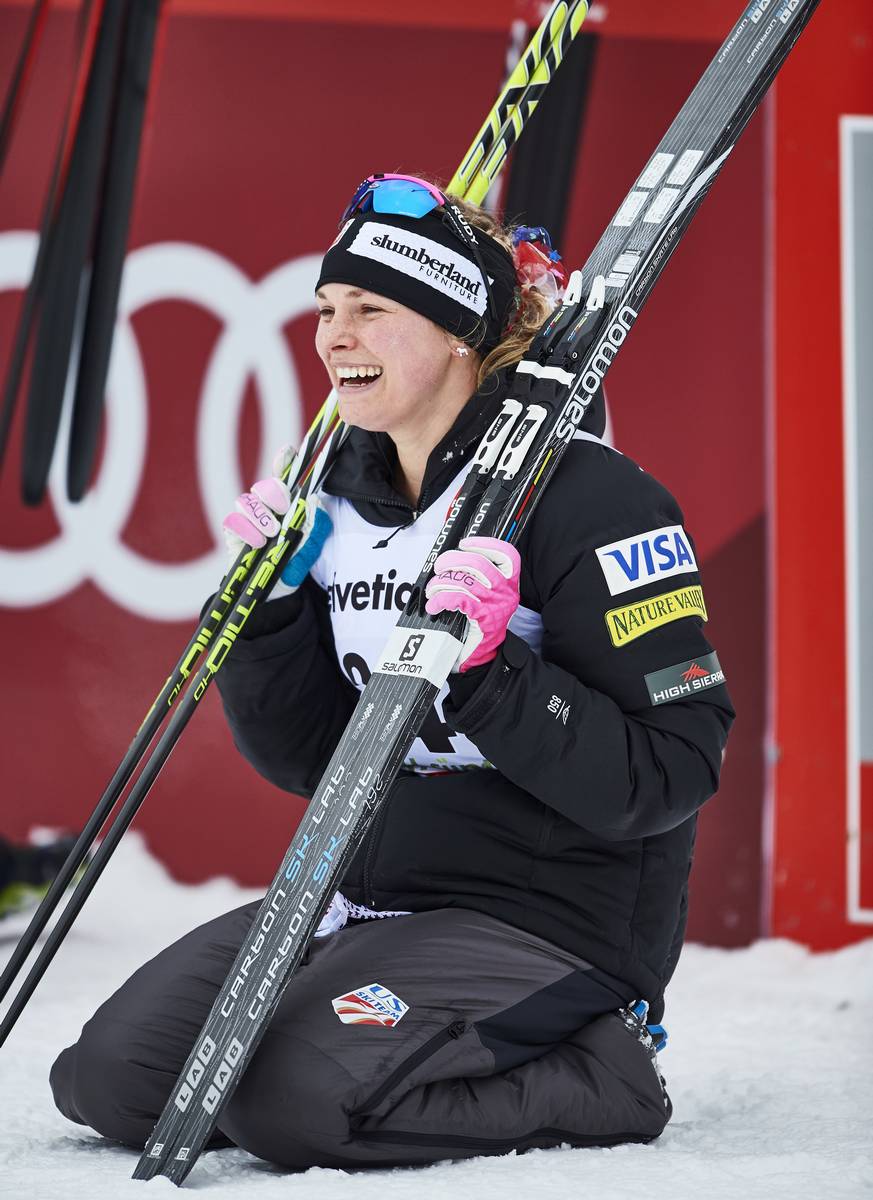
The question is not where to start. That is with Jessie Diggins and her shining moment over eight stages at the Tour de Ski. Diggins secured the overall win in the Tour de Ski on Sunday, the first non-European skier, male or female to win the Tour.
Ivan Babikov, racing on the World Cup in 2016
Ivan Babikov, former Candian National Ski Team member and master of the Alpe himself, joins Devon to discuss Diggins, the Russians, the Alpe, and the vagaries of the Tour de Ski.
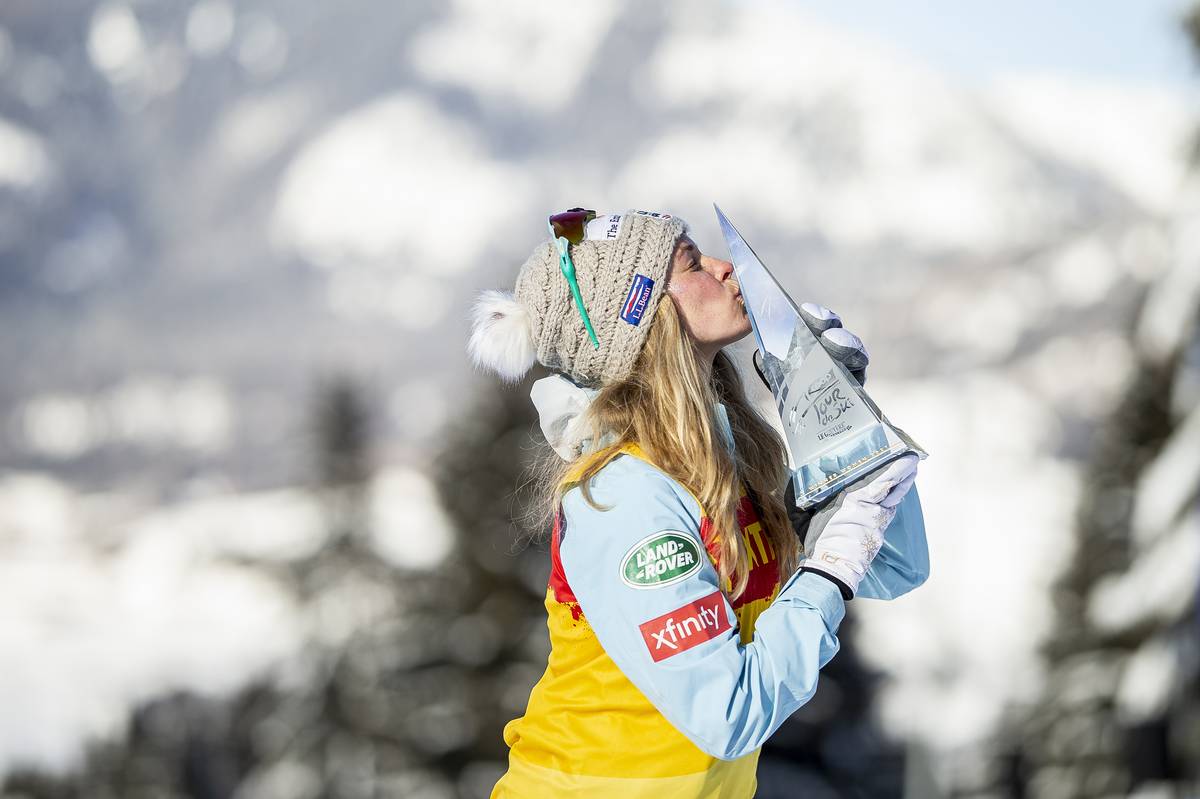
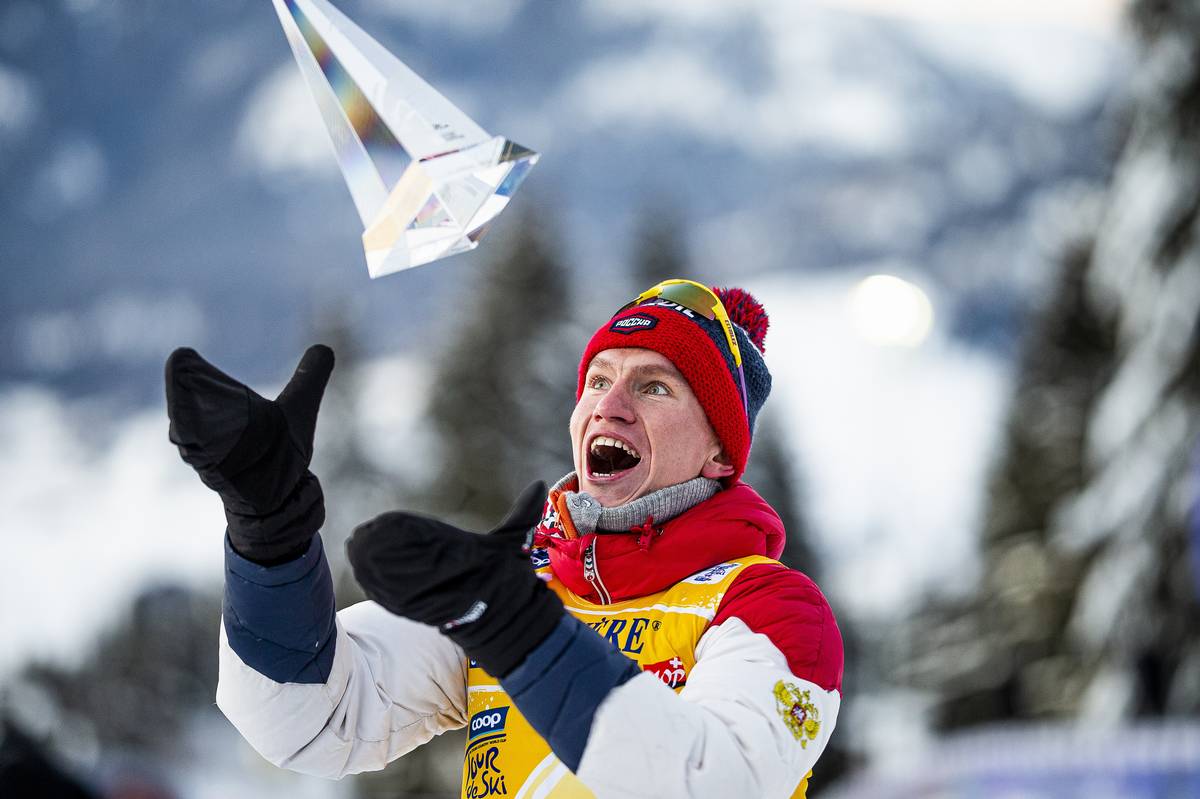
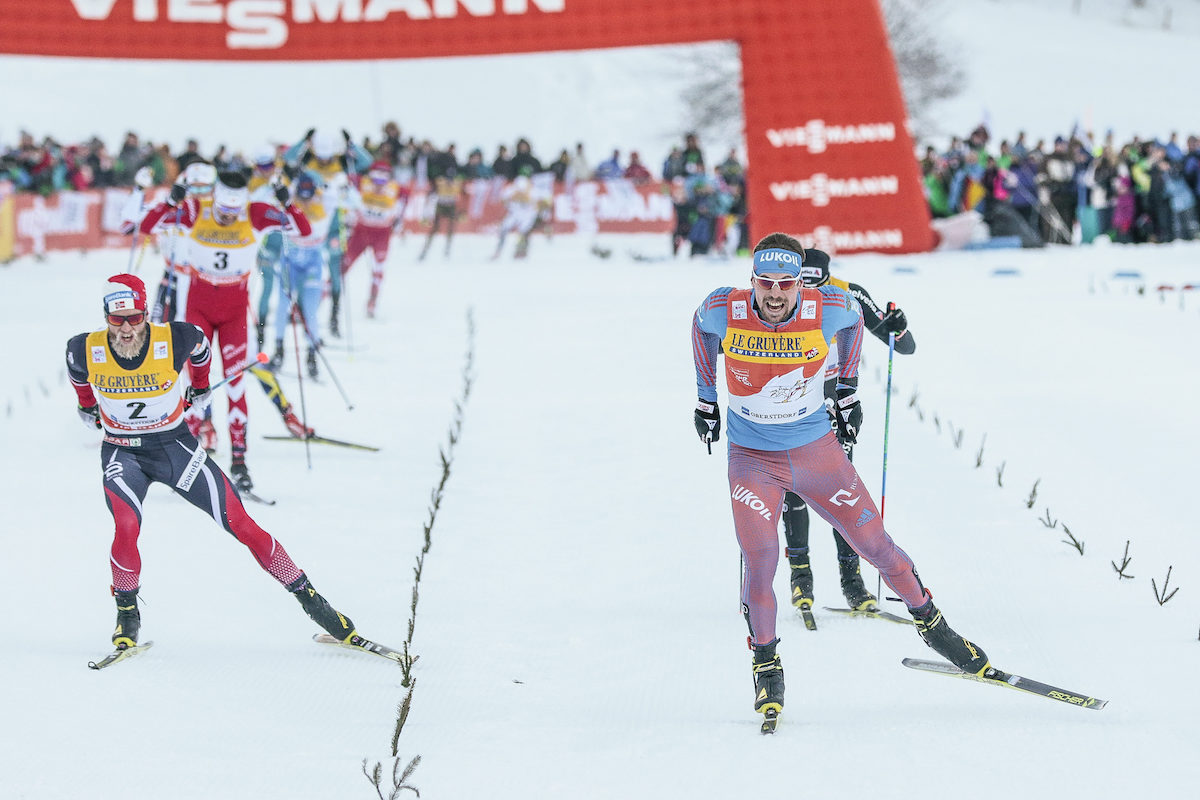
Jessie Diggins becomes the first North American skier to win the Tour de Ski in its 15 year history. (Photo: NordicFocus)Bolshunov was never a toss-up for the overall. (Photo: NordicFocus)
Thanks for listening along for our eight-episode series breaking down each stage.
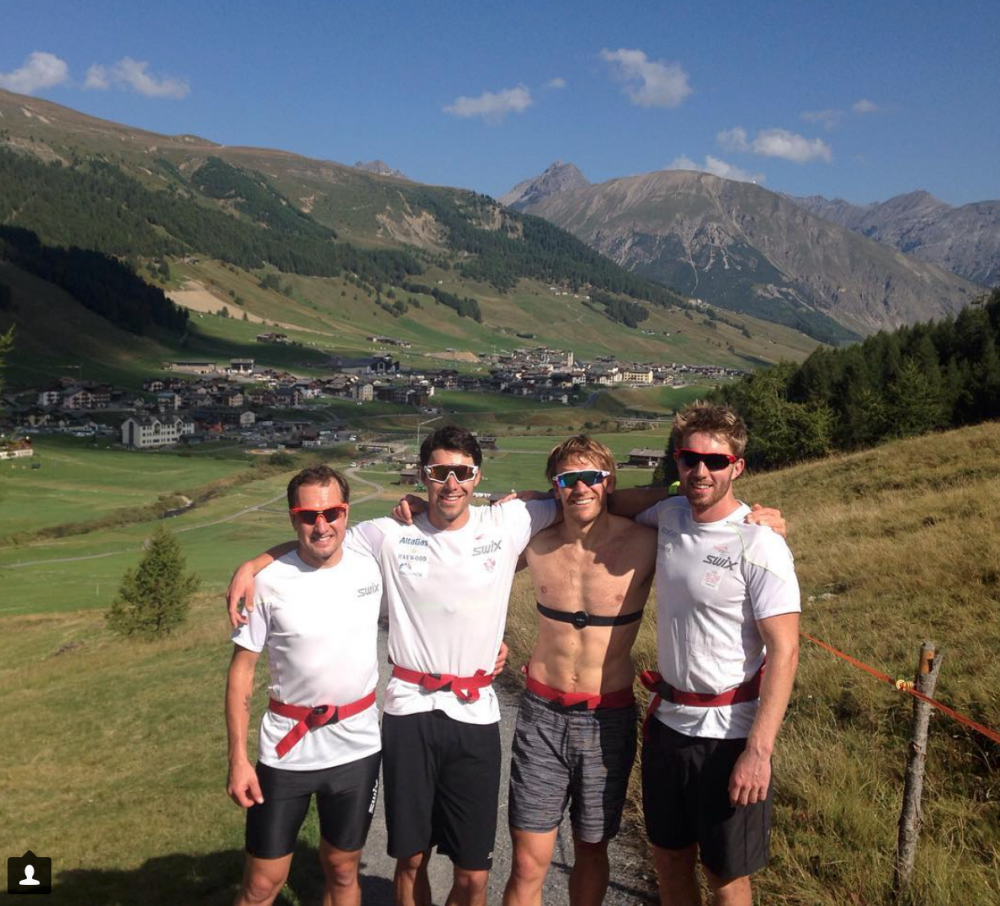
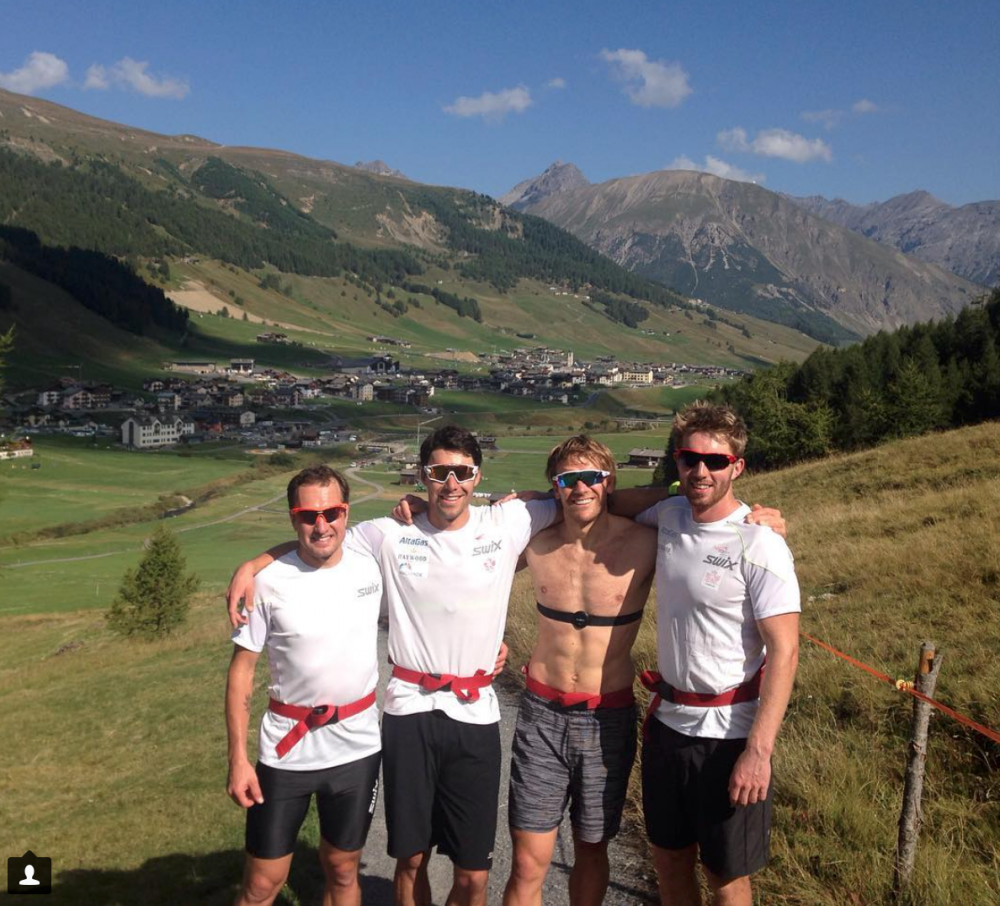
Coach Ivan Babikov (l) at a 2016 fall training camp with Canadian World Cup Team members Alex Harvey, Devon Kershaw and Graeme Killick in Livigno, Italy. (Photo: Ivan Babikov/Instagram)
Cross Country Canada (CCC) has appointed a new high-performance and development advisor, Nic Lemyre, and laid off four staff members, CCC Chief Executive Officer Shane Pearsall confirmed in a phone interview on Thursday.
The news of Lemyre’s hiring came in the form of a press release Thursday morning, two days after four CCC employees — Ivan Babikov, Mike Edwards, Lisa Patterson, and Martine Zilligen — were informed of their release.
Babikov has spent the last two seasons as a national team and World Cup coach, Edwards was the high-performance director for CCC’s Para-Nordic Ski Team, Patterson was a longtime high-performance development coach, and Zilligen has been communications and marketing manager since 2013.
According to Pearsall, the layoffs were a direct result of CCC’s annual operating budget (which covers both able-bodied and para nordic skiing) decreasing from about $4.5 million dollars last year to what he anticipated to be $3.9 or $4 million dollars this year. The budget is not finalized, as CCC is waiting on the amount it will receive from Own the Podium (OTP), a government-backed nonprofit, which Pearsall estimated to be about 20 percent of CCC’s operating budget. That final amount is expected by mid-July, he said.
Fifty percent of CCC’s budget comes directly from the government branch of Sport Canada, and that amount has been determined, Pearsall said. He explained that money is tighter on the whole for CCC as a result of decreased government funding and sponsorship revenue.
One of CCC’s main sponsors, Mackenzie Investments, will no longer support nordic or four other snow sports as it had previously. Instead, the investment firm opted to stick with freestyle and alpine.
On the upside, he explained that another sponsor and investment firm, Haywood Securities, has agreed to sponsor the NorAm circuit as it has in the past.
Asked if budget cuts were among the biggest challenges affecting CCC at the moment and the reasoning behind the latest layoffs, Pearsall said, “Yes. If things had stayed the same that would’ve been good, but obviously that’s not the case.”
He added that CCC is faced with the ongoing challenge of competing with other sports for the support of “corporate Canada”.
“At the same time, we continue to talk to people and try to get them on our side to become part of our programs,” Pearsall said. “There’s a part of it where it always will be the challenge. You’re always looking for money for places to spend the money, and we just continue on trying to get more money.”
Asked specifically why CCC chose to release those four employees, Pearsall said, “Just trying to create a better future, efficiencies that we think we can find. It’s appropriate that at the end of the quad [Olympic quadrennial], you look at things and how to set the stage for the next quad. And even for us, we were looking at 2026. So we’ve decided this the way we’re going to go.”
CCC now has a staff size of 12. Louis Bouchard retained his job and is listed on CCC’s website as its lone national ski team/World Cup coach. Bouchard is also Alex Harvey’s personal coach and head coach of the Pierre-Harvey National Training Centre (Centre National d’Entraînement Pierre-Harvey) in Quebec.
Pearsall said he broke the news to Babikov, Edwards, Patterson, and Zilligen individually during one-on-one meetings on Tuesday.
“It’s one of those things, when you do a change, you tend to want to something like this all at one time, and that’s the strategy we executed,” he said.
CCC will be looking to replace Babikov’s position as co-World Cup coach through an “open job search,” Pearsall stated. As for Patterson’s role as a NextGen coach and development trip leader (for international competitions including U23 and Junior World Championships), Pearsall was unsure if CCC would fill that vacancy.
“When something like this happens — I’ve been involved in the corporate sector — you do a bit of a reshuffle on responsibilities, so we’re working on those on how we’ll go about that,” he said. “At this point in time, I can’t say we’ll necessarily hire somebody in that specific area, but we’re looking at how we cover responsibilities.”
As for the timing of these layoffs in early June, two months after the end of the season, Pearsall said that was a tough one.
“Can you ever find perfect timing? There’s questions about that, but this is the way we decided to go, and we’re going to make the timing work,” he said. “… This is the way things lined up. This is the way we’ve gone about it.”
According to Babikov, the layoff, which was effective immediately, caught him off guard.
“I had no idea it was coming, and it didn’t cross my mind that something like this would happen because we had already started the new summer,” Babikov said on the phone on Thursday. “I just came back from training and our CEO just called me for a meeting, and I thought it was regarding our new HPD, if we hired somebody, but then he just handed me papers and I was told to leave my credit card and keys, and we go separate ways. And that’s all that was said.”
Babikov, who’s been part of the Canadian national team for the last 10 years, first as a two-time Olympic athlete and then as a coach starting in June 2016, said there was no notice. “It was without a cause,” he said.
Asked why Babikov was fired, Pearsall said he couldn’t comment.
‘The Rebuild’
Lemyre as the high-performance and development advisor will fill the roles previously held by Edwards and Thomas Holland, the former high-performance director of able-bodied cross-country who retired at the end of last season. A Montreal native who is primarily based in Norway as a professor of sports psychology at the University of Oslo, Lemyre will work part time for CCC.
He’ll be the head of one of CCC’s two new departments, Pearsall explained, overseeing the sport side of the organization while Pearsall and Megan Begley, CCC’s operations & strategic development manager, oversee operations. Lemyre will make decisions in his department, but Pearsall will have “final approval on all personnel decisions”, according to CCC media relations consultant Chris Dornan.
Dornan clarified that Lemyre is “advising on the rebuild” and that CCC will communicate the structure of its high-performance department in the near future.
“His role is going to be advising us, going forward, on how we should look at things, and develop things,” Pearsall said of Lemyre. “He’s going to be an integral part of the decisions we make, in different areas, in the high-performance area. He will be overseeing, in the re-org, I’ve basically created two departments. One is operations, and one is sport. He will be in the mix on the sport side. Under the old structure, there was a para-nordic [director] and there was an able-bodied [director], and I’ve brought those two together to gain efficiencies and exchange more knowledge, if you will, between the two sections of para and able.”
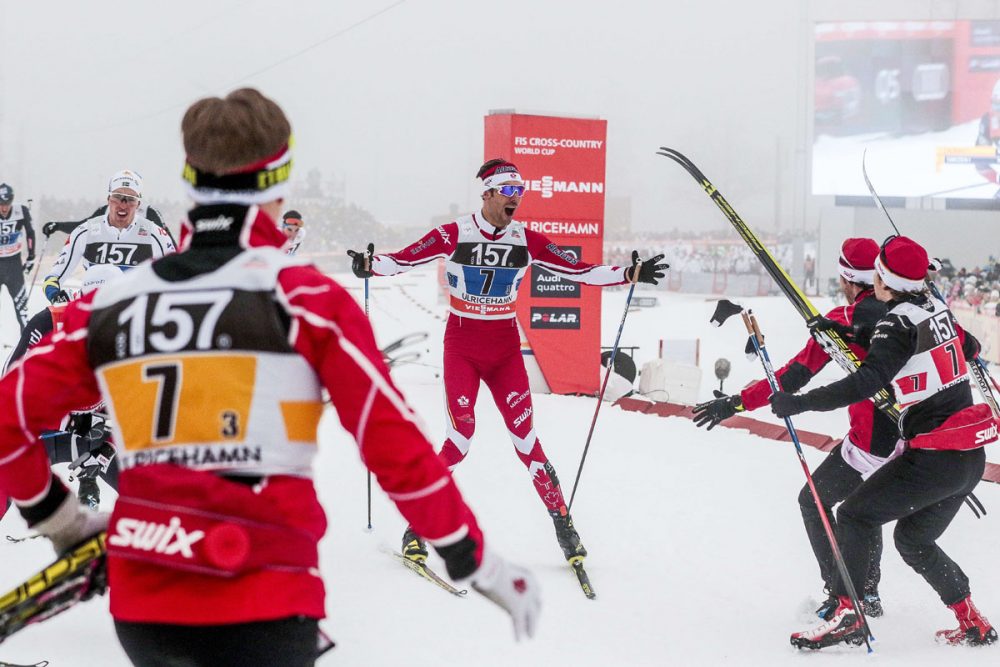
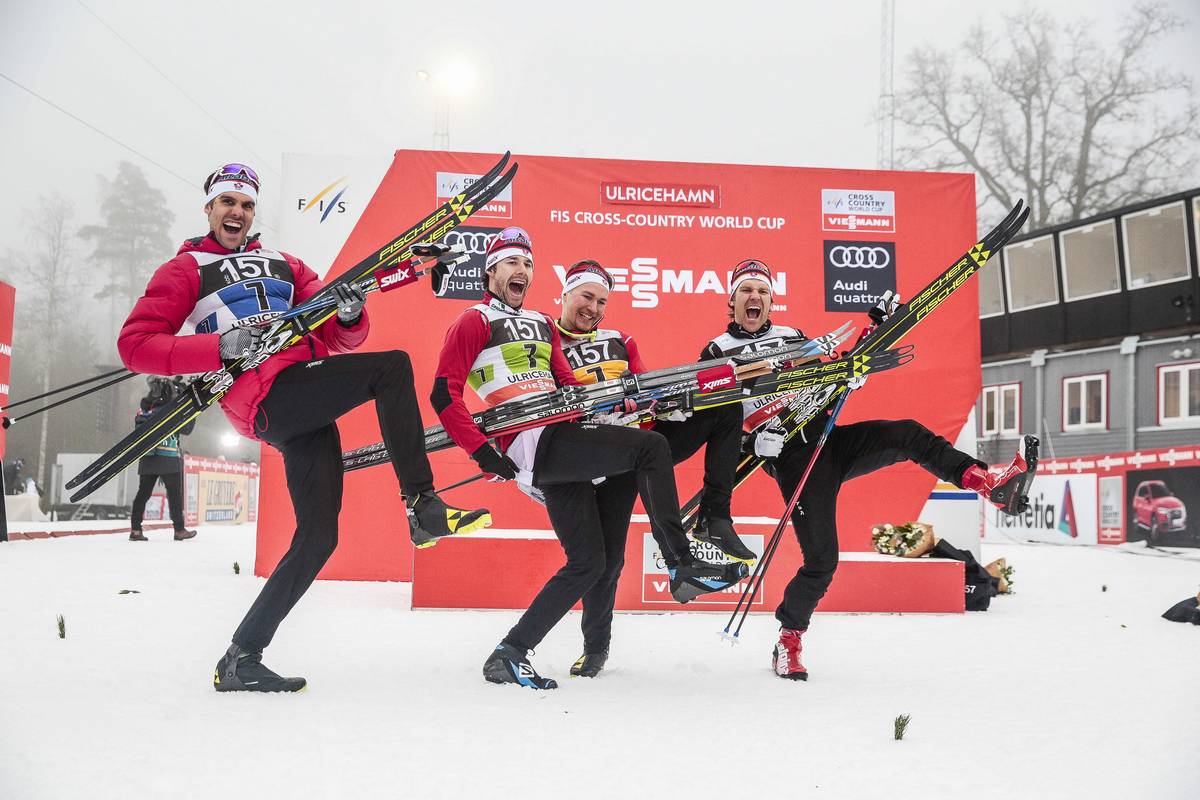
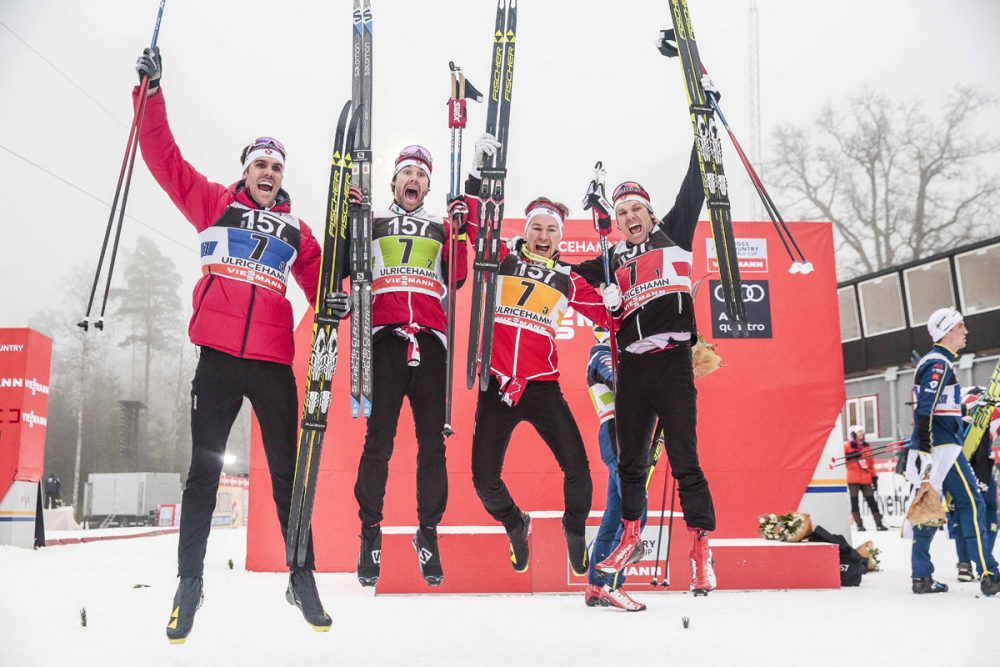
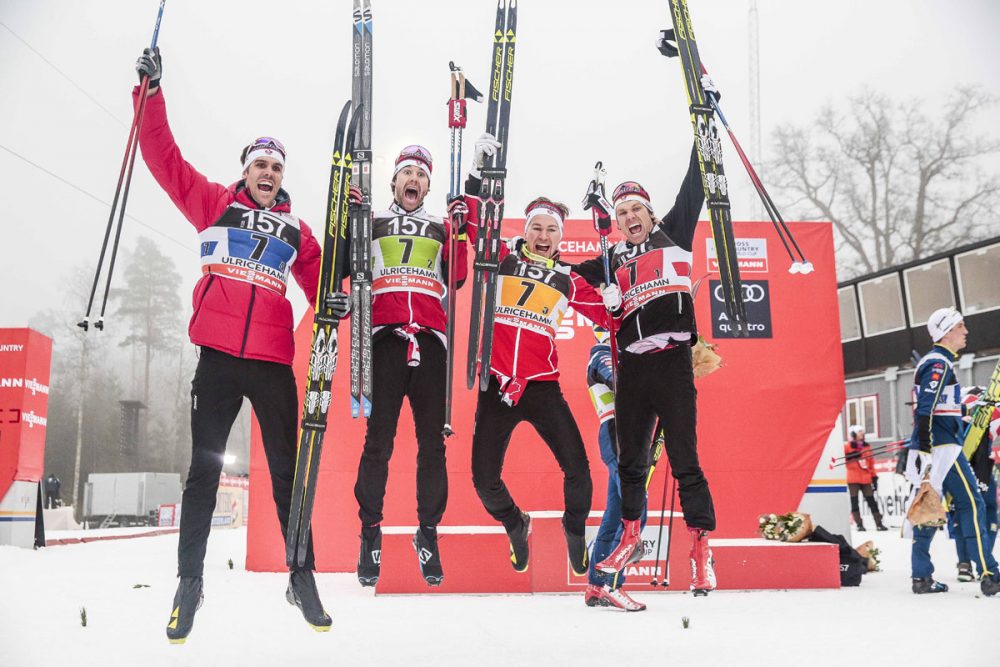
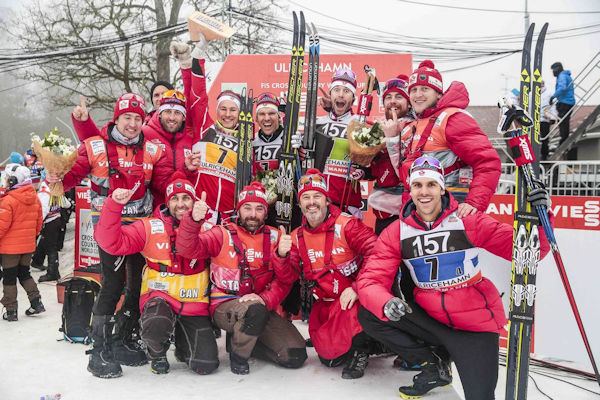
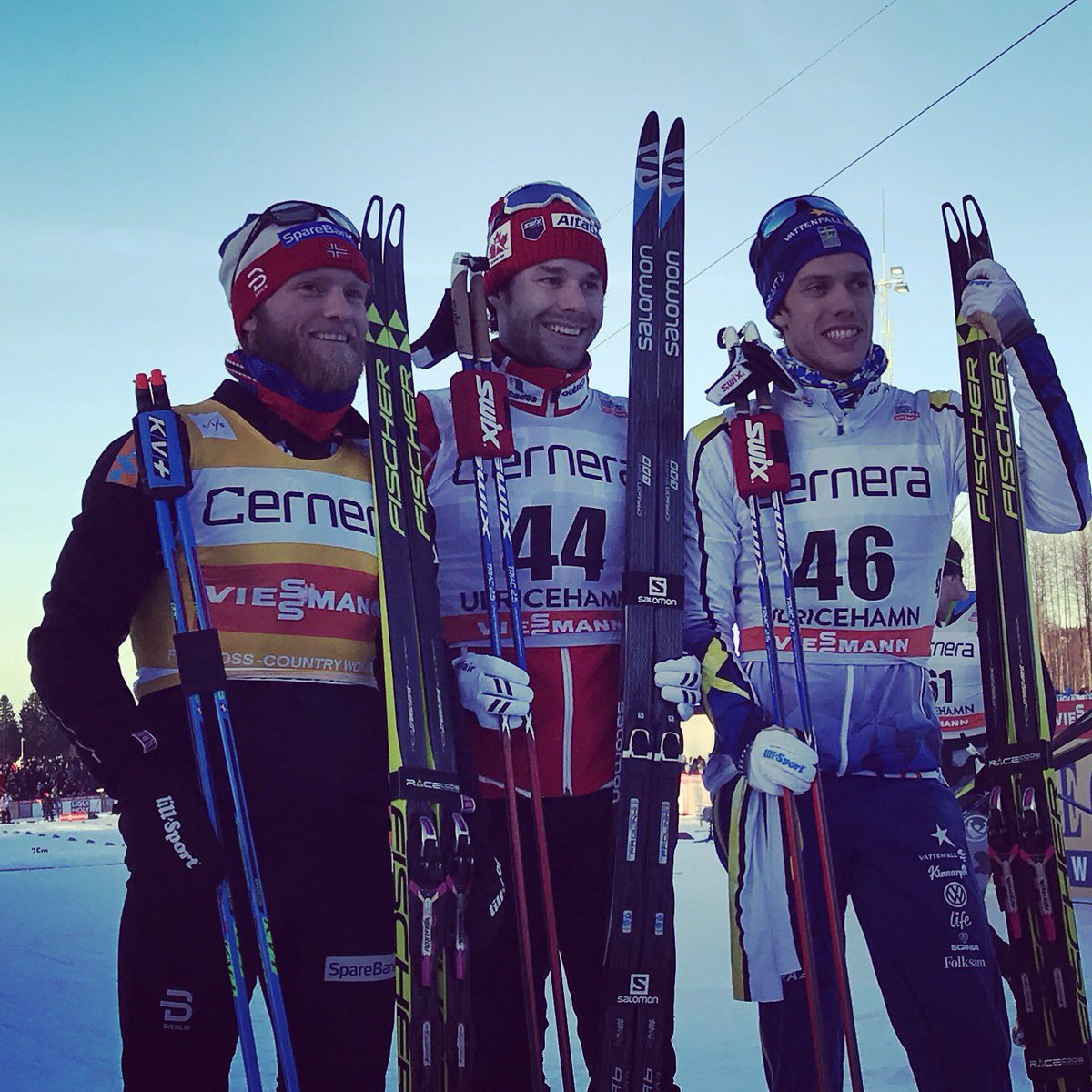
Len Valjas (c) spreads his arms to greet his teammates Alex Harvey (far right), Knute Johnsgaard (far left) and Devon Kershaw after he crossed third in the 2017 men’s 4 x 7.5-kilometer team relay on Jan. 22, 2017, in Ulricehamn, Sweden. (Photo: Fischer/Nordic Focus)
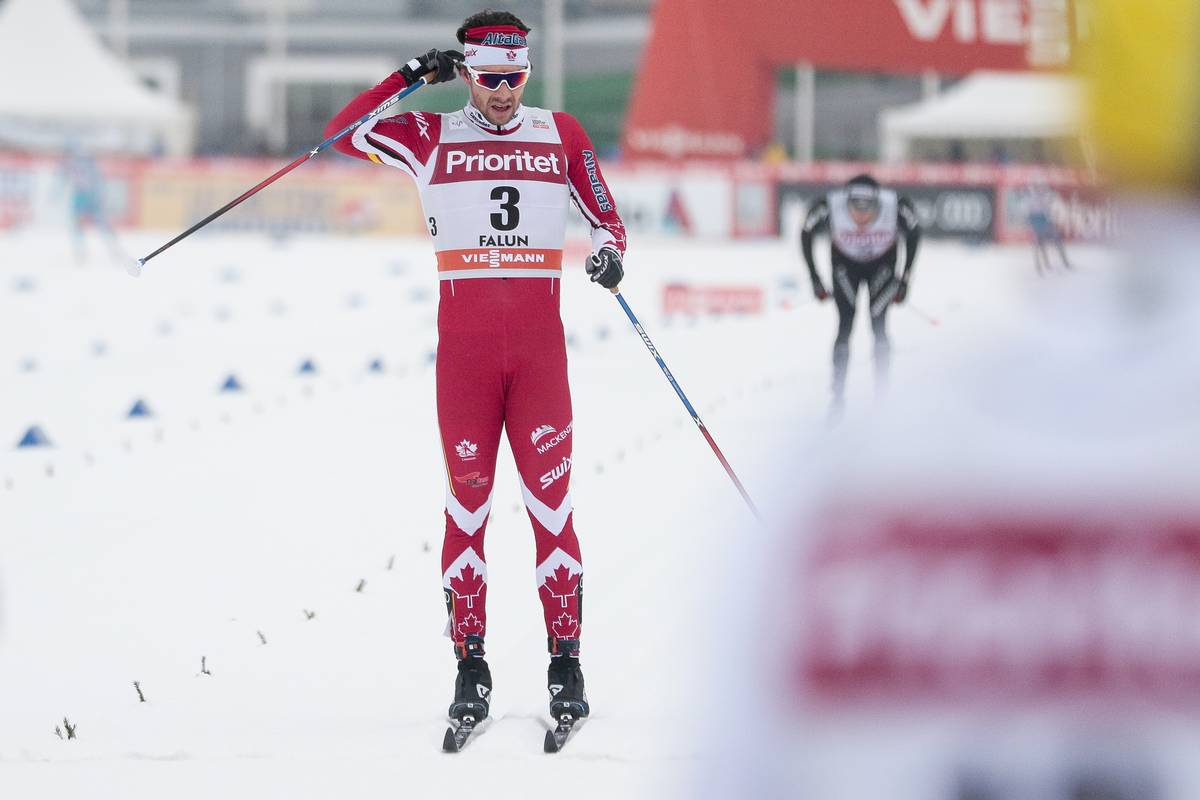
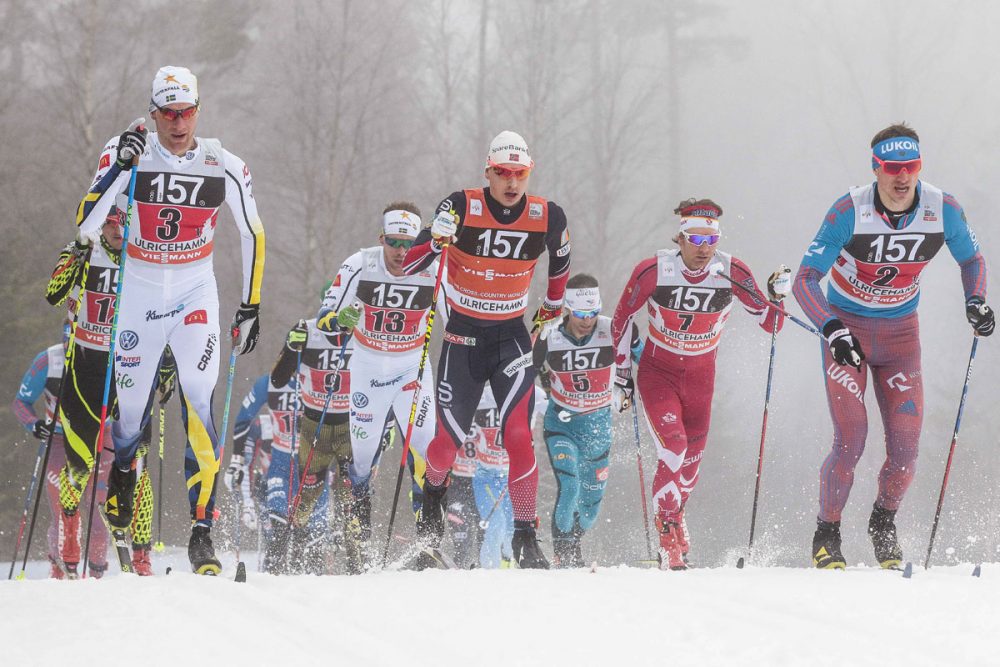
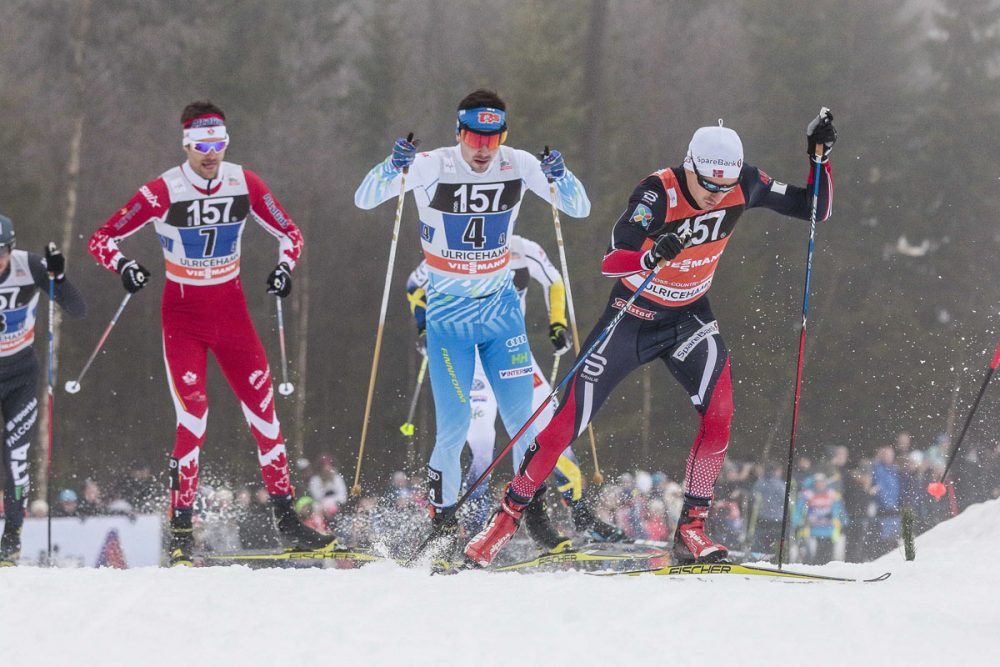
Back on Jan. 15, 2017, current Canadian World Cup B-team member, Len Valjas was beaming. Valjas, along with podium-regular teammate Alex Harvey, had won a World Cup team sprint in Toblach, Italy. The next weekend, Valjas and three teammates (including Harvey) rocketed to third in the men’s relay at the World Cup in Ulricehamn, Sweden. The results, at the time, looked to be a good indicator for the ensuing 2017 World Championships in Lahti, Finland.
Days before the Lahti events, during a gym session, Valjas felt his upper back between his shoulders give out. He felt little initial pain, but with compromised breathing, his results fell flat in Finland. As the remaining 2016/2017 World Cup season came to pass, Valjas hadn’t yet determined the exact cause of his physical ailments. His fitness and confidence suffered.
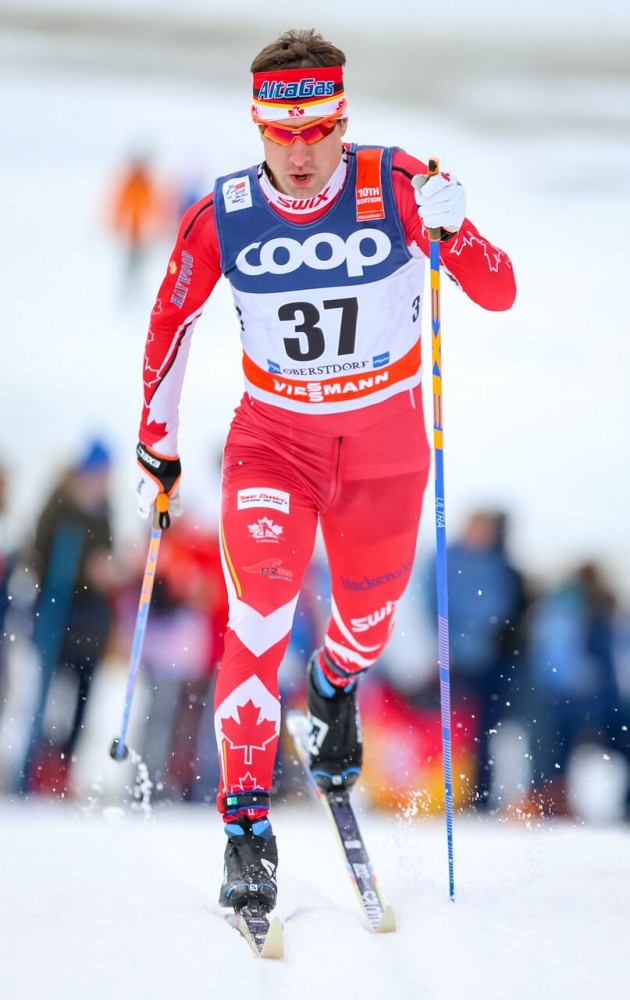
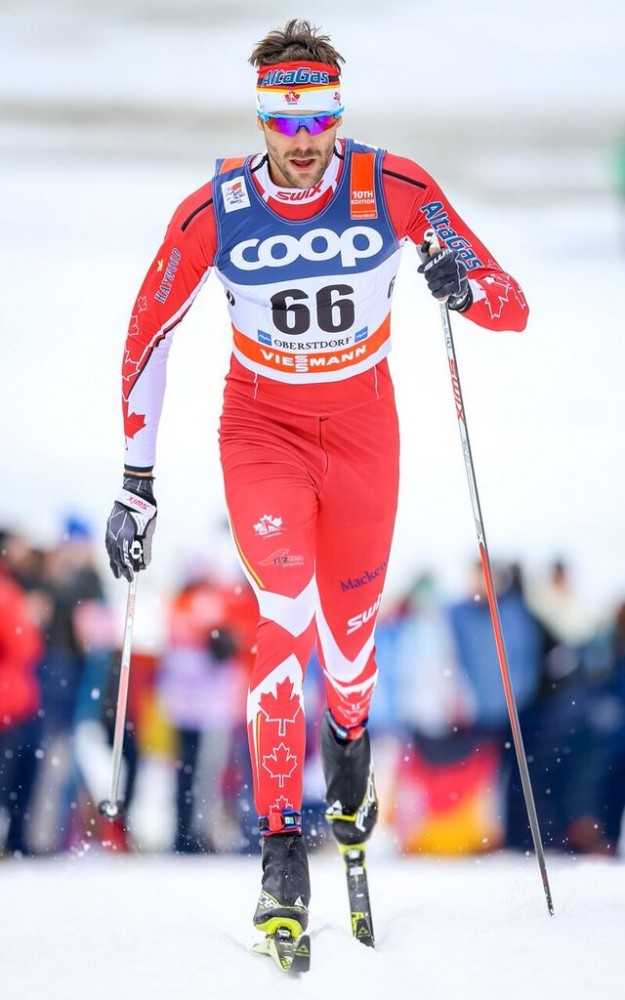
Len Valjas (Canadian World Cup Team) en route to 10th overall in a classic-sprint stage at the 2016 Tour de Ski in Oberstdorf, Germany. (Photo: Marcel Hilger)
Prior to Lahti, Valjas was ranked 13th overall on the sprint list. By season’s end, he had dropped to a very respectable 16th in the sprint standings.
Coming into the 2018 Olympic season, Valjas remained frustrated. He knew something was off. A pattern of poor performances continued through his most recent World Cup campaign. In the big picture, this past World Cup season left a bad taste for Valjas.
“Last year, I had so many bad feelings from the year,” Valjas reflected on the phone on May 22. “I could never train in the summer because I was always injured and compensating. I could not double pole on rollerskis. My back would hurt. All these little things … The last season obviously wasn’t by any means a good smooth season for me. I did have a good Olympic race which I am super proud of, but, overall, other than that one good day, I had one of my worst and least-fun seasons I have ever had. I was dealing with an injury for the last year and a half in my back.”
At the Olympics in PyeongChang, South Korea, Valjas reached the semifinals in the individual classic sprint and ended the day in seventh for his best result at his second Olympics.
Canada’s Olympic sport-funding system emphasizes championship medals and results. Harvey and Valjas set new Olympic benchmarks this February for Canadian men’s cross-country skiing, with Valjas’s contribution being seventh overall in that classic sprint.
“It is what they wanted,” Valjas said of Cross Country Canada’s priorities. “The end goal they wanted — Olympic results this season. Alex and I set records in the individual races anyway, three new Canadian records. Alex had two of them. I had one. It was one of our most successful Olympics ever. They should be extremely proud, especially when the season wasn’t going very well for a lot of us. We had an off-year and still were able to beat three of the Canadian records at the Olympics. I think they should have been very proud.”
Valjas, 29, hasn’t felt healthy since before Lahti 2017. The year and a half he endured at less than 100 percent has literally sapped him. During his most recent interview with FasterSkier, there was a tone of lament in his voice — not anger, just a simple melancholy from an athlete known to have a mellow demeanor. From Valjas’s telling, the wires between getting a full diagnosis from the Canadian team for his original back ailment and the pressure to continue training and racing got crossed.
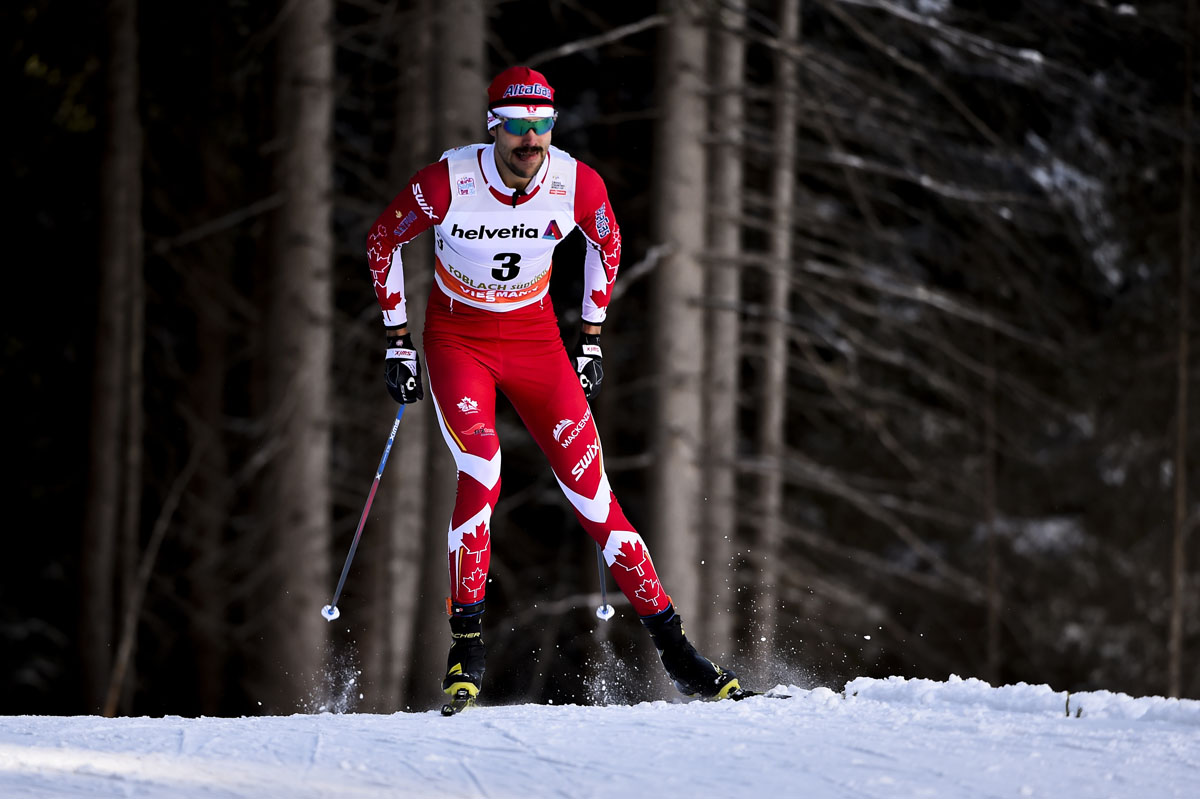
Canada’s Len Valjas on his way to 20th overall in a January 2017 World Cup freestyle sprint in Toblach, Italy. (Photo: Fischer/Nordic Focus)
“At World Champs [in 2017], I was begging for an MRI or some sort of check just to see what I did,” Valjas said. “But I kept getting turned down because my symptoms weren’t so bad. I didn’t have weird nerve feelings in my hands. It was kind of frustrating for the rest of that season.”
According to Valjas, he asked again in the spring of 2017 for an MRI.
“We should check to see if it is nothing, at least we will see that it is nothing,” Valjas remembered saying at the time.
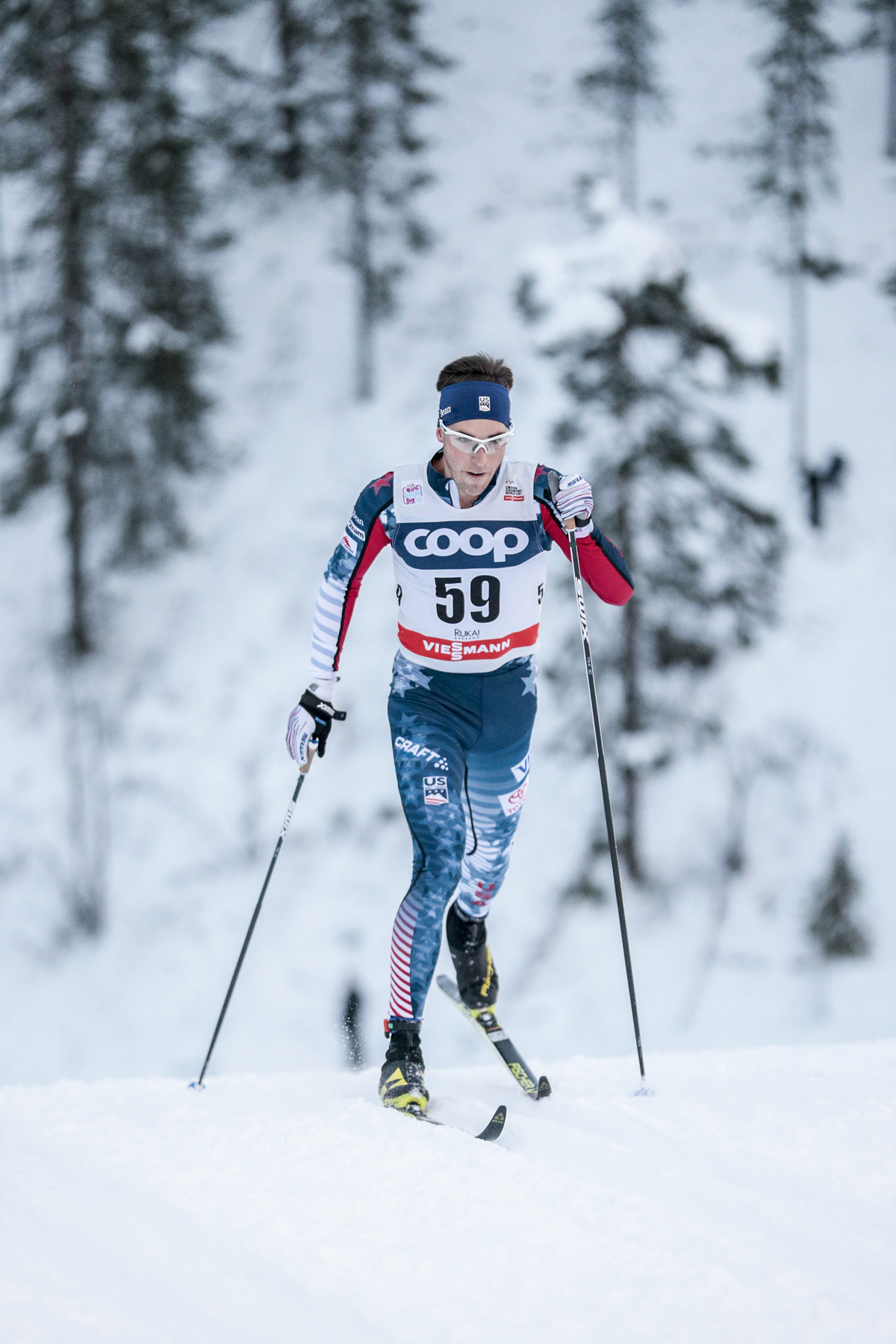
Again, Valjas said, he was denied the test. He trained all summer with frequent setbacks. His 2017/2018 World Cup season began in Kuusamo, Finland, with him finishing 44th overall in the three-day mini tour. The next weekend he placed 59th in a classic sprint in Lillehammer, Norway. Valjas said he had been working with a U.S. Ski Team physiotherapist in Lillehammer due to shoulder discomfort and nerve pain.
The pair continued their work together through the rest of December 2017. After their conversations regarding the pain, physical limitations and sensations, they linked what Valjas was experiencing to the moment in the gym before Lahti 2017 when he felt the “pop” in his upper back.
“[The physio] said, ‘I don’t think this is a shoulder injury. I think this is in your back,’ ” Valjas recalled. “And that is when he kind of tied in my mind to, OK, we are dealing with the same thing when I hurt it before Lahti if he thinks it is in my back. It all made sense. … And finally, I told the team I am leaving. I am going home and getting this checked out myself.”
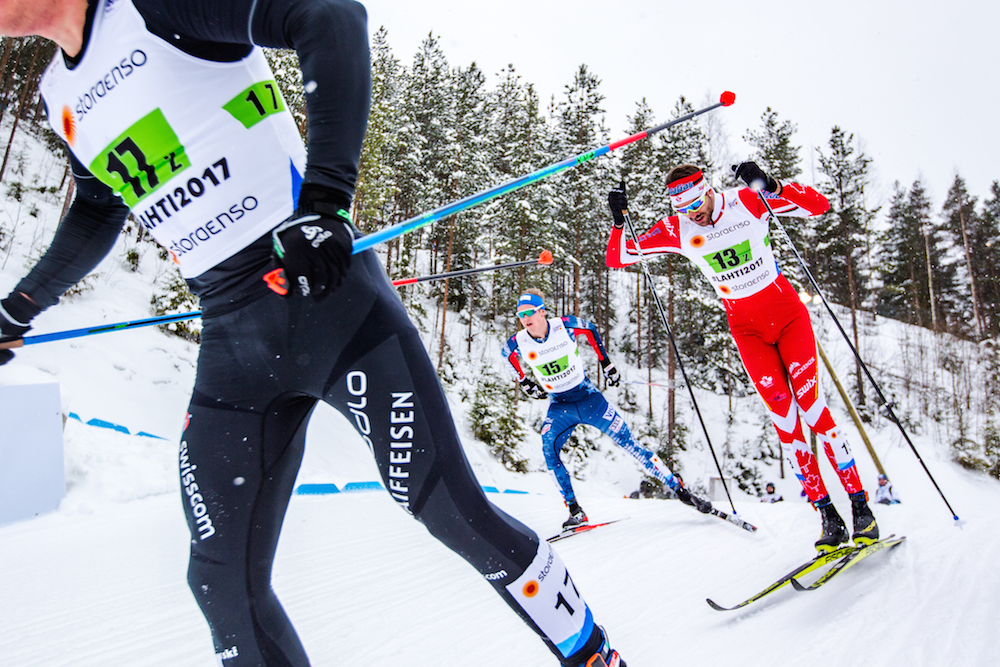
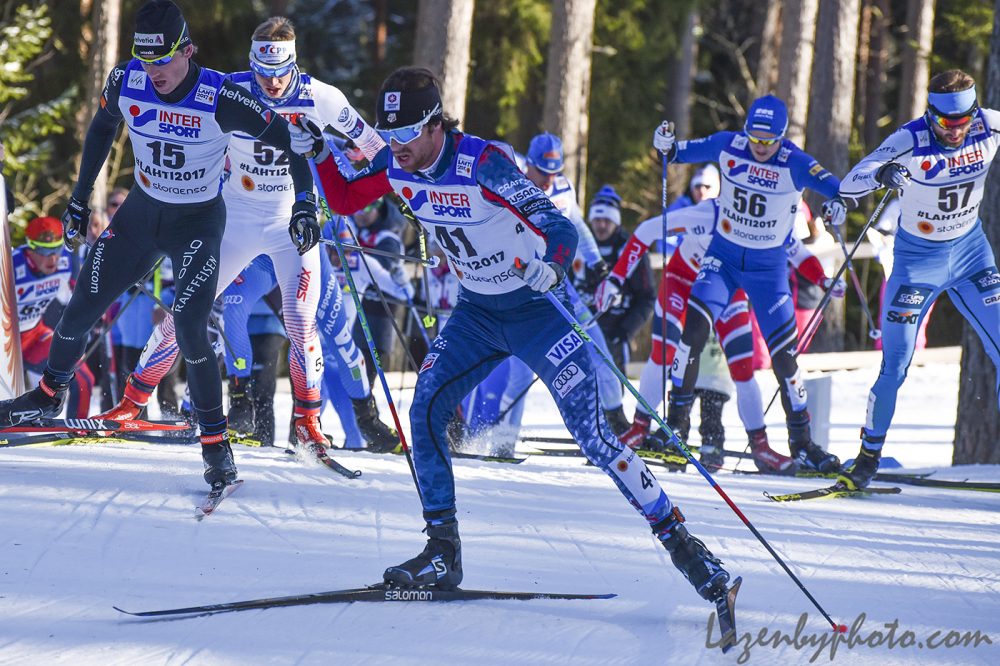
Switzerland’s Jovian Hediger leads Canada’s Len Valjas (r) and American Erik Bjornsen (c) during the classic team sprint at 2017 FIS Nordic World Ski Championships in Lahti, Finland. The U.S. men placed fifth and Canada finished sixth in that race. (Photo: John Lazenby/Lazenbyphoto.com)
Valjas clarified that the shoulder pain was in fact referred pain originating in his back.
Upon his return to Canada, Valjas received an MRI authorization from a trusted physician he had worked with in the past.
“Turns out it was a herniated disc at T2-T3. And I fractured a vertebra at T4,” Valjas explained. “So it was quite a bit worse than I thought at first.”
The T4 fracture Valjas incurred was not a threat to his spinal cord. The break occurred where the rib meets the vertebrae rather than along the spinal cord. The personal physician consulting Valjas also explained he had signs of arthritis in several joints around the injury zone. A consequence of working through the injury, Valjas was told, rather than taking time off. His doctor ultimately cleared him for racing since it was an Olympic year.
But, according to Valjas, it was a grim six-week buildup to PyeongChang. There was little effective training, scores of physio sessions, and the rare on-snow intensity effort to “salvage shape”. Then there was his seventh place at the Olympics. After his herculean effort in PyeongChang, he pulled the plug on the season. Time for rest, rehab, and reflection.
“To be totally honest, I kind of thought after the Olympic cycle I would be done, too,” Valjas said of the rumors swirling about his potential retirement. “That is why I probably started my own rumors, just saying that I was planning to retire.”
Several times Valjas mentioned how proud he was of his Olympic result. But the season-long canvas of results, he felt, was not reflective of his World Cup racing capacity.
“I just didn’t feel like I was finished this last year,” Valjas said. “I only raced, I don’t know, 13 races or something. Crazy low. I didn’t have the results I wanted in the end beyond the single Olympic one. It wasn’t the season I was hoping for. So I am hoping to get healthy and have a last season that I am proud of. I might not have the seventh-place result, but I just want to race well and be pain free.”
The path to pain-free racing will initially involve building up his strength while delaying his rollerski-specific training. With expected massive financial cuts looming across the board for Cross Country Canada (CCC), Valjas explained he will be based out of Canmore, Alberta, this summer with bare-bones support. Canadian World Cup coach Ivan Babikov will be writing his training plan, but according to Valjas, CCC has eliminated its physiologist and strength-trainer positions.
“It is me and Ivan, which, for what I am going through right now, is actually good,” Valjas said. “Through all this, he would fight for me. He believed me, let’s just say. There are only a couple of people who trusted what I said and the rest kind of left me out to dry there. I am happy to work with Ivan this year because, he actually knew all along. He did what he could. But at the same time, he doesn’t want to lose his job. He was working on my side for sure.”
Valjas is still processing how his medical condition was handled and how he responded. An athlete going against team wishes can have repercussions.
“It is hard to go against the team right away,” Valjas said. “If I got the MRI and there was nothing there, they might not be too happy with me either.”
Valjas hung on to the party line for months. Not exactly a “suck it up” directive, but messaging from the team that didn’t correlate with the distress and inability to rebound that Valjas experienced.
“When I told them my symptoms, the answer was always, ‘Oh, you have anxiety, your back is healthy. You have anxiety,’ ” Valjas said.
He also mentioned that he endured numerous back manipulations under the recommendation of team health care providers. Procedures, he said, that he’s now been banned from at the risk of inflaming his injury.
“It is just unprofessional how they just assume that it is anxiety and they get me manipulated probably 30 times in that year,” Valjas commented. “It could have been way worse. I feel lucky that … my spinal cord is totally fine.
“I am more worried about the future. If you break your leg, it is pretty obvious you broke your leg. It is more straightforward. If someone has a nagging spine injury, I hope that they learn from this,” he continued. “But so far I don’t feel like they have. I hope they learn you need to take these very seriously. Because you can have your athlete back in half the time if you don’t jeopardize their whole career over it. If I knew right away that it was herniated and broken, I probably could have taken a few months and gotten stronger. But the way I did it, it was a year and a few months of constant atrophy in my back and spine. I can feel it. I am weaker in the upper body than I have ever been.”
Canada’s Alex Harvey (l) and Len Valjas celebrate their 2017 World Cup freestyle team sprint win in Toblach, Italy. It was the first team-sprint victory for Canada since 2011 World Championships. (Photo: Salomon/NordicFocus)
Valjas remains focused. His new competition singularity is the upcoming freestyle team sprint at the 2018 World Championships in Seefeld, Austria. The plan is to contest the race with Harvey. A healthy Valjas could allow the tandem to revisit the emotions of their former World Cup team sprint win.
“I am doing it really just as much for me as I am for [Alex],” Valjas said of continuing in the sport and supporting his longtime friend and teammate. “It for sure helps to have a race to look forward to, even if it is a team race. It is going to help me in the rehab and the training to have something to train after, an end goal.”
(Note: This article has been updated to reflect that Len Valjas was nominated to the B-team, rather than the A-team as previously stated.)
On Thursday, Cross Country Canada (CCC) announced its national-team nominations for the 2018/2019 season via a press release.
Canada’s Alex Harvey celebrating on the podium after placing second in the World Cup men’s 15 k freestyle mass start in Seefeld, Austria, last season. (Photo: Salomon/NordicFocus)
Notably, the World Cup A-team is made up of one man — Alex Harvey — after three athletes from last year’s World Cup A-team retired (Devon Kershaw, Jess Cockney and Knute Johnsgaard). Graeme Killick, of last season’s World Cup B-team, also retired. Len Valjas was nominated to the B-team, a demotion, he said, that was a result of him ending his season immediately after the PyeongChang Olympics.
“The reasoning is that I … didn’t show up to [the World Cup in] Drammen, is that I didn’t follow what the team said,” Valjas told FasterSkier on May 22. He explained he had a broken spine, which required rest and rehabilitation.
On the women’s side, Dahria Beatty was renominated to the World Cup B-team, while Emily Nishikawa and Olivia Bouffard-Nesbitt were not.
All five of last year’s U25 Team were renominated to the national team, with Cendrine Browne and Julien Locke making the jump to the World Cup B-team, while Katherine Stewart-Jones, Maya MacIsaac-Jones and Gareth Williams were renominated to the U25 Team. Also on the U25 development squad, Antoine Cyr was promoted from the junior national team, and Graham Ritchie earned his first national-team nomination.
The World Cup team will once again be led by co-coaches Ivan Babikov and Louis Bouchard.
On the Para-Nordic side, the World Cup Team grew by one despite the retirement of Chris Klebl. Six athletes and two guides were nominated to the Para-Nordic World Cup Team, while two were renamed to the Development & Prospects Team. Four other athletes round out the team as part of the Prospects Team.
On Monday, Cross Country Canada announced its 2018 Olympic cross-country ski team for the upcoming Winter Games in PyeongChang, South Korea. The team includes 11 athletes: seven men and four women.
According to the press release, “each of the 11 athletes met the standard for nomination to the Canadian Olympic Committee under Cross Country Canada’s Internal Nomination Procedures for the 2018 Olympic Games, and in the process form a talented squad replete with veteran leadership and podium potential.”
“This is a team that has evolved from a group of talented athletes excited to be on the start line into a group of determined high-performers focused, and confident, in their ability to achieve international podium results,” Cross Country Canada (CCC) High Performance Director Tom Holland said in the press release. “Led by our men’s team of Devon, Alex and Lenny over the last two quadrennials, we are in the podium hunt, and will continue to push towards getting Canada back on the Olympic podium at the Nordic venue.”
As the press release points out, Canada has three Olympic medals in cross-country skiing, starting when Beckie Scott earned the gold medal at the 2002 Salt Lake City Games. She added a silver Olympic medal to her collection in 2006, placing second in the team sprint with Sara Renner. Also in 2006, Chandra Crawford won gold in the Olympic skate sprint in Turin, Italy.
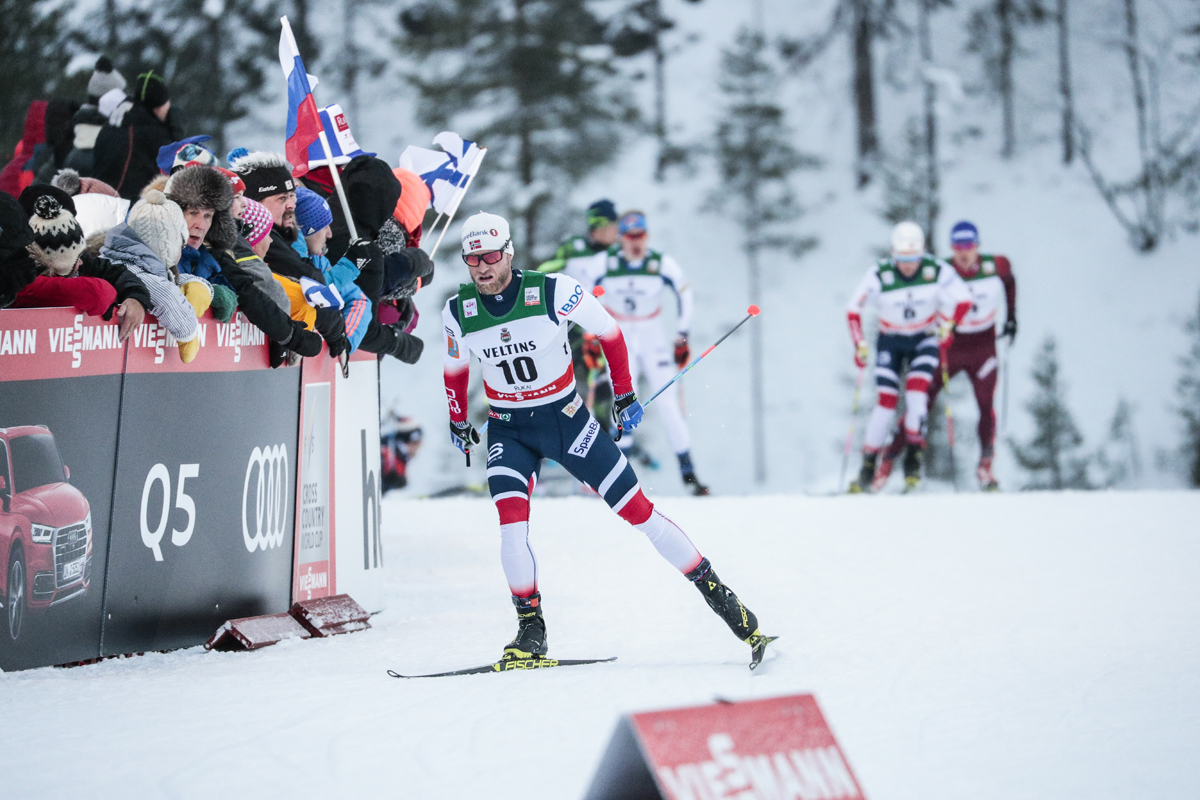
Norway’s Johannes Høsflot Klæbo en route to his third-straight win in as many days of the World-Cup-opening Ruka Triple in Kuusamo, Finland. He won the 15 k freestyle pursuit for the mini-tour title. (Photo: Fischer/Nordic Focus)
Two previous days of racing, and back-to-back victories no less, had begun to take its toll on Johannes Høsflot Klæbo within the first few laps of the men’s 15-kilometer freestyle pursuit on Sunday in Kuusamo, Finland. The 21-year-old Norwegian could feel it throughout his body; he was tired and 38 seconds of a starting cushion wasn’t going to be enough to hold off the hungry challengers behind him.
Klæbo, who won Friday’s classic sprint and Saturday’s 15 k classic individual start on the World Cup opening weekend, wasn’t invincible and he couldn’t race to another win alone. Halfway through the pursuit, the man who started in second place, 38 seconds after him, Russia’s Alexander Bolshunov (who’s actually younger than Klæbo at age 20), had cut that deficit to 19.8 seconds. After him, Norway’s Martin Johnsrud Sundby, who started 10th and 1:05 minutes behind Klæbo, was up to third and just 25.3 seconds back.
Norway’s Martin Johnsrud Sundby, who started 10th in the 15 k freestyle pursuit on Sunday, picking off the places on the final day of the Ruka Triple World Cup mini tour in Kuusamo, Finland. (Photo: Fischer/Nordic Focus)
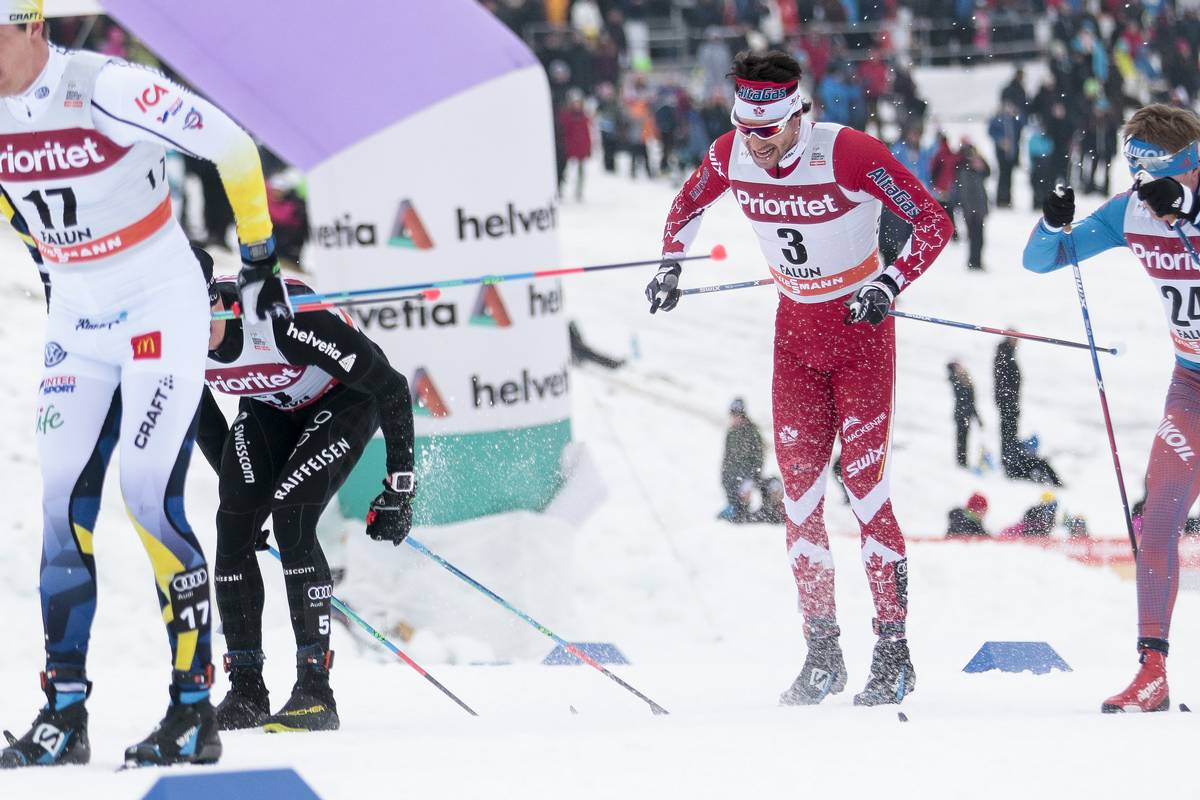
On his fourth lap, Klæbo accepted the inevitable as Bolshunov and Sundby, who had linked up in an effort to catch him, in fact caught him on a climb around 8.6 k. A larger group of pursuers, including Canada’s Alex Harvey, locked on to the three leaders as well, and from there, the race truly began to take form. Klæbo had to recover, Sundby had to figure out how to try to drop him, Bolshunov had to see what he was capable of, and Harvey had to see how much he could give in the third race of the season.
The first races of each winter aren’t easy for anyone. Despite spending the summer training for skiing, most North American World Cup skiers don’t get the opportunity to actually race — even on rollerskis — too often during the offseason. Because of the rich ski culture in Europe, rollerski races are a big deal with lots of summer and fall competitions to chose from. And because of Europe’s geography, it’s often easier to get on snow than it is for North Americans.
(“I think this applies to all the North American actually, compared to Europeans we don’t race as much in summer,” Canadian World Cup coach Ivan Babikov said on the phone on Sunday. “They have races every weekend so they come into the season pretty sharp already with some good speed workouts, when we don’t have that opportunity. So that’s why, I think, every race is a step forward. It’s just, you have to remember or remind yourself how hard it is.”)
So while Canadians and American World Cup skiers alike often look at an opening weekend like Finland’s Ruka Triple mini tour as a “chance to blow the cobwebs out” or “shake off the rust”, as some have said, it’s also an opportunity to see where you stand — as was the case for Harvey in the final meters of Sunday’s pursuit.
Later in the fourth of six laps, Klæbo pushed the tempo up a climb, Bolshunov responded, and Harvey went with them. Soon after at 10 k, they lapped through the stadium with 11 men within 2.7 seconds of first. Up front, Bolshunov led Harvey, who had started the race 1:23 back in 12th.
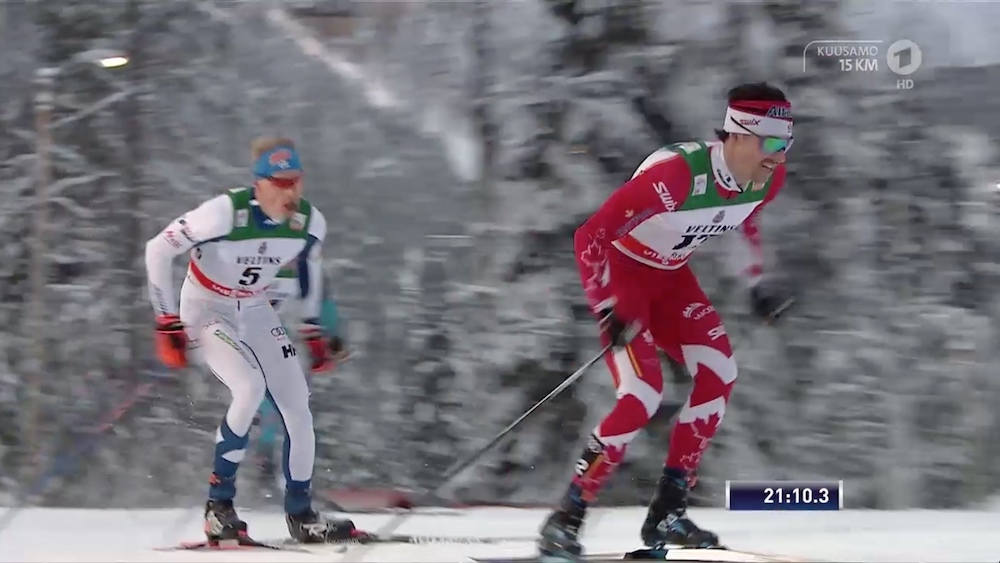
Canadian World Cup Team member Alex Harvey leads Finland’s Iivo Niskanen during the men’s 15 k freestyle pursuit on Sunday, the final day of the Ruka Triple mini tour in Kuusamo, Finland. (Screenshot: ARD)
Harvey had spent the first three laps working up to that lead group, initially with the likes of Russia’s Alexey Chervotkin (*who reportedly thanked Harvey after the race) and Sergey Ustiugov, Norway’s Hans Christer Holund and Sweden’s Marcus Hellner, and later with France’s Maurice Manificat, Sweden’s Calle Halfvarsson, Norway’s Emil Iversen, Chervotkin, and Holund, among others.
“I knew there’d be some fireworks on the last lap so I just wanted to be in the front third of the group, just be ready for a move,” Harvey explained in a post-race phone interview. “I thought Sundby would be the guy making the move, which in the end, that’s what happened. The big uphill in the last lap, that’s where he went. I just wanted to be close to Sundby and ready to respond when Sundby went.”
Sundby attacked as predicted on the second-to-last climb, around 13.6 k, and Harvey slotted behind him to follow him over the top.
“I was just actually there on that last uphill when Sundby attacked,” Babikov recalled. “Klæbo was right there. I think there were just Norwegian tactics … Sundby attacked on the last uphill and Klæbo just cooled down and wasn’t chasing him at all, so for Alex, that was his only chance. … If he didn’t chase him, then Sundby probably would have skied away and it would have been a bigger group at the finish, but at the moment he tried, and they actually created a gap … Alex second and Sundby first.”
With a few meters separating them from Norway’s Didrik Tønseth in third and Klæbo in fourth, Harvey thought he and Sundby had dropped them and that he would fight for first to the finish.
“I kind of went all-in with the Sundby move,” Harvey said. “When I looked in between my legs just before the last downhill I thought we had a big enough gap … so I was feeling pretty good about my chances there, but not good about taking [Sundby] because I was really, really dead.”
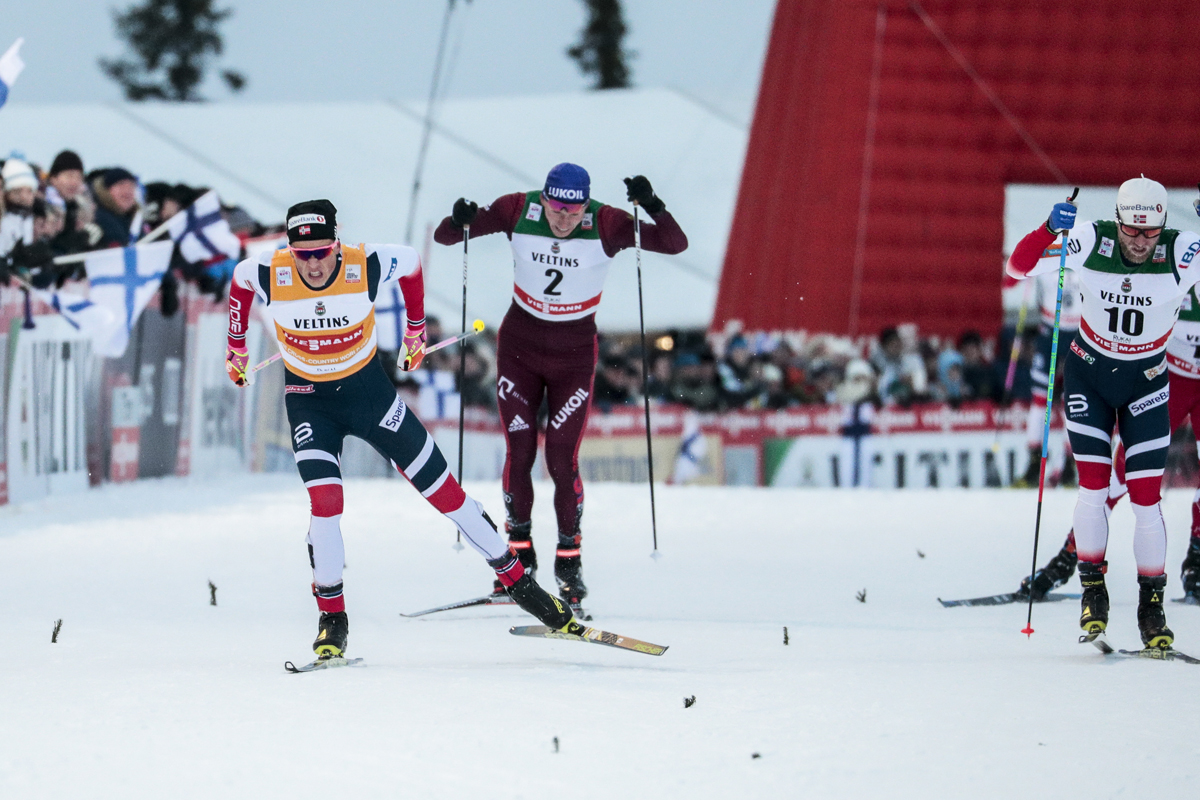
Johannes Høsflot Klæbo (l) passing fellow Norwegian World Cup Team member Martin Johnsrud Sundby (10) for the win in Sunday’s 15 k freestyle pursuit at the Ruka Triple mini tour in Kuusamo, Finland. Russia’s Alexander Bolshunov (2) was 1 second back in third place for his first World Cup podium while Canada’s Alex Harvey (behind Sundby) placed fourth. (Photo: Fischer/Nordic Focus)
After what Harvey estimated to be a 45-second downhill, he realized that wasn’t the case. Klæbo and Bolshunov had slingshot back toward the front, and while Sundby was first to the top of the last climb before the finish, Klæbo and Bolshunov were right behind him while Harvey followed in fourth.
They entered the stadium together in that order, and Klæbo passed Sundby with about 100 meters remaining to take his third-straight win of the weekend.
“Coming out of my tuck there I was just full of lactate, not feeling any fresher … then I just got passed on the hill,” Harvey recalled. “I had nothing left. That was my move. … I’m happy I made that move, but I couldn’t make a second burst after that.”
While Klæbo won the pursuit and with it, the Ruka Triple mini-tour title in 36:23.2 minutes, Sundby placed second, 0.4 seconds back, Bolshunov claimed his first World Cup podium in third (+1.0), and Harvey finished another 0.6 seconds back in fourth (+1.6).
On the day, Harvey’s course time ranked fifth fastest behind Manificat, who was the “winner of the day” in 34:50.9. Finland’s Matti Heikkinen was second fastest (+5.4) after starting 22nd and placing 14th, Holund was third fastest (+7.5) after starting 14th and finishing ninth, and Switzerland’s Dario Cologna, who started 26th and finished 17th, was fourth fastest (+8.7).
Harvey said starting 17 seconds behind Sundby was a tall task on its own, and he had started the race with a goal of breaking into the top 10 overall. All things considered, fourth place was better than he expected at this point in the season.
“… But I knew it was still within reach,” Harvey explained. “I believed in it, but I didn’t put too much hope in, let’s say, a top five or fighting for the podium. It was more like I wanted to be back in the top 10 and just that to me seemed already hard enough.”
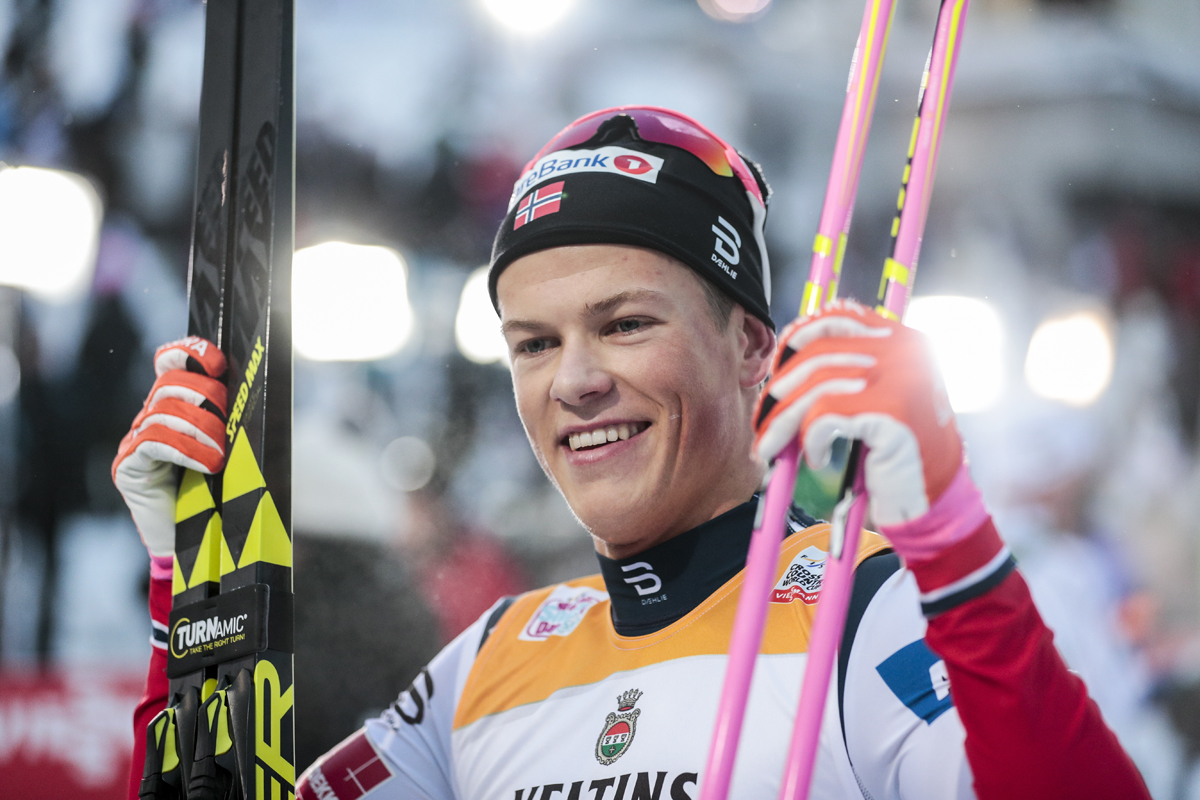
Norway’s Johannes Høsflot Klæbo after winning the 15 k freestyle pursuit on Sunday to win the Ruka Triple mini tour in Kuusamo, Finland. (Photo: Fischer/Nordic Focus)
The fact that he was able to hang with Klæbo and Sundby to the finish was a good sign, he added.
“Right now, he’s not just a good sprinter, he’s the best distance skier in the world, too,” Harvey said of Klæbo. “I mean, to win a 15 k individual you have to be in very, very good physical shape, so he’s in really good physical shape and I know I’m not yet. I’m not in my best form and Sundby probably isn’t yet, so you never know what’s going to happen later in the season at the Olympics, but for now it’s hard to drop him when he’s actually just in better shape than everybody else in the world.”
After the race, Klæbo told NRK he was relieved to get the win and have some time to rest before next weekend’s World Cup in Lillehammer, Norway.
“My legs are shaking now,” Klæbo said. “Feels incredible to be the first to cross the finish line. Now I need a few days rest.
“This was brutal,” he added. “I’m actually glad they caught up to me and luckily I had good skis. I’m glad I had a few seconds today.”
Norwegian national-team coach Tor-Arne Hetland told NRK he was “really impressed” with Klæbo. “We have a diamond in the sport of cross country skiing now,” Hetland said.
“That’s very nice of him to say. It’s probably a little too much, but it has been a good start to the season,” Klæbo responded to NRK.
Sundby spoke excitedly about having Klæbo to contest for the overall World Cup lead.
“For the moment, he’s taking international cross-country skiing for men to a whole ’nother level,” Sundby told NRK. “It is a little humiliating for the rest of us, but at the same time it’s extremely inspiring to see what he does in his second year at this level. It’s hell of fun to have a guy like that on the team.”
Bjornsen 26th, Kershaw 29th; Caldwell Posts Top-20 Time of Day
Canada had two in the top 30 on Sunday with Devon Kershaw in 29th (+1:47.8), scoring World Cup points for the second-straight day. He started 28th and 1:59 out of first, just one second behind Cologna in 26th and Russia’s Andrey Larkov in 27th.
“I just wasn’t strong enough to go with Dario,” Kershaw said on the phone. “I had the perfect chance to be able to follow Dario up the field, but he just started so fast, and on the steep terrain, my legs just — I tried up the first steep wall and at the top, I’m like, man, if I keep going like this, after 5 k I’m gonna be dead.
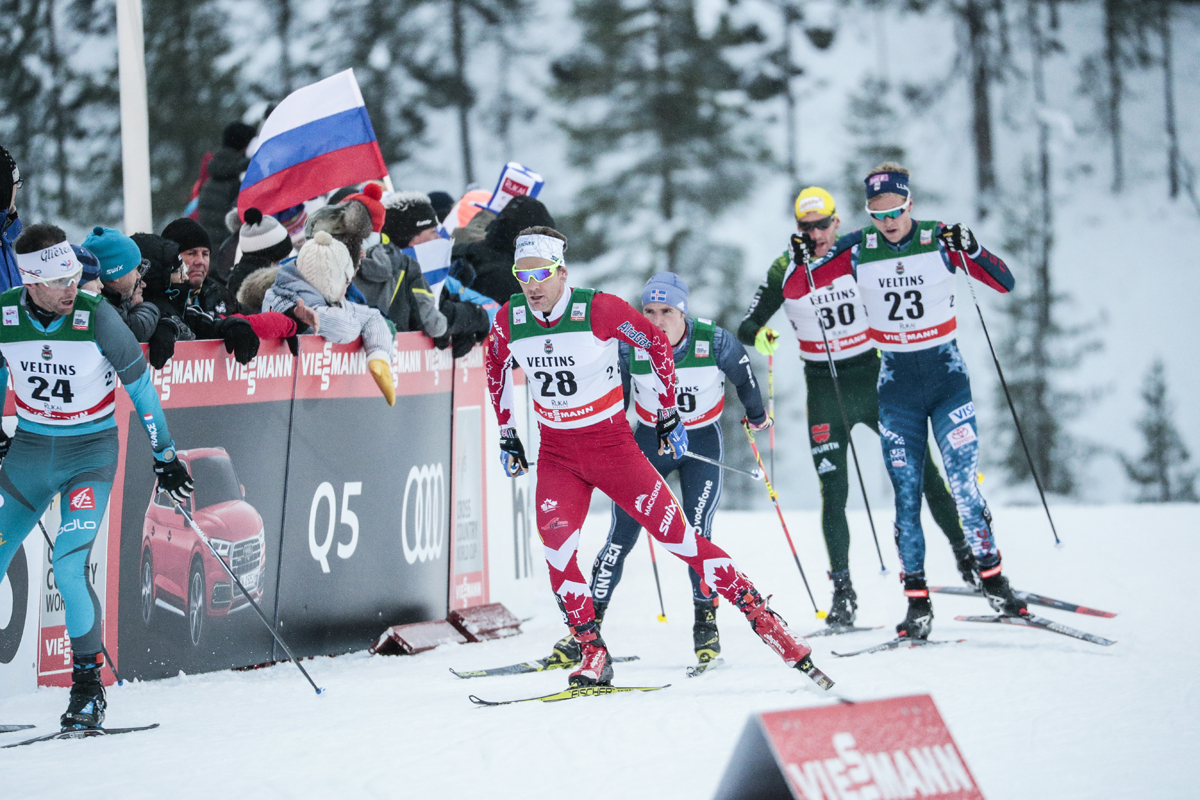
Canada’s Devon Kershaw (28) leads American Erik Bjornsen (23) and others during the World Cup men’s 15 k freestyle pursuit on Sunday in Kuusamo, Finland. (Photo: Fischer/Nordic Focus)
“So I had to manage my energy a little bit and in the end, it turned out that Bjornsen and I’s group just wasn’t strong enough,” Kershaw continued, referring to U.S. Ski Team member Erik Bjornsen, whom he started eight seconds behind and spent most of the race with. “[Our group] had a good 7 1/2 k and then after that, between 7 1/2 kilometers and 12 k, we were skiing really slow. So that’s a bit frustrating in a pursuit because you’re just stuck there in no-man’s land.”
While he felt like he was skiing the flats well, Kershaw said he struggled with the “biting” conditions, which seemed to limit glide, especially on the notoriously steep course’s climbs.
“I had to make the choice to be like, OK, I’ve got to just stay in this group and I’m not strong enough to drive the bus, because my legs just weren’t there today on the terrain” he said. “In the end I made a tactical error in the last 600 meters. I should’ve followed Bjornsen on the outside and I went on the inside and was hoping it would open up for me and it didn’t. So I ended up 29th, but that’s OK.”
Bjornsen started 24th and finished the pursuit in 26th (+1:43.6), after following Larkov in 25th (+1:42.8) across the line and holding off Iceland’s Snorri Einarsson (a former Norwegian skier who raced for the University of Utah) in 27th (+1:46.2), Great Britain’s Andrew Musgrave in 28th (+1:47.2), Kershaw in 29th, and France’s Jean-Marc Gaillard in 30th (+1:49.2).
“I started right around Cologna and [Finland’s Matti] Heikkinen but there was no way I was going to hold their pace, they were flying,” Bjornsen wrote in an email. “I had to settle in with the group around me. It soon became clear our group was not going to catch anyone in front of us or get caught, so it became a tactical game. Some surges, but for the most part nobody wanted to lead.”
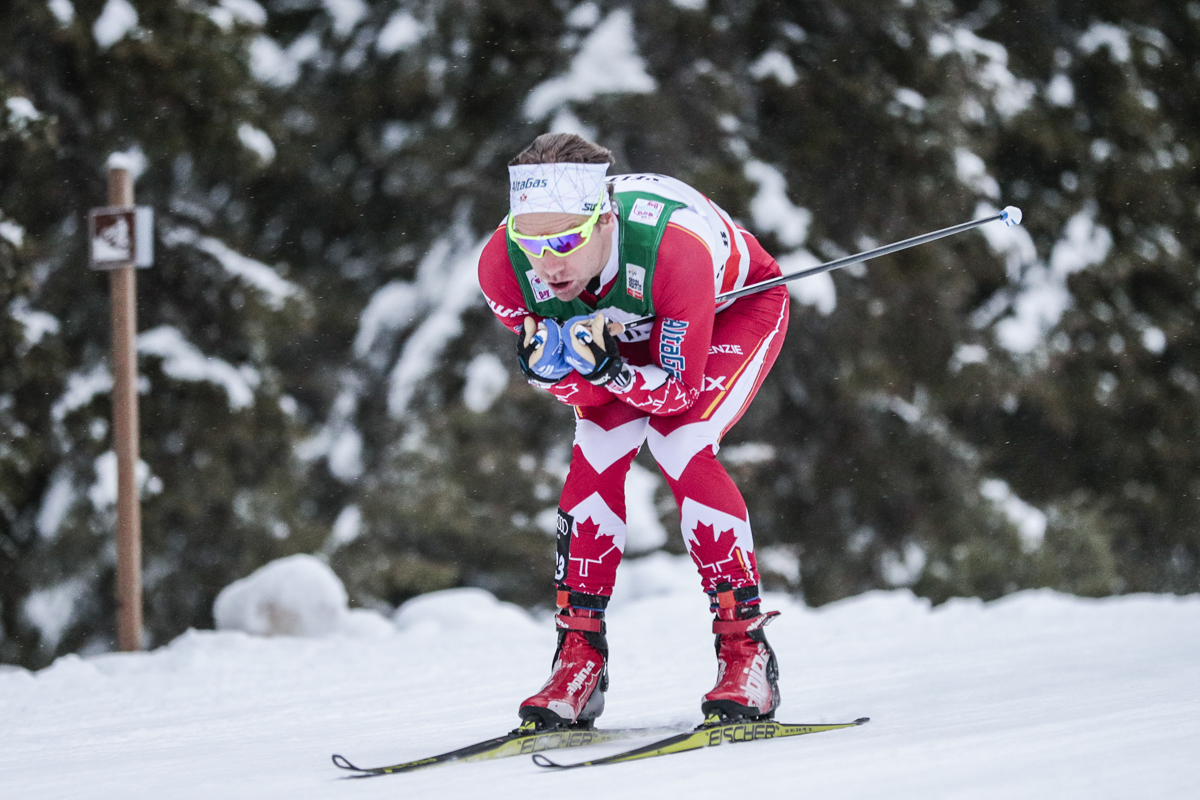
Devon Kershaw (Canadian World Cup Team) en route to 29th in the 15 k freestyle pursuit on the last day of the Ruka Triple World Cup mini tour in Kuusamo, Finland. (Photo: Fischer/Nordic Focus)
Kershaw laughed when he talked about some “tips” he gave Bjornsen during the race.
“He had really fast skis so there were a few times that he came by me on the downhill and then would kind of try to hammer for a minute and then get tired and slow down again,” Kershaw said. “I told him, like, ‘Dude, you’ve got great skis. Unless you can stay in the front and really press, then it’s better just to play the game and wait for the end.’ After that, he did that and he torched us all in the end. So that was kind of fun to see for him.”
According to Bjornsen, Kershaw suggested he sit back and wait for the sprint.
“My skis were good but I think my weight is what helped me the most on that last huge downhill,” Bjornsen wrote. “I was fine going for that tactic but at the same time it would have been nice to leave a little more out there today. Stoked to get double points for 26th though!”
Paddy Caldwell (U.S. Ski Team) racing to 70th in the men’s 15 k classic on Saturday, Day of the Ruka Triple World Cup mini tour in Kuusamo, Finland. In Sunday’s 15 k freestyle pursuit, he skied up to 51st with the 19th-fastest time of day. (Photo: Fischer/Nordic Focus)
Paddy Caldwell, new to the U.S. Ski Team B-team this year, posted his best World Cup result with the 19th-fastest time of day, 50.5 seconds back from Manificat. He started with the wave in 70th and finished 51st overall (+3:03.1).
“Going into the race my goal was to move up as much as possible,” the 23-year-old Caldwell wrote in an email. “I wasn’t really thinking about place or time of day – I was just trying to ski fast and put together a good effort.
“It was really hard to move up in the pack,” he added. “I started midway back in the wave and we kept picking up more and more skiers as the race went on. I tried to relax as much as possible on the hills and build in energy to pass where I could on the flats. … I am really excited with the day and psyched to have had a good result here in Ruka. I’m looking forward to the rest of period 1 and learning more from the big dogs!”
“Very exciting race out of Erik today,” U.S. Ski Team coach Matt Whitcomb commented on the phone. “… When he settled to the back of his pack on Lap 6 and headed into the downhill with one climb to go, we just all sort of expressed confidence over the U.S. radio channel, got ready see what he could do. It is so fun to watch him in a stadium when he has to go head to head against five other athletes … he did not disappoint today. Really proud of Erik’s 26th place.”
As for Caldwell, who skied the 25th fastest time of day in the 2017 World Cup Finals freestyle pursuit, Whitcomb said, “this is his race, the skate distance.”
“There were times that he was a little bit road-blocked out there, just the way the pursuit race unfolds in that start … and it looked like today Paddy could keep going, so really great signs out of him,” Whitcomb said.
Whitcomb also highlighted the races of Scott Patterson, who raced up from 78th to 55th (+3:28.4) with the 31st-fastest time, and Noah Hoffman, who improved from 45th to 39th (+2.33.3) with the 35th-fastest time. Also for the U.S., Andy Newell finished the tour out in 75th (+5:39.6).
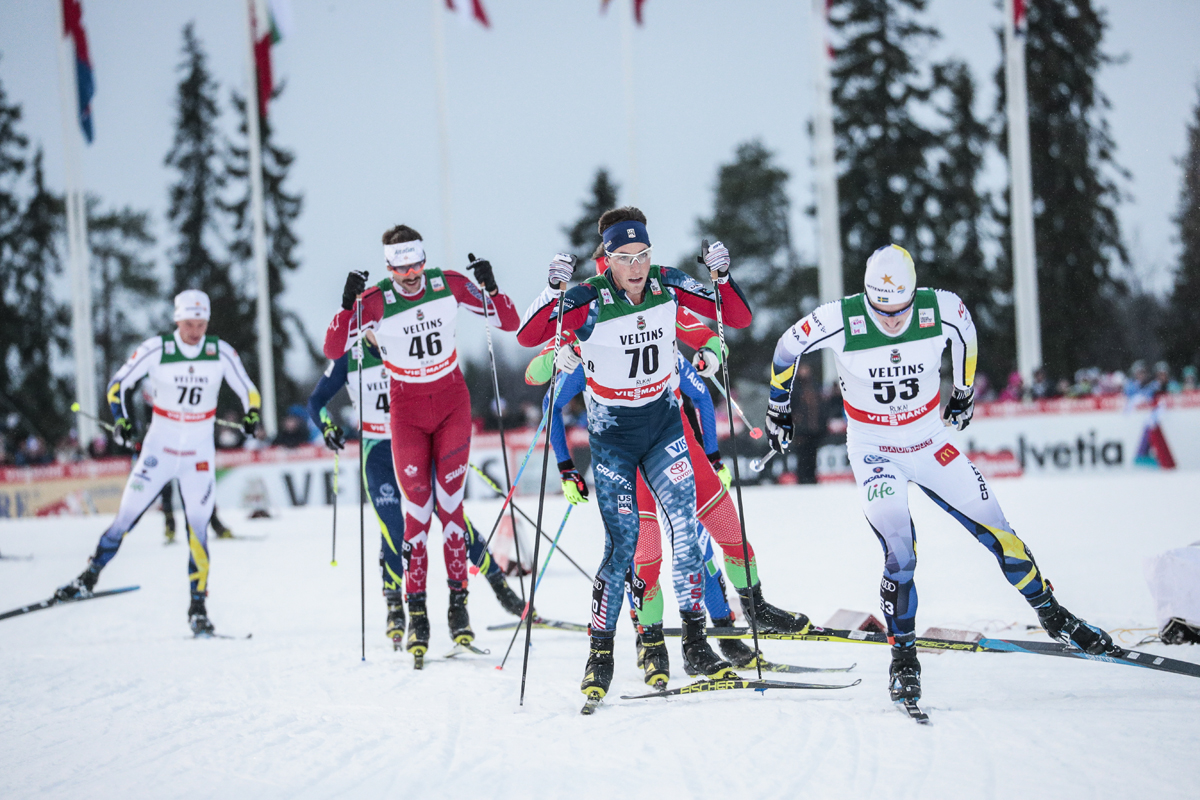
American Paddy Caldwell (70) racing with Sweden’s Jens Burman (front) and Canada’s Len Valjas (46), among others, during Sunday’s World Cup 15 k freestyle pursuit on the last day of the Ruka Triple in Kuusamo, Finland. (Photo: Fischer/Nordic Focus)
Canada’s Len Valjas moved up two places for 44th overall (+2:47.5), Graeme Killick finished the tour in 68th (+4:39.5), Knute Johnsgaard 81st (+6:43.6), and Julien Locke 83rd (+7:33.6).
Babikov pointed out that Valjas had a shoulder injury that he mostly recovered from, but caused him to struggle with double poling in Friday’s sprint. Despite placing 63rd in that sprint, Valjas was the team’s third-best man in the weekend’s distance races.
“[In] two distance races, he was third best and actually placed higher than he placed in sprint in the distance, 15 k, hardest one with lots of climbing,” Babikov said. “So that shows he has a good shape, but just needs to scrape that rust off and remember how to go fast again. I think physically he is in a good place, just need to do some more races, and it will come.”
***
*Post-race sidenote: According to Harvey, after the race, the Russian team’s massage therapist told Canadian coach Ivan Babikov that Chervotkin wanted to thank Harvey for pulling him in the pursuit. Chervotkin, 22, started 11th and finished fifth, 6.2 seconds out of first and 4.6 seconds after Harvey in fourth.
“There’s a bit of beef with the Russians and me right now,” Harvey said. “I came in wondering if they were just going to punch me in the face. They said they wanted to break my teeth, so this is a good turn of things.”
“I read that in the Norwegian news, actually, that Petukhov wanted to …,” he said with a laugh. “But I knew the media likes that sort of thing. But I think things are good now.”
Harvey noted that Bolshunov and Chervotkin, neither of which have been implicated in the doping scandal, are part of “a new generation” in Russian cross-country skiing. “I saw the results in Bruksvallarna; it looks like the have almost as much depth as Norway does. They’re really strong.”
— Aleks Tangen, Ian Tovell, Jason Albert, and Harald Zimmer contributed
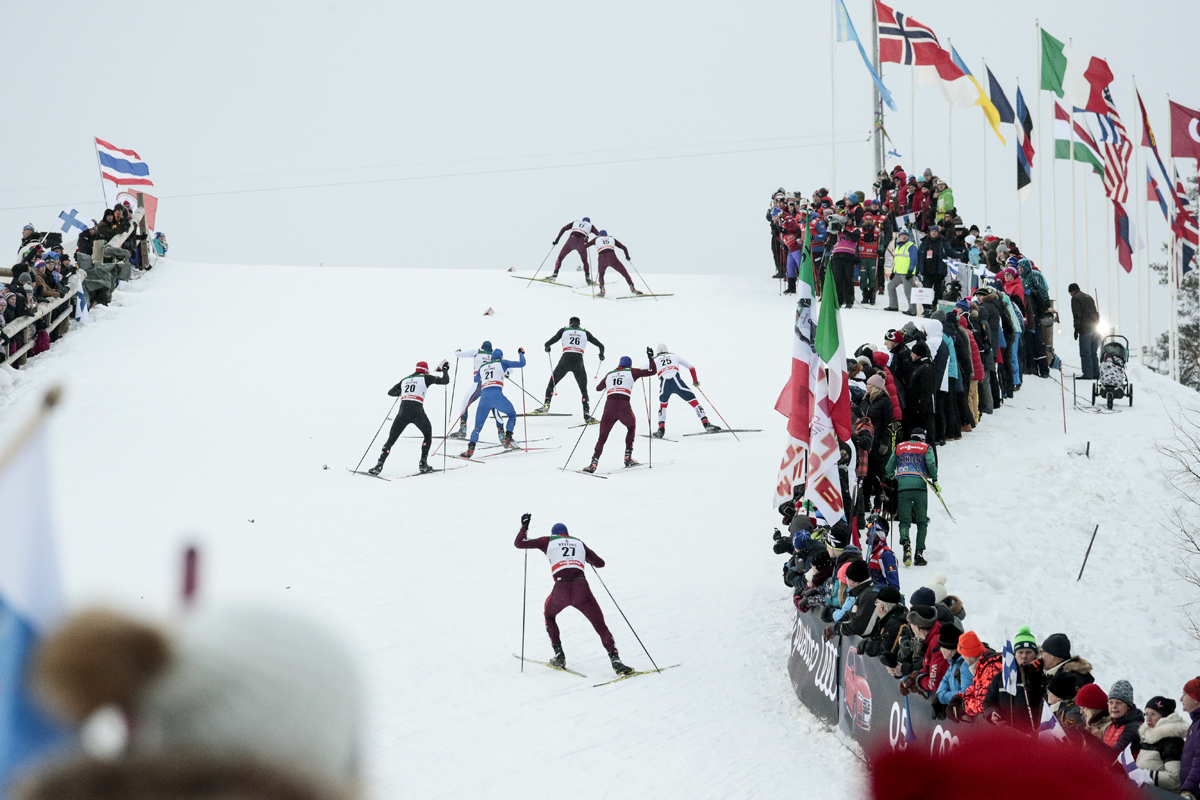
Racers in the Ruka Triple World Cup 15 k freestyle pursuit, including Russia’s Andrey Larkov, Switzerland’s Jonas Baumann, Italy’s Federico Pellegrino, Switzerland’s Dario Cologna, and Norway’s Simen Hegstad Krueger, ascend a climb in Kuusamo, Finland. (Photo: Fischer/Nordic Focus)
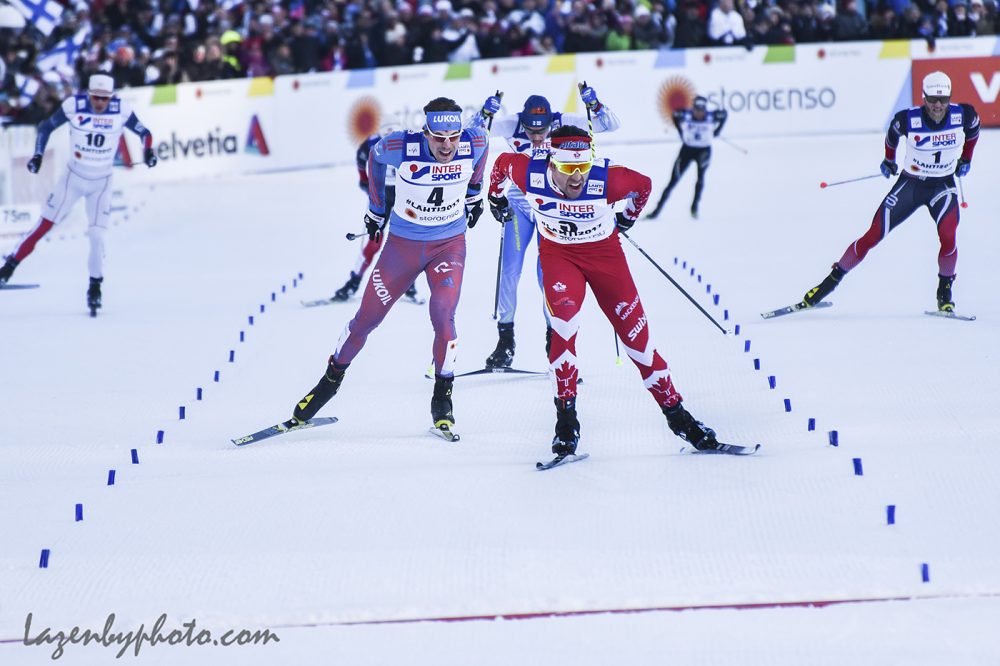
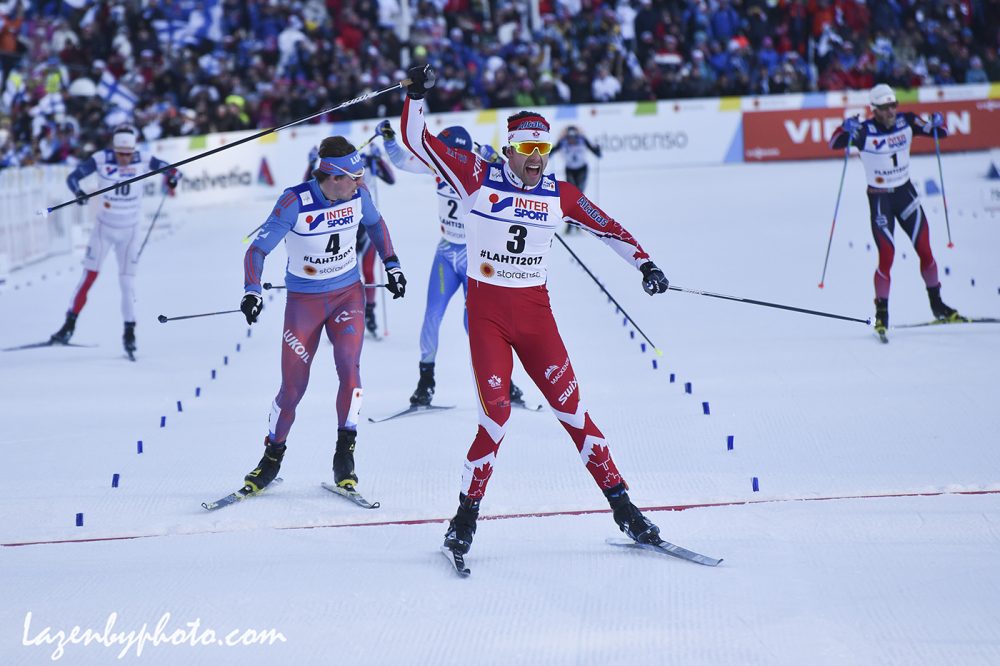
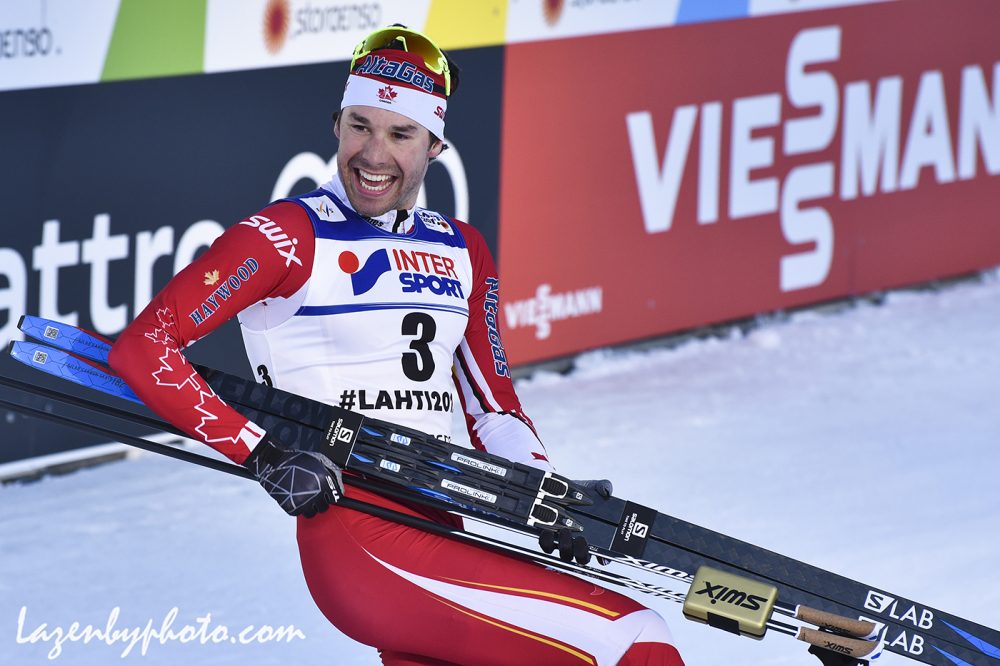
Canada’s Alex Harvey after winning gold in the men’s 50-kilometer freestyle mass start at the 2017 Nordic World Championships in Lahti, Finland. (Photo: John Lazenby/Lazenbyphoto.com)
Welcome to World Cup Windup, where we check in with the top-10 teams from last year’s FIS Cross Country World Cup tour before the season starts with the Ruka Triple in Kuusamo, Finland, on Nov. 24. Last but not least, Canada!
CANADA
Overall in Nations Cup Last Year:10th
Women’s Ranking 2016/2017:14th
Men’s Ranking 2016/2017:Sixth
Who’s Back:
Alex Harvey, World Champion, runner-up in the Distance Cup, and third in the overall World Cup; Len Valjas, with seven World Cup top-20’s last season and Harvey’s partner in crime for team sprints; Devon Kershaw, top-10 in a Tour de Ski stage; Knute Johnsgaard, who teamed up with the previous three for a World Cup relay podium; Jesse Cockney, who had two sprint top-10’s. Other starters on the first period of World Cups are World Cup top-30 finishers Dahria Beatty, Cendrine Browne, Emily Nishikawa, Graeme Killick, and Julien Locke, and NorAm leaders Katherine Stewart-Jones and Russell Kennedy.
Who’s Missing:
No major retirements.
Pre-Season Results:
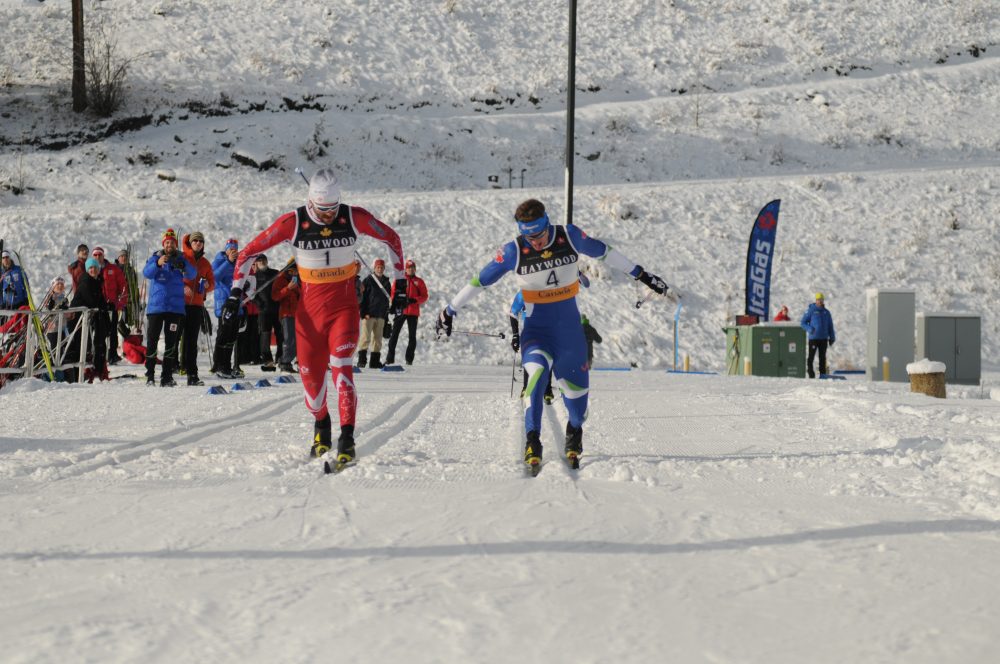
Canadian World Cup Team member Len Valjas (1) and Bob Thompson (NTDC Thunder Bay) lunge to the line during Wednesday’s Frozen Thunder classic sprint at the Canmore Nordic Centre in Canmore, Alberta. (Photo: Doug Stephen)
The Canadians first competed at home in Canmore on the Frozen Thunder loop, with Lenny Valjas and Dahria Beatty winning the sprint, and Julien Locke earning his World Cup spot by crushing the qualifier. Valjas also won the distance race at Frozen Thunder, and Beatty finishing second behind American Chelsea Holmes.
Then this past weekend, they were in Gällivare, Sweden. Devon Kershaw was the best Canadian in the distance races, finishing 12th in the 10 k skate on Friday. “I changed various things with my training this year so it’s exciting to see how my body feels in the beginning of a new season,” Kershaw wrote. “… My goals are really to just be calm and execute well – which means going into the racing with no expectations other than to ski as technically well as possible while working on the whole pacing thing (which can be challenging at the beginning of the season when you don’t have that many races in the body).” Russell Kennedy finished 48th and Lenny Valjas 49th. In the 5 k skate the same day, Emily Nishikawa finished 26th. The next day, she placed 51st in the 10 k classic, while Kershaw finished 20th in the 15 k and none of his teammates broke the top 50.
In Sunday’s classic sprint, Dahria Beatty made the women’s quarterfinals and ultimately ended up 22nd. Valjas also made the heats, but likewise did not advance, finishing 29th; on the outside looking in were Julien Locke (39th); Knute Johnsgaard (40th), Russell Kennedy (43rd), and Jesse Cockney (48th) in a field of 114 men.
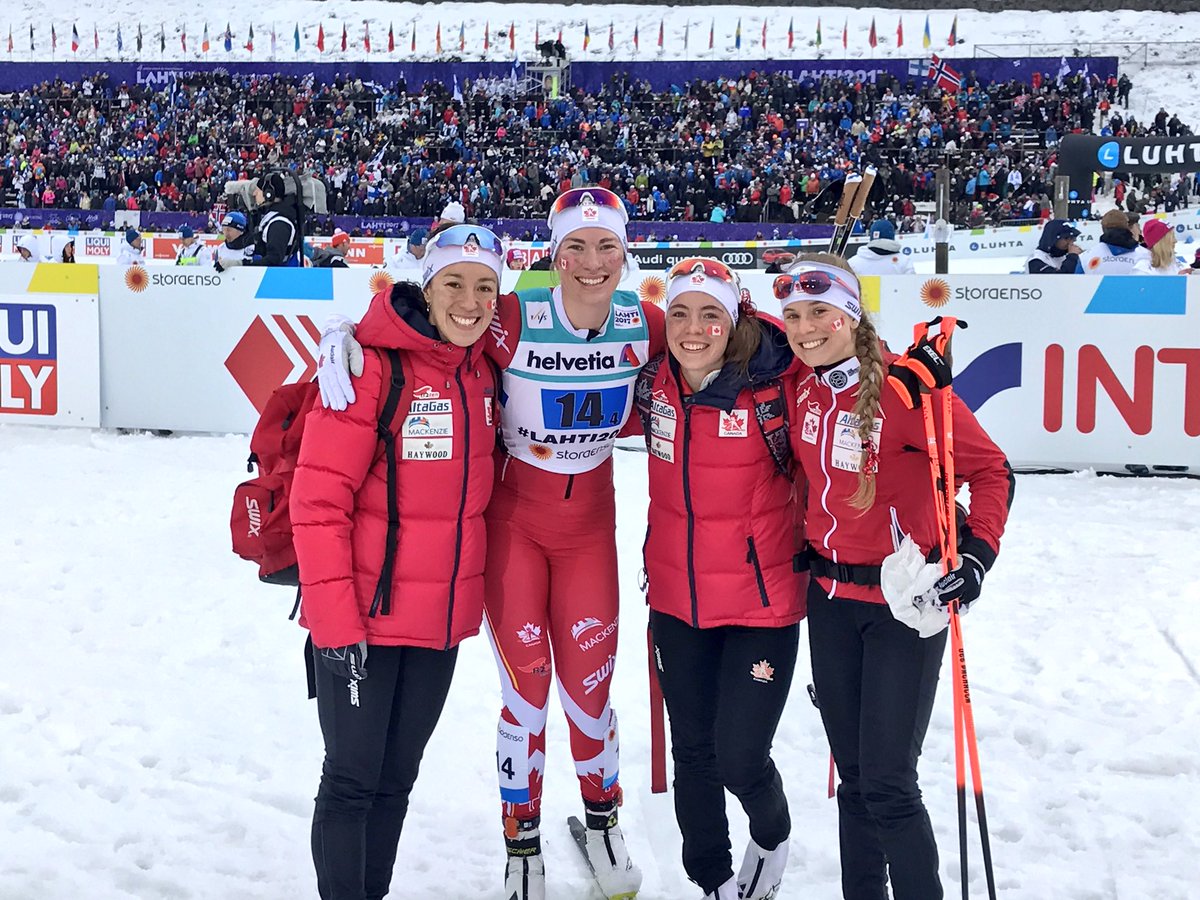
The Canadian women’s 4 x 5 k World Championships relay team, (from left to right) Emily Nishikawa, Dahria Beatty, Katherine Stewart-Jones, and Cendrine Browne, after tallying the third-best relay result for the Canadian women at a World Championships on Thursday in Lahti, Finland. (Photo: CCC/Twitter)
Recent Drama:
While the rest of the team started the season in Sweden, Alex Harvey and Cendrine Browne headed to Davos, Switzerland. In a recent interview with La Presse, Harvey said his goal is to race in six events at the 2018 Oympics. “As a Canadian, I know that a medal at the Olympics would cause a bigger impact than any other medal,” he said. “But I don’t do this for recognition. I do it because I’m keen to set goals and work hard to try to reach them. ”
Katherine Stewart-Jones got a concussion when she crashed her bike two months ago, and had to miss a substantial amount of training. She wrote about the mental challenge on her blog: “The hardest thing about the recovery was feeling helpless. I wanted answers. I wanted to know how long it would take for me to recover and what I needed to do to get better. I would set myself timelines but every time I would reach them, I would end up feeling discouraged. In the end, it was exhausting and stressful, a mix of feelings that are not helpful for recovery.”
Russell Kennedy is a fabulous photographer, so his Instagram page is not to be missed.
The Canadian women’s team also just started a team Instagram page where you can check up on the progress and whereabouts of the different team members.
Another good place to keep track of the team when they are on the road is through coach Ivan Babikov, who regularly posts photos, race results, and video on Instagram and Twitter.
Jess Cockney (Canadian National Ski Team) racing to 28th in the qualifier of the men’s 1.5 k freestyle sprint at World Cup Finals in Quebec City in March. He went on to place 10th on the day to tie his second-best World Cup result. (Photo: John Lazenby/Lazenbyphoto.com)
Last Olympics, the first for Canadian cross-country skier Jesse Cockney, went almost exactly wrong.
In Sochi, Russia, Cockney slumped to 53rd in the sprint — his signature event — missing the heats by 6.5 seconds in a lighter field than many World Cups (at the Olympics, no country can enter more than four athletes).
“I honestly believed I would be better — I didn’t imagine I would be that far behind,” Cockney said in an interview with FasterSkier last month. “I had great races at the [Olympic] trials in Canmore. After the training camp we did, we raced the World Cup in Toblach [Italy], and that was by far the best distance race I ever had. The trend was in the right direction to perform at the Olympics.”
It wasn’t a necessarily psychological flake-out, stage fright, or anything like that. Cockney has numbers, and he knows that something in his training and peaking just didn’t add up back in 2014.
Canada’s Jesse Cockney (right) and American Simi Hamilton bump fists after anchoring their countries’ relay teams at the 2014 Olympics in Sochi, Russia.
“We have blood tests we do before competitions,” he explained. “That was probably the seven-year low for all of my blood numbers, coming into those races two days before the sprint. So something was pretty missed in terms of the physiological preparation for Sochi, and it totally reflected itself in the race results and the feelings.”
Coming into 2018, Cockney has already met Cross Country Canada’s qualification criteria for the Olympics in PyeongChang, South Korea. And he’s looking for different results this time, different feelings.
“I’ve had four years to learn, and I hope we learned,” he said.
Nearing the halfway point of last season, it didn’t seem at all obvious that Cockney would end the year qualified for PyeongChang. Cockney only finished two World Cup races before the Christmas break, with a top finish of 78th in the 15 k classic in Ruka, Finland.
That’s a far cry from the top 30’s, top 16’s, and top 6’s that are needed for Cross Country Canada’s various levels of qualification criteria.
“It was a comedy of errors last year,” Cockney admitted. “The fitness than the results would show. Some of the external factors I let play into the results too much. The race in Kuusamo, there was a snowstorm before the sprint, which threw me off. In Davos, I fell in the qualifier. So I have no idea what that day would have looked like.”
But he secured start rights for the World Cups in PyeongChang, which served as a preview of the Olympic courses. Because the travel was so substantial in the middle of the season and just a few weeks before World Championships, many top athletes didn’t attend the races. Cockney knew he had an opening for top results.
“Very often my often my strength is skiing in the heats and finding opportunities and openings in the heats,” he explained. “It’s very difficult for me to get into the heats. So I knew I really wanted to take advantage of being in the heats.”
Canada’s Jess Cockney (r) racing to first in his quarterfinal in the men’s classic sprint at the PyeongChang World Cup, while leading Norway’s Mathias Rundgreen (13) and Daniel Stock (14). (Photo: Fischer/NordicFocus)
Cockney qualified 16th and then won his quarterfinal. He ended up 10th on the day, halfway to the two top-16 sprint results he would need to make the Olympic team.
His season continued with a trip to World Championships, where he finished 47th.
“Last year basically every single race I did was a trials for the next race,” he said. “I was pretty much always hearing from the coaching staff before a weekend that if I didn’t do well this weekend I wouldn’t get to start next weekend, or if I don’t do well here I won’t get to go to World Champs, or something else. It just became that every day was racing for something else and not actually being present.”
That changed when Cockney came home to compete in World Cup Finals in Quebec, the last World Cups of the season. But he didn’t feel great.
“I was quite tired by the end of the World Cup season,” he admitted. “Actually, the intensity before we left Canmore to go to Quebec at the end of the season, it was probably the worst intensity that I did all year. Ivan [Babikov] and I were doing a workout together in Canmore and I couldn’t finish the workout — I was so tired, I had no energy in my legs. I guess I was a little apprehensive going into the World Cups in Quebec.”
Cockney found some magic, though, qualifying 28th in the sprint, and taking second in his quarterfinal in a photo finish with Norway’s Johannes Høsflot Klæbo, who later that day became the Sprint Cup winner based on a season of World Cup success.
At the end of the day, Cockney was 10th again, and had made the Olympic criteria.
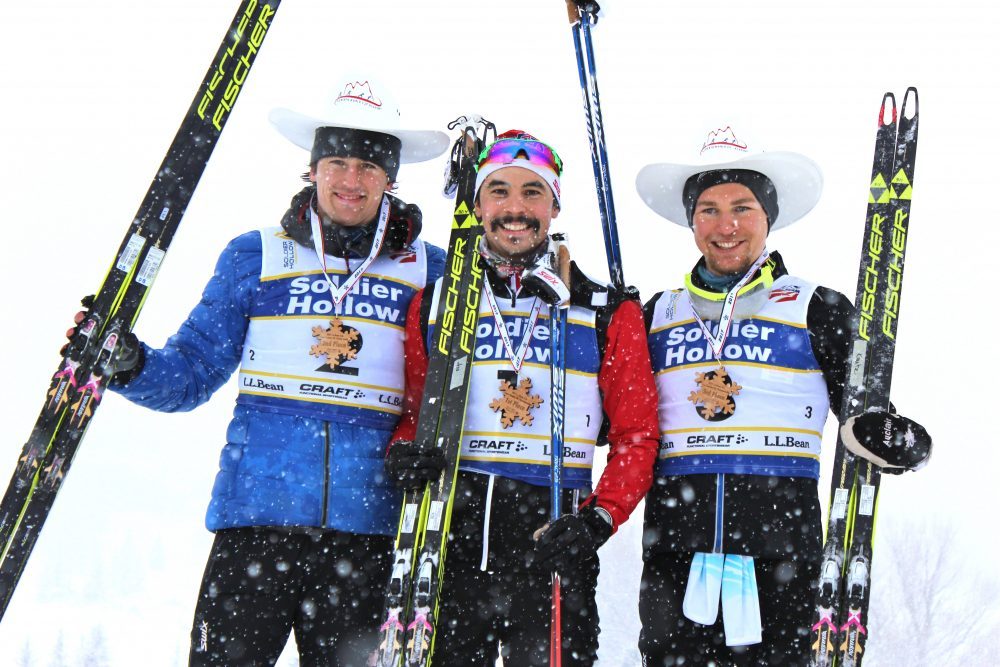
The men’s podium after the freestyle sprint prologue at 2017 U.S. Cross Country Championships at Soldier Hollow, with (from left to right) Julien Locke (AWCA/NST U25 Team), race winner Jesse Cockney (Canadian National Ski Team), and Knute Johnsgaard (AWCA/NST U25 Team).
“On the day, my legs were feeling good, and it’s a course that I like, with the long flowing speed sections and a big high-speed finish around the corner,” he said.
Having hit those criteria and secured World Cup starts for next season as well, Cockney is looking forward to having a very different perspective on his upcoming races.
“That’s a pretty big bonus for Period I and the rest of the year,” he said of being qualified. “I can just race. And that’s pretty often when people’s best results come, when they are just present and focused on the day.”
When Cockney gets to PyeongChang, he will have an advantage many top athletes will lack: prior experience at the venue. Just a handful of men’s sprinters who competed in the PyeongChang World Cups are expected to make their countries’ Olympic teams (Cockney’s teammate Len Valjas is another one of them).
“Nothing really compares to being there,” Cockney said of the decision to take the travel. “I think that was really valuable to get a chance to go and see the courses first hand, to see what it’s like to have a sustained climb – the last climb is quite difficult. It’s hard to tell on the video but it’s quite steep. So I’m pretty happy that I was able to see the course.”
Building towards the Olympic season, that preview has allowed Cockney to keep a laser focus on the PyeongChang sprint.
“I have a loop in Camore on the World Cup trails that I’ve kind of adopted,” he explained. “Mentally it is the Olympic course in PyeongChang. I do most of my warmups for the strength sessions running and ski bounding on that section, and visualizing that I’m not in Canmore, that I’m in Korea skiing on snow and finding the best lines. Just trying to picture myself on those climbs, and hopefully mentally getting more and more confident and comfortable.”
Jesse Cockney racing to 78th in the 15 k classic in Ruka, Finland, last season. (Photo: Fischer/Nordic Focus)
That’s one thing Cockney is doing to look towards Olympic success. Another is learning from whatever got him to a physiological low in Sochi.
“I will spend less time at altitude before these Olympics,” he said. “And take a big step back in terms of training volume and intensity, and make sure that I’m rested and that my body isn’t in that recovery panic mode that it was in Sochi.”
So far, training this year has been nothing out of the ordinary, just a continuation of the plan that got him here.
“I think I’ve just been patient with the training,” Cockney explained. “It has been pretty steady. We haven’t had many highs or lows with anything. I’m letting the bulk of the training year build towards February.”
Getting better at sprint qualifiers is also a goal, so that he can have more opportunities to find good lines in the heats.
“Over the last two years I’ve been trying to get back to training a bit more volume, trying to get some capacity in a different way,” he said. “I [need to] have the stamina to ski at a high speed in the qualifier, not just for 30 or 45 seconds well, but I have to be strong for 3 ½ minutes in a qualifier. And that comes for sure just from capacity and I’m trying to work on that.”
Cockney went to Italy for a national team camp, but other than that it has been a lot of training in Canmore, the adopted home of the Yellowknife, Northwest Territories, native.
He is not part of a National Development Training Center, and instead has been training primarily with the other Canmore-based members of the national team.
“We can be our own team with Lenny, Knute [Johnsgaard], Graeme [Killick], and myself,” Cockney said. “[World Cup coach] Ivan [Babikov] is there for all the workouts we need to go. We have a good small group so that means we are pretty flexible… I’d say every workout there’s someone who is strong and can pace the group and make sure that there’s high-quality speed we can feed off of.”
But a rotating cast of characters have joined them at different times.
“It has been a really strong training group over the summer, and we have kind of opened the workouts to anyone in town who wants to train with us,” he continued. “So a lot of athletes from [Alberta World Cup Academy] are doing workouts with us, and some athletes who are unsupported who are training on their own in Canmore.”
“I got back to Canmore… [and] it was still quite smokey in the air,” he said of early September after the Italy camp. “This block of training was pretty important with the intensity, so we made a last-minute decision to come to Quebec, be with Alex [Harvey], get some time at lower altitude, and make sure that we didn’t miss any workouts because of the smoke. It has been a productive period, with hard workouts with Graeme and Alex.”
At the moment, Cockney is headed to Park City, Utah, for a national team training camp. He will cut it a bit shorter than some teammates to try to avoid too much fatigue from altitude, and then have a few weeks in Canmore before the season starts.
He said he’s looking forward to those weeks, where he can train but also get good family and friend time before heading to Europe.
Because from there, it’s race time, and Cockney is hoping for solid results on the World Cup before Christmas.
“The big goal is to be racing into the semifinals again,” he said. “Having good strong days, seeing the speed of the World Cup again and racing at a good level. Probably in terms of which courses to target, I think Lillehammer [Norway] and Davos [Switzerland] are good courses for me. The last time I raced in Lillehammer I think I was 34th or 32nd or something, so close to making the heats. In Davos I have been in the heats before. So those are to big weekends for me, with goals to get into the semifinals those days.”
The U.S. Ski Team women’s team at work during a 10-day camp in the Methow Valley. (Photo: Matt Whitcomb/U.S. Ski Team)
(Note: This article has been updated to include comments from Canadian coach Ivan Babikov on his team’s recent camp in Park City, Utah.)
Two days after Andy Newell and Erika Flowers tied the knot in Bozeman, Mont., seven members of the men’s U.S. Ski Team and eight U.S. women’s team members jumped into an intensity training block at their respective dryland camps in Park City, Utah, and the Methow Valley in northern Washington.
The 10-day camps were scheduled simultaneously from June 26-July 5 to accommodate the wedding. Newell is a longtime U.S. Ski Team (USST) member and teammates with Flowers on the Stratton Mountain School (SMS) Elite Team out of Stratton, Vt. Because several national-team members ventured to Bozeman (Flowers’s hometown) to watch them say “I do,” the USST coaches decided to reduce travel and keep their squads together out west.
“We wanted to capture the men in the Intermountain West immediately following Andy Newell’s wedding in Bozeman, and therefore reduce the overall travel load for athletes who were already coming to the West from the East or Alaska,” head coach Chris Grover explained in an email.
The men based themselves in Midway, Utah, about 1,500 feet lower in elevation than Park City and 1,000 feet lower than Deer Valley, where they typically reside for summer and fall camps. Grover explained that this was by design, “because of the shorter duration of the camp (i.e. too short to create a meaningful stay at altitude), the focus on specific intensity workouts, and the benefits of quicker recovery at lower altitude,” he wrote.
Staying closer to the Soldier Hollow training venue was also ideal for the men’s team’s “PyeongChang-specific workouts”, Grover explained, including sessions focused on the freestyle team sprint, classic sprint and 4 x 10-kilometer relay, which will be contested at the 2018 Winter Olympics in PyeongChang, South Korea.
Newell, Simi Hamilton, Erik Bjornsen, Scott Patterson, Paddy Caldwell, Ian Torchia, and Ben Saxton attended and worked with coaches Jason Cork, Pat O’Brien, Grover, and U.S. Ski & Snowboard Strength and Conditioning Coach Tschana Schiller.
“The men did a great job of bringing heightened focus and effort to these key intensity workouts and we are grateful to the staff at Soldier Hollow for preparing the track for us,” Grover wrote. “Overall, it was a very productive camp and I think sent the men into the main summer preparation period with important areas to work on, a good gauge of fitness, and a further understanding of what skills need to be developed for the WC [World Cup] season and for PyeongChang.”
(Article continues below)
The U.S. men’s cross-country team at work during a classic distance rollerski near Midway, Utah. (Photo: Pat O’Brien)
The U.S. men’s cross-country team at work during a classic distance rollerski near Midway, Utah. (Photo: Pat O’Brien)
The U.S. men’s cross-country team at work, accompanied by head coach Chris Grover on his bike, during a skate over-distance rollerski near Midway, Utah. (Photo: Pat O’Brien)
The U.S. men’s cross-country team at work during a skate over-distance rollerski near Midway, Utah. (Photo: Pat O’Brien)
The U.S. men’s cross-country team at work during a skate over-distance rollerski near Midway, Utah. (Photo: Pat O’Brien)
The U.S. men’s cross-country team at work during a skate over-distance rollerski near Midway, Utah. (Photo: Pat O’Brien)
Start of the men’s skate team sprint on July 3 at the U.S. Ski Team men’s camp at Soldier Hollow in Midway, Utah. (Photo: Pat O’Brien)
Start of the men’s skate team sprint on July 3 at the U.S. Ski Team men’s camp at Soldier Hollow in Midway, Utah. (Photo: Pat O’Brien)
Do you use a heart rate monitor for training? Has it ever given you a seemingly implausible reading? Here’s why, and whether you should worry. (Photo: Pat O’Brien)
Andy Newell (r) leads the men’s skate team sprint on July 3 at the U.S. Ski Team men’s camp at Soldier Hollow in Midway, Utah. (Photo: Pat O’Brien)
Scott Patterson starting the U.S. Ski Team’s distance time trial at Soldier Hollow in Midway, Utah. (Photo: Pat O’Brien)
Scott Patterson (l) ascends the infamous Hermod’s Hill during the U.S. Ski Team’s distance time trial at Soldier Hollow in Midway, Utah. (Photo: Pat O’Brien)
Paddy Caldwell climbing during the U.S. Ski Team’s distance time trial at Soldier Hollow in Midway, Utah. (Photo: Pat O’Brien)
Simi Hamilton during the U.S. Ski Team’s distance time trial at Soldier Hollow in Midway, Utah. (Photo: Pat O’Brien)
Newlywed Andy Newell on his U.S. Ski Team’s distance time-trial day at Soldier Hollow in Midway, Utah. (Photo: Pat O’Brien)
From left to right: Andy Newell, Ben Saxton and Simi Hamilton working on classic speeds at Soldier Hollow in Midway, Utah. (Photo: Pat O’Brien)
From left to right: Andy Newell, Ben Saxton and Simi Hamilton working on classic speeds at Soldier Hollow in Midway, Utah. (Photo: Pat O’Brien)
Simi Hamilton leads Andy Newell and Paddy Caldwell during a classic-speeds workout at Soldier Hollow in Midway, Utah. (Photo: Pat O’Brien)
Andy Newell leads Simi Hamilton during a classic-speeds workout at Soldier Hollow in Midway, Utah. (Photo: Pat O’Brien)
Paddy Caldwell leads Erik Bjornsen (c) and Ian Torchia (r) during a classic-speeds workout at Soldier Hollow in Midway, Utah. (Photo: Pat O’Brien)
Ben Saxton (r) and Erik Bjornsen (l) during a classic-speeds workout at Soldier Hollow in Midway, Utah. (Photo: Pat O’Brien)
U.S. men’s team members Erik Bjornsen (l) and Ian Torchia during a classic-speeds workout at Soldier Hollow in Midway, Utah. (Photo: Pat O’Brien)
U.S. Ski Team Men’s Assistant Coach Jason Cork checks in with Ian Torchia during a classic-speeds workout at Soldier Hollow in Midway, Utah. (Photo: Pat O’Brien)
Local juniors rollerski alongside U.S. Ski Team members during a workout at Soldier Hollow in Midway, Utah. (Photo: Pat O’Brien)
***
Meanwhile, the U.S. women tried a new camp in the Methow Valley, home of current national-team members Sadie and Erik Bjornsen. The athletes themselves dubbed it the “CAGS Camp“, which U.S. women’s coach Matt Whitcomb explained stood for “a secret and mildly inappropriate team acronym that pokes fun at girls being girls. Sophie had hats made for the camp that she handed out at the airport when everyone arrived.”
All kidding aside, the goal of the camp was to be small and intensity focused, “with eight days of training and hard intervals every other day,” Whitcomb wrote in an email. “It’s an unusual setup for our team as we usually run joint camps with the men, but both enjoyed the simplicity of having such small training groups.
“We chose the Methow in part because it is where Sadie and Erik Bjornsen grew up, but also because we could get close to sea-level to maximize our hard efforts,” he added. “Another draw was that Pete Dickenson, one of our team physical therapists, was able to provide great treatment all week. Winthrop PT & Fitness sponsored our strength sessions, which meant we didn’t have to drive very far to get strong.”
Like Grover, Whitcomb used the word “ideal” to describe the Methow as a training site, yet emphasized that the community that hosted them was “even more incredible.”
“A local couple gave us their two cabins in a location as beautiful as we’ve seen anywhere in the world,” he wrote. “The chance to meet Olympians Laura McCabe (’94, ’98) and Leslie Hall (’88, ’92, ’94) was an important experience for the team. We owe them special thanks not for just guiding us to their favorite training spots, but for helping pave the early path for elite women’s skiing.”
The women’s team, which included Sadie Bjornsen, Rosie Brennan, Sophie Caldwell, Jessie Diggins, Katharine Ogden, Kikkan Randall, Ida Sargent, and Liz Stephen, spent one afternoon working with with the Methow Valley Nordic Team, which McCabe and Hall both coach.
“We invited a handful of their top athletes to join our bounding and ski walking sessions, and were encouraged by their technique and fitness, but also their love for the sport,” Whitcomb wrote. “They are doing a good job up there. I don’t know what the future holds for us regarding camp locations, but the Methow Valley will be considered as a great option moving forward. Thanks to so many people for making it happen.”
Women’s team staff included Whitcomb, Tim Baucom and physical therapist Pete Dickenson.
(Article continues below)
The U.S. women’s team with Methow Valley Nordic Team members during the U.S. Ski Team’s recent camp in Washington state’s Methow Valley. (Photo: Matt Whitcomb)
Rosie Brennan (in yellow) takes the lead while Sadie Bjornsen (in pink helmet) coaches on the bike during a 2017 U.S. women’s team camp in the Methow Valley. (Photo: Matt Whitcomb)
The U.S. Ski Team women’s team at work during a 10-day camp in the Methow Valley. (Photo: Matt Whitcomb)
The U.S. Ski Team women line up for the team sprint final during their camp in Washington state’s Methow Valley. (Photo: Matt Whitcomb)
Liz Stephen at work during the U.S. Ski Team women’s team’s camp in the Methow Valley. (Photo: Matt Whitcomb)
Sadie Bjornsen (front) and Ida Sargent get some help hydrating from coach Tim Baucom during a run in the Methow Valley. (Photo: Matt Whitcomb)
The U.S. women’s team at their dryland camp in the Methow Valley: (from left to right) Ida Sargent, Kikkan Randall, Sophie Caldwell, Jessie Diggins, Liz Stephen, Sadie Bjornsen, and Rosie Brennan. (Photo: Matt Whitcomb)
U.S. Ski Team coach/serviceman Tim Baucom sits on the porch of one of the team’s cabins during their recent camp in the Methow Valley in northern Washington. (Photo: Matt Whitcomb)
***
Cross Country Canada also recently finished up a two-week camp in Park City (June 26-July 11) with its entire men’s World Cup team — Alex Harvey, Len Valjas, Devon Kershaw, Jess Cockney, Knute Johnsgaard, and Graeme Killick — and U25 national-team member Julien Locke. Co-World Cup coaches Ivan Babikov and Louis Bouchard accompanied the team for the duration, and Joel Jaques joined for the first week.
While Park City has become an annual staple for the Canadian team, Babikov explained that this was their first time there in the summer, as opposed to the fall.
“We love the area and training there. … It was pretty hot but we managed,” he wrote. “The main goal was a big training volume/hours at the altitude. We were planing on doing a time trial at the SoHo but it got closed for those dates so we ended up doing intensity down in Salt Lake instead.
It was a great camp for all the guys, everyone feels good and no injuries on the team.”
The Canadian men’s relay after placing third for Canada’s best World Cup result in the men’s 4 x 7.5 k relay, with (from left to right), Lenny Valjas, Alex Harvey, Knute Johnsgaard, and Devon Kershaw. (Photo: Salomon/NordicFocus)
What a year for Cross Country Canada (CCC). For the first time in history, its men’s team stood on a World Cup relay podium. Its top skier brought home his first World Championships gold and its women’s team pulled off its fourth-best world champs relay result on record.
With the release of Canada’s 2017/2018 national-team nominations earlier this month, FasterSkier caught up with CCC’s High Performance Director Thomas Holland and the World Cup co-coach Ivan Babikov to discuss the program moving forward.
What’s changed since last year? Not much. With a strong season behind them, an Olympic season ahead and a solid coach and tech crew on board, Holland supported a sense of continuity for the upcoming season.
“We’re not changing anything this year. We’re just making little improvements, which is a great thing,” Holland said on the phone on May 23. “We’ve got stable coaching, stable technical team …. We’re just adding one more camp. We used to always do four, with cutbacks we went to three, so now we’re stepping it back up to four.”
Almost all of the 14 athletes named to the senior team are returnees, but two made the jump from the World Cup B-team to the A-team: Knute Johnsgaard and Jess Cockney. With the advance, both Cockney and Johnsgaard will join A-team veterans Alex Harvey, Len Valjas and Devon Kershaw.
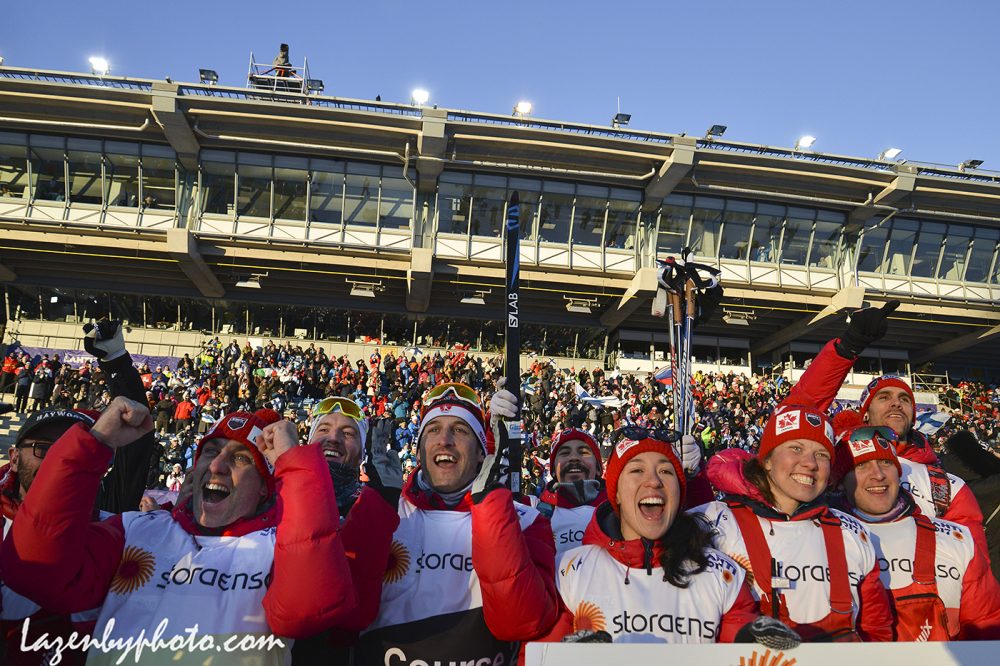
Canadian teammates, coaches and support team celebrate Alex Harvey’s win in the men’s 50 k freestyle mass start at the 2017 Nordic World Championships in Lahti, Finland. (Photo: John Lazenby/Lazenbyphoto.com)
For the second-straight year, Babikov is teaming up with Louis Bouchard, Harvey’s personal coach and head coach of the Pierre-Harvey Training Centre (CNEPH), who coaches U25 Team member Cendrine Browne as well. As World Cup co-coaches, Bouchard and Babikov are able to divide the workload and travel required throughout the year, and specifically, five months abroad.
“It’s hard to be on the World Cup circuit all the time for staff,” Babikov said on the phone. “[Louis and I] both have families, so it’s worked out well when we’re subbing for each other once in awhile so athletes have a national-team coach with them all the time. We have a good mix with his experience and my experience on the other side as an athlete. I think I’ve learned from him and it’s been great.”
While the World Cup A-team remains all-male, three women were nominated to the B-team: Emily Nishikawa, Olivia Bouffard-Nesbitt, and Dahria Beatty of the Alpine Insurance Alberta World Cup Academy (AWCA). These women will work with Chris Jeffries, head coach of the AWCA, who plans to travel with the team on certain trips to Europe as well.
Tuesday, May 30, marked the last day of the team’s first official camp of the season in Mont-Tremblant, Québec, which started May 21 and included the entire national team minus Kershaw.
According to Babikov, Kershaw would be at the second men’s World Cup team camp in Park City, Utah, from June 26-July 11. A month later, those six men (including B-team member Graeme Killick) will head to Livigno, Italy, for their third camp Aug. 16-Sept. 3, while the women’s team and Jeffries head to New Zealand for an on-snow camp.
For the fourth and final camp, both the men’s and women’s World Cup teams, along with the Canadian U25 Team, which includes Julien Locke (Black Jack), Browne (CNEPH), Katherine Stewart-Jones (NTDC Thunder Bay), Maya MacIsaac-Jones (Rocky Mountain Racers), and the senior team’s only newcomer Gareth Williams (Telemark), will return to Park City for a dryland camp Oct. 5-24. An all-encompassing Alignment camp is scheduled for early July in Thunder Bay, Ontario, but due to other camps happening simultaneously, the World Cup team members will not be attending, Babikov said.
Heading into the upcoming World Cup season, Harvey remains Canada’s lone athlete in the Red Group (top 15 in sprint or distance World Ranking list) and is accordingly the only one receiving full funding for training camps. According to Holland, the six men that form the World Cup training group (World Cup A-team plus Killick) are receiving funding from Own The Podium (OTP). He reiterated that OTP allocates funds based on medal potential.
“They’re funding the medallist people, the potential people,” he said. “Primarily, that’s Alex Harvey. We did get a medal in the relay last year on the World Cup, part of that group [Harvey, Kershaw, Johnsgaard, and Valjas] is included as well. Len Valjas had a medal on the World Cup too, [in the team sprint] with Alex … and additionally, we want a training group. They support that idea of having a good training group here around Alex. That adds up to six men.
“After that, it doesn’t change much from last year,” he continued. “There’s not a lot of money outside of that [Own the Podium support] window. There’s support on the World Cup, etc., but your question was has it changed. … We don’t have more money, we have actually less money.”
Compared to past Olympics, CCC’s budget this year is about half of what it was for the 2014 Sochi Olympics and “a lot less than what we had in Vancouver,” Holland said.
“It’s a tight budget,” he added. “I’m not going to sit here and whine about money because we also had a tight budget last year. We’ve had cuts for three years leading into last year, and still — small team, small budget — we did pretty good. Our attitude is that we have a little bit more money this year we’re getting from Own The Podium and we’re doing an additional camp for the men. … We’re not changing a lot, except adding a camp and having good preparation. There’s less money, but we’re going to get the job done.”
From his viewpoint, ongoing annual budget cuts have especially hurt development programs with a “lack of money to really invest in the future,” he said. Yet development remains a priority.
“You’ve probably heard of the ‘NextGen’ funding. Expect that there’ll be some kind of announcement this year,” Holland said. “We have a plan in place, and we’re making changes, regardless of not having a lot of money, in how we go about that next generation, in testing and development.”
In order to continue creating opportunities for up-and-coming talent, CCC is now working more closely with clubs, permitting some national-team members to continue their work with club coaches, while simultaneously training with national team. Out of nine World Cup team members, seven are not affiliated with training centres (only Harvey is listed as CNEPH and Beatty is part of the AWCA).
“We’ve never said everybody has to join a training centre,” Holland said. “I guess what we’ve said is, if you’re on the national ski team, you had to be in a training centre. … That is an option for U25 athletes, but once you’re on the World Cup team, we still have a centralized model. What we’re doing is broadening.”
Since the training-centre model was instated in 2006, the level of coaching in clubs around the country has improved, Holland explained. That makes it less essential for an athlete to belong to one of three training centres.
“They provide education and good services in six or eight clubs across the country,” he said. “You’ve got to have a club that has a coach who is well-experienced, can write a good yearly training plan that makes sense. … There’s also requirements to come and be tested here [in Canmore], for those athletes, to participate in national ski team camps, etc. So it’s not just cutting them loose, it’s more of a closely integrated model. Trying to integrate more with the divisions and the clubs. When you do that, you know your dollar goes farther.”
Bottom line, Holland reiterated that CCC is “moving ahead despite not having the resources.”
“We ran a World Cup team program with significantly less money, but we’ve been pretty good at finding ways to do things inexpensively [through] collaboration with divisions and clubs,” he said. “We’re also extending some of our national senior team programming to the clubs. That’s a big change.”
Gareth Williams (Telemark Race Team) on his way to a personal-best 11th in the men’s 20 k skiathlon at 2017 Junior World Championships at Soldier Hollow in Midway, Utah. (Photo: FlyingPointRoad.com)
Because of this change, 19-year-old Williams, in his first year on the senior team, will continue to work with his club, Telemark, while also training with the national team.
Financially, not much separates Canada’s World Cup B-team from its U25 (Under 25) Team.
“In terms of support, there’s not a lot of difference,” Holland said of the two teams. “I think it’s mainly an age factor. If you’re coming through U25, you’re expected to meet a little higher standard for that B-team. Whereas Gareth Williams, we want to look at that as more talent development. … By the time they hit the B-team, we expect them to be at the World Cup level.”
In addition to his international results last season (including an 11th place in the skiathlon at Junior World Championships), Williams was also named to the U25 development team because of the value seen in the years ahead of him.
“Gareth, as a junior, has a few years to develop for us, to put into his program,” Holland said. “We have clearly defined benchmarks of who gets on the team. For Gareth, it’s written in our criteria, top 12 at World Junior championship result.”
“We have to look to the future and look ahead and develop younger guys and give them a nod and give them recognition so they have something to work for,” Babikov said.
A few of the senior team nominations, including Bouffard-Nesbitt, who was injured in a car accident in February, and MacIsaac-Jones, who struggled with a foot injury and had surgery this spring, were based on the “force majeure” clause.
“Some people who were sick at the wrong times last year,” Holland said. “Health is a big concern … that’s a primary thing that we’ll be on top of this year. Then the other people, I wouldn’t call health. … Athletes get injured, we like to stay with them as long as we see that there’s a good recovery plan and the injuries are taken care of. I won’t say that those injuries aren’t serious. As the hockey players say, it’s day-to-day on the comeback.”
As for which Canadian skiers you can expect to see starting World Cup Period 1, Holland confirmed there will be at least 11: seven men and four women. The seven men include the five A-team members who “have met the Olympic Winter Games (OWG) Nomination Criteria outlined in CCC’s OWG Internal Nomination Procedures for the Olympics”, according to Holland, with standout results last year (in individual or team events). Killick will also start the season on the World Cup, as will Russell Kennedy as the Continental Cup leader.
The four women all competed at 2017 World Championships: Stewart-Jones (who is also the Continental Cup leader), Nishikawa, Beatty, and Browne.
And Nishikawa, Beatty and Killick all met “alternate qualifying criteria” for the Olympics.
The Olympic team size is a minimum of four men and four women, Holland explained in an email. “The primary criteria takes precedent over the alternate criteria if the maximum number of athletes is established under the primary criteria.” Olympic selections will be finalized in January.
But in the meantime, CCC will aim to host selection races for Period 1 World Cup starts on Frozen Thunder in Canmore in early November.
“We don’t have criteria yet, but potentially we would add one or two more male sprinters, and at least another female athlete,” he said of the Period 1 team. “I’m not going to get into specifics, because we still have to write the criteria, but that’s the intent coming out of our spring meetings. You’ve got a pretty good World Cup group there in November/December.
“I think it’s good to note we’re a little different, the way we do things, than the U.S.,” Holland added. “After we see what happens in December, then we look at our Olympic trials, which will be in Mont-Sainte-Anne in January. That’s how we’ll pick the rest of them.”
In terms of medal potential at the PyeongChang Winter Olympics in February, Holland said the goal is one, for starters.
“We’re just looking for a medal,” he said. “Always, two is better than one, but our focus … [is on] where our medal chances are. How do we maximize those opportunities for each? Certainly in the relay, we’ll be shooting for the bronze because we’ve done the analysis. For Alex, he’s going to ski in as many events as he can. So it depends on day to day, how he comes into the games. You know he can medal in sprints, he can medal in the 50 k, and everything in between. We’re just optimizing every opportunity.”
FasterSkier’s Performances of the Year (clockwise, from upper right): Jessie Diggins and Sadie Bjornsen placing third in the FIS World Championships team sprint (Photo: John Lazenby/Lazenbyphoto.com), Canadian men’s relay placing third in Ulricehamn World Cup (Salomon/NordicFocus), Ben Loomis placing ninth at Junior World Championships (U.S. Ski Team/Tom Kelly), Susan Dunklee placing second at IBU World Championships (USBA/NordicFocus), and Lowell Bailey becoming the first American to win gold at IBU World Championships (Glen Crawford).
This is it — the final award in our 2016/2017 awards series. Votes stemmed from the FS staff, scattered across the U.S., Canada, and Europe, and while not scientific, they’re intended to reflect a broader sense of the season in review. This honor goes to outstanding North American performances of the year across various nordic sports.
What made his performance legendary wasn’t just that Bailey became the first American biathlete to ever earn the title of world champion. It was the way he did it: perfect 20-for-20 shooting, digging deep on his skis, rising to the meet the pressure of a nailbiter of a competition, and sealing the win with aggressive skiing on the final downhill into the stadium.
Lowell Bailey (US Biathlon) racing to gold in the men’s 20 k individual at 2017 IBU World Championships on Feb. 16 in Hochfilzen, Germany. (Photo: USBA/NordicFocus)
“In my mind, that was where the race began, the second I left the mat,” Bailey said of cleaning his 20th target.
Watching from the finish line was the Czech Republic’s Ondřej Moravec, who had started with an earlier bib, also cleaned all 20 targets, and held a 6.4-second lead as Bailey left the range. It also would have been the first world title for Moravec, who had a gold relay medal but never an individual of his very own. The Czech — a veteran journeyman just like Bailey — shook his head and laughed as he watched his fate hang in the balance on the big screen.
The 20 k individual is often nobody’s favorite race. It’s hard to keep track of what’s happening, with each athlete going through four shooting bouts and a seemingly interminable amount of skiing. The individual-start affair takes nearly two hours from first start to last finish. There are only a few on the World Cup schedule each year and persistent rumors that the format will be eliminated.
But Bailey, Moravec, and their competitors proved that the individual can be as exciting as anything in the sports world.
With just about a kilometer to go, Bailey had a tenth of a second on Moravec’s time. The stadium announcer asked the fans to cheer him around the last bit of the race course and they responded with a deafening roar.
“Every hundred meters it was a sprint,” Bailey said. “Every hundred meters was ‘go as hard as you can for this hundred meters, and then when you get to the end of that hundred meters, go as hard as you can and just keep doing that.’ I thought the finish line was never going to come. I was just like, I don’t know how much longer I can do this, because the finish line is just not showing up.”
It did, and Bailey had done it. The first American world champion let out a scream. He was mobbed by the press afterwards and his performance became one of the defining moments of the World Championships.
“I know how important it really is for biathlon,” World Cup overall champion Martin Fourcade said of Bailey’s gold medal. “To see some people outside of Europe winning. I think that is the most we can do to make our sport bigger. I cannot be more satisfied about the guy winning today.”
Susan Dunklee (US Biathlon): Mass-start silver at IBU World Championships
A few days later, Bailey’s teammate Susan Dunklee matched his 20-for-20 shooting and left the shooting range in the 12.5 k mass start with the race lead.
American Susan Dunklee leaving the range first after the final shooting stage of the women’s 12.5 k mass start at IBU World Championships in Hochfilzen, Austria. She went on to place second for her first World Championships medal and the best result of a U.S. female biathlete at World Championships. (Photo: USBA/NordicFocus)
In the final kilometers, she was caught and passed by Germany’s Laura Dahlmeier, the most successful athlete of the Championships who took home five gold medals. But her fifth and last one did not come easily: the pair were among the only women to shoot perfectly, and Dahlmeier had to chase hard on the last loop. In the end, Dunklee crossed the line 4.6 seconds after the German and won a silver medal, the first individual medal ever by a U.S. woman at a World Championships.
“I had a feeling that [Dahlmeier] would catch me, because it is a lot easier when you are hunting than being hunted,” Dunklee said of not being able to follow the German and thus missing out on gold. “Unfortunately I didn’t quite have that today, but I am pretty happy with the race and it gives me something to aim for in the future.”
While Dahlmeier was faster on her skis, Dunklee was the fastest on the shooting range, and it wasn’t even close. From the first bout of the race, she knocked down her targets in blazing fashion. That allowed her to leave the range first time after time, and set out around the course at her own pace. By the time she came to the last shooting stage, it seemed almost impossible that she could miss; a totally electric performance.
“You have to get to the point where you trust that speed is better than shooting slow,” she said of her shooting training. “That takes a long time… today it worked.”
Jessie Diggins and Sadie Bjornsen (U.S. Ski Team): Classic team sprint bronze at FIS World Championships
Jessie Diggins and Sadie Bjornsen gave us all a glimpse of what was to come when they finished first and third, respectively, in the women’s 5 k freestyle during the Tour de Ski in Toblach, Italy. That was Bjornsen’s first individual podium and Diggins’s third. Less than two months later, they returned to the podium together, this time in a team event at World Championships nonetheless. Bjornsen started first for the two-woman squad in the 6 x 1.3 k classic team sprint in Lahti, Finland, and Diggins anchored, skiing from fifth to third on the final lap and overtaking Sweden’s Stina Nilsson in the finishing stretch.
Sadie Bjornsen (r) greets her U.S. teammate Jessie Diggins after Diggins outlunged Sweden’s Stina Nilsson (not shown) for the bronze medal in the women’s 6 x 1.3-kilometer classic team sprint at 2017 Nordic World Championships in Lahti, Finland. (Photo: John Lazenby/Lazenbyphoto.com)
Diggins edged Nilsson by 0.19 seconds for the final spot on the podium. Following Diggins’s freestyle team sprint gold, which she won with Kikkan Randall at 2013 World Championships, bronze is the U.S. team’s next-best result. The medal was Diggins’s fourth at a World Championships (and second of the week in Lahti, Finland) and Bjornsen’s first.
“I have been dreaming to be on a team sprint at World Championships or Olympics for a while now and it’s so cool to finally be here,” Bjornsen said afterward. “I think it’s finally sinking in, because I feel like I just wanna cry.”
Out of all of the first-leg skiers in the final, Bjornsen posted the fastest splits on her first and second laps.
“For me, this is one of the most exciting ones because, as Sadie said, it’s in classic,” Diggins said.
In all, the U.S. team took home four medals from 2017 World Championships: two in the skate sprint (where Diggins placed second and Randall finished third), and technically two from the classic team sprint (one each for Diggins and Bjornsen).
“This was an event that, in April, we talked about as an outside medal shot,” U.S. Ski Team Women’s Coach Matt Whitcomb said. “With that in mind, the team started brainstorming of a way of ‘coming from some sort of surprising attack’ when the time came in Lahti.”
He explained that they didn’t select the team-sprint duo until about 12 hours before the race.
“We had [Bjornsen] specifically skip the skiathlon because we thought with a little extra rest, she could be that much sharper,” Whitcomb said. Diggins ended up dropping out of the skiathlon to rest up for the team sprint the next day.
“But we had four other women that were up for serious consideration for this spot and we didn’t make the call until yesterday afternoon at 2:25 p.m.,” he added. “[Bjornsen and Diggins] felt the pressure of being selected for this team and … they’ve awarded everybody that could have been on it.”
Canadian men’s relay: Bronze at Ulricehamn World Cup
Len Valjas (c) is greeted by his teammates Alex Harvey (far right), Knute Johnsgaard (far left) and Devon Kershaw after he anchored their team to third in the men’s 4 x 7.5-kilometer team relay for a team best in Ulricehamn, Sweden. (Photo: Fischer/NordicFocus)
“We barely assembled one team, but that team made a miracle today, so we only needed one,” Canadian World Cup coach Ivan Babikov said after the Ulricehamn relay medal. Babikov competed on Canada’s 2012 relay team, retiring just last spring and transitioning to coaching.
“I’ll never forget this day,” he added. “We’ve had individual podiums and individual medals, but the relay is special because it’s a show of strength for the whole team and the whole staff behind this team.”
The four-man squad included veteran World Cup skiers Devon Kershaw and Harvey, as well as U25 national team member Knute Johnsgaard, who flew to Sweden just a few days before the event. By the first exchange, Kershaw put the Canadians in third, just 0.7 seconds out of first. Harvey went on to tag Johnsgaard 3.5 seconds back in fifth, and Johnsgaard as the third leg kept the team within striking distance in seventh, 5 seconds out of first.
Over the final 7.5 k, Valjas raced his team into not just podium contention, but a threat for second place as well.
“On the last lap, I was totally blocked on the hill, so I couldn’t actually empty the tank, which was probably a good thing for me,” Valjas recalled. “And then just after the hill I built up some speed, and passed five or six guys just double poling.”
With about 300 meters to go, Valjas was up to second place behind Sweden’s Calle Halfvarsson in first. Norway’s Finn Hågen Krogh slipped past both of them on the final corner, leaving Valjas and Halfvarsson to duke it out for silver. The Swede took it and Valjas claimed third, 1.3 seconds ahead of Switzerland’s Curdin Perl in fourth, and the Canadian team was ecstatic.
“I’ve never been the anchor in a relay,” Valjas explained. “I’ve been the second leg in some team sprints, but today was special, the best feeling I’ve ever had skiing, seeing my three teammates sprinting towards me at the finish line. I don’t think anything will ever top that, the first relay [podium] for Canada.”
Harvey as the the team’s lone fully funded athlete explained that the relay medal could give the rest of his team a significant financial boost.
“Because the results over the last couple of years internationally have been not stellar as a team, a lot of funding was cut for us,” Harvey explained after the race. “I think this result will really help those guys to be fully funded again.”
Ben Loomis (U.S. Nordic Combined Team): Ninth at Junior World Championships
American Ben Loomis (10) leading Slovenia’s Vid Vrhovnik (11) during the individual normal hill/5 k competition on Feb. 4 at Nordic Combined Junior World Championships at Soldier Hollow in Midway, Utah. Loomis finished ninth for a career best in his third Junior Worlds. (Photo: U.S. Ski Team/Tom Kelly)
Together, the teammates raced to seventh in the 4 x 5 k relay, along with Elijah Vargas and Grant Andrews. Loomis moved the team from ninth to seventh on the third leg, and Schumann anchored them to seventh, 2:10 minutes behind Austria in first.
Two days later, Loomis posted his first top 10 in his third Junior World Championships, finishing ninth in the individual normal-hill/5 k. He started the day by jumping to 10th out of nearly 50 competitors then picked off one place in the shorter-format race before the finish.
“I was able to stay relaxed, focused and have my best competition jump of the week,” Loomis wrote in an email afterward. “The home hill advantage made a huge difference in my jumping. Prior to this week, I had little jumps on the hill this winter. Luckily, I know the hill well and was able to get in rhythm with the jump very quickly.”
Loomis hails from Eau Claire, Wis., a town that actually does have ski-jumping facilities, he explained in an “Under 23 Questions” interview before the championships. He is currently based in Park City, where he trains with his older brother Adam.
In the final competition of 2017 Junior Worlds, he was one of two U.S. men in the top 15. Schumann followed in 15th, racing up from his 20th-ranked jump.
“Overall, I am very happy with my 9th place result,” Loomis wrote. “I was hoping for a little more, but to be 9th in the world is very special. I am already looking forward to next year’s competitions and approaching them with even more experience.”
It’s real. Canada’s Alex Harvey after winning gold in the men’s 50-kilometer freestyle mass start on Sunday at the 2017 Nordic World Championships in Lahti, Finland. (Photo: John Lazenby/Lazenbyphoto.com)
LAHTI, Finland — Here’s the basics: fast and firm tracks, cloudless skies, and once again a stacked field for the final event of the 2017 Nordic World Championships: the men’s 50-kilometer freestyle mass start.
Over the course of the 50 k, Canada’s Harvey had to think about one thing: be up front near the top three in order to shadow Norway’s Martin Johnsrud Sundby’s inevitable gut punch in the last kilometer. What he didn’t have to think about was playing catch up as a skier yo-yoing off the back, or his skis — they were rockets.
In Sunday’s closing race of Lahti World Championships, Harvey was slotted in second, sliding around “Lahti Corner” just centimeters behind Sundby. Drafting off Harvey was 2017 championships legend, Russia’s Sergey Ustiugov, who had already racked up four medals previously in the week (skiathlon gold, team sprint gold, freestyle sprint silver and team relay silver). Pulling not far behind the three was Finland’s Matti Heikkinen and Andrew Musgrave of Great Britain.
Russia’s Alexey Chervotkin (21) leads Canada’s Alex Harvey (3) and Sweden’s Marcus Hellner (5) during the men’s 50 k freestyle mass start on Sunday at 2017 Nordic World Championships in Lahti, Finland. Harvey went on to win, Hellner placed 12th and Chervotkin 13th. (Photo: John Lazenby/Lazenbyphoto.com)
“I saw the women’s race yesterday, and I figured if Marit Bjørgen could not distance herself from the other girls, then there is no way that the men will be able to do that,” Harvey said during Sunday’s post-race press conference. “I knew with the fast conditions, it was going to be a big group, and that leaves the potential for a lot of carnage, a lot of mayhem.”
For the first 10 k, skiers from various nations took pulls up front, including Sundby and Ustiugov, and Norwegians Petter Northug, Hans Christer Holund, and Anders Gløersen. After testing the field and breaking away around 8 k into the race, Gløersen was still skiing alone up front, 20 seconds ahead of anyone else at 15 k.
“Gløersen took off a bit and he was like, ‘What’s the gap? What’s the gap?’ ” Canadian World Cup coach Ivan Babikov said of Harvey. “He was always controlling the race and saving energy for the finish.”
Eventually, the main pack surged to recover the lost time. Gløersen’s off-the-front-flier only earned him camera time. The catch came just before Lahti Corner returning to the stadium around 20 k in, where Russia’s Alexey Chervotkin took over. In another 2 k, Sundby, who had been stalking in the top 10, moved to the front as if the race were all of a sudden for real.
Norway’s Anders Gløersen broke away early to lead the men’s 50 k freestyle mass start, skiing alone off the front for about 12 kilometers, on Sunday at the 2017 Nordic World Championships in Lahti, Finland. (Photo: John Lazenby/Lazenbyphoto.com)
From then on, the size of the pack atrophied with each consecutive lap. At 30 k, the pack streaming through the stadium was 24 skiers long. At 45 k, the group winnowed to a train of 19. And within another 4 k, only 13 remained: Sundby, Ustiugov, Musgrave, Harvey, Heikkinen, Northug, Holund, Gløersen, Chervotkin, Sweden’s Marcus Hellner, Norway’s Sjur Røthe, Switzerland’s Dario Cologna, and France’s Maurice Manificat.
“I wanted to be in the front, top three at least,” Harvey said, reflecting on his skiathlon tactics from last weekend, where he skied around fifth up until the final headwall and finished fifth, outside of the medals.
“I knew that Sundby’s first chance to win gold was to break everybody,” Harvey continued. “I was expecting him to leave from kilometer 1 or 49.”
Harvey guessed Sundby would be the only one who would try to break away. With that in mind he marked the Norwegian.
“He knew it would be hard to break away [and that] it will be all about the finish,” Babikov said. “He was positioning himself perfectly up the last hill and just stayed on Sundby. That was his plan, ‘I’m just gonna stay on Sundby and if he changes skis, I’ll go change skis,’ but today conditions were perfect so he didn’t.”
With ripping conditions and skis to match, Sundby never slowed nor switched skis. Neither did Harvey.
“When he waited until the last lap, I knew exactly where he was going to do it: with a k and a half to go,” Harvey explained. “I was just lucky enough to have the legs to stick on him today and from then on it started playing more into my hands.”
Canada’s Alex Harvey (5) charging to the line ahead of Russia’s Sergey Ustiugov (4), Norway’s Martin Johnsrud Sundby (1), Great Britain’s Andrew Musgrave (10) and Finland’s Matti Heikkinen (behind Harvey) in the men’s 50 k freestyle mass start on Sunday at the 2017 Nordic World Championships in Lahti, Finland. (Photo: John Lazenby/Lazenbyphoto.com)
In the closing moments of nearly every race of these world champs, the fate of winners seem come down to luck, and often someone else’s bad luck. As the leaders came into the stadium, it was as if every observer were about to witness an upset due to a tumble or a tangle.
Harvey was clean around the final turn and unscathed down the stretch.
“I wanted to hit the [Lahti] corner in second, right behind Sundby or whoever was in the lead,” Harvey said. “I knew I needed to do that in the skiathlon, too, and I tried to go around Finn Hågen Krogh there, but he’s a clever sprinter too. He knew he wanted to be second there.
“In the skiathlon it didn’t work, but today it did,” Harvey continued. “I was second the whole time and then out of that corner I did one push more than Sundby. I had really fast skis, but used the draft to slingshot and then hit the final corner in first and from there, I knew it was mine to lose more than anything else.”
Canada’s Alex Harvey (5) celebrates his first individual World Championships gold after winning Sunday’s 50 k freestyle mass start in Lahti, Finland, ahead of Russia’s Sergey Ustiugov (4), Norway’s Martin Johnsrud Sundby (1), and Finland’s Matti Heikkinen (2), respectively. (Photo: John Lazenby/Lazenbyphoto.com)
And so Harvey earned the crown: 50 k world champion in 1:46:28.9 hours.
It’s his first championships gold since winning the classic team sprint with Devon Kershaw at 2011 world champs, and fifth medal in four World Championships.
“He turned around these world champs for all of us,” Babikov said of the Canadian team. “He was solid. We were with no medals so far, and winning 50 k, he’s the king now.
“This is the legit distance and he took it today,” he added.
“It’s a long championship,” said Louis Bouchard, Harvey’s personal coach and Canada’s World Cup co-coach. “He feels every day his energy’s still there, so he knows today, if he’s good tactically, then he can do it.”
Asked how nerve-racking it was watching the final 5 k unfold, Bouchard responded, “I was pretty nervous, too much maybe. But that’s OK.”
Alex Harvey’s Canadian teammates, coaches and support team celebrate his win in the men’s 50 k freestyle mass start on Sunday at the 2017 Nordic World Championships in Lahti, Finland. (Photo: John Lazenby/Lazenbyphoto.com)
For his fifth medal of these championships (and sixth world-champs medal of his career), the 24-year-old Ustiugov crossed second for his third silver of the week, just 0.6 seconds behind Harvey. Finland’s 33-year-old Heikkinen took third (+1.4) for his first medal since 2011 World Championships.
“Today I skied within my own limits and at the end I was fresh enough to attack,” Heikkinen said in a press conference.
Asked about his not-so-characteristic finishing kick on Sunday, Heikkinen said he remembered how he faded to 20th in the 50 k classic mass start at 2015 World Championships.
“After Falun 2015 world champs, I was watching the race after and I was walking in front a mirror and I said, ‘I won’t ever again be like that after a 50 k,’ ” he said. “I’ve been training two years now at a high level [with my team] … and that’s why I’m top three in overall World Cup, so it was possible.”
Behind him in a photo finish for fourth, Musgrave capitalized on Sundby slowing before the finish — probably after the Norwegian realized he had missed out on a medal — to place fourth (+2.9). For Musgrave, who turns 27 on Monday, it was his first World Championships top 10. For Sundby, who had been on a quest all week for his first individual championships goal — it was a bummer. The 2018 Winter Olympics in PyeongChang, South Korea, will be Sundby’s next opportunity.
From a North American and perhaps international standpoint, American Tad Elliott skied the gutsiest of races. Halfway through the race, Elliott, a 28-year-old Colorado native and former U.S. Ski Team member, remained a not-too-far-off the back chaser, 27 seconds behind the lead group. His margin back slowly accrued over the remaining distance.
“At 25 k, man, some guys were really struggling and they balled it up,” Elliott said afterward. “I should have sent it a little harder but that’s how it goes sometimes in that pack. I thought I could get there, but I just missed it.”
Elliott, of Ski Club Vail, finished 27th (+3:16.8) for his best individual result in three World Championships. In recent years, Elliott has struggled with illness, which impacted his ability to train and peak. Those difficulties caused him to question whether or not his best years were behind him. Evidently not.
American Tad Elliott (41) racing to 27th in the men’s 50 k freestyle mass start on Sunday at the 2017 Nordic World Championships in Lahti, Finland.. (Photo: John Lazenby/Lazenbyphoto.com)
“I didn’t know if I wanted to come back [to skiing]. I was so sick. I was so bummed. I was like, ‘Am I ever going to get back? Am I ever going to get back to top-30 form?’ ” Elliott said. “We knew if everything went right, I would qualify for worlds … then to get top 30 here, man, I feel like I’m starting to get greedy. I’m starting to want more, I’m starting to want more opportunities. But I’m proud of this effort, I’m going to savor it a bit.”
In the first few kilometers, Russia’s Petr Sedov skied too wide on a 180-degree corner and stalled out. American Kyle Bratrud, the next skier to round the turn, was unable to avoid the Russian and collided. Soon after, due to the impact, Bratrud was unable to complete the race.
U.S. Ski Team member Noah Hoffman finished the day in 50th (+8:53.1).
Devon Kershaw was Canada’s second skier on Sunday, crossing in 38th (+5:45.5). Also for Canada, Graeme Killick and Knute Johnsgaard finished in 43rd (+7:04.0) and 55th (+12:03.3), respectively.
“[Alex’s performance] was incredible and such a big boost for our entire team,” Babikov said. “You should see all the techs, and Devon and Graeme and Knute, who didn’t really have a great race today, and they’re still so psyched for him.”
— Gerry Furseth, Jake Ellis and Alex Kochon contributed
Canadian air guitar: Alex Harvey performs his team’s signature move after winning the men’s 50 k freestyle mass start on Sunday at the 2017 Nordic World Championships in Lahti, Finland. (Photo: John Lazenby/Lazenbyphoto.com)
Norway’s 25-year-old Emil Iversen celebrates his first win of the season on Sunday in the men’s 30 k classic mass start, which he won by 3.7 seconds over fellow Norwegian Martin Johnsrud Sundby (yellow bib). (Photo: Fischer/NordicFocus)
$75,400: the yearly amount top Norwegian national-team members reportedly make, not counting sponsorships — closer to the amount someone like Iversen, 25, is now making.
The look on Iversen’s face on Sunday after crossing the finish line first on Sunday for his first World Cup win of the season? Priceless.
The victory, which he secured by 3.7 seconds over his team’s superstar Martin Johnsrud Sundby in the men’s 30-kilometer classic mass start in Falun, Sweden, was his second in a World Cup distance race and fourth of his career.
But the way Iversen talks, he should’ve been winning every race this season.
“My performance says a lot; I’m pretty good at skiing and I master several things,” he told VG.
Iversen’s World Cup win on Sunday was redemption for what he deemed a sub-par performance on Saturday. Second place by 0.06 seconds was unacceptable, and the look on his face and the pole he snapped in two after the men’s freestyle sprint final said it all.
“I’ve been pretty mad at my little brothers, but I don’t think I’ve been this angry in years,” Iversen told NRK.
For the sake of reflection, let’s rewind to a year ago, when Iversen credited training with the best, Norway’s Petter Northug.
“I have trained too much with him now I think,” Northug said at a February 2016 post-race press conference in Lahti, Finland.
Iversen, then 24 with his second sprint World Cup victory, jested that he knew Northug’s weakness, but there was no way he was disclosing it.
“I know what that is, so I’m going to use it also next year,” he said.
It’s now next year, and Northug’s nowhere in sight — at least not until Sunday, when he returned to the World Cup for the first time in over a month to finish 31st as the seventh-best Norwegian (out of nine) in the 30 k mass start.
Northug finished a whopping 3 minutes and 10.6 seconds behind Iversen, who’s proven himself one of Norway’s strongest starters in any given race.
“The plan is sprint, team sprint, classic distance and the relay,” Iversen said of 2017 World Championships, slightly less than a month away in Lahti, Finland.
At the same time, he explained he hadn’t heard anything definitive about Norway’s World Championships team.
“I haven’t heard sh*t, so maybe they don’t have faith in me. But I’ve handed in some good applications,” he said. “I think I was born to do a team sprint. The distance suits me incredibly well.”
Asked who he’d pick as his teammate, Iversen was uncertain.
“It would have been fun to do it with Petter, but if you’re gonna do the team sprint you need to have performed well in the distance,” he said.
How the tables have turned…
Emil Iversen (11) leading fellow Norwegian Martin Johnsrud Sundby (yellow bib) in the men’s 30 k classic mass start on Sunday at the World Cup in Falun, Sweden. (Photo: Fischer/NordicFocus)
On Sunday, Iversen hung in where he needed to, within striking distance of the leaders in the six-lap 30 k.
Conditions weren’t easy, with temperatures around -4 degrees Celsius (25 Fahrenheit) and snow that was described as “sugary” in Falun. Iversen scored bonus points at three out of the four intermediate sprints on the course, racing through the 6.5 k checkpoint in fourth, 16.5 k in fifth, and 21.5 k in fifth.
Meanwhile, his teammates Sundby and Sjur Røthe mostly drove the pace up front. With 10 k to go, Røthe made a move and put five seconds into the field. One and a half kilometers later, at the final bonus sprint, Røthe had built that lead to 8.5 seconds. Skiing alone and having to herringbone outside the tracks, however, isn’t easy, and Røthe was swallowed by the pack as he entered the stadium for the final lap at 25 k.
Sweden’s Daniel Rickardsson was one of several different men to take the lead after that point, before Iversen moved into first halfway around the loop at 27.5 k. Finland’s Iivo Niskanen followed, along with Sundby, both within a second of first. By 28.2 k, Sundby was again leading Iversen and Niskanen, with a 1.4-second gap to Russia’s Alexander Bessmertnykh and Røthe in fourth.
With less than a kilometer remaining, Sundby began his final push. Iversen caught up to him, ultimately challenging Sundby for the win. With about 200 meters to go, Iversen made it clear he was going take it all on Sunday — not second to Sundby or anyone else. He crossed the line first in 1:15:46.7 minutes, 3.7 seconds ahead of Sundby.
Norway’s Emil Iversen double poling to a decisive victory on Sunday, ahead of Norway’s Martin Johnsrud Sundby (yellow bib) and Sweden’s Calle Halfvarsson (in white) in the World Cup men’s 30 k classic mass start in Falun, Sweden. (Photo: Fischer/NordicFocus)
“It felt good when I realized there was no Italian in the final stretch like yesterday,” Iversen told NRK, referring to his photo-finish loss in the sprint to Italy’s Federico Pellegrino.
“There was a war between me and Martin,” he said of Sunday’s distance race. “It turned out a little like I wanted it to, and then it’s all about attacking.”
The overall World Cup leader by more than 300 points, Sundby settled for second and Sweden’s Calle Halfvarsson locked up third, 5.6 seconds behind Iversen. Just 0.1 seconds off the podium, Røthe placed fourth. Norway had four in the top five with Niklas Dyrhaug in fifth (+8.2), while Niskanen finished sixth (+9.8), Rickardsson was seventh (+10.3), and Bessmertnykh eighth (+10.9).
Iversen currently ranks seventh in the overall World Cup standings, behind Russia’s Sergey Ustiugov (who placed 12th on Sunday) in second, Finland’s Matti Heikkinen (14th on Sunday) in third, Canada’s Alex Harvey (15th) in fourth, Sweden’s Marcus Hellner (didn’t race on Sunday) in fifth, and Switzerland’s Dario Cologna (16th) in sixth.
‘Double Whammy’ for Canada’s Harvey
For most of the first two laps of Sunday’s 30 k, Harvey skied in the top three. By 10 k, he had dropped to ninth, but was still within 3 seconds of Ustiugov up front. One lap later, he remained in the top 10 and 2.3 seconds out of first, before dropping back to 16th and 7 seconds behind Iversen in first at 20 k.
“The first lap the kick was still, it was not locker kick, but I honestly don’t think anybody had locker kick today, it was hard to get good grip,” Harvey explained on the phone after. “So the first two laps, till 10 k was fairly comfortable, I was not fighting the skis too much, but then from 10 k to 20, I started fighting the skis a lot. I would kind of drift on the uphills, but my skis were really fast so I could kind of come back with the group. Even being at the tail of the group I could still use the draft and everything, but then at one point, the elastic just popped and I couldn’t come back anymore.”
Canada’s Alex Harvey (3) skiing behind Sweden’s Calle Halfvarsson (17) and ahead of Russia’s Dmitriy Japarov (r) during the World Cup men’s 30 k classic mass start in Falun, Sweden. Harvey finished 15th. (Photo: Salomon/NordicFocus)
For the last 10 k, Harvey held on, skiing with Cologna (among others) while fighting to stay within reach of the podium. Just 6.8 seconds out of first in 16th at 25 k, Harvey slipped to 55 seconds back in 15th just over 3 k later. He finished 1:17.5 back in 15th (13.8 seconds behind Heikkinen in 14th and 4.7 seconds ahead of Cologna in 16th).
“I was just losing a bit more kick every lap and getting more and more tired,” Harvey explained. “So it’s harder to compensate and yet you have less energy to compensate so it was just kind of a double whammy.”
According to Canadian World Cup coach Ivan Babikov, he told the team’s two racers on Sunday — Harvey and Cendrine Browne (who competed in the women’s 15 k classic mass start) — that no one would have perfect kick because of the soft conditions.
“It’s more like a running, double poling [race],” Babikov said on the phone after. “The uphills, especially Mördarbacken, got pretty mashed-potatoey. It was really sugary, super soft and really hard to get kick for many nations, and we struggled with the kick wax today. That’s a bit disappointing to all of us … but it’s one of those days that we did our best…
“We tried actually changing it for Cendrine, but it actually got even worse somehow and she struggled even more,” he said of Browne, who finished 46th in the women’s race.
“Not the proudest day of the season so far on the waxing side, but we’re just moving forward and learning from our mistakes,” Babikov continued.
The day before, Harvey missed qualifying for the skate-sprint heats in 46th. It was only his second time time not qualifying in a sprint this season and first time outside the top 40.
“Falun being arguably the best stop for me on the World Cup, I really had quite high expectations,” Harvey said on Sunday. “I think I went to the start line [of the skate sprint] a bit too excited and with too much adrenaline and I just really skied really bad. I didn’t ski like myself yesterday. I skied all tempo and no tempo and no glide, and for me, that’s not a good way to ski.”
Canada’s Alex Harvey finishing 15th in the World Cup men’s 30 k classic mass start on Sunday in Falun, Sweden, ahead of Switzerland’s Dario Cologna (in black) in 16th. (Photo: Salomon/NordicFocus)
As for the conditions on Sunday and how they affected his race, he blamed his choice in skis.
“[The conditions were] kind of a bit abrasive, but we think the binder didn’t hold up enough,” he explained. “I made a bit of a risky pick because I had a pair [of skis] that was way faster, but the kick was a bit limited on them in the beginning so I for sure paid for it when I started losing a bit of kick.”
He started to lose it after 10 k, he said.
“Then I could kind of fake it for 10 more k’s, but then that was it,” Harvey explained. “Coming 15th is a bit of a disappointment after the previous two weekends, but I know that the shape is still really good. I think that with the mistake I made, with picking a bit of a too slick of a ski, I could’ve been out of the top 30 today in those conditions, so it was still kind of a good sign even though it was a bit disappointing.”
The Canadian team in Falun was a lean one, not by design but rather because of circumstance, especially on the men’s side. Babikov explained that Knute Johnsgaard had been recovering from a stomach bug he picked up last week, which prompted an overnight hospital stay in Falun. He was on the mend, Babikov said, but had a “rough couple days.”
Graeme Killick had returned to Canmore, Alberta, after the Tour de Ski earlier this month and originally planned to be back on the circuit in Falun.
“But unfortunately he got sick as well so that kind of postponed all of it,” Babikov said. “We made the decision that it would be best to get ready for the World Champs … so he’s doing some good training at home and we’ll see him in a week in Davos [Switzerland, at the team’s training camp].”
Until then, Harvey will go to Livigno, Italy, with coach Louis Bouchard, Johnsgaard, and Browne, Babikov will return to Canmore, Len Valjas will race at next weekend’s World Cup in PyeongChang, South Korea, and Devon Kershaw will continue to await the birth of his first child with his wife, Kristin Størmer Steira.
Among the Americans in Sunday’s 30 k classic, a race that has only been held three times in the last 10 years, according to an International Ski Federation (FIS) press release, Erik Bjornsen and Noah Hoffman finished 35th (+3:30.8) and 37th (+3:59.8), respectfully, followed by Matt Gelso in 44th (+5:23.6) and Andy Newell in 53rd (+7:45.3).
For Bjornsen, who finished about 20 seconds behind Northug in 31st, he reflected that he was happy with the majority of his race.
“Most of the race I was skiing in a position I would have been very happy to finished in,” Bjornsen wrote in an email, after hovering in 25th to 30th throughout it. “I skied alone for about 10km near the end of the race and that was enough to put me over. I really needed some help to stay away from a pack of 10 guys that were hunting me down. I could see a them chasing me down for about 10km. They finally caught me with 4km to go. I didn’t have much fuel left in the tank. It was really disappointing to finish in 35th when at 25km I was in 24th.”
On Monday, he planned to head to France, where he’ll spend two weeks training before racing the pre-World Championships World Cup in Otepää, Estonia.
Meanwhile, FasterSkier caught up with Hoffman while he was packing his bags for South Korea.
“I had not a great start for the first k and a half, and then kind of made a good move on the first time up the big hill and was able to run by a bunch of people and move up into the top 30, which is where I wanted to be skiing,” Hoffman reflected of his race on Sunday. “And I noticed that I had the fastest split of the whole race for that section [from around 0.5 to 2 k].
“But then I paid the price for that a little bit and faded pretty quickly,” Hoffman added. “And really Laps 2 and 3 were a bit of a struggle, and I ended up in no-man’s land off the back of the group all by myself.”
He regrouped for the third and fourth laps, catching back up to a sub-group of skiers that had been dropped from the main group, skiing between 30th and 40th place.
“I skied with that group for a while and was feeling pretty good, and I was actually helping lead the charge up to another group that was falling off the main pack, and that represented all the way up to 24th place,” Hoffman said. “And right as we made contact with them, with about 5 k to go, I crashed on the same corner that I crashed on three years ago when I was having a good race in the mass start skate race here. And it’s just a terrible place to crash, right on the sprint course as you are coming into the stadium with a lot of speed.”
In an instant, he had lost an estimated 13 places and skied alone for the final 5 k, out of reach of that group.
“All of a sudden, I was like ‘OK, six or seven people out of this group are gonna get points … and that could have been me.’ I felt good, and so I let points today go with that crash,” he said. “There were some good signs today, and it’s a frustrating result. It’s a result where I felt I was better than the result shows. But it’s kind of been a frustrating season.
“I still feel good, and I think today was a positive sign, and there are still some really good races [coming up for me],” Hoffman added.
Among those were next weekend’s races in PyeongChang, with a classic sprint, 15/30 k skiathlons, and a freestyle team sprint from Feb. 3-5. (Hoffman planned to race the skiathlon.)
“Next weekend [in Korea] it’s gonna be a light field. And then we go back to Otepää, where I scored my first-ever World Cup points on a course that I really love,” he said. “And then with the World Championships, which obviously if you are successful at World Championships then nobody remembers the rest of the season. And I feel like I can have a really good championship. Those courses suit me really well, and I am particularly psyched for the 50 k skate there…”
American Matt Gelso racing to 59th in his first-ever World Cup sprint on Saturday in Falun, Sweden. (Photo: Salomon/NordicFocus)
He’ll be joined in PyeongChang by a few other U.S. Ski Team members (mostly sprinters, as well as distance skier Liz Stephen). Gelso, the Period 1 SuperTour leader from the Sun Valley Ski Education Foundation, also planned to be there.
“Today was a solid race, not great, but solid,” Gelso, who previously raced in Falun at 2015 World Championships, wrote in an email on Sunday. “World Cups in Scandinavia are very competitive so I am relatively happy with my result although it leaves MUCH room for improvement. My body also felt MUCH better than it has since I have been here. The sprint yesterday was my first World Cup sprint and was also a decent result for me [in 59th], however it was easy to identify a few costly mistakes.
“The overarching goal on the World Cup is to score World Cup points/have a top 30 result,” Gelso explained. “As far as a non-result goal it is hard to get over to Europe and acclimate to sea level, European courses, wetter snow, different food, very stout competition, timezone changes, long travel, etc. It is easy to come over here and feel pretty bad racing, always feeling like you are blowing up and hanging on and never really racing. My goal today was to not feel like that and actually be able to get a race feeling going in my body.”
Looking ahead, he was focused on next weekend’s World Cup in South Korea. While an individual top 30 remains his goal, Gelso explained he also wanted to “nail my travel and acclimatization there so that I can feel good racing, and race well.”
He planned to return to the U.S. after to race the SuperTour in Ishpeming, Mich., and the American Birkebeiner in Wisconsin. Ultimately, he hoped to qualify for the World Cup Finals in mid-March in Quebec City.
The Canadian men’s relay after placing third for Canada’s best World Cup result in the 4 x 7.5 k, with (from left to right), Lenny Valjas, Alex Harvey, Knute Johnsgaard, and Devon Kershaw. (Photo: Salomon/NordicFocus)
Last weekend’s first-ever World Cup in Ulricehamn, Sweden, was one Canada will remember for a long time, after Alex Harvey won Saturday’s 15-kilometer freestyle individual start for his second-straight World Cup victory (after winning the freestyle team sprint with Len Valjas the weekend before) then reached the podium again in the men’s 4 x 7.5 k relay on Sunday — which was a first for the Canadian men. Safe to say, Canada is riding some serious momentum, as are the U.S. women, which missed the podium by 0.2 seconds in the Ulricehamn 4 x 5 k.
“I love Sweden, so I kind of get into my happy place when I enter this country and the fans today really brought out the happy in me. It was really amazing out there.”
— Liz Stephen (U.S. Ski Team), 16th
“Competing in Ulricehamn was pretty awesome today. The course was packed with some of the most enthusiastic fans I’ve ever seen!”
— Kikkan Randall (U.S. Ski Team), 40th
“An awesome Swedish vibe.”
— Sadie Bjornsen (U.S. Ski Team), 12th
“I’ve been so impressed with the venue, the spectators and especially the enthusiasm and hard work from the organizers and volunteers here in Ulricehamn! We haven’t had a course this packed with energized fans all year long, so it was a really special atmosphere out there!”
— Jessie Diggins (U.S. Ski Team), 7th
On getting to know a new venue:
“We got here on Thursday … we went skiing Thursday afternoon, and that was the first time on the course. Then yesterday we skied again and did some race prep on it. Yesterday was actually quite different from today, it was slushy and really soft, but it was still a fast course. Even though the 5 k loop is longer than five kilometers, 5.1 k or something so at the end that makes it a 15.5 k … even though it was a longer loop, we thought with our race prep was pretty fast, covering the distance pretty fast, so we knew it was going to be a fast race. Then looking at the girls race this morning, it was 24 minutes for a 10 k, that’s really fast. Devon and I were like, ‘Yes! It’s going to hurt a little less longer than other 15 k’s.’ ”
— Alex Harvey (Canadian World Cup Team), 1st
“It was a pretty cool course too. Deceptively hard with a lot of gradual terrain and not many places to recover.”
— Randall
On pacing and ski style:
“In the team meeting, we said that we thought it was going to be hard to gain time in the last lap, so it was important to open hard, but still steady, not kill yourself, just be in it from the beginning. We thought it would be hard to come from behind.”
— Harvey
“For Alex, it is a really good course. There is that one big uphill but the rest of it is kind of rolling, super punchy, you have to be really proactive, really aggressive everywhere. Good speed, good glide, and with a good power. And that is exactly his technique, and today it just clicked together.”
— Ivan Babikov (Canadian World Cup coach)
“It was great to have [Sadie Bjornsen] pull me into the finish the last few kilometers, especially when they like flat like that are often challenging for me so it was great to like follow her and see how she races and have a strong finish.”
— Rosie Brennan (U.S. Ski Team), 24th
On not quite getting it right:
“Devon, it didn’t work out perfectly. He had a really good first split and then maybe had to take a break in the middle of the race. But he was still satisfied and he said that there was good moments and bad moments. It is really important in this kind of course, and this kind of race, that you have someone to ski with, and unfortunately he didn’t have anyone today and had to work by himself the whole time.”
— Babikov
On steady improvement:
“Fifteen k individual start has been my weak event for a long time, but over the last two seasons, it’s been coming along nicely. I was second in Kuusamo, and a few top tens in 15 ks, so I knew it was coming along.”
— Harvey
“I think the Tour left me in a good zone, mentally and physically, and I am just psyched. We have five weeks till World Champs, and four of those weeks I will be in Sweden and one week in Asia so I have a pretty fun situation coming up and I think it will leave me in a good mental state going to World Champs.”
— Stephen
“Skating has been going well this year. I have a lot more confidence every time I start a race, so that is fun.”
— Bjornsen
On team spirit:
“Alex is just lifting everyone’s spirits. Of course it’s Alex’s thing, he won it, but its not only for him. It’s for our whole team, our whole country, Team Canada and everyone. It’s just the best for everyone. Like, the waxers are super psyched, coaches, everybody, and other skiers back home, it’s just a big boost for all of us.”
— Babikov
“To witness a performance like that, it has really invigorated the whole team and staff … It was a beautiful performance to cement his legacy. Simply fantastic skiing.”
— Devon Kershaw (Canadian World Cup Team), 38th
“You actually had all the American ladies, all four of those, all really close to each other at the track if not skiing actually in a pack at times, so it was pretty fun.”
— Chris Grover (U.S. Ski Team head coach)
On a one-person women’s team:
“That was kind of last minute decision between Louis [Bouchard] and [Cendrine Browne]. There was opportunity, there were spots, and she was one that was kind of close to the points and showing good shape before [Christmas]. Today again, she proved that she is mature — she had a really good race. She started really aggressive, and maybe at the end it just wasn’t enough. This was more for training to get in shape as well for the World Champs.”
— Babikov
Canada’s Alex Harvey (44) racing to the win in the men’s 15 k freestyle on Jan. 21 at the World Cup in Ulricehamn, Sweden, followed by Japan’s Keishin (directly behind), American Noah Hoffman (in blue), and his Canadian teammate Lenny Valjas (back left). (Photo: Salomon/NordicFocus)
Canada’s Alex Harvey (44) racing to the win in the men’s 15 k freestyle on Jan. 21 at the World Cup in Ulricehamn, Sweden, followed by Japan’s Keishin (21), American Noah Hoffman (in blue), and his Canadian teammate Lenny Valjas (back left). (Photo: Salomon/NordicFocus)
Alex Harvey (Canadian World Cup Team) on his way to winning the World Cup men’s 15 k freestyle on Jan. 21 in Ulricehamn, Sweden. (Photo: Salomon/NordicFocus)
Alex Harvey (Canadian World Cup Team) on his way to winning the World Cup men’s 15 k freestyle on Jan. 21 in Ulricehamn, Sweden. (Photo: Salomon/NordicFocus)
The men’s 15 k freestyle podium at Saturday’s World Cup in Ulricehamn, Sweden, with Canadian winner Alex Harvey (c), Norwegian runner-up Martin Johnsrud Sundby (l), and Sweden’s Marcus Hellner (r) in third. (Photo: Fischer/NordicFocus)
Alex Harvey (Canadian World Cup Team) after winning the World Cup men’s 15 k freestyle on Jan. 21 in Ulricehamn, Sweden. (Photo: Salomon/NordicFocus)
(Photo: Salomon/Nordic Focus)
Alex Harvey (Canadian World Cup Team) after winning the World Cup men’s 15 k freestyle on Jan. 21 in Ulricehamn, Sweden. (Photo: Salomon/NordicFocus)
Alex Harvey (Canadian World Cup Team) after winning the World Cup men’s 15 k freestyle on Jan. 21 in Ulricehamn, Sweden. (Photo: Salomon/NordicFocus)
Jessie Diggins (U.S. Ski Team) on her way to seventh in the World Cup women’s 10 k freestyle on Saturday in Ulricehamn, Sweden. (Photo: Salomon/NordicFocus)
Devon Kershaw (Canadian World Cup Team) racing to 38th in the World Cup men’s 15 k freestyle on Jan. 21 in Ulricehamn, Sweden. (Photo: Fischer/NordicFocus)
Sweden’s Charlotte Kalla racing to third in the World Cup women’s 10 k freestyle on Jan. 21 in Ulricehamn, Sweden. (Photo: Fischer/NordicFocus)
Sweden’s Marcus Hellner (46) on his way to third in the World Cup men’s 15 k freestyle on Jan. 21 in Ulricehamn, Sweden. (Photo: Fischer/Nordic Focus)
“It was a really special moment, [head wax technician] Yves [Bilodeau] was crying, Ivan was crying, too — he’s actually raced relays with us so many times, and we were fifth or seventh, which was not stellar, but he was still able to live it on the other side of the fence as a coach … it was great.”
— Harvey
“Today was a special day. It was my dream for a long time. When I was racing it was my number one priority of my career to be on the relay podium, so it is really emotional for all of us, especially me. We finally achieved it .”
— Babikov
“It was a career highlight for me, and one of the best days of my life.”
— Knute Johnsgaard (Canadian U25 Team)
“It means everything to us — and for me as well. We had NEVER hit the podium in arguably cross-country skiing’s marquee event on the men’s side. It’s incredible that it’s taken this long, but my whole career this was something I have dreamed of being involved in. I remember all the talk and dreams as a young senior with George, Stef, Drew, Chris, Gord, Dan, etc… and then again only five years ago when we had four guys (Len, Alex, myself, and Babs) skiing at an insanely high level together in individual races, but not being able to get it done together … So to break through and do it was just incredible. “
— Kershaw
On pre-race confidence:
“At the team meeting last night we were all saying that there is no expectation, no matter what we do, good day, or bad day, there’s no expectation, which is pretty nice, but then this morning, I’m rooming with Knute, the young guy, and we both woke up, and were like, ‘This is the day.’ We were both confident that neither of us would let the group go.”
— Len Valjas (Canadian World Cup Team)
“We knew we had a really good chance. I knew last week when I decided to come to Sweden, I knew that Len and Alex won the team sprint last weekend in Toblach, and I knew the guys were in really good shape.”
— Johnsgaard
On doing it against the odds:
“We have been in a tough situation with our budget lately, and I don’t just mean our operating budget. The burden on the individual athletes right now in Canadian skiing is extremely debilitating and the worst I have ever seen. All except Alex in the country are paying tens of thousands of dollars to do this, so to be at that kind of disadvantage compared to the rest of the world could obviously be just too much. Yet, despite the situation, to still break through and stand on the podium with the likes of Norway and Sweden is a testament to our team as a whole. It’s just incredible. I hope this is the beginning and that we can be fighting for relay medals for years to come now that we know we can do it.”
— Kershaw
On ski-community support:
“These four guys did this, they made it possible, but it’s also only because they have these amazing people behind them; all the wax techs, the people back home, the cross-country ski community, they care so much. You should have seen the amount of emails and texts I got from random people who care so much. It was very special, and amazing.”
— Babikov
On getting your mojo back:
“I wish we had some more skate races coming up this weekend, because I feel like I’m getting my skate legs under me again. It will be fun to see if I can get some classic legs under me, too.”
— Stephen
On Germany hitting the podium:
“Over the years we’ve become good friends with the German team, and if anybody was going to step onto the podium above us, it was fun to see them. Because similar to the the American team, they are not just dominating every weekend. It takes more of a really neat day to put everything together, and it was cool to see them do that. I think the last time they would have been on the podium was the Olympics, so it was fun to see how well they did.”
— Bjornsen
“I think all of us feel the same way, and even Norway, who wins a lot. It’s nice to see new people on the podium. We’re close with the Germans, as [our coach] Matt [Whitcomb] is dating one of them, and they’re really friendly, smiley, and it was really nice to see them on the podium. I was trying to think when the last time I saw the German team on a relay podium was, and so I asked Steffi Böhler — and she said, ‘I don’t know!’ … You always want it to be you up there, but it’s good to see people equally joyful and excited about being up there as you are.”
— Stephen
On keeping perspective:
“I got overwhelmed a few times with the whole World Cup scene, but just tried to focus on little things like testing skis, and getting in my warm-up and getting to the start, and just remembering that it’s still a ski race like any other one.”
— Liz Guiney (Craftsbury Green Racing Project)
“Those guys [the U.S. women’s team] raced great. They had something like the fifth, second, fourth, and then the fastest leg times. Of course it was all really close being so fast out there, especially on the skate side. In fact Jessie, Sandra Ringwald, and Hanna Falk were all within the same second for their ski times. And of course, Ringwald and Falk both raced incredibly well yesterday too, so they are clearly in good shape. Those were some daunting competitors for her at the end. So obviously, it’s super tight and they raced great.”
— Grover
On the men’s race:
“That was disappointing, just to lose contact. On a different day I think we could have been in contact for a lot longer. It was the kind of day where if you could keep the contact it was pretty easy to stay in it, but if you’re all by yourself, you’re just out by yourself. [We] definitely suffered from that.”
— Grover
On crazy pre-race logistics:
“Skis were great all day, which was really a testament to how good of a job the wax team did. Because it was a tough day. It did not freeze last night, and because of that they did not open the course on time as planned, they delayed it. The women were never allowed to skate on the course before the relay. The men maybe just for a little bit. We ended up trying to do all of our testing, kick and all of the glide testing, and work with athletes testing skis, all in about an hour before the start. And make all the skis, with two [women’s] relay teams. Which was incredibly crazy. And then there were only 25 minutes of open track between the women’s race and the men’s race. There’s no natural snow here, so they just had a really tiny 300 meter test track. It was a real challenging day for the wax team and they did an awesome job of being able to produce great skis for these guys and keep everybody in contention.”
— Grover
“The snow conditions held up really well for the skate legs. We were not allowed on the course, it was completely partitioned off, so being the fourth or fifth person on the course, I thought it was great! I’m sure it slowed down significantly for the men, and maybe even for the fourth-leg skiers, I don’t know, but it was pristine when I was out there.”
— Stephen
On future plans:
“The race I would have liked to target in Period II is next weekend in Falun (30km mass start classic), but with my wife Kristin expecting (the due date is next Saturday), I doubt I will toe the line there… Too much stress! I will put in some great training coming up here ahead of Otepaa and World Champs and Norwegian Nationals are actually only a 1:15h drive from Oslo — so I have signed up for two races there — but with the arrival of our first child, it’s all about ‘baby-watch’ now. Can’t make too many long-term plans with regards to a race schedule.”
— Kershaw
“I’m really excited — I love Falun! I love Sweden and I’m psyched to be staying in this country. And then I get to go to Asia for the first time ever after that, which will be very exciting as well, and then coming back to Sweden for the pre-World Championships camp, so I’m in a good mental spot right now. Sweden always brings out my happy, and the fans and the organizers did a phenomenal job and really made this weekend what it was.”
— Stephen
Marit Bjørgen crossing the finish line first for Norway in the World Cup women’s 4 x 5 k relay on Jan. 22 in Ulricehamn, Sweden. (Photo: Fischer/NordicFocus)
The World Cup women’s 4 x 5 k podium on Jan. 22 in Ulricehamn, Sweden, with (from left to right) Germany (Stefanie Boehler, Sandra Ringwald, Victoria Carl, Katharina Hennig) in second, Norway (Ingvild Flugstad Østberg, Heidi Weng, Astrid Uhrenholdt Jacobsen, Marit Bjørgen) in first, and Sweden in third (Ida Ingemarsdotter, Sofia Henriksson, Charlotte Kalla, Hanna Falk). (Photo: Fischer/Nordic Focus)
The World Cup men’s 4 x 7.5 k relay on Jan. 22 in Ulricehamn, Sweden, with (from left to right) Sweden in second (Daniel Rickardsson, Johan Olsson, Marcus Hellner, Calle Halfvarsson), Norway in first (Simen Hegstad Krueger, Martin Johnsrud Sundby, Anders Gløersen, Finn Haagen Krogh), and Canada in third (Len Valjas, Alex Harvey, Knute Johnsgaard, Devon Kershaw).
(Photo: Salomon/NordicFocus)
Len Valjas (c) greeting his teammates across the line, including Alex Harvey and Devon Kershaw (on the right), Knute Johnsgaard (left) after he finished third in the World Cup men’s 4 x 7.5-kilometer team relay on Sunday in Ulricehamn, Sweden, for a best-ever relay result for Canada. (Photo: Fischer/NordicFocus)
Looking up from the finish line on Sunday, Canada’s Len Valjas saw something he would never forget. Amidst a sea of waving Swedish flags, a trio of men ran toward him. Their arms were outstretched and a chorus of cheers escaped all three as they charged toward their teammate.
Just a week ago, Valjas had celebrated his first World Cup win in the men’s team sprint with teammate Alex Harvey. Seven days later, after anchoring the final leg of the Canadian men’s 4 x 7.5-kilometer relay team in Ulricehamn, Sweden, Valjas would celebrate another first.
But this time, the first was not his alone. It was one for Canada as well.
Left to right: Canada’s Len Valjas, Alex Harvey, Knute Johnsgaard, and Alex Harvey after their historic third-place finish in the men’s 4 x 7.5-kilometer relay on Sunday in Ulricehamn, Sweden. (Photo: Fischer/NordicFocus)
Prior to Sunday, no other men’s team sporting the red maple leaf had reached the podium in a World Cup relay. The closest Canada had come to was fifth place in 2012 in Gällivare, Sweden, with Valjas, Harvey, Devon Kershaw, and Ivan Babikov.
A little less than five years later, with Babikov as Canada’s new World Cup coach and Knute Johnsgaard having joined the relay-race crew, history was made.
For the first time on a World Cup, four Canadian men — Kershaw, Harvey, Johnsgaard, and Valjas — would raise their arms in celebration while standing on the third podium step on Sunday, stealing the spotlight from Norway’s first place finishers and Sweden in second.
“As a small cross-country skiing country, we don’t have two teams at the start line,” Babikov said on the phone afterward. “We barely assembled one team, but that team made a miracle today, so we only needed one.”
Even if scraping together a squad did not take place until last week — Johnsgaard only flew into Sweden a few days ago and skipped Saturday’s 15 k freestyle to rest up for the relay — Canada has been aiming at a team podium for a while.
For Babikov, especially, standing on the relay podium alongside his teammates had been a longtime dream. And though it wouldn’t occur while he was skier, watching his athletes (three of them former teammates) climb onto the third podium step was just as momentous for Babikov.
“I’ll never forget this day,” Babikov said. “We’ve had individual podiums and individual medals, but the relay is special because it’s a show of strength for the whole team and the whole staff behind this team.”
Just half of a second out of first — which went to Norway in a time of 1:06:47.5 — Canada’s third place finish is an indication not only of the team’s depth, but potential to place even higher.
“I’ll never forget this day. We’ve had individual podiums and individual medals, but the relay is special because it’s a show of strength for the whole team and the whole staff behind this team.”– Ivan Babikov, Canadian World Cup coach, on the men’s relay’s historic third-place finish on Saturday
Since distance relays are also one of the primary ways Own The Podium evaluates how much funding Cross Country Canada (CCC) receives, Sunday’s performance may also incentivize an increase in financial resources for the Canadian World Cup team.
As Harvey explained, most his teammates are not currently getting financial support from CCC due to budget cuts from previous years. As a result of Sunday’s performance, that could change.
“Because the results over the last couple of years internationally have been not stellar as a team, a lot of funding was cut for us,” Harvey said on the phone after Sunday’s race. “I think this result will really help those guys to be fully funded again.”
Regardless of what exactly happens with the future funding, Canada’s relay members and coaches alike were smiling, speechless and simply stoked.
“I felt honored to anchor such a hard working team,” Valjas said on the phone. “I didn’t want to let them down, so it was easy, there was only one thing to do, just get on the podium. They all did their work, and I wasn’t going to be the guy who lets it all go to shame.”
Canada in Close Quarters, Krogh Out Sprints Halfvarsson for the Win
In the words of Babikov, relay days are somewhat like the “lottery,” with decisions on which leg to designate to each athlete a gamble. With Sunday’s first two legs classic and the second two skate, Canada selected Kershaw and Harvey to start the team off, followed by Johnsgaard and Valjas.
“Our strongest guys [were] on the first two legs, Devon and Alex, that’s where most of the damage was done,” Babikov said.
Canada’s Devon Kershaw (second from r) during the first classic leg of the World Cup men’s 4 x 7.5-kilometer relay on Sunday in Ulricehamn, Sweden. (Photo: Fischer/NordicFocus)
Kershaw started things off for the Canadians, skiing in bib 7 and positioned in 10th place until just before 2 k, when he made a move to the outside right of the tracks to the front. However, he didn’t lead for long. By 4 k, Russia’s Sergey Turyshev had overtaken him, followed by Sweden’s Daniel Rickardsson and Italy’s Dietmar Nöckler.
Coming into the exchange zone, it was Kazakhstan’s Alexey Poltoranin in the lead, and Kershaw in fifth. Kershaw tagged off to Harvey for the second classic leg.
Within the first half a kilometer, Harvey was at the helm of the leading pack of nine.
“I knew that the heavy hitters were on my leg, but it was good,” Harvey said. “It was hard on the big hill, but then over the top I had really fast skis.”
At 2.5 k Finland’s Iivo Niskanen and Russia’s Alexander Bessmertnykh traded off leads. Within another 4 k, Norway’s Martin Johnsrud Sundby moved to the front. The Norwegian maintained the lead through the exchange zone, while Harvey chased from five seconds back.
Sundby passed off to Norway’s Anders Gløersen, and Harvey to Johnsgaard for the third leg and first freestyle portion. Despite considering himself a ‘World Cup rookie’, Johnsgaard, of Canada’s U25 Team, maintained his position within the middle of the lead pack.
“Alex tagged me off in a good position, and my job was to hold that, and give Len the same opportunity I had to ski in the group in a good position,” the 23-year-old Johnsgaard said.
Johnsgaard did his job and tagged off to Valjas within five seconds of Gløersen’s tag to Norway’s Finn Hågen Krogh.
Seven skiers still remained in the front pack with Krogh, Sweden’s Calle Halfvarsson and Italy’s Sebastiano Pellegrin in the lead. Valjas spent most of his first lap in fifth, following as close to the leaders as possible.
“On the last lap, I was totally blocked on the hill, so I couldn’t actually empty the tank, which was probably a good thing for me, and then just after the hill I built up some speed, and passed five or six guys just double poling,” Valjas said.
By the final 300 meters, the Canadian had moved up to second behind Halfvarsson in first. As the group rounded the final corner, however, Krogh moved around to the right of Halfvarsson and Valjas.
“I gave him a meter in the final turn but I entered the final stretch in good speed” Krogh told NRK of his final maneuver.
Left to right: Canada’s Len Valjas follows Finland’s and Norway’s Finn Hågen Krogh during the World Cup men’s 4 x 7.5-kilometer relay on Sunday in Ulricehamn, Sweden. (Photo: Fischer/NordicFocus)
Krogh edged Halfvarsson and Valjas by half a second for the win in 1:06:47.5.
“I would have like to have won but Finn Hågen is fast,” Halfvarsson told NRK of his final maneuver.
In his first time anchoring a team relay, Valjas views the moment as one he’ll never forget.
“I’ve never been the anchor in a relay. I’ve been the second leg in some team sprints, but today was special, the best feeling I’ve ever had skiing, seeing my three teammates sprinting towards me at the finish line,” Valjas said. “I don’t think anything will ever top that, the first relay [podium] for Canada.”
The U.S. men fielded a team with Andy Newell handing off to Erik Bjornsen, followed by Noah Hoffman, and Simi Hamilton, who anchored them to 10th (+1:16.5).
U.S. Ski Team Head Coach Chris Grover explained that while Newell maintained contact with the pack during his first lap, he lost it during his second time around.
“The second time up the big climb he got stuck behind a Russian who was fading,” Grover said on the phone. “By the time he got around, he lost contact with the lead. Then coming down into the stadium he had a fall. And then after that, he was maybe 16 seconds behind the group in front of him. That really took us out of contention.”
Newell tagged Bjornsen in 13th, 23.2 seconds out of first. From there, the U.S. men steadily picked off the places, with Bjornsen moving into 12th by the second exchange, Hoffman improving to 11th by the last exchange, and Hamilton finally finishing 10th.
— Chelsea Little, Jake Ellis and Aleks Tangen contributed
Team Canada celebrates its first World Cup relay podium in the men’s 4 x 7.5-kilometer relay on Sunday in Ulricehamn, Sweden. (Photo: Cross Country Canada)
Alex Harvey celebrates on his way to the top step of the podium in Ulricehamn, Sweden. The Canadian won the 15 k freestyle over Norway’s Martin Johnsrud Sundby and Sweden’s Marcus Hellner. (Photo: Cross Country Canada/NordicFocus.com)
But winning a long individual-start race? Yes, that’s something else. Harvey picked up his fifth individual win in Ulricehamn, Sweden, today, and the first in an individual-start race longer than a prologue.
“It’s for sure the win that gives me the most satisfaction,” Harvey said after besting every other skier in the 15 k freestyle. “In mass starts or sprints, in the tactical game sometimes I can play it pretty well. I can use the others a bit, and kind of wait for the last sprint. But today — I didn’t have a ride or anything. I had to make it on my own. That’s true skiing, pure skiing, more old school in a way. So it’s the win that gives the most satisfaction in my career, I think.”
It wasn’t just Harvey who saw the difference between his previous victories and today’s 15 k freestyle. Harvey’s whole team felt like it was a moment where Canada truly had arrived.
“Today was a legendary day for our team,” Harvey’s longtime teammate and friend Devon Kershaw wrote in an email. “I mean, when you win an individual start race in our sport – then in my opinion you have really written your name amongst the greats. I’m not saying winning sprints or mass starts are easy – but when it’s just you out there – having to do it totally alone – it’s something pretty special… All I can say is ‘chapeau mon gars’ to Alex… To win in the style he did it in too, and in front of such a wonderful crowd, that will be a memory we will all have for life. Simply fantastic skiing.”
Harvey started hard, and already laid down the fastest split of the field when he crossed the five kilometer mark.
A number of top competitors had later bib numbers. Dario Cologna of Switzerland, Martin Johnsrud Sundby of Norway, and Marcus Hellner of Sweden were all lurking behind him, hearing his splits and trying to pounce. But none could best his time.
The men’s 15 k freestyle podium at Saturday’s World Cup in Ulricehamn, Sweden, with Canadian winner Alex Harvey (c), Norwegian runner-up Martin Johnsrud Sundby (l), and Sweden’s Marcus Hellner (r) in third. (Photo: FIS Cross Country/Twitter)
Initially, that made Canadian coach Ivan Babikov nervous.
“When I saw the first split, I kind of got a bit scared,” he admitted. “Like maybe, I hope he didn’t start too fast. Leading by two seconds on the first split — there are some guys who start really fast and then blown up.”
But when he saw how Harvey was skiing, his fears slipped away.
“I was on the biggest hill,” Babikov explained. “He was just so confident, so powerful, one-skating the whole thing. And then did not slow down in the second lap, and got even more time on the second and third place. Then I thought, he is actually doing it. He has his game plan, he started fast, and he was able to keep his pace and speed all the way.”
Harvey agreed: he had things under control.
“I was trying to not put myself too much in the red on the big hill, but to really ski well and fast on everything else for the course,” he explained. “So for maybe 600 meters of the course, on the big hill, let my foot off the gas. Everything else I was able to attack, and recover well on the downhills. At the halfway point I was actually feeling pretty positive still… I was like, ‘Okay, it’s mine to lose now, and I’m not going to let it slip through my fingers.’ It was a good feeling.”
A few racers lost substantial time over the last several kilometers, or on the rolling sections of the course which require focus, momentum, and, as Harvey said, “punch”.
But this was a course well-suited to Harvey, and he took advantage.
“Short uphills that you can really punch it, and then recover quickly again,” he explained. “Skiing it the last two days, I thought it was a great course for me. I was looking for a good result and I know I’ve been feeling good since I took a few days off after the Tour. I was looking forward to the race, but winning… I did not think I could win until the midway point of the race.”
When all was done, Harvey landed a six-second victory over Sundby. Hellner was third, +14.3, and managed to hold off fourth-place Cologna by just 0.4 seconds.
Daniel Stock of Norway, who got the call to race within the last week, posted a huge career best in fifth place (+16.2). Britain’s Andrew Musgrave was sixth (+18.7).
“I don’t believe that I am this good, so I just go out there and do what I’m supposed to do,” Stock told NRK. “And then I finish fifth and that’s indescribable… I got a phone call from Tor-Arne [Hetland, the Norwegian men’s coach] Sunday night and I totally panicked. I had been training like crazy lately. So I just had to eat, lay down with legs elevated and find some extra energy. And I was able to do that.”
As for the winner, the Canadians were still high on the feeling hours later. Babikov, a former World Cup racer who once won the time-of-the-day on the Tour de Ski final climb, knows a thing or two about how hard it is to win a race on your own.
“It’s not a mass start,” Babikov said. “If you win by yourself, it you’re off the start leading the whole race, it shows great form… Individual start, it doesn’t show good tactics, or being more smart or lucky than other people, it’s all endurance and it’s all physical ability. Today [Harvey] showed that he is the best in the world, and to win like that with authority from the gun, leading most of the splits — oh it was impressive, it was really impressive. He is one of the best in the world and he is only getting better and better, and hopefully he can keep this shape for the World Championships.”
In taking the win, Harvey also became the first Canadian to ever win back-to-back World Cups on consecutive weekends.
“We’ve had a lot great champions in Canada,” he said in a Cross Country Canada press release. “It is nice to be able to own a statistic like that, but I do it for the result and to be the best I can be each race. If that means that I win back-to-back then that is a bonus.”
With Strong Performances, Canada Looks to Relay
While Harvey’s win certainly highlighted the day for Canada, the team was also pleased with some other results.
Canada’s Alex Harvey (l) and Len Valjas celebrate their World Cup freestyle team sprint win in Toblach, Italy, least weekend. (Photo: Salomon/NordicFocus)
Lenny Valjas finished 35th (+1:17.7), his best result in a distance race over 5 k since 2013. That season, he and Harvey shared the podium in a 15 k mass start stage of the Tour de Ski. But ever since, Valjas has been battling injuries and has primarily succeeded in sprinting.
“Len had a good starting position and he started well,” Babikov explained. “He kind of tried to pull Alex when Alex caught him, and maybe slowed up a bit on the second lap. But then he recovered and finished actually really, really, strong so I am really proud of him and just happy with it. It’s just kind of bittersweet that he is almost in the points [top 30]. But it’s his best distance race of the season so far… Len is a way that now it’s not about training, it’s about races. The more races he does, he is getting better in shape.”
Close behind Valjas was Kershaw. The veteran was on track to score points with a top-30 finish, but lagged in the course’s final kilometers and landed 38th (+1:22.2).
“The last 2km were just absolutely horrendous apparently (based on the splits),” Kershaw wrote in an email. “I was skiing alone – and of course I was tired – but I didn’t think I was SO tired. Very disappointed with the last few kilometres… The terrain was really gradual, undulating and turny – perhaps in my tired state I fell asleep through some of that terrain and I really, really paid for that on the results board… I may have opened a tad hot, but fortune favours the bold – or so they say – so I do not regret my strategy there.”
Despite an imperfect race, Kershaw was not too disappointed.
“I was not hoping for anything this weekend if I’m honest,” he wrote. “15km skate individual start is by far my least favourite race in skiing…. The race today had its moments. Both good moments and some tough moments.”
Canada’s fourth athlete, Knute Johnsgaard, did not end up starting, with Babikov saying that Johnsgaard was still suffering a bit after only recently arriving in Europe from North America.
Still, the gang will contest Sunday’s 4 x 7.5 k relay, and are particularly pumped after the results of the 15 k.
“I’m excited,” Harvey said. “The big hill is only in the classic part, so the classic will be harder. Maybe things will go down a bit earlier, because after that the skate is quite… there are no easy courses on the World Cup, but I think this is one that can be a big advantage to be able to follow in a group. Devon and I are going to go in the classic legs. We will try to lay down a good race and stay with the group, and if we’re still with the group after the classic, then we’re allowed to believe in a good result. Top eight would be good for us, after that you never know.”
Bjornsen 28th to lead Americans
Erik Bjornsen racing to 20th place in the World Cup in La Clusaz, France, earlier this season.
Erik Bjornsen was the top American finisher in 28th (+1:09.2), scoring World Cup points for the third time this season.
Bjornsen had to drop out of the Tour de Ski partway through, but seems to be back in top form.
“He obviously needed some time to go and get healthy, or recover from the Tour,” U.S. Ski Team Head Coach Chris Grover said. “He had a really good training block in France. Conditions were good he had a lot of skiing at his disposal, so he was able to recover and then he was able to build in some good training. It was great to see him out there have a good race today. He started I would say fairly conservatively and then he ended up getting behind the Lari Lehtonen of Finland and catch a ride with him for maybe ten kilometers. That really propelled him into another good skate race.”
Also for the United States, Noah Hoffman finished 41st (+1:28.8), Simi Hamilton 53rd (+1:56.2), and Matt Gelso 68th (+3:00.3).
Norway’s Martin Johnsrud Sundby (l) well ahead of the field as he double poles toward the finish in Saturday’s 15 k classic mass start, which he won by 2.2 seconds over Russia’s Sergey Ustiugov (third from r) while Finland’s Matti Heikkinen (second from r, ahead of Ustiugov) placed third at the Tour de Ski Stage 6 in Val di Fiemme, Italy. (Photo: Fischer/Nordic Focus)
Six laps. Three climbs per lap. Fifteen-kilometer classic mass start. If you’re in it to win it, where do you make your move?
That was the kind of calculating Norway’s Martin Johnsrud Sundby was doing throughout Saturday’s Stage 6 mass start, the second-to-last stage of the 2017 Tour de Ski, in Val di Fiemme, Italy. Every time he rounded the 2.5 k loop, the man he needed to beat — Russia’s Sergey Ustiugov — was right there, either leading or within a few strides of first.
Through five Tour stages, the 24-year-old Ustiugov was unbeaten. Could he be beat? Yes, Sundby thought, but it was going to take some brains as well as brawn.
He had to be patient, despite being extremely frustrated with his race on Friday, when he placed 14th in the 10 k freestyle in Toblach, Italy. That put him more than a minute and a half behind Ustiugov in the overall Tour with two stages to go.
“Yesterday’s race was really bad and it is good I could win today,” Sundby said, according to an International Ski Federation (FIS) press release. “I was little bit conservative at the beginning. I wanted to win some bonus seconds. I had some power left and I am happy about victory.”
He attacked on the last lap just before the 13.9 k mark, after pulling up alongside Ustiugov on the first long climb out of the stadium, while Switzerland’s Dario Cologna did the same on the other side of the Russian in the Tour leader’s bib.
Norway’s Martin Johnsrud Sundby glances back to make sure he’s out of reach during the final kilometer of the men’s 15 k classic mass start at Stage 6 of the Tour de Ski in Val di Fiemme, Italy. (Photo: Fischer/Nordic Focus)
Sundby’s move wasn’t obvious then, but it was along a long false-flat, where he began dropping the field with an unmatched double pole. Heading into a tricky descent before the final climb, Sundby had successfully broken away and frequently checked back to make sure Ustiugov wasn’t anywhere near him.
Ustiugov and two of his Russian teammates, Andrey Larkov and Alexander Bessmertnykh, continued to lead the chase, followed by Cologna, Finland’s Matti Heikkinen, Norway’s Niklas Dyrhaug, and even Italy’s Francesco de Fabiani had worked his way into the mix.
Up that last steep climb, Cologna switched from the right to the left tracks suddenly, appearing to cut off Heikkinen, who moved outside the tracks to get around him. A few strides later, Dyrhaug stepped outside the right tracks to get around Ustiugov, but Ustiugov wasn’t having it. He stepped out as well, forcing Dyrhaug to file back in behind him. All of this was shaping up to be a fight for second; Sundby was too far gone.
The second-ranked man in the Tour, Sundby finished in 40:40.0 minutes, while Ustiugov caught a draft and out-double poled the chase pack for second place, crossing 2.2 seconds later. That still puts Ustiugov 1:12 minutes ahead going into the final climb (yep, he’ll start 1:12 minutes ahead of anyone else in the 9 k freestyle hill climb up Alpe Cermis), but at least for Sundby it’s not 1:34.
But as Ustiugov said Friday, “For Martin, a minute does not mean anything … The main thing is not to lose all that has been so hard-earned in these five races.”
“Today’s performance gives me a different starting point in tomorrow’s race,” Sundby told NRK. “I need a little miracle tomorrow, but I’m not going to quit before I cross the finish line.”
Finishing 0.6 seconds behind Ustiugov on Saturday, and nearly being taken out by the Russian at the finish when Ustiugov collapsed sideways across the line, was Heikkinen in third (+2.8). Fourth through eighth place were all within 1.1 seconds of the podium, with de Fabiani taking fourth (+3.2), Larkov fifth (+3.3), Dyrhaug sixth (+3.5), Cologna seventh (+3.8), and Bessmertnykh eighth (+3.9).
After that, there was a 6-second gap Norway’s Hans Christer Holund in ninth (+9.9), Sweden’s Marcus Hellner finished 10th (+10.3), France’s Jean-Marc Gaillard 11th (+13.6), Sweden’s Jens Burman 12th (+14.9), and France’s Maurice Manificat 13th (+16.3).
Russia’s Sergey Ustiugov (r) leads his Russian teammates Alexander Bessmertnykh (23) and Alexey Larkov (l) during the men’s 15 k classic mass start at Stage 6 of the Tour de Ski in Val di Fiemme, Italy. (Photo: Fischer/Nordic Focus)
The fact that Ustiugov finished second was largely in part to his teammates, Larkov and Bessmertnykh, who drove the pace and helped box out competitors up front, especially early in the final lap. Ustiugov even drafted one of them on the final descent into the stadium before switching to an open lane in the finishing straight and double poling to the front of the chase pack.
“I am grateful to my teammates,” Ustiugov said, according to a loose translation. “If they did not help me, one of them could have won the mass start. Tomorrow’s race? We’ll see. In any case, it will be interesting. I understand perfectly … what is waiting for me, despite the fact that I was only passed once on the final uphill.”
One thing Saturday showed: the Russian is beatable. Last year, Sundby won the climb, both as the first man at the top and with the fastest time up the 9 k grind. France’s Robin Duvillard, who is not competing in this year’s Tour, was second (+7.2) for time of day, and Heikkinen was third (+11.8).
Ustiugov as the fourth starter clocked the 13th-fastest time, 47.6 seconds behind Sundby. Of note, American Noah Hoffman was 15th (+56.4) and Canada’s Alex Harvey 16th (+1:07.4) for final-climb time.
Ustiugov ended up third overall in the 2016 Tour, arriving at the top near four minutes after Sundby.
Russia’s Sergey Ustiugov (front, in Tour leader’s bib) leading early in the men’s 15 k classic mass start on Saturday, along with Canada’s Alex Harvey (l) at Stage 6 of the Tour de Ski in Val di Fiemme, Italy. (Photo: Fischer/Nordic Focus)
“… I think he’s in better shape now,” Harvey said on the phone Saturday about Ustiugov. “So I think those two guys [Ustiugov and Sundby] will stay in front, and Sundby probably second. I think it will be just a really good fight…”
On Sunday, Harvey will start sixth in this year’s final climb, 2:42 minutes behind Ustiugov and 38 seconds behind Cologna, who is third overall.
“I am third at the moment with a lead of more than 20 seconds, that surely looks positive, but it’s a long flat section before the climb,” Cologna told Swiss broadcaster SRF. “It’s almost a minute to Sundby, and he is not a bad climber, either. So I really have to look how I can defend my third place. That’s the goal for tomorrow.“
Harvey entered Saturday’s 15 k classic mass start in fourth overall but dropped two spots when he finished 19th, 38.7 seconds after Sundby. Also slated to start ahead of Harvey on Sunday are Heikkinen, who is fourth overall (+2:33) and Manificat in fifth (+2:34).
“Manificat will try early on the hill, and then Heikkinen. I’m sure they’ll be pushing really hard down the flat to kind of close that 26-, 28-second gap that they have on Dario [Cologna],” Harvey anticipated. “… When you see someone up the hill, like 10 seconds, it seems like they’re three meters ahead, always. So I think that it’s a good position to be in, for Heikkinen especially. My guess for the podium is probably Ustiugov, Sundby, and Heikkinen, but I’ll be in there, too, so we’ll see.”
On Saturday, Harvey surged to the front of the pack early, leading at 1.1 k, with superior skis on the uphills, he said. Also up there with him was Romania’s Paul Constantin Pepene — sort of a surprise at this point in the Tour.
“The Romanian guy started really fast and then he blew up right away,” Harvey said, of Pepene falling off the pace after 2.5 k. “There was a prime in the second lap early on … and I think I had one of the best grip out there today, so on that steep hill it was pretty easy for me to just run in the track and get that prime [for 15 bonus seconds].”
Alex Harvey (Canadian World Cup Team) en route to 19th in the men’s 15 k classic mass start on Saturday, which puts him sixth overall in the Tour de Ski with one stage remaining in Val di Fiemme, Italy. (Photo: Salomon/Nordic Focus)
Heading into Lap 3, Harvey said the wheels started to come off.
“When we lapped into the stadium, I was starting to get kind of yo-yoed a bit near the end of the group,” Harvey recalled. “And then tried to fight my way back up on the climbs, but I was getting yo-yoed a bit, and then the elastic just broke.”
Fewer than 5 seconds out of first at 5 k while skiing in seventh, Harvey was down to 15th by the end of the next lap, yet still within 7 seconds of Ustiugov in first.
Early on the fourth lap, he was 15 seconds back in 18th, just ahead of Great Britain’s Andrew Musgrave and Harvey’s teammate Devon Kershaw in 19th and 20th, respectively. Another three seconds back, a third Canadian, Graeme Killick was skiing in 25th (+18.7) at 8.6 k.
“I actually didn’t know he was there until he just passed me, but yeah, I skied with him for a bit,” Harvey said of Kershaw, who passed him shortly after.
Harvey recalled that Kershaw “got kind of tangled up with a Russian in the herringbone part, and then I think he said he lost our group there.”
Kershaw could not be immediately reached for comment after Saturday’s race.
The start of Lap 5 saw Harvey 10 seconds back from the leaders in 18th and Kershaw another five seconds back in 24th, with Killick following roughly three seconds later in 26th. Harvey was nearly 20 seconds behind one lap later, skiing in 17th, and he closed the race out in 19th (his worst result after placing 11th on Friday in the Toblach 10 k) of the Tour.
“I don’t know. The body was good,” Harvey said.
As for Sunday: “Oh I’m ready,” he said. “I kind of want revenge after today.”
“Alex is a competitive guy and is hungry,” Canadian World Cup coach Ivan Babikov said, according to a Cross Country Canada press release. “He will be in a group of about four guys who are all good climbers. Dario is always strong, but anything is possible.”
Kershaw finished the race in 27th (+1:21.1) and Killick 32nd (+1:31.0). They will start the final climb in 23rd (+7:19) and 37th (+11:25), respectively.
“Coming into the Tour this year the priority races for me to target were the 10km in Val Mustair and the 15km tomorrow in Val di Fiemme,” Kershaw wrote in an email on Friday. “… [The 15 k mass start] will be a real battle royale and it’s the crux of this tour for the top 10. A lot of really strong guys are grouped close together and aside from Ustiugov who has made a mockery of this years event I would say it’s wide open.
“What that means is that with the two bonus sprints on course and the time at the line – there is 45sec available – there will be a lot of hungry racers gunning for it. Blend that with a difficult and punishing course here in Val di Fiemme and I think this race will be blown open pretty good,” Kershaw anticipated. “I hope to have a good start and really just feel good in the body because you are going to need that for sure if you want to have a good race.”
“It is a tough course and the guys are pretty tired but they dug deep today,” Babikov said Saturday, according to the press release. “We might have missed it a bit with the skis. We may have gone with something a bit too sticky.
“It was really hard-packed snow and this is a tough course to get the skis right,” Babikov added. “Ideally you want to have good kick and a fast glide, but it is a gamble on a course this tough. The tracks were firm and icy but there were some sections where there were no tracks and others with powdery snow. We will debrief on it tonight.”
The lone American to finish, Noah Hoffman landed in the points for the second-straight stage in 30th (+1:17.1) after skiing in 34th for the first two-thirds of the race. By 12.5 k, Hoffman was up into 29th, right behind Russia’s Petr Sedov in 28th and about 50 seconds behind the leaders.
“I actually felt like I skied the second half pretty well,” Hoffman said on the phone. “I was able to make contact with that group that contained all the way up to 22nd place by the end. I didn’t really lose that much time … But I mean, yeah, certainly not a standout result. I kind of feel like a broken record, when every race I’m like, ‘Well, there were some good signs and I’m optimistic that it’s going to come around, but it’s not here yet.’ That’s kind of where I’m at.”
Hoffman will start the final climb — a race he hopes to place in the top 15 in for time of day — in 30th (+9:42).
“I’ve been top 20 on time on day a couple times, but I’m kind of frustrated, I feel like I haven’t shown what I can really do up a climb like that,” he said. “It’s a stage that was built for me, especially if I have help down in the valley, which I do tomorrow, because I’m starting with Sedov and that Swede [Viktor Thorn right behind me].
“So I will definitely rely on some help to get to the base of the climb, and then I feel like once we get there, then I just need to use my energy and show what I can do,” Hoffman added. “I think I can move up. Certainly a spot or two would be great, but there’s some pretty good time gaps [ahead of me]. But I would love to be at least top 15 for time on day, and I feel like that’s something I can do if I show my aerobic capacities.”
Erik Bjornsen’s crash caught on camera during the first lap of the men’s 15 k classic mass start at Stage 6 of the Tour de Ski on Saturday in Val di Fiemme, Italy. (Photo: CCC/Eurosport screenshot)
American Erik Bjornsen started the race but crashed on the first lap on a climb which plagued top competitors in the women’s race as well.
According to Hoffman, he and Bjornsen watched the women’s race on TV in the athletes’ lounge before their race.
“And it was in that exact same spot, Kalla and Pärmäkoski went down. … That corner does not ski challenging when you’re alone, but it’s a corner that when you get into a pack, it transforms a bit,” Hoffman recalled. “There was just an ice patch that opened up. I kind of couldn’t believe it when Erik went down, I was like, ‘Oh my god, that is exactly what we just watched Pärmäkoski and Kalla do.”
Hoffman was behind Bjornsen at the time and narrowly avoided a pileup Russians he created.
“I believe [Erik] broke a pole, but I have not had a chance to talk with him about why he decided to drop out,” Hoffman said of Bjornsen pulling out of the race at the halfway point at the end of the third lap.
Bjornsen could also not be immediately reached for comment.
Tour de Ski leader Sergey Ustiugov of Russia leads Canada’s Alex Harvey (3) on Tuesday in the Stage 3 skiathlon in Oberstdorf, Germany. Ustiugov won the 20 k race to maintain his overall lead in the Tour. Harvey placed fourth to hold onto third overall, and Switzerland’s Dario Cologna (6) finished third on the day for fourth overall. (Photo: Fischer/NordicFocus)
First things first: fresh snow in Central Europe. Rather than what we’ve been used to — seeing a farmed ribbon of snow snaking through an otherwise snow-free landscape — Oberstdorf, Germany, the site of Tuesday’s third and fourth stages of the Tour de Ski, looked Bavarian-alps idyllic. Snow!
Despite the new flakes, the Stage 3 men’s 20-kilometer skiathlon (10 k classic + 10 k skate) was still a dizzying affair. That had little to do with the eight total laps each skier contested around the 2.5 k race loop. There were near-constant lead changes, falls, a slinky line of skiers stretching and contracting, and some infighting involving Russia’s Sergey Ustiugov and Norway’s Martin Johnsrud Sundby making a wrong turn.
After all the tactics and drama, Ustiugov made it three victories in three stages, winning the skiathon by a toe ahead of Sundby in second (+0.6). Swiss skier Dario Cologna placed third (+1.0). Canada’s Harvey, sitting third overall coming into the stage, was fourth (+2.7). Another Canadian, Devon Kershaw skied near the front for most of the race for a World Cup season-best 10th (+7.4).
Ustiugov came into the skiathlon as the the Tour leader with a 18.9-second lead on Sundby in second overall, and a 59.6-second gap on Harvey in third. With another win, the Russian increased those margins, further tightening his Tour de Ski grip. Sundby and Harvey are still second and third in the overall Tour standings, respectively, but now sit just a bit further back. Sundby is 29.5 seconds behind Ustiugov, and Harvey is 1:09.3 minutes back heading into Wednesday’s Stage 4: a 15 k freestyle pursuit.
“It was a really hard race today,” Ustiugov said, according to a FIS press release. “I gave my best. On the last climb I felt the pace went down and I decided to attack. It was not planned. I reacted to the situation.”
For the initial classic leg Ustiugov led. But whether setting the tempo or sitting back a few places, his race was never one of fighting to gain places. When some like Sundby were starting to double pole after a downhill runout, Ustiugov could glide. His skis a value added variable to his day-to-day dominance thus far in the Tour.
Before the swap from classic to skate, others besides Ustiugov and Sundby positioned themselves in front. There were Norwegians Niklas Dyrhaug and Didrik Tønseth, Russian Alexander Bessmertnykh and Harvey all taking their turns. It was a mass-start race where no skier could pull away, only those unable to keep pace fell off.
With the classic-to-skate exchange came some tension
High speeds and tight quarters led to some tension during the Tour de Ski Stage 3 men’s 20 k skiathlon on Tuesday in Obertsdorf, Germany. (Photo: Fischer/NordicFocus)
At 10.1 k, the leaderboard looked like this: Sundby in first, Finland’s Matti Heikkinen second (+0.1), Kershaw third (+0.4), Harvey fourth (+1.2), with Ustiugov sixth (+2.2). At this point, Cologna was 18th (+6.0).
Sundby then played his traditional role up front. He came through the 12.5 k time check leading Heikkinen. Kind of ho hum. But then a quick loss of focus and Sundby missed the lap lane through the stadium. Heikkinen was caught lapsing and followed, too. All that at the start of the second skate lap with 7.5 k to go.
“A lot of weird things happened,” Tønseth, who placed 25th (+27.5), told Norwegian broadcaster NRK after the race. “Martin went the wrong way and then Ustiugov ran off. I think that’s poor sportsmanship.”
What Tønseth referred to was the perception that Ustiugov upped the pace when Sundby U-turned. Even if that was the case, the Russian’s acceleration wasn’t a doomsday type increase of speed for Sundby. The overall World Cup leader kept calm despite retracing his steps, heading back on course and bumping back to 18th (+12.8) at the 12.95 k mark.
“It isn’t that much to talk about,” Sundby told NRK about his wrong turn. “Real idiot! I hadn’t gone through the course beforehand. I don’t really understand what happened. It was very unintelligible.”
Ski racing is mental. It’s clearly physical, too. Unshaken, Sundby began picking off places and time. With less than a kilometer to go, it looked as if the parallel universe in which Sundby had skied off course didn’t exist — Sundby was in front.
Ustiugov outdueled Sundby in the ensuing finishing-straight drag race.
Russia’s Sergey Ustiugov (r) edging Norway’s Martin Johnsrud Sundby (l) on Tuesday in Stage 3 of the Tour de Ski, the men’s 20 k skiathlon, in Obertsdorf, Germany, with Switzerland’s Dario Cologna (behind Ustiugov) racing to third and Canada’s Alex Harvey (back left, in red) racing to fourth. (Photo: Fischer/NordicFocus)
“I wish I could have won, but I’m not the best skier in the world at the moment,” Sundby said to NRK. “That’s a Russian. I was so sore that it was mostly about finishing with pride and crawling over the finish line.”
For Swiss start Cologna, being on the podium after a considerable drought was welcome.
“It was an exciting race,” Cologna told FIS. “I like skiathlon competitions in Oberstdorf and I Iike the course. I wanted to ski carefully, there were some falls and I did not want to lose the race. I was feeling really good in the free technique portion. I tried to be in a good position. In the end I could follow Martin. I am very satisfied with the third place.”
In a post-race sidenote, Tønseth’s perception of poor tactics on Ustiugov’s part may not have been Ustiugov’s only faux pas. During the race, Sweden’s Marcus Hellner could be seen jostling with Ustiugov.
NRK quoted Hellner after he spoke to Swedish broadcaster SVT. Hellner claimed Ustiugov was skiing with aggression.
“I feel like Ustiugov was throwing his poles around,” Hellnerreportedly said. “It’s no big deal, but it’s frustrating when it happens … I asked him what he was doing and then he hit me with his pole again. It’s natural to be frustrated by stuff like that.”
Hellner boiled over. “I punched him back and added some well-chosen words.”
After crossing the line, Hellner could be seen having words with the winning Russian.
Maple-Leaf Duo
Canada’s Alex Harvey en route to fourth in the men’s 20 k skiathlon at Stage 3 of the Tour de Ski on Tuesday in Oberstdorf, Germany. With his season-best result of fourth place, he maintained his position of third in the Tour. (Photo: Salomon/NordicFocus)
At age 28, Harvey is on pace for an overall Tour podium. It’s still early, but with three stages down and four to go he sits third overall.
“The Tour de Ski, it’s all about consistency, being close to the leaders everyday,” Canadian World Cup coach Ivan Babikov told FasterSkier on the phone. “That will set you up for the good overall [result]. Alex is happy, it’s kind of bittersweet, that we are close to podium, but not really. I think for the long run, it’s a really good race for Alex, and now he’s still third with some clearance, and some good work to do tomorrow with Dario. I think Dario is the only one that is close to him.”
For the overall, Harvey is third (+1:09), Cologna fourth (+1:25.4), while Hellner lurks in fifth (+1:42.4), and Norway’s Emil Iversen is sixth (+1:44.5).
“[Harvey] did everything right … When it’s a mass start, it’s hard to ski away from the pack. You have to be super, super strong, you have to be stronger than everybody else,” Babikov said. “Today, just the plan was to stay with the group, try and collect some bonus points, and finish on the podium or as close as possible. And that’s what he did.”
“Things played out exactly according to plan,” Harvey said. “I had really good skis again and the body felt good. After watching the [women’s race], I knew it would be a tight race. I really thought I was going to be on the podium today, but in the end I came up a little short.
Harvey wanted both a podium and bonus seconds — time that in a seven-stage race like the Tour de Ski can pay long-term dividends.
“I knew with a tight pack I could go for the bonus seconds,” Harvey said. “I won the first sprint and was third in the second one so that gave me some extra time in the overall.”
Canada’s Devon Kershaw skied to a season-best 10th place on Tuesday’s at the Tour de Ski’s Stage 3 skiathlon in Obertsdorf, Germany. (Photo: Fischer/NordicFocus)
It was Harvey’s best result of the year. That was also the case for his 34-year-old teammate Kershaw.
“It was just an excellent day for me,” Kershaw told CCC. “I woke up and I felt really good. I felt amazing in the warm up and all of my classic skis I tested felt really good. I took a lot of confidence in that while climbing the steep hill, and it just continued throughout the race. The guys (wax techs) gave me excellent equipment as they have all year and I’m just incredibly satisfied. It feels that extra little bit special since it has been a while for me.”
For a time as the classic leg was closing down, Kershaw put a ten-meter gap on the field.
“That was some of the best I’ve felt in classic-skiing in my career,” he said. “I have been feeling good in classic all year. It’s weird though. I feel I have been slightly on the wrong side of things and today I was able to ski at the top and also hold my own in the skate.”
Kershaw finished fourth overall in the 2012 Tour de Ski, and his 10th place on Tuesday is his best result since the 2013/2014 season. After three stages Kershaw is 20th overall in this year’s Tour (+ 3:01.9).
Also for Canada, Len Valjas placed 37th (+2:10.6) and is 32nd overall, and Graeme Killick 50th (+3:33.7) for 48th overall.
The U.S. Ski Team has two skiers remaining in the Tour: Noah Hoffman and Erik Bjornsen. Hoffman began the day in bib 44 but will start Wednesday’s stage in bib 37 as the Tour’s 37th ranked skier.
On Tuesday, Hoffman finished 35th (+2:06.8).
“I was very encouraged with Noah’s skate energy today, and with his attitude after the race,” U.S. coach Matt Whitcomb told FasterSkier on the phone. “He said, ‘Thank God there are four stages left.’ It’s not an athlete that is ready for the Tour to be over … I really believe that tomorrow could be one of the best days of the year for Noah. It’s a very challenging skate course, and he looked good doing it today. He spent about 30 minutes skiing by himself today, he unfortunately wasn’t able to maintain contact. That cost him some time, for sure.”
Hoffman was mindful of his bump in the standings but is keeping a big perspective on the season.
“It’s more than that for me, though,” Hoffman said on the phone. “I did a lot of really high-quality training this year and I have not shown that. I have not skied at the level that I have even at times last year let alone the Olympic season when I had fastest time of the day in two different pursuits…and I was skiing in the lead pack of the Olympics for 49 k … It doesn’t change the fact that I have done the work and that I have great energy and that I am healthy. The only thing I can do is to take care of the things that I can control.”
Expanding on his comments to Whitcomb about not wanting the Tour to be over, Hoffman said he wants more chances.
“Every opportunity is an opportunity to take that next step to get to where I want to be and I believe that it can happen. I’m just psyched that there are some more opportunities coming. There are some good parts of today to take away.”
One positive aspect of Hoffman’s race was deep into the contest, on lap seven of eight. Skiing solo, Hoffman chased down a group of skiers containing Canada’s Valjas. On that timed sector of course, Hoffman gained insight into what he’s capable of.
“I skied that section alone, chasing down Lenny’s group,” he said. “A group of like six or eight guys and I made contact with them and I had the eighth-fastest split for that segment, which means I am skiing the same pace as the lead pack on my own. So energy was good and I can ski at that pace and doing it lap seven out of eight. There are good things there.”
Bjornsen skied to 53rd (+4:22.4) for 52nd overall (+7:35.6).
Racing continues Wednesday with the women’s and men’s 10/15 k freestyle pursuits.
The women’s mass start, seen from above in Val di Fiemme, Italy, at last year’s 2015/2016 Tour de Ski with American Sadie Bjornsen and an Italian in the foreground and Jessie Diggins switching lanes. (Photo: Fischer/Nordic Focus)
It’s time for the International Ski Federation’s (FIS) 11th Tour de Ski. The 2017 edition takes place in three countries and four different venues. Racers will compete in seven stages over the course of nine days. The grueling Alpe Cermis — a 9-kilometer freestyle hill climb in Val di Fiemme, Italy — will be featured again as the final race to determine the overall Tour de Ski (TdS) results.
Directly leading up to the multi-stage event, all four venues reported good snow conditions, even if it’s mostly manmade. In its third year of hosting the Tour, Val Müstair, Switzerland, is opening the TdS for the first time with the first two stages. Oberstdorf, Germany, reported good conditions for two stages on a 2.5 k loop, as did Toblach, Italy, which will hold the fifth stage. The perennial host of the Tour’s final stages, Val di Fiemme has coped with a lack of natural snow, but its course and final climb are ready, with the Alpe being open since Christmas.
Friday, Jan. 6 (Toblach): 5/10 k freestyle (4:45/7 a.m. ET)
Saturday, Jan. 7 (Val di Fiemme): 10/15 k classic mass start (8:30/9:30 a.m. ET)
Sunday, Jan. 8 (Val di Fiemme): 9 k freestyle pursuit (hill climb) (5:30/9:30 a.m. ET)
The Players:
The all-Norwegian 2016 Tour de Ski overall podium, (from left to right) with runner-up Ingvild Flugstad Østberg (l), winner Therese Johaug (c) and third-place finisher Heidi Weng (r) after the final climb in Val di Fiemme, Italy. Johaug is not competing while serving a provisional suspension. (Photo: Fischer/NordicFocus)
Ingvild Flugstad Østberg continues to prove that she can compete for a win in any distance and after finishing second in last year’s Tour (to Norwegian teammate Therese Johaug, currently out with a provisional suspension), Østberg will be back this year to vie for her first TdS title. Her teammate Heidi Weng placed third last year but is already off to her strongest start yet, with three individual victories so far this World Cup season.
A victorious Martin Johnsrud Sundby at the top of Alpe Cermis after winning his third-consecutive Tour de Ski last season in Val di Fiemme, Italy. (Photo: Fiemme World Cup)
Last year’s men’s champion, Martin Johnsrud Sundby of Norway returns to defend his title all the way to the finish in Val di Fiemme. Sundby is in good form, with two individual wins and four podiums so far this season. Also returning is Sundby’s teammate Finn Hågen Krogh, who raced to second last year and is coming off his first victory of the World Cup season in the 15 k freestyle in La Clusaz, France. Russia’s Sergey Ustiugov will be aiming to move up on the podium after taking third last year, and Norway’s Petter Northug continues to miss the World Cup action as he is looking to rekindle his usual level of energy, according to multiple reports.
Six Russian skiers have been provisionally suspended as of Dec. 22, after being tied to doping violations at the 2014 Sochi Olympics in the McLaren report, according to a FIS press release on Friday. Following the investigative actions of the International Olympic Committee (IOC), the FIS Doping Panel “made the unanimous decision today [Friday]” to uphold those provisional suspensions of Evgeniy Belov, Julia Ivanova, Alexander Legkov, Evgenia Shapovalova, Alexey Petukhov, and Maxim Vylegzhanin. The athletes had originally appealed to FIS to compete in the Tour, expediting the FIS Doping Panel’s decision-making process, but ultimately, those six will not be able to compete in the Tour nor any competitions or national-team activities.
“The reasons for the Panel’s decision will be communicated directly to the athletes in due course,” the FIS press release stated.
So who does that leave for Russia, and which other athletes will be competing? Let’s take a look at some of the TdS rosters.
RUSSIA
Women: Yulia Tchekaleva, Polina Kalsina, Elena Soboleva, Alisa Zhambalova, Olga Tsarevets, Mariya Guschina, Anna Nechaevskaya (as leader of the Continental Cup)
Men: Sergey Ustiugov, Alexander Bessmertnykh, Andrey Larkov, Andrey Melnichenko, Petr Sedov, Ermil Vokuev, Alexey Chervotkin (as leader of the Continental Cup)
USA
Jessie Diggins realizing she won the 5 k freestyle at the sixth stage of the Tour de Ski on Jan. 8, 2016, in Toblach, Italy. (Photo: Salomon/NordicFocus)
* Caldwell and Hamilton intend to stop the Tour after Stage 2, according to U.S. Ski Team (USST) Head Coach Chris Grover.
** Randall may stop after Stage 5, according to Grover.
As for the rest of the team, Andy Newell and Ida Sargent are currently in the U.S. and plan to leave for Europe soon. They will join Caldwell and Hamilton at an OPA Cup in Planica, Slovenia, during the last week of the Tour (with all four planning to race the sprint on Jan. 6 and 5/10 k freestyle on Jan. 7).
The six U.S. skiers planning to complete the Tour will recover afterward at Seiser Alm, Italy, for a post-Tour camp Jan. 10-17. The team’s sprinters will race at the regular-season Toblach World Cup Jan. 14-15, and Period 1 Continental Cup leaders Matt Gelso and Liz Guiney will convene with the team the following week in Sweden, according to Grover.
As for how the USST picked its six women for the Tour, Grover wrote in an email that it weighed several factors, including:
“Results in Period 1 of World Cup
History of top performances in the TdS
Current trends in fitness; who is skiing faster each weekend
Who are our strongest distance skiers? There is only one sprint in this year’s TdS and it is the opening stage. Sprinters will stop after 2 stages.
Who needs the multi-day racing format of the TdS to help create top-end fitness for the second half of the season?”
“Ida was originally scheduled to start the TdS,” Grover wrote. “However, we had more women wanting to start than are possible in our quota of 6. … The hardest part of this decision was weighing the impact that a sprinter like Ida might have in the opening stage of the Tour versus the impact that an all-arounder might have in the complete Tour.”
CANADA
Canada’s Alex Harvey (l) on the podium in second place at the 2015 Tour de Ski two years ago, with Norway’s Petter Northug (c), who won the 15 k classic pursuit in Oberstdorf, Germany, and third-place finisher Calle Halfvarsson of Sweden (r). Northug is not competing this year. (Photo: Marcel Hilger)
Men: Alex Harvey, Devon Kershaw, Len Valjas, Graeme Killick
No women’s team, as most of its members are training in Canmore, Alberta, gearing up for U.S. nationals/U23 World Championships trials at Soldier Hollow in Midway, Utah. According to Canadian World Cup coach Ivan Babikov, its veteran athlete, 27-year-old Emily Nishikawa, is also at her training base in Canmore for a training block.
All four men are planning to finish the Tour.
“It’s very good race program at the Tour this year and most of the races suit these guys very well,” Babikov wrote in an email. “But for Len sprint is #1 priority, but he is also very excited about short distance and mass starts, but like I said, even Len is focusing on finishing the Tour.”
SWITZERLAND
Men: Dario Cologna, Toni Livers, Curdin Perl, Jason Ruesch, Jonas Baumann, Erwan Käser, Jovian Hediger, Roman Furger, Roman Schaad, Philip Hälg
Women: Nathalie von Siebenthal, Nadine Fähndrich, Laurien van der Graaff, Heidi Widmer
GERMANY
Women: Nicole Fessel, Victoria Carl, Julia Belger, Steffi Böhler, Katharina Hennig, Sofie Krehl, Elisabeth Schicho, Sandra Ringwald, Hanna Kolb and Antonia Fräbel
Men: Thomas Bing, Lucas Bögl, Jonas Dobler, Sebastian Eisenlauer, Andy Kühne, Valentin Mättig, Florian Notz, Tim Tscharnke and Thomas Wick
FINLAND
Women: Anne Kyllönen, Laura Mononen, Kerttu Niskanen, Krista Pärmäkoski, Riitta-Liisa Roponen, Aino-Kaisa Saarinen
Men: Matti Heikkinen, Perttu Hyvärinen, Ristmatti Hakola, Martti Jylhä, Ari Luusua, Iivo Niskanen
SWEDEN
Women: Anna Haag, Charlotte Kalla, Stina Nilsson, Maria Nordström, Maria Rydqvist, Emma Wikén
Men: Jens Burman, Axel Ekström, Calle Halfvarsson, Marcus Hellner, Daniel Richardsson, Victor Thorn
The men’s 15 k classic podium at Sunday’s World Cup in Kussamo, Finland, with Finnish winner Iivo Niskanen (c), Norway’s runner-up Emil Iversen in second and Martin Johnsrud Sundby in third (r). (Photo: Fischer/NordicFocus)
If Finland’s Iivo Niskanen has a classic race course, it’s clearly becoming the men’s 15-kilometer in Kuusamo, Finland. For the second time, Niskanen outlasted Norway’s Martin Johnsrud Sundby to take the overall title — the Finn’s first and only other World Cup win occurring in 2014 at the age of 22.
Now, two years later at 24, Niskanen is the only male to have repeated a victory in the Ruka men’s 15 k classic individual start, an event that has taken place in Kuusamo for the past nine years.
“I was confident when I saw the intermediate times,” Niskanen said during a post-race TV interview. “I believed that my pace is sufficient for victory.”
Starting in bib 21, Niskanen toggled between third and fourth place for the first 3 k on Sunday, while Sweden’s Calle Halfvarsson, bib 84, took the lead until the end of lap one. With two more laps to go, the Finnish skier took over the lead, superseding not only Halfvarsson, but Norway’s Sundby and Emil Iversen as well.
Norway’s Emil Iversen en route to second in the World Cup men’s 15 k classic on Sunday in Kuusamo, Finland. (Photo: Fischer/NordicFocus)
During the next 5 k, Iversen and Halfvarsson dueled for second place, with Iversen eventually coming out on top and taking the front position from Niskanen around the 10 k mark.
Within another kilometer, however, Niskanan had regained control of the lead and Iversen dropped back from the Finn by a little more than eight seconds. Sundby, who had been sitting comfortably in fourth for most of the race, began to dig deeper and reeled in Iversen with less than 5 k to go.
With less than a lap to go, Sundby made another push to surpass Niskanen, but it was too late. The Finn held him off for the rest of the final lap, and as Sundby started to lose steam, Iversen regained speed and moved back into second.
“This was good for my head and body,” Iversen told Langrenn.com. “I felt lousy yesterday but now I’m relieved. I considered not racing at all, but it turned out pretty good and I don’t completely know why.”
Iversen placed second overall, finishing 10.2 seconds behind Niskanen’s winning time of 35:27.6. Sundby took the final podium spot in third, 11.2 seconds out from the win.
“I got a beating from the other two,” Sundby said, referring to Niskanen and Iversen, in a post-race TV interview. “I feel like I did a good race … sadly I wasn’t good enough to win today.”
After leading for the first third of the race, Sweden’s Halfvarsson, who reached the podium in Saturday’s sprint final, dropped back to seventh (+21.2) by the end of the day. Within a little under 14 seconds of Halfvarsson was Canada’s Alex Harvey in 11th (+35.0).
The top North American on the day, Harvey, a 28-year-old Canadian World Cup Team member, narrowly missed Sunday’s top 10, with 1.2 seconds separating him from 10th. He said it was still a good sign of where his classic technique is headed as he begins a new season.
“I felt last year I never had a good classic race, a race that I felt like I skied well the whole way technically,” Harvey said on the phone, pointing out that Sunday was one race that he he did.
Despite feeling a little worn down prior to the start of Sunday’s race –which Harvey indicated may have prevented him from racing in a top-five position — the consistency he showed on course in his skiing mechanics were a positive for the Canadian.
“I’m still really happy with the result and not just the result itself, but also the way I was skiing,” he said.
Canada’s Devon Kershaw racing to 33rd in the World Cup men’s 15 k classic on Sunday in Kuusamo, Finland. (Photo: Fischer/NordicFocus)
After placing 25th in Saturday’s classic sprint, Harvey also explained that the weekend’s combined results were, for him, checkmarked accomplishments.
“I didn’t put too much [weight] on the sprint, so just being able to qualify yesterday was good,” Harvey said of Saturday. “I had a bit more expectation on today’s race [with] the goal [being] to get close or at least finish in the top ten.
“And I think that’s what I reached,” he added. “That’s mission accomplished for me, I’d say for both days.”
After Harvey, the second top North American man on the results sheet was Devon Kershaw in 33rd (+1:23.4), finishing just outside of World Cup points — not quite where he wanted to be, but on the right track.
“To be just outside of the points is never a great feeling,” Kershaw said, according to a Cross Country Canada press release. “[B]ut to know that I’m knocking on the door in only the first competition of a long World Cup season gives me some confidence moving forward. I’m looking forward to the next stop!”
Following him as the first American was U.S. Ski Team (USST) B-team member Erik Bjornsen in 41st (+1:37.2). These being Bjornsen’s first races on snow, he indicated that coming into the opening World Cup competition, his greater focus was getting the feel for racing again.
“I only did one day of classic skiing in the 30 days leading up to coming over here,” Bjornsen wrote in an email. “I took a fairly bad rollerski crash at Soldier Hollow which left my tail end and hand in a bad spot. My goal coming into this weekend was to not get to hung up on the results. Lillehammer has always been a good venue for me so I was trying to think of Ruka as a warm-up into the season.”
Canada’s Graeme Killick (World Cup B-team) finished 53rd (+2:12.9) and Noah Hoffman (USST B-team) was 64th (+2:42.6).
Canada’s Graeme Killick racing to 53rd in the World Cup men’s 15 k classic on Sunday in Kuusamo, Finland. (Photo: Fischer/NordicFocus)
“It’s an early race on a super-tough course against athletes that have been racing for two or three weeks and we know we just came up short today,” USST Women’s Coach Matt Whitcomb said on the phone.
Whitcomb indicated that, from his perspective, the men’s squad has had good preparation, training and fitness leading up to the opening World Cup races in Kuusamo. With goals of peaking for later World Cup competitions, such as those in the Tour de Ski and World Championships, Whitcomb explained the men’s team will continue to work into the season with the understanding that the opening races this weekend are early season races.
“They haven’t gotten fast yet and everybody has a pretty balanced head on their shoulders,” Whitcomb said of the U.S. men who raced on Sunday. “I think there is nothing wrong with being a little disappointed. I know they are right now but they’re also very realistic and they know that their season is about to open up.”
When asked about Hoffman, who made a notable increase in training hours this season, Whitcomb explained that the way Hoffman absorbs his training load as he comes out of it and into the race season may impact his early season and later performances.
“I would suggest that [Hoffman] has probably not fully absorbed that training load and good things are to come,” Whitcomb said. “I’ve already seen really nice changes in his strength level. He has spent a huge amount of time this year on general strength training and it has improved his double pole. … I think it is just going to take a couple weeks of being in Europe racing and training more normally for things to liven up.”
The Canadian coaches could not be reached for comment.