Tag: J.C. Schoonmaker

  • Klaebo Controls Toblach as Schumacher Anchors the Chase in Men’s 20 k Classic Pursuit

    Klaebo Controls Toblach as Schumacher Anchors the Chase in Men’s 20 k Classic Pursuit

    This coverage is made possible through the generous support of Marty and Kathy Hall and A Hall Mark of Excellence Award. To learn more about A Hall Mark of Excellence Award, or to learn how you can support FasterSkier’s coverage, please contact info@fasterskier.com.

    Johannes Hoesflot Klaebo (NOR) paced the Tour de Ski 20 K Classic in Toblach (ITA) to perfection. (Photo: Vanzetta/NordicFocus)

    By mid-morning in Toblach, the cold had settled into the valley in that particular Dolomite way—dry, bright, and unforgiving. The stadium clock read 10:30 a.m., the tracks were hard-packed, and the Tour de Ski—never gentle, always exacting—had reached a moment where patience mattered as much as power. Stage 4’s men’s 20-kilometer classic pursuit would not be decided by theatrics. It would be decided by discipline.

    From the first push out of the starting line, Johannes Høsflot Klæbo made that clear.

    The Norwegian leader skied as if tethered to an internal metronome, clicking off splits that barely wavered across five laps of the 4-kilometer loop. Behind him, the race congealed into a dense, minute-long chase—ambitious but realistic, orderly but never comfortable. Inside that group, Gus Schumacher did what pursuit racing rewards: work when it mattered, wait when it didn’t, and finish inside the race rather than on its margins.

    Johannes Hoesflot Klaebo (NOR) on his way to first place on the 20 K Classic Pursuit. (Photo: Vanzetta/NordicFocus)

    Klæbo’s Quiet Authority

    Klæbo entered the day with the yellow bib and skied as though intent on keeping it uncontested. At 4 kilometers, he led in 9:11.8; at 8 kilometers, 18:23.4; at 12, 27:34.6; and at 16, 36:53.3—the first three splits almost exact to the tenth. He crossed the line in 46:01.7, never once letting the chase compress to a threatening distance.

    Second place belonged to Mattis Stenshagen (+51.1), who skied the most assertive race of those behind Klæbo and briefly tested the cohesion of the chase on the fourth lap’s long climb. Third went to Edvin Anger (+59.8), tied on time with Italy’s Federico Pellegrino, whose classic form looked as efficient as it did economical. Emil Iversen finished fifth (+1:00.2), matching Schumacher stride for stride to the line.

    That minute—barely more than a breath in Tour de Ski terms—defined the race.

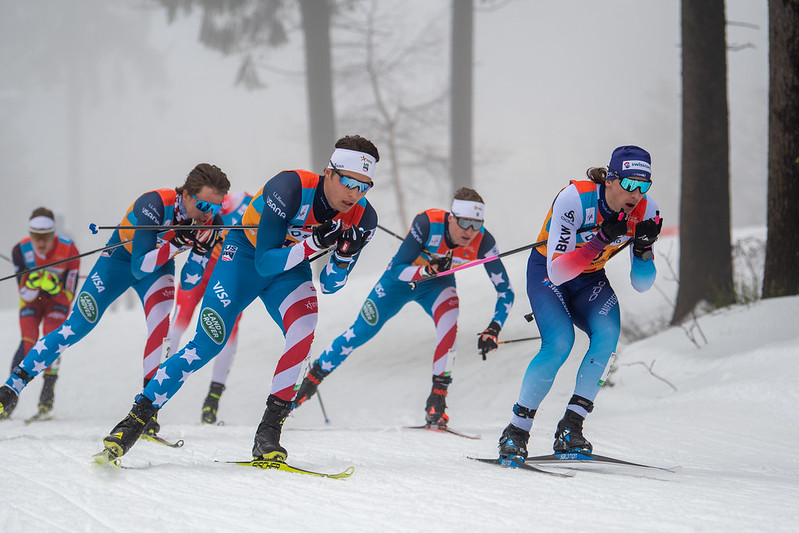
    Gus Schumacher (USA) did much of the work early to bring the chase into one pack behind Klaebo. (Photo: Vanzetta/NordicFocus)

    Schumacher in the Middle of It

    Schumacher finished sixth, also +1:00.2, part of the decisive chase that refused to fracture even as the course repeatedly asked for answers. The result came less than 24 hours after his 5 k freestyle win in Toblach, and the transition—emotionally and physically—was not trivial.

    “It was a little bit tough, honestly,” Schumacher said. “This pursuit started at 10:30 a.m., and I haven’t woken up before eight in probably a month because all our races have been so late. … I definitely enjoyed the win, but the focus was to refocus right away. It’s another new day, and this race was really important for the Tour.”

    Inside the race, Schumacher was not hiding. He described closing the gap to Iversen after the early climbs and doing much of the work that consolidated the group—an effort he acknowledged with pride. “I did most of that work, which I’m actually pretty proud of,” he said. What he didn’t do was overreach. “I wasn’t trying to catch Klæbo or anything,” Schumacher added. “Even though some of the guys might have been thinking that.”

    The fourth lap told the story. Stenshagen pressed hard on the long climb out of the stadium, stretching the elastic just enough to test resolve. Schumacher bent but didn’t break. Over the top, the group exhaled. The fifth lap came fast—but not frantic—and Schumacher found himself boxed in late, a tactical note he filed away rather than lamented.

    “With the overall standings so tight, I don’t think it’s worth thinking about it too much,” he said. “I’m sitting in third right now, and top ten is definitely still the goal. … Everyone from second through ninth is so close that it really comes down to focusing day by day.”

    That may be the most Tour de Ski answer of all.

    Gus Schumacher (USA), Emil Iversen (NOR), Edvin Anger (SWE), and Lars Heggen (NOR) worked together to prevent Klaebo from extending his lead. (Photo: Vanzetta/NordicFocus)

    A Chase by Committee

    Behind Schumacher, the chase’s cohesion owed as much to restraint as to strength. Lars Heggen (seventh, +1:00.3) and Benjamin Moser (eighth, +1:00.8) rounded out a group that included Harald Østberg Amundsen (ninth, +1:03.1). No one bridged to Klæbo; no one detonated the pack behind. The race’s geometry stayed intact.

    That stability mattered in a Norwegian context. With Olympic selection pressure already humming and only a few men’s spots still unsettled, Toblach functioned as both race and audition. Stenshagen’s second place was emphatic. The Tour does not reward one-off brilliance. It rewards survivability.

    Ben Ogden (USA) finding his classic distance form. (Photo: Vanzetta/NordicFocus)

    The Americans: Process Over Panic

    Further back, the pursuit revealed its less visible truths. Ben Ogden finished 29th (+3:03.3), a result that reads well on paper and even better when you hear how he raced it.

    “The biggest challenge is always the start,” Ogden said. “For me, it was about trying to pace the race properly, even when people were moving ahead of me early. … I started with a pack, then a bunch of them dropped me, and I just kind of let that happen, knowing I’d be able to catch some of them later—which I did.”

    That in-and-out rhythm—sometimes lonely, sometimes crowded—is pursuit racing in the middle of the field. Ogden framed it honestly. “Racing in a tight group is obviously more fun,” he said, “but you really have to pace yourself and try not to lose unnecessary time in a Tour, especially when you’re already a little tired.”

    For Zak Ketterson, who started deep in the order, the early kilometers were chaos by design. He finished 42nd (+3:55.1), but the route there mattered.

    “The wave is really challenging, especially starting in bib 70,” Ketterson said. “Five or six seconds have already passed before I even reach the start line. The first two laps were chaos, and I was just trying to stay relaxed and avoid trouble.”

    He did move forward—damage control after a Stage 2 crash that had already cost him minutes. “It was nice to move up a lot today,” Ketterson said, “but the classic sprint on Stage 5 is definitely the main focus now.”

    Ketterson also addressed the jury’s written reprimand for use of a banned technique in a marked stride zone—a penalty that did not disqualify him but appears in the official record. “The technique violation came from double poling in a stride zone,” he explained. “I changed tracks to pass someone, and the motion of doing that ended up being a double pole.”

    For Zak Ketterson (USA), the Tour de Ski hasn’t exactly gone as he had hoped, but today in the pursuit, he showed his form from earlier in the season. (Photo: Vanzetta/NordicFocus)

    When the Day Turns on a Ski

    Kevin Bolger finished 51st (+4:18.6), a result shaped by circumstance rather than strategy. Bolger had been patient by design, content to let early red-lining pass him by before advancing after lap two. Then a ski broke.

    “I like to settle in, and then after lap two start working my way up the field,” Bolger said. “I was just about to do that today when someone merged into my track and broke my ski, which cost me close to a minute. That was pretty disappointing.”

    Before that moment, his choices had been sound. Toblach’s two main climbs invite early commitment to kick wax, and Bolger leaned into it. “It was an easy choice to really feel the kick wax early,” he said. “The skis were feeling great, and I was really excited about how I was going to start moving up the field.”

    Bolger’s broader view was measured, almost cheerful in its realism. “This Tour isn’t quite as massive as some of the past ones,” he said. “It’s about gaining confidence and fitness, as long as you’re able to absorb it after the Tour.” Olympic energy is present, he acknowledged, but not consuming. “At the end of the day, I’m just trying to race fast.”

    J.C. Schoonmaker placed 56th (+4:42.7), while Jack Young finished 80th (+8:07.2), both navigating a day where patience was mandatory, and opportunities were earned in inches rather than meters.

    Andrew Musgrave (GBR) and Antoine Cyr (CAN), (l-r) moving up through the field together. (Photo: Vanzetta/NordicFocus)

    Canada: Trials Done, Work Ongoing

    Canada’s men arrived in Toblach with their Olympic trials already behind them and the Tour serving a different purpose. Antoine Cyr led the way in 13th (+1:54.5), with Thomas Stephen 28th (+3:02.6) and Xavier McKeever 30th (+3:08.1). The emphasis now is accumulation—fitness, familiarity, resilience—rather than immediate results.

    Context at the Margins

    The Tour de Ski has a way of narrowing options without warning. On Thursday morning, one Norwegian men’s Olympic hopeful, Oskar Opstad Vike, withdrew close to start time, a reminder that the margins between readiness and retreat are thin, especially in an Olympic year. Toblach did not create that pressure; it merely revealed it.

    Mattis Stenshagen (NOR) was excited when he crossed the finish line as if he knew he had shown the Norwegian Olympic selectors enough to make the team. (Photo: Modica/NordicFocus)

    What the Splits Say

    A look at the time checks explains why the race felt so controlled. Klæbo’s advantage barely fluctuated. The chase group’s gaps among themselves were measured in seconds—Schumacher, Iversen, Anger, and Pellegrino trading fractional advantages without a decisive rupture. Further back, time losses accrued not in dramatic collapses but in quiet inefficiencies: a missed pack, a broken ski, a moment of over-enthusiasm.

    The course profile—five laps, 137 meters of total climb—rewards restraint. Toblach does not forgive impatience.

    A broken ski for Kevin Bolger (USA) didn’t prevent him from showing his form in Toblach (ITA). (Photo: Vanzetta/NordicFocus)

    Looking Ahead

    Stage 4 did not reshuffle the Tour so much as clarify it. Klæbo remains the reference. The men chasing him know exactly how much ground they have—and how little room there is to gamble it away. Schumacher’s position near the top of the standings is real, earned through effort and discretion. Behind him, athletes like Ogden, Ketterson, and Bolger are racing a Tour that asks for perspective as much as speed.

    Val di Fiemme awaits with its own demands and, this year, Olympic resonance. But Toblach offered a simpler lesson. In a pursuit, the clock is visible; the choices are not. The best skiers make the hard ones look easy—and the easy ones count.

    Men’s 20 K Classic Pursuit Start RESULTS

    Men’s 2026 Tour de Ski OVERALL STANDINGS

    Fastest Skiers on the Day – Men (Top 15, Net Time Only)

    This ranking removes pursuit start gaps and shows who skied the fastest 20 km classic on Stage 4.

    Day Rank Athlete Nation Net Time
    1 Edvin Anger SWE 45:39.5
    2 Simen Hegstad Krüger NOR 45:44.0
    3 Federico Pellegrino ITA 45:45.5
    4 Mattis Stenshagen NOR 45:51.8
    5 Emil Iversen NOR 45:51.9
    6 Gus Schumacher USA 45:52.9
    7 Truls Gisselman SWE 45:58.5
    8 Antoine Cyr CAN 45:59.2
    9 Hugo Lapalus FRA 46:00.5
    10 Johannes Høsflot Klæbo NOR 46:01.7
    11 Benjamin Moser AUT 46:03.5
    12 Savelii Korostelev AIN 46:04.5
    13 Harald Østberg Amundsen NOR 46:07.8
    14 Andrew Musgrave GBR 46:13.6
    15 Lars Heggen NOR 46:17.0

    Net time calculated as finish time minus individual pursuit start offset.

    Places 3-7 where this close for Federico Pellegrino (ITA), Edvin Anger (SWE), Gus Schumacher (USA), Emil Iversen (NOR), (l-r) after 20 K in Toblach (ITA). (Photo: Modica/NordicFocus)

    Love Stories Like This? Help Keep Them Coming.

    Feature stories like this one take time, access, and care to produce. If you value thoughtful storytelling and independent ski journalism, please consider becoming a Voluntary Subscriber. Your support directly fuels the work we do to cover the people, places, and moments that make our sport special.

    Join the FasterSkier community!


    Mattis Stenshagen (NOR), Johannes Hoesflot Klaebo (NOR), and Edvin Anger (SWE), (l-r) shared the pursuit podium in Toblach (ITA). (Photo: Modica/NordicFocus)


  • US Nationals Day 2: Jager stops chasing his friends and breaks through, while multi-sport Smith takes women’s title

    US Nationals Day 2: Jager stops chasing his friends and breaks through, while multi-sport Smith takes women’s title

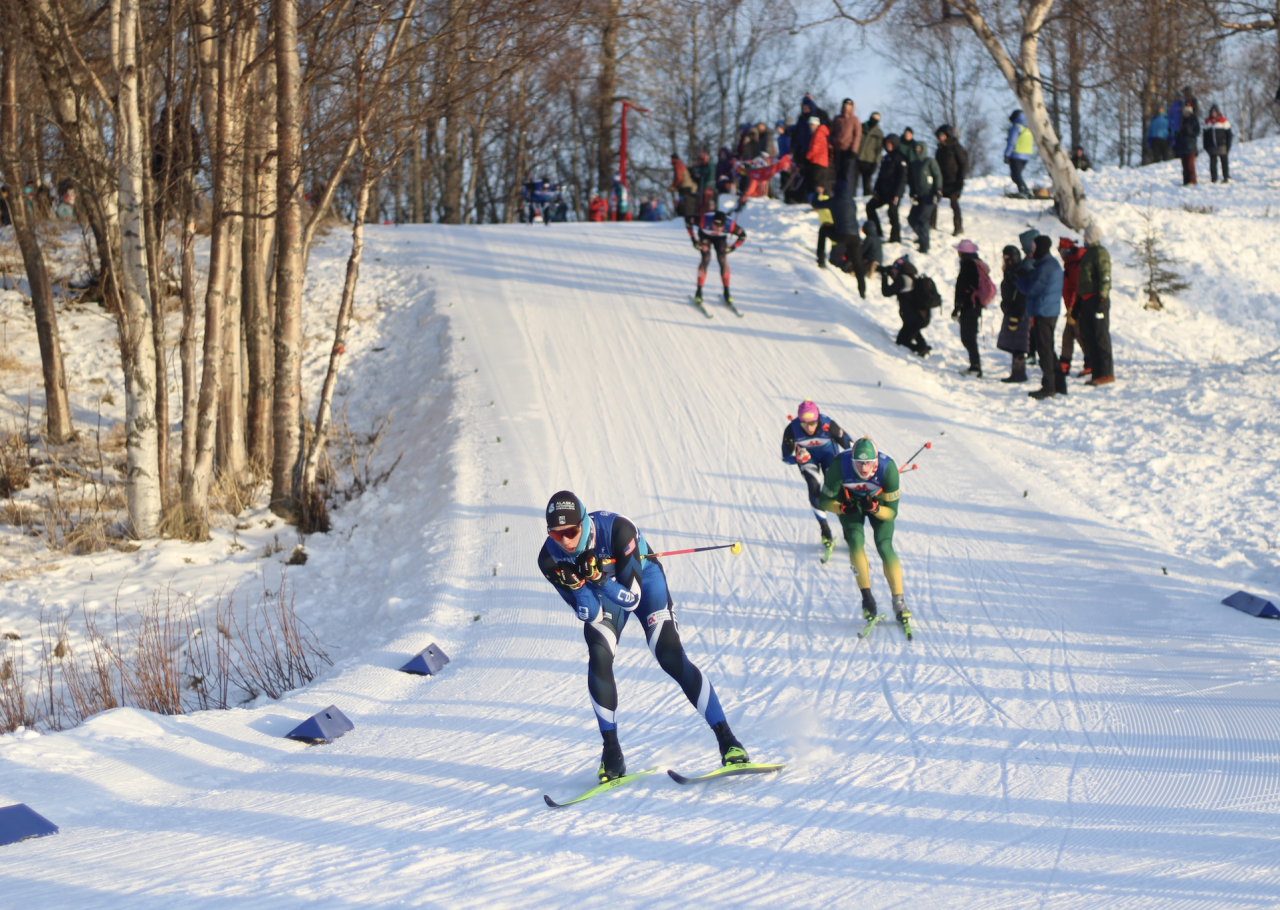
    Luke Jager leads a sprint heat at the U.S. National Championships at Anchorage’s Kincaid Park on Saturday, January 4, 2025. Jager won a national title in his hometown in front of a crowd that included his dad, his girlfriend and a childhood friend revving a chainsaw. “He’s just become a lot more confident in doing his own thing,” said Jager’s girlfriend, fellow ski racer Novie McCabe. “I think he has a much easier time rebounding from non-satisfactory races this year — he can kind of learn from it and go on to the next.” (Nathaniel Herz/FasterSkier)

    ANCHORAGE — Luke Jager spent most of his cross-country ski career training and racing with a tight group of talented, up-and-coming American men — the first ever to win a gold medal in the relay at the World Junior Ski Championships.

    Two of Jager’s teammates on that relay squad, Gus Schumacher and Ben Ogden, have made the leap to the top-level, international World Cup, where both have collected podiums in the past two seasons — along with J.C. Schoonmaker, another early career standout who trains with Jager in his hometown of Anchorage.

    Jager, 24, has also raced on the World Cup in recent years. But by his own admission, he hasn’t kept up with the meteoric rise of his peers. So this season, he decided to stop chasing them.

    Instead of racing this week at the Tour de Ski, a grueling World Cup stage race in Europe, Jager chose to stay stateside and compete on the American domestic circuit — including at the U.S. National Championships in his home city this week.

    In Saturday’s classic-technique sprint race, the decision paid off with a title, as Jager beat two other Alaskans, Michael Earnhart and Murphy Kimball, for the win.

    “It definitely has taken a lot of the pressure off — just being like, ‘I’m going to go out there and do my best,’” Jager said afterward. “We’re all pretty dang lucky to be doing this sport in the first place.”

    Jager’s title was the second awarded in a series of three championships at Anchorage’s Kincaid Park, with the final event, a classic-technique distance competition, scheduled for Sunday. (Another sprint will be held Tuesday, but it’s not a national championship.)

    The races have drawn hundreds of competitors from across the country, including a number of Europeans who have been recruited to race at American colleges. One of those recruits, Andreas Kirkeng, a Norwegian studying at the University of Denver, actually edged out Jager at the finish line Saturday, but was not eligible for the U.S. title.

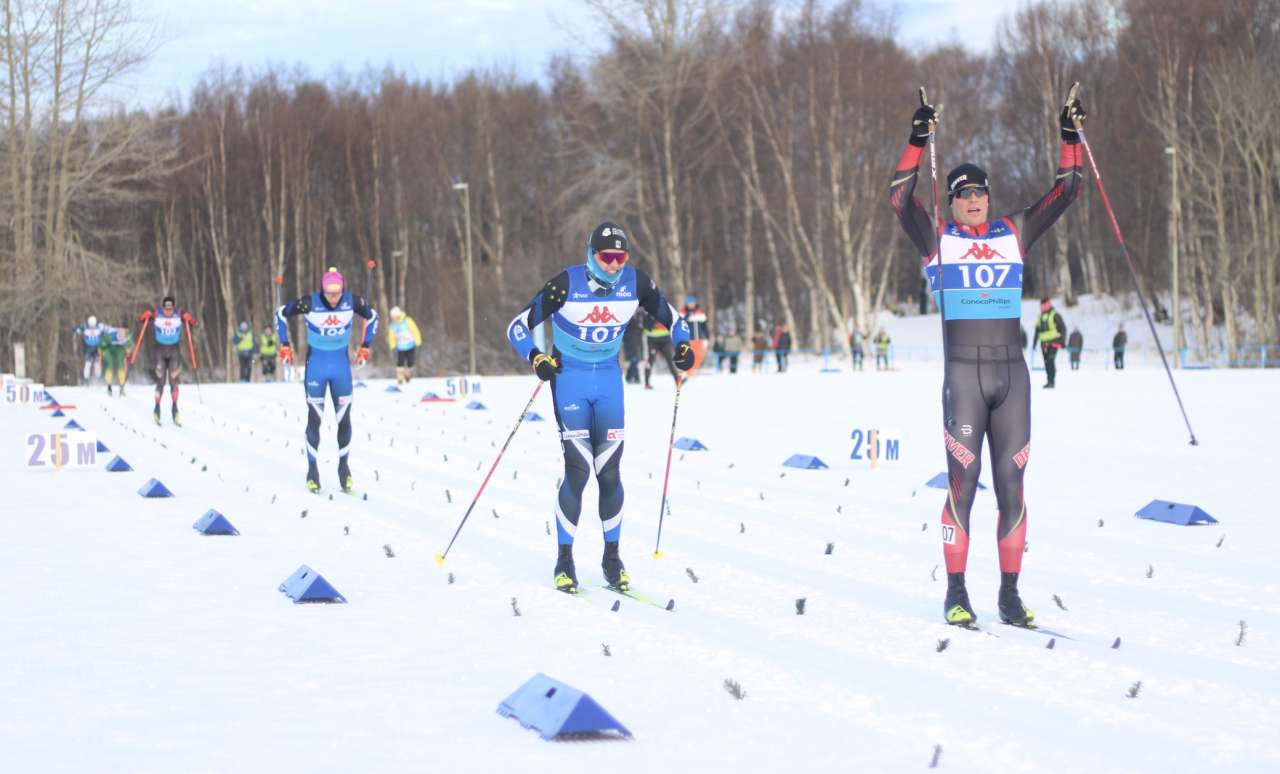
    Andreas Kirkeng celebrates being the first across the finish line at the U.S. National Championships at Anchorage’s Kincaid Park on Saturday, January 4, 2025. (Nathaniel Herz/FasterSkier)

    The women’s race played out similarly. Two Europeans — Sweden’s Erica Laven, racing for the University of Utah, and Estonia’s Mariel Pulles, racing for Team Birkie — were the top two finishers.

    But Sammy Smith, the third athlete across the line, won the U.S. title as the first American. It was just the second race of the season for Smith, who spent the fall playing soccer for Stanford University and had just 10 days of on-snow training before the championships.

    “I wasn’t really sure what to expect at all,” Smith said afterward. “I’m grateful to be out here and have a chance to race.”

    Erin Bianco, racing for Bridger Ski Foundation, and Dartmouth College’s Nina Seemann, finished fifth and sixth to round out the U.S. podium. Eve Duchaufour, a French athlete racing for the University of Denver, crossing the line in fourth.

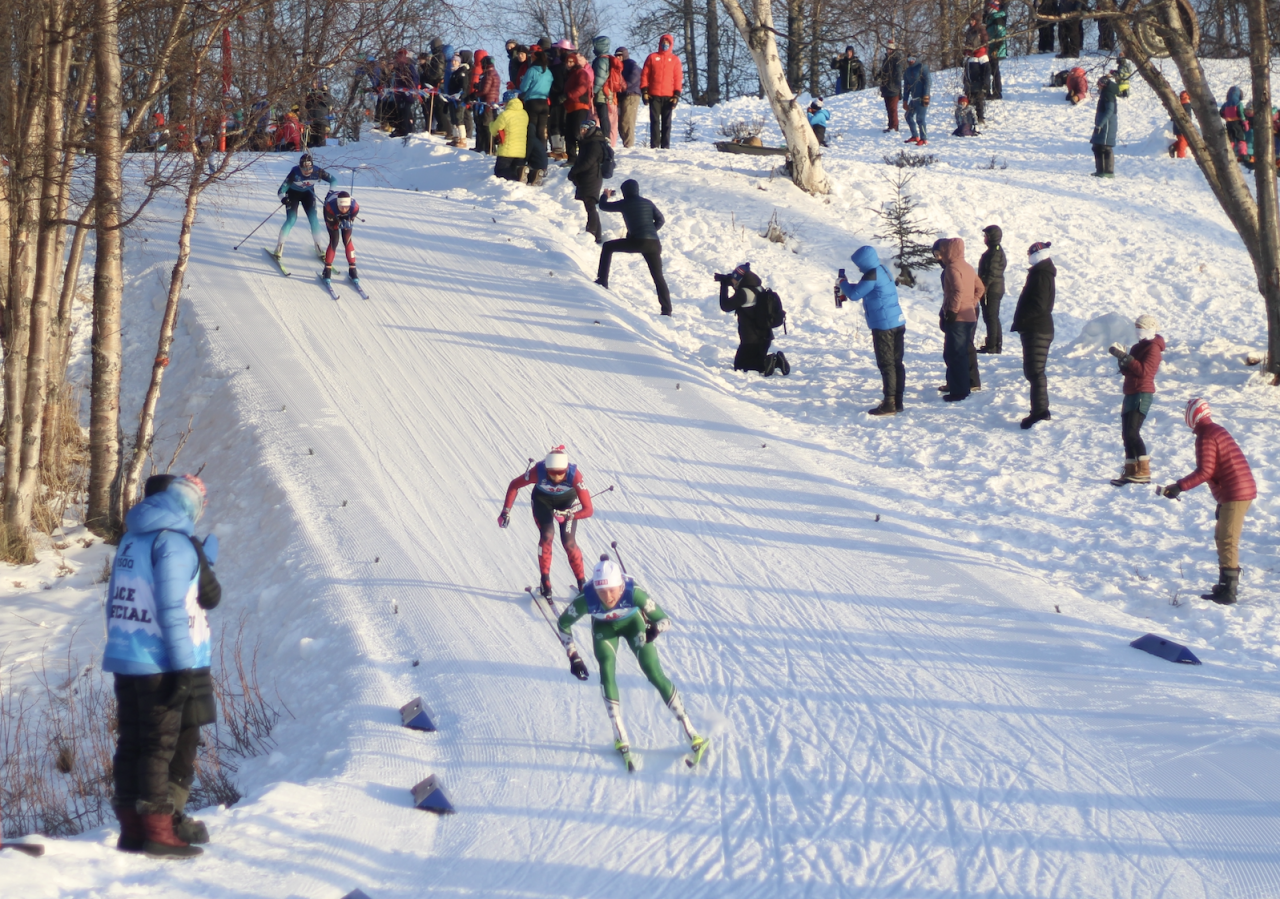
    Dartmouth College’s Nina Seemann leads a downhill at the U.S. National Championships at Anchorage’s Kincaid Park on Saturday, January 4, 2025. (Nathaniel Herz/FasterSkier)

    After a frigid first day of racing in Anchorage, Saturday’s individual-start qualification round began with the thermometer a few degrees higher. But the warmth quickly drained out of the air as the wind picked in the afternoon, just as the skiers began their head-to-head heat racing.

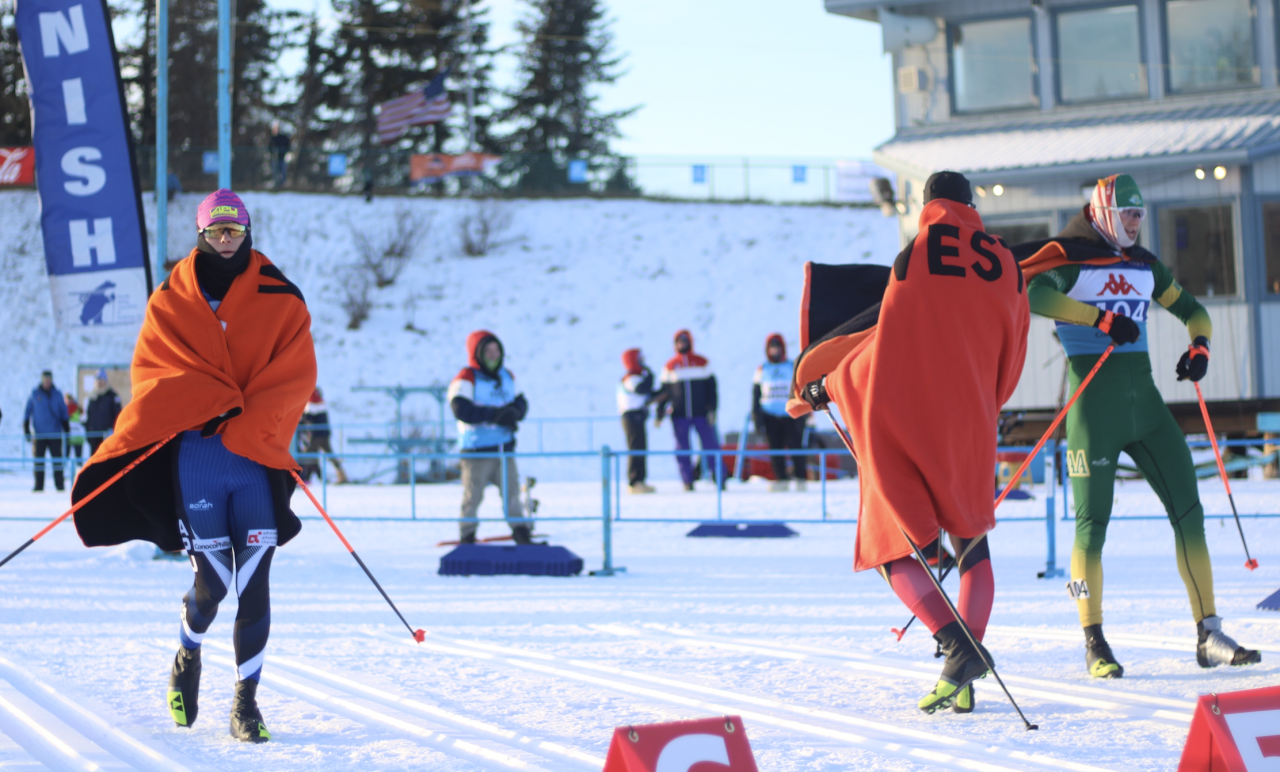
    Athletes draped heavy orange blankets around their shoulders like capes as they walked to the start line, dropping them just before the start of each heat.

    Michael Earnhart, left, keeps warm along with other participants in his men’s semifinal heat at the U.S. National Championships at Anchorage’s Kincaid Park on Saturday, January 4, 2025. (Nathaniel Herz/FasterSkier)

    Jager had the fastest qualifying time in the men’s race, then won his quarterfinal and semifinal heats. He matched up in the finals against Kirkeng, Earnhart and Kimball, along with Florian Knopf, a German racing for the University of Denver, and Middlebury College’s Jack Christner.

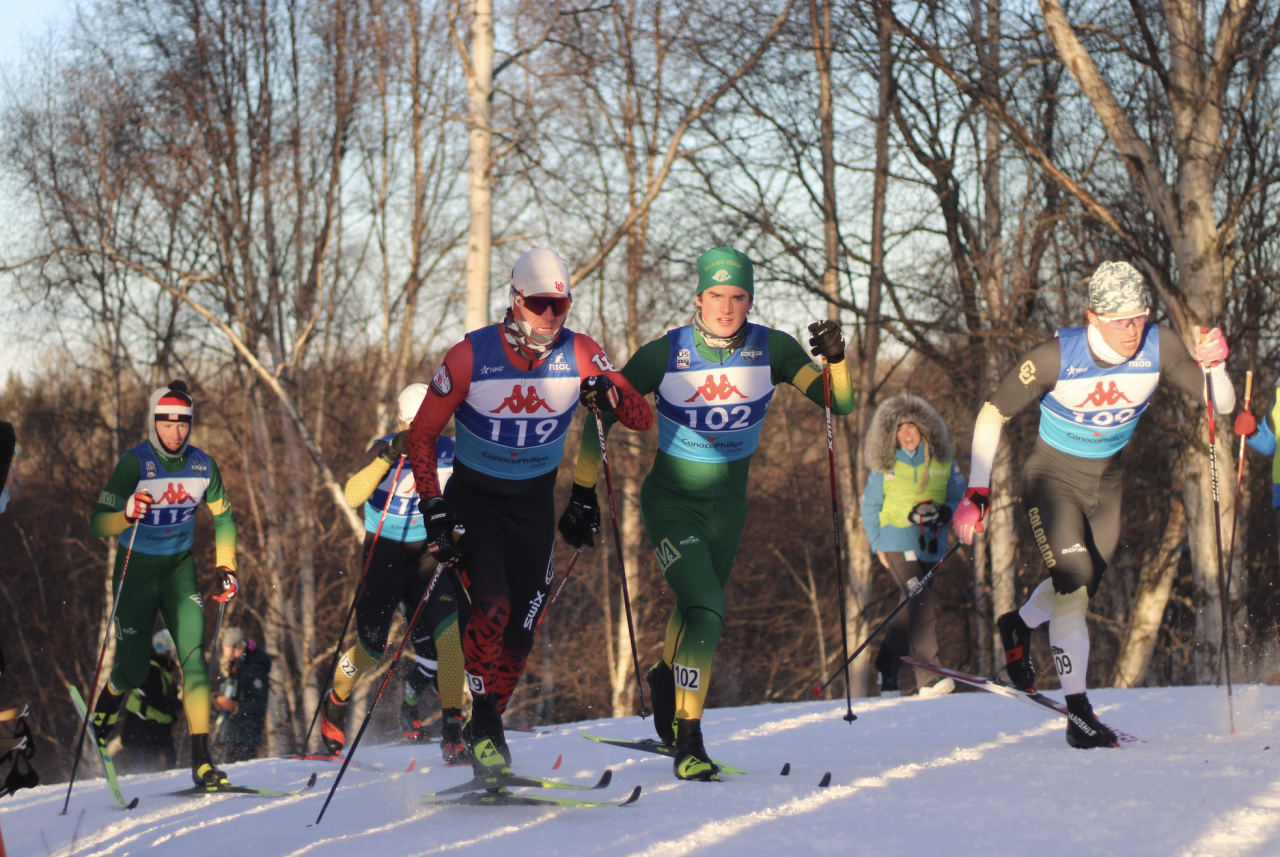
    Erling Bjoernstad, in bib 102, is a Norwegian racing for the University of Alaska Anchorage, and he was the second-fastest athlete in Saturday’s qualifying round behind Luke Jager. Organizers disqualified Bjoernstad, however, from his semifinal heat, after he was the second athlete in that heat to false start. “I was fired up after a good quarterfinal, and I felt really good,” said Bjoernstad, who acknowledged an accidental twitch. “It was a shame.”

    Jager led from the start and stayed at the front for much of the 1.3-kilometer course before Kirkeng poled past him on the final meters of the homestretch. And yes, in case you were wondering: Jager acknowledged that he was not entirely content with a national title in which one of his competitors reached the finish line first.

    “I guess I was like, ‘Dang, I think I just lost like 600 bucks,’” said Jager, referring to the difference in payouts between first and second place. “I was bummed. But Andreas is so strong and I love racing against him, so I can’t complain. I was good and beat.”

    Nonetheless, Jager said he’s benefited from a mental adjustment that came after some tough days of racing last season. While his teammates and friends like Schumacher, Ogden and Schoonmaker reached new heights, Jager struggled on the World Cup in his strongest discipline, the sprint — advancing out of the qualifying rounds and into the heats just once in eight starts.

    “We were all young — it was so sweet and so fun and we were like this group, this cohort that was super put together. I was super proud to be a part of it. And I love those guys — they’re totally like family,” Jager said in an interview earlier this week. “But then as we got older, those guys just kept getting better and kept getting better. And it felt like I was still stuck, so I was really grasping on to trying to maintain my identity as part of that.”

    The American gold-medal winning relay team at the 2019 World Junior Ski Championships in Finland. From left, John Steel Hagenbuch, Ben Ogden, Luke Jager and Gus Schumacher. (Photo: JWSC2019 / Mikaela Takala)

    He added: “My focus wasn’t in the right place. I was focused on having my breakthrough so I could join the club. I wasn’t focused on performing — and, like, on myself, and what I need to do.”

    Jager’s outlook was grim enough last year, he said, that there was a period when he indulged in some “mopy” thoughts about retirement.

    But instead, he ended up with a new mindset and a shift in focus inward.

    That included some changes to his summer training. Jager said that while there’s currently a trend toward “polarization” in training — making hard workouts even harder and easy workouts even easier — he did the opposite, making his easier workouts a little faster and harder. That change, he said, has made him more durable in races when the pace starts to ratchet up.

    So far, it’s been working for Jager. In addition to Saturday’s title, he had what he described as an unusually strong fourth-place result in Thursday’s individual-start distance skate race — a format that’s historically challenged him at U.S. nationals. He also won two races on the domestic SuperTour circuit earlier this winter.

    “I think every skier has their way, right?” said Erik Flora, Jager’s coach at the Alaska Pacific University club team.

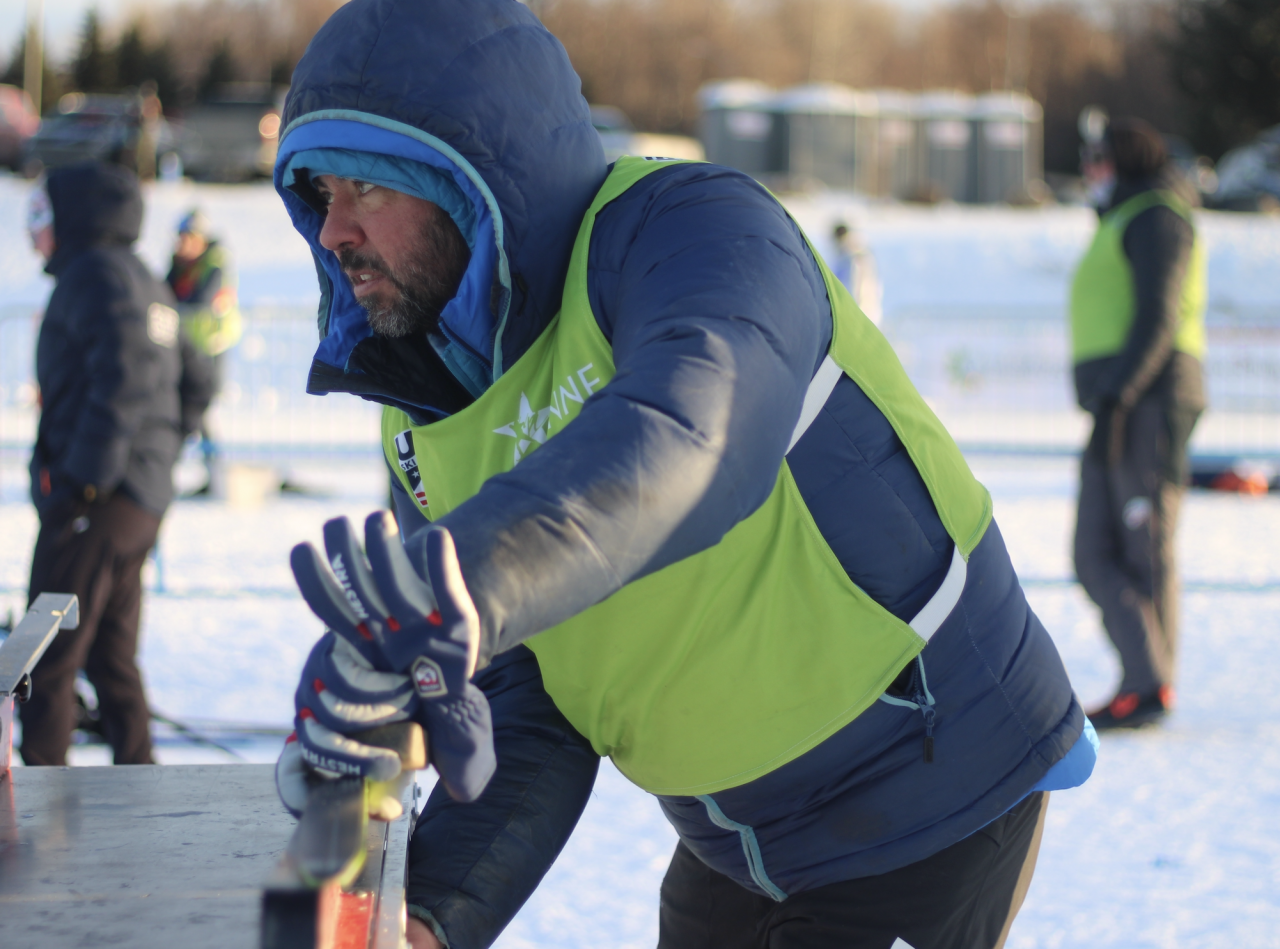
    Alaska Pacific University coach Erik Flora finishes waxing a ski at the U.S. National Championships at Anchorage’s Kincaid Park on Saturday, January 4, 2025. (Nathaniel Herz/FasterSkier)

    Flora, a veteran coach who’s also worked with retired Olympic medalist Kikkan Randall and World Cup standout Rosie Brennan, said he wishes that athletic development could be “linear” — steadily upward and regular. But in his experience, he said, “it just isn’t.”

    “Everyone goes through these gains, and they go through settles,” Flora said. “It’s just waves.”

    Smith, Saturday’s women’s champion, is still riding a wave on its way up.

    At just 19 years old, she’s a prodigy who’s already spent parts of two seasons racing on the World Cup — and has a world junior championships silver medal in her trophy case from last season.

    Samantha Smith racing at last year’s Tour de Ski in Europe. She comes from a family of athletes, with a sister who also plays soccer at Stanford, a mother who rowed at Stanford and a father who played soccer at Duke University. In junior high, Smith played football; she also has been a competitive freestyle moguls skier. “She has always been phenomenal,” Kristin Smith, her mother, told FasterSkier last year. “She used to crawl up my body when she was less than two and sit on my shoulder.” (Barbieri/NordicFocus)

    But as most of her competitors spent the fall training and sharpening for ski racing, Smith was doing something completely different: traveling the country with Stanford’s soccer team.

    Smith, who plays a defensive-minded position called outside back, wasn’t a starter as a freshman this year. But she got playing time in 13 games, according to Stanford statistics, on a team that made it to the national semifinals.

    Smith’s sister Logan, who also plays for the Stanford soccer team, said that because the squad competes in the Atlantic Coast Conference, players spend much of every other week on the road. They typically travel on Tuesdays to the East Coast, play games Thursdays and Sundays, and fly home Sunday night.

    As for school?

    “Mondays. And the weeks we don’t travel,” said Logan Smith, who was watching the races at Kincaid with her family this week.

    The grueling soccer schedule meant that Sammy Smith fit in training for cross-country skiing when she could. But she described it as “the first time I was really able to focus on one thing.”

    She said she expected that her first event in Anchorage, “was not going to be great” — and she finished 12th on Thursday.

    On Saturday, though, she looked like a podium contender from the start, winning both her quarterfinal and semifinal heats. In the final, she said she slipped on her first four or five strides and was trailing the pack leading out from Kincaid’s stadium. But she made up ground on Duchaufour, Bianco and Seemann as the pack climbed over the big hill on the course to take home the American title.

    Sammy Smith, center, starts one of her heats at the U.S. National Championships at Anchorage’s Kincaid Park on Saturday, January 4, 2025. (Nathaniel Herz/FasterSkier)

    After U.S. nationals, Smith said she plans to race at world juniors in Italy and hopes to compete on the World Cup, as well.

    “It’s also definitely a balance with school,” she said.

    But Smith said she hopes to continue with both soccer and cross-country skiing as long as she can. And she dreams of competing in the Olympic Games in both sports.

    U.S. Ski Team coaches would “love to have her pick skiing,” said Cross-Country Development Director Bryan Fish, who was on hand for Saturday’s race.

    “But from a U.S.A. perspective, we’re just happy that she’s here,” Fish said. “Our job is to support her in the best way that we can.”

    Full results.

  • The Devon Kershaw Show: Recapping a soggy, fluoro-free weekend in Trondheim

    The Devon Kershaw Show: Recapping a soggy, fluoro-free weekend in Trondheim

    Eli Brown, a member of the U.S. Ski Team’s waxing and ski service staff, joins us this week to talk about his job and the new enforcement of the rules banning fluorocarbons on the World Cup circuit. We recap another strong weekend for American athletes, along with all the hijinks that happened in Trondheim, Norway at the test event for next season’s World Championships.

    The World Cup takes a break next weekend before the Tour de Ski, but we may try to squeeze in a mailbag episode. Send us questions if you’ve got ’em. Reach us at nat@fasterskier.com and devon@fasterskier.com.

  • The Devon Kershaw Show: Stars are born in Ostersund, with guest Luke Jager

    The Devon Kershaw Show: Stars are born in Ostersund, with guest Luke Jager

    Multiple U.S. podiums. Near-misses. Coaches barging into the classic track. This past weekend was pretty fun. We get up-and-coming Alaska star Luke Jager to join us for a recap and go through it all.

    Reach us with your questions, comments and feedback at devon@fasterskier.com and nat@fasterskier.com. We’ll be back next week after Trondheim.

  • Ogden Sixth, Schumacher Seventh, Schoonmaker 13th for U.S. in Junior World’s Sprint

    Ogden Sixth, Schumacher Seventh, Schoonmaker 13th for U.S. in Junior World’s Sprint

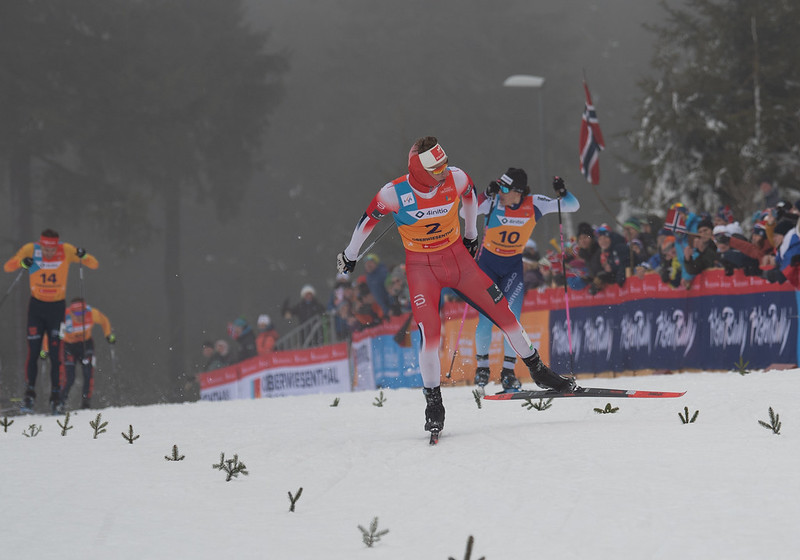
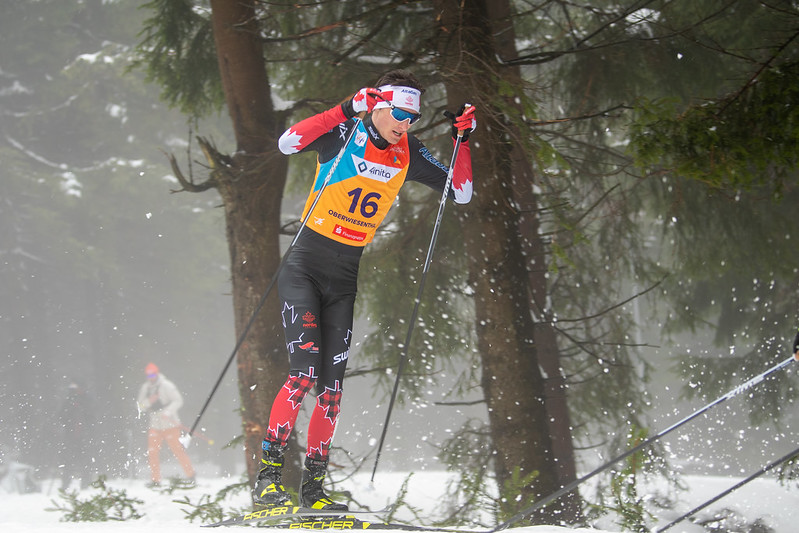
    Junior men’s quarterfinal action: For the U.S. (l-r), Luke Jager, J.C. Schoonmaker, and Gus Schumacher. (Photo: Doug Stephen)

    The monochromatic backdrop during the junior women’s sprint was the persistent theme in Oberwiesenthal, Germany  — it bled right into the World  Junior men’s 1.3 k freestyle sprint. For U.S. fans, in particular, this first event of four for the junior men possessed an element of tension. The tension, for those that follow, was seeded last year with an unequivocal success story that was the U.S. junior men’s run at the 2019 Junior Worlds in Lahti, Finland. The final collective chapter there capped with the 4 x 5 k relay win

    Today, again, was full of promise, and perhaps the pressure that comes with being a known quantity – otherwise called podium favorites, at this year’s event.  

    The U.S. put three skiers into the top-11 during qualification: Gus Schumacher was first in 2:26.34, ben Ogden third (+1.13), and J.C. Schoonmaker 11th (+4.76). Slotting into 21st for the U.S. was Luke Jager (+6.42).

    Let’s start with Jager. He looked strong in the first quarterfinal, in which he was grouped with Schumacher and Schoonmaker. Leading into a short punchy hill, Jager appeared to lose his footing and tripped, coming to a standstill. He recovered to place fourth in the heat but was eliminated. Schumacher skirted by Jager when he stumbled and took the win. Schoonmaker was third and did not advance. 

    Ogden, in the fifth quarterfinal, cruised. He won by 2.32 seconds in earning his semifinal spot. 

    Ready. Set. Go. Ben Ogden (pink beanie), during the World Junior’s skate sprint. (Photo: Doug Stephen)


    Ben Ogden on quarterfinal’s cruise control. (Photo: Doug Stephen)

    In the first semi, Schumacher pushed from the back portion of the pack – never finding enough room to seize an opening. He came down the stretch positioning himself into third, 0.46 seconds back. However, in the slower of the two semis, he was unable to advance as a lucky loser.

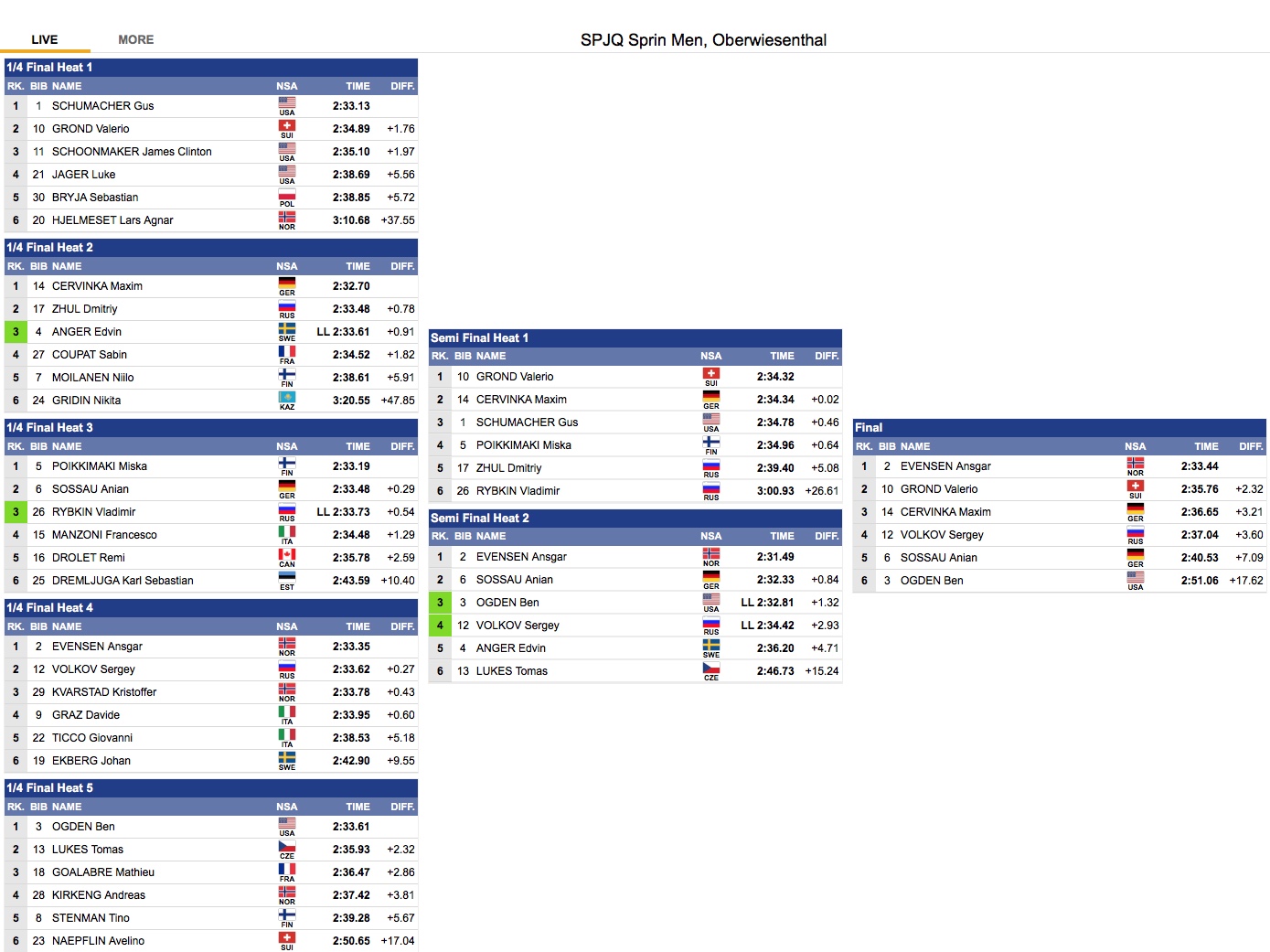
    Ogden placed third in the second semi to take a lucky loser spot in the final. But Ogden, racing the fifth quarterfinal, and with a quick turnaround into the semis, ran on fumes in the final. He placed sixth in the final, 17.62 seconds off the winning pace of Norway’s Ansgar Evensen who won in 2:33.44. Switzerland’s Valerio Grond placed second (+2.32), and Germany’s Maxim Cervinka third (+3.21). 

    Norway’s Ansgar Evensen winning the World Junior’s skate sprint. (Photo: Doug Stephen)

    In the final standings, Ogden was 6th overall, Schumacher 7th, Schoonmaker 13th, and Jager 18th. A stout day collectively for the American foursome. 

    Canada’s Remi Drolet, a student at Harvard, began his day by qualifying 16th (+5.76). Drolet placed fifth in the third quarterfinal to finish 23rd overall. Also for Canada, Thomas Stephen finished 36th, Xavier McKeever 44th, and Olivier  Léveillé 49th.       

    Canada’s Remi Drolet, the day’s 16th fastest qualifier. (Photo: Doug Stephen)

    Junior Men’s Qualification | Junior Men’s Results | Junior Men’s Bracket