From the FasterSkier archive — posts syndicated from athletes’ and coaches’ own blogs between 2004 and 2012, kept online as published. Current coverage is at fasterskier.com.
MINNEAPOLIS, Minn. (January 5, 2018)– The World Masters Association has approved a motion to extend registrations for the 2018 Masters World Cup, happening January 19-26.
“The WMA Executive Committee decided that the early dates of this particular MWC required additional time for registrations to come in. We understand that some folks — particularly in the Upper Midwest — are still building fitness and having another week to decide to participate in the MWC2018 could be useful,” said J.D. Downing of AXCS.
This extension opens a window for master skiers that may still be deciding if they’re in shape to compete in the cup. The additional ten-day registration extension will give them time to make that call, though the timing will influence their starting point in the races. Competitors who register after the original deadline of January 6 will be seeded in their age and gender category, based on the order in which their registration was received.
As registrations continue to roll in, trails crews at the Loppet Foundation continue working day and night to build out the course for the week-long championship. Mike Erickson, Race and Events Director of the Foundation, said:
“The plan developed over the past five years for manmade snow on the Masters World Cup courses is working perfectly thus far. The cold weather over the holidays has allowed the first 5 km of the core 7.5 km of trails used for the first four race days to be put in place.”
With many other areas of the USA struggling with snow or weather woes, the Twin Cities are increasingly looking great for a fabulous Masters World Cup. It’s not too late to make your plans and join the fun — late registrations will be accepted until January 16, 2018.
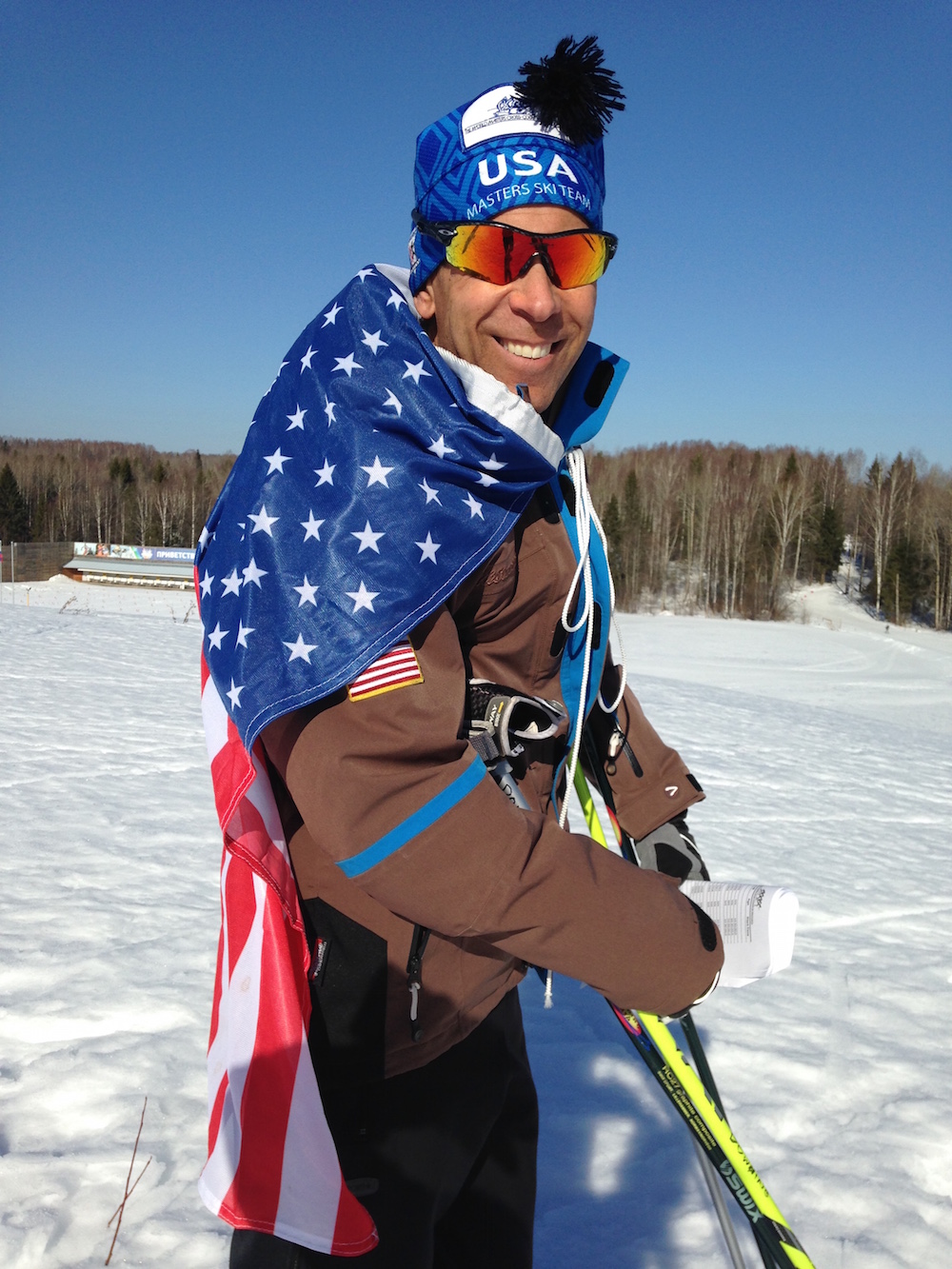
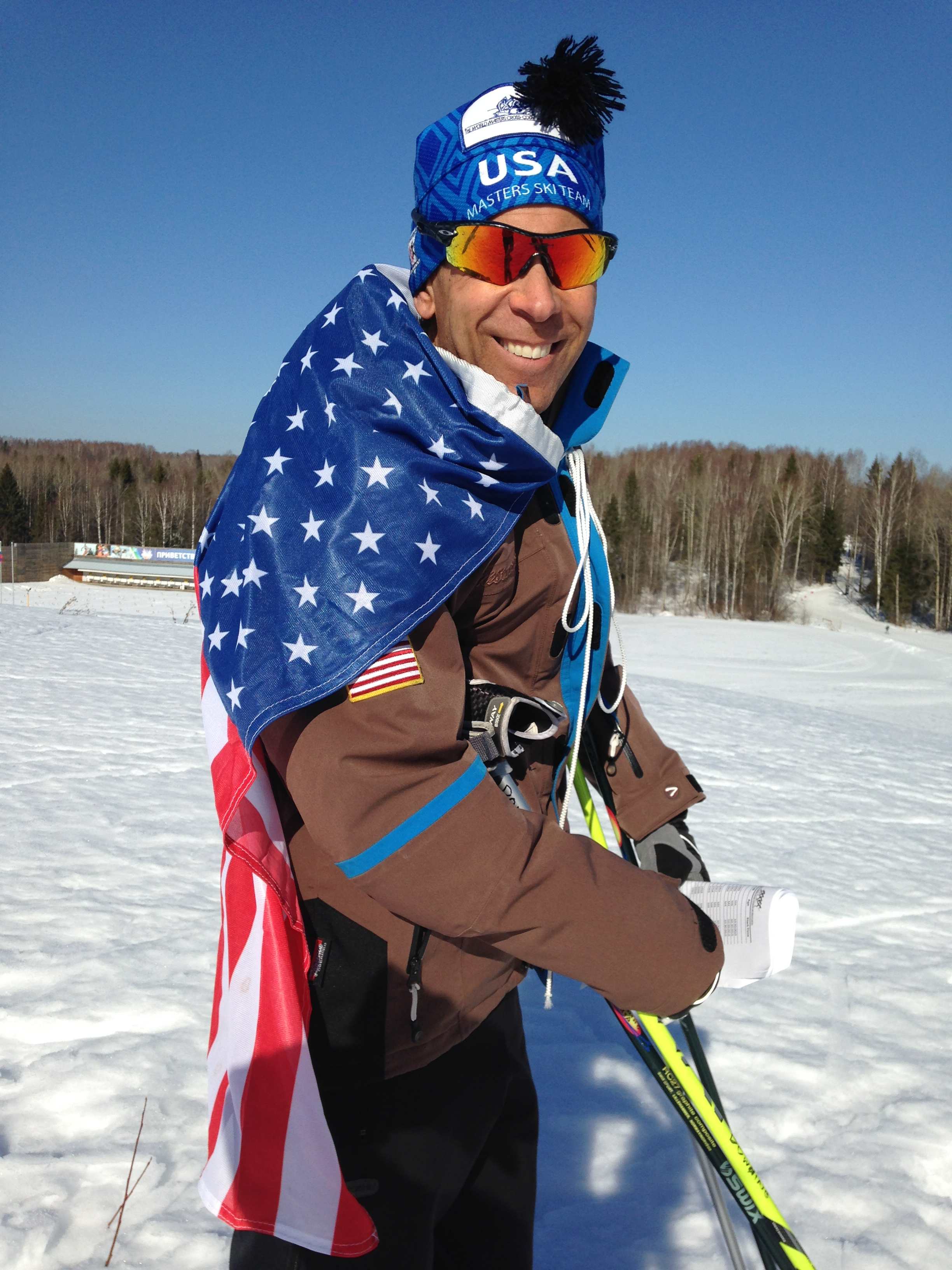
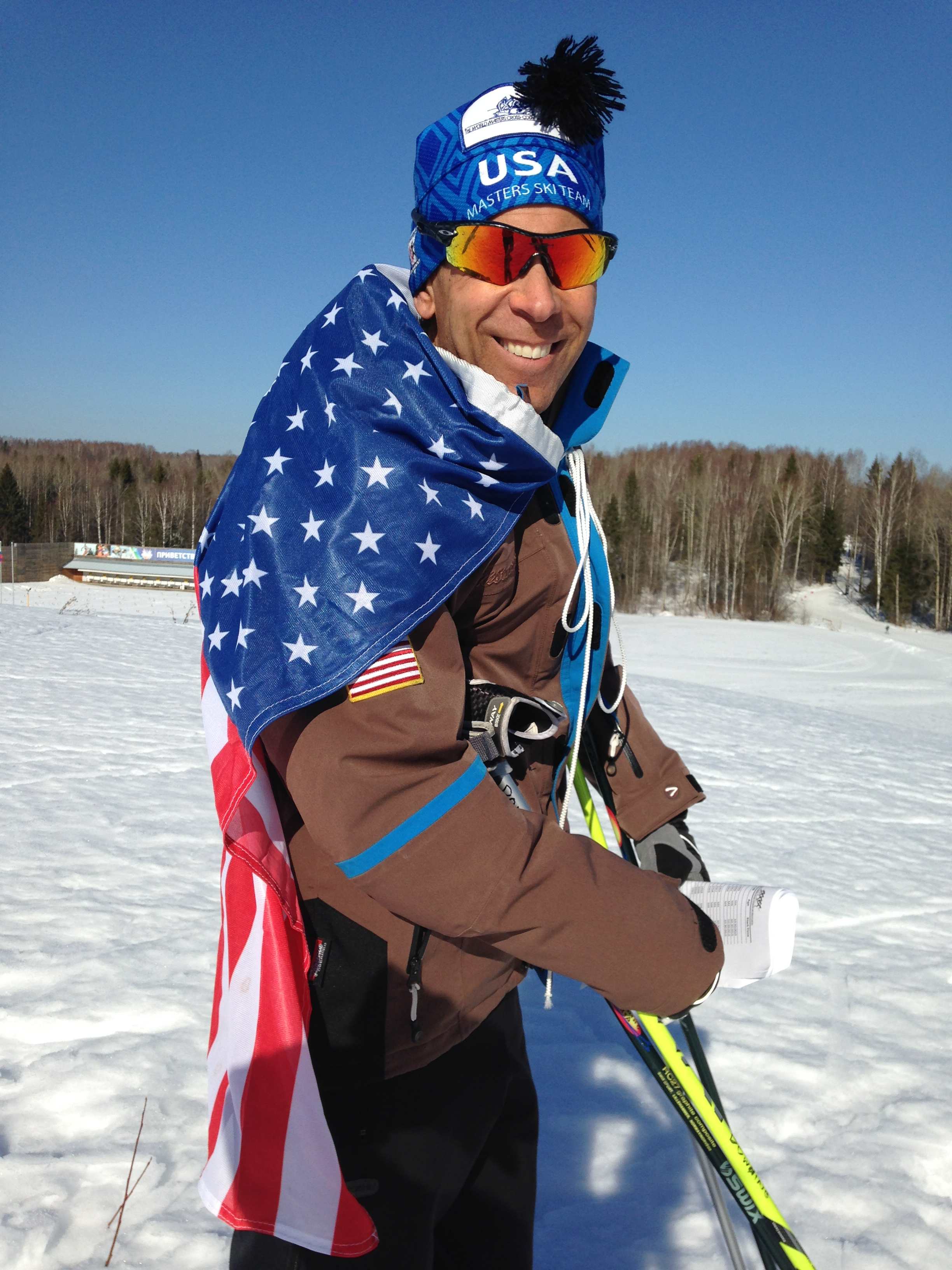
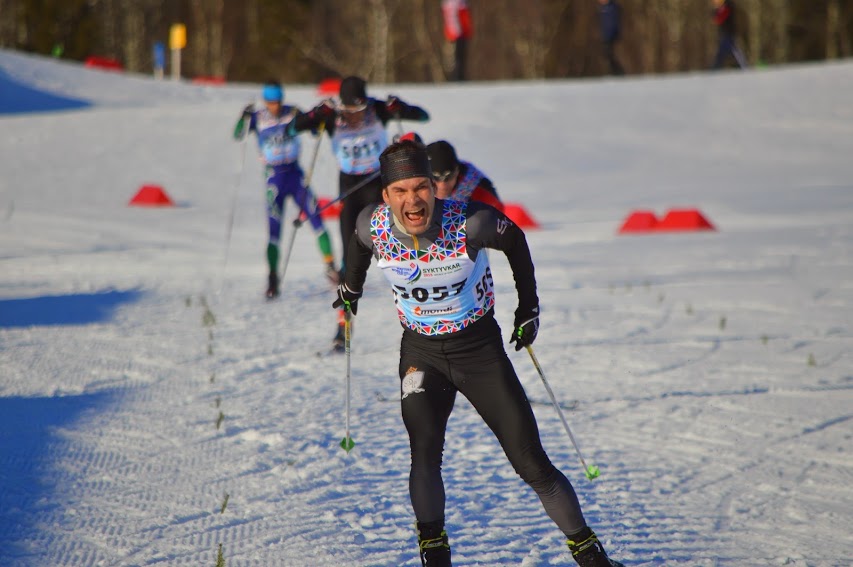
J.D. Downing at the 2015 Masters Word Cup last March in Syktyvkar, Russia. (All photos: Inge Scheve)
Late last month, John “J.D.” Downing of Bend, Ore., was elected president of the World Masters Cross-Country Ski Association (WMA), putting him at the helm of the international organization that governs master skiers in the International Ski Federation (FIS).
Pointing out that master skiing is much more than the big loppet events, Downing, who founded XC Oregon and has been involved in international cross-country skiing for more than four decades, said in a phone interview that he wants to get more masters involved in racing, both internationally and locally.
“In some capacity I’ve been part of just about every type of nordic ski event imaginable over the past 41 years, and I really believe the MWC [Masters World Cup] format is one of the most enjoyable to be around,” Downing said. “You get the fantastic energy of international participation of the big marathons, but with easier logistics and a more intimate ski experience out on the trails. I also love the fact that skiers of any ability can enjoy an annual world championship with their peers, discovering all these fantastic ski places around the world.”
As president of the WMA, Downing, 49, wants to reduce the logistics and organizational requirements necessary for attending and hosting a Masters World Cup, an annual, competitive world championship for skiers ages 30 and older, which attracts more than 1,000 athletes annually from across the globe.
FasterSkier: What attracted you to this position, and what do you hope to accomplish during your term?
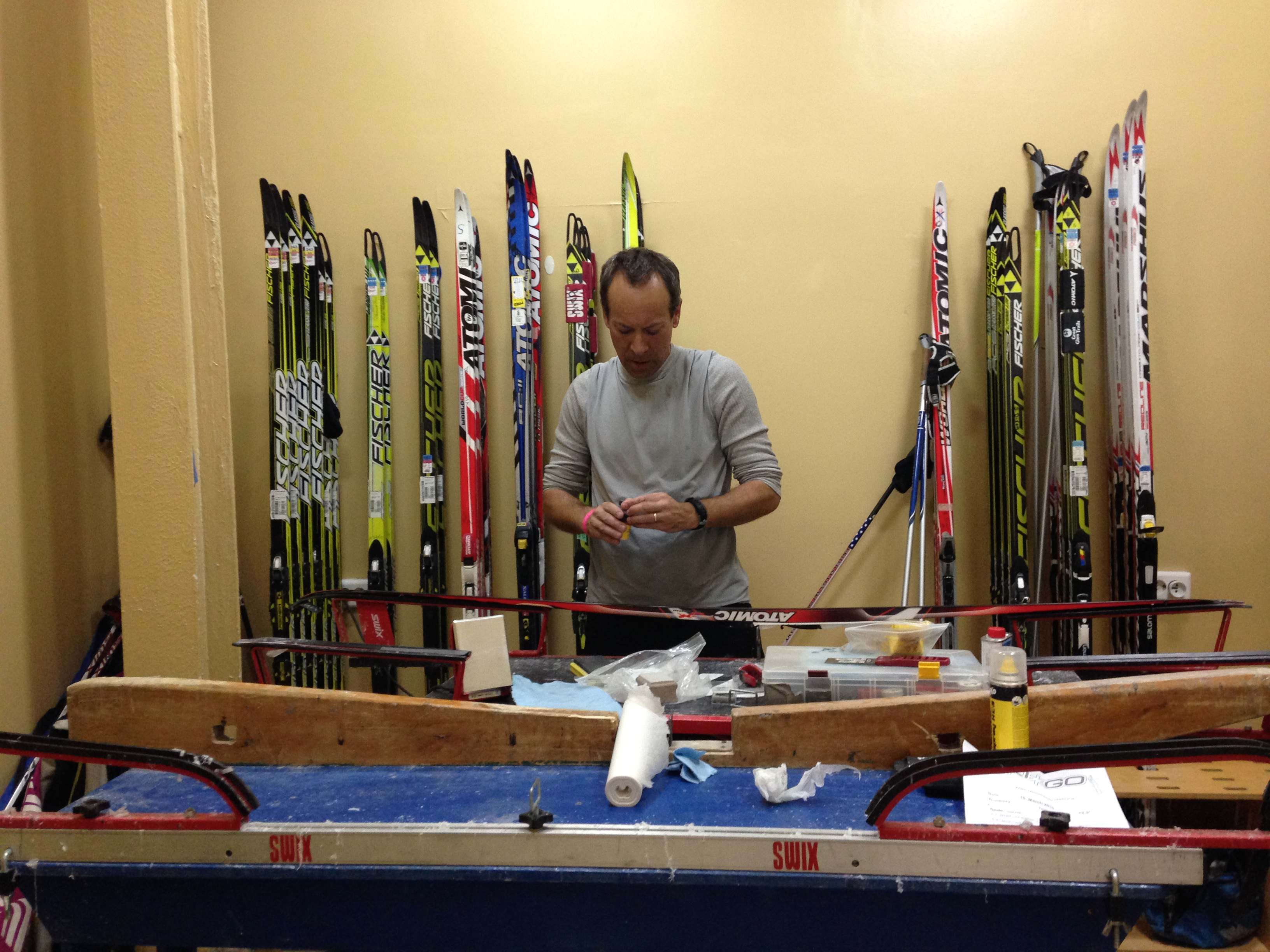
J.D. Downing at work in the U.S. wax room at the Smetanina Sports Complex at 2015 Masters World Cup. (Photo: Inge Scheve)
“I have really enjoyed the past 11 years working with the WMA as the USA national director, and when it became apparent that there wasn’t a long list of directors that were able or willing to step into the president shoes, taking on the added responsibility, it just made sense at this time for me,” Downing said.
“Honestly, the biggest thing I hope to accomplish is having the WMA become more of a team effort with even the minimal administrative functions we have to perform each year. I’ll have a full plate the next several MWC events leading what should be increasingly bigger Team USA contingents, but I’m confident we’ll see multiple other directors and officers embrace different tasks within the WMA, which is exactly the way a non-profit international organization led by volunteers should function.”
He added that the association is already working on a few new elements within the event design for Masters World Cups that will come into play after the 2016 MWC in Vuokatti, Finland, which could make the championships appeal to a wider group of master skiers.
“We would like to reduce the time commitment at the MWC for skiers, particularly younger masters. We also want to keep the event as practical to manage as possible for future organizers, so there are some ideas being worked on in that area as well,” he said.
FS: What are some of the challenges facing the association, and what issues need to be addressed?
“The biggest issue by far is a gradual reduction in worldwide numbers of what I call motivated masters,” Downing said. “The biggest ski events are generally doing very well, and the MWC numbers are holding steady. But we are seeing a clear decline in motivation and numbers of master skiers at the grassroots level around the world. Skiers under the age of 55 are particularly hard to keep ‘in the game.’ ”
He added that some of the underlying issues of this gradual decline are beyond the scope of the WMA, including climate change.
“There are many factors involved in this decline that the WMA can’t really address. Annual consistent snow in ski regions worldwide being first and foremost. But we do need to find ways to motivate and interest more adult skiers in the basic concept that there is more to this sport than just taking part in one or two big loppets every year.
“We’ve got an amazing lineup of MWC events coming up, and I urge every skier over 30 to consider taking part in a future Masters World Cup,” he added. “Vuokatti in 2016, Klosters in 2017, Minneapolis in 2018, and then next fall, we hope to confirm Beitostølen, Norway, for 2019 MWC, which would keep the positive momentum going.”
“We’ve got an amazing lineup of MWC events coming up, and I urge every skier over 30 to consider taking part in a future Masters World Cup.” — World Masters Association President J.D. Downing
The last time the MWC was in North America was in 2011 in Silver Star, British Columbia. In 2008, the MWC was in McCall, Idaho.
Additionally, most of the national masters associations host national championships in varying locations. In the U.S., that organization is American Cross Country Skiers (AXCS), which Downing also heads. This season, the 2016 National Masters Championships will be held at Royal Gorge in California.
Downing has been the U.S. national director since 2004, and will continue to lead the AXCS while being MWA president. He does not anticipate that the additional responsibilities of the presidency to detract from his national role.
“There are some practical economic advantages for both AXCS and WMA in having me do both jobs, especially with the MWC 2018 in Minneapolis coming up fast,” he said.
The WMA Legacy
On Sept. 25, Downing was elected president of the WMA during the the association’s annual conference in Klosters, Switzerland. He takes over for Germany’s Thomas Heckmann, who served as WMA president since 2009, but stepped down this past spring because of business demands. WMA Technical Vice President Klaus Pleyer served as an interim president this spring and summer until the election.
The World Masters Association consists of national directors from every country that fields teams at the Masters World Cup. Every year, the WMA meets to determine business regarding master skiers, review rules and regulations, and select a host and destination for the next Masters World Cup championships, much like the annual FIS general assembly.
The MWC is the biggest event of its kind for age-group skiers, and the bidding process to host the MWC is much like that of the regular FIS Nordic World Championships with potential host destinations submitting their bids to the WMA for review. WMA officials then visit the host destinations and vote on the options.
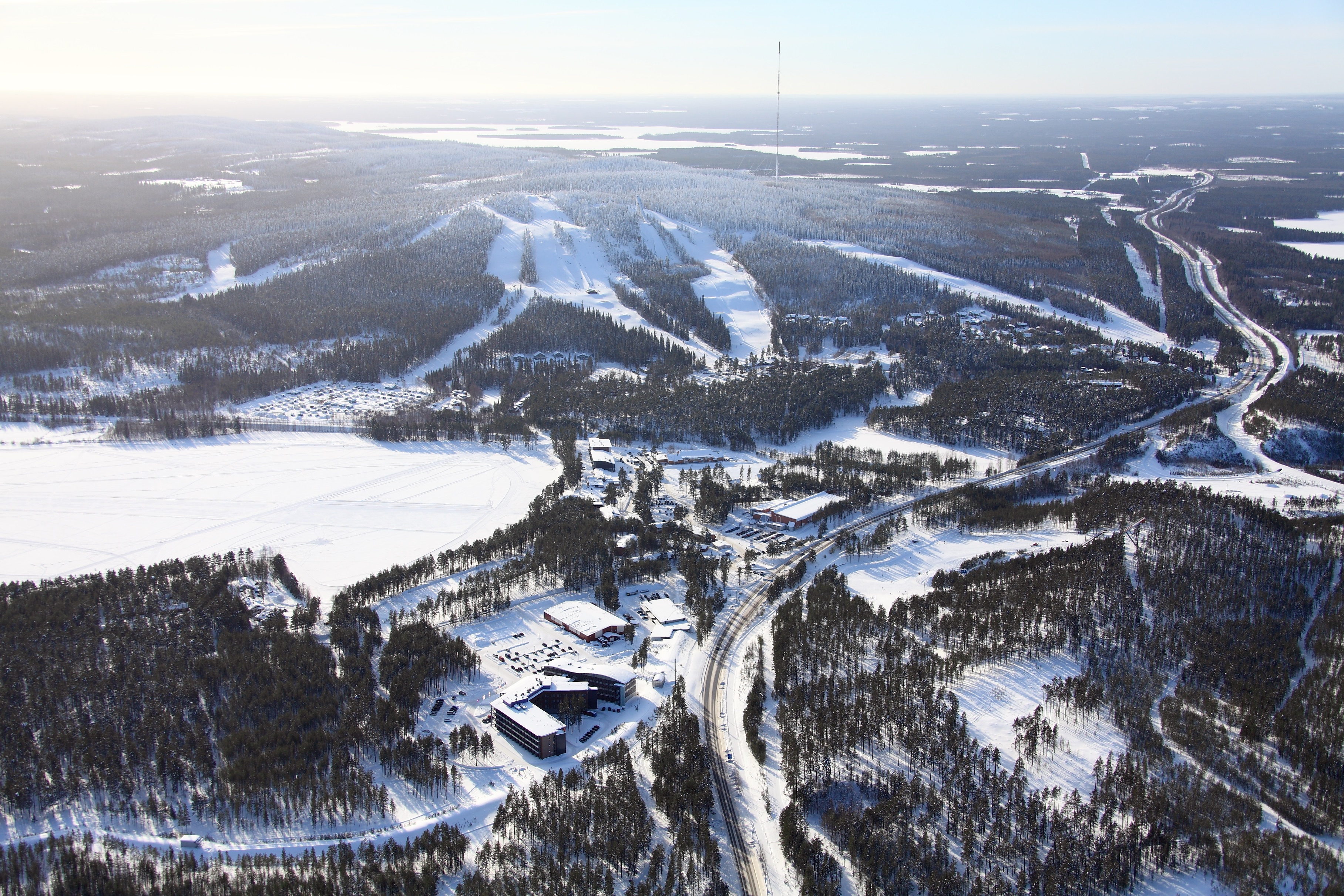
An aerial shot of the 2016 Masters World Cup venue in Vuokatti, Finland (Photo: MWC Vuokatti)
Every year, the Masters World Cup draws master skiers aged 30 and older from all around the world to World Cup-level venues for a week of FIS-World Championship-style racing. Finland will host the Masters World Cup for the fourth time in February 2016, welcoming roughly 1200 master skiers to Vuokatti.
Finland previously hosted the Masters World Cup in Kuusamo, and Kuopio, and most recently Rovaniemi, which took place in 2007. The 2016 site, Vuokatti, last hosted a World Cup in 1995, but has seen plenty of Scandinavian Cup and FIS racing since then. The venue hosts the Vuokatti Hiihto, one of Finland’s biggest ski marathons.
The Masters World Cup is open to skiers 30 and older and routinely attracts more than 1000 racers from more than a dozen countries. Each racer can compete in up to three individual events, with skiers choosing between skate or classic. Additionally, there is a relay competition in the middle of the championship week.
For the United States, the team is organized by American Cross Country Skiers (AXCS). No qualification is necessary; a skier only has to have an AXCS membership to represent the country.
John Downing is the head of AXCS and also the head coach of XC Oregon. He is particularly excited about the Finnish venue for 2016.
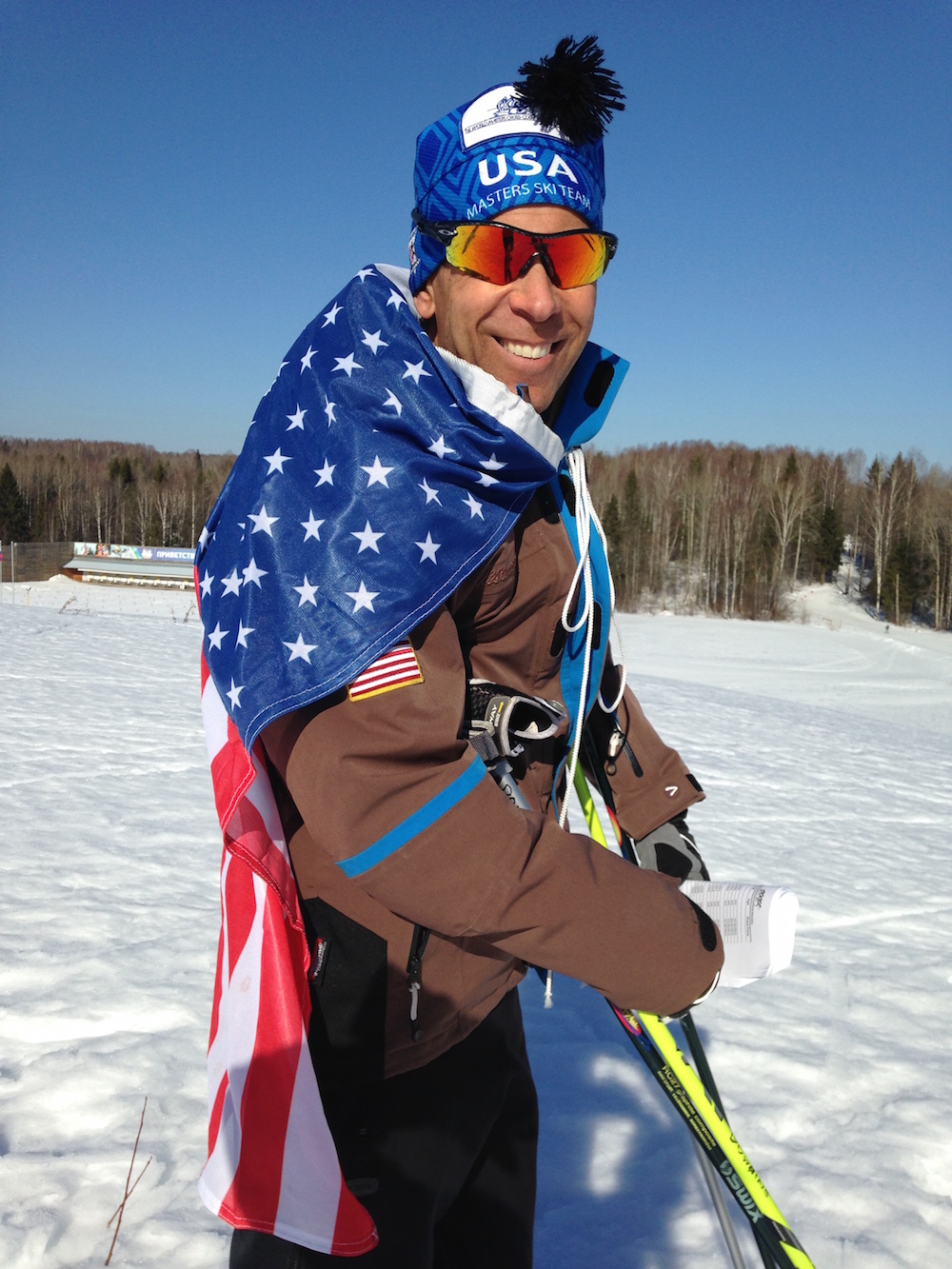
U.S. National Director J.D. Downing at the 2015 Masters World Cup (Photo: Inge Scheve)
“The ski trails are, in the opinion of your humble USA National Director, some of the most enjoyable we’ve ever had for a Masters World Cup event,” Downing told FasterSkier this spring. “The first 5 k features a joyful romp of rolling terrain followed by a crossing of a small frozen lake, and then a simply spectacular loop up/down the side of a forested ridge. The diversity of terrain and visuals on the core 15 k trails rivals any MWC venue in the world.”
Besides the race courses, Downing pointed out that Vuokatti – which as well-known for its summer ski tunnel as for its winter trails – has over 150 k of skiing. That means plenty of great ski touring is available, too.
“The absolute best thing about Vuokatti is the MWC race loops are just the beginning when it comes to ski options,” Downing said. “An honest-to-gosh 150km of total trails are going to be at our disposal. Whether you want to race or not, there aren’t many places in the world that offer more great skiing options right out the door.”
For a full recap of the Masters World Cup experience, from racing to teamwork to opening and closing ceremonies, read the story here.
There are seven possible race starts per gender, with all distances featuring a classic and a freestyle option, plus a relay. Athletes can choose up to three individual competitions to enter; they are divided into age and gender classes, with the youngest racers age 30-35 racing in the M/F01 category, ages 36-40 in the M/F02, ages 41-45 in the M/F03, ages 46-50 in the M/F04 and so on.
The championships open with a medium length event: 10 k, 15 k or 30 k, depending on age and gender. The younger men race 30 k, men in the Master 7 through 9 categories and the younger women race 15 k, while the oldest men and all women in the Master 9 and older race 10 k. These events are held on the first two days of the championships, alternating between skate and classic for the first day, following with the other technique on the second day. The championships always start with opening ceremonies on a Friday, and the first races on Saturday.
The second event, held on the third day of the championships, is a short distance – 10 k for all younger men and women, and 5 k for men in the M10 and older as well women in the F9 and older. Both classic and skate races are held on the same day, with classic events in the morning and skate in the afternoon.
The final individual events are the long-distance races, held on the two last days of the championships (Thursday and Friday) and alternating between concluding with skate or classic. If the championships opened with skate technique on day one, the last long-distance event will be classic and vice versa. The long distance races range from 45 k for the youngest men, 30 k for the youngest women and the men in the M7 and older, and 15 k for the women in the F9 and older, and the men M10 and older.
Additionally, there are relay races for all ages on day five, Wednesday, after a rest day following the short distance races. Relays consist of two classic legs, followed by two skate legs. Nations can field as many teams as they like in both the men’s and the women’s categories. However, there are rules regarding the make-up of the team in terms of age. Older racers can be dropped down to field a team in a younger category, but there must be at least two racers of the correct age on the team. In other words, a maximum of two racers per team can drop down to a younger age category. The relay team selection is the discretion of the national directors.
All of this will go down the next time around in Vuokatti, one of the most popular all-year-round holiday resorts in Finland, and the organizers point out that Nordic skiing and racing is not the only game in town. Vuokatti is home to the Angry Birds app, and even has an entire theme park dedicated to the lively birds, unfortunately only open in the summer.
“You’ll have many ways to enjoy the beautiful Finnish nature and experiences, such as ice fishing, snowshoe hiking, skating on natural lake ice, or riding on Icelandic horses,” Marika Makkonen of the Vuokatti MWC Organizing Committee wrote in an email. “There are many kinds of safaris available like snowmobile safaris and husky safaris. Depending on the weather you may also experience the northern lights.”
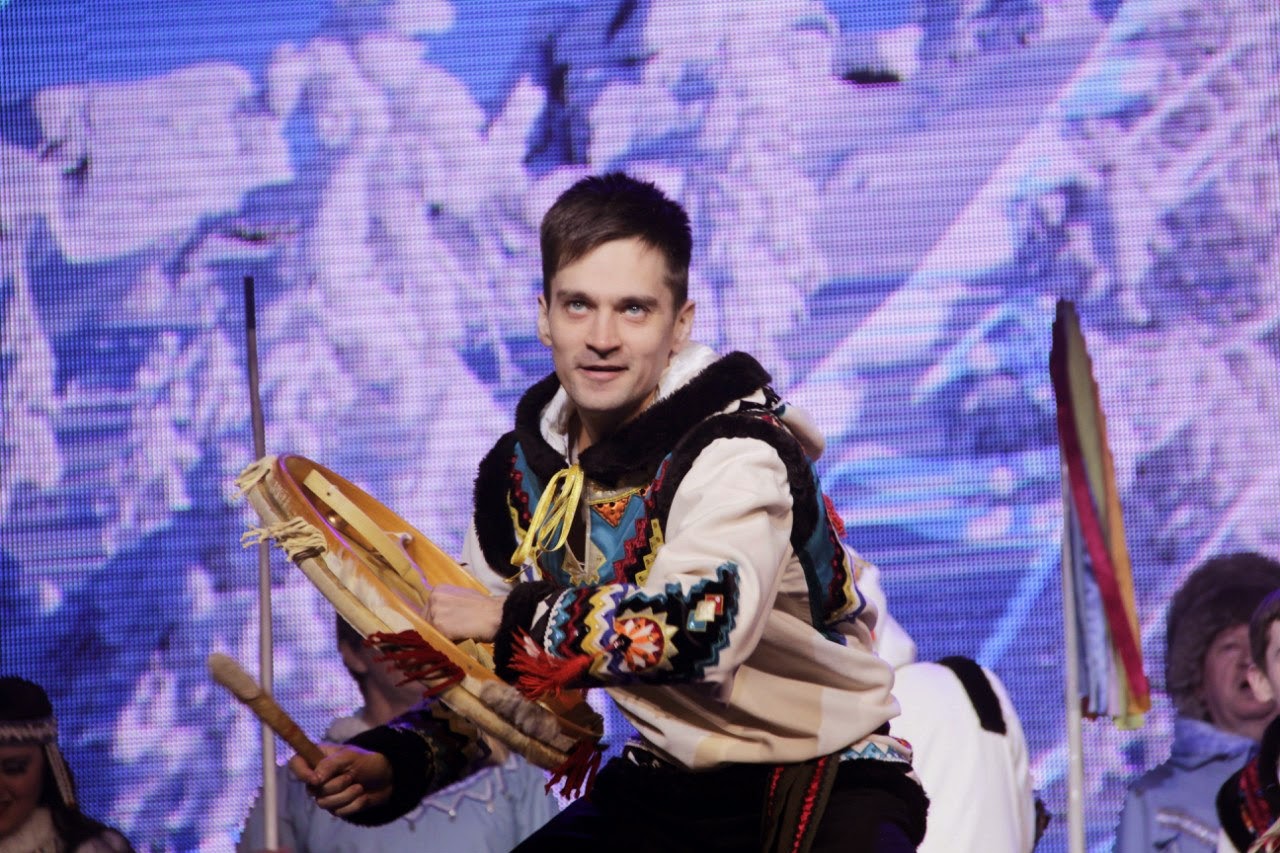
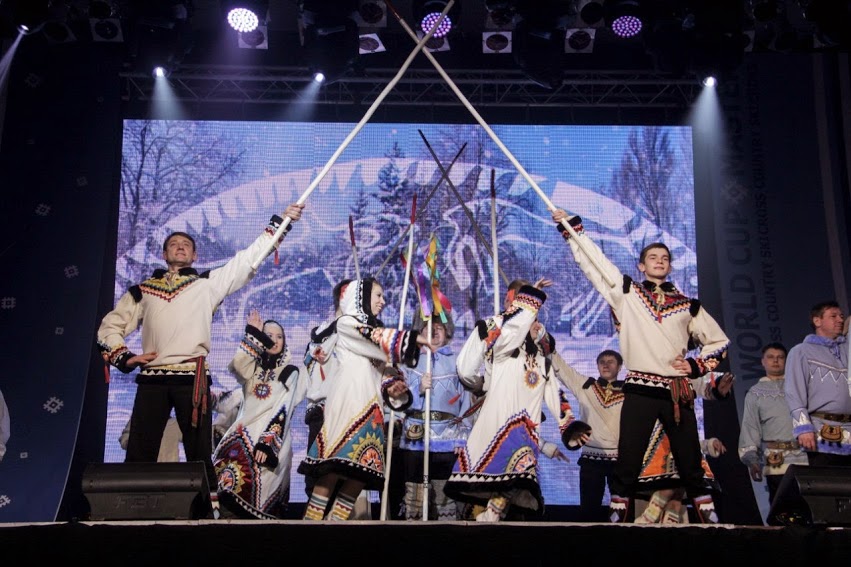
A scene from the opening ceremony at the 2105 Masters World Cup in Syktyvkar, Russia. (Photo: Masters World Cup 2015)
The following is an editorial submitted by FasterSkier contributor Inge Scheve, a Norwegian native who lived in Fairbanks, Alaska, and Bend, Ore., for a number of years where she became an avid skier and masters racer. Scheve recently returned from competing in her fifth Masters World Cup in Syktyvkar, Russia.
***
Russia was quite a trip. Literally. The 2015 Masters World Cup in Syktyvkar, Russia, from March 14 to 20 was amazing, maybe one of the best I’ve experienced in terms of racing, depth of competition, facilities, professionally run venue and race organization, as well as opening ceremony, medals ceremony and entertainment that made you feel like these championships were a big deal.
The head of grooming was the same guy who was in charge for the 2014 Winter Olympics in Sochi, Russia. The courses and stadium fit every International Ski Federation (FIS) technical specifications and rules for World Cup standard. Each national team was given its own wax room complete with amenities, premium ventilation and work conditions, locker rooms, bathrooms and showers.
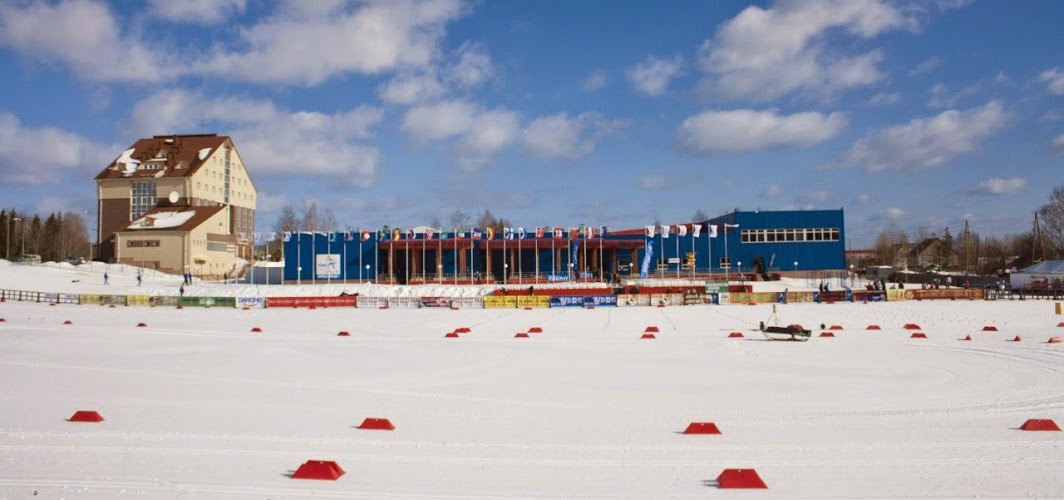
The Smetanina Sports Complex at Masters World Cup 2015. (Photo: MWC2015)
The U.S. team consisted of a scant dozen travelers, including supporting spouses and a couple of racers who ended up injured just prior to the trip, but still decided to go because of the novelty of the destination. And you can certainly argue that it was.
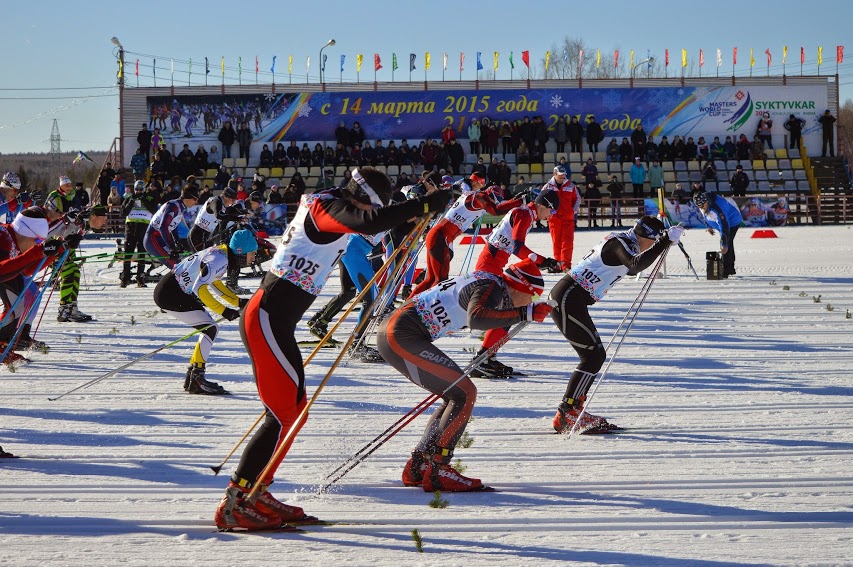
Start of a race in the M1 category. (Photo: MWC2015)
We stayed at the Olympiets Hotel at the venue, with a view of the courses from our rooms, and within spitting distance of the wax rooms and venue.
For a lot of us, Masters World Cup is the main event of the season, and the most important training and performance goal. It’s what you have in the back of your mind through the soggiest moosehoofing intervals in the fall and on those the frigid long-distance workouts in January.
And it’s also the closest most of us working folks get to a taste of Petter Northug and Marit Bjørgen’s world, with no further comparison. We certainly don’t ski as fast, but many definitely dig just as deep for the finish line.
Masters World Cup is one week of racing your brains out in events where the competition is fair, and you don’t have to worry about racers stepping on your gear out of the start and excessive jockeying and fighting for positions.
JD Downing at work in the U.S. wax room at the Smetanina Sports Complex at 2015 Masters World Cup. (Photo: Inge Scheve)
It’s unlike so many of the mass events such as the Birkebeiner and the Engadin with 10,000 to 15,000 racers on course. Even in the largest men’s categories, the start field at the Masters World Cup rarely exceeds 50 to 70 racers, and even those fields string out fairly quickly.
But Masters World Cup is so much more than just a week of crazy hard racing. It’s the five-week peaking plan leading up to the event. It starts with three hell weeks of volume and intensity that makes you wonder if you are going to bury yourself entirely, followed by two tapering weeks when you finally feel speed and snappiness come to you. You are race-ready and bursting at the seems.
And it’s a week where the world revolves around sleeping, eating, training, racing, waxing, and performing.
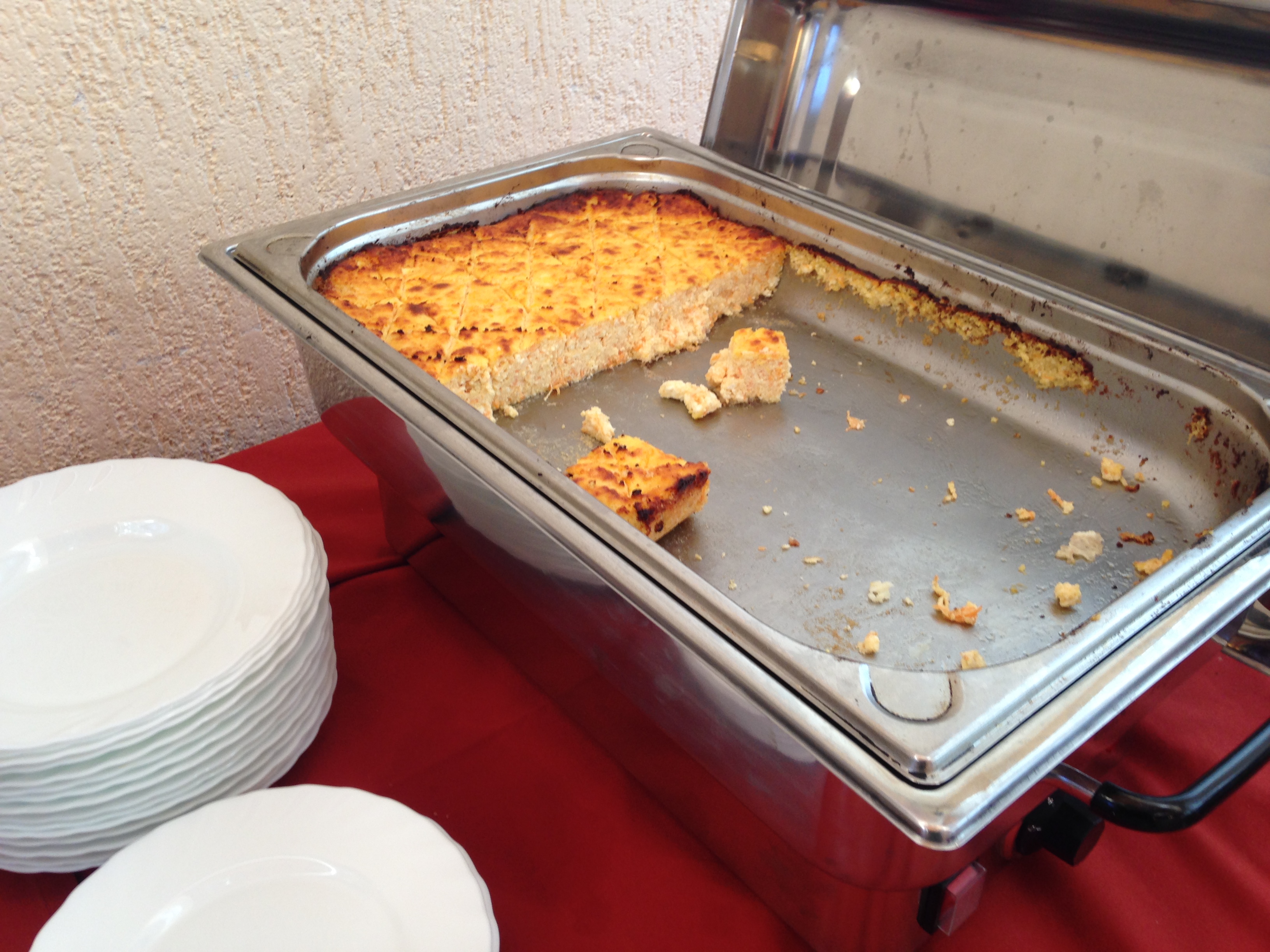
The dubious cottage cheese pudding at the Olympiets cafeteria. Not sure it will make me an Olympian.
Staying healthy is an important part of that equation, and it’s at the forefront of our minds to the point where some even start to feel they are coming down with something. Many carry hand sanitizers and try to avoid the obvious germ traps such as excessive hugging and handshaking, sharing water bottles, and avoid using the serving spoons in the cafeteria and touching handrails and elevator buttons.
But all kinds of precautions only go so far when the food-service hygiene fails. Food is expensive in Russia – relative to Russians, of course – and at our hotel’s cafeteria, leftover food was kept for a long time, reheated and resurfaced day after day. That creates a perfect growing environment for bacteria, and by the end of the week, many of us had both colds and stomach infections.
Syktyvkar is also the home of former Olympians Raisa Smetanina, Vasiliy Rotchev and Nikolay Bazhukov, who were on the World Cup circuit in the 1970s and ’80s. The stadium facilities, courses and venues are named after Smetanina. This is the national training center for the Komi Republic, where Syktyvkar is the capital, and from time to time, there are World Cup races both in cross country and biathlon at the Smetanina Sports Complex.
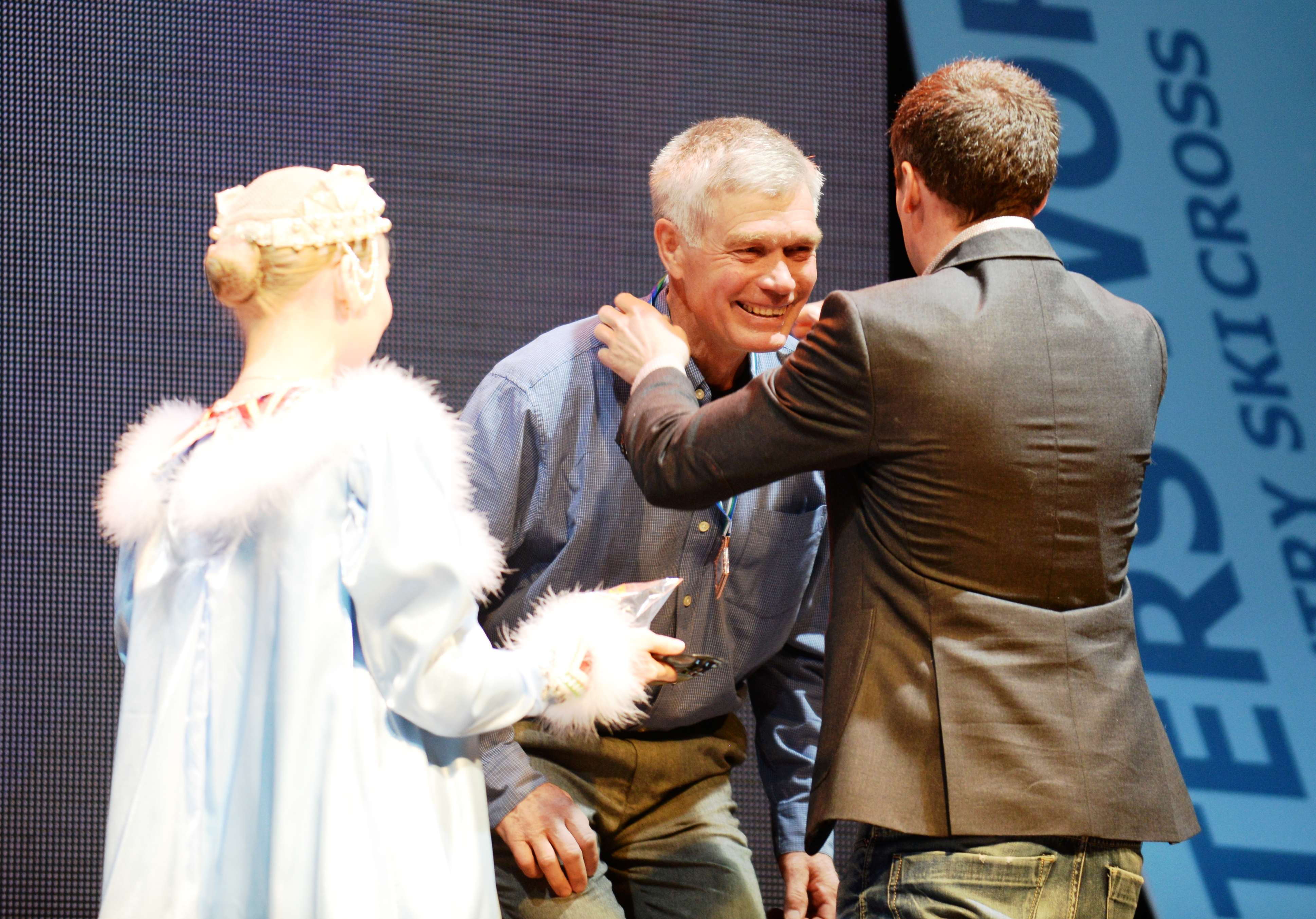
Bob Gray receiving his bronze medal. (Photo: Kent Murdoch)
The quick and dirty on U.S. results at MWC
Eight U.S. athletes collected a total of seven medals in Syktyvkar: Milan Baic of Michigan earned bronze in the men’s 30-kilometer skate on March 14, the first day of the races, as well as a bronze medal in the men’s 45 k skate on March 19.
On March 16, Bob Gray of Vermont took bronze in the men’s 5 k classic, and I finished second in the women’s 10 k skate.
Baic also scrambled for the U.S. men’s relay team that earned bronze in the M5 category on March 18. Gray skied the second leg for the team, Steve Smigiel of Michigan skied the third leg, and Kent Murdoch of Washington anchored the team to third place.
There were also several top-10 finishes during the Syktyvkar race week, including Murdoch’s fifth place and Gray’s sixth place in the men’s 10 k skate, Murdoch’s 10th place in the 30 k skate and my fifth place in the 15 k skate on March 14. On March 19, I placed fifth in the 30 k skate and Murdoch was sixth in the 45 k skate.
Additionally, the U.S. team consisted of Sherry and Richard Dixon, Alec Davies, and the U.S. national director of the Masters World Cup Association, J.D. Downing, who also raced two events during the Syktyvkar championships week. Dan Nolan was also part of the team, but did not race due to a thumb injury.
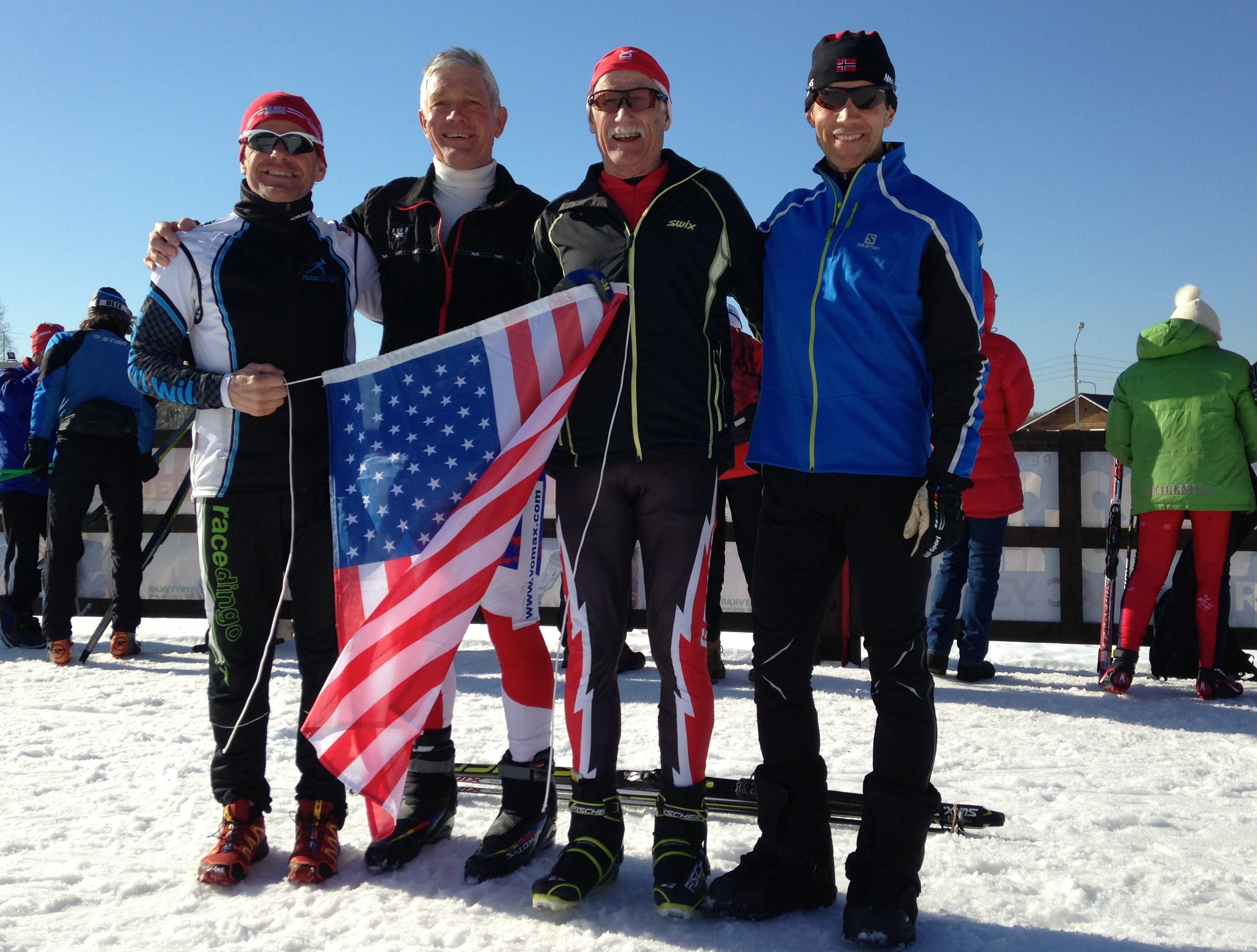
The U.S. bronze-medal relay team: (from left to right) Milan Baic, Bob Gray, Steve Smiegel and Kent Murdoch. (Photo: Inge Scheve)The cheering was first class: U.S. National Director J.D. Downing kept tabs and splits on all of the U.S. racers.
The Syktyvkar experience
We have competed against the Russians in many World Masters events before. I’ve wondered about their race faces and admit that they can be quite intimidating on the start line. They’re serious about the racing, with everything from ski testing to warmup routines and recovery. They mean business.
But off the course, the Russians are warm people, excited to share their culture and proud of their heritage. And with the global political situation starting to resemble the intensity of the Cold War days, most Russians are eager to show that they are not the regime. They are genuine, compassionate and generous. The organizers had more than 1,500 volunteers, and each national team was assigned a team of young students who worked as guides and interpreters, guiding us smoothly through language barriers, red tape and bureaucracy, and happy to take us anywhere we wanted to go, be it the mall, the supermarket or the ballet.
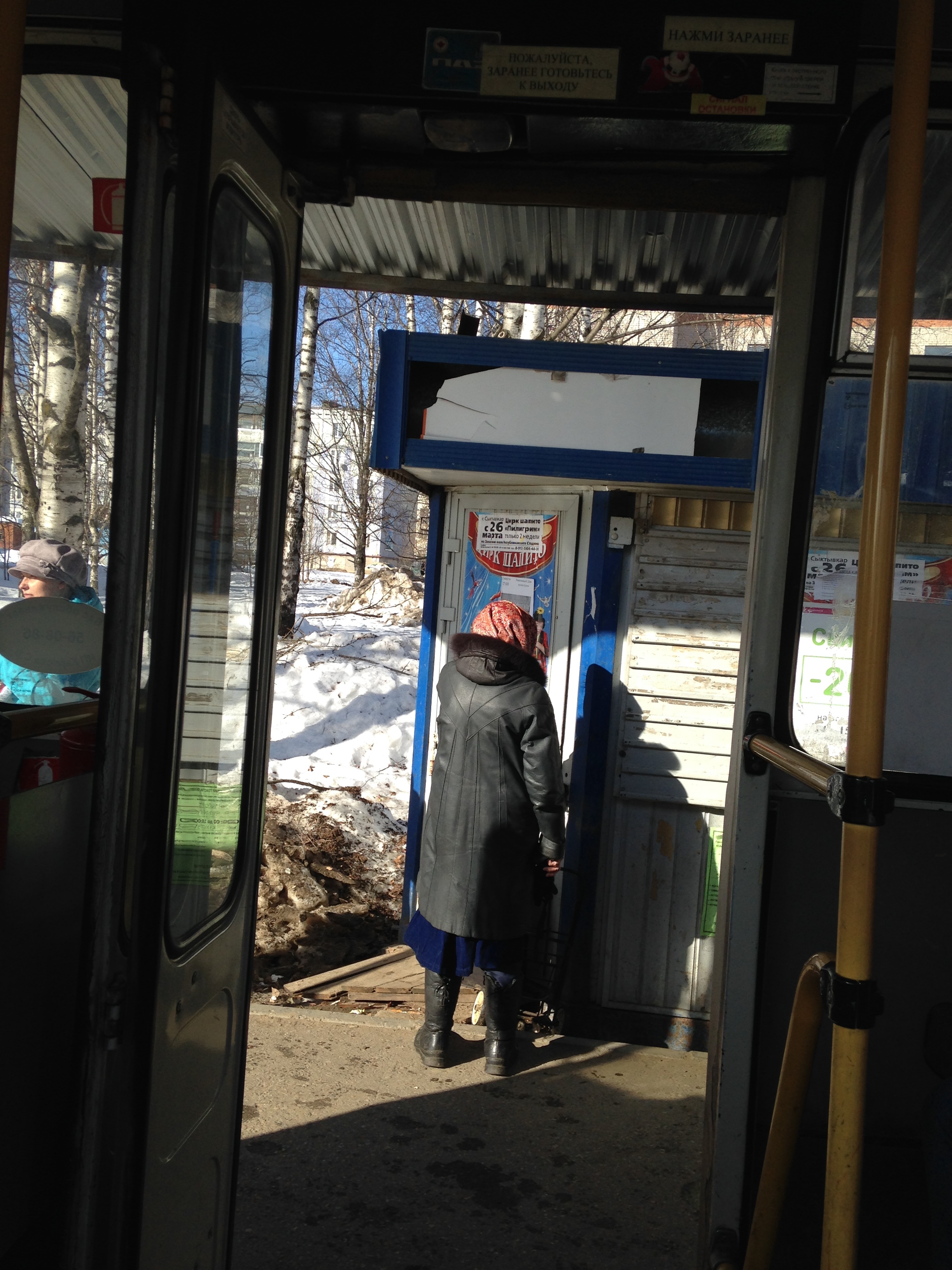
A snapshot of downtown Syktyvkar, taken from the city bus.
Syktyvkar is the capital of the Komi Republic and has been a city since Catherine the Great granted such status in 1780. The Tsarina needed timber and natural resources from the north, and also a new location for a penal colony. That tradition was continued by Stalin, who established a number of gulag prison camps in the area from 1929 and well into the post-World War II era. Prison gangs built rails and roads, towns and mines and most of the industrial infrastructure of Syktyvkar and other Komi cities, as well as numerous other Soviet communities. On paper, these gulags were no longer used after 1955, but it has later been documented that they were alive well into the Gorbachev era in the 1980s.
I must admit that Syktyvkar’s past sent chills down my spine when walking the muddy streets of the city and taking the bus through the town. Knowing that every ditch and road here is carved out manually with only crude tools and by scantly clad and undernourished prisoners, many sent there without a proper trial and only on dubious charges, casts a dark shadow over the beautiful cathedral roofs.
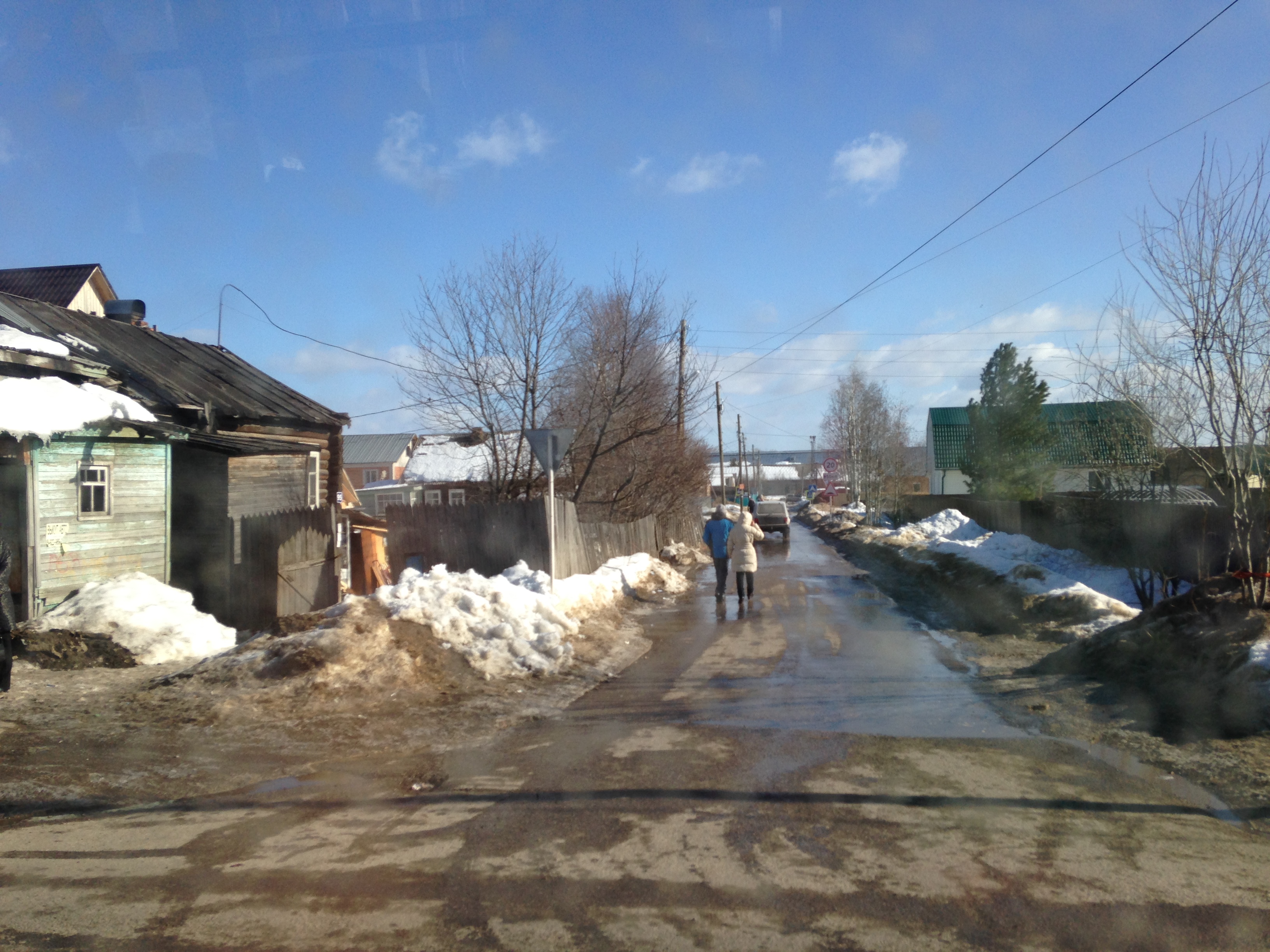
Syktyvkar city street.
Syktyvkar, a town of a couple of hundred-thousand people at the foothills of the Ural mountains, now has a university and several large corporations in timber industry, mining, oil and natural gas. At first glance, Syktyvkar looks like just another mid-size town consisting of endless gray communist-era housing projects in various stages of decay and suburbs of shabby-looking wooden cabins that reflect on the region’s economic state.
But the area has a vibrant cultural scene, with numerous museums, a theater of ballet and opera and performing arts, evident during the spectacular opening and closing ceremonies and the daily medal ceremonies at the Masters World Cup. At all of these events, local artists performed traditional music and dances.
From the Opening Ceremony at the 2015 MWC in Syktyvkar, Russia. (Photo: MWC2015)The Opening Ceremony at the 2015 MWC in Syktyvkar, Russia. (Photo: Kent Murdoch)
The racing
Yours truly (l) on the final lap of the 30 k skate. (Photo: MWC2015)
I’m quite content with the results at Worlds this year, especially given the rocky preparation and the stressful winter I’ve had with my professional work situation.
The fifth place in the 15 k skate on the opening day felt like a solid effort, where I raced the best I could on that day. The field was stacked with Russian skiers without prior Worlds points, which made them total wild cards. I beat the racers whom I generally compete with at these events, but I was also beat by a couple of these wild cards. So, overall a solid effort.
But the silver in the 10 k skate was particularly exciting. At that event, I also beat a couple of the wild-card racers who topped me in the first race. The feeling of having dug so deep, put it all on the line and making it to the podium is magic.
The feeling of having dug so deep, put it all on the line and making it to the podium is magic.
However, digging so deep sure took a toll. The next couple of days I felt very tired, even shorts workouts seemed like they required more recovery than expected, and I was on the brink of coming down with a full-on cold, which had been circulating in the team for a few days.
Then on the day of the 30 k, I woke up in the middle of the night with a monster head congestion in addition to the race hack I had been dealing with since the 15 k on Saturday. As if that wasn’t enough, several of the team suffered from the revenge of the cafeteria – stomach pain and the runs. Not a great setup for a 30 k race. But given that this was the last race of the week, I gave it a shot with the ambition of finishing in style. So a fifth place under those circumstances felt like another success.
The price to pay was that the trip from Syktyvkar to Lillehammer, Norway, the following day became a bear. The same is true for Murdoch, who was sixth in the 45 k skate and suffered a similar illness both before the race and during the expedition trek to Lillehammer. Needless to say, only working at the Norwegian Birkebeiner on March 21 felt quite all right. Neither one of us felt a desire to race the 54 k classic event, despite the best conditions in several years. But we will be back!
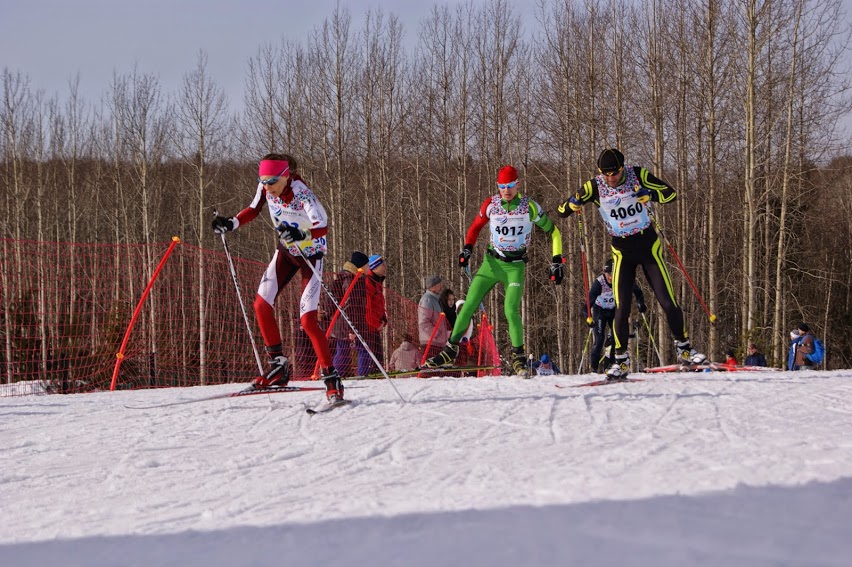
Kent Murdoch (back of the train) during the 45 k skate at 2015 Masters World Cup. (Photo: MWC2015)
About the author:
A longtime contributor, Inge Scheve was born and bred in Norway, and learned to ski about the time she learned to walk. She always loved skiing, but didn’t really get into racing until she came to the University of Alaska Fairbanks, where she was introduced to collegiate ski racing American style. After UAF, she moved to Bend, Ore., in 2001 to ski with XC Oregon. She has competed for the U.S. in five World Masters, earning eightgold medals, 10 silver and 11 bronze.
When she’s not skiing, Inge loves caribou hunting on the tundra in her native Rendalen valley in Norway, dabbles in adventure racing, mountain biking, road cycling, hiking, trail running and kayaking. Inge really wants to become a wine snob, but realizes that probably involves learning to like red wine.
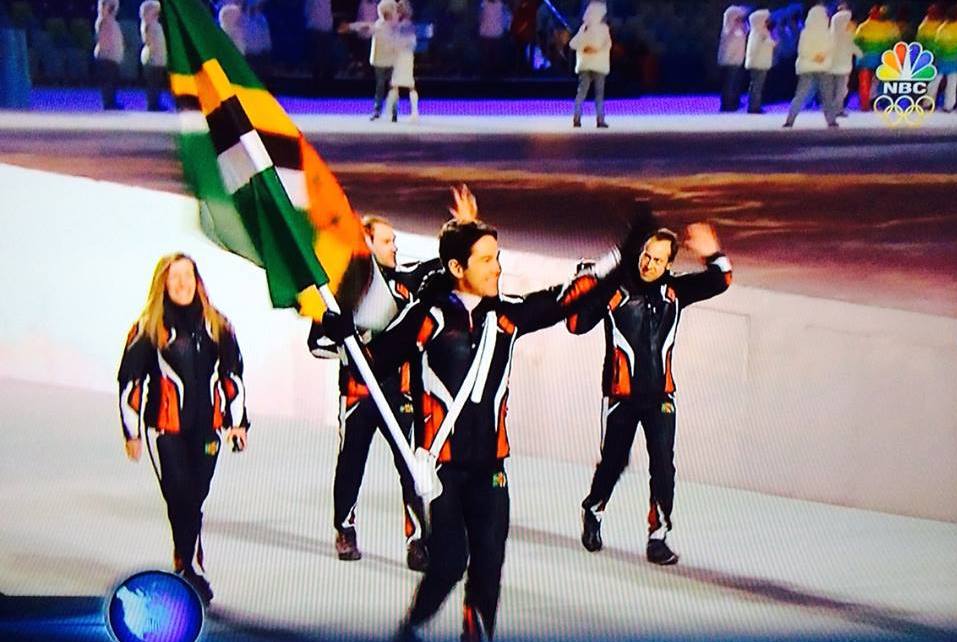
Team Dominica nordic skiers, the oldest Olympians at the 2014 Winter Games, Gary di Silvestri (with flag) and his wife Angelica Morrone (l), and coach J.D. Downing (r) at the Opening Ceremony in Sochi, Russia.
After the Olympics in late February, FasterSkier published a news blog about an American couple, Gary di Silvestri and Angelica Morrone, that represented the island nation of Dominca as cross-country skiers at the Sochi Winter Games. The post was based on allegations and reports that the couple pulled a fast one in order to get to the Games, and once there, did not compete.
We then reached out to their coach, J.D. Downing, who founded the XC Oregon nordic team in Bend, Ore., and is a well-known figure in the US master’s circuit, for his take. Downing’s frustration with the negative coverage his athletes received was apparent. What follows is an article based mainly on excerpts from his thorough response.
(Note: In the interest of writing the most-straightforward article, only Downing’s statements that pertained to the FasterSkier’s news blog were included in this article. In his original email, Downing addressed the issue of taking advantage of a loophole in the rules. A few more excerpts from Downing’s email that are relevant to the first comment on this article have been added under the heading ‘What Exactly is the Problem Here?’)
***
“You have two people that have fallen madly in love with cross-country skiing and the combination of their unbridled enthusiasm and personal resources has spread proven positive benefits far and wide in the worldwide XC ski community.” — J.D. Downing, XC Oregon head coach and Dominca Olympic coach
“I first had the pleasure to work with Gary and Angelica at the 2005 Oregon Spring Camp,” J.D. Downing wrote in an email. “Shortly after that camp they became supporters of the XC Oregon non-profit under our Friends of XC Oregon program. Gary and Angelica have been two of our many generous donors over the past eight fiscal years.
“Within the Friends of XC Oregon program, all donors to XC Oregon receive as benefits access to our XC Oregon workouts, camps, and training programs,” he continued. “So in that way I have coached Gary and Angelica for the past eight years. Beginning spring 2013 we mutually increased my time demands beyond the Friends of XC Oregon program to match the pressing requirements for Olympic qualification and the Games itself.”
What distinguishes di Silvestri and Morrone from the other wealthy donors Downing coaches was that they were attempting to qualify for the Sochi Olympics under the flag of the tiny Caribbean nation of Dominica. Forty-eight and 47 years old, respectively, at the time of the Olympics, Morrone and di Silvestri weren’t quite at the level for qualifying for the U.S. Olympic team, or, for that matter, the Italian Olympic team, as Morrone is Italian-born. (Di Silvestri is from Staten Island and the couple lives in Montana.)
The Rules
There are two separate issues on the table — what anyone chooses to think of Morrone and di Silvestri, and what anyone chooses to think of the rules they followed. Downing wrote that criticism of the rules was being improperly directed at his athletes:
“If it’s a matter of short versus long-term citizenship that bugs people, then feel free to take appropriate steps with your IOC representatives to suggest an international rule change that requires a certain period of time of holding citizenship before you can represent a country at the Olympics.
“If you have a problem with how specific nations legally grant citizenship, take it up with national leaders worldwide for the next Olympics. You know, the people that actually write and enforce laws in various countries.
“If you have a problem with how specific nations set their national Olympic participation criteria, again, please speak with the specific national leaders in question.”
Morrone and di Silvestri qualified according to the “B Standard” — nations that do not have any “A-Standard” athletes can still send one male and one female representative of each sport. However, the B-Standard qualification must still be met, which is a maximum of 300 International Ski Federation (FIS) points in order to enter the mid-distance classical races. Dominica had never previously fielded a team at the Winter Olympics, and their B-Standard cross-country ski spots were open.
“Now there’s been plenty of commentary and opinion about the level of skiing required to meet the Olympic B standard,” Downing continued. “I am perfectly OK with that conversation and if anyone is really bent out of shape about that standard then I’d encourage writing to your FIS and IOC representatives to voice your views. For example, you can argue for lowering the Olympic B standard to an average of 250 or even 200 FIS points. If a tougher ‘standard’ of the Games is your mission, those official entities are the right parties to lobby.
“But please understand just who you impact versus how little you accomplish by lowering the 300 FIS point average. The list of nationalities eliminated largely would be smaller, poorer, and/or snow-challenged. [The resulting pool of athletes will closely resemble] a typical World Cup race. So you’ll successfully make the Winter Olympics far less inclusive while changing nothing in terms of the overall pros and cons of the Olympic movement.”
How It Really Went in Sochi
The Deadspin article quoted in the article by FasterSkier had a great deal of personal criticism for the couple. Downing’s irritation with the negative coverage was apparent, beginning with the coverage of their Olympic experience:
“[That their Olympic experience was an] un-mitigated disaster is completely true. I take issue with how this Olympic experience was presented. Deadspin clearly painted the health of the athletes with a wide brush of suspicion, derision, mocking, and doubt. FasterSkier itself doesn’t exactly leave readers with an accurate portrayal by claiming Angelica just had a ‘broken nose’ and the sarcasm of Gary ‘didn’t get the memo’ on potentially tainted water.”
Downing described their untimely predicaments:
“On Saturday, February 8 Gary woke up with severe abdominal cramps so severe he could not walk nor even stand for more than a few seconds. […] Ultimately he was diagnosed […] as having a serious bacterial gastroenteritis infection. Our best guess was the water in our lodging as the culprit. The symptoms came and went for over a week. In the best of times he could ski, but felt very weak. At the worst, he was back to the day one misery and barely able to walk or stand.
“That very same morning of Saturday, February 8, Angelica and I were skiing on the race courses before the women’s skiathlon and she had a high speed crash into the fence on the exact same downhill corner of the ‘Red’ course that caused so many problems for many athletes in the early portion of the Games. In fact, the exact location of her crash was precisely where Anders Gloeersen hit the bottom of the same fence in the men’s sprint final and where Marcus Hellner and Sergey Ustiugov collided in the same race.
“Although the fence you could see on TV footage was padded, the padding ended just shy of the top metal cross bar (it’s a permanent fence). In her crash, Angelica hit her face right on that exposed cross bar which resulted in a heavy craniofacial injury with multiple fragmental open fractures. Most serious initially was the penetrated open crania-cerebral injury where surgeons were worried that bone fragments might enter her brain. She was transported by ambulance [and] quickly admitted to the Intensive Care Unit, and subsequently underwent four surgeries between the evening of February 8 and lasting until February 24.”
“The medical record regarding this crash provided by the hospital is comprehensive and without dispute. Yet the Deadspin writer actually goes out out of his way to characterize Angelica’s injuries as trivial and Gary’s infection as imagined — and in a bizarre twist insinuates they made it all up for some unspecified reason. Thus he was such a great ‘reporter’ that he supposedly uncovers pointless dirt dating back 30 years ago [including tax-evasion accusations in the Deadspin article], but he couldn’t be bothered to actually get an accurate account of one of the worst injuries to take place at the 2014 Winter Olympics? Even the accounts of Angelica having a ‘broken nose’ are horrifically incomplete in painting the true picture here. […] If you have just a broken nose, it’s painful, but rarely a serious medical emergency. Angelica’s injuries were Intensive Care Unit for the better part of a week serious. Four surgeries serious. In the hospital almost the entire Winter Olympics serious. But apparently not serious enough for accurate reporting. As I’ve already pointed out, the writer never bothered fact checking the medical realities drawing his credibility in all regards into total question.”
And as for di Silvestre’s illness?
“For Gary, his Olympic routine consisted of daily trips to the hospital to be with Angelica and dealing with the ups/downs of his bacterial infection. The morning of the men’s 15k (Friday, February 14) the abdominal cramps brought on by his infection returned with a vengeance. Even after the Endurance Village clinic treated him with every cramp-relieving medicine at their disposal, he was barely able to walk from the village shuttle to our wax cabin. […] it was literally everything Gary could do to make it around the stadium in a vain hope that Angelica could at least see him start (from her hospital bed). [The assertion that he made it] 300 meters is about right and yes, he collapsed off the track (so as not to impede other skiers in any way) before I could run around the stadium to assist him off the field of play.”
“To top off Gary’s erstwhile Olympic start, his race skis were stolen that afternoon from a credential-only ‘secure area,’ ” Downing added.
“Accountability in any writing matters. The original Deadspin account openly challenges Angelica was ever severely hurt or that Gary was ever seriously ill. Right there I don’t need any more proof that the writer in question wasn’t interested in honest and factual reporting. I know what happened to these people because I was there every second. The writer didn’t ask me. He didn’t ask the Dominica National Olympic Committee. He didn’t ask the IOC. The medical issues that confronted both Angelica and Gary were not insignificant sidebars. Any writer and any resource that doesn’t can’t get very basic medical facts straight simply cannot be trusted with anything that was alleged.”
‘What Exactly is the Problem Here?’
“It is a fact that Gary and Angelica were hardly the only athletes in Sochi with multiple past or present passports in their name. Multiple examples exist in both XC and biathlon. In several cases the athletes very openly switched national affiliation purely for athletic reasons. In many cases the athletic reasons involved a measure of direct financial gain to the athlete which is most certainly NOT the case for Gary or Angelica.
“I’m fascinated the vitriol leveled at Gary and Angelica that conveniently ignores the situations where many other athletes (including multiple medalists) gained citizenship for various nations with the clear and often admitted motive of, ‘I’ll get better support or simply have access to the Olympics if I switch to such-and-such country’. I know of no example where any athlete in these many other situations was then subject to the character assassination that Gary and Angelica have been through.
“Try as anyone might, no valid argument can be made that Gary or Angelica bumped someone else out of the Olympics. There was never going to be a Dominica Winter Olympic Team at all if they didn’t make it. They didn’t take a dime from the Dominica NOC. They covered every Olympic and National Ski Federation expense and would have happily covered more if ever required by FIS, the IOC, or Sochi organizers. The IOC and the Sochi O.C. were openly delighted they were there representing Dominica. So please tell me — what exactly is the problem here?
“Finally, I can guarantee the world that if there was any other Dominican citizen that really had a serious plan for making the 2018 Winter Olympics — Gary and Angelica would be the first in line to offer support. How many ‘legitimate’ athletes from other nations can say the same?”
Good People
Throughout Downing’s email he paints di Silvestre and Morrone as kind, generous, and hard-working.
“Both Gary and Angelica would have to be among the most impressive examples I’ve ever come across of near-total devotion to a sport. Any age. Any ability. Their work ethic is literally off the charts. More often than not I needed to warn them about working too hard or too much, which is often the case with the most motivated skiers of any age.
“Over eight years I honestly cannot think of anyone that got to know Gary and Angelica that has not expressed enjoying the positive energy that comes with being around them. But I can document a very long list of clubs, athletes, events, associations, fundraising campaigns, ski retailers, ski industry companies, websites (yes, including FasterSkier) that have all benefited from contributions, expenditures, participation, etc. by Gary and Angelica’s love of cross-country skiing.
“XC Oregon can document an extensive list of athletes, ski programs, and other worthwhile causes that our program has impacted and supported over the past eight years around the XC world. These positive efforts would not have been possible without the support of donors such as Gary and Angelica.
“In sum you have two people that have fallen madly in love with cross-country skiing and the combination of their unbridled enthusiasm and personal resources has spread proven positive benefits far and wide in the worldwide XC ski community.”
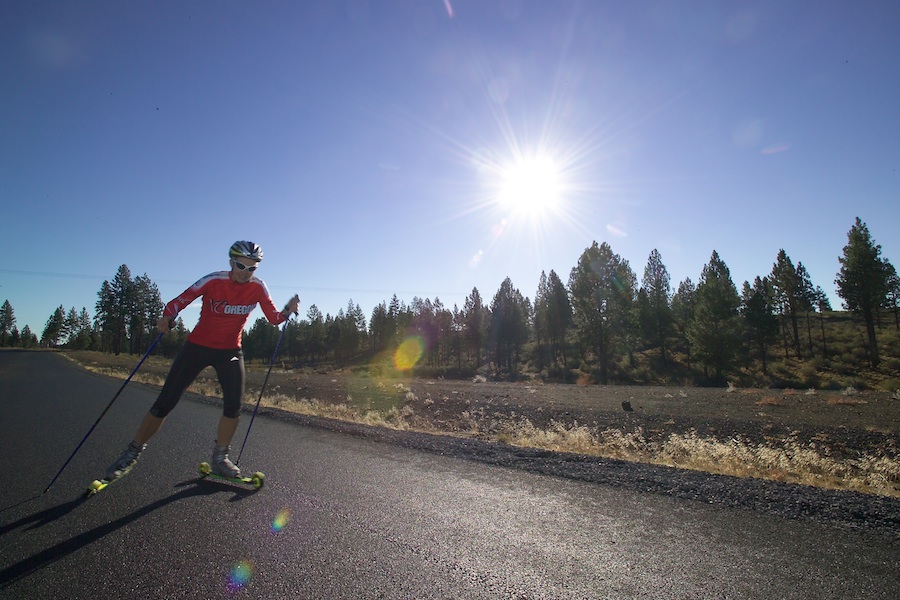
XC Oregon’s Sarah Max during a rollerski session near Bend, Ore. (Photo: XC Oregon)
Note: This is the 10th preview in our U.S. elite-team series, called the “The 12.” We asked coaches to tell us what’s new and whom to look out for this season, and we’ll publish additional previews in the coming weeks in no particular order.
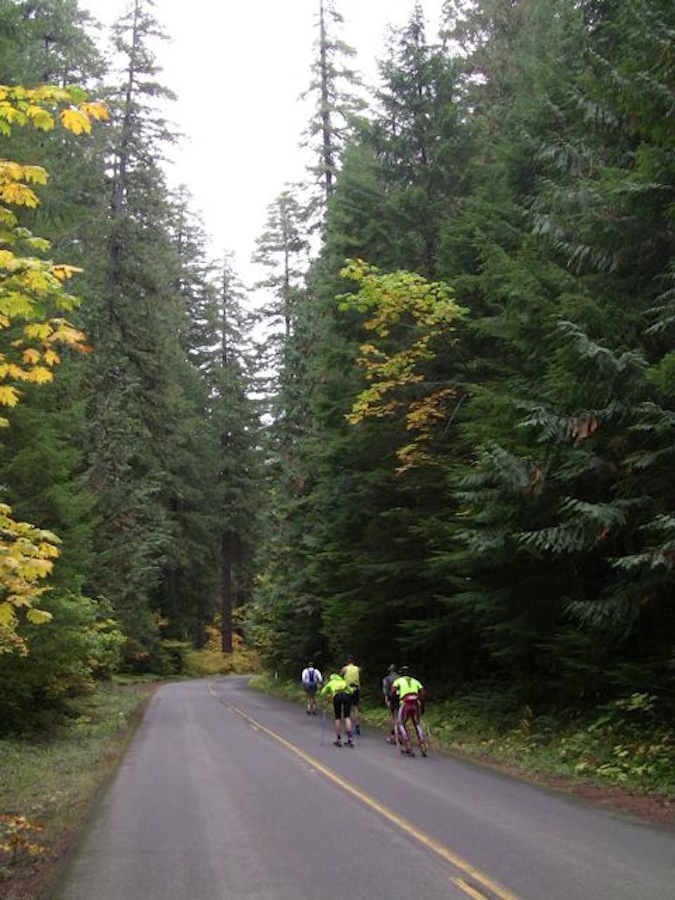
The XC Oregon squad during a rollerski last fall near Bend, Ore. (Courtesy photo)
National/International Elite Roster: Santiago Ocariz, Matt Briggs; Carolyn Ocariz, Sarah Max.
Associate roster: 12-15 additional associate skiers will join the roster come November, according to Downing, who is “still finalizing plans with a bunch of folks.”
Who’s new: Downingexpects several top regional associate skiers to come onboard, but not at the national/international elite level.
Who’s missing: Oliver Burruss, who’s “entering the ‘real world’ ” in Burlington, Vt., Downing writes.
Top results last season: A couple months before his first child was born, Santi Ocariz made the most out of the Noquemanon Ski Marathon in Marquette, Mich., winning the 50 k classic in January. He went on to win Bend’s pinnacle spring event, the Pole Pedal Paddle, in May just two months after his wife and teammate, Carolyn, gave birth to Sonia. As you can imagine, Santi didn’t get to train as much as he would’ve liked.
“I don’t think I have trained this little in a year since I was a junior in high school,” Ocariz wrote in an email after the race. “However, what I lacked for in time, I made up in effort.”
Max won the women’s race to complete the XC Oregon sweep, and in February, the 38-year-old topped the podium at the 58 k Mora Vasaloppet in Minnesota.
Coach’s comment:
“For 2013/14 we’ll have a bit of a ‘factory team’ feel with fewer full-time skiers than some years, but a whole lot of talented people involved,” Downing wrote in an email.
“Santiago and Carolyn Ocariz will be out of the state much of the year with school [in the Midwest], but it’ll be fun seeing what those two can pull off,” Downing explained.
The rest of the team will race “a mixed bag of events” for the duration of the season, mostly within the Pacific Northwest and at select marathons, and not so much at big domestic races like nationals and SuperTour series.
“Our big focus once this winter winds down will be attracting 4-6 new high performance athletes to target the national/international scene beginning Spring/Summer 2014,” Downing wrote. “Bend is an amazing spot so basing here for a few years (or longer) is rarely a tough sell. But we are also happy to incorporate athletes living anywhere in Oregon. The flexibility and quality of the XC Oregon system has stood the test of time so we know any skier than joins us is going to have what they need to reach their goals — whatever they may be.
“We have already banked resources to guarantee an exceptional level of financial and logistical support for new athletes for several seasons. The consistency of our support is amazing and a direct reflection of the quality of XC Oregon delivery over 16 years. Our incredible sponsors and patrons have believed in XC Oregon because we don’t try and be something we aren’t. We help skiers achieve their goals. We attract quality people. We constantly support our community. We do all this the right way. Simple as that.
Whether someone is interested in chasing the Olympic pipeline or marathons or a little bit of everything — interested skiers should visit xcoregon.org and feel free to get in touch at any time over the coming 8-10 months.”
Matt Briggs leads XC Oregon teammates Jason Adams (c) and Ollie Burruss (l) during team relays during a training session in late May in Bend, Ore.
Note: This is the first of a quick-and-dirty preview series on elite teams in the U.S. We asked coaches to send their 2012/2013 rosters and tell us what’s new for the coming season. We will be publishing additional reports over the next few weeks. Teams are presented in no particular order.
National /International Elite Roster: Santiago Ocariz, Oliver Burruss, Matt Briggs;
Carolyn Ocariz, Stephanie Howe, Sarah Max, Jamie Woelk
Who’s new: Santi and Carolyn Ocariz (as the two confirmed additions, 1-2 more possible. Carolyn arrived just over a week ago on June 9).
“We are super excited to have them both here,” Downing wrote in an email. “Their addition obviously allows us to significantly boost our national/international elite presence, but just as important to us is the quality of the individuals. Just look at what these two did this spring [rollerskied across the country] — and more importantly why they did it [to feed impoverished children]. There’s also a big comfort level in that Santi has spent several summers in Bend and has a brother living here so the transition should be very smooth. It’s really a perfect fit all the way around.”
What else: With a PhD and all, Howe will likely compete in more marathons this winter after studying at Oregon State University in Corvallis last year on the western side of the Cascades.
While it’s unclear how much Marshall Greene will race, Downing was excited to welcome him back to Bend this summer with his wife and new baby. Greene spent the last couple of years in Wisconsin earning his Master’s degree.
XC Oregon (XCO) is also expecting to add 12 to 15 members to its associate roster.
Who’s missing: Zoe Roy will likely make the full switch to Rocky Mountain Racers (RMR) in Canmore, Alberta, in an attempt to make Canada’s international teams. She was affiliated with XCO last season while completing her undergraduate degree in Utah and also raced in Canada with the support of RMR. Given that Roy is from Bend, Downing will try to incorporate her whenever possible.
Top results last season: Burruss was eighth in the Boulder Mountain Tour and 20th in the American Birkebeiner 50 k skate, and both Burruss and Briggs had career-best SuperTour results last season. Max was the 19th woman the in the Birkie this year, and Roy notched four top-10 performances on the Canadian NorAm circuit, two of which were on the podium.
In all, a dozen XCO skiers tallied best-ever results last year, which “radically improved on anything they had done before,” Downing wrote. “We really take our role seriously as positive ambassadors for the sport in Pacific Northwest and there is no question last year was one of our best ever in that regard.”
Coach’s comment: XC Oregon is proud to celebrate its 15th season this year. According to Downing, it’s either the longest or second-longest continuously running elite-development program in the U.S. Aside from the high number of athletes that represented XC Oregon over the years, at least two dozen went on to coach nordic skiing.
“That more than anything probably reflects the 100% athlete-based approach of XC Oregon,” Downing wrote.
As for spring training, XCO skiers can enjoy at least another week on snow up at Mt. Bachelor, less than a 30-minute drive away.
“That’s a huge upside as athletes can maintain normal routines and yet still get the same quality of on-snow workouts as if we were shelling out thousands of dollars sending them to some remote spot,” Downing wrote. “I feel really good that the vast majority of the crew is in a comfort zone of how they’ll structure their training around everything else in life. We’ve also got some good training partner options this year that should be a big help. Bend itself is often a huge asset since there is a deep and incredibly talented pool of endurance athletes here.
“For the season I think we’ll find 2012/13 looking very much like the average year over the past decade,” he added. “We’ll have a nice mix of some notable SuperTour/Nationals results, some domestic and international marathons, and then the steady drumbeat of regional activity.”
Down the road in 2013, the team may restart a summer internship program for collegiate skiers, especially for graduating seniors interested in racing after college.
“We’ll be fundraising for that this summer and hope to roll out specifics this fall,” Downing wrote. “It’s also likely we’ll want to add 2-3 funded-level athletes in Spring 2013 so that’s always exciting to look forward to.”
You Call This "Spring" Skiing? – Here In Oregon, Yes We Do! Photo: XC Oregon.
Registration is open to the general public for the 2011 Oregon Spring Camp taking place May 26-30, 2011 (Memorial Day weekend) at Bend/Mt Bachelor, Oregon.
Designed primarily as a master/citizen XC ski camp, junior skiers with a chaperone adult camper are also welcome. Due to carefully limited enrollment numbers, this camp is recommended only for skiers at intermediate and above skill levels.
Featuring on-snow morning sessions and a variety of optional events including dryland clinics, an evening training plan workshop, and ski specific physiology lab testing — the Oregon Spring Camp is one of the most unique ski educational events in the world.
Coaching for the camp will be led by J.D. Downing, Coach of the XC Oregon elite team and National Director of the American XC Skiers masters association. Downing will be assisted by a variety of local athletes and coaches.
With over 12 feet of snow base still reported at the 6300 foot elevation and spring Nordic Center operations continuing through June 20 this year, prospects for continued excellent spring skiing at Mt Bachelor for at least the next five weeks look promising to say the least.
Since 2001, Oregon Fall and Spring Camps have gained an international reputation as some of the best ski technique and fitness events in the world. Campers of all ability levels (including numerous National and World Masters champions) annually rave about their progress and information gained at Oregon Camps.
Highlighted by a fun and inclusive atmosphere as well as small group sizes, the goal of every Oregon Fall and Spring Camp is to give every participant the best possible experience to help further their enjoyment of the world’s greatest sport.
As with the traditional Oregon Fall Camp held every December, this year’s Spring Camp event will also offer the ability for campers to name the exact number and sequence of days they’d like to attend.
Complete information and registration materials for the Oregon Spring Camp can be found at www.xcoregon.org website.