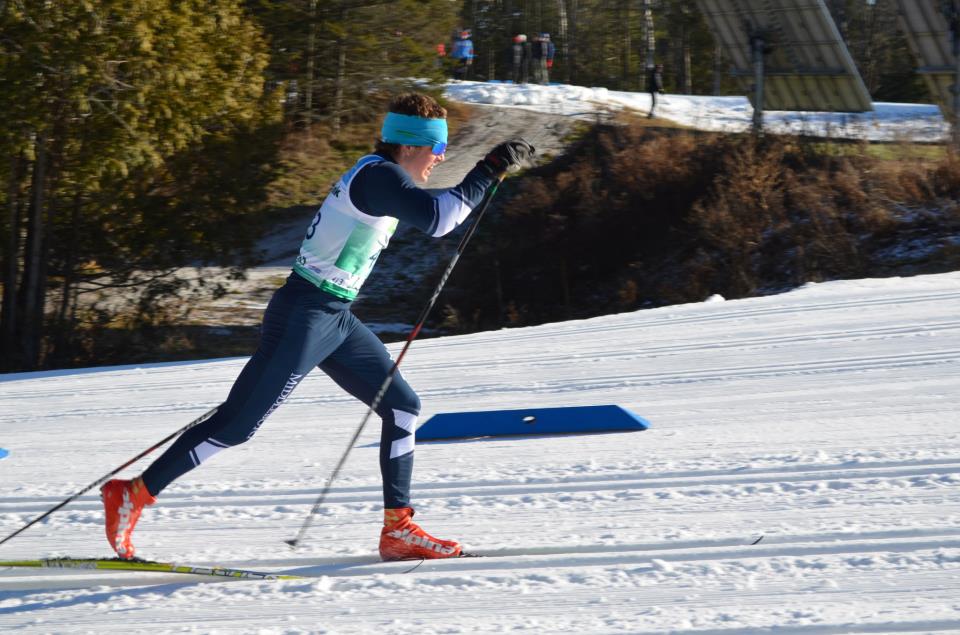
Middlebury freshman Jack Steele hitting endpoints in Craftsbury, Vt. (Photo: Andrew Gardner)
By Andrew Gardner, Middlebury College head coach
Tasked with the charge of finding a light-hearted post-holiday workout, I was tempted to include some of the most relaxed days of training for the Middlebury Ski team in this space. These were workouts that included on-snow games of “stuck in the mud,” a team photo scavenger hunt using iPhones and near-by landmarks, or a game of dodgeball with our alpine team. (Which, in fact, wasn’t so light hearted.)
The most important post-holiday workout, however, the piece that I think would be the most useful to share might also be the most straight-forward and the least revolutionary seeming. It’s a workout that I call “endpoints.” It is, basic, no-poles skiing. Here’s the rub.
All coaches, worth their coffee, prescribe no-poles skiing. Countless high school students can be seen on trails throughout the country waddling dutifully sans poles. The trick is, from junior to professional, to hit the end points.
Endpoints are the sharp ends of ski technique, the places where, if you’re a photographer, you try to capture in the frame. Most easily seen in V2 alternate (especially the well-known, hyper-extended, gradual downhill type, the arms extend back and forward as the legs fully complete a push off.) The force of the endpoints of technique are what define how fast a skier moves. In good no-pole skiing, there are no middling movements in the center of the stroke, no place to sit and rest. A skier hits the endpoints, driving from leg to leg in skate or classic technique. Arms are connected to the movement as though they had poles. Many junior coaches suggest skiing with poles held in place in front and while this is a fine basic teaching technique, it should evolve to clean arm movements as the skier progresses beyond learning basic upper body stability. The best place to employ no poles skiing: late in a workout. Deep in the space following a long ski that includes some depleting efforts.
As a workout it is harder than it appears to do really well.
Warm up: 30 minutes
Threshold efforts: 2 x 15 minutes with 10 minutes rest in between
Continue skiing: 30 minutes
No poles with a focus on hitting the endpoints: 30 minutes
Whitefish, Montana, from a ski run called “Inspiration” (Photo courtesy of PJ Sullivan, creative commons content)
Heaven is pretty much how Robin Brooks feels about her job as the head coach of the Glacier Nordic Team in Whitefish, Montana. Sometimes, coincidences just seem to happen at the right time: Brooks was looking for a new home, Whitefish was looking for her.
The 25-year-old Seattle native left her parents’ driveway and set out on a 12-month bicycle tour across the U.S. in September of 2009. Brooks spent most of that time on her own, exploring new areas of her home country and trying to figure out what she wants in life. She found it in Whitefish. While she was camping there in August, only a couple of weeks before her 365-day bike tour was officially finished, she called her dad to check in and tell him about this amazing little town she had landed in.
Her father, Don Brooks, had just seen an ad on FasterSkier a few days earlier, which announced that the Glacier Nordic Team in Whitefish was looking for a head coach.
Robin (left) and sister Holly Brooks at the 2010 West Yellowstone Ski Festival
“I decided I was very interested in living here. I liked the feel of the town, I liked the downtown area, there was a farmer’s market with live music and that was something I really looked for. And growing up in Seattle, I always wanted to have skiing out my door, and there is amazing mountain biking and running here,” Brooks said.
Brooks has been skiing since she was 2 years old, and started racing with the youth ski program at Snoqualmie Pass, coached by her dad. She always loved skiing, and imagined that some day, she’d be living in a place with consistent snow in the winter. Like Whitefish.
Why Whitefish?
The only thing Brooks was missing in Whitefish was an established social network, something she had identified as important to her during her long bike ride.
But Brooks was willing to take a gamble on that. The opportunity was too good to give up.
“I’ve always been independent, and always gone into things with the attitude that I will make it work,” Brooks said.
Her gut feeling turned out to be the right choice for Brooks.
“I was really excited and very nervous at the same time. Part of me didn’t expect the job to be offered me. But I was psyched to know I was coming back to Whitefish and this area, excited to work with the team, and definitely nervous since I had never been a head coach,” Brooks said.
In terms of building that social network she was looking for in the place she wants to call home, the Whitefish community has been more than welcoming as well, Brooks added.
“The ski community has been fantastic. The parents have really made a great effort to include me and help me get involved,” Brooks said, adding that she stayed with one of the ski team families for a couple of weeks while looking for a place to rent. Living with them also helped her get to know the community better.
Also, it turned out that two of Brooks’ good friends from junior skiing in Seattle now live in Whitefish. One of them, Noah Young, will be her assistant coach this season.
Although Brooks is a city kid and grew up in Seattle, she’s been drawn to smaller places since she graduated from high school and took off for college. A 2008 graduate, Brooks was an environmental studies major at St. Lawrence University in Canton, New York, a town of roughly 5,900 people. She skied for St. Lawrence for four years on the collegiate circuit.
Last year, Brooks spent the winter in Cle Elum, Wash., a town of less than 2,000 people about two hours from Seattle, just east of Snoqualmie Pass. While living in Cle Elum, she helped coach the Bush School nordic team, a private high school ski squad from Seattle that trains and races at Snoqualmie.
Learning on the job
Holly Brooks with the Glacier Nordic Ski Team at the 2010 West Yellowstone Ski Festival.
While Brooks doesn’t have a long list of formal coaching experiences beyond her winter with the Bush school, she feels well-prepared to start building training plans and setting goals for the athletes. For starters, her sister Holly Brooks has been coaching at Alaska Pacific University for several years, and she also raced for the U.S. Ski Team at the 2010 Olympics. Holly offers help and advice whenever Robin needs input.
Additionally, Robin said that she spends a lot of her time looking up coaching and physiology resources online – and, with years of personal competitive experience at the junior national and collegiate level, Brooks has a good understanding of what it takes to bring out the best in young racers.
The Glacier Nordic Team has seven competitive skiers this season, and Brooks thinks two of them could qualify for the J1-Scandinavian Cup races this winter. 17-year-olds Stella Holt and Jack Steele have to make the U.S. team at National Championships in Maine in early January, but Brooks is optimistic.
The five other athletes on the team are good development skiers, Brooks said, and she added that she’s hopeful at least two of those will qualify for the Intermountain Division team racing at Junior Nationals in Minneapolis in March.
“They’re all looking good, and I’m happy with where they are at this point, so they should be able to qualify,” Brooks said.
Challenges and surprises
Technically, the head coach position in Whitefish is a part-time job, and Brooks thought she would get a second job to help make ends meet and stay busy. But that remained a thought.
“I am a lot busier than I expected, making training plans, doing one to two practices a day with the team, all the logistics for the different ski events…the meeting list, the board, the parents, and doing some training on my own,” Brooks said. “It’s definitely a learning experience for me. Things that don’t seem like they should take very long take forever.”
Since Brooks doesn’t know the area well, she said she also spends a lot of time trying to scout out good places for her team to do different workouts. The nordic area at the downhill resort is no longer groomed and maintained, so the team has to train on a local golf course. But Brooks said she’s hoping to find other good locations for on-snow workouts.
As far as Brooks’ own athletic goals, they have been scaled back this season to make room for her kids. She has skied since she was two years old, raced through her youth, junior and collegiate years, and now, she said, she’s ready to step down from the start line and onto the side line.
“It won’t be a lot of racing for me, but that’s okay,” Brooks says, noting that she still has some competitiveness left in her. “There is a Tuesday night race series in town that I’ll try to jump in, and I’ll definitely do some local races as long as I’m not coaching the whole time.”
The Brooks family: (left to right) Mother Chris Syrjala, brother Scott Brooks, Holly Brooks, Robin Brooks and father Don Brooks.