
From the FasterSkier archive — posts syndicated from athletes’ and coaches’ own blogs between 2004 and 2012, kept online as published. Current coverage is at fasterskier.com.

Tag: Jack Young

  • Grazie, Federico—Pellegrino Scripts the Perfect Ending

    Grazie, Federico—Pellegrino Scripts the Perfect Ending

    This coverage is made possible through the generous support of Marty and Kathy Hall and A Hall Mark of Excellence Award. To learn more about A Hall Mark of Excellence Award, or to learn how you can support FasterSkier’s coverage, please contact info@fasterskier.com.

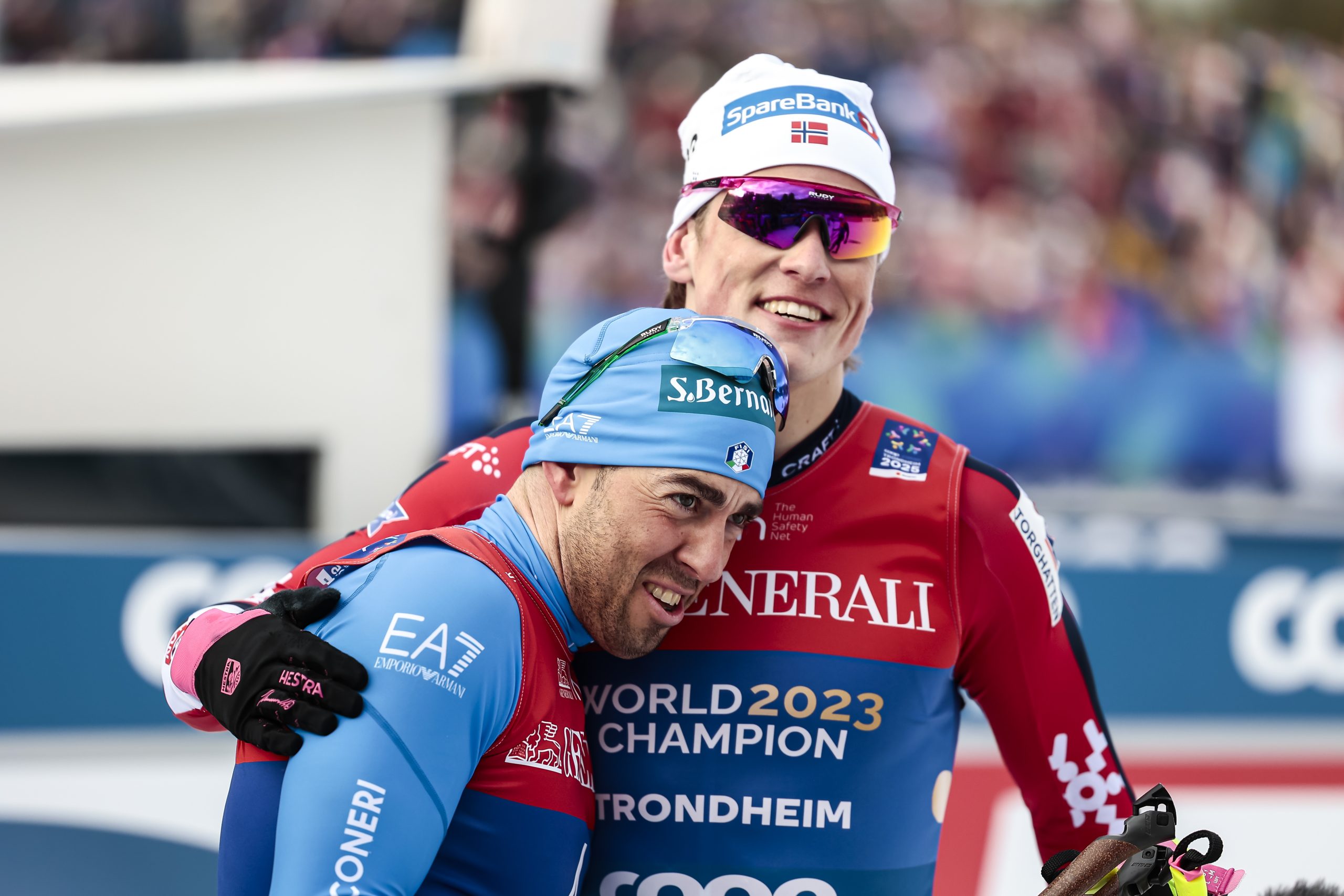
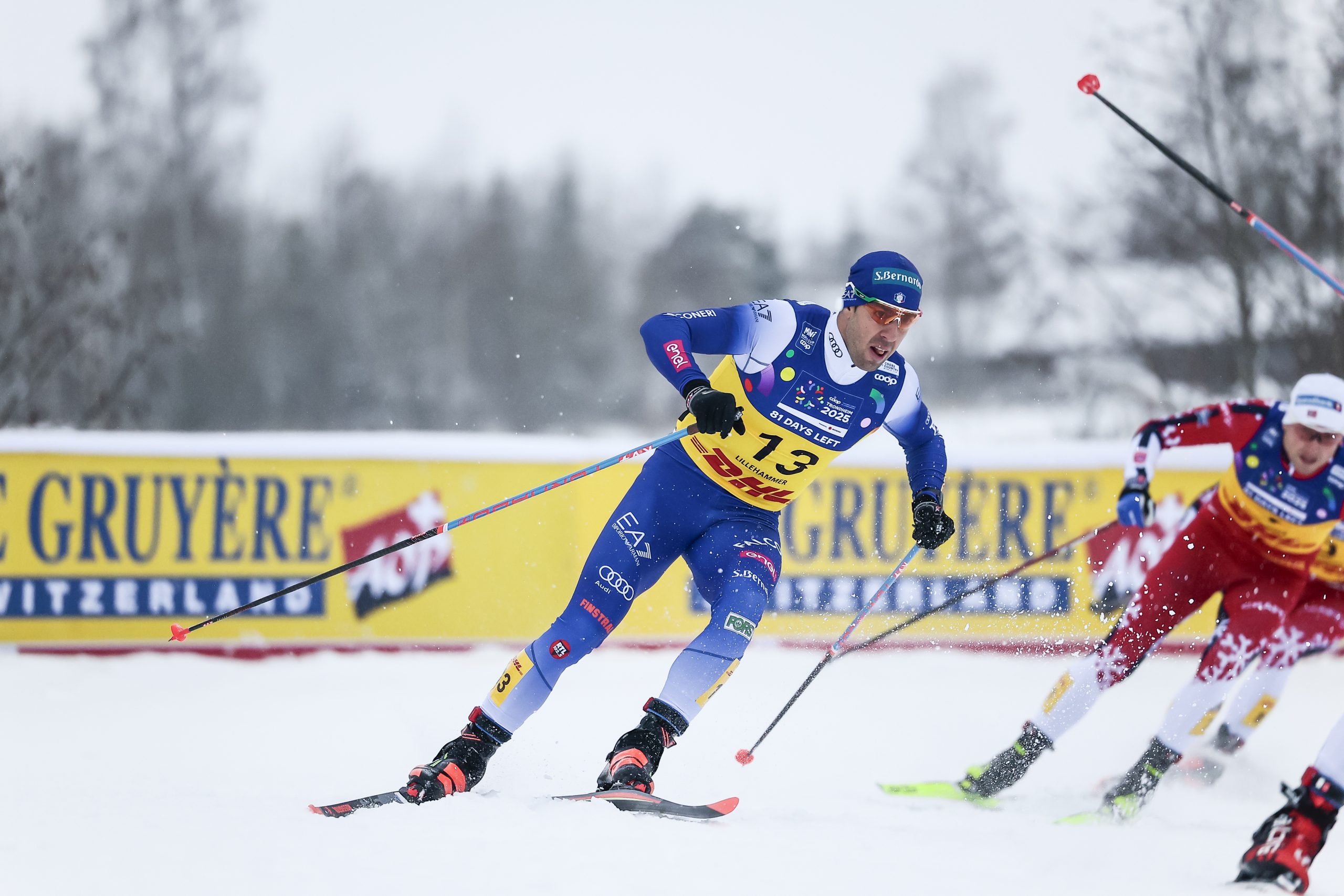
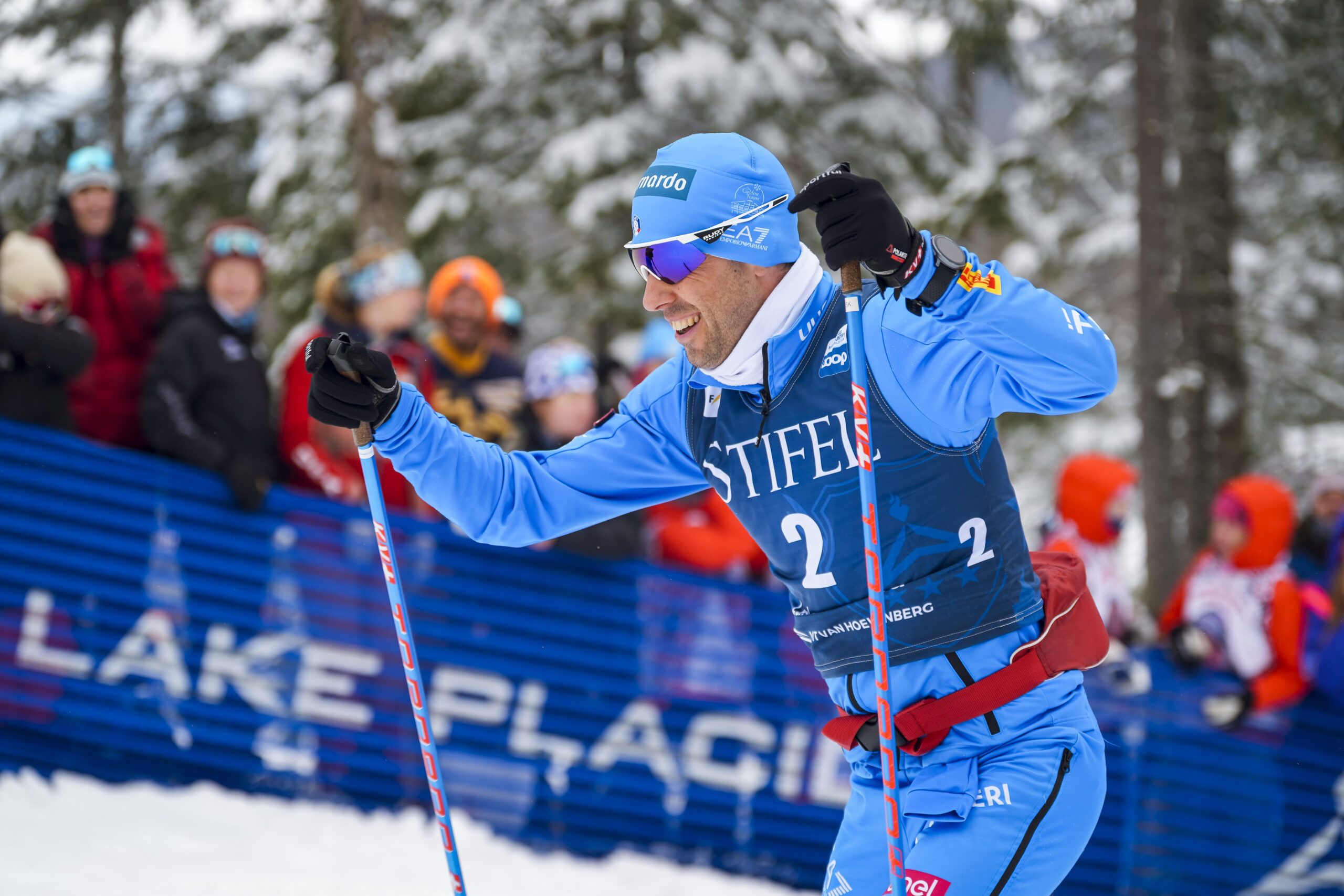
    Federico Pellegrino (ITA) during warmup, hearing his name called by the joyous crowd lining the course in Lake Placid. It was the beginning to a tremendous day, and the final Sprint victory of his glorious career. (Photo:  Thibaut/NordicFocus.)

    “The energy that I got in the warmup lap . . . I got this feeling of power from the public,” said Federico Pellegrino.”Cheering for me. “Chicco Pelle! Chicco Pelle! And then in the Final, I could not wait!”

    Though this race—this glorious victory— came at the end of a long and illustrious career, Pellegrino was true to his word. He could not wait. He blazed off the front of a complex and contact-filled Freestyle Sprint final to storm to the 18th win of his World Cup career—his 46th podium. He had won silver and bronze medals in front of his countrymen at the Olympics of Milano-Cortina just a few weeks ago. Perhaps this final victory in front of the cheering throngs of Mt. Van Hoevenberg was sweeter, still.

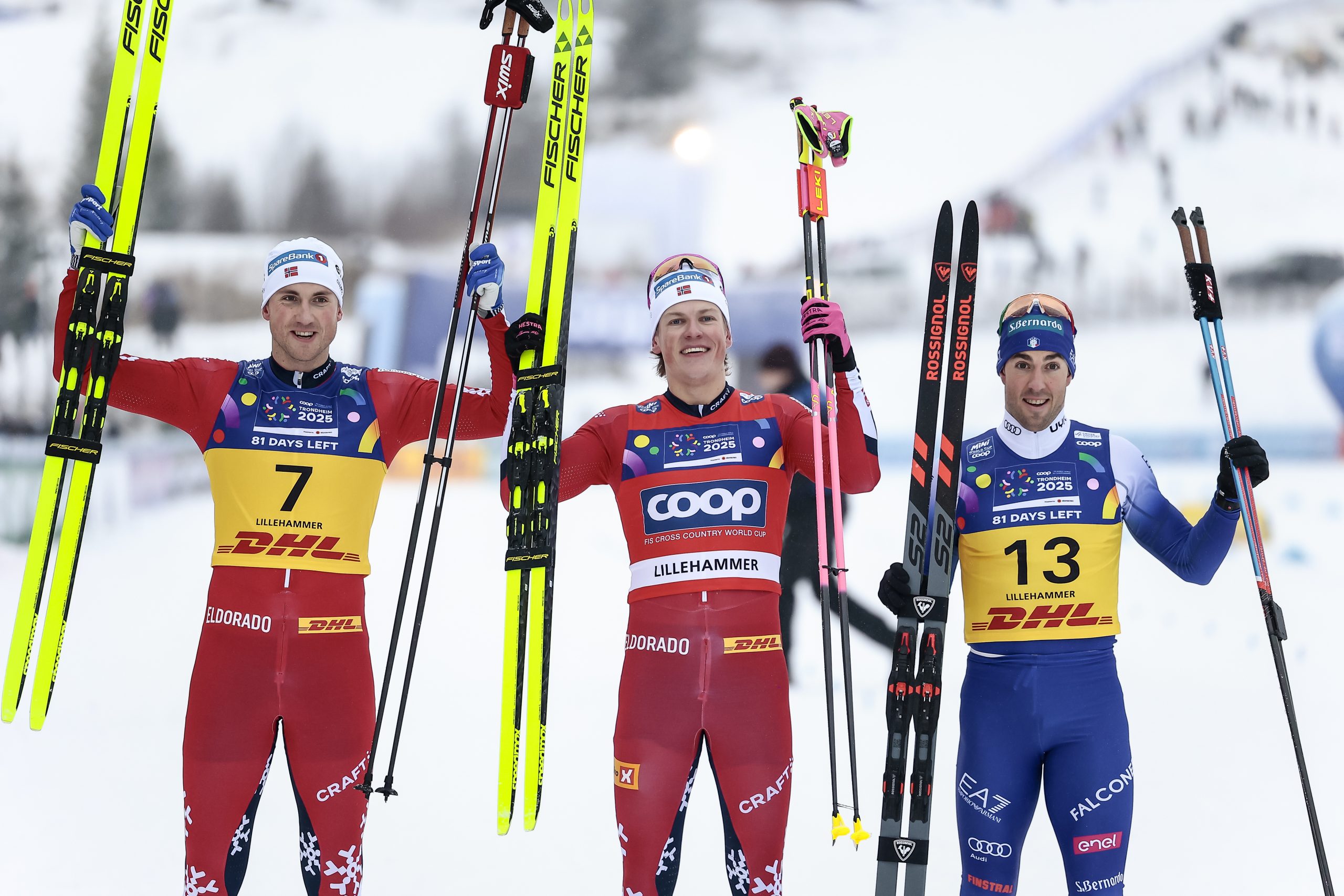
    Pellegrino was joined on the podium by Lars Heggen (NOR) and Anton Grahn (SWE), two young guns who may represent the future of the sport. But Pellegrino showed he was not yet ready to allow the great names of the past to be forgotten. One last Sprint victory, and one more chance to show his appreciation to an appreciative crowd.

    “Thank you Lake Placid,” smiled Pellegrino. “It was great!”

    Lars Heggen (NOR) may see himself as the heir apparent, the sprinter most likely to triumph when Klaebo is away. That may soon be true . . . just as soon as Federico Pellegrino (ITA) retires. (Photo: Thibaut/NordicFocus)

    A World Cup Sprint without Klaebo is two things at the same time: both a lot less interesting, and a lot more interesting. When Klaebo is in the Sprint field, Klaebo will win, won’t he? So what does it mean when Klaebo is absent? It means almost anyone can win. And with only the World Cup Distance championship remaining to be defended (in a close race with Harald Oestberg Amundsen), Klaebo elected to sit out the Freestyle Sprint . . . marking perhaps the only time that Klaebo has been able to watch an entire World Cup Sprint competition from the sidelines.

    “It’s not very often that you have the races (in the USA),” said Klaebo. “And it’s always fun—I mean it was amazing when we were in Minneapolis a couple of years ago, and I’ve been looking forward to this race for a long time. With what happens last week, (coming to Lake Placid) was a little bit uncertain. I’m really happy that I made it, and happy that I made it to the starting line.”

    “The Americans really know how to make noise and a good atmosphere,” said Klaebo of the Mt. Van Hoevenberg crowds lining the 10 k course on Friday. “It was cool!”

    “I think it’s the right decision to skip the (Sprint on Saturday),” said Klaebo. “Hopefully I will be back at it again on Sunday with enough energy to be able to fight.”

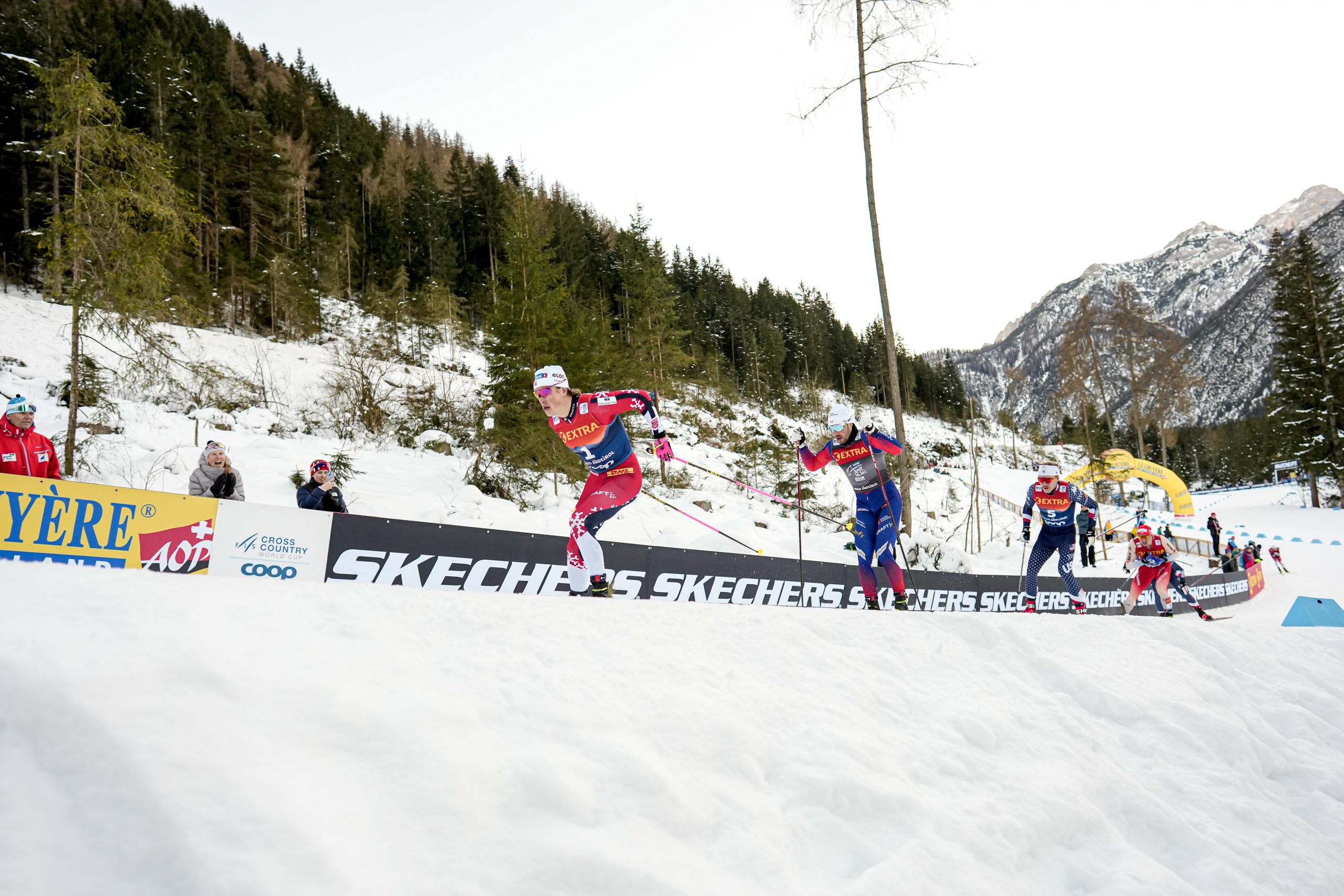
    JC Schoonmaker (USA) was the top American among five who qualified for Lake Placid’s Freestyle Sprint quarterfinals. He would put together a fine set of performances, advancing to the semifinal and finishing the day ninth. (Photo:  Thibaut/NordicFocus)
    Freestyle Sprint Heats

    Team USA would qualify five skiers into the quarterfinals: Gus Schumacher, Ben Ogden, Jack Young, JC Schoonmaker, and Zanden McMullen. Schumacher, Ogden, and Young delivered especially eye-popping qualifying efforts: fourth, fifth, and sixth,  respectively. While Americans would ski their way into the quarterfinals, it was not to be the Americans’ day.

    Schumacher caught his pole in the start gate and immediately surrendered ten meters to the field, but an initial slow pace in the heat allowed him to catch up quickly, and to surge forward into third position. Schumacher followed early leaders Benjamin Moser (AUT) and Anton Grahn (SWE), though it was Lars Heggen (NOR) sitting quietly mid-pack that should have occupied everyone’s attention. Heggen was badly positioned mid-race, pinched out of a spot to advance on the climb, and found himself at the very back. Schumacher was pushed wide on the final turn while Heggen masterfully weaved far inside, squeaking past to fuel his dash down the final straightaway. Heggen would finish second (behind Grahn) while Schumacher would find himself fourth. Schumacher’s time would not hold up as a lucky loser. He would finish the day in 21st.

    Quarterfinal 2 had Ogden lining up beside his teammate, McMullen, and with the legend, Federico Pellegrino. Loud cheers greeted the announcement of the Americans as Ogden waved to the crowd. The heat would be paced by Roman Alder (SUI) with Ogden and Pellegrino waiting patiently for the pace to settle. Pellegrino and Ogden vied for the lead at the top of the final uphill, but neither of them really wanted it. They baited Alder back into the lead, and prepared to take advantage of his slipstream on the descent. Pellegrino showed why he is a legend in the sport, weaving through the field and into the lead as he crossed the line. Ogden showed that he may still have much to learn as he skied himself into dead ends in the finishing straightaway, fading to fourth behind McMullen. McMullen would finish the day 15th, Ogden 17th.

    Chanavat led out Quarterfinal 3; a typical tactic for Chanavat, though one that has always found itself to be ineffective against Klaebo. But Klaebo wasn’t here today . . . and no one other than Chanavat really seemed to have a plan. Counter-punching in Sprint heats can sometimes result in advancement, but it rarely results in victory. It looked like Chanavat would have the advantage. Behind him, Schoonmaker scrubbed too much speed in the hairpin turn, finding himself dropped by the acceleration of Jir Tuz (CZE) on the significant downhill. Chanavat gave chase, and the heat was all but decided. Chanavat would step out of the draft and into the lead. Tuz would follow him across the line with Harald Oestberg Amundsen claiming a lucky loser spot. Schoonmaker would finish fourth in the heat, sitting in a hopeful lucky loser position with two heats remaining.

    Sasha Masson (CAN) set the pace in Quarterfinal 4, but found himself overtaken in the final curves. Eric Johansson (SWE) and Even Northug (NOR) would advance.

    Quarterfinal 5 pitted Young against Ansgar Evensen (NOR) and Jaume Pueyo (ESP). Young would drop to the back in the opening meters, but forced his way forward by the top of the first uphill. He found an open lane on the next uphill, but may have spent too much energy advancing. Young entered the final downhill in second position, but he would fade in the final straightaway, finding himself overtake by Pueyo and Evensen. Young would end the day in 13th place.

    Semifinals

    Schoonmaker followed Chanavat, Pellegrino, and Heggen into the first semifinal, where he would mark Heggen at the rear. Maybe patience would be the righ tactic? At thefront, Chanavat drove the pace, duking it out with Pellegrino on the uphill. Grahn, Heggen, and Pellegrino would all lunge at the line in a photo finish as Chanavat faded into a lunge for fourth with Schoonmaker. Ultimately, the lucky loser spots would belong to Pellegrino and Chanavat. Schoonmaker would finish ninth on the day.

    The second semifinal was led by Johansson, who was shadowed by Evensen and Amundsen. Pueyo, Northug, and Tuz trailed the field. Johanssen and Amundsen would advance at the line.

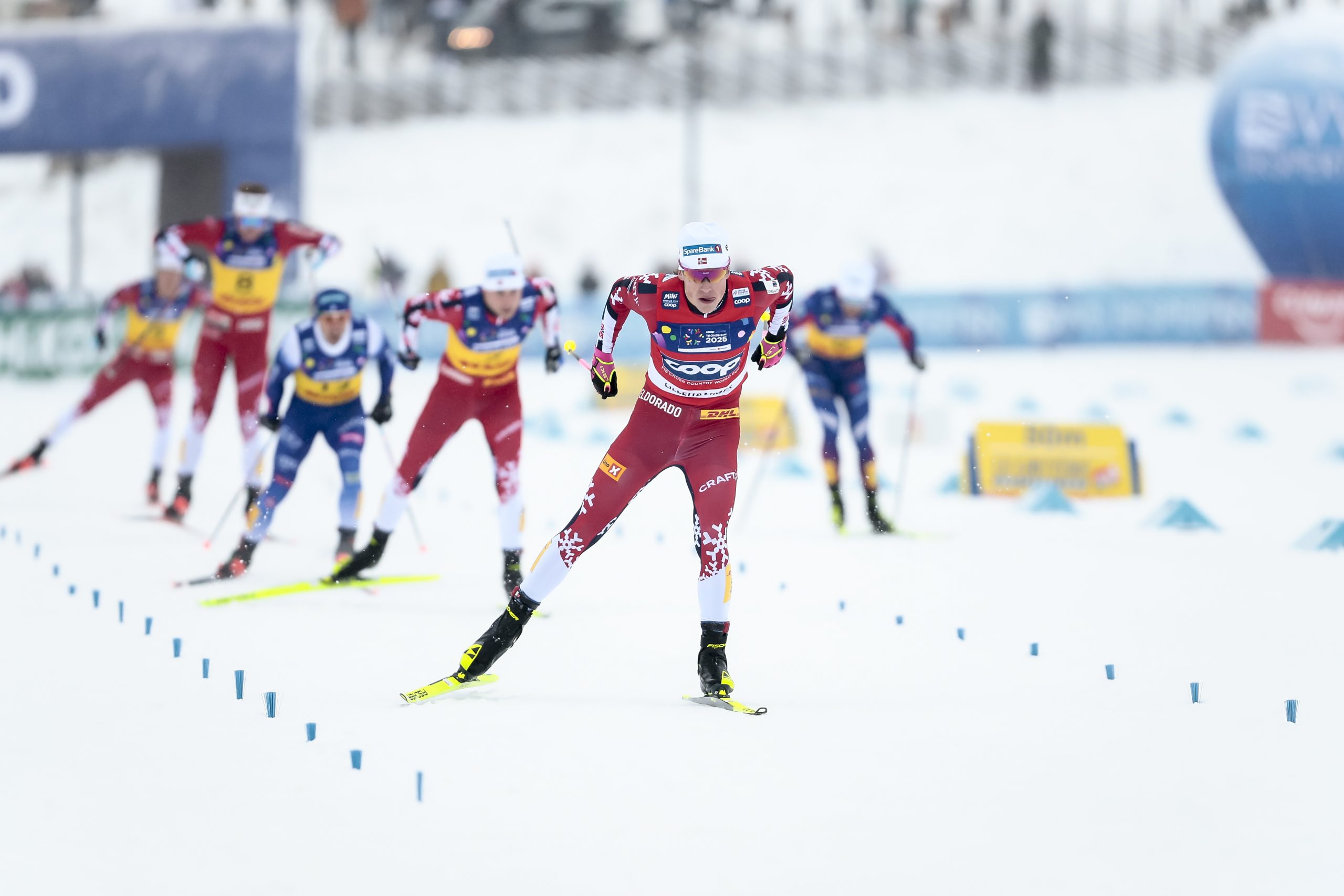
    Federico Pellegrino (ITA) came storming into the finish area al alone. The crowd let him know who their favorite really is. (Photo: Modica/NordicFocus)
    Sprint Final

    The Sprint final offered an excellent non-Klaebo lineup: Grahn, Johansson, Heggen, Amundsen, Pellegrino, and Chanavat.. The veterans (those likely to have a plan), Chanavat and Pellegrino, had advanced as lucky losers. Would they be fast enough to contend? The Norwegians featured a proven sprinter in Heggen with a points-hungry all-rounder in Amundsen. Sweden brought two young skiers eager to upset Norway’s podium pitch. And the starter’s pistol revealed how easy it is for even the most experienced racers to suffer the most rookie mistakes—Amundsen planted his pole tip on top of his own ski, and collapsed in a tangle in the very first meter of the race. Remarkably, he would jump to his feet and take off in pursuit of the field, which he caught before 30 seconds had elapsed. Amundsen was back in the race, but at what cost?

    At the front, Grahn and Pellegrino set the pace. They were followed by Chanavat who, for once, seemed willing to change his at-the-front tactics. As the climb began, Heggen’s ski tip fouled in Johansson’s binding. The Swede went down, and Heggen lost momentum. The leading three seemed to be getting away where Pellegrino was putting an entire career’s worth of energy to his hop skate up the steepest climb. Power-skating into the final downhill, Pellegrino had created a gap ahead of Grahn that meant the tall  Swede would not benefit from Mt. Van Hoevenberg’s notorious draft. Pellegirno would exult across his final Sprint finish line, capping a brilliant career with one final victory. Heggen would recover to dash forward to claim second, ahead of Grahn in third.

    “This was the way I dreamt, when I was young, to win races,” said Pellegrino. “To end my career in that way was fantastic.”

    World Cup Final Men’s Freestyle Sprint RESULTS

    World Cup Final Men’s Freestyle Sprint QUALIFYING

    Love Stories Like This? Help Keep Them Coming.

    Feature stories like this one take time, access, and care to produce. If you value thoughtful storytelling and independent ski journalism, please consider becoming a Voluntary Subscriber. Your support directly fuels the work we do to cover the people, places, and moments that make our sport special.

    Join the FasterSkier community!

    World Cup racing continues this weekend from Lake Placid and Mount van Hoevenberg:

    Sunday, March 22

    12:30 pm | Men’s 20km Mass Start Free

    2:30 pm | Women’s 20km Mass Start Free

    4:30 pm | ONE LAST LAP w/Jessie Diggins & the Retiring Stars

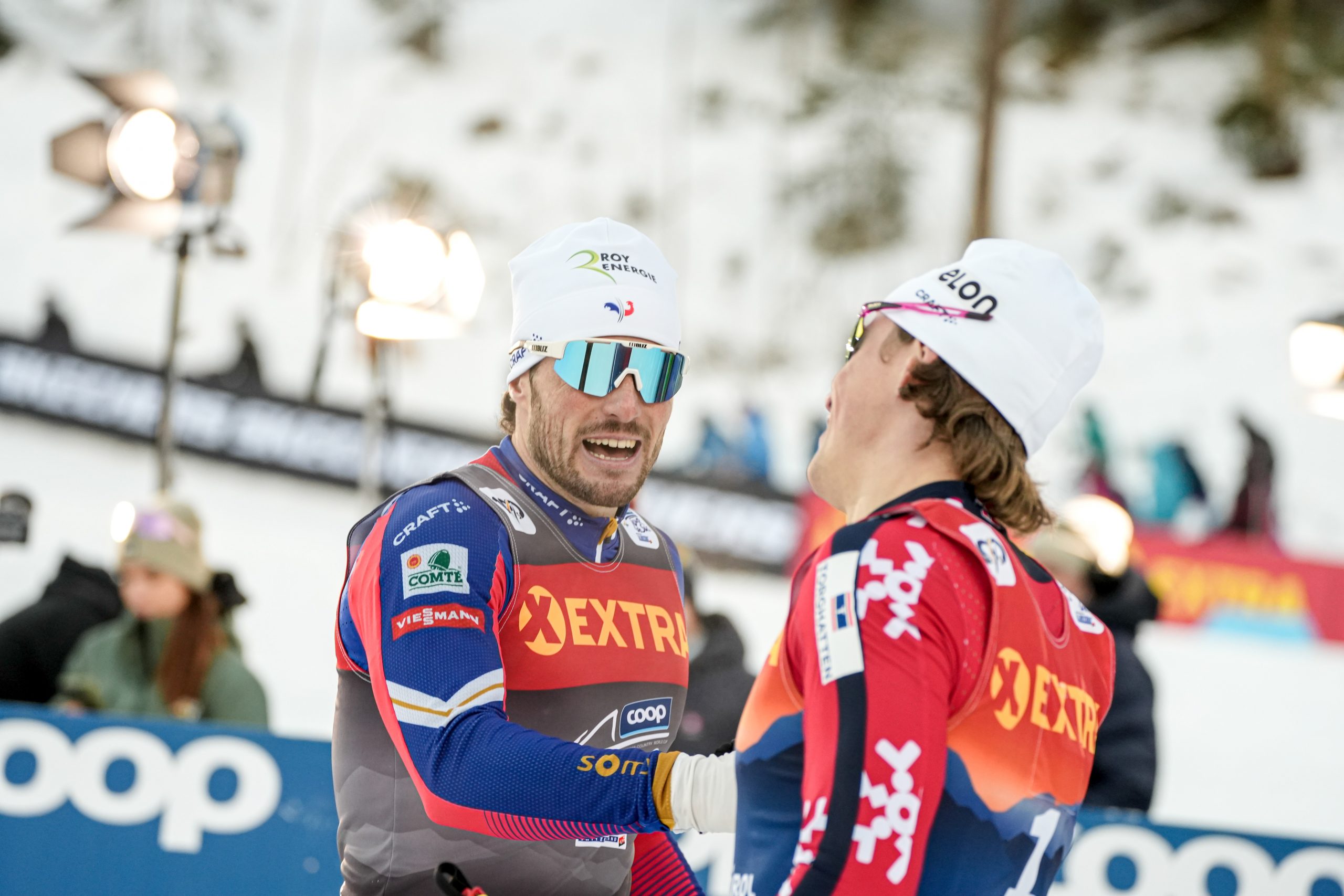
    Chicco Pelle and his fans. Grazie, Federico. (Photo: Thibaut/NordicFocus.)


  • Klaebo Edges Closer to a Season for the Ages in Falun

    Klaebo Edges Closer to a Season for the Ages in Falun

    This coverage is made possible through the generous support of Marty and Kathy Hall and A Hall Mark of Excellence A Hall Mark of Excellence Award. To learn more about A Hall Mark of Excellence Award, or to learn how you can support FasterSkier’s coverage, please contact info@fasterskier.com.

    Johannes Hoesflot Klaebo (NOR) continues his march on a most historic season in Falun, Sweden. (Photo: Authamayou/NordicFocus)

    Six days after the Olympic flame dimmed in Italy, the World Cup caravan reassembled in Falun, Sweden, at the Lugnet cross-country ski center. The Mördarbacken — the famed “murder hill” — still looms over the stadium, waiting to torture the athletes tomorrow. The snow was fast, and the sport’s most dominant man arrived with something bordering on the unthinkable within reach.

    Johannes Hoesflot Klaebo had already swept the Olympic program: six races, six gold medals. He had already conquered the Tour de Ski. He leads the sprint standings. He leads the distance standings. He leads the overall.

    In Falun’s Freestyle Sprint, he resumed his campaign as if nothing had interrupted it.

    And to no one’s surprise, Klaebo won again.

    The victory — tactical, controlled, clinical — pushed his streak forward and kept alive the possibility of something the sport has never seen: a season in which one athlete claims the Olympic sweep, the Tour de Ski title, and all three FIS World Cup Crystal Globes.

    “So interesting watching Klaebo,” FasterSkier’s John Teaford observed. “In the semi, he had Chanavat in front, so Klaebo went wide to force him into the lead. In the final, Chanavat was already there, so Klaebo took the inside to shut down Heggen. He’s racing, everyone else is just reacting.”

    On a course where lane choice and downhill drafting often matter more than raw power, Klaebo once again skied as if he had solved the puzzle in advance.

    Johannes Hoesflot Klaebo (NOR) gets his quarterfinal started. (Photo: Thibaut/NordicFocus)
    The Course That Punishes Hesitation

    Lugnet’s sprint track is deceptively compact — Klaebo won the qualification in 2:33.9 — but it rewards patience and punishes impatience. The downhill into the stadium is long enough to generate devastating draft effects; even if a skier has what seems like a wide enough margin out front, they often get swallowed up.

    Lars Heggen, left off Norway’s Olympic team in favor of Oskar Opstad Vike, skied with visible urgency all afternoon. He had qualified 26th but surged through the rounds, eventually finishing second behind Klaebo in the final. Vike, the Olympic bronze medalist in the Classic Sprint, failed to advance to the finals.

    In a Norwegian program that might be the deepest in skiing history, the margins remain ruthless, and the storyline between Vike and Heggen will continue throughout the rest of the season.

    Gus Schumacher (USA) during qualification. (Photo: Thibaut/NordicFocus)
    Schumacher: Six Olympic Races, Then a Movie Theater

    If Klaebo’s season has been relentless, Gus Schumacher’s has seen both uncertainty and excellence. Schumacher was the only Olympic racer besides Klaebo to start all six events in Italy, culminating in the 50-kilometer classic last weekend.

    His recovery plan for Falun?

    “I was just chilling,” Schumacher said afterward. “I didn’t ski Sunday or Monday. Tuesday, I went skiing for a little bit, but I wasn’t too stressed about the training. The biggest thing was just not doing too much.”

    He went to a movie theater on Tuesday night.

    “Just kind of like doing sort of normal life things,” he said. “Helped with recovery for me.”

    There was no urgency in his tone, no sense of chasing something lost. Instead, he described an emotional decompression that many Olympians quietly experience.

    “All week it’s been a little low,” he admitted. “Today was just nice to go out and race.”

    Schumacher advanced cleanly from his quarterfinal, but the semifinal unfolded differently. His start, he acknowledged, hasn’t been historically a strength.

    “My start has never been that fast,” he said. “So for me to get into a top-four spot early on is hard. I was kind of relying on gaps to open up.”

    But they didn’t.

    “The pace was kind of too high, or it was too wide or both,” he said. “I really should have just pulled up a little bit, embrace sixth until the finish, and then gone fast there.”

    He missed a lucky loser qualification by three-tenths of a second.

    “I’m not super happy with it,” he said. “But the quarterfinal was nice.”

    After the emotional volatility of the Games, including a crash in his opening race, a silver medal in the team sprint with Ben Ogden, Schumacher’s energy felt steadier in Falun.

    “I wouldn’t say I’m digging deep,” he said. “I think I’m just enjoying the ride.”

    After an Olympic training block, Jack Young (USA) is back racing on the World Cup in Falun, Sweden. (Photo: Thibaut/NordicFocus)
    Young’s Gamble

    Jack Young arrived in Sweden with a different story.

    He made the Olympic team but did not earn one of the four U.S. sprint starts in Val di Fiemme. Rather than chase race sharpness, he chose volume.

    “I trained very hard for the two weeks leading up to Falun,” Young wrote us in an email after the race. “The theory was that my speed was really good and I needed a fitness boost to finish out the season well.”

    This may have been a bit of a risk, but one Young was willing to take.

    “I’ve never trained even close to this much volume this close to a World Cup sprint,” he said. “But it seems to have paid off.”

    He did not miss race intensity.

    “In fact, the two weeks of training were some of my favorite weeks of the winter.”

    Young benefited from Filip Skari’s disqualification after he received a second yellow card of the season in the quarterfinals, advancing to the semifinals. There, the course’s tactical nuance intervened.

    “I wanted to ski the corner really well, exit with speed, and hopefully overtake Vike and Ersson right before the course kicks up again,” he said. “I had too much speed out of the corner and passed Vike too early and lost the draft.”

    The mistake was microscopic, but the consequence decisive.

    “Today was hectic but fun,” Young said. “Really cool sprint racing.”

    If there was a change in him, it was mental.

    “This was probably the most locked in I’ve been for a World Cup semifinal,” he said. “I was ready to really race with those guys and try to beat them.”

    For a 23-year-old navigating the narrowest margins in sprint racing, that shift may matter as much as fitness.

    Kevin Bolger, who narrowly missed Olympic selection, qualified for the heats but was eliminated in a stacked quarterfinal that included Klaebo. (Photo: Thibaut/NordicFocus)
    Bolger’s Return

    For Kevin Bolger, the weeks surrounding the Olympics were heavier. Bolger narrowly missed selection for Milan-Cortina, and the emotional toll was real.

    “I mean — at the beginning, life sucked,” he said. “It feels like everything is against you and that I was wronged.”

    He had been to the Olympics before — in Beijing — and that perspective helped, but it did not soften the blow.

    “It still really sucked and hurt a lot,” he said.

    Bolger’s response was simple: train.

    “My motivation was training through that period and hopefully be able to attack these last World Cup weekends. And of course pour my energy into Maja and do what I could to help her get some medals.”

    By the time Falun arrived and the World Cup season got restarted, Bolger felt ready. He knew his quarterfinal would be stacked — Johannes Klæbo among those in the heat — and expected the pace to be high.

    “I was prepared for that,” he said. “I felt great and was mentally ready for the pace.”

    But on a course like Falun — fast, tactical, draft-dependent — ski speed can decide everything.

    “I don’t think I had the most competitive skis in my heat,” Bolger said. “So on a fast tactical course, it’s a bit of an uphill battle. I was hoping to catch the draft coming back to the stadium, but the skis didn’t seem to be running as I’d hoped. But that’s life, and we move on.”

    Bolger did not struggle to keep pace with the athletes racing in Val di Fiemme.

    “It’s not that hard,” he said. “I had a few weekends of racing to help keep the sharpness going and the shape. It always seems to get better when you can actually just get back into a good training routine. And right now I feel like I’m in a great place and just happy to be racing back in the heats.”

    Johannes Hoesflot Klaebo (NOR) climbs  one of the sprint course hills in front of the Swedish fans in Falun, Sweden. (Photo: Authamayou/NordicFocus)
    The Stakes Beyond Saturday

    Klaebo’s victory further tightened his grip on the sprint and overall standings.

    The distance globe remains mathematically alive, though narrowing. The sprint globe appears close to decided, and the overall lead, barring collapse, is substantial.

    What remains compelling is not merely whether Klaebo will win, but whether he will complete something approaching total seasonal dominance.

    Johannes Hoesflot Klaebo (NOR) once again makes it look easy during his win in Falun, Sweden. (Photo: Authamayou/NordicFocus)

    After the Olympics, and the understandable fatigue that would be a result of winning gold in all six races, you might expect Klaebo to take some time off from the World Cup… he did not.

    Klaebo moves forward, and what awaits in Lake Placid, where fans will gather to celebrate the close of the season and Jessie Diggins’ final World Cup start, is the possibility of witnessing something the sport has never seen: a Tour de Ski title, an Olympic sweep, and three Crystal Globes claimed in a single winter.

    In a season already defined by dominance, Klaebo is now skiing toward something that would endure long after the snow melts.


    Falun World Cup Men’s Freestyle Sprint – QUALIFICATION RESULTS

    Falun World Cup Men’s Freestyle Sprint – FINAL RESULTS

    Men’s World Cup – OVERALL STANDINGS

    Men’s World Cup – SPRINT STANDINGS


    Love Stories Like This? Help Keep Them Coming.

    Feature stories like this one take time, access, and care to produce. If you value thoughtful storytelling and independent ski journalism, please consider becoming a Voluntary Subscriber. Your support directly fuels the work we do to cover the people, places, and moments that make our sport special.

    Join the FasterSkier community!


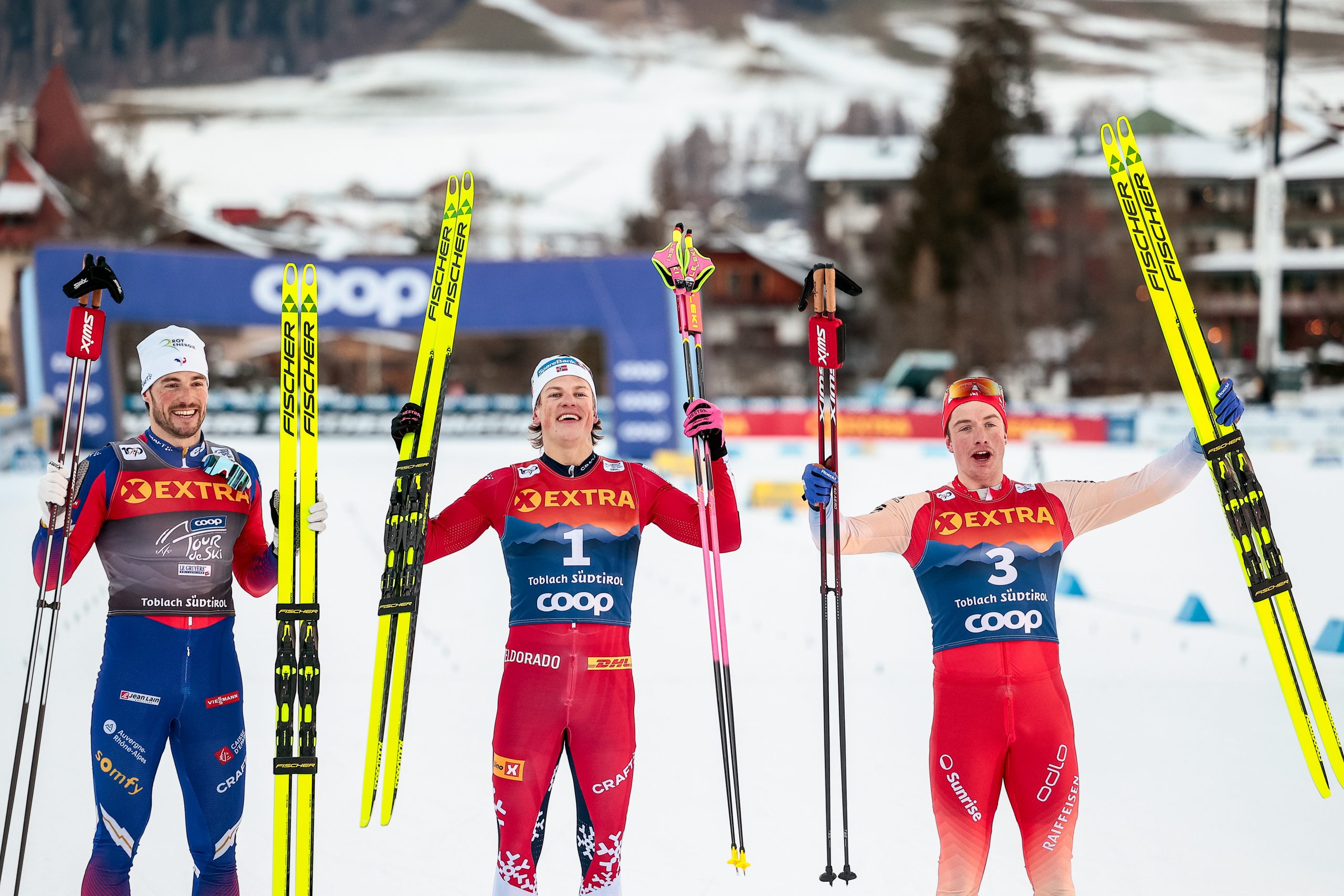
    Lars Heggen (NOR), Johannes Hoesflot Klaebo (NOR), and Benjamin Moser (AUT), (l-r) share the Freestyle Sprint podium in Falun, Sweden. (Photo: Authamayou/NordicFocus)
  • Oberhof Freestyle Sprint—Lars Heggen Proves His Point

    Oberhof Freestyle Sprint—Lars Heggen Proves His Point

    This coverage is made possible through the generous support of Marty and Kathy Hall and A Hall Mark of Excellence Award. To learn more about A Hall Mark of Excellence Award, or to learn how you can support FasterSkier’s coverage, please contact info@fasterskier.com.

    Lars Heggen (NOR) overpowered the field in Oberhof, but many of the world’s best sprinters—his Norwegian teammates—were absent from the day’s racing. (Photo: Authamayou/NordicFocus)

    Some day, Norway won’t be the only force in Men’s World Cup cross-country skiing. Some day, the participation of other nations will truly matter. Other nations will hear their anthems played, other skiers will excel, other results will be cited and praised. Some day, France may figure it out, or Finland may remember its heritage, or Sweden may return to prominence. The USA may identify another Bill Koch, or Italy another Pellegrino, or Switzerland another Cologna, or Russia another Bolshunov. Some day, the podium of the Men’s Cross-Country Skiing World Cup will not be decorated exclusively in Norwegian flags. While that’s not yet the cross-country skiing world that we live in, it is this upcoming World cup weekend in Oberhof where we expect to witness a kind of “It’s A Wonderful Life” view of Nordic skiing . . . the chance to see what the world would be like without them.

    France stayed home from Oberhof, presumably for national championships and team selections of their own. But everyone else is here, hoping to add to their World cup résumés with some of the scraps left on the tablecloth by absent Norwegians. Finland has sent its best (their Sprinters, anyway), and Sweden (in Norway’s absence they could make a splash), and the Italians (Federico Pellegrino and Elia Barp will see their chances to capture glory). The Czechs and the Swiss are here as well, hoping to grab World Cup distinction while the Norwegians are at home. And Team USA has sent it’s own hungry skate-sprinters, as well. Ben Ogden and Jack Young will be vying to return to the finals . . . even to imagine standing atop the podium (dare we say). JC Schoonmaker will be desperate to prove he belongs on the team that marches into Milano-Cortina. Gus Schumacher will be itching to prove that he and Ogden make a compelling Team Sprint team. There’s a lot going on . . . the same sort of drama that goes on every single week of the World Cup season, but no one really notices it because we’re so distracted by the Norwegian that tsunamis through every World cup venue.

    And where’s Norway? Well, Norway has more important business to attend to. World Cup wins, World Cup podiums, World Cup points: those are every-week occurrences for ski-crazy Norway. But 2026 is an Olympic year . . . the big prizes will be awarded at the Games of Milano-Cortina. So, this weekend in Oberhof, Norway sends stand-ins while the true contenders refine their technique or taper their training, or just put their feet up for a few hours before the headlong streak toward Norwegian immortality in Milano-Cortina continues.

    The elder Northug bother—Petter—was one of Norway’s greatest champions, but even he faced disappointment when it came to Olympic qualification. If Lars Heggen fails to make the team for Milano-Cortina, he will understand the parallels between his pain, and Northug’s. (Photo: Nordnes/NordicFocus)
    Norway Still Expects to Win

    Lars Heggen (NOR) is 20 years old . . . and he just dominated the Sprint competitions at the recent Norwegian Nationals. Granted, a number of Norway’s very best Sprinters weren’t there (no Klaebo, no Valnes, no Amundsen), but Heggen made enough of an impression that many Norwegian ski-pundits called for his immediate elevation to the Olympic Team. We can assume that Petter Northug was not among that enthusiastic group of pundits . . . especially since a 20-year-old Northug dominated 2006 Norwegian Nationals in an even more commanding manner than Heggen did in 2026. And Northug was unceremoniously denied an Olympic berth because of the selection committee’s assertion that, at only 20, he was too young for the pressures of Olympic competition, that Northug would benefit from more development time before being tossed into the Olympic maelstrom. Northug’s career turned out all right in the end, but it may have been even better if he’d collected another Olympic medal or two at the 2006 Games in Torino.

    Northug’s little brother, Even, competes for Norway in the World Cup Sprint this weekend in Oberhof. Like his brother 20 years ago, Even Northug has already been told that no spot is reserved for him on the Norwegian Team at the upcoming Olympic Games. Well, he’s still a world class Sprinter . . . it will be interesting to see how the younger Northug uses this weekend’s Sprint opportunity to comment on his being the second Northug to have been ignored in his efforts to make a Norwegian Olympic Team.

    But first, you need to qualify . . .

    The top American qualifier in Oberhof, JC Schoonmaker (USA) leading Even Northug (NOR), and Zanden Mcmullen (USA) in their quarterfinal heat. (Photo: . Authamayou/NordicFocus)
    Qualifying

    We don’t know exactly why, but it’s been reported that top 30 in today’s Sprint qualifying will be rewarded with increased FIS World Cup points (nearly double when compared to normal World Cups, or to races in tour de Ski that received only 50% points). It’s a good reason to be at your best in this particular qualifying event . . . and a pretty good way to continue shuffling the deck for numerous nations that are still choosing their Olympic Teams. And while a number of Norway’s best sprinters decided to sit this one out, Norway still manages to dominate most men’s Wold Cup racing. Case in point: six of Norways seven entries qualified for the heats, with Lars Heggen doing the job he was sent to do—winning the qualifier by 1.5 seconds.

    Americans took advantage of this diluted World Cup field with JC Schoonmaker finishing 13th, Jack Young 22nd, Zanden McMullen 28th, Michael Earnhart 35th, Kevin Bolger 44th, Owen Young 54th.

    “The heat selection strategy was definitely a bit different today with a lot of normal World Cup guys not being here,” said Schoonmaker. “I went for heat 1 because that felt like a good one to move on from and it was a better option than usual with  Klaebo not here. Other than heat selection the strategy didn’t differ at all for me, just trying to race my best!”

    McMullen is better known as a Distance skier, but his strong qualifying effort proved his versatility. “I do actually like using sprint races as a bit of a warm up,” said McMullen. “It puts my mind and body into a race mentality that I can’t really achieve on a race prep day. Sprints also typically feel lower stakes to me, so it’s just a nice way to go out and have some fun!”

    Sprint Heats—New Cast, New Strategies

    Skiing can be such a strange sport. Oberhof is a famed biathlon venue; if this were a weekend of biathlon races the grandstands would be packed. As it is, this was a cross-country weekend, and the stadium stood all but empty. The German fans who could’ve been here definitely missed a good show, and a fair indication of what the future of what World Cup Sprint events may look like in the near future. Even with a number of bright stars missing from the days entry list, the racing proved fast and furious.

    There was a lot going on in Quarterfinal 1: Lars Heggen wearing the green U23 World Cup leaders bib, alongside JC Schoonmaker, Zanden McMullen, and Even Northug. Everybody with something to prove, everybody with something to gain, and only two minutes of Heat 1 in which to do it. Schoonmaker led through the early parts of the course, but faded by mid-race. Heggen accelerated up the hill before the finish, sufficiently gapping his rivals and easing up before the finish line which he was followed across by a scrambling Even Northug. McMullen would finish fourth in the heat, followed by Schoonmaker in fifth. On the day, McMullen and Schoonmaker would finish 20th and 23rd, respectively.

    Pellegrino advanced out of Quarterfinal 2 in which Jack Young’s day would end with a fifth place heat finish. Young had led early in the quarterfinal, evidently hoping to press the pace in the hopes of advancing as a lucky loser. His strategy was bold, but it left him one place short. Young would finish 24th on the day.

    “I wanted to get to the front and control the race,” said Young. “Sadly, I wasn’t able to hold my position into the big climb—this wasn’t part of the plan. I then made up sole ground, but I didn’t have the energy to hold my position through the working finish.”

    Semifinal 1 included Heggen, Pellegrino, and Northug who all came in together at the bottom of the final climb. Heggen would V2 the entire climb, while Pellegrino switched to a high-tempo V1 to scoot past into the hole-shot. Northug faded as Lauri Vuorinen (FIN) edged into the top three. Pellegrino would coast across for the heat win, followed by Heggen’s lunge for second ahead of Vuorinen in third and Northug fourth. Those lucky losers would sit and wait for the results of the second semifinal.

    That second semifinal included one well known Sprinter—Switzerland’s Valerio Grond—who was joined by a cast of names we’re less accustomed to hearing: Filip Skari (NOR), Jaume Pueyo (ESP), Emil Liekari (FIN), Jiri Tuz (CZE), and Martino Carollo (ITA). Grond would finish second in the heat behind Liekari to advance to the final. Vuroinen and Northug—lucky losers from Semifinal 1—would advance as well.

    Federico Pellegrino (ITA) used a high-tempo V1 to position himself on the steep uphill of Oberhof’s Sprint course. But Heggen’s V2 would prove stronger. (Photo:  Reichert/NordicFocus)
    Plenty at Stake in the Final

    In the absence of truly dominant skiers, no one really knows what to do. The Sprint Final would become a bit of a curiosity as Heggen hoped to solidify his Olympic credentials . . . but Northug would be harboring similar plans of his own, and they’d both need to figure out how to deal with the cagey veteran, Pellegrino. In the final, Heggen and Pellegrino went to the front to control things, but neither looked eager to really drive the pace. Both the leaders chose the far-right line up the first climb as Liekari spun his wheels in the loose snow on the inside line. That was the point at which Grond took control, charging over the top of the climb. But Heggen’s fast skis could not be contained onthe subsequent downhill. He coasted easily into the lead, followed to the base of the final climb by Pellegrino and Northug. The final hill had offered a contrast in styles all day: Heggen’s V2 power vs. Pellegrino’s V1 tempo. This time up the hill, it was Heggen’s strategy that proved strongest, fending off Pellegrino’s V1 charge and holding on across the finish line for his first World Cup win. Northug would cross the line in third, a fine World Cup finish that was likely to be overlooked in Norway’s construction of its Olympic roster.

    The 20 year old upstart bested the 35 year old veteran. The question that remained was this: was the Norwegian Olympic Team Selection Committee watching?

    Oberhof World Cup Men’s Freestyle Sprint RESULTS

    Oberhof World Cup Men’s Freestyle Sprint QUALIFYING

    The Men’s Freestyle Sprint Podium in Oberhof—Federico Pellegrino (ITA always contends, Lars Heggen (NOR) hopes he proved his point, Even Northug (NOR) left wondering if anyone had noticed. (Photo: Authamayou/NordicFocus)


    Love Stories Like This? Help Keep Them Coming.

    Feature stories like this one take time, access, and care to produce. If you value thoughtful storytelling and independent ski journalism, please consider becoming a Voluntary Subscriber. Your support directly fuels the work we do to cover the people, places, and moments that make our sport special.

    Join the FasterSkier community!
  • Klaebo Controls Toblach as Schumacher Anchors the Chase in Men’s 20 k Classic Pursuit

    Klaebo Controls Toblach as Schumacher Anchors the Chase in Men’s 20 k Classic Pursuit

    This coverage is made possible through the generous support of Marty and Kathy Hall and A Hall Mark of Excellence Award. To learn more about A Hall Mark of Excellence Award, or to learn how you can support FasterSkier’s coverage, please contact info@fasterskier.com.

    Johannes Hoesflot Klaebo (NOR) paced the Tour de Ski 20 K Classic in Toblach (ITA) to perfection. (Photo: Vanzetta/NordicFocus)

    By mid-morning in Toblach, the cold had settled into the valley in that particular Dolomite way—dry, bright, and unforgiving. The stadium clock read 10:30 a.m., the tracks were hard-packed, and the Tour de Ski—never gentle, always exacting—had reached a moment where patience mattered as much as power. Stage 4’s men’s 20-kilometer classic pursuit would not be decided by theatrics. It would be decided by discipline.

    From the first push out of the starting line, Johannes Høsflot Klæbo made that clear.

    The Norwegian leader skied as if tethered to an internal metronome, clicking off splits that barely wavered across five laps of the 4-kilometer loop. Behind him, the race congealed into a dense, minute-long chase—ambitious but realistic, orderly but never comfortable. Inside that group, Gus Schumacher did what pursuit racing rewards: work when it mattered, wait when it didn’t, and finish inside the race rather than on its margins.

    Johannes Hoesflot Klaebo (NOR) on his way to first place on the 20 K Classic Pursuit. (Photo: Vanzetta/NordicFocus)

    Klæbo’s Quiet Authority

    Klæbo entered the day with the yellow bib and skied as though intent on keeping it uncontested. At 4 kilometers, he led in 9:11.8; at 8 kilometers, 18:23.4; at 12, 27:34.6; and at 16, 36:53.3—the first three splits almost exact to the tenth. He crossed the line in 46:01.7, never once letting the chase compress to a threatening distance.

    Second place belonged to Mattis Stenshagen (+51.1), who skied the most assertive race of those behind Klæbo and briefly tested the cohesion of the chase on the fourth lap’s long climb. Third went to Edvin Anger (+59.8), tied on time with Italy’s Federico Pellegrino, whose classic form looked as efficient as it did economical. Emil Iversen finished fifth (+1:00.2), matching Schumacher stride for stride to the line.

    That minute—barely more than a breath in Tour de Ski terms—defined the race.

    Gus Schumacher (USA) did much of the work early to bring the chase into one pack behind Klaebo. (Photo: Vanzetta/NordicFocus)

    Schumacher in the Middle of It

    Schumacher finished sixth, also +1:00.2, part of the decisive chase that refused to fracture even as the course repeatedly asked for answers. The result came less than 24 hours after his 5 k freestyle win in Toblach, and the transition—emotionally and physically—was not trivial.

    “It was a little bit tough, honestly,” Schumacher said. “This pursuit started at 10:30 a.m., and I haven’t woken up before eight in probably a month because all our races have been so late. … I definitely enjoyed the win, but the focus was to refocus right away. It’s another new day, and this race was really important for the Tour.”

    Inside the race, Schumacher was not hiding. He described closing the gap to Iversen after the early climbs and doing much of the work that consolidated the group—an effort he acknowledged with pride. “I did most of that work, which I’m actually pretty proud of,” he said. What he didn’t do was overreach. “I wasn’t trying to catch Klæbo or anything,” Schumacher added. “Even though some of the guys might have been thinking that.”

    The fourth lap told the story. Stenshagen pressed hard on the long climb out of the stadium, stretching the elastic just enough to test resolve. Schumacher bent but didn’t break. Over the top, the group exhaled. The fifth lap came fast—but not frantic—and Schumacher found himself boxed in late, a tactical note he filed away rather than lamented.

    “With the overall standings so tight, I don’t think it’s worth thinking about it too much,” he said. “I’m sitting in third right now, and top ten is definitely still the goal. … Everyone from second through ninth is so close that it really comes down to focusing day by day.”

    That may be the most Tour de Ski answer of all.

    Gus Schumacher (USA), Emil Iversen (NOR), Edvin Anger (SWE), and Lars Heggen (NOR) worked together to prevent Klaebo from extending his lead. (Photo: Vanzetta/NordicFocus)

    A Chase by Committee

    Behind Schumacher, the chase’s cohesion owed as much to restraint as to strength. Lars Heggen (seventh, +1:00.3) and Benjamin Moser (eighth, +1:00.8) rounded out a group that included Harald Østberg Amundsen (ninth, +1:03.1). No one bridged to Klæbo; no one detonated the pack behind. The race’s geometry stayed intact.

    That stability mattered in a Norwegian context. With Olympic selection pressure already humming and only a few men’s spots still unsettled, Toblach functioned as both race and audition. Stenshagen’s second place was emphatic. The Tour does not reward one-off brilliance. It rewards survivability.

    Ben Ogden (USA) finding his classic distance form. (Photo: Vanzetta/NordicFocus)

    The Americans: Process Over Panic

    Further back, the pursuit revealed its less visible truths. Ben Ogden finished 29th (+3:03.3), a result that reads well on paper and even better when you hear how he raced it.

    “The biggest challenge is always the start,” Ogden said. “For me, it was about trying to pace the race properly, even when people were moving ahead of me early. … I started with a pack, then a bunch of them dropped me, and I just kind of let that happen, knowing I’d be able to catch some of them later—which I did.”

    That in-and-out rhythm—sometimes lonely, sometimes crowded—is pursuit racing in the middle of the field. Ogden framed it honestly. “Racing in a tight group is obviously more fun,” he said, “but you really have to pace yourself and try not to lose unnecessary time in a Tour, especially when you’re already a little tired.”

    For Zak Ketterson, who started deep in the order, the early kilometers were chaos by design. He finished 42nd (+3:55.1), but the route there mattered.

    “The wave is really challenging, especially starting in bib 70,” Ketterson said. “Five or six seconds have already passed before I even reach the start line. The first two laps were chaos, and I was just trying to stay relaxed and avoid trouble.”

    He did move forward—damage control after a Stage 2 crash that had already cost him minutes. “It was nice to move up a lot today,” Ketterson said, “but the classic sprint on Stage 5 is definitely the main focus now.”

    Ketterson also addressed the jury’s written reprimand for use of a banned technique in a marked stride zone—a penalty that did not disqualify him but appears in the official record. “The technique violation came from double poling in a stride zone,” he explained. “I changed tracks to pass someone, and the motion of doing that ended up being a double pole.”

    For Zak Ketterson (USA), the Tour de Ski hasn’t exactly gone as he had hoped, but today in the pursuit, he showed his form from earlier in the season. (Photo: Vanzetta/NordicFocus)

    When the Day Turns on a Ski

    Kevin Bolger finished 51st (+4:18.6), a result shaped by circumstance rather than strategy. Bolger had been patient by design, content to let early red-lining pass him by before advancing after lap two. Then a ski broke.

    “I like to settle in, and then after lap two start working my way up the field,” Bolger said. “I was just about to do that today when someone merged into my track and broke my ski, which cost me close to a minute. That was pretty disappointing.”

    Before that moment, his choices had been sound. Toblach’s two main climbs invite early commitment to kick wax, and Bolger leaned into it. “It was an easy choice to really feel the kick wax early,” he said. “The skis were feeling great, and I was really excited about how I was going to start moving up the field.”

    Bolger’s broader view was measured, almost cheerful in its realism. “This Tour isn’t quite as massive as some of the past ones,” he said. “It’s about gaining confidence and fitness, as long as you’re able to absorb it after the Tour.” Olympic energy is present, he acknowledged, but not consuming. “At the end of the day, I’m just trying to race fast.”

    J.C. Schoonmaker placed 56th (+4:42.7), while Jack Young finished 80th (+8:07.2), both navigating a day where patience was mandatory, and opportunities were earned in inches rather than meters.

    Andrew Musgrave (GBR) and Antoine Cyr (CAN), (l-r) moving up through the field together. (Photo: Vanzetta/NordicFocus)

    Canada: Trials Done, Work Ongoing

    Canada’s men arrived in Toblach with their Olympic trials already behind them and the Tour serving a different purpose. Antoine Cyr led the way in 13th (+1:54.5), with Thomas Stephen 28th (+3:02.6) and Xavier McKeever 30th (+3:08.1). The emphasis now is accumulation—fitness, familiarity, resilience—rather than immediate results.

    Context at the Margins

    The Tour de Ski has a way of narrowing options without warning. On Thursday morning, one Norwegian men’s Olympic hopeful, Oskar Opstad Vike, withdrew close to start time, a reminder that the margins between readiness and retreat are thin, especially in an Olympic year. Toblach did not create that pressure; it merely revealed it.

    Mattis Stenshagen (NOR) was excited when he crossed the finish line as if he knew he had shown the Norwegian Olympic selectors enough to make the team. (Photo: Modica/NordicFocus)

    What the Splits Say

    A look at the time checks explains why the race felt so controlled. Klæbo’s advantage barely fluctuated. The chase group’s gaps among themselves were measured in seconds—Schumacher, Iversen, Anger, and Pellegrino trading fractional advantages without a decisive rupture. Further back, time losses accrued not in dramatic collapses but in quiet inefficiencies: a missed pack, a broken ski, a moment of over-enthusiasm.

    The course profile—five laps, 137 meters of total climb—rewards restraint. Toblach does not forgive impatience.

    A broken ski for Kevin Bolger (USA) didn’t prevent him from showing his form in Toblach (ITA). (Photo: Vanzetta/NordicFocus)

    Looking Ahead

    Stage 4 did not reshuffle the Tour so much as clarify it. Klæbo remains the reference. The men chasing him know exactly how much ground they have—and how little room there is to gamble it away. Schumacher’s position near the top of the standings is real, earned through effort and discretion. Behind him, athletes like Ogden, Ketterson, and Bolger are racing a Tour that asks for perspective as much as speed.

    Val di Fiemme awaits with its own demands and, this year, Olympic resonance. But Toblach offered a simpler lesson. In a pursuit, the clock is visible; the choices are not. The best skiers make the hard ones look easy—and the easy ones count.

    Men’s 20 K Classic Pursuit Start RESULTS

    Men’s 2026 Tour de Ski OVERALL STANDINGS

    Fastest Skiers on the Day – Men (Top 15, Net Time Only)

    This ranking removes pursuit start gaps and shows who skied the fastest 20 km classic on Stage 4.

    Day Rank Athlete Nation Net Time
    1 Edvin Anger SWE 45:39.5
    2 Simen Hegstad Krüger NOR 45:44.0
    3 Federico Pellegrino ITA 45:45.5
    4 Mattis Stenshagen NOR 45:51.8
    5 Emil Iversen NOR 45:51.9
    6 Gus Schumacher USA 45:52.9
    7 Truls Gisselman SWE 45:58.5
    8 Antoine Cyr CAN 45:59.2
    9 Hugo Lapalus FRA 46:00.5
    10 Johannes Høsflot Klæbo NOR 46:01.7
    11 Benjamin Moser AUT 46:03.5
    12 Savelii Korostelev AIN 46:04.5
    13 Harald Østberg Amundsen NOR 46:07.8
    14 Andrew Musgrave GBR 46:13.6
    15 Lars Heggen NOR 46:17.0

    Net time calculated as finish time minus individual pursuit start offset.

    Places 3-7 where this close for Federico Pellegrino (ITA), Edvin Anger (SWE), Gus Schumacher (USA), Emil Iversen (NOR), (l-r) after 20 K in Toblach (ITA). (Photo: Modica/NordicFocus)

    Love Stories Like This? Help Keep Them Coming.

    Feature stories like this one take time, access, and care to produce. If you value thoughtful storytelling and independent ski journalism, please consider becoming a Voluntary Subscriber. Your support directly fuels the work we do to cover the people, places, and moments that make our sport special.

    Join the FasterSkier community!


    Mattis Stenshagen (NOR), Johannes Hoesflot Klaebo (NOR), and Edvin Anger (SWE), (l-r) shared the pursuit podium in Toblach (ITA). (Photo: Modica/NordicFocus)


  • Schumacher Wins in Toblach as New Four-Heat 5K Format Turns the Race into a Clock-Chasing Puzzle

    Schumacher Wins in Toblach as New Four-Heat 5K Format Turns the Race into a Clock-Chasing Puzzle

    This coverage is made possible through the generous support of Marty and Kathy Hall and A Hall Mark of Excellence Award. To learn more about A Hall Mark of Excellence Award, or to learn how you can support FasterSkier’s coverage, please contact info@fasterskier.com.

    Gus Schumacher (USA) and the rest of Heat 2 climb over Toblach’s iconic feature during the 5 K Freestyle. (Photo: Modica/NordicFocus)

    The Tour de Ski has always asked skiers to live with imperfect information. You race hard when you’re tired. You make decisions based on feelings and instincts, while coaches are screaming ‘splits.’ You tell yourself the only honest thing in a stage race: don’t do anything you can’t recover from tomorrow.

    On Wednesday, the Tour leaned fully into that uncertainty — and then amplified it.

    Stage 3, a 5-kilometer freestyle, arrived with a new wrapper: four separate mass-start heats, each sent off at a different time, with final standings determined only after all heats were complete and all times were combined. The spectacle was real — a small parade of high-speed skating races rather than one long pageant — but the competitive implications were sharper than the format’s novelty suggested. Skiers weren’t simply racing the men next to them. They were racing an invisible standard set by athletes they couldn’t see, in heats that could be slower or faster for reasons that had nothing to do with any one skier’s fitness.

    If that sounds like chaos, it wasn’t. Not for Gus Schumacher.

    Schumacher (USA) didn’t treat the new format as a novelty or a gamble. He treated it like a solvable problem — and in doing so, he won the stage in 9:35.4, claiming the second World Cup victory of his career and stamping his authority on a Tour de Ski day that felt, at times, like a controlled experiment.

    Behind Schumacher, Austria’s Benjamin Moser was second (+0.2), and Norway’s Lars Heggen — the U23 skier who helped turn Schumacher’s heat into a metronome — was third (+0.6).

    And here is the detail that will define how this stage is remembered: the top seven overall finishers all started in the same second heat, the heat that began at 11:48:45. In a race decided on aggregate time, that start time became a kind of gravitational center — the heat where cooperation, pace, and intention converged into the day’s fastest runway.

    Ben Ogden (USA), JC Schoonmaker (USA), Remi Drolet (CAN), and others follow Johannes Hoesflot Klaebo (NOR) during the third heat of the 5 K Freestyle. (Photo: Modica/NordicFocus)

    The Format: Four Races, One Result — and a Quiet Incentive to Collaborate

    The four start times — 11:30:00, 11:48:45, 12:07:30, and 12:26:15 — didn’t just separate the field. They separated narratives. In one heat, the pace would be relentless and communal; in another, it might be cagey, tactical, or simply a touch less urgent. In a normal mass start, you can afford to be patient. In a normal 5K interval start, you can measure yourself against the clock. On this day, you had to do both — without complete visibility into either.

    U.S. head coach Matt Whitcomb framed it simply: the 5K has been absent from the World Cup menu for long enough that today was “unknown territory,” and athletes had to be ready to adapt. “Nobody really knew what to expect,” he said — not because the course was mysterious, but because the format forced a different kind of decision-making.

    Whitcomb also emphasized that heat assignments weren’t random theater. They were determined by overall Tour standings after two stages, via a snake-draw system written into the rules — in other words, the groups were structured, and the group you landed in mattered.

    That mattered most in the heat Schumacher found himself in — and, crucially, in the way he decided to race it.

    Gus Schumacher (USA) leads Heat 2 during Stage 3 of the Tour de Ski in Toblach (ITA). (Photo: Vanzetta/NordicFocus)

    Heat 2 Becomes the Day’s Engine

    By the time Schumacher’s heat went off at 11:48:45, the day already had shape: one race had happened, a set of times had been posted, and the Tour’s new experiment had revealed its first truth — you could win your heat and still lose the stage.

    Schumacher and his heat-mates didn’t merely acknowledge that truth. They embraced it.

    “I think my heat-mates and I realized that having a fast heat was the biggest picture,” Schumacher said afterward. “I was prepared to be 10th in the heat if it meant we were fast.”

    That sentence — prepared to be 10th if it meant we were fast — is the kind of thing athletes say when they’re not racing for ego. It’s what they say when they’re racing for an outcome.

    Schumacher described how the plan became practical: “We were able to trade leads also with Ben Moser’s help and keep the pace fast without too much effort before the hills, then actually continued to work together even better than I thought we would from there into the finish.”

    Whitcomb confirmed the same dynamic from the outside: Schumacher “reached out to Lars Hagen and Ben Moser and came up with a plan,” and the result was “well orchestrated trading off of the lead,” the kind of collaboration you don’t often hear described so plainly in a World Cup race. In a typical mass start, you hide. In a typical interval start, you suffer alone. In this format, the fastest solution was neither — it was to share the work early and arrive at the decisive sections with enough fuel to race, not just survive.

    And the split data makes the story legible.

    At 1.7 km, Schumacher hit 2:54.2. Moser was 2:54.4. Heggen was even quicker at 2:53.5. The heat was not strolling into the race; it was setting terms.

    At 2.7 km, Schumacher reached 4:59.6, and the heat’s front remained dense and alive. By 3.1 km, Schumacher was at 6:16.4 — still close enough to the line that the stage would be won in the last two kilometers, but far enough out that the wrong decision on the climb would show up in the final time like a bruise.

    Schumacher’s last 1.9 km — from 3.1 km to the finish — was the sharpest of the podium trio, and among the best in the field. He closed in 3:19.0, a finish that wasn’t just a sprint, but a controlled acceleration from a high baseline.

    This is what it looked like in practice: a heat that refused to turn into a chess match. A group that made the race fast enough to matter. And a skier — Schumacher — who could do the work and still finish.

    Gus Schumacher (USA) and Benjamin Moser (AUT) lead other Stage 3 top finishers to the line in Toblach (ITA). (Photo: Modica/NordicFocus)

    The Podium: Schumacher Leads, Moser Hangs, Heggen Announces Himself

    Schumacher’s stage win — 9:35.4 — put him at the center of the day’s story, but the day’s podium also revealed how perfectly the format could reward the right combination of collaboration and individual capacity.

    Moser (AUT), second at 9:35.6, was integral to the heat’s pace-making. Heggen (NOR), third at 9:36.0, wasn’t a passenger either — he was part of the mechanism.

    Schumacher was explicit about what the format rewarded him for. “Sometimes I feel like a jack of all trades and a master of none,” he said, “but high-speed skating with an element of required distance capacity is a place where I can excel. I think Minneapolis had that too.”

    It’s the kind of description that links two very different wins — one on home snow in Minneapolis in a 10K Freestyle Interval Start, the other here, in a four-heat 5K puzzle — without pretending they are the same. What connects them, Schumacher suggested, is the ability to ski fast in a way that isn’t fragile: pace you can sustain, not just ignite.

    “I’ve been feeling good, but I’m still building momentum,” he said. “Today definitely helped.”

    Benjamin Moser (AUT), Gus Schumacher (USA), Mattis Stenshagen (NOR), (l-r) worked together to claim the podium of the 5 K Freestyle. (Photo: Vanzetta/NordicFocus)

    Where the Race Was Won: The Climb, the Urge to Go Early, and the Last Kilometer

    If Heat 2 was the engine, the course still demanded decisions — and it punished some of them.

    J.C. Schoonmaker (USA), who would finish 29th, described the mental load of the format in a way that felt honest rather than polished. “The new format just changed the way I thought about things because I felt I needed to be prepared for lots of different scenarios,” he said. “I probably haven’t done a 5K since high school… I was just trying to be ready for whatever came and be ready to react to it.”

    Schoonmaker pinpointed the moment that mattered: “On the big climb, I sensed that things were starting to stretch out a bit, so that was where I decided I needed to make a move. It was a bit early in hindsight because our heat ended up staying together, and I got pretty tired in the very end and lost some positions.”

    That’s the stage’s second truth: in a format like this, you can race aggressively and still end up punished by the math. An early move that might win you your heat can also drain the last 400 meters you need to protect your time — the thing that actually counts.

    Ben Ogden (USA), 20th, offered the same theme from a different angle. He admitted he didn’t dictate his heat’s tempo — and that, in hindsight, he wished he had done more when he felt capable.

    “I didn’t really dictate the pacing in my heat,” Ogden said. “I let Klaebo and Stenshagen really dictate the pacing, and I just held on as best I could.”

    Then the key sentence — the one that tells you how easy it was, in this format, to race the wrong race: “It’s hard to remember that it’s sort of us versus them a little bit in that race format rather than just trying to win your group.”

    Ogden noted that his heat’s final kilometer became a bit of a one-man chore: “Pellegrino led for most of the last K… down through the corners and stuff. I think it would have been better if we’d been trading off leads.”

    In other words, the format quietly rewards heats that turn into rotating pacelines and punishes heats that turn into sprints for pride.

    Schumacher’s heat was a paceline that never forgot the clock.

    Ben Ogden (USA) and Johannes Hoesflot Klaebo (NOR), (l-r) leading Heat 3 of the 5 K Freestyle in Toblach, Italy. (Photo: Vanzetta/NordicFocus)

    The Americans: A Day of Depth Under a Day of Headlines

    Schumacher’s win was the headline, but the U.S. team’s men didn’t only deliver a winner. They delivered a set of performances that made the result feel like something sturdier than a single bright point.

    Here’s where the Americans landed on the day:

    • 1st: Gus Schumacher (USA) — 9:35.4
    • 20th: Ben Ogden (USA) — 9:45.4
    • 29th: J.C. Schoonmaker (USA) — 9:46.2
    • 41st: Zak Ketterson (USA) — 9:48.9
    • 42nd: Jack Young (USA) — 9:49.1
    • 79th: Kevin Bolger (USA) — 10:08.9

    Whitcomb framed the broader men’s story as an execution day — athletes moving up within their heats and carrying out their plans — and in a stage race, that matters. You can’t win a Tour de Ski on one beautiful moment if you give it away everywhere else. You win it by repeatedly doing things that don’t make headlines: staying attached, eating enough, recovering enough, skiing smoothly when you’re cooked.

    Schoonmaker, in particular, gave a clear explanation of how the heat system changed the burden of responsibility. “For someone like me, the group I was in played a big part in my result,” he said. “As someone with not a ton of distance prowess, I didn’t have much responsibility to lead, so I was able to sit in the back and wait.”

    Then, without making excuses, he told the truth about the dependency built into the format: “That basically made it so my overall time was in the hands of the top guys — but with that being said, it also does take fitness to stay with them.”

    It’s a nuanced defense of the format — and also a subtle admission that it can be cruel. It can make your best decision feel like passivity. It can make your best fitness feel like waiting.

    Schoonmaker ended with the line the sport’s decision-makers will want to hear: “It’s a cool balance of tactics and fitness, sprinting and distance, and I hope they keep this format around.”

    Johannes Hoesflot Klaebo (NOR) was the fastest in Heat 3, but that was only good enough for 12th place overall on the day. (Photo: Modica/NordicFocus)

    Norway: The Pressure Cooker Is Always On

    Norway, as ever, arrived in Toblach with depth so thick it looks almost unfair from the outside — and with selection pressure that turns every race into a referendum.

    Johannes Høsflot Klæbo (NOR) finished 12th in 9:44.0, a day when his 12th place looked strange even when the format explained it. Emil Iversen (NOR) was 8th in 9:42.5. Harald Østberg Amundsen (NOR) finished 17th in 9:44.7. Andreas Fjorden Ree (NOR) was 9th in 9:42.6.

    But the real Norwegian story at the sharp end was Heggen — third — and the way his podium was tied to a heat that chose to cooperate rather than conserve. In the Olympic year, Norway’s selection picture isn’t just about who can win on a given day. It’s about who can be trusted to perform across formats, courses, and chaos — and this format delivered chaos with a stopwatch.

    If you are a coach trying to build a roster for Milano-Cortina, you probably liked what you saw from athletes who could do the work and still finish — athletes who could be generous early and ruthless late. That’s not a ski cliché. It’s a trait.

    Antoine Cyr (CAN) led the way for the Canadian men on a strong day in Toblach (ITA). (Photo: Vanzetta/NordicFocus)

    Canada: After Trials, Into the Fire — and Right on the Doorstep of the Top 10

    Canada came into the Tour de Ski after holding Olympic trials at home — a different rhythm than many of their European rivals — and Stage 3 gave the Canadian men a tidy set of results that will matter both psychologically and practically.

    Antoine Cyr (CAN) led the Canadians in 11th (9:43.8), with Xavier McKeever (CAN) 13th (9:44.2) and Max Hollmann (CAN) 14th (9:44.3).

    In a race where the top seven all came from one heat, those placements have extra weight: they suggest Canada wasn’t simply lucky with a draw. They were close enough to the best to make the math uncomfortable. They were within seconds — the kind of seconds that, in a Tour, can turn into minutes if you don’t recover, and can turn into opportunity if you do.

    And because this format was so dependent on heat tempo, these results also reinforce a quieter Canadian strength: the ability to race within a fast-moving group and stay composed enough to cash it in at the end.

    Benjamin Moser (AUT), Gus Schumacher (USA), Lars Heggen (NOR), (l-r) celebrate the podium in Toblach (ITA). (Photo: Modica/NordicFocus)

    A Stage That Felt Like a Debate About the Sport — and a Race That Still Had to Be Won

    The Tour de Ski has always been, in some sense, a referendum. It’s a referendum on endurance. On recovery. On whether your season has enough structure to survive a week of high heart rates and thin margins.

    This stage was something else too: a referendum on presentation. On whether cross-country skiing can be made to feel urgent to people who don’t already love it.

    FIS itself framed Stage 3 as a premiere — the first Heat Mass Start event of its kind at the World Cup level — and pointed directly to fan engagement as a key motivation for the format shift.

    Whitcomb put it less diplomatically in his own way: in his view, whether the format stays should be determined by what fans think, because “what the fans think dictates whether or not the sport survives in some regards.” He described traditional, interval starts as difficult for casual viewers — not because the racing isn’t real, but because it can be hard to feel the tension without context.

    Wednesday’s format was designed to create tension. You could see the effort. You could see the decisions. You could see the finish. And then you had to wait — which is its own kind of tension — to learn what it meant.

    But none of that changes the simplest truth of Stage 3: Schumacher still had to win it.

    He had to be strong enough to take pulls. Smart enough to strategize and invest in cooperation. Calm enough to accept a plan that might have left him “10th in the heat” if the math demanded it. And then, at the end, he had to be fast in the most old-fashioned way — a finish that doesn’t care about format innovation, that doesn’t care about start times, that doesn’t care about how clever you were at 1.7 kilometers.

    It cares only about what you have left when the line is close enough to hurt.

    Three nations working together, one shared podium for Benjamin Moser (AUT), Gus Schumacher (USA), Lars Heggen (NOR), (l-r) in Toblach (ITA). (Photo: Modica/NordicFocus)

    The Tour Moves On — and the Final ‘Hill’ Looms

    Schumacher, already looking forward, kept his gaze where Tour de Ski veterans always keep it: on what the next stage demands.

    “Those time gaps are tight,” he said. “I’ll keep taking it day by day and especially try to ski well tomorrow and keep in mind how important that hill climb will be.”

    That’s the Tour in one sentence: tight gaps, day by day, and a hill that doesn’t care how good you felt yesterday.

    The new 5K heat format gave the Tour a jolt of spectacle, yes — but it also gave us something more interesting: a day that rewarded not only fitness, but the willingness to race in a way that made sense for the structure of the event.

    Schumacher understood it. His heat executed it. The numbers validated it.

    And now the Tour moves on with the usual debts: tired legs, shifting standings, and the knowledge that in a stage race, the best days are never purely celebrations. They are also investments — and the bill always comes due tomorrow.


    Men’s 5 K Mass Start Freestyle RESULTS

    Men’s 2026 Tour de Ski OVERALL STANDINGS


    Love Stories Like This? Help Keep Them Coming.

    Feature stories like this one take time, access, and care to produce. If you value thoughtful storytelling and independent ski journalism, please consider becoming a Voluntary Subscriber. Your support directly fuels the work we do to cover the people, places, and moments that make our sport special.

    Join the FasterSkier community!


    The taste of victory for Gus Schumacher (USA) on the FIS World Cup. (Photo: Vanzetta/NordicFocus)
  • Fire, Ice, and Belief: Two Vermonters Deliver Under the Lights in Davos

    Fire, Ice, and Belief: Two Vermonters Deliver Under the Lights in Davos

    This coverage is made possible through the generous support of Marty and Kathy Hall and A Hall Mark of Excellence Award. To learn more about A Hall Mark of Excellence Award, or to learn how you can support FasterSkier’s coverage, please contact info@fasterskier.com.

    The lights come on early in Davos, not because they are needed, but because Davos wants them on. By mid-afternoon, the valley is already sliding toward dusk, the alpine light thinning and flattening, and the sprint venue leans into the moment the way it always has: music turned up, cowbells ringing with a little extra insistence, flames licking the edges of the course like stage cues. The effect is deliberate. This is not cross-country skiing as a quiet endurance ritual in the woods; this is cross-country skiing as spectacle.
    “Davos deliberately designs this event to feel like a rock concert,” U.S. head coach Matt Whitcomb said afterward. “They race at night, they bring in fire and lighting and music, and because it’s a two-lap course, you see the athletes twice as much. They invest in the experience, and it pays off.”
    Jack Young (USA) on his way to a fast qualification in Davos (SUI). (Photo: Modica/NordicFocus)
    On Saturday night, it paid off in a men’s freestyle sprint that delivered one of the most compelling American performances in years. Jack Young finished fourth, Ben Ogden fifth — the first time two American men had made a World Cup sprint final together in Davos — on a night when the script cracked open early and never fully resealed. Johannes Høsflot Klæbo was gone before the semifinals. A notoriously slick downhill corner became the day’s silent antagonist. And by the time Lucas Chanavat lunged across the line to win by three hundredths of a second, the story had already shifted: the U.S. men were no longer visitors to the sprint final. They were participants, with opinions about how it might have ended differently.
    For Young, the fourth-place finish marked his first World Cup sprint final — a breakthrough that felt less like a surprise than a confirmation. “This result means so, so much,” he said. “It really feels like proof that I can make it to the top in this sport. If I’d told myself three years ago that I’d finish fourth in a World Cup sprint, I would have thought I was insane.”
    Ben Ogden (USA) during qualification in Davos (SUI). (Photo: Modica/NordicFocus)
    A course that punishes impatience
    Davos is not a long sprint, but it is not a forgiving one. Two laps of just under 600 meters pack in a decisive climb, sustained skating tempo, and — this year especially — a downhill corner that demanded respect. The snow was entirely man-made, hard and fast, and as the temperature dropped through the evening, it glazed into ice. Athletes began to talk about the corner not as a feature, but as a test.
    “That bottom corner was particularly dicey this year,” Whitcomb said. “Man-made snow turns to ice quickly, and that corner claimed a lot of people over the last couple of days.”
    Ben Ogden felt it more than once. “That last corner was really the focus,” he said. “I fell there yesterday, JC fell there in practice, and I stumbled twice in the final and ended up against the boards. It was unfortunate, but every year you learn a little more about how the ice forms there.”
    The corner changed the race’s outcome. The first time through, athletes skied it conservatively, prioritizing stability over speed. The second time, with fatigue setting in and the finish looming, choices became riskier — and more consequential.
    Janik Riebli (SUI), Jack Young (USA), and Lars Heggen (NOR), (l-r) during the heats in Davos (SUI). (Photo: Vanzetta/NordicFocus)
    Qualifying hints, early shocks
    The qualifying round suggested a familiar hierarchy, but with enough irregularities to hint that Davos might misbehave. Lucas Chanavat of France was fastest, Ben Ogden second, Klæbo third. Jack Young qualified sixth — an excellent position that put him squarely in control of his bracket.
    “That’s one of the best qualifying results we’ve ever had on the U.S. team,” Whitcomb said. “Qualifying in the top ten gives you options. It lets you race offensively instead of defensively.”
    Klæbo’s day began to unravel in the quarterfinals. Boxed in and forced wide through the downhill, he finished fourth in his heat and failed to advance. His 16-race sprint win streak ended not with drama, but with traffic — a reminder that sprinting, for all its stars, is still governed by physics and positioning.
    Ogden and Young both advanced cleanly. Ogden won his quarterfinal with authority. Young skied his with the composure of someone who knew exactly what he needed to do — no more, no less.
    Ben Ogden (USA) and the US Ski Team had a lot to celebrate in Davos (SUI). (Photo: Modica/NordicFocus)
    Semifinals: the Americans arrive together
    By the semifinals, the noise in Davos had sharpened. Chanavat advanced. Ogden advanced. And then Young did, stepping into his first World Cup sprint final with the kind of quiet efficiency that suggested the moment had not surprised him.
    “To be honest, the first thing that went through my mind standing on the start line was how tired I was,” Young said. “But I reminded myself that anything can happen in a sprint final. I don’t train just for qualifiers and quarters — I train for the full day. It was time to execute.”
    For Ogden, the significance of sharing the moment wasn’t lost. “Racing with Jack today was awesome,” he said. “He has this infectious confidence, especially here in Davos. Last year we were in the semifinals together, and this year we were in the final together. That’s a big step.”
    Whitcomb saw it as more than a statistical milestone. “To put two guys into the men’s final is a dream,” he said. “When athletes finish a race seeing the podium and knowing they can be on it, that’s when things start to get dangerous — in a good way.”
    Jack Young (USA) had every right to be celebrated after his breakout race today in Davos (SUI). (Photo: Modica/NordicFocus)
    The final: margins measured in inches
    The men’s final unfolded at full speed. Chanavat and Federico Pellegrino established themselves early, both reading the race the way veterans do — not forcing it, but shaping it. Oskar Opstad Vike of Norway positioned himself patiently, waiting for the moment when commitment would matter.
    Ogden and Young stayed connected. Coming into the final corner, Ogden had position. Young had momentum.
    “I was really gunning for that podium,” Ogden said. “I felt like I was pretty close. With fewer stumbles and maybe a little better positioning, I think I could have made it happen.”
    The corner had other plans. Ogden’s line took him over the ice and was forced wide, momentarily pinned against the boards. Young exited cleaner, carrying speed into the finishing straight.
    Chanavat and Pellegrino lunged together at the line, Chanavat winning by three hundredths of a second. Vike took third. Young crossed fourth, Ogden fifth — separated from the podium by seconds, but not by belief.
    “I finally feel like I can truly compete at the top,” Young said. “That’s a special feeling.”
    Results — Men’s Sprint Freestyle, Davos
    1. Lucas Chanavat (France)
    2. Federico Pellegrino (Italy)
    3. Oskar Opstad Vike (Norway)
    4. Jack Young (USA)
    5. Ben Ogden (USA)
    6. Edvin Anger (Sweden)
    Notables: Johannes Høsflot Klæbo (Norway), 17th, and JC Schoonmaker (USA), 27th.
    It has been a tough trail back to the top step on the podium for Lucas Chanavat (FRA) so he was extremely excited to be standing on it today in Davos (SUI). (Photo: Vanzetta/NordicFocus)
    What Davos leaves behind
    Davos has always been good at revealing things. It reveals how athletes handle altitude, manage nerves, and respond when a race refuses to go according to plan. On Saturday night, it revealed something else: American depth at the sharp end of a sprint final.
    Young talked about the atmosphere as something that lifts him. “With all the energy, it’s easy to trick yourself into thinking you’re walking into a big arena,” he said. Ogden talked about validation — not just from results, but from proximity. “My target in these races is the podium,” he said. “It feels good to know I’m getting closer.”
    Whitcomb, standing back from it all, saw the longer arc. “We’re in a really good place with these guys,” he said. “There’s a lot more to come.”
    The flames went out eventually. The music faded. Davos returned to being a quiet alpine town under an early winter night. But for the American men — and for two Vermonters who now know exactly what a World Cup sprint final feels like in tandem — something lingered.
    Not noise. Not spectacle.
    Belief.


    Men’s Individual Sprint Final RESULTS


    Love Stories Like This? Help Keep Them Coming.

    Feature stories like this one take time, access, and care to produce. If you value thoughtful storytelling and independent ski journalism, please consider becoming a Voluntary Subscriber. Your support directly fuels the work we do to cover the people, places, and moments that make our sport special.

    Join the FasterSkier community!


    Federico Pellegrino (ITA), Lucas Chanavat (FRA), and Oskar Opstad Vike (NOR), (l-r) on the sprint podium in Davos (SUI). (Photo: Vanzetta/NordicFocus)
  • Jack Young: Against the Template

    Jack Young: Against the Template

    On the Wednesday before the World Cup season opens in Ruka, Jack Young sits in a small condo, looking out at over a foot of new snow that’s been drifting down all morning. The air is much warmer today than it was before he and the U.S. Ski Team loaded onto a six-plus hour bus ride yesterday — “Muonio was friggin’ cold,” he says — and the mood is calmer, quieter, the way he wants it. This is his final runway before an Olympic year truly begins, and he is spending it doing almost nothing.

    Not nothing-nothing, of course. But nothing extra. No bonus minutes, no filler skis, no threshold for confidence, no volume for psychological reassurance. “The biggest thing right now is taking these two weeks absolutely as seriously as possible with rest and just not doing anything extra training-wise that I do not need to be doing,” he says. “I’m training so little right now because of how important Ruka and Trondheim are for me.”

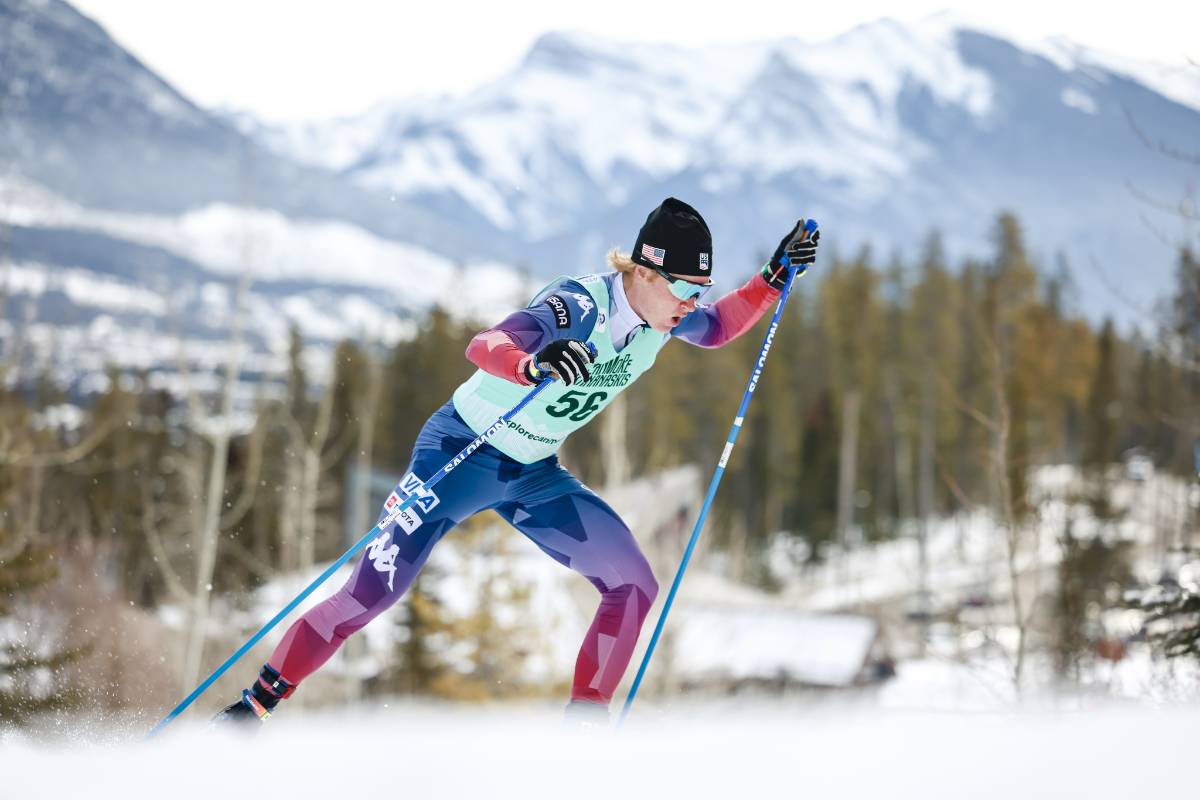
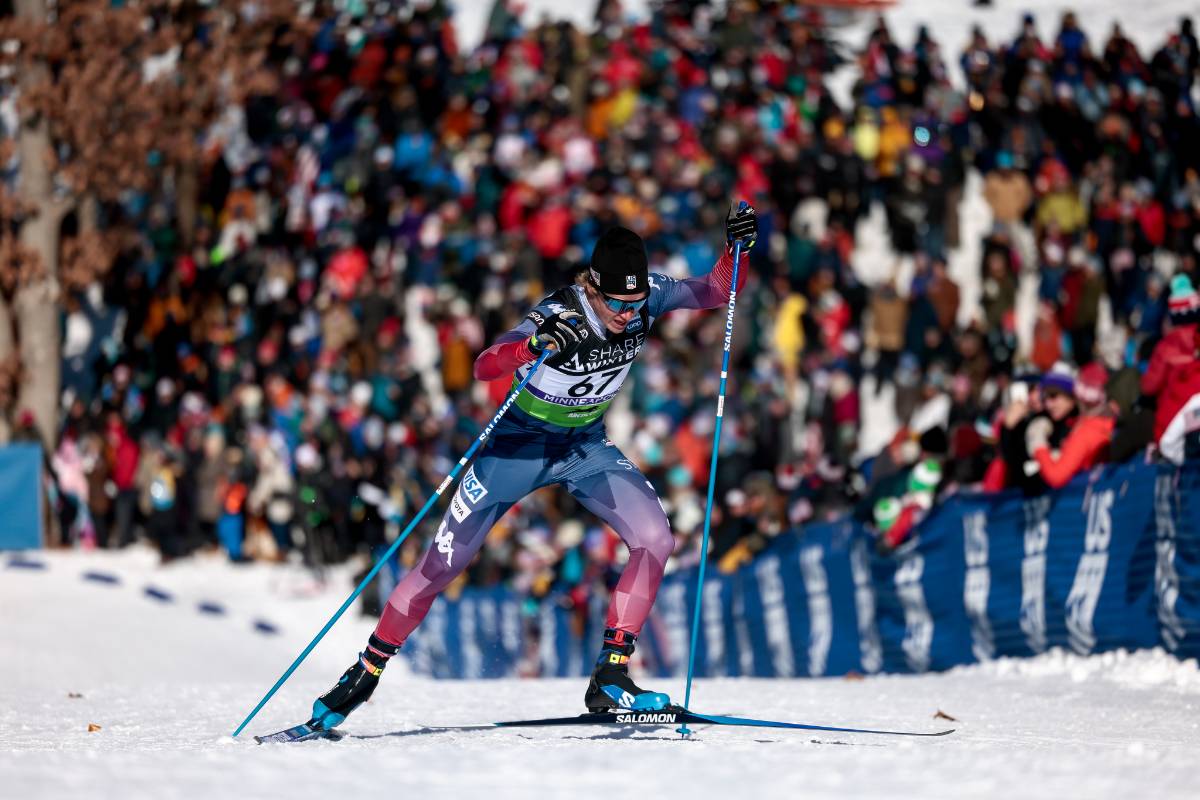
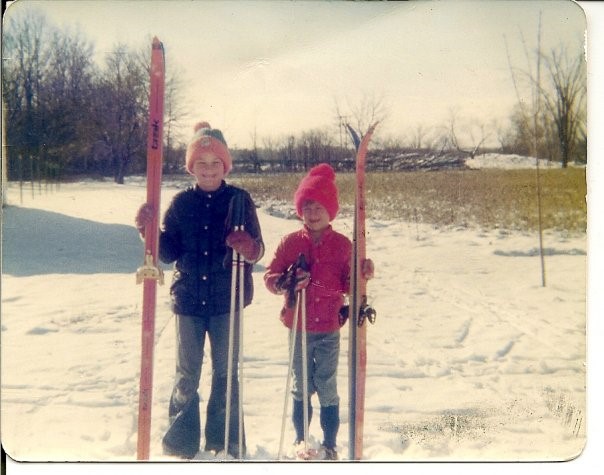
    Growing up in Northern Vermont, Jack Young had an All-American childhood. (Photo: Courtesy Photo)

    Outside, the classic sprint course cuts through the forest — the first of two classic sprints in Period 1. They matter—more than they ever have. To make the Olympics, he must qualify. To qualify, he must have transformed himself into something he has never consistently been: a classic sprinter capable of making heats on the hardest stage in the world.

    That he is even here, on the cusp of an Olympic selection fight, is strange enough. Stranger still is the way he got here — not built from the standardized American skiing pipeline but stitched together from its edges. A football quarterback. A baseball outfielder. A skier whose parents “didn’t know what Nordic skiing was.” A D3 athlete who reverse-engineered sprint training out of 800-meter track plans and the writings of a Swedish speed skater. A young man who kept such detailed training logs that, by the time he made the World Cup, he could begin writing his own plan.

    In a sport that often rewards conformity, Young’s ascent is something close to a jailbreak.

    Jack Young as he started his racing for Craftsbury. (Photo: Courtesy Photo)

    A Vermont Childhood Without the Usual Skiing Script

    “Neither of my parents knew what Nordic skiing was,” he says with a laugh. They loved the outdoors, yes — mountain biking, alpine skiing, the typical northern Vermont mélange of mud, woods, and winter — but their son’s athletic identity formed somewhere else entirely. “I played every sport. I loved baseball. I played basketball through elementary school. I started football as soon as I was allowed to, which I think was in fourth grade.”

    He became the kind of athlete rural towns understand intuitively: the quarterback on fall afternoons, the center fielder chasing down balls in the summer dusk, the kid who could pick up anything and find competition in it. Skiing entered sideways, almost accidentally, through his sister Callie. She joined the small Nordic program in Newport, and he was brought along because that’s what families do — pack the car, hand over snacks, make it work.

    “I immediately fell in love with racing,” he says. “I just love the competition.” Running around on skis made sense to him. Movement, speed, chaos — he could do that. But even with training days at Craftsbury beginning around sixth grade, he didn’t think of skiing as his primary outlet. “I wasn’t as focused as my sister was, but I would still get dragged along,” he says. “I loved skiing, but I loved football and baseball just as much.”

    The irony — one he now sees clearly — is that he was training for skiing without realizing it. “All summer was spent doing fun things in the woods. We’d go to Craftsbury a couple of times per week. But I never thought of skiing as my main sport. I weighted those sports equally, even though I was putting a lot more time into skiing.”

    If northern Vermont had offered a travel football club or competitive baseball without days of driving south, the story may have gone a different way. But mountain running and biking were nearby, and elite baseball diamonds were not. “I’d so much rather go for a long run in the mountains or go mountain biking than I would hit on the tee for two hours,” he says.

    Sometimes this is what talent looks like in real time: a kid choosing the fun version of hard work without realizing he’s choosing a future.

    When we spoke, Jack Young sat in a small condo in Ruka wearing a Boston Red Sox baseball hat, just added evidence for how important the game has been for him since he was a boy. (Photo: Courtesy Photo)

    The Late Bloom: A Breakthrough and a Decision

    He kept skiing in the winter, of course. Not obsessively. Not in the way some junior skiers live their lives by FIS points before they have a driver’s license. But enough to stay close. Enough to remain good. Then came the summer after his sophomore year of high school — the first time he trained like someone who had decided to see what was possible.

    “I put a good summer of training in,” he says. “Had a bad football season… but that was the first time I was really starting to push the limit on what I could do training-wise while in season for football.”

    He mountain-biked in races on weekends, squeezed workouts around football practices, and tried to make the whole geometry hold together. Then came Junior Nationals, and with it, proof. “I had a pretty good result in the sprint. I think I was like 18th or something… and that was the moment where I was like, okay. I am decent at least at this sport. I’m doing a lot better than I’ll ever be at baseball.”

    That spring, Young emailed coaches — the NESCAC schools, Dartmouth, and UNH. Bowdoin and Dartmouth joined Colby on his shortlist. Colby won on something less quantifiable: belief.

    “Tracy [Cote] was very excited about me,” he says. “And I think that resonated with me. Maybe it’s my ego, but it was nice to hear.”

    He would later call it “a perfect decision.”

    Jack Young enjoying some backcountry skiing in Jay. (Photo: Courtesy Photo)

    Colby: Building an Athlete in a Place That Shouldn’t Have Worked

    Winters in college can blur into one another — classes, training, snow, the strange mix of exhaustion and euphoria that defines 19-year-old life. But Young remembers his freshman fall with clarity: meeting people, finding balance, doing “good, not great” training, and then, once the season started, traveling west for Senior Nationals.

    There, in Soldier Hollow, everything sharpened. “I think I qualified in the top 20 in the skate sprint,” he says. “That was an absolutely massive result for me. I never had anywhere near that level of success on the national level.”

    He didn’t transform overnight — not yet. His sophomore season brought a “fine college season,” a top-30 at NCAAs in the 10k skate, and the sense that distance skiing was finally, mercifully making progress. But the turning point came not in results but in imagination. He learned that the U.S. would receive twelve start spots for the Canmore World Cup the following year. Twelve starts. “I was like, 12 starts… that’s not that far off,” he says. “I kind of feel like I’m in contention for that.”

    To chase it, he would need to master something specific: the sprint qualifier.

    And this is where the story breaks from the template completely.

    Jack Young hits some big lactate numbers during a hard training session. (Photo: Courtesy Photo)

    Reinventing Sprinting from Scratch

    “I’ve always thought that sprint qualifiers were really similar to an 800-meter race on the track,” he says. Physiologically, mechanically, conceptually — they looked more alike than different. So he dug into 800m training. He looked for the extreme version, the distilled essence of what sprinters do when they train specifically for the thing that matters. Qualifiers are discrete. Defined. Precise. Why train them like a generalist?

    Then he read Nils van der Poel.

    The legendary Swedish speed skater’s manifesto, How to Skate a 10k, isn’t a skiing manual, but to Young, it may as well have been scripture: the idea of building huge aerobic capacity, then sharpening with brutally specific intervals at exact race pace. “He wants to skate as many possible laps at world record pace as possible,” Young says. “And that really struck me. I’m like — I can apply this to skiing.”

    He wasn’t going to become a single-event specialist, not in college. But he could take the principle and adapt it. So he built a sprint-qualifier program composed of things like:

    • 6 × 1 minute
    • 4 × 90 seconds
    • 10 × 30 seconds
    • 8 × 45 seconds

    All at precisely what he believed to be his sprint qualifier pace.

    “That was the bread and butter,” he says. “I’d do those workouts once or twice a week. I didn’t actually find them that strenuous, but I was accumulating a good amount of time at exactly what I thought sprint qualifier pace was.”

    He went completely dry that fall — no beer, no casual nights out, nothing that compromised sleep. “I was just recovering a lot better all the time,” he says. “I didn’t get sick at all.”

    Meanwhile, Colby head coach Tracy Cote allowed him to blend his ideas into the fall plan. “We were working together. I think we ended up writing the training plan together that fall,” he says. “She was pretty stoked about the focus on recovery… and she’d let me get away with doing things a bit more geared towards sprinting.”

    He trained more overall, too — a heavy summer that gave him the resilience to handle so much intensity once fall arrived. “My freshman year, I trained a little under 600. Sophomore year was around 650. My junior year I trained like 750 or something.”

    This was not an American development pipeline approach.

    It was an experiment.

    A smart one.

    A successful one.

    Jack Young, who a week earlier had a 3rd and 5th place in the EISA college races for Colby College delivered the 11th fastest qualifying time in the freestyle sprint at the Canmore World Cup in 2024. (Photo: Cockney/FasterSkier)

    Anchorage, SoHo, Canmore — and the Race That Changed Everything

    He targeted Anchorage for his first chance at the Canmore World Cup spot. He knew what he had to do: fly across the country in the early winter, race well, then perform at Senior Nationals in Soldier Hollow. Anchorage was the linchpin.

    “I went into Anchorage with a lot of confidence,” he says. “I won that qualifier; it was such a surprise.”

    He didn’t replicate the magic at Soldier Hollow — “I think I got like 11th” — but the Anchorage win held. He made the Canmore start list.

    And then came the race of his life.

    “That’s still my lowest FIS points ever,” he says. “I didn’t match that last year.”

    When he crossed the line, something shifted internally. “Once I did that in Canmore… that was the first time I really thought I wanted to keep skiing after college,” he says. “That was the moment I realized how good I thought I could get.”

    Call it the ignition point, the place where belief calcified into ambition.

    Where a multi-sport kid from a non-skiing family, attending a D3 school, doing self-designed intervals, suddenly saw himself in a World Cup heat map and thought: Yes. Here.

    Jack Young training on Eagle Glacier this past summer. (Photo: Courtesy Photo)

    Writing His Own Plan on the World Cup

    Two years later, he is living in Europe, often for months at a time. He is in his second year of racing full-time on the circuit. He is older, stronger, and more certain. And he is, in many ways, coaching himself.

    “For this time of year, it’s entirely guided by what I’ve done the last two years,” he says. “Which workouts worked in which places, which workouts didn’t… the comments are much more important than the hours.”

    He still works closely with Pepa Miloucheva at Craftsbury — “She’s the number one on that” — but when he’s on the World Cup, he is the primary author of his training. He reads his patterns. He analyzes sensations. He looks for the combinations of stress and stimulation that make him feel dangerous on race day.

    He isn’t reinventing his body now — he’s listening to it.

    The independence he cultivated at Colby has become his competitive advantage.

    With the Olympic sprint being in the classical technique, Jack Young (USA) hopes to find the form he has historically shown in freestyle sprinting during the early season World Cup stops. (Photo: Modica/NordicFocus)

    The Classic Sprint Problem — and the Olympic Dream

    To make the Olympics, the math is simple, even if the execution is brutal.

    “The simplest answer is: make a big jump in classic sprinting,” he says. “If I can start qualifying for classic sprints consistently, I have a very clear path to making the Olympics.”

    Last year’s results would meet the published criteria — “hypothetically, if I had the exact same season… I would technically make the team,” — but this year is different. The Olympic sprint is classic. Period 1 has two classic sprints and only one skate sprint. Some of the contenders for Olympic spots are stronger in classic than he is.

    So the path is narrow: qualify in Ruka. Qualify in Trondheim. Hold form in Davos. Don’t step back. Don’t stagnate.

    At the philosophical level, the criteria are simpler still.

    “It’s all about execution at this point,” he says. “A good season is continuing with progress I’ve made… scoring more World Cup points than I did last year. Anything else is a step back.”

    He knows progress isn’t linear. He knows failure is part of sport. But he also knows what a step backward would feel like. “I’d be lying if I said I could look at this season as successful if I don’t maintain what I’ve been doing in skating and at least make a little bit of progress in classic skiing.”

    It is clear-eyed. Unsentimental. The kind of assessment you get from someone who has built his career on self-honesty.

    Jack and his sister Callie after winning a slow pitch softball tournament. (Photo: Courtesy Photo)

    What It Means to Make It This Way

    There’s a certain poetry in the fact that Young’s rise mirrors the very way he races: a precise, deliberate accumulation of moments. Nothing in his career came from the prescribed steps, the standard routes, the familiar trophies of a groomed junior-star life. Instead, his path looks more like a map drawn after the fact — connecting points that didn’t seem aligned until the picture emerged.

    A sister’s Craftsbury workouts.

    A baseball-heavy early adolescence.

    Mountain biking and football collisions.

    A D3 program that let him try things.

    A manifesto by a Swedish speed skater.

    A dry collegiate fall at age 20.

    A logbook of sensations.

    A day in Canmore.

    A belief.

    There is no template for this. There never was.

    But here he is anyway — on the World Cup, in an Olympic year, taking the biggest swing of his life.

    And as he sits in a Ruka apartment, resting more than he ever has before a race that matters more than most, he reflects not on what’s missing from his résumé but on what got him here in the first place: a way of building a skier that is his alone.


    Love Stories Like This? Help Keep Them Coming.

    Feature interviews like this one take time, access, and care to produce. If you value thoughtful storytelling and independent ski journalism, please consider becoming a Voluntary Subscriber. Your support directly fuels the work we do to cover the people, places, and moments that make our sport special.

    Join the FasterSkier community!


    Jack Young enjoying some orange juice on the Maine seacoast. (Photo: Courtesy Photo)
  • Klaebo Thrills Hometown Crowd with World Sprint Title

    Klaebo Thrills Hometown Crowd with World Sprint Title

    FasterSkier’s coverage of this week’s FIS World Championships stands as a proud tribute to American Skiing Icon Marty Hall, who (with his wife, Kathy Hall, and their A Hall Mark of Excellence Award) has generously supported our coverage of international cross-country ski events. To learn more about A Hall Mark of Excellence Award, please contact info@fasterskier.com. We’ll miss you, Marty. 

    Johannes Hoesflot Klaebo (NOR) won bronze in the Individual Sprint way back in 2017 in Lahti, Finland (where he also placed fourth in the Team Sprint). In each of the three FIS World Championships since then (2019, 2021, 2023), he’s won gold in both Sprint events as well as gold in the Team Relay (for a total of nine gold medals at World Championships). Combined with his silver and bronze medals at various championships, Klaebo enters Trondheim tied with Petter Northug (NOR) for most gold medals by a male skier in World Championship history and tied with the immortal Bjorn Daehlie NOR) for most total medals (12). With a win in the Sprint, Klaebo would distance himself from every other skier in history . . . but this isn’t even the medal Klaebo’s eventual immortality demands.

    Johannes Hoesflot Klaebo (NOR) racing on his home snow, on his home trails in front of the home crowd in Trondheim, Norway for the opening race of the 2025 FIS Cross-Country Ski World Championhips. (Photo: NordicFocus)

    Imagine this sort of pressure: you’ve won Sprint, Team Sprint, and Relay for the last few World Championships and Olympics, so naturally you’re expected to win those again. Three more gold medals—the sort of haul that grants Nordic skiing immortality to any who could achieve it—yet that’s not nearly enough to satisfy your fans and countrymen. Klaebo is constantly reminded that he’s never won an individual Distance medal at World Championship or Olympic events (though he came breathtakingly close when he crossed the finish line first in the 2021 World Championships 50 k Mass Start, only to be disqualified for interfering with Alexander Bolshunov (RUS) in the final meters). Klaebo has won plenty of individual World Cup races—interval starts, skiathlons, mass starts, pursuits—but he’s never been able to deliver an individual distance win on the very biggest stages. Trondheim is his hometown; he’s determined to do better here, even to the point that an Individual Distance medal may be even more important to him than the Sprint, the Team Sprint, or the Relay. But, to be honest, failing to win any of those would be a bitter disappointment and would certainly supply the gold-hungry Norwegian media with ammunition to lob at him from yet another angle. The only way for Klaebo to win, is to win.

    Federico Pellegrino (ITA), and Johannes Hoesflot Klaebo (NOR), (l-r) enter the homestretch during the finals of the freestyle sprint. (Photo: NordicFocus)

    And win he did—showing the easiest speed, the greatest endurance, the most clever tactics, and the fastest skis. Klaebo drove up the final hill, rocketed down the other side, negotiated the final slush-filled turn, and cruised up the finishing straightaway ahead of an ecstatic Federico Pellegrino (ITA) and Lauri Vuorinen (FIN).

    “It was a lot of nerves, that’s for sure,” Klaebo said. “I’m just glad we’re done with it now, to be honest. So, I’m really satisfied. Tussen Takk, Trondheim!”

    All four Americans—Ben Ogden, Gus Schumacher, JC Schoonmaker, Jack Young—qualified for quarterfinal heats amid Trondheim’s deafening atmosphere that Ogden, described as crazy. “Norway knows how to throw a ski race, I’ll tell you that.” Ogden grinned. “I was nervous for this one, so I’m happy to be getting going. I’m gonna try and ski smart, ski hard, leave it all out there.”

    Ben Ogden (USA, during the quarterfinals) drove the pace during his semifinal heat with the hope of setting a fast enough time that four athletes would qualify from the second heat to advance to the final. Thanks to Ogden, that is just what happened, but unfortunately, he ran out of gas with mere meters to go, ultimately crossing the line in sixth place in his heat and 12th place overall. (Photo: NordicFocus)

    Ogden and Schumacher raced a tactical quarterfinal (won by Northug), with Ogden managing to win the boot throw at the line for the final qualifying spot. Schumacher never managed to develop the speed necessary to contend in the heat. He’d finish 27th on the day.

    JC Schoonmaker and Jack Young finished fourth and fifth in their quarterfinal. They’d finish the day in 15th and 18th, respectively.

    Among Canadians, Pierre Grall-Johnson was 36th, Graham Ritchie 48th, Xavier McKeever 51st, and Sasha Masson 54th.

    JC Schoonmaker (USA) put it out there to finish the individual sprint in 15th place at the World Championships in Trondheim (NOR).
    (Photo: NordicFocus)
    Men’s Sprint

    FasterSkier’s Devon Kershaw considered the Trondheim Sprint course in pre-race interviews, describing Klaebo’s chances of mastering it. “An athlete like Klaebo, for example, has every tool in the toolbox,” Kershaw said. “I don’t think it really matters; there’s no real crucial point. But, of course, this big right-hander into the finishing stretch is incredibly crucial. You have to carry a lot of speed and stay on your feet. It’s going to be an exciting competition.”

    Joining Klaebo on the Norwegian Sprint team were Matz William-Jenssen, Even Northug, Haavard Solaas Taugboel, and Ansgar Evensen. Erik Valnes (NOR) finished second in the most recent World Cup Sprint and stands second in the season-long World Cup Sprint standings, but withdrew with a back injury prior to the start of competition in Trondheim. Everybody else was here, all the hungriest World Cup contenders—the French, the Swedes, the Germans, the Italians, the Finns, the Austrians, the Americans—but it definitely looked to be Norway’s finishing order to sort out. There were six spots available in the Sprint Final, five Norwegians entered, and only three medals to hand out. Something had to give.

    Johannes Hoesflot Klaebo (NOR) charging up the climb in front of the home fans. (Photo: NordicFocus)

    As it turned out, what gave—at least a little bit—was Norway. Valnes’s withdrawal put Jenssen in the lineup, but Jenssen got tangled in his quarterfinal and was eliminated. Taugboel skied a lackluster quarterfinal without ever being a factor. Northug was able to advance through the quarterfinal, but only by making a Kamikaze dive into the final right-hand turn before the finishing straight.

    Predictably, Klaebo cruised brilliantly through his quarterfinal heat, showing the savvy tactics and fast skis that have always epitomized his Sprint performances. Pellegrino had a difficult time weaving his way through his quarterfinal but showed his blazing speed in the finishing straightaway to win the heat and advance to the semifinals. Edvin Anger (SWE) entered the World Championships ranked third in World Cup Sprint standings, but he raced carelessly in the quarterfinals and only advanced to the semifinal as a lucky loser.

    Federico Pellegrino (ITA), pulling away from Even Northug (NOR) and Richard Jouve (FRA) on the home stretch of their semifinal, found the fitness of years past today in Trondheim. (Photo: NordicFocus)
    Semifinal

    Semifinal 1 featured Pellegrino facing Klaebo, Northug, and Anger (who had only narrowly avoided elimination in the quarterfinals). Klaebo skied flawlessly, conserving energy as he cruised to a semifinal win ahead of Pellegrino. Jules Chappaz (FRA) claimed a lucky loser spot. Northug struggled to fifth while Anger—who never looked sharp—ended his day sixth in the semifinal.

    Ogden moved toward the lead of Semifinal 2, where he was joined by Lucas Chanavat (FRA). Ogden opened up the pace on the significant uphill section, only to find his skis overtaken on the final downhill by Lauri Vuorinen (FIN) and Chanavat. An errant pole plant in the final straight dropped Ogden to sixth while Vuorinen and Chanavat advanced.

    Ben Ogden (USA) struggled to keep his balance down the final hundred meters after pushing the pace so hard earlier in the semifinal. Ultimately Ogden would finish in 12th place overall. (Photo: NordicFocus)
    Men’s Sprint Final

    It must have felt a bit strange to Klaebo, being the only Norwegian in the Sprint Final. If it bothered him at all, he didn’t show it. Choosing the far-left start position all day, Klaebo moved quickly to the front in order to control the early pace. Pellegrino matched his speed, with Chanavat following. The fatigue of the day seemed to take its toll on the racers, as what appeared to be a moderate pace still managed to stretch out the field. Klaebo coasted to the front on every downhill, followed by a stubbornly determined Pellegrino. They crested the final uphill in that order, using the subsequent downhill to repeatedly check the positioning of their pursuers. Klaebo crossed the finish, punching the air to celebrate his first gold of these championships. But it appeared that the greatest elation at the finish line belonged to Pellegrino, who seemed almost overcome by his silver medal effort. Vuorinen outsprinted Chappaz for third.

    Federico Pellegrino (ITA) may have been the happiest person in Trondheim, Norway after finishing the individual sprint in second place. (Photo: NordicFocus)

    The ovation of the Norwegian crowd lasted long after the skiers had crossed the line . . . and there are still plenty of races yet to run.

    “I’m out of words,” Klaebo said. “I mean, look at the spectators . . . it’s way different from what we are used to. This is how we do it in Trondheim . . . It’s amazing.”

    Projecting toward the upcoming Skiathlon—and the possibility of ending his own World Championship distance-racing drought—Klaebo said, “Come back on Saturday. It’s gonna be fun.”

    FIS World Championships Men’s Freestyle Sprint RESULTS

    Men’s Sprint QUALIFYING

    Federico Pellegrino (ITA), Johannes Hoesflot Klaebo (NOR) and Lauri Vuorinen (FIN) (l-r) take the Freestyle Sprint podium at the 2025 FIS Cross-Country Ski World Championships in Trondheim (NOR). (Photo: NordicFocus)

    – – – – – – – – – – – – – – – – – – – – – – – – – – – – – – – – – – – – – – – – – –

    Our ski boots on the ground coverage was provided by Nat Herz, Stuart Harden, and Aidan O’Connell.

    This reporting costs money. Please support this coverage with a voluntary subscription (below) so FasterSkier can provide this level of access to the sport we all love year-round.

    – – – – – – – – – – – – – – – – – – – – – – – – – – – – – – – – – – – – – – – – – – –

  • Fast Tracks: World Champs—Jack Young Talks About Not Quite Having the Magic Today

    Fast Tracks: World Champs—Jack Young Talks About Not Quite Having the Magic Today

    This reporting costs money. Please support this coverage with a voluntary subscription (below) so FasterSkier can provide this level of access to the sport we all love year-round.


  • Ogden Battles Through Broken Pole in Final As Klaebo Wins Tour de Ski Stage 1

    Ogden Battles Through Broken Pole in Final As Klaebo Wins Tour de Ski Stage 1

    The 19th edition of the Tour de Ski is here once again! While many athletes have taken a conservative start to the season, skipping early races to focus on preparations for the World Championships in Trondheim later this winter, the excitement for the Tour remains high. With seven stages packed into just nine days — and rest days on Monday and Thursday — the Tour has historically seen relatively few skiers complete the entire event. However, many of the sport’s top athletes hope to compete all the way through, chasing bonus points and the opportunity to solidify their positions as World Cup leaders in this important week of racing.

    The Tour kicks off in Toblach, Italy, with a skate sprint as the opening event. The first four races will take place in Toblach before athletes transition to Val di Fiemme for the final three races on Friday, Saturday, and Sunday, marking the Tour’s conclusion.

    This course demands sharp strategy, precise lines, and well-timed pacing to finish in the front of each heat. Athletes must not only position themselves effectively on the uphills but also navigate the downhills skillfully, taking optimal lines to slingshot themselves around both the trail’s corners and their competitors. Completing two laps on this challenging course requires a careful balance of power and tactics. With the finishing stretch emerging from a downhill turn, positioning becomes crucial long before the finish line itself.

    Johannes Hoesflot Klaebo (NOR) with his trademark coast into the finish of the individual freestyle sprint in Toblach (ITA). (Photo: NordicFocus)

    The heats followed a familiar marching pattern to those we’ve already seen this season: with Johannes Hoesflot Klaebo (NOR) and Lucas Chanavat (FRA) skiing synchronously at the start of each heat to control pacing and claim podium positions together. Janik Riebli (SUI) followed closely behind, slipping into the final as a lucky loser, with the road paved to a podium position after competitors Ben Ogden (USA) broke a pole and Valerio Grond (SUI) slipped during the final ascent. Klaebo earned, in what appeared to be an easy win, his 95th sprint victory. “In the end, I’m really satisfied, and it’s the perfect way to start the tour,” he said upon finishing the race. 

    Four Americans advanced to the heats, with Ogden finishing 6th, Gus Schumacher, 10th, JC Schoonmaker, 14th, and Jack Young, 17th. Zanden McMullen just barely missed qualification, finishing 36th. On the Canadian side, Antoine Cyr (56th) and Olivier Leveille (60th) completed the race but did not qualify for the heats.


    Men’s Sprint Quarterfinals

    In the first heat, Klaebo and Chanavat dominated from the start, skiing side by side in a controlled performance that seemed almost choreographed, easily securing their spots in the semifinal heats. Other athletes vied for these positions, Emil Danielsson (SWE) tried to pass through the middle of Klaebo and Chanavat, who accelerated and maintained their position in front. French skier Remi Bourdin also approached the pair in front over the final ascent around two minutes into the race, though could not surpass Chanavat and finished third in the heat. 

    In the second quarterfinal heat, Ogden battled Riebli head-to-head for the leader position, both holding off sprint specialist Richard Jouve (FRA). The two exchanged leads throughout the race, with Ogden making a decisive move around the inside of the final turn. This maneuver set him up for a clear finishing sprint, allowing both Ogden and Riebli to advance together to the semifinals.

    Schumacher took an early lead in the third heat, facing challenges from Niilo Moilanen (FIN) and Davide Graz (ITA). After a minute and a half, Schumacher was able to solidify himself in front, accelerating through the descent to establish a small gap ahead of the field. His competition narrowed again in the final stretch, though Schumacher maintained his position in front to advance to the semifinals alongside Moilanen. Meanwhile, Evan Northug’s race took an unfortunate turn as he broke a pole just out of the gate, forcing him to pull to the side of the trail and effectively ending his chances of progressing. Currently ranked 3rd in the overall sprint standings, Northug is a strong sprinter, but this setback could jeopardize his Tour prospects, especially given his relatively weaker performances in distance disciplines.

    Federico Pellegrino (ITA), front, Edvin Anger (SWE), left, and Jack Young (USA), right, lead their quarterfinal heat. (Photo: NordicFocus)

    Young battled against Federico Pellegrino (ITA), 12 years his senior, in the fourth quarterfinal together with strong sprinters Edvin Anger (SWE) and Erik Valnes (NOR). Valnes established an early lead out of the start, joined by Pellegrino. Midway through the race, Anger accelerated into the lead, but the top three continued to trade positions as the heat progressed. Young stayed right in the mix, maintaining a strong position near the front of the pack.

    “I started as hard as I could and put myself in position near the front of the heat. After that, there wasn’t much I could do to get around Pellegrino or Anger,” Young explained. After being boxed out in the inside of the finishing stretch, Young’s chance of qualification was low but chances at a lucky loser position seemed high, ultimately missing qualification by 0.3 seconds. “The only thing I’m wondering about is whether I could have swung out wide on the turn into the finish instead of checking my speed to get the inside,” Young reflected after the race, “that could have given me the three-tenths necessary to get a lucky loser spot.” 

    Finally, Valerio Grond controlled the pace of quarterfinal five through much of the race, battling closely against Finland’s Lauri Vourinen. Italy’s Giovanni Ticco briefly challenged Grond for the lead initially but soon fell back, ultimately finishing last in the heat. Meanwhile, Schoonmaker stayed in the middle of the pack, focusing on “bringing good momentum into hills,” and positioning himself strategically to contest the leaders in the final sprint. Although he crossed the line in third, initially appearing poised to advance to the semifinals as a lucky loser, subtle time adjustments narrowly eliminated him from contention.


    Men’s Sprint Semifinals
    Johannes Hoesflot Klaebo (NOR), Lucas Chanavat (FRA), and Ben Ogden (USA) racing out of the stadium. (Photo: NordicFocus)

    A quick look at the start list made it evident which semifinal was likely to produce the fastest times—and from which the lucky losers would emerge. Klaebo and Chanavat were set to face off again in the first heat, joined by Ogden, Riebli, and Valnes, all formidable sprinters capable of pushing Klaebo to reconsider his race strategy.

    The heat unfolded precisely as would be expected, mirroring the quarterfinals.  Klaebo and Chanavat led the pack side by side, skillfully controlling the pace around the course before Klaebo pulled ahead to take first at the line. Ogden positioned himself right behind them, confident that the speed of this heat would give him a chance at entering the final as a lucky loser. Ogden raced confidently and quickly, taking tight lines around the course and crossing the finish line in third, just behind Chanavat in second. The real drama came down to Ogden and Riebli, sprinting neck and neck to the finish, successfully securing lucky loser positions.

    The second semifinal lacked a clear favorite, leaving the top two positions wide open for the competitors to claim. Richard Jouve and Federico Pellegrino both have a strong history in skate sprints, while Valerio Grond has recently delivered impressive results in the freestyle sprint discipline. Meanwhile, Anger, Vuorinen, and Moilanen have consistently been contenders in sprint finals this season.

    Ultimately, this semifinal—perhaps aware that the lucky loser spots had already been secured by the first heat—turned out to be one of the slowest of the day. With six skilled sprinters, strategic positioning within the pack became the decisive factor in determining who would advance. Grond skied steadily from the start, moving into the lead later in the short race. In a close finish, Jouve narrowly edged out Pellegrino to claim the second qualifying spot for the final.


    Men’s Sprint Final

    Again, Klaebo and Chanavat took an early lead, executing their well-rehearsed, almost synchronized strategy to control the pace of the heat before battling it out at the finish line—a contest Klaebo typically wins.

    While their dominance played out as expected, the race for the top three positions took an unexpected turn. Ogden broke a pole early on, losing contact with the leaders as they rounded the first corner. Moments later, Grond’s skis slipped on the uphill through the stadium, causing him to fall and take Jouve down with him. With three competitors effectively out of contention, Klaebo and Chanavat remained unchallenged at the front while Riebli skied through the chaos to contend for the third podium position. 

    Johannes Hoesflot Klaebo (NOR), right, and Lucas Chanavat (FRA), left, congratulating each other after the races. (Photo: NordicFocus)

    Ogden recounted the chaotic events of the final to FasterSkier after the race. “I was trying to weasel in behind Lucas [Chanavat], and someone behind me wasn’t thrilled about that,” Ogden reported, describing the battle for position that ultimately led to his pole snapping. “I was kinda able to ski with one pole, but then the exchange was incredibly hectic, and I tripped myself twice, and there was little to no hope after that.” Once Grond fell too, the two of them competed head to head for the remaining positions. 

    Despite the disappointing result, Ogden found pride in his approach to the heats. “I’m most proud of my confidence today in the heats,” he shared. “I was more nervous today than I’ve been for a while because I’ve got some memories.” He was referring to his breakthrough performance last season, which included his first-ever sprint podium on the Toblach course. “I feel like I handled it really well—skied smart and never got too frantic. It’s an unfortunate way to end after all that work, but what can you do? It’s part of the deal.”

    As for Klaebo, his victory came as no surprise, continuing his dominance in sprint racing this season. While another win may feel routine for the seasoned sprinter, Klaebo expressed excitement with his performance. “In the end, I’m really satisfied. It’s the perfect way to start the Tour,” he said with a smile. 

    With only Stage 1 of the Tour completed, Ogden is focused on the long week ahead. “My goals are to manage my energy as best as I can and make it all the way to the end!” he said, with his eyes on the Leader Bib. For now, fans can expect him to prioritize recovery, fueling for the upcoming races, and finding lighthearted distractions like browsing “clapped Jaguars and Porsches on eBay” to unwind between events.

    Men’s Freestyle Sprint Results

    Tour de Ski Overall Standings

    Lucas Chanavat (FRA), Johannes Hoesflot Klaebo (NOR), Janik Riebli (SUI) topped the podium in Toblach Tour de Ski Stage 1. (Photo: NordicFocus)


  • Ogden Top Qualifier in Lillehammer Sprint, Klaebo Remains Wondrously Predictable

    Ogden Top Qualifier in Lillehammer Sprint, Klaebo Remains Wondrously Predictable

    This coverage is made possible through the generous support of Marty and Kathy Hall and A Hall Mark of Excellence Award. To learn more about A Hall Mark of Excellence Award, or to learn how you can support FasterSkier’s coverage, please contact info@fasterskier.com.

    Ben Ogden (USA) had his 2024 World Cup campaign interrupted by illness. Ever since, he’s been working to return to world-class form. His win in the Sprint Qualifier in Lillehammer may be an indication that he’s finally back where he belongs. (Photo: Modica/NordicFocus)

    The World Cup cross country season is a long and winding road—few athletes experience seasons that end the way they began. American, Ben Ogden, had his 2024 World Cup campaign interrupted by mononucleosis that ended his season and prevented him from participating in the memorable Minneapolis World Cup races. Not only did much of 2024 prove to be a disappointment for Ogden, it also forced him into a long off-season of recovery and re-start. It hasn’t been known how successful Ogden’s recovery has been, and his first weeks in the 2024-2025 World Cup season offered both hope and doubt. Today in Lillehammmer, he received the first indications that he may have done things right. Ogden was simply superb in Sprint Qualifying, posting the fastest time of all skiers (2:34.33), a half second ahead of the usually-untouchable Klaebo, and 2+ seconds ahead of everyone else. Ogden would find himself boxed in in his quarterfinal heat, and would finish the day in 17th.

    “Today, I really had my eye on the semifinal and the final (foolishly),” said Ogden. “So I tried to be tactical in the quarterfinal and save as much energy as I could. That’ll teach me!”

    Colby College’s Sprint specialist, Jack Young (USA), also advanced to the quarterfinal round, qualifying 25th. He would finish the day in 25th.

    “Except for a two week camp in Park City, I have been in Waterville (Maine) training with my teammates at Colby,” said Young. ” . . . “I knew my training had been good al fall, so I wasn’t too concerned about not having put on a bib yet this year. Sure, it would be nice for my first race of the year not to be one of my most important, but at the end of the day, it’s pretty cool to be able to train all fall with the clear goal of performing at a Period 1 World Cup.”

    Among other Americans, Gus Schumacher was just outside the qualifying standard in 31st, ahead of JC Schoonmaker (39th), Kevin Bolger (45th), Zak Ketterson (47th), Michael Earnhart (51st). Canadians in qualifying included Pierre Grall-Johnson (58th), Sasha Masson (62nd), Xavier McKeever, (66th), Antoine Cyr (71st).

    Notably, Spaniard, Jaume Puyeo, qualified third. He would face off against Klaebo in Quarterfinal 1, and ultimately finished the day in 21st.

    Johannes Hoesflot Klaebo (NOR) is accustomed to having no one in front of him at World Cup Sprint finish lines. His day in Lillehammer was more of the same as he coasted to another remarkable Sprint win, the 51st of his career. (Photo: NordicFocus)

    When Johannes Hoesflot Klaebo wakes up fresh and well rested on the morning of a World Cup Sprint; that’s usually going to be a problem for every one else. I mean, the guy already has enough advantages: blazing speed, unmatched tactical acumen, the fastest skis in the world, and the tendency of the rest of the World Cup field to let him do pretty much whatever he wants. When’s the last time anyone cut this guy off? When’s the last time someone sent him a good forearm shiver in the final turn? Where’s Alexander Bolshunov when you need him?

    Klaebo does make World Cup Sprinting interesting, but it’s the kind of interesting that’s about “How will he manage to win again this time?” The result itself is kind of a foregone conclusion. He’s gonna win, right? He’s gonna accelerate at the top of a mid-course hill, rocket down the backside, controlling the pace from the front and putting daylight between himself and his glide-challenged rivals. Then he’s going to switch on skiing’s hottest afterburners up the final hill and leave everybody scrambling in his wake. By the time he gets to the final turn, he’ll be pretty much alone and unchallenged. He’s gonna bow to the crowd as he eases down the finishing straightaway. We’ve seen this movie before.

    And that’s exactly how things turned out . . . The second and third positions on any World Cup Sprint podium tend to shuffle from week to week—occupied in Lillehammer by Even Northug (NOR) in second and Federico Pellegrino (ITA) third—but the top step seems reserved for Klaebo.

    Klaebo sat out the final race in Ruka a week ago, as well as yesterday’s 10 k Freestyle. “I’ve been a little bit sick since Ruka,” Klaebo said. “Didn’t get to go last Sunday and needed to wait one extra day. I’m glad I did that. So, It’s good to be back again, and hopefully now we can give full speed fo the rest of the season.”

    World Cup Sprint veteran, Federico Pellegrino (ITA), called on his experience, his tactics, and his speed to advance cleverly through the heats. He would finish the day in third behind Even Northug (NOR) in second, and the day’s winner, Johannes Hoesflot Klaebo (NOR). (Photo: Modica/NordicFocus)
    Freestyle Sprint Quarterfinal

    The Lillehammer Sprint course is not as straightforward as others on the World Cup circuit. It’s final uphill is less close to the finish, and somehow seems to offer less of a draft-effect on its downhill side. With fewer advantages and disadvantages to be found on the course, it can take afew rounds for racers to sort out the proper strategies.

    Quarterfinal 1 seemed to be a puzzle being solved in real time. Klaebo started slowly, at the rear of the six-man field, allowing Valerio Grond to set the early pace. While Klaebo is known for weaving with ease through Sprint fields, on this day he seemed to possess a bit less vision. Klaebo appeared to play a bit of field-clogging stop-and-start on the final uphill—though after Janik Riebli (SUI) stepped on Klaebo’s pole near the summit, Klaebo seemed less likely to employ that tactic again. While he would glide forward to a photo finish with Grond—and automatic qualification into the semifinals—Klaebo did not look as though he’d established the tactics he’d likely incorporate in the semifinals and beyond.

    Lucas Chanavat (FRA) and Even Northug (NOR) lunged for the automatic qualifying standard in Quarterfinal 2, but their heat proved to be fast enough that both would advance to semifinals.

    Quarterfinal 3 was marked by the weaving journey of perennial Sprint contender, Erik Valnes (NOR), who struggled to find clear lines and open lanes. Valnes was forced wide in the finishing straightaway, only managing to get to the front in the final meters. He would advance to the semifinal just ahead of Federico Pellegrino (ITA).

    Ogden lined up smiling in Quarterfinal 4 wearing the #1 bib of the day’s top qualifier. He eased to the front of what appeared to be a slow, tactical heat, the pace of which would not heat up before the final uphill. Ogden held a place near the front over the top of the hill, but found himself outmaneuvered on the descent. Boxed in down the finishing straightaway, Ogden found himself with literally no where to go, tripping and crashing across the finish line in an awkward jumble of skiers, skis, and poles. He would finish the quarterfinal in fourth place, and be done for the day. Matz William Jenssen (NOR) and Benjamin Moser (AUT) would advance out of Quarterfinal 4.

    “Certainly feeling good about the qualifier today,” said Ogden. “I was a little worried after Ruka and not racing for so long. I think today is a good reminder that it takes time to transition to snow, and I need to be patient. But things are coming.”

    Defending his World Cup Overall Leader’s bib, Harald Oestberg Amundsen advanced out of Quarterfinal 5, along with Alexander Elde Holmboe (NOR) whose twin brother, Nicolai Elde Holmboe (NOR) had earlier advanced as the winner of Quarterfinal 2.

    Lucas Chanavat (FRA) spent much of his offseason training in the company of his friend, Johannes Hoesflot Klaebo (NOR). A sprinter who relies on raw speed and power, Chanavat advanced well through the heats, but ran out of steam in the final. He would finish the day in fifth. (Photo: © Modica/NordicFocus)
    Freestyle Sprint Semifinal

    Semifinal 1 offered a packed lineup, including N. Holmboe, Valnes, Klaebo, and Chanavat. Having been dissatisfied with his quarterfinal tactics, Klaebo went immediately to the front with N. Holmboe. Valnes moved forward mid-race, boxing in Holmboe and Chanavat. Chanavat worked his way free to lead up the significant hill, showing his power as the only skier on the day to V2 all the way over the top. Klaebo staying close at his heels as Valnes and Holmboe faded. Klaebo would incorporate his signature slingshot acceleration in the final straightaway to cross the line first while Chanavat held on for second. Finishing a close third behind Chanavat, Valnes would advance as a lucky loser.

    Amundsen would lead a fast-paced Semifinal 2, but he would fade from contention in the final meters. Jenssen would win the heat ahead of a hard-charging Pellegrino in the faster of the two semifinals. Northug and A. Holmboe would advance as lucky losers.

    Freestyle Sprint final

    Klaebo moved quickly to the front of the final, followed closely by Chanavat. If klaebo had fiddled around with other tactics in earlier heats, he was having none of that in the final. Controlling the race from the front, Klaebo stormed up the final uphill to create a gap over Pellegrino, one he never surrendered all the way to the finish line. Pellegrino would finish third, after being overtaken by Northug in the closing meters for the second spot on the Lillehammer podium.

    Klaebo’s 51st career World Cup Sprint win ended up looking eerily similar to most of the prior 50. No struggles, no mistakes, no surprises: Klaebo simply has more sprint to give, more tactics from which to draw, more speed when it counts. He also has the abilities and physiological qualities of an all ’rounder, his endurance allowing him to continue his domination into the later rounds of a Sprint day while his fast-twitch rivals tend to fade. Until someone solves the Klaebo puzzle, we may be watching repeat-race-scenarios for quite some time to come.

    Lillehammer Men’s Freestyle Sprint RESULTS

    Lillehammer Men’s Freestyle Sprint QUALIFYING


    The podium of the Men’s Freestyle Sprint in Lillehammer, Norway: Even Northug (NOR), Johannes Hoesflot Klaebo (NOR), Federico Pellegrino (ITA), (l-r). (Photo: Modica/NordicFocus).
  • Jack Young Kicks Like a (Colby) Mule

    Jack Young Kicks Like a (Colby) Mule

    Colby College skier, Jack Young, during the sprint qualifier at the Canmore, Alberta World Cup in February. Since then, his racing performances have earned him a place on the Stifel U.S. Ski Team. (Photo: Nordic Focus)

    The story of how Colby College became the Mules traces back to years of listless play from their football team, before a season in which the team suddenly became one of the best in New England. That led the Sports Editor at the student newspaper, The Colby Echo, to remark that instead of “black horse” to win their conference, Colby was suddenly a “white mule.” A couple of creative undergrads took the cue, sourced the rural environs around Waterville, Maine, and the next weekend, a real live mule patrolled the Colby sideline.

    A century later, the story seems allegorical for the story of Colby nordic skier Jack Young. The Jay, Vermont native and Colby Junior spent his winter chasing down World Cup starts as one of the country’s best sprint prospects. Then, in his first World Cup start, Young quickly put together a memorable performance in Canmore where he qualified for the skate sprint heats in 11th place. In retrospect, it pointed to the potential of American skiers to leverage the relative home-field advantage of a rare North American World Cup tour into expectation-defying results. A week later, Gus Schumacher won in Minneapolis. Black horse to white mule-type stuff.

    Earlier this month, as the buds of spring emerged on Colby’s Mayflower Hill campus, Jack Young’s performance proved to earn him a nomination to the D-Team of the Stifel U.S. Ski Team. He is the first Colby skier to receive a nomination while still enrolled at the small college of 2,200 undergraduates in Central Maine.

    Young’s Colby College affiliation stood out among a nominee sheet that includes storied collegiate ski programs with more Team USA alumni in their history than one can count: University of Vermont, Dartmouth College, University of Utah, University of Alaska-Fairbanks, and University of Alaska-Anchorage, among others. Young qualified for the team via objective criteria requiring him to be ranked in the top 175 skiers in the World in his birth year, a standard that speaks to his accomplishments as an athlete, and his embracing of a Colby College ski-culture that revels in the role of offbeat outsider.

    A Whole New World…Cup

    When Young woke up on the morning of his World Cup race in Canmore, he was focused on feelings more than results. “Once I got a World Cup bid, my complete focus changed to getting to the place that I race best, which is not just physically being rested, but in a place where I have carved out the space in my mind to just get excited to ski race.” When he finally got to ski the sprint qualifier, that feeling transformed into something like euphoria, “I hit the top of the course, and all I was focused on from there was riding the wave I got from imagining that moment and reaching it,” he said. “I didn’t have a thought of where I might stack up in the field. I think that’s when the qualifier fell into place for me.”

    As Young crossed the line, where he was stacking up in the field came into view for everyone; it simply astounded. “[American] Murphy Kimball was in the finish corral and was cooled down enough to be processing what the announcers were saying, which I wasn’t, and he heard ‘Jack Young, in 11th,’ and just immediately looked at me. So I stare back for like three seconds of silence, and then he just gives me the biggest hug ever. I started to get it then.”

    Young had just started to process his achievement as others looked on with a mixture of awe and dis-belief. “My sister texted me asking if the result on the FIS App was correct.” His Colby teammates, camped up in Hanover, New Hampshire at the EISA Dartmouth Carnival also quickly got in contact. “They were like, it’s not just us that’s excited for you, EVERYONE here is excited.”

    Meanwhile, Colby Head Coach Tracey Cote, was spelling it out in even more plain terms. In response to a text that said, “Mules in the Heats,” her response was an exuberant, “HOLY S***!” For Cote, the moment was a culmination of what she has always coached towards: not just an athlete reaching a goal they’ve worked at for years, but doing so in a way that reflected the unique intersection that happens when an athlete brings the character qualities they hold as a person to performing in the ever-complex sport of nordic skiing. “He started thinking about wanting to qualify for the World Cup in the summer,? said Cote. “And from that point forward, everything he did in training and life was centered around this goal.”

    Looking back, Young sees Cote’s philosophy as key to his preparations to excel at the sport’s highest level. “She will always say, ‘[at Colby] we coach skiers, not just skiing’ and I think it took me a little bit to understand that,” said Young. “But I look at Canmore, and I think about how I was prepared to ski as well as I did. It wasn’t just because my training was good. It wasn’t just that I was physically rested. It was because I went in trusting that if I carried myself how I know I can carry myself, ski how I know I can ski, things would fall into place. I don’t get that without Tracey, or my teammates working everyday towards a culture that empowers that.”

    Jack Young at the World Cup in Minneapolis, MN in February. (Photo: Nordic Focus)

    To Cote, Young’s results on the World Cup and throughout the season were evidence of his personal capacity to be “exceptionally collaborative.”

    “We meet constantly to talk about how we can incorporate what he needs into the team training and when he just needs something different,” said Cote. “I have so much respect for skiers who can achieve incredible results while also lifting up their teammates. Not every top-level skier can do this, but I have been lucky to coach a few in my career and Jack is definitely one!”

    Cote and Young also have cued in on Young’s profile as a skier acting as a litmus test for the team-forward culture at Colby. The NCAA circuit in which Colby competes has traditionally been focused on distance-only racing. Young, who earned his World Cup bids on his sprinting ability, has needed to create a training and racing calendar that can look very different from that of his Colby teammates.

    “The coolest thing about training at Colby is that in any given workout, one of our guys can do something special,” said Young. “I hope that in a sprint workout, guys like Zach [Nemeth] can push themselves off me, and in a distance workout, I learn a lot from Zach, and the others too.”

    Still, there are times when Young strays to keep sharp for sprinting. “He is so intentional about not disrupting the team culture,” says Cote. “Everyone understands when Jack does a different workout.” Young too, has seen it as a would-be weakness that’s turned into a key strength for the Colby team. “The thing about our season is that we have all fall as a team to work out any tension around individualized plans,” Young explained. “When we hit winter, we’re all in lockstep, the whole team, and better for it.”

    The process of creating a team culture comes with a necessary constraint in NCAA skiing that Young looks at as a continuing opportunity. “The reality is the team is different every year, because you lose guys to graduation, and you have freshman that come in. Which again, [what you] try to do is turn what might be a weakness into a strength. Every fall, we’re looking to create a team that’s going to work best for that season.”

    With that challenge of creating a culture ahead of him for one more year, Young eagerly anticipating the opportunity. “I get to bring the World Cup experience back, that’s exciting.”

    Young, far right, in his Canmore World Cup sprint heat alongside eventual World Cup Overall champion Harald Oestberg Amundsen (NOR). (Photo: Nordic Focus)

    For Young, that’s the triumph of his sprint qualifier just as much as his “welcome to the Big Leagues” moment that came in his sprint heat at Canmore. In a heat with eventual World Cup champion Harald Oestberg Amundsen (Norway) and World Championship sprint medalist Jules Chappaz (France), he was competitive, but eventually lost ground in the final surge. “I’d talked [the heat] over with the US Team coaches, and we both agreed with it being my first time going in and trying to stay relaxed, [but] the reality of those World Cup heats is that being ‘relaxed’ per se means still jockeying for a good position so that when the heat goes…and they GO…you can react quick enough to adjust to the pace.”

    Young sees the experience as a necessary learning ground, and knows what to adjust going forward. “I can’t wait to bring that back to training,” he said. “The idea that when you enter a World Cup heat, everyone thinks they can be in the top two in that heat. To me, that’s an attitude I need to have, and I want all my teammates to have too.”

    Cote has no doubt those new lessons will combine with Young’s steady leadership. “He’s been a leader sine the day he stepped foot on our campus and always brings a level of positive and competitive spirit that infuses confidence into his teammates.”

    Tracey Cote’s ski career started out on the back forty, literally, here pictured alongside brother, Ted in Elkhart Lake, WI (Photo: Courtesy Image/Ted Theyerl)
    A Match Made in Waterville, Maine

    The success Young had this season may seem like the result of a serendipitous match with the Colby program. But for longtime observers, Young’s nomination to the Stifel US Ski Team is the logical outgrowth of a program built steadily over generations.

    All great programs bear traces of their leaders. For Colby, that’s found in Tracey Cote, who has served as Head Coach for 27 seasons. Cote (née Theyerl—note the non-coincidental author’s byline of this article) grew up in the small Wisconsin village of Elkhart Lake, an hour and a half into the hills north of Milwaukee. Tracey and brother Ted took their first ski strides in the Schultz family cornfield behind their modest home on the outskirts of Elkhart Lake, and continued on into American Birkebeiners of the 1970’s. Her beginnings in the sport were literally out on the back forty.

    Starting out skiing in the Kettle-Moraine forest was a far cry from the traditional skier development centers across the United States. Elkhart Lake-Glenbeulah High School certainly was not a ski academy. Fifteen miles west of Sheboygan wasn’t Aspen. Where Cote learned to ski, she learned to love skiing alone. When she did ski with others, it was a family affair. Those two elements continued through Cote’s own collegiate career at Northern Michigan University, her taking on the Colby program in its first year as a Division I ski program in 1997, and through NCAA Championship qualifiers, NCAA All-American finishers, World Junior Championship qualifiers, and now, a US Ski Team member. Her coaching is driven by a desire for every Colby skier to intensely pursue their own competitive skiing goals, while maintaining the perspective to intensely pursue relationships with their teammates, and the sport, that makes everyone feel supported. That’s a close approximation to the “team culture” often spoken about by Young and Cote. “Any one skier’s success is a success for everyone.”

    That guiding principle has never come at the expense of letting some of Cote’s own background and quirks shine through. “Tracey will talk a lot about is how training is often a process of avoiding mistakes, more than finding a silver bullet,” says Young. “And that often translates into letting her athletes train on the terms that work best for them.

    For years, Cote’s athletes have come from backgrounds in cycling, soccer, basketball, football, and even more esoteric pursuits. She also has a penchant for recruiting skiers who come from out-of-the-way talent centers, and keep to unconventional paths in the sport. The Colby program’s first World Cup skier under Cote came earlier this year when alumni Erin Bianco, who currently skis for Bridger Ski Foundation out of Bozeman, Montana, made her first World Cup starts in Oberhof, Germany. Bianco qualified for her first World Cup sprint heats on the same day Young put in his performance at Canmore. When Cote recruited the Iron Range, Ely, Minnesota native though, Bianco was out of skiing, running at St. Olaf College. Bianco transferred to Colby and became an NCAA All-American.

    Further back, the Colby’s program milestones have been linked to out-of-the-way stories of success. Colby’s first All-American, Olivia Amber, came from the small outpost of Lake Nebagamon, Wisconsin, where she and her sister constituted the entirety of their high school team. Colby’s most dominant skier during Cote’s tenure, Zane Fields, was a Woodstock, Vermont skier who came direct from that state’s high school league. The program’s first World U23 Championship qualifier, Andrew Egger, was a sprint specialist who was concurrently enrolled in Officer Training School for the US Marine Corps.

    Colby College Head Coach Tracey Cote and former Assistant Brad Ravenelle at work in the wax trailer at US Nationals in January 2023. (Photo: Colby College Ski Team)

    They all have come to Waterville, a post-industrial New England mill town in central Maine where they found an out-of-the-way approach to pursuing the sport at the highest level. Cote and Colby have made sure those skiers have all the resources to do so. A decade ago, Colby partnered with the town of Waterville to revive and expand an abandoned quarry, Quarry Road, down the hill from campus into a homologated 5 k course with snowmaking. Two years ago, Colby opened a $200 million-dollar athletic center boasting a full support staff, and arguably the best waxing facilities in the East. For Cote, there was a clear direction in the investments: “It’s made us an attractive place to support a collegiate ski career.”

    All of which sets up to point towards an understanding of why Jack Young has not just excelled as a skier, but excelled as a Colby skier. Young has been nordic skiing since he was a little kid in Jay, Vermont’s Bill Koch Youth League (BKL). He didn’t connect with the sport competitively though until relatively late, joining up with the nearby Craftsbury Ski Club in high school. By then, he was more known around Vermont’s Northeast Kingdom as his high school’s starting quarterback than as a top junior skiing prospect.

    He found success, becoming a Vermont State Champion skier five times over. However, he still went relatively under the radar to the college coaches casting a recruiting net over a national pool of skiing talent. In short, Young was a bit of an outsider going into college. Which made him the type of skier with whom Cote has had success in her tenure.

    Scenes from season’s past: a young Craftsbury Nordic Ski Club racer—Jack Young of Jay, VT—gets some help from his father, Chris, to adjust his pole straps in the start corral, NENSA Eastern Cup. (Photo: Craftsbury Outdoor Center, December 2016)

    Young admits that his current list of accomplishments is something that he didn’t even fathom at this time last year. “This season was a sequence of things that just kept going,” he said. “I didn’t take that for granted, but I did have to learn to take it. You go from dreaming of winning a SuperTour qualifier, then you do it like I did in Anchorage, and then you start piecing things together from there. Oh, I could make the World Cup. Oh, I made the World Cup…things like that. I guess the US Ski Team is that too.”

    His nomination to the Stifel U.S. Ski Team is something that both he, and the program he comes from, see as the realization of the groundwork laid over the course of decades. “I’ve always loved skiing,” he said. “But really I think the difference has been that I learned to love the competition and training aspect of skiing. When I was a kid in the BKL, it wasn’t on the forefront of my mind to compete on the world stage. Now it is.”

    In Jack Young, the skier, there’s a parable for a program. No longer the black horse, with Young, the Colby mules are kicking on.

  • Vermont Talent Jack Young Breaks Through in First-Ever World Cup start

    Vermont Talent Jack Young Breaks Through in First-Ever World Cup start

    Jack Young, in bib 11, races to the finish line in the World Cup freestyle sprint Saturday, February 10, 2024 in Canmore, Alberta. (Martin Jalkotzy for FasterSkier)

    CANMORE, ALBERTA — Jack Young’s home in Vermont is two miles from the Canadian border. So it makes sense that he skied like he was right at home in Canada on Saturday, in a smoking fast finish in his first-ever race on the World Cup—the top-level circuit that saw him lining up against a bevy of Olympic medalists.

    Young, 21, placed 11th in the qualifying round of Saturday’s sprint race in Canmore, and 23rd in the final. His qualifier made him the second-fastest American, slotted him ahead of Norwegian stars like Erik Valnes, Even Northug and Harald Østberg Amundsen and earned him the adulation of his U.S. teammates.

    “It was a lot of hugs, a lot of expletives,” Young said afterward. “It was a pretty fun, happy scene.”

    His U.S. teammates were much more emphatic.

    “That was insane,” said Murphy Kimball, a 17-year-old Alaskan who also made his World Cup debut Saturday.

    “I was speechless to see that,” said Ben Ogden, a fellow Vermonter and sprinter. “Jack Young is crazy,” added Gus Schumacher, another proven American talent. “So sick to see a truly legit sprint result.”

    “Oh, my God. Unbelievably stoked,” said Julia Kern, a veteran U.S. sprinter. “Popping off an 11th is just unreal.”

    Jack Young (11), who a week ago had a 3rd and 5th place in the EISA college races for Colby College, delivered the 11th fastest qualifying time in the freestyle sprint on Saturday in Canmore. (Photo: Cockney/FasterSkier)

    Young, a junior at Colby College in Maine, grew up in northern Vermont and was a football quarterback through high school.

    He began skiing in a youth program called the Bill Koch League. In junior high school, he started training with the club at Vermont’s Craftsbury Outdoor Center—where coaches, he said, once helped motivate him through a long run by dangling gummy bears out a window of a team van.

    His results have picked up in the past three years, he said, and early this season, he won a qualifying round at a national level SuperTour sprint race in Anchorage, which he called a huge confidence boost.

    “Just knowing that I can be the best in the U.S. on a day—meaning that I can hopefully mix it up here,” he said after Saturday’s race.

    At the World Cup, Young said he wasn’t expecting to make the heats, which required him to place in the top 30 in the qualifier. “But I knew I could do it,” he added.

    Once he made it into the heats, Young got a little advice from Ogden, who shared some tactical insights from his own race.

    Young’s heat included heavy hitters like Chappaz, Amundsen—who’s the leader of the overall World Cup standings—and Switzerland’s Janik Riebli, all of whom had slower qualifying times. He was waiting for those competitors to line up at the starting gates until he discovered that as the fastest qualifier, he was supposed to go first.

    “I was just standing there,” Young said. “And someone was like, ‘Come on, Jack, get your skis on.’”

    The racing itself, he added, felt much more normal.

    His heat, like many others, started slow, with participants waiting until the top of the last hill to make their moves. Young finished fifth out of six, but he said he felt “in the mix.”

    “It’s just a real validation,” he said. “I always have been looking at World Cup result, curious, like, ‘If I were to get this start, where would I be?’ And now, I know that I can mix it up with these guys.”

    Kern, the veteran U.S. sprinter, said Young’s result is impressive not just on its own, but also underscores the level of skiing in her home country—and the value of bringing the World Cup circuit to North America, which provides opportunities to new U.S. talents.

    “I think there’s a lot of people who, if they were given the chance—that can really just bolster your confidence and help you make that jump,” she said. “It’s so cool to see that the depth is there in the U.S.”

  • The Devon Kershaw Show: fast and furious in Canmore, Day 2

    The Devon Kershaw Show: fast and furious in Canmore, Day 2

    We’re back, in less than 24 hours since hour last pod. Devon is burning the midnight oil in Norway to bring you this new episode recapping the excellent sprint races in Canmore today. Stay tuned for another episode after tomorrow’s race and a bonus episode where Nat will interview Sweden’s William Poromaa.

    Email us at devon@fasterskier.com and nat@fasterskier.com with questions, comments and race predictions. We’ll be back.