Let’s face it, nordic ski racing is about the most physically taxing of sports. Pre-race, mid-race, post-race, it’s easy to come up with excuses and to complain. My tech missed the wax, I’m overtrained, I’m undertrained, sore muscles, no muscles … there’s a lot to whine about.
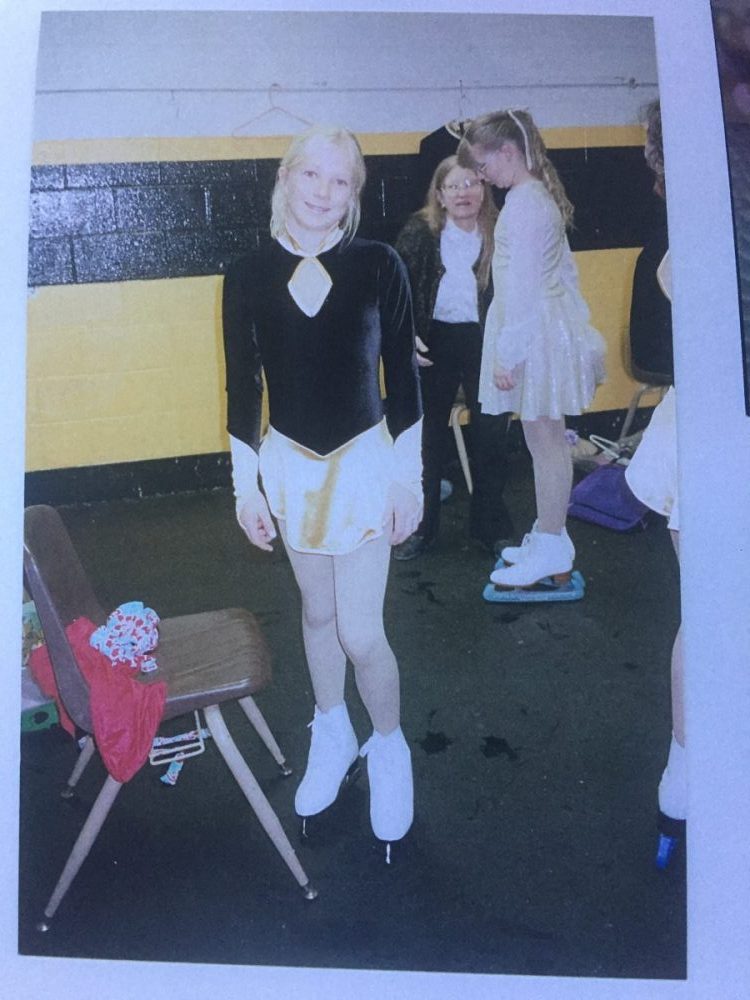
A young Jesse Knori in the skating zone: no pole style = moxie too. (Courtesy photo)
Mostly the sport is rife with teeth-grinding athletes seeking the sufferfest. One of those athletes is 23-year-old Jesse Knori, a 2017 University of Colorado-Boulder (CU) graduate and native of Jackson Hole, Wyo.
On the spectrum of sufferfesting skiers, Knori is an outlier. For a young adult, Knori has already dealt with more than her fair share of physical and emotional pain. (For all the details, you’ll have to listen to the podcast episode below.)
Jesse Knori (University of Colorado-Boulder) leading Estonia’s Anette Veerpalu during their quarterfinal of the women’s classic sprint at U23 World Championships at Soldier Hollow in Midway, Utah. Knori finished third in that heat (while Veerpalu was sixth). While she didn’t advance to the semifinals, Knori was the top U.S. woman in 15th on the day. (Photo: FlyingPointRoad.com)
As a middle schooler, Knori was diagnosed with severe rheumatoid arthritis. Knori skied at CU and notched 15th in the classic sprint at this year’s U23 Nordic World Championships in Utah. Clearly, Knori didn’t let her autoimmune condition dictate her goal setting.
Bottom line, Knori is as tough as they come. And she’s a sixth-generation Jackson Hole native and new coach at the Bend Endurance Academy in Oregon. She’s the guest on Nordic Nation’s first edition of its “Moxie Episode”.
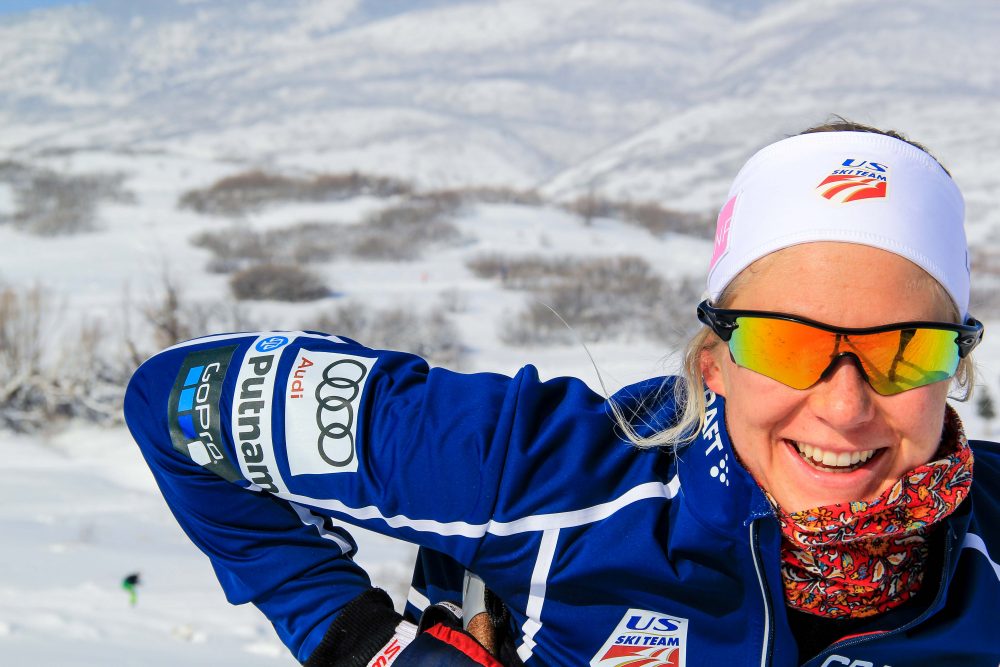
Jesse Knori (University of Colorado-Boulder) representing the U.S. at 2017 U23 Worlds at Soldier Hollow in Midway, Utah. (Photo: Bernie Nelson)
American Jesse Knori (University of Colorado-Boulder) racing to 19th in the women’s classic sprint qualifier on Tuesday at U23 World Championships at Soldier Hollow in Midway, Utah. She went on to finish 15th overall. (Photo: FlyingPointRoad.com)
In an effort to showcase the North Americans competing at this week’s International Ski Federation (FIS) 2017 USANA Nordic Junior World Championships and U23 Cross Country World Championships at Soldier Hollow in Midway, Utah, we asked those qualifying athletes several questions about themselves — actually, we had them fill in the blanks. Here we have 22-year-old Jesse Knori, of the University of Colorado-Boulder Ski Team, who’s representing the U.S. at her first U23 Worlds.
“My full name is Jesse, but you can call me Jesse (or Knori as long as you pronounce the K). I was born in Jackson Hole, Wyo., raised in Jackson Hole, and one thing you should know about my hometown is I am 6th generation Jackson Hole.
Jesse Knori (University of Colorado-Boulder) representing the U.S. at 2017 U23 Worlds at Soldier Hollow in Midway, Utah. (Photo: Bernie Nelson)
I started cross-country skiing when I was 16, thanks to my swim coach who told me to either train year round for swimming or do another endurance sport. Turns out I left swimming for skiing 🙂
I currently train in Boulder, Colo., with the University of Colorado Ski Team.
If I’m not skiing, you might find me mountain biking, backcountry skiing, swimming, playing beach volleyball, or drawing floorplans.
If I had to pick a favorite book, it would be an empty sketch book for me to draw in. (I know! Not a regular book *plot twist)
One of the things I’m most excited about for U23/Junior Worlds at Soldier Hollow is getting to race against the top U23 athletes in the world at one of the most weather changing, exciting courses I’ve ever raced on!
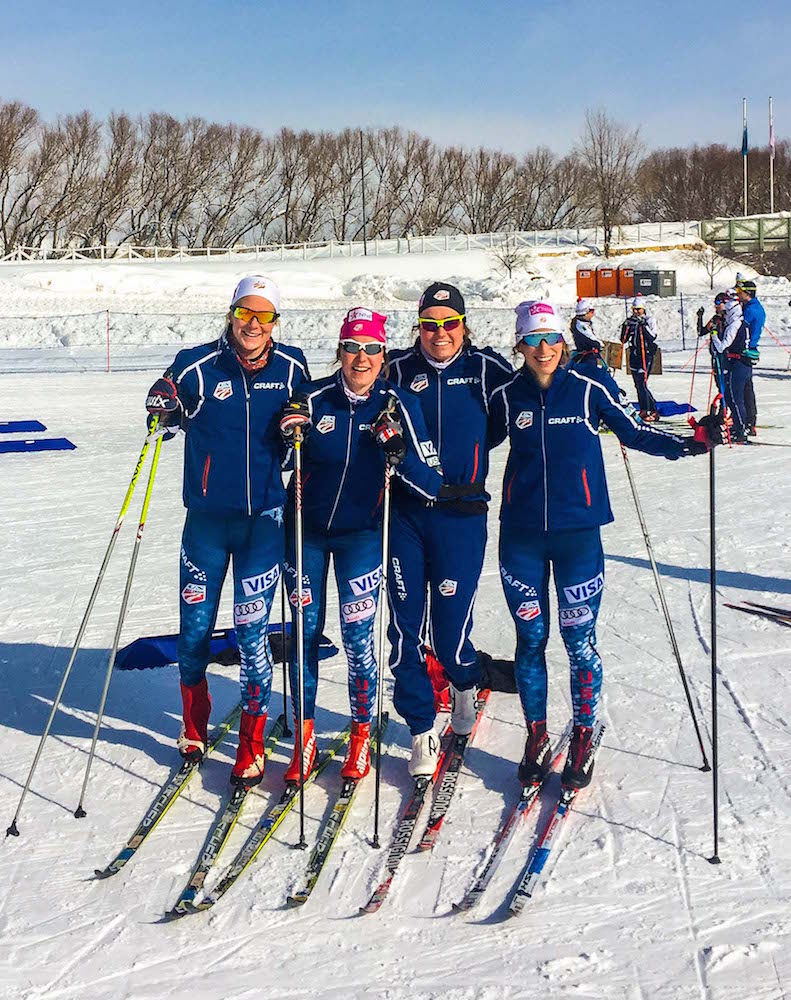
(Left to right) U.S. U23 Worlds teammates Jesse Knori, Corey Stock, Nichole Bathe, and Kelsey Phinney on a training day before 2017 U23 World Championships racing began at Soldier Hollow in Midway, Utah. (Photo: Paddy Caldwell)
One race I’m especially targeting there is just experiencing the skiathlon. I’ve never raced in one and I think the energy of it all will be an amazing 15k.
The best advice anyone ever gave me about skiing or racing was somewhere along the lines of ‘you’ve done all the hard work, go out and have fun’. There is something so remarkable about the type of people nordic skiing attracts and to just all be able to go out and push our bodies and smile afterwards is what nordic skiing is all about.
One of the best race memories I have is NCAA 15k classic race last year in Steamboat. The weather was bathing-suit hot, the tracks had long disappeared before our start and it became such a mental game. I love when race conditions are subpar, I think it challenges you as a person and it is exciting to test your body and mind when it isn’t perfect skiing on fast tracks on extra blue.
If I could meet one World Cup skier, it would be Stina Nilson.
If I don’t end up being a professional skier, I’ll probably be an interior designer for Kitchen and Baths or a Landscape Architect.
I’m missing three weeks (*heading straight to Alaska for college races after this) of school to be here, and my professors are probably thinking, ‘What is cross country skiing?’
When members of the USSA Cross Country Sport Committee head to Park City next week for the annual USSA Congress, they will be deciding the fate of the High Plains division.
Before the 2015/2016 season began, the regional cross-country ski associations around America hammered out a deal with the U.S. Ski and Snowboard Association (USSA): they crafted “affiliation agreements” detailing the relationship between geographic divisions and the national governing body.
Until that point, regional bodies like Central Cross Country (CXC), Intermountain Division (IMD), the New England Nordic Ski Associaion (NENSA), and the Pacific Northwest Ski Association (PNSA) had been organizing much of skiing on their own. They ran USSA-sanctioned races, placed members on USSA committees, and were represented as teams at Junior Nationals. But in terms of day-to-day governance and regional racing, they were their own non-profits and to a large extent their own bosses.
15 conference calls later, the divisions are still their own nonprofits but are now legally affiliated with USSA.
Two weeks ago, the chair of the board of the High Plains division got a call from Robert Lazzaroni, the nordic domestic programs director for USSA.
“He was asking a few questions about High Plains, and just getting a better feel for how our division is laid out and what we’re made up of,” said Rebecca Watson. “How many U14s do we have coming up? How many NRL races do we have? Details like that.”
Lazzaroni was hired by USSA in August of last year, and the national governing body has been pushing to make additional partnerships with cross-country ski organizations at all levels and gain members in the nordic world.
It seemed to Watson like Lazzaroni was doing an educational fact-finding mission about a remote division. High Plains includes all of Wyoming except for Jackson Hole (which is part of Intermountain), and also serves some communities in eastern Montana and western South Dakota which are far from their designated divisions’ resources. It is a geographically large region in a sparsely populated part of the country.
Then an email arrived in Watson’s inbox.
“About four days later I got an email from Alex [Natt, USSA’s executive vice president and general counsel] saying that they had decided not to renew our affiliation agreement and that we would talk about it at Congress,” Watson said. “That was a little bit of a shock, that it wasn’t going to be renewed. It seemed like they didn’t give me much of a reason for the non-renewal.”
Since the affiliation agreement system has only been in place for a year, it’s unclear what ending the agreement will mean for Wyoming skiers and teams — other than, as Lazzaroni made clear in a later email to Watson, no High Plains team at Junior Nationals.
There’s still a chance that High Plains will be an affiliate of USSA next year, because the decision has to be voted on by USSA’s Cross Country Committee.
“At Congress, there will certainly be a continuation of the discussion on [High Plains],” USSA CEO Tiger Shaw wrote in an email. “This is a constructive and engaging discussion that is fully in flight, and as such it wouldn’t be right for me to comment on anything about it. I want the players to sort it out.”
Those in the High Plains region are perplexed, and leaders of other divisions concerned.
“Let me tell you, I have gotten an incredible amount of support from around the nation, from other team leaders and coaches,” Watson said. “It’s been really amazing. I’m just hoping that we can continue to grow the sport, and to make it accessible to everybody. That’s my biggest thing, is access.”
Like his boss, Lazzaroni did not elaborate on the reasons for the decision.
“See below the exact wording,” he wrote in an email on Tuesday. “USSA has decided not to renew the Affiliation Agreement with High Plains which would otherwise auto renew effective May 1, 2016. High Plains’ status as a USSA Affiliate will be considered at the USSA Congress later in May.”
Why Affiliate?
According to another divisional leader, one of the main purposes of the affiliation agreements were to cover everyone’s legal backs.
PNSA is one of the few divisions where alpine and cross-country skiing are still integrated under one governing body. The association’s Director of Nordic Alan Watson – no relation to Rebecca – was able to watch the alpine divisions go through the same process a year earlier.
“One of the things the McKinsey study had pointed out is that there’s no legal relationship between the divisions and USSA – they weren’t really divisions, they were their own nonprofit organizations,” Alan Watson explained. “They thought it would be good to have a contract … My understanding is that one reason to have the affiliation agreements is to protect us against some sort of unfortunate legal repercussions that could happen, but for practical purposes nothing changes.”
Indeed, once the agreements went into effect, not a lot changed. One main thing, said Rebecca Watson, is that divisions could now purchase liability insurance from USSA at a lower cost.
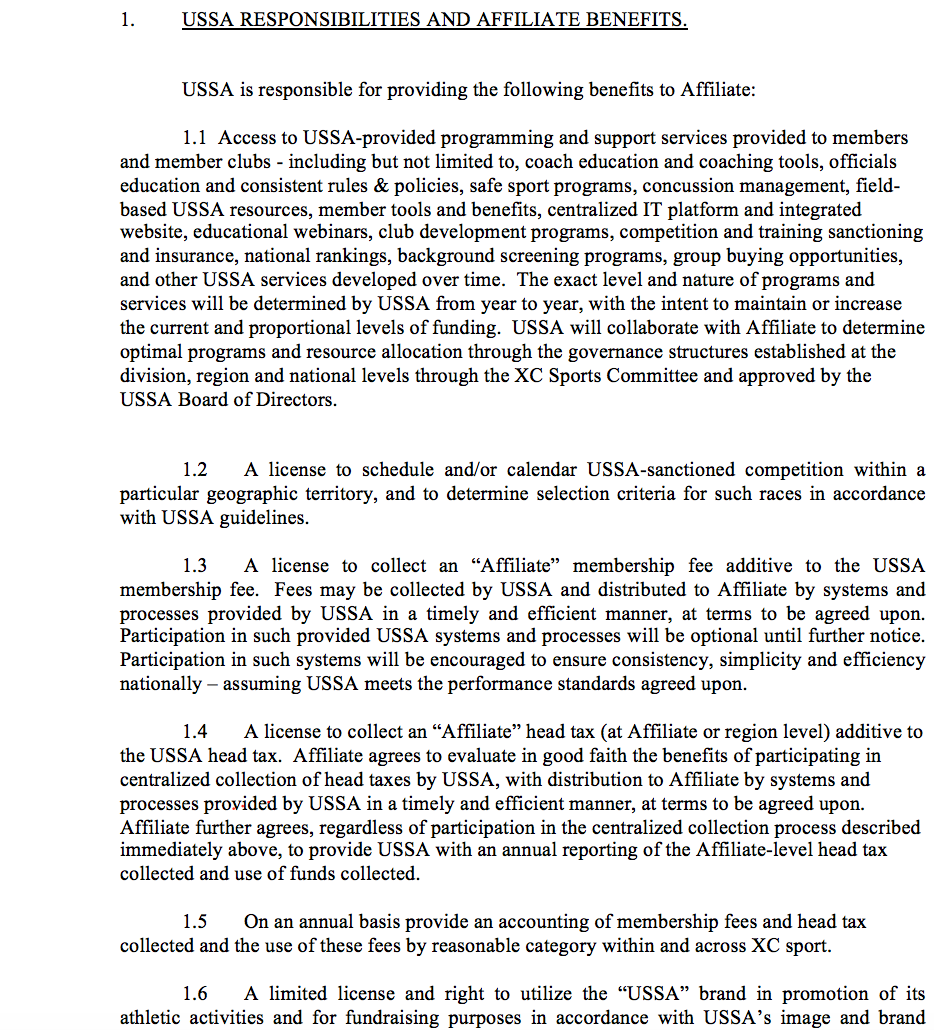
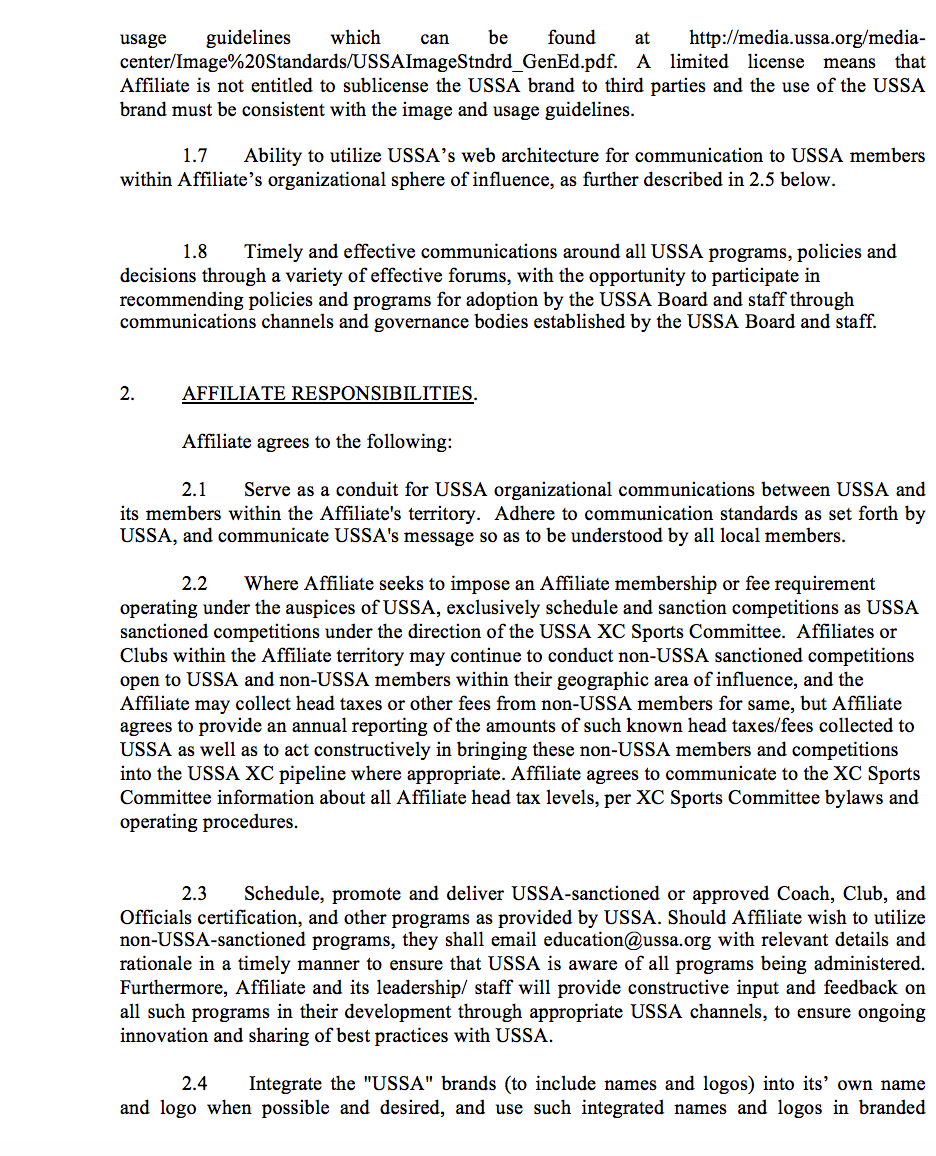
There were also agreements about race organization fees and head taxes, the use of the USSA logo, and communication between USSA and the affiliates, for instance about education and coach and official certification. In many cases, regional races now require a USSA membership, which is more affordable thanks in part to initiatives by Shaw and also to agreements worked out by Joey Caterinichio, Lazzaroni’s predecessor who stayed on with USSA this winter despite resigning last summer.
“Through all 15 or so conference calls, I most definitely got the feel from Tiger [Shaw, the USSA CEO] that he just wanted to have a better understanding of what the divisions were doing and to help grow the sport,” Rebecca Watson said. “That was the biggest thing that he kept saying: ‘I just want to increase membership and help grow the sport and help the health of the divisions.’ ”
Shaw confirmed as much in an email, writing, “You are correct in that the goals and initiatives of USSA have not changed. We do want to grow membership, enable competition and foster all of our sports. That is core to our mission.”
FasterSkier obtained a copy of an affiliate agreement from another division, with the source requesting anonymity in order to protect ongoing relations with USSA.
The agreement had virtually no references to elite racing, results, or the development pipeline: while divisions were responsible for communicating with USSA when they wanted to schedule USSA-sanctioned races, they were also welcome to continue to host non-sanctioned races (i.e., without points) and allow non-members to enter them. Junior Nationals was never mentioned.
‘Bottom of the Ranking List’
When Rebecca Watson asked Lazzaroni for a rationale about why her affiliate agreement was being terminated, however, high performance and the development pipeline seemed to be the focus.
Watson gave FasterSkier a copy of an email Lazzaroni had sent her (after also sharing it with other divisional leaders and the Sports Committee), and it focuses mainly on junior programming and racing.
Among his concerns: the division organizes few races, and even fewer that are USSA-sanctioned National Ranking List (NRL) competitions; there are few year-round clubs, and most of the teams are high school teams; and the region finished at the “bottom of the ranking list” at 2016 Junior Nationals.
With just 584,000 people and few major population centers in Wyoming, it’s not surprising that there are a limited number of ski teams in the state. As for the matter of most of them being high school teams, Watson said that’s partially a matter of logistics.
“Because of the distances that we have to travel it would be crazy to have two separate race series,” she explained. “I think people can look at that and say that we’re just high school. But we do have both club and high school, it’s just that we try to work it out so that we can do things together.”
Watson said that High Plains is looking into hosting more NRL races, but that it’s an ongoing challenge in part because of the expense. According to USSA’s website, hosting a USSA race costs $50 dollars, plus a $3 per person head tax up to a maximum of $300 per gender. That’s potentially $650 in cash to hand over. Hosting a FIS race series carries an additional $500 fee.
Several venues in Wyoming are upgrading their race-hosting abilities, including Watson’s hometown of Laramie and, perhaps most notably, Casper — which is using donated land and pouring more than $700,000 into putting up a state-of-the-art biathlon facility.
But still, in 2016 the 22-member High Plains team was last in the Junior Nationals Alaska Cup scoring, by a wide margin. They had only one skier hit the top 30: Adam Pickett, who finished 23rd in the U16 5 k and 26th in the U16 sprint.
Mike Elliott, a head of the Rocky Mountain division and a member of the USSA Cross Country Committee, said that during the affiliation agreement negotiations, he had interpreted some of the top goals of the process to be increasing membership and gaining more non-competitive members.
The process was not as contentious as it had been for alpine, he said, and everyone seemed to be talking in good faith.
“That is why I was so surprised at USSA notifying [High Plains] that they were not renewing the affiliation agreement,” he wrote in an email on Thursday. “Judging how the conference calls were handled, I would have thought USSA would have reached out to [High Plains] to offer professional help. There was no notification to the USSA Cross Country Committee that USSA was even thinking about not renewing the affiliation agreement that I am aware of, and I am on the Cross Country Committee.”
Geography
Another issue Lazzaroni seemed to have with the division was geography: he told Watson that one-state divisions don’t make sense.
“One division should represent more than one state (High Plain represent only Wyoming, minus Jackson Hole). Club, state, division, region, national is the map. AK is clearly a unique geographical situation,” Lazzaroni wrote in the email Watson shared.
In fact, there are other divisions which represent primarily one state. Great Lakes includes Michigan, Indiana, Kentucky, and Ohio, but almost all of its skiers hail from northern Michigan. It is considered a sub-division of Midwest, also governed by CXC.
Mid-Atlantic comprises New York, New Jersey, Pennsylvania, Delaware, West Virginia, Maryland and the District of Columbia. But its skiers are almost exclusively from New York.
The reason for High Plains encompassing primarily one state is partly the size of Wyoming (the organization does also include parts of Montana and South Dakota). The state is roughly 280 miles wide and 360 miles long. Cut out and put together, all of the traditional ski regions of Lazzaroni’s native France would easily fit within the borders of Wyoming.
“Before [2003] Wyoming was split into four different divisions,” Watson explained. “It made it very dysfunctional within the state. Laramie was with Rocky Mountain, Pinedale with Intermountain, Cody went up to what was Northern, but now no longer exists.”
High Plains teams do travel to the western Super JNQs; to get to Soldier Hollow, Utah, might be a six-hour drive. Sun Valley, Idaho, is over nine hours from Casper, Wyoming.
“I was actually on that coaching crew which put forward the initial proposal for [High Plains to exist],” Watson said. “One of main reasons was, geographically, it was impossible to get to the IMD qualifiers. One skier attempted it, and was driving 21 hours in a weekend to and from a qualifier. It was just absurd.”
In his email to Watson, Lazzaroni suggested that once High Plains no longer exists, Wyoming athletes could choose between “geographically close divisions”: IMD, including Idaho, Montana, Utah, and Jackson Hole, or Rocky Mountain, which comprises Colorado and New Mexico.
This plan has not yet been sussed out.
“We have not had any discussions within IMD about what would happen to [High Plains] regarding their participation in other divisions,” IMD Competition Committee member Rick Kapala, also the Cross Country Program Director of the Sun Valley Ski Education Foundation, wrote in an email.
Furthermore, there was confusion as to why this was surfacing now, rather than last year when several of the first conference calls were dedicated to mapping out regions and divisions.
“[A goal of the affiliation agreements was] clarification of geographic boundaries for all divisions to include states that may have a limited number of participants,” Elliott wrote. “I do not remember any discussion regarding there were issues about High Plains representing only one state.”
“Why did we go through all this stuff last summer, and why did nobody say, ‘OK, High Plains, you’re sort of a weak division, you’re on probation?’” Alan Watson asked.
Another Theory?
There might be one other factor: Jackson Hole. The town stayed part of IMD, but recently a skier who lived in Pinedale, Wyoming, and skied with Jackson Hole as a J3 (U14) decided to compete in the High Plains junior national qualifiers instead, and thus was able to meet qualification criteria where she would have failed in IMD.
The idea that this could happen provoked strong reaction.
“What, if anything, does our non-renewal have to do with the border town issues with Jackson?” Watson asked in her email.
“We do not believe that offering a way for skiers to qualify to junior national Championship that do not require skiers to train more and to become better skier is the right way,” Lazzaroni replied.
But others, including Alan Watson, don’t see this as a major issue.
“One thing that Tiger [Shaw] clearly said is that kids in border towns should be able to choose which division they want to compete in,” the PNSA head said. “Which makes sense to me, because we want kids to want to race.”
What is clear is that if the Sports Committee follows USSA’s recommendation, there will be no more High Plains division.
That, Watson believes, would be unfortunate.
“We took [the state] and were able to join it as one division,” she said. “And it’s been huge for Wyoming skiing. The accessibility to skiing, and to skiing at the national level, has increased so dramatically.”
The Jackson Hole Ski & Snowboard Club is pleased to announce the hiring of Ben Morley as our Nordic Program Director and Head Coach. Ben was born and raised in Jackson Hole and has spent his life Nordic racing and coaching. After competing at the junior level with JHSC, Ben raced at the NCAA Division 1 College level for Western State College, with a podium at Junior Nationals.
Subsequent to his junior racing career, he finished his degree at the University of Oregon and University of Oslo in Norway. In the following years, he returned to Jackson where he coached the Teewinots, Junior Nordic and IMD teams as well as the Master’s Program at JHSC. Ben also served as the Head Coach at the Glacier Nordic Ski Club in Whitefish, Montana where he took three athletes to Junior Nationals.
Ben’s passion for the sport and our community will help him lead our program to new heights. He has already begun working with our IMD Team and looks forward to working with our Junior and Master’s athletes in the coming months.
The fifth edition of the USSA National U16 Camp will be held Sunday July 27 to Sunday August 3, 2014 Jackson Hole, WY. The National U16 Camp brings together the top U16 Boys and Girls from across the Country for a week of intensive training and ski sport education as one the first steps in the USSA National Development Pipeline. The National Nordic Foundation has designated the U16 Camp as one of its Pillar Projects and has been instrumental in helping the U16 Camp project grow into one of our country’s key development initiatives.
The camp rotates in location throughout the country and this year’s camp will be based at the Teton Science School Campus, located in Jackson Hole, Wyoming. The community of Jackson offers unlimited opportunities for ski training in a beautiful mountain setting. US Ski Team Head Development Coach, Bryan Fish will lead the camp along with a selection of top regional coaches. Selection for the camp is based on results from US Junior Championships, held in Stowe, Vermont using a system of best 2 of the 3 individual results.
In addition to the automatic selections of the top twenty boys and top twenty girls based on JN results, each USSA division is afforded two discretionary picks of one boy and one girl in addition to however many may have qualified via the JN selection procedure. It is the responsibility of each USSA Division to select these discretionary divisional skiers and forward those selections onto the camp director, Rick Kapala of the Sun Valley Ski Education Foundation, rick@svsef.org. Please include discretionary names with phone and email contact. We also ask all Divisional Leaders to alerting all athletes who have been selected, that they have qualified for this opportunity.
Attendees are required to organize their own flights or ground transport into Jackson, WY to arrive on Sunday, July 27 and to depart on the following Sunday, August 3rd. Note that it is possible to fly directly into Jackson, WY connecting through an assortment of major airline hubs. All skiers arriving by air into Jackson will be picked up by U16 staff and transported to the lodging. All Lodging, meals and all associated camp costs are included in the camp fee of $660.00. Skiers who have been selected through the JN selection procedure may immediately confirm their attendance by emailing U16 Camp Director Rick Kapala at rick@svsef.org. Participants will receive a comprehensive registration packet upon confirmation. The Final date for confirmation is Friday June 6, 2014. We would also appreciate an email declining participation as well if a skier may not attend.
USSA/NNF 2014 U16 Camp Selections based on best 2 of 3 from US Junior Nationals
U16 Boys
1. WILLIAMS, Zach 14 IM Sun Valley SEF
2. WONDERS, Hunter 15 AK APU
3. HAMILTON, Forrest 15 NE Mansfield Nordic
4. LUKENS, Leo 15 PN Mt Bachelor SEF
5. WOLTER, Peter 15 IM Sun Valley SEF
6. BOSWELL, Russell 14 NE Stratton Mountain School
7. KOENIG, Benjamin 15 AK NSCF-Fairbanks-FXC
8. STREINZ, Daniel 15 NE Maine Winter Sports Center
9. POLITO, Max 15 IM Jackson Hole SSC
10. KNOPP, Tracen 15 AK Alaska Nordic Racing
11. HOEFLER, Matthew 15 AK Alaska Winter Stars
12. SAPP, Everett 14 MA New York SEF
13. BALCAO, Will 15 AK Alaska Winter Stars
14. GLUECK, Adam 14 NE Ford Sayre
15. CONSENSTEIN, Jack 15 AK APU
16. VORSE, River 15 IM Sun Valley SEF
17. HANSON, Anders 15 NE Craftsbury Nordic
18. KNOPP, Dawson 15 AK Alaska Nordic Racing
19. BATES, Calvin 15 NE Dublin School
20. ROS, Carter 15 IM Sun Valley SEF
U16 Girls
1. SWIRBUL, Hailey RM Aspen Valley Ski
2. HALVORSEN, Hannah 15 FW Sugar Bowl Academy
3. KAUTZER, Amanda 15 MW Loppet Nordic Racing
4. LANGE, Leah 15 IM Park City Nordic Ski Club
5. LEVINS, Chloe 15 NE Mountain Top Nordic
6. BRAMS, Leah 15 NE Cambridge Sports Union
7. YOUKEY, Lydia 14 PN Leavenworth Winter Sport
8. O `CONNELL, Kathleen 15 RM Steamboat Springs WSC
9. BENTON, Claire 15 MW Loppet Nordic Racing
10. RUDD, Hannah 15 MW Loppet Nordic Racing
11. RIZIO, Mackenzie 15 NE Stratton Mountain School
12. LARKINS, Lizzie 15 FW Auburn Ski Club
13. FLOYD, Jordan 15 RM Steamboat Springs WSC
14. MOENING, Erin 14 MW Endurance United
15. JOHNSON, Anna 14 MW Mesabi East
16. DUNNAGAN, Brooke 14 IM Bogus Basin Nordic Team
17. DARNELL, Anna 15 AK APU
18. GIBSON, Anna 14 IM Jackson Hole SSC
19. MORGAN, Madison 14 IM Park City Nordic Ski Club


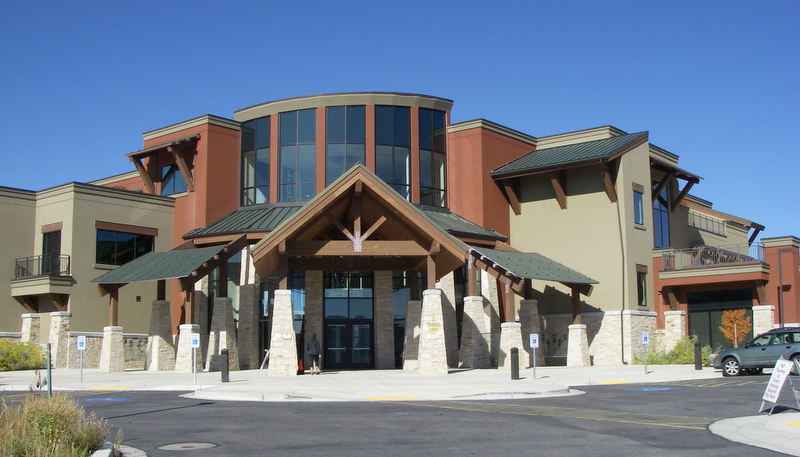
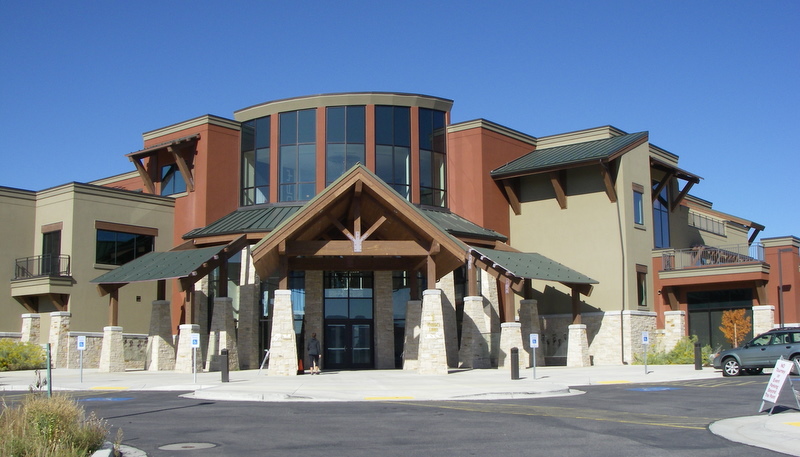
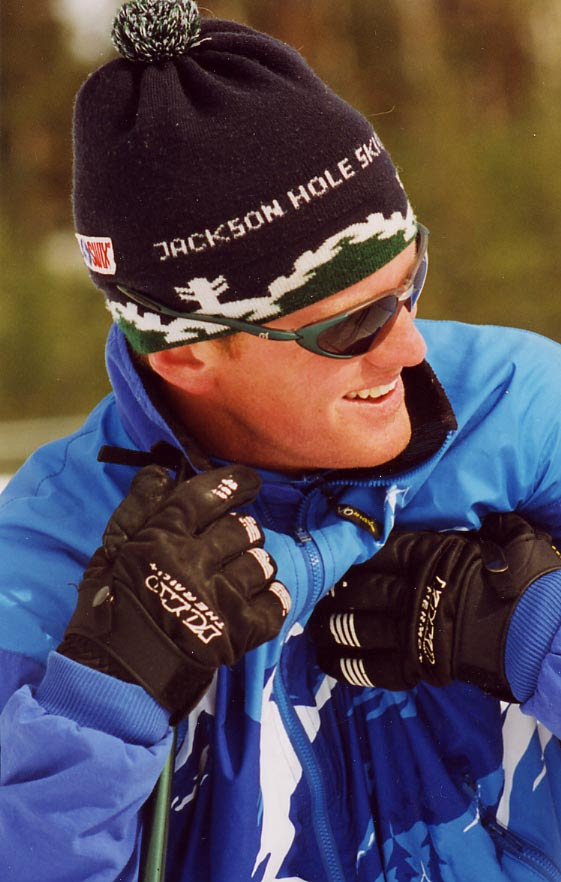 announce the hiring of Ben Morley as our Nordic Program Director and Head Coach. Ben was born and raised in Jackson Hole and has spent his life Nordic racing and coaching. After competing at the junior level with JHSC, Ben raced at the NCAA Division 1 College level for Western State College, with a podium at Junior Nationals.