Tag: Jacqueline Akerman

  • Opening Doors: Biathlon Canada’s All-Female Coaching Staff at Youth/Junior Worlds

    Opening Doors: Biathlon Canada’s All-Female Coaching Staff at Youth/Junior Worlds

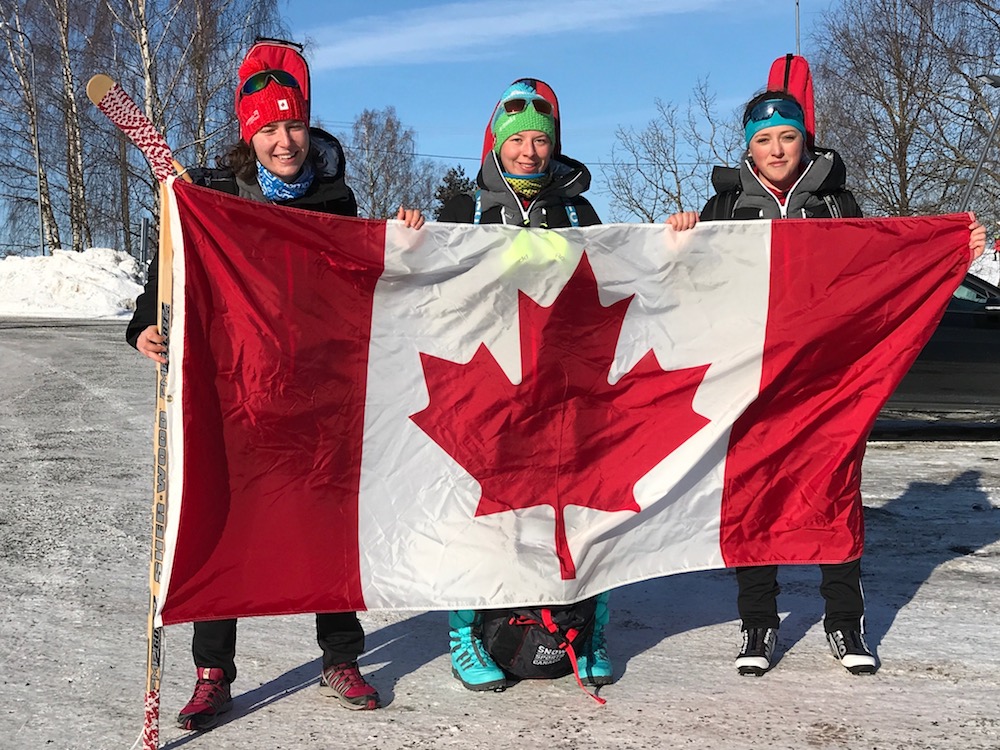
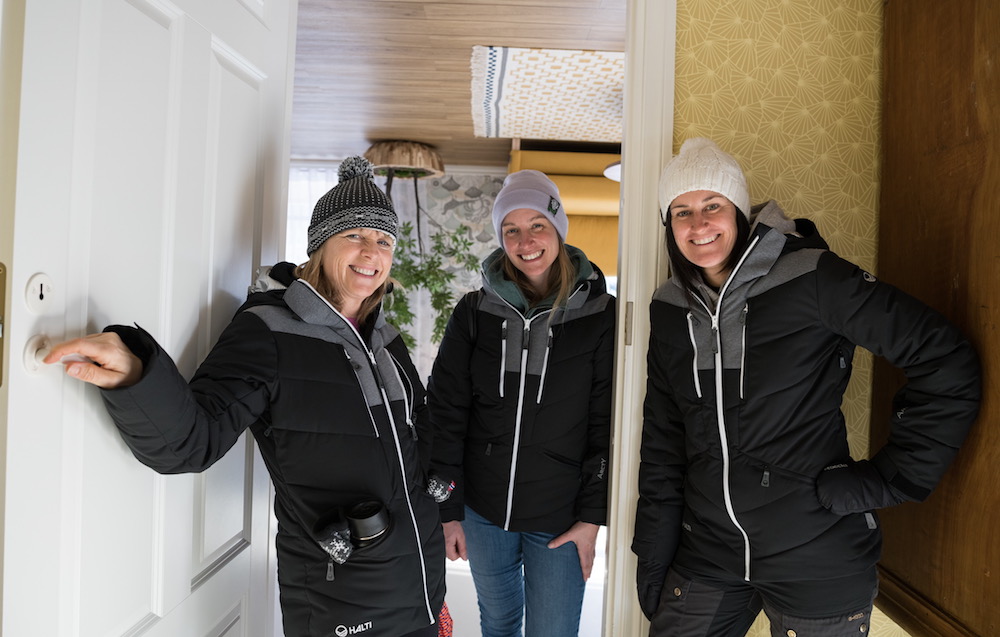
    Biathlon Canada’s all-female coaching staff at 2018 IBU Youth/Junior World Championships in Otepää, Estonia. From left to right: Kathy Davies, Jessica Blenkarn and Jacqueline Akerman. (Photo: Emily Dickson)

    Think about all of the exceptional female biathletes out there. Too many to count, right?

    Now, if you watch biathlon at the World Cup level, think about how many women you’ve seen coaching there. None? One?

    There are at least a couple, according to Biathlon Canada’s High Performance Director Roddy Ward, who’s been coaching biathlon internationally since 2011. The Slovakian women’s coach is one and the Austrian team also has a female coach, he wrote in an email to FasterSkier.

    When it comes to wax techs, Ward wasn’t aware of any at the International Biathlon Union (IBU) World Cup level. The number of female race officials in that arena is similarly low.

    Biathlon Canada is trying to change that. Not by consciously developing female wax techs or officials, but by presenting women with career opportunities after they retire as an athlete or if they show promise as a budding coach.

    That emphasis on female leadership and coaching development is taking place in sports across Canada, Ward explained. Biathlon Canada is fully onboard with that movement and sent a clear message at this year’s IBU Youth/Junior World Championships — which took place last week from Feb. 26-March 4 — sending three female coaches to head up its team in Otepää, Estonia.

    Last fall, Ward and Jacqueline Akerman, Biathlon Canada’s athlete and coach development manager, decided on their coaching staff for Otepää Youth/Junior World Championships. Akerman would be the head coach and trip leader, as she had for the previous two years, and joined by Kathy Davies, head coach of the Biathlon Alberta Training Center, and Jessica Blenkarn, who coaches at Sea to Sky Nordics.

    The three women would make up the coaching staff and work with two male wax techs: head wax tech Andrew Chisholm and assistant tech David Bradley.

    While the coaches were selected because of their qualifications (“we have these three great coaches who happened to be female,” Ward wrote), he also liked that female-to-male staffing ratio. It sent a message.

    “Roddy and I went, ‘Oh, that would be cool, to be able to take an all-female staff,’ ”  Akerman recalled of their conversation last fall. “… He said, ‘This is a really good thing for people to see, that we have three strong women coaching.’ ”

    “It’s definitely important for us to have strong female leadership in our program,” Ward wrote to FasterSkier. “Truthfully, these are three great coaches who just showed up at my front door.”

    Akerman had previously worked with Davies and Blenkarn on other international racing trips; Davies has been to several Youth/Junior Worlds and Blenkarn has coached at Open European Championships, the IBU Cup and IBU Junior Cup.

    Asked if they’ve ever encountered an all-female or mostly female coaching staff in their sport, Akerman was quick to respond: “That’s an easier answer, two letters: NO.”
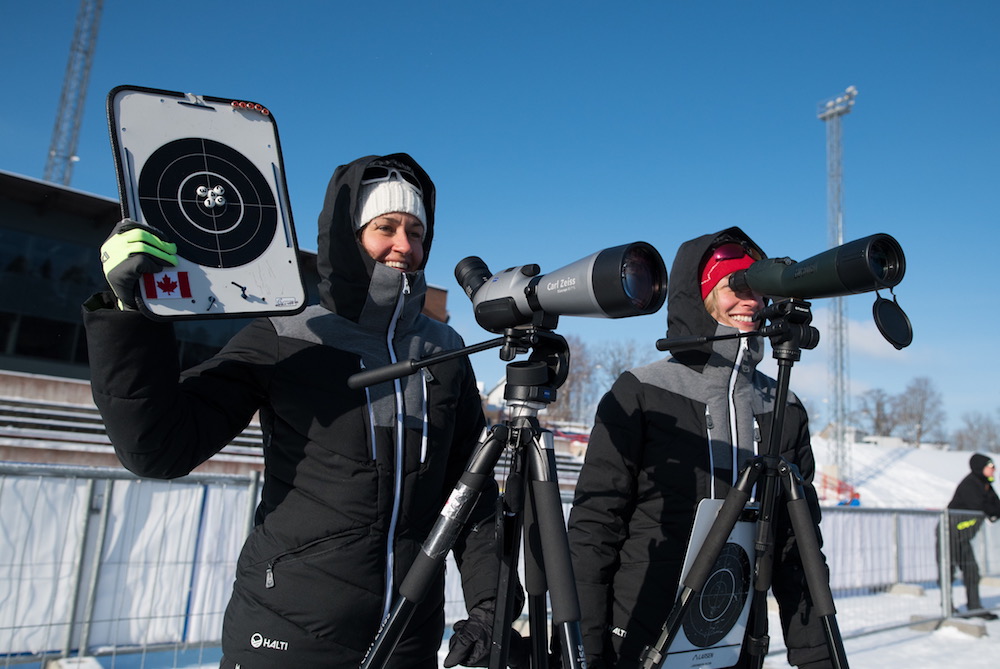
    Jacqueline Akerman (l) and Jessica Blenkarn on the range at 2018 IBU Youth/Junior World Championships in Otepää, Estonia. (Photo: Emily Dickson)

    At last year’s Open European Championships, Akerman and Blenkarn experienced some reaction from their peers when they were working together on the range.

    “The amount of second glances that we got was incredible, and comments saying, ‘Oh, two female coaches! Two women coaches!’ ” Akerman said during a joint phone interview with Davies and Blenkarn in Otepää a few days before the championships began.

    “We were a bit of a spectacle,” Blenkarn added.

    “And we got lots of TV time,” Akerman continued. “The TV’s haven’t come out yet and not all the teams have arrived yet so we’re waiting to what kind of spectacle this will be with three of us.”

    FasterSkier had yet to hear how the three coaches were received throughout the championships, but they stated they were off to a good start from an internal perspective.

    “We’re all good communicators, and we’re all complimenting each other really well,” Akerman said. “For me, it seemed to just really flow nicely, maybe more so than other times.”

    “I’ve been on a number of trips similar to this and it’s the first time I’ve have even another woman on a trip, except for athletes,” Davies said. “Those trips can be very, very isolated and very hard to sometimes fit in or even feel like part of the coaching staff when you’re the only female.

    “It’s not a conscious thing on the men’s part necessarily, but it sometimes feels very isolating, so it’s just absolutely amazing to be with other women in the coaching position,” Davies continued. “What I love about it is it actually gives female athletes and idea that there’s more that they can do. It’s not just athletes, whereas most World Cup races, the women, that’s all they see is an athlete, because you see very few in the coaches’ world, you see next to none in the techs’ world and you also see a rare few in the officials’ realm as well, so it’s really nice to [show] women and athletes that there’s something else they can do as well.”

    “I think we just support each other really well,” Blenkarn noted. “We have a good understanding of what female coaches go through and what kind of unique challenges they might face at an event like this so it’s nice to have other people around you to support you.”
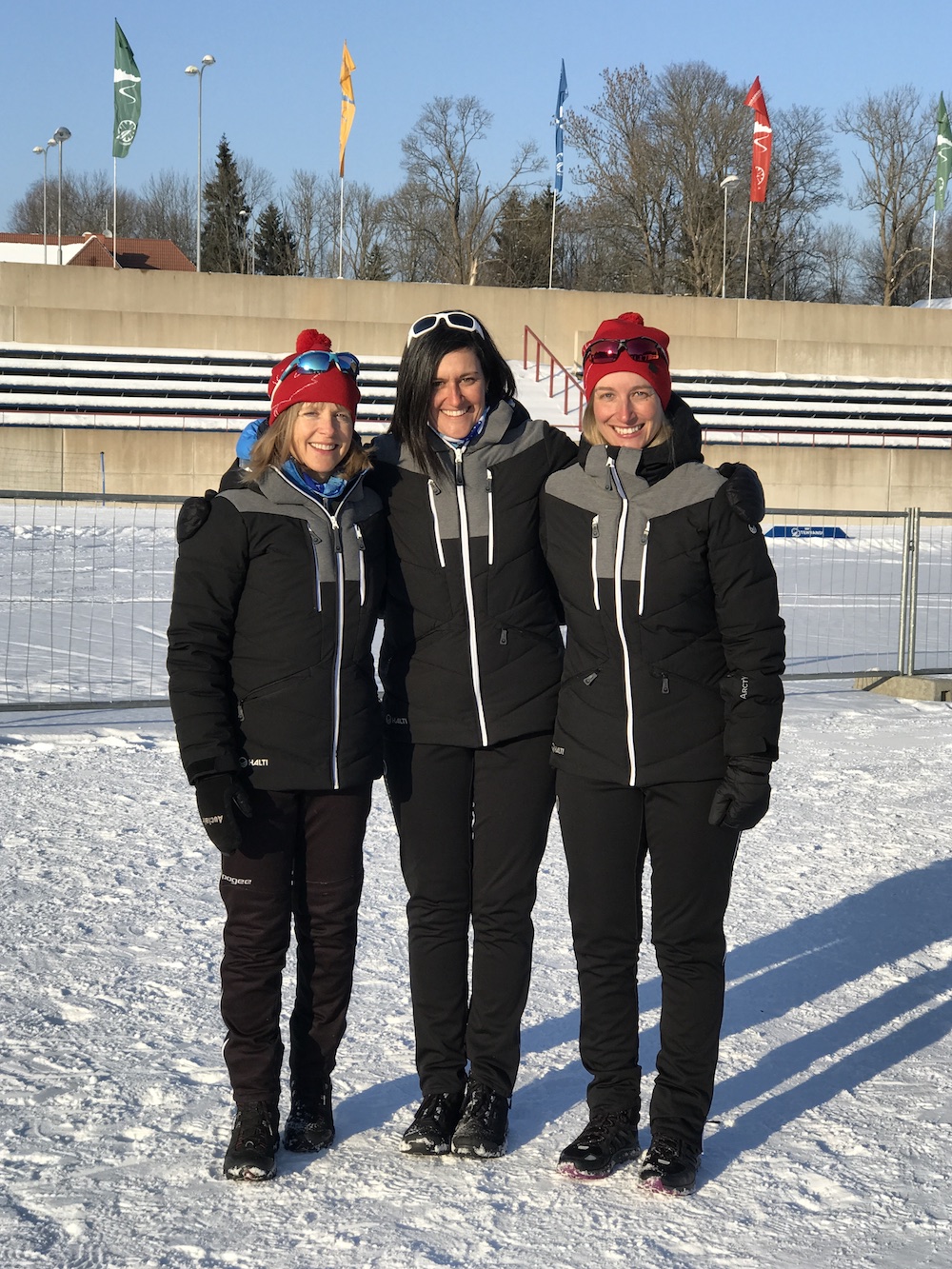
    Biathlon Canada’s all-female coaching staff at 2018 IBU Youth/Junior World Championships in Otepää, Estonia. From left to right: Kathy Davies, Jacqueline Akerman and Jessica Blenkarn. (Photo: Terri Dickson)

    Asked more specifically about those challenges, Akerman referred to the term Davies used: “isolating.”

    “It’s really hard to find your space in the room,” Akerman said. “It’s really easy for me right now to find my confidence with these other two that are here and sharing and supporting. Just them physically being here I feel more confident. So I can find my voice better. There’s just more space for you.

    “Your space can sometimes get beaten up in a male-dominated place, so I feel that we need to be encouraged … and open and invited,” she continued. “I met Jess about three years ago and I just saw her skill and her ability and I was like, OK, we need her to be invited into this because she’s excellent. … Someone has to be opening the doors and allowing that space to happen, otherwise it won’t happen for women. I think when we see potential and, not just potential, when we see people who are experienced and they’re very good at what they do, we have to open the door for them. For the men, it’s already open, they just walk through. We need top open it. … I think that’s partly what Roddy’s doing … some men get it and they open the doors, but I think as women we can do it even more because we can understand what it’s like.”

    At the Olympic level, biathlon dates back to 1924 when it was known in its ancient form as “military patrol”. A more modern form of biathlon debuted at the 1960 Olympics, but women’s biathlon didn’t become an Olympic sport until 1992. The sport’s military background paired with the relatively recent participation of women has led to some inherent challenges for women in the sport’s leadership roles.

    “I can find my voice better. There’s just more space…” — Jacqueline Akerman, Biathlon Canada’s head coach and trip leader for the last three Youth/Junior Worlds, on having two other women on her coaching staff in Otepää

    “2003 was the first time I worked the World Cup for biathlon and that was on the range with one of our male coaches and I was the only woman there,” Akerman recalled. “And people looked at me like I was an alien. Slowly over the years you see a few women. On the IBU Cup last year, actually, there was a fair amount of female coaches. I mean, the percentage is still ridiculously low, but you do see them now, and on the Junior IBU Cup as well…”

    So the trend is in the right direction, and Biathlon Canada is more than happy to be at the forefront of that progression.

    “It’s important for female athletes to have good role models,” Ward wrote. “I have seen firsthand what a good female coach can do for a female athlete and I see that is important for three reasons.

    “1) to help athletes navigate life/struggles to turn into healthy and successful adults.

    “2) I want our athletes to kick butt internationally and I believe strong female leadership can help us achieve this goal.

    “3) I believe female athletes are more likely to give back to the sport (coaching, waxing, officiating etc) if they had female role models through their career that had a positive impact on their life.”

    Last week in Otepää, outside of relays, Canada notched five top-10 results, five top-20’s and seven top-30’s, which were achieved by five different women and three different men.

    “We’re building, practicing, focusing, training to be a well-oiled machine as a large group and as individuals,” Akerman said before the races began. “And we’re very confident in our ability to utilize those skills and abilities to our potential.”
  • Thursday Rundown: Levins 6th, Moser 8th, Bankes 9th in Junior Worlds Individual

    Thursday Rundown: Levins 6th, Moser 8th, Bankes 9th in Junior Worlds Individual

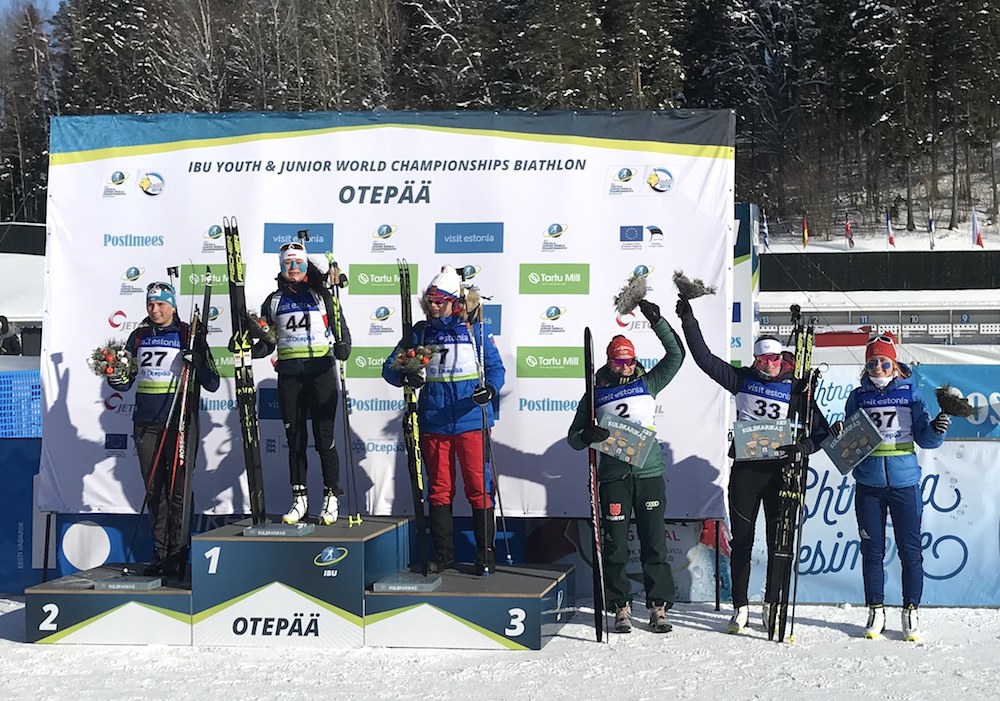
    The top-six finishers at the junior women’s 12.5 k individual flower ceremony on Thursday at IBU Junior World Championships in Otepää, Estonia, with Poland’s Kamila Żuk (second from l) in first, Ukraines’s Anna Kryvonos (l) in second place, Russia’s Irina Kazakevich (third from l) in third, and American Chloe Levins (r) in sixth. (Photo: Erik Lewish)

    IBU Junior World Championships (Otepää, Estonia): Junior women’s and men’s individual

    Three North Americans in the top 10, top nine even. That’s what happened in a single race at the International Biathlon Union (IBU) Junior World Championships on Thursday in Otepää, with American Chloe Levins placing sixth, and Canada’s Nadia Moser and Megan Bankes claiming eighth and ninth, respectively, in junior women’s 12.5-kilometer individual.

    According to the three racers, it was another beautiful day in Otepää with steady, sometimes even gusting, wind.

    Levins was the earliest starter of the three, starting in the middle of the field in bib 37 (out of 70). Bankes headed out of the gate 45th and Moser started near last in 67th.

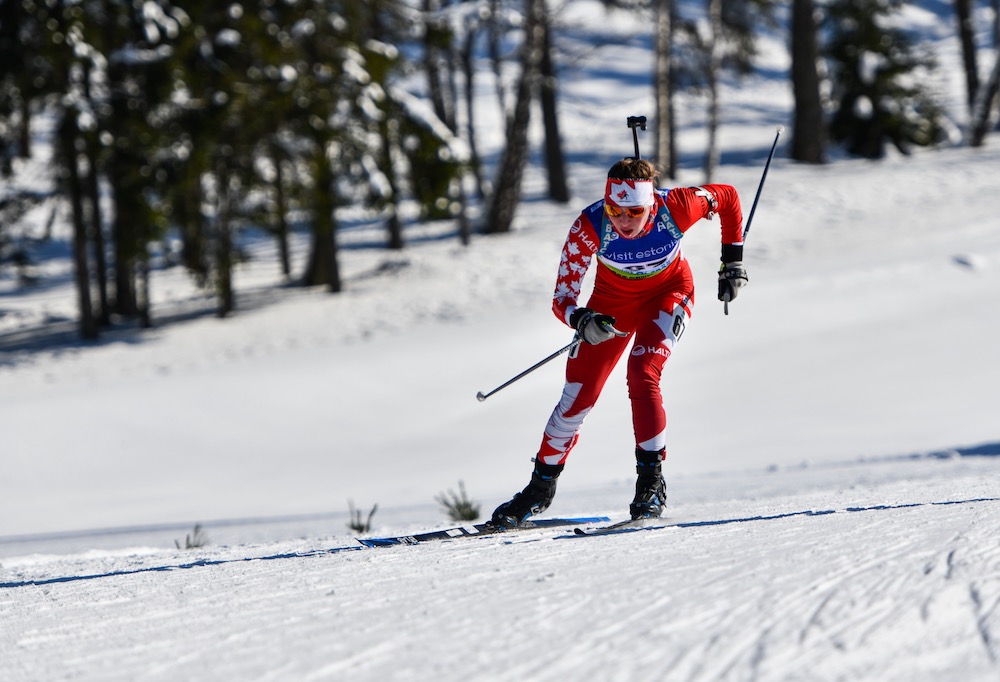
    Canada’s Nadia Moser racing to eighth in the junior women’s 12.5 k individual at IBU Junior World Championships in Otepää, Estonia. (Photo: Bryan Dickson)

    Despite the late start, Moser, 20 years old and in her second Junior Worlds, explained in an email that she wasn’t nervous. With temperatures rising to a high of -10 degrees Celsius (14 Fahrenheit) on Thursday morning, she almost preferred it.

    “There were also 20 second start intervals which are shorter than the usual 30, so all of the competitors were out of the gate in a shorter amount of time than normal,” Moser wrote.

    In neither Thursday’s women’s race nor the men’s 15 k individual that followed, nobody shot clean. In fact, only one woman shot 19-for-20: Slovakia’s Veronika Machyniakova, who ended up 11th. The top-two finishers in the women’s 12.5 k, Poland’s Kamila Żuk (who placed first in 41:36.1 minutes) and Ukraine’s Anna Kryvonos (who finished 3:04.7 minutes back in second place), both had two penalties. Russia’s Irina Kazakevich placed third (+3:20.0) with three misses — which added three minutes of penalties to her time.

    “I found the wind in the range today to be fairly variable,” Bankes, the defending Junior Worlds champion in the event, wrote in an email. “It was gusting and then dying quiet significantly and also in the middle of shooting bouts which made things a little tricky.”

    At last year’s Junior Worlds in Osrblie, Slovakia, Bankes shot a perfect 20-for-20 for the first time in her career and won gold in the junior women’s 12.5 k individual.

    Thursday brought new challenges, and Bankes explained she was happy to clean her first prone. She went on to miss two in the next standing stage, then one in each of the following two stages (0+2+1+1) to finish the race with four penalties, which ultimately put her in ninth overall (+4:59.1).

    Canada’s Megan Bankes racing to ninth in the junior women’s 12.5 k individual at IBU Junior World Championships in Otepää, Estonia. (Photo: Bryan Dickson)

    “I’m not totally sure what happened in my first standing (when I missed 2) but when I came into my 2nd standing the wind was gusting quite a bit, and I was really happy with how I waited for my first 4 shots, but I was a little annoyed to have missed that last one,” she recalled. “Overall I think my shooting today was pretty good, but I could have been better.”

    While Bankes figured the wind was giving most others trouble as well, she didn’t think that she’d make it into the top 10 with four misses.

    “I don’t like getting splits until the last lap, so I heard Andrew [Chisholm] our wax tech tell me I was fighting for 10th when I passed him, so I really tried to give everything that last lap,” Bankes, 20, wrote. “I was super stoked to see I crossed the line in 7th, and knew I wouldn’t be bumped down too much because I started 3rd seed.

    “Coming off of gold last year, I definitely had high expectations for myself,” she explained. “But I tried to use that as more positive belief in myself to know I can be in the top women, and know that I can shoot well, instead of just focusing on the result number. My main goal going into these championships was to have races that I’m happy with, and to ski and shoot to the best of my abilities.”

    At the end of the day, Bankes wrote that she was “really happy” with her result.

    “I felt like I really held myself together on skis, and kept my technique under control, while also pushing myself to the limit throughout the race,” she wrote. “I’m super stoked to see that the youth women are totally crushing it, and to be right behind Nadia today was also super exciting (also to see Chloe Levins in 6th was fantastic – 3 North Americans in the top 10!)”

    From left to right: Megan Bankes, Nadia Moser and Emily Dickson after the junior women’s 12.5 k individual at IBU Junior World Championships in Otepää, Estonia. (Photo: Bill Gilliland)

    One place ahead of her, Moser scored her first non-relay top 20 at Junior Worlds, leading Canada in eighth (+4:18.9) with three penalties (1+0+1+1). Two days earlier, Moser, Bankes and their teammate Emily Dickson placed ninth in the junior women’s 3 x 6 k relay.

    “I knew I could get a top 10 finish if I could pull my shooting together,” Moser wrote after Thursday’s individual race. “After my third shooting I had missed 2 targets total and I thought then that my top 10 chances were over. On may last loop I had 3 misses and was not even thinking about top 10 anymore. I realized that I must be doing better than I initially thought when everyone who was cheering me sounded really excited. I definitely got lucky today because no one cleaned their shooting. I was extremely happy to have finished in the top 10, especially since I was sure that I had no chance after missing 3 targets.”

    She was pleased to see all of her training over the last year validated on Thursday.

    “I tried really hard to improve over the summer and fall because I really wanted good results this season,” Moser wrote. “I think that the best thing I did today was to stay calm, and take my time in the range. I shot really slowly but that paid off in the end.”

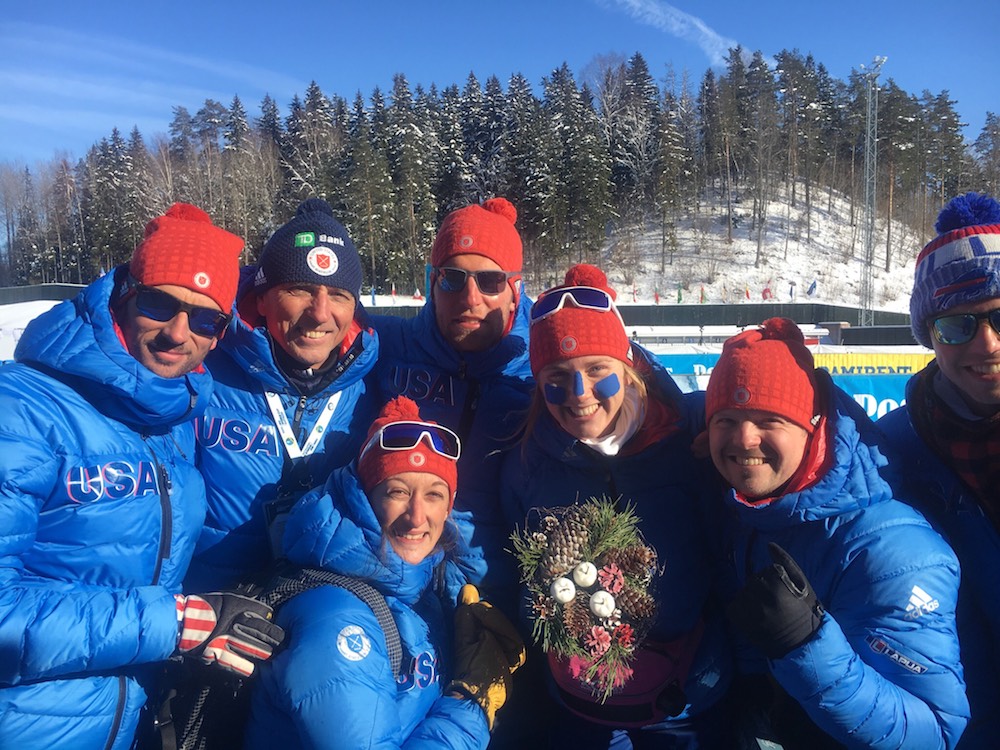
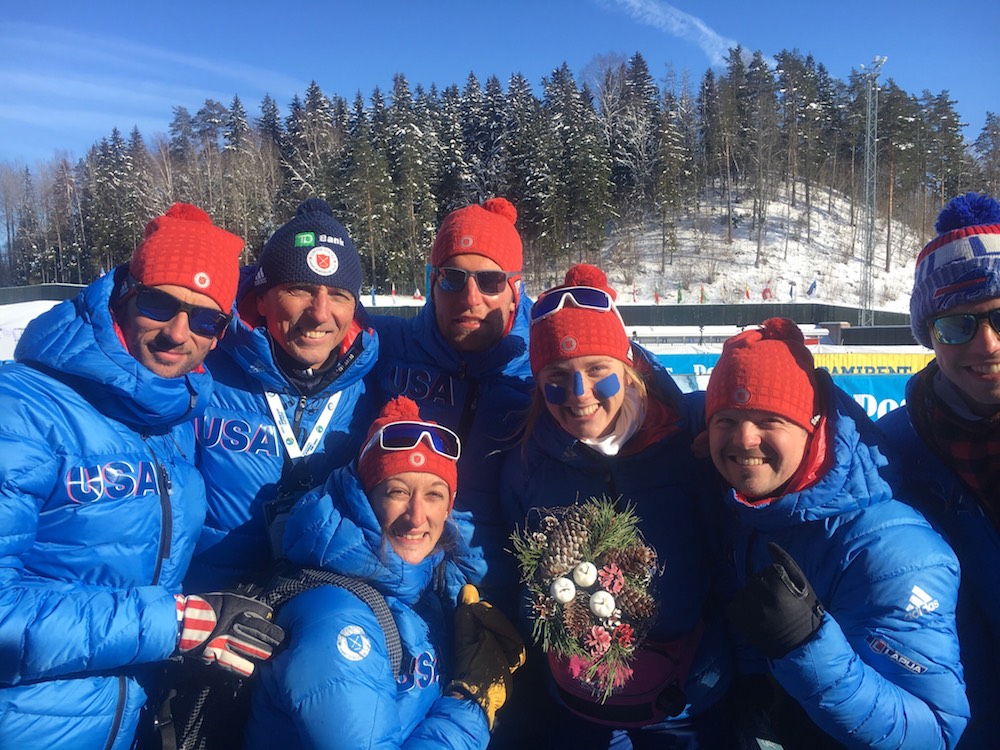
    Chloe Levins (third from r) with the U.S. team staff (from l to r) wax tech Travis Voyer, coach Algis Shalna, assistant coach Danika Frisbie, wax tech Max Bergmann, wax tech Mattias Halquist, and head coach Erik Lewish, after Levins placed sixth in the junior women’s 12.5 k individual at IBU Junior World Championships in Otepää, Estonia. (Photo: Erik Lewish)

    The lone American junior woman at this year’s IBU Youth/Junior Worlds, Levins, 19, finished sixth (+3:37.4) with three penalties (0+1+0+2). At last year’s Youth Worlds, Levins notched fourth place in the 7.5 k pursuit.

    “There’s a big difference between youth and junior competition,” Levins wrote in an email. “A lot of juniors have IBU Cup experience, World Cup experience, and a handful even attended the Olympics. Fortunately, there’s also a big difference between the youth athlete I was last year and the junior I am now. I’ve been fortunate to compete in more winter biathlon races than ever this year, which has really helped me up my game. It’s a good feeling to see that I’m prepared to compete at this level.”

    She explained that she had one goal on Thursday: “smile no matter what,” she wrote. “The hay is in the barn. Now it’s just time to get out of my own way and focus on one thing at a time.”

    While Levins had experienced the rush of being near the front of the race in a pursuit, actually contending for a top result in an individual-start race was a new experience for her, she explained.

    “As always, I tried not to let thoughts of my position distract me from thinking tactically about the course or my shooting process,” Levins noted. “Every lap, every corner, every shooting remained an opportunity for me until the finish line.

    “A lot of my friends finished their races around me, so I did not even see my standing at the finish,” she continued. “When I finally looked at the board and saw that I was more than three minutes back of the leader, I thought that this result, with three penalties myself, was okay. I didn’t expect it to be good enough for sixth place.”

    The race was Levins’s first of the week and she presumably has two more to go — as do Moser, Bankes and most of the other junior women — with a sprint on Saturday and, if they place in the top 60 of the sprint, a pursuit on Sunday.

    As the only American junior woman in Otepää, Levins wrote that she was fortunate to have a significant amount of team support behind her on Thursday.

    “My skis today were incredibly fast,” she emphasized. “Our wax guys made the fastest skis on the track today. … I can’t thank them enough.”

    The U.S. team’s head coach and trip leader, Erik Lewish, pointed out that Levins had the seventh-fastest overall ski time and one of the best shooting performances of the day.

    “It’s great to see that she is right in the mix with this very competitive field (2 of the starters today were competing in the Olympics),” Lewish wrote. “1 more hit and she would have finished in 2nd place today, this is very exciting looking forward to the Sprint and pursuit (sat and Sunday) where she will have another chance to get on the podium.”

    “There are a lot of good things to take from this race and, as always, a lot of things to learn,” Levins concluded. “What’s my goal for the rest of the week? Keep learning. Keep smiling.”

    According to Canada’s head coach and trip leader Jacqueline Akerman, the Canadian techs also nailed the wax.

    “The techs hit the wax perfectly allowing for some of the top skis out there, when skiing form and wax meet it sets the scene for great results,” Akerman wrote. “The shooting was a bit tricky today with varying strength and switching winds, but both [Nadia and Megan] managed to keep misses to a minimum. They both hit enough to place in the top ten on a day when no one in the field shot clean and only one athlete managed one penalty. They are both happy with their performance, and the rest of us are too!”

    Next on the results sheet for Canada was Dickson in 36th (+8:33.7) with five penalties (2+1+0+2), and Zoë Pekos in 63rd (+15:50.6) with eight misses.

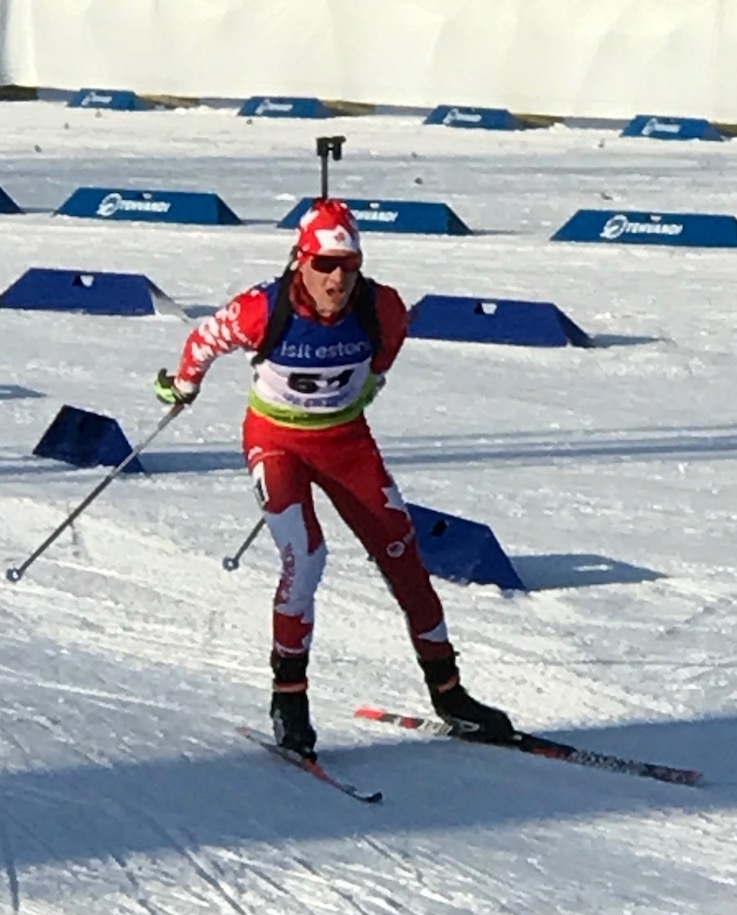
    Canada’s Adam Runnalls racing to 29th in the junior men’s 15 k individual at IBU Junior World Championships in Otepää, Estonia. (Photo: Bill Gilliland)

    In the junior men’s 15 k, Canada’s Adam Runnalls led the North Americans in 29th (+4:26.4) with five penalties (0+0+3+2). Teo Sanchez followed in 58th (+7:25.2) with four misses (1+1+1+1), Angus Tweedie was 67th (+9:11.8) with six misses (2+0+2+2), and Trevor Kiers 77th (+12:44.3) with 13 penalties.

    For the U.S., Tim Cunningham finished 53rd (+6:49.3) with six penalties (1+3+1+1), Cody Johnson was 60th (+8:01.7) with seven misses, Jacob Pearson 83rd (+16:39.6) with 13 misses, and Cameron Christiansen 84th (+16:53.6) with eight penalties.

    Russia had two on the podium in the men’s race as well, with Igor Malinovskii scoring his second-straight win after racing to gold in the junior men’s 4 x 7.5 k relay on Tuesday. He has won the last four races he’s contested, including the sprint and the pursuit at IBU Junior Open European Championships before Junior Worlds. Malinovskii finished in 41:48.5 on Thursday with three penalties (1+1+1+0), besting Norway’s Sturla Holm Lægreid in second place by 19.4 seconds; Lægreid also had three penalties (1+0+1+1). Russia’s Said Karimulla Khalili added bronze (+23.0) to his medal collection, with two misses (0+1+1+0), after capturing gold with his relay team.

    No one in the junior men’s individual had fewer than two misses.

    Results: Junior women’s 12.5 k individual | Junior men’s 15 k individual 

  • Monday Rundown: Canada’s Paradis 6th, Peiffer 11th in Biathlon Youth Worlds Debut

    Monday Rundown: Canada’s Paradis 6th, Peiffer 11th in Biathlon Youth Worlds Debut

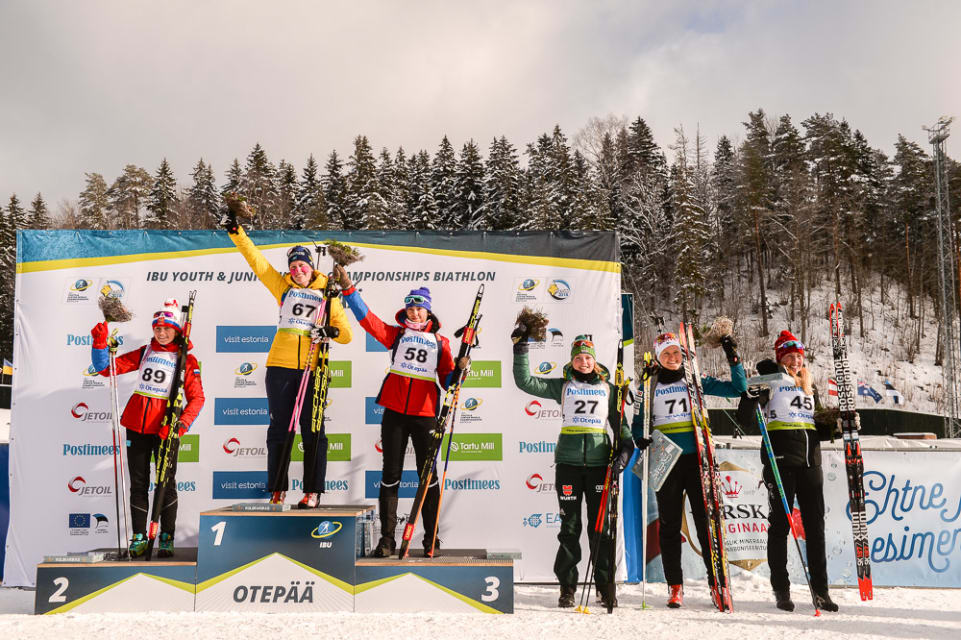
    The top-six finishers in the youth women’s 10 k individual at IBU Youth World Championships on Monday in Otepää, Estonia, with Sweden’s Karin Elvira Öberg (second from l) in first, Russia’s Anastasia Shevchenko (l) in second, Russia’s Anastasiia Goreeva (third from l) in third and Canada’s Pascale Paradis (far right) in sixth. (Photo: IBU/Biathlonworld)

    (Note: This article has been updated to include comments from Canada’s Pascale Paradis and Canadian head coach Jacqueline Akerman.)

    IBU Youth World Championships (Otepää, Estonia): Youth women’s and men’s individual 

    On Day 1 of the International Biathlon Union (IBU) Youth/Junior World Championships in Otepää, Canada had two women finish in the top 11 of the youth women’s 10-kilometer individual race on Monday.

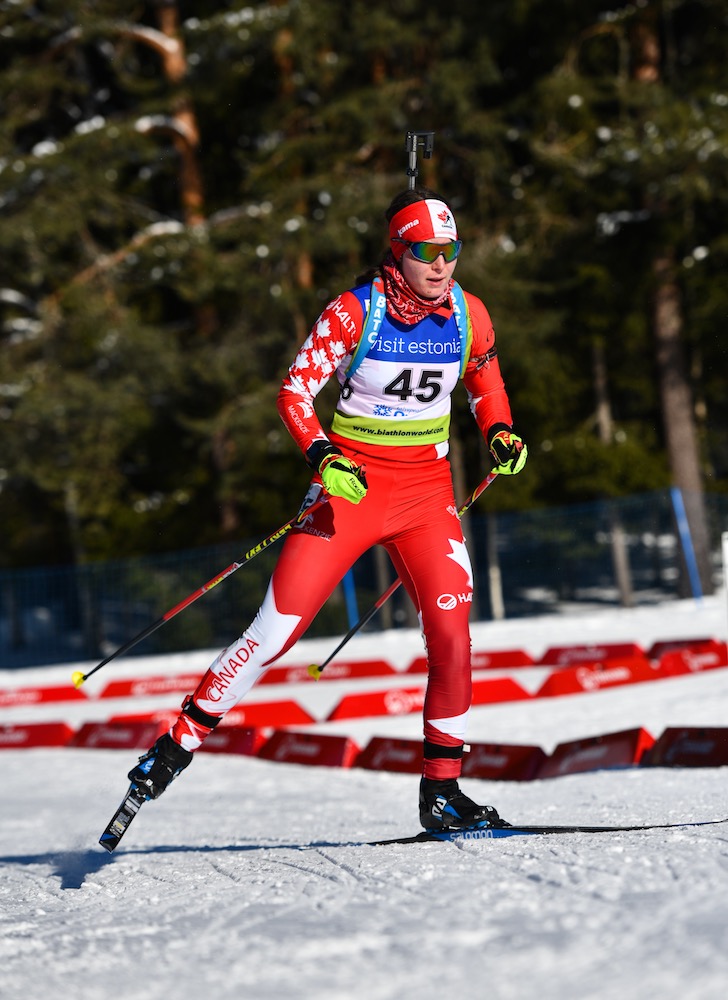
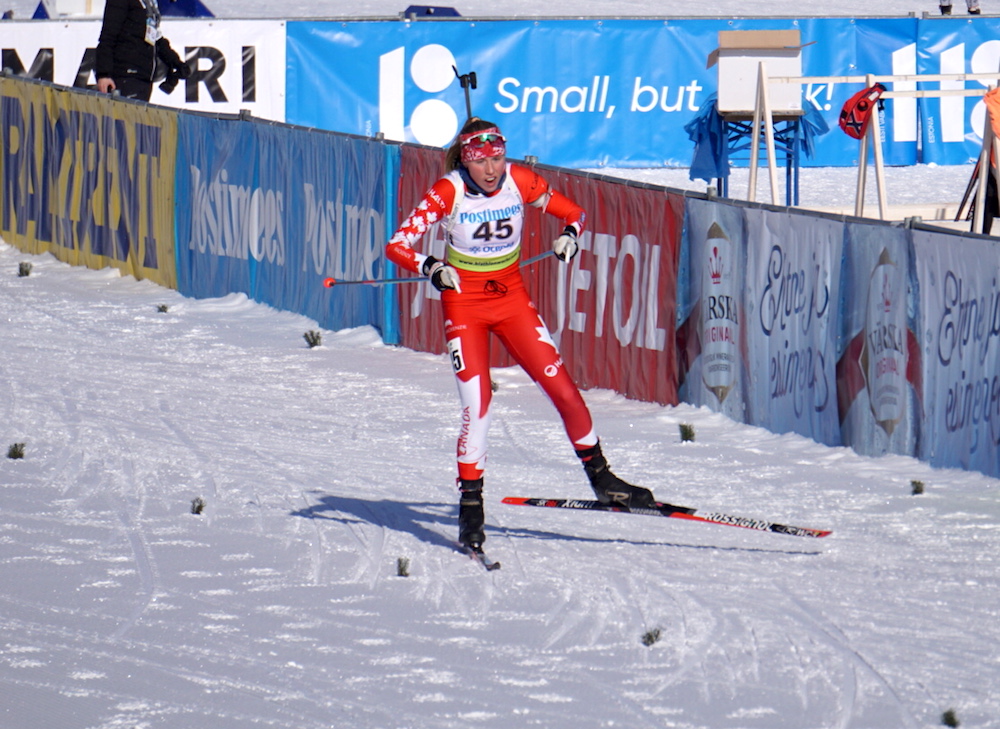
    Canada’s Pascale Paradis racing to sixth in the youth women’s 10 k individual on Monday, the first day of 2018 IBU Youth World Championships in Otepää, Estonia. (Photo: Ian Sherrington)

    Both are brand new to the Youth World Championships scene, with 15-year-old Pascale Paradis placing sixth, 1:09.2 minutes out of first, with one penalty (1+0+0+0). Also for Canada, 17-year-old Benita Peiffer shot an impressive 19-for-20 in the youth women’s longest race of the championships, missing one in prone and cleaning her remaining targets (1+0+0+0) to finish 1:43.1 out of first.

    “I came to these championships with no expectations, with it being my first international race I figured I wouldn’t do great because there’s so many other great competitors in the world,” Paradis wrote in an email to FasterSkier on Monday night. “I just lined up for the start line and pretended that I was racing any normal race because if I didn’t think that I knew the nerves would get to me.”

    She started in the middle of the field in bib 45 and found the conditions to be ideal: sunny, not too cold and with minimal wind.

    “Right out of the start gates I had a good feeling about the day,” she recalled. “I had a restful sleep and was really nervous and excited at the same time. Though I had no idea I would do that well, I just felt good to me and that’s what made me happy. It just made me even happier to realize that I had come top ten and I was over the moon. I didn’t see that coming and I was incredibly grateful for all of those that had helped get to this stage.

    “On course I felt pretty strong, I definitely didn’t feel weak but I had no idea my skiing was within some of the faster times,” Paradis added. “On the range my goal was to focus on my own race and not getting bothered by other competitors, which I usually do, and on the range I felt confident when I came in to shoot. I achieved my goal by not getting flustered by the other girls and all the other distracting sounds.”

    According to Canada’s head coach and trip leader Jacqueline Akerman, the team’s head wax technician, Andrew Chilsom, informed Paradis she was in first place after the last shooting.

    “She gave a little laugh and immediately picked up her pace and passed a few more competitors in her last loop, good enough to hold for a spot in the flower ceremony,” Akerman wrote.

    When Paradis crossed the finish line, she was initially in second place.

    “When I finished I didn’t believe that I was one of the top competitors,” Paradis wrote. “I was so dazed and tired and there was so many people around that I just couldn’t really get it into my head. So I was just extremely happy to be up there with the other top biathletes in the world, I didn’t think my result would stay like that but I was just happy to be in that position at all. I was expecting a top 60 maybe when I came here let alone top 10.”

    Peiffer started 88th out of 91 in the women’s race. After cleaning the last three shooting stages, she learned what place she was fighting for on her last loop.

    “It was probably a good thing I wasn’t told how I was doing until the last lap otherwise I would have gotten too excited and blown up on my last shooting bouts,” Peiffer wrote. “When I found out that I would have a chance at 11th place while I was racing I instantly skied as fast as I could and left all my energy all out on the course. Once I crossed that finish line in 11th place I was filled with satisfaction knowing that I put it all out on the course and proved to myself that I can hit those targets!

    “I think the key to my solid shooting today was staying completely focused and in my bubble while shooting,” Peiffer continued. “I found it quite challenging with the amount of people around but I just focused on what I had to do to hit those targets. I also found that not thinking about my shooting too early while skiing on the course helped. I usually get too excited about what could happen and then things go sideways! Positivity is another one! Believing that I could hit those targets is what gave me confidence going into the range.”

    She described the Otepäa range approach as relatively easy, which she preferred. “I really like to calm down before I start shooting,” Peiffer explained. “The range here is also not affected by the wind much which I am very pleased with!”

    Sweden’s Karin Elvira Öberg, the younger sister of Olympic 15 k individual champion Hanna Öberg, won the race with 19-for-20 shooting as well (1+0+0+0), posting the fastest time at the finish of 35:35.9 minutes. And she did so on her 19th birthday.

    “I was so happy for Hanna when she won, and now I win,” Öberg told the IBU on Monday.

    Russia occupied the second and third steps on the podium with Anastasia Shevchenko placing second, 35.6 seconds back, with two penalties — one of which came on the last shooting stage (1+0+0+1). Anastasiia Goreeva placed third (+53.8) with three penalties (1+2+0+0).

    Four Canadian women competed in the event, with Shilo Rousseau finishing 36th (+4:06.4) with three penalties (0+1+0+2), and Jenna Sherrington following in 40th (+4:22.9) with one miss (1+0+0+0).

    “It was wonderful to see the whole group of young youth women who are relatively inexperienced (on the international stage) put in solid performances today,” Akerman wrote. “All of them placing in the top forty along with great shooting results is something to be very proud of! … This is credited to the great and hard working staff and supportive team we have here, as well as thier coaches and others back home who have obviously done great prep work. We have 14 family members of athletes here cheering like crazy, cowbells and flags and heys with each hit, it sure adds to the support the athletes feel. During the flower ceremony Pascale got a much louder cheer than the first placed athlete!”

    Emma Stertz led the U.S. in 60th (+6:01.9) with two penalties (0+2+0+0), Helen Wilson finished 74th (+8:00.9) with five penalties (2+2+1+0), and Margaret Madigan placed 83rd (+10:53.9) and Grace Gilliland 84th (+11:26.3) with nine penalties apiece.

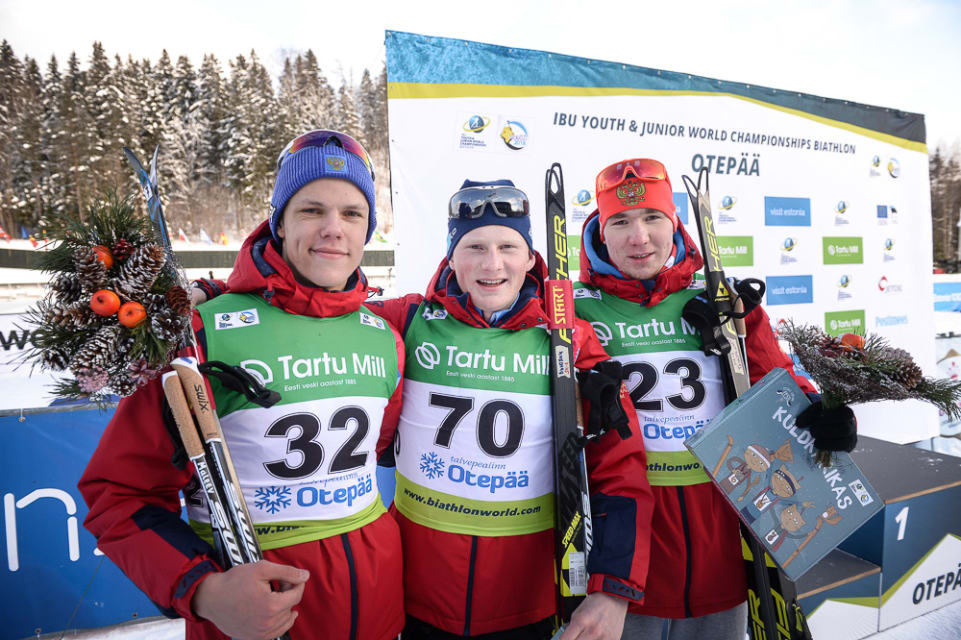
    Russia put three in the top six of the youth men’s 12.5 k individual on Monday at 2018 IBU Youth World Championships in Otepää, Estonia, with Mikhail Pervushin (32) placing first, Andrei Viukhin (70) fourth and Denis Tashtimerove (23) sixth. (Photo: IBU/Biathlonworld)

    In the youth men’s 12.5 k individual, Russia’s Mikhail Pervushin claimed the win in 37:41.2 with perfect shooting except for a single miss on the last stage (0+0+0+1). Norway’s Filip Andersen took silver (+12.3) with one penalty as well (1+0+0+0), and France’s Martin Bourgeois République claimed bronze (+47.2) with two penalties (0+1+0+1).

    “I was worried before the start, but I’m happy that things turned out as they did,” Pervushin told the IBU. “Today I was aiming for clean shooting, but I did not succeed, that upset me, but I had to fight for the win. I feel good on the track, I like it – overall I’m happy.”

    The defending youth world champion in the event, Canada’s Leo Grandbois placed 24th (+4:15.6) on Monday after incurring five penalties (1+1+2+1). American Vasek Cervenka finished about another 10 seconds back in 27th (+4:25.5) with six penalties (0+3+2+1).

    “Leo had a solid ski race today,” Ackerman wrote. “His shooting was not there today, but knowing him he will turn that around in a hurry.’

    Also for Canada, Rory Gilliland finished 47th (+6:00.1) with three misses (1+0+1+1), Thomas Hulsman was 65th (+7:35.0) with four penalties (3+1+0+0), and Ryan Elden 81st (+10:47.3) with 10 penalties.

    For the U.S., Garrett Beckrich placed 48th (+6:03.9) with seven misses, Camren Nieslen was 64th (+7:21.8) with four misses (0+3+1+0), and Maxime Germain 70th (+8:15.6) with seven penalties.

    The junior women’s 3 x 6 relay and junior men’s 4 x 7.5 k relays will be held Tuesday and the youth relays will follow on Wednesday.

    Results: Women | Men 

  • Bankes Gets Gold #2 for Canada with Perfect Shooting at IBU Junior Worlds

    Bankes Gets Gold #2 for Canada with Perfect Shooting at IBU Junior Worlds

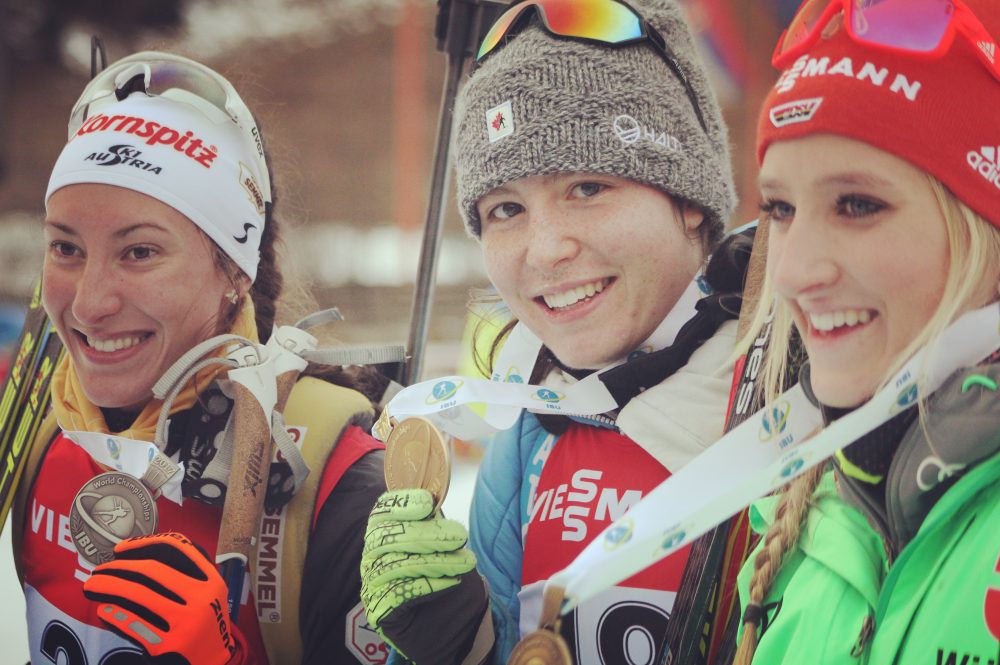
    Canada’s Megan Bankes flashes a smile and her gold medal after winning the junior women’s 12.5 k at IBU Junior World Championships on Thursday in Osrblie, Slovakia. individual podium on Thursday at IBU Junior World Championships in Osrblie, Slovakia. Joining her on the podium are Austria’s silver medalist Julia Schwaiger (l) and Germany’s bronze-medalist Anna Weidel (r). (Photo: Jacqueline Akerman)

    (Note: This article has been updated to include comments from Megan Bankes.)

    Just to review:

    • 2004: Jean-Philippe “JP” Le Guellec becomes first Canadian to win an International Biathlon Union (IBU) Youth World Championships title (in the youth men’s sprint).
    • 2009: Kurtis Wenzel becomes second Canadian to win at IBU Youth Worlds, with a gold medal in the youth men’s sprint.
    • 2012: Wenzel does it again as a junior, winning the 15-kilometer individual at IBU Junior Worlds.
    • Feb. 22, 2017: Leo Grandbois shoots a perfect 20-for-20 to become the third Canadian to be crowned a world champion at Youth/Junior Worlds, winning the youth men’s 12.5 k individual in Osrblie, Slovakia.
    • One day later: Megan Bankes repeats the 20-for-20 shooting feat in the junior women’s 12.5 k individual in Osrblie and becomes Canada’s first woman to win at Youth/Junior World Championships.

    And just like Grandbois, Bankes had never hit 20 consecutive targets without a miss in a race before. In fact, she had never cleaned a race of any length before. Doing so earned her a gold medal in her first race of her fourth Youth/Junior Worlds.

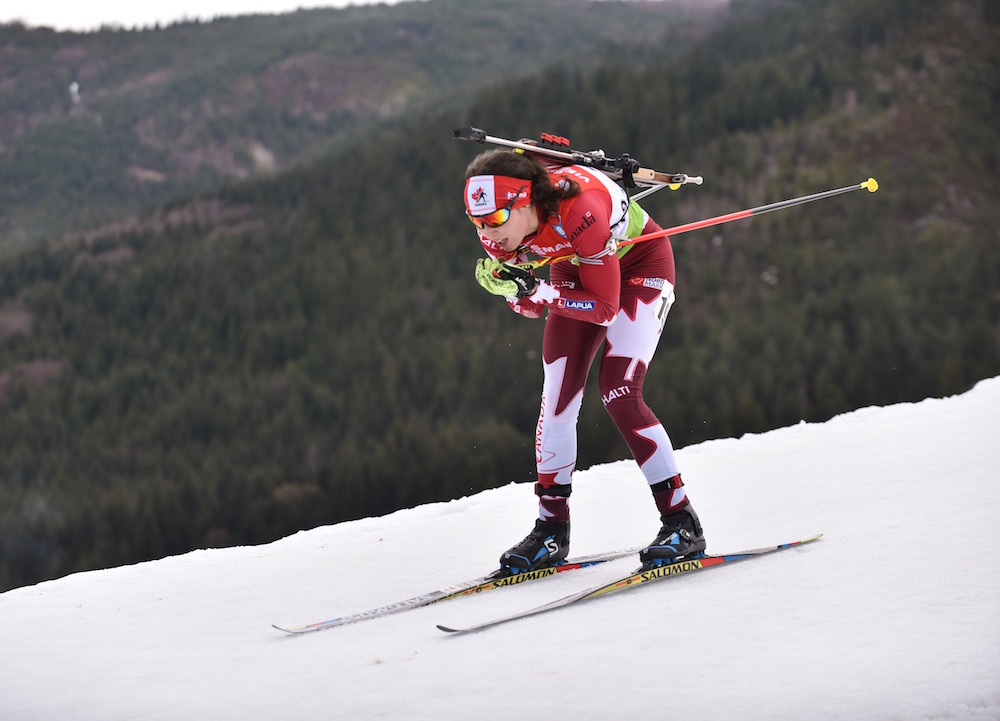
    Megan Bankes racing to an unprecedented gold for a Canadian woman in the junior women’s 12.5 k individual on Thursday at 2017 IBU Junior World Championships in Osrblie, Slovakia. (Photo: Bryan Dickson)

    “I watched Leo yesterday and gained a lot of inspiration from him,” Bankes said, according to a Biathlon Canada press release. “I saw how calm he was on the range and just felt if he can do it then I can, too. I just wanted to go out there – shoot clean and ski fast.”

    As the 19th starter in a field of nearly 70 women, the 19-year-old Bankes, who trains with the Biathlon Alberta Training Centre (BATC) in Canmore, set down the performance to beat with clean shooting and a finishing time of 37:22.0 minutes. She bumped Germany’s Anna Weidel, the 13th starter, to second place with a time that was 1 minute and 20 seconds faster. Weidel had missed just one shot — still an impressive performance in a four-stage race — in the first standing stage (0+1+0+0). Each miss adds a minute penalty to a racer’s total time.

    “I was incredibly stoked to clean my last standing, and then knew I just had to push super hard up the last 2 hills and ski smart all the way to the finish,” Bankes wrote in an email to FasterSkier. “When I crossed the finish line I was really excited, but I didn’t really think my result would hold up because there were a few girls who were skiing fast and had hit 15/15, but then when a bunch of them started missing, and I realized my position was going to hold, it was incredible.”

    Her overall course time ranked 11th, comparable with the two women she ended up sharing the podium with. Weidel was ultimately pushed to third when Austria’s Julia Schwaiger in bib 26 finished 32.1 seconds faster for silver. With one costly miss in her final standing stage (0+0+0+1), Schwaiger’s finishing time was 47.9 seconds short of gold.

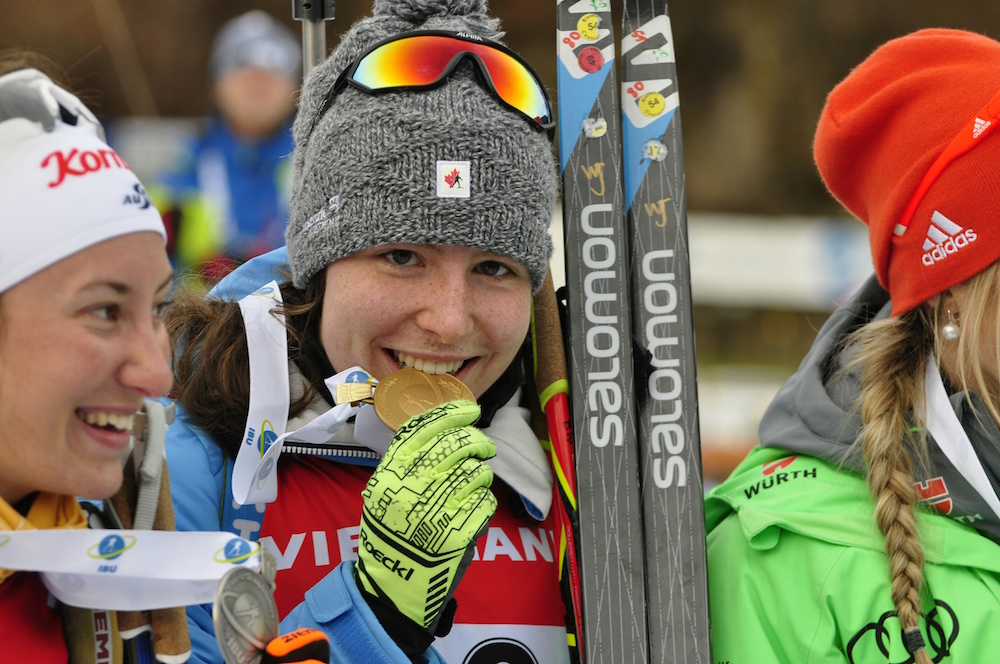
    Canada’s Megan Bankes takes a bite out of her gold medal after winning the junior women’s 12.5 k individual at 2017 IBU Junior World Championships in Osrblie, Slovakia, and becoming the first Canadian woman to do so at Biathlon Youth/Junior Worlds. (Photo: Airat Aitniakov)

    That medal went to Bankes, one of five women in the race to hit every target.

    “I shot with a lot of confidence today. It came really easy,” Bankes told Biathlon Canada.

    But, as there usually is, there was a backstory on Thursday.

    “She had a what she said was a ‘horrific’ zero,” her coach Richard Boruta explained of her pre-race target practice, in an email co-written with Canada’s trip leader/head coach Jacqueline Akerman.

    Boruta tried to calm Bankes down, assuring her that she had the self confidence to execute strong shooting.

    “My coach Richard just told me to go out pretty hard and not lose too many seconds up the first couple hills, and then settle into my race,” Bankes recalled in the email. “The range entry is pretty easy, because you’ve got a bit of downhill into it, so you can push pretty much as hard as you want (or can).”

    “Megan had been focused the whole day on the race and she new what she needed to do and was able to pull it through,” the two coaches wrote. “The trail conditions and weather have been challenging with all the rain and slush, but Megan managed to ski very tactically along the flats and paced herself well on the two major climbs in the course.”

    According to them, one of Bankes’s longtime goals had been a top eight at these championships. That changed after she broke through on the IBU Junior Cup earlier this month, placing second in the 10 k pursuit at IBU Junior European Championships in Nove Mesto, Czech Republic. After that, she visualized herself in the top five, maybe top three, in her first year as a junior at world championships. Bankes had previously notched 18th in the pursuit and 19th in the individual at last year’s Youth World Championships in Romania.

    “Junior OECH was a pretty big confidence boost, but coming into the race, I didn’t totally know what to expect,” Bankes wrote. “I knew that if I had a really good day on the range and on the course, then I could do well, and maybe podium, but I didn’t really imagine that I would hit 20/20, and win!”

    Individual-format races require solid shooting and fast skiing, just like any biathlon race, but the one-minute penalties as opposed to penalty laps put an emphasis on shooting accuracy.

    “I can’t say they have ever been my strong suit!” Bankes wrote of individual-format races. “So for me the goal was to start pretty fast on skis, stay calm in the range, and then see what happened.”

    “After I got the silver [in Nove Mesto], I knew if I shot and skied well, I could get a medal here,” she told Biathlon Canada. “It takes a long time to get to this point. I think having been here [at Youth/Junior Worlds] four times now I have the experience to do this. I have everything around me here that I need to be successful.

    “It is pretty exciting,” she added. “This is the first time I’ve shot 20 for 20. It never crossed my mind, but to be the first Canadian [woman] to win is very cool.”

    According Akerman and Boruta, they had anticipated that Grandbois and Bankes would have “a respectable chance” at a medal, along with other team members as well. But two gold medals in two days?

    “We have had good results and medals in the past, but it has been up and down with a few top athletes hitting the top 10 or reaching the podium,” they wrote. “Now we see the group as a whole rising together.”

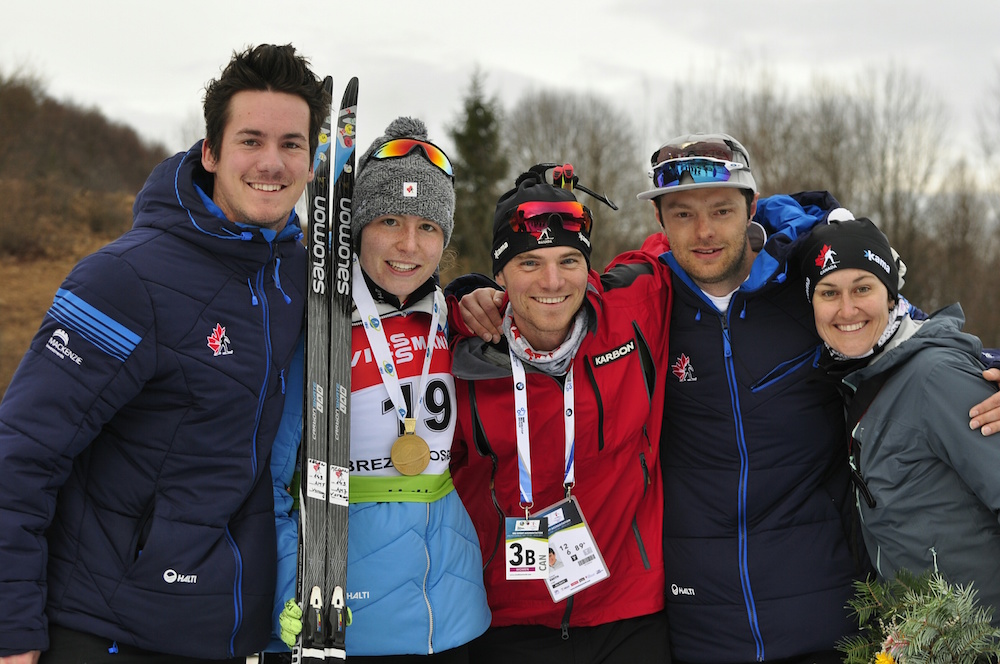
    Megan Bankes (second from l) with her Canadian support crew, including her former coach Tyson Smith (c), wax techs Andrew Chisholm (l) and Andrzej Lesnik (second from r) and Canada’s trip leader/head coach Jacqueline Akerman (r), after Bankes won the junior women’s 12.5 k individual for Canada’s second gold medal of 2017 IBU Youth/Junior World Championships in Osrblie, Slovakia. (Photo: Airat Aitniakov)

    They credited “consistent and qualified coaching support in yearly developmental stages”, and explained that Bankes started the sport with coach Iaroslav Khomiak at Foothills Nordic in Calgary. She was later coached by Tyson Smith (Nathan Smith’s brother, who is assisting the team at Youth/Junior Worlds) before joining the BATC group in Canmore in 2015.

    Last summer, Biathlon Canada launched a funded “Shooting Stars” camp, which brought national-team staff and coaches together with athletes and their coaches in Canmore. The team also added IBU Junior Cup tours to the schedule to give young athletes opportunities to experience international competition in Europe and “get to know each other before WYJCHs.”

    “My observations of this current group; they are pretty grounded, are very motivated, focused and are they are both pushing and supporting each other in all aspects of their performance,” Akerman and Boruta wrote.

    So what does two gold-medal performances mean for Canada?

    “There is now a great opportunity for an greater amount of exposure for our athletes and our sport,” the coaches wrote. “… More solid results ahead for us this week, there are other realistic opportunities within the group. The whole team, including staff are motivated and focused for that. … Of course Leo and Megan have both shown what they are capable of, and will be eager for more. Right behind those two in our Jr Women and Youth Men categories are others skilled enough to be right up there with them. Our youth women are a younger crew, but are learning and applying new skills daily, so I am excited to see some PB’s from them tomorrow. The relays also present us with exciting and realistic chances of podiums, it will continue to be an exciting week and championships!”

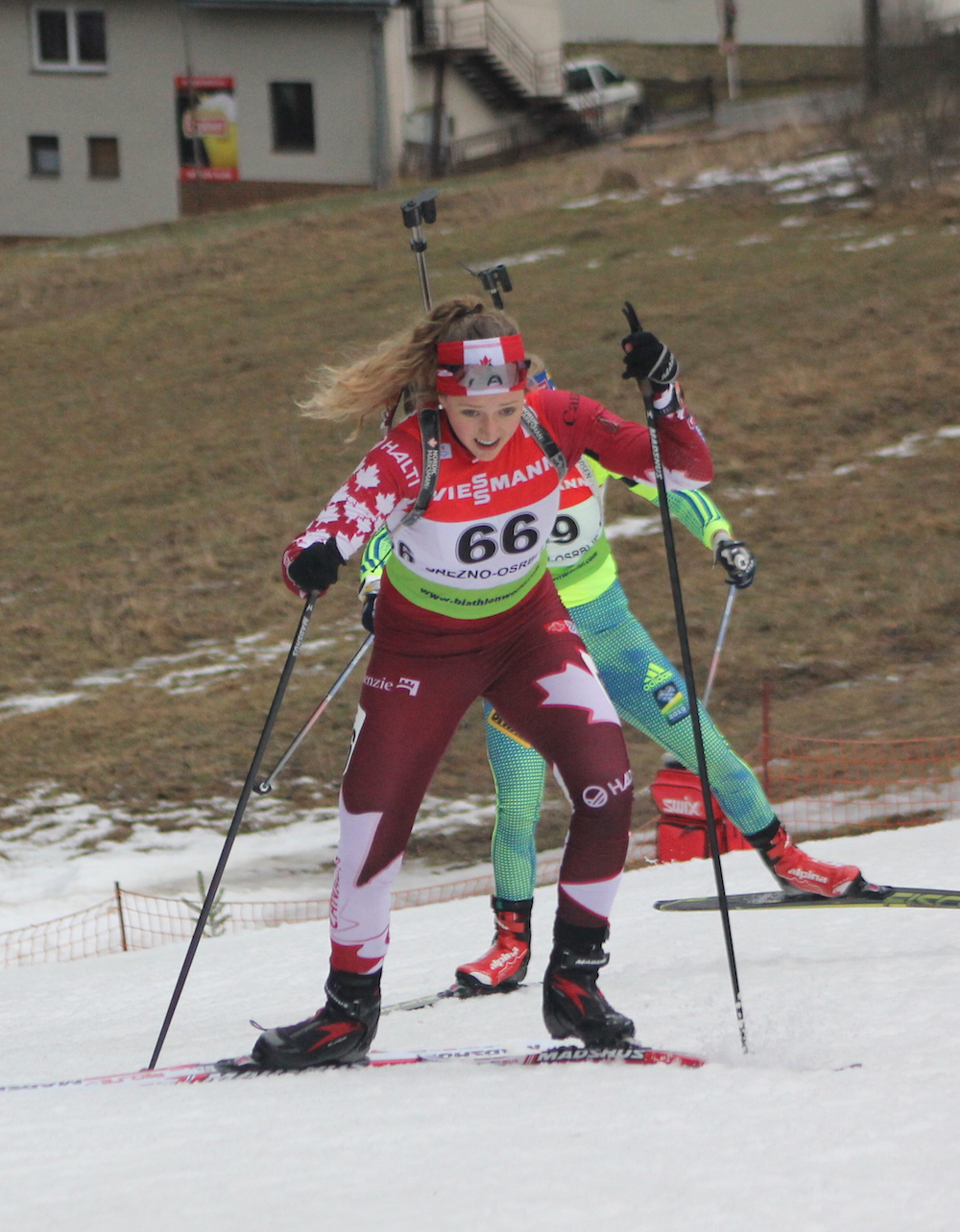
    Canada’s Emily Dickson (66) racing to 28th for her first top 30 at IBU Junior World Championships in the women’s 12.5 k individual in Osrblie, Slovakia. (Photo: Jacqueline Akerman)

    In the junior women’s race, Canada had two in the points (top 40) and one just outside with Emily Dickson in 28th (+4:21.3) with one miss (0+1+0+0). Nadia Moser finished 41st (+5:55.8) with four penalties (2+0+0+2). Charlotte Hamel did not finish.

    For the U.S., Siena Ellingson placed 50th (+7:11.5) with four penalties (0+1+2+1) and Nina Armstrong 65th (+14:15.3) with eight misses (4+1+2+1).

    Earlier in the day, the junior men raced a 15 k individual, which Norway’s Sindre Pettersen won in 40:17.2 minutes. He started 68th and cleaned three-straight stages before missing two on his last standing (0+0+0+2), but managed a 51.2-second win over Germany’s David Zobel. An early leader in bib 26, Zobel had three penalties (0+2+1+0) yet his time held up for silver despite a challenge from Russia’s late starter Nikita Lobastov (bib 84). Lobastov shot 19-for-20 (0+1+0+0) and finished just four seconds short of Zobel for third place (+55.2).

    Only one athlete in the junior men’s race cleaned: Latvia’s Ingus Deksnis in fifth.

    In his first year as a junior, Canada’s Zachari Bolduc led the North Americans in 34th (+3:44.7) with two penalties (1+0+0+1). He later told FasterSkier his goal had been a top 30, and he was 8.4 seconds short of it on Thursday.

    “I’m happy with this shooting but I was very very slow on my skis,” Bolduc wrote in an email. “The course was a mix of soft snow, ice and slush so it was not easy conditions! I hope I will have better feelings on my skis for the sprint. But, I’m happy with my race today!”

    He was followed by Canadian teammates Trevor Kiers and Jules Brunette in 54th (+5:21.6) and 55th (+5:27.4), respectively, after each shot five penalties. Pearce Hanna finished 65th (+6:38) with seven misses (1+2+2+2).

    The top American on Thursday was Cody Johnson in 50th (+5:08.3) with two penalties, both in the last stage (0+0+0+2). Cameron Christiansen followed in 72nd (+8:10.6) with six penalties (1+1+2+2), and Peter Carroll was 79th (+10:36.4) with four misses (0+3+0+1). Travis Cooper did not start.

    The youth men’s and women’s sprints are scheduled for Friday in Osrblie.

    Results: Junior women | Junior men