From the FasterSkier archive — posts syndicated from athletes’ and coaches’ own blogs between 2004 and 2012, kept online as published. Current coverage is at fasterskier.com.
ZHANGJIAKOU, China — Team USA won its first-ever mixed relay gold to close out the cross-country competition at the Paralympic Winter Games Beijing 2022 on Sunday at Zhangjiakou National Biathlon Centre in Zhangjiakou, China.
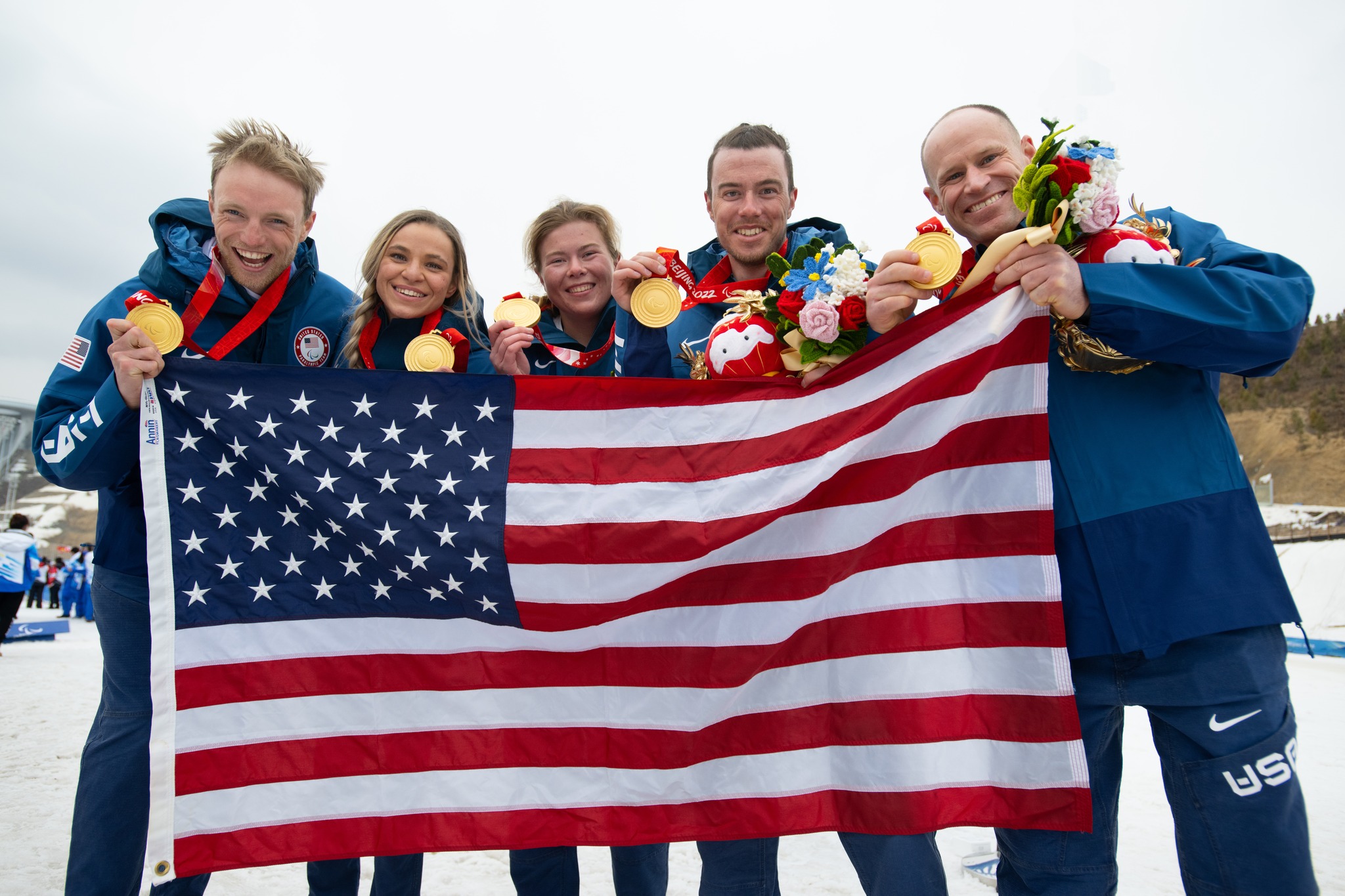
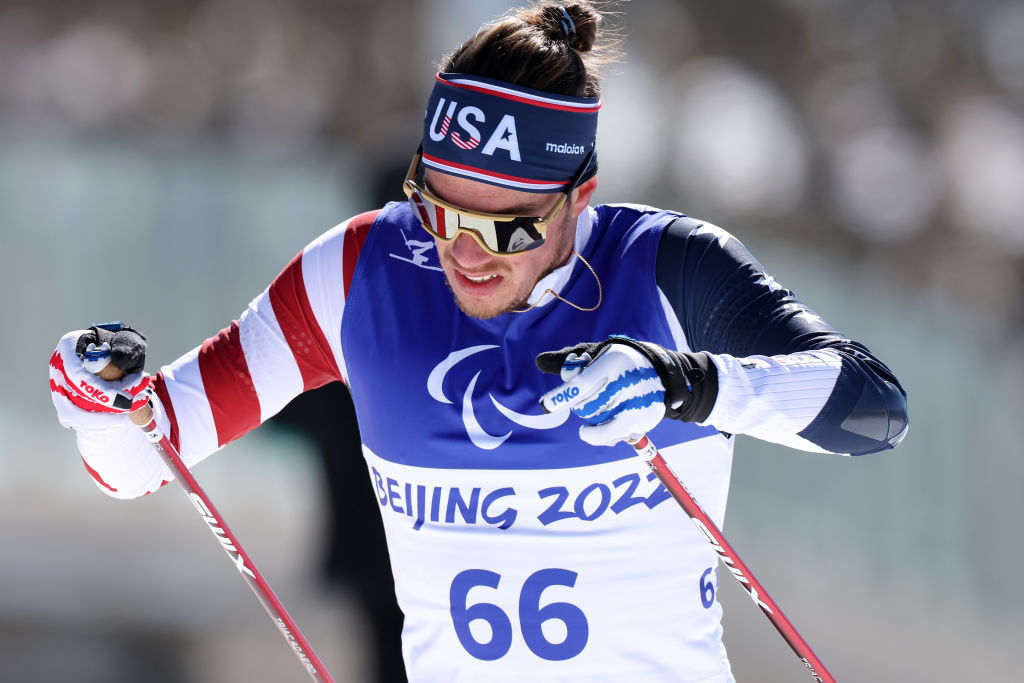
Team USA’s 4 x 2.5-kilometer mixed relay featured Oksana Masters, Sydney Peterson, Dan Cnossen and Jake Adicoff guided by Sam Wood. They stormed to a 25:59.3 gold-medal finish.
China took silver in 26:25.3, and Team Canada captured bronze in 27:00.6. Defending world and Paralympic champions Ukraine finished fourth.
“I could not be more proud and more excited,” Cnossen said. “Really, it’s an honor to be part of this team knowing the caliber of athletes that I got to ski with.”
Cnossen, 41, became the most seasoned medalist for Team USA in Beijing. The gold-medal win also earned Masters a place in the history books as the most decorated U.S. Winter Paralympian with 14 career Winter Paralympic medals.
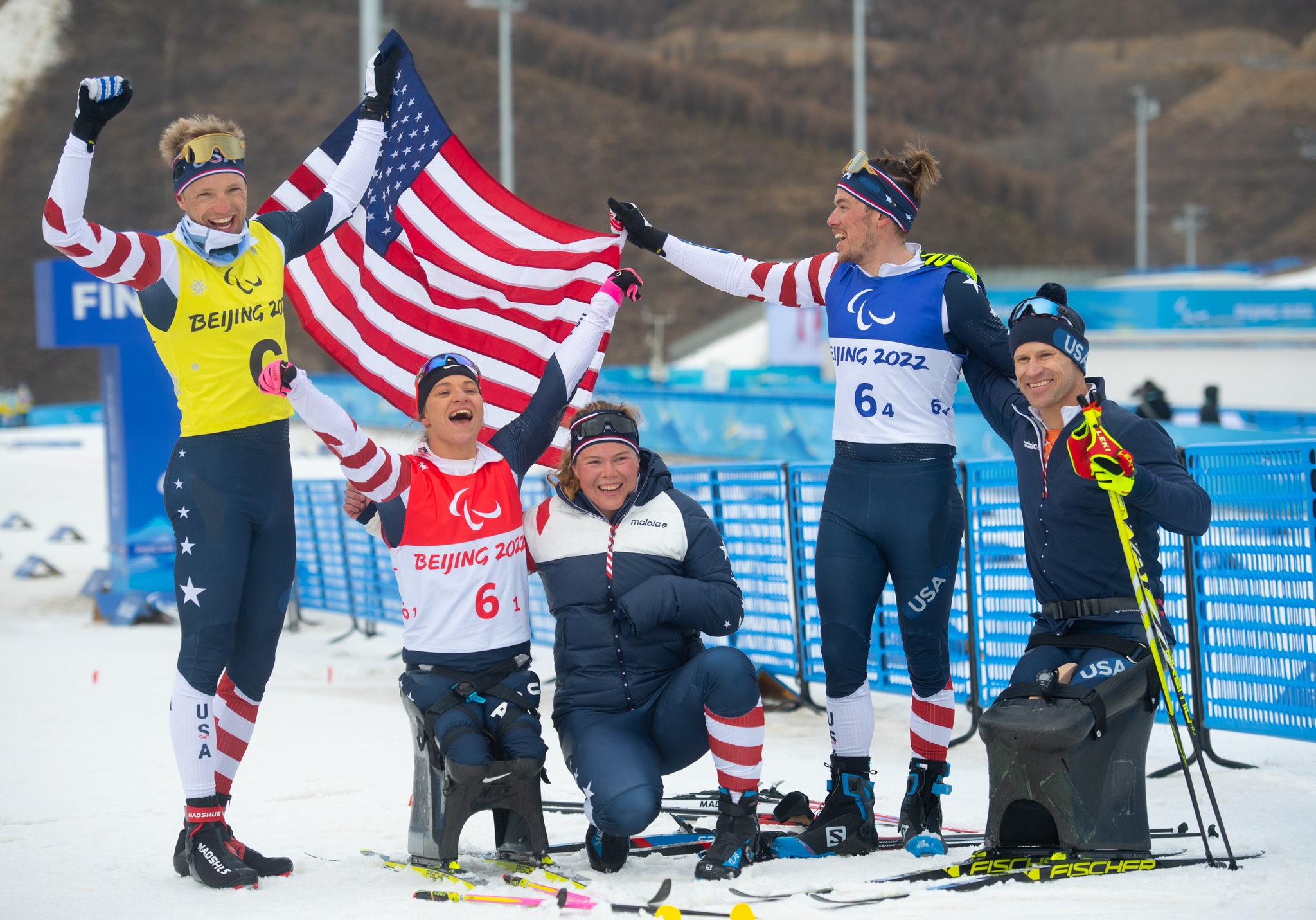
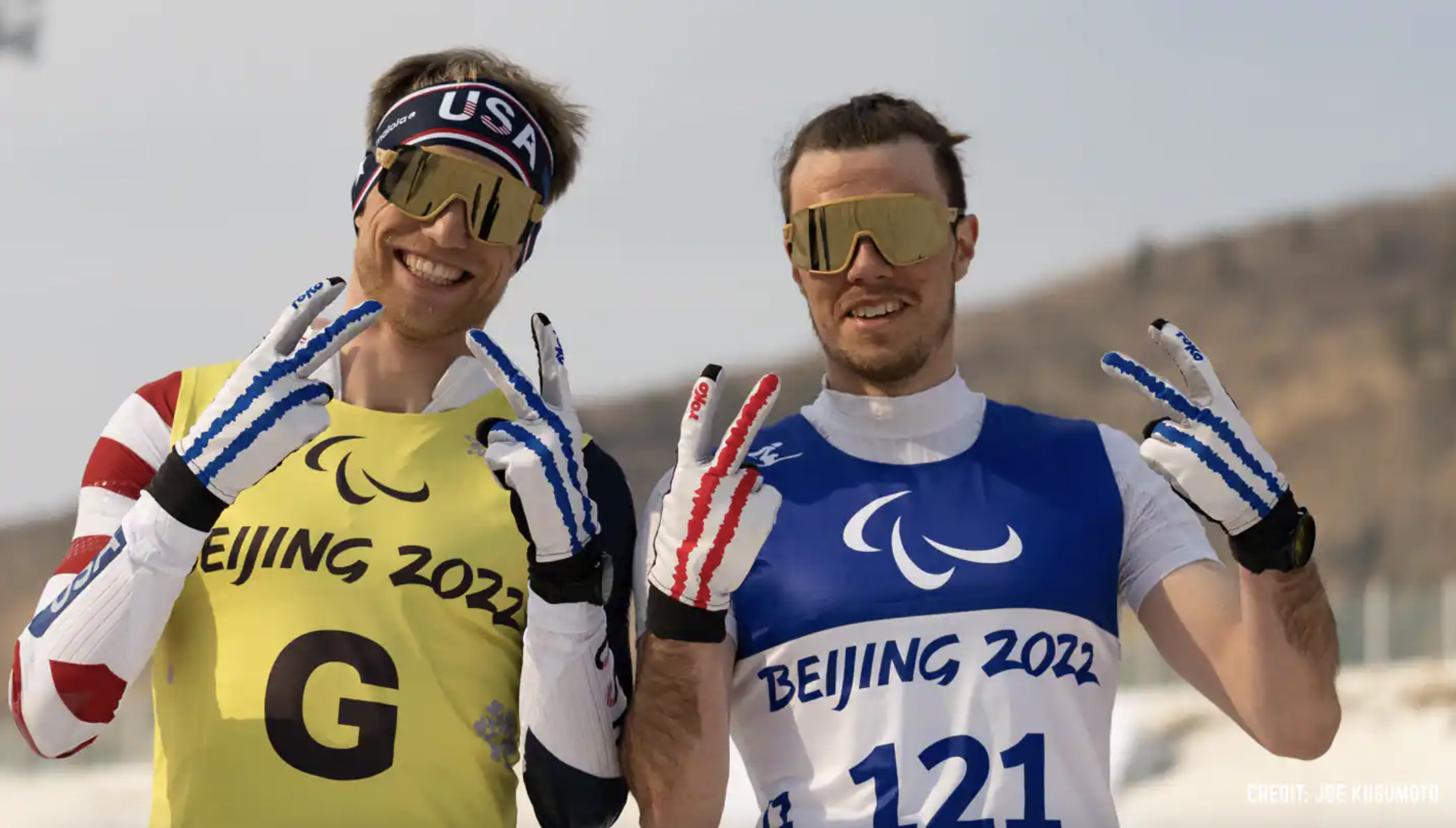
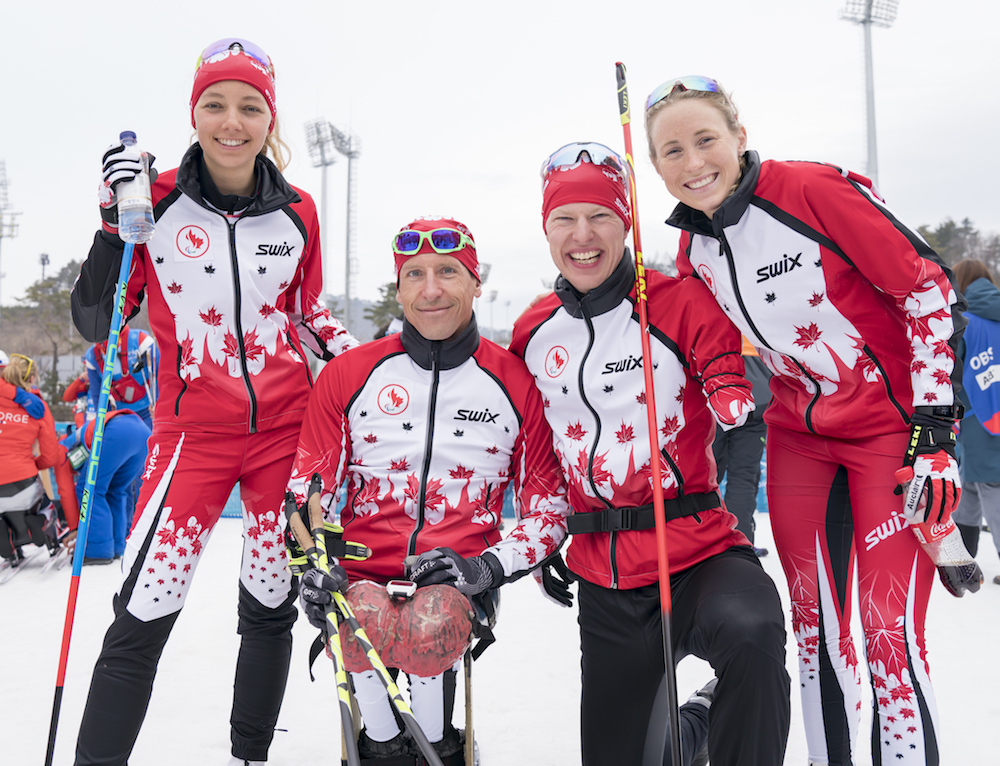
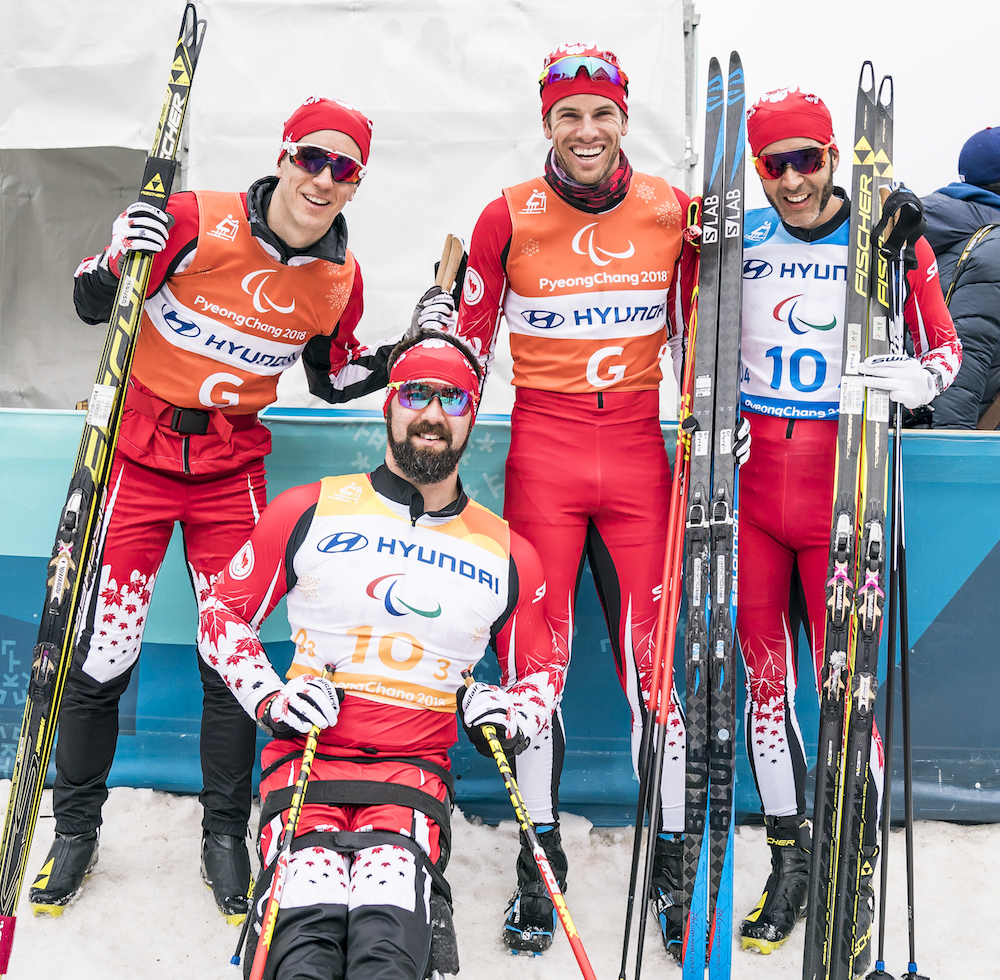
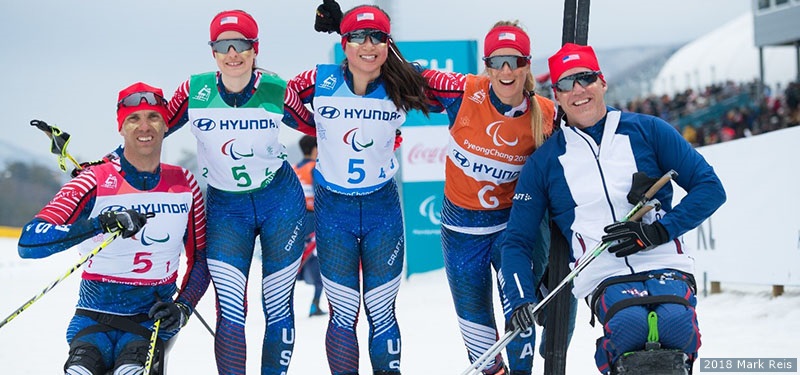
The 2022 Paralympic gold medal mixed relay team: guide Sam Wood, Oksana Masters, Sydney Peterson, Jake Adicoff, and Dan Cnossen (left to right). (Photo: Mark Reis / TeamUSA)
The relays were the only team events on the Para cross-country skiing program. The mixed relay featured four fast 2.5-kilometer laps that can be skied by an alternating team of two, three or four skiers and at least one man and one woman.
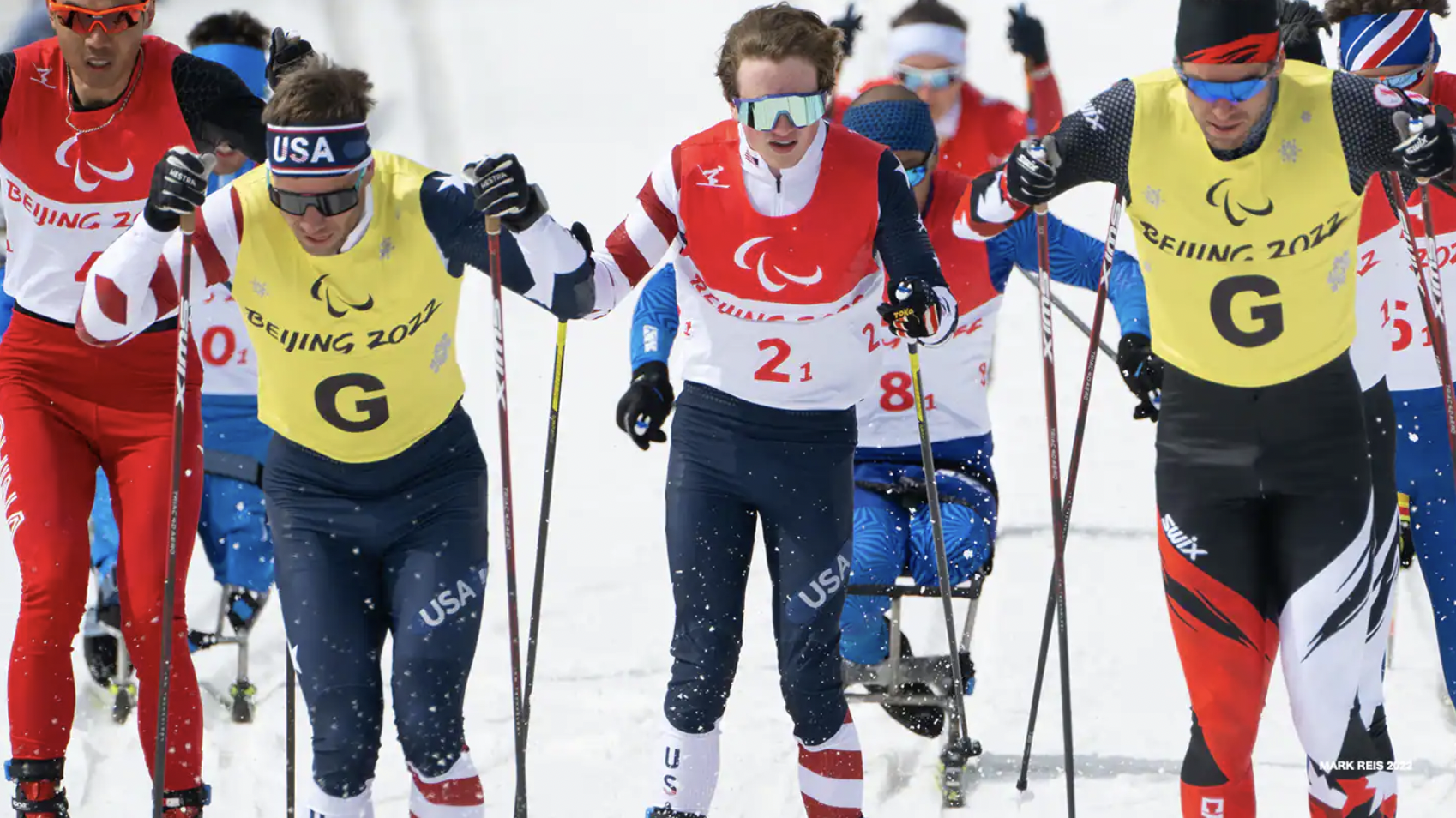
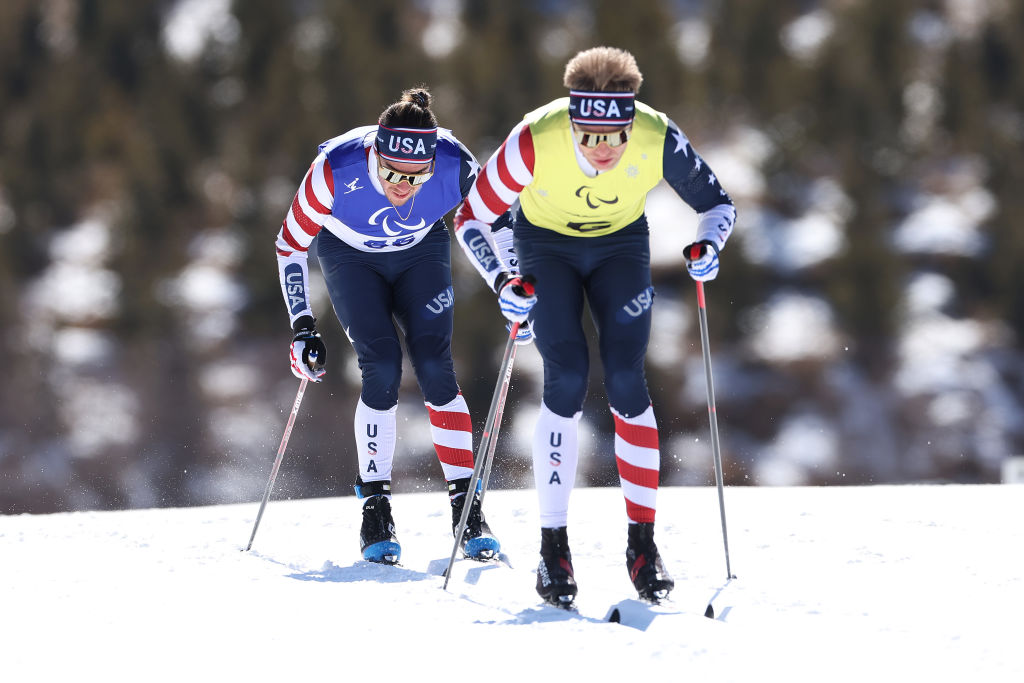
Masters raced a strong first leg to hand off to now three-time Paralympic medalist Peterson for leg two. Cnossen skied leg three to hold Team USA in fourth place. Adicoff and Wood turned up the heat for the final lap, rocketing into first place and never looking back.
“We started that so hot, “Adicoff said. “We were just really gas in the beginning, no holding back in the first part. By the time we were at the top of the course, we skied into the lead. From there, we just had to stay on our feet and bring it home. Getting that energy from our teammates for that first part of the race was critical.”
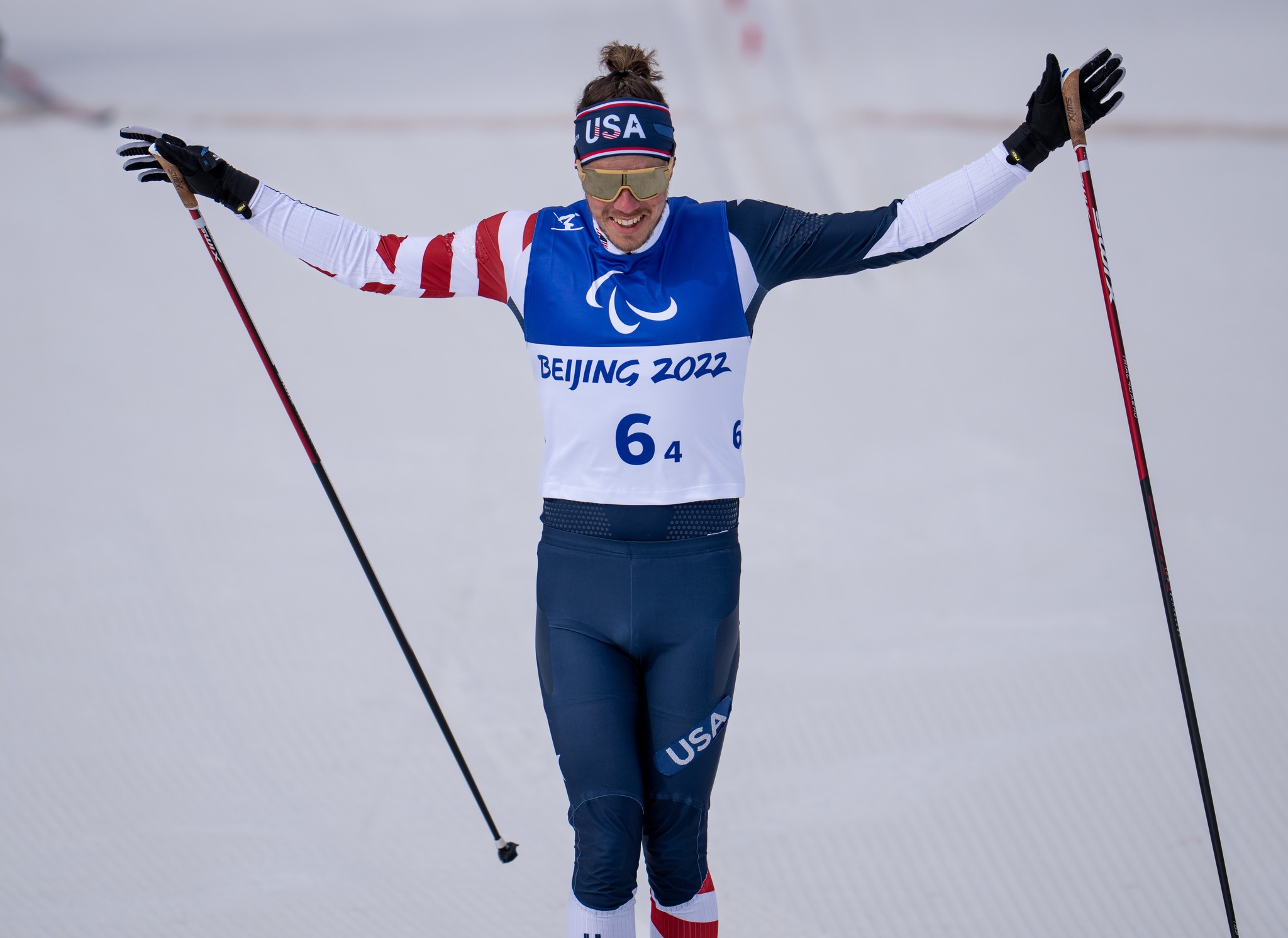
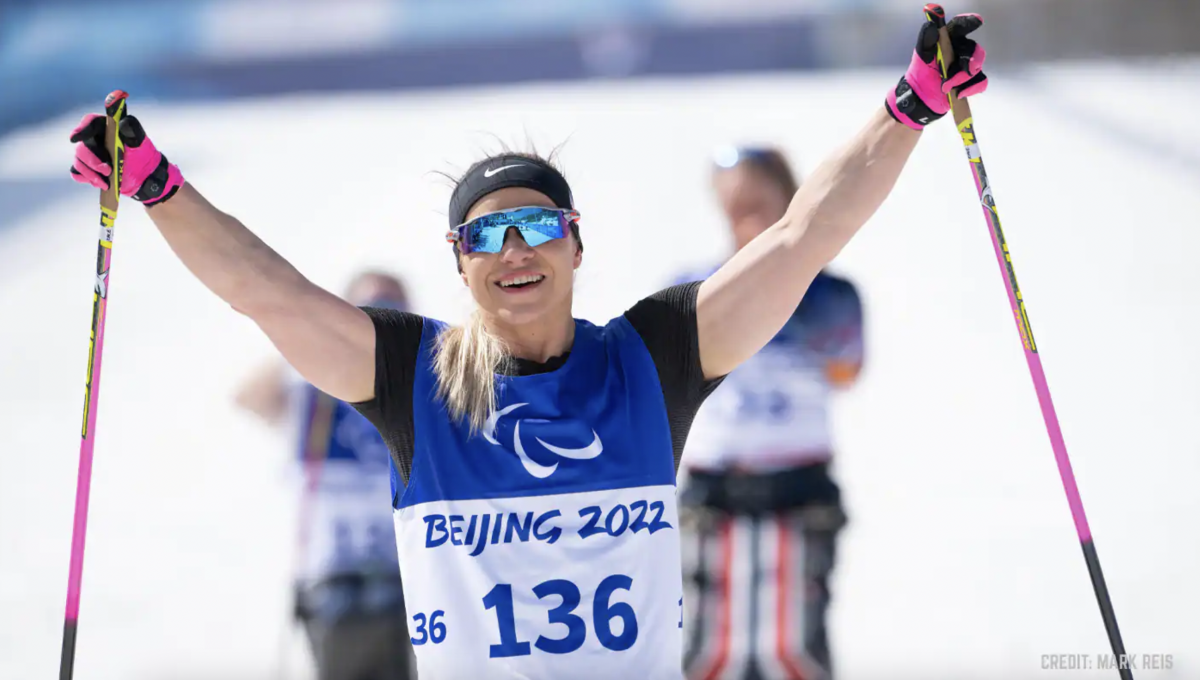
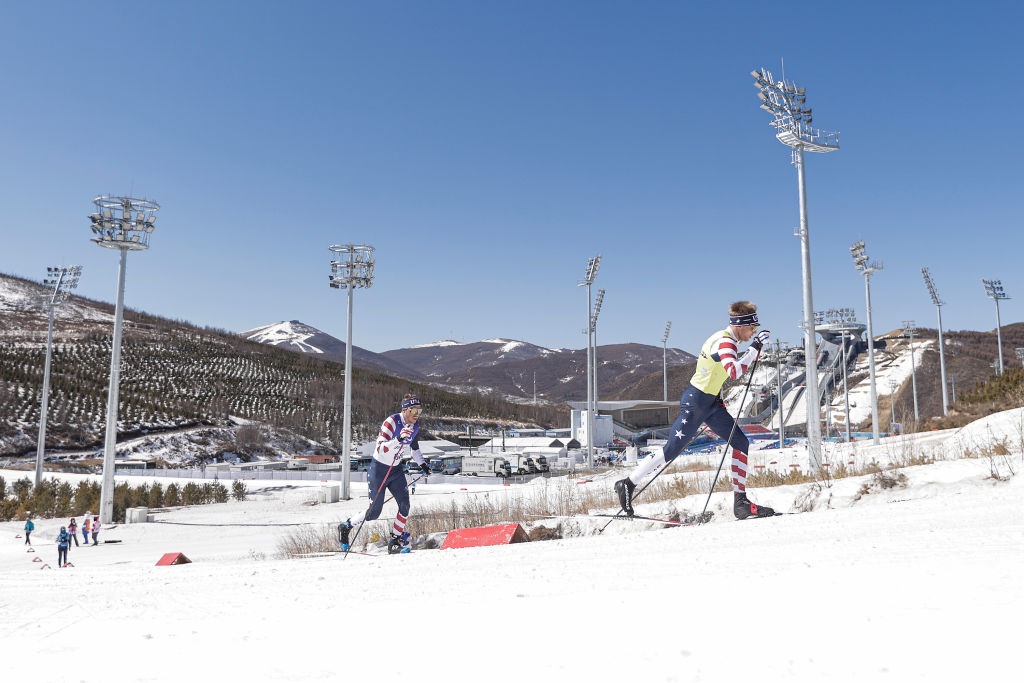
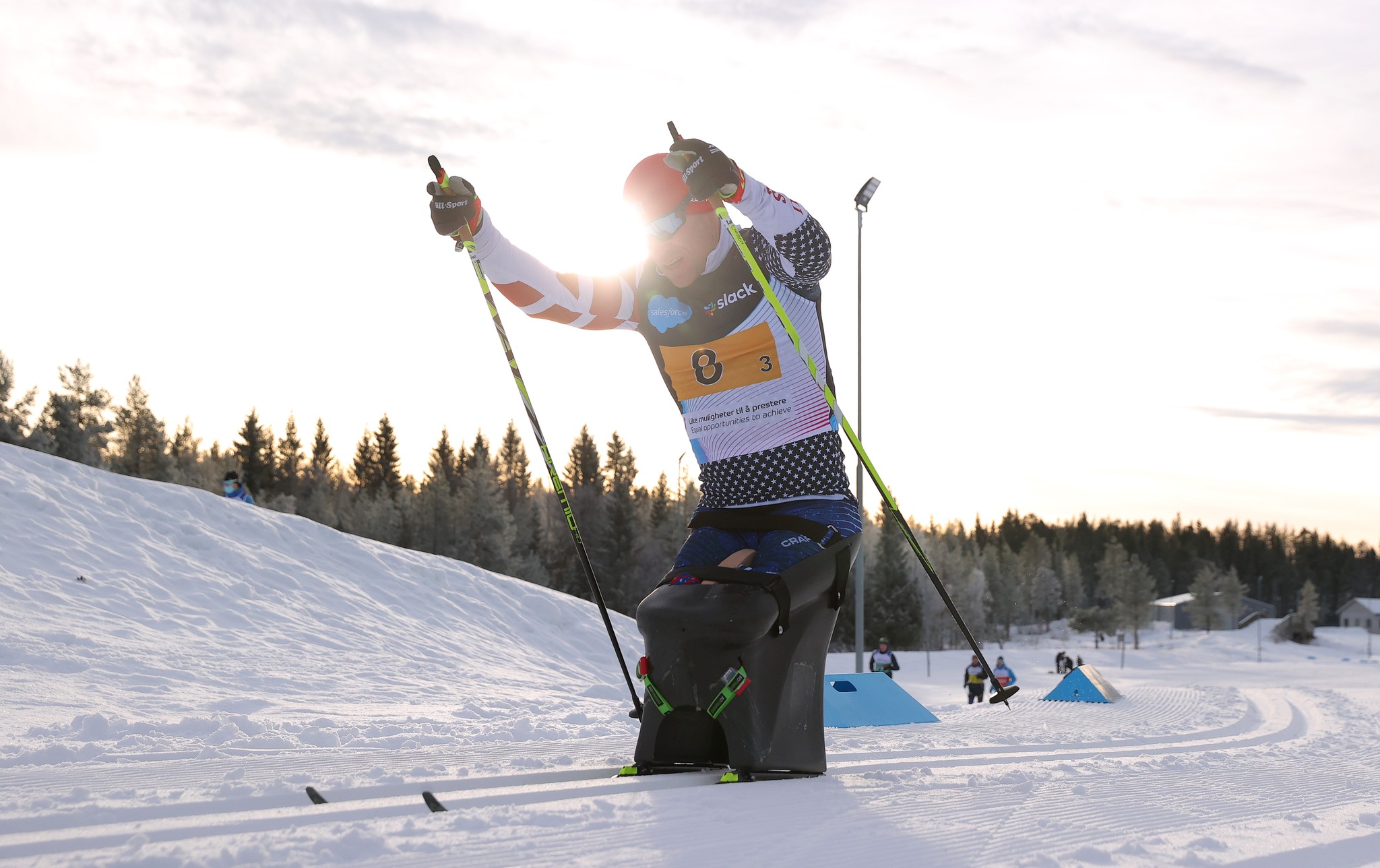
Jake Adicoff crosses the line for Paralympic gold in the 4 x 2.5 k mixed team relay. (Photo: Mark Reis / TeamUSA)
The American team competed with athletes across the sitting, standing and visually impaired classifications. The team felt confident coming into the race after strong podium performances across each classification over the last eight days of Paralympic competition.
“It’s not just one athlete carrying the load,” Cnossen said. “We have really, really strong athletes in all the categories. For me, I didn’t have some of the individual success here that I’ve had in the past, but it just goes to show when you get to be part of a team that lifts the performance.”
“It’s so much better being part of a team,” Peterson said. “There were five of us out there today, and I think all of us had great races. Thanks to everyone else supporting us back home and all the Team USA staff here supporting us.”
The team of Oksana Masters, Sydney Peterson, Jake Adicoff (with guide Sam Wood) and Dan Cnossen, take Paralympic gold in the mixed team relay. (Photo: Mark Reis / TeamUSA)
The gold-medal win fueled the 4 x 2.5-kilometer open relay, the final competition for Para Nordic in Beijing.
First-time Paralympians Max Nelson, guided by Simi Hamilton, and Drew Shea teamed up with veterans Kendall Gretsch and Ruslan Reiter for the final relay. The team placed ninth overall in 33:03.0.
“It was fun to watch everyone ski in the first race and to go out there and just give it all you got,” Reiter said.
Team Ukraine won gold in 28:05.3 thanks to a strong last leg by Anatolii Kovalevskyi guided by Oleksandr Mukshyn. France finished second for silver in 28:30.4, and Norway held onto bronze in 28:41.0.
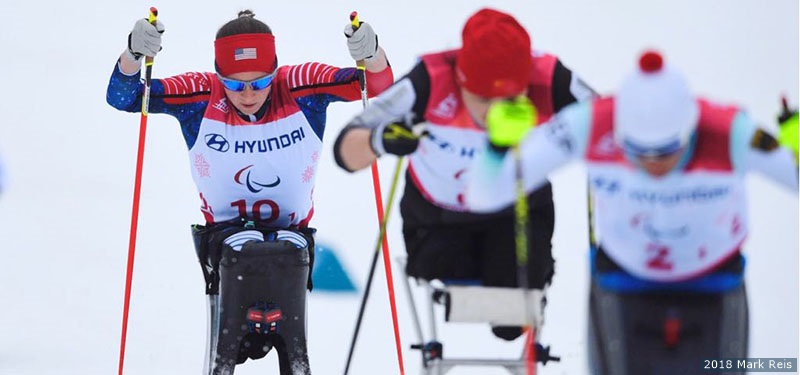
Max Nelson, the youngest skier on the U.S. Para Nordic team in Beijing, fought for Team USA from the very start of the race in the leadoff leg.
“It was pretty crazy at the start trying to fight off a couple skiers for my spot,” Nelson said. “But I’m just honored to be here and race for Team USA. It was a great day.”
Max Nelson and guide Simi Hamilton lead off for Team The team of Oksana Masters, Sydney Peterson, Jake Adicoff (with guide Sam Wood) and Dan Cnossen, take Paralympic gold in the mixed team relay. (Photo: Mark Reis / TeamUSA)
The athletes made the most of the time on their course together in a sport that is normally focused on individual racing. Gretsch, who won three medals in biathlon and competed in all three cross-country races at these Games, said it’s exciting to see the athletes race head-to-head across the classifications.
“It is so crazy because there’s such a yo-yo between the legs of it so you can really like never count yourself out until the very end,” Gretsch said. “Everyone just has to go and give it their all for 2.5-kilometers.”
First-time Paralympian Drew Shea said this was a great way to end his first Games experience.
“This is pretty special in such an individual sport, just being able to fight for the next person who’s out there,” Shea said. “It’s not about you out there. It’s about the team so you’re just trying to make up every second and grind it out.”
Team USA’s Para Nordic skiers closed out a successful Paralympic Winter Games with 14 medals (four gold, eight silver and two bronze.)
Want to follow Team USA athletes during the Paralympic Winter Games Beijing 2022? Visit www.teamusa.org/beijing-2022-paralympic-games to view the competition schedule, medal table and results.
***
Author Bio:
Katie Grunik is a digital content creator for TeamUSA.org. She is covering her second Olympic & Paralympic Games for teamusa.org and currently serves as the digital content coordinator for the U.S. Olympic & Paralympic Committee.
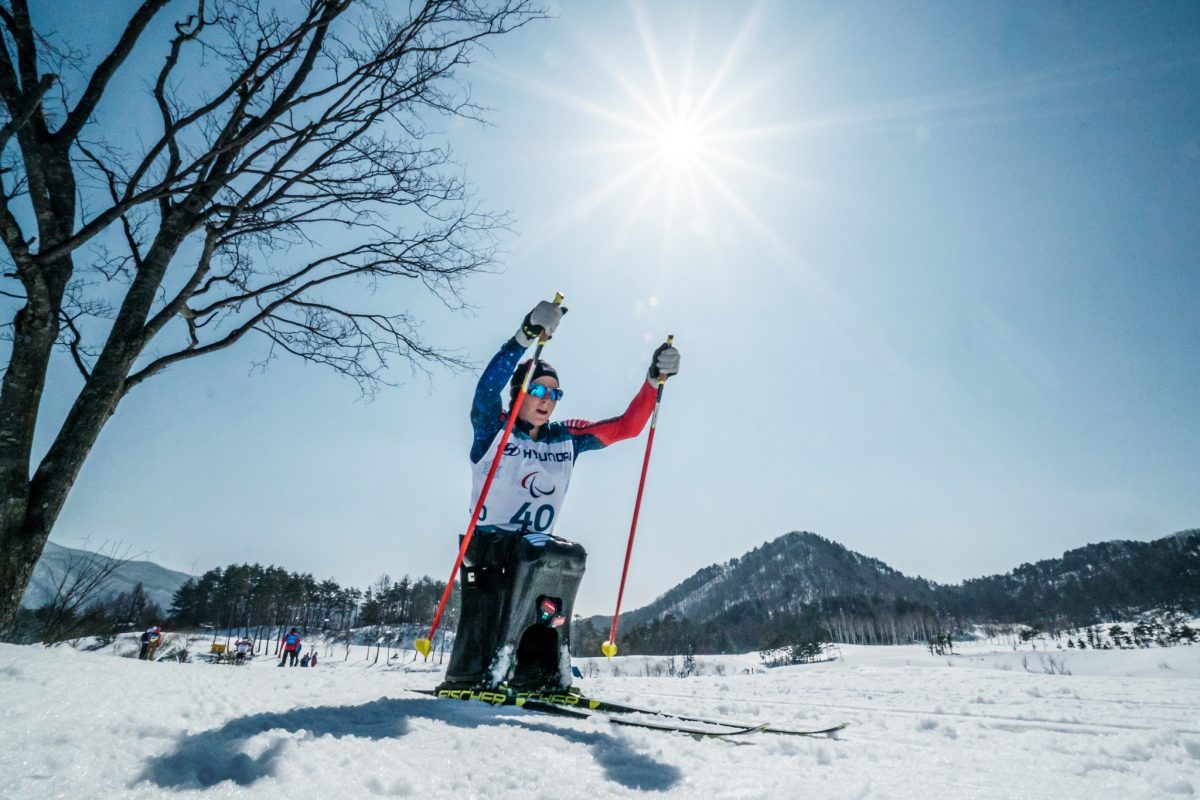
Oksana Masters skis to silver in the women’s sitting middle-distance cross country event. (Photo: Mark Reis / Team USA)
ZHANGJIAKOU, China — Team USA Nordic skier Oksana Masters (Louisville, Kentucky) skied her way into the record books on Saturday at the Paralympic Winter Games Beijing 2022.
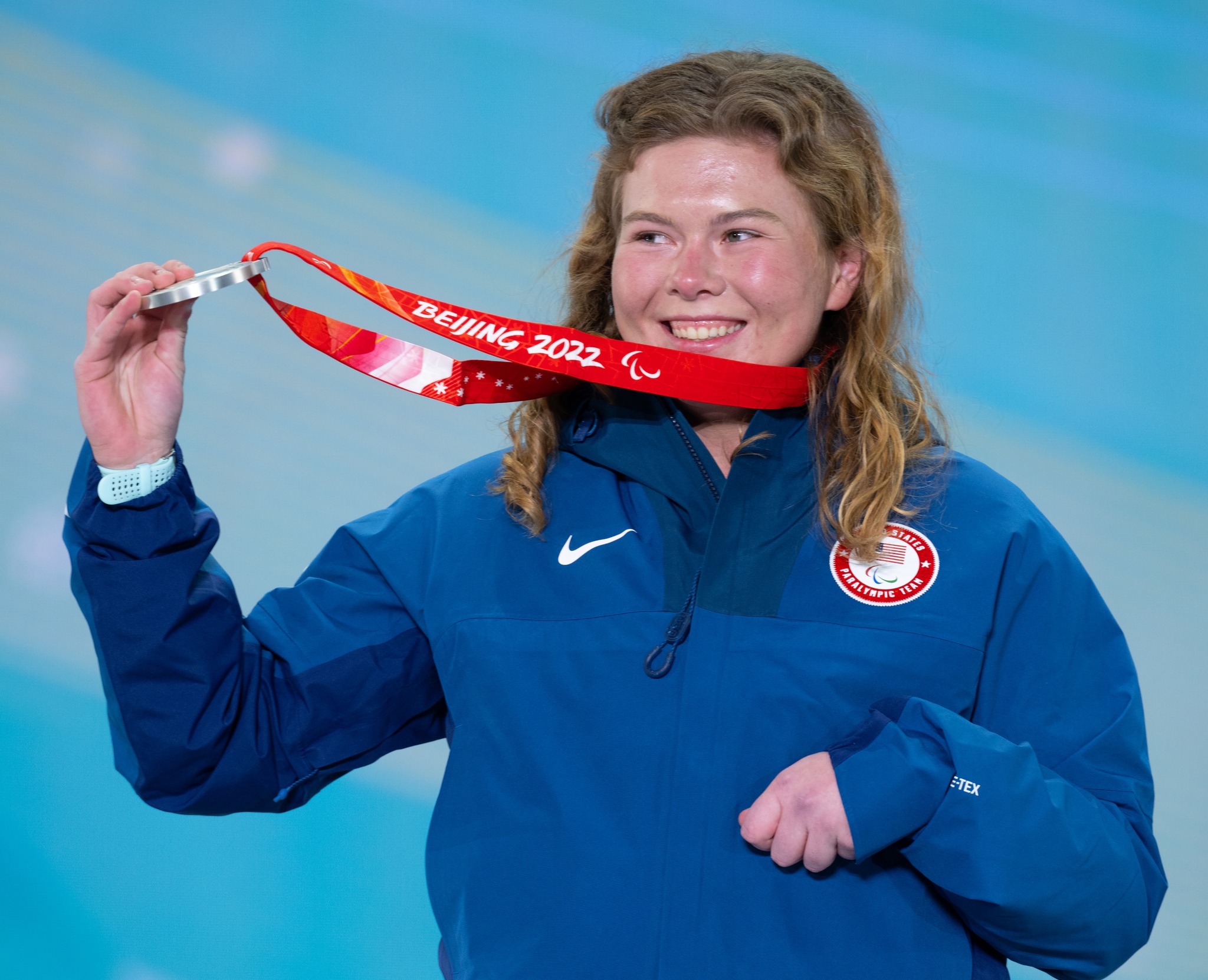
Masters won the silver medal in the women’s sitting cross-country middle-distance at the Zhangjiakou Biathlon Center, her sixth medal of Beijing 2022 and 16th overall medal in her Paralympic career, which is the fourth-most Paralympic medals by a U.S. athlete.
A star in both the winter and summer Paralympic Games, Masters has now won eight Paralympic medals in cross-country, five in biathlon, two in Para-cycling and one in rowing. Her eight cross-country medals are the most ever by a U.S. Paralympian and her 13 overall Winter Paralympic medals ties alpine skiers Sarah Billmeier and Sarah Will as the most all-time by a U.S. Paralympian.
Oksana Masters skis to silver in the women’s sitting middle-distance cross country event. (Photo: Thomas Lovelock for OIS / Team USA)
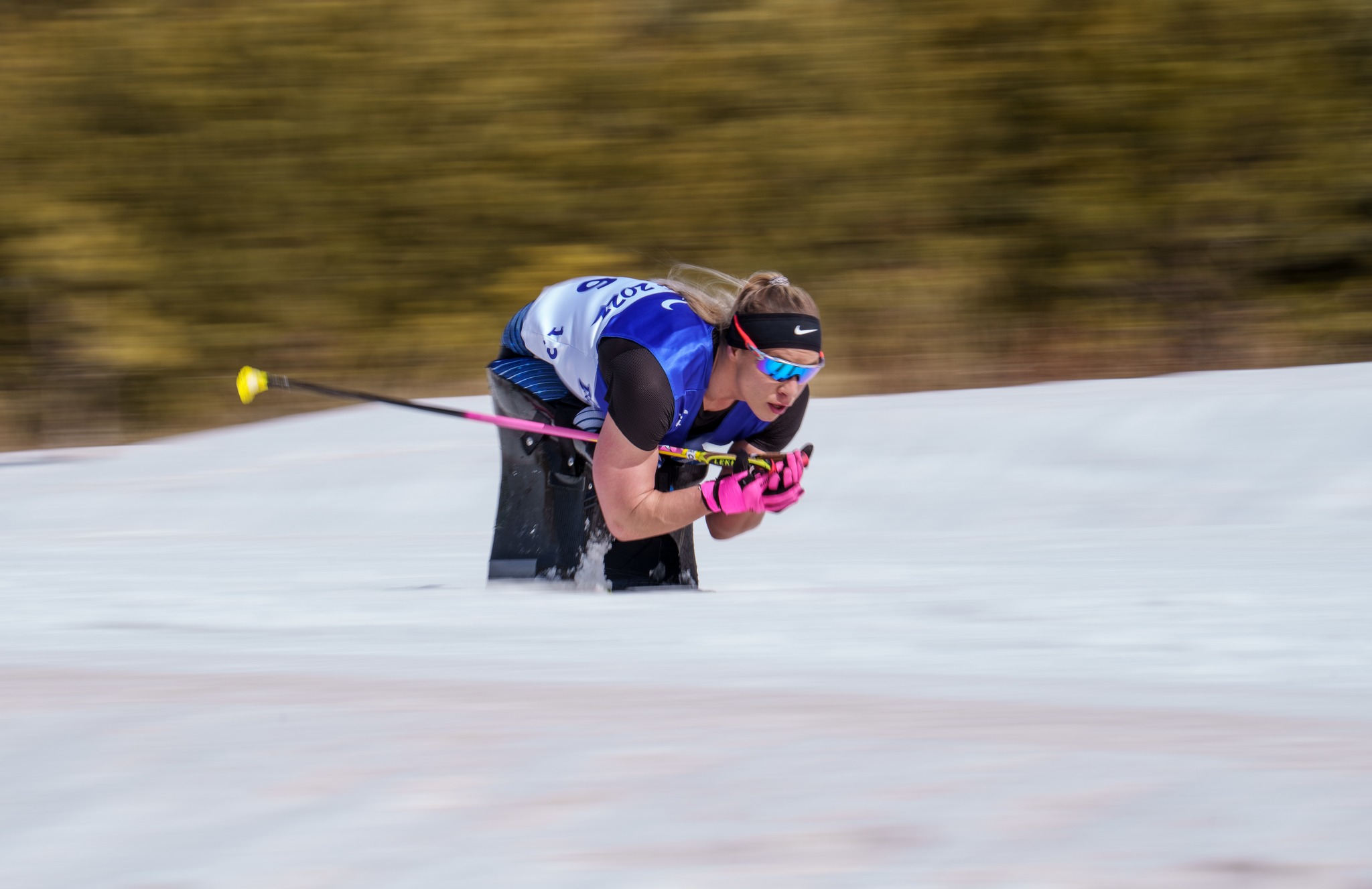
On Saturday in warm conditions and slushy snow, Masters skied the middle-distance 7.5-kilometer course in a time of 25:24.7 — 37.2 seconds away from gold. China’s Hongqiong Yang won in a factored time of 24:47 and her teammate Jing Ma won bronze in 26:22.
Kendall Gretsch (Downers Grove, Ill.) placed sixth, with a time of 27:47.
“Today was a really tough day. The combination of the fresh snow and the warm temperatures made for a brutal race,” said Gretsch, who will head home from Beijing 2022 with three medals from her individual races. “I’m proud of my performance here. I came out every race and gave it everything I had. I wanted a little more and was hoping to do a little bit better, but I can’t be upset that I gave everything I had.”
Together, the duo of Masters and Gretsch have won nine medals across six days of biathlon and cross-country racing at Beijing 2022, and the U.S. Nordic team as a whole has won 13 medals. With individual racing now concluded, the Nordic racing action finishes on Sunday with the mixed relays on the final day of Beijing 2022.
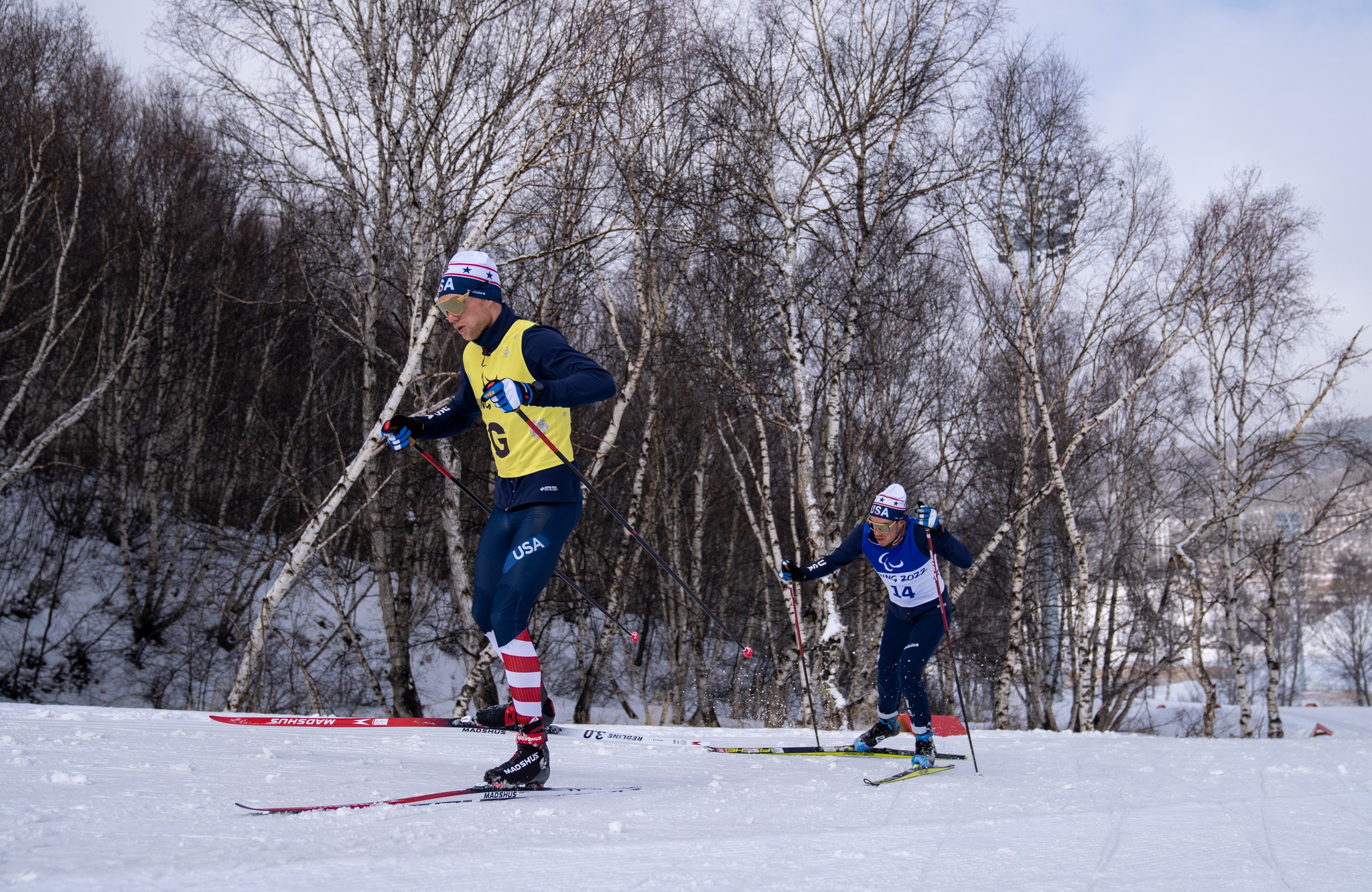
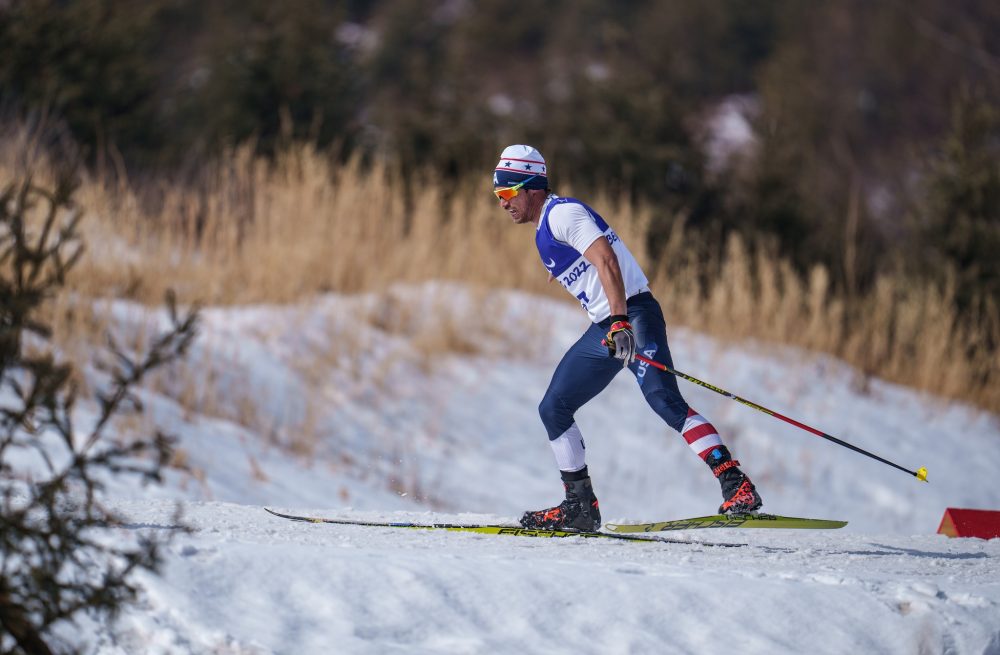
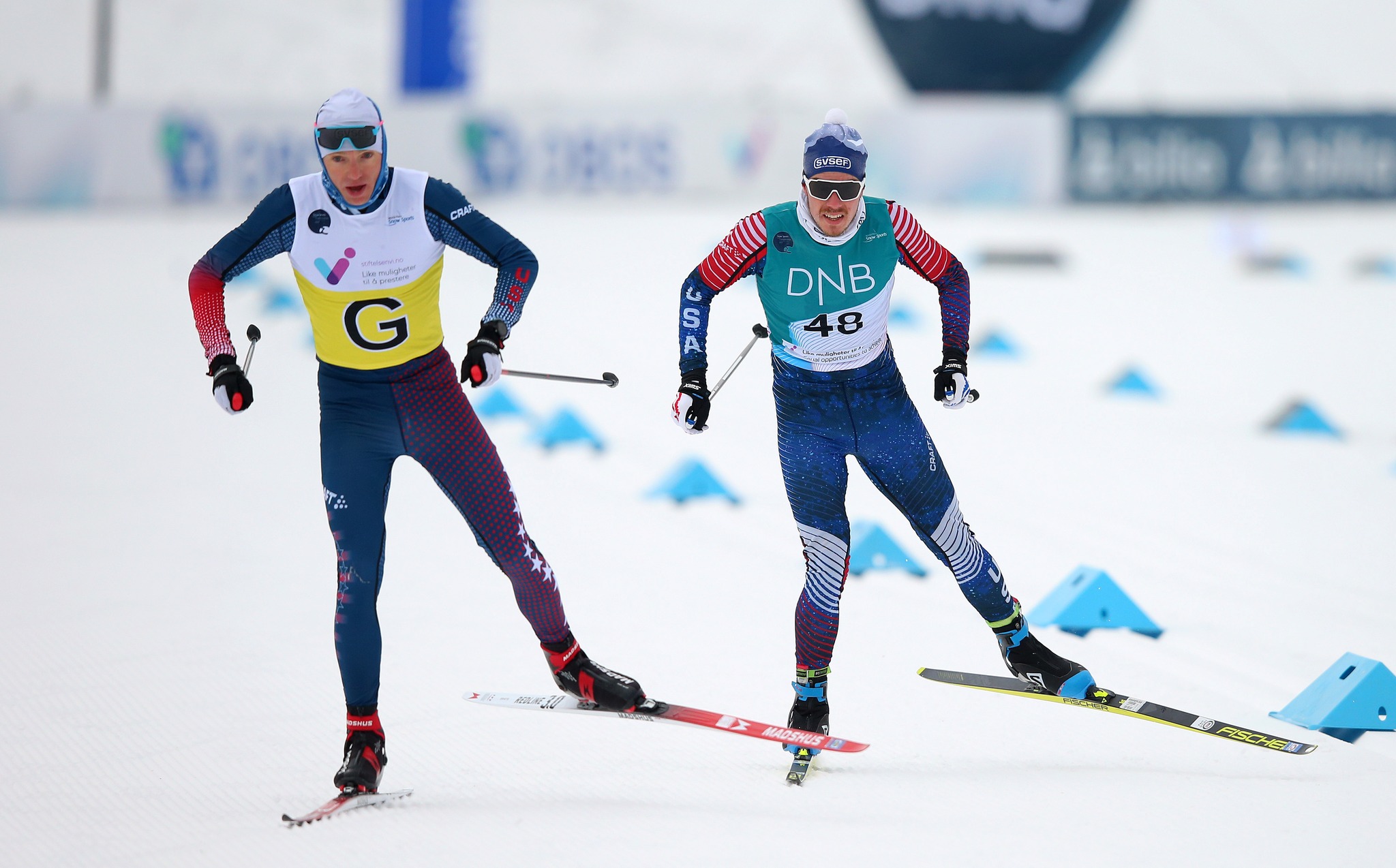
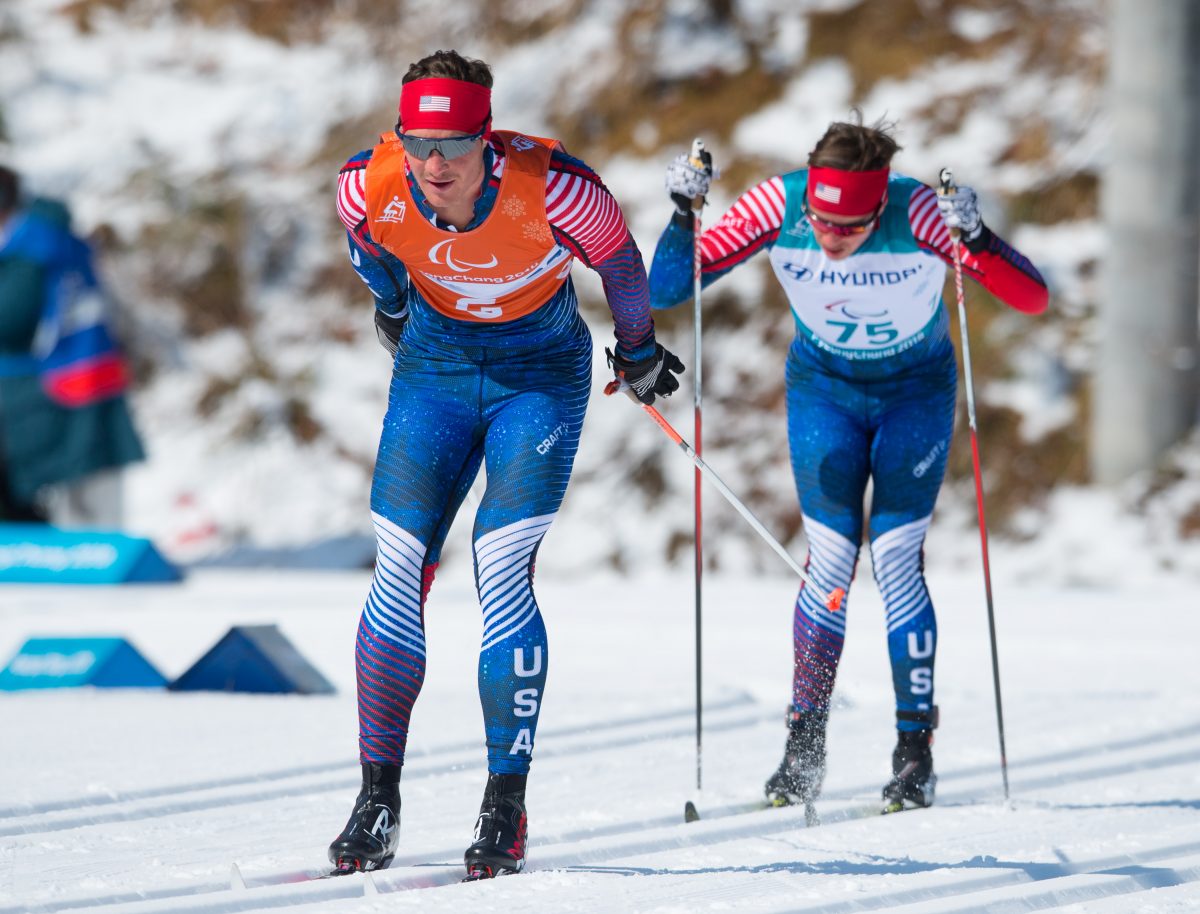
Jake Adicoff and guide Sam Woods race the middle-distance freestyle race in Zhangjiakou. (Photo: Thomas Lovelock for OIS / Team USA)Ruslan Reiter skates to 10th place in the middle-distance standing cross country event. (Photo: Thomas Lovelock for OIS / Team USA)
In Saturday’s standing middle-distance, Jake Adicoff (Sun Valley, Idaho), with guide Sam Wood (Harpswell, Maine), placed sixth in the men’s vision impaired category. Team USA’s Ruslan Reiter (Manchester, Maine) scored a top-10 finish in the men’s standing middle-distance, placing 10th, while teammate Drew Shea (Vienna, Virginia) finished 19th.
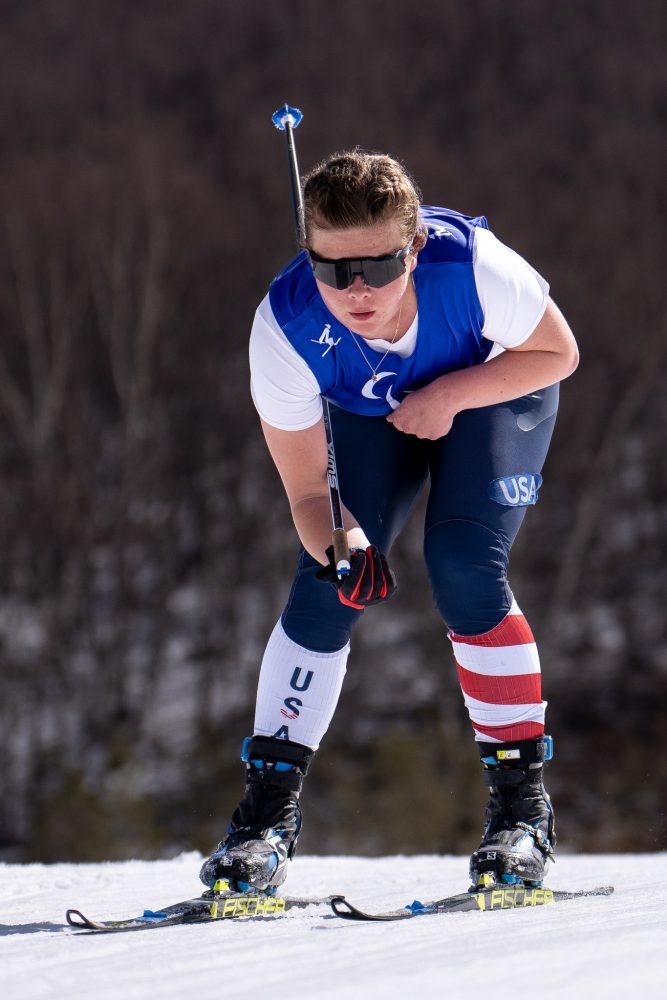
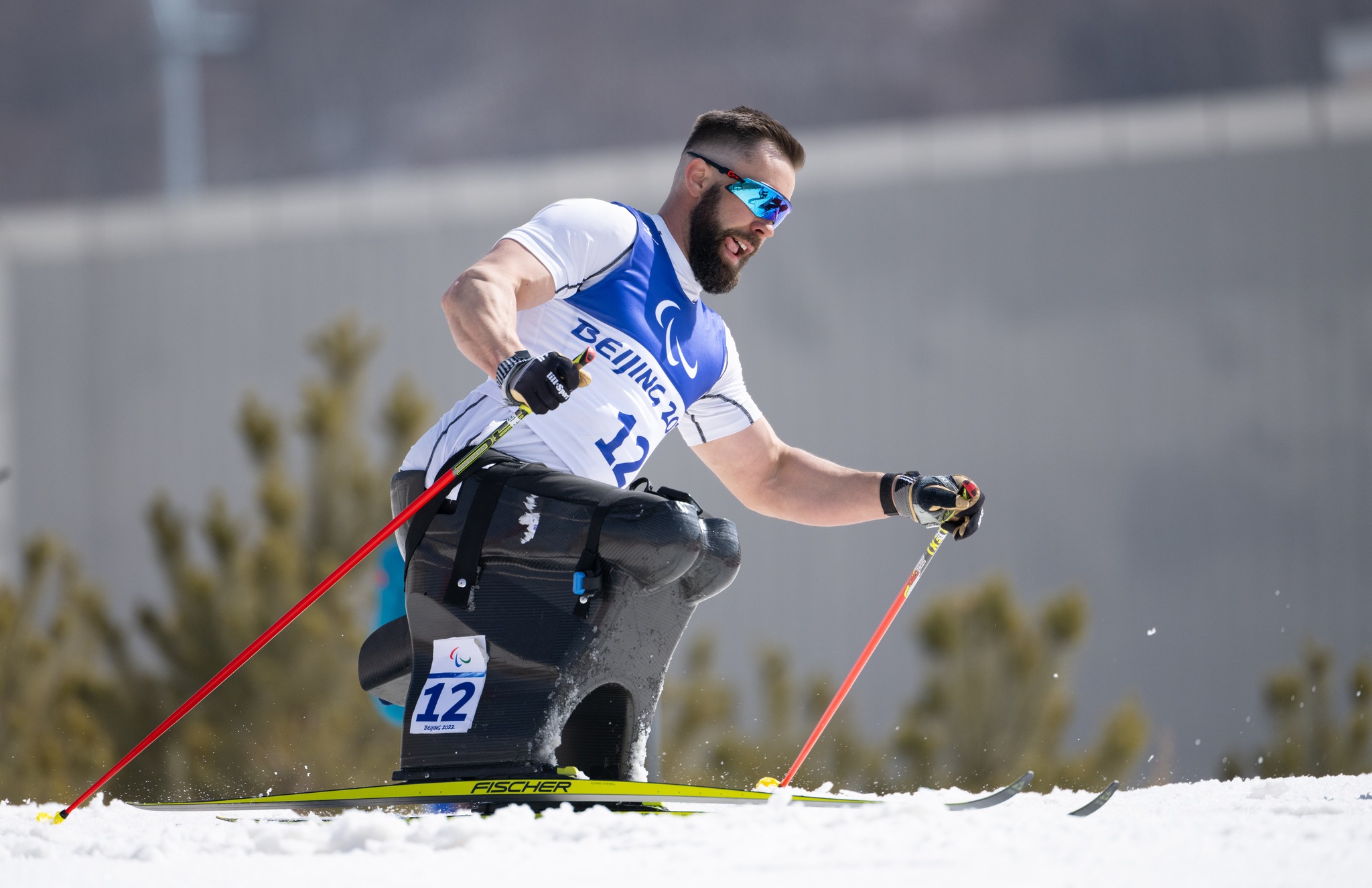
Sydney Peterson (Lake Elmo, Minnesota) who has won two medals in Beijing 2022 in her debut Paralympic Games, led the U.S. women in the standing middle-distance with a sixth-place finish. Dani Aravich (Boise, Idaho) scored her second top-10 finish of these Games, placing ninth. Two-time Paralympian Grace Miller (Palmer, Alaska) placed 16th. In the men’s sitting middle-distance, six-time Paralympian Aaron Pike (Park Rapids, Minnesota) led the way for the U.S. with a 12th-place finish. Josh Sweeney (Glendale, Arizona) took 24th.
Sydney Peterson takes sixth in the standing middle-distance cross country race in Zhangjiakou. (Photo: Thomas Lovelock for OIS / Team USA)
To follow and watch U.S. Paralympics Nordic Skiing competition from the 2022 Beijing Paralympics, tune in to NBC, which features more than 230 hours of coverage across NBC, Peacock, USA Network, the Olympic Channel, NBCOlympics.com and the NBC Sports App.
ZHANGJIAKOU, China — Team USA Para Nordic skiers Oksana Masters (Louisville, Kentucky) and Jake Adicoff (Sun Valley, Idaho), alongside guide Sam Wood (Harpswell, Maine) each won silver medals, and Sydney Peterson (Lake Elmo, Minnesota) took bronze in an exciting, fast-paced day of cross-country sprint racing at the Paralympic Winter Games Beijing 2022.
Through five days of competition, the U.S. Para Nordic team has collected 10 medals in cross-country and biathlon at Beijing 2022, with three more days of racing to go at the Zhangjiakou Biathlon Center.
Oksana Masters takes silver in the women’s sitting sprint. (Photo: Mark Reis / Team USA)
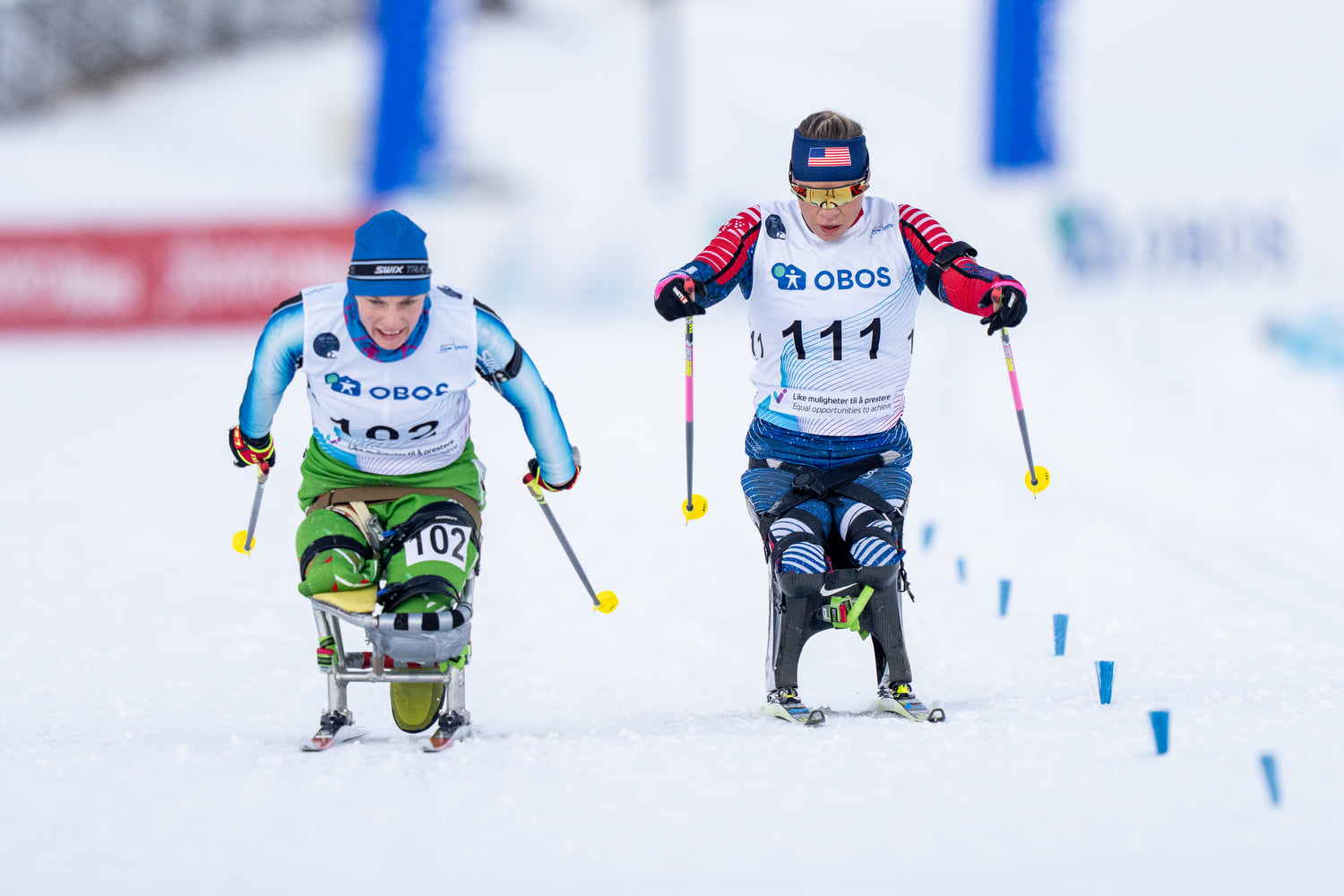
Masters has won four medals — in all four races — at Beijing 2022 and now has won 14 medals in her Paralympic career. Masters, the 2021 world champion and 2018 cross-country sprint gold medalist from PyeongChang, finished just 1.7 seconds away from gold on Wednesday.
The cross-country and biathlon star powered up the hills on the 1-kilometer course and sprinted down the finish chute to nearly catch China’s Hongqiong Yang who won gold with a time of 3:18.2. Masters finished in 3:19.9 and Panpan Li of China earned the bronze in 3:31.0.
Team USA’s Kendall Gretsch (Downers Grove, Ill.) placed fifth, in 3:37.3.
Adicoff and Wood won their second silver medal of Beijing 2022 in the men’s visually impaired category, just 0.8 seconds away from gold. The duo hammered the sprint cross-country course in a time of 3:20.3, just behind Canada’s Brian McKeever, guided by Russell Kennedy. Sweden’s Zebastian Modin, guided by Emil Joensson Haag, took the bronze in a time of 3:37.8.
The silver is Adicoff’s third medal of his Paralympic career — and he’s gunning for two more cross-country medals in Beijing.
Jake Adicoff (right) with guide Sam Wood earn a second silver medal in the visually impaired freestyle sprint, their second medal in two races at the 2022 Beijing Paralympics. (Photo: Joe Kusumoto / Team USA)
“I said it before, but I’ll say it again — ‘We’re going to gun for gold,’” said Adicoff who is a three-time Paralympian who won silver in the 10k cross-country at the 2018 Paralympic Games in PyeongChang.
“Two more to go. We’re hoping for four for four (on the podium) so we’re right on schedule,” Wood said.
Adicoff said the fun of cross-country sprints is the opportunity to cheer on his fellow U.S. Para Nordic teammates. The entire team raced on Wednesday, which began with qualification rounds, a round of semifinals and the final to determine the Paralympic medalists.
“Being with this team is so much fun. Especially on sprint day. Sprint days are the best. You get to watch everyone and it’s an absolute blast,” said Adicoff. “The team had a good day, so we’re psyched.”
Peterson, who is competing in her first Paralympic Games, won her second medal of Beijing 2022, adding to the silver she won in long-distance cross-country. She completed the sprint cross-country in 4:12.1, behind Canada’s Natalie Wilkie (4:05.1) and Norway’s Vilde Nilsen (4:08.1).
“It was a super challenging race. There were a lot of components to it going throughout the day, but I’m super excited about how it all stacked up,” Peterson said. “I had a ton of people that were out there helping and cheering and it wouldn’t have been possible without all their support.”
Grace Miller races to 14th in the women’s standing freestyle sprint. (Photo: Mark Reis / Team USA)Visually impaired athlete Max Nelson sprints to 14th with guide Simi Hamilton. (Photo: Mark Reis / Team USA)
A total of 14 U.S. athletes competed in the day’s events. For the women’s sitting sprint, Lera Doederlein and Erin Martin finished 14th and 16th respectively while Grace Miller took 14th in the women’s standing. In the men’s sitting competition, Dan Cnossen finished just outside a qualifying spot with a 13th place finish while Josh Sweeney finished 19th. Max Nelson took 14th place in the men’s visually impaired qualification round while Drew Shae covered the course in the first round of the men’s standing for 21st.
American teammates Dani Aravich, Ruslan Reiter and Aaron Pike made their way to the semifinal round finishing the sprint competition in 8th, 12th and 12th respectively.
Aaron Pike races into the sprint semifinal, finishing 12th. (Photo: Mark Reis / Team USA)
Nordic athletes will enjoy a rest day on Thursday. Racing is scheduled to resume on Friday, with the men’s and women’s individual biathlon. To follow and watch U.S. Paralympics Nordic Skiing competition from Beijing 2022 on NBC, which features more than 230 hours of coverage across NBC, Peacock, USA Network, the Olympic Channel, NBCOlympics.com and the NBC Sports App. All events will be streamed live on NBC’s Peacock. Follow U.S. Paralympics Nordic Skiing on Facebook, Twitter and Instagram for daily updates from Beijing.
ZHANGJIAKOU, China — Three-time Paralympian Jake Adicoff (Sun Valley, Idaho), alongside guide Sam Wood (Harpswell, Maine), won the silver medal in the men’s visually impaired long-distance cross-country race on Monday, while Paralympic newcomer Sydney Peterson (Lake Elmo, Minnesota) won the silver in the women’s long-distance cross-country race in another banner day for the U.S. Para Nordic team at the Paralympic Winter Games Beijing 2022.
Visually impaired athlete Jake Adicoff earns the second Paralympic silver medal in the 20 k classic, alongside guide Sam Wood. (Photo: Mark Reis / Team USA)
The U.S. Para Nordic team has now collected five medals through three days of cross-country skiing and biathlon competition at Beijing 2022, with five more days of racing to go at the Zhangjiakou Biathlon Center.
Adicoff’s strong performance in the 20-kilometer cross-coutry race on Monday gives him his second Paralympic medal, adding to the silver he won in the 10k cross-country at the Paralympic Winter Games PyeongChang 2018.
Adicoff retired from the sport following those Games, but got the itch to compete again during the early months of the coronavirus pandemic in 2020. With months of dedicated training under his belt, the Sun Valley, Idaho, resident accepted an invitation to join the U.S. Para Nordic team for a training camp in February of 2021.
Jake Adicoff and guide Sam Wood race for a silver medal in the 20 k classic. (Photo: Mark Reis / Team USA)
Paired with his longtime friend Wood as his guide, the 26-year-old came to Beijing as one of the top podium contenders in the men’s visually impaired field after the two combined for three medals at the Lillehammer 2022 World Para Snow Sports Championships in January.
(Listen to Adicoff and Wood on the Nordic Nation podcast here.)
Jake Adicoff earns his second Paralympic silver medal in the 20 k classic. (Photo: Mark Reis / Team USA)
On Monday, Adicoff and Wood completed the 20k course in a time of 58:54 solidly in silver position ahead of Sweden’s Zebastian Modin and his guide Emil Joensson Haag who finished in 1:00:05. Canada’s Brian McKeever, with guide Russell Kennedy, won the gold in a time of 55:36.
“It feels good,” Adicoff said. “I’m happy to be on the medal stand today and we’ll do everything we can to get the gold medal next.”
“It’s great to represent Team USA. We just love skiing with this team. It’s so much fun to be surrounded by people who are so dedicated and athletes who are so strong. It’s sweet to be a part of that.”
Sam Wood helps guide Jake Adicoff to silver in the 20 k classic during the 2022 Beijing Paralympic Winter Games. (Photo: Mark Reis / Team USA)
Wood echoed that sentiment and pointed out the U.S. Para Nordic team’s strong culture and commitment to excellence.
“The teammates that we have here are some of the best, most committed athletes in the world. For us to be able to use that to get fired up and get faster, that’s the best thing you can have as an athlete. We have a great support system and teammates,” Wood said.
In the women’s long-distance cross-country race, 20-year-old Peterson completed the 15k course in a factored time of 49:00, fast enough to capture the silver medal in her Paralympic debut. Canada’s Natalie Wilkie (48:04) and Brittany Hudak (49:27) won gold and bronze, respectively.
Sydney Peterson takes silver in the 15 k classic, her career first Paralympic medal. (Photo: Mark Reis / Team USA)
Peterson, a standing skier who is a sophomore at St. Lawrence University, said her silver medal “hasn’t sunk in yet.” Her entire Paralympic experience has been a whirlwind, she said.
It wasn’t until mid-February that she received an official bipartite invitation to earn a spot at the Paralympic Winter Games in Beijing. New to adaptive sports, Peterson raced in only one world cup event this season before traveling to Lillehammer for the world championships. There, she won two silvers and a bronze. Despite the strong performance on the world stage, Monday’s race came as a surprise to the Lake Elmo, Minnesota, native.
“I didn’t really expect to ever be here. It’s all happened really fast. It feels kind of surreal to be here,” Peterson said. “I’m pretty excited [to win the silver medal]. I really didn’t have many expectations. There are so many strong skiers in this field, and I didn’t know where things would stack up today. I felt pretty good [on the course.] I tried to ski smooth throughout the race. It was definitely a very hard race and physically exhausting.”
Sydney Peterson takes silver in the 15 k classic during the 2022 Beijing Paralympic Winter Games. (Photo: Mark Reis / Team USA)
Grace Miller (Palmer, Alaska) also competed in women’s long-distance cross-country placing ninth to round out the U.S. team’s performances. On Tuesday, biathlon competition resumes in Zhangjiakou, as biathletes will compete in the men’s and women’s middle-distance in the sitting, standing and visually impaired classifications.
***
Follow and watch U.S. Paralympics Nordic Skiing competition from Beijing 2022 on NBC, which features more than 230 hours of coverage across NBC, Peacock, USA Network, the Olympic Channel, NBCOlympics.com and the NBC Sports App. All events will be streamed live on NBC’s Peacock. Follow U.S. Paralympics Nordic Skiing on Facebook, Twitter and Instagram for daily updates from Beijing.
Oksana Masters crosses the finish line of a race in Lillehammer, Norway. (Photo: Alex Livesey/Getty Images)
By Kristen Gowdy | Jan. 31, 2022, 6:02 p.m. (ET)
COLORADO SPRINGS, COLORADO – Following a stellar world championships performance that saw Team USA earn 13 medals in Para Nordic disciplines, U.S. Paralympics Nordic Skiing today announced the six women, seven men and one guide who have been nominated to compete at the Paralympic Games Beijing 2022 in March.
Veteran athletes will lead the way in Beijing as Team USA looks to build on the 16 Paralympic medals won at the Paralympic Games PyeongChang 2018. Headlined by multi-time Paralympic medalists Oksana Masters (Louisville, Kentucky), Kendall Gretsch (Downers Grove, Illinois) and Dan Cnossen (Topeka, Kansas), the athletes nominated to the 2022 team sport a combined career total of 21 Paralympic medals. Of the 14 athletes, nine have previous Paralympic experience while five athletes will make their Paralympic debut.
“We have many athletes who thrive in these high-stakes competitions, who know what it means to represent Team USA as a Paralympian,” Eileen Carey, director of U.S. Paralympics Nordic Skiing, said. “We are looking to them, as well as our experienced coaching staff, to lead the newer athletes into Beijing 2022. We are motivated by the combination of experience and the high quality of our Paralympic rookies as a testament to the growth and bright future of our program; their success this Paralympic quad has shown us that we can reach new heights in March.”
A 10-time Paralympic medalist and recently crowned 10-time world champion, Masters is set to make her sixth Paralympic appearance. After winning double gold in Para-cycling at the Paralympic Games Tokyo 2020, Masters has continued her success on the snow, earning a medal in every world cup competition in which she has competed, as well as five medals at the recent Lillehammer 2021 World Para Snow Sports Championships. In Lillehammer, the multi-sport phenom earned her ninth and 10th career world championship titles and will look to put an exclamation point on her already historic 2021-22 season on the world’s biggest stage.
Gretsch, who is putting together a world-class resumé herself this season, also won gold in Tokyo in paratriathlon. She led Team USA in Lillehammer with three world championship titles and also added a silver as she looks to repeat the double gold she won in PyeongChang. The 13-time world championship medalist is headed into Beijing as a heavy favorite in the biathlon discipline, having won both titles in the Para biathlon events in which she competed in Lillehammer.
A six-time Paralympic medalist and retired Navy SEAL, Cnossen earns his third Paralympic team nomination in 2022. All six of Cnossen’s Paralympic medals came in PyeongChang, where he dominated in both cross-country skiing and biathlon. Cnossen is at his best on the Paralympic stage, where he will look to repeat his success come March.
Paralympic silver medalist Jake Adicoff (Sun Valley, Idaho) will team up with longtime friend and guide Sam Wood (Harpswell, Maine) to lead the U.S. in the men’s visually impaired class for his third Paralympic appearance. After taking several years off following his podium performance in PyeongChang, Adicoff accepted an invitation to join the team for a training camp last February, and hasn’t faltered since. He and Wood enter Beijing as one of the top podium contenders in the men’s visually impaired field. The duo have been putting together Adicoff’s best racing of his career, having recently combined for three medals – one of each color – in Lillehammer.
Paralympians Aaron Pike (Park Rapids, Minnesota) and Josh Sweeney (Glendale, Arizona) round out the men’s sitting class for Team USA. Pike, who recently won his second career world championship medal, a silver in the men’s individual biathlon, makes his sixth career Paralympic team. Also a prolific wheelchair racer and marathoner, Pike is peaking at the right time, having been in the podium mix in nearly all of his races this season. He is seeking his first career Paralympic medal in Beijing.
Sweeney, meanwhile, makes his first Paralympic team in Para Nordic skiing, having transitioned to the sport following a 2014 Paralympic gold medal appearance in sled hockey. The 2014 Pat Tillman Award for Service winner and retired U.S. Marine Corps Sergeant picked up skiing through the Challenged Athletes Foundation.
The final sit skiers on the 2022 roster, Erin Martin (Seattle, Washington) and Lera Doederlein (San Diego, California) are set for their Paralympic debuts. A former rock climber, Martin found Para Nordic skiing after sustaining a T4 spinal cord injury while climbing. She is also a registered nurse care manager who has served during the COVID-19 pandemic. Doederlein, meanwhile, also competes in sled hockey and Para-cycling. At just 18 years old, Doederlein, who was adopted from Russia, has found a mentor in the Ukraine-born Masters.
Standing skiers Grace Miller (Palmer, Alaska), Ruslan Reiter (Manchester, Maine) and Dani Aravich (Boise, Idaho) also bring Paralympic experience to the team. Miller and Reiter competed in PyeongChang, where Reiter’s best finish was seventh in the cross-country mixed relay, while Miller finished 10th in the 15-kilometer cross-country skiing race. Aravich made her Paralympic debut as a track and field athlete in Tokyo and along with Masters, Gretsch and Pike, will compete in her second Paralympic Games in six months.
Making their first Paralympic appearances and rounding out Team USA’s roster is standing skier Drew Shea (Vienna, Virginia), and visually impaired athlete Max Nelson (Mahtomedi, Minnesota).
Relatively new to Para Nordic skiing, Shea recently moved to Bozeman, Montana, to pursue the sport competitively with Crosscut Mountain Sports Center, his club team. A rising star in the sport, the 17-year-old Nelson made history as a high school junior last year when he became the first visually impaired Nordic skier to win an individual conference title in Minnesota.
The Paralympic Games begin on March 4, and Para Nordic skiing competition kicks off on March 5. Following record-breaking coverage of the Tokyo Paralympic Games, NBC has announced a historic broadcast schedule for its Winter Paralympic programming, which features more than 230 hours of coverage across NBC, Peacock, USA Network, the Olympic Channel, NBCOlympics.com and the NBC Sports App. NBC’s scheduled programming also includes the first-ever Winter Paralympic Games primetime coverage.
For media requests and photo inquiries, please contact Kristen Gowdy at Kristen.Gowdy@usopc.org.
2022 U.S. Paralympics Nordic Skiing Paralympic Team
Women:
Dani Aravich, women’s standing
Lera Doederlein, women’s sitting
Kendall Gretsch, women’s sitting
Erin Martin, women’s sitting
Oksana Masters, women’s sitting
Grace Miller, women’s standing
Men:
Jake Adicoff (with guide Sam Wood), men’s visually impaired
The Para World Championships wrapped up in Lillehammer, Norway on Sunday January 23rd, with a mixed open relay event bringing athletes from across genders and race categories together into one thrilling capstone event.
Rewinding to where our previous coverage left off, Saturday’s schedule featured the final individual races of the Championships, a classic spring for standing athletes, and a cross country sprint for sprint skiers. As in able-bodied fields, a sprint involves a qualification round, followed by a semifinal and grand finale to decide the medalists. The number of athletes who make the semifinal varies based on category.
Highlighting the day, Oksana Masters took gold in the women’s sitting race, her sixth medal of the Championships (two of each color) and career 11th World Championship medal. This title was not certain until the final meters of the race, where Masters put in a final surge to overtake an athlete from Belarus just before the line.
Oksana Masters (right) sprints to the finish during the women’s sitting individual biathlon. (Photo: Alex Livesey/Getty Images)
“It feels incredible,” Masters said in the Team USA press release. “It doesn’t feel that long ago that I was barely making finals in sprint, or I couldn’t finish a sprint without falling or breaking a pole. To be able to have a third consecutive world championship title in this event is just incredible.”
Another medal favorite based on her performances through the week, Kendall Gretsch also raced in the sitting finale, however, a late crash put her out of reach of the podium and she ended the day in fifth.
On the men’s side, Aaron Pike led the American men in the sitting sprint, placing well inside the top-12 to qualify for the semifinals. In his semi, Pike finished fifth and did not advance to the finale. Meanwhile, Dan Cnossen was 16th in qualification and did not advance to the rounds.
Dan Cnossen competes at the Para World Championships in Lillehammer. (Photo: Alex Livesey/Getty Images)
In the women’s standing races, newcomer to the team Sydney Peterson earned her second silver medal of the week, in addition to a third place medal. Perhaps still gaining experience, Peterson felt her first two rounds of racing were not smooth, though it came together in the final round.
“I had some mishaps the first two races this morning so I’m glad that things worked out for the finals,” said Peterson to Team USA. “I’m pretty excited that was a really fun race. It will be fun to continue racing.”
A second standing athlete, Dani Aravich, was just shy of the top-eight in qualification, meaning she was unable to advance to the semifinal for her class.
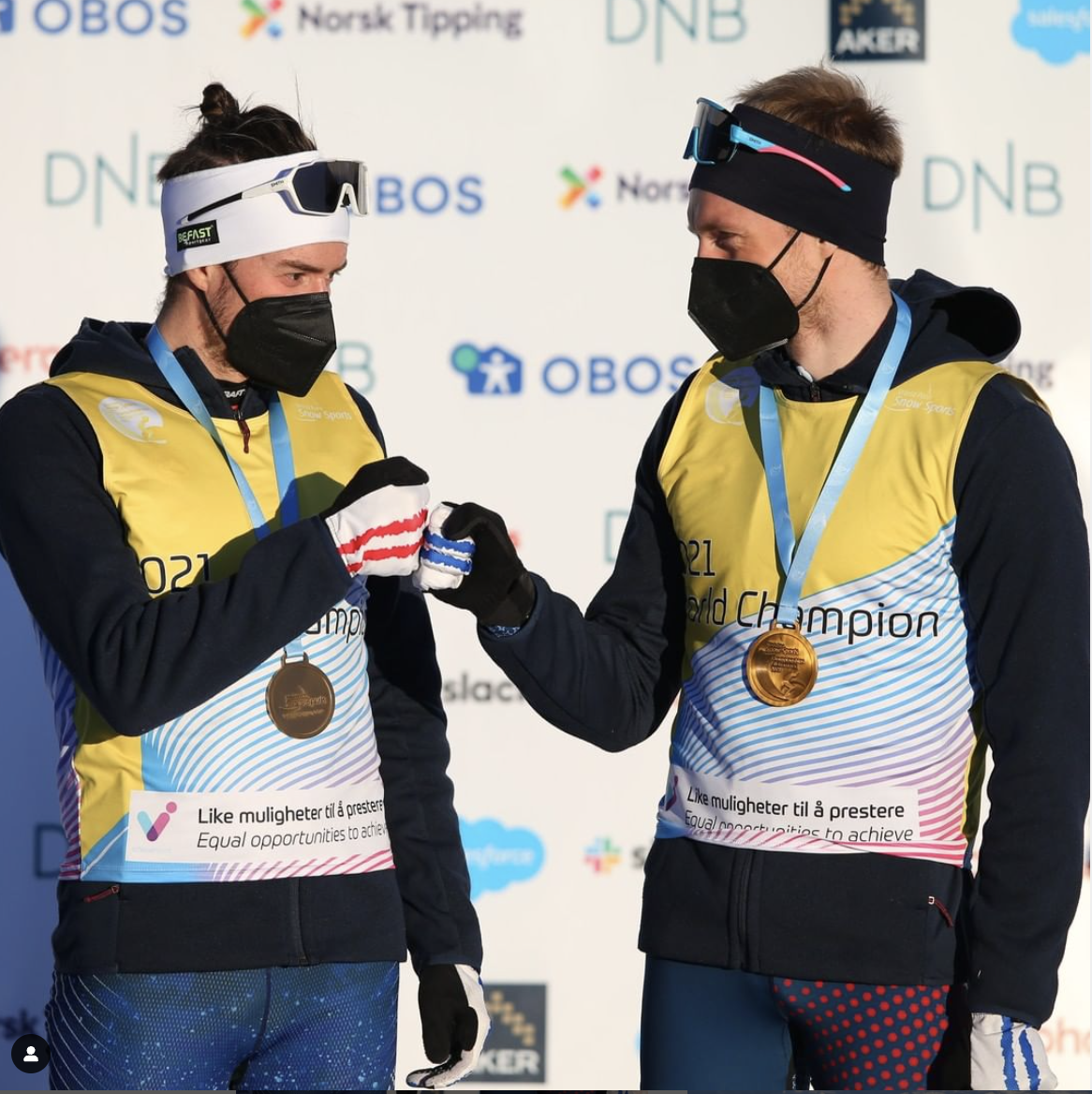
Friends, teammates, and more recently athlete-guide pair, Jake Adicoff and Sam Wood fist bump after earning a gold medal in the 10k classic at the Para World Championships in Lillehammer. (Photo: Alex Livesey/Getty Images)
“I’m feeling pretty good,” said Adicoff. “This is an improvement from the classic sprint in Canmore. We’re pretty happy with the result and it’s super fun racing out there. [We’re taking away] a little bit of confidence and then to be off that gold medal for two races now that’s what we’re looking for – gold in Beijing.”
On Sunday, the American squad fielded two relay teams in the mixed-gender, mixed-class 10-kilometer event. Given the variations in time based on sitting, standing, and subcategories within those groups, this makes for an interesting equation. Simultaneously, what better a way to highlight the diversity, talent, and teamwork seen across nations?
According to the daily Team USA press release, “relays were structured so that each athlete was assigned points based on their classification and gender, and the sum of each team’s total points could not exceed 335 for the mixed relay and 375 for the open relay. From there, it was head-to-head racing, and factored times did not come into play.”
Masters led an all-women’s team for the U.S., passing off to Peterson for the second leg, with Grestch racing third, and Aravich as anchor. Each of the women put together strong performances to keep their team within the top four, finishing in a cumulative time of 31:41.5.
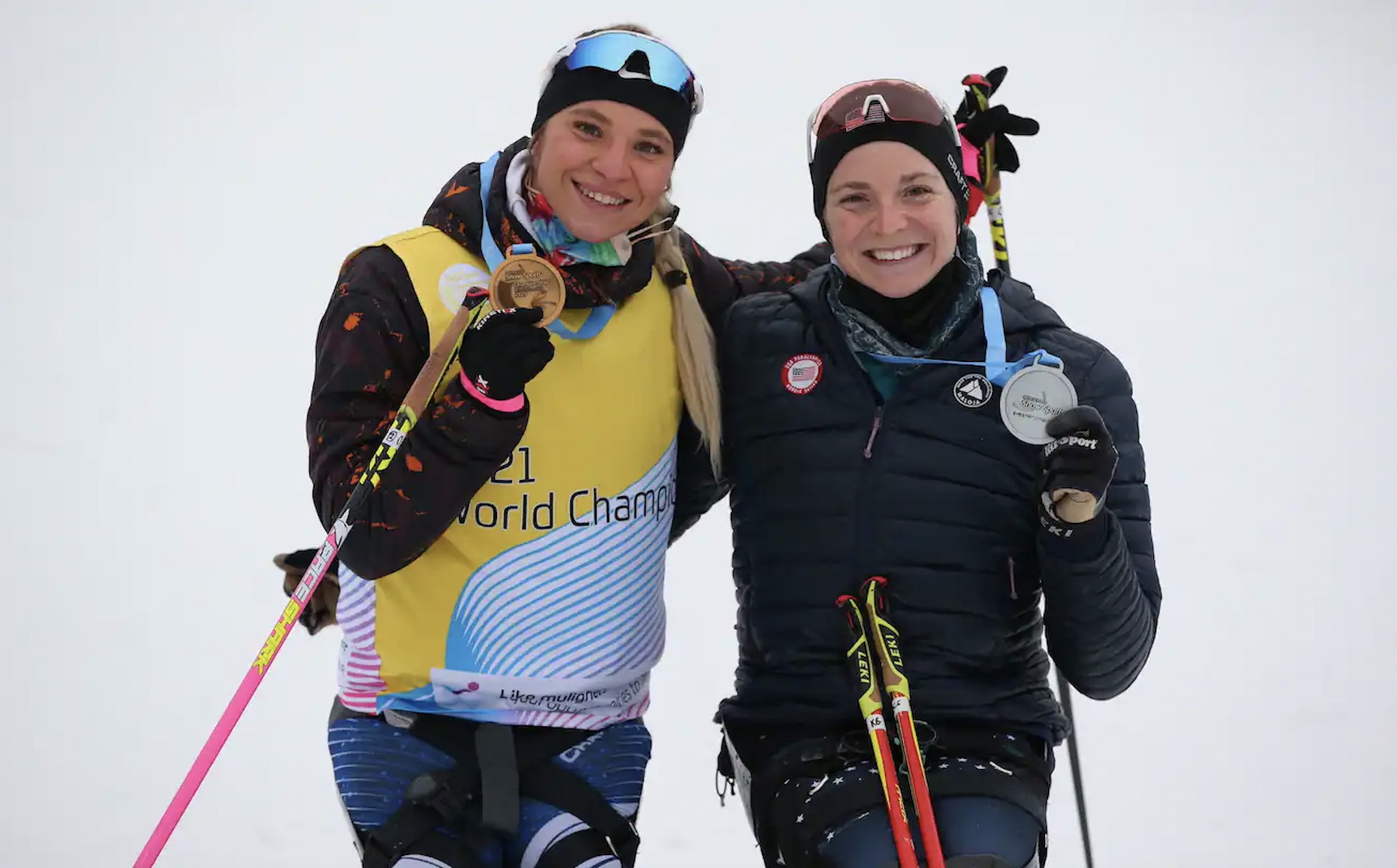
The American women’s open relay team took fourth in the final race of the Para World Championships in Lillehammer. (Photo: Alex Livesey/Getty Images)
“We didn’t know until yesterday how we were going to do the relays, so when our coaches told us it was all women, we were really excited,” Aravich explained in the press release. “When we looked at the points and how it was stacked up, we probably shot ourselves in the foot a bit because we didn’t come close to maximizing the points we could have had in the race. We set our expectations to have fun and end this trip on a high note, which we did.”
On the men’s side, Adicoff and Wood raced both the second and final leg of the relay, with Pike leading the team for the first leg and Cnossen racing third. Following a strong opener from Pike, Adicoff and Wood brought the men into second place, though they slipped back in the results over the next two. They finished the race in fifth overall, however, they were issued a 30-second time penalty for one of their exchanges, which bumped them down to sixth.
Jake Adicoff and guide Sam Wood race the long-distance skate, bringing home a bronze medal. (Photo: Alex Livesey/Getty Images)
The next races on the Para World Cup calendar begin next weekend, running January 27th – February 1st in Östersund, Sweden. The 2022 Paralympic team will be named following these events on February 1st, leaving the team just over a month to prepare for the Games in Beijing, which kick off on March 4th.
In this episode, we have Jake Adicoff and Sam Wood, calling in from Lillehammer as the duo races as athlete and guide at the Para World Championships. Jake is a visually impaired athlete from Sun Valley who grew up racing with the SVSEF cross country program and now trains with the Gold Team. He has raced at both the 2014 Paralympics in Sochi, and the 2018 Games in Pyeongchang, where he won a silver medal in the 10k classic, as well as placed 4th in the classic sprint and 5th in the 20k free.
Jake Adicoff and his guide Sam Wood put together a gold medal performance on the opening day of racing at the Para World Championships in Lillehammer, NOR. (Photo: Alex Livesey/Getty Images)
Meanwhile, Sam is also a member of the SVSEF Gold Team, balancing his own training and race goals with his support of Jake this season. Sam finished in the top-10 twice in the opening SuperTour weekends this season, and was in the Top-25 in both distance races at the U.S. Cross Country Championships in Soldier Hollow. (Jake also raced, independently, at U.S. Nationals
While it has included career best results, this year of racing was not originally in Jake’s plans. He retired from professional skiing in 2018, heading to San Francisco to work as an engineer for Uber, having graduated from Bowdoin College that spring with a degree in Mathematics and Computer Science. When the pandemic hit, he began to work remotely from his parents’ house in Sun Valley (thinking it would be just for two weeks – remember that?) and ended up “casually” hopping into training with his friends on the Gold Team. With a few nudges from US Para Nordic and teammates like Sam, Jake began to realize he was still passionate about ski racing and quite fit again, and he began to set goals for the upcoming 2022 Paralympics.
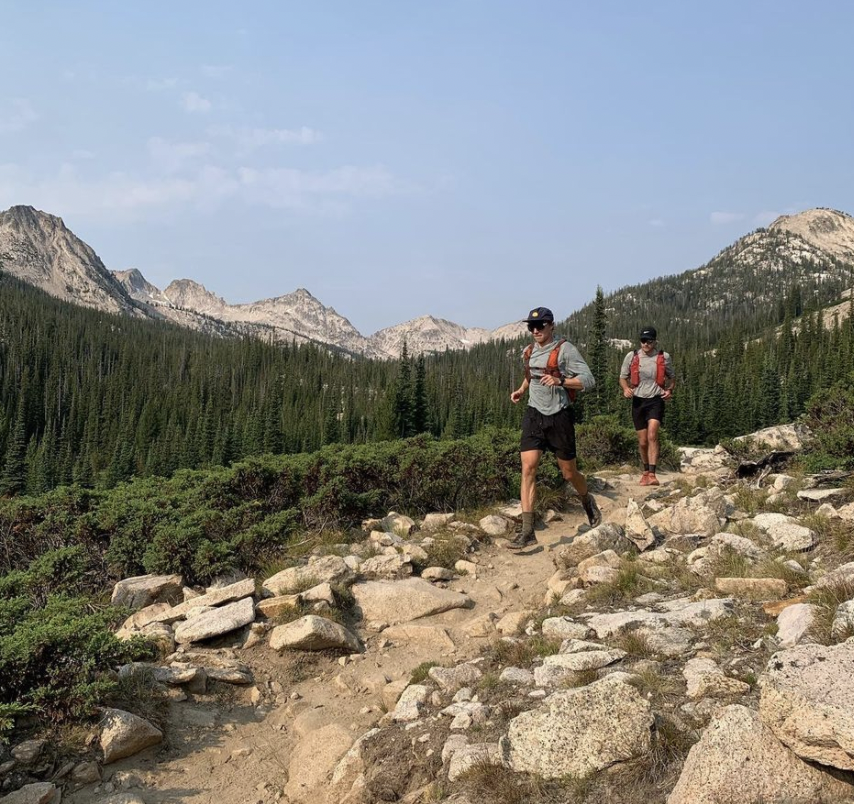
Jake Adicoff follows Sam Wood on a long training run near Sun Valley, ID with the SVSEF Gold Team. (Photo: Instagram @svsefxcgoldteam)
At the time of the call on Friday January 21st, Jake had already earned a World Championship gold medal in the 10k classic on Sunday the 16th, and a bronze medal in the 15k skate on Tuesday the 18th. The morning after the call, the pair raced to second place in the 1.5k classic sprint. Three races, three medals. This week made it clear that Jake is in top form and will be a medal contender in Beijing.
In this conversation, we get into the dynamic of the athlete-guide partnership, as well as how being long-time friends and teammates has contributed to their success racing as a pair this season.
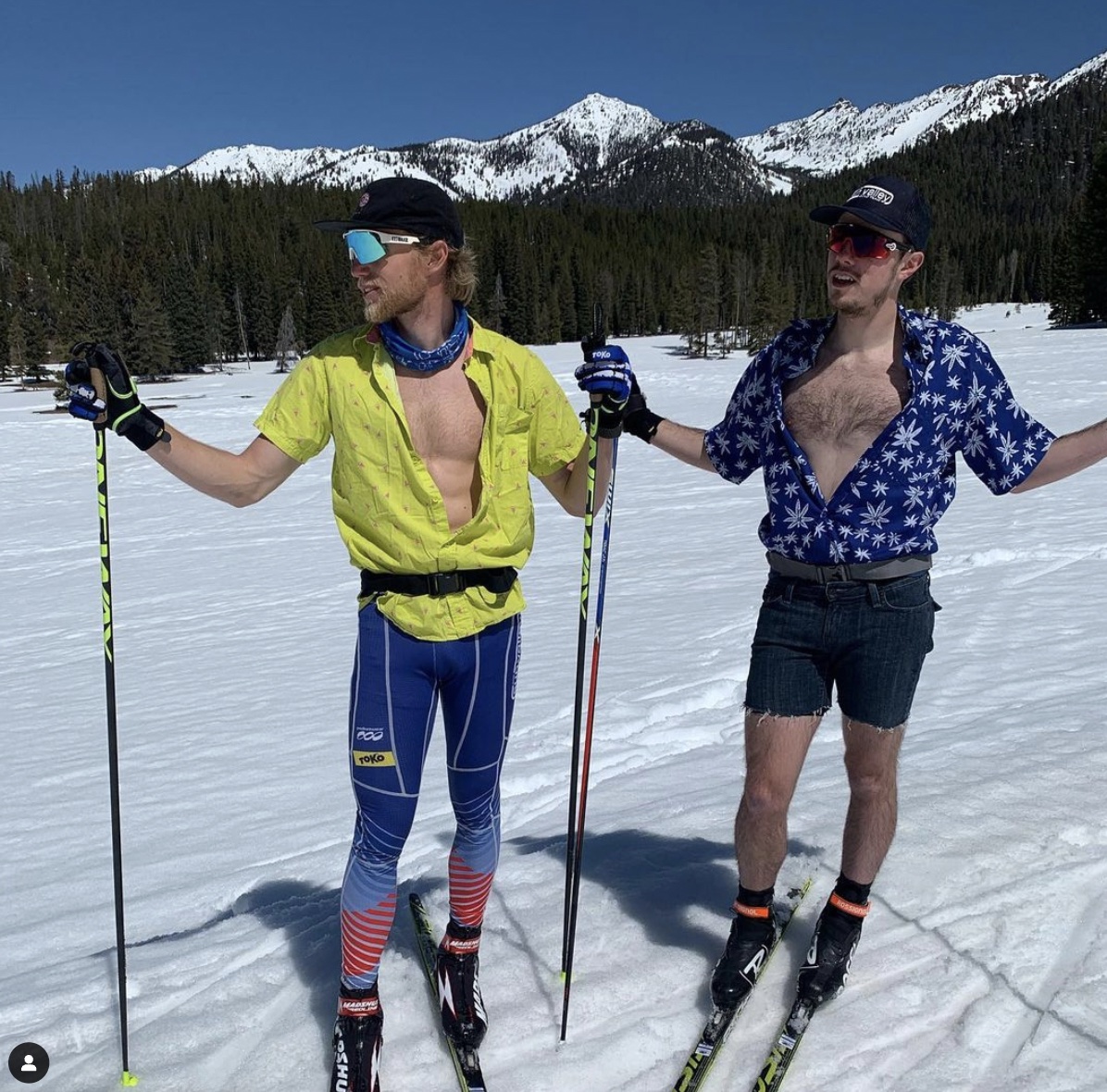
Friends, teammates, and now athlete-guide pair, Sam Wood (left) and Jake Adicoff (right) keep it fun on a sprint ski near Sun Valley, ID. (Photo: Instagram @svsefxcgoldteam)
To follow along with Jake’s racing this season, you can find race recaps with athlete quotes on the US Paralympics Nordic Skiing tab on the Team USA website, or follow the team on Facebook and Instagram.
A quick heads up on the audio, you’ll notice a bit of crackling and some poor connection toward the end of the podcast. Thanks for listening.
Oksana Masters (left) and Kendall Gretstch (right) go 1-2 in the women’s 15k sitting long distance cross country race. (Photo: Alex Livesey/Getty Images)
It’s late January and we’re deep into the race season. As the Olympics and Paralympics draw nearer, we’ve simultaneously just wrapped up the Tour de Ski, the U.S. Cross Country Championships, and another wave of SuperTour races. Never a dull moment in the racing world, the Para World Championships are currently well underway, running January 13-23rd in Lillehammer, Norway.
Normally occurring on odd years, the World Championships were postponed from last February due to the pandemic. Nevertheless, the event was called the Lillehammer 2021 World Para Snow Sports Championships. It was a hallmark event, as it is the first time that all snow sports have competed together in one location over the same dates.
Led by well-decorated veterans like Oksana Masters, Kendall Gretsch, and Dan Cnossen, the U.S. Para Nordic Team has put together a string of outstanding results at World thus far. Events have ranged from biathlon springs to cross country distance races, with athletes competing – and cleaning up – across all disciplines and distances.
Kicking off the series of events, Sun Valley’s Jake Adicoff took home his career first World Championship medal by winning the men’s visually impaired 10-kilometer middle distance race.
“It feels great,” Adicoff said of his performance, according to the Team USA Press Release. “Lillehammer has been skiing really well so far, I’ve been having a lot of fun here. It feels great to go and get that first podium, and hopefully we can go out and get some more here.”
Jake Adicoff and his guide Sam Wood put together a gold medal performance on the opening day of racing at the Para World Championships in Lillehammer, NOR. (Photo: Alex Livesey/Getty Images)
Adicoff retired in 2018 after earning a silver medal in the 10k and taking 4th in the sprint, however, he is making his return with a bang in this 2021/22 season.
Building momentum throughout the first day, 19-year-old Sydney Peterson earned a silver medal in the women’s standing middle distance race, with Gretsch earning the second gold medal for team USA in the women’s sitting 7.5k middle distance event. That’s three medals, two gold and one silver, on the first day of racing, along with an additional two athletes, Cnossen and Dani Aravich, earning top-10 finishes.
Dan Cnossen hits the range during the individual sitting biathlon event at the Para World Championships in Lillehammer, NOR. (Photo: Alex Livesey/Getty Images)
Joining the team in Lillehammer late after testing positive for COVID-19 on New Year’s Eve, Masters made a smooth return to competition, taking second place in her first race at Worlds, the sitting biathlon sprint on January 15th. The next day, the American women took first and third in the sitting biathlon middle distance race, with Gretsch earning her second gold medal of the week and Masters adding an 18th World Championship medal to her ever-expanding collection.
On point, a perfect shooting performance contributed to Gretsch’s gold, while Masters skied her way out of a significant deficit. Experiencing challenges on the range, Master’s racked up seven penalties, but made up her shooting with her skiing. In the men’s sitting race, Master’s partner, Aaron Pike, skied his way into the Top-10, a rank he has achieved in each of his World Cup races this season, leaving him primed for a medal.
Two days later on the 18th, Masters and Gretch again took the spotlight, going 1-2 in the women’s sitting 15k long distance cross-country race. Now reaching 19 total, this marked Masters’ 10th career World Championship gold medal.
“It’s absolutely incredible,” Masters said in the Team USA press release that day. “It feels like yesterday where I was that new athlete, never thinking that I would be a world championship athlete. So, to have 10 now … is incredible and it’s a testament to our team’s hard work. It’s not just me, it’s the whole team.”
Already an historic day for the U.S., Peterson and Adicoff continued the medal streak in the long-distance cross country races, with each athlete earning a bronze medal in the standing and visually impaired divisions, respectively. Four Americans competed that day, and four medals were won. How’s that for success?
Aaron Pike races the individual sitting middle distance biathlon event at the Para World Championships in Lillehammer, Norway. (Photo: Alex Livesey/Getty Images)
As the final days of World Championship racing kicked off, Pike’s consistency paid off with a silver medal in the men’s sitting individual biathlon event. Missing just one target, matching the best result of the event, Pike finished 24 seconds back on the winner, Pavlo Bal of the Ukraine. This result is both a World Championship and overall World Cup career best for Pike, who is an accomplished wheelchair racer during the summer season.
“It was a tough day to be shooting out there, everybody’s missing so I was happy to come away with just missing one shot,” said Pike in today’s recap. “This is probably the windiest race we’ve had in three years. Every chance you get to put a bib on and race in a biathlon race is experience.”
Racing in the women’s sitting individual biathlon, Gretsch and Masters continued to dominate the field, taking first and third, respectively, to keep their medal streak alive and well.
Again performing well on the range, Gretsch missed just one target in four rounds of shooting and skied the second fastest time on course for a finish time of 52:25.0. While Masters skied the fastest time of day, she again faced challenges in her shooting, incurring five penalties, leaving her 3:00.7 behind Gretsch in the final results. In the women’s standing class, Aravich earned another top-10 finish in eighth.
With excellent shooting records, Kendall Gretsch puts together back-to-back gold medal performances in biathlon events. (Photo: Alex Livesey/Getty Images)
After a day of rest, the Para athletes have two final days of racing in Lillehammer on the 22nd and 23rd, which feature a sprint for the standing and visually impaired categories on Saturday and a Mixed Relay on Sunday. Based on the week’s results, it’s clear that they are primed for another medal run in the upcoming 2022 Beijing Paralympic Games, which begin March 4th.
Livestreams of past and upcoming events, along with links to results can be found on the U.S. Paralympics Nordic Facebook page, or you can check out the remainder of snowsport events happening this week in Lillehammer by following along here.
Current roster: Kevin Bolger, Katie Feldman, Sarah Goble, Sam Wood, Karl Schulz, Johnny Hagenbuch, Peter Holmes, Peter Wolter, Jake Adicoff
Who’s new: Peter Wolter and Jake Adicoff
Who’s missing: n/a
Who’s still on this team, or otherwise involved in American skiing, from when we did this in 2012: No one; Simi Hamilton recently retired, and Patrick Johnson was long involved in coaching, but no one currently
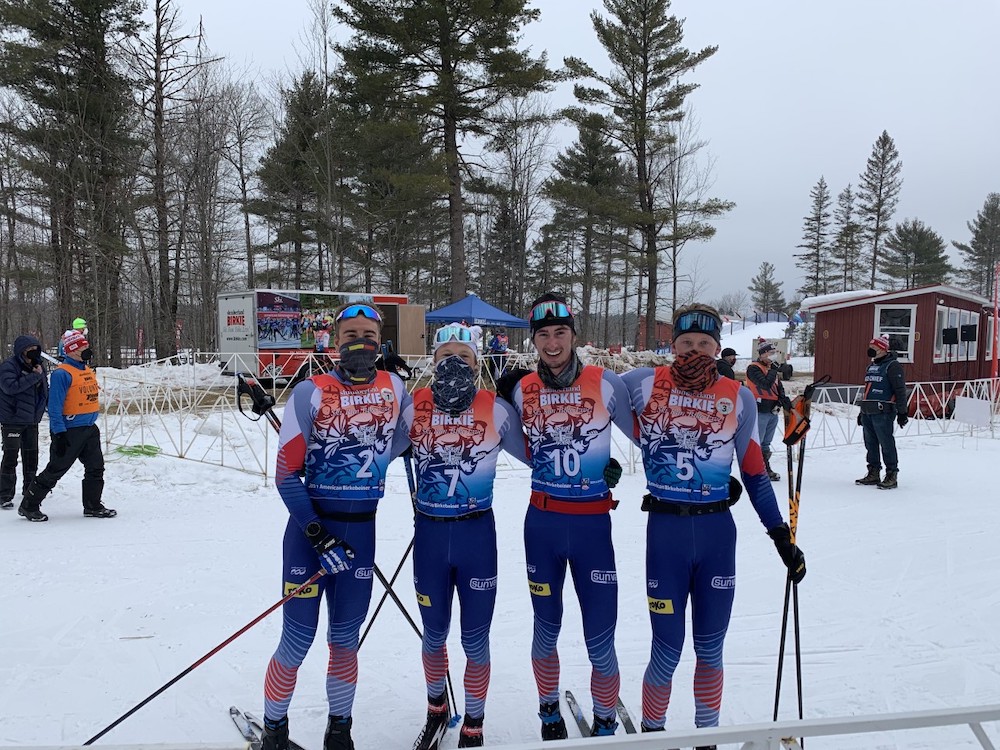
SVSEF athletes at the 2021 American Birkebeiner. (photo: courtesy SVSEF)
Top results last season: Bolger made five individual sprint heats last season, highlighted by 6th in the final in Dresden and 13th in Davos in the quarters, both in December. He finished the season ranked 16th in the Sprint Cup, and based on that metric, is the top returning American sprinter now that Simi Hamilton (14th) has retired. Hagenbuch made his World Cup debut with a pair of March distance races in Engadin, SUI (69th and 72nd) and had three starts at World Juniors in Vuokatti, FIN in February, with a best finish of 17th in the 10-kilometer skate. Domestically, he had two second-place finishes against deep regional fields in Soldier Hollow in January. Holmes raced in the World Cup sprint weekend in Ulricehamn, SWE last February, and was first and fourth in Soho January sprints.
Domestically, the team had a very strong showing in the American Birkebeiner, with a combined nine top-10 finishes between the men’s and women’s skate and classic fields. In the skate race, Hagenbuch won the men’s race, with Wood 2nd, Schulz 9th, and Holmes 10th. Feldman was 4th for the women. In the women’s classic race, Feldman was 3rd. For the men, Hagenbuch was 2nd, Sam Wood 6th, and Holmes 8th.
Going back to March 2020, Feldman was scheduled to make her World Cup debut in the ill-fated Québec City races. Bolger and Holmes had starts for the men.
Coach’s comments: Here’s Chris Mallory on the new additions to the team: “Peter [Wolter] came up through the SVSEF program and is finishing up at Middlebury this spring. Jake [Adicoff, a visually impaired skier and biathlete] didn’t compete much the last few seasons, but found the fire again this past year and will also ski with the US Paralympic Team this season. One of our other current Gold Teamers, Sam Wood, will work as Jake’s guide, so that’s exciting going into Bejiing.”
And here’s Mallory on recent training and the current team mood: “The training season has been going well. With the full team returning we were able to push the training pretty hard. We spent a large portion of the summer training in Sun Valley, so we had a lot of consistency there, but we were also able to add some camps again which was nice. We did a May Bend Camp, teamed up with BSF and Stratton some to put together an intensity block in Lake Placid, and recently spent a week in Park City with the National team. Kevin just traveled to Sweden to start prepping in Scandinavia for the World Cups, while the rest of the squad just arrived in Canmore yesterday to get some early snow time in at Frozen Thunder.
SVSEF athletes, fall 2021. (photo: courtesy SVSEF)
“We’re looking forward to a busy domestic race circuit. After spending last season racing regionally and putting together time trials to keep the motivation up, the team is looking forward to seeing friends again and the added competition the national circuit brings. SVSEF is hosting the post-Nationals SuperTour in January as a big Intermountain junior event/RMISA collegiate race, so we’re really looking forward to that as well.”
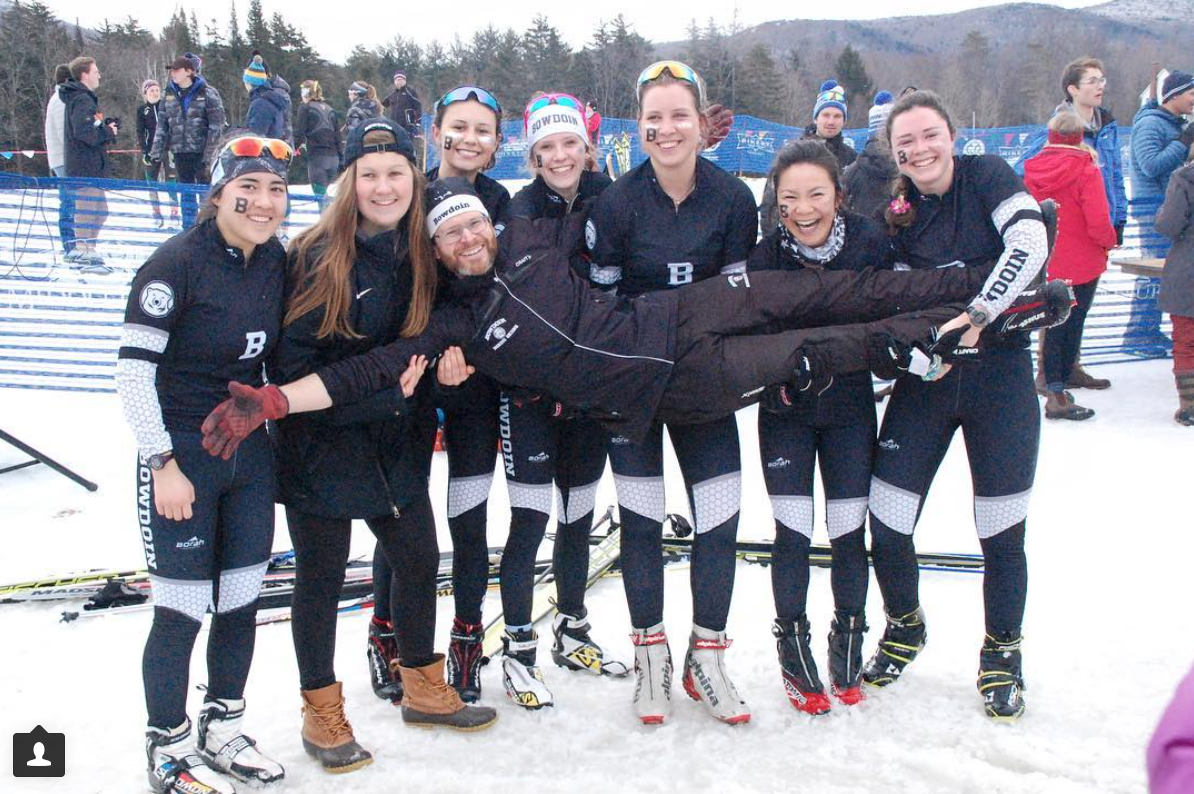
Bowdoin nordic skiers with head coach Nathan Alsobrook. In July, Alsobrook was recognized as NENSA’s 2018 Coach of the Year. (Photo: @bowdoinskiing/Instagram)
Building on one of its most successful seasons yet, the Bowdoin College nordic ski team, out of Brunswick, Maine, recently jumped back into training under the guidance of head coach Nathan Alsobrook. Last winter, three skiers qualified for NCAA Skiing Championships, one alumna qualified for the U.S. Olympic team (Kaitlynn Miller, class of 2014), and one visually impaired skier Jake Adicoff (’18) earned a silver medal at the Paralympics. It was a season that Alsobrook names as a highlight of his coaching career.
American Jake Adicoff leads Canada’s Graham Nishikawa and Brian McKeever in the men’s visually impaired 20 k freestyle at the Paralympic Winter Games in PyeongChang, South Korea. Adicoff earned silver (behind McKeever) in the men’s visually impaired 10 k classic in PyeongChang. (Photo: US Paralympics/Mark Reis)
“The most fun thing about has just been to see the very slow but steady progress that the program has been able to make over the past several years,” Alsobrook said in a phone interview last month. “It’s been very fun and exciting.”
To top it off, Alsobrook was recognized by the New England Nordic Ski Association (NENSA) as 2018 Coach of the Year in recognition of his team’s steady progress and his contributions to the growth of cross-country skiing in New England.
“Over the past years, Nathan has been active in NENSA Programming, including serving as a coach at Eastern Regional Camps, chairing the Coaches Education Committee and running L100 Technique clinics for the state of Maine,” a NENSA press release stated. “Through his dedication to these programs he has made the Bowdoin Nordic Team a visible and attractive institution for skiers to continue their careers.”
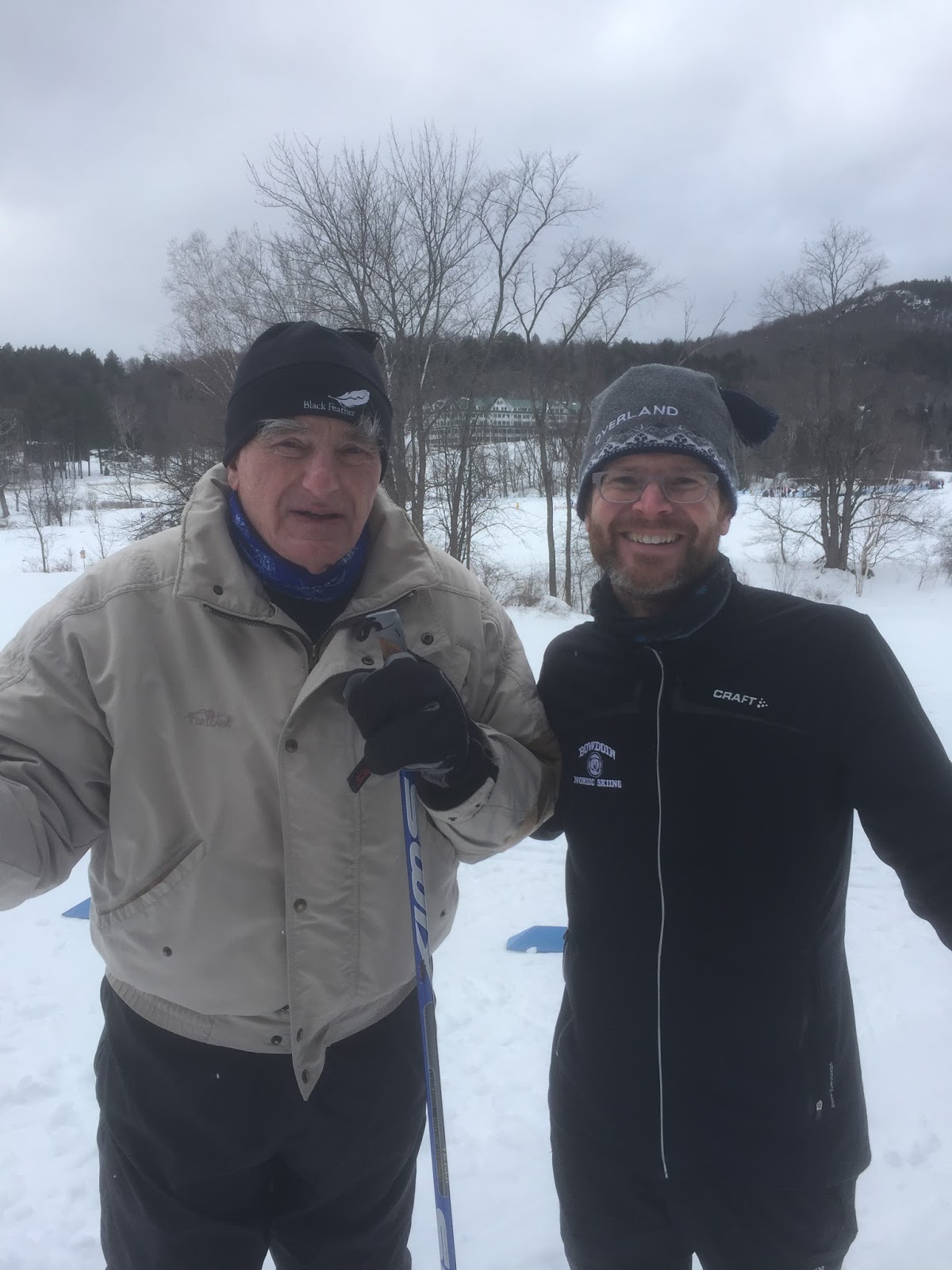
Current Bowdoin Nordic Ski Team Head Coach Nathan Alsobrook (r) with Marty Hall, who coached at Bowdoin for eight years and was inducted into the U.S. Ski & Snowboard Hall of Fame this past spring. (Photo: Bowdoin Nordic)
A Bowdoin graduate (’97) himself, Alsobrook returned as head coach in 2007, taking the place of former U.S. and Canadian national team coach Marty Hall, to whom he attributes planting the seeds for Bowdoin’s current development.
“He was really responsible for taking Bowdoin out of where it had been,” Alsobrook said of Hall’s eight years with the team. “We really weren’t functioning at a super high level before Marty came in. He was able to really push for the college to bring more resources to the sport and just sort of professionalize the whole program. He essentially created this really great foundation for me to springboard off of.”
Before Bowdoin, Alsobrook coached at Whitman College, Montana State University (MSU), Colby College, and the Pocatello XC Ski Foundation, and earned a master’s in exercise physiology from MSU in 2005.
While it didn’t happen overnight, over the years, the Bowdoin Polar Bears have trended upward in the Eastern Intercollegiate Skiing Association (EISA) nordic rankings.
“We had individuals pop great races, and we had these flashes of brilliance that more was possible, but it took so many years for us to become competitive as a team. It was not until 2013 that we sent a skier to NCAA’s during my tenure,” Alsobrook explained. “We would have little successes here and there, a great relay performance or a single race where we would finish very competitively, but we never really put it together for consistent week after week Carnival team performances. It was really only last year that that finally happened, where all of a sudden for the combined men’s and women’s nordic events we would find ourselves finishing in the top half of the league.”
Every weekend on the Carnival circuit last winter, either Bowdoin’s men’s or women’s team placed in the top six. And it saw three skiers — more than ever before — qualify for NCAA’s in Steamboat Springs, Colorado: Gabrielle Vandendries, Renae Anderson and Elliot Ketchel.
Outside of the results, Alsobrook said he enjoys the culture of the student body at Bowdoin and feels that it contributes to the dedication and work ethic of his athletes.
“There is this really great sense of balance here at Bowdoin, and we really try to compliment that in our program,” he said. “It’s such a fun mix of these very academically focused and engaged students. … They just love learning, they love being in this environment and challenging themselves, and then they’re just so ready to get out and train hard.
“I think we do a pretty nice job here at Bowdoin of making this a very collaborative experience, the learning experience and certainly the athletic experience,” he continued. “And it’s just such a natural fit for when you’re trying to create this very team-centered program like I’m trying to do here, that that culture is already in place at the college. I mean, people really want to do well here, in whatever they’re doing, and they’re going to work really hard to do it, and yet they’re trying to help everyone else do the same. That’s something I really appreciate … any competition is directed toward making everyone better.”
His coaching philosophy aims to capitalize on this dedication to personal success, while also reflecting the sense of balance achieved at the school.
“I can’t remember who started saying this, but it’s something we started saying around our team: ‘Happy people ski faster,’ and that is really at the heart of what we are trying to do,” he said. “I know that my skiers are going to get more out of themselves on the race course if they feel very fulfilled with their Bowdoin experience as a whole.”
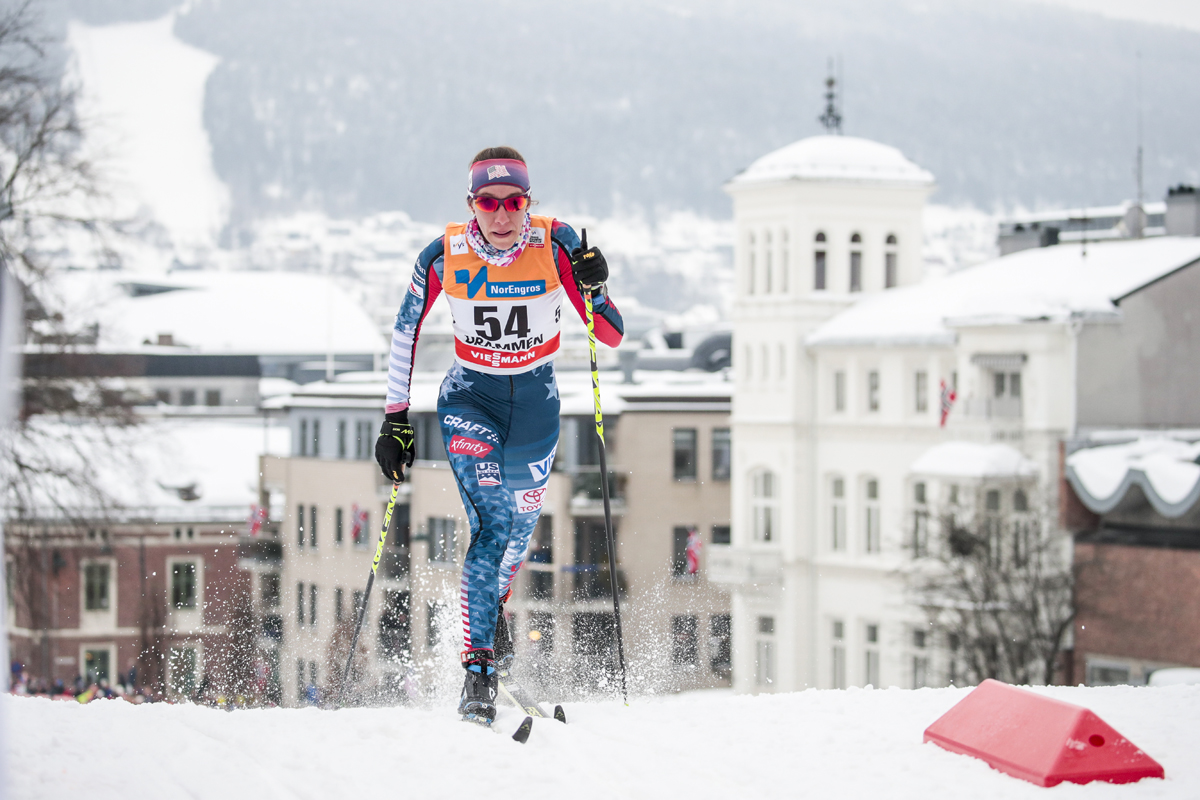
Bowdoin alumna Kaitlynn Miller racing to 53rd in the World Cup classic sprint qualifier last March in Drammen, Norway. (Photo: Fischer/NordicFocus)
According to Alsobrook, this culture and balance served Kaitlynn Miller, who now skis for the Craftsbury Green Racing Project, well in her time at the school. He described Miller as “very studious, very thoughtful … and yet very focused when it came time to train.”
Miller ended last season as the overall SuperTour leader and has earned World Cup starts in November and December as a result.
“It was really nice to have someone that embodied what we are trying to do in our program,” he continued. “For someone who is such a high-level athlete, she is just extremely humble, very kind and thoughtful, very team-centered. It was really fun to coach an elite athlete who was such a team-centered, selfless person … It’s been a real pleasure to watch her take off.”
As for the upcoming season, Alsobrook will continue to focus on the continued growth of his team.
“With my athletes, we’re all about the process,” he said. “Having said that, of course, I have outcome goals, essentially I want to see the team keep moving forward. We’ve never won the Maine State Championship, for example … so we’re really excited to go after that this year. We’ve come close a few times, and maybe this will be our year,” he said.
Another goal will be to continue to place highly at EISA Carnivals and to develop a strong championship team. Last year, its two female athletes at NCAA’s — Vandendries and Anderson — posted top-30 finishes in Steamboat.
“Certainly bringing back a good contingency of skiers to NCAA’s again is a big goal,” he said. “We had a number of times where our [team] finishes [in EISA competitions] were fourth, fifth, sixth pretty consistently throughout the season, and that’s a pretty good place to be in a league as competitive as EISA. I do not want to stay there and keep cranking out those finishes, I want to keep getting better. … I mean, hey, we did fourth last year, why not try for third this year? They’re just great things for us to keep fighting for while at the same time we stay firmly grounded on the process.”
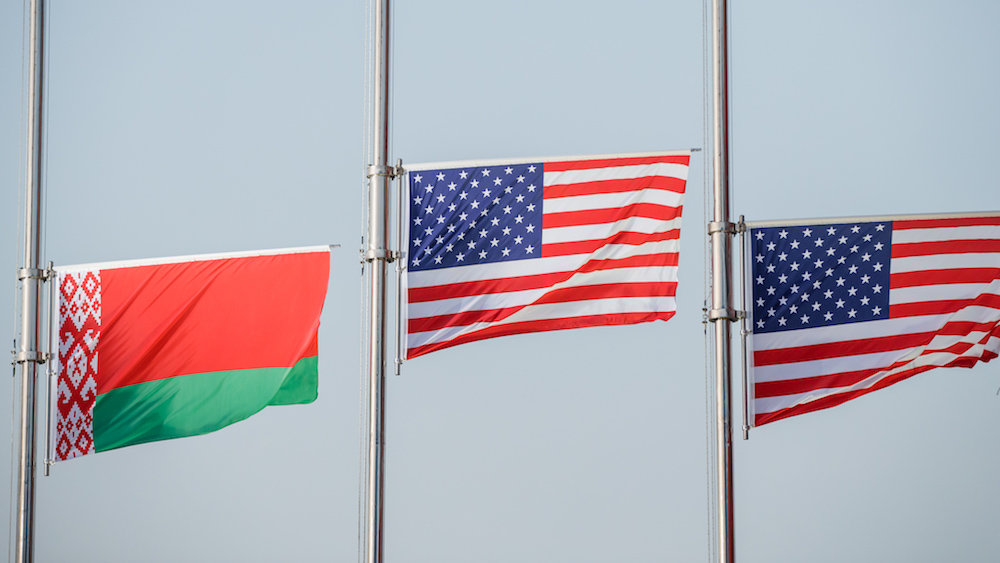
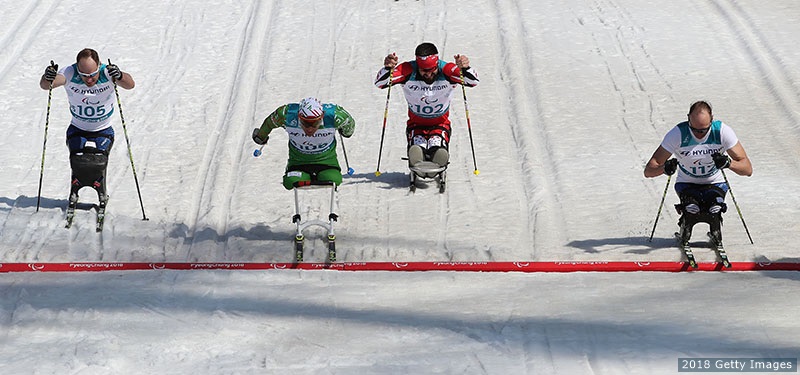
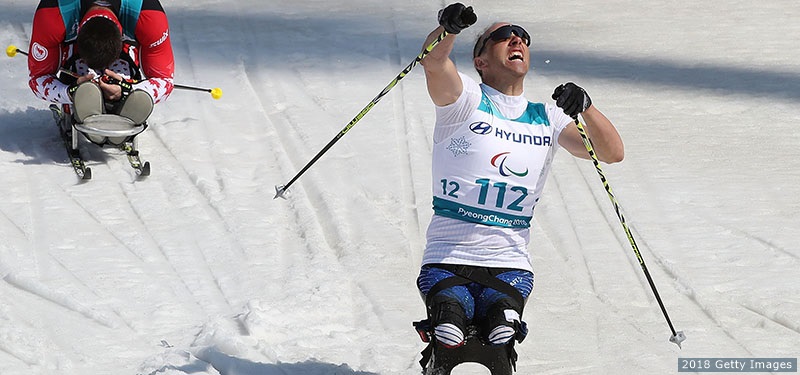
Two American flags and a Belarusian flag being hoisted to honor the medalists in the men’s sitting cross-country sprint at the 2018 Winter Paralympics in PyeongChang, South Korea. Americans Andy Soule and Dan Cnossen placed first and second, respectively, and Dzmitry Loban of Belarus finished third. (Photo: U.S. Paralympics/Joe Kusumoto)
Success to failure. Failure to success. Two trends of two extremes on the performance metrics on the international cross-country skiing spectrum. There are many in-betweens: scoring World Cup points with a top 30, top 10’s, any spot on the podium. There are the Olympic and Paralympic quads featuring a four-year buildup to North America’s singular focus on bronze, silver and gold hardware.
When considering how to develop talent, placing athletes on snow with the absolute best technology available, positioning athletes to medal, the U.S. Paralympics Nordic Program is an enviable high-performance model. That became evident this winter during the 2018 Paralympic Winter Games in PyeongChang, South Korea. U.S. Paralympics Nordic hauled in 16 medals in a week about a month ago.
That many medals for a single team borders on excess. Pursuing the perfection that leads to near-excess has driven the U.S. team staff and athletes for years. Back in 2006 in Torino, Italy, the U.S. Paralympics Nordic team earned three medals. In 2010, in Vancouver, British Columbia, they tallied one medal. In 2014 in Sochi, Russia, they claimed three. This year in PyeongChang: 16.
“I think we have a few factors to our success,” Eileen Carey, head coach of the U.S. Paralympics Nordic team told FasterSkier in a recent phone interview. “We’ve built the entire team — every athlete who has been engaged in the last several years and the staff that we have built are totally committed to the goal of the team. There are not a lot of egos. Everybody has a role. Everybody is really good at what they do, and everybody executes on race day.”
That goal and the team’s execution amounted to 11 medals total between two athletes, both sit-skiers. Thirty-seven-year-old Dan Cnossen entered six races: three cross-country, three biathlon. He medaled in each. Oksana Masters, 28, took five medals: two in biathlon, three in cross-country.
In the leadup to the Games, with buoyant media coverage of para-athletes and opportunities to brand themselves more broadly, the narrative of athletes like Masters and Cnossen were hard to miss. Masters endured a Ukrainian orphanage until she was almost 8. Cnossen is a retired Navy SEAL and a Purple Heart and Bronze Star with Valor recipient. He lost both legs above the knee after stepping on an improvised explosive device (IED) while on patrol in Afghanistan in September 2009.
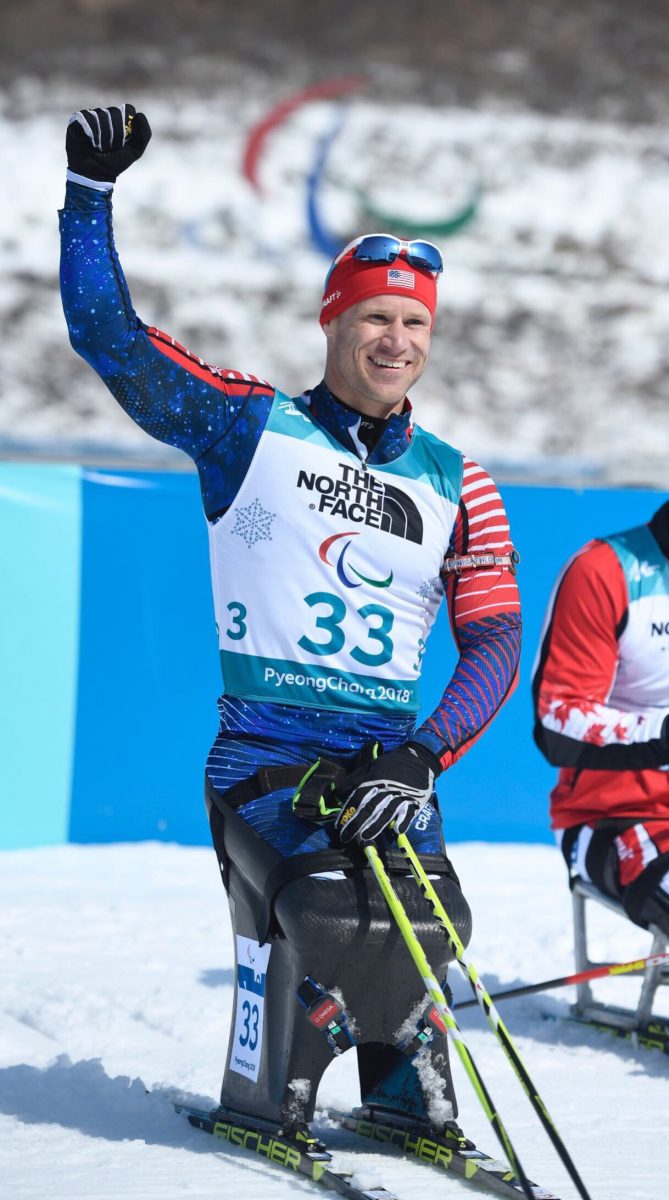
Biathlon gold medalist Dan Cnossen of the U.S. celebrates his win in the men’s sitting 7.5 k biathlon sprint on opening day of competition at the 2018 Winter Paralympics on March 10 in PyeongChang, South Korea. (Photo: U.S. Paralympics/Mark Reis)
Stories like those of Masters and Cnossen should make us appreciate for a moment our most basic gifts. Their stories are inspiring. That, according to Carey, misses the point when it comes to understanding what exactly manifested in PyeongChang.
“Sure, the Olympic and the Paralympic mission is to inspire people,” Carey said. “But the narrative about Paralympians has historically been far more about inspiration being the central storyline versus Olympians where the essential storyline as about their athletic prowess. The comments that I have heard about these Games are about the athletic performances of the athletes. Whereas in Sochi, and a lot what I have heard before, is a lot about the inspiration.”
Cnossen is a graduate student at Harvard. He receives some support from the school’s cross-country coach, but trains most often north of Cambridge Square at the Craftsbury Outdoor Center in northern Vermont. There, Cnossen benefits from world-class biathlon instruction.
Carey explained that at last season’s 2017 PyeongChang test event, Cnossen performed better in the cross-country races there than in biathlon. As a world-class athlete, traveling several hours for countless four-day Craftsbury weekends and increasing his time spent training on the shooting range were some of the commitments Cnossen made, just like any other hyper-focused, hyper-driven athlete.
Carey also made clear what Craftsbury’s part was in developing Cnossen’s athleticism.
“As a sit skier, you don’t carry a rifle,” she explained. “When you are shooting, that means 100 percent of the time, someone is on the range loading pellets with bare hands when it’s cold outside and handing you your rifle. Dan would shoot three or four times a weekend when he was there, and they supported him 100 percent of that time. He won a medal in every biathlon event. That is Craftsbury’s success as much as anybody else’s.”
Masters’s own drama unfolded two weeks before the Paralympics when she slipped and fell on ice. She dislocated her elbow and chipped all three bones that meet in the elbow. After being operated on at The Steadman Clinic in Vail, Colorado, Masters remained a medal favorite in Korea.
She came to PyeongChang as an all-arounder in both biathlon and sitting cross-country. (Masters, also a multi-sport athlete, competed in rowing at the 2012 London Paralympics — where she earned a bronze medal — and cycling at the 2016 Rio Games.)
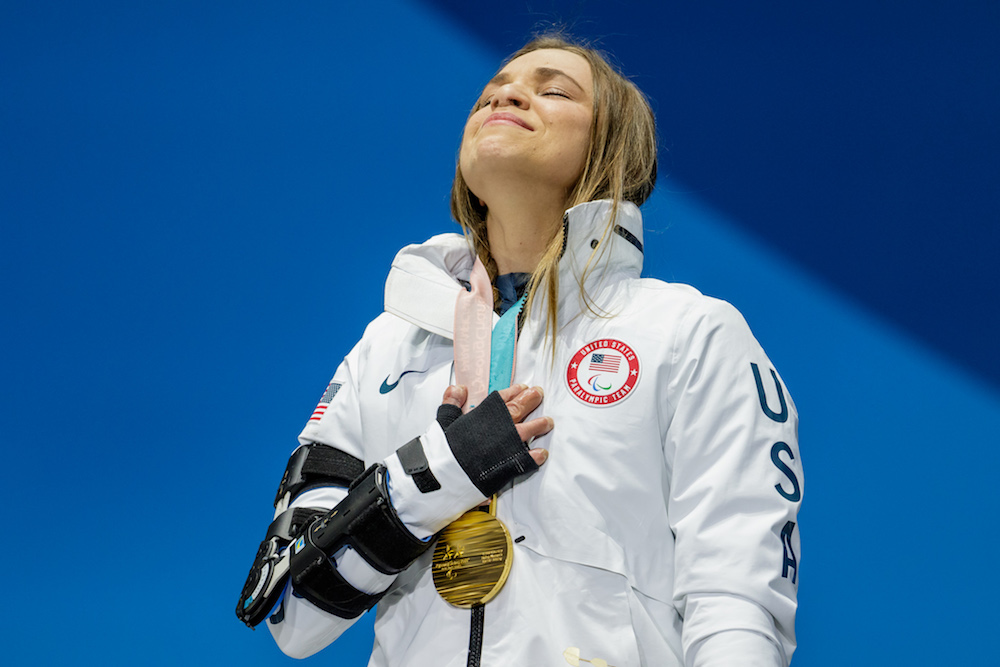
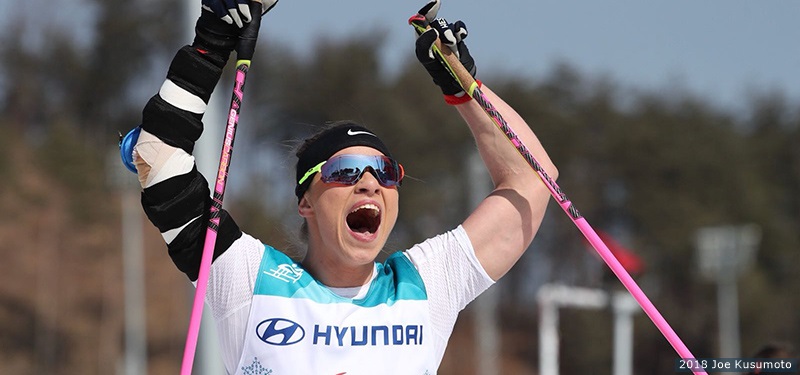
Oksana Masters (U.S. Paralympics Nordic) after winning her first-career Paralympic gold medal in the women’s sitting cross-country sprint at the 2018 Winter Paralympics in PyeongChang, South Korea. (Photo: U.S. Paralympics/Joe Kusumoto)
In her first race in PyeongChang last month, Masters took silver in the biathlon sprint (behind her U.S. teammate Kendall Gretsch in first). Those medals, Gretsch’s first and Masters’s first in biathlon, set the stage for more gritty performances and Masters’s five-medal PyeongChang bounty. Inspiring? Yes. But more to the point, both were athletically dominant.
Masters’s dominance came with a very human off-race. On March 13, during the women’s sitting 10 k biathlon race, Masters fell in her sit ski onto her ailing arm and missed a total of six shots for six penalty laps. While she skied the extra laps, another U.S. coach encouraged Masters to pull herself out of the race. The team’s staff was concerned about her elbow and wanted to ensure her health for her three remaining races.
“I sprinted down the course and just stood in front of her in the middle of the course and pulled her off,” Carey said of how she ultimately persuaded Masters to not finish. “Oksana thought she was done midway through the Games. We X-rayed her again and came up with a plan and taped her elbow in a way that would provide more protection.”
At the 2010 Vancouver Paralympics, Andy Soule earned bronze in biathlon. His medal was the first Paralympic medal in the discipline for the U.S. team. Eight years later in PyeongChang, Soule, a 38-year-old Army veteran, who, like Cnossen, lost both his legs in Afghanistan, delivered the Paralympics equivalent to the “here comes Diggins” moment.
During the men’s sitting cross-country sprint final, Soule came into the last hill in sixth place. He then glided into fourth on final downhill before the last intensive double-poling push to the finish.
With lickety-split skis to match his upper body’s Thor-like power, Soule willed himself into medal contention. From literally out of the camera’s view and into front and center on the final stretch, Soule threw down and accelerated. Bronze, then silver, and at the line, gold came into play. The PyeongChang sprint win was Soule’s first-career Paralympic gold in three Paralympics — he also claimed bronze in the PyeongChang 12.5 k biathlon race. (Soule promptly retired from elite-level competition afterward.)
“Andy has spent a lot of time over the last four years doing a whole lot of stuff, like learning how to move fast on flats, which was something that we had identified from Sochi as being the weak link,” Carey said. “There was something otherworldly about those last 100 meters that was just incredibly cool to watch.”
Cnossen, Masters, and Soule symbolize the U.S. Paralympics Nordic team’s rise. Yet, Carey, along with the team’s high-performance director, John Farra, have been able to build a program that has positioned itself for future medals. Gretsch, 26, may be part of that future. She came to nordic skiing as a world-class para-triathlete and represents what Farra calls “talent transfer”.
“We are super proud with how our sit-ski program has evolved,” Farra said on the phone. “We are super proud that we can take athletes in a talent-transfer situation like Kendall and help her come from being a world champion in triathlon and have her transfer and learn the skills in a short period of time to now being one of the best in the world.”
In PyeongChang, Gretsch captured two golds in the first two races. She won the sitting biathlon sprint and the 12 k sitting cross-country events.
Winter Paralympic rookie Kendall Gretsch racing at the 2018 Paralympics in PyeongChang, South Korea. (Photo: U.S. Paralympics/Joe Kusumoto)
Farra explained that their medal was the first for the U.S. in a visually impaired race at the “modern” Paralympics. The VI classes were historically split between B1, B2 and B3 classes. (B1 athletes have the least amount of vision.) The different classifications are used as a descriptor of each athlete’s degree of blindness. Formerly, each classification of athlete competed against the same classification athletes. For example, in the past, only B1’s competed against B1’s. Today, that format is defunct, and all classifications currently compete against one another. An athlete’s finishing time is adjusted based on their severity of blindness.
As Farra explained, in the “modern” VI medals are harder to come by.
Adicoff, a student at Bowdoin College and a member of the Sun Valley Ski Education Foundation (SVSEF), was competing at his second Paralympics. Kesselheim was a Paralympic rookie.
“They are a team,” Carey said of the Adicoff-Kesselheim pairing. “Visually impaired athletes and guides function much more, in my view, like a cycling team as opposed to a traditional ski racer. … The medal was won by both Jake and Sawyer. In that race, they worked together more effectively than I had ever seen them work together. They were more in sync; they were skiing closer to each other. There is a lot of challenges in guiding when it comes to the communication, and Sawyer is a great communicator. He is an amazing skier and athlete, but he is a great communicator and he has no ego. He was totally bought into being on that team.”
Guide Sawyer Kesselheim leads his U.S. teammate Jake Adicoff during the open relay on March 18 at the 2018 Winter Paralympics in PyeongChang, South Korea. (Photo: U.S. Paralympics/Mark Reis)
The first day of the next Paralympic quad began on March 19, the day after the PyeongChang Paralympic Closing Ceremony. Yet Casey and Farra kept an eye on 2022 by nurturing and investing in more Paralympic rookies by exposing them to their respective sport’s highest level of competition. Grace Miller (standing , Alaska Nordic Racing), Ruslan Reiter (standing, Outdoor Sports Institute), Joy Rondeau (sitting, National Sports Center for the Disabled), and Mia Zutter (visually impaired, CXC/St. Scholastica) participated in their first, yet most likely not their last, Winter Paralympics.
“Having a larger community of people that consider themselves para-nordic skiers is motivating,” Farra said.
In the recent past, Farra explained that identifying and developing standing athletes has been a priority. The U.S. has already been a leader in supporting sitting athletes and providing them with top-end, sit-ski technology.
“We have just scratched the surface of finding a couple of standing and a couple of VI athletes,” Farra continued. “That’s got us pretty excited about the connections they have to their local clubs and colleges, too. We were motivated to bring them to these Games so they could get a taste of what is out there and hopefully, they left absolutely motivated to live a professional athlete lifestyle and train hard with their clubs and their home college programs.”
— Alex Kochon contributed
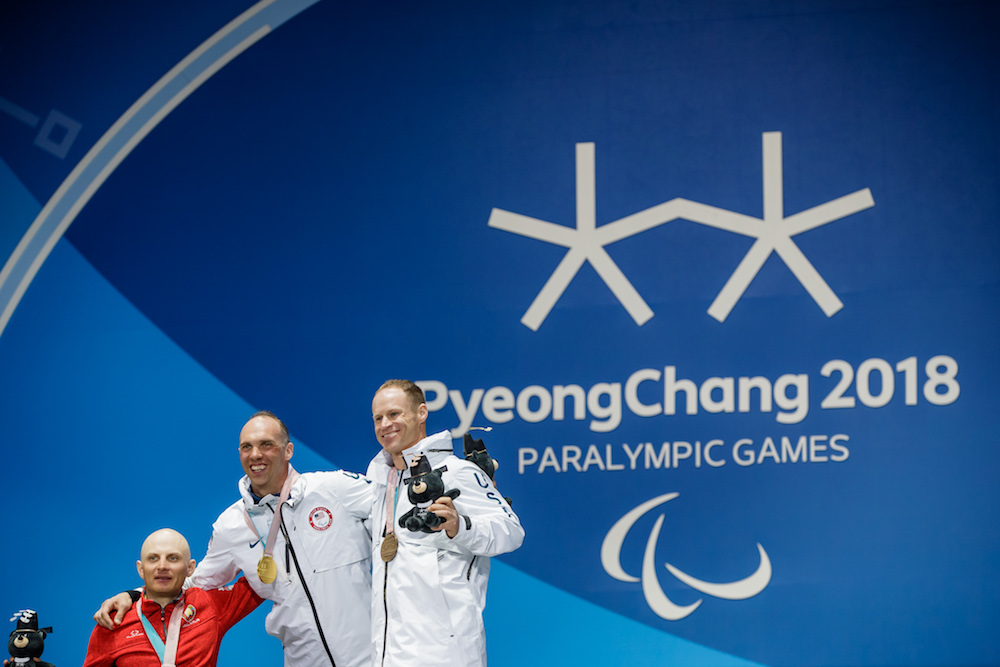
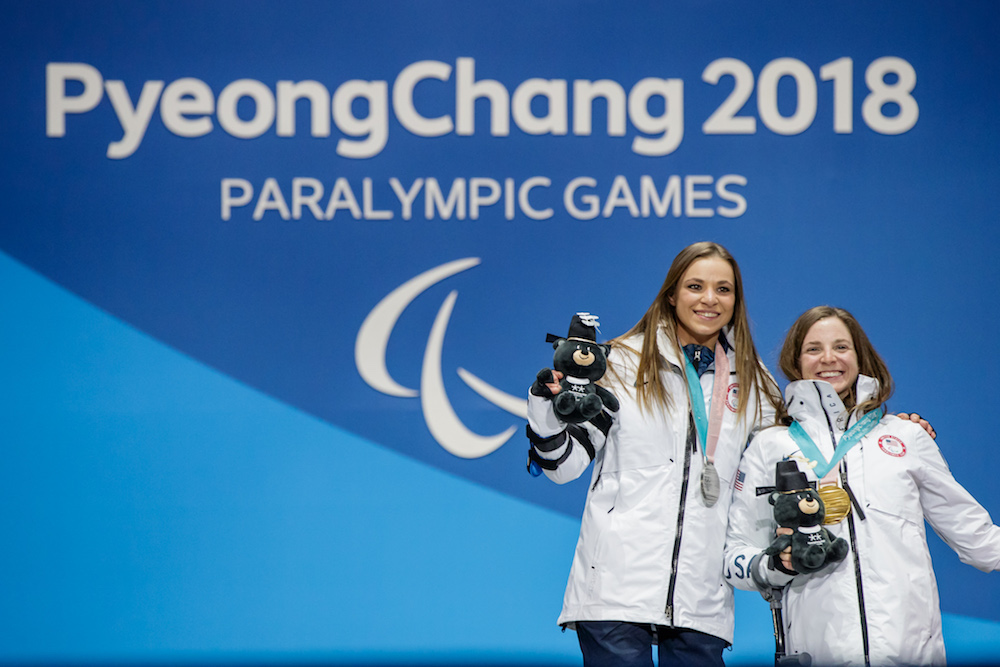
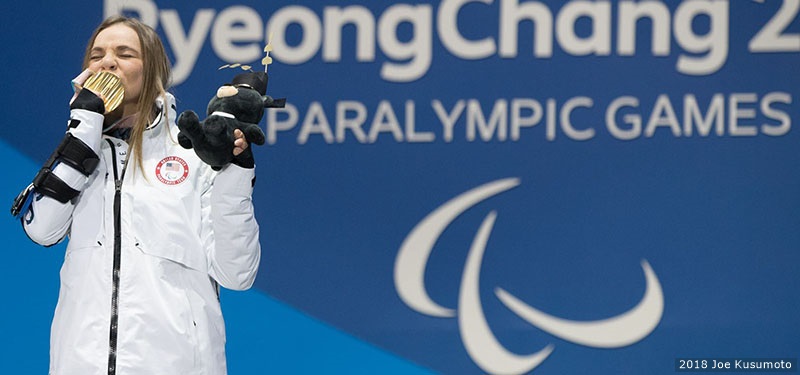
The 2018 PyeongChang Paralympics men’s sitting cross-country sprint podium at the medal ceremony, with Americans Andy Soule (c) and Dan Cnossen (r) in first and second, respectively, and Dzmitry Loban of Belarus in third. (Photo: U.S. Paralympics/Joe Kusumoto)Kendall Gretsch (r) and Oksana Masters at the 2018 Paralympics medal ceremony for the women’s sitting 6 k biathlon sprint after winning gold and silver, respectively, on the first day of competition in PyeongChang, South Korea. (Photo: U.S. Paralympics/Joe Kusumoto)
Canada’s mixed relay after taking silver on the last day of the 2018 Paralympics in PyeongChang, South Korea, with (from left to right) Natalie Wilkie, Chris Klebl, Mark Arendz and Emily Young. (Photo: Dave Holland/Canadian Paralympic Committee)
2018 Winter Paralympics (PyeongChang, South Korea): Mixed and open relays
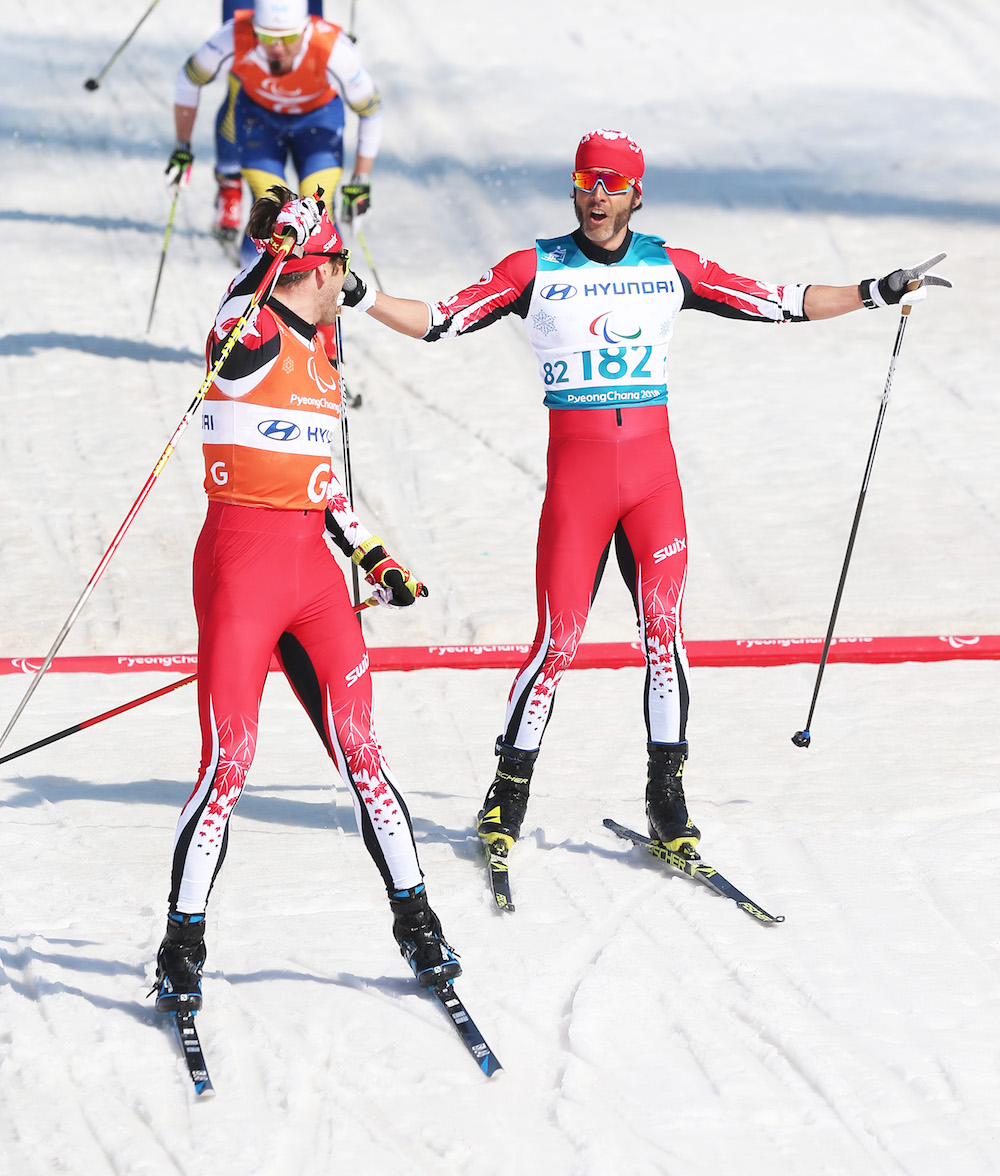
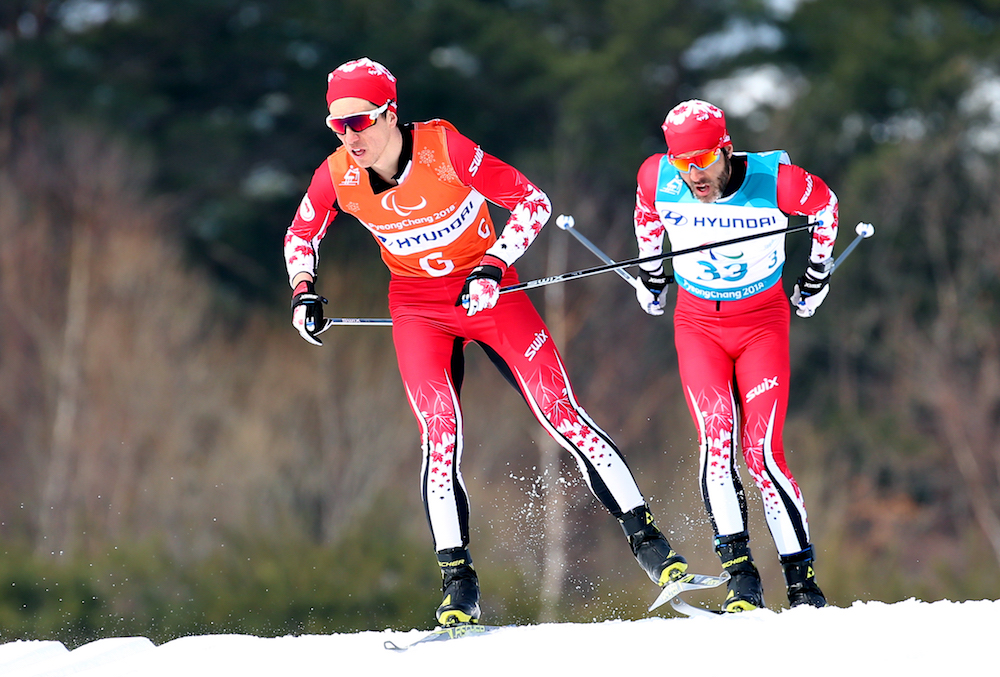
On the final day of the PyeongChang Paralympic Games, Canada was the only country to medal in both the mixed and open cross-country relays, and its mixed relay anchor, Mark Arendz, became the most decorated Canadian at a single Winter Paralympics with his sixth medal of the week.
In the 4 x 2.5-kilometer mixed relay on Sunday, Natalie Wilkie, Emily Young, Chris Klebl, and Arendz teamed up for silver, 50 seconds behind Ukraine (Iurii Utkin, Liudmyla Liashenko, Yuliia Batenkova-Bauman, and Oksana Shyshkova), which claimed gold in 24:31.9 minutes. On the final skate leg, Arendz held off Germany (Andrea Eskau, Steffen Lehmker and Alexander Ehler) by 3.4 seconds at the line.
Wilkie and Young, standing athletes coming off gold and bronze in Saturday’s 7.5 k cross-country race, started the team off for the first two classic legs. Wilkie, 17, also earned an individual bronze at these Games. While Wilkie tagged Young in fifth, Young went on to tag Klebl, a 2014 Paralympic champion sit-skier, in seventh place.
“Our team worked so well together,” Young said of the relay, according to a Cross Country Canada press release. “It looked a little scary in the beginning, but we knew we had Chris in third and Mark anchoring which was going to be the difference. We each held our own in our individual sections and it is so fun to win this one as a team.”
Klebl, 46, made up 27 seconds on the field and tagged Arendz in fourth. Arendz then caught and passed Japan’s Taiki Kawayoke and later Germany’s Ehler on the last downhill into the finishing stretch to finish second.
“This is fantastic. It is our first relay medal ever,” Arendz, 28, told Cross Country Canada. “It is great to end the Games with a historic moment that we get to share with each other for the rest of our lives. This is a great team of two veterans and two rookies. I’m so happy we were able to get this done.”
Arendz, who elected flag bearer of the Canadian Paralympic Team for Sunday’s Closing Ceremony, is taking home a gold medal from the 15 k biathlon race, two silvers, and three bronze medals. He competed in all but one race throughout the week, skipping the distance cross-country race.
“I came in here thinking I could get three medals, but to get six is incredible,” Arendz said. “Today’s is a special one. I am happy we got this done, but there is no way I could do another race. I’m done.”
American Kendall Gretsch (l) racing in the 4 x 2.5 k open relay at the 2018 Paralympic Winter Games in PyeongChang, South Korea. (Photo: U.S. Paralympics/Mark Reis)
The U.S. team, with Kendall Gretsch, Ruslan Reiter, Jake Adicoff (and guide Sawyer Kesselheim) placed seventh in the mixed relay, 1:35.7 out of first. Gretsch skied both the first and third legs and tagged Adicoff in ninth out of 13 teams at the last exchange.
“It’s a little bit nerve-wracking and a little bit fun,” Adicoff said of skiing the anchor leg. “They did an awesome job on the first three legs.”
In the 4 x 2.5 k open relay an hour later, Canada raced to bronze with two athletes: sit-skier Collin Cameron and visually impaired skier Brian McKeever (and his guides Graham Nishikawa and Russell Kennedy).
The duo finished 1:05.8 behind France, which placed first with Benjamin Daviet, Anthony Chalencon and Thomas Clarion in 22:46.6. Norway finished 22.5 seconds back for silver, with Nils-Erik Ulset, Hakon Olsrud and Eirik Bye.
Ukraine (Iaroslav Reshetynskyi, Olha Prylutska, Grygorii Vovchynskyi, and Anatolii Kovalevskyi) crossed the line in third but was penalized 30 seconds for an early exchange and slipped to fifth (+1:26.3), while Canada moved into third and Belarus placed fourth (+1:23.7).
Canada’s open relay after taking bronze on the last day of the 2018 Paralympics in PyeongChang, South Korea, with (from left to right) Graham Nishikawa (guide), Collin Cameron, Russell Kennedy (guide), and Brian McKeever. (Photo: Dave Holland/Canadian Paralympic Committee)
Early in the race, Cameron tagged McKeever in eighth at the first exchange, and McKeever and his guide raced up to fourth. On the third leg, Cameron was skiing in third until he dropped a pole on the last climb and had to turn around to recover it. He came through the last exchange in sixth, 25 seconds behind Ukraine in third. McKeever went on to crossed the finish line fourth place, but his team was awarded bronze after Ukraine was penalized for tagging outside the exchange zone.
The bronze medal was Cameron’s third of the week after he placed third in two biathlon races earlier in the week. For McKeever, Canada’s most decorated Winter Paralympian of all time who won all three individual cross-country races he competed in over the last week, it was the 17th medal of his Paralympic career.
“I just tried to pace it properly and be as fast as I could. It was so much fun,” Cameron, 28, told Cross Country Canada. “This is my first relay, so I was really looking forward to this. I am super happy to leave here with three medals.”
“It’s incredible to get two relay medals today,” McKeever, 38, said. “We knew we had a shot if we all had really good days. What Mark, Chris and the girls did in that first relay was awesome. These races are so interesting with all different disabilities together. It is never over until last tour around, and in both cases, we saw that today with lots of different lead changes out there.”
The U.S. open relay at the 2018 Paralympics in PyeongChang, South Korea, with (from left to right) Andy Soule, Grace Miller, and Mia Zutter, Kristina Trygstad-Saari (guide), and Sean Halsted. (Photo: U.S. Paralympics/Mark Reis)
The U.S. team, with Andy Soule, Sean Halsted, Grace Miller, and Mia Zutter (and guide Kristina Trygstad-Saari), placed 12th in the open relay out of 12 teams.
“It’s been an amazing Paralympic Games,” Soule, 38, told U.S. Paralympics Nordic. “The organizers have put on a great event. This is a great team to be involved with. We’ve had a lot of fun here. This is my last Paralympic race, but we have a couple of young athletes here. We’ll have a great team for a long time.”
In total, both the Canadian and U.S. Paralympic teams tallied 16 medals between nordic and biathlon in PyeongChang — a record for both programs. Notably, every member of Canada’s Para-Nordic World Cup Team is taking home at least one medal.
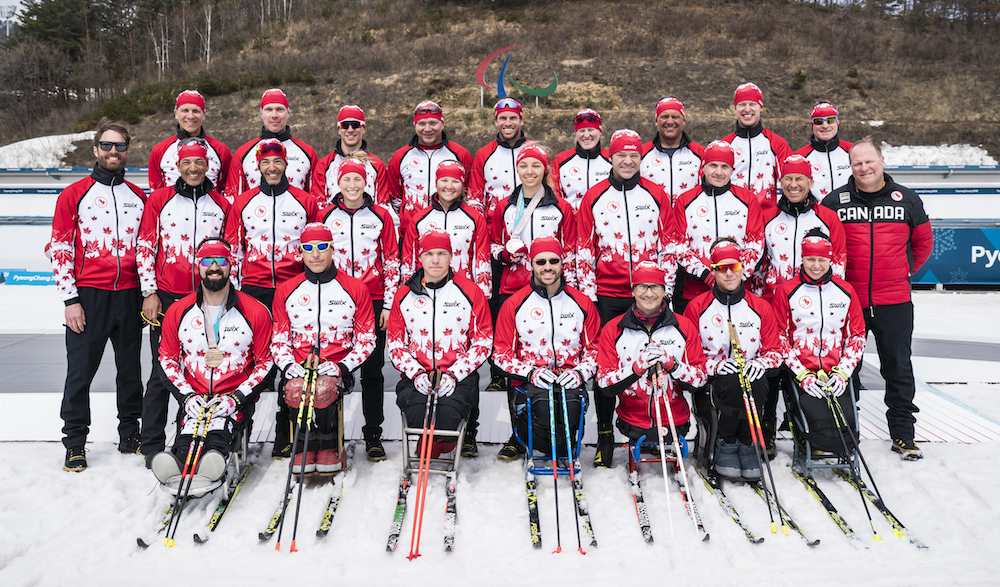
Canada’s 2018 Paralypmic cross-country and biathlon team at the Alpensia Biathlon Centre on the last day of the Games in Pyeongchang, South Korea. (Photo: Dave Holland/Canadian Paralympic Committee)
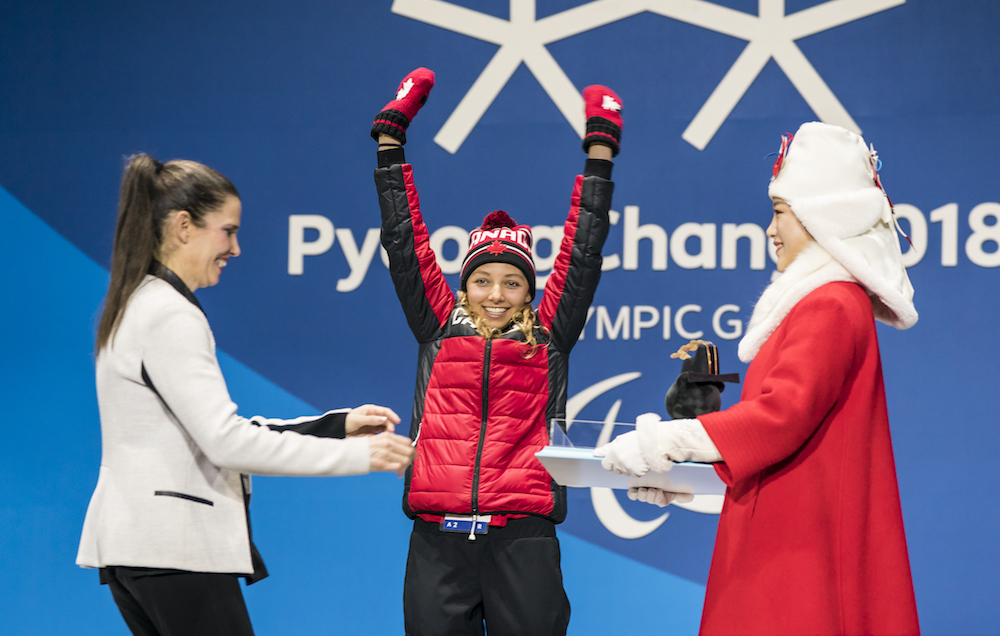
Canada’s 17-year-old Natalie Wilkie being awarded gold after she won her first Paralympic race on Saturday, the women’s 7.5 k standing classic, in PyeongChang, South Korea. (Photo: Dave Holland/Canadian Paralympic Committee)
2018 Winter Paralympics (PyeongChang, South Korea): 5/7.5/10 k cross-country races
Saturday marked the last day of individual racing at the PyeongChang Paralympics, and as they have over the last week, the U.S. and Canadian teams did not disappoint, with the U.S. Paralympics Nordic Team adding a gold and two silvers to its medal count and the Canadian Para-Nordic Team notching two golds and two bronze medals in the middle-distance cross-country races.
Seventeen-year-old Natalie Wilkie of Salmon Arm, British Columbia, won the women’s 7.5-kilometer standing classic race, while her Canadian teammate Emily Young placed third in that race.
Brian McKeever, 38, of Canmore, Alberta, won his third-straight race of the Paralympics, the men’s 10 k visually impaired classic race, sweeping all three races at the Paralympics for the third-straight time (he was undefeated at the 2014 Games in Sochi, Russia, as well as the 2010 Paralympics in Vancouver, B.C.)
Canada’s Mark Arendz raced to bronze in the men’s 10 k standing classic race for his fifth medal of the week (including a biathlon gold) and seventh of his Paralympic career.
For the U.S., Oksana Masters won her second gold of the Games in the women’s 5 k sitting (after winning the cross-country sprint as well) and fifth medal total in PyeongChang. In three Paralympics, she has eight medals to her name.
Dan Cnossen continued his medal streak with another silver in the men’s 7.5 k sitting for his sixth medal in as many races this week (three in cross-country, three in biathlon), and Jake Adicoff achieved his first Paralympic medal after placing second behind McKeever in the 10 k visually impaired classic.
In the women’s standing race on Saturday, Canada nearly went first and second, with Young missing out on silver by 0.1 seconds. While Wilkie took the win in 22:12.2 minutes, Ekaterina Rumyantseva of the Neutral Paralympics Athletes (NPA) finished 1.6 seconds back for second, just ahead of Young in third (+1.7).
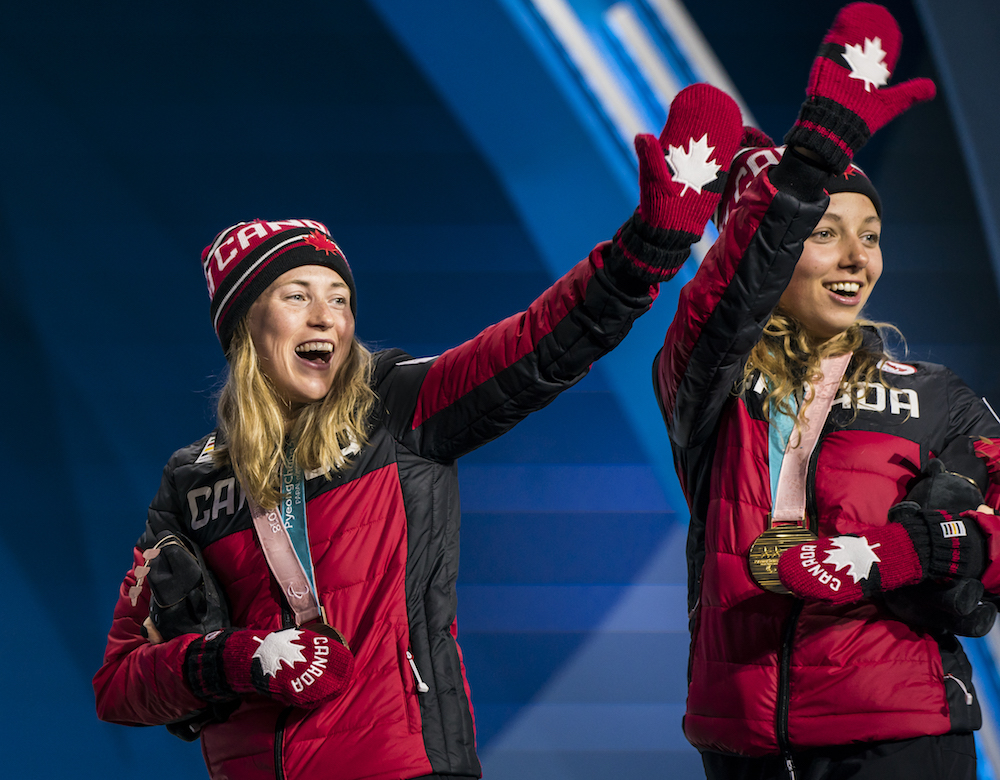
Natalie Wilkie (r) and Emily Young at Saturday’s 2018 Paralympic medal ceremony with their gold and bronze medals in the women’s 7.5 k standing classic race on Sunday in Pyeongchang, South Korea. (Photo: Dave Holland/Canadian Paralympic Committee)
“This is crazy awesome,” Wilkie said after winning the last individual race of her first Paralympics, according to a Cross Country Canada press release. “I didn’t think this would happen at all…
“The difference today was double poling,” she added. “I just kept telling myself to pretend I was elbowing my older brother.”
During the race, Young channeled her teammate for motivation.
“ ‘What would Natalie do?’ I just kept saying ‘What would Natalie be doing?’ ” Young, 27, said with a laugh to Cross Country Canada. “I was trying and trying all week to get onto the podium. I knew this race would be my big chance. I kept telling myself to get this done. There is nothing left in the tank. I didn’t want any more hills. I just wanted to get over the finish line. I left it all out there today.”
Also in the women’s standing race, Canada’s Brittany Hudak placed eighth (+1:37.4) and American Grace Miller finished 18th (+7:09.7).
McKeever spent about half the race with each of his guides, Graham Nishikawa and Russell Kennedy, to win the men’s visually impaired race by more than a minute in 23:17.8. Adicoff, of the U.S., with his guide Sawyer Kesselheim had the second-fastest time for silver (+1:13.5), while Belarus’s Yury Holub (with guide Dzmitry Budzilovich) placed third (+1:19.3).
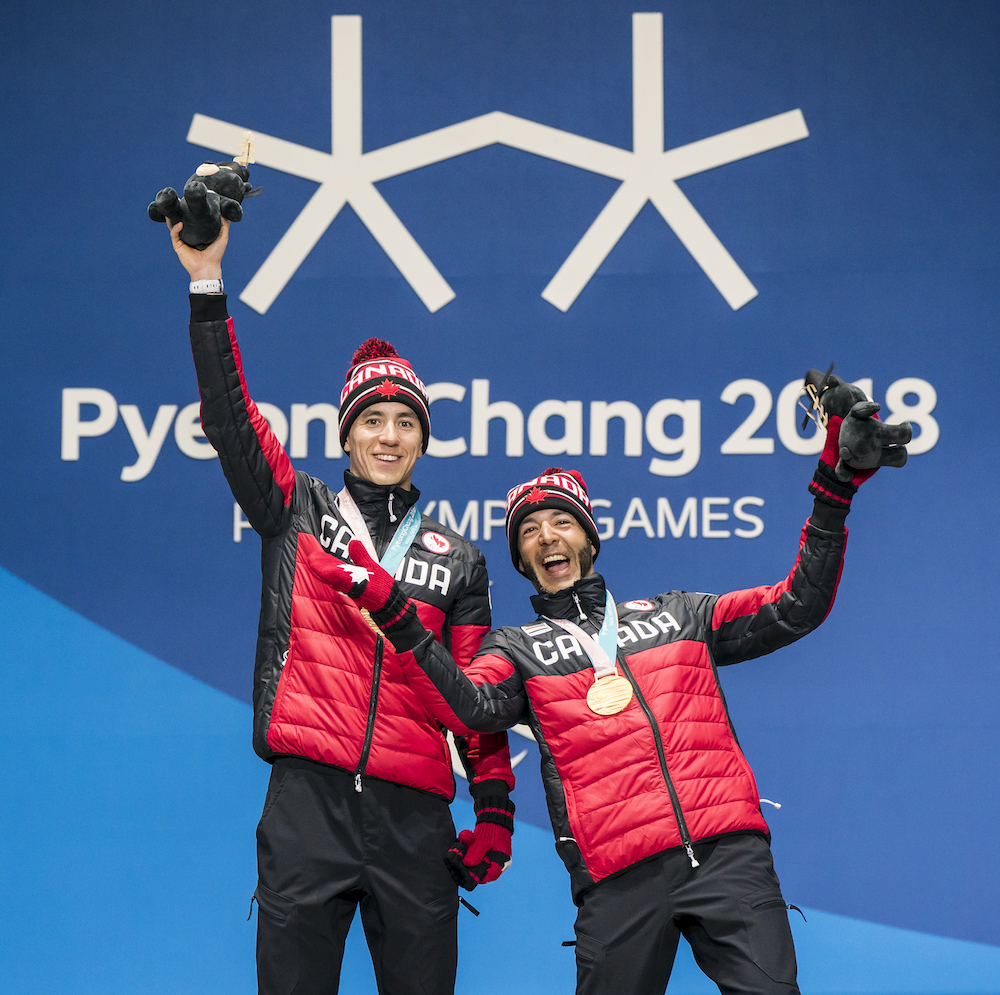
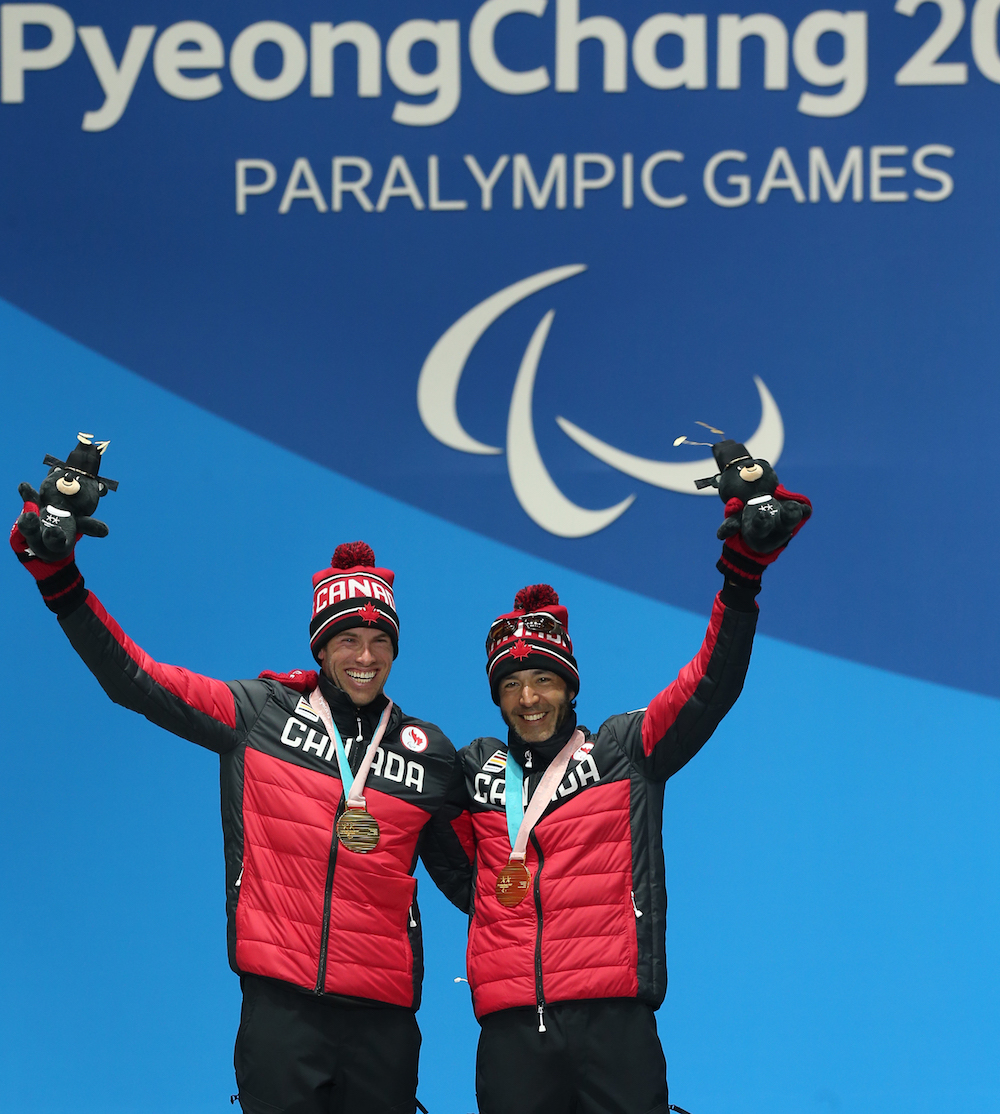
Canada’s Brian McKeever (r) having some fun at the medal ceremony after winning gold with guides Graham Nishikawa (l) and Russell Kennedy (not pictured) in the men’s 10 k visually impaired classic race at the 2018 Paralympics in PyeongChang, South Korea. (Photo: Dave Holland/Canadian Paralympic Committee)
“This feels good,” said McKeever, who has won 13 gold medals in five Paralympics. “That one was hard today and was a lot closer than the others.
Nishikawa led him for the first 6 k, helping him claw back 4 seconds on Sweden’s Zebastien Modin (and guide Johannes Andersson) ahead of him. At the race’s halfway point, the Canadians took the lead, and after Kennedy jumped in to guide McKeever, they widened their gap over the final 4 k. Modin did not finish.
“Sebastian had a pretty hard crash and I’m most concerned about him because he is a very good friend and you don’t want to win that way,” McKeever said. “It was a good fight today. We knew when to hit it and when to pull back. It’s nice to complete what we set out to do.
“Today was all about teamwork,” McKeever added. “There was a huge temperature change so we were out very early as a team testing new skis with our wax techs for 90 minutes before the race even started. It was a huge effort by everyone today.”
For Adicoff, 22, the silver marked the first Paralympic medal of his career. He had previously been awarded bronze in the cross-country classic sprint, but was relegated to fourth for a technique violation.
As for Saturday’s middle-distance race, he said the skiing was “absolutely awesome. We had great skis by our staff,” Adicoff said, according to a U.S. Paralympics Nordic press release. “I got a little bit sick a couple days ago, so going into this race I told myself to stay relaxed the first part and see if we could keep adding throughout the whole race. It ended up working out, I’m really happy about that.”
“He was really smart today, thinking about how he’s going to pace the race,” Kesselheim told U.S. Paralympics. “Taking it out not too hard and then building throughout. Really using the skis to our advantage and skiing smooth.”
In the women’s 7.5 k visually impaired classic race, American Mia Zutter (with guide Kristina Trygstad-Saari) finished ninth, 5:33.7 behind the winner, Belarus’s Sviatlana Sakhanenka (with guide Raman Yashchanka).
Oksana Masters and her U.S. coach Eileen Carey after Masters won the women’s 5 k sitting cross-country race on Saturday at the 2018 Paralympic Winter Games in PyeongChang, South Korea. (Photo: U.S. Paralympics/Mark Reis)
Then there was Masters, 28, who learned Friday that she was elected as the flag bearer for the entire U.S. Paralympic team at Sunday’s Closing Ceremony. She picked up her second gold medal of the week with a win in the 5 k sitting in 16:42, 11.5 seconds ahead of Germany’s Andrea Eskau in second.
“I am absolutely truly speechless on this performance,” Masters told U.S. Paralympics on Saturday. “I was a little bit nervous because I didn’t get my full warm up in and I was yawning at the start line thinking I was a little too relaxed. I have no idea what just happened.
“I thrive and love the athlete lifestyle of eat, sleep and train,” she continued. “To put yourself to the ultimate test on that start line and seeing all your hard work come through, and not just that, it’s a whole team effort. Seeing how our amazing team between our wax tech, nutritionist, sport psych, everything just comes together at the finish line. That’s really what it’s all about. It’s that moment coming together. It’s not a one-person show. It definitely takes a village and we have an incredible team.”
In that race, American Kendall Gretsch, who won two golds earlier in the week, placed sixth (+1:04.4), Canada’s Cindy Ouellet (+4:04.6) finished 17th and American Joy Rondeu was 19th (+5:13.1)
American Dan Cnossen racing to silver in the men’s 7.5 k sitting cross-country race at the 2018 Paralympic Winter Games PyeongChang in PyeongChang, South Korea. (Photo: U.S. Paralympics/Mark Reis)
In the men’s 10 k sitting, Cnossen pulled off his fourth silver medal of the week (and sixth medal total), finishing 5.3 seconds shy of gold, which went to South Korea’s Sin Eui-hyun in 22:28.4.
“This is my favorite race that we do,” Cnossen, 37, told U.S. Paralympics. “It’s 20-21 minutes of effort, or thereabouts, just all out as hard as you can go. I left it all out on the course and was edged out by five seconds. I’m really happy for Mr. Sin, my South Korean competitor. He earned the gold medal.”
After what he estimated to be around 60 k of racing over the last eight days, not including training, warming up or cooling down, Cnossen said he was feeling “very fatigued.”
“I came into the Games just trying to take it one race at a time and give it my all — each and every race — and not think too far ahead,” the retired Navy SEAL said. “Just focus on the here and now, and soak up the moment and be in the present.”
Also in that race, Andy Soule of the U.S. finished fifth (+34.0) and Canada’s Chris Klebl placed sixth (+1:00.9). Also for Canada, Derek Zaplotinsky followed in 15th (+3:15.2), Sebastien Fortier placed 16th (+3:19.9) and Yves Bourque 31st (+8:47.9). For the U.S., Sean Halsted finished 23rd (+4:19.8), Bryan Price 26th (+5:35.9) and Jeremy Wagner 30th (+8:06.9).
In the men’s standing division, Arendz claimed his fifth medal in as many starts this week, placing first, second and third in the three biathlon races and earning another bronze in the cross-country sprint. (He skipped the long-distance cross-country race.)
Canada’s Mark Arendz after being awarded bronze in the men’s 10 k standing classic race at the 2018 Paralympics in PyeongChang, South Korea. (Photo: Dave Holland/Canadian Paralympic Committee)
On Saturday, in the middle-distance cross-country event, Arendz finished 20.3 seconds behind the winner, Japan’s Yoshihiro Nitta, who won in 24:06.8, and 11.6 seconds behind Ukraine’s Grygorii Vovchynskyi, who placed second (+8.7).
“The focus was to come here and race in six out of the seven events,” Arendz explained. “I have one more left to accomplish in the relay, but I got done what I set out to do in biathlon and to get a couple in cross-country is extra special. This course here really suits me well and the skis have been great all week.”
With two relay races (mixed and open) remaining on Sunday, Canada has a grand total of 14 nordic and biathlon medals at these Paralympics, surpassing its previous Paralympic medal total. The U.S. team is up to 16, also record-breaking for its nordic/biathlon program.
Americans Jake Adicoff (l) and his guide Sawyer Kesselheim racing to silver in the men’s 10 k standing classic race at the 2018 Paralympic Winter Games in PyeongChang, South Korea. (Photo: U.S. Paralympics/Mark Reis)
American Oksana Masters reacting to her first gold medal in her third Paralympics, after winning the women’s 1.1 k sitting sprint on Wednesday in PyeongChang, South Korea. (Photo: U.S. Paralympics/Joe Kusumoto)
2018 Winter Paralympics (PyeongChang, South Korea): Cross-country sprints
Hold onto your hats, this was a major day for both the American and Canadian teams at the 2018 Paralympics.
In the cross-country sprints on Wednesday in PyeongChang, Andy Soule and Oksana Masters of the U.S. Paralympics Nordic Program both captured their first-career Paralympic golds in the women’s and men’s sitting events, while Dan Cnossen skied to his fourth medal in as many races with a bronze to add to his collection.
Brian McKeever of the Canadian Para-Nordic Ski Team raced to his second-straight gold of the week in the men’s visually impaired sprint, with guide Russell Kennedy, and two of their teammates claimed bronze: Mark Arendz, in the men’s standing sprint for the first Paralympic cross-country medal of his career (following four biathlon medals) and Natalie Wilkie, the youngest member of the team at age 17, in the women’s standing sprint.
Andy Soule (r) of U.S. taking first in a photo finish with Dzmitry Loban (second from l) of Belarus, while American Dan Cnossen (l) takes third and Canada’s Collin Cameron (second from r) fourth in the men’s 1.1 k sitting cross-country sprint at the 2018 Paralympics in PyeongChang, South Korea. (Photo: U.S. Paralympics/Chung Sung-Jun for Getty Images)
In the men’s 1.1-kilometer sitting sprint final, Soule won a photo finish with Dzmitry Loban of Belarus, after both crossed the line in 3:31.4 minutes. Cnossen finished 0.4 seconds back in third and Canada’s Collin Cameron was just 0.3 seconds off the podium in fourth (+0.7).
After skiing the pack throughout the final, Soule took the lead as the four racers entered the stadium together. In the finishing stretch, Loban, Cnossen and Cameron challenged him for the gold, but with a powerful surge and lean at the line, Soule, 38, notched the first gold medal after nearly 13 years in the sport. The U.S. Army veteran had previously earned bronze at the 2010 Paralympics and bronze in Tuesday’s 12.5 k sitting biathlon race.
American Andy Soule celebrates gold in Wednesday’s 1.1 k sitting sprint final at the 2018 Paralympics in PyeongChang, South Korea. (Photo: U.S. Paralympics/Chung Sung-Jun for Getty Images)
“I chased the whole way,” he said. “I don’t think it necessarily hurt me to chase that much, it actually helped with a little bit of wind break. I think a good, tight tuck coming down the final hill put me in a natural line, and I knew I had a shot at a good sprint out. This is an incredible group to compete with. That kind of a finish … that’s what sprinting is all about.”
“I definitely lost a little gas in the final stretch,” Cnossen reflected, according to the press release. “My strategy was to tuck in behind the Belarus athlete in the beginning and then sprint over the bridge and try to hang on. Andy had such an awesome race. This is the second day in a row we’ve had two U.S. men on the podium which is just phenomenal.”
For Soule, the gold was his first in his third Paralympics, and his first Paralympic medal in a cross-country race (rather than biathlon).
“It means so much. It feels so incredible,” Soule said. “I couldn’t do it without incredible teammates pushing me all the time, and without incredible coaching and technical staff. I think it speaks to a great team effort that has really paid off for us.”
Cameron came within fractions of a second of achieving his second medal in his first Paralympics.
“I raced as hard as I could … it is what it is. I just came up a little short,” he said, according to a Cross Country Canada press release. “It is amazing that I got a medal this week in biathlon, I wasn’t expecting it, but that was behind me. I really wanted something here. This was the race I wanted a medal in. It was a close one.”
Also for Canada, Chris Klebl and Derek Zaplotinsky missed advancing to the final after both finished sixth in their respective semifinals.
American Oksana Masters kissing her first Paralympic gold at the medals ceremony on Wednesday night after she won the women’s 1.1 k sitting sprint at the 2018 Paralympics in PyeongChang, South Korea. (Photo: U.S. Paralympics/Joe Kusumoto)
Masters, 28, won the women’s 1.1 k sitting sprint final by 2.1 seconds over Germany’s Andrea Eskau, crossing the line first in 4:06.7. The gold was Masters’s first in her third Paralympics, after she had previously collected five medals — two silver and three bronze — between the 2012 Summer Paralympics in London (where she placed third in a doubles rowing event), 2014 Winter Paralympic in Sochi, Russia (where she tallied one silver and two bronze in cross-country events), and PyeongChang (silver in the biathlon 6 k sprint).
Masters has notably been racing with an injured elbow throughout these Games. On Tuesday, she did not finish the 10 k biathlon race.
“I can’t believe it. I literally was starting to think this day would never happen,” she said of her win on Wednesday, according to the U.S. press release. “I knew that I wasn’t going to let yesterday be my last race. I couldn’t believe it, but at the same time, I knew I had it in me to dig deep a couple more times. I could not have done this without the USOC medical staff.”
In the sitting semifinals, her teammates Kendall Gretsch, who won the first two races of the 2018 Paralympics, and Aaron Pike, were eliminated after both placed fourth in their respective heats.
McKeever 2-for-2
Canada’s Brian McKeever (r) and his guide Russell Kennedy celebrate gold in the men’s 1.5 k visually impaired classic sprint at the 2018 Paralympics on Wednesday in PyeongChang, South Korea. (Photo: Scott Grant/Canadian Paralympic Committee)
A five-time Paralympian, McKeever, 38, racked up his 12th Paralympic gold medal (15th total medal) in the men’s 1.5 k visually impaired classic sprint. He finished 2.5 seconds ahead of Sweden’s Zebastien Modin (with guide Robin Bryntesson) in second place, with a time of 4:03.2. Behind them in the final, Norway’s Eirik Bye (with guide Arvid Nelson) finished third (+29.5) and Jake Adicoff (with guide Sawyer Kesselheim) was relegated to last (fourth place) for a technique violation.
McKeever has won all three Paralympic sprints since they were introduced in 2010. On Wednesday, he double poled the entire race.
“These sprint races are miserable,” McKeever said, according to a team press release. “They are so hard. The young guys are fast, and have natural snap. There is so much stress in sprint racing, and it goes all day long. I’m much more comfortable with the longer distances, but it was a great day for us. Russell carried the load for us today, and just thrilled we were able to cross the line first.”
Kennedy, 26, who competed at his first Olympics last month in PyeongChang, said it was tough battling it out in Wednesday’s soft conditions.
“We played things a bit more strategic in the semis because we knew the final was going to be a tough fight, and it was,” Kennedy reflected. “That first hill hurt a lot. Once I got to the top I was able to settle down and said to myself ‘OK, you got this.’ ”
While Kennedy guided McKeever to gold in the second half of Monday’s 20 k cross-country race, McKeever’s other guide, Graham Nishikawa (who skied the first half with him), joined McKeever on the podium. Wednesday was Kennedy’s turn at the medals ceremony.
“This is a new experience for me — especially coming from the Olympics where the focus is all on yourself,” Kennedy said. “Brian is such a strong athlete and guiding him requires a lot more communication. Competing here at the Paralympics is really rewarding because you do this as a team. It is hard at times to know if I’m going too hard or if he needs me to go faster, but it has been a lot of fun for me.”
Canada’s Mark Arendz en route to bronze in the men’s 1.5 k standing classic sprint at the 2018 Paralympics in PyeongChang, South Korea. It was his first cross-country medal (fifth total) in his second Paralympics. (Photo: Scott Grant/Canadian Paralympic Committee)
In the men’s 1.5 k standing sprint final, Arendz tied Finland’s Ilkka Tuomisto for third place, and both were awarded bronze. They finished just 0.3 seconds behind Japan’s Yoshihiro Nitta in second, and 1.1 seconds behind Kazakhstan’s Alexandr Kolyadin, who won in 4:19.7.
“Sitting there in the finish waiting for the results of the photo finish, I was just hoping for a tie,” Arendz said, according to the team press release. “It was a really good race but I made a mistake down the finishing stretch switching to try and find a faster track and that may have cost me the whole race.”
The Paralympic medal was the first in a cross-country race for the 28-year-old Arendz, who has two silver and two bronze in biathlon races between these Paralympics and the 2014 Sochi Games.
“I came here for medals in biathlon and was hoping to get my first one in cross-country,” he said. “To come away with my first bronze in cross-country skiing means a lot. I couldn’t be happier.”
In the women’s 1.5 k standing sprint final, Wilkie raced to third for her first medal in her first Paralympics. She finished just a tenth of a second behind Norway’s Vilde Nilsen, who took silver, and 3.2 seconds out of first, which went to Anna Milenina of the Neutral Paralympic Athletes (NPA) in 5:11.1.
Canada’s Natalie Wilkie (r) finishing third, just 0.1 seconds behind Norway’s Vilde Nilsen (l) in second, for her first Paralympic medal on Wednesday in the women’s 1.5 k standing classic sprint in PyeongChang, South Korea. (Photo: Scott Grant/Canadian Paralympic Committee)
“It feels so awesome,” Wilkie said of her bronze medal. “This is my first Paralympics and I am just so happy to have won a medal.”
Four seconds behind Wilkie, her teammate Emily Young placed fourth (+7.2). Canada made up half of the six-woman final with Brittany Hudak placing sixth (+49.2)
“We are competing against each other, but we are also helping each other,” Wilkie said. “It was calming for me to have them there with me. We talked about strategy as a team before the final because the goal was for us to win a medal for Canada.”
Paralympic nordic skiers and biathletes have a day off on Thursday before races resume Friday with men’s and women’s long-distance biathlon races, starting at 10 a.m. Korea time Friday (9 p.m. EDT Thursday).
Canada’s Brian McKeever (r) and Russell Kennedy receiving their gold medals from the men’s visually impaired classic sprint at the 2018 Paralympic Games in PyeongChang, South Korea. (Photo: Scott Grant/Canadian Paralympic Committee)
Brian McKeever follows guide Graham Nishikawa during the men’s visually impaired 20 k freestyle on Monday at the 2018 Paralympics in PyeongChang, South Korea. Along with guide Russell Kennedy, they won the race by over a minute for McKeever’s 14th Paralympic medal and 11th gold. (Photo: Scott Grant/Canadian Paralympic Committee)
2018 Winter Paralympics (PyeongChang, South Korea): 15/20 k visually impaired and standing races
Make that record-breaking medal No. 14 for Brian McKeever. In his fifth Paralympics, the 38-year-old Canadian raced to the 11th gold medal of his career (and 14th medal total) on Monday at the 2018 Paralympics in PyeongChang, South Korea. He did so in the 20-kilometer visually impaired freestyle cross-country race with his guides Graham Nishikawa and Russell Kennedy, who traded guiding responsibilities during the four-lap race.
Canada’s Brian McKeever (l) and one of his two guides on Monday, Graham Nishikawa, (Russell Kennedy was the other), at Monday night’s medal ceremony after they all teamed up for gold in the visually impaired 20 k freestyle cross-country race at the 2018 Paralympics in PyeongChang, South Korea. (Photo: Dave Holland/Canadian Paralympic Committee)
McKeever finished in 46:02.4 minutes, more than a minute faster than silver medalist Yury Holub and his guide Dzmitry Budzilovich of Belarus, who finished 1:05 back in second. France’s Thomas Clarion (with guide Antoine Bollet) completed the podium in third (+1:33.3), Sweden’s Sebastian Modin (with guide Johannes Andersson) took fourth (+1:38.4) and American Jake Adicoff and his guide Sawyer Kesselheim placed fifth (+3:41.0).
“It was super good today. Thanks to our wax techs and both of these guides. They all did an awesome job,” McKeever said, according to a Canadian Paralympic Committee press release. “It is super windy out there so to be able to tuck in behind these big boys is important for me. They pushed hard, skied well and towed me along the whole way.”
Nishikawa led McKeever for the first half of the race before handing off to Kennedy.
“The biggest thing about coming in mid-race is I have to remember that I’m fresh and Brian has already skied 10 kilometres so you have to be careful not to go out too hard or he could blow up,” Kennedy explained. “Brian is such an incredible athlete. He is so fit, so I knew it would not be a major problem. It worked out really well today.”
After pushing hard in the middle of the race, McKeever changed skis at 14 k, then worked to hang on to the sizable lead he had built.
“The plan was to ski comfortably into it and build towards the end, and I think I built a little too much during the middle and almost undid it because that last lap was very hard to keep the pace,” McKeever said with a laugh. “It was touch and go there for a bit, but we did enough in the middle to build a nice cushion, and we were able to manage it and hang on.”
Brian McKeever leads the Canadian Paralympic team during the Opening Ceremony of the 2018 Paralympic Games in PyeongChang, South Korea. (Photo: Scott Grant/Canadian Paralympic Committee)
The race was McKeever’s first of the 2018 Games and came three days after he served as Canada’s flag bearer at the Paralympics’ Opening Ceremony. With his 14th medal, he became Canada’s most decorated Winter Paralympian, surpassing the late Para-alpine skier Lana Spreeman, who amassed 13 medals in five Paralympics.
“I wasn’t aware of this record, but it is pretty cool,” McKeever said. “I think for me more than anything is this is a testament to our entire program. We’ve had so many great skiers leading the way for me with my brother, Robin who is now coaching us, and Colette Bourgonje. Now it is awesome for me to be a part of a new generation that has arrived in Mark [Arendz], Colin Cameron, and the young women like Emily [Young], Brittany [Hudak] and Natalie [Wilkie], who are ready to carry the torch. I’m so excited to be around all of them this week and to be there cheering them on.”
Canada’s Emily Young racing to fifth in the women’s standing 15 k freestyle on Monday at the 2018 Paralympic Games in PyeongChang, South Korea. (Photo: Scott Grant/Canadian Paralympic Committee)
In the women’s standing 15 k freestyle race, his teammate Emily Young raced to fifth in slushy conditions, 2:21.3 behind Ekaterina Rumyantseva, a Russian designated as a Neutral Paralympic Athlete (NPA), in first. Anna Milenia, also an NPA, placed second (+1:21.0), and Ukraine’s Liudmyla Liashenko took bronze (+1:32.9).
Canada’s 17-year-old Natalie Wilkie, the youngest member of her team in her first Paralympic race, raced to sixth (+2:41.9). Eighteen-year-old Grace Miller, of the U.S., placed 10th (+20:02) in that race.
“That was really tough – a lot tougher than I thought it was going to be,” Wilkie said. “I’ve never raced over five kilometres before in these types of conditions. It wasn’t easy, but I’m happy I was able to push to the end.”
In his second Paralympics, Adicoff, a 22-year-old Bowdoin College skier, led the U.S. team on Monday in fifth place in the visually impaired 20 k skate. The result bested his previous Paralympic mark of sixth place in the 20 k classic at the 2014 Games in Sochi, Russia.
“First lap felt pretty good. We were right in it,” Adicoff recalled in a U.S. Paralympics press release. “I just got tired and started to slow down, ended up getting bumped from the podium.
American Jake Adicoff leading Canada’s Graham Nishikawa and Brian McKeever in the men’s visually impaired 20 k freestyle on Monday at the Paralympic Winter Games in PyeongChang, South Korea. (Photo: US Paralympics/Mark Reis)
“It’s pretty warm out, but the skiing stayed fast. It was awesome out there,” he added.
In the women’s visually impaired 15 k on Monday, Americans Mia Zutter and her guide Kristina Trygstad-Saari raced to eighth place, 13:09.0 behind Belarusian winner Sviatlana Sakhanenka and her guide Raman Yashchanka. Ukraine’s Oksana Shyshkova (with guide Vitaliy Kazakov) placed second (+8.2) and Mikhalina Lysova (with guide Alexey Ivanov) of the NPA placed third (+3:20.1).
“It was so much fun,” Zutter, 18, told U.S. Paralympics Nordic. “I competed here [in PyeongChang] last year, so I kind of had an idea of what to expect, but definitely the big ‘Games’ title made it a lot more nerve-wracking but also really fun.”
Paralympic action continues Tuesday with men’s and women’s middle-distance biathlon races, starting at 10:00 a.m. Korea time (7 p.m. EDT on Monday).
Three-time Paralympic medalist Oksana Masters won her third consecutive overall women’s sitting IPC World Cup globe in cross-country. (Photo: U.S. Paralympics)
COLORADO SPRINGS, Colo. — Thirteen athletes, including seven U.S. Paralympians in Nordic skiing, were named to the 2017-2018 U.S. Paralympics Nordic Skiing National Team on June 1 by U.S. Paralympics, a division of the United States Olympic Committee.
“The level to which our Nordic skiers have performed already is very inspiring,” said Paralympic Nordic Skiing head coach Eileen Carey. “Our veteran athletes have continued to improve as we approach the Paralympic Winter Games PyeongChang 2018, and the addition of new members on our national and development teams is promising for the future.”
Three-time Paralympic medalist Oksana Masters (Louisville, Kentucky) highlights the team after claiming four world championships titles during the 2016-17 season, including cross-country crowns in sprint, middle and long distances, as well as the sprint biathlon title. She capped off the season by securing her third consecutive overall women’s sitting world cup globe in cross-country at the World Para Nordic Skiing World Cup Finals in Sapporo, Japan. Additionally, Masters finished third in the world cup overall rankings in biathlon.
Kendall Gretsch (Chicago, Illinois), Ruslan Reiter (Manchester, Maine) and Daniel Romanchuk (Mount Airy, Maryland) all make the national and development teams for the first time.
Four military veterans are featured on the roster, including Dan Cnossen (Topeka, Kansas/Navy), Sean Halsted (Rathdrum, Idaho/ Air Force), Bryan Price (Belton, Missouri/Army) and Andy Soule (Pearland, Texas/Army).
Team USA had a record-breaking 2016-17 season that finished with 33 world cup medals by five athletes, setting a record for the Nordic skiing team. Of the 33 world cup medals acquired, 12 were in biathlon. All A- and B-Team athletes reached the podium this past season, including first-time medals for Jake Adicoff (Sun Valley, Idaho) and guide Sawyer Kesselheim (Bozeman, Montana), as well as Aaron Pike (Park Rapids, Minnesota) at the PyeongChang Test Event.
2017-18 U.S. Paralympics Nordic Skiing National Teams
*Denotes U.S. Paralympian in Nordic skiing
# Denotes U.S. Military veterans
A Team
Jake Adicoff (Sun Valley, Idaho) – visually impaired skier*
Dan Cnossen (Topeka, Kansas/Navy) – sit skier*#
Sawyer Kesselheim (Bozeman, Montana) – guide
Oksana Masters (Louisville, Kentucky) – sit skier*
B Team
Aaron Pike (Park Rapids, Minnesota) – sit skier*
Andy Soule (Pearland, Texas/Army) – sit skier*#
C Team
Kendall Gretsch (Chicago, Illinois) – sit skier
Development Team
Sean Halsted (Rathdrum, Idaho/Air Force) – sit skier*#
Bryan Price (Belton, Missouri/Army) – sit skier*#
Ruslan Reiter (Manchester, Maine) – standing skier
Daniel Romanchuk (Mount Airy, Maryland) – sit skier
Joy Rondeau (Granby, Colorado) – sit skier
Mia Zutter (Sun Prairie, Wisconsin) – visually impaired skier
Kevin Bolger (University of Utah) during a track workout. (Courtesy photo)
With spring in full swing and many skiers returning to training, this week’s Wednesday Workout is presented by University of Utah Ski Team member, Kevin Bolger. While most of his athletic accomplishments from this past season are nordic-based — he’s a NCAA All-American, the 2017 Rocky Mountain Intercollegiate Ski Association (RMISA) nordic MVP and the U.S. nationals classic sprint champion — most of Bolger’s spring workouts mean giving skiing a spring ‘break.’
***
It’s no secret that natives of Sweden, Norway and other overseas nations often abound in the top spots of the RMISA circuit. Two seasons ago, just three American men — Nick Hendrickson (formerly of U.S. Nordic Combined), Sawyer Kesselheim (now a guide for Para-Nordic skier Jake Adicoff) and Ian Torchia (a 2016/2017 U.S. Ski Team Development Team member) — reached the podium.
The University of Utah’s Kevin Bolger during a cycling training session. (Courtesy photo)
Not listed: Kevin Bolger.
In his junior season with the University of Utah, Bolger, of Minocqua, Wis., native came close. He placed fourth three times in 2016, missing third by 3.1 seconds at RMISA Championships. Still, by the end of Bolger’s third year on the college circuit, a podium remained elusive.
But that was no deterrent. Bolger, who turned 24 earlier this month, ended his senior year with six regular-season podiums (two of them wins), a top-10 finish for All-American status at NCAA Championships (despite frostbitten fingers), a team championship title (Utah’s first in 14 years), and his first national title.
“If someone would have told me all this going into the season, I would have been like ‘Bring it on. Let’s actually do it,’ ” Bolger said in a recent phone interview.
Even if that meant finishing his last his last regular-season RMISA race, the 20-kilometer freestyle in Anchorage, Alaska, with fingers white from frostbite and the inability to unclasp his ski bindings. Though he ended that day in fourth, his first time off the collegiate podium all year, the frostbite meant skipping RMISA Championships and spending nearly three weeks inside training on a treadmill.
“As fun as that sounds, it wasn’t the best,” Bolger joked of his indoor training.
“I would have loved to have finished individually a lot better at NCAAs,” he said of finishing 15th and 10th, respectively, at NCAA Championships, which took place this past March in Jackson, N.H. “I really wanted to double podium there as well, but circumstances didn’t allow it.”
While Bolger missed his individual goals of garnering a podium, his efforts at NCAAs were still ones well spent. Heading into the championship’s final competition day, Utah was just 34 points behind the University of Denver. With temperatures hovering just above the legal race limit of -20 degrees Celsius (-4 Fahrenheit) on the last day, Bolger raced to 10th in the 20 k freestyle mass start, earning All-American honors, helping the Utes to a championship title, and perhaps most importantly, finishing with all 10 fingers in tact.
“Part of me like, ‘Well, I need to do this, but then there was another part of me that was like my fingers aren’t 100 percent… I don’t want to lose any of them,” Bolger said. “The frostbite was a little hiccup to my season, but to finish that whole week as a team winning a national championship, that means a lot more to me and I know it means a lot more to a lot more people as well.”
Kevin Bolger (l) of the University of Utah with UU teammate after a training session. (Courtesty Photo)
With his college ski career behind him, Bolger is bent on finishing school, but also looking ahead to life outside of the classroom. He plans to continue skiing after graduating with a major in sociology and minor in health education. Though unsure which training group he’ll choose, he does have his sights set on the Olympics.
“The U.S. nationals title was an accomplishment for me,” Bolger said. “I mean I know I’m capable of throwing down on any given day, so being able to do it there on that stage was jaw dropping.
“This season was a super good motivator for me,” he continued. “And I know I can accomplish a lot more.”
Despite his building excitement, he is adamant that at this time of year, even full-time skiers need a break from skiing.
“Whether it’s going to play pickup basketball or pickup soccer, something beyond what nordic skiers tend to do. For me, that’s a breath of fresh air,” he said.
“If I can postpone getting on rollerskis for an extra day or two days a week,” he added. “That’s a very big goal of mine.”
The Workout
Pick a sport outside of skiing that you enjoy. Bolger recommends soccer, basketball or climbing, though it could be anything. Get out and play for 1-3 hours.
Bonus Points from Bolger:
Gear Up with Games. Just because it’s not skiing, doesn’t mean it’s not beneficial. “I think skiers can get a little too wound up in full-on, 100-percent cross-country skiing, which is draining,” Bolger said. Games like soccer and basketball are valued by Bolger not only for the agility and coordintation they require, but for the more relaxed return to training they provide. “It’s all working toward a common goal, just getting back and moving again and getting ready for a new season.”
Seek New Faces and Places. Bolger says spring is the time for switching it up. Working out at a new spot or with a new training partner can relieve any unnecessary pressure and help keep the return to training fun. “I just want to go run with somebody who I don’t normally run with or I don’t ever get to hang out with,” he said. “It’s a breath of fresh air.”
APU’s Scott Patterson (Photo: Max Kaufman) and Chelsea Holmes (Photo: Fischer/Nordic Focus) are FasterSkier’s U.S. Breakthrough Skiers of the Year.
With the 2016/2017 season officially in the rearview, FasterSkier is excited to unveil its annual award winners for this past winter. Votes stem from the FS staff, scattered across the U.S., Canada, and Europe, and while not scientific, they are intended to reflect a broader sense of the season in review. This set of honors goes to breakthrough U.S. skiers.
Domestically and internationally, the U.S. women have been on a tear. And waking up on winter weekend mornings, most fans of the sport scroll to the top of the World Cup results list looking for U.S. podiums. Breaking into that scene can be tough with both a top-loaded international women’s program and several skiers based stateside ready to make the European jump.
Chelsea Holmes (r) with her Alaska Pacific University (APU) coach Erik Flora after she placed a career-best 13th in the women’s 30 k freestyle mass start at 2017 World Championships in Lahti, Finland. (Photo: John Lazenby/Lazenbyphoto.com)
“Peak when it matters and ski like you mean it,” may as well have been 30-year-old Chelsea Holmes’s mantra this year. The Alaska Pacific University (APU) skier and Girdwood, Alaska, native won the overall SuperTour (granting her World Cup starts for next year’s first World Cup period), and won the U.S. nationals 20 k classic mass start in January at Soldier Hollow (SoHo) near Midway, Utah. Three days before that, Holmes initially made her championship presence felt as she placed second in the 10 k skate at nationals, finishing just 2.2 seconds behind the winner, Caitlin Gregg (Team Gregg).
En route to her 20 k classic win, Holmes pushed hard from the start and withered chasers, including U.S. Ski D-Team member Katharine Ogden, who ultimately placed second.
Along SoHo’s terraced trails, Holmes’s blue-and-white APU suit remained in front, charging. After the race, Holmes was asked if she was concerned about bonking late in the race, a possible consequence of her steamrolling pace.
“It’s a waste to think about that,” Holmes said. “If I blow up, I blow up. I have to believe that I blow up less than everyone else.”
Those are the words of an athlete peaking and knowing full well they should have the confidence to take the “I might blow up” risk. Those risks brought reward: Holmes was named to the U.S. team for 2017 World Championships in Lahti, Finland.
Actually racing in Lahti was another story. Regarding the World Championships selection criteria, U.S. Ski Team (USST) Head Coach Chris Grover explained that selection would partially be based on “who we would start in which races in Lahti, because we absolutely want to fill every start spot, and we want to be able to have an alternate there in most cases as well, and that makes for some tough choices. Who’s skiing well domestically, who’s skiing well on the World Cup; it’s occasionally challenging to figure out which athletes are faster when they have the Atlantic Ocean between them.”
Holmes did get a Lahti start. But that start wasn’t guaranteed. Jessie Diggins (USST) was slated to start, as was Gregg, both former World Championship medalists. According to Grover, the remaining spot was offered to Sadie Bjornsen (USST) and then Kikkan Randall (USST), both of whom declined.
Score one for Holmes. On a tough Lahti course, Holmes looked like a 30 k start shoe-in. She finished 13th in the World Championships 30 k freestyle mass start, 1 minute and 28 seconds behind the winner, Norway’s Marit Bjørgen. It was her first top-20 result in a World Cup level race, in her World Championships debut.
Scott Patterson, Alaska Pacific University
Like his APU teammate, Holmes, Patterson also won the overall SuperTour and will be offered U.S. starts for Period 1 of the 2017/2018 World Cup.
Patterson’s breakout season was more of a prolonged emergence than a “here I am” statement. Certainly he was for real early on, but so were a dozen other skiers. In late November, he won a season-opening 10 k classic International Ski Federation (FIS) race in West Yellowstone, Mont.
A week later, the 25 year old from Anchorage, Alaska, placed third in the SuperTour’s opening distance, a 15 k classic also in West Yellowstone. Patterson followed that up with a win in the 15 k freestyle at the Sovereign Lake NorAm in British Columbia.
Scott Patterson (1) atop the men’s 50 k freestyle podium at 2017 U.S. Distance Nationals in Fairbanks Alaska. Patterson (APU) placed first, Brian Gregg (Team Gregg) second, and Eric Packer (APU) was third. (Photo:Max Kaufman)
That’s a pattern and the beginnings of a breakout.
Patterson entered U.S. nationals in SoHo with low energy. Although his results were solid, they did not earn him a World Champs selection. His best result was a fourth place in the 30 k classic.
The week after World Championships, Patterson once again tackled a time-zone shift and Holmenkollen’s hefty course in Oslo, Norway. He emerged as the top American, once again in the points, placing 28th in the 50 k classic mass start.
Officially, we’ll call that a breakthrough, a big one.
Patterson maintained his form for the remainder of the season, proving in the domestic distance events he’ll willingly set the tempo and position himself for more international opportunities.
At the recently concluded U.S. Distance Nationals in Fairbanks, Alaska, Patterson took the crown in the 50 k freestyle mass start. He started the season-ending SuperTour Finals series with a win in the 20k skiathlon.
APU Head Coach Erik Flora noted both Patterson and Holmes were deserving of their 2016/2017 achievements.
“It was good to see Chelsea and Scott have strong international results this season,” Flora wrote in an email. “With more World Cup experience I see both being able to climb even further up the results. It is extremely hard to travel from the US to the Scandinavian or European World Cups and produce good results in only a few weekends of racing. The results are a testament to their hard work and dedication, plus it shows the level and depth in US skiing is continuing to build. All good things for the future.”
“In the mountains somewhere, smiling at the sky. It’s actually pretty rare for me to know what I’m doing next month, let alone five years from now.”
Certainly five years is a long way out, but the Colorado-based skier should be myopic when it comes to the next few years. She’ll most likely be traveling the World Cup.
Jake Adicoff (r) and his guide Sawyer Kesselheim (l) racing at IPC World Cup Finals last month in Sapporo, Japan. (Photo: US Paralympics Nordic)
Jake Adicoff, 21, is a visually impaired skier on the U.S. Paralympics Nordic B-team. He finished the season ranked fourth in the International Paralympic Committee (IPC) Nordic Skiing World Cup standings.
COLORADO SPRINGS, Colo. (June 1) — Seven athletes, including five U.S. Paralympians, were announced to the 2016-2017 U.S. Paralympics Nordic Skiing National Team by U.S. Paralympics, a division of the United States Olympic Committee.
“The high quality of our national team this season is very encouraging,” said Paralympic Nordic Skiing head coach Eileen Carey. “All of our athletes have shown themselves to be competitive as they continually challenge for medals on the international stage.”
Headlining the team is two-time Paralympic medalist Oksana Masters (Louisville, Kentucky) who comes off a perfect 2015-16 campaign in cross-country competition. She went undefeated in sprint, middle and long distances to claim her second consecutive overall world cup globe for the women’s sitting class at the IPC Cross-Country Skiing World Cup Finals in Vuokatti, Finland in March. She also amassed the most world cup cross-country points throughout the season than any other female on the world cup circuit.
The roster also includes three military veterans: Sean Halsted (Rathdrum, Idaho), ret., Air Force, Bryan Price (Belton, Missouri), ret. Army and Paralympic medalist Andy Soule (Pearland, Texas), ret. Army.
Making their national team debut are two newcomers Joy Rondeau (Granby, Colorado) and Mia Zutter (Sun Prairie, Wisconsin). Both competed in their first international competitions at the world cup in Finsterau, Germany which will play host to the 2016 IPC Nordic Skiing World Championships.
Team USA finished the 2015-16 strong with nine medals in the final two world cups, including three gold medals at the World Cup Finals. The team will face an important year in preparation for the 2018 Paralympic Winter Games. Before the world championships in February, the team will travel to world cups in Finland, Ukraine and Japan as well as South Korea for the PyeongChang Test Event.
2016-2017 U.S. Paralympics Nordic Skiing National Teams
*Denotes 2014 U.S. Paralympian # Denotes retired U.S. Military
A Team
*Oksana Masters (Louisville, Kentucky), sit ski
*#Andy Soule (Pearland, Texas/Army), sit ski
B Team
*Jake Adicoff (Sun Valley, Idaho), visually impaired
Development Team
*#Sean Halsted (Rathdrum, Idaho/Air Force), sit ski
Oksana Masters (front) and U.S. Paralympics Nordic coach Eileen Carey at 2016 IPC World Cup Finals in Vuokatti, Finland, with wax tech Dave Mark (behind). Masters won the overall cross-country World Cup for the second-straight year. (Photo: U.S. Paralympics Nordic)
When an athlete finishes a World Cup season undefeated, it’s not just a win for the athlete, it’s a win for their teammates as well.
After U.S. Paralympics Nordic sit skier Oksana Masters completed the 2015/2016 International Paralympic Committee (IPC) World Cup race season as the undefeated victor in the cross-country events, from the 1-kilometer sprints to the debut of the 20 k marathon event, her success was seen as one for and from the team.
“Oksana is an amazing athlete and I have been privileged to be a [part] of her cross country skiing career since she started the sport,” her teammate Andy Soule wrote in an email.
“We have both become better skiers by learning from one another and training together,” Soule added. “She is hard-working, motivated, and a joy to be around as a teammate and as a person; and it makes me incredibly happy to see her having the level of success she had had these past couple of years.”
Last week at IPC World Cup Finals in Vuokatti, Finland, Masters raced to three wins in a row, including the cross-country sitting sprint, but she didn’t let it get to her head.
“It [was] the last sprint of the season and I didn’t want to leave anything behind!” Masters, of Louisville, Ky., told Inside the Games.
Throughout the season, nobody came close to the 26-year-old Masters in the cross-country events. According to a U.S. Paralympics press release, nearly eight seconds separated her from her closest competitor in the sprint, and more than 28 seconds separated her from the field in the middle distance 5 k.
“Oksana brought impressive consistency to her racing this season,” U.S. high-performance coach Eileen Carey wrote in an email to FasterSkier. “We had longer travel to our World Cups this season than is typical, so quality recovery was hard to come by at times. Oksana made gains this winter in making smart decisions for her recovery and health, even when it meant backing off from training. She made a few mistakes early in the winter, training through some sickness, but she learned from it and made smarter decisions for the rest of the season. Her performances in cross country races would not have been possible without that adjustment. That self-knowledge will pay off in future seasons.”
Day 1: Canada’s Arendz Fifth, Top 10’s for Weekes and Hudak
The first day of IPC World Cup Finals took place Tuesday, March 15, with a biathlon sprint.
In the women’s 6 k visually impaired biathlon sprint, Ukraine’s Oksana Shyshkova won in a time of 20:55.8 after shooting clean. Also with perfect shooting was Mikhalina Lysova of Russia who finished in second overall. Third place went to Russian skier Elena Remizova after she missed two shots (1+1).
In the women’s 6 k standing biathlon sprint, Oleksandra Kononova of Ukraine placed first in a time of 20:53.2 after two penalties (1+1). Russia’s Anna Milenina finished in second, also with two penalties (2+0). Russian teammate Ekaterina Rumyantseva rounded out the podium in third with three penalties (1+2).
Two Canadians competed in the 6 k standing biathlon sprint, including Emily Weekes and Brittany Hudak. With three misses (0+3), Weekes finished ninth, while teammate Hudak finished just behind her in 10th place with four penalties (2+2).
In the women’s 6 k sitting biathlon sprint, the top two spots went to Russia, with Irina Guliaeva coming in first in 23:31.8, after missing one shot (1+0). Her teammate Nadezhda Fedorova, came in second after shooting clean. Third place went to Germany’s Anja Wicker after she missed one shot (1+0).
Masters finished sixth in a time of 25:47.0 after missing three shots (3+0).
In the men’s 7.5 k visually impaired biathlon sprint, Russia’s Stanislav Chokhlaev emerged victorious, winning the event in a time of 20:36.9 after perfect shooting. Also shooting clean was second place finisher, and Russian teammate Nikolay Polukhin. Third place for the men’s visually impaired event went to Ukraine’s Anatolii Kovalevskyi with one miss (1+0).
U.S. Paralympics Nordic veteran Andy Soule tucking at 2016 IPC World Cup Finals in Vuokatti, Finland. (Photo: U.S. Paralympics Nordic)
American skier Jake Adicoff also competed in the event, racing to 11th after four misses (2+2).
In the men’s 7.5 k standing biathlon sprint, Ukraine’s Ihor Reptyukh, raced to first place in a time of 18:49.5 after perfect shooting. In second place was Vladislav Lekomtsev of Russia with two misses (2+0). France’s Benjamin Daviet rounded out the top three, finishing third with one miss (0+1).
Canada’s Mark Arendz competed in the men’s standing biathlon sprint, racing to fifth place overall with two misses (1+1).
“Going into today I felt I had a lot more. The body felt ready to go, but it didn’t materialize in today’s race,” Arendz said in a Canadian Para Nordic Team press release.. “I was close on the skiing, but I’m still finding myself needing to tweak my shooting. Two misses is two too many for me right now.”
In the men’s 7.5 k sitting biathlon sprint, the top three spots all went to Russia, Grigory Murygin leading the trio in first in 25:23.6 with one miss (1+0). Ivan Golubkov and Roman Petushkov both shot clean and finished second and third, respectively.
Soule was the sole U.S. skier in the event, racing to an 11th place overall after five misses (3+2).
“[I] had a broken pole early in the sprint and I am grateful to team Russia for their display of sportsmanship in offering me one of their spare poles until a coach could get mine to me,” Soule wrote in an email.
Canada’s Derek Zaplotinsky also competed in the event, finishing in 15th overall after shooting the same as Soule.
The second day of racing, Wednesday, March 16, brought athletes out for another biathlon event.
In the women’s 12.5 k sitting biathlon, Russia’s Maria Iovleva took her first victory of the week, finishing first in a time of 53:20.6 with just one miss (0+0+1+0). She led a Russian podium sweep with Guliaeva placing second with three misses (2+0+1+0) and Svetlana Konovalova taking third with two misses (1+0+1+0).
Masters finished seventh, after skiing eight penalty loops (2+0+4+2).
In the women’s 12.5 k visually impaired biathlon, Ukraine’s Shyshkova took her second consecutive title of the week, completing the course in a time of 40:43.0 after one missed shot (1+0+0+0). Finishing in second once again behind Shyshkova was Russia’s Lysova after skiing four penalties (2+1+1+0). Third place went to Vivian Hosch of Germany, who missed three (0+3+0+0).
In the women’s 12.5 k standing biathlon, Ukraine’s Kononova continued her winning streak, taking first place in a time of 43:15.2, after missing two shots (0+0+1+1). Second place went to Russia’s Natalia Bratiuk, with one penalty (0+0+0+1). Rounding out the podium finishers for the day was Russia’s Milenina in third after missing six shots (0+1+2+3).
Weekes finished just off the podium in fourth, with two misses (0+0+0+2).
“Emily led the way for us again today, and showing steady development,” Canadian head coach Robin McKeever, said of Weekes in a team press release. “The classic sprint is a bit of a tough test for Emily, but she faired well today and skied strong.”
In the men’s 15 k visually impaired biathlon, Russia’s Polukhin bested his previous second place finish for first, winning the 15 k in a time of 43:31.3 with perfect shooting. In second place was Russian Nikita Povarov, who also shot clean. Ukrainian skier Iurii Utkin rounded out the podium in third, after two misses (1+1+0+0).
In the men’s 15 k standing biathlon, France’s Daviet raced to the win in 44:12.0 after skiing three penalties (2+0+1+0). Second place went to Ivan Kodlozerov of Russia with one miss (0+0+1+0). Russian teammate Lekomtsev finished third after missing four (0+2+1+1).
Mark Arendz (Canadian Para-Nordic Ski Team) at last year’s 2015 IPC World Cup Finals in Surnadal, Norway. This year in Finland, he placed fifth in the 2016 World Cup Finals biathlon sprint. (Photo: IPC Nordic Skiing/Facebook)
Arendz finished just off the podium in fourth after skiing three penalty loops (0+1+1+1).
In his second victory of the week, Murygin of Russia, raced to first in the men’s 15 k sitting biathlon in 54:18.1 with one penalty (0+1+0+0). Germany’s Martin Fleig finished second after missing four (2+0+2+0). The third podium spot went to Poland’s Kamil Rosiek with two penalties (2+0+0+0).
Soule finished sixth, with seven penalties (4+1+0+2).
“Both biathlon races were difficult shooting races for me. I have struggled in the range somewhat this year and will be working in the of season to return to some solid shooting fundamentals,” Soule wrote. “I am really excited for the mass start 20km marathon race [later that week] … This is a type of race that we do not get to do often and I an looking forward to the challenge.”
Canada’s Derek Zaplotinsky was the second North American to compete in the event, finishing 11th with 12 penalties (2+4+3+3).
Day 3: Masters Wins Sprint; Adicoff, Weekes and Soule All Reach Respective Finals
Thursday marked the third-consecutive day of racing with a 1 k cross-country sprint, where Masters continued her streak to finish the season with her fourth cross-country sprint win in as many races. She won the sprint in 2:12.68, besting Russia’s Iovleva in second and Germany’s Wicker in third.
The women’s 1 k visually impaired cross country sprint went to Lysova of Russia, who won in 3:31.34. Crossing after Lysova in second was her Russian teammate Remizova. Ukraine’s Shyshkova took the final podium spot in placed third overall.
Thursday brought the third-straight win for Ukraine’s Kononova, who won the women’s 1 k standing cross-country sprint in 3:28.44. Crossing behind her in second was her Ukrainian teammate Liudmyla Liashenko. Rounding out the top three was Russia’s Milenina in third.
Weekes advanced to the final where she finished fifth. Her teammate, Hudak finished ninth overall.
Three Russians dominated the men’s 1 k visually impaired cross-country sprint, with Vladimir Udaltcov taking first in 2:52.66. Chokhlaev placed second, while Oleg Ponomarev took third.
Jake Adicoff (c) and his two guides, U.S. Paralympics high-performance coach and director John Farra (r) and Germany’s Florian Grimm. (Photo: U.S. Paralympics Nordic)
Finishing just off the podium after advancing to the final was Adicoff of the U.S. in fourth.
The men’s 1 k standing cross-country sprint saw Russian Lekomtsev stand at the top of the event podium, ahead of Ukraine’s Vovchynskyi in second place. Third place went to Japan’s Yoshihiro Nitta.
Arendz missed advancing to the final by one spot, finishing seventh overall.
Competition in the men’s 1 k sitting cross-country sprint went to Ukrainian athlete Maksym Yarovyi, who crossed the final in first in a time of 1:55.47. Russia’s Golubkov and Aleksandr Davidovich finished second and third, respectively.
Soule advanced to the final, where he placed sixth overall.
Canada’s Chris Klebl advanced to the semifinal, where he placed 12th and Canadian teammate Zaplotinsky finished the day in 14th overall.
Day 4: McKeever, Masters Take Marathon Titles; Klebl Second
After a day of rest, IPC World Cup athletes returned to the Vuokatti ski trails for Saturday’s marathon events.
Masters raced to first place in the women’s 20 k sitting marathon on Saturday, March 19, completing the course in a time of 1:00:57.0.
Two Russians, Guliaeva and Fedorova finished behind Masters in second and third, respectively.
The women’s 30 k visually impaired marathon event went to Remizova of Russia, who won in 1:36:22.6. Her Russian teammate Lysova placed second. Ukraine’s Shyshkova earned her fourth-straight podium of the week, after placing third.
Ukraine’s Kononova rolled to her fourth-straight win of the week in the women’s 30 k standing cross-country marathon. She won in 1:39:09.6, while Sweden’s Helene Ripa finished second and Russia’s Rumyantseva placed third.
Hudak raced to fifth in the women’s 30 k.
Canada’s Brian McKeever (c) and his guide Graham Nishikawa with their gold medals after the men’s visually impaired 30 k at 2016 IPC World Cup Finals Vuokatti, Finland. Russia’s Alexsander Artemov (l) placed second and France’s Thomas Clarion (r) was third. (Photo: IPC Nordic Skiing/Facebook)
Canadian team veteran Brian McKeever took the victory in the men’s 30 k visually impaired cross-country marathon, completing the course in a time of 1:20:43.0. Behind him in second was Russia’s Alexsander Artemov and France’s Thomas Clarion in third.
Adicoff was the second North American in the men’s visually impaired marathon in sixth overall.
After winning Thursday’s standing sprint, Russian Lekomtsev took his second win of the week in the men’s 30 k standing in 1:17:52.8. The next closest competitor was his Russian teammate, Rushan Minnegulov in second. Third place went to France’s Daviet.
Arendz raced to eighth place in the 30 k standing marathon.
In the men’s 20 k sitting, Klebl narrowly out on a victory, placing second behind Maksym Yarovyi of Ukraine. Yarovyi completed the 20 k course in a time of 52:31.0.
Soule was one spot off the podium in fourth, behind Korea’s Eui Hyun Sin in third.
“The 20km was an interesting race,” Soule wrote in an email. “It was formatted as a mass start, which is not how we usually race. Because of the way we adjust times for differing disabilities, it was not actually first across the line wins. While we do not actually train specifically for this distance, the fast conditions and relatively flat course made it run much like a long individual race.”
Day 5: Masters Defends Unbeaten Streak; McKeever Wins Again
Athletes geared up for the final World Cup race of the season on Sunday, March 20, with the men’s and women’s middle-distance cross-country races.
American Oksana Masters (c) on the podium with one of her three gold medals from this year’s IPC World Cup Finals in Vuokatti, Finland. (Photo: IPC Nordic Skiing/Facebook)
Masters displayed her strength with one final win, topping the women’s 5 k sitting cross-country in a time of 17:16.3, for her third win of the week.
Finishing behind Masters in second was Russia’s Fedorova and in third was Guliaeva, also of Russia.
In the women’s 7.5 k visually impaired cross-country, Lysova won in a time of 20:02.0. Second place went to her Russian teammate Remizova and Ukraine’s Olga Prylutska finished behind her in third place overall.
In the women’s 7.5 k standing cross-country, Russia’s Milenina won in 19:59.2. Ukraine’s Kononova finished in second and Russian Rumyantseva placed third.
McKeever secured his second win of the week, finishing first in the men’s 10 k visually impaired cross-country. McKeever completed the 10 k course in 22:31.1. Second place went to France’s Clarion.
“We put in a really good effort today. Nish was on fire for the first five kilometres, and that moved us into a solid position,” McKeever said of his guide, Graham Nishikawa, in a team press release. “We were able to build on that pace, and nobody was able to respond.
Adicoff once again just missed the podium in fourth overall, finishing behind Russia’s Chokhlaev in third.
France’s Daviet took his second win of the week in men’s 10 k standing cross-country. Behind Daviet in second was Russia’s Minnegulov and Ukraine’s Reptyukh finished third.
Arendz placed eighth in the 10 k standing event.
In the final men’s sitting cross-country event, Russia’s Golubkov finished first in a time of 23:47.4. Second place went to Ukraine’s Yarovyi and Korea’s Eui Hyun Sin took third.
Soule led the North Americans in that race in fifth, while Canada’s Klebl and Zaplotinsky finished behind him in 12th and 16th, respectively.
“Overall the event has been a lot of fun,” Soule wrote. “I always enjoy coming to Vuokatti, a place where we have competed on a regular basis for my entire nine-year career.”
Masters Wins World Cup Globe for Second-Straight Year
Overall, Masters won the season-long World Cup title for the second year in a row in the women’s sitting cross-country. She topped the rankings with 760 points, beating out Russia’s Maria Iovleva, who had 545 points, and Russia’s Nadezhda Fedorova, who was third with 526 points.
Andy Soule was 30 points short of the cross-country podium in fourth overall, with 390 points to Russian winner Ivan Golubkov’s 689 points in first.
Emily Weekes placed seventh in the women’s standing cross-country, McKeever was eighth in the men’s visually impaired.
Soule placed fifth overall in the biathlon World Cup men’s sitting, while Masters was sixth in the women’s category. Weekes finished the season in ninth overall in the biathlon World Cup, and Mark Arendz tied for ninth in the men’s standing biathlon.