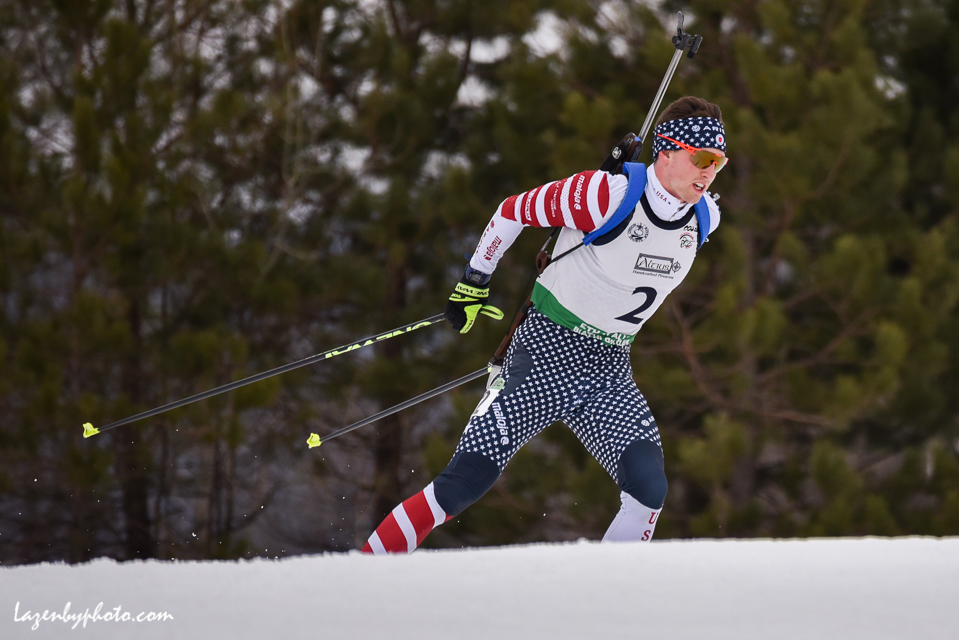
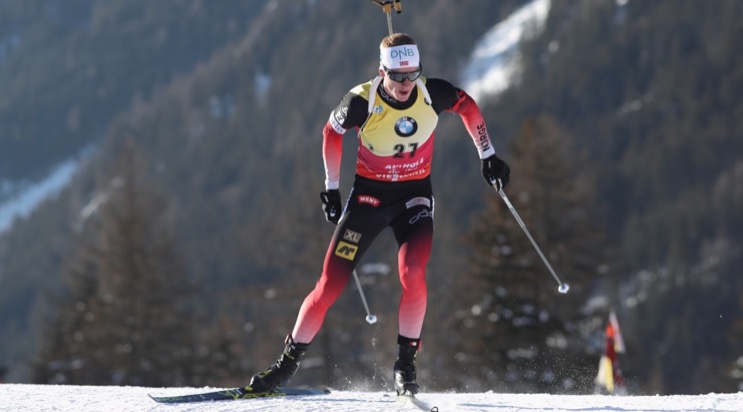
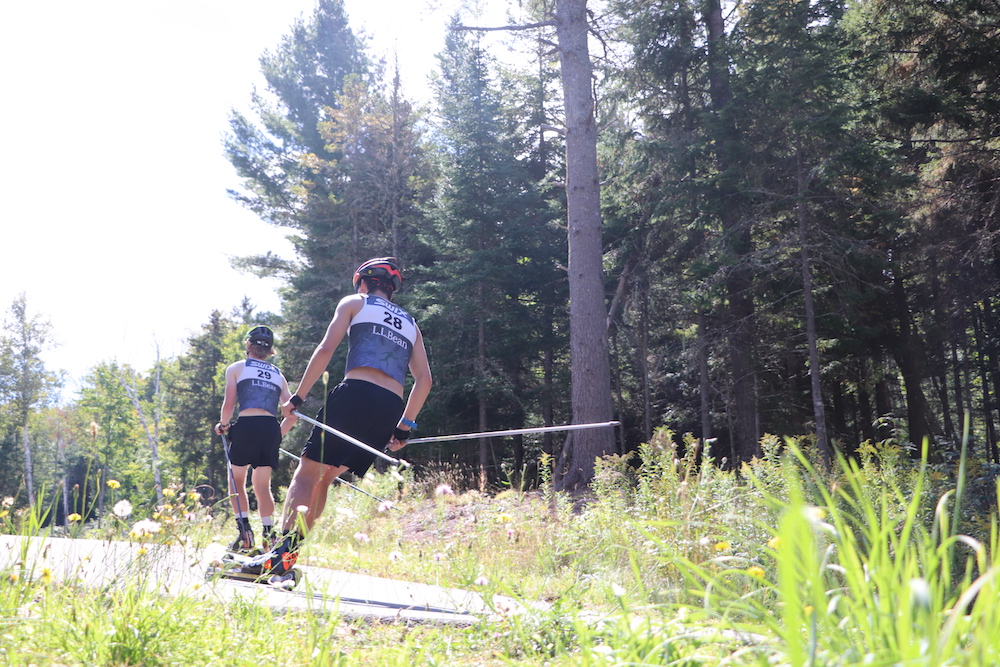
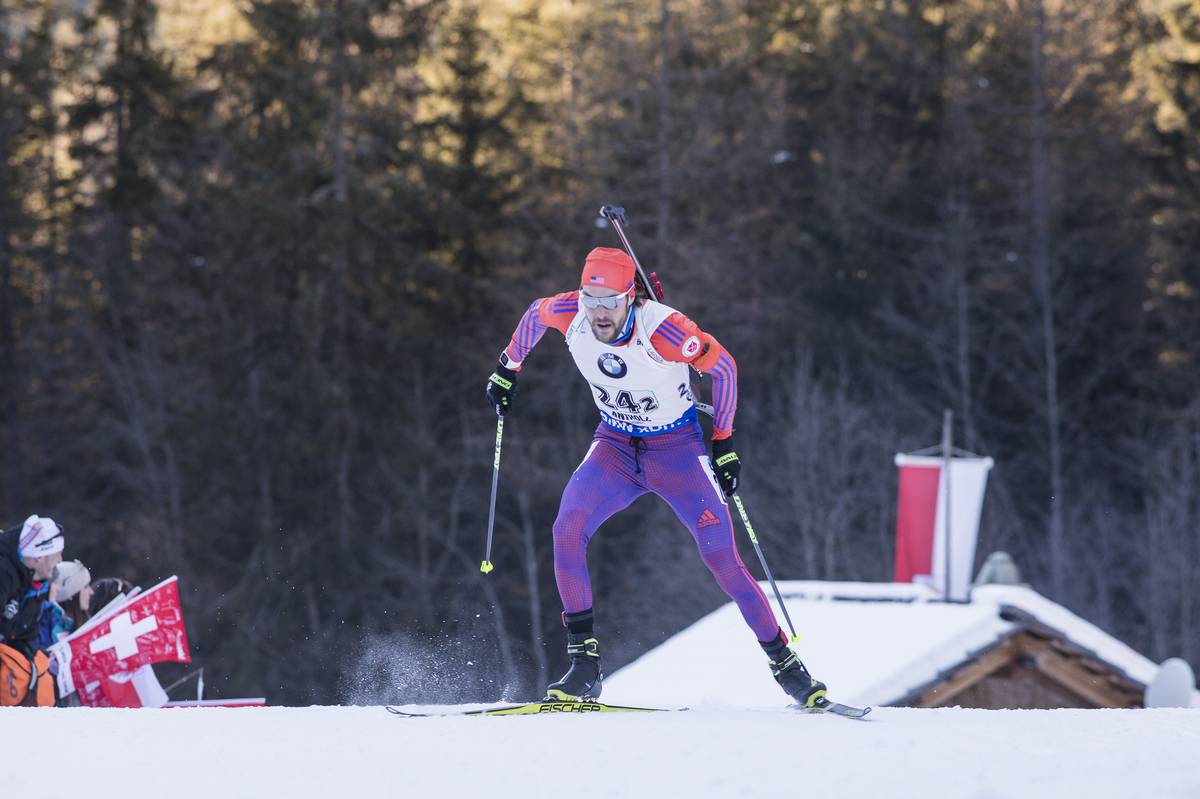
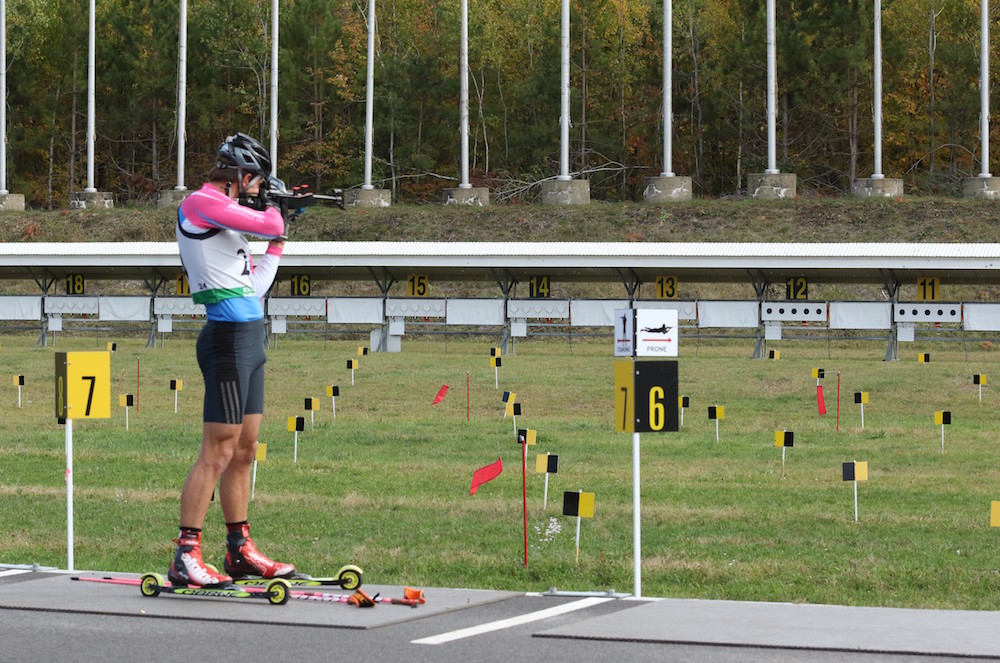
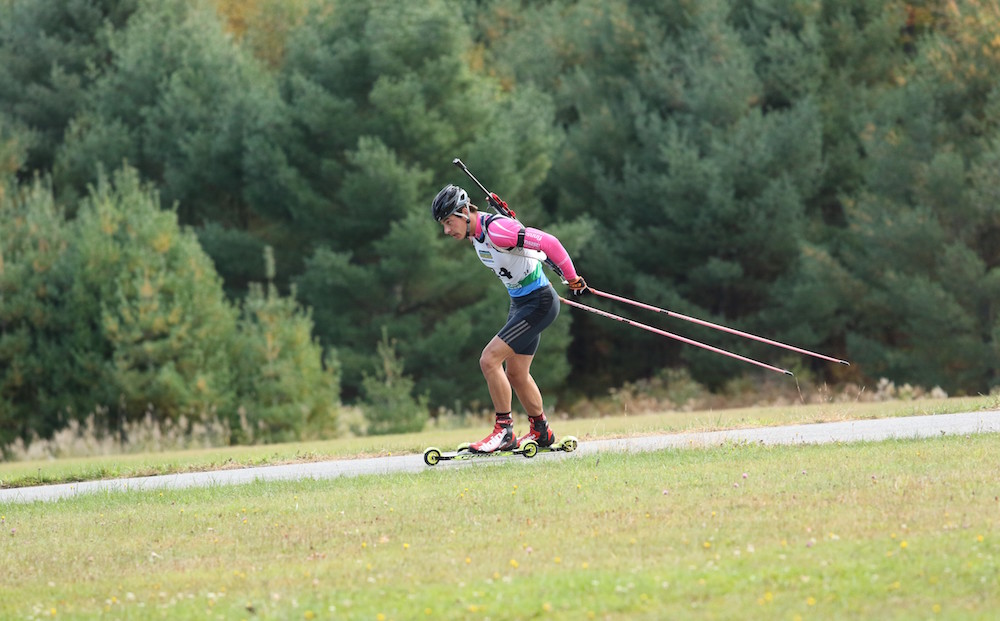
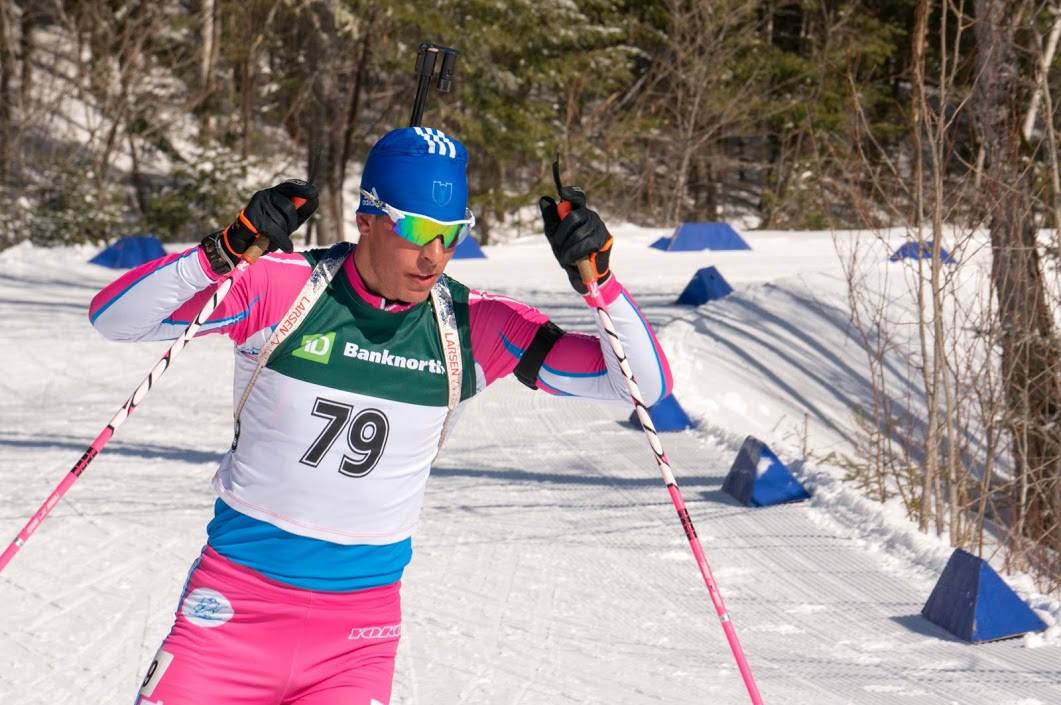
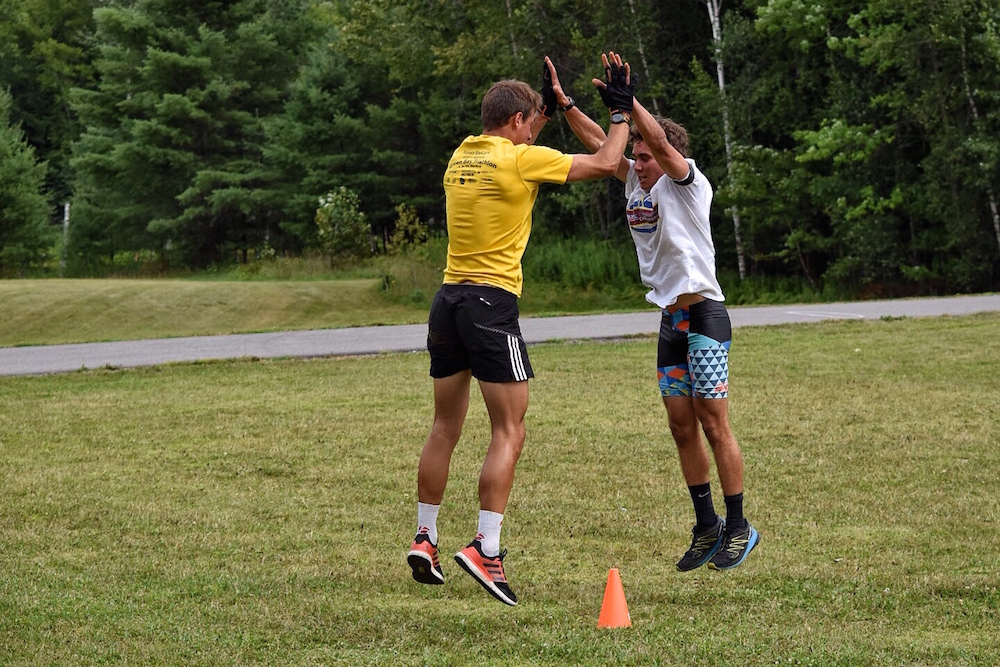
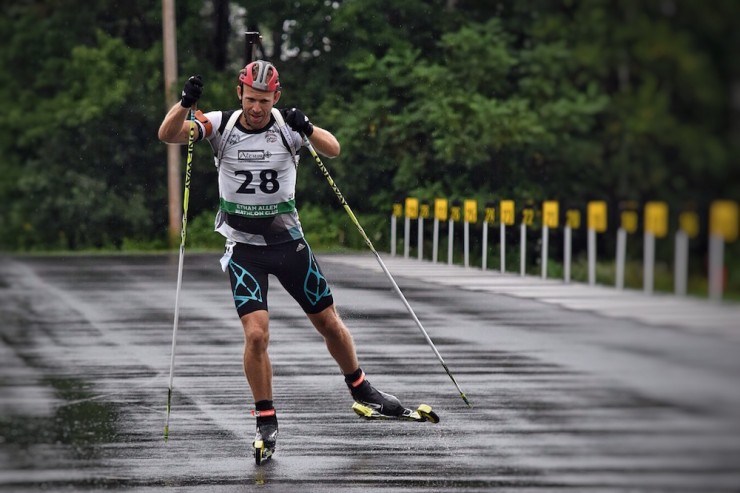
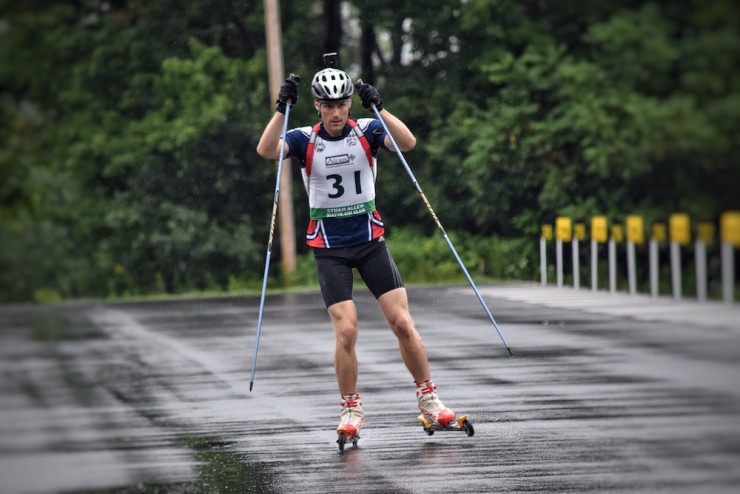
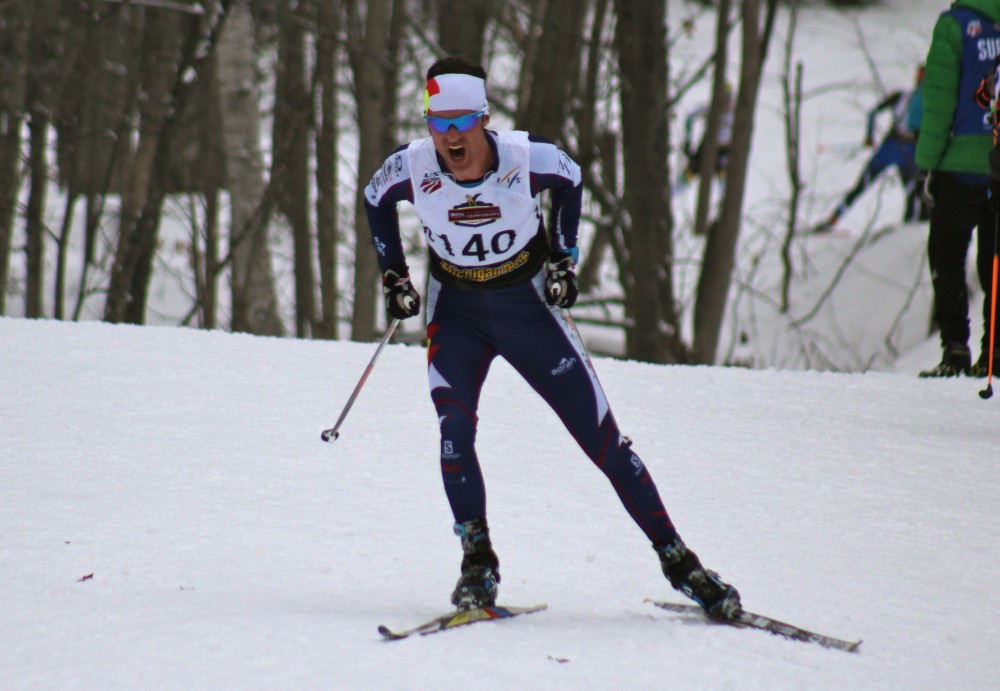
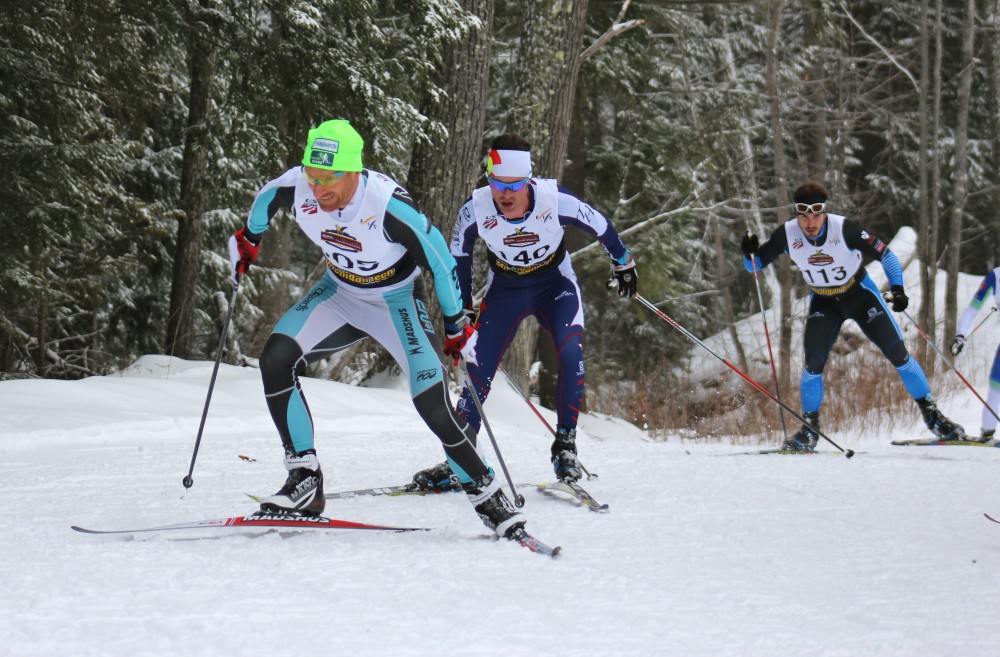
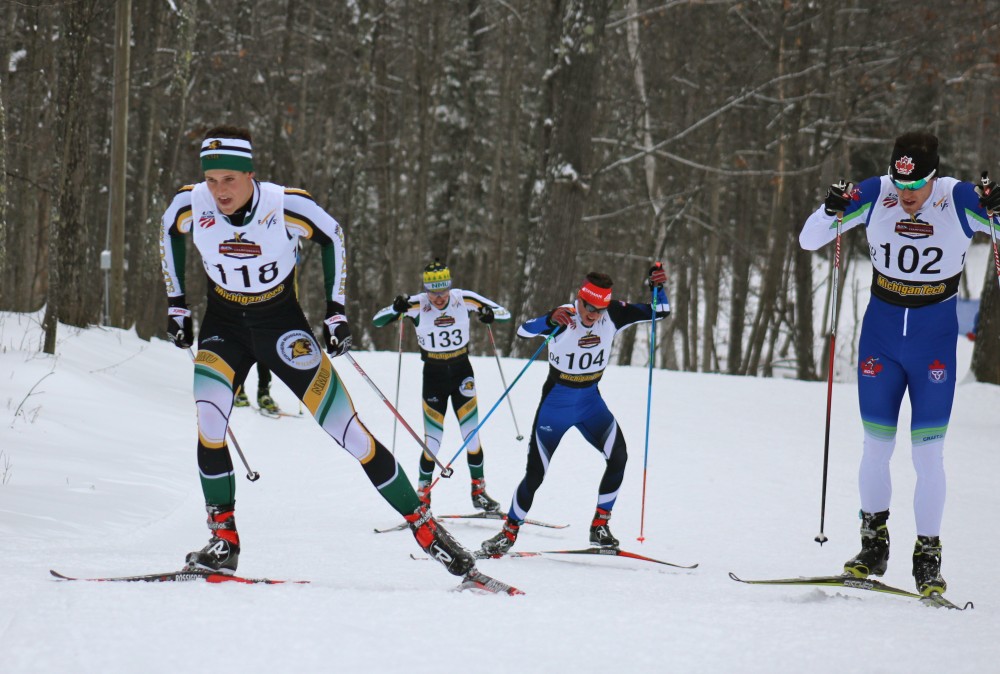
Sean Doherty on his way to winning the men’s 12.5 k pursuit. (Photo: John Lazenby/lazenbyphoto.com)
USBA National Championships Jericho, Vermont 12.5 k/10 k pursuit
On Saturday, Sean Doherty (USBA) won the 12.5-kilometer pursuit in 34:19.1. Doherty shot 1+2+1+2 in taking the win. He began in bib 2, 5.8 seconds behind Jake Brown (CGRP). Brown placed second in Saturday’s pursuit finishing 17.0 seconds back. Max Durtschi (USBA/Strafford) raced to third (+1:36.6, 1+1+1+1).
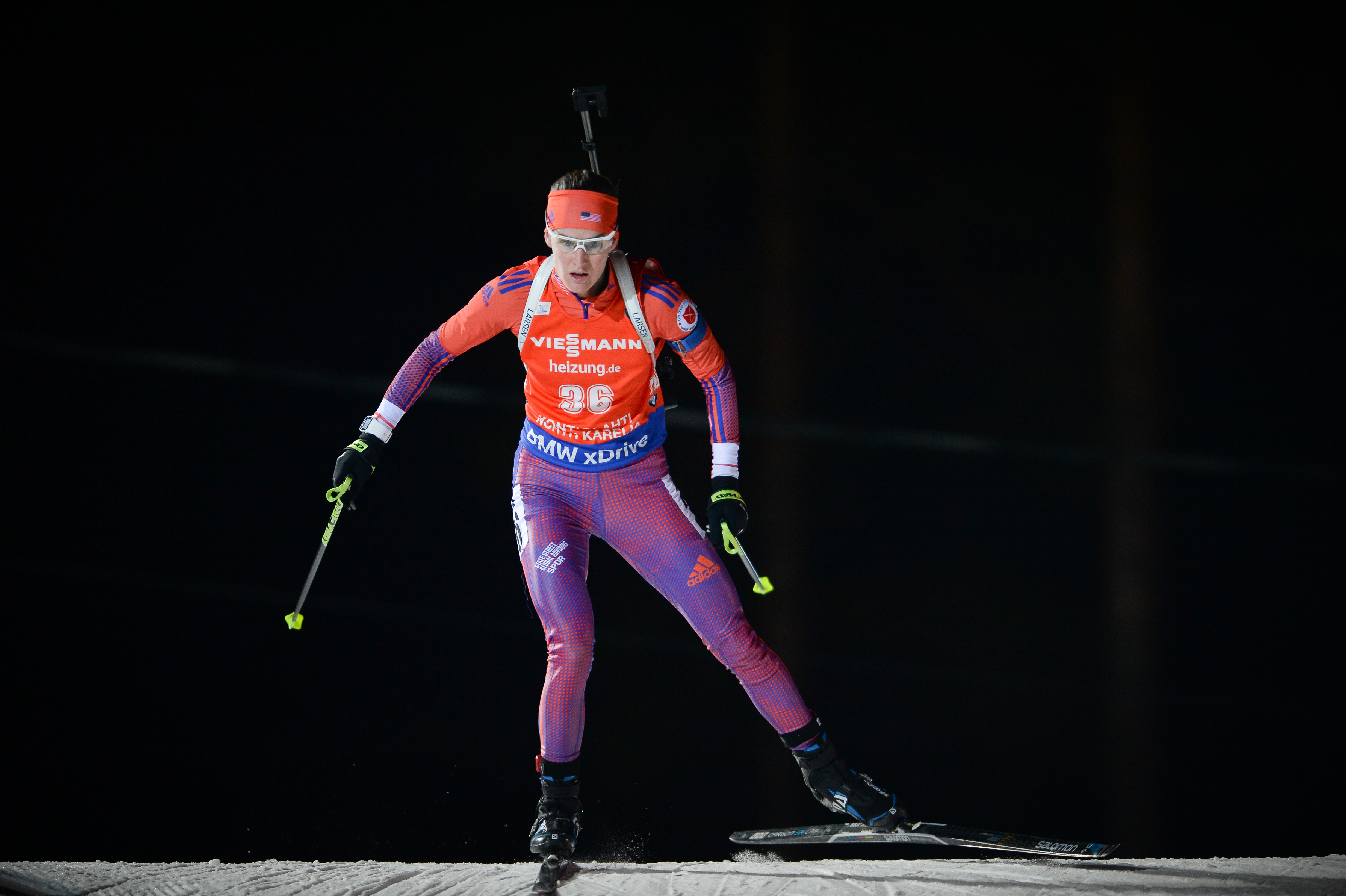
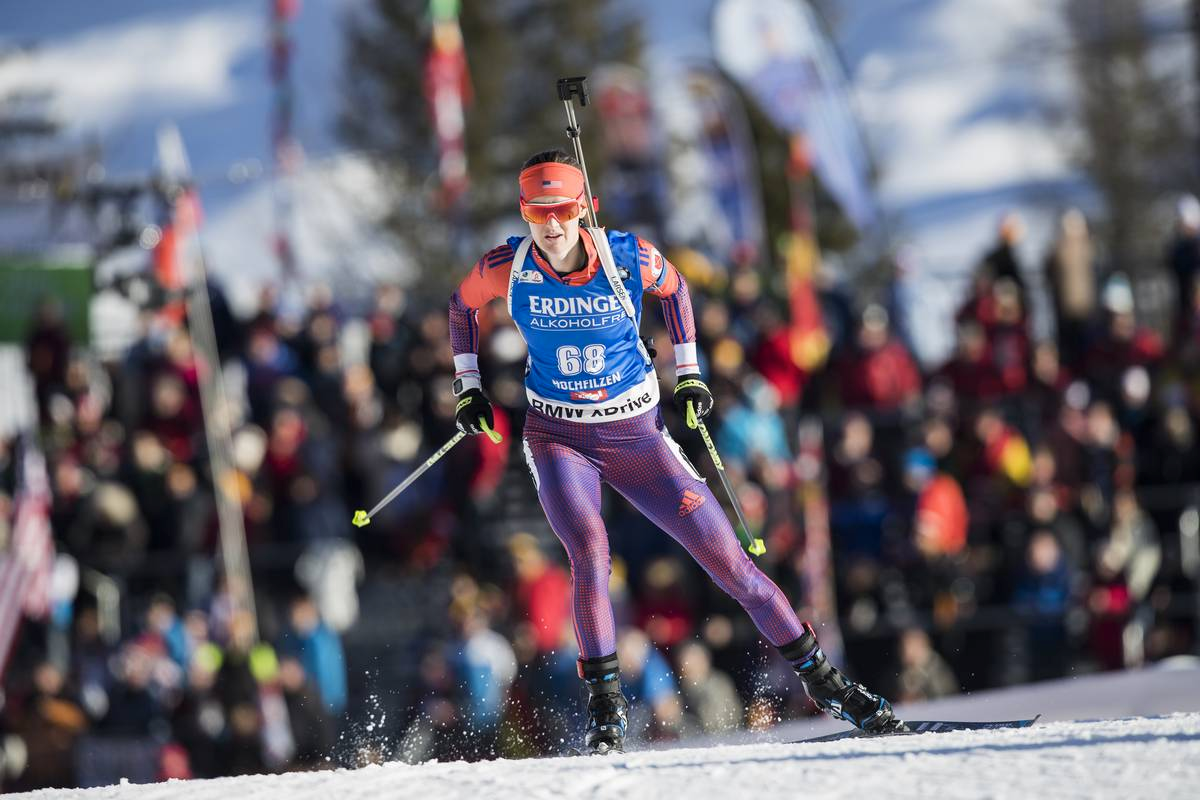
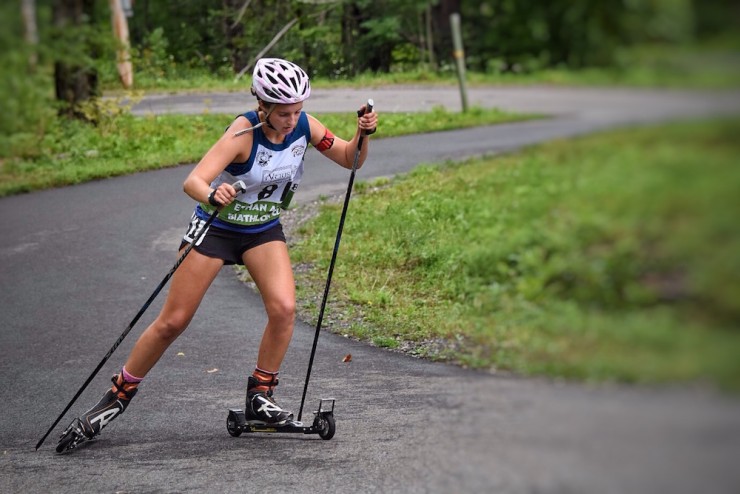
Susan Dunklee during the women’s 10 k pursuit at the 2019 USBA National Championships. (Photo: John Lazenby/lazenbyphoto.com)
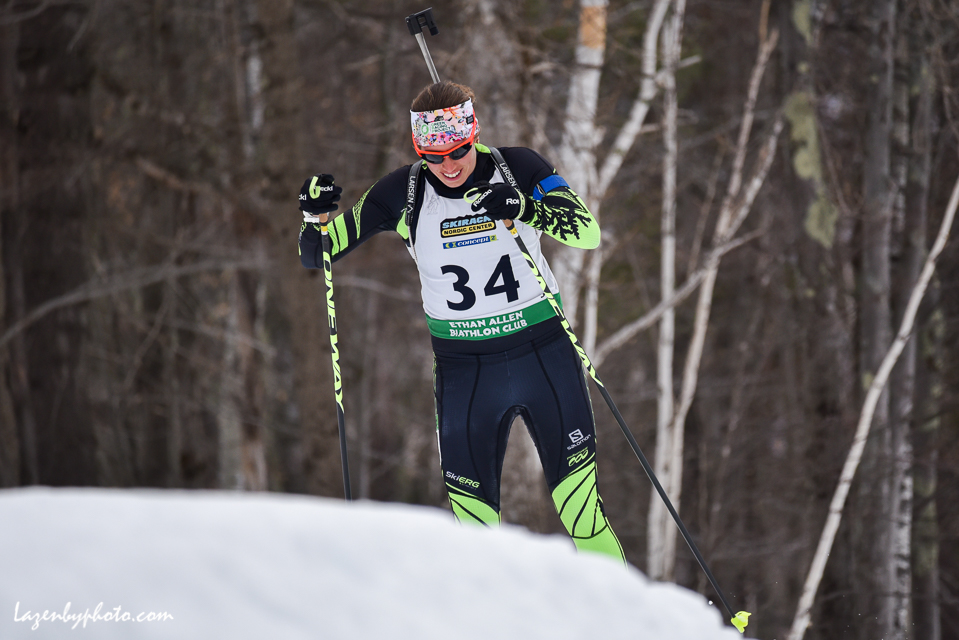
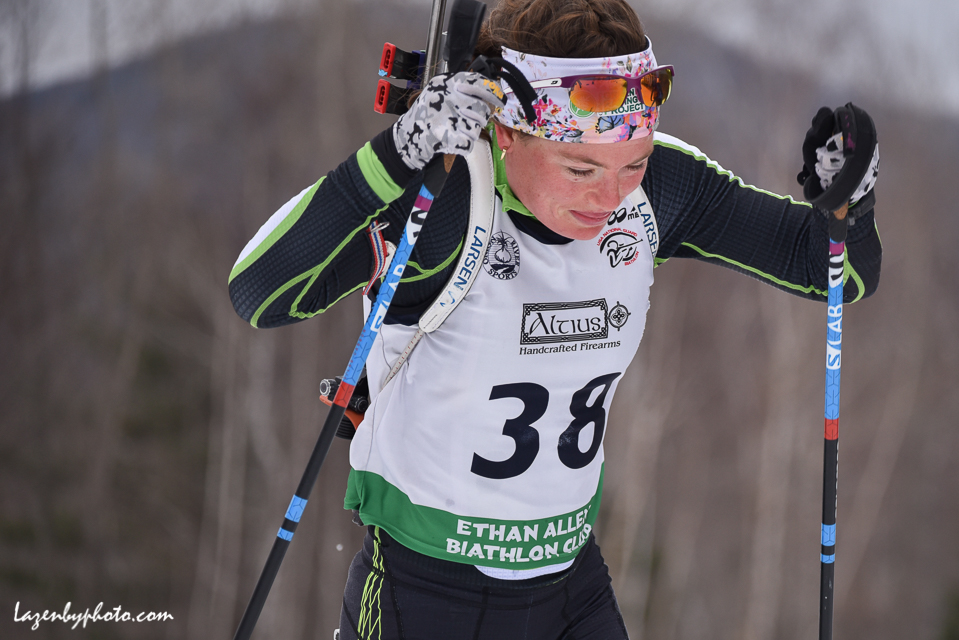
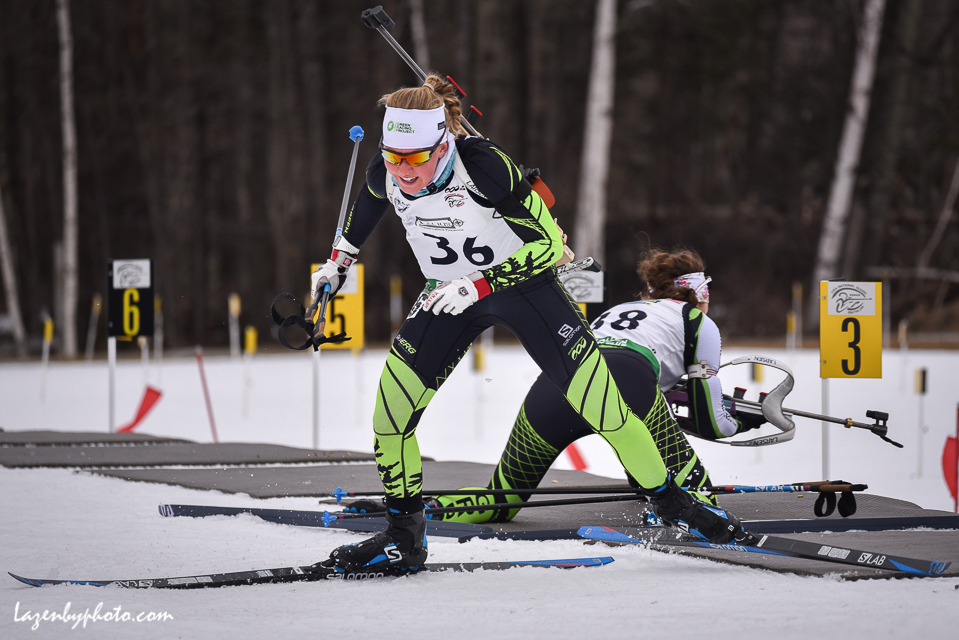
In the women’s 10 k pursuit, Susan Dunklee (USBA/CGRP), the winner of Friday’s sprint, won in 34:38.7 after shooting 0+3+1+3. Hallie Grossman (CGRP) placed second (+4:06.7, 0+05+1), with Kelsey Dickinson (CGRP) taking third. Dickinson shot 0+0+4+3 to place 4:41.0 back.
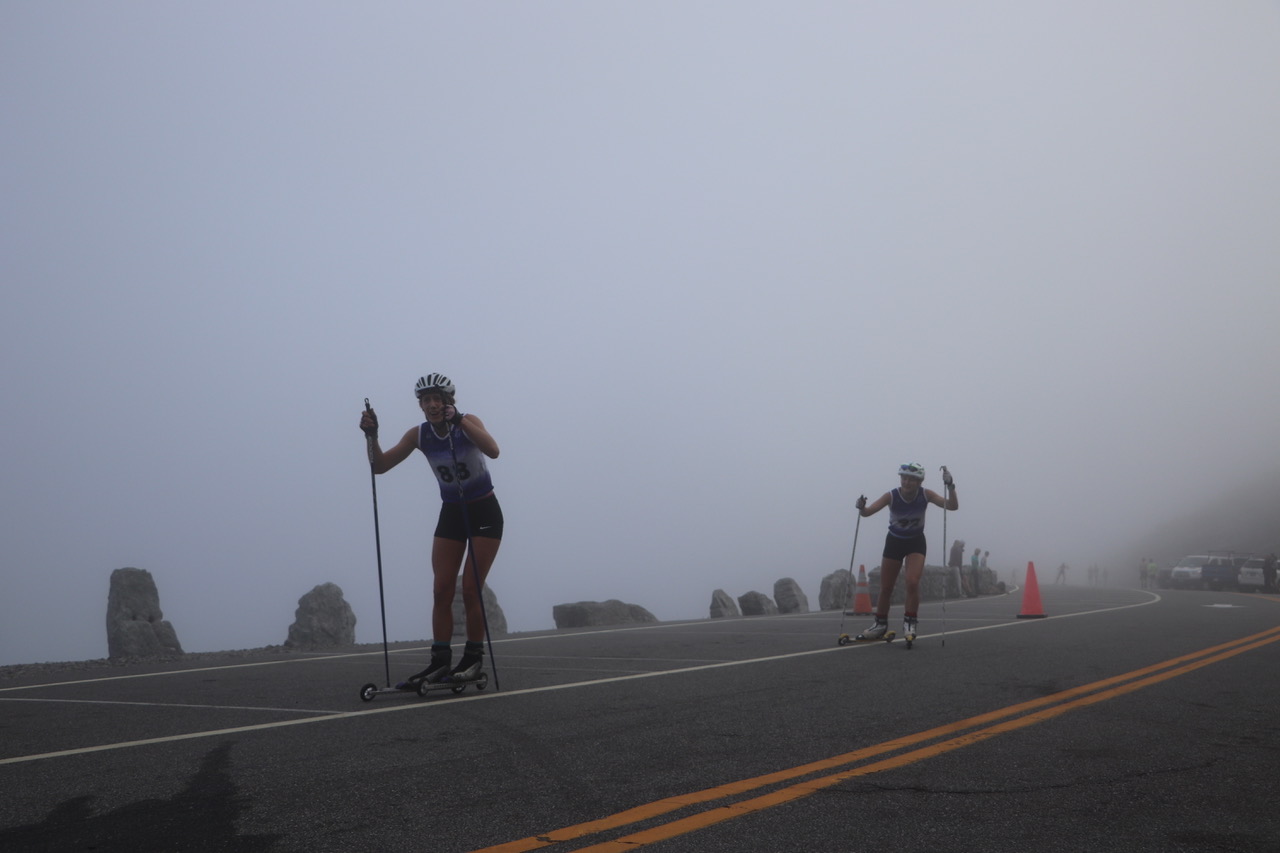
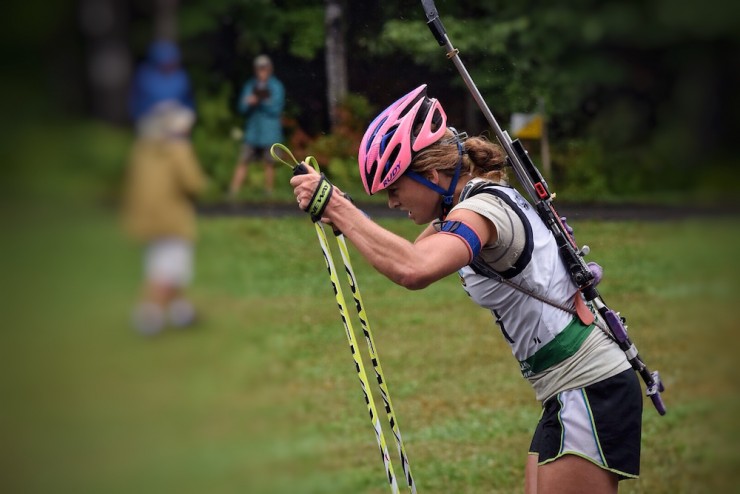
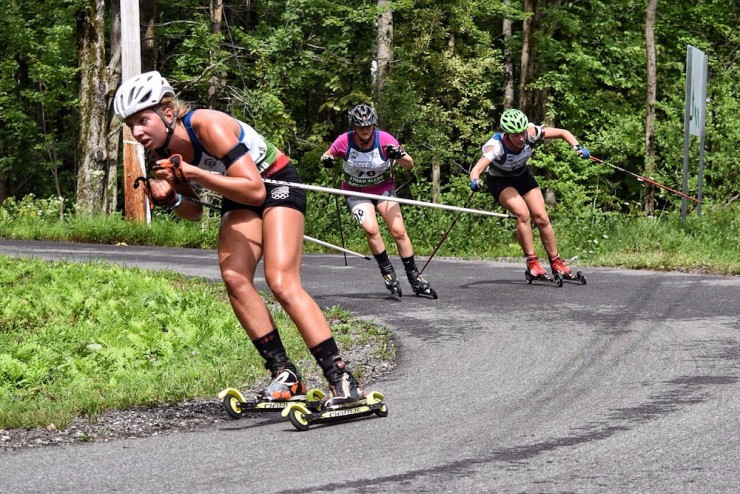
Hallie Grossman placed second in Saturday’s 10 k pursuit at the USBA National Championships. (Photo: John Lazenby/lazenbyphoto.com)
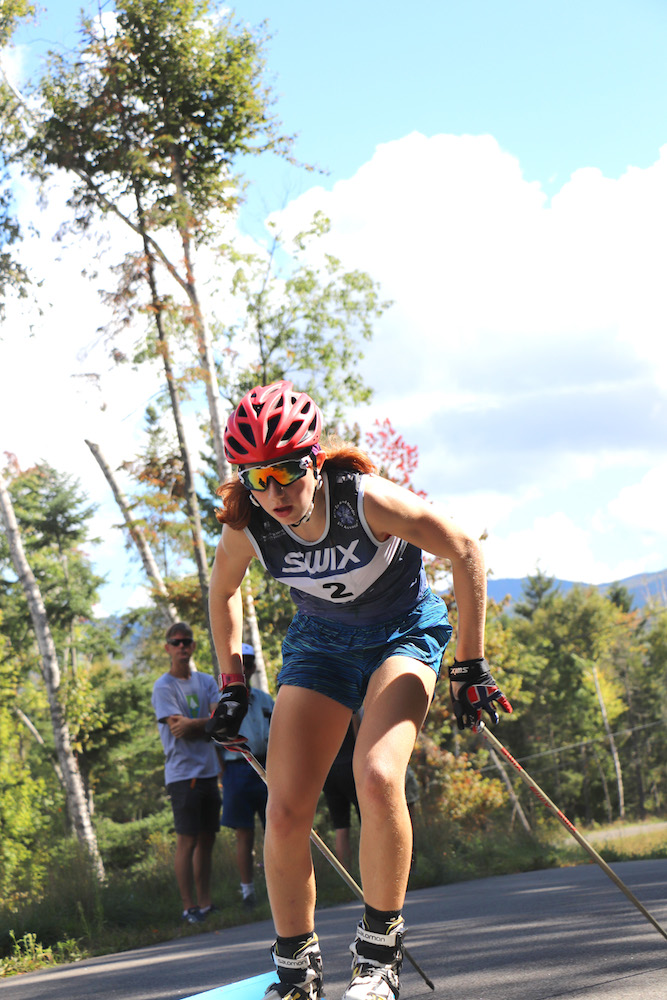
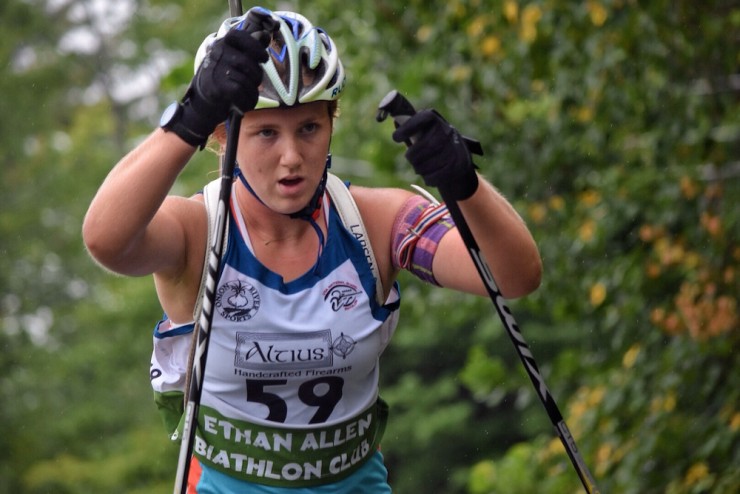
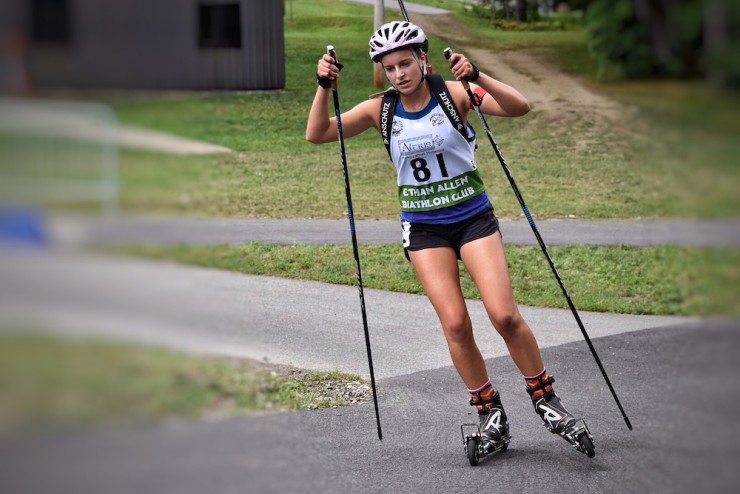
Kelsey Dickinson skiing to third in the 10 k pursuit. (Photo: John Lazenby/lazenbyphoto.com)
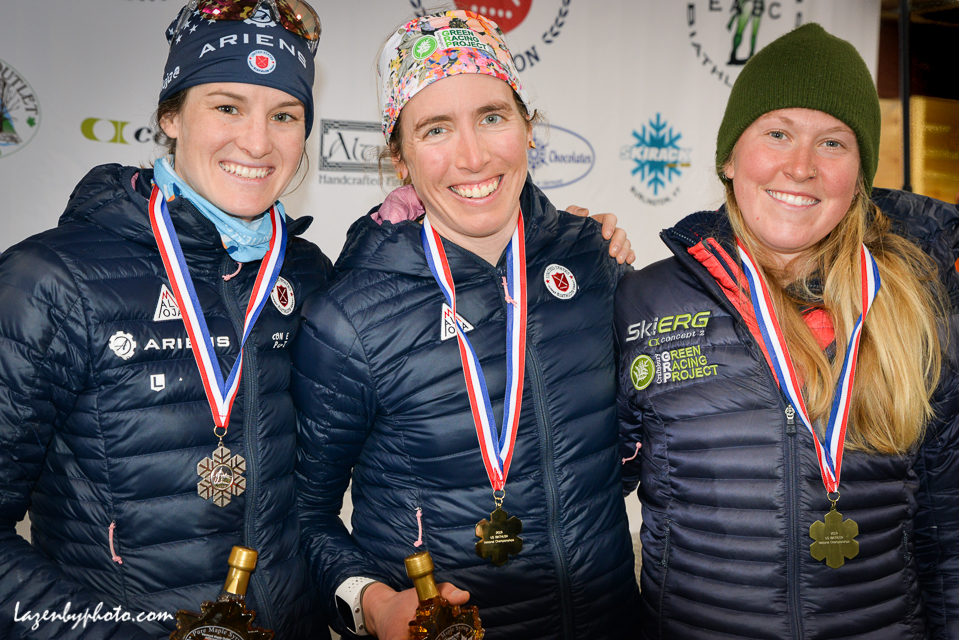
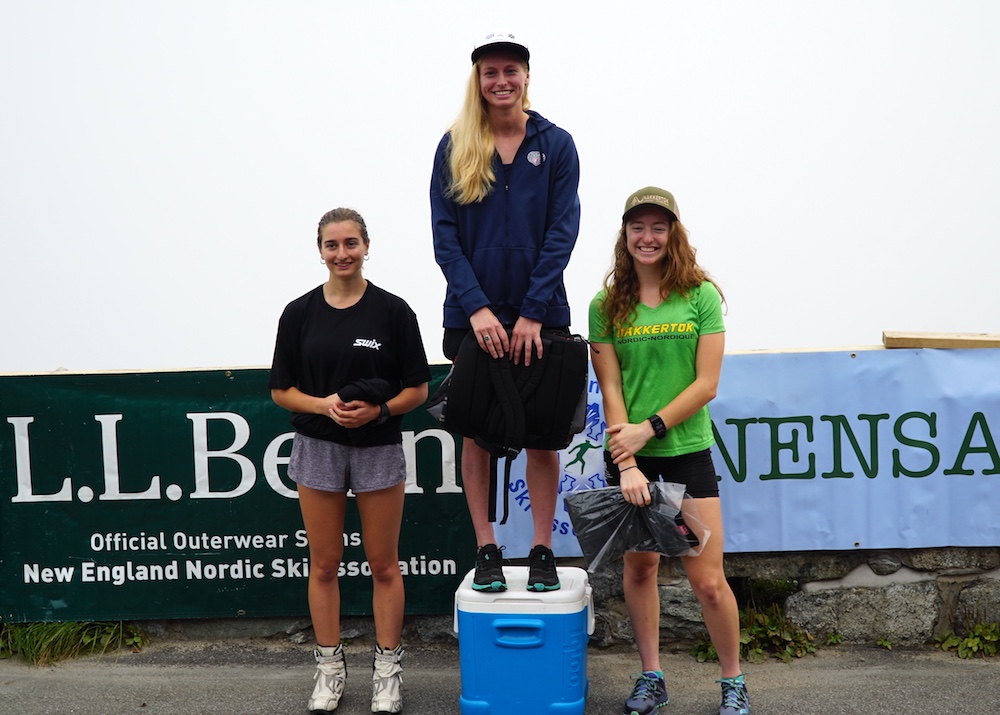
The podium from Friday’s USBA National Championship 7.5 k sprint (l-r): Clare Egan in second, Susan Dunklee in first, and Kelsey Dickinson in third. (Photo: John Lazenby/lazenbyphoto.com)
USBA National Championship Jericho, Vermont 10 k/7.5 k sprint
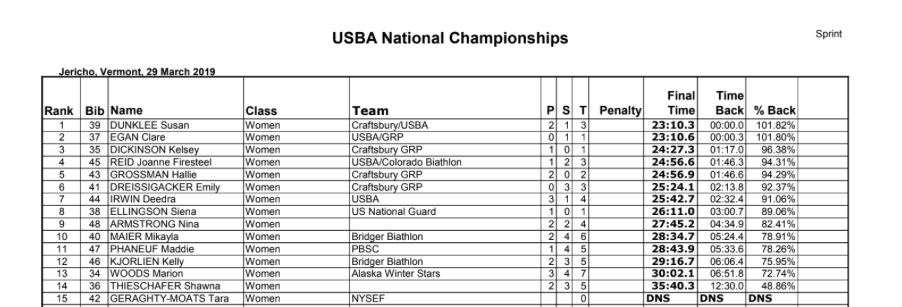
Friday, in the women’s 7.5-kilometer sprint at the USBA National Championships Susan Dunklee (CGRP/USBA) missed two targets in prone and one in standing to win in a time of 23:10.3. Clare Egan (CGRP/USBA) missed a single penalty in standing to take second 0.3 seconds behind Dunklee. Kelsey Dickinson (CGRP) raced to third place (+17.0) after missing only one target in prone.
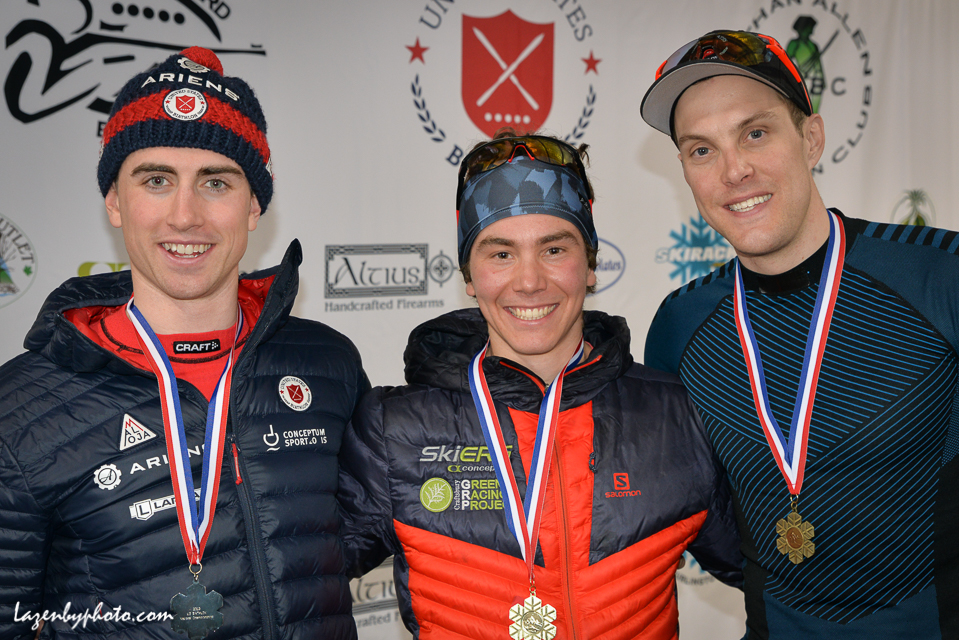
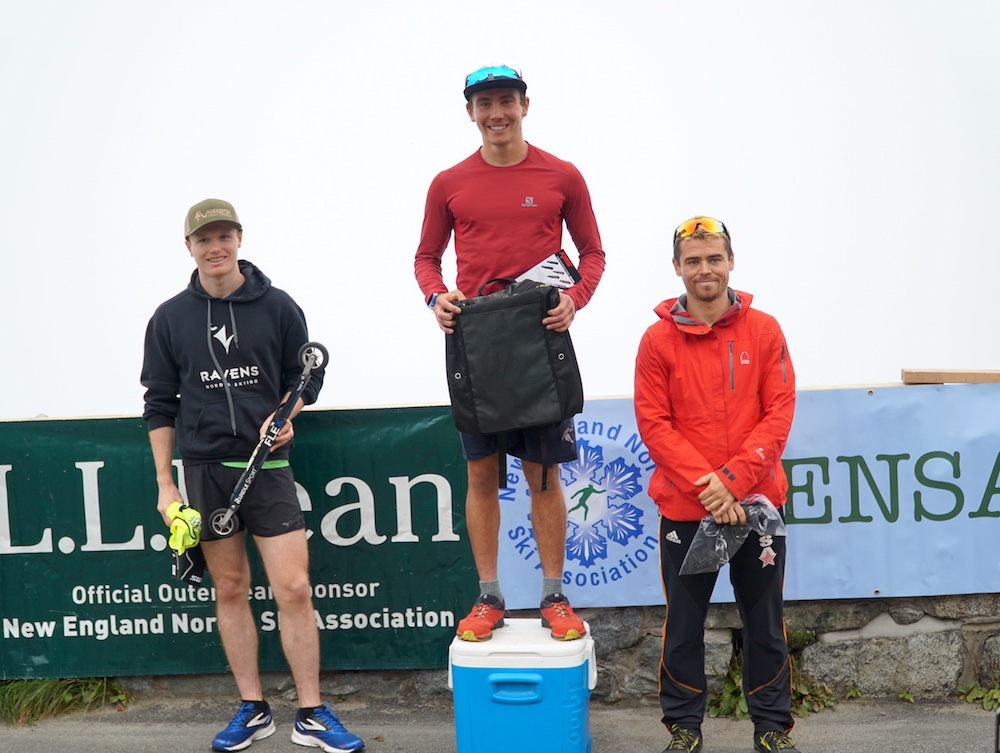
The podium from Friday’s USBA National Championship 10 k sprint (l-r): Sean Doherty in second, Jake Brown in first, and Leif Nordgren third. (Photo: John Lazenby/lazenbyphoto.com)
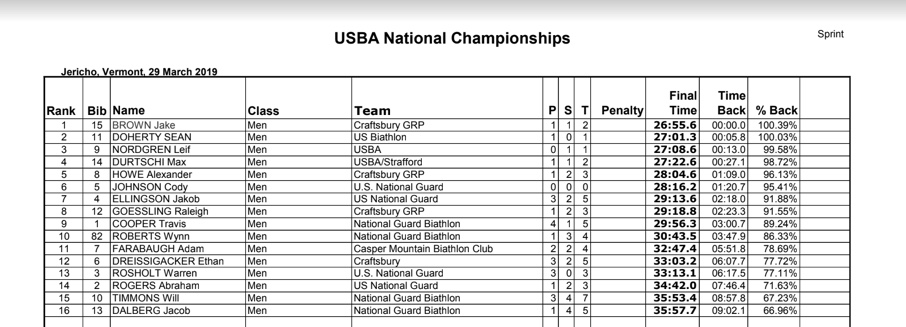
The men’s 10 k sprint was won by Jake Brown (CGRP) in a time of 26:55.6. Brown missed one shot in both prone and standing. Sean Doherty (USBA) placed second (+5.8, 1+0), Leif Nordgren (USBA) third (+13.0, 0+1).
Men’s results.
The men race a 12.5 k pursuit on Saturday, the women race a 10k pursuit.
Click images below to enlarge.
Leif Nordgren during Friday’s 2019 USBA National Championship 10 k sprint. (Photo: John Lazenby/lazenbyphoto.com)
Jake Brown during Friday’s 2019 USBA National Championship 10 k sprint. (Photo: John Lazenby/lazenbyphoto.com)
Sean Doherty during Friday’s 2019 USBA National Championship 10 k sprint. (Photo: John Lazenby/lazenbyphoto.com)
Kelsey Dickinson during Friday’s 2019 USBA National Championship 10 k sprint. (Photo: John Lazenby/lazenbyphoto.com)
Susan Dunklee during Friday’s 2019 USBA National Championship 7.5 k sprint. (Photo: John Lazenby/lazenbyphoto.com)
Clare Egan during Friday’s 2019 USBA National Championship 7.5 k sprint. (Photo: John Lazenby/lazenbyphoto.com)
Norway’s Therese Johaug with the Holmenkollen 30 k classic win and no challengers in site. (Photo: ARD screenshot)
FIS World Cup Oslo, Norway Holmenkollen 30 k Classic
Beautiful sunshine. Norwegian crowds. And fine views of Oslo fjord from atop the Holmenkollen venue for the women’s 30-kilometer mass start classic. All things typical on a good weather March day in Oslo.
Norway’s Therese Johuag took this fine day and turned the screws on the 47 starters on Sunday to once again ski away from the field. By the second points bonus at 8k, Johaug was already 23.6 seconds up on the field. She won the race in 1:18:54.5 hours. According to the International Ski Federation (FIS), this was Johaug’s third 30 k win at Holmenkollen and her second classical victory. She won the 30 k skate in 2013. Her first Oslo 30 k classic win came in 2016.
Russia’s Natalia Nepryaeva placed second 1:45.9 minutes back. Ebba Andersson of Sweden skied to third (+149.9).
Rosie Brennan (APU) was the top U.S. skier in 33rd (+ 7:57.0). Rosie Frankowski (APU) placed 34th (+9:40.2), and Kaitlynn Miller (CGRP) 42nd (+13:43.7).
Jessica Yeaton (APU/Australian National Team) raced to 30th (+7:29.4).
IBU World Championships Östersund, Sweden 10 k/12.5k Pursuit
On Saturday’s 10 k pursuit at the IBU World Champs in Östersund, Sweden the German women took first and third. Denise Herrmann won in 31:45.9 minutes with two penalties in her third shooting stage. Tiril Eckhoff of Norwayplaced second, 31.4 seconds back while also skiing two penalties in her third shooting stage. Germany’s Laura Dahlmeier was a close third (0+0+1+0, +31.6).
Clare Egan of the U.S. was 12th (2+0+0+3, +2:44.3), Susan Dunklee raced to 24th (2+0+0+1, +3:27.6), and Joanne Reid 32nd (3+2+1+0, +4:24.2).
For Canada, Sarah Beaudry finished 42nd (2+1+1+0, +5:23.5), while Rosanna Crawford, Emma Lunder, and Megan Bankes were lapped.
In Östersund on Sunday, the men raced the 12.5 k pursuit. Ukraine’s Dmytro Pidruchnyi, who placed fourth in yesterday’s sprint, came away with the win in 31:54.1. Remarkably, it was Pidruchnyi’s first race win either on the IBU World Cup or at the championship level. The 27 year old missed two targets for the day.
Johannes Thingnes Bø of Norway, the biathlete who has dominated the men’s side this season, placed second (+8.3). Bø’s ski speed was such that he took silver despite missing five targets he won the Silver medal. Taking third (+17.7) was France’s Quentin Fillon Maillet. He missed three targets in earning bronze.
For the U.S., Sean Doherty raced to 20th (+1:54.3) while missing two targets. Leif Nordgren placed 44th (0+0+3+1, +4:02.7), and Jake Brown 53rd (1+1+4+1, +6:00.8).
Canada’s Scott Gow began in bib 50, and skied up to finish 43rd (2+0+0+2, +3:51.4).
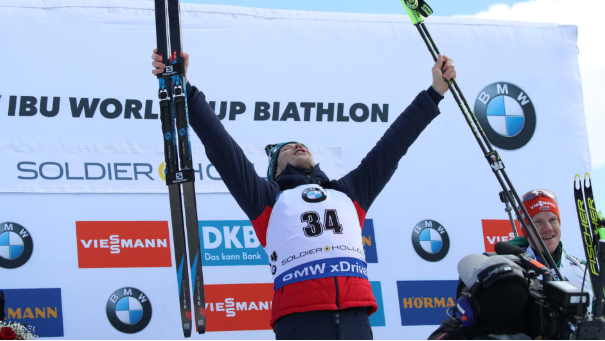
It was a career first IBU World Cup win for Norway’s Vetle Sjåstad Christiansen in the men’s 10 k sprint on Friday at Utah’s, Soldier Hollow. (Photo: biathlonworld.com screenshot)
IBU World Cup Soldier Hollow Men’s 10 k Sprint
It was a career first IBU World Cup win for Norway’s Vetle Sjåstad Christiansen in the men’s 10 k sprint on Friday. Christiansenwon in a time of 23:39.7 minutes while shooting clean for the day. France’s Simon Desthieux earned his first World Cup podium of the year as he marked a time only 1.3 seconds behind Christiansen while accruing one penalty after missing a target during his prone stage. The third podium spot went to Germany’s Roman Rees who missed one target standing and finished 22.4 seconds behind.
For the North American men, several athletes marked top-20 results.
U.S. biathlete Sean Doherty placed 14th (+1:03.6, 1+0). Canada’s Scott Gow finished 17th (+1:13.8, 1+0), and Aidan Millar 20th (+1:20.7) while cleaning both his shooting rounds. According to the IBU, this is Millar’s career best World Cup result.
Also for the U.S., Alex Howe finished 81st (+3:51.4, 3+2), and Jake Brown 85th (+4:17.8, 2+5).
Christian Gow for Canada placed 44th (1:59.7, 0+3), Jules Burnotte 64th (+2:52.6, 1+3).
Eighty-six athletes finished Friday’s sprint.
In the season long overall results news, Norway’s Johannes Thingnes Bø, by placing fourth today (+41.5, 0+4), captured the IBU World Cup sprint globe. It is Bø’s first “unshared” globe. Last season he tied with France’s Martin Fourcade for the individual title.
Of the four Russian athletes starting the 15-kilometer classic mass start in Lahti, Finland three placed in the top four. Anna Zherebyateva won in 40:31.4 minutes as she was able to stretch her nine-second gap at 10 k to 23.5 seconds by the finish. Also from Russia, Lidia Durkina placed second (+23.5), Germany’s Katharina Hennig skied to third (+37.5).
“My tactic was to make a gap in the second loop,” Zherebyateva said during the post-race press conference. “So I did exactly what I wanted. It went really well. Tracks were exactly right for me. This gold medal is an important step for my sport career.”
Yana Kirpichenko was the third Russia in the top-five as she placed fourth (+41.6).
The best North American finisher was U.S. skier Hailey Swirbul who raced to 10th (+1:27.8). Swirbul was positioned 29th at the 5 k time check but steadily moved up in the field as the race progressed. By 10 k she had positioned herself in the top-15.
For the twenty-year-old Swirbul, this is her first go at U23 Worlds after participating in three Junior Worlds as an U20. Last season in Goms, Switzerland she placed second in the 5 k classic and third in the 10 k skiathlon.
Two other U.S. skiers raced into the top-30. Julia Kern placed 16th (+1:43.4), while Alayna Sonnesyn was 23rd (+2:24.9). Hannah Halvorsen, the fourth U.S. starter, placed 54th (+6:58.6).
Hannah Mehain was the top Canadian in 31st (+3:16.8), Sadie White placed 33rd (+3:18.6), and Natalia Hynes 51st (+3:40.9). Marie Corriveau did not start.
Similar to the U23 women’s race, Russian skiers dictated the pacing at the front of the pack — the four Russian starters swept first through fourth place.
Andrey Sobakarev won in 1:17:19.1 hours, Ivan Kirillov placed second (+3.5), Ivan Yakimushkin third (+4.9), and Anton Timashov fourth (+11.4).
Canada’s Antoine Cyr was the top North American in 27th (+2:26.8), while teammate Gareth Williams toed the line a fraction behind in 28th (+2:26.9). Also for Canada, Ritchie Graham was 41st (4:44.1), and Julian Smith 45th (+5:14.3).
Peter Holmes was the top U.S. finisher in 33rd (+3:15.7). Hunter Wonders placed 40th (+4:43.0), Braden Becker 53rd (+6:59.0), and Daniel Streinz 66th (+15:53.9).
Johannes Thingnes Bø scored his 10th IBU World Cup win of the season today in the 10 k sprint in Antholz, Italy. (Photo: biathlon world.com screenshot)
IBU World Cup Antholz, Italy 10 k sprint
In the groove is in the groove. Norway’s twenty-five-year-old Johannes Thingnes Bø scored his 10th IBU World Cup win of the season today in the 10 k sprint in Antholz, Italy. Bø won the race in 23:53.9 minutes with a single penalty in standing. The Norwegian leads the IBU World Cup overall and padded his lead with his fifth sprint win this year.
“It was quite difficult; the altitude here is quite heavy and with the new tracks, I felt dead from 5K so the last 5K was really tough,” Bø said to the IBU after the race. “I managed to have a good plan for the race. When I shoot nine targets, I was quite happy and then it was just to fight hard for the finish line. I like this year’s track; I liked last year’s too because it was not so painful.”
Bø’s season thus far has been a study in speedy skiing. His shooting stands at 87% for accuracy (82% standing, 91% prone) with his superior skiing speed carrying him to the World Cup overall lead. In Antholz today, his course time for each of his two 5 k laps were ranked first.
Norwegian teammate Erlend Bjøntegaard shot clean in both his shooting bouts to take second place, 17.5 seconds behind. France’s Antonin Guigonnat placed third (+20.2, 0+1).
Scott Gow of Canada was the top North American in 20th (+1:06.6, 0+0). Teammates Jules Burnotte raced to 48th (1:55.9, 1+1), Christian Gow 61st (+2:13.4), and Aidan Millar (+3:46.7, 2+2).
Jake Brown was the top American in 40th (1:42.4, 1+0). Sean Doherty finished in 55th (+2:06.2, 2+1), Max Durtschi 62nd (+2:13.8, 0+1), and Leif Nordgren 73rd (+2:43.1).
Racing continues tomorrow in Antholz for both the men and women with the 12.5k and 10 k pursuits.
Lake Placid SuperTour 5 k/10k Skate Individual Start
In the 5 k-freestyle individual start Jessica Yeaton (APU/Australian National Team) placed first with a winning time of 15:01.9 minutes. She was in a tight race for the top spot with U.S. Ski Team/SMS T2 athlete Sophie Caldwell who finished 3.0 seconds back. Caldwell is back home in Vermont training and preparing for the 2019 World Championships.
Katherine Ogden (Dartmouth Ski Team) placed third in a time of 15:17.8. Kelsey Phinney (SMS T2) placed fourth in 15:37.7.
“Today’s race went super well for me; I had awesome skis despite tricky conditions/weather leading into the race – our wax tech did a phenomenal job,” Yeaton wrote to FasterSkier. “The course here is really good for me with all the steady climbing in the first part- I just tried to push hard to the top of the course and then survive and carry my speed on the downhill, which turned out to be a good tactic.
“Between US Nationals and now I definitely feel like I am in a good place leading into Seefeld. I struggled with some injuries in the fall and was forced to do a lot of cross-training (especially on the bike) and skip the early season races in Nov/Dec. In retrospect I think this actually was a blessing in disguise, as I ended up putting in a super hard training block and gaining a lot of fitness. Looking ahead to Seefeld, my goal is to top 30 in one of the races, with my main focus being on the skate events (30k and sprint), and the 15km skiathlon. I am really excited for the rest of the races this weekend; they are my final prep before heading over to Europe to race on World Cup and in Seefeld.”
Kyle Bratrud (SMS T2) won the men’s 15 k skate in 25:27.1 minutes. Bratrud, who was recently selected to the 2019 U.S. World Championship Team, has been a top-performing distance skier this season on the SuperTour.
“Today went well,” Bratrud emailed. “After Nationals, I made the tough decision of turning down World Cup starts in Otepaa and Ulricehamn in order to get some quality training in for the World Champs. Today reflected that as I felt a little tired and pretty flat from not racing since Nationals. That being said, I expect to keep feeling better each race and I should be in a great place when I fly to Europe on the 4th!”
Bratrud recently won the NorAm/SuperTour 15 k classic in Sovereign Lake and the 15 k classic at U.S. Nationals. Bratrud placed second in West Yellowstone’s SuperTour 15 k skate, and the 30 k skate mass start at U.S. Nationals.
Akeo Maifeld-Carucci (CGRP) placed second in a time of 26:18.9. It was Carucci’s second SuperTour podium of the season and his best career SuperTour result. In West Yellowstone, he was third in the 15 k skate behind Ben Lustgarten (CGRP) and Bratrud.
Alexis Dumas (CNEPH) of Canada was third in 26:32.2. U.S. skier Adam Martin was fourth, 3.1 seconds behind Dumas.
The men’s 4 x 7.5 k relay in Ruhpolding, Germany. (Photo: screenshot biathlonworld.com)
IBU World Cup Ruhpolding, Germany 4 x 7.5 k / 4 x 6 k Relay
In relatively calm weather on Friday in Ruhpolding, Germany the International Biathlon Union (IBU) World Cup sent the men’s 4 x 7.5-kilometer relay on its way. Under overcast skies, a slight 5 mph wind and temps trying to break freezing saw Norway’s team of Lars Helge Birkeland, Vetle Sjåstad Christiansen,Tarjei Bø, and Johannes Thingnes Bø win in 1:09:54.3 hours. The Norwegian foursome raced to the top podium spot with no penalties and using eight spares.
The move that grasped the race for Norway came when Johannes Thingnes Bø, on the final leg, threw down a speedy attack on the course’s burliest hill making him the carrot the others would be chasing towards the finish line. In less than a kilometer, Bø put in the almost 14 second gap back to Germany
Germany’s Rees Roman, Johannes Kuehn, Arnd Peiffer, and Doll Benedikt placed second 13.5 seconds behind Norway. Rees shot clean for Germany as did Peiffer – in total the German team shot with no penalties and used six spares.
The final podium spot went to France’s Emilien Jacquelin, Martin Fourcade, Quentin Fillon Maillet, and Simon Desthieux. France finished 26.2 seconds back while skiing no penalties and using nine spares.
Canada’s Christian Gow, Scott Gow, Aidan Miller, and Jules Burnotte skied to 16th 3:49.0 minutes behind Norway. In total, the Canadians skied one penalty and used 16 spares.
The U.S. team of Leif Nordgren, Sean Doherty, Jake Brown, and Max Durtschi raced to 17th, stopping the clock 4:01.2 after Norway. Over the duration of their four legs, the U.S. skied a single penalty lap while using 13 spares.
Twenty seven teams were entered in the men’s race.
The Canadian selection races for senior World Championships combined with a NorAm and Québec Cup weekend hosted by the Mont Orford club, began with freestyle sprints today.
Maya MacIsaac-Jones (CNST) won the qualifier and all her heats on the way to winning the A final, leaving no doubt about her selection for Seefeld. MacIsaac-Jones’ 2:36.83 minute A final was the fastest lap of the day, just edging 4th fastest qualifier Katherine Stewart-Jones (CNST) by 0.05 seconds. Laura Leclair (CNEPH) was third at 3.77 seconds after qualifying second. Third-place qualifier Cendrine Browne (CNST) was fourth, 4.99 seconds back, with Zoë Williams (Nakkertok) fifth (+5.18) and U.S. skier Madison Morgan sixth (+8.92.)
On the men’s side, Evan Palmer-Charrette (Team R.A.D.) won the A final in 3:06.58 minutes, 0.11 seconds ahead of Julien Locke (CNST). Top qualifier Russell Kennedy (Team R.A.D.) was third, 2.26 behind Palmer-Charrette and 0.24 seconds ahead of Sebastien Boehmler-Dandurand (AWCA). Antoine Briand (Skibec) finished sixth (+5.12), followed by Dominique Moncion-Groulx (Nakkertok) in sixth (+5.93).
Racing continues for two more days with an interval start classic on Saturday and mass start skate on Sunday. The top Canadian each day qualifies for World Championships.
The brothers Bø. Norway’s Johannes Thingnes Bø (right) of Norway with the sprint in Ruhpolding, Germany. His brother Tarjei (left) placed second. (Photo: biathlonworld.com screen capture)
IBU World Cup Biathlon Ruhpolding, Germany 10 k / 7.5 k sprint
Cutting to the chase: it has been dumping in certain regions of the alps. Ruhpolding, Germany, site of this week’s International Biathlon Union (IBU) World Cup’s has been no exception.
The men’s 10-kilometer sprint that went off today under clear skies had been postponed, it was scheduled to run Wednesday. Race officials postponed the race due to a weather related (read heavy snowfall) state of emergency in the district of Traunstein, where Ruhpolding is located.
With a bit more rest in their legs, Norway’s Bø went one and two in the results.
The younger of the brothers, twenty-five-year-old Johannes Thingnes Bø won in a time of 22:56.3 minutes after skiing a single penalty lap. Johannes Bø cleaned his prone stage, while missing one target while standing.
The elder Bø, thirty-year-old Tarjei Bø placed second (+7.9) after cleaning both shooting stages. It was Tarjei’s second individual podium of the season. Benedikt Doll of Germany was third (+10.5), with one penalty while standing. France’s perennial biathlon star Martin Fourcade was fourth (+15.9) with no penalties.
Sean Doherty of the U.S. was the best placed North American in 23rd (+1:10.2, 1+0). As of late, Doherty has been racing consistently in the top-30.
Also for the U.S., Jake Brown shot clean to finish 47th, 1:40.8 minutes back. Leif Nordgren placed 50th (+1:45.3, 0+0), and Max Durtschi 103rd (+3:29.0, 2+2).
Canada’s Scott Gow skied to 42nd (+1:36.0, 0+1). His brother Christian Gow placed 56th (+1:52.7, 0+1), Jules Burnotte skied and shot to 67th (+2:01.5, 1+0), and Aidan Millar 102nd (+3:26.4).
Friday’s racing in Ruhpolding will feature a 4 x 7.5 k and 4 x 6 k relays for the men and women respectively.
Anatasiya Kuzmina won the women’s 7.5 k sprint on Thursday in a time of 19:15.1 minutes. It was Kuzmina’s second win of the 2018/2019 IBU World Cup season. Kuzmina’s day was made a bit easier as she cleaned both her prone and standing shooting stages.
Italy’s Lisa Vittozzi placed second 11.5 seconds behind Kuzmina. Vittozzi also shot clean. In third place was Sweden’s clean shooting HannahÖberg. She finished 29.1 seconds back.
Susan Dunklee for the U.S. placed 20th overall, 1:11.3 minutes behind with a single penalty. Teammate Clare Egan, placed 35th (+1.44.6, 2+0). Also for the U.S., Joanne Reid finished two places back in 37th (+1:45.2, 1+0).
Rosanna Crawford was the top Canadian in 27th. She skied a single penalty loop to cross the finish line 1:32.3 minutes behind. Megan Bankes placed 68th (+2:32.7, 1+1), Emma Lunder 88th (+3:17.9, 3+2), and Sarah Beaudry 96th (+3:40.3, 1+3).
Johannes Thingnes Bø of Norway after winning the 2018 men’s 10 k sprint in Nove Mesto, Czech Republic. It was the Norwegian’s third sprint win of the season and his fourth win overall this year. He leads the IBU World Cup. (Photo: biathlonworld.com)
IBU World Cup Nové Město, Czech Republic Men’s 10 k Sprint
On Thursday in Nové Město, Johannes Thingnes Bø of Norway captured his third sprint victory of the early IBU World Cup season. Shooting clean, Bø won in a time of 23:09.9 minutes. It was Bø’s fourth win of the year. Alexander Loginov of Russia, in what was his best career result on the World Cup, placed second (+21.0) while shooting clean. In third place was Sweden’s Martin Ponsiluoma. The Swede also missed no targets while posting a career best for his first podium on the World Cup.
With several races left in Nove Mesto, Bø leads the men’s World Cup after six events with 308 points. Loginov sits in second with 232 points.
Christian Gow of Canada was the best placed North American as he tied for 20th (+1:31.8, 0+0). Also for Canada, Jules Burnotte placed 33rd (+1:57.8,0+1), Scott Gow 38th (+2:04.7,1+1), and Brendan Green 67th (+2:43.0, 1+1).
Leif Nordgren was the best American finisher in 40th (+2:07.6, 1+0). Sean Doherty placed 51st (+2:23.8, 2+0), Travis Cooper 56th (+2:28.8, 0+1), and Jake Brown 78th (+3:13.7, 1+1).
Racing continues tomorrow for the women with the 7.5 k sprint, and the men on Saturday with a 12.5 k pursuit.
For the women, Susan Dunklee, Clare Egan, and Joanne Reid all pre-qualified based on last season’s results. Emily Dreissigacker was named to the team on Monday. The women’s World Cup team has three start spots per race in Pokljuka. According to Monday’s announcement, coaches will determine which athletes get specific starts at a later date.
After the Pokljuka races, only three U.S. women will travel to Nove Mesto, Czech Republic, the host of this season’s second IBU World Cup .
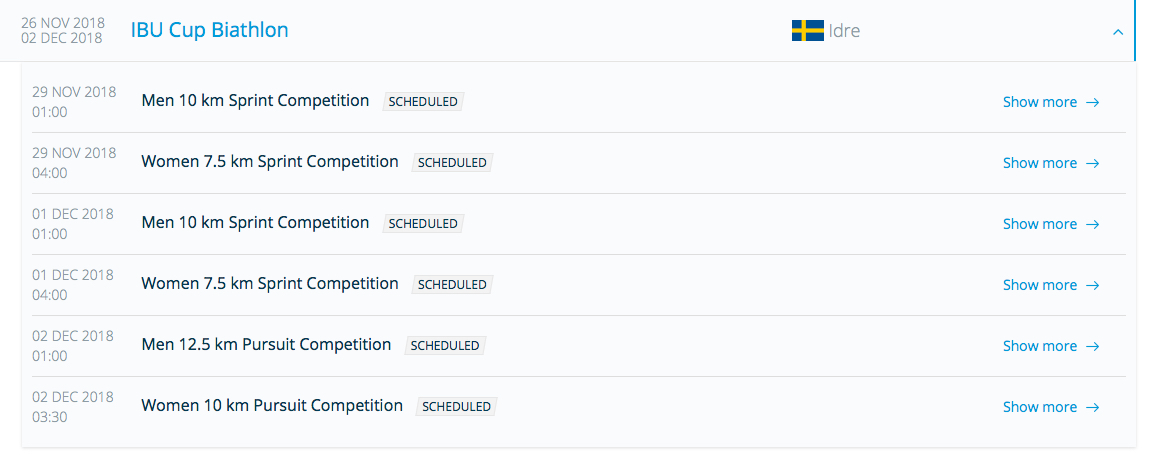
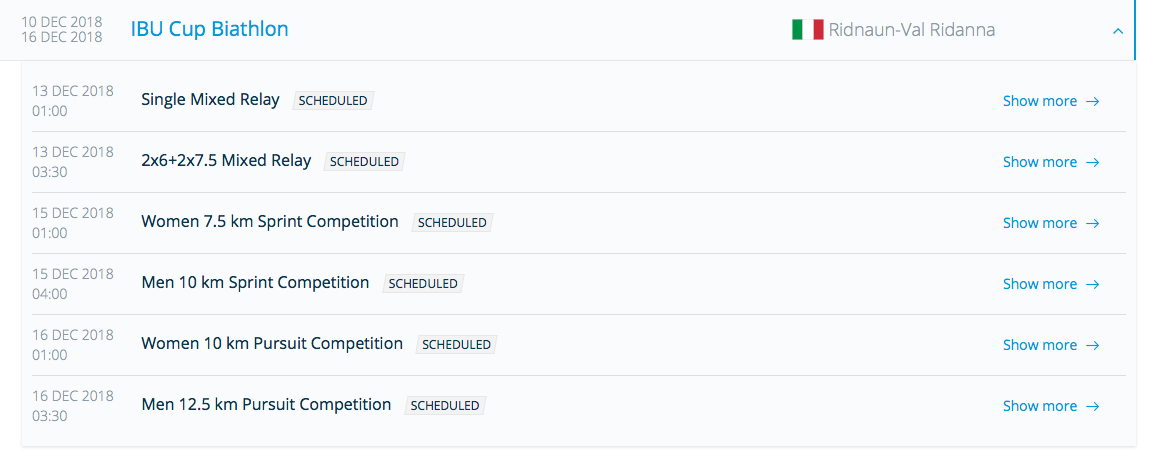
The fourth biathlete will head to Ridnaun-Val Ridanna, Italy to race the second weekend of IBU Cup on Dec. 10-16. (The IBU Cup’s first weekend of racing will take place in Idre, Sweden on Nov. 26-Dec. 2).
Leif Nordgren and Sean Doherty both pre-qualified for the men’s opening World Cup races. The men’s side has four start spots in Pokljuka. Along with Nordgren and Doherty, Paul Schommer and Travis Cooper have been named to the first World Cup team roster.
Cooper’s path to Pokljuka will include a stop at the IBU Cup races in Idre. According to U.S. Biathlon, Cooper must first race in Sweden in order to earn his qualification for the IBU World Cup. Max Durtschi will travel to Pokljuka as a reserve athlete.
IBU Cup Teams
The SoHo and Jericho rollerski trials also served as a springboard to the second series of IBU Cups in Ridnaun-Val Ridanna, Italy. Hallie Grossman, Deedra Irwin, and Kelsey Dickinson were named as U.S. athletes for those races. They will be joined by one member of the women’s IBU World Cup team racing in Pokljuka.
The men also have four start spots at the second IBU Cup. Durtschi, Alex Howe, Jake Brown, and Vasek Cervenka have been named to the team for the Ridnaun-Val Ridanna, Italy competitions.
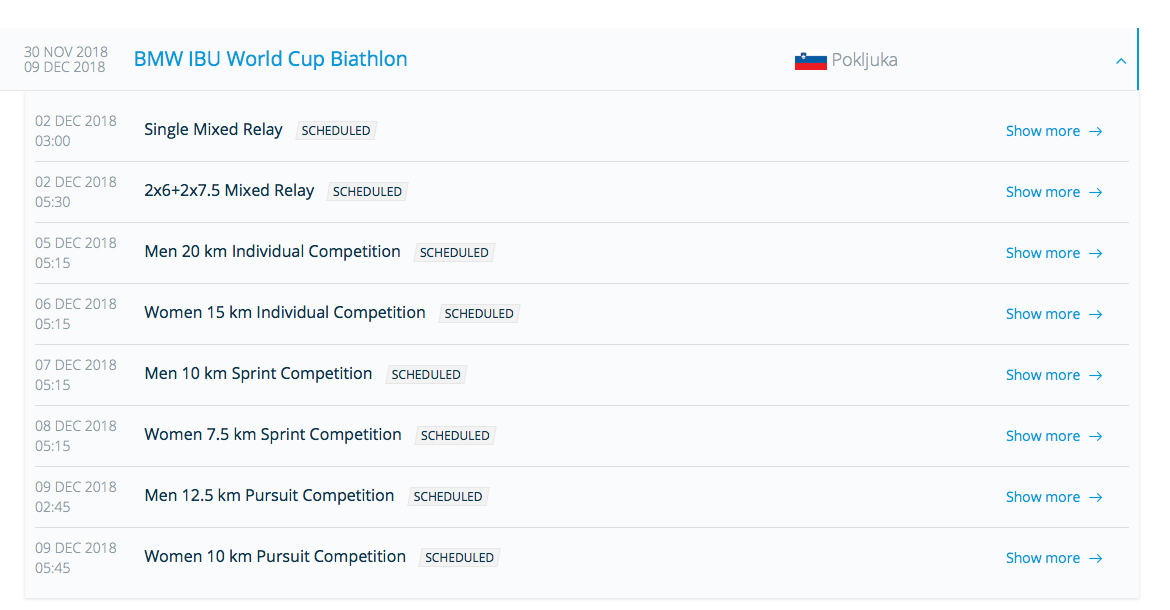
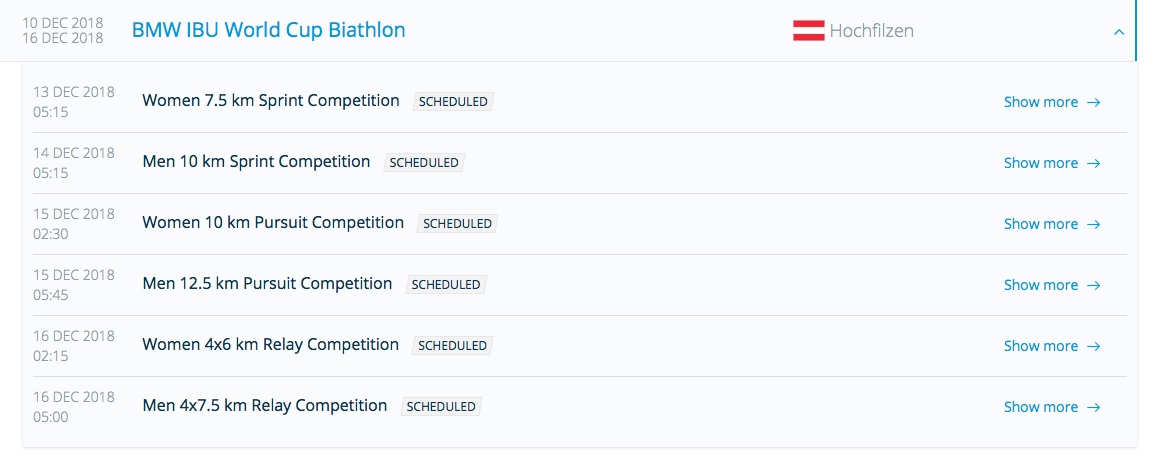
Below is the schedule for the first two IBU World Cup and IBU Cup races.
Schedule for the first IBU World Cup in Pokljuka, Slovenia.
Schedule for the second IBU World Cup in Nove Mesto, Czech Republic.
Schedule for IBU Cup #1 in Idre, Sweden.
Schedule for IBU Cup #2 in Ridnaun-Val Ridanna, Italy.
Jake Brown (Craftsbury Green Racing Project/US Biathlon) racing to a sizable win at the 2018 Climb to the Castle on Saturday, Sept. 15 in Wilmington, N.Y. (Photo: Heloise Rolland)
On a humid fall Sunday in northern New York where temperatures reached an uncharacteristic 80 degrees, Jake Brown of the Craftsbury Green Racing Project and US Biathlon Development Team and Tara Geraghty-Moats of USA Nordic won the 2018 Climb to the Castle.
Brown’s time was 35:40.7, while Geraghty-Moats finished in 45:03.
Big Gaps and Clear Wins
On the men’s side, Brown’s Craftsbury teammate Raleigh Goessling finished second in 38:16.6, and Erikson Moore of the Fondeurs-Laurentides team in Quebec was third in 39:00.3.
Among women, Jackie Garso of Saint Lawrence University was second, in 49:24.1, and Nakkertok’s Zoe Williams third in 49:40.6.
This year was a high water mark for attendance, with 102 athletes finishing.
The overall women’s podium at the 2018 Climb to the Castle at the top of Whiteface on Sept. 15 in Wilmington, N.Y., with winner Tara Geraghty-Moats (c) of USA Nordic, Jackie Garso (l) of St. Lawrence University in second, and Zoe Williams (r) of Nakkertok in third. (Photo: Colin Delaney)
While a few degrees cooler than last year, dank humidity settled like a blanket over the five-mile climb, with athletes moving through a couple of patches of dense fog on the higher reaches of the mountain.
“It was a hard one today,” Brown said following the race. “Last year, I felt like I went a little too hard off the line, and kind of buried myself early. So I wanted to be a little more conservative and finish strong today. I tried doing that and it felt a lot better, and I skied a little faster. I was on different rollerskis, so it’s hard to be able to compare it to last year. I was happy with my effort and it was a good push today.”
This year was Brown’s second consecutive win, and he beat his 2017 time of 39:01.9.
“It’s always a tough race, but I’m happy with how my summer training has paid off,” Geraghty-Moats said. “I felt strong and I had a good race.”
Asked if the race was part of her training plan, she replied, “I just finished competing in the Ski Jumping Grand Prix in Russia, so I’m still pretty jet-lagged. I love this race, NYSEF puts a lot of energy into putting it on every year, so I figured I’d make the trip over. It’s really fun and I enjoy racing with a good crew.”
A ski jumper winning a cross-country ski competition? For those not in the know, Geraghty-Moats is one of the pioneers of the developing women’s nordic combined.
The overall men’s podium at the 2018 Climb to the Castle at the top of Whiteface on Sept. 15 in Wilmington, N.Y., with winner Jake Brown (c) of the Craftsbury Green Racing Project (CGRP)/USBA Development Team in first, Raleigh Goessling (r) of the CGRP in second, and Erikson Moore (l) of Fondeurs-Laurentides in third. (Photo: Colin Delaney)
“I’m on the women’s ski jumping team and I’ve been to a World Championship in 2015 and on the World Cup team for the past 4 years,” she explained. “Before that, I was a biathlete, so nordic combined was sort of a natural step for me. FIS has put in a lot of resources to developing women’s nordic combined. This year, they’ll have a Continental Cup circuit; next year, there’ll be a World Cup circuit; and the following year after that, there’ll be a World Championship. I’m starting to learn how to compete in nordic combined and I’m really enjoying it.”
Zoe Williams, along about 60 other athletes, had participated in the previous day’s Doubleday events at the Intervale Ski Jump. (for more on the Doubleday, keep reading!)
“I felt a bit tired in my warmup,” Williams said. “By the time I got to the start line and the race started, I didn’t feel as bad as I could have. My legs for sure felt tired in the first kilometer, but after the first k, I started settling into that rhythm and I ended up feeling pretty good for the rest of the race. Climb to the Castle, you just have to find that gear and grind away.”
In 2017 she was fourth overall, five seconds behind biathlete Deedra Irwin.
Meredith Stetter (88) leads her Mansfield Nordic Club teammate Jennifer Wilbraham during a foggy Climb to the Castle rollerski race on Sept. 15 in Wilmington, N.Y. They finished 19th and 20th, respectively. (Photo: Heloise Rolland)
“This year, I ended up leading the group that I was with, which was kind of a fun change,” Williams said. “But the whole time I was thinking ‘what did Deedra do here? We one-skated [V2’ed] here. I can one-skate here!’”
Asked if Climb to the Castle was a good fitness benchmark, Williams said, “Because the next couple of months are where you start getting the really high intensity zone four, this is a really good indicator of the base level fitness that you have, because of the endurance focus of the race. But I’m for sure looking to find my top end gear in the next couple of months.”
Doubleday Takes Off: New Events Added to the Climb to the Castle weekend
On Saturday, the New England Nordic Ski Association (NENSA) and the New York Ski Education Foundation (NYSEF) collaborated on a new event held on the rollerski loop at the Intervale Ski jumps.
Quincy Massey-Bierman won the junior women’s 3 k prologue. (Photo: Heloise Rolland)
The Lake Placid Doubleday started with a three-kilometer prologue; after a break, there was a 1.5 kilometer sprint time trial. The results of the two races were aggregated to determine winners.
Nicholas Clifford of Carleton University in Ottawa, Ontario, was the open men’s winner, while Nakkertok’s Williams was the open women’s winner before going on to be the runner-up in the Climb to the Castle.
“We’ve had the Climb to the Castle for 11 years, and this year we wanted to expand it to a full weekend,” NYSEF head coach Shane McDowell said. “We started talking with Justin [Beckwith, NENSA Competitive Program Director] ] in the spring and he proposed the idea of trying [NENSA’s] new format of the doubleday, which will be used at the Eastern Cup scheduled for 23 February at the Dublin School.”
“The format came out of discussions this spring,” Beckwith said. “Three kilometers is a national junior relay distance and we were valuing shorter, sprinting efforts in the results because we were usually a little heavy on the distance qualifications for our Junior National team in New England. When partnering with Shane and ORDA [the Olympic Regional Development Authority] to make it a reality, for us to test out the event which has a physiological effect of doing the 3k prologue in the morning and do a prelim in the sprint, the 1.5, would be the timing of a typical quarter final.”
The roller ski loop at Intervale is serpentine and narrow, with fast downhills. In the pre-race meeting, Beckwith admonished the athletes to be conservative as they warmed up. As they warmed up, the rollerskiers gradually became more aggressive in their approach to the course.
Taking a corner on the Intervale Ski Jump loop during Doubleday. (Photo: Heloise Rolland)
The race started and finished at the biathlon range located midway through the long climb from the lowest to the highest sections of the course.
Clifford is the coach of the Carleton University ski team, located in Ottawa, Ontario.
“It was really exciting,” he said. “It was the first time I’ve skied at [Intervale]. I’ve heard a lot about some of the sketchier downhills but it was actually really well done. It was just like ski racing.”
Asked how he planned his races, Clifford said, “Not so much. I’m not a shorter distance guy, so the Climb to the Castle tomorrow is the real show and this was just a bit of a tuneup to get some speed in the legs.”
Of the Doubleday format, the consensus was that it was tough.
“The course here… It’s pretty much straight up and then you go down and come back up,” CSU’s Alex Burt said. “For the 3 k, you do it twice. It’s a lot more brutal. I had to actually pace it. For the1.5 k, my strategy was to go out as hard as I can and just keep it up.”
But it was also fun, many participants agreed.
Racers lined up at the start for a Doubleday competition. (Photo: Heloise Rolland)
“It was fun,” said Williams of the Doubleday. “The course here was super awesome, because it was like actually skiing, whereas a lot of roller ski races are on roads. It’s so twisty and turns up and down, it’s a lot like actually ski racing.”
On getting used to the downhills, Williams said, “It took me through mid warm up, to get used to the corners. In the race itself, I didn’t even think about it. It was super nice. I worried about it in the warmup, because there are some really gnarly corners, but when you’re racing, all your focus is on going fast.”
Amy Duclos of Saint Michael’s College in Burlington VT, was the third overall female finisher at the Doubleday.
“I wasn’t really sure about the course going into it, because of the turns, the hills, but it was a lot of fun,” she said. “I thought today was a good warmup to get the legs moving for tomorrow. It’s definitely a different type of race.”
Laura Appleby, of Cambridge Sports Union (CSU), won the junior women’s division at Doubleday and was the fifth junior woman finisher at Climb to the Castle.
“They went really well,” she said of the Doubleday races. “It was super fun. I liked the downhills… The first race was a little bit longer, so I was definitely pacing it a little bit slower. But generally just go out and ski the course, ski the transitions.”
Shilo Rousseau, Chandra Rousseau, and Zoe Pekos, all of Barrie [Ontario] Cross-Country, sat for an interview in a downtown Lake Placid coffee shop following the Doubleday.
“It was a little scary at first with the safety meeting,” said Shilo, who finished third junior woman both at the Doubleday and C2C. “After skiing the lap a few times, you realize it’s not that bad. As you go on, your laps get faster. You really have commit on roller skis.”
Did she save energy for the C2C?
“Full send every day,” Shilo replied. “I’m not leaving anything in the tank.”
Chandra Rousseau said, “The last downhill was bad. The prologue wasn’t as good as I wanted it to be. I probably could have pushed a little harder on the downhills. On the sprint, I was more used to the course.”
Recovering in a bench outside the Castle, a reporter asked the Rousseaus and Pekos, so, did you go full send?
Emily Dreissigacker tags off to Joanne Reid in the women’s World Cup biathlon relay in Ruhpolding, Germany. Both women are on the roster for the U.S. for the next year of international biathlon. (Photo: USBA/NordicFocus)
For the first time in years, the roster features more women than men. Following the retirements of Lowell Bailey, Russell Currier, and Tim Burke, Alex Howe (Craftsbury Green Racing Project) netted his first senior national team nomination, and joins 2018 Olympians Sean Doherty and Leif Nordgren, as well as Paul Schommer (Moose Nordic).
On the women’s team, all five members of the 2018 Olympic team have been renamed: Susan Dunklee, Clare Egan, and Emily Dreissigacker (all Craftsbury Green Racing Project), Joanne Reid (Colorado Biathlon), and Maddie Phaneuf (Polar Bear Ski Club). Dunklee and Egan recently said that they were not certain yet about retirement, but appear on the roster. The newest addition to the women’s senior team is Chloe Levins, who finished all three individual races at 2018 World Junior Championships in the top seven.
The “A” team athletes will be primarily based in Lake Placid, New York, while designated “B” team athletes (Phaneuf, Schommer, and Howe) will be based at regional training centers or with clubs, according to national team selection documents.
The federation has also named a development squad of Deedra Irwin (Wisconsin Biathlon), Travis Cooper and Jake Ellingson (National Guard Biathlon), Jake Brown (Loppet Nordic Racing), and Max Durtschi. All saw international race starts last season.
In addition, an 11-member Junior Development Group has been named, many of whom we interviewed this winter – see the links below to read about their experiences at World Youth and Junior Championships.
High Performance Team – Women
Susan Dunklee (Barton, Vt./Craftsbury Green Racing Project), A1 Team Clare Egan (Cape Elizabeth, Maine/Craftsbury Green Racing Project), A2 Team Chloe Levins (Rutland, Vt.), A3 Team Joanne Reid (Boulder, Colo./Colorado Biathlon), A3 Team Emily Dreissigacker (Morrisville, Vt./Craftsbury Green Racing Project), A3 Team Maddie Phaneuf (Old Forge, N.Y./Polar Bear Ski Club), B Team
High Performance Team – Men
Sean Doherty (Center Conway, N.H.), A1 Team Leif Nordgren (Marine, Minn.), A3 Team Paul Schommer (Appleton, Wisc./Moose Nordic), B Team Alex Howe (Gilford, N.H./Craftsbury Green Racing Project), B Team
Development Team – Senior Women
Deedra Irwin (Pulaski, Wisc./Wisconsin Biathlon)
Development Team – Senior Men
Travis Cooper (Kenai, Alaska/National Guard Biathlon) Max Durtschi (Sun Valley, Idaho) Jake Brown (Houghton, Mich./Loppet Nordic Racing) Jakob Ellingson (Minnetonka, Minn./National Guard Biathlon)
Youth and Junior Development Group – Women
Helen Wilson (Eagle River, Alaska/Alaska Biathlon Club) – 20-for-20 interview Lexie Madigan (Truckee, Calif./Auburn Ski Club) – 20-for-20 interview Emma Stertz (Grand Rapids, Minn./Mt. Itasca Biathlon) – 20-for-20 interview Grace Gilliland (Eagle River, Alaska/Alaska Biathlon Club) – 2017 20-for-20 interview Sarah Beaulieu (Fort Fairfield, Maine/Outdoor Sports Institute) Arianna Woods (Bozeman, Mont./Bridger Biathlon Club)
Youth and Junior Development Group – Men
Vasek Cervenka (Grand Rapids, Minn./Mt. Itasca Biathlon) – 2017 20-for-20 interview Garrett Beckrich (Grand Rapids, Minn./Mt. Itasca Biathlon) – 20-for-20 interview Tim Cunningham (Springfield, N.H./Saint Lawrence University) – 20-for-20 interview Eli Nielsen (Stehekin, Wash./Methow Valley) – 20-for-20 interview Marcus Gore (Vail, Colo./Casper Mountain Biathlon Club)
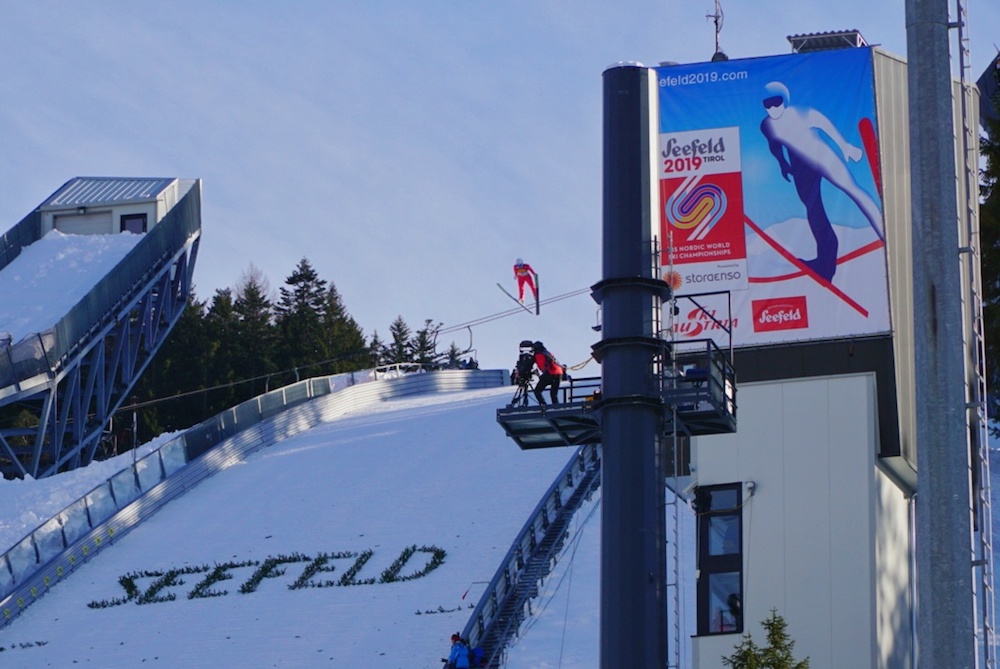
The jumping portion of the Nordic Combined World Cup Seefeld Triple on Friday in Seefeld, Austria. (Photo: Garrott Kuzzy / LumiExperiences.com)
Nordic Combined World Cup (Seefeld, Austria): Individual normal hill/5 k
On the first of the three-day Seefeld Triple Nordic Combined World Cup, Japan’s Akito Watabe took the win and Taylor Fletcher was the top American in 28th in the individual normal hill/5-kilometer Gundersen on Friday.
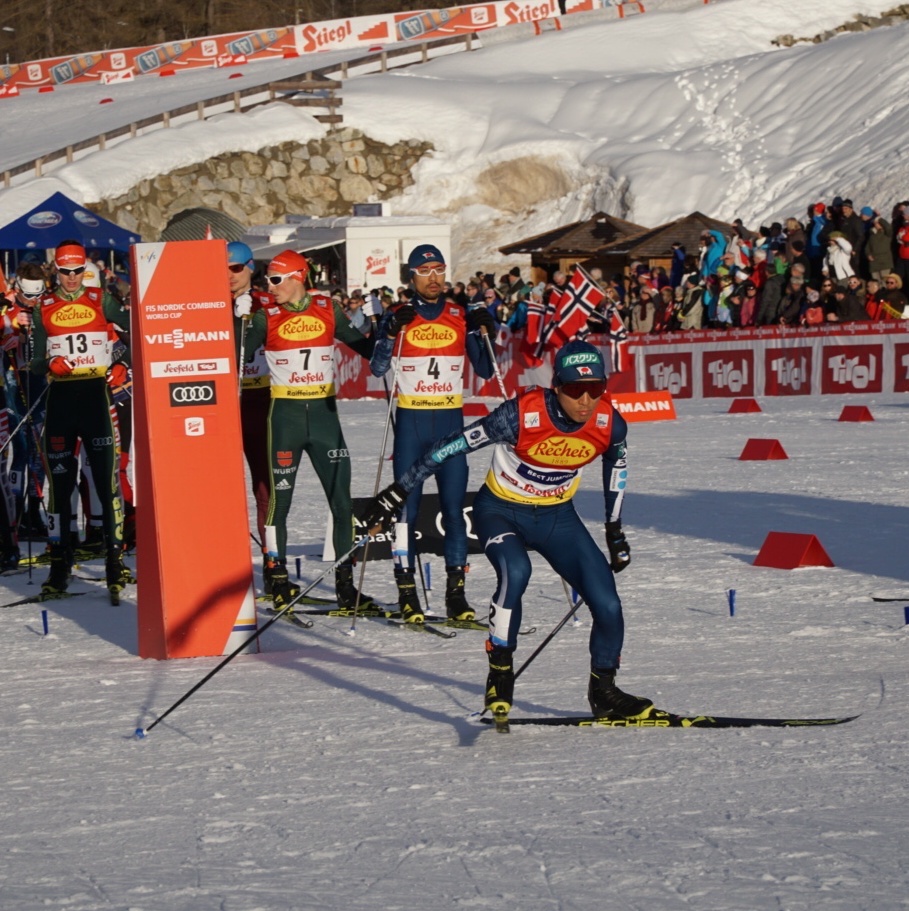
Japan’s Akito Watabe heading out of the gate second in the 5 k Gundersen on Friday at the Seefeld Triple Nordic Combined World Cup in Seefeld, Austria. Watabe went on to win the race by half a second. (Photo: Garrott Kuzzy / LumiExperiences.com)
Watabe put himself in second in the jump portion and started the 5 k ski race 21 seconds behind Norway’s Jarl Magnus Riiber in first. Watabe caught Riiber and beat him at the finish line, taking the win in 11:22.3 minutes, while Riiber followed 0.5 seconds back in second place. Germany’s Fabien Rießle followed in third, 32.4 seconds out of first, after starting the 5 k in sixth and 1:03 minutes back.
Norway’s Jan Schmid jumped to third and ended up fourth (+37.8). Watabe’s brother, Yoshito Watabe placed fifth (+47.2), losing one place in the ski race after jumping to fourth.
Two Americans competed, with Fletcher jumping to 30th and ending the day in 28th, and Jasper Good finishing 52nd (+3:45.6) after jumping to 49th. Both are headed to the 2018 Olympics next month in PyeongChang, South Korea.
Taylor Fletcher (USA Nordic) starting the 5 k Gundersen on Friday at the Seefeld Triple Nordic Combined World Cup in Seefeld, Austria. He started in 30th and finished 28th. (Photo: Garrott Kuzzy / LumiExperiences.com)
***
U.S. SuperTour (Craftsbury, Vermont): Classic sprints
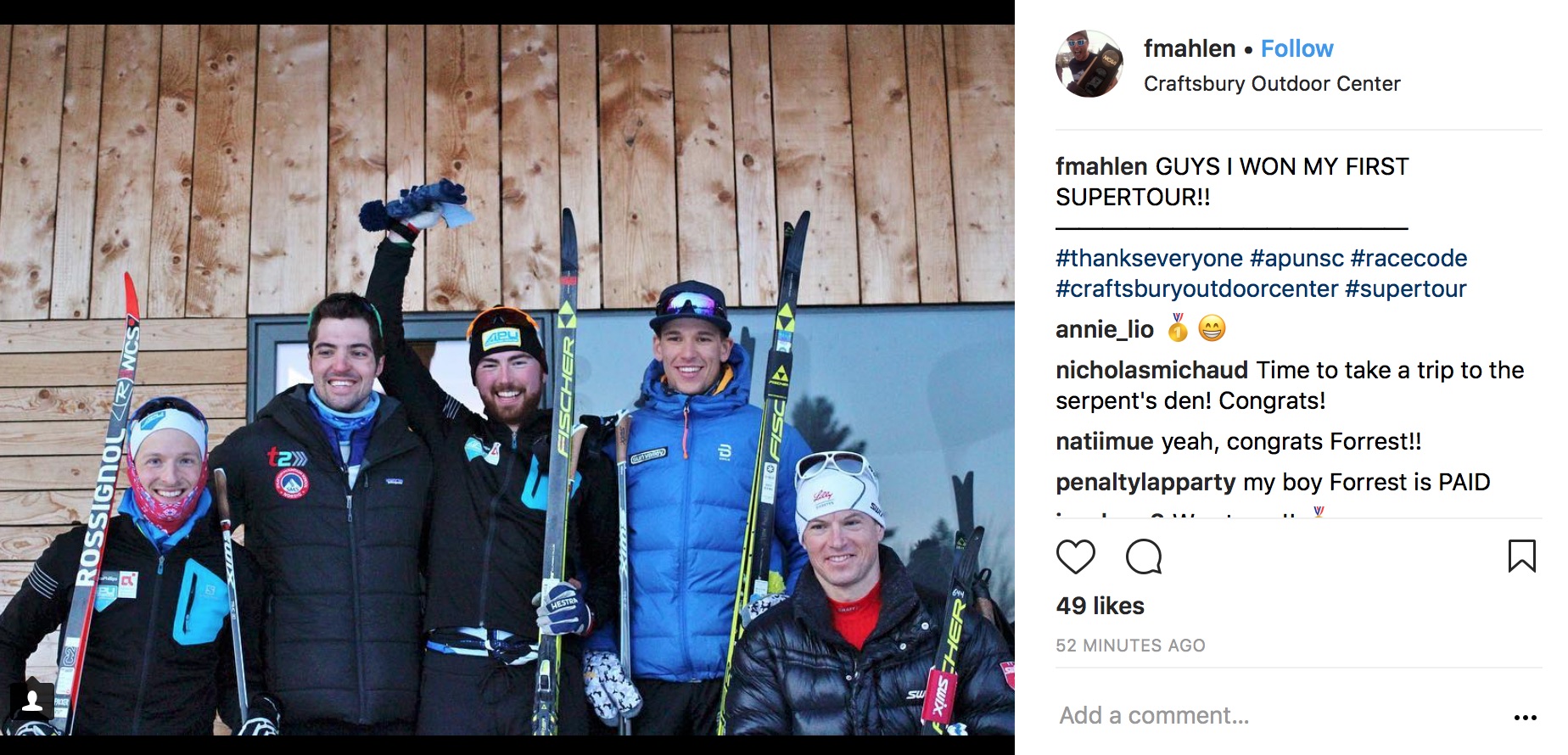
Forrest Mahlen (APU) celebrates his first time atop the SuperTour podium on Friday after winning the men’s 1.4 k classic sprint final in Craftsbury, Vermont. (Photo: Forrest Mahlen/Instagram)
Kaitlynn Miller and Forrest Mahlen won their respective classic-sprint finals at Friday’s SuperTour in Craftsbury, Vermont.
The 1.4-kilometer classic sprint kicked off a three-day race weekend at the Craftsbury Outdoor Center. On Saturday, the Craftsbury Marathon will be held (not a SuperTour event), followed by 5/10 k freestyle SuperTour races on Sunday.
Miller, of the Craftsbury Green Racing Project, started Friday by winning the women’s qualifier. She went on to win both her quarterfinal and semifinal before topping the final as well in 3:40.9 minutes. Also on Friday, it was formally announced that Miller was named to the U.S. Cross-Country Ski Team’s Olympic squad, which will compete in PyeongChang, South Korea, Feb. 10-25.
Kelsey Phinney, of the Sun Valley Ski Education Foundation (SVSEF), placed second in the women’s final, 0.63 seconds back, and Felicia Geisor (CXC Team) was third (+1.67). Erika Flowers, of the Stratton Mountain School (SMS) T2 Team placed fourth (+3.2), Canada’s Olivia Bouffard-Nesbitt (Rocky Mountain Racers) — fresh off NorAm Western Canadian Championships last weekend in Alberta — finished fifth (+5.46), and Alaska Pacific University (APU) skier Rosie Frankowski (who also made the U.S. Olympic team) placed sixth (+6.27).
On the men’s side, APU’s 24-year-old Mahlen qualified fifth, then won his quarterfinal and semifinal before taking the final for his first-career SuperTour win in 3:06.81. Ben Saxton (SMST2) initially won the qualifier and won his quarterfinal as well before placing second to Mahlen in the first semifinal. Saxton ended up 0.55 seconds back in second place in the final, just three-hundredths of a second ahead of Kevin Bolger (SVSEF) in third place (+0.58). Another half second back, Kris Freeman followed in fourth, just 1.09 out of first, Eric Packer (APU) was fifth (+1.39) and Canada’s Andy Shields (Lappe Nordic), who also competed at Western Canadian Championships last weekend) sixth (+8.99).
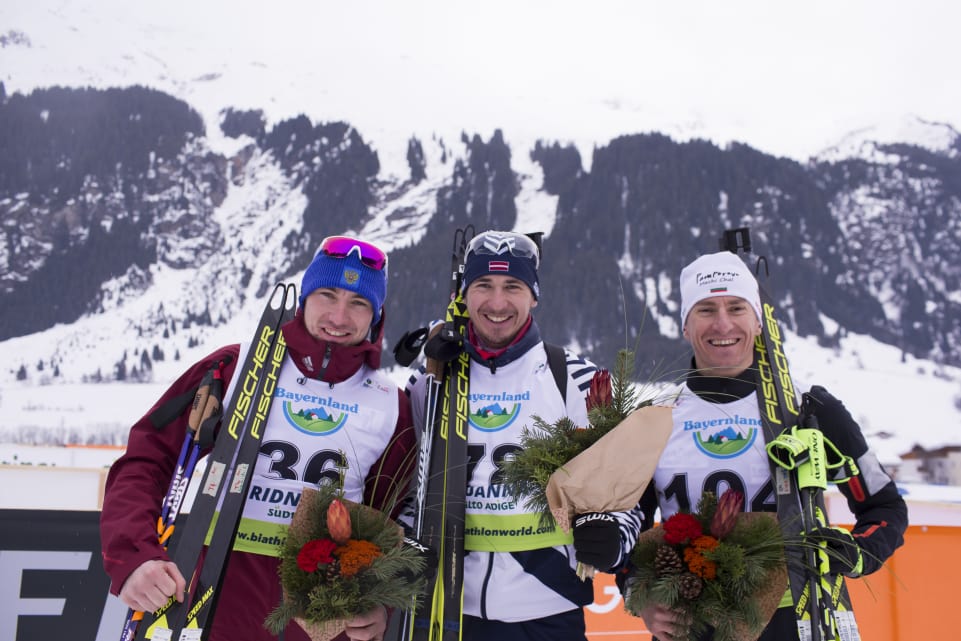
The men’s 10 k sprint podium at IBU Open European Championships, with Latvia’s Andrejs Rastorgujevs (c) in first, Russia’s Alexander Loginov (l) in second, and Bulgaria’s Krasimir Anev (r) in third. (Photo: IBU/Biathlonworld)
IBU Open European Championships (Ridnaun-Val Ridanna, Italy): Men’s and women’s sprints
Canada’s Macx Davies led the North Americans on Friday on Day 2 of the International Biathlon Union (IBU) Open European Championships in Ridnaun, Italy, placing 27th in the men’s 10-kilometer sprint with 9-for-10 shooting (1+0). Davies finished 1:32.3 minutes behind Latvia’s Andrejs Rastorgujevs, who took the win in 24:03.0 with a single penalty as well (0+1).
Russia’s Alexander Loginov placed second, 5.5 seconds back, with one penalty (1+0), and Bulgaria’s Krasimir Anev shot clean to finish third (+24.5).
“At the [last] World Cup in Anterselva [Italy], I have had a difficult time in the shooting range, and so I spent a lot of time in the last few days working on my shooting,” Rastorgujevs told the IBU after. “Today it was clear that all this hard work paid off. It is also a great motivator for Olympic gold.”
For Davies, who’s also headed to the Olympics next month, the result tied his best individual result this season after he placed 27th in an IBU Cup sprint earlier this month in Osrblie, Slovakia.
Canada entered four in the men’s race, with Carsen Campbell finishing 75th (+2:34.6) with one miss (0+1), Aidan Miller placing 91st (+3:18.2) with three penalties (1+2), and Matt Hudec finishing 119th (+4:31.6) with four misses (1+3).
Five American men raced, with Alex Howe finishing 53rd (+2:15.1) with one penalty (1+0), Jake Brown 84th (+3:02.0) with four misses (1+3), Jakob Ellingson 85th (+3:07.0) with one miss (1+0), Max Durtschi 111th (+3:50.1) with four misses (3+1), and Paul Schommer 114th (+3:59.8) with four penalties (2+2) as well.
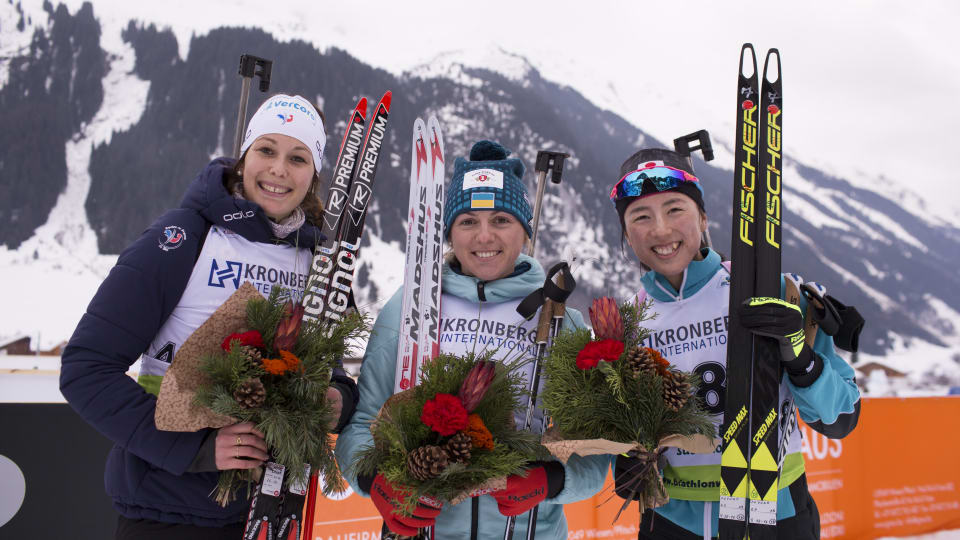
The women’s 7.5 k sprint podium at IBU Open European Championships in Ridnaun, Italy, with Ukraine’s Iryna Varvynets (c) in first, France’s Chloé Chevalier (l) in second, and Japan’s Fuyuko Tachizaki (r) in third. (Photo: IBU/Biathlonworld)
In the women’s 7.5 k sprint that followed, Chloe Levins of the U.S. was the top North American in 59th, 2:01 behind the winner Iryna Varvynets of Ukraine. Varvynets shot clean and posted the fastest finishing time of 20:54.1, 12.5 seconds faster than France’s Chloé Chevalier, Wednesday’s 15 k champion who had one miss (0+1) on Friday and ended up second. Japan’s Fuyuko Tachizaki reached the podium in third (+15.5) and was one of four women in the top five that shot clean (only Chevalier did not).
“After the individual competition on Wednesday, I was not at all happy with my shooting,” said Varvynets, who placed fifth in the 15 k. “Today I therefore concentrated especially hard in the shooting range. It was my luck that not many finished without errors, otherwise it would probably not have been enough for the victory.”
“Two races, two medals — it could not have gone better for me,” Chevalier said. “In the standing shooting I missed the first disc and got a little nervous, but thankfully, there were no further errors.”
Tachizaki called the bronze medal a “big dream come true”.
“The focus of my season had been the Olympics and I ‘only’ took part in Ridanna as part of the preparations, but with this result I have exceeded everything I have achieved so far,” she said. “At the end of the race I did not only fight hard in the track, I was already dreaming of a medal. Now I’m in seventh heaven.”
Levins had one miss in each stage (1+1), as did fellow American Maddie Phaneuf, who finished 63rd (+2:19.0) with two penalties. Clare Egan followed in 70th (+2:34.2) with four misses (3+1), Deedra Irwin was 85th (+3:38.1) with four penalties (1+3) as well, and Jennie Bender 97th (+5:52.8) with six misses (3+3).
Two Canadians started the race, with Sarah Beaudry finishing 76th (+3:02.9) with four misses (1+3). Erin Yungblut did not finish.
Open European Championships continue Saturday with the men’s and women’s pursuits. The top 60 from the sprint qualify, which, for the North Americans, means Davies, Howe, and Levins.
The championships end Sunday with single mixed and mixed relays.
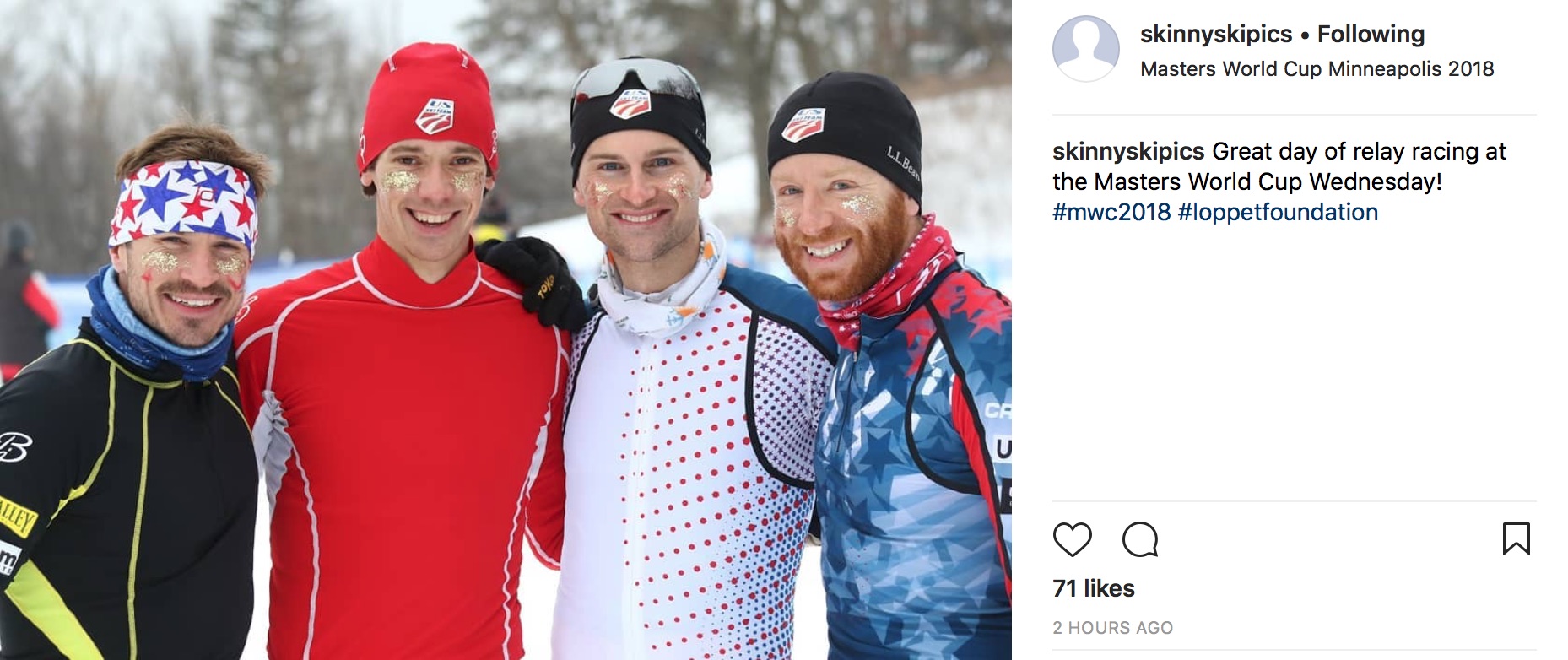
Matt Liebsch (l) and his men’s age-group “1” 4 x 5 k winning relay team on Wednesday at 2018 Masters World Cup in Minneapolis, Minnesota. (Photo: SkinnySki/Instagram)
2018 Masters World Cup (Minneapolis, Minnesota): 4 x 5 k relays
Matt Liebsch, 34, anchored the winning relay of the youngest men’s age group (AG 1) at 2018 Masters World Cup on Wednesday, crossing the line in 45:57.2 minutes (the fastest relay time of the day) and teaming up with fellow Americans Christopher Harvey, Mark Johnson and Zach Varty. Two teams competed in that age group’s 4 x 5 k relay, with Italy finishing second, 1:22.6 minutes back.
The U.S. won all five women’s 4 x 5 k relays on Wednesday, and eight total between the men’s and women’s age groups. Finland had the second-most relay victories with five in the men’s categories.
Canada won the men’s AG 4, beating out four other teams with Gabriel Babin, Bruce Macneil, Luc Tremblay, and Michel Labrie, who finished the 4 x 5 k in 49:41.9. Germany placed second (+36.4), and the U.S. third (+54.1).
Piotr Bednarski, head coach of Loppet Nordic Racing, which is based out of Theodore Wirth Park, anchored the men’s AG 5 to a win in 49:39.1, with teammates Rune Harkestad, Dennis Paul and David Sjogren.
Masters World Cup continues with 15/30/45 k classic distance races on Thursday at Wirth Park.
Day 4 Age Group (AG) 4 x 5 k Relay Winners
Men:
AG 1: USA (Christopher Harvey, Mark Johnson, Zach Varty, Matt Liebsch) 45:57.2
AG 2: Finland (Jouni Leinonen, Mika Kilpeläinen, Johan Gustafsson, Joachim Gustafsson) 47:53.4
AG 3: Russia (Ivan Batyutenko, Andrey Lushnikov, Sergey Degtyarev, Aleksandr Pushkarev) 46:43.3
AG 4: Canada (Gabriel Babin, Bruce Macneil, Luc Trembley, Michel Labrie) 49:41.9
AG 5: USA (Rune Harkestad, Dennis Paul, David Sjogren, Piotr Bednarski) 49:39.1
AG 6: USA (Milan Baic, Odd Bersvendsen, Kent Murdoch, Barry Makarewicz) 48:48.3
AG 7: Finland (Heikki Ruokonen, Tapio Tikkanen, Timo Pullinen, Aito Pennanen) 51:56.3
AG 8: Finland (Leino Nisula, Pauli Halonen, Yrjo Teravainen, Harri Makela) 54:58.4
AG 9: Finland (Veikko Piirainen, Tapio Ikaheimonen, Paavo Raisanen, Vaino Paakko) 58:18.9
AG 10: Finland (Alpo Virtanen, Tapio Wallenius, Jouko Laiho, Riku Kyllonen) 1:02:39.7
Women:
AG 1: USA (Kathleen Dewahl, Tamra Kornfield, Davya Flaharty, Gina Chythlook) 56:49.3
AG 2: USA (Bonnie Weiskopf, Kim Rudd, Mary Mckelvey, Mary Wellington) 56:23.9
AG 3: USA (Elizabeth Youngman, Kelly Milligan, Jan Guenther, Kelly Skillicorn) 56:23.6
AG 4: USA (Kate Ellis, Magdenla Bowen, Joann Hanowski, Muffy Ritz) 1:00:33.6
AG 5: USA (Gabriele Andersen, Constance Meek, Dagmar Eriksson, Kati Campbell) 1:14:23.4
France’s Chloe Chevalier after winning the women’s 15 k individual on Day 1 of IBU Open European Championships in Ridnaun, Italy. (Photo: IBU/Biathlonworld)
IBU Open European Championships (Ridnaun-Val Ridanna, Italy): 15/20 k individual
The International Biathlon Union (IBU) Open European Championships opened Wednesday in Ridnaun (Val Ridanna), Italy, with several North Americans competing in the women’s 15- and men’s 20-kilometer individual races.
Austria’s Felix Leitner racing to the win in the first race of 2018 IBU Open European Championships, the men’s 20 k individual, on Wednesday in Ridnaun, Italy. (Photo: IBU/Biathlonworld)
Canada’s 23-year-old Carsen Campbell raced to 19th in the men’s 20 k, shooting 19-for-20 (1+0+0+0) and finishing 3:18.5 minutes behind the winner, Austria’s Felix Leitner, who clocked the fastest time in 53:32.8 — also with one penalty (0+0+0+1).
Leitner, 21, won by 43 seconds over Tomas Krupcik of the Czech Republic, who also had a single penalty in the last standing stage (0+0+0+1) and placed second.
Germany’s Philipp Horn reached the podium in third (+56.6), with 19-for-20 shooting as well (1+0+0+0).
According to an IBU press release, Leitner is one of the youngest athletes to win the 20 k, the longest race on the circuit.
“I had many problems with my shooting lately, but today it was probably the best in the last two seasons,” Leitner said, according to the release. “I believed in myself and knew that I have to run fast from the beginning, and if the shooting would be as good as during the training, I could be in the top.”
Campbell, of Biathlon Canada’s National “Z” Team, was the top North American in 19th in his second trip to Open European Championships. Previously, his best individual result was 64th last year.
Paul Schommer led the U.S. men in 46th (+5:22.6) with three penalties (0+1+1+1). Max Durtschi also shot 17-for-20 (1+0+1+1) and ended up 56th (+6:18.5), Jakob Ellingson followed in 58th (+6:23.5) with two penalties (0+0+1+1), and Jake Brown finished 74th (+8:06.7) with seven penalties (1+1+3+2). Alex Howe did not start.
For Canada, Macx Davies, a senior national team member who is headed to the Olympics, placed 67th (+7:32.7) with five penalties (2+2+1+0). Matt Hudec was 96th (+12:00.5) with six penalties (0+2+1+3), and Aidan Miller 105th (+14:49.0) with nine penalties (2+1+1+5).
In the women’s 15 k that followed, Sarah Beaudry, of Biathlon Canada’s Senior National Team as well as Olympic team, was the top North American in 23rd, 4:55.6 out of first. Beaudry, 23, shot 18-for-20, with her two misses coming in the first prone (2+0+0+0).
France’s Chloe Chevalier won the women’s race, with spring-like temperatures around 6 degrees Celsius, in 46:32.9 with a single penalty, also in the first stage (1+0+0+0). The second- through fourth-place finishers all shot clean, with Italy’s Alexa Runggaldier placing second (+47.7), Russia’s Victoria Slivko taking third (+55.9) and Ukraine’s Yuliia Zhuravok missing the podium by half a second in fourth place (+56.4).
“After that penalty in the first prone, I relaxed and did not worry about the result,” Chevalier said after, according to an IBU press release. “I just enjoyed being out on the tracks on a beautiful sunny. Maybe the key to success is relaxing and not worrying about the result.”
Two Canadian women entered the event, with Erin Yungblut finishing 83rd (+13.19.9) with eight penalties (2+3+1+2).
Chloe Levins was the top American woman in 60th (+7:18.6) with four penalties (1+2+1+0), and Maddie Phaneuf, who made US Biathlon’s Olympic team, followed in 65th (+8:10.8) with four misses as well (1+2+0+1). Deedra Irwin finished 82nd (+13:15.8) and Jennie Bender was 87th (+15:05.0), both with 10 penalties apiece.
Open European Championships continue Friday with the men’s and women’s sprints, followed by pursuits on Saturday and relays on Sunday.
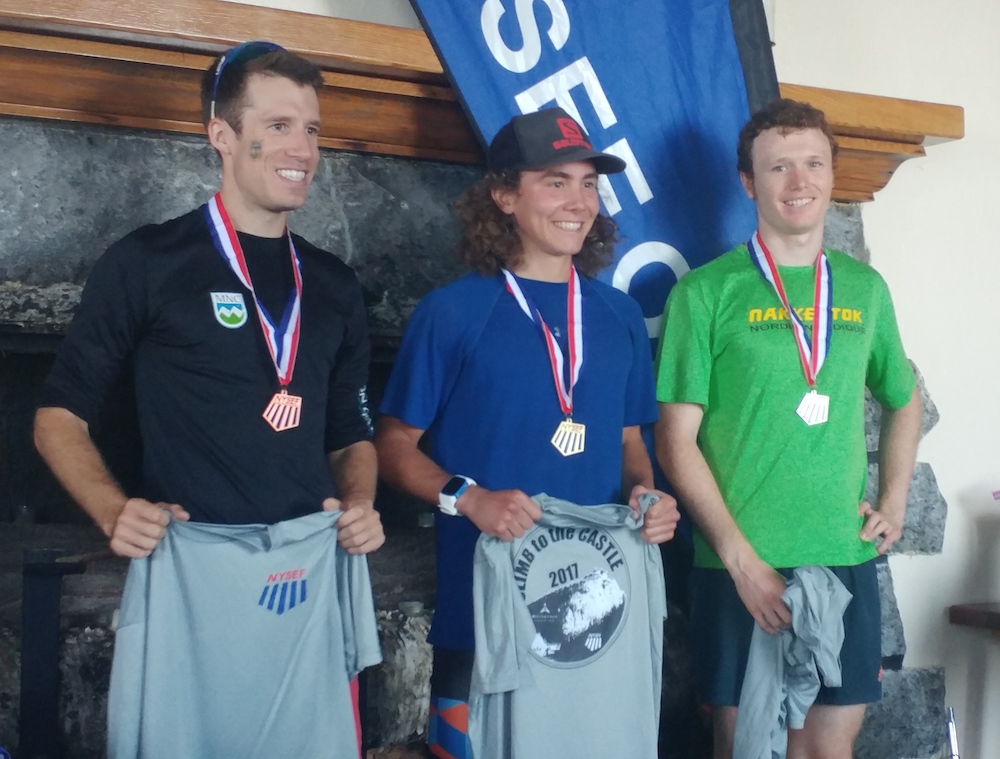
The men’s top three finishers at NYSEF’s 2017 Climb to the Castle on Sunday, Sept. 24, at the top of Whiteface Mountain in Wilmington, N.Y., with winner Jake Brown (c) of US Biathlon, runner-up Aidan Kirkham (r) of Nakkertok Nordic, and Mansfield Nordic Club Head Coach Adam Terko (l) in third.
(Note: This article has been updated with comments from Adam Terko in regards to rollerski safety.)
WILMINGTON, N.Y. — On what may be the hottest day in memory for the annual Climb to the Castle (C2C) rollerski race, hosted by the New York Ski Educational Foundation (NYSEF) up Whiteface Mountain, Jake Brown and Jennie Bender were fastest to the top. Both have spent at least part of their summer training with the US Biathlon Association (USBA) in nearby Lake Placid, N.Y.
Brown, a 25-year-old USBA X-Team member, finished the five-mile climb up Whiteface’s toll road on Sunday in 39:01.9 minutes, more than five minutes clear of runner-up Aidan Kirkham, a Canadian racer with Nakkertok Nordic, who finished in 44:16. Adam Terko, Mansfield Nordic’s head coach and executive director, placed third in 45:35.7.
Bender, 29, racing under the team name of “The Dark Side”, which she later explained was a joke, topped the women’s race in 48:59.4. She finished 21.5 seconds ahead of 51-year-old (no, that’s not a typo) Sheila Kealey, who skis for XC Ottawa and coaches for Nakkertok. Deedra Irwin of the Sun Valley Ski Education Foundation (SVSEF) was third woman in 51:13.5.
“I had put my name in the registration as ‘Darth Vader’, but they changed it on the other end,” Bender wrote in an email. “When I am in Bozeman MT I train with Bridger Ski Foundation, and when I am in Lake Placid, I train with USBA.”
At the tollgate at 7 a.m., the temperature was already 66 degrees Fahrenheit with clear skies. With mild weather the previous two days, the pavement was dry for 83 skiers who rolled to the start line. At the castle at the summit an hour later, temperatures were upwards of 70, making an already grueling race even more fatiguing.
The men’s and women’s races played out quite differently. According to Kirkham, Brown led “off the start and gapped the whole field.”
Familiar with the territory in and around Lake Placid, which has become an annual training camp for Nakkertok, based out of Ottawa, Kirkham said it was one thing to ski the toll road in Zone 1 and another to race it.
“I wanted to pace it well, and I think I did that,” he added. “I didn’t want to go too hard off the start because there’s no chance to recover on a course like this. … Once I got to the last mile I knew I could try to pick it up a little bit. But I was pretty tired. Just getting to the finish felt good.”
Having completed five or six C2Cs, Terko said experience was his advantage. But he didn’t exactly have a race plan.
“The field can vary wildly,” Terko said of the level of competition. “You’re never really sure how the start’s going to play out. I found myself near the front and there wasn’t a ton of US Ski Team or US Biathlon folks.”
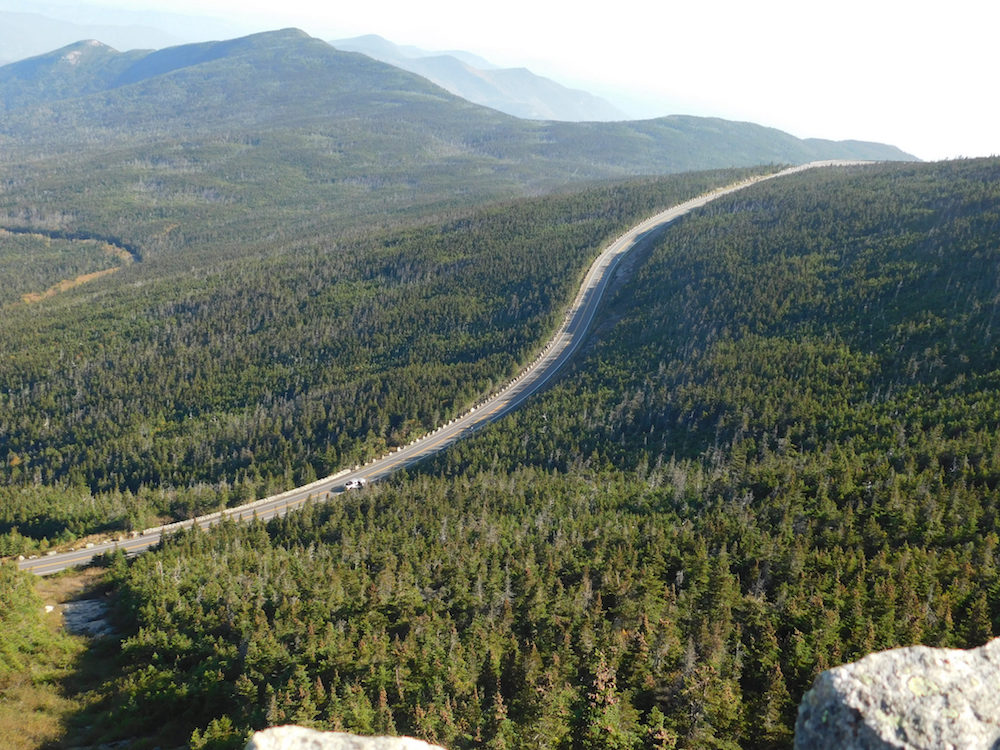
Looking down at the Whiteface Veterans Memorial Highway, a five-mile toll road to the top of Whiteface Mountain in Wilmington, N.Y., as seen on Sunday, Sept. 24, for the 2017 NYSEF Climb to the Castle rollerski race. (Photo: NYSEF)
As recently as a few years ago, the U.S. Ski Team held annual dryland training camps in Lake Placid and competed at the C2C. But that camp has been replaced by an on-snow camp in New Zealand. This year, US Biathlon’s top athletes recently spent several weeks training in Germany.
“Jake Brown was right off the front so I realized that this could be a good day and I might as well try and hang in there,” Terko added.
While Terko skis and rollerskis plenty with his athletes, he says it’s not always adequate training for a race like this.
“As a coach, it’s more about generally making sure the workout is going well for the athletes,” he explained. “I’ve made an effort the last few weeks to get out after practice and ski around in the dark myself.”
(Terko later clarified in an email that he was referring to Mansfield Nordic’s primary training venue, a paved and lit rollerski loop at Camp Ethan Allen in Jericho, Vermont. “Rollerskiing in the dark there is pretty standard as opposed to being in a dangerous road situation which I of course do not advocate!” he wrote.)
As for Brown, a Northern Michigan University graduate student who is currently living and training with US Biathlon in Lake Placid, he had a slightly different recollection of the start on Sunday.
“It wasn’t so much I dropped everyone. It was more like I just slowly pulled away,” Brown said. “Within the first 400 meters, I had a small gap. The gap got bigger and bigger as we went along. Maybe by the first mile, I couldn’t hear anyone behind me.”
Sticking to his own race, he resisted the temptation to look behind.
“I was trying to get a good effort today on the skis,” he continued. “I was hoping that some of the faster junior skiers would have some fast rollerskis and be able to push me, but pretty much right from the get-go I was on my own, so I was just trying to keep the pedal to the metal and make it a good effort, which gets tough at the end. It definitely helps to know the course.”
The women’s top three finishers at NYSEF’s 2017 Climb to the Castle on Sunday, Sept. 24, at the top of Whiteface Mountain in Wilmington, N.Y. (From left to right) Jennie Bender in first, Sheila Kealey (XC Ottawa) in second, and Deedra Irwin (SVSEF) in third.
In contrast, the women’s race swapped leaders. Clare Egan, a USBA national-team member and Craftsbury Green Racing Project (CGRP) member finished fifth (+5:02.4) after leading early.
“I did lead a little bit at the beginning,” Egan said. “Jennie, Sheila and I were together for the first 1.5 or 2 miles, and then Jennie and Sheila pulled away, and I got caught by Deedra and Zoe [Williams].”
“From doing this race in the past, the order doesn’t usually change so much after the first mile or so,” she explained. “It’s just so hard to make up gaps on this grade. I wanted to try to hang on for as long as I could and stay in front the whole way, but I wasn’t able to do that. So it was very hard work out there, and I didn’t have what it takes to stay with Jennie and Sheila. Respect to them.”
Irwin explained in a post-race email that her plan was to pace off Bender and Egan and stick with them for as long as she could.
“Jennie and Sheila pulled away just around mile two, I think,” wrote Irwin, a SVSEF Gold Team member who was invited to train with US Biathlon (following its Talent ID Camp) in Lake Placid this fall. “My race went really well. I’m really happy with my result. This was my first time doing Climb to the Castle. I didn’t really know what to expect, it’s a tough climb!”
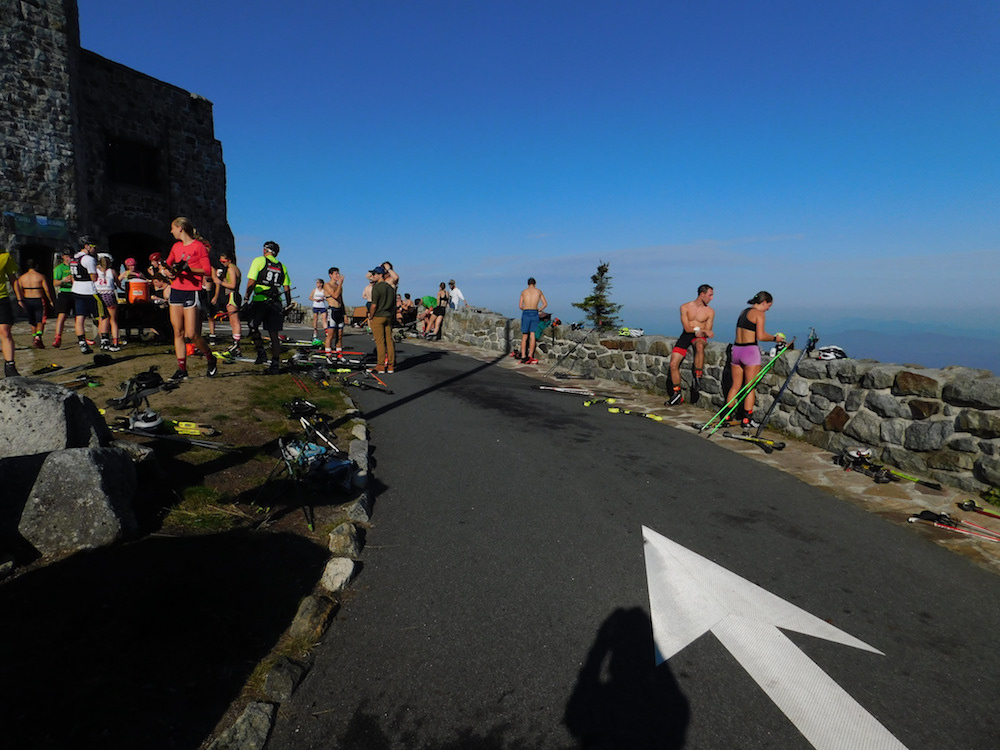
Blue skies and no snow post-race at the castle atop Whiteface Mountain in Wilmington, N.Y., at the 2017 NYSEF Climb to the Castle on Sept. 24. (Photo: NYSEF)
“Every year I did it, Liz Stephen did it, and it went out really, really fast,” she said of the U.S. Ski Team member who holds the women’s course record of 41:50. “Really hard at the beginning, and then people dropped off, but today’s pace was a good pace.”
Kealey described wanting to keep a consistent rhythm all the way to the top. She spent much of the race trading off with Bender.
“And then I managed to get a gap,” Kealey said. “I had a gap on [Bender] almost until the last 800 meters, and then she caught me. She was hurting, but she put the guns on at the last bit and just pulled away. She skied really well.”
Reflecting on her win, Bender said, “It wasn’t snowing, and it wasn’t freezing, so that was awesome. My V1 has been getting a lot better. It was a small crowd, but I was stoked to feel good for the whole duration. I haven’t done this race in a long time. I did it probably in college, and it’s fun to see the giant progression since then.”
She explained that she’s been working with US Biathlon in Lake Placid more this summer.
“I think in the big picture, it’s fun to see that I’m not just a sprinter,” she said.
On her race plan, Bender said, “The biggest thing, you have to pace it and not go out too crazy. We kind of started splitting up a bit, and I was going back and forth between first and second throughout the race. First with Clare, then with Sheila and then, near the last 200 to 400 meters, that tunnel, which is always so crazy with the wind, we both were like, ‘Oh.’ We were feeling it.”
“I saw someone coming up behind us,” Bender continued. “I thought it was Clare, I didn’t realize it was Jake. And then I sprinted it in to the finish. I was stoked to get in under 50 minutes.”
Bender, Egan, Irwin, and Brown all skied on matched Marwe rollerskis that they also used in time trials, Bender said.
Zoe Williams, the fourth-place woman (+2:18.8) from Nakkertok and Carleton University, said she wasn’t sure what to expect for her first C2C.
“About 15 minutes in, I kind of all of a sudden realized that it was all uphill,” Williams said. “I was like, ‘Whoa, what have I got myself into?’ But it was fun. I was following Deedra for most of it. I was trying to match her tempo.
“The last mile was tough because you can see the castle,” she added. “I really wanted to try to stick with the lead pack as long as I could.”
“We’ve had every kind of weather possible,” she said. “It’s just fun to see everybody out there getting ready for winter.”
“It was really a blessing to have this awesome weather,” Brown concluded. “Normally you come up here and [the castle] is in the clouds, even if it’s sunny down low. It’s cool to do something here with NYSEF and show our support from US Biathlon.”
Susan Dunklee and Lowell Bailey celebrate after finishing second in the World Cup single mixed relay in Kontiolahti, Finland. Austria won the competition. (Photo: IBU/Twitter)
The U.S. Biathlon Association (USBA) has named five women and six men to its senior national team for the 2017/2018 season, and 14 more athletes to its several development teams.
The nominations are headlined by Lowell Bailey and Susan Dunklee, both of whom won individual medals at 2017 World Championships in Hochfilzen, Austria. They are joined on the “A” team by their World Championships teammates Clare Egan, Joanne Reid, Maddie Phaneuf, Tim Burke, Leif Nordgren, and Sean Doherty.
“This year it really culminated in a perfect way,” USBA Chief of Sport Bernd Eisenbichler said. “The best thing about it — besides being so successful and having a dream season — is that the upcoming and younger athletes, like Leif, Sean, Maddie, Joanne, and Clare, they see now that it’s not only the athletes from Norway and Germany succeeding. At some races we took medals and then we also proved it on the Olympic course. It’s giving a lot of confidence to the whole program.”
Leif Nordgren skiing the second leg of the men’s 4 x 7.5 k relay at the IBU World Cup in Antholz, Italy, where the U.S. finished sixth. (Photo: USBA/NordicFocus)
The men’s relay team notched sixth- and seventh-place relay efforts this season, and Nordgren picked up four top-30 finishes despite missing almost half the season with an injury. Doherty also missed almost half the season due to illness, but came back to earn a top-20 in the Kontiolahti pursuit at the end of the season. Veteran Burke collected four top-30’s over the course of the year.
On the women’s side, Egan and Reid picked up two and one top-30 finishes apiece, and Phaneuf had a 10th-place pursuit result on the IBU Cup.
Also snagging an “A” team nomination is Paul Schommer, who came from the senior development team to land consistent World Cup starts from the middle of the season onwards. Schommer had a top individual finish of 33rd in the individual in Antholz, Italy, and contributed to an eighth-place mixed relay effort in Kontiolahti, Finland.
“Paul had a great season for his second year in biathlon, and made really big improvements,” Eisenbichler said. “He showed that he can be a really good alternative, or even more than that, for the men’s relay and other relays too. He showed that in Korea and especially in Kontiolahti in the mixed relay there. He had a top-35 result at his first World Cup, so we felt that he is really very close to the big guys and separated himself from the athletes who were performing with him at the beginning of the season in the IBU Cups.”
Clare Egan racing to 20th place in the women’s 7.5 k sprint at the 2017 IBU World Championships in Hochfilzen, Austria (Photo: USBA/NordicFocus)
Landing on the “B” team are Emily Dreissigacker (Craftsbury Green Racing Project) and Russell Currier (Outdoor Sports Institute). Currier started the year on the World Cup, finishing 34th in the pursuit in Oberhof, Germany, before moving to the IBU Cup. Dreissigacker racked up five top-30 finishes on the IBU Cup circuit this season.
“They will get a lot of camp time in Lake Placid,” Eisenbichler said of the “B” team. “They will also get direct coaching from the National Team coaches. In Emily’s regard it’s from Jean Paquet, and in Russell’s regard from Jonas Johansson. So they have not only access to the training plan from the ‘A’ Team, but also their individualized plan from the national team coaches. They will spend about seven to eight weeks in Lake Placid from May to August.”
Chloe Levins, who finished fourth in the youth women’s pursuit at World Youth and Junior Championships this season, and IBU Cup racer Jake Brown comprise next season’s “X” Team, which is seen as consisting of athletes who are expected to make the jump to the “A” team within two years.
“The ‘B’ team should be very close to the World Cup, and we expect ‘B’ Team members to be able to really chase the World Cup team for the next season and to have a really good shot for the Olympic Games,” Eisenbichler explained. “That’s the difference between the ‘B’ Team and the ‘X’ Team. The ‘X’ Team is still a development team, for athletes who just started biathlon or young athletes, as we have this year.”
Chloe Levins (11) with her US Biathlon support team (from left to right: Erik Lewish, Travis Voyer, Mathias Zacherl, Robert Gorgos, and Algis Shalna) after her fourth-place finish in the youth women’s 7.5 k pursuit, her career best in her third IBU Youth World Championships, on Sunday in Osrblie, Slovakia. (Photo: USBA)
USBA has also named a five-member Senior Development Team, consisting of Hallie Grossman and Alex Howe (Craftsbury Green Racing Project), Siena Ellingson (Mount Itasca), Travis Cooper (National Guard Biathlon), and Max Durtschi.
And the Junior Development Team consists of athletes with some of the top U.S. results at World Youth and Junior Championships: Vasek Cervenka (Mount Itasca, 16th in youth individual), Cody Johnson (Outdoor Sports Institute, 46th in junior sprint), Jake Pearson (Casper Mountain Biathlon Club, 49th in youth individual), Amanda Kautzer (Michigan Tech/Loppet Nordic Racing, 42nd in youth pursuit), Grace Gilliland (Alaska Biathlon, 46th in youth individual), and Helen Wilson (Alaska Biathlon, 62nd in youth individual). Lexie Madigan of the Auburn Ski Club was also named; she qualified for the World Youth Championships team but was younger than the minimum age set by the International Biathlon Union to compete.
“The setup is, they are regionally coached with consulting from the National Team coaches,” Eisenbichler said. “They can get access to the training philosophy, but they are coached by their own regional or club coaches. But they are also invited to Lake Placid, the seniors for two camps, and the younger ones for one camp. At the [Rollerski National Championships] in mid-August, we will re-evaluate their performance levels and see who gets more invitations later on towards the fall.”
The team nominations are as follows:
National Team Women
Susan Dunklee (Barton, Vt.), A 1 Team
Clare Egan (Cape Elizabeth, Maine), A 2 Team
Joanne Reid (Boulder, Colo.) A 3 Team Maddie Phaneuf (Old Forge, N.Y.) A 3 Team Emily Dreissigacker (Morrisville, Vt.) B Team
National Team Men
Lowell Bailey (Lake Placid, N.Y.), A 1 Team
Tim Burke (Paul Smiths, N.Y.), A 2 Team
Leif Nordgren (Marine, Minn.), A 2 Team Sean Doherty (Center Conway N.H.) A 2 Team Paul Schommer (Appleton, Wis.) A 3 Team Russell Currier (Stockholm, Maine) B Team
X Team Women
Chloe Levins (Rutland, Vt.)
X Team Men
Jake Brown (Houghton, Mich.)
National Development Group – Senior Women
Hallie Grossman (South Woodstock, Vt.) Siena Ellingson (Minnetonka, Minn.)
National Development Group – Senior Men
Max Durtschi (Sun Valley, Idaho) Alex Howe (Craftsbury, Vt.) Travis Cooper (Kenai, Alaska)
National Development Group – Youth/Junior Women
Amanda Kautzer (Plymouth, Minn.)
Grace Gilliland (Eagle River, Alaska) Helen Wilson (Eagle River, Alaska) Lexie Maddigan (Truckee, Calif.)
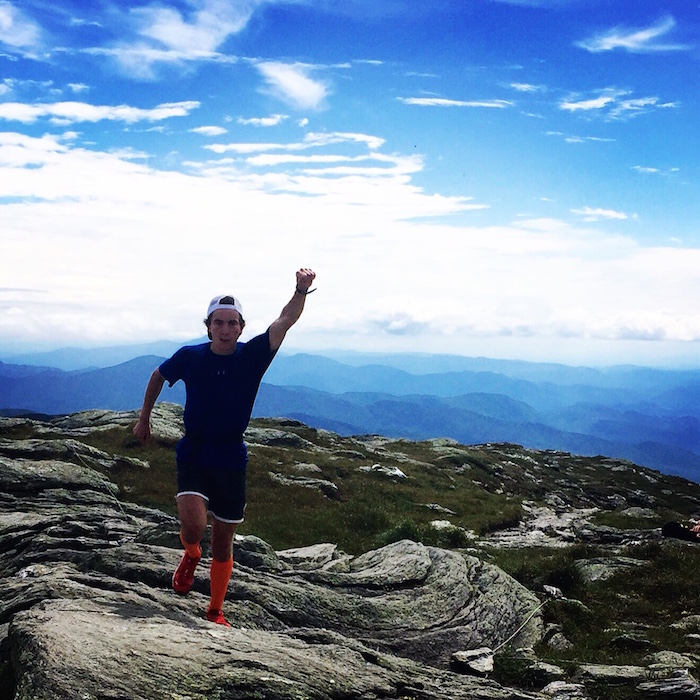
Jake Brown: “Finished my biggest volume week of the year with a mini-training camp around Mount Mansfield with college teammate Liam John. This was the last summit of the last over-distance.” (Courtesy photo)
Welcome to “17 Questions for 2017”, where we are catching up with American and Canadian national-team members before the beginning of the winter season.
***
Jake Brown’s move to Lake Placid wasn’t his first major relocation in recent years: after helping NCAA Division III Saint Olaf win a cross-country running championship, Brown used his final year of ski eligibility to join midwest behemoth Northern Michigan University, where he won the 10 k skate at NCAA Central Regional Championships by over a minute last season. He also became an NCAA All-American and placed sixth in the 30 k skate at U.S. National Championships.
But Brown has let his International Ski Federation license lapse, picked up a rifle, and moved again. He joined the U.S. Biathlon Association’s X-team this year, after being identified by team staff as a potential talent worth developing.
Brown had his first on-snow biathlon race in West Yellowstone two weeks ago.
“I hopped in the biathlon race- overall it was a good opportunity to feel fast with snow underfoot and to get in a hard effort and my first on-snow biathlon race,” he wrote in an email.
Despite now competing in a new sport, the joys of the West Yellowstone Ski Festival are familiar ones: seeing your community all in one place (mostly).
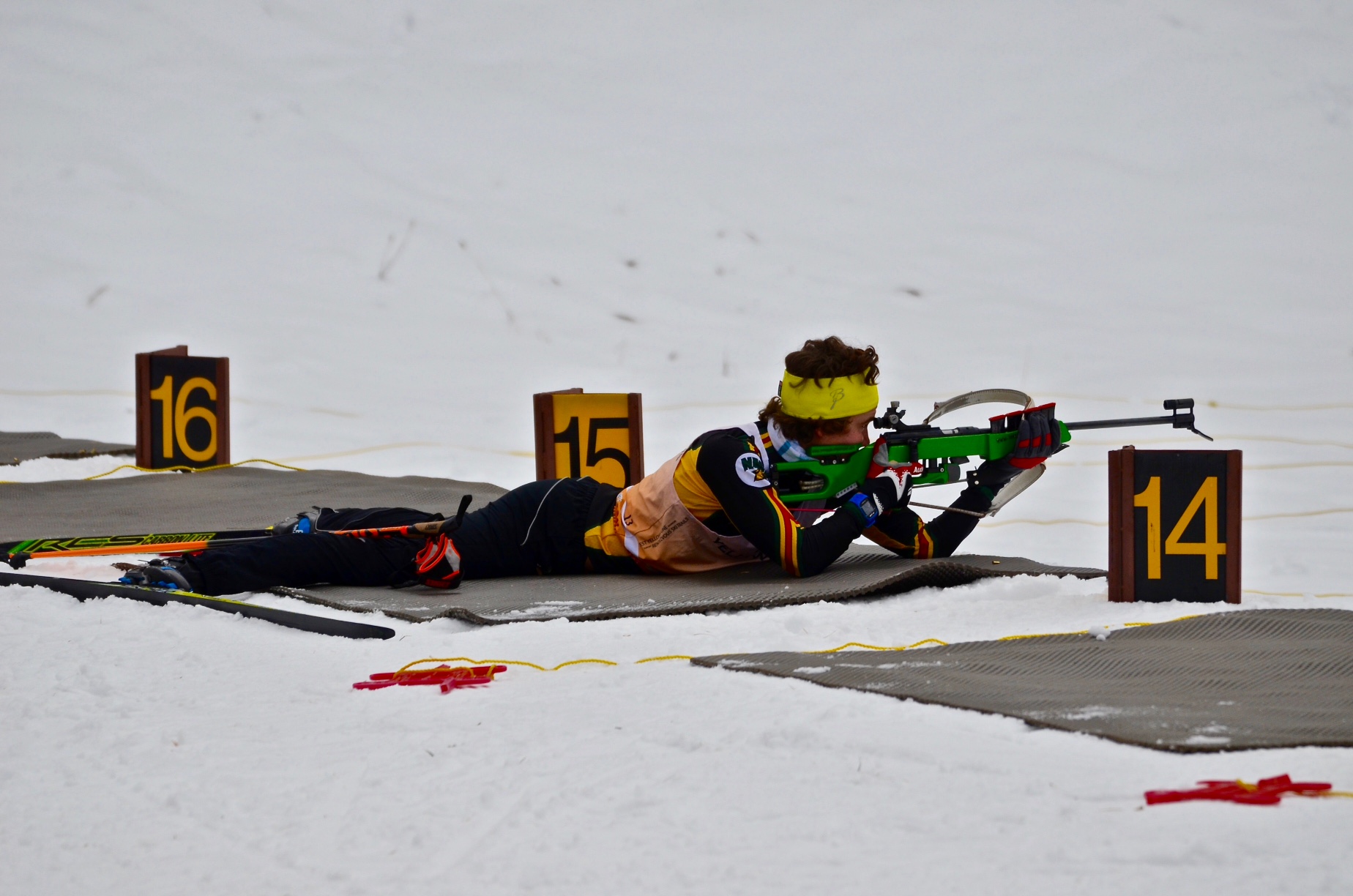
Jake Brown competing in his first ever on-snow biathlon race in West Yellowstone, Montana. (Photo: Alex Larsen)
“Great vibes and it’s a blast to see a big chunk of the ski community come together,” he wrote. “I was helping coach the Duluth area high school trip and training around the coaching. As a former Minnesota high school skier I really enjoy hearing the kids talk about who might make it out of their section and earn the right to race on the legendary state meet course at Giants Ridge!”
More recently, Brown finished ninth in both the 10 k sprint and 15 k mass start at biathlon NorAms in Canmore, Alberta.
1. Biggest change in your life in the last five or so months since the ski season ended?
I picked up a rifle, put it on my back, and started biathlon after moving to Lake Placid in June.
2. Biggest change in your training?
The simple switch in focus from cross-country to biathlon has meant more intervals and easy rollerskiing on a loop, with twists and turns rolling up and down. Aside from the obvious, shooting bullets at black targets after each interval, this means a more targeted focus of working on transitional skiing instead of just pounding away straight up a hill. As a runner-turned-skier, mastering the technical aspects of the sport- including transitional skiing- is an aspect at which I can still improve.
3. Major areas of improvement you’ve seen so far?
I have so much appreciation for the work a dedicated biathlete has to put in to improve their shooting and consistency. When I reflect on my progress I can see I’ve taken quite a few clicks up since June- my range time is light years faster, my standing is more stable, and my prone group is getting smaller. However it hasn’t been without work, and when I see where the elite biathletes on our team are and the work they’ve put in to get there I am humbled. I’ve also learned how to ski a biathlon race differently; as my teammate Max Durtschi told me when I first started in June, “this isn’t skiing and shooting- this is biathlon.”
4. Whom you’ve been working closest with this offseason (coaches or training partners)?
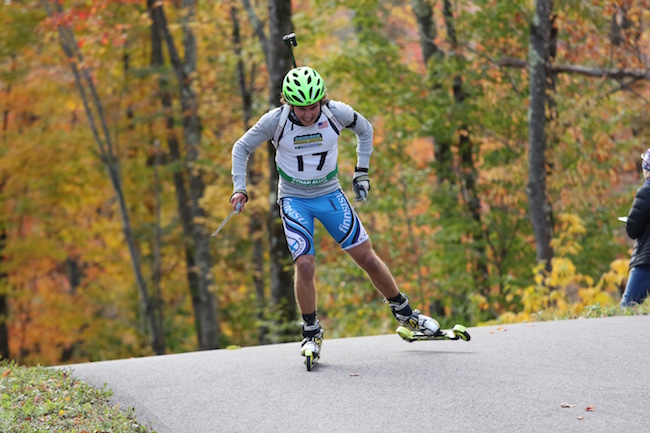
Jake Brown competing in rollerski trials in Jericho, Vermont, in October. (Photo: Karen Brown)
I work most closely with Jean Paquet, the USBA development coach. I’m always impressed when Jean jumps in a workout- trying to hang onto his back wheel during a 70-mile road ride was one of the most joyfully painful experiences of my summer.
This year has been a fantastic opportunity for me to learn from all the veteran US biathletes- I’ve been lucky to train with each and pick their brains for sage biathlon wisdom. Paul Schommer, a good friend of mine, joined the X-team in August and is who I train with most. He picked up biathlon a year before I and we are close in ski times, so chasing him in shooting is a really valuable challenge for me.
5. Best trip in the last five months (and why)?
Over the summer my cousin got married in Seattle, which served as a mini-family reunion. I don’t see my extended family often, so when I get the chance it’s always special.
6. Favorite cross-training?
Mountain running. I prefer basketball or climbing for an active recovery day.
7. Favorite non-athletic activity or pastime this summer?
Life at the training center can become repetitive, so on occasion I’ll venture into the Adirondack park for a short backpacking excursion. There’s nothing quite like a night in the peace of wilderness to reset your mind, body, and spirit.
8. Song that was your jam this summer?
Racers (left to right) Kyle Bratrud of CXC and Northern Michigan University’s Adam Martin and Jake Brown, along with Team Freebird’s Kris Freeman, in the men’s 20 k freestyle mass start race at 2016 U.S. National Championships in Houghton, Mich. Bratrud went on to place tenth overall, Martin fourth, Brown sixth, and Freeman ninth.
Whatever heavy metal Jean plays in the weightroom.
9. All time favorite race moment?
Skiing in the lead pack towards the end of the 2013 Birkebeiner; Matt Liebsch turns and points between himself, Brian Gregg, Sylvan Ellefson, and I and says “For America.” I may or may not have peed my pants I was so excited. To me those guys were legends.
10. First thing you pack in your bag when you leave for Europe?
Whenever traveling for skiing I make sure to put my boots in my carry-on. I learned that the hard way after my ski bag, boots included, failed to make it to Lake Placid (when NCAAs were there in 2015) until the day before the first race. I have yet to ski race in Europe, so I hope to get the chance to put others’ packing tips to use soon.
11. Venue/event you’re most excited to visit this season?
Mount Itasca in Coleraine, MN. It’s the first true test of the year and a challenging course (if they have natural snow) in my home state. I can’t wait for it all to start.
12. Who will win the World Cup title this year?
Tim Burke and Susan Dunklee. I pick with my heart.
13. Biggest sacrifice you feel you’ve made choosing this career path?
I certainly wish I could spend more time with family and friends, especially those who don’t ski and those who live back in MN.
14. If you could change one thing about your sport, what would it be?
Lowell Bailey (l) chasing Jake Brown during the men’s sprint at the 2016 US Biathlon National Rollerski Championships on Aug. 13 in Jericho, Vt. (Photo: Katrina Howe)
Increased access to biathlon, especially in the USA. I’d love to see any youngster be able to bike across town to the local biathlon range, pop on his skis, grab a club-owned rifle, and give the sport five shots. Of course that’s a dreamlike scenario, but developing a passion takes time, and if we want biathlon to grow in this country we need to inspire the next generation. I think the US Ski Team has done an impressive job of developing those passions- they’re a great example for biathlon to follow.
15. What did you have for breakfast this morning?
An egg and oatmeal with banana, yogurt, and almond butter. It’s usually oatmeal with whatever I find to put in it. Orange juice to wash it down.
16. In 5 years, I’ll be ____?
Skiing, trail running, climbing, triathloning, canoeing, and enjoying the great outdoors in any way possible.
17. In 50 years, I’ll be ____?
Skiing, trail running, climbing, triathloning, canoeing, and enjoying the great outdoors in any way possible. Plus skiing my 45th Birkie and waxing skis at Giants Ridge for the Minnesota State High School ski meet.
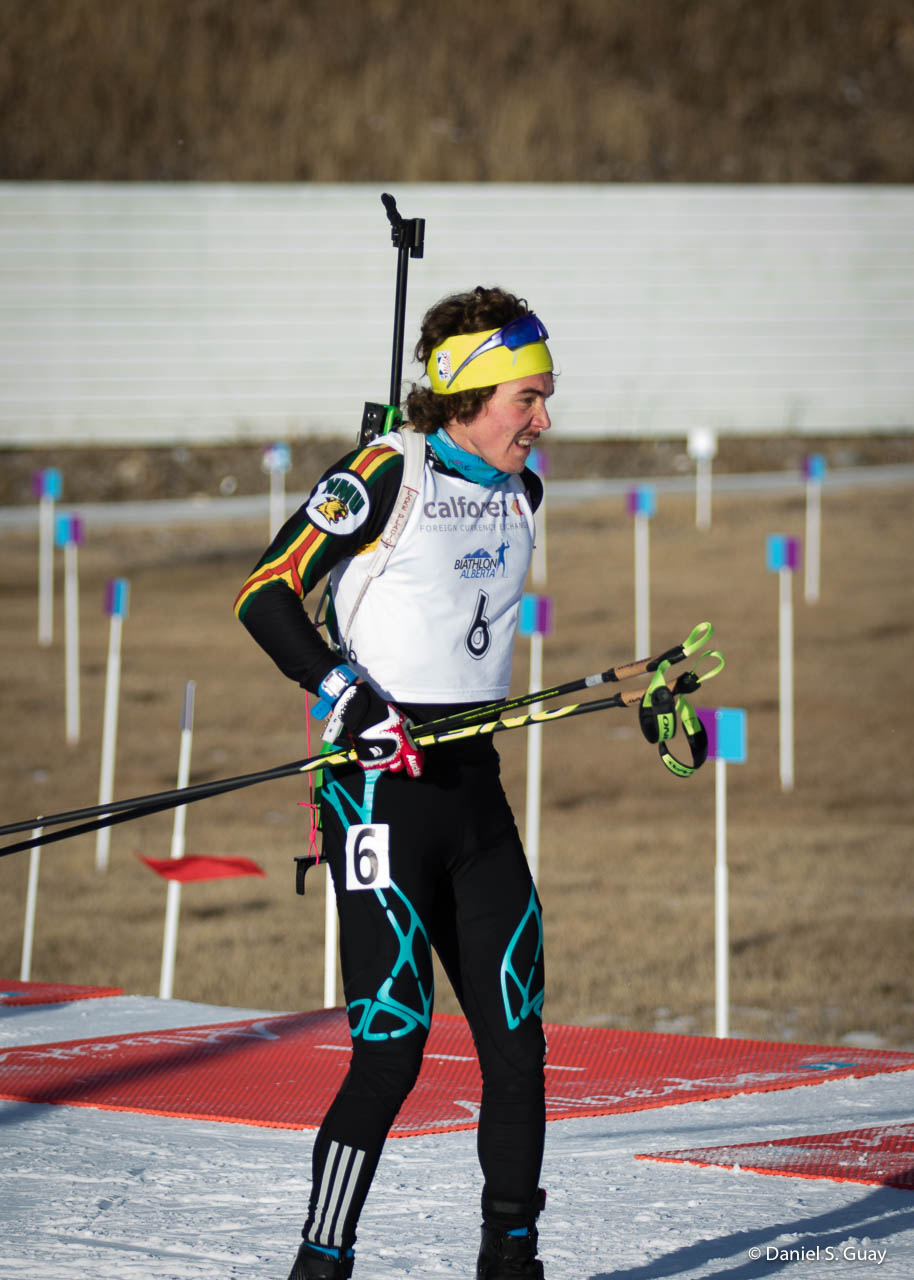
Jake Brown coming into the shooting range in Canmore, Alberta, during this weekend’s NorAm sprint. (Photo: Daniel Guay)
Paul Schommer, of US Biathlon’s National Development Group, shooting in Jericho, Vt., at rollerski trials this fall. (Courtesy photo)
Welcome to “17 Questions for 2017″, where we are catching up with American and Canadian national-team members before the beginning of the winter season.
***
After graduating from the College of St. Scholastica in 2015, Paul Schommer was identified as a potential biathlon talent by the US Biathlon Association. He has been going full bore in his new sport ever since and was recently invited to the national team’s pre-World Cup camp in Canmore, Alberta. Part of US Biathlon’s senior national development group, the 24-year-old Schommer was on the short list for a World Cup starting spot which he ultimately lost out on to Russell Currier, but proved that he’s getting close to the top level of American biathlon just a short time after switching sports.
1. Biggest change in your life in the last five or so months since the ski season ended?
I would have to say the biggest change in my life has been moving out to Lake Placid full time. Training in Hayward was great, but coming out to Lake Placid and having all the resources here has been an amazing opportunity. The staff here really makes it possible for us to concentrate on becoming a better athlete by taking care of simple daily tasks. For example, I step out the door and roller ski to the range, which is already set up by all the coaches, and do my workout. When I return back my room has been cleaned by a housekeeping staff member and I head to the cafeteria where food is hot and ready. To me, that’s just amazing and it’s because of all the awesome people here at the OTC that make it happen. It’s also incredible to have world class coaching day in and day out. It really makes a huge difference and am stoked to be able to be here training with the team.
2. Biggest change in your training?
Paul Schommer (left) after the Climb to the Castle rollerski race in September, where he placed third, in Wilmington, N.Y. (Courtesy photo)
I would say sheer volume and intensity has increased in the past year. My coach at St. Scholastica Chad Salmela and I have been working on increasing my aerobic efficiency ever since I got to Duluth, and I am now starting to reap the benefits of that training. My ability to come back day after day and train at a higher level has allowed me to increase my quality training. In conjunction with this, I have not been working a part-time job like in years past. Due to my financial situation in the past, I have always had to work a part-time job to support myself. However, this year I decided if I was going to do biathlon, I would have to do it right. Money is always tight but thankfully God has put a lot of people in my life that have helped out a ton. The increase in training is definitely a result of the work done with Chad while at St. Scholastica, but being able to recover properly between workouts also makes a huge difference.
3. Major areas of improvement you’ve seen so far?
I touched briefly on my physiological improvement in the previous question, but biathlon is two sports in one. As my ski performance has continued to improve, so has my shooting performance from day to day. The first year of biathlon is an up and down roller coaster, have good days only to be followed by terrible days. The key is to find consistency, which is coming around more and more. As I have become more and more comfortable on the range, I am able to hit more targets consistently. A lot of this has come from lots of dry fire in the past year and shooting more rounds this summer than last year.
4. Whom you’ve been working closest with this offseason (coaches or training partners)?
Schommer competing at rollerski trials in Jericho, Vt., this fall. (Courtesy photo)
While I was in Hayward this summer, I was all by myself. It was awesome to have that time to myself, work through things on my own and not have to rely on anyone else. However, being able to come to Lake Placid for camps made a huge difference and always helped keep me stay motivated. When in Lake Placid, I worked with Jean Paquet most the time, the head Development Coach at USBA. Working with Jean has been great and I’ve always jived well with him. For a training partner, Jake Brown and I do most of our workouts together. We have a really healthy competitive relationship with each other which allows us to push each other in workouts but still have fun. We are great friends and having him in Lake Placid makes things enjoyable both during and after training.
5. Best trip in the last five months (and why)?
Most my traveling is for training purposes, and I don’t have much expendable income for travel beyond that. So when I do have a few days off, I tend to use it to see those I love, whether that be heading home to see family or meeting up with friends. It’s hard to pick on specific trip that means more than another as each one holds its own special meaning. I mean, The Bjorn Bakken Ski Championships of America are a huge deal, the biggest deal, and I had a blast, but also moving my younger brother into college this fall was also awesome, but in a totally different way. So simply put, I’ve had a lot of awesome trips in the past five months and I can’t really say one was better than the other. And what made them all awesome wasn’t because of where I went, but because of the people that were there.
6. Favorite cross-training?
Schommer competing at U.S. National Championships in Maine in March. (Courtesy photo)
Normally I would say mountain biking but this summer I did a lot of paddling in a surfski and really grew to love it. There are so many lakes in the Hayward area and I had a blast going and exploring these on days where it was too hot to double pole, or just wanted a break from the usual training grind. I had a few evenings where I was the only one on the lake with the sunset reflecting of the glassy water and all seemed right in the world.
7. Favorite non-athletic activity or pastime this summer?
Probably the exact opposite of that, just sitting around doing nothing. Where I live this summer I didn’t have internet or phone service so I spent a lot of time just sitting around reading and praying, and it was awesome. When I would be in Lake Placid and have internet, I would start to miss the disconnected life I had back in the woods of northern Wisconsin. I loved just hanging out on the porch in the evening just chilling. It was so peaceful and relaxing. It makes me sound old and boring but I loved it.
8. Song that was your jam this summer?
King of My Heart by Steffany Gretzinger. There were a lot of times I was out skiing or doing a workout and this song would just be playing in my head and would just bring a smile to my face.
9. All-time favorite race moment?
Paul Schommer (l) and Jake Brown doing high-five partner burpees during a strength workout at the U.S. Biathlon development camp in Jericho, Vt. Find their workout here. (Photo: Katrina Howe)
I would have to say the Minneapolis SuperTour at Wirth in 2010. I was a senior in High School and it was my first year ski racing competitively. I was having a bit of a rough season and was having trouble putting together a good race. Before the race my older brother Philip told me, “Paul, if you’re flowing keep it going, if you’re pressin’, you’re messin’.” I took his advice and for the first kilometer or two just tried to flow. As the race continued, I just kept passing people so just kept it flowing. At the finished I was the fastest J1 of the day, which even took me by surprise as my best finish prior to that had been 12th. The best part was at this time absolutely no one knew who I was as I just started competing. When I was looking at results a kid next to me turned to his friend and asked, “Who the heck is Paul Schommer?”
10. First thing you pack in your bag when you leave for Europe?
Positive attitude.
11. Venue/event you’re most excited to visit this season?
Anywhere I get to race and haven’t been to already. I love going to new places and meeting new people so I hope I have the opportunity to go to new places and meet new people this season. When the season concludes, I always look forward to heading back to the Ski Haus for the Bjorn Bakken Ski Championships of America, the greatest backyard ski race on the planet. They always have a great course to really test the skills.
12. Who will win the men’s and women’s World Cup titles this year?
On the women’s side I’d have to go with Marie Dorin Habert. On the men’s side, I think it’s going to be a tight race between Martin Fourcade and Johannes Thingnes Boe.
13. Biggest sacrifice you feel you’ve made choosing this career path?
I don’t really feel like I have sacrificed much. Right now, I am thankful to have this opportunity and don’t have any regrets.
14. If you could change one thing about your sport, what would it be?
Have people know what it actually is. Haha, this is a blessing and a curse at the same time. Not many people in the US know what biathlon and right off the bat guess it is biking and running. However, this also gives me an opportunity to introduce people to the sport and in turn help grow it. Biathlon is a very spectator friendly sport, which is evident by the fact that it is the most watched winter sport in central Europe. Talking with some people of USBA it sounds like they are going to be doing a few things in the coming year to help bring biathlon to Americans which is pretty exciting.
15. What did you have for breakfast this morning?
I’m on this new diet so I had an orange peel, half a banana, and a peanut. I’m only kidding, I had oatmeal.
Brendan Cyr during the men’s sprint at the 2016 US Biathlon National Rollerski Championships on Aug. 13 in Jericho, Vt. (Photo: Katrina Howe)
Alex Howe during the men’s sprint at the 2016 US Biathlon National Rollerski Championships on Aug. 13 in Jericho, Vt. (Photo: Katrina Howe)
Lowell Bailey (l) chasing Jake Brown during the men’s sprint at the 2016 US Biathlon National Rollerski Championships on Aug. 13 in Jericho, Vt. (Photo: Katrina Howe)
Tim Burke during the men’s sprint at the 2016 US Biathlon National Rollerski Championships on Aug. 13 in Jericho, Vt. (Photo: Katrina Howe)
Paul Schommer during the men’s sprint at the 2016 US Biathlon National Rollerski Championships on Aug. 13 in Jericho, Vt. (Photo: Katrina Howe)
Lowell Bailey during the men’s sprint at the 2016 US Biathlon National Rollerski Championships on Aug. 13 in Jericho, Vt. (Photo: Katrina Howe)
Kaitlynn Miller during the women’s sprint at the 2016 US Biathlon National Rollerski Championships on Aug. 13 in Jericho, Vt. (Photo: Katrina Howe)
Sweden’s Anna Hedstrom in the junior women’s sprint at the 2016 US Biathlon National Rollerski Championships on Aug. 13 in Jericho, Vt. (Photo: Katrina Howe)
Emily Dreissigacker during the women’s sprint at the 2016 US Biathlon National Rollerski Championships on Aug. 13 in Jericho, Vt. (Photo: Katrina Howe)
Chloe Levins during the youth women’s sprint at the 2016 US Biathlon National Rollerski Championships on Aug. 13 in Jericho, Vt. (Photo: Katrina Howe)
Chloe Levins during the youth women’s sprint at the 2016 US Biathlon National Rollerski Championships on Aug. 13 in Jericho, Vt. (Photo: Katrina Howe)
Chloe Levins during the youth women’s sprint at the 2016 US Biathlon National Rollerski Championships on Aug. 13 in Jericho, Vt. (Photo: Katrina Howe)
Erik Gorman during the men’s sprint at the 2016 US Biathlon National Rollerski Championships on Aug. 13 in Jericho, Vt. (Photo: Katrina Howe)
Kamran Husain in the junior men’s sprint at 2016 US Biathlon National Rollerski Championships on Aug. 13 in Jericho, Vt. (Photo: Katrina Howe)
Tadhg Nakada (National Guard Biathlon) during the men’s sprint at the 2016 US Biathlon National Rollerski Championships on Aug. 13 in Jericho, Vt. (Photo: Katrina Howe)
Joanne Firesteel Reid during the women’s mass start at the 2016 US Biathlon National Rollerski Championships on Aug. 14 in Jericho, Vt. Reid earned a World Cup nod thanks to her performances. (Photo: Katrina Howe)
Susan Dunklee on her way to victory in the women’s mass start at the 2016 US Biathlon National Rollerski Championships in Jericho, Vt. (Photo: Katrina Howe)
Susan Dunklee during the women’s mass start at the 2016 US Biathlon National Rollerski Championships on Aug. 14 in Jericho, Vt. (Photo: Katrina Howe)
Clare Egan during the women’s mass start at the 2016 US Biathlon National Rollerski Championships on Aug. 14 in Jericho, Vt. (Photo: Katrina Howe)
Kelsey Dickinson during the women’s mass start at the 2016 US Biathlon National Rollerski Championships on Aug. 14 in Jericho, Vt. (Photo: Katrina Howe)
Kelsey Dickinson during the women’s mass start at the 2016 US Biathlon National Rollerski Championships on Aug. 14 in Jericho, Vt. (Photo: Katrina Howe)
Kelsey Dickinson during the women’s mass start at the 2016 US Biathlon National Rollerski Championships on Aug. 14 in Jericho, Vt. (Photo: Katrina Howe)
Maddie Phaneuf during the women’s mass start at the 2016 US Biathlon National Rollerski Championships on Aug. 14 in Jericho, Vt. (Photo: Katrina Howe)
Maddie Phaneuf during the women’s mass start at the 2016 US Biathlon National Rollerski Championships on Aug. 14 in Jericho, Vt. (Photo: Katrina Howe)
Hallie Grossman during the women’s mass start at the 2016 US Biathlon National Rollerski Championships on Aug. 14 in Jericho, Vt. (Photo: Katrina Howe)
Emily Dreissigacker during the women’s mass start at the 2016 US Biathlon National Rollerski Championships on Aug. 14 in Jericho, Vt. (Photo: Katrina Howe)
Emily Dreissigacker during the women’s mass start at the 2016 US Biathlon National Rollerski Championships on Aug. 14 in Jericho, Vt. (Photo: Katrina Howe)
Emily Dreissigacker during the women’s mass start at the 2016 US Biathlon National Rollerski Championships on Aug. 14 in Jericho, Vt. (Photo: Katrina Howe)
Sweden’s Nicolina Lindqvist during the junior women’s pursuit start at the 2016 US Biathlon National Rollerski Championships on Aug. 14 in Jericho, Vt. (Photo: Katrina Howe)
Sweden’s Nicolina Lindqvist during the junior women’s pursuit start at the 2016 US Biathlon National Rollerski Championships on Aug. 14 in Jericho, Vt. (Photo: Katrina Howe)
Sweden’s Elvira Oberg during the youth women’s pursuit start at the 2016 US Biathlon National Rollerski Championships on Aug. 14 in Jericho, Vt. (Photo: Katrina Howe)
Junior women race at the 2016 USBA Rollerski Nationals in Jericho, Vt.
Sweden’s Tilda Johannson (l) and Frederique-Karia Perusse during the youth women’s pursuit start at the 2016 US Biathlon National Rollerski Championships on Aug. 14 in Jericho, Vt. (Photo: Katrina Howe)
Tilda Johannson during the youth women’s pursuit start at the 2016 US Biathlon National Rollerski Championships on Aug. 14 in Jericho, Vt. (Photo: Katrina Howe)
Chloe Levins during the youth women’s pursuit start at the 2016 US Biathlon National Rollerski Championships on Aug. 14 in Jericho, Vt. (Photo: Katrina Howe)
Chloe Levins during the youth women’s pursuit start at the 2016 US Biathlon National Rollerski Championships on Aug. 14 in Jericho, Vt. (Photo: Katrina Howe)
Eliza Thomas during the youth women’s pursuit start at the 2016 US Biathlon National Rollerski Championships on Aug. 14 in Jericho, Vt. (Photo: Katrina Howe)
Eliza Thomas during the youth women’s pursuit start at the 2016 US Biathlon National Rollerski Championships on Aug. 14 in Jericho, Vt. (Photo: Katrina Howe)
Siena Ellingson during the junior women’s pursuit start at the 2016 US Biathlon National Rollerski Championships on Aug. 14 in Jericho, Vt. (Photo: Katrina Howe)
Amanda Kautzer during the youth women’s pursuit start at the 2016 US Biathlon National Rollerski Championships on Aug. 14 in Jericho, Vt. (Photo: Katrina Howe)
Sarah Beaulieu during the youth women’s pursuit start at the 2016 US Biathlon National Rollerski Championships on Aug. 14 in Jericho, Vt. (Photo: Katrina Howe)
Sarah Beaulieu during the youth women’s pursuit start at the 2016 US Biathlon National Rollerski Championships on Aug. 14 in Jericho, Vt. (Photo: Katrina Howe)
Sarah Beaulieu during the youth women’s pursuit start at the 2016 US Biathlon National Rollerski Championships on Aug. 14 in Jericho, Vt. (Photo: Katrina Howe)
Naomi Hernandez during the women’s pursuit start at the 2016 US Biathlon National Rollerski Championships on Aug. 14 in Jericho, Vt. (Photo: Katrina Howe)
Joanne-Firesteel Reid (l) cheers on Alex Howe during the men’s mass start at the 2016 US Biathlon National Rollerski Championships on Aug. 14 in Jericho, Vt. (Photo: Katrina Howe)
Lowell Bailey during the men’s mass start at the 2016 US Biathlon National Rollerski Championships on Aug. 14 in Jericho, Vt. (Photo: Katrina Howe)
Tim Burke during the men’s mass start at the 2016 US Biathlon National Rollerski Championships on Aug. 14 in Jericho, Vt. (Photo: Katrina Howe)
Russell Currier during the men’s mass start at the 2016 US Biathlon National Rollerski Championships on Aug. 14 in Jericho, Vt. (Photo: Katrina Howe)
Jake Brown during the men’s mass start at the 2016 US Biathlon National Rollerski Championships on Aug. 14 in Jericho, Vt. (Photo: Katrina Howe)
Paul Schommer during the men’s mass start at the 2016 US Biathlon National Rollerski Championships on Aug. 14 in Jericho, Vt. (Photo: Katrina Howe)
Brendan Cyr during the junior men’s pursuit start at the 2016 US Biathlon National Rollerski Championships on Aug. 14 in Jericho, Vt. (Photo: Katrina Howe)
Peter Carroll during the junior men’s pursuit at the 2016 US Biathlon National Rollerski Championships on Aug. 14 in Jericho, Vt. (Photo: Katrina Howe)
Cody Johnson (l) and Brendan Cyr during the junior men’s pursuit start at the 2016 US Biathlon National Rollerski Championships on Aug. 14 in Jericho, Vt. (Photo: Katrina Howe)
Cody Johnson (l) and Brendan Cyr during the junior men’s pursuit start at the 2016 US Biathlon National Rollerski Championships on Aug. 14 in Jericho, Vt. (Photo: Katrina Howe)
Cody Johnson during the junior men’s pursuit start at the 2016 US Biathlon National Rollerski Championships on Aug. 14 in Jericho, Vt. (Photo: Katrina Howe)
Brendan Cyr during the junior men’s pursuit start at the 2016 US Biathlon National Rollerski Championships on Aug. 14 in Jericho, Vt. (Photo: Katrina Howe)
A select group of top U.S. biathletes and more than 60 juniors made the trek to the military base in Jericho, Vt., for the 2016 US Biathlon National Rollerski Championships and North American Rollerski Biathlon Championships last weekend, weathering hot and humid temperatures over two days of racing.
US Biathlon Chief of Sport Bernd Eisenbichler wrote in an email that he was pleased with the turnout at the Ethan Allen Firing Range, especially among the younger athletes. On Sunday, 15 men raced the elite mass start, and 10 women raced the women’s mass start. The rest of the field competed in pursuits, separated into various age categories for ages 14 and up.
“Tim and Lowell showed a high level … and showed that they are overall well ahead of everybody else,” he wrote. “Shooting was challenging for them as well as for everybody else through the weather conditions, as when you stopped the whole body felt like [it was going] to explode…but both had also some very good stages!”
He added that Dunklee was skiing at a high level, but struggled on the range a bit in the sprint (with four penalties) because of the weather and a few adjustments she was working on.
“The mass start was better in that regard,” Eisenbichler wrote.
In terms of developing male skiers, he pointed out Jake Brown, a former Northern Michigan University skier who started biathlon this past June, and Paul Schommer, who picked up the sport two summers ago. In the mass start, Brown placed third and Schommer was fourth.
“They worked hard to get where they are right now,” Eisenbichler wrote. “Still a lot to work on, but on the right way.”
Max Durtschi and Alex Howe were sick leading up to the races, which affected their results, he added. Absent from Jericho were national-team members Leif Nordgren and Sean Doherty, who are in Europe for a seven-week camp. They’re currently in Östersund, Sweden, and will meet up with the rest of the team in Ruhpolding, Germany, on Aug. 22 for a three-week camp in Ruhpolding and Oberhof, Germany.
On the women’s side, Eisenbichler highlighted Clare Egan (second in the mass start and third in the sprint) and Joanne Reid (second in the sprint and third in the mass start).
“Joanne had very good shooting in the Sprint and both days [skiing] was solid and showed that she made very good progress in [biathlon],” he said of Reid, who’s entering her second year of biathlon. “With good focused work and more daily based coaching in the fall (she had to spend some periods back in Colorado for some studies in the spring), [she] will be on the right path for the start of the season.”
Several cross-country skiers came out as well, including Hallie Grossman, Liz Guiney and Kaitlynn Miller. “We hope that a few of them will pursue [biathlon] intensively in the future,” Eisenbichler said.
Note: FasterSkier is seeking photos from the nordic races at 2016 NCAA Skiing Championships. Please email info@fasterskier.com with photos of top finishers or for more info.
***
Two juniors, one from Montana State University (MSU) and the other from the host team, the University of Colorado-Boulder (CU), claimed the ultimate collegiate titles on Thursday at 2016 NCAA Skiing Championships in Steamboat Springs, Colo.
It was the first of two days of nordic racing at Howelsen Hill, and Anika Miller (MSU) and Mads Strøm (CU) emerged as the individual winners in the 5- and 10-kilometer freestyle races, respectively.
The women’s 5 k freestyle podium on the first day of nordic racing at 2016 NCAA Skiing Championships in Steamboat Springs, Colo. Anika Miller (MSU) placed first, Petra Hyncicova (CU) finished second and Utah’s Sloan Storey took third. (Photo: MSUBobcats.com)
Miller led four Bobcats in the top 10, winning the women’s 5 k freestyle individual start in 13:06.1. Her teammate, Cambria McDermott, placed fourth, 9.4 seconds back.
“When I finished, I had no idea how I’d done actually until my teammates jumped on me and were screaming,” Miller told NCAA.com. “I had no idea. I just started crying.”
A native of McCall, Idaho, Miller bested second-place finisher Petra Hyncicova (CU) by 7.9 seconds for the win, becoming the first MSU skier to win an individual title since 1978, when Dan Brelsford (now the director of skiing) won the slalom race, according to an MSU press release. She is also the first female skier to win an individual title for MSU.
Just one-tenth of a second behind Hyncicova, Sloan Storey (University of Utah) reached the final step of the podium in third.
An NCAA champion in 2014, Strøm achieved his second freestyle title in the men’s 10 k freestyle on Thursday in 22:06.8. His time proved to be 10.6 seconds faster than runner-up Ian Torchia of Northern Michigan University (NMU). Denver University’s Moritz Madlener placed third (+19.8).
For Strøm, the win was his fifth in a row and seventh total this season, according to a CU press release.
“It feels awesome, it feels amazing,” the 24-year-old Norwegian told CUBuffs.com. “For ten months this has been my goal and to accomplish my goal is amazing. I was so nervous. I knew there was going to be a mass crowd out. I just had to find good skis, good pacing, and push it as hard as possible. It was definitely the best win of the year. Pulling it off when it matters the most is great.”
Mads Strøm of the University of Colorado-Boulder celebrates his win in the men’s 10 k freestyle on Thursday at 2016 NCAA Championships in Steamboat Springs, Colol. (Photo: Jamie Schwaberow/NCAA via CUBuffs.com)
Strøm explained he had to “push it all the way to the end,” so hard that he was physically ill across the line.
“I was so tired in the end,” he added. “As soon as I crossed the finish line, I had to lie down.”
With his seventh win, Strøm is the winningest male nordic skier in CU history. He exceeded the amount of wins of Per Kare Jakobsen (who won six races in 1989) and Ove Erik Tronvoll (six in 1999). It was also the 89th individual win by a Buff, the most of any school in NCAA history, the CU release stated.
For women’s runner-up Hyncicova, a 21-year-old sophomore from the Czech Republic, second stood as her best result of the season and matched her career best.
“It was so hard, but it was really nice in the end. I didn’t hope for getting second, so it’s really nice,” Hyncicova told CUBuffs.com. “I really didn’t have any idea what I was hoping for. In each race you want to win, but I didn’t expect that I would win here because I was always around fifth [place] this season. I went to Romania a couple of weeks ago [for U23 World Championships], so I was really tired and didn’t feel that great.
“I was really nervous before the start,” she added. “But once I saw everyone here — the alpine’s and everyone who cheered for us — I was like, ‘Yes I have to do it. I have to do it for the team.’ ”
Team Standings (through 4 races):
Montana State: 282
Utah: 264
Denver: 263
Colorado: 214.5
Vermont: 154
New Mexico: 139.5
Dartmouth: 126
Alaska Anchorage: 124
Northern Michigan: 122
Middlebury: 81
“I feel somewhat relieved but happy,” CU Nordic coach Bruce Cranmer said. “Compared to racing, coaching is way more stressful. You are worried about everyone and getting the right wax. I am still trying to calm down. I get so fired up.
“Mads did great,” Cranmer added. “The guy that got second [Torchia] is one of the top U.S. [skiers] that went to World Juniors. [Mads] was on really good form before he got here, so I had high expectations without trying to get too caught up.
“As for Petra, we were hoping for a top five finish. That is we thought she was capable of. … For her to finish in second is awesome. … She does really well in skating.”
Late last month, Torchia led the U.S. junior men in Romania with his top individual result of the week in 15th in the 15 k freestyle. It was his second-best at Junior Worlds since placing 11th last year in the 20 k skiathlon.
Following Torchia in second, Northern Michigan had three in the top 10 with Adam Martin in fourth (+28.4) and Jake Brown in ninth (+56.1).
“We knew that if we had a good day, all three of those guys were capable of winning and we just didn’t know which one,” said NMU Head Coach Sten Fjeldheim told NCAA.com. “We weren’t shocked or surprised that they’re all in the top 10, but you never know at altitude.”
The base elevation of Steamboat Springs’ Howelsen Hill is about 6,700 feet.
Through four events (two cross-country and two alpine) at 2016 NCAA Championships, Montana State leads the team standings with 282 points and Utah is second with 264. Denver is a close third, with 263 points after two days of racing. With a win and second-place finish on Thursday, CU moved into fourth in the standings, with 214.5 points.
MSU’s previous team best was seventh, which it achieved last year with 259 points. The University has already exceeded that total at the halfway point of the championships. Racing wraps up Saturday with 15/20 k classic mass starts.
“The momentum definitely helps our mindset, but the bottom line is we’ve got to go out and race the same way that we race everyday. That’s the way to succeed,” MSU Head Coach Matthew Johnson told NCAA.com. “Trying to mix it up and change it for the championship isn’t going to go well. Coming in with too much excitement isn’t going to go well, but skiing like we’re in the lead and skiing like we’re champions is going to do well for us.”
The men start the 30 k freestyle mass start at U.S. Nationals in Houghton, Mich.
Note: This article has been updated to reflect that Tad Elliott has won four national distance races, including the 50 k skate in 2010 in Fort Kent, Maine.
HOUGHTON, Mich. — Although Tad Elliott’s name may have been missing from the top of U.S. results recently, at the 2016 U.S. Cross Country Ski Championships on Thursday, the former U.S. Ski Team member showed he’s still got it.
Elliott, 27, a longtime racer with Ski and Snowboard Club Vail (SSCV), made a move in the last three kilometers that went unanswered in the men’s 30 k freestyle mass start, and he entered the stadium with a comfortable berth over Brian Gregg (Team Gregg), winning by 9.6 seconds in 1:20:31.6.
Gregg held off a strong finish by Michael Somppi of Canada’s National Development Centre-Thunder Bay to secure second place, 3.7 seconds ahead of Somppi in fourth.
Over the last two years, Elliott has battled illness, forcing him to take nine months off from training, and endured multiple hospital stays due to complications of Epstein-Barr. Since then, Elliott struggled to attain the same level of results he had grown accustomed to prior — as one of the most promising distance skiers on U.S. Ski Team from 2011 to 2013. However, his upward trajectory began last season when he finished 14th at the American Birkebeiner ski marathon and 11th in the 50 k freestyle mass start at U.S. Distance Nationals in Sun Valley.
Tad Elliott cruises to his fourth-career national title in the 30 k freestyle mass start at U.S. Nationals in Houghton, Mich.
He competed in both SuperTour weekends this year, finishing 25th in the 15 k skate in West Yellowstone, Mont., and 15th in the 15 k classic in Sun Valley, Idaho, allowing him to enter this weekend flying somewhat under the radar.
“Before this week I knew I was in my best form for a long time, but could only dream of a podium,” Elliott said after Thursday’s win — his fourth national title following victories in 2010, 2011 and 2012 at nationals in Maine: first in the 50 k skate in Fort Kent, then in the 30 k skate and 15 k skate in Rumford.
This year’s 30 k skate mass start consisted of three laps around the 10 k course on the Michigan Tech Trails. About an inch of new snow had fallen overnight and racers awoke to a foggy and warm morning. Temperatures hovered around 30 degrees at race time when 91 men lined up for the event.
Since start positions are based on recent International Ski Federation (FIS) points, Elliott started in bib 140 and had to fight through the field to reach the front on the first lap. Elliott and the rest of the podium contenders stayed out of trouble out of the start, avoiding broken poles and navigating the high-speed hairpin turn two kilometer into the race.
Canadian Kevin Sandau (Alberta World Cup Academy) made the first decisive move at the end of the first lap just before 10 k. Scott Patterson of Alaska Pacific University (APU) answered Sandau’s attack, and the two gapped the field by 50 to 60 meters.
Meanwhile, Gregg was concerned with the strength of Patterson and Sandau together up the trail.
“I was nervous we wouldn’t be able to bring those guys back so I put pretty big surge in to bring them back,” Gregg said. “Unfortunately I brought six to eight skiers along with me. I was hoping it would be a bit smaller than that.”
Sandau’s move ended up establishing the the lead group. “Everyone was hurting and that was for sure the hardest part of the race for me and I think a lot of people today,” Somppi explained. “Once we regrouped and got into our 10-, 11-person pack then it was a lot easier and more chill. I just hung out in the group and waited for the finish.”
The resulting group of 11 consisted of Elliott, Gregg, Somppi, Sandau, Adam Martin and Jake Brown of Northern Michigan University (NMU), Patterson, Matt Liebsch (Gear West), Kyle Bratrud (CXC) and Kris Freeman (Freebird) .
“It was awesome to ski with Jake, who I’ve been training with all fall,” Martin said. “Jake led the pace for a good part of the second lap and it was pretty sweet to ski behind him. It just felt like an L3 workout at practice this fall.”
Patterson was another consistent presence at the front of the lead pack.
“I led a lot of the race, but my skis weren’t quite in the game today,” Patterson said. “I think I was one of the strongest in the field, but a little off on skis and that makes it a bit harder.”
The lead group stayed intact until Elliott made his statement.
“It was pretty steady until about three ‘k’ to the finish when Tad Elliott made a strong move and Brian kinda latched onto him,” Patterson described.
Gregg (Team Gregg) leads Elliot (SSVC) during the 30 k freestyle mass start at U.S. Nationals in Houghton, Mich. Elliott went on to win the race and Gregg took second.
Elliott’s move wasn’t completely premeditated, but it proved crucial.
“It was not planned before the race or during,” the eventual winner said. “I knew I had to drop Gregg for a chance to win. He is the best closer out there. My plan was to wait until 400 meters, but the opportunity was there and I felt amazing.”
With Gregg unable to match him, Elliott celebrated across the line.
“Tad was looking really strong. We’ve been teammates and friends for a long time so it is great to see him back on top,” said Gregg, who was Elliott’s former teammate on Central Cross Country (CXC).
After the race Elliott was thankful more than anything.
“I’m pretty thankful for my support team. It’s been a while since I’ve been at the front of a race and went through kind of a lot the past two years so I was really excited,” he said.
“My twin brother waxed my skis they were probably the best in the field,” Elliott added. “[I’ve had] Vail support me for a long time as well as Caldwell Sport who was helped me come back from my illness. This is a really big one for me and it feels like a huge team win.”
Somppi was happy for a podium while feeling less than optimal.
“I came here hoping to win but I’m feeling a bit worn out,” he said. “I raced Period 1 of the World Cup and I sick from coming back from Europe. It was a short ten days at home with some sickness and then come down here so it’s been tough racing.”
Adam Martin (l) leads Patterson (r) and NMU teammate Brown during Thursday’s 30 k freestyle mass start at U.S. Nationals in Houghton, Mich.
Since Somppi is Canadian, Martin made the American podium in third and was ecstatic about his race.
“In the past I’ve been much stronger in classic races so to get fourth today that was a huge surprise and I’m really satisfied with that,” Martin said.
Gregg was happy for Elliott’s success as well as his own performance.
“Today was really fun, felt like my skis were one of the best in the field,” he said. “I was trying to stay in the front group and conserve energy.”
As for the rest of the season, Gregg is looking to regain the overall SuperTour lead as he returns to the domestic circuit. Patterson will leave the domestic circuit this month as he earned World Cup starts as the Period 1 SuperTour leader.
Last season’s overall NorAm champion, Somppi will return to the Canadian circuit and race the next NorAm in his hometown of Thunder Bay, Ontario, a qualifying race for the Canadian World Cups in March.
As for Elliott: “We haven’t really talked about it yet,” his coach, Eric Pepper, said. “We had to see how this went first, but he will primarily focus the Birkie.
“Tad’s dealt with a lot the past couple years and to come back and win a race, and win it like that, it was just awesome,” Pepper continued.