Tag: Jake Dalberg

  • U.S. Biathletes Smith and Dalberg Look Back on World Juniors That Was, Forward to More European Racing

    U.S. Biathletes Smith and Dalberg Look Back on World Juniors That Was, Forward to More European Racing

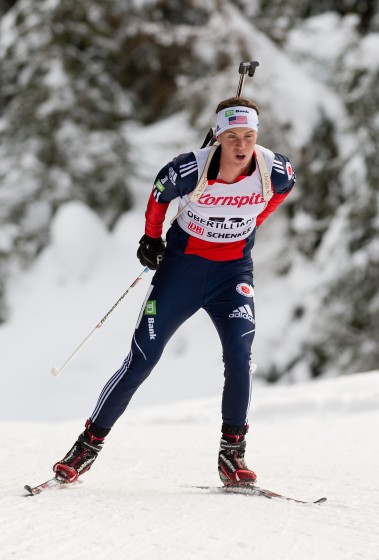
    Casey Smith (USA) en route to 37th place in the junior men's individual in Obertilliach. He had his career-best finish of 23rd place in the pursuit on Sunday. Photo: US Biathlon/NordicFocus.
    Casey Smith (USA) en route to 37th place in the junior men’s individual in Obertilliach. He had his career-best finish of 23rd place in the pursuit on Sunday. Photo: US Biathlon/NordicFocus.

    With the U.S. bringing just two junior men and one junior woman to the World Youth and Junior Championships in Obertilliach, Austria, relay day isn’t going to mean much for the oldest athletes on the team.

    Instead, Casey Smith, Jake Dalberg, and Tara Geraghty-Moats had their last crack at the Championships on Wednesday, competing in the 12.5 / 15 k individual races: four shooting stage, a minute time penalty per missed shot.

    After an impeccable pursuit race that saw just one penalty in four stages, Smith couldn’t quite keep pace in the individual, collecting one missed shot in each of the first three stages and then two in the last stage. Nevertheless, he was able to move from 42nd as he left the range the final time up to 37th by the finish.

    “The individual went okay, it was not a great race but not bad either,” he wrote in an e-mail to FasterSkier. “Especially in an individual, with five misses you can’t expect to do great. Of course I would have like to hit more, but that is part of biathlon and what makes it fun and exciting.”

    Teammate Jake Dalberg actually shot much better, collecting only three penalties, but was hampered by an early crash. As he spun around in the snow, he managed to lose all four bullet-filled magazines that usually tuck into a rifle stock. Arriving at the range, he realized he had nothing to shoot with, and had to wait for about 45 seconds while an official brought him new ones.

    Dalberg ended up 52nd, but with the 45 seconds subtracted he would have been about even with Smith.
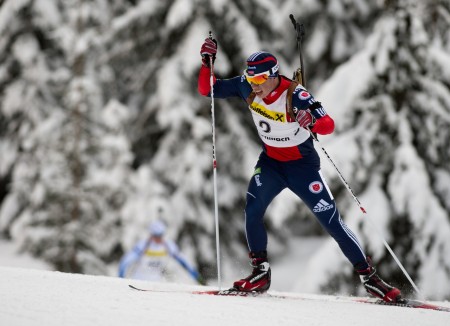
    Jake Dalberg competing in the sprint. Photo: US Biathlon/NordicFocus.
    Jake Dalberg competing in the sprint. Photo: US Biathlon/NordicFocus.

    “I shot that prone really fast, and honestly I am a little surprised that I hit 4 of 5,” he wrote in an e-mail. “So I was not so focused in that shooting, but the next three I was locked in and just paused too long on the last shot of each standing. I think as I have become more and more comfortable with the range I have been improving my averages in both training and obviously today in the race.”

    Geraghty-Moats faced bigger challenges on the range, where she missed a painful 11 shots and wound up 63rd, over 13 minutes behind the winner, Laura Dahlmeier of Germany.

    Like Geraghty-Moats, Dalberg failed to qualify for the pursuit race on Sunday, leaving him with just two starts in the series. He wasn’t exactly frustrated, but had hoped to gain one more race-worth of experience out of the trip.

    “I wouldn’t say that I am disappointed with these races too much, but I definitely was hoping to make the pursuit,” he explained. “My ski speed overall just was not there I felt like, just kind of missing that top end. It may be the altitude, or the fact that I had a pretty intense cold in between trials and coming here.”

    It’s Dalberg’s first trip to World Juniors, although he has international race experience as part of the National Guard biathlon team competing at military events. Those past races helped him prepare for this event – to an extent. Racing a military event in Italy still isn’t the same as World Juniors in Austria, with fans loudly cheering and booing in German for each shot on the range.

    “Having been to Europe to race before definitely helped, but I still had some nerves going into the sprint,” Dalberg said. “I think too some days training on the range it was so busy, that I lost some focus while shooting at certain points.”

    Staff Seargant Sarah Lehto, Dalberg’s coach, was nonetheless impressed at his performances this week.

    “This is by far the biggest international race series for Jake in his career,” she told FasterSkier. “He’s competed internationally for the past two seasons but nothing at this
    level. I’m extremely pleased that he was able to qualify for the team after narrowly missing the youth qualification last year and how he performed in such an atmosphere like these World Championships in Obertilliach… he’s now gained a ton of experience at this level which will help his development and expectation level for future racing.”

    She also acknowledged that Dalberg’s skiing wasn’t up to his usual level, but that she hoped he wasn’t too disappointed. The racer himself is hoping to get back into shape next week, when he heads over the border to Italian Military Championships.

    “For my first World Juniors, I would say I am happy with it, but felt like I could have had some better ski times,” he explained. “The competition was very tough, I knew it would be but the top several juniors I believe have been competing on the World Cup/IBU Cup, so I felt like the top end was very competitive, and I think overall the fields were pretty large this year compared to past years.”

    Smith is also hoping to carry on in the coming weeks; he’s waiting to hear whether he is accepted to a trip to U26/Open European Championships, where he thinks he can keep up this level of racing.

    “My skiing is feeling good,” Smith said. “I think that my training for the past few weeks leading up to now went well my coach had a pretty specific plan written out for me and I tried to follow it as close a possible which really helped me.”

    But unlike Dalberg, who has one more year of junior eligibility, Obertilliach was truly the end of the road for Smith. A four-time World Youth and Junior Championships competitor, he looked back on both this and other editions with fond memories.

    “I am happy with the Championships as a whole, like I said the other day I had my best ever Junior Worlds finish here in the pursuit which I was really happy about,” he said. “It is nice to see that I am continuing to improve especially since I am moving up into the senior ranks next year… I have definitely enjoyed all of my Junior Worlds and had fun at them, but I am ready to move on and continue.”
    Results: men / women


  • For Dalberg and Roberts, National Guard Offers Another Route to Ruhpolding

    For Dalberg and Roberts, National Guard Offers Another Route to Ruhpolding

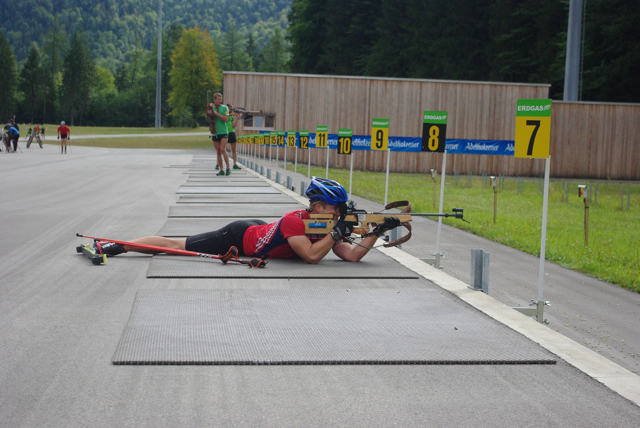
    Jake Dalberg, a member of the National Guard biathlon program, shoots prone during a workout in Ruhpolding, Germany on Monday.

    RUHPOLDING, Germany – When Jake Dalberg made the decision to join the National Guard at age 17, this was exactly what he had in mind.

    “It was tough, but at the same time I felt like it was what I wanted to do and that was the way to do it,” Dalberg, now 19, said of the decision that the National Guard was his best route forward in biathlon.

    In just his third year in the sport, Dalberg is here in Ruhpolding as a sort of adjunct member of the U.S. national team training camp. Although Dalberg and teammate Wynn Roberts are staying in separate accommodations and are supported entirely by their own program, not the U.S. Biathlon Association, they see the national team athletes on the range and the trails every day and have joined in to test themselves in time trials.

    Wynn Roberts checks in with National Guard coach Sarah Lehto.

    “We work together with the national team very well,” National Guard coach Sarah Lehto said as she watched Roberts and Dalberg shoot. “They come to Jericho and sometimes send athletes over to Jericho and we work with them. And in the winter once in a while I’ve gone to World Cups if they need another coach. So we work really well together and I have a good rapport with the coaches.”

    That’s what allowed this trip to happen. Last year, 2010 Olympian Wynn Roberts joined the Guard team; he was the most experienced and high-level athlete to sign up in several years. This spring, Lehto began to think about how to best provide Roberts with the kind of training he needed, which basically meant training with his former national team teammates.

    She asked USBA High Performance Director Bernd Eisenbichler if Roberts if the Guard could bring Roberts to Ruhpolding; only later did she decide to bring Dalberg along. Now, there are two athletes and two coaches from the team in Ruhpolding.

    For Dalberg, it’s an unusual opportunity, and one he’s bent on making the most of.

    “I really just want to learn a lot,” he said as he stretched after a two-hour skating, classic, and shooting combination workout. “I’m still in just my third year of biathlon so I there’s still a lot of learning going on. So just watching the national team, seeing how they do things, and trying to get as much out of it as I can.”

    What is he learning?

    “Just being efficient in skiing, and resting, and all the little things,” Dalberg said. “Sometimes I feel like I’m skiing well, but then I’ll go look at video and go, wow, I really have a lot to work on.”

    Lehto sees the trip serving a different purpose for her two athletes. Dalberg has raced mainly on the NorAm circuit and at a few military races, including one in Italy last year; he seldom gets to compete against the national team. The coach hopes that this will give him some valuable experience.

    Roberts (front) and Dalberg shooting together on the range.

    “It’s good for him to see the next level,” Lehto said. “You know, he sees video comparing himself to some of the top racers in the world and it’s a good way for him to learn. You can talk about these things, but until you’re really immersed in it it’s really hard to know what it’s like. He’s the only U.S. junior getting this type of training right now.”

    Another difference is that while Dalberg has been training more or less all year, Roberts took a break after the race season ended so that he could go through Basic Training and then get married. He’s only been training for part of the summer. But Lehto said that Roberts was taking things well, even when he finished farther behind the national team men in time trials than he usually would. She didn’t think the fact that he was still working on fitness was a major detriment for the camp.

    “For Wynn especially, he needs to be immersed in this environment,” Lehto said.

    Normally, the two athletes train together in Jericho, Vermont. The Guard team typically brings its entire eight-athlete squad together for training camps once a month. While the program has enough funding to do a trip like this every year, it doesn’t always make sense to do so.

    “We have done trips to Scandinavia in the past, but it depends on who you’re working with whether it’s even worthwhile to come over here and be in this environment,” Lehto said. “We have athletes who we didn’t bring, who are not capable of being in this environment. But it will benefit these two, for sure.”

    The spread in ability levels on the team makes her job interesting, but not easy.

    “We just have two coaches but we have eight athletes covering the entire spectrum,” Lehto said. “So that’s really tough. But I feel like we’re rebuilding our program… now that things are calming down in the world, people are beginning to re-look at this option. It’s more enjoyable for me to work with athletes who are closer together, and who are true biathletes rather than looking within the National Guard to find athletes who could potentially be biathletes.”

    As for Dalberg, the Guard is working out perfectly. After just missing the World Youth Championships team last year, he is entering his first year as a junior and aims to make the World Junior team to Obertilliach, Austria.

    “It’s been really good,” Dalberg said of the Guard experience. “I have really great support and good coaching. And it’s a good place to train in Jericho and a good roller loop, so good facilities.”

    After the national team finishes up in Ruhpolding at the end of the week, they will head to Oberhof, Germany, to train and test skis in the ski hall. The Guard athletes, too, will head in that direction.

    “We’ll be three weeks here, which is kind of long, but we’ll be two weeks here and then when they’re kind of tired of this, then they get to go skiing in the ski hall,” Lehto said.

    Dalberg was excited; he had only ever skied in the summer once, and it was a completely different experience. He hopes that this time might be better for training.

    “I was in Chile once in the summer and I skied there, but that was at 10,000 feet,” he laughed. “I think this will be a little easier.”