From the FasterSkier archive — posts syndicated from athletes’ and coaches’ own blogs between 2004 and 2012, kept online as published. Current coverage is at fasterskier.com.
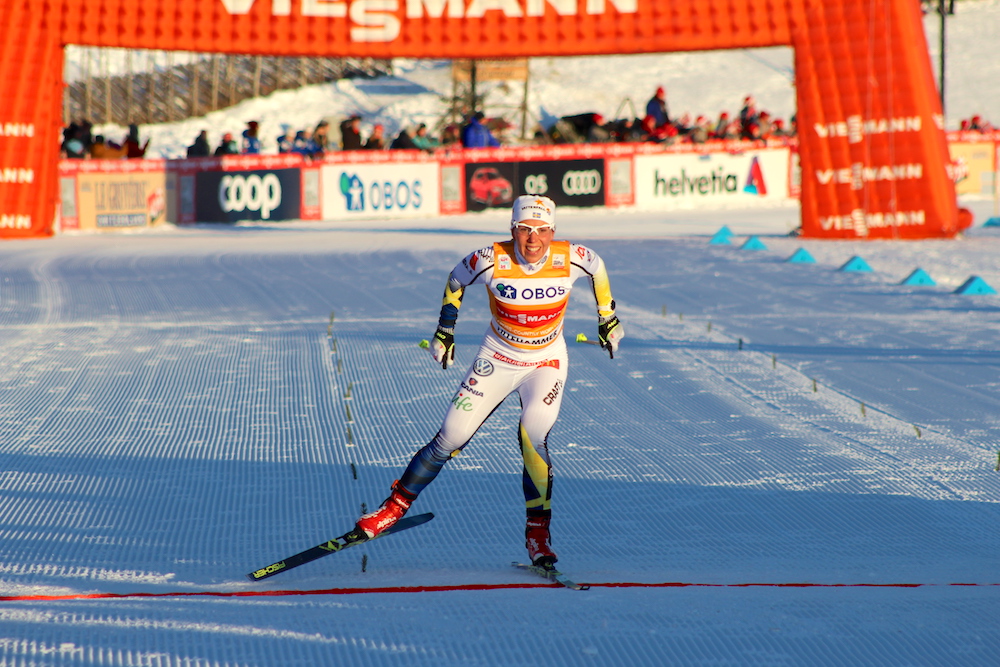
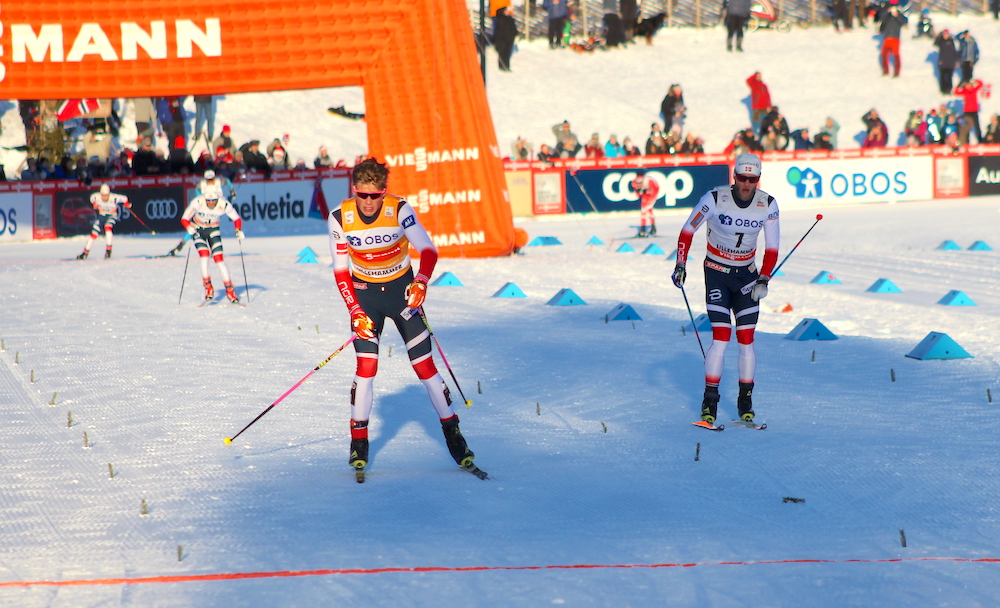
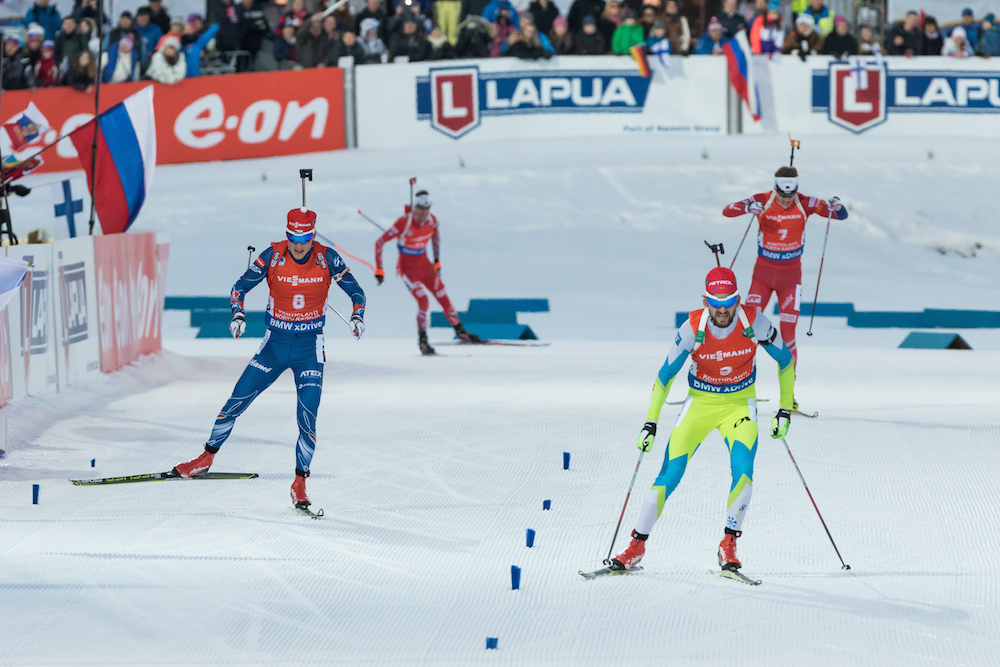
Johannes Høsflot Klæbo anchoring the Norwegian men’s 4 x 10 relay to gold on Sunday at the 2018 Olympics in PyeongChang, South Korea, while Denis Spitsov (background) celebrates silver for the Olympic Athletes for Russia. (Photo: FlyingPointRoad)
For a while in the men’s 4 x 10-kilometer relay on Sunday, it looked like the Russians might run away with the win. But that was just two classic legs and 20 k into the race, with a lot more racing to come.
While Kazakhstan’s Alexey Poltoranin had handed off in first at the first exchange, just ahead of Andrey Larkov of the Olympic Athletes from Russia, Italy, France and Norway skied together behind them, with Norway’s Didrik Tønseth trailing off the back, 18 seconds behind.
On the next classic leg, Russia’s Alexander Bolshunov put a hurt on the field. Within the first 3.3 k lap, he was 25 seconds ahead of Kazakhstan’s Yevgeniy Velichko in second, who was followed closely by Italy, Norway and France in third through fifth. Sweden’s Daniel Rickardsson had fallen farther behind to more than a minute back in sixth place, after his teammate Jens Burman lost contact with the lead group on the first leg.
By the second exchange, Russia was 24.5 seconds clear of second place, while Italy’s Francesco de Fabiani tagged Giandomenico Salvadori in second, France’s Maurice Manificat tagged Clement Parisse in third (+28.0), and Norway’s Martin Johnsrud Sundby tagged Simen Hegstad Krüger in fourth (+32.1). Kazakhstan’s Velichko had fallen off the pace and was another 19 seconds back in fifth.
Over the next 10 k, the first skate leg, Krüger and Parisse reeled in Russia’s Alexey Chervotkin, catching him before the end of their second lap. One lap later, Krüger came through the final exchange in first, tagging Johannes Høsflot Klæbo 0.4 seconds ahead of France in second. Chervotkin tagged Russia’s anchor Denis Spitsov in third, 16.2 seconds back, while Finland’s Matti Heikkinen passed Italy’s Salvadori on the last climb to put Finland in fourth (+58.6).
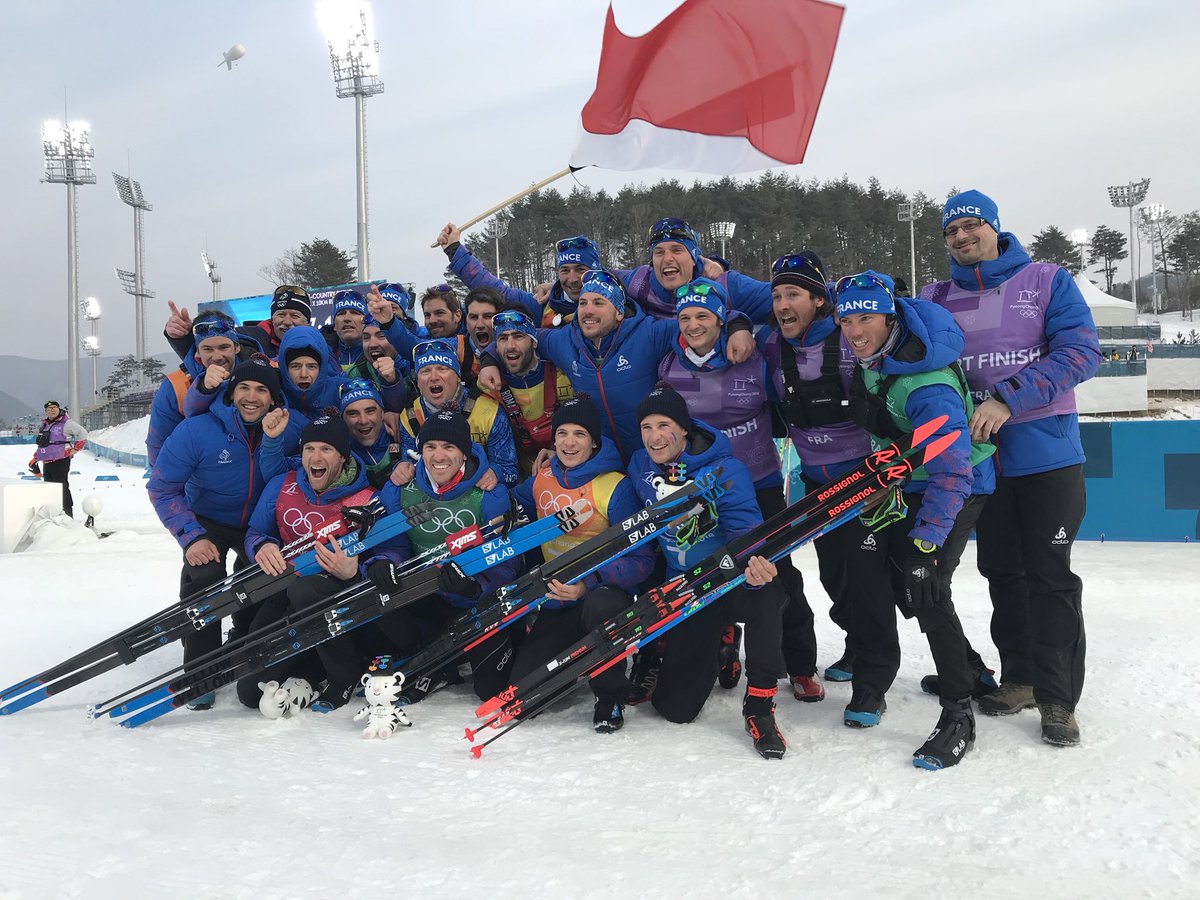
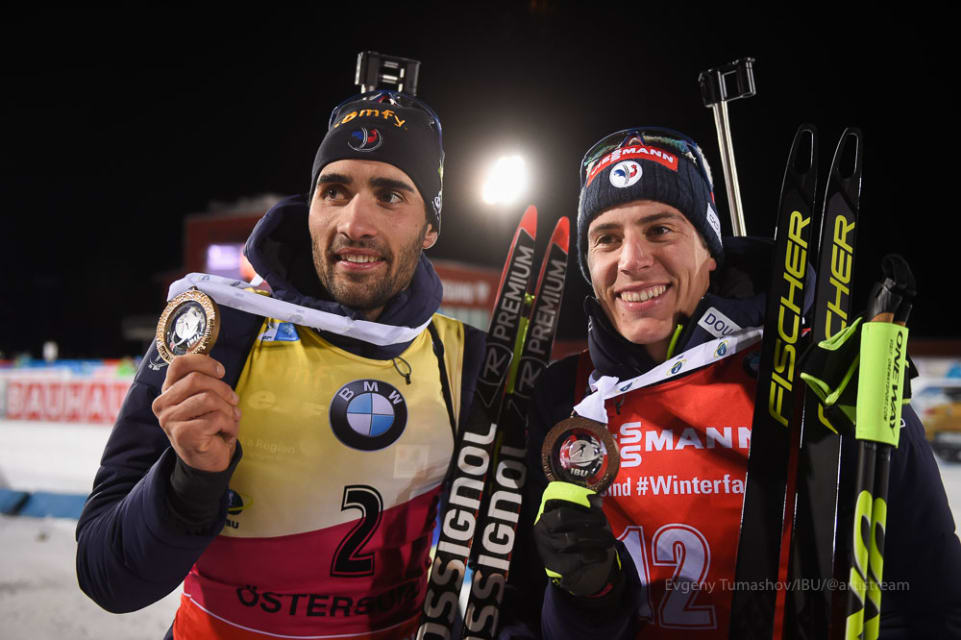
Team France celebrates its bronze-medal finish in the men’s 4 x 10 k relay at the 2018 Olympics on Sunday in PyeongChang, South Korea. (Photo: FIS Cross Country/Twitter)
Early in the final leg, France’s Adrien Backscheider took the lead ahead of Klæbo. The two held Spitsov off until the end of the second lap, where Spitsov came through the stadium first to start the final loop. Spitsov and Klæbo soon upped the pace, dropping Backscheider, and shortly after the 8.27 k checkpoint, Klæbo truly put the jets on to accelerate away from Spitsov. He dropped the Russian on a climb just before the final uphill, where it was clear that the gold was Norway’s.
As he sped down into the stadium, Klæbo relaxed his arms, skied to the sideline and took a flag from the stands. He looked back for a moment and then crossed the finish line first in 1:33:04.9 hours, while Spitsov followed 9.4 seconds later for silver for Russia. Backscheider held on for bronze (+36.9) as his team exuberantly celebrated with him at the finish.
Finland placed fourth (+1:40.5), Sweden fifth (+2:05.6), Germany sixth (+2:08.2), Italy seventh (+2:35.2), and Kazakhstan eighth (+3:31.4). Canada was ninth (+3:41.0) for its second-best Olympic relay result (with Len Valjas, Graeme Killick, Russell Kennedy, and Knute Johnsgaard), and the U.S. finished 14th (+9:24.2), out of 14 teams, with Andy Newell, Reese Hanneman, Scott Patterson, and Noah Hoffman.
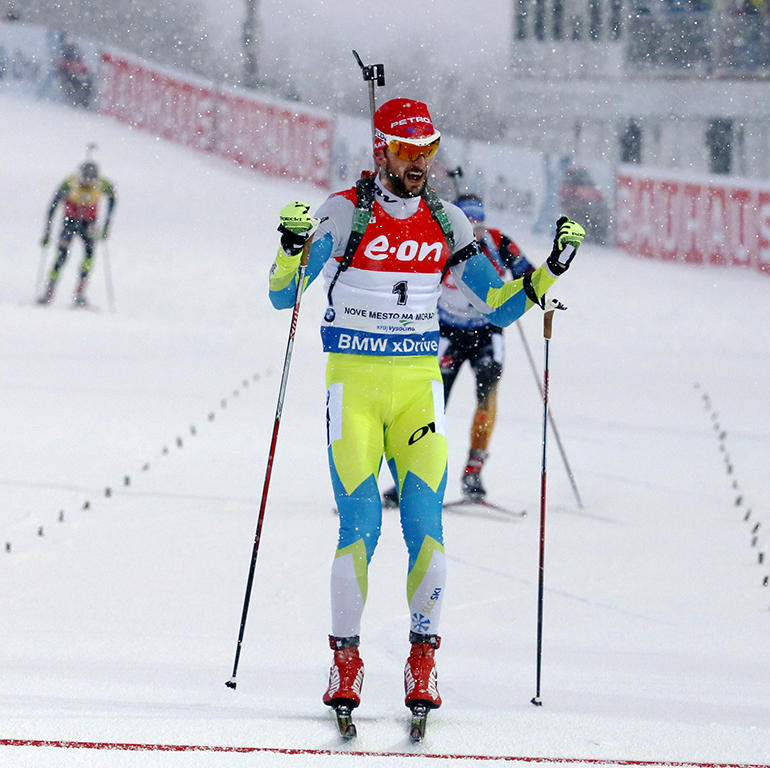
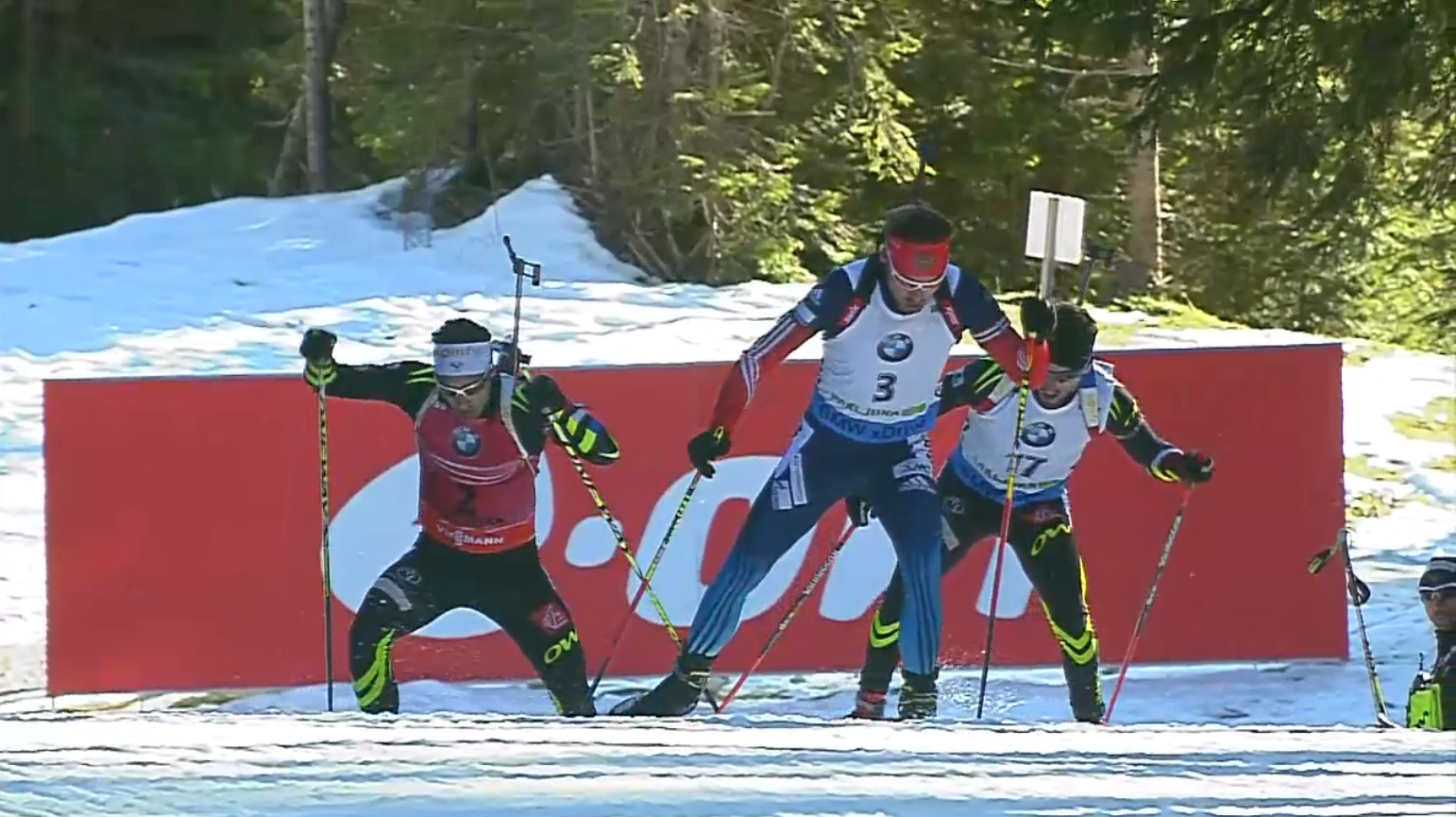
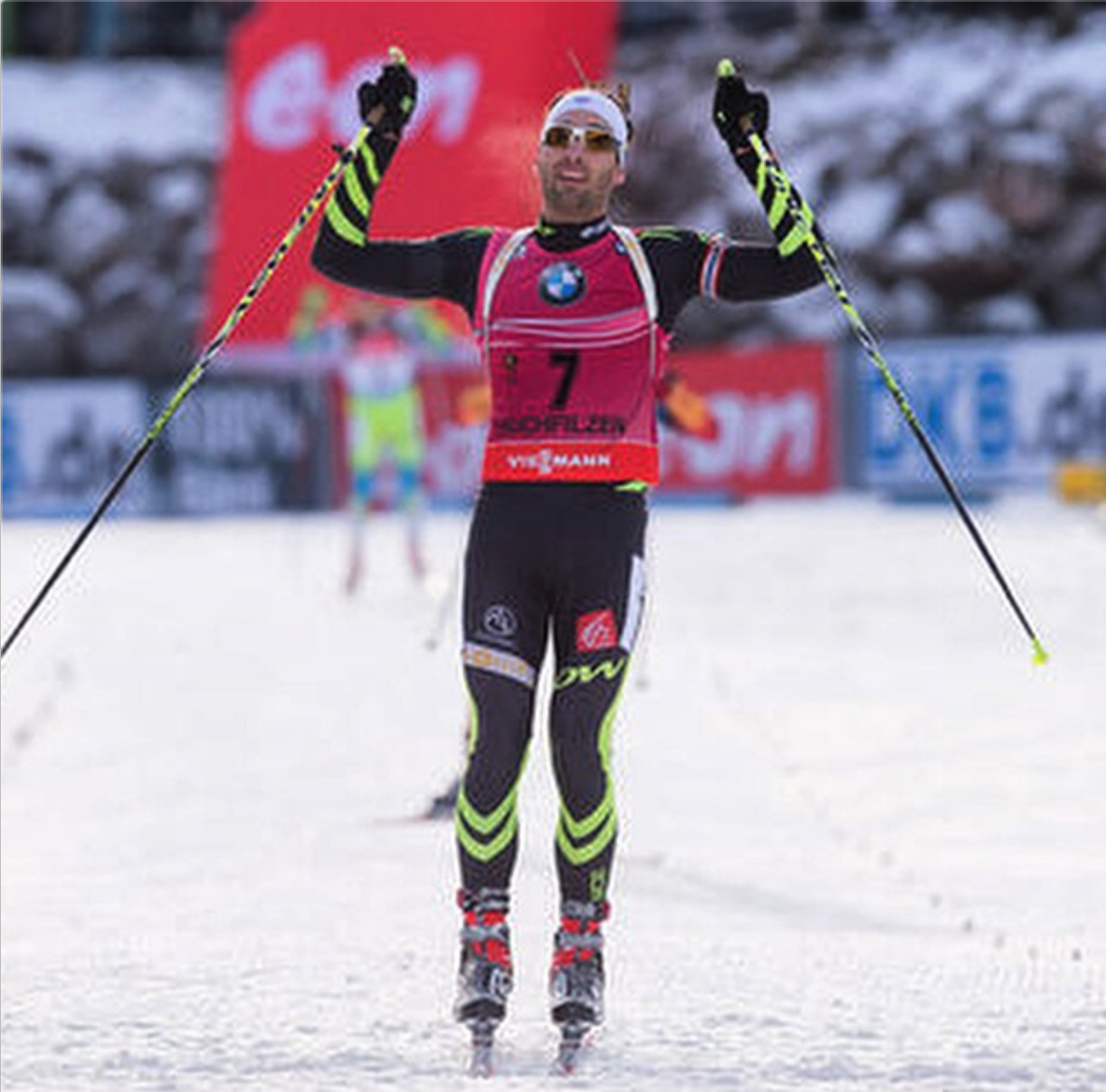
France’s Martin Fourcade lunging for his second gold of the 2018 Olympics in PyeongChang, South Korea, winning the men’s 15 k mass start on Sunday. (Photo: FlyingPointRoad)
Martin Fourcade is the champion once again. Six days after he won the 12.5-kilometer pursuit for his first gold in PyeongChang, the 29-year-old Frenchman did it again in the men’s 15 k mass start on Sunday, winning in a photo finish at the line.
He took charge on the first loop, leading the field into the range for the first prone shooting. There, Fourcade shot a penalty and slipped to 19th, but it wasn’t over.
Clean shooting on the second prone brought him up to eighth, 9.4 seconds out of first. Germany’s Benedikt Doll took that lead at that point after his second stage without a miss. Meanwhile Norway’s Johannes Thingnes Bø shot three misses on that second stage and dropped out of contention.
One loop later, Fourcade moved into first with a clean standing. He left the range about 1 second ahead of Germany’s Simon Schempp and 2 seconds ahead of Germany’s Erik Lesser, after both made it through the first three stages without a miss. Doll missed one to slip to seventh, almost 30 seconds behind.
After Fourcade and Schempp exchanged leads over the next loop, Lesser moved into first just before the final shooing, Going head to head, Fourcade and Schempp both missed one while Lesser missed two. Fourcade and Schempp still left the range in first and second, respectively, separated by 0.4 seconds, while Lesser slipped to fifth, 22.5 seconds back.
Doll left the range in third (+19.2) after cleaning and Norway’s Emil Hegle Svendsen moved into fourth (+21.9) with a clean standing stage as well.
In the end, Fourcade outlunged Schempp for the win in 35:47.3 minutes, with Schempp finishing less than a tenth of a second behind for silver, and Svendsen beat out Lesser in the finishing stretch by 0.4 seconds to claim bronze, 11.2 seconds behind, while Lesser settled for fourth (+11.6). Doll followed them in fifth (+18.8), Austria’s Julian Eberhard placed sixth (+30.7) with three penalties, Norway’s Erlend Bjøntegaard seventh (+32.1) with two misses, Norway’s Tarjei Bø eighth (+34.6) with three penalties, Sweden’s Jesper Nelin ninth (+34.6) with two misses, and Slovenia’s Jakov Fak 10th (+36.1), just ahead of the Czech Republic’s Ondřej Moravec in 11th (+36.3), with one miss each.
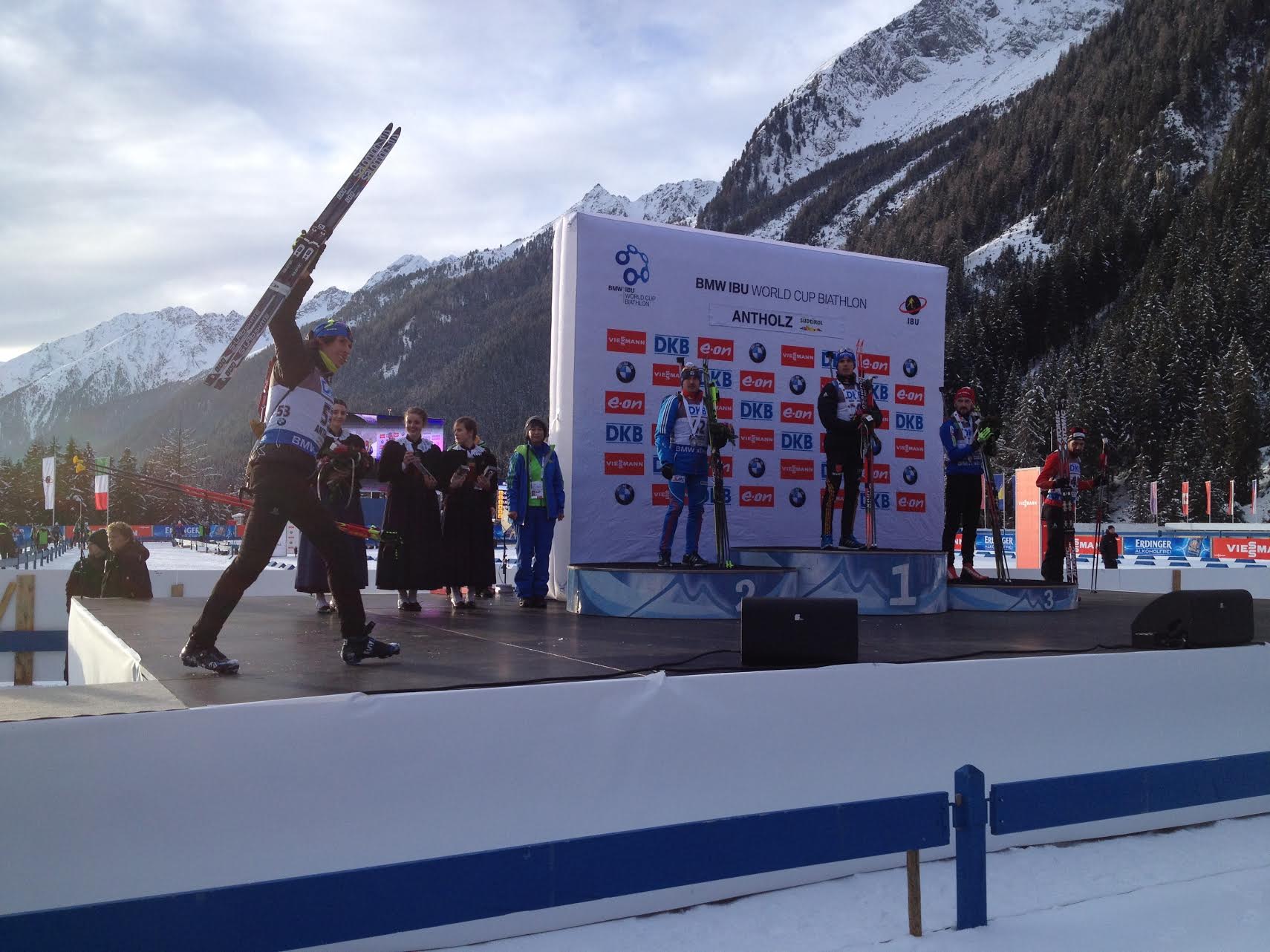
Norway’s Johannes Thingnes Bø celebrates his first Olympic medal — gold — in the men’s 20 k individual on Thursday at the 2018 Olympics in PyeongChang, South Korea. (Photo: FlyingPointRoad)
Johannes Thingnes Bø came into these Olympics as a definite favorite, right up there with Martin Fourcade. But PyeongChang quickly humbled the 24-year-old Norwegian, just as it did Fourcade, in the first race of the 2018 Winter Games. There, in the men’s 10-kilometer sprint, Fourcade finished eighth, missing three out of five in his first shooting stage, and Bø had the same problem with prone — missing three then shooting another penalty in standing — to end up 31st. It was the kind of result no one saw coming after those two had taken first or second in every non-relay World Cup race this season (except for one, the sprint that Bø’s older brother Tarjei Bø won on Dec. 2 in Östersund, Sweden).
The men’s second biathlon race of the Games, the 15 k pursuit, saw Fourcade back to his winning ways while Johannes Bø finished 21st.
“We both [knew] before the Olympics that it will not be only a fight between us, because we know the shooting range [here] is challenging,” Fourcade said when asked about Bø in a press conference after the pursuit. “I thought that at our best level, we could be difficult to beat but the wind and the Olympic situation will bring many opportunities for outsiders to take competition… It’s not a competition about Johannes today. It’s biathlon.”
Three days later in the men’s 20 k individual race on Thursday, Bø overcame any doubts and won his first Olympic medal in his second Games. It was gold, and he had achieved it with a time that stood up against 85 others in the men’s field. Even with two penalties that added two minutes to his final time (there are no penalty laps in the individual-format race), Bø finished the 20 k in 48:03.8 minutes and he posted the fastest overall course time of 43:11.4 in the process.
Despite his two previous races in PyeongChang, Bø — the overall World Cup leader in the 20 k individual — explained in a post-race press conference on Thursday that he never got down on himself.
Norway’s Johannes Thingnes Bø racing to first in the men’s 20 k individual on Thursday at the 2018 Olympics in PyeongChang, South Korea. The gold was his first Olympic medal in his second Winter Games. (Photo: IBU/Biathlonworld)
“After the two done races, I just let my shoulders down, and I knew there were still two great opportunities for me, individual and mass start,” he said. “Two races I have won before this season, so I knew that there still was a chance even if the sprint and pursuit was my favorite before the Olympics. So I always had the belief that I could do it. And you only need one chance, so if I missed out today there would still be a chance on the mass start, and I always believed that I could make it.”
He started Thursday’s individual race in bib 9 and was one of several of the top contenders who chose an early start because of more favorable conditions earlier in the day. It was the warmest race day yet at the Alpensia biathlon venue, and perhaps most importantly, less windy than it had been. At least that was the case early in the 20 k; the wind picked up as the race wore on.
Bø took the attention away from himself early in the race after missing one in the first prone stage — his third shot. That put him in seventh at the time and ultimately 52nd overall. From that point on, Bø quietly worked his way back into contention, cleaning the next two stages, then missing shot in the last standing stage. But because of his speediness out on the course, he still left the range in first.
In the finishing stretch, Bø nearly took himself out as his pole tip nicked his left ski. But he stayed upright, recollected himself and continued charging to the line. There, he finished 1:22.1 minutes clear of the previous race leader, Sweden’s Fredrik Lindström.
“I put my pole right down on my ski,” Bø told NRK after, according to a translation. “Two to three [centimeters] to the left and I would’ve put the pole on the inside of the ski, but it would’ve went well anyway, but you never know.”
As the rest of the starters embarked on the five-loop course and navigated the four shooting stages, it became evident that no one was going to touch Bø. He sat inside the leader’s cubicle at the venue, which had a small couch and TV to watch the rest of the race, along with a race-leader camera documenting his every move. He wasn’t glued to the screen by any means. It was probably hard for him to watch.
France’s Martin Fourcade (23) follows Sweden’s Fredrik Lindström (1) during the men’s 20 k individual at the 2018 Olympics in PyeongChang, South Korea. Fourcade went on to place fifth while Lindström placed eighth. (Photo: FlyingPointRoad)
Initially, Fourcade came closest to him, finishing 42.4 seconds off his time in second place. The Frenchman had been on track for his second-straight gold after cleaning the first three stages of Thursday’s race, but he missed his last two shots to slip to second behind Bø. And he couldn’t beat the Norwegian on the last loop; despite skiing the second-fastest final loop and second-fastest overall course time, Fourcade was still second to Bø, who was the fastest on both.
“That was like a gift,” Bø said at the press conference of Fourcade’s uncharacteristic late misses. “Even if he only had missed one of the two last [shots] he would have been the winner. But, you know, someone will miss one in the first shooting and one in the last, and others make two mistakes on the last shooting, so you just have to see for the total. And we both had two mistakes today and I was a little bit faster than him and that saved my result.”
Austria’s Dominik Landertinger racing to bronze in the men’s 20 k individual at the 2018 Olympics in PyeongChang, South Korea. (Photo: FlyingPointRoad)
Fourcade as the 23rd starter was later bumped off the podium by Austria’s Dominik Landertinger (bib 38) and Sweden’s Sebastien Samuelsson (bib 51), respectively. While Landertinger hung on for the medals, Samuelsson missed his second-consecutive Olympic medal in fourth place (+29.1), 14.9 seconds behind Landertinger.
While Landertinger had shot a perfect 20-for-20 and Samuelsson was one off that mark with a single penalty (0+0+1+0), the 57th starter, Slovenia’s Jakov Fak finished ahead of them both and just 5.5 seconds behind Bø for the silver medal. Like Landertinger, who earned bronze (+14.2), Fak was one of just three men who cleaned all four stages on Thursday. (Ukraine’s Artem Tyshchenko, who finished 29th, was the other.)
Once Fak finished, Bø could finally exhale and celebrate. He had done it.
“After the first shooting, I still believed that a medal could be won, could be possible, but after the last standing I thought I missed out on the podium,” Bø reflected at the press conference.
“I’m glad I fought through the final lap even with two misses,” he told NRK. “Because I thought the medals wouldn’t be possible, but I felt good, and I had no problems with changing gears out in the course. And thank God I did, because I ended up with the gold in the end.”
Bø’s previous Olympic best was fourth in the men’s relay at the 2014 Olympics in Sochi, Russia. He is a three-time world champion and won three golds at biathlon Junior World Championships, two of which came in relays in 2012 and 2013. Between that time of transitioning from the junior ranks to the World Cup in 2013, Bø became best known as the young and hard-charging biathlete with the gold-painted rifle. He later painted it pink, before going back to gold in the leadup to PyeongChang.
“I had a pink rifle for two years and I wanted to change it before the Olympics,” Bø said at the press conference. “The first season I came into the World Cup I had a golden rifle.”
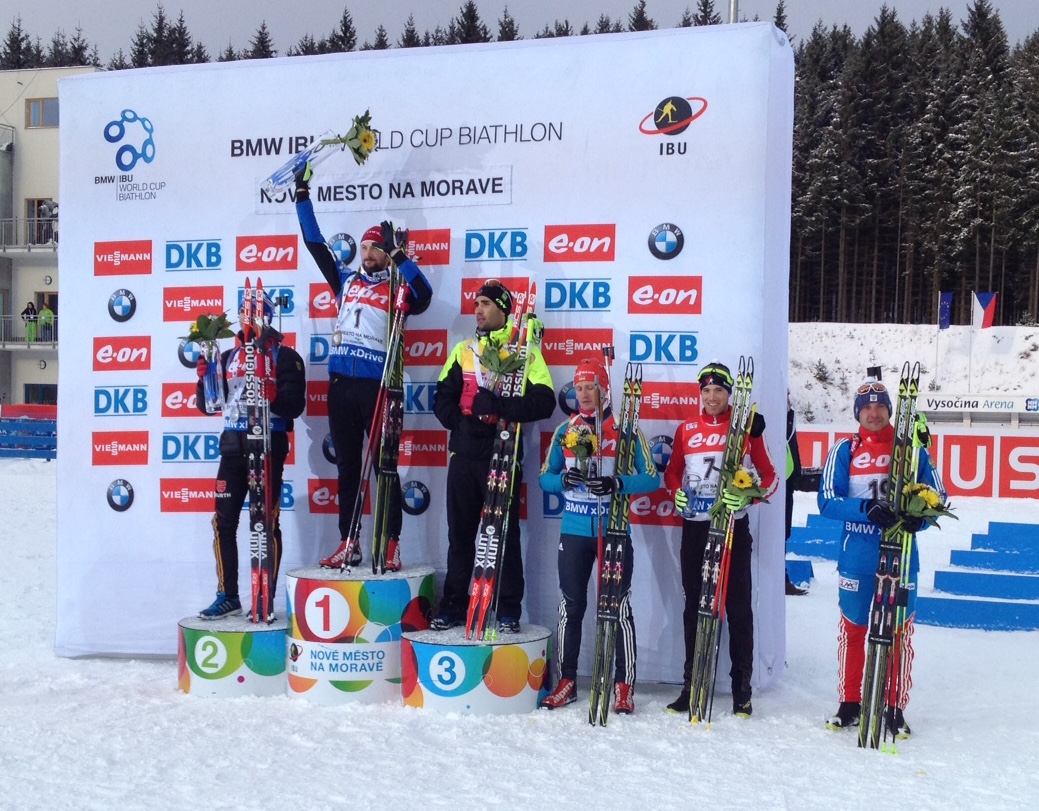
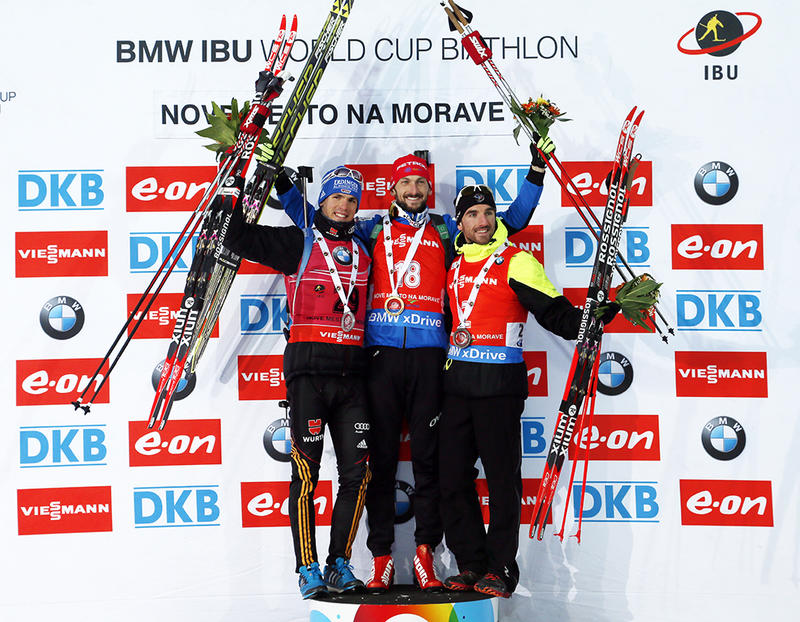
The men’s 20 k individual podium at the 2018 Olympics in PyeongChang, South Korea, with Norway’s Johannes Thingnes Bø (c) in first, Slovenia’s Jakov Fak (l) in second, and Austria’s Dominik Landertinger (r) in third. (Photo: FlyingPointRoad)
After stepping back outside and into the stadium, Bø began to tear up. He finally connected with his brother Tarjei, who had finished 13th with two penalties, and they embraced in a special moment.
“It’s a great feeling,” Bø said of what it’s like to be an Olympic champion. “To describe with one word is just ‘amazing’. It’s every nice words you can find.”
For Fak, 30, who missed all but two World Cup races last season because of health issues, he said the silver medal was a “dream come true.” Earlier this season, he placed second in two World Cup pursuits.
“At the last Olympics in Sochi, I was sick before the Olympic Games,” Fak said at the press conference. “I fought until the last race to get some medals and my best result was fourth place in the mass start, so I missed it and it was a big struggle for me, the last two seasons were very hard. I was sick all the time. Last season I had only two starts on the World Cup and it would be better if I didn’t even have them. I had really a lot of problems and to come back into the whole season was a very big victory for me.”
Slovenia’s Jakov Fak pushing for silver in the men’s 20 k individual at the 2018 Olympics in PyeongChang, South Korea. (Photo: FlyingPointRoad)
After different illnesses plagued him last year — “I would train for two weeks and another sickness would come,” he recalled — Fak considered hanging up his rifle and quitting the sport. But his coach encouraged him to stick with it.
“We made a good plan. It was not to be on the highest level on the World Cup, but just to come back,” Fak explained. “And everything that I’ve done this season, the podiums, are just a big bonus for me.”
Landertinger, 29, earned his second Olympic bronze after helping Austria to third in the men’s relay in Sochi. He also has a relay silver from 2010 in Vancouver, British Columbia, but Thursday marked his first individual Olympic medal.
In September, he had back surgery to repair a herniated disc, and he didn’t start his World Cup season until early last month.
“I am really overwhelmed,” Landertinger told Austrian broadcaster ORF, according to a translation. “The last year was extremely tough. During the last races I already was a little bit despaired, and now the bronze medal, that is crazy. On the course I again did not feel good today, but I fought and put out everything I could. There were a lot of beautiful moments in my career, this medal was the most difficult one. Today I had to do it with the shooting, and that worked out.”
Fourcade ended up fifth on the day (+42.4), Switzerland’s Benjamin Weger placed sixth (+48.6) with one penalty, the Czech Republic’s Michal Krčmář finished seventh (+1:15.5) with one miss, and Lindström was eighth (+1:22.1) with one penalty as well.
Scott Gow’s Career-Best 14th
In his first Olympics, Canada’s Scott Gow raced to 14th (+2:02.5) for his best Olympic result by nearly 50 places after finishing 61st in the PyeongChang sprint. Gow cleaned three-consecutive stages then missed his first shot on the final standing (0+0+0+1) to slip out of the top 10. Regardless, 14th was still better than his career-best World Cup result after he had finished 16th in two races this season.
Canada’s Scott Gow racing to 14th in the men’s 20 k individual on Thursday at the 2018 Olympics in PyeongChang, South Korea. It was his career best at the World Cup and world-championships level. (Photo: FlyingPointRoad)
“I was very happy with it,” Gow said of his result in a post-race interview with FasterSkier. “A little disappointed to miss that one standing shot, especially when everything was going quite well in the range. Skiing was pretty good, and so overall I am very happy.”
Without having spoken with his coach yet, Gow wasn’t exactly sure where his lone miss went wrong, but he guessed it was a close one.
“I have a feeling that I missed it just high,” the 27 year old said. “That’s usually where I miss in standing, especially when it feels good. If it feels like it was good, if it feels like it was hit, I probably missed it just high.”
With weaker and less variable wind than in previous biathlon races this week, Gow said that presented a new challenge.
“When it’s this calm, relatively as calm, everyone can shoot well,” he observed. “So that puts a little extra pressure and emphasis on myself to shoot well. So going into today I knew that would be have to the focus, to hit targets, because even if my skiing is a little off I can make up for it with a really good shooting. And that was what was going through my head the last few days preparing for this.”
Looking ahead to the remaining races in PyeongChang, Gow said the hardest ones were over.
“Now it’s the relays,” he said. “And my body feels like it’s in fairly good shape. I was happy with my skiing today, and again, my shooting was much better today and it has been good all week. So as long as I can maintain a good training mode and a good training rhythm, I think it will be good, and I am optimistic.”
Canada’s Brendan Green racing to 22nd in the men’s 20 k individual at the 2018 Olympics in PyeongChang, South Korea. (Photo: FlyingPointRoad)
Canada had three in the top 30 with Brendan Green in 22nd (+2:26.6), with a single miss in the last stage (0+0+0+1), and Christian Gow in 26th (+2:57.2), with two penalties (1+0+0+1). For 24-year-old Christian Gow in his first Olympics, it was a big improvement from 62nd in the sprint.
“I think I kind of reset after the sprint. It was not even close to what I wanted,” Christian, Scott’s younger brother, told FasterSkier after. “But I guess what I realized kind of internalizing that race is that I am not defined by one race that I had. Of course of all the times that you want to perform is the Olympic Games. It was a bit of a bummer, and I looked at it as a chance to refocus for the races to come, obviously including this one.
“I was very happy with my effort,” Christian said before he knew his final result. “I felt like I had good energy on skis and was able to push the whole time, and more than anything I am just happy with what I did out there today.”
Canada’s Christian Gow racing to 26th in the men’s 20 k individual on Thursday for his best result at his first Olympics in PyeongChang, South Korea. (Photo: FlyingPointRoad)
Green, 31, was also pleased with his performance after placing 82nd in the sprint four days ago.
“I was a little worried going into today after the sprint. I mean, the sprint you had the wind, but I also had a pretty rough day on the skis as well,” he told FasterSkier. “So I was a little bit worried as to how today would play out, but I did a good race prep yesterday. I didn’t have a ton of guys to ski with today, but there were always people kind of within sight … I just tried to keep a pace that I could maintain and really focus on the shooting range.
“I think I was really able to capitalize on these less-windy conditions that we finally had today,” Green said. “And to get away with one miss, that’s a good day for sure.”
American Tim Burke en route to 41st in the men’s 20 k individual at the 2018 Olympics in PyeongChang, South Korea. (Photo: FlyingPointRoad)
In his fourth Olympics, Tim Burke was the top American in 41st (+4:01.9), a result he wasn’t happy with, after shooting four penalties (1+1+0+2).
“The strategy is always the same: it’s just to execute the game plan, and tonight I struggled with that on the range,” he told FasterSkier after. “I felt like I was decent on the skis, not great but not bad. … I felt like I tried to follow through with my plan, and some days it’s easier than others. And today it didn’t work out.”
Sean Doherty followed in 44th (+4:21.8) with three penalties (2+0+1+0).
“Prone has continued to have a few gremlins in it for me,” the 22-year-old two-time Olympian said. “I worked on it the last couple days in training, but I mean, today was less wind and I was looking forward to that, so I still have just a couple things to work out with it. Standing was great, felt super solid, skied well. You know, those two out of three categories went well, so prone is just continuing to plague me. It’s unfortunate.”
Lowell Bailey, the defending world champion in the 20 k individual, finished 51st (+4:53.0) after missing his first two shots of the day in the first prone then incurring two additional penalties (2+1+0+1). The four penalties added four minutes to his time.
Afterwards, Bailey was beside himself.
“I think shock is really the only way to describe it, completely shocked to miss those two,” he told FasterSkier. “I’ve never started an individual [race] like that. I felt really good about the shooting going into this, I had a game plan, I really felt like I had everything — I had a good plan, it just didn’t work out.
American Lowell Bailey gets up off the mat and ready to head back onto the course after a shooting stage in the men’s 20 k individual at the 2018 Olympics in PyeongChang, South Korea, where he finished 51st. (Photo: FlyingPointRoad)
“I knew the shooting conditions were more to my liking today and I felt really good about my training leading into it, especially on the shooting range, I felt like this was the race I had a good chance to do well in,” he continued. “The wind got me. It was just enough to push me out on the right side. The wind’s tricky here, sometimes it doesn’t register as strong as it actually is, so missing two shots right off the bat, that’s just a really tough way to start the race.”
At that point, he said he had two options.
“You can decide to give it your best because you’re representing your country or you can throw in the towel,” Bailey said. “And I think if there’s one thing I can take away from this race it’s that I never gave up.”
The fourth American finisher, Leif Nordgren placed 64th (+6:27.3) with five penalties (1+1+3+0). Canada’s Nathan Smith ended the race in 81st (+8:11.9) with five misses as well (0+1+4+0).
“I think it was a shooting race today,” Smith noted. “That was my focus. I felt comfortable taking it a little bit easier on the tracks. Unfortunately my third shooting, my second prone, was a disaster. I don’t know what happened. Other than that, my shooting was excellent. I’ll have to ask [coach Matthias Ahrens]. I was adjusting and I don’t know, [the targets] wouldn’t go down that time.”
Moving forward, Smith said he would take it easy in the days leading up to the relay next week. The mixed relay (2 women, 2 men per team) is scheduled for Tuesday, Feb. 20 and the men’s 4 x 7.5 k relay — the last biathlon race of the Games — is next Friday, Feb. 23.
No North Americans qualified for the 30-athlete mass start, with the men’s 15 k mass start taking place on Sunday.
It was a disappointing opening to the Olympics for Johannes Thingnes Bø of Norway, who despite winning eight World Cup races this season started the Games with finishes of 31st and 21st in the sprint and pursuit. But on Thursday he showed why he was a medal favorite and won the 20 k individual race – only by 5.5 seconds, but that margin becomes impressive when you consider that he had two penalties, and thus two minutes of penalty time, while silver and bronze medalists Jakov Fak of Slovenia and Dominik Landertinger of Austria (+14.2) shot clean.
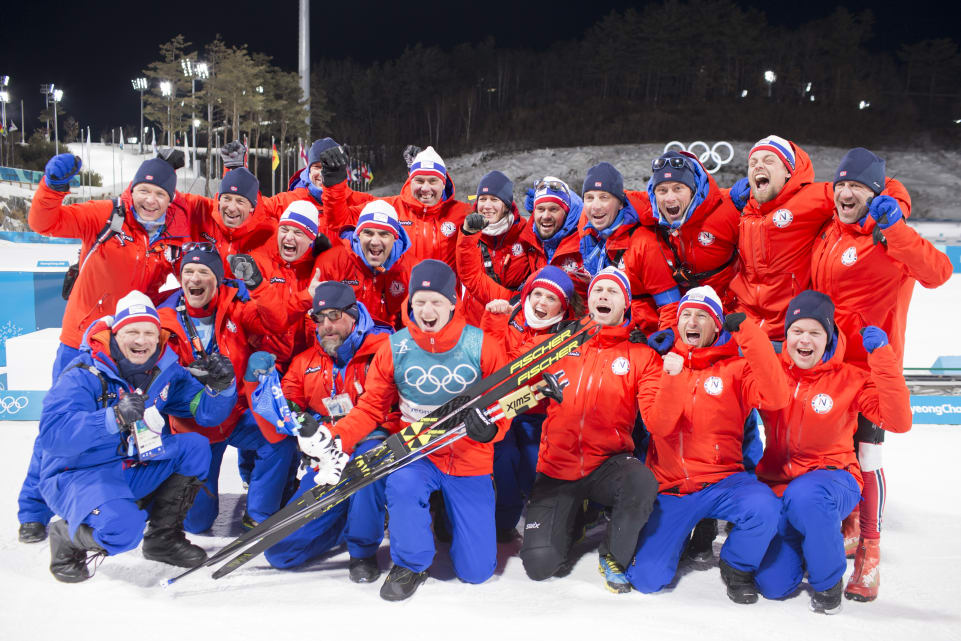
Johannes Thinges Bø celebrates with Norwegian team staff after winning Olympic gold in the 20 k individual despite two missed shots. (Photo: IBU/Biathlonworld.com)
Sweden’s Sebastian Samuelsson followed up a silver medal in the pursuit with fourth place in the individual, missing one shot and notching a time 29.1 seconds behind Bø. France’s Martin Fourcade, gold medalist in the pursuit, missed two shots like Bø but finished in fifth (+42.4). Switzerland’s Benjamin Weger placed sixth (+48.6) with one penalty.
It was a good day for Canada on the back of strong shooting: Scott Gow placed 14th (+2:02.5) with one penalty for a career-best result result; he had previously had two 16th-place finishes on the World Cup this season. With the same shooting, Brendan Green placed 22nd (+2:26.6). Christian Gow had two penalties to finish 26th (+2:57.2). Canada’s fourth man, Nathan Smith, missed five shots and placed 81st (+8:11.9).
For the United States, shooting was not as successful and Tim Burke led the way in 41st (+4:01.9) with four penalties. With one less penalty Sean Doherty was close behind in 44th (+4:21.8). Lowell Bailey placed 51st with four penalties (+4:53.0) and Leif Nordgren missed five shots to finish 66th (+6:27.3).
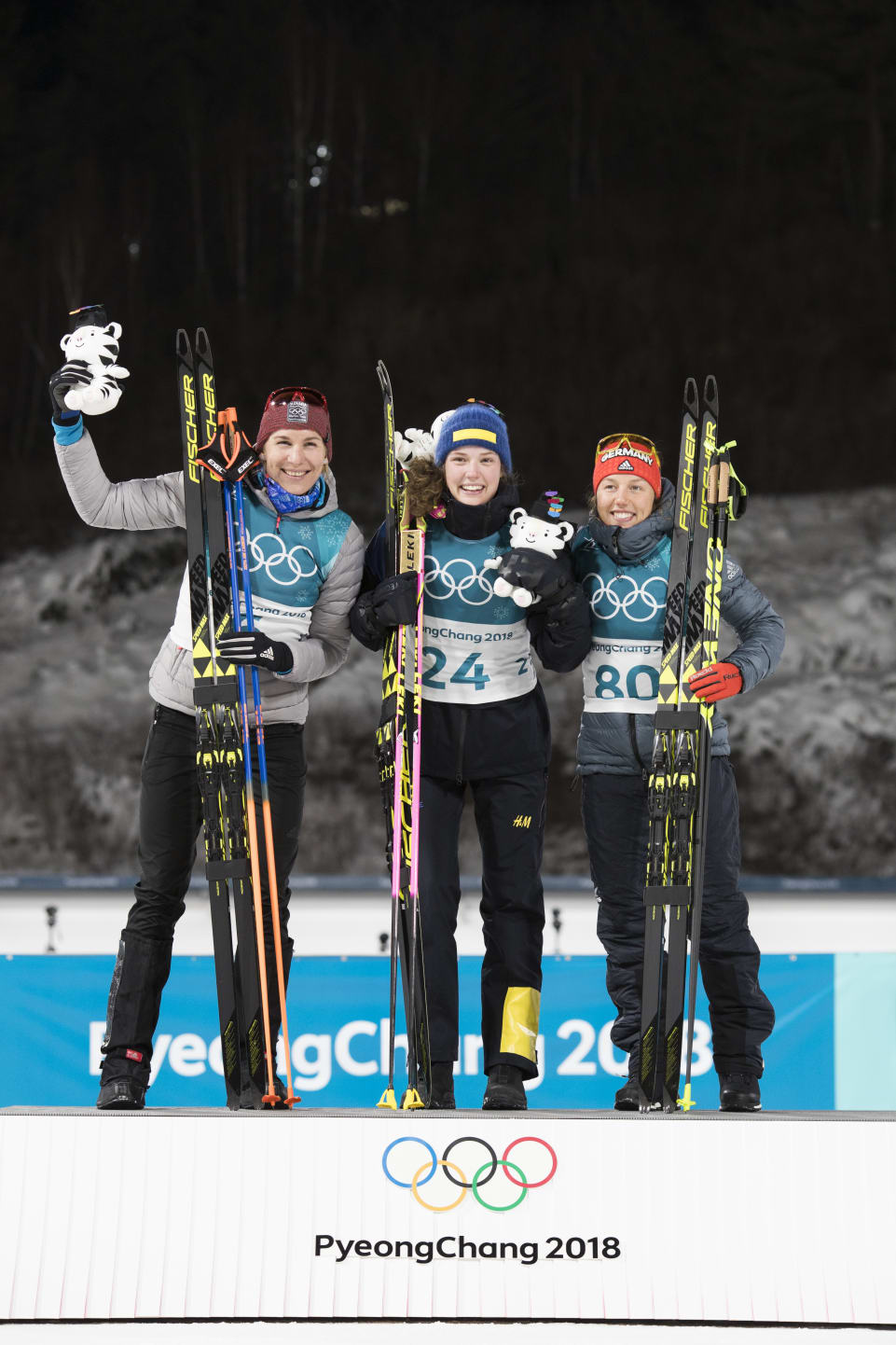
Sweden’s Hanna Oeberg (center) won gold in the biathlon women’s 15 k pursuit, followed by Slovakia’s Anastasiya Kuzmina (left) in silver and Germany’s Laura Dahlmeier in bronze. (Photo: IBU/Biathlonworld.com)
A few days after teammate Samuelson scored a career-best result to earn silver in the pursuit, Hanna Öberg of Sweden used perfect 20-for-20 shooting to capture gold in the women’s 15 k individual. The 22-year-old’s previous best results were fifth place in both Monday’s pursuit, and in a World Cup race last season.
She bested the two pre-race favorites: Anastasiya Kuzmina of Slovakia had two penalties but still managed a silver medal, her second of the games, finishing +24.7. And double gold medalist Laura Dahlmeier of Germany had one penalty and earned bronze (+41.2).
It was a good day for both of those teams as Franziska Preuss of Germany finished fourth, +59.0 with clean shooting, and Paulina Fialkova of Slovakia placed sixth (+1:02.3) with one missed shot. Poland’s Monika Hojnicz finished sixth (+1:54.8) with one missed shot as well.
The United States was led by Susan Dunklee in 19th, with two penalties (+3:26.3). Her teammate Joanne Reid finished 22nd (+3:34.1), her best-ever result in top-level international competition, with just one missed shot. Clare Egan finished 62nd (+6:53.6) and Emily Dreissigacker 67th (+7:09.2) with four penalties apiece.
For Canada, Rosanna Crawford led the way in 26th (+3:48.7) with two penalties and Sarah Beaudry was close behind in 29th (+3:58.4) with one missed shot. Emma Lunder finished 54th (+5:49.4) with three penalties and Julia Ransom was 74th (+8:31.4) with five missed shots.
Montana State University student Johanna Talihärm of Estonia finished 50th (+5:36.8) with three penalties.
Thursday afternoon saw more of the same for the women’s cross-country ski events at this year’s Winter Olympics: Scandinavia filling up the podium, with American Jessie Diggins tantalizingly close to that breakthrough American podium in fifth. This time it was Norwegian Ragnhild Haga in first in the 10 kilometer freestyle individual start, Charlotte Kalla of Sweden in second (+20.3), and Finland’s Krista Pärmäkoski and Norway’s Marit Bjørgen tied for third (+31.9).
The bronze is Bjørgen’s 12th lifetime Olympic medal, moving her into a tie with fellow Norwegian Bjørn Dæhlie for the most Olympic medals won by a cross-country skier. Countryman Ole Einar Bjørndalen, a biathlete, holds the overall Winter Olympics record with 13.
Diggins was 35.2 seconds back of Haga in fifth. She was in seventh place through 1.6 k, up to fifth at 5 k, up to third at 6.2 k, and still in third at the 8.4-k time checkpoint, 1.9 seconds up on Bjørgen and five seconds up on Pärmäkoski. But her form seemed to break down over the final uphill, and Diggins lost just enough time on Bjørgen and Pärmäkoski over the final 1.6 k to slip off the podium.
Between a 4.6-second deficit to third in Saturday’s skiathlon and a 3.3-second gap here, Diggins has now missed two bronze medals by a combined 7.9 seconds over 25 kilometers of racing.
Jessie Diggins pushing to the finish in the Olympic 10 k skate. The American finished fifth. (Photo: FlyingPointRoad)
Sixth place went to Swiss skier Nathalie von Siebenthal (+49.8), who slowed slightly after a fast start that saw her with the second-ranked time through 1.6 k. Ingvild Flugstad Østberg (+1:05.5), in seventh, was the third Norwegian in the top seven.
Olympic Athlete from Russia Anastasia Sedova (+1:07.3), Austrian Teresa Stadlober (+1:15.6), and Olympic Athlete from Russia Anna Nechaevskaya (+1:24.3) rounded out the top ten.
Sadie Bjornsen (+1:42.1) in 15th and Kikkan Randall (+1:49.9) in 16th were the next two Americans. Randall started relatively early with bib number 23, and was the leader in the clubhouse when she crossed the finish line. Liz Stephen (+2:35.4) was 30th.
For the Canadians, Emily Nishikawa (+2:41.) led the way in 32nd. Dahria Beatty (+2:48.4) was 37th, Cendrine Brown (+3:11.9) 43rd, and Anne-Marie Comeau (+4:10.8) 62nd.
Also of note, Australia’s Jessica Yeaton, who lives and trains in Anchorage with Alaska Pacific University, recorded an Olympics personal best finish of 41st (+3:09.1). University of Alaska Anchorage student Casey Wright, also competing for Australia, finished 81st (+6:55.8).
University of Colorado skier and NCAA champion Petra Hyncicova of the Czech Republic finished 60th (+4:09.4). University of New Hampshire alum Annika Taylor of Great Britain finished 75th (+5:52.4).
And Jaqueline Mourau of Brazil, who lives and trains in Quebec, was 74th (+5:49.8).
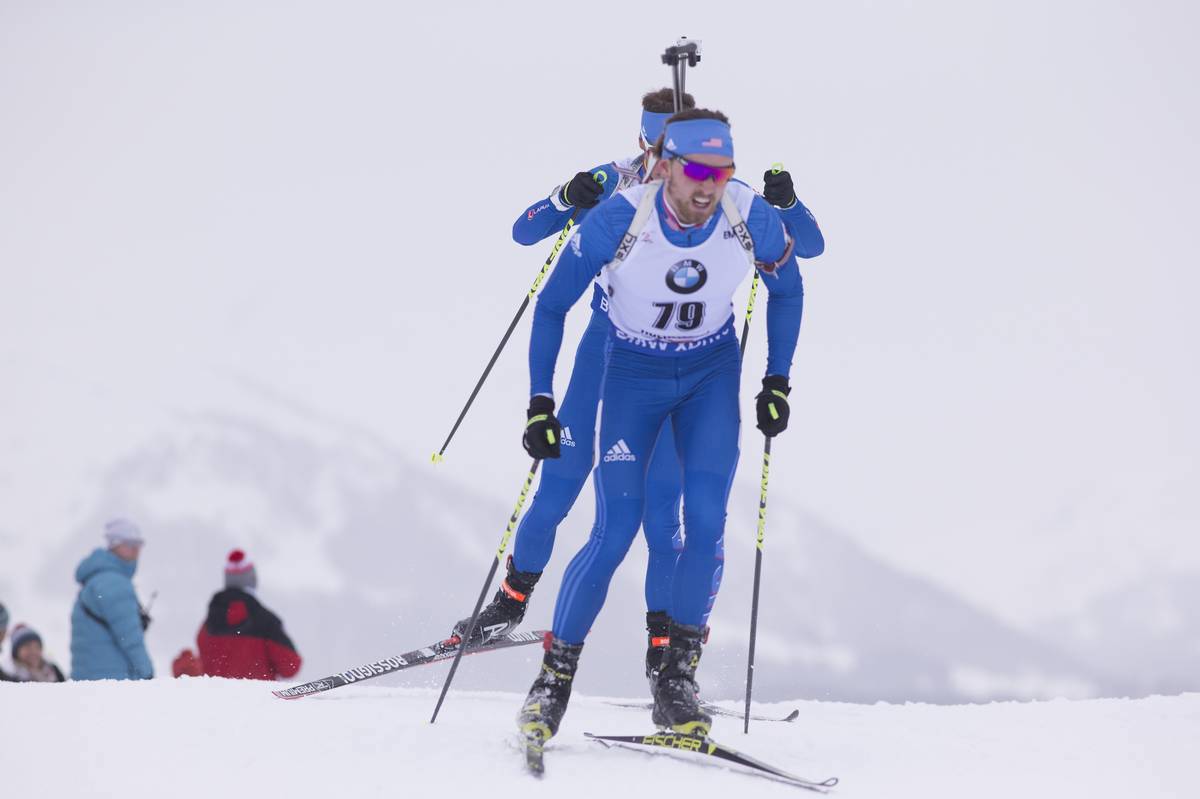
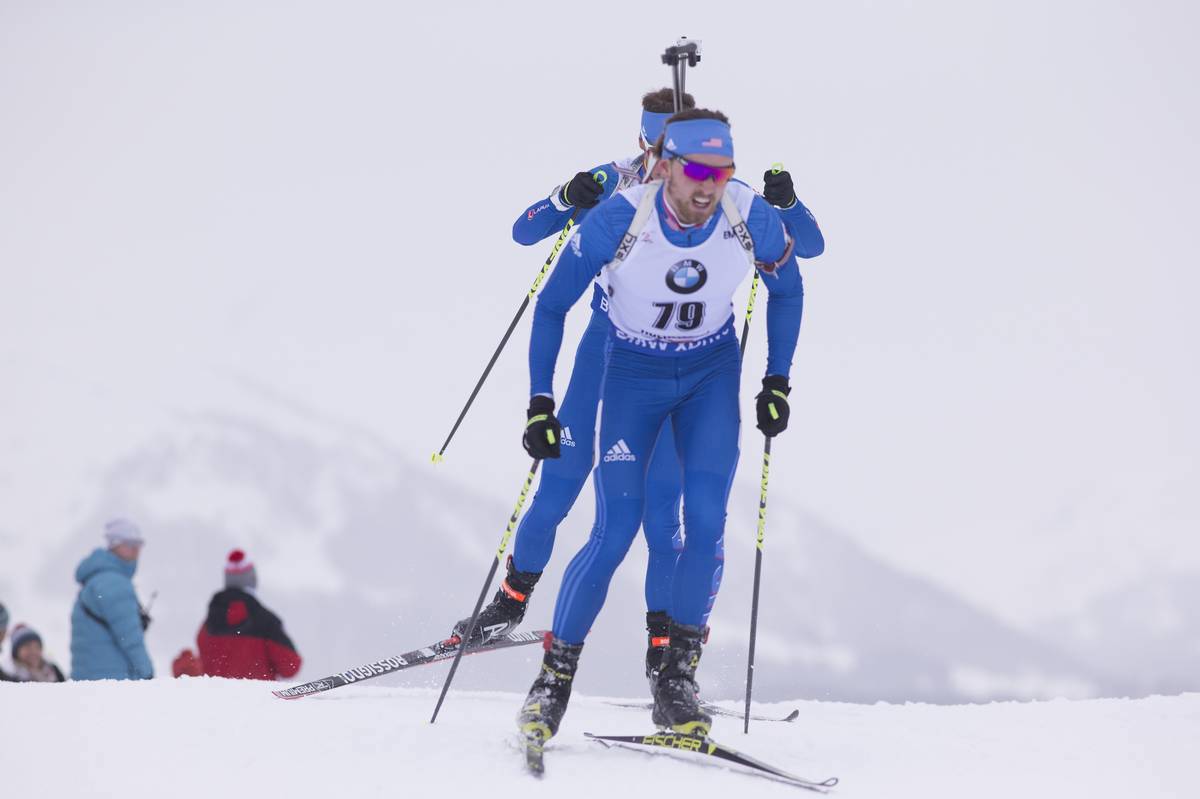
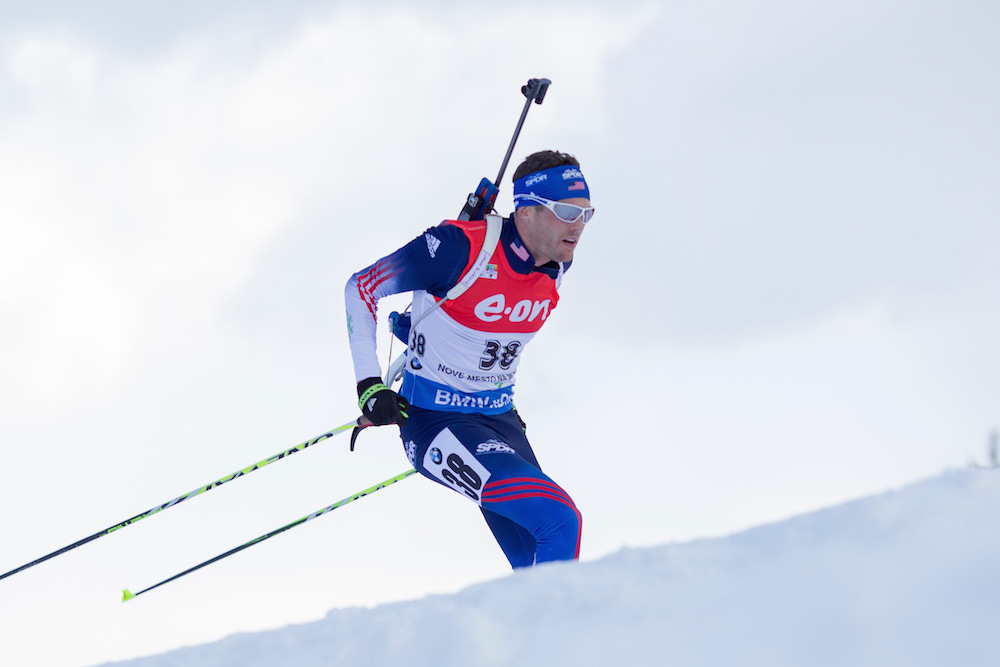
US Biathlon’s Sean Doherty (79) racing to 22nd in the IBU World Cup men’s 10 k sprint on Friday in Hochfilzen, Austria. On Saturday, he raced up to 17th for his best pursuit result on the circuit. (Photo: US Biathlon/NordicFocus)
One day after winning the International Biathlon Union (IBU) World Cup men’s sprint, Johannes Thingnes Bø held onto first place in the men’s 12.5-kilometer pursuit on Saturday in Hochfilzen, Austria. In difficult conditions with heavy snowfall and strong gusts of wind, the Norwegian decided the race when he shot clean in the final standing stage. He reached the finish line uncontested on the last loop in a time of 36:41.1 minutes, almost a minute ahead of Slovenia’s Jakov Fak (+58.8 with one penalty) and last season’s Overall World Cup winner Martin Fourcade (+1:10.0 minutes with five penalties).
“Best start of the season so far in my career,” the 24-year-old Bø said after his third victory of the season in a post-race press conference. “I have to enjoy it, you never know what the next races will bring.”
2:12.8 minutes behind him, US Biathlon’s Sean Doherty finished 17th for his best career result in a World Cup pursuit, improving by on an 18th place from a pursuit last season in Kontiolahti, Finland.
A day after scoring his first points of the new World Cup season in 22nd and shooting a perfect 10-for-10 in Friday’s 10-kilometer sprint, Doherty shot 18-for-20 in the pursuit (1+0+1+0).
“I am very happy with the race today,” Doherty wrote in an email to FasterSkier. “The execution on the range was good in the tough conditions we had today. It’s nice to have a solid back-to-back set of races here. … The ski shape is still a ways off but it’s heading in the right direction.”
In very difficult conditions in the first standing stage, several of the top racers like Norway’s Henrik L’Abee-Lund and Germany’s Arnd Peiffer incurred multiple penalties and to slip out of contention. Meanwhile, Doherty hit all but one of his targets in that stage and moved up to 16th. On the next loop he maintained that position about 1:50 back.
“The course was slow today, although not too soft,” Doherty commented on the conditions. “Fortunately it was not as snowy and windy as yesterday afternoon. There was a steady wind but it was manageable. I am pleased with my work on the range. If you want to compete at this level you have to shoot well.”
After the race up front had been decided in a final duel between Bø and Fourcade in the last stage, Doherty once again shot clean in the last standing stage and moved up to 11th. On the final loop, he could not quite hold that position and a small group passed him, yet coming onto the finishing stretch he was able to keep Ukraine’s Dmytro Pidruchnyi 0.4 seconds behind him in a push for 17th (+2:12.8).
“Unfortunately I didn’t quite have the legs to back up the solid shooting, as was clear on the last lap,” Doherty wrote. “Looking over my shoulder I saw that big pack of guys and I just tried to give it all I had. I wasn’t able to hang on but I was glad to be in that situation nonetheless.”
Starting out in 19th place based on his sprint result, Biathlon Canada’s Nathan Smith finished the day in 31st, 3:02.2 after Bø with three penalties (1+1+0+1).
After the first shooting stage, Smith had moved into 14th despite incurring a penalty.
“The wind was a bit changeable, especially in the first prone where it was blowing quite strongly,” he explained in an email after the race.
Smith skied the next lap in a group that included Germany’s Simon Schempp, who eventually would finish the race in podium contention, and got into a slight tangle with Schempp in a right-hand turn at the far point of the course, but both remained on their feet.
“I started pretty aggressive on the first lap but wasn’t able to maintain the speed of those around me after that,” Smith wrote. “I didn’t see who was tangling with me on that turn, but it was definitely an odd place to attempt an inside pass. I can’t say yet that things are turning around in the skiing department. I think I will just have to be very very patient.”
In the second prone stage, Smith incurred another penalty and dropped to 29th place, almost two minutes behind the leaders. He cleaned the first standing stage that followed, then had one more miss in the fourth and final stage.
“My shooting was pretty good once again today, given the challenging conditions,” Smith wrote. “It was definitely tougher conditions today, although the temperature was low enough that the falling snow wasn’t sticking to my glasses. The tracks were a little soft, and quite slow, especially out of the track where athletes were skiing.”
He started the final loop in 27th position and “like the previous ones, I was mostly focused on trying to minimize the number of skiers passing me,” Smith wrote. “It’s fun to pass but when you’re not feeling it its important to try and conserve energy.”
On the final meters of the race, he went head to head with Italy’s Thomas Bormolini and finished 0.4 seconds behind him for 31st.
“I thought I could take Bormolini but he got the middle track,” Smith recalled. “I tried my best in the outside and made a little ground, but the snow was just too deep over there. Tactically it would’ve been best to be in front heading through the tunnels [that are leading into the stadium].”
Smith’s teammate Brendan Green finished 33rd (+3:15.7), also with three penalties ( 1+0+1+1), after climbing nearly 20 places from his starting position by using his extensive experience to deal with snowy conditions that he described as “a classic Hochfilzen day”.
“Today was a much better race for me,” Green wrote in an email. “Yesterday felt completely off for some reason, so to be able to put together a solid performance today is reassuring. … I’m quite happy with the shooting considering the conditions. I was really hoping to shoot clean in the last bout, which would have made for a really great day, but all in all I’m happy with how I performed.”
After incurring that third penalty in the last standing stage, Green, who started 52nd, came back on the course in 37th place. He recalled seeing a group ahead of him, which he was able to catch by skiing the 17th-fastest course time on the final loop.
“I attacked early on and skied my way past a train of 5 athletes, and was able to hold them off for the rest of the loop with the exception of [Belgium’s] Michael Roesch. This was my strongest ski of the season which is hopefully a sign that my shape is coming around. It seems that no matter what I do, I struggle to find my form early on in the season.”
Doherty’s teammate, Lowell Bailey, the only other American who qualified for the pursuit, moved up from 53rd to finish 36th (+3:20.6) with three penalties (0+2+1+0).
The two remaining Canadian starters, Scott Gow and Christian Gow, finished 48th (+5:08.4) and 49th (+ 5:13.7), respectively, with Scott ending up with seven penalties (1+1+3+2), while his younger brother Christian had five penalties (2+0+1+2) and improved five places from the sprint.
Bø and Fourcade in Sync… Until Final Shooting
The two dominant athletes of the IBU World Cup season so far swapped the lead out on course and dueled on the range in Saturday’s pursuit. In the end the podium was nearly a repeat of Friday’s sprint, with Bø in first, and Fak and Fourcade flipping positions in second and third, respectively.
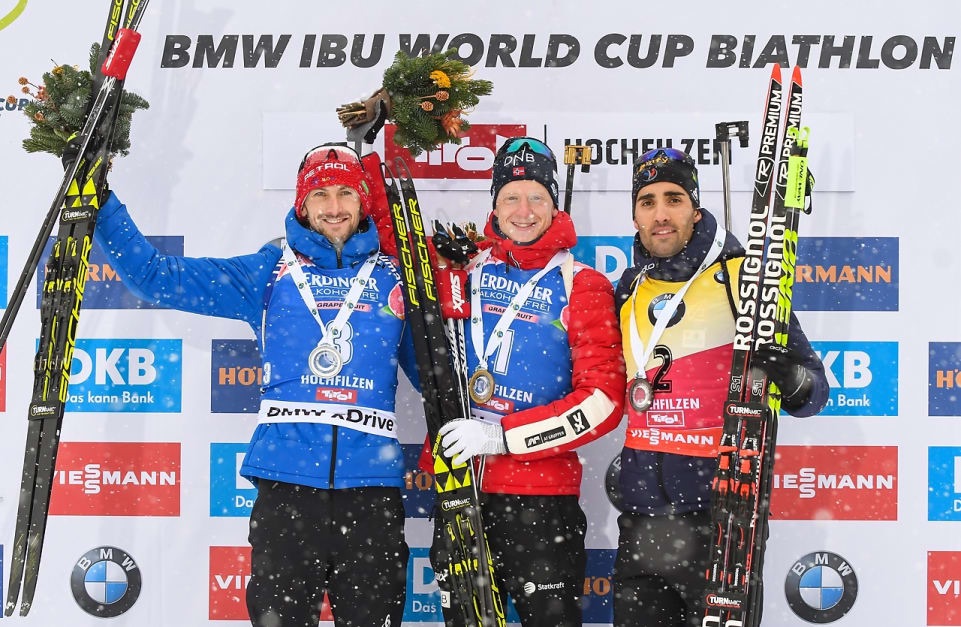
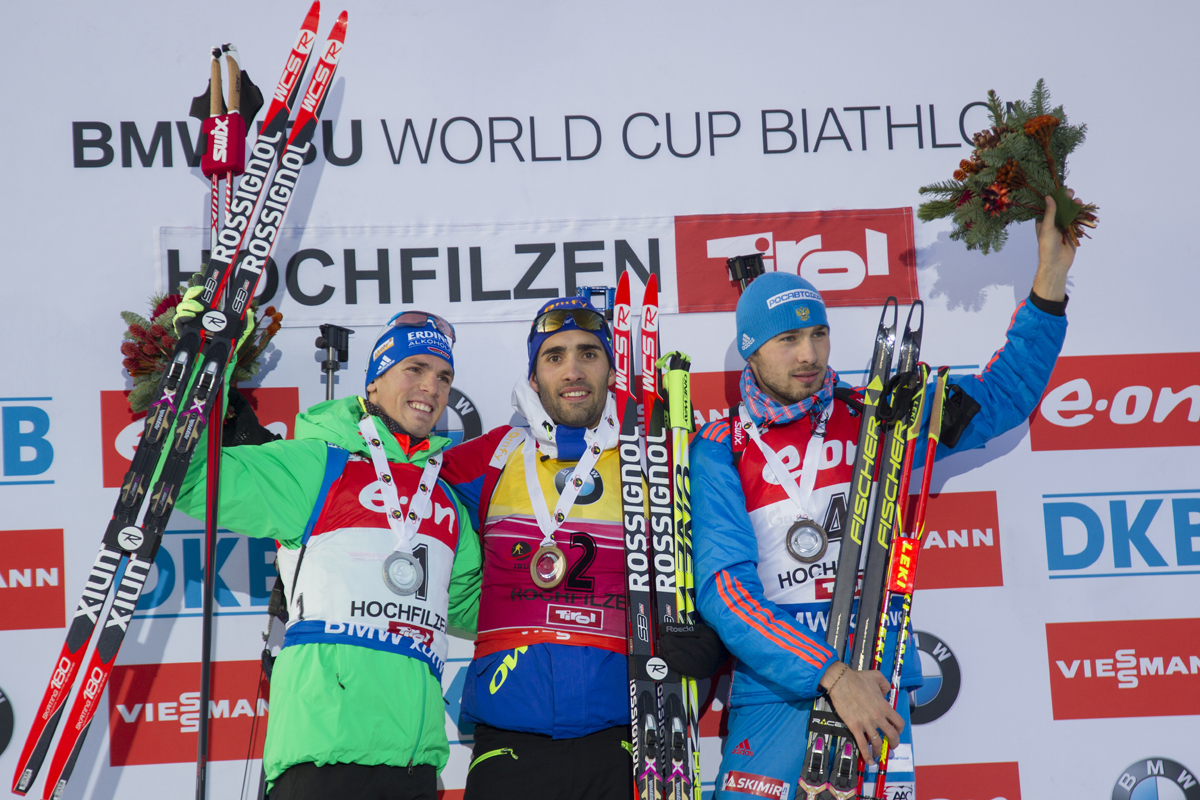
Medal ceremony for the men’s 12.5-kilometer pursuit at the 2017/2018 IBU World Cup in Hochfilzen, Austria, with Norway’s Johannes Thingnes Bø (c) in first place, Slovenia’s Jakov Fak (l) in second place, and France’s Martin Fourcade (r) in third place. (Photo: IBU/biathlonworld)
In the first shooting bout, Bø incurred two penalties to lose his 12-second head start on Fourcade, but he set out on his second loop just a second behind Fourcade. In the second prone stage, the two both shot clean, after shooting alongside each other and almost hitting their targets in a synchronous rhythm, before starting the third loop together.
While not quite able to hold up with Fourcade and Bø on the course with the 35th-ranked overall course time, Fak, who had started the day in third, was able to keep in touch with the leaders due to another solid shooting performance.
The 30-year-old, Croatian-born Fak, who has been racing for Slovenia since the beginning of the 2010/2011 season, is coming back from a slight slump last season, but is looking back on a storied career that includes a third place in the 2014/2015 World Cup Total Score and two gold medals at the 2012 and 2015 IBU World Championships.
By his own account, in preparation for the new season Fak mostly trained with the Ukrainian women’s team, which is coached by one of his old mentors. “They shoot good and I wanted to beat them and I guess that also works in the men’s field,” he said with laugh at the press conference.
In the first standing stage, Bø and Fourcade each incurred a penalty, and while Fourcade shot his sequence slightly faster, Bø was able to easily make up a six-second gap on the next loop, taking the lead again up the first big climb.
“[I] had a perfect race together with Johannes,” Fourcade said at the press conference. “We each did half the [work] in the front and it was a smart move because we wanted to keep the advantage and we knew the answer would be on the final shooting.”
Fak also had his only miss of the day in the third stage, but managed to improve his position as conditions worsened and a number of athletes had several penalties in this stage. Russia’s Maxim Tsvetkov and Germany’s Schempp were the first ones to clean this stage to leap into podium contention. Bø’s older brother Tarjei also cleaned.
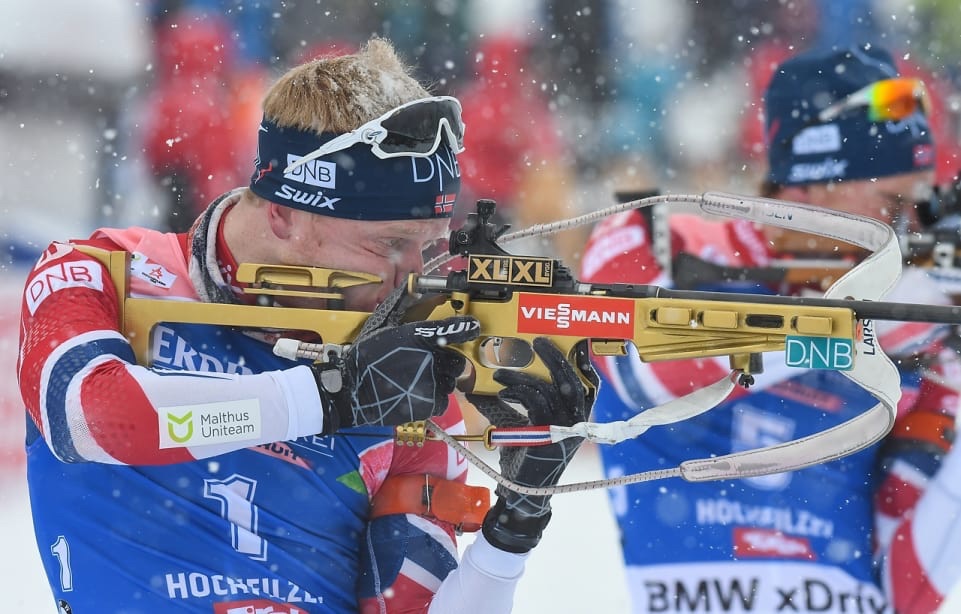
Norway’s Johannes Thingnes Bø shooting in the standing position in difficult weather conditions on his way to the victory in the men’s 12.5-kilometer pursuit at the 2017/2018 IBU World Cup in Hochfilzen, Austria. (Photo: IBU/biathlonworld)
In the final stage Johannes Bø and Fourcade again stood side by side on the range, but this time Fourcade missed three while Bø hit every target to embark on the last loop with nearly a minute lead.
“He got the answer, and I didn’t…,” Fourcade sighed when he tried to explain what had happened in his final shooting. “With the snow conditions I went on my shooting mat a little late, I first had to open my rifle [sights snow cover] and I was simply a bit late compared to Johannes by just one or two seconds. … Then I heard that Johannes had a good shooting and I tried to shoot faster to catch him, and that was totally wrong today.”
“The people are always speaking about a fight of Martin against the Norwegian team,” Bø stated in the press conference. “Of course both me and him think about this, but still we fought together out there, we exchanged in the first position [helping each other], and that was a smart move for us.”
Fak managed to shoot clean again to leave the range for the last time in second, and while he could be relatively sure of second place, a fierce fight for third ensued behind him.
“It was very hard on the track, but I managed to stay calm on the shooting range and tried to shoot as [few] mistakes as I could,” Fak said. “It was only one mistake and so I am pretty happy about that, because if we look at the weather it was not so easy on the shooting range. On the track I used my shooting as an advantage, and it got me in the second position on the last lap, so I just needed to go a little faster in the beginning and then cruise to the finish.”
A group of Schempp, Tsvetkov and Tarjei Bø also came through the final stage with a clean shooting performance, and Fourcade joined them after he had completed his three penalty laps.
Fourcade led that group going into the longest climb of the course, then tried to break away, pushing hard over the crest of the hill with only Schempp able to stay on his tails into a corkscrew downhill section.
Schempp and Fourcade had a minor tangle as they positioned themselves on the slightly uphill finishing stretch, and Fourcade ended up outlasting Schempp in the final meters by half a second
“It was a big fight with Simon but also with Tarjei and Maxim Tsvetkov from Russia,” Fourcade said. “It was a big battle, and then at the finish line we crossed our skis. The advantage of being in the first position is that you can choose your own line, it’s what I did, and when I crossed my skis with Simon because I saw he chose the same line I went to the other line. … I said to Simon that I was sad, because I didn’t want to do it this way, but I fought really hard on the track to get the first position and choose my own track because it’s a big advantage.”
“In the finish sprint I really wanted to take the innermost lane, so wide right, and thought he’d take the middle lane,” Schempp told German broadcaster ARD in a post-race interview, according to a translation. “But then he still pulled onto my side and we tangled up and got a little bit into each other’s way, but everything is all right.”
Tarjei Bø came to the finish a second later in fifth (+1:11.9) with two penalties (1+0+1+0), while Tsvetkov finished sixth (+1:12.3), up from a 20th starting position, with just one penalty (1+0+0+0).
“I am happy I am in the top six, but I am a bit sad that I can’t fight today for a top three,” Tsvetkov told the IBU in an interview, via a translator.
“[Actually] I can’t understand why I missed today,” he added with a laugh when questioned about his lone penalty, which only he, Fak, and two more athletes achieved in this race.
The IBU World Cup in Hochfilzen concludes on Sunday with the first men’s 4 x 7.5 k and women’s 4 x 6 k relays of the season.
Fourcade announced during the press conference that he plans to skip the relay to focus on next week’s races in front of a home crowd in Le Grand Bornand, France.
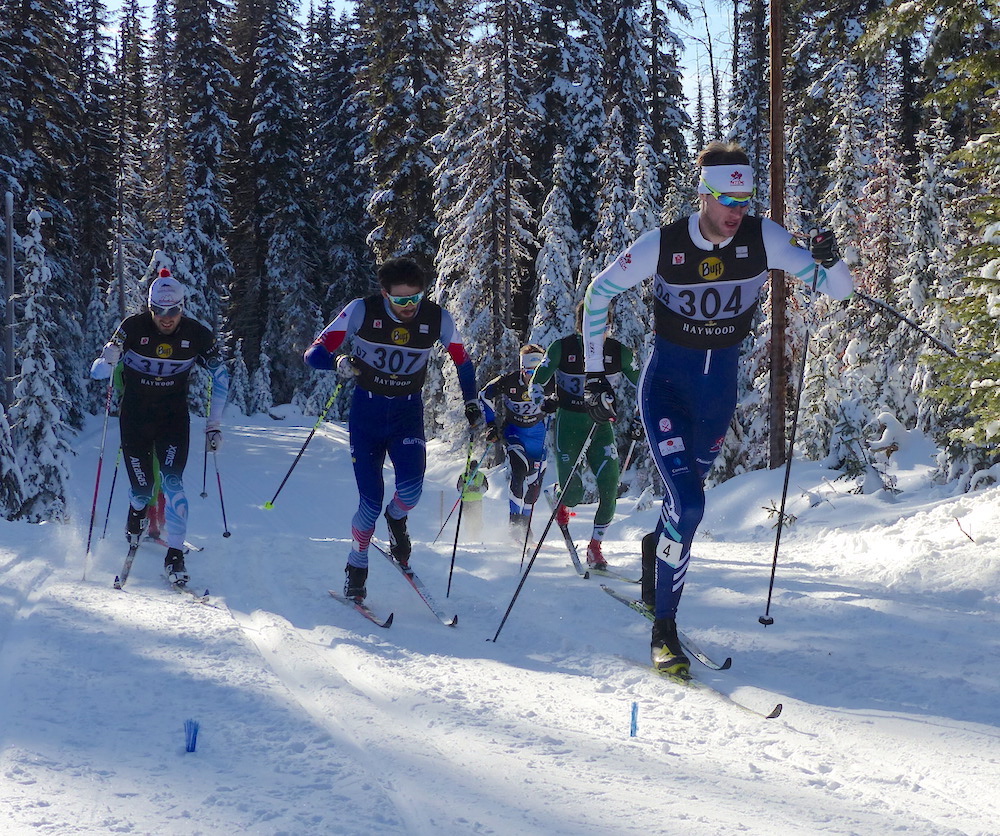
Bob Thompson (304) of NTDC Thunder Bay leading Sun Valley’s Jack Hegman (307) and Patrick Stewart-Jones (317) of the AWCA during their quarterfinal of the NorAm men’s 1.3 k classic sprint on Saturday at Sovereign Lake near Vernon, B.C. (Photo: Peggy Hung)
NorAm/SuperTour (Sovereign Lake near Vernon, British Columbia): Classic sprints
On the opening day of the NorAm Continental Cup series in Canada (which doubled as a U.S. SuperTour), American Kaitlynn Miller of the Craftsbury Green Racing Project (CGRP) started Saturday with a nearly three-second win in the classic-sprint qualifier at the Sovereign Lake Nordic Centre, then went on to win her quarterfinal and semifinal before topping the final as well.
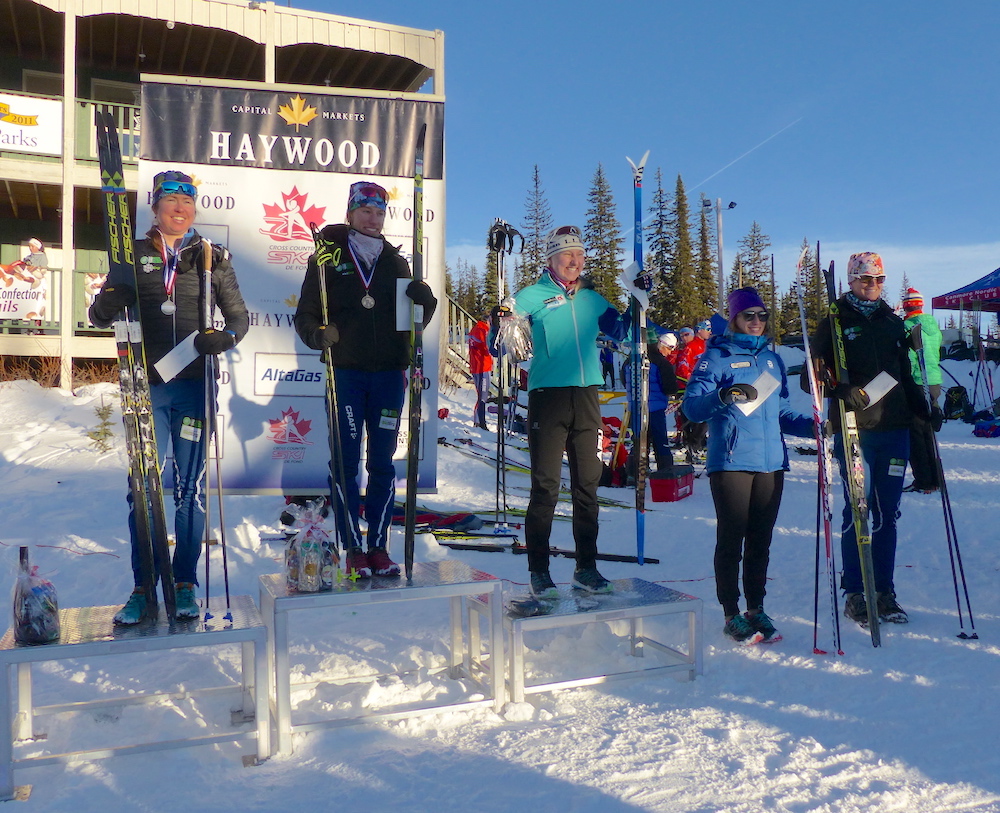
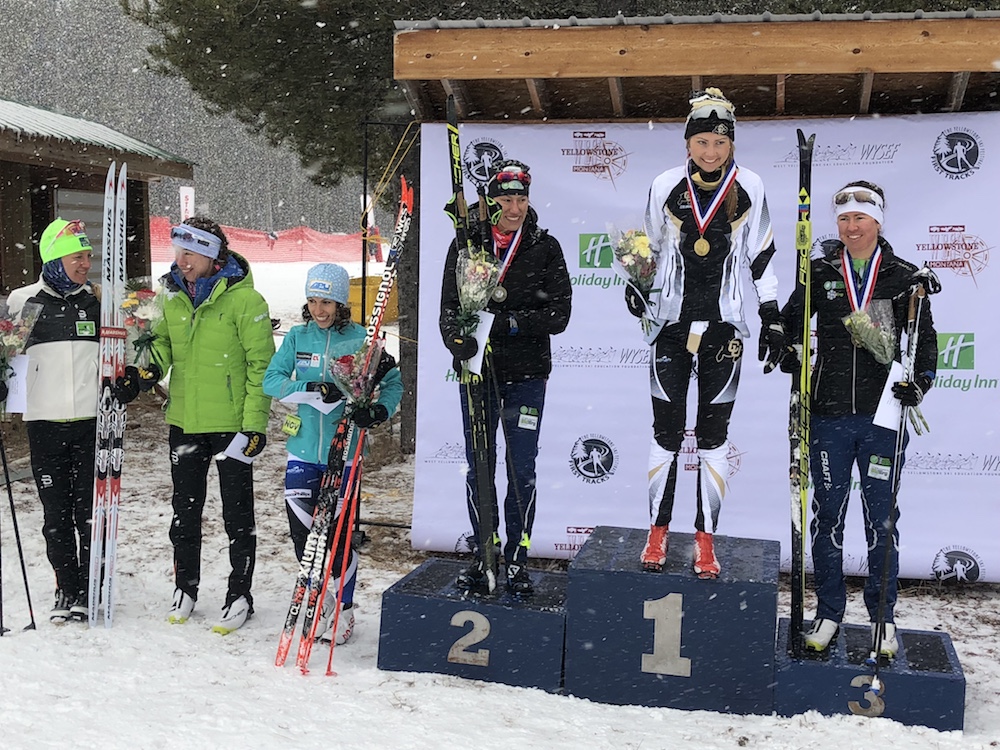
The women’s 1.3 k classic sprint podium and top five at the first NorAm of the season on Saturday at Sovereign Lake near Vernon, B.C., with (from left to right) Caitlin Patterson (CGRP) in second, Kaitlynn Miller (CGRP) in first, Hannah Halvorsen (APU/USST) in third, Kelsey Phinney (SVSEF) in fourth, and Liz Guiney (CGRP) in fifth. (Photo: Peggy Hung)
Miller was the fastest women’s qualifier by 2.87 seconds on the 1.3-kilometer course with a time of 2:59.39. Ultimately, she won the final in 2:57.53, 0.93 seconds ahead of her teammate Caitlin Patterson in second and 2.59 seconds clear of the third American on the podium, Hannah Halvorsen of Alaska Pacific University (APU) and the U.S. Ski Team (USST) D-team, in third place.
Halvorsen previously qualified third behind Kelsey Phinney, of the Sun Valley Ski Education Foundation (SVSEF) in second. Phinney finished fourth in the final (+2.85), while a third Craftsbury skier, Liz Guiney placed fifth (+3.53). The lone Canadian in the six-woman final, Sophie Carrier-Laforte of the Pierre-Harvey National Training Centre (CNEPH) placed sixth (+4.38).
Thompson Fends Off Five Americans
Of the six racers in the men’s 1.3 k freestyle sprint final, five of them were American. Bob Thompson, of the Thunder Bay National Team Development Centre (NTDC), bested them all for the win in 2:29.31, just 0.03 seconds ahead of Ben Saxton, of the Stratton Mountain School (SMS) Elite Team, in second place. Cole Morgan (SVSEF), the qualifying winner who had so far dominated all of his heats, ended up third overall, 0.48 seconds behind Thompson.
Sun Valley and APU each had two athletes reach the men’s final with Jack Hegman (SVSEF) taking fourth (+0.51), and APU’s Reese Hanneman and Tyler Kornfield placing fifth (+7.75) and sixth (+7.9), respectively.
To start the day, Morgan posted the fastest men’s qualifying time in 2:31.00, while last weekend’s SuperTour skate sprint winner Nick Michaud, of the Bridger Ski Foundation (BSF), qualified in second, 0.78 seconds back. Americans took the top-three qualifying spots with Logan Hanneman (APU) in third (+1.59), whileThompsonwas the top Canadian qualifier in fourth (+2.34).
Morgan won both his quarterfinal and the first semifinal to advance to the final, along with Thompson who placed second in that semifinal (and placed second to Hegman in the quarterfinals).Saxtonwon the second semifinal (after finishing second to Logan Hanneman in the quarterfinals) andKornfield was second behind Saxton in that semifinal to automatically advance to the final. Reese Hanneman and Hegman made it to the final as lucky losers after placing third and fourth, respectively, in the first semifinal.
Norway’s Johannes Thingnes Bø notched his second-straight win in Hochfilzen after Martin Fourcade of France missed three on the final shooting stage of the men’s 12.5 k pursuit on Saturday. Bø, who started the race 12 seconds ahead of Fourcade in second, cleaned the final standing stage to leave the range nearly a minute ahead of Slovenia’s Jakov Fak in second. Meanwhile, Fourcade, who had been skiing in first just ahead of Bø before the last stage, dropped 1:19 minutes back to fifth.
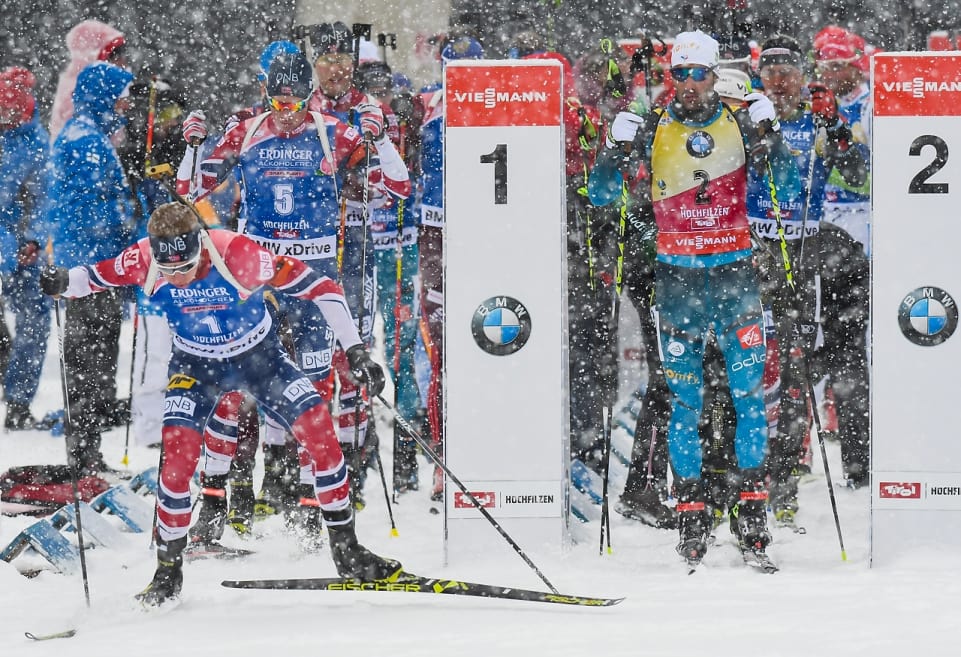
Norway’s Johannes Thingnes Bø (1) heading out of the start, 12 seconds ahead of the second starter, France’s Martin Fourcade (yellow bib), on Saturday in the IBU World Cup men’s 12.5 k pursuit in Hochfilzen, Austria. (Photo: IBU/biathlonworld)
While Bø skied the win in 36:41.1 minutes and Fak, the third starter, finished 58.8 seconds later in second place, Fourcade made up two places on the final loop to place third (+1:10.0) after passing Germany’s Simon Schempp and Russia’s Maxim Tsvetkov.
Schempp settled for fourth (+1:10.5), and Bø’s older brother, Tarjei Bø, passed Tsvetkov as well to claim fifth (+1:11.9), while Tsvetkov finished sixth (+11:12.3).
On another snowy afternoon in Hochfilzen, Johannes Bø had three penalties, two of which came in the first stage (2+0+1+0). Fak was one of four men in the race with just one miss (0+0+1+0) — no one cleaned — while Fourcade missed five (1+0+1+3). Schempp had four penalties (3+1+0+0) but held onto his starting position in fourth, Tarjei Bø improved from 14th at the start to fifth with just two misses (1+0+1+0) and Tsvetkov raced up from 20th to sixth with a single miss (1+0+0+0).
American Sean Doherty tied his second-best World Cup result in 17th (+2:12.8) after starting 23rd and 1:39 out of first. He had two penalties (1+0+1+0).
Canada’s top finisher, Nathan Smith placed 31st (+3:02.2) after starting 19th and missing three shots (1+1+0+1). His teammate Brendan Green rose to 33rd (+3:15.7), up from 52nd at the start, with three penalties as well (1+0+1+1).
Four Canadians qualified for the pursuit, with Scott Gow placing 48th (+5:08.4) with seven penalties (1+1+3+2). His younger brother Christian Gow crossed next in 49th (+5:13.7) after missing five (+5:13.7).
The other American man in the race, Lowell Bailey placed 36th (+3:20.6), up from 53rd, with three misses (0+2+1+0).
Kuzmina Gets First Win in Three Years
Slovakia’s Anastasia Kuzmina cleaning one of two standing stages in the women’s 10 k pursuit at the IBU World Cup in Hochfilzen, Austria, en route to a 10-second win. (Photo: IBU/biathlonworld)
In the women’s 10 k pursuit that followed, Slovakia’s Anastasia Kuzmina overcame a 22-second starting deficit to win her first race in three and a half years, shooting 19-for-20 (1+0+0+0) and finishing in 34:31.2. Kuzmina (the sister of Russia’s Anton Shipulin) started second behind Friday’s sprint winner Darya Domracheva of Belarus. Domracheva had a single miss as well in Saturday’s pursuit (0+0+1+0) but slipped to second after her penalty in the first standing stage, while Kuzmina cleaned the last three stages to take the win.
Domracheva settled for third (+11.8) and Finland’s Kaisa Mäkäräinen rose to second (+10.2) after shooting 18-for-20 (1+0+0+1) and skiing the fastest course time to rise from her starting position in sixth.
Italy’s Dorothea Wierer slipped one place to fourth (+51.6) after starting third and missing two (1+0+0+1), while Norway’s Marte Olsbu raced up from 13th to fifth (+58.2) with a single penalty (1+0+0+0). Ukraine’s Yuliia Dzhima improved from 20th to sixth (+1:08) with one miss as well (0+0+0+1).
Canada’s Emma Lunder achieved her second-best career World Cup result in 27th (+2:31.6) after starting 42nd and cleaning three stages after missing one in the first prone (1+0+0+0). Her teammate Rosanna Crawford improved from 49th at the start to 39th at the finish (+3:44.3) with four penalties, one in each stage (1+1+1+1).
The U.S. had one woman qualify for the race, Clare Egan, who finished 53rd (+5:21.6) with seven penalties (2+2+2+1).
For the third and final day of World Cup racing in Hochfilzen, the men’s and women’s relays will be held Sunday.
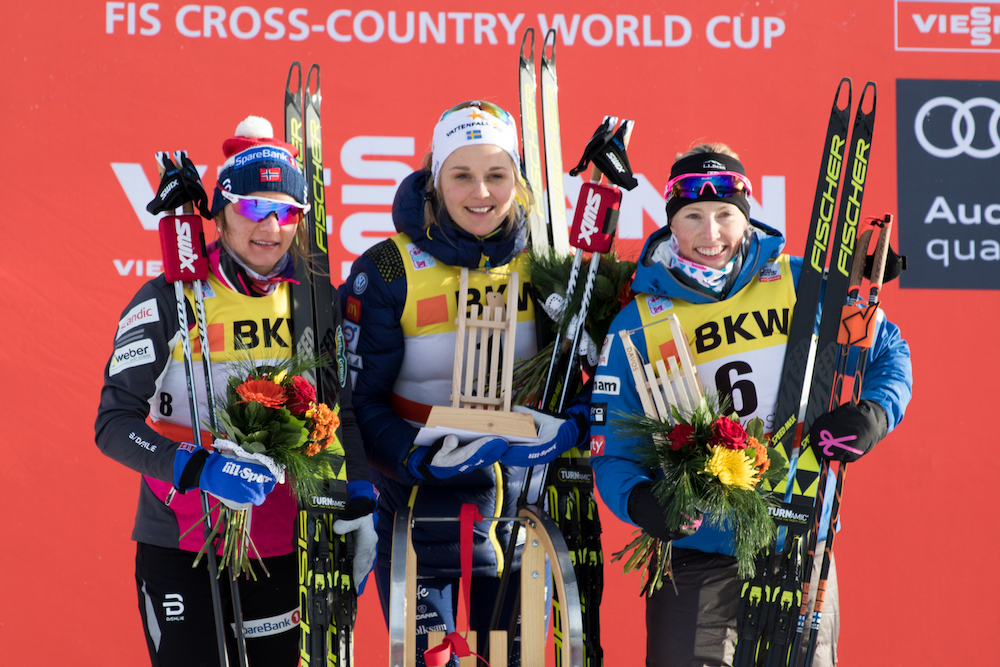
The women’s skate sprint podium at Saturday’s World Cup in Davos, Switzerland, with Kikkan Randall (r) of the U.S. Ski Team in third place, Sweden’s Stina Nilsson (c) in first, and Norway’s Maiken Caspersen Falla (l) in second. (Photo: Reese Brown/US Ski & Snowboard)
Kikkan Randall returned to the podium on Saturday in the first freestyle sprint of the 2017/2018 World Cup season, placing third in the women’s 1.5-kilometer skate sprint behind Sweden’s Stina Nilsson and Norway’s Maiken Caspersen Falla, respectively, in Davos, Switzerland.
Americans made up half of the women’s final, with Jessie Diggins racing to fourth and Ida Sargent sixth, with Norway’s Ingvild Flugstad Østberg between them in fifth.
Nilsson started the day by winning the qualifier in 2:51.71 minutes, while Østberg had the second-fastest qualifing time, 2.57 seconds back. Switzerland’s Nadine Fähndrich posted the third fastest qualifying time (+2.73), and for the U.S., Diggins qualified fourth (+3.37), Sargent fifth (+3.78), Randall sixth (+4.11), Sophie Caldwell ninth (+4.87), and Sadie Bjornsen in 11th (+5.38).
Nilsson then won her quarterfinal and the first semifinal before outlunging Falla by eight-hundredths of a second for the final win in 2:47.99. Randall (who won her quarterfinal and advanced to the final as a lucky loser in third in the first semifinal) finished 2.53 seconds after Nilsson for third overall, and Diggins (who won both her quarterfinal and the second semifinal) was 4.41 seconds back in fourth. Østberg finished 5.62 seconds back in fifth, and Sargent crossed the line 14.49 seconds back in sixth.
Caldwell placed eighth overall after winning her quarterfinal then placing fourth in the second semifinal, behind Diggins, Sargent and Germany’s Sandra Ringwald, respectively. Ringwald did not advance to the final, either, for seventh overall. Bjornsen placed 13th on the day after finishing third in her quarterfinal.
Also for the U.S., Julia Kern (U.S. Ski Team D-team) finished in 57th in the qualifying round, 16.55 seconds out of first.
Dahria Beatty was the top Canadian in 53rd (+15.53), followed by Katherine Stewart-Jonesin 55th (+16.18) and Cendrine Browne in 64th (+18.27).
In the men’s 1.5 k skate sprint, Norway’s Johannes Høsflot Klæbo rocketed to his sixth-straight win in as many World Cup races this season, topping the qualifier in 2:23.10 (by 1.27 seconds over France’s Lucas Chanavat and 1.73 seconds over Italy’s Federico Pellegrino in third) then winning his quarterfinal and semifinal comfortably before capping the day with a victory in the final in 2:28.07. Pellegrino placed second in the final, 1.8 seconds back, and Russia’s Alexander Bolshunov tallied his third podium of the season in third place (+4.64). Finland’s Ristomatti Hakola placed fourth (+5.39), France’s Richard Jouve was fifth (+8.65) and Russia’s Gleb Retivykh was sixth in the final (+18.34).
Americans Andy Newell and Simi Hamilton both qualified for the heats in 10th and 12th, respectively. Hamilton went on to place ninth overall after finishing second in his quarterfinal (behind France’s Renaud Jay) and fifth in the second semifinal (which Hakola won). Newell’s day ended in the quarterfinals, where he placed fifth, 2.44 seconds behind Klæbo, who won that heat. Overall, Newell was 21st.
Canada’s Alex Harvey qualified for the heats in 21st and went on to place 23rd overall after finishing fifth in his quarterfinal, 1.14 seconds behind Retivykh in first.
Also for Canada, Julien Locke missed qualifying in the top 30 by 1.07 seconds in 36th (+7.84). Russell Kennedy placed 48th (+9.39), Knute Johnsgaard was 52nd (+10.35), Jess Cockney 54th (+10.83), Devon Kershaw 63rd (+11.78).
For the U.S., Erik Bjornsen finished 58th (+11.12) and Paddy Caldwell 108th (+24.04) in the qualifier.
Darya Domracheva of Belarus after winning her first race in more than a year and a half, the women’s 7.5 k sprint at the IBU World Cup in Hochfilzen, Austria, on Friday. (Photo: IBU/biathlonworld)
Note: This article has been updated to include comments from Biathlon Canada’s Nathan Smith and Emma Lunder.
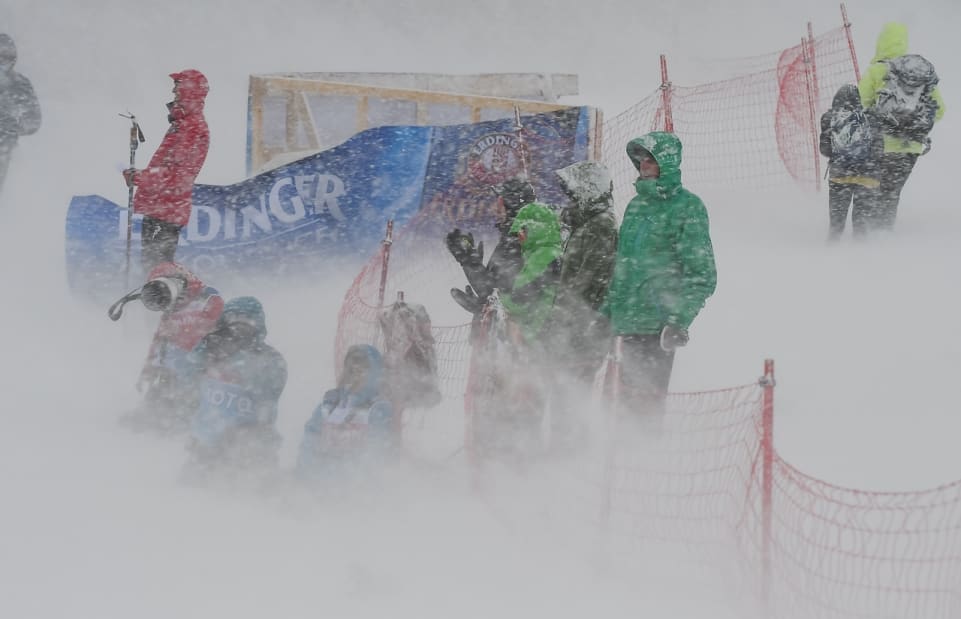
Calm wind and a light drizzle for the men’s International Biathlon Union (IBU) World Cup sprint on Friday afternoon in Hochfilzen, Austria, turned into a full-blown blizzard for the women’s sprint that followed. One multiple-time Olympic and world champion weathered the elements best, as Darya Domracheva of Belarus won the latter with clean shooting. She was one of four women in the top 20 that cleared all 10 targets amid the white-out conditions with a strong wind ripping sideways across the range.
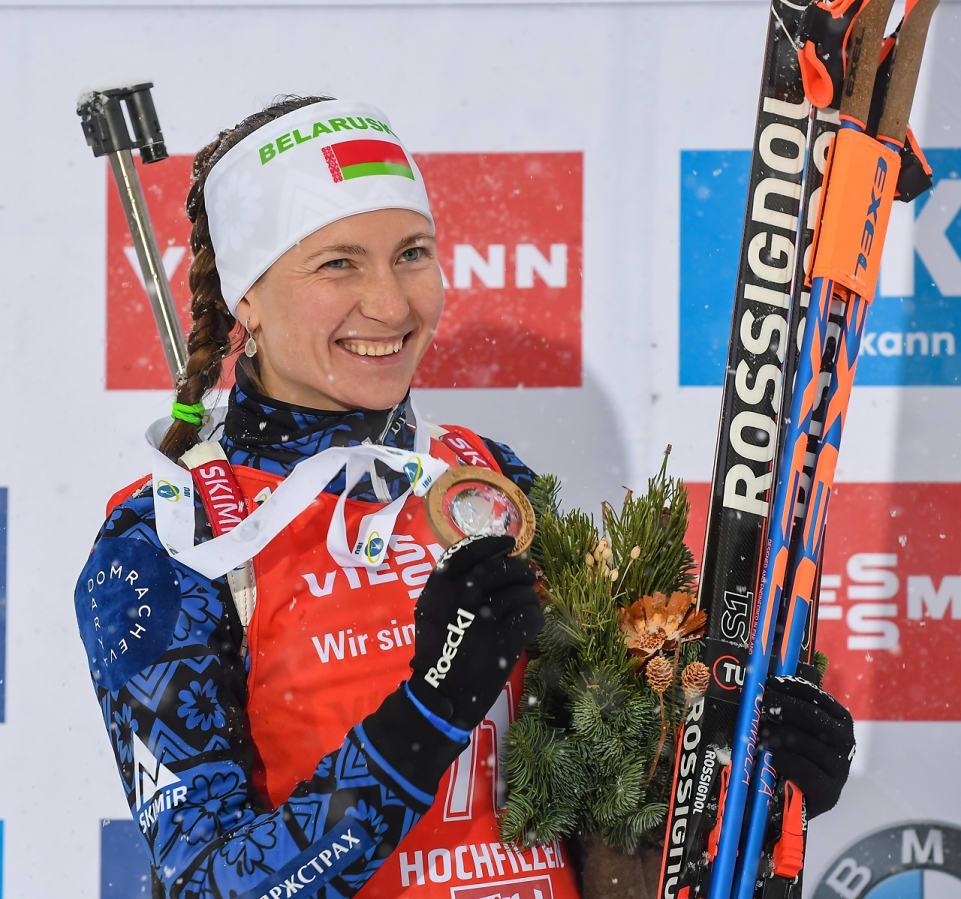
“I am grateful that I was able to handle these challenging weather conditions today,” said the 31-year-old Domracheva, who had her first child just over a year ago, according to an IBU press release. “It has been a long time since I was on top of the podium, since March 2015, so it is nice to be here.”
Domracheva is the defending Olympic champion in three disciplines: the individual, pursuit and mass start. On Friday, she won the women’s 7.5-kilometer sprint for her first win over a year and a half, after taking the 2015/2016 season off to have a child and returning to the World Cup this past January. At 2017 IBU World Championships, she raced to silver in the pursuit.
During the women’s 7.5 k sprint on Friday at the IBU World Cup in Hochfilzen, Austria. (Photo: IBU/biathlonworld)
But on Friday, in the second sprint of the World Cup season, she was back to her winning ways in the most challenging of conditions. After the men’s race, wet snow began to fall more steadily. Temperatures dropped, making for drier snow that intensified in the minutes leading up to the race.
“The conditions were completely different in the race from the zeroing, so you had to adapt today,” said Domracheva, who started 71st of 102 women and bested Anastasia Kuzmina’s time by 22.1 seconds for the win in 22:40.2 minutes. Kuzmina, of Slovakia, who started just ahead of her in bib 69, placed second with a single penalty (1+0), bumping Italy’s Dorothea Wierer (bib 48), who also missed one prone target (1+0), to third (+30.6).
“It was really strange; I could see nothing on the tracks and I had to take off my glasses,” Wierer said, according to the IBU. “In these conditions, the race was decided on the shooting range; with one mistake, that was pretty good. … I think the conditions were the same for everyone; it was snowing for the whole race.”
“We were all hoping that the forecasted storm wouldn’t materialize, but just as predicted, the flakes started getting heavy about 20 minutes before the start,” US Biathlon’s Clare Egan explained in a post-race email to FasterSkier. “That’s when one of our wax techs says he thought about locking the wax cabin and fleeing the scene. Lucky for us he did not, and I think our skis were the best in the field today. I don’t know how they can make such fast skis for such slow conditions but somehow they manage!”
Egan led three American women in 35th, 1:56.1 minutes behind Domracheva, with a total of two penalties: one in prone and another in standing (1+1).
“While I was warming up the wind was extremely strong and then it seemed less intense during my race so I think the earlier starters had worse wind,” Egan recalled. “I took a couple clicks in prone [i.e., adjusted my sight for the wind] but that’s very standard. I actually did a completely normal shooting routine today in both prone and standing, which is a good thing. The trick in biathlon is to replicate your normal shooting routine even when you are in a high-stress race scenario.”
Egan started 68th, just ahead of Kuzmina. Her overall shooting time ranked 29th in the field, while her course time was 42nd. In comparison, Domracheva had the 43rd-ranked shooting time but was fifth-fastest out on course. Kuzmina was sixth fastest on course and had the second-fastest range time (including setup and actual shooting time).
“I did not do anything special today, but because I had special skis I managed a decent course time,” Egan wrote. “This year I am making a point to accept however my body feels on a given day and just focus on technique. When I do that, I know that even if I don’t feel great I can still have a great race.”
In the second World Cup stop of the season, 35th is a season best for Egan and her best result since placing 34th in a sprint last March. Last week in Östersund, Sweden, she placed 75th in the sprint and 79th in the 15 k individual.
“To borrow an expression I just learned from a British biathlete, I’m super duper chuffed with my race,” she wrote. “Last week’s racing was a real blow to my confidence so I’m very proud of the work I did to turn things around. It took a lot of mental gymnastics and help from our sports psychologist. Today’s race wasn’t exceptional but it was a solid biathlon performance and I’m very content with that. I will be completely happy when all of my teammates have races they can feel good about too. We are very much in this together.”
Egan will be the lone American woman racing in Saturday’s pursuit in Hochfilzen; both Emily Dreissigacker and Susan Dunklee finished outside the qualifying top 60. Dreissigacker placed 89th (+3:49.1) with three penalties (1+2) and Dunklee was 97th (+4:52.9) with eight penalties (3+5).
Two Canadian women landed in the top 60 to make the 10 k pursuit, with Emma Lunder in 42nd (+2:03.5) with a single miss (1+0) and Rosanna Crawford in 49th (+2:19.6) with two penalties (1+1). Megan Bankes just missed the cutoff in 65th (+2:55.3) with three standing penalties (0+3), and Julia Ransom finished 100th (+5:20.6) with seven misses (3+4).
“I was really happy with my shooting in the race,” Lunder wrote in an email. “I made sure to focus on my cues after making a 5-click correction for the wind, and took a bit of extra time setting up. It was snowing quite heavily, so I did my best to make every shot a good one, but unfortunately I did have one get away from me. When I came into standing it was a lot calmer, but still snowing a lot, so I was pleased with shooting clean! I’ve been working a lot this year on getting my confidence back in the shooting range, and I’ve seen improvements in both my prone and standing.”
She started second, with only one racer clearing the tracks ahead of her.
“I followed the tracks of Bib 1 for the first loop, just trying not to ski off the trail!” Lunder reflected. “It was really deep snow for that first loop but all things considered our wax team gave me some pretty quick skis for the race. I felt okay skiing today but I still need to find that next gear when I’m racing, so I’m excited to have a lot of girls around me to chase in the pursuit.”
Smith 19th, Doherty 22nd
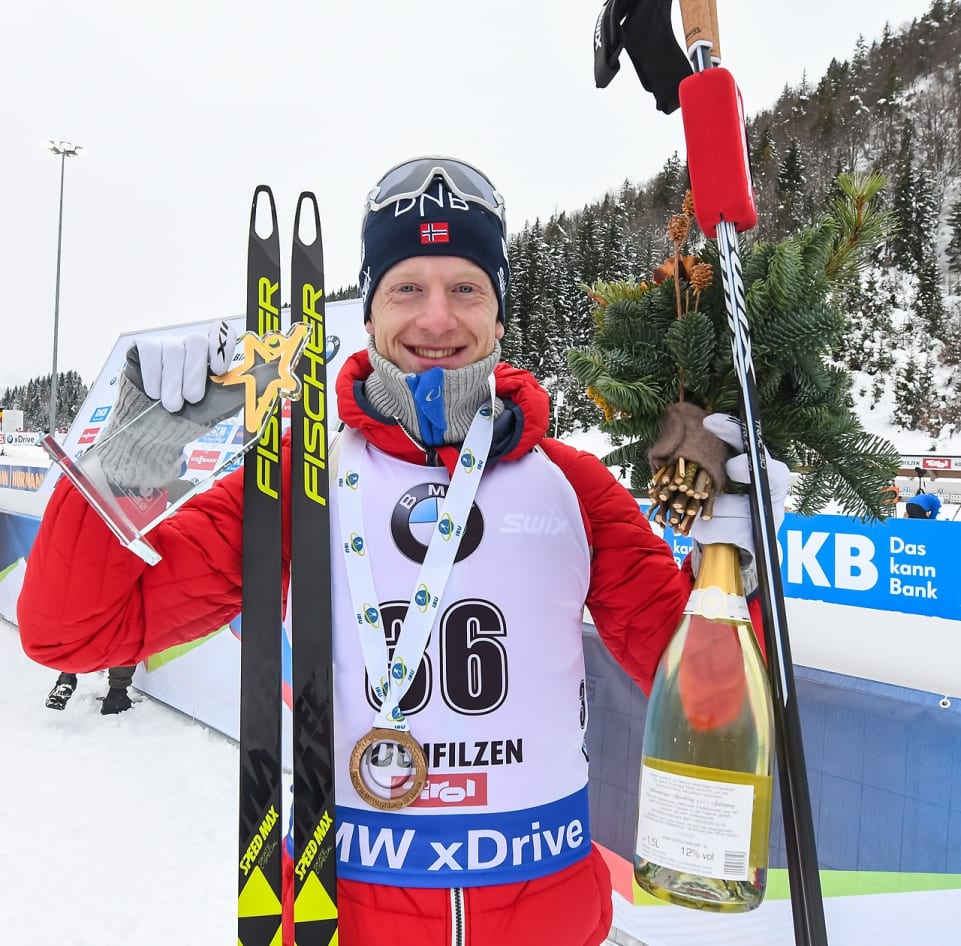
Norway’s Johannes Thingnes Bø after winning his third race of the season (including a mixed relay and 20 k individual race last week Ostersund, Sweden) in Friday’s 10 k sprint at the IBU World Cup in Hochfilzen, Austria. (Photo: IBU/biathlonworld)
In the men’s 10 k sprint that opened the Hochfilzen weekend, Canada’s Nathan Smith raced to 19th — his best non-relay World Cup result since March 2016 — and American Sean Doherty placed 22nd for his best result since finishing 18th in a World Cup pursuit last March. Both Smith and Doherty shot clean, along with 12 others out of 108 competitors.
“Conditions for our race were quite good,” Doherty explained in an email. “Calm winds and overcast. Unfortunately a storm blew in for the women’s race so they had a much tougher course and range today.”
The top-four men all shot a perfect 10-for-10, with Norway’s Johannes Thingnes Bø in bib 36 setting a faster time around the course than France’s Martin Fourcade (bib 38), who also shot clean. Bø took the win in 24:18.4 and was 12.1 seconds clear of Fourcade, who ended up second. Slovenia’s Jakov Fak notched his second-straight podium (coming off a second place in Östersund’s pursuit) in third (+35.4).
“It is always better to be first rather than second,” said Bø, who also won the 20 k individual last week in Ostersund, according to an IBU press release. “I was lucky to shoot clean today. That is what I needed to get the win … My plan was like: go until you die, attack all the way. If you want to win, you cannot save the power…I was quite tired in the last loop, but I managed to hold on.”
Bø’s overall course time was the fastest of the field, 15.3 seconds faster than Fourcade.
“I cannot comment on any fight because Johannes had too big of an advantage after the standing shooting,” Fourcade told the IBU, referring to his 20-second deficit to Bø after the second shooting stage. “I am just happy that I was able to catch some seconds in the end. We had about the same ski speed as last week, but today he shot clean and I had not chance to win.”
“I shot clean and ran as fast as I could; that is all you can do,” said Fak, who started 33rd. “I never worried much after that … You can never be sure about the results until everyone has finished.”
Smith started 12th and finished 1:31.9 off Bø’s winning time, posting the fifth-fastest overall shooting time while hitting every target. Smith’s course time ranked 54th overall.
“I was carefull to take it easier for the last 15 sec before the range,” Smith, 31, wrote in an email when asked about his clean shooting. “It’s an awkward entry with a short steep bump.”
“I’m looking to continue the solid shooting while upping my ski speed a bit, back to around what my shape had been like in November,” he stated. “I’m happy with today’s race. Top 20 is a good accomplishment and a solid step in my comeback. For the pursuit I’m aiming to improve a little and grab a top 16.”
Doherty started in bib 79 and ended up tying Slovenia’s Klemen Bauer for 22nd, 1:39.2 back. (Bauer had a single penalty in prone.)
“As long as I stay disciplined the targets will fall,” the 22-year-old Doherty wrote of his clean shooting. “Overall I am happy with my race today. I am excited to take the momentum into the pursuit tomorrow.”
Saturday will be his first pursuit of the season after placing 82nd in the Östersund sprint. He also placed 38th in the 20 k individual there.
“The start to the season in Ostersund was tough,” Doherty noted. “That course there is one of the hardest on the whole circuit and we had exceptionally poor snow conditions for the individual, so that was a brutal race. Here in Austria I was looking to make a step froward towards the level of racing I know I am capable of and take care of the final Olympic criteria.
“To be honest my skiing is pretty poor right now, and that’s fine,” he added.
Doherty’s overall shooting time was 29th fastest while his course time ranked 57th.
“The important part of the season is still a ways away and that is when I will be on form,” he wrote. “In general I think I am off to a good start this season but there are still many races to go. So I just want to keep working and using each race as an opportunity to keep improving.”
All four Canadian men qualified for Saturday’s 12.5 k pursuit, with Scott Gow finishing 43rd (+2:25.1) with three penalties (2+1), Brendan Green 51st (+2:30.3) with one standing miss (0+1), and Christian Gow 54th with clean shooting.
For the U.S., Lowell Bailey is also in after placing 53rd (+2:32.4) with two penalties (2+0). Tim Burke finished outside the necessary top 60 in 73rd (+3:00.7) with three misses (1+2), Leif Nordgren was 98th (+3:40.2) with three standing penalties (0+3), and Paul Schommer 103rd (+3:54.6) with three misses as well (1+2).
The men race at 6:15 a.m. Eastern Standard Time Saturday, followed by the women at 8:45 a.m. EST.
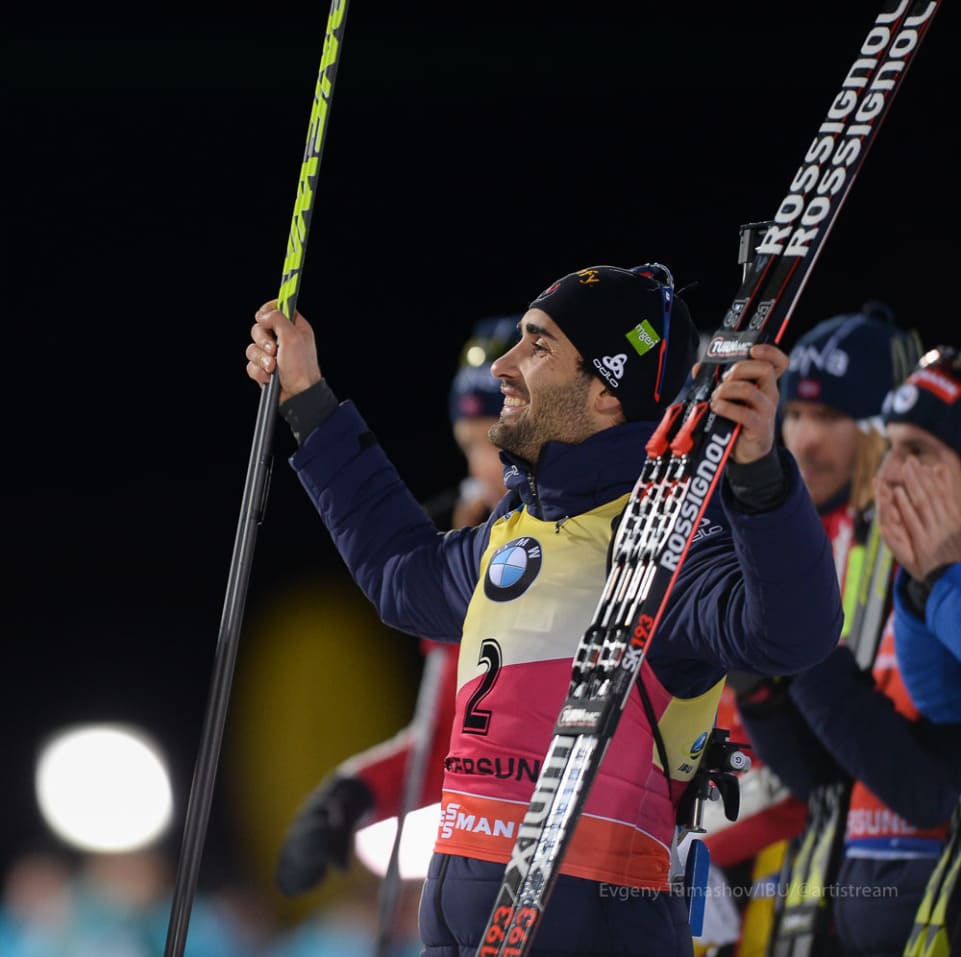
France’s Martin Fourcade celebrating his first IBU World Cup win of the 2017/2018 season in the men’s 12.5 k pursuit on Sunday in Östersund, Sweden. (Photo: IBU/biathlonworld)
If you were to ask France’s Martin Fourcade what’s wrong with a second and third place, and even two fourth place finishes in the first four races of the International Biathlon Union (IBU) World Cup season, he’d likely politely tell you nothing — it just wasn’t up to his usual standards.
“Despite my two podiums here, I felt that if I had not won here, it would have been my worst season opener since, for seven years in a row, I won here,” the 29-year-old defending World Cup champion told the IBU after Sunday’s pursuit in Östersund, Sweden. “Now I can be very calm and relaxed for the next competitions.”
He got down to business out of the start of the men’s 12.5-kilometer pursuit, starting second, just 1 second behind Norway’s Tarjei Bø, who won the sprint to start the pursuit first. Early in the first of five 2.5 k loops, Fourcade set the pace with Bø and Germany’s Erik Lesser in bib 3 slotting in behind him. Fourcade entered the range first to take Lane 1 for the first prone stage, where he and Bø both missed a shot to slip to fifth and sixth, respectively, after each skiing a penalty lap. Meanwhile, Lesser missed four to drop out of the top 30 and nearly a minute and 20 seconds out of first.
While Fourcade left the range 10 seconds behind Norway’s Emil Hegle Svendsen, who had moved into first with clean shooting, he was back into first 2.5 k later. On the second prone, Fourcade and Bø both cleaned to leave the range just 3.8 seconds apart in first and second, respectively. Svendsen missed one to slip 18 seconds back to third.
On Loop 3, Fourcade switched into high gear. Bø kept pace, but by the time they lined up together for the first standing stage, Fourcade had the edge. The Frenchmen once again cleaned while Bø missed three to fall to 18th and nearly a minute and a half out of contention by the time he finished his penalty laps.
Game over. Fourcade spent the next two loops and final shooting going through the motions to secure his victory, cleaning the last standing stage with the 25th-fastest shooting time, then slowly turning to look up at the crowd. He appeared relaxed with his two closest challengers, his French teammate Quentin Fillon Maillet and Slovenia’s Jakov Fak, who started 2 seconds apart in 12th and 10th, respectively, and shot identically (1+0+0+1), skiing together more than a minute back in second and third.
Fourcade’s final loop time ranked 51st out of 58 yet he still finished first, 40.8 seconds clear of Fak, who dropped Maillet on the final climbs before the stadium. Fourcade claimed his first win of the season in 30:12.2, Fak placed second for his first podium since 2015, and Fillon Maillet took third (+42.1).
“I must say that I was very surprised because after the third shooting it was more a fight against myself,” Fourcade said. “I am very satisfied about the biathlon I showed.”
“I think Quentin and I worked well together, half the loop each pushing to keep on the podium,” Fak told the IBU. “Both can be very satisfied about finishing on the podium and leaving Sweden with this result.”
On a day with variable wind conditions and soft, slow snow, no one in the men’s race shot clean. Six hit 19 of 20 targets, including Fourcade and his brother Simon Fourcade (ninth place) and Norway’s Lars Helge Birkeland (sixth place) in the top 10.
Christian Gow (Biathlon Canada) racing to his previous career best of 23rd in the men’s 12.5 k pursuit at 2017 IBU World Championships in Hochfilzen, Austria. On Sunday, he placed 21st in the Östersund World Cup pursuit. (Photo: Glen Crawford)
Biathlon Canada’s Christian Gow also finished with a single penalty (0+0+1+0) in 21st for his best World Cup result. Gow had started the pursuit 26th and 58 seconds back, and picked off five places to finish 2:04.6 behind Fourcade.
“[Saturday] was my best sprint placing ever, so I knew I was in a good position for the pursuit,” Gow wrote in an email to FasterSkier. “I knew a top 20 was possible, and maybe more if my skiing was on form. Unfortunately, I had some shin issues skiing today so I wasn’t able to ski as well as I would have liked. But I did my job on the range and am happy with how the race turned out.”
The shin pain he referred to wasn’t anything serious, “just bothered me today for some reason,” he elaborated. “I’m not too concerned though, I’m sure they’ll be fine in a couple days.”
His shooting time ranked 22nd overall compared to his overall course time in 49th.
“The shooting conditions were challenging today, but I knew that I could still shoot well if I stayed focused in the range,” Gow wrote. “I shot confidently today and I think that helped a lot.”
He consistently left the range within striking distance of the top 20: first in 22nd, then in 21st, then 26th, and finally 20th.
“The course was pretty soft today. That added an extra challenge skiing,” he continued. “I made up all of my time in the range today, but am quite happy with my last loop. I am proud of how hard I was able to push myself on that lap to keep my placing.”
Leaving Östersund, where he and his older brother Scott Gow and another teammate Julia Ransom all achieved career bests to start their season, Gow said the team mood was positive.
“Almost everyone had at least one result that they can be proud of and we really performed well as a team which boosts everyone’s confidence I think,” he wrote.
Four Canadians qualified for the men’s pursuit, withNathan Smith finishing 42nd (+3:19.2) after starting 24th and missing three shots (1+0+0+2). Scott Gow placed 50th (+4:10.9) after starting 16th and incurring six penalties (1+2+1+2), and Brendan Green followed in 51st (+4:18.6) with five penalties (0+2+2+1).
Bailey Gets First Top 20 of Season
Lowell Bailey (US Biathlon) racing to 17th in the IBU World Cup men’s 12.5 k pursuit on Sunday in Östersund, Sweden. (Photo: USBA/NordicFocus)
Lowell Bailey led two Americans in the pursuit, starting 22nd and 50 seconds back and rising to 17th (+1:40.2) with two penalties (0+1+0+1). After cleaning the first prone stage, where several of the top competitors incurred penalties, Bailey moved up to 12th and 39 seconds out of first.
One loop later, he found himself nearly a minute back in 19th after a penalty on his second prone. Bailey worked his way back to 11th after cleaning his third stage, but slipped to 15th with a miss in the final standing stage.
“The range was tricky today. The wind was very shifty and constantly changing,” Bailey explained in an email. “I only tried to focus on the fundamental parts of my shooting (e.g. trigger squeeze, breathing, etc.) and make sure that I was taking good shots. My groups did move around from one prone to the next, but fortunately, most of the shots stayed in the hit zone.
“I’m happy with the shooting today,” he continued. “I tried to execute the type of shooting that I’ve worked on all summer. Although I was happy with the shooting result in the Sprint, I know that I could have shot faster. It’s a delicate balance; when to go for speed and when to hold back for accuracy.”
His shooting time in the pursuit ranked third overall, while his course time was 42nd.
“I definitely don’t feel in my best shape yet,” he wrote. “We deliberately approached the season conservatively, with the mindset that the Olympics are months away and I want to be in my best shape when I hit the tracks in Pyeongchang.”
Leaving Östersund, where he finished 22nd in the sprint and 67th in the 20 k individual, Bailey wrote that he was satisfied with his first week of racing considering that he came down with a cold a week earlier.
“All things considered, I feel very fortunate to have come away with some WC points in a field which seems to be one of the strongest international biathlon fields yet,” he wrote.
Also for US Biathlon, Tim Burke finishing 48th (+3:52.7) after starting 52nd and missing four shots (2+0+1+1).
With the conclusion of the first IBU World Cup in Östersund, the circuit moves to Hochfilzen, Austria, where racing kicks off again Friday, Dec. 8, with men’s and women’s sprints.
The SuperTour women’s 10 k classic mass start podium on Sunday in West Yellowstone, Montana, with Hedda Bångman (second from r) of the University of Colorado Boulder in first, and Craftsbury’s Kaitlynn Miller (third from r) and Caitlin Patterson (r) in second and third, respectively. From left: Caitlin Gregg in sixth, Katharine Ogden in fifth and Rosie Frankowski in fourth were also recognized at the flower ceremony. (Photo: FBD)
US SuperTour (West Yellowstone, Montana): 10/15 k classic mass starts
The second day of SuperTour racing took place as originally planned at the Rendezvous Ski Trails in West Yellowstone, with 22-year-old Hedda Bångman, of the University of Colorado Boulder (CU), and 33-year-old Brian Gregg (Team Gregg) winning the women’s 10-kilometer and men’s 15 k classic mass starts, respectively, on Sunday.
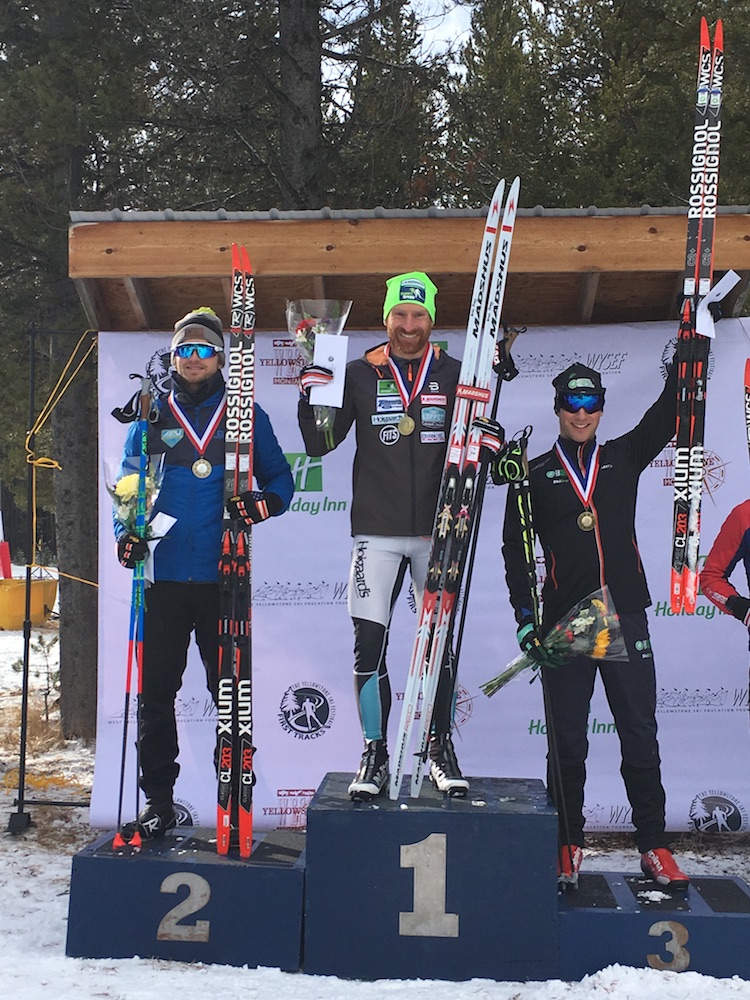
The men’s 15 k classic mass start SuperTour podium on Sunday in West Yellowstone, Montana,with Brian Gregg (c) of Team Gregg in first, David Norris (l) of APU in second, and Ben Lustgarten (CGRP) in third. (Photo: FBD)
Bångman, a Swedish freshman on the CU Ski Team, won the women’s race in 30:24.8, just ahead of two Craftsbury Green Racing Project (CGRP) skiers Kaitlynn Miller and Caitlin Patterson. While Miller placed second (+1.3) and Patterson was third (+3.4),
Rosie Frankowski of Alaska Pacific University (APU) finished another 10 seconds later in fourth (+13.5), and Katharine Ogden of the Stratton Mountain School (SMS) was fifth (+17.2). Caitlin Gregg (Team Gregg) followed in sixth, Felicia Gesior (CXC Team) was seventh, Anne Siri Lervik (CU) eighth, Erika Flowers (SMS Elite Team) ninth, and Corey Stock of the Bridger Ski Foundation (BSF) 10th.
In the men’s race, Brian Gregg pulled out a 1.9-second win over David Norris (APU), crossing the line first in 41:30.3. Ben Lustgarten (CGRP) reached the podium for the second-straight day (after placing second in Saturday’s skate sprint) in third (+4.6). Kyle Bratrud (CXC Team) finished fourth (+10.9) and Kris Freeman (Caldwell Sport) was fifth (+12.6). Tad Elliott (Ski & Snowboard Club Vail) followed in sixth, Eric Packer (APU) seventh, Ian Torchia (Northern Michigan University/U.S. Ski Team D-Team) eighth, Hunter Wonders (APU) ninth, and Martin Bergström (University of Utah Ski) 10th.
Sweden’s Charlotte Kalla winning the women’s 15 k skiathlon on Sunday at the Lillehammer World Cup in Norway. (Photo: Henrik Hunnes)
Sweden’s Charlotte Kalla pulled out another dominant distance performance on Week 2 of the World Cup, racing to a 19.7-second win in the women’s 15-kilometer skiathlon on Sunday, ahead of three Norwegians and American Jessie Diggins.
Kalla led at the halfway point of the skiathlon when skiers transitioned from classic to skate, just ahead of Norway’s Heidi Weng in second. The two had broken away around 4 k into the classic leg and put more than 20 seconds into the rest of the field by the transition, when Diggins came through 21.6 seconds back in third, leading a large chase group with Finland’s Krista Parmakoski, Norway’s Marit Bjørgen, Austria’s Teresa Stadlober, Norway’s Kathrine Rolsted Harsem, Finland’s Kerttu Niskanen, Norway’s Ragnhild Haga, and Switzerland’s Nathalie von Siebenthal, respectively.
While Kalla and Weng continued to trade the lead over the next 5 1/2 kilometers or so, by the 13.65 k marker, Kalla had dropped Weng, with 12 seconds between the two, while the chasers remained 29 seconds behind Kalla.
Over the next 1.2 k, that time gap grew to 20 seconds and 46 seconds, respectively, and Kalla skied off to her second win of the season in 42:24.7 minutes.
Weng placed second, 19.7 seconds back, and Haga claimed third (+43.6), after skiing alone for the last 4 k of the race. Bjørgen finished just ahead of Diggins for fourth (+54.3) and fifth (+57.0), respectively, and Stadlober was sixth (+1:04.9), Parmakoski seventh (+1:07.8), Norway’s Ingvild Flugstad Østberg eighth, Russia’s Natalia Nepryaeva ninth (+1:27.8), and Sadie Bjornsen 10th (+1:32.6).
Four Americans finished scored points in the top 30, with Kikkan Randall placing 16th (+2:06.5) and Rosie Brennan 29th (+3:07.7). Liz Stephen finished 36th (+3:25.7), Chelsea Holmes was 38th (+3:39.6) and Ida Sargent 55th (+6:41.1).
Cendrine Browne of the Canadian National U25 Team led Canada in 45th (+4:37.3), and Emily Nishikawa followed in 49th (+5:00.1). Katherine Stewart-Jones did not finish.
Klæbo Outlasts Sundby; Harvey 6th
A gassed Johannes Høsflot Klæbo (yellow bib) holding off fellow Norwegian Martin Johnsrud Sundby (r) for the win on Sunday in the men’s 30 k skiathlon at the Lillehammer World Cup in Norway. (Photo: Henrik Hunnes)
In the men’s 30 k skiathlon that followed, Norway’s Johannes Høsflot Klæbo made it a five-peat, proving himself once again unbeatable, this time in the first multi-discipline distance race of the season.
Klæbo outlasted [edit: rocketed past] teammate Martin Johnsrud Sundby to beat him by 1.3 seconds for his fifth-straight win in 1:16:47.1, and Norway swept the top four with Hans Christer Holund in third (+6.8) and Simen Hegstad Krüger in fourth (+10.9).
France’s Maurice Manificat followed closely in fifth (+11.3) and Canada’s Alex Harvey was next in sixth (+13.1), ahead of Finland’s Iivo Niskanen in seventh (+16.2), and Russia’s Alexey Chervotkin, Sergey Ustiugov and Alexander Bolshunov in eighth (+37.7), ninth (+42.2) and 10th (+59.6), respectively.
Klæbo skied patiently in the pack for essentially the entire race. For instance, at 11 k he sat back in 18th, just seven seconds from Canada’s Devon Kershaw in the lead.
One kilometer later, Klæbo remained 5 seconds back in 13th while Kershaw was 8 seconds back in 16th.
At the ski exchange at 15 k, Niskanen led Sundby and Italy’s Francesco de Fabiani and a total of 10 men within three seconds of first. Klæbo clocked through 5 seconds back in 13th, just ahead of Harvey in 14th (+5.3). Sixteen men remained within six seconds and striking distance of first. Kershaw in 18th had fallen off the pace and was 36 seconds back at the transition, just behind Russia’s Andrey Larkov.
While Harvey continued to ski around third place during the first 5 kilometers of the skate leg, Klæbo worked his way closer to the front and led at 22.5 k. By then, the lead group had dwindled to six within two seconds of first. Harvey remained in fourth.
Over the next 7.5 k, the lead changed several times, with Klæbo hovering near the tail end of the group. With about 200 meters to go, however, it was down to Sundby and Klæbo, with the former leading by 2 seconds (and Holund skiing seven seconds back in third). Klæbo ultimately had the most finishing kick to take the win by 1.3 seconds over Sundby, while Holund crossed 6.8 seconds later for third.
Canada had two in the top 20 with Kershaw in 19th (+2:59.7). Last year’s NorAm winner Russell Kennedy (Team R.A.D.) placed 53rd (+7:30.7), and Canadian World Cup Team members Graeme Killick and Knute Johnsgaard finished 54th (+7:41.3) and 60th (+9:49), respectively.
Two U.S. men landed in the points with Erik Bjornsen (U.S. Ski Team) in 20th (+2:59.9; just 0.2 seconds behind Kershaw) and Noah Hoffman in 28th (+3:37.8). Scott Patterson finished 36th (+4:56.1) and Paddy Caldwell was 56th (+7:43).
— International Biathlon Union (@biathlonworld) December 3, 2017
France’s Martin Fourcade overcame an early penalty and his No. 2 starting position to take the men’s 12.5 k pursuit win on Sunday, 40.8 seconds clear of anyone with 19-for-20 shooting (1+0+0+0).
Fourcade started 1 second behind Saturday’s sprint winner, Norway’s Tarjei Bø, and took control of the race after cleaning the second shooting stage. Bø missed one on the first prone stage then five more later in the race (1+0+3+2) to slip to 19th (+1:49.5) while Slovenia’s Jakov Fak raced up from 10th to second, 40.8 seconds behind Fourcade, with two penalties (1+0+0+1). Just behind him, France’s Quentin Fillon Maillet took third (+42.1) with identical shooting after Fillon Maillet started 12th and skied with Fak for most of the race.
France’s Martin Fourcade (l) and Quentin Fillon Maillet after placing first and third, respectively, in the IBU World Cup men’s 12.5 k pursuit on Sunday in Lillehammer, Norway. (Photo: IBU/biathlonworld)
None of the 58 finishers cleaned the four-stage race. American Lowell Bailey improved from 22nd to 17th (+1:40.2) with two misses (0+1+0+1). Canada’s Christian Gow achieved a career best in 21st (+2:04.6), up from starting 26th, after shooting 19-for-20 (0+0+1+0).
Also for Canada, Nathan Smith slipped from 24th at the start to 42nd (+3:19.2, three penalties), Scott Gow finished 50th (+4:10.9; six penalties) after starting 16th, and Brendan Green placed 51st (+4:18.6; five penalties).
One other American qualified in the sprint top 60 for the pursuit, with Tim Burke finishing 48th (+3:52.7; four misses).
In the women’s 10 k pursuit earlier in the day, Germany’s Denise Herrmann tallied her second-straight win (and the second win of her IBU World Cup career). She started first and successfully held of France’s Justine Braisaz, who started 15 seconds behind her in second place, by 25.8 seconds. While Herrmann missed two on her third shooting (0+0+2+0), Braisaz was one of three women in the field to clean (0+0+0+0).
Norway’s Marte Olsbu raced up from seventh to third place (+48.0) with two penalties (0+1+0+1).
Canada’s Julia Ransom placed 23rd (+2:48.1), up from 29th at the start, with two misses (0+0+1+1). Two of her teammates also qualified for the pursuit, with Rosanna Crawford finishing 52nd (+5:25.1) with six penalties (0+3+1+2). In her first World Cup pursuit, Megan Bankes completed three shooting stages before being lapped (3+1+1).
No American women qualified for the pursuit.
With the conclusion of the first IBU World Cup in Östersund, the circuit moves to Hochfilzen, Austria, where racing kicks off again Friday, Dec. 8, with men’s and women’s sprints.
Craftsbury Green Racing Project’s Ben Lustgarten (l) training in the ski tunnel in Planica, Slovenia, earlier this month. (Photo: Caitlin Patterson/ CGRP blog)
Pay 9 Euros a day, get a 950-meter loop in return. If snow were to take on a monetary value, that’s how much the Planica Nordic Centre charges for a day pass in its snow tunnel, new to the city’s Olympic Sports Center since the spring. But to others, the opportunity to ski on snow at the tail end of summer is priceless, even if it is under the fluorescent lights and within the concrete walls of a three-level parking garage.
Among those “others” are the Craftsbury Green Racing Project (CGRP) elite cross-country skiers and biathletes, who spent Sept. 12 to Sept. 20 in Planica, Slovenia, training in the city’s ski tunnel. As a few explained, getting on snow at this time of year outweighs the occasional lassitude that comes from skiing two-plus hours on a less-than-1-kilometer loop.
“No matter what condition it is nordic skiers love their first time on snow of the season,” Ben Lustgarten, new to the CGRP cross-country team, wrote in an email. “We were able to do speeds, short level 4 intervals, some threshold, accelerations, and sprint simulation workouts. There was fair amount of terrain to do varying technique work and video analysis for the small amount of space.”
Left to right: Craftsbury GRP head coach Pepa Miloucheva along with athletes Heather Mooney, Ben Lustgarten, Kaitlynn Miller, Caitlin Patterson, Liz Guiney, and assistant coach Nick Brown in the ski tunnel in Planica, Slovenia, during a training camp this month. (Photo: Caitlin Patterson/CGRP blog)
Along with Lustgarten, who joined Craftsbury this year after spending the last two seasons with the Sun Valley Ski Education Foundation (SVSEF) Gold Team, nearly a dozen CGRP skiers made the trip, including Caitlin Patterson, Kaitlynn Miller, Liz Guiney, Heather Mooney, and Mary O’Connell, and biathletes Alex Howe, Ethan Dreissigacker, Mike Gibson, Emily Dreissigacker, and Hallie Grossman.
“The intensity and technique really helped to keep the tunnel from getting too boring, as there was always something to think about or work on, or at the very least a coach on hand videoing for later technique review,” Patterson wrote in an email. “It gave us an opportunity to practice being adaptable to snow conditions and terrain (ie corners); even if those particular features in the tunnel would be rarely seen on a race course, they were valuable in their extremes. I feel more prepared than ever to handle a course with tons of 90 and 180 degree corners, even though that’s unlikely to happen often.”
The athletes, along with Craftsbury’s head coach Pepa Miloucheva and assistant coaches and wax technicians Nick Brown and Sam Doherty, completed a weeklong training camp in Planica, taking full advantage of the three-level snow tunnel. The following week, the group headed to Schladming, Austria, for eight days of volume training on the Dachstein glacier, more than 9,800 feet above sea level. In Planica, nearly 7,500 feet lower, much of the team’s first week focused sharpening agility, coordination and speed.
“The tunnel is a perfect environment for working on both technique and speed, with enough transitions and tight turns to keep the skiing interesting,” Grossman wrote in an email.
“I feel more prepared than ever to handle a course with tons of 90 and 180 degree corners, even though that’s unlikely to happen often.” — Caitlin Patterson (CGRP) after training in the Slovenian ski tunnel
Grossman, who recently switched from cross-country to biathlon, explained that the biathletes’ intensity training slightly deviated from their original plan when they learned that Slovenian Summer Biathlon Nationals were being held in Pokljuka, Slovenia, about an hour away from Planica.
“The camp took a little turn when we found out about the rollerski races in Pokljuka, so what was going to be a primarily on-snow camp turned into a combination of skiing and rollerskiing,” Grossman wrote. “This allowed us to still focus on technique and shorter speed in the tunnel, while also getting the opportunity to race.”
The biathletes had originally planned to use the Pokljuka range for a few shooting sessions, but quickly decided to jump into the races when they discovered the competitions were taking place at the same location. Grossman competed in both races that weekend — the women’s 7.5 k sprint and 10 k mass start — as did her teammate Emily Dreissigacker.
“We actually didn’t even know Slovenian Nationals were happening until we tried to sign up to use the range and they told us we couldn’t because there were races,” Dreissigacker wrote.
Dreissigacker, who married Howe, her teammate, last month and spent a few weeks before the camp on a honeymoon with him in Italy, explained that the competitions elicited an opportunity to reconnect with racing, even within a small field.
“There wasn’t a ton of competition in the senior women’s category, four of us to be exact, but one of the Slovenians was Teja Gregorin who won bronze in the pursuit in Sochi, so it was pretty cool to be able to race against her,” Dreissigacker wrote. “For me it was also a good way to re-focus after the craziness of the wedding.”
“We actually didn’t even know Slovenian Nationals were happening until we tried to sign up to use the range and they told us we couldn’t because there were races.” — Emily Dreissigacker (CGRP) on racing at Slovenian Summer Biathlon Nationals
Dreissigacker finished third in the women’s 7.5 k race, with two standing misses, and Grossman placed fourth. In the mass start the next day, Dreissigacker once again reached the podium in third and Grossman repeated in fourth.
CGRP biathletes Hallie Grossman (l) and Emily Dreissigacker after the women’s 14 k mass start at Slovenian Summer Biathlon Nationals in Pokljuka, Slovenia, on Sept. 18. (Photo: Ethan Dreissigacker)
The men’s races included a 10 k sprint and 14 k mass start. In the sprint, Howe placed seventh, Ethan Dreissigacker was ninth and Gibson 13th. The next day, Ethan rocketed to third, Howe finished 10th and Gibson 14th.
“It was really fun to be able to jump into the Slovenian races!” Ethan wrote in an email. “While it did change up the plan a bit that first week, it think it was for the better, and I’m really glad we were able to compete. Biathlon races in the US are pretty few and far between, and many of them are also ‘trials’ of some kind. It’s super valuable to get in competitive racing experience outside of those trials races to get used to the pressure of competition without feeling like your season is on the line.”
Along with the CGRP athletes, the men’s field included the Slovenian national biathlon team and some non-national team skiers, as well as a few Bulgarian national-team members.
“The competition at these races was really pretty similar to that of the US rollerski nationals we had in August,” Ethan explained. “The big name in the men’s field was Jakov Fak who has an Olympic bronze, and a bunch of World Cup victories. Fak has is a very relaxed and efficient skier and it was awesome to get to ski behind him for a bit in the races.”
After Slovenian nationals, the Craftsbury crew ventured to Austria for a week of altitude training. The team planned to train through Wednesday and fly back to Vermont on Thursday this week.
“Both places are only 2 hrs apart, so was very convenient for a week long speed block in the tunnel and a week and a half volume block on the glacier all on snow,” Miloucheva wrote in an email. She explained that “some speed work followed by some good distance hrs on snow,” were the primary goals of the camp.
While it wasn’t the first time the CGRP spent a few weeks of fall training on snow, this year was the first split camp featuring the Slovenian snow tunnel.
“This is the third year in a row that the GRP has come over to Austria for an altitude camp on the Dachstein Glacier,” Ethan explained. “This year I was really excited about the split the camp between two locations, with two different focuses, and I think that has really helped make the most of the trip. Both locations have had some awesome resources for training, and beautiful scenery.”
Ben Lustgarten getting in a final day of classic kilometers in on the Dachstein glacier in Austria this month. (Photo: Caitlin Patterson)
Craftsbury skiers Ben Lustgarten (r) and Heather Mooney skiing on set tracks under clear skies while volume training on the Dachstein glacier in Austria this month. (Photo: Caitlin Patterson)
Craftsbury GRP biathletes Ethan Dreissigacker (l), Alex Howe (c) and Mike Gibson after the men’s 14 k mass start at Slovenian Summer Biathlon Nationals in Pokljuka, Slovenia, on Sunday, Sept. 18. (Photo: Ethan Dreissigacker blog)
Craftsbury GRP biathletes Hallie Grossman (l) and Emily Dreissigacker during the women’s 10 k mass start at Slovenian Summer Biathlon Nationals in Pokljuka, Slovenia, on Sunday, Sept. 18. (Photo: Sam Doherty)
The men’s 14 k mass start at Slovenian Summer Biathlon Nationals in Pokljuka, Slovenia, on Sunday, Sept. 18. (Photo: Ethan Dreissigacker blog)
Part of the Slovenian ski tunnel’s 950-meter, snow-covered loop in late September. (Photo: Ben Lustgarten)
Craftsbury GRP’s Ben Lustgarten (r) and Caitlin Patterson get in some classic speeds while training in the Slovenian ski tunnel in Planica this month. (Photo: Sam Doherty)
Craftsbury’s Ben Lustgarten (r) and Alex Howe practice corning while training in the Slovenian ski tunnel in Planica this month. (Photo: Sam Doherty)
Lowell Bailey (US Biathlon) on his way to 13th in the men’s 12.5 k pursuit at the IBU World Cup in Hochfilzen, Austria. (Photo: USBA/NordicFocus)
Despite the best efforts of his competitors, it appeared French biathlon star Martin Fourcade was almost his own worst enemy in Saturday’s 12.5-kilometer World Cup pursuit in Hochfilzen, Austria.
In a scene reminiscent of Norwegian cross-country skier Heidi Weng’s mistake in Kuusamo earlier this season, Fourcade, who was being followed closely by Germany’s Simon Schempp and Russia’s Anton Shipulin, nearly skipped his final shooting stage. He was saved, though, because as he turned towards the finishing stretch, he saw his two competitors ski toward the range again. He very quickly realized his mistake, and followed them, keeping his focus to clean the final stage.
After that he never looked back until he finished first in 31:19.9, pounding his chest and pointing to the crowd as he did so. Schempp finished 8.9 seconds later in second place and Shipulin was 19.1 seconds back in third to round out the podium.
After what runner-up Simon Schempp (l) of Germany called a “psycho race” Schempp, winner Martin Fourcade (c) of France, and Russia’s Anton Shipulin (r) shared the pursuit podium at the IBU World Cup in Hochfilzen, Austria. (Photo: Fischer/NordicFocus)
During a post-race press conference, Fourcade had no comment on his nearly-disastrous wrong turn. But Schempp, who suspected a mistake mused it might just have been a move by Fourcade to avoid having to go on the first position on the shooting range.
“It was a wonderful victory at the site of the next [2017] World Championships,” Fourcade told the IBU. “My fan club, my family, is here, and it was a really good fight. I love to win, but I love to win more when the opponents are really strong. Today it was a great fight, which is why I’m so happy to succeed.”
For most of the race, Friday’s sprint runner-up Fourcade had struck with or been within a few seconds of sprint winner Schempp and Shipulin, who started fourth. After taking the control of the pursuit, each with two clean shooting stages, Schempp and Shipulin at times slowed down considerably on the track, skating next to each other with Shipulin gesturing wildly for Schempp to take his turn in front, but the German was seemingly unwilling to set the pace.
This posturing enabled a few athletes, including Fourcade, to close the gap to them again, after Fourcade had missed two targets in the second shooting. But he, too, didn’t want to take the lead.
All three athletes managed to leave the crucial last shooting stage without a miss. Fourcade shot the fastest, and Schempp entered the final lap about five seconds later, with Shipulin 12 seconds behind. They tried everything in their power to catch Fourcade, but to no avail.
“I am happy about the second place,” Schempp told the German broadcaster ARD, “but it was a complete psycho race. Like Martin not wanting to go in front, then attacking just ahead of the shooting, then he wanted to skate into the finish…”
“It was not so easy for my brain. Topsy-turvy, but that’s part of the game,” he added. “It was a fine competition [for me] with one miss on the shooting range. And of course I’m happy with the second place.”
Nathan Smith (Biathlon Canada) racing to 18th in the IBU World Cup pursuit in Hochfilzen, Austria. (Photo: Fischer/NordicFocus)
Both athletes complimented their fierce competition afterward.
“I gave all I had in the beginning of the loop,” Schempp said in the press conference. “The gap was the same a long time, but at the last hill, Martin was very strong, so I had to defend my second place to Anton.”
Fourcade echoed those remarks after swapping positions with Schempp in two races between Friday and Saturday.
“Simon showed me on the last lap it was necessary to do my best,” Fourcade said. “This week I had to give 100 percent. It was a great fight between us.”
Shipulin also expressed his satisfaction with his first podium of the season.
“I realized those are my conditions and I’m getting better and better compared to the first leg in Östersund,” he said through a translator. “I still have to work hard on my form, but I’m really glad this is the first podium for me, and I’m doing better and better race by race.
“I have always loved pursuits,” Shipulin added. “Of course, I was a bit disappointed [Friday] with the fourth place, but I only tried to pay attention to today and in the end the podium is a good result.”
Last week at the World Cup in Östersund, Sweden, Schempp struggled mightily with the windy range, missing the pursuit after placing out of the top 60 in the sprint.
Asked before Saturday’s race how he coped and turned a difficult situation into a sprint victory on Friday, Schempp revealed his latest training secret to ARD: last week, he had worked with his home-team coach and assistant national-team coach Andreas Stitzl, using a leaf blower to simulate strong sudden gusts of wind.
While he acknowledged Fourcade’s strong performance in the two Hochfilzen individual races, Schempp was not too pleased with a scene that happened during the final shooting stage. He claimed Fourcade, who was next to him, nicked Schempp’s ski poles on the mat between his legs while Fourcade left the range.
“You have to be able to focus on yourself, but of course you notice what happens left and right,” Schempp told ARD. “I noticed Martin had hit everything in the last shooting, he was a little bit faster than me. And then when he was leaving, he hit my ski poles good, while I still had one shot. That brought me out of my rhythm a little bit, but thank God I hit it. Then on the last round I tried everything, but there was nothing left.”
Schempp reiterated this irritation in his post-race interview with the IBU: “I was not calm every time. It was a psycho race. You have to be calm.”
Norway’s Tarjei Bø, who had started the pursuit in third, always kept the leaders in viewing distance but couldn’t quite catch them in the end, finishing with two penalties (0+1+0+1) and missing the podium by 12 seconds (+31.2).
With about 8,000 spectators in the stadium and lining the course in the Austrian Alps, local fan favorite Dominik Landertinger managed to move up eight positions with a single miss, finishing fifth place (+39.8), ahead of Norwegian stars Ole Einar Bjørndalen (+57.5) and Emil Hegle Svendsen (+59.5).
Landertinger told the Austrian television broadcaster ORF that he’s been struggling with the recent death of his mother and wished she could have been there to see him.
“Everything I had to go through in recent weeks, I can tune that out pretty well during the race,” he said. “I have a great family with everyone supporting each other, but this has been a hard time for me.
“That was a very good race. I came through the shooting great. I achieved exactly what I had set out to do. Focus just on myself,” Landertinger added. “But for the podium I should not have had that miss. You’ve got to be satisfied, there are so many good guys here.”
Bailey Just Outside Top 10
Lowell Bailey on his way to 13th in the men’s 12.5 k pursuit at the IBU World Cup in Hochfilzen, Austria. (Photo: USBA/NordicFocus)
Of the eight North American men in Saturday’s pursuit, US Biathlon’s Lowell Bailey came closest to a top 10 after starting 12th and briefly moving into eighth with two clean prone stages. He skied the third lap in a fairly large chase group with six other athletes, but after missing a target in the first standing, Bailey fell back to 13th.
From there, the 34-year-old Bailey pushed to hang on up two climbs on the course. After cleaning his final standing stage, he left the range for a last time in 10th place, just between Germany’s Andreas Birnbacher and Slovenia’s Jakov Fak. Bailey faded a bit on the last loop, and in the finish he had given up the positions he previously gained on the shooting range, ending the day in 13th place (+1:20).
“Today was a great indicator of how strong the current men’s World Cup field is,” Bailey said in a US Biathlon press release. “I feel really good about my race today, but unfortunately I wasn’t able to hold or improve my starting place. Some days the field is just that strong and you just have to live with the result. Still, I’m happy with another top-15 and excited for the relay tomorrow.”
Nathan Smith (Biathlon Canada) racing to 18th in the IBU World Cup pursuit in Hochfilzen, Austria. (Photo: Fischer/NordicFocus)
Biathlon Canada’s Nathan Smith ended the day in 18th (+1:48.4) — the same position he had started in — with too many penalty laps preventing a better result. Smith missed two targets in the first shooting, then cleaned the next two stages before adding another two penalties in the last standing to his tally. His skiing remained strong, posting the fifth-fastest time on the final lap for the 13th-best course time overall.
On Friday, Smith had predicted “some spectacular crashes” in the pursuit, due to the difficult snow conditions on the course. Crashes didn’t decide the outcome of Saturday’s race, but indeed, there were some victims. Germany’s Daniel Böhm careened off the course on the third lap in a downhill hairpin turn, then struggled back to his feet and onto the elevated track. Worse yet, in addition to the lost time, Böhm damaged his rifle in the crash and had to switch to the official reserve each team has in store during a race. However, as he explained after the race, that replacement rifle has a generic fit, rather than being fitted to any one athlete. Böhm went on to miss three shots between the last two standing stages, ultimately falling nine spots to 55th (+6:14.2).
Tim Burke achieved another top 30 for the U.S., moving up three spots to finish the day in 27th (+2:38.5). He cleaned the first two prone stages, before missing three on the next two (0+0+2+1) and crashing, which set him back farther.
“I had a great start to the race today with two clean prone stages and solid skiing,” Burke wrote in an email. “Unfortunately, I had a huge crash on the third loop and lost a lot of time. This definitely took a little wind out of my sails.”
He was cheered on by his wife, retired German biathlete Andrea Burke (formerly Henkel), who attended the race with a few friends from her national-team days.
“Considering [the crash], I was very happy to still move up a few places,” Burke continued. “I was really happy with my skiing so far this week. It was a big improvement from Ostersund and I feel like I am back to my normal ski form.
“I am pretty banged up from the crash today,” he added. “But am hoping to feel better for the relay tomorrow. Everyone seems to be in good shape, so anything is possible!”
A third American, Sean Doherty started 45th and ended the pursuit in 35th (+3:24.8). He missed six (2+1+1+2) while skiing the 23rd-fastest course time. Leif Nordgren placed 52nd (+5:27.1) for the U.S., with three misses in the first shooting and five in all (3+0+1+1).
Canada’s Christian Gow moved up 20 spots to finish 39th (+3:43.1) after having missed two targets and cleaning both standing stages (1+1+0+0), while his older brother Scott Gow missed six targets (2+3+1+0), and dropped 12 places to end the day in 45th (+4:23.8).
Start of the men’s 15 k mass start on Sunday at IBU World Championships in Kontiolahti, Finland, with Martin Fourcade (r) and Norway’s Johannes Thingnes Bø (l) leading and Canada’s Nathan Smith (behind Bø in red and white) near the front. Smith went on to miss two on the first shooting stage and one in the third stage to finish 23rd overall. (Photo: Kontiolahden Urheilijat/Kari Kuninkaanniemi)
KONTIOLAHTI, Finland — All four North American men in Sunday’s 15-kilometer mass start had moments from 2015 IBU World Championships they could hold onto, high points of the last week and a half they could drum up and replay in their minds.
Some were fresher than others. For American Lowell Bailey, it was cleaning every stage after a single miss on his first prone of the mass start, leading a chase group behind the leaders then tagging on to the main pack and finishing 35 seconds behind the winner in 13th — his best result of these World Championships.
For his teammate, Tim Burke, who finished 10.6 seconds behind him in 14th, it was racing hard on his second lap to catch the leaders, then hanging in and beating out Norway’s Emil Hegle Svendsen, who racked up two silver medals over the last week, in a photo finish. It was also Burke’s best result of the 2015 championships.
Canada’s Brendan Green experienced the sensations of skiing fifth on his second-to-last lap of the mass start after cleaning all three stages leading up to that point. While he fell behind over the next 2.5 k and missed one of his shots in the final standing for 19-for-20 shooting, that kind of shooting was still something he could be proud of. He also tallied his third 21st place in four individual races at worlds, and he placed 16th in the pursuit.
And his teammate, Nathan Smith had the physical evidence of a silver medal to remind him what he accomplished eight days earlier.
“It would be nice to have another race close to that level,” the 29-year-old Smith said after placing 23rd in the mass start with three penalties, two of which came in the first prone. He finished 1:19.4 behind Slovenia’s Jakov Fak, who won in 36:24.9.
On March 7, Smith became the first Canadian male biathlete to medal at World Championships. The next day, he placed 13th in the pursuit, and on Thursday, finished 44th in the 20 k individual. On Saturday, he hit all 10 of his targets as the second leg of the men’s relay to lift the Canadians from 22nd to 10th. They ended up 19th.
“I’d say my relay was close to that level, but I’m still pretty happy with how world champs went,” Smith said. “Before this, my best race ever at world champs was [43rd in 2012] so all my races have been better than that.”
Lowell Bailey (US Biathlon) en route to 13th in the men’s 15 k mass start for his best result of the 2015 IBU World Championships in Kontiolahti, Finland.
Bailey put himself in contention for what looked like a possible top 10 heading into his last lap on Sunday. After a single prone penalty put him back in 23rd, 26.4 seconds out of the lead, he rose to 11th after the last shooting without another miss all race.
“I was happy with my mental game today,” Bailey said. “I was able to stay with it and even in the last standing, while I was shooting, it was just, ‘I’m here, I’m shooting and I’m trying to do what I know how to do. The race is whatever it’ll be.’ ”
After the first prone, Bailey, Burke and Smith all slipped outside the top 20 with at least one miss (Smith had two). The top 20 men out of that stage cleaned, including Green in 16th.
“It’s a tough way to start off a mass start because that group of clean guys leaves and you’re left kind of at the back of the pack,” Bailey explained. “I just tried to regroup. I knew that it’s only one penalty, it’s a four-stage race, so I really just tried to … pace myself and stay in it so I had a little bit left on the last loop, which was good to have.”
Within 25 seconds of Norwegian race leader Ole Einar Bjørndalen heading into the last lap, Bailey initially dropped to 13th when Russia’s Evgeniy Garanichev and Svendsen passed him. He passed Svendsen back after the steepest climb and nearly caught Sweden’s Fredrik Lindström, finishing 0.3 seconds behind him in 13th.
“I’m happy, top 15 at world champs, it’s where I wanted to be,” Bailey, 33, said after his ninth World Championships. “This week’s been kind of up and down. I’m happy with my shooting and the relays [with eighth place in the mixed relay] were solid. Overall, there was no fireworks, but it was a solid week for me, especially considering where I came from. I wasn’t even in the points [at the World Cup] in Oslo. I was sick for the other World Cup before that.”
Burke, also 33 and in his ninth World Championships, was pleased with his second individual top 15 and third top 20 over the past eight days in Kontiolahti.
He explained he had to reset after Saturday’s relay, in which he used four spares and skied two penalty loops on the third leg to drop from eighth to 15th.
Tim Burke (US Biathlon) approaches the range during the men’s 15 k mass start on the last day of 2015 IBU World Championships in Kontiolahti, Finland. He went on to place 14th for his best result of the championships.
“It was tough to regroup after that,” Burke said. “I felt bad for the other guys because they did a great job, but I just wanted to refocus and try to have a solid race here today.”
Before the mass start, he decided he was going to take his time shooting and go back to the basics.
“I knew I was going to give away time on the shooting range, but I didn’t care,” Burke said. “Just try to go for each shot, one shot to the next. I felt a lot more comfortable doing that, and that combined with really good skiing today, I was very happy with how I felt. I was able to attack a lot.”
After an early prone penalty put him back in 26th, 32.1 seconds out of first, Burke pushed hard on his second lap to catch the 24-man lead pack and came into the range within 13 seconds of Norway’s Johannes Thingnes Bø up front.
“I just went out aggressive on the loop and halfway through, I realized that front group was taking it easy,” Burke recalled. “I saw I had an opportunity to catch back up, and any time you can do that, you have to do it.
“I definitely burned some matches on that second loop catching up,” he added. “Luckily, I shot clean in the second prone so I was able to get back in the group and take a breather for a loop.”
While taking it easy within the lead pack doesn’t usually happen, but Burke explained this race was unique.
“It was pretty crazy, the front group was just not going fast,” he said. “No one wanted to lead. There were 20 guys that came into the last shooting. I’ve never seen that.”
Out of the final stage, Bjørndalen emerged 1.6 seconds ahead in first, having cleaned all four stages. Fellow Norwegian Tarjei Bø cleaned the last shooting to head out in second, and Ondrej Moravec of the Czech Republic left the range in third, 3.4 seconds back. Also with a clean final standing, Fak was the fourth man to join that group, 4.1 seconds after Bjørndalen.
While the frontrunners battled for three podium spots, there was a 10-second gap to Germany’s Simon Schempp, who cleaned the last stage to move into fifth. France’s Simon Fourcade, Svendsen and Garanichev each missed one to fall back in the standings, from second to sixth for Fourcade, and 12th and 13th for Svendsen and Garanichev, respectively.
That’s where Bailey found himself in 11th, and Burke was 37.5 seconds back in 17th after two more penalties, one on each standing stage. Burke skied the sixth-fastest course time overall to finish 14th, just ahead of Svendsen in 15th and one-tenth of a second ahead of Germany’s Benedikt Doll in 16th.
“Overall, solid,” Burke said of his World Championships. “It’s better than what I’ve done so far this year so I have to be happy with that, but it’s not what I’m here for. It’s not what I think I’m capable of, but it’s a step in the right direction.”
Brendan Green (Biathlon Canada) racing the men’s 15 k mass start on the last day of 2015 IBU World Championships in Kontiolahti, Finland. While he skied up to fifth with clean shooting through the first three stages, he ended up 19th with a miss on the last stage and placed 21st.
With three flawless shooting stages, Green started his penultimate lap in fifth, 13.6 seconds behind Simon Fourcade, the leader at the time, and 6.4 seconds behind Moravec in fourth.
“That was pretty fun,” Green said of the race overall. “It was unreal how tight it was. I don’t think I’ve ever been in a mass start quite like that. It was fun to be in the mix. The skiing still isn’t quite there, but the saving grace was being in the pack of guys. I think that enabled me to dig a bit deeper and hurt a bit more.”
While skiing alone in fifth, the 28-year-old Canadian said the pace picked up considerably on that lap, which he expected. On the climb known as the “wall,” Green was 16 seconds back in 13th, just ahead of Burke.
“Lower down on the course I got caught by a group,” Green said. “I was able to kind of stay with them, but it was so tight. There was a big group of guys and I don’t think anything was really decided until that last standing.”
There, he missed one and dropped to 19th, 43.5 seconds out of the lead. Green finished 21st, 1:08.3 after the winner.
“I gave it my best today and it was working out pretty good until the last standing,” he said. “I have to be happy with the shooting today. It was a good race and it’s more experience under my belt for the future.
“All in all for the championships, I’m pretty happy with how I did,” Green added. “I wish my preparation could’ve been better and more as planned, but that’s the way it goes sometimes.”
Leading into the championships, Green had to rehab a back injury and spent some time away from skiing.
“Hopefully next year my form is a little better and I can keep the same shooting and improve upon these results,” he said.
Slovenia’s Jakov Fak (r) attacked on the last lap and held off Ondrej Moravec of the Czech Republic (l), in second, and Norway’s Tarjei Bø (back r), in third, as well as Norway’s Ole Einar Bjørndalen (back l), in fourth, to win the men’s 15 k mass start on the last day of 2015 IBU World Championships in Kontiolahti, Finland. (Photo: Kontiolahden Urheilijat/Risto Kuittinen)
Fak Finally Gets His
As predicted, the race came down to the final shooting, and really, the last lap, where Fak took control. Without wasting much time, the Slovenian made a point to get in front of Moravec and the Norwegians, and by the top of the wall, he had successfully gapped Bjørndalen and Tarjei Bø.
“After the shooting, I saw that Ole Einar was in front of me,” Bø recalled in a press conference. “I turned around and saw these two guys [Moravec and Fak] and I knew the medals would be delivered out to three of the four. I was trying to go for the gold medal. Jakov increased the speed in the second last of the uphills. I tried to follow him and I did it almost as good as I was planning to, but in the last hill, he and Ondrej were too strong for me and Ole … there was no energy left.”
Moravec held on, but barely.
“I know how fast he is,” the Czech said of Fak, whom he has trained with for several summers. “He take a little bit advantage on the last uphill, so I say, ‘OK, you win,’ but I believe that I can take some medal in the end.”
The two sprinted toward the finish together, and Fak outlasted Moravec by a 1 second for his first medal of the week and second World Championships title.
“It was a very hard World Championships for me,” Fak explained in the conference. “When you look at the competition schedule before the World Championships, you see a lot of races, then when you are not satisfied with your competitions, you have less and less chance every day.
“Today was the last day,” he continued. “When I was standing on the start, I saw all the medal winners before me. I was the first with the number without the medal and I wanted to get it so much.”
He earned it ahead of not only Moravec, but also Bø, who medaled in five out of six races at 2015 worlds (excluding the 20 k individual). Bø finished 3.7 seconds back in third for his fourth bronze of the week. He also earned silver with the men’s relay on Friday.
Norway’s Tarjei Bø with his five medals from 2015 IBU World Championships in Kontiolahti, Finland. He took bronze on Sunday in the men’s 15 k mass start, the final race. (Photo: Kontiolahden Urheilijat/Kari Kuninkaanniemi)
“In both Khanty-Mansiysk and Nove Mesto [World Championships], I took individual gold medal. I like that color better,” said Bø, a four-time world champion between 2011 and 2013. “But still with five medals, even if it’s not a gold medal, I’m so happy. It was a strange winter and even here, I’m not skiing as good as I’m hoping to do, but my shooting has been incredible.”
Fak, Moravec and Bø all shot 19-for-20, with Fak missing one in the third stage, Moravec missing one in the first prone, and Bø missing one in the third stage as well. Bjørndalen cleaned and ended up fourth, 10.2 seconds after Fak and 6.5 seconds off the podium.
Canada’s Nathan Smith at his first-ever awards ceremony after placing a career-best fifth on Sunday in the IBU World Cup 12.5 k pursuit in Nove Mesto, Czech Republic. (Photo: Biathlon Canada/NordicFocus)
No part of Sunday could be described as “easy” for anyone racing the IBU World Cup pursuits. A little new snow and some wind had been in the forecast for the last day of racing in Nove Mesto, Czech Republic, and that seemed manageable.
Overnight, nearly half a foot of snow fell. Then, on Sunday afternoon, came the snow squalls, sporadically and unforgivingly, with increasing blizzard-like conditions making for a miserable-looking women’s race.
Heavily falling snow jammed rifles, and some women crossfired, like Germany’s Franziska Hildebrand, who was in the top five until shooting at the wrong targets in the final stage. She then skied the wrong number of penalty loops and was penalized six minutes, relegating her to 50th out of 51 finishers.
Meanwhile, the Czech Republic’s own Veronika Vitkova desperately tried to get the attention of race officials to reset her targets — the ones Hildebrand shot at. The technical delegate for the weekend, Max Cobb (also US Biathlon’s CEO) explained that video cameras in the range revealed Vitkova lost 52 seconds amid the confusion, and the jury deducted that from her final time, which put her in 11th overall.
And all that happened before the men’s race even started.
Canada’s Nathan Smith was ready for an equally slow-and-painful 12.5-kilometer men’s pursuit. He had seen blue skies during zero shift to snowfall during his warmup, amounting to a centimeter or so on the ground before the gun went off.
Fortunately, it lightened up to “a medium snowfall” for most of the race, he explained, up until the another big squall blew through on Smith’s final lap.
“Thankfully, I only had to deal with that for half a lap,” he wrote in an email.
But what a half a lap it was. After starting seventh, 38 seconds behind Saturday’s sprint winner Jakov Fak of Slovenia, Smith leapt to fifth with a clean first prone. Fak cleaned as well, as did France’s Martin Fourcade, who started fourth, Germany’s Simon Schempp, who started second, and the Czech Republic’s Michal Slesingr, who started fifth, respectively.
Smith, who posted a career-best seventh on Saturday, established himself behind them in fifth after the first shooting, 40.7 seconds after Fak. The top-12 men to leave the range all came out with perfect shooting.
Conditions were initially more favorable than the women’s race, with light snow and a slight-yet-variable wind.
But the weather gradually intensified, and with each passing shooting stage, the pressure picked up as well.
The 29-year-old Smith handled it like never before — cleaning all four stages for 20-for-20 shooting and keeping himself squarely in the top-six throughout the race.
“I was pretty nervous on the last standing, but channelled my previous fails to make sure I diligently aimed at the targets,” he wrote.
He focused on relaxing his left arm in prone and his left hand in standing — which worked.
After the last standing, Smith headed into the final lap in fifth, 5.2 seconds behind Ukraine’s Sergey Semenov in fourth and 22.7 seconds behind Fak, who was still in the lead despite a single miss on the last stage.
Slovenia’s Jakov Fak celebrates his second-straight win with a victory in Sunday’s 12.5 k pursuit at the IBU World Cup in Nove Mesto, Czech Republic. He held off Simon Schempp of Germany and France’s Martin Fourcade, respectively. (Photo: IBU/Květoslav Frgal)
(Fak completed his penalty loop just as Fourcade was leaving the range after cleaning his fourth-straight stage. Fak led the Frenchman into the last lap, where he extended his gap on him over the next 2.5 kilometers.)
Meanwhile, Smith simply needed to hold his position to set new World-Cup best, but that wasn’t easy, either.
“The Ukrainian [Semenov] and I had been skiing pretty similarly whenever I saw him,” Smith explained. “I tried my best to gain time but was a lot more concerned that someone might come up from behind.”
With 20.6 seconds separating Smith from sixth place (with Germany’s Erik Lesser) after the last stage, the Canadian skied the fifth-fastest course time on the last lap to secure fifth. He crossed the line 24.1 seconds after Fak, who proved untouchable on Sunday with a winning time of 37:24.9.
“I never started a pursuit in first and won so I am happy that I did that,” Fak told the IBU. “I wanted to shoot clean but do not have much experience shooting on lane one, so maybe next time I can do it.”
Fak’s 19-for-20 shooting and second-fastest overall course time was enough to hold off Fourcade and Schempp, who missed one on the second prone, by 4.4 seconds. Fourcade hit each one of his and was in contention for second until the last climb, where Fak attacked to drop both him and Schempp. The German proceeded to pass Fourcade about halfway up, accidentally stepping on Fourcade’s ski to leave the Frenchman staggering for a moment — a moment he couldn’t get back.
Fourcade let up and casually finished third, 8.9 seconds behind Schempp and 13.3 seconds after Fak. Semenov hung on to fourth, another seven seconds later, and Smith finished 3.8 seconds behind him in fifth.
Canadian Nathan Smith (second from r) after placing fifth in Sunday’s IBU World Cup pursuit in Nove Mesto, Czech Republic, for his first-ever flower ceremony. Slovenia’s Jakov Fak (second from l) won the race, Germany’s Simon Schempp (l) placed second, and France’s Martin Fourcade (third from l)made the podium in third. (Photo: Matthias Ahrens/Biathlon Canada)
With Russia’s Evgeniy Garanichev in sixth (+45.6), the top-six men walked together to the following flower ceremony, where Fourcade patted Schempp on the back, indicating no hard feelings.
“It was not easy on the tracks; there was only one spot that was fast,” Schempp later told the IBU. “I had no other chance to pass him. We talked it over and it is okay.”
For Smith, the ceremony itself marked his season-long goal.
“It feels awesome to achieve that and especially when the other guys up there are the perennial biathlon top dogs,” Smith explained of his new career high.
In addition to a bouquet and a glass vase Smith estimated weighed 20 pounds, “It won’t be so great for travelling with,” he joked, Smith also received 3,500 Euros for sixth, roughly $4,000 U.S. dollars.
On any other day, with 20-for-20 shooting, he felt he could have been on or certainly closer to the podium. Fourcade and Semenov also cleaned all four stages just ahead of him.
“Today was a little unlucky for me as the top-three men were basically the Overall World Cup leaders,” Smith told Biathlon Canada, referring to Fourcade, Schempp and Fak, who rank first, second and fourth in the overall standings, respectively. “If a couple of them faltered I could have been there, but it is tough to beat the best when they are on 100 per cent. I know though if you’re only a couple of places off the podium enough times, one day it will happen.”
Canada’s Nathan Smith at his first-ever awards ceremony after placing a career-best fifth on Sunday in the IBU World Cup 12.5 k pursuit. (Photo: Biathlon Canada/NordicFocus)
For the first time in his career, the Canadian also notched back-to-back clean races. He came close last year at the Sochi Olympics, with 29-out-of-30 shooting between two races, but completed the feat on Saturday and Sunday, knocking down 30 consecutive targets.
“Today is extra special because it is the first 20/20 clean of my biathlon career,” Smith added. “It feels awesome to have that success. It makes skiing less of a chore, and you’re excited to get back to the range after the next lap.”
In an email, Canada’s head coach Matthias Ahrens observed that Smith was more mentally prepared for the pressure situation he faced on Sunday, than when he found himself in third coming into the last shooting earlier this season in Östersund, Sweden, and ended up 16th.
“He keeps it cool, he is a pretty quiet guy but lots of thinking in his preparation,” Ahrens wrote.
“The skill and control he demonstrated is exactly what we expect to see from an athlete hungry for medals at world cup and world championship competitions,” wrote Chris Lindsay, Biathlon Canada’s high-performance director, in an email. “Both he and Brendan [Green] have taken on the leader roles within the team now that more of the younger athletes are being introduced to the World Cup. This leadership is most important when it is expressed though performance like we saw today.”
The second of three Canadian men in the pursuit, Green started 22nd and finished 30th (+3:13) with three penalties, one on his second prone and two more in the last stage.
“For me the hardest part today was the skiing,” Green wrote in an email. “It’s a tough 2.5km course to begin with and the conditions today made it a really slow grind. I had some tough luck with my skis today. It wasn’t an easy day for the wax techs in those conditions and I ended up on a pair of skis that just didn’t want to glide.
“We’re all still a little baffled as to why that pair wasn’t gliding well but after chatting a bit we have a few ideas,” he added. “It’s a lesson learned and we’ll get it right in these conditions next time!”
In the range, he recalled a “fairly consistent wind” each time he shot.
“I think I managed it well,” Green wrote. “I would have been happier with one less miss in my last standing bout but 17/20 was decent for today.”
Canada’s 22-year-old Macx Davies started 54th and finished 54th (+9:01.5) with nine penalties (2+3+2+2).
Nordgren 20th for Career-Best Pursuit
Coming off an all-time best 16th on Saturday, Leif Nordgren again led the U.S. in 20th on Sunday. He finished 2:37.9 behind the winner with three penalties, one on each prone stage and one more in the last standing.
“I felt pretty good today, definitely tired from 3 days of racing, but not bad,” Nordgren wrote in an email. “One nice thing about starting the pursuits a little higher up is that there’s always someone to ski with and catch a good draft. I think for almost every loop I just skied behind whoever I happened to exit the range with.”
Nordgren started 1:05 after Fak with Russia’s Matey Eliseev. With an initial prone miss, the American slipped to 21st, then was 25th leaving the second prone. He worked his way back to 21st with a clean standing, and was 19th leaving the range after one last penalty on the final shooting. Overall, Norgren posted the eighth-fastest range time.
“I was sort of welcoming these conditions,” he explained. “Anytime there are these types of winds in a pursuit race is a really good opportunity to move up in a pursuit race, much like last week in Otepaa [where he skied up from 51st to 19th in the pursuit].
“I was pretty happy with where I ended up, but it should have been better,” Nordgren added. “I made 3 mistakes on the shooting range, 2 of them were really stupid mistakes that I shouldn’t have made, and two more hits would have put me a few places higher. … It’s my best ever pursuit result, but knowing it could have easily been better makes it bittersweet.”
Tim Burke (US Biathlon) on his way to 37th in the men’s 12.5 k pursuit at the IBU World Cup in Nove Mesto, Czech Republic. (Photo: USBA/NordicFocus)
After Nordgren, Tim Burke started 38th and placed 37th for the U.S., 3:37.8 back with four penalties (1+2+1+0). Nineteen-year-old Sean Doherty started 57th and finished 45th (+5:02.1) with four misses as well (2+1+0+1).
“I think the best days of the season are still ahead of us,” Cobb wrote. “Just under a month to go until the World Champs.”
Nathan Smith racing in August in the men’s 10 k sprint at the 2014 North American Rollerski Championships in Jericho, Vt.
Note: This article has been updated to include emailed comments from Nathan Smith.
Seventy-eighth. That’s where Nathan Smith finished in the last IBU World Cup 10-kilometer sprint before Saturday’s race. And while the 29-year-old Canadian would probably very much like to forget that result in Antholz, Italy, it was a marker of how far he’d come in just over two weeks with some quality time spent training.
“January was a tough month of shooting and I felt like I was hitting my head against a brick wall trying to knock the targets down,” Smith told Biathlon Canada after Saturday’s 10 k sprint in Nove Mesto, Czech Republic. “Even though I was trying hard it just wasn’t happening. After the last World Cup I decided to take a week off shooting, and thought of some key points to focus on – relaxing into the position and slowing things down a touch.”
While training in Antholz, he fell on his chest and hurt his back, aggravating an injury he sustained three years ago while rollerskiing, he explained in an email on Sunday morning.
“That made it really hard to ski for a few days and racing was pretty painful,” Smith added. “I focused a lot during the break getting my back to relax and stretching a lot. Aside from that I just revised a little bit of volume training to help maintain my fitness through the rest of the season.”
He also did’t touch his rifle during that time.
“I decided to not touch my rifle at all during the break and let thing reset,” Smith wrote. “When I picked it up again I made a big effort to focus on relaxing…”
Nathan Smith (Biathlon Canada) (Photo: olympic.ca)
So with some, but not too much restraint, Smith forged ahead on Saturday, starting 25th on a crystal-clear-yet-windy day and ultimately finishing seventh for his career-best World Cup result. Earlier this season, he placed ninth in the mass start in Pokljuka, Slovenia, and ninth in the sprint in Östersund, Sweden, but seventh was a new high.
He finished 37.7 seconds behind Saturday’s winner, Jakov Fak of Slovenia, who rounded the course in 24:09.9. Fak hit all 10 of his targets, as did Smith. In fact, seven of the top-eight men cleaned (with the exception of France’s Martin Fourcade, who missed one standing).
“Today the top men shot amazingly well which makes for a very tough day to medal when you aren’t within the top-five or 10 skiers,” Smith said. “A medal may have been possible if I’d also had the ski of my life today, however, the odds of perfect shooting and skiing coming together are pretty low. A more likely way to grab a first podium is to put yourself in a position where you can capitalize on a day when the favourites falter.”
He passed two people during the race, yet Smith knew that didn’t exactly indicate how fast he was moving.
“There was a glory train of athletes starting behind me so I knew it must’ve been pretty good if no one passed me,” he wrote. “The techs were giving me info the entire time so I knew I was fighting for a top 10 and that a medal wasn’t too far away.”
Both his range and shooting times ranked fifth overall, and he was 23rd-fastest on course throughout the three-lap race.
“My skiing felt strong but I can definitely give a little more,” he reflected. “The difference was shooting 10-for-10 today and I will try and reflect on that in the future.”
Smith has seen his share of top 15’s on the international scene; at his first Olympics last season, he placed 11th in the pursuit and 13th in the sprint in Sochi, Russia. He’s also recorded five top-10 World Cup results in the last two years. He credited his success this season in part to his teammates.
“Rosanna [Crawford] had an amazing first trimester, and Brendan [Green] really came into his own in Ruhpolding and Antholz. All three of us have been very close to the podium the last couple of years, and it’s a bit of a friendly competition to see who will do it first,” he said.
“Today reaffirmed that my form is still there and that I can shoot really well,” he wrote. “It gave me some good confidence for the next couple world cups and leading to world champs.”
“I decided to not touch my rifle at all during the break and let thing reset. … When I picked it up again I made a big effort to focus on relaxing.” — Nathan Smith, after career-best seventh in IBU World Cup sprint on Saturday
Slovenia’s Jakov Fak shot 10-for-10 and skied faster than anyone else to win Saturday’s 10 k sprint at the IBU World Cup in Nove Mesto, Czech Republic. (Photo: IBU/Květoslav Frgal)
Ahead of Smith, Fak started 18th and ended up with the fastest-overall course time. He took his time on the range, hitting all his targets with the 60th-ranked range time out of 94 men.
Fak rose from fourth after his first stage to first with another clean shooting bout, skiing faster than Germany’s Simon Schempp, who started 29th. Schempp ended up second with perfect shooting, 12.8 seconds behind the Slovenian.
“It was important to shoot zero because in Antholz I missed the last shot,” Fak told the IBU after the race. “Today I hit it and could run my own race.”
The second starter, Jean-Guillaume Béatrix of France shot 10-for-10 and initially led at the finish before Fak crossed the line 26 seconds faster. Fourcade skied the second-fastest course time to counteract his single penalty and finished fourth, 0.3 seconds after Beatrix.
The men’s 10 k sprint podium at the IBU World Cup in Nove Mesto, Czech Republic: with Slovenian winner Jakov Fak (c), German runner-up Simon Schempp (l), and France’s Jean-Guillaume Béatrix in third. (Photo: IBU/Květoslav Frgal)
Michal Slesingr of the Czech Republic was another 0.4 seconds back in fifth with clean shooting, and Russia’s Anton Shipulin cleaned for sixth, 29.5 seconds behind the winner.
Smith initially finished fourth, then was bumped to seventh by Fourcade, Schempp, and Shipulin respectively. He ended up 8.2 seconds away from sixth and a spot at the awards ceremony.
“He showed great consistent skiing in all three laps,” Biathlon Canada Head Coach Matthias Ahrens wrote in an email, “and displayed again his strong shooting efficiency which showed in his personal best result of finishing 7th in a [World Cup].”
In all, three Canadian men made the top 60 to qualify for Sunday’s pursuit: Green placed 22nd (+1:12.8) with a single standing penalty, and 22-year-old Macx Davies finished 54th (+2:20.9) with one prone miss. That result tied Davies’ season best after he placed 54th in the World Cup sprint in Oberhof, Germany.
Canada’s fourth man, Scott Gow placed 63rd, 2:35.7 back from the winner and 3.8 seconds out of 60th with two prone penalties.
“It would have been nice to qualify all 4 men for the pursuit tomorrow, Scott Gow just missed it by a small margin,” Ahrens wrote. “Happy that Macx was able to continue in good form which he started at [IBU Open European Championships]. I am looking forward to next week’s relays since I believe we have a nice mixed team of eager younger and older more experienced athletes who supplement each other quite well.”
Macx Davies racing in the 2013 North American Biathlon Rollerski Championships 12.5 k pursuit in Jericho, Vt.
Last Sunday at the European Championships in Otepää, Estonia, Davies led Canada in 27th in the 12.5 k pursuit.
“I am elated to finally pull my shooting together after some crazy conditions in Otepaa,” Davies wrote in an email. “My skiing felt good, I spent most of the race pushing myself harder and harder. Until I felt like I was at the redline for my whole final loop.”
He set two personal goals on Saturday: to shoot 10-for-10 and make the top 40 to score World Cup points.
“Though I didn’t quite achieve either of these I still feel happy with my performance today and am excited to race tomorrow,” he wrote.
Davies will start Sunday’s 12.5 k pursuit 2:21 behind Fak in first; Smith will head out 38 seconds back in seventh, and Green will start 1:13 back in 22nd.
“Today was another good result for me and it sets me up well for tomorrow’s pursuit,” Green wrote in an email. “It’s a tight race amongst the top 30 and tomorrow will be another good opportunity. The shooting will be especially important for me tomorrow if we continue to face more wind.”
After Friday’s mixed relay, in which Green skied a penalty loop and used three spares to anchor Canada to 14th, he was looking for more.
“I knew today that I would have to step up my game,” he wrote. “I knew with the wind we’ve been experiencing here that the shooting would be challenging so I really tried to make each shot count. It’s a tough race course here as well and I tried hard to make time in the areas that I thought played into my ski strengths.”
He ended up rising from 34th overall after prone to 28th after missing his lone shot of the day in standing, and closed his last lap with the 17th-fastest course time to place 22nd.
“My skiing was better than yesterday. I definitely pushed and made myself hurt more on course, and at the same time tried to focus more on areas such as the gradual climbs that I felt would play more into my strength while skiing,” Green added. “I was happy shooting 9/10.”
Leif Nordgren (US Biathlon) racing to a career-best World Cup result of 16th on Saturday in the men’s IBU World Cup 10 k sprint in Nove Mesto, Czech Republic. (Photo: USBA/NordicFocus)
When Leif Nordgren caught wind that he was seven seconds from a top 10 with one loop to go, he couldn’t help but get fired up.
The 25-year-old Minnesota native hadn’t cracked the top 20 in a World Cup since 2011, when he placed 17th in the mass start at 2011 IBU World Championships. The day before, in Friday’s mixed relay, US Biathlon Chief of Sport Bernd Eisenbichler said Nordgren looked better than ever — a sign of things to come.
On Saturday, Nordgren started 44th and raced himself up to ninth at one point in the men’s 10-kilometer sprint, right after cleaning his first of two shooting stages. Twelve-and-a-half seconds behind race leader Martin Fourcade of France, who led through prone, Nordgren headed out on his second-to-last lap.
Entering the range for the last time, he glanced at the leaderboard and noticed quite a few men had missed their targets on the windy afternoon. He shot conservatively in standing and missed one, which “was a little deflating,” he said, “but all I could do was push hard the last loop and see where I ended up.”
Even after skiing a penalty loop, he heard he was within reach of a top 10, which ended up being a top 20 after all 94 men in the field had finished. Nonetheless, Nordgren raced to complete his last lap and ended up 15th before being bumped to 16th by Germany’s Arnd Peiffer.
Sixteenth ended up being Nordgren’s magic number as it stood as his World Cup career best, 1:04.8 back from Slovenian winner Jakov Fak.
Leif Nordgren (US Biathlon) racing to a career-best World Cup result of 16th on Saturday in the men’s IBU World Cup 10 k sprint in Nove Mesto, Czech Republic. (Photo: USBA/NordicFocus)
“Today was almost a perfect race for me,” Nordgren said in a US Biathlon press release. “I felt really good on the skis, a little tired from the race yesterday, but not too much to handle. With clean shooting in prone I had a lot of momentum to work with right off the bat.
“I’m especially excited for tomorrow knowing I’m skiing good right now,” he wrote in an email to FasterSkier.
In Sunday’s 12.5 k pursuit, Nordgren will start 16th, 1:05 after Fak and at the same time as Russia’s Matvey Eliseev.
“Anything can happen in a race with 4 shooting stages,” Nordgren wrote. “If the conditions are tricky with wind like they can be here, then I look forward to a good opportunity to improve on today!”
Three American men started Saturday’s sprint, and all of them made the top 60 to qualify for the pursuit, with Tim Burke in 38th and Sean Doherty in 57th. Lowell Bailey is recovering from an illness in Ruhpolding, Germany, after running a fever for five days, according to Eisenbichler. On Monday, Bailey will meet the team in Oslo, Norway, to prepare for the next World Cup.
Tim Burke (US Biathlon) on his way to 38th in the men’s IBU World Cup 10 k sprint in Nove Mesto, Czech Republic. (Photo: USBA/NordicFocus)
Burke finished 1:40.7 behind Fak after three initial prone penalties set him back to 81st overall after the first stage. He made up more than half of those positions with a clean standing stage and skied the eighth-fastest course time overall.
Doherty met his season-long goal of qualifying for the pursuit, finishing 7.6 seconds ahead of 60th and 2:24.3 behind the winner. Like Burke, he also missed three prone targets to slip to 87th overall early on, then improved to 68th and finally 57th after a clean standing.
“The first shooing was really quite a disappointment,” Doherty reflected in an email. “The wind here can be tricky and I did not adjust enough to compensate for that, but other factors aside I know I am much better than 3 misses.”
He tried to clear his head and refocus on the second lap, forgetting everything that happened before.
“It worked out and I squeaked into the pursuit,” Doherty wrote. “I felt very strong on course today, not much different than yesterday. We had great skis and I was trying my best to make full use of them.”
As for Sunday’s pursuit, he simply planned to “go for it and race hard,” he wrote. “We will just have to see how it works out!”
Biathlon Canada’s Brendan Green (l) acknowledges the crowd, including his parents, during his first appearance in an IBU World Cup awards ceremony on Thursday in Antholz, Italy. He placed fifth in the men’s 10 k sprint for a career best. (Photo: Matthias Ahrens)
Brendan Green couldn’t put his finger on it after the men’s 10-kilometer sprint in Antholz, Italy, but whatever it was, he was hoping it kept up.
The 28-year-old Canadian rolled to his fourth-straight flawless IBU World Cup race on Thursday — flawless in the sense that he didn’t miss a single shot, and perhaps the most perfect of all four given that he achieved a career-best fifth place in doing so.
“I’ve always loved racing here in Antholz and it is definitely my favourite stop on tour,” Green wrote in an email. “It’s hard to say exactly why I’ve been able to find success here. It’s a fun venue to race, the atmosphere and fans are awesome, the weather is almost always perfect, and the course is one that maybe plays a little more into my strengths.”
Just over a year ago, Green recorded his previous career-best World Cup result of eighth in the Antholz sprint. On Thursday, he broke an IBU record for the longest clean-shooting streak of any man on the circuit in the last two years, according to RealBiathlon.
Brendan Green (Biathlon Canada) celebrating fifth place in the men’s 10 k sprint on Thursday at the IBU World Cup in Antholz, Italy. It topped his previous career best of eighth, which he previously achieved in the Antholz sprint last year. (Courtesy photo)
As of last Sunday, Green was the first biathlete to clean a three-race weekend in 2014/2015, closing out the races in Ruhpolding, Germany, in 18th in the mass start.
And on Thursday, he became the first male in the last two seasons to notch 50-for-50 shooting, matching Belarusian female biathlete Nadezhda Skardino, who did so in Ruhpolding last season.
“It’s been awesome to have had such success with my shooting since Christmas,” wrote Green, who hasn’t missed a target in a race so far this second World Cup trimester. He returned to the circuit in Ruhpolding, starting with a relay on Jan. 15.
“After the first trimester of racing I came home with some specific changes in mind that I needed to address before I continued back on the World Cup circuit,” he explained. “No major changes or revelations, but I did make a few small positional adjustments and then from there fine tuned a few areas in my approach to shooting. So far it seems to be working and I really hope that I can continue on in the season with strong shooting.”
But no pressure.
“At the moment I’m trying not to overthink it too much and focus more on each race day to day,” he added.
With his fifth-place result, Green will start Saturday’s 12.5 k pursuit in fifth, 24 seconds behind sprint winner Simon Schempp of Germany. On Thursday, the Canadian finished 24.4 seconds behind Schempp and 3.5 seconds off the podium.
Schempp, who tied Italy’s Lukas Hofer for first in last season’s Antholz sprint, won it outright on Thursday in 23:18.8, 14 seconds ahead of Russia’s Evgeniy Garanichev. It was the German’s second-straight victory and fourth ever since he won the Ruhpolding mass start four days earlier.
Germany’s Simon Schempp on the podium after his second-straight IBU World Cup win (and fourth overall) in the men’s 10 k sprint on Thursday in Antholz, Italy.
Schempp cleaned his third-straight race with the second-fastest course time. Switzerland’s Benjamin Weger was fastest on course in the three-lap race, but missed one prone target to place fourth, 30.9 seconds behind Schempp and 0.8 seconds off the podium (behind Slovenia’s Jakov Fak in third).
“This is crazy. The last three races were really good for me,” Schempp told the IBU. “I think I made good progress in my training over Christmas. I am really happy about January.”
Green’s overall course time ranked ninth and his range time was 31st-fastest among 102 finishers. The 42nd starter, Garanichev cleaned with the third-fastest range time and skied to second with the sixth-fastest course time — coming closer than anyone but still 14 whole seconds away from Schempp, who started in bib 29 ahead of him.
An early leader, Norway’s Ole Einar Bjørndalen exhausted at the finish of the IBU World Cup men’s 10 k sprint on Thursday in Antholz, Italy. He ended up ninth.
Fak started 48th, and with the fourth-fastest ski time and sixth-ranked range time, the Slovenian was headed for first with one shooting stage and one lap to go, but missed his final shot (his lone penalty of the day) to finish 20.1 seconds behind Schempp.
“The pressure on the trigger was not quite right and I missed by a small amount,” Fak told the IBU. “I was shooting really well in zeroing — no misses. That probably gave me too much confidence. It is better to miss a few and then you work harder to make sure you hit in the race.”
However, for Green, who started 53rd and jumped from 15th after prone to fifth after standing, it was about keeping his momentum going.
“Brendan always seems to get into race shape in skiing and shooting after Christmas, it takes him a while to gain the right pacing and shooting confidence in race intensity,” Biathlon Canada Head Coach Matthias Ahrens wrote in an email.
“We worked a little bit on his zeroing pending on what type of race related to how the pace is being pushed, i.e. individual compared to sprint, mass start, relay, etc.,” Ahrens explained. “Historically he also has quite good races in Antholz with fast ski times, maybe it is the combination of the altitude with the course profile which suits him.”
Green compared it to his training base in Canmore, Alberta, in terms of “weather, snow, and terrain,” he wrote. “I’m sure training and living at 1400 meters [4,600 feet] in Canmore would also be another factor. The fact that I have had some of my better results here, like my sprint race last year is definitely a motivator as well.”
Brendan Green after finishing a career-best fifth in the men’s 10 k sprint at the IBU World Cup in Antholz, Italy.
He also had his parents to race for and in front of, after they traveled three days from the Northwest Territories to watch him race for the weekend. They arrived in Antholz on Wednesday night.
“I think the most special part of today was having my parents in the crowd,” Green wrote. “They’ve dedicated so much time and energy towards my career and for them to see in person what I spend my winters doing and experience the World Cup atmosphere was awesome for them. It was really special to be able to share my result today with them and I think that’s what I’ll remember most from today — seeing my parents smiling and waving a flag from the grande stand during the prize ceremony.”
From the start, Green knew his skiing already felt stronger than last week. And after his first shooting stage, he realized he was on track for a top result if he stayed on the same unblemished path.
“I tried not to take any risks shooting and focus more on a steady and consistent race,” he wrote. “I think if I can race in control with a process that I know I can trust, that will be the key factor to good results for me.”
Leaving standing with 10-for-10 shooting behind him, he looked up at the big screen to see his split time: fifth. From there, the Canadian staff gave him splits on the final lap.
“I did all I could on my last lap, I knew it was tight and that the podium was close, there really wasn’t too much else going through my mind,” Green wrote.
Brendan Green (c) in fifth stands between Swiss fourth-place finisher Benjamin Weger (l) and Norway’s Henrik L’Abee-Lund, who was sixth, at the 10 k sprint awards ceremony in Antholz, Italy.
When he finished, he looked up again, confirmed he had held onto fifth and turned his attention to the stands. Still standing at a time when most other racers collapse to catch their breath, he raised one arm to celebrate.
“Today was a great result for me,” he wrote. “I’m sure I’ll think about those 4 seconds to the podium eventually, but for now I’m especially happy with the race I executed and the end result.”
According to a tweet from Biathlon Canada, Green will receive “clean shooting pins” for his last several performances.
Former US Biathlon racer Sara Studebaker explained in an email that the national-team coaches used to reward her teammates for clean-shooting races with “Fika” — coffee and pastries.
“It really is pretty cool that Brendan cleaned the whole weekend! If that had been me, I probably would have celebrated with a couple glasses of wine with my team,” Studebaker wrote after his Ruhpolding performance. “But at the same time, it’s your job to shoot well … so you can’t go too crazy. It’s awesome, but also kind of like, ‘yeah, that’s what I’m SUPPOSED to do.’ ”
“ I probably would have celebrated with a couple glasses of wine. … It’s awesome, but also kind of like, ‘yeah, that’s what I’m SUPPOSED to do.’ ” — former US Biathlon member Sara Studebaker on clean shooting
Biathlon Canada High Performance Director Chris Lindsay noted that Green’s progression and shooting success has been in line with the team’s expectations.
“Brendan has consistently been a very strong shooter for a number of seasons,” Lindsay wrote in an email. “The change in the past two years following his [back] injury has been that the ski speed has improved. I think that the work that our physiologists, physiotherapists, and strength coaches did to rebuild his fundamental movement skills has been paying off and serves as a lesson for young athletes. You have to get the basic fitness correct before working on the things that will shave the final seconds off your time. It’s a similar philosophy to shooting — hit the targets first, then worry about speeding up.”
Lindsay also pointed out that Green is following a similar pattern to last season, “where December laid the foundation for the success around the Olympics,” he wrote.
But Green explained that he had hoped to start this season stronger than he did.
“It was never really the plan to follow a similar trajectory as seasons past,” he wrote. “I would say almost the opposite, this year I was really hoping to start off the season and first trimester with a bang. I’m not sure why I historically get better as the season progresses but it’s starting to seem more and more like a very difficult trend for me to change.”
Lowell Bailey (US Biathlon) racing to 32nd in the IBU World Cup 10 k sprint in Antholz, Italy. (Photo: USBA/NordicFocus)
With his first-ever appearance in the flower ceremony (top six), Green led three teammates, including Christian Gow, who qualified for Saturday’s pursuit in 52nd (+2:03.9). Scott Gow finished 74th (+2:38.5) with three penalties (2+1), and Nathan Smith ended up 78th (+2:43.3) with four misses (2+2).
Two Americans made the top-60 cutoff for the pursuit as well, with Lowell Bailey placing 32nd (+1:31.2) with a single standing miss, and Tim Burke finishing 48th (+2:02.1) with three penalties (1+2).
Also for the U.S., Sean Doherty placed 63rd (+2:19) with three misses (1+2), and Leif Nordgren missed four for 80th (+2:49.5).
Mass start winner Simon Schempp (GER) hold up a printout of the photo finish, flanked by second place Quentin Fillon-Maillet (FRA, left), who lost by just eight centimeters, and third-place Michal Slesingr (CZE). (Photo: IBU/Ernst Wukits)
In an unusually tight race – the top 20 were within 25 seconds after two shootings, the top 15 within 22 seconds after three shootings, and the top 13 within 30 seconds after the final bout – Simon Schempp of Germany pulled out a win for the hometown crowd in Ruhpolding in the 15 k mass start on Sunday.
The top five heading towards the finish line. (Photo: IBU/Ernst Wukits)
It came by the narrowest of margins: in a photo finish, Schempp snuck the toe of his boot past Quentin Fillon-Maillet of France, whose body was clearly ahead of the German’s. Along with the Michal Slesingr of the Czech Republic, the first three finishers were separated by less than a tenth of a second.
On the results sheet, they all have a time of 0.0.
And they didn’t have much breathing room, either: Emil Hegle Svendsen and Ole Einar Bjørndalen of Norway were 2.0 and 2.6 seconds back in fourth and fifth, and Anton Shipulin of Russia, Jean Guillaume Beatrix of France, Simon Eder of Austria, and Arnd Peiffer of Germany weren’t far behind. That put the top nine finishers all within 9.1 seconds.
Schempp looked relieved and confident when he cleaned his targets on the final prone stage. But he had work ahead of him.
“It was a really tough last loop,” Schempp said in a press conference. “We were five or six men together, and Quentin did a great job. We had a lot of speed.”
Slesingr with the finish photo. (Photo: Czech Biathlon/facebook)
The top six fought furiously into the final two hundred meters; but there were only three finishing lanes. The Norwegians were cut off and Svendsen appeared visibly frustrated to be denied a lane towards the win. Instead, it was Schempp who timed his lunge perfectly over the less-experienced, 21-year-old Frenchman.
“It was really hard and I gave all I had,” said Schempp, who crashed after crossing the finish line. “It’s crazy to win here in Ruhpolding.”
He didn’t know it at the time though. The timing company reported that it was eight centimeters which separated Schempp from Fillon-Maillet; they waited and carefully measured before making the announcement.
It was the third win of Schempp’s career, and helped him jump up to the third-ranked spot in the World Cup overall score. It was a fitting end to a weekend of racing at a notoriously fan-crazy venue, the center of biathlon in Western Germany – and where Schempp lives and trains.
It was a race full of other interesting tidbits, too. Jakov Fak of Slovenia was leading on the third loop of racing, when he crashed on one of the course’s downhill corners; Johannes Thingnes Bø of Norway was skiing so close behind him that he tripped and fell, superman-style, into the snow (you can see a clip of the crash here). After two ski changes, Bø managed to hit all 20 targets and finish 10th. He is being monitored for a concussion.
…. Like Watching A Ski Wreck? (story continues below)
As Jakov Fak slides out on a corner, Johannes Thingnes Bø goes flying over him.
Banging his head hard against the ground meant that Johannes Thingnes Bø would later be monitored for a concussion.
Picking up the pieces. The force of the crash ripped Fak’s ski from his boot.
Jakov Fak getting the first of at least two new skis.
Johannes Thingnes Bø getting a new ski from range officials, who had taken the ski from his team staff and handed it to him as he exited the shooting stage.
Both had abrasions to their faces. Fak, who also had to get new skis at least twice, finished 24th. There are plenty of crashes in nordic racing, but this one was particularly brutal.
“The problem was that it was flat light, so you can not see if there is ice or snow,” Bjørndalen told NRK news of the downhill that claimed the pair. “You must be freaking awake.”
Also left frustrated today? World Cup leader Martin Fourcade of France had pulled up early in Saturday’s sprint – sandbagging the final loop deliberately in order to save energy for the mass start. But it didn’t work out. After leading aggressively in the first loop, he finished 21st with four penalties.
“A weekend to forget like happens from time to time,” he posted on his twitter account, according to a translation.
One man who stayed completely out of trouble? Canada’s Brendan Green. After a 16th-place finish in Saturday’s sprint, Green placed 18th in the mass start, finishing 57 seconds behind Schempp. He also shot perfectly, bringing his tally to a stunning 40-for-40 over the course of the three-race weekend.
“It’s definitely the first weekend that I’ve hit all my targets,” Green said in a phone interview. “So that’s pretty sweet.”
Green said that Ruhpolding has “notoriously good shooting” because the wind is often quiet. But looking at a results sheet shows that the range conditions didn’t help anyone else achieve what Green did.
“There were a few things I was working on over Christmas to try to get a little bit more dialed in,” he explained. “So far I feel like I’ve been able to apply that process to the racing. And this week the body has felt really solid. Nothing has felt too out of control. It’s really positive and hopefully I can do that a few more times throughout the season.”
The pair of results are in Green’s ten best ever, which he said was a relief after less-than-exciting results earlier in the season.
“It has definitely been a bit of a slow and frustrating start to the season, especially with the first trimester,” Green said. “So finally to have some better results is definitely a nice feeling and motivating for sure.”
The lone American competitor, Lowell Bailey, finished 28th (+2:25.1) with three penalties.
US Biathlon’s Lowell Bailey (l) leading Michal Krcmar of the Czech Republic and the rest of the field in the first leg of the men’s 4 x 7.5 k relay at Thursday’s IBU World Cup in Ruhpolding, Germany. (Photo: USBA/NordicFocus)
Emil Hegle Svendsen and Lowell Bailey had a few things in common on Thursday, despite not racing head to head in the men’s 4 x 7.5-kilometer relay in Ruhpolding, Germany. While Bailey started the four-leg race for the Americans in last of 25 teams and Svendsen anchored the Norwegians after starting in the top two, both led to the finish and capitalized on one critical hill to do so.
Bailey saw his opportunity on his last of three laps, after moving up from dead last in the mass start (where his team was seeded after missing last week’s IBU World Cup relay in Oberhof, Germany) and cleaning both his prone and standing stages to move into fifth.
Three seconds behind Norwegian race leader Ole Einar Bjørndalen at 6.1 k, Bailey latched onto the back of a chase pack two seconds behind Bjørndalen, with Michal Krcmar of the Czech Republic, Germany’s Erik Lesser and Bulgaria’s Krasimir Anev.
On the phone Thursday, Bailey said that he knew Lesser’s strengths — he has a strong finishing kick and is a “great tactician [who] knows when to tuck in behind people and when to push it.”
By clinging to the German, Bailey found himself in the top four and overtaking Bjørndalen. With three climbs remaining, the American anticipated Lesser’s next move: a push on the first big uphill. He was right; Lesser attacked and Bailey was able to stay with him and move into the top three.
“Then basically we were all in a line and everyone on that second-to-last hill went right,” Bailey recalled. That was the shortest line into the righthand curve at the top, but he saw an opening on the left and went for it.
“I put in a sprint there, which put me into the lead,” Bailey said.
At 6.4 k, with just over a kilometer to go, Bailey was up front, 0.3 seconds ahead of Bjørndalen and 1 second ahead of Krcmar.
“For the last hill, I just tried to give everything I had,” Bailey explained. “I pretty much knew if I could stay into the lead over the top of the last hill, I could keep a lead going into the stadium.”
Just as he’d hoped, the American stayed ahead on the long descent and straightaway into the exchange zone. He tagged Sean Doherty in first, 0.5 seconds ahead of the Czech Republic in second, 3.2 seconds ahead of Russia in third, and 3.7 seconds ahead of Norway and Germany.
“Any second or two advantage I could give to Sean is a second or two that he doesn’t have to make up,” Bailey explained. “I was just trying to key in on where he was and get him into a good spot … I didn’t know what was going to happen with Sean, being that this is his first time on the World Cup this year and definitely one of his first times getting tagged off in that first group, but he handled himself well. He stayed really relaxed and stayed right with it … and he did a great job.”
Sean Doherty skiing the second leg for the U.S. in Thursday’s IBU World Cup 4 x 7.5 k relay in Ruhpolding, Germany. After receiving the tag in first, he handed off to Leif Nordgren in sixth. (Photo: USBA/NordicFocus)
In his first World Cup of the season, Doherty, 19, grinned while looking back at Bailey.
“When Lowell was coming in, all I could do was smile, really,” Doherty said in a US Biathlon press release. “In front of one of the biggest and most exciting crowds of the year, to have the lead, these are the moments that you train all summer for — the position that I want to be in, even if it was a bit surprising.”
Not long after, Slovenia’s Jakov Fak took the lead after receiving the tag in sixth, 4.3 seconds behind Doherty. Russia’s Timofey Lapshin, Germany’s Andreas Birnbacher and Fak all entered the range together for their first stage, and Doherty followed less than a second back in fourth.
Fak cleaned to leave first, 4.4 seconds ahead of Norway’s Erlend Bjøntegaard in second and 5 seconds ahead of France’s Simon Desthieux in third, both of which also cleaned. Doherty used all three spares but avoided a penalty loop, setting out on his second lap in eighth, 27 seconds after Fak.
“For the first prone, it was a little rough,” Doherty recalled. “But the key is to forget that and reset for the next stage. I had super skis and just focused on keeping a good pace on the course, then to come into the range and let the training take over and skip the spares this time.”
He did so on the next round, cleaning standing to move into sixth, 36.9 seconds behind Fak in first and 0.3 seconds back from Czech Michal Slesingr in seventh. Fak cleaned his second-straight stage quickly to stay 10.6 seconds ahead of Birnbacher, who cleaned as well to move into second.
By the second exchange, Fak tagged teammate Rok Trsan in first with a 23.4-second gap to Norway in second and 23.7 seconds to Germany in third.
Doherty handed off to U.S. teammate Leif Nordgren in sixth, 59.1 seconds behind Slovenia and 9.3 seconds behind the Czech Republic in seventh.
After arriving in Ruhpolding two days earlier, Nordgren was still coming off a cold he’d been battling since the beginning of the month.
“I was hoping it wasn’t going to be much, in fact I never really felt too bad physically, but it’s just taken a long time to clear out of my sinuses and lungs,” he explained in an email.
Instead of racing in Oberhof, he recovered at home and explained that Thursday marked his first hard effort in almost two weeks.
Before his first shooting, Nordgren slipped one spot to seventh behind Austria. He entered the range 52 seconds behind Slovenia in first, and proceeded to miss three — using all three spares.
That put Nordgren in ninth and then 10th on the next lap. Heading into the second stage, he was 1:27.6 behind Germany’s Arnd Peiffer, who cleaned prone to take the lead, just ahead of Trsan, who used one spare.
Nordgren hit all five standing targets without a miss, improving to eighth and 1:18 back. Peiffer used one spare but stayed in first, eight seconds ahead of Norway’s Johannes Thingnes Bø in second, who had more trouble shooting with one prone spare and three spares in standing.
“My goal for today was more for the shooting,” Nordgren explained. “I wasn’t sure how the ski shape was going to be, so I was mostly focused on making sure I do a normal shooting routine. I wasn’t happy with prone obviously, but standing it came around and all in all I’m not too disappointed.”
While Peiffer led Bø into the last exchange, with just a second separating the two, and 28 seconds to Russia in third, Nordgren tagged Tim Burke ninth, 1:51.8 back but 0.2 seconds behind Slovakia.
Burke was also recovering from an illness he came down with last week. In an email, he explained he had not trained much in the five days before the relay.
“I would have liked a few more days to recover before racing again but we really needed to start the relay after skipping last week,” he wrote. “It was definitely a shock to my body to start racing and, as expected, I felt very flat.”
Burke remained in ninth until his first shooting, which he cleaned to improve to eighth, 2:04.9 behind the leaders. He went on to use three spares in standing, dropping to 11th and 3:05.2 back.
While Burke posted the seventh-fastest course time of the anchors on the last lap, he managed to pick off just one place to put the U.S. in 10th at the finish, 2:55.3 out of first.
“Today was definitely a challenge for me but overall I think it was positive for the team,” Burke wrote. “Using three extra rounds at this level is simply not good enough.”
In the final shooting, Canada moved ahead of the U.S. for the first time in the race. Nathan Smith cleaned prone, then used two standing spares to leave the range 3.5 seconds ahead of Burke in 10th.
“I was able to catch up and pass him, but I did not have enough gas to reach the finish,” Burke wrote.
The Canadians placed ninth, 2:53.9 back and 1.4 seconds ahead of the U.S.
“I was pretty worried with Tim breathing down my neck the whole lap,” Smith wrote in an email. “He attacked on the first big climb but I think that cost him later on. He was also sick last week so that probably helped to my advantage. On the last climb the [Belarusian] put in a very surprising attack and I couldn’t really answer. I clawed back most of those metres in the final strait but couldn’t quite do it.”
Yuryi Liadov edged Smith by 0.3 seconds for eighth.
“Since the course was quite icy and fast, I picked up most of my time in the range,” Smith noted. “Although perhaps the actual places were grabbed out on course. My skiing was good. About on par for this season. I’m happy with that but obviously I’m looking for an amazing day or two this weekend.”
Germany’s Simon Schempp (l) and Norway’s Emil Hegle Svendsen go head to head in the final shooting stage of the men’s 4 x 7.5 k relay in Ruhpolding, Germany. (Photo: IBU/Ernst Wukits)
While the North Americans duked it out for a top 10, Norway’s Svendsen and Germany’s Simon Schempp switched leads at the front of the pack. Both used one spare in prone, as did Russia’s Anton Shipulin, but the two stayed 20 seconds ahead of Russia in third.
In the final stage, Schempp cleaned to leave the range 7.4 seconds ahead of Svendsen, but the Norwegian caught him a kilometer later.
Shipulin came within 10 seconds of the two leaders about 1 k before the finish, but that was where Svendsen turned it on — attacking on the same last climb before the stadium, just like Bailey.
Svendsen passed Schempp before the top and left him several meters behind while soaring down into the finish. He sealed the win for Norway by 4.6 seconds in 1:09:42.3, and Schempp held off Shipulin by 3.8 seconds for second place.
“I was not sure that I would catch a strong athlete like Simon,” Svendsen told the IBU. “It took a lot of energy to catch up, so I stayed behind him to recover some. I knew that I am good in turns so I waited to one of the last turns before the bridge. I think my plan worked pretty well.”
Svendsen (r) glances back before securing the victory for Norway in the men’s 4 x 7.5 k relay, ahead of Germany’s Simon Schempp (c) in second and Russia’s Anton Shipulin (l) in third. (Photo: IBU/Ernst Wukits)
Shipulin and the rest of the Russian team, which won last week’s relay in Oberhof, settled for third (+8.4). France took fourth (+23.8), ahead of Austria in fifth (+24.5), and the Czech Republic in sixth (+30.8).
More than two minutes later, Slovenia’s Janez Maric, who had two penalties and three spares, finished seventh (+2:46.8), Belarus was eighth (+2:53.6), Canada ninth, and U.S. 10th.
“We hope for the flower ceremony and a podium, but there’s been a lot of things leading up to this race definitely didn’t go in our favor,” Bailey said. “We definitely weren’t, as a team, at a hundred percent, so considering that we’re pretty happy with a top 10. It’s definitely better than the 25th rank that we had starting today.”
Canadians Improve from 15th to Ninth
With the Gow brothers entering their second World Cup weekend (after starting on the IBU Cup circuit) and Brendan Green back for his first race since the holiday break, the Canadians were somewhat of an unknown for Thursday’s relay.
However, a week ago, they placed eighth with two IBU Cup skiers — Christian Gow and Macx Davies — plus Marc-André Bédard and Smith.
“I would say our goal was to build on our relay performances from the season so far and with solid racing, discover what is possible,” Green wrote in an email on Thursday.
He arrived in Ruhpolding on Monday night after training in Canmore, Alberta, over the holidays.
“I feel as though I was able to bring better focus into a few aspects of my performance and hopefully that will show during this trimester,” Green explained of his training.
He skied the second leg for Canada, receiving the tag from Christian Gow in 15th and 59.2 seconds behind the leader. Gow posted the 15th fastest-course time of the first leg and used one spare in each of his two stages.
“During my leg of the relay I was hoping to move up the ranking a bit and keep the team in the race,” Green wrote after skiing up to 13th with 10-for-10 shooting.
“I’m for sure happy with my shooting today but my skiing was not as strong as it should be,” he added, after skiing the 12th-fastest course time of the second leg. “Maybe partially to jet lag, who knows.”
He tagged Christian’s older brother, Scott Gow, in 13th, 1:53.7 out of first. In his first World Cup relay of the season, Scott used three spares in prone and two in standing to slip to 15th, where he remained until the final exchange.
“It was a pretty tight field and I knew strong shooting would move us up there,” he wrote in an email. “Unfortunately I couldn’t keep myself together very well on the range … Shooting was bad today. I don’t have any excuses other than I was inside my own head too much, and just need to relax and not worry about my competitors when I’m on the shooting mat.
“I was a little anxious going into both prone and standing shooting because I wanted to hit all 5 quickly and get out of there. Ideally I would focus on the process and not trying to destroy my competitors. I’ll try harder for Saturday.”
Scott plans to race the remaining World Cup competitions in Ruhpolding this weekend and Antholz, Italy, next weekend.
“My goal for this season was to race mainly on the World Cup circuit, so I am happy to be starting here in Ruhpolding,” he wrote, explaining he arrived in Europe on Sunday. “If I can maintain good results and good form I should be able to stay on the circuit.”
Scott tagged Smith in 15th, 2:50.8 behind the leader and 11.6 seconds behind Belarus in 14th.
“I knew I was losing time on the leaders, so my goal was to try and bridge the gap to my closest competitors and give Nathan the best chance possible,” Scott added. “I’d like to think I made up some time on my last loop but it wasn’t as much as I would have liked. I’m happy with my race today but have a few things to focus on for the sprint race.”
According to Smith, the position was “not great but not a disaster yet,” he wrote. “I knew if I put in a really good leg I could move us back up to perhaps around 10th.”
Considering how fast and icy it was, he knew ski speed wasn’t going to make the difference — shooting would.
“Prone went amazingly well and I built on that through the race,” Smith wrote of his clean first stage.
He tried to be as precise in standing, but lost some focus on his final two shots, he explained.
“I would say we are satisfied with today but we are still capable of more,” Green summarized of the team’s ninth-place finish.
“The conditions today were probably the best we’ve had all year. Basically no wind, pleasant temperatures, and firm tracks,” Smith added. “I wouldn’t have minded a little less ice, but I’ll take that over what the women had to race in yesterday. It looked so slow.”
Bailey said it was the best conditions he’d seen all year as well, with perfect tracks, transformed snow, and not much wind.
Nathan Smith (Biathlon Canada) racing to 13th in the first Olympic race of his career, the 10 k sprint in last season in Sochi, Russia.
This wasn’t Nathan Smith’s first time in a mass-start rodeo. The 28-year-old Canadian biathlete, who turns 29 on Christmas, had raced a 15-kilometer mass start in his first Olympics last winter. That was his first one — and he crashed out of it in a downhill pileup in the first 500 meters.
Sunday was going to be different — at least he’d know what to expect. Starting in the last of 10 rows in bib 30 out of 30 racers, Smith knew he was at a disadvantage from the get-go and tried not to stress over it on the first lap.
Not long into the final IBU World Cup race in Pokljuka, Slovenia (the last one of the circuit’s first trimester), Smith watched as a few competitors crashed in front of him. Fortunately, he saw the chaos coming and had enough time to move around them.
“I knew that if would take really strong skiing to maintain position because these are the 30 fastest in the world,” Smith reflected in an email on Monday.
Russia’s Anton Shipulin celebrates his IBU World Cup mass-start victory on Sunday in Pokljuka, Slovenia, which he won by 1.2 seconds over France’s Martin Fourcade (back). (Photo: IBU/Rene Miko)
Meanwhile, two of the top men in the overall World Cup, Norway’s Emil Hegle Svendsen in bib 1 and France’s Martin Fourcade in bib 2, set the pace out of the start. The third-ranked man in the World Cup at the time, Russia’s Anton Shipulin went with them. All three started in the first row.
Another Russian, Timofey Lapshin, who start in bib 29 near Smith, lost a ski on that first lap. By 2.2 k, Shipulin was leading a three-man train with Fourcade and Svendsen, and American Lowell Bailey was up to 11th, four seconds behind them. His US Biathlon teammate Tim Burke was another three seconds back in 17th, and Smith trailed by 11 seconds in 24th.
By the first shooting stage, all 30 racers lined up in their designated lanes, and Smith headed to the farthest mat from the exit — all the way off to the left. Then he missed his first shot.
“I’m not sure why I missed the first shot, but I had to be super, super careful after that,” he wrote.
It worked, he added, as he knocked down the next four targets — and went on to hit 18 straight on Sunday. Smith left the range in 20th, 33.7 seconds behind Shipulin, who cleaned, followed by Austria’s Dominik Landertinger 1.9 seconds back in second, Fourcade 3.5 seconds behind in third, and another Austrian, Simon Eder 4.8 seconds back in fourth.
The top 13 men after the first prone all cleaned, leaving Svendsen, who missed one, 21.7 seconds back in 14th.
The two other North Americans in the race, Bailey missed one and Burke had two penalties to put them in 26 and 28th, respectively, 46 and 54 seconds behind.
On the next lap, Fourcade took the lead, ahead of Landertinger, Shipulin, France’s Jean Guillaume Beatrix, who left the range in fifth, and Eder.
By the time the second prone rolled around, a large group of about 10 men entered the range together. Landertinger cleaned quickly, Shipulin matched him, as did Eder, Fourcade, and Beatrix. All five left the range within 1.6 seconds of one another.
Smith hit every target to move to 13th, 34 seconds behind.
“Shooting was excellent after that [first stage],” he reflected. “After the second prone I knew it was gonna be a great race.”
Bailey and Burke both cleaned to improve to 21st and 24th, respectively, both about a minute out from the lead.
Shipulin led Fourcade, Landertinger, Beatrix, and Eder through 8.2 k, then Fourcade took charge after the third stage. He quickly cleaned his standing shots, and Beatrix, Shipulin, and Sweden’s Fredrik Lindström, who had been hovering in the top 10 with perfect shooting, did as well. Eder had one penalty, Bulgaria’s Krasimir Anev jumped to sixth with clean shooting, and Smith found himself in seventh with another flawless stage.
“I had to reset once in the first standing but other than that there were no problems until the last few shots of the race,” Smith wrote.
The wind picked up for the men’s afternoon race, after a mostly calm-and-bluebird week in Pokljuka. It was still sunny, with more of a headwind coming at the athletes as they shot into the range.
Bailey also cleaned his second-straight stage to move to 19th (+1:07), and Burke had one miss to drop to 25th (+1:31).
Beatrix led around 10.6 k into the penultimate lap, with Shipulin and Fourcade right on his heels. Lindström fell 20 seconds off the pace, followed by Eder, and Smith was another nine seconds back — up to sixth, and just ahead of Anev and Ondrej Moravec of the Czech Republic.
Shipulin (3) leads Frenchmen Fourcade (l) and Beatrix (r) around 11.2 k during Sunday’s 15 k mass start in Pokljuka, Slovenia.
Shipulin took his turn leading at 11.2 k, followed by Beatrix and Fourcade, while Lindstroem and Eder hung together in fourth and fifth, about 13 seconds ahead of Smith.
Shipulin led into the range for the last time, where his first miss of the day put him 8.1 seconds back in fifth behind Eder, who cleaned, and Fourcade, who missed one but shot quickly to stay within three seconds of Eder.
Lindström finished the stage out with 20-for-20 shooting, the only man to do so, to leave the range in third, 7.2 back, and Beatrix missed one to head out fourth (+8.0), just ahead of Shipulin.
Smith missed his final shot to drop to 11th, but left the penalty loop feeling like he had a lot left to give — 37 seconds out at the time. Less than three seconds ahead of him, Germany’s Andreas Birnbacher in eighth, France’s Quentin Fillon Maillet in ninth and Russia’s Dmitry Malyshko in 10th were within reach.
“I really struggled to hold it together and those last three [stages],” Smith explained. “I almost felt dizzy trying to aim and concentrate from the pressure. That shot cost me a position where I could’ve been fighting in the lead pack for a medal.
“I almost felt dizzy trying to aim and concentrate from the pressure.” — Nathan Smith (Biathlon Canada), after placing ninth in Pokljuka mass start
“I held back behind a couple guys and waited to attack at the top of the second last climb,” Smith added. “I made a good gap on them and almost shook [Slovenia’s Jakov] Fak [who left the range in 12th], but he surged again on the next hill and got in front of me.”
At the front of the race, French teammates Beatrix and Fourcade led side by side up a hill, and attacked together to try to drop Shipulin, Eder, and Lindström — and perhaps each other. Beatrix picked up the pace again with about a kilometer to go, and Fourcade went with him, as did Shipulin trailing off the back of the breakaway.
Beatrix fell, apparently tripped up by Shipulin, and the Russian pounced on the opportunity to get ahead, attacking up and over the last rise to drop the field, soaring down into the stadium well ahead of Fourcade, as well as Eder and Lindström, who also passed Beatrix.
“I would like to apologize to Jean Guillaume; sometimes these things happen in sports, but I did not mean anything and did not do it on purpose,” Shipulin told the IBU media after the race.
Fourcade backed him up. “I think this is a part of the game,” he said. “I am 100-percent sure that Anton did not do it consciously. It kept me from battling Anton on the final stretch, but I have only to blame myself for not winning today; I missed one shot on the shooting range.”
Shipulin took the victory in 35:16.8, while Fourcade finished 1.2 seconds back in second, and Eder outsprinted Lindström in a photo finish for third (+1.4). Beatrix took fifth (+4.8).
“I am the guy who benefitted from the ‘wheel-banging’ in the last loop,” Eder said. “I might have been fourth! This is biathlon; I did not give up and you can see what happened!”
Norway’s Tarjei Bø placed sixth with a single penalty on his third stage, Moravec took seventh with one miss on his second prone, and Fak edged Smith by 0.6 seconds for eighth (+29.8).
Canada’s Nathan Smith racing to ninth in the IBU World Cup 10 k sprint in Östersund, Sweden, earlier this season. (Photo: Fischer/NordicFocus)
For Smith, ninth stood as his second-best World Cup result (after tallying two eighth-place finishes in a sprint and pursuit last season) in his second-ever mass start. After finishing 30.4 seconds behind the winner, he posted the third-fastest shooting time, seventh-ranked range time and eighth-fastest course time.
“Mass starts are a lot different than pursuits. It’s nice to get one under my belt now and I hope to do a few more this season, too,” Smith reflected. “I’m very happy with yesterday’s race and it’s a perfect way to cap off a strong trimester. It gives me extra motivation to rest up and train over the Christmas break.”
Just a few weeks ago, Smith placed ninth in the sprint at the World Cup opener in Östersund, Sweden, and 16th in the pursuit there, after skiing in the top three.
“I’m happy with the season so far. A bit disappointed that I missed a few medal opportunities due to last standing misses,” Smith wrote. “Skiing hasn’t been on average quite as good as last year yet, but it has been more consistent. My two best skis so far though are definitely at least as good as anything I did last year. Prone has been amazing, but standing needs to come up just a little and then I will be where I want to be.”
He’ll spend his holidays mostly in Vernon, British Columbia, with his girlfriend, Emma Lunder, and her family. After that, Smith planned to head to Canmore for a week, then back to Oberhof, Germany.
Lowell Bailey (US Biathlon) racing to 21st with two penalties in the 15 k mass start on the last day of IBU World Cup racing in Pokljuka, Slovenia. (Photo: USBA/NordicFocus)
In the final shooting stage of Sunday’s race, Bailey had another penalty and Burke missed three to drop to 22nd (+1:25.7) and 28th (+2:29.8), respectively. Bailey held his position to finish 22nd with two penalties, 1:34.6 behind Shipulin, while Burke moved up one spot to 27th (+2:32.3) with six misses.
“I was actually pretty satisfied with most of my race today,” Bailey said in a US Biathlon press release. “I felt better on the ski course and the shooting was pretty decent. The only issue was early on in the first prone stage. I had some trouble with my rifle and probably lost an extra 25 seconds getting that figured out. This made it pretty hard to recover and catch the rest of the pack. Other than that, I’m satisfied with the race and looking forward to the Christmas break.”
Fourcade regained the World Cup lead, and Shipulin moved up to second, 25 points back and just one point ahead of Svendsen — who finished 17th with four penalties on Sunday — in third overall.
France’s Martin Fourcade celebrates the finish of Sunday’s IBU World Cup 12.5 k pursuit in Hochfilzen, Austria, which he won by 4.1 seconds over Germany’s Simon Schempp. (Photo: Martin Fourcade/Instagram)
Martin Fourcade was pretty pumped about his 12.5-kilometer pursuit win on Sunday on the last day of the Hochfilzen IBU World Cup in Austria. Like, eight exclamation points excited.
“Yes!!!!!!!!” the two-time Olympic gold medalist and five-time world champion from France wrote on Instagram, posting a photo of himself holding his arms high above his head at the finish line.
Fourcade started seventh, 28 seconds behind Friday’s sprint winner Johannes Thingnes Bø of Norway, and raced his way up to sixth, 21.4 second back, after cleaning the first prone.
Bø cleaned as well to leave the first stage with a 19-second lead on Germany’s Andreas Birnbacher, who started 18 seconds back in third.
After the second stage, Fourcade was up to fifth behind Bø, Slovenia’s Jakov Fak, Germany’s Simon Schempp, and Norway’s Emil Hegle Svendsen, respectively — all of which cleaned back-to-back prone stages.
On a calm, bluebird afternoon with warming conditions, the men’s race was clearly going to come down to mistakes — or who could escape without any.
Fourcade and Schempp turned out to be those guys. Both cleaned the two standing stages to shoot 20-for-20 and finish first and second, respectively. Schempp had started second, 14 seconds after Bø.
The 21-year-old Norwegian leader dropped to fourth on the third shooting stage with two standing misses, putting him 27.8 seconds out of first. Svendsen, Fak, Fourcade, and Schempp entered the ranged together after him, and Fak, Fourcade and Schempp emerged without any misses. Fak took the lead, 1.5 seconds ahead of Fourcade and 3.6 seconds over Schempp, and Svendsen dropped to ninth with two penalties.
On the fourth lap, Fourcade passed Fak, leading the Slovenian by one second at 8.7 k. Schempp was right there in third, trailing by another half a second. Meanwhile, Bø led the chase 31 seconds back in third, just ahead of Austria’s Dominik Landertinger and Russia’s Anton Shipulin.
Entering the range first a few seconds ahead of Fak and Schempp, Fourcade cleaned once more. Fak missed one and Schempp hit every target to move into second, 8.1 seconds behind Fourcade.
The penalty put Fak into fourth, 26 seconds back and 0.6 seconds behind Bø, who cleaned to leave the range in third.
“I knew Johannes was the best skier, but I tried to give it my all in the last uphill and that tactic paid off,” Fak told the IBU, after attacking on the last climb to pass and drop Bø, along with Shipulin in tow.
Fourcade held off Schempp on the last lap by 4.1 seconds for the victory in 32:53.7. Fak powered to third, 10.9 seconds after Fourcade, and Bø finished fourth, 5.3 seconds later. Shipulin fell off the pace on the last climb, but held onto fifth (+28.5), and Bø’s older brother Tarjei Bø placed sixth (+45.1), ahead of Birnbacher (+48.8) in seventh.
Landertinger, the fourth starter, ended up eighth with three penalties (+56.2), Ondrej Moravec of the Czech Republic was ninth (+56.5), and Russia’s Dmitry Malyshko took 10th (+1:02.6).
“This was a great weekend for me,” Fourcade told the IBU, after placing seventh in the sprint with clean shooting. “I am happy that I gave 100 percent of myself today and shoot 20. I am very happy with that … My instinct on the shooting range was not to go too fast but to hit the targets and win the race.”
Second twice this weekend, Schempp was satisfied.
“I am really happy with my start to the season,” he said. “The first two weeks have been really great for me. This is the result of good preparation for the season with no injuries and illness.”
Burke Top North American in 25th
Tim Burke on his way to 25th in the IBU World Cup 12.5 k pursuit on Sunday in Hochfilzen, Austria. (Photo: USBA/NordicFocus)
After starting 13th, 40 seconds behind Bø, American Tim Burke ended the pursuit with five penalties and 25th overall (+2:35.6).
“I am definitely disappointed with my pursuit race today,” he wrote in an email. “I felt like I had really good ski form but I struggled with the shooting until the last stage.”
Burke missed one on each of his prone stages, then three in the first standing. He went from 16th after the first shooting to 34th by the end of his third bout.
“I was a little frustrated with my mistakes in prone because I felt like I had taken good shots and I was surprised with the penalties,” he wrote. “On the first standing stage I just never felt comfortable and was not able to get into any flow.”
As for his finish, he was pleased to land in the points, especially before the first mass start of the season next Sunday in Pokljuka, Slovenia.
“I feel like I am in great shape right now and Pokljuka is one of my favorite courses,” Burke wrote.
Lowell Bailey leads Bulgaria’s Krasimir Anev during Sunday’s 12.5 k pursuit in Hochfilzen, Austria. After starting 18th, Bailey went on to place 32nd. (Photo: USBA/NordicFocus)
His US Biathlon teammate Lowell Bailey started 18th and 58 seconds behind first. With four penalties, one on each prone and two on the final standing, he finished 32nd (+2:53.2).
“It was just one of those days where nothing went totally wrong but nothing went right either,” Bailey explained in an email.
His prone penalties put him in 25th, nearly two minutes out of first, halfway through.
“I recovered a bit with a clean stage in the first standing but I set myself pretty far back with two misses in the end,” he wrote after leaving the range for the last time in 31st. “I’m not sure why I missed in the last standing. I felt good with the position and I felt stable. Sometimes you just miss!
“My legs were a little heavy, this being the third of a three-day mini-series… But that too is biathlon, three races a week, three weeks in a row,” he added. “It’s a brutal schedule but normally I’m able to handle it ok. The trick now is to get some recovery in before the next races in Pokljuka.”
The third U.S. man, Leif Nordgren skied up to 37th after starting 51st and 2:19 back. On Saturday, Nordgren and the rest of the U.S. men’s 4 x 7.5 k relay were lapped on the final leg after a tough day on the range. After getting tagged in 11th, Nordgren used all his spares and skied four penalty loops.
Leif Nordgren racing up from 51st to 38th on Sunday in the IBU World Cup 12.5 k pursuit in Hochfilzen, Austria. (Photo: USBA/NordicFocus)
He tried to forget it soon after.
“It was such a spectacular mess that it wasn’t worth even giving a second thought to,” Nordgren wrote in an email. “I know that I’m better than that, sometimes those things happen and it doesn’t help to worry about it! Not really sure what happened, or why, but like I said I’m not really trying to think it out.”
For Sunday’s race, he figured anything could happen and aimed to land in the top 30.
“The first lap is my least favorite, everyone in the back just guns it as fast as they can, I think this is the second week in a row where I’ve been the last one into the range for the first shooting!” he explained. “But I like starting out a little more conservative and hopefully having some more gas for the last loop.”
Nordgren cleaned his first two stages, missed one standing, and cleaned his last standing.
“I was a little too relaxed in the first standing, I took it shot by shot instead of getting into a nice rhythm,” he wrote. “So it was just a bad shot, I was more aggressive in the second standing and it worked out perfectly.”
Without much left to give on the last loop, he went from 36th to 37th at the finish (+3:30.1).
“Overall I’m pretty happy with the weekend,” he wrote. “It was a step up from Ostersund for sure, hopefully I can keep climbing into next week as well.”
The two Canadian men in Sunday’s race — Brendan Green and Nathan Smith — struggled on the range, with Green missing five and Smith being penalized two minutes for another racer’s crossfire. While it appeared he cleaned his first and last stages, Smith didn’t actually clean his last standing — the person next to him did.
“This has never happened to me in all my years of biathlon,” Smith explained. “I wasn’t exactly sure what to do so I waited for a good 40 seconds, the target did not reset, so I took my partially full magazine out, cleared the chamber and left.”
It didn’t take him long to realize that he’d be penalized for not firing all five shots.
“Right after I left I was like f***, I’m disqualified now!” Smith wrote. “Turns out it’s actually a 2 min penalty for failing to use each bullet. So that mishap cost me close to 3 minutes total.”
With two misses (0+1+1+0) and the added time penalty, Smith finished 49th (+5:19.6) after starting 44th and 1:57 behind the leader.
“I was really happy with my ski form in yesterday’s relay, so I was optimistic about how today could go,” he wrote, referring to his team’s sixth-place relay on Saturday. “I felt absolutely wrecked yesterday evening though and just hoped that I would feel a lot more energetic after a good night’s sleep.”
Yet on Sunday, he realized his skiing wasn’t there.
“It was a tough race for me and I couldn’t really find the extra motivation to give 100% because it was just hurting too much,” Smith wrote. “I made good time in the range, but suffered on course. I was mostly able to maintain position thanks to shooting quickly.”
Green started 49th and ended up 44th (1+0+1+3), 4:21.9 back. In an email, he explained that his race was “fairly decent” up until the last standing. For one, he was feeling good skiing and posted the 32nd-fastest course time overall.
“I had my best ski of the year today which is a step in the right direction,” Green wrote.
Hovering around 42nd before his last bout, he knew he could potentially move up with a clean last stage.
“Unfortunately I ended up with three misses,” he wrote. “I just kind of went for it with a nothing-to-lose attitude in the last shooting and the first miss felt very close to a hit so I continued with my rhythm and kept missing by what felt like just a small margin. It was frustrating and in hindsight I should have taken a second or two to reset after the first miss, but the shots were feeling good and not out of control. Lesson learned on that front today I guess.”
Overall, he felt the weekend was an improvement, although, “I’m still not content with my form and know I’m capable of a lot more,” he added.
On the bright side, after he and his teammates tied a team-best relay result, Green watched his girlfriend Rosanna Crawford achieve a career-best fifth in Sunday morning’s women’s pursuit.
“When it hit me that if she shot clean she would be leaving the range in 3rd or 4th I held my breath until she was done shooting,” Green wrote. “That’s when I started yelling at the TV and things really got intense! It was a little more action then I’m used to in the morning while I’m getting ready to race, but it was awesome.
“She’s had a taste of what it’s like to fight it out for a podium today and there’s no doubt it will happen any day now,” he added. “I think she’s finished in the top 10 just once prior to today, so as soon as she accepts that she belongs in the top 10 and then the top 5, a podium will be the next step.”
The men’s 12.5 k pursuit podium in Östersund, Sweden, with France’s winner Martin Fourcade (c), Russia’s Anton Shipulin (l) in second and Norway’s Emil Hegle Svendsen in third. (Photo: Fischer/NordicFocus)
Martin Fourcade treated shooting on Sunday like a means to an end. The faster he could get through it, the better off he’d be as the first starter in the men’s 12.5-kilometer pursuit on the last day of the IBU World Cup in Östersund, Sweden.
With a 28.3-second sprint win on Saturday, the Frenchman started 28 seconds ahead of the sprint runner-up, Ondrej Moravec of the Czech Republic, on Sunday. Slovenia’s Jakov Fak was 29 seconds back in third, and another Czech Michal Slesingr left the start 10 seconds later in fourth.
Conditions were slightly better on the final day of competition than what competitors weathered on Saturday: “They’re still pretty bad, but they were definitely better than yesterday,” Canada’s Nathan Smith said on the phone after starting ninth, skiing into the top three before the last shooting stage, then placing 16th in the pursuit.
Smith noted the pursuit course had one fewer technical downhill than the sprint, but said organizers apparently scraped snow from the corners of the trail to beef up the middle.
“On your last lap, you’re, like, ‘OK, I gotta stay on my feet,’ because you’re tired, but it wasn’t as scary as in the sprint,” he said.
In the range, it was typical Östersund: a little windy as usual. Fourcade, for one, had trouble — or maybe he was just rushing to stay ahead.
On the first prone, he missed his first two shots. Then he looked up.
“I didn’t [understand] why, but I wasn’t surprised,” Fourcade told reporters in a press conference after the race. “I saw that it was not a good beginning so I tried to get some information from the big screen.”
He learned he was aiming too far right, corrected it and hit the next three targets.
But after the first stage, Fourcade was already playing catchup. Jak had cleaned and was 8.1 seconds ahead. Fourcade made up the lost time quickly on the following lap, coming within 1.7 seconds of him at 4.6 k before entering the range together.
There on the second prone, Fourcade missed one for another penalty loop. Fak cleaned and so did Russia’s Evgeniy Garanichev, who started fifth and left the range in third. Then there was Norway’s Ole Einar Bjørndalen, who started eighth and cleaned the first two stages as well, and Russia’s Anton Shipulin —all four of which were ahead of him. Fourcade was 23 seconds out of the lead with three laps and two shooting stages to go.
On the heels of Garanichev and Shipulin at 7.1 k, approaching the range for the first standing, Fourcade was up to fourth, 23.8 seconds behind Jak. He was the only man in the top six with any penalties whatsoever — and Smith was the sixth man, 38.1 seconds behind the leader.
Canada’s Nathan Smith racing to ninth in Saturday’s IBU World Cup 10 k sprint in Östersund, Sweden. (Photo: Fischer/NordicFocus)
With the pressure on, Fourcade cleaned. Jak missed one, and Smith hit all his targets to head out on the course in third right behind Fourcade, who was 15 seconds behind the Slovenian.
The experience of racing in the top three of a head-to-head race wasn’t totally unusual to the 28-year-old Canadian.
“Last year in one race, I was second for one lap, but it was earlier in the race, so I’d say today I was definitely closer because it was down to the last shooting that decided it,” Smith reflected. “It’s pretty exciting, but also, I don’t know, you feel a bit out of your league. Hopefully I’ll get more experiences like this and I’ll get more used to it so I’ll feel more comfortable.”
By 8.8 k, Fourcade passed him, and Smith was 19 seconds back in third. Just under a kilometer later, Norway’s Emil Hegle Svendsen overtook Smith and led him, Shipulin and two Germans — Simon Schempp and Andreas Birnbacher — into the range for the last time.
Meanwhile, Fourcade was 20 seconds ahead with Fak. While Fourcade faltered in the second standing with one miss, he handled the pressure better than most: Fak missed two and Smith, who entered the stadium in fourth, missed three to tarnish his perfect shooting up to that point.
“Basically every lap, I was shooting really well, cleaning, and I was shooting quickly so I was making time in the range every loop,” Smith said. “But I was still trying to ski my own race out on the course. I know I’m not as fast as Svendsen or Fourcade, but I was trying to make up the time I lost there in the range and it was working. But on the last shooting, I don’t know, maybe the nerves got the best of me and I missed my first three. I thought I was going to miss four, but thankfully I didn’t.”
Smith dropped to 14th, 1:20.6 behind Fourcade in first. The 26-year-old, five-time world champion and two-time Olympic gold medalist left the range 10 seconds ahead of Shipulin, who cleaned the last stage to move to second.
“The last loop was hard with him on my back,” Fourcade said. “I was quite confident, but I looked back, too.”
“Leaving the shooting range, I had my mind set on catching him, but soon realized it was not possible,” Shipulin told reporters.
The Russian had started sixth, 48 seconds behind Fourcade, and emerged as the best shooter in the eventual top four with a single penalty. Fourcade had four total, but when he crossed the line uncontested, 10 seconds ahead of Shipulin, all that mattered was he won.
“The shooting conditions weren’t easy so I’m happy to succeed. Some guys did really well,” Fourcade said. “I had some mistakes, but it was good enough to win.”
Svendsen, with two misses, ended up third (+26.3), and Fak, with three penalties, finished fourth, 0.4 seconds off the podium. One-tenth of a second later, Austria’s Dominik Landertinger placed fifth after starting 30th and rocketing toward the front with a single miss on the last standing. Sixth through eighth place had a single miss, with Schempp, Birnbacher and Norway’s Alexander Os finishing in that order. France’s Jean Guillaume Beatrix took ninth with two penalties, and Bjørndalen was 10th with three misses.
The lone Canadian to qualify for the pursuit after placing ninth in Saturday’s sprint with clean shooting, Smith settled for 16th, 1:30.9 behind Fourcade.
“After missing three, I definitely lost a bit of steam,” Smith said. “I was definitely tiring a bit on the fourth lap, though. I still fought hard on the last lap, but if it would’ve been for a podium, I’m sure I could’ve mustered a bit more.”
He explained he tried to ski his own race throughout the five-lap pursuit, and focus on his strengths in fast shooting. That led to him lose about 10-seconds per lap on the leaders, but he ended up with the fifth-fastest range time. Fourcade’s range time ranked seventh overall, after posting the second-fastest time in the second bout and top range time in the last one.
Smith’s final stage was his slowest all day by about four seconds.
“That might’ve been a mistake — If you slow down sometimes you have more time to let thoughts creep in, distractions,” he said. “I mean, it was awesome shooting other than the last one. I’m still pretty happy with it.
“It’s nice to know that the possibility’s there so hopefully I have some more chances this year,” he added. “In one of them, I’ll hit those last targets.”
While Fourcade racked up back-to-back victories in Östersund, Svendsen remains the overall IBU World Cup leader by 44 points over Fourcade.
After Sunday’s race, he said the yellow bib was a bit of a curse.
“Now I have to defend it,” Svendsen said. “I will try to do that for as long as I can, but I know Martin will be there. If I lose it, then I will focus on the World Championships.”
For Fourcade, the World Cup opener turned out to be a confidence booster.
“The most important thing I am taking away from here is confidence,” he said. “I wanted some personal answers and now I have them.”