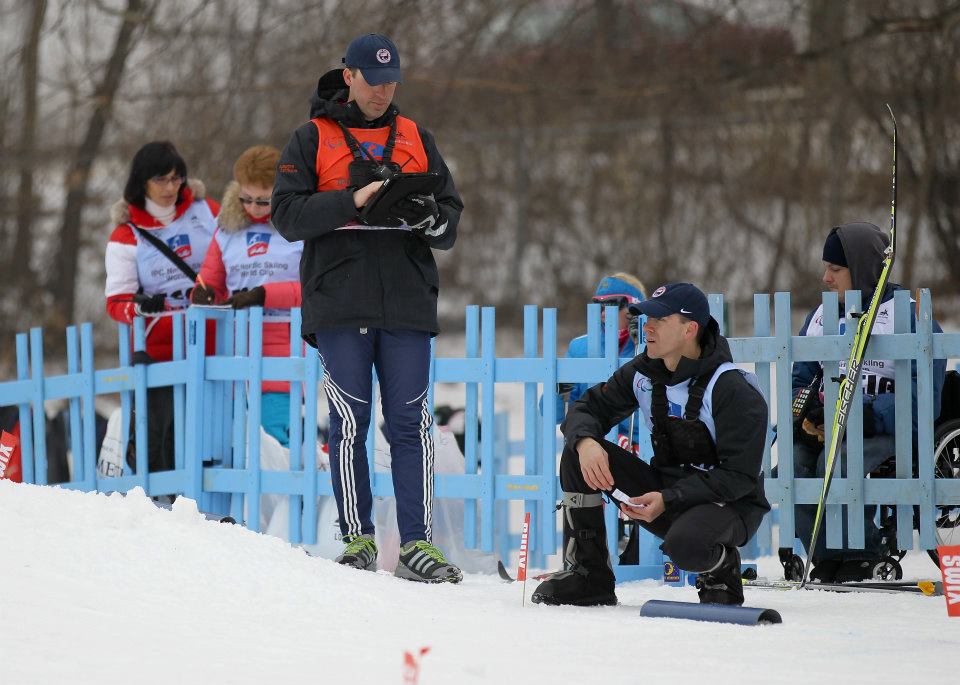
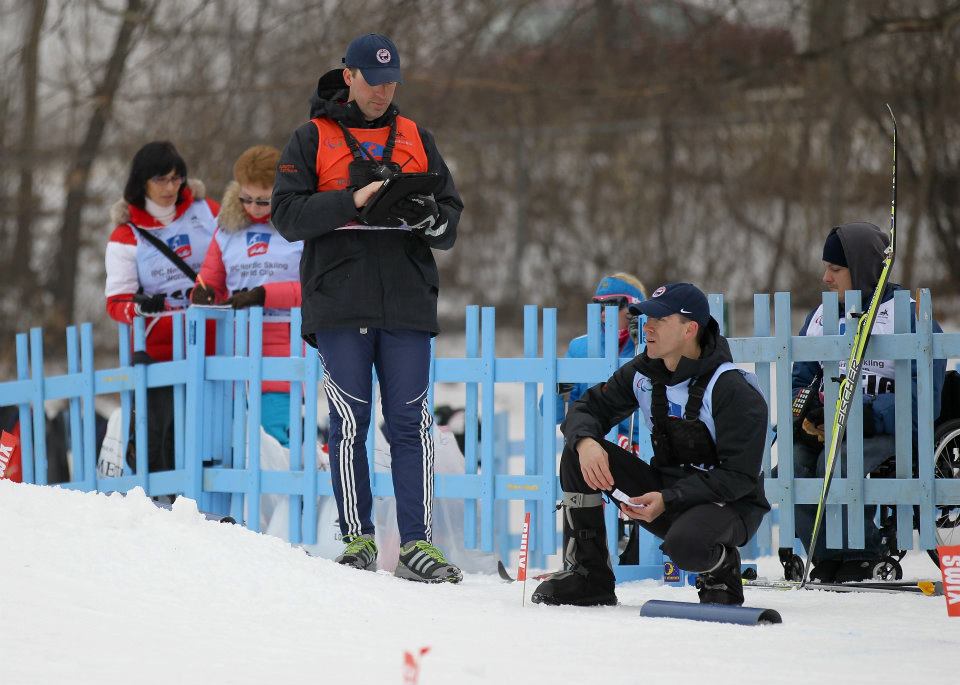
Former U.S. Para-nordic head coach James Upham (l) and High Performance Director John Farra at the IPC World Cup in Canmore in December.
For James Upham, becoming an assistant coach at Bates College this fall will be a big change.
“I have only recently realized this, but I have always run my own show,” the until-recently Head Coach for U.S. Para-Nordic told FasterSkier. “Either as a head coach or a lone wolf running a lean, emerging program with minimal assistance. It will be an adjustment for me.”
But on the other hand, it’s also coming home. Upham grew up in Wilton, Maine, and attended Mount Blue High School. En route to becoming a junior national champion in biathlon, his own training was firmly grounded in The Pine Tree State.
“I’m really happy to be living in Maine!” he exclaimed.
And so, after restructuring and the post-Sochi financial dip hit the Paralympic team hard (the Head Coach position was eliminated: “It came as a complete surprise and I was left emotionally devastated”) Upham found himself looking for a job and was thrilled to find one at Bates.
“I have always wanted to experience the Eastern Carnival scene and this was a great opportunity that came up,” he wrote in an e-mail. “Becky Woods, the head coach, has been a friend since Bill Koch League racing days and I have some family connections to the College that make it feel comforting and supportive right away. The immediate challenge for me is that we can’t start working with the athletes until October, which is driving me nuts! I want to get going!”
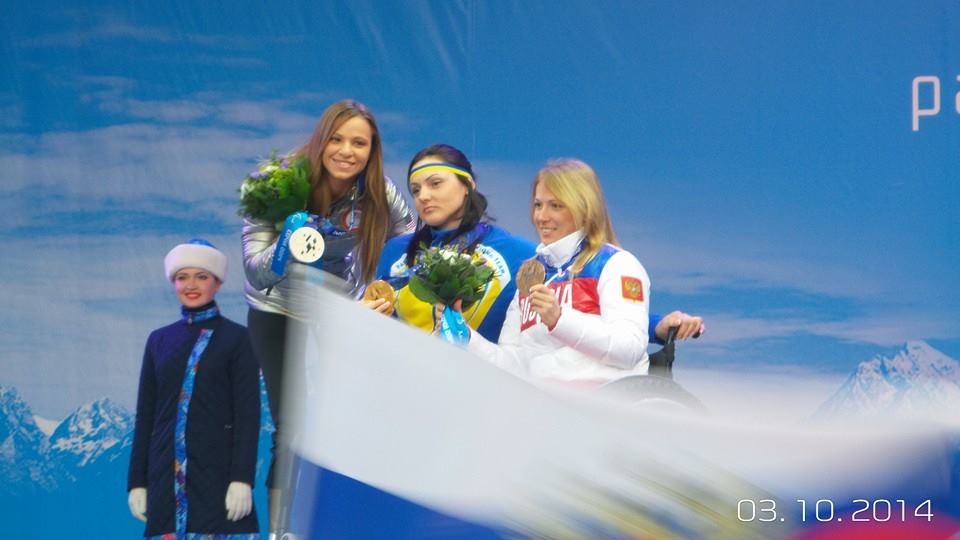
Upham coached Oksana Masters (second from l) two two Olympic medals this February. She became the most successful female nordic skier in U.S. Paralympic history. Photo U.S. Paralympics Nordic.
Bates is a Division III school, but sent one woman (Hallie Grossman, now a senior) and one man (Jordan Buetow, now graduated) to NCAA Championships last season. Their skiers have also often found success and junior and senior national championships, and the storied program also produced Olympians in Nancy Ingersoll Fiddler, Justin Freeman, and Haley Johnson.
Upham said that he has already talked with Woods enough to tell that they agree on training philosophy, which will make the pair a strong team.
“She has handed off some duties for me to manage, but for the most part, I think we will coach as a team and help support each other,” he wrote. “40 years of combined coaching experience should produce some success if harnessed properly. I am also a student of the game, so I am going to pick her brain every chance I get just like I do with all my other coaching friends.”
Upham has a rich history of Nordic experience to draw on as he heads back into the college scene. He attended Northern Michigan University in the early 1990’s, then went on to coach the development program for the U.S. Biathlon Association in the 2000’s.
Upham has always felt that college skiing sets athletes up for potential international success, and that’s an attitude that he will definitely be bringing to Bates.
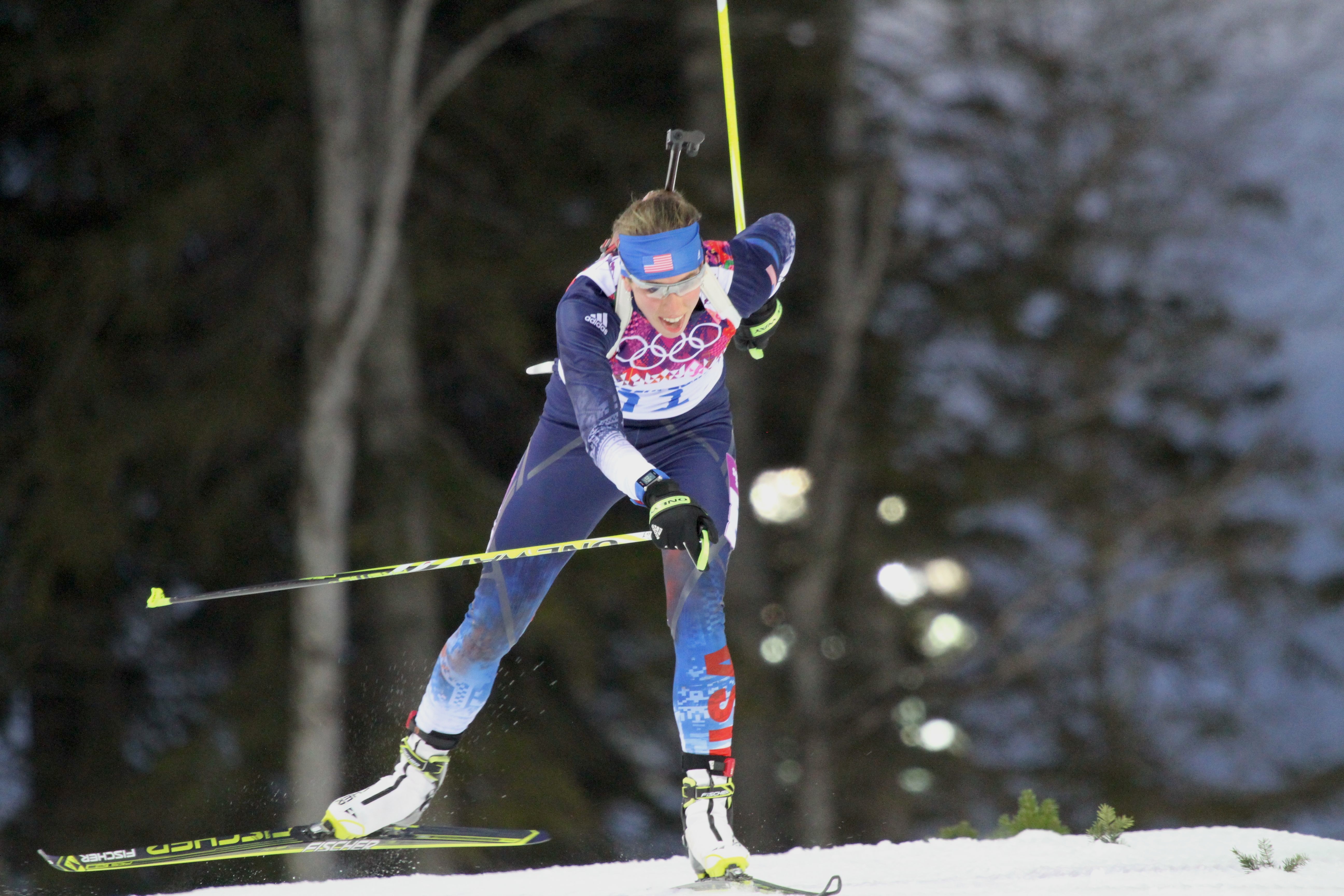
Susan Dunklee’s 12th-place finish in the mass start at the Sochi Olympics was the best ever by a U.S. biathlete. Dunklee graduated from Dartmouth College having never tried biathlon – but joined Upham’s program in Lake Placid, and the rest is history.
“I would like to help all the Eastern skiers get better,” he wrote. “Can some of them one day be internationally competitive? YES. That has been proven. I will do my best to help.”
Coaching the Paralympic team was a huge learning opportunity, Upham explained.
“What I learned from the Paralympic side is that racing on an Olympic level course with limited use of your legs or arms or torso or vision is REALLY hard!” he wrote. “Training works. Finding the right dosage is the key. I learned a lot about how much athletes can handle.”
The litany of challenges faced by his athletes was extensive – and in many cases goes well beyond what an able-bodied skier can imagine.
“Imagine getting 40 medical bills- In one day,” he listed, as an example. “Imagine racing a World Cup a week after finishing radiation treatments… Imagine after multiple surgeries your bladder is now the size of a teacup… Imagine nearly every piece of your essential equipment needing to be customized and tinkered with constantly… Imagine being 20k out on a sitski training day and your pole breaks. How do you get back?”
College skiers certainly have an easier road, but Upham believes that a lot of what he learned from his last group of athletes is extremely applicable.
“Every day with the Paralympic team was a lesson in overcoming obstacles,” he wrote. “[It’s] all the same obstacles nordic athletes face everywhere: motivation, fatigue, finances, snow conditions, equipment, team dynamics, travel, time management, jetlag, etc., just exaggerated.”
As he settles down in Maine – Upham just got engaged to his fiancée, Jill, and the two spent the summer painting a new house – the new college assistant is looking forward to bringing that same problem-solving attitude to a new role.
“I have learned that life is going to throw you some obstacles,” he said. “Get busy. You can get through them.”
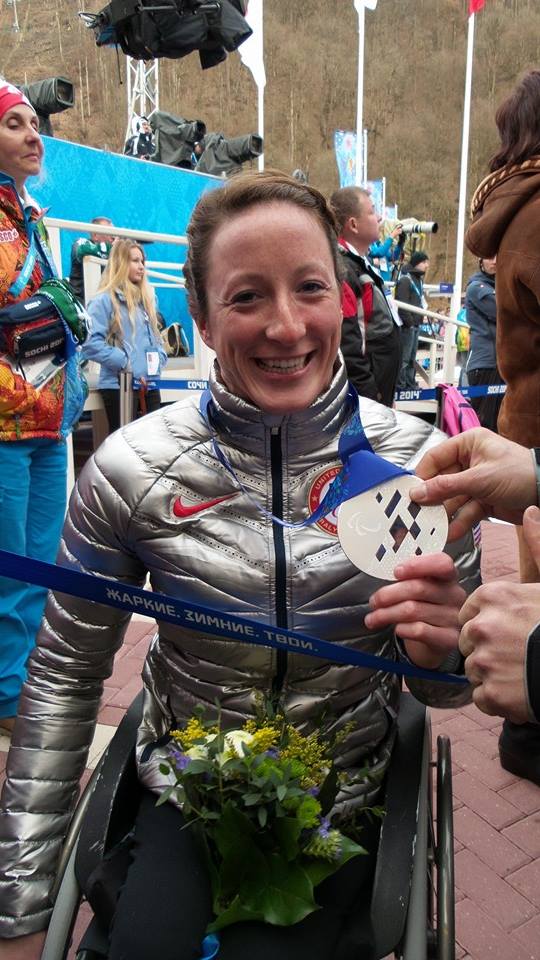
Tatyana McFadden with her sprint silver medal in Sochi. Photo BethAnn Chamberlain/U.S. Paralympics Nordic.
Our recent series on biathletes facing the question of when and whether to go to college (parts one, two, and three) produced more interview material than we could fit into the three-part sequence, but we wanted to share a few more of the ideas with you anyway. What do biathletes do if they miss a target in a relay? They use a spare round. This week, we’re presenting you with short briefs on a few lingering topics.
U.S. Head Coach Per Nilsson in action on the World Cup circuit. Nordicfocus/USBA.
Earlier this spring Jonne Kahkonen, the women’s coach for biathlon’s U.S. national team, expressed frustration that star athlete Laura Spector was returning to school for the summer after a disappointing season and did not seem to plan on joining the national team program in Lake Placid.
It was not an unreasonable sentiment: without actually seeing an athlete, a coach’s job is certainly much harder. And as a European (Kahkonen is originally from Finland), the concept of athletes going to college or getting a postgraduate degree while still focusing on their sport at a high level is likely somewhat unfamiliar.
But at the end of his interview with FasterSkier, Kahkonen said something else. He said that he understood.
“What I always say is that if you want the top result, then you need to do biathlon 100%, but at the same time biathlon is only a part of life and you have to be happy doing biathlon,” Kahkonen explained. “It’s sometimes a tricky combination, but that’s why I want to give all the information and all the support that I can give, and then the final decision is up to the athlete.”
His words echoed what other U.S. Biathlon Association (USBA) staff had told FasterSkier over the course of several months: going to college isn’t ideal from their point of view, but if it’s what will make their athletes happy, then so be it.
For example: here’s USBA President and CEO Max Cobb.
“Obviously, if the coaches could design the perfect progression for an athlete, irrespective of all other factors, having them spend 50 hours per week on their studies probably wouldn’t be part of the perfect progression,” he told FasterSkier last fall.
The staff and coaches are also limited by the reality of biathlon in the U.S. Cobb pointed out that with so few serious biathletes, that the team is obligated to work with the top athletes regardless of whether it agrees fully with their choices or not.
“If they make the decision to try to go to a university, then I think we’re obligated to try to make a solution so that they can still do that and still be a biathlete,” Cobb said. “We have to partner with them in a way that works for them and keeps a balance of their Olympic aspirations and their whole life aspirations together, and we’ve seen great dedication in the athletes who try to balance school and training.”
And as former development coach James Upham explains, the junior level is actually where the U.S. field is the least strong, meaning that college-educated athletes are actually an important group for the program to court.
“We’re really only getting one elite-level junior every couple of years,” Upham said in an interview. “You need to have a couple of them in the program all the time.”
As a result, national team coaches can end up working with athletes who come into the program in their mid-20’s, after college, even though they’d rather work with those athletes continuously all the way from the junior national team.
“The Europeans that are coming in at the national team level say, ‘well, yeah, I can take a nice engine at 22, but if I can take it at 16 I want it at 16,’” Upham said. “But we’re just not designed that way as a nation right now. We all recognize that and understand that … I think in general in nordic sports, you have to assume that Americans are going to develop later because there aren’t that many programs pushing you all the way through from being a teenager all the way up through the Olympics.
Head coach Per Nilsson, for instance, is from Sweden, where top biathletes do not generally make time for school, and said that it would be extremely difficult for U.S. racers who took a break for college to compete with those fully-dedicated Europeans.
“If we are looking at the top international biathletes, the level is so high that you cannot give a way three or four years with less training if you want to compete against these guys,” Nilsson told FasterSkier. “Then it would take you some time to close that gap back up again.”
The ultimate solution to the problem? Nilsson had a novel idea: embrace college and bring it into the biathlon fold.
“What would be optimal would be to have college on the college circuit, but that probably won’t happen,” he laughed. “But for the development of North American biathletes that would have been just great. I would love to see that in the future.”
Note: This is the second piece in a three-part series following several groups of biathletes as they negotiate the college question. Part one, which featured five top juniors who took a detour through college before returning to the international stage, ran last Monday. Stay tuned for part three next week.
Susan Dunklee celebrating her fifth-place finish at 2012 World Championships, which came in her fourth season as a biathlete. NordicFocus/USBA.
As I was standing near the finish waiting for U.S. biathlete Susan Dunklee to come through the mixed zone after the IBU World Championships women’s 15 k individual in Ruhpolding, Germany, I was approached by a gray-haired French journalist who usually sat at the table directly behind me in the media center. We had also shared a shuttle back into town one night, so he knew I was American.
“Who is this Susan Dunklee?” he asked me.
Dunklee was bib one that day, so it wasn’t surprising that she crossed the line first. Ultimately, she finished fifth in the race. It was one of the best results ever by a U.S. woman, tying Kari Swenson’s result at 1984 World Championships, and certainly a surprise to the sport’s European fanbase. I explained that it was her first season on the World Cup, and she had previously had just one top-20.
“She has only been doing biathlon for four years,” I said.
The French journalist’s eyebrows raised as if to say, go on.
“She was a skier in college, and then she learned how to shoot,” I continued. “Her father was in the Olympics in cross country skiing.”
He scribbled in his notebook, and then asked me Dunklee’s father’s name and which years he was an Olympian.
“I write for a newspaper,” he said. “I don’t have a lot of room. Usually, fifth place, maybe we mention it, maybe not. But this? This is interesting enough to put in. Thanks.”
* * *
During the 2011-2012 competition season, the U.S. Ski and Snowboard Association had 1,139 members with “cross country competitor” licenses. The U.S. Biathlon Association’s (USBA) year-end points list, by contrast, featured fewer than 200 athletes.
USBA’s numbers are even more grim in terms of development. While the masters biathlon scene has been growing in the U.S., that points list included just 37 junior men and 23 junior women. At World Junior Trials or U.S. Nationals, a field of 15 or so youth men (ages 18 and under) whittles down to just a handful of juniors (ages 19-20). Five or six women compete in each division. After the robust development teams of the 1990’s and early 2000’s were lost in a budget crunch, the junior national team is now largely symbolic.
That leaves the biathlon community with big questions: how do you develop a World Champion with such low numbers? What if top juniors leave the sport for college or other pursuits? (This happens.) By 2007, there was an undeniable talent gap in U.S. biathlon.
“Cory Salmela had developed a bunch of people on the junior team in the 1990’s, and I was taking over those juniors,” said James Upham, who was the USBA’s Development Coach at the time and is now the Nordic Head Coach for U.S. Paralympics. “We had pretty much pushed those guys onto the [senior] national team. So we said, well, we’ve got to have some more people because there aren’t enough clubs in America producing the high end biathletes that we’re looking for.”
Along with USBA CEO Max Cobb, Upham came up with a new idea: instead of looking at college as a sink that they lost athletes to, they would look at it as a source.
“We needed to find some talent, some fairly young talent, and maybe a little raw, someone that could be molded,” Upham told FasterSkier. “We felt like even in their early 20’s we could manage that– that it was good resources to put away if you had the engines and the attitudes, and that within four or five years [you could have] a World Champion.”
Sarah Konrad, an early indicator that skiers could learn to shoot. Photo: TeamToday.
He was also perhaps emboldened by the success of Sarah Konrad, who at age 37 and after just two years in biathlon finished 50th in the individual race at 2005 World Championships. She went on to the 2006 Torino Olympics, where she became the first U.S. woman to compete in two winter sports: skiing and biathlon.
With “engines and attitudes” as his manta, Upham began scouting the college field. He offered college juniors the chance to try biathlon at a training camp over the summer. If they showed some aptitude for shooting, Upham would offer them a spot on his re-tooled Development Team when they graduated. USBA provided a free place to live at the Olympic Training Center (OTC) in Lake Placid, a crash course on shooting, and the country’s best biathletes as training partners.
Could you really create a world-class biathlete starting at age 22? It was an unusual strategy, but Upham was confident that he could pull it off. He signed Caitlin Compton, who was coming off a season in which she took five SuperTour wins and represented the U.S. at FIS World Championships in Sapporo, Japan. She was joined by recent All-American Sara Studebaker, who had just helped captain Dartmouth to an NCAA title, and her boyfriend Zach Hall, another mainstay on the EISA circuit.
“It sounded like a really legitimate way to pursue a nordic sport at a high level,” said Hall, who had been contemplating how to swing a ski career financially. “You were able to go there and focus on it 100%.”
And in that very first year, Compton (now Gregg after her marriage to CXC teammate Brian Gregg) showed that the development program could work. It’s a forgotten fact that Gregg, who was a 2010 Olympian in skiing, had her first World Cup starts in biathlon and made the 2008 World Championship team. By her own admission she “didn’t know what [she] was doing” and told the online news site MinnPost that she estimated there were ten high-level female biathletes in the entire country.
But even if she benefitted from a small field in terms of selection, Gregg turned in strong performances. She finished 37th in the individual at World Championships in Ostersund, Sweden, hitting 16 of 20 targets and skiing the 29th-fastest time. She was the top American in the race.
Gregg left the team to return to skiing after just one season, but her success surely reinforced USBA’s confidence in its plan. Hall and Studebaker joined more experienced athletes on the “B” squad, and the Development Team started fresh with Dartmouth’s several-time All American Susan Dunklee, former junior national sprint champions Bill Bowler and Casey Simons from Northern Michigan University (NMU) and the University of Utah, and Jen Wygant, another NMU grad.
In 2009, Dunklee moved up to the “B” team and was replaced by Katrina Howe, a two-time NCAA competitor for the University of Vermont. The next year, the Development Team was cut – but Studebaker also became an Olympian. Even after it ended, the program was delivering what USBA had hoped for.
Engines and Attitudes, Exhaustion and Frustration
While Gregg had succeeded right away, the transition may have been more natural for her. She was 26 years old when she joined the team, and had already trained at a high level for several years. Before the younger recruits could match her results they needed to transform into senior athletes, which was challenging. There was no time to ease into the transition because Upham was trying to accomplish in a few years what usually took ten.
“It was a big increase in terms of training volume and overall intensity, and it was a little bit overwhelming to be training with the national team and surrounded by all of that,” Hall told FasterSkier in an interview. “That whole first year was crazy…. I was straight up exhausted all the time.”
He wasn’t quite sure of the numbers, but estimated that his training volume had jumped about 20% that first year. Upham has other stories, too. After the very first week in Lake Placid, Studebaker told him that she had never trained so many hours in a week before, ever. The next year, he encountered the same thing with his new crop of athletes.
“Going into the winter I remember Susan saying, ‘This is more classic skiing than I’ve ever done,’ and you’re a biathlete now– you don’t even race it!” Upham laughed. “It’s fun taking a college-level athlete who’s really gifted and smart, and putting them into a full-time training program. That transition is pretty tough and you don’t necessarily get better right away, but you put a huge amount of work in and it pays off… you see them doing really well later.”
Bowler, who had trained about 600 hours a year at NMU – “definitely on the upper end of the spectrum for a college skier” – was better prepared for the hours, but not necessarily for the intensity of national team training.
Bill Bowler and Zach Hall competing in Altenberg, Germany in 2011. Photo: Viktoria Franke.
“There’s a big difference between doing a 20-hour week with one or two intensity days, and one of those being classic, versus a 20-hour week with three skating intensities,” he told FasterSkier in an interview in Bend, Oregon, last week.
Then there was shooting, which added another roughly 200 or 300 hours to the training load without any immediate payoff; several of the athletes said that it takes a minimum of three years before shooting comes together. Until then it’s a lot of work, and at no point is hitting targets a guarantee.
“I’d like to say that biathlon gets easier, and it definitely does, but inherently biathlon is more tumultuous than nordic skiing,” Hall said. “No matter how good you get, there’s always that question… there’s so much that’s thrown into the mix with the shooting. You have a really good race and you have euphoria, and then the next race you can be behind from the first stage and then you’re out of it.”
While the endurance training was tough on athletes’ bodies, shooting tired their minds and tested their patience. They were immediately thrown into workouts with experienced senior national team athletes, which created a good learning environment. But it could be demoralizing to be the worst shooters day after day after day.
“I went into it being super focused,” Hall explained. “By nature I’m fairly detail-oriented when I approach training, and shooting ends up being all about the details. So every day is focusing on a million different details and trying to figure it out… For me it was challenging sometimes, because you know you’re not nearly as good [as the other athletes].”
The final piece of the transition was living at the OTC, which was ideal in many ways: no rent to pay, no meals to cook, a gym and coaches and training all in one place. But the austere building was the antithesis of the vibrant college campuses most athletes had recently called home.
“You live in a bubble,” Bowler said of the experience. “It’s a very focused environment all the time. It was good for me for certain chunks of time, but sometimes you need to get out to the real world a little bit, because biathlon is very far from the real world.”
Dunklee, too, needed a release. For the 2011 season, to the initial chagrin of her coaches, she joined the Craftsbury Green Racing Project so that she could get back to Vermont (she is still in Lake Placid more than half the time). She said it was a lifesaver for her mental health.
“I need balance and I need to use my mind,” she told FasterSkier last fall. “When training or racing isn’t going well, I need a means of distancing myself from biathlon.”
All of the changes were a lot to take in, and Upham knew it. To try to keep his team motivated, he read everything that he could about sports psychology. In his previous work with junior and senior biathletes he had seen racers hit a plateau even though they were physically capable of continued improvement. With his new team, Upham wanted to make sure athletes’ heads didn’t get in the way of their performance.
“The lifestyle change [is a big thing],” he said. “We worked on sports psychology every day. It’s not something that you read the book and suddenly you have it, it’s just practice, practice, practice, and forming habits. Most of our psychological aspect was, how do you deal with going from winning college races or being top ten, to internationally pretty much getting your butt kicked for a year or two?”
Mixing It Up in Europe
One measure of the Development Team’s success was that like Gregg, Dunklee and Studebaker made it to Europe in their first year as biathletes. It took the others a bit longer, but of the eight, all but Wygant have competed at the IBU Cup or European Championship level, if not higher.
Initially, a European tour added to the stress of the athletes’ transition.
“My first race I was in the 90’s in an IBU Cup, which is really a tough pill to swallow when you go over there and you have a race that you might be happy with in the United States,” Bowler said.
In her first season as a biathlete, Dunklee won a national title in the sprint. But on the IBU Cup, biathlon’s second tier of racing, her top finish was 35th. A year later, Simons also won a national championship, but when he competed at Open European Championships his best race left him 40th. Despite multiple international tours, Bowler hasn’t excelled; he didn’t crack the top 40 in an IBU Cup until 2012, when the circuit traveled to Canmore and field size shrunk by half.
But the athletes had plenty to fall back on, and they started improving.
“The first race Sara was ever in as a full-time biathlete, she cleaned [a four-stage race],” Upham explained. “She hit all 20 targets. I think there are a lot of biathletes out there who have still never done that! Zach, his second year he was our number one shooter in the country in terms of percentage. That just shows the amount of work they put in.”
After Gregg, Studebaker was the first one to make it onto the big stage (she had an advantage: dabbling in biathlon in high school had left her with some shooting background). In 2009, she earned her first World Cup start. She had dreamed big and hoped to make the World Championship team that year, but missed, in what she described as one of the biggest setbacks in her biathlon career.
Studebaker leading Andrea Henkel (GER) in the mixed relay at 2012 World Championships.
“I was pretty devastated after that,” she told FasterSkier. “I had been told that they may have a spot for me at the Vancouver World Cup [at the end of the season], but it took a while for it to be official. When I finally found out I would get to race, I was really excited and determined to make the most of it. In the sprint, I cleaned and scored a couple World Cup points.”
After a single weekend of racing, the 38th-place finish made Studebaker one of only three U.S. women to score World Cup points all year, which lifted her spirits and set her up to compete in the first period of World Cups the next season. She has been one of the team’s top performers ever since, and raced at the Vancouver Olympics.
In 2011, her fourth season as a biathlete, Studebaker collected four top-20 results. That put her 34th on the World Cup points list, the highest-ranking U.S. woman. Although the development team was no longer in existence, it was delivering the results USBA had expected in year four.
“We were really happy to see Sara have a top-15 result,” Cobb said. “It was right where she needed to be.”
Hall, too, faced disappointment before his World Cup debut. After competing in Altenberg, Germany, for the final round of trials for the 2010 Olympics, he wasn’t named to the team. Based on his performances there and the next weekend in Nove Mesto, Czech Republic, however, Hall received World Cup starts in Antholz, Italy. He finished 85th and 96th, but the experience showed him what biathlon really was, and what he was striving for.
“Over 15,000 spectators came out for each of the races so the atmosphere was electric,” Hall wrote on his blog at the time. “It’s really cool going from the U.S., where only a handful of people show up, to an area of the world where biathlon is the most widely televised sport and spectators come out in droves for an all-day party.”
While Studebaker excelled and Hall got sporadic tastes of World Cup action, Dunklee has ultimately become the poster child for the Development Team. Even in the beginning, she stood out as an obvious choice to bring to Lake Placid.
“Everyone can see world class aerobic potential if you ever see her do anything,” Upham marveled. “So how do we teach her how to shoot things, how do we refine her technique? We felt like we were pretty good at that. It wasn’t daunting to us, [we didn’t see it] as a great risk. And she had a great attitude as well, there was no denying that.”
But unlike Hall, it took her four whole years to make the World Cup despite having top-20’s and even a top-ten on the IBU Cup. She was crushed when she missed the Vancouver Olympics by a few spots, and she didn’t receive the consolation prize of World Cup rights, either.
At the beginning of the 2012 season, Dunklee capitalized on her first World Cup starts, placing 45th, 28th, and 32nd in the individual, sprint, and pursuit competitions in Ostersund, Sweden. Like Studebaker, she had scored World Cup points on her first try; the former Dartmouth teammates were the top Americans in all three races. Dunklee wasn’t going to get left at home again. She had her first top-20 in Antholz, then missed a single shot to finish fifth in the World Championships individual race, just seven seconds from a medal. In the final weekend of racing, she picked up top top-tens in Khanty-Mansiysk, Russia. Dunklee is currently ranked 34th on the World Cup – exactly the same position that Studebaker had one year ago.
“We had the feeling that it was probably going to be four years before they were ready to do something internationally,” Cobb said of the Development Team athletes. “When we were initially talking with the athletes, we said they had to be willing to give this a try for two seasons. We were thinking in the fourth season they could have top 20 results [on the World Cup].
“That’s what we saw with Susan,” he continued. “Yay!”
So You Want To Race?
USBA Women’s Coach Jonne Kahkonen told FasterSkier in the fall that the team was deliberately holding Dunklee in reserve until she was ready to excel at the World Cup level, but the athlete herself was chafing at the bit.
“I had become fixated on earning a World Cup spot,” she wrote in an e-mail this spring.
And if Dunklee was frustrated being stuck on the IBU Cup, her teammates were even more desperate to get in top-level races; between IBU Cup and Under-26 Open European Championship racing, Dunklee’s two tours represented as many or more European starts every year as any mid-level American biathlete.
Casey Simons at 2010 U.S. Nationals in Fort Kent, Maine.
The lack of high level racing and its benefits for development and motivation, said Hall, was one reason said that the program’s success and retention rate could have been better. After all, Simons left the sport in 2010 after a national title was not rewarded when team nominations came due; he declined to comment for this article. Hall himself retired in 2011. (Bowler and Howe are currently pursuing biathlon at the Biathlon Alberta Training Center and the Maine Winter Sports Center, respectively.)
Without going to Europe, the athletes were left to race against a NorAm field that is undeniably weak, especially compared to skiing’s SuperTour circuit. With the top five men and three or four women on the World Cup at all times in addition to the periodic IBU Cup tour, biathletes are competing against the same handful of people every weekend. They now more or less how things are going to shake out.
And that’s where the men were stuck. In 2007 when the Development Team started, Jay Hakkinen, Jeremy Teela, and Tim Burke had already scored multiple World Cup top-tens. Lowell Bailey had been in the top 20. By contrast, of the women only Lanny Barnes had a single top-20. Studebaker, Dunklee, and Gregg were certainly talented, but they were helped by the relative strength of the men’s and women’s national teams.
Hall didn’t want to offend his former teammates by implying that the women on the Development Team had it easier, but Studebaker confirmed as much. There was more of a gap on the women’s team, and she was there to fill it.
“Things may have been easy on the women’s side when I was starting out biathlon,” she wrote in an e-mail last week. “There were always more men competing, and that meant fewer of them had a chance to get international competition. It was definitely a little easier to get over to Europe and get on the IBU Cup at least, but it did take me a while to get to the World Cup level.”
Unfortunately for the men, the IBU Cup experience played a huge role in determining how quickly the athletes improved.
“As a developing biathlete, the most important thing is being in competition situations where you are forced to ski as fast as you can and shoot as fast as you can, and do that over and over again,” Hall said. “Everybody at USBA understands that there’s not a lot of opportunity for racing unless you make it to Europe. It’s a bit of a catch-22 right now.”
Studebaker believed that she and Dunklee had the ability to score World Cup points in their first outings thanks in large part to their many lower-level European race starts before they hit the big stage. And, both said, the racing and travel opportunities were carrots drawing them along when their new sport could begin to feel like a slog.
“I thought I’d try the sport for a year or two and then move on with my life,” Dunklee said. “Qualifying for a Europe trip was a huge factor in hooking me. I realized that if I gave my shooting time to develop, I could become a very good biathlete… I could not have justified [my dedication] if I only ever raced three or four other women at a handful of NorAms. I would have switched back to cross country where we do have a strong domestic circuit that can develop athletes.”
If she’d had to do the work that Hall did, she might not have stuck around.
“U.S. athletes do have to take initiative to keep the sport engaging and worthwhile,” Dunklee said. “In 2011 there were no NorAms in the peak of winter because all our biathlon officials were needed in Maine for the World Cups. I suspect the lack of race opportunities contributed to Zach’s decision to leave the sport when he did.”
In the Red
It did, said Hall. By the time he left the sport, the men’s team had only improved at the top: Tim Burke had worn the overall leader’s yellow bib, Bailey had begun racing better, and at 2011 World Championships youngster Leif Nordgren had made a splash with his first top-20 finish. Hall felt that he might be stuck racing NorAms for a long time.
“For me, I knew from the get-go that it was really slim odds that I could make [the Olympic] team,” Hall said. “I like slim odds, but I knew – and I like to think I’m pretty perceptive – it seemed as though the [men’s] relay team for the Games was already pretty much chosen.”
The other side of his decision was financial. As Bowler said: “It is a little bit alarming not to have any income.”
Studebaker had quickly progressed onto the “A” team, which provides stipends to athletes, so she had less to worry about. Dunklee eventually made that transition too, with a longer stop on the “B” team. And Bowler, while worried, seemed philosophical about the lack of funding.
Caitlin Gregg has returned to skiing; on the SuperTour, she can pick up prize money. Photo: Toko.
“I mean, there are plenty of people my age who are in grad school or medical school and they’re going backwards into debt, more so than I am,” he said. “The job market is tough right now, so in some ways it’s nice to be in biathlon. At least you’re doing something and you’re not unemployed. “
Hall, however, left Dartmouth with loans to pay, and it was impossible to have a job that earned him cash. Even when he made the “B” team and began receiving a small stipend, that money mostly went to getting out of debt from the first season. If there was one thing he thought that the Development Team could have done better, it would be to teach athletes how to sell themselves to sponsors. With USBA’s budget, he knew that receiving a stipend was too much to ask. But perhaps the federation could have helped athletes find funding from other sources.
“I pretty much went from Dartmouth right into a crash course on marketing, which I failed the first couple of years,” he said.
Imagine, suggested Bowler, that you are a cross-country skier struggling to find sponsorship dollars. Now imagine that your sport is even more obscure and less familiar to the general public.
“People are like, ‘what’s biathlon?’” he said. “I’ve been lucky that a lot of people have helped me out along the way.”
Upham knew that money was a problem– it’s not often, he pointed out, that Ivy League graduates make a several-year commitment to a job that leaves them with a bank account saying “zero.” It was one more pull on his athletes’ mental ability to focus on biathlon, and he tried to build it into his sports psychology sessions.
Another issue was the dearth of prize money on the NorAm circuit. In skiing, athletes can sometimes use prize money won in the U.S. to fund trips to Europe. But meaningful cash isn’t up for grabs for biathletes. If you win, you might be rewarded with $75.
In the end, it all added up to too much for Hall.
“There was just very little money, so being able to do anything outside of biathlon was really difficult, especially being able to travel home to Alaska,” he said. “I’m close to my family, so for me that was really difficult. It’s a lot of stress, and if there’s any way you can come up with to alleviate some of that financial stress you’ll probably end up with athletes who can perform better more consistently.”
Unfilled Gaps
While Dunklee and Studebaker are shoo-ins for Sochi and show that the Development Team was the perfect band-aid for the women’s team, Hall’s career can almost make it seem like the U.S. didn’t need the program to supplement it’s men’s squad. Unfortunately, that couldn’t be farther from the truth.
“I think anyone you talk to in biathlon recognizes that there’s a hole in our development program,” Upham said. “We’re really only getting one elite-level junior every couple of years. You need to have a couple of them in the program all the time, and you need to sink a ton of resources into getting those juniors to the next step.”
The U.S. men’s team may be as strong as it has ever been, but it’s also not a young team. Teela is 35, and on Hakkinen’s birthday in July he’ll catch up; Bailey is about to turn 31, and Burke is 30. At least two, if not more, of those athletes will likely retire after Sochi, and there aren’t many men waiting in the wings. Nordgren and Russell Currier are ready to take over, but there are only three or four other seniors who race at the IBU Cup level, and a small group of juniors.
“It’s really scary to think about the gap that’s there in development right now,” Studebaker said.
To all of the former Development Team athletes contacted for this story, refunding the program seemed like an obvious solution.
Dunklee in Ruhpolding. NordicFocus/USBA.
“There’s so much talent in the United States,” Bowler said. “Athletes could go over to Europe and have very good ski times on the biathlon circuit, and if you give them three years you could really see some results. There’s such a strong core group of men right now, at least through 2014, but beyond that it is going to be a problem because you need to get more athletes into it, and there’s just not a big pool of athletes in their early 20s that are really committed.”
And Cobb agreed. For years, USBA has known that it can’t have a strong senior national team made solely of career biathletes.
“It was always imagined that there would be two different tracks,” he said. “One for junior biathletes who want to continue training right on through, and then the other track let athletes come into the sport after college… the strongest skiers want to go and compete in college, and [a degree] is something most athletes want to get at some point. So we’re facing that reality pretty clearly and just saying, okay, well, given that that’s how it is, how do we create a program that accepts that?”
Right now, Cobb said, the organization cannot come up with the roughly $100,000 a year that he estimated it took to fund the Development Team; to pay for a full-fledged development system, including juniors, Upham thought USBA’s budget would have to double.
There will be a camp in Lake Placid this summer to introduce a few college skiers to the sport, but there’s no offer of a residency program at the end. USBA has all of its eggs in the high-performance basket – with great success at the sport’s highest level. But unlike skiing, biathlon does not have a strong club system which is capable of picking up the slack on the development front. In recent years only two clubs, the Maine Winter Sports Center and Craftsbury, have put athletes on the national team.
Meanwhile, the next Susan Dunklee or Sara Studebaker is probably in college right now, starting another summer of training for skiing. If the biathlon team could snag her – or him – they’d have a shot at developing a World Champion.
“For biathlon, you need to train really seriously for ten years,” Upham said. “Ten years, 10,000 hours. For most skilled or endurance type of sports, that’s what it takes to develop and be world class. If you start at 15, then at 25, bingo. World Champion. Fantastic. But if you start when you’re 22 out of college, you can still do it, maybe by the time you’re 31, 32. Maybe it’s accelerated, maybe you can do it even faster than that.”
Studebaker encountered setbacks in her fifth season, when she had just one top-20 and ended ranked 55th in the world. Dunklee might follow a straighter path to the top, or she might not. Regardless, Upham’s two disciples have made it clear: USBA might not need ten years.
Lowell Bailey competing in 2012 IBU World Championsips, his seventh. Bailey left biathlon completely for two years during his time as a ski racer at the University of Vermont.
Note: this is the beginning of a three-part series following several groups of biathletes as they negotiate the college question. .
In the summer of 2002, Lowell Bailey was a national “A” team biathlete living in a trailer at Camp Ethan Allen, a national guard training site in Jericho, Vermont.
Lowell Bailey Hometown: Lake Placid, NY Age: 30 Results Before College: Three top-20 World Junior Championships races, along with three top-10’s at European Championships; started a World Cup. Alma Mater: University of Vermont Notable Senior Results: Five World Cup top-10’s, numerous top-20’s, scramble leg for U.S. relay team. What’s Up Now: Bailey had his major breakthrough in the 2011-12 season, where he finished 14th in the Total Score, the top-ranked American. He’s planning to continue at least until the Sochi Olympics. Quote: “I really think that if I didn’t go to UVM, if I didn’t have college and the things that college has to offer, I don’t think I would have gone back to biathlon. I think I needed that mental break from the sport at that moment in my life.”
In some ways, his career as a biathlete was looking up: although he had missed the previous winter’s Olympics by two spots, a few veterans had retired, leaving Bailey near the top of the heap on the U.S. team. And after years on the junior national team and the previous season on the senior team, he was beginning to accumulate the kind of training that can make skiers fast.
There was just one problem, and the trailer and military base had something to do with it.
“I was at a point in my biathlon career where I was kind of burnt out, believe it or not, at age 21,” Bailey told FasterSkier in an interview last fall. “I was thinking, ‘man, what am I doing?’ The funding for biathlon was pretty much nothing. I had a lot of pressure from my family and my grandparents, and a lot of people that were wondering what I was doing with my life.”
Ten years later, Bailey is a two-time Olympian and has ascended to the top of the international field. He netted four individual top-ten World Cup results in 2012 and landed 14th in the Total Score. How he got there, however, was by taking the road less traveled – not only by U.S. nordic athletes, but by the other biathletes he is now battling in Europe.
Bailey spent three years at the University of Vermont, training with the college ski team and racing on the EISA circuit and at NCAA Championships. While he was quick to say that college isn’t for every athlete, Bailey was clear that in his case, it was a career-saver.
“I really think that if I didn’t go to UVM, if I didn’t have college and the things that college has to offer, I don’t think I would have gone back to biathlon,” he said. “I think I needed that mental break from the sport at that moment in my life.”
The Changing Face of USBA Development
Typically, national team coaches in the U.S. don’t support the college model; just this spring, both Matt Whitcomb and Chris Grover told FasterSkier that education was not compatible with athletic commitment to the U.S. Ski Team program. Biathlon coaches agree.
“It’s for sure nothing that we recommend, going to college, if we see potential for an athlete,” U.S. Biathlon Association (USBA) Head Coach Per Nilsson wrote in an e-mail to FasterSkier. “We prefer to keep them more under our guidance.”
That was even more true a decade ago, when USBA had a well-funded and successful junior national team program. In 2002, Lanny Barnes, Tracy Barnes, and Carolyn Treacy (now Bramante) teamed up for silver in the World Junior Championships relay, putting the U.S. on the podium for the first time since Jay Hakkinen’s 1997 sprint title, and other athletes were frequently finishing in the top 20.
At that point, Bramante seriously considered heading off to a university like other high school seniors, and applied to Dartmouth College. But after being accepted she decided to defer, taking summer classes at Colorado College instead.
Carolyn Bramante Hometown: Duluth, MN Age: 30 Results Before College: Silver medalist in World Junior Championships relay in 2002, and three other individual top-20’s. Alma Mater: Dartmouth College Notable Senior Results: Represented the U.S. at 2006 Olympics in Torino, as well as 2007 and 2009 World Championships. What’s Up Now: Just finished medical school at University of Minnesota, headed to Johns Hopkins University for residency in Internal Medicine and Pediatrics; also gave birth to a son, Leo, who has child-sized scrubs. Quote: “My choice to go to Dartmouth was definitely what I thought was best for my biathlon career. Skiing wasn’t always a huge strength of mine, so I [wanted] to work on skiing for a year or more, and I knew I would have great training and racing at Dartmouth.”
“On the ‘A’ junior team nobody was really going to school except for me, and not on the senior national team either,” Bramante told FasterSkier. “Biathlon has only been an Olympic sport for women since 1992, so when I was looking at the women who had gone to the Olympics, none… went to school while they were training. There were very few examples to look at of how to do school and training.”
The U.S. coaching staff couldn’t give her the answers she wanted, either.
“When I was a junior I really liked our coaches, but they were very discouraging of going to school,” she said.
And why wouldn’t they be? The team provided coaching, racing opportunities in Europe, and fast, hardworking teammates; it seemed like a no-brainer for dedicated athletes to stick with biathlon full-time to until finishing their junior careers at age 20. Tim Burke, Walt Shepard, and Anders Osthus were among those who trained with development coach James Upham out of Burlington, Vermont.
But after the 2002 Olympics, much of that funding disappeared, leaving both juniors and first- and second-year senior racers in the lurch. The development program was routed through the then-still-nascent Maine Winter Sports Center, and although that organization provided support, the timing was ripe for biathletes who wanted to go to college to assert themselves.
“There was pretty much zero support from U.S. Biathlon at that point, and that was a huge influence on my decision,” Bailey said.
The reasons to consider college were numerous and highly individual; Bailey and Bramante, who enrolled at Dartmouth a year later, were followed by Annelies Cook heading to the University of Utah, Shepard to Bowdoin College, and Laura Spector to Dartmouth. For Bramante, Spector, and Shepard, finances were less of the equation, since Ivy League and Division III schools cannot offer scholarships.
But Cook and Bramante, for example, considered themselves strong shooters who wanted to improve their ski speed, and chose college teams accordingly. Shepard wanted to move back to southern Maine, where he had grown up, and to work with former Canadian and U.S. national team coach Marty Hall, who headed the Bowdoin program at the time.
Bramante racing at the ’09 World Championships (Courtesy Photo)
And then there was the consideration of life after biathlon.
“The trend at that point, and to some degree today, is that you do your ski career and then you pick up on real life after that,” Bailey said. “The trouble with that is – I mean, right now I just turned 30, and I’m looking at Sochi very seriously, so at the end of that season I’ll be 32 or 33, and there’s still the possibility of continuing on. If I do choose to retire, I’m a 32-year-old and I have to start from where a 21-year-old college graduate is starting. To me, that’s a pretty scary prospect.”
Shepard, who retired after the 2010 season, echoed that sentiment in an interview, pointing out that he is now almost 30 and in his first full year in the work force. Cook hopes to go into nursing, which will require additional education, while Spector is planning on a graduate degree and Bramante recently earned her M.D. Not all athletes have such ambitious career goals, but for those who do, the thought of starting undergraduate classes at age 30 is understandably daunting.
“I didn’t want to push medical school off forever, because medical training is a really long road,” Bramante said. “I was really excited to start learning.”
The All-American Route: Bailey at UVM
While Bramante knew exactly what she wanted, Bailey was in more of a general funk – and didn’t have much of an inkling that he would blaze a new path and inspire other biathletes to broaden their horizons. A single interaction with assistant coach Al Serrano, however, changed the course of his athletic career.
“Al one day mentioned during training that he was the head coach at UVM,” Bailey told FasterSkier. “He mentioned for the first time the possibility of me skiing for UVM, and the fact that scholarship money was available.”
Bailey now wonders if the comment was made in jest, since he was on track to be a career biathlete. But the idea quickly grew in his mind, and it took only one night before he went back to Serrano and asked how they could make it work. At first, Serrano was careful not to steal Bailey away from the biathlon team, and Bailey wanted to keep racing for the national team that had given him so much support. In 2003, he attempted to compete as both a collegiate skier and an international biathlete.
“It was probably the busiest year of my life,” he said. “I went and raced the December and early January race circuit in Europe. Then I came back and raced the college circuit and I remember perfectly – we had NCAA’s at Dartmouth that year and I finished the final race, went back and packed my bags, and was on a plane to Russia the next morning. I competed at World Championships for biathlon and I think I was racing five or six days later.”
Annelies Cook Hometown: Saranac Lake, NY Age: 27 Results Before College: Four top-20’s at World Junior Championships, several more in European Cup races. Alma Mater: University of Utah Notable Senior Results: Competed at 2011 and 2012 World Championships; two World Cup top-40’s What’s Up Now: Recently promoted to national team “A” status after the best year of international racing of her career. Quote: “You know, I didn’t make the Olympic team [in 2010] and it was heartbreaking, but if you asked me whether I would trade my years at Utah for two weeks at the Olympics, I don’t know that I would do that.”
Bailey did fine that year – he finished 45th, 50th, and 59th at World Championships, placed second in the 10 k skate at NCAA Championships, and helped UVM to the runner-up trophy – but he realized that it wasn’t sustainable (four years later, Spector would make the same discovery). Believing that he had to pick a single focus, he chose Vermont and said goodbye to biathlon.
“At that point, as much as I was really grateful to U.S. Biathlon for the opportunities that I’d had racing and the lifestyle and all of that, I thought that I was transitioning into a different phase of my life,” Bailey explained. “I wanted to focus on nordic skiing and school, and enjoy my time at UVM. I really liked the team atmosphere.
“I mean, there’s nothing like a college ski team.”
Bailey excelled as a skier: he was an All-American every season at UVM, and in 2004 he replicated his second-place NCAA finish. In 2005, he finished fifth in the U.S. Nationals 10 k classic. Of the four men who beat him, three – Ivan Babikov, Justin Freeman, and James Southam – went on to compete in the Olympics in skiing, and two (Babikov and John Stene of Norway) were foreigners, so Bailey ended up with bronze.
As graduation drew near, Bailey began thinking about what to do with his degree. Once again, he was approached by a coach. This time it was Upham, the USBA development team coach who had moved to the Maine Winter Sports Center. Upham saw Bailey in Burlington – “I played guitar with him, actually” – and urged him to at least try out his program. After all, the upcoming Olympic trials would be in northern Maine.
Cook at 2012 World Championships.
“I even said he could stay at my house,” Upham told FasterSkier.
Bailey was undeniably in great shape, so despite uncertainty about how quickly his shooting would come back, he figured he might as well “give myself a year to see what I can do in biathlon.” Since then, he has not looked back, except to say thank you – both to USBA for its support early and late in his career, and to college, without which he doesn’t believe he would have made it to the 2006 Olympics.
“Competing at the college level relieves the pressure of the long term development goals, and we got to focus on the moment and let the rest fall where they may,” Serrano said of Bailey’s years at UVM. “I think this helped him reinvent himself for the next stage of his international career – which he has had do a few other times since. His ability to do this is extraordinary, and I am in awe of what he has accomplished.”
Bramante and Spector: Olympic-Bound Students
When Cook headed for Utah, she more or less copied Bailey’s plan, only competing as a biathlete at U.S. Nationals every spring. Shepard, too, mostly eschewed biathlon while he was at Bowdoin, and raced on the EISA circuit until 2010, when he took the year off to train for Vancouver. But athletes also have another option for their college years: remaining a full-time biathlete. Bramante blazed that path in the runup to the Torino Olympics, and since then Spector has done the same thing.
While coaches feared that athletes leaving biathlon for college skiing would train less, stop shooting, and never return to the sport at a high level, Bramante’s approach carried different worries. In the past several years, only one school – UVM – has had any sort of collegiate biathlon program, meaning that students who want to continue as biathletes have no training or race support and must spend a significant chunk of time and energy on logistics, travel, and planning.
At Dartmouth, Spector and Bramante had to tackle a lot on their own. Bramante started fixing up the old shooting range at Dartmouth and re-started the Biathlon Club, which had been a division of the school’s Outdoor Programs Office; Spector often traveled an hour and a half to Jericho, Vermont when she needed a better range.
Laura Spector Hometown: Lenox, MA Age: 24 Results Before College: Member of tenth- and seventh-place relay teams at World Junior Championships; placed 11th in a European Cup race. Alma Mater: Dartmouth College Notable Senior Results: The 2010 Olympian finished 19th in a World Cup in 2010-11, and also had four more top-30 results.
What’s Up Now: Member of the national team “B” squad, taking the summer off from full-time training to study organic chemistry at the University of Montana. Quote: “I plan to not ever in the future be just solely an athlete. Because that just doesn’t work for me. I want to be able to love the sport that I’m doing, and when I have nothing else to balance my time I stop loving it.”
Despite those challenges, Bramante made the senior national team in 2004-2005, then qualified for the Olympics the next season. In her eyes, she had proven herself. But she still felt pushback from USBA.
“I think the coaches were definitely impressed that I had been able to do it while being in school, but… they wouldn’t endorse [that approach],” Bramante said. “Bernd [Eisenbichler] was the new High Performance Director and coming from a German background it was understandable that he wouldn’t support me going to school. I don’t want to sound too negative against USBA, because I don’t blame them for not wanting us to go to school.”
By the time Spector arrived at Dartmouth the next fall, she didn’t get the same feeling. But she also hadn’t received as much support from USBA as a junior, which she said meant that the team was less invested in her sticking to its program.
She was immediately hit by the challenges of her situation.
“She was trying to go up to Jericho to train and do the shooting, and then she’s come down and try to train with us , and she’d try to go to the carnivals, and she’d try to go to World Juniors,” Dartmouth women’s coach Cami Thompson told FasterSkier. “It was way too much. She just wasn’t focused enough, and she got tired and run down and it impacted her results. She skied okay, but she could have skied better and she probably could have done biathlon better.”
The next year, Spector focused entirely on biathlon and qualified for her first senior World Championships. Then in 2010, she became an Olympian, finishing 65th in the sprint and 77th in the individual in Vancouver. Her best season came in 2011, when – still a student – she qualified for two 30-woman mass starts and had her first World Cup top-20.
Five years after Bailey’s first Olympic appearance changed the game, Spector’s results had a similar effect. At the time, they were landmarks for the U.S. women’s team; the last American to appear in a World Cup mass start had been Rachel Steer six years earlier.
“Laura is really structured in her personality and can get in the right amount of training,” Nilsson, the current head coach, said. “The compromise for her is shooting and combination training – it gets a little more complicated to find time for shooting when you have studies plus 20 hours of physical training, and then try to squeeze in a drive to go and do combo training. But obviously it’s possible to progress, as she showed last year! She did a good job.”
You Can’t Always Win, But There’s Accident Forgiveness
In fact, both women found that they struggled once they left school. Bramante finished Dartmouth in the fall of 2006, had her best season in 2007, then started medical school at the University of Minnesota, which was a “hard decision” to make while thinking about the 2010 Olympics. She ultimately decided to take time off – in Bramante’s world that means getting a masters degree in public health – to prepare for Vancouver.
That year’s trials were a disaster. Bramante struggled with rifle problems, and also felt that her strategy to spend more time on biathlon had backfired.
“There was not quite as much academically, and that allowed me to go to training camps,” she said. “I didn’t get any slower in speed, but I didn’t get faster, and I think I almost trained too much that year because I had so much time and I was going to all the camps and whatnot. For some people that amount of training just doesn’t work. There’s a beauty to just doing one thing and getting really into it, but for me that never felt right, and it just wasn’t as successful as when I also had school going on.”
Spector faced similar challenges. Her last term at Dartmouth came in the summer of 2011, after which she moved to Lake Placid for her first fall training full-time with the national team. But instead of continuing her rise towards the top of the biathlon standings, Spector began backsliding. She failed to make the top 70 in the first period of World Cups, and raced on the Continental Cup for the rest of the season. Spector said in an interview last week that she believed the transition away from school had negatively affected her performance.
Except for Bailey, who seemed to skate effortlessly from one success to the next, there have been hiccups and disappointments along the way for each athlete who tried the college route.
Cook, for example, was hoping to replicate Bailey’s route all the way to the 2010 Olympics, but it didn’t work out. After leaving Utah she was immediately invited to the national team, where she initially floundered.
Laura Spector in a sprint in Atholz, Italy, last year. Photo: NordicFocus.com courtesy of USBA.
“It was such a big change from the way that I had been training as a nordic skier and college athlete that I had a really terrible year, actually,” Cook told FasterSkier last fall. “I was really burnt out and I didn’t get to build into it at all. Unfortunately that was an Olympic year, so I didn’t make the Olympics and that was kind of a bummer, and then I didn’t get re-named to the team because they restructured everything.”
Shepard, too, missed the 2010 Olympics; he made it to the last series of trials races in Altenberg, Germany, where six men were competing for the final two spots on the Olympic team. It was disappointing – he had dreamed of racing at the Olympics since he was a kid, and had been preparing for Vancouver ever since missing the Torino team – but Shepard didn’t blame the failure on his training or his decision to attend Bowdoin. Instead, he humbly explained that he just wasn’t good enough.
“I mean, if Tim [Burke] and Lowell and Jeremy [Teela] weren’t such good friends I would have a lot of cause to write them out of my will for my career coinciding with the glory day of men’s biathlon,” Shepard joked in an interview.
While Spector has been on the national team for the past several years, Cook, Bramante, and Shepard all spent time off the roster and still either made or came close to making the international racing squads. And that’s one place where USBA policy diverges from that of, say, the U.S. Ski Team.
For each international tour – such as World Cups, World Championships, and Olympic Games – there are explicit trials procedures. The trials themselves change from year to year, but never more than a handful of national team athletes are prequalified for any competitions; if one of USBA’s own athletes is beat out by someone else, so be it. Discretion seldom comes into play.
“It was just based purely on the math and the times and the percent back,” Shepard, one of the team’s Athlete Representatives, said of his first trials before Torino. “It was the polar opposite of the way they were choosing the nordic team, which was heavily based on discretion. We had gone the other way because on the nordic side there was a lot of controversy, a lot of people upset about the process, and it created a lot of headaches for USSA.”
The downside, he said, was that there was no room to accommodate athletes who might be the best pick but had raced poorly for one reason or another. But the upside, for athletes like him, seems obvious: there’s no nepotism, and athletes can’t be penalized for working outside the national team system. If biathletes show up and race well, they’re in.
For example, Cook trained largely on her own in 2011 – “I had a lot of help from people” – and not only started her first World Cup that season, but also made World Championships. After that she was re-named to the national team, and has since been one of its core members.
A Matter of Perspective
The resiliency shown by Cook and others likely isn’t entirely unrelated to their career paths. For instance, several of them talked about how college freed them from getting hung up on biathlon-related disappointments and minutiae.
“It’s really easy for any biathlete or nordic skier to get wrapped around all the little training elements,” Shepard said. “You wake up in the morning and your heart rate is a couple beats out of whack, and you’re generally being a geek about your life, that to me can be a really negative process, where if you get up and everything isn’t totally in its place then you’re going to have a bad day.”
Walt Shepard Hometown: Yarmouth, ME Age: 29 Results Before College: Two top-20’s at 2002 World Junior Championships, several European Cup top-20’s. Alma Mater: Bowdoin College Notable Senior Results: Competed in 2005 World Championships; domestically, was a five-time national champion and a three-time North American champion. What’s Up Now: Works at a consulting firm in Portland, Maine, and is getting married next week. Quote: “Adding the school element put the whole process in perspective for me. It’s really easy for any biathlete or nordic skier to get wrapped around all the little minutia that make up the training elements… it was raising the bar in terms of what I thought I was capable of.”
Shepard had taken time off after high school to race full-time, but still didn’t feel that he was mature enough as an athlete when he tried out for the 2006 Olympics.
“There was a lot of pressure, a lot of travel, and not necessarily the kind of perspective that I really needed to be successful,” he said. “That was a big part of the decision-making process for me in deciding to go back to school, was that I just really needed to be a more well-rounded person if I was going to have a shot to make the 2010 Games… When I was in the last year of my career, I was a completely different person.”
All five biathletes said that the traditional reasons to attend school – scholarship money, the promise of a job after biathlon, new training partners, being surrounded by people one’s own age – were joined by another, and that was balance.
“If you look at an athlete as a human being who has facets other than just being a good athlete, if you actually look at them as a whole person, then something like college can actually be a good thing,” Bailey said. “It can be a positive for their sports career because it gives you a different perspective, and I think you’re just mentally fresher and more able to put your heart and soul into the training sessions. You’re not faced with the monotony day in and day out.”
Conversely, having taken time off to compete in biathlon full-time before entering college also improved their educational opportunities.
“When I went into college, I told myself, I really want to go back into biathlon when I’m done here,” Cook said. “I had four years of training experience under my wing, so I didn’t go to school as an 18-year-old who might have been more prone to wanting to party. I had a good time, but I definitely treated myself as an athlete and a student first.”
Sheppard sporting Maine Winter Sports Center colors at his last U.S. Nationals.
Shepard, too, said that he did better at college than he probably might have had he gone directly to Middlebury, where he was accepted after high school. Instead, he lived in Burlington for several years and trained with Burke, Bailey, and company. That made all the difference when he made it to Bowdoin, where he maintained his progression of increasing training hours every year.
“To go back to school five years later, I had a lot more life experience and perspective, and I think I got a ton more out of my academic experience,” Shepard said. “And it really made me so much more of a calm person when it came to 2010, because when all I was doing was biathlon, that felt pretty easy to me all of a sudden.”
Does College Slow You Down?
When Bailey initially left biathlon to attend UVM, his excitement for learning and joining a college team did nothing to answer the questions of whether leaving the national team would cause the kind of athletic decline that many predicted. He and Bramante were the guinea pigs.
What did they learn? Bailey, for one, was the first to admit that on paper, school isn’t the smartest route for elite athletes, and the reasoning is based firmly in truth.
“I’m not going to say that it’s the ideal training environment,” he said of college. “If your main focus is having the most ideal training environment, I would definitely say that a college campus isn’t it.”
Ideal or no, the proof of whether athletes can compromise is in the proverbial pudding: a comparison of the development of athletes who took the college detour and those who didn’t.
When Bramante was reunited with the Barnes sisters at the 2006 Olympics in Torino, all three were about to turn 24 – on the young side, as most medalists were in their late 20’s or even mid 30’s. Bramante she finished 80th in the sprint, while Tracy Barnes placed 71st in the sprint and Lanny Barnes 64th in the individual. Bramante wasn’t quite even with her peers who had stayed in the national team program, but she was close. (By the time Vancouver rolled around and they reached the age where athletes are more likely to win medals, only Lanny made the Olympics, where she finished 23rd in the individual.)
Bailey had joined them in Torino and fared better, placing 27th in the individual and in the mid-40s in the sprint and pursuit. That was about as well as Burke had finished, and the men – who had each placed 11th at World Junior Championships in the early 2000’s – still seemed to be back on par.
Bailey racing at 2012 World Championships. Photo: Nordic Focus.com courtesy of USBA.
In 2012, that’s still the case. Although Burke had his major breakthrough first, wearing the overall yellow World Cup leader’s bib in 2009, both finished 2012 ranked in the top 20 in the World Cup Total Score; Burke’s top finishes were fourth and sixth, while Bailey placed fifth twice.
“Lowell was the first person to go to college and take a three year break from biathlon, fulltime, which went against everything that every biathlon coach would ever tell you in this country: that if you stop doing biathlon, there’s no chance for you to have success afterwards,” Shepard said. “And Lowell totally disproved that.”
Meanwhile, Cook and Spector’s teammates from their World Junior Championships days are no longer competing. While they certainly left the sport for a myriad of different reasons, from other interests to burnout, allowing athletes the chance to pursue education likely wouldn’t worsen the dropout rate – and in some cases, like Bailey’s, it might even make them more likely to continue in the sport.
“It was a very much needed break,” Cook, who had previously spent three very productive years at the Maine Winter Sports Center, said of her time at the University of Utah. “You can imagine living in northern Maine and not going to college. I did miss out on the whole college scene, and that was at times difficult, I would say. All my friends were doing different things, and I was a full-time athlete.”
The national team, due to low participation numbers in the sport, admits that it must accept that some athletes will want to go to college; if top biathletes aim to get an education, the team has little choice but to demur. But thanks to this group’s success, taking a break from the sport doesn’t necessarily seem like such a bad option.
“After your studies, when you have some more experience in life, maybe you still feel that you want to be a really good biathlete,” Nilsson said. “Then you can get back to it with high motivation again. This was the case for Lowell.”
It takes a highly organized and dedicated athlete to maintain an elite-level training load through college. Nevertheless, there’s been a softening of the biathlon community’s attitude. Instead of saying no, some are asking: why not?
“You look at a guy like Lowell Bailey, who was able to do really robust training as a junior with us, and then go on and have a really successful career at the UVM, stand on the podium at NCAA’s, and then come back to biathlon and make the Olympic team in 2006 fresh out of college, and continue to be a strong member of the team – I think that’s a good example for us,” Cobb concluded.
What advice do these athletes have for others currently navigating the college question? Stay tuned for part three of the series, when we’ll check back in with Bailey, Bramante, Shepard, Spector, and Cook, as well as the current crop of juniors. Part two, focusing on USBA’s 2007 and 2008 development teams, will run next Monday.