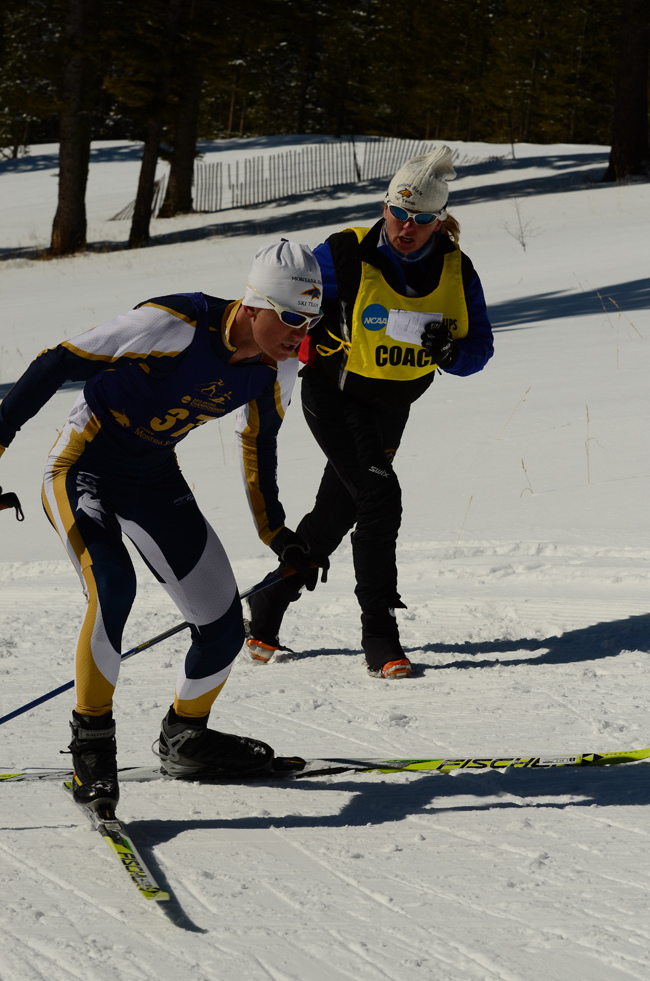
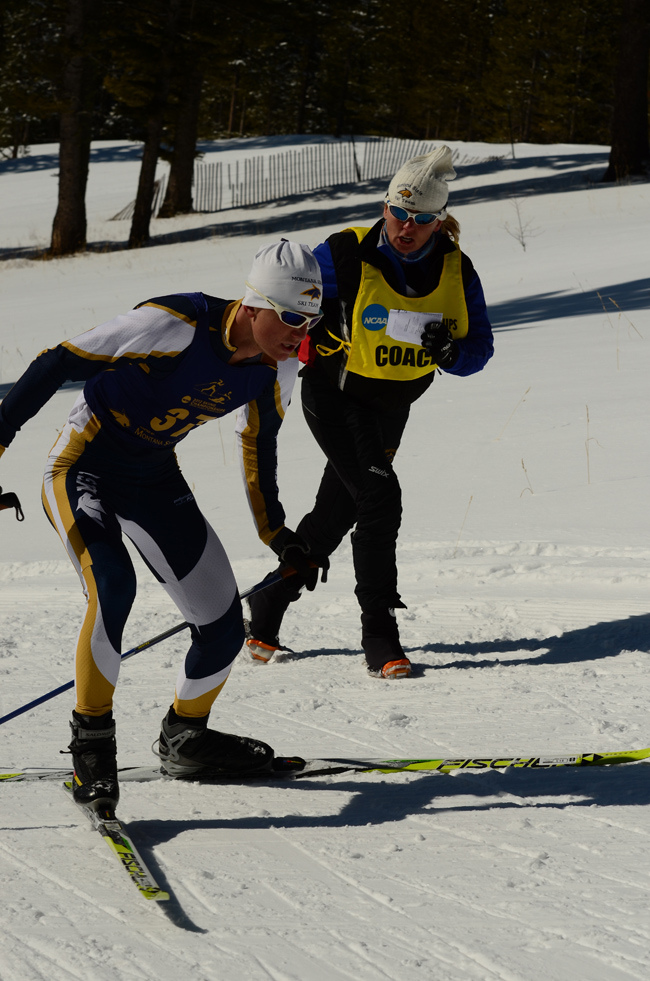
Grethe Lise-Hagensen served as Montana State University’s Head Nordic Coach from 2003 to 2014. During her decade as head coach, Hagensen brought the team from a state of near non-existence to ranking third in the nation at the 2010 NCAA Championships. In May of 2014, Hagensen’s contract was not renewed by the university’s administration. FasterSkier sat down with Hagensen in July to talk about her time at the helm of the MSU program and the accomplishments she achieved during her ten years as head coach.
***
BOZEMAN, Mont. — Like most Norwegians, Grethe-Lise Hagensen was born with proverbial skis on her feet. Unlike most Norwegians, she decided to bring her successful ski career to the United States.
Hagensen grew up in Tromsø, Norway, roughly 300 miles above the Arctic Circle where she found an early introduction to skiing out of necessity. Her family didn’t have a car and like many of the other townspeople, she had no choice but to ski into town whenever she needed to go to school, buy groceries, or visit friends.
Hagensen’s skiing soon evolved from a means of travel to a form of competition as she was introduced to racing. Her entrance into world of ski racing would change her life forever, and by the time she was a teenager she had already won a Norwegian national championship and was on the Norwegian National Ski Team.
In 1979, Hagensen was part of what she described as the “the biggest athletic event in northern Norway.” A relay team consisting of Hagensen and fellow Tromsø skiers made their way to the top of the podium, astounding spectators.
“It was a huge sensation. It is still probably the biggest athletic event that has ever happened in northern Norway because we were such underdogs,” she said during a recent in-person interview. “For us to win it was a shocking thing. Top ten would have been a sensation, and we ended up winning.”
Hagensen first ventured to the U.S. to attend the University of Wyoming. During her time there, she earned all-American honors each of her four years at the university and was part of its winning team in the 3 x 5 k relay at the 1985 NCAA Skiing Championships.
Hagensen graduated from the University of Wyoming in 1986. She returned to Norway, where she coached both soccer and skiing. She then married American John Villar and the couple had two daughters.
In 2002, Hagensen and her family made the decision to move to Bozeman, Mont. for a year so that her children, Bjørk and Embla, could learn English. The family’s plan was changed when a friend informed Hagensen that the head coach position at Montana State University (MSU) was available.
Hagensen applied for the job, accepted the university’s offer, and has lived in Bozeman ever since.
“Suddenly they could smell gold”
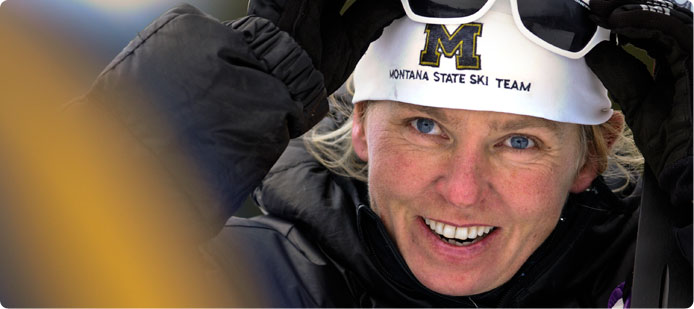
When Hagensen took over as MSU’s head nordic coach in 2003, it was the first year since the 1980s that the university had a male team. While women had been part of the team for many years, their results were lackluster and recruitment was challenging.
“You need to have results to get good athletes — it’s like the chicken and the egg,” Hagensen said of her entry into the program in 2003. “I thought it would take me five years to build up a winning team that would be competitive against CU [the University of Colorado] and DU [the University of Denver].”
The winning combination came earlier than expected. While a handful of good finishes from MSU skiers scattered the results of the Rocky Mountain collegiate series in Hagensen’s early years as head coach, it wasn’t until 2007 that the team really started to excel.
The turning point came during the first weekend of Rocky Mountain Intercollegiate Ski Association (RMISA) races at Soldier Hollow in Midway, Utah. With a relatively strong first day of competition, Hagensen was optimistic about the mass-start races. During the women’s 10 k, she was waxing the men’s skis and conversing with a fellow coach.
“I remember I said to one of the coaches, ‘I might get a medal today’ and he said to me, ‘Grethe, you might take the top three,’ ” Hagensen explained. “After that I don’t remember anything.”
Her colleague was correct as a trio of MSU women consisting of Jamie Woelk, Mandy Bowden Axelson and Claire Rennie rounded the corner into the final stretch of the women’s race. The three Bobcats swept the podium, separated by less than a second.
It was the first time in RMISA history that a women’s team had taken all three spots on the podium in a single race, but the historic moment almost didn’t happen as all three skiers were nearly disqualified.
“We almost got disqualified because someone said that I skied next to them,” Hagensen said. “I don’t remember skiing but I must have because I was in shock. I was so happy. Maybe I skied maybe I didn’t, who knows.”
Despite the alleged incident, the women’s results stood and Hagensen was issued a warning. The moment, however, was a major turning point for the program, which had existed on a small scale four years prior.
“Suddenly they could smell gold. Once you do it, you have broken the barrier,” Hagensen said.
She credits the rapid rise of the MSU nordic team to a focus on American athletes who might have been overlooked by other universities, some of which heavily recruit European skiers and only the best American juniors.
“I always had, not the best juniors in the U.S., but maybe the ones who were a little bit behind,” she said. “I tried to get them to become the best. You have Ryan Scott and Tyler Reinking, these guys were OK and then we just built them. That’s what made me the most proud over my years: taking care of the Americans.
She also made sure to focus on building technique before anything else.
“We tried to tap into whatever edge they had. Technique was something that we had to work on a lot,” she said. “You can’t be the best if your technique is a handicap. I tell everyone to focus on their technique and then we get them to the next level.”
After joining the big show in 2007, MSU continued to progress at an unprecedented rate. With recruitment soaring and a tight-knit team, Hagensen entered the 2009/2010 season with high hopes.
With their eyes on the NCAA Championships in Steamboat Springs, Colo., the team qualified a full six-person squad for the event: Scott, Reinking, Bernhard Roenning, Kaelin Kiesel, Mellie Park, and Casey Kutz.
Underdogs from the beginning, MSU wasn’t expected to be overly competitive, let alone make a run for the podium. However, they did just that with all three men placing in the top 10 in the second day of competition. The results propelled the squad to third place overall at NCAAs.
“We had a phenomenal year, and suddenly we had three [men in the] top ten and Kaelin Kiesil was fifth,” Hagensen said. “Sometimes everything lines up.”
Later that year, Hagensen received the Intercollegiate Coach of the Year Award in recognition of her contributions to MSU.
Termination After a Decade
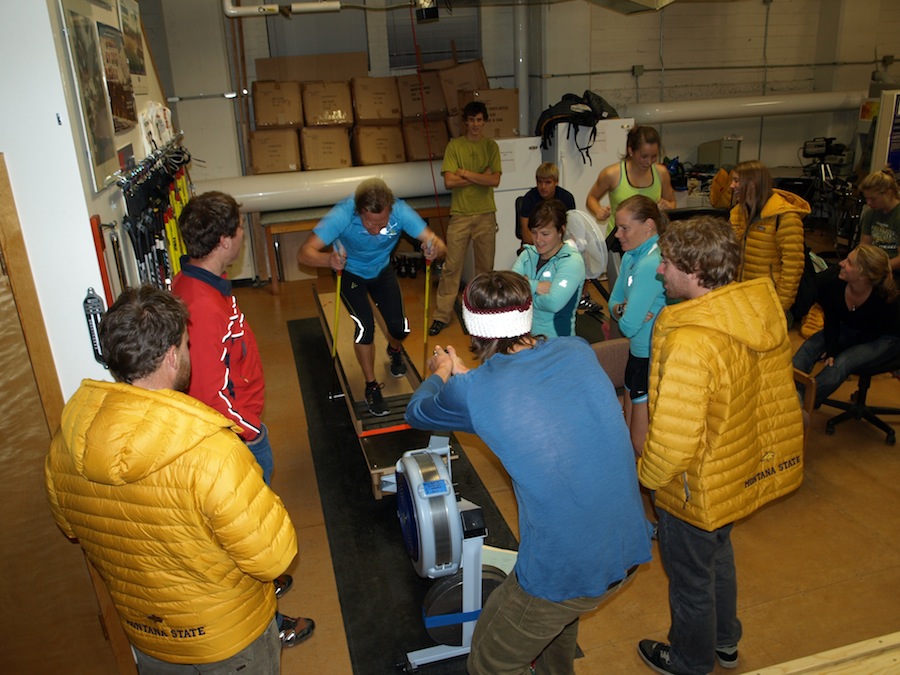
After 2010, both Hagensen and the MSU nordic team continued to find success with top finishes in the RMISA and NCAA race series. In 2012, for the first time in school history, MSU qualified a full team in both alpine and nordic for the NCAA Championships that took place on their home courses in Bozeman, Mont.
Hagensen also received the RMISA Coach of the Year Award that year.
During the 2012/2013 season Hagensen took a sabbatical year so that she could spend time with her mother in Norway who had just suffered a stroke. During that season, assistant coach Chad Andersen took over the responsibility of the team.
In what would be her final season as MSU’s head nordic coach, Hagensen lead her team to qualify a full NCAA Championships squad once again. At the 2014 NCAAs in Soldier Hollow, MSU saw two athletes — Jessica Yeaton and Sawyer Kesselhiem — earn all-American honors with fifth- and ninth-place finishes.
Adding to the season’s milestones, the nordic team won both the men’s and women’s awards for team of the year at the Montana State Athletics’ 2014 ALL (Academics, Leadership and Life Skills) Banquet in April.
Not long after, Hagensen said she received a positive review from her athletic department and was given a mandate to hire a new assistant coach. The new assistant coach, Andrew Morehouse, had both a verbal and written agreement with Hagensen for his position that was yet to be made official by the university.
In May, she said she was summoned MSU Athletic Director Peter Fields’ office for what she assumed would be a conversation about the assistant-coaching position.
What she experienced was far from what she expected.
Instead of discussing the assistant coach position, Fields told Hagensen that her contract would not be renewed in the coming year.
“They asked me to come in and I thought they were going to ask me about the new assistant coach that I was to hire,” she said. “… Ten years of my life was canned in two minutes.”
The university declined to comment on the decision due to its personal nature, according to Sports Information Director Tom Shutlz.
“I’m still traumatized,” Hagensen said. “You would think that an institution would bring you in and give you a reprimand or warning or something, but the fact is that there is no job guarantee. You would think that Montana State University would be bigger than this and that they would communicate.”
Hagensen claims that Fields gave her no indication as to why her contract was not renewed and failed to even thank her for ten years of service to the university.
She quoted from her prepared statement regarding her departure from MSU:
“I was surprised that after a decade of strong performance as a head coach, my boss Peter Fields made no comment to me about all the success that the nordic ski teams that I have coached have brought to MSU. Most surprising was the reaction of President Cruzado, who has as well reported record on workplace issue and good management practices. I realize that most of us have one-year contracts and that MSU management can make changes as they see fit. But after a decade as an MSU coach, to be tossed aside without any reason…”
MSU issued a press release on May 22, which read in its entirety: “The contract of Montana State head Nordic ski coach Grethe Hagensen will not be renewed, announced Bobcat Athletics Director Peter Fields, Thursday afternoon. Hagensen recently completed her tenth year at Montana State. A national search for the position will be conducted.”
There were those who weren’t surprised by the move. Three former skiers of Hagensen who wished to remain unnamed, claimed that coach was distracted and absent during her last year of coaching.
When asked about these claims, Hagensen said she made a conscious effort to take a back seat in the 2013/2014 season because she did not want to overbear the atmosphere that assistant coach Chad Andersen had created during her sabbatical year.
“Last year I wasn’t there and this year I was easing back in so that I wasn’t too powerful or too controlling,” Hagensen said. “Maybe I should have done it differently but those are small things. Not enough to get fired. It is an adjustment.”
Despite some athlete discontent, Hagensen has received many positive reviews from former athletes, including Scott who graduated in 2012. While Scott had not yet returned an inquiry from FasterSkier at the time of publication, he was quoted in a 2011 Montana State University press release saying that, “she (Hagensen) cares about you personally as well as how you are doing as a skier. She taught me how to seek out my strengths and capitalize on those, which carries over to all aspects of my life.”
In the same article, Axelson (member of the podium sweeping team in 2007) is quoted saying, “Grethe taught us that in order to be successful, you have to be self-motivated; you have to know what you want and go after it. When you are driven, opportunities come your way–that’s Grethe’s legacy.”
On July 11, MSU announced the hiring of new head coach Kristina Trygstad-Saari, a Bozeman resident and former Dartmouth skier and coach.
Hagensen was pleased that Trygstad-Saari was tapped for the position, insisting that Trygstad-Saari could accomplish the one goal Hagensen never did with MSU.
“My dream while at MSU was always to win the NCAA Championship,” Hagensen wrote in an email after the announcement. “As the new head nordic coach, Kristina Trygstad-Saari brings experience in racing and coaching to the team. Together with MSU Alpine coach Kevin Frances, I believe the MSU ski team has the potential to achieve that goal, winning the NCAA Championship. I wish them all the best.”
Unsure of what exactly lies ahead of her, Hagensen explained her future will likely involve traveling between the U.S. and Norway. During her sabbatical year she taught at the University of Tromsø which may be a future possibility for the Norwegian.
She’s planned a trip to Oslo with her oldest daughter, Embla, who’s taking a postgraduate year at an outdoors school. Her youngest daughter, Bjørk, has a year left at a boarding school in Park City, Utah.
Wherever Hagensen finds herself, she’s certain of one thing: she will always remember her time at Montana State with fond memories and will continue to be proud of the athletes she coached.

