This coverage is made possible through the generous support of Marty and Kathy Hall and A Hall Mark of Excellence Award. To learn more about A Hall Mark of Excellence Award, or to learn how you can support FasterSkier’s coverage, please contact info@fasterskier.com.
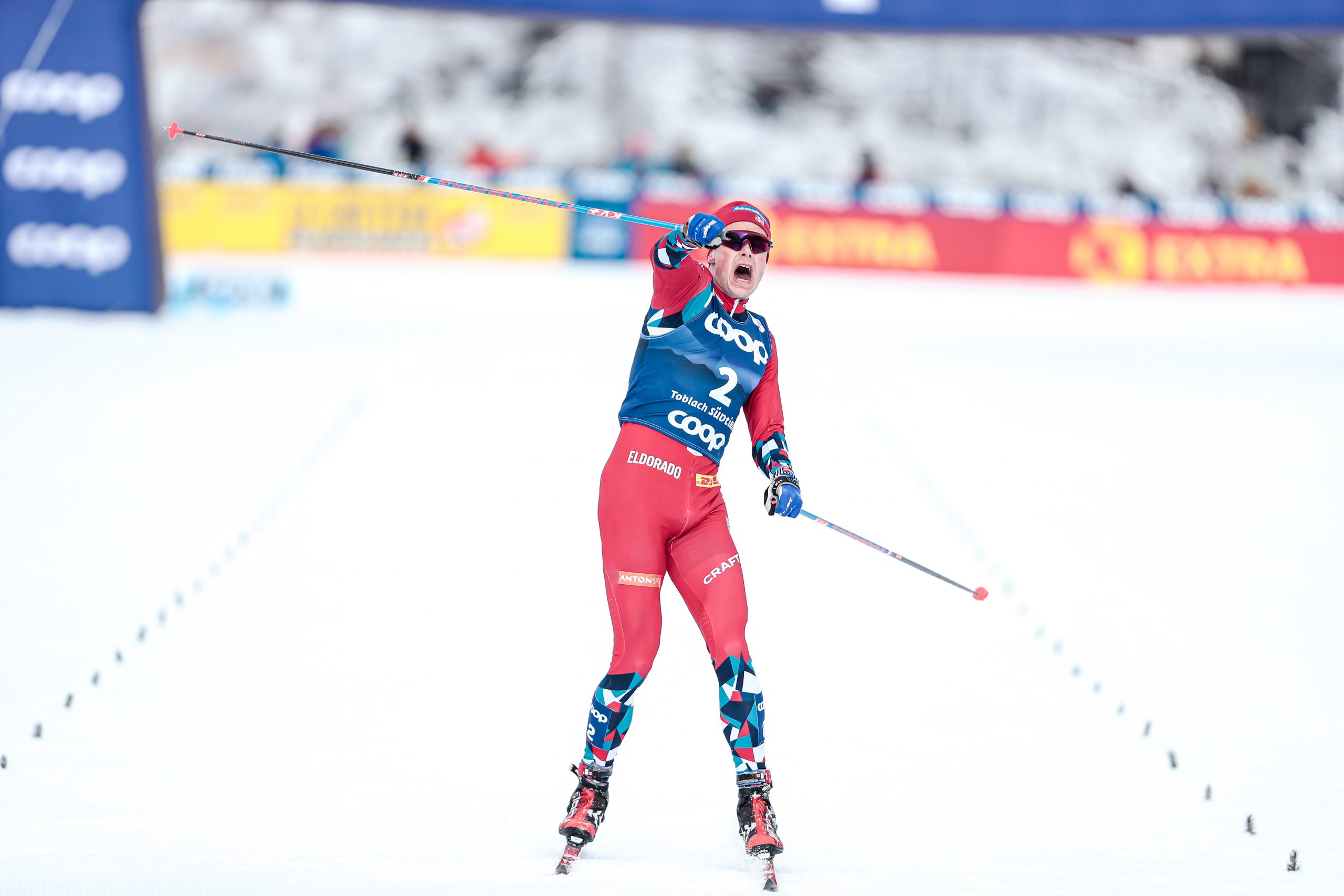
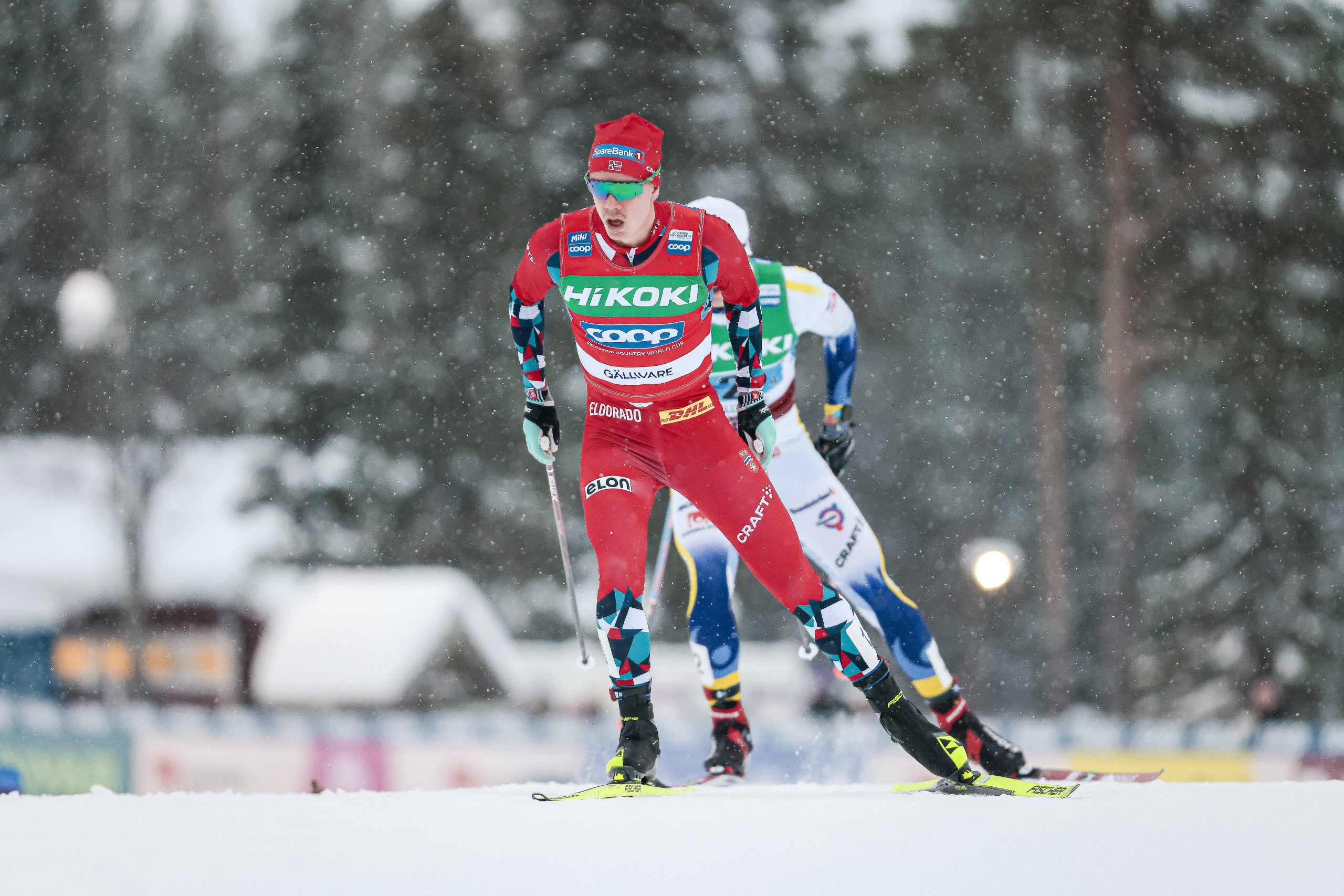
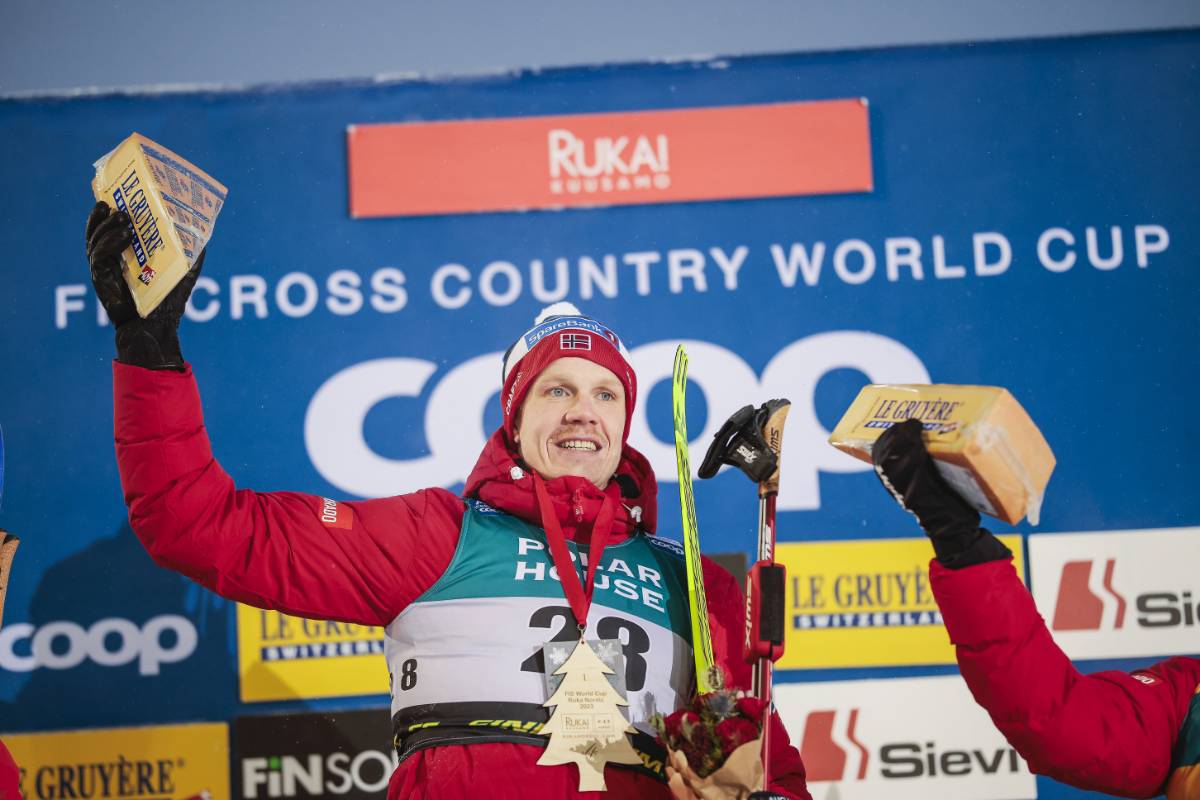
Status quo restored: Harald Oestberg Amundsen (NOR) dominates the 20 k Freestyle Pursuit—and moves into the overall lead—in the 2024 Tour de Ski in Toblach, Italy. (Photo: Modica/NordicFocus)
Pursuit racing is kind of weird—giving an additional head start to those already in the lead, while asking other racers to chase those who have already proven to be faster. It can seem like a bit of a set-up . . . one that Norway was entirely happy to benefit from on the third day of Tour de Ski racing from Toblach, Italy.
It must make Norway a bit nervous to endure a start like this one at the 2024 Tour de Ski: shut out of individual World Cup race podiums for the first time in recent memory. But, eventually, races get longer, the abilities of the distance skiers allow them to shake off the pluck and daring of over-reaching sprinters, and the status quo is re-established. After what appeared to be a few days of equitable, good-natured, highly entertaining, multi-national competitive ski-mayhem, Norway once again emerged at the front. The Tour de Ski returned to earth with a display of Norwegian dominance in the 20 k Freestyle Pursuit, and the state of affairs in the Men’s World Cup field returned to normal. Harald Oestberg Amundsen (NOR) entered the 2024 Tour de Ski as the prohibitive favorite for the overall title. On the first day of the new year, Amundsen lived up to those predictions with his commanding victory in the 20 k Freestyle Pursuit. He was followed across the finish line by a game Erik Valnes (NOR), and their countryman Jan Thomas Jenssen (NOR).
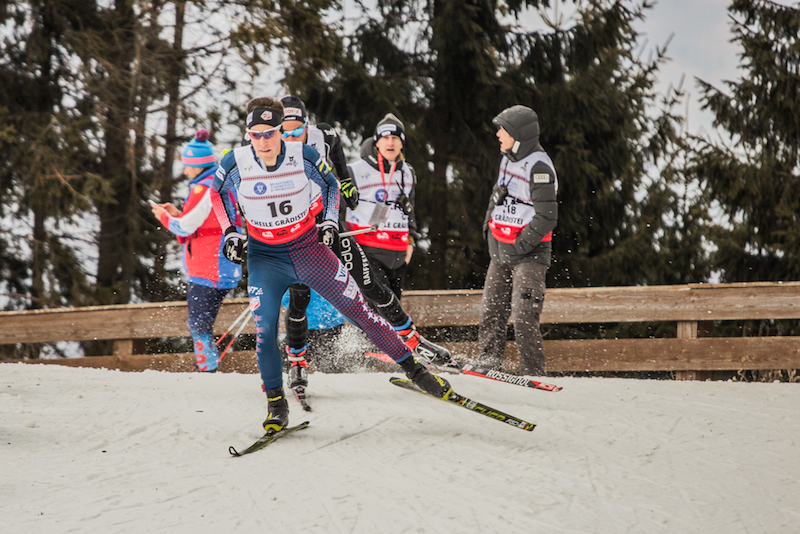
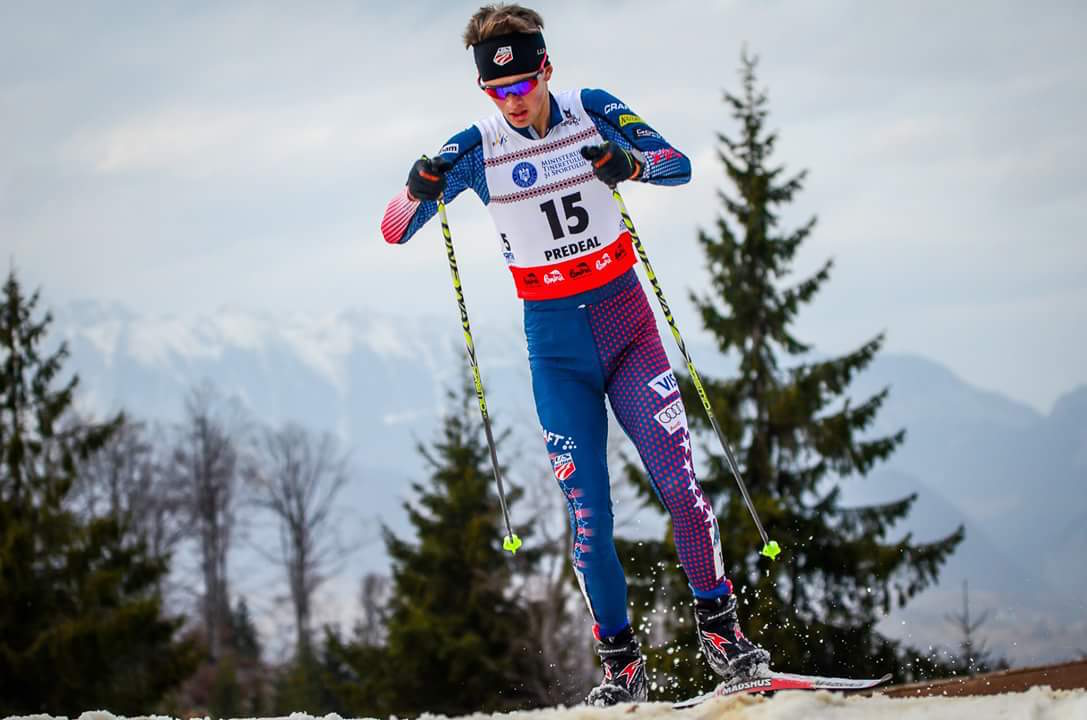
American, Gus Schumacher, raced courageously and intelligently throughout the day, remaining in the primary chase group to finish tenth, a performance that places him tenth in TDS Overall standings, as well. Other American finishers included Scott Patterson in 28th, Ben Ogden 33rd, Zanden McMullen 48th, Kevin Bolger 66th.
For Canada, Antoine Cyr continues a string of fine performances in 19th, followed by Olivier Leveille 58th, and Julien Locke 79th.
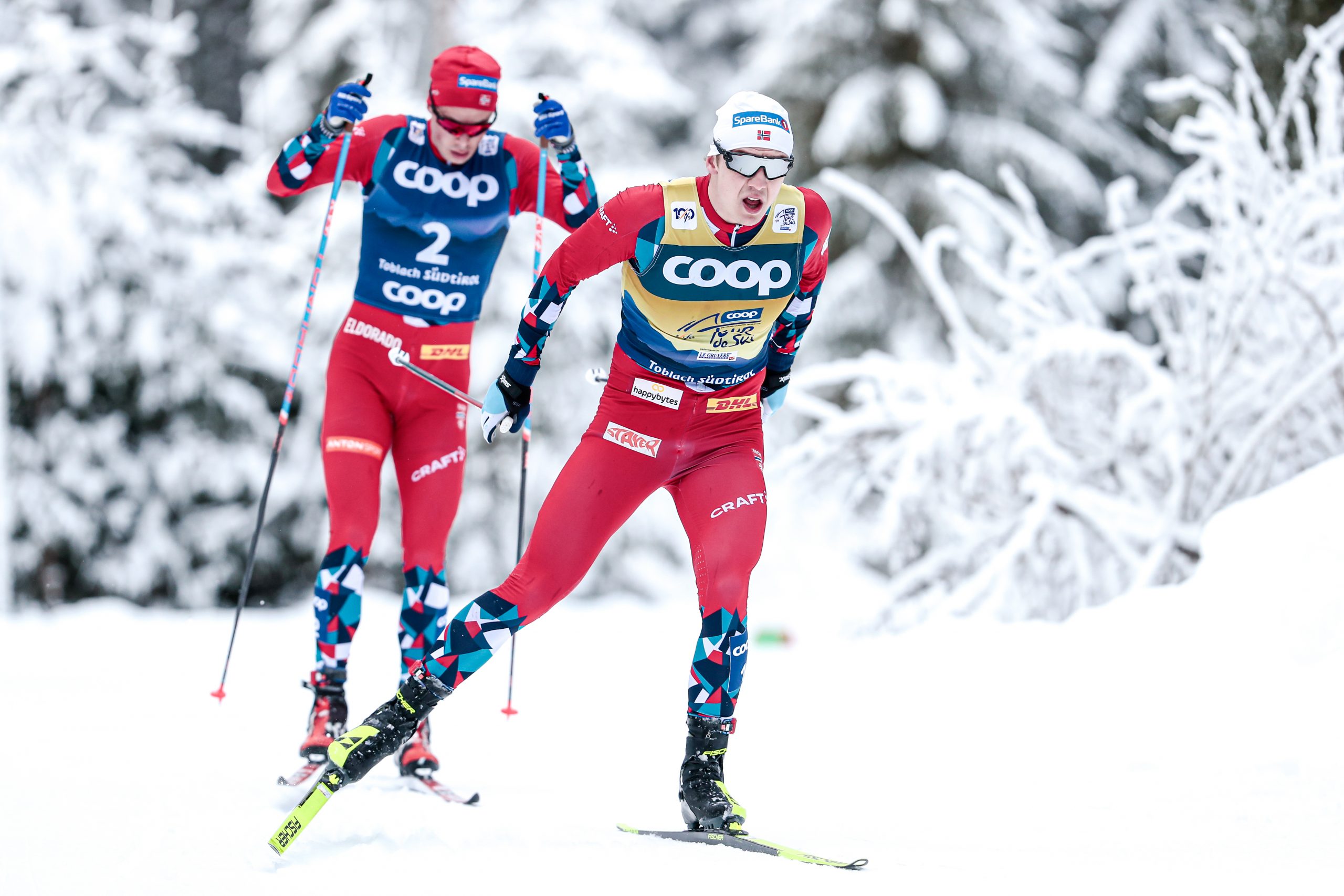
Tour de Ski leader at the beginning of the day’s 20 k Freestyle Pursuit, Erik Valnes (NOR) helped to make the pace for the pair of leaders. Ultimately, he was overcome by his countryman, Harald Oestberg Amundsen, who took the race win and the overall lead in the Tour de Ski standings. (Photo: Modica/NordicFocus)
Men’s 20 k Freestyle Pursuit
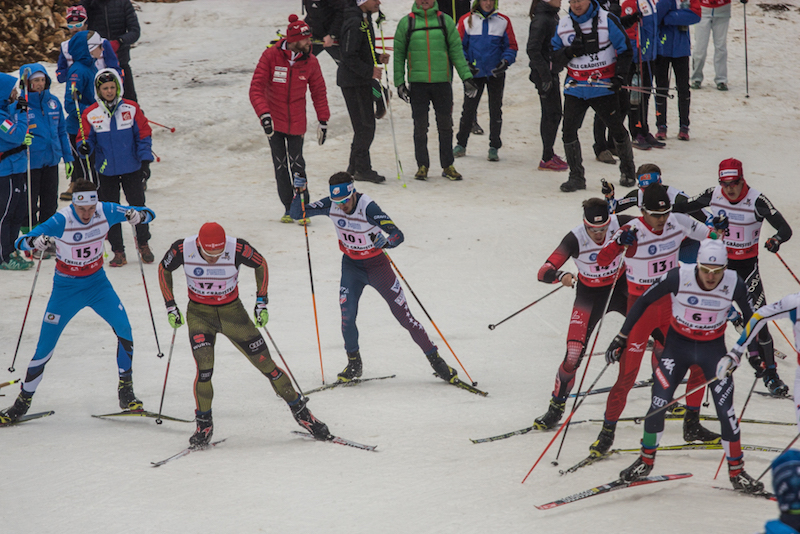
Ski racing is not always what it seems. The 20 k Pursuit contested in Toblach was actually 22 kilometers in length—five laps of 4.4 kilometers each—on a course that many competitors consider “easier” than the typical World Cup distance course.
Tour leader at the beginning of the day, Valnes was first to start, followed only four seconds later by his countryman, Harald Oestberg Amundsen. Ben Ogden (USA) started third, 28 seconds behind the leader. Perttu Hyvarinen (FIN) started fourth, followed by Lauri Vuorinen (FIN). Those five represented the top of the overall standings at the beginning of the race. The end of the race would see numerous changes . . .
The two leaders started relatively close to one another; most of the other early-starting racers were separated from each other by gaps of 20 seconds or more. Chasers would have a difficult time grouping up unless early starters slowed intentionally. The top two Norwegians quickly paired up while Ogden was left alone to either chase, or sit up and wait for help to arrive from behind. By the end of the first kilometer, Hyvarinen had come forward: Ogden would have company.
Bonus Points were offered for the fastest skiers to cross the checkpoint at .7 k. Mika Vermuelen (SUI) captured the winner’s 15 points, ahead of Henrik Doennestad (NOR). The inclusion of mid-race Bonus Points is an action-inspiring strategy on the part of race organizers—much like mid-race “Primes” offered in bicycle racing. It’s the system organizers have devised to play on the relative greed of individual riders, coercing them to sprint in the middle of the race (sometimes a disastrous tactical decision) for money or points. The idea of including a Bonus Points sprint within Toblach’s TDS Pursuit was to encourage skiers to start out fast instead of sitting up to wait for later-starting skiers to form a racing group. Ogden didn’t fall for it: he and Hyvarinen maintained a steady, conservative pace—ignoring the chance to race for additional points—until they were finally enveloped by the main chase group at the five kilometer mark.
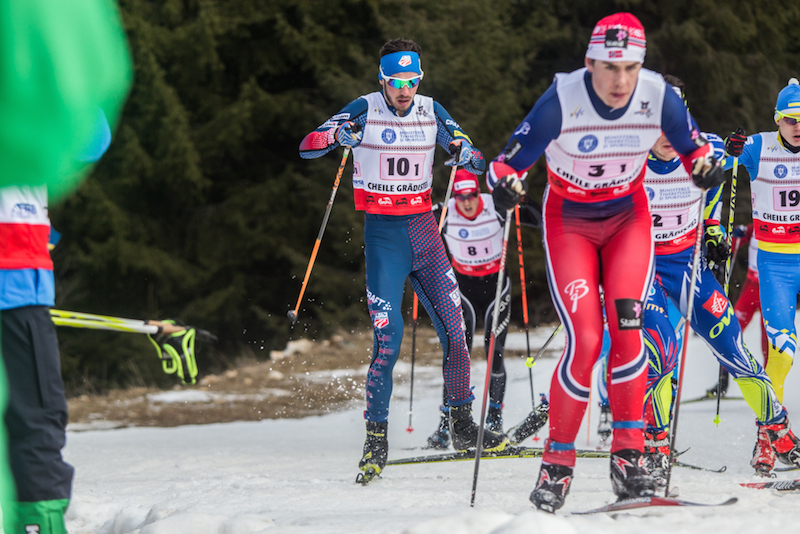
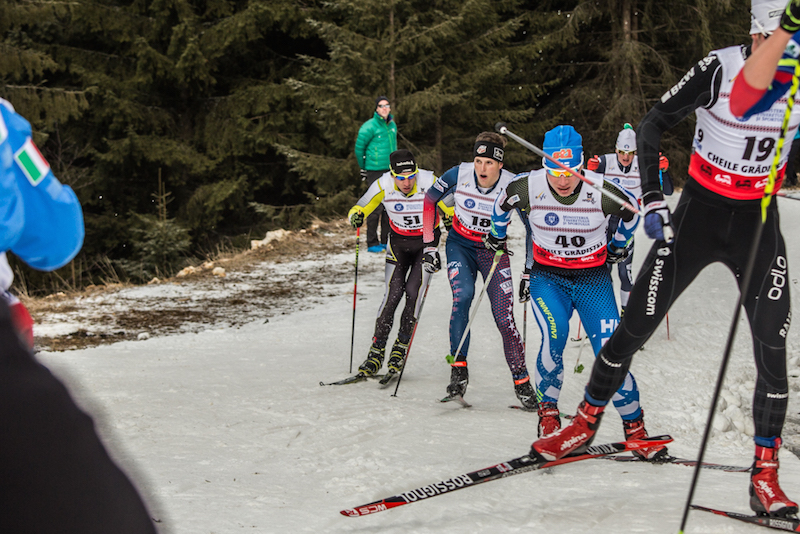
Schumacher had started in a closely-packed group of starters who quickly formed the day’s main chase group, one that would grow to include William Poromaa (SWE), Jens Burman (SWE), Martin Loewstroem Nyenget (NOR), Beda Klee (SUI), Jules Chappaz (FRA), Hugo Lapalus (FRA), Friedrich Moch (GER), and Federico Pellegrino (ITA). As Ogden and Hyvarinen gradually faded back to this group, the two leaders simply stormed away.
Moch seemed determined to press forward in pursuit of the leaders—and Nyenget and Lapalus came forward to add to the torrid pace—but most others in the chase group seemed content to race those around them. Rather than work as a cohesive group, the chase group began to unravel. The French sprinter, Chappaz was quickly gapped and left behind. Ogden suffered a similar fate not much later while Schumacher continued to vie for position within the eleven-man chase group.
After the second of five laps, Amundsen had firmly established himself as the pace-maker while Valnes began visibly to struggle. Near the race’s halfway point, there was a moment when it seemed that the second chase group could catch the first chase. But Nyenget forged to the head of the front group, and they gradually pulled away from the other chasers. It seemed that no one wanted Paal Golberg (NOR) (who was in the second chase group) to come back into contention. All this went on while Amundsen and Valnes continued to maintain a gap of more than a minute.
At 15 k, Amundsen used the main uphill to distance Valnes. Raising the tempo—and the pace—Amundsen skied clear, creating a gap that grew quickly to more than ten seconds. Amundsen was gone, leaving Valnes to consider damage control, though he still enjoyed a cushion of over a minute to the group of chasers.
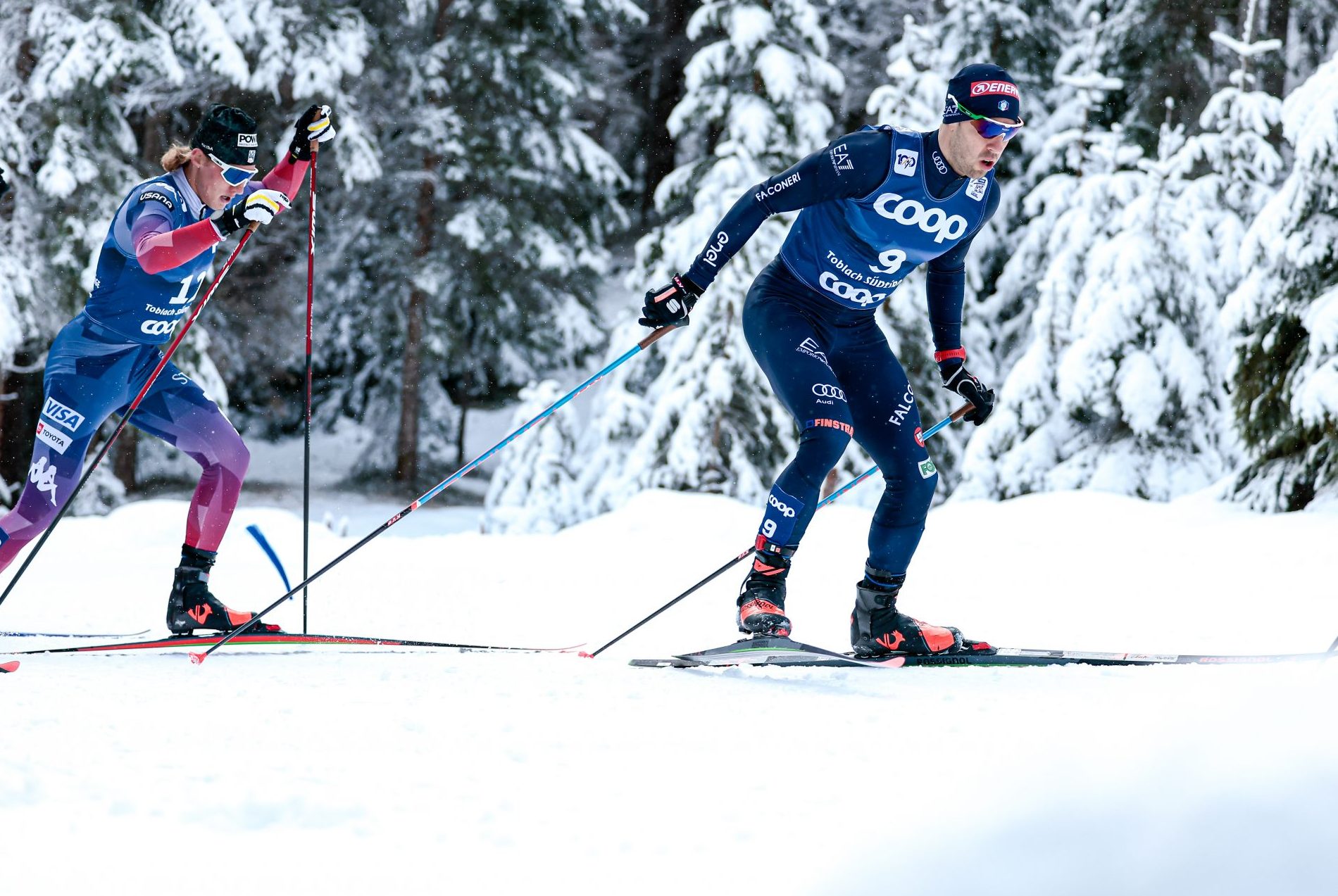
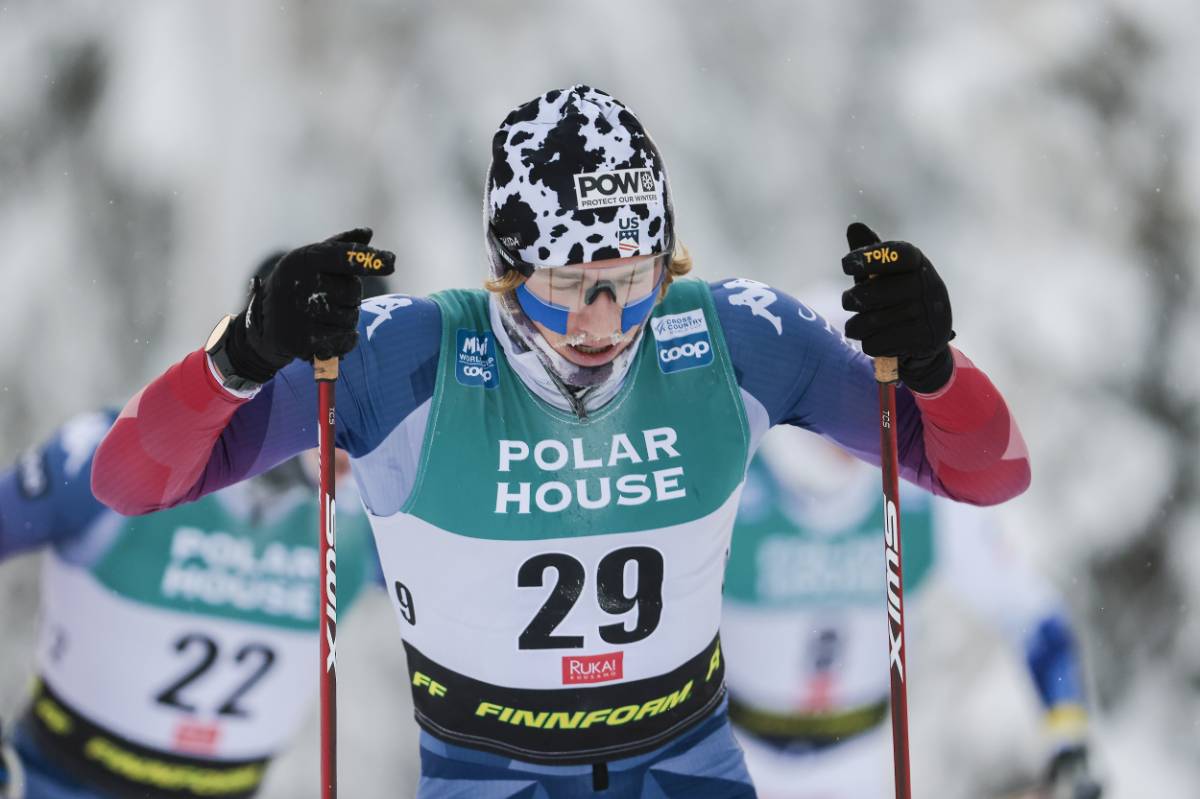
Late in the race, Gus Schumacher (USA) and Federico Pellegrino ((ITA) were forced to work hard to maintain contact with the chase group. Those courageous efforts paid off with top ten finishes for both. (Photo: NordicFocus)
Midway through the final lap, Moch returned to the business end of the chase, initiating a pace (supported by Lapalus and Poromaa) that spread out the group and forced Schumacher and Pellegrino to chase hard to remain in contact. They managed to remain in contact, allowing them to sprint for a top ten finish.
“My mentality was to smooth out the effort in the end,” said Schumacher. “I was right on the limit near the top of the main climb where we got left behind. I also knew from the beginning of the race that I was able to ski fast on the rest of the course, so I kept some energy by letting the gap open, and thankfully they didn’t seem to have too much gas left either, so we were able to get back by the bottom of the course.”
Amundsen powered across the finish line alone, some 32 seconds ahead of a game but exhausted Valnes. The other contending Norwegians stormed to the front of the chase group up the final hill—Nyenget followed by Jenssen. Jenssen would come forward to grab third (just over a minute behind the winner), followed closely by Poromaa and Nyenget. Schumacher would hold on for tenth, just behind Pellegrino. The bodies of exhausted skiers lay strewn about the finish area as the racers showed the extraordinary strain of pack racing at this level.
Norway one, two, and three on the podium—Norway one, two, and three in the overall standings. At a certain point in Cinderella’s fairytale, the spell wears off: her coach turns back into a pumpkin, leaving her stranded on the road side wearing shabby, soot-stained clothes, and minus one glass slipper. It was fun to have been a beautiful princess for a while, but it seems tremendously difficult to keep it up. Just ask Ogden, Hyvarinen, and Vuorinen. Five more races lie ahead in the 2024 the Tour de Ski, and Gus Schumacher may still be racing in search of an elusive glass slipper. We’ll wait to see how this fairytale plays out.
Tour de Ski Stage 3, 20 k Freestyle Pursuit RESULTS
In Time of day RESULTS it was Jenssen with the day’s fastest racing time, followed by Henrik Doennestad (NOR) , and Lapalus. Schumacher’s finishing time proved to be the sixth fastest of the day.
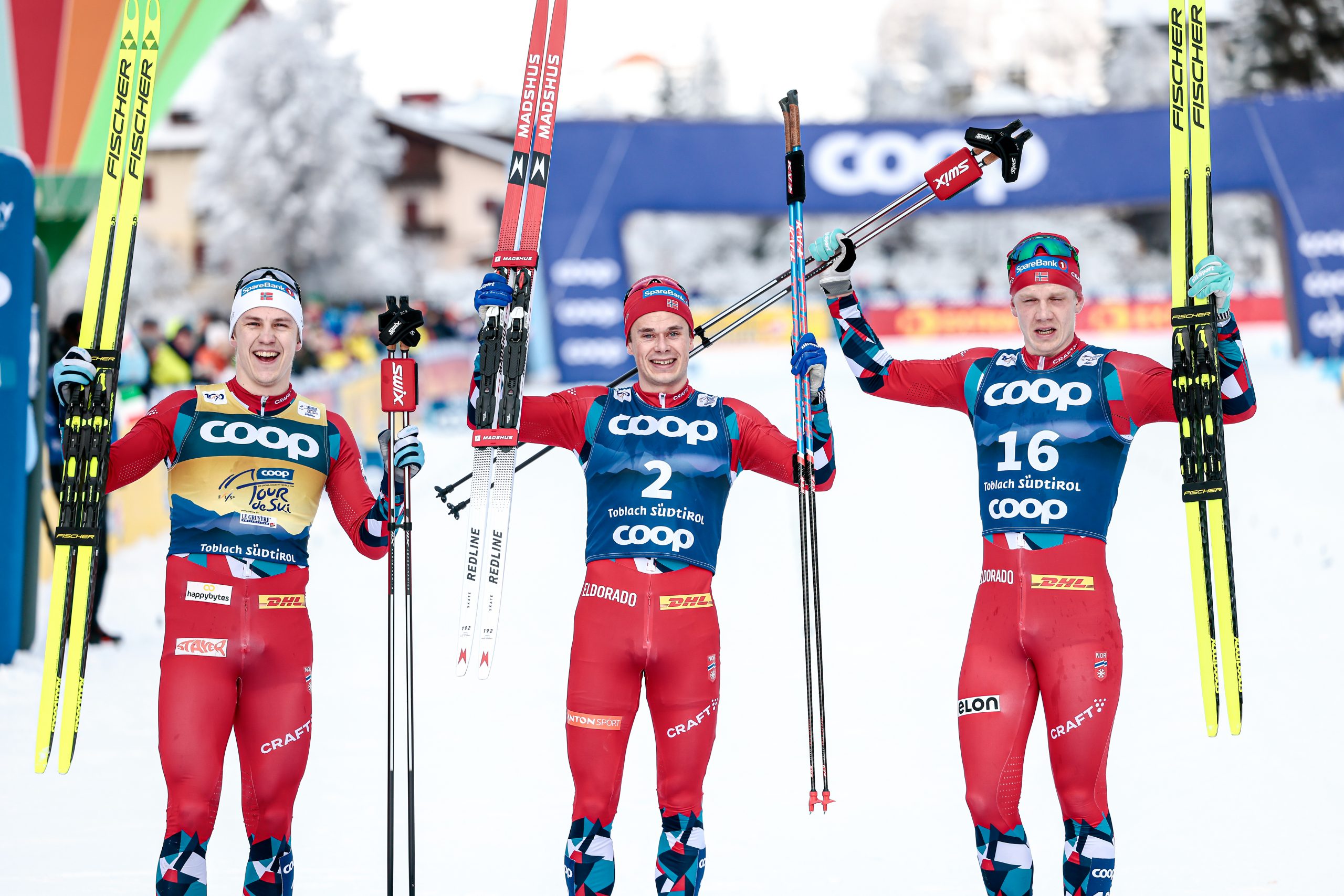
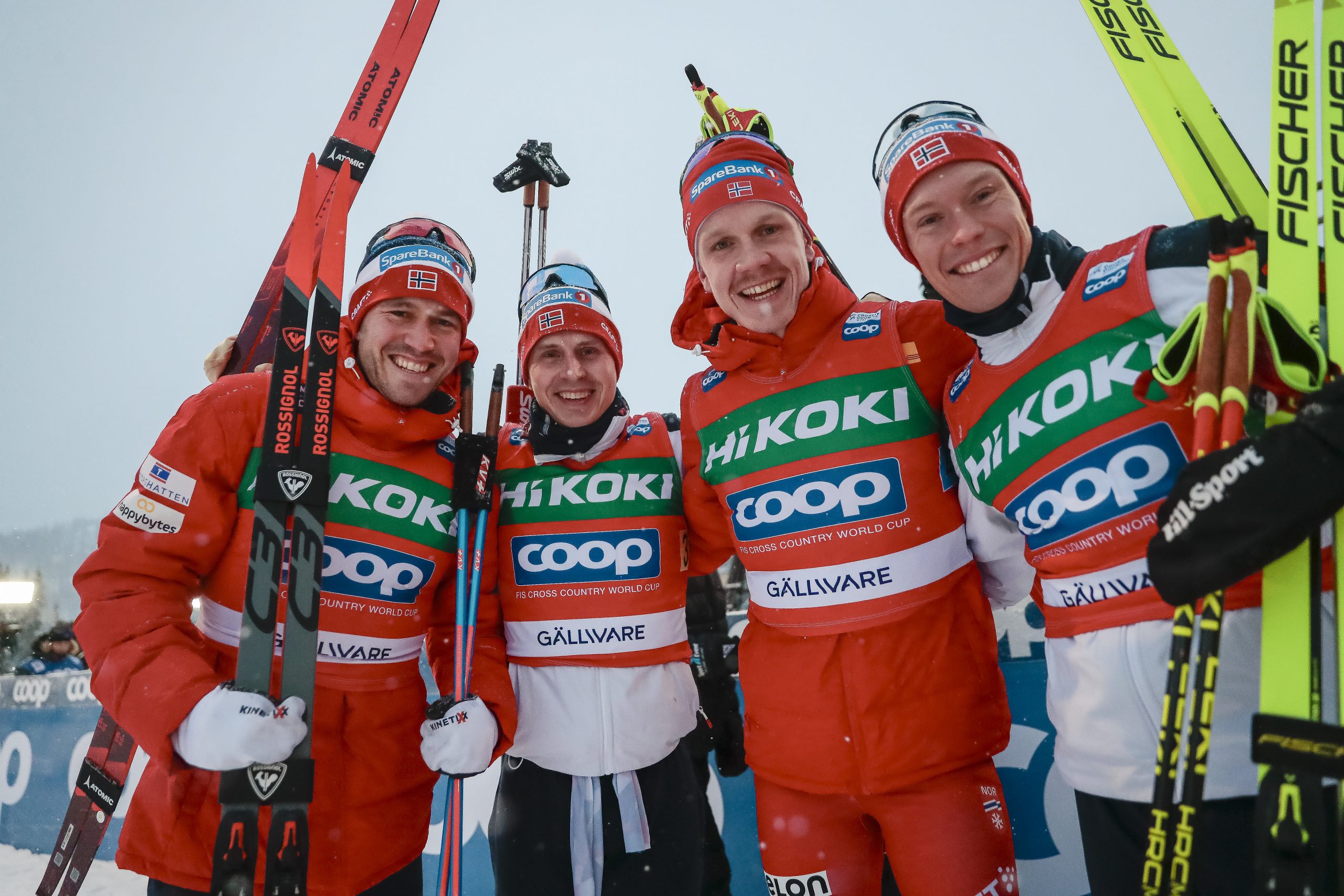
Norway returns to the podium in the Tour de Ski 20 k Freestyle Pursuit. Erik Valnes (NOR), Harald Oestberg Amundsen (NOR), Jan Thomas Jenssen (NOR), (l-r). (Photo: Modica/NordicFocus)
Eli Brown, a member of the U.S. Ski Team’s waxing and ski service staff, joins us this week to talk about his job and the new enforcement of the rules banning fluorocarbons on the World Cup circuit. We recap another strong weekend for American athletes, along with all the hijinks that happened in Trondheim, Norway at the test event for next season’s World Championships.
The World Cup takes a break next weekend before the Tour de Ski, but we may try to squeeze in a mailbag episode. Send us questions if you’ve got ’em. Reach us at nat@fasterskier.com and devon@fasterskier.com.
Norway dominates: Paal Golberg (NOR), Simen Hegstad Krueger (NOR), Jan Thomas Jenssen (NOR), Martin Loewstroem Nyenget (NOR), (l-r) atop the podium in the FIS World Cup 4 x 7.5 k Relay at Gaellivare, Sweden. (Photo: Modica/NordicFocus)
Seven Norwegian men—not even the seven best Norwegian men—entered the most competitive ski race the world has to offer (World Cup 10 k Interval Start Freestyle in Gaellivare, Sweden), and the worst Norwegian finisher was ninth! That’s the apparent nature of men’s cross country ski racing today: Norway shows up, Norway wins, Norway sweeps the podium, and the worst Norwegian in the field still manages to beat pretty much everyone else in the world. Norway could bring seven guys who finished 30th to 37th in a recent weekend of Norwegian club races, and it seems like those guys are still all likely to finish in the top ten on any given World Cup weekend. What must that be like for ambitious Norwegian skiers? Toiling away in anonymous obscurity on the dimly lit tracks of some Norwegian village trail system, knowing they could be among the best in the world if only the national team would just send them to a World Cup? I mean, c’mon: it’s a World Cup Men’s 10 k Interval Start Freestyle; not withstanding the absence of a team of officially-banned Russian all stars, this is how we identify the best skiers in the world. What we discover is this: they all seem to come from Norway . . .
Jan Thomas Jenssen (NOR) hadn’t even been entered in a World Cup race in three years. In his first weekend back on the World Cup tour, he won the 20 k Mass Start Freestyle in Ruka, Finland. (Photo: Modica/NordicFocus)
One week ago in Ruka Finland, an unheralded Norwegian who hadn’t even earned a World Cup start in three years managed to win a World Cup race. Jan Thomas Jenssen (we’ll forgive North American ski fans if they’d never heard of him before last week) stormed to victory in a 20 k Freestyle Mass Start that reminded us just how truly deep the Norwegian ski-racing population truly is. So, here’s my question: how does Norway do it? Is it the air? Is it the diet? Is it the gene pool? Is it the youth development philosophy? Is it the skis? Is it the Norwegians’ reliance on asthma inhalers (to be fair, the near-100% occurrence of exercise-induced asthma among contending Norwegian skiers is a bit eyebrow-raising)? Obviously, the question is not going to be answered on our little North American cross-country skiing website . . . but this little North American cross-country skiing website can certainly raise the question! Norwegian men are kicking the world’s backside at cross-country skiing. Anybody know how?
Norway does enjoy certain advantages: it’s way up north (Sjusjoen and Lillehammer get skiable snow long before the rest of Europe), it’s a culture founded on skiing (consider all the drawings and illustrations of little King Haakon being rescued by ski-propelled Birkebeineren), and the top athlete in the country is certain to be the top skier on the Norwegian national team (fame, fortune, headlines, immortality, etc.). We know that Johannes Hoesflot Klaebo is always given the fastest skis (Fischer makes sure of that). We only need go back one year to re-visit the wax protocol FIS race in which all competitors raced on identically waxed skis (prepared by Swix personnel). The predictions before that race held that waxing advantages would be negated, that finishing margins would be closer, that the playing field would be leveled, that smaller ski-nations would have more chances to shine . . . but what really happened was that Klaebo won his events by even greater margins, the evident speed-qualities of his one-in-a-million skis being the only things that mattered.
Cross-country skiing is a simple sport, and many athletes can (and do) master the nuanced techniques of this nuanced technical athletic motion. Ultimately, international competitions become a grueling long-distance talent show with medals and prizes and fame and accolades being reserved for those who gruel the best. Even on what would appear to be a level playing field, no other nation does it like Norway: the Norwegian men’s team seems to be conducting an intramural competitions within races to which all other skiing nations are invited. History has shown us that other nations have dominated certain sports in a similar manner—Soviet speedskaters, East German swimmers, Bulgarian weightlifters—but much of that former sport-domination proved to have been based on secretive, mysterious, performance-enhancing drug programs and nationally-sponsored systems of sports-cheating. For the Norwegians who stand on the podium week after week ( and who are presumably tested and scrutinized more than any other skiing nation), their kind of dominance speaks of different qualities, different properties, different traditions that other nations lack. Or maybe it’s just that there are no Russians in the field . . .
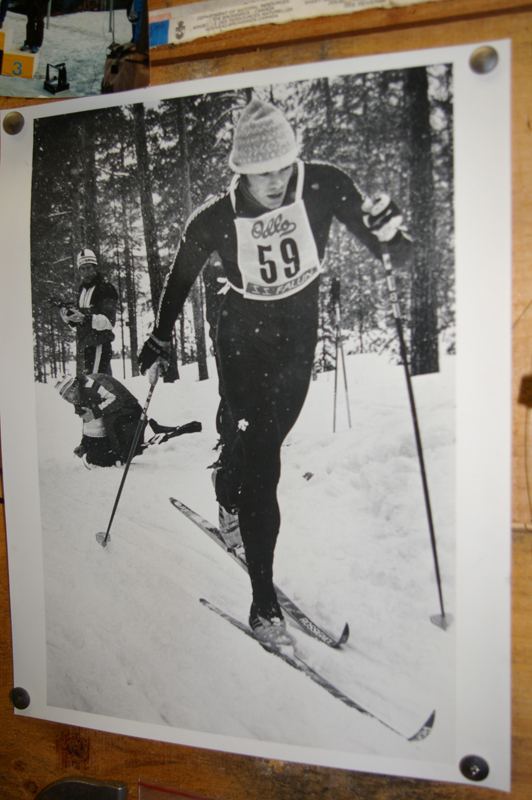
No, it’s not a clear photo image . . . but it’s worth it just to see Juha Mieto (FIN) in full flight.
In earlier ski racing generations there were no sprints, no mass start races, no multi-lap interval start races. When you raced cross country, it truly was cross country. We remember watching Bill Koch race the Olympic 50 k in Innsbruck: interval start, basically a one-lap course, HOURS of slow-burning effort on trails that disappeared into the woods and re-appeared hours later to deliver a winner to the finish line. Not many splits to be communicated, not much information from coaches, no jumbotron in the stadium, no real view of your rivals, almost no one else around: it was a test of individual fitness, talent, courage, and discipline. That’s the kind of course over which Thomas Wassberg (SWE) defeated his legendary teammate, Gunde Svan (SWE), by only 4.9 seconds after 50 kilometers of tortuous racing in Sarajevo in 1984. That’s the kind of course over which Wassberg and Juha Mieto (FIN) battled it out in Lake Placid in 1980: two guys going as fast as they can for 15 kilometers, only to be separated by .01 of a second at the end. Subsequently, the International Olympic Committee changed the rules so that no race would be decided again by so tiny a margin (Olympic cross-country races are now only timed to the tenth of a second, not the hundredth), but it’s still remarkable that it could’ve been so close between two separate men skiing so great a distance. The champions of yesteryear could dominate for years at a time. Today’s Norwegian champions seem to be caught in a revolving door . . .
Olympic silver medalist, overall World Cup Champion, and skating innovator, Bill Koch en route to winning a 1982 World Cup event in Italy.
I know, I know . . . we old-time reporters are ski-racing dinosaurs, and the examples we exhume are from what now seems like a different sport. But Norway is crushing everybody, and no one can explain why! Evidently, Norway has so many great new guys that they don’t even need the old guys. We might wonder where are all the Norwegian stars from the last few years of World Cup podiums? World Championship medals? Olympic relays? Where’s Sjur Rothe? Sindre Bjornstad Skar? Didrik Toenseth? We know that Klaebo is relaxing at home recovering from a recent bout of Covid (and nursing his ego from a distinctly-less-than-Klaeboesque performance last week in Ruka, Finland). We know that Emil Iverson is back on the Norwegian team (after a season of truly lackluster performances). We know that Hans Christer Holund retired over the summer (amid headlines that he was doing so in order to “make room” for other Norwegian up-and-comers). The question, then, is that if a champion drops out of the spotlight in Norwegian cross-country skiing, is it really worth it for the national team to attempt to bring them back? I mean, they’ve got plenty of guys who can finish top ten in the world. What’s the difference, really, who those guys are?
The U18 Girls field races through Wirth Park at the 2022 Junior Nationals in Minneapolis. Might this be where the next generation of world-beaters will be coming from? (Photo: David J Owen Photography)
The population of the Kingdom of Norway is roughly 5.5 million; just a bit smaller than the State of Minnesota’s 5.7 million. It stands to reason that Minnesota (with a gene pool not all that dissimilar to Norway) should be producing a team of cross country skiing world beaters. Perhaps they will! Perhaps Jessie Diggins is just the tip of the Minnesota iceberg! Perhaps the attention garnered by this winter’s Minneapolis World Cup will reveal a new generation of glitter-splashed world-beating snow-speedsters. If so, that new generation of bubbly Minnesotans is likely to possess a set of dance moves that Norwegians could never rival. If so, then cross country skiing might transition into something new all over again.
Damn. What a weekend for the U.S. Ski Team, with three podiums in three days of racing at the World Cup opener in Finland.
Erik Bråten, a Norwegian who coaches the Swiss ski team, joins Devon and Nat to recap and share his experiences across a range of international ski cultures. Send us questions, feedback and anti-vax screeds to: devon@fasterskier.com and nat@fasterskier.com — we’ve already got some questions stacking up for a mailbag episode in a few weeks. We’ll be back in a few days after the next World Cup weekend in Sweden.
Jan Thomas Janssen (NOR) pulled off an unlikely victory in his first World Cup start in three years during Sunday’s 20 k Freestyle Mass Start in Ruka, Finland. (Photo: Nordic Focus)
Jan Thomas Jenssen (NOR) hadn’t been entered in a World Cup race since 2020. On Sunday in Ruka, the highlight to Jenssen’s weekend of racing was expected to be his start in the 20 k, not his finish. But something strange was swirling in the chill Arctic air, and Sunday was one for the dark horses. In the final stretch of Sunday’s race that bent two unlikely skiers—Michal Novak (CZE), and the 27 year-old Jenssen—emerged from a pack of World Champions and Olympic medalists. Jenssen rounded the final corner on Ruka’s World Cup weekend to find no one—not one skier—between him and the finish line. Norwegian men would sweep the weekend, but they would do so with a most unlikely trio: Erik Valnes winning the Men’s Sprint on Friday, a 10 k Classic victory on Saturday from Martin Loewstroem Nyenget, and Jan Thomas Jenssen on Sunday.
Gus Schumacher led American finishers with a tremendous 16th place. Scott Patterson remained with Schumacher until the last, finishing 20th, while Zanden McMullen pulled up to the finish in 28th to round out a trio of Americans in the top 30. John Steel Hagenbuch scored the best result of his young World Cup career, taking 45th in just his fourth World Cup start. Zak Ketterson was 52nd, Luke Jager 68th, and Ben Ogden 71st. Among Canadians, Antoine Cyr finished 26th, Olivier Leveille 40th, Xavier McKeever 46th, Graham Ritchie 58th, Leo Grandbois 64th.
There are two substantial take-aways from the World Cup’s opening weekend in Ruka: (1) the Norwegian men’s team is still the dominant force in men’s skiing, animating almost all of the races and filling out most of its lead packs and sprint finals. (2) Ski racing is magical: terrain, weather, conditions, and circumstances can still align in such a way that an athlete who’s worked hard and steadily for years may, on any given day, find himself victorious.
Consider how Jan Thomas Jenssen ended up in the field Sunday. He had earned a single discretionary start from the Norwegian national team after a steady season’s-worth of races in last year’s Scandinavian Cup (the second-tier of FIS competition) in which Jenssen finished second. The Overall winner of the Scandinavian Cup earns an automatic World Cup bid for Period I. Last year, Jenssen’s countrymen Harald Oestberg Amundsen won the Scandinavian Cup; Amundsen also proved his mettle in Sunday’s action, ending up with a podium finish in third place. Jenssen likely wouldn’t have gotten a start in Ruka in any other year. For the first time since Ruka began hosting the World Cup opener 15 years ago, Sunday’s race was a mass start contest rather than a pursuit based on Saturday’s classic results.
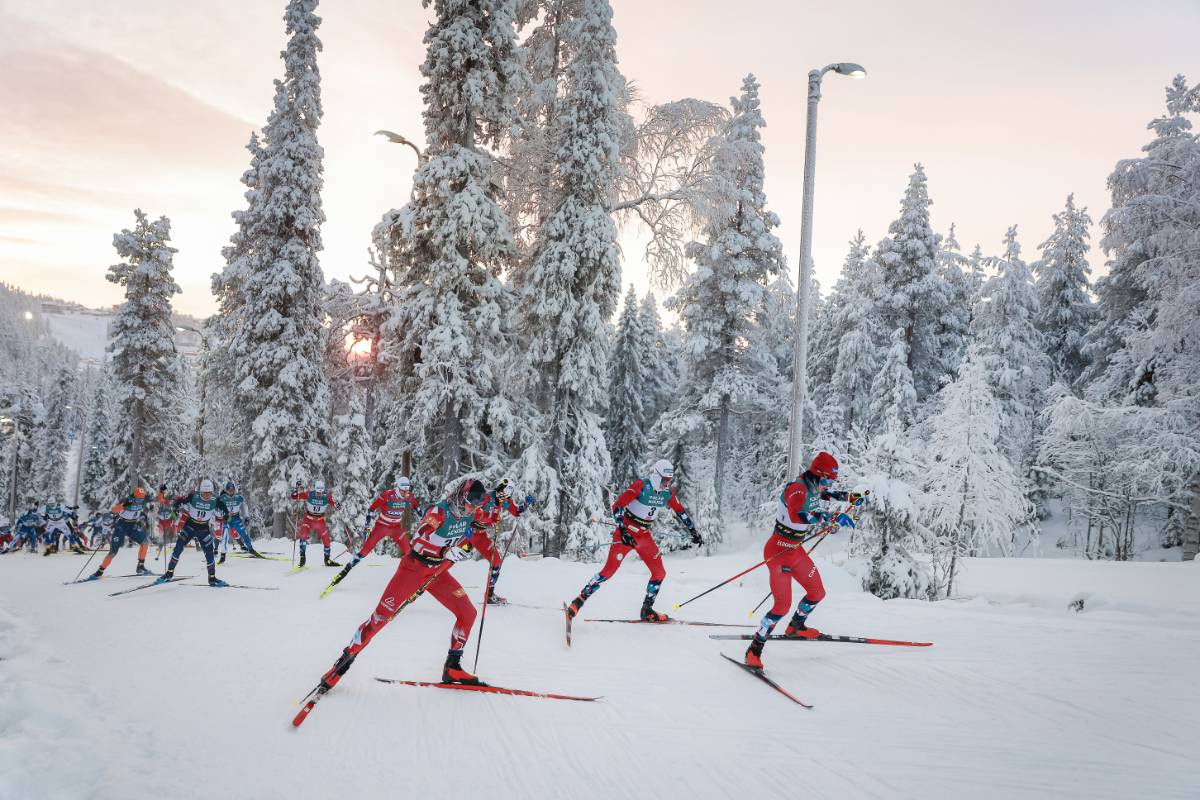
The men’s field on course in Ruka during Sunday’s 20 k Freestyle Mass Start. (Photo: Nordic Focus)
Also contributing to the potential for Jenssen’s unlikely victory was the form of the usual dominant figures in the men’s field. Johannes Hoesflot Klaebo was notably off-form for a third day in a row, helping pull a duo of Americans, Schumacher and Patterson, to a 16th place and 20th place, respectively, before easing across the finish line in 21st place. Saturday’s winner, Nyenget, followed an early agitation from Austrian Mika Vermeulen that left him out of the final running, while 2023 World Cup Distance Globe winner, Paal Golberg (NOR), was left struggling to maintain his place in the lead pack rather than searching for ways to drop it.
All these circumstances aligned for Jenssen: an all out effort, a World Cup win, and a loss for words. “I don’t even know what to say,” was Jenssen’s only statement to FIS media after the race, before he headed to his first ever podium on the sport’s biggest stage.
Men’s 20 k Freestyle Mass Start
There were other, bigger forces, at play on Sunday, too. Ruka’s 2.5 k course is composed of a long, steep, steady uphill, followed by a long downhill that wound into the stadium. In warmer, icy conditions, that set-up may have allowed break-away attacks to gain enough ground to snap the field on the downhill. This was Ruka, above the Arctic circle, in November, though. Cold, dry snow was the order of the day; as a result, the field largely acquiesced to the fact that the long downhill would serve to mitigate punchy efforts rather than help them succeed.
Ruka’s course conditions also allowed competitors, coaches, and wax technicians to worry less about the effects of the new non-fluoro wax protocols. After yesterday’s 10 k Classic, US Ski Team Coach Jason Cork said that the cold, powdery snow in Ruka—where fluoros and their characteristic moisture-resistance have the least effect—probably leaves open the question of the new wax protocols effect on skis. “It’s hard to know for certain [what the effect will be],” said Cork. “There are a lot of new products coming out—nearly daily—but our expectations going into the season was that the non-fluoro rule would create the least impact in cold, dry conditions like we’ve seen in Ruka.”
Gus Schumacher (USA) skied to 16th place in Sunday’s 20 k Freestyle Mass Start. “I’m in a solid place and can just kind of go with the flow and not do anything crazy from here,” said Schumacher of his results in Ruka. (Photo: Nordic Focus)
All of this created a mass-start race that stretched rather than snapped, as the field largely stayed together over the first 10 k. Some early action occurred when Mika Vermeulen (AUT) pressed the issue on the downhill leading into the stadium at the 5 k checkpoint. He was joined by Nyenget, but by 10 k the break-away was looking back, anticipating being gathered up by the pack. Through the early kilometers, Americans Schumacher, Patterson, Ogden, and McMullen remained in contact with each other, hovering around the 25th-30th spots in the pack.
By the 10 k mark, a pair of Frenchmen—Jules LaPierre and Hugo LaPalus—had started to push to the front in an apparent counter to the Vermeulen/Nyenget move, before Simen Hegstad Krueger (NOR) pushed into the final downhill in a move that animated the pack and created a split. By 12.5 k, there was a group of Norwegian’s at the front that slowly, but surely, was joined and punctuated by other nationalities. There were the Frenchmen, Britain’s Andrew Musgrave, Switzerland’s Beda Klee, Vermeulen, and Novak . A break occurred behind the first 15 skiers; this chase group was where Schumacher, Patterson, and notably, Klaebo, all ended up skiing for the final five kilometers.
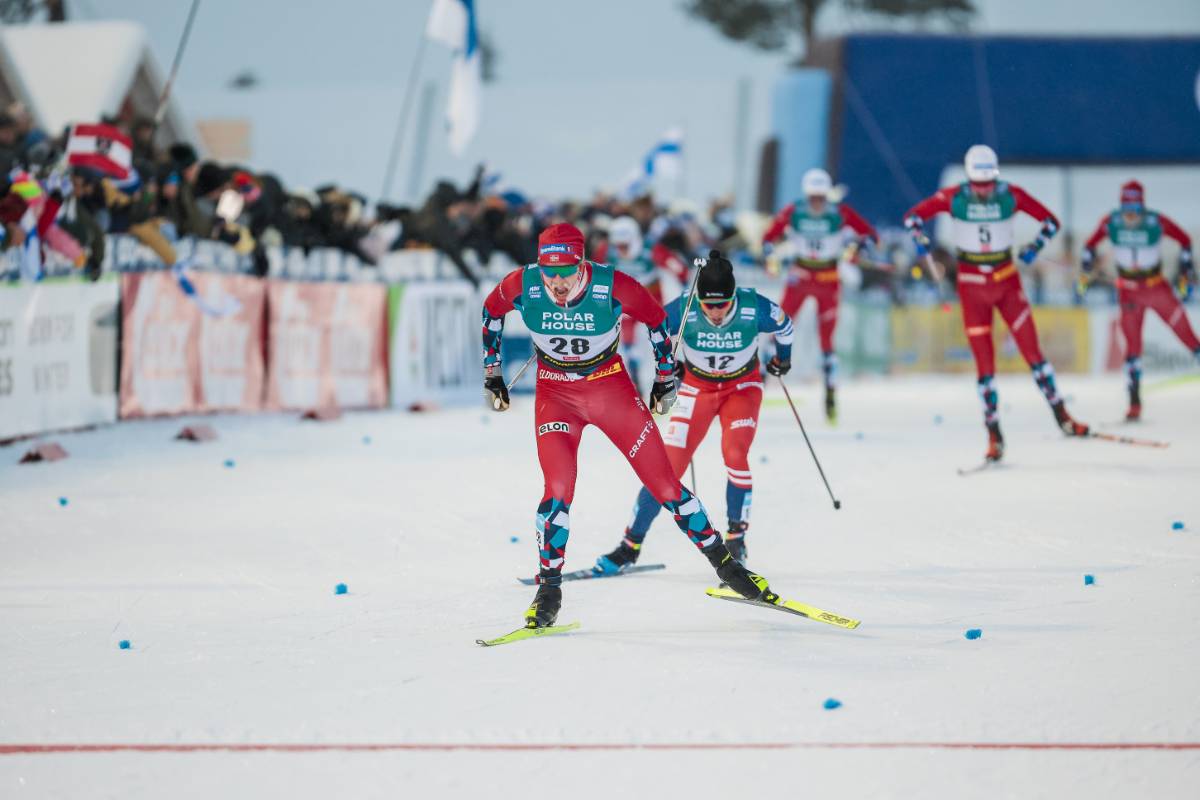
Jan Thomas Jenssen (NOR) sprints ahead of Micah Novak (CZE) to win his first ever World Cup. (Photo: Nordic Focus)
The lead group remained compact despite jockeying, with the decisive moment coming in the seventh lap. “The leaders surged or the bonus points, blasted through and kept going,” said Schumacher in post-race comments to FasterSkier. In the final run-in, true urgency set up a sprint. That’s when Novak took his shot, followed by Jenssen. The duo broke clear in a hop-skate towards the Ruka stadium, with Jenssen’s line allowing him to steer clear of Novak, and towards his own first ever World Cup win.
The American action for the day came in the chase group, where Schumacher was able to create a bit of separation and win the final push to 16th place. “I felt like if I tried to cover that [gap], I’d lose time up the big hill on the last lap,” Schumacher said. “So I just tried to relax into the final.” The result was Schumacher’s best-ever showing at the Ruka World Cup opener, marking an auspicious beginning to the Alaskan’s campaign. “The goal for Ruka is always not to stress too much about where I’m at,” said Schumacher. “But that’s easier said than done. Mostly, I’m just a little relieved to know I’m in a solid place and can just kind of go with the flow and not do anything crazy from here.”
The World Cup leaves Ruka to head even more North next week, setting up in the Swedish town of Gallivare for a 10 k skate followed by the season’s first Team Relay.
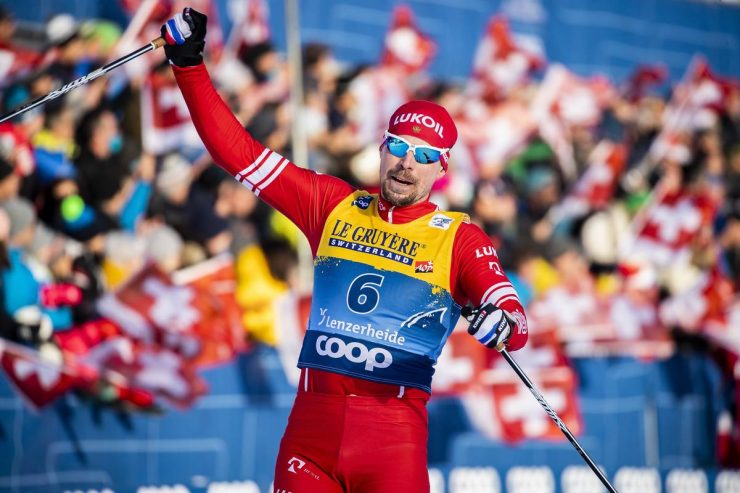
Ustiugov claims his 8th stage win in the opening event of the 2019/2020 Tour de Ski. (Photo: NordicFocus)
The starting corral was blocked by a wall of red before the start of the 15-kilometer mass start freestyle in Lenzerheide, Switzerland. Of the top ten ranked athletes, eight hailed from either Norway or Russia, interrupted only by Iivo Niskanen of Finland and Lucas Chanavat of France.
Johannes Høsflot Klæbo thanks his supporters before climbing into the second spot on the podium after the first stage of the 2019/2020 Tour de Ski. (Photo: NordicFocus)
Front and center was last year’s victor Johannes Høsflot Klæbo. He became the youngest Tour de Ski Champion at 22 years of age after holding off Russia’s Sergey Ustiugov who was gaining on the Norwegian throughout the final climb up the Alpe Cermis. It was clear in the final meters that there was no showmanship or gamesmanship in this performance; the young star was fully spent as he collapsed over the line.
Now an aged and wizened 23-year-old working on his tactics and gears in distance racing, Klæbo aspires to become the second man in history to win consecutive tours. Swiss athlete Dario Cologna did this in 2011 and 2012.
Klæbo is not a lock for this achievement — today’s opening stage made that abundantly clear. He will need to hold off the likes of Sergey Ustiugov and Alexander Bolchunov (RUS), Niskanen, Emil Iversen (NOR) and an otherwise deep field all vying for the same goal.
“I will try my best and I will count [my time] after the last day,” Klæbo told FIS during a pre-race press conference.
With the starting pistol marking the start of the nascent tour, the men began soaring around the course, through snow laden pine forest in front of high mountains emerging from their wreath of snow.
For the first 10 k, the field held strong in a long train. The top men, who stemmed from the first row of the start line, regularly exchanged the lead and the top 40 were separated by 10 seconds. Though the pace began to accelerate, the top ten were only spread by three seconds with 1.5 k to go.
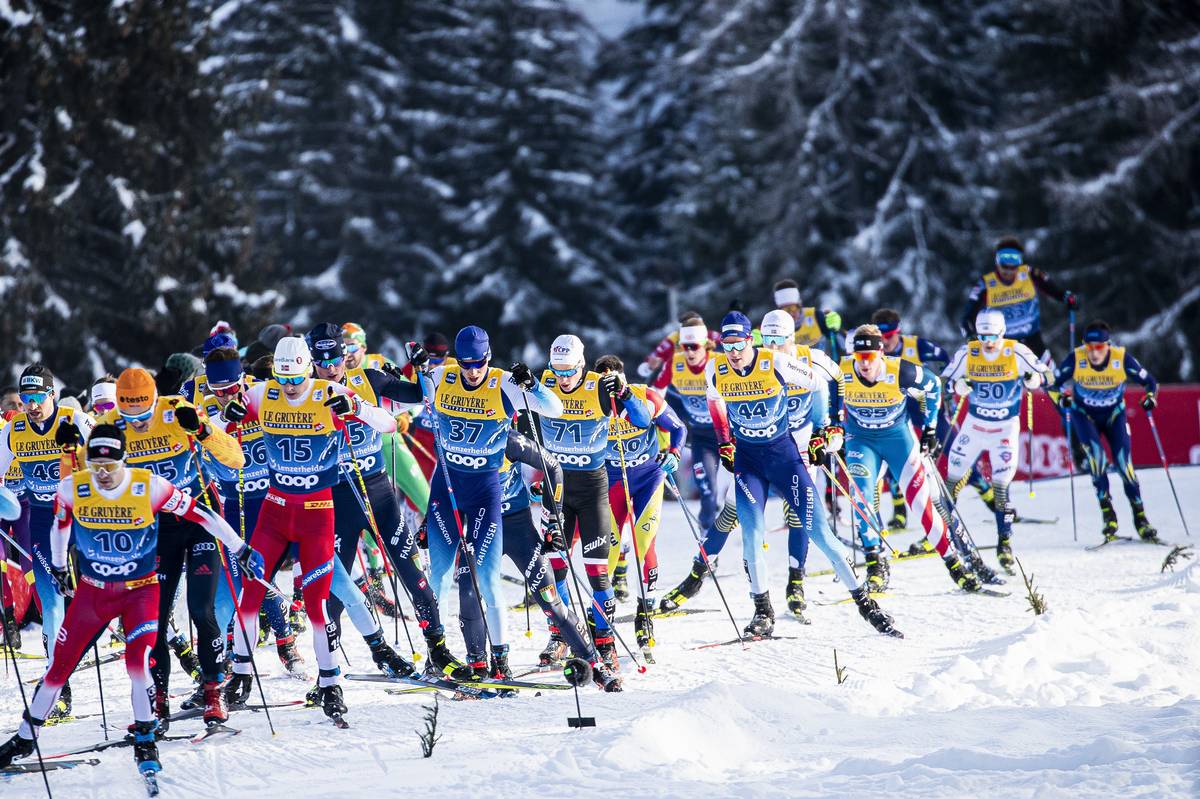
A dense pack of skiers during the first stage of the 2019/2020 Tour de Ski, a 15-kilometer mass start freestyle. Logan Hanneman can be found on the right side of the image wearing bib 85. (Photo: NordicFocus)
Moves and countermoves. With 1 k to go, Ustiugov took charge. He rocketed off the front to create a gap to the lead pack. His teammate Bolshunov was three seconds back, along with Cologne, Iversen, Klæbo, and their Norwegian teammates Simen Hegstad Krüger and Sjur Røthe.
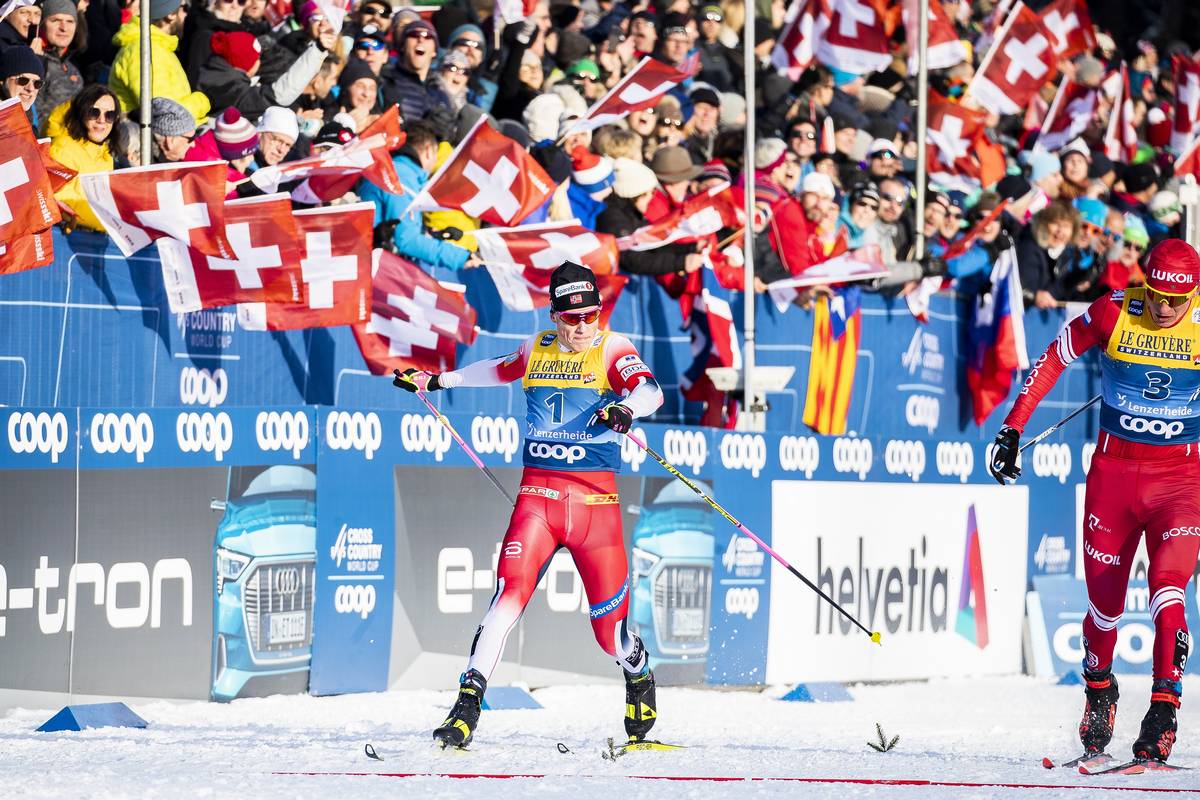
Ustiugov managed to maintain his gap and flew through the final straightaway in a confident V2. In the screen behind him was a pack of men whose final standings were far less certain. Klæbo and Bolshunov were dueling tête-à-tête in a sprint to the finish, sliding their boots over the line in sync for a photo finish. It was decided that Klæbo edged out his competitor for second, though he and Bolshunov will both enter the second stage of the tour four seconds behind Ustiugov.
Johannes Høsflot Klæbo (NOR) and Alexander Bolshunov (RUS) slide across the line in a photo finish at the end of the first stage of the Tour de Ski. (Photo: NordicFocus)
Iversen surged for 4th (+7.2) ahead of his countryman Martin Løwstrøm Nyenget (+8.6) who bested Tour de Ski veteran Cologna, Hans Christer Holund, Jan Thomas Jenssen, and Sjur Røthe in a five-way photo finish. Finishing in the order listed, the five men were separated by a margin of 0.4 seconds. Krüger rounded out the top ten one second later (+10.0).
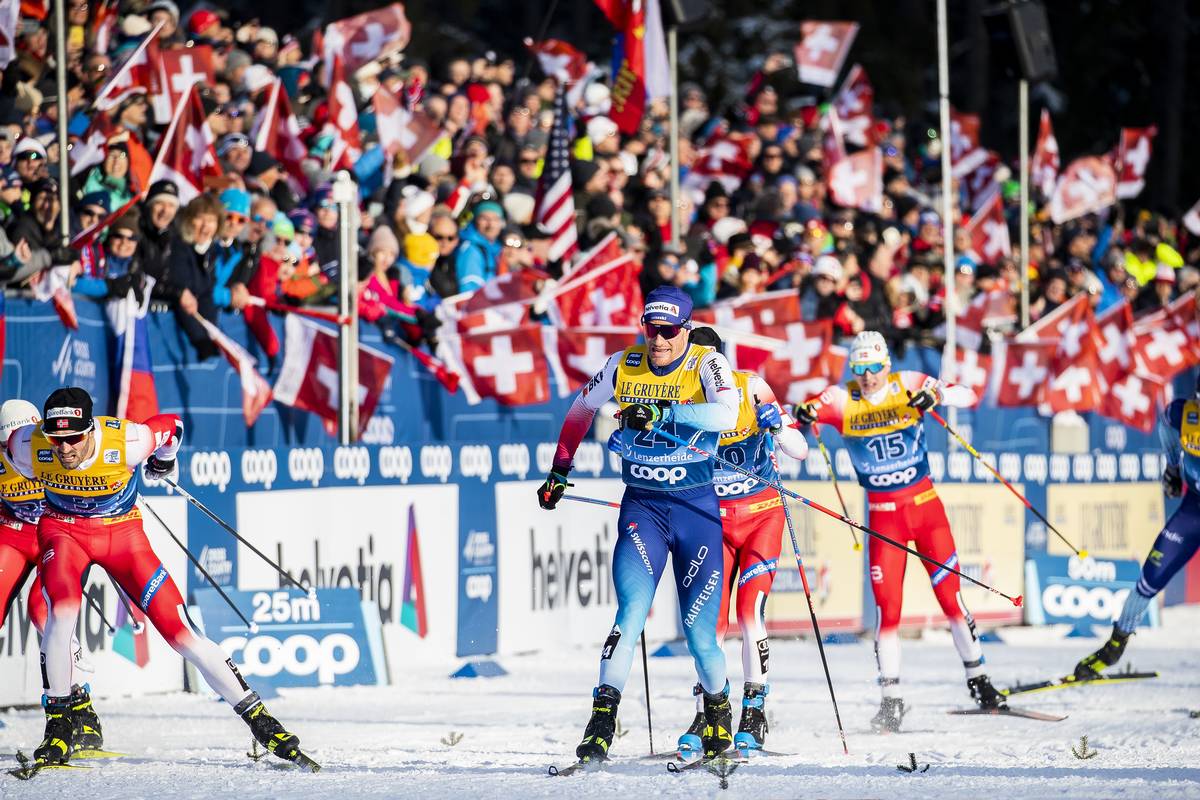
Dario Cologna (bib 24) finishes amongst a herd of men vying for position at the end of Stage 1 of the 2019/2020 Tour de Ski, a 15-kilometer mass start skate in Lenzerheide, Switzerland. (Photo: NordicFocus)
“It was a really good performance and the shape was okay,” Ustiugov told FIS through a translator at the finish. “It was for sure a pleasure to win the first stage and I wish to show the same results on the next stages. Big thanks to Russian fans because it’s a really big pleasure to hear Russian people [cheering] here in Switzerland. It’s great.”
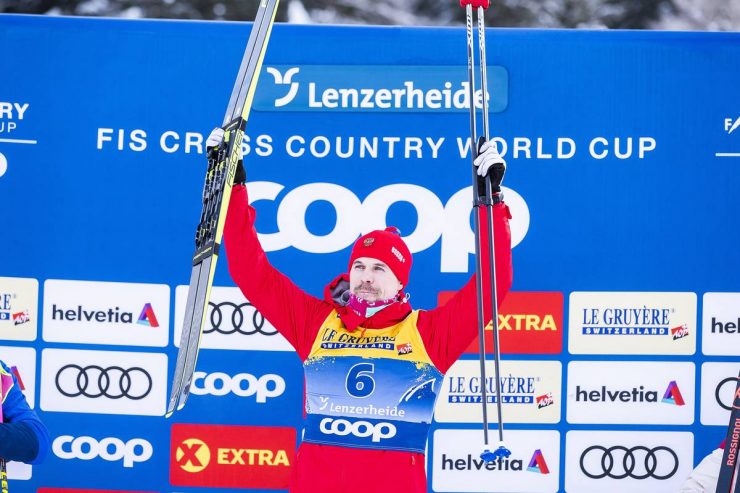
Russia’s Sergey Ustiugov celebrates his victory after the first stage of the 2019/2020 Tour de Ski, a 15-kilometer mass start skate. (Photo: NordicFocus)
Today’s victory marks the Russian’s eighth win in a TdS stage, advancing him to the second most behind Petter Northug who has 13 wins. The winner of the 2016/2017 TdS, Ustiugov has reached the overall podium in three of his last four rounds, only missing the final TdS podium in the 2017/2018 tour where he withdrew after the 5th stage. The Russian also won the first distance stage of last year’s TdS.
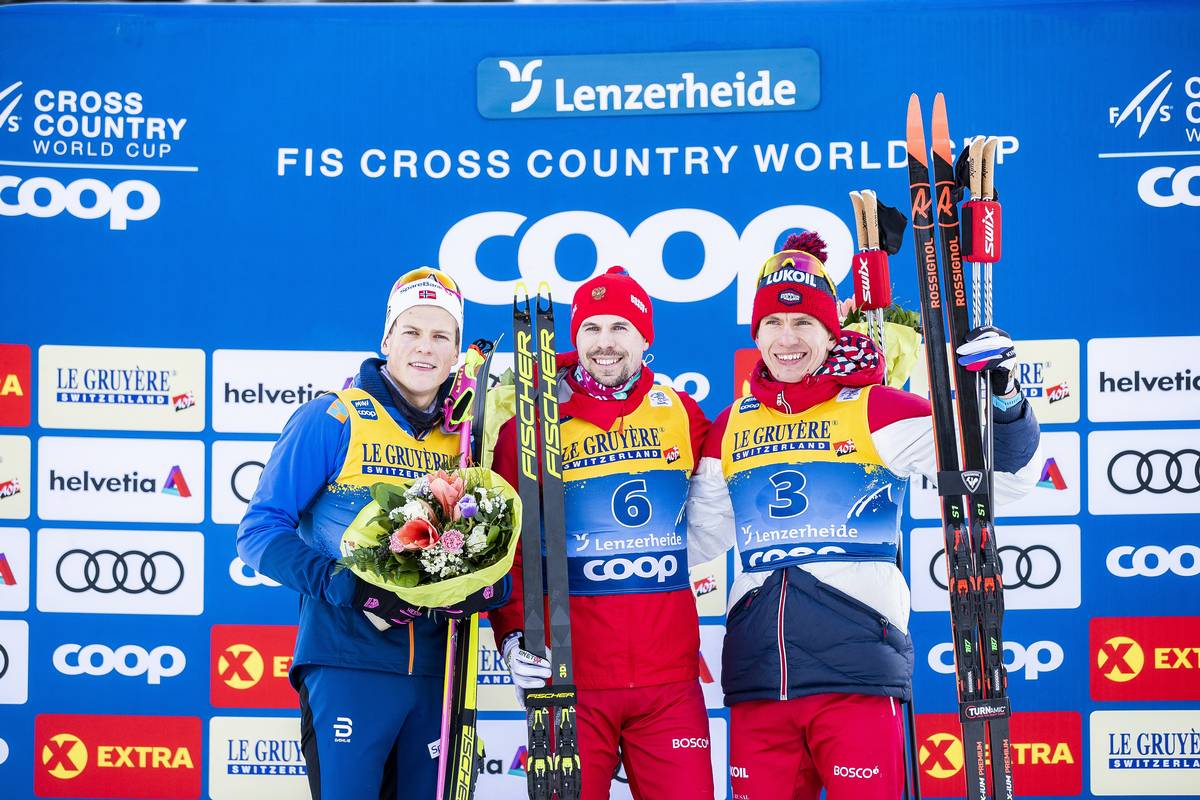
The men’s podium of the first stage of the 2019/2020 Tour de Ski, a 15-kilometer mass start skate in Lenzerheide, Switzerland. Sergey Ustiugov (RUS) took the win over Johannes Høsflot Klæbo (NOR) and Alexander Bolshunov (RUS) who were second and third, respectively, in a photo finish. (Photo: NordicFocus)
Three Americans started in Lenzerheide. David Norris finished as the top ranked American in 58th (+1:11.2). Kevin Bolger finished 64th (+1:35.0), followed by fellow Logan Hanneman in 69th (+1:42.1). Simi Hamilton was slated to start, but withdrew from the TdS due to a pulled muscle in his groin.
For the first nine kilometers, Norris hovered on the cusp of the top-30. After the race, Matt Whitcomb explained the energy-expenditure challenges of racing in this position, along with the strategy of sprint specialists Bolger and Hanneman.
Post-race interview with Matt Whitcomb on men’s performance.
“This was a fun mass start – fast and flowing,” wrote Norris explained an email after the race. “For the first 12km or so I felt really comfortable in the group. I tried to ski relaxed and avoid any of the chaotic crashes and tangles that seemed to occur each lap. With about 2 km to the finish I felt great and my skis were running well, but all of the sudden I bonked incredibly hard – got tunnel vision and struggled to avoid tripping on myself. It was a tough way to finish the race, but I’m optimistic I have better days ahead in this tour.”
Swiss flags flying against a breathtaking backdrop. Wearing bib 77, Kevin Bolger can be found at the center. (Photo: NordicFocus)
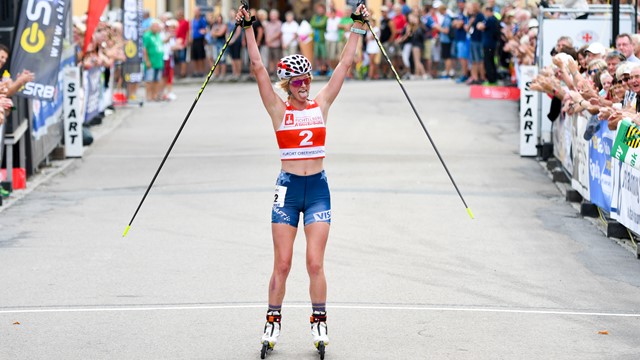
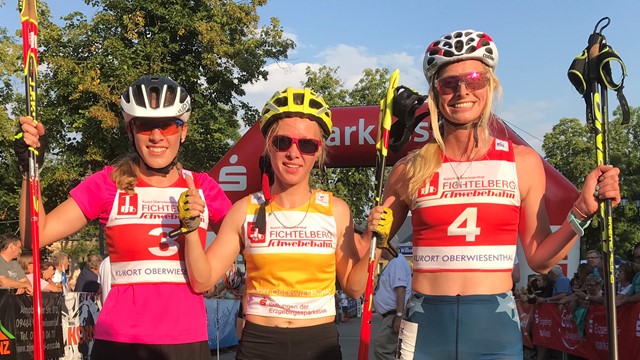
Tara Geraghty-Moats winning Sunday’s normal hill/5 k Gundersen at the 2018 Women’s Nordic Combined Summer Grand Prix in Oberwiesenthal, Germany. (Photo: Romina Eggert/FIS)
Two North Americans posted impressive results at nordic events in Germany and Norway over the last week, with Vermont native Tara Geraghty-Moats racing to first overall in the first-ever Women’s Nordic Combined Summer Grand Prix and Quebec’s Alex Harvey placing second, fifth and 10th in three races at the Toppidrettsveka rollerski series.
Geraghty-Moats 1st and 2nd at Inaugural Women’s NoCo Grand Prix
Brand new to nordic combined as well as the jump hill in Oberwiesenthal, Germany, Geraghty-Moats took the inaugural women’s Nordic Combined Summer Grand Prix by storm this past weekend, placing first and second in two competitions. That tied her for first place in the overall Grand Prix standings, alongside Russia’s Stefaniya Nadymova — the defending champion of last winter’s inaugural women’s Nordic Combined Continental Cup.
On Sunday, Geraghty-Moats, 25, of USA Nordic and the New York Ski Education Foundation (NYSEF), handily beat Nadymova and the rest of the 10-woman field after starting the 5-kilometer Gundersen rollerski race in second, four seconds behind Germany’s Jenny Nowak. While Nowak had posted the best jump of 96 meters on Oberwiesenthal’s 106-meter “normal” hill, Geraghty-Moats tied for the second-best-scoring jump (94.5 meters), with Austria’s Lisa Hirner (95 meters). From there, Geraghty-Moats dropped Hirner, Nadymova and Nowak on the first of three laps in the rollerski race and went on to finish in 11:04.8. Nowak ultimately placed third, 1:29.2 behind Geraghty-Moats.
“I was really satisfied by how my first weekend of being a nordic combined-er went, and I think the patience of waiting to be a nordic combined-er really paid off,” Geraghty-Moats told the International Ski Federation (FIS) after. “I struggled with the jump a little bit the first couple days. I had never jumped this hill before, and I sort of figured it out today so I got to ski a little bit easier than yesterday, but I was also happy that yesterday I was able to have a good fight and ski fast to my potential and end up on the podium.”
The women’s individual normal hill/5 k Gundersen podium on Saturday at the 2018 Women’s Nordic Combined Summer Grand Prix, with Russia’s Russia’s Stefaniya Nadymova (c) in first, American Tara Geraghty-Moats (r) in second, and Germany’s Jenny Nowak (l) in third in Oberwiesenthal, Germany. (Photo: FIS/Silke Tegethof)
“It was a dream come true to finally be able to compete in women’s Nordic Combined on an international level,” Geraghty-Moats told FIS on Saturday. “I’m using this weekend to learn the level I have to be at to have success in Nordic Combined. I made some mistakes today and learned a lot but I came away with a good result and having had a huge amount of fun competing with small but strong field.”
Eleven women competed in Saturday’s normal hill/5 k.
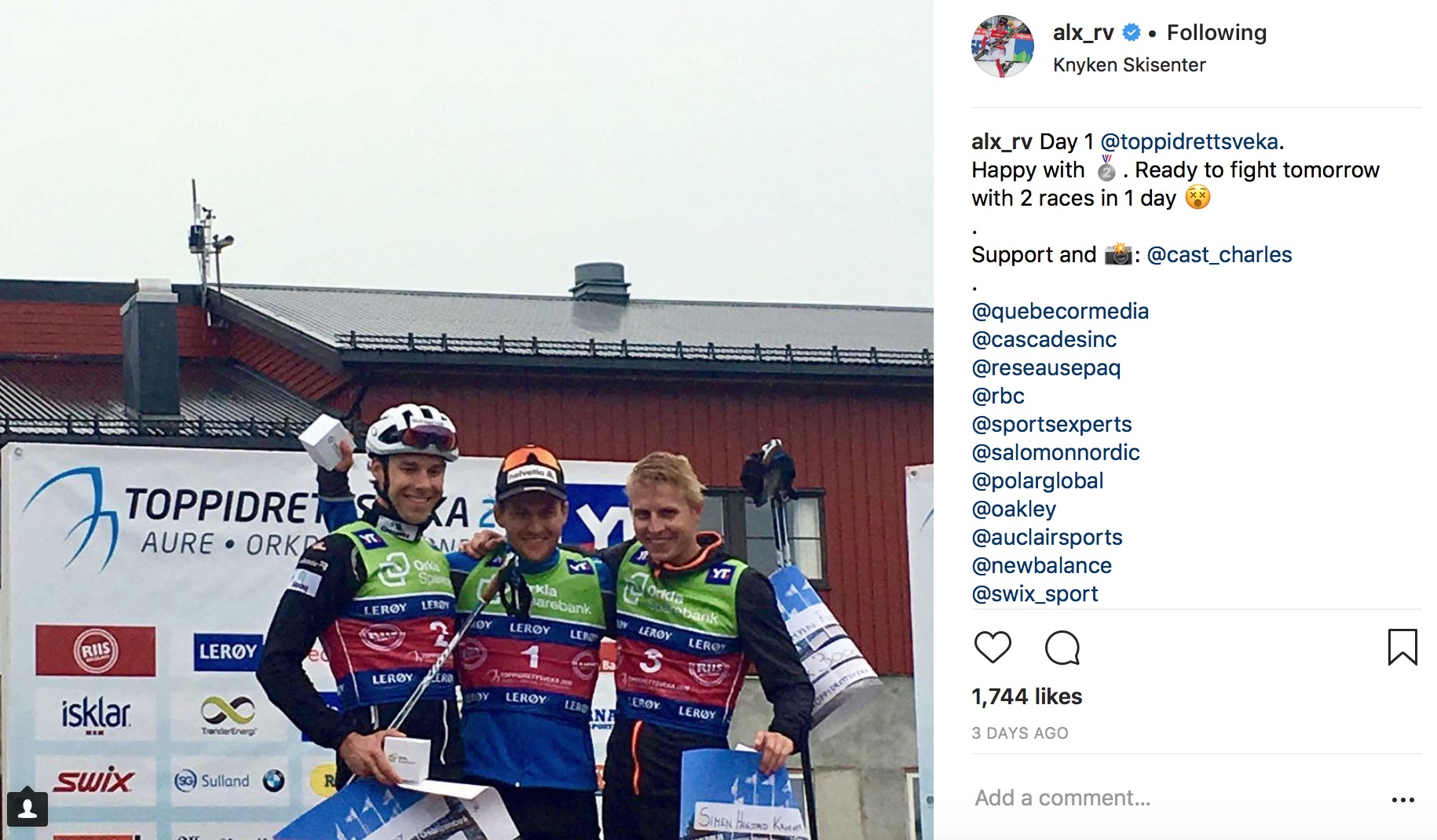
Alex Harvey (l) on the podium with Roman Furger (c) and Simen Hegstad Krüger (r) at the 2018 Toppidrettsveka rollerski festival in Norway last Thursday, Aug. 16. (Photo: Alex Harvey/Instagram)
At the Toppidrettsveka rollerski festival in Norway, Canada’s Alex Harvey raced to second in the 15 k skiathlon last Thursday in Orkdal, missing out on first by just 0.6 seconds to Switzerland’s Roman Furger, who won in 30:43.3. Norway’s Simen Hegstad Krüger, the reigning Olympic skiathlon champion, finished third, 1.5 seconds back. In a stacked international field of 125 men, Canada’s Evan Palmer-Charrette placed 75th in that race (+2:14.4), Bob Thompson was 84th (+2:32.7), and Scott Hill 89th (+2:52.5).
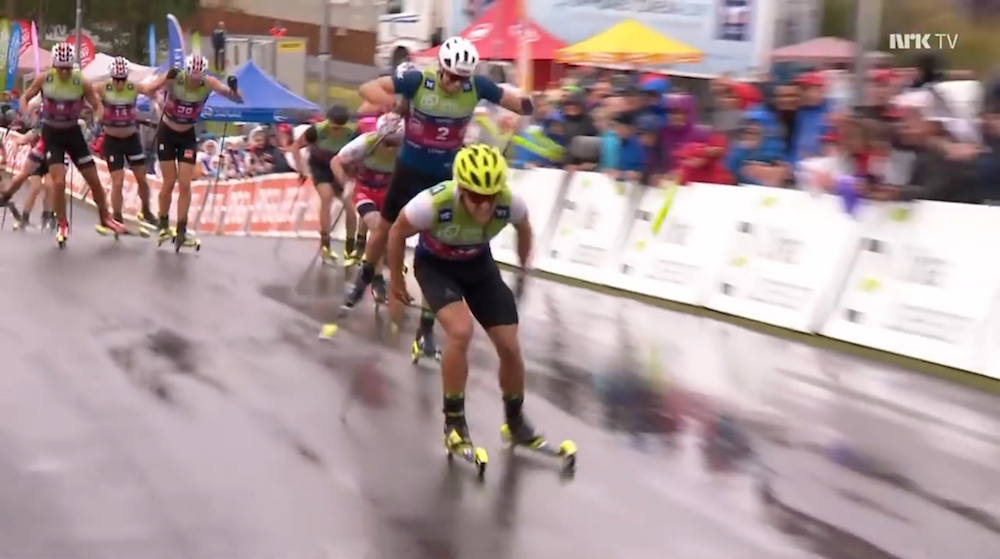
Canada’s Alex Harvey (2) gunning for first in the men’s 15 k skiathlon on Aug. 16 at the Toppidrettsveka rollerski festival in Orkdal, Norway. (Screenshot: NRK broadcast)
Heidi Weng beat her cousin Tiril Udnes Weng by 0.7 seconds in the women’s 10 k skiathlon that day, finishing in 22:52.1. Norway swept the top five of the women’s race, with Anne Kjersti Kalvå reaching the podium in third (+1.3), and national-team members Kathrine Harsem and Astrid Uhrenholdt Jacobsen placing fourth (+1.4) and fifth (+1.5), respectively, out of 43 women.
In the men’s 24 k classic mass start aroundAure/Brekka on Friday, Harvey finished fifth, 19 seconds after Krüger, who won in 59:57.5. Norway’s Hans Christer Holund placed second in that race (+2.6), Norway’s Magnus Stensås was third (+13.0), and Switzerland’s Dario Cologna fourth (+17.1). Also for Canada, Palmer-Charrette finished 61sth (+2:30.9), Hill 78th (+4:02.3), Thompson 86th (+5:40.3), and Maks Zechel 88th (+7:01.4) out of 125.
Heidi Weng repeated in first in the women’s 24 k mass start, finishing in 1:10:02.4 hours, while Tiril Udnes Weng again placed second, 25.4 seconds back, and Jacobsen reached the podium in third (+27.7).
Later on Friday in Aure, Norway’s Sondre Turvoll Fossli topped the men’s freestyle sprint final ahead of four other Norwegians, including Pål Trøan Aune in second and Jan Thomas Jenssen in third, and Switzerland’s Furger in fifth, while Harvey did not qualify for the heats and ended up 37th overall. Palmer-Charrette was once again 61st in qualification, Hill 107th and Thompson 109th out of 121.
In the women’s sprint, Norway’s Mathilde Myhrvold won the final in 2:56.54, 1.05 seconds ahead of Slovenia’s Katja Visnar in second. Heidi Weng placed third in the final (+1.97), ahead of Tiril Weng (+2.64) in fourth, another Norwegian Anna Svendsen in fifth (+2.76), and another Slovenian Alenka Cebasek in sixth (+3.73).
In the final race of the series, the classic pursuit on Saturday, Harvey started second, 10 seconds behind Furger in first. The Canadian went on to place 10th, 4.2 seconds out of first, in the 15 k race, while Stensås took the win in 37:45.5 after starting seventh. (Furger slipped to 55th and 1:55.5 behind at the finish.) Norway’s Mikael Gunnulfsen rose from eighth to second (+0.7) and France’s Jean-Marc Gaillard made it all the way up to third (+1.7) after starting 15th.
Palmer-Charrette finished the pursuit in 59th (+2:04.2), Thompson placed 80th (+2:55.2), Hill 87th (+3:41.5), and Zechel 93rd (+3:48.9) out of 105.
Jacobsen ended the weekend as the women’s 12 k mass start winner, after the entire women’s field (of 33) started at the same time. She crossed the line first in 34:20.8, 0.4 seconds ahead of Heidi Weng in second and 1.2 seconds ahead of Kalvaa in third.
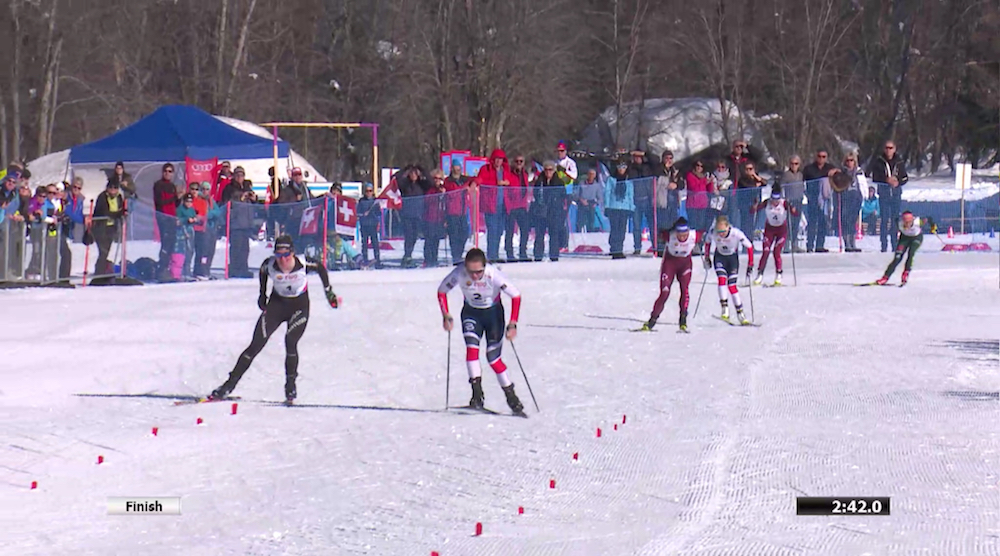
Norway’s Tiril Udnes Weng (second from l) and Switzerland’s Nadine Fähndrich (l) battle for first down the finishing stretch of the women’s final for the gold medal in the U23 World Championships skate sprint in Goms, Switzerland. Weng won it by eight-hundredths of a second. (Screenshot: Swiss Ski livestream)
(This article has been updated to include comments from Canada’s Laura Leclair, Katherine Stewart-Jones and Maya MacIsaac-Jones, as well as American Julia Kern.)
U23 World Championships (Goms, Switzerland): Freestyle sprints
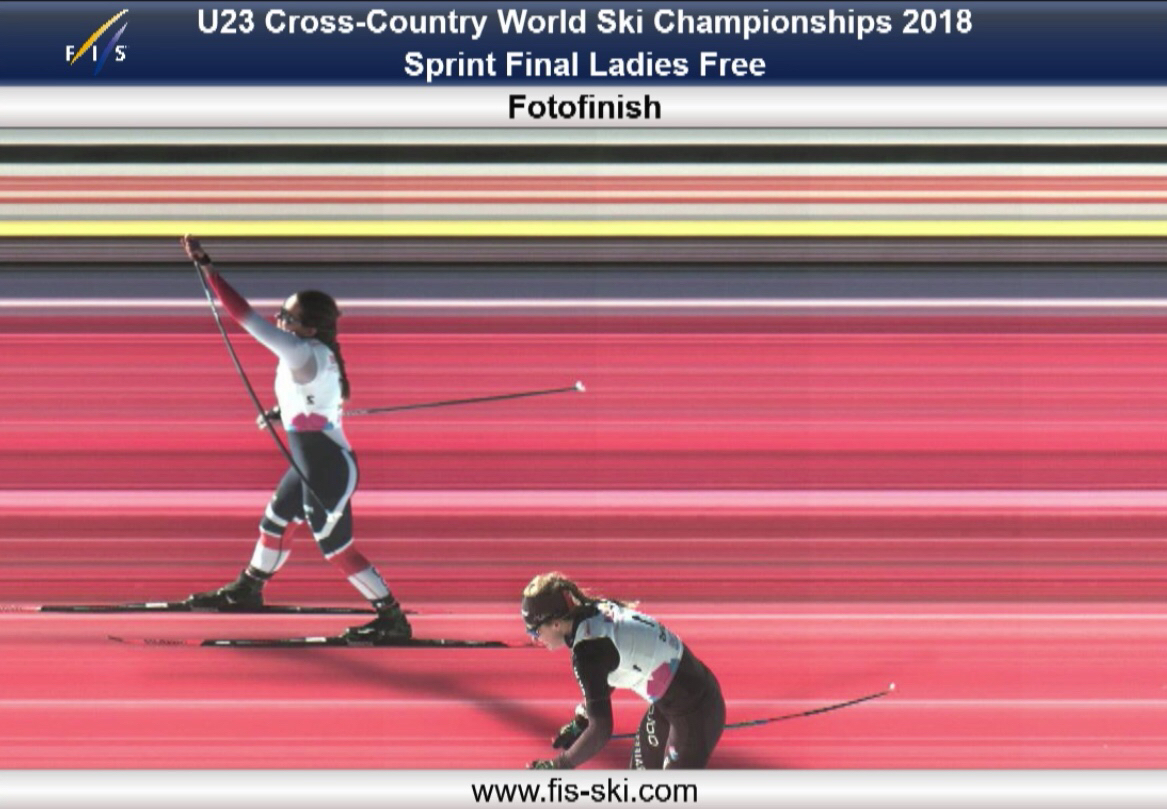
On the first day of U23 World Championships racing in Goms, Switzerland, Norway’s Tiril Udnes Weng tallied her first individual world title in the women’s 1.2-kilometer freestyle sprint, winning the A-final in 2:50.24 minutes, just 0.08 seconds ahead of Swiss World Cup regular Nadine Fähndrich in second. Another World Cup skier, Natalia Nepryaeva of Russia finished third, 4.78 seconds out of first.
Weng, 21, is no stranger to World Cups, either. Just two days ago, she qualified 11th in the World Cup skate sprint in Seefeld, Austria, and went on to place 17th overall.
On Monday, she qualified second, 0.2 seconds off Fähndrich’s top qualifying time of 3:03.51. Weng then placed second to Nepryaeva in the fourth quarterfinal, a heat that included Canadians Maya MacIsaac-Jones and Katherine Stewart-Jones, both of the Canadian National U25 Team. While Sweden’s Moa Olsson finished third in that quarterfinal and advanced as a lucky loser based on time, the two Canadians did not. MacIsaac-Jones had previously qualified in 19th and Stewart-Jones in 22nd. Overall, MacIsaac-Jones placed 18th and Stewart-Jones was 23rd on the day.
In an email, MacIsaac-Jones explained her goal had been to make the semifinals.
“My strategy was to stick behind the top two girls, and hang on as best I could,” she wrote of her quarterfinal. “As Canadians we tend to be pretty good at downhilling, so I tried to use that to my advantage. I wasn’t quite able to stick with the top girls over the crest of the big hill, but I was happy to be fairly competitive in the heat overall!”
Still, the top 20 was her best result in her fourth trip to Junior/U23 Worlds.
“I’m disappointed of course to have missed out on making the semi-final, but I feel I did the best I could with what my body had on the day so I’m happy with that,” she continued. “It was of course exciting to get my first top-20 , but also disappointing because I felt like my body wasn’t moving as well as it was at trials a few weeks ago (I got sick right after arriving in Europe which probably didn’t help with that).”
For Stewart-Jones, this marks her fifth Junior/U23 World Championships.
“Over the years I have learned that it’s just another race, and that I don’t need to treat it any differently,” she wrote in an email on Tuesday. “Coming into te race I knew that I was in the best shape I’ve been all year, but I also had only done one skate sprint qualifier and no heats) this year so I wasn’t sure what to expect.”
Her goal had been to reach the semifinals and finish in the top 12.
“I am happy with how I skied the qualifier. The quarterfinal was tough,” Stewart-Jones wrote. “My teammate Maya and I ended up being in a really fast heat. I felt like I skied well technically but I don’t think I skied it how I needed to to have a chance of moving on. I tried holding on to the top 2 girls over the top of the first hill and ended up losing time on the second… I think it would have made more sense to lay back a bit over the top of the first to save some gas for the end.”
Stewart-Jones as well as MacIsaac-Jones came incredibly close to making Canada’s 2018 Olympic team based on their results at NorAm trials earlier this month.
“Overall, I am happy with how the body feels but disappointed with how I skied tactically,” Stewart-Jones wrote. “Not making the Olympic team was definitely more frustrating than it was disappointing. The whole ordeal was a bit exhausting, with first missing out on the 4th spot by less than a second and then being 12th on the list of [11] quota spots, it was really as close as it gets. I’m doing my best to fuel that frustration into positive energy so that I can perform at my best here. I am really looking forward to the next 2 races!!”
Norway’s Tiril Udnes Weng (l) and Switzerland’s Nadine Fähndrich in a photo finish for first in the women’s freestyle sprint final at U23 World Championships on Monday in Goms, Switzerland. Weng won it by eight-hundredths of a second. (Screenshot: Swiss Ski livestream)
Fähndrich won both her quarterfinal and semifinal leading up to the final, and Weng won the second semifinal by 0.59 seconds over Nepryaeva. In the final, Weng had the edge.
“I dream about winning, that’s the goal of my season,” Weng said during a post-race interview in the arena. “So it felt good to win.”
Three Canadians made the heats, with Laura Leclair of the Pierre-Harvey National Training Centre (CNEPH) qualifying in 26th then placing third in her quarterfinal, 2.75 seconds behind German winner Nadine Herrmann. That put Leclair 15th overall on the day in her first U23 World Championships race.
“As it is my first time at Worlds and my first year in a big category (U23) I was coming here for experience,” Leclair wrote in an email on Tuesday. “Experience to ski internationally, in Europe and against the best. Of course, I was hoping to perform but I never anticipated a top 15.
“Since I was seeded 30th, I was a little skeptical of making it through the qualifier,” she continued. “Qualifying 26th was a very exciting moment.”
In her quarterfinal, she said the pace didn’t pick up until about halfway up a long uphill out of the start, a climb that lasted for about a minute and a half.
“I was in a strong position (4th) but it was hard to make my way to the top,” Leclair wrote. “At the top of the big hill, a girl broke a pole and I was able to pass her and push over the hill into the downhill in order to come closer to the two girls in front. The last uphill felt like it was just give or take. Obviously, I chose the give option and gave it all I had into the finish. My heat wasn’t one of the fastest so I wasn’t a lucky loser but I am very happy of how I skied that course.
“This season has been full [of] surprise,” she concluded. “Just qualifying for Worlds in Canada was one! I am very happy that all my efforts and my dedication to the sport are paying off. For the rest of the week, I want to have some strong races, especially in the skiathlon and maybe surprise myself again.”
Two Americans qualified in the top 30 as well, with Lauren Jortberg (Dartmouth Ski Team) in 14th and Julia Kern (U.S. Ski Team/Dartmouth/Stratton Mountain School T2 Team) in 21st. Jortberg went on to finish fifth in her quarterfinal, 7.28 seconds behind German winner Pia Fink, and Kern finished sixth in Fähndrich’s quarterfinal, 22.28 seconds out of first. Overall, Jortberg placed 22nd and Kern was 27th.
In an email, Jortberg, who competed at U23 World Championships last year at Soldier Hollow in Midway, Utah, explained her goal was to qualify for the heats.
“I honestly had no idea what to expect in Goms this year because Soldier Hollow felt just like US Nationals and the Super Junior National Qualifiers I’d been going to for the past ten years,” Jortberg, a Dartmouth College sophomore, wrote on Monday. “Obviously the competitors from all over the world was different, but was easy to visualize what is going to be like. The venues are similar in many ways because there are very few trees making it very open and a great spectators course.
“A big difference between Goms and Soldier Hollow is the little towns everywhere,” she continued. “The first ski we did here, we skied through the roads and through a town. There are ski trails everywhere here, we could even ski from the venue to the hotel (which is pretty far)! For the ski courses, I think Goms is one of the most challenging ski courses I’ve ever raced on. There are huge climbs are incredibly technical downhills! Its a one of the most exciting places I’ve ever raced, I love it so much.”
As for her racing on Monday, she wrote that she was “really psyched because I felt really strong and smooth in the qualifier! I was a bit bummed because I had to scrub a fair amount of speed skiing behind a girl I caught on the really technical downhill. The heats were really fun!! I had a great starting position and skied really smooth up the big climb. Then I took a very gutsy move on the downhill to sling shot into first place on the inside corner around the downhill turn. Unfortunately right after that I got caught up in a tangle on the last climb, and then I lost contact with the lead group. I was bummed to get caught up in a tangle, but it was really cool to be able to ski with these girls!”
Overall, Jortberg described the day as “pretty incredible.”
“My motto has always been that sprints are funny because ‘anything can happen’ for the good and bad!” she added. “I’m pretty excited for the rest of the week of racing even though this race was my main target. These courses play really strongly to my strengths so it should be fun to see what I can do!”
Kern explained in an email that she’s been sick for the past month so her main goal was to start Monday’s race. But for a long time leading up to this race, she had envisioned a top 10.
“Regardless of how I was feeling, one of my goals was to ski with good technique because that is something you can always control,” Kern wrote. “I was pretty content with my qualifier, given being sick. Skiing out there today, I had no idea if I would surprise myself and my illness wouldn’t impact my skiing or if I was just going to feel absolutely terrible. I was happy with how I placed given how I felt.”
In the heats, she wanted to stay in contact with leaders up the course’s big climb, then try to “drop the hammer on the downhill and last uphill.”
“However, my quarterfinal did not play out that way,” she wrote. “The pace was hot from the start, with bib #1 [Fähndrich] gunning from the start. I stuck with the heat until part way up the first climb, where I started to lose the leaders. I did not feel good and I had no energy so I was not able to hold the pace of the other competitors. I had considered not doing the heats because I felt pretty wiped after the qualifier, but the competitor inside me couldn’t just walk away from my favorite thing—sprint heats.
“Given my current health state, I feel okay about my day, but I am obviously bummed because this was the race I was looking forward to most this season,” Kern added. “I am looking forward to getting healthy in time to race the 10k classic, or at the very least the skiathlon!”
Also for the U.S., Lydia Blanchet missed qualifying by 0.32 seconds in 32nd, as did Canada’s Sophie Carrier-Laforte, who was 3.68 seconds out of the top 30 in 34th. American Nicole Schneider finished 44th.
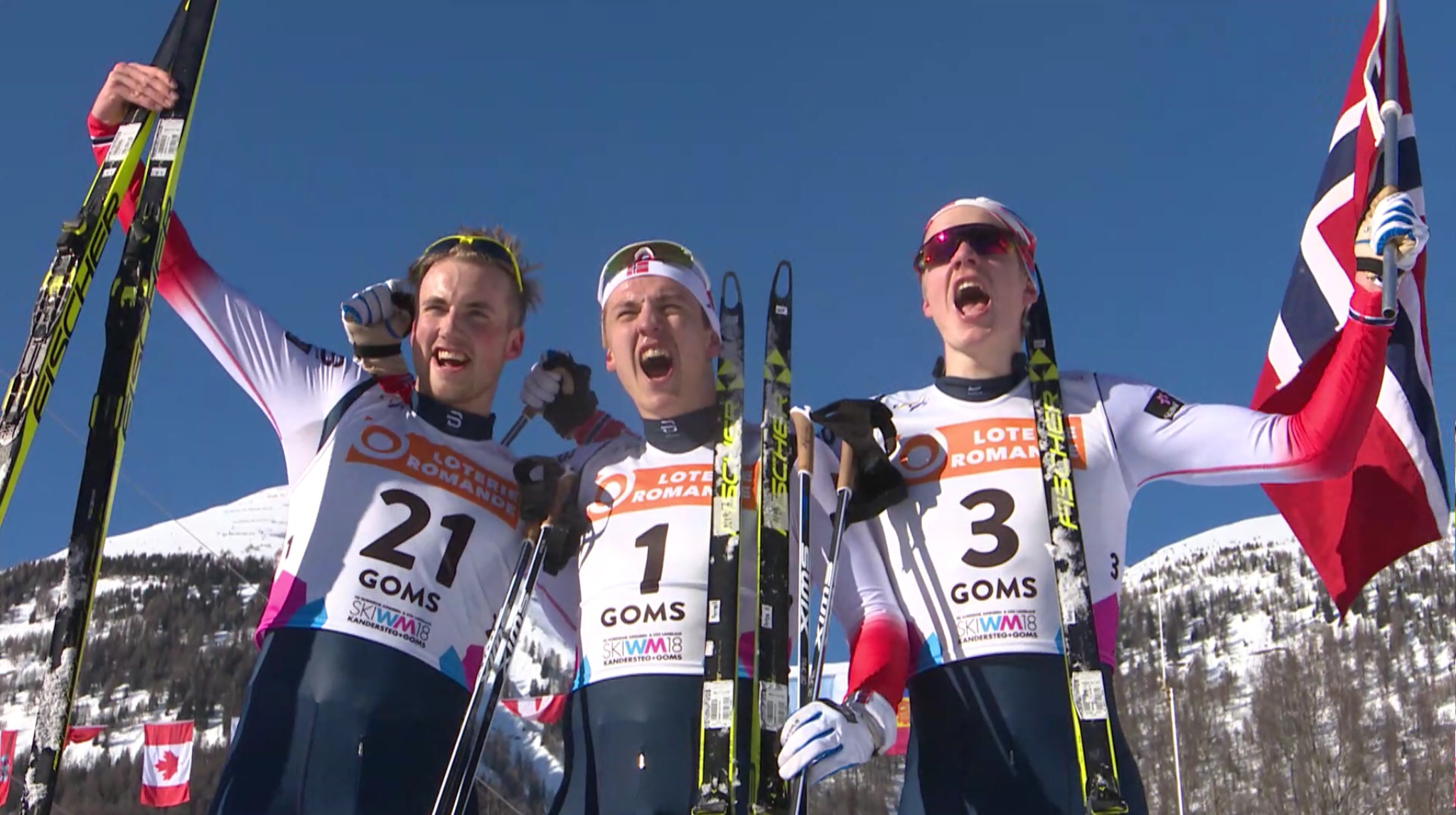
The all-Norwegian men’s freestyle sprint podium on Monday at U23 World Championships in Goms, Switzerland, with Erik Valnes (c) in first, Jan Thomas Jenssen (l) in second and Even Northug (r) in third. (Screenshot: Swiss Ski livestream)
In the men’s 1.5 k skate sprint on Monday, Norway swept the men’s podium, with Erik Valnes winning his first World Championships medal in 2:56.38, Jan Thomas Jenssen finishing 0.24 seconds back in second, and Even Northug placing third (+6.34).
For the 21-year-old Valnes, this marked his first U23 World Championships (or Junior Worlds for that matter). He’s competed in two World Cup sprints this season, placing 22nd in the skate sprint earlier this month in Dresden, Germany, and 27th in a classic sprint in December in Lillehammer, Norway.
Valnes started Monday by winning the qualifying round in 3:00.18, by 0.77 seconds over Sweden’s Anton Persson, then won his quarterfinal and semifinal, both by nearly half a second, before besting his fellow Norwegians in the final.
“Fun to take the gold medal at the end,” Valnes said during a televised in-arena interview after the final. “It was my biggest goal this year, so it means a lot, of course. A gold medal is always good to have.”
No North American men qualified for the heats. Canada’s Ricardo Izquierdo-Bernier placed 40th, Antoine Briand was 41st, Philippe Boucher 42nd, and Olivier Hamel 60th.
For the U.S., Bill Harmeyer finished 46th, Andrew Egger was 47th, Thomas O’Harra 64th, and Zak Ketterson 65th.
Anne Hart (SMST2) racing at last year’s 5 k classic FIS race in West Yellowstone, Montana, where she finished 12th. A year later, Hart placed 19th in the Beitostølen, Norway, 10 k freestyle race. (Photo: Ian Harvey/Toko)
In one weekend of racing, Anne Hart has already learned a lot, the types of things you can only learn from careful observation and reflection. And for Hart, a 25-year-old member of the Stratton Mountain School (SMS) Elite Team, the season doesn’t truly begin until Dec. 2.
After racing to 19th in the women’s 10-kilometer freestyle individual start on Sunday in Beitostølen, 2:41.9 minutes behind Norwegian winner Marit Bjørgen, Hart talked about being inspired by numerous speedy Norwegians there — many of which are gunning for a spot on Norway’s World Cup team.
Hart ventured to Norway earlier this month to jumpstart her season before heading back to the U.S. to race the SuperTour opener in West Yellowstone, Montana, Dec. 2-3. In two previous races in Beitostølen on Friday and Saturday, she finished 31st in both the 10 k classic and classic sprint.
On Sunday, she resolved to leave it all out there, just as she’d seen Norwegian World Cup regular Finn Hågen Krogh do.
“Today we were watching the men’s race [before our race], and we watched Finn Hågen Krogh halfway up the hill the last time, the third time. I kid you not, he just stopped, bent over and he went on and finished fifth,” Hart reflected. “He went out hard, he blew up, but he made up so much time at the beginning that he just had to make it in.”
That’s precisely what Hart’s been working on.
“I really just pushed it from the go,” she said of her race. “After watching the [top] women start the classic race [on Friday], and then watching how fast they go in the sprints [on Saturday], there is just no easy pace out there … You just keep on going, and you suffer. But the harder you suffer the faster it is over.”
The women’s podium (and top six) after Sunday’s 10 k freestyle in Beitostølen, Norway, with Norway’s Marit Bjørgen (1) in first, Ragnhild Haga (2) in second, Heidi Weng (3) in third, Ingvild Flugstad Østberg in fourth, Astrid Uhrenholdt Jacobsen in fifth, and Tiril Udnes Weng in sixth. (Photo: Aleks Tangen)
Hart finished her 10 k, in what she described “beautiful skiing” conditions, in 26:37.1. Bjørgen raced to first for her second distance win of the long weekend in 23:55.2, 12.6 seconds ahead of Ragnhild Haga in second place. Norway once again swept the podium with Heidi Weng in third, 30.1 seconds behind Bjørgen.
“It’s a course that doesn’t have a lot of rest in it … basically I was just trying to V2 as much as I could, because I noticed that’s another thing they do over here,” Hart said. “It’s like riding a bike; it’s easier to go in a lower gear. … I know I am a stronger V2-er, and the longer I can V2 up the hills, I figured the better I would do overall. Then [I] backed off, worked on quick turnover, and then really tried to push the V2-ing.”
For much of the race, her split times hovered between 19th and 20th. But after a strong effort from 7 to 9.8 k, where she clocked the 15th fastest time in 7:58.2, Hart secured 19th, 8.5 seconds behind 18th-place finisher Silje Theodorsen, of the Norwegian National U23 Team, and 12 seconds ahead of 20th, which went to Norway’s Magni Smedås (Lillehammer Ski Club).
That stands as Hart’s best international finish outside of an Alpen Cup last season in Seefeld, Austria, where she notched two top 20’s. Each year, Norway’s season-opening FIS races in Beitostølen attract most of Norway’s top skiers and upcoming talent.
So 19th in Beitostølen is a big deal.
At the time of her post-race interview with FasterSkier, Hart wasn’t sure where she ended up. But she knew she pushed herself to the limit.
“I think last year I suffered from over-pacing, and it’s gonna hurt no matter what you do,” she said. “And I am very much of the mentality, for me anyways, to just go all in, no fear. And the worst thing that happens is you blow up.”
In terms of how her results in Beito will affect her moving forward, she said it was about building confidence with each race and “having faith in my training and my fitness. The worst feeling in the world is when you finish and are like, ‘Damn, I could have gone harder.’ I would much rather literally collapse out on the course.”
Great Britain’s Annika Taylor, who grew up in Truckee, California, and raced at the University of New Hampshire, placed 23rd (+3:09.9). Taylor, 24, finished 29th in the 10 k classic two days earlier
At the front of Sunday’s race, the final time between Bjørgen and runner-up Haga was what made the news. One Norwegian journalist asked Norwegian women’s team coach Roar Hjelmeset if “this was almost like a victory since the gap was so small”. He replied “no” but added that it was “a very good performance” for Haga.
Bjørgen started last in bib 63 and, as she typically does, clocked the fastest times through essentially every checkpoint and put more time into her competition with each passing kilometer. Haga’s time from 4.9 to 6.1 k was actually 2.5 seconds faster, but Bjørgen later told reporters that she expected a strong performance from her 26-year-old teammate.
“The race was acceptable,” she told NRK. “I was prepared for Ragnhild’s approach since she’s better at skating, but I felt like I was somewhat in control.”
Haga was pleased to hold on to second ahead of fellow World Cup Team members Weng (who ended up third) and Ingvild Flugstad Østberg in fourth (+32.3).
“I had hoped to kick harder from the start so that Ingvild wouldn’t catch up to me,” Haga told NRK. “I didn’t tighten up and was able to keep pushing. I couldn’t really do anything about Marit, but I was closer than normal.”
Both Weng and Østberg told NRK how impressed they were with Haga’s performance.
“Ragnhild has shown strength over a lot of years,” Østberg said.
Weng added that she was impressed Haga gave Bjørgen a fight for first place.
“[Haga] does this because she’s been able to train well over the course of long time, and she has done very well leading up to this season,” Hjelmeset explained to a group of reporters.
Krüger: ‘It’s a big deal’
In the men’s race, Norway’s Simen Hegstad Krüger took advantage of the optimal conditions — with temperatures between -6 and -9 degrees Celsius, firm tracks and a clear blue sky — to win the 15 k freestyle by 16.5 seconds in 32:59.6.
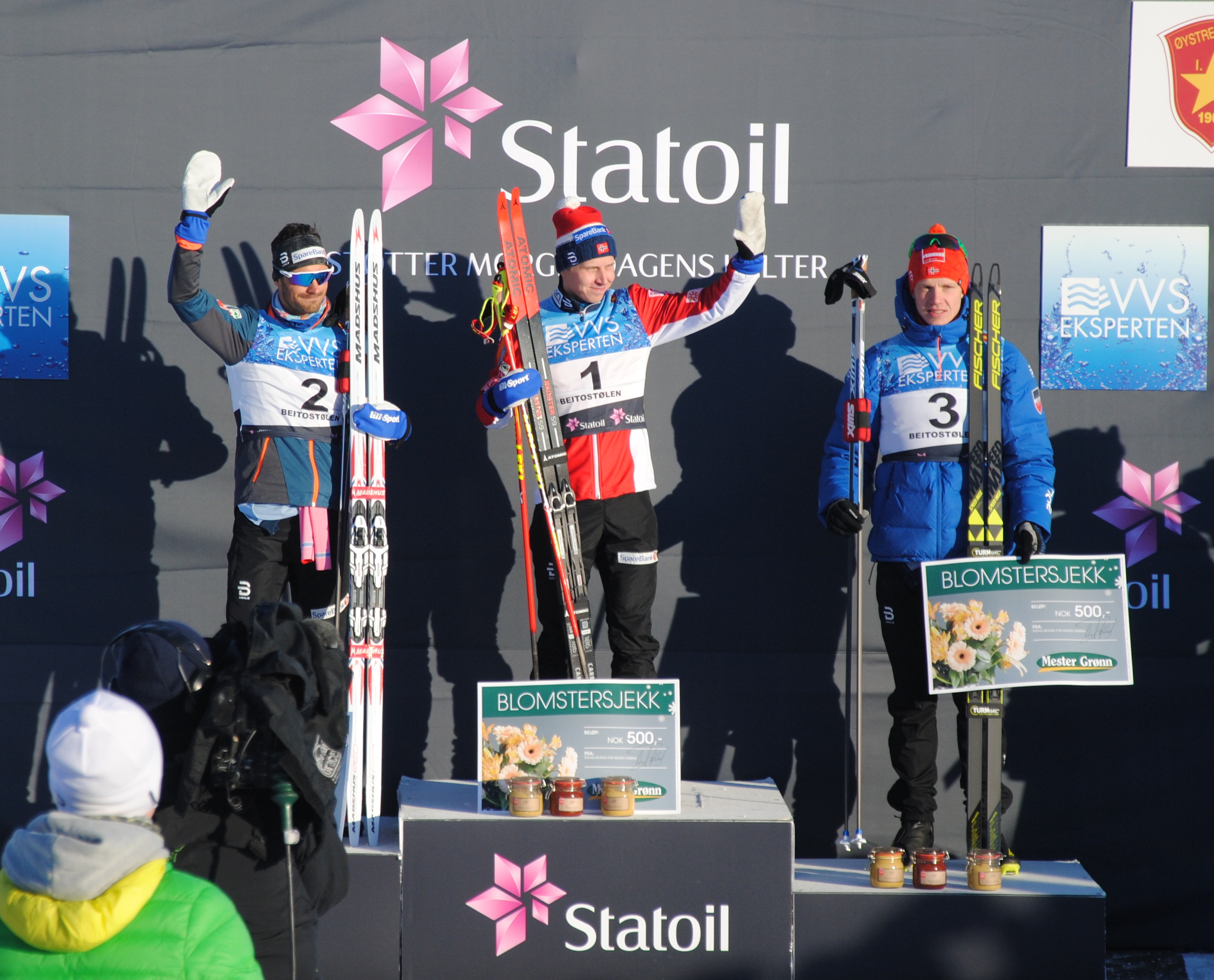
He did so after starting in bib 122 of 124 and taking control of the race at 2.1 k. Krüger led from that point on, clocking the fastest splits in every stretch except from 11 to 11.9 k. At the finish, he beat out the likes of fellow Norwegian World Cup Team members Hans Christer Holund in second, Hågen Krogh in fifth (+42.1), Sjur Røthe in sixth (+42.8), and Martin Johnsrud Sundby in seventh (+52.9).
The men’s podium after Sunday’s 15 k freestyle FIS race in Beitostølen, Norway, with Norway’s Simen Hegstad Krüger (1) in first, Hans Christer Holund (2) in second and Jan Thomas Jenssen (3) in third. (Photo: Aleks Tangen)
“This is incredibly cool,” Krüger told NRK. “Even if it’s early in the season, it’s not common to win at this level. It’s a big deal when entire Norwegian elite is here.”
Notably, 21-year-old Norwegian Jan Thomas Jenssen, of Hommelvik Il, placed third (+30.7). He’s never raced on the World Cup.
“What should I say? This is amazing,” he told NRK, adding that the experience was “indescribable.”
Great Britain’s Andrew Musgrave raced to fourth place (+37.1) as the only non-Norwegian in the top 24. American Noah Hoffman was next in 25th (+2:09.6), and Andy Newell (U.S. Ski Team) finished 52nd (+2:56.0).
“It was better than the other day, a step in the right direction and I feel pretty good and looking forward to next weekend,” Hoffman, who finished 29th in Friday’s 15 k classic, told FasterSkier on Sunday. “Part of it is just having a race under my belt, but beyond that, I think on these more gradual courses I’m better at skating than I am classic, and the conditions were better for me today.”
While he was able to navigate traffic on the course by picking off several racers, Hoffman was frustrated with his “lapse of concentration” that caused him to clip a V-board on the biggest downhill and fall on his second lap.
“[I] went down really hard, lost my glasses, but at least I didn’t hurt myself,” Hoffman said. “Got a little bit of whiplash, I think I might be sore from it. … I probably lost 10 seconds. It was just silly. It still was a good effort and it doesn’t make too big of a difference.”
Andy Newell (c) racing to 52nd in the men’s 15 k freestyle FIS race on Sunday in Beitostølen, Norway. (Photo: Aleks Tangen)
Newell started out skiing around 70th and made his way up to 38th mid-race, but lost time over the final three kilometers to finish 52nd. When he spoke with FasterSkier immediately after, he was unsure of how he placed.
“I don’t think my time will be great, but it was a good workout and my body felt good despite being a little tired and sore from yesterday,” said Newell, who placed 16th in Saturday’s classic sprint. “It was a good training race, and these guys are so fast, and since skating is not my best, I just looked for a good feeling in the body. …. I think I have a little more in the tank. I can save that for next weekend.”
The World Cup opens next Friday, Nov. 24 with the three-day Ruka Triple in Kuusamo, Finland.
Of the four Canadian men that raced on Sunday, Scott James Hill of Barrie Cross Country (BXC) led them in 64th (+3:09.8).
“Today was good, a lot better,” said Hill, who placed 84th in Saturday’s sprint and 99th in Friday’s 15 k classic. “The classic race was kind of my first race and time trial of the year so I wasn’t expecting much, but today I felt like I was ready to race.
“I think everything worked out well,” the 23 year old continued. “I was never skiing alone other than maybe the first half lap, so I was always being pushed, which was really good.”
Ryan Jackson (Team Asker) followed in 102nd, Maks Zechel (Team Asker) was 113th, and Joey Foster (BXC) finished 118th.
Paddy Caldwell (Dartmouth/SMS/USST) racing to 21st in the men’s 15 k freestyle at U23 World Championships in Rasnov, Romania. (Photo: Logan Hanneman)
(Note: This article has been updated to include comments from Jasper Good, a U.S. Nordic Combined skier, and Annika Taylor, a California native who races for Great Britain.)
Twelfth, 13th, 15th. Those were the top results three Americans posted in Thursday’s competitions — between nordic combined and cross-country — at U23/Junior World Championships in Rasnov, Romania.
Jasper Good (U.S. Nordic Combined) racing to 11th in the normal hill/10 k individual competition at 2016 Junior World Championships in Rasnov, Romania. (Courtesy photo)
Jasper Good, a 19-year-old nordic-combined skier from Steamboat Springs, Colo., raced to 12th in the normal hill/5-kilometer Gundersen, finishing 1:13.3 behind winner Thomas Portyk of the Czech Republic, after starting 1:20 back. Portyk improved from second in the jump to win by 5.1 seconds in 11:01.5 minutes. Germany’s Terence Weber placed second and Estonia’s Kristjan Ilves, the jump leader, finished third (+5.4).
Good jumped to 14th then raced the seventh-fastest 5 k to climb to 12th. On Tuesday at junior worlds, he recorded his career best in his fourth World Championships: 11th in the normal hill/10 k.
“I wanted to put myself in the fight for a top 10 finish and I did that both days so to some degree I am happy with that,” Good wrote in an email on Sunday after the competitions. “Although I really wanted to break the top 10 I am happy as I was able to put two consistent competitions together. Both days were what I would call an accurate portrayal of my average level. I am happy that my average had me finishing in the top 15 on both days but a little disappointed I wasn’t able to have a slightly above average day to get me into the top 10.”
“With all of the challenges we were faced with this week between lack of snow, wind on the jump hill, and an excessive amount of schedule changes I am happy I was still able to move past it and perform when it mattered,” he continued.
Americans (from left to right) Ben Loomis, Stephen Schumann, coach Martin Bayer, Jared Shumate, and Jasper Good after an individual competition at 2016 Nordic Combined Junior World Championships. Not pictured: Koby Vargas. (Photo: Jasper Good)
In the normal hill/4 x 5 k team event on Friday, Good and fellow Americans Jared Shumate, Stephen Schumann and Ben Loomis placed sixth, about 5 1/2 minutes behind the Austrian winners. According to Good, that was his team-best result at junior worlds.
“I think the fact that our team event rank has been improving every year I have been on the team is a huge testament to the potential coming up in US Nordic Combined!” Good wrote.
He planned to finish the season with two more weekends of Continental Cup competitions.
In Thursday’s individual nordic-combined competition, three Americans followed Good with Koby Vargas in 32nd, Schumann in 38th and Shumate in 44th.
Friday also marked the last day of individual cross-country racing as well, Katharine Ogden of the Stratton Mountain School (SMS) and U.S. Ski Team (USST) finished 13th in the junior women’s 10 k freestyle individual start, two days after placing 13th in the 5 k classic. On Thursday, Ogden finished 1:11.4 behind Ebba Andersson of Sweden, the winner in 23:29.8.
Andersson won the 10 k skate (originally scheduled as a skiathlon, but changed before the championships because of low snow) by 29 seconds, ahead of Germany’s Katharina Hennig in second and 32.2 seconds ahead of Norway’s Tiril Udnes Weng in third. The fifth starter, Andersson consistently clocked the fastest splits in the four-lap race. Ogden started sixth and posted times that ranked within the top 15 for most of the race.
“The conditions were fast and icy with a little corn snow built up in some places,” Ogden explained in an email.
The course had frozen overnight, giving it a much different feel than the slow slush athletes had previously raced in this week.
“I struggle a little in faster conditions like that which is why I was focusing on really skiing bigger and getting more power as opposed to my usual fast tempo skiing,” the 18-year-old Vermont native continued. “I had high expectations going into this race and I was initially a little disappointed with how it went result wise. However, I am really psyched that I fought it out and raced as hard as I could in conditions that did not favor my strengths.”
“Katharine Ogden had an awesome day and was consistent in her race today as well as in the results,” USST Development Coach and trip leader Bryan Fishtold USSA. “She did a great job holding on to her place throughout the race.”
Also making the top 30 in the junior women’s race, Vivian Hett of Northern Michigan University (NMU) placed 30th (+2:06.3) for her career best in two world championships.
“My goal coming into the competition was to better my results from last year,” Hett, 19, wrote in an email. “I felt like last year didn’t do a great showing of the skier I would like to be and I feel as if I have improved that this year.”
In Rasnov, she achieved her first top 30 after placing 36th in the classic sprint at 2015 junior worlds in Almaty, Kazakhstan.
“My main focus today was to pace the race correctly,” Hett explained. “Being from sea level, I like to consider Romania at altitude even though it’s not very high up. We’re at about 3500ft at the race venue and I knew that if I went out too hard, I could possibly burn up. With that being said, it was my goal to ski the first lap smoothly and go from there.”
At the race’s halfway point, her split time ranked 23rd. By 7.5 k, Hett’s time was 25th fastest and she ended up 30th.
“The second half of the race was tough but I kept getting splits that I was in the mid 20s and that kept me firing,” she wrote. “I’m very happy with my results. It’s the best I’ve done at Junior Worlds and it makes all the summer and fall training worth it!”
Also representing the U.S. in the junior women’s race, two other NMU skiers Nicole Schneider and Sarah Bezdicek placed 40th and 46th, respectively.
Canada’s Hannah Mehain finished 54th, Natalie Hynes was 56th and Sadie White 59th.
In the 4 x 2.5 k freestyle relay on Friday, the U.S. junior women raced to eighth, 1:07.3 behind the Swedish winners, and Canada, with two athletes out sick, was unable to field a full team and did not finish.
Julia Kern (SMS/USST) started first for the U.S., putting the team in 12th at the first exchange, 15.3 seconds behind Russia in first.
“Julia had an awesome leg until she tangled with an Italian girl and fell,” Ogden explained in an email on Friday. “She gained back a bit of time but still tagged off in 12th place.”
Ogden raced the fifth-fastest second leg to improve to seventh, 16.4 seconds behind Sweden in first by the second exchange.
“I made up most of the places that I got by utilizing a quick V1 up some of the steeper pitches,” Ogden wrote.
Hett lost one position on the third leg and tagged off in eighth, 45 seconds behind Sweden, and Bezdicek kept the team in eighth through the finish, crossing the line 30 seconds after Italy in seventh.
“Our team was happy with our result,” Ogden explained. “It would have been awesome to have seen what would have happened if Julia hadn’t fallen but then again that’s totally just a part of the game and it happens.”
Sweden won the final race of the championships, with Emma Ribom, Elina Rönnlund, Andersson, and Jenny Solin, in 22:30.7. Norway was just 0.6 seconds away from gold in second place, and Russia finished third, 10.2 seconds behind.
Mehain skied the first leg for Canada, tagging Hynes in ninth, 10.6 seconds behind the leaders. Hynes then came through the second exchange in 12th before the team had to pull out of the race without two more athletes.
In the junior men’s 15 k freestyle on Thursday, Ian Torchia, another NMU Wildcat, raced to 15th for his best result of the week. In two Junior World Championships, it was his second-best individual result after placing 11th in the 20 k skiathlon last year in Almaty.
Ian Torchia (10) racing the first leg of the junior men’s 4 x 5 k relay at Junior World Championships on Friday in Rasnov, Romania. (Photo: Logan Hanneman)
“Coming into the week I had high goals and after the disappointment of 43rd in the [10 k] classic race I threw that race in the toilet and refocused for the skate,” Torchia wrote in an email.
“My strategy was to try and start out hard but I was missing a little pop today so I was lucky to get a ride off the eventual 6th place Russian Ivan Krillov,” he added. “I stayed on him thanks to my fast boards waxed by Justin Beckwith and the hard working tech crew. After he peeled off for his finish I gave it all I had in the last lap and held onto 15th.”
Torchia finished 1:24.2 behind the winner, Ivan Yakimushkin of Russia, who completed the six-lap race in 31:19.1. Yakimushkin won by 12.2 seconds over Norway’s Mattis Stenshagen in second place, and Russia’s Denis Spitsov was 29.2 seconds back in third.
“I was happy with my performance today as the icy fast power course with short steep climbs did not play to my strengths,” Torchia wrote. “I was originally disappointed with all the changes from a skiathlon to a 20k mass start to a 15k individual start but as a team we all adjusted and dealt with the ‘interesting’ conditions for all the races this week.”
According to Fish, “Ian Torchia did an excellent job in pacing his race and moving up,” he told USSA. “He kept charging hard throughout the race and eventually was able to move all the way up to 15th place, in a very competitive field.”
Joey Foster led Canada in 33rd, 2:22.5 behind the winner, for his best result in his debut junior worlds. Also for Canada, Philippe Boucher placed 39th, Ryan Jackson was 57th and Antoine Blais 61st.
Racing for the U.S., Cully Brown placed 41st, Zak Ketterson was 60th and Leo Hipp 74th.
Norway trounced the junior men’s 4 x 5 k relay on Friday by 47.7 seconds, winning in 43:07.5 with Stenshagen, Vebjørn Hegdal, Jan Thomas Jenssen, and Johannes Høsflot Klæbo.
Russia took silver and France earned bronze, 1:18.2 behind Norway.
Ian Torchia (c) in bib 10 racing the opening “scramble” leg for the U.S. junior men in Friday’s 4 x 5 k relay at Junior World Championships in Rasnov, Russia. The U.S. placed 11th. (Photo: Logan Hanneman)
The U.S. placed 11th (+3:21.5) with Torchia, Brown, Henry Harmeyer, and Ketterson. Canada finished 15th (+4:29.1) with Boucher, Foster, Blais, and Jackson.
“Scrambling for the relay tomorrow on such a narrow course is going to be hectic,” Torchia predicted on Thursday, adding he was “looking forward to mixing it up with the best.”
He tagged the U.S. in ninth after skiing the first leg, 12 seconds behind Norway in first. Brown held that position but slipped 57.4 seconds behind the leaders (Russia) by the second exchange. Harmeyer lost two places by the final exchange, tagging in 11th and 2:21.8 out of first, and Ketterson remained in 11th through the finish.
Canada opened with Boucher racing to 17th by the first exchange (+1:04.6), then Foster held that position and tagged Blais 2:04.5 out of first. Blais raced the 11th-fastest third leg to bring his team to 15th by the final exchange (+3:10.7) and Jackson kept them in 15th, about 30 seconds away from either 14th or 16th.
In the U23 men’s 15 k freestyle, Paddy Caldwell led the U.S. in 21st and Adam Martin placed 29th for the second-consecutive top 30’s for both Americans.
Caldwell, of the Dartmouth and Stratton ski teams, as well as the USST D-team, finished 1:34.2 behind the winner for his best result of the week.
Norway’s Simen Hegstad Krueger won it in 31:13.3, while France took second and third with Clement Parisse (+13.3) and Alexandre Pouye (+32.8), respectively.
“Today’s race was my main focus for the week,” Caldwell, 22, wrote in an email. “I had awesome skis out there — big thanks to all the wax techs for getting amazing skis. I did not feel as good as I had hoped out there today, my legs felt heavy and I couldn’t keep the distance pace that I usually aim for. With that the wheels started to come off the last few laps and I fell back quite a bit. I wanted to be up in that top five/ top ten spot but didn’t have it today.”
Paddy Caldwell (Dartmouth/SMS/USST) racing to 21st in the men’s 15 k freestyle at U23 World Championships in Rasnov, Romania. (Photo: Logan Hanneman)
After posting the sixth-fastest split at 2.5 k, Caldwell’s time stood up as the 12th fastest at 7.5 k, and by 12.5 k, he was down to 20th.
“He went out strong in the beginning and lost a little bit of time in the end, but he still showed a lot of promise in a very deep U23 field,” Fish told USSA.
Caldwell’s career best at a U23 or junior world championship was 10th in the 20 k skiathlon two years ago in Val di Fiemme, Italy. That was at junior worlds; last year at U23’s in Almaty, he placed 15th in the 15 k freestyle and 20th in the 30 k skiathlon.
Looking ahead to the rest of the season, Caldwell wrote that he’s “Not entirely sure what the rest of the season holds! But I am looking forward to spring series and whatever races I have between now and then!”
On Friday, Matt Liebsch announced that he had earned the final men’s spot for the U.S. at the Ski Tour Canada (STC) — the season-ending World Cups from March 1-12. U.S. Ski Team Head Coach Chris Grover previously explained in an email that either Liebsch or an outstanding performer at U23’s would earn that final spot.
American Adam Martin (second from left in bib 18) of Northern Michigan University racing to 29th in the men’s 15 k freestyle at U23 World Championships in Rasnov, Romania. (Photo: Logan Hanneman)
For Martin, who declined the U.S. team’s offer to compete at STC (instead choosing to focus on NCAA Championships in two weeks), he left U23 World Championships “quite satisfied,” as he considered classic skiing to be his strength.
“I started more aggressively than Tuesday,” Martin wrote on Thursday. “Fortunately, an Italian who was on his first lap caught me on my second lap, and I skied with him until the finish. This helped me dig deeper I think.”
He finished 2:01.6 behind the winner and one-tenth of a second out of 28th.
“Leaving the championships I’m optimistic,” Martin, 21, wrote. “I would really like to qualify again next year and race [at U23 World Championships] in Soldier Hollow.”
In his first world championships, Canada’s Jack Carlyle cracked the top 40 in 32nd (+2:10.4). Also for Canada, Alexis Dumas placed 38th, Scott James Hill was 42nd and Angus Foster finished 72nd.
Akeo Maifeld-Carucci of the Bridger Ski Foundation placed 39th for the U.S. and Kyle Bratrud (CXC) was 43rd.
American Heather Mooney racing to 42nd in the women’s 10 k freestyle at the U23 World Championships on Thursday in Rasnov, Romania. (Photo: FIS)
In the U23 women’s 10 k freestyle, Germany’s Victoria Carl claimed gold by in 23:14.1, 18.9 seconds ahead of Slovenia’s silver medalist Lea Einfalt and 27.1 seconds ahead of Russia’s Anastasia Sedova in third.
A California native and dual citizen of Great Britain, Annika Taylor (Sugar Bowl Academy Elite Team) achieved her first top 30 in two U23 World Championships, placing 30th, 2:06.8 behind the winner.
Taylor, 22, has spent most of the season racing World Cups for Great Britain. She led the British team in Rasnov, with Sarah Hale finishing 40th in Thursday’s 10 k skate. Earlier in the week, Taylor finished 34th in the 10 k classic and 36th in the freestyle sprint.
“I was really looking for a top-20 result at these championships, so I was left wanting more at the end of the week,” Taylor wrote in an email. “At the [World Cup] races in Falun, my body felt really good, most likely indicating a bit of a peak in performance, which then left me tired in the training week leading up to Romania. Although I didn’t achieve my results-based goal for the championships, I still had a few personal ‘wins’ of the week, including racing my 24th race of the 15-16 ski season, marking 4.5 months on the ski-traveling road, and seeing friends from the EISA carnival circuit!
“After 4 years at UNH focusing only on distance racing, this year has been a ‘relearning how to sprint’ year, and I’m excited to get to race a few sprints at the Tour of Canada!” she continued. “I’m also planning on racing Supertour Finals in Craftsbury (as long as my body keeps going after racing 8 races at the T of C).”
Canada’s Frédérique Vézina finished 35th (+2:35.6) for her best result of the week. Americans Felicia Gesior and Kelsey Phinney placed 38th and 39th, respectively, and Heather Mooney was 42nd and Kristen Bourne 44th for the U.S.
Canada occupied 45th through 47th, with Kendra Murray, Alannah Maclean and Sophie Carrier-Laforte, respectively.
“Overall, Romania was a positive and unique experience,” Taylor wrote. “I had so many laughs with my British teammates, shared plenty of hugs with Heather and Kelsey, played with stray dogs, visited Dracula’s castle, and even got a slight face-tan!”
On Saturday, most of the athletes planned to leave Romania. Ogden is headed to Ottawa, Canada, to compete in the eight-stage STC.
“Romania was an awesome experience and I think that I will definitely remember the stunning views of the Transylvanian alps,” Ogden reflected. “And I’ll probably remember all the crazy schedule changes and the heroic effort of the organizing committee to pull off this even with barely any snow.”
Simen Krueger won the men’s 15 k freestyle at 2016 U23 World Championships in Rasnov, Romania. (Photo: FIS)
Canada’s Antoine Blais (41) and Philippe Boucher (30) racing in a group with Norway’s Thomas Jan Jenssen (19), Italy’s Mikael Abram (8) and France’s Jules Lapierre during the men’s 15 k freestyle at Junior World Championships in Rasnov, Romania. (Photo: FIS)
Canada’s Jack Carlyle racing to 32nd in the men’s 15 k freestyle at U23 World Championships in Rasnov, Romania. (Photo: FIS)
Romania’s Florini Pripici leads Canada’s Angus Foster during the men’s 15 k freestyle at U23 World Championships in Rasnov, Romania. Foster placed 72nd. (Photo: FIS)
American Paddy Caldwell leads Switzerland’s Jason Rueesch during the men’s 15 k freestyle at U23 World Championships in Rasnov, Romania. Caldwell finished 21st. (Photo: FIS)
Bird’s eye view of the race course with Adam Martin, of the U.S., in bib 18. He placed 29th in the men’s 15 k freestyle at U23 World Championships in Rasnov, Romania. (Photo: FIS)
Kyle Bratrud (USA) racing to 43rd in the men’s 15 k at U23 World Championships in Rasnov, Romania. (Photo: FIS)
Kyle Bratrud of the U.S. leads a French athlete during the men’s 15 k freestyle at U23 World Championships in Rasnov, Romania. (Photo: FIS)
Italy’s Sebastiano Pellegrin leads American Kyle Bratrud into the finish of the men’s 15 k freestyle at U23 World Championships in Rasnov, Romania. (Photo: FIS)
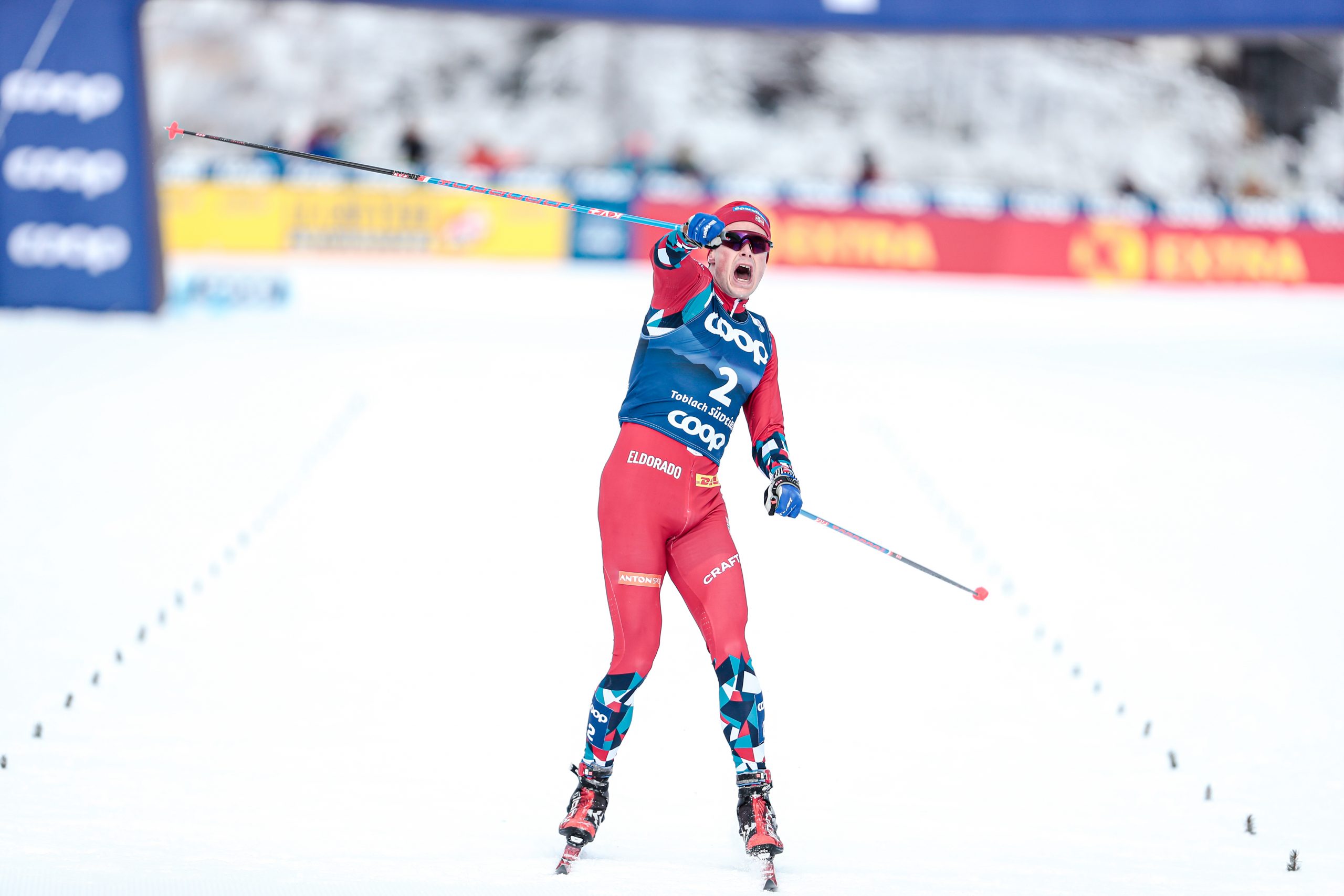
 This coverage is made possible through the generous support of Marty and Kathy Hall and A Hall Mark of Excellence Award. To learn more about A Hall Mark of Excellence Award, or to learn how you can support FasterSkier’s coverage, please contact info@fasterskier.com.