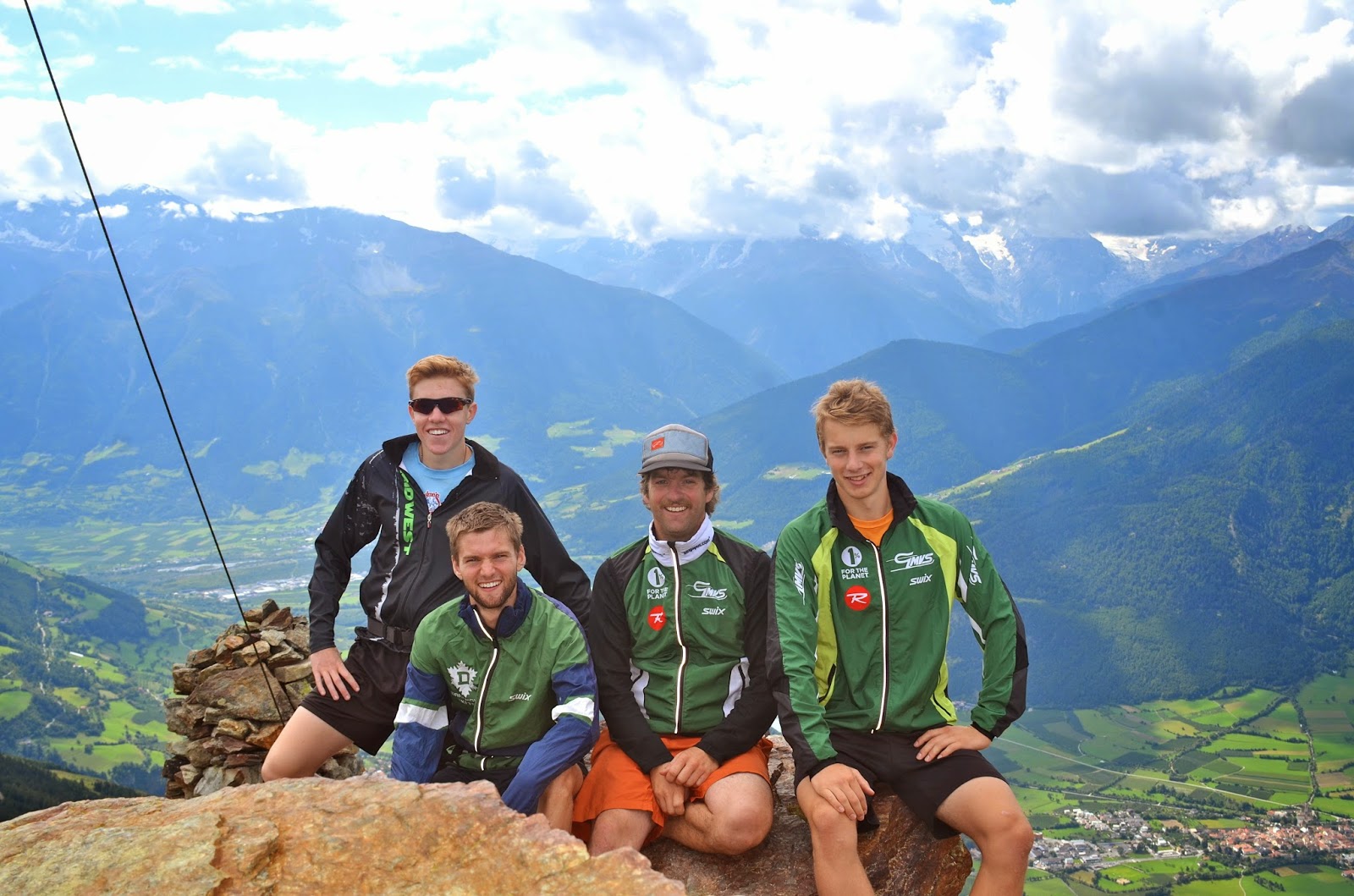
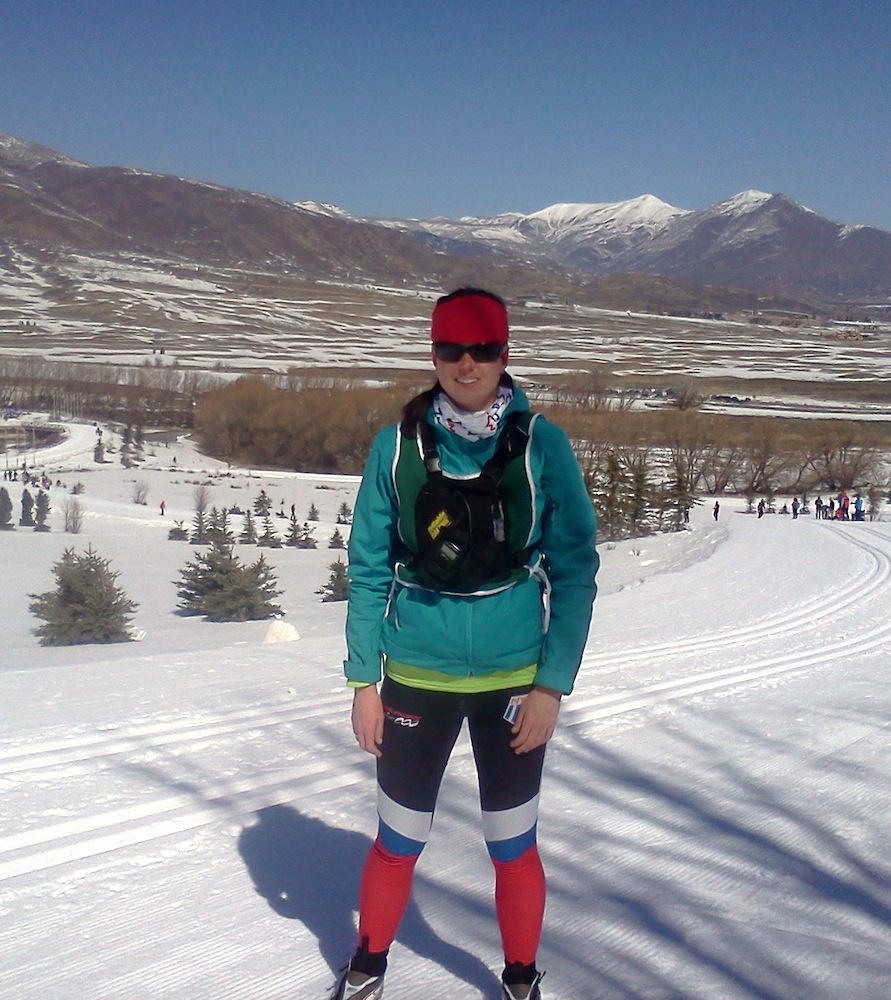
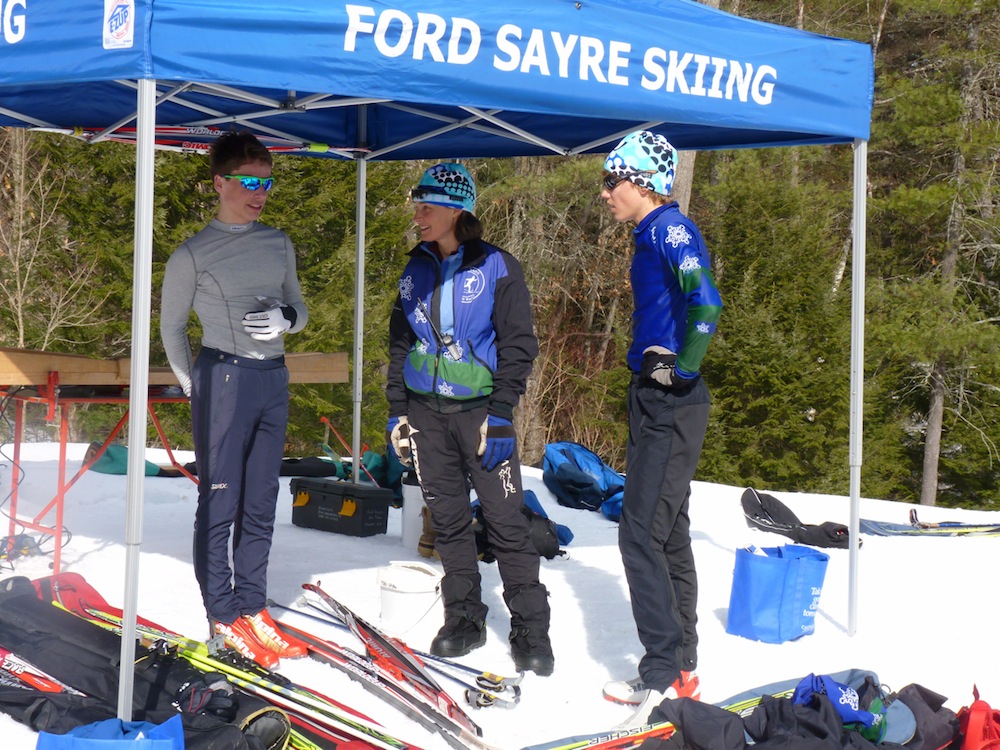
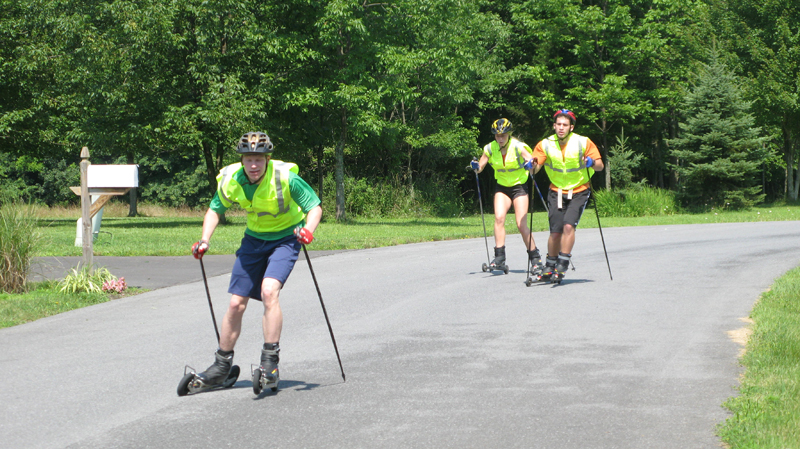
Justin Beckwith (second from r), as seen in 2014 when he was head coach of the Green Mountain Valley School (GMVS), with former GMVS elite and postgraduate athletes (from l to r) Nick Gardner, David Sinclair and Ian Moore during a fall trip to Italy. (Photo: GMVS)
The news came from NENSA early last month in an announcement that stated Beckwith would be filling in for Amie Smith, the association’s high-performance director for the last two years, who was promoted to executive director.
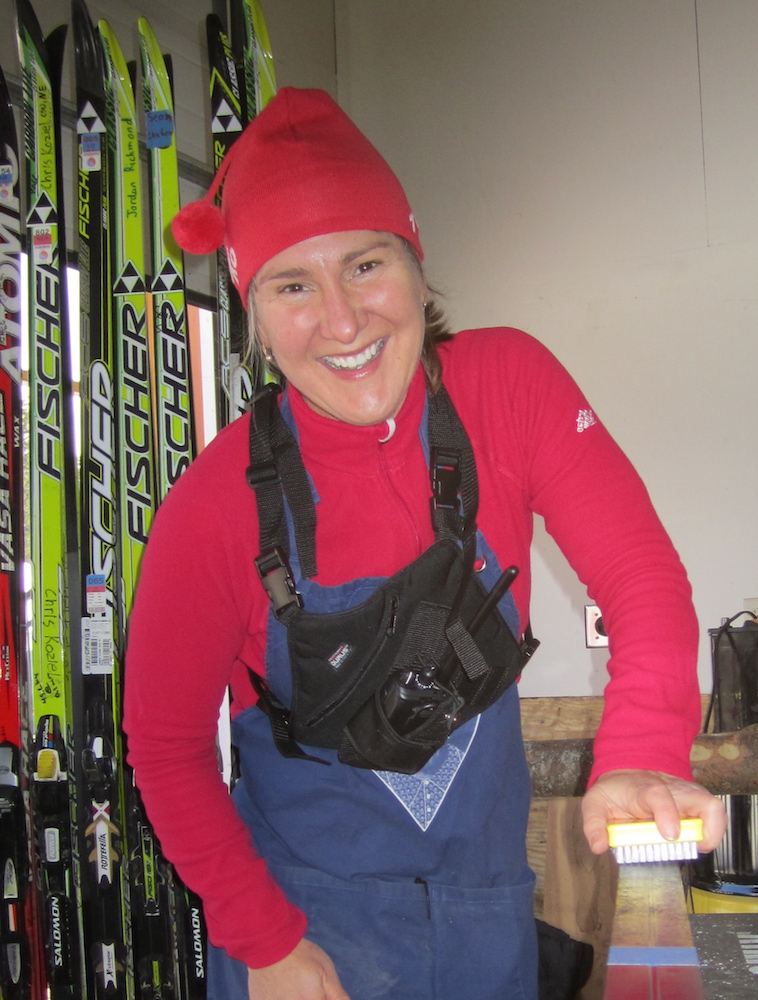
Justin Beckwith (l) and Gus Kaeding in the wax room at 2017 U23/Junior World Championships at Soldier Hollow in Midway, Utah. (Photo: Flyingpointroad.com)
Beckwith, of Warren, Vt., spent nine years from 2006 to 2015 building the GMVS program. When he left in the fall of 2015, he decided to go back to building houses, yet he remained involved with nordic as a wax tech for New England juniors and U.S. skiers at both national and international races, like last season’s OPA Cup Finals.
Right around that time, in late March when NENSA posted the job opening, Beckwith knew he was ready to return to a full-time position in skiing.
“It was just sort of, ‘OK, that’s it. That’s what I need to do,’ ” he told FasterSkier last month.
After graduating from Middlebury College, Beckwith, now 37, spent one year living out west before taking the job at GMVS in Waitsfield, Vt. During his tenure there, he was also a coach for the U.S. Ski Team’s U18 Trip and Junior World Championships as well as the head wax tech for Junior Nationals and Junior Worlds.
Stepping away from the sport as a coach allowed him to view it in a way he hadn’t before.
“I went back to Junior Nationals after not being there for a couple years, now being able to watch, coming from the outside and see how our coaches, athletes and organizers are acting and performing, and what a unique perspective it is,” he said. “It is so much different than when you have your own athletes in the race, or you’re supporting your division or whatever your job is. … I am really excited to start to using all my contacts and resources and just bring energy that I think coaches understand what I am all about.”
***
FasterSkier: What made you decide to return to skiing full time?
Justin Beckwith: When I left GMVS to be a carpenter, I knew I wanted to come back to skiing, but on my own terms and do the piece of the skiing that I absolutely love and am so passionate about. That allowed me to be open to do that, whether or not the bank account reflected that, I just needed to be a carpenter, but I also had the ability to start making relationships with international people, coaches from other nations that are so impressed with what we are doing now in the U.S., and that started happening three or four years ago. Coaches started saying, “Wow, you guys are doing really well down to the national level now.” Then I got to start working with some of our manufacturers and suppliers, like Start Ski Wax specifically, a bunch more this year. I went back to Junior Nationals after not being there for a couple years now being able to watch coming from the outside and see how our coaches, athletes and organizers are acting and performing, and what a unique perspective it is.
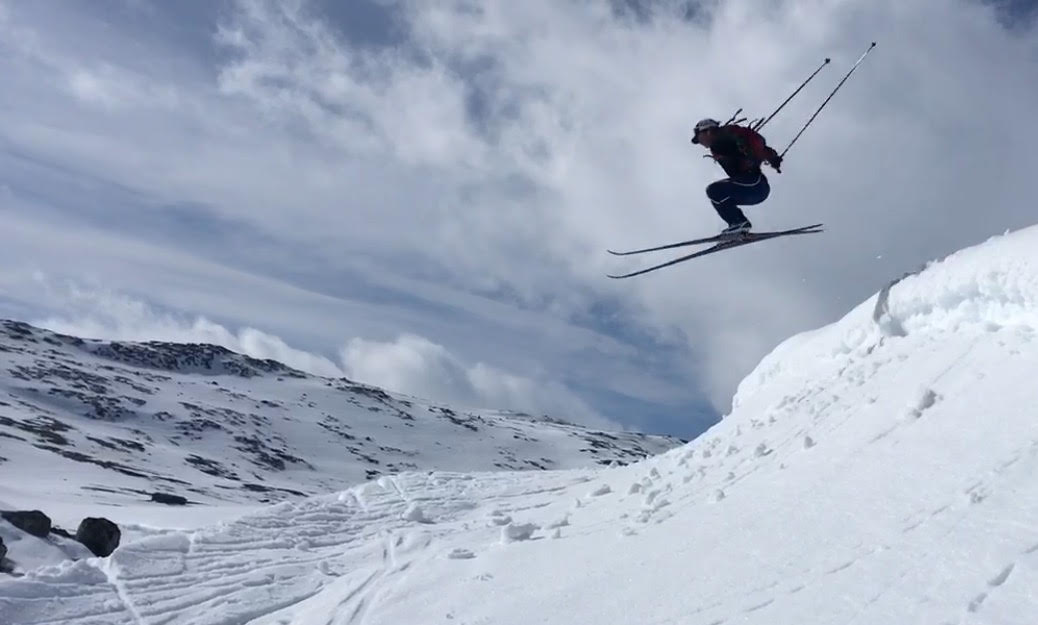
Justin Beckwith getting after it in Hemsedal, Norway. (Courtesy photo)
So bringing to the present day, I think this [NENSA] position came up one time while I was involved at a certain amount of professional level with skiing. Amie [Smith] took on the job a few years ago, but I was deeply immersed my GMVS culture at that time and I also think that probably was not the perfect fit for me. Just before my wife and I left for our trip to Norway [this year], the job was posted [again]. It was just sort of, ‘OK, that’s it, that’s what I need to do.’ I am really excited to start to working with my contacts and resources and just bring energy that I think coaches understand what I am all about. I have also been able to make that connection with a lot of the young athletes over these last few years.
FS: What drew you to the NENSA position?
JB: With this position with NENSA and also what I have been able to do the last couple years, I am not using the microscope anymore, I am using a telescope. It’s totally different, but at the same time, it’s the same. I am going to be able to support GMVS in a great way. I love working with [GMVS Nordic Director] Colin Rodgers. GMVS went through some transitions. I am staying in the Mad River Valley, which is amazing; another great part of the job is that I get to stay where I am and sort of create some of that vision and move it in a way. It’s a pretty cool job, it’s a very cool lifestyle, it’s something that I am so passionate about. I was just talking to [Dartmouth men’s nordic coach] Brayton Osgood, he said he’s so glad to have [me] officially back in skiing. That is the coolest thing, to have those relationships.
We are going through a transition within the U.S., there is a changing of the guard within our coaches and in our whole community, and we need to hold on to the history. That’s why people like Peter Graves are so interesting. We absolutely need to hold on to that history, but we have so many, because of all the awesome work that Dick Dreissigacker and Judy Geer at Craftsbury, or Sverre at Stratton, Rick Kapala at Sun Valley, or Gordon Lange in Park City, because of what all these people did, they inspired the next generation of not only athletes but coaches. It’s a really exciting time for U.S. skiing that we have such great venues, coaches and organizations. It’s a really cool time and a lot of energy is coming back into it right now.
FS: How is your role at NENSA going to be different than it was with GMVS?
JB: The biggest difference is what I tried to do at GMVS is essentially I wanted to be able to do what I am going to be able to do with NENSA. I am able to work with everybody now — and not that I am trying to spread myself too thin; I will obviously be working in a different capacity — I will be in personal contact with a lot of our athletes. … I will have more communication with coaches, whether it is with [U.S. Ski Team Development Coach] Bryan Fish or our club coaches in New England, and coaches throughout the nation, and figuring out that common goal, whether you’re part of a ski academy, or a club, or even a different region at JN’s, the goal is to make U.S. skiing better, and to create that culture and create those results, so that’s the goal.
FS: How was being at the OPA Cup Finals and what were your takeaways?
U.S. techs and coaches at 2017 U23/Junior World Championships (from left to right) Justin Beckwith, Andy Keller, Gus Kaeding, and Mike Matteson at Soldier Hollow in Midway, Utah. (Photo: flyingpointroad.com)
JB: Probably the coolest thing going into that was the fact we were able to pull Caitlin Gregg into that, so we had this mix where we had some of our best juniors were there, we didn’t have the biggest team we’ve had, but we had a great time. And right out of the gate in the OPA Cup Finals — these are big-deal racers — on Day 1, Caitlin won the thing and Hannah Halvorsen was second. World Juniors was of course groundbreaking, but that result showed another level of depth we have in the country, and that was really inspiring to see that and be a part of. It also showed that we are a little bit better at skate skiing than in the European contemporary classic condition, basically slush. We were racing in 10 degrees [Celsius, 50 degrees Fahrenheit], and that is something we are adjusting at the developmental-team level. … That’s something we are going to try address soon. The takeaway from OPA, it shows the depth of where U.S. skiing is now, it shows what happened at World Juniors isn’t a fluke, it shows that we still have work to do, but we very much have arrived, and we are lucky as a nation that the European Nations are recognizing what we are doing and they are interested in what we are doing. We are contemporary now, and it’s pretty cool.
FS: What are some of your key initiatives moving forward and what does your five-year plan at NENSA look like?
JB: One of the things is my big initiative to make NENSA a known support structure to our clubs and to our coaches and to our athletes. We are not just putting on races, I want to make coaches’ education cool again. I want to make it popular and fun, and I just sort of want to reinvigorate that a bit. I want to help increase the participation and make it a clear thing that when you ask any coach what NENSA is doing for them, I want them to be able to give a clear answer that we are providing really cool feedback and support for their program. We are helping them coach and inspire their kids, and we are not putting on camps or other events that compete, we are helping make those better. I want to reinvigorate rollerski races. I have one that I want to start with this summer and ideally that would transfer to each state, having an event that we were able to make better for them, whether through promotion or physically bringing athletes to them, bring sponsors and suppliers in there, all part of that goal. … That’s what I want to do with this job, create that that buzz, that energy.
Another thing I am going to work on is NENSA alumni, if you will, we need to keep them involved. When you’re a junior skier: you love your coach, you love your peer group, love going to Junior Nationals. You don’t necessarily remember that it was Janice Sibilia or Zach Caldwell or NENSA that created these camps and brought you all together two or three times a year. There are so many people that brought it to where it was now. It’s cool to come back and look at it with that perspective. Some of those people are coming back to it in different ways. Kris Seymour has taken a position at running Mount Van Hoevenberg in Lake Placid. Kris Seymour was Lowell Bailey and Tim Burke’s high-school coach; he inspired those guys, he helped to inspire me, now he is at a position where he can do wonderful things not only for his venue and his job, but he can do great things for cross-country skiing. So it’s really neat to meet somebody who cannot just juggle those balls, but bring those balls together.
FS: Are you still going to be a carpenter?
JB: I do have a passion for that and creating things especially with wood. I will still be hobby-ing and doing fun projects on the side, but only in a capacity like somebody would play the guitar, not as a business. I am diving right into this as a passion. People who are involved in the country and New England are coaching for the right reasons and I share the same vision.
The enthusiasm and the support and welcome I have gotten from the staff and board of NENSA, New England and the U.S. ski community is truly humbling. It’s going to be really fun, and I am looking forward to it. I am so fortunate to be a part of it and want to get more people in the sport.
In response to the popularity of last year’s Masters’ Camps, we’ll be offering two sessions again this December.
December 3-6, 2015 December 10-13, 2015
The first camp will be geared more toward newer skiers or those who haven’t raced before; the second will be aimed more at the master skier who has been competing and wants to race faster.
Participants will get three days on snow (four if you get to campus early enough on Thursday) full of instruction. Coaching staff for the camps are being finalized but will include Craftsbury’s Ollie Burruss, Janice Sibilia, Craftsbury GRP’s Pepa Miloucheva (session 2 only), GRP athletes, Craftsbury coaches and more (we’re hoping for a return of Gunstock’s Nina Gavrylyuk). The curriculum consists of technique drills, longer base-building skis, video review to reinforce technical points, flexibility and yoga, plus lots of presentations by the coaching staff on a range of topics including strength, program personalization, and nutrition. The weekend won’t be all work though: there’ll be plenty of time for relaxing with your fellow campers and staff, enjoying sumptuous meals in our Vermont Fresh Network Dining Hall (included in the full price camp), trying some biathlon, gear demo opportunities, and free-skiing. Registration starts at $300 for daycamp ($250 for NENSA or Craftsbury members) or $500 with overnights ($450 for NENSA or Craftsbury members).
Worried about conditions? We’re waiving our standard cancellation policy for the period of November 20 to December 17. If we can’t provide at least a kilometer of skiable snow in time for your stay, we’ll give you your money back.
Amie Smith, a Cambridge Sports Union volunteer and the new high-performance director at NENSA, in the wax room. (Courtesy photo)
The New England Nordic Ski Association (NENSA) is joining the high-performance bandwagon. In May, the association, based in New Gloucester, Maine, announced its competitive programs director of nine years, Janice Sibilia was stepping down “due to changes in essential functions” of her position. The next day, NENSA published a job posting for a high-performance director.
Amie Smith (c) on a ski with her daughter Rebecca (l) and her husband Tom. (Courtesy photo)
That’s where Amie Smith came in. Late last month, NENSA hired Smith, of Wellesley, Mass., to their team. As high-performance director (HPD), Smith will manage competitive cross-country ski programs throughout New England, much like Sibilia did, however, the position expands beyond the athletes and into the coaches’ side of skiing as well. The HPD also will manage race data and be responsible for keeping track of points throughout New England, from Zak Cup points to Junior National Qualifier points.
Smith enters the position with a lot of background within the New England ski community. Originally from Bennington, Vt., she grew up skiing and racing in the local youth ski league there, attended the University of Vermont and Columbia University, then settled down in Wellesley, a suburb about ten miles west of Boston. In 2007, she became involved with the Cambridge Sports Union (CSU), a ski club based out of Weston, Mass., along with her daughters who skied for the all-volunteer organization. For the past two years, Smith has also been the New England Junior National Championship trip leader, a position she plans to fulfill as HPD for years to come.
NENSA’s Executive Director Zach Stegeman told FasterSkier he is excited to have Smith onboard, as she brings a lot of enthusiasm and experience to the new job. Since the role spans throughout many facets of skiing, a person such as Smith — with experience in many aspects of the sport — is ideal, he explained.
“Amie is uniquely positioned for this role through her experience on every side of the sport: as a parent of competitive racers, as a coach, as an athlete herself, and in critical behind-the-scenes roles as a race director, a volunteer, a trip leader, and as board chair of a highly successful club,” Stegeman wrote in an email.
FasterSkier caught up with Smith earlier this month during her first week at NENSA. She started July 13.
FasterSkier: How has your first week been so far?
Amie Smith: Well, I have to say that we are in the throat of trying to finalize our Eastern Cup schedule for this coming year. Although I officially started [July 13], I have actually been working with the athletic development committee from NENSA the last couple weeks on finalizing what the schedule will be, what our venue options are. … I can tell you we have two SuperTours back to back this year, which is awesome for the East Coast. … Those weekends are going to be fantastic because were going to have so many great skiers from all over the country joining us in the midst of carnival and Eastern Cup weekends. But it also makes planning our eastern cup schedule this year a little different from previous years because we’ve already got two back-to-back weekends so were trying to spread out the other races and figure out the rest of the scheduling. So that’s my first week.
FS: You currently live outside of Boston; does this new position mean you have to move?
AS: No. The beauty of this job is I can work remotely. Obviously, I’ll have a lot of travel to all the Eastern Cup races, to Junior Nationals — I will be the trip leader again and organizing — a big part of my job is Junior Nationals. And then all the other things. We have a USSA Coaches Symposium in Lake Placid this September and all sorts of stuff. So I can stay in Boston and just travel to work when needed.
FS:Traveling around is something you are used to because you have daughters that have been nordic ski racers for a while, right?
AS: Yes. Rebecca will be a sophomore at Williams [College] next year and she skis for the Williams Ski Team, as did Hannah. When I looked at the schedule and between having daughters, who have been on the Eastern Cup and carnival circuit for the last eight years, and my previous work or my work with the CSU Junior Ski Team… Obviously I have more things like NENSA board meetings, and I represent NENSA for … the Olympic development committee, which are meetings out in Colorado every October. There are some other things, too, for travel that are a little bit more, but all to cool places, so it’s very familiar in a lot of ways.
FS: What was your role with the Cambridge Sports Union and what does becoming the high-performance director mean for your role within the club?
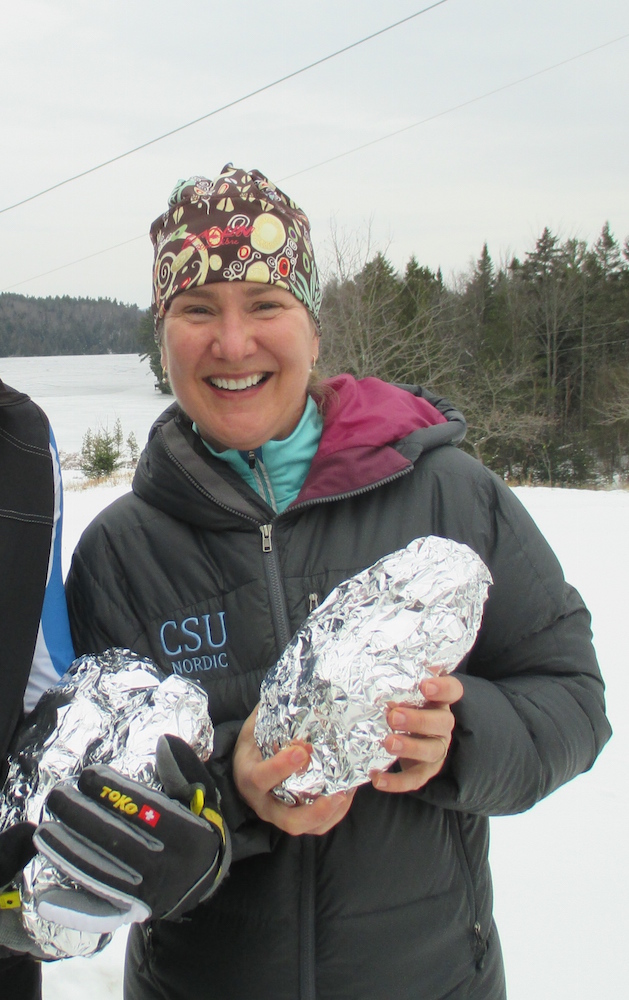
Amie Smith after “winning” a loaf of homemade bread at the 2014 Craftsbury Opener. (Courtesy photo)
AS: The last eight years I have been involved with CSU on a lot of different levels, as a parent volunteer, starting with that because it is an all-volunteer organization, and then in 2010 we created our first board: the CSU advisory board, which I have chaired since then. Also at that time, I moved from volunteer coordinator into the general manager position. So kind of helping oversee the day-to-day smooth running of the club along with Rob Bradlee, our head coach. I have also been, for the last three years, a coach for CSU. I started coaching, which I really love. So I am actually going to continue as a coach as I can, but I am giving up my general-manager volunteer position and my board-chair position although I am going to stay on as a board member. … Obviously I won’t be under the wax tent anymore. I was the wax-team leader for a couple years for CSU. So I wont be doing that because I will be running the Eastern Cups or helping the host venues with Eastern Cups.
FS: What did you see and contribute to during the rise of CSU as a program and why do you think it has become so successful?
AS: I think there are a couple of things that have contributed to that. One, the kids have a great time, the coaches have a great time, the parents have a great time. Our motto is having fun basically; it’s contagious. We have grown numbers-wise from, a handful of really active skiers — even if we had thirty on our roster, we might have only had eight kids at an Eastern Cup on a great weekend — to now this year we have 52, and the last number of years we’ve had 52 on our roster and we will consistently get 40 or more kids at each Eastern Cup race, which is crazy. I think it’s word of mouth, kids talk about it with each other … And the coaching, I think the fact that we are an all-volunteer club, I was thinking about this when we got the Club of the Year award just recently from NENSA; it’s been a really great model for us.
Here in the Boston area I think another part of our success is we have so many people to draw from since we are a large urban community. Our pool is huge. The fifty kids we have are from a very large population so you are going to end up with kind of the top skiers, and there are a lot of them. … I think part of our success is we have a large population pool to draw from, from both athletes, coaches and parents. And a lot of the parents were collegiate skiers and lifelong skiers themselves and we have our coaches the same way, you know, lifelong skiers, collegiate, and World Cup skiers. Without saying, Rob Bradlee is the glue and the base of our club and he is so passionate about CSU and about the kids — it’s great. So between Rob and our other group of fantastic coaches, I think that’s the key to our success, the people.
FS: What attracted you to the opening at NENSA?
AS: I have to say that the opportunity to work in the nordic ski community and have a job in the nordic ski community such as this is what attracted me to it. I have loved what I was doing for CSU over the years and that was in a volunteer position. I was thinking about going back to work … and I love the nordic community I’m super excited.
FS: What does the HPD job entail?
AS: A big thing I’m excited about actually is to delve into coaches’ education here in New England and really having the opportunity for our coaches to be well trained and up to date on the latest techniques and thoughts on skiing, as well as getting certified either on the NENSA level or the USSA level depending on where they want to go. Again to that, also we have the development and elite teams so I hope to be able to whenever possible hook up with them and get our competitive skiers, all our new England skiers jazzed up. Like Andy Newell showed up at an Eastern Cup last year, get that word out that, you know, Andy is going to be at this Eastern Cup and take advantage of it, or Sophie [Caldwell] is back so let’s take advantage of her being here and let people know about it, opportunities like that for the development and elite teams have a place to shine.
FS: Do you have any goals for NENSA or a long-term vision for the program?
AS: It’s still evolving. I’m still trying to get a handle on the job responsibilities and the to-do list … I would really like to not only continue with high-caliber Eastern Cup races and bringing the best New England Junior National Team to JNs each year, I mean that’s obviously a huge thing, but I really feel strongly about coach development and my hope is to work with the NENSA coaching committee to really ramp up coach education and make sure that opportunities are available to all of our coaches across New England to advance and tune up some stuff. But I’m still evolving on that one, you will have to give me a little bit of time. [There are] lots of great goals to accomplish.
FS: Is there anything else you would like to add?
AS: I’m really looking forward to this. In a way, it is a dream job, I mean you get to work in a community with people, athletes, coaches, parents, venues that you love and get to be a part of that. In a way it’s a dream job and what a great opportunity to be able to do this in New England. And I’m just really excited. I know it’s going to be hard, I know I’m going to make some mistakes … but I’m hoping by year two, OK, this all looks very familiar. You know, as you go on, it gets easier. … I think it is such a great community on so many levels to be involved with. I’m so happy my kids grew up in it, I’m so happy I’m still a part of it.
New England Nordic Ski Association (NENSA) is seeking a Director of High Performance to oversee NENSA’s competitive programming. This role requires strong, inspired leadership with a collaborative spirit to galvanize and to work with our nordic community. This position will work closely with community stakeholders and EISA, USSA, and the NENSA staff team and Board. Managing NENSA’s race data, including seeding and scoring competitive events as well maintaining all competitive rankings, including ranking and naming the New England Junior National Team is a key part of this position. The High Performance Director is an empowered position, requiring energy, vision and attention to detail in advancing all of NENSA’s competitive programs.
The current competitive programs director Janice Sibilia will be leaving NENSA this summer after nearly nine years of service. More on Sibilia’s departure.
Essential Functions
Including, but not limited to, management of the following programs:
Providing collaborative leadership, education, and guidance to coaches, event managers, parents, athletes, and others
Oversight and management of all aspects of the EasternCup Race Series
Coach Education and Development programming and resources
Race Seeding, Scoring, and NENSA Rankings
New England Junior National Team ranking, management and staffing
Proactive scheduling and site recruiting for regional and national events
Authorship/management of published resources for coach education, athlete development, club advocacy, and event management
Athlete Development programming and resources
U16 & Eastern High School Championship events with NENSA Youth Program Manager
NENSA and national summer camps and training opportunities
NENSA Elite and Development Team naming and communications
Additional Key Priorities
Including, but are not limited to, the following:
Maintain program-specific content on NENSA.net website
Maintain USSA Coach Certification of L100 or higher
Promote available resources to NENSA community
Represent NENSA at relevant regional and national events
Track and share relevant news and updates via NENSA.net and social media
Other duties as assigned
Qualifications:
Bachelor’s Degree Preferred
Familiarity with the New England cross country skiing community
Competitive skiing background as athlete or coach
Excellent written and verbal communication and human relations skills
Ability to lift and carry 50lbs
Comfortable working on a computer and online, including proficiency with Microsoft Office
Must be eligible to work in the USA with a valid drivers license
Passion for sport of cross country skiing and the ideals of the NENSA mission
Conditions:
Regular work from home office or other remote location
• Frequent and extensive regional travel with occasional national travel
Work will often be done outdoors, in varying and winter weather conditions
The High Performance Director is a full time, year round, benefits-eligible position. All NENSA staff and coaches undergo background checks. Start date is negotiable, but we seek to fill this role as soon as possible. Interested candidates should send a letter of interest, resume, and three references to Zach Stegeman via email at zach@nensa.net or via mail to:
What do Matt Whitcomb (USST), Chris Hall (Swix), Sverre Caldwell (SMS), Patrick O’Brien (SMS T2), and the Stratton T2 Team all have in common? Other than being huge contributors to our sport and to our New England Nordic community, they’ll all be at Stratton Mtn. School for the 2015 NENSA Coaching Symposium November 15-16.
Join NENSA for two days in Vermont with presentations from USST Women’s Head Coach, Matt Whitcomb, Swix’s Chris Hall (yeah, there will be swag for all), and the Stratton coaching staff, as well as hands-on work with the elite T2 athletes. This is going to be a very cool weekend. Cost is just $95 for NENSA members.
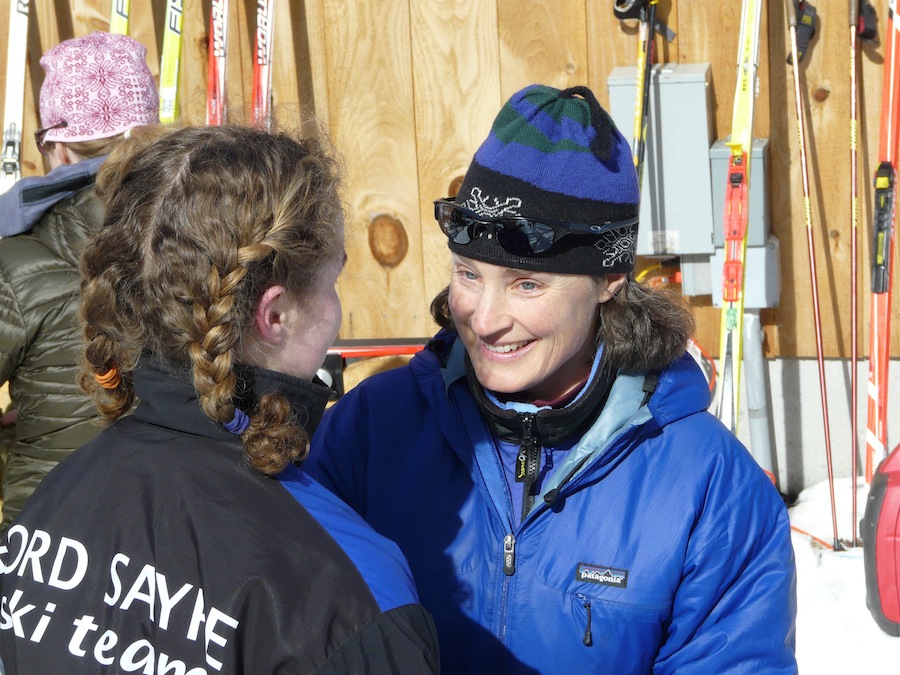
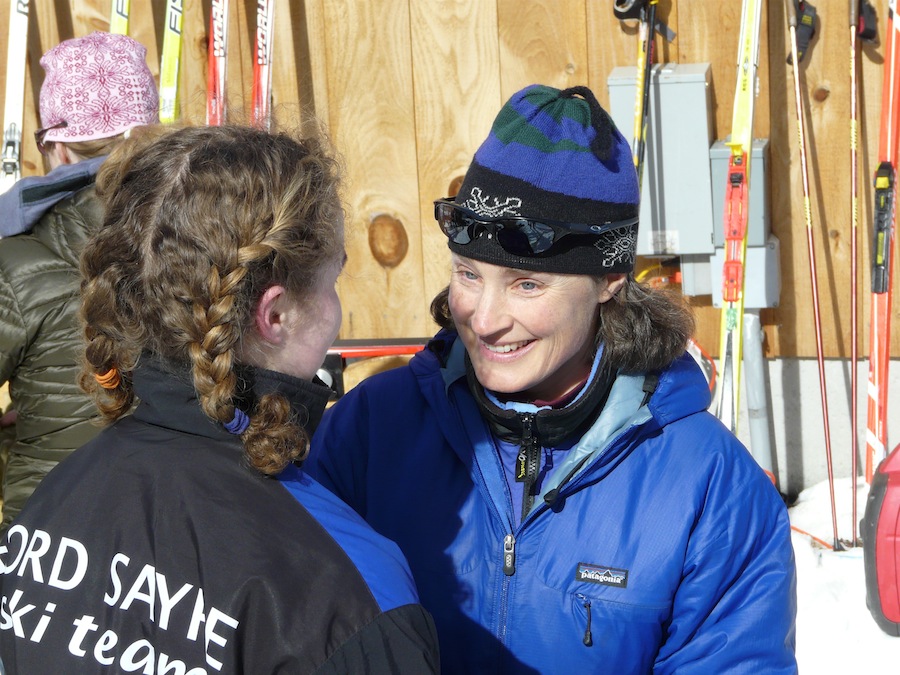
Scottie Eliassen (l), coach of the Ford Sayre Nordic Club in Hanover, N.H., gives a pre-race pep talk to one of her athletes. (Photo: Midge Eliassen)
Editor’s note: This is the third installment in a four-part series on female nordic coaches in the U.S. In Part I, two-time Olympic U.S. skier Nancy Fiddler introduced herself, Part II took a look at several influential female collegiate coaches, and Part III delves into female coaching in the junior pipeline. Part IV will explore women leading grassroots efforts across the country.
***
America! Land of the free, home of many sports! As a parent, I know all about the athletic choices kids have; my daughter cross-country and alpine skied, played soccer, did ballet, Irish danced, and rode horses for many years. Life is crazy busy for most American kids and the parents who shuttle them around.
I am going to go out on a limb here and say that most of the successful cross-country skiers in the U.S. come from a multi-sport background. I went through high school playing varsity field hockey and lacrosse and was a diver on the swim team. I never trained during the summer for any of my sports, working instead at a summer camp teaching swimming and canoeing.
I went to college and played hockey and lacrosse, but graduated with a Bachelor’s degree and a passion for skiing. How did I end up learning to ski and race in college? At the time, there was no pool at Bates, and the nordic team was recruiting, so I gave it a try. Yes, I gained a high degree of athleticism doing other sports, and this helped me in my skiing, but this is not the U.S. Ski and Snowboard Association’s recommended pipeline!
The scenario is different today. Yes, kids are still involved in multiple sports at a young age, but collegiate and elite skiers ultimately picked nordic at some point out of a vast menu of fun athletic endeavors. Focusing on one sport means giving another sport a lesser role or dropping it entirely. These decisions can be agonizing.
Successful nordic skiers typically begin to focus on skiing around age 15 or 16. By then, ski training requires a significant amount of time and energy for teenagers. The sport becomes year-round and is increasingly specific. Many good cross-country skiers also excel at other sports, but end up skiing because it is fun and their friends do it. They choose to do ridiculously hard workouts in all kinds of weather because they love the sport and the culture attached to it.
Part III of this series takes a look at female coaches who work with U18 and U16 athletes, the kids who are in the process of choosing cross-country skiing over other sports. These coaches are involved with juniors at a critical point in their development. Much happens during this time: technique refinement, conditioning, coordination during growth spurts, more frequent racing, equipment acquisition and maintenance, and more. Skiing takes on a new level of commitment for these kids.
It becomes part of a coach’s job to lead kids to skiing and help them love it and choose to pursue it. Ten female club level coaches weighed in via an email survey about their coaching careers. These dedicated women are part of the team who make skiing attractive, fun, and rewarding for junior skiers around the country.
Female Coaches: Roots of Community and Family
Go to the Olympics or to a World Cup race and take a look at the athlete-support system. Every team has a swarm of coaches and service staff to meet the athletes’ every need. With few exceptions, coaching at the international level in cross-country skiing is a male-dominated field.
Are female coaches coaching closer to home by choice?
“I see myself right where I am: working in a community-based program to share the sport and prepare athletes to take it to any level they choose – whether it be local, regional, national, or international,” wrote Scottie Eliasson, who coaches the Ford Sayre Nordic Club in Hanover, N.H.
Community-based programs, whether they are clubs or school teams, are the backbone of nordic skiing in the US. Eliasson has committed 21 years to coaching at Ford Sayre, a program with more than 100 athletes and 30 coaches.
Club programs are attractive to female coaches on many levels. For starters, it’s a foot in the door of coaching. Ashley McQueen, who skied as a junior in the Sun Valley Ski Education Foundation, explained that her coaches and nordic skiing in general “had a huge impact on how I grew up. I really wanted to have an influence like that. Rick [Kapala] offered me a coaching job as a way for me to get in my training and to make some money over the summers, and I really enjoyed it. When he called to offer me a position on the staff, I jumped at the opportunity.”
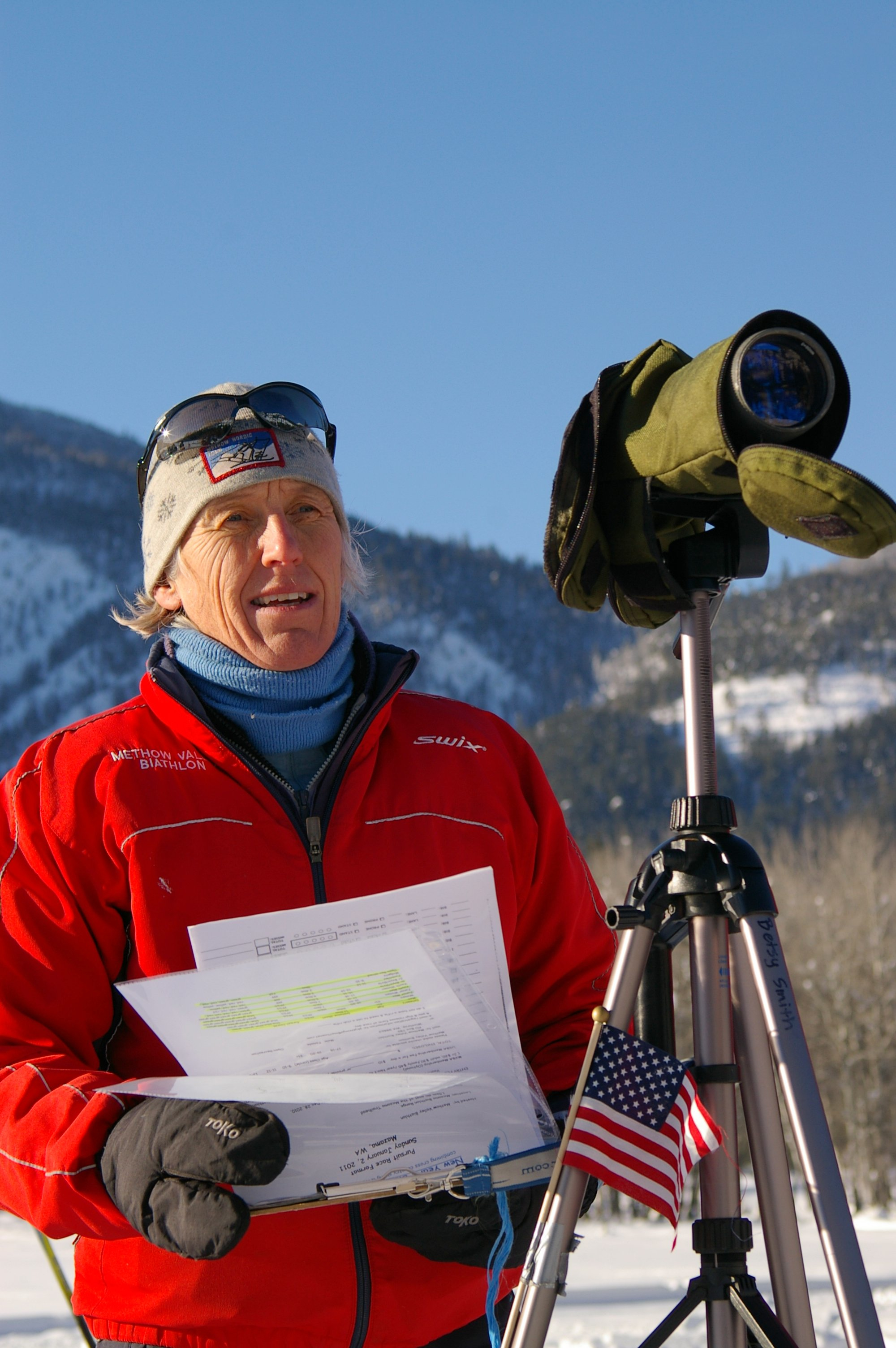
Methow Valley biathlon coach Betsy Devin Smith giving some guidance at practice. (Photo: Kristen Smith/Methow Valley Photography)
Lots of coaches who double as moms don’t want to travel outside the U.S. while their kids are young.
The Methow Valley Nordic Team in Winthrop, Wash., has a stronghold of female coaches. Leslie Hall, Laura McCabe and Betsy Smith have been holding down the fort in the Methow Valley for nearly two decades. All three women are moms with children who are or have been involved in the program. Being able to coach in the program her own two kids are in is important to Hall, who sees her job as Mom as top priority.
A three-time Olympian who competed in as many Junior World Championships and five World Championships, Hall explained she never had any goals to coach at the international level.
“I will coach locally on some level until my kids are out of high school, so probably another 7 years or so,” she wrote of her coaching plan. “I hope to coach at Junior Nationals and to do my best to inspire lots of kids to commit to skiing.”
Susan “Poppet” Boswell has been coaching skiing for 19 years and found her dream job at Stratton Mountain School [SMS] in Vermont. After two years of working with the U16 skiers, she now holds a position as a Winter Term Coach working with U14 athletes. She likes this arrangement, as it allows her more time at home with her family. Boswell’s 14-year-old son will start his first year at SMS this fall.
Many female coaches have careers outside of skiing. Club programs offer flexibility and the opportunity to work with kids in the outdoors, which appeals to some women who work “regular jobs.”
Smith juggles a career as a veterinarian and sheep rancher with her biathlon coaching. Eliasson works full time at the medical school at Dartmouth.
Margaret Maher, who heads the New York Ski Educational Foundation nordic program in Lake Placid, N.Y., works per-diem at Adirondack Medical Center as an exercise specialist and is also in nursing school. Alison Deines-Sehnert, who recently stepped down from her position as nordic director of the Jackson Hole Ski Club, worked as a bookkeeper, a caretaker, and office coordinator for a heli-ski operation. Boswell owns a company that does computer mapping.
U.S. Ski and Snowboard Association [USSA] Nordic Program Director Joey Caterinichio has come through the entire system of nordic skiing in the US. As an athlete, she made five trips to Junior Nationals and races at three NCAA Championships. She started coaching high-school skiers and went on to form Alaska Nordic Racing in Anchorage with her husband. She coached there and through 17 Junior Nationals until moving to her present position with USSA last year. Caterinichio has three children under 10, and all the years she was coaching, she also worked in medical sales.
Although female coaches may not be front and center on the international stage, they are in the wings, behind the curtains and working for the team in school and club programs around the country.
Eliasson sees it like this: “I feel that I am directly making a difference locally and regionally. Indirectly, I see our club as an integral part of the strengthening club network that is helping make a difference nationally and in the US’s international results.”
Boswell feels she is part of the big picture of skiing in the U.S. “I’m a small person, and I work with small kids, but I have a high level of experience and education that I bring to my skiers, who in turn bring it to the table and raise the bar for everyone,” she wrote.
Club Programs: The Infrastructure of U.S. Skiing and a Good Place to Grow Up
“Sports keep kids out of trouble, pushes them to be disciplined and healthy while tackling dreams that they only have a short time to achieve. Everybody should do sports. I don’t care which one. Skiing of course is my favorite but kids need to be involved and active.” — Caterinichio
Before taking on the position of USSA nordic program manager, Joey Caterinichio (l) poses for a photo with U.S. Ski Team veteran Kikkan Randall at the 2010 Olympics in Vancouver, B.C. (Photo: USSA)
Nordic clubs are growing around the country and are staffed by legions of full and part-time male and female coaches. Most clubs offer ski programs for juniors from 7 years and up and often engage entire families.
Coaches who work with the U16 and U18 age groups are spending quality time with athletes in the process of growing up. Coaches become role models and mentors for the teenagers they work with and thus, very important figures in their lives. Strong relationships are created on the ski trails and in the wax rooms.
“I love the relationships with the athletes,” McQueen wrote. “I get to work with such great individuals and watch them grow from little 13/14 year old kids into strong and confident adults.”
Deines-Sehnert enjoys working with kids and helping them achieve “not results, but their inner goals,” she wrote. “Watching kids stand up straighter because they are proud of their accomplishments – that’s what I love.”
The role of a club coach is a fine balance of taskmaster and nurturer. Cross-country ski racing is one of the toughest sports out there. How do coaches keep kids from quitting when the pain is too much to bear, the results too disappointing, or their will to do the same drill one more time is gone?
After five years on the SVSEF Gold Team, Nicole De Yong has been coaching Sun Valley juniors for a year. She has quickly figured out that having a good rapport with the athletes is essential to gaining their trust. “Playing, joking, having fun from a friendship standpoint is as important as having the ability to get down to business when necessary,” she said.
Ski racing boils down to complete commitment and the ability to take risks. None of this is possible without trust; trust in your preparation, trust in your equipment, and trust in the coaches who lead you. Skiing at the highest level requires these elements and belief in oneself and their coaching system. Fostering this confidence is part of a coach’s job and far exceeds the teaching of technique and the waxing of skis.
Skiers entering the U20 bracket are often leaving home for the first time to either go to college or to pursue their skiing goals in a new setting. This is the time when nordic athletes make the decision to continue in the sport or to follow a new life path. The time spent training and racing during their high school years has prepared them for anything.
According to Eliasson, the foundation of success in sports or anything in life boil down to “resilience, adaptability, independence, responsibility, and the capacity to prioritize competing demands,” she wrote. “Many of our athletes continue on to college ski teams, and feedback from the athletes and from their college coaches indicates that they are well-prepared for the demands placed on student-athletes. We hear from parents and athletes many years later that experiences in Ford Sayre have a lasting positive impact.”
Sharing the Dream
“My job is a lot more than just coaching, as I deal with all the bureaucratic stuff and organizing everything. My favorite part is the one on one interaction with the skiers and helping them to find the excitement and passion of committing to a great sport.” — Leslie Hall, Methow Valley nordic program director
The qualifications required to coach skiing might include the USSA Level 100 certification, waxing knowledge, basic physiology, and an understanding of skate and classic techniques. These identifiable skills are important, but the essential qualification is not easily measured and not always readily apparent. Every good ski coach has it. Passion does not come from a clinic or a book on ski training.
Many nordic coaches are deeply connected to the sport by means of personal experience. That does not mean that anyone who has ski raced is automatically a great coach; technical and waxing expertise can be acquired through education and practice, but the ability to channel passion and to communicate it to others is a gift.
Head of the NYSEF nordic program, Margaret Maher on course at the 2012 Junior Nationals at Soldier Hollow in Midway, Utah. (Courtesy photo)
Everyone gets involved with ski coaching in different ways. Maher grew up cross-country skiing and coaching is her way of sharing her love of the sport.
“Since high school, I knew at some point I would want to coach,” she wrote. “My dad, mom, and grandmother were all PE/health teachers: I guess athletic teaching is in my blood. I certainly wasn’t ready to leave the sport after college … but I was not ready to be a full-time ski racer. Coaching was the next natural step.”
An eight-time Vermont state champion and two-time Junior Nationals winner, Maher turned her experiences she as a junior and in college (she made two USSA J1 Scando Cup Teams and raced four years in college) into a successful coaching career.
Maher started skiing with the Mountain Top Bill Koch Club in Chittenden, Vt.,, which she called “family oriented.” She feels fortunate to have been coached by Mike Gallagher at Rutland High School and also credited her college coach at the University of New Hampshire, Cory Schwartz.
An assistant coach at Sun Valley, McQueen uses her personal experience to reach out to juniors in the program she grew up with. “I was shy as a kid, and I think that going through the process of overcoming my shyness and insecurities helps me se how fear and insecurity affects some of the athletes I work with,” she wrote.
Another accomplished junior and world-class nordic athlete, Hall also cites her mentors as contributing to her passion for skiing and coaching. “I have been influenced my whole life by so many great coaches,” she explained. “Of course, Torbjorn Karlsen probably had the biggest role, and also Martha Rockwell. Laura McCabe encouraged me to be involved and I have drawn from [sister] Cami’s experiences at Dartmouth.”
Some coaches have stumbled into their passion for coaching. Such is the case with Caterinichio, who was returning from college and skiing on her own when she got “the call.” She volunteered at Chugiak High School, where her younger brother Gus and sister Nina were on the team.
“When all the coaches quit the program I was left with a team of 50 athletes. I took over the team and never stopped coaching,” she explained. Caterinichio ran with her opportunity, literally all the way to the USSA Nordic Program Director job. On the way, she doubled the size of the high school program, which eventually became Alaska Nordic Racing.
Not all respected coaches come straight out of long ski careers beginning with the Bill Koch league or have ever raced on the World Cup circuit. A diverse background can lend itself well to coaching – case in point, Janice Sibilia, competitive programs director for New England Nordic Ski Association. Sibilia has a competitive background in several sports. She was an equestrian and national-level cyclist and didn’t get into skiing until she began cross training for cycling.
An injury brought Sibilia to ski coaching. “During my downtime from racing a local high school asked me to help out,” she explained. “It was a big group of over 50 high school skiers and a lot of fun. I learned a lot (being an athlete is very different than coaching!) and was grateful for the opportunity. It really sparked my interest in coaching and since then I have worked really hard to improve my coaching skills and knowledge.”
Sibilia became a student of nordic skiing by going to every clinic she could find. She shadowed other coaches at camps and training sessions and cites the USSA L100 certification as an important building block in her education. Besides drawing on her background as a cyclist, Sibilia has learned invaluable lessons about communication from a favorite equestrian clinician. She says, “I think you can learn things in places you least expect it.”
Ford Sayre coach Scottie Eliassen debriefing with her athletes post-race. (Photo: Midge Eliassen)
Eliasson got started in her coaching career by volunteering to help with the local Bill Koch League (BKL) program “to share the sport with others.” Eliasson was a BKL participant herself, and continued racing through college. Like Sibilia, Eliasson has drawn from other sports, such as rowing, to develop her coaching style.
“My experiences coxing girls in high school and men in college helped shape who I am as a coach today,” Eliasson wrote. “My high school crew coaches remain some of my most important coaching mentors.”
The biathlon head coach at Methow Valley, Smith started as an alpine skier and racer, then jumped into nordic coaching.
“When our son was 9 years old we wanted to keep him [cross-country] skiing so we started a biathlon program to complement our local nordic team and I have been coaching that now for 11 years,” she explained. “I hope to be a great junior coach. I hope to develop a biathlon program here that is a model for other Nordic programs in the US on how to incorporate biathlon into their xc teams.”
It’s All About Balance
“I wish there was at least one female coach on the US [Ski] Team because I think it would actually help all the coaches. Women bring a whole different set of strengths and perspectives to the table and I think that would help both the coaches and the athletes. I guess I’d say women are not on par (with men), but I think they are getting there. It will take time.” — Boswell
Stratton Mountain School coach Poppet Boswell with her son Russell, who won 2012 Silver Fox Trot in Hanover, N.H., at age 12. (Courtesy photo)
Co-ed coaching can be especially challenging, as boys and girls bring different personalities, quirks, and styles to any ski program. Each gender has its own special needs and methods during a group workout, before a race, and just messing around after practice. Coaches see this and work to take care of everyone and to create team balance.
In coaching, men and women generate different kinds of energy as well. “Gosh, the two male coaches I work with would be bored out of their skulls if it was just the two of them working together as guys,” Boswell wrote. “Life is so much more fun with a mix of sexes bringing different ideas and styles to the table.”
She pointed out that balance on the coaching staff is necessary to effectively deal with both genders. For example, a female coach can be helpful when a specific “girly” question or situation comes up. Often, girls feel more comfortable confiding in a female mentor.
There are times when male coaches can’t do what females can. For instance, a 200-pound male coach may not be the best kick-wax tester for a 100-pound female athlete. According to Hall, “it is important to have strong female role models for those young ladies out there. Also for wax testing, we often find that we can pick a kick wax more accurately for the girls than the male coaches can.”
“It’s important for all athletes (girls and boys) to see men and women in all manner of coaching roles, and to have same- and opposite-sex role models,” wrote Eliasson.
Times are changing!
All the female coaches who participated in this discussion are in agreement that women are slowly making headway into the world of ski coaching.
“In my first decade of coaching, there were certainly times/places in which I felt less valued/respected than the male coaches with similar experience – and there were JN trips on which I was the only female coach,” Eliasson wrote. “In my second decade of coaching, as more and more women have entered the regional and national coaching ranks, I haven’t felt discrimination from other coaches.”
While women are not dropping their jobs as mothers or professionals in other fields to coach on the World Cup circuit, they are very present at the club level. They’re in the trenches, working with the adolescent skiers who might become the next generation of Olympic champions. They are working with the athletes who could become the next generation of coaches.
Deines-Sehnert is a great example of female coaches making a difference. Male and female coaches are singing the same song, it just sounds better with the different voices and reaches more ears.
“I am a cog in the wheel,” she wrote. “I think the most important thing that each of us can do is make our programs the best that they can, raising the bar locally will only help us grow nationally.”
As Caterinichio sums it up, “It is extremely important to have female coaches. I look around and am excited to see more and more female faces.”
“I am not sure we will ever have the same numbers as men,” she added. “It is hard to juggle career, motherhood, and coaching, but it is important that we try. (We must support) women in coaching roles, officiating roles, leadership roles.”
Dozens of junior skiers raced up Agony Hill on June 25 in Salt Lake City as part of the Western REG Camp. (Photo by Dan Simoneau/MBSEF Nordic)
The Western Regional Elite Group (REG) Camp kicked off in earnest at 6 a.m. Monday, June 25, with a trail-run time trial up Agony Hill. On the training schedule, instructions read: “Bring your ‘A’ game.”
Dozens of teenage athletes tackled the 1,200-foot, 0.9-mile climb in Salt Lake City, tucked behind the University of Utah and often used as a measuring stick for pain tolerance. By the afternoon, the group was back in Park City – the home base of the weeklong camp – for core and strength exercises with U.S. Ski Team assistant coach Jason Cork.
Throughout the seven-day camp, 36 athletes from five divisions (Rocky Mountain, Intermountain, High Plains, Pacific Northwest and Far West) worked with 10 coaches for a total of 20 training hours. They hiked, ran, rollerskied, lifted, played volleyball and went to a waterslide park.
A junior racer at the Eastern REG Camp in Craftsbury charges up Elmore Hill in Elmore, Vt., on June 27. (Photo by Liz Kantack/SMS Nordic)
Meanwhile 2,300 miles east in Craftsbury, Vt., the New England Nordic Ski Association (NENSA) hosted a the Eastern REG Camp, with a total of 33 skiers (19 J1s and OJs in the elite group and 14 in the J2 camp).
They also raced uphill, ran and rollerskied last week. They worked on strength and agility, hill bounding and intervals, and attended presentations at night.
Several U.S. Ski Team (USST) members from around the country made it to the camps as well. Out West, elite juniors chased Simi Hamilton, Noah Hoffman and Tad Elliott up Big Cottonwood Canyon during an over-distance classic rollerski. Miles Havlick, an NCAA champion and Ski Racing Magazine’s two-time Collegiate Skier of the Year, also joined them on the 3 ½-hour trek to the top of Guardsman Pass.
In Craftsbury, national-team skiers Andy Newell, Ida Sargent and Skyler Davis participated, along with elite skiers from the Craftsbury Green Racing Program and Stratton Mountain School.
FasterSkier caught up with Western REG director Mike Elliott and Eastern REG coordinator Janice Sibilia via email for details on last week’s camps.
Western REG
Where: Park City, Utah (Canyons Ski Resort townhomes)
Coaches making their way to the top of Agony Hill in Salt Lake City on June 25 for the Western REG Camp time trial. (Photo by Dan Simoneau)
When: June 24-July 1
Weather: Hot (most workouts started at 7 a.m., with the exception of Agony Hill, so they were able to complete each)
Workouts: Four intense training sessions (including rollerski time trials at Soldier Hollow, Canadian strength tests at the USSA Center of Excellence); two over-distance rollerskis
Extras: Several presentations, including Tad Elliott’s talk about goals
Highlights: “The USST was a tremendous amount of help,” Elliott wrote. “We had Jason Cork at everytraining session. We had USST members Simi Hamilton, Tad Elliott, and NoahHoffman joining us on the over distance days and a time trial day. MilesHavlick with the University of Utah and a NCAA winner last year skied withus on Big Cottonwood Canyon.
“We had a couple of days of Strength with Alexand Michael in the Center of Excellence that they were awesome. Greatinformation and some light hearted teasing. Alex strongly recommends NOspandex on Dudes in the Strength Training at the COE.”
Western REG campers during a 3 1/2-hour classic rollerski up Big Cottonwood Canyon to the top of Guardsman Pass near Park City, Utah. U.S. Ski Team members Simi Hamilton, Tad Elliott and Noah Hoffman joined the juniors for the workout. (Photo by Dan Simoneau)
Additional comments: Elliott was impressed by the amount of “highly motivated and very talented skiers,” which consistently showed up early with all of their equipment before workouts. They didn’t have to wait on stragglers, and some days the vans departed ahead of schedule.
“All of the skiers showed up in fairly good condition and had been training for a couple of months before the REG,” Elliot wrote. “When the skiers introduced themselves we learned … that one is going to Harvard, two to Dartmouth, one to Middlebury, one to Colorado University, three are taking a Post Graduate year to train specifically for cross-country skiing.
Juniors learn the meaning of “rest and recovery” at the weeklong Western REG Camp in Park City, Utah. (Photo by Dan Simoneau)
The J2s did extremely well throughout the week, he continued. Two local juniors from the Wasatch Nordic Ski Club and Park City Nordic joined them at Agony Hill and for the two over-distance days.
“The classic roller ski up Big Cottonwood canyon to the top of Guardsmen Pass was the last training session and it was long and steep. Camp attendees got to observe what year round training is like at the next level by being able to roller ski with Simi Hamilton, Tad Elliott, Noah Hoffman, and Miles Havlick. Even with all the training, the skiers reported that they were having fun.”
Eastern REG
Where: Craftsbury, Vt. (Craftsbury Outdoor Center at Hosmer Point)
When: June 24-July 1
Weather: Rainy at first, then hot (especially during the final workout, Saturday’s rollerski-run combo)
Skyler Davis (l) setting the pace during an interval double-pole session at the Eastern REG Camp June 24-July 1 in Craftsbury, Vt. (Photo by Liz Kantack)
Workouts: 11 in seven days, six of which were intensity or speed.
Three testing phases (rollerski agility, strength and Elmore Uphill run (on which Nils Koons set a course record), to determine which skiers would be invite to the National Elite Group camp in September in Lake Placid, N.Y.)
There were also two interval sessions consisting of DP intervals and hill bounding, recovery runs, rollerski sessions and one over-distance combo run/rollerski.
Extras: Presentations by Sargent, Newell, U.S. Ski Team assistant coach Bryan Fish and Burke Mountain Academy coach Kate Barton on the J1 Scando/U18 trip last winter.
Highlights: “The camp went very well,” Sibilia wrote. “It was hard, but gave the athletes lots of head-to-head time. They also had the opportunity to jump in with Olympian Andy Newell, and [other] USST members … Ida Sargent, and Skyler Davis. Most members of the CGRP and newly formed Stratton Elite team also joined us. For the uphill run we had the [Green Mountain Valley School] join in the fun! There was also an Olympic Day celebration that some of the REG athletes took part in, and a competitive game of mini golf!”
Craftsbury’s own Hannah Dreissigacker, who was recently named to the US Biathlon team, racing up Elmore Hill in Vermont at the Eastern REG Camp last week. (Photo by Liz Kantack)
Additional comments: “Everyone came to camp prepared, and absorbed the training well,” Sibilia continued. “The clubs are doing a really good job of keeping the training focused and the motivation up. Regional coaches came in to help run the camp, as did the folks from Craftsbury and Hosmer Point. The energy level was high!”
On the NENSA website, Sibilia wrote that the athletes had been mindful throughout the week with details concerning nutrition, hydration and recovery.
“They are getting more dialed in to this every time this camp is run,” she wrote. “I witnessed campers taking advantage of the rainer first days by settling into the cabins with their feet propped up for recovery. Without access to internet and cell phones, rest came easier!”
Eastern REG Camp juniors during the rollerski portion of a combo over-distance workout near Craftsbury, Vt., on June 30. (Photo by Liz Kantack)
Can’t get enough of these photos? Neither could we. See more on the MBSEF (for Western REG) and SMS (Eastern REG) Facebook pages.
NENSA athletes rollerskiing at a 2011 REG camp in Craftsbury, Vt.. Photo courtesy Chris City.
Janice Sibilia waited nearly two years for this. Most of the New England Nordic Ski Association had.
Upon hearing the good word that the U.S. Olympic Committee (USOC) approved NENSA as a Community Olympic Development Program about two weeks ago, Sibilia wasn’t sure where to start.
The competitive programs director will find out more at a phone-update meeting with USOC representatives on Tuesday. In the meantime, Sibilia could revisit all the ideas she came up with during the application and acceptance process, which involved site visits to NENSA’s headquarters in Maine.
What Sibilia did know was the certification enabled NENSA to label approved programs with the Community Olympic Development Program (CODP) logo. That could help recruit development- and elite-nordic racers in New England, while also attracting coaches.
“We’ve operated under the premise of knowing that we develop elite athletes,” Sibilia said in a phone interview. “It’s not our whole mission but it’s a big part of it. … Now it’s official that we can call ourselves an Olympic Development Program.”
NENSA Executive Director Patrick Cote said the program’s flexibility was enticing, and Sibilia made it her mission to get the association approved.
“The USOC allows each Olympic development program to define what it means to them and use the resources that work for them,” Cote said. “We’re initially targeting our elite and development teams. Our main goal there is to provide more resources directly to those athletes and to the coaches that work with those athletes.”
Resources include access to USOC staff members and speakers for programs and camps. For instance, a nutritionist could visit athletes in New England, and a USOC representative may attend NENSA’s high-level coaches’ symposium next September. Athletes and coaches may also receive lodging discounts at Olympic training centers, Sibilia said.
Perhaps most importantly, the USOC helps guide CODP-certified groups, steering them toward potential grants and partnerships. The USOC also opens doors for communicating with sports’ governing bodies, such as the U.S. Ski and Snowboard Association.
“They don’t provide cash, per say, funding, but they do provide opportunities to become aware of … and programs to tap into,” Sibilia said. “It is still a learning process as to how exactly we can utilize (the CODP), but there are some good things that have been mentioned.”
The CODP started in 1998 as part of the USOC’s effort to foster youth sports development in the U.S. The idea was to help athletes at every level, from beginner to elite, through programs that enabled them to participate in Olympic and Paralympic sports, according to a USOC press release.
Eight community sports groups across the country hold the CODP designation, with NENSA being the most recent. Of the lot — which includes the Metro Atlanta Boys & Girls Clubs, a weightlifting club, and the Utah Athletic Foundation — the Central Cross Country Ski Association (CXC) is the only other ski-specific organization.
Sibilia said former USSA Nordic Director John Farra first prompted her to apply. She later spoke with CXC Executive and Athletic Director Yuriy Gusev about the program after CXC earned the designation in 2009.
According to her, Gusev said the program was what you made of it.
“(CXC was) focusing more on their junior aspect, which is probably what we’ll do as well,” Sibilia said. “It’s a great way to meet people. … There’s a ton of information out there on what works.”
NENSA athletes compete at the 2011 Eastern High School Championships in Rumford, Maine. Photo courtesy Janice Sibilia.
With NENSA more than 3,000 members strong, Sibilia said the motivation to be certified wasn’t about numbers. About 100 of the association’s elite and development athletes would be most affected, along with about 100 of its coaches. That didn’t include the younger skiers hoping to someday rank among the elite.
Sibilia explained those athletes, which also included Bill Koch League skiers, fell under the “outreach” category of the CODP plan. Because NENSA was a governing body and not a team, that made the community aspect of the title even stronger.
“Our motto has always been to make sure however we grow, that we’re still providing quality,” she said. “Sometimes that may just be connecting the community. … We really just want to make sure that the programs we have are solid and that the people are aware of what we have.”
The USOC stamp on NENSA’s website will help. But Sibilia explained that the label can only be used with USOC-approved programs and sponsors can’t conflict. With TD Bank as NENSA’s major supporter, the association learned that USOC’s programs and sponsors must be distinctly separate.
Cote acknowledged the learning curve, but said NENSA’s history with the USOC — particularly through its annual adaptive-program grant — eased the process.
“This is a really good opportunity with obviously an amazing organization,” Cote said.
Chandra Crawford celebrating her gold medal at the 2006 Olympic Winter Games in Torino, one of the many strong performances by North American women in the past decade.
Between Kikkan Randall, Sara Renner, Chandra Crawford, and Beckie Scott, there has been no shortage of successful female athletes in North American over the past decade. Step off the trails and into the wax room, and you’ll find even more involved in the sport as coaches for collegiate and club programs.
But during the May meetings of the U.S. Ski and Snowboard Association in Park City, Utah, an accomplished group of female coaches gathered not to celebrate, but to figure out how to get even more women involved in the sport.
“The barriers don’t exist like they used to, obviously—there’s been a lot of progress in this country over the last 30 or 40 years,” said Eileen Carey, a coach and vice president at the Maine Winter Sports Center, who convened the meeting. “What we have to do now is take a more nuanced look at it…what do we have to do to take it to the next step?”
Carey said that the conversations at Park City were preliminary, and honed in on some of the gender differences that persist in cross-country skiing. For example, Carey said that she has noticed fewer female athletes moving on from collegiate to post-graduate ski careers, as well as into careers as coaches.
The question for the six women at the meeting—Carey, New England Nordic Ski Association’s Janice Sibilia, Alaska Nordic Racing’s Joey Caterinichio, Bates College’s Becky Woods, University of Utah’s Abi Holt, and Jackson Hole’s Ali Deines—was how they could close those gaps, and they came up with a few ideas.
One, Carey said, was an award for the strongest initiative encouraging female participation in cross-country skiing. Other suggestions included holding a women’s camp during the summer, or hosting a panel discussion at a major event that would include successful female athletes, coaches, and event organizers.
While it’s important to make sure that avenues exist for women to continue participating in the sport after college—whether as a coach, an athlete, or in some other capacity—Carey said that it’s just as critical to make sure that they are aware of the opportunities that are already open to them.
“A lot of it is just getting the word out there,” she said.
The discussions begun in Utah will continue on an e-mail list that Carey is overseeing; she said that the group hopes to push forward with the creation of an award. She plans to bring the women together for another meeting at the U.S. National Championships in Rumford, Maine, next January.
For more information, or to be added to Carey’s e-mail list, contact her at eileen[at]mainewsc.org, or at (207) 227-4114. To download the minutes from the meeting, click here.
New Paltz is home to the famous Shawangunk Mountains, a Mecca for rock climbing, trail running, mountain and road biking and paddling. This past weekend it was also home to 14 Nordic skiers eager to learn more about the sport.
Nick Mancuso, Camp organizer, had a goal of offering an opportunity for High School juniors to train together, and receive an overview on training and technique for Nordic skiing. In addition to the ski components, the area provided a unique array of sights not readily available at most ski camps.
Skiers had several chances to roller ski both skating and classic on the country roads around New Paltz, including Huegenot Street. This street boasts several of the oldest stone houses in the country and has varied terrain enabling everyone to practice different techniques on the distance workouts.
The Mancuso’s “campground” worked beautifully as home base and the athletes were treated to home cooked meals every day and access to the Wallkill River literally in their backyard.
Coaches included Nick Mancuso Sr., Wallkill HS Coach and Mid A JO Coach; Art Stegan, former Olympic Biathlon Coach and National Guard Biathlon Team Coach; Jason Hettenbaugh, Mid Atlantic JO Coach: Greg Malia Section IX Nordic Coach; Nick Mancuso Jr, currently attending UNH and Head Coach Janice Sibilia, JLS Sports and NENSA Competitive Program Director. Joe Rivera, who also works closely with the Wallkill Ski Team, was also instrumental in the camp organization and making it a success.
Over the course of the camp, skiers took part in a very cool trail hike/run complete with large tallis rock scrambles and caves, a mountain bike session on the “Gunks” Escarpment trails leading to a swim in Lake Awosting, A skate and Classic distance ski with video analysis, Speed and agility on roller skis, a strength test and a Time Trial on the roads of West Point Military Academy. For non athletic endeavors, campers were able to see the sights and sounds of Times Square in Manhattan and enjoy a meal at the famous, albeit strange, Jeckyl and Hide Restaurant.
After today’s time trial at West Point, Art Stegan led the group on a tour of the Military Academy.
The main focus was to introduce everyone to the different concepts that make up the life of a nordic skier…technique training, fitness training, the importance of proper recovery and balancing it all with a whole lot of fun!
It appears from the feedback that we accomplished our goals and many comments were heard about what a beautiful environment we have here for training. In November there will be another chance to experience the area with the Annual Kingston Roller Ski Races.
Level 3 Intervals
West Point Military AcademyTour of West PointThe Time Trial- 10km of climbingAt the Finish Line