It’s the most wonderful time of the year — or is it? The Tour de Ski has returned, but Devon has some beef with this year’s watered down format. Plus, recaps of the four races we’ve been through so far, including Jessie Diggins sprint win from heat five.
Send feedback, hate mail and love letters to devon@fasterskier.com. You can send love letters to nat@fasterskier.com. See you in a couple of days.
The 19th edition of the Tour de Ski is here once again! While many athletes have taken a conservative start to the season, skipping early races to focus on preparations for the World Championships in Trondheim later this winter, the excitement for the Tour remains high. With seven stages packed into just nine days — and rest days on Monday and Thursday — the Tour has historically seen relatively few skiers complete the entire event. However, many of the sport’s top athletes hope to compete all the way through, chasing bonus points and the opportunity to solidify their positions as World Cup leaders in this important week of racing.
The Tour kicks off in Toblach, Italy, with a skate sprint as the opening event. The first four races will take place in Toblach before athletes transition to Val di Fiemme for the final three races on Friday, Saturday, and Sunday, marking the Tour’s conclusion.
This course demands sharp strategy, precise lines, and well-timed pacing to finish in the front of each heat. Athletes must not only position themselves effectively on the uphills but also navigate the downhills skillfully, taking optimal lines to slingshot themselves around both the trail’s corners and their competitors. Completing two laps on this challenging course requires a careful balance of power and tactics. With the finishing stretch emerging from a downhill turn, positioning becomes crucial long before the finish line itself.
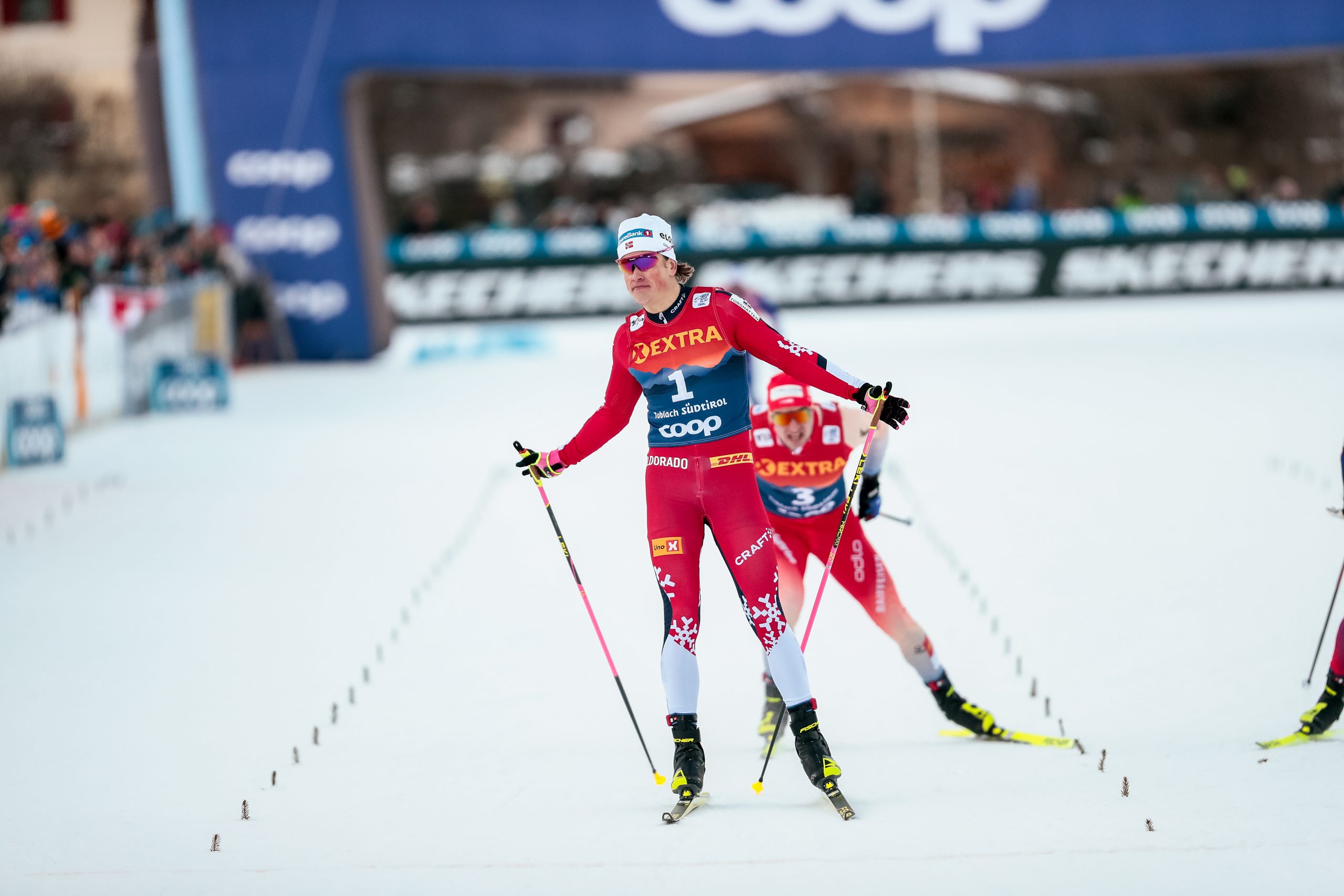
Johannes Hoesflot Klaebo (NOR) with his trademark coast into the finish of the individual freestyle sprint in Toblach (ITA). (Photo: NordicFocus)
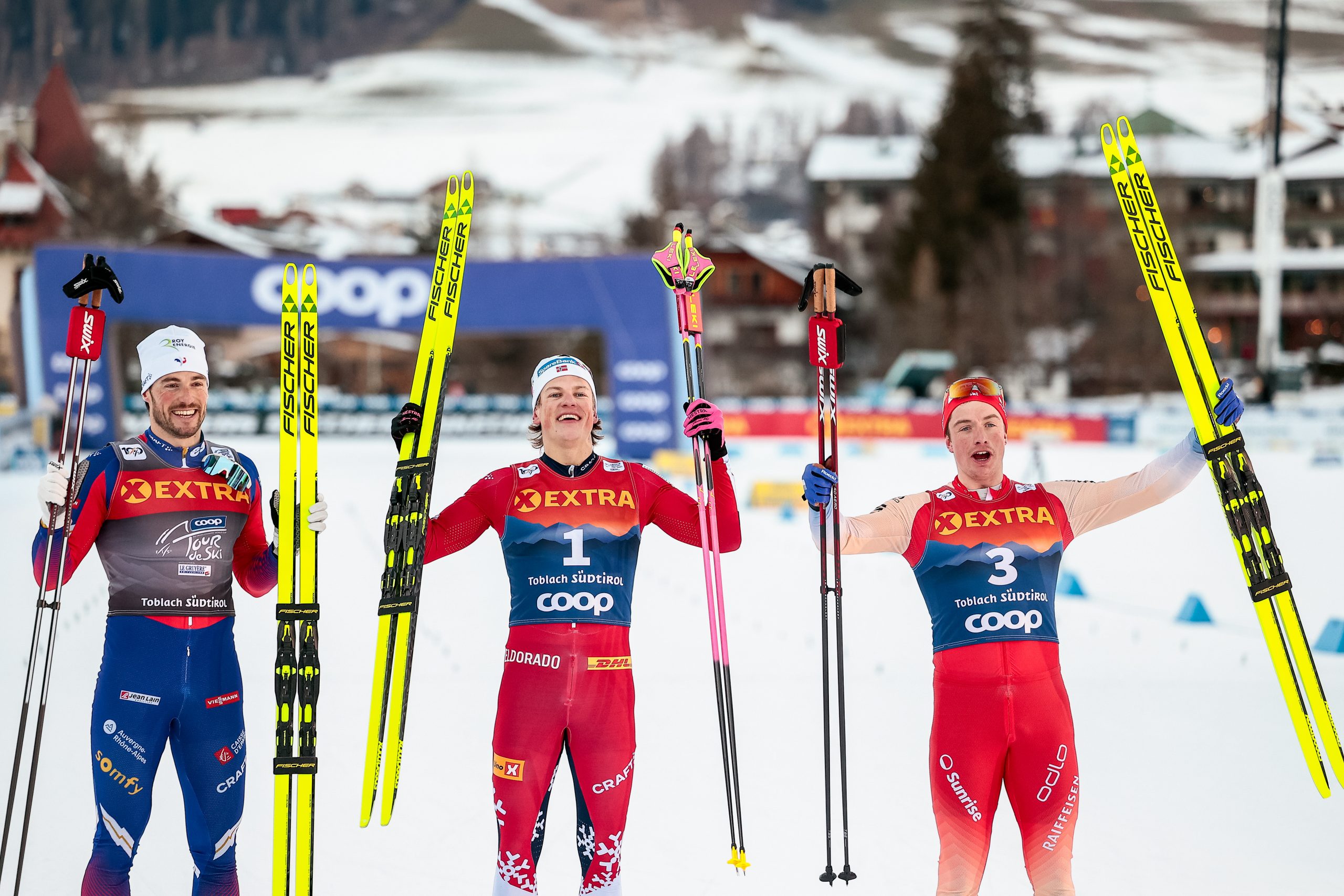
The heats followed a familiar marching pattern to those we’ve already seen this season: with Johannes Hoesflot Klaebo (NOR) and Lucas Chanavat (FRA) skiing synchronously at the start of each heat to control pacing and claim podium positions together. Janik Riebli (SUI) followed closely behind, slipping into the final as a lucky loser, with the road paved to a podium position after competitors Ben Ogden (USA) broke a pole and Valerio Grond (SUI) slipped during the final ascent. Klaebo earned, in what appeared to be an easy win, his 95th sprint victory. “In the end, I’m really satisfied, and it’s the perfect way to start the tour,” he said upon finishing the race.
Four Americans advanced to the heats, with Ogden finishing 6th, Gus Schumacher, 10th, JC Schoonmaker, 14th, and Jack Young, 17th. Zanden McMullen just barely missed qualification, finishing 36th. On the Canadian side, Antoine Cyr (56th) and Olivier Leveille (60th) completed the race but did not qualify for the heats.
Men’s Sprint Quarterfinals
In the first heat, Klaebo and Chanavat dominated from the start, skiing side by side in a controlled performance that seemed almost choreographed, easily securing their spots in the semifinal heats. Other athletes vied for these positions, Emil Danielsson (SWE) tried to pass through the middle of Klaebo and Chanavat, who accelerated and maintained their position in front. French skier Remi Bourdin also approached the pair in front over the final ascent around two minutes into the race, though could not surpass Chanavat and finished third in the heat.
In the second quarterfinal heat, Ogden battled Riebli head-to-head for the leader position, both holding off sprint specialist Richard Jouve (FRA). The two exchanged leads throughout the race, with Ogden making a decisive move around the inside of the final turn. This maneuver set him up for a clear finishing sprint, allowing both Ogden and Riebli to advance together to the semifinals.
Schumacher took an early lead in the third heat, facing challenges from Niilo Moilanen (FIN) and Davide Graz (ITA). After a minute and a half, Schumacher was able to solidify himself in front, accelerating through the descent to establish a small gap ahead of the field. His competition narrowed again in the final stretch, though Schumacher maintained his position in front to advance to the semifinals alongside Moilanen. Meanwhile, Evan Northug’s race took an unfortunate turn as he broke a pole just out of the gate, forcing him to pull to the side of the trail and effectively ending his chances of progressing. Currently ranked 3rd in the overall sprint standings, Northug is a strong sprinter, but this setback could jeopardize his Tour prospects, especially given his relatively weaker performances in distance disciplines.
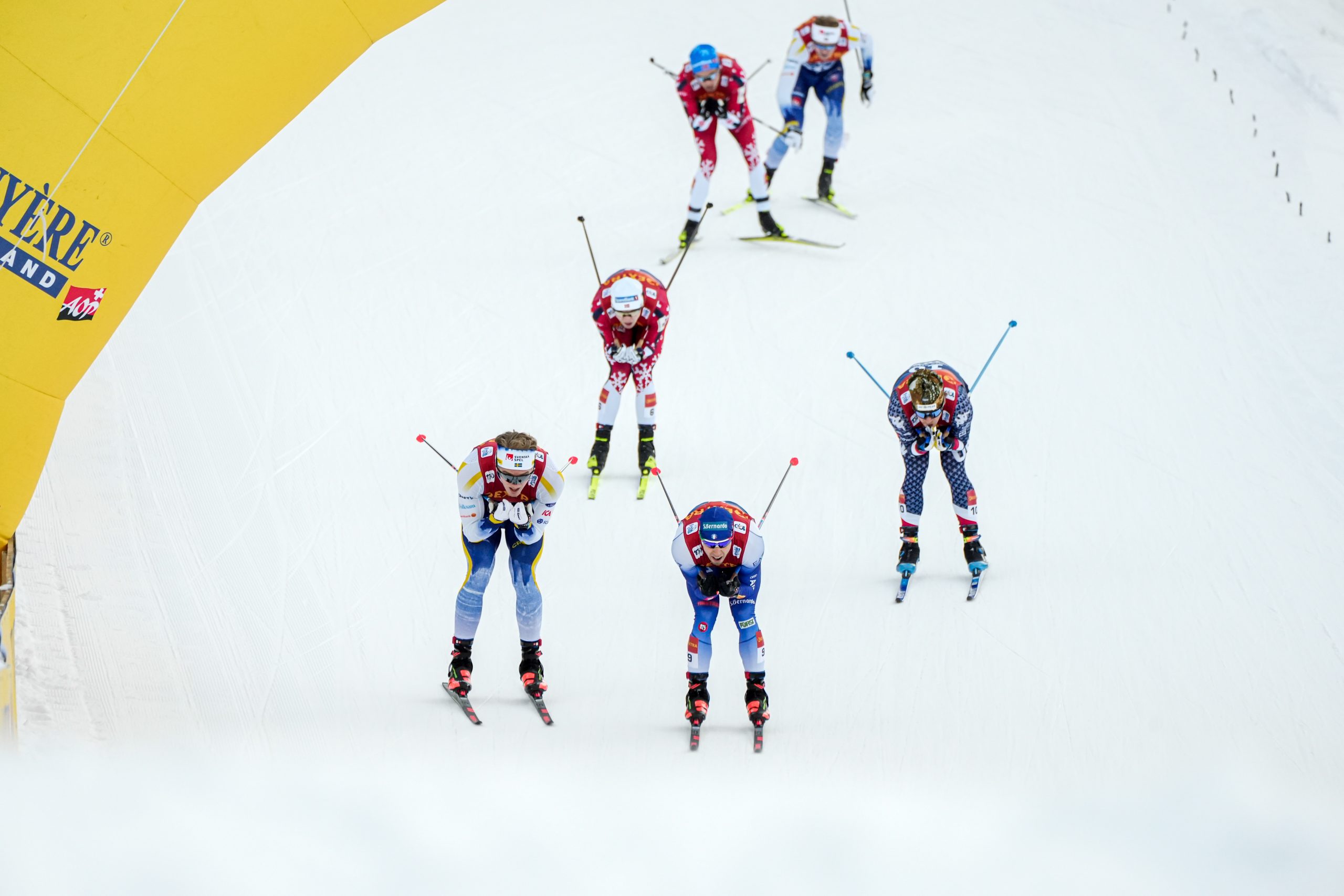
Federico Pellegrino (ITA), front, Edvin Anger (SWE), left, and Jack Young (USA), right, lead their quarterfinal heat. (Photo: NordicFocus)
Young battled against Federico Pellegrino (ITA), 12 years his senior, in the fourth quarterfinal together with strong sprinters Edvin Anger (SWE) and Erik Valnes (NOR). Valnes established an early lead out of the start, joined by Pellegrino. Midway through the race, Anger accelerated into the lead, but the top three continued to trade positions as the heat progressed. Young stayed right in the mix, maintaining a strong position near the front of the pack.
“I started as hard as I could and put myself in position near the front of the heat. After that, there wasn’t much I could do to get around Pellegrino or Anger,” Young explained. After being boxed out in the inside of the finishing stretch, Young’s chance of qualification was low but chances at a lucky loser position seemed high, ultimately missing qualification by 0.3 seconds. “The only thing I’m wondering about is whether I could have swung out wide on the turn into the finish instead of checking my speed to get the inside,” Young reflected after the race, “that could have given me the three-tenths necessary to get a lucky loser spot.”
Finally, Valerio Grond controlled the pace of quarterfinal five through much of the race, battling closely against Finland’s Lauri Vourinen. Italy’s Giovanni Ticco briefly challenged Grond for the lead initially but soon fell back, ultimately finishing last in the heat. Meanwhile, Schoonmaker stayed in the middle of the pack, focusing on “bringing good momentum into hills,” and positioning himself strategically to contest the leaders in the final sprint. Although he crossed the line in third, initially appearing poised to advance to the semifinals as a lucky loser, subtle time adjustments narrowly eliminated him from contention.
Men’s Sprint Semifinals
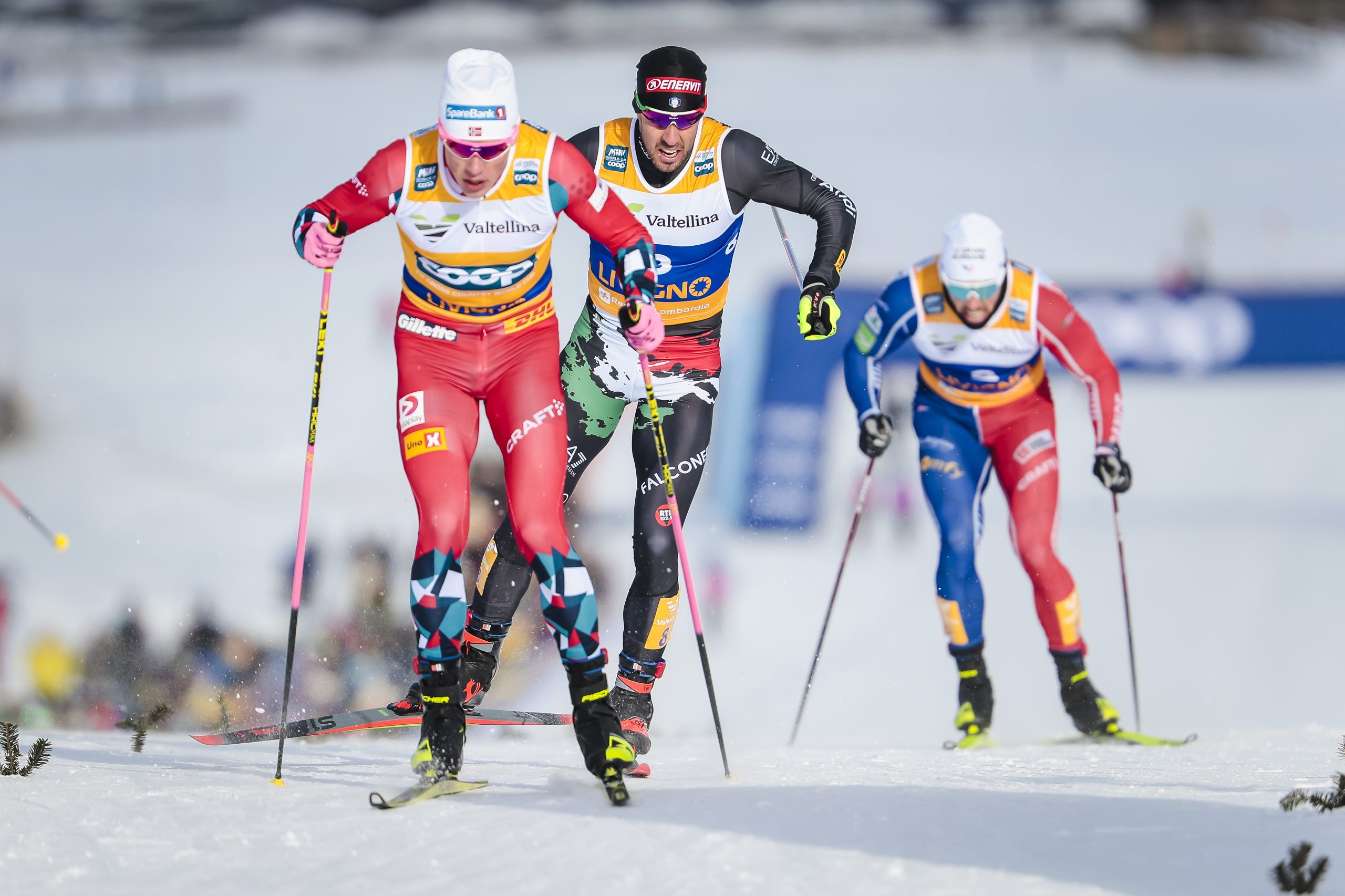
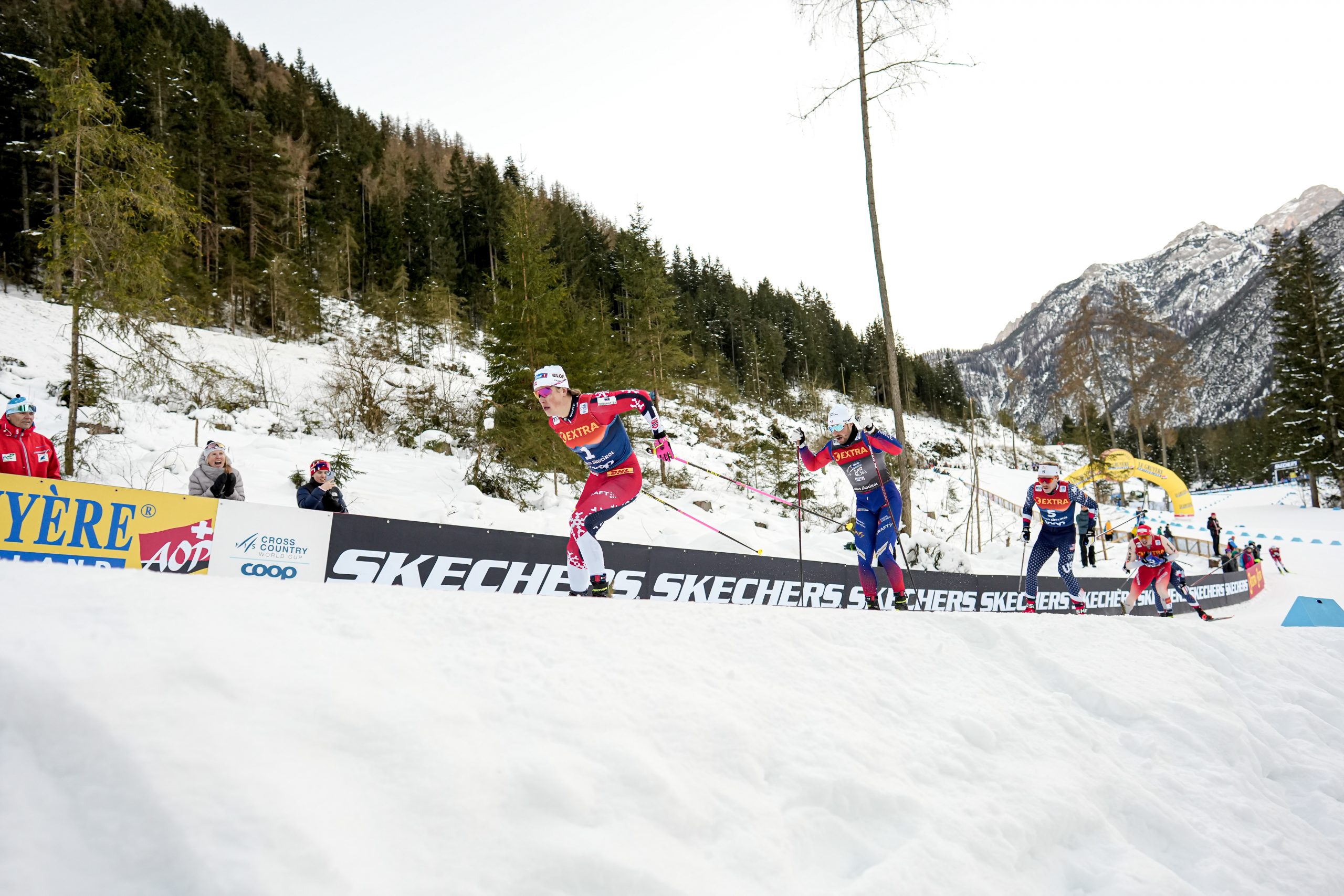
Johannes Hoesflot Klaebo (NOR), Lucas Chanavat (FRA), and Ben Ogden (USA) racing out of the stadium. (Photo: NordicFocus)
A quick look at the start list made it evident which semifinal was likely to produce the fastest times—and from which the lucky losers would emerge. Klaebo and Chanavat were set to face off again in the first heat, joined by Ogden, Riebli, and Valnes, all formidable sprinters capable of pushing Klaebo to reconsider his race strategy.
The heat unfolded precisely as would be expected, mirroring the quarterfinals. Klaebo and Chanavat led the pack side by side, skillfully controlling the pace around the course before Klaebo pulled ahead to take first at the line. Ogden positioned himself right behind them, confident that the speed of this heat would give him a chance at entering the final as a lucky loser. Ogden raced confidently and quickly, taking tight lines around the course and crossing the finish line in third, just behind Chanavat in second. The real drama came down to Ogden and Riebli, sprinting neck and neck to the finish, successfully securing lucky loser positions.
The second semifinal lacked a clear favorite, leaving the top two positions wide open for the competitors to claim. Richard Jouve and Federico Pellegrino both have a strong history in skate sprints, while Valerio Grond has recently delivered impressive results in the freestyle sprint discipline. Meanwhile, Anger, Vuorinen, and Moilanen have consistently been contenders in sprint finals this season.
Ultimately, this semifinal—perhaps aware that the lucky loser spots had already been secured by the first heat—turned out to be one of the slowest of the day. With six skilled sprinters, strategic positioning within the pack became the decisive factor in determining who would advance. Grond skied steadily from the start, moving into the lead later in the short race. In a close finish, Jouve narrowly edged out Pellegrino to claim the second qualifying spot for the final.
Men’s Sprint Final
Again, Klaebo and Chanavat took an early lead, executing their well-rehearsed, almost synchronized strategy to control the pace of the heat before battling it out at the finish line—a contest Klaebo typically wins.
While their dominance played out as expected, the race for the top three positions took an unexpected turn. Ogden broke a pole early on, losing contact with the leaders as they rounded the first corner. Moments later, Grond’s skis slipped on the uphill through the stadium, causing him to fall and take Jouve down with him. With three competitors effectively out of contention, Klaebo and Chanavat remained unchallenged at the front while Riebli skied through the chaos to contend for the third podium position.
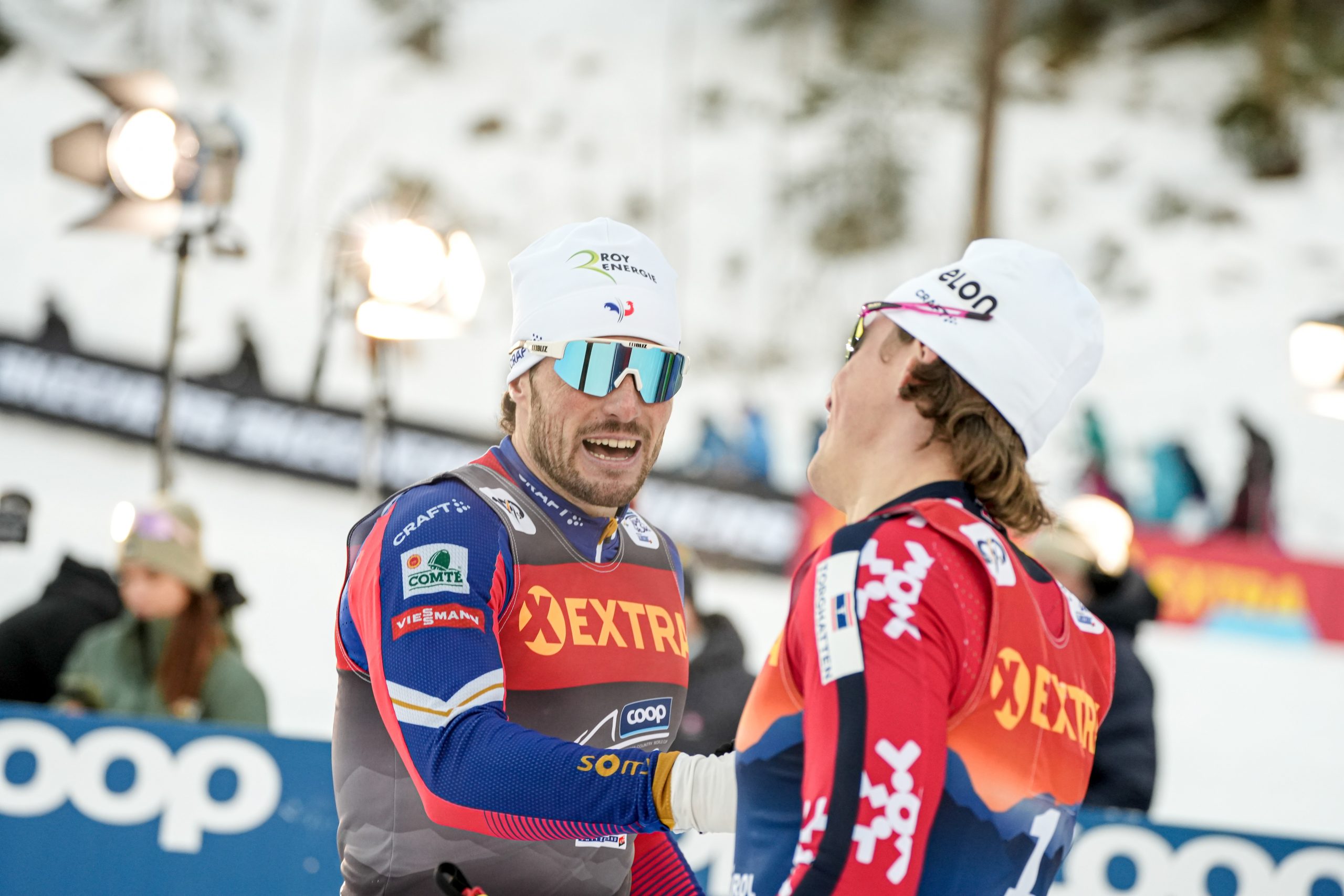
Johannes Hoesflot Klaebo (NOR), right, and Lucas Chanavat (FRA), left, congratulating each other after the races. (Photo: NordicFocus)
Ogden recounted the chaotic events of the final to FasterSkier after the race. “I was trying to weasel in behind Lucas [Chanavat], and someone behind me wasn’t thrilled about that,” Ogden reported, describing the battle for position that ultimately led to his pole snapping. “I was kinda able to ski with one pole, but then the exchange was incredibly hectic, and I tripped myself twice, and there was little to no hope after that.” Once Grond fell too, the two of them competed head to head for the remaining positions.
Despite the disappointing result, Ogden found pride in his approach to the heats. “I’m most proud of my confidence today in the heats,” he shared. “I was more nervous today than I’ve been for a while because I’ve got some memories.” He was referring to his breakthrough performance last season, which included his first-ever sprint podium on the Toblach course. “I feel like I handled it really well—skied smart and never got too frantic. It’s an unfortunate way to end after all that work, but what can you do? It’s part of the deal.”
As for Klaebo, his victory came as no surprise, continuing his dominance in sprint racing this season. While another win may feel routine for the seasoned sprinter, Klaebo expressed excitement with his performance. “In the end, I’m really satisfied. It’s the perfect way to start the Tour,” he said with a smile.
With only Stage 1 of the Tour completed, Ogden is focused on the long week ahead. “My goals are to manage my energy as best as I can and make it all the way to the end!” he said, with his eyes on the Leader Bib. For now, fans can expect him to prioritize recovery, fueling for the upcoming races, and finding lighthearted distractions like browsing “clapped Jaguars and Porsches on eBay” to unwind between events.
This World Cup coverage is made possible through the generous support of Marty and Kathy Hall and A Hall Mark of Excellence Award. To learn more about A Hall Mark of Excellence Award, or to learn how you can support FasterSkier’s coverage, please contact info@fasterskier.com.
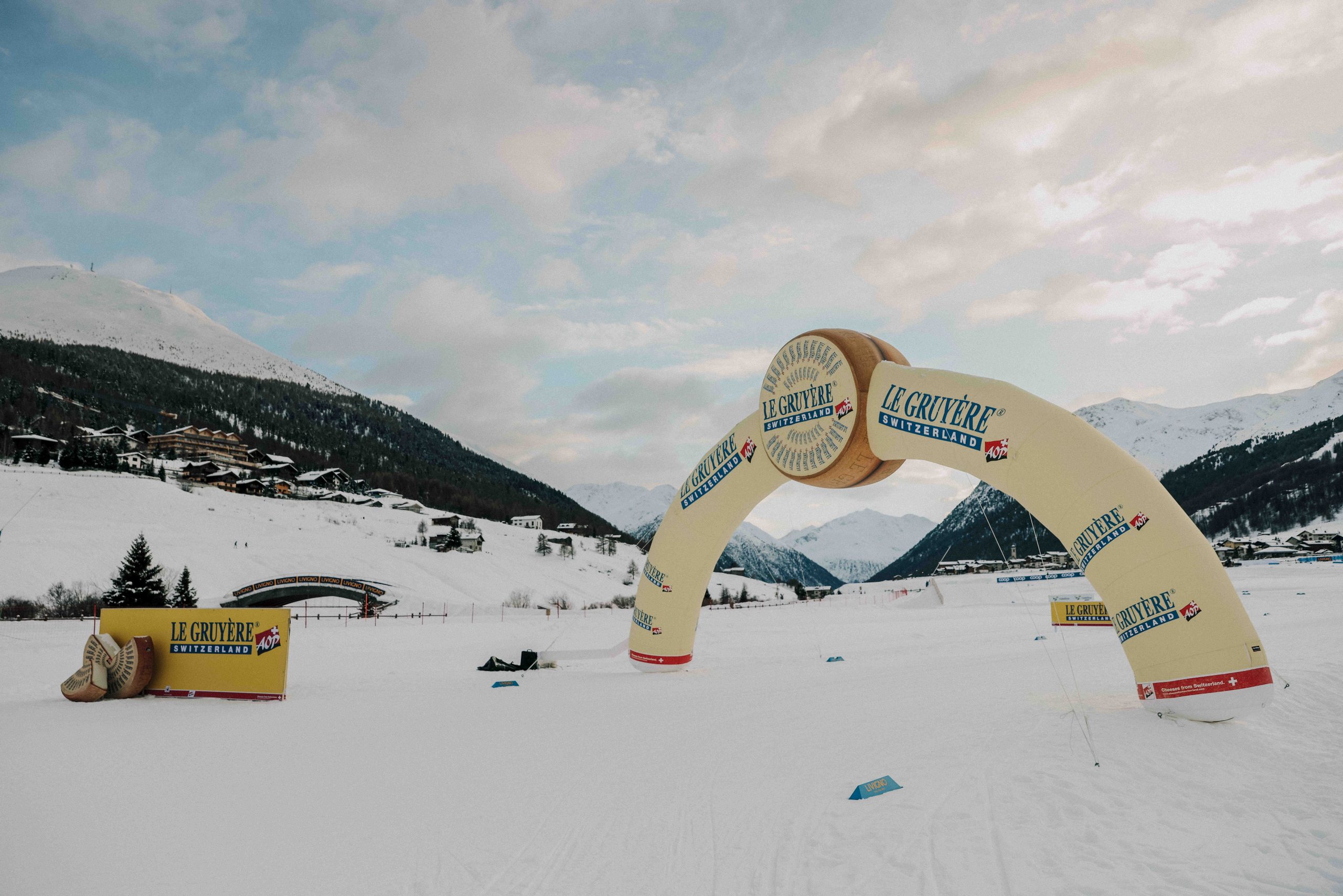
After taking a weekend off to recover from the grueling Tour de Ski, the World Cup returned to its traditional format this weekend. Today, in Livigno, Italy, the freestyle sprints were contested. It’s the first time Livigno has hosted a World Cup event. Livigno sits just below 6,000 feet, which would press the FIS (International Ski Federation) rules on altitude.
The pleasant sight of natural snow welcomed racers in Livigno, Italy. (Photo: NordicFocus)
The storyline on the men’s side should have been straight forward: Would Johannes Klaebo (NOR) continue his season, and career long, sprint domination? Over half of Klaebo’s individual World Cup victories have been in sprints, and he is riding a very hot hand having won nine out of ten of the last sprints he’s competed in. The primary threat to Klaebo was likely to come from Lucas Chanavat (FRA) who is currently second in the sprint rankings. Also hoping to topple Klaebo were Richard Jouve (FRA), and Federico Pellegrino (ITA). Pellegrino would have the benefit of being able to draw support from his home country’s fans. Pellegrino beat Klaebo in a shocking outcome in Davos, back in the middle of December. While a strong sprinter, Jouve’s strength is in the classic technique sprint.
Johannes Klaebo (NOR) on the way to another sprint victory. (Photo: NordicFocus)
Klaebo is in a pitched battle with countryman Paal Golberg (NOR) for the overall cup standings. While Golberg doesn’t usually have Klaebo’s sprint prowess, (he is fifth overall in the sprints), he would need a strong performance to keep him in the overall cup hunt.
However, the narrative became scrambled due to a schedule conflict with the Norwegian national championships. This led to Paal Golberg racing Thursday in Gjovik, Norway and then heading over to Italy for the weekend. Other men pulled double duty racing both the Norwegian championships and the World cup, including Erik Valnes and Even Northug. Valnes ended up winning his country’s sprint championship. It remained to be seen what effect the extra racing would have on Golberg and the others. Klaebo did not race in the Norwegian Championships.
The U.S. side of the men’s sprint story was also dominated by who was absent. Going into the race, Ben Ogden was in seventh place in the sprint standings (ninth overall). However, Ogden did not race today. U.S. coach Matt Whitcomb told FasterSkier that the time off was planned for Ogden. Also not racing today to prepare for the world U-23 championships were J.C. Schoonmaker (University of Alasaka-Anchorage), and Gus Schumacher (Alaska Winter Stars)
On the Women’s side, the biggest story again was who wasn’t racing. There were only 38 women who competed in the qualifying round. A morning of racing for the qualifiers was spent eliminating only 8 skiers. This should be a point of concern for FIS. Whitcomb shared the concern about depth of competition. “There’s a lot of stress coming up to altitude, and racing a sprint without being acclimated, and there’s a lot of pressure to race at [Norwegian] nationals. You really have to choose your battles.” The scheduling is far from ideal. Whitcomb noted that he is concerned with the depth, particularly of the women’s field. “One of the big issues is that it doesn’t make a lot of physiological sense when preparing for World Championships to go up to altitude for four days…and then come down.” He noted that it’s a problem that needs fixing.
Many of the top Norwegian women also chose to race the Norwegian championships or skipped Livigno. Tiril Udnes Weng, Heidi Weng, Lotta Udnes Weng, Ragnhild Haga, Helene Fossesholm, and Ingvild Flugstad Oestberg all chose to skip Italy. Frida Karlsson (SWE) also did not race today.
Emma Ribom (SWE) had dominated the sprints early in the season, but a bout with Covid may have prevented her from achieving similar successes lately. It remained to be seen whether she could regain her early season form. Today would also be a return to World Cup racing for Linn Svahn (SWE) who has had an extended absence from the World Cup due to injury.
The start list shuffling left the door wide open for American Julia Kern, who has been having an impressive sprint season. She is currently sixth in the sprint standings. Going into the race, third through sixth overall were only separated by 56 points. Given the sparse starting field, Kern had the opportunity to gain significant ground.
Julia Kern (USA) raced her way into a World Cup sprint final for the first time this season. (Photo: NordicFocus)
Jessie Diggins is fourth in the overall cup standings, only 15 points behind Kerttu Niskanen (FIN) who sits in third. But Diggins joined the long list of women not racing today. It was a strategic decision for Diggins who chose to prioritize rest prior to the World Championships over chasing World Cup points. U.S. coach Matt Whitcomb told FasterSkier that “Jessie’s doing great. She had a great training camp in Seefeld and stayed there with a bunch of athletes…because we knew she needed a break it was going to be either this weekend or Les Rousses, France [next weekend’s World Cup race]. Whitcomb continued that “The focus is now on World Championships, much more than points.”
Also not racing was U.S. National’s champion Hailey Swirbul. Swirbul won every race two weekends ago in Houghton, MI and had expected to race this weekend. However, Whitcomb informed FasterSkier that Swirbul had gotten sick almost immediately after arriving in Europe. “She’ll head straight to Les Rousses as soon as she is feeling good.”
Going into the race, Rosie Brennan was sixth in the overall standings, and she would be trying to help her cause by gaining points in the sprint. Brennan has had her ups and downs in sprints this year. She’s made the finals in Davos but has also had her difficulties. She seems to have put her early season illness behind her, so hopes would be riding high for the Alaskan.
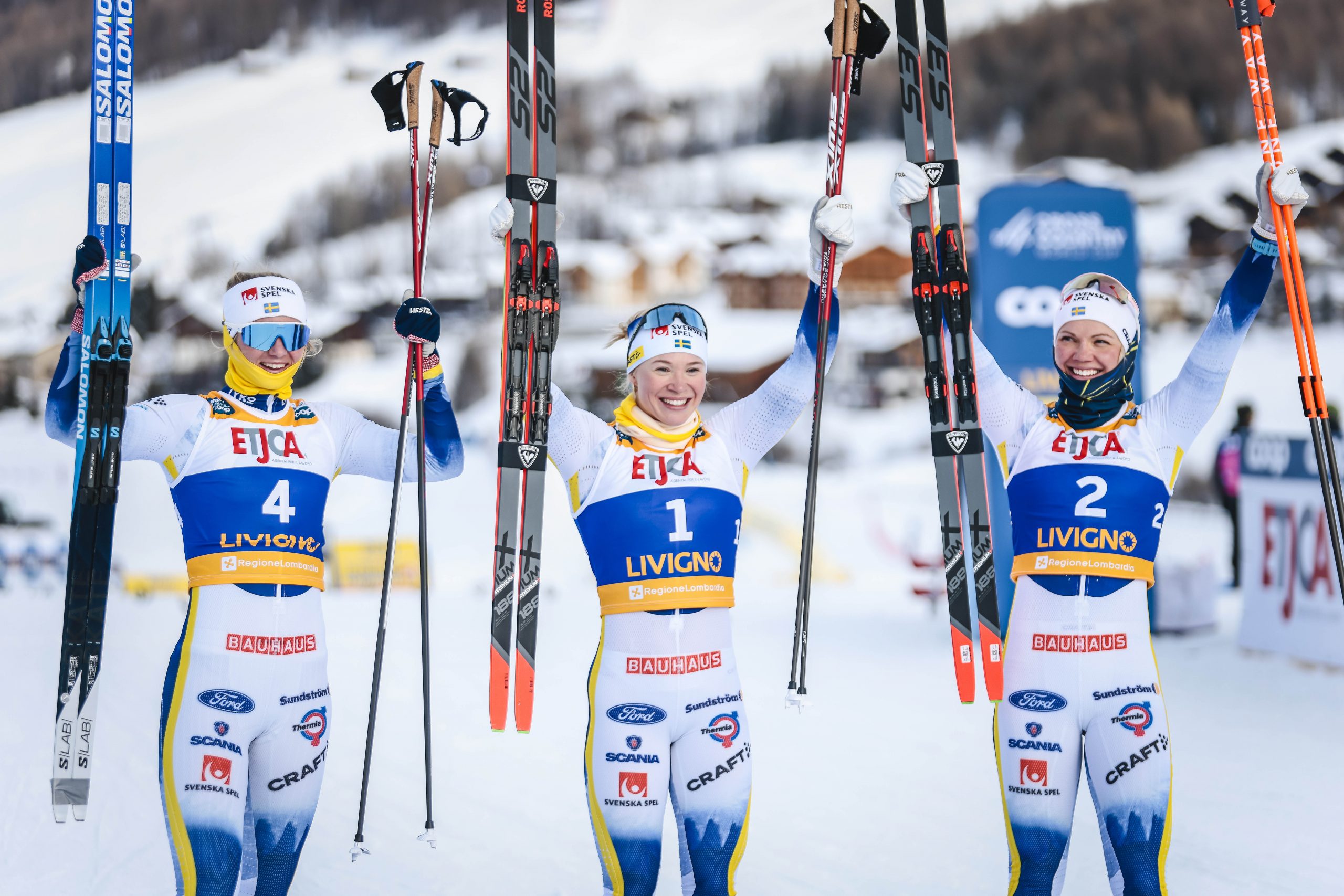
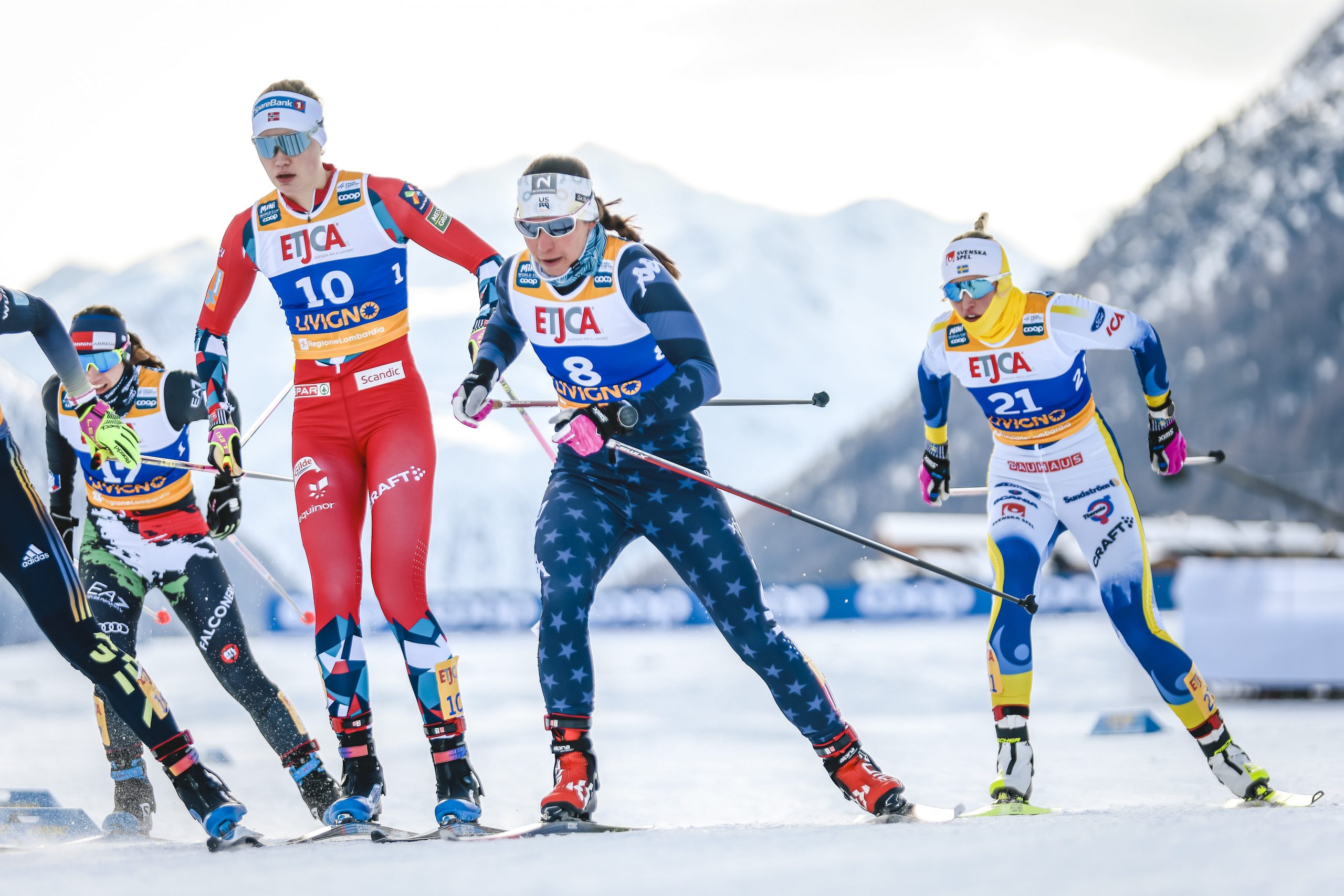
An all Sweden podium in Livigno (l-r : Maja Dahlqvist, Jonna Sundling, Emma Ribom) (Photo: NordicFocus).
The Results
It ended up being team Sweden dominating the Livigno podium. Finishing first was Jonna Sundling (SWE), followed by Maja Dahlqvist (SWE), and Emma Ribom (SWE). The top American women were Julia Kern, who finished sixth, and Rosie Brennan in 11th.
Other American finishers were Alayna Sonnesyn, 24th, and Lauren Jortberg, 29th.
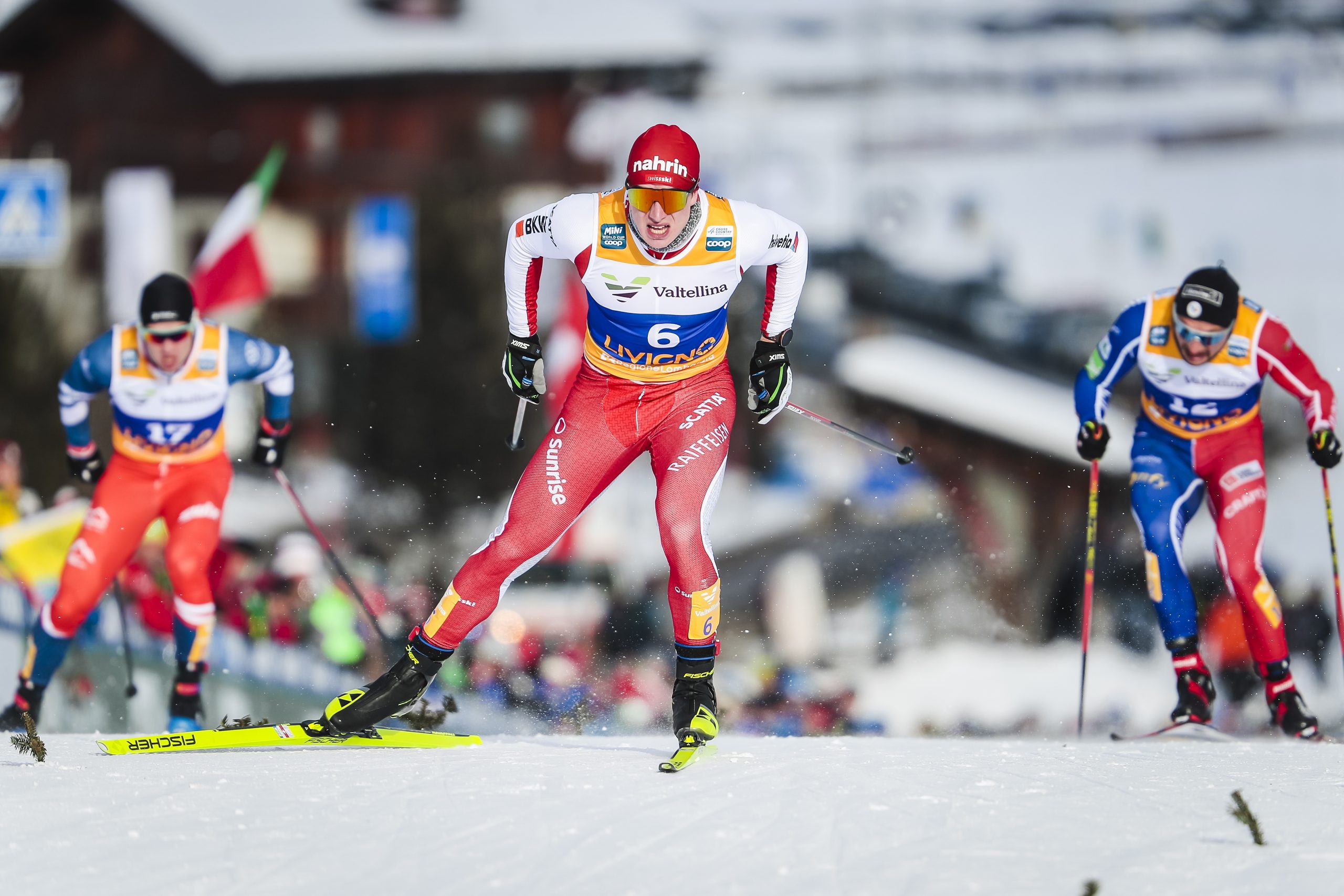
On the Men’s side the Klaebo train continued to chug along as he beat out Richard Jouve in a close finals race. In third place was a surprising Janik Riebli (SUI).
Janik Riebli (SUI) on the way to a podium performance (Photo: NordicFocus)
The top American male was Kevin Bolger, 12th. He was followed by Logan Diekmann, 38th, Will Koch, 41st, and Adam Witkowski 42nd.
The Race
In the women’s heats Brennan went in having qualified in 12th spot. She skied her quarterfinal heat strategically, sitting in fourth most of the way. She ultimately finished third in her heat and would have to wait for a lucky loser spot. She was rewarded for her work and ultimately advanced via the lucky loser route.
Kern skied very controlled in her quarterfinal and pushed herself to the front of the pack taking the lead with about 30 seconds to go and cruised comfortably to finish first.
Julia Kern navigating through the field on the way to the finals in Livigno. (Photo: NordicFocus)
Alayna Sonnesyn was not able to advance out of her heat.
Brennan and Kern both raced in the second semi-final. Brennan pushed immediately from the start setting a fast early pace. However, she was unable to hold the quick tempo and was passed about halfway through the race. Kern took an alternative strategy holding back early and then pushing to the front in the final half. Kern ended up second to advance to the finals. Brennan’s strategy of going out hard did not work for her as she continued to fade through the race and ended up last in her heat.
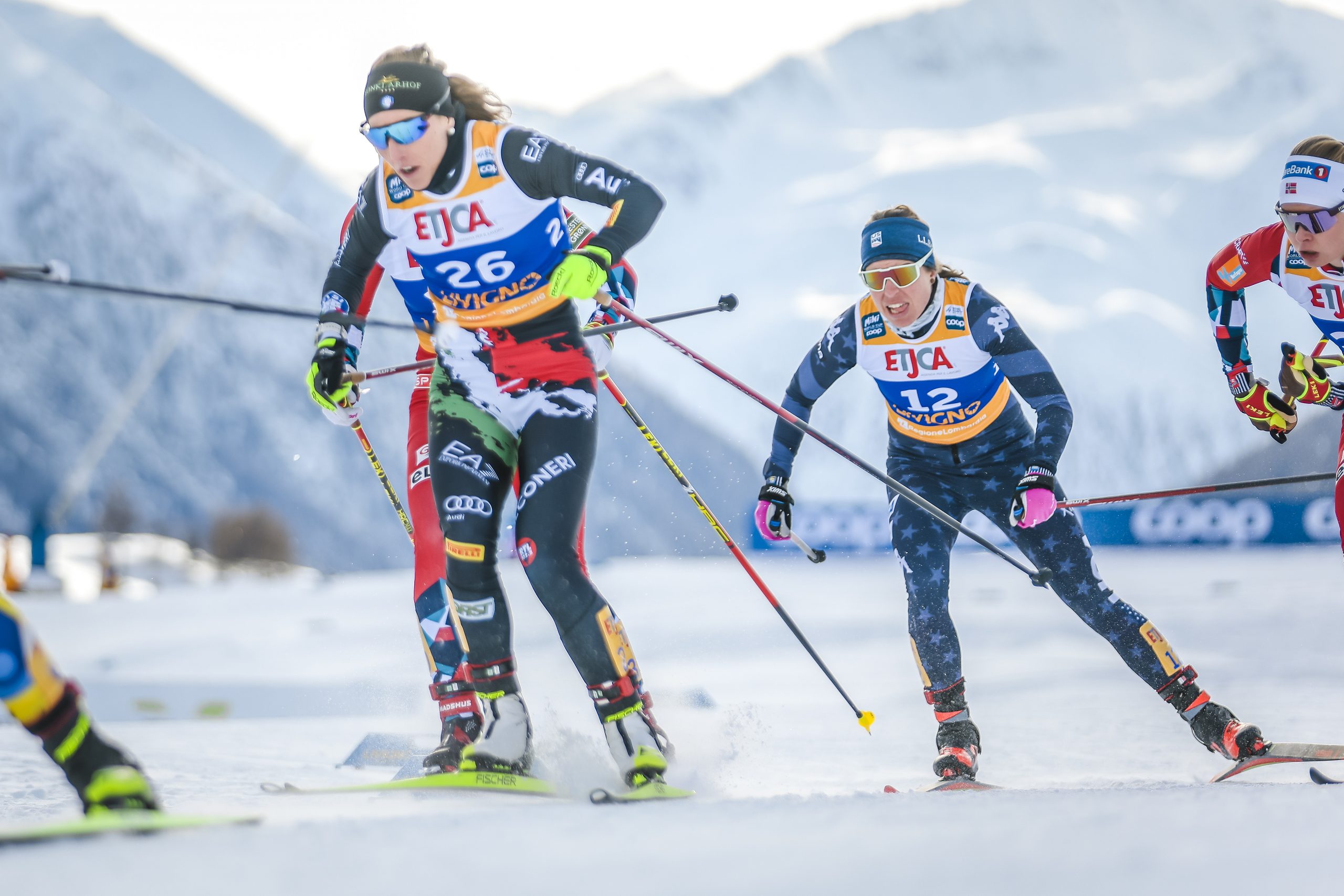
“I took a chance in my semi to ski a bit more aggressively and unfortunately, I completely ran out of power on the long uphill finish.” Rosie Brennan.
Rosie Brennan (USA) (number 12) gave it everything she had in the heats, but ultimately ran out of steam. (Photo: NordicFocus)
The difference in approach was based upon what the racers experienced in the quarterfinals. Whitcomb said that “Julia felt like she was knocked around a little out of the start…there’s always a risk when you’re playing your cards from fifth or sixth. We wanted her in the semifinal to be in a [higher position], so she had less traffic to deal with.” Regarding Brennan, Whitcomb said that “People drafted by her, and she kind of ran out of energy.”
On the men’s side, Klaebo—who qualified with the fastest time—comfortably won his quarterfinal. Jouve, Chanavat, and Pellegrino also advanced comfortably.
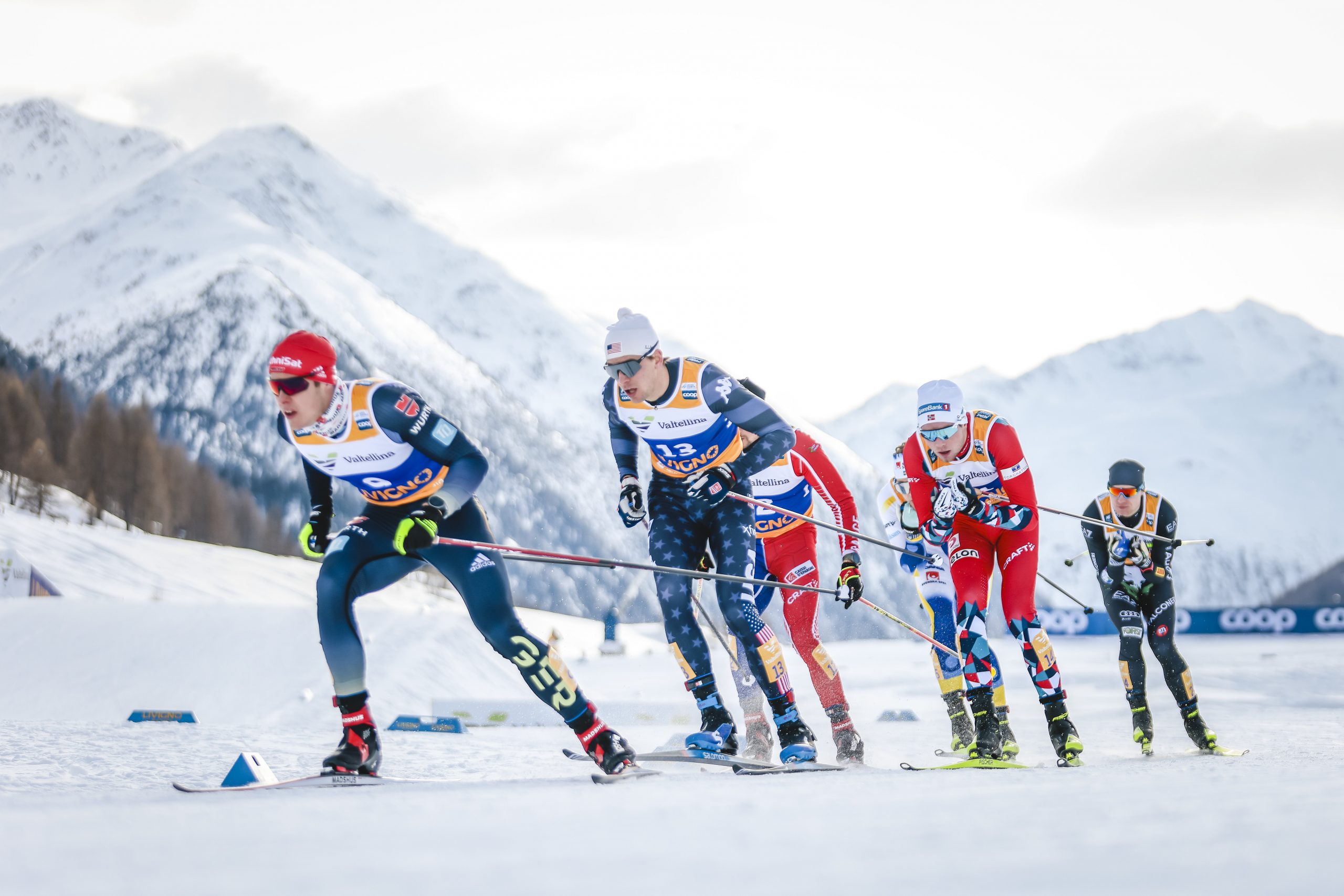
The only American man to qualify for the heats was Kevin Bolger. He skied a very efficient quarterfinal and ended up winning his heat.
In the men’s first semifinal it was Klaebo and Jouve taking first and second. In Bolger’s semifinal he went to the front from the start. With most of the pre-race favorites going in the first heat, it was a good strategy. But just like with Brennan, he faded toward the finish and ended up finishing last in his semifinal.
Kevin Bolger (USA) (number 13) would have an outstanding day in Livigno, finishing 12th. (Photo: NordicFocus)
In the finals, the only American left was Julia Kern. She held back toward the rear of the pack at the start with four Swedes out front. Faehndrich tried to meticulously worked her way through the crowd of Swedes, but was unable to join the front grouping. Kern was never able to find the speed to challenge and ended up sixth. It was still her best sprint result of the year. At the end of the day, It was all Sweden with Sundling, Dahlqvist, and Ribom going 1-2-3.
In the men’s final Klaebo held back at the start sitting in fifth place, and then easily moved himself to the front about a minute into the race. He then asserted himself at the front, content to let others try to find a way around him. At the finish Klaebo turned on the afterburners and was able to just beat out Jouve at the finish line. It was a close finish, but at the end of the day no one had solved the puzzle of how to beat Klaebo in a sprint race. Not bad for a guy who pulled into the venue the night before the race.
An interesting byproduct of the scheduling was the U.S. and Norwegian teams shared wax facilities this weekend. Whitcomb said that, “Because Norway kept so much of its infrastructure in Norway because of the nationals, they needed some help. It was a great opportunity to partner up…we had the Norwegians in our truck today.” It turned out that Klaebo’s skis were waxed in the American truck by Norwegian technicians. Whitcomb emphasized the value of sharing ideas and was excited about the partnership. The teams have a history of helping each other when one needs help. In addition to sharing physical space, the teams shared testing data as well. “We have a great relationship with the Norwegian team…I’m very proud of our small staff’s ability to plug in with the Norwegians and figure out a seamless working machine. It was a great team accomplishment.”



 This World Cup coverage is made possible through the generous support of Marty and Kathy Hall and A Hall Mark of Excellence Award. To learn more about A Hall Mark of Excellence Award, or to learn how you can support FasterSkier’s coverage, please contact info@fasterskier.com.