
Jaqueline “Jaque” Mourão is used to surprising people, and it’s a feeling that she relishes.
It’s hard to even list all of the achievements the 36-year-old Brazilian has racked up so far. Mourão picked up mountain biking as a teenager, and at age 29 became the first woman from her country to compete in mountain biking at the Olympics, in Athens; she qualified thanks to a ninth place ranking in the UCI mountain bike standings in 2003. In 2005, earned Brazil’s first podium in a World Cup race, and then later in the season won a World Cup cross country marathon at Mont Sainte Anne in Quebec.
Mourão moved to Quebec to be with Guido Visser, a Montreal native who represented Canada in cross-country skiing at the 1998 Olympics in Nagano. The two are now married and parents, but Visser changed her life in another way too: he introduced her to snow.
By 2006, Mourão was skiing and qualified for the Torino Olympics, becoming the first Brazilian woman to compete in both summer and winter Olympics. Since then she has made two more appearances, placing 19th in mountain biking in Beijing in 2008 and 66th in the 10 k skate in Vancouver in 2010.
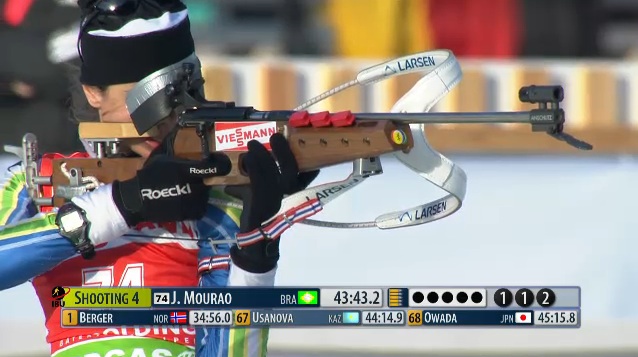
Not content with any of that, Mourão picked up biathlon and made her first big-stage appearance this season at World Championships in Ruhpolding, Germany. She’s helped by still being in great shape, and improving her ski technique: at the end of the winter, she placed sixth in the 10 k skate at Canadian National cross country championships, besting Chandra Crawford by 15 seconds.
Mourãois now aiming for an Olympic appearance in a third sport, and appears to be well on her way – especially thanks to the help of Matthias Nilsson, a Swede who signed on this season to coach the Brazilian team. Nilsson was planning to compete this year, but was forced to call it quits after being diagnosed with a leaky heart valve in early October.
FasterSkier was able to snag the pair for an interview onsite in Ruhpolding back in March, after Mourão had just finished the 15 k individual race, where she placed 88th.
FasterSkier: How did you get into biathlon?
Jaque Mourão: I started one year ago because I got pregnant. I finished the 2010 Olympics and Vancouver and found out that I was pregnant, and thought, “oh man, I will have to cut a lot in my training.” So then I decided to learn how to shoot.
And I really love the shooting – I just love to shoot! It’s funny, because I’m Brazilian, I hate guns. There is so much violence and these things on the news. And all of a sudden I have a gun. After you learn all the procedures and how to be safe all the time, you see that it’s not a problem. It’s not dangerous. I even have my baby, and it’s not dangerous.
FS: And Matthias, how did you get hooked up with the Brazilians?
Matthias Nilsson: It’s a long story, but I can make it short [laughs]. They wanted a coach from Sweden, and they asked a friend of mine. But he couldn’t take the job, and it was about the time that I retired, so – I did it.
FS: So are you living in Canada now?
MN: No, I still live in Sweden.
FS: So, then, Jaque, do you go to Sweden?
Jaque Mourão: I was there in December for the first IBU Cup. I met Matthias there. But before that, I was training with the Quebec girls – I started there one year ago. Now that Brazil has a coach, I am working more with Matthias.
FS: It seems like you shot pretty well today for someone who has only been doing biathlon for a year.
JM: Yeah, I am happy. I had a very good race – 17 out of 20 has been my best, and today was 15. People said the sprint would be better because it’s only ten shots, but it’s the opposite. I do better in the individual races. The shooting is saving me. I just love it. I want to learn as much as I can.
In Brazil, it’s like: mountain biking? You are the first woman to go to the Olympics. Oh, yes, I can prove it for us, you will see, I will go to the Olympics. And then the winter sports: oh yes, Brazilians can ski, I will show you. And now with biathlon, I say, Jaque, you can do that.
It’s so complicated, and there are so many things to learn, but I like the challenge, and I like to learn and to show people that it’s possible. It’s complicated because we don’t have snow – I saw snow for the first time when I was 27 years old. It’s not at all our sport. So it’s very emotional when I arrive here and see our flag with all these countries, and see that yes, I am representing my country.
FS: Are you the only one from Brazil? Are there no men?
JM: I am the only one. There are males but they didn’t qualify. It was a bit of a surprise because we have Mika [Mirlene Picin] who has been doing biathlon for longer than me, but unfortunately she didn’t qualify, by just 13 seconds. It was a bit unlucky. And then I qualified and it was like, okay, I’m going to the World Championships now, and it was very big. We tried to do our best, and that’s what we did.
To challenge yourself is [what the sport is really about], and to do your best. And if you are able to attain your goals and write your name in the history of your country, then people down the line will look at your history and say, yes, it’s possible. Yes, we can do it. Yes, no matter what your dream is you can pursue that. If I can inspire them with that, I am very glad.
FS: How are the trails here?
JM: It is different than the IBU Cup, because you have those three really tough hills here right before you shoot. And there are tough curves, so it goes right to your legs. I’ve now reached the World Cup [standard], and I want to do more and more of these races so I get used to this level.
FS: Do you train at Mont Sainte Anne?
JM: Yes.
FS: There are some hard hills there…
JM: Yes! But we don’t have a shooting range. So you don’t have the feeling of shooting after you really force your legs.
FS: Do you shoot at Valcartier?
JM: Yes, I go there every day and go training one hour, and then I shoot and come back home. It’s a good center and I have Claude [Godbout], I have Yolaine [Oddou], I have all the girls there that I can train with, so it’s very good for me. It’s perfect – they invite me, come Jaque, let’s do intervals – so they teach me, and that was very good for me to learn fast, because I don’t have time.
FS: Matthias, this is your first coaching job, right?
MN: Yes.
FS: What were you expecting when Brazil approached you?
JM: A bunch of bananas?
MN: I was more afraid of, what if I didn’t like being a coach? Like if it doesn’t fit you, or it’s boring, or I’m bad at it. But it’s fun, and it’s a good challenge for me.
FS: Has it been hard to be here and not be racing?
MN: Not here so much, but it was hard in Östersund when it was the first competition and my home course. After a while I’m getting used to it. And now when I’m skiing, I feel that I don’t have the same shape as before, and you feel that it’s not so – if I compete, I want to be at the same level that I was before, and I’m not.
FS: Are you coaching her on technique, or just sending a training plan, or what?
MN: Guido takes care of the skiing training. But I help her with the technique, in skiing and shooting.
JM: It is very good help.
MN: There has been a huge difference from before Christmas and after.
JM: When you have someone like Matthias in the team, you have the answers right away.
MN: Before Christmas she was skiing like a – I don’t know what you call it, but, like, the opposite of how you should.
JM: I was pushing to the side, so he corrected me, and it was very fast, like, oh, now I understand.
MN: I was very impressed that she could so easily make the change, because if you take a Swede who has been skiing wrong for so long, it is really hard to change.
JM: There is still a lot to go, but we are working hard.
MN: And then the shooting, she shoots well. She can speed up more, but it takes time to get there. The groups are really nice.
FS: How fast are you shooting compared to the other women here?
JM: Sometimes it’s one minute, sometimes it’s 29 seconds.
MN: In the standing it’s about 50 seconds.
JM: So 20 seconds worse. And also my approach to the range is still a lot slower. I can gain 30 seconds, 40 seconds on these things, arriving, shooting, and going away.
FS: So those are some easy places to gain seconds. Well, maybe not easy?
MN: No, but it’s easier to get five seconds by putting the rifle on the right way than by skiing five seconds faster.
FS: How does Brazil finance these biathlon trips?
JM: I bought my gun, which was expensive in the beginning. But we have quite a normal life. We are not living in luxury but we can survive with biathlon and skiing. There is a Brazilian Snow Sports Federation (CBDN) for all the winter sports, alpine skiing, cross country skiing, biathlon. The Olympic Committee, the government, and the federation pay for my trips, and I have a salary from Brazil because I’m an Olympic athlete.
FS: How does it feel to skate through the stadium with so many cheering fans?
JM: Today in the warmup, I saw this little flag of Brazil in the middle of the crowd and I was ready to try to make contact with them, and then he realized I was right there. It’s amazing, it’s so loud when you are right there [on the range] and you don’t want to be shooting with the German girls because it is so loud.
And I have to say, for Guido and my in-laws, they all like watching biathlon better because it’s more exciting than cross-country skiing.
FS: So are you done cross-country ski racing, do you think?
JM: No! I’m going to do both. You can’t just do biathlon because we don’t know very well if we are going to qualify or not [for Sochi], but my goal is to qualify for the Olympics for biathlon. And the skiing, I’ll still be doing it, and of course the skating technique is the same and does help, but we are focusing more on biathlon.
It’s a very complicated system to qualify, because you only have 28 nations that can go to the Olympics. Actually in the last Olympics there were 31, so you have a little bit of room. But it’s the three or four girls who at the World Championships who count – and there’s only one of me here. So you have to do your job. I hope Mirlene can qualify next year and get some more points for us.
FS: Matthias, are you going to keep coaching her through the Olympics?
MN: Yes, that’s the goal. Then, I don’t know.
JM: And then I don’t know! Maybe I can go for pistol-shooting.
MN: You can do that until you’re 50 years old. There was a Swede who was in the Olympics when he was 70 or something. I think that can be your goal. [Note: Sweden’s Oscar Swahn, then 65, won gold in 1912, and silver eight years later.]
FS: You can be the oldest Brazilian Olympian, too.
Do people in Brazil know that you are doing this? Is there media coverage?
JM: Actually, they are following me. I was surprised. I was in a big magazine, and the biggest TV in Brazil, and today they broadcast the biathlon championship live on sport TV. That has never happened, never. So it’s fun to see that they are paying attention.
FS: Do you have any advice to people who want to try biathlon?
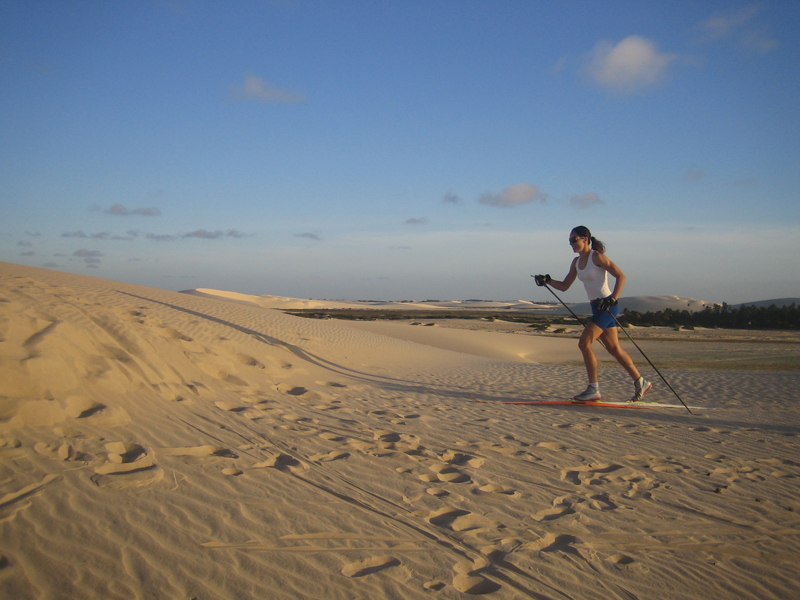
JM: It’s a good thing to go into, because the federation is very open. They have now more rollerskis in Brazil, and a camp for beginners. So we can introduce them to the sport. Have you ever seen sand skiing? We have alternative ways to show our sport to people. And it’s working. We have a very young athlete who went to Sweden to train for a month, and we have another who contacted me through my website who is a rollerblade racer. And one guy in Canada, in Canmore, 30 years old, Brazilian, and he loves biathlon.
So I’d say the future is bright.