Tag: Jari Joutsen

  • Bender, Ozerskiy Stay Alive in Birkie Sprints

    Bender, Ozerskiy Stay Alive in Birkie Sprints

    Dmitriy Ozerskiy of Russia out-lunges Tim Reynolds (Craftsbury Green Racing Project) to win the men's freestyle elite sprints at the American BIrkebeiner festival in Hayward, Wis., on Thursday.

    All American Birkebeiner coverage is brought to you through the generous support of Concept2, makers of the SkiErg.

    Birkie Elite Sprints are available to watch here (recorded live by CXC).

    HAYWARD, Wis. – In theory, every high-level racer in downtown Hayward on Thursday should have been a distance specialist. With the 50 k American Birkebeiner in two days, one would have thought that’s what they were there for.

    The 500-meter elite freestyle sprints proved otherwise, as 26 skiers zoomed up and down Main Street on freshly packed natural snow. Essentially, the single-elimination bracket left no second chances as racers attempted to master the art of going all-out.

    American Birkebeiner sprints
    Jennie Bender (CXC) celebrates her Birkie elite sprint victory on Thursday after beating Clare Egan (l) in the final.

    Jennie Bender of Central Cross Country (CXC) demonstrated her sprint savvy with a powerful V2 alternate, first beating Rebecca Dussault, a two-time elite sprint winner and 2010 Birkie champion, formerly of CXC and now races for Salomon.

    In the semifinals shortly after, Bender knocked out the reigning Birkie sprint champion, Natalia Naryshkina of Russia, who out-lunged Bender for first place last year.

    Trailing Bender in this year’s semi, Naryshkina, who also races for CXC, cramped up and pulled back before the finish. Bender advanced to the final, where she topped Clare Egan of the Craftsbury Green Racing Project to claim the sprint victory and $500 dollars that came with it.

    After the race, Bender said she felt a little over-raced and initially considered skipping the sprints.

    “I was pretty tired this afternoon, and I was like, ‘Well, I’ll kind of go and see,’ ” she said. “I have a hard time saying ‘no’ to a sprint.”

    In the end, she was glad she did the downtown sprints.

    “I kind of needed today as a little bit of a tune-up,” Bender said. “I’ve been needing a kick in the butt to get going. Some speed will help me, I think, for this weekend.”

    On Saturday, Bender will embark on her first 50 k Birkie skate race. She won last year’s classic race and set a course record in the 54 k at the American Birkebeiner.

    As for the biggest hurdle in Thursday’s race, with a slightly downhill straight shot to a pylon and back, Bender said it was the sharp turn on the “super-slick snow.”

    Women's podium at the American Birkebeiner's 500-meter elite sprints. (From left to right): Clare Egan (CGRP) in third, Jennie Bender (CXC) in first, Natalia Naryshkina (RUS/CXC) in third.

    That made it hard to stay on your feet and even more difficult to do at high speeds.

    “A lot of the sprints these days have an endurance component, but this is pure, fast-twitch muscles, all-out go,” Bender said.

    Egan took the $250 second-place prize after beating Sara Hewitt (CXC) in the quarterfinal and Audrey Weber (Atomic) in the semi. In her first time racing an out-and-back short sprint, Egan said the technical aspect of making the tight turn was both crazy and fun.

    “I’m usually not that successful in short sprint races, especially kind of flat ones just because there are a lot of people that are more powerful than me,” Egan said. “But I somehow made it around the pylons and my skis were really fast, and it just ended up working out today.”

    She also found her lucky charm: a set of brass pigs, which she shook before the race. Teammate Susan Dunklee bought the trinkets in Austria and gave them to Egan to hold in her hand and shake for good luck.

    “I kind of felt like I was in a slump recently and I realized it was because I hadn’t had my lucky pigs,” Egan said. “I definitely gave them a little shake before the race and I think that might have helped me.”

    Naryshkina was third after beating Weber in the consolation round.

    Russians Go to Work

    In the men’s race, Dmitriy Ozerskiy of Russia dominated his competition, including his lone teammate at the Birkie, Maxim Fadeev. Ozerskiy was coming off a broken-pole mishap in Madison, Wis., which took him out of contention for the SuperTour freestyle sprint title last weekend.

    Dmitriy Ozerskiy (RUS) at left edges Jari Joutsen (FIN) in a head-to-head semifinal round at the Birkie elite sprints in Hayward, Wis., on Thursday.

    On Thursday, he topped the elite field of 17 men, edging Tim Reynolds (CGRP) in the final with one last lunge. Ozerskiy previously beat Finland’s Jari Joutsen in the semifinal with a similar photo finish.

    After he eliminated Fadeev in the quarterfinal, his teammate immediately shifted gears to help him. Fadeev said he applied high-fluoro “Russian special liquid” on Ozerskiy’s skis, which helped make the difference.

    “I like the short distance,” Ozerskiy said after V2-ing to the win.

    “He’s a great sprinter for short distance in Russia,” Fadeev said. “If this format sprint was in Russia, I think that he would be first or second in the medals.”

    Fadeev suggested that Ozerskiy could be of Olympic caliber in a sprint of similar distance. Ozerskiy started off strong, beating Morten Eide Pedersen (NOR/Lillehammer) in the opening round.

    The men's podium at 2012 Birkie elite sprints. From left to right: Tim Reynolds (CGRP) in second, Dmitriy Ozerskiy (RUS) in first, Jari Joutsen (FIN) in third.

    The runner-up of the day, Reynolds raced the Birkie sprints two years ago and said the turn at the end always made things interesting. Fortunately, he got around it fine.

    After winning his first two rounds comfortably (first over Norway’s Halvor Korboel Thoner and later against Vegard Kjoes Egge of Lillehammer), Reynolds ousted Switzerland’s Philip Furrer by an inch. Reynolds was on the other side of the photo finish in the final.

    “I thought I could get [Ozerskiy] and I just got a little squirrely at the end and lost a little bit of space,” Reynolds said. “Short course, you can’t make any mistakes.”

    Joutsen placed third after topping Furrer, his friend and travel partner at their first Birkie, in the consolation round. Joutsen said he had fun but would have preferred a one-way sprint uphill to avoid the turn, which, “for a big guy, it’s very tight.”

    “Your skis can [get] in the fence,” Joutsen said. “In the rollerski World Cup, they have this 200-meter to 300-meter sprint straightaway. It’s very interesting.”

  • Furrer Notches SuperTour Victory Ahead of Reynolds, Joutsen

    Furrer Notches SuperTour Victory Ahead of Reynolds, Joutsen

    Switzerland’s Philip Furrer (second from left) celebrates winning the Madison SuperTour 1 k freestyle sprint on Sunday. Tim Reynolds squeezes by on the far left to get second, Jari Joutsen (second from right) was third, and Pat O’Brien (r) was fourth in the A-final.

    All Madison SuperTour and American Birkebeiner coverage is brought to you through the generous support of Concept2, makers of the SkiErg.

    MADISON, Wis. – Finland’s Jari Joutsen could have been mad or at least frustrated with a split-second lane change that forced him out of his spot into another skier in the A-final of the SuperTour 1 k freestyle sprint on Sunday.

    After the race as he stood next to Philip Furrer, the Swiss who claimed the victory, Joutsen smiled. How could he be mad at his friend, who trained with him and stayed at his home in Finland? Furrer was even wearing a matching green ski suit to represent Joutsen’s company, Optiwax.

    Furrer didn’t have to apologize for Joutsen ending up third. They both understood that was part of racing. From Joutsen’s standpoint, his team topped the podium twice in two days after he won Saturday’s classic sprint.

    On Sunday, Tim Reynolds (Craftsbury Green Racing Project) found a way to edge Joutsen in the A-final, tucking behind Furrer when he moved to the inside lane. Meanwhile, Joutsen tried to regroup after being forced outside. Reynolds stayed on Furrer’s heels and stuck his leg out around the Swiss for second place.

    Madison SuperTour men’s 1 k freestyle sprint podium: runner-up Tim Reynolds (CGRP) at left, winner Philip Furrer (SUI) in the center, and Jari Joutsen (FIN).

    Joutsen likely never saw Reynolds coming or squeeze by on the inside. He was too busy trying to stay on his feet after Furrer’s skis came in contact with his.

    “It was a tight race,” Joutsen said. “If you ski behind Philip, you never know what happens. You have to be prepared.”

    From the qualifier to the final, Furrer went for it. The seventh-fastest to qualify Sunday, he missed advancing to the semifinals the day before.

    In his first trip to the U.S., he wanted to make the weekend worthwhile.

    “I wanted it,” Furrer said. “I really wanted it.”

    He set out for the victory from the start of the heats, winning his quarterfinal and semi over Joutsen, who was second in both. In the A-final, it was more of the same, as Furrer led with a high tempo from the beginning. Joutsen stayed close behind in second.

    “I was very focused on myself when I was in the lead,” Furrer said. “I knew Jari was behind so I really wanted him to come in second place, but I focused on myself and I closed a little bit on him so the team maybe lost a second place and maybe he had a chance to win also, I don’t know.

    “I would have beaten him [without] this,” Furrer added with a laugh. Then he looked at Joutsen.

    “Just kidding,” he said.

    The win was especially important to the 28-year-old from Switzerland, as he had been sick for most of the season. In Saturday’s sprint, his pole strap broke in the qualifiers and he ended up sixth. Furrer said he made some poor decisions in the quarterfinal, which cost him a chance to move on.

    “That’s the way a sprint is and today it changed again,” Furrer said. “That’s the nice thing about sprint skiing, everything can happen.”

    After winning the last SuperTour skate sprint in Minneapolis, Reynolds knew exactly what it took to podium. Ninth in the qualifier, he said he felt more energized in the heats, but hit a slight blip early in the A-final when he thought his pole broke.

    “I stopped for a second because I thought my pole was gone. I heard it crack out of the start,” Reynolds said. “It ended up being fine. Maybe I just imagined it.”

    Third at the time, he held his position until the finish, where he lunged into a tiny opening next to Furrer for second place.

    “I had a lot of speed so I ended up throwing my legs forward and hoped for the best,” Reynolds said.

    Pat O’Brien (CGRP) was fourth in the A-final. He had ranked 12th in the qualifier and was second in both the quarterfinals and semis.

    Karl Nygren (CXC) won the B-final ahead of Russians Dmitriy Ozerskiy and Maxim Fadeev, respectively. Ozerskiy won the qualifier, but broke his pole in the semifinal on the first of four corners around Capitol Square. Unable to find a replacement, he skied the rest of the heat with one pole.

    After Ozerskiy and Fadeev placed sixth and seventh overall, Skyler Davis was eighth.

    Two of the top three men in Saturday’s classic sprint, Dakota Blackhorse-von Jess (Bend Endurance Academy), who was second, and Lars Amund Toftegaard (NOR), who was third, missed qualifying by a few tenths of a second on Sunday. Blackhorse-von Jess was 19th in the qualifier, 0.22 seconds out of the top 16, which he needed to advance.

    Toftegaard was 18th and Sam Naney (Methow) was 17th by 0.03 seconds. Nils Koons (CGRP) nabbed the final qualifying spot in 16th but did not make it beyond the quarterfinals.

    Blackhorse-von Jess said he was pleased with his qualifying effort; it was the wax that was off. Waxing his skis with Naney and Lars Ellefson (Bend) and without a coach, they decided to use the same combination they went with on Saturday.

    “We made a gut call on wax last night and it turned out to be a total bust,” Blackhorse-von Jess wrote in an email. “I’ve been racing long enough that if everyone had had the same skis, I would have been fine. I was actually pretty excited for the heats because I was feeling pretty snappy.”

    He was surprised to discover he didn’t make the heats.

    “Between Sam and I, and our experience racing in the US, it was a legitimate shock to not make it through,” Blackhorse-von Jess said. “I’m still kind of reeling. Outside of crashing or [being] sick (or the World Cup), I can’t remember a time in my life that I haven’t qualified for the heats.”

    Men’s A- and B-final results

    Madison SuperTour men’s A- and B-finals in freestyle sprints
  • Russians Nab Two of Top Three Qualifying Spots in Madison

    Russians Nab Two of Top Three Qualifying Spots in Madison

    Russia's Dmitriy Ozerskiy en route to winning the SuperTour freestyle sprint qualifier on Sunday.

    All 2012 Madison SuperTour and American Birkebeiner coverage is brought to you through the generous support of Concept2, makers of the SkiErg.

    MADISON, Wis. — As Dmitriy Ozerskiy patiently awaited his turn to take a look at the result board, his Russian teammate, Maxim Fadeev, approached him.

    Fadeev had just heard the news that Ozerskiy won the SuperTour freestyle sprint qualifier, 0.06 seconds ahead of Jari Joutsen of Finland. Fadeev was the third fastest around the 1 k loop, 34 seconds behind Ozerskiy’s winning time of 1:45.89.

    “Really?” Ozerskiy said as he walked away from the board on the sidewalk in downtown Madison.

    He didn’t speak much English and did not hear the results announced a few minutes earlier.

    “Unbelievable,” Fadeev said.

    “We skied perfect and that is why we took a good place in the qualification,” Fadeev said. “Yesterday, we skied bad. We chose not the correct skis; we choose a classic ski and other sportsmen choose skate ski.”

    Ozerskiy did not make Saturday’s heats and Fadeev was eliminated in the quarterfinals. On Sunday morning, they were among the first athletes warming up on the course.

    “We discuss strategy, we tested the skis a lot and we choose the right ski and wax,” Fadeev said. “We did the right warm up. We have a long time for a warm up and that’s good for our results.”

    Joutsen, who won Saturday’s classic sprint, said he would be switching his skis to adapt to the softening conditions on the 30-plus degree morning. Heats would start after noon.

    “The course was perfect even better than yesterday,” he said. “Very fast snow.”

    Despite sleeping 10 hours Saturday night, Joutsen said he felt a bit lethargic Sunday morning.

    “I felt that I was slow in the morning in the start, but I did OK,” he said.

    Among some of the race favorites that did not qualify in the top 16 were Sam Naney (Methow) in 17th, Lars Amund Toftegaard (NOR) in 18th, and Dakota Blackhorse-von Jess (Bend) in 19th.

    Madison SuperTour men's 1 k freestyle sprint qualifier results


  • First Time in America, Joutsen Wins Madison SuperTour Sprint

    First Time in America, Joutsen Wins Madison SuperTour Sprint

    The men's podium in the Madison SuperTour 1 k classic sprint: 1. Jari Joutsen (FIN) at center; 2. Dakota Blackhorse-von Jess (Bend Endurance Academy) at left; Lars Amund Toftegaard (NOR) at right

    All Madison SuperTour and American Birkebeiner coverage is brought to you through the generous support of Concept2, makers of the SkiErg.

    MADISON, Wis. – Most of the men in the SuperTour classic sprints on Saturday probably didn’t have a clue who Jari Joutsen was.

    He certainly had an international reputation with several World Cup top-30 results. Yet to the 22 others in the 1 k sprint around Madison’s Capitol Square, Joutsen was just another competitor – one Finish skier among a half dozen Scandinavians.

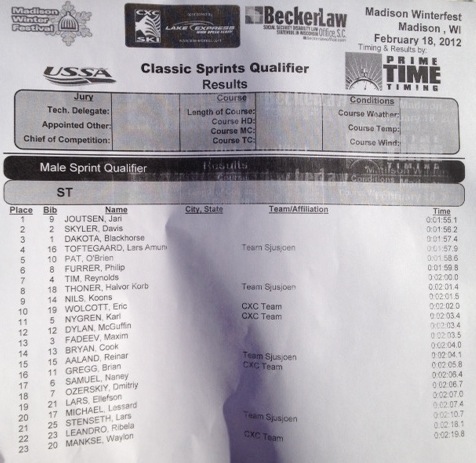
    A few days after first setting foot in the U.S., Joutsen made himself known in Wisconsin’s state capital at the eighth annual Madison Winter Festival, at least among the racers. He started out by setting the fastest qualifying time around the city loop in 1:55.1. Skyler Davis of the U.S. Ski Team was 1.1 seconds behind in second.

    Dakota Blackhorse-von Jess (Bend Endurance Academy) qualified in third, finishing the square-shaped and strictly double-pole course in 1:57.4. He was 2.3 seconds behind the leader.

    Anyone who thought they knew how to overtake Joutsen either didn’t or couldn’t, as the 33-year-old advanced through the heats with little trouble, even with a pole-strap malfunction in the semifinal.

    Fearing his makeshift pole repair might not hold up, he held back at the beginning of the A-final. About halfway through, Joutsen decided to go for it and jutted ahead to win by several meters.

    Behind him, Lars Amund Toftegaard (Team Sjusjoen) and Blackhorse von Jess battled for second. Blackhorse-von Jess edged the Norwegian at the line, and Karl Nygren of Central Cross Country (CXC) finished fourth.

    In his SuperTour debut, Joutsen was recognized as a winner. Few knew the 6-foot-3 Finn was the CEO of a company called Optiwax and designed an Excel pole grip handle used by two-time U.S. Olympian Torin Koos. Most were probably unaware that Koos convinced Joutsen and some other Scandinavians to visit the states for the first time and race in the SuperTour before the American Birkebeiner.

    From a racing standpoint, his result was all that mattered. Joutsen had a plan and it worked, even with a taped pole strap. Fortunately, his engineering skills played a role.

    “I was afraid my pole was broken, so I had to start slowly,” Joutsen said after initially trailing Toftegaard and Blackhorse-von Jess, respectively, in the A-final. “After the middle part, I started to push then I raced [to] first place.”

    Dakota Blackhorse-von Jess (r) leads Tim Reynolds (in green), Karl Nygren (in red) and Skyler Davis (l) on the final turn before the stadium in the semifinals.

    He made it sound easy.

    “I think it’s a benefit if you are tall and big like in these classic sprints,” Joutsen said. “Only the problem with the strap, but otherwise I felt very good.”

    Blackhorse-von Jess, who won his quarterfinal and semi, said he was particularly excited to race against Joutsen and Toftegaard in the final.

    “It’s really good having these guys here because they race a lot different than we do,” Blackhorse-von Jess said. “Watching them race in the semifinals, there was a lot of track changing going on so I was ready for that, and in the final, I just followed that.”

    In the final, he positioned himself in second and later dropped to third before the only downhill before the final stretch. The plan to let the Finn and the Norwegian lead could have worked out if not for a costly blip, he said.

    Blackhorse-von Jess made his move on the gradual descent, attempting to get up front before the last corner. When one of them heard him, he had to step to the outside of the corner where he hit some soft snow.

    “My legs were flooded with lactate and I just didn’t get forward on the ski and push and that cost me a chance at the win,” Blackhorse-von Jess said.

    His indecisiveness at times against unfamiliar opponents also hurt him, he said.

    “I had this vision in my head, and I was like, ‘I know how this is gonna go, I should go now. No, I’m too tired, I’m gonna wait. No, I’m gonna go now! No, I’m too tired, I’m gonna wait. Now I’m gonna go!’ ” he recalled. “When I finally went everything was perfect and then I didn’t make it happen so that’s a bummer. That’s a real bummer.”

    Lars Amund Toftegaard of Norway leads Finland's Jari Joutsen (second from right), Pat O'Brien (CGRP), and Norway's Halvor Korb Thoner (far left) on the gradual downhill in the semifinal. Toftegaard held his position to win the heat.

    After beating Joutsen in the semifinal, Toftegaard was disappointed his strategy of getting out in front early didn’t result in a win, but he understood sprints involved some guesswork.

    “I just have to make my plan and try to follow that,” Toftegaard said. “The other guys probably have their own plans.”

    He was second in the quarterfinal after first leading the Pat O’Brien (Craftsbury Green Racing Project) and tucking behind him to advance in second place.

    “It worked the first two times and the last time I didn’t manage to keep one guy passing me before the last hill,” Toftegaard said. “I tried to keep up with him and I got a little tired so I lost [another] position to number two.”

    Toftegaard qualified for the heats in fourth.

    Davis had his hopes of an A-final dashed when he poled through one of his skis shortly after the start of his semifinal. He fell and ended up fourth in the heat. He initially scrambled to catch Blackhorse-von Jess and Nygren and came close in the final stretch.

    “I worked so hard in that semi to just get back,” Davis said. “Then I was basically done for the B-final. I was out of energy.”

    After winning his quarterfinal in front of runner-up Tim Reynolds (CGRP), the two met again in the semifinal when their skis came in contact during lane changes before the finish.

    “It’s really not that common to poke your own ski,” Davis said, looking at bullet-like hole in the ‘F’ of his Fischer skis. “I don’t really know what happened. … It’s just really unfortunate, but that’s just how it goes.”

    O’Brien won the B-final to end up fifth overall. Norway’s Halvor Korb Thoner (Team Sjusjoen) was sixth, Reynolds placed seventh and Davis was eighth.

    Men’s 1 k classic sprint results

  • Joutsen Edges Davis, Blackhorse von Jess in Madison Sprint Qualifier

    Joutsen Edges Davis, Blackhorse von Jess in Madison Sprint Qualifier

    All Madison SuperTour and American Birkebeiner coverage is brought to you through the generous support of Concept2, makers of the SkiErg.

    MADISON, Wis. — In his SuperTour debut, Jari Joutsen put forth a strong showing for Finland, winning the men’s 1 k classic sprint qualifier in 1:55.1. The 33-year-old, who skis for Vetelin Urheilijat, beat Skyler Davis of the U.S. Ski Team and Stratton Mountain School (SMS) by 1.1 seconds.

    Davis was the second-fastest qualifier on the snow-covered streets surrounding Wisconsin’s State Capitol building, 1.2 seconds ahead of Dakota Blackhorse von Jess (Bend Endurance Academy) in third.

    “I’m really excited,” Davis said in his first classic sprint since placing fifth at U.S. Nationals in Rumford, Maine, last month. “I’m glad that the qualifier went as planned. I saw that a Finnish guy beat me. Dakota and I will have to change that in the heats.”

    Davis started second after Blackhorse von Jess kicked off the weekend on the manmade course. Fifteen seconds behind, he could see Blackhorse von Jess throughout much of the course with four tight righthand turns, one gradual uphill and one long downhill.

    “With him out in front I could kind of see what tracks he was going in and what lines to take,” Davis said. “So that was good.”

    With one warmup loop on the all-double-pole course, Blackhorse von Jess said he wasn’t sure how to approach the descent before the finish.

    “The downhill on the backside is, who knows? Tuck? Double pole? In tracks? Out of tracks? I don’t really know,” Blackhorse von Jess said. “I knew Skyler was behind me and I figured whatever I did he was probably going to do the same so I figured I would just stay in the tracks, no reason to mess with it.”

    With 10 seconds between the top 16 qualifiers, Blackhorse von Jess said the heats will involve different strategies.

    “The heats are always a totally different animal and once they start it’s going to be way easier,” he said. “I bet the slowest guys are close enough to the top guys that unless you drop the hammer, they’re going to stick on you, so might as well ski slow beat them at the end.”

    Davis planned to use shorter poles as he anticipated softer snow closer to noon on the 34-degree day. While he said the course was a leg-burner, he liked it.

    “It was cool to have that downhill before the finish,” he said. “You kind of like revamp and give that last push.”

    The top 16 men advance to the semifinals.

    Madison SuperTour 1 k sprint qualifier results