From the FasterSkier archive — posts syndicated from athletes’ and coaches’ own blogs between 2004 and 2012, kept online as published. Current coverage is at fasterskier.com.
This coverage is made possible through the generous support of Marty and Kathy Hall and A Hall Mark of Excellence Award. To learn more about A Hall Mark of Excellence Award, or to learn how you can support FasterSkier’s coverage, please contact info@fasterskier.com.
Coletta Rydzek (GER) used the day’s best tactics—and the field’s fastest skis—to claim her first World Cup Sprint victory in Lahti, Finland. (Photo: Modica/NordicFocus)
Back in 2021-2022, Slovenia’s Annamarija Lampic won the Sprint World Cup while having stepped onto a World Cup Sprint podium only three times that season (2 x third, 1 x second). No victories on the season, but Lampic claimed the Crystal Globe. It was a career-defining achievement, but one that continues to be listed with a bit of an asterisk denoting a season without a World Cup win. We’ve become so accustomed to World Cup champions dominating their events that we can find ourselves with jaded views of someone who claims a championship without appearing consistently at the top of the podium. That’s the situation in which Jasmi Joensuu (FIN) finds herself.
We cant blame Joensuu for racing the way he does—full speed, full gas, at the front, making everyone else pay dearly if they want to beat her. Joensuu doesn’t often win her heats—and she is yet to claim a World Cup Sprint victory—but she is amazingly consistent in being able to advance to semifinals and finals, so often, in fact, that Joensuu claimed the World Cup Sprint Crystal Globe a few days ago in Talinn, Estonia even in advance of this double-points Sprint finale in Lahti. On the men’s side of World Cup competitions, Johannes Hoesflot Klaebo (NOR) is a truly dominant sprinter, but not even he had claimed the season’s top Sprint prize so quickly.
Still without a World Cup win on the season—and with only one podium performance—Jasmi Joensuu (FIN) rode a wave of consistent tactics all the way to the World Cup Sprint Crystal Globe. (Photo: Modica/NordicFocus)
Whatever Joensuu is doing, it’s definitely working. It’s just that we find ourselves wishing she’d do it differently. But the Sprint course in front of her her home crowd in Lahti was not the place to experiment. Ultimately, Joensuu would not get her victory in Lahti, either, as the win was earned by the fast skis an exemplary tactics of Germany’s Coletta Rydzek. Rydzek was joined on the podium by a disappointed Kristine Stavaas Skistad, and the always-fast Nadine Faehndrich (SUI).
Coletta Rydzek (GER) was joined on Lahti’s Sprint podium by Kristine Stavaas Skistad (NOR), and Nadine Faehndrich (SUI). (Photo: Modica/NordicFocus)
Women’s Freestyle Sprint
Conditions had been described as “variable” in Lahti, with the possibility that the steep course could become icy as the sun went down. Kern and Smith found themselves eliminated in the third quarterfinal, where Victoria Carl (GER) and Maja Dahlqvist (SWE) maneuvered easily into qualifying positions in a slower, more tactical heat.
Diggins headlined the fifth quarterfinal, but was eliminated behind Johanna Hagstroem (SWE) and Coletta Rydzek (GER).
In the Sprint semifinal, finally Joensuu eased up. Skistad had gone out fast, presumably hoping to control the race and clog the front against the always-go tactics of Joensuu. but this time it Joensuu did not take the bait. Both stood straight up at the top of a mid-course hill, waiting for someone else to set the pace. It looked like a whole new Jasmi Joensuu . . . though in the end, it seemed evident that the reason Joensuu doesn’t attempt to ski tactically is because that’s just not the way she’s likely to excel. Others showed greater abilities to accelerate, and Joensuu even stumbled briefly in the homestretch. She would finish the heat out of contention in fourth, well behind Skistad and Mathilde Myhrvold (NOR). Joensuu would finish her season without a Sprint win, but she would go home with the Sprint Crystal Globe held gingerly and dearly in her grasp.
Coletta Rydzek (GER) exults as she crosses the finish line for her first World Cup victory in Lahti, Finland. (Photo: Modica/NordicFocus)
Women’s Sprint Final
Skistad remained consistent in her tactics, driving quickly to the front and standing up at the top of the first hill. The field wandered along fo a while at a medium pace with Skistad still controlling the front. Skistad led lackadaisically around the hairpin turn midway up the final uphill, then she hit the gas, accelerating away from the the field with the finishing downhill in sight. But it was the fast skis and tactical brilliance of Rydzek that blazed down the finishing straightaway for the win. Skistad was forced to settle for second ahead of Faehndrich in third.
“Unbelievable, really,” said Rydzek. “It’s hard to describe. I didn’t think I ever can achieve this!”
This coverage is made possible through the generous support of Marty and Kathy Hall and A Hall Mark of Excellence Award. To learn more about A Hall Mark of Excellence Award, or to learn how you can support FasterSkier’s coverage, please contact info@fasterskier.com.
Julia Kern (USA) took her first individual podium since 2019. (Photo: NordicFocus)
Today’s nighttime mid-week Freestyle city Sprint in Tallinn, Estonia is an unique event. It’s one day of individual Sprint racing coming at the tail end of the season leading into the final weekend of racing in Lahti, Finland. The race also requires all skiers to use the same ski wax.
In the women’s event— with the chase for the Overall crystal globe already mathematically secured by Jessie Diggins and a 50 kilometer World Cup finale looming this coming weekend— there wasn’t much incentive for the American star to race today. Her teammate Rosie Brennan would also be taking the day off. But it wasn’t just Diggins and Brennan who would be missing from the lineup. World Sprint Champion Jonna Sundling (SWE) is ill and not racing. Her teammate Linn Svahn, who has had an almost unbearable string of bad luck, is also still on the sidelines suffering from concussion symptoms. That meant that Kristine Stavaas Skistad (NOR), along with Sprint crystal globe leader Jasmi Joensuu (FIN) and Nadine Faehndrich (SUI) would be catapulted into the pre-race favorites position. With Joensuu entering the day leading the Sprint cup by 148 points over Sundling, and 157 points over Faehndrich—with only one individual Sprint race remaining after today— she was in prime position to cement her chances for the Sprint crystal globe.
It has been an odd journey for the Finnish skier who could receive the Sprint crystal globe and yet hasn’t won a World Cup Individual Sprint race this season and has only been on the Sprint podium once. A victory today would help to erase that asterisk from her championship.
With Diggins not racing, Julia Kern (USA) immediately moved into the favorite position for team USA.
The script was set perfectly by the qualifying results when Faehndrich finished first besting Joensuu, who qualified second, by almost two seconds. Kern also had a strong qualifier finishing sixth. But at the end of the day it was Faehndrich who triumphed taking the victory with Maja Dahlqvist (SWE) finishing second, and Kern taking a dramatic third for her first individual podium since 2019.
It was a satisfying day for Kern. “It feels really good, especially after over 5 years since my first individual podium,” said Kern. “I never stopped believing, and I felt like coaches and teammates close to me as well, and it feels good that how I imagined I can ski finally all came together today. I feel like I’ve had a lot of injuries and obstacles along the way that have often disrupted my training, so even in a year where I still experienced major training disruptions, it means that it’s still possible with enough patience and persistence!”
Kern also acknowledged the efforts of the wax technicians. “The staff did an amazing job in ski testing and strategy today, especially with the limited course access and neutral waxing rules. They were cheering so loud around the course that I no option but boost into another gear and I feel so grateful for their unwavering belief over the years, and especially this season where I was reminded to be patient, and that likely my form will catch up and come around at the end of the season!”
It was definitely a race of redemption for Kern who struggled early in the season after a summer of nagging injuries. “A podium possibility is something I have been chasing the past 5 years ever since my first podium. I never stopped believing that I had it in me, but there were definitely times when it felt far out of reach, like in Period 1 this season. Things with sprinting were really not clicking early season, which wasn’t so surprising given my injury ridden fall. But I knew my fitness was there with strong distance races, so I worked really hard with the coaches and strength coach in the lead up to World Champs to get my sprinting gears back. The belief has always been there deep down, but I feel like my body has not been able to get there. I’m pleasantly surprised how quickly I was able to build back my sprint gears in the last month, making it feel that much sweeter!”
Joensuu finished sixth and was still in the awkward position of being on the cusp of winning the Sprint crystal globe, having never won a Sprint and only having found the podium once. But that’s the lesson of a long World Cup season; persistence and durability often win out over intermittent victories and podiums.
Nadine Faehndrich (SUI) took the Sprint victory, but she can’t overcome Joensuu’s crystal globe lead. (Photo: NordicFocus)
Women’s Freestyle Sprint-Quarterfinals
In heat number one, Kern had the difficult task of facing off against Skistad, and Moa Ilar (SWE), the winner of the most recent world cup Sprint. But very quickly, the entire heat was turned upside down when three athletes fell in an early turn, including Ilar. That paved the way for Kern to advance with little difficulty. Kern quickly jumped to the front to take the lead, which she held until the finish line, with Skistad content to sit far back in second place conserving energy.
All eyes were on Jasmi Joensuu (FIN) to see if she could maintain her Sprint lead and whether she could win a Sprint race. (Photo: NordicFocus)
Emma Ribom (SWE) and Mathilde Myhrvold (NOR) took the second heat with the narrow course proving to be the most dominating factor.
Heat four included the two fastest qualifiers with Faehndrich and Joensuu facing each other. Joensuu blasted out from the start immediately, but Faehndrich was able to take the lead up the steep final hill with Joensuu drifting back to third having been displaced from automatic advancement by Katerina Janatova (CZE). Joensuu would have to wait until the next heat was completed to see if she could advance as a lucky loser. If she didn’t, her lead for the Sprint cup would dwindle substantially.
Sammy Smith (USA) qualified for the heats, but couldn’t advance out of the quarterfinals. (Photo: NordicFocus)
In the final heat the only other American to make the heats, Sammy Smith, would try to advance to the semi-finals, but she couldn’t keep up with the pace set by Johanna Hagstroem (SWE) who won the heat. But more importantly to the Sprint cup standings, Joensuu’s time from the prior heat held up for her to advance as a lucky loser which let her avoid what would have been a disastrous outcome had she not advanced out of the quarterfinals.
Women’s Freestyle Sprints-Semifinals
Kristine Stavaas Skistad (NOR) found herself in the unusual position of being shut out of the finals. (Photo: NordicFocus)
Kern was in the first semifinal and would again face Skistad as well as Ribom, Maja Dahlqvist (SWE), and Myhrvold. Skistad didn’t waste any time going to the front with Dahlqvist right behind her. Kern was pinched to the outside early but was able to pick her way toward the front as Dahlqvist shot into the lead. Kern and Skistad came to the line together with Dahlqvist ahead of them taking the victory. In an incredibly tense photo-finish Kern nipped Skistad at the line to finish second. It was now Skistad who was in the unusual position of having to wait on a lucky loser position with Kern automatically advancing to the finals.
Kern had to adjust her strategy during the race. “My strategy was to be as far front as possible and push the pace. Unfortunately I did not have a great start and my backup strategy was to move up and find a window as I lapped through and that is what I did. I knew I was feeling really strong in the second lap all day, so if I could be in the right position, I had confidence I could go.”
The second semifinal was packed with top contenders with Joensuu, Faehndrich, Janatova, Hagstroem, and Coletta Rydzek (GER) facing each other. Joensuu and Faehndrich again went to the front early with Faehndrich setting the pace. Faehndrich was able to put a small gap on the field early, but the group quickly closed in on her with Joensuu doggedly in pursuit. Faehndrich pushed hard up the final hill and was able to re-establish her lead over Joensuu who began to fade. Gina Del Rio (AND) took advantage of Joensuu’s slowdown and finished second. But miraculously once again Joensuu was able to advance as a lucky loser. Joensuu’s good fortune was Skistad’s bad luck as she would not be able to advance as a lucky loser and for the first time in a long time, she wouldn’t reach the finals.
Maja Dahlqvist (SWE) had a strong showing finishing second. (Photo: NordicFocus)
Women’s Freestyle Sprint-Finals
In the finals Kern would match up with Faehndrich, Dahlqvist, Del Rio, Joensuu, and Rydzek. Joensuu had been living a charmed existence all day having advanced twice through the heats using the lucky loser position. Having reached the finals ensured that she would maintain a healthy lead going into the final Sprint this weekend. But there was still a podium to contend for today. Following the previous heat’s form, Faehndrich shot to the front at the start with Del Rio gamely following closely. Faehndrich continued to charge as the field went up the final steep hill with Dahlqvist behind her and Kern in third. Faehndrich put in a big gap on the field to take the win with Dahlqvist finishing second, Kern finished third to take her second ever individual world cup podium, her first since she finished third in Planica in 2019. Joensuu finished sixth but it was mission accomplished for the Finnish skier who miraculously managed to maintain an insurmountable Sprint cup lead by advancing twice as a lucky loser.
For Kern it was a landmark day finding an individual podium after a very long absence, and for Joensuu it was a combination of luck, persistence, and speed which locked up her grasp of the Sprint crystal globe. Joensuu will go into the final weekend of racing with an insurmountable 129 point lead in the Sprint competition with only one race left to be contested.
Maja Dahlqvist (SWE), Nadine Faehndrich (SUI), Julia Kern (USA), (l-r) (Photo: NordicFocus)
In Stowe, Vermont the men raced a 10-kilometer interval start skate race on Wednesday to open the cross-country portion of the NCAA championships. Erik Olsvik Dengerud from the University of Colorado won in a time of 24:25.5 minutes. Kornelius Groev from the University of New Mexico (UNM) placed second in 24:45.1, and Ian Torchia of Northern Michigan University was third in 24:45.4.
In the women’s 5 k skate, Julia Richter of the University of Utah (UoU) won in 13:28.3 minutes. University of Denver’s Jasmi Joensuu skied to second in 13:29.3, and Evelina Sutro of UVM was third in 13:29.4.
Katherine Ogden from Dartmouth placed fourth (13:34.5) and Guro Jordheim of the UoU fifth (13.37.6)
After the first day of competition, during which only nordic races were held, the University of Utah leads the team competition with 142 points. They hold a one point buffer over the University of Vermont. Colorado sits in third with 120 points.
Racing continues tomorrow with alpine athletes competing in giant slalom.
The top finishers in the men’s 20 k freestyle mass start at 2018 NCAA Skiing Championships in Steamboat Springs, Colorado, with Northern Michigan University’s Ian Torchia (c) in first. (Photo: Dartmouth Sports/Clarkson Creative)
NCAA Skiing Championships (Steamboat Springs, Colorado): 15/20 k freestyle mass starts
On the fourth and final day of NCAA Skiing Championships at Howelsen Hill in Steamboat Springs, Katharine Ogden skied to her second-straight national title, Ian Torchia became an NCAA champion and the University of Denver (DU) won its 24th NCAA National Championship.
Dartmouth freshman Katharine Ogden racing to her second-straight victory of the 2018 NCAA Skiing Championships in Steamboat Springs, Colorado. She won Saturday’s 15 k freestyle mass start by more than 38 seconds. (Photo: Dartmouth Sports/Clarkson Creative)
Ogden, a Dartmouth College freshman, raced to a 38.4-second victory in the women’s 15-kilometer mass start, finishing in 43:22.0 minutes for her second win in as many races at 2018 NCAA Championships. She won the 5 k classic on Thursday and with her win on Saturday, she became the first Dartmouth skier in 56 years to win two national titles in the same year, according to a Dartmouth press release.
On the second of three laps, Ogden broke away early with close to 10 k to go. According to the press release, she had a “quick fall” near the end of the second lap, but that didn’t derail her as she had time to grab sunglasses from Dartmouth men’s coach Brayton Osgood and a Dartmouth Lone Pine flag before the finish.
At this year’s championships, Ogden’s two titles are accompanied by victories from Dartmouth men’s alpine skiers Brian McLaughlin (who won the giant slalom) and Tanguy Nef (who won the slalom). This marked only the second time that Dartmouth’s Big Green won four individual titles in a single NCAA Championships; that also occurred 61 years ago.
“Katharine absolutely wanted this one, and she really likes to win,” Dartmouth Director of Skiing and Women’s Nordic Head Coach Cami Thompson Graves said in the press release. “She wasn’t about to let a fall slow her down, she has such a great competitive fire. But she also showed her playful side grabbing Brayton’s glasses and smiling all the way to the finish line!”
Hailey Swirbul of the University of Alaska Anchorage placed second and Linn Eriksen (DU) reached the podium in third (+46.3). Denver had three in the top 10 with Jasmi Joensuu in ninth and Taeler McCrerey in 10th. Also landing in the top 10 for All-American honors were Guro Jordheim of the University of Utah in fourth, Emma Tarbath (Montana State University) in fifth, Petra Hyncicova of the University of Colorado Boulder (CU) in sixth, Christina Rolandsen (CU) in seventh, and Lauren Jortberg (Dartmouth) in eighth.
Torchia, an Northern Michigan University (NMU) junior and U.S. Ski Team Development Team member, became the seventh NCAA champion in NMU Wildcats nordic skiing history, according to an NMU press release. Fredrick Schwenke was the Wildcats’ last nordic champion; he won the 2015 NCAA Championships 20 k classic.
Torchia drew bib 1 for Saturday’s 20 k freestyle mass start and crossed the finish line first in 54:21.0, just 2 seconds ahead of CU’s Alvar Alev. Eivind Kvaale (DU) finished just four seconds back in third, and Denver had three in the top seven with Dag Frode Trollebø in fourth and Lars Hannah in seventh. Darmouth’s Cal Deline placed fifth, Zane Fields of Colby College finished sixth, and the 20 k freestyle’s 2017 NCAA champion Martin Bergström (Utah), who also won Thursday’s 10 k classic, placed eighth. CU’s Petter Reistad and Sondre Bollum finished ninth and 10th, respectively.
In the team standings, Denver beat Colorado by 41 points for the overall win with a total of 604 points between the nordic and alpine events at this year’s championships. Dartmouth placed third, 114.5 points behind Colorado, and Utah was another 63 points back in fourth.
According to a DU press release, Denver has won at least one national championship in each of the last five athletic seasons (skiing: 2013/14, 2015/16, 2017/18; hockey: 2016-17; men’s lacrosse 2014/15), joining only Stanford on the list of schools that have done so in the last five seasons. (Oregon, West Virginia, Penn State, Oklahoma, Ohio State and Florida could potentially join that list later this year.)
“It feels incredible,” said DU head coach Andy LeRoy said in the press release. “I am so happy for all of our athletes, they’ve been training all week and all season and to do it in Steamboat in front of our crowd is special.”
The Holmenkollen men’s 50 k freestyle mass start podium on Saturday at the World Cup in Oslo, Norway, with Switzerland’s Dario Cologna (c) in first, Norway’s Martin Johnsrud Sundby (l) in second, and Russia’s Maxim Vylegzhanin (r) in third. (Photo: FIS Cross Country/Twitter)
FIS Cross Country World Cup (Oslo, Norway): Men’s 50 k freestyle mass start
A four-time Olympic champion, Dario Cologna of Switzerland won his first 50-kilometer World Cup race on Saturday, topping the podium in the famous Holmenkollen 50 k freestyle mass start after outlunging Norway’s Martin Johnsrud Sundby (who won the event last year) for the win in 2:01:48.1. Sundby finished one-hundredth of a second behind for second place, ahead of Russia’s Maxim Vylegzhanin, who was 1.1 seconds back in third in his first World Cup race since November of last year.
The photo finish for first between Switzerland’s Dario Cologna (near) and Norway’s Martin Johnsrud Sundby at the Holmenkollen 50 k freestyle mass start on Saturday in Oslo, Norway. Cologna got it by 0.01 seconds. (Photo: FIS Cross Country/Twitter)
Norway’s Sjur Røthe came out on top in a race for fourth (+4.2), ahead of Russia’s Denis Spitsov in fifth (+4.4) and his Norwegian teammate Hans Christer Holund in sixth (+4.5). Great Britain’s Andrew Musgrave followed in seventh (+15.1), Germany’s Florian Notz placed eighth (+25.9) and Canada’s Alex Harvey finished ninth (+32.4), ahead of France’s Robin Duvillard in 10th (+33.5).
Scott Patterson led the U.S. in 16th (+56.3) coming off an 11th place in the 50 k classic mass start at last month’s Olympics, and Canada’s Devon Kershaw finished in the points in 28th (+3:43.6). Just outside the top 30, Canada’s Graeme Killick finished 34th (+4:55.1).
Also for the U.S, David Norris placed 38th (+6:19.7), Paddy Caldwell was 46th (+8:12.3), Noah Hoffman 49th (+10:27.9), Kevin Bolger 52nd (+12:44.2), and Simi Hamilton did not finish.
Canada’s fourth man in the race, Andy Shields finished 47th (+8:13.6).
Italy’s Lukas Hofer celebrates his team’s win in Saturday’s mixed relay at the IBU World Cup in Kontiolahti, Finland. (Photo: IBU/Biathlonworld)
IBU World Cup (Kontiolahti, Finland): Single mixed relay & mixed relay
(Note: This rundown has been updated to include comments from Christian Gow and Sean Doherty.)
In the last single mixed relay and mixed relay of the International Biathlon Union (IBU) World Cup season, France and Italy came out on top, with France winning the two-person single mixed relay and Italy taking first in the coed mixed relay.
France’s Anaïs Chevalier and Antonin Guigonnat after winning Saturday’s single mixed relay at the IBU World Cup in Kontiolahti, Finland. (Photo: IBU/Biathlonworld)
France’s Anaïs Chevalier and Antonin Guigonnat combined for zero penalties and six spares to finish first in the single mixed relay in 33:29.1 minutes. Guigonnat as the team’s anchor secured the win by just 2.4 seconds over Austria’s Julian Eberhard while Norway’s Johannes Thingnes Bø finished 4.4 seconds back for third.
Chevalier put France in fifth after the first leg, 15.5 seconds behind Ukraine’s Iryna Varvynets in first. Guigonnat used just one spare on his first leg to move them into fourth, 9.2 seconds back while Norway led at the second exchange. On Chevalier’s second leg, she shot clean in both stages to lead through the final exchange, with Ukraine skiing just 6.2 seconds back in second.
On the final leg, Guigonnat used two spares and stayed out of the penalty lap, keeping the team in first through the finish. Eberhard skied the second-fastest course time on that leg to elevate Austria (with Lisa Theresa Hauser) from fourth at the tag to second place at the finish, and Bø skied all the way up from eighth to third place for Norway (with Marte Olsbu) with the fastest course time.
Ukraine’s Artem Tyschenko used just one spare but slipped to fourth with the 11th-ranked course time on that leg, as he finished 10.8 seconds behind Norway.
Behind Russia in fifth and Italy in sixth, Canada placed seventh (+23.8) with Rosanna Crawford and Christian Gow. The duo combined for zero penalties and six spares, and put themselves in third place early in the race. Crawford skied them into third on the first leg, using just two spares and tagging Gow 7.4 seconds out of first.
Gow went on to take the lead after cleaning prone without any spares, and he cleaned standing as well but slipped back to third while Bø took the lead. Gow tagged Crawford in third, 8.9 seconds behind Norway in first.
“I didn’t think too much about being tagged in third,” Gow recalled in an email to FasterSkier. “It was exciting for sure, but I let it fade to the background so that I could focus on my job both on the track and in the range. It was great to leave prone in first place! It was also surprising, but it was a good place to be in.
“My skiing was ok today,” he continued. “It is a really challenging and demanding race format that we don’t get a lot of practice with. I was sick after the Olympic Games and only finally coming around the past couple days. The Sprint race was horrendous for me, so today was much better than that. In the range I just focussed on myself and trusted my shooting. I tried my best not to get caught up in the race going on around me and it worked to my benefit.”
Crawford then slipped to seventh and 21 seconds back with three prone spares, but avoided the penalty lap, and Gow held onto seventh through the finish, using just one spare and skiing the eighth-fastest course time on that leg.
“We are both happy with this result,” Gow wrote. “I think that we are both looking at the 23 second gap to first and thinking that if things had worked out just a bit better we could be there. It can be both exciting and frustrating to be that close to the podium. We know we can do it, it’s just a matter of putting it together on the right day. We are happy with 7th, but hungry for more.”
Susan Dunklee and Lowell Bailey finished 14th for the U.S., 1:13.0 out of first with one penalty and 14 spares. The penalty came on Dunklee’s first leg during her standing stage, after she had cleaned prone without any spares. She tagged Bailey in 14th and he brought them up to 11th, using three spares on that leg, then Dunklee came through the final exchange in 13th after using four spares to clean. Bailey lost one place on the final leg, using four spares but staying out of the penalty lap.
Twenty-six teams competed in the single mixed relay, compared to 23 in the mixed relay that followed.
Team Italia celebrates its win in the IBU World Cup mixed relay on Saturday in Kontiolahti, Finland, with its relay members Dorothea Wierer, Lisa Vittozzi, Dominik Windisch, and Lukas Hofer. (Photo: IBU/Biathlonworld)
In Saturday’s 2 x 6 + 2 x 7.5 k mixed relay, Italy nabbed a 1.5-second victory over Ukraine in 1:15:08.3. Dorothea Wierer, Lisa Vittozzi, Dominik Windisch, and Lukas Hofer — the same Italian team that took bronze in the mixed relay at last month’s Olympics, although in a different order — combined for the win with one penalty and 13 spares.
Ukraine, with Anastasiya Merkushyna, Vita Semerenko, Artem Pryma, and Dmytro Pidruchnyi, had zero penalties and just three spares throughout the whole race. For the second-straight relay on Saturday, Norway placed third (+9.1) with Synnøve Solemdal, Tiril Eckhoff,Henrik L’Abée-Lund, and Tarjei Bø totaling zero penalties and nine spares.
Italy’s lone penalty came in Vittozzi’s second leg, but it didn’t derail the team as it improved from sixth to fifth with Vittozzi, who skied the third-fastest course time on that leg. She tagged Windisch 6.8 seconds out of first, and Windisch, who had anchored the team in the Olympics, took the lead by the final exchange after using two spares to clean. Hofer left the exchange just 3.3 seconds ahead of Norway’s Bø but used just one spare and skied the second-fastest anchor leg to finish first, beating his rivals up Kontiolahti’s infamous climb known as “The Wall”. Ukraine’s Pidruchnyi also shot clean with a single spare and clocked the fastest anchor leg to move his team from fourth to second place. Bø lost one place and finished third after using one spare as well and skiing the third-fastest anchor leg.
Russia followed in fourth, France fifth, Sweden sixth, Germany seventh, Austria eighth, and the U.S. ninth (+2:48.4). The U.S. team, with Clare Egan, Joanne Reid, Tim Burke, and Sean Doherty, had one penalty and 11 spares. Egan cleaned her first prone but had to ski a penalty lap after her standing stage, tagging Reid in 17th, 58.7 seconds out of first.
Reid used three spares on the second leg and moved up to 13th by the second exchange, and Burke used three spares as well to pick off one more place and tag Doherty in 12th. Doherty skied the eighth-fastest anchor leg and used two spares to clean to put the team in ninth at the finish.
“I don’t consider two spares to be anything special, but today it was enough to make up some ground,” Doherty wrote in an email to FasterSkier.”I felt strong skiing, more like myself which is fun even if it’s a little late in the season. We had very good skis which always helps. I have done quite a few laps on this course over the years so the lines and transitions are pretty refined, so that is where I made time on the course.
“I am happy with my leg. I enjoyed my little battle for 9th,” he continued. “I can’t speak too much for the other members of the relay tonight but I think 9th is a solid effort.”
Canada finished 17th (+4:34.9) with Emma Lunder, Julia Ransom, Scott Gow, and Brendan Green combining for one penalty and 13 spares. Lunder put them in 12th at the first exchange and Ransom skied up to 10th, but Scott Gow had a penalty on his standing stage to drop to 16th. Green lost one more place on the last leg despite only requiring two spares.
Caitlin Patterson (c) atop the podium for the fourth-straight race of the week at 2018 U.S. Cross Country Championships in Anchorage, Alaska, joined by Finland’s Jasmi Joensuu (l) of the University of Denver, in second and Patterson’s CGRP teammate Kaitlynn Miller (r) in third. (Photo: Michael Dinneen Photography)
Note: This article has been updated to reflect the fact that U.S. Ski Team member Jessie Diggins was the top American in four consecutive U.S. nationals races in 2012, winning the freestyle sprint, 10 k skate and 20 k classic mass start outright and placing second to Canada’s Dasha Gaiazova in the classic sprint (but topping the podium as the first American). This week, Caitlin Patterson, of the Craftsbury Green Racing Project, became the first woman since Diggins to be the top American in four U.S. national races as well.
***
ANCHORAGE, Alaska — Maybe there’s something to be said for growing up in Alaska. Or maybe there’s something to be said about the mystique of Kincaid Park, its surrounding Tordillo, Chugach and Alaskan mountain ranges all bathed in sunlight at the start on the last day of 2018 U.S. Cross Country Championships during the women’s 1.5-kilometer classic sprint.
Caitlin Patterson (Craftsbury Green Racing Project) approaching the finish line of the women’s 1.5 k classic sprint final on Monday, the last day of 2018 U.S. Cross Country Championships in Anchorage, Alaska. She won the final for her fourth-straight national title of the week. (Photo: Michael Dinneen Photography)
Be it either of those, Caitlin Patterson became the first woman since U.S. Ski Team (USST) member Jessie Diggins, to earn four consecutive titles at a single U.S. nationals. Diggins did it in 2012 in Rumford, Maine, two years after Kikkan Randall, a USST member who trains with Alaska Pacific University (APU), swept four races outright at Kincaid. (Both Randall and Patterson grew up in Anchorage; Randall was born in Salt Lake City, born in McCall, Idaho. Patterson, 27, attended South Anchorage High School while Randall, 35, went to East Anchorage High).
Even if Patterson, who’s currently based out of Vermont with the Craftsbury Green Racing Project (CGRP), had not won the final event of 2018 nationals, she had already posted a banner week. She started it by racing to first in the opening women’s 10 k freestyle individual start last Wednesday, amidst slushy ski trails, falling wet snow and a standard dark Alaskan winter morning sky.
After a training day on Thursday, she returned to the Kincaid trails on Friday — which had transformed from 48 hours before — racing once again to first, this time in the women’s freestyle sprint for her first sprint title.
Hedda Bångman, a Swedish freshman at the University of Colorado at Boulder (CU), racing to fourth in the qualifying round of the women’s 1.5 k classic sprint on Monday at 2018 U.S. Cross Country Championships in Anchorage, Alaska.
Up against Sweden’s Hedda Bångman, a University of Colorado at Boulder (CU) freshman, and Rosie Frankowski (APU), the two of whom led much of Sunday’s four-lap race, Patterson had met her match. However, Frankowski’s fall on the final hill paired with Patterson’s strong skiing led Patterson to finish as the day’s top American. Bångman took the outright win while Patterson placed second overall, ahead of Frankowski in third. The two were first and second on the U.S. podium.
If she had left it at that, Patterson would have tied Rosie Brennan — of the U.S. Ski Team and APU — who won three out of four U.S. nationals races in 2015.
But Patterson took it one step further.
With no training or rest day in between, the CGRP skier joined the remaining U.S. nationals field on Monday. Some skiers had already left, including Australian and APU skier, Jessica Yeaton, who flew out Monday morning to prepare for next weekend’s World Cup in Dresden, Germany.
Based on her qualifier alone, it might have seemed Patterson was beginning to feel the effects of four days of racing since last Wednesday. She qualified seventh, 4.77 seconds behind the fastest qualifying time of 3:41.40, posted by Finnish skier and University of Denver (DU) junior Jasmi Joensuu.
“Today qualification was really good, I felt really good,” Joensuu said after the race. “But then, my throat is really sore after the qualification … so I didn’t know if I could race actually. But I decided to race, I knew that I could win this race. I knew that there were some good girls but they also had 20 k yesterday, which I didn’t race, so that was good for me.”
With Joensuu, 21, having sat out Sunday’s mass start and Patterson having expended herself over 20 k, the Finn may have had a leg up on the American.
What Joensuu had not counted on was Patterson’s familiarity with the course and what the American had learned from Friday’s freestyle sprint.
“I think that bottom corner was a really good one for me all week and in the skate sprint I figured out how to ski it with good momentum,” Patterson said after Monday’s race, referring to the slightly inclined corner about 100 meters before the finish. “Even with that big gap that she put on the hill, I think just knowing how to ski the hill here at Kincaid … the finish stretch was mine.”
Craftsbury’s Caitlin Patterson (207) and Kaitlynn Miller (second from r) and Jasmi Joensuu, of the University of Denver, lead their semifinal during the women’s 1.5 k classic sprint on Monday at 2018 U.S. Cross Country Championships in Anchorage, Alaska.
In their semifinal, though Joensuu had gapped both Patterson and and another CGRP skier Kaitlynn Miller at the top of Gong Hill — the sprint’s final major climb — both Craftsbury skiers had caught Joensuu by the bottom of the descent’s corner back towards the finish.
A similar scenario played out in the final.
“In the final I did a tactic, I would ski the uphill as fast as I can, I don’t save anything and that almost worked,” Joensuu recalled.
Joensuu and Petra Hyncicova, a CU senior from the Czech Republic, had pushed hard out of the start of the final, followed by Patterson and Miller, as well as Dartmouth skier Lydia Blanchet and APU’s Becca Rorabaugh.
“I tended to lose time in the beginning of the race and then catch back up,” said Blanchet, who had to catch a plane within an hour of finishing the final. “I had great skis and downhills are one of my strengths.”
While the two non-Americans raced to the front halfway through the course’s major climb, Blanchet, Rorabaugh, Miller, and Patterson hung behind. Then halfway through the final hill, Joensuu attacked, attempting to distance herself from the pack.
By the top of the hill, she had done just that, with 4 meters separating her from the rest of the field. Miller and Patterson followed, tucked into the downhill swooping curve.
As Joensuu disappeared behind the trees blocking the corner from spectator’s view, Miller and Patterson were already hot on her heels. Using her momentum, Patterson swung around Joensuu and emerged from the corner first, double poling with a sizeable lead to her fourth victory in a row in a time of 3:39.58.
“It felt surreal coming down the finishing stretch today, realizing that I couldn’t hear people behind me and realizing that it was going to be number four,” Patterson said. “I could not have imagined this if I tried, but I’ve just had really good feelings all week. Great support from the staff and waxers and everything, and it’s fun being back here in Anchorage, especially.”
The fifth women’s classic sprint quarterfinal heat on Monday at 2018 U.S. Cross Country Championships in Anchorage, Alaska, with CXC/Peak Nordic’s Felicia Gesior (208) leading with Corey Stock (213) of the Bridger Ski Foundation, and Northern Michigan’s Nicole Schneider (223), the University of Colorado Boulder’s Christina Rolandsen (218) and Petra Hyncicova (203), and Mae Chalmers of SMS (228) chasing.
Finishing second, 2.36 seconds behind Patterson, was Joensuu. Capturing third for her third American podium this week was Miller (+3.9). Miller finished second to Patterson in Friday’s freestyle sprint and was the third American in Sunday’s 20 k.
“I’m really pleased with how everything panned out,” Miller said. “To me the big sign of improvement has been in my skating and I was really excited with my skate sprint and obviously really excited with yesterday and today as well, but it’s nice to see my skating moving up a little bit.”
Despite being the 2016 national classic sprint champion, Miller, of Elmore, Vt., explained she entered Monday’s race with nothing held over her head.
“I don’t ever go into a race expecting a certain result,” she said. “Anything can happen, even to strong, very experienced skiers … [but] it is exciting to be in the mix.”
Though Miller also explained she “felt pretty tired” by the time she lined up for the final on Monday, she also acknowledged that she was, in all likelihood, not alone.
“I think that was the situation for all of the women out there today, after the 20 k yesterday. It was sort of like, well, the snap isn’t there, the energy isn’t quite there, but everyone was in the same boat,” she said. “Everyone’s making the best of it, and your body knows what to do once you get to the start line.
“All things considered, I felt great, had a really great result, and I’m very happy with it,” Miller added.
Becca Rorabaugh (APU) during the women’s 1.5 k classic sprint on Monday at 2018 U.S. Cross Country Championships in Anchorage, Alaska. After finishing second in the qualifier (as the top American) she finished fourth overall in the final and was the third American on the day.
Rorabaugh finished fourth overall (+9.92) and was the third American. The Fairbanks native, who has spent the last 10-plus years living and training in Anchorage, was the top American qualifier on Monday, 1.31 seconds behind Joensuu in first overall.
“I was extremely excited with my qualifier,” Rorabaugh said. “It was rather unexpected. I was the first American and I had one really good qualifier in West Yellowstone this year but the other two so far have been pretty medium for me, so I was really excited really happy with this morning.”
Though the qualifier is what counts for the Olympic points list, Rorabaugh indicated that was of less importance to her than just “getting her qualifier back.”
“It’s been a couple years since I’ve been having a very strong qualification in sprint racing so I was just trying to work on having enough energy and having enough heat pumped to really crush a qualifier first thing in the morning,” she said.
“I wanted to have something special at home,” she added, referring to the friends and family that came to Kincaid to watch her race. “So it was good to have something at the end of the week.”
With firm tracks, cold temperatures reading around 10 degrees Fahrenheit and a low sun in the sky, Rorabaugh described the final U.S. nationals event as “a quintessential Alaskan day.”
“That was quite nice,” she added.
Rounding out the final was Hyncicova in fifth (+10.03) and Blanchet in sixth (+11.21).
“Today I was kind of tired. I finally hit the jet lag over the weekend,” Hyncicova, the two-time defending NCAA champion, said. “But … making the final, and even being third in the quarterfinal is awesome. It’s just proving that I am kind of in good shape so that’s a good start of the season.”
Rounding out the remainder of the women’s top 10 was Bångman in seventh, Sun Valley Ski Education Foundation skier, Kelsey Phinney in eighth, Central Cross Country’s Felicia Geisor in ninth and Stratton Mountain’s Erika Flowers in tenth.
In the junior women’s classic sprint, Wasatch Nordic’s Sarah Morgan took the win in 3:54.93. Novie McCabe (Methow Valley Nordic) placed second (+1.5) and her teammate teammate Ella-Sophie Kuzyk placed third (+6.66).
Left to right: Tyler Kornfield (APU), Reese Hanneman (APU) and Ben Saxton (SMS) the top three Americans in the men’s 1.6 k classic sprint final on Monday, the last day of 2018 U.S. Cross Country Championships in Anchorage, Alaska.
U.S. Cross Country Championships (Anchorage, Alaska): Classic sprint
Caitlin Patterson did it. With a classic-sprint win on Monday, she successfully capped off an undefeated 2018 U.S. Cross Country Championships, as the top American woman in all four races over the past week in Anchorage, Alaska.
Patterson, of the Craftsbury Green Racing Project, qualified seventh then won the women’s 1.5-kilometer final by more than 2 seconds in 3:39.58 minutes. Finland’s Jasmi Joensuu, a junior at the University of Denver (DU), won the qualifier and ultimately finished second in the final, 2.36 seconds behind Patterson.
Craftsbury once again had two on the podium with Kaitlynn Miller placing third overall (+3.9) as the second American. Becca Rorabaugh, of Alaska Pacific University (APU), was the top American in the qualifier in second overall, then placed fourth in the final (+9.92) and reached the U.S. podium in third.
Petra Hyncicova, a University of Colorado Boulder (CU) senior from the Czech Republic, placed fifth overall (+10.03), and Lydia Blanchet, a Dartmouth College U23 skier, finished sixth (+11.21) and was the fourth American woman.
Joensuu, 21, of Kuortane, Finland, started the day by winning the qualifier in 3:41.4, while Rorabaugh followed in second, 1.31 seconds back. Hyncicova qualified third (+1.85), CU’s Hedda Bångman (who won Sunday’s 20 k classic) qualified fourth (+2.92), and Miller qualified fifth (+2.93). Anne Hart of the Stratton Mountain School (SMS) Elite Team clocked the sixth-fastest qualifying time (+3.88), and Patterson followed in seventh (+4.77).
From there, Patterson won both her quarterfinal and semifinal, besting Miller and Joensuu in the latter by 0.66 seconds and 2.63 seconds, respectively. Blanchet placed fourth in that same semifinal (+5.15) and advanced to the final as a lucky loser with a fast-enough time, along with Joensuu (Patterson and Miller automatically advanced in first and second).
With her 4-for-4 record at 2018 nationals, Patterson is the most successful woman at U.S. Cross Country Championships since U.S. Ski Team member Jessie Diggins was the top American in all four races at 2012 nationals in Rumford, Maine.
In the men’s classic sprint final, Reese Hanneman (APU) captured his second title in as many sprints this week (after winning the freestyle sprint on Friday). He won the qualifying round by 2.84 seconds in 3:21.93, and later the final by a 0.2 seconds in 3:20.62. Kornfield placed second, and Ben Saxton (SMS Elite Team) rounded out the podium in third (+4.78).
Logan Hanneman, the winner of Friday’s freestyle-sprint qualifier, finished second to his older brother Reese in Monday’s classic-sprint qualifier, then went on to reach the final and place fourth overall (+5.42). Kevin Bolger (Sun Valley Ski Education Foundation) placed fifth (+5.52), and Zak Ketterson (Northern Michigan University) was sixth (+6.83).
NorAm Trials (Mont Sainte-Anne, Quebec): 15/30 k skiathlons
The women’s 15 k skiathlon podium on Monday at NorAm trials at Mont Sainte-Anne, Quebec, with Cendrine Browne (c) of the Pierre-Harvey National Training Centre (CNEPH) and Canadian U25 Team in first, Anne-Marie Comeau (l) of Laval University in second, and Dahria Beatty (Alberta World Cup Academy/Canadian World Cup Team) in third. (Photo: Cross Country Canada/Instagram)
Cendrine Browne won the women’s 15-kilometre skiathlon in 43:01.9 minutes on Monday at the Mont Sainte-Anne (MSA) ski trails to put an exclamation point on her presumptive selection for the PyeongChang Olympics. Browne, of the Centre National d’Entraînement Pierre Harvey (CNEPH)/Pierre-Harvey National Training Centre, which is based in nearby Saint-Ferréol-les-Neiges, broke away with Laval University’s Anne-Marie Comeau during the classic leg to take a 20-second lead that she held to the finish.
Comeau faded slightly to take second, 11.9 seconds back, qualifying for U23’s and putting her name in the hat for the upcoming 2018 Olympics. Either Comeau or the winner of Wednesday’s classic interval start should take that potential Olympic berth as Canada’s top female distance skier not already qualified. Browne has theoretically earned a spot as the top women’s sprinter, besides Dahria Beatty, who won the sprint and already met Canada’s Olympic qualifying criteria.
“It now has to go before the selection committee,” Cross Country Canada’s High Performance Director Thomas Holland wrote in an email on Friday.
After trials races were shuffled around due to extreme cold, with temperatures near -20 Celsius on Sunday at MSA, it warmed up to a balmy -8 degrees Celsius (17 Fahrenheit) by mid-afternoon on Monday. Both the women’s and men’s skiathlons were held, which not only served as one of two distance races for Olympic selection, but for Junior and U23 World Championships as well.
In the race for third place,Beatty outsprinted a group of four to take the final podium spot, 19.9 seconds behind Browne and 0.3 seconds ahead of their fellow Canadian National Team member Maya MacIsaac-Jones, of Rocky Mountain Racers (RMR) and U25 Team. Just 0.2 seconds out of fourth, Katherine Stewart-Jones, of the National Training Development Centre (NTDC) Thunder Bay and national U25 Team, placed fifth (+20.4) and CNEPH’s Laura Leclair was another second back in sixth (+21.4).
Almost 55 seconds passed before the seventh-place finisher came across the line, which was Zina Kocher (Foothills Nordic) skiing alone (+1:15.8). Another 49 seconds later, Jaqueline Mourao of Brazil’s national team placed eighth (+2:04.9), ahead of Zoë Williams (Carleton University) in ninth (+2:11.3), and Andrea Dupont (RMR) in 10th (+2:11.5).
In the junior women’s 10 k skiathlon, Whitehorse’s Natalie Hynes won in 30:19.8 to punch her ticket to Junior Worlds in Goms, Switzerland, from Jan. 28-Feb. 3. India McIsaac (RMR) finished 0.7 seconds back in second and Orford’s Alexandra Racine completed the podium in third (+32.8).
The men’s 30 k skiathlon podium at NorAm trials at Mont Sainte-Anne, Quebec, on Sunday, with Knute Johnsgaard (c) of Canada’s World Cup Team in first, Graham Nishikawa (r) of the Canadian Para-Nordic Team in second and Gareth Williams (Telemark Nordic/Canadian U25 Team) in third. (Photo: Cross Country Canada/Instagram)
On the men’s side, Canadian World Cup Team member Knute Johnsgaard, who met qualifying criteria for PyeongChang last season, shook off a slow start to the World Cup season with a win in the NorAm trials men’s 30 k skiathlon, finishing in 1:13:30.9.
Graham Nishikawa, who’s already destined for the PyeongChang Paralympics as a guide on the Canadian Para-Nordic Ski Team, finished 1 second back for second place. The 34-year-old Nishikawa edged out first-year senior national-team member Gareth Williams, 20, of Telemark Nordic and the national U25 Team, by 0.5 seconds. Williams was the top U23 athlete to qualify for this year’s U23 World Championships.
The top 6 finished within 41 seconds of the podium, with Jack Carlyle (AWCA) in fourth (+5.8), Philippe Boucher (CNEPH) in fifth (+13.9), and Scott Hill (BXC) in sixth (+40.7). World Cup Team member Len Valjas led the next group across the line in seventh (+1:28.6), followed by Bob Thompson (NTDC Thunder Bay) in eighth (+1:29.4), Alexis Dumas (CNEPH) in ninth (+1:35.5), and Ricardo Izquierdo-Bernier (CNEPH) in 10th (+1:35.7)
CNEPH’s Antoine Cyr won the junior mens 15 k skiathlon in 50:13.1 to earn a spot at Junior Worlds. Félix Longpré, of the local M.S.A. ski club, finished second (+15.7) and Thomas Manktelow was third (+49.0), just ahead of his Alberta World Cup Academy teammate Étienne Hébert in fourth (+49.3).
After Sunday’s racing was postponed due to temperatures well below the legal race limit, the remaining trials schedule includes freestyle sprints on Tuesday (for Junior and U23 World Championships qualifying purposes only), and classic interval starts on Wednesday.
The Hanneman brothers after Friday’s skate sprint at 2018 U.S. Cross Country Championships in Anchorage, where they live and train with Alaska Pacific University. Reese Hanneman (l) won the men’s final and younger brother Logan (r) won the men’s qualifying round.
U.S. Cross Country Championships (Anchorage, Alaska): Freestyle sprints
Caitlin Patterson racked up her second-straight national title at this year’s 2018 U.S. Cross Country Championships and Reese Hanneman topped the men’s freestyle sprint final on Friday at Kincaid Park in Anchorage, Alaska.
In the first of two sprints at 2018 U.S. nationals, Patterson, the Craftsbury Green Racing Project (CGRP) skier who won the women’s 10-kilometer freestyle on Wednesday, posted a 3.56-second win in the women’s 1.5 k freestyle sprint final on Friday.
After qualifying 12th, 5.76 seconds back from Anne Hart of the Stratton Mountain School (SMS) Elite Team, who won the qualifier in 3:22.10, Patterson won both her quarterfinal and semifinal, both times ahead of University of Denver (DU) junior Jasmi Joensuu in second.
The two advanced to the final, where Patterson reached the finish line first once more in 3:20.93, about 3 1/2 seconds ahead of Joensuu in second and 4.19 seconds ahead of Petra Hyncicova, a senior at the University of Colorado Boulder, in third. Craftsbury had two in the final with Kaitlynn Miller placing fourth (+4.35). U20 skier Hannah Halvorsen of Alaska Pacific University (APU) and the U.S. Ski Team (USST) finished fifth (+7.66), and Kelsey Phinney of the Sun Valley Ski Education Foundation (SVSEF) placed sixth (+9.78).
Hart won her quarterfinal then placed third in the first semifinal, behind Miller, who won that heat, and Hyncicova in second, to miss advancing to the final. Hart had won the qualifier by 1.78 seconds over Joensuu in second.
In the men’s 1.6 k skate sprint, Logan Hanneman (APU) won the qualifier in 3:07.4. Kevin Bolger (SVSEF) qualified in second (+0.48), and older brother Reese Hanneman (APU) was third (+1.13).
In the quarterfinals, Reese won his heat by 0.19 seconds ahead of his teammate Tyler Kornfield, and Logan finished second, 0.42 seconds behind U18 skier Gus Schumacher (Alaska Winter Stars), as the winner of the first quarterfinal. Bolger won the fourth quarterfinal.
Reese raced to another win in the second semifinal, 0.17 seconds ahead of Bolger in second. APU’s Eric Packer won the first semi, 1.66 seconds clear of Zak Ketterson of Northern Michigan University (NMU) in second. Logan finished fifth in that semifinal, 4.48 seconds out of first, trailing Dakota Blackhorse-von Jess (Bend Endurance Academy) in third and Schumacher in fourth.
In the final, which included three APU athletes out of six total, Reese nipped Bolger by just eight-hundredths of a second for the win in 3:11.33. APU had two on the podium with Kornfield in third (+0.88). Ketterson finished fourth (+1.92), Packer was fifth (+2.34), and DU sophomore Eivind Romberg Kvaale was sixth (+14.08).
U.S. nationals racing continues Sunday with the 20/30 k classic mass starts.
The men’s classic sprint podium at 2018 Canadian NorAm Trials on Friday at Mont Sainte-Anne, Quebec, with Julien Locke (second from r) in first, Russell Kennedy (r) in second, Bob Thompson (c) in third, Evan Palmer-Charrette (second from l) in fourth, and Dominique Moncion-Groulx (l) in fifth. (Photo: Canmore Nordic Ski Club/Instagram)
Canada’s NorAm Olympic trials opened Friday at Mont Sainte-Anne in Beaupré, Quebec, with Dahria Beatty (Canadian World Cup Team/Alberta World Cup Academy) winning the women’s 1.35-kilometer classic sprint and Julien Locke (Canadian U25 Team/Black Jack) topping the men’s 1.35 k classic sprint final. While Beatty has already secured her spot at the 2018 Olympics in PyeongChang, South Korea, Locke has not — but the win didn’t ensure he’ll be selected to the team. In a tiebreaker, it looks like he is second on the men’s sprint list at trials to Russell Kennedy, of Canmore Nordic/Team R.A.D.
Based on its published nomination procedures for the 2018 Olympic Games, Cross Country Canada (CCC) will consider both qualifying and final results in its “sprint selection ranking process”. In the men’s qualifying round on Friday, Kennedy qualified first (in 3:02.81 minutes) and Locke followed in second (3.06 seconds back). Kennedy later placed second to Locke in the men’s final. Effectively, that meant they were tied, should CCC select another male sprinter to its Olympic team. But the tiebreaker is the qualifying round, which Kennedy won.
To reach the final, Kennedy placed second in his quarterfinal, behind Ricardo Izquierdo-Bernier of the Pierre-Harvey National Training Centre (CNEPH), and Locke was second in his quarterfinal as well, behind Andy Shields of Lappe Nordic. All four automatically advanced to the semifinals, where Kennedy posted a 1.12-second win over Bob Thompson, of the National Team Development Centre (NTDC) Thunder Bay, and Locke edged Jess Cockney (of the Canadian World Cup Team, who prequalified for PyeongChang) by 0.34 seconds.
In the final, Locke notched a 1.17-second win over Kennedy, crossing the line first in 3:04.16. Thompson took third (+2.49), Evan Palmer-Charrette (NTDC Thunder Bay) was fourth (+5.74), Dominique Moncion-Groulx (AWCA) was fifth (+7.2) and Cockney sixth (+55.97). Len Valjas, who is recovering from a shoulder injury and is prequalified for PyeongChang, won the men’s B-final for seventh overall.
In the women’s race, Beatty qualified first in 3:41.55, then won both her quarterfinal and semifinal before topping the final as well in 3:45.02, 0.64 seconds ahead of Maya MacIsaac-Jones (U25 Team/Rocky Mountain Racers) in second. Katherine Stewart-Jones (U25 Team/NTDC Thunder Bay) finished third (+1.2) in the final, Cendrine Browne (U25 Team/CNEPH) was fourth (+4.58), Annika Hicks (AWCA) fifth (+10.21), and Andrea Dupont (RMR) sixth (+12.18).
Browne posted the second-fastest qualifying time, 3.13 seconds back from Beatty. Olivia Bouffard-Nesbitt (RMR) qualified third (+8.08), but was disqualified in her quarterfinal. MacIsaac-Jones qualified fourth (+8.49), putting her total points for the day — based on CCC’s selection ranking — at 6. Browne scored 6 points as well (for qualifying second then finishing fourth overall), but with the better qualifier, Browne is expected to be deemed the winner of that Olympic sprint spot. Laura Leclair (CNEPH) qualified fifth (+10.57), and Stewart-Jones ranked fifth (+13.8) in the qualifying round.
NTDC Thunder Bay’s Katherine Stewart-Jones (l) and CNEPH’s Cendrine Browne, both the Canadian U25 Team, after the NorAm Trials classic sprint at Mont Sainte-Anne, Quebec. (Photo: Mario Walker/NorAm MSA 2018 Facebook)
Browne won her quarterfinal by 1.5 seconds over Hicks, and the two met again in the semifinal, which Browne also won, this time by 2.81 seconds over Hicks. MacIsaac-Jones posted a 0.25-second quarterfinal win over Dupont, then finished second in her semifinal, 0.22 seconds behind Beatty.
Fresh off racing Period 1 of the World Cup, Browne, 24, is best known as a distance skier, but she’s been on the NorAm sprint podium before. She last won a sprint qualifier and finished second overall at two years ago at the Canmore NorAm in December 2015.
In an email, CCC High Performance Director Thomas Holland confirmed Browne and Kennedy were the sprint-selection winners next in line for Olympic quota spots.
“Cendrine has officially been named the winner of the Olympic sprint selection event.
The only catch is that Cross Country Canada’s official selection cannot be announced until FIS (the international ski federation) announces its final quota re-allocation at the end of January.
The most recent version of the FIS quotas, dated yesterday morning (Friday) allocates only eight quotas for Canada. IN THEORY, that quota could be lowered further still, in which case certain named athletes could be left out.
Which is why Cendrine will have to wait until late January to shout her news from the rooftops!
Her victory in the sprint selection is doubly important as it puts her in the Number 3 spot on the women’s team, behind Dahria Beatty and Emily Nishikawa, according to Amendment #2 of Cross Country Canada’s Olympic selection criteria.
If the FIS quota were to be lowered to 7, for example, it would be the women’s distance winner who would lose out.”
The NorAm trials for Olympics as well as Junior and U23 World Championships resume Monday with skiathlons, followed by skate sprints on Tuesday. Sunday’s 10/15 k classic individual starts were postponed to Wednesday.
Tim Burke shooting clean in standing for his second-straight stage en route to a fourth-place finish in the men’s 10 k sprint on Friday at the IBU World Cup in Oberhof, Germany. (Screenshot: ARD broadcast)
In his first race of the new year, Tim Burke raced to fourth — his best result in four years — in the men’s 10-kilometer sprint at the International Biathlon Union (IBU) World Cup in Oberhof, Germany.
The 35-year-old American started 22nd out of 103 and shot clean to cross the finish line in third, 20.1 seconds behind France’s Martin Fourcade, who also shot clean and finished in 25:03.3 minutes — a time that would hold up against the entire field as the fastest and give the Frenchman his second win of the season.
Fourcade had bumped early race leader Norway’s Johannes Thingnes Bø to second, after Bø missed two targets on his initial prone stage then cleaned standing (2+0), but skied the fastest overall course time to reach the podium. Burke’s time was 9.9 short of Bø’s.
Ultimately, Norway’s Emil Hegle Svendsen as the 58th starter bumped Bø to third and Burke off the podium, finishing second, 8.1 seconds behind Fourcade, also with clean shooting.
Canada was led by Scott Gow in 32nd (+1:48.7), who had a single standing penalty (0+1), and his brother Christian Gow finished 36th (+1:50.3) with one standing miss as well (0+1). Brendan Green was 57th (+2:30.4) with three penalties (1+2), and in his first European World Cup race, Carsen Campbell finished finished 94th (+4:05.3) with two misses (2+0).
The U.S. started two men on Friday, with Sean Doherty finishing 84th (+3:24.4) with four penalties (3+1).
The Oberhof IBU World Cup continues Saturday with the men’s and women’s pursuits.
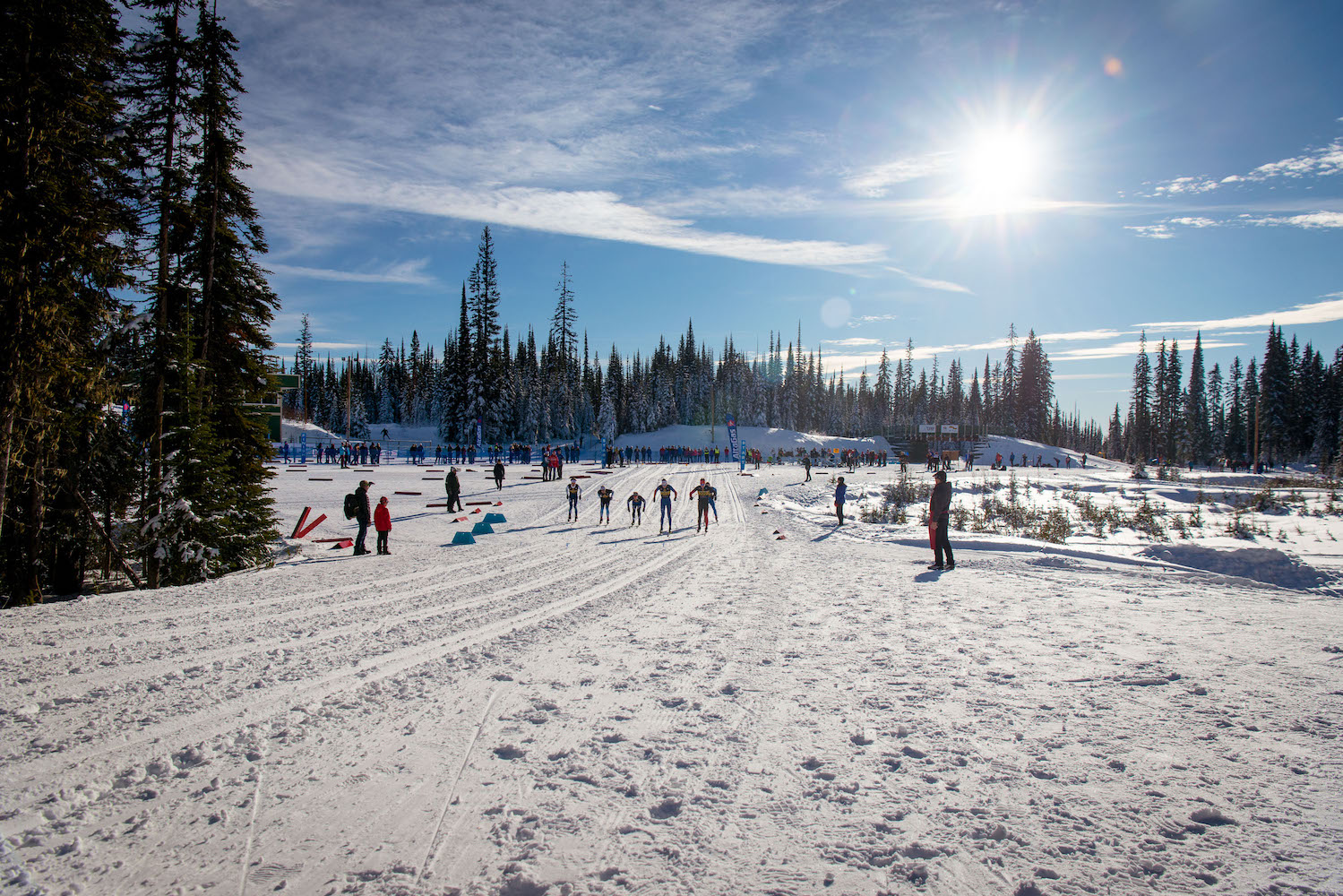
Classic sprint day at the Sovereign Lake Nordic Centre on Saturday, Dec. 9. The NorAm opening weekend also counted as SuperTour races. (Photo: SilverStar Mountain Resort)
VERNON, British Columbia — For the second consecutive year, the Sovereign Lake NorAm was combined with the SuperTour for an expanded field of racers. The warm, sunny, and windless conditions on both days were a welcome change from the previous season’s cold weather and falling snow. What didn’t change was the ‘south of the border’ feel to the leaderboard.
The race formats were similar to that of the Davos World Cup, just nine time zones later: Saturday was a classic sprint (Davos was a skate sprint) and Sunday included 10- and 15-kilometer freestyle interval starts.
With temperatures around -2 degree Celsius and dry, untransformed snow, the waxing was straightforward both days with ski choice dominating the discussions. More than 400 racers competed, including 140 men and 84 women in the open categories.
Classic Sprint
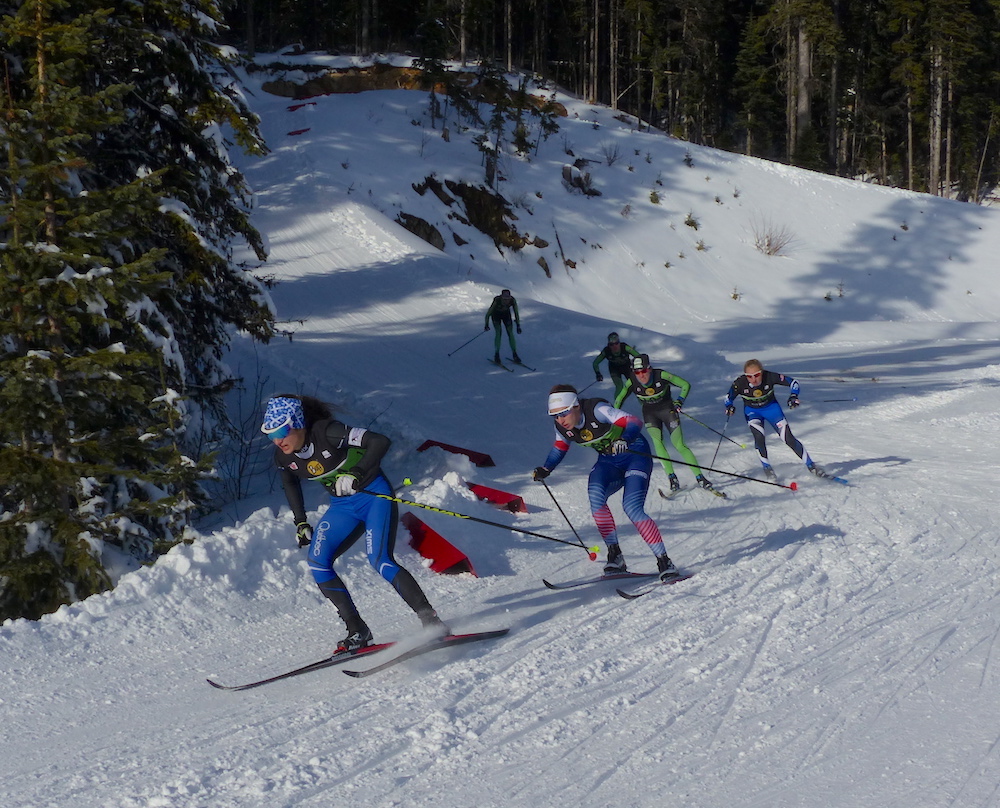
Sophie Carrier-Laforte (Pierre-Harvey National Training Centre) leading the women’s classic sprint final at the Sovereign Lake NorAm/SuperTour on Dec. 9, ahead of Sun Valley’s Kelsey Phinney (second from l), Craftsbury’s Kaitlynn Miller (third from l) and APU’s Hannah Halvorsen (far r). (Photo: Peggy Hung)
Sovereign’s 1.3-kilometer sprint course doesn’t feature large climbs, but it does reward good tactics. There were a few minor incidents off the start when the six tracks became four, and the final 270-degree turn off the bridge into the finishing straight punished tired legs and tight groups.
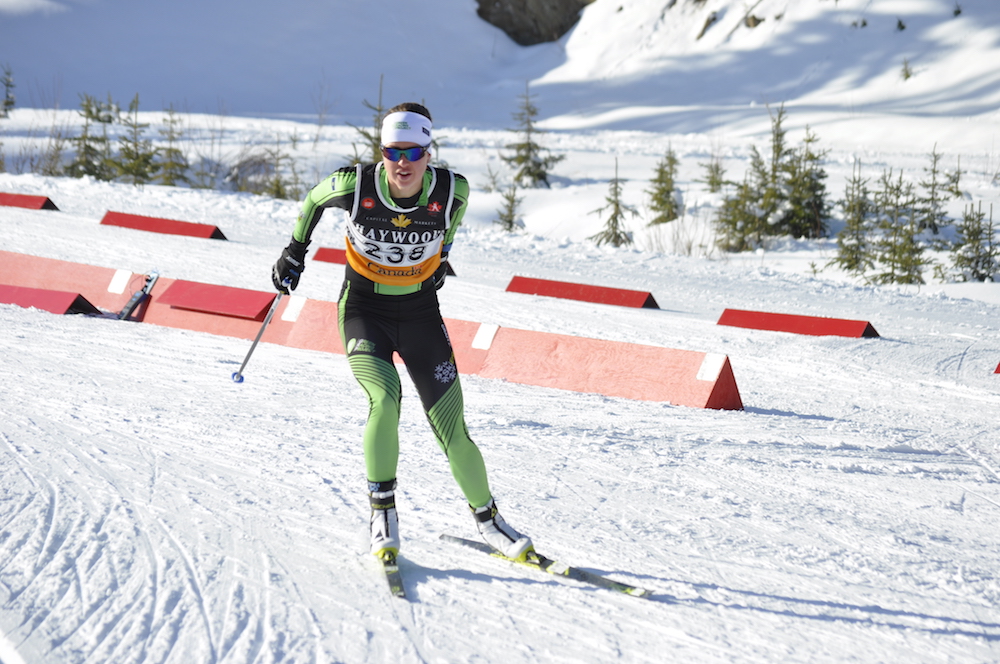
American Kaitlynn Miller of the Craftsbury Green Racing Project (CGRP) dominated the open women’s sprint, winning the qualifier and all of her heats. In the A-final, Canadian Sophie Carrier-Laforte, of the Pierre-Harvey National Training Centre (CNEPH), pushed the pace from the start, using her double-poling power to stretch the field over the first three climbs. Miller was last into the hole and used the big climb to work her way to the front, where she was able to control the group through the tricky final turn and get first lane choice to take the win in 2:57.53 minutes. Miller’s teammate, Caitlin Patterson powered past Hannah Halvorsen, of Alaska Pacific University (APU) and the U.S. Ski Team (USST) D-team, to take second, 0.93 seconds behind Miller. Halvorsen claimed third (+2.59), Kelsey Phinney, of the Sun Valley Ski Education Foundation (SVSEF) took fourth (+2.59), and a third Craftsbury skier Liz Guiney placed fifth (+3.53). The lone Canadian in the women’s final, Carrier-Laforte, finished sixth (+4.38).
The ‘technique zone’, where only diagonal stride or herringbone techniques are permitted, wasn’t a factor for the women. Finland’s Jasmi Joensuu, a junior at the University of Denver, had tested early in the week and decided to use grip wax for the one steep climb. Joensuu added some excitement the B-final, as she changed clothes and switched to skate skis for her planned cooldown before discovering that the NorAm series does B-finals. Luckily, her classic race skis were still in the start area and she was able to finish third in that heat for ninth overall.
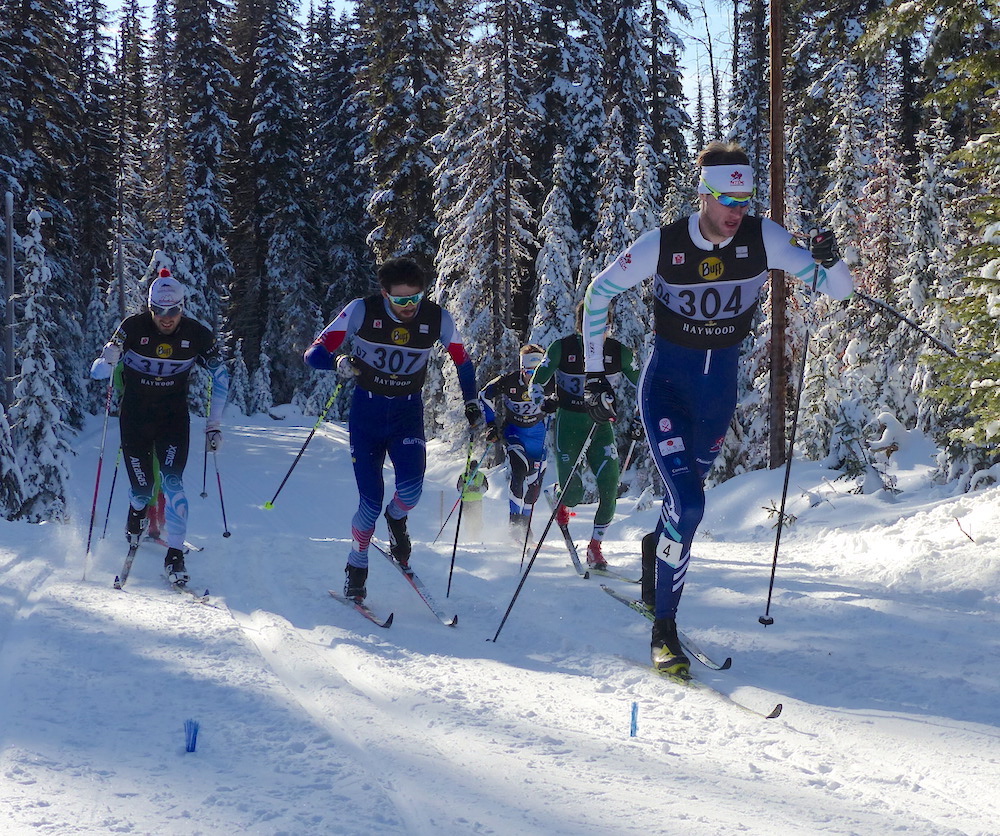
Bob Thompson (304) of NTDC Thunder Bay leading Sun Valley’s Jack Hegman (307) and Patrick Stewart-Jones (317) of the AWCA during their quarterfinal of the NorAm men’s 1.3 k classic sprint on Saturday at Sovereign Lake near Vernon, B.C. (Photo: Peggy Hung)
In the men’s race, Bob Thompson, of the National Team Development Centre (NTDC) Thunder Bay, salvaged Canadian pride with a win after qualifying fourth and placing second in his quarter and semi heats. Thompson was the only Canadian in the A-final, closing a gap to the leading three on the bridge turn and double poling from fourth to first to finish in 2:29.31. American Ben Saxton of the Stratton Mountain School (SMS) Elite Team finished just three-hundredths of a second back for second place, and Cole Morgan edged out his SVSEF teammate Jack Hegman by 0.03 seconds for third (+0.48). APU’s Reese Hanneman and Tyler Kornfield followed in fifth (+7.75) and sixth (+ 7.90), respectively, after being gapped early and losing the battle for the four lanes on the first hill.
In the B-final, the lone Canadian in that heat, Evan Palmer-Charrette (NTDC Thunder Bay) recovered from finishing sixth in his semifinal to take the win (for seventh overall) and earn some important series points.
The technique zone was a larger challenge for the men as they carried more speed into the start of the zone, keeping the jury busy, although only one athlete was disqualified. Many of the top men used just enough grip wax to prevent ‘gliding herringbone’ and the resulting DQ. There were broken poles and one protest at the merge to four lanes off the start, resulting in one verbal warning from the jury, along with a few quarterfinal crashes on the final turn.
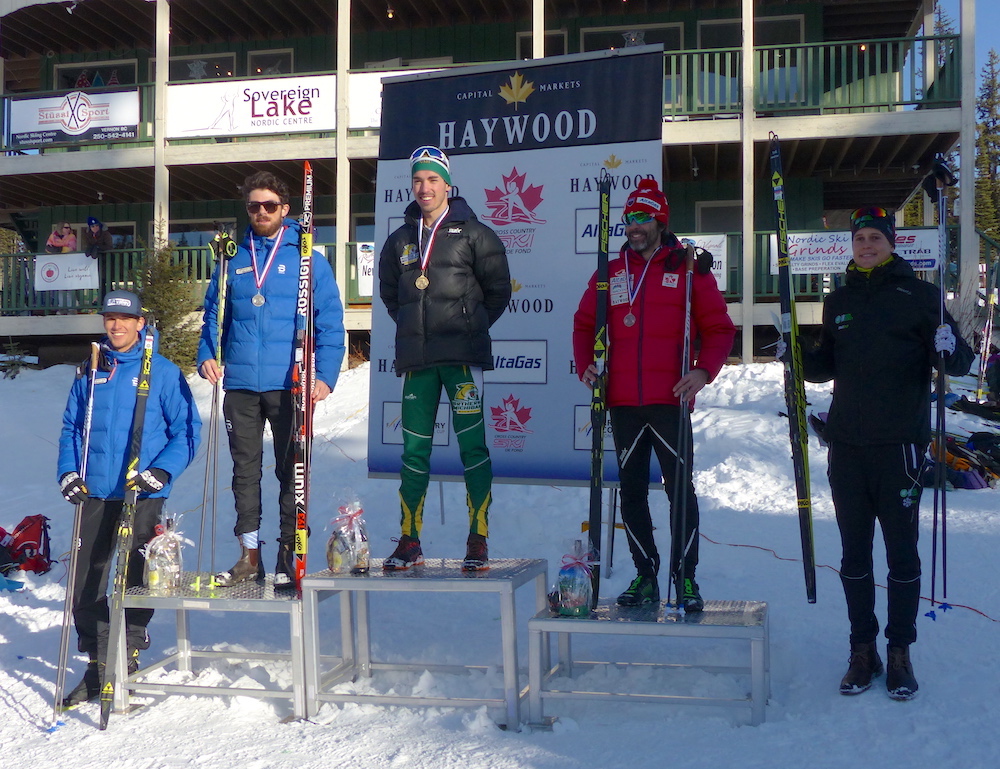
The men’s 15 k freestyle podium on Day 2 of the NorAm opening weekend at Sovereign Lake near Vernon,B.C., with (pictured) Ian Torchia (NMU/USST D-Team) in first, Jack Hegman (SVSEF) in second, Brian McKeever (Canadian Para-Nordic Team) in third, Kevin Bolger (SVSEF) in fourth (far left), Adam Martin (CGRP) in fifth (far right). (Photo: Peggy Hung)
The 5-kilometer ‘Upper World Cup’ course is not obviously difficult to someone casually skiing it in Zone 1; there is one mildly challenging corner, one steep climb (‘the wall’), and the total climb is at the lower limit of the International Ski Federation (FIS) homologation range. But racing it is another story, as evidenced by several top finishers after Sunday’s 10/15 k freestyle interval starts who used words like “nightmare”, “hardest”, and “most painful” in post-race interviews.
In the men’s 15 k, Ian Torchia, a Northern Michigan University (NMU) junior and member of the USST D-team, was on fire, ranking fourth after two of three laps. He described suffering on the last lap and relying on a ride to keep his speed up, but still managed to ski the fastest final lap (in 12:15.7) to take the victory in 36:29.7.
Hegman placed second, 19.0 seconds back, improving on his fourth place from the sprint. Canadian Para-Nordic skier Brian McKeever, who skipped the Canmore International Paralympic Committee (IPC) World Cup to race at Sovereign, notched third (+22.6). Sun Valley’s Kevin Bolger skied three very even laps (11-second variation from fastest to slowest) to finish fourth. Craftsbury’s Adam Martin took fifth (+28.3), just edging out Para-Nordic guide Graham Nishikawa, who led Torchia into the finish and placed sixth (+29.1).
A perennial podium threat at Sovereign and the previous weekend’s SuperTour distance winner, Brian Gregg, of Team Gregg, Central Cross Country (CXC) and Loppet Nordic Racing (LNR), took the lead after Lap 1 with a time of 11:49.8. But by the end of Lap 2, he was visibly losing power, clocking the 18th-fastest lap time, before his 13:10.4 final lap ranked 45th for 16th overall (+1:09).
Thompson, wearing the NorAm leader’s bib after his victory on Saturday, finished 19th (+1:17.2). The combined NorAm and SuperTour fields made for a highly competitive event, with the top 40 men finishing within two minutes of first.
Caitlin Patterson (Craftsbury Green Racing Project) racing to the win in the women’s 10 k freestyle on Dec. 10 at the Sovereign Lake NorAm/SuperTour. (Photo: XTS Photography)
In the women’s 10 k, Patterson moved up from her sprint second place to notch her first win of the season in 27:13.0. She was 30.7 seconds clear of runner-up Rosie Frankowski (APU), and Frankowski claimed second by just one second over Caitlin Gregg (CXC/LNR/Team Gregg) in third.
Katherine Ogden, a Dartmouth College freshman and member of the Stratton Mountain School (SMS) and USST D-team, placed fourth (+50.1), just ahead of Becca Rorabaugh (APU) in fifth (+52.7) and Mary Rose (SVSEF) in sixth (+1:00.9).
Retired biathlete Zina Kocher was the top Canadian in eighth (+1:31.2). Kocher (who raced at Frozen Thunder in November under her new married name of Lawson) will compete as Kocher this season as FIS requires a new passport to register a name change. Not surprisingly for a former biathlete, she enjoyed the skate distance race much more than the classic sprint.
CNEPH’s distance specialist Frédérique Vézina was the second Canadian in 12th overall (+2:03.3).
If you didn’t get your fill of video links above, the local tv station visited the day before the sprints and presciently chose Thompson for their first interview. They also talked to APU’s Erik Flora.
Sprint Photos
The junior men descending after the second climb. (Photo: Anna Sellers)
Men’s X final drops off the bridge into the 270. (Photo: Anna Sellers)
Sunshine on the third descent. (Photo: Anna Sellers)
Ben Saxton leads the way to the bridge. (Photo: Anna Sellers)
Top of the last climb. (Photo: Anna Sellers)
(Photo: Anna Sellers)
Bob Thompson leads early in the men’s A final. (Photo: Peggy Hung)
The men’s A final in the finishing straight. (Photo: Peggy Hung)
Ben Saxton (l) leads Bob Thompson (r) with 50m to go. (Photo: Peggy Hung)
Sophie Carrier-Laforte was pushing hard on the double-pole climbs. (Photo: Peggy Hung)
Caitlin Patterson leads the A final. (Photo: Peggy Hung)
Distance Photos
For more distance photos, find XTS Photography on FaceBook.
This is what retirement looks like for Brittany Webster. (Photo: Peggy Hung)
Caitlin Gregg leads Mary Rose. (Photo: Peggy Hung)
Recovery time for Caitlin Gregg and Mary Rose
. (Photo: Peggy Hung)
Dakota Blackhorse-von Jess on the wall climb. (Photo: Peggy Hung)
Evan Palmer-Charrette (l) chases American Thomas O’Harra in the 15 k skate at the Sovereign Lake NorAm near Vernon, B.C. (Photo: Peggy Hung)
A sparkling race
for biathlete Karen Messenger. (Photo: Peggy Hung)
Photo: Peggy Hung)
Seeing double? Nope, this is Chad Gregg. (Photo: Peggy Hung)
Graham Nishikawa opened a gap on Ian Torchia on the wall climb. (Photo: Peggy Hung)
The trains were forming. (Photo: Peggy Hung)
Former biathlete Zina Kocher likes skate distance more than classic sprints, and the selection race schedule might not work in the current NorAm leader’s favor. (Photo: Peggy Hung)
Looking down from the wall climb. (Photo: Peggy Hung)
Caitlin Patterson is ready to start. (Photo: XTS Photography)
Local national team junior Hannah Mehain entering the stadium. (Photo: XTS Photography)
Brian McKeever blasting the final short climb. (Photo: XTS Photography)
Ian Torchia leads a group on his way to the win. (Photo: XTS Photography)
Jack Hegman chasing the podium. (Photo: XTS Photography)
Jack Hegman has his focus. (Photo: XTS Photography)
Are there photos we are missing? Share with info@fasterskier.com and include photo credit information.
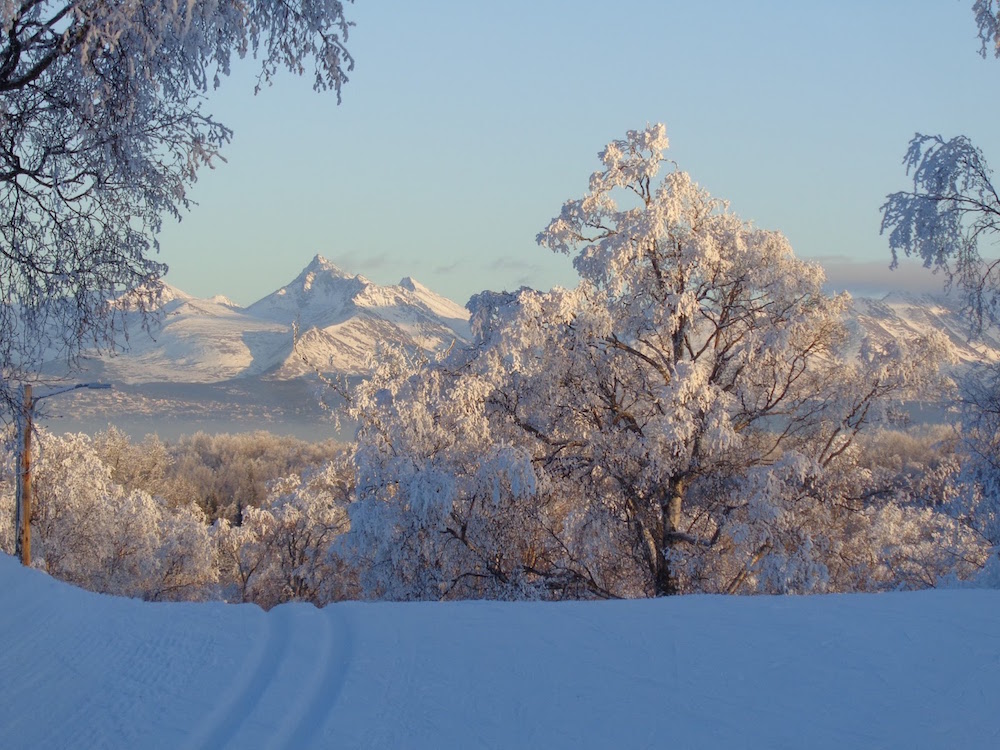
The Chugach Mountains as seen from the Lekisch Loop, part of the course for the weekend’s races, at Kincaid Park in Anchorage, Alaska. (Photo: Adam Verrier)
ANCHORAGE, Alaska — So how cold was it at Kincaid Park Sunday morning for the last of four Rocky Mountain Intercollegiate Ski Association (RMISA) races held in the Anchorage area this week?
“It’s f—ing cold,” said women’s winner Merete Myrseth of the University of Utah. “It was cold,” said men’s winner Moritz Madlener of the University of Denver. “Now we fly back to Denver and get warm.” [Unavailable for comment] were the two skiers who required an ambulance for cold-related injuries following the women’s race.
For the record, temperatures were consistently at or above zero degrees Fahrenheit all morning, so readily FIS-legal. (The International Ski Federation, which sanctioned all of this week’s races, has a temperature cutoff of -20° C, or -4° F, in order for a race to be held.) The real problem was the wind, which blew steadily from the north at around 10mph all morning.
Unless the real problem was the humidity. The city of Anchorage is, well, a natural anchorage, bordered by Cook Inlet to the north and Turnagain Arm to the south. The Kincaid stadium is well under a kilometer away from the shores of the ice-choked Pacific Ocean; athletes were within 150 meters of the Turnagain Arm beach at one point on Sunday’s race course. Humidity was over 90% all morning. By any measure, conditions were somewhere between “raw” and “brutal.”
At least atmospherically speaking. The ski trails were in superb shape following 30″ of snow in the month of January, if slow due to temperatures below zero Saturday night into Sunday morning.
The first race of the day, the men’s 20-kilometer freestyle mass start, saw its start moved one hour later due to cold conditions. In that time the temperature rose from -2° F to zero.
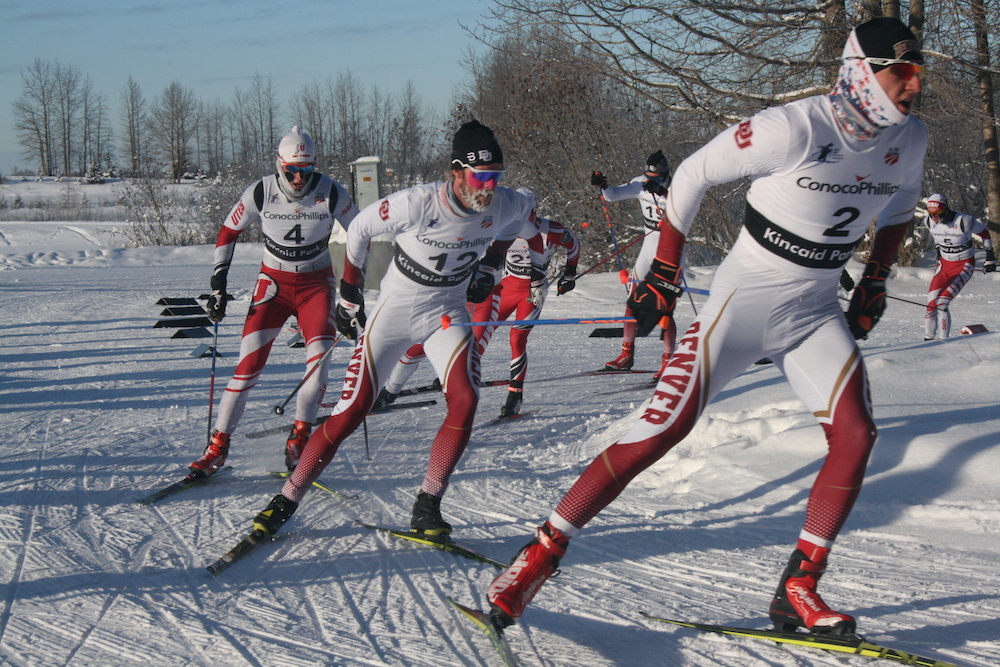
Denver’s Moritz Madlener (2) leads Dag Frode Trollebø of Denver (12) and Kevin Bolger of Utah (4) in the men’s 20 k skate at Kincaid Park in Anchorage, Alaska. (Photo: Adam Verrier)
When the race started, Denver’s Madlener quickly moved near the front as the field of 42 racers headed north out of the stadium to make their way up Elliott’s Climb. (For Anchorage readers, or anyone else familiar with Kincaid: the course went up Elliott’s and down Rollercoaster; up and down the Gong Hill; through the lower tunnel out to Mize’s Folly; take the first right onto Hairpin; take the first left at the top of Hairpin onto the 2.9 k Lekisch. Men did two laps of this, for 15 k, then a final 5 k lap that cut out Elliott’s. Women did two laps of the 7.5 k course for 15 k total.)
“I was in the front pack pretty much the whole race,” Madlener recounted in an in-person interview with FasterSkier. “Tried to, you know, set the pace every now and then to get rid of people. Which worked pretty well; I think four of us got away after maybe 12 [kilometers]. And then we stayed together for the rest of the race, and then the last couple hills we kind of separated.”
Madlener ultimately crossed the line in 52:39.2, edging teammate Dag Frode Trollebø by 2.6 seconds. Martin Bergström of the University of Utah followed in third (+10.4). “That’s a great feeling” to share the podium with a teammate, Madlener told FasterSkier.
Madlener recalled that he had “a really good start” to his season at U.S. nationals – he earned two podiums there, second in the classic sprint and third in the 15 k skate – before he got sick “and had to catch up. And the races so far here in Alaska weren’t that great,” he continued, “so I was very happy to win today.”
This week marked Madlener’s second time racing in Alaska; he previously competed in the last RMISA race series held in Anchorage, in early 2015. That week was marked by warm weather, rain, and shortened courses.
Madlener is a fan, of Alaska in general and particularly the full courses that athletes got to race on this year.
“I think it’s beautiful,” Madlener said of Alaska. “It’s like – I would say it’s like a big theme park; people are surfing and flying around and fishing. I really enjoy it. And the courses – again, two years ago, were not so great, but this year there’s a lot of snow, they’re pretty amazing courses. Like a rollercoaster.”
Merete Myrseth of Utah enters the stadium approaching the finish in the women’s 15 k skate at Kincaid Park in Anchorage, Alaska. (Photo: Adam Verrier)
Sunday’s race course featured a total of eight A-climbs for the men in 20 k, and six A-climbs for the women in 15 k. There was an average of 34 meters of climbing per kilometer on the main 7.5 k loop.
Four racers, roughly a tenth of the field, were DNFs in the men’s race, likely due to a combination of the hills and the cold. Two skiers did not finish the women’s race. An additional eight opted not to start.
The first words out of Madlener’s mouth when asked about his race were, “It was – first of all it was cold, obviously.” Myrseth, the women’s winner who skis for Utah, voiced similar sentiments: “It was cold, really cold,” she began her race summary. (By the time of the women’s race start at 12:30 p.m., temperatures had climbed to 1.6° F.)
“I was unsure if I would start the whole race because it was so cold, actually too cold for me,” Myrseth told FasterSkier in a brief in-person interview while shivering in the windy stadium soon after her finish. “But it went really easy in the first half of the lap,” she continued, and she felt good. “So I decided to speed up when I came to hills”; there Myrseth created a gap that she kept all the way to the finish.
But not without difficulty. “I didn’t feel good,” Myrseth said. “My feet, I couldn’t feel my feet, it was so cold. So I had to just, like, double pole over the hills, I was so tight in my feet and lost my balance, it was just so hard to keep balancing. But I made it to the finish line. And I am so happy that Guro took the second place.”
Merete Myrseth of Utah (l) in the finishing chute en route to the narrow victory over Guro Jordheim of Utah (106) and Christina Rolandsen of Colorado (109) at Kincaid Park in Anchorage, Alaska. (Photo: Adam Verrier)
Myrseth crossed the finish line in 46:28.3 for 15 k, double poling the last few meters to the finish. As she noted, she was followed by teammate Guro Jordheim in a close second (+0.5). Christina Rolandsen of the University of Colorado was not far back in third (+1.8). There was then a 30-second gap to a chase pack containing places fourth through sixth. 32 skiers finished the women’s race.
This week marked Myrseth’s first time racing in Anchorage or even visiting Alaska. So what did she think? “I love it,” said the native of Øverbygd, Norway. “It’s f—ing cold, but it reminds me of Norway, my home. I’m used to it. But it’s so nice; I really like it here.”
Sunday’s race marked the fourth race of the week in the Anchorage area for RMISA athletes. Recaps of the first three races follow below.
On Tuesday, February 7, RMISA athletes, plus a handful of skiers from Alaska Pacific University (APU) with sterling sprint credentials, raced a 1.4-kilometer freestyle sprint at Kincaid. Conditions were impeccable, with pure blue skies, temperatures in the high teens, and last month’s fresh snow mixed in with the base of manmade snow covering the sprint loop.
In the women’s race, Merete Myrseth of Utah posted the fastest time in qualifying, 3:25.77, followed by Becca Rorabaugh of APU (+2.14) and Utah’s Guro Jordheim (+3.65). All three skiers made the A-Final, where Myrseth took her first victory of the week. The overall podium, which was also the college podium, was Jordheim in second and Anika Miller (Montana State) in third. Casey Wright (UAA), Rorabaugh, and Jasmi Joensuu (Denver) were fourth through sixth.
Times were not available for any of the heats.
In the men’s race, Dag Frode Trollebø (Utah) set the pace in qualifying in 2:48.80. He was followed by APU’s Logan Hanneman (+1.52) and Utah’s Martin Bergström (+3.33).
Three of the six skiers in the men’s A-Final were locals (in the broad sense of being from Alaska; the Hanneman brothers are from Fairbanks, not Anchorage). And it was the Hanneman show in the final, as the elder Reese Hanneman took the victory over his younger brother Logan. Trollebø was third. Kevin Bolger of Utah, last seen winning the classic sprint national championship at Soldier Hollow, Bergström, and APU’s Forrest Mahlen rounded out the final finisher spots in that order.
The collegiate podium for the men’s race was Trollebø, Bolger, and Bergström. (APU is not an NCAA-affiliated athletic program.)
While sprinting may be on the horizon for NCAA skiing in general, it had yet to make an appearance on the RMISA circuit.
“This was the first sprint that I know of in my, what – 10 years of RMISA coaching now and we’ve never had just a straight invitational sprint,” University of Alaska Anchorage Head Nordic Coach Andrew Kastning told FasterSkier in person following Sunday’s distance skate races.
Kastning said that the addition of a sprint in Anchorage stemmed from a desire for a change of pace, and to avoid repetition in a single week with four races. “So when we sat down last spring and were deciding the schedule,” he said, “we’d been hearing for a few years now from our athletes that the fives, 10s, 15s, and 20s [kilometer race format] every weekend just kind of got boring, and we wanted to mix it up. So we counted the qualifying round as an invite at U.S. Nationals, and then we ran the full sprint [this week] and counted that. … So we just wanted to mix it up a little up here. Especially with four races in a short period of time, you don’t want to be doing all the same distances and the same courses.”
So did the college athletes appreciate the chance to contest a sprint race in the middle of the RMISA race season? “Some of them do,” Kastning said. “There’s always a sprint specialist in the crowd who gets to shine. And I know there were kids on the podium, or in the top-10 at least, that aren’t normally in a distance race. So it allows some athletes to play to their strengths and shine a bit when they maybe wouldn‘t in a 20 k race, they can in a sprint.”
On the non-collegiate side, APU skier Reese Hanneman, a sprint specialist, was thrilled to have a mid-season sprint race with high-level competition on his adopted home course. “I wish there were more sprint races in the middle of the season,” Hanneman told the Alaska Dispatch News.
Utah’s Martin Bergström (402) leads Denver’s Dag Frode Trollebø (right) and APU’s Reese Hanneman (center) at the start of the mixed-gender classic relay in Girdwood, Alaska. (Photo: Adam Verrier)
The next day, Wednesday, February 8, skiers made the 45-minute drive down Turnagain Arm from Anchorage to Girdwood for a classic relay race. Girdwood is perhaps best known in ski circles as home to the Alyeska Resort alpine area, which boasts an average annual snowfall of 669″ and (when it’s clear) sweeping views of the mountains and glaciers overlooking Turnagain Arm. Publications as diverse as Powder magazine and National Geographic have lauded Girdwood as a quintessential locals ski town (“Best For: Off-the-beaten-path powder hounds with an aversion to glamour”).
Girdwood also has a proud nordic heritage, though you have to look a little harder to find it. It is home to APU skier Chelsea Holmes, who will be competing at World Champs in Lahti later this month. And it hosted the 1969 Junior Nationals, on trails cleared from the continent’s northernmost coastal rainforest for this purpose.
As discussed in more detail on former U.S. Ski Team member Tim Kelley’s invaluable blog, Alaska Lost Ski Areas Project, the trails faded back into the woods at some point during the 1970s. High-level nordic skiing in Girdwood then languished for over thirty years, until the early part of this decade, when the Girdwood Nordic Ski Club oversaw construction of a new 5 k loop. The reborn nordic trails have since hosted a handful of local high school races in periods of poor snow conditions in Anchorage, but it is safe to say that Wednesday’s relay was the most significant cross-country ski race held in Girdwood since 1969.
APU (1st), Colorado (2nd), and Utah (3rd) make up the podium for the mixed-gender classic relay in Girdwood, Alaska. (Photo: Adam Verrier)
Athletes raced in a mixed-gender 4 x 5-kilometer classic relay in the epochal event, man/woman/man/woman. It was once again APU leading the way, as the team of Reese Hanneman, Rosie Frankowski, Logan Hanneman, and Rorabaugh crossed the finish line for the victory in 57:33.7. Second overall, and first among collegiate teams, was Colorado (Mads Ek Strøm, Jesse Knori, Petter Reistad, Christina Rolandsen), 25.6 seconds back. They were followed by Utah (Bergström, Jordheim, Bolger, Myrseth) (+1:02.6). Fourth overall, and third for the NCAA podium, was Denver (Trollebø, Linn Eriksen, Moritz Madlener, Joensuu) (+1:25.4).
“Everybody was psyched on a new format and a new trail in a beautiful location,” Kastning told FasterSkier of Wednesday’s race.
Kastning added that the relay, like the previous day’s sprint, was new territory for RMISA racing. “We’ve never had a relay that’s counted for anything,” he said. “I think the relay captures college skiing well, with the mixed gender and the team aspect, men and women working together to try and reach the podium.”
Three days later, Saturday, February 11, skiers were back in Anchorage for individual start distance classic races, 5 k for the women and 10 k for the men. Race time was moved forward from 10 a.m. to noon, which allowed temperatures to rise from 2° F up to 8°.
Saturday’s course was by some measures the hilliest of the week, clocking in at a healthy 39 meters of climbing per kilometer of distance. The upper limit for FIS homologation is 40 m/km. (The course covered the final two-thirds of Sunday’s 7.5 k course – notably Gong Hill, Mize’s Folly, Lekisch.)
Merete Myrseth of Utah (103) leads Denver’s Jasmi Joensuu (126) and Taeler McCrerey (108) in the women’s 15 k skate at Kincaid Park in Anchorage, Alaska. (Photo: Adam Verrier)
Rorabaugh started near the end of the field in the women’s 5 k classic, which had 39 starters. Two A-Climbs later she crossed the finish line in 15:47.0, which held up as the fastest time of the day. Colorado skier Knori was second (+4.2), followed by her teammate Rolandsen in third (+8.2). Jordheim of Utah (+13.8) was fourth overall to round out the collegiate podium, just ahead of APU’s Frankowski in fifth (+15.0).
It was Rorabaugh’s first 5 k classic FIS race in this country in over five years.
The men raced two laps of the same course for a 10 k classic. Denver’s Trollebø was again on the podium, posting the day’s fastest time of 26:51.60. He was followed by Utah’s Bolger in second (+15.0) and Colorado’s Reistad in third (+19.3). Utah skier Bergström (+29.2), immediately followed by Denver skier Madlener (+29.4), rounded out the top five.
The week’s four races were technically scored as parts of two college invitational race series. In the Seawolf Invitational, encompassing the sprint and relay from the first part of the week, plus two alpine races held at Alyeska in January, the University of Utah took the overall team title with 665 points. The University of Denver (569 points) and the University of Colorado (549 points) followed. The order was the same if the standings are broken out by exclusively nordic results: Utah, Denver, Colorado.
The weekend’s distance races combined with two other January alpine races to make up the week’s second race series, the UAA Invitational. Combined standings were unchanged here, as Utah (661 points) took the victory over Denver (636 points) and Colorado (544 points). On nordic results alone the ranking was the same: Utah, Denver, Colorado.
RMISA racing continues with the RMISA Championships/NCAA West Regional in Colorado in late February, then (for qualifying skiers) NCAA Championships in New Hampshire in March. Nordic races will be held at Jackson Ski Touring Center.
Kastning explained that RMISA schools take their biennial trip to Alaska in years when NCAA Championships are set for the East Coast, “because it’s lower elevation. So other teams like to get some sea-level racing,” he said. “And so it helps our whole region do better I think at NCAAs, because you get some tempo racing, a different kind or style of racing than you do when you’re racing at 9,000 feet.”
From left, Dag Frode Trollebø of Denver, Moritz Madlener of Denver, Kevin Bolger of Utah, and Martin Bergström of Utah enter the stadium in the men’s 20 k skate at Kincaid Park in Anchorage, Alaska. (Photo: Adam Verrier)


 This coverage is made possible through the generous support of Marty and Kathy Hall and A Hall Mark of Excellence Award. To learn more about A Hall Mark of Excellence Award, or to learn how you can support FasterSkier’s coverage, please contact info@fasterskier.com.



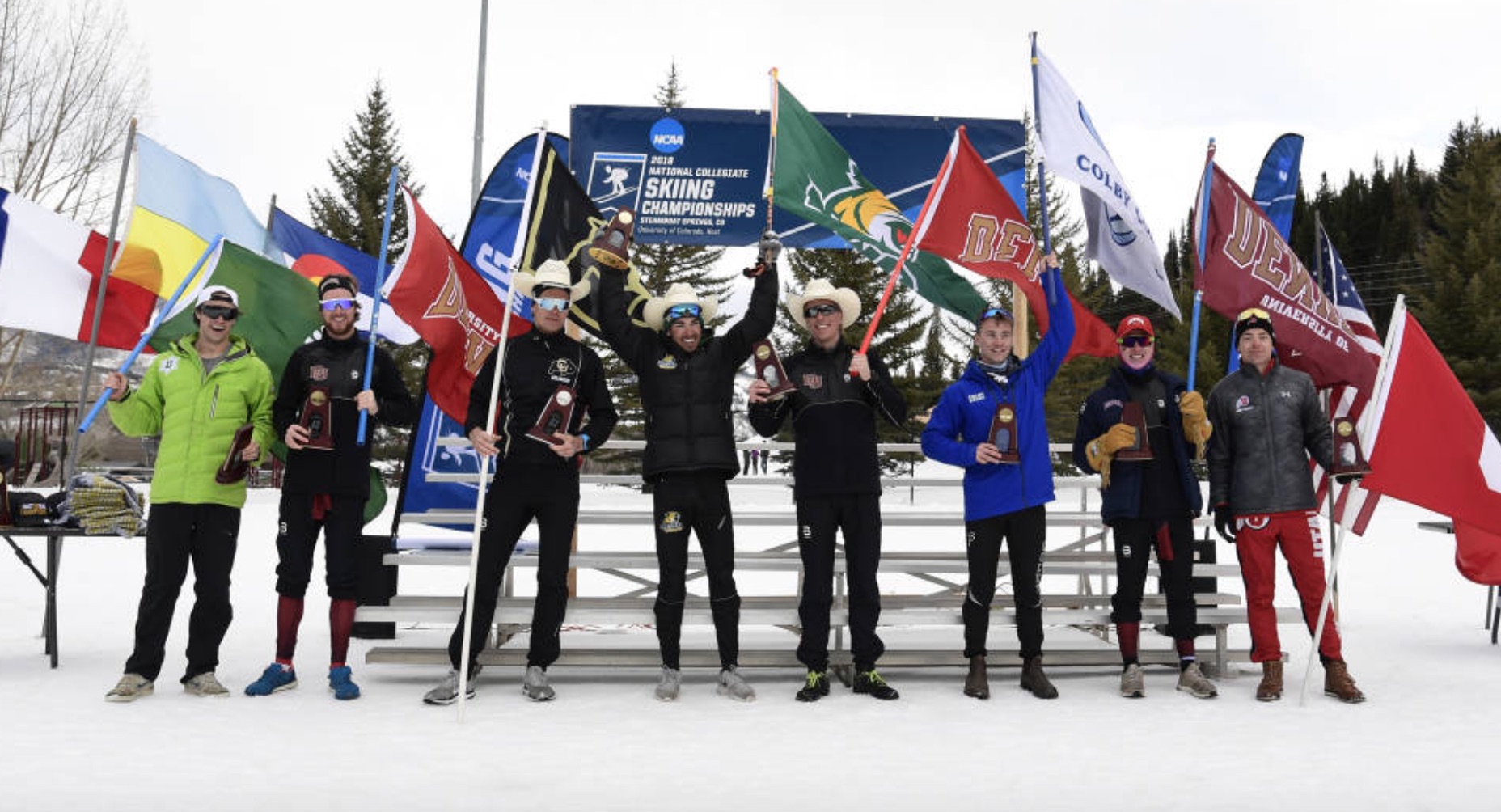
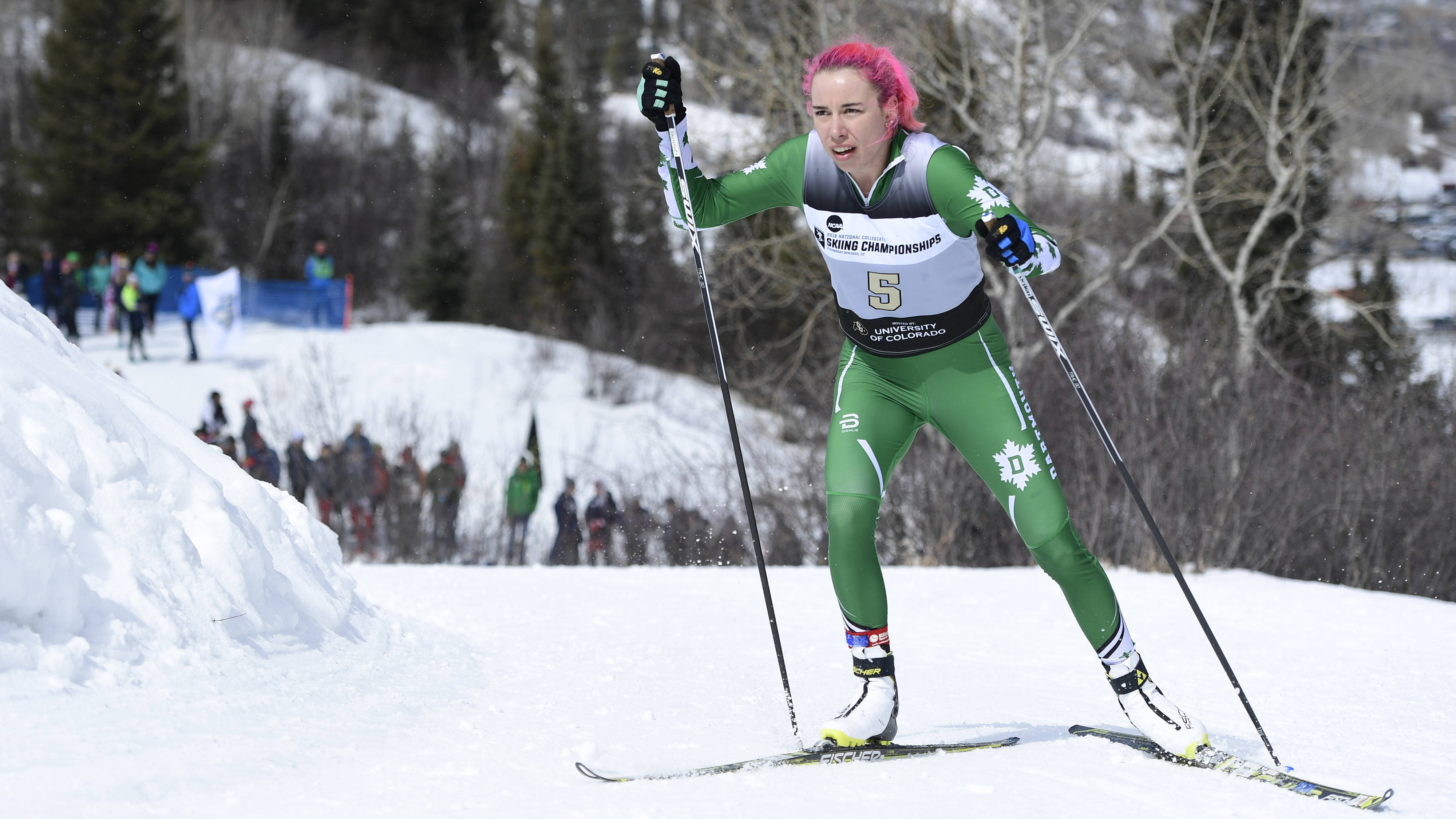
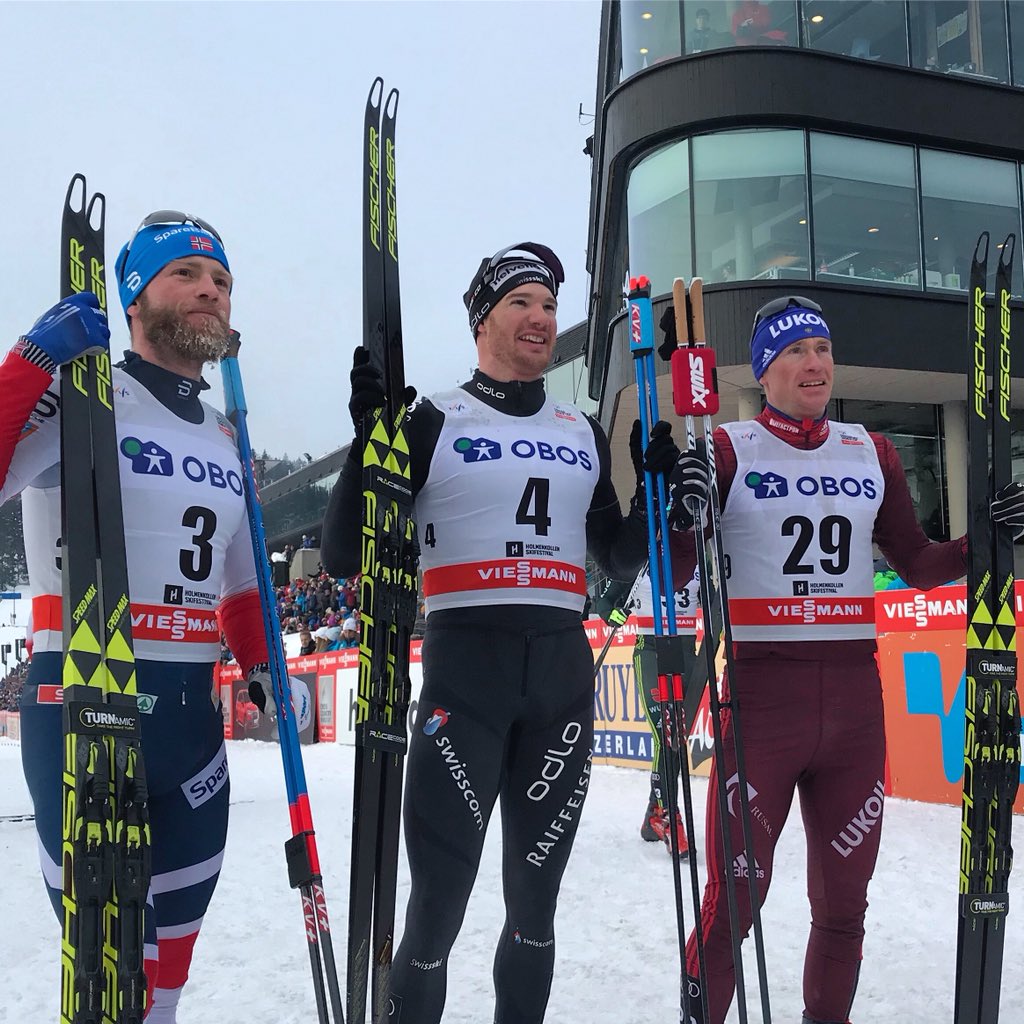
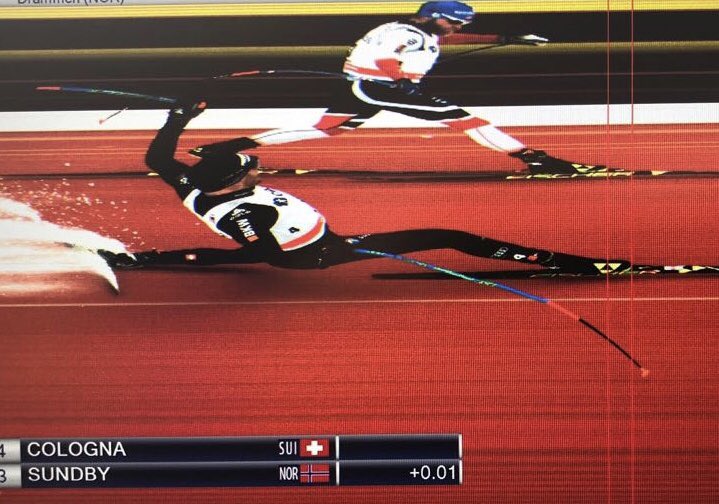
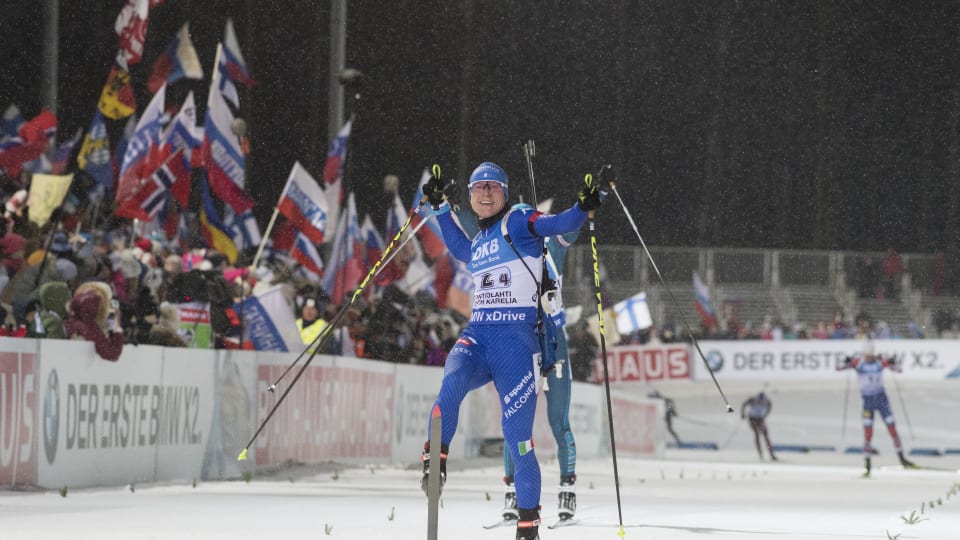
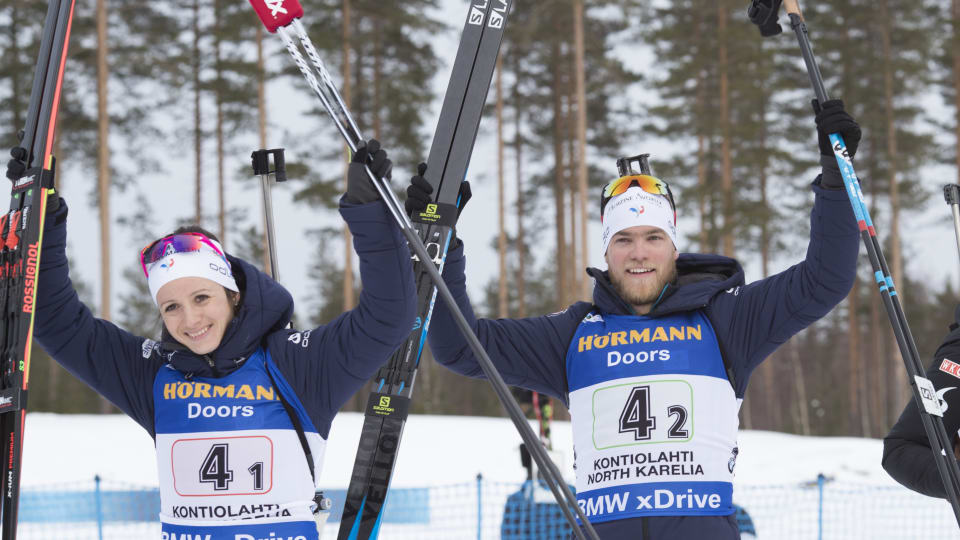
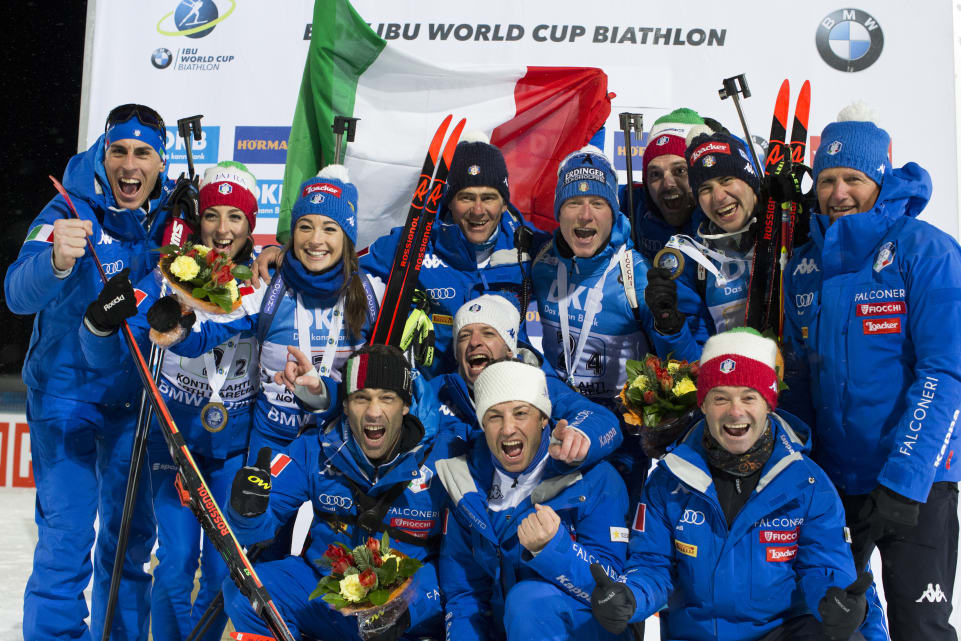

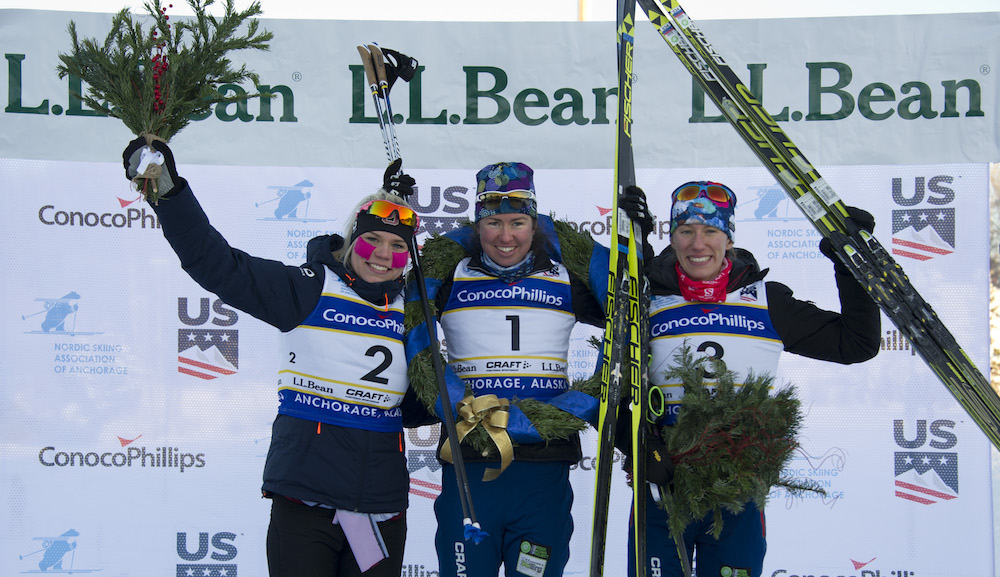
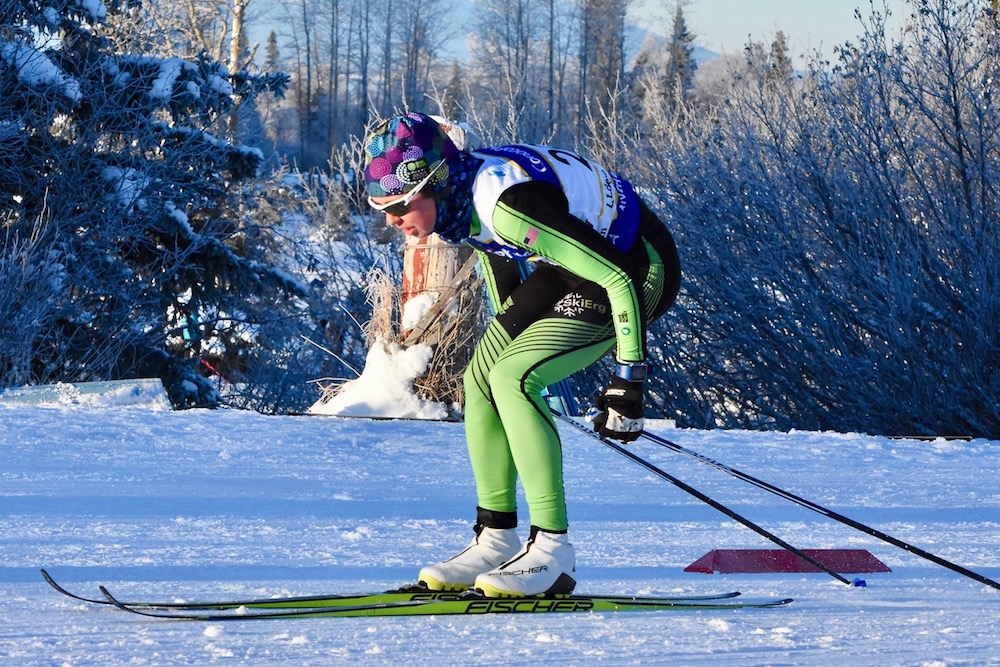
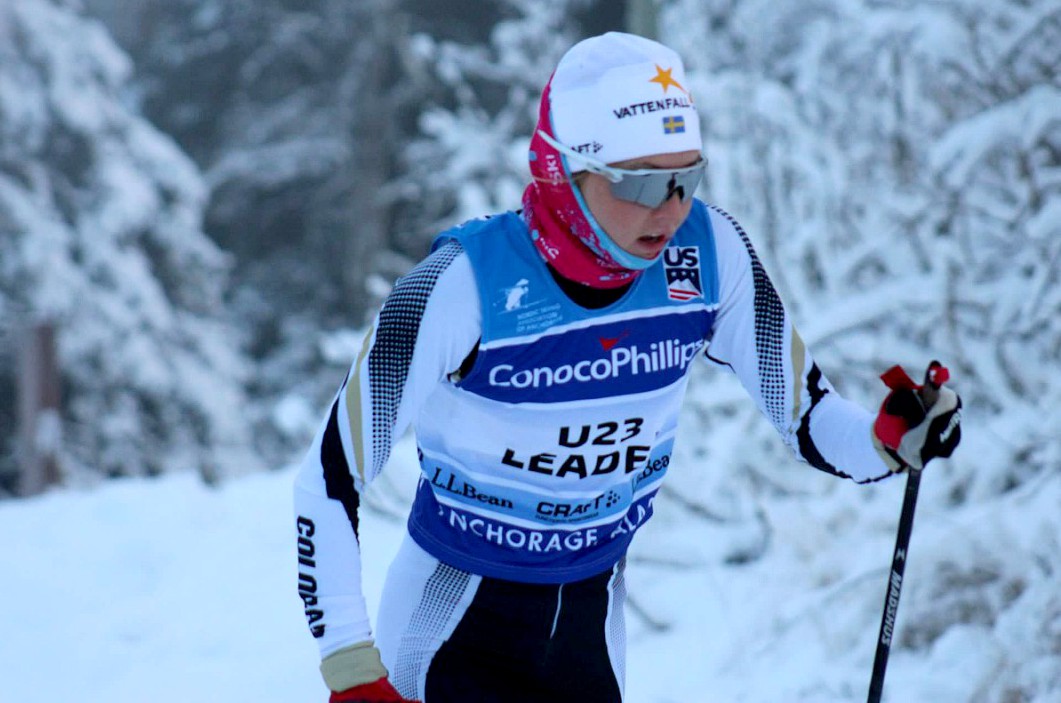
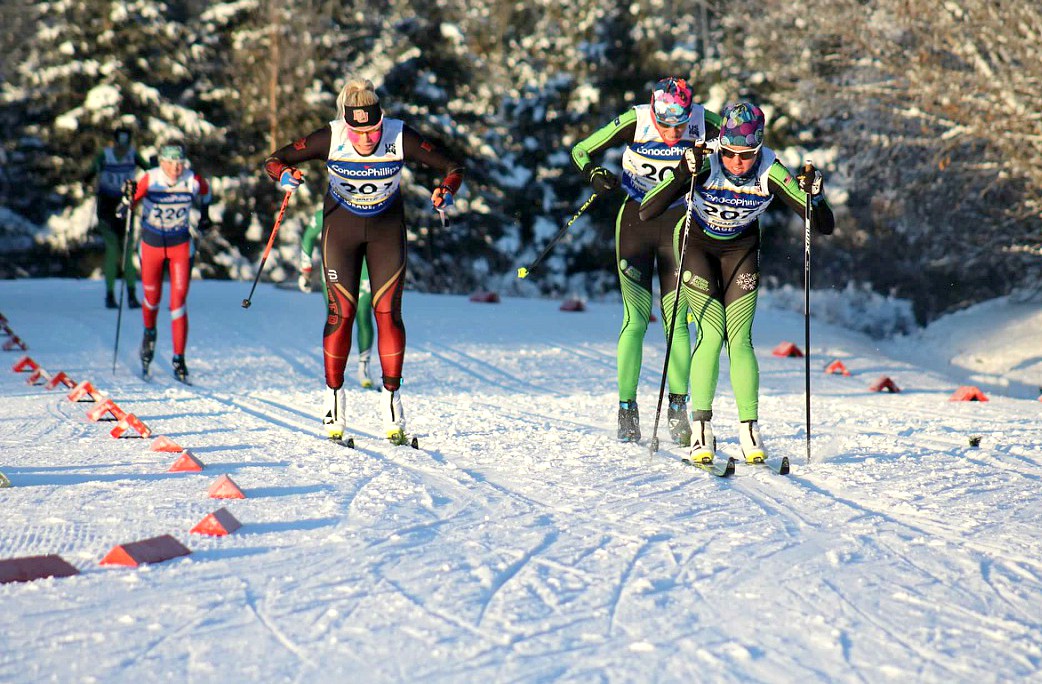
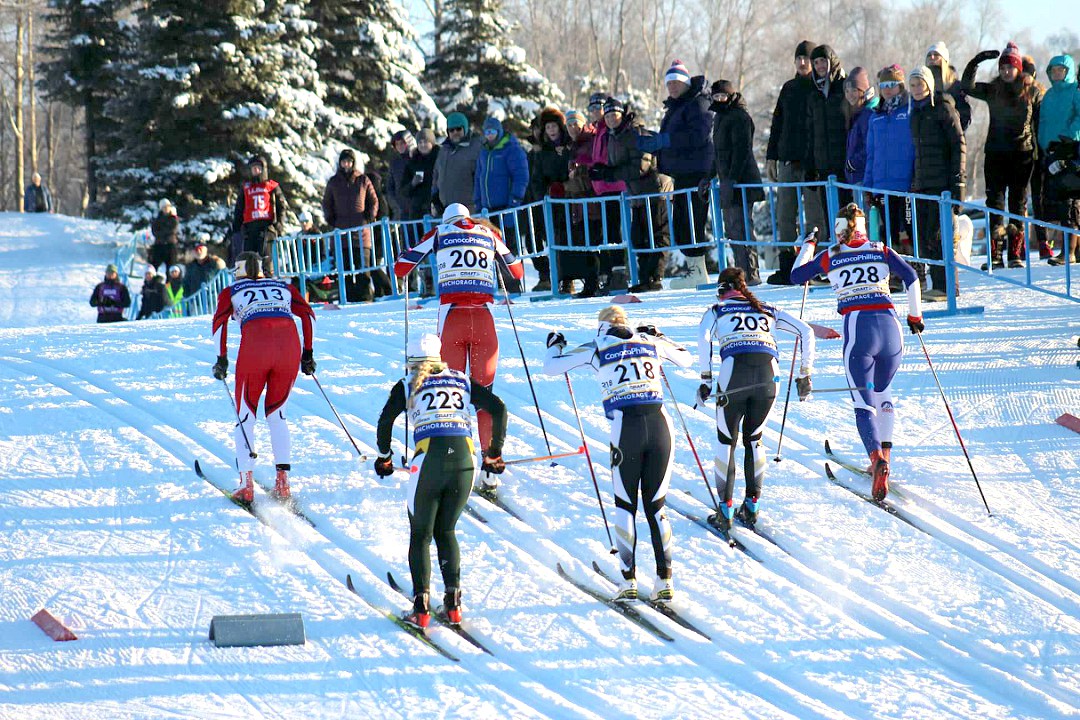
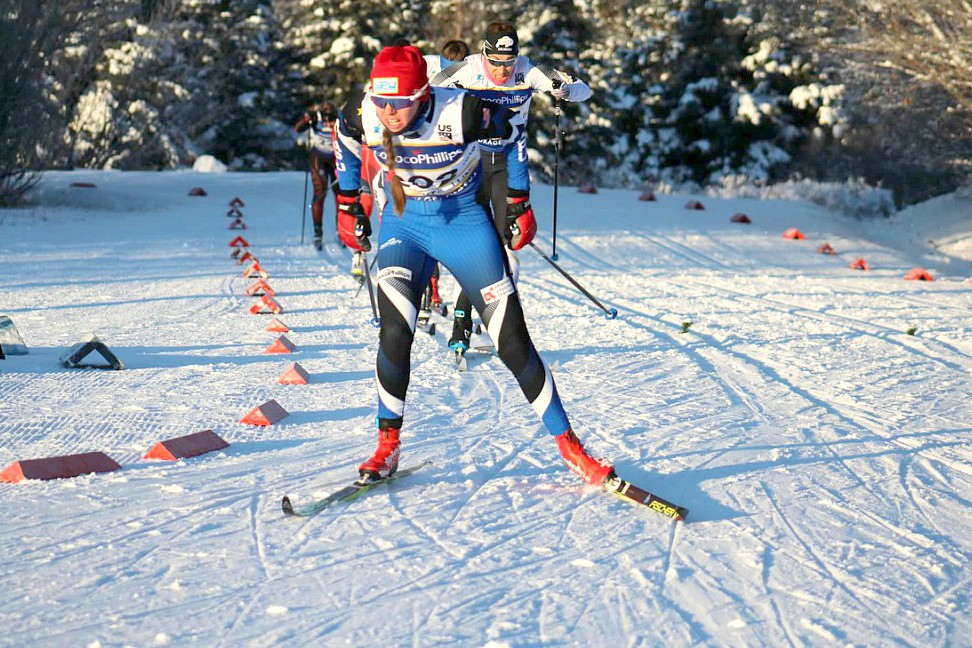

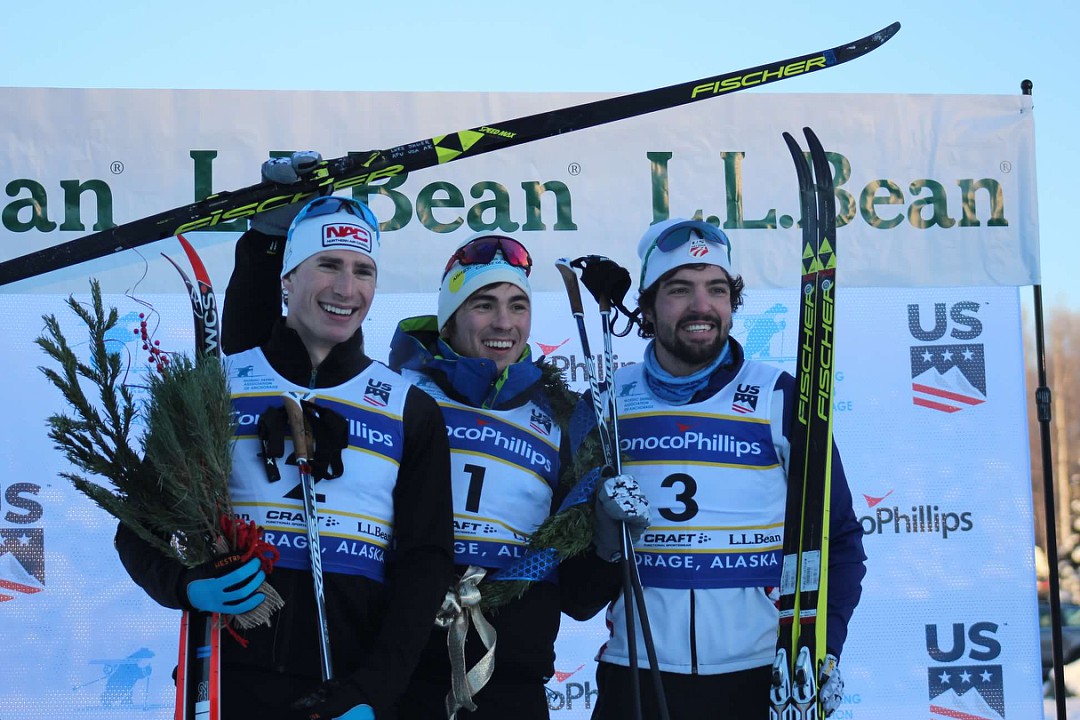
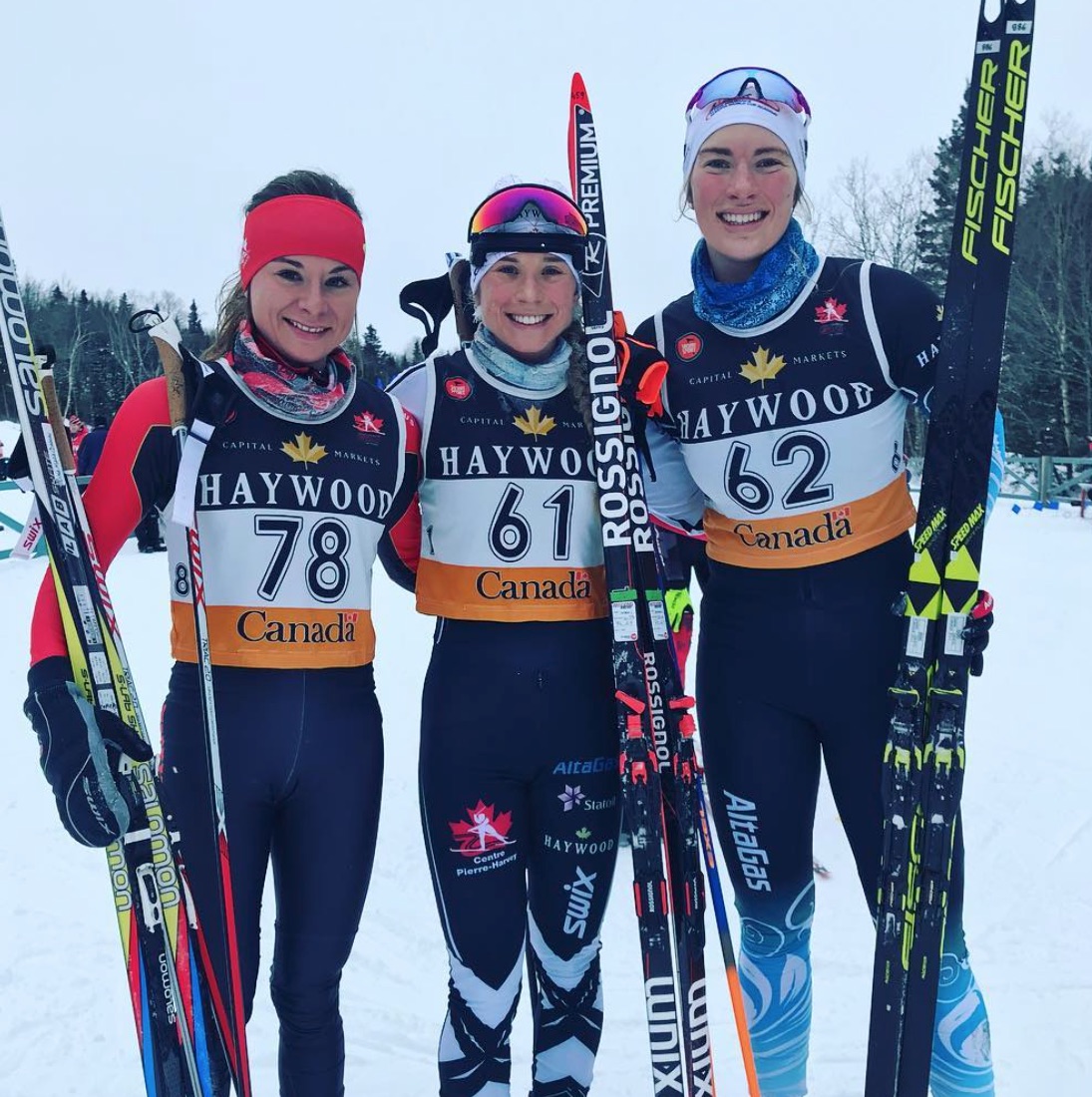
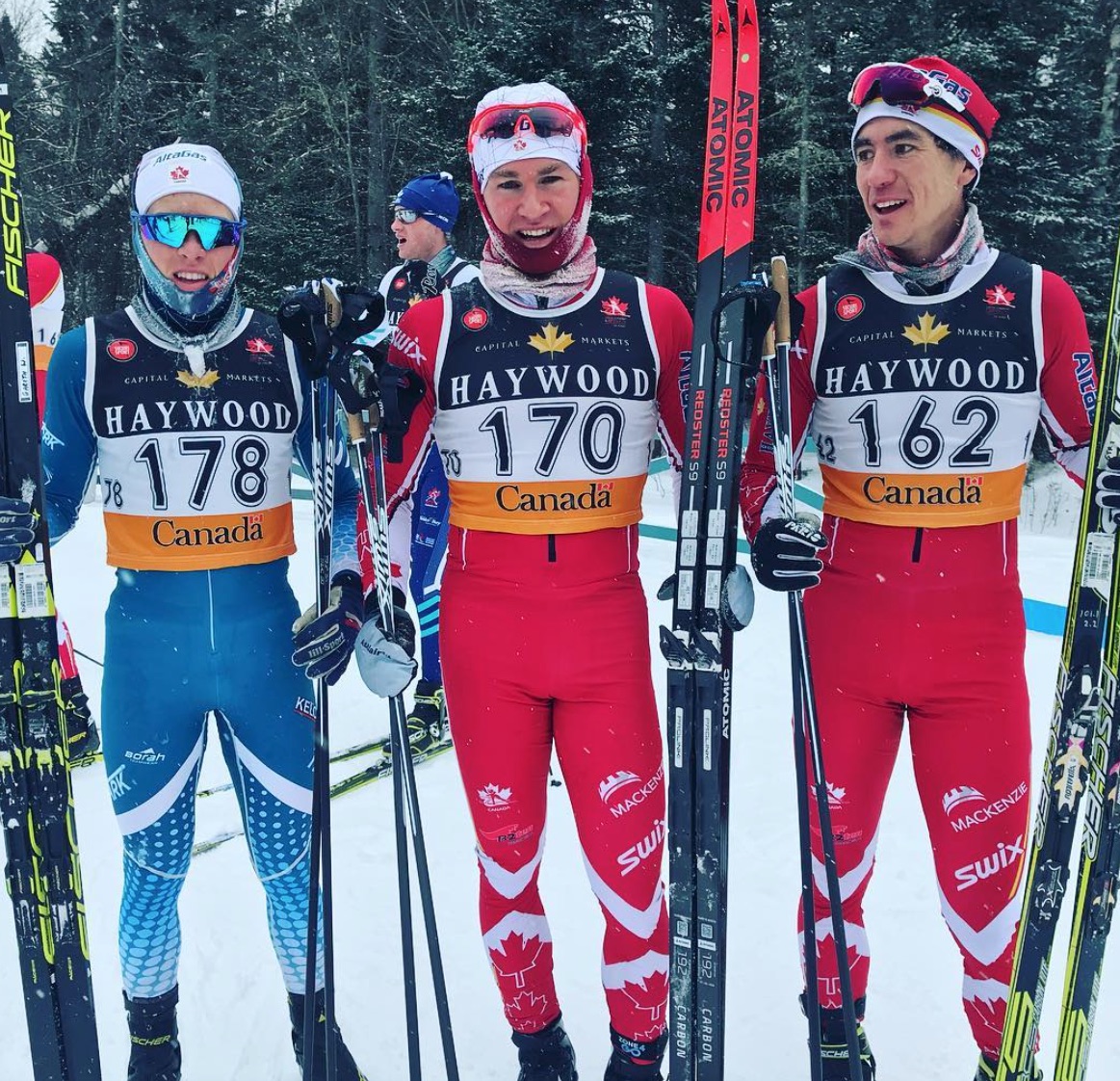
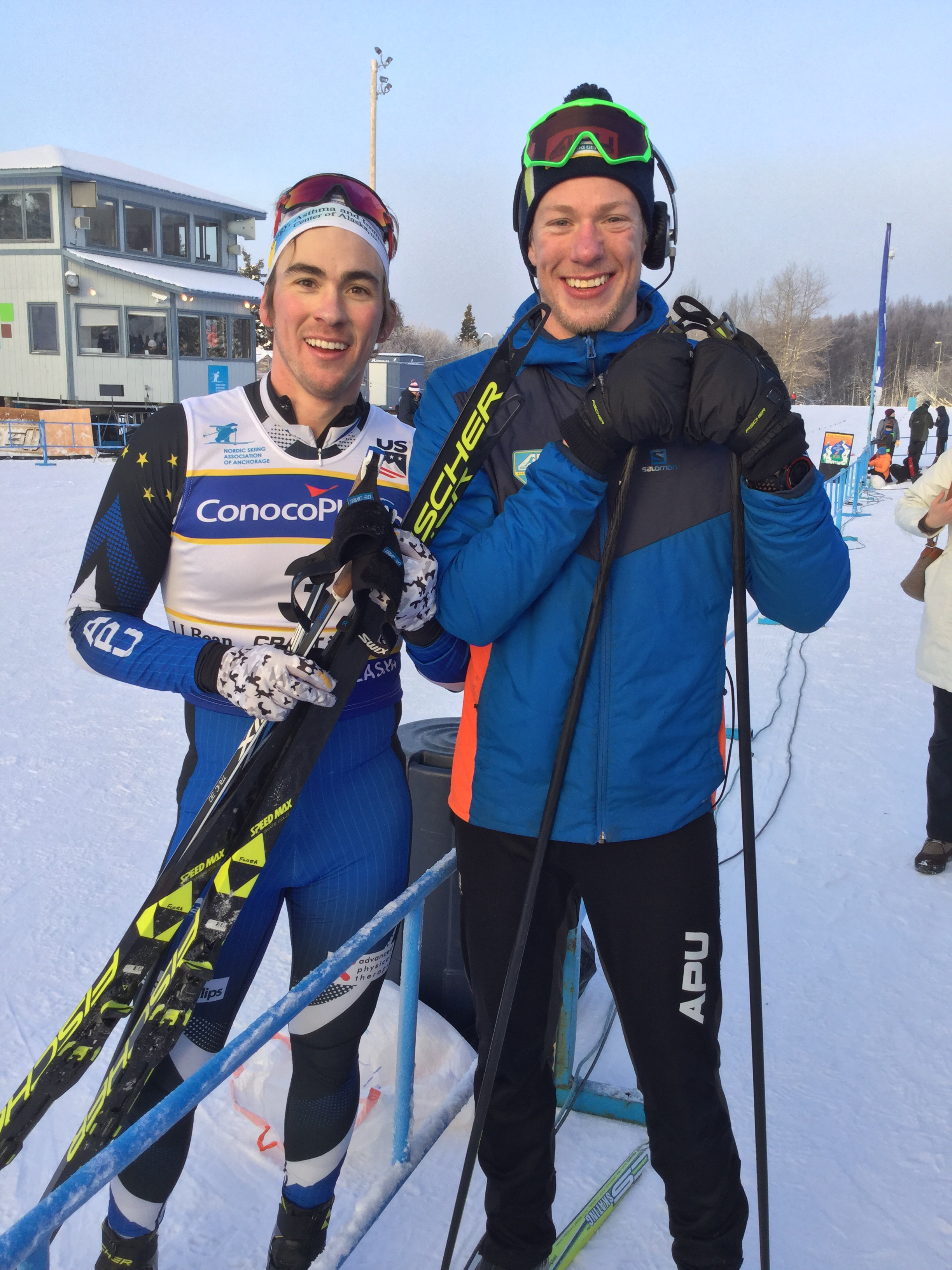
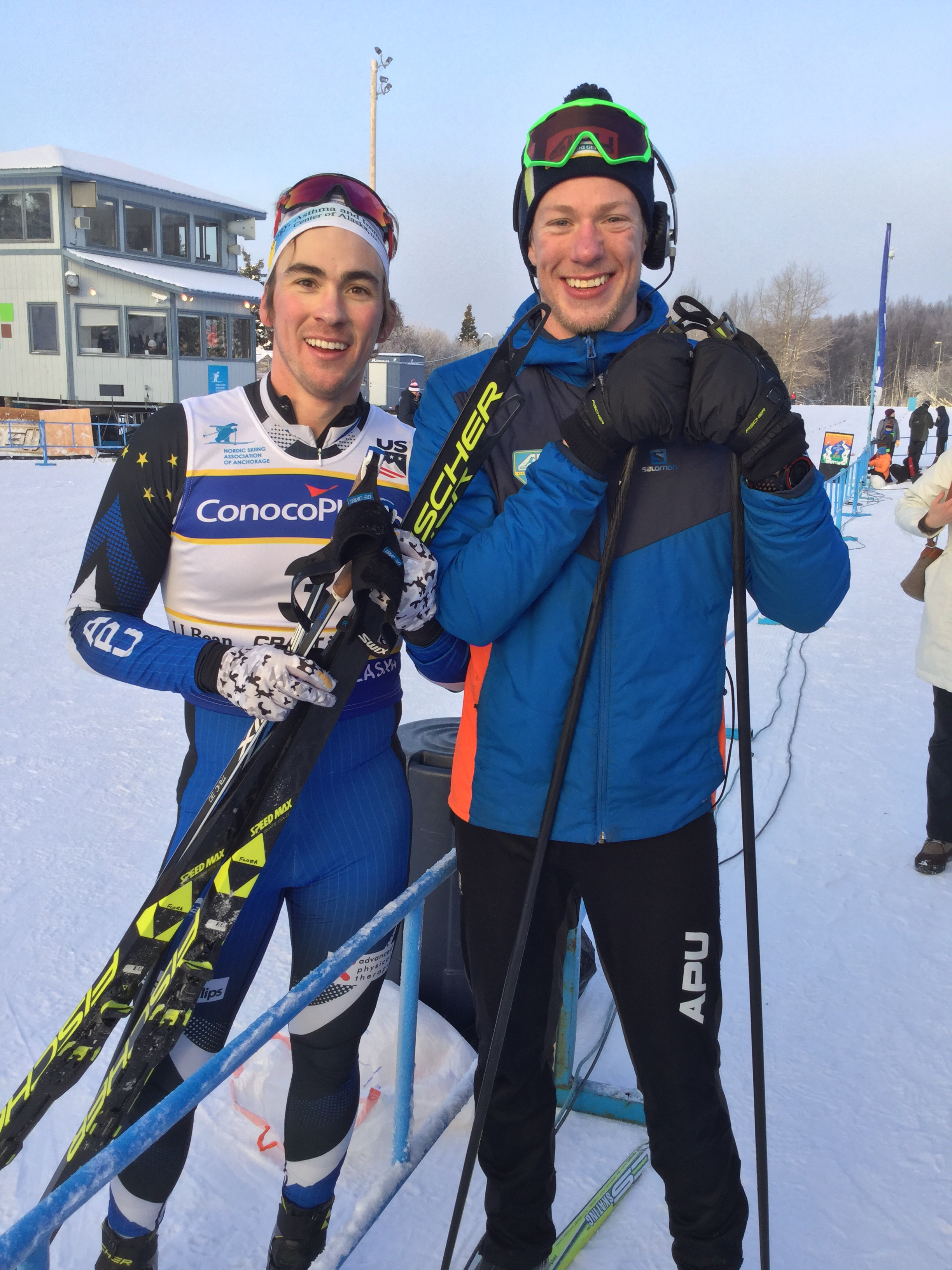
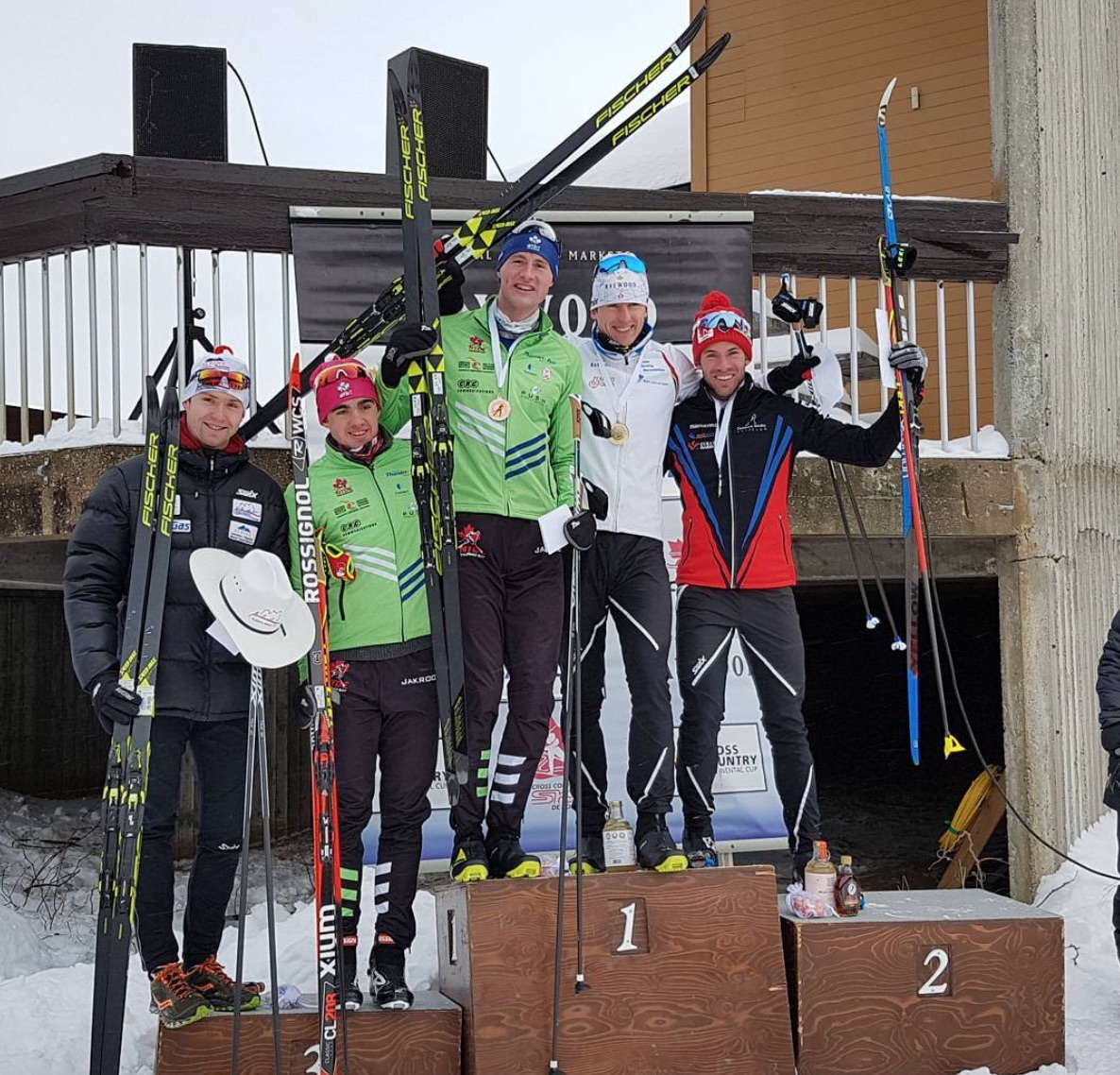
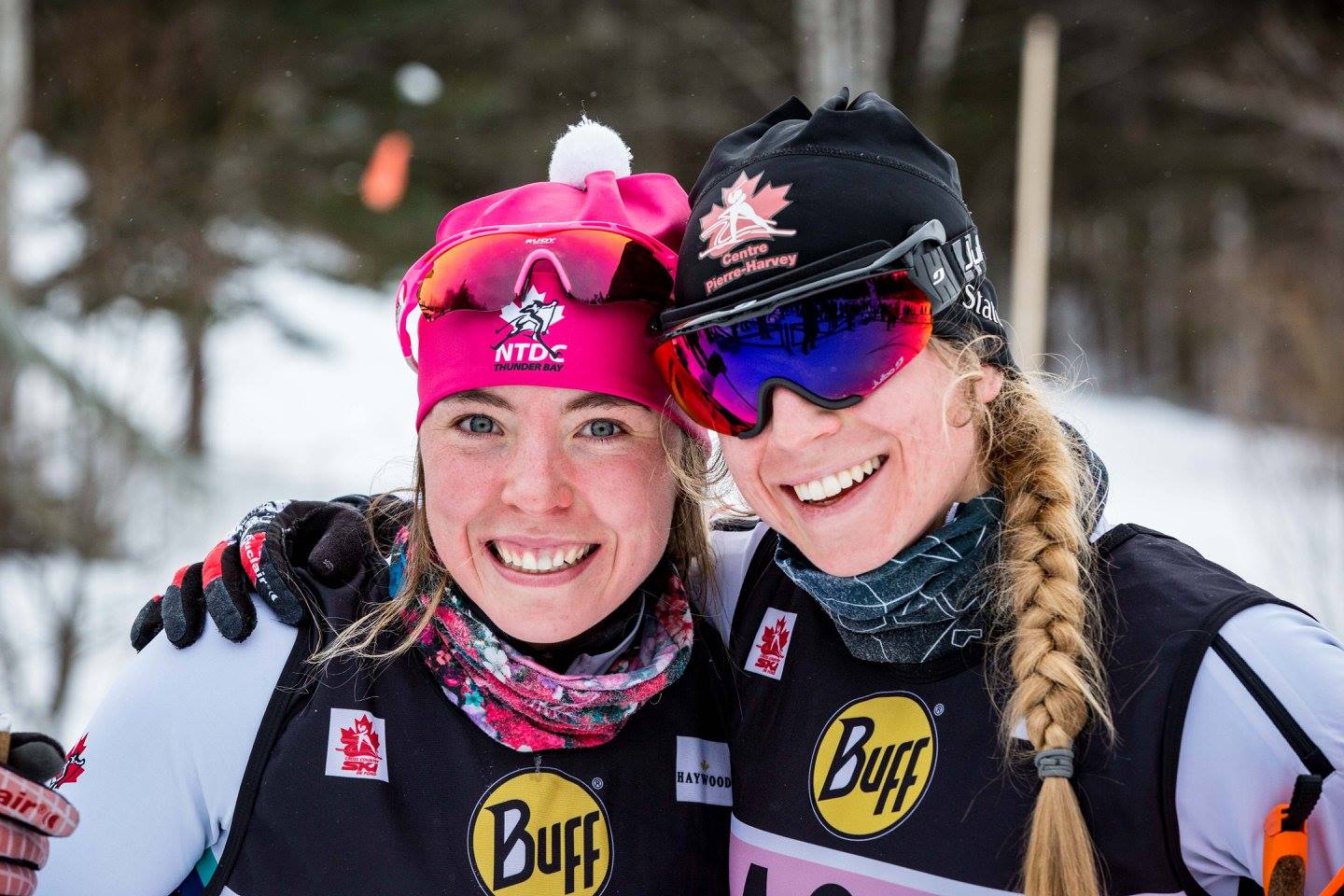
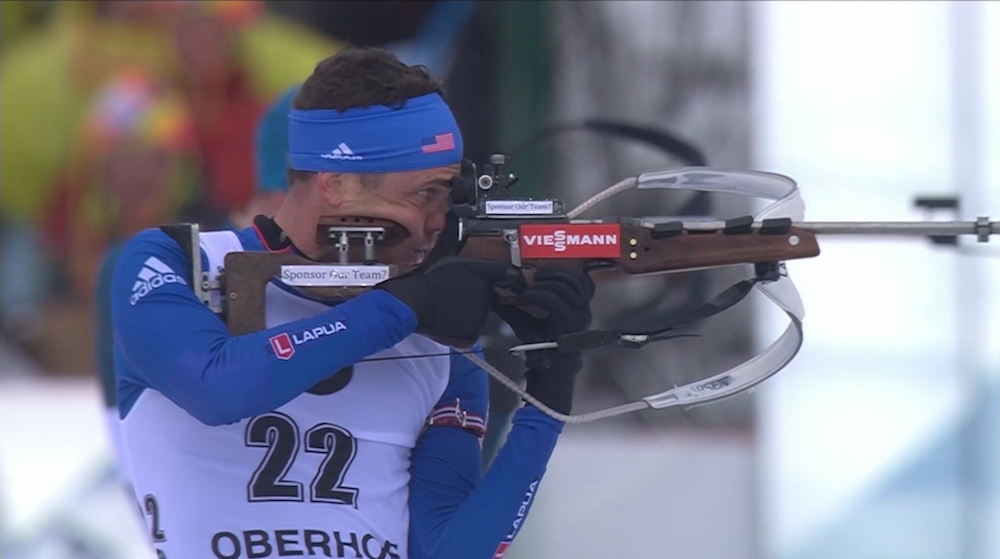
![Sovereign NorAm/SuperTour Rewind: Craftsbury Women on Top; Thompson and Torchia Take Wins [Updated Photo Gallery]](https://cms.fasterskier.com/wp-content/blogs.dir/1/files/2017/12/Sov2017FLCPatterson2.jpg)