From the FasterSkier archive — posts syndicated from athletes’ and coaches’ own blogs between 2004 and 2012, kept online as published. Current coverage is at fasterskier.com.

Tag: Jasmine Drolet

  • Diggins Podiums in Lahti as Karlsson Wins 10 k Classic

    Diggins Podiums in Lahti as Karlsson Wins 10 k Classic

    This coverage is made possible through the generous support of Marty and Kathy Hall and A Hall Mark of Excellence Award. To learn more about A Hall Mark of Excellence Award, or to learn how you can support FasterSkier’s coverage, please contact info@fasterskier.com.

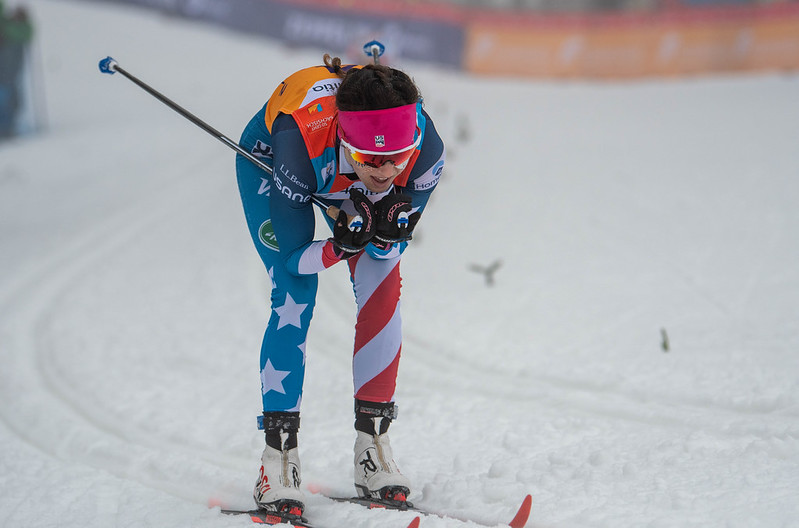
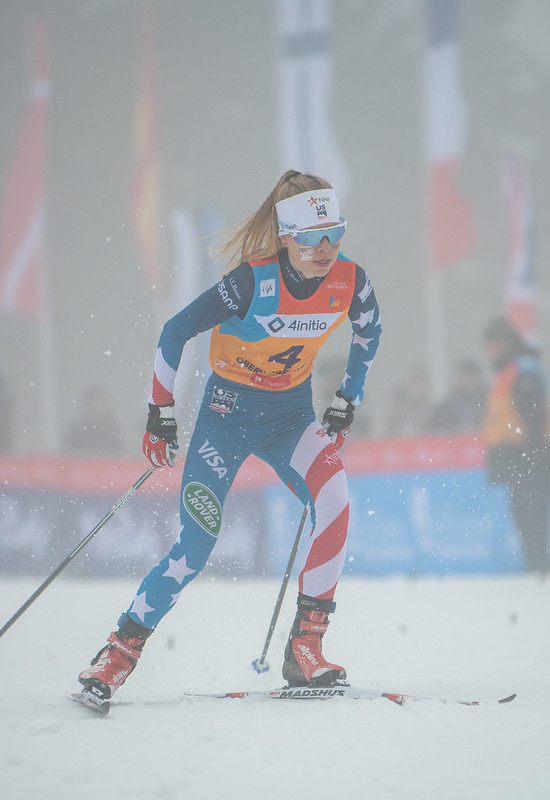
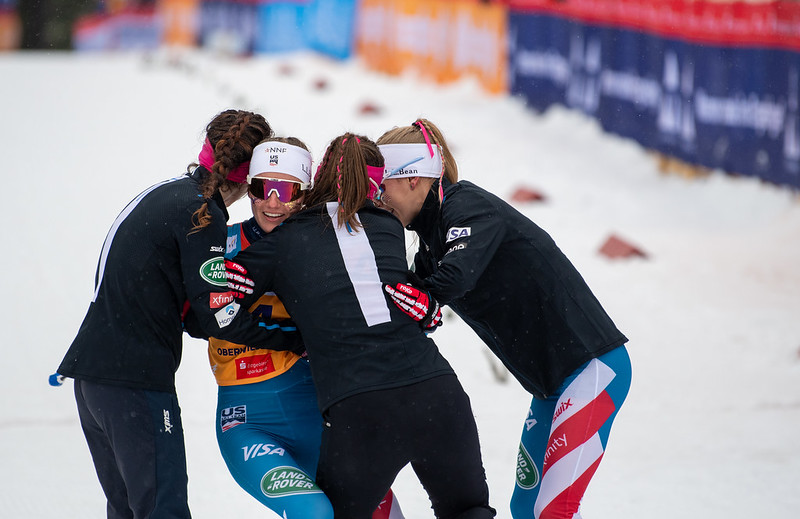
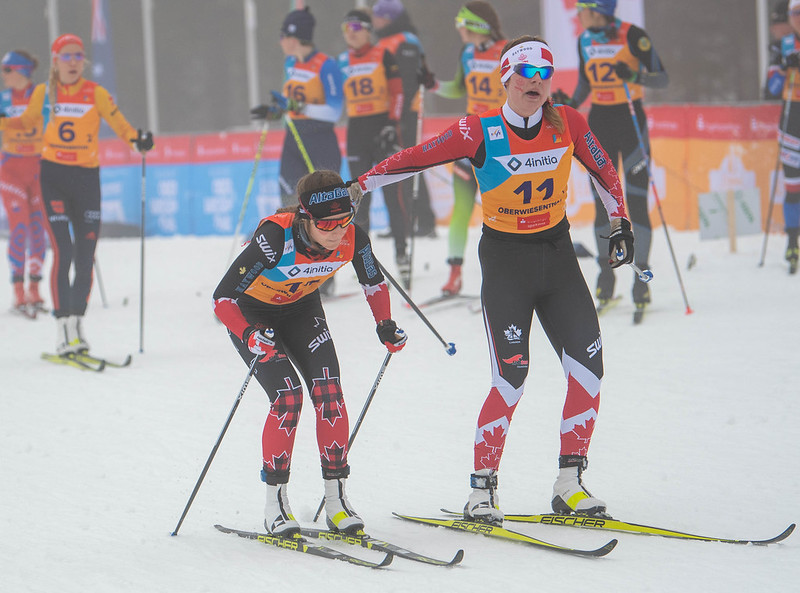
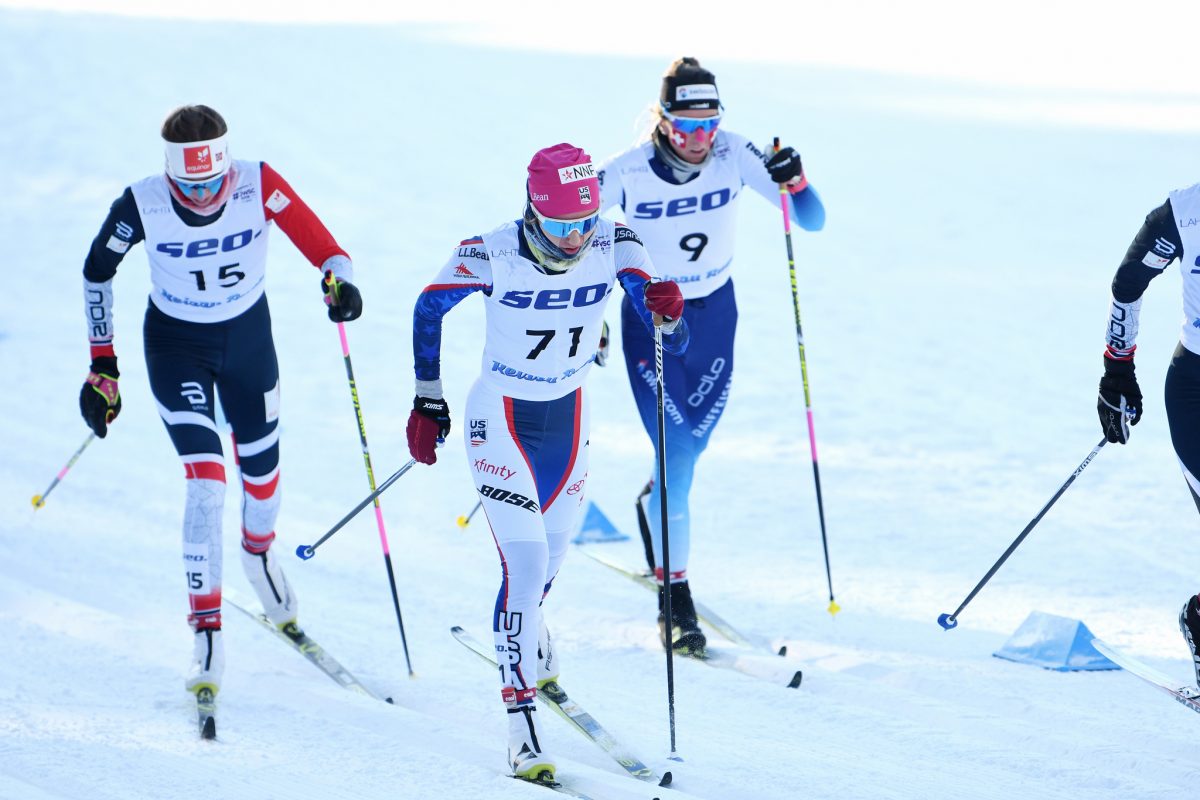
    Jessie Diggins (USA) on her way to third place in the 10 k Classic Individual Start in Lahti, Finland. (Photo: Authamayou/NordicFocus)

    As Jessie Diggins climbed the final hills in Lahti on Sunday, she could hear something unusual rising above the crowd noise. Scattered along the course were hand-made signs held by Finnish fans and young skiers. Many carried the same simple message: “Thank you, Jessie.”

    For Diggins, racing through what has increasingly become a farewell tour of World Cup venues that have defined her career, the moment carried emotional weight. Lahti has not always been a place where the American felt the course played to her strengths, particularly in classic technique. But on Sunday, she delivered one of her most meaningful performances there, skiing to third place in the women’s 10-kilometer classic interval start.

    “There were so many people out on the course with signs saying ‘Thank you, Jessie,’ and it was really emotional in the best way,” Diggins said afterward. “It was incredibly touching. Seeing all the little kids in glitter after the race was just really special.”

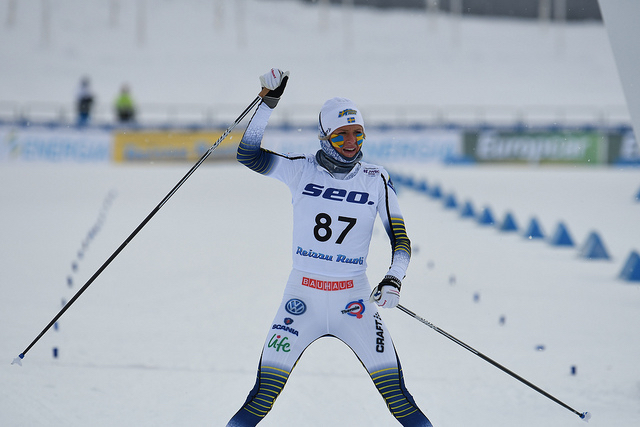
    Frida Karlsson (SWE) on her way to the 10 k Classic win in Lahti, Finland. (Photo: Authamayou/NordicFocus)

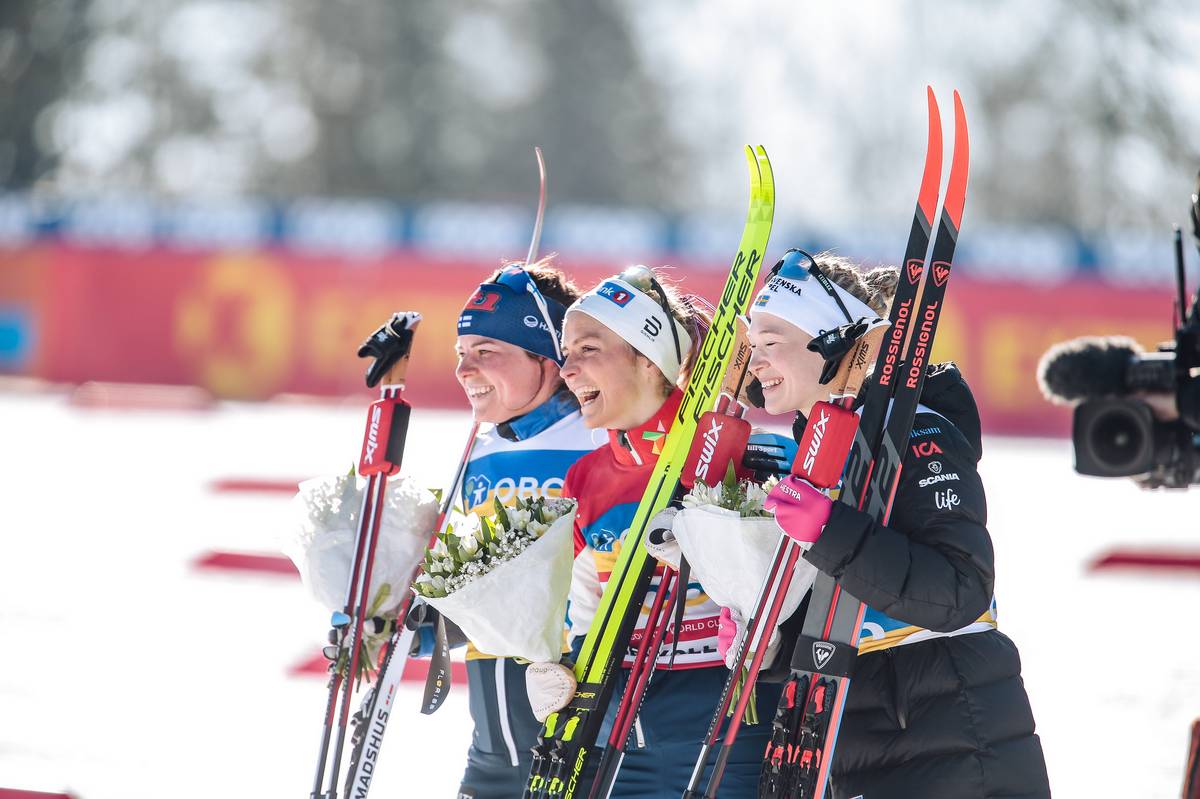
    Sweden’s Frida Karlsson powered to the victory in 25:57.6, edging teammate Linn Svahn by just over four seconds. Diggins followed in third, 6.2 seconds behind the winner, securing the 90th World Cup podium of her career — a milestone that came in her 375th World Cup start.

    The podium also represented a breakthrough for Diggins in a discipline she has spent years working on. Despite her long list of accomplishments, Sunday marked her first World Cup podium in a standalone 10-kilometer classic interval start.

    “The Lahti course hasn’t always suited my strengths in classic skiing,” Diggins said. “So it felt really cool to pull it together a bit more today.”

    The result allowed Diggins to maintain control of both major season-long competitions. With only three World Cup stops remaining this winter, she continues to lead Sweden’s Moa Ilar by 264 points in the Overall World Cup standings and by 188 points in the Distance standings, positioning herself strongly in the race for the sport’s coveted crystal globes.

    Moa Ilar (SWE) and Linn Svahn (SWE), (l-r) reflecting at the finish. (Photo: Authamayou/NordicFocus)
    Svahn Sets the Early Benchmark, Karlsson Finishes the Job

    With the interval format — one athlete starting every 30 seconds — stretching the field across the Lahti course, the first major time to chase appeared almost immediately.

    Sweden’s Linn Svahn, starting with bib 5, was among the earliest contenders onto the course and quickly posted the fastest times through the early checkpoints. Known primarily as one of the World Cup’s dominant sprinters, Svahn skied aggressively over the opening kilometers and established the benchmark that much of the field would spend the next hour chasing.

    Her time held atop the standings as racer after racer attempted to match it.

    Later in the race, however, another Swede began to close the gap. Frida Karlsson, wearing bib 40, remained within seconds of Svahn through the intermediate checkpoints before edging ahead in the final kilometers.

    “I was just trying to stay in my own skiing,” Karlsson said afterward. “I heard it was between me and Linn, and I was super excited to get that fight.”

    Karlsson ultimately crossed the line in 25:57.6, securing the victory by 4.1 seconds over her teammate.

    The win came after a brief illness, which prevented her from competing in the Olympic 50 k, but Karlsson said she was eager to keep racing despite the setback.

    “I was sick after the Olympics, but I was really excited to keep racing and just do what I know best,” she said. “So I’m super glad to be here.”

    Diggins, starting shortly after Karlsson, kept herself in contention throughout the race, skiing within striking distance of the Swedish pair at each checkpoint before finishing 6.2 seconds back in third place.

    Linn Svahn (SWE) on her way to second place. (Photo: Authamayou/NordicFocus)
    Three Different Approaches to the Same Race

    The split times revealed three distinct pacing strategies among the podium finishers.

    Svahn, starting fifth, set the tone early. She posted the fastest time through the opening 1.1 kilometers and maintained the lead at the 3.4-kilometer checkpoint, immediately putting pressure on the rest of the field as they left the start gate.

    Karlsson, starting later in bib 40, remained just seconds behind through the early checkpoints, skiing a controlled opening before gradually closing the gap. By the middle of the race, she had moved into contention, and over the final kilometers, she proved strongest of all, ultimately pulling ahead to secure the victory.

    Diggins, meanwhile, delivered perhaps the most evenly paced effort of the three. She remained within striking distance of the leaders at every checkpoint — fifth at 1.1 kilometers, third by 3.4 kilometers, and still in podium position through the final lap.

    That steadiness proved decisive in the final standings. While the two Swedes battled for the win, Diggins’ consistent pace allowed her to secure third place and another important podium in the fight for the season-long crystal globes.

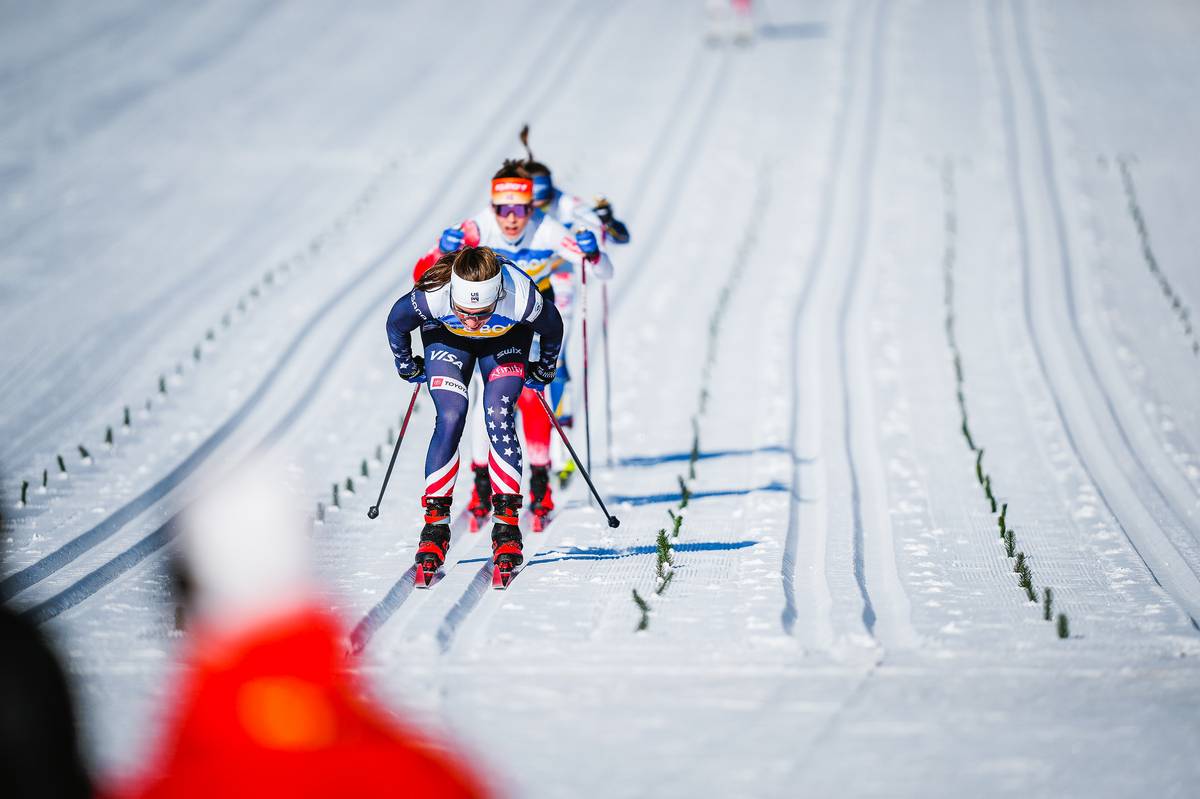
    Jessie Diggins (USA) sprints for the finish line. (Photo: Authamayou/NordicFocus)
    Diggins’ Classic Progress

    Diggins’ podium also reinforced one of the season’s quieter developments: the continued evolution of her classic technique.

    For much of her career, the American’s greatest moments have come in skating events, where her aggressive pacing and powerful finishing speed often prove decisive. But this season she has shown remarkable consistency in classic distance races, finishing in the top ten in every classic distance event on the World Cup calendar.

    Conditions in Lahti — warming temperatures and increasingly soft tracks — placed an additional premium on ski preparation, something Diggins was quick to acknowledge after the race.

    “I had great skis, which is a huge part of the equation, especially when the conditions get slushy,” Diggins said. “This podium really belongs to the team. I’m so grateful for all the hard work they put in.”

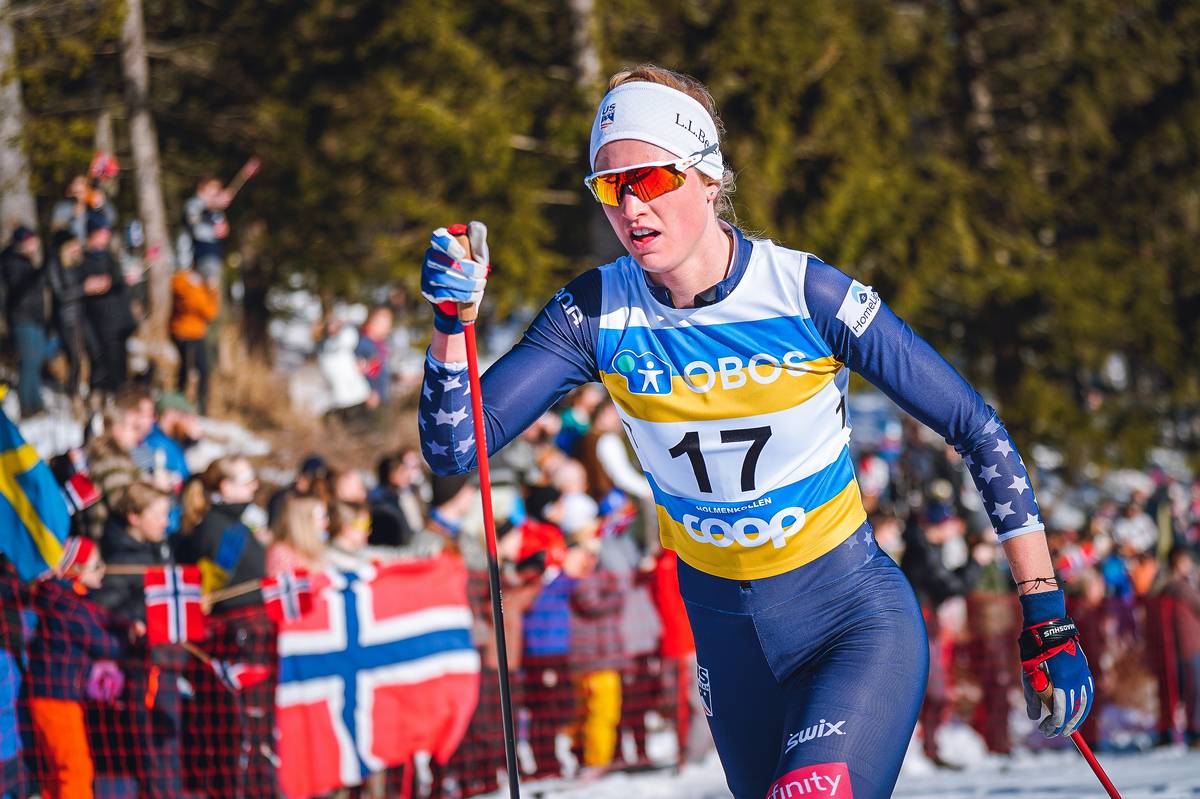
    Rosie Brennan (USA) on her way to 12th place. (Photo: Authamayou/NordicFocus)
    Brennan Continues Return to Form

    A bit further down the results list, fellow American Rosie Brennan continued a gradual return toward form after a long battle with illness that has affected much of her season.

    Brennan finished 12th (+38.6) in Lahti, a result that reflected both solid skiing and a cautious approach early in the race.

    “This whole process has really been a game of time,” Brennan said. “There have been many moments when I’ve wondered if I’ll ever feel normal again in my life. But the last three days are the most normal I’ve felt racing since December 2024.”

    The Lahti course, known for its steep climbs and technical demands, offered a test of efficiency in classic technique — a challenge Brennan felt she handled well.

    “Lahti requires really good technical skiing,” she said. “I felt like if I could relax and focus on my classic technique, that would give me the best chance.”

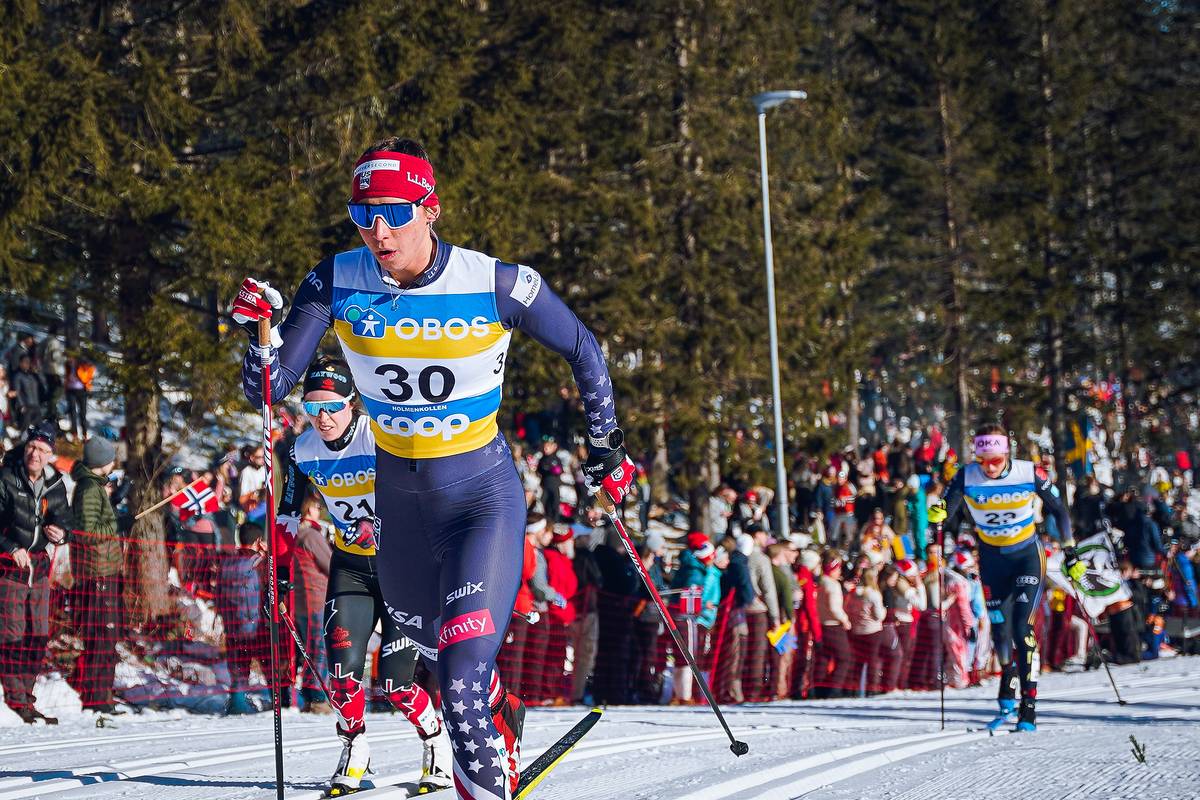
    Kendall Kramer (USA) working her way up one of the many Lahti climbs. (Photo: Authamayou/NordicFocus)
    Kramer Finds Lessons in the Lahti Hills

    For American Kendall Kramer — 42nd in 27:40.8 (+1:43.2) — the Lahti race presented a different kind of challenge: starting first.

    Wearing bib 1, Kramer had the advantage of pristine tracks before the course began to break down as temperatures warmed. But the early start also meant racing without reference splits from the rest of the field.

    “I was actually okay starting with bib 1 today, given the state of the tracks,” Kramer said. “They tend to break down as the race goes on, and the corners can get icy, so it was nice to have cleaner conditions early.”

    Without other athletes on course to gauge pacing against, Kramer said the race became more about skiing freely and trusting her own effort.

    “Racing without reference splits definitely makes pacing tougher, but at the same time it lets you ski freely and focus on your own race.”

    The steep Lahti climbs also highlighted the technical demands of classic skiing at the World Cup level.

    “The punchy hills were fun because I could really bound up them, which is something I haven’t done much in World Cup racing so far,” Kramer said. “But the sections where it turns into pure power striding showed me I still have a lot to work on.”

    Despite the challenges, Kramer described the experience as valuable for understanding the technical standards required to compete consistently at the highest level.

    “I’ve learned so much from racing here this season,” she said. “At the World Cup, every strength and every weakness gets highlighted, and that really helps show what to work on heading into the summer.”

    Julia Kern (USA) catches a rest from both the climbs and the sunlight. (Photo: Authamayou/NordicFocus)
    Kern Heading Home Early to Recover

    Julia Kern, who finished 51st — 28:11.4 (+2:13.8) — today, said she will return home early from the World Cup circuit as she continues working through health issues that have lingered since the Olympic races.

    “I’ve been battling my body on various fronts since the Olympics,” Kern said in a team media statement. “One of my strengths is showing up and continuing to try and believe despite the challenges, while also being patient and smart.”

    Kern added that she will take additional time to recover while seeking answers about her condition, with hopes of returning to competition at the Stifel World Cup Finals in Lake Placid later this month.

    “Right now, my body needs more time to recover and is in search of answers, so I’m headed home early with the hopes of being in a place to race in Lake Placid.”

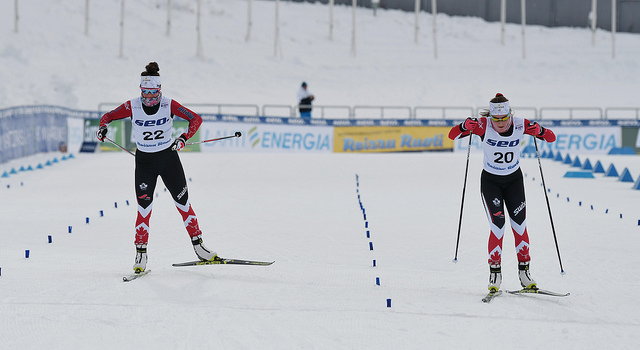
    Lauren Jortberg (USA) and Katherine Weaver (CAN), (l-r) charge for the line. (Photo: Authamayou/NordicFocus)
    Jortberg Gets a Front-Row Look at Karlsson’s Pace

    For American Lauren Jortberg — 55th in 28:32.7 (+2:35.1) — the Lahti race offered a unique opportunity to measure herself against one of the sport’s best.

    Early in the race, Jortberg found herself skiing behind Sweden’s Frida Karlsson for several kilometers as the eventual winner was completing her second lap while Jortberg was still on her first.

    “I skied with Frida for about three kilometers, which was really cool,” Jortberg said. “She’s obviously a beast, and it was cool to hang with her and get a taste of what that pace actually feels like.”

    Jortberg said the experience offered valuable insight into the demands of racing a 10-kilometer interval start at the World Cup level, where pacing often means pushing near maximum effort from the start.

    “Ten-k pacing on the World Cup is basically as hard as you can go the whole way,” she said. “It’s about learning how to navigate that kind of effort and still ski your own race.”

    She added that the race reinforced both the progress she has made in classic technique and the areas she hopes to continue developing as she gains more experience at the international level.

    “I’m really proud of how my classic skiing is coming along,” Jortberg said. “There’s still a lot to work on, but it was definitely a good first start in a distance race.”

    Jortberg said she hopes to carry the fitness and lessons from Lahti into the next stop on the World Cup circuit in Drammen, Norway.

    Emma Albrecht (USA) giving it everything she can all the way to the finish. (Photo: Authamayou/NordicFocus)
    Albrecht Sees the Margins Up Close

    Further back in the start order, fellow American Emma Albrecht — 58th in 28:50.7 (+2:53.1) — experienced firsthand just how tight the margins can be in World Cup distance racing.

    “The tight margins were shown by skiers finishing at similar times,” Albrcht said after the race. “For me, I was not passed, and I did not pass anyone. Which meant the skiers in front and behind me were skiing at a similar pace to me.”

    Like Kramer, Albrecht said the steep Lahti climbs emphasized the technical demands of classic technique, particularly the efficiency required to stride uphill without losing grip.

    “The uphill sections are the most technical and demanding here,” she said. “The climbs in Lahti are steep, and striding up efficiently requires really good technique to avoid slipping.”

    For Albrecht, the race served as a clear reminder of the areas she hopes to refine moving forward.

    “One of my biggest takeaways is that I want to keep working on my striding technique and get better at adjusting my tempo based on the terrain.”

    Dariya Nepryaeva (AIN) and Novie Mccabe (USA), (l-r) come to the line. (Photo: Authamayou/NordicFocus)
    Other North Americans in the Field

    Novie McCabe raced her way to 43rd in 27:45.0 (+1:47.4) in the 64-skier field.

    For Canada, Jasmine Drolet led the team in 41st place with a time of 27:39.8 (+1:42.2). Liliane Gagnon finished 46th in 27:56.4 (+1:58.8), and Katherine Weaver placed 59th in 29:00.9 (+3:03.3). Teammate Olivia Bouffard-Nesbitt, who had been listed on the start sheet, did not start the race.

    Take a bow, Jessie Diggins (USA) . (Photo: Authamayou/NordicFocus)
    The Season’s Final Push

    Sunday’s race in Lahti brought us even closer to the end of the season, now with only two sprint races and three distance races remaining until the sport’s biggest prizes will ultimately be decided.

    For Diggins, the third-place finish represented more than another podium in an already historic career. It also reinforced the remarkable consistency that has defined her season. With top-10 finishes in every classic distance race this winter, she has transformed what was once considered a relative weakness into one of the foundations of her bid for both the Overall and Distance crystal globes.

    Three stops remain on the calendar: the classic city sprint in Drammen, Norway, the iconic 50-kilometer race at Holmenkollen in Oslo, and the Stifel World Cup Finals in Lake Placid, New York.

    For Diggins, those races now carry both competitive stakes and emotional significance. As the American continues what has increasingly felt like a farewell tour across the World Cup circuit, the crowds that gathered along the Lahti course on Sunday offered a glimpse of how much her career has meant to fans of the sport, not just in the United States, but all around the world.

    And as Diggins pushed across the final climbs toward the stadium — signs waving, glitter-clad children cheering from the side of the course — she did what she has done so often over the past decade: she kept fighting for every second and left everything she had, once again, on the course.

    Lahti Women’s 10 k Classic RESULTS


    Love Stories Like This? Help Keep Them Coming.

    Feature stories like this one take time, access, and care to produce. If you value thoughtful storytelling and independent ski journalism, please consider becoming a Voluntary Subscriber. Your support directly fuels the work we do to cover the people, places, and moments that make our sport special.

    Join the FasterSkier community!


    Linn Svahn (SWE), Frida Karlsson (SWE), and Jessie Diggins (USA), (l-r) share the 10 k Classic podium in Lahti, Finland. (Photo: Authamayou/NordicFocus)
  • The University of Utah Claims the 2025 NCAA Championship

    The University of Utah Claims the 2025 NCAA Championship

    This article was made possible through the generous support of our voluntary subscribers.  If you would like to see more articles like this one, please support FasterSkier with a voluntary subscription.  

    The sun came out on Saturday at Dartmouth’s Oak Hill Ski Center in Hanover, New Hampshire. The best collegiate skiers in the country gathered in Hanover, New Hampshire, for a week of racing at the NCAA Championships. The final races of the week were the nordic distance races, 20km freestyle for both the men and women. University of Utah’s Joe Davies skied away with the national title on Saturday, much like how his team gapped the competition.

    Though Utah’s nordic and alpine teams combined points ultimately created an unclosable gap, the championships started off close. In the first nordic races, the 7.5km men’s and women’s classic race, it was the host school Dartmouth who had the top racers.

    Dartmouth College’s John Steel Hagenbuch skied to a 15 second victory on his home trails in the 7.5 k Classic at the NCAA Championship on Thursday. (Photo: Tobias Albrigtsen)

    In the men’s 7.5km classic race, Dartmouth’s John Steel Hagenbuch won by 16 seconds over UVM’s Finn Sweet. It was his second NCAA title, having won the 7.5km skate competition in 2024. Steel Hagenbuch’s teammates Luke Allen and Cooper Camp finished 4th and 9th, respectively. They combined for 93 points, besting Utah by nine points. Rounding out the podium was Utah’s Joe Davies, who just days before the competition was in Trondheim, Norway, racing in the World Championships skiathlon. Competing under the Great Britain flag, he finished 24th, 1:31.8 behind Johannes Klaebo.

    Utah earned their first individual win of the 2025 NCAA championships when Erica Laven won the 7.5km women’s classic race. Annie McCulgan of UVM finished second and Dartmouth placed three in the top eight. Jasmine Drolet, Ava Thurston and Nina Seeman finished third, fourth and eighth, respectively. The Dartmouth women tallied 88 points for a slim two-point edge over Utah.

    Utah’s Erica Laven took home the women’s 7.5 k Classic individual title by 11 seconds on Thursday. (Photo: Tobias Albrigtsen)

    As the competitions continued at the Dartmouth Skiway, Utah’s men’s and women’s alpine teams both scored the most points in the Giant Slalom. They opened up a sizable lead that would be incredibly difficult for the trailing Dartmouth and University of Colordao to close.

    After Davies took control of the men’s 20km freestyle on Sunday, that lead became impossible to catch.

    Utah’s Joe Davies took command of the Men’s 20 k Freestyle, skiing to a 1:10 victory and leading Utah to the NCAA Championship. (Photo: Tobias Albrigtsen)

    Oak Hill has undergone major renovations in the past few years, and the newly homologated races loops were on full display during the championships. The configuration is such that fans can see racers in multiple spots, so as the laps ticked away during the 20km, fans watched as Davies pulled farther and farther away from Steel Hagenbuch, ultimately winning by over a minute. It’s his second NCAA title. His first was in 2023 at the 10km skate in Lake Placid, when he was a sophomore racing for UAF. That year, Steel Hagenbuch finished second.

    Having Davies and Steel Hagenbuch leave the championship with one win each is fitting. They’ve dominated their respective sides of the country and met at NCAA’s to jockey for podium positions over the last couple of years – all while benefitting from the relatively new mentality that allows collegiate skiers to compete in both college races and on the World Cup, instead of having to choose between domestic and international competition.

    For Steel Hagenbuch, it’s extra sweet to have gotten a win at home. Though he grew up in Idaho, he comes from a family of Dartmouth athletes and has added greatly to that legacy.

    After the men finished, the competition was still close for who would finish runner-up in the team competition: Dartmouth had a 14-point lead over Colorado.

    Erica Laven (UU – left) and Kendall Kramer (UAF – right) distanced themselves from the rest of the field during the NCAA Championship Women’s 20 k Freestyle. (Photo: Tobias Albrigtsen)

    It didn’t take long for Kendall Kramer of UAF and Erica Laven of Utah to create a gap over Colorado’s Tilde Baangman and Denver’s Lea Wenaas. Behind them was a dense chase pack. But once Kramer decided to go, she was gone. She skied in total control, her crisp tempo unchanging over Oak Hill’s rigorous climbs. She finished 35 seconds ahead of Laven, taking a bow as she came across the line. This has been an impressive year for Kramer in the 20km: In February, she won the 20km at U.S. Nationals in Anchorage.

    Eventually, Kendall Kramer (UAF – right) decided it was time to make a move on Erica Laven (UU – left), skiing to a 35-second victory for the individual Women’s 20 k Freestyle NCAA Championship. (Photo: Tobias Albrigtsen)

    After all had finished, the points were tallied. Colorado, who won the NCAA team title in 2024, had two women in the top 10 in the 20km to Dartmouth’s one. They scored 20 more points than Dartmouth in the women’s race to overtake them and finish in second for the week-long team competition.

    The NCAA Championships are dominated by the Western schools – Utah has now won six of the last seven championships. So to see Dartmouth finish runner-up on their home turf, in a star senior’s year, on that sugary, spring East coast snow, would’ve felt like a fitting end to this story. But even though it’s not the result they wanted, it takes nothing away from what was accomplished at Oak Hill, and the successful championships they hosted there.

    “The transformation of Oak Hill is a game-changer for us,” Dartmouth head coach Cami Thopmson told FasterSkier via email. To have good training on reliable snow less than 2 miles from campus makes a huge difference. We knew how the course would ski, where it would be particularly challenging, what line to take, and what places would be best to make a move on the field. Our athletes used that knowledge to their advantage.”
    There was lots of great energy at Oak Hill for the final day of the 2025 NCAA Championship. (Photo: Tobias Albrigtsen)
    “We are really proud of the team, it is tough to manage the expectations and all the extra energy that goes into racing at home, especially with final exams looming.  The seniors have had this week to look forward to since they showed up on campus four years ago. I think it far exceeded their expectations,” Thompson told FasterSkier via email.
    “We had a very solid finish in the end, but it is hard to go from leading at one point to 3rd with only a 5-point gap. That is sport though and we know that every one of our athletes raced their hearts out.”

    Complete NCAA Championship Results


  • NCAA—Magnus Boee Leads Colorado to Come-from-Behind Victory

    NCAA—Magnus Boee Leads Colorado to Come-from-Behind Victory

    The 2024 NCAA Champion University of Colorado Buffaloes. (Photo: Tobias Albrigsten/ @UnTraceableG)

    Winning a fifth NCAA championship in a row would represent a program milestone for the University of Utah, though going into the final day of NCAA competition, Utah’s path to victory was less than a foregone conclusion. Nonetheless, Utah has shown itself to be the dominant collegiate program—both Alpine and Nordic—of the last few years, entering the final day of NCAA competition as the favorite to take the crown. All that history would be decided in the Men’s and Women’s 20 k Mass Start Classic races held at Howelsen Hill in Steamboat Spring, Colorado. Clear skies and perfect conditions made waxing and preparation quite straightforward; the races—and the championship—would be decided on the trails.

    The NCAA Skiing Championship is awarded to the team with the highest combined score after two Alpine races and two Nordic races. The University of Utah entered Saturday’s 20 k Mass Start Classic races (Men’s and Women’s) with a substantial lead (444.5 points) over University of Denver (401 points) and University of Colorado (393.5 points). These would be the final races of the 2024 NCAA Championship—trophy presentations, unfurled flags, and whole-team podium photos to follow.

    University of Colorado’s Weronkia Koletta during Saturday’s NCAA 20 k Classic Mass Start. Koletta finished ninth, part of a CU effort that placed three in the top ten to secure a closely-contested NCAA Team Championship. (Photo: Tobias Albrigsten/ @UnTraceableG)
    Women’s 20 k Classic Mass Start

    Earlier in the week, Thursday’s 7.5 k Individual Start Freestyle race was won by Utah’s Sydney Palmer-Leger (UU) who ended her own three-year title-drought by returning to the top step of an NCAA podium for the third time in her career. Palmer-Leger was a two-time NCAA champion as a freshman in 2021, but since those early-career successes, she has had to watch as her teammates—Novie McCabe in 2023 and Sophia Laukli in 2022—won races and garnered headlines. With McCabe and Laukli now racing full-time on the World Cup circuit, the responsibility of delivering national championships for the Utes has returned to Palmer-Leger.

    Along with Palmer-Leger, the list of contenders in the Women’s race is deep and distinguished, and many of those names went straight to the front as the race began. Led by Tilde Baangman (MSU) and Hannah Abrahmson (CU), a group of seven separated themselves from the field by the top of the very first hill. By the end of the first of four 5 k laps, that lead group would grow to ten: Jasmine Drolet (DAR), Baangman, Abrahamson, Kariana Dengeruud (UU), Palmer-Leger (UU), Anna-Maria Dietze (CU), Weronika Kaleta (CU), Haley Brewster (UVM), Ava Thurston (DAR), Kate Oldham (MSU). The challenging climbs and the daunting elevation of Steamboat’s Howellson Hill course continued to whittle away at the lead group for the next two laps. Conversely, Kendall Kramer (UAF) was able to work her way up to the lead group as other contenders continued to fall away.

    At the beginning of the final lap, the lead group had seen itself shrink to seven: Abrahamson, Baangman, Palmer-Leger, Drolet and Dietze, with Kaleta hanging just off the back in sixth. If that combination of skiers—three from CU and only one from UU—were to finish in that order, it would mean a massive points swing to CU with only the Men’s race remaining in team scoring. But racing rarely goes to script.

    Midway through the final lap, a major climb caused another split in the lead group as Abrahamson, Palmer-Leger, and Brewster powered to the front, only to see themselves caught and passed on the subsequent downhill by a rocketing Drolet who quickly established a gap and shattered the small group of leaders.

    Drolet would storm across the line first, followed seconds later by Brewster second, Palmer-Leger third, Abrahamson fourth, Dietze fifth, Kramer sixth, Baangman seventh.

    Women’s 20 k Classic Mass Start RESULTS

    Magnus Boee (CU) delivered the third NCAA race win of his career, leading the Colorado Buffaloes to an unlikely final-day comeback and the NCAA Skiing Championship. (Photo: Tobias Albrigsten/ @UnTraceableG)
    Men’s 20 k Classic Mass Start

    Utah led team scoring going into the final Men’s race, with Colorado trailing by only 17 points. NCAA bragging rights would be up for grabs over the next 20 kilometers.

    In the 2023 NCAA Mass Start race, Dartmouth’s John Steel Hagenbuch had found himself out-dueled by Remi Drolet of Harvard (the first NCAA race-winner in that school’s history). Drolet returned to this year’s NCAA championship, but he appeared to have left his best form on the World Cup courses where he spent much of the winter and spring. Drolet finished Thursday’s 7.5 k Freestyle an uncharacteristic 16th. Hagenbuch, too, has raced through a calendar dominated by World Cup racing, but he appears to be getting stronger and stronger as the collegiate season continues.

    The Men’s  race broke up quickly; by the beginning of lap two, a lead group had formed of Andreas Kirkeng (DU),  Florian Knopf (DU), Magnus Boee (CU), and Will Koch (CU). That lead group was followed closely by 2023 NCAA Champion Joe Davies (UU), Tom Mancini (UU) Hagenbuch, and Drolet.

    Mid-lap attacks by Boee shook up the lead group, shedding Koch and stringing out Kirkeng and Knopf. It seemed an audaciously early move, though with potential to develop points gaps (especially with Boee in the lead and Koch remaining ahead of Utah’s skiers) that could bear heavily on the final NCAA standings.

    Boee’s tremendous double-pole continued to put time into his rivals. All that remained was the upcoming 30+ kilometers, and the question of whether or not Boee’s gamble would pay off. Through the end of the second lap, Boee’s gap continued to grow. Behind him, Knopf continued to chase gamely, though Kirkeng was overtaken by Koch.

    Working together behind Koch was a group of contenders including Tom Mancini (UU), Drolet, Hagenbuch, Brian Bushey (UU), Davies, and Florian Winker (MSU).

    Beginning the final lap, Boee held a gap of over 20 seconds over second place Knopf, then another 20 + seconds to Koch, then a final 20+ seconds to the main group of chasers. Someone would need to surge—and someone would need to blow—for those standings to be much changed before the finish. At the beginning of this final lap, CU led the NCAA team standings by a mere two points.

    University of Coloardo’s Will Koch held off a late surge by John Steel Hagenbuch (Dartmouth) to take third in the NCAA 20 k classic mass start, helping win the Team Championship for CU by just 2 points. (Photo: Tobias Albrigsten/ @UnTraceableG)

    On the major climb, Drolet and Hagenbuch began to pull away from the Utah skiers. And by the last kilometer of the final lap, Hagenbuch and Drolet were beginning to track down Koch who gave everything he had to get over the top of the final climb ahead of his pursuers.

    Boee skied across the line waving a CU flag, Knopf crossed the line, Koch crossed the line, Drolet outsprinted Hagenbuch for fourth, then a trio of Utes crossed together. A few skiers later, Colorado’s Johannes Flaaten crossed the line for 11th place . . . and a NCAA TEAM CHAMPIONSHIP for the Colorado Buffaloes . . . a win they took from the Utah Utes by a team-total of two points.

    Men’s 20 k Classic Mass Start RESULTS

  • A full-circle moment, Johaug wins the 30 k classic at Holmenkollen, exactly 11 years after her first individual World Championship gold; Brennan leads the US in 7th

    A full-circle moment, Johaug wins the 30 k classic at Holmenkollen, exactly 11 years after her first individual World Championship gold; Brennan leads the US in 7th

    Crowds line the storied tracks at Holmenkollen during the women’s 30 k classic. (Photo: NordicFocus)

    This World Cup coverage is made possible through the generous support of Marty and Kathy Hall and the A Hall Mark of Excellence Award.  To learn more about A Hall Mark of Excellence Award or to learn how you can support FasterSkier’s coverage please contact info@fasterskier.com.


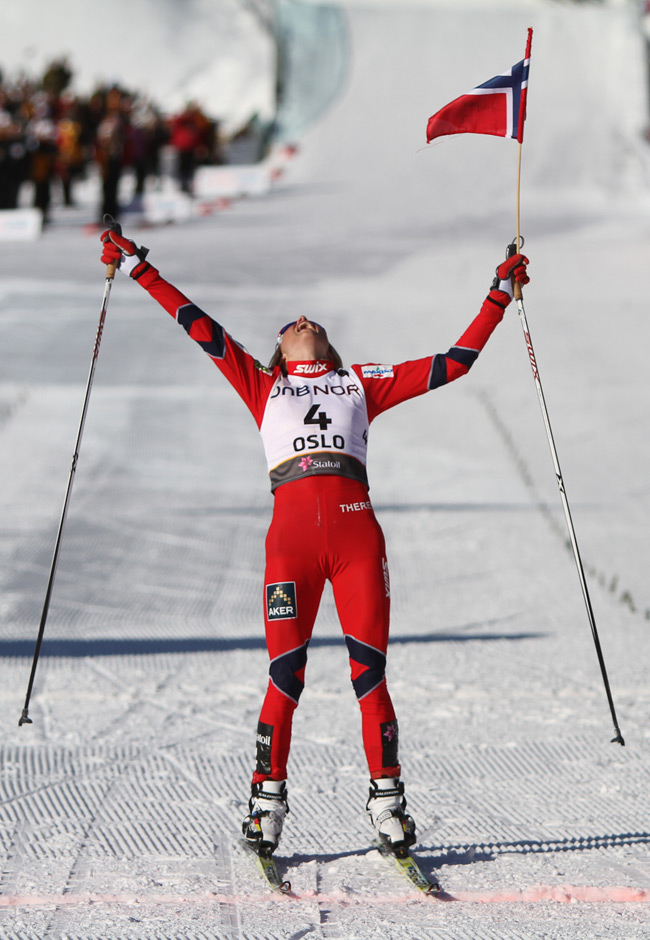
    Terese Johaug wins her first individual World Championship gold medal in the 30 k mass start skate in Oslo, NOR. (Photo: FS Archives)

    Eleven years ago to the day, racing the 30-kilometer mass start skate, a 22-year-old Therese Johaug won her first individual World Championship gold medal in a breakout performance at Holmenkollen near her home in Oslo, NOR. In doing so, she had broken apart a field of women considered legends of the sport on an equally legendary course known for long grinding climbs that require superior fitness and technique. Johaug won by nearly 45 seconds over one of the greatest cross country skiers of all time, her teammate Marit Bjørgen, and was 1:34 ahead of the Polish champion Justyna Kowalczyk. 

    “It was hard for me. It’s hard to see her go in front, and the gap [grow] bigger and bigger,” said Bjørgen that day. Then at the peak of her career, Bjørgen had gone four-for-four that week with gold medals in each of the previous World Championship races in Oslo, and the upset was a shock to those following along. “But I’m very happy for Therese. She is a young girl, and a girl for the future—and for Norway.”

    Little did cross country ski fans know just how storied the athlete’s career would be.

    Therese Johaug races in front of a home crowd during the 30 k classic at Holmenkollen. (Photo: NordicFocus)

    Today, under clear skies that allowed for views of the city skyline and Oslofjord, Norwegian flags flying, and fans returning to the crowded stadium and partying in the woods, she did it again, as one of her final performances after more than a decade as the top female distance skiers of all time. 

    And what’s more, Johaug won today’s 30 k classic in the same dominant fashion that she did eleven years ago, and has done many time since, stopping the clock at 1:19:22.8.

    Though the final results show just 19.4 seconds as her winning margin, this only tells part of the story. By 10 k, Johaug held a margin of over 23 seconds, which she steadily grew over the subsequent laps. At 25 k, she led by nearly a minute and a half.

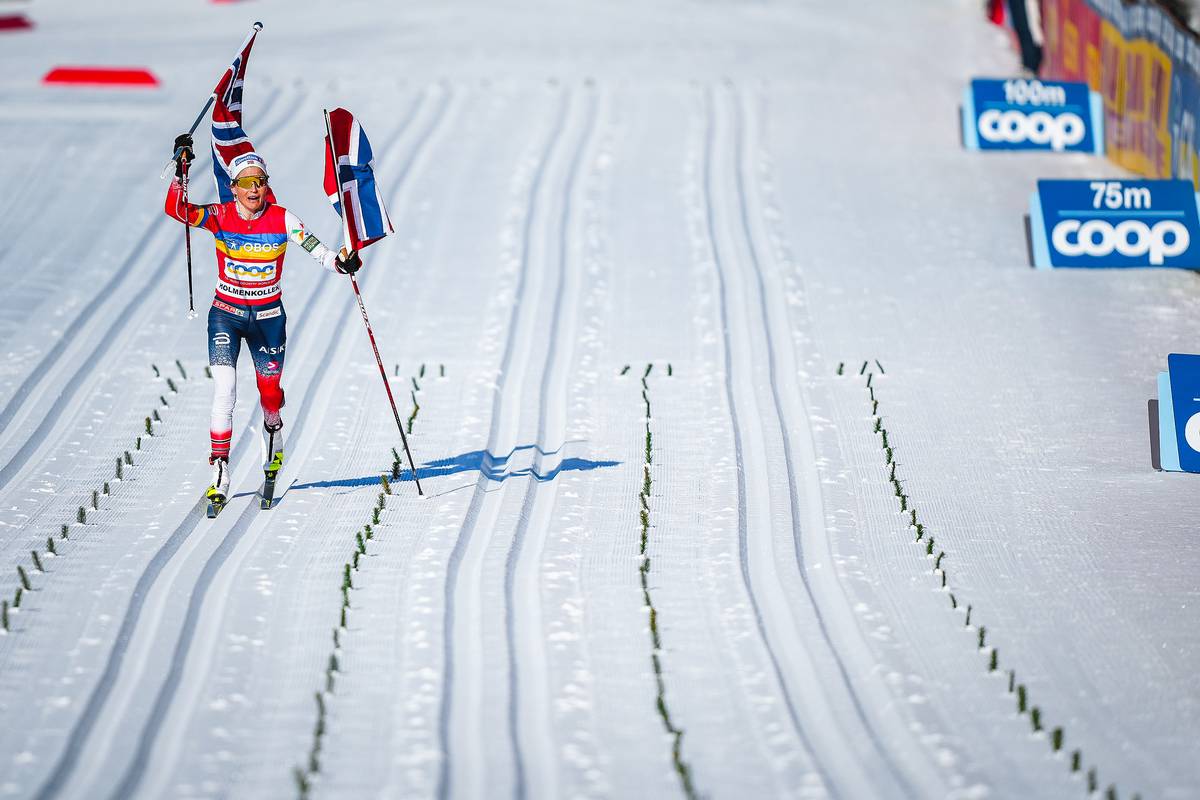
    Therese Johaug waves Norwegian flags as she skis the final meters of 30 k classic at Holmenkollen. (Photo: NordicFocus)

    As she entered the stadium, Johaug was greeted by coaches and techs who handed her a flag for each hand, which she carried through the finish, waving, and stopping to take in the erupting cheers from the crowds. 

    Laughing behind tears as the rest of the field began to trickle across the line, Johaug was hoisted onto shoulders, waving her flags for a loud Norwegian crowd who had supported and applauded her through fifteen years of racing on the World Cup. 

    “It’s a lot of emotion now,” Johaug said at the finish. “I start here in 2011 with my first individual victory, and today is my last race here. It was sun and blue sky, the same as  in 2011, and there were a lot of people around the track cheering for me. I’m so happy now, but also so sad that this is the end of my career.”

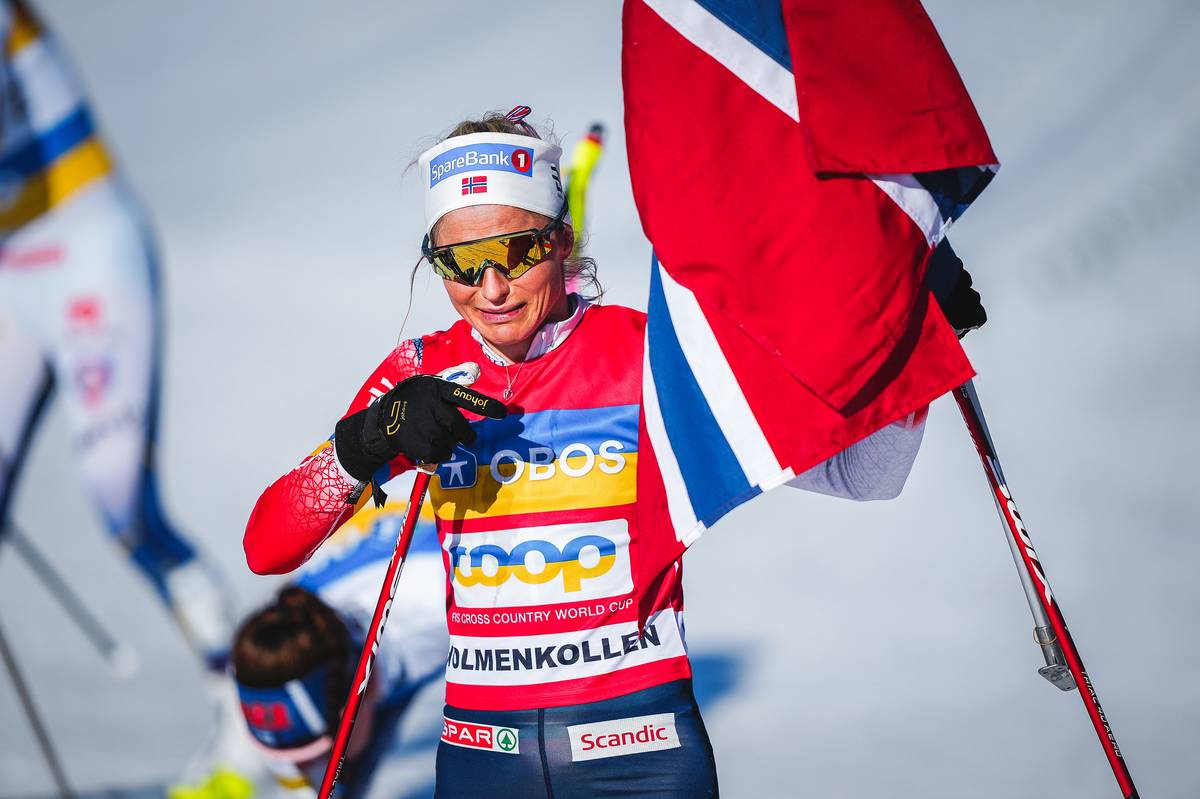
    Therese Johaug was emotional at the finish of today’s 30 k classic at Holmenkollen, the venue where she won her first individual World Championship gold in the 30 k skate eleven years prior. (Photo: NordicFocus)
    Norway’s legendary Therese Johaug wins the 30 k mass start classic, exactly 11 years after her first individual World Championship gold medal was won on the same tracks. (Photo: NordicFocus)

    While she indicated during the Olympics that she would not compete another four years, it was not until yesterday that she officially announced that this would be her final race at Holmenkollen. 

    “In many ways, it feels as if the [story] ends when on Saturday, March 5, 2022, I stand on the starting line for another 30 k in Holmenkollen. I really do not want the journey to end, but it is a time for everything,” she wrote to NRK. “In light of this, I look forward to a final fight at home with the flag on my chest, and I am grateful for everything the sport has given me.”

    Therese Johaug is showered with champagne after winning the 30 k classic at Holmenkollen following her retirement announcement. (Photo: NordicFocus)
    Therese Johaug celebrates her final race race at Holmenkollen, winning the 30 k classic exactly eleven years after taking her first individual World Championship gold on these tracks. (Photo: NordicFocus)

    As Queen’s “We are the Champions” blared through the stadium, Johaug stepped off the podium only to be soaked by champagne sprayed by a flock of teammates wearing shirts spelling her name, with “takk” – thank you – written with a heart at the end of the row. It was a joyous celebration fitting for the moment, and perhaps also a refreshing distraction from the times at large.

    “There are a lot of strong moments, but I am moved when so many people come here and see my last race. I must thank the Norwegian people who stand here today,” Johaug later said to NRK.

    While you can certainly expect a more in-depth look at her storied career on FasterSkier, for now, we’ll echo the crowds in congratulating Therese Johaug, and we look forward to following along for the next chapters.

    Therese Johaug celebrates her final race race at Holmenkollen, winning the 30 k classic exactly eleven years after taking her first individual World Championship gold on these tracks. (Photo: NordicFocus)
    Krista Pärmäkoski (FIN) and Jonna Sundling (SWE) lift champion Therese Johaug (NOR) for a podium shot at the finish of the 30 k classic in Oslo. (Photo: NordicFocus)

    Behind the celebration, the lineup of women in today’s top-10 was remarkably similar to the Olympic 10 k interval start classic, with a few name swaps, and of course, a few noteworthy athletes missing – namely, Natalia Nepryaeva and Tatiana Sorina of Russia, and Jessie Diggins, who had been fourth, seventh, and eighth, respectively. 

    The volume of the ringing cowbells swelled as Finland’s Krista Pärmäkoski skied through the stadium on her own for second place, after pulling away from the first chase pack with 5 k to go and maintaining a healthy 10-15 second gap through the finish. Coming back on form after a few rocky seasons, Pärmäkoski had been third in the 10 k classic in Zhangjiakou, behind her teammate Kerttu Niskanen, who was fourth today (+33.8). 

    Finland’s Krista Pärmäkoski takes second in the 30 k mass start classic at Holmenkollen in Oslo, NOR. (Photo: NordicFocus)
    The women’s 30 k classic podium at Holmenkollen: Therese Johaug (NOR) took the win ahead of Krista Pärmäkoski (FIN) and Jonna Sundling (SWE). (Photo: NordicFocus)

    Between the Finns, Sweden’s Jonna Sundling reaffirmed her talents across all distances, taking the third spot on the podium (+32.3) just two days after being second in Drammen’s classic sprint. Matching her fifth place result in the Olympic 10 k, Germany’s Katharina Hennig followed Niskanen to the line (+34.7) with Therese Stadlober, who was ninth at the Games, crossing after a gap in sixth (+46.7). 

    Leading the next chase group, and the American team, was Rosie Brennan in seventh (+1:12.3), bringing Norway’s Marte Skaanes and Sweden’s Ebba Andersson to the line just behind her for eighth (+1:13.1) and ninth (+1:13.8), respectively.  

    Rosie Brennan leads Norway’s Marte Skaanes and Sweden’s Ebba Andersson to the line. (Photo: NordicFocus)

    “Today was huge for me,” Brennan wrote in a post-race email. “I have struggled here my entire career, and [though] it’s been a few years since I’ve raced here and I have improved a lot in the last few years, I still felt I lacked a lot of confidence and excitement coming here [today]. It’s also been a really stressful week for a variety of reasons, so I showed up today with an immense amount of anxiety that I needed to get a hold of before the race started. 

    “I am really proud of giving myself another chance to put together a good race here and to have managed the stress and anxiety well enough to do so. I wasn’t feeling in a place to shoot for the moon so I tried to start a bit a conservative the first 5 k and then reevaluate. I had a great ride with Ebba and really had an enjoyable time skiing out there today. The last lap, we had the chance to pick off a few from the lead pack and so I started to ramp things up to see what was possible. I felt strong on the last climb and felt I had a good shot at the sprint finish so I went on the last little bump before the [last 100 meters]. It felt great to finish strong and to put together a really solid race today.” 

    Rosie Brennan skis to seventh in the 30 k classic at Holmenkollen. (Photo: NordicFocus)

    Following her classic sprint race in Drammen Thursday, Brennan joked post-race that she had lost out on yet-another boot slide. Today, the final sprint was hers. It was perhaps, also worth American fans celebrating that today that she won amongst her chase group, just under two weeks after a brave and gritty performance in the Olympic 30 k skate where she had pulled the chase group for much of the race, wearing herself out to break the wind, only to be dropped in the final 600 meters as Niskanen pulled away for a bronze medal. However, Brennan said she is not connecting any dots between the two.

    “This race was nothing like Zhangjakou, really hard to even compare the two. 30 k’s are always an adventure and I am really happy to have put together two strong ones, in each technique.” 

    Rosie Brennan skis to seventh in the 30 k classic at Holmenkollen. (Photo: NordicFocus)

    Commenting on how she is feeling, mentally and physically, with one final race weekend to go, Brennan concluded, “I am really bummed that the [World Cup] Finals were canceled. I haven’t raced a ton this season because of the earlier cancellations and while it has been a very high density block since the Olympics started, I am still feeling strong and wanted to see what I could do. But it will be really fun to end the season with the mixed relay event as that is a new one for us!” 

    Julia Kern was next for the US in 23rd (+3:37.2), followed by Hailey Swirbul in 26th (+3:57.8), and Caitlin Patterson – six days after taking second at the American Birkie – in 30th (+4:11.5). 

    Julia Kern skis to 23rd in the 30 k classic at Holmenkollen in Oslo, NOR. (Photo: NordicFocus)
    Hailey Swirbul skis to 26th in the 30 k classic at Holmenkollen in Oslo, NOR. (Photo: NordicFocus)

    In a post-race call, head coach Matt Whitcomb shared that Kern’s result was perhaps especially noteworthy as she has been struggling throughout the season with nausea during distance races, making it difficult for her to keep down fluids taken in prior to the race, let alone receive feeds during. Whitcomb also explained that Diggins sat out today’s race as she was feeling lingering fatigue from the long, and successful, season of racing. He affirmed that she is healthy and will be ready to race for the final World Cup weekend in Falun, beginning next Friday. Listen to the full call with Whitcomb below.

    Outside the top-30 for the US, Katharine Ogden was 37th (+5:54.1), followed by Rosie Frankowski, who has consistently landed on SuperTour podiums throughout the season, in 46th (+8:12.2). 

    Katharine Ogden (left) and Caitlin Patterson (right, bib 32) take to the course at the start of the women’s 30 k classic at Holmenkollen. (Photo: NordicFocus)
    Canada’s Cendrine Browne (bib 43) leads Katharine Ogden (bib 40) during the 30 k mass start classic at Holmenkollen. (Photo: NordicFocus)

    Racing for Canada, Katherine Stewart-Jones led the way in 22nd (+3:25.0), with Cendrine Browne also inside the top-30 in 25th (+3:53.7). After a successful World Junior Championship in Lygna, NOR, Jasmine Drolet finished 42nd today (+6:53.2), with Olivia Bouffard-Nesbitt closing out the Canadian racers in 48th (+10:19.8). 

    Results

  • World Juniors: Canada puts two in top ten as Russia sweeps 5/10 k classic; Will Koch top American in 13th

    The 2022 FIS Junior/U23 World Ski Championships trip has been made possible through support from the National Nordic Foundation (NNF), which has identified this invaluable opportunity for developing athletes as one of its “Pillar Projects”. You can support the NNF and the next generations of America’s top skiers by making a donation here.

    Friday at 2022 FIS Junior World Ski Championships in Lygna, Norway, marked the phase that Steve Fuller, on site to take photographs qua Flying Point Road, calls “the ‘groundhog’s day’ stage” of the championships. “Things are happening so fast that you’re not quite able to get caught up with each day before you get up and do it all over again,” Fuller wrote on Instagram.

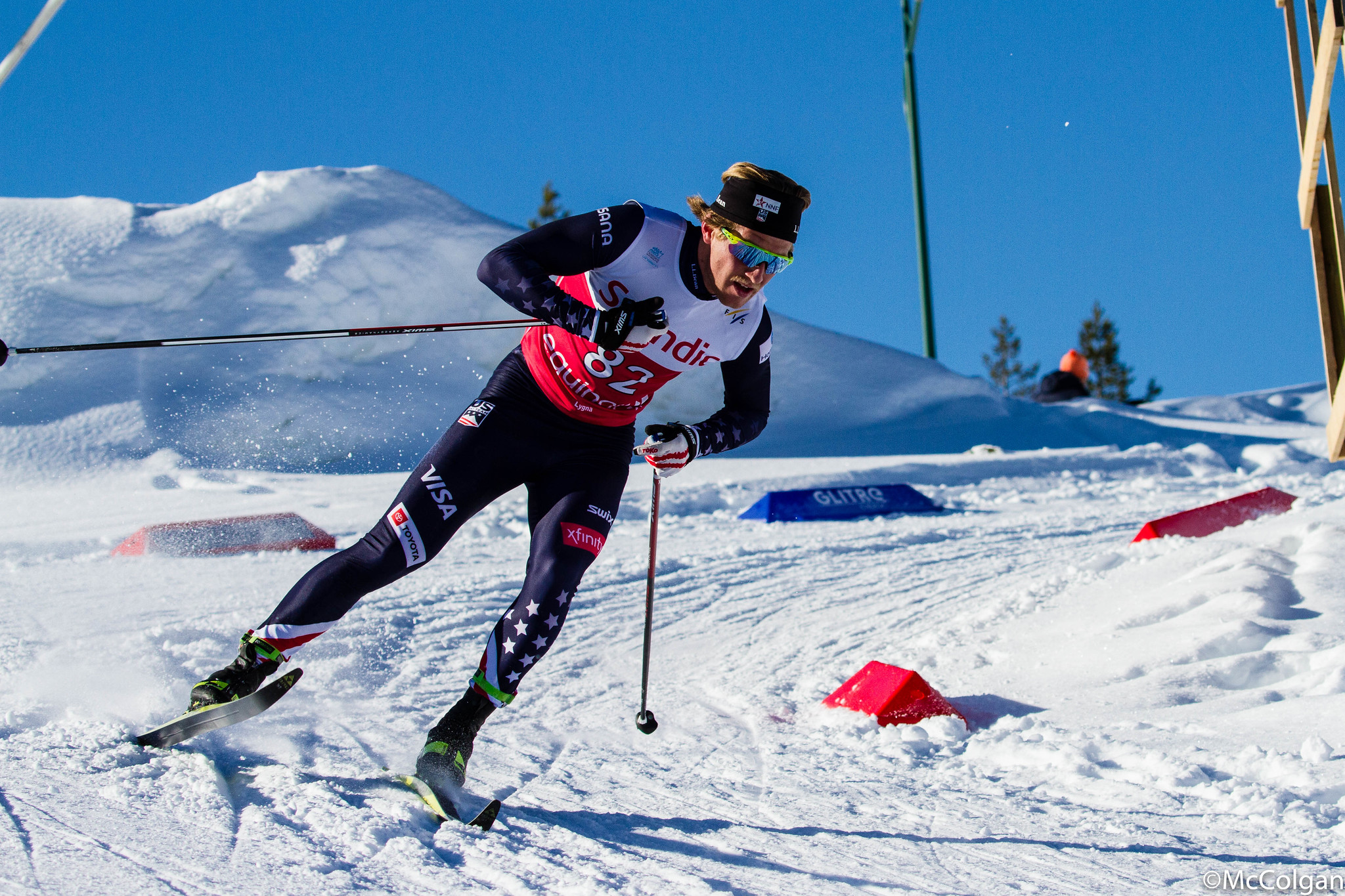
    Will Koch races to 13th in the 10 k classic during the 2022 Junior World Ski Championships in Lygna, NOR. (Photo: John McColgan)

    Undeterred, the Americans headed out on course Friday morning for their seventh and eighth races in four days. The coaches and wax techs (see the back row in the lead picture of the relay story) prepped skis for their eighth championship race within less than 72 hours. At the end of the day, Russia took a combined four out of six podium spots; Canadian skiers Xavier McKeever and Jasmine Drolet placed sixth and eighth, respectively; and Will Koch and Sydney Palmer-Leger led the way for the Americans in 13th and 19th.

    Women’s 5 k Classic

    Let’s back up. The women again had the day’s first race, a 5-kilometer interval-start classic. The first starter headed out on course, over a single lap of yesterday’s 5 k course, at 11 a.m. The official results describe conditions as somewhere between moderate and perfect: air temp of -2 C, snow temp of -3 C. Skies were overcast for the women’s race, but the sun came out for the men; as USST Development Team Coach Greta Anderson told FasterSkier later Friday, conditions sped up noticeably by the afternoon.

    82 starters later, Dariya Nepryaeva, who started at the sharp end of the field in bib no. 80, had logged the day’s fastest time, crossing the line in 14:30.1. She was closely followed by her compatriot, Elizabeta Bekisheva, in second, 2.9 seconds back. Emma Kirkeberg Mørk of Norway was close behind for third, 4.0 seconds back.

    Sydney Palmer-Leger skis into the top-20 in the 5 k classic during the 2022 Junior World Ski Championships in Lygna, NOR. (Photo: flyingpointroad.com)

    The day’s fastest North American finisher, and fastest Jasmine in the field, was Jasmine Drolet of Revelstoke, B.C., in eighth, 21.5 seconds back. She was followed in the North American standings by American Sydney Palmer-Leger (University of Utah/Park City, Utah) in 19th (+51.3), and Canadian Jasmine Lyons in 26th (+1:03.3).

    “I felt pretty good. I really like classic skiing and my goal was to give it all I had,” said Drolet in a press release from Nordiq Canada. “You only ski the lap once, so the key was to just go hard the whole time. We had amazing conditions, perfect for classic skiing so it was a good day.”

    Behind Lyons were the two Ninas, Nina Schamberger (Summit Nordic Ski Club/Leadville, Colorado) in 31st (+1:14.2) and Nina Seemann (Dartmouth Ski Team/Craftsbury, Vermont) in 36th (+1:23.0). Annie McColgan (University of Vermont/Bend, Oregon) was 40th (+1:27.3). Canadian athletes Sarah Cullinan (44th, +1:34.2) and Tory Audet (59th, +2:08.2) followed.


    Annie McColgan races the 5 k classic in Lygna, NOR, her first start of the 2022 Junior World Ski Championships. (Photo: John McColgan)

    McColgan radiated enthusiasm when she talked with FasterSkier following her first race at these championships. “It was nice to have everyone cheering out there, and my parents were here so it was really, really fun. It was really cool,” McColgan said.

    McColgan also provided insights on the course, describing it as “a really interesting 5k” with plenty of rolling terrain, but not many opportunities for recovery. “There’s a lot of steep little hills that you just have to be really good at… But it also is 16 minutes long. So you kind of have to make that balance [with energy expenditure]. And then the final climb was so brutal.”

    Men’s 10 k Classic

    The men again had the day’s second race, starting a two-lap, 10 k interval-start classic race at 1 p.m. local time. Taking athletes’ distance points as an informal form chart, in a field with 101 athletes the podium finishes came, relatively unsurprisingly, from bibs no. 90, no. 100, and no. 101. The gold medal on Friday went to Russian Saveliy Korostelev, the penultimate athlete on the course. Korostelev posted the fastest split time at 3 kilometers, at 5 kilometers, and at 8 kilometers, crossing the finish line in 26:15.8.

    Will Koch leads the American junior men with a 13th place finish in the 10 k classic during the 2022 Junior World Ski Championships in Lygna, NOR. (Photo: flyingpointroad.com)

    Korostelev enjoyed a hefty advantage over silver-medal finisher Niko Anttola of Finland, who finished 21.4 seconds back. Anttola ranked one to eight seconds behind Alexander Ivshin of Russia at all intermediate checkpoints, but skied the final two kilometers just barely faster. When Ivshin, the day’s final starter, crossed the line, he had fallen 0.8 seconds behind Anttola and had to settle for third.

    Put another way, Russia came within a second of going 1–2 in both the men’s and women’s races. They instead had to settle for first and second in the women’s race, and first and third in the men’s.

    Shortly behind the podium, Xavier McKeever of Canmore, Alberta, skied a strong race to finish sixth, 52.4 seconds back of Korostelev and roughly 30 seconds off the podium. It was McKeever’s best international result since, well, Tuesday, when he was fifth in the men’s 30 k mass start skate. McKeever’s sixth today tied Palmer-Leger’s sixth, from Tuesday’s women’s 15 k skate, for the second-best North American individual result of these championships.

    “I am stoked to be in the top-10 again,” McKeever told Nordiq Canada in a press release. “I was getting splits that I was close to the podium in the first lap, but I just couldn’t keep the high pace that I started with. Honestly, I feel like the podium is still a fair bit away, but today just motivates me more to make the steps toward being able to contend for a medal. … I have been able to build my confidence over the course of this season. After last year, it was instrumental for me to refocus on putting in the hard work each and every day, which I think has helped me race with more confidence than ever before.”

    McKeever was followed by his countrymen Max Hollman (Thunder Bay) in 17th (+1:28.8), Derek Deuling (Whitehorse) in 19th (+1:31.5), and Thomas Stephen (Calgary) in a tie for 26th (+1:40.0).

    Brian Bushey races the 10 k classic during the 2022 Junior World Ski Championships in Lygna, NOR. (Photo: John McColgan)

    Will Koch (University of Colorado/Peru, Vermont) led the way for the Americans, finishing in 13th (+1:23.4). He was followed by Alex Maurer (University of Colorado/Anchorage, Alaska), also 26th (+1:40.0); Brian Bushey (University of Utah/Waitsfield, Vermont) in 36th (+2:00.2); and Finn Sweet (University of Vermont/Waterbury, Vermont) in 47th (+2:11.3).

    Thoughts from the coach

    Greta Anderson is in Lygna at her third World Juniors as a coach or tech, her first since assuming her current coaching position with the U.S. Ski Team. (Disclosure, Anderson was this reporter’s coach in APU Masters in 2014–15, and has remained a close personal friend ever since.)

    Asked what she saw about today’s races, Anderson noted, “They were really fun to watch. Between FIS live timing and back split, the radios were pretty lively. One thing I did learn this year, and this is more than I’ve seen in the past, is that our athletes – every single one has the raw speed to compete at this level. We’re working on the durability portion of it. I think the top athletes in these races often are running negative splits in a big way; I would have to sit down and look at percentages. I’m sure we’ll do that at some point in time. But you know, the speed is there early on, we have very good placement, and then we need to figure out how to speed up just a little bit more. But that’s, you know, that’s been a big step for us as a country.

    “Will Koch, obviously very, very strong today. Brian Bushey came out on the top end of ten places being within four seconds, or eight places within four seconds maybe. So you know, really phenomenal. … Annie McColgan had her first ever World Juniors race today. And that’s always really fun and special to watch. I think often athletes come away seeing like, ‘wow, there’s another level,’ and it can be really motivating for the following year.”

    Sydney Palmer-Leger leads the junior women during the 5 k interval start classic. (Photo: John McColgan)

    Turning to Schamberger, Anderson observed that the 16-year-old has “had a pretty heavy week of racing so far. She’s had three starts, and the first day was not what she wanted. And the second day she had the gift of getting redemption the very next day, which I think is one of the best things athletes can have. And she was really happy with how she skied the relay, a big smile on her face. And then a really good race today. It’s fun to watch athletes – the moment that they realize they’re skiing at that level. Because we know they can do it, and we watch it, but that aha moment of ‘Oh, okay, in the world, this is where I am.’ That moment is really cool. It’s one of my favorite parts of my job for sure.”

    Anderson also described the environment at the venue more broadly, highlighting the effects of vocal parental support. “There’s quite a few parents here from the U.S.,” she said.

    “And Americans are really loud compared to other countries, and it’s probably taken as obnoxious, but I really appreciate it. We can always hear the Americans. It’s fun to stand by them and listen to them get all excited. Next to the parents during the relay is one of my favorite places to stand.”

    In that vein, Anderson concluded, “I look around, and I’m so proud to be an American coach. I’m so proud of the American skiers; there’s not a single other nation I would – I’m really glad that I work for our staff. And I think our athletes are really glad that they ski for the U.S.A. I don’t think they look around and think, like, ‘I wish I was on that team,’ or, ‘I wonder what that team is up to.’ We’re definitely in that, ‘We’re Americans and we’re here to beat you. Or at least die trying’ mode. And that’s pretty fun.”

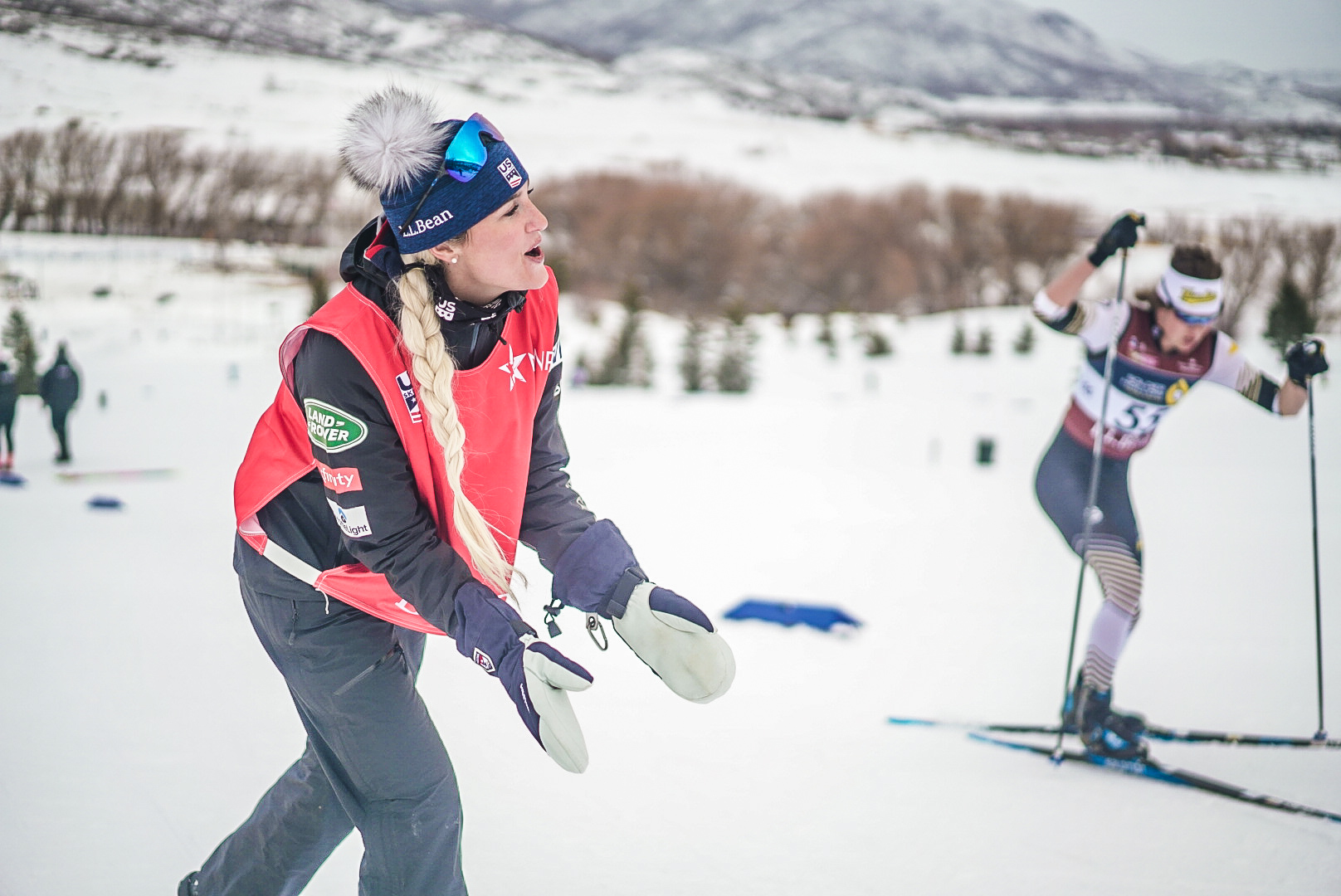
    U.S. Ski and Snowboard Development Team Coach Greta Anderson encourages athletes during the men’s 30k distance race during the 2022 U.S. Cross Country Championships in Soldier Hollow. (Photo: Tobias Albrigtsen / @untraceableg)

    Racing continues tomorrow with skate sprints for U23 athletes, both genders, before wrapping up Sunday with both men’s and women’s U20 skate sprints and the U23 mixed relay, sending athletes and techs out with three races, two techniques, and a combined sixteen sprint heats on the final day of racing. Groundhog’s Day, indeed.

    Today’s results: women | men

    World Juniors links and information:

    Home page and general info | race program | results and live timing (all races) | streaming (only for Thursday through Sunday’s races, purchase required)

  • Fresh Snow and World Class Grooming Set the Stage for a Weekend SuperTour Distance Pursuit in Craftsbury

    Fresh Snow and World Class Grooming Set the Stage for a Weekend SuperTour Distance Pursuit in Craftsbury

    In the wake of a winter storm, athletes found ideal race conditions for a weekend of distance racing at the Craftsbury Outdoor Center, which hosted the Henchey Memorial Carnival. (Photo: NENSA Facebook Page)

    By Ian Tovell and Rachel Bachman Perkins

    Find FasterSkier’s coverage of Friday’s freestyle sprints here. 

    Saturday: 10 k Interval Start Classic

    After another 4+ inches of snow fell throughout the day on Friday, NENSA described the conditions for today’s 10-kilometer interval start race as a “banner day for classic skiing” on the two-lap course at the Craftsbury Outdoor Center. The weekend of racing, titled the Henchey Memorial Carnival, included athletes of all levels, was described as “a celebration of the type of ski racing that [the late Bill Henchey] loved.” All three stages scored points toward the U.S. SuperTour Standings, while Friday and Saturday encompassed the UVM Carnival, and Saturday and Sunday’s distance races were part of NENSA’s Eastern Cup race series that allows developing athletes to qualify for Junior Nationals.

    Results from the 10 k classic stage on Saturday established the start order and deficit for Sunday’s 7.5/10 k freestyle pursuit. The women took to the course first on Saturday at 9:45, with the men following at noon.

    As the women lapped through the 5 k checkpoint, a familiar name topped the standings. Friday’s sprint winner Katharine Ogden (SMS T2) came through the halfway point in a time of 15:23.5. Rosie Frankowski (APU) was in second, 5.3 seconds back, while Alayna Sonnesyn (SMS T2) came through in third (+9.4). Second alternate for the Canadian Olympic Team, Jasmine Drolet (DAR) came through in fourth (+14.9), with Becca Rorabaugh (APU) right behind in fifth (+15.0).  Ava Thurston (Mansfield Nordic Club) was 8th (+36.2), as the first U18 skier through the 5k mark.

    Over the second lap, Ogden held onto her lead, claiming her second victory of the weekend in a time of 30:59.8. Though she has won all three SuperTour sprint races she has entered, this is Ogden’s first domestic distance win of the season. She was second to Caitlin Patterson (CGRP) in the 10 k classic in the U.S. Cross Country Championships in early January, then took second to Rosie Brennan in the same event the following weekend in Sun Valley.  

    “The race today was a lot of fun,” Ogden wrote to FasterSkier after the race. “It was a gorgeous Vermont day. Sunny, new snow, perfect grooming. Basically, a wonderful time. I love racing in Craftsbury with so many people I love. I also had some awesome skis, which is always a blast. It was especially fun to have my mom and dad and sister there! In terms of pacing and tactics, this course really has a lot of constant output, so I was mostly just focusing on skiing well and smoothly, and taking advantage of swapping between doublepole and striding to get little bits of recovery where I could. I got to ski with a little pack of EISA people (past and present) at the very end, which was fun.”

    SMS T2 went one-two, as Sonneysn was able to catch and overtake Frankowski, placing second (+26.6) and third (+26.8), respectively. Yet another Sonnesyn-Frankowski matchup… 

    The women’s 10 k classic podium after the second day of SuperTour racing in Craftsbury, VT. (Photo: Craftsbury Outdoor Center/John Lazenby)

    Rorabaugh crossed in fourth (+29.3), with Drolet rounding out the top-five (+34.4). Thurston was able to stay in the top-10 placing ninth (+2:18.5). 

    As the first collegiate racer, Drolet (DAR) topped the EISA podium with a time of 31:34.2. Yesterday’s collegiate sprint winner, Anna Bizyukova (UVM) was second (+36.1) and tied for seventh overall (+1:09.5). Erin Bianco (CBC) placed third (+58.3) and took the final spot in the top-10 overall (+1:31.7).

    In the men’s race, it was between two athletes through the 5 k mark; Adam Martin (CGRP) went through with a time of 13:18.6 with Zak Ketterson (Team Birkie) only 2.1 seconds behind. Johnny Hagenbuch (SVSEF) was third (+9.3) at the half, with teammate Peter Holmes (SVSEF) in fifth (+15.0).  Sitting in fourth was Finn O’Connell (BSF Pro), but his split did not register as he crossed the checkpoint.

    Adam Martin races the 10 k interval start classic during the Henchey Memorial Carnival in Craftsbury, VT. (Photo: Craftsbury Outdoor Center/John Lazenby)

    Martin was able to hold on for the win, closing the race with the fastest second lap split. Taking the win at home, he stopped the clock at 26:56.9. Martin took second in last weekend’s 10 k mass start free in Lake Placid, and won the 15 k classic at both the U.S. Cross Country Championships in Soldier Hollow, and the second SuperTour race weekend in Cable, WI.

    Yesterday’s sprint winner Ketterson held solidly onto his position, finishing in second (+12.4), while Hagenbuch came through in third (+24.4). 

    “I’m really psyched to win today,” Martin wrote in a post-race email. “Interval start classic races are my favorite, so racing today at Craftsbury was close to my ideal race. A big snow storm came through Thursday night into Friday, so today’s near perfect conditions are a testament to our incredible grooming crew. I started toward the end of the A-seed directly in front of Zak Ketterson. I believe Zak put some time on me in the first 3 or 4 k, but I was able to claw that back by the lap mark and narrowly increase my lead by the finish. It deserves mention in all races, but at home when I know many of the volunteers, I especially want to thank everyone who came out to help put the races on, and as always our incredibly hard working wax techs.”

    The men’s 10 k classic podium after the second day of SuperTour racing in Craftsbury, VT. (Photo: Craftsbury Outdoor Center/John Lazenby)

    O’Connell finished fourth (+29.5) in the men’s overall, with Karl Schulz of Sun Valley next to round out the top-five (+38.1). It was a strong day for the Craftsbury Green Racing Project and the Sun Valley Gold Team, as both placed three skiers in the top-10.  

    In the collegiate race, Finn Sweet of UVM took first in a time of 28:08.5 beating two fellow Vermonters. Peter Wolter (MID) was not far behind, coming in second (+1.7). Fellow UVM skier, Gregory Burt finished third (+3.7). These athletes were 11th, 12th, and 14th in the overall standings, respectively. 

    10 k Classic Results:

    Women | Men

    Sunday: 7.5/10 k Freestyle Pursuit

    The final day of racing in the Henchey Memorial Carnival featured a pursuit start for the 7.5/10-kilometer freestyle races, with start order and time back from the first starter determined by the previous stage’s results. Switching the order of the previous day, the men took to the course first, with Adam Martin (CGRP) heading out 12 seconds ahead of Zak Ketterson (Team Birkie). Johnny Hagenbuch (SVSEF) left the gate 24 seconds back, with Finn O’Connell (BSF Pro) next (+29.0), and Karl Schulz (SVSEF) starting fifth (+38.0).

    With live timing giving splits solely based on time of day, overall position was tough to track from afar. As racers lapped through the 5 k checkpoint, Schulz had skied the fastest first lap, coming through midway in a time of 12:29.4. Goble Reid of BSF Pro came through with the second fastest time (+9.5), just ahead of teammate O’Connell (+10.3). Reid had started 13th, 1:18 back from Martin. Sam Wood (+12.9) of Sun Valley came through with the fourth-fastest time after starting 12th overall, 1:14 back. “Retired” long-time Craftsbury Green Racing Project team member Ben Lustgarten rounded out the top-five fastest splits at the midway point (+ 13.6).  Both Martin (+37.8) and Ketterson (+25.4) were outside the top-10.  

    As mentioned, lap splits only tell part of the story. As the overall winner of the pursuit is whoever crosses the line first, moves and countermoves at the front of the field tell the true story of the day. Wearing a target on his back, Martin was quickly chased down by yesterday’s podium athletes, Ketterson and Hagenbuch. Lapping through the stadium, all three athletes raced together, heading out what would be a tactical second half. In the hunt were O’Connell and Schulz, both of whom were also within reach of the podium.

    In the final kilometer, Hagenbuch began to lead the charge toward the finish, creating a small gap to Ketterson and Martin who were evenly matched as the leaders headed into the finish lanes. Hagenbuch held his advantage through the finish to stop the clock in a time of 26:02.0, which would also be the third fastest time of day.

    Johnny Hagenbuch (SVSEF) pulls away for the win in the men’s 10 k freestyle pursuit, while Adam Martin (CGRP) and Zak Ketterson (Team Birkie) fight for second and third. (Photo: Craftsbury Outdoor Center/John Lazenby)

    Dead even through the finish, Martin and Ketterson both crossed 1.2 seconds behind Hagenbuch, with second place going to Martin and third to Ketterson. O’Connell was next to the line for fourth (+3.3), with Schulz skiing the fastest time of day to take fifth (+13.0).

    “It was a really fun weekend of racing in Craftsbury!” Hagenbuch wrote in a post-race email. “This was the first time I’ve competed here since I was a junior in high school in 2019, and happily the courses are much less intimidating now than they were then… The conditions for the classic race were just about as perfect as it gets; we may have raced on Blue Extra kickwax.”

    Hagenbuch also provided a detailed look inside the men’s race, adding his own approach to the day, recognizing his time deficit and strengths. 

    “Being only 24 seconds back from Adam Martin at the start of the pursuit, I was pretty confident that I could at least catch him. I started with some intent, and I was able to reel in Zak Ketterson and Adam as Finn O’Connell and Karl Schulz reeled me in. The level of exertion dropped a lot once I caught the leaders, and I just tried to ski as smoothly as I could for the remainder of the first lap and the first half of the second five-kilometer lap. I picked up the pace at the start of the long climb from the low-point of the course – the one that includes ‘Screaming Mimi’ – and tried to hold high power through the climb. I established a decent gap – something that I didn’t necessarily expect – but had to keep pushing to hold off the chase group. Fortunately, I was able to maintain the lead and relax a little bit into the finish.”

    The men’s podium after the 10-kilometer freestyle pursuit in Craftsbury, VT. (Photo: Craftsbury Outdoor Center/John Lazenby)

    This is Hagenbuch’s third consecutive 10 k freestyle win of the season; he also stood atop the podium after racing on his home trails in Sun Valley, then again following the 10 k free in Lake Placid two weeks later. Putting together a solid weekend in Craftsbury, the 20-year-old was also third in the sprint qualifier on Friday, which he described as “one of his bests”. A member of the 2022 Junior World Championships team, and a soon-to-be Dartmouth College student, Hagenbuch concluded with insight into what lies ahead for him over the next few months.

    “I’ll stay in Craftsbury this week, and then I’ll go directly to the pre-camp for World Juniors/U23s in Norway, which will actually be my first time to the country. Post-World Juniors, I’d like to remain in Europe for whatever competitions are offered to me. I would then go directly to SuperTour Finals in Whistler. From Canada, I would leave on March 28th to miss the first day of school and start classes on Tuesday in Hanover. It will be a whirlwind, but I’m really looking forward to it!”

    As only Friday and Saturday’s events were part of the UVM carnival, collegiate race numbers dwindled on Sunday. The top EISA skier for the second day in a row was Finn Sweet (UVM) with a winning time of 27:44.6. Going one-two for UVM, teammate Bjørn Westervelt was the second collegiate skier across the line (+3:04.4), while Bowdoin’s Carson Williams finished third (+3:59).

    Katharine Ogden leads the women’s 7.5 k freestyle pursuit in Craftsbury. (Photo: Craftsbury Outdoor Center/John Lazenby)

    In the women’s 7.5 k pursuit, Katherine Ogden (SMS T2) was first on course with a sizable gap to the next racer. Her teammate, Alayna Sonnesyn, and APU’s Rosie Frankowski of APU Nordic headed out at 26 and 27 seconds back, respectively. Becca Rorabaugh of APU was next out of the start gate at 30 seconds back, with Alexandra Lawson of Craftsbury beginning 42 seconds back as the fifth starter. 

    Working to close the gap to Ogden during the first lap, Frankowski skied the fastest split through the 3.75k checkpoint with a time of 9:27.0 with Sonnesyn skiing the second fastest split  (+1.9). Their work proved effective, as they caught the leader and lapped through the stadium as a group.

    Rorabaugh had the third fastest 3.75 k split at the half (+14.7), while Lina Sutro (SMS T2) of SMS T2 skied the fourth fastest (+16.7) and Lawson the fifth (+15.9).

    In Craftsbury’s Day 3 recap video (embedded below),  produced by Mountain X Media, Frankowski described the second lap as “cat and mouse” as each of the athletes took advantage of her individual strengths to push different sections of the course. Eventually, Ogden began to fall off the pace, while Sonnesyn and Frankowski stayed tight through the final kilometer. 

    Rosie Frankowski (APU) leads Alayna Sonnesyn (SMS T2) and Becca Rorabaugh (APU) up a climb during the women’s 7.5 k freestyle pursuit in Craftsbury. (Photo: Craftsbury Outdoor Center/John Lazenby)

    In the end, Sonnesyn found the advantage, heading into the finish lanes with a gap over the other two women to take the win in 19:40.5. Frankowski crossed 3.5 seconds back for second place, with Ogden taking third after a 23.5 second gap. Rorabaugh was fourth (+31.3), with Lawson fifth (+57.5). U18 standout Ava Thurston (Mansfield Nordic Club) skied her way from 9th to 6th (+1:31.8).

    “I felt really good today and am excited about that!” Sonnesyn wrote to FasterSkier after the race. “It’s been a lot of racing the last 10 days and I was feeling the fatigue start to accumulate, but I’m also feeling confident in my distance skate skiing right now, so I was pretty excited to work hard out there.”

    Over those ten days of racing, Sonnesyn has raced in five events and only missed the podium once in Friday’s freestyle sprint. She also won the 10 k mass start freestyle last weekend in Lake Placid.

    “It was really fun to do a pursuit race today! We don’t typically do pursuits in the U.S. and the last few years I’ve only competed in World Cup pursuits where I started in the wave, so it was a unique and exciting day. I knew Rosie, Becca and I would want to work pretty hard in the beginning to chase down Katharine and that’s exactly what we did (although we never outwardly spoke about this plan with each other). We charged pretty hard from the start and once we became a full pack we started playing a little more cat and mouse on the second lap. We were all trying to conserve energy for the final few kilometers while also keeping up the pace, which made for some tactical racing. 

    “The last 1.5k are pretty much all uphill. From the bottom Rosie started charging again and I hung on. Prior to reaching the super steep pitch on Screaming Mimi, I put in a surge so I could take the most direct route around the corner. From there, I put my head down and gave it everything I had left up the last bit of the climb and into the finish.”

    The women’s podium after the 7.5 k freestyle pursuit in Craftsbury, VT. (Photo: Craftsbury Outdoor Center/John Lazenby)

    A graduate of UVM and now a member of the Stratton Mountain School T2 team, Sonnesyn has perhaps spent more of her competitive ski career based in the Northeast than near her childhood home in Plymouth, MN. 

    “The Midwest will always be my home but Vermont has become my second home the past eight years. It was pretty incredible hearing so many people cheering my name this weekend and definitely kept me charging up those hills. Really fun to be around such a great ski community and feel the love for the sport. Makes me appreciate this sport and all of the people in it!”

    Wrapping up with her next steps, the two-time American Birkebeiner champion (2019 and 2021) has her eyes set on the Midwest’s marquee event. 

    “I’m currently en route back to the Midwest to spend a few weeks at home training for the Birkie. I’m excited to be back and the fever is definitely setting in!”

    In the collegiate standings, UVM’s Annie McColgan took the win as the Catamounts topped both the men’s and women’s EISA podiums. McColgan’s time of 22:57.0 put her in 14th overall in the women’s standings. The second collegiate athlete was Emma Strack of St. Lawrence University (+2:20.9), with teammate Charlotte Browne in third (+6:15.5). 

    *****

    As Period III draws to a close, the SuperTour race calendar breaks for the remainder of the 2022 Olympic Winter Games. The next race event will be the 50 k American Birkie, kicking off on February 26 in Hayward, WI.

    7.5 / 10 k Freestyle Pursuit Results

    Men | Women

  • It’s Ogden and Ketterson Again in the Craftsbury SuperTour Freestyle Sprint

    It’s Ogden and Ketterson Again in the Craftsbury SuperTour Freestyle Sprint

    SuperTour racing continued on Friday in Craftsbury, Vermont, as part of the Henchey Memorial Carnival, which also included Eastern Cup and collegiate racing. The three-day event is presented by the Craftsbury Outdoor Center, NENSA, U.S. Ski & Snowboard, and the University of Vermont (UVM), the EISA carnival host school.

    Racers were faced with snowy conditions for the opening 1.4-kilometer freestyle sprint as a winter storm made its way across the Northeast. Friday morning’s grooming report mentioned 6 inches of fresh snow, as more continued to fall throughout the morning. 

    On the women’s side, last weekend’s 10k freestyle winner, Alayna Sonnesyn (SMS T2), won the qualifier in 3:58.27, ahead of BSF Pro Team’s Lauren Jortberg in second and APU’s Rosie Frankowski in third. Perhaps a nod to the wintery conditions, these top three finishers were separated by over six seconds.

    Sonnesyn advanced from the first heat of the quarterfinals into the semis, where she finished third in the first heat behind Katharine Ogden (SMS T2) and Ava Thurston (Mansfield Nordic Club), who crossed the line together, roughly 0.4 seconds ahead of Sonnesyn. As the second semi, which was won by Jortberg, was roughly four seconds faster on average, Sonnesyn did not earn a lucky loser spot in the final. Instead, Jortberg advanced with Anna Bizyukova of UVM, Frankowski, and Craftsbury’s own Margie Freed. 

    Despite the trend seen in the qualifier, the final featured tight racing, with the top five athletes finishing within two seconds of one another. Just 0.6 seconds separated second from fifth.

    A scene from the women’s final of the 1.4k freestyle sprint in Craftsbury. (Photo: Instagram @nensa_nordic)

    Coming out on top was Ogden, who won the final in 3:59.08. After racing on the World Cup from the opening races in Ruka through the midway point of the Tour de Ski, Ogden has gone three-for-three in SuperTour sprints since returning stateside, winning classic sprints in Soldier Hollow and Lake Placid before checking off a skate win today.

    Just behind, Jortberg took second place (+1.30) with U18 athlete Thurston closing in third (+1.78). Bizyukova was next to the line in fourth (+1.86), with Frankowski less than a meter behind in fifth (+1.91). Freed rounded out the women’s final in sixth (+4.51).

    “I think that the biggest thing to note about today was that it was blizzarding!” wrote Ogden in a post-race email. “The heavy falling snow made the heat racing very tactical and rewarded being very quick off of the line. There was one lane on the course that was packed down by traffic and the other areas were pretty soft!”

    Ogden was just 11 points behind Caitlin Patterson on the Olympic qualification distance list, based on the athletes’ best two distance races on the SuperTour or at the U.S. Cross Country Championships, during which Ogden competed in only one race – the 10k individual start classic where she was second to Patterson. The following weekend in Sun Valley, she was second in one distance race and fourth in the other, behind three Olympians and ahead of Patterson in each. As the races at U.S. Nationals were scored at a higher point value, Patterson took the final Olympic spot, leaving Ogden on the wrong side of the cusp. 

    Nevertheless, Ogden has found silver linings in the additional time back east. 

    “It was a blast to be able to race with the EISA. I miss skiing for Dartmouth (Ogden graduated in 2021), so it was fun getting to ski with some of my old teammates and some new Dartmouth skiers. It was also pretty great to ski in lots of natural snow, we rarely get a snowstorm this big anymore and it was undeniably very fun.” 

    The women’s podium after the opening freestyle sprint race which kicked off a weekend of SuperTour, Eastern Cup, and EISA racing. (Photo: APU Nordic Ski Center / Instagram)

    As Thurston is, remarkably, still in high school, Bizyukova was the top collegiate racer to earn today’s EISA sprint title. The second and third placed collegiate racers both hailed from Dartmouth College, with Callie Young finishing fifth in the first semifinal and 10th overall, and Jasmine Drolet taking sixth in the second semi for 11th overall.  

    The men of the Sun Valley Ski Education Foundation (SVSEF) Gold Team swept the top-three spots in the men’s qualifier, with Karl Schulz leading the way in 3:23.48. Peter Holmes was 0.33 behind in second, with Johnny Hagenbuch in third (+1.21).

    Schulz carried momentum from the qualifier win into the first quarterfinal, which he won by half a second, but his day ended soon after in the semifinal. Racing in a fast first heat that contained two eventual podium winners and found both lucky losers, Schulz was fifth in the heat, +1.72 behind winner Matias Øvrum of UVM. Sam Wood (SVSEF) was second in the heat, ahead of last weekend’s sprint winner Zak Ketterson (Team Birkie) and Gregory Burt (UVM). 

    In the second semi, which was nearly three seconds slower, Canada’s Étienne Hébert (CNEPH) edged out Holmes by 0.1 seconds to go 1-2 and advance to the final round. 

    Zak Ketterson leads up the final climb in the men’s freestyle sprint final in Craftsbury. (Photo courtesy Zak Ketterson)

    The top two spots in the final were decided by a close finish between Ketterson and Øvrum, with Ketterson crossing 0.28 ahead in a time of 3:22.57 to earn his third SuperTour sprint title of the season. Øvrum was second, though he was named the collegiate race winner for UVM, with Hébert crossing the line a few meters behind on his own in third (+2.17). 

    “I’ve always really liked racing at Craftsbury,” Ketterson wrote to FasterSkier after the race. “It’s an awesome place and this year Team Birkie has been lucky enough to stay right at the Outdoor Center. The race course is right out our back door!”

    Ketterson also provided insights to the final round for those following from afar.

    “The final was really close! I gave it everything I had at the top of the last hill but I definitely started to get tired and bogged down a bit into the finish. Matias skied a smart race and gave me a really good challenge in the last few meters but luckily I was able to fend him off. It was a tricky day with super soft fresh snow and I’m happy I was able to execute.”

    Zak Ketterson races a snowy freestyle sprint qualifier in Craftsbury. (Photo courtesy Zak Ketterson)

    Wood was fourth in the men’s final (+6.9), with Burt fifth (+7.17), and Holmes sixth (+10.82).

    The men’s freestyle sprint podium after the opening day of SuperTour racing in Craftsbury. (Photo: Instagram @nensa_nordic)

    As mentioned, Øvrum was the top collegiate racer, with Burt second, going one–two for UVM. Third place among college athletes was Allan Luke of Dartmouth, who finished sixth in the first semifinal and 12th overall. 

    Craftsbury’s Day 1 coverage of the the 2022 Henchey Memorial Carnival: SuperTour, NENSA Eastern Cup and UVM EISA carnival.

    Results:

    Women’s Qualifier | Heats | Collegiate

    Men’s Qualifier | Heats | Collegiate

    Full Heat Brackets


  • Western Canada Cup #3 and #4: Déjà Vu

    Western Canada Cup #3 and #4: Déjà Vu

    Rémi Drolet leads out the first mass start of the season. (Photo: Peggy Hung)

    Race, rinse, repeat. The Western Canada Cup series returned to Sovereign Lake for race days 3 and 4 of the new season.

    Originally scheduled for Rossland, BC, the event had to be moved after an ‘atmospheric river’ event delivered warm rain to almost all southern BC trail systems on December 1st. Sovereign Lake was the least damaged, able to hold WCC #1 and #2 on the 4th and 5th as scheduled. By December 11th, skiing conditions were much improved and the racers were primed to go again. 

    The organizing committee was a little less primed, with four chiefs unavailable, along with many of the 180 volunteers from the previous weekend. With some timely help from Nordiq Canada, it all came together. Next Gen coach Eric de Nys (a Vernon resident) could be seen moving V-boards with High Performance Manager Joel Jaques (from three ski areas to the south in Penticton) while Al Maddox shortened his vacation to fill in as Technical Delegate.

    Despite hosting major events on the two previous weekends, the club was able to find enough volunteers to make it work.

    While there was still plenty of rust on display, more athletes were getting more things right than last weekend.

    Saturday: 5km/10km Classic Interval Start

    The weather gods delivered one of everything for Saturday’s classic, with fresh snow, strong winds, a brief blizzard during wax testing, before settling for overcast race conditions with firm tracks that occasionally filled with dry blowing snow at -4C.

    On the flat 2.5km course, there were enough skiers lapping to keep the tracks packed. This is the first time this course has been used for the open categories and it has a distinctly different feel to the traditional 5km loop. Eliminating much of the climbing, the new course turns downhill halfway up the first A-climb at the 5km mark, before skipping the second A-climb entirely. 

    Dartmouth’s Jasmine Drolet took the win in 17:22.0, matching her result from last Sunday with an overall win, in addition to topping the U20 list. AWCA’s Olivia Bouffard-Nesbitt was 3.0 back in second ahead of teammates Laurence Dumais in third (+47.1) and Beth Granstrom in fourth (+1:00.8).

    “Definitely not my favourite race,” Jasmine Drolet told FasterSkier, despite preferring classic technique. “I tend to prefer the longer races but still good and a good effort out there.”

    “I was happy with it,” Bouffard-Nesbitt explained after the race. “It was unusual for us to start so late at one [pm]. It was sunny this morning, beautiful, mild. We showed up to the racecourse this afternoon and it was blizzarding, so windy. And then it cleared up for our race. So it was fun to do 5km.”

    “It’s definitely quite a bit different than the five km [course]: it’s less climbing and more flat,” Dumais told FasterSkier. “Which is in my favour, because I’m better at double polling, so it was good.”

    In the men’s 10km, Black Jack’s Rémi Drolet matched his sister’s achievement, finishing in 30:37.2, edging out Foothills junior teammates Tom Stephen by 4.7 seconds and Xavier McKeever by 7.0. AWCA’s Jack Carlyle (39.2 back) and Hardwood’s Scott Hill (54.3 behind) completed the senior podium.

    “It was a pretty good day,” Stephen explained. “Not a course that favours me, but I still pushed hard and I’m happy with the results.”

    Asked about ski and wax choices, Stephen said “the coaches were really accommodating today because they tested my skis before we got here, because we had such a late start. So that was nice, a lot less stress than having to get here and test all the skis with the new tracks and stuff like that.”

    McKeever enjoyed the ‘new’ course.

    “I felt really strong with the double pole, there was a lot of double poling on this course. That really played into my favour.”

    McKeever also broke down how the course skied during the race.

    “Overall, there’s some good climbs. there’s two good climbs in there for sure. But once again, it’s it’s a lot of double pole. So I’d say in that sense, it’s like fairly flat overall. There’s like gradual sections, but yeah, you definitely can’t get caught off guard.”

    There were 112 finishers. The smaller field was a result of only two age groups (open and U20) and road closures affecting some teams.

    Sunday: 10km/15km Mass Start Free

    Sunday was a great day of skiing, with snow clouds blowing away in the morning for a sunny afternoon of mass start racing on the traditional Upper World Cup 5km course that older racers know so well.

    Rémi Drolet leads Xav McKeever and Tom Stephen at the end of lap 2. (Photo: Peggy Hung)

    The men raced first, with a very tactical first lap before the action began on the second of three laps. 

    On the third lap, McKeever attacked on the ‘wall’ climb to get a gap he would not relinquish in the final 1.x km. With only one small climb left, racers need either a gap at the top of the wall or confidence in their final sprint.

    McKeever took his first open win in 37:22.3, 1.2 seconds clear of fellow U20 Tom Stephen. Carlyle passed a fading Rémi Drolet to take third, 21.0 seconds behind, while Bob Thompson narrowly missed out on fourth, finishing 40.0 back.

    “I was really happy with my race and how I skied both tactically and technically, so overall, [it was a] good day,” McKeever said after collecting his first senior win at age 18.

    He continued that he “couldn’t really have asked for anything better from a start [to the season], but we’ve just got to keep putting in the work, keep training hard.”

    Stephen, in his last year as a U20, was more philosophical.

    “I’m definitely feeling a little tired,” Stephen said. “There’s a lot of racing back to back for me. But yeah, I think it went well. I’m happy with the result.”

    On his approach to racing, Stephen explained how the weather factored into his race plan.

    “I think I was pretty smart in the tactics part. There were a lot of people throwing down sprints halfway through trying to break away and then easing up because the wind plays a big factor into it.”

    Carlyle also enjoyed the day: “It was good, super fun to ski in the pack and do a mass start race and it felt like Real Racing was back.”

    “I didn’t really think too much about how to win I just kind of wanted to like make their day as hard as I possibly could,” Carlyle continued. “The way it played out was going into the second last climb, I guess it would have been the like the super steep hill [the wall], Xav just had so much speed. So much speed. So Tom and I are kind of standing still and that’s pretty impressive.”

    Jasmine Drolet stretches out the group at the start of the 10km. (Photo: Peggy Hung)

    Shortly after the top men finished, the women began their first mass start of the season with two laps of the same course. Jasmine Drolet strung the group out quickly, opening passing opportunities for lower ranked skiers like Bouffard-Nesbitt who would quickly join the action at the front. After the pandemic break, the points list is a much less useful guide to current performance, but today there was no difficulty to pass on the wide opening climb with room to skate four abreast for over a kilometre.

    Bouffard-Nesbitt finished alone in 29:04.4.

    “It was really good. I love mass starts and I’m so happy that sovereign decided to host a mass start race today,” she said. “The conditions were the best they’ve been in the last two weeks. It was a great day.”

    Jasmine Drolet took second, 12.4 seconds back, followed by fellow U20 Marielle Ackermann from Kimberly in third (+21.0), and Granstrom in fourth (+26.5).

    Jasmine Drolet leads a large pack near the end of lap 1. (Photo: Peggy Hung)

    “It was pretty chill for the first lap,” Bouffard-Nesbitt said. “I didn’t feel that I needed to lead especially, [since] I’m pretty confident in my sprint. So I was happy just to follow and then, yeah, on the second lap, I started to have fun playing around, going to the front a little bit and pushing the downhills and unfortunately, as Jasmine might tell you if you interview her, she had a fall before the last two climbs. That was too bad and that’s where my gap opened up. I just pushed it from there.”

    Jasmine Drolet did include her fall in her post race comments, reflecting on an experience that was “Pretty hard. That’s all, really hard.”

    “A little bit frustrating,” Drolet continued. “I mean, I lead a lot of the race, which is not really what I wanted, but then fell and couldn’t catch up again. So a little bit frustrating, but that’s how mass starts are.”

    She fell on the one tricky corner on the course, a fast hairpin that becomes challenging as the lactate builds in the legs.

    The pandemic has made student life easier, with distanced exams that can be done anywhere. Easier, but not easy, with a large number of athletes needing a quiet space to write exams Sunday evening after the racing was done. Ackermann was one of those student athletes who rushed away before FasterSkier could catch up with her.

    In addition to all the racing, there were bets to be settled.

    Rémi Drolet explains his new purple hair to Next Gen coach Eric de Nys.

    This writer entered a casual masters program mass start classic race on Saturday morning, using the same course as the elite skiers used in the afternoon. The finish times were very different, but I am still smiling days later. To twist up Joni Mitchell, “you don’t know what you’ve got til it’s back!”

    Photo Galleries:

    Doug Stephen (VR45 Photography): Interval, Mass Start.

  • Western Canada Cup #1: Back to the Bibs

    Western Canada Cup #1: Back to the Bibs

    Olivia Bouffard-Nesbitt starts the first FIS race in Canada in 20 months.

    Racing returned to Canada after a lost season, and there are plenty of storylines to follow.

    This weekend, The Sovereign Lake Nordic Centre in Vernon, BC hosted a freestyle sprint and a classic 10/15-kilometer individual start. It sounds so familiar, a re-run of the annual NorAm kickoff with a new Western Canada Cup name.

    Travel to the venue became more challenging when a November 13th ‘atmospheric river’ destroyed the two main highways between Vancouver and Vernon. The two alternate routes reopened fairly quickly, but only for commercial traffic. This created an unusual situation where athletes from Vancouver had to fly while athletes from Manitoba (two time zones east) were able to drive.

    Official training on Friday was lightning fast.

    Another atmospheric river on December 1st brought record heat to the region, with a high of 16C in Vernon, well above the old 7C record. A timely cold snap saved the snow base, albeit with extremely fast glide for Thursday and Friday training. The sprint course was changed from the 2005 World Cup loop to a safer and slower variation.

    Despite border restrictions, a number of U.S. teams attended. Dartmouth made their annual trip from Vermont, joined this time by Green Mountain Valley School and Stratton Mountain School (not the post-graduate SMS T2 team; they went to Duluth). Methow Valley Nordic Ski Education Foundation sent a much smaller team than usual, but Sugar Bowl Academy in California helped to make up the numbers (and took a few medals home too).

    Further reaching by geography, Brazil and Portugal each had one woman racing, who were discussing plans to earn quota spots for the 2026 Olympics. Throw in the second ever Mexican National Championships and you have the makings of a great weekend.

    Saturday Freestyle Sprint

    Two themes dominated the sprint day: smiles and rust. With only a few athletes having raced the previous season (World U20/U23 and World Cup athletes), the excitement of racing again was visible everywhere. 

    The rust was also on display. Athletes regretted their layering choices. Enthusiasm led to extremely aggressive starts and ragged finishes. Many athletes forgot to allow time to collect timing chips on the way to the start. More forgot that it takes extra time to show the ‘fully vaccinated’ wristband to be eligible to start. Quite a few discovered that the wristband should not be on your watch arm, because the wristband is covered by a sleeve locked in place by the watch strap resulting in a longer delay. A wristband that is applied so that it can’t be transferred to another person also can’t be moved to the other wrist for day two. Lessons learned, or re-learned, for many skiers.

    National Team Development Centre Thunder Bay (NDC TBay) athlete Julian Smith summed up the first day back for FasterSkier.

    “Yeah, first day racing in Canada in a long time,” he said. “My last race was the American Birkebeiner in February 2020. So that’s pretty fun to put the bib on, really push the body and race with all our friends out here. The organizers here at the Nordic Center did a great job. And everyone was doing their job well and it ran really smoothly.”

    Behind the scenes, there were also a few learning and re-learning moments for the 180 volunteers running the event.

    Nonetheless, race morning dawned with a steady snowfall at -4C that provided great skiing and slower racing.

    Olivia Bouffard-Nesbitt was the top seed and became the first person to race for points in Canada in twenty months.

    Pre-race speculation had a changing of the guard, with the young athletes expected to displace the known entities, and most athletes feeling confident in their preparation with very little evidence to back it up.

    Bouffard-Nesbitt, who trains with Alberta World Cup Academy (AWCA), justified her #1 bib by winning the 1.3km qualifier in 2:59.69, 2.31 seconds ahead of Kimberly’s U20 Marielle Ackermann. Shaylynn Lowen (NDC TBay) skied to third (+6.54).

    In the heats, Ackermann comfortably won each U20 round to take the win while Bouffard-Nesbitt showed her experience to dominate the senior heats.

    Bouffard-Nesbitt, like most of the skiers, was visibly thrilled to be back on course.

    “Oh, it was really good,” she said, before laughing. “It was rusty! It kind of felt like the first race back in two years. But every heat got progressively better. Quarter was better than the [qualification] and then better after that, so yeah, it was great.”

    Sovereign’s own Hannah Mehain got stronger through the heats to take second place, ahead of Dartmouth’s Callie Young.

    “I felt maybe not quite as snappy in the qualifiers,” Mehain told FasterSkier. “But it improved for the day and I just felt better and better .”

    As the American east and Eastern Intercollegiate Skiing Association (EISA) faced COVID restrictions that limited race opportunities, Young was in a similar boat to the Canadian women in terms of lack of high-level racing opportunities. She also shared her feelings on the sprint day.

    “I didn’t have my best qualifier, this is my second day at altitude,” Young said. “So it was kind of tough. But when I get into the heats, it’s always so fun and competitive.”


    On the same course NDC TBay’s Smith was clearly the strongest of the men, winning the qualifier and all three heats. Xavier McKeever and Tom Stephen, qualifying 2nd and 6th, both chose to race up in senior, resulting in some hard fought heats. McKeever and Stephen are both members of the national team and train with Foothills Nordic Ski Club in Calgary.

    “It was really fun,” said Smith after his race. “It was a blast for the body to do what it’s supposed to do, what I’ve been training it to do, so that was really fun.”

    Smith was one of the few who answered the tactics question with something other than how much fun it was to be racing again.

    “In the final, it kind of slowed down at about the first third. And I just tried to go when everyone else started to go and got a bit of a gap and in the end, was able to hold the lead. So that was really fun.”

    In the end, the juniors found themselves enrolled in the Locke School of Heat Tactics, with Black Jack’s Julien Locke using guile to take second in the final after qualifying 7th.

    AWCA’s Bob Thompson gapped NDC TBay’s Pierre Grall-Johnson on the climb to complete the podium.  

    World U20 relay silver medallist teammates McKeever, Rémi Drolet, and Stephen were 5th, 6th, and 7th, while Olivier Léveillé was away in Lillehammer. Though age and experience filled the podium, Grall-Johnson-Johnson was the first U23 athlete showing that the younger skiers are putting the pressure on.

    Sprint Results: Qualification, Heats, Final, U18/U16 Mass Start.


    10km/15km Classic Individual Start

    The race of truth was also the race of discovery as many athletes re-discovered why pre-race routines exist. Sunday dawned clear and cold, rising to -11C for the men’s start at 9am. With yesterday’s new snow packed hard, there was no difficulty in finding grip with hard wax, but not everyone found the glide necessary on a 5km loop that is flat and fast by World Cup standards.

    Rémi Drolet, just returned from racing Continental Cups in Muonio and Gällivare, skied a consistent race to take the win in 39:06.1, setting the fastest time in all three laps.

    Stephen was second, 39.6 behind, moving up on the final lap.

    “It was really good,” Stephen said. “It’s my first 15k back this season because I’ve been coming back from injury. And it went really well, it went just like I planned it, so really happy with it.”

    Interval starts are more exciting than they used to be.

    “Oh, it’s so fun,” Smith added. “I haven’t done something like this with this many people in a long time.”

    AWCA’s Jack Carlyle skied a very strong first 5km lap before struggling with the cold after a mistake choosing baselayers, finishing third at 49.2 back.

    “I made a rookie mistake and did not wear enough layers and froze halfway through the race,” Carlyle explained once he was warm again. “But I had great skis. And for the first bit of the race, I had great feelings. So yeah. Happier where the body is just need to remember not to make silly mistakes.”

    McKeever recovered from a slower first lap, moving up from 7th to finish 4th at 1:06.8 behind.

    “I was really lucky to start my season off in Europe, with a couple of victories in Finland and Sweden. And I was really happy with how they went, especially after last year being a really tough year for myself,” he said. “So overall, I’m pretty stoked to just be back at it.”

    “The sprint yesterday, I think went really well. Today, I was just missing a bit of gas. I feel I didn’t feel awesome, awesome, but it’s just nice to get out there and race again in Canada. And we have more next weekend.”


    Jasmine Drolet stepped up the sibling rivalry with a win in the 10km in 30:38.9. Now in her first year at Dartmouth, she made up for missing the sprint with a steady performance.

    “Definitely a shock to the system,” she told FasterSkier. “But I’m glad to have gotten it over with and to be in racing season now.”

    Back in Canada after her first semester in the Ivy League, she was adjusting to the changes.

    “I was nervous before [the race]. Changing training, and changing coaches and everything, but now, I feel confident that my training this fall was good. The US is maybe a little bit different than Canada, but not very different. It’s a lot of work to juggle school and skiing full time, but it’s manageable.”

    Bouffard-Nesbitt finished in second place, 41.4 back, with a fast first split.

    Another full-time student, Mehain was third at 1:09.7, just holding off a fast finishing Beth Granstrom.

    “I had a great day,” Mehain said. “It’s really fun to be out racing again, seeing everybody. I pushed fairly hard on that course for the classic 10k and had a lot of fun.”

    Distance Results: Interval Start, Full Weekend.

    Mexican National Championships

    Karla Schleske Shepard is the first female National Champion for Mexico. (Photo: Peggy Hung)

    This is the second National Championship for Mexico, with the first held in Canmore at Canadian nationals in 2019. Starting a ski program in a country without snow or a skiing tradition is hard, even without a pandemic disrupting progress. This year, there were six men and one woman competing.

    Jonathan Soto Moreno won both days, capping a year where he also earned a Beijing quota spot for Mexico at World Championships.

    Karla Schleske Shepard, a former heptathlete who represented Mexico at the PanAm games, became the first ever female champion after learning to ski in February 2021.

    What’s Next?

    December 11th and 12th has both the Eastern Canada Cup #1 at Nakkertok and the Western Canada Cup #2.

    The major storm that threatened the first weekend at Sovereign did even more damage in Rossland, forcing Black Jack’s Organizing Committee to cancel. WCC #2 will now be held at the backup venue, Sovereign Lake, with details forthcoming.

    With continued highway closures in BC and additional border restrictions related to the omicron variant, many travel plans will change. Both ECC #1 and WCC #2 may have smaller fields as US teams react to the increased friction at the border.

    NDC TBay, based in arguably the east/west centre of the country, is headed for the eastern Canada Cups. This will allow some comparison between the two series and give ski fans something to debate during the Christmas break.

    All will be made clear in Canmore on January 6th to 11th, when trials for OWG, U20/U23 World championships, and World Cup Period 4 will bring together the top athletes from the entire country.

    Photo Galleries: Doug Stephen (VR45 Photography): Sprints, Distance


  • Junior World’s Relay: In Photos

    Junior World’s Relay: In Photos

    Junior Men’s Relay:

    Luke Jager for the US, bib 1, a deep breath before the scramble leg beat down. (Photo: Doug Stephen)


    Luke Jager: onward. He gapped the field by 25 seconds on the scramble leg. (Photo: Doug Stephen)


    Ben Ogden for the U.S. on his solo journey to keep his team way off the front. (Photo: Doug Stephen)


    Ben Ogden tags to Johnny Hagenbuch for the first skate leg. (Photo: Doug Stephen)


    Gus Schumacher: The Closer. (Photo: Doug Stephen)


    The Win. (Photo: Doug Stephen)


    Canada’s Turn

    From left to right: Canada’s Olivier Léveillé, Tom Stephen, Xavier McKeever, and Rémi Drolet. Second overall in the World Junior’s 4 x 5 k relay. (Photo: Doug Stephen)


    Bib 11, Xav McKeever for Canada fighting for position on the scramble leg. (Photo: Doug Stephen)


    Leg 2, Canada’s Olivier Léveillé leading the chase. (Photo: Doug Stephen)


    Where they belong: Canada’s Tom Stephen taking the pull on the front chase group. (Photo: Doug Stephen)


    Rémi Drolet — closing it out. (Photo: Doug Stephen)


    Drolet, almost there. (Photo: Doug Stephen)


    The maple leaf group hug. (Photo: Doug Stephen)


    Junior Women’s Relay:

    Sydney Palmer-Leger (bib 4) during the scramble leg. (Photo: Doug Stephen)


    Kendall Kramer on the second classic leg. (Photo: Doug Stephen)


    Leg 3 for the U.S., Sophia Laukli (Photo: Doug Stephen)


    Novie McCabe on the fourth leg for the U.S. (Photo: Doug Stephen)


    The U.S. takes second overall. (Photo: Doug Stephen)


    Canada’s Molly Miller tagging Jasmine Drolet: Leg one to two. (Photo: Doug Stephen)


    Leg three to four: Canada’s Lilian Gagnon tags Elizabeth Elliott. (Photo: Doug Stephen)


    Let’s not forget the Swiss who had a fine day. Here’s Swiss skier Anja Lozza closing down for the team win. (Photo: Doug Stephen)

    Watch the races here on the FIS site.

    Doug Stephen has more photos here.

  • Junior World’s Relay: U.S. Women 2nd, U.S Men 1st, Canada 2nd

    Junior World’s Relay: U.S. Women 2nd, U.S Men 1st, Canada 2nd

    Friday was a much anticipated day across the Atlantic from the Oberwiesenthal, Germany: Junior World’s relay day. 

    Junior Women’s 4 x 3.3 k Relay

    For the U.S. junior 4 x 3.3 k relay, oh-so-close was last year’s World’s just off the podium fourth place performance. Twelve months later and a loaded team featuring (in this order) Sydney Palmer-Leger, Kendall Kramer, Sophia Laukli, and Novie McCabe, the group skied themselves into second overall, 4.9 seconds off the winning time of Switzerland in first. The Swiss won in 35:08.6. Sweden placed third, 14.2 seconds back. 

    The tag to the U.S. at 9.9 k saw the team 27.8 seconds down on Switzerland, followed by the Swedes about six seconds further behind. Around 11 k, the Swedes and the U.S. were paired together in the hunt. McCabe eventually began to pull ahead into a secure second place position. In 3.3 k, McCabe locked in and chipped away nearly 23 seconds on the Swiss — who no doubt were feeling the pressure as McCabe gapped up. 

    Canada’s Molly Miller, Jasmine Drolet, Liliane Gagnon, and Elizabeth Elliott placed ninth (+1:25.8).  

    Eighteen teams started the race, with Germany and Poland disqualified for not following the marked course. 

    Junior Women’s Relay Results 

    Junior Men’s 4 x 5 k Relay

    The U.S. juniors, Luke Jager, Ben Ogden, Johnny Hagenbuch, and Gus Schumacher had experience on their side for Friday’s relay. Last year the foursome clinched a first ever U.S. relay win at World Juniors. That victory came down to a Schumacher anchor leg in which he outpaced the Russians by 3.9 seconds to the line. 

    This year, in 54:54.9, the U.S. built a cushion of 35.5 seconds on second place Canada — which was the surprise, perhaps, of these Junior Worlds. (More on that in a few paragraphs.)

    But, it’s never over until it’s over. However, Jager ended this sooner than anticipated. He pegged the scramble leg, putting 25 seconds into second place Germany when he tagged Ogden. It was game over as the U.S. added a few more seconds on each successive leg in their win. 

    “Today ended up perfect, but in the morning we didn’t know that would happen, and with the past 2 years of great relays, we had a lot of pressure on ourselves to do it again,” Schumacher emailed. “We’d looked at the teams quite a bit, and were glad with how they looked, especially with a strong American skier to match every other strong German and Norwegian leg. I myself was fairly confident with a lot of different scenarios on the last leg, but I knew that it depended on the first 3 legs going well, and those boys exceeded my expectations in a big way. They’ll say they had great skis and that’s why they were able to splinter a stacked field, but really these boys are some of the best skiers in the world and when it comes together perfectly (which it seems to often do on relay day), there’s not much match for them. I’m so proud of this team for making a 3rd relay podium look almost easy, because it definitely isn’t. The execution out of them was unparalleled today and I’m so glad to be a part of this team. Also all of us were so proud and stoked for our women’s silver medal this morning and also the Canadian men’s silver medal! Both were great races and it’s great to see them get such good placement here. Now we’re all looking forward to some North American world cups, especially Minneapolis. Go USA!!”
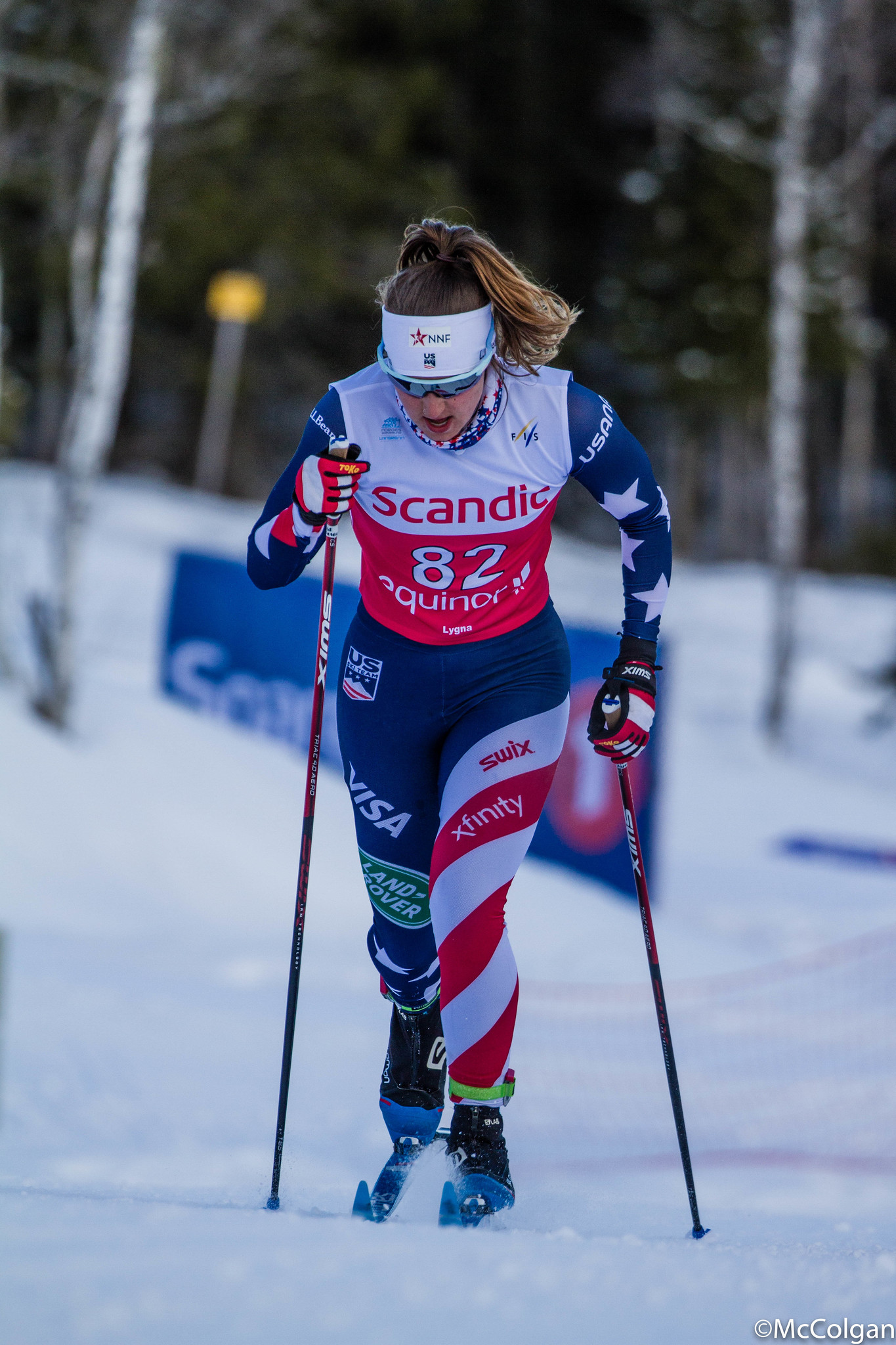
    Let’s get back to Xavier McKeever, Olivier Léveillé, Thomas Stephen, and Remi Drolet; starting in bib 11 for Canada. It clicked today for this group. Good skis? Surely. Inspired by their U.S. neighbors? Perhaps. Stoked by their on-site talisman Devon Kershaw (in Germany to coach)? Does that need an answer?

    No matter how you spin it, this was the race of the day. Certainly unexpected, and certainly deserved for a program rebounding from low funding and in the midst of a rebuild.

    At the 10 k mark, Italy, at 30.8 seconds behind the U.S., was trailed by Norway, Switzerland, Canada, and France — all within roughly seven seconds. That five team pack moved together through the final tag off at 15 k. Glued together through 16.8 k, only Norway fell off the pace. 1.5 k later, and it was Italy’s turn to feel the burn, as they fell off too. 

    That left Canada and Switzerland 10 seconds ahead of the now trailing Italians. By the time the next k had clicked by, Drolet, who was coming off a stellar fourth in the junior men’s 30 k mass start skate, made it real: he gapped the Swiss by 20 seconds. 

    It’s worth mentioning again – Canada in second overall, 35.5 seconds off the winning pace. The Italians rebounded as the Swiss fell back. Italy took third (+55.4), the Swiss placed fourth (+1:34.4).

    “This is absolutely incredible,” Drolet said to Nordiq Canada after the race. “We were so stoked to start this race, and we told ourselves last night we are going to go for the medal today. This is one of the best, if not the best, World Juniors for a Canadian team in terms of results. Knowing everyone on the relay team had a top-30 at the Championships we knew this was doable.”

    Adding his own poetry to the historic relay for Canada, “People don’t really understand what went down today, but it is insane,” Kershaw told Nordiq Canada.

    Junior Men’s Relay Results 

  • Mass Start day at World Juniors: Remi Drolet 4th, Schumacher 5th…Laukli 5th, McCabe 9th (Includes Audio Interview with USST Coach Bernie Nelson)

    Mass Start day at World Juniors: Remi Drolet 4th, Schumacher 5th…Laukli 5th, McCabe 9th (Includes Audio Interview with USST Coach Bernie Nelson)

    Helen Marie Fossesholm of Norway taking the junior women’s 15 k mass start skate. (Photo: Doug Stephen)

    Wednesday in Oberwiesenthal, Germany World Juniors continued with a 15 k mass start skate for the women. 

    Junior Women’s  15 k Mass Start Skate

    Norway’s Helene Marie Fossesholm (18) won her second race of these championships by taking the mass start skate in 35:55.6 minutes. Fossesholm also won the 5 k interval start classic race on Monday. Poland’s Izabela Marcisz placed second 1:09.3 back. Marcisz also won a bronze in the 5 k classic. Switzerland’s Siri Wigger skied herself into third (+1:10.6). The theme continues, this was Wigger’s second 2020 championship medal, after placing third in the skate sprint. 

    Sophia Laukli (bib 56) skied to 5th overall in the junior women’s 15 k mass start skate. (Photo: Doug Stephen)

    Starting in bib 56, layered well back at the start, was Sophia Laukli (Middlebury) for the U.S. Laukli (19), in her first Junior Worlds, moved up in the pack to place fifth overall (+1:26.5). 

    Novie McCabe (MVNST) skied to ninth (+1:33.0) for her best individual Junior World’s result. Mccabe placed 10th in last year’s championship 15 k classic in lahti, Finland. Kendall Kramer (Fairbanks Nordic) was 24th (+2:54.5), and Sydney Palmer-Leger (SVSEF) did not finish. 

    Novie McCabe on her way to 9th overall in the 15 k mass start skate. (Doug Stephen)

    Interview with U.S. Ski Team Coach Bernie Nelson

    Liliane Gagnon (Skibec Nordique) was the top finisher for Canada in 34th (+3:38.2). Jasmine Drolet (Blackjack Nordic Club) followed close behind in 36th (+3:39.0). Benita Peiffer (Whistler Nordic) placed 49th (+4:43.2), and Elizabeth Elliott (Revelstoke Nordic) skied to 51st (+4:39.1).

    From left to right: Canada’s Jasmine Drolet, Elizabeth Elliott, Benita Peiffer, and Liliane Gagnon. (Photo: Doug Stephen)

    Junior Women’s Results 


    Junior Men’s 30 k Mass Start Skate

    The junior men raced a 30 k mass start skate Wednesday with Norway’s Iver Tildhelm Andersen winning in a time of 1:13:39.0. Anderson medlaed in last year’s Junior World’s, placing third in the 10 k skate.

    Second place went to Germany’s Friedrich Moch who crossed the line 9.4 seconds back. Moch also placed second in Monday’s 10 k classic. Third place went to Martin Kirkeberg Mørk of Norway, who was 32.8 seconds off the winning pace. 

    Remi Drolet of Canada skiing to 4th overall at the Junior World’s 30 k mass start skate. (Photo: Dough Stephen)

    Scrolling not so far down on the results sheet to places fourth and fifth, respectively, added some excitement for North America; Remi Drolet (Black Jack Nordic) of Canada placed fourth overall (+43.2), and Gus Schumacher (AWS) of the U.S. fifth (+56.1). For Drolet, this was a Junior World’s career best result – he placed seventh in last year’s Junior World’s 30 k mass start skate. 

    At 25 k Wednesday, Drolet was positioned sixth overall, 19.4 seconds back on the then leading Moch. He was in a group with Mørk, and Italy’s Davide Graz. Roughly four seconds ahead was Schmacher as their carrot. By 28.8 k, Schumacher had faded slightly, as Drolet moved into fourth.

    Schumacher won Monday’s 10 k classic, and with Wednesday’s fifth, nearly matches his fourth place in the 2019 Junior World’s 30 k mass start classic.      

    Gus Schumacher (bib 1), leading the 30 k mass start skate at the 2020 Junior Worlds. (Photo: Doug Stephen)

    Thomas Stephen (Foothills Nordic) of Canada, placed 17th (+3:35.8), Xavier McKeever (Foothills Nordic) 32nd (+5:43.3), and Michael Murdoch (Whistler Nordic) 45th (+8:23.5). 

    For the U.S., Luke Jager placed 19th (+3:46.1), Johnny Hagenbuch (SVSEF) 20th (+3:49.2), and Zanden McMullen (APU) 35th (+6:03.3). 

    Luke Jager (bib 13) and Johnny Hagenbuch (bib 7), during the junior men’s 30 k mass start skate. (Photo: Doug Stephen)


    Thomas Stephen skiing to 17th overall in the Junior World’s 30 k mass start skate. (Photo: Doug Stephen)

    These events conclude individual racing for the juniors at these World Championships. 

    Junior Men’s Results


  • Norway’s Helene Marie Fossesholm Wins World Junior’s 5 k Classic; Laukli 13th, Kramer 22nd

    Norway’s Helene Marie Fossesholm, pace-perfect, during the women’s 5 k classic at the 2020 Junior World Championships. (Photo: Doug Stephen)

    Monday’s World Junior’s 5 k classic in Oberwiesenthal, Germany was won by Norway’s Helene Marie Fossesholm in 13:49.1 minutes. Germany’s Lisa Lohmann placed second (+15.7), and Izabela Marcisz of Poland was third (+28.1). 

    Fossesholm was the top qualifier in Saturday’s skate sprint. She finished fifth overall in the sprint. 

    Sophia Laukli (Middlebury) was the top North American in 13th (+51.6). She was followed by teammates Kendall Kramer (Nordic Ski Club of Fairbanks) in 22nd (+58.4), Sydney Palmer-Leger (SVSEF) 43rd (+1:31.6), and Mara McCollor (Minneapolis Ski Club) 60th (+2:23). 

    Sophia Laukli (U.S.) and Jasmine Drolet during the 5 k classic at 2020 Junior Worlds. (Photo: Doug Stephen)

    Jasmine Drolet (Black Jack Ski Club) was the top Canadian in 32nd (+1:18.6). Molly Miller (Black Jack Ski Club)  47th (+1:41.5), Benita Peiffer (Whistler Nordic) 49th (+1:48.8), and Liliane Gagnon (Skibec Nordique)50th (+1:50.5). 

    Racing continues for the junior women and men on Wednesday with mass start skate races. 

    Results

    Kendall Kramer of the U.S., skiing to 22nd overall in the World Junior’s 5 k classic. (Photo: Doug Stephen)
  • MSA Trials Wrap-up: Tactics, Selections, Photos, and Videos

    MSA Trials Wrap-up: Tactics, Selections, Photos, and Videos

    Emily Nishikawa leads out the U20 and Open 15km at MSA Trials. (Photo: Doug Stephen)
    Emily Nishikawa (bib 1) leads out the U20 and Open 15km at MSA Trials. (Photo: Doug Stephen)

    Mont Sainte-Anne brought great ski conditions on a weekend where the best in Canada fought to qualify for four different race trips: U20/U23 World Championships in Oberwiesenthal, Germany; Falun and the Scando Tour; the sprint tour of Québec and Minnesota; and World Cup finals in Canmore. Combine this with the usual NorAm action and COC leader competition and you have all the ingredients for a great weekend.

    Over 400 athletes raced in five age groups with over 150 competing for U20 selection.

    For all four trip selections, Nordiq Canada will be making a list and checking it twice. Or maybe more than twice. For U20, five athletes of each gender are selected, starting with the top skier on Sunday, then Friday, then Saturday and starting again with Sunday’s second place. For U23, four or five skiers will be selected the same way. The Sprint Tour averages the qualification and heats points to rank athletes to be selected after pre-qualified athletes. The Canmore weekend similarly sums the two distance days. With 10 Host Nation starts allocated in addition to the ones Canada has earned, there are many start opportunities. Most of the paths to guarantee a spot on next year’s National Team begin with qualifying for one of the above. But no pressure.

    Each COC leader gets their own start allocation at every World Cup for the period. As there are no more NorAm (Continental Cup) events until Nationals beginning on March 26, the COC leader as of today retains this for the rest of the World Cup season. The best five of nine races are counted, which means Katherine Stewart-Jones had the women’s spot locked up in December. Antoine Cyr came into this weekend with the leader’s bib and a win Saturday was enough to keep it, according to Nordiq Canada.

    After Friday’s free technique sprints and Saturday’s interval start classic, Sunday brought mass start skating and longer distances.

    The U20 and open women started the day with 15km on the same hilly 5km course as Saturday. Emily Nishikawa and CNEPH’s Cendrine Browne got away early before Nishikawa broke clear on the final long climb to win in 43:44.1, with Browne 13.4 seconds back. Browne’s teammate Laura Leclair spent most of the race alone and held off a charging pack to finish third for the top U23 result, 1:45.4 behind, just 0.8 seconds ahead of the top U20 finisher, Revelstoke’s Elizabeth Elliott. Black Jack’s Jasmine Drolet was edged out into 5th but should still have earned the trip to U20’s in Oberwiesenthal.

    Nishikawa spent a rare winter period back in Canada and enjoyed the change.

    “It was great to be home in Canmore, and I got a good block of training in before heading back to the World Cup,” Nishikawa emailed. “It was very fun to be able to race in Canada – in Whistler and here in MSA, and now I feel ready to get back on the World Cup.”

    Nishikawa, who was 25th overall in the 2019 Tour de Ski, is focussed on the Scando Tour and racing back home in Canmore.

    Browne, who is bouncing back from a tough year, was happy to be back in the game. “The race felt really good, I had good legs and great skis. I really liked skiing with Emily, it was fun to race with her again,” Browne wrote. “I should’ve taken more relays and rested more so I maybe could’ve followed Emily when she attacked at 14km. Unfortunately, when she did attack, my legs were fried!”

    Browne, a distance specialist who loves the skate days, was also excited to have won the sprint on Friday.

    “Winning a sprint was very fun! It was a big confidence boost! It was also a pretty tactic race, which was very fun too.”
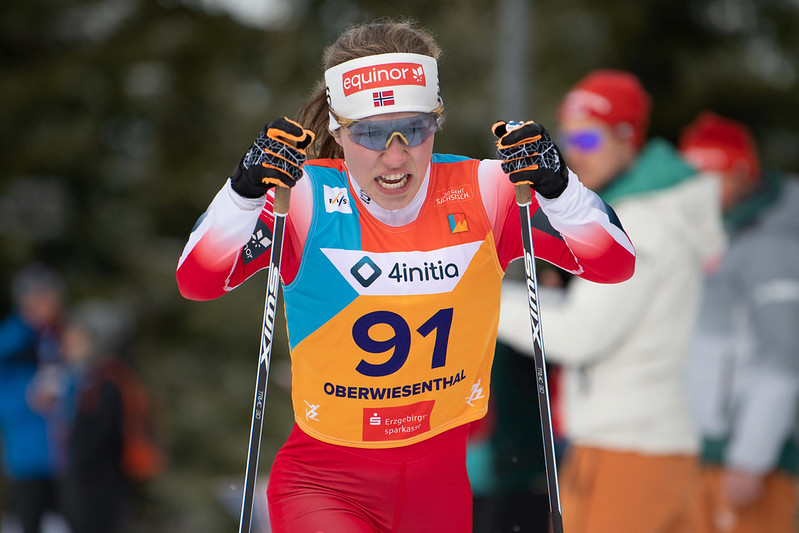
    The applause and support is always there for the good days, but no athlete has only good days.

    “Last year was very tough for me, as for many athletes after the Olympics, Browne continued. “I was very depressed and wasn’t having fun anymore. It was also very hard to lose all support from my federation. After that tough year, I had a severe concussion (in the end of August till mid November) so coming back strong is such a big relief. I feel so much better, physically and mentally and I’m confident that I have a good form.”

    Writing about the tough times feels like kicking an athlete when they are down. It is much easier to write about an athlete when they are scrambling to catch a flight to Falun. It looks like some athletes will be at the airport before we have a confirmed published list of who is joining Browne and Nishikawa for period 4 of the World Cup. (To be fair, that list is one of four that has to be written and double-checked by officials who also have flights to make today.)

    “Today’s race was tough,” Leclair wrote to FasterSkier. “I skied alone and had a pack of 10 skiers chasing me the whole time. I would have liked to ski with Emily and Cendrine but lost them in the first lap. However, I did what I had to do and I am happy with how I skied considering I was alone.” Leclair will be going to a CNEPH elevation camp in Livigno, Italy, on her way to U23 Worlds.

    Russell Kennedy leads the pack early, with Rémi Drolet (#108), Philippe Boucher (#104), Sam Hendry (#107), and Ricardo Izquiedro-Bernier (#106) keeping a close eye. (Photo: Doug Stephen)
    Russell Kennedy leads the pack early, with Rémi Drolet (#108), Philippe Boucher (#104), Sam Hendry (#107), and Ricardo Izquierdo-Bernier (#106) keeping a close eye. (Photo: Doug Stephen)

    The men skied 30km and many said they were feeling the big climb by lap six. Black Jack’s Rémi Drolet animated the race early before Canmore’s Sam Hendry made a big move on the final lap to explode the pack of ten. In the end, it was Team R.A.D.’s Evan Palmer-Charrette who emerged to take the win in 1:15:49.7, with Fondeurs-Laurentides’ Ricardo Izquierdo-Bernier at 0.3 seconds and top U23 Hendry at 0.4. CNEPH’s Phil Boucher was fifth at 5.3 ahead of Rémi Drolet who took his third U20 win at 11.2 seconds back.

    Foothills’ Tom Stephen popped out of the second pack to book his trip to Germany as the second fastest U20, 2:04.6 behind the winner and 11th overall.

    “The race today went very well for me,” Palmer-Charrette explained in an email. “My plan from the get go was to match any move and stay in contact, the final kilometre is very high speed and my plan was to wait until there to make a move, so it played out perfectly.”

    “Race went pretty well today,” Hendry wrote of his Sunday. “I skied in the group and did the best job I could to save energy. Coming up to the last climb I moved into the front of the pack to avoid traffic and found myself pulling away from the group so went all in and attacked hard over the final climb. I then had a few second lead and tried to hang on until the end of the course but blew up in the final meters and was passed by Evan and Ricky.”

    Like many of the other athletes, Hendry is balancing full time studies with skiing.

    “Full time school and racing is going great. The University of Utah is super accommodating and want to see me succeed in not only academics and college racing but also international competitions such as these trials and U23’s.” That balance only goes so far. In addition to collegiate racing and U23’s, Hendry is hoping to ski World Cup Finals in Canmore (which may require a good result from him in Germany), but nationals is not on the program.

    Boucher should have earned his trip to Canmore with a 4th and a 5th in distance this weekend.

    “The race went well,” he wrote. “I managed to react well on Sam’s move in the last km. It blew the pack in small groups. So the only tactic here was to survive until the end. But in general, the plan for today was to try to stay in the front of the pack in the uphills, so I dont get caught behind if someone makes a move.”

    While many athletes are enjoying the new race calendar with less east/west flights to races, Boucher also sees a downside: less races.

    “I think there’s a lack of races. We currently race 1 weekend per month… I train all summer long to race in the winter so it’s a shame when we dont have a lot of racing to do in North America.  I had a difficult start in December but at least I had some good racing at the U.S. Nationals in Houghton early in January. And then here at MSA, it’s been one of my best racing weekends of the season so far. My race shape is raising and that’s good sign for the coming races.”

    Nordiq Canada’s Jeff Ellis, Joel Jaques, and Erik Bråten have talked to FasterSkier about balancing the need for lots of races, reduced travel costs, and reduced challenges to host regional races. Watch this space.

    While some athletes will go home happy with their race efforts and others won’t, it seems like everyone enjoyed their weekend. Palmer-Charrette put it best: “The conditions here for the whole weekend were really good, the [Organizing Committee] did a great job with the trails. Yesterday turned out to be a slightly tricky waxing day and on a relatively flat high speed course there were definitely a few athletes caught out with icing issues, however that’s the game of classic racing. For the sprint and today, conditions couldn’t get any better really, so it made for exciting races.”

    Results: Full Weekend, Sprints, Interval Start Classic, Mass Start Skate.

    Photographer Doug Stephen has more evidence of the great trails in his Sunday Gallery. Athletes are welcome to download and use full resolution images if they give credit to ‘Doug Stephen’ or @vr45photography.

    Olivia Bouffard-Nesbitt leads Jasmine Drolet, Elizabeth Elliott and Liliane Gagnon in pursuit of the top 3. (Photo: Doug Stephen)
    Olivia Bouffard-Nesbitt leads Jasmine Drolet, Elizabeth Elliott and Liliane Gagnon in pursuit of the top 3. (Photo: Doug Stephen)
  • MSA Trials Rundown: Classic Interval Starts

    MSA Trials Rundown: Classic Interval Starts

    Russell Kennedy (#46) caught Sam Hendry (#45) and Nicolas Beaulieu (#44) on his way to third place in the 15km. (Photo: Doug Stephen)
    Russell Kennedy (#46) caught Sam Hendry (#45) and Nicolas Beaulieu (#44) on his way to third place in the 15km. (Photo: Doug Stephen)

    Fresh snow greeted day two of the Mont Sainte-Anne Trials for the interval start classic. With athletes battling to qualify for U20/U23 World Championships in Oberwiesenthal, Germany and three separate World Cup trips (Falun/Scando Tour, Sprint Tour, Canmore), it was never going to be a simple matter of skier against the clock.

    Antoine Cyr rocking the NorAm leader's bib on the way to victory. (Photo: Doug Stephen)
    Antoine Cyr rocking the NorAm leader’s bib on the way to victory. (Photo: Doug Stephen)

    Racing started with the open men’s 15km on a 5km loop that was shared by all the elite categories. Early on, it looked like a tight four way battle, but CNEPH’s Antoine Cyr, starting last, was 14 seconds ahead after the first lap. Cyr was fastest on all three laps to win in 40:05.1, 47.5 seconds ahead of Fondeurs Laurentides’ Ricardo Izquierdo-Bernier and 51.6 ahead of Canmore’s Russell Kennedy. Cyr should be selected for U23’s based on this win. In the interview posted below, he talks about his relief to know that his form is still good after a disappointing first World Cup in Europe.

    The U20 and U18 men raced 10km  and once again Black Jack’s Rémi Drolet displayed that full time students can be competitive, as he won both laps to finish in 26:46.2. CNEPH’s Olivier Léveillé took advantage of a late start bib to narrowly beat ULLR’s Xavier McKeever, finishing at 35.4 and 39.1 seconds respectively. This result combined with Thursday’s sprint should see both Léveillé and McKeever selected for U20 Worlds.

    Olivier Léveillé took second place and pencilled his name on a ticket to Oberwiesenthal. (Photo: Doug Stephen)
    Olivier Léveillé took second place and penciled his name on a ticket to Oberwiesenthal. (Photo: Doug Stephen)

    (Drolet’s post-race interview starts with the punchline to a joke, but without the setup we miss the laugh.)

    In the women’s 10km, Emily Nishikawa continued the theme of winning every lap on her way to a clear victory in 29:51.2. CNEPH’s Cendrine Browne showed that her recovery is going well with a strong second place in her less-favoured technique, finishing 48.7 back. Laval University’s Andrée-Anne Théberge completed the podium, 2:04.7 back.

    Emily Nishikawa on a mission. (Photo: Doug Stephen)
    Emily Nishikawa on a mission. (Photo: Doug Stephen)

    AWCA’s Annika Richardson was 4th at 2:15.4 to take the top U23 finish and what should be a selection for U23 Worlds.

    By the time the U20 and U18 women headed out, the tracks were showing some wear, but that didn’t stop Black Jack’s Molly Miller from winning the 5km in 15:24.8, 10.9 seconds ahead of teammate Jasmine Drolet, and 11.0 ahead of Revelstoke’s Beth Granstrom. Revelstoke also took fourth with Alexandra Luxmoore at 11.1 seconds, only 0.2 seconds away from silver.

    Molly Miller attacking the 5km classic at MSA Trials. (Photo: Doug Stephen)
    Molly Miller attacking the 5km classic at MSA Trials. (Photo: Doug Stephen)

    Black Jack defended their club’s reputation for developing young skiers with three U20 wins so far this weekend. Revelstoke is also starting to make waves with yesterday’s winner Elizabeth Elliott 11th today at 47.6 seconds. With 86 U20 and U18 men and 72 U20 and U18 women competing today, the future of Canadian skiing is starting to look brighter.

    Sunday’s free technique mass starts should be exciting, with the U20 and Open categories merged so the younger athletes can measure themselves against the top seniors.

    Results: Full Weekend (including live timing for Sunday), Interval Start Classic

    Photographer Doug Stephen has a new gallery for Saturday. Athletes are welcome to download and use full resolution images if they give credit to ‘Doug Stephen’ or @vr45photography.

  • Canadian Western Championship: Weekend Wrap-up

    Canadian Western Championship: Weekend Wrap-up

    Julien Locke leads Rémi Drolet and Sam Hendry in the second lap at Westerns 2019. (Photo: Doug Stephen)
    Julien Locke leads Rémi Drolet and Sam Hendry during the second lap at Westerns 2019. (Photo: Doug Stephen)

    KELOWNA, B.C —

    One week after Easterns, it was time for Westerns, and the Polar Vortex made the trip for both weekends.

    At Easterns, the air was cold enough to keep the organizing committee on edge at the start of the weekend, and freezing rain complicated driving  plans. At Westerns, the cold weather held off to Sunday, but falling snow on dry, salted roads created a sheet ice for Friday’s commute. Both championships had less athletes than expected, with driving conditions and weather predictions having an effect.

    Photo albums and result links follow the daily summaries.

    Friday, Skate Sprint

    Tallon Noble leads Sam Hendry in junior men's A final. (Photo: Greg Redman)
    Tallon Noble leads Sam Hendry in the junior men’s A final. (Photo: Greg Redman)

    The action kicked off Friday with skate sprints at the Telemark Nordic trails near Kelowna, B.C., in sunshine and -11C.

    Benita Peiffer (Whistler) won the 1.3km A final in 3:02.79, 0.10 seconds ahead of top qualifier Katie Weaver (RMR). Elizabeth Elliot (AWCA) took third, 2.77 back after qualifying second.

    “I felt really confident going into the final,” Weaver told FasterSkier. “I led all of the race, right until the finishing stretch and Benita came up, and I think she got me right at the end.”

    Despite placing second, Weaver was happy with her tactics: “I wasn’t super confident with my hop offset on those tough hills, so my goal was to get out into the lead and control the race. Kinda position myself well so I could have a good finish.”

    Peiffer and Elliot grew up racing together before Elliot moved to Canmore, and were clearly enjoying racing together again, completing each other’s sentences during the post-race interview.

    Elliot: “It was really fun, we had all the BC skiers that we grew up skiing with. It was super-fun to all be with each other in the same heats and…”

    Peiffer: “…Back to the good old days of racing together.”

    Tactics were also a shared vision.

    Peiffer: “You stay with the pack going up the big hill, and then it’s really easy to draft because you have a really long downhill.”

    Elliot: “If your skis work for you.”

    The open men raced the same course and Julien Locke (CNST) was in dominant form, winning the qualifier and each heat by over 3 seconds, taking the A final in 2:28.23.

    “I’m just here to race hard,” Locke said after his cool down ski, “so I just raced hard every round.” Locke has been fast in 2019, winning the sprints at US Nationals, Easterns, and Westerns, but he would probably trade any one of those to improve on his second place at the World Championships qualification sprint at Bishop’s University.

    Junior national team member Rémi Drolet (Black Jack) outreached Telemark’s own Gareth Williams (CNST) to take second, 3.42 behind Locke and 0.03 ahead of Williams.

    “Tactics were tough for me,” Drolet said. “I was slow off the start, so I was behind a little bit. Basically, I had to catch up so I was really focusing on pushing over the tops of hills really hard. In the end, it was a sprint to the finish between Gareth and I. Julien was a bit ahead [laughs at the understatement]. It was fun.”

    Williams was bouncing back after getting ill on the trip home from U23’s in Lahti and leaving Easterns without starting a single race.

    “I started to feel better round after round, because I hadn’t done any intensity at all, so the feelings were coming back, but I kind of lost it there on the last hill,” he said. “My legs felt really heavy and I pushed really hard but it wasn’t quite enough to out sprint Rémi, and not enough to keep up to Julien Locke either.”

    312 athletes raced in good conditions on a day where the driving conditions were anything but good.

    Xavier McKeever won the junior boys qualifier and every heat at Westerns 2019. (Photo: Greg Redman)
    Xavier McKeever won the junior boys qualifier and every heat at Westerns 2019. (Photo: Greg Redman)

    Saturday, Classic Mass Start

    The new 5km loop at Telemark received a homologation certificate less than a week before the event, but it was immediately put to use with the men doing three classic laps and the women doing two in -11C air and intermittent light snow.

    The men raced first, with Locke, Drolet, Williams, and Sam Hendry (Team R.A.D.) taking an early lead.

    Williams dropped out early in a race he probably shouldn’t have started. It is hard to miss a race for illness, and harder still when the local tv station is there to see their hometown star, and your mum is the race secretary.

    Black Jack teammates Locke and Drolet put the hurt on Hendry early, before Drolet broke clear to win alone in 42:18.4, 4.8 seconds ahead of Locke. Hendry hung on for third, losing 42.2 seconds on the final lap.

    “I tried my best to hang on to the pace, but Rémi’s in great shape right now, coming off his big results at world juniors, so [it was] hard to stick on,” Hendry said after. “My skis weren’t quite as fast as the others. On all the downhills, they’d open up a little gap and I’d have to try to bring it back on the climbs and the flats.”

    “Rémi and Sam were skiing fast, it was fun to battle with them,” Locke said. “I’m a little bit stronger on the flats, [Rémi’s] a bit of a stronger climber. We were pushing each other and just trying to ski fast and work together.”

    “It was a really fun race today,” Drolet said after doping control “It was a decent pace off the start, skiing with my teammate Julien, Gareth for a bit until he unfortunately dropped out, and then Sam Hendry. It’s a pretty hilly course, so there’s not a tonne of double poling, but I think the parts of it that are double pole are important to ski well and conserve energy for the uphills.”

    Drolet and Locke worked well together, up to a point. “Once Sam started to fade a little bit, we attacked and dropped him off,” Drolet explained. “Then we skied together for the rest of the race until the final climb, where I managed to pull away from him.”

    Novie McCabe (61) leads Jasmine Drolet, Katie Weaver, and Molly Miller at the 2019 Westerns 10km. (Photo: Doug Stephen)
    Novie McCabe (61) leads Jasmine Drolet, Katie Weaver, and Molly Miller at the 2019 Westerns 10km. (Photo: Doug Stephen)

    The open women’s 10km was all about the next generation. Novie McCabe (Methow) got away early to win in 32:42.6 minutes. Black Jack teammates Jasmine Drolet and Molly Miller were second and third at 53.4 and 1:28.1 back. All three are in the junior girls category and competed at Junior Worlds in Lahti.

    “I basically went out from the start hard, and tried to hold it,” McCabe told FasterSkier. “Going up the first hill, I tried to get into the lead and then on the double pole section I tried to make a break and just push hard into a downhill and that’s where I kind of gapped people by a little bit and then I just went from there.”

    As an American, McCabe has a Canadian Points List ranking that put her in the third row at the start. Asked about whether this is good practice for racing in Europe, she replied “Yeah, it was definitely good to have some practice with that, navigating my way through people.”

    Jasmine Drolet, at sixteen, a year younger than the other two on the open podium, kept things simple in the interview, describing her day as “good race, good skis.”

    “In Canada it’s not hard to be the fast one, but when you get there [at World Juniors], it’s quite a shock,” Jasmine Drolet explained. “It’s good to ski with the best in world.”

    “I haven’t been feeling super great in a lot of the distance races this year, so I was happy to have a better day today,” Miller said at the end of the day. “It was a bit aggressive in the beginning for sure. I came out of the lanes in a bad place, but it seemed to spread out very quickly.”

    Among the 386 racers were some of Canada’s para-nordic team, here to prepare for World Championships starting the following Saturday.

    “Races are always better than intensity,” Mark Arendz (CPNST) told FasterSkier post-race. “We’re using this as an intensity, just this single race from Westerns, to prep for World Championships in Prince George [B.C.] next week.”

    (In the video below, you can see Arendz in the open men’s start, look for the national team suit, second lane from left.)

    Sunday, Relays

    The temperature, despite predictions, reached -17C by 9:00, allowing the relays to start on time.

    For most, the relays are really about having fun with friends. The results are summarized in Sunday’s rundown.

    “Relay events are always fun races, even in -17 conditions,” Rémi Drolet wrote in an email Sunday night. “It also does not matter how far ahead or behind you may be. It is always important to go as fast as possible since it can be hard to predict exactly what will happen after you have tagged your teammate.”

    105 teams braved the cold to enjoy another good event at Telemark.

    Course and Venue

    “It’s a good course, I love racing here. Steep hills, some nice gradual stuff, it’s a good combination of all techniques.” — Locke, talking about the new sprint course

    Julien Locke leads early in the first lap of the 15km. (Photo: Peggy Hung)
    Julien Locke leads early in the first lap of the 15km. (Photo: Peggy Hung)

    “My first race [here] was in 2005, my first ever provincial race, BC Midget Championships. I was 13 years old and that was my first race outside of the Kootenays. It was a pretty big day for me.” — Locke

    “Seeing the young kids racing this weekend certainly brought back memories.  Kelowna was one of the locations where I raced most in my younger years, and it was there that I learned many of the fundamentals of racing.  Much of my early understanding of race preparation, tactics, and even technique was developed racing at Telemark.” — Rémi Drolet

    “Super nice day, super great course, not too cold. Another great race at Telemark.” — Hendry, on Saturday

    “It’s really nice to just be able to come up here and have some great competition and the races are really well organized.” — McCabe, on crossing the border from the Okanogan Valley in Washington state to the Okanagan Valley in B.C.

    Photos and Results

    Doug Stephen has albums on Flickr: Sprint, Classic, and Relay

    On zone4 results, click on a skier’s name to pull up pictures of that athlete in the selected event. Greg Redman, featured here, is one of the photographers contributing. There are a lot of photos, with over 60 photos of some athletes in some events.

    Results: Qualifier, Heats, Classic, Classic Para, Relay, Full Weekend

    Note that masters and the youngest athletes are in the Okanagan Cup links under Full Weekend, and some of the para athletes competed in the open category for the classic race.

  • Saturday Race Rundown; Caldwell Second in Lahti; Canadian Westerns

    Saturday Race Rundown; Caldwell Second in Lahti; Canadian Westerns

    Norway’s Maiken Caspersen Falla taking the World Cup win in the 1.4 k skate sprint in Lahti, Finland. Sophie Caldwell of the U.S. Ski Team placed second. (Photo: fis-ski.com screenshot)

    FIS World Cup Lahti, Finland 1.4 k/ 1.6 k Freestyle Sprint

    In the women’s skate sprint qualifier in Lahti, Finland Slovenia’s Eva Urevc laid down the fastest time in 2:40.67 minutes. Swiss skier Nadine Faehndrich was the second fastest qualifier, 4.21 seconds back, with the U.S. Ski Team’s (USST) Sophie Caldwell third (+4.36).

    Canada’s Dahria Beatty qualified 25th (+10.21). Also making the heats for the U.S. were Ida Sargent (USST) in 26th (+10.36), and Kelsey Phinney (SMS T2) in 27th (+10.54).

    Of the top three qualifiers, only Caldwell advanced to the finals. The final was won by Norway’s Maiken Caspersen Falla in 2:43.64. Falla advanced to the finals as a lucky loser from the first semifinal. That semi was won by Caldwell who ended up placing second (+0.11) in the final. Sweden’s Maja Dahlqvist sprinted to third overall (+0.37).

    Germany’s Sandra Ringwald placed fourth (+0.46), Norway’s Mari Eide fifth (+0.75), and Tiril Udnes Weng of Norway sixth (+0.94).

    Phinney placed 19th overall, Sargent 30th. Canada’s Beatty was 24th in the final standings.

    Also for the U.S., Julia Kern (USST D-Team) coming off of illness ended her day 38th overall. Hannah Halvorsen (USST D-Team) placed 41st.

    No other North Americans were entered.

    Women’s Qualification | Women’s Results

    Johannes Høsflot Klæbo won the men’s 1.6 k skate qualifier in 2:47.01 minutes. He was followed by teammate Haavard Solaas Taugboel in second (+4.15). Qualifying in third was Finland’s Joni Maeki who clocked a time of 2:51.36.

    Klæbo won the final in 2:52.06 while Italy’s Federico Pellegrino raced to second (+0.30). Norway’s Finn Hågen Krogh was third (+0.61). Also from Norway, Eirik Brandsdal took fourth (+1.31) and Emil Iversen fifth (+1.75). Gleb Retivykh of Russia was sixth (+2.08).  

    No North American men qualified for the heats.

    Logan Hanneman (APU) for the U.S. placed 32nd overall after missing the heats by .22 seconds. Simi Hamilton (USST) finished 36th overall, and Erik Bjornsen (USST) 42nd.

    Evan Palmer-Charette was the lone Canadian entered; he placed 67th.

    Men’s Qualification | Men’s Results

    ***

    Rémi Drolet leads Julien Locke and Sam Hendry at the start of lap three. (Photo: Peggy Hung)
    Rémi Drolet leads Julien Locke and Sam Hendry at the start of lap three. (Photo: Peggy Hung)

    Canadian Western Championships, Telemark, Classic Mass Start

    Day two of Westerns dawned with low clouds and intermittent light snow at -11C for the classic mass starts.

    The men raced first, completing three laps of the new (and freshly homologated) 5km loop. Rémi Drolet (Black Jack) won in 42:18.4, getting from Julien Locke (CNST) on the last climb to earn a 4.8 second gap. Sam Hendry (Team R.A.D.) stayed with leaders until late in the second lap, finishing 42.2 seconds back. Rémi Drolet and Hendry are juniors who represented Canada at Junior Worlds in Lahti last month. Crystal Lust

    The first small climb of the Westerns 10km classic. Jasmine Drolet (#55) leads Novie McCabe (#61) in the left track. (Photo: Peggy Hung)
    The first small climb of the Westerns 10km classic. Jasmine Drolet (#55) leads Novie McCabe (#61) in the left track. (Photo: Peggy Hung)

    The open women skied two laps of the same course, with Novie McCabe (Methow) breaking clear on the first lap to win alone in 32:46.6. Jasmine Drolet (Black Jack) was second at 53.4 seconds followed by teammate Molly Miller at 1:28.1. All three raced at World Juniors in Lahti: Jasmine Drolet is 16 and the other two are 17.

    There were 386 finishers on Saturday.  Racing continues Sunday with relays.

    Results: mass start classic, full weekend

  • Saturday Race Rundown: U.S. U20 Men Win Relay, U20 Women 4th at World Juniors (Updated)

    Saturday Race Rundown: U.S. U20 Men Win Relay, U20 Women 4th at World Juniors (Updated)

    The U20 World Juniors 4 x 5 k relay first place team from the U.S, (l-r) Johnny Hagenbuch, Ben Ogden, Luke Jager, and Gus Schumacher. (Photo: JWSC2019 / Mikaela Takala)

    2019 U23 World Ski Championships in Lahti, Finland 4 x 3 k and 4x 5 k relay

    Full U20 Men’s Race Report

    In a historic first for the U.S., the U20 men’s team won the 4 x 5-kilometer relay today in Lahti, Finland at the 2019 World Junior Ski Championships. Luke Jager skied the first classic leg for the U.S., Ben Ogden skied the second classic, Johnny Hagenbuch skied the first initial skate leg and Gus Schumacher raced the anchor leg.

    The foursome won in a time of 45:34.7 minutes, and beat second-place Russia by 3.8 seconds.

    Russia’s team was comprised of Egor Trefilov, Andrey Kuznetsov, Yaroslav Egoshin, and Alexander Terentev.

    Germany’s team of Jakob Milz, Florian Knopf, Anian Sossau, and Friedrich Moch took third finishing 6.3 seconds behind.

    For Canada, Remi Drolet , Sam Hendry, Xavier McKeever, and Thomas Stephen skied to 11th (+2:29.7).

    Nineteen teams were entered in the race.

    Men’s U20 Results

    In the 4 x 3.3 k U20 women’s race, Norway’s Kristin Austgulen Fosnaes, Astrid Stav, Helene Marie Fossesholm, and Kristine Stavås Skistad won at the line in 35:24.7 minutes.

    Russia’s Anastasia Faleeva, Kristina Kuskova, Veronika Stepanova, and Anna Grukhvina were a close second, stopping the clock 1.0 seconds back.

    Louise Lindström, Frida Karlsson, Tilde Baangman, and Lin Svahn for Sweden placed third (+33.3).

    The U.S. team of Mara McCollor, Kendall Kramer, Sydney Palmer-Leger and Novie McCabe skied to fourth place, 40.5 seconds back.

    For Canada, Anne-Marie Petitclerc, Jasmine Drolet, Anna Pryce, and Molly Miller placed 11th, 3:01.4 minutes behind.

    U20 Women’s Results

    ***

    FIS Cross Country World Cup Ulricehamn, Sweden 10/15 k freestyle

    In what is his skiing canvas, the 15 k freestyle, France’s thirty-two-year-old Maurice Manificat won his first World Cup of the season in Ulricehamn, Sweden today in 34:55.4 minutes. It was a tight race in that Norway’s Simen Hegstad Krüger Simen Hegstad Krüger who placed second finished 1.1 seconds back. Teammate Didrik Tønseth was third (+8.7).

    Canada’s Alex Harvey was the best placed North American in ninth (+31.4). Lenny Valjas skied to 57th (+2:32.1), and Bob Thompson 77th (+4:16.6).

    For the U.S., Scott Patterson finished 35th (+1:26.5), David Norris 53rd (+2:11.3), Ben Lustgarten 64th (+3:04.7).

    Men’s Results

    Norway’s Therese Johaug kept her distance win streak alive at eight wins in eight starts on the World Cup this season. She won the women’s 10 k skate race in 25:48.2 minutes, with teammate Astrid Uhrenholdt Jacobsen in second, 22.8 seconds back. Third place went to Sweden’s Ebba Andersson, 24.9 seconds behind.

    The U.S. Ski Team’s Jessie Diggins skied to fourth place (+38.3), while teammate Sadie Bjornsen was 15th (+1:25.1). Caitlin Paterson (CGRP) had her best World Cup result of the season, skiing to 23rd (+1:49.9). Rosie Brennan (APU) placed 28th (+2:03.2), and Rosie Frankowski 42nd (+2:28.0).

    Dahria Beatty was the only Canadian entered. She finished 56th (+3:54.7).

    Women’s Results

    ***

    IBU World Cup Antholz, Italy 10/12.5 k pursuit

    In the women’s 10 k pursuit, Italy’s Dorothea Wierer won in a time of 29:20.1 after skiing two penalties (1+0+0+1). Second place went to Germany’s Laura Dahlmeier, who finished 6.0 seconds after Wierer after one missed shot (0+0+1+0). Saturday’s third place went to another Italian, Lisa Vittozzi, who finished 16.2 seconds behind the winner after tying Wierer’s shooting score.

    Clare Egan led the way for the U.S., racing to 11th (+1:31.9) after skiing two penalties (0+0+0+2).

    “I’m really happy with my race today,” Egan wrote in an email. “The wind and altitude are always a challenge here, but I took my time on the range and capitalized on the fast glide of my skis to save energy on course. I made a costly and dumb mistake on my last shot but still came away with my second-best career result. I’ll take what I learned from today and go for it again tomorrow in the mass start! Can’t wait!”

    Joanna Reid was the next American to finish, placing 29th (+2:55.2) after three missed shots (1+0+0+2).

    For Canada, Rosanna Crawford finished 34th (+3:30.8) after skiing five penalties (2+1+1+1) and her teammate Megan Bankes finished 39th (+3:37.1) with five misses (1+0+3+1). Also skiing for Canada, Sarah Beaudry placed 46th (+5:07.5), also with five penalties (4+0+1+0).

    Women’s 10 k Results

    In the men’s 12.5 k pursuit, Norway’s Johannes Thingnes Bø
    won in a time of 31:33.7 after skiing three penalties (1+1+0+1). France’s Antonin Guigonnat raced to second place, 34.8 seconds behind with one missed shot (0+0+1+0). The third and final podium spot on Saturday went to France’s Quentin Fillon Maillet, who skied two penalties (1+0+0+1) and finished 40.6 seconds back from the winning time.

    Sean Doherty for the U.S. placed 47th (+4:39.1, 3+2+1+0). Jake Brown was lapped and was not given an official time.

    For Canada, Jules Burnotte skied to 54th (+5:42.8, 1+3+1+1), and Scott Gow 55th (+6:39.7, 4+0+2+3).

    Men’s 12.5 k pursuit results

    ***

    Lake Placid SuperTour Classic Sprint

    Canada’s Antoine Briand (CNEPH) was the fastest qualifier on the day in 3:14.71 minutes and won the men’s final. Dominique Moncion-Groulx (Nakkertok) placed second in the final, with Ben Saxton (SMS T2) in third.

    Saxton was the second fastest qualifier, with Oliver Hamel (CNEPH) third fastest.

    Men’s Qualification | Men’s Heats

    For the women, Sophie Caldwell (USST/SMS T2) scorched the qualifier in 3:40.44 minutes with Jessica Yeaton (APU/Australian National Team) qualifying in second (3:50.49). Dartmouth’s Katharine Ogden qualified third (3:51.79).

    Caldwell went on to win the final in 3:37.06, with Yeaton in second and Kelsey Phinney (SMS T2) in third.

    Women’s Qualification | Women’s Heats


  • U20 Worlds 15 k/30k Classic Mass Start Rundown: A Big Day for the U.S. and Canada

    U20 Worlds 15 k/30k Classic Mass Start Rundown: A Big Day for the U.S. and Canada

    Gus Schumacher leading the pack with teammate Ben Ogden (pink hat) and Canada’s Sam Hendry (left) in the draft — during the U20 30 k classic mass start at World Juniors in Lahti, Finland. (Photo: Doug Stephen)

    The mass start classic races for the U20 athletes at the 2019 World Junior World Ski Championships dawned on another crisp, bordering on a frigid day in Lahti, Finland. A scroll through the results makes clear the day was strong for North Americans as the U20 men raced a 30-kilometer classic mass start, the women a 15 k classic mass start.

    In the men’s race, the six laps around the 5 k course which climbed a total of 193 meters each circuit, the top-15 skiers were separated by 17 seconds at the finish. The tight front-pack racing meant there were moments when the U.S. sported four skiers pacing the sharp end of the race.

    Gus Schumacher skiing for the U.S. placed fourth in a four-skier sprint at the line to finish 0.7 seconds behind the winner Luca Del Fabbro of Italy. Del Fabbro won in a time of 1:15:16.7 hours. Norway’s Haavard Moseby placed second (+0.4), and Switzerland’s Cyril Faehndrich third (+0.5).

    On the far left, Gus Schumacher in the podium mix down the stretch in the U20 30 k classic mass start at World Juniors in Lahti, Finland. (Photo: Doug Stephen)

    Canada’s Remi Drolet skied to seventh overall 6.4 seconds back.

    “Going into the race, the strategy was to stay relaxed and save as much energy as possible over the thirty kilometres,” Drolet emailed. “The plan was to get near the front, avoid mishaps, and be ready for when the speed increased and the pack was strung out.”

    Actualizing the strategy in terms of mishaps was another story on Drolet’s journey to seventh place.

    “Overall, I am very happy with how I skied today,” Drolet continued. “I executed my plan quite well and was able to stay calm and ski well even when I was involved in a collision and lost both of my skis. I had a lot of fun out there, and it was incredible to race against the best juniors in the world in some of the best conditions for classic skiing.

    “Going into the championships and into this race, I was really hoping to achieve a top 10 result.  In the first two races, I had decent results but was not quite there. It was encouraging, however, that I was improving everyday, and the second half of the skate race was quite good for me.  I also knew that the 30-kilometre classic race would likely be my best, and I showed up to the start line ready to leave everything I had out on the track. It certainly felt great when I crossed the finish line knowing I had achieved this goal!”

    Canada’s Remi Drolet after his seventh place in the U20 30 k classic mass start at World Juniors in Lahti, Finland. (Photo: Doug Stephen)

    For the U.S., Ben Ogden finished 10th (+9.0), Luke Jager 13th (+14.9), and Johnny Hagenbuch 17th (+25.6).

    Sam Hendry of Canada raced to 20th (+44.6), Tom Stephen, at sixteen years old placed, 23rd (+1:07.3), and Pierrick Sarthou 46th (+6:32.2).

    U20 Men’s Results

    Start of the U20 Worlds 15 k classic mass start in Lahti, Finland. The winner Frida Karlsson is in bib 1. (Photo: Doug Stephen)


    Sweden’s nineteen-year-old Frida Karlsson won the U20 women’s 15 k classic mass start race in a time of 40:45.3 minutes. Helene Marie Fossesholm of Norway was second (+52.1), and Finland’s Anita Korva was third (+58.1).

    This was Karlsson’s second win of these championships after taking the U20 5 k skate race on Tuesday. Karlsson was also the fastest qualifier in last Sunday’s classic sprint – she placed fifth overall.

    Kendall Kramer, a sixteen-year-old U18 skier for the U.S. was the top-North American in the U20 women’s race placing fourth (+1:30.7).

    In perhaps the most earnest and down-to-earth post-race comment FasterSkier has received to date (Kendell’s comments were handwritten), the sixteen year old from Fairbanks, AK. explained the 15 k mass start was a new venture which suited her skiing style.

    “This was my first 15 k I’ve ever done so going into the race I was extremely clueless and nervous about feeds, how aggressive the Scandos would be, how to race etc… but I think the slip-free kick job the techs gave me and my knack for throwing elbows and maintaining my spot which really aided me staying out of trouble early on, which set me up for a comfortable position to ride my 4th place into the finish,” Kendall wrote about her race experience.

    Kendall Kramer on her way to fourth place in the U20 15 k classic mass start at World Juniors in Lahti, Finland. (Photo: Doug Stephen)

    Kramer’s keen eye during the race played into her in-the-moment decision making when it came to how to ski the course.

    “It was all hills and with the slow snow the flats weren’t even flats. I mostly decided to how to take every part of the course by seeing how the older girls in front of me reacted to it,” wrote Kendall.

    U.S. teammate Novie McCabe at 17 years old is a U18 skier skiing up at these Junior Worlds. McCabe finished 10th (+2:19.0) after starting the day in bib 71, way back in the pack of seventy starters. (One skier did not start.)

    “Starting in the back was definitely a bit of a challenge,” McCabe told FasterSkier in the mixed zone. “I thought of it as I had to be patient for sure at the start. But it was also better than I thought it would be going up that first hill. I was able to hop in the outside and get up right out of the start and seeing more numbers in the 30s and 40’s and so I was like ‘oh, that wasn’t that bad’. I kept on trying to work my up and trying to stay calm and patient. There were a few crashes and some of the front girls came back. I ended up skiing in a group with one of the girls who ended up crashing and I tried to hang with her.

    The U20 women’s 15 k classic mass start at the Junior World Championships in Lahti, Finland. Way way back, bib 71, that’s Novie McCabe. (Photo: Doug Stephen)

    “The group got smaller and I knew it was sixth through 12th I think, and I just tried to hang in there. My skis were really fast and I had really good kick so that was really helpful. I just tried to hang in there on the hills and get the best rest that I could. Then on the last part I was trying to hang with the girl ahead of me and I ended up crashing on the last corner, but it was really quick and I just tried to hop up and tuck in behind the ninth-place girl, and ended up hanging in there and finishing 10, it as a really fun race.”

    Novie McCabe (bib 71) on her way to 10th place in the U20 15 k classic mass start at World Juniors in Lahti, Finland. (Photo: Doug Stephen)

    For the U.S., Mara McCollor finished 24th (+3:58.3), and Sophie Mazzoni 48th (+6:19.9).

    Jasmine Drolet was the top Canadian finisher in 36th (+4:51.4), followed by Anne-Marie Petitclerc in 40th (+5:07.6), and Anna Pryce in 46th (+6:07.2).

    U20 Women’s Results

  • Tuesday Race Rundown: Lahti Junior Worlds  U20 5 k/10k Individual Skate (Updated 2x)

    Tuesday Race Rundown: Lahti Junior Worlds U20 5 k/10k Individual Skate (Updated 2x)

    Gus Schumacher skiing to sixth place in the U20 10 k skate during the 2019 Junior Worlds in Lahti, Finland. (Photo: Doug Stephen).

    FIS Junior World Ski Championships Lahti, Finland 5 k/10k Freestyle Interval Start

    Tuesday in Lahti, Finland was as Finland should be: squeaky-snow-cold and cross-country ski racing on offer.

    Eighteen-year-old Gus Schumacher broke through for the U.S. and placed sixth overall in the U20 men’s 10-kilometer freestyle. Schumacher was the 95th starter of 102 finishers on the day. His sixth place finish was consistent with his 1.1k, 5k, and 6.6k splits where he was ranked 5th, 6th, and 7th respectively. Schumacher stopped the clock in 23:19.3 minutes, 44.4 seconds behind the winning mark.

    The Lahti championships are Schumacher’s second Junior Worlds. His sixth place is his best individual result. He was part of the second place 4 x 5 k U20 relay last year in Goms, Switzerland.

    “I was most nervous about hitting it right and doing the right pacing and making sure I can have the best race that know I can,” Schumacher told FasterSkier over the phone. “I approached it as just a new race almost. We have done a fair amount of watching old world cups and world championships that were on the exact same courses here. It was definitely hard to reflect on that because none of them were exactly 10 k. And obviously those athletes are quite a bit stronger than we are. And the snow is different.”

    Schumacher extracted what he needed from the videos. Imprinted in his mind before his 10 k start were enough visuals to quell the nerves and provide a path to fast clean skiing.

    “We watched that and I felt like I got an idea for what the body movements looked like of those guys,” Schumacher said. “I thought about how that would feel for me and I thought about the other middle distance skate races I have done this year –which is actually a fair amount between early season time trials.”

    Schumacher executed his plan. He dialed back the initial effort, stayed in control, and systematically revved the engine.

    “I went out and tried for at least the first five minutes to go a little easier, because I think that is the high risk time, the very beginning,” said Schumacher. “I tried to go out and keep it consistent and as I started to get into it, I started to ramp it up a little more and really try to make the most of the recovery. Which wasn’t a lot, but enough that I could put my head in between my knees on the downhill and I could tell myself that 15 seconds of high speed downhill is helping me. And I could get my breath down a little bit and I was ready for the next hill.”

    His run at the podium came up just 17 seconds short. But with his plan executed, the Anchorage based skier had no regrets when reflecting on Tuesday’s race effort. 

    “I definitely wanted to be top-10, but I felt like and still feel like a medal is in sight,” Schumacher said. At 18, he still has one more year of eligibility in the U20 ranks.

    “For sure satisfied with this race, it felt like a good result and it was one of my better races. And I am happy with how it played out and also thinking about how I can hit the 30 k and do the most I can do.”

    France’s Jules Chappaz won the race in a time of 22:34.9 after skiing the fastest splits at 5 k and 6.1 k. Sunday’s classic sprint winner, Russia’s Alexander Terentev, placed second (+21.0), and Norway’s Iver Tildheim Andersen in third (+27.2).

    Canada placed two skiers in the top-31. Remi Drolet finished in 20th (+1:14), Samuel Gary Hendry 21st (+1:15.9), Thomas Stephen 31st (+1:36.8). Xavier McKeever skied to 44th (+2:04.6).

    For the U.S., Zanden McMullen placed 32nd (+1:40.6), Johnny Hagenbuch 34th (+1:46.3), and Noel Keeffe 58th (+2:45.7).

    Men’s U20 Results

    Sweden’s Frida Karlsson winning the U20 5 k skate at Junior World Ski Championships in Lahti, Finland. (Photo: Doug Stephen)

    Sweden’s Frida Karlsson won the U20 5 k skate in 12:50.6 minutes. Norway’s Helene Marie Fossesholm placed second 11 seconds back, with Finland’s Anita Korva in third (+19.8).

    “It was fun to ski today. I just wanted to have my revenge”, Karlsson told race organizers after the race. Karlsson had qualified first on Sunday’s U20 classic sprint but placed fifth in the overall.

    U.S. skier Kendall Kramer post U20 5 k skate at Junior World Ski Championships in Lahti, Finland. (Photo: Doug Stephen)

    The best placed North American was U.S. skier Kendall Kramer who finished in 15th (+55.6) place. Also for the U.S., Sydney Palmer-Leger was 20th (+1:04.9), Novie McCabe 29th (+1:20.8), and Waverly Gebhardt 65th (+2:28.8).

    Canada’s Anna Pryce (bib 22) and Jasmine Drolet (bib 20) finishing the U20 5 k skate at Junior World Ski Championships in Lahti, Finland. (Photo: Doug Stephen)

    Anna Pryce was the top Canadian in 43rd (+1:36.5). Teammates Molly Miller skied to 50th (+1:52.9), Isobel Hendry 58th (+1:57.1), and Jasmine Drolet 67th (+2:35.7).

    Women’s U20 Results