From the FasterSkier archive — posts syndicated from athletes’ and coaches’ own blogs between 2004 and 2012, kept online as published. Current coverage is at fasterskier.com.
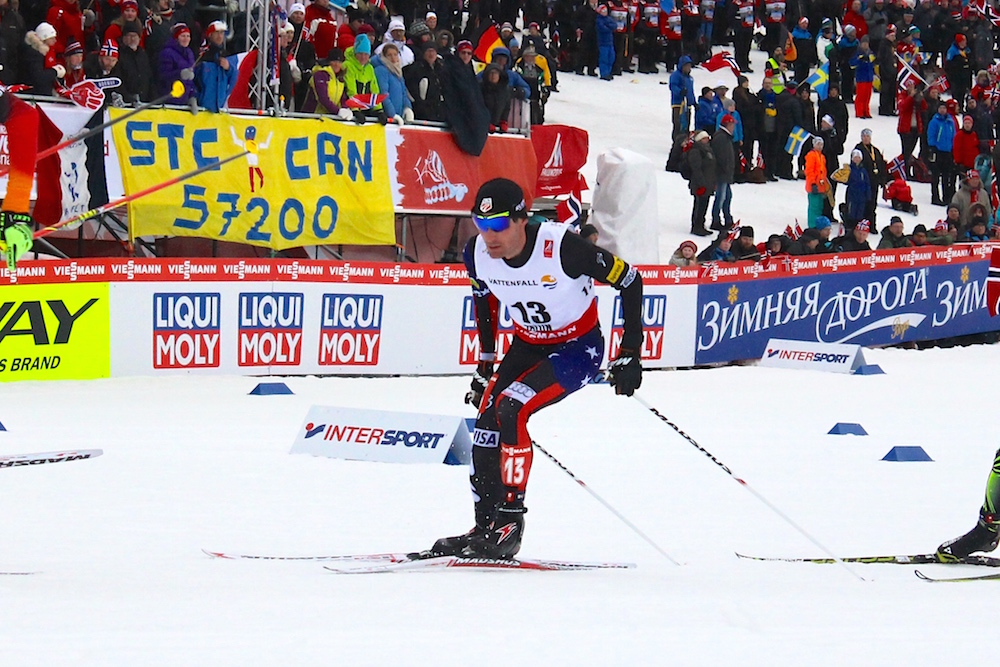
Bryan Fletcher (U.S. Nordic Combined) racing to fifth in while skiing with a chase pack during Thursday’s 10 k at 2015 World Championships.
FasterSkier’s coverage of the 2015 FIS Nordic World Ski Championships in Falun, Sweden, is brought to you by the generous support of L.L. Bean, now featuring a complete line of Kikkan Randall training wear.
FALUN, Sweden — Bryan Fletcher knew there was one thing that could elevate him to the podium on Thursday at FIS Nordic World Ski Championships, and it wasn’t going to be playing it safe.
The 28-year-old U.S. Nordic Combined skier decided to go with the “go-big” mindset on the 134-meter large hill, and in doing so, he jumped to 13th on Thursday morning — a huge improvement from his 20th-ranked jump in the normal-hill individual competition at Falun World Championships, where he ended up 21st last Friday.
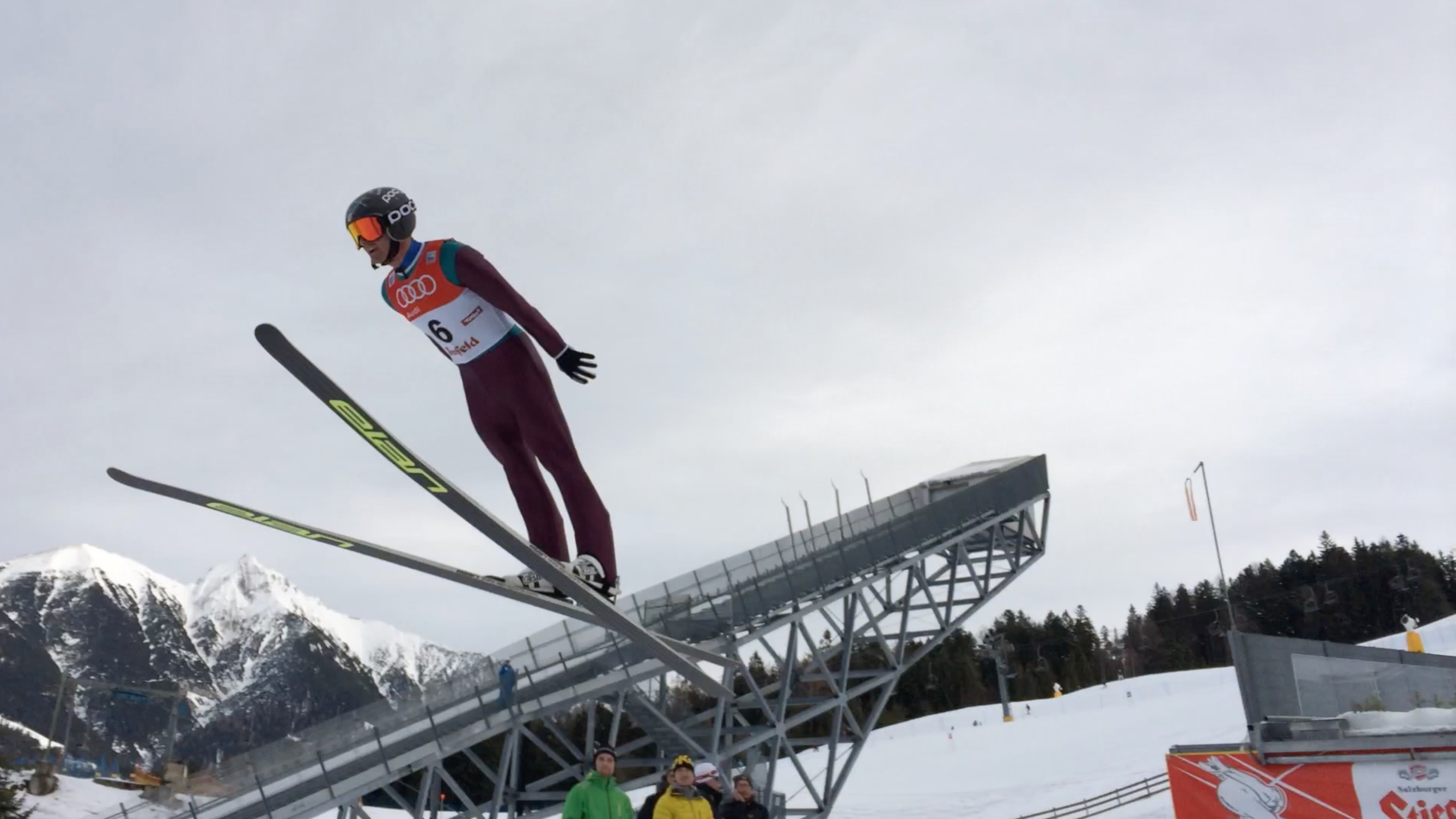
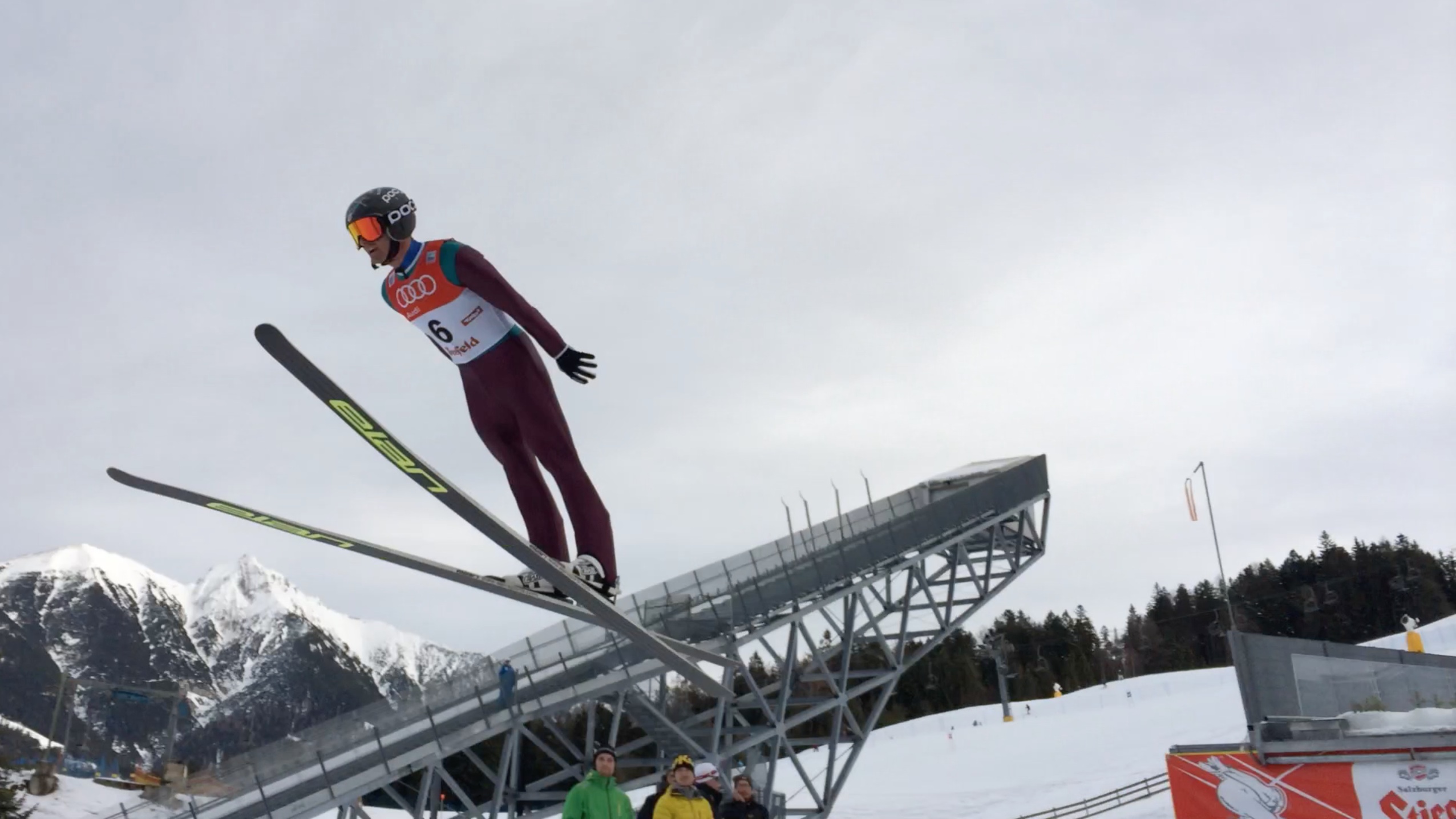
Bryan Fletcher (U.S. Nordic Combined) jumping in Sunday’s four-man team event at the 2015 FIS Nordic World Ski Championships in Falun, Sweden. (Photo: FlyingPointRoad.com)
“Today, I came into jumping in attack mode,” Fletcher recalled after Thursday’s 10-kilometer Gundersen start. “It was like, ‘Well since these are the Championships, and it’s not really worth being anything but on the podium, I’m just going to go for it as hard as possible and lay it all out there.’ ”
Starting the race 13th and 44 seconds behind the jump leader, Austria’s Bernhard Gruber, meant Fletcher could actually move up enough to matter.
“I jumped pretty well, put myself in contention, and then going into the race I was pretty nervous because being in contention is exciting but it’s also like, ‘Uh oh, now what do I do?’ ” Fletcher said.
Before Thursday, his previous individual best in four World Championships was 14th. He won a World Cup two years ago, but had not placed better than fifth in an individual competition since. He called upon his experience from a month ago in Sapporo, Japan, where he placed eighth and ninth in back-to-back World Cup competitions.
On a dark-and-damp Thursday afternoon, Gruber took off 5 seconds ahead of France’s Jason Lamy Chappuis in second and another Frenchman, Francois Braud, who started 7 seconds back in third. After that, the fifth- through eighth-best jumpers started within six seconds of one another, 23 to 29 seconds after Gruber, and Fletcher headed out six seconds after 11th and one second out of 12th.
“My goal was to ski a tactically smart race and not be in the front too much, but do enough work to put myself in contention,” Fletcher explained.
He ended up completing the first of four 2.5 k laps in 10th, toward the front of a 14-man pack. The group trailed the three frontrunners: Lamy Chappuis, Gruber and Braud, respectively. Japan’s Yoshito Watabe skied alone in fourth, 15 seconds behind them, while the chase pack reined him in from another 15 seconds back.
By 3.8 k, Norway’s Magnus Moan continued to lead the chase in fourth, with Fletcher in eighth and Watabe back in 11th. By the halfway point, the group was 30 seconds behind the three leaders, with Moan still in fourth, Germany’s Johannes Rydzek and Tino Edelman in fifth and sixth, and Fletcher up to seventh. Less than a kilometer and a half later, Fletcher was at the front of the pack in fourth, just 19.3 seconds behind the top three.
There, the American pushed to bridge the gap to the podium. Mostly focused on a medal, he gave his all while leading at least 11 others directly behind him.
“There were a lot of guys in our pack,” he said. “I think at one point it was all the way from third to 20th, and if you glance over your shoulder, you’re like, ‘Oh man, what am I doing at the front of this thing? I’m wasting so much energy.’ But at the same time, the guys that were at the front, myself included, were kind of really trying to get more people to share in the workload because we wanted to ultimately catch the front of the race and then be able to work past that.
“I think we were caught in a zone where we were working, and then also trying to rest at the same time,” he added. “It was tough to organize, but I feel like Magnus and I did a good job of sharing the workload as much as possible, and then also breaking away from the rest of the guys in that train to give ourselves a shot.”
With one lap to go, Fletcher was still in fourth, 20 seconds out of third. Moan clung to him in fifth, and Rydzek skied in sixth, followed by 10 others. Over the next 2.5 k, Moan attacked, Rydzek went with him and Fletcher worked to stay in the fight for fourth, while the rest of the pack dropped off the pace.
“I jumped on them and was actually really surprised when I looked back and we were clear of the group,” Fletcher said. “I was kind of relieved because I knew it was just us, and we were catching up to third place really fast so I was going all out trying to get there.”
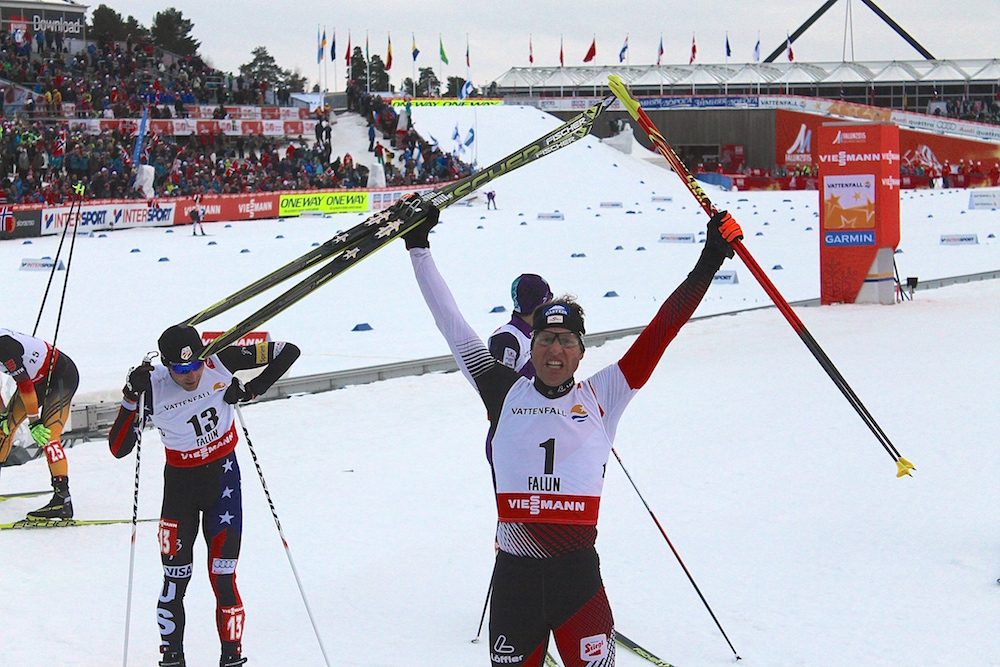
American Bryan Fletcher (l) after finishing fifth to Austria’s Bernhard Gruber (1) in the individual large hill/10 k at 2015 World Championships in Falun, Sweden. It was Fletcher’s World Championships career best and a season best as well.
While Moan and Rydzek charged to the finish, Fletcher lost contact on the last two uphills. Gruber cruised into the stadium and finish uncontested to win in 22:45.8, 11.9 seconds ahead of Braud in second. Rydzek and Moan overtook Lamy Chappuis in the last kilometer and sprinted to the line for third. Rydzek took it by 0.2 seconds, 14.9 seconds after Gruber, Moan settled for fourth, and 8.3 seconds later, Fletcher finished fifth (+23.4).
“I was hoping I could beat those guys on the hill, but they were strong, they skied a great race, and obviously I [felt] the legs at the end,” Fletcher said. “This is a personal-best result this season for me and in a World Championship event. To be on the podium would have been a dream come true, but to be in the fight was more what I was really looking for.
For me, I really just want to ski a good race, a good race to the best of my ability and the best of my performance,” he added. “I was happy that I was able to do that today and I was in the fight.”
“To be on the podium would have been a dream come true, but to be in the fight was more what I was really looking for.” — Bryan Fletcher, fifth for a career-best individual result at World Championships
His younger brother Taylor, who jumped to 34th and raced up to 29th, 1:51.7 after Gruber, patted him on the shoulder afterward.
“I think that’s the best [U.S. Nordic Combined has] done since 2009 for an individual result so hats off to him,” Taylor said of Bryan’s new World Championships marker. Teammate Billy Demong won the large hill/10 k at 2009 worlds in Liberec, Czech Republic, and in 2011, he placed sixth in the same event.
“[Bryan] really pulled it together today and skied a smart race by the looks of it, and was able to finish hard, which is the most important thing here,” Taylor said.
The second American on Thursday, Taylor wasn’t pleased with his performance after putting himself 2:01 back after the jump.
“It’s hard to say what could’ve been,” he said. “But knowing how I’ve been skiing, I could’ve been up there for that medal. I’ve had a lot of really good jumps and I’ve had huge improvements in my last competitions, and I gotta be satisfied with that but at the same time I’m really disappointed … when it came time to show that work and that effort, I fell short a little bit.”
While Bryan posted the eighth-fastest course time, Taylor, 24, ranked 10th fastest of 47 men in the 10 k.
“I’m probably the most competitive guy out here,” Taylor said. “I yelled at guys in the track earlier because I just wanted to go. I can’t settle for something. I want it more and more and I’m going to work my ass off to get it.”
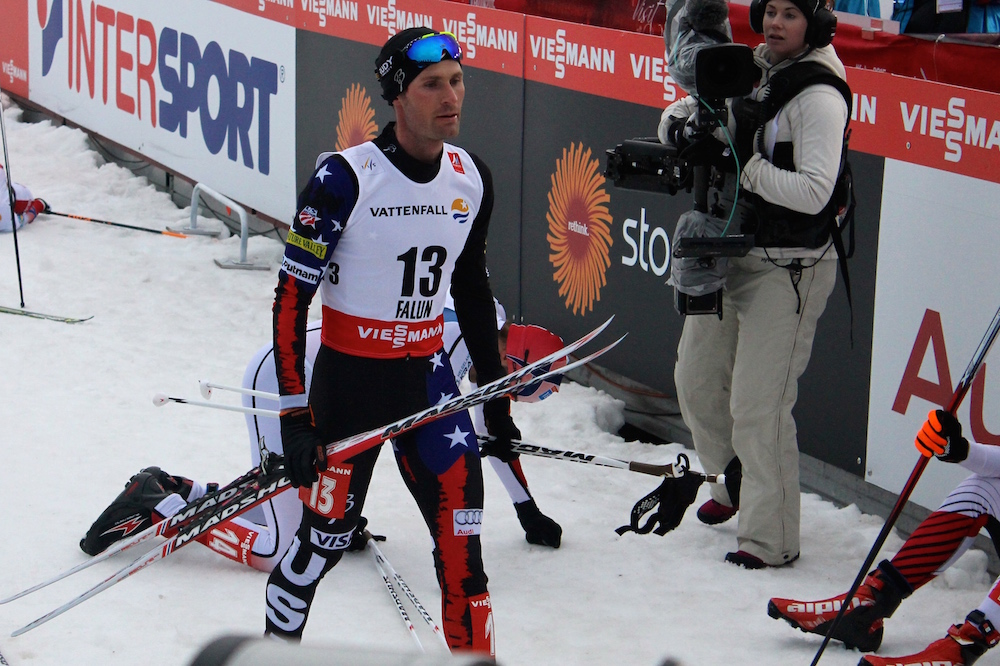
Bryan Fletcher (U.S. Nordic Combined) after finishing fifth in the large hill/10 k at 2015 World Championships in Falun, Sweden, for an individual season best and career best at World Championships.
Also for the U.S., Demong went from 30th in the jump to 33rd overall (+2:27.3), and Adam Loomis improved from 44th to 41st (+3:46.5) at the end of the day.
With one competition left at World Championships — the 2 x 7.5 k team sprint — Taylor, for one, was looking for redemption.
“I know what I did on the hill and what happened and I’ve got one more event [the two-man team sprint] on Saturday, where it’s probably going to be Bryan and I and that’s gonna be special,” he said. “Hell, if he’s skis like he did today, and I jump better on the hill like I know I can, there’s no reason in hell why we shouldn’t be first, second or third.”
Germany’s Johannes Rydzek (5) celebrates his first World Championships title in the first nordic-combined competition of 2015 World Championships on Friday in Falun, Sweden. He edged Italy’s Alessandro Pittin in the normal hill/10 k individual by 1.3 seconds. (Photo: FlyingPointRoad)
FasterSkier’s coverage of the 2015 FIS Nordic World Ski Championships in Falun, Sweden, is brought to you by the generous support of L.L. Bean, now featuring a complete line of Kikkan Randall training wear.
FALUN, Sweden — Johannes Rydzek hadn’t seen the podium in a World Championships competition since his first World Championships in 2011 in Oslo, Norway, where he won three silver medals between the large-hill individual and two team events.
Four years later, the 23-year-old German rose to gold in the normal hill/10-kilometer individual on Friday, the first day of nordic combined at 2015 FIS Nordic World Ski Championships.
“Every child that comes to sport has this dream to be a world champion, and now I am one,” Rydzek told the Associated Press.
Rydzek jumped to fifth on the 100-meter hill at Lugnet Arena in Falun, Sweden, then overcame a 31-second starting deficit to make a break for first on the last lap of the 10 k Gundersen start. Rydzek answered an attack from Italian leader Alessandro Pittin with about half a kilometer to go, trailing him down into the stadium. On the final rise before a sweeping downhill toward the finish, Rydzek passed Pittin and outlasted him by 1.3 seconds for the win.
“I tried everything to go alone,” Pittin told the AP. “But for sure, Johannes was faster than me when we entered the stadium.”
Pittin had raced up to second with the fastest ski time, latching onto the lead pack on the fourth-and-final lap. He jumped to 14th and started the 10 k race 1:16 minutes behind Germany’s Eric Frenzel, who led the jumping portion.
Rydzek posted the fourth-fastest ski time to win in 26:38.9, while France’s defending Olympic champion Jason Lamy Chappuis finished third (+5.0) after starting third, 25 seconds back. Frenzel placed fourth (+6.1) with the 20th-ranked time.
Håvard Klemetsen led Norway in fifth (+9.6) after starting sixth, and Japan’s Akito Watabe and Yoshito Watabe placed sixth (+12.2) and seventh (+14.4), respectively. The two were among the most competitive in the jump on a windy afternoon, which included delays, with Yoshito soaring to second and Akito ranking fourth heading into the 10 k.
Norway’s Jørgen Graabak improved from 11th to eighth, Germany’s Fabian Riessle rocketed from 23rd to ninth with the fifth-fastest time, and Austria’s Bernhard Gruber went from 17th to 10th overall.
U.S. Nordic Combined’s Taylor Fletcher (25) racing to 19th in Friday’s 10 k after jumping to 25th on the normal hill in Falun, Sweden. Fletcher was the lone American in the top 20 on the first day of nordic combined at 2015 World Championships. (Photo: FlyingPointRoad)
Taylor Fletcher led the U.S. in 19th after starting 25th, 1:31 behind Frenzel, and finished 1:32.5 after Rydzek. His ski time ranked 18th.
“I felt like I had good speed, I just I never got into a rhythm,” Fletcher said afterward. “I felt like I was swimming and I was never comfortable. I had people stepping all over my poles and I was going in and out of the line of people trying to move up, and I didn’t race my style.”
Fletcher started four seconds behind his older brother Bryan, who jumped to 20th and ended up 21st (+1:40.9).
“We were really hoping that we’d be able to pull away or work together and pull up to the front, but with the way the conditions were and just how I was skiing, it was really hard to actually make up ground on anybody,” Bryan said.
While temperatures cooled slightly to around 35-degrees Fahrenheit by the start of the race at 4 p.m., the course had turned to a mashed-potato-like consistency with the sun beating down on a 40-degree afternoon.
The 50-man field saw the jumping portion delayed from 10 a.m. to 1:30 p.m. because of winds, leaving competitors with about 50 minutes after the last jump to prepare for the pursuit-style race.
“We didn’t get much of a warmup and we were only able to ski the upper part of the course,” Bryan said. “They didn’t have the full course open or anything so that was tough. It was a quick turnaround.”
Ben Berend (U.S. Nordic Combined) competing in his first World Championships competition on Friday in Falun, Sweden. After jumping to 16th on the normal hill, Berend finished 45th in the 10 k. (Photo: FlyingPointRoad)
He noted that his teammate Ben Berend, in his first World Championships, had more adversity to deal with jumping as the ninth starter in the first group.
“Every time they were going to start the competition today, he’d have to get dressed, go all the way to the top of the jump and by the time he’d get there, they’d say, ‘OK we’re not going to do it,’ and he’d have to come right back down,” Bryan said. “For us in the later group, it wasn’t nearly as bad. It certainly is a lot of warming up and then, ‘OK, we’re not going yet.’ … It’s the same for everybody. It used to happen a lot more on World Cup then it does these days with TV and everything, but it’s just something you have to deal with.”
Berend jumped to 16th, the second best of the four Americans after Billy Demong leapt to 10th.
After having competed at one World Cup beforehand, the 19-year-old Berend was surprised to discover he led the jump through the first 18 men.
“I went and actually got equipment checked. I was in there forever and I came back out and they were like, ‘You’re still in the lead. You need to come back to the leader’s chair,’ ” he recalled. “I’ve never been there before so that was a pretty awesome experience being able to take that in.”
The 19th jumper, Demong bumped him out of it.
“Having Bill take me out of that leader’s chair, it couldn’t have been more perfect,” Berend said.
“They were like, ‘You’re still in the lead. You need to come back to the leader’s chair.’ ” — Ben Berend (U.S. Nordic Combined), who was 16th in Friday’s jump and 45th overall for his career best in his second World-Cup-level individual competition
Demong went on to finish 25th in the 10 k (+1:51.8), and Berend placed 45th (+4:54.6).
“I’m not fast enough to ski at the front of these races,” Berend said. “The conditions just made it tougher so the race was pretty brutal, but you learn. It was good experience for me out there. … Overall it was an awesome day. I’m looking forward to learning from this and moving on to better results in the future.”
Demong noted that this was Berend’s first World Championships and third-ever World Cup event (after two competing twice at last month’s World Cup in Schonach, Germany).
“To execute well and sit in the lead, that’s huge,” Demong said. “At 19 it’s a lot easier to train a few years and get faster at cross country than it is to make a ski jumper. Ski jumping is a really funny sport. When I was his age I was a great jumper, but I struggled in cross country. I’d rather start with someone who is a talented athlete, a great jumper, and try to teach them the cross-country side.”
In his eighth World Championships, the 34-year-old Demong explained that jumping has been his strong point this year.
“I haven’t competed a whole lot, and seemingly in my old age not training much for jumping has paid off,” he said. “The same can’t be said about cross country. I haven’t raced super well this year, but it’s been stable. Today, I started out harder, hoping to make something happen and paid for it the second half of the race. Ordinarily, these were my racing conditions. When I was my fittest this is where I would win, like Vancouver and Liberec. That being said, when you’re not the fittest, it is punishing.”
The second of four nordic-combined events is scheduled for Sunday with the 4 x 5 k team event.
“Sunday is going to be great if we can jump like we did today,” Demong said. “I think Taylor and Bryan skied a really good first half today. They’ve been two of the fastest, if not the fastest guys this year, so hopefully I can pull my stuff together and we’ll have a fight for a medal.”
SEEFELD, Austria — What does Fast Big Dog Racing mean to you? That was the theme of Saturday’s video, filmed and edited by Fast Big Dog, on scene at the Nordic Combined World Cup Triple in Seefeld, Austria.
Bryan Fletcher (U.S. Nordic Combined) jumping to ninth on Day 2 of the Nordic Combined World Cup Triple in Seefeld, Austria. Fletcher improved to sixth in the 10 k. (Photo: Fast Big Dog)
On the second day of the inaugural three-day triple, several top NoCo skiers, including Jason Lamy-Chappuis, Akito Watabe, Tino Edelmann, and Mikko Kokslien, chat on camera and dish about their favorite U.S. athletes.
“Fletcher brothers because we are the Watabe brothers,” Watabe says. “Always brothers fighting.”
For the second-straight day, Bryan Fletcher tied his season best in sixth. Billy Demong was also in the mix in 12th.
Competition concludes Sunday with two jumps followed by a 15-kilometer pursuit.
Johnny Spillane (USA) at the 2011 World Championships in Oslo. On Saturday, he notched a season-best ninth.
A day after Alessandro Pittin became the first Italian to win a nordic combined World Cup event, the Olympic bronze medalist repeated his success, edging Jason Lamy Chappuis of France on Saturday in Chaux-Neuve, France.
After ranking 22nd of 54 athletes in the 118-meter large hill jump, Pittin went on to catch the leaders in the 10 k Gundersen start and pulled out the victory in a photo finish with Lamy Chappuis and Fabian Riessle (GER), who was third.
Pittin posted the second-fastest time Saturday after Magnus Moan (NOR), who ranked 30th in the jump and first in the race. Not far behind the race leaders, American Bill Demong climbed his way to 12th place with the third-fastest split.
While Pittin added another achievement to the Italian history books, and Lamy Chappuis, who was born in Montana and moved to France as a kid, maintained his top spot in the World Cup standings, American Johnny Spillane lowered his season-best to ninth on Saturday.
Spillane had previously notched his best result of 2011/2012 season on Friday, when he finished 13th in Chaux-Neuve. The same day, Demong placed a season-best eighth, and Bryan Fletcher had his second-best result of the season in 14th.
“Everything has been slowly coming together, mostly on the jumping side of things,” Spillane wrote in an email after Saturday’s competition. “I have been feeling good on the skinny skis but needed to do a better job on the jump hill to have a chance.”
On Saturday, the second of three consecutive days of competition, Spillane was the ninth fastest in the 10 k after ranking 13th in the jump.
After seeing his best results in nearly two years following an injury that caused him to miss the beginning of last season, the 2010 Olympic silver medalist hadn’t met his podium expectations, but felt he was getting there.
“I’m feeling positive about the rest of the season,” Spillane wrote. “I feel like I’m in good shape but I still have work to do on the jump hill before I can be in there day in and day out.”
After Spillane, who was 7.9 seconds out of first, and Demong (+10.5), Taylor Fletcher was 31st and his brother, Bryan Fletcher, 32nd on Saturday. Both climbed from ranking a respective 49th and 41st in the morning jumping portion. Another American, Nick Hendrickson finished 41st after ranking 49th in the jump.
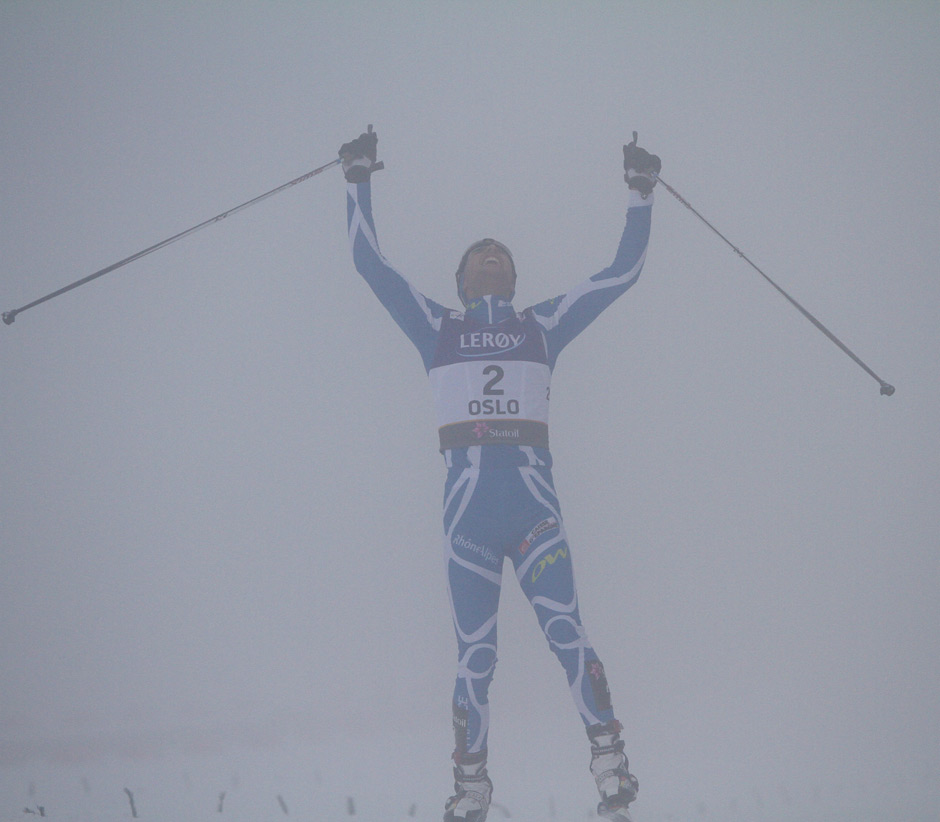
France's Jason Lamy Chappuis celebrating gold through the fog.
After just missing the medals in the first two competitions at the 2011 World Championships, an American-born athlete was back on top of the nordic combined podium on Wednesday.
Billy Demong? Nope. Todd Lodwick? Guess again. Maybe Johnny Spillane? Or the two flying Fletcher brothers, Bryan and Taylor? No, no, and no.
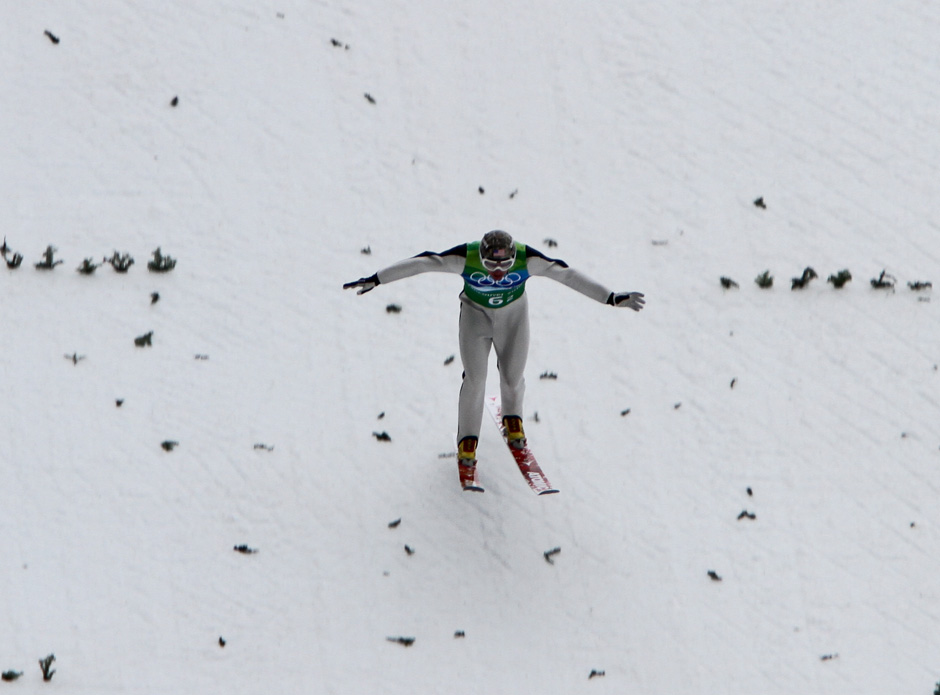
Todd Lodwick jumping.
Instead, it was Jason Lamy Chappuis, a French citizen born in Montana, who took the win in the individual large hill competition in Oslo.
Lodwick ended up fifth, 30 seconds off the podium, while Demong, the defending champion, was sixth, another 10 seconds back. The two were impressive on their skis, with the sixth and second-fastest course times, respectively, but couldn’t overcome jumps that were merely average.
“I guess that was what I could do today,” Demong said.
In the individual large hill competition, the athletes each get one shot to launch themselves as far as possible off Oslo’s massive Holmenkollbakken—the iconic jump that just underwent a 300-million-dollar remodeling.
The Holmenkollbakken normally cuts an impressive, sweeping form that interrupts the Oslo skyline, but during the competition on Wednesday morning, there was no skyline whatsoever, with an impenetrable fog limiting visibility to around 50 meters.
For the athletes, the weather seemed like it should have presented an insurmountable challenge. But for these guys,
The nordic combined medal winners.
who were regularly hitting the take-off at speeds upwards of fifty miles an hour and flying farther than the length of a football field, it wasn’t a big deal.
“It can be a little intimidating, but it’s not as bad as it looks,” said Wesley Savill, one of the Canadian competitors.
In fact, Demong said the conditions were challenging, but his gripe wasn’t about the visibility. Instead, his complaint was that the jump’s ramp was running slowly on Wednesday.
“It’s hard to go far,” he said.
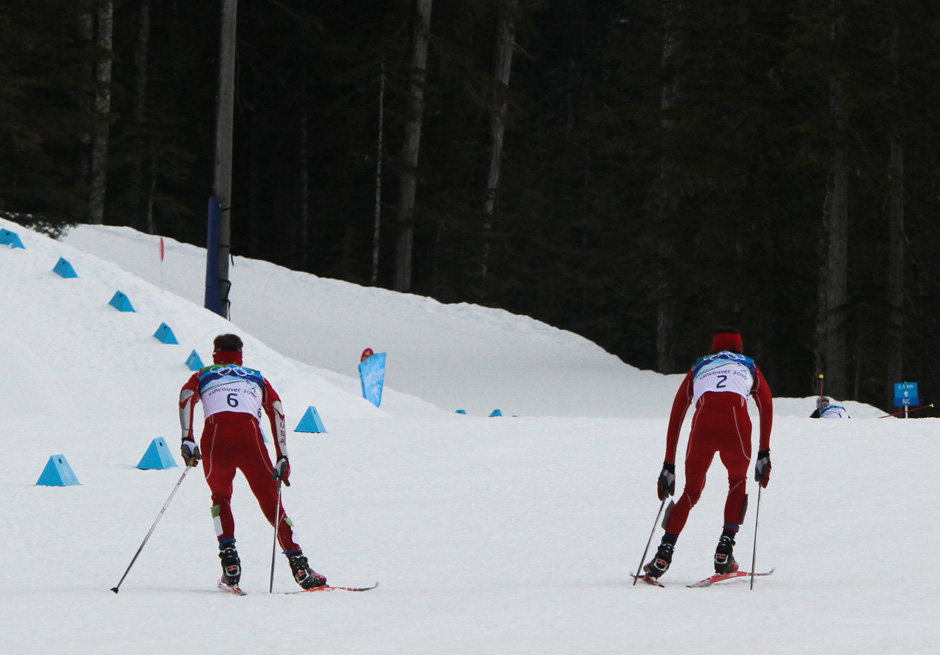
After spending the morning on the Holmenkollbakken, the athletes moved to the cross-country stadium next door, where the results from the jump were used to handicap the start of a 10-kilometer cross-country ski race.
Out of the five Americans in the event, Lodwick and Demong had the two best jumps—in a 56-man field, the former was 12th, and the latter 20th. Decent, but not quite of the caliber that got Demong the gold in the same event in 2009.
Still, the Americans are among the best skiers on the nordic combined circuit, and as soon as the race started, they began working their way up through the field.
With their results on Wednesday, Lodwick (L) and Demong (R) got to hit up the podium ceremony.
Demong ended up with the second-fastest cross-country time, though it was hard to tell what was happening in the fog.
“It’s easy, when you’re skiing fast, to be motivated by catching people,” he said. “But I couldn’t see more than eight seconds in front of me.”
He caught 14 of the 19 men who started before him, and by the last of four 2.5-kilometer laps, he had managed to close the gap to Lodwick as well. But Lodwick had a little more left, and accelerated to ultimately leave Demong 10 seconds adrift at the finish.
Lodwick said the fifth place was his “best result of the season” so far, which was gratifying after fighting illness and asthma for the last six months.
“I have two kids at home, and they bring stuff home from day care, and it’s just really been an uphill battle,” he said. “I finally feel like I can go out, and I can pace myself, and breath and feel power. And I think today showed it.”
At the front of the race, Norway’s Haavard Klemetsen had started first after a mammoth jump. But despite the exhortations of the home crowd, he was quickly reeled in by Lamy Chappuis, as well as two Germans, Joannes Rydzek and Eric Frenzel, who had started fifth and sixth.
Lamy Chappuis had a 30-second advantage on the two Germans, and was able to cruise to the win without being truly tested. It was a gratifying win for the Frenchman, who had missed the podium in the first individual race in Oslo despite dominating the World Cup circuit this year.
“I am so glad to be back,” he said in a press release from the organizers. “My self-confidence wasn’t so good after the first competition, but now it feels great.”
The Americans, meanwhile, have one more chance for a podium at Worlds in Friday’s team competition—the second one of the championships. In the first team event, held on the smaller hill on Monday, the Americans were fourth.
It shows just how far the U.S. program has come that anything less than hardware feels like a bit of a letdown, even though Lodwick said that he was “very satisfied” with his result.
The Americans need slightly better performances in the jump if they want to content for medals, but as Demong put it, the team is “getting closer.”
“Maybe too little too late for this year, but pretty fired up for next year—and years beyond,” he said.
Todd Lodwick was eighth in Sunday’s World Cup competition in Chaux Neuve (FRA), after jumping to start the cross-country in third place. Bryan Fletcher could easily have been top 10 on Saturday if the margins were on his side, Johnny Spillane is consistently jumping better and returning to race shape, and Bill Demong is showing promising colors. This was the final World Cup weekend before the World Championships in Oslo next month.
“Four guys in the top 30 is always a good day, for sure we wanted to be in the top half with everyone too. Things are coming together more and more,” said US Nordic Combined head coach Dave Jarrett after the competitions in France.
Jarrett’s conclusion on the weekend’s events is that things are on track.
“Todd jumped well but didn’t finish the race strongly. He was out of gas the last lap. Bryan had a great trial jump but his comp jump was a bit below his average. The good thing is that he now able to score points in a full-strength World Cup with a below average day. Johnny had a better day, jumping is coming slowly each jump and racing is coming around too. Billy is still looking for the loving feeling on the hill. Skiing is coming too,” Jarrett said to FasterSkier, summarizing the weekend in France.
Now the team is returning to base in Park City, Utah, to make sure all their i’s dotted and their t’s are crossed before heading back across the pond for the Worlds.
“We are going home now to get ready for Oslo and show up with our full Mojo,” said Jarrett.
Confidence-builder
Bryan Fletcher, who has moved in, established and defended his position in the top 30 on the World Cup this season, is excited about the upcoming championships. This last World Cup weekend helped his confidence.
“The weekend was a success, not on any huge level for me, but I am happy with my results. Things felt good this weekend my jumping was on par with what I was hoping for and my cross-country felt strong,” Fletcher said in an email to FasterSkier.
“The first day I surprised myself and was able to ski up to 13th place only to hit a wall on the last hill and lost my pack falling back to 21st place. However I was happy with my race over all it was a solid step to build some confidence,” the 24-year-old said.
Jarrett is also encouraged by Fletcher’s performance, and points out that his preliminary jump was particularly good, landing him an 18th place. Saturday Fletcher was 24th in the jumping and 21st overall.
“With just a few more meters he could have been top 10 again today. Anyway, he jumped well and skied well. He was in a group with some fast guys so it was hard to make up places. Solid nonetheless,” Jarrett noted.
Sunday Fletcher ran into bad conditions on the jump hill but still pulled off a decent jump and started the cross-country in 34th place, two minutes behind Jason Lamy-Chappuis (FRA) who went ahead and won the competition on home turf. Solid performance on the course landed him in 27th place overall, securely within his own season goal of consistent top 30 results on the World Cup.
“The second day I had some adverse conditions on the jump hill. However was able to put an OK jump together and had another solid race. I didn’t feel quite as good as the first day, but I was able to ski into points, which is tough from my starting position. I ended up 27th place,” Fletcher explained.
Prep time
From here it’s all about getting ready for the World Championships.
“There will be lots of training to gear up (for the Worlds),” Fletcher said, adding that he is looking forward to the process.
“I will be focusing on fine-tuning the things that are limiting me from being in the top 10. I will also be taking the time to gain some much needed rest and relaxation,” Fletcher said to FasterSkier.
Fletcher is also planning on racing into shape by participating in some races on home turf and some longer efforts, including the 32-kilometer Boulder Mountain Tour in Sun Valley, Idaho.
“I plan on doing a couple races as well when I am home. The biggest race will be the Boulder Mountain Tour. The BMT has always been a fun race for me, and having missed it last year I am looking forward to being able come back and ski this year. I find it’s always fun to mix it up a little bit with the other skiers,” Fletcher concluded.
The first Nordic Combined race at the World Championships in Oslo is on February 26.
Complete results from Saturday’s World Cup in Chaux Neuve here.
Complete results from Sunday’s World Cup event here.
Taylor Fletcher: COC in Harrachov (CZE)
Bryan Fletcher’s brother had a job to do with the US Nordic Combined team on the Continental Cup circuit and executed according to plan.
“It was a very successful trip for me! Not only did I score World Cup points, but I am now three for three on COC podiums this year,” Taylor Fletcher in an email to FasterSkier. The 20-year-old has raced with the World Cup crew for much of the winter. Just like his brother, Taylor Fletcher found the final major event weekend before the Worlds to provide extra confidence.
“I felt like this weekend was a very motivating weekend. I told (head coach) Dave Jarrett what I wanted to do, and went and did just that. It is a major confidence-builder as we are heading to Oslo,” Taylor Fletcher said.
Leading up to the Worlds, he will be paying attention to the details and honing his peak, as well as just getting some more raw volume under his belt. Taylor Fletcher is also trying to dial his match weight for optimal performance, something that matters more on the hill than on the course.
“I’ll be training a lot building up my intensity making sure I am the fastest I possibly can. I will do at least one race and possibly the Boulder Mountain Tour. But I will also slim down a little more and try to get to 65 kilos before Oslo to optimize my performance on the jump hill,” Taylor Fletcher said.
Complete results from the COC Friday here and Saturday here
After a so-so weekend in Seefeld, Austria, last weekend, the team is moving on and looking ahead to Oslo. This weekend in Chaux Neuve, France, is the last chance to compete at the World Cup level before the World Championships in Oslo next month.
“I am excited to just compete and try to get some more points. After having two weekends of not my best races, I am just looking to improve upon the last two weekends,” said Bryan Fletcher, who has made a consistent splash into the top 30 this season.
Fletcher is encouraged by the improving conditions in Chaux Neuve, and notes that it could not get much worse.
“Conditions are looking better and better every day. When we showed up there was absolutely no snow,” Fletcher said in an email to FasterSkier.
“Today it has snowed off and on all day, and the temps have dropped down a bit so that is good they are able to make snow. So the competitions look like they are going to be good,” Fletcher added.
Aside from Bryan Fletcher, Johnny Spillane and Todd Lodwick, Billy Demong has joined the crew after staying home last weekend for the birth of his son Liam to round out the US team in Chaux Neuve. Taylor Fletcher, who raced the World Cup in Seefeld last weekend, has joined the COC crew in Harrachov, Czech Republic, to try earn some more points for the US nordic combined team.
While the US racers are looking to make their names known and feared in time for the Worlds in Oslo, hometown favorite and current World Cup leader Jason Lamy-Chappuis is excited about the competitions in friendly territory.
“There’s always a great atmosphere in Chaux-Neuve so I’m looking forward a lot to the competitions at home.”
The venue at Chaux Neuve is among the most modern on the World Cup circuit. The La Cote Feuilee-Hill officially opened on December 14th 2010 after the reconstruction a HS 118. Local hero Jason Lamy-Chappuis from Bois-d’Amont made the first jump, pulling off 115 meters, and enjoyed both the honor and the hill.
“It was an honor for me to make the first jump,” Lamy-Chappuis said to FIS Nordic Combined.
Chaux-Neuve is not only an indicator for the World Championships in Norway, but it’s also the last chance to score World Cup points before the season final in Lahti.
Magnus Moan (NOR) won the World Cup Nordic Combined competition on Sunday, barely 1.5 seconds ahead of Jason Lamy-Chappuis (FRA) who was leading after the jumping and started the cross-country a full minute in the lead. Moan polished off the course in 24 minutes and 36.8 seconds, Lamy-Chappuis clocked in at 24:38.4. David Kreiner (AUT) was third in 24:40.5. It was an incredibly tight race among the fastest racers: The top six finished within less than five seconds of each other.
“The strategy today was to get up on the heels of Lamy-Chappuis early and just hang out there and see what he would do,” Moan said to Norwegian TV station NRK.no after the race.
So Moan rolled up his sleeves and went to work. In 2.5K he had reduced Lamy-Chappuis’ advantage to half, and halfway through the course, Moan was on the Frenchman’s tails. With 400 meters to go, Moan surged and literally parked Lamy-Chappuis.
Some highlights
Taylor Fletcher was the top American, finishing in 29th place – one of his best ever results in a World Cup competition. Dave Jarrett, US Nordic Combined Head Coach, is impressed with Taylor Fletcher’s performance in Seefeld, which landed him some World Cup points.
“Today had some positives for sure. Taylor got some points, which was good,” Jarrett said to FasterSkier in an email after the competition.
Jarrett also sees improvement for Johnny Spillane, who is racing his way into shape for the World Championships in Oslo next month. He recently returned to competition after an 8-month break due to injuries.
“Johnny is definitely coming back better and better. He needs to get the competition edge sharpened, for sure,” Jarrett said, but they both know they need to be patient, and that the 2011 World Championships are the goal of the season for him, and he recognizes that the Seefeld venue is known for brutal courses along with a difficult hill and challenging snow conditions.
“While this is new version of the hill here, (Spillane) has always struggled a bit on this hill. Horses for courses,” Jarrett said, adding that Spillane is already excited for the next races in Chaux Neuve, France, this coming weekend.
“Today was better for me,” Johnny Spillane said to FasterSkier after his race on Sunday.
“I’m feeling faster every race which is a good sign,” he said, adding that it takes time to get back from an 8-month break and it takes time to dial in new equipment.
“Jumping is still a little hit miss now, but that is due to lake of training and trying to catch up on equipment testing. Today I tried a brand new pair of skis on the jump, which adds to the stress level a little, but overall they were pretty good.”
But Spillane is patient and knows that every competition and every training day add up and will get him closer to peaking for the World Championships in Oslo in the end of February.
“I’m looking forward to a week of training and continuing to take some more small steps towards Oslo,” Spillane said.
Ups and downs
Bryan Fletcher, who has delivered consistently encouraging results this season, generally overshooting his own goals of top 30, had a tough day Sunday. He was in 43rd place after the jumping, and started 1:32 behind Lamy-Chappuis. Still, he was able to climb seven spots over the 10K course and ended up in 36th place overall.
“Bryan didn’t jump as well as he has been but in actuality it was just a one-off jump in the comp,” said Jarrett.
Todd Lodwick felt a little off Sunday and didn’t pull off his best game, so despite a 26 place in after the jumping – the best of any of the US racers – Lodwick decided to opt out of the cross-country Sunday.
“Todd jumped ok, but is still struggling with his lungs and breathing issues. He felt it was better not to race and hopefully let his lungs heal a bit more before Chaux Neuve,” Jarrett said.
The World Cup events in Chaux Neuve next weekend will be the last World Cups before the World Championships in Oslo, and also the last World Cup competition for the season aside from the Oslo events.
Jason Lamy-Chappuis, the Frenchman who won an Olympic individual gold medal at the 2010 Winter Games in Vancouver, jumped 113 meters, a whopping 7.5 meters longer than anyone else, and started with a minute and four second lead on Maxime Laheurte (FRA). With Norwegians Mikko Kokslien jumping to 8th place and Magnus Moan all the way down in 25th, Lamy-Chappuis maintained his position through the cross-country portion of the race. He finished in 25:33.2, while Magnus Moan, who started 1:53 behind Lamy-Chappuis, skied into second place, finishing in 26:02.5, while Kokslien was third, clocking in at 26:06.1.
“Jason destroyed the field,” United States Ski Team’s (USST) Bryan Fletcher said with awe.
“He jumped 1:04 ahead of second place. He was able to jump 113 meters. Pretty great performance by him. He also was able to stay off the front and won by almost 40 seconds so it was a good day for him,” Bryan Fletcher said.
As for his own race, Bryan Fletcher said the course was tricky and conditions were tough, and that the margins were just not on his side, despite a decent jump.
“Today was tough. The course was a combo of bullet proof ice and spring slush. With the technical down hills it was a sketchy scene,” said Bryan Fletcher, explaining that the tight field did not help his game.
“The race was very tightly packed. I did not have my best race by any means. I also fell twice, which doesn’t help. One was not my fault – someone stepped on my tip and pole and spun me around 180 degrees. In the middle of a pack, it was tough to get back on course. But I made it through that and worked my way back up to the pack only to fall again on the fourth lap on the big nasty corner,” Bryan Fletcher said, noting that he was content with his jumping.
“The jumping went alright for me, I was able to land myself in 14th position,” he said.
Taylor Fletcher was 34th overall after jumping to 47th place and starting 2:36 behind Lamy-Chappuis, and Johnny Spillane was 44th overall, after jumping to 54th place and starting in the wave of skiers who started 3 minutes behind Lamy-Chappuis.
“It was a pretty good day on the hill for Bryan, Todd, and Taylor as well. Johnny didn’t jump as well,” head coach Dave Jarrett said, noting that conditions for the cross-country were tricky.
“The course was hard and very icy. Todd and Bryan skied OK but not where we hoped they would finish. Taylor had a better race, and Johnny is still getting into race shape. It is clear we need to work on some cross-country stuff and that will be addressed going to Oslo,” Jarrett said.
He knows both Lodwick and Bryan Fletcher is capable of better races than 23rd and 28th, and that the real goal is the World Championships in Oslo in February.
“We have another competition tomorrow, so we will keep working,” said Jarrett.
Johnny Spillane feels like the potential is there, but knows he has to be patient. “Today was not too great for me, but you have to keep everything in perspective. I have not been able to train for almost eight months due to my knee injury and some time off after the Olympics, so for me it is nice to get in the mix,” Spillane said.
“Of course, I want to do better, but competing in a World Cup without much training is difficult. I’m in the process if trying to test new jumping skis and also compete, which is hard. But my main goal is Oslo, and I’m going to do everything I can to be prepared for Worlds,” Spillane said.
Austria dominated the podium as Nordic Combined World Cup action continued in Germany. Felix Gottwald took first place clocking in 24:38.4, Mario Stecher was 15.6 seconds behind in second place, and Bernhard Gruber in third, 16.2 seconds behind Gottwald. Jason Lamy-Chappuis (FRA) who was first after the jumping, ended in 11th place overall.
Gottwald made a strong move on the last major climb of the course to open up a gap on his teammates and Jan Schmid (NOR).
Bryan Fletcher jumped well and started the cross-country in ninth place and 55 seconds behind Lamy-Chappuis, ready to battle the world for the podium. But the course wanted it differently, and rather than plucking racers off along the way, Fletcher damaged a pole early and played catch up from the 1K mark. He dropped to 31, almost two minutes behind the winner.
“Today was a bit bittersweet. I had a good jump and was very happy with my starting position. However I quickly ran into problems on the cross country,” Bryan Fletcher said to FasterSkier in an email.
“About 1 kilometer into the race I broke the basket on my pole. It was in the worst spot for it to happen. I had to ski almost another kilometer without a pole before I could get one. So that fried me quick. Afterwards I had to spend two laps recovering and relaxing before I could start working my way back up again,” Fletcher explained. However, Fletcher is moving on.
“Oh well, bad luck happens and my focus is now on Seefeld,” Fletcher said, taking away the highlight of the day: a good jump.
“I have a lot of confidence in my skiing so I am sure that with a good jump, I can be in there again. Today was just a very frustrating day, but it happens to everyone.
Rain and warm weather also added their share of challenges for the racers, especially on the cross-country course.
“The conditions were soft and warm, quite a change from out previous races. The course is pretty muddy but the organizers have done a good job keeping the course and the jump hill in good shape for the competitions with all the rain that has happened,” Fletcher said.
Tomorrow the US Nordic Combined team is entering the World Cup team competition, before moving on to the next World Cup events in Seefeld (AUT) January 14 to 16.
“For the team comps tomorrow I just want to have some fun and see what we as a team can accomplish. I will also be looking at how I can compare individually as well. It will be a good chance to work on some fine-tuning in competition before Seefeld,” Fletcher concluded.
The other Americans were Taylor Fletcher in 56th (3:18 behind), Brett Denney in 58th (3:45.4 behind) and Eric Camerota in 60th (3:58.8 behind). Complete results.
At 34, Todd Lodwick may be the old man of the U.S. nordic combined squad. But he hasn’t lost a step.
In his first World Cup event of the season, in Ramsau, Austria on Saturday, he started off with a bang by finishing fourth, just a tenth of a second off the podium.
“I’m happy to be up there where I was,” Lodwick said in a press release after the race.
Lodwick, who started 16 seconds behind the leaders after the jumps, moved quickly on the course, and in the end maintained the fourth-place position he held at the start of the cross-country. However, he was only narrowly shut out of the podium, with mere seconds separating the top finishers overall.
“It was a typical comp, where a lot of different factors play into the results. My objective today was to go out and ski my own race and see what the speed was on the World Cup,” said Lodwick.
Local favorite Mario Stecher (AUT), who was sixth after the jumping, made up 29 seconds on the course and won narrowly over Germany’s Bjoern Kircheisen. Lodwick was part of a pack that was going back and forth for the lead throughout the race, and he was in a good position coming into the final kilometer. Lodwick nearly beat Johannes Rydzek (GER), but was short by 0.1 seconds at the finish line.
Jason Lamy-Chappuis (FRA) was fifth, a full second behind Lodwick.
“It was bad tactics on my part to head into the finish stretch in fourth, but I’m still happy with my result,” Lodwick said.
Fletcher content in 23rd
Bryan Fletcher, who was 32nd after the jumping and started 1:29 behind, skied as fast as any on the tough course and finished in 27:06.9 to a strong 23rdplace overall. Fletcher’s goal for the season is to establish himself solidly in the top 30, and so far he is delivering to his promise. Conditions taken into account, Bryan Fletcher is satisfied with the race and his results.
“I am happy with my result. I felt I had a much better race than the last two weekends. Today was a bit windy, just like predicted. I didn’t have as good of a comp jump as my trial jump. However just like I thought, it was a tight race, and even with a little bit worse jump I was only a minute and 29 seconds out of the lead. I was right in the pack of skiers, and knew I could move up into the points from where I was,” Bryan Fletcher told FasterSkier.
“Tomorrow I will go out with the same mentality and try to repeat my performance today, with hopefully a little better jumping,” Fletcher said.
Decent all around
US Nordic Combined Coach Dave Jarrett is also satisfied with the crew and its performances.
“Todd and Bryan did their jobs on the hill, although Bryan has been better in training than his comp jump today. But both guys skied well, and we are happy with the race,” Jarrett told FasterSkier.
Changing winds, starting gates and jury decisions made for a challenging day for both coaches and athletes, and Jarrett added that the younger racers also delivered solid performances.
“Taylor [Fletcher] and Nick [Hendrickson] both had better races [Saturday], but were at the wrong part of the start list and became victims of the wind gods and the jury. Nick’s trial jumps was good and he knows he can do it on the World Cip. We will keep working and are looking forward to tomorrow,” Jarrett said.
Taylor Fletcher moved up to 42nd place after jumping in 59th, and Hendrickson also moved up handily, from 60th to 47th, and Eric Camerota was 59th overall. Complete results here.
“Today was a good day. There was not much wind on the hill – pretty clear weather and cold conditions,” Bryan Fletcher told FasterSkier after finishing 15th in the provisional jumping round of the nordic combined World Cup in Ramsau, Austria. “All in all…I am happy with where I ended up overall.”
Todd Lodwick led the way for the Americans in the jumping Friday, finishing fourth. The results from the provisional round are used if the weather is too inconsistent for a fair competition on Saturday. And if the forecast comes true, high winds and snow are on the horizon for Ramsau.
The Austrian venue comes with its own set of challenges, Fletcher says, noting that both the hill and the course are difficult.
“The jumping is on a small hill and the cross-country course is a tough, tough course. The small hill will bunch everyone together, making the race a bigger part of the game,” Fletcher predicted.
“The weather for the weekend looks a little windy, so there is a better chance we could use the provisional this weekend then previous weekends. We’ll see how it looks in the morning, though. I am prepared and hoping to improve upon what I was able to do today,” Fletcher said.
Psyched about jumps
US Nordic Combined Head Coach Dave Jarrett was content with the provisional jumping.
“We are psyched with Todd and Bryan’s results on the hill today but know that Eric [Camerota], Nick [Hendrickson], and Taylor [Fletcher] can be better and will be better,” Jarrett said, adding that for his team, a new jumping round could be beneficial.
“It’s snowing pretty good here now, so we will see if today’s [provisional jump] will be used on Saturday or Sunday. It can only be used once. I know Todd and Bryan wouldn’t mind, but the other three want two more shots on the hill. We will prepare for another comp tomorrow and see what happens,” Jarrett said. “This is the World Cup and if you want to be high in the results you have to jump well in the competitions.”
Jarrett knows Lodwick is capable of podium finishes, and that Bryan Fletcher’s 15th was a good result for him. Not surprisingly, Jason Lamy-Chappuis (FRA) won the provisional round with a jump of 96.5 meters, with Bernhard Grueber (AUT) in second place (95 meters) and Espen Rian (NOR) in third (93 meters). Camerota was 33rd, Taylor Fletcher 57th and Hendrickson 61st.
Confidence-booster
For Fletcher, the good provisional round gave him some confidence for the coming races, and a confirmation that he is on track in terms of his own goals.
“I am feeling confident going into the weekend. Since this weekend will pretty much mark the halfway point in our season, my goals are set at scoring points again,” Bryan Fletcher told FasterSkier. Establishing himself among the top 30 in World Cup competitions has been Fletcher’s aim, and he is sticking to it.
“I am not raising my expectations, just because the year started off the way I wanted. This weekend, I am simply focusing on doing what I need to do, just to stay in the game. I know I am capable of being in there both days, and I am going to do my best to make that happen,” he said.
Bryan Fletcher was the top American in Sunday’s nordic combined race, finishing 26th overall. He was 22nd after the jumping, and started 1:28 behind Jason Lamy Chappuis (FRA), who was leading at the beginning of the cross-country race and proceeded to win overall.
Bill Demong was 38th,climbing four spots on the trails, and Taylor Fletcher was 48th overall after finishing the jumping competition in 55th. Brett Camerota was 45th after the jumping, but did not finish the cross-country.
Lamy-Chappuis (FRA), who was second in the competition on Saturday, managed to keep Mikko Kokslien (NOR) behind him on Sunday. On the jumping hill, nobody seems to be able to beat the French bird, but so far, he has lost ground in the woods.
Sunday, Lamy-Chappuis had a 20-second lead on the next racer, and started 1:28 ahead of Kokslien. Mario Stecher (AUT) was tenth after the jumping, and skied his way into third place, only a tenth of a second behind Kokslien.
Fletcher told FasterSkier that his 18th place on day two of the World Cup season opener in Finland last weekend (his career best in a World Cup) was encouraging and exciting, but that his goal for the season is to establish himself solidly in the top 30.
Hometown favorite Mikko Kokslien (NOR), who started the cross-country in 16th place, 1 minute and 4 seconds behind Braud Francois (FRA), won by 8.4 seconds over Lamy-Chappuis. Francois, who was first after a jump of 138.5 meters, ended up in 20th place overall. In the final kilometer of the race Kokslien dug into the reserves and beat the French Olympian to earn his first WC victory.
Kokslien jumped into the Norwegian national spotlight when he skied into second place in the World Cup opener in Finland last weekend, only narrowly beaten by Felix Gottwald (AUT). Lamy-Chappuis started the cross-country in third place, 18 seconds behind Francois, after a jump of 137 meters. Gottwald started in 32nd place, 1:50 behind.
Brett Camerota jumped the longest of the Americans, 126 meters, and started in 22nd place, 1:20 behind Francois. Bryan Fletcher jumped 119.5 meters and started in 35th place, 2:11 behind. Taylor Fletcher was 44th after the jumping (118.5 meters) and 2:30 behind, while Bill Demong (111 meters) started 3:20 behind. Except for Demong, who advanced from 53th to 45th over the 10K course, all had a tough time on the course and dropped spots in the overall.
Bryan Fletcher, who delivered his career best World Cup result in Finland last week when he hauled into 18thplace, was not content with Saturday’s effort.
“Today was not as good as I hoped. The race was tough today. Slow snow and a course with not a ton of rest so it was a very challenging day for myself and for others,” Bryan Fletcher admitted to FasterSkier, but has already put the race behind him and preparing for the next.
“I am just focusing on tomorrow. Tomorrow is a new day and we will try again. Hopefully I will have a better go. Oh well,” he said.
The Nordic world is focused on Kuusamo, Finland, this weekend. In addition to the cross-country World Cup taking place, the first Nordic Combined World Cup is taking happening in the same location.
Bryan Fletcher led the American contingent with a strong ski, moving himself four spots up on the result lists after finishing 22nd in the jumping competition Saturday. Fletcher started 1 minute 20 seconds behind the leader, only a second behind Mikko Kokslien (NOR), who ended up second overall. Fletcher went right to work from the get-go, and picked off a couple of spots in just the first quarter of the race. He was able to pluck off two more spots in the final kilometer of the race to earn himself 18th place.
“I was able to jump more like I had been jumping in training, which landed me in 22nd after the jumping,” Fletcher said to FasterSkier after the race. “I was able to ski strong and ski my own race without pushing it too hard and blowing up,” he said, explaining that he was happy with a top 20 result.
“Kuusamo was a tough place to start the season, cold weather and a large hill, with an even tougher course make it a really challenging opener for the season,” Fletcher said, noting that the cold added more trouble.
“The cold can really screw up your routines on the jump hill and on the race course. The weather was very, very cold and the humidity didn’t help. Everyone was freezing during and after the race. Because it so cold you tend to try to stay in a warm place as long as possible, however this can make you late for your jumps or the race and then jumping into the comp can be hectic,” Fletcher explained, adding that two hours after the race, his fingers were still tingling.
“I hope it is a breakthrough for him,” U.S. Nordic Combined Team head coach Dave Jarrett said to www.usskiteam.com.
“It’s a step in the build to 2014 where we need to have more different guys doing this more often. It starts with top 30s, then top 20s,” Jarrett continued. “But we need to keep it in perspective. It is his best result but we have higher expectations.”
Billy Demong jumped 111 meters to start the cross-country in 38th place, which Jarrett suspects is partly an equipment issue. Demong worked himself up two spots to finish in 36th but that doesn’t concern Jarrett too much at this point.
“With more and more jumps leading into Oslo [World Championships], he’ll have plenty of time to dial things in. That’s the focus for Bill this season,” Jarrett said.
Taylor Fletcher was 36th after the jumping with a distance of 115 meters, but dropped to 39th after the cross-country. Brett Camerota did not start the cross-country after a tough start on the hill.
Day for breakthroughs
It was the day for breakthroughs in Finland; Mikko Kokslien (NOR) was 21st after the jumping but skied into second place. Kokslien was narrowly beaten by Felix Gottwald (AUT), who won the competition after skiing from 26th to 1st place over the 10K course, only passing Kokslien on the last kilometer. Jason Lamy Chappuis (FRA), who earned himself a 15-second head start after soaring 140 meters in the jumping, ended up in third place.
Kokslien, who started 1:19 behind and lead the race for parts of the course, said he doesn’t know what to feel, losing first place by 7.5 seconds at the finish.
“I don’t know what I was thinking. This is a new situation for me. I thought the Austrian was a little ways back, but then suddenly he was right there,” Kokslien said to Norwegian television station NRK
“This was wicked good. I’ve worked so hard for so many years,” Kokslien said to NRK.
This is Kokslien’s best international result, and the Norwegian coaches consider it a breakthrough for the 25-year-old.
Francois Braud (FRA) was second after the jumping, but finished the cross-country in 16th place. Wilhelm Denifl (AUT) was third after the jumping but finished 11th overall.
More work
“Overall I am happy with my results in Kuusamo, however I know I can still do better,” Fletcher said. “The whole team is looking ahead to Lillehammer and hoping to post some solid results there. Our team knows we can be at the top and the group of guys here can definitely put it together, it’s just a matter of time,” Fletcher said.
And while Jarrett is excited about Bryan Fletcher’s break into the top 20, he is looking at the performance as a whole and seeing that there are plenty of things to work on. The crew now heads to Lillehammer (NOR) for a pair of World Cup races next weekend, and then to Ramsau (AUT) the weekend after, and looks to build on the season opener in Finland.
“Collectively we’re not skiing on par,” said Jarrett. “We come into a long block of racing now. If the plan goes as we’re hoping they’ll ski stronger in Lillehammer next weekend and be in good shape for Ramsau the following weekend.”
Kuusamo, Finland – “It is hard not to be upset but in reality we are here with a new group of guys competing full time on World Cup. It is going to take some time to build them up to 2014,” U.S. Nordic Combined Team head coach Dave Jarrett said to FasterSkier.
Bryan Fletcher was the top American after the jumping, where he finished 35th. Taylor Fletcher was 38th after the jumping, Brett Camerotta was 40th and Bill Demong was 45th. Demong worked his way up to 32nd in the cross-country, while Taylor Fletcher advanced three spots, from 38th to 35th. Bryan Fletcher fell two spots, from 35th to 37th. All are capable of better performances, Jarrett said.
Jason Lamy Chappuis (FRA) won Friday’s World Cup opener, finishing in 28:33.5, Eric Frenzel (GER) was second (28:40.1) and Mario Stecher (AUT) was third (28:45.2).
Trying to see the silver lining in the situation, Jarrett pointed out that he has a young team that needs experience.
“The new group is ahead of Billy and Johnny’s curve for their age and need to be mixing it up on WC more often,” Jarrett said. “The Fletchers have only been in top 30 once in the winter in their careers, and today they were 35th and 37th in a full strength World Cup field. Neither competed up to their training level, and they know that,” Jarrett said, noting that the World Cup opener featured plenty of challenges. Windy jumping combined with cold temperatures made it hard for the athletes on both the hill and on the course.
“The conditions were difficult on the hill and you needed to be mentally tough and just go for it. It is going to take time. If they can consistently be in the points, working their way up, we will be satisfied,” Jarrett said.
For Billy Demong, the result list from the first World Cup tells only part of the story, Jarrett said.
“Billy is a bit off, but is closer than today showed. He is looking forward to tomorrow and [next week’s] competitions in Lillehammer, too.”
Camerotta did not start the cross-country after finishing 40th in the jumping. He has his work cut out for him in the coming weeks.
“Brett is struggling on this hill, but knows he needs to be better on the hill to start the race,” Jarrett said.
Overall, the results from the first competition of the season leave room for improvement and simply stepping up to the task. Jarrett said he is glad to have the first race under their belt, and now the team needs to look ahead to the rest of the season.
“The results today, in both jumping and cross-country, were not where the boys are in training, but training is training and now we need to execute in the competition. It is good to get the first competition finished, and see where we are and what we need to do,” Jarrett said.
“At this point, we are here with some new talent, and we will be happy with solid performances in the points and for sure, top 20. As far as Billy goes, he has been on a good trajectory since September, and we are working towards Oslo in February. He is certainly capable of winning on any given day. His jumping is becoming more and more consistent, so we will see how it goes today,” Jarrett said.
Chad Salmela with one of his skiers at the College of St. Scholastica.
You may not recognize the name Chad Salmela, but if you live in the United States and watched any of the biathlon, nordic combined, or cross-country ski races at the 2010 Olympics, you’ve heard his voice. Along with play-by-play man Al Trautwig, Salmela spent the month of February holed up in a 50-square-foot room above the stadium in Whistler, doing the color commentary for NBC at the Games in Vancouver.
Salmela started announcing over ten years ago, and he did the color for the biathlon races at the 2006 Games in Torino, Italy. Last year, NBC approached him about calling all three sports at the 2010 Games, and after a tryout in Los Angeles, he landed the job.
Announcing isn’t his only talent; in addition to his work for NBC, Salmela is the head coach of the cross-country ski team at the College of St. Scholastica in Minnesota. He’s also the lead singer and guitarist for the band A M Herculis.
Now that the dust has settled, we caught up with Salmela to hear what it was like behind the scenes at the Games. Given that it’s his job to talk, it probably goes without saying, but one thing’s for sure: Salmela is not a tough guy to interview.
FasterSkier: So, you told me you couldn’t do an interview last week because your rock band was performing. I did a little Google sleuthing and listened to some of your guys’ tunes—so are these coaching and announcing things just side gigs?
Chad Salmela: I was ready to fold the band after this last gig, because I don’t have time. We really hadn’t played since this same music festival last year. Recording the CD—we did two days in November of ’08, and we finished the album. You know, making albums these days—it’s pretty much a joke, because everybody can do it. It’s like spending money on paint and painting. I’ve done three solo albums—this is definitely the most fun, because it’s the first time I’ve collaborated with people.
I’m not a very great guitar player—I can play, but if you listen to it, there’s not a lot of guitar virtuosity on the album. It’s a lot of white boy power chords. I honestly don’t listen to that much music, but I do compose. I’ve been married for almost two years, and these songs are pretty much songs from my last girlfriend. It’s good angry music, but the great thing is, when you’re kind of pissed off, you write your best stuff.
FS: Do you have any cross-country related tunes? Power ballads dedicated to Kris Freeman, or something like that?
CS: You have this cheesy effect that you kind of hold at bay—I think to write a song, you have to be…there are some parameters you set for yourself naturally, and I can’t express what those are, but I guess I know cheesy when I hear it or when I write it.
If it’s something I think has some merit and has something interesting going on in it, that’s kind of what I do. And I like it and I enjoy it. It’s a really nice diversion from all the other things I do. If I was single, I’d probably try to do it a little more, but I honestly don’t have time. We’re going to Finland in mid-July, and from there I’m taking my team to Oslo and the Torsby ski tunnel.
FS: Okay, so on to the serious stuff—so aside from being an NBC announcer, you’re also a ski coach at St. Scholastica? If you’re spending a month at the Olympics, how do you make that work?
CS: Around the time I got the job, my part-time assistant coach Brad Nelson quit—he just couldn’t do it any more. I got Josh Tesch, who skied for Green Bay. He’s helped Bryan Fish [with CXC] on and off. For me, the winter is all about waxing—the training is done, and you’re just reacting to what people’s form is giving them. It’s better to be there, but you can do that by e-mail almost. I was gone a lot—I was doing a lot of the International Ski Federation [FIS] World Cups prior to the Olympics, for Universal Sports, as warm-up.
A typical week was wax, test skis, and pack up; test skis all day Friday, make the team’s dinner, wax for first race; race, test for next race; wake up Sunday, test, send ’em out to race. Then I’d fly to L.A., call events sometimes on Monday and Tuesday, get on a flight and go to New York to call a biathlon race. In January, I was home seven days the entire month. That was actually worse than the Olympic month. I was there for every race for the team that was important—all the NCAA qualifiers. The only events I missed were the final events for the team in January. But I always focused on the team’s performance on those two weekends, and they rocked.
FS: And the announcing gig—your first event was at Middlebury, for trials for World Championships and U.S. Biathlon events?
CS: As a junior, I’d quit the season previous as an athlete. I got into Middlebury, started going to school, and Max Cobb [with the U.S. Biathlon Association] asked me to come over to Lake Placid and call the trials. It was nothing—I had a start list and a CD. There was no production at all. I just kind of announced the event.
That was ’98—and then we had a World Cup in January or February of 1999. I was still in college. I got called in—I did it with Peter Graves. He showed me a few tricks of how to set the tone with music. Peter was by no means doing sport production, where you’re actually choreographing the day in your mind with music choices that will fit the mood. Sport production was still pretty new in the U.S. But Peter and I did the World Cup, and I I have to credit Peter a lot with getting me to realize how to do it. And, from there, I got hired to do Junior Olympics in my last year at Middlebury. I think they paid me $500 for the week. But it was outdoors—there was no indoor announcing facility. The stadium moved twice; I was sick as a dog the entire time. But we had some great races with Tim Burke and Lowell Bailey and Ethan Foster and Sean Gallagher—there were some really great rivalry races. I got excited, and from that point on, people took notice. After the Junior Olympics I started realizing I kind of had something.
I ended up doing more biathlon events, did Junior Olympics one more time—I went out and did Nationals at Soldier Hollow, and [former biathlete] Lyle Nelson said “you’ve got to do this for the Olympics!” Then they were looking for announcers in the stadium for the Olympics, and there was a lot of uproar, because I was already working for the organization as sport manager. To have me switch gears and do sport production, everyone was freaked out. But Max Cobb said, “this is our chance to showcase the sport—let him do it.”
FS: And then from there?
CS: Everything snowballed. I sat in a production truck at the Pre-Olympic World Cups and met [producer] Kent Gordis—this was my first touch with TV. I was a spotter, some things went wrong—there was all kinds of interesting stuff that opened my eyes.
Al Trautwig (left) and Chad Salmela (right) calling the action during the men's 50 k classic at the 2010 Olympics.
With the [biathlon races on the] Outdoor Life Network (OLN), they said, “we want you to do it, with Bob Papa.” Bob was just a great commentator—I think we did ten and 15 shows a year, for three years, on OLN. Not a lot, but it was enough for me to really work with a pro. You start realizing that those guys are guys that [make you] look good. You can have a lot of things to say and not say them, because the guy next to you isn’t giving you time to say them.
If you look at what we did for [this] Games, it was the best job I’d ever done. It was because Al is so good at what he does. And it doesn’t come across that way, but if you go back and you watch the tape and see our train of thought, Al was always directing it—he was just setting us up for me to say what was in the back of my mind. It takes a real skilled professional to do that. If you look at the difference between—[Universal Sport announcer] Steve Schlanger’s new to the sport, he’s good and talented, but he’s not as seasoned as Al. I worked with Steve on the FIS competitions.
Looking at Al, he’s been doing this for 39 years. He’s just amazing—it was amazing how he understood. Even not being a complete expert on the sport, he understands enough about it just to set things up—and it’s much harder to do if we’re going live-to-tape like we were in Vancouver. I’m in awe of Al Trautwig.
FS: So, can you tell me about the tryout for the Vancouver job?
CS: Officially, they had a few shows left in the ’08-’09 season. They had the cross-country World Cup final in Sweden, and it’s not Universal Sports that does it. I’m basically getting booked by an [NBC] Vice President in New York, and I show up in L.A. with a bunch of guys who don’t know I am. I got called in to do real shows. We’re voicing over tape, so we’re not doing anything super-critical that they can’t fix. They brought me in, and I did the events in Stockholm and Falun. I got a call a month later and they said “we like you, we want to book you for the whole thing.”
I didn’t know if they were trying anybody else out. That’s how I got cross-country, nordic combined, and biathlon. Ironically, I didn’t call a [single] nordic combined race ever before the race [Johnny] Spillane and [Jason] Lamy-Chappuis sprinted for the line—that was my first nordic combined call. Which isn’t that hard. All you gotta do is know what [announcers] Jeff Hastings and Matt Vasgersian said on the lead-in—it’s still just a cross-country ski race, essentially.
FS: In your mind, what’s key to a good call?
CS: Trying to boil [it] down, at least for an American audience. A good call in Norway is very different than a good call in the U.S. Maybe I could have gotten much more technical than I ever did during Vancouver. I look at Kjell Erik Kristiansen, who does a lot of P.A. announcing—he’s amazing. He’s got a very mathematical mind, which I do not—I can’t look at a split time and get to the tenth of a second. I have to do the count. He gets it to the tenth of a second—the Norwegians expect that. If you say two seconds down, Kjell Erik will correct you, and say, “he’s 1.8 seconds down.” The race can be won by a tenth of a second.
In the U.S., people aren’t going to worry. You just have to tell a story. With a call in the U.S., you’re setting up a bunch of people—who don’t know who these [athletes] are—to like somebody. You have to tell a backstory. If you see a bunch of people with wacky foreign names, and all you’re talking about is the action, there’s no draw to any individual—you’re going to lose the viewer. That’s what drives people nuts, for the sports fan. We’re talking about the red army, we’re talking about Petter Northug over and over again—it sounds redundant to me and everyone else who knows who Petter Northug is.
Every time the Olympics come on, you’re seeing new viewers who haven’t seen the race yet. They don’t know who Charlotte Kalla is, or who Marit Bjoergen is. You have to be building the story. The great thing about it is that Al has great instincts for that. The true sports fans are like, “Al Trautwig doesn’t do anything.” But that stuff is the bulk of what’s going to get people to stick. If I can deliver the drama while the race is going on, and get those people drawn in to the Swedes working together [in the
Sweden's Johan Olsson during his solo move in the men's 30k pursuit
men’s 30 k pursuit], that’s why that race worked well even on American television. Because there’s all of a sudden a story to tell about people. You start building up the Anders Soedergren story: He’s a huge name but has not done anything all year. He’s a team player. All of a sudden, he’s a bit of a hero, and all of a sudden [bronze-medal winner] Johan Olsson is a hero. All of a sudden there’s all the competitors’ stories going on. When you can see the backstory within the call of the race, the American viewer will stay in tune—they won’t switch the channel. They have to say, “We have to see what happens to these Swedish guys!” All of a sudden, you’ve created a compelling story. That’s what a good call is—I can’t say that it’s the same thing from race to race.
One thing that really worked for nordic skiing overall was that every race had a great story to tell the American people. That’s not always the case, to have that many races unfold the way they did. The men’s relay, when Northug went nuts, and…there was something compelling going on during the entire 50 k—and then the finish was spectacular.
It’s not as if there is a universal [way to make] a good call, but for the Olympics, making the sport more accessible to the American people—it takes that long-term professionalism to set things up, work together on telling the stories, and finishing—if the race is great—with a great call in the finish. And then having Al gift-wrap it, put a bow on it, and kick that down the hall—and he does that better than everybody. The recap, he’s doing it off the cuff, and he gets these almost poetic endings. When you can close an event with a pro like that, you leave the booth feeling really good about what you just did.
FS: What did you feel like was your best call of the Games?
CS: I think if you look at the setup—at the being the first guesser, so to speak, when things were going down that actually happened, I have to say that the men’s pursuit was the best. I made the call that when Johan Olsson gets 20 to 25 seconds, the person who chases him down won’t get a medal. And that happened—it was Legkov, and Legkov got fourth. That, as far as being on top of something that could draw people into the event and actually have it play out, that was totally the best. My worst job of doing that was Aino-Kaisa Saarinen—I completely second guessed her changing skis in the final leg [of the 30 k classic], and it was completely the right choice.
To me, my favorite call was probably the first nordic combined medal with Spillane. We did a few things wrong there—first of all, Al and I didn’t go over the fact that there’s a ten-meter line, and he just about called Spillane gold. And I jumped it, and my enthusiasm was completely genuine. You can call it over the top, but it was such a great race. Spillane went for broke, and you gotta love that confidence. He didn’t win, but it was a spectacular effort, and for me it was great, because that call got on the Today Show, it got on a Coke commercial. For me, I think I’ll always cherish as an announcer for the rest of my life the fact that I got the chance to call Spillane’s silver, the team’s first silver, and the gold of Demong. He’s a friend, and I wanted that to be a spectacular day for him. I feel lucky that I got to try to do that. I get to be the voice of those guys’ memories—that’s pretty cool.
FS: What about the other way around? Were there any calls you screwed up?
I would say that the biggest…the moment of the games was the Spillane and Lamy-Chappuis sprint (the call starts at 1:02:00). I didn’t even remember it, because when you’re in that situation, your mind is racing. The format is this—and this was the first exciting call of the games between me and Al, we’re still getting used to each other: I’ll call anything exciting that happens on the big climb, because that makes sense. I’ll analyze who’s going to go when, and basically, a lot of moves happen on that final climb. Essentially my cut-out point, no matter what, is to let the play-by-play call the race to the line from basically 100 meters. I cut out at the turn.
Johnny Spillane during the Olympics
It was a total instinct—I wasn’t event thinking about it, but as they were coming to the line, Al goes, “Spillane’s got it!” and was going to say something else, and I just knew that Al was thinking that [the ten-meter line] was the finish line. And before he said “gold medal,” I didn’t want the word gold to come out of his mouth, and I just jumped on him and said “No! Lamy-Chappuis is coming on!” And [then] the race is over, and I didn’t think anything of it, and Al said that the producers thought we were all over each other at the finish.
I went home and was like, “I wonder where I stepped on Al?” I thought everything was okay, because I’m pretty much an amateur. I could watch our handiwork on NBC two hours later, and I watched the call and I realized then that that was my mindset. So I called Al up and I said “Al, first I want to apologize for jumping on [you].” He goes, “Don’t worry about it.” He goes, “dude, you saved my butt–that’s all I can say.”
FS: But it worked out, though?
CS: In the end, and I think Al feels the same way, it was the right thing for me to do. It was a learning experience for me. If I had been too timid, there would’ve been a little bit of hell to pay, and it probably would have come down a bit from the top brass at NBC. I didn’t know at the time what kind of possible wrath that would have brought on Al, for calling the gold to Spillane. Already, people are worried about us being too pro-American. If that had happened, it would have been a story in more places than that guy at the [New York] Post who figured out what had happened.
We all went out to dinner, and Al’s wife came. Halfway through she reached across the table and said, “I can tell Al likes working with you.” That was really nice to hear, and I think that in a lot of respects, that Spillane-Lamy-Chappuis call solidified that we got [each other’s] backs in this—from that point on, we were like a team.
FS: So clearly, you’re bringing things to the table as an announcer that you’ve taken from your job as a coach. But does it go the other way, too?
CS: I really think that any time you can touch the world level and see what’s going on, you see things and you learn things, and it gives you access to stuff that is happening. I see the same thing not just announcing, but interacting with the U.S. Ski Team coaches, and interacting with [coach] Bryan Fish at CXC. I’m doing a lot of things with my team in the physiology lab that I got through the channels at the U.S. Ski Team, via CXC. If I’m not out there being a part of the international nordic ski world, I become dated. If I have that access, that gives me an advantage as a coach. I feel I’m doing a really good job with the athletes…they get a higher level of coaching, I believe, because I’m connected at a higher level.
FS: So are you signed up for Sochi in 2014?
CS: I don’t know yet. They’ll probably give me a call a year before. At this point, who knows? Anything could happen. NBC doesn’t even have the rights for Sochi yet; they may not even want them. I think Vancouver was a good thing for them. My hunch is they were doing pretty well with the ratings. As much as you want to bitch at NBC, they’re going to do the best job of anybody. I think [NBC executive Dick] Ebersol is the guy for making the Olympics better. The sports fans hate it, but we’re never going to get a Eurosport kind of Olympics. Not even the European major networks are Eurosport-style production. They’re much more sport-based, but they also have a much more engaged audience in the sports. But still, if you look at the ratings of Eurosport, [they] don’t even touch the ratings of [German broadcasters] ARD and ZDF. They package these things just like Ebersol does, for the mass consumption of the German people.
For ski fans to compare NBC to Eurosport, it’s unrealistic. The best is to have a Eurosport-style [broadcaster] in the U.S. who gets the rights as well, which is never going to happen. But I think Ebersol gets the Olympics. If it goes to ESPN, I don’t know—it’s an unknown of how that’s going to be produced. Maybe they’ll do a great job, maybe they’ll go very sport-level, but can you see SportsCenter doing as good a job as NBC does? I don’t know.
Am I going to do Sochi? I think there’s a fair chance, but it’s impossible to say at this point.
It’s hard to let people know what you’re going through on this side. I love the sport—I think it has all the things it needs. I just think it has to be packaged in a way that Americans beyond the cross-country crowds will enjoy it. Unfortunately, that might mean you alienate some of the superfans, but if you want to make Torin Koos and Andy Newell and Kikkan Randall and these U.S. Ski Team people financially viable, this is worth doing for them for the long term. [If] we can actually fund junior development, it’s gotta be on TV, it’s gotta be exciting, and it can’t be this esoteric stuff. It has to be mainstream America in the way it plays out on TV, otherwise we’re a fart in the wind. So that’s the big picture.
Todd Lodwick (USA) lands a jump during Tuesday's team event
As Billy Demong and Johnny Spillane strode triumphantly to the podium for the flower ceremony after today’s nordic combined competition, a parade of sullen-looking Europeans was walking through the mixed zone, in the other direction.
It was easy to miss them—after all, they weren’t the ones who won medals. But they had an interesting story to tell, too: how Thursday’s weather conditions in the jumping round had ruined their chances for Olympic glory.
Big names like France’s Jason Lamy-Chappuis, Austria’s Felix Gottwald, and Norway’s Magnus Moan were nowhere near the top, their races compromised by poor jumping that stemmed at least partly from the conditions.
“This jumping competition has nothing to do with fair competition,” said Gottwald, who, with seven Olympic medals to his name, should know.
In an event that is only held every four years, with such high stakes, Gottwald said, officials should have done more to ensure that all the athletes got a fair shot.
“A lot of athletes didn’t get the chance to show their performance,” he said.
The sport of nordic combined is split between two separate competitions. A ski jump, usually held in the morning, is used to determine the start order for a cross country race in the afternoon, and the athletes with the longest leaps get a head start.
Since jumpers are in the air for so long, buoyed by puffy suits that help them glide more than 100 meters, minor fluctuations in wind or precipitation can have a big impact on results. That’s what happened Thursday morning.
“It was switching on and off all day with the wind, and light snow on and off on the in-run,” said Taylor Fletcher, one of the American competitors in the event. “You really had to be on top of your game in order to put one down farther on the hill.”
During World Cup competitions, which are held almost weekly in Europe, the jury (the officials in charge of regulating the jumping and ensuring a level playing field) has more flexibility.
If conditions are too erratic, they can delay the jumping until the weather improves, or if things are far too dicey, they can scrap it altogether. If that happens, the cross country race is handicapped using the results from a competition from the day before, called the “provisional round.”
“Had this been a World Cup event, they would have cancelled today, and used the provisional jump,” said Dave Jarrett, the head coach of the American nordic combined team.
At the Olympics, though, no provisional jump is held, and Jarrett said that yesterday’s bad weather would have precluded one, anyway. As for a delay or postponement, Jarrett said many teams have flights scheduled for tomorrow—and that cluttered television lineups give officials little choice but to push ahead.
“The T.V. drives the times,” he said. “When you have the Olympics on such a tight schedule, that doesn’t leave much room for error.”
While Demong and Spillane both ended up benefiting from the weather, the problems on the hill affected all the teams—not just the Europeans. The third American medal contender, Todd Lodwick, had tough conditions for his jump, while some of the athletes from nordic combined powerhouses France and Austria made it through unscathed—including bronze medalist Bernhard Gruber (AUT).
But Jarrett did acknowledge that ultimately, the sport’s officials have some work to do.
“Something needs to change on the jumping hill,” he said.
One way the effects of the weather could be minimized, Jarrett said, would be if jumpers used thinner suits, like the ones worn by alpine or nordic racers. Those suits trap less air, reducing the impact of changes in wind.
“The fit and the materials can be a solution,” he said.
Whistler, British Columbia – The US Nordic Combined team will paying overweight on their flight back to Park City. A historic day doubled their Vancouver medal haul, giving them nearly nine pounds of hardware.
Billy Demong skied away from teammate Johnny Spillane and Austrian Bernard Gruber on the final climb to claim Olympic gold. With a move of his own, Spillane left Gruber in the dust, too—laying claim to his 3rd silver medal of the Games.
The US entered the 2010 Olympics never having won an Olympic medal in nordic combined. They leave with four and have cemented their place as the top team in the world.
Spillane and Demong were in excellent position after the morning jumping round, in 2nd and 6th respectively. Gruber posted the longest jump of the day, by an impressive five meters, and sat 34 seconds up on Spillane. Demong was another 12 behind.
In the jumping round, athletes had to content with snow, rain, and swirling winds, which wreaked havoc on the results. Clad in puffy suits, which help catch the wind and allow the athletes to sail so far, minute differences in weather can get amplified tremendously.
Conditions were so erratic this morning that officials scrapped the first round of jumping. But with tight TV schedules and many teams flying home tomorrow, the show had to go on.
That left a number of top Europeans out of contention, including France’s Jason Lamy Chappuis and Austria’s Felix Gottwald, who blasted the jury (the officials in charge of overseeing the jumping).
“This jumping competition has nothing to do with fair competition,” he said. “In my opinion, if all the athletes performed like the jury did today, then we would crash on the in-run.”
Lamy Chappuis and Gottwald weren’t the only ones who got thrown off by the weather—U.S. Nordic Combined Coach Dave Jarrett said that the conditions for Todd Lodwick’s jump were also less than ideal. But France, Austria, and the U.S. all had men in the top five, as well, and there was nothing to be done aside from strap on the skis in the afternoon.
“No matter how many times they restarted they restarted that competition, no matter how windy or snowy it got, we were going to do our best,” Demong said.
With the jumping results set in stone, Demong set about closing the gap to Spillane right out of the gate.
Already, by the end of their first 2.5 kilometer lap, Demong had dropped the skiers that started with him, bridging up to his teammate.
Trading the lead, the two worked to close the 30-second gap to Gruber—part of the plan they had devised before the race.
Spillane leads Demong through the stadium afte rthe first lap.
“The big goal that we had before the race was to get two guys on the podium, preferably one-two. And the way we were going to do that was exactly what we did: I had to ski up to [Spillane] alone, and then we had to go together like it was a team time trial, and do the best we could to work over Bernhard Gruber,” he said.
Knowing that he was outmanned, with the two Americans working together behind him, Gruber was conserving energy.
“I started out quiet as not to get tired legs,” he said. “I knew the two strong men…were coming from behind.”
USA takes over the lead.
Before the halfway point, Gruber had been caught, and more importantly, the large chase pack that formed behind was not gaining any ground. Poor skiers, the other athletes starting between Demong and Spillane quickly fell off the pace. But Mario Stecher (AUT), who outkicked Demong in the team event two days ago, and the always-dangerous Petter Tande (NOR), set to work, and their group continued to grow as more skiers came up from behind, including American Todd Lodwick, in bib 13.
Lodwick moved to the front of the pack, and taking a page from the Swedish cross-country team in the pursuit, he attempted to control the pace.
“I went in the lead [of the chase group] and slowed the pack down, said Lodwick. “Other skiers were not so happy, but who cares? We’re on the podium.”
Halfway through the 10 kilometer race, the chasers were 32 seconds back. At the next checkpoint, a k-and-a-half later, the gap was up to 46 seconds, and it was clear that the medalists were decided. The only question remaining was who would get gold.
Demong and Spillane continued to switch leads, and several times it appeared they had shaken Gruber. He seemed to struggle all day to maintain contact with the Americans, never even getting near the front. As soon as Spillane and Demong took the lead one lap in, they had the race in a vice grip, applying accelerations and pace changes to tire out the Austrian.
Demong and Spillane working over Gruber
The Americans had been in similar situations earlier this year, with multiple athletes in the lead group, but they hadn’t been able to take control the way they did here on Thursday.
“I think the major difference, especially today, was the fact that Johnny and I are really, really fit now,” Demong said. “We’re racing faster than we did before…that’s what makes the biggest difference. And today we had that luxury of being able to just go as hard as we could together, skiing away from everybody else, pretty confident that we could both beat Gruber—and that’s when team tactics really work.”
In to the stadium with one lap to go.
The Austrian especially had trouble maintaining the pace over the tops of the bigger climbs, but he always managed to claw his way back. This raised the specter of ski speed – the Austrians clearly had better boards in the team competition, most strikingly in the final push when Stecher easily glided away from Demong in the stadium.
But it was finally Demong’s Olympic day. With the fitness and speed that he has displayed in cross-country over the several seasons, he attacked furiously halfway up the final climb, and Gruber was gone instantly. Spillane could not match Demong, but he fired up his own engine, and dropped the hammer on the Austrian as well.
Spillane appeared to close on Demong down the backstretch, but the three-time World Championship medalist put in one final acceleration around the final corner. With that, the U.S. nordic combined team made history for the third consecutive race.
“That was the best finish I have had in a race all year,” a composed Demong told media. “We are racing faster than ever.”
The stadium video board shows Demong (left) and Spillane (right) breaking away.
The rest of the field came streaming in. The great Hannu Manninen (FIN) skied up from 16th at the start to finish 4th, and Gottwald, furious after the jump, threw down for the fastest ski time, 17 seconds ahead of Demong. That performance, however, only moved him up to 17th.
“I had a small chance for a medal,” said Manninen following the race, “but there were three better guys today, and the gap was too big.”
Demong was still at a loss for words at the press conference, an hour after the finish.
“I’m still trying to wrap my mind around that,” he said, when asked what it felt like to become the first American to win Olympic gold in the nordic sports. “I’ll let you know in ten or fifteen years from now.”
Demong – Victory!Spillane – Three races, three silver medals.
Johnny Spillane after receiving his silver medal for the men's 10k individual nordic combined race
After Johnny Spillane won a silver medal Sunday afternoon—the first of any color in U.S. nordic combined history—his former coach, Tom Steitz, voiced the rhetorical question on every reporter’s mind here.
“How do you boil up 86 years of emotion and frustration?” he asked.
The answer? Todd Lodwick’s face.
Struggling to explain himself and holding back tears after just missing out on the bronze, Lodwick quivered with feeling: fierce pride for his teammate and friend, disappointment from coming so tantalizingly close to a medal, and envy stemming from the sheer competitiveness that has fueled the rise of three Americans to the sport’s greatest heights, which finally culminated with Spillane’s performance today.
“This one’s satisfying,” said a teary-eyed Luke Bodensteiner, who oversees the American nordic combined program as the U.S. Ski and Snowboard Association’s (USSA’s) associate director of high performance. “This one’s the first.”
The crowd lining the course at the nordic combined/cross country venue during Sunday's race
Capitalizing on the fourth-best jump of the morning, Spillane skied 99 percent of a tactically perfect 10-k. Attacking out of a chase group in the last kilometer and reeling in Japan’s Norohito Kobayashi, Spillane took a ten-meter gap over the last climb and looked to be on his way to gold—the stadium announcers were hyping the “battle for second” as the lead group came down into the stadium.
But they underestimated the fitness of Jason Lamy-Chappuis, the French World Cup leader. With Spillane fading on the finishing stretch, Lamy-Chappuis inexorably closed the gap between the two, catching the American with about ten meters to go—depriving him of a storybook ending to what was still an historic day for U.S. skiing.
After Lodwick and Spillane took second and fourth in this morning’s jump, an American medal seemed all but assured, given the strength of those two on their skis. But the two still had to contend with Lamy-Chappuis, as well as other strong skiers who cracked the top-ten in the jump like Mario Stecher (AUS) and Anssi Koivuranta (FIN).
Janne Ryynaenen (FIN) had by far the longest leap of the morning, and headed out on course with a 34-second lead over Lodwick, who had another ten to 15 seconds over a group of chasers that included Spillane, Lamy-Chappuis, Stecher, and eventual bronze-medallist Alessandro Pittin (ITA).
Nordic combined races tend to form big packs, with the real racing not playing out until the last few kilometers, and this one was no different.
By the four k mark, Lodwick had caught up to Rynaenen—not a strong skier—and he was joined soon after by Spillane, Koivuranta, Kobayashi, and a handful of others. For the next five kilometers, the two Americans took turns at the front, with Lodwick doing the bulk of the work leading into the finale.
Afterward, he said that he was hoping to stretch things out, and perhaps open up a gap. But it also helped Lodwick to know that Spillane was behind him, resting.
“I sacrificed myself to push the pace high, because I knew that if we didn’t do that, people were going to come up from behind,” he said. “For the
Todd Lodwick leads the pack out of the stadium
greater good of the team, I pushed the pace hard.”
As the group neared the bottom of the big climb on their final 2.5k lap, Kobayashi attacked, getting about five seconds on the rest of the bunch, which was still tightly packed. But with those half-dozen athletes still together behind him, there was a sense that Kobayashi was a little early.
Spillane was the first to respond, and he did so with authority, using a sharp acceleration to leave the rest of the group behind. He quickly reeled in Kobayashi going over the top of the big climb, and it was clear that this would be the race’s decisive move.
There was one last hill before the stadium, and Spillane climbed it alone, exhorted by the fines lining the course and still chased by Lodwick, Lamy-Chappuis and Pittin. The rest of the pack was shattered behind them.
Spillane looked sharp on his way up, still able to hop-skate. He looked so good that the stadium announcer guaranteed a win barring a fall on the final downhill turn.
But Lamy-Chapuis wasn’t done. Aided by a very fast pair of skis, the Frenchman had Spillane within five meters when the group entered the stadium. As the pair turned the corner onto the finishing stretch, the race was a toss-up, with Spillane clinging to a slowly-eroding lead as every American in the stadium held their breath. But Lamy-Chappuis had just a little more left, having spent a few more seconds out of the wind. He edged Spillane by .4 seconds, completing a perfect tactical race.
The French fans celebrate Lamy-Chappuis's victory
“Jason—I’ll give it to him,” Lodwick said. “He’s a smart motherf—–, I’ll tell you what.”
Having burned a few more matches, Lodwick was another second behind. After returning to chase an Olympic medal following a two-year retirement, the fourth place was tough for him to stomach. There was an edge to his voice after the race, revealing a twinge of jealousy of his teammate’s accomplishment.
“To tell you the truth, being the fourth really sucks,” he said. “We’ve got two events left, but I’d much rather be fifth.”
On another day, Billy Demong also would have been on the podium. After a poor jump left him in 24th place, he fought his way to the lead pack, despite having started over two minutes down on Ryynaenen. He didn’t have the gas for the sprint, though, after working so hard to catch up, and he was dropped on the last hill. Demong ended up sixth, 18 seconds down, but with a silver lining of the field’s third-fastest ski time.
“It makes it that much sweeter I was able to finish in the group with those guys, but honestly, today was a team success,” he said. “Hopefully it means it will be that much easier to do it again.”
The powerhouse nordic combined team now flies back to Park City on a private jet for a few days of rest before the next competition, the relay, which takes place on the 23rd.
After Sunday’s race, Lodwick guaranteed a medal for the U.S. in that race.
“I’ll say it right now: we will be on the podium in the team event,” he said. “No questions. We’re gonna be there.”
But regardless, the combiners have already done more than any team before them, which USSA Nordic Director John Farra said should provide a boost for his whole program.
Spillane's father during the flower ceremony after the race
“I’m sure the guys that have been hoping for this and investing in this for years at USSA, and holding out hope that nordic was going to be part of the solution, are going to say ‘okay, here we go. It costs a lot of money to get there, but it’s worth it,’” he said. “And I’d like to think it continues to prove what kind of investment we can get in our sport.”