Tag: Jason Lemieux

  • After Two-Year Apprenticeship, Lemieux Takes Reins from Fisher at Williams

    After Two-Year Apprenticeship, Lemieux Takes Reins from Fisher at Williams

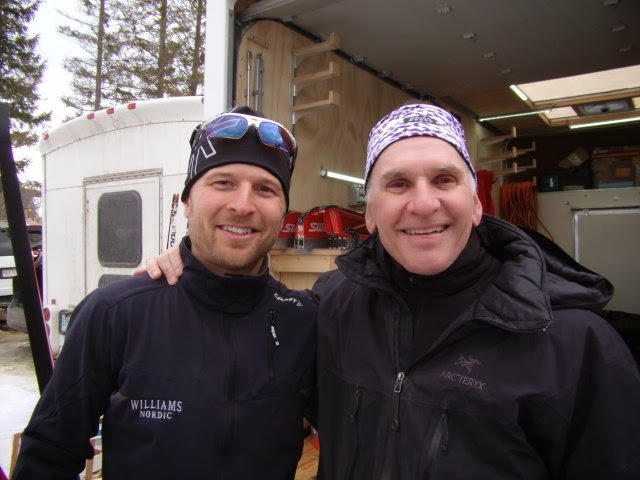
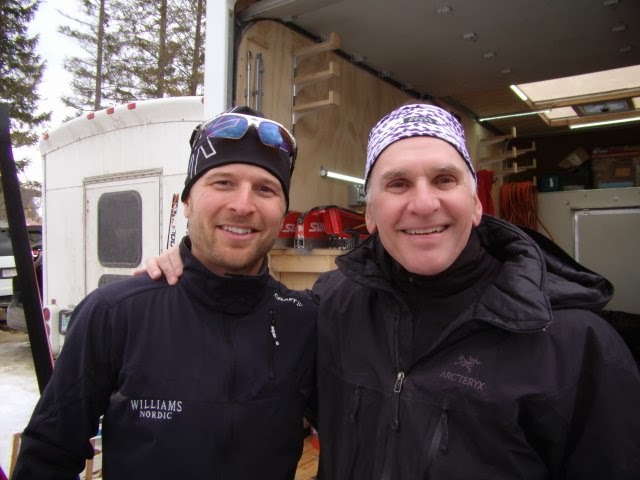
    Jason Lemieux (left) and Bud Fisher coached the Williams College ski team together for the last two years. This season, Lemieux has taken over head coaching responsibilities. Photo: ephnordic.blogspot.com.
    Jason Lemieux (left) and Bud Fisher coached the Williams College ski team together for the last two years. This season, Lemieux has taken over head coaching responsibilities. Photo: ephnordic.blogspot.com.

    When longtime Williams College Nordic coach Bud Fisher began to contemplate retirement, he knew someone who might want his job.

    He called Jason Lemieux, a former Williams racer who had gone on to ski for the Subary Factory Team before moving to Hood River, Oregon, to be closer to his wife’s family. Lemieux was happy on the West coast, coaching with XC Oregon and working marketing for a carbon fiber manufacturing company.

    But he had never given up the idea that it would be nice to coach at his alma mater – which is also only half an hour from where he grew up in Massachusetts.

    “It would have been a lot to give up for any other location, or any other school that is farther away from my family,” Lemieux said in an interview last week. “So this was pretty much what we had on the top of our list, and what we were willing to make the sacrifice for.”

    Lemieux spent the last two years working side by side with Fisher as an assistant coach. The official handoff – or at least the emotional one – happened over spring break in Sjusjøen, Norway, where the current Williams team and a group of alums took a trip with Fisher to spend a lot of time on snow and celebrate their love of the sport.

    “We ended up with a group of about 50 people skiing all day every day,” Lemieux said. “The kids were just all fired up. After such a long season, they still wanted to ski all day every day. It was a once in a lifetime trip. We’re hoping to do it again down the road sometime.”

    Fisher always instilled Scandinavian values about the role of sport in a balanced life in his athletes. Having coached briefly at the NTG in Lillehammer, Norway, he knew exactly how much a part of life skiing is in Norway.

    And that’s something that Lemieux says he will work hard to keep as a tenet of the Williams program.

    “We used to always talk about the lifestyle to income ratio,” he said of Fisher. “That’s the goal, one way to find happiness. We’re definitely about the lifestyle, and it’s how I am too. When people are struggling or trying to balance, it’s all about the love of the sport. It has to be fun. It’s not just about the results.”

    Official practice doesn’t start until the first Monday in October, but Lemieux says he has obviously been in touch with the team and it is shaping up to be one of the college’s best years ever.

    Williams placed 15th at NCAA Championships last year, with the best cross country performance by Eli Hoenig, who placed 17th in the 20k freestyle. This year, Lemieux belives that the men’s team might be the best the school has ever seen.

    He’s particularly excited about 2015 NCAA’s, which are to be held in Lake Placid, New York.

    After graduating from Williams in 2001, Lemieux moved to Lake Placid to coach the Nordic combined team at the National Sports Academy. It’s where he made a big jump in his own skiing, after using mornings to train before teaching and coaching in the afternoons and evenings. So he knows the race trails well and says that it’s informing his team’s training this fall.

    “Those trails are awesome, they’re great,” Lemieux said. “We’ll be doing some workouts that mimic the Lake Placid courses. There’s big ups and big downs there.”

    So what has changed at Williams now that Lemieux is alone at the top?
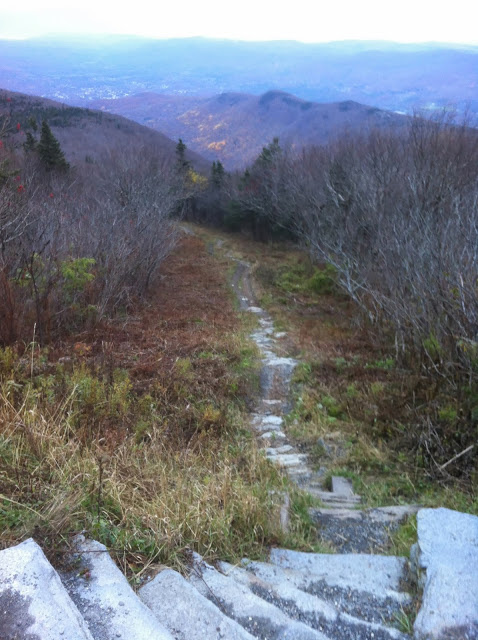
    The Schnellsteigen running time trial awaits Williams skiers this fall. Photo: ephnordic.blogspot.com.
    The Schnellsteigen running time trial awaits Williams skiers this fall. Photo: ephnordic.blogspot.com.

    Some things are superficial.

    “Well, the average age in the office went down by a lot,” he laughed. “We have a new alpine head coach as well, and of course two new assistants because we both were the assistants before.”

    And in a big relief to Ephs fans everywhere, Lemieux is touting a new race suit which more closely resembles the classic purple cow print than the suits of the last few years, which relegated the pattern to a small strip on the sides.

    “I don’t think people will see a whole lot of difference from the outside looking in, but we do have new ski suits,” he joked. “They are definitely identifiable as a purple cow suit. It’s a modern world version of the purple cow.”

    As an alum himself, Lemieux is intent on upholding the Williams Ski Team traditions, many of which date back decades. This fall, many of the standard workouts and time trials will still be on the schedule.

    “We always do a race called the Schnellsteigen, which is about an hour uphill running race,” he explained. “It’s good training, but it’s also just a tradition. There’s 30 or 40 years of data so people can look back on their Schnell time. We’ll of course do that.”

    But he is also adding some new variety to the training routine.

    “We do a lot more creative agility workouts now, and different ways to train specific technique strength and speed,” Lemieux said. “I’m a little les straight-line focused. I like to have them working on a lot of different things for agility and athleticism. We’re doing some newer tests as well. We never had really a double-pole test, and we started a shorter uphill running test two years ago as well.”

    So the updated Williams team? Lemieux hopes that by building on the school’s long tradition of Nordic excellence and introducing a few key new ideas, the Ephs will be able to rise to even greater heights.

    “It’s important to be really consistent and have traditions, but at the same time you have to always look for new workouts and always look for new routes,” he said. “You try not to do the same thing every week, just to keep people excited about going to practice.”
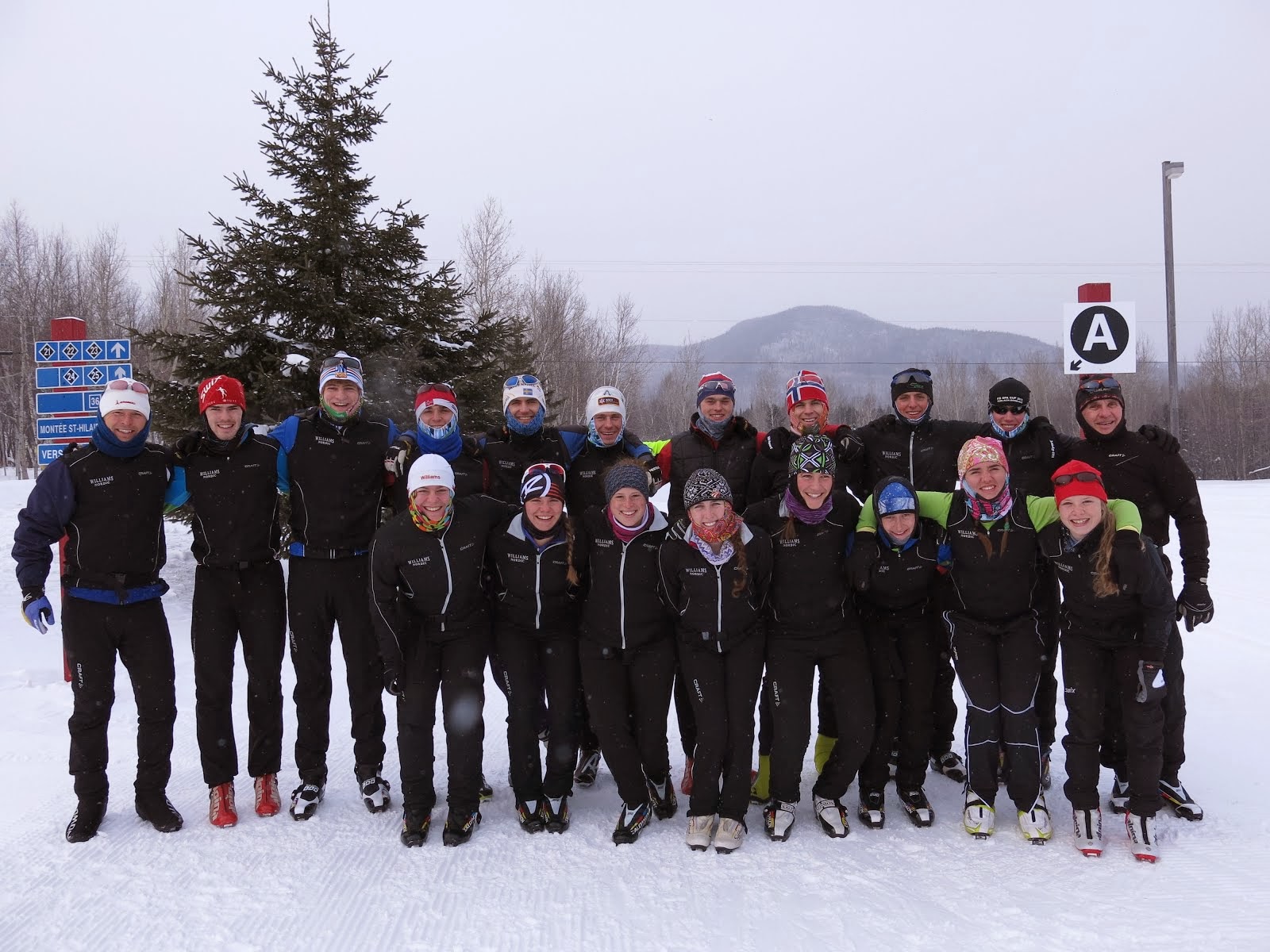
    The 2013-2014 Williams team, with Lemieux (standing, left) and Fisher (standing, right). Photo: ephnordic.blogspot.com.
    The 2013-2014 Williams team, with Lemieux (standing, left) and Fisher (standing, right). Photo: ephnordic.blogspot.com.
  • Push for Homologation at Williams’ Prospect Mountain

    Push for Homologation at Williams’ Prospect Mountain

    Every two years, the Williams College nordic team hosts its Winter Carnival 20 miles north of Williamstown, Mass., at Prospect Mountain in Woodford, Vt. By 2016, it could have a five-kilometer ski loop up to International Ski Federation (FIS) standards.

    A scene from the Williams' College Winter Carnival at Prospect Mountain in Vermont. (Photo: Jason Lemieux)
    A scene from the Williams’ College Winter Carnival at Prospect Mountain in Woodford, Vt. (Photo: Jason Lemieux)

    “It started with my coach, Bud Fisher,” said Williams senior Will Wicherski. “He’s been at Williams forever.”

    Williams’ associate director of athletics, Fisher suggested that Wicherski study Prospect’s trail system to determine whether a homologated trail would be feasible.

    “Within the EISA [Eastern Intercollegiate Ski Association], there’s more and more of a move to get all our races on homologated courses,” Fisher said. “We’ve been thinking about it for some time, and we’re taking a probably a little bit more conservative, slow-paced approach to it.”

    Wicherski characterized some of the EISA race loops as “really uneven,” pointing to Dartmouth’s Skiway at Oak Hill as an example.

    “The climb is way too big and not that wide,” he said. “Our course at Prospect is kind of unfair. It’s old-school, not wide, and there isn’t a lot of climb. We can’t really have mass start races there.”

    Homologating race trails evens the playing field, he explained. “Among the coaches, there’s more of a desire to hold races at homologated race sites.  They know what they’re getting.  There are more schools that want to host carnivals.”

    Some New England schools already hold their carnivals on homologated trails, including the University of New Hampshire (which hosts in Jackson); the University of Vermont (at Trapp Family Lodge in Stowe), and Middlebury (at Rikert) and Colby (in Waterville, Maine).

    The course will combine existing trails with new sections.  Much of Prospect Mountain’s trail network is on U.S. Forest Service land, where the permitting process makes large-scale alterations difficult. As a result, Williams wants its race loop to include minimal new trails.

    Ultimately the college would like to create a course that will accommodate interval-start freestyle and classic races as well as team relays. Mass-start skate races require wider trails than interval starts, and Fisher said that while it wouldn’t be impossible to make them happen, it would be “very difficult.”

    Interval-start freestyle, classic, and relay events require trails 5 meters wide.  Even for interval-start homologation, some sections of trail — all on forest service land — would need to be widened.

    Wicherski described southern Vermont/northwestern Massachusetts as “being on the edge of consistent snow,” adding that if the homologation project works out, the college may consider snowmaking in the future.

    “Getting the course homologated is the first step towards snowmaking,” he said.

    According to Williams’ Nordic Head Coach Jason Lemieux, snowmaking is a “long term goal/dream … it’s a battle we’ll wait to fight until the completion of the homologation project,” he wrote in an email.

    Prospect Mountain’s ski roots trace back to 1939, when it started as an alpine-ski area with a rope tow. At 2,250 feet above sea level, its base elevation is the highest of any ski area in Vermont. In the 1970s, Prospect’s owners cut cross-country ski trails to enhance their business, and in 1992, Steve Whitham and Andrea Amodeo purchased the area after its previous owner abandoned it. Instead of reopening the lifts, they focused on cross-country skiing.

    At 2,250 feet above sea level, its base elevation is the highest of any ski area in Vermont.

    Getting Up is Half the Battle

    One of the biggest challenges was designing an appropriate downhill from the main climb. Running under the old lift line, the A-climb diagonally crosses the alpine hill, ending up on a trail called Shay’s.

    “We know where the A-climb is, but we don’t have a way to get down off it,” Fisher said.

    This summer, they plan to build the descent. Williams will test it this coming winter, after which they plan to finish work on the trail.

    The other challenge exists at the opposite end of the course. Prospect’s trail system is bisected by a forest-service road that sees heavy snowmobile traffic during the winter. During Williams’ last Winter Carnival, course workers had to stop snowmobiles 17 times during the races. “It’s a dangerous situation,” Fisher said.

    To avoid the road, Williams would need to construct a short connector trail on forest-service land.  They’ve applied to the U.S. Forest Service (USFS) both for this and to widen trail sections where necessary. The carnival trail falls into the forest service’s small-projects category, which requires less time, ecological compliance and money than a large-scale endeavor.

    Pending USFS approval, construction will start with trail work this summer.

    We haven’t actually gotten an FIS [inspector] in yet,” Fisher said. “We wanted to get all the homologation parameters met before we do that. We launched into the project and came up with a number of ideas to us where show we get an A-climb and a B-climb.”

    Lemieux estimated the project’s cost to be “easily more than $15,000.”

    Approval will give Williams a 10-year permit. If the downhill from A-climb works, they’ll continue work on the land the following summer. At that point, they would bring in a course inspector from the FIS for any tweaks.