From the FasterSkier archive — posts syndicated from athletes’ and coaches’ own blogs between 2004 and 2012, kept online as published. Current coverage is at fasterskier.com.
PARK CITY, UTAH (January 19, 2022) — USA Nordic Sport announced today its nominations for the U.S. Olympic Nordic Combined Team that will represent Team USA at the Olympic Winter Games Beijing 2022. Nominations are to be confirmed by the United States Olympic & Paralympic Committee when it formally announces the U.S. Olympic Team.
Athletes to Watch
The team will be headlined by three-time Olympian Taylor Fletcher, who looks for his first Olympic podium. Fletcher’s top finishes at the Olympics include a sixth-place finish in the Team Large Hill/4x5km competition at the Sochi Games in 2014, along with a 20th place finish in the Large Hill/10km Individual competition and a 33rd place finish in the Normal Hill/10km in Sochi. Fletcher will be joined by Ben Loomis, a one-time Olympian who will also be looking for his first Olympic podium. At the Pyeongchang Olympics in 2018, Loomis carded a 10th place finish in the Team Large Hill/4x5km competition, 40th in the Large Hill/10km Individual competition and 41st in the Normal Hill/10km Individual competition.
Taylor Fletcher competes in Val di Fiemme in January, 2022. (Photo: NordicFocus)
Selection Process
The selection process for nordic combined includes results from both domestic and international competitions. The first spot on the U.S. Olympic Nordic Combined Team is decided by the winner of the Olympic Trials event in Lake Placid, New York on December 25, 2022. Additional spots were selected based on athletes’ results at both the FIS World Cup and Continental Cup levels during this winter’s qualification period.
Olympic Competition Schedule Nordic Combined has an action-packed schedule at the 2022 Games. The first of three medal events kick off on Wednesday, February 9, with the Individual Gunderson Normal Hill/10km competition, followed by the Individual Gunderson Large Hill/10km on Tuesday, February 15. The final event –Team Gunderson Large Hill/4x5km – is scheduled for Thursday, February 17.
2022 U.S. OLYMPIC NORDIC COMBINED TEAM
(Name; hometown, birthday; club; past Olympics)
Taylor Fletcher, Steamboat Springs, Colorado;5/11/90; Steamboat Springs Winter Sports Club(Olympics: 2010, 2014, 2018)
Ben Loomis,Eau Claire, Wisconsin; 6/9/98; Flying Eagles Ski Club (Olympics: 2018)
Jasper Good,Steamboat Springs, Colorado; 5/10/96; Steamboat Springs Winter Sports Club (Olympics: 2018)
*Jared Shumate, Park City, Utah; 3/6/99; Park City Ski and Snowboard
*Stephen Schumann, Park City, Utah; 3/14/00; Park City Ski and Snowboard
*Denotes first-time Olympian
WatchTeam USA compete on the networks ofNBCthroughoutthe Olympics, February 4-20, 2022.
Ben Loomis competes in a World Cup in Val di Fiemme, Italy in January, 2022. (Photo: NordicFocus)
Taylor Fletcher
“Getting named to my fourth Olympic team after winning the Olympic Trials is a big motivation for me. As the veteran athlete of the U.S. Nordic Combined Olympic Team, I want to make the most of this Olympics with my best results. Knowing that my spot is secure will allow me to focus on training and competition to make sure I am in the best form going into Beijing 2022. The Olympics are always a big focus and have been since I started the sport many many years ago. I feel confident I can go there and have my best results yet. We will have a young team but a team for the future, which is very exciting. Look out for nordic combined in the coming weeks!”
Ben Loomis
“I am extremely proud to have been named to the 2022 Olympic Team. It will be a true honor to represent both USANordic and the U.S. Army World Class Athlete Program in Beijing. Amongst the current state of COVID-19, it will be great to bring the world together in a safe manner and showcase what the Olympics are all about. I couldn’t be more excited to have a team of both experienced Olympians and athletes heading to their first games alongside me in Beijing.”
Jasper Good
“I am incredibly honored and excited to be named to the 2022 U.S. Olympic Team. Representing Team USA at this Games means even more to me as a member of the U.S. Army World Class Athlete Program (WCAP). The support and camaraderie I have gained from WCAP have helped me reach new levels. It will be an honor to represent the U.S. with this added factor. I am really excited about how much progression our team has made and can’t wait to perform with my team in Beijing!”
Jared Shumate
“I am honored to be selected to represent the USA at the 2022 Olympics. It has been a goal of mine since I was a kid to compete at the Olympics, and I am overjoyed to officially be selected to my first Olympic team. I feel like I have made some big steps forward in the last few months, including scoring my first World Cup points in Predazzo, Italy, which qualified me for the team, and I am looking forward to keeping the momentum going into Beijing! I’m excited to compete with the rest of my teammates at the highest level of sport and am looking forward to experiencing my first Olympic Games, even though COVID is making these games a bit different than previous years. In the weeks leading up to the Olympics, the goal is to stay healthy and train hard!”
Stephen Schumann
“I’m beyond excited for the opportunity to represent the USA at the upcoming Olympics in Beijing. It has been a dream of mine to compete at the Olympics since I first stepped on a ski jump at 5 years old. To think that the dream I had as a little kid is coming true 16 years later is surreal, and the fact that I get to do it with some of my best friends makes it so much better. I could not be more excited! Thank you so much to everyone who has believed in me and helped me get to this point through all the setbacks and hard times; it wouldn’t have been possible without you. Now, time to buckle down and polish things up before heading to Beijing!”
Jasper Good jumps in a December, 2021 World Cup competition in Lillehammer, Norway. (Photo: NordicFocus)
COACH QUOTES:
Nick Hendrickson – Men’s Nordic Combined Team Director
“With the nomination of our 2022 Olympic Team, I am extremely excited to have every one of these athletes selected to represent the USA in Beijing. I am proud of each individual for their accomplishments throughout the qualification process, but I am most proud of the teamwork that has been invested behind the scenes to raise our competition level. Collectively, our team is composed of four-time Olympic veterans, two-time Olympians, as well as first-timers; we have a lot of both experience and opportunity in this group of talented guys. The team momentum that we have at the moment is contagious and we can’t wait to keep it rolling into Beijing!”
###
About USANordic USANordic is the national leadership organization for Nordic combined and ski jumping in the United States, providing support and guidance to the nations’ clubs and coaches while overseeing the national elite teams. More information can be found at usanordic.org or its social media channels @usanordic.
FOR MORE INFORMATION CONTACT:
Riley Elliott Nordic Combined/Ski Jumping Olympic Press Officer riley@usanordic.org
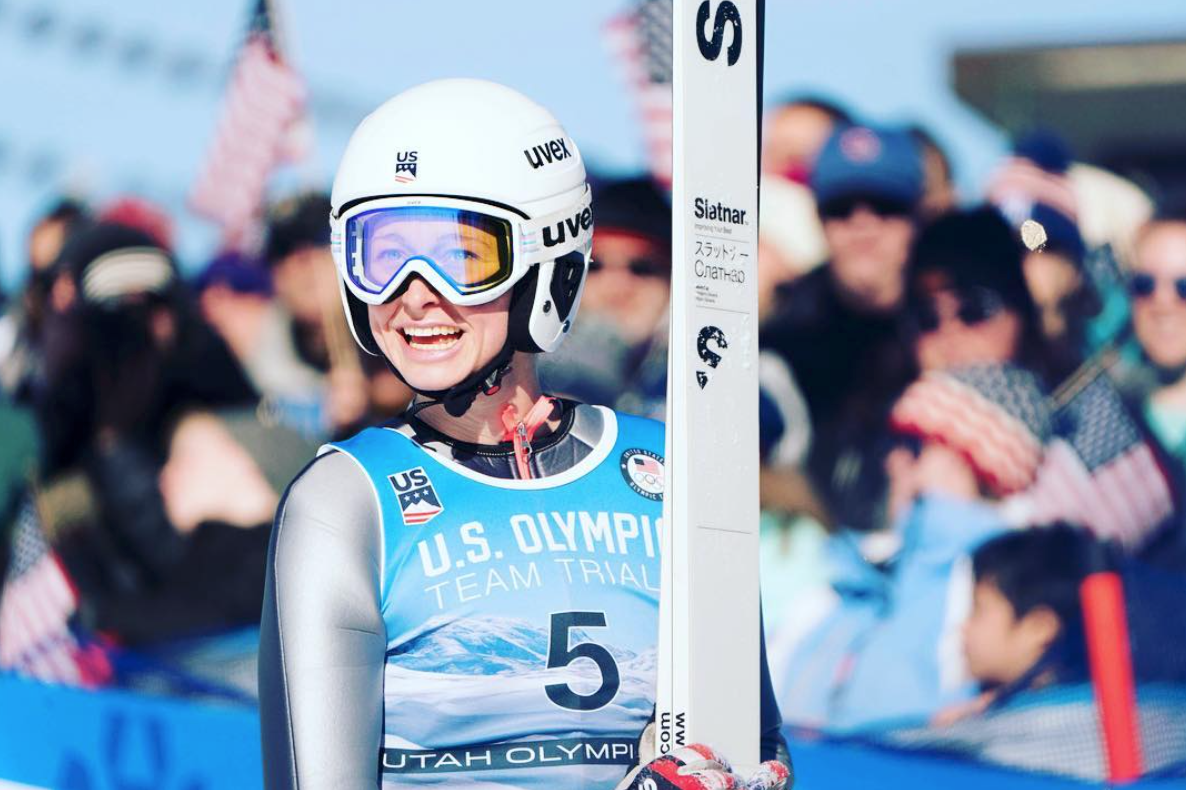
Tara Geraghty-Moats at 2018 U.S. Olympic trials (Photo: Tara Geraghty-Moats/Instagram)
The nordic-combined team includes six men and for the first time, a woman, with Tara Geraghty-Moats on the 2018 Women’s Nordic Combined National “C” Team. (Geraghty-Moats is also a member of USA Nordic’s Women’s Ski Jumping “C” Team.)
On the men’s Nordic Combined National Team, 2018 Olympian and Junior World Championships bronze medalist Ben Loomis stands as the lone A-team member following Bryan Fletcher’s retirement. The B-team includes team veteran Taylor Fletcher, Jasper Good and Stephen Schumann, while Grant Andrews and Jared Shumate were nominated to the C-team.
“We are excited about our continued expansion of our teams and with the exciting development of Women’s Nordic Combined including confirmation of the event in the 2021 World Championships!” USA Nordic Executive Director Bill Demong said in the press release. “Tara Geraughty-Moats continues to be one of our top talents in the sport and, though she was unable to compete in any Nordic Combined competitions last year due to injury, USA Nordic recognizes the importance of growing our sports and developing athletes who have the ability to push the envelope and we are excited to lead growth and opportunity in this new discipline of Womens Nordic Combined.”
USA Nordic 2018/2019 Men’s Nordic Combined National Team
Johannes Rydzek (5) leading his two German teammates, Fabian Rießle (6) and Eric Frenzel, as well as Norway’s Jarl Magnus Riiber toward the finish of the nordic-combined large hill/10 k competition on Tuesday at the 2018 Olympics in PyeongChang, South Korea. They finished in that order, with Germany sweeping the medals. (Photo: FlyingPointRoad)
It was a total team effort on Tuesday for Germany in the second nordic-combined individual event of the 2018 Olympics in PyeongChang, South Korea, with Fabian Rießle, Johannes Rydzek and Eric Frenzel, with the help of Austria’s Wilhelm Denifl, chasing down Japan’s Akito Watabe and Norway’s Jarl Magnus Riiber about 6 kilometers into the 10 k race.
Earlier on Tuesday, Watabe had put himself in first with the best-ranked jump on PyeongChang’s 142-meter large hill. He started the 10 k Gundersen in first, just 1 second ahead of Riiber, who had jumped to second, just 0.3 points behind Watabe.
(Riiber had actually jumped farther with a distance of 139 meters, compared to Watabe’s 134-meter jump, and scored identical marks from the judges but lost points for wind compensation.)
Germany en route to a complete sweep of the podium in the men’s nordic-combined individual large hill/10 k on Tuesday at the 2018 Olympics in PyeongChang, South Korea, with Johannes Rydzek (5) leading Fabian Rießle (6) and Eric Frenzel (4). They went on to place first, second and third, respectively. (Photo: FlyingPointRoad)
Behind them, Denifl started the 10 k race 16 seconds out of first, Frenzel surged out of the start 24 seconds back, Rydzek 31 seconds behind, and Rießle 34 seconds back.
While Watabe led Riiber off the front for the first two laps of the four-lap race, the three Germans caught Denifl before lapping through the stadium for the first time at 2.5 k. From there, 16 seconds behind the leaders, the four-man group worked to reel in first and second place and did so by 6 k.
The lead pack then became six as Riiber and Watabe continued to position themselves up front at the 7.5 k mark.
On the final lap at the 8.58 k marker, Watabe charged to the front in his move to reclaim first. After taking the lead on an uphill, it wasn’t long after until he found himself skiing with three others alongside him: Riiber, Rydzek and Frenzel.
Then, Watabe slipped behind Riiber and the group closed in around him. Watabe clipped a ski, apparently with Rießle, who didn’t stumble, but Watabe did and dropped to the back of the pack. For Watabe, that was the end. For Germany, it was the beginning.
Frenzel led the charge up the final climb with Rydzek and Rießle behind him while Riiber tried to keep pace. Riiber slotted into fourth over the top and the foursome flew down into the stadium, with Rydzek coming out of the draft in first and leading Rießle, Frenzel and Riiber to the finish, respectively.
They finished in that order, with Rydzek taking gold in 23:52.5 minutes, 0.4 seconds ahead of Rießle in second place and 0.8 seconds ahead of Frenzel in third. Riiber crossed 2.8 seconds back in fourth, and Watabe ended up fifth (+12.5).
Germany had four in the top seven with Vinzenz Geiger in seventh (+50.1), behind Finland’s Eero Hirvonen in sixth (+22.1).
“I looked up to the video wall and saw the first three: all Germans,” Geiger recalled in a post-race interview with German broadcaster ARD. “That made me really happy, and of course I can also be happy about my seventh place.”
Bryan Fletcher en route to 17th in Tuesday’s large hill/10 k competition, tying his best result at the 2018 Olympics in PyeongChang, South Korea. (Photo: FlyingPointRoad)
American Bryan Fletcher repeated his result from the normal-hill competition as well, placing 17th on Tuesday, 1:42.9 minutes behind Rydzek in first. Fletcher had started the 10 k 2:04 minutes back in 23rd based on his jump. His teammate Ben Berend started 8 seconds behind him in 24th. Ultimately, Fletcher raced up to 17th with the 10th-fastest course time while Berend slipped to 39th (+4:28.2).
“The second I was in the air I knew I had a good one,” Berend told FasterSkier after the jumping portion of Tuesday’s competition. “Because when you do it right, you’re just flying, and I was really high and I was pulling away towards the bottom of the hill and so I knew, but I couldn’t feel any wind or anything. I was just so psyched, trying to enjoy every second of it.
In his first Olympic race, American Ben Berend on his way to 39th in the large hill/10 k competition at the 2018 Olympics in PyeongChang, South Korea. He started the day by jumping to 24th, which he said was his best competition jump of the season. (Photo: FlyingPointRoad)
“I haven’t had that many good jumps this season so I’ve just been searching for that,” Berend explained. “It’s funny, it’s so easy when you are doing it right and it’s so hard when you’re lost, and so I finally felt like, that might have been my best jump of the season, honestly, so what are the odds of doing that at the Olympics? That’s pretty cool.”
Tuesday was the 22 year old’s first Olympic competition after he sat out the first individual event because his jumping had been going poorly in training, he said. (Each team can only start four athletes per event. Taylor Fletcher sat out Tuesdsay’s competition.)
“I definitely was a little nervous for tonight, even though there is no pressure on me,” Berend said. “… Our coach [three-time U.S. Olympic biathlete Jeremy Teela] texted us, he’s actually our cross-county coach, he’s back at home, and he just said, ‘You guys have nothing to lose. Don’t be scared to fail.’ So that’s kind of our mindset here, and it was good; it kind of works for me.”
American Bryan Fletcher (23) skiing with Norway’s Jørgen Graabak (19) during the cross-country race of Tuesday’s individual large hill/10 k competition at the 2018 Olympics in PyeongChang, South Korea. Fletcher went on to finish 17th while Graabak placed 10th. (Photo: FlyingPointRoad)
After the race, Bryan Fletcher, who had skied up to 13th by 7.5 k, recalled pulling a chase group for most of the four laps. He ended up 17th, 3.2 seconds shy of 16th place, behind Japan’s Go Yamamoto.
“I went all in and just tried to make up as much ground as possible,” Fletcher told FasterSkier after. “I was hopeful and optimistic that I’d have the legs at the end. I knew that they were going to come around me with a pretty hard attack, and both of the guys that were with me have great finishing sprints, so I tried to pace myself a little bit, but I also knew that 17th or 10th or whatever you could get up to, it doesn’t really matter unless you’re on the podium so I was really going all in. … Unfortunately it didn’t work out, but I’m happy with how I skied and happy with the performance I had on the course today.”
American Ben Loomis racing to 40th in the large hill/10 k competition at the 2018 Olympics in PyeongChang, South Korea. (Photo: FlyingPointRoad)
Just behind Berend, his teammate Ben Loomis finished 40th (+4:38.8), up from 43rd in the jump, and Jasper Good followed in 43rd (+5:50.2), up from 46th.
“It was kind of tough jumping … [and] hard to start the race at the back, but overall it was a good race by me and I felt pretty good out there,” Loomis said after. “Regardless of how I have and how I continue to do here, there’s a lot to take away and I’m learning a lot about how to better refine my preparations and just stay relaxed out there and just really put my best foot forward.”
Nordic combined at the 2018 Games will conclude with the 4 x 5 k team event on Thursday.
Germany’s Eric Frenzel celebrates defending his Olympic gold in the normal hill/10 k Gundersen on Wednesday, the first nordic-combined competition of the 2018 Olympics in PyeongChang, South Korea. Japan’s Akito Watabe (l) placed second, 4.8 seconds back. (Photo: FlyingPointRoad)
PYEONGCHANG, South Korea — Wednesday at the Alpensia nordic sport complex, the first of the scheduled three nordic-combined events of the 2018 Olympics got underway. Despite the women’s 15-kilometer individual biathlon event being postponed to Thursday due to high winds, the nordic-combined jumping portion went off earlier in the day as planned.
The men’s individual normal hill/10-kilometer Gundersen competition saw Austria’s Franz-Josef Rehrl scored the highest number of points off the jump with a jump of 112 meters and 130.6 points. Norway’s Jarl Magnus Riiber jumped to second, flying 111 meters and scoring 126.9 points, and Japan’s Akito Watabe posted the third-best jump of 105.5 meters, which scored 123.7 points.
Four U.S. nordic combined skiers entered the competition. After the jump, Bryan Fletcher was the top American in 18th place. Ben Loomis was the next best placed American in 37th, while Taylor Fletcher ranked 39th and Jasper Good 47th.
The pursuit-race format saw Rehrl leave first on the demanding four-lap, 10 k course. Riiber followed in second, starting 15 seconds back, Watabe began with a 28-second deficit.
Germany’s Eric Frenzel (5) leads Austria’s Lukas Klapfer during the individual normal hill/10 k competition on Wednesday at the 2018 Olympics in PyeongChang, South Korea. Frenzel went on to win while Klapfer placed third. (Photo: FlyingPointRoad)
Several skiers ready to chase down the leaders began with reasonable time penalties to overcome. Germany’s Eric Frenzel started 36 second back in fifth, Austria’s Lukas Klapfer was Frenzel’s initial rabbit, starting four seconds before the German in fourth place.
Both Fletcher brothers are renowned for their cross-country skiing. Often ranked in the top three for overall time on the 10 k course, a deficit of over a minute is not an insurmountable gap for the brothers from Steamboat Springs, Colorado. Yet on Wednesday, Bryan began 2:06 minutes back while Taylor looked ahead at a massive 3:37-minute vacuum to Rehrl in first. Loomis began the ski four seconds ahead of Taylor, while Good started in the wave, 4 minutes back.
For the first 2.5 k lap of the race, the 24-year-old Rehrl skied alone until a climb about 5 minutes in, where Riiber caught him. The chase group, with Watabe, Klapfer, and Frenzel, wasn’t much farther behind. At the 2.5 k mark, that group was just 12 seconds behind the two leaders as they lapped through the stadium.
Meanwhile, Bryan pushed out of the start in immediate pursuit of Finland’s Ilkka Herola and Germany’s Fabian Rießle 2 and 3 seconds ahead of him, respectively. At 2.5 k, Bryan was up to 16th, skiing in a pack with Herola, Fabian Rießle, Germany’s Vinzenz Geiger, and Japan’s Hideaki Nagai and Go Yamamoto, about 1:33 minutes back from the leaders.
Halfway through the race at 5 k, Frenzel, Riiber, Watabe, Klapfer, and Rehrl pushed on as a unit, forming the nucleus from which gold, silver and bronze would eventually come. There, Bryan continued to ski in 16th with a slightly more strung-out chase pack, 1:18 behind Frenzel in first.
Frenzel, Watabe and Klapfer swapped leads over the next 2.5 k, while Rehrl dropped to seventh, 25 seconds behind Germany’s Johannes Rydzek and Finland’s Eero Hirvonen, who had 21 seconds between them and the leaders at 7.5 k.
Bryan spent most of that next lap skiing alone in 17th, about 10 seconds out of 16th. By the end of the third lap, he was almost a minute clear of France’s Jason Lamy-Chappuis in 18th.
While Bryan held his ground in 17th for the final 2.5 k, the four-man lead group battled for three medals. Frenzel moved into first with 1 k to go and on the last climb, a long grinder before a descent into the stadium, Frenzel launched his attack. Only Watabe in second could immediately respond, but about halfway up the climb, even he lost sight of Frenzel over the top.
Japan’s Akito Watabe (3) leading Germany’s Eric Frenzel and Austria’s Lukas Klapfer during the 10 k ski race portion of the normal hill/10 k at the 2018 Olympics in PyeongChang, South Korea. Frenzel went on to win, Watabe placed second and Klapfer third. (Photo: FlyingPointRoad)
Frenzel steamrolled into the stadium to cross the finish line first in 24:15.4 minutes, defending his title from the normal hill/10 k four years ago at the Olympics in Sochi, Russia. While Frenzel, 29, is a perennial threat, it was only his second victory of the season, after he won a normal hill/10 k World Cup event in December in Ramsau, Austria. Meanwhile, Watabe came into the Games having won four of the last five individual World Cup competitions. But an Olympic gold still eludes the Japanese skier.
“It was a moment that was hard to stomach for me,” Frenzel recalled of the last few hundred meters of the race in an interview with German broadcaster ZDF. “In that moment I couldn’t yet quite believe that I could come back on the finish stretch in first place, and just tried to enjoy the moment. It was a lot of work up to this place for it to work out today. I waited for this for a long time again. And so I am overjoyed it worked out again.”
Watabe crossed the line 4.8 seconds later for silver, his second medal in as many Olympics after he placed second in the normall hill/10 k behind Frenzel in Sochi. Klapfer held off Riiber for third, 18.1 seconds behind Frenzel, for Klapfer’s second Olympic bronze after taking third with his Austrian teammates in the 4 x 5 k team event in Sochi.
Riiber placed fourth (+22.5), Rydzek was just behind in fifth (+27.9), Hirvonen finished sixth (+51.6), and Rießle and Herkola moved all the way up to seventh (+1:05.3) and eighth (+1:05.5), respectively, finishing with Geiger in ninth (+1:05.5).
With four Germans in the top 10, Frenzel predicted more success for his team at these Olympics.
“I hope there will be more golden moments like this here,” he told ZDF. “I think all of us are in good shape at the moment, especially Fabian [Rießle] who definitively was out of luck on the jump today. He surely can perform at a similar level as I did. So because of that we will keep attacking here over the next few days, especially on the large hill, and then we will see what is in it for us.”
American Bryan Fletcher racing to 17th in the normal hill/10 k Gundersen start on Wednesday at the 2018 Olympics in PyeongChang, South Korea. It was his first individual top 20 at his second Olympics. (Photo: FlyingPointRoad)
Bryan nearly caught Estonia’s Kristjan Ilves in 16th at the line, finishing 0.3 seconds behind him in 17th (+2:12.2) for his best individual result in his second Olympics. The 31 year old’s previous Olympic best was 22nd in the large hill/10 k in Sochi.
In a post-race interview with FasterSkier and other reporters in PyeongChang, Bryan said that he was disappointed with the result and felt that, with faster skis, he could’ve been in the mix. He noticed his skis weren’t up to par with Germany and FInland immediately out of the start, where he said he was sprinting to catch Rießle and Herkola.
“A two-second gap, I should be able to just yo-yo right onto them, and I couldn’t even get there,” he said. “That to me was a surefire sign that something was up. Either my physical performance wasn’t there or the skis weren’t there. It very well could’ve been a combination of both.”
He explained that nordic-combined athletes don’t warm up on race skis. “They were good, but just not quite there,” Bryan said of his skis.
On the day, his course time ranked 22nd, about 20 places slower than usual.
“I dug deep, I’m happy with how I managed that today and limited losses,” he explained. “Positive takeaways from the jump hill I think were really good. I know that I can be in the fight there and also know that with some better skis I can be in fight in the cross-country, so refocus and looking forward to next week.”
American Bryan Fletcher after jumping to 18th on the 109-meter normal hill at the 2018 Olympics in PyeongChang, South Korea. He went on to finish 17th in the 10 k later in the day. (Photo: FlyingPointRoad)
After his jump, he had hoped for a top 10.
“In fact, I think it was completely doable,” Bryan said. “It was only about a minute to eighth so it was a little bit disappointing going in and not being able to close that gap. It’s a big event, it’s one day and certainly anything can happen. And unfortunately today the cards didn’t stack in our favor.”
As a father and the oldest member of the USA’s young Olympic team, Bryan said he had been giving his teammates some pointers.
“I think they’ve been calling me ‘Dad’ all week because they love the advice, so falling into a parent role again,” he said. “It’s been fun and certainly they give me as much energy as I give them.”
Behind him, his younger brother Taylor, 27, finished 35th (+3:27.8) with the 15th-fastest course time, Loomis placed 41st (+4:29.4), and Good 45th (+5:48.4).
American Taylor Fletcher racing to 35th in the normal hill/10 k, after jumping to 39th, at the 2018 Olympics in PyeongChang, South Korea. (Photo: FlyingPointRoad)
Asked about his day, Taylor described it as “Not awesome. I mean it was realistic,” he explained. “Average day on the jump, average day on the cross-country. I know what I did and what I need to do, and I think that’s the harsh reality, for sure, but it was a mix between thinking the skis weren’t so great, me definitely going a little too hard at the beginning and maybe me [trying to figure] out whether it was me or whether it was skis, and honestly I think it was more me.”
Italy’s Alessandro Pittin started the race 4 seconds ahead of him in 38th. Pittin went on to ski the fastest 10 k time of 23:48.9 to end up 19th at the finish.
“Alessandro Pittin is the fastest skier, he’s taken that away from me for sure,” Taylor said. “I think I put a little too much energy on that first lap trying to stay with him and then I actually went passed him and led in the wind going up this hill coming back toward the stadium, and I think that just put me on edge a little bit too much and too early.”
Taylor described the conditions as variable, alternating from glazed and fast to “mush” and “dead” feeling.
“It’s hard to describe where I’ve skied that before, but it has no character, no feeling to it, and it’s really hard to glide on it,” he said of the snow in PyeongChang. “I was struggling on the gradual hill coming back into the stadium and I felt like I couldn’t get up onto my toe for that final kick of V2 so I was very static and heavy on the legs and that’s not where I want to be at all. It’s not fluid for me, and it’s just difficult.”
As for his jumping, he was pleased with his improvement since earlier this season.
“It’s a million times better than it was in December,” he said. “… It’s still got a ways to go, but I’ve shown in these last couple weeks that slightly better jumps are leaps and bounds better for me.”
As the 10th jumper to descend down PyeongChang’s 109-meter hill on Wednesday, Taylor explained that the first three American jumpers got “a little unlucky” with the crosswind on the jump. Good was the first jumper of the day in bib 1, Loomis started ninth, Taylor 10th, and Bryan 26th out of 48 starters.
(Article continues below)
American Ben Loomis jumping to 37th on the 109-meter normal hill at the 2018 Olympics in PyeongChang, South Korea. (Photo: FlyingPointRoad)
“I still had good conditions compared to Jasper, but compared to a lot of the other guys, I was still slightly behind them,” Taylor said. “But for me, I’ve just got to jump a little bit early and a little bit more forward with the speed and it’ll be there.”
Good told reporters that the top of the PyeongChang jump “literally feels like a hurricane. The wind is just howling and the first time we got up there training earlier this week, I was like, there is no chance we’re jumping right now,” he recalled. “But the wind barriers they have set up do an awesome job because when you actually get to the jump the wind is fine so it’s more of a mental battle.”
In his first Olympic competition, the 21-year-old Good’s jump of 76 meters put him last place going into the 10 k. But he started with four other skiers in a wave start, 4 minutes behind the leader.
“It’s a little bit easier to get motivation starting in the back in this event just because it’s so big, you’re on the world stage, and this is the kind of race where everyone has, like, inspired skis regardless of where they’re skiing,” Good said. “It just feels like there’s more to it and there’s more within you, but it’s just awesome to be out competing and achieve a personal dream of mine.”
American Ben Loomis en route to 41st in the normal hill/10 k Gundersen at the 2018 Olympics in PyeongChang, South Korea. (Photo: FlyingPointRoad)
Loomis said that while PyeongChang is probably the windiest place he’s ever jumped, it made for a challenging and exciting competition. He said his jump on Wednesday, at 86.5 meters, was better than most of his training jumps there.
“Most of the training rounds were even a lot windier than today, so we kind of got well-prepared for that, and luckily it was pretty good for the comp today,” Loomis explained. “The winds were about as even as they’ve been here so far.”
At 19 years old, Loomis is coming off a bronze-medal performance and fourth-place finish in two individual races at Junior World Championships in Kandersteg, Switzerland, just two weeks ago.
“It’s my first Olympics and I’m one of the younger guys so I’m looking to take it all in and learn from this and gain as much experience as I can for the next Olympics in four or even eight years out of today,” he said.
The next nordic-combined competition at the Games is set for Tuesday, Feb. 20 with the individual large hill/10 k.
The nordic-combined normal hill/10 k podium at the 2018 Olympics, with Germany’s Eric Frenzel (c) in first, Japan’s Akito Watabe (r) in second, and Austria’s Lukas Klapfer (l) in third. (Photo: FlyingPointRoad)
American Bryan Fletcher racing to 17th in the men’s 10 k Gundersen start today, the second half of the nordic-combined normal hill/10 k competition, on Wednesday at the 2018 Olympics in PyeongChang, South Korea. It was his first individual top 20 at his second Olympics. (Photo: FlyingPointRoad)
After the jumping round of the nordic-combined individual normal hill/10-kilometer Gundersen-start competition on Wednesday, Austria’s Franz-Josef Rehrl topped the standings thanks to a jump of 112 meters, just a meter farther than second place Jarl Magnus Riiber of Norway.
The top American was Bryan Fletcher, who sat in 18th place after a jump of 97.5 meters good for 99 points. He started the 10 k cross-country skiing portion of the competition 2:06 behind Rehrl, 1:51 behind Riiber – who has won two World Cups this season – and 1:30 behind defending Olympic champ Frenzel.
Fletcher initially made up some time on the leaders, but as the pace of the race was constantly changing in the end he wound up just one spot ahead of where he started, in 17th. Defending Olympic champ Eric Frenzel of Germany made it to the front after starting in bib five and sprinted to a 4.8 second victory over Japan’s Akito Watabe. Austria’s Lukas Klapfer earned bronze (+18.1) just ahead of Riiber (+22.5). Fletcher’s time was 2:12.2 behind Frenzel at the finish.
Ben Loomis and Taylor Fletcher jumped to 37th and 39th positions, respectively, and started the cross-country competition 3:24 and 3:37 out of the lead. Taylor Fletcher moved up four spots to finish 35th (+3:27.8) while Loomis lost a few places to finish 41st (+4:29.4). The final American starter, Jasper Good, was last (47th) after the jumping round but made up two spots on the trails to finish 45th (+5:48.4)
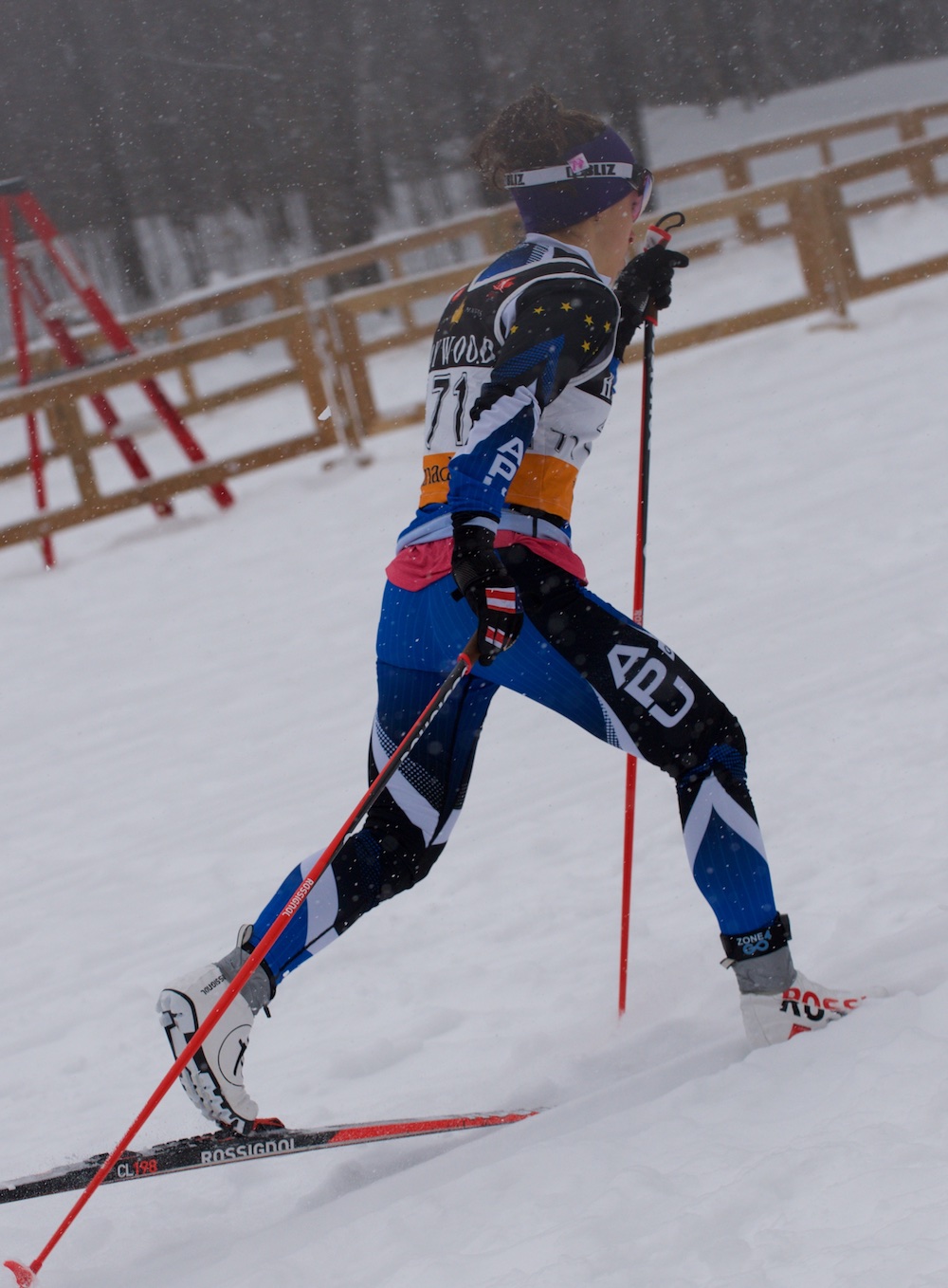
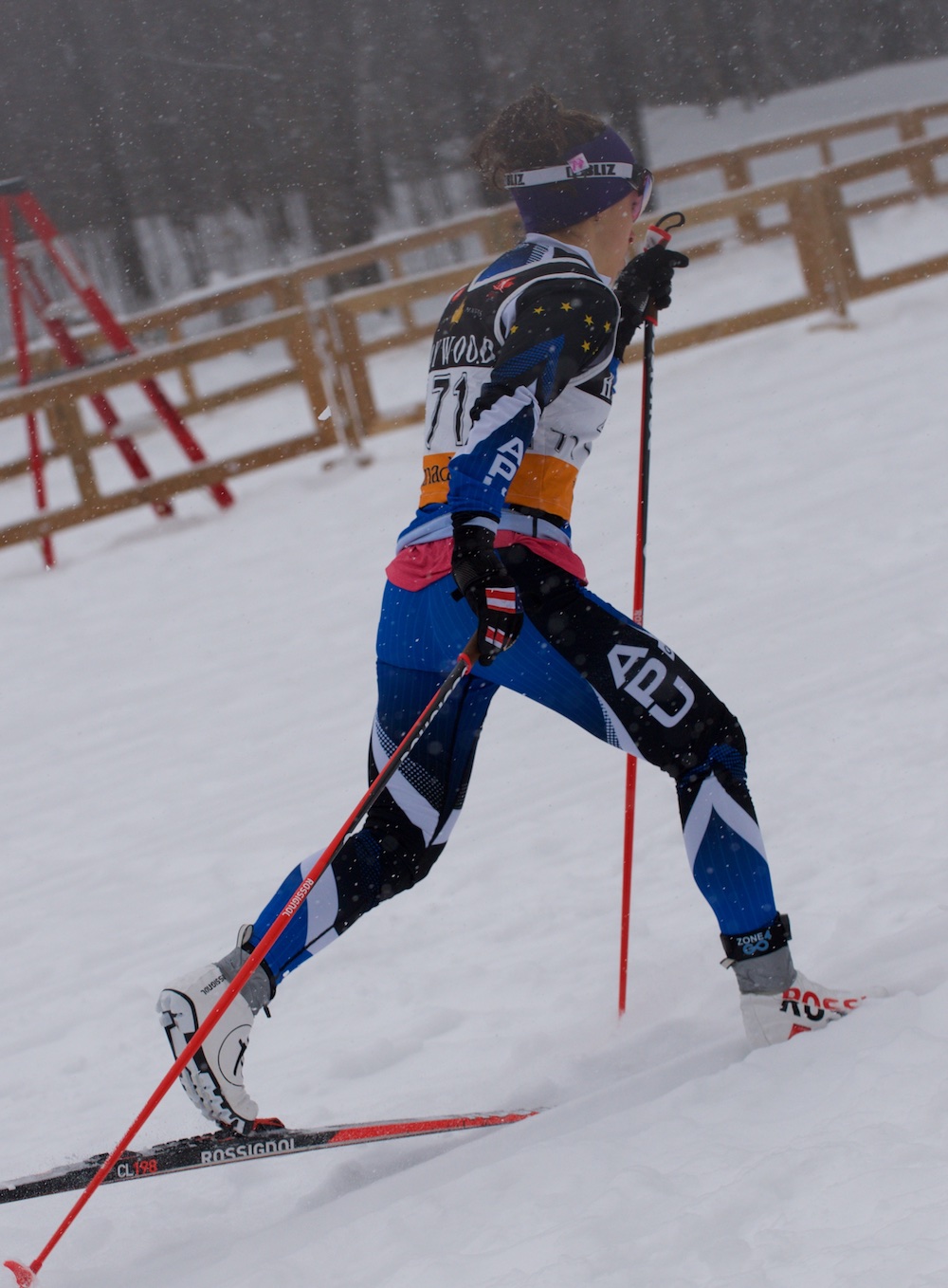
Rosie Frankowski (APU) racing to a 2-second win in the women’s 10 k classic pursuit on Sunday, the final day of 2018 Eastern Canadian Championships in Gatineau, Quebec. (Photo: Rob Smith)
NorAm Eastern Canadian Championships (Gatineau, Quebec): 10/15 k classic pursuits
Rosie Frankowski defended her lead and tallied her second-straight win on Sunday, the final day of Eastern Canadian Championships, both a NorAm and a SuperTour. Meanwhile, David Norris overcame a 10-second starting deficit to make it all Alaska Pacific University (APU) atop the podium in the classic pursuits.
Frankowski started the women’s 10 k pursuit 47 seconds clear of her APU teammate Becca Rorabaugh in second and held Rorabaugh off by 2 seconds at the finish, crossing the line first in 1:00:32.6 hours on a warmer day around 0 degrees Celsius with heavy snow in Gatineau. Kaitlynn Miller of the Craftsbury Green Racing Project (CGRP) was the third American on the podium, racing up from seventh to third, 21.3 seconds behind Frankowski.
Olivia Bouffard-Nesbitt (Rocky Mountain Racers) led the Canadians in fourth (+3:09.2), up from sixth at the start, and Frédérique Vézina, of the Pierre-Harvey National Training Centre (CNEPH), followed in fifth (+3:15.2), after starting fourth.
Another 4.6 seconds back was Liz Guiney (CGRP) in sixth (+3:19.8). Felicia Gesior (CXC Team) finished seventh (+4:05.6), Corey Stock (Bridger Ski Foundation) placed eighth (+4:05.8), Annika Hicks of the Alberta World Cup Academy (AWCA) was ninth (+4:40.8), and Alannah Maclean of the National Team Development Centre (NTDC) Thunder Bay finished 10th (+5:25.9).
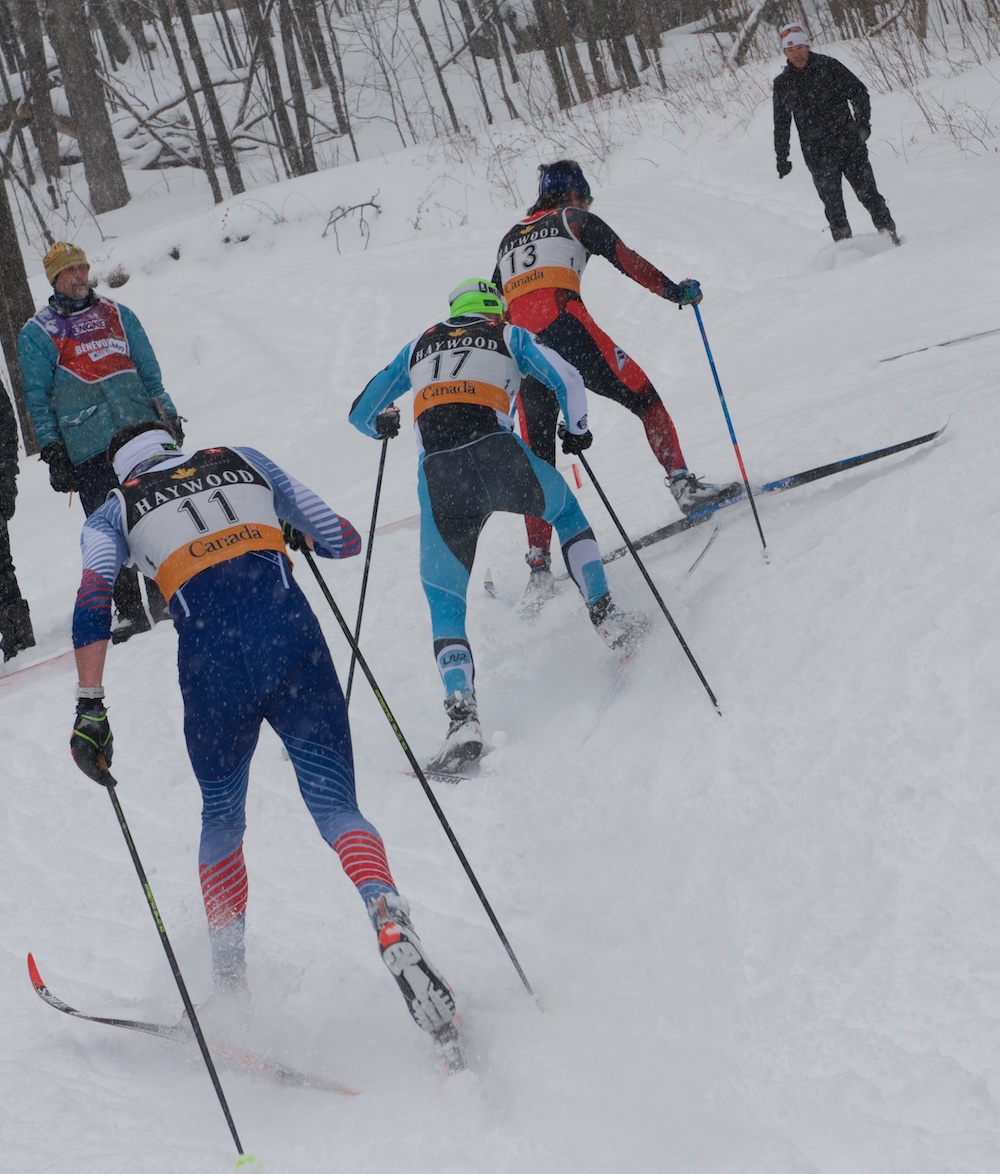
Tad Elliott (13) leads Brian Gregg (17) and Jack Hegman (11) up a climb during the men’s 15 k classic pursuit on Sunday at 2018 Eastern Canadian Championships in Gatineau, Quebec. Gregg went on to edge Elliott in a photo finish for third and Hegman followed in fifth. (Photo: Rob Smith)
In the men’s 15 k, Norris started second and caught leader Jack Hegman, of the Sun Valley Ski Education Foundation (SVSEF) early then raced alone to the victory in 1:19.26, while Ben Lustgarten (CGRP) followed 1:17.8 minutes later in second. Lustgarten started the race in sixth and Brian Gregg (Team Gregg/Loppet Nordic Racing/CXC) started seventh, with Gregg edging Tad Elliott (Ski Club Vail) by less than a tenth of a second in a photo finish for third (+1:38.5). Elliott had started third.
Hegman finished fifth (+1:42.6), his Sun Valley teammate Kevin Bolger was next across the line in sixth (+1:59.1), Adam Martin (CGRP) finished seventh (+2:01.2), Rogan Brown (SVSEF) was eighth (+2:02.9), Scott Hill (Barrie Cross Country) was the top Canadian in ninths (+2:22.5), and Jack Carlyle (AWCA) finished 10th (+2:44.2).
Nordic Combined World Cup (Hakuba, Japan): Large hill/10 k Gundersen
In the final nordic combined World Cup competition before the Olympics, Norway’s Jan Schmid came from 1:14 minutes behind at the start of Sunday’s 10 k to win the individual large hill/10 k event by 6.6 seconds in 25:36.5.
Schmid started the race in seventh, based on his competition jump, 1:14 behind Estonia’s Kristjan Ilves in first. Ilves had jumped to first and started the race 13 seconds ahead of Japan’s Yuto Nakamura in second, but while Nakamura dropped to 18th (+2:21.2) at the finish, Schmid moved all the way up to first with the fourth-fastest course time.
Japan’s Akito Watabe, who won Saturday’s large hill/10 k competition, took the final spot on the podium after a photo finish with the Czech Republic’s Tomas Portyk. They finished 11.1 and 11.2 seconds behind Schmid in third and fourth, respectively.
American Adam Loomis achieved his best individual result in three years, placing 24th (+3:03.4), after jumping to 30th and starting 3:20 out of first. Loomis skied the eighth-fastest course time.
His USA Nordic teammate Ben Berend placed 31st (+4:28.4) after ranking 28th in the jump.
Nordic Combined Continental Cup (Planica, Slovenia): Saturday and Sunday
Meanwhile on the Nordic Combined Continental Cup, Americans Bryan and Taylor Fletcher reached the podium on both Saturday and Sunday in Planica, Slovenia.
Bryan won back-to-back individual large hill/10 k Gundersen starts, while Taylor placed second on Saturday and third on Sunday.
On Saturday, Bryan jumped to third on the 139-meter large hill and started the 10 k race 22 seconds behind Germany’s Anton Schlüter in first. Taylor jumped to 14th and started 1:35 minutes out of first and posted the fastest course time in the 10 k to finish second to his older brother, 59.4 seconds back.
Bryan skied the third-fastest 10 k to take first in 26:24.1 minutes. About a minute behind Taylor, Austria’s Martin Fritz placed third (+1:58.8). Schlüter ended up 15th (+3:51.5).
Also for the U.S., Jasper Good raced from 26th in the jump to eighth overall (+3:08) with the fifth-fastest course time. Grant Andrews did not finish after posting the 38th-ranked jump.
Canada’s Nathaniel Mah placed 28th (+5:41.5) after starting 27th based on his jump.
On Sunday, Fritz jumped to first and finished between the Fletcher brothers in second place, 39.7 seconds behind Bryan, who repeated in first.
Bryan had jumped to second and started the 10 k just 9 seconds back. He skied the fourth-fastest course time en route to the win in 25:01.6.
Taylor’s jump put him in 15th and 1:40 back at the start of Sunday’s race, and he passed 12 competitors to claim third (+1:25.0) with the second-fastest course time.
Good finished 17th (+3:12), up from 23rd in the jump, with the ninth-fastest 10 k time, and Andrews placed 22nd (+3:38.2), up from 24th.
Mah finished 34th (+5:38.7) after jumping to 21st.
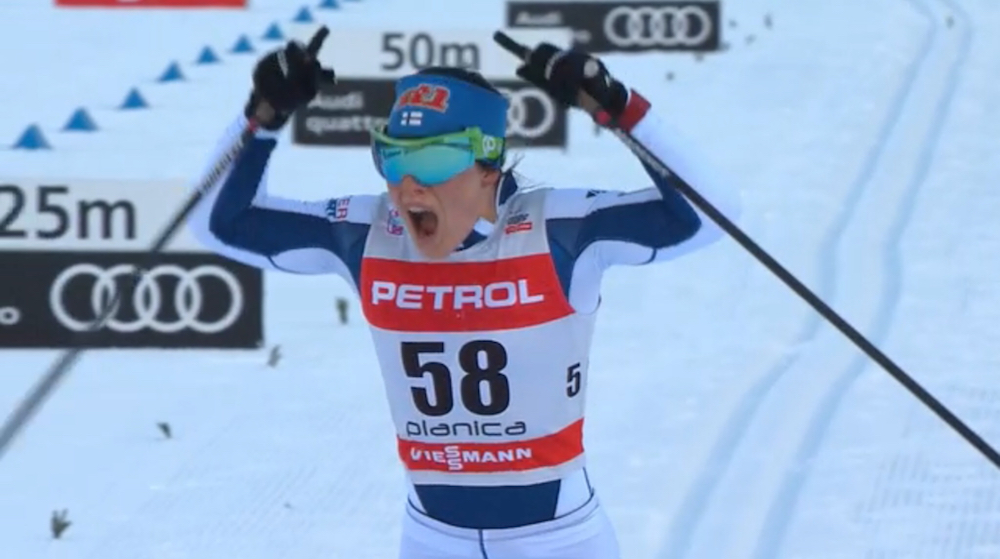
Finland’s Krista Pärmäkoski after winning her first non-stage World Cup on Sunday in the women’s 10 k classic in Planica, Slovenia. She bested Sweden’s Charlotte Kalla’s time by 3.6 seconds. (Screenshot: ARD broadcast)
FIS Cross Country World Cup (Planica, Slovenia): 10/15 k classic
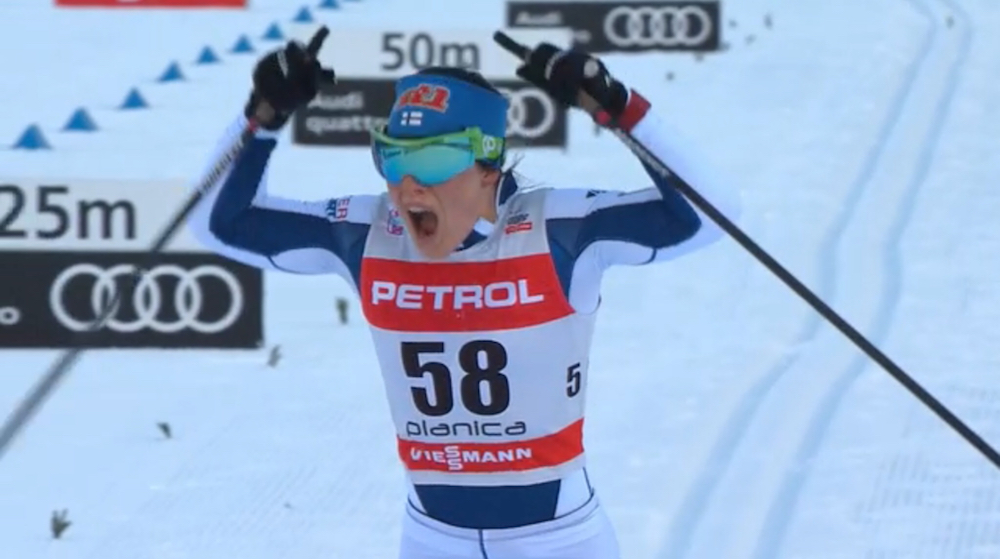
Just when it looked like one of those Charlotte-Kalla days, Finland’s Krista Pärmäkoski swooped in and topped the Swede’s time by 3.6 seconds in the women’s 10-kilometer classic individual start on Sunday for her first-career outright World Cup win.
Outright meaning non-stage; Pärmäkoski has two World Cup wins to her name for setting the fastest time of day in 2016 pursuit races.
But Sunday’s 10 k in Slovenia saw her rising to the challenge and besting Charlotte Kalla’s time of 27:12.3, which was at least 39 seconds faster than the first 57 starters. Kalla had started 32nd and beat the previous top time set by Swedish U23 skier Ebba Andersson (bib 28) by 48.6 seconds.
Austria’s Teresa Stadlober started later in bib 56 and clocked the second-fastest time to Kalla, 39 seconds back.
But it was Pärmäkoski in bib 58 who beat them all. Even Norway’s Heidi Weng, who started 60th, couldn’t come close, as she finished 33.5 seconds off Pärmäkoski’s winning time for third place. That put Stadlober in fourth and Andersson in fifth at the end of the day.
Finland’s Kerttu Niskanen placed sixth (+49.4), Norway’s Kari Øyre Slind took seventh (+49.5), Poland’s Justyna Kowalczyk (who’s more of a marathon skier these days) placed eighth (+1:02.1), Norway’s Kathrine Rolsted Harsem (who placed second in Saturday’s classic sprint) finished ninth (+1:03.2), and American Jessie Diggins was 10th (+1:05.4).
Another American, Caitlin Patterson, of the Craftsbury Green Racing Project (CGRP), broke through with her second-best individual World Cup result in 20th (+1:45.2). (Last year, she finished seventh in the pre-Olympic PyeongChang World Cup 15 k skiathlon in a notably small field.)
Kikkan Randall (U.S. Ski Team) followed in 23rd (+1:50.4), and her teammates Sophie Caldwell placed 31st (+2:17.2), Liz Stephen 35th (+2:34.9), and Ida Sargent 37th (+2:37.5).
For the second-straight weekend, no Canadian women competed.
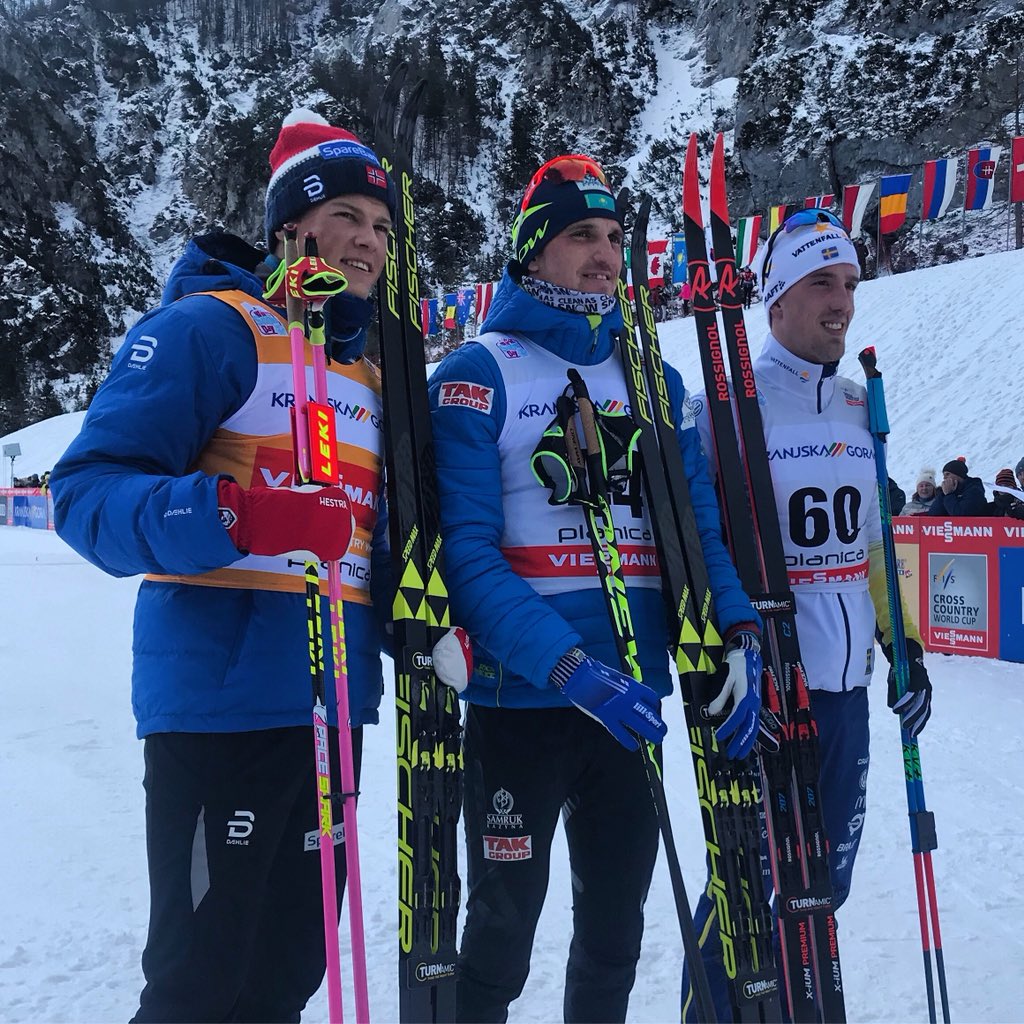
The World Cup men’s 15 k classic podium on Sunday in Planica, Slovenia, with Kazakhstan’s Alexey Poltoranin (c) in first, Norway’s Johannes Høsflot Klæbo (l) in second, and Sweden’s Calle Halfvarsson (r) in third. (Photo: FIS Cross Country/Twitter)
In the men’s 15 k classic, Kazakhstan’s Alexey Poltoranin tallied his second win of the season and first in a race against Norway’s Johannes Høsflot Klæbo on Sunday, winning by 13.2 seconds over Klæbo in 36:54.7.
Poltoranin, 30, started 44th and a minute behind the 21-year-old Klæbo. When Klæbo finished, he bumped Russia’s Ivan Kirillov, also 21, out of the leader’s chair by 43.3 seconds. Then Poltoranin finished 13.2 seconds faster, but Klæbo held onto second when Sweden’s 60th starter, Calle Halfvarsson, finished third (+42.8). It was Halfvarsson’s second podium of the season after placing third in the classic sprint at the November World Cup opener in Kuusamo, Finland. In Saturday’s classic sprint in Slovenia, Halfvarsson qualified second but crashed out of the quarterfinals to finish the day in 30th overall.
Norway’s Emil Iversen started 66th and ended up fourth (+54.7) and Kirillov scored his first World Cup top 10 in fifth (+56.5). Russia had four in the top 10 with Stanislav Volzhentsev in sixth (+57.8), Andrey Larkov in eighth (+1:02.2) and Andrey Sobakarev in ninth (+1:03.4). Norway’s Mattis Stenshagen finished seventh (+1:00.8) and Finland’s Iivo Niskanen took 10th (+1:10.1).
Scott Patterson (U.S. Ski Team) was the top North American in 43rd (+2:56.2), Ben Lustgarten (Craftsbury Green Racing Project) finished 46th (+3:04.9) and Tyler Kornfield (Alaska Pacific University) was 57th (+4:03.7). Andy Newell did not finish.
Canada’s Devon Kershaw returned to the circuit and placed 44th (+2:57.1), Bob Thompson (NTDC Thunder Bay) was 64th (+5:05.0), and Dominique Moncion-Groulx (Alberta World Cup Academy) was 70th (+6:11.7).
Russia’s Stefaniya Nadymova outsprinting Japan’s Ayane Miyazaki at the finish for the win at the inaugural women’s Nordic Combined Continental Cup competition on Saturday in Rena, Norway. (Photo: FIS/Romina Eggert)
FIS Nordic Combined Continental Cup (Rena, Norway): First-ever women’s competitions
Fourteen women, including American Gabriella Armstrong, made history this weekend by competing in the first women’s Nordic Combined Continental Cup in Rena, Norway (after the scheduled opener in Jan. 6-7 in Otepää, Estonia, was canceled), with back-to-back days of individual large hill/5-kilometer Gundersen start races.
On Saturday, Russia’s Stefaniya Nadymova took the win in 16:26.9, just 0.6 seconds ahead of Japan’s Ayane Miyazki in second. Germany’s Jenny Nowak joined them on the podium in third, 16.6 seconds out of first. Armstrong finished 12th (+6:24).
Nadymova, 23, had kicked off the event by jumping to first in the provisional round, which was used for the jumping results, and began the 5 k with a 10-second head start on Nowak in second place. Miyazaki jumped to third and started 14 seconds back. Armstrong jumped to 14th and started 4:08 out of first.
On Sunday, 15-year-old Miyazaki took the win in 16:23.2, swapping places with Nadymova, who finished second, 11.7 seconds back. Nowak, also 15, repeated in third, but finished over a minute and 21 seconds back out of first.
Miyazaki had jumped to first place earlier in the day and started the 5 k with a 20-second cushion to Nadymova in second. Nowak jumped to third and started 1:08 minutes back.
Armstrong, 19, of the New York Ski Education Foundation, jumped to 11th and finished 11th, 4:26.1 after Miyazaki.
Several U.S. Nordic Combined men also competed in Rena, with Taylor Fletcher placing fourth in Saturday’s individual large hill/10 k, 2.7 seconds behind Austria’s Thomas Joebstl in first. Fletcher had skied up from 25th and 2:17 back after the jump with the second-fastest course time.
Also for the U.S., Adam Loomis placed 33rd (+2:30.7) after jumping to 45th with the 12th-fastest course time. Grant Andrews finished 41st (+3:28.7), and Jared Schumate 43rd (+4:10.1).
Fletcher reached the podium in Sunday’s individual large hill/10 k in third behind two Austrians. After jumping to 19th, he skied the fourth-fastest course time to finish third, 3.7 seconds behind Dominik Terzer in first and 2.7 seconds behind Martin Fritz in second.
Loomis improved to 29th (+1:40.9), up from 35th in the jump, and Andrews finished 37th (+2:36.4) and Shumate 40th (+2:57.9).
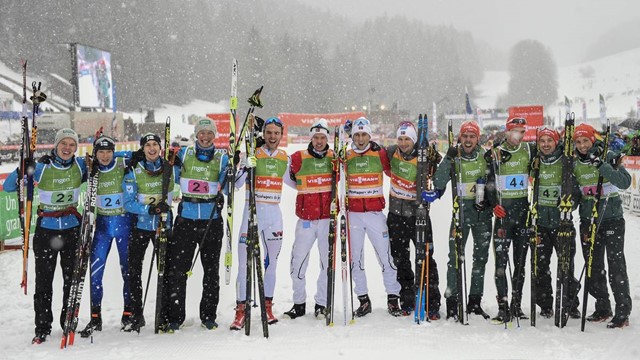
The men’s large hill/4 x 5 k team event podium on Sunday at the Nordic Combined World Cup in Chaux-Neuve, France, with Norway (c) in first, Germany (l) in second, and Finland (r) in third. (Photo: FIS/NordicFocus)
FIS Nordic Combined World Cup (Chaux-Neuve, France): Saturday & Sunday
Four American men competed at the Nordic Combined World Cup this weekend in Chaux-Neuve, France, with three of them racing in Saturday’s individual large hill/10 k Gundersen and all four racing Sunday’s large hill/4 x 5 k team event.
Norway’s Jan Schmid was the big winner this weekend, racking up an individual win on Saturday and a team victory on Sunday. He won Saturday’s competition after jumping to fourth and starting 27 seconds behind jump leader Akito Watabe of Japan. Schmid worked his way up to first in the 10 k with the third-fastest course time, crossing the line 1.4 seconds ahead of Watabe in 23:32.7.
Watabe finished second and Finland’s Ilkka Herola placed third (+21.5), just ahead of Austria’s Lukas Klapfer in fourth (+21.8).
Ben Loomis led USA Nordic in 37th (+2:49), after jumping to 37th, Stephen Schumann finished 45th (+5:17.0) and Ben Berend 46th (+5:22.2).
On Sunday, Schmid teamed up with Espen Andersen, Jarl Magnus Riiber and Jørgen Graabak to win the 4 x 5 k team event in 47:22.5 by 13.1 seconds. Germany followed in second, with Eric Frenzel, Fabian Rießle, Johannes Rydzek, and Vinzenz Geiger, and Finland placed third (+20.5) with Leevi Mutru, Arttu Maekiaho, Herola, and Eero Hirvonen.
Norway had led after the jump and started the relay 1:03 minutes ahead of Finland in second. France jumped to third and ended up fourth (+47.4), after being passed by Germany, which had started the relay in fourth.
Japan placed fifth (+2:50.9), Italy sixth (+3:59.9), Austria seventh (+4:06.8), Poland eighth (+5:22.1), Estonia ninth (+5:52.1), Russia 10th (+6:41.2), and the U.S. (with Schumann, Loomis, Berend, and Jasper Good) 11th (+6:52.4).
Western Canadian Championships (Red Deer, Alberta): Relays
Nine men’s teams and six women’s squads contested the open relays on the last day of the NorAm Western Canadian Championships on Sunday in Red Deer, with Ontario’s Team “O” (Scott Hill, Michael Somppi and Andy Shields) winning the men’s 3 x 5 k and Alberta 1 (Annika Hicks, Emma Camicioli and Zina Kocher) winning the women’s 3 x 5 k.
For Shields and Hicks, it was their second win of the weekend after they won their respective classic mass starts on Saturday.
Team “O” posted a 19.9-second win over B.C. Storm (Remi Drolet, Tallon Noble and Greg Kilroy), finishing first in 36:22.6. Alberta 5.1 (Sebastien Boehmler-Dandurand, Sam Hendry and Russell Kennedy) placed third (+52.3).
In the women’s relay, Alberta 1 beat out B.C. Fast, Furious & Freakin’ Awesome (Katie Weaver, Michaela McLean and Kaia Andal) by 2 minutes and 37.8 seconds, winning in 43:17.2. Alberta had two teams on the podium with the Kit Kats (Ember Large, Molly Jane Strum, and Sara McLean) in third (+4:25.8).
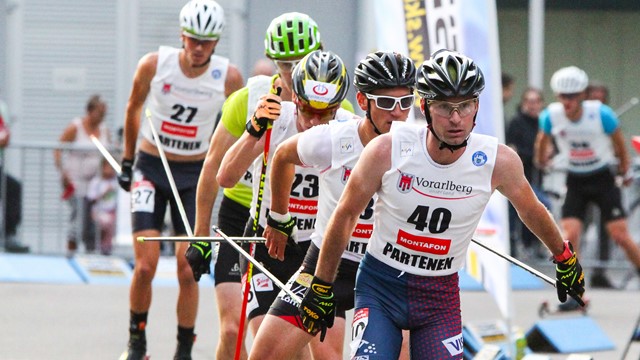
U.S. Nordic Combined’s Bryan Fletcher (40) on his way to 15th place in Tschagguns, Austria, during the International Ski Federation’s (FIS) Summer Grand Prix 2017. (Photo: FIS Nordic Combined)
Summer flying in at the FIS Nordic Combined Summer Grand Prix 2017 in Tschagguns, Austria. (Photo: FIS Nordic Combined)
On Aug. 23, Tschagguns, Austria, hosted an individual normal hill/10-kilometer Gundersen start. Germany’s Fabian Rießle, after jumping to eighth place, won the event in 23:09.9 minutes. Austria’s Mario Seidl started first based on his jump but finished the 10 k just 0.3 seconds behind Rießle in second. Finland’s Ilkka Herola jumped to seventh and moved up four spots to round out the podium in third (+0.8).
The U.S. entered four skiers. Bryan Fletcher jumped to 40th and proceeded to ski the sixth-fastest time of day, enough to move himself up to 15th overall (+17.9). It was his best individual result of the series after placing 20th in Oberwiesenthal.
“Feels good to be racing again!” Fletcher wrote on Instagram after the race. “Lots of work to do before winter! But 15th place is closer than last week.”
Ben Berend finished the day in Tschagguns in 34th (+59.1), Taylor Fletcher 41st (+1:12.8), and Jasper Good in 58th (+3:02.7).
The Grand Prix took a day off and moved to Oberstdorf, Germany, for two days of jumping and skiing from Aug. 25-26. Day 1 featured an individual large hill/10 k Gundersen, where Germany’s Eric Frenzel, who barely missed the podium in Tschagguns in fourth place, took the win. Frenzel had previously jumped to first and later held off his contenders (with the sixth-fastest ski time) to cross the line in first in 25:27, more than 30 seconds clear of anyone else. German teammate Johannes Rydzek followed in second place (+34.5) just ahead of Austria’s Seidl in third (+36.0).
Taylor Fletcher was the top American in 25th (+2:33.5). He jumped to 44th place, but skied the fourth-fastest time of the day to move up the results list during the ski race. Bryan Fletcher jumped to 40th, skied the 12th-fastest ski time, and ended the day in 28th (+2:49.7). Berend finished 40th overall (+4:13.6), and Good 45th (+4:48.5).
During the second day of summer competition in Oberstdorf, Seidl took first place for his third podium of the week. He won the individual large hill/10 k Gundersen in 26:26.3. Seidl is proving a solid jumper — gaining enough time after to the jump to make up for his less-than top-10 ski speed. On this day, Seidl jumped to first place but skied the 26th-fastest ski time. Germany’s Rießle was second overall (+22.5), and Frenzel third (+22.7).
U.S. Nordic Combined Team skier Adam Loomis was the only American that raced the 10 k. He placed 28th overall (+2:51.8) after starting the race in 42nd and posting the 14th-fastest ski time. Taylor Fletcher and Berend were disqualified in the jump portion, and Bryan Fletcher jumped to 38th but did not start the 10 k.
On Instagram, Taylor Fletcher explained that he was the current red-bib leader for fastest overall skier.
“Part one of grand prix is done and dusted. It was a good test of where I am and where I could be with more consistent jumps,” he wrote. “The final day was good until my disqualification which was in my opinion was crap. I got disqualified for a guideline to a rule which almost every skier would be if they were tested. For the future we will fix the issue and continue fighting.”
Taylor Fletcher’s disqualification occurred on Aug. 18 in Oberweisenthal, Germany during a provisional competition round (PCR). Beyond the top-tier competition, the Summer Grand Prix offers the opportunity for athletes to test equipment and experience how new rules are enforced. One of the key rules has to do with suit permeability.
“I got DQ’d in the first PCR because my suit didn’t pass enough air,” Fetcher wrote in an email. “I wasn’t trying to cheat, but actually it was very warm and I was sweating pretty bad so a thin layer of moisture was on my suits which caused it to blow less air. The next day I passed it without doing anything to my suit.”
The perameters for suit fit have strict tolerances. Fletcher explained that the suits are allowed to be +3cm everywhere possible, but not over the set limit. Fletcher’s detailed account of why he was disqualified signifies the importance of attending the Summer Grand Prix series.
“I was disqualified because my shoulder/armpit was too big,” Fletcher explained. “We have never been tested there and I don’t think really anyone has. As long as the suit feels like it fits in the armpit, we feel that it is good. After the jump on the last day, I was selected for equipment control, I was sure I was good as I made some alterations to my suit the previous night to fix the places that were big (inside thigh). When I got to control I passed my crotch measurement and thought that was it. Then he started to measure my shoulder and armpit and I was shocked because I had never been tested there. He had me hold this triangle apperatus between my arm and hip then measured around that spot. He disqualified me for that spot being too big (20cm to big). There isn’t much I can do after he says you are out, I could file a protest, but that is just silly as these are summer comps and don’t count towards anything. My coaches went and talked with the equipment controller and he told them what is up and how to fix it, but continued to say that it is more of a guideline rather than a rule. We were angry, I was angry as I hate not racing but rather than wasting energy, I just packed my bags and got the hell out of dodge.”
A skier flying during the FIS Nordic Combined Summer Grand Prix 2017 in Oberwiesenthal, Germany. (Photo: FIS)
Green grass, plastic jumping surfaces, big jumps, sunshine, rollerskis and no snow means one thing. It’s August in Europe and it’s time for the International Ski Federation (FIS) Nordic Combined Summer Grand Prix 2017.
Last weekend Aug. 19-20, Oberwiesenthal, Germany hosted a two-day Grand Prix event.
Day 1 featured a two-person team event with the requisite jump and 2 x 7.5-kilometer cross-country race to determine the winners.
Czech Republic’s first team (Czech Republic I), comprised of Tomas Portyk and Dvorak Miroslav, won the team competition in 28:52.9 after starting fourth, 11 seconds behind first. Germany I’s Fabian Rießle and Eric Frenzel raced to second (+0.3), and Germany II’s Jakob Lange and Vinzenz Geiger placed third (+11.2).
The U.S. had two teams entered. Bryan Fletcher and Taylor Fletcher (U.S. II) placed 12th (+2:37.0) while Jasper Good and Ben Berend (U.S. I) finished 14th (+3:03.5).
Day 2 of racing was an individual normal hill/10 k Gundersen start.
Austria’s Mario Seidl claimed the win in 25:18.5 after jumping to first and starting the 10 k four seconds ahead of Japan’s Akito Watabe in second. Germany’s Frenzel raced from ninth to second (+10.5), after starting 46 seconds after Seidle. Rießle finished third (+12.3), up from fifth in the jump, while Watabe narrowly missed the podium in fourth (+14.2).
Bryan Fletcher (29) during this weekend’s Summer Grand Prix in Oberwiesenthal, Germany. He finished in 20th in Sunday’s individual normal hill/10 k event. (Photo: FIS)
Four U.S. skiers competed on Sunday, and Taylor Fletcher led them at the end of the day in 11th (+1:17.6) after jumping to 33rd and starting 2:01 minutes behind Watabe. Bryan Fletcher finished 20th, Berend 33rd, and Good 34th.
In an Instagram post, Taylor Fletcher described his first individual race of the series.
“First individual race in the books. I had a decent jump in a hard competition,” he wrote. “I started 33rd and ended up finishing 11th. I had a lot more to give but I thought I had another lap (I wish we did) before the coach said this was the last lap. Now @USAnordic is on the way to the next leg ready for another crack at it!!”
The Summer Grand Prix continues Aug. 23 with another normal hill/10 k in Tschagguns, Austria, and concludes in Oberstdorf, Germany, with back-to-back large hill/10 k competitions Aug 25-26.
Taylor Fletcher cruising in the 2017 Fish Creek Time Trial in Steamboat Springs, Colo. (Photo: Jasper Good)
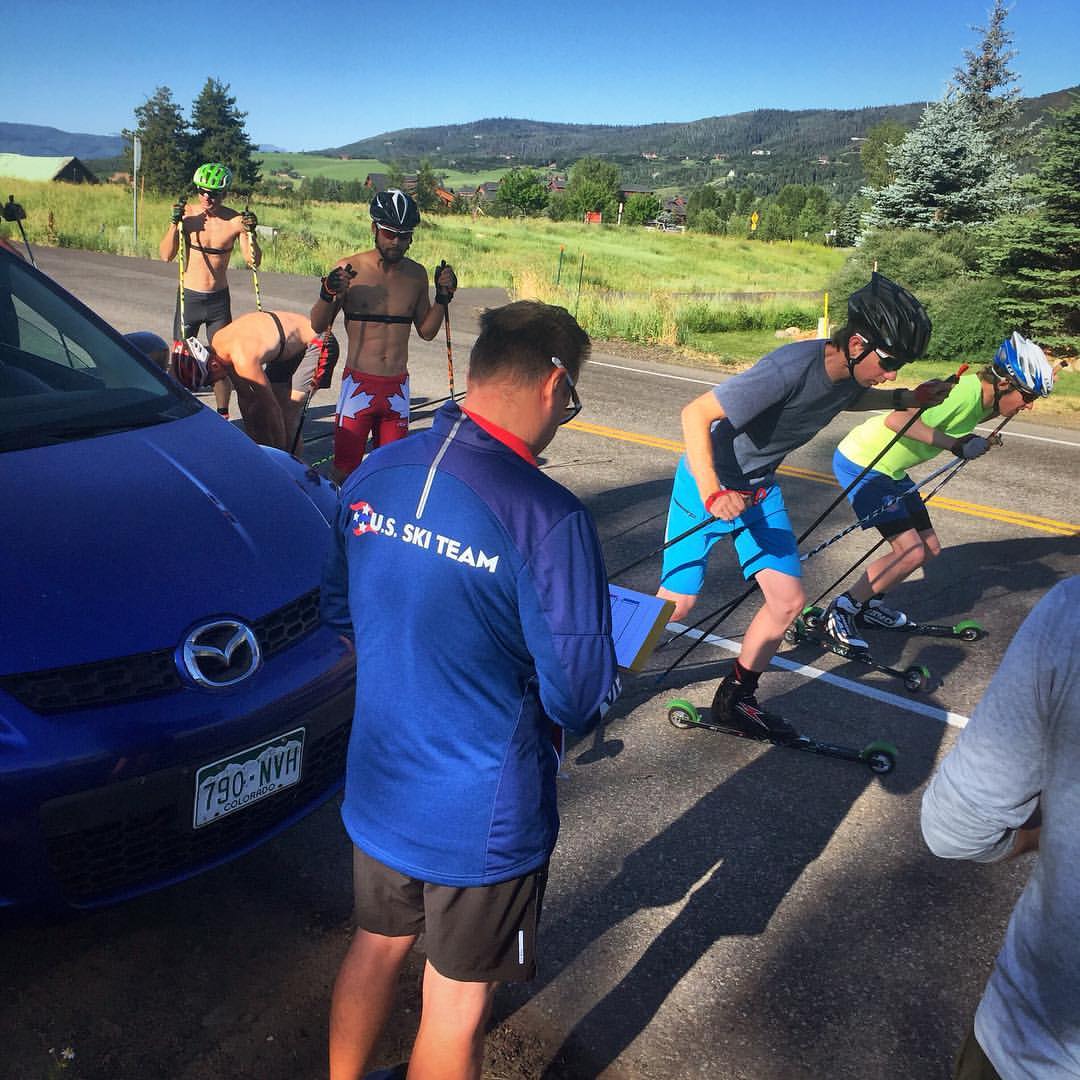
From late June into early July, U.S. Nordic Combined hosted a major training camp in Steamboat Springs, Colo. Among the sessions was the Fish Creek Time Trial, a skate rollerski race first held in 2007. That year, Johnny Spillane set down the first in a series of course records that would be improved by different athletes in the next decade.
The time trial is 8 kilometers and gains 885 feet of elevation, starting just south of Steamboat Springs and ending up in the Medicine Bow-Routt National Forest.
National team member Jasper Good is a Steamboat Springs native and remembers the first time he participated in the now-annual time trial.
“In 2012 Ben Berend and I miscalculated how long it would take us to get to the start,” he wrote in an email. “We proceeded to show up and were getting yelled at by everyone saying, ‘You’re starting right NOW, GO GO GO!’ Not the best first impression at a time trial with the National Team.”
A group photo of participants in the 2016 Fish Creek Time Trial, from “young guns” to Olympians. That year, retired gold medalist Billy Demong competed. (Photo: Jasper Good)
OK, that first start was a snafu, but that’s one of the points of the time trial: getting young racers like Good and Berend were then on the same pavement with the national team veterans and staff. Good is now 21 years old and collected his first Continental Cup top-10 last season, so he’s on his way to being one of those veterans that juniors can measure their progress against.
“We do the annual Fish Creek Time Trial with everyone from national teams down to young guns,” Good wrote.
The time trial is a suffer-fest, starting with rolling terrain that must be worked very deliberately, and also featuring a few walls.
“The first half is a gradual but hard rolling uphill with a lot of V2 gradient, an important part to keep your speed up and use momentum over hills,” Good explained. “About [5.5 k in], you hit the first wall of the race. After the wall there is a false flat with another segment of rolling uphill V2 gradient before you hit the final climb. As it starts to kick up more and more, you hit the second wall where you really don’t want to bonk. Because after the top of that, you only have about 250 meters to the finish. But the last 250 at the very top is a false flat that hurts oh so much. The race finishes with all the racers sprawled out all over the parking lot.”
Because there are now ten years of data, performances can be compared both between athletes and from year to year for any individual racer.
“It has been helpful to see the results from this time trial over the years,” Good wrote. “With it being a mid-summer uphill time trial, it is good to see overall fitness and willingness to suffer, but it’s not always a key indicator of how an athlete may race in a NoCo race come winter. It’s more of a checkpoint mid-summer.”
Other things can change over the years, too: as the “suffer-fest” becomes more and more like a normal race effort over the years, athletes can change how they approach it. For instance, Good’s warmup has changed a lot since that first year when he nearly missed the start.
“My warm-up now resembles my winter time warm-up more than ever,” he wrote. “When I was younger it was mostly just warmup to the start of the race from downtown and then just send it into the race.”
How To Make a Great Time Trial Course
U.S. Nordic Combined Coach Martin Bayer starts athletes at the 2017 Fish Creek Time Trial in Steamboat Springs, Colo. (Photo: Jasper Good)
There are a few things to keep in mind while putting together a rollerski time trial course: just finding the biggest hill with a paved road is not enough. Here are some reminders from Good, who has done Fish Creek for several summers in a row now.
Not All Uphill. “The first part is all about pacing it right and not going out to hard,” Good wrote. “If you go too hard at the beginning the two walls [at the end] are absolutely brutal. Technique and momentum is key in the first half.” Choosing a course with a big chunk of rolling terrain will require athletes to use good technique, execute on their transitions, and maintain momentum. That means that finishing times will reflect not only the athlete with the biggest ‘motor’, but also to some extent that they are skiing well.
Overall Time. “Taylor Fletcher set the time trail record this year at 23:02,” Good writes. “But most of us race it in 23:30 to 26:00, so it is very similar to our typical 10 k times [in nordic combined competitions]. I think it is key that it is in a sense the same time as our typical race, and the same sort of mentality.”
When the Gun Goes Off. How will you set up your time trial? Mass start? Interval start? For Fish Creek, there’s a very deliberate seeding strategy. “It is an interval start with reverse order and the best skier starting last,” Good writes. “In that regard, it is good for every athlete to have someone to chase, and perhaps a stronger skier to go by them. This is good because everyone can try their best to hang on to faster skier and learn how they ski the time trial.”
Pick a Location. If your club is big, this isn’t a big issue — you will always have people to race. But potentially consider whether you can locate your time trial in a place where athletes from surrounding clubs might consider commuting to, or a spot where regional or national teams sometimes host camps. “It is important for all of the NoCo crew to do this time trial together so that every athlete can see where they are at in comparison to the best (i.e. Taylor Fletcher the last few years),” Good writes. “It is also an annual thing so everyone can go out and try and best their time from previous years.”
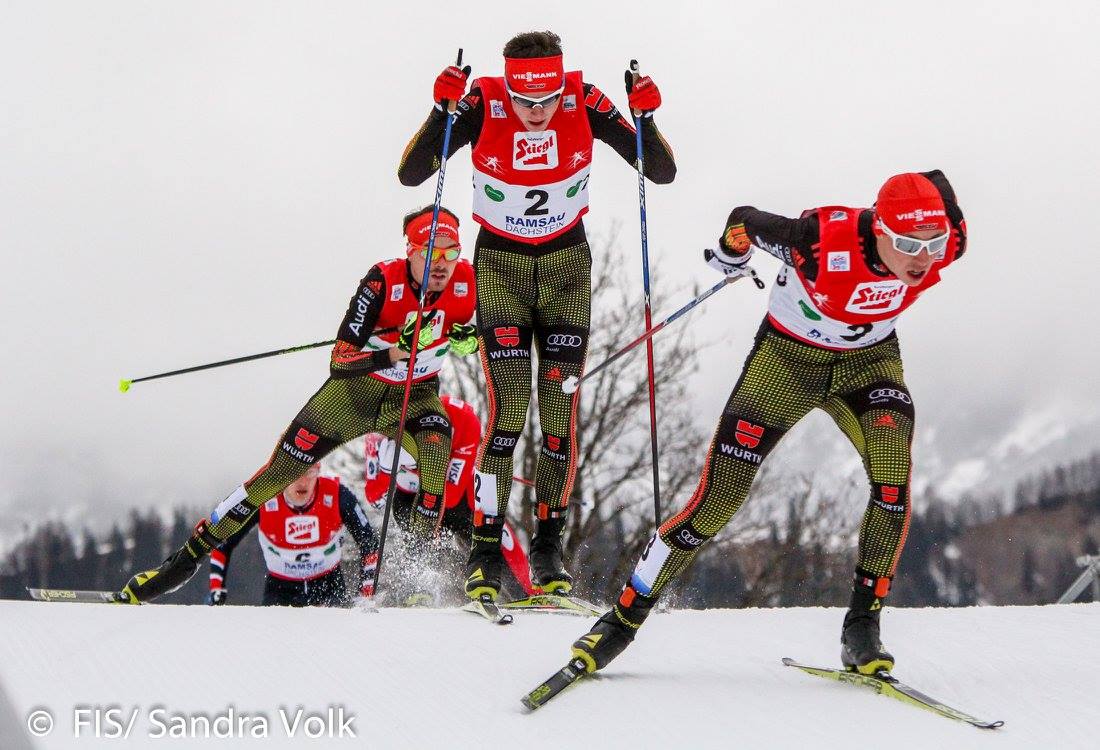
Eric Frenzel (r) leads German teammates Vinzenz Geiger (c) and Fabian Rießle (l) toward a sweep of the podium in the Nordic Combined World Cup individual normal hill/10 k on Sunday in Ramsau, Austria. (Photo: FIS Nordic Combined/Facebook)
Welcome to The Rundown, your quick primer of need-to-know information about the day’s racing. We’ll be updating this digest as the day goes on with additional results, photos and quotes. The Rundown is NOT a race report; stay tuned for complete race reports later today with interviews from the day’s top racers.
***
FIS Nordic Combined Continental Cup in Klingenthal
[UPDATE] Ben Loomis tallied two top 10’s and his U.S. Nordic Combined teammate Ben Berend notched eighth place this past weekend at the Continental Cup in Klingenthal, Germany.
Loomis ended the three-day series on Sunday by placing fifth in the large hill/10 k for his second-best result at the Continental Cup level (he finished fourth last year in the normal hill/10 k competition in Park City, Utah). Loomis put himself in position by jumping to sixth then racing to fifth, 49.9 seconds behind Japan’s winner Go Yamamoto, who finished in 24:06.4.
Florian Dagn of Austria placed second (+6.0) after jumping to first. Yamamoto jumped to second and headed out on the course seven seconds behind him.
Norway’s Sindre Ure Soetvik placed third (+28.8), after starting the 10 k in third. Germany’s David Welde finished fourth (+36.0), moving up after jumping to eighth.
Also on Sunday, Berend placed 15th (+2:25.3) and Jasper Good was 35th (+3:07).
Berend started the long weekend out with an eighth-place finish in the large hill/5 k on Friday. He jumped to fourth and finished the ski race in eighth, 1:09.2 minutes behind Germany’s Maximilian Pfordte, who won in 10:58.9.
Pfordte posted the best jump to start the 5 k first, then held his lead for a 16.4-second victory over Yamamoto in second. Dagn placed third (+18.3) after jumping to second, and Yamamoto’s jump ranked third.
Also for the U.S., Good finished 21st (+2:05.8) for his best result of the weekend, Loomis was 28th (+2:50.5) and Stephen Schumann 29th (+2:52.1).
On Saturday, it was Loomis who tallied another eighth place for the U.S. in the large hill/10 k. He jumped to 10th then improved to eighth, finishing 58 seconds behind German winner Tobias Simon. While Simon dominated the jump as well as the race, winning by 10.1 seconds, Yamamoto repeated in second place and Austria’s Thomas Joebstl reached the podium in third (+38.3).
Berend finished 25th (+1:45.9) and Good 45th (+3:24.9) on Day 2.
The Nordic Combined World Cup resumed this weekend in Ramsau, Austria, with Germany not only topping but sweeping the podium in both individual normal hill/10 k competitions.
On Saturday, Team Germany swept the top four, with Johannes Rydzek notching his third individual win of the season, ahead of teammates Fabian Rießle (+1.5) and Eric Frenzel (+8.7). Vinzenz Geiger completed the sweep in fourth (+15.0), a career best for the 19 year old after placing seventh earlier this month in Lillehammer, Norway.
Frenzel led after the jump on the 98-meter hill, which put him 2 seconds ahead of the second-best jumper, Austria’s Mario Seidl, in the 10 k Gundersen start. (Seidl went on to place seventh.)
Rydzek posted the third-best jump and started 10 seconds back, while Rießle started another 10 seconds later in seventh. Rydzek went on to ski the fifth-fastest course time and Rießle was third fastest en route to first and second at the finish.
Americans Taylor Fletcher and Bryan Fletcher finished 27th (+1:17.6) and 29th (+1:18.4), respectively, and Adam Loomis was 47th (+3:16.2).
Taylor started 41st, 1:18 back, and Bryan started five seconds later in 43rd. Bryan posted the seventh-fastest course time and ended with a photo finish with Finland’s Arttu Maekiaho, which Maekiaho took by 0.1 seconds for 28th. Loomis started 50th.
Day 2 in Ramsau went to Frenzel, who won the normal hill/10 k in 22:49.4. Rießle repeated in second (+0.8) and Geiger improved on his career best for his first podium in third (+23.4). Seidl again jumped to first and this time ended up fourth (+24.3).
Frenzel started third and raced to first, Rießle moved up from fourth in the jump to second, and Geiger made the most of his second-best jump.
Taylor Fletcher skied the third-fastest course time to move up from 46th after the jump to 22nd at the finish (+1:20.2). Bryan Fletcher finished 32nd (+1:33.5), losing one place after starting 31st.
The Nordic Combined World Cup goes on holiday break until resuming Jan. 7-8 in Lahti, Finland.
The NorAm mini tour in Rossland, British Columbia, wrapped up with a classic pursuit race on Sunday.
In the women’s 10 k classic, APU’s Chelsea Holmes continued her strong form, winning the mini tour with an aggregate time of 1:08:04.4. Holmes finished the 10 k in 35:35.4 minutes, 6.2 seconds behind fastest woman of the day, Katherine Stewart-Jones (NTDC Thunder Bay).
SMS Elite’s Erika Flowers continued her podium-filled visit to Canada with the third-fastest ski of the day, 48.1 seconds behind Stewart-Jones, to take second overall, 2:23.9 behind Holmes. AWCA’s Olivia Bouffard-Nesbitt was the fifth fastest in the 10 k to hold on to third overall (+3:25.2), while Stewart-Jones was just 0.5 seconds back in fourth overall.
NTDC Thunder Bay’s Evan Palmer-Charrette used a fourth-fastest ski in the 15 k to keep the overall title, with an aggregate time of 1:28:54.0. Alexis Dumas (CNEPH) skied 1:14.7 faster than Palmer-Charrette to climb from sixth at the start to second overall (+52.2). AWCA’s Jack Carlyle had the second-fastest time of the day, 29.9 seconds behind Dumas, to climb into third overall (+1:10.1).
National Para-Nordic guide Erik Carleton had the third-fastest 15 k time, 1:01.3 back, but it wasn’t enough to catch Team R.A.D.’s Russell Kennedy, who placedfourth overall (+1:20.8).
Full results (with tabs for the overall and time of the day)
***
FIS Cross-Country World Cup in La Clusaz: Men’s and women’s relays
Team Norway I emerged victorious in Sunday’s men’s 4 x 8 k mixed relay event in La Clusaz, France, with Didrik Tønseth leading the winning group’s first classic leg.
After crossing in seventh, Tønseth handed off to Martin Johnsrud Sundby for a second classic leg. Sundby dropped a spot, finishing his classic leg in eighth. Sundby tagged off to Anders Gløersen for the first freestyle leg.
Gløersen rocketed the team to first, and held the position straight through his 7.5 k. The final leg for Norway’s winning team went to Finn Hågen Krogh. The Norwegian men’s team completed the relay event in a total time of 1:11:25.7
Second place overall, two-tenths of a second behind, was team Russia, led by Evgeniy Belov for the first classic leg. Belov handed off to Alexander Legkov for the second classic leg, with Legkov putting down the third fastest time by the time he returned to the exchange zone.
The third and first freestyle leg for Russia went to Alexey Chervotkin, who maintained the team’s third place position. Anchoring the team was Sergey Ustiugov, who managed to maneuver the team from third place to second during his final freestyle leg.
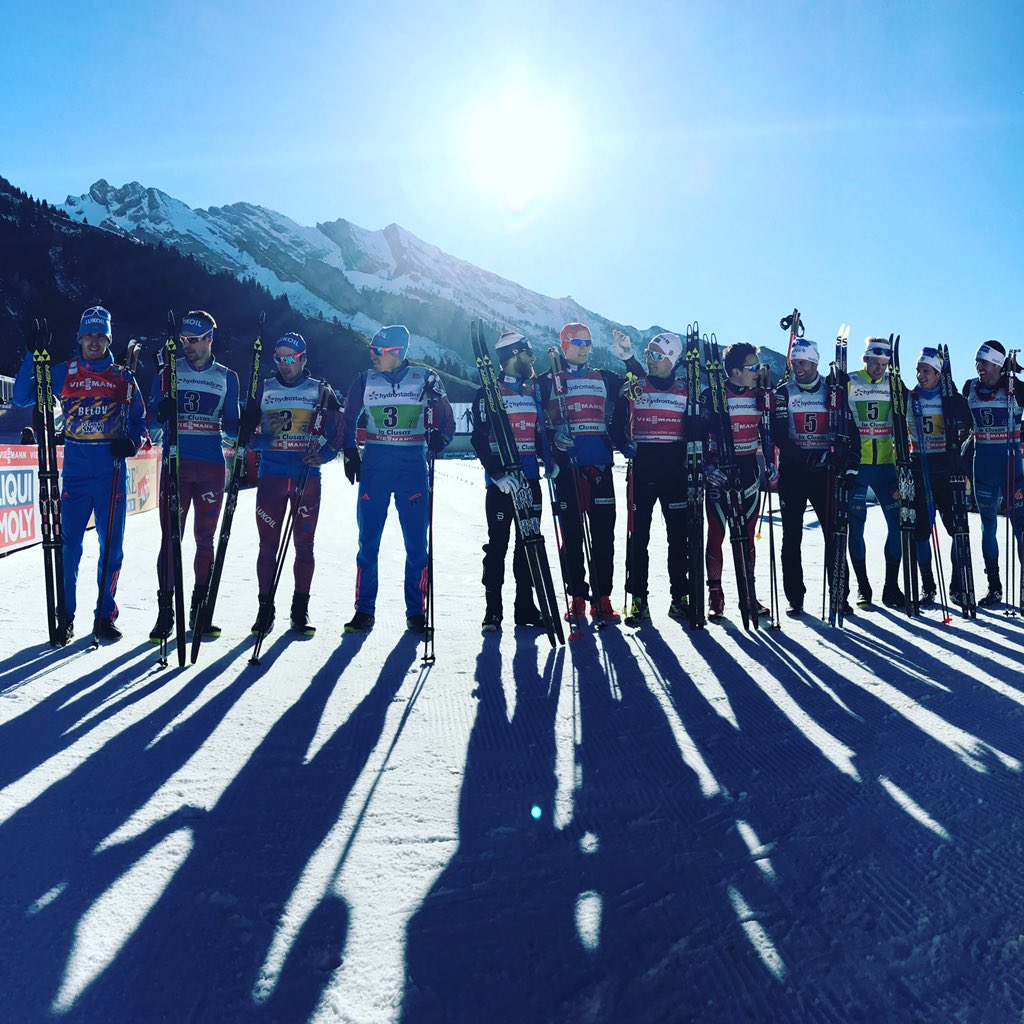
The men’s 4 x 8 k relay podium on Sunday in La Clusaz, France, with Russia in second (left four) Norway first (center four) and France third overall. (Photo: FIS Cross-Country/twitter)
Rounding out the men’s mixed relay podium on Sunday was France I (+7.7).
Jean-Marc Gaillard led team France’s first classic leg, racing in a sixth position into the exchange zone. Gaillard handed off to Alexis Jeannerod, who moved up to fifth place by the end of his classic leg.
Skiing the third and first freestyle leg was Clement Parisse who held onto fifth place and tagged off to Maurice Manificat for the final freestyle leg. Manificat managed to move around Sweden’s Axel Ekstrløm and Germany’s Lucas Bøgl for third place overall.
Neither Canada or the U.S. entered a men’s relay team due to illness.
In the women’s 4 x 4 k relay event, it was another Norwegian team who stood atop the podium.
Ingvild Flugstad Østberg led the women’s first classic leg, skiing in first place until her hand-off to Marit Bjørgen. Bjørgen maintained the first place position during her classic leg, tagging off to Ragnhild Haga.
Haga completed the first freestyle leg for Norway, handing off to Heidi Weng, who anchored the team’s last freestyle leg. The Norwegian women finished in a total time of 39:23.3.
In second was team Finland, 50.2 seconds behind Norway’s winning time. Aino-Kaisa Saarinen started the first classic leg for Finland, passing off to Anne Kyllønen.
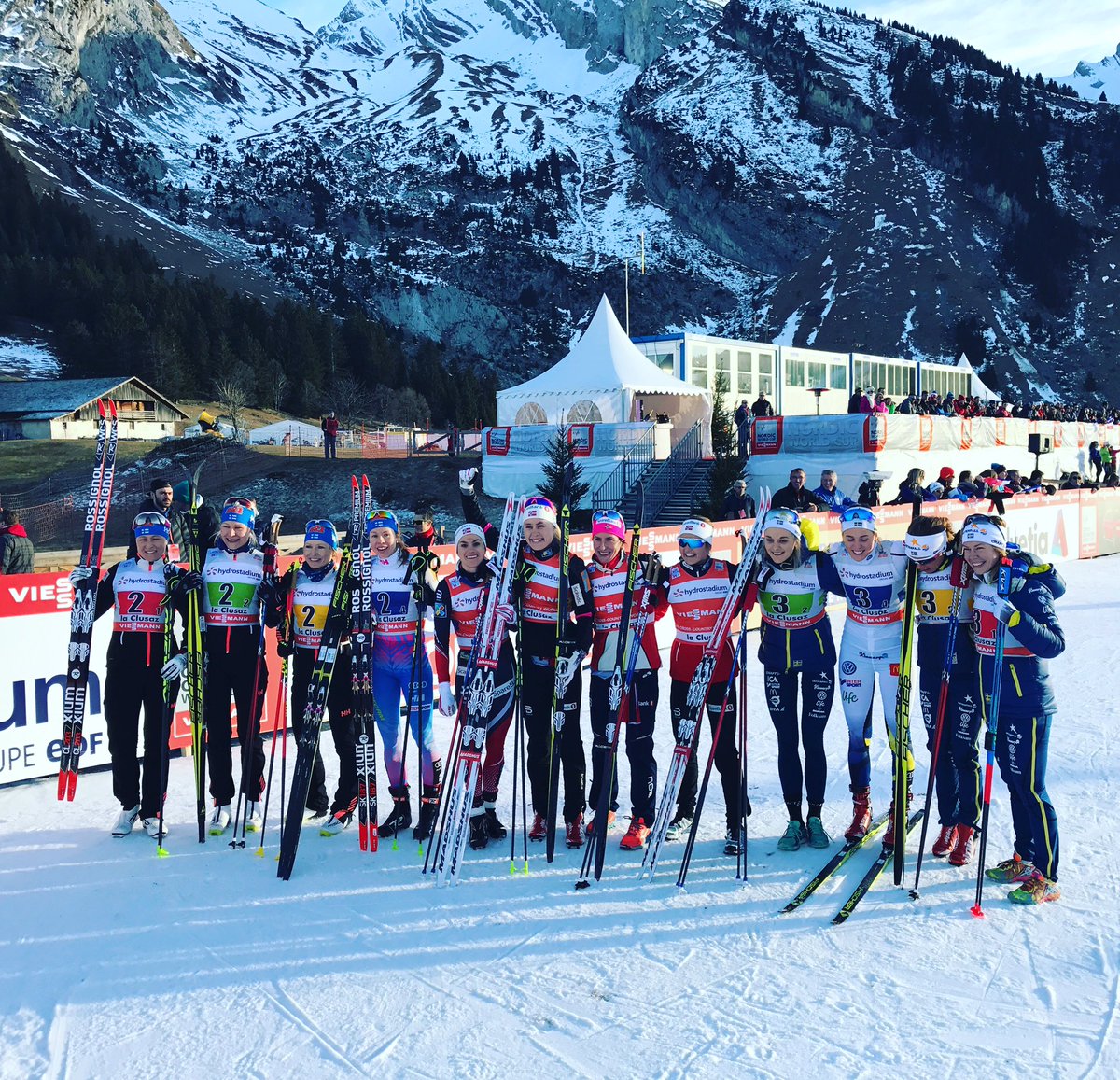
The women’s 4 x 4 k mixed relay podium on Sunday in La Clusaz, France. Norway (c) took the win ahead of team Finland in second (l) and Sweden in third. (Photo: FIC Cross-Country/Twitter)
Taking on the first freestyle leg for Finland was Riitta-Liisa Roponen, who tagged off to Laura Mononen for the final freestyle leg.
Rounding out the relay podium in third overall was team Sweden (+1:08.9). Emma Wiken raced the first classic leg, who tagged off to Stina Nilsson for the second classic leg. Maria Rydqvist raced the first freestyle leg and handed off to Anna Dyvik, who anchored the team to third.
Only one U.S. women’s relay team was entered on Sunday, with both Jessie Diggins and Sadie Bjornsen out due to illness. Sophie Caldwell led the U.S.’s first classic leg, followed by Rosie Brennan. Liz Stephen followed Brennan, taking on the first freestyle leg. Anchoring the team was Kikkan Randall in the final freestyle leg. The Americans finished in seventh overall (+2:26.0).
Canada also entered a women’s team in Sunday’s relay. Emily Nishikawa led the first classic leg, and handed off to Cendrine Browne for the second classic leg. Dahria Beatty raced the first freestyle leg and tagged off to Sophie Carrier-Laforte, who anchored the team to 12th overall (+4:07.9).
IBU World Cup in Nove Mesto: Men’s and women’s mass starts
Gabriela Koukalová of the Czech Republic looks to her home crowd as she wins the women’s 12.5 k mass start on Sunday at the IBU World Cup in Nove Mesto, Czech Republic. She fended off Germany’s Laura Dahlmeier (r), who took second. (Photo: IBU)
Despite skiing in 14th at one point in the men’s 15 k mass start on Sunday, France’s Martin Fourcade came back to win the International Biathlon Union (IBU) World Cup in Nove Mesto, Czech Republic.
That makes him seven for eight in individual races so far this season.
Fourcade started with bib 1 as the overall World Cup leader and finished first in 36:18.9 minutes, despite a penalty on his second prone that put him in 14th and 22 seconds back heading out on his third loop.
He rebounded with a clean third shooting to move into third, 2.5 seconds behind Ukraine’s Dmytro Pidruchnyi in first and 1.3 seconds behind Russia’s Anton Babikov in second.
By the final shooting stage, Fourcade was back in first with clean shooting (0+1+0+0), 28 seconds clear of Babikov in second. Babikov had his first penalty of the day on the final stage (0+0+0+1) to drop out of contention.
Germany’s Simon Schempp (1+1+0+0) came out on top of an eight-way battle for second place on the final loop. Schempp took it, 8.3 seconds after Fourcade and 1.1 seconds ahead of Babikov in third (+9.4).
The Czech Republic’s Ondrej Moravec was 0.3 seconds off the podium in fourth (+9.7), Pidruchnyi placed fifth (+10.2), Russia’s Matvey Eliseev finished sixth (+11.0), Norway’s Ole Einar Bjørndalen was back in the top 10 in seventh (+11.3), France’s Quentin Fillon Maillet notched his second-straight top 10 in eighth (+13.7), and Norway’s Johannes Thingnes Bø finished at the back of that pack in ninth (+19.8).
American Lowell Bailey missed the top 20 by 10 seconds in 21st (+1:17.1). He had three penalties, two of which came on the last stage (0+1+0+2) to drop him from ninth to 20th at the start of the final loop.
Bailey retained his spot in ninth in the overall World Cup standings, while Fourcade continues to lead, 158 points ahead of Shipulin in second.
In the women’s 12.5 k mass start, Gabriela Koukalová delivered to her home fans in Nove Mesto, Czech Republic, racing to her second win of the season in 34:42.1.
“I was so nervous before the race so it was amazing,” Koukalová said, according to an IBU press release. “I have so many emotions; it’s even more emotional than at the Olympics. I would like to say thanks to all the spectators and I hope I was able to make a nice Christmas present to all of them.”
The defending World Cup champion beat the current World Cup leader, Germany’s Laura Dahlmeier, by 3.1 seconds after shooting a single penalty and cleaning the last two stages (0+1+0+0) to move into first. Dahlmeier missed two on the first stage to drop 23rd, but cleaned her last three stages (2+0+0+0) to capture second at the finish. She passed three athletes on the last lap, including Italy’s Dorothea Wierer, who ended up third (+9.7) with one miss (1+0+0+0).
“I don’t really know what happened with those two misses,” she told German broadcaster ARD. “But in terms of skiing I had a great day on the course, and I had skis that were the bomb. It’s just a lot of fun when you can make the podium reaching the second place despite a large deficit in the beginning. I am overjoyed.”
Germany’s Vanessa Hinz rebounded from Friday’s sprint (where she placed 73rd) to end up fourth (+15.5) with a single penalty (0+0+1+0). None of the 29 finishers hit every target, and American Susan Dunklee did not start.
Dahlmeier leads the overall World Cup standings by 98 points over Finland’s Kaisa Mäkäräinen, and Koukalova is third, just seven points behind Mäkäräinen. Dunklee is 11th.
The IBU World Cup now goes on holiday break until resuming Jan. 5 in Oberhof, Germany.
The third IBU Cup was held on Dec. 16-17 in Obertilliach, Austria. In the men’s 20 k individual on Friday, the top three finishers were France’s Antonin Guigonnat, with a winning time of 49:58.6, Russia’s Yury Shopin in second (+32.2), and Germany’s Florian Graf in third (+35.6). Each of the top three had one miss, and Canada’s Matthew Hudec was the top North American in 34th (+4:11.3) with two penalties (0+2+0+0). Also for Canada, Carsen Campbell finished 38th with three penalties (1+2+0+0), Matthew Neumann was 53rd with three penalties (0+2+0+1) out of 118 finishers.
In the women’s 15 k individual on Friday, Germany’s Karolin Horchler took the win with clean shooting (0+0+0+0) in 44:54.7. France’s Coline Varcin was 1.1 seconds back in second with one penalty (1+0+0+0), and third went to Russia’s Daria Virolaynen (+30.2), who had one miss as well (0+1+0+0). Canada’s Nadia Moser was the top North American in 35th (+5:10.8) with two penalties (0+1+1+0). Also for Canada, Erin Yungblut placed 66th with five penalties (0+3+0+2).
In the men’s 10 k sprint on Saturday, two Norwegians took first and second with Henrik L’Abee-Lund winning in 23:29.9, and Vetle Sjastad Christiansen 13.9 seconds back in second. Third was claimed by Germany’s Phillipp Nawrath (+29.5) and all of the top three shot clean. Neumann led Canada in 47th (+2:20) with one miss (1+0). Campbell missed two (1+1) and finished 59th (+2:47.4), and Hudec was 64th (+2:58.9) with two penalties as well (1+1). Canada’s Pearce Hanna finished 87th, with two misses (2+0), out of 125 finishers.
In the women’s 7.5 k sprint, Russia swept the podium with Virolaynen winning in 20:31.5, followed closely by Uliana Kaisheva (+3.7), and then Anna Nikulina (+23.1). Virolaynen missed one (0+1), Kaisheva cleaned (0+0) and Nikulina had a standing miss as well (0+1). The top North American was Canada’s Megan Bankes in 30th (+2:08.1), with one prone penalty (1+0). Also for Canada, Sarah Beaudry finished 34th (+2:18.1), with two standing misses (0+2), Yungblut was 45th (+2:40.6) with clean shooting (0+0), and Moser finished 49th (+2:45.5) with two misses (1+1), out of 85 women.
Taylor Fletcher (26) racing to the fastest time on the day and several overall at the Summer Grand Prix in Oberwiesenthal, Germany. (Photo Sandra Volk/FIS)
End of August. It’s not quite transition season yet. Leaves are green, there’s still the possibility of sweltering humidity, and if you’re inclined to fly off 100-meter ski jumping hills sans snow, the International Ski Federation (FIS) Nordic Combined Summer Grand Prix has you covered.
Last weekend, Oberwiesenthal, Germany, hosted the two-day opening round of the Summer Grand Prix. Although months away from on-snow events, jumping and racing on rollerskis against some of the best in the world is an incomparable way to size up dryland training.
Saturday featured a team sprint (teams of two) with a combined score jump followed by a 15-kilometer (2 x 7.5 k) race. Host Germany took the top prize. Germany I, with Björn Kircheisen and Eric Frenzel, placed first. Norway I (Jan Schmid and Magnus Moan) took second (+18.8), and Austria I (Bernhard Gruber and Philipp Orter) finished third (+19.7).
The U.S. entered two teams: Taylor Fletcher and Ben Berend for U.S. I and Jasper Good and Stephen Schumann for U.S. II.
Fletcher and Berend finished the jumping round in 14th; Good and Schumann ranked 19th. U.S. I held its 14th place after the ski portion, finishing 2:24.5 behind the winners. U.S. II ended the day in 18th overall.
Sunday’s normal hill/individual 10 k was a new day for U.S Nordic Combined’s reigning national champ Taylor Fletcher. (Of note: The race weekend featured half of the Fletcher clan. Taylor’s older brother Bryan remained in Park City, Utah, as he and his wife were expecting their first child. They welcomed their baby girl, Ellery Ardene Fletcher, on Monday, Aug. 29.)
Best off the jumping hill on Sunday, Aug. 28, was Norway’s Jarl Magnus Riiber. Taylor Fletcher jumped to 26th place. He started the ski portion 2 minutes and 25 seconds after Riiber.
Reading between the lines, Fletcher made progress in the jump portion. He flew eight meters farther on Sunday compared to his effort the previous day.
“Today was a good step forward,” Fletcher said Sunday about his Day 2 jump in a USSA press release. “I am pleased, for sure, but know I still have my work to do. I have had some really good jumps lately but haven’t had them in the competition yet. Today I put in a great jump after my miss yesterday (in team sprint) so that was a great feeling. I think this will help me relax knowing that with a jump like this I am in the hunt with my skiing, but of course the goal is to make it easier on the cross country side.”
Schumann jumped to 31st, while U.S. teammate Ben Loomis was 33rd.
Making it easier on the cross-country side was Fletcher’s performance trademark of tracking down early starters. On Sunday, he was true to form and strategy.
Norway’s Jarl Magnus Riiber crosses the line first last weekend for Day 2 of the Summer Grand Prix in Oberwiesenthal, Germany. (Photo: Sandra Volk/FIS)
Fletcher’s 24:28.9 marked the fastest rollerski time of the day, and brought him within 10.2 seconds of race winner Riiber, who finished in 26:43.7 . The hard-charging effort earned Fletcher seventh-place overall.
“I was happy with the weekend for sure,” Fletcher wrote in an email to FasterSkier. “I have been focusing on the jumping way more this year and with the addition of our new jump coach and philosophy I have been able to improve way more. I had pretty solid jumps in Oberwiesenthal but still not my best jumps so that is exciting knowing I can still jump better. I will try to keep those feelings with me as we get ready for competition [on Wednesday] in Villach, Austria.”
Behind Riiber on the podium were Austria’s Mario Seidl (+2.8) in second and Germany’s Kircheisen in third.
For the U.S., Schumann finished 42nd (+3:23.3), Ben Loomis was 45th (+4:11.7), while Adam Loomis did not start the ski portion after being disqualified for a suit violation during the jumping portion.
Asked why the team headed to Europe for the Grand Prix, Fletcher explained the race series provides a fitness litmus test against some of the best in the world.
“We come to Europe for these races to see where our form is at the moment, but also to get some competition and practice in,” he wrote. “These races are no different than the World Cups in the winter with the exception that a few people may be absent. Another reason we come over is for the equipment. All the jumping manufacturers are based in Europe and it is difficult to get equipment sent the USA. Also, every year the rules for jumping are changed and unless you are at a competition, it is hard to know if you bindings, suits, skis, gloves, helmets, undersuits are legal or not. Coming to Summer Grand Prix allows us to check out our equipment with the officials so we know we are inline with the rules and won’t get disqualified for unknown reasons.”
Fletcher elaborated on how jumping differs in the summer compared to jumping in colder, more dense, wintertime air. “The only thing that is different in the summer and winter is the air pressure really,” he wrote. “The surface is different but over time it starts to feel more like snow and the landing and in-run start to feel close. In the summer the temp is high causing the pressure to drop a little, especially in Park City and that makes the jumping a little harder. So without the air pressure, it sometimes feels like you are falling instead of flying through the air. The best jumping happens when the temperature is very cold(-F) as the air is very thick and you feel way more pressure under neath you! The speed is relatively the same as, the slope the hill doesn’t change from summer to winter.”
Bryan Fletcher holding his newborn, Ellery Ardene Fletcher. Fletcher and his wife Nikki welcomed their baby girl on Monday. (Photo: USSA Nordic/Facebook)
On Wednesday in Villach, Fletcher did not start the normal hill/10 k competition and final day of the Grand Prix. His teammate Berend led the U.S. in 33rd after posting the 19th-best jump, Ben Loomis finished 42nd after jumping to 31st, and Adam Loomis was 50th, improving upon his 57th-ranked jump.
Austria’s Seidl won at home with a 12.9-second victory over Germany’s Fabian Riessle, and Norway’s Håvard Klemetsen placed third (+15.1).
Now an uncle, Fletcher planned to head home to Park City after the Grand Prix series and spend the month prior to the start of the winter season training in Europe.
One thing we can say about most dads: they tell it like it is and they tell it to you straight. Just like we did for our moms on Mother’s Day, we wanted to honor all of the fathers out there on Father’s Day, and we asked top North American national-team members to share a photo and answer one of the following questions:
What was the best piece of advice your dad ever gave you?
What was the biggest lesson you learned from your dad?
Ian, and dad, Mike Torchia at an inline skate race on Madeline Island, Wisconsin, in 2016. Torchia wrote on his dad’s advice at the time: “‘You know what happens to hot dogs, Ian? They get eaten!’ – Mike Torchia
While my dad (affectionately called Sir) has given countless gems of advice, the above is one that I remember the most as he has always emphasized humility in the face of success.” (Courtesy Photo)
“My dad taught me the most basic and important lessons for a kid athlete and that was how to race and pace. He helped organize the first road races in Bennington and would run the 5k with me before heading out on the 10k race for himself. He taught me how to relax on the downhills and try to kick it in to the finish as hard as I could… I distinctly remember learning those two important things from running with my dad.”
“My mom teaches me lessons through words (she is going to school to be a counselor), whereas my dad has always taught me lessons through actions. I’ve observed these actions throughout the years with the intent to grow into somebody similar. His positivity, sense of humor, and ability to make people feel at home are things I hope have worn off on me. The biggest thing my dad has taught me is how to follow my gut feeling through the decision making process. He never tries to control or alter the decisions I’m going to make. Instead, he has allowed me to reap the rewards or consequences from these decisions on my own. And from there, I learn. Happy Fathers Day Hans. Love you!”
“When I want advice, the first person I call is my dad because he is very honest and always puts things into perspective. There is one piece of advice in particular that really stuck with me. I must have been really nervous about an upcoming race and was talking about the criteria I needed to make in order to qualify for a certain event. He reminded me that there was no point in getting worked up about criteria because it is something that I can’t control. He simply told me: ‘When you ski fast, good things happen.’ It made me realize how simple it was. I had worked hard to get to where I was, all I could do was go as hard as I possibly could, the rest is out of my control. I often think about that when I am nervous before important events. I am so glad that I can always rely on my dad to give me down to earth advice. Thank you dad and happy father’s day (and birthday)!”
“The best advice my dad has ever given me is reminding me that I tend to ski the fastest when I’m happy and enjoying myself. One of the times he reminded me of this was when I was at the Olympics and it forced me to step back and soak in the incredible experience I was having. When he said it, he was obviously applying it to skiing, but I think it’s a pretty simple piece of advice that you can apply to most parts of life. It’s easier to succeed in something that you’re passionate and happy about whether that’s a sport, friendship, or class. I think it’s easy for my dad to give advice like that because he’s one of the most kind and happy people I know and he likes to keep things pretty simple. I’ve always admired him for those reasons and would be happy to take advice from him any day :)”
“While I never actually went cross country skiing with my Dad, he was incredibly influential in his love for the outdoors and ability to truly enjoy life. My dad taught me to alpine ski and mountain bike, both were activities in which he challenged me and was always up for a race. I don’t know if my mom will ever get over just how much I ski like him. My dad had a great ability to do things in a big way in order to maximize the enjoyment out of each adventure and he did so with incredible passion. I can’t say I have fully learned this yet, but his spirit and enjoyment of life certainly are in me and I think often about how to embrace this a little more each day. At the very least, I have learned to be very passionate about the things I love. My favorite place in the world is the Southern Utah desert and I think my love for the desert stems entirely from family fun, particularly with my Dad.”
“The biggest lesson I learned from my Dad was to never do anything halfway. Whatever you decide to do, give it your best effort and be present. Whenever I see my Dad engaged in a project, whether that’s yard work, making dinner, going for a ski or going to work for the day, he’s fully committed to what he’s doing. He never does anything part-way, and that’s the way I want to live my life, too!
My Dad is also the gutsiest and toughest racer I know. I cheered him on in marathons when I was little and I’d like to think that when I have my best races where I hang in there with the pack, I’m racing like him.”
Little Jessie Diggins running alongside and cheering for her dad at a road race
“When I was younger I used to always want to quit different sports or activities that I was involved with. One of those sports was biathlon. I definitely didn’t give biathlon a good chance yet, but what I knew was that it was hard and I was bad at it. ‘I want to quit…I’m always coming in last!’ probably came out of my mouth about a dozen times when I began biathlon, but my dad saw something in me that I didn’t see yet. He knew I needed to give it another shot and stick with it, and I’m thankful he didn’t let me give up on it when I was a stubborn teenager. As a result, I slowly saw some improvement and was enjoying it more…quickly forgetting that I wanted to quit only months before. It’s funny to look back on, especially now that biathlon is such a huge part of my life. My dad has continued to support me to this day, and is always the first person that I talk to (along with my mom) after my races, if I’m having a hard time, or just to catch up. I’m excited to see where biathlon takes me, knowing that he’ll be by my side during the entire journey. Love you dad, hope you have a great Father’s Day!”
US Biathlon’s Maddie Phaneuf (c) with her parents after her fourth-place finish at 2014 Youth/Junior World Championships in Presque Isle, Maine.
“In his soccer coaching days, something that my dad always said that stuck with me is ‘Practice doesn’t make perfect, perfect practice makes perfect’, and that taught me to always practice with intent. But the biggest lesson my dad taught me without having to say a word was to find the fun in everything I do. Thanks dad!”
“The biggest lesson I learned from my dad is to enjoy life’s beauty.”
“Being the king of practical jokes, quick wit, and somewhat embellished stories, my father taught me to never take life too seriously. He manages to find humour in any situation, no matter what the mood is. He has always been at the sidelines of races and practices with off-beat cheers and goofy hats. Even now with majority of races overseas, he religiously watches every race live and follows it up with an email commenting on an obscure element of the race such as my earrings. From day one he has been there, encouraging my dreams and making me laugh. Thanks for being so awesome, Dad!”
“My dad has played a major role in my life in so many ways. He is the one who introduced me to the outdoor and sporting world when I was young. From building small ski ramps in the backyard to taking me backcountry skiing. I have so many amazing memories of my dad and what he has taught me it is hard to nail one thing down as the best advice or lesson that he has shared with me. All of the things I have learned seem to relate to a couple key things. Find something you enjoy doing, decide what your level of commitment is going to be and then do it right. I am very grateful that my dad was never one to pressure me in the sporting world but rather support me and help me figure it out. There are so many different avenues one can choose especially in a town like Steamboat where you can participate in almost any sport. With my dad’s help I was able to find the sport I love and figure out how much I really was willing to put into my career. That stage is still panning out but without my dad’s support in everything I tried I would not have learned to love the sporting world. So thank you dad! Love ya!”
“The wisest and most sincere thing that my dad taught me was to be myself. Whether it was going out for a 5-hour mountain bike ride because you felt like it, doing skate intervals until you threw up because you wanted to beat your competition at the next JNQ, or just acting totally goofy while on a desert camping trip, being yourself and knowing what you truly wanted to do and be in the moment of now was the most valuable thing that my dad, or anyone for that matter, has ever taught me. Happy Father’s Day to all of the amazing dads out there! None of us would be where we are now without you, literally and figuratively.”
“The biggest lessons I’ve learned from my dad are to be tough and love what I’m doing. He taught me to hang tough, finding the strength to believe in myself and not give up when the going gets hard. He also always reminded me to have fun and if I wasn’t enjoying or passionate about what I was doing then it was time to do something else. This advice has given me the strength and work ethic to follow my dreams and have a blast doing it.”
“My dad has always had a love for sports, especially skiing. Growing up both my parents encouraged me to do many activities. They were always driving me from practise to practise but skiing was something that my dad and I did together. Over the years skiing became one of my favourite sports. Growing up some of the best advice my dad ever gave me was to make sure the things you are passionate about play and important role in your life, and that real jobs are overrated. He always encouraged me to pursue my goals and supported my racing and training with pride. After high school when I was trying to decide what my future would hold, my dad’s advice and philosophy on life, If I can do what I love as my ‘job’ why wouldn’t I. My dad has been there every step of the way, through my best times and the hard ones. I am so happy to have to chance to be home in Whitehorse this Father’s Day to spend it with my dad. No skiing together at this time of year but we have already been out trail running together in the one day I’ve been home. Happy Father’s Day dad and thank you for sharing your love for skiing with me, I love you! And a very Happy Father’s day to all the dads out there!”
“My Dad has literally supported me in biathlon since day 1 whether it was helping run kid’s practices on the weekends, cheering me on at the Olympics or proofreading website updates! I can’t name a single best advice, but I think the most powerful thing my Dad has given me is honesty. It sounds cliché I know! But really, no matter how well a race or training session went (or anything in life for that matter) my Dad was always positive but honest: he is the person I trust to give me advice or feedback that isn’t sugar coated. My Dad has this way of analyzing things that always leave me feeling more motivated and determined. The skill of being honest with myself, keeping my sport in perspective and not beating myself up when things don’t go as I want has come in a huge part from my Dad – and I doubt I would still be a biathlete without it!
As for my Grandpa, as soon as I think of him and sport I can hear him smiling snd saying ‘Go get’em Kid’….he must of said this to me thousands of times at uncountable races!
I am a lucky girl!”
“The biggest lesson my dad has taught me is the importance of confidence in racing. Whether it was by coming with me to the start pen to help me get my ‘game face’ on or by giving me pre-race pep talks, he showed me that a huge part of being a successful athlete is having confidence in your own abilities.”
” ‘Don’t forget to have fun, Susan.’ Those are often my father’s parting words to me as I leave for competitions. As a former USST member and a 2 time xc skiing Olympian, my father always understood that a passion for the sport must be the foundation to build on, no matter what level is ultimately reached.
When I was a kid, my dad always wanted to make sure I was enjoying skiing and doing it for the right reasons. I’ve always been competitive, sometimes to my own detriment. Dad held me back from intense training environments during my junior high years so that I wouldn’t burn myself out. In high school, he encouraged me to invent games for my teammates and to turn interval workouts into fun relays. I am thankful he led me in that direction, otherwise I would not be competing today.
As I got older and reached a more elite level, he has given me all sorts of wonderful advice. Immediately upon graduating from college, I was uncertain whether I should accept an invitation to move to Lake Placid to try a complete unknown, biathlon. My dad pointed out: ‘If you don’t try this, you are always going to wonder, ‘What if?’ ‘ He knows me well.
Some of his other advice that I have taken to heart:
1. ‘If you are going to be a full-time ski racer, you have to want to be the best in the world. I don’t know if you have that hunger in you — it is something you are going to have to figure out for yourself.’
2. ‘The Euros put their pants on in the morning the same way you and I do — one leg at a time.’
3. ‘I know you want to make an Olympic team, but the real question is, what is your goal once you get there?’
“My Dad always told me ‘do as your dad says, not as he does’… wise words from the Wizard of the North himself.”
“I wouldn’t be writing into Fasterskier if my Dad hadn’t taught me how to ski at a young age. Unfortunately, I can’t remember as far back as my first days on skis, but I do have many memories of him teaching other friends and family various forms of skiing. In this, he taught me that there’s tremendous satisfaction in sharing your passions. In fact, although my dad has never strapped on a pair of jumping skis, he has helped many younger kids progress at the local ski club, and he’s been the Central Division Nordic Combined Representative for years. He’s demonstrates a selflessness that is inspiring for me to try to live up to.”
“My dad has taught me that nature offers so many great adventures and that you always have to remember to have fun and really enjoy what you are doing :)”
“My dad always tells me to think before I speak. I have not fully figured that one out yet, but it is really good advice! Happy Father’s Day pops!”
Bryan Fletcher: “The biggest lesson I ever learned from my dad was not only how to ski but how to enjoy every single day on skis. He definitely showed me how to work hard so you can play harder. Both of the attributes have led me to the competitor I am today! Happy Fathers Day Dad!”
Taylor Fletcher: “My Father (Tim Fletcher) was huge in myself and my brother’s development as skiers. Growing up, my dad was ski patrol on Mt Werner and Howelson Hill. He was the person that taught us to ski beginning at a very young age, but I can’t remember if I started skiing early or walking late. We would go up there any chance we got to ski with him and chase him around the trees and down the slopes. Every weekend that he was working he would try to be at Howelson hill so he could patrol while we had jumping competitions. I can’t even think how many jumps my father has seen me take over the years, from watching at the base of the jumps to finding those hacked streams online to watch us compete in the middle of the night. Over the years, one thing has always stayed the same, and that is his love us and watching us compete. The biggest thing I have learned from my dad, he perseverance and hard work. I have never met a person that works as hard as he does during the summer and winter every year. I have been able to apply that to my training career as he always told me that no one is going to do my training for me!
Happy Fathers Day DAD!”
Think you’re (insert favorite U.S. or Canadian skier’s name here) biggest fan? It’s no competition when you’ve got mom to compete with, and the feeling is mutual for many North American national-team members.
Some of the top skiers in the U.S. and Canada have more to thank their moms for than just good genetics, so we asked in honor of Mother’s Day: “What role did you mom play in your development as a skier?”
“My mom obviously played a huge role in my development as a skier,” Devon wrote in an email.
“My mom was the first person to teach me how to ski and even volunteered as a Bill Koch Youth Ski league coach during my early years of racing. So she taught me lots of things including how to ski without stopping at every intersection to eat snow and also technique fundamentals. As an older skier she and my dad have traveled almost every year to one of my international races including all the way to Japan in 2007.”
“My Mom has been a huge positive influence on my career as an athlete. She helped me develop a love for being active and a love of the outdoors early on and has always been my biggest cheerleader. Growing up she taught me to challenge myself and stay committed while also giving me the freedom to explore different sports and activities. She is still one of my favorite training partners. Being pregnant this past winter and now having newly become a mother myself, I have so much appreciation and respect for my Mom. It’s fun to be able to share my journey into motherhood with her by my side.”
“My mother has played a tremendous role in my development as a skier. She is my number one fan, my number one believer, and my number one cheerer. She taught me to love the outdoors, love the competition, and love the achievement. In my opinion, behind every wonderful athlete is a wonderful mother! My mother has always given me every opportunity to shoot for the sky. As an athlete, you have many ups, downs, and valleys in between. I am lucky in that I have someone along the way, teaching me to learn from all these experiences and love the life I have! As I have developed into an elite athlete, my mother has been the first one to push me, the first one to set the bar high, the first one to congratulate me, and the first one to remind me how big my ‘small steps’ truly are. I would never be standing where I am now without the support and belief of my mother!”
“My mom is my best friend. She’s been by my side for every major moment in my life, from the second that I was born. She is always the most supportive person in my life… she sees through me when I’m questioning myself with a hard decision (and always recommends the most logical path), and she is always up for an 8 hour adventure in the backcountry when nobody else is (which, at 60, makes her pretty badass). I’m proud to say that I learned everything worth knowing from my mom. Happy Mother’s Day!
“My mother’s passions in life include skiing, sewing and animals. I was introduced to all three at a young age, though I never did take to sewing. My mother first took me out skiing in our backyard when I was about two. She put me on a pair of little wooden red skis and gave me some bamboo poles. It was the start of many skiing adventures in the field behind our family’s veterinary clinic with our dogs. My mother came to almost all of my races when I was growing up: lollipop, BKL festivals, high school, and college carnivals. She is still one of my biggest fans and tries to come cheer at couple World Cup races each winter. When she can’t be there in person, my mother will wake up at 4 am if necessary to watch the race live on Eurovision. And if it happens to be on during the workday, she plays the race at her veterinary office so many of her clients have become biathlon fans, too. One of my mother’s favorite stories to tell is ‘how to count to 5 in French.’ During the sprint race at the Sochi Olympics, my parents befriended some French fans next to them in the bleachers. They all started cheering for me. When I came in to shoot, they counted along as I hit each target: ‘Un…deux…trois…quatre…cinq.’ When I came in for the last shooting, I was having a great race and in contention for a podium. They started cheering again as I hit my targets: ‘un…deux…trois…quatre…’ Then I missed the last very last shot and my mother yells out ‘SHIT!’ And all her new French friends echo her and yell ‘SHIT!’ Ever since, that’s been our joke about how you count to five in French.”
“My mom has always brought so much positive enthusiasm and energy to my skiing. She was always cheering loudly and excitedly for everyone in the race regardless of whether that person was having the best or the worst race. We have a tradition that started when I was young where she very enthusiastically says ‘Have a GREAT race!’ and gives me a big hug before every race I do and I still love to hear her say those words before my races!”
“I started ski jumping when I was 5 years old. The sport had me hooked from the beginning. I was so hooked in fact, that the afternoon ski jumping sessions at Howelsen Hill just weren’t enough. So I convinced my mom to help me build a ski jump at home. She probably thought this would be a great way to keep me busy. Little did she know she was about to become my coach which was a full-time job. In order to get more jumps my mom would pull me back up to the top of the jump with a ski pole. She would then go to the landing of the jump and mark my distance. We would do this for hours! At a young age I was tallying up 30 jumps after school with my mom. Every single day. If you add that on top of the scheduled training, I was getting WAY more jumps than all the other kids my age. Could this be the reason why ski jumping has always been my strength in Nordic Combined? Possibly. Was this the beginning of me being a total mommas boy? Absolutely. I love you Heidi Berend! Happy Mother’s Day.”
“My mom, Pat, played a huge roll in my development as a skier. She’s always been super active and into the outdoors; backcountry skiing, hiking, biking, even volleyball (despite being vertically challenged.) Naturally I ended up following in her footsteps and have also grown up to love spending my time much the same way. Biathlon is a family sport, and for many years both of us just saw it as something purely for fun, she even did her share of master’s racing against the other Alberta moms. Eventually for myself biathlon morphed into a career and she has always supported me the entire way, from newbie kid pulling up the rear at Alberta Cups to World Championships medals.”
“My mom played a huge role in my development as a biathlete. Aside from her unconditional support for my newfound passion, when I was younger she would always go the extra mile to make sure I made it to every training session no matter when or where it was. I used to live in Calgary, which is an hour drive from the Canmore Nordic Centre, and she would make sure that her weekly schedule was built around driving me back and forth 3 or more days per week. My mom is the major reason I was ever able to make it to my training sessions.”
“Our mother has played a vital role in our development as athletes,” Bryan wrote. “Thinking back it’s easy to remember the hundred and probably thousands of car rides to and from training and competition. Then I think about the financials of putting two kids through the winter sports club and it’s truly a selfless endeavor. She made a lot of sacrifices to make sure we had what we needed to succeed in the sport and that is not always easy! Material things aside, the most notable memory is that of encouragement and support as we pursued our dreams. That is what being a parent and specifically a mother is all about. She let us reach for the things we wanted and that’s the reason we are where we are today. … I was lucky to grow up with a mother who cared so much. Happy Mother’s Day to all the moms out there!”
“My mother was a huge influence in my skiing career. My Brother and I were both filled with energy so she thought it would be great for us to go burn it off after school at the Steamboat Springs Winter Sports club. She was always there to pick us up after training or drop off us off. She was the one that would take us to competitions in Park City or Winter Park when we were too young to go in the club vans. She was the one that would comfort us when we were bummed after a jump or race. It is safe to say, I wouldn’t be where I am now without my mother. She kept my brother in the club when he was young and fighting Leukemia. That was what got me started in Nordic Combined after I saw how much fun my brother was having. Most importantly, she was the one that would foot the bill every single winter when we needed new equipment and airline tickets. As all parents know, Ski racing is never cheap whether your alpine, cross country, nordic combined, or Ski jumping, but she made it feel like it was a necessary expense. As far as I am concerned, She was my biggest coach and rival as she was constantly pushing me to be the best, and to see the light at the end of the tunnel when things were tough.”
“My mom spent a ton of time driving me to ski practice, summer training and races, getting me out the door on time and dressed warmly enough as a kid to never freeze! To this day I can always hear her voice during my races when she’s there cheering for me, and I know I can always count on a big big hug after every race, which means so much to me. She’s going to love me no matter how my race goes, as long as I’m having fun doing the sport I love, which keeps me grounded and enjoying sport. Thanks Mom! Both my parents have always been, and continue to be, incredibly supportive and encouraging. They introduced me to skiing through the Minnesota Youth Ski League in Willow River park, and took me out on the trails in backpacks before I was old enough to walk. I grew up around skiing, and because my parents gave me so many opportunities to get out on cool trails and fall in love with being outdoors, I get so much enjoyment out of skiing! They have never ever pushed me to do anything, but always got me to practice once I decided it was what I wanted to do. Because of their support I never got burned out and still have the same passion for skiing that I did as a kid!
“My mom has played a really positive role in my development in a skier. Neither of my parents ever put pressure on us as ski racers and I think that’s one of the main reasons we love skiing as much as we do. My mom has always been one of my biggest fans in ski racing and she’s there for a hug or a phone call regardless of whether I won the race or blew it. She’s spent many hours in the car driving to watch us ski and is one of the faces I’m always happiest to see after a race.”
“My mom has always been my #1 cheerleader, no matter what sport I was doing she was so supportive in me following my dreams. Driving me to no where’s vile Alberta for a ski or biathlon race. Watching me swim back and forth in a pool. Chasing a soccer ball across a field, she was always there with a hug on the good and bad days! My parents were both really active and had a passion for the outdoors and that was passed onto [my siblings] Chandra, Jordan and me. Our adventures were always filled with great stories and good snacks to keep the kids entertained! Hiking around Lake O’Hara or back country skiing at Mosquito creek, there was always some outdoor activities on the weekend and through the summer. Even now my mom has been setting an example that at any age you can achieve great things. She has completed her Pilates teacher training and is a Pilates Method Alliance certified instructor working at a studio here in Canmore. My parents are the reason why I get to travel the World and compete in a sport I love and I can’t express my gratitude to my mom enough, she has motivated me every step of the way. Taught me to be a strong women who isn’t afraid to stand up for her self.
Love you mom!”
“I have a really amazing, loving, supportive family and my Mom is right in the middle of it! She played a huge role in my development skier. For me one of the most touching memories was a conversation when I was 18. My parents had pushed me to take biathlon seriously and make the next step into a high performance program but I was struggling with the transition. I remember I was crying and uncertain if I wanted to continue sport full time. Anyways, I remember discussing the options with my parents, and at some point my Mom told me that all they really wanted was for me to be happy and that I had their support regardless of whether I chose to pursue sport or whether I was successful as an athlete. Of course I already knew that, but somehow hearing is outloud that I, as a person, was more important than any result gave me the confidence and determination to continue the program… a decision that I am very glad I made! In recent years my Mom has flown over to Europe twice to support me….once my mom and Grandma actually came over together for 3 weeks to help look after my then 2 year old son so I could train better!”
“When I joined the GRP after skiing at UNH, [Craftsbury head coach] Pepa [Miloucheva] cautioned, ‘I know your mom is really involved, but she will have to stay out of the wax cabin in the winter.’ I laughed because neither of my parents are cross-country skiers and my mom would NEVER set foot in a wax cabin. Apparently the whole GRP had watched the 2011 NCAA championship live stream, on which my mom famously live-commented continuously in ALL CAPS from her home in Florida. (‘GO CORY FEED MY GIRL!’) My mom IS really involved, in the right way: she cheers the loudest and proudest, for me and the people around me. Her best advice? Resting is half of winning.”
“I really wouldn’t be where I am today without my mom (besides the obvious birthing part behind it). She is the source behind my competitive drive; she’s the most competitive person I know! Her saying is ‘Well, if my daughter can do that, so can I!’ and proceeds to break her pull-up PR’s. She has shaped this joy around racing that has stuck with me. Although I may not remember it, she was the one who taught me how to swim, which as the first competitive sport I was involved with. I’m forever thankful that she encourages me to chase my dreams and supports me along the way. While I continue chasing the Olympic Dream, one of the things that keeps me motivated is picturing my mom (and dad, because I know he’s reading this too!) in the crowd cheering me on as I race in my first Olympics. I think that would be one of the best feelings in the World, and a very emotional event for the both of us. If you’re reading this mom, I hope you have an amazing Mother’s Day. I’m lucky to call you my mother, and I love you so much.”
“In 8th grade, I eventually gave into my mother’s suggestion that I try nordic skiing and it turns out that Mom’s do always know best…
My mom has been a crucial training partner, adventure buddy, cheerer, and supporter during every step. Maybe I was just a golden teen, but in reality, I think I spent less time fighting with my mom because we were able to spend time hiking, biking, and skiing together. We were able to build an understanding for each other through our mutual love of being outside.
When going through both compartment surgery and knee surgery, she was not only a supreme caretaker, but also spent countless hours hiking up the resort and taking the gondola down with me just to keep my company as I was building my strength back.
She has always been the person I call to share good races and bad and to help me navigate the tough decisions as I have grown up and moved through the different steps of ski racing development.
I think it is a special skill to be able to support your kid without pushing them or making them feel pressure to do certain things. I am lucky to have a mom with that ability.
I am also lucky to have a brother who spends his limited vacation time traveling to see my race so we can still manage some family vacations with my hectic schedule.
“When an athlete has a great day, a typical interview goes as follows: here’s how the event went down, I’m really proud, I worked so hard for this and knew it could happen, and, also, thanks for all the support that got me here. Not to say that supporters are an afterthought, but they’re not what we tend to bring up first. On any day, but especially Mother’s Day, we should remember that our careers would be impossible without our selfless parents. Growing up as a skier in the Midwest meant many hours on the road traveling to different venues each week. In the car, I was usually sleeping, reading, eating or relaxing, while my mom was at the wheel. Even after I had my drivers license, my mom would continue to drive the mid-week trips to St. Paul and Minneapolis for an evening jump session, which gave me time to do homework on the way. Now, the commute has expanded across the country, as my brother is in the Winter Sports High School in Park City, UT. Over the past couple years, my mom has probably made the trip a dozen times to give him (and me) the support that a young athlete needs. Of course, my mom’s support goes far beyond an on-demand driver. She knows what makes me tick better than anyone else, and believes in me even when my own faith falters. For me, the cliché ‘you can do anything you set your mind to’ comes directly from her. At the end of the day, that kind of infinite support is the building block for success. Next time someone congratulates me after a good day, I’ll try to consider this first. And on the days that no congratulations are deserved, I can guarantee that she’ll still be there for me.”
“My Mom has played a major role in my skiing career, let’s just say without her there is no possible way I would be anywhere near where I am now. It all started when I was younger starting my career at Howelsen Hill as a part of the Steamboat Spring Winter Sports Club and she was the one driving me to training everyday after school. The support she gave me as I came up through the club was unforgettable. She came to every competition and often times volunteered to help get the competition off smoothly. It didn’t matter to her where I finished, all that mattered was the fact that I was having a blast everyday. Without her guidance I doubt I would have fallen in love with the sport of Nordic Combined, she taught me to enjoy each and everyday of it. As I got older it progressed to weekend trips to Park City for competitions, she would crush out the drive so that I could catch up on homework on the way home. She may have been rather worried when I traveled to my first World Junior Championships solo to meet the rest of the team, but she didn’t fail to be supportive and psyched for me to be pursuing new goals! When I began traveling more and more she was extremely helpful when it came to helping me make sure to keep up with school work. She has been with me every step of the way and been extremely supportive of every goal I set and try to chase down. Without her support and guidance I would not be the athlete or person I am today. So Thank you so much Mom!! Love ya!”
“My mom gave us every opportunity to be involved in as many sports, music lessons, and activities that we wanted. Between me and my brothers, we were involved in many. My mom was a superhero mom driving us to and from each activity to the next. We even started referring to Wednesdays as ‘Crazy Wednesdays!’ She encouraged me be my best, but not in a way that put any pressure on me. She also shared her passion for the outdoors, as well as to enjoy life to its fullest and always have some fun. I would not be where I am today without her unconditional support and love. Thanks Mom! Love you!”
“I got my mom to thank for everything! She helped me fall in love with sport and when I decided to pursue skiing full time she made sure I could make ends meet until I made the national team. Her passion for the outdoors has made me appreciate everyday I get to spend training outside with friends, thanks mom!”
“My mother was my first coach and has always been a large part of my development. From getting me out on skis when I was young, to teaching me to love the outdoors. Since she first brought me into the sport, my mother has been my coach on and off, as well as being my go-to person for waxing, overtraining and technique. She is the constant throughout my career and is largely responsible for my technical gains over the last few seasons. As a coach and mother, there is no one better! Happy Mother’s Day Mom!”
“My mom started it all! She introduced me to cross-country skiing and was the one who encouraged me to join the Telemark racing program. She took me to all of the Jackrabbit practices (most times with the promise of a Wendy’s cheeseburger afterwards) and cheered loudly on the sidelines of race courses. We road tripped all over BC and Alberta together, excited for yet another weekend of junior ski racing. Even now that I’ve moved away and am racing internationally, she is still there at every race cheering loudly and holding her breath for every shot… Only now its from a live stream on her computer at two in the morning! Lots of love and gratitude for that woman!”
“My mom played a huge part in my biathlon career. I think one of the biggest roles of parenting is identifying when your kid becomes interested and enamored with one activity or another, and giving that child the support and encouragement to keep at it. I became obsessed with nordic skiing and biathlon at a young age and my mom supported me every step of the way, from the lollipop ski course, to the Olympics. It is a selfless act, and one for which I am eternally grateful!”
“My Mom provided support, belief and love as the building blocks that have helped me to pursue whatever I was passionate about. It happened to be skiing, and from a young age, we always went alpine skiing as a family on the weekends, which turned into race weekends, and eventually led me to Burke Mountain Academy. Though it was there that I tried nordic for the first time, I was always encouraged as a kid to follow my heart. Sometimes it is hard to do, as some choices are hard to make, or hard to figure out how you really feel. My Mom is a guide for me in this. She is so positive, listens well, and provides incredible advice, heck, she provides Mom advice, which is one of a kind. I am so fortunate to have been encouraged in all the ways my parents encouraged me. I loved the outdoors, in many capacities, and I know it is because it’s where we were when I was growing up. We were playing outside in the mud, the tall grass until we were red and too itchy to continue, the snow, the water. And as I write this, the rain is pouring outside, and I have to say, I can’t wait to get out into it. Happy Mother’s Day, Mom. Thanks for showing me by example how to follow my passions and love the outdoors.”
U.S. Nordic Combined World Cup skier Bryan Fletcher (r, seen racing in Lahti, Finland, and 19-year-old Jasper Good (r), racing to 11th at 2016 Junior World Championships, are FasterSkier’s Nordic Combined Skiers of 2016. (Photos: Jasper Good and JoJo Baldus)
With the 2015/2016 season officially in the rearview, FasterSkier is excited to unveil its annual award winners for this past winter. Votes stem from the FS staff, scattered across the U.S. and Canada, and while not scientific, they are intended to reflect a broader sense of the season in review.
***
Bryan Fletcher, U.S. Nordic Combined A-team
In a season without any World Championships and without any podiums for U.S. Nordic Combined, the eldest man on the team — 29-year-old Bryan Fletcher — stood as the most consistent on the World Cup from December 2015 through March 2016.
Leading the team without the likes of Billy Demong (who retired last spring) and with just one other World Cup veteran on the A-team (younger brother Taylor Fletcher), Bryan finished the season 20th overall in the World Cup. Taylor ranked 31st overall.
Together, the two brothers placed sixth in a team sprint in late February in Val di Fiemme, Italy. Individually, Bryan had a season best of seventh in Seefeld, Austria, where he also placed ninth for his second-best result of 2015/2016.
Taylor, 25, tallied three Continental Cup podiums in December at home in Park City, Utah, including a victory, and spent much of the World Cup season hovering around the top 25.
“The team sprint was for sure Taylor’s and I’s highlight of the weekend,” Bryan wrote in an email after the Val di Fiemme World Cup. “It was nice to have some decent jumps and a solid race to get us into the fight. It’s the best team sprint result we have had as a duo and the best since Todd Lodwick and I were fourth in Ramsau in 2013 I believe. Honestly, while 6th is a solid result, Taylor and I were hoping for a little more …”
That desire for more was the running theme of the season, at least for Bryan. At the preceding World Cup in Kuopio, Finland, he placed 12th with the second-fastest time in the 10-kilometer skate race.
“I am happy to be 12th, but I was hoping for a little more,” he told USSA.
Overall, the team found positives within its performances. Up-and-coming athletes, like Ben Berend, posted competitive jumps.
“…The highlight was Ben Berend jumping to 10th,” Bryan wrote of the Val di Fiemme weekend. Berend went on to place 34th. “It was awesome to see him step up his game there and he hung tough in the race narrowly missing out on points in some incredibly hard conditions.”
In all, the 20-year-old Berend’s career best was 33rd, which he posted in February in Lahti, Finland.
In his fourth trip to Junior Worlds, Good notched 11th and 12th in the individual competitions and sixth with teammates Jared Shumate, Stephen Schumann, and Ben Loomis in the 4 x 5 k team event.
Americans (from left to right) Ben Loomis, Stephen Schumann, coach Martin Bayer, Jared Shumate, and Jasper Good after an individual competition at 2016 Nordic Combined Junior World Championships. Not pictured: Koby Vargas. (Photo: Jasper Good)
“I wanted to put myself in the fight for a top 10 finish and I did that both days so to some degree I am happy with that,” Good wrote in an email afterward.
“Although I really wanted to break the top 10 I am happy as I was able to put two consistent competitions together,” he continued. “Both days were what I would call an accurate portrayal of my average level. I am happy that my average had me finishing in the top 15 on both days but a little disappointed I wasn’t able to have a slightly above average day to get me into the top 10.”
According to Good, sixth in the relay was a team best at junior worlds.
“I think the fact that our team event rank has been improving every year I have been on the team is a huge testament to the potential coming up in US Nordic Combined!” he wrote.
At the Park City Continental Cup, Good notched three top 20’s with a best result of 13th.
Of note:
The 2015/2016 Nordic Combined World Cup season was a tough one in terms of lack of snow, especially for teams like the U.S. fighting for quota spots.
“We earned a wildcard in the first period with the results at Soldier Hollow,” U.S. Nordic Combined coach Dave Jarrett explained in January, after three of five World Cup weekends had been canceled. “Every race that we have had the ability to start five guys on the World Cup has been canceled so far. … We really needed to get some new names on the points scoring list that we haven’t had before.”
Paddy Caldwell (Dartmouth/SMS/USST) racing to 21st in the men’s 15 k freestyle at U23 World Championships in Rasnov, Romania. (Photo: Logan Hanneman)
(Note: This article has been updated to include comments from Jasper Good, a U.S. Nordic Combined skier, and Annika Taylor, a California native who races for Great Britain.)
Twelfth, 13th, 15th. Those were the top results three Americans posted in Thursday’s competitions — between nordic combined and cross-country — at U23/Junior World Championships in Rasnov, Romania.
Jasper Good (U.S. Nordic Combined) racing to 11th in the normal hill/10 k individual competition at 2016 Junior World Championships in Rasnov, Romania. (Courtesy photo)
Jasper Good, a 19-year-old nordic-combined skier from Steamboat Springs, Colo., raced to 12th in the normal hill/5-kilometer Gundersen, finishing 1:13.3 behind winner Thomas Portyk of the Czech Republic, after starting 1:20 back. Portyk improved from second in the jump to win by 5.1 seconds in 11:01.5 minutes. Germany’s Terence Weber placed second and Estonia’s Kristjan Ilves, the jump leader, finished third (+5.4).
Good jumped to 14th then raced the seventh-fastest 5 k to climb to 12th. On Tuesday at junior worlds, he recorded his career best in his fourth World Championships: 11th in the normal hill/10 k.
“I wanted to put myself in the fight for a top 10 finish and I did that both days so to some degree I am happy with that,” Good wrote in an email on Sunday after the competitions. “Although I really wanted to break the top 10 I am happy as I was able to put two consistent competitions together. Both days were what I would call an accurate portrayal of my average level. I am happy that my average had me finishing in the top 15 on both days but a little disappointed I wasn’t able to have a slightly above average day to get me into the top 10.”
“With all of the challenges we were faced with this week between lack of snow, wind on the jump hill, and an excessive amount of schedule changes I am happy I was still able to move past it and perform when it mattered,” he continued.
Americans (from left to right) Ben Loomis, Stephen Schumann, coach Martin Bayer, Jared Shumate, and Jasper Good after an individual competition at 2016 Nordic Combined Junior World Championships. Not pictured: Koby Vargas. (Photo: Jasper Good)
In the normal hill/4 x 5 k team event on Friday, Good and fellow Americans Jared Shumate, Stephen Schumann and Ben Loomis placed sixth, about 5 1/2 minutes behind the Austrian winners. According to Good, that was his team-best result at junior worlds.
“I think the fact that our team event rank has been improving every year I have been on the team is a huge testament to the potential coming up in US Nordic Combined!” Good wrote.
He planned to finish the season with two more weekends of Continental Cup competitions.
In Thursday’s individual nordic-combined competition, three Americans followed Good with Koby Vargas in 32nd, Schumann in 38th and Shumate in 44th.
Friday also marked the last day of individual cross-country racing as well, Katharine Ogden of the Stratton Mountain School (SMS) and U.S. Ski Team (USST) finished 13th in the junior women’s 10 k freestyle individual start, two days after placing 13th in the 5 k classic. On Thursday, Ogden finished 1:11.4 behind Ebba Andersson of Sweden, the winner in 23:29.8.
Andersson won the 10 k skate (originally scheduled as a skiathlon, but changed before the championships because of low snow) by 29 seconds, ahead of Germany’s Katharina Hennig in second and 32.2 seconds ahead of Norway’s Tiril Udnes Weng in third. The fifth starter, Andersson consistently clocked the fastest splits in the four-lap race. Ogden started sixth and posted times that ranked within the top 15 for most of the race.
“The conditions were fast and icy with a little corn snow built up in some places,” Ogden explained in an email.
The course had frozen overnight, giving it a much different feel than the slow slush athletes had previously raced in this week.
“I struggle a little in faster conditions like that which is why I was focusing on really skiing bigger and getting more power as opposed to my usual fast tempo skiing,” the 18-year-old Vermont native continued. “I had high expectations going into this race and I was initially a little disappointed with how it went result wise. However, I am really psyched that I fought it out and raced as hard as I could in conditions that did not favor my strengths.”
“Katharine Ogden had an awesome day and was consistent in her race today as well as in the results,” USST Development Coach and trip leader Bryan Fishtold USSA. “She did a great job holding on to her place throughout the race.”
Also making the top 30 in the junior women’s race, Vivian Hett of Northern Michigan University (NMU) placed 30th (+2:06.3) for her career best in two world championships.
“My goal coming into the competition was to better my results from last year,” Hett, 19, wrote in an email. “I felt like last year didn’t do a great showing of the skier I would like to be and I feel as if I have improved that this year.”
In Rasnov, she achieved her first top 30 after placing 36th in the classic sprint at 2015 junior worlds in Almaty, Kazakhstan.
“My main focus today was to pace the race correctly,” Hett explained. “Being from sea level, I like to consider Romania at altitude even though it’s not very high up. We’re at about 3500ft at the race venue and I knew that if I went out too hard, I could possibly burn up. With that being said, it was my goal to ski the first lap smoothly and go from there.”
At the race’s halfway point, her split time ranked 23rd. By 7.5 k, Hett’s time was 25th fastest and she ended up 30th.
“The second half of the race was tough but I kept getting splits that I was in the mid 20s and that kept me firing,” she wrote. “I’m very happy with my results. It’s the best I’ve done at Junior Worlds and it makes all the summer and fall training worth it!”
Also representing the U.S. in the junior women’s race, two other NMU skiers Nicole Schneider and Sarah Bezdicek placed 40th and 46th, respectively.
Canada’s Hannah Mehain finished 54th, Natalie Hynes was 56th and Sadie White 59th.
In the 4 x 2.5 k freestyle relay on Friday, the U.S. junior women raced to eighth, 1:07.3 behind the Swedish winners, and Canada, with two athletes out sick, was unable to field a full team and did not finish.
Julia Kern (SMS/USST) started first for the U.S., putting the team in 12th at the first exchange, 15.3 seconds behind Russia in first.
“Julia had an awesome leg until she tangled with an Italian girl and fell,” Ogden explained in an email on Friday. “She gained back a bit of time but still tagged off in 12th place.”
Ogden raced the fifth-fastest second leg to improve to seventh, 16.4 seconds behind Sweden in first by the second exchange.
“I made up most of the places that I got by utilizing a quick V1 up some of the steeper pitches,” Ogden wrote.
Hett lost one position on the third leg and tagged off in eighth, 45 seconds behind Sweden, and Bezdicek kept the team in eighth through the finish, crossing the line 30 seconds after Italy in seventh.
“Our team was happy with our result,” Ogden explained. “It would have been awesome to have seen what would have happened if Julia hadn’t fallen but then again that’s totally just a part of the game and it happens.”
Sweden won the final race of the championships, with Emma Ribom, Elina Rönnlund, Andersson, and Jenny Solin, in 22:30.7. Norway was just 0.6 seconds away from gold in second place, and Russia finished third, 10.2 seconds behind.
Mehain skied the first leg for Canada, tagging Hynes in ninth, 10.6 seconds behind the leaders. Hynes then came through the second exchange in 12th before the team had to pull out of the race without two more athletes.
In the junior men’s 15 k freestyle on Thursday, Ian Torchia, another NMU Wildcat, raced to 15th for his best result of the week. In two Junior World Championships, it was his second-best individual result after placing 11th in the 20 k skiathlon last year in Almaty.
Ian Torchia (10) racing the first leg of the junior men’s 4 x 5 k relay at Junior World Championships on Friday in Rasnov, Romania. (Photo: Logan Hanneman)
“Coming into the week I had high goals and after the disappointment of 43rd in the [10 k] classic race I threw that race in the toilet and refocused for the skate,” Torchia wrote in an email.
“My strategy was to try and start out hard but I was missing a little pop today so I was lucky to get a ride off the eventual 6th place Russian Ivan Krillov,” he added. “I stayed on him thanks to my fast boards waxed by Justin Beckwith and the hard working tech crew. After he peeled off for his finish I gave it all I had in the last lap and held onto 15th.”
Torchia finished 1:24.2 behind the winner, Ivan Yakimushkin of Russia, who completed the six-lap race in 31:19.1. Yakimushkin won by 12.2 seconds over Norway’s Mattis Stenshagen in second place, and Russia’s Denis Spitsov was 29.2 seconds back in third.
“I was happy with my performance today as the icy fast power course with short steep climbs did not play to my strengths,” Torchia wrote. “I was originally disappointed with all the changes from a skiathlon to a 20k mass start to a 15k individual start but as a team we all adjusted and dealt with the ‘interesting’ conditions for all the races this week.”
According to Fish, “Ian Torchia did an excellent job in pacing his race and moving up,” he told USSA. “He kept charging hard throughout the race and eventually was able to move all the way up to 15th place, in a very competitive field.”
Joey Foster led Canada in 33rd, 2:22.5 behind the winner, for his best result in his debut junior worlds. Also for Canada, Philippe Boucher placed 39th, Ryan Jackson was 57th and Antoine Blais 61st.
Racing for the U.S., Cully Brown placed 41st, Zak Ketterson was 60th and Leo Hipp 74th.
Norway trounced the junior men’s 4 x 5 k relay on Friday by 47.7 seconds, winning in 43:07.5 with Stenshagen, Vebjørn Hegdal, Jan Thomas Jenssen, and Johannes Høsflot Klæbo.
Russia took silver and France earned bronze, 1:18.2 behind Norway.
Ian Torchia (c) in bib 10 racing the opening “scramble” leg for the U.S. junior men in Friday’s 4 x 5 k relay at Junior World Championships in Rasnov, Russia. The U.S. placed 11th. (Photo: Logan Hanneman)
The U.S. placed 11th (+3:21.5) with Torchia, Brown, Henry Harmeyer, and Ketterson. Canada finished 15th (+4:29.1) with Boucher, Foster, Blais, and Jackson.
“Scrambling for the relay tomorrow on such a narrow course is going to be hectic,” Torchia predicted on Thursday, adding he was “looking forward to mixing it up with the best.”
He tagged the U.S. in ninth after skiing the first leg, 12 seconds behind Norway in first. Brown held that position but slipped 57.4 seconds behind the leaders (Russia) by the second exchange. Harmeyer lost two places by the final exchange, tagging in 11th and 2:21.8 out of first, and Ketterson remained in 11th through the finish.
Canada opened with Boucher racing to 17th by the first exchange (+1:04.6), then Foster held that position and tagged Blais 2:04.5 out of first. Blais raced the 11th-fastest third leg to bring his team to 15th by the final exchange (+3:10.7) and Jackson kept them in 15th, about 30 seconds away from either 14th or 16th.
In the U23 men’s 15 k freestyle, Paddy Caldwell led the U.S. in 21st and Adam Martin placed 29th for the second-consecutive top 30’s for both Americans.
Caldwell, of the Dartmouth and Stratton ski teams, as well as the USST D-team, finished 1:34.2 behind the winner for his best result of the week.
Norway’s Simen Hegstad Krueger won it in 31:13.3, while France took second and third with Clement Parisse (+13.3) and Alexandre Pouye (+32.8), respectively.
“Today’s race was my main focus for the week,” Caldwell, 22, wrote in an email. “I had awesome skis out there — big thanks to all the wax techs for getting amazing skis. I did not feel as good as I had hoped out there today, my legs felt heavy and I couldn’t keep the distance pace that I usually aim for. With that the wheels started to come off the last few laps and I fell back quite a bit. I wanted to be up in that top five/ top ten spot but didn’t have it today.”
Paddy Caldwell (Dartmouth/SMS/USST) racing to 21st in the men’s 15 k freestyle at U23 World Championships in Rasnov, Romania. (Photo: Logan Hanneman)
After posting the sixth-fastest split at 2.5 k, Caldwell’s time stood up as the 12th fastest at 7.5 k, and by 12.5 k, he was down to 20th.
“He went out strong in the beginning and lost a little bit of time in the end, but he still showed a lot of promise in a very deep U23 field,” Fish told USSA.
Caldwell’s career best at a U23 or junior world championship was 10th in the 20 k skiathlon two years ago in Val di Fiemme, Italy. That was at junior worlds; last year at U23’s in Almaty, he placed 15th in the 15 k freestyle and 20th in the 30 k skiathlon.
Looking ahead to the rest of the season, Caldwell wrote that he’s “Not entirely sure what the rest of the season holds! But I am looking forward to spring series and whatever races I have between now and then!”
On Friday, Matt Liebsch announced that he had earned the final men’s spot for the U.S. at the Ski Tour Canada (STC) — the season-ending World Cups from March 1-12. U.S. Ski Team Head Coach Chris Grover previously explained in an email that either Liebsch or an outstanding performer at U23’s would earn that final spot.
American Adam Martin (second from left in bib 18) of Northern Michigan University racing to 29th in the men’s 15 k freestyle at U23 World Championships in Rasnov, Romania. (Photo: Logan Hanneman)
For Martin, who declined the U.S. team’s offer to compete at STC (instead choosing to focus on NCAA Championships in two weeks), he left U23 World Championships “quite satisfied,” as he considered classic skiing to be his strength.
“I started more aggressively than Tuesday,” Martin wrote on Thursday. “Fortunately, an Italian who was on his first lap caught me on my second lap, and I skied with him until the finish. This helped me dig deeper I think.”
He finished 2:01.6 behind the winner and one-tenth of a second out of 28th.
“Leaving the championships I’m optimistic,” Martin, 21, wrote. “I would really like to qualify again next year and race [at U23 World Championships] in Soldier Hollow.”
In his first world championships, Canada’s Jack Carlyle cracked the top 40 in 32nd (+2:10.4). Also for Canada, Alexis Dumas placed 38th, Scott James Hill was 42nd and Angus Foster finished 72nd.
Akeo Maifeld-Carucci of the Bridger Ski Foundation placed 39th for the U.S. and Kyle Bratrud (CXC) was 43rd.
American Heather Mooney racing to 42nd in the women’s 10 k freestyle at the U23 World Championships on Thursday in Rasnov, Romania. (Photo: FIS)
In the U23 women’s 10 k freestyle, Germany’s Victoria Carl claimed gold by in 23:14.1, 18.9 seconds ahead of Slovenia’s silver medalist Lea Einfalt and 27.1 seconds ahead of Russia’s Anastasia Sedova in third.
A California native and dual citizen of Great Britain, Annika Taylor (Sugar Bowl Academy Elite Team) achieved her first top 30 in two U23 World Championships, placing 30th, 2:06.8 behind the winner.
Taylor, 22, has spent most of the season racing World Cups for Great Britain. She led the British team in Rasnov, with Sarah Hale finishing 40th in Thursday’s 10 k skate. Earlier in the week, Taylor finished 34th in the 10 k classic and 36th in the freestyle sprint.
“I was really looking for a top-20 result at these championships, so I was left wanting more at the end of the week,” Taylor wrote in an email. “At the [World Cup] races in Falun, my body felt really good, most likely indicating a bit of a peak in performance, which then left me tired in the training week leading up to Romania. Although I didn’t achieve my results-based goal for the championships, I still had a few personal ‘wins’ of the week, including racing my 24th race of the 15-16 ski season, marking 4.5 months on the ski-traveling road, and seeing friends from the EISA carnival circuit!
“After 4 years at UNH focusing only on distance racing, this year has been a ‘relearning how to sprint’ year, and I’m excited to get to race a few sprints at the Tour of Canada!” she continued. “I’m also planning on racing Supertour Finals in Craftsbury (as long as my body keeps going after racing 8 races at the T of C).”
Canada’s Frédérique Vézina finished 35th (+2:35.6) for her best result of the week. Americans Felicia Gesior and Kelsey Phinney placed 38th and 39th, respectively, and Heather Mooney was 42nd and Kristen Bourne 44th for the U.S.
Canada occupied 45th through 47th, with Kendra Murray, Alannah Maclean and Sophie Carrier-Laforte, respectively.
“Overall, Romania was a positive and unique experience,” Taylor wrote. “I had so many laughs with my British teammates, shared plenty of hugs with Heather and Kelsey, played with stray dogs, visited Dracula’s castle, and even got a slight face-tan!”
On Saturday, most of the athletes planned to leave Romania. Ogden is headed to Ottawa, Canada, to compete in the eight-stage STC.
“Romania was an awesome experience and I think that I will definitely remember the stunning views of the Transylvanian alps,” Ogden reflected. “And I’ll probably remember all the crazy schedule changes and the heroic effort of the organizing committee to pull off this even with barely any snow.”
Simen Krueger won the men’s 15 k freestyle at 2016 U23 World Championships in Rasnov, Romania. (Photo: FIS)
Canada’s Antoine Blais (41) and Philippe Boucher (30) racing in a group with Norway’s Thomas Jan Jenssen (19), Italy’s Mikael Abram (8) and France’s Jules Lapierre during the men’s 15 k freestyle at Junior World Championships in Rasnov, Romania. (Photo: FIS)
Canada’s Jack Carlyle racing to 32nd in the men’s 15 k freestyle at U23 World Championships in Rasnov, Romania. (Photo: FIS)
Romania’s Florini Pripici leads Canada’s Angus Foster during the men’s 15 k freestyle at U23 World Championships in Rasnov, Romania. Foster placed 72nd. (Photo: FIS)
American Paddy Caldwell leads Switzerland’s Jason Rueesch during the men’s 15 k freestyle at U23 World Championships in Rasnov, Romania. Caldwell finished 21st. (Photo: FIS)
Bird’s eye view of the race course with Adam Martin, of the U.S., in bib 18. He placed 29th in the men’s 15 k freestyle at U23 World Championships in Rasnov, Romania. (Photo: FIS)
Kyle Bratrud (USA) racing to 43rd in the men’s 15 k at U23 World Championships in Rasnov, Romania. (Photo: FIS)
Kyle Bratrud of the U.S. leads a French athlete during the men’s 15 k freestyle at U23 World Championships in Rasnov, Romania. (Photo: FIS)
Italy’s Sebastiano Pellegrin leads American Kyle Bratrud into the finish of the men’s 15 k freestyle at U23 World Championships in Rasnov, Romania. (Photo: FIS)
Katharine Ogden (SMS/USST) racing to 13th in the 5 k classic at Junior World Championships in Rasnov, Romania. (Photo: Pete Leonard)
Julia Kern (SMS/USST) racing to 18th in the 5 k classic at Junior World Championships in Rasnov, Romania. (Photo: Pete Leonard)
Adam Martin (NMU) racing to a American-leading 23rd in men’s 15 k classic at 2016 U23 World Championships in Rasnov, Romania. (Photo: Pete Leonard)
Kyle Bratrud (CXC) racing to 29th in the men’s 15 k classic at U23 World Championships in Rasnov, Romania. (Photo: Pete Leonard)
Cully Brown racing to 35th in the men’s 10 k classic at Junior World Championships in Rasnov, Romania. (Photo: Pete Leonard)
Kristen Bourne racing to 40th in the women’s 10 k classic at U23 World Championships in Rasnov, Romania. (Photo: Pete Leonard)
Felicia Gesior racing to 41st in the women’s 10 k classic at U23 World Championships in Rasnov, Romania. (Photo: Pete Leonard)
Ian Torchia racing in the men’s 10 k classic at Junior World Championships in Rasnov, Romania. He placed 43rd and went on to notch 15th in the 15 k freestyle there. (Photo: Pete Leonard)
Henry Harmeyer racing to 65th in the men’s 10 k classic at Junior World Championships in Rasnov, Romania. (Photo: Pete Leonard)
Katharine Ogden didn’t worry too much about the slush at Junior World Championships on Tuesday. She tested her skis once, remained confident in her kick and resolved to “hammer the whole thing” because 5 kilometers is pretty short, the 18-year-old Stratton Mountain School and U.S. Ski Team D-team member explained in an email.
“I didn’t notice too much of a change in the conditions between laps, although by my second lap I’m not sure I would have noticed much, it was definitely a sufferfest out there,” she wrote.
Ogden raced to 13th in the 5 k classic individual start on the second day of U23/Junior World Championships in Rasnov, Romania, leading the U.S. team on a classic distance day with temperatures in the mid-to-upper 50 degrees Fahrenheit.
American Katharine Ogden (6), of the Stratton Mountain School and U.S. Ski Team, chases Germany’s Antonia Fraebel during the junior women’s 5 k classic at the Junior World Championships on Tuesday in Rasnov, Romania. (Photo: FIS Nordic JWSC & U23 WSC)
The sixth starter, Ogden finished 56.8 seconds behind the winner Marte Mæhlum Johansen of Norway, who completed the two-lap race in 15:34. In Ogden’s second junior world championships, the result was her third best after placing sixth in the 10 k skiathlon and 11th in the 5 k freestyle last year in Almaty, Kazakhstan.
“I’m psyched about my race and I’m hoping to carry the momentum into the skate 10k which is a much better event for me,” she wrote of Thursday’s race. “I’m mostly focused on the skate race here.”
When asked how Rasnov compares to Almaty, Ogden explained they are “pretty similar in some ways but completely different in others.
“Almaty was a huge industrial city while Rasnov is a small rural mountain town,” she wrote. “The low snow has been common to both venues, however the situation is much worse here in Romania. It’s pretty awesome that we get the opportunity to travel to these crazy places and race because neither place is one that I would ordinarily get to experience.”
Finishing 21.2 second off her teammate’s pace and 1:18 behind the winner, Julia Kern (SMS/USST) notched her second-straight top 20 in as many races at this year’s junior worlds.
Kern finished 18th, and like Ogden, whose time ranked 18th at the halfway point, Kern sped up on her second lap to improve from the 24th-fastest split at 2.5 k.
“Honestly, my plan was to feel it out as I went along because when I saw the first starters lap, they looked like they were in a lot of pain and that it was super slow and grueling,” Kern wrote in an email. “I also had talked with my coach Matt Boobar about water ‘feeds’, where he would dump cold water on me while I was racing so I could cool off a little. I found the cold water helped me cool off a little in the heat.”
She started the race 26th out of almost 80 junior women and felt the conditions were likely similar for everyone: “hot, wet, slow, and slushy,” she wrote.
“Quickly after I had started out, my body set into a pace automatically that was appropriate,” Kern explained. “Is was so slow out there that it was really hard to go significantly faster without wasting a lot of energy; it was almost like the speed you were going was hard to change. … I definitely didn’t feel like I was having a good race just by how slow I was skiing, but I guess the results showed otherwise.”
Her goal had been a top 25, so 18th place exceeded that.
“I am very happy with my result today and pleasantly surprised!” she added. “The coaches had done a great job giving splits out on course, but I knew that when they said I was top 20, there were plenty of fast girls still behind me. It is hard to tell how I feel about the actual race because I don’t think it felt good for anyone; it was all about who could fight through the pain the fastest.”
Finishing 5.3 seconds behind the winner, Norway’s Lotta Udnes Weng placed second for the second-straight day and Germany’s Antonia Fraebel took third (+10.7).
Canada’s Hannah Mehain racing to 44th in the women 5 k classic on Tuesday at Junior World Championships in Rasnov, Romania. (Photo: FIS Nordic JWSC & U23 WSC 2016/Facebook)
Canada’s Marie Corriveau placed 37th, 2:04.8 behind the winner, and explained in an email that she found it difficult to push hard in the slushy conditions.
“I am not used to skiing in those conditions,” Corriveau, of the Pierre-Harvey National Training Centre in Quebec City, wrote. “I know it was the same for everybody, but usually I take advantage because of my good technique, but today it was almost impossible to ski well.
“I am not feeling bad [about] my race, because i know I gave everything!” she added. “For sure, I would expect better for a 5km classic, but with the circumstances, I am pretty happy with this 37th place!”
Behind her, Canada’s Hannah Mehain placed 44th, Natalie Hynes was 58th and Sadie White 62nd. For the U.S., Vivian Hett placed 48th, and Leah Lange was 52nd.
Three Americans in the U23 men’s 15 k classic finished in the top 30, with Adam Martin of Northern Michigan University leading the way in 23rd. Paddy Caldwell (Dartmouth/SMS/USST) placed 27th and Kyle Bratrud (CXC) was 29th.
Unlike the junior women, who raced two laps, the men rounded the 2.5 k loop six times. A few men opted to double pole on skate skis and two of them, including Canada’s Julien Locke, were disqualified for violating classic technique.
“Preparing for this race presented some challenges I haven’t encountered before,” Martin, who previously raced at 2014 Junior World Championships in Val di Fiemme, Italy, wrote in an email. “To preserve snow, race organizers only allowed athletes to ski in short time periods on Sunday and Monday. I don’t think this affected me as I was able to pick my skis and execute the intervals I had planned, but it was definitely something new.”
A bird’s eye view of the race course at U23/Junior World Championships in Rasnov, Romania. (Photo: FIS Nordic JWSC & U23 WSC 2016/Facebook)
The 21st starter out of approximately 70, Martin recalled the snow feeling significantly slower on his third lap.
“I usually make an effort to start very hard, but considering the conditions, my focus was more on being relaxed at the beginning,” he explained. “I am happy with that strategy because it didn’t take long to feel the effort.”
Considering this was his personal best at a world championships, after placing 26th in the 10 k classic at 2014 junior worlds, Martin wrote that it felt great to improve.
“But to be honest it’s hard for me to celebrate too much when there are 22 guys beating me by up to three minutes at the event,” he added after finishing 3:02.2 behind the winner, Jens Burman of Sweden, who took gold in 40:02.
Russia’s Alexey Chervotkin was 26.8 seconds back in second place, and Norway’s Mikael Gunnulfsen placed third (+36.6).
In an email to FasterSkier, U.S. Ski Team Chris Grover recently explained that Martin had turned down World Cup starts for the Ski Tour Canada. In his place, there is one opening on the men’s roster that can be filled with an “outstanding performance” at U23 World Championships.
“As a collegiate skier … I think in some sense NCAAs is my only obligation each year for NMU,” Martin wrote of his decision to decline the spot. “Furthermore, I think I have some improvements I need to make especially in sprinting before I am ready to race a World Cup. Finally, I’m very excited to race some fast guys at NCAAs in a few weeks; I think they will be very high quality competitions.”
Finishing 25.2 seconds back from Martin on Tuesday, Caldwell placed 27th (+3:27.4) in his second U23 World Championships (after placing 15th in the 15 k freestyle and 20th in the 30 k skiathlon in Almaty last year). He started 19th and hung in the top 30 throughout his six laps.
Also in his second appearance at U23 worlds, Bratrud, in bib 22, notched his second-career top 30 after placing 19th in the 15 k freestyle last year. On Tuesday, he finished 3:46.1 back after posting faster splits earlier in the race.
Canada’s Scott James Hill racing to 36th in the men’s 15 k classic at U23 World Championships in Rasnov, Romania. (Photo: FIS Nordic JWSC & U23 WSC 2016/Facebook)
“The race course today was pretty insane,” Bratrud wrote. “Originally it resembled Eagle glacier [in Alaska] which had me pretty stoked but as the race went on it broke down pretty bad. I’m not sure I have ever raced in conditions like that. Definitely an experience. Maybe the longest 15k I have ever done, at least feeling wise.
“I have been targeting these races my whole season so I was definitely disappointed with my result, but all things considered I am not super worried,” the 23-year-old Minnesota native added. “I didn’t feel great warming up and I generally don’t classic well in these type of conditions nor have I raced on them this year or more then a handful of times in my entire career. The wax techs worked extremely hard to give us great skis in these extremely challenging conditions. I am really looking forward to the skate race and the races moving forward [this season] in Germany and Italy.”
About 16 seconds outside the top 30, Canada’s Scott James Hill placed 36th (+4:03.3), Jack Carlyle was 42nd, and Alexis Dumas finished 53rd.
American Logan Hanneman was 55th, coming off 15th place in the freestyle sprint on Monday. He started 53rd, the latest of the North Americans aside from Locke, of Canada, who started 59th but was disqualified for skating.
In the junior men’s 10 k classic, Norway’s Johannes Høsflot Klæbo claimed his second-straight gold in 28:57.8. Coming off three medals at the Youth Olympic Games, South Korea’s Magnus Kim (who is half Norwegian) placed second, 11.2 seconds back, and Finland’s Lauri Lepisto earned bronze (+25.4).
American Cully Brown finished 35th (+2:01.9), Ian Torchia was 43rd, Thomas O’Harra 54th, and Henry Harmeyer 65th for the U.S.
Ryan Jackson was the top Canadian in 46th, followed by Antoine Blais in 52nd, Joey Foster in 56th, and Philippe Boucher in 67th.
In the U23 women’s 10 k classic, Heather Mooney, a former Middlebury skier, was the top American in 38th (+4:27), just ahead of Canada’s Frédérique Vezina in 39th (+4:31).
Russia’s Anastasia Sedova won gold in 28:49.4, while Germany’s Victoria Carl finished 13.1 seconds back in second, and Petra Novakova of the Czech Republic was third (+17).
Also for the U.S., Kristen Bourne placed 40th, Felicia Gesior was 42nd, and Kelsey Phinney 44th.
Canada’s Kendra Murray finished between Gesior and Phinney in 43rd, Jenn Jackson was 45th and Sophie Carrier-Laforte was 46th.
Jasper Good (U.S. Nordic Combined) racing to a career-best 11th in his fourth Junior World Championships on Tuesday in Rasnov, Romania. (Photo: Romina Eggert/Facebook)
Also on Tuesday, 19-year-old Jasper Good raced to 11th for U.S. Nordic Combined in the normal hill/10 k Gundersen. In his fourth Junior World Championships, it was his first individual top 20.
Fifteenth on the hill, he posted the 13th-fastest ski time to finish 11th, 3:48.9 behind the winner, Austria’s Bernhard Flaschberger. Germany’s Vinzenz Geiger crossed the line nearly a minute later in second (+59.6). Germany’s Terence Weber held onto third (+1:08.5) by three-tenths of a second over Eero Hirvonen of Finland in fourth.
“This year’s World Junior Championships are full of schedule changes and an extreme lack of snow here in Rasnov,” Good wrote on his Facebook page. “We were able to get the first individual competition off yesterday and I had a career best finish of 11th place! I didn’t ski my best race, but I was able to move up from 15th after jumping! I’m happy with this and excited to improve in the next competition! “
Also for the U.S., Stephen Schumann placed 31st, Jared Shumate was 37th and Koby Vargas 44th.
Racing continues Thursday with the cross-country 10/15 k freestyle individual starts, replacing the skiathlons. Friday’s junior relays have been shortened to 4 x 2.5 k for the women (and remain 4 x 5 k for the men), and Wednesday’s nordic combined event was postponed.
Nordic combined has two remaining competitions: the normal hill/5 k on Thursday and normal hill/4 x 5 k team event on Friday.
Organizers unload snow onto the course Wednesday during the off-day at U23/Junior World Championships in Rasnov, Romania. (Photo: FIS Nordic JWSC & U23 WSC 2016/Facebook)
Germany’s Eric Frenzel after winning his third-straight Seefeld Triple at the Nordic Combined World Cup in Seefeld, Austria. (Photo: FIS/Nordic Focus)
Jump. Ski. Jump. Ski. And in Seefeld, Austria, this past weekend, it was an added bonus round of jumping and skiing for the three-day Nordic Combined World Cup.
Held Friday through Sunday, the series of competitions, known as the Seefeld Triple, is a highlight of each nordic-combined season as the racing format winnows the best of the best.
The Seefeld Triple is set up as a race of attrition.
Day 1 featured a normal-hill jump coupled with a 5-kilometer ski race. The top 50 finishers advanced to Day 2, with another jump on the 109-meter normal hill and a 10 k race. Only the top 30 advanced to Day 3, which included another normal-hill jump and 10 k Gundersen start.
The results from Day 1 set the tone for the weekend. The names of German Eric Frenzel and Japan’s Akito Watabe would consistently top the Triple’s results.
During the jump on Day 1, Watabe flew the farthest, earning 131.3 points, while Frenzel came in a close second with 133.2 points. Norwegian Jarl Magnus Riiber finished the jumping round in third, but was eventually disqualified for starting the cross-country race without a transponder. His teammate Magnus Moan had been previously disqualified on Friday for his jumping suit being 1 millimeter too loose.
For the U.S. Nordic Combined team, the pressure was on from the start. The Seefeld Triple marked the end of the period during which the team can start five athletes. That five-man quota was a result of points earned last season as well as additional spots earned from the team’s results during the Continental Cup in Utah last December.
On the first day of competition in Seefeld, American Ben Berend posted the 33rd-best jump. His teammates Bryan Fletcher followed in 34th, Adam Loomis in 43rd, Jasper Good in 49th, and Taylor Fletcher in 53rd.
If it wasn’t clear from the jumping, the ski race was where Frenzel and Watabe made others realize that, by Sunday’s racing, it would simply be a race for third.
Watabe began eight seconds ahead of Frenzel, while Berend and Bryan Fletcher, the closest Americans, began 1:21 and 1:26 minutes back, respectively.
Steadily, Frenzel and Watabe built a gap by the finish line. Frenzel finished first in 11:08.5, while Watabe crossed the line 6.2 seconds later in second place. Germany’s Fabian Riessle skied to third (+43.6). Bryan Fletcher moved up in the field after starting 34th, finishing 20th (+1:07.5) with the third-fastest ski time on the day.
The next-best placed American was Loomis, who skied to 42nd (+2:16.4). Berend placed 43rd (+2:17.9), Taylor Fletcher 47th (+2:26.6), and Jasper Good 50th +2:32.8). Despite only Bryan Fletcher scoring World Cup points, the entire U.S. Team finished in the top 50 to earn starts in the Triple’s second day of competition.
In an email to FasterSkier on Sunday, Bryan Fletcher wrote he was surprised with his fast ski time on Friday.
“Going into Seefeld I was a bit nervous,” he wrote. “I came down with a really weird virus on Thursday in the provision comp round. I almost didn’t start because I was so dizzy during the jumping. But I wanted to make sure I had a result on the page just in case knowing the weather on Sunday would be challenging.
“So Thursday I went to bed early in the hopes that Friday it would pass as quickly as it came on,” he continued. “Luckily I felt better in the morning, Still had some slight symptoms but compared to the day before it was much better. Having such a fast race after the sickness was surprising but it gave me the motivation to keep pushing as the weekend went on.”
Day 2: A Leap Frog
Bryan Fletcher racing at 2015 Nordic Combined World Championships in Falun, Sweden.
The jumping was a virtual repeat for Watabe and Frenzel on Day 2. Watabe posted the best jump, with Frenzel a close second. Austria’s Bernhard Gruber ranked third.
As far as the contenders for the Seefeld Triple’s overall, this wasn’t much of a surprise. Coming into Saturday’s competition, Frenzel ranked second in the overall World Cup standings behind Germany’s Riessle, while Watabe was third.
The top American from Day 1, also kept himself in a top-10 hunt. Bryan Fletcher jumped to 16th and would start the ski race 1:40 behind Watabe. Behind him, Berend started 35th based on his jump, Loomis 42nd, Taylor Fletcher 47th, and Good 50th.
Watabe began Saturday’s 10 k four seconds ahead of Frenzel, while Gruber started nearly a minute back.
That minute gap the leaders’ began with only grew. The chase for Frenzel and Watabe remained unorganized, with little agreement as to who would set the pace. The chasers expanded from as little as four skiers to over a dozen — including Bryan Fletcher. Beginning the final loop, Fletcher led out the chasers.
Near the end, after the top two had skied alone, Frenzel attacked and dropped Watabe to take the win by 24.9 seconds in 23:11.5. Nearly a minute after Watabe, Riessle finished third (+1:27.7).
Bryan Fletcher had an opportunity to reach the podium. On the final climb, Riessle and Norway’s Jørgen Graabak hammered, giving themselves a few seconds margin. During that push, there was a small tangle behind. It caught Fletcher, briefly turning him sideways — yet he didn’t fall. That mishap cost him time and places. He finished ninth, 1:36 behind and only 8.3 seconds out of third. Fletcher tied for the sixth-fastest ski time on the day.
“Unfortunately at the end I had my poles stepped on and that took me out of contention for 3rd place. Sometimes racing can be unlucky but I was happy to stay in the top ten despite the mishap at the end,” Fletcher explained.
The remaining four U.S. athletes finished outside the top 30: Loomis in 37th (+4:23.5), Taylor Fletcher in 41st (+4:49.6), Berend in 44th (+5:17), and Good in 46th (+6:21.3).
The day’s results meant a few things, both positive and negative.
On the downside, Bryan Fletcher was the only American to advance in the top 30 to Day 3.
Then there was the positive. If nordic combined was a sport married with betting, like football in the U.S., Frenzel would be as safe a bet as you could get.
Saturday marked Frenzel’s 10th-straight win in Seefeld. That’s dating back to 2013. The “triple” format was introduced there in 2014 — and Frenzel has owned it since. He won the first two editions of the Seefeld Triple, in 2014 and 2015, and kept the momentum going into Sunday.
In addition to firming his grip on 2016’s Triple, heading into Sunday’s final day of racing, Frenzel had leap frogged Riessel, to rank first in the World Cup standings by 17 points.
Day 3: Frenzel on the Watabe Hunt
It wasn’t exactly ideal conditions for the final day of jumping and racing at the Seefeld Triple. With steady snow and unpredictable winds, the jump was delayed several times, until organizers sent the field of 30 skiers off the hill.
Once again, Watabe dominated. Frenzel was the next best jumper. Yet in the tricky conditions, he botched his landing. Although he was only half a meter down on Watabe in distance, the fall gave him a lower overall score, and thus a cross-country ski start time 56 seconds behind Watabe. Riessle rounded out the top-three jumping spots in third, putting him 1:26 back for the ski race.
Bryan Fletcher jumped to 16th and started the race 2:24 behind Watabe.
With snow falling and several inches of snow on the course, race officials shortened the planned 15-kilometer race to 10 k. Either way, Frenzel had a tough task ahead of him. But as the race unfolded, stride by stride, Frenzel reeled Watabe in. Starting the final loop, Watabe still had roughly a thirty-second margin.
That proved not enough.
Frenzel eventually passed Watabe, winning by 18.7 seconds in 26:45.8. Watabe took second and Riessle, the third place finisher on Day 1 and Day 2, once again placed third (+1:09.1).
Bryan Fletcher jetted to the fastest time on the day in 25:38.6. That effort earned him seventh in the Seefeld Triple, just 7.7 seconds off the podium.
Fletcher leaves Seefeld knowing his form is good, but also with the understanding that the U.S. team’s goal of maintaining quota spots remained elusive.
“Today was a very tough day on the jump hill,” he wrote on Sunday. “The snow was very heavy and wet and it make the organizers work hard to get the comp off. In the end though it was a good competition and I was happy to have a jump that kept me in the fight for the race.”
Considering Sunday’s tough snow conditions, Fletcher knew that suited him. He aimed to ski hard and try to catch the chase group “and at least have a shot at the sprint for 3rd,” he wrote.
“Seefeld has been good to me, I have been top 10 in the triple now three times [placing ninth in 2015 and fifth in 2014] so I know this weekend showed positive trends,” he continued.
“Unfortunately the team will lose a number of spots after this weekend. With the cancellations of many world cups in second period it didn’t give our team much opportunity for the guys to score points. They really only got two chances, Chaux Neuve and Seefeld. They put in a good fight this weekend given that it’s not easy to make the third day. So at this point our team will have two start rights in Oslo and Trondheim.”
Fletcher’s melancholy was offset by the vibe on the German side, which was celebrating Frenzel’s long-weekend domination.
“We have a tradition in the hotel here,” Germany’s head coach Hermann Weinbuch told German broadcaster ARD. “The innkeeper opens champagne [bottles] with a saber, and if we win another Triple we will keep up that tradition and drink a glass of sparkling wine or champagne.“
Frenzel now leads the overall World Cup with 671 points, 97 points ahead of Riessle in second and 117 ahead of Watabe.
World Cup competition continues next weekend in Oslo, Norway.
Taylor Fletcher (U.S. Nordic Combined) charges around a corner in a 10 k Nordic Combined Continental Cup cross-country race in December at Soldier Hollow in Midway, Utah. (Photo: U.S. Ski Team/Tom Kelly)
It will have been since Dec. 20, over one long month, since the last Nordic Combined World Cup event. That lack of high-end competition can take its toll on athletes and on the national organizations and regional clubs constituting the sport’s backbone of support. The U.S. Nordic Combined team is no stranger to the vagaries of where their funds are coming from and when the next high-level competition will take place.
Unlike its cross-country cousin, nordic combined is not simply snow-dependent — it’s also dependent on calmer atmospheric conditions. In other words, if it’s too windy, or the winds are too swirly, too unpredictable, the jumping can be cancelled. The first scheduled World Cup in Kuusamo, Finland, Nov. 28-29 was canceled due to dicey wind conditions. The next weekend’s races, in Lillehammer, Norway, had a modified schedule on the first day of competition because of winds: judges canceled the jumping, using the provisional jumping results from the day before, to set the cross-country ski portion’s start order.
The Ramsau World Cup in Austria got off the ground Dec. 19-20, but the cancellation trend continued after holiday break. A lack of snow led organizers to cancel the Jan. 2-3 World Cup races in Klingenthal, Germany. The following weekend’s races Jan. 16-17 in Chaux-Neuve, France, were postponed a week also due to low snow. (Currently, those races are scheduled to be held this weekend, Jan. 23-24.)
Lack of snow and periodic cancellations are something U.S. Nordic Combined Head Coach Dave Jarrett must stomach. “It’s a real tough thing because it’s not anything we can control, mother nature which is difficult,” Jarrett said in a phone interview from Park City, Utah.
Adam Loomis (U.S. Nordic Combined B-team) in a competition jump (Photo: National Nordic Foundation)
The U.S. team has taken what they can control and made the best of it. Back in December, the U.S. men entered several skiers in what amounted to a local series of Continental Cup races with jumping at Utah Olympic Park in Park City and skiing at Soldier Hollow in Midway. Their objective: earn enough points to advance more skiers to the World Cup stage.
Jarrett and the team met that goal. But it remains bittersweet.
“It also adds a little bit of a sting, we earned a wildcard in the first period, with the results at Soldier Hollow. Every race that we have had the ability to start five guys on the World Cup has been canceled so far, and we are not going to get those chances back. Even if they reschedule them later in the year, they’ll occur in a different period,” Jarrett said. “You now that was the the hard thing, because we really needed to get some new names on the points scoring list that we haven’t had before. We have two more chances though.”
If the World Cup schedule proceeds as planned, the U.S. can bring five skiers to both the Chaux-Neuve races and to the following week’s races in Seefeld, Austria.
Excited to be back in @ChauxNeuve for the @fisnc world cup! Even more pumped to see it dumping snow with cold temps! Lets hope it stays!
But getting new names on the list is something Jarret mentioned several times. And with the current period ending after the Seefeld rounds, the pressure is mounting for results; the number of U.S. start positions depends on it.
“If Adam Loomis, for example, doesn’t get some World Cup points to maintain his spot, then his points will expire, and so we will lose his spot. Bill Demong [who retired this past spring] had points from last year that are set to expire at the end of this period, and we know that he is not going to earn those points back. So we know that that spot is going to expire,” Jarrett explained.
“So right now, we need to have more different names on that list: the Adam Loomis’, the Ben Berends, the Michael Wards. They need to step up because Bill [Demong] is not around anymore, and Todd [Lodwick] is not around anymore, and Johnny [Spillane] is not around anymore. Adam did it last year, but Adam has not gotten any points this year, so he needs to do that as well. There’s a realistic chance that after Seefeld, if nobody gets enough World Cup points, we will only have the ability to start two guys on World Cup for the next weekend at Oslo.”
The Oslo race on Feb. 2 begins the new period.
Training and Maintaining
After the first post-holiday competition was canceled, Bryan and Taylor Fletcher decided to remain stateside, basing themselves in Park City. Maintaining race fitness hasn’t been as difficult, as both are cross-country racing locally.
“But there’s definitely that mental edge, that competion edge that you have once the season starts and you are going weekend into weekend, it’s competition time,” remarked Jarrett. “And it’s hard to replace. The good thing is that it’s been the same for everyone. It’s not like somebody’s injured and they are trying to come back, and there’s been competitions going on. Their hasn’t been competition. We’ve been maintaining fitness as best we can. “
The podium at the 2015 U.S. Nordic Combined Championships, which were held in Park City and Midway, Utah: with winner Bryan Fletcher (c), second-place finisher Adam Loomis (l) and Taylor Fletcher in third. (Photo: USSA/Tom Kelly)
At least for the Fletchers, Park City remains a locale with an upside.
“We are at an advantage at altitude to be here and living here,” Jarrett said. “And we can assimilate sea level. So I feel pretty good about the way that they are, but it’s more that competition mindset.”
The remaining four U.S. Nordic Combined skiers, Adam Loomis, Ben Berend, Jasper Good, and Michael Ward, have remained in Europe to train.
Although race cancellations may impact quota spots, it also impacts the bottom line for his skiers.
“If we are not there, we are not paying to be there,” Jarrett said of expenditures. “We have had to pay some airline ticket changes, and things like that, but you know if we are not there we are not collecting travel money [from FIS], at the same time we are not spending money on accommodations and things like that.”
Beyond impacting institutional finances, race cancellations also impact small wallets. “It’s also they are losing the opportunity to make prize money, which also, when you look at the big picture, they have bills to pay and things like that. Certainly, having no event and no opportunity to earn money is another big big piece of the puzzle.”
With earning potentials compromised, the team must rework how it allocates funds. That puzzle problem is compounded by the team’s insecure quota spots.
“We project revenue based on quota spots, and collecting travel money based on those quota spots. So when there is cancellation you don’t collect that money and if they. If you have a stable quota then it doesn’t matter, they make it up in the next period, but our quota is going to start fluctuating,” Jarrett said.
So quota spots, funding and potential sponsorship dollars go hand in hand. Better results corresponds to better publicity, and hopefully in the long term, a more secure financial situation for athletes. This in turn comes back to the season’s races and subsequent cancellations. Jarrett says the lack of races, the lack of opportunities, ripple throughout the U.S Nordic Combined community.
“We have a bunch of young guys that need to get established on the World Cup list. We are going to lose some spots probably before we get more again. And so, we needed to have as many opportunities to get those extra spots for the next period, and the next period, and the next year. And so when they are cancelled, it has a ripple effect throughout the system. Because if you are starting four or five on World Cup, and then all of a sudden we can only start two, then that knocks two guys down to Continental Cup, and then that knocks two younger skiers out of Continental Cup.”
Now more than ever, in addition to quota spots, the nordic-combined community must think about money. “What we are faced with now is that all the athletes, all the staff, are full-time fundraisers, and tongue and cheek, part-time athletes. Everybody knows, athlete’s included, that if there’s no funds, it doesn’t matter how much you train, if you can’t get there, you can’t get there. So those guys, the athletes, I know the staff, wake up in the morning and they think about two things: how are we going to raise more money and what are we doing for training today?”
For the next two weekends Jarrett has his fingers crossed — quota spots and more are on the line.
U.S. Nordic Combined’s Taylor Fletcher (r) shouts as he edges Austria’s David Pommer at the finish of Sunday’s 10 k Gundersen to win this Nordic Combined Continental Cup at Soldier Hollow in Midway, Utah. (Photo: U.S. Ski Team/Tom Kelly)
Jump, ski, repeat. That was the mantra in Park City and Midway, Utah, this weekend as some of the world’s best nordic-combined athletes converged for a series of three Continental Cup races. Continental Cups are a stepping stone for some athletes on their way to the World Cup; it’s also an opportunity for already accomplished World Cup skiers to maintain race fitness and keep their jumping dialed.
All three of the competitions Friday, Dec. 11, through Sunday, Dec. 13, involved a normal-hill jump at Utah Olympic Park followed by a 10-kilometer ski race at Soldier Hollow.
Day 1: Taylor Fletcher Third
Austria’s David Pommer leads teammate Bernhard Flaschberger the 10 k Gundersen start on Friday, Dec. 11, at the Nordic Combined Continental Cup at Soldier Hollow in Midway, Utah. They went on to place first and second, respectively, and American Taylor Fletcher (not shown) finished third. (Photo: U.S. Ski Team/Tom Kelly)
With a break in the Nordic Combined World Cup schedule, many skiers from Europe were in Park City. That was evident from the results on Friday, Dec. 11.
Austria’s David Pommer, who finished in 26:15, narrowly beat teammate Bernhard Flaschberger by 0.2 seconds at the line. The Austrians captured five of the top six places, with U.S. Nordic Combined skier Taylor Fletcher finishing third, 37 seconds after Pommer.
Starting the day on the normal hill, Japanese high-school student Hisaki Nagamine, 18, recorded the longest jump of 97.5 meters. American Ben Berend leapt to fourth, while teammates Jasper Good ranked 10th and Ben Loomis jumped to 13th.
Fletcher jumped 88.5 meters to rank 14th going into the 10 k. Pommer tied for the fifth-longest jump at 95.5 meters.
Fletcher started the race a minute and 20 seconds back. At the race’s mid-point, Fletcher bridged up to Pommer and Flaschberger. At the finish line, the 25-year-old Fletcher held off Austria’s Franz-Josef Rehrl to take third place, with the third-fastest ski time. Nagamine did not finish the race.
Overall the U.S. team had a solid day. Five Americans finished in the top 16 with six Americans in the top 30. Michael Ward, originally from Aspen, Colo., placed 10th (up from 25th in the jump with the seventh-fastest 10 k).
Berend, 20, and Good, 19, both from Steamboat Springs, Colo., completed their best Continental Cup races to date in 12th and 13th, respectively. Seventeen-year-old Loomis, of Eau Claire, Wis., placed 16th.
Day 2: Two-peat for Austria’s Pommer; 4 Americans in Top 10
The result sheet tells the story: Pommer maintained his lead in the overall Continental Cup standings by 60 points over Taylor Fletcher by winning again. Pommer jumped to seventh then skied to first, winning the event in 24:20.1.
But unlike Friday’s competition, with the Austrians clogging most of the top six, Fletcher took second just 0.1 seconds back from the win. Loomis captured a career-best fourth — missing the podium by four seconds. Italy’s Armin Bauer placed third (+46.1).
Michael Ward (U.S. Nordic Combined) placed sixth, 10th and 12th in three Continental Cup competitions Dec. 11-13 in Park City, Utah. Here, he’s pictured starting the 10 k race in 25th on Dec. 11 at Soldier Hollow. He went on to place 10th in that race. (Photo: U.S. Ski Team/Tom Kelly)
Ward finished the day in sixth with the third-fastest time, behind Fletcher with the fastest time of the day, and Berend placed eighth for a new career-best.
The jump leader again was Nagamine. He set the longest jump at 96.5 meters. He was followed in second by Norway’s Audun Hokholt. Jumping highlights for the Americans were two-fold. Loomis jumped to third (96 meters) and Berend ranked fourth (94 meters), putting them in podium contention while starting the race 8 and 24 seconds after Nagamine, respectively.
On the other hand, Fletcher jumped to 19th and Ward ranked 20th heading into the race. Fletcher needed to close a one-minute-and-40-second gap, while Ward started another 2 seconds later.
“I decided I had to go for it. I wanted to ski easy the first lap or so and make up some time but not push the pace too much,” Fletcher said in a USSA press release. “I did that and was making up 16 seconds a lap, which is pretty good, but I just ran out of real estate. But I can’t be disappointed in that because I skied tactically almost a perfect race.”
Pommer, confident after Friday’s victory, knew Fletcher could overcome almost any deficit.
“I fought from the beginning by running a really good pace, but my coaches kept telling me Taylor was getting closer and closer,” Pommel said in the press release. “At the finish line, I was very lucky with my win — I’m glad it wasn’t one more meter. There was never any contact until the finish and I thought, ‘run, run.’ ”
Taylor Fletcher after placing second in the Dec. 12 Continental Cup in Midway, Utah, 0.1 second behind Austria’s David Pommer. Fletcher came back the next day to beat Pommer by the same margin. (Photo: U.S. Ski Team/Tom Kelly)
The third-and-final day of Continental Cup NoCo scene in Park City was a flip flop.
Apparently Fletcher needed a challenge. He again began the day behind: on this day it was a 1:16 deficit to Pommer.
Again, the athlete with the longest ride was Nagamine, jumping 96 meters. But Pommer, proving his all-around skills, ranked second in the jump and notably tied with Berend with a 94-meter jump. The two started the 10 k together, 14 seconds back from the Japanese leader. Fletcher’s distance from the front was the result of a middle-of-the-pack jump: he rode 86.5 meters to rank 17th. In addition to Berend, Loomis also started ahead of Fletcher after jumping to sixth (91.5 meters) and starting 30 seconds back.
The cloudy conditions at Soldier Hollow kept the ski tracks firm and fast. Fletcher took advantage. (Remember, he had 1:16 to make up and catch Pommer). He pushed it from the start, ticking off one competitor after another. On the third of five laps, Fletcher had skied into second.
By then, Pommer was off the front solo. With three kilometers remaining, the time back to Fletcher remained 25 seconds. That time gap, in that distance, became a grind-it-out time trial for Fletcher.
And roughly 2.8 kilometers later, Fletcher could draft right behind Pommer. Rounding the tight 180-degree corner before the finish, the two skiers sprinted for the line.
“It’s so tight in that final corner. It’s great snow but it’s also icy. Trying to keep that ski under you is difficult,” Fletcher recalled in a press release. “I chose that wide line to carry a little bit more speed knowing he was going to want the center and try to block me. I knew if I took that wider line I would have a lot more speed.”
With the sprint on, Fletcher toed just ahead of Pommer, beating the Austrian by a tenth of a second in 23:37.3. Once again, Nagamine finished 22nd (+2:45.7).
“I’m not known for my sprinting, but I put in a hell of a sprint and I’m proud of it,” Fletcher said after posting the fastest 10 k time en route to the victory.
“Taylor was skiing so well, so fast, he deserved to win,” Pommer said in the press release. “Second place is more than good. Today there was no strategy, it was just running for survival. I just keep saying ‘push your limits, push your limits.’”
This was the fourth-career Continental Cup victory for Fletcher. More importantly, Fletcher’s three podiums during the Park City Continental Cups have earned the U.S. a fifth quota spot on the World Cup.
The U.S. had four skiers in the top 15 and six in the points. Berend placed sixth, and Ward finished 12th with the fourth-fastest ski time. Good raced up to 15th (from starting 20th) and Loomis finished 21st.
Local 15-year-old junior, Stephen Schumann, of the Utah Olympic Park Sports Club, scored points in the top 30 in all three races — his first-ever Continental Cup events — placing 25th on Friday, 27th on Saturday and 26th on Sunday.
The Nordic Combined World Cup resumes Dec. 19-20 in Ramsau, Austria, with two more normal hill/10 k competitions. Fletcher currently trails Pommer by 40 points in the overall Continental Cup standings.
Ben Berend leads the U.S. in fourth in the ski jump on a foggy morning at start of the Nordic Combined Continental Cup at Utah Olympic Park in Park City, Utah. (Photo: U.S. Ski Team/Tom Kelly)
Taylor Fletcher jumping on foggy morning at start of the Nordic Combined Continental Cup at Utah Olympic Park in Park City, Utah. (Photo: U.S. Ski Team/Tom Kelly)
Jasper Good jumping on foggy morning at start of the Nordic Combined Continental Cup at Utah Olympic Park in Park City, Utah. (Photo: U.S. Ski Team/Tom Kelly)
Ben Loomis takes charge on a tight corner in the 10 k race at the Nordic Combined Continental Cup at Soldier Hollow in Midway, Utah. (Photo: U.S. Ski Team/Tom Kelly)
Ben Loomis celebrates a career-best Continental Cup fourth-place in December in the 10 k cross-country race at Soldier Hollow in Midway, Utah. (Photo: U.S. Ski Team/Tom Kelly)
Ben Berend charges around a corner in a 10 k Nordic Combined Continental Cup cross-country race at Soldier Hollow in Midway, Utah. (Photo: U.S. Ski Team/Tom Kelly)
Jasper Good (in white) chases down a competitor on a high-speed corner in the 10 k Nordic Combined Continental Cup cross-country race at Soldier Hollow in Midway, Utah. (Photo: U.S. Ski Team/Tom Kelly)
Ben Berend leads the way in the final 10 k cross-country race at Soldier Hollow during the Nordic Combined Continental Cup in Park City and Midway, Utah. (Photo: U.S. Ski Team/Tom Kelly)