From the FasterSkier archive — posts syndicated from athletes’ and coaches’ own blogs between 2004 and 2012, kept online as published. Current coverage is at fasterskier.com.

Tag: JC Schoomaker

  • Ogden’s First Podium—Third in Tour de Ski Sprint

    Ogden’s First Podium—Third in Tour de Ski Sprint

    This coverage is made possible through the generous support of Marty and Kathy Hall and A Hall Mark of Excellence Award. To learn more about A Hall Mark of Excellence Award, or to learn how you can support FasterSkier’s coverage, please contact info@fasterskier.com.
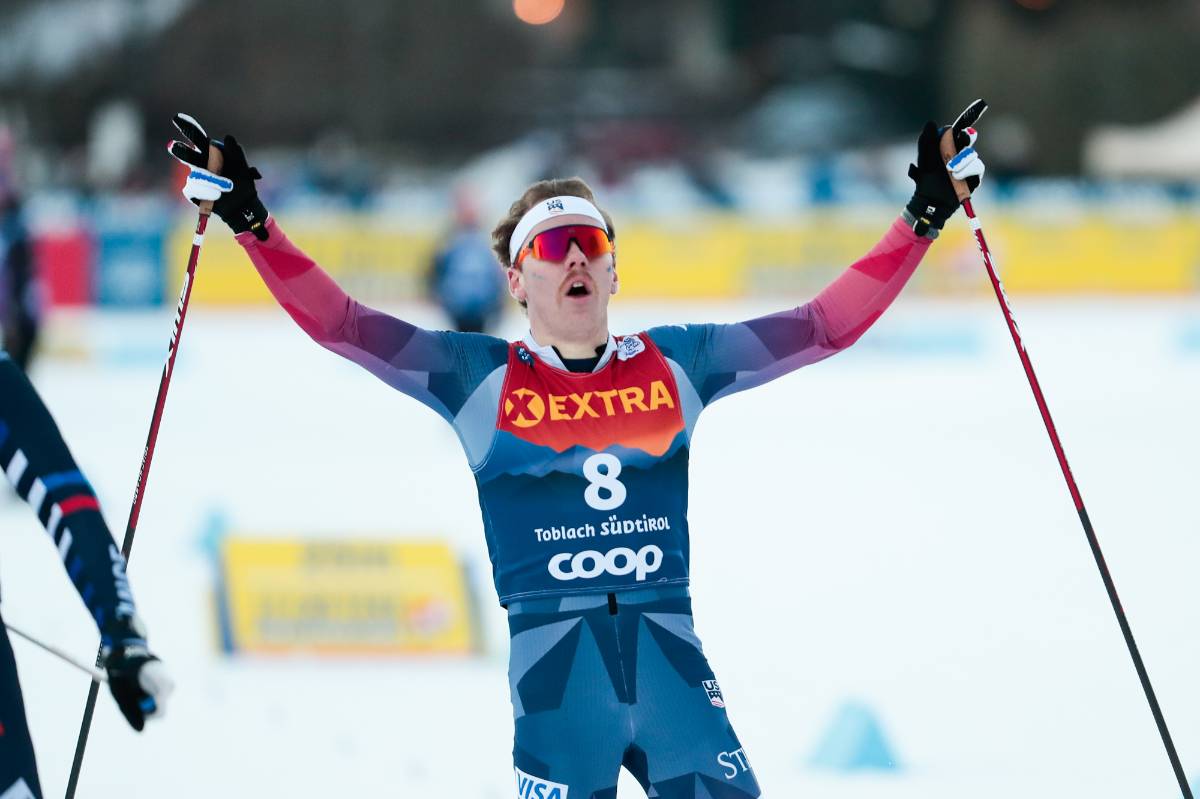
    It was a glorious day for Ben Ogden (USA), as he captured his first ever podium and had a great start to the Tour de Ski. (Photo: NordicFocus)

    It looks like it must be pretty fun to be part of Team USA right now. Two American women (Jessie Diggins and Rosie Brennan) sit in the top three of the World Cup standings, Diggins forges a path toward the lead in the Tour de Ski, and American men advance through sprint qualifying, make finals, and race onto the podium (as JC Schoonmaker did three weeks ago in Oestersund, Sweden). Today, in Toblach Italy, it was Ben Ogden’s time to step into the spotlight. One who exudes the energy and joy epitomizing this season’s US Ski Team, Ogden smiles broadly and celebrates genuinely. American ski fans—and those of many other nationalities, as well—smile and celebrate with him.

    After a two week hiatus, the FIS World Cup resumed today in Toblach, Italy, for Day One of the Tour de Ski (TDS). Today, the Freestyle Sprints were up for grabs. Going into the weekend, the prohibitive favorite to win the Men’s Sprint—and the overall Tour de Ski title—was Johannes Hosflot Klaebo (NOR). That was before yesterday, when conventional wisdom received a giant gut-punch with Klaebo’s announcement that he was ill and would not be able to compete in the TDS.

    Klaebo’s illness quickly threw the men’s competition into disarray, and the immediate question became: “Which Norwegian would step up to fill Klaebo’s boots?” With Norwegian men having won all individual World Cup events this season, it was not a stretch to simply assume that another Norwegian would rise to the challenge. But not only was Norway missing Klaebo, it was also missing Simen Hegstad Kruger—who finished second in last year’s TDS—as he was also taken ill. With Norway missing its one-two punch, they suddenly seemed very vulnerable.

    Illness also invaded the Finnish camp with Iivo Niskanen announcing that he was sick and would withdraw from the tour.

    Lucas Chanavat (FRA) made the most of Norway’s health problems and took the victory in Toblach. (Photo: NordicFocus)

    Waiting to challenge the Norwegian dominance was France’s Jules Chappaz—silver medalist from last year’s World Championships—along with countryman Lucas Chanavat, one of the few sprinters who has shown himself capable of challenging Klaebo. With the top Norwegians out of the way, and Chappaz and Chanavat chomping at the bit, perhaps today would be the day for one of the frequent second place podium finishers to shine. An opening was also there for American Ben Ogden. It suddenly looked like it would be a tall order for one of the other Norwegians to step up and snatch victory from the grasp of one of the men who have been fighting for their chance to stand at the top of the podium.

    At the end of a tumultuous day of racing, it was Chanavat taking the victory, Chappaz in second, and Ogden finishing third to claim his first World Cup podium.

    Two other Americans made the heats: Gus Schumacher in 18th, and Kevin Bolger 24th. Other American finishers were Zanden McMullen 47th, and Scott Patterson 91st. J.C. Schoonmaker did not start due to illness. Under TDS rules, he will not be allowed to compete for the rest of the tour.

    The top Canadian was Antoine Cyr in 35th. He was followed by Olivier Leveille in 70th, and Julien Locke in 73rd.

    TDS Sprint Qualifying—and Bonuses

    Earning a fast qualifying position for Sprints is especially important in the TDS since the times from the qualification round will be used to calculate overall TDS standings. Bonus seconds are then awarded to the top 30 Sprint finishers; with first place getting a 60 second bonus. Bonus seconds are subtracted from competitors’ cumulative race times which are then used to calculate overall TDS standings.

    In the absence of the Norwegians, Chanavat took advantage of the opportunity in the qualifiers and took the first spot by over two seconds. American Ben Ogden was also in a good position having finished eighth in the qualifying rounds.

    Ben Ogden (USA) fought hard all day long and clearly preferred to be with the leaders out front in each of his heats. Ogden commented that he had a couple of awkward finishes as shown here. “I didn’t have a strategy with regards to lunging. I thought I had it in all the heats and sort of went for the lunge at the last second, and used my head instead of my foot.” (Photo: NordicFocus)
    Men’s Freestyle Sprint

    Chanavat raced wearing the leader’s bib in the first quarterfinal. He easily won his heat. American Kevin Bolger was in the second heat. He seemed to falter in the final meters, finishing fifth and would not advance. Valerio Grond (SUI) took first place in that heat, with another Norwegian contender Haavard Solaas Taugboel finishing second.

    Gus Schumacher (USA) had another good day qualifying for the heats. His fourth place finish in his heat wouldn’t hold up for a lucky loser position. (Photo: NordicFocus)

    American Gus Schumacher qualified 22nd and was in the third heat. He stayed with the leaders throughout the race and was in the top three coming toward the finish. Unfortunately, he was pushed into a bad line around the last corner and ended up fourth. At the time, it was enough to put him into the lucky loser position, but he would have to wait two more heats to see if he would advance. Ultimately, his time did not hold up.

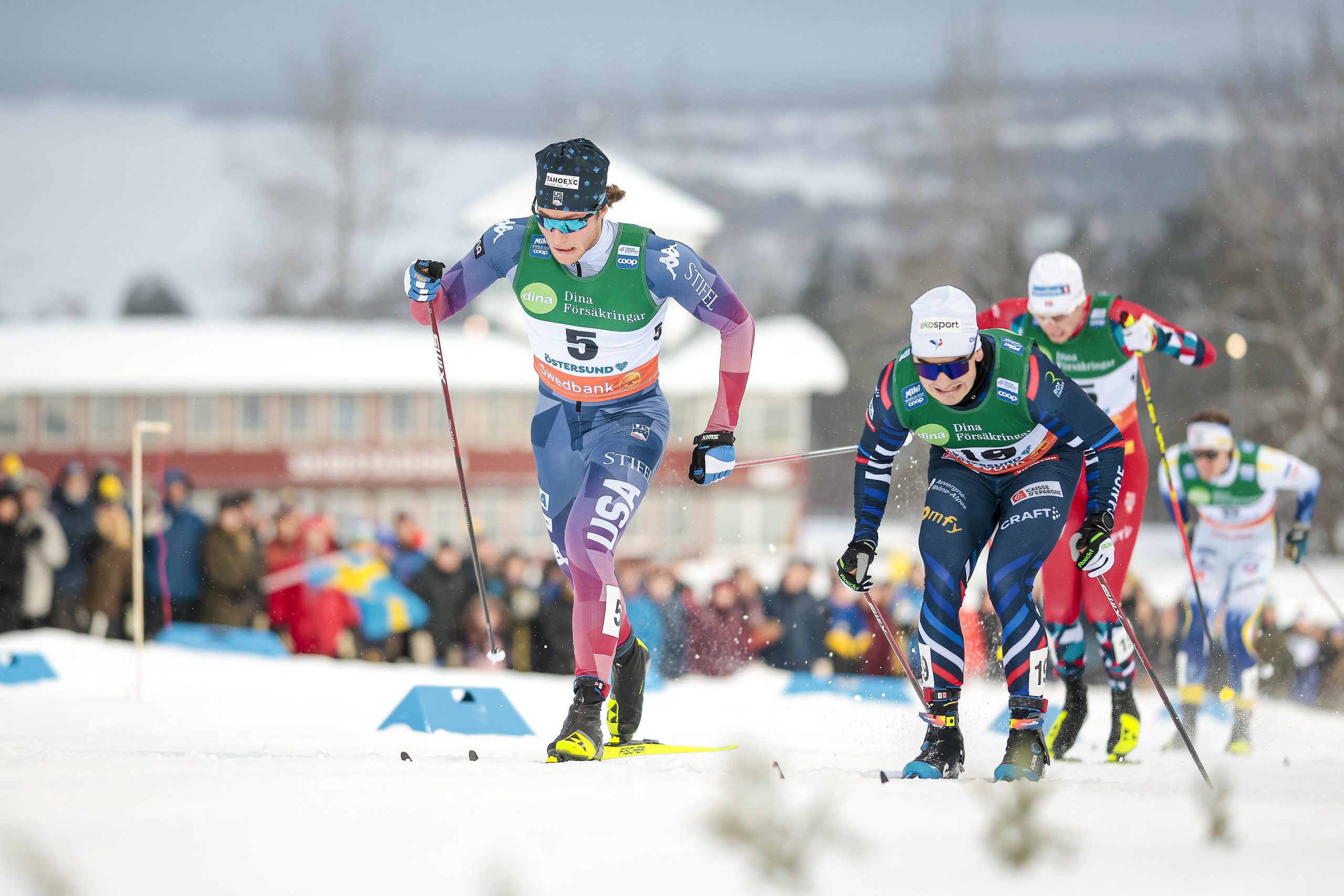
    Ben Ogden (USA) fought hard all day, and worked at the front of every heat on his way to the final. (Photo: NordicFocus)

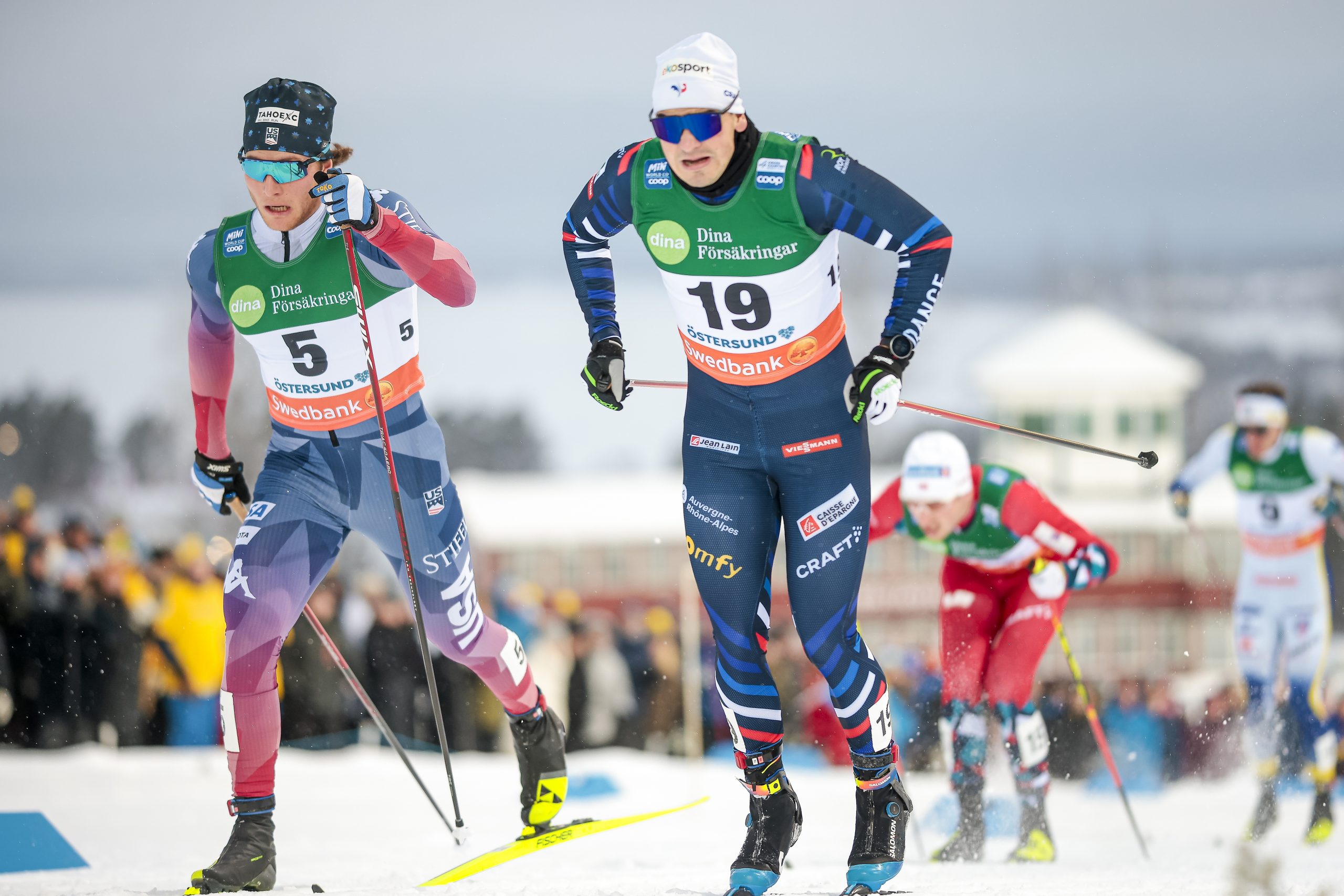
    The fourth quarterfinal featured Ogden. As spectators have come to expect from Ogden, he went toward the front early, and was on Chappaz’ tails right from the start. Ogden continued to hang on to second place, maintaining great position coming into the finish. Ogden fought hard all the way to the finish line, where he was in a three way photo-finish and ultimately finished second by .02 seconds. It was a fast heat and pushed Schumacher out of the lucky loser position.

    TDS favorite Federico Pellegrino (ITA) was in the last quarterfinal, taking the win with Norwegian Matz William Jenssen following him into the semfinals.

    Semifinals

    The semifinals posed an interesting quandary for the Norwegians: they advanced five skiers to the semifinals, but four of them would face each other in the first semi that also included top qualifier, Chanavat. In that first semifinal, Chanavat immediately jumped into the lead, but Grond clung tenaciously to his ski tails. Chanavat easily took the win with Grond taking second. The Norwegians would be in the unusual position of having to wait to see if any of their skiers would advance as lucky losers.

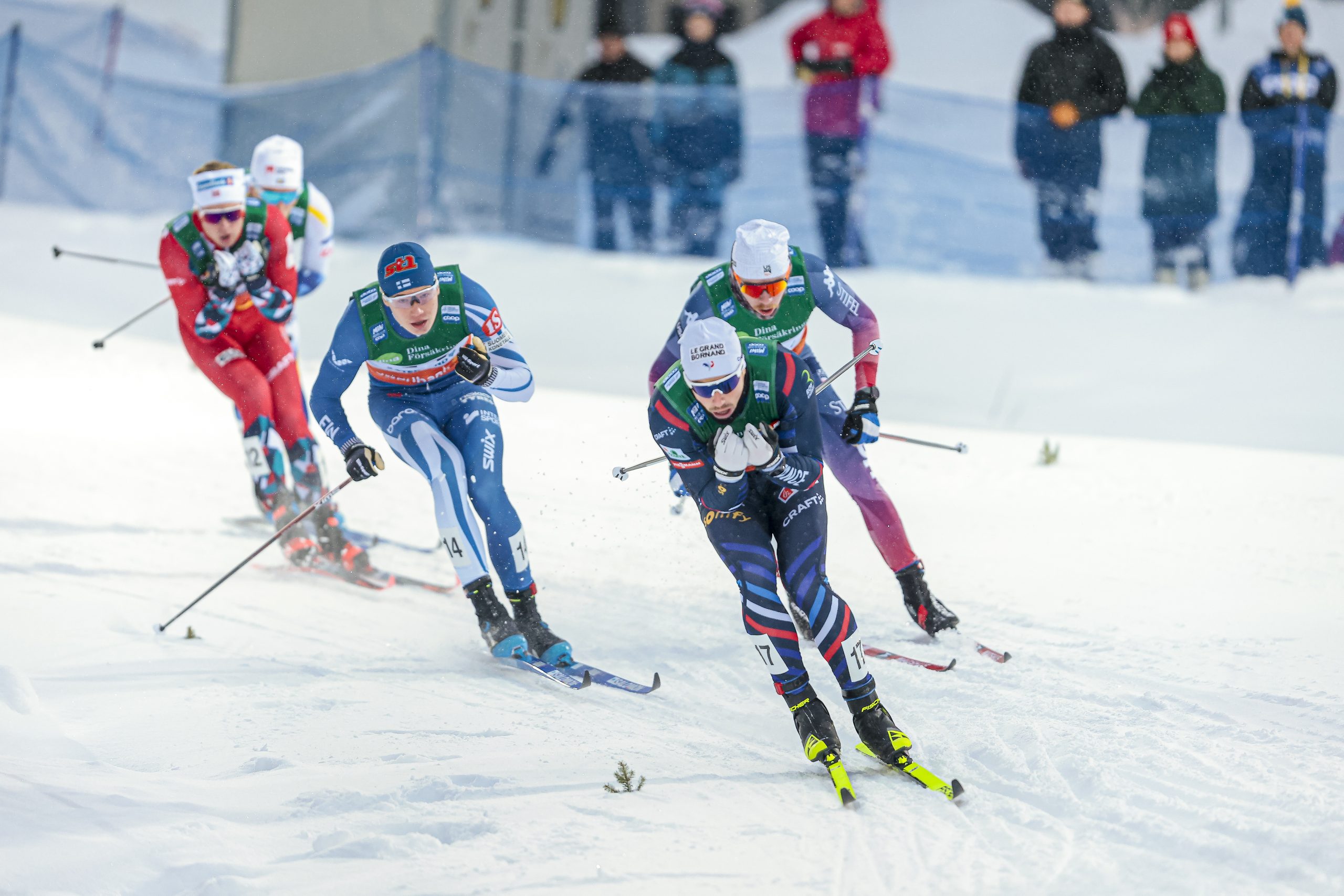
    In the second semifinal, all American eyes were on Ben Ogden who was the second highest ranked qualifier in that heat. Italian, Michael Hellweger, jumped to the lead with Ogden again tucked into third. The pace quickened significantly halfway through the race with Ogden moving up into second position. He was able to establish a gap on the field along with Chappaz who had fought to join him at the front. It was a furious sprint to the finish with Ogden and Chappaz creating a photo-finish for first place. After review, the victory went to Chappaz, but the second place finish put Ogden into the finals.

    Jules Chappaz (FRA) took second to give France first and second place and help to shut Norway off of the podium. (Photo: NordicFocus)
    Sprint Final

    The final race saw Chanavat, Chappaz, Grond, Ogden, Harald Oestberg Amunsen (NOR), and Erik Valnes (NOR) competing for the podium. It was only the second time for Ogden in a Sprint final. True to form, Ogden hung with the leaders at the start and held firm in third place; evidently his favorite spot on this highly tactical course. After the race Ogden said that, “my strategy was to try and come all the way around [the course], and block off the inside lane, which I did twice.” Halfway through, Ogden moved up to second behind Chanavat who pushed the pace from the front. It was all Chanavat, who put on a quick burst to establish a significant gap on the field while Ogden held his position in third. Ogden pushed hard all the way through in a duel with Valnes for third place. Ogden didn’t flinch one bit and was able to fend off Valnes to fight his way onto the podium. It was a first career podium for Ogden, and Norway was shut out of the podium for the first time this season . . . and the first time in memory. So, on day one of the TDS it was a new world order for the top skiers with a new American presence on the podium.

    It was a big day for many reasons for Ogden. Family members were there and got to see him race on the World Cup for the first time. “It was really special,” Ogden said. “Honestly . . . I had hoped that they would be able to see my first podium finish, but I was really stoked that they were able to see me for the first time in a World Cup.”

    The first time on the podium is obviously special, but Ogden couldn’t point to any one thing which had made the difference. He readily acknowledged that the absence of others made a difference. “If Klaebo was here, I would have been fourth. That being said, I feel like I cracked this course a little more than I had. Having a hard start was really worthwhile. ”

    U.S. coach Kristen Bourne concurred that there wasn’t any one thing which stood out for Ogden. “In [World Cup] sprinting, you have to be really strategic,” Bourne said. “You have to find tiny gaps. It does take a while to learn World Cup Sprinting. He’s been in so many heats … he’s figuring it out. I think it’s an accumulation of experience.” Ogden’s podium was meaningful for the entire team. “It was a pretty special day,” Bourne told FasterSkier. “Every time somebody gets the first podium on the World Cup, it’s a pretty special day for everyone involved. A lot of his teammates waited around for the final, people wanted to line the course and support him.”

    Illness was definitely big news today, but team USA hasn’t changed up its protocols to address this issue. Coach Bourne commented that, “We’re definitely trying to follow the same guidelines that we’ve had all season. We’re masking on planes and public transportation. We’re being very cautious about people that are coming in from traveling internationally, especially outside of the bubble.” Bourne thinks that the holiday break may have played a part in the rise of illness. “It’s pretty standard stuff,” Bourne said. “We are not the only team masking, you go to team coaches’ meetings and almost everyone there are wearing masks. But people spend time with their families during the holidays, and that expands their bubbles. You give them the opportunity to go home, rightfully so, and they try to be normal for a little bit and naturally it just exposes you to more stuff, and we’re seeing the effect of that.”

    It looks easy to be happy when you’re winning. For Team USA, it also appears that cultivating that sort of happiness is a good formula for winning, too.

    TDS Men’s Freestyle Sprint RESULTS:

    A best-ever day for Ben Ogden (USA) as he earned a spot on the World Cup podium for the first time.
    Jules Chappaz (FRA), Lucas Chanavat (FRA), Ben Ogden (USA), (l-r) (Photo: NordicFocus)
  • Great Day for USA! Schoonmaker Podiums in Classic Sprint, Ogden Fourth

    Great Day for USA! Schoonmaker Podiums in Classic Sprint, Ogden Fourth

    This coverage is made possible through the generous support of Marty and Kathy Hall and A Hall Mark of Excellence Award. To learn more about A Hall Mark of Excellence Award, or to learn how you can support FasterSkier’s coverage, please contact info@fasterskier.com.

    In what has already been an action packed season; it’s hard to believe that this is only week three of the World Cup season. This weekend’s venue is Oestersund, Sweden where the Classic Sprint competitions were held. The question going into the men’s race was whether Johannes Hoesflot Klaebo’s (NOR) return to the World Cup circuit, after a brief hiatus to deal with Covid, would also mark his return to Sprint domination. Two weeks ago, in Ruka, he finished third in the Classic Sprint—his worst Sprint finish since 2018—a red flag that something wasn’t right.

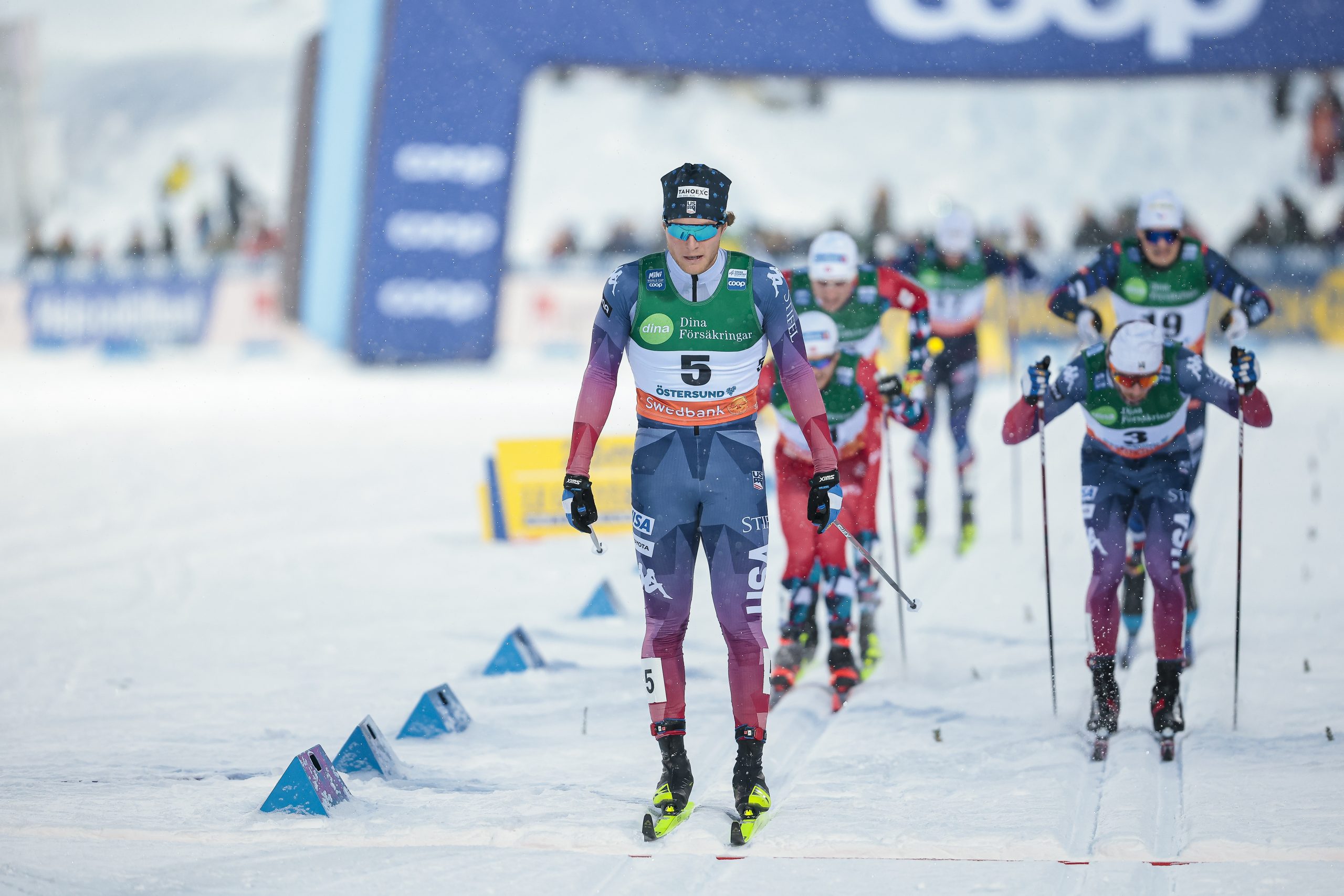
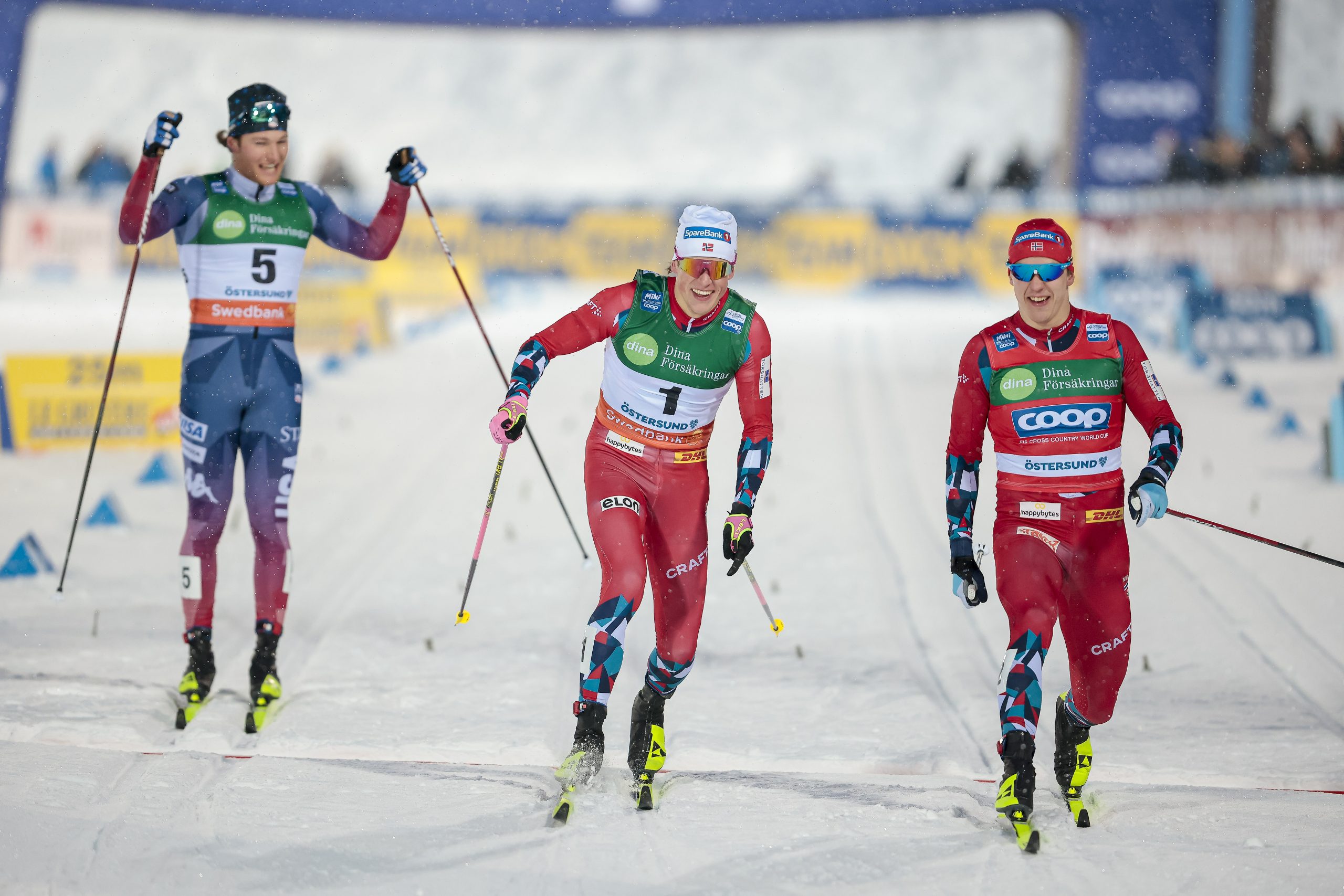
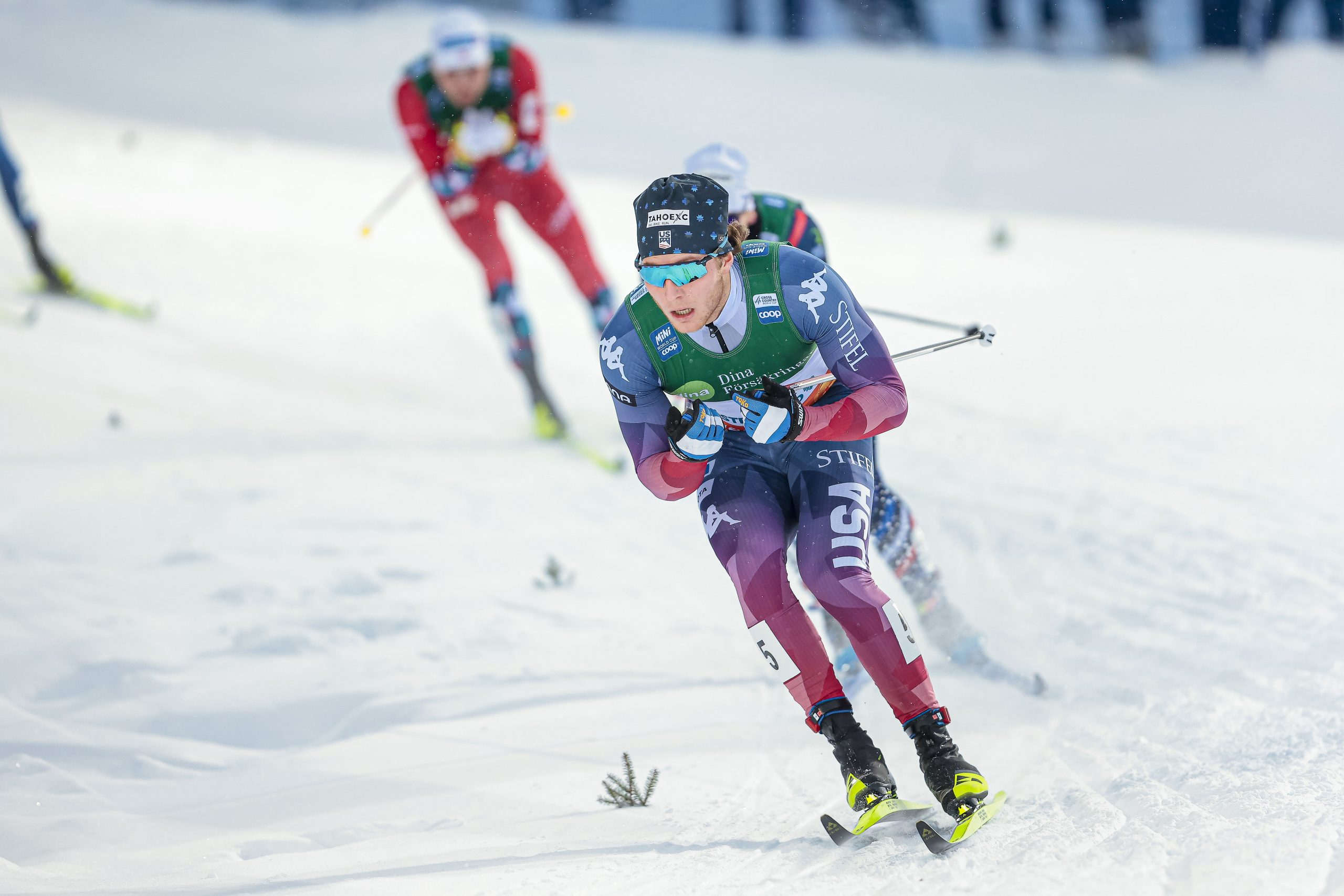
    JC Schoonmaker (USA) had a breakout day reaching the podium for the first time. The American took third place. (Photo: NordicFocus)

    America’s hopes were riding on Ben Ogden and JC Schoonmaker. Ogden had finished 11th in the Classic Sprint two weeks ago, and hopes for him were high. Ogden has thrilled fans with many exciting races, but team USA was hoping that he would be able to find a way to the final round. To do that, he would need to break through a field with eight Norwegian contenders having advanced beyond the qualifying round. JC Schoonmaker would also carry the American hopes into the finals.

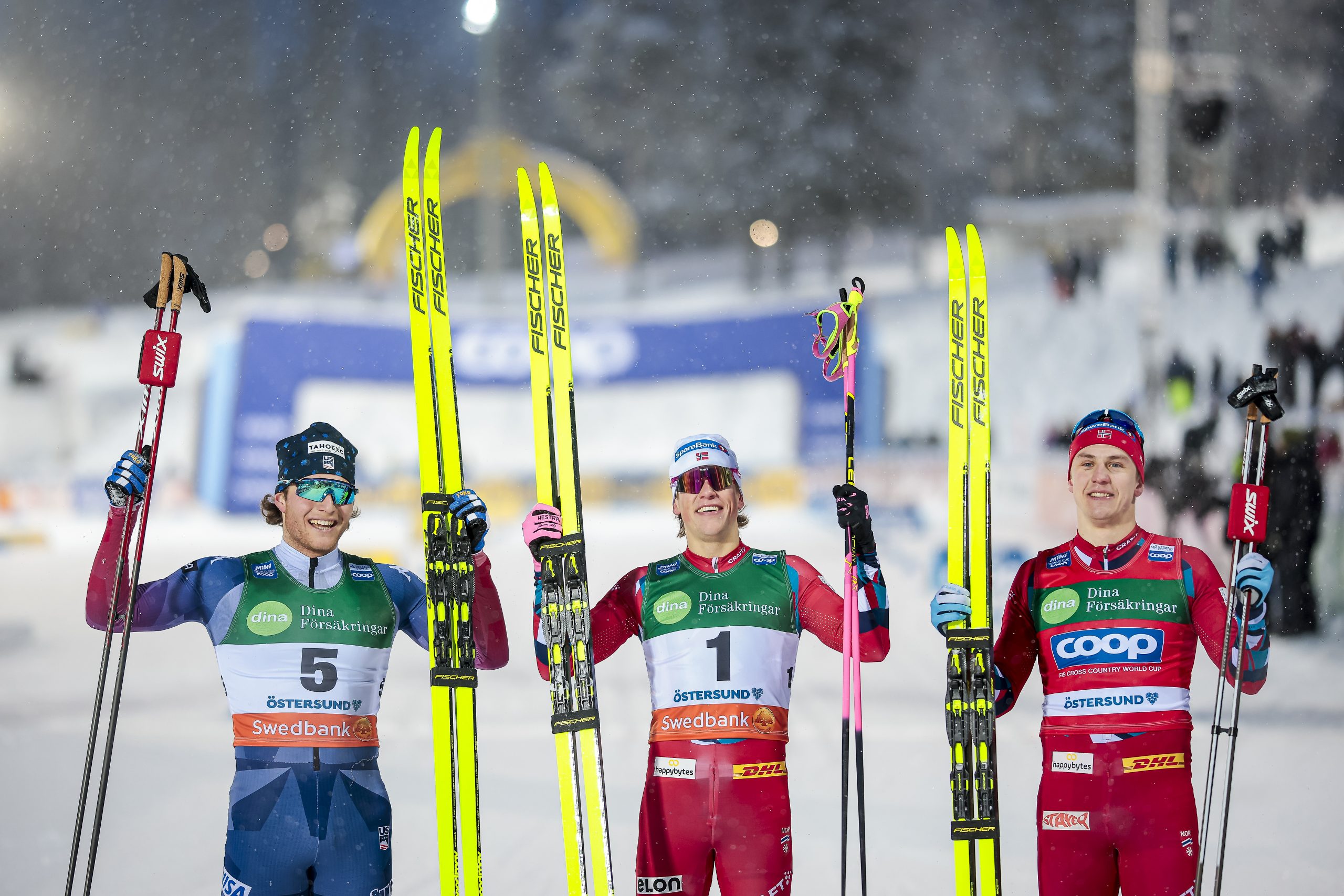
    It ended up being a great day for team USA. In the finals it was Klaebo first, Erik Valnes (NOR) in second and JC Schoonmaker (USA) taking third with his first ever World Cup podium. Ben Ogden finished fourth. Other American finishers were Gus Schumacher 39th, Zanden McMullen 43rd, Luke Jager 52nd, Kevin Bolger 59th, and Will Koch 68th.

    The top Canadian finisher was Antoine Cyr in 16th. Other Canadian finishers were Xavier McKeever 43rd, and Leo Grandbois 65th.

    Men’s Classic Sprint

    Two Americans qualified for the heats: Ben Ogden, who was third in the qualifiers drew the fifth heat, with JC Schoonmaker, who was fifth in the qualifiers, drawing the fourth heat.

    JC Schoonmaker (USA) was dominant in the heats—winning his semifinal and finishing in a photo-finish to take second in his quarterfinal. (Photo: NordicFocus)
    Sprint Quarterfinals

    The questions about Klaebo would be addressed in the first heat, where he was up against countryman, Valnes. Iivo Niskanen (FIN) set the early pace trying to take advantage of his expert Classic technique, but he couldn’t hold off the hard-charging Norwegians. At the finish, Valnes and Klaebo broke away from the field taking 1-2. At this point, it appeared that Klaebo was back in form. Not that he needed it, but Klaebo might have had a little extra incentive today. If he won, he would break the tie he was in with Marit Bjorgen (NOR) for the most individual World Cup Sprint wins.

    In the second heat, the hometown crowd was treated to a thrill as two Swedes dominated with Calle Halfvarsson and Oskar Svensson taking first and second.

    The third heat saw the lone Canadian qualifier, Antoine Cyr, jump out with the leaders. He hung with the front pack throughout the race, and at the end of the heat finished third and held a position as a lucky loser which might have allowed him to advance; however, other racers later supplanted him, and he ended up finishing 16th.

    JC Schoonmaker (USA) and Jules Chappaz (FRA) (right) dueled in the quarterfinal. (Photo: NordicFocus)

    The fourth heat was a thriller as Schoonmaker took the lead from the start, the rest of the field filing in right behind him. Schoonmaker continued to press from the front the entire way and began to split the field, but at the two minute mark the Frenchman Jules Chappaz took the lead with Schoonmaker now second and Norwegian Even Northug closing on him. The three battled it out at the finish. It was Schoonmaker putting in a tremendous double pole burst at the end, finishing in a photo finish with Northug. Northug took the photo for first, but Schoonmaker’s second place finish would move him forward. Chappaz held on for a lucky loser position.

    Ben Ogden (USA) (far right), needed some last second heroics to advance out of his quarterfinal (Photo: NordicFocus)

    The final heat featured American Ben Ogden. He replicated what seemed to be the American strategy today by going to the front quickly. Veteran Lucas Chanavat (FRA) was able to push the pace and Ogden could not hang with the group as he began to drift and was fourth two minutes into the race. At this point, two racers went down, thinning the field. Marcus Grate (SWE) dropped out with an injury, and Niilo Moilanen (FIN) got tangled, fell, and was dropped. This provided the breathing room Ogden needed; when it looked like Ogden wasn’t going to advance, he was able to pick his way through the crowd, put on a quick burst and found the finish line first. It was an inspiring comeback.

    Two Americans would advance to the semi-finals in a Classic Sprint. An historic event for team USA.

    James Clinton Schoonmaker (USA) brought his racing to a new level, and with it, a podium finish. (Photo: NordicFocus)
    Sprint Semifinals

    Klaebo landed in the first semi-final with two other Norwegians and three Swedes. Klaebo went right to the front along with countryman Erik Valnes. It was a very moderate pace for the first half of the race when Klaebo then decided to push the pace by maximizing his speed on the downhills. He put in a quick turn of pace and was quickly able to gap the field. Klaebo appeared to be his old self easily winning the race. Valnes finished second.

    Both Americans were in the second heat and faced a very challenging field of Northug, Haavard Taugboel (NOR), Chanavat, and Jules Chappaz (FRA). Two Americans, two Norwegians, and two Frenchmen.

    Ogden went to the lead early along with Schoonmaker. It was Americans 1-2 early on as they established a bit of a gap on the field. Schoonmaker continued to press and was able to maintain the lead. Ogden then found himself trapped in a corner but was able to push his way through the field. Schoonmaker continued to push and finished first in dominating fashion. Ogden was able to hang on for second. It was team USA 1-2 in the semifinal!

    Happy finishers, as Klaebo was able to put his health woes behind him and reasserted his position as the most dominant sprinter of all time. JC Schoonmaker (USA), Johannes Hoesflot Klaebo (NOR), Erik Valnes (NOR) (l-r). (Photo: NordicFocus)
    Sprint Final

    In the Sprint final, Schoonmaker and Ogden would face all Norwegians with Klaebo leading the way, along with Taugboel, Valnes, and Northug.

    Once again Klaebo went right to the front, but Schoonmaker was right behind him looking for an opening in which to pass. Ogden pressed forward coming up from the outside and joined the skiers at the front. Schoonmaker continued to push and at the 1:30 mark was ahead of Klaebo and punishing the field. Schoonmaker and Klaebo continued to fight hard for the lead. But Klaebo did what he does best: put in a burst and surge ahead of everyone. Schoonmaker was still holding on for a podium when Valnes passed him near the finish.

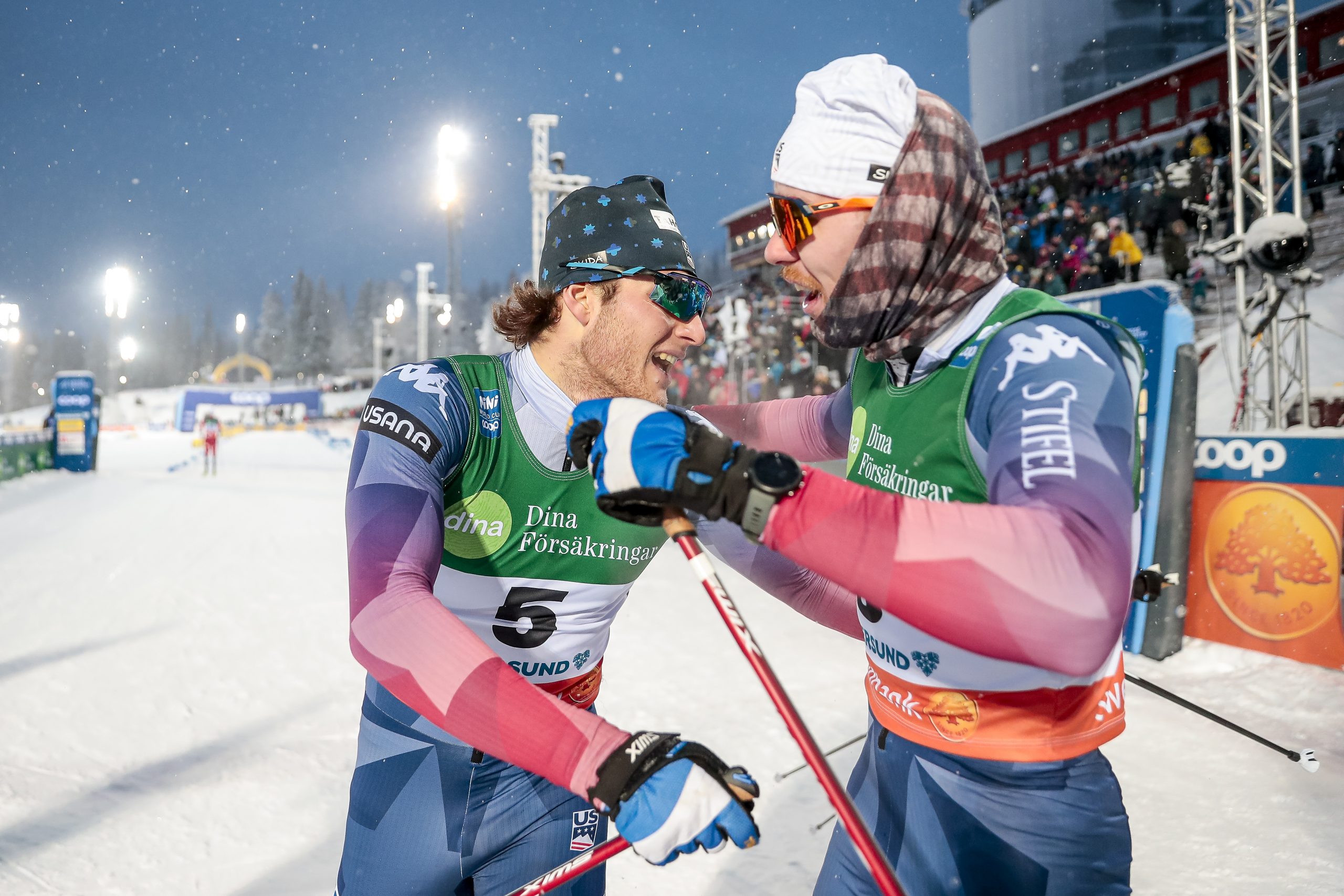
    JC Schoonmaker (USA) and Ben Ogden (USA) congratulate each other after an epic day at the Classic Sprints. (Photo: NordicFocus)

    Klaebo put the hurt on the field and was able to then coast to first. He erased any doubts that he was back in vintage Klaebo form. Valnes held on to second with Schoonmaker taking third. Ogden continued to ski strong and held on to fourth. It was a thrilling, emotional, and historic race for team USA.

    Regarding his first podium, Schoonmaker said that, “[it] just means so much to me that it’s hard to even describe. It’s been a dream of mine for a long time, so to get up there today and have Ben really close right with me is just such a sweet feeling.”

    Schoonmaker commented on his Classic Sprint success that, “I feel like I am probably a bit stronger in Classic than Skate right now, but also it’s hard to say considering we haven’t had a skate sprint yet this year.” He continued that, [I] definitely feel confident in both after a good race today and feeling like I’m in good shape at the moment.”

    He continued that the historic nature of having two Americans in a Classic final wasn’t lost on him; “Ben and I have both been looking to make it to the final now for a while and both of us getting it done on the same day is a dream scenario. I’ve been excited for U.S. skiing and U.S. men’s skiing for a while now but today has really stoked the flame and I feel more motivated to keep it up and more proud to be a part of it than ever before.”

    Ben Ogden also had opinions on today’s top finishes. He said, “I think it goes to show that Americans are so much stronger together. Today I never would have made it as far as I did if JC wasn’t there and I bet he feels the same. It was a truly spectacular day and it will make us want to do it all again that much more.”

    The performance inspired the entire team. Jessie Diggins said that, “those boys brought me to tears … that was amazing, they’ve worked so hard for so long, they’ve kept believing. To see JC get his first career podium … I’m going to remember that forever. I couldn’t possibly be more proud of both of them.”

    Check back with FasterSkier throughout the day as this story will be updated with quotes and comments from Team USA athletes and staff.

    Men’s Sprint RESULTS

    It was a breakout day for team USA with Schoonmaker finding the podium. James Clinton Schoonmaker (USA), Johannes Hoesflot Klaebo (NOR), Erik Valnes (NOR), (l-r) (Photo: NordicFocus)
  • U.S. Cross-Country National Team Announced

    U.S. Cross-Country National Team Announced

    U.S. Ski and Snowboard has announced the members of the 2023-24 National team, now officially known as the Stifel U.S. Cross Country Ski Team. With a few notable retirements this spring a couple of shakeups were going to occur. The team uses a selection criteria which it has developed to try and balance proven performers with budding talent. It is a somewhat complex set of guidelines.

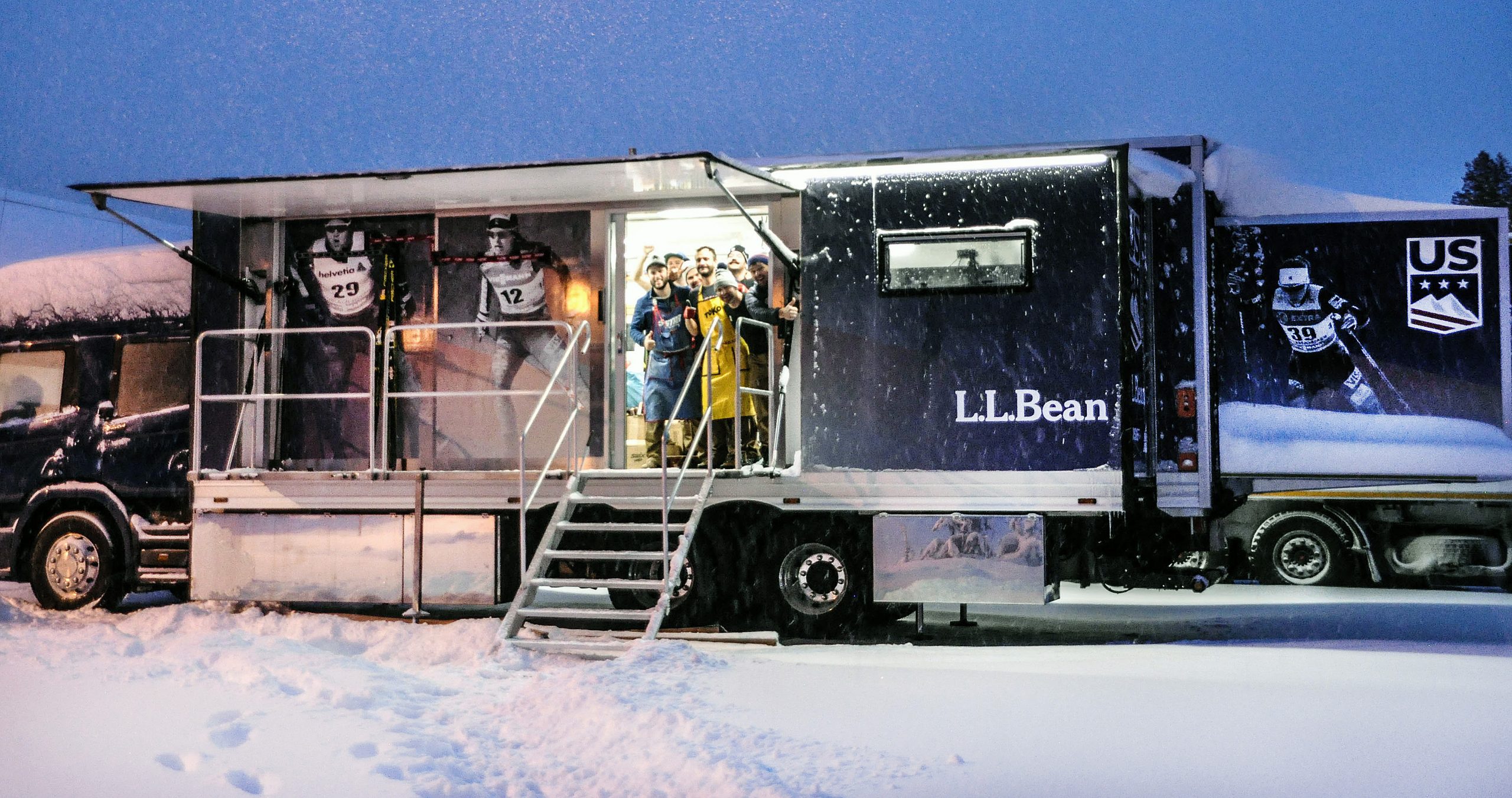
    U.S. Ski Team wax truck during pre-season camp in Rovaniemi, Finland will find some new occupants this year along with some proven fan favorites. (Photo: Matt Whitcomb)

    Women’s Squad

    The women’s A Team members come as no surprise. Veterans Jessie Diggins, and Rosie Brennan will be joined by Julia Kern. Last season Kern solidified her placement on the A squad with consistent sprint results all winter.

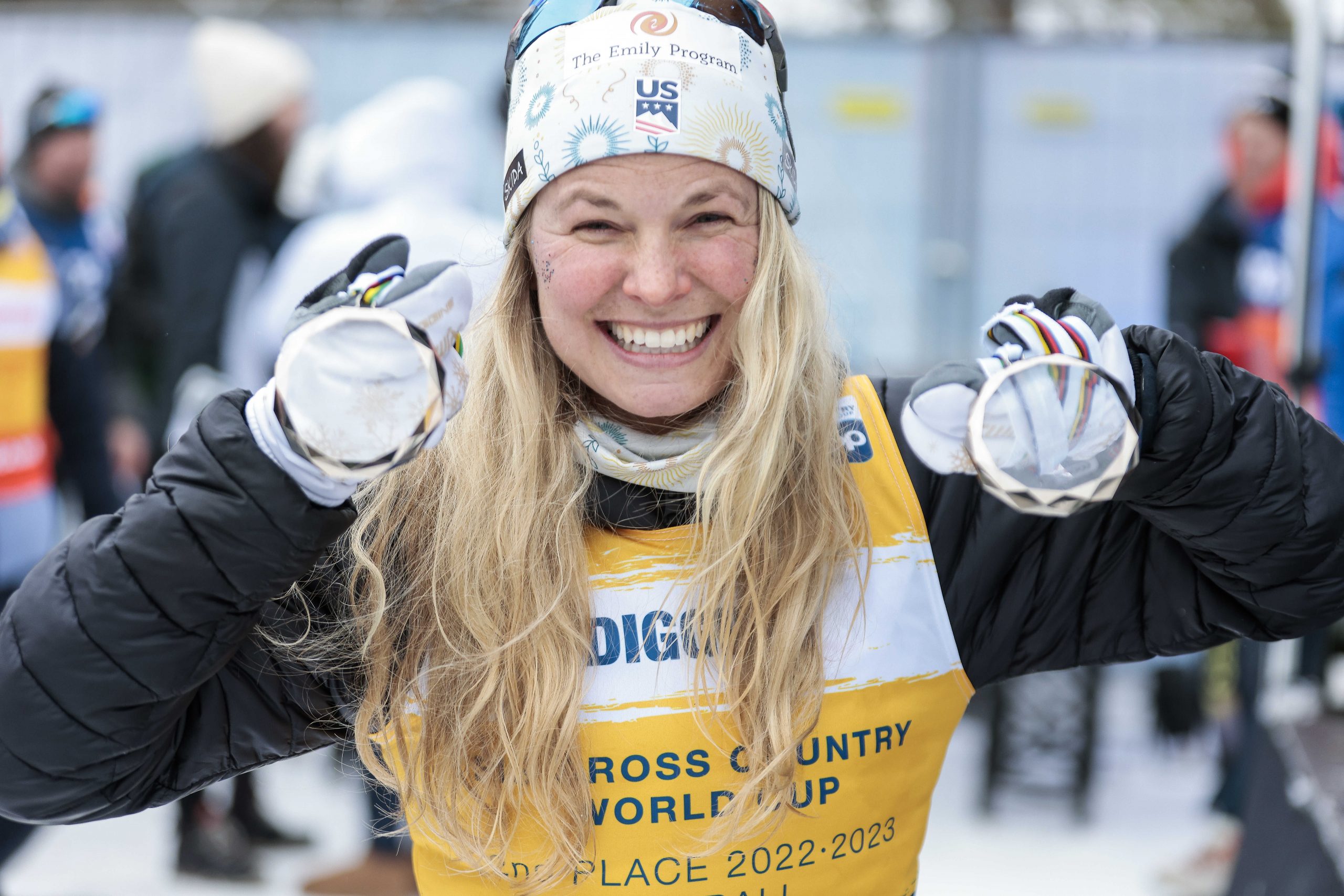
    Jessie Diggins (USA) showing off her new hardware after the end of last season. (Photo: NordicFocus)
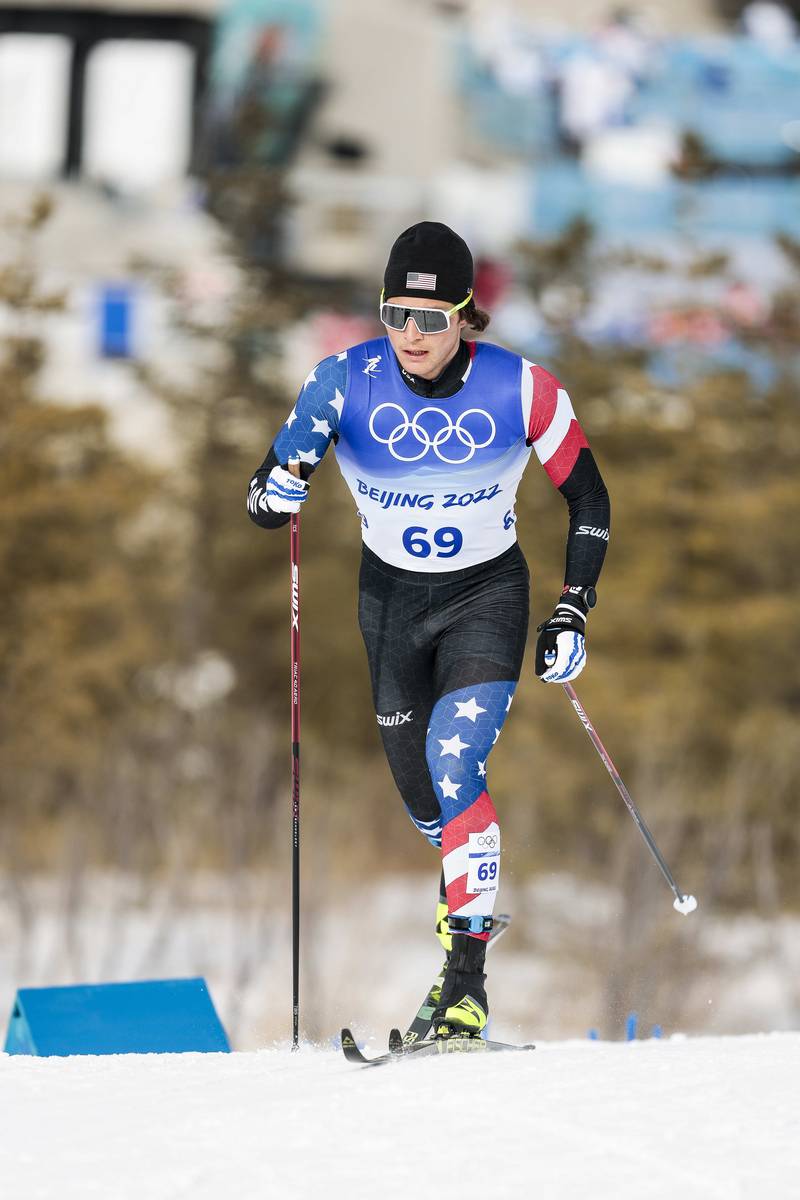
    The women’s B team will consist of Sophia Laukli, Novie McCabe, and Sydney Palmer-Leger, who will move up from the development team.

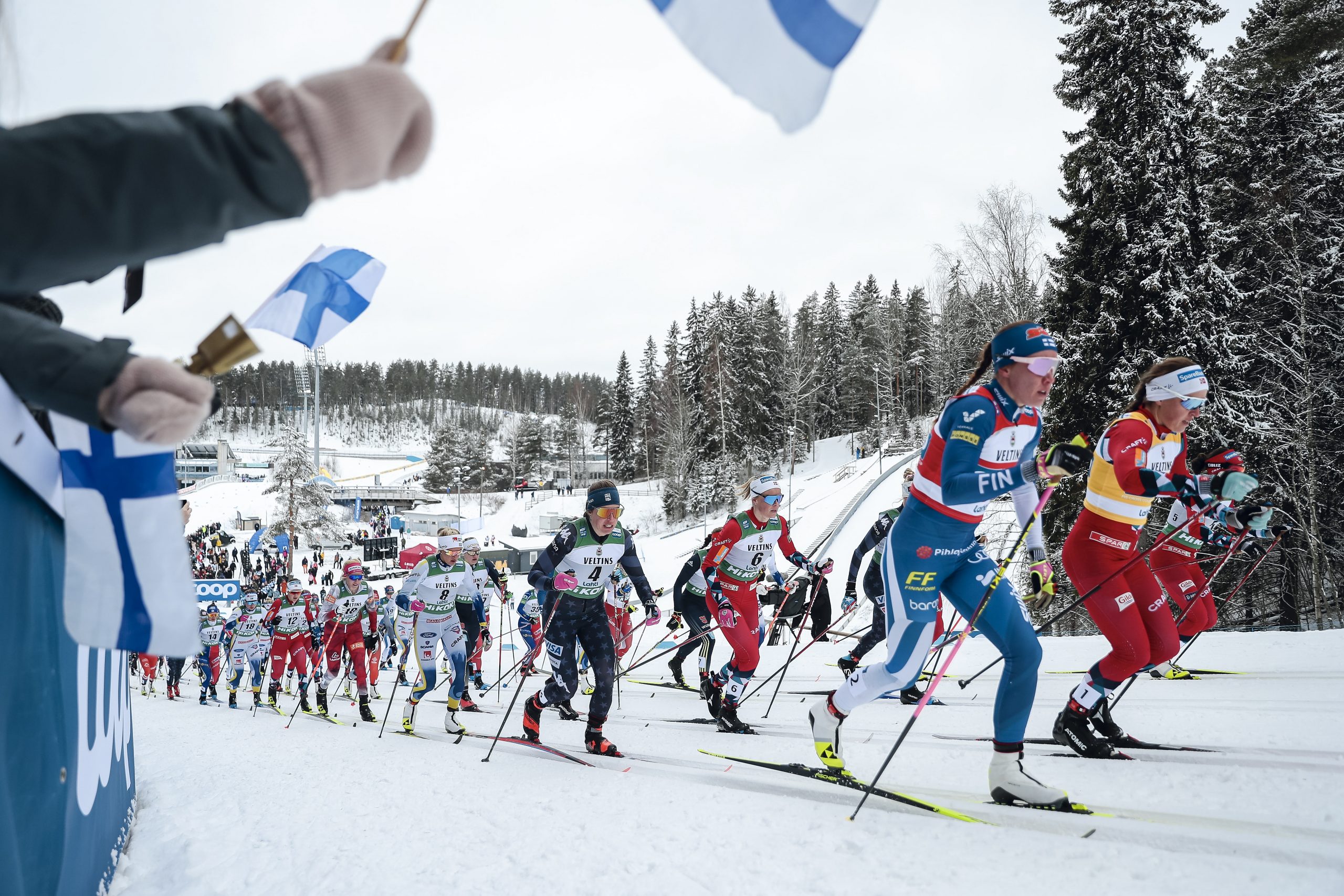
    Rosie Brennan ( Number 4, USA), in the lead pack in Lahti, Finland, will again be part of the core of the U.S. women’s squad. (Photo: NordicFocus)
    The women’s development team will see the return of multi-sport star Sammy Smith, who will be joined by Ava Thurston, and Haley Brewster

    Men’s Squad

    The men’s A team will consist of Ben Ogden, last years winner of the green bib for the best under 23 year older skier, who will be joined by JC Schoonmaker.

    Ben Ogden (USA) celebrates his green bib victory on last year’s World Cup tour and will return on the A team this coming winter. (Photo: NordicFocus)

    The men’s B Team will be comprised of Gus Schumacher, Luke Jager, Scott Patterson, Zak Ketterson, Zanden McMullen, and John Hagenbuch.


    JC Schoonmaker (USA) in the Planica, Slovenia individual sprint. (Photo: NordicFocus)

    The men’s development team will be comprised of Walker Hall, Will Koch, and Michael Earnhart. They will be joined by new development team athletes Brian Bushey, Max Kluck, and Derek Richardson.


  • Niskanen with the golden stride in 15 k classic, while North American men hold strong on tough tracks

    Niskanen with the golden stride in 15 k classic, while North American men hold strong on tough tracks

    This World Cup coverage is made possible through the generous support of Marty and Kathy Hall and the A Hall Mark of Excellence Award.  To learn more about A Hall Mark of Excellence Award or to learn how you can support FasterSkier’s coverage please contact info@fasterskier.com.


    In the sport of cross country skiing, the Olympic 15-kilometer individual start classic might be considered the “granddaddy of them all.” The technique was classic, as was the race against the clock, and even the weather on Friday morning seemed to harken to the pitch perfect idea of a ski race we all have in our minds; mid-20s Fahrenheit, -3.5℃ to be exact, and with some sun too. This race, in this discipline, had been raced in 1924 at the first winter Olympiad in Chamonix, when a pair of legendary Norwegians and a Finn graced the podium.

    Hans Christer Holund (NOR) races the 15 k individual start classic during the 2022 Beijing Olympic Winter Games. (Photo: NordicFocus)
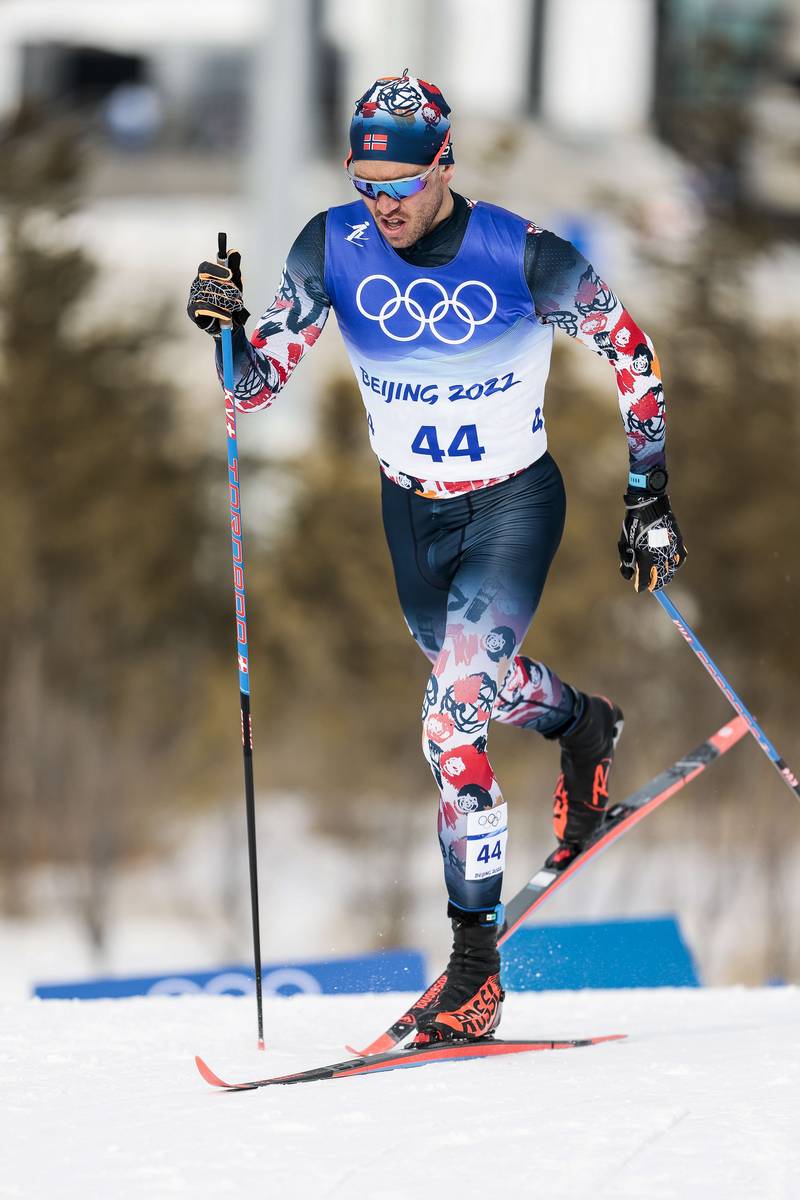
    More recent history too, had plenty of threads that this race could potentially follow suit when it played out on Friday. The last 15 k classic World Championship race in March 2021 had seen a Norwegian sweep. Norway’s Johannes Høsflot Klæbo has won two of the last 15 k distance events on the World Cup, with Finland’s Iivo Niskanen winning the third. Alexander Bolshunov of Russian Olympic Committee (ROC) stood on two out of three of these podiums. 

    The gold medalists in the 15 k Olympic races from the 2018, 2014, and 2010 Games were all on the start-line; their name was Dario Cologna (SUI). 

    So which one to follow? Well, it turns out that sometimes, recency bias is the best bias.

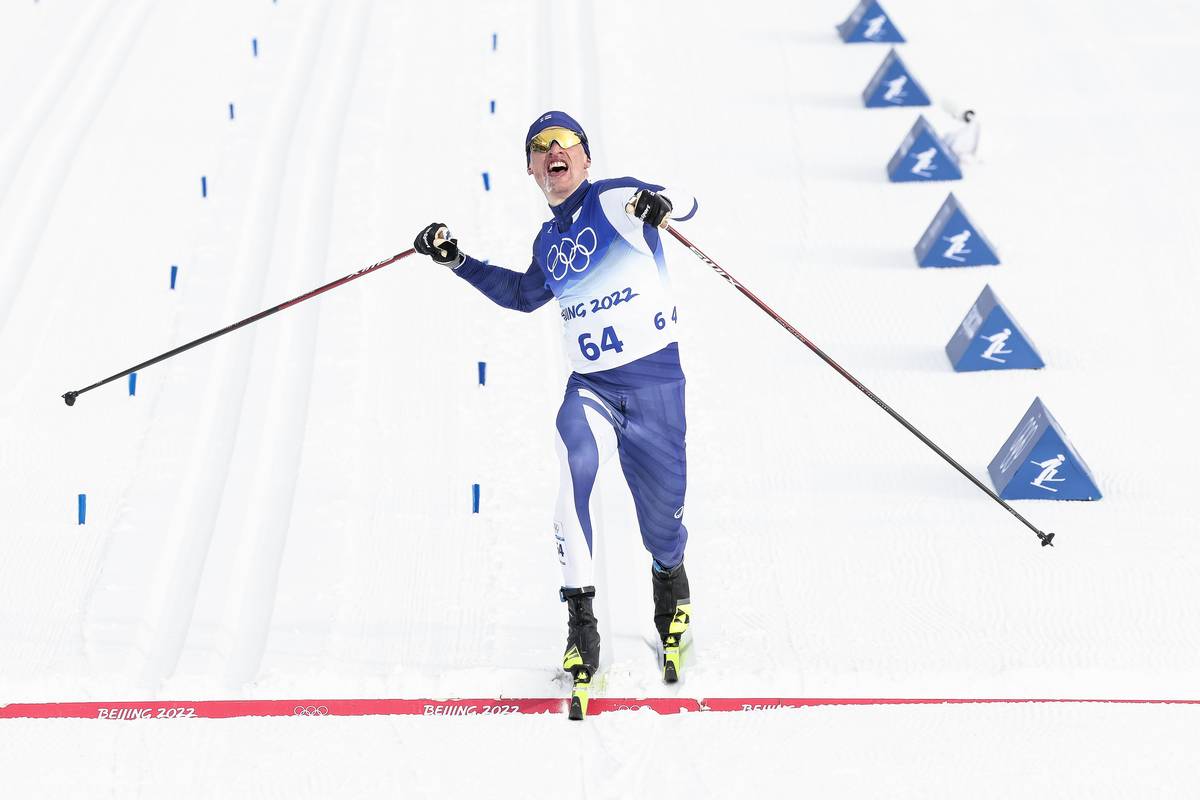
    Following the thread of history in big, bold, strides was Iivo Niskanen. In doing so, he not only followed, but also made, history too.

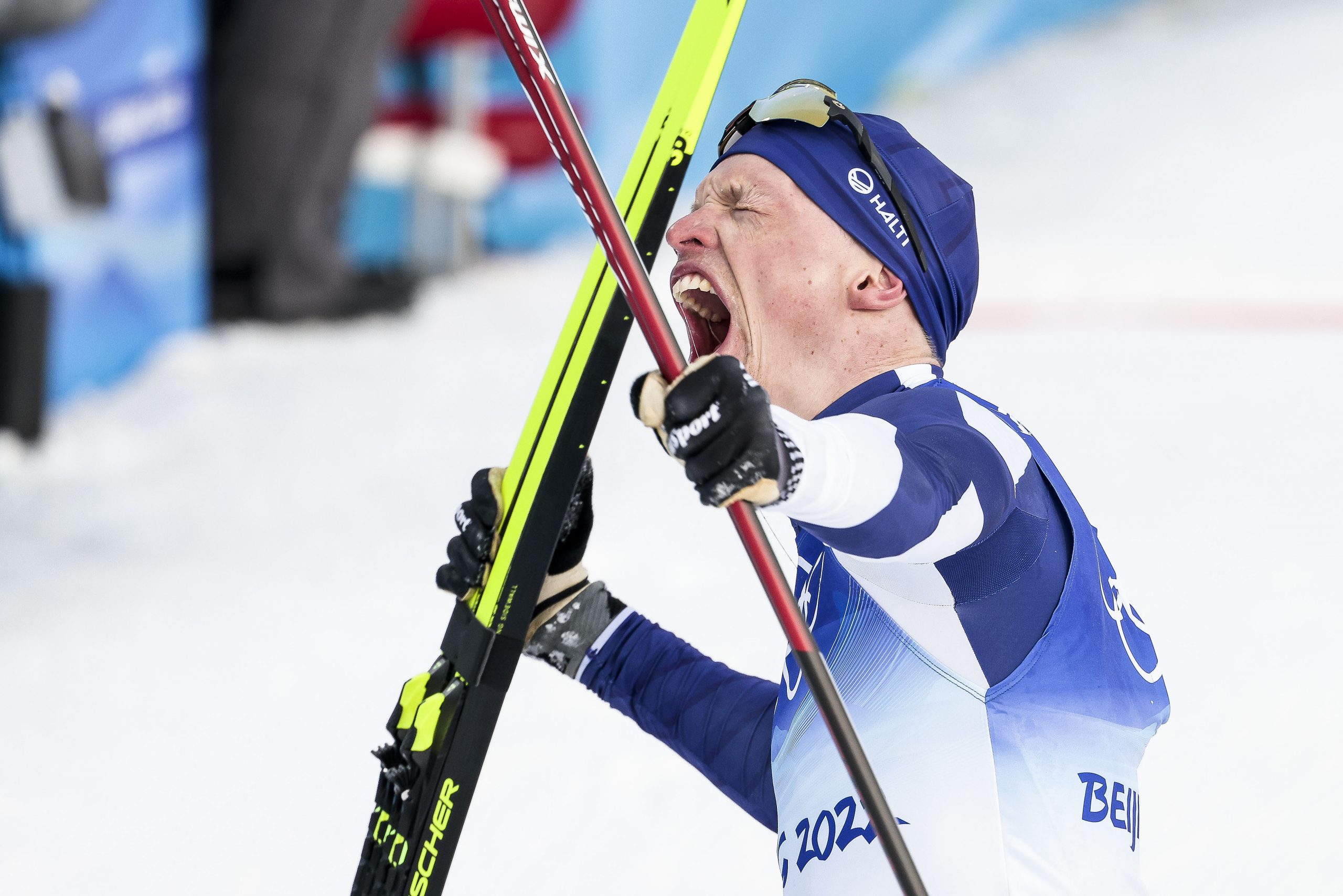
    Iivo Niskanen (FIN) let’s out a shout of jubilation after Friday’s 15 k at the Beijing Olympics. Photo: NordicFocus

    Getting there though, was the matter of following a field that showed the complexity and nuance involved in the simple task of racing against the clock for 15 k. The men’s race entailed two laps of a 7.5 k course that included rolling terrain, and plenty of steady, long uphill pitches seemingly perfect to test the ability of skier’s to mix glide and tempo in classic strides.

    “It was a brutal, brutal course,” said American JC Schoonmaker in an interview with FasterSkier. “There’s so many long, gradual, working sections, and when you get to the top you don’t get a lot of downhills that have much speed…there’s two especially long climbs and a whole bunch of medium grinds in between.”

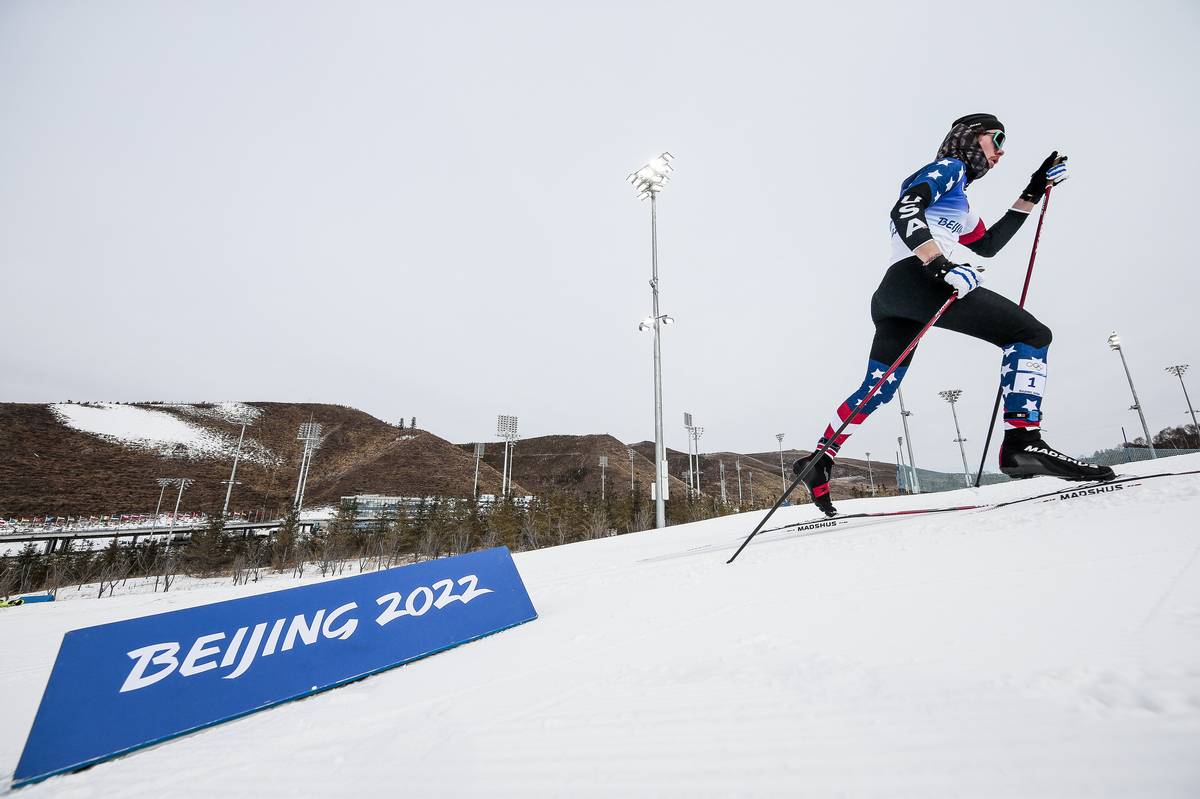
    JC Schoonmaker skis the 15 k individual start classic. (Photo: NordicFocus)
    “Whether this day goes well or not, this course makes this a really big day, the hills are so steep, and the trick is that kick is even more critical because of the pitch of some of these hills.” said US Ski Team Head Coach Matt Whitcomb.

    For their part, the men’s field went out to attack this hard course with a smile. Or at least, Ben Ogden (USA) did. The American wore bib number 1, fresh off his historic sprint finish, and gave a wink and grin to the camera before dashing out of the start gate, and settling into a powerful double-pole that would allow him to set the pace for the field in the early part of the race.

    Ogden said on his early start “I’ve never been in that position [going out in bib 1], so it was fun to go out and try and stay with the really fast guys on the second lap.”

    Ben Ogden races his first distance event of the 2022 Olympics, the 15 k individual start classic. (Photo: NordicFocus)
    Ogden eventually finished 41st overall (+3:35.0), notching another impressive result for the 21-year-old Vermonter, and reason for fans to look forward to a bright Olympic future from him.

    Ogden’s 1.8 k split was surpassed by Canadian Olivier Léveillé, who wore bib number 5, before the French sprinter Richard Jouve put down a split that seemed to be a good barometer of what going out hard on this course looked like.

    When the field’s favorites came through, Jouve’s split gave away how different competitors were approaching the pacing of the 15 k course. Johannes Høsflot Klæbo (NOR), wearing bib 32, came through the 1.8 k checkpoint way back in 28th place, +28.6 seconds off of Jouve. His teammate Pål Golberg came +6.4 off of Jouve as well. The Norwegians seemed to be taking the early part of the race conservatively.

    Dario Cologna (SUI) too, was back in 26th place after 1.8 k (+26.1), but it seemed clear from the early part of the race that the reigning Olympic champion was out on one last run, an homage to his legendary Olympic career.

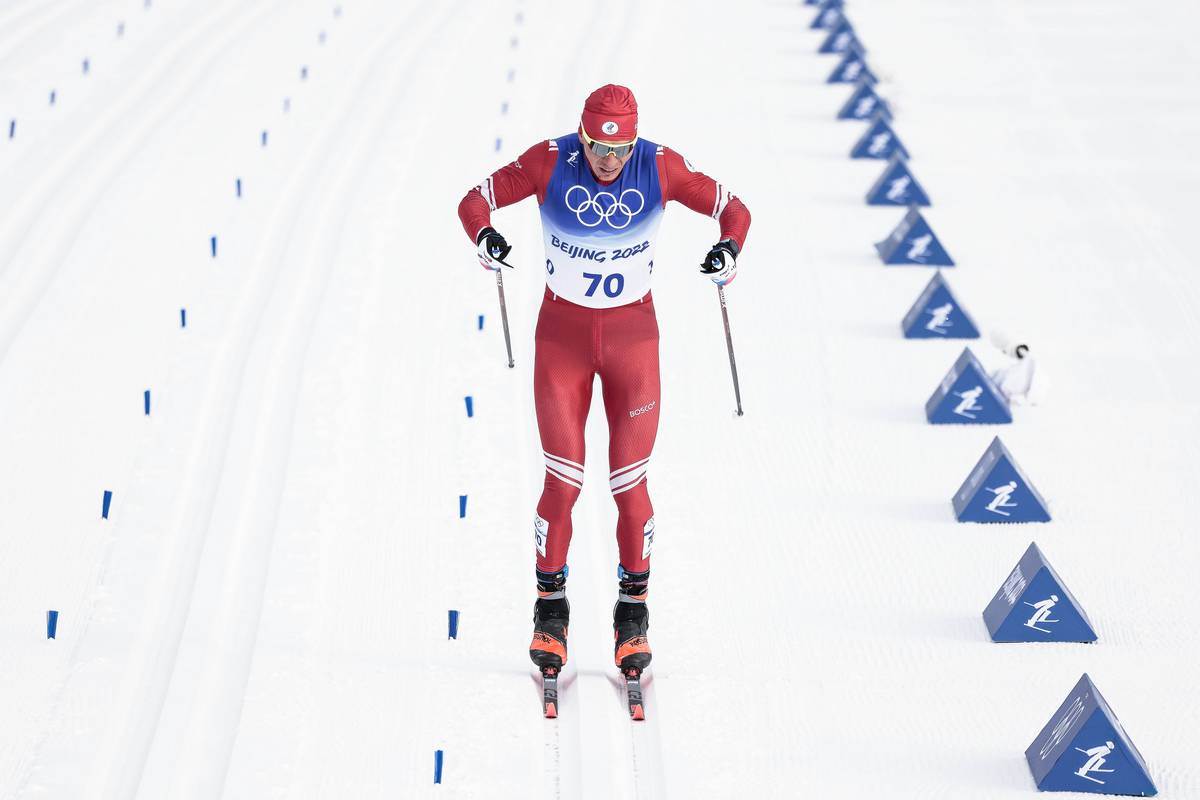
    When Jouve’s mark was eventually surpassed, it was by Iivo Niskanen, wearing bib 64, who skied through the 1.8 k mark with a 2.3 second advantage over the entire field. Eyes then turned towards the skier who had outdone Niskanen in last Sunday’s 30 k Skiathlon, Alexander Bolshunov (ROC), wearing bib 70, who came through the 1.8 k mark +8.4 seconds off of Niskanen’s time.

    Alexander Bolshunov (ROC) strides up a climb during the 15 k Classic. Photo: NordicFocus

    Their proximity early in the race couldn’t help but recall the women’s race yesterday, where Niskanen’s sister, Kerttu ultimately missed the gold medal by just 0.4 seconds. The two are now one of just four sibling pairs to win medals at the same Olympic Games, and looked to be able to do it in the men’s and women’s equivalent of the same event. 

    For a second time in two days, a Niskanen would be in a grueling duel against the clock.

    Finland’s Iivo Niskanen strides for gold in the 15 k individual start classic. (Photo: NordicFocus)
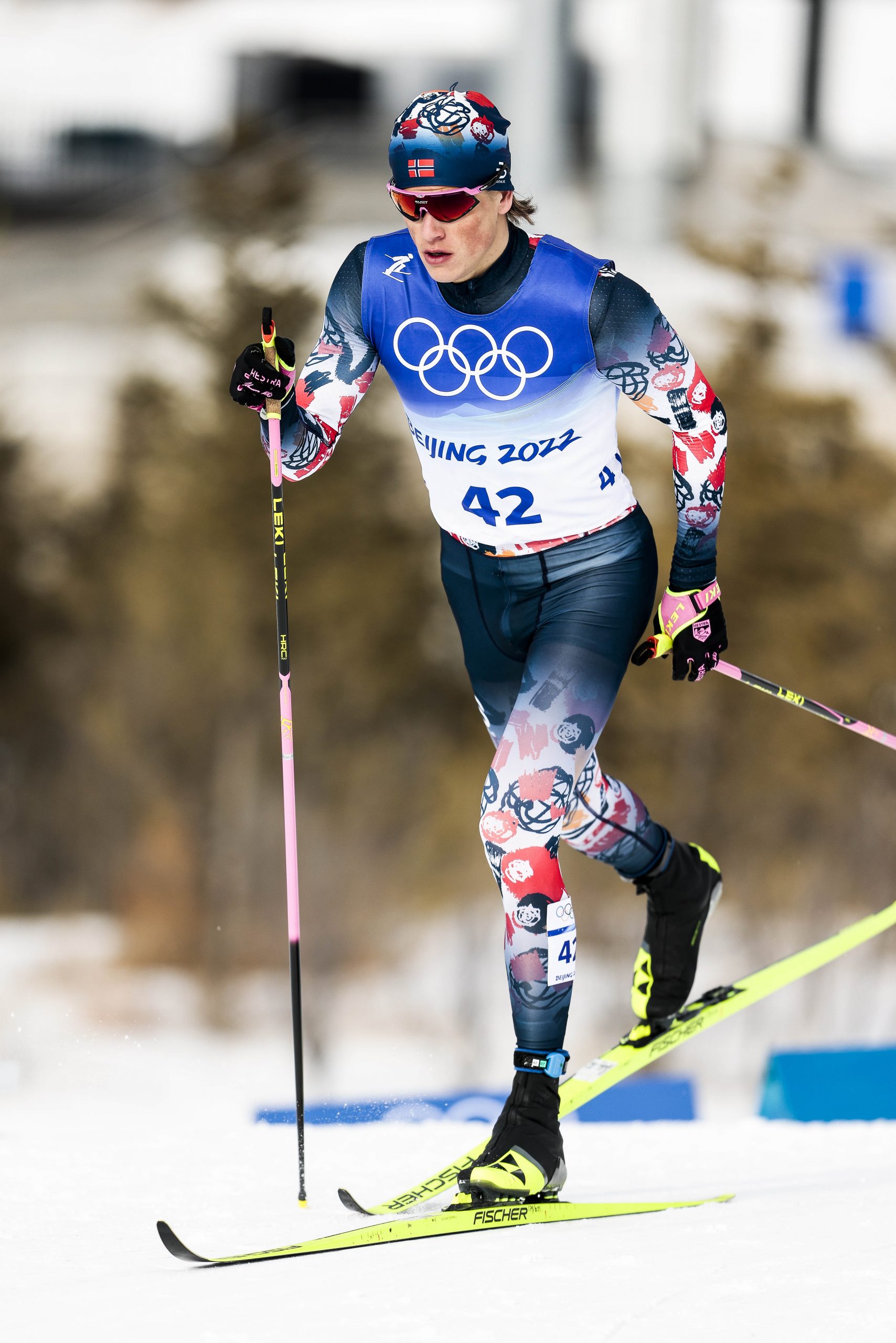
    By 6.3 k, the tension hadn’t subsided. Klæbo had picked up his pace, coming into the checkpoint with a 12 second advantage over the field. His teammate Golberg followed, besting Klæbo by 20 seconds. Niskanen then came through and bested that mark by 20 seconds. Bolshunov, though, couldn’t top the feat. He had managed to stay with it, coming through the 6.3 k mark +13.7 seconds off of Niskanen.

    Half-way through the race then, four skiers seemed to be vying for three medal spots in a muddled mass of splits that kept them within a minute of each other. Niskanen had the advantage in 1st place, Bolshunov 2nd, Golberg 3rd, and Klæbo 4th. 

    The decisive portion that would sort out the field came quickly in the early part of the 2nd lap. That portion included a series of two climbs, the latter of which was a veritable wall up to the 10.5 k mark. This played to the strengths of those with a strong, smooth stride.

    In this field, that was Niskanen. He seemed to reset a classic track muddled by a field where most had to herringbone up to the 10.5 k checkpoint, and when he came across it, he had built a decisive gap of 51 seconds over the field. 

    When Bolshunov came through, showing signs of slipping up the climb, he had lost an additional 15 seconds to Niskanen, putting him +28.8 seconds back but still in second place.

    Pål Golberg fights the clock during the men’s 15 k individual start classic. (Photo: NordicFocus)

    Golberg had lost his advantage on Klæbo, and would continue to fade through the rest of the race, eventually ending the day in 11th (+1:52.6).

    At 13.8 k, the gaps at the top had only expanded. Niskanen had held his lead over Bolshunov at 29.1 seconds. His final push up the gradual climb leading to the checkpoint putting the image of a picture-perfect stride to the notion that has become clear over the course of his career; Niskanen is his generation’s best classic skier, the proprietor of glide and stride in a sport that’s increasingly turned its attentions to the temptations of tempo and power.

    Iivo Niskanen celebrates a gold medal performance in his signature event, the 15 k individual start classic. (Photo: NordicFocus)
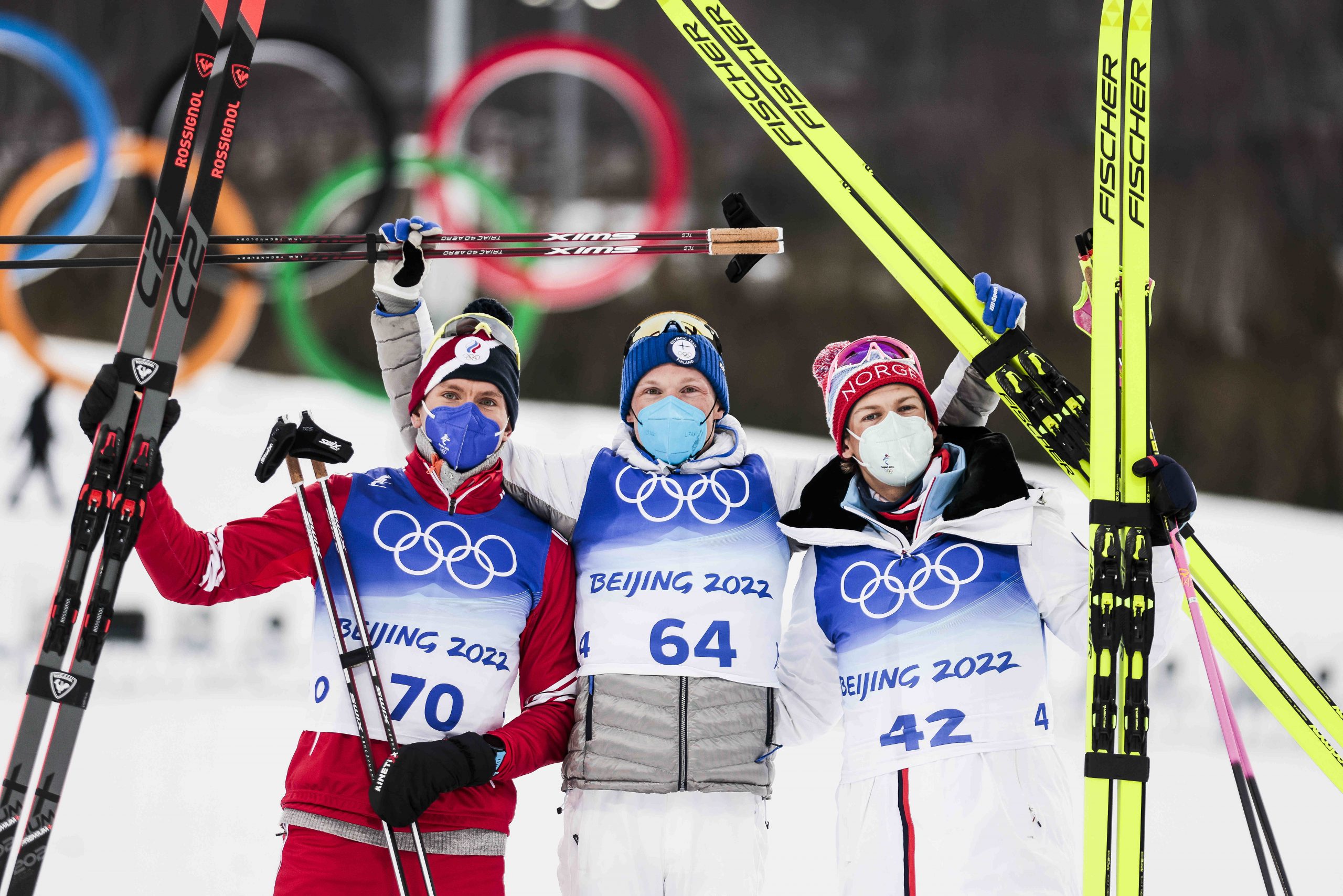
    There was little in doubt when Niskanen crossed the finish line. He had won gold, done it decisively, and along with his sister’s result yesterday, etched the name Niskanen into Olympic history and Finnish national pride.

    Bolshunov came through in 2nd, with the final margin +23.2 seconds, to claim his second medal of these Olympics. Following him in the results and in that feat was Johannes Høsflot Klæbo in 3rd (+37.5).

    Alexander Bolshunov earns his sixth career Olympic medal with a silver in the men’s 15 k individual start classic. (Photo: NordicFocus)
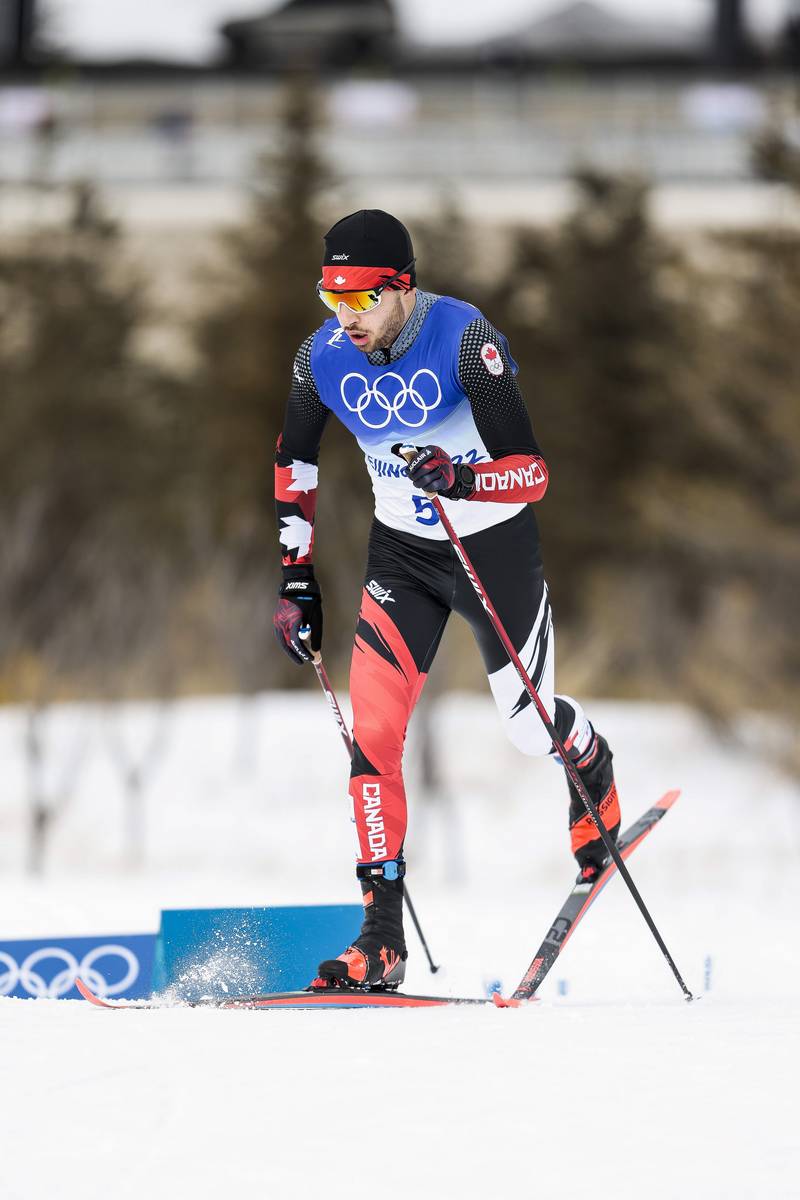
    Johannes Høsflot Klæbo (NOR) strides to his second medal of this Olympic games, winning bronze in the 15 k classic.

    Now holding an individual gold and bronze medal, earned in the 30 k skiathlon earlier this week, Niskanen has established himself as the dominant 15 k classic skier on the world’s stage. The Finn has seven World Cup victories in the event, and holds a gold and bronze World Championship medal in the event from 2017 and 2019, respectively. He had matched today’s silver medalist, Bolshunov, stride for stride in the 15 k classic half of the opening Olympic skiathlon event, before Bolshunov skated away with the win leaving Niskanen fading into third.

    Iivo Niskanen wins the men’s individual start classic during the 2022 Beijing Olympic Winter Games. (Photo: NordicFocus)
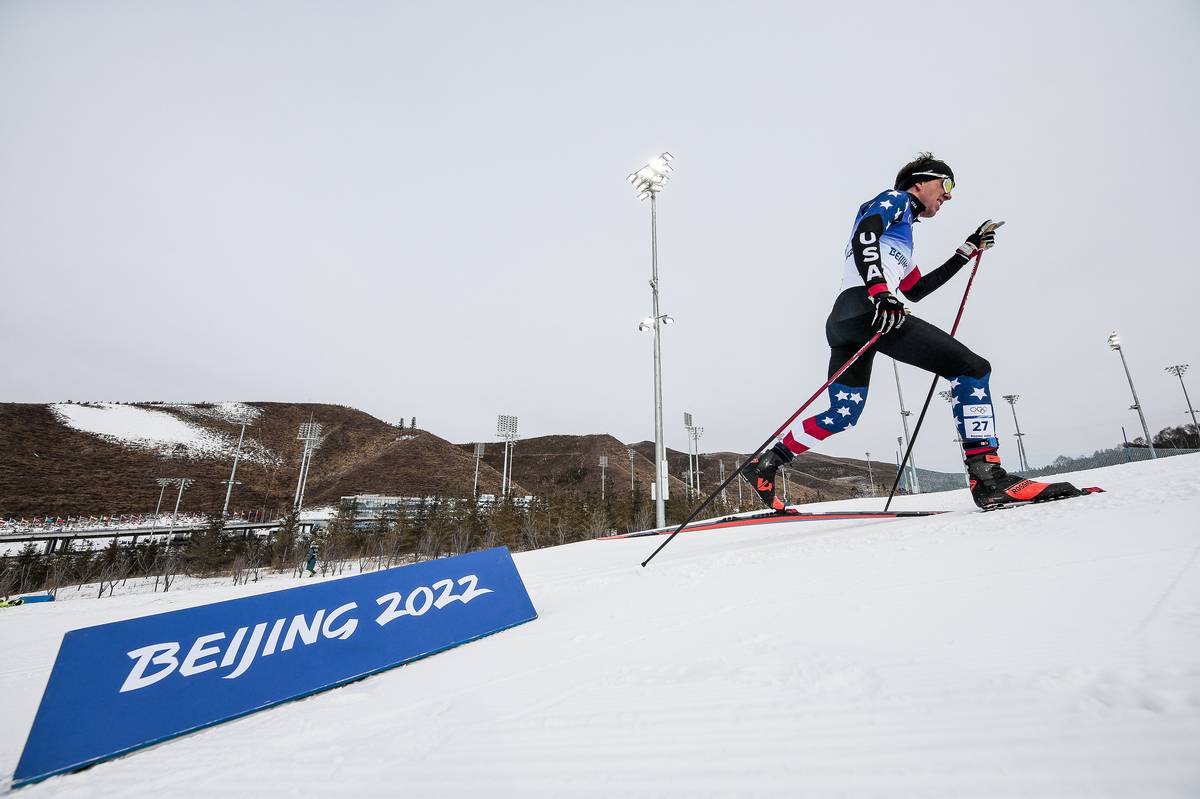
    Also holding one gold and one bronze from this Olympiad, Bolshunov youngest male athlete to hold six Olympic medals. Individually, Bolshunov earned silver in the 50 k classic in PyeongChang in 2018, along with a bronze in the classic sprint. And he supported the ROC team to earn silver medals in the 4 x 10 k relay and the freestyle team sprint.

    “I wanted to win today but Iivo was stronger, I knew that after starting into the race,” Bolshunov said through translation in the press conference. “Getting a silver medal, however, is a nice treat as well, especially at the Olympic Winter Games. And there are more races coming where I will fight for Gold again”.

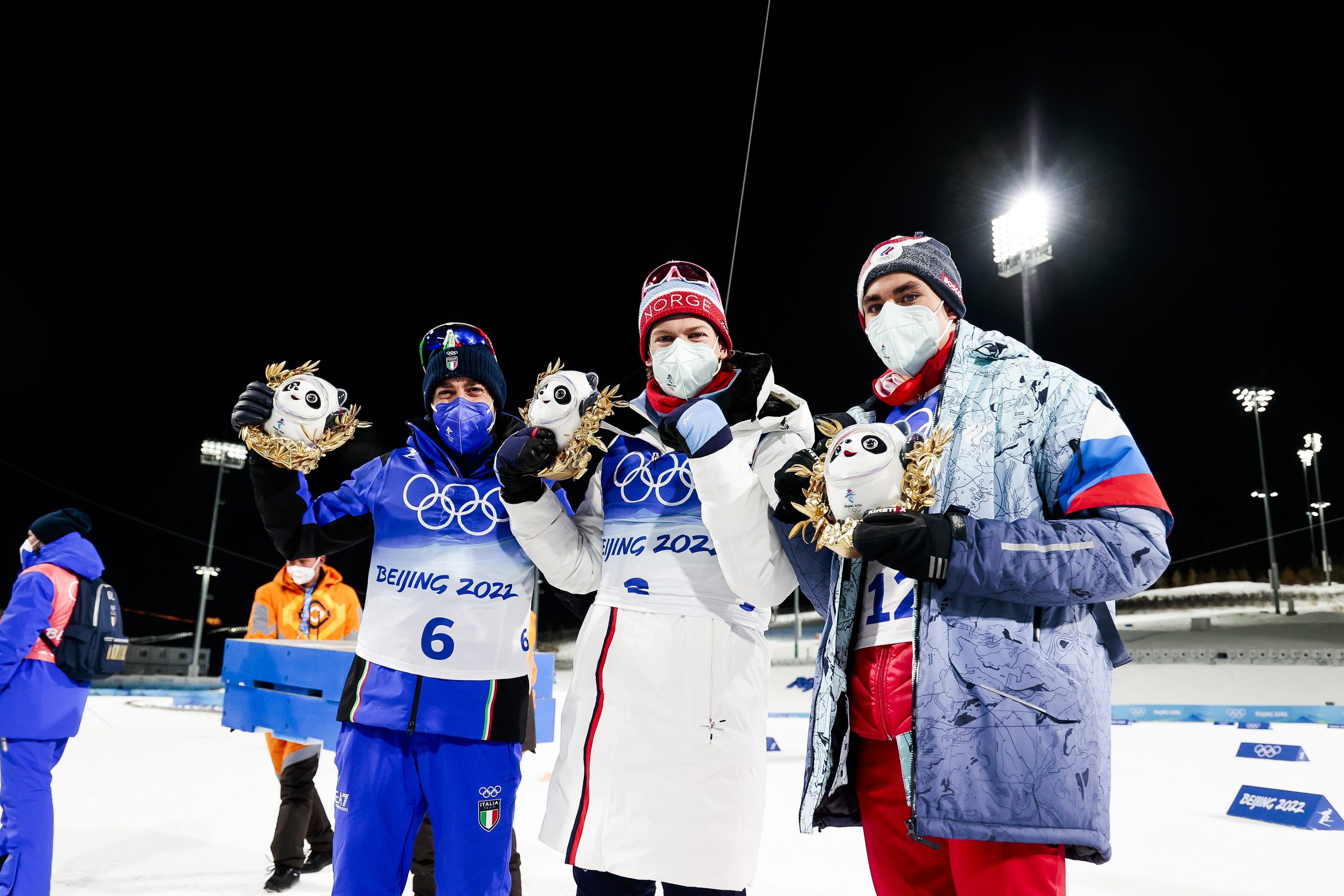
    Iivo Niskanen (FIN) takes gold in the 15 k classic, with Alexander Bolshunov (ROC) earning silver and Johannes Høsflot Klæbo (NOR) bronze. (Photo: NordicFocus)
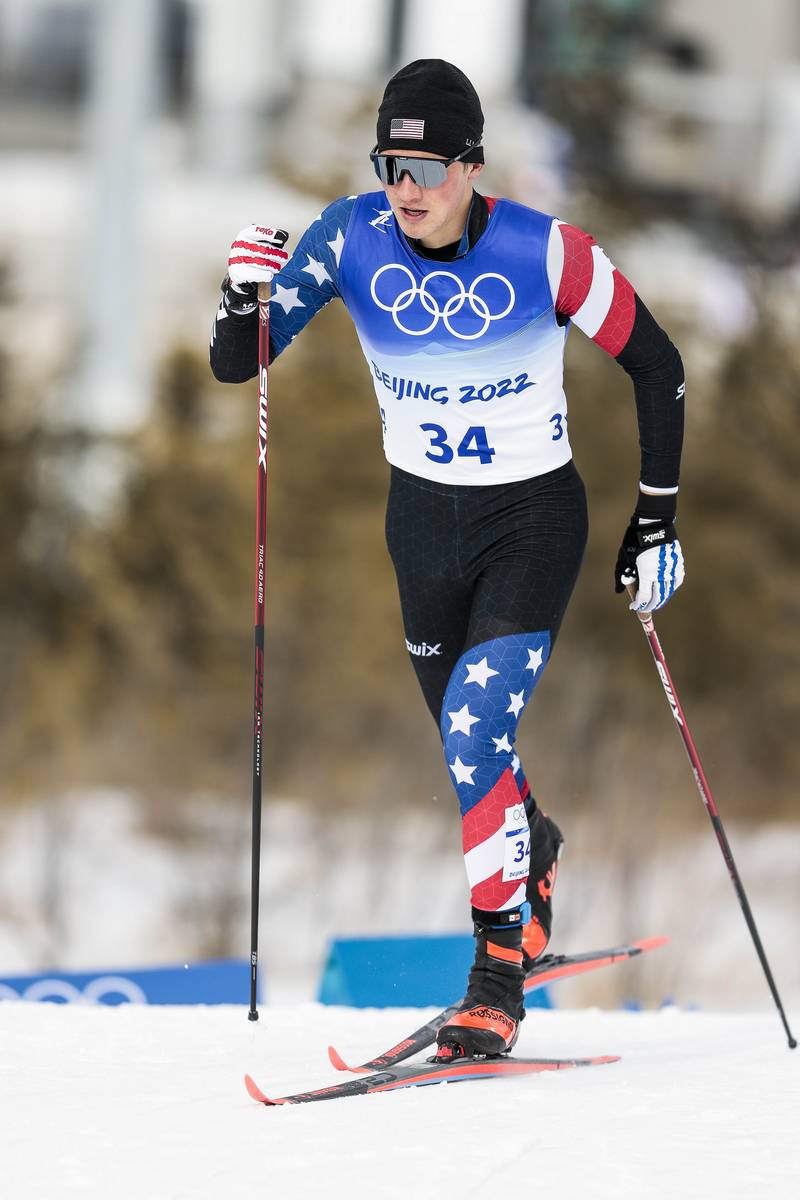
    Today also provided glimpses of the young North American athletes from both Canada and the United States gaining valuable experience that points towards an exciting Olympic future for years to come.

    Ogden, for instance, found an opportunity to ski with the world’s best on the world’s biggest stage, “I was surprised when Klæbo passed me on the second lap on that climb, he wasn’t going a totally inhuman pace. I think one day I’ll be able to ski a larger percentage of that race at that speed.”

    Meanwhile, Gus Schumacher is focused on regaining a sense of feeling good on skis, saying to FasterSkier that “today was pretty flat, not a lot of aerobic power…you don’t feel like yourself, and I think we’re pretty grounded in physical feeling in this sport, so when those are weird you don’t feel like you have an anchor. I don’t want to rest at the Olympics, but I’m focused on coming around again this season.”

    Canada’s Olivier Léveillé leads the North American athletes in 29th during the 15 k individual start classic. (Photo: NordicFocus)

    Leading the way in the North American contingent was Canadian Olivier Léveillé in 29th (+2:57.2), followed by countrymen Rémi Drolet in 33rd (+3:12.9), and Antoine Cyr in 37th (+3:22.9).

    American Scott Patterson was close behind in 38th (+3:28.3), Ben Ogden was 42nd (+3:35.0), Gus Schumacher was 48th (+3:58.6), and JC Schoonmaker was 66th (+5:36.8).

    “That was tough,” Patterson told FasterSkier in the mixed zone. “It was a hard race day – wasn’t exactly what I wanted. I think we could have done a bit better with skis. I was slick to start and worked my arms pretty hard for the first lap. I think I kind of held it together, but the second lap hurt, and I was struggling out there. I was herringboning in most of the hills and trying to doublepole what I could, but it definitely felt like things were falling apart by the second lap. ”

    Scott Patterson leads the Americans in 38th in the 15 k individual start classic. (Photo: NordicFocus)
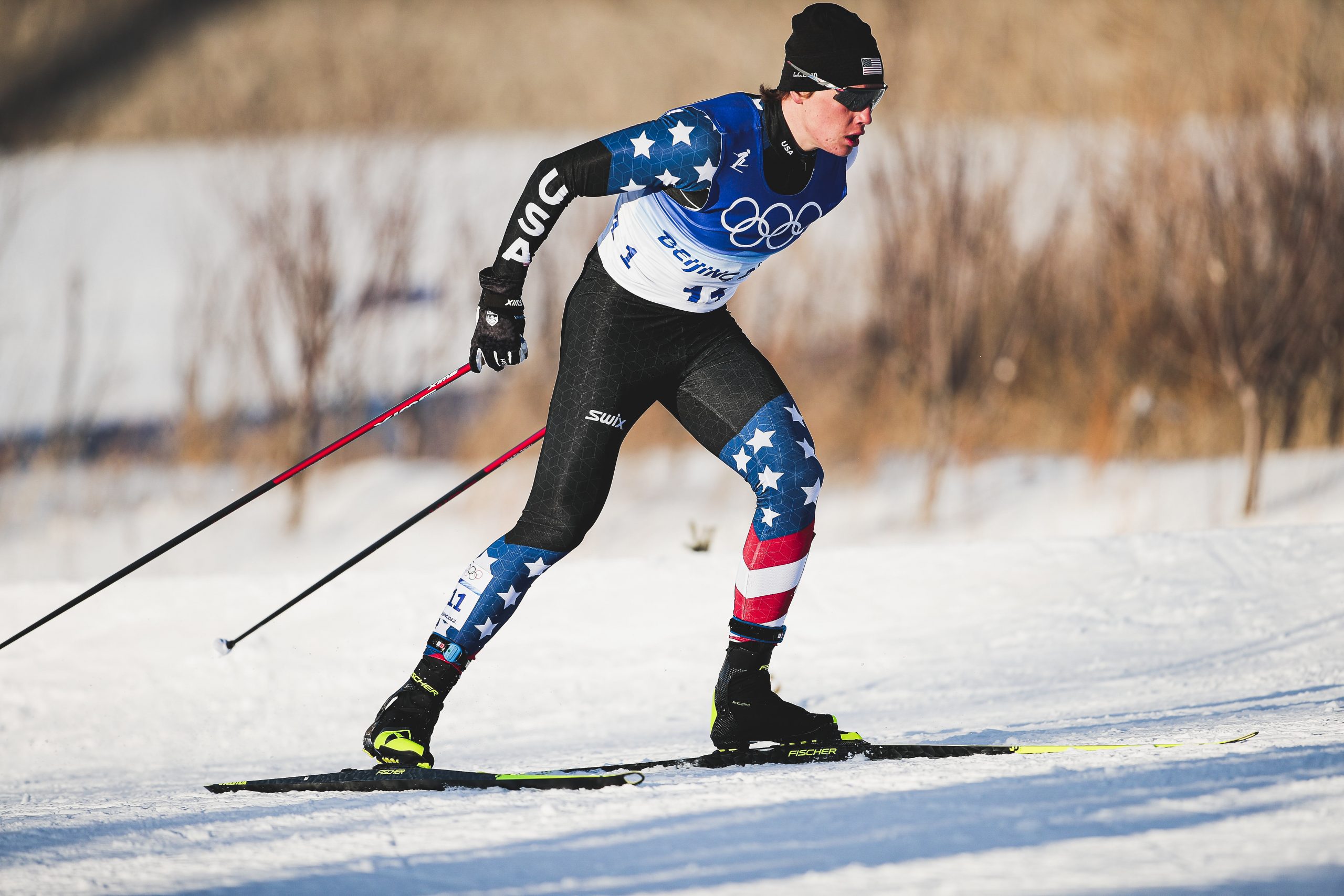
    During this second lap, Patterson began to recognize that the 15 k may not match his historic result from the skiathlon, where he finished 11th as the top American in the event, the best result in Olympic history for the men’s program. He shared what was in his mind as he worked through the discomfort and frustration of under-performing skis.

    “Keep hanging on. Keep fighting. I never like to be the one to kind of call it quits, so it’s tough. I mean, you know, other people are hurting out there too…I was turning my eyes back and head down on this final hill trying to pick up a few spots.”

    The American and Canadian contingents will now look ahead to the next two races of this game, when they come together to race under their nation’s respective banners. Sunday will see the 4 x 10 k team relay, before the team sprint next Wednesday.

    For more on how the U.S. team is approaching selection for those races, read here.

    Gus Schumacher races the 15 k individual start classic in Zhangjiakou. (Photo: NordicFocus)
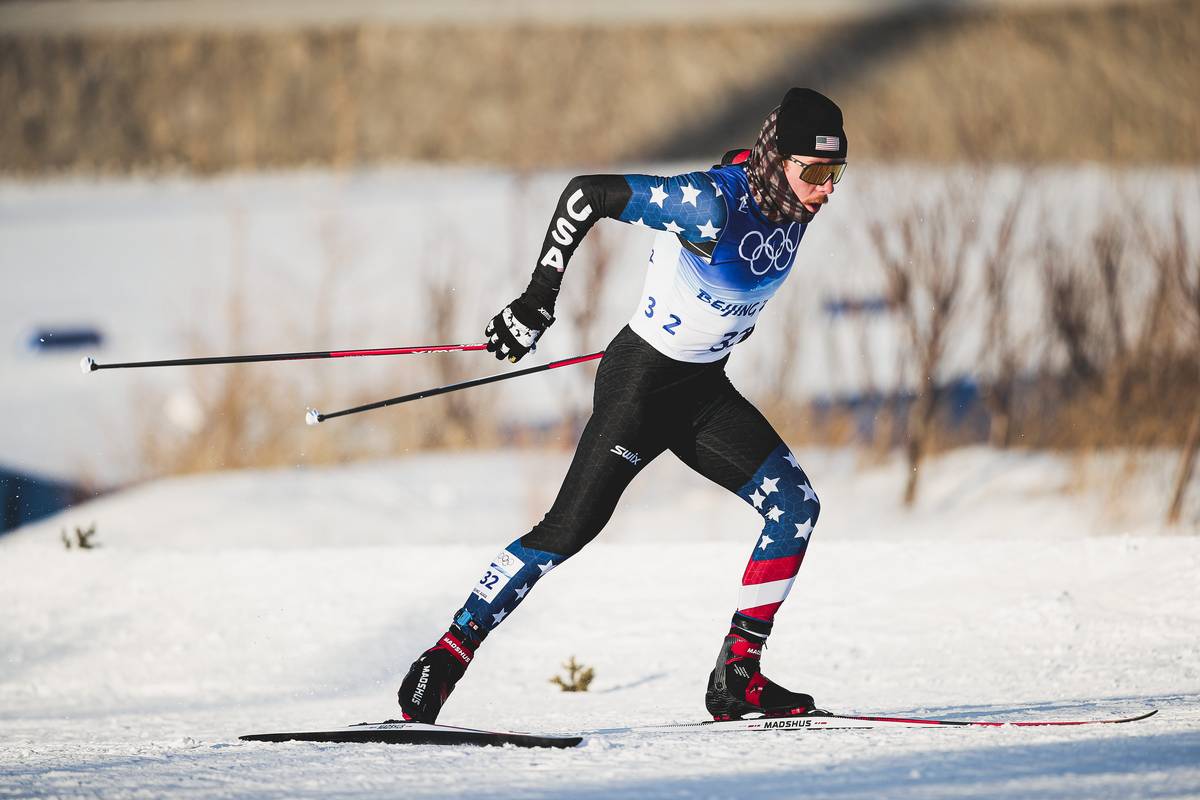
    – Rachel Bachman Perkins contributed

    Full Results

  • Klæbo Defends Olympic Gold as Americans Soar to New Heights in the Freestyle Sprint

    Klæbo Defends Olympic Gold as Americans Soar to New Heights in the Freestyle Sprint

    This World Cup coverage is made possible through the generous support of Marty and Kathy Hall and the A Hall Mark of Excellence Award.  To learn more about A Hall Mark of Excellence Award or to learn how you can support FasterSkier’s coverage please contact info@fasterskier.com.


    During the American broadcast of the 30-kilometer Skiathlon on Sunday, NBC Analyst Chad Salmela made the comment that race represented the “old-school” of long-burn, grind-it-out ski racing. That length of ski race, updated only for the introduction of skating, has been a feature of Olympic competition since the 12th Olympiad held in 1956.

    In contrast, each one of the American skiers starting today was already born when the 1.5 km freestyle sprint became an Olympic event at the 2002 Salt Lake City games. In fact, only Kevin Bolger (born in 1993) can claim to have a living memory of that event. The other three – JC Schoonmaker, Ben Ogden, and Luke Jager – were all two years old when Tor Arne Hetland won gold at Soldier Hollow.  

    Luke Jager (USA) on his way to qualifying 30th in the Individual Sprint Qualifier in Beijing. (Photo: NordicFocus)
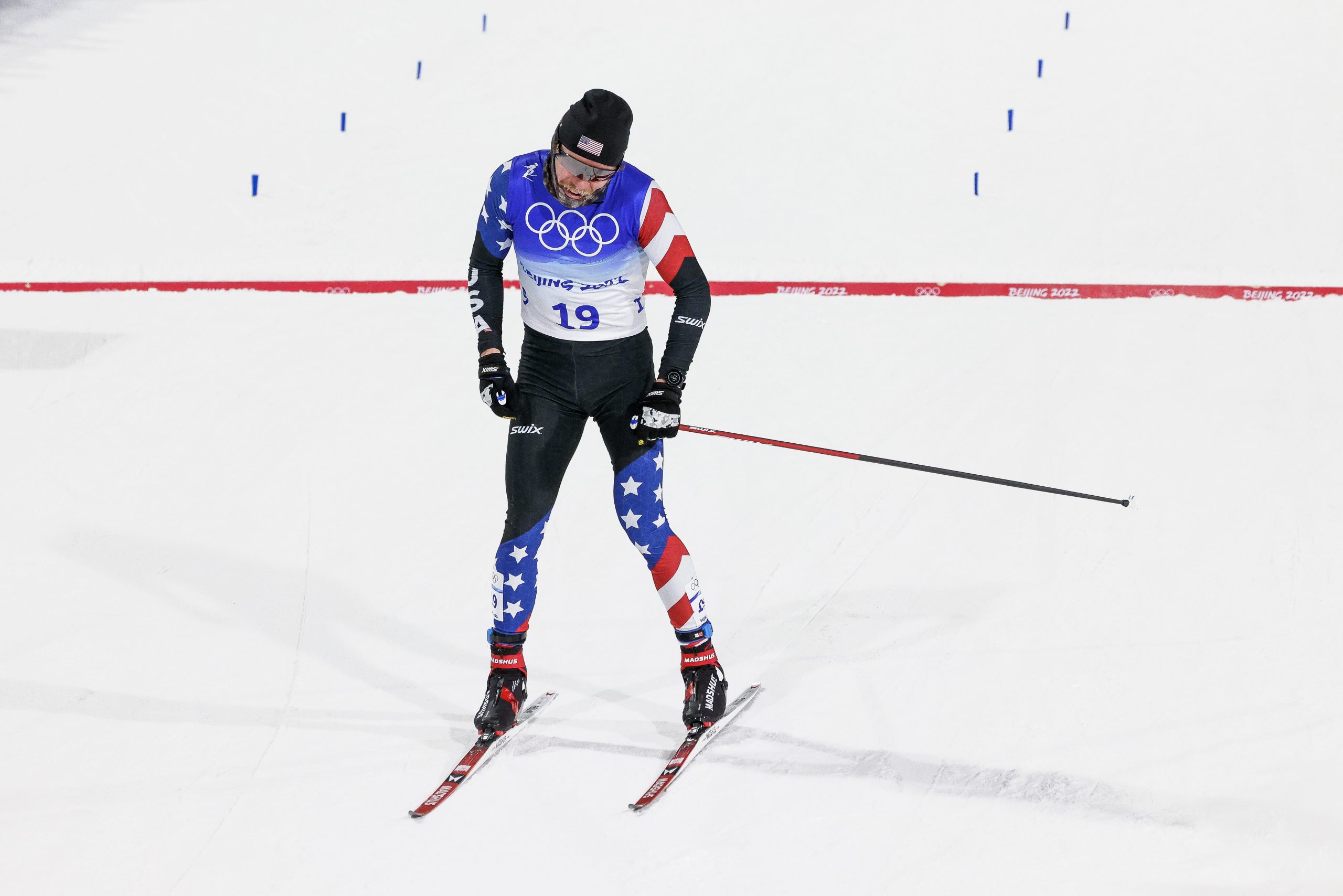
    In the intervening twenty years, those latter three were part of an American generation that came of age sprinting on the 2002 Soldier Hollow course, contesting junior and senior U.S. Nationals as they climbed through the ranks and quietly holding tight to their Olympic dreams. Meanwhile, the generation of skiers they looked up to were trailblazers, with sprinting their preferred in-road for American skiing on the Olympic stage. At the 2006 Torino games, Andrew Newell came through qualifiers in 2nd. Then Simi Hamilton became a consistent presence on the World Cup circuit, and qualified for heats in the last freestyle the Olympic sprint at the 2014 Sochi games. Eight years later in 2022, the kids had grown, and from Vermont hollows, Wisconsin Northwoods, the California snowfields, and the Alaskan frontier, had converged on a start-line in Beijing, ready to push for something new.

    After qualifying, they had already done it. The American men started four skiers for the individual sprint, and for the first time in Olympic history, each one of them made the heats. Leading the way was recently crowned U.S. sprint champion JC Schoonmaker, who finished in 13th, +6.12 seconds off of winner Lucas Chanavat (FRA), who clocked a 2:45.03 on the 1.5 k course. Ben Ogden finished in 19th (+7.18), Kevin Bolger was 22nd (+7.47), and Luke Jager rounded out the quarterfinal field in 30th (+9.41).

    Jager, in 30th, found himself right away in the unique challenges the Olympics can bring then, saying in an interview with FasterSkier that “There were seeded guys behind me and I knew I was right on the bubble [for qualifying]. I was getting interviewed by NBC and the whole time just wanting to reach down and check my phone.”

    In the end, he was through with his American teammates.

    Ben Ogden skis to 19th in qualification in the men’s individual freestyle sprint. (Photo: NordicFocus)
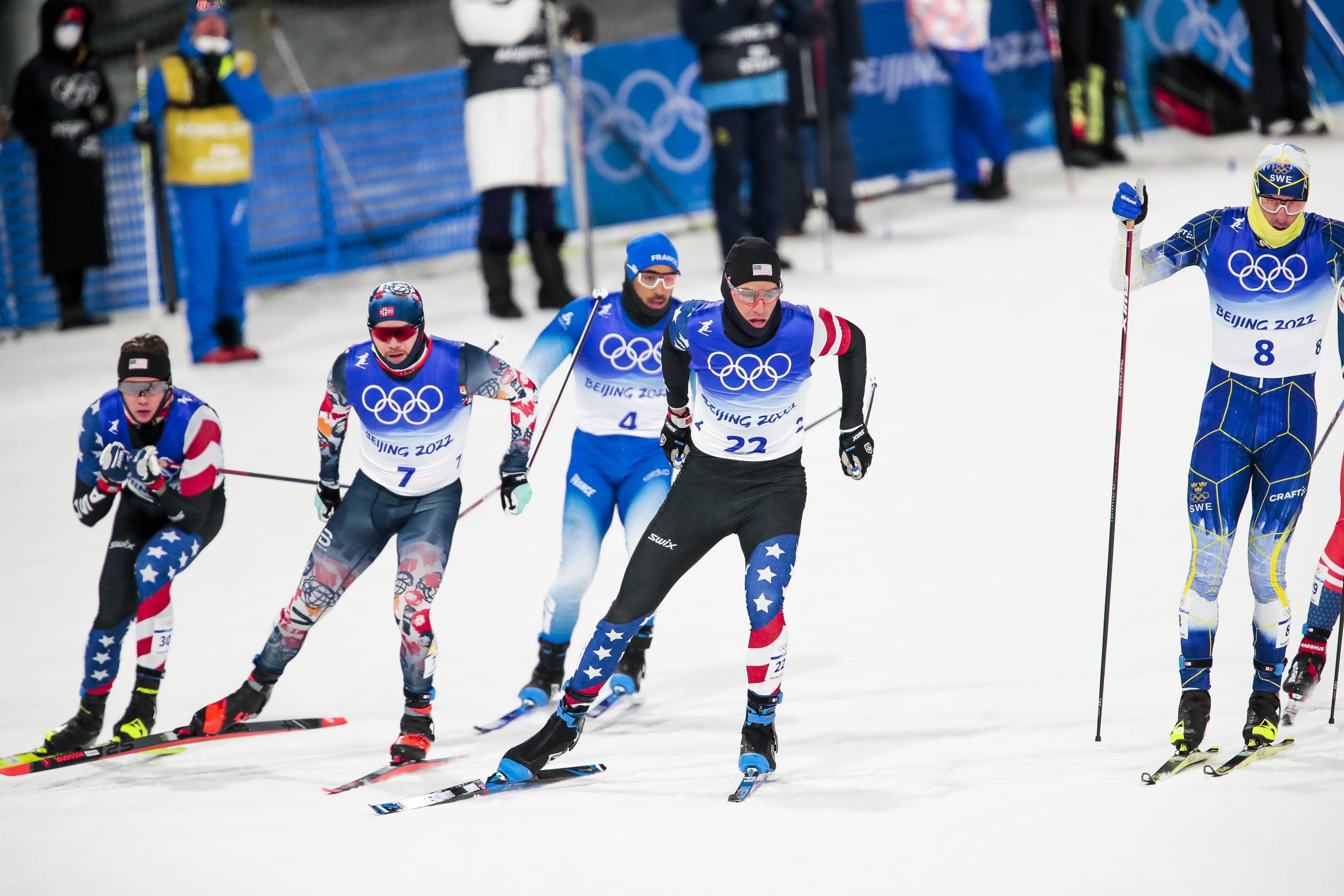
    They joined the established field that’s become familiar to those who follow the World Cup week-to-week, and for whom the individual sprint was a priority at these Games. That included defending individual sprint gold medalist Johannes Høsflot Klæbo (NOR), who qualified in 3rd (+1.71), defending silver medalist Federico Pellegrino (ITA) in 6th (+4.52), and the Russian Olympic Committee’s (ROC) own young star Alexander Terentev in 14th (+5.89). 

    The whole field would converge in the quarterfinals to race a 1.5 k course that raced as a “true sprint” as NBC Analyst and American gold medalist Kikkan Randall remarked on the American broadcast. Her remarks were apt; the course raced as a single-lap, taking three minutes for the majority of the field, on fully artificial snow. If you were looking for an archetype for what the “sprint-course” has developed into since the inception of the event at the 2002 Olympics, you’d have the one in Beijing. A first climb gave way to a downhill, which led to a long final climb, before skier’s took a sharp left turn into the final stadium stretch. The tactical pressure-point was the turn to go into the descent following the first-climb. If you went over with speed, the transition into the final hill could prove to be a decisive factor in a long-burn attack. If you followed, the draft could be just as important to launch a punchy sprint to move up the field on the last climb.

    That racers would see both approaches became apparent straight from the first quarterfinal, which featured Klæbo, Sergey Ustiugov (ROC), and Ben Ogden. Klæbo seemed to take the tactic of a long-burn attack on this course, which was helped along by a field that seemed set at every level today to try and force him out in front so as to catch his draft. He used the corner off of the first uphill to delay his burst of speed into the downhill just enough to surprise the field, and by the time he hit the final climb, he was in a comfortable position to win the heat.

    Ben Ogden crosses the finish-line in sprint heat action. Ogden would finish 12th, the best men’s individual sprint finish in US Olympic history. (Photo: NordicFocus)
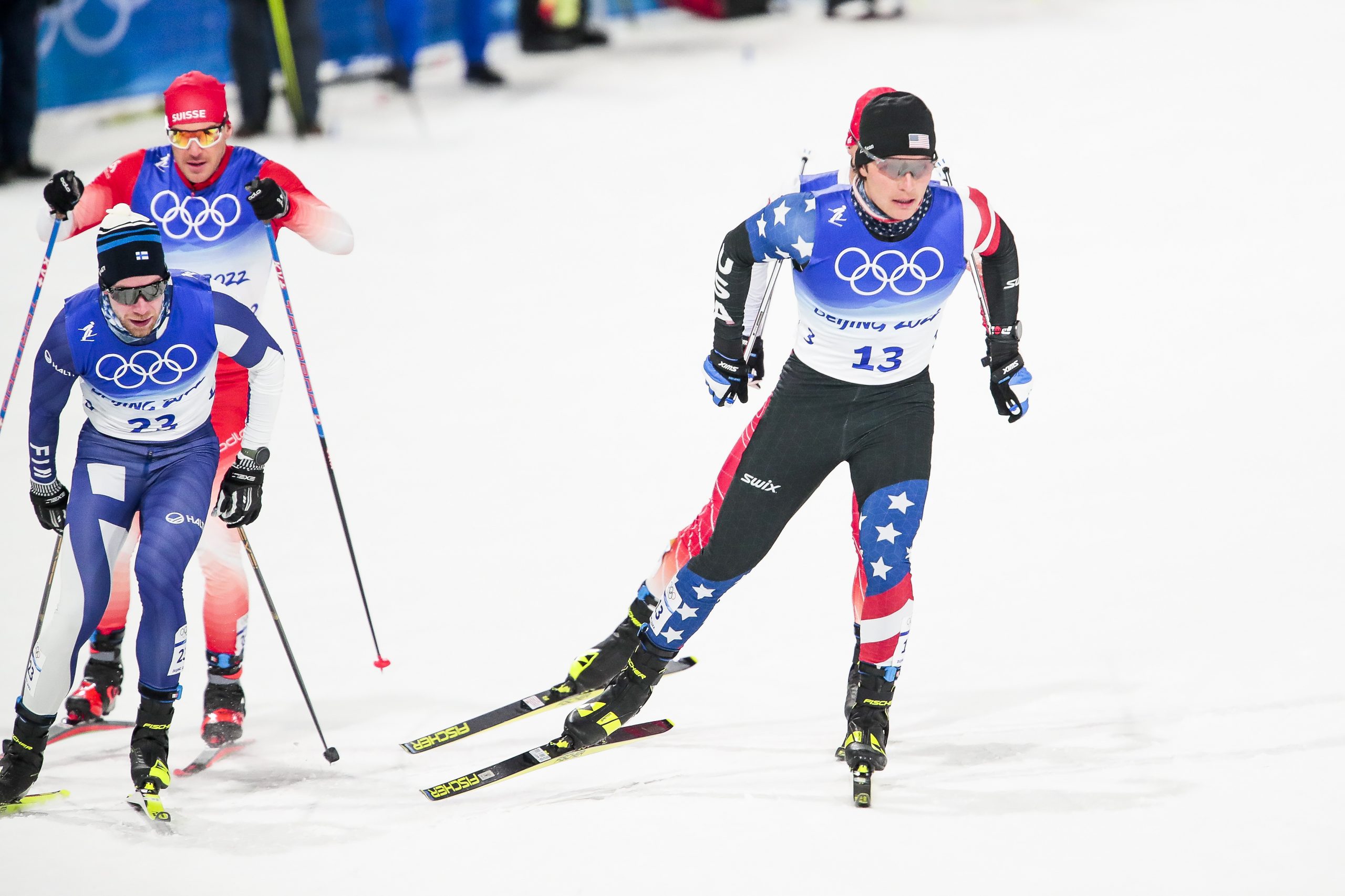
    His burst of speed, though, had blown open the field behind him. Ben Ogden was caught out in 5th place going into the final corner. It turned out, in this particular case, to be a blessing. In front of him, Renaud Jay (FRA) stumbled over Anton Persson (SWE) (who was given a yellow-card for obstruction)  and caused a split-second hang up in the field with Oskar Svensson (SWE) that allowed Ogden to come into the finishing straight with a chance. He ended up taking it, finishing fourth place. Klæbo (2:51.57) had animated the quarterfinal, and the chase behind him yielded a fast heat. Ogden finished with a time of 2:53:00, good enough to warrant hope for a lucky loser spot into the semi-finals, but he would have to wait through four more heats to find out for certain.

    The third quarterfinal saw the next American action, with Kevin Bolger and JC Schoonmaker lining up against sprint stalwarts Richard Jouve (FRA) and Håvard Solås Taugbøl (NOR). Bolger, who is eight years senior to his fellow teammates, took a tactic in this race that suggested he understood the gravitas of the Olympics and how you race to stay in it. He led the pack out with gusto, trying to take the heat along with him.

    The field, however, seemed to have other ideas. Bolger said in an interview with FasterSkier that he “started V1-ing on the hill and I went ‘nope, not getting lucky loser, this is a different pace than the qualifier.” With those lucky loser spots most likely gone, the heat became a race for 1st and 2nd. Jouve and Taugbøl turned out to have the burst of speed needed in the end, with Bolger in 3rd. For the bleary-eyed among us back in the U.S., he provided the first glimmer of the American’s intrepidness on the day. For his part, Jager followed his older teammate, and his presence in 5th across the line was another reminder that that American spirit was found in spades on the day.

    Kevin Bolger (USA) and Luke Jager (USA) in quarterfinal action. Photo: NordicFocus.

    Jager pointed to how the Olympic experience was a unique one that he’ll hope to build on in an interview with FasterSkier, saying, “maybe it was the novelty, [but] to be perfectly honest my head wasn’t maybe in a great place to look towards advancing, but I think it’s one step at a time and I’m figuring out the right mindset to qualify consistently now and to advance. It was unlike anything else… it’s dark out and you need sunglasses, that’s awesome!”

    The fourth heat fleshed out the idea that Bolger had in the previous heat. The skiers went hard from the gun, knowing that if they could race a faster heat than the first quarterfinal, a 3rd or 4th in this heat could still keep their Olympic dreams alive. This was all complicated as Erik Valnes (NOR) pulled away to win the heat and a long sprint for second ensued. Pål Golberg (NOR) and Raimo Vignants (LAT) went down, and the sprint seemed to end up going for Chinese skier Qiang Wang, who hadn’t raced in the World Cup field since before the pandemic in 2019.

    Unofficial results showed that Valnes and Wang were through in 1st and 2nd, respectively. Results also showed that the quarterfinal had been the fastest heat of the day. Valnes finished in 2:49.31, with 3rd place Artem Maltsev (ROC) at 2:50.37 getting a lucky loser nod. The race jury quickly deliberated and disqualified (or officially, “ranked as last”) Wang, which meant that Maltsev was through to the semifinals on an automatic bid. That opened up one more lucky loser spot, and the next time on the list would prove to be a 2:53:00; belonging to Ben Ogden. He was through to the semifinals of the Olympic games.

    JC Schoonmaker (USA) races in the final quarterfinal on Tuesday in Beijing. Photo: NordicFocus.

    The last quarterfinal saw JC Schoonmaker narrowly lose out on a sprint to Alexander Terentev and Joni Mäki (FIN), after Schoonmaker led out the pack for the first part of the race.

    The men’s semifinals then, for the first time ever in an Olympic games, featured an American. And that American found himself in a who’s-who of heavyweights. The first semi-final lineup; Klæbo , Pellegrino, Jouve, Ustiugov, Chanavat, and Ben Ogden.

    Ben Ogden races the quarterfinal of the men’s freestyle sprint during the 2022 Beijing Olympic Winter Games. (Photo: NordicFocus)
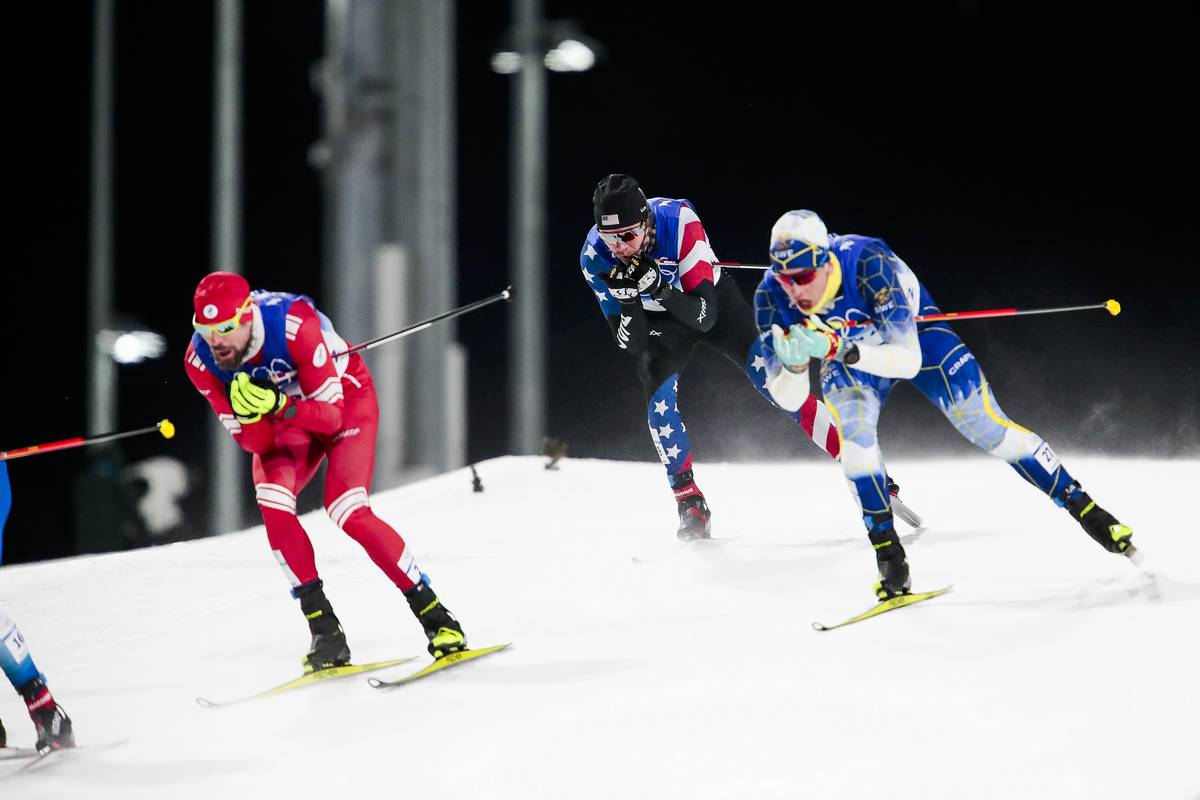
    As the field climbed up the first hill, the skiers seemed set on fighting Klæbo tactics with Klæbo tactics. The race to get over the top was on.

    Richard Jouve ended up winning the fight to go into the downhill first, while Klæbo got caught at the back-end of a pack that remained tight. That included Ogden, who had weathered the storm to come into the final hill with the group. The transition into the final climb was furious, with Klæbo moving through the pack and bringing his rivals along with him. When they came into the final stretch, the field spread four wide and Klæbo, in shades of race nightmares past, looked to have eased up early, producing a four-way photo finish. Pellegrino and Klæbo ended up getting the nod to the finals in first and second, respectively.

    Ogden finished just off the sprint in 6th place (+1.24). His final placing of 12th is the best for an American man in an Olympic sprint. More than that though, he loomed in the background of a sprint of the world’s biggest names, appearing not as a straggler but as a shadow. The youngest in his semi-final field by 5 years, as he crossed the line, it seemed to be a reminder that the Americans are the ascendent force in sprint racing, with much more to learn, and to come, as they continue to gain experience at the Olympics.

    The second semi-final saw Artem Maltsev race with the same purpose he had struck out with in the quarterfinal. He seemed set on making sure that luck, in the lucky losers, would be with the second semi-final. After the first climb he had a gap that his teammate Alexander Terentev and Joni Mäki would claw back successfully in the lead-up to the stadium sprint, finishing 1st and 2nd, respectively. Maltsev and Oskar Svensson (SWE) were successful in their project of creating a fast heat though, and claimed the two lucky loser bids to the finals.
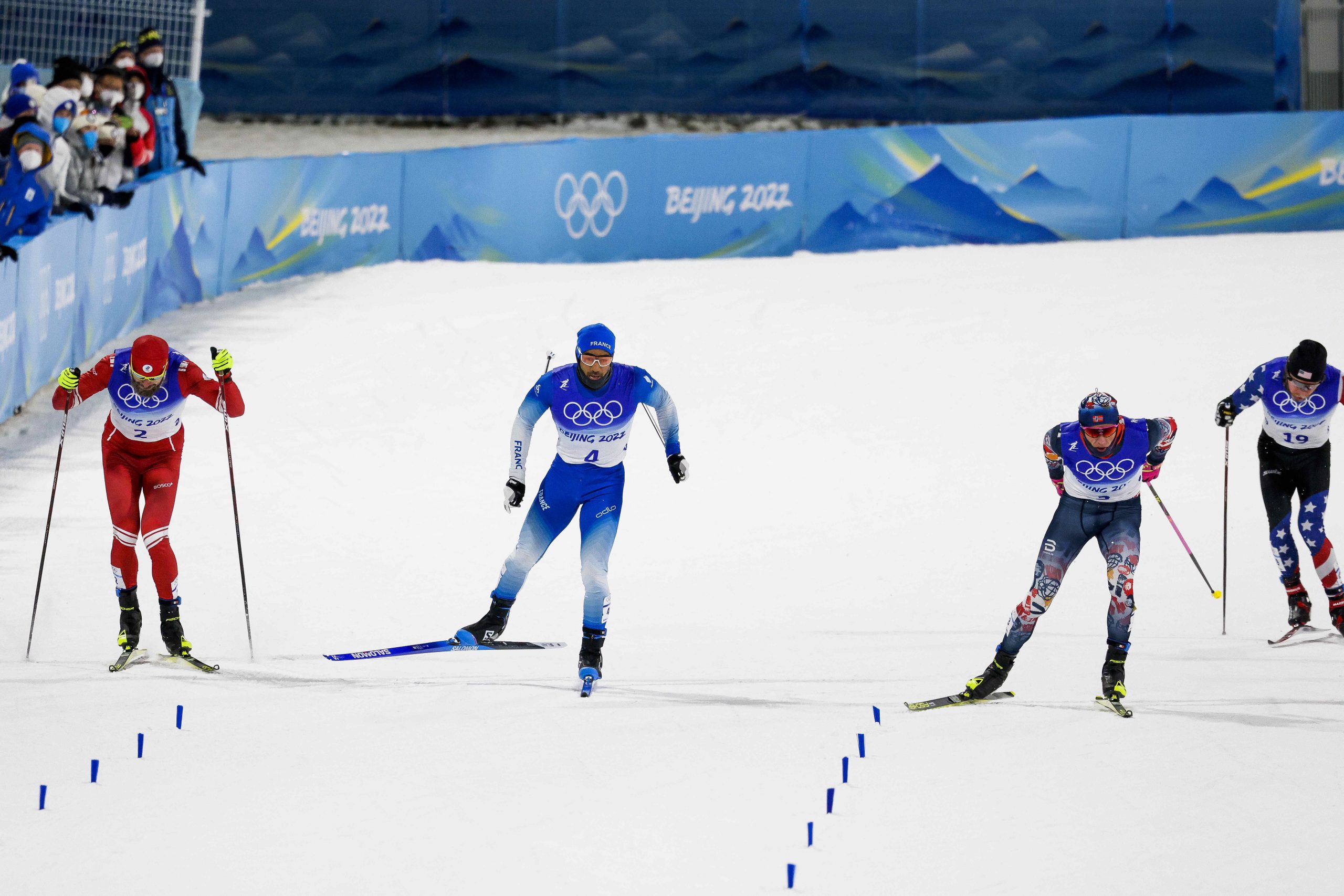
    The final then, had a field filled with shades of the last Olympic individual sprint. Klæbo had his chance to defend his medal. Pellegrino had his chance to one-up himself and claim gold in his stronger technique. Terentev, Mäki, Svensson, and Maltsev were all racing for their first Olympic medal of any sort.

    Sergey Ustiugov (ROC), Richard Jouve (FRA), Johannes Høsflot Klæbo (NOR), and Ben Ogden (USA) in semi-final heat 1. Klæbo and Ustiugov advanced to the final. (Photo: NordicFocus).

    There was again then, a guarantee for something new. A new medalist at the Olympic games. This was, though, still a sprint race of the world’s best. That meant the field knew who they didn’t want to have a positional advantage – Johannes Høsflot Klæbo. They skied wide, without much depth, to try and force him to the front. Through the first climb, they were successful. Klæbo though, one-upped them, again sneaking a move into the later part of the corner leading into the downhill, and catching the field just off-guard enough to give himself an advantage going into the final climb.

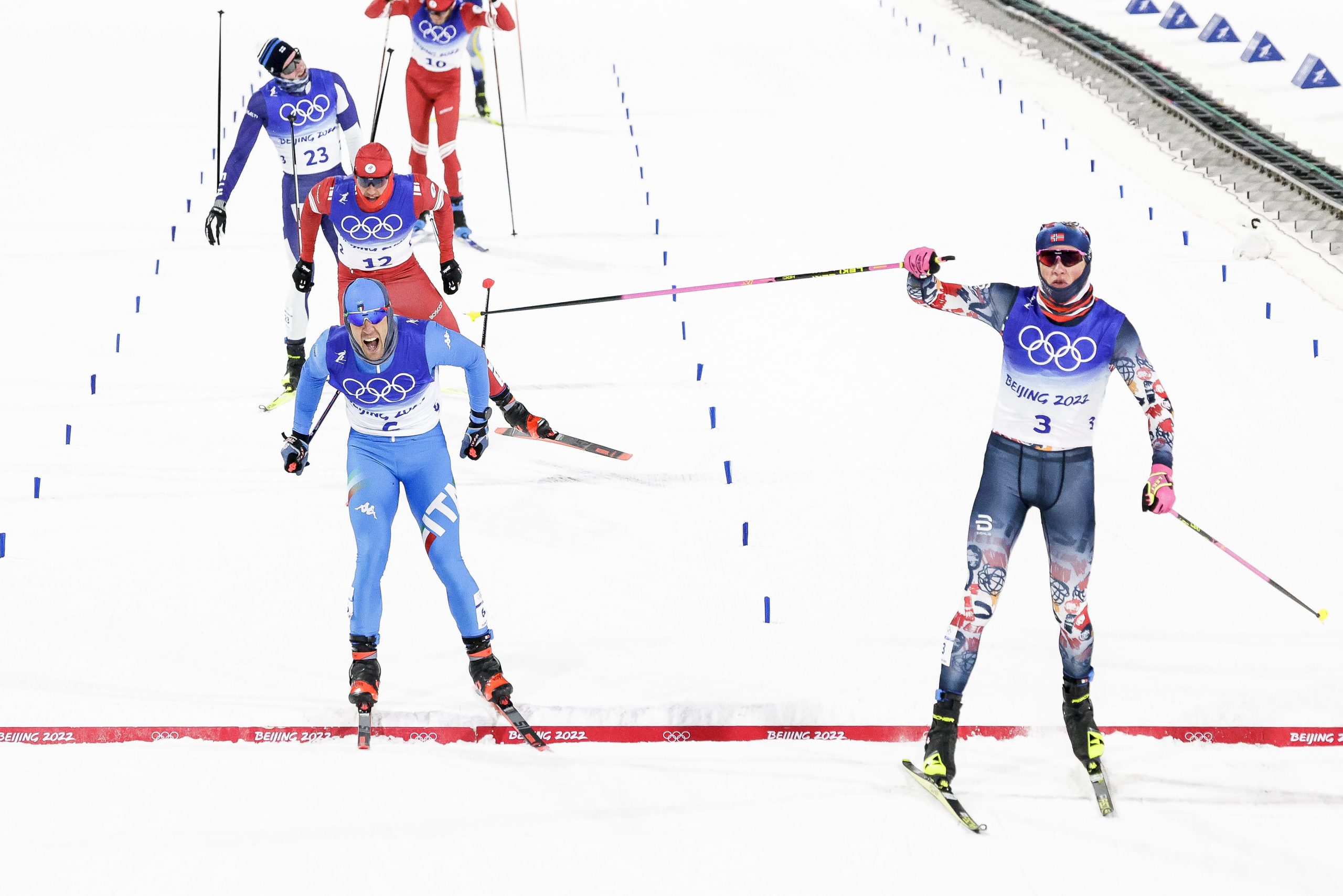
    Johannes Høsflot Klæbo (NOR) crosses in 1st to win gold in the men’s 1.5 k individual sprint. Federico Pellegrino (ITA) follows in 2nd place to claim silver. Photo: NordicFocus.

    There was no reeling him back. He came across the finish line an Olympic champion once again, defending his individual sprint medal and further building his case as one of the sport’s greats. Pellegrino pulled into the final climb and let out a final sprint that proved he is still Klæbo’s chief sprint competitor, four years on from establishing that fact in PyeongChang. The final step on the podium was occupied by Alexander Terentev, who, after a season in which he opened with a win, got to see his potential as an Olympic skier converted into kinetic possibility. He has one medal, and it would be a good bet that it won’t be long before he starts dreaming of the 1.5 k course that will be dreamt up for Milano-Cortina in 2026.

    Which, on the men’s side as a whole, is where many of us Americans are too. Even in these first few moments after their arrival on the Olympic stage, there is an err of possibility, energy, and optimism in the air about where this crop of skiers goes from here. We could get carried away and let that excitement uproot us from the source of that optimism in the first place. So before we look forward, let’s remember that the act of converting optimism into action is tenacity, and we can cherish Kevin Bolger, JC Schoonmaker, Luke Jager, and Ben Ogden giving us an image clad in stars and stripes of that here, today, in Beijing 2022.

    Men’s podium of the Olympic 1.5 k Individual Sprint in Beijing. Johannes Høsflot Klæbo (NOR) in 1st, Federico Pellegrino (ITA) in 2nd, Alexander Terentev (ROC) in 3rd. Photo: NordicFocus.

    The Canadians also put up a set of strong performances in the sprint qualifier. Graham Ritchie finished 34th (+10.01), just 0.6 seconds out of qualifying for heats. The results continued with Olivier Léveillé in 54th (+17.23), and Antoine Cyr in 56th (+17.56).

    Final Results:

    Qualifying | Finals

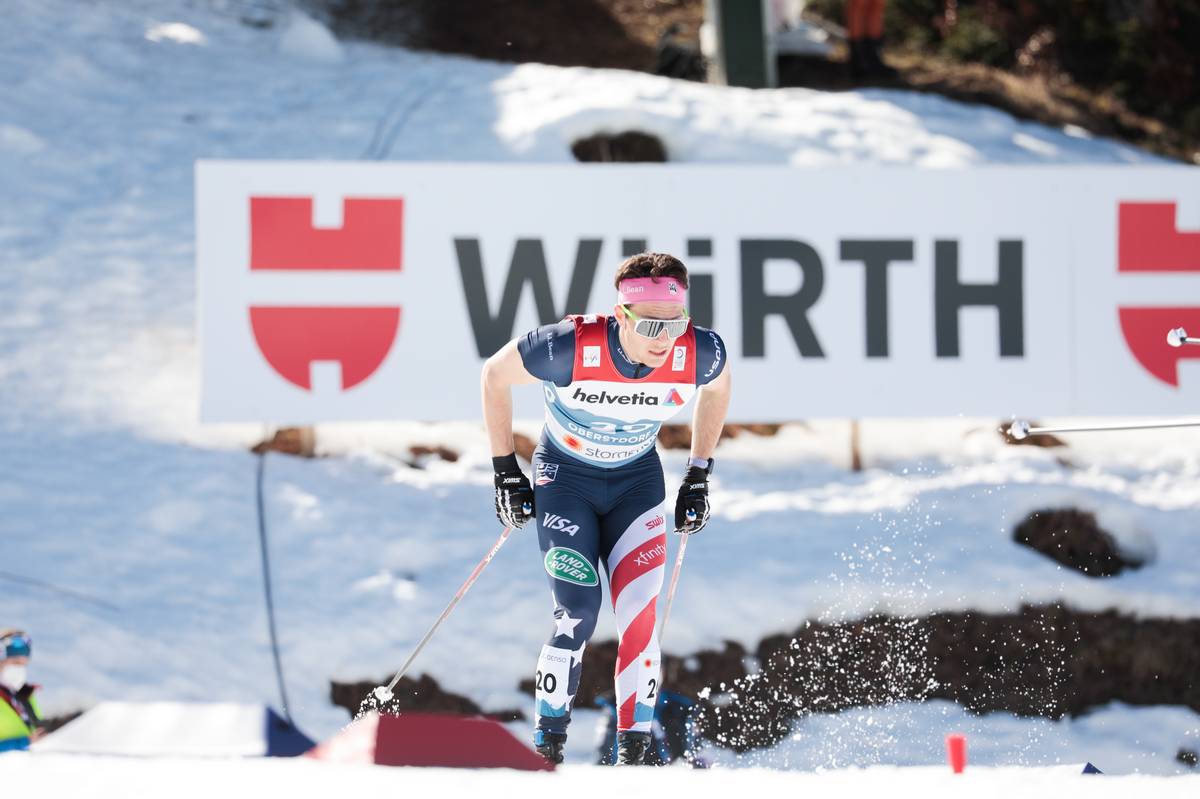
  • Norwegian Triple Championship Podium with Klæbo Crowned the Winner; Ogden 17th for the US

    Norwegian Triple Championship Podium with Klæbo Crowned the Winner; Ogden 17th for the US

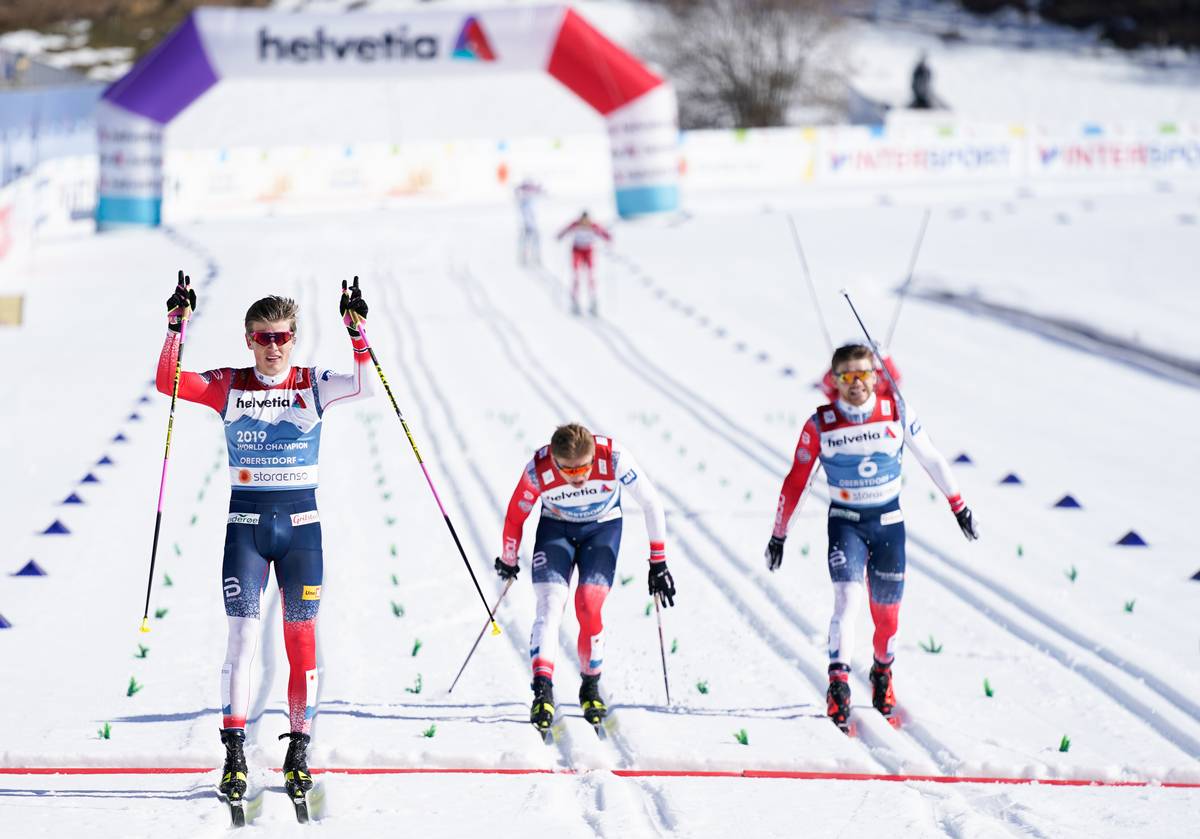
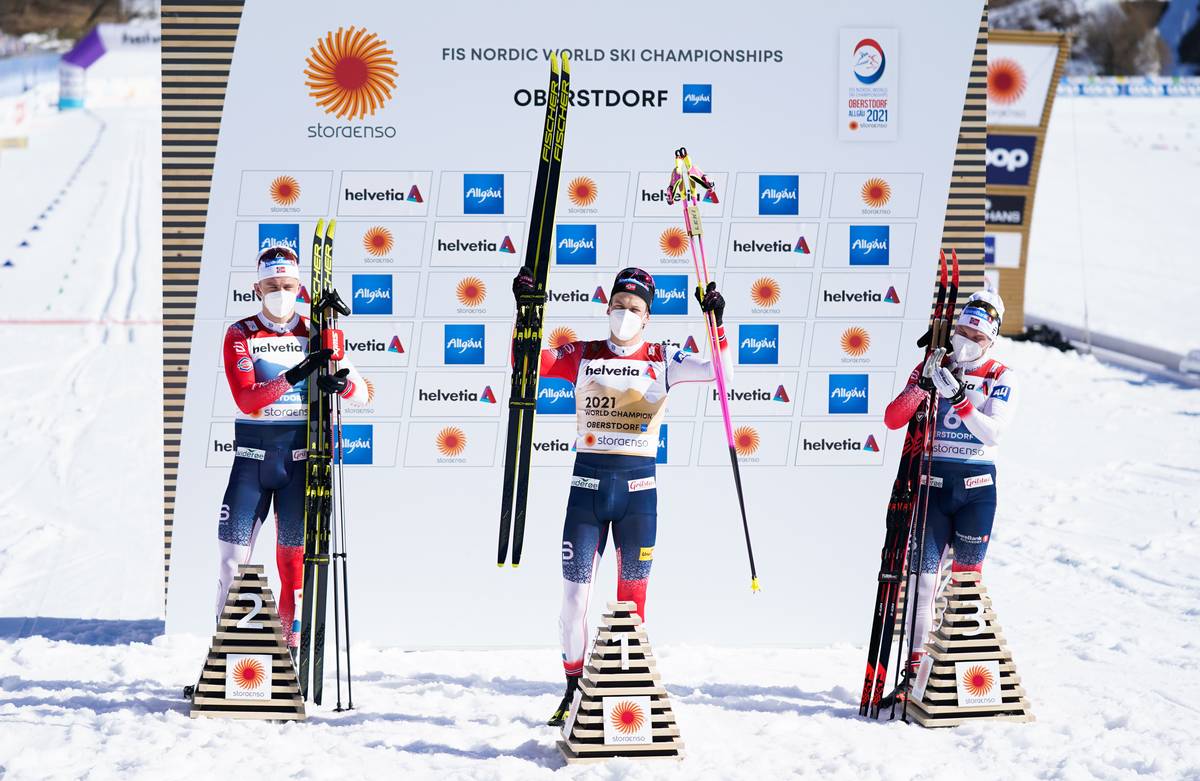
    Norsk triple. Johannes Høsflot Klæbo (left) raises his hands in victory as Valnes (middle) and Taugbøl (right) lunge for the line. (Photo: NordicFocus)

    This World Championship coverage is made possible through the generous support of Marty and Kathy Hall and their A Hall Mark of Excellence Award. To learn more about A Hall Mark of Excellence Award or to learn how you can support FasterSkier’s coverage please contact info@fasterskier.com.

    Against the backdrop of hundreds of cardboard cut-out fans, the men battled for the first medals of the 2021 World Championships in Oberstdorf, Germany. Despite warming temperatures, conditions were firm and fast for the 1.5 k classic sprint, likely due to the application of salt to help with freezing. The course featured three climbs with the last being the most significant and sustained. 

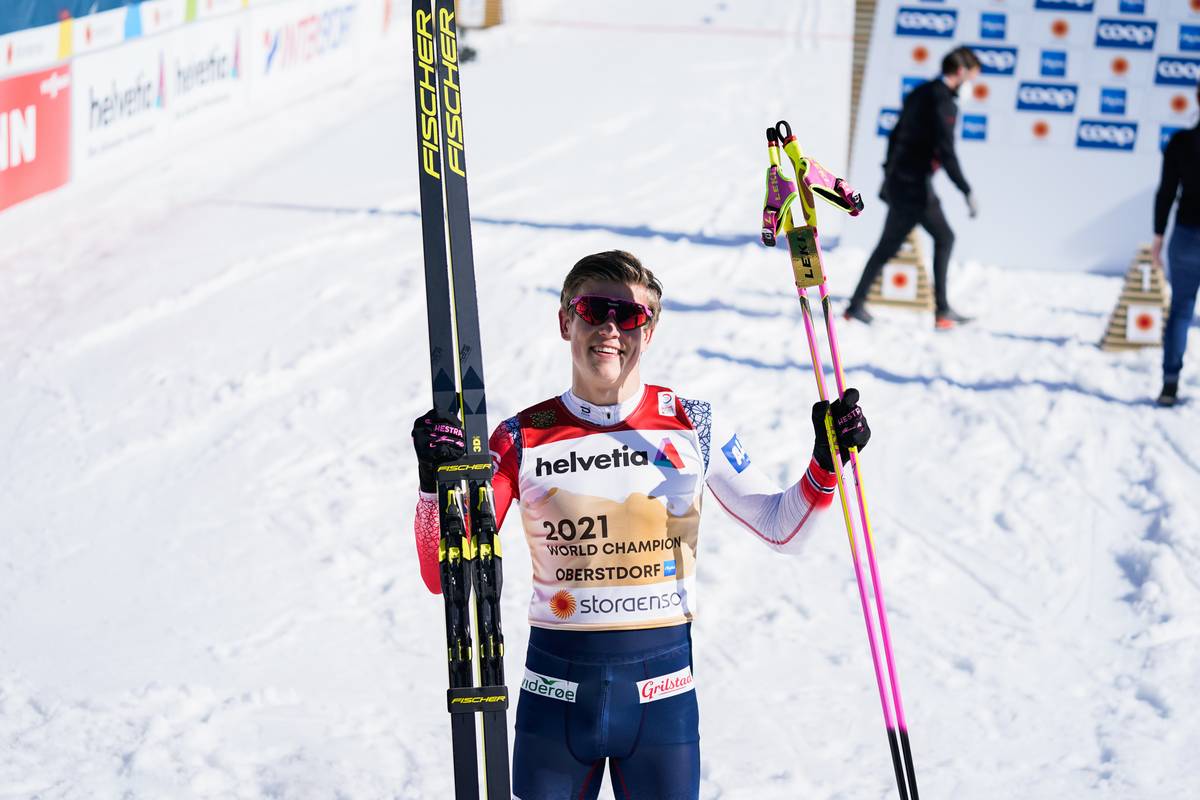
    A smiling Klæbo after being the first athlete to complete back-to-back sprint victories at World Championships. (Photo: NordicFocus)

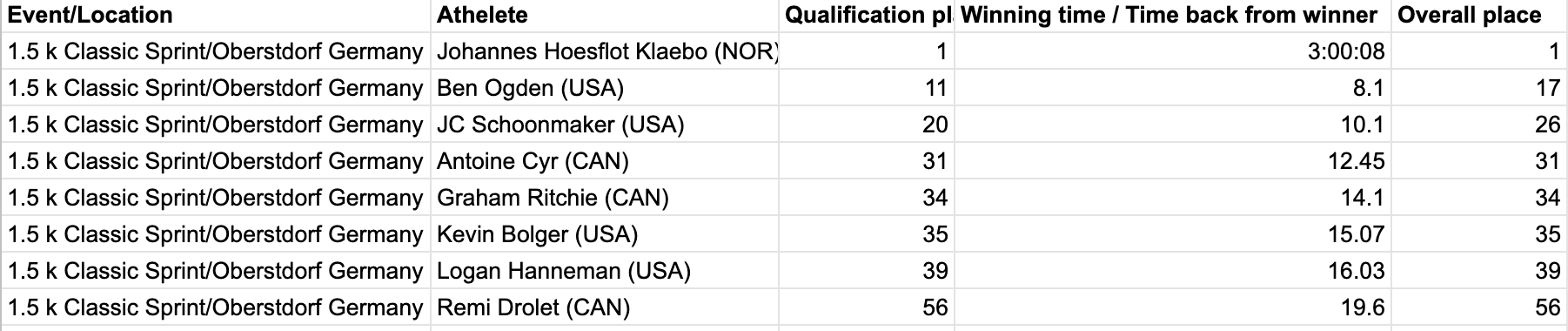
    From start to finish, the day belonged to Johannes Høsflot Klæbo who won the qualifier in a time of 3:00:08 and took his second consecutive sprint World Championships gold medal, becoming the first male athlete in history to repeat back to back sprint golds, winning the final in a time of 3:01.30. 

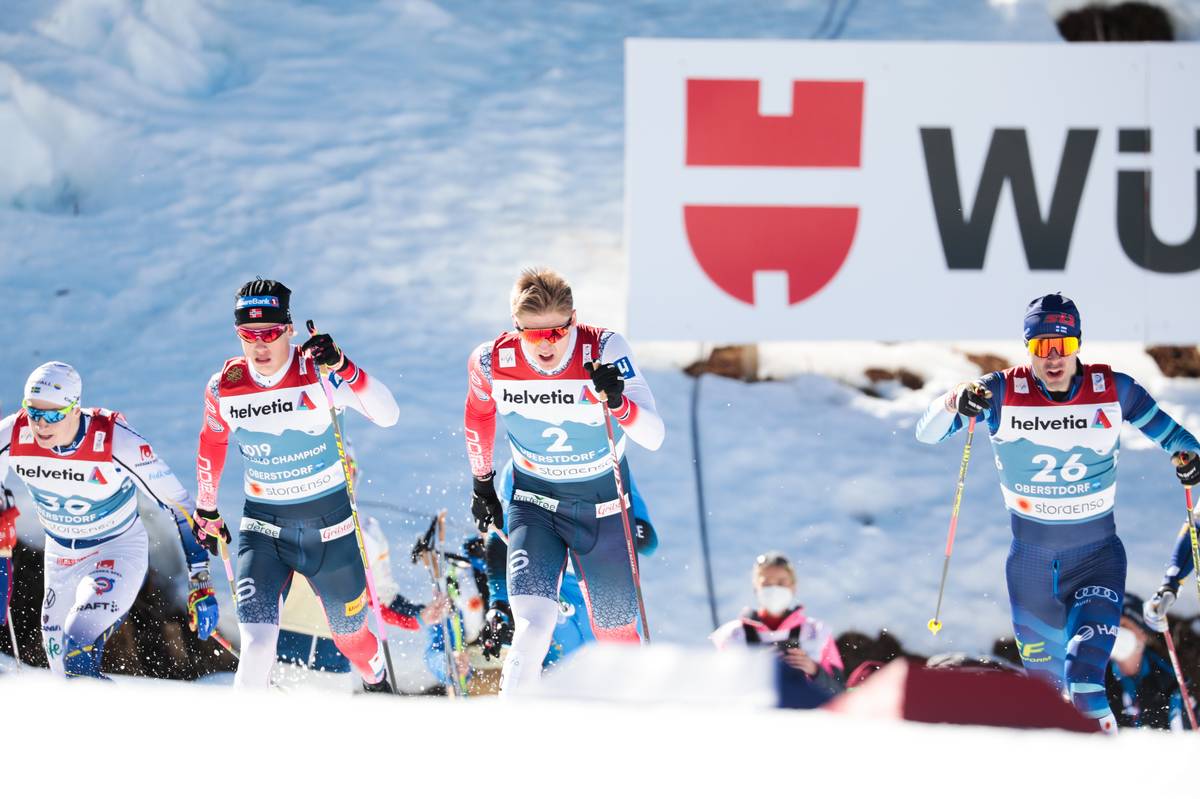
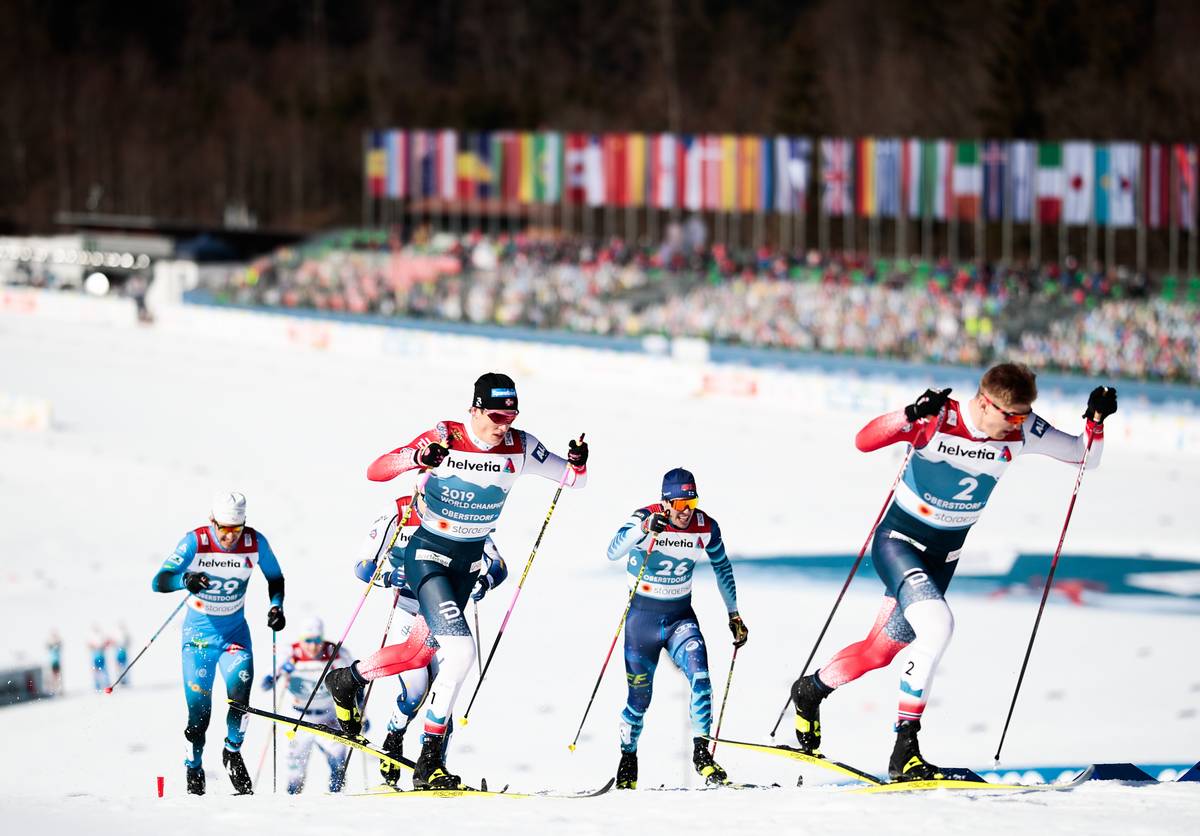
    As in the women’s race, the final hill proved to be the decisive factor throughout the quarterfinals and into the remaining rounds. The hill was no stride-fest, but instead a full-on sprint-run. Competing in Heat 1, Norwegians Erik Valnes and Klæbo easily gapped their competitors on the climb and advanced with ease.  

    The eventual 1-2 skiers charging. Valnes (bib 2) and Klæbo (left). (Photo: NordicFocus)
    Valnes (bib 2) and Klæbo (left) lead over the crest of the hill in their quarter-final heat. (Photo: NordicFocus)

    Racing in Heat 2 was J.C. Schoonmaker for the United States who qualified in 20th position. Schoonmaker came in 6th in his heat to finish 26th overall. After the race, Schoonmaker said, “I did not feel my best today but it was a solid result I think for my first World Champs, and I think I can walk away, I learned a lot and I think I am happy with it. But definitely saw it going better and I hoped it was going to go better. But, yeah I think it was overall still good.” 

    A sleeve-less JC Schoonmaker (USA) racing through warm temps in the quarter-final rounds. (Photo: NordicFocus)

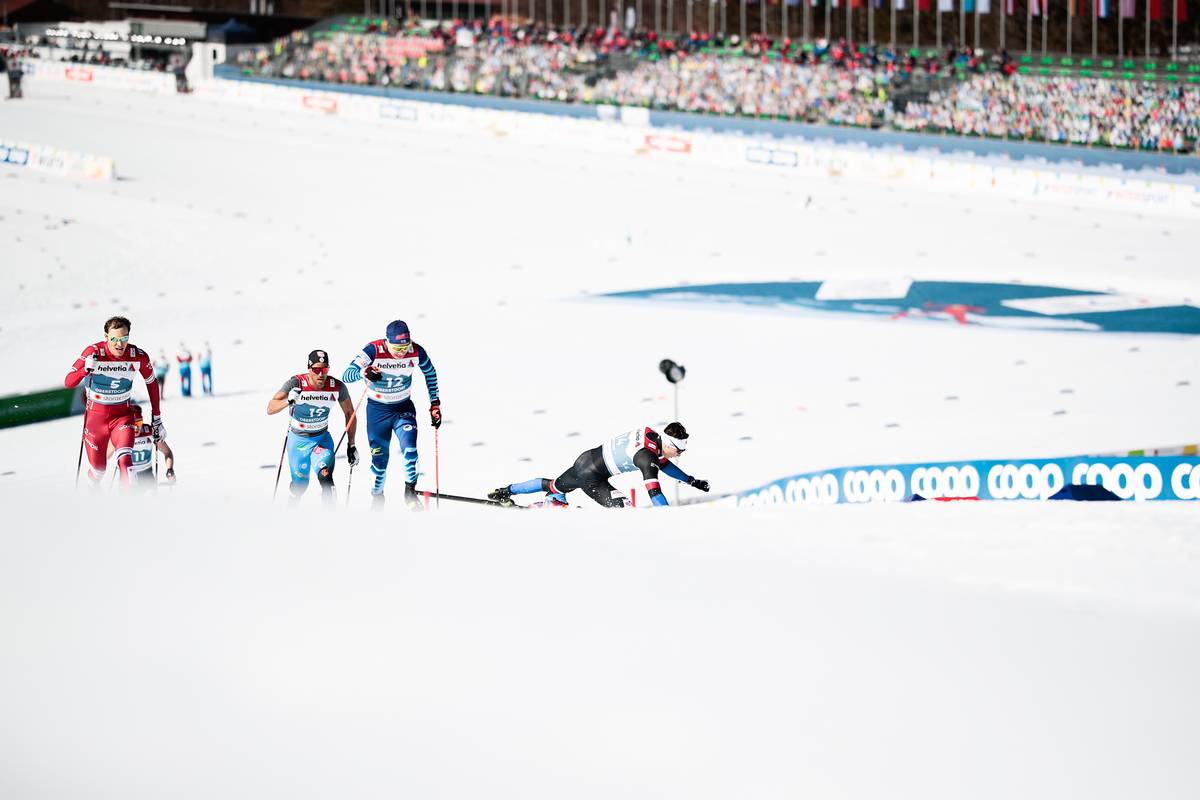
    His teammate, Ben Ogden, qualified in 11th position and raced in the fifth quarterfinal. Ascending the final climb in that heat, Francesco De Fabiani of Italy found himself caught in the slush and went down, taking Cerny Ondrej of the Czech Republic down with him.

    Ondrej Cerny (CZE) taking the stumble. (Photo: NordicFocus)
    Ogden was able to move around the crash and capitalize. (Photo: NordicFocus)

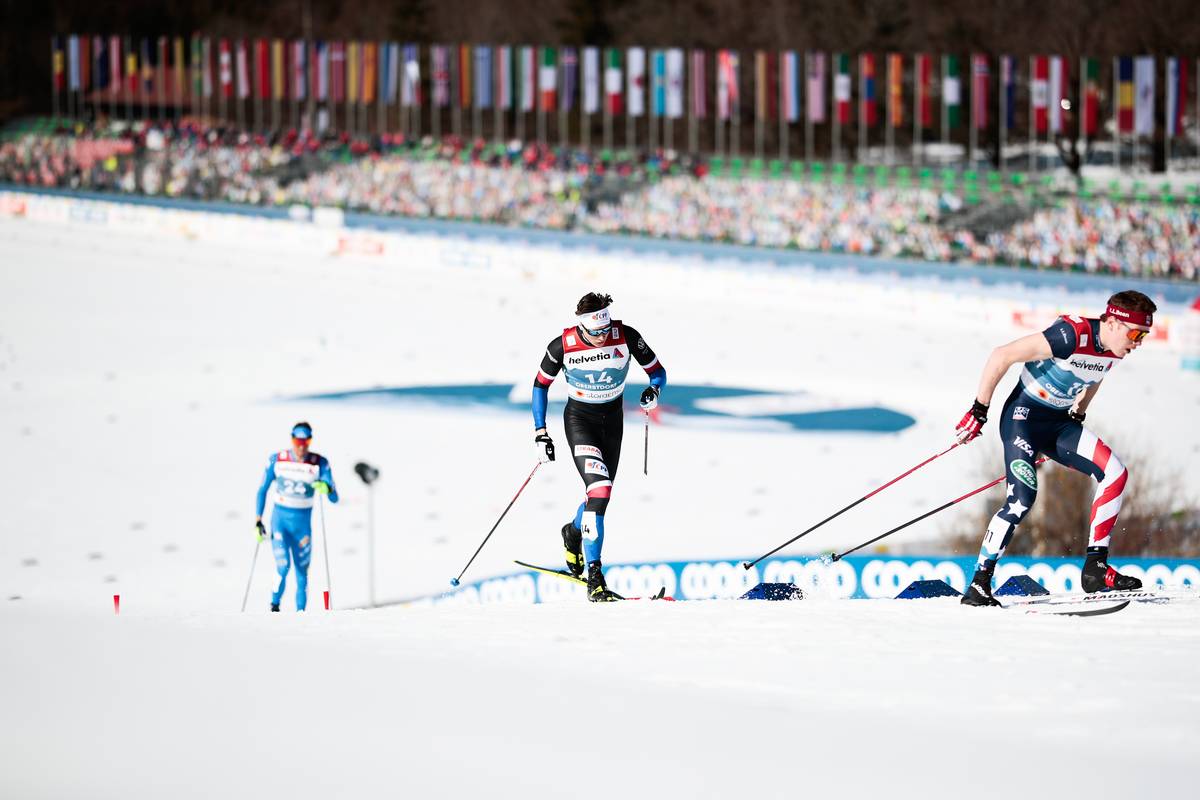
    Ogden ended up fourth after a solid fight in his quarterfinal and 17th overall. In a post-race interview, Ogden said about his day, “It was good in general. The qualifier was really good. I was happy to be able to feel fast in that. And then in the heats were a little tricky, as they often are. Just remembering that this is only my second heat so far this year since World Juniors last year. I have a lot to learn and that was my first ever World Cup level heat. So, yeah, I am really excited with the whole day, and we will be looking forward to the skiathlon in a few days” 

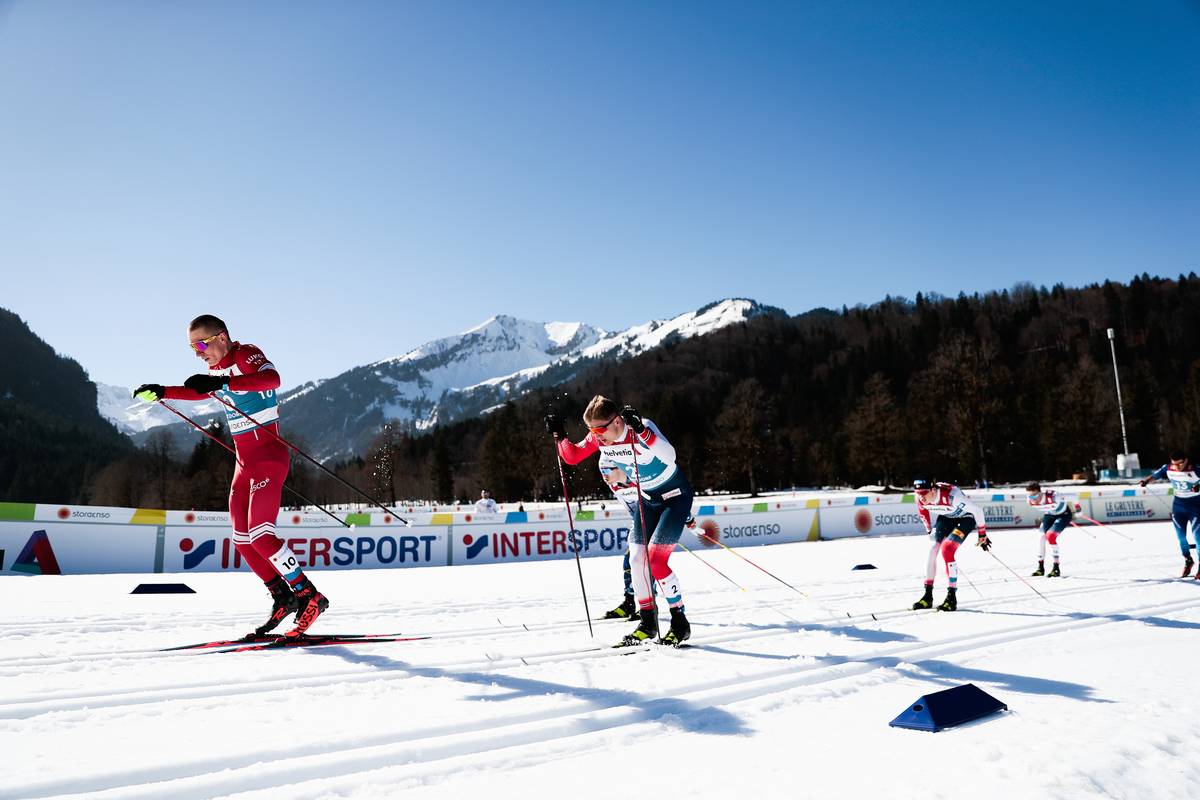
    In the semi-final rounds, once again Klæbo and Valnes went one-two in the first semi. Given this was the faster semi, Alexander Bolshunov (representing the Russian Ski Federation at these championships) and Oskar Svensson of Sweden, also advanced from this heat as lucky losers. Coming from the second semi-final was Håvard Solås Taugboel of Norway and Sergey Ustiugov (RSF) who bested the likes of skate sprint legend Federico Pellegrino and steady sprint finalist Gleb Retivykh to advance to the final. 

    Bolshunov (RSF) and Valnes race against a picturesque backdrop through the sprint rounds (Photo: Nordic Focus)

    Preparing for one last round, the three Norwegians, two Russians, and lone Swede took their start positions, having shed hats and layers as the temperatures and efforts increased. Steady through the first part of the course, again the final climb marked a crucial moment. Taking the inside lane Klæbo stomped his way up the hill using his trademark technique. However, it was his teammate Valnes who was first over the crest. As they descended into the stadium Klæbo shot to the outside and took off. Valnes was left to fend-off his teammate Taugboel to secure second place while bronze went to Taugboel, making it a Norwegian triple. 

    Triple Norwegian podium for the first championship event of 2021 (Photo: NordicFocus)

    Speaking to FIS after the race Klæbo said, “I don’t know what to say. I’ve been so nervous the last couple of days. It’s been a really strange season with not so many competitions and I think we made some decisions that weren’t so good when we were sitting at home watching the Tour de Ski, but today it feels great and is a dream come true.” When asked about the conditions he replied, “I think it was a really tough day, the conditions were really good today, I think it was the right decision to salt it yesterday. It’s really hard out there when it’s so warm, and you are losing a lot of energy.”

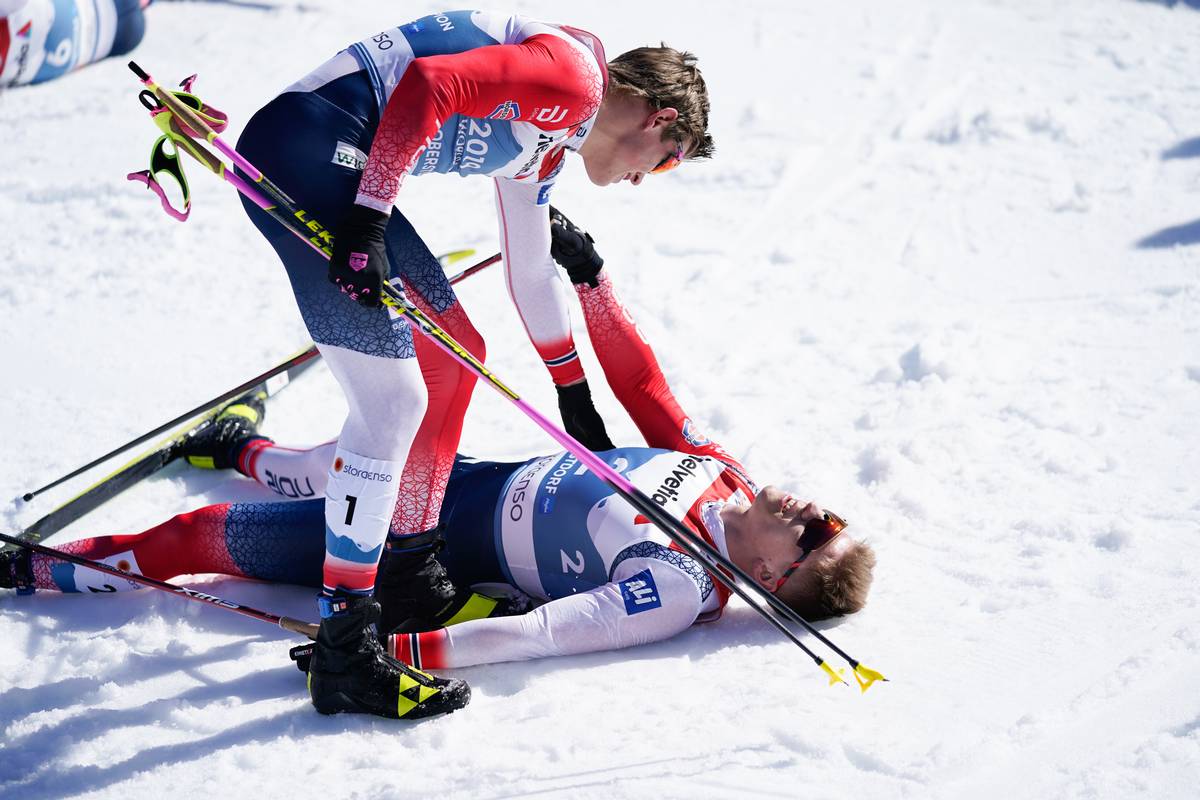
    Klæbo congratulates a tired teammate, Valnes, after they finish 1-2 in the classic sprint. (Photo: NordicFocus)

    Klæbo came out of his first World Championships in 2019 with three gold medals after winning the individual sprint as well as the team sprint and relay event with teammates. After this victory on Thursday it seems like he is well on his way to another successful championship. For his teammate Valnes, this is his first time competing at World Championships. Valnes has made one other podium appearance this season when he won the classic sprint at the season opener in Ruka, Finland. This is also the first time at World Championships for Taugboel who has had three individual World Cup podiums throughout his career, all in sprint events. 

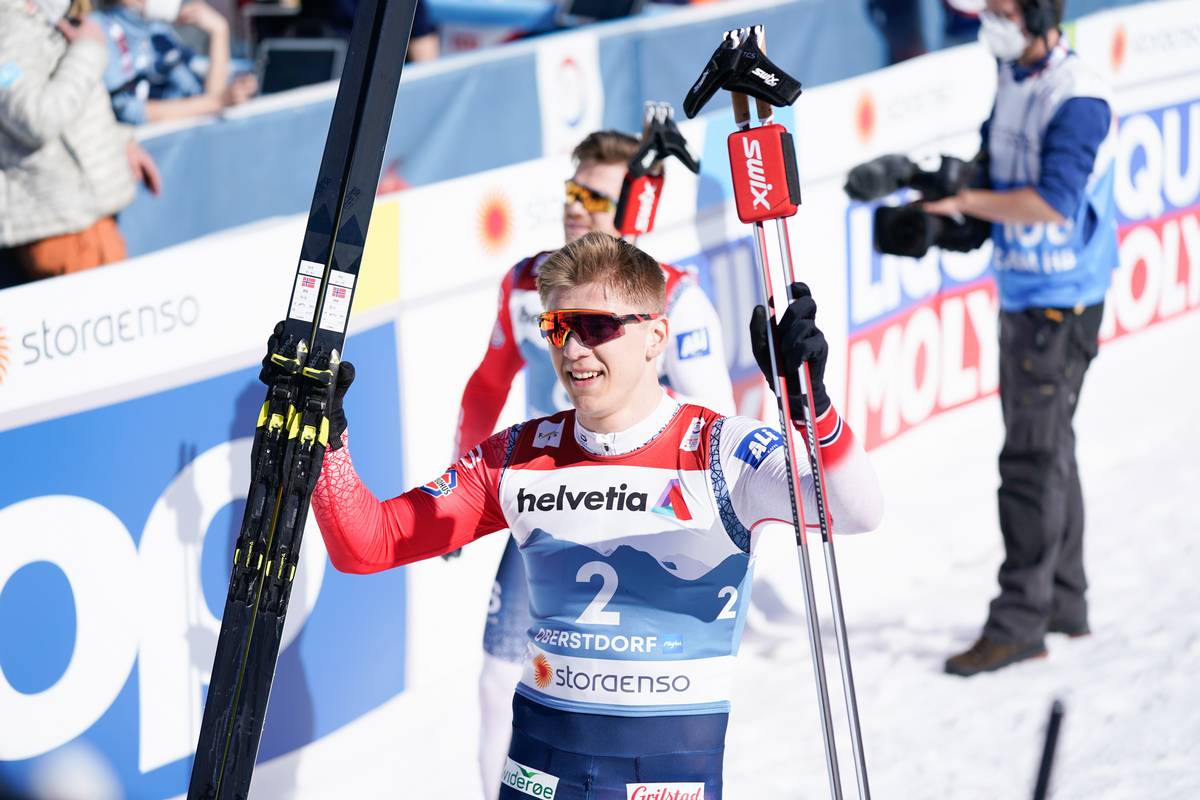
    Valnes after placing second in the classic sprint (Photo: Nordic Focus)

    Racing continues on Saturday with a 30 k skiathlon.

    Results: Men’s Final | Men’s Qualifier

  • Dresden Team Sprint Rundown

    Dresden Team Sprint Rundown

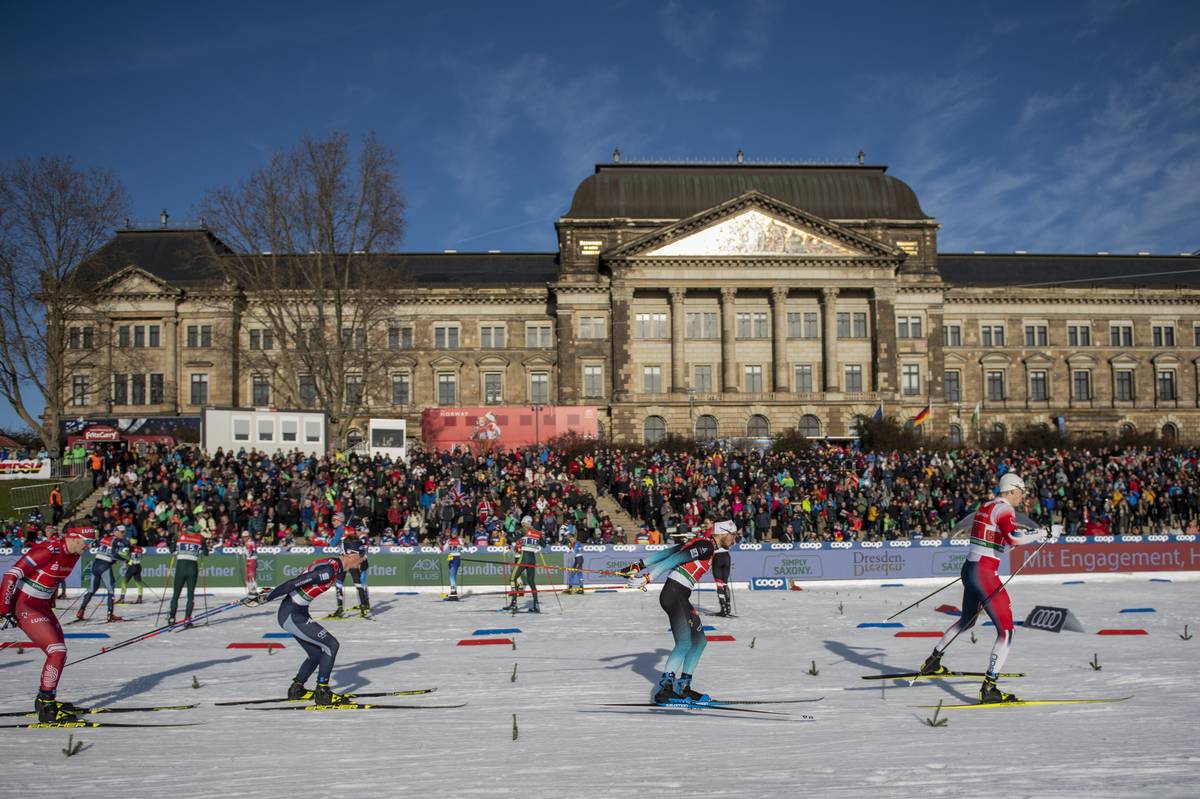
    Spectators gather in Dresden, Germany to watch the team sprint. (Photo: NordicFocus)

    It was dizzying in Dresden for the skate team sprints. The man-made loop of lightning-fast snow had skiers going literally round and round for a total of 11 exchanges between teammates. Each skier skated a single 0.7-kilometer lap, for a total of 7.8 k. Each skier raced six laps. Turn your head dizzy.

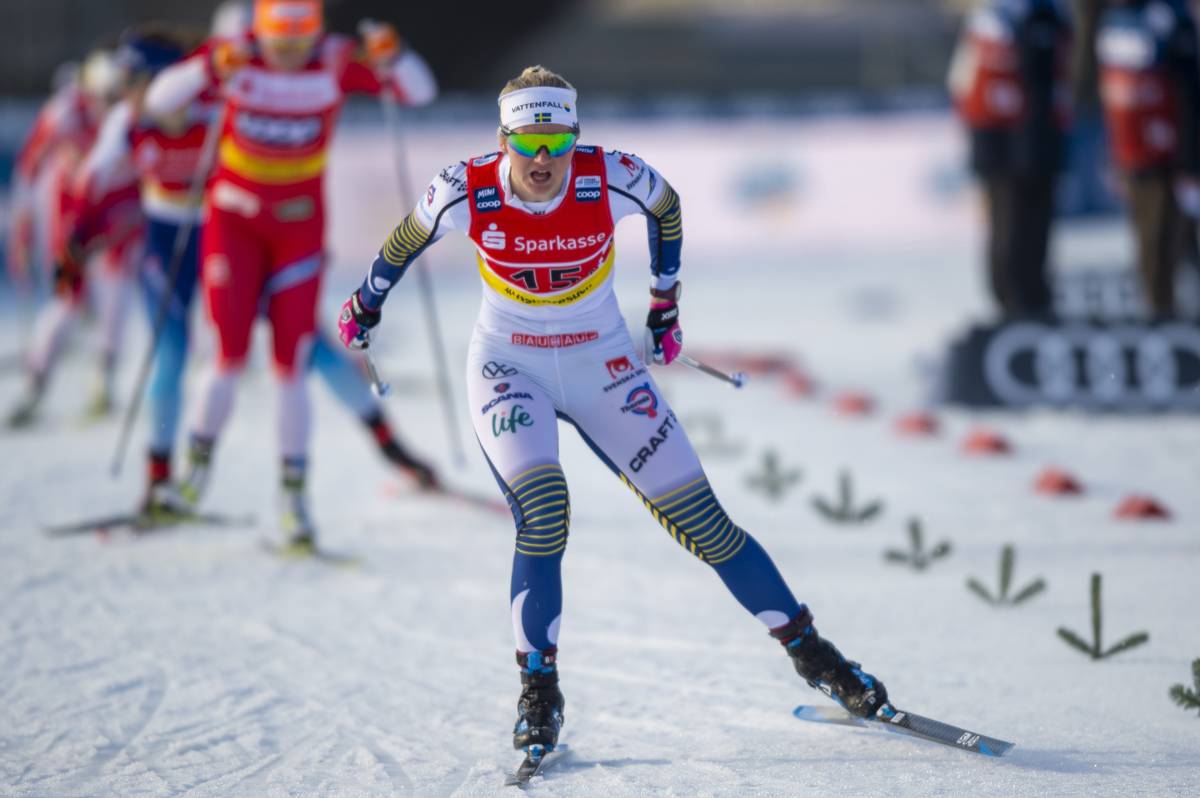
    Maja Dahlqvist (bib 15) and teammate Linn Svahn maintain their lead in the final laps of the Dresden team sprint. (Photo: NordicFocus)

    The Women’s Final

    The finals consisted of ten teams. Sweden I animated the race with its display of pull ahead speed late in the race. Sweden I featured Maja Dahlqvist, who won this event last year with Stina Nillson. This year, Dahlqvist and Linn Svahn, yesterday’s skate sprint winner, had the pleasure of burning plenty of matches in Dresden. 

    Sweden I’s tactics were clear: late in the race, with several exchanges remaining, apply speed to the front, separate from the pack, and position themselves for the win. According to FIS, that has been somewhat easy for Sweden to do of late: Sweden has won seven of the last eight women’s team sprint World Cup events. This includes the last five in succession. 

    So it was today, as Dahlqvist tagged to Svahn on the final lap with a 0.8-second gap on Switzerland I’s Nadine Faehndrich. Norway I came through 3.6 seconds back, and Sweden II another 0.4 seconds behind. 

    That was the race.  Faehndrich was able to close down and give Svahn a scare at the line for a photo-finish. 

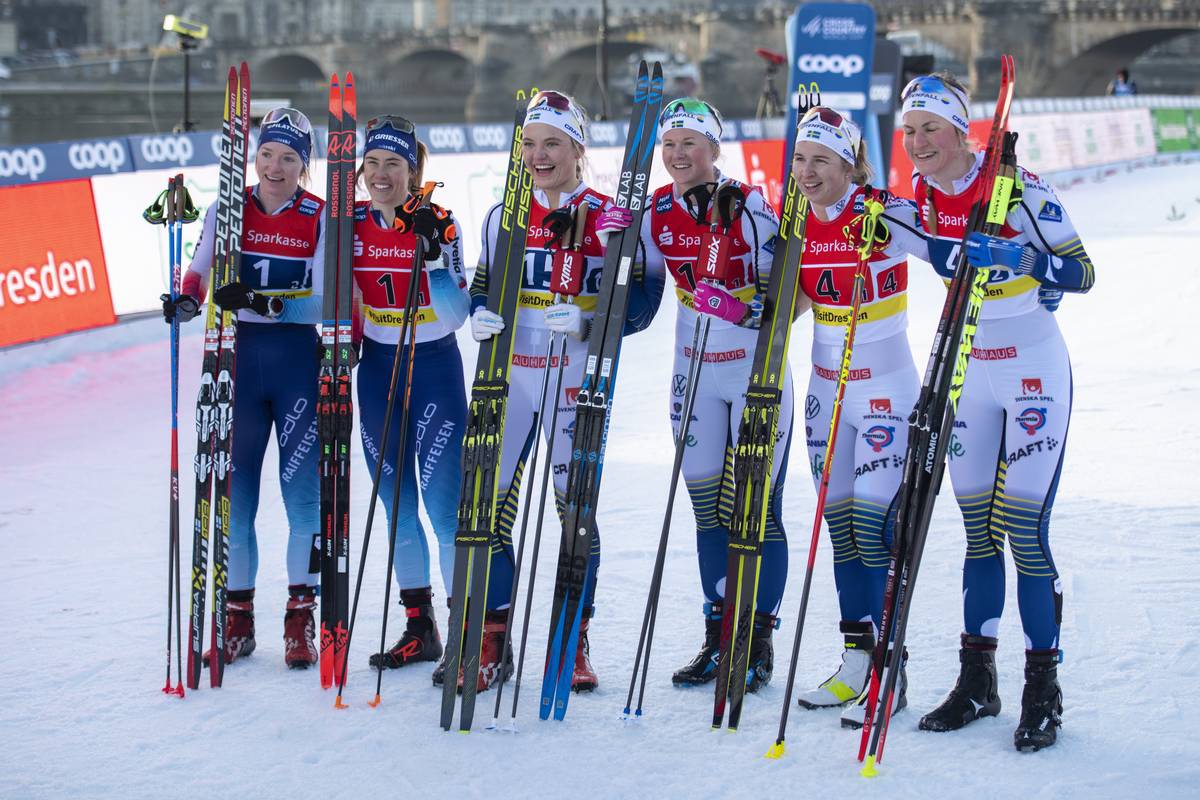
    The finish line item read: Sweden I in first at 15:43.7, Switzerland I second (+0.09), and Sweden II third (+3.27). 

    The U.S. team of Julia Kern and Sophie Caldwell placed fifth overall (+6.61). The U.S. pairing advanced out of the semis after placing third behind Norway I in first and Switzerland I’s Laurien Van Der Graaf and Nadine Faehndrich. 

    Canada I’s Katharine Stewart-Jones and Dahria Beatty placed third in the second semi-final — in a photo finish with Germany I for second —  and did not advance as a lucky loser. In the team sprint format, the two top teams advance, with the six remaining spots in the final given to the next six fastest teams via lucky loser spots. Canada I placed 11th on the day. 

    Canada II’s Maya Macisaac-Jones and Katherine Weaver were 23rd overall.

    Women’s Team Sprint Results

    Laurien Van Der Graaff (SUI), Nadine Faehndrich (SUI), Maja Dahlqvist (SWE), Linn Svahn (SWE), Evelina Settlin (SWE), Linn Soemskar (SWE), (l-r) take the podium positions. (Photo: NordicFocus)

    The Men’s Final

    Looking for some smooth skiing technique cues for high speed skate skiing? Look no further than the Frenchman crossing the line in first on Sunday for France I. Lucas Chanavat — paired with Jay Renaud — was the kinesthetic perfection of coaches advising – and sometimes commanding —  athletes to ski big and tall.  

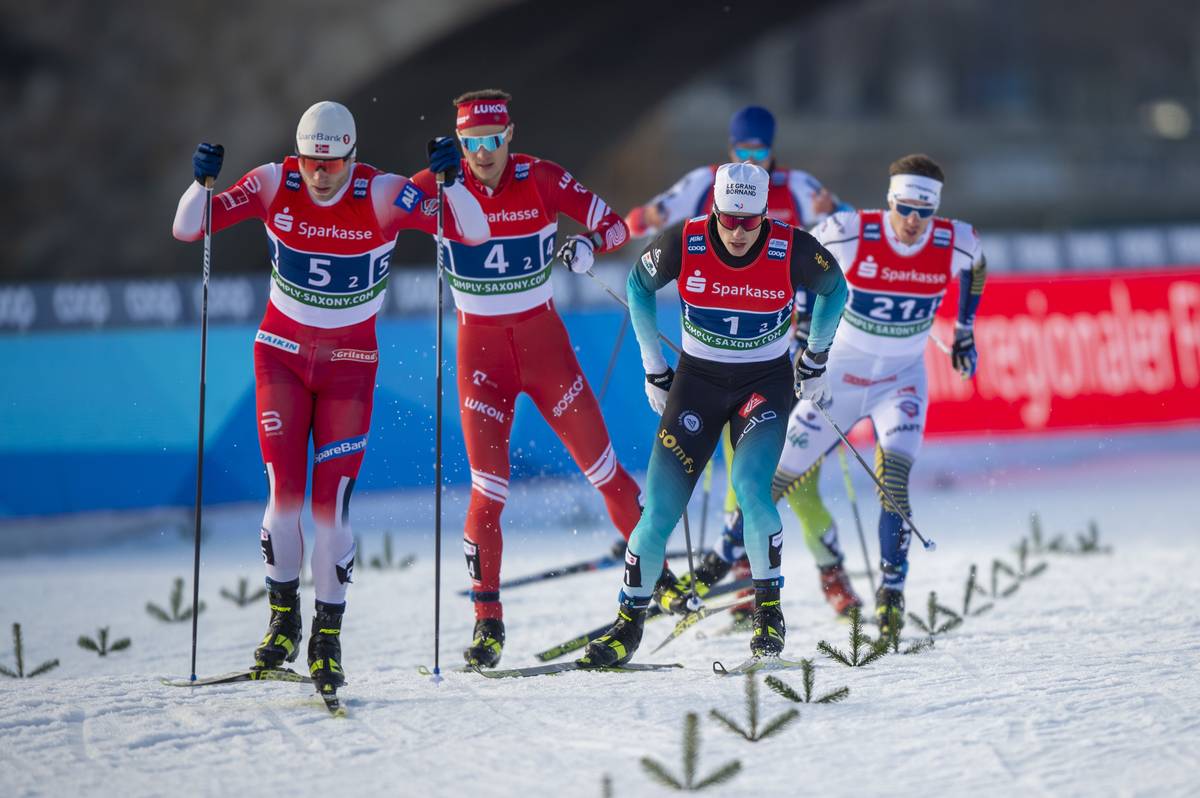
    Lucas Chanavat (bib 1) put on a clinic this weekend in Dresden, Germany. (Photo: NordicFocus)

    On Dresden’s quick 0.7 oval loop and deteriorating snow, Chanavat was simply big and smooth and just enough faster than the others.

    In an event that saw five teams on the final tag within 1.4 seconds, France did not exactly have this Dresden team sprint nailed shut.

    With the front five teams out of trouble, they came into the final straight drag race style. As noted, France I pipped in for the win. Sweden I’s Marcus Grate and Johan Haeggström were second (+0.09), and Russia I’s Andrey Krasnov and Gleb Retivykh third (+0.18). Norway I’s Håvard Solås Taugbøl and Sindre Bjørnestad Skar were fourth (+0.56).  

    Great Britain’s James Cluget and Andrew Young were eighth overall (+7.07). 

    Canada I’s Graham Ritchie and Bob Thompson were 14th overall, with Canada II 20th. For the U.S., JC Schoonmaker, a junior skier for the University of Anchorage Alaska, and Kevin Bolger were paired. They placed 21st for the day. 

    Men’s Results

    Marcus Grate (SWE), Johan Haeggstroem (SWE), Renaud Jay (FRA), Lucas Chanavat (FRA), Andrey Krasnov (RUS), Gleb Retivykh (RUS), (l-r) earn top honors in the men’s team sprint. (Photo: NordicFocus)