From the FasterSkier archive — posts syndicated from athletes’ and coaches’ own blogs between 2004 and 2012, kept online as published. Current coverage is at fasterskier.com.
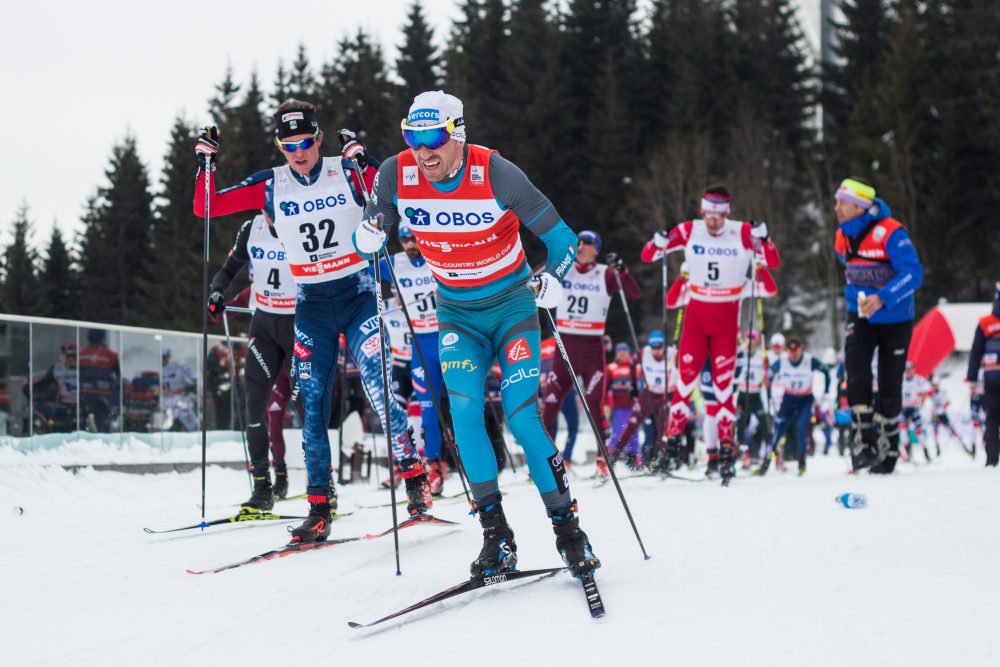
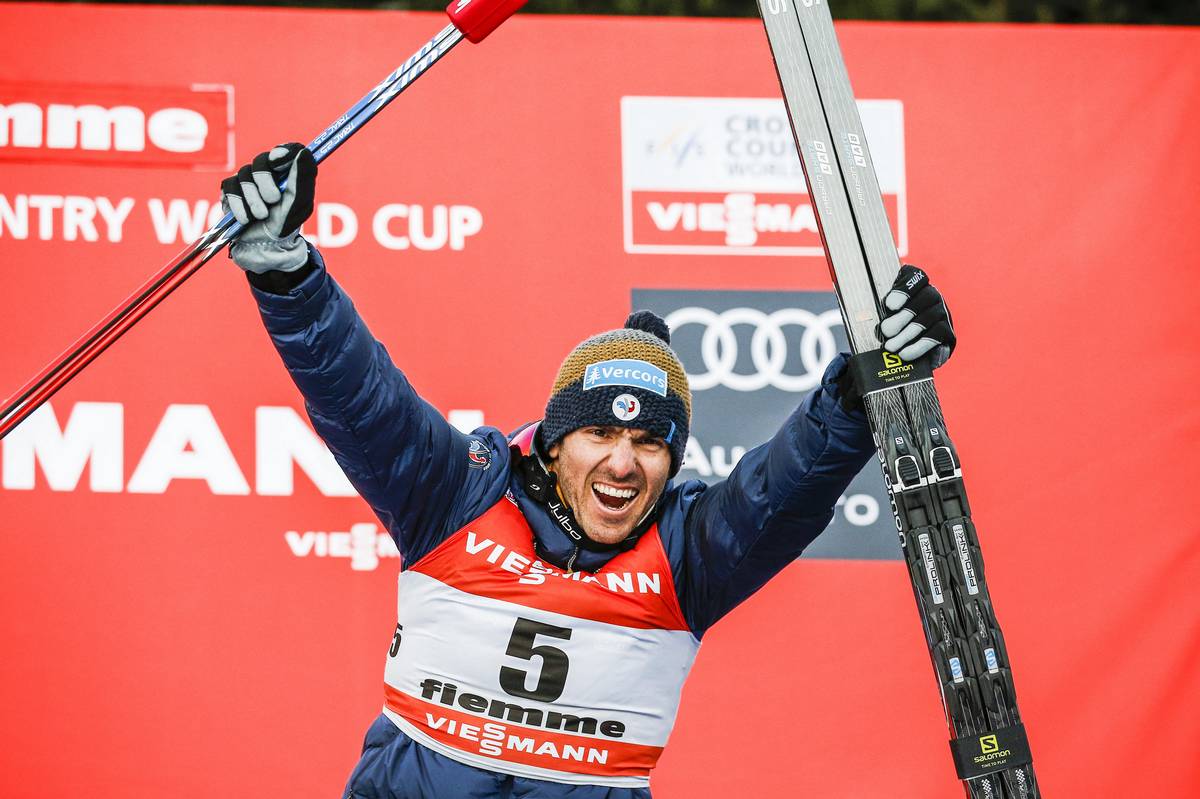
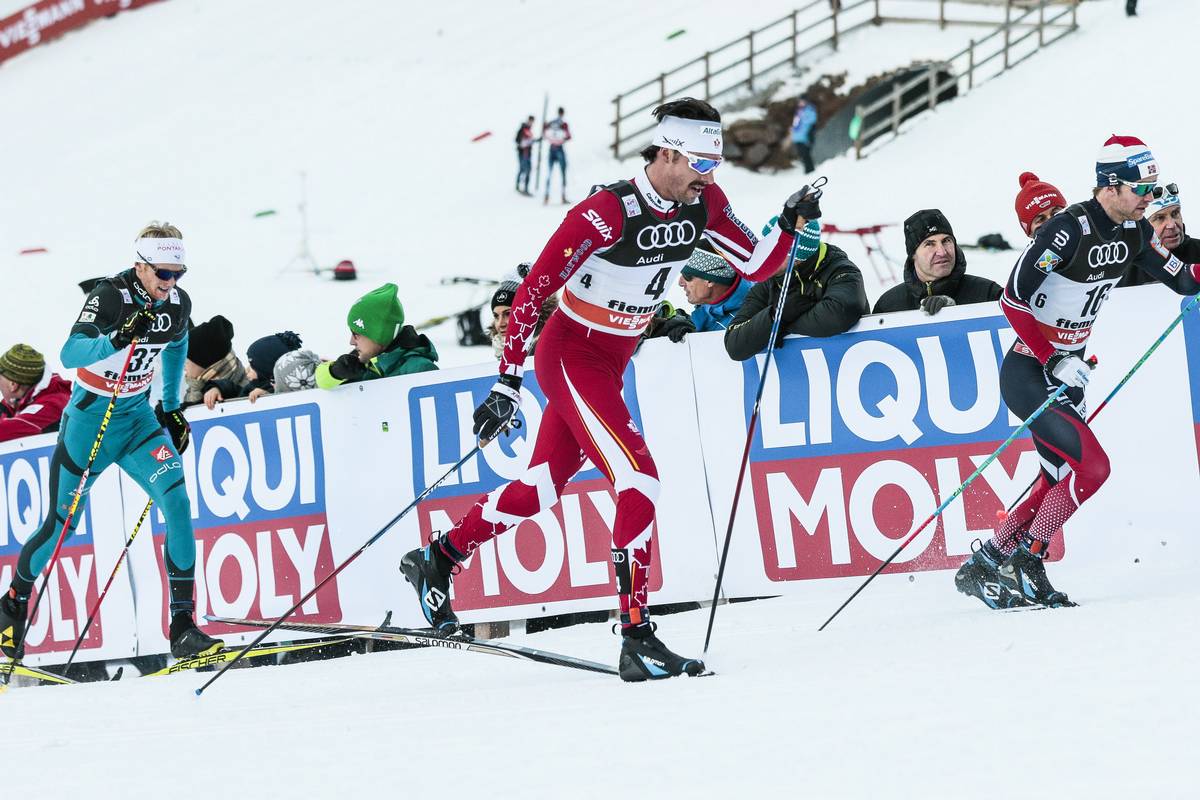
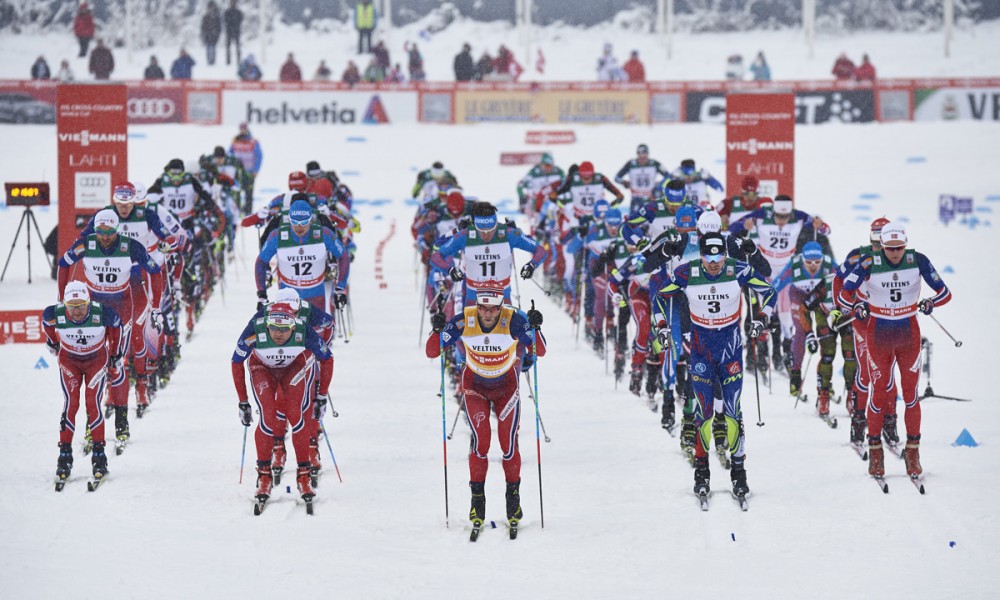
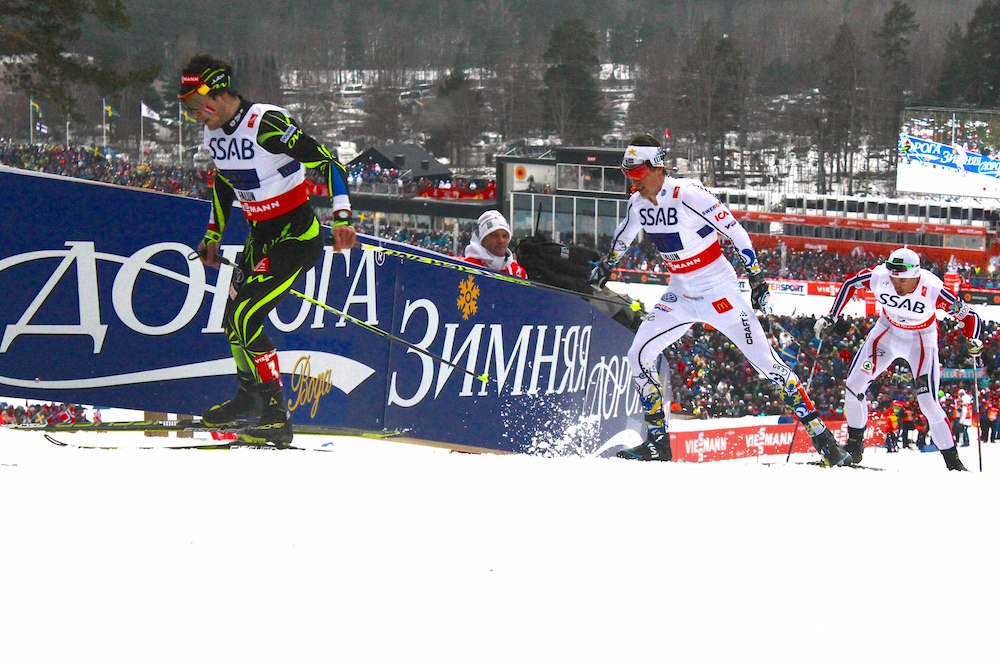
France’s Maurice Manificat (r) leads American Scott Patterson (32) and Canada’s Alex Harvey (5), among others, during the 2018 Holmenkollen 50-kilometer freestyle mass start last season in Olso, Norway. (Photo: Logan Hanneman)
Welcome to FasterSkier’s World Cup Preview, where we check in with the top-10 teams from last year’s FIS Cross Country World Cup tour before the season starts. The World Cup begins with a classic sprint in Ruka, Finland on Nov. 24th.
***
France
Overall in Nations Cup Last Year: 7th
Women’s Ranking 2017/2018: 12th
Men’s Ranking 2017/2018: 3rd
French to Watch: Subdued, understated, but right there when it counts. That would encapsulate France’s men’s team – a group never demanding your attention, but certainly deserving of it.
Maurice Manificat, at 32 years old, placed 5th in the distance rankings last season. When the technique was freestyle, Manificat became a top-10 lock. Of his eight distance top-10’s last season, only two involved classic technique: he placed 9th in a 15 k classic pursuit and 5th in a 30 k skiathlon. Otherwise, it was all skate. In particular, if the race format is a 15 k skate, keep Manificat within your sights.
His Olympics impressed for their consistency and hardware. A fifth place in both the 30 k skiathlon and 15 k skate kept Manificat in the medal hunt. He helped deliver Olympic bronze in the men’s 4 x 10 k relay — he actually skied the second classic leg — and the team sprint which suited his skate skiing endurance.
Thirty-eight-year-old Jean-Marc Gaillard lends stability to the French distance team. He posted several top-20 results and finished 7th overall in the Tour de Ski. Sitting 18th in the distance cup and 21st overall, Gaillard may not podium, but he takes pressure off Manificat and plays a key role when it comes to championship relays – he was part of France’s bronze performances in the 4 x 10 k relay in PyeongChang and Sochi in 2014 as their scramble leg starter.
The speed is also reliable for France’s men. Lucas Chanavat, Baptiste Gros, and Richard Jouve form a reliable trifecta of sprint qualifiers that can move through the heats.
Chanavat posted four podiums last season all in skate. Gros earned seven top-20’s. Jouve sported five top-10’s including a 4th place in Dresden’s skate sprint. Jouve also earned Olympic hardware with Manificat in the team sprint.
This season, France does not have an “A” level women’s team according to a team announcement. The “B” team will feature several younger skiers with limited World Cup experience. However, Anouk Faivre-Picon, at thirty years old, was a steady top-30 distance skier for France last season. She notched a season-best 13th place in the Olympic skiathlon. Maybe this year will see an uptick in results and organizational commitment from France which did not bring a women’s team to the 2017 Lahti, Finland Nordic Ski World Championships.
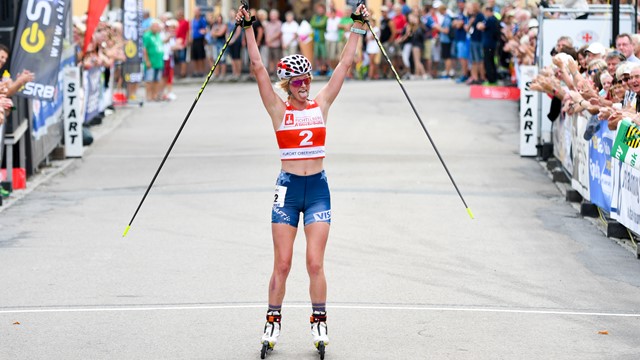
Tara Geraghty-Moats winning Sunday’s normal hill/5 k Gundersen at the 2018 Women’s Nordic Combined Summer Grand Prix in Oberwiesenthal, Germany. (Photo: Romina Eggert/FIS)
Two North Americans posted impressive results at nordic events in Germany and Norway over the last week, with Vermont native Tara Geraghty-Moats racing to first overall in the first-ever Women’s Nordic Combined Summer Grand Prix and Quebec’s Alex Harvey placing second, fifth and 10th in three races at the Toppidrettsveka rollerski series.
Geraghty-Moats 1st and 2nd at Inaugural Women’s NoCo Grand Prix
Brand new to nordic combined as well as the jump hill in Oberwiesenthal, Germany, Geraghty-Moats took the inaugural women’s Nordic Combined Summer Grand Prix by storm this past weekend, placing first and second in two competitions. That tied her for first place in the overall Grand Prix standings, alongside Russia’s Stefaniya Nadymova — the defending champion of last winter’s inaugural women’s Nordic Combined Continental Cup.
On Sunday, Geraghty-Moats, 25, of USA Nordic and the New York Ski Education Foundation (NYSEF), handily beat Nadymova and the rest of the 10-woman field after starting the 5-kilometer Gundersen rollerski race in second, four seconds behind Germany’s Jenny Nowak. While Nowak had posted the best jump of 96 meters on Oberwiesenthal’s 106-meter “normal” hill, Geraghty-Moats tied for the second-best-scoring jump (94.5 meters), with Austria’s Lisa Hirner (95 meters). From there, Geraghty-Moats dropped Hirner, Nadymova and Nowak on the first of three laps in the rollerski race and went on to finish in 11:04.8. Nowak ultimately placed third, 1:29.2 behind Geraghty-Moats.
“I was really satisfied by how my first weekend of being a nordic combined-er went, and I think the patience of waiting to be a nordic combined-er really paid off,” Geraghty-Moats told the International Ski Federation (FIS) after. “I struggled with the jump a little bit the first couple days. I had never jumped this hill before, and I sort of figured it out today so I got to ski a little bit easier than yesterday, but I was also happy that yesterday I was able to have a good fight and ski fast to my potential and end up on the podium.”
The women’s individual normal hill/5 k Gundersen podium on Saturday at the 2018 Women’s Nordic Combined Summer Grand Prix, with Russia’s Russia’s Stefaniya Nadymova (c) in first, American Tara Geraghty-Moats (r) in second, and Germany’s Jenny Nowak (l) in third in Oberwiesenthal, Germany. (Photo: FIS/Silke Tegethof)
“It was a dream come true to finally be able to compete in women’s Nordic Combined on an international level,” Geraghty-Moats told FIS on Saturday. “I’m using this weekend to learn the level I have to be at to have success in Nordic Combined. I made some mistakes today and learned a lot but I came away with a good result and having had a huge amount of fun competing with small but strong field.”
Eleven women competed in Saturday’s normal hill/5 k.
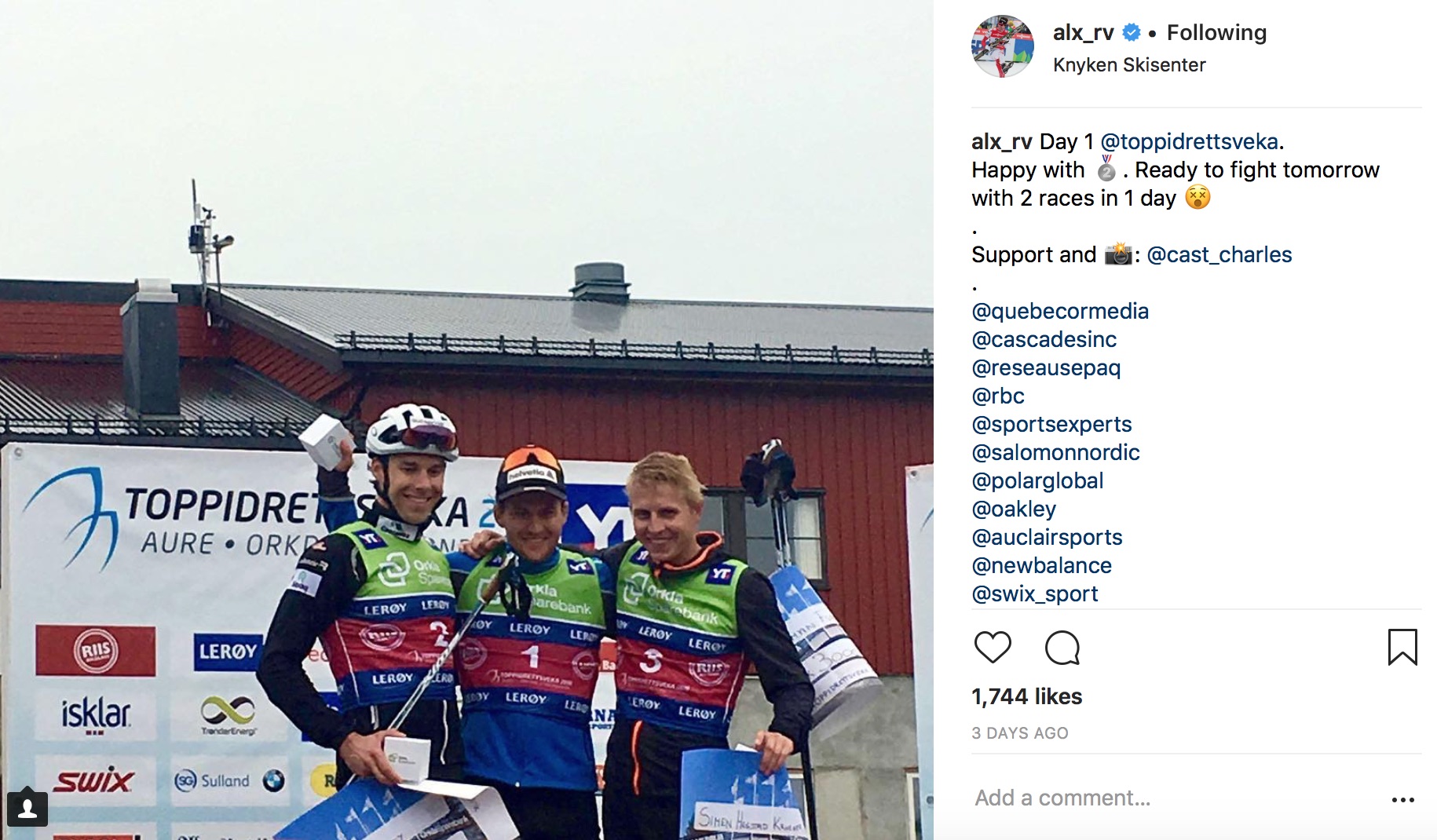
Alex Harvey (l) on the podium with Roman Furger (c) and Simen Hegstad Krüger (r) at the 2018 Toppidrettsveka rollerski festival in Norway last Thursday, Aug. 16. (Photo: Alex Harvey/Instagram)
At the Toppidrettsveka rollerski festival in Norway, Canada’s Alex Harvey raced to second in the 15 k skiathlon last Thursday in Orkdal, missing out on first by just 0.6 seconds to Switzerland’s Roman Furger, who won in 30:43.3. Norway’s Simen Hegstad Krüger, the reigning Olympic skiathlon champion, finished third, 1.5 seconds back. In a stacked international field of 125 men, Canada’s Evan Palmer-Charrette placed 75th in that race (+2:14.4), Bob Thompson was 84th (+2:32.7), and Scott Hill 89th (+2:52.5).
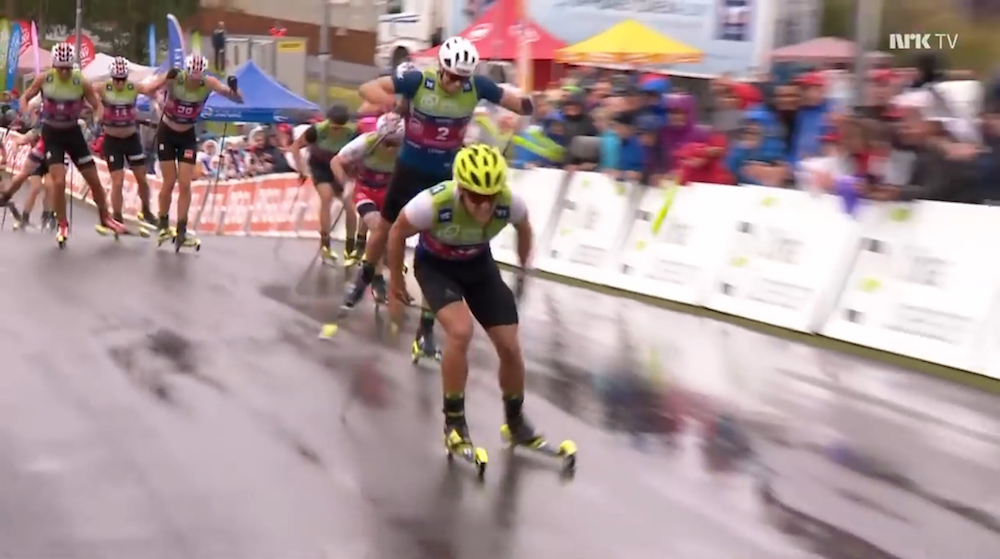
Canada’s Alex Harvey (2) gunning for first in the men’s 15 k skiathlon on Aug. 16 at the Toppidrettsveka rollerski festival in Orkdal, Norway. (Screenshot: NRK broadcast)
Heidi Weng beat her cousin Tiril Udnes Weng by 0.7 seconds in the women’s 10 k skiathlon that day, finishing in 22:52.1. Norway swept the top five of the women’s race, with Anne Kjersti Kalvå reaching the podium in third (+1.3), and national-team members Kathrine Harsem and Astrid Uhrenholdt Jacobsen placing fourth (+1.4) and fifth (+1.5), respectively, out of 43 women.
In the men’s 24 k classic mass start aroundAure/Brekka on Friday, Harvey finished fifth, 19 seconds after Krüger, who won in 59:57.5. Norway’s Hans Christer Holund placed second in that race (+2.6), Norway’s Magnus Stensås was third (+13.0), and Switzerland’s Dario Cologna fourth (+17.1). Also for Canada, Palmer-Charrette finished 61sth (+2:30.9), Hill 78th (+4:02.3), Thompson 86th (+5:40.3), and Maks Zechel 88th (+7:01.4) out of 125.
Heidi Weng repeated in first in the women’s 24 k mass start, finishing in 1:10:02.4 hours, while Tiril Udnes Weng again placed second, 25.4 seconds back, and Jacobsen reached the podium in third (+27.7).
Later on Friday in Aure, Norway’s Sondre Turvoll Fossli topped the men’s freestyle sprint final ahead of four other Norwegians, including Pål Trøan Aune in second and Jan Thomas Jenssen in third, and Switzerland’s Furger in fifth, while Harvey did not qualify for the heats and ended up 37th overall. Palmer-Charrette was once again 61st in qualification, Hill 107th and Thompson 109th out of 121.
In the women’s sprint, Norway’s Mathilde Myhrvold won the final in 2:56.54, 1.05 seconds ahead of Slovenia’s Katja Visnar in second. Heidi Weng placed third in the final (+1.97), ahead of Tiril Weng (+2.64) in fourth, another Norwegian Anna Svendsen in fifth (+2.76), and another Slovenian Alenka Cebasek in sixth (+3.73).
In the final race of the series, the classic pursuit on Saturday, Harvey started second, 10 seconds behind Furger in first. The Canadian went on to place 10th, 4.2 seconds out of first, in the 15 k race, while Stensås took the win in 37:45.5 after starting seventh. (Furger slipped to 55th and 1:55.5 behind at the finish.) Norway’s Mikael Gunnulfsen rose from eighth to second (+0.7) and France’s Jean-Marc Gaillard made it all the way up to third (+1.7) after starting 15th.
Palmer-Charrette finished the pursuit in 59th (+2:04.2), Thompson placed 80th (+2:55.2), Hill 87th (+3:41.5), and Zechel 93rd (+3:48.9) out of 105.
Jacobsen ended the weekend as the women’s 12 k mass start winner, after the entire women’s field (of 33) started at the same time. She crossed the line first in 34:20.8, 0.4 seconds ahead of Heidi Weng in second and 1.2 seconds ahead of Kalvaa in third.
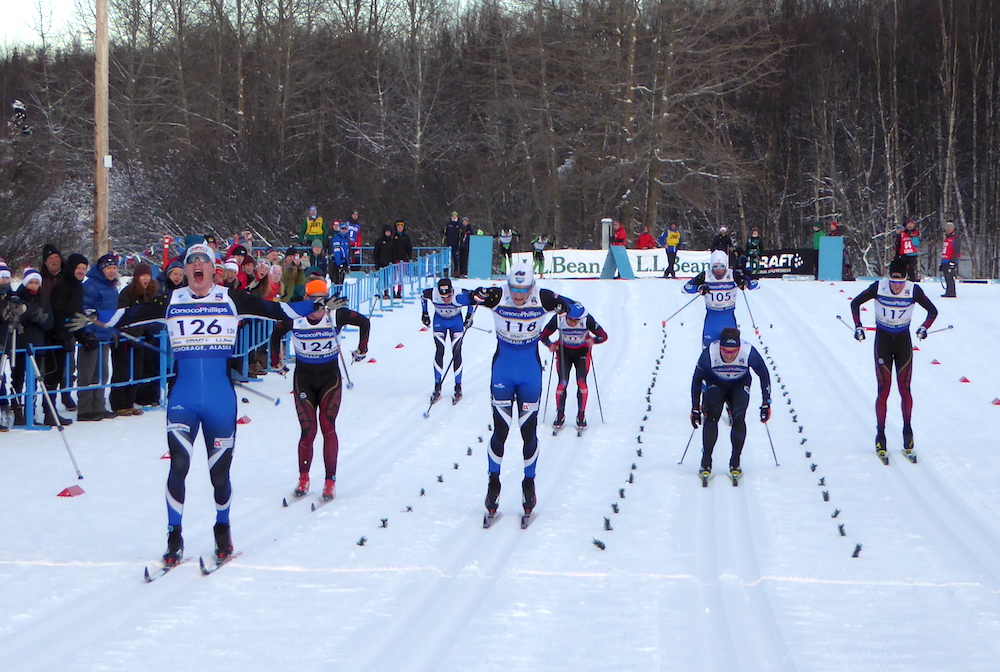
APU’s Tyler Kornfield (126) leads APU’s Eric Packer (118) and DU’s Eivind Romberg Kvaale (124) to the line in the men’s 30 k classic mass start at 2018 U.S. Cross Country Championships on Sunday in Anchorage, Alaska. Kornfield, Packer, and Kvaale finished first, second and third, respectively. Kris Freeman (10, second from left) was fourth overall and the third American.
U.S. Cross Country Championships (Anchorage, Alaska): 20/30 k classic mass starts
Sweden’s Hedda Bångman denied Caitlin Patterson of her first outright victory of the week at 2018 U.S. Cross Country Championships, but Patterson as the first American racked up her third-straight national title in the women’s 20-kilometer classic mass start at Kincaid Park on Sunday in Anchorage, Alaska.
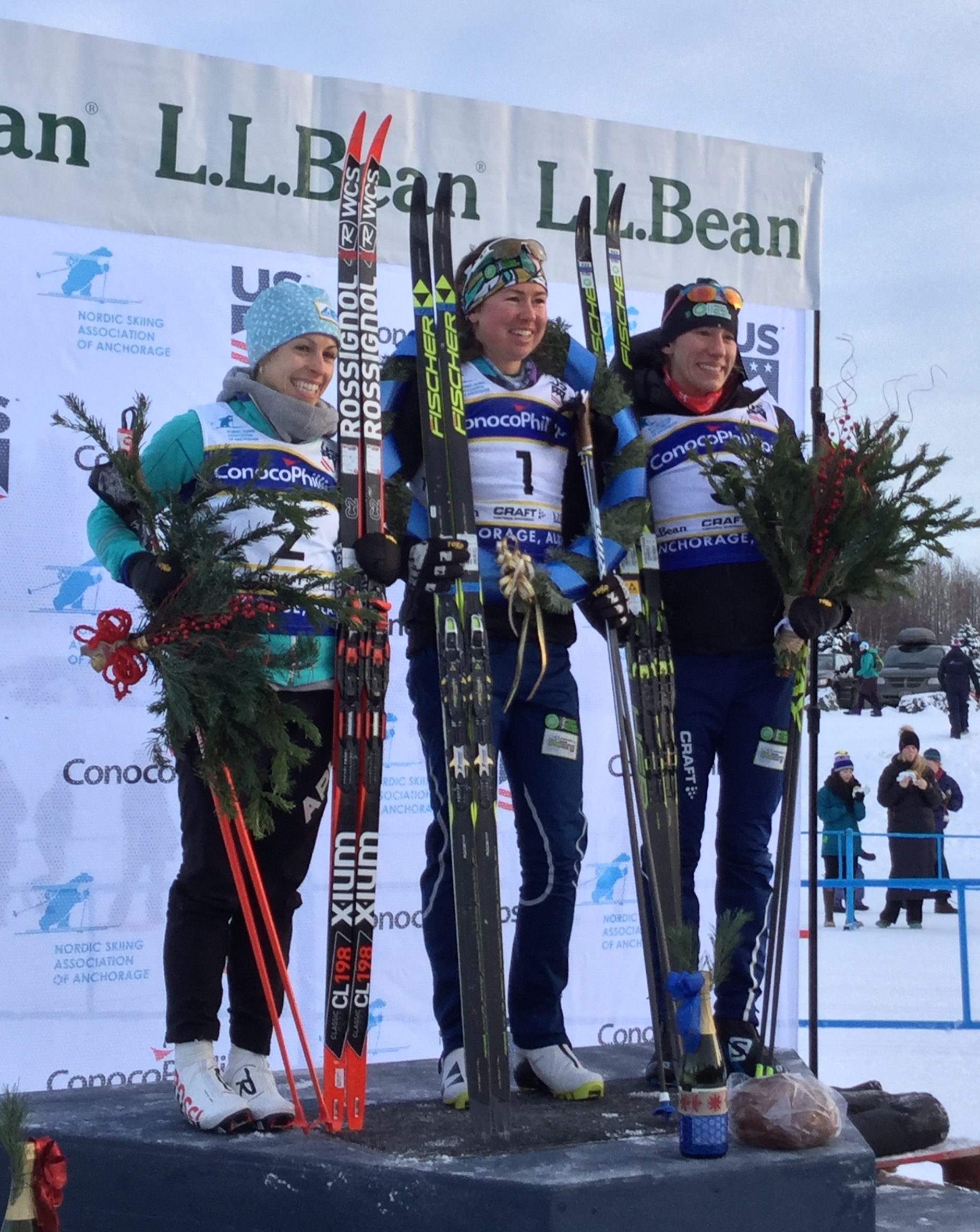
The top-three Americans in the women’s 20 k classic mass start on Sunday at 2018 U.S. nationals in Anchorage, Alaska, with Caitlin Patterson (1) of the Craftsbury Green Racing Project (CGRP) in first, Rosie Frankowski of APU (l) in second, and Kaitlynn Miller (r) of CRGP in third.
Bångman, a 22-year-old freshman at the University of Colorado Boulder (CU), pulled off a 15.9-second win in the mass start, crossing the line in 1:00:55.3 hours. Patterson, of the Craftsbury Green Racing Project (CGRP), finished second, but was the top American in the event for the third time this week, and Rosie Frankowski, of Alaska Pacific University (APU), notched third (second American), 19.6 seconds back.
Rounding out the top 10 was Jessica Yeaton, who trains with APU and races for Australia, in fourth (+44.1), Kaitlynn Miller (CGRP) as the third American in fifth overall (+1:13.5), Alayna Sonnesyn of the University of Vermont (UVM) in sixth (+1:25.3), Chelsea Holmes (APU) in seventh (+1:55.4), Norwegian CU skiers Christina Rolandson and Anne Siri Lervik in eighth (+1:55.7) and ninth (+1:56.1), respectively, and Erika Flowers of the Stratton Mountain School (SMS) Elite Team in 10th (+2:14.6).
The men’s 30 k classic mass start was incredibly close, with APU’s Tyler Kornfield taking his first-ever distance national title (he was the 2012 classic sprint national champion) in 1:21:43.6. He edged his teammate Eric Packer by 0.7 seconds at the line, and Eivind Romberg Kvaale, a sophomore at the University of Denver (DU), finished 1 seconds back in third.
Kris Freeman (Caldwell Sport) was just off the overall podium in fourth (+1.6), but was the third American. Another DU skier, Dag Frode Trollebø, also from Norway, finished fifth (+2.0), and APU had three in the top six with David Norris in sixth (+2.5). Noah Hoffman (Ski & Snowboard Club Vail) finished seventh (+2.6), Scott Patterson (APU) eighth (+3.6), and Craftsbury’s Adam Martin and Ben Lustgarten followed in ninth (+14.7) and 10th (+14.9), respectively. With Brian Gregg (CXC/LNR/Team Gregg) in 11th (+16.1), the men’s top 11 were separated by less than 17 seconds.
IBU World Cup (Oberhof, Germany): Men’s and women’s relays
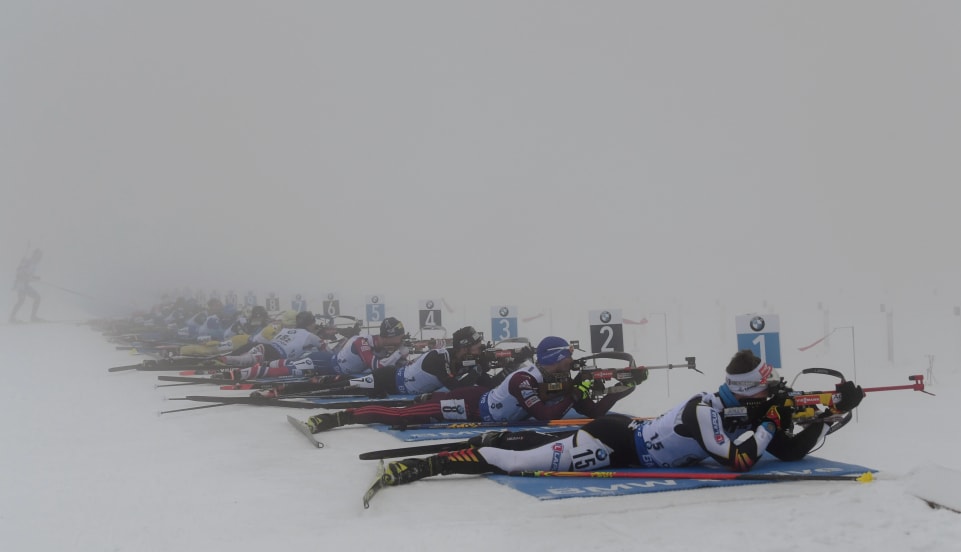
Racers on the range during the men’s 4 x 7.5 k relay on a foggy Sunday at the IBU World Cup in Oberhof, Germany. (Photo: IBU/Biathlonworld)
The Swedish men’s team and French women won the second relays of the International Biathlon Union (IBU) World Cup season on Sunday, with Sweden winning the men’s 4 x 7.5 k relay by 1:10.8 over Italy, and France besting Germany by 32.4 seconds.
Notably, most of the top teams didn’t start all of their “A” teamers.
In the men’s race, Sweden’s Martin Ponsiluoma, Jesper Nelin, Sebastian Samuelsson, and Fredrik Lindström combined for their first win together — and the first win for most of the members on the team.
“It is a dream when you are a kid to compete in a World Cup,” Samuelsson said, according to an IBU press release. “To have a win is really amazing!”
The Swedish women’s team also landed on the podium in third (+48.2).
“What a race by the whole team,” said Lindström, who also has one non-relay World Cup win (from 2012) to his name. “It could not be better.”
Conditions could not have been much more difficult for shooting on Sunday, with the fog that had descended early in the day for the women’s race worsening for the men’s race. When there wasn’t fog, there was wind.
Misses were common throughout the two races, and even with racers being able to use three spares per shooting stage to clean, there were a high number of penalty laps.
But the Swedish men kept their penalties to a minimum, with just one for the entire team and a total of nine spare rounds used among them. After Ponsiluoma came through the first exchange in sixth, Nelin skied them into third, Samuelsson picked off another place despite skiing a penalty after his standing stage to put them in second, and Lindström anchored them to first.
“The conditions today were so special. Somehow I felt not so nervous, I was calm and had luck on my side,” Lindström said at a post-race press conference about his nearly flawless shooting (0+0; 0+1).
“I have never [been first] before,” he added. “Not like this in a relay at least. That’s really fantastic.”
“I had to look up to see if I was aiming the right way,” Nelin said after cleaning prone (0+0) then using two spares to clean standing (0+2). “I had no idea where I was aiming, so it was really difficult. But I hit, and it was good. Maybe these conditions fit me and I should never see anything.”
Italy placed second with Thomas Bormolini, Lukas Hofer, Dominik Windisch, and Thierry Chenal combining for two penalties and 11 spares. Hofer had skied them up from eighth to second, and Windisch then took the lead on the third leg to put them in first at the final exchange, 1 minute ahead of Sweden. But Chenal slipped with the seventh-fastest last leg time and a penalty after standing.
“Being on the podium with the team is always a special feeling,” Hofer said at the press conference. “For Thierry, it’s the first year in the World Cup, and he does a really good job, not just today. I am really happy that he could close out this relay. Second place is like a win for us.”
Norway placed third (+2:04.6) with Vetle Sjåstad Christiansen, Henrik L’Abée-Lund, Lars Helge Birkeland, and Tarjei Bø. Together, they had three penalties (two from L’Abée-Lund and one from Birkeland) and 14 spares.
“I grew up on Holmenkollen so I practiced a lot there [in fog],” L’Abée-Lund said. “But today was really really hard, I didn’t see anything in prone. Standing was OK, but prone was really difficult.”
“It’s great to be on the podium,” Christiansen said. “Of course Norway always wants to win, but today we are very happy for our brothers in our neighbor-country Sweden.”
The Canadian men placed 10th (+6:23.1) out of 25 teams with Christian Gow, Scott Gow, Brendan Green, and Carsen Campbell having a combined six penalties and 20 spares. Three of those penalties came on Scott Gow’s second leg, two from Campbell’s anchor leg, and one on Christian Gow’s first leg.
After a penalty on his first prone stage (1+3), Christian cleaned standing with a spare (0+1) and tagged Scott in 11th, 53 seconds out of first. Scott then had two penalties in prone and three in standing, but managed to improve to eighth given how much everyone else was struggling with the shooting as well. Green kept them in eighth with two clean stages (0+2, 0+3), and Campbell, in his first World Cup relay, cleaned prone (0+2) but had two standing penalties (2+3) to put the team in 10th at the finish.
In an interview with German broadcaster ARD halfway through the race, Canadian coach Matthias Ahrens called the range conditions, which ranged from thick fog to unpredictable wind, “very hard to assess.”
“… To be honest, the good thing was that conditions were very bad,” he later added. “So regarding visibility, almost everyone was on the range at the same time [with the same irregular conditions]. They had to wait very long, and of course had bad conditions to shoot, but much of the field was there at the same time.”
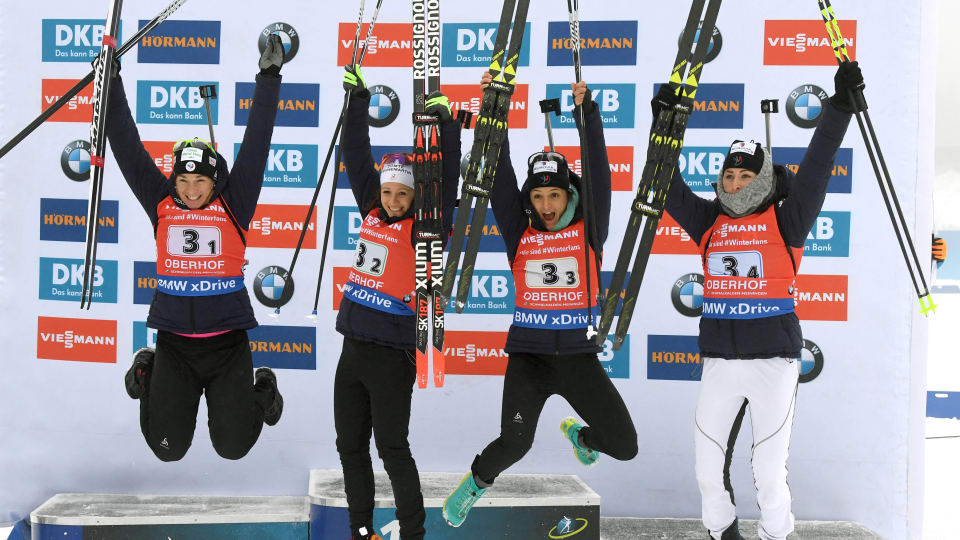
The French women’s team, of Anais Bescond, Anais Chevalier, Celia Aymonier, and Justine Braisaz, celebrate their relay victory on Sunday at the IBU World Cup in Oberhof, Germany. (Photo: IBU/Biathlonworld)
In the women’s race, with better shooting visibility, France’s Anais Bescond, Anais Chevalier, Celia Aymonier, and Justine Braisaz took the win in 1:12.42.4, with one penalty and 10 spares. After Bescond put them in first through the first exchange, 6 seconds ahead of Italy in second, Chevalier had to ski a penalty loop after prone but cleaned standings (1+3, 0+0) and tagged off in second, 23 seconds behind Italy, now in first.
One loop later, France was back in first thanks to Aymonier, who cleaned with just two spares (0+0, 0+2), and they extended their lead from 0.8 seconds at the last exchange to 32 seconds at the finish with Braisaz, who shot 0+1, 0+3, and skied the fastest anchor leg.
“I know that it’s always good for Justine to start in the first position, so I really wanted to pass the relay to her in that,” Aymonier said in a press conference after.
“I was nervous, too,” Braisaz said. “That kind of shooting turned my mind upside down, actually. The crowd was very loud, and … I wasn’t very focused on what I did. It was a bit foggy, too, so that made it harder. But finally it was a French day, maybe.”
“In my mind the whole team is really strong, and really able to get the first place,” Bescond said. “After years and years and years behind Germany’s team we finally did it. So just Oberhof spirit I think.”
Germany placed second with Vanessa Hinz, Denise Herrmann, Franziska Preuss, and Maren Hammerschmidt. They combined for two penalties and 13 spares; with a penalty on Hinz’s first leg and one more on Hammerschmidt’s last shooting. After being tagged in 14th, Herrmann skied them into fourth, 40 seconds out of first, and Preuss elevated them to second, which Hammerschmidt held onto.
“I was struggling a little bit in the prone shooting,” Herrmann said. “But the skiing was good today, and also the standing [shooting]. I tried to go fast on the track and catch some girls.”
Sweden, with Linn Persson, Anna Magnusson, Elisabeth Högberg, and Mona Brorsson, avoided the penalty loop and used eight spares to reach the podium for the first time in six seasons. In sixth place at the first exchange, they slipped one place to seventh on the second leg, but Högberg raced them up to fourth with near-perfect shooting (0+0, 0+1) with one leg to go. Brorsson then anchored them to third with clean shooting (0+2, 0+1) and the third-fastest last leg.
“It’s just super nice for us! I am super happy,” Magnusson said. “We were very emotional at the finish.”
When Brorsson was asked if she believe she could fight for the podium, she responded, “Not really. But I said to Linn, ‘Maybe it is our day today. Please let it be our day today.’ ”
The Canadian women finished 14th (+6:37.5), out of 20 teams, with two penalties and 13 spares. Sarah Beaudry initially put them in 15th after shooting 0+1, 0+2, then Julia Ransom had a standing penalty (0+2, 1+3) to slip one place to 16th. Megan Tandy picked off three places with clean shooting (0+0, 0+2) and tagged Emma Lunder in 13th, and Lunder had a penalty in prone but cleaned standing (1+3, 0+0) to finish in 14th.
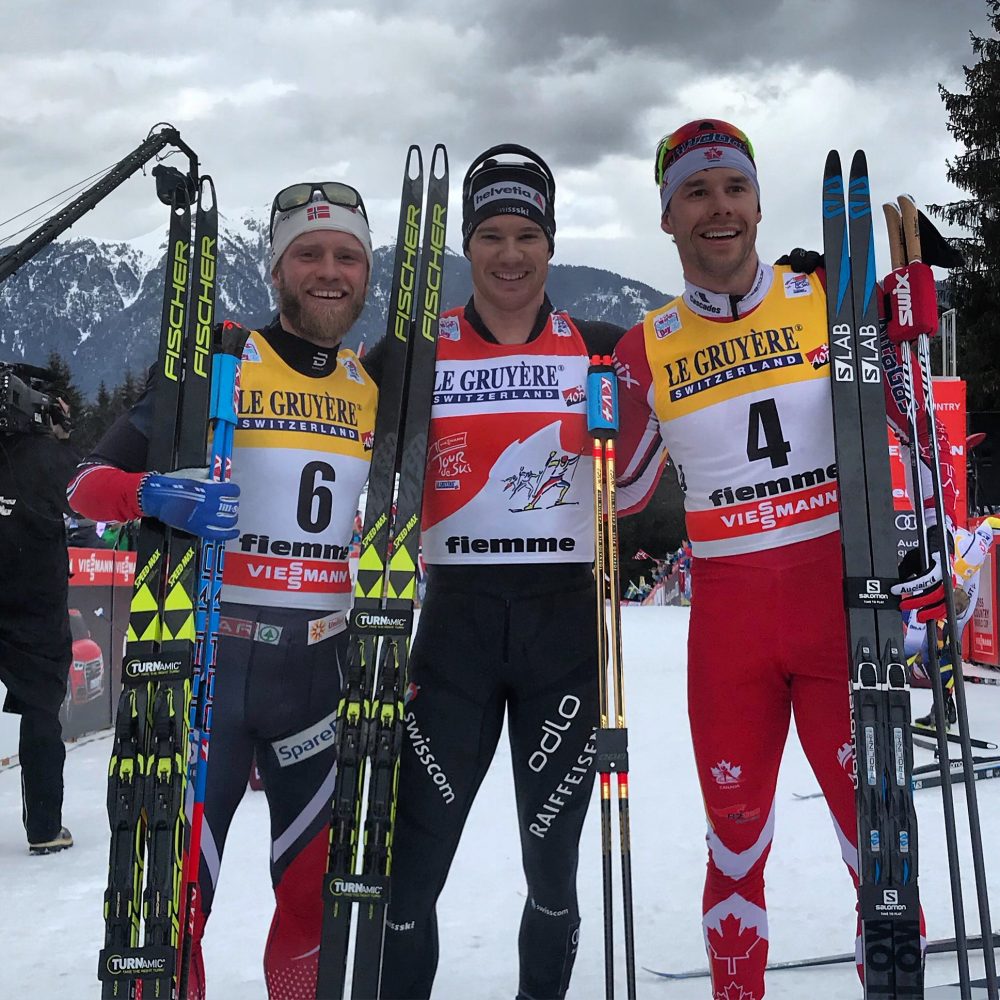
The men’s overall 2018 Tour de Ski podium atop Alpe Cermis after the final Stage 7 hill climb: with Switzerland’s Dario Cologna (c) in first, Norway’s Martin Johnsrud Sundby (l) in second and Canada’s Alex Harvey (r) in third. (Photo: FIS Cross Country/Twitter)
Dario Cologna of Switzerland added a fourth Tour de Ski (TdS) title to his list of accolades on Sunday, winning the 2018 edition of the race in dominant fashion, with a 1:26.5-minute win over Norway’s Martin Johnsrud Sundby. And Canada’s Alex Harvey scored his first TdS overall podium in third.
The 31-year-old Cologna started the 9-kilometer freestyle pursuit up Alpe Cermis 1:15 ahead of Kazakhstan’s Alexey Poltoranin in second. Russia’s Sergey Ustiugov, slated to start third, did not start due to a back injury. Thus Harvey was the third man off the start line, 1:23 behind Cologna.
(Sweden’s Marcus Hellner, 13th after Saturday’s Stage 6, also did not start the Tour’s final stage.)
Early on, Cologna started putting time into his competitors, extending his lead on Poltoranin to 1:20.5 and Harvey to 1:24 at 1.8 k.
By 4 k, however, Harvey had used his speedy skiing on the flatter portions of the race leading up to the climb to catch Poltoranin, and the two clocked through that checkpoint 1:19.4 behind Cologna. Behind them, Russia’s Alexander Bolshunov skied just ahead of Sundby, another 21 seconds and 22 seconds back, respectively, in fifth and sixth.
While Harvey clawed back a few more seconds on Cologna, he was still 1:17.8 back at 6.2 k, with Poltoranin just 0.7 seconds behind him in third.
Harvey remained in second until around 8.5 k; with just a half kilometer to go, Sundby had caught both Poltoranin and Harvey, passing them both. Sundby held that position and finished second, 1:26.5 behind Cologna, who won in 28:52.1.
Harvey stayed strong for third (+1:30.6) while Poltoranin dropped off the Canadian’s pace in the final half kilometer and finished fourth (+1:41.7). Norway’s Hans Christer Holund placed fifth (+2:17.8), Bolshunov lost a spot to finish sixth (+3:09.7), France’s Jean-Marc Gaillard finished seventh (+3:16.7), Sweden’s Daniel Rickardsson eighth (+3:20.8), and Russia’s Alexey Chervotkin and Andrey Larkov took ninth (+3:33.5) and 10th (+3:37.8), respectively.
France’s Maurice Manificat, known for his strength in freestyle hill climbs and pursuit races, rose from 14th to 11th (+3:45.7) with the second fastest time of day, 12.8 seconds slower than Sundby as the time of day winner in 28:36.4. Cologna’s time was fourth fastest (+15.7), behind Russian U23 skier Denis Spitsov in third (+14.3) (Spitsov started 20th and finished 13th). Holund’s time ranked fifth (+20.6) and Harvey’s time was sixth fastest (+23.6) of the 43 men that finished the race.
The lone American man to complete this year’s Tour, Paddy Caldwell (U.S. Ski Team) skied the 22nd fastest time of day for 38th overall (+11:54.8).
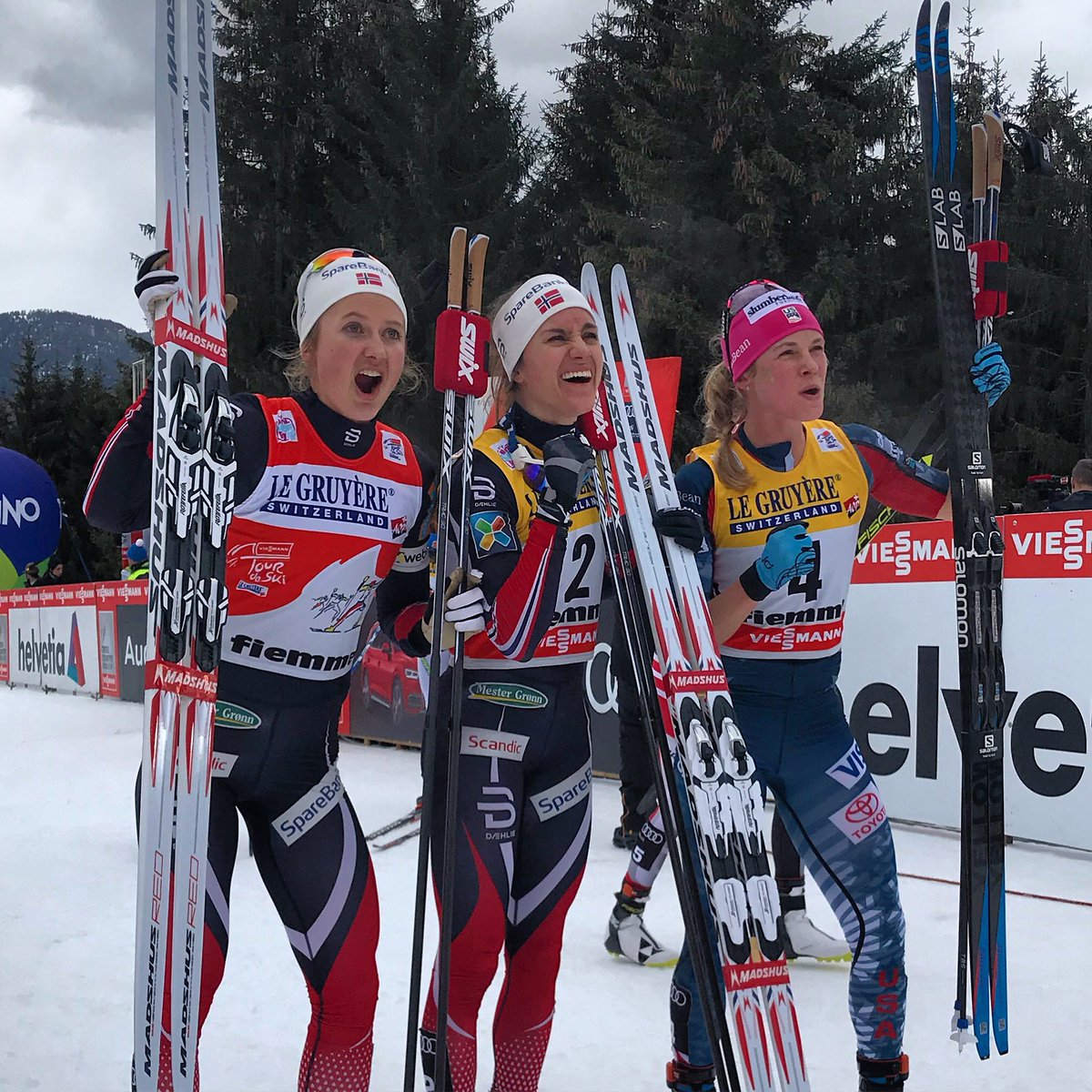
Heidi Weng (center) celebrates her second Tour de Ski victory, with teammate Ingvild Flugstad Østberg second and the U.S. Ski Team’s Jessie Diggins third. (Photo: FIS Cross Country/Twitter)
In the women’s hill climb that kicked off the day, Heidi Weng raced to her second consecutive TdS title. The Norwegian started the day within two seconds of teammate Ingvild Flugstad Østberg, and the two skied together for the flat section of the nine-kilometer stage of the competition. But when the climbing got steep on Alpe Cermis, Weng left her teammate behind and eventually racked up a 48.5-second win.
The battle for third was less predictable. Jessie Diggins of the United States started the day in fourth, but made up the ten seconds to third-place KristaPärmäkoski of Finland in the first few kilometers. The pair climbed together for a while before Diggins attacked. Pärmäkoski tired on the final sections of the Alpe Cermis and Diggins took the podium in definitive style, 2:23.2 behind Weng and 24 seconds ahead of Pärmäkoski. It’s the first overall Tour de Ski podium for Diggins or any American athlete.
Teresa Stadlober of Austria finished fifth (+3:09.4), Kerttu Niskanen of Finland sixth (+4:17.0), Russia’s Anastasia Sedova seventh (+4:49.6), and Switzerland’s Nathalie von Siebenthal eighth (+4:56.1).
Sadie Bjornsen started eighth and slipped one spot to finish ninth (+6:15.0), giving the U.S. two top-ten finishers in the Tour de Ski for the first time. Liz Stephen finished 16th (+8:25.8) and Rosie Brennan 24th (+10:59.6).
En route to her win, Weng notched the fastest time of the day on the 9 k stage. Stadlober’s time was second, Diggins third, Østberg fourth, and Stephen fifth.
32 women finished this year’s edition of the Tour de Ski.
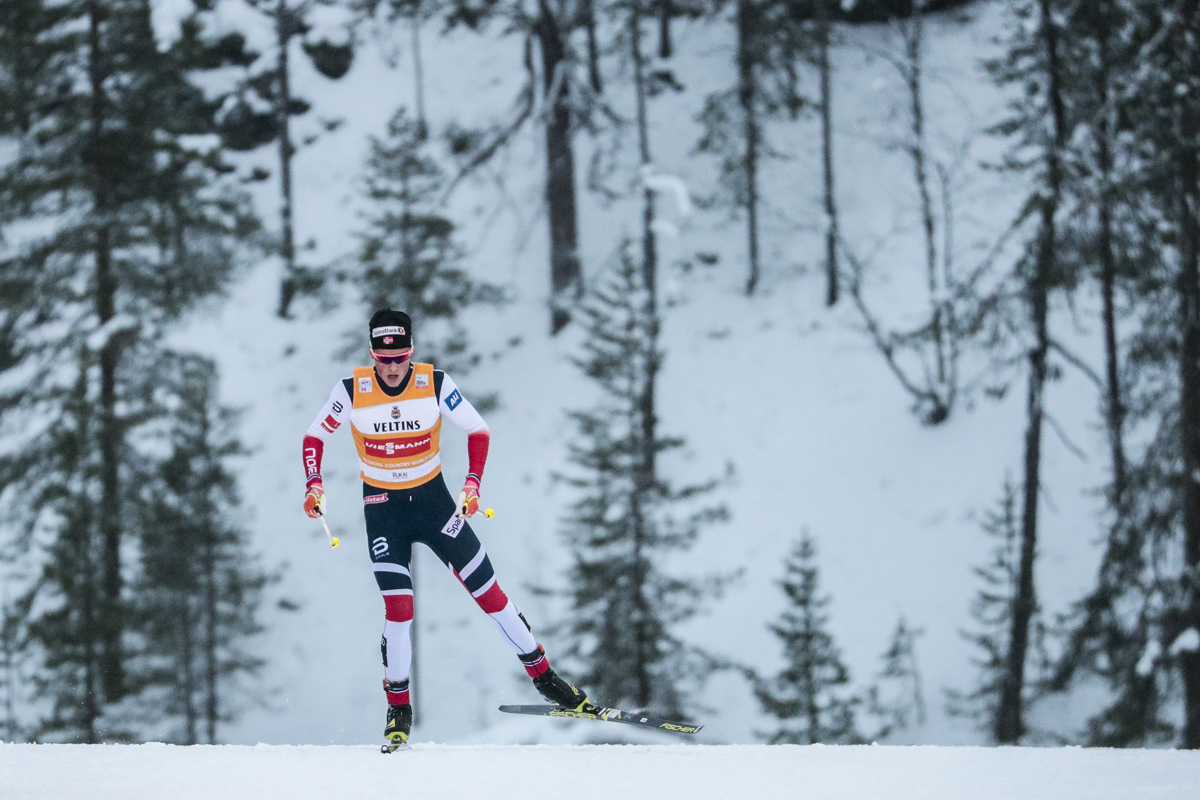
Norway’s Johannes Høsflot Klæbo en route to his third-straight win in as many days of the World-Cup-opening Ruka Triple in Kuusamo, Finland. He won the 15 k freestyle pursuit for the mini-tour title. (Photo: Fischer/Nordic Focus)
Two previous days of racing, and back-to-back victories no less, had begun to take its toll on Johannes Høsflot Klæbo within the first few laps of the men’s 15-kilometer freestyle pursuit on Sunday in Kuusamo, Finland. The 21-year-old Norwegian could feel it throughout his body; he was tired and 38 seconds of a starting cushion wasn’t going to be enough to hold off the hungry challengers behind him.
Klæbo, who won Friday’s classic sprint and Saturday’s 15 k classic individual start on the World Cup opening weekend, wasn’t invincible and he couldn’t race to another win alone. Halfway through the pursuit, the man who started in second place, 38 seconds after him, Russia’s Alexander Bolshunov (who’s actually younger than Klæbo at age 20), had cut that deficit to 19.8 seconds. After him, Norway’s Martin Johnsrud Sundby, who started 10th and 1:05 minutes behind Klæbo, was up to third and just 25.3 seconds back.
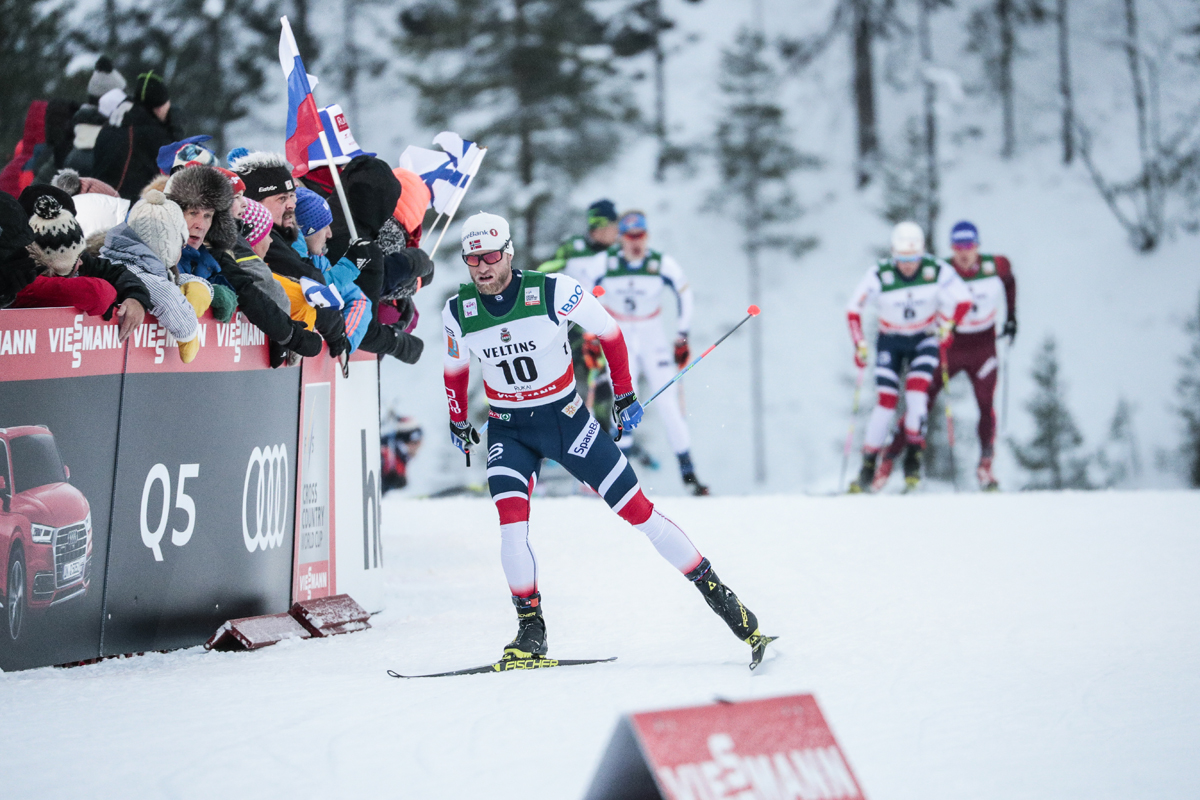
Norway’s Martin Johnsrud Sundby, who started 10th in the 15 k freestyle pursuit on Sunday, picking off the places on the final day of the Ruka Triple World Cup mini tour in Kuusamo, Finland. (Photo: Fischer/Nordic Focus)
On his fourth lap, Klæbo accepted the inevitable as Bolshunov and Sundby, who had linked up in an effort to catch him, in fact caught him on a climb around 8.6 k. A larger group of pursuers, including Canada’s Alex Harvey, locked on to the three leaders as well, and from there, the race truly began to take form. Klæbo had to recover, Sundby had to figure out how to try to drop him, Bolshunov had to see what he was capable of, and Harvey had to see how much he could give in the third race of the season.
The first races of each winter aren’t easy for anyone. Despite spending the summer training for skiing, most North American World Cup skiers don’t get the opportunity to actually race — even on rollerskis — too often during the offseason. Because of the rich ski culture in Europe, rollerski races are a big deal with lots of summer and fall competitions to chose from. And because of Europe’s geography, it’s often easier to get on snow than it is for North Americans.
(“I think this applies to all the North American actually, compared to Europeans we don’t race as much in summer,” Canadian World Cup coach Ivan Babikov said on the phone on Sunday. “They have races every weekend so they come into the season pretty sharp already with some good speed workouts, when we don’t have that opportunity. So that’s why, I think, every race is a step forward. It’s just, you have to remember or remind yourself how hard it is.”)
So while Canadians and American World Cup skiers alike often look at an opening weekend like Finland’s Ruka Triple mini tour as a “chance to blow the cobwebs out” or “shake off the rust”, as some have said, it’s also an opportunity to see where you stand — as was the case for Harvey in the final meters of Sunday’s pursuit.
Later in the fourth of six laps, Klæbo pushed the tempo up a climb, Bolshunov responded, and Harvey went with them. Soon after at 10 k, they lapped through the stadium with 11 men within 2.7 seconds of first. Up front, Bolshunov led Harvey, who had started the race 1:23 back in 12th.
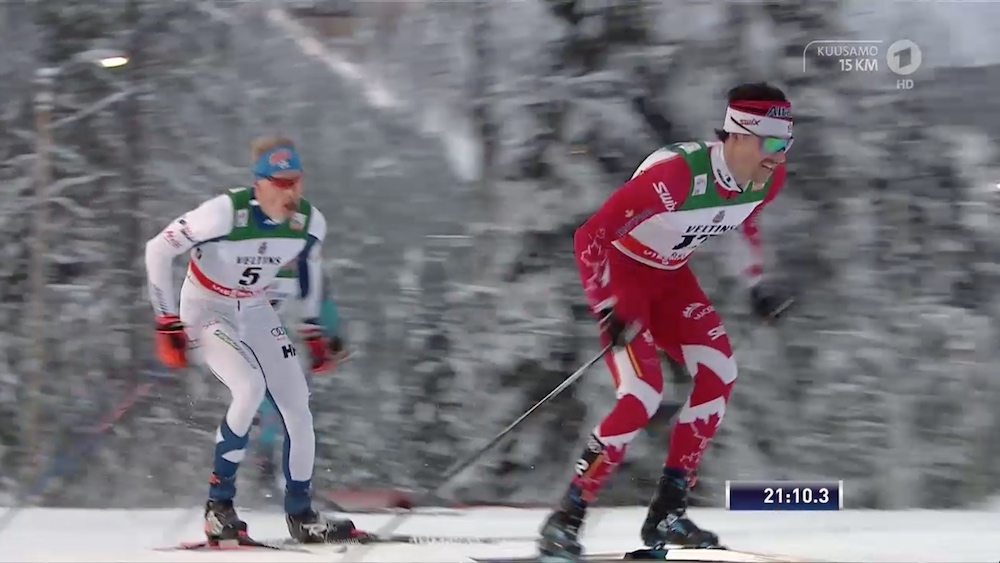
Canadian World Cup Team member Alex Harvey leads Finland’s Iivo Niskanen during the men’s 15 k freestyle pursuit on Sunday, the final day of the Ruka Triple mini tour in Kuusamo, Finland. (Screenshot: ARD)
Harvey had spent the first three laps working up to that lead group, initially with the likes of Russia’s Alexey Chervotkin (*who reportedly thanked Harvey after the race) and Sergey Ustiugov, Norway’s Hans Christer Holund and Sweden’s Marcus Hellner, and later with France’s Maurice Manificat, Sweden’s Calle Halfvarsson, Norway’s Emil Iversen, Chervotkin, and Holund, among others.
“I knew there’d be some fireworks on the last lap so I just wanted to be in the front third of the group, just be ready for a move,” Harvey explained in a post-race phone interview. “I thought Sundby would be the guy making the move, which in the end, that’s what happened. The big uphill in the last lap, that’s where he went. I just wanted to be close to Sundby and ready to respond when Sundby went.”
Sundby attacked as predicted on the second-to-last climb, around 13.6 k, and Harvey slotted behind him to follow him over the top.
“I was just actually there on that last uphill when Sundby attacked,” Babikov recalled. “Klæbo was right there. I think there were just Norwegian tactics … Sundby attacked on the last uphill and Klæbo just cooled down and wasn’t chasing him at all, so for Alex, that was his only chance. … If he didn’t chase him, then Sundby probably would have skied away and it would have been a bigger group at the finish, but at the moment he tried, and they actually created a gap … Alex second and Sundby first.”
With a few meters separating them from Norway’s Didrik Tønseth in third and Klæbo in fourth, Harvey thought he and Sundby had dropped them and that he would fight for first to the finish.
“I kind of went all-in with the Sundby move,” Harvey said. “When I looked in between my legs just before the last downhill I thought we had a big enough gap … so I was feeling pretty good about my chances there, but not good about taking [Sundby] because I was really, really dead.”
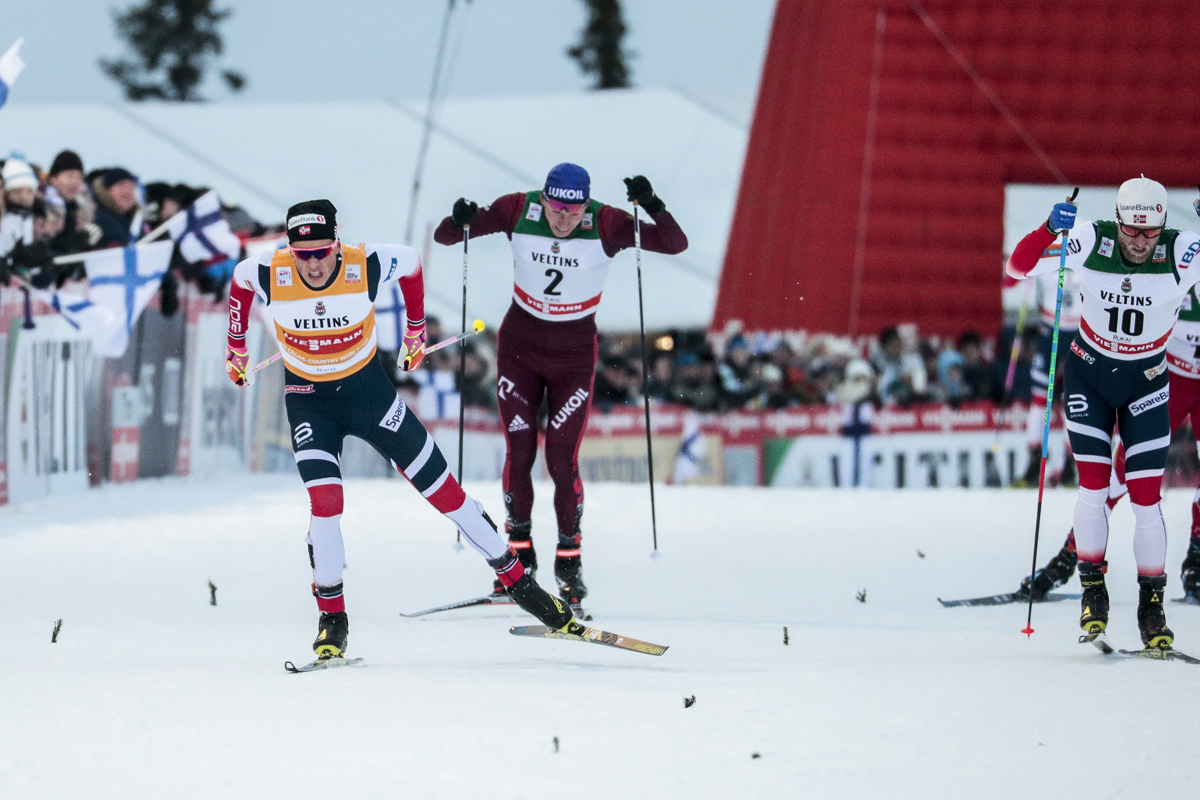
Johannes Høsflot Klæbo (l) passing fellow Norwegian World Cup Team member Martin Johnsrud Sundby (10) for the win in Sunday’s 15 k freestyle pursuit at the Ruka Triple mini tour in Kuusamo, Finland. Russia’s Alexander Bolshunov (2) was 1 second back in third place for his first World Cup podium while Canada’s Alex Harvey (behind Sundby) placed fourth. (Photo: Fischer/Nordic Focus)
After what Harvey estimated to be a 45-second downhill, he realized that wasn’t the case. Klæbo and Bolshunov had slingshot back toward the front, and while Sundby was first to the top of the last climb before the finish, Klæbo and Bolshunov were right behind him while Harvey followed in fourth.
They entered the stadium together in that order, and Klæbo passed Sundby with about 100 meters remaining to take his third-straight win of the weekend.
“Coming out of my tuck there I was just full of lactate, not feeling any fresher … then I just got passed on the hill,” Harvey recalled. “I had nothing left. That was my move. … I’m happy I made that move, but I couldn’t make a second burst after that.”
While Klæbo won the pursuit and with it, the Ruka Triple mini-tour title in 36:23.2 minutes, Sundby placed second, 0.4 seconds back, Bolshunov claimed his first World Cup podium in third (+1.0), and Harvey finished another 0.6 seconds back in fourth (+1.6).
On the day, Harvey’s course time ranked fifth fastest behind Manificat, who was the “winner of the day” in 34:50.9. Finland’s Matti Heikkinen was second fastest (+5.4) after starting 22nd and placing 14th, Holund was third fastest (+7.5) after starting 14th and finishing ninth, and Switzerland’s Dario Cologna, who started 26th and finished 17th, was fourth fastest (+8.7).
Harvey said starting 17 seconds behind Sundby was a tall task on its own, and he had started the race with a goal of breaking into the top 10 overall. All things considered, fourth place was better than he expected at this point in the season.
“… But I knew it was still within reach,” Harvey explained. “I believed in it, but I didn’t put too much hope in, let’s say, a top five or fighting for the podium. It was more like I wanted to be back in the top 10 and just that to me seemed already hard enough.”
Norway’s Johannes Høsflot Klæbo after winning the 15 k freestyle pursuit on Sunday to win the Ruka Triple mini tour in Kuusamo, Finland. (Photo: Fischer/Nordic Focus)
The fact that he was able to hang with Klæbo and Sundby to the finish was a good sign, he added.
“Right now, he’s not just a good sprinter, he’s the best distance skier in the world, too,” Harvey said of Klæbo. “I mean, to win a 15 k individual you have to be in very, very good physical shape, so he’s in really good physical shape and I know I’m not yet. I’m not in my best form and Sundby probably isn’t yet, so you never know what’s going to happen later in the season at the Olympics, but for now it’s hard to drop him when he’s actually just in better shape than everybody else in the world.”
After the race, Klæbo told NRK he was relieved to get the win and have some time to rest before next weekend’s World Cup in Lillehammer, Norway.
“My legs are shaking now,” Klæbo said. “Feels incredible to be the first to cross the finish line. Now I need a few days rest.
“This was brutal,” he added. “I’m actually glad they caught up to me and luckily I had good skis. I’m glad I had a few seconds today.”
Norwegian national-team coach Tor-Arne Hetland told NRK he was “really impressed” with Klæbo. “We have a diamond in the sport of cross country skiing now,” Hetland said.
“That’s very nice of him to say. It’s probably a little too much, but it has been a good start to the season,” Klæbo responded to NRK.
Sundby spoke excitedly about having Klæbo to contest for the overall World Cup lead.
“For the moment, he’s taking international cross-country skiing for men to a whole ’nother level,” Sundby told NRK. “It is a little humiliating for the rest of us, but at the same time it’s extremely inspiring to see what he does in his second year at this level. It’s hell of fun to have a guy like that on the team.”
Bjornsen 26th, Kershaw 29th; Caldwell Posts Top-20 Time of Day
Canada had two in the top 30 on Sunday with Devon Kershaw in 29th (+1:47.8), scoring World Cup points for the second-straight day. He started 28th and 1:59 out of first, just one second behind Cologna in 26th and Russia’s Andrey Larkov in 27th.
“I just wasn’t strong enough to go with Dario,” Kershaw said on the phone. “I had the perfect chance to be able to follow Dario up the field, but he just started so fast, and on the steep terrain, my legs just — I tried up the first steep wall and at the top, I’m like, man, if I keep going like this, after 5 k I’m gonna be dead.
Canada’s Devon Kershaw (28) leads American Erik Bjornsen (23) and others during the World Cup men’s 15 k freestyle pursuit on Sunday in Kuusamo, Finland. (Photo: Fischer/Nordic Focus)
“So I had to manage my energy a little bit and in the end, it turned out that Bjornsen and I’s group just wasn’t strong enough,” Kershaw continued, referring to U.S. Ski Team member Erik Bjornsen, whom he started eight seconds behind and spent most of the race with. “[Our group] had a good 7 1/2 k and then after that, between 7 1/2 kilometers and 12 k, we were skiing really slow. So that’s a bit frustrating in a pursuit because you’re just stuck there in no-man’s land.”
While he felt like he was skiing the flats well, Kershaw said he struggled with the “biting” conditions, which seemed to limit glide, especially on the notoriously steep course’s climbs.
“I had to make the choice to be like, OK, I’ve got to just stay in this group and I’m not strong enough to drive the bus, because my legs just weren’t there today on the terrain” he said. “In the end I made a tactical error in the last 600 meters. I should’ve followed Bjornsen on the outside and I went on the inside and was hoping it would open up for me and it didn’t. So I ended up 29th, but that’s OK.”
Bjornsen started 24th and finished the pursuit in 26th (+1:43.6), after following Larkov in 25th (+1:42.8) across the line and holding off Iceland’s Snorri Einarsson (a former Norwegian skier who raced for the University of Utah) in 27th (+1:46.2), Great Britain’s Andrew Musgrave in 28th (+1:47.2), Kershaw in 29th, and France’s Jean-Marc Gaillard in 30th (+1:49.2).
“I started right around Cologna and [Finland’s Matti] Heikkinen but there was no way I was going to hold their pace, they were flying,” Bjornsen wrote in an email. “I had to settle in with the group around me. It soon became clear our group was not going to catch anyone in front of us or get caught, so it became a tactical game. Some surges, but for the most part nobody wanted to lead.”
Devon Kershaw (Canadian World Cup Team) en route to 29th in the 15 k freestyle pursuit on the last day of the Ruka Triple World Cup mini tour in Kuusamo, Finland. (Photo: Fischer/Nordic Focus)
Kershaw laughed when he talked about some “tips” he gave Bjornsen during the race.
“He had really fast skis so there were a few times that he came by me on the downhill and then would kind of try to hammer for a minute and then get tired and slow down again,” Kershaw said. “I told him, like, ‘Dude, you’ve got great skis. Unless you can stay in the front and really press, then it’s better just to play the game and wait for the end.’ After that, he did that and he torched us all in the end. So that was kind of fun to see for him.”
According to Bjornsen, Kershaw suggested he sit back and wait for the sprint.
“My skis were good but I think my weight is what helped me the most on that last huge downhill,” Bjornsen wrote. “I was fine going for that tactic but at the same time it would have been nice to leave a little more out there today. Stoked to get double points for 26th though!”
Paddy Caldwell (U.S. Ski Team) racing to 70th in the men’s 15 k classic on Saturday, Day of the Ruka Triple World Cup mini tour in Kuusamo, Finland. In Sunday’s 15 k freestyle pursuit, he skied up to 51st with the 19th-fastest time of day. (Photo: Fischer/Nordic Focus)
Paddy Caldwell, new to the U.S. Ski Team B-team this year, posted his best World Cup result with the 19th-fastest time of day, 50.5 seconds back from Manificat. He started with the wave in 70th and finished 51st overall (+3:03.1).
“Going into the race my goal was to move up as much as possible,” the 23-year-old Caldwell wrote in an email. “I wasn’t really thinking about place or time of day – I was just trying to ski fast and put together a good effort.
“It was really hard to move up in the pack,” he added. “I started midway back in the wave and we kept picking up more and more skiers as the race went on. I tried to relax as much as possible on the hills and build in energy to pass where I could on the flats. … I am really excited with the day and psyched to have had a good result here in Ruka. I’m looking forward to the rest of period 1 and learning more from the big dogs!”
“Very exciting race out of Erik today,” U.S. Ski Team coach Matt Whitcomb commented on the phone. “… When he settled to the back of his pack on Lap 6 and headed into the downhill with one climb to go, we just all sort of expressed confidence over the U.S. radio channel, got ready see what he could do. It is so fun to watch him in a stadium when he has to go head to head against five other athletes … he did not disappoint today. Really proud of Erik’s 26th place.”
As for Caldwell, who skied the 25th fastest time of day in the 2017 World Cup Finals freestyle pursuit, Whitcomb said, “this is his race, the skate distance.”
“There were times that he was a little bit road-blocked out there, just the way the pursuit race unfolds in that start … and it looked like today Paddy could keep going, so really great signs out of him,” Whitcomb said.
Whitcomb also highlighted the races of Scott Patterson, who raced up from 78th to 55th (+3:28.4) with the 31st-fastest time, and Noah Hoffman, who improved from 45th to 39th (+2.33.3) with the 35th-fastest time. Also for the U.S., Andy Newell finished the tour out in 75th (+5:39.6).
American Paddy Caldwell (70) racing with Sweden’s Jens Burman (front) and Canada’s Len Valjas (46), among others, during Sunday’s World Cup 15 k freestyle pursuit on the last day of the Ruka Triple in Kuusamo, Finland. (Photo: Fischer/Nordic Focus)
Canada’s Len Valjas moved up two places for 44th overall (+2:47.5), Graeme Killick finished the tour in 68th (+4:39.5), Knute Johnsgaard 81st (+6:43.6), and Julien Locke 83rd (+7:33.6).
Babikov pointed out that Valjas had a shoulder injury that he mostly recovered from, but caused him to struggle with double poling in Friday’s sprint. Despite placing 63rd in that sprint, Valjas was the team’s third-best man in the weekend’s distance races.
“[In] two distance races, he was third best and actually placed higher than he placed in sprint in the distance, 15 k, hardest one with lots of climbing,” Babikov said. “So that shows he has a good shape, but just needs to scrape that rust off and remember how to go fast again. I think physically he is in a good place, just need to do some more races, and it will come.”
***
*Post-race sidenote: According to Harvey, after the race, the Russian team’s massage therapist told Canadian coach Ivan Babikov that Chervotkin wanted to thank Harvey for pulling him in the pursuit. Chervotkin, 22, started 11th and finished fifth, 6.2 seconds out of first and 4.6 seconds after Harvey in fourth.
“There’s a bit of beef with the Russians and me right now,” Harvey said. “I came in wondering if they were just going to punch me in the face. They said they wanted to break my teeth, so this is a good turn of things.”
“I read that in the Norwegian news, actually, that Petukhov wanted to …,” he said with a laugh. “But I knew the media likes that sort of thing. But I think things are good now.”
Harvey noted that Bolshunov and Chervotkin, neither of which have been implicated in the doping scandal, are part of “a new generation” in Russian cross-country skiing. “I saw the results in Bruksvallarna; it looks like the have almost as much depth as Norway does. They’re really strong.”
— Aleks Tangen, Ian Tovell, Jason Albert, and Harald Zimmer contributed
Racers in the Ruka Triple World Cup 15 k freestyle pursuit, including Russia’s Andrey Larkov, Switzerland’s Jonas Baumann, Italy’s Federico Pellegrino, Switzerland’s Dario Cologna, and Norway’s Simen Hegstad Krueger, ascend a climb in Kuusamo, Finland. (Photo: Fischer/Nordic Focus)
France’s Maurice Manificat celebrates his “time of day” victory in Stage 7 of the 2017 Tour de Ski, with the fastest time in the 9 k freestyle hill climb in Val di Fiemme, Italy. (Photo: Salomon/Nordic Focus)
Welcome to World Cup Windup, where we check in with the top-10 teams from last year’s FIS Cross Country World Cup tour before the season starts with the Ruka Triple in Kuusamo, Finland, on Nov. 24.
FRANCE
Overall in Nations Cup Last Year:Eighth
Women’s Ranking 2016/2017:15th
Men’s Ranking 2016/2017: Fifth
Who’s Back:
France’s Baptiste Gros leads teammate Richard Jouve in their semifinal of the freestyle sprint at the Ski Tour Canada in Quebec City in 2016.(Photo: John Lazenby/Lazenbyphoto.com)
Maurice Manificat, the fastest man up the Tour de Ski final climb last season, and a World Cup race winner previous seasons as well; Lucas Chanavat, a finalist in several World Cup sprints and third in the U23 standings; Richard Jouve, third in the sprint at World Cup finals and fifth in the U23 standings; the World Cup podium relay team of Manificat, Jean Marc Gaillard, Clement Parisse, and Alexis Jeannerod, as well as Robin Duvillard, a member of the World Championships relay team and the 2014 Olympic bronze-medal relay team (soon to be silver), and Baptiste Gros, who won a World Cup in 2016.
Who’s Missing:
A women’s team. Not a single French woman scored World Cup points in the 2016/2017 season. France didn’t even send a women’s team to 2017 World Championships. That’s right, there were no French representatives in the cross-country ski races at World Championships. French women competed at only two few World Cups: the home races in La Clusaz and the sprints in Toblach, Italy.
Pre-Season Results:
Lucas Chanavat of France had the fastest men’s qualifying time in the Davos World Cup freestyle sprint in 2017.
In early November, Lucas Chanavat won both the qualifier and final in a King’s Court style sprint in Davos, besting Italy’s Federico Pellegrino among others; Richard Jouve and Alexis Jeannerod were second and third, and Aurore Jean won a lightly-attended women’s race.
More recently, the French attended FIS races in Saariselka, Finland, where Maurice Manificat tore it up, winning the 10 k classic and, in a surprise, also winning the classic sprint ahead of his sprint-specialist teammates.
Recent Drama:
In the year or so after the 2014 Olympics, where the French women finished fourth in the relay, the women’s program lost its best skiers. Three started families, and Celia Aymonier became a biathlete (she now has several World Cup top-tens and a World Championships bronze medal in the relay).
For two seasons, the French women were nearly completely absent from the World Cup, but that may change this year, in part because the Olympics always bring out efforts to get each country represented. The three new moms are back training: Coraline Thomas-Hugue, Aurore Jean, and Anouk Faivre-Picon, who in the meantime won some big Worldloppet races like the Engadin Ski Marathon. Several younger skiers are also joining them. It’s not straight into the thick of things; the team will do some FIS racing throughout the season. There is the possibility of a few participating in the World Cup sprint in Ruka, Finland, but none will go to Lillehammer and instead a group will focus on competing at the third World Cup in Davos, Switzerland.
Aurore Jean racing in Davos in 2014.
“The atmosphere in the group is very good and it’s nice to see positive girls and a team in training,” coach Alexandre Rousselet told ski-nordique. “We will have a quota of four girls each [World Cup] but they will not be filled. We are waiting for the girls to have encouraging results at OPA Cup and FIS events before they register… We will first work on this 10 k skating goal. to try one or more qualifications for the 2018 Olympics. The relay and the other races would be a bonus… The Olympics are in their heads but for the moment, at this stage of the winter, it is still far away.”
(And yes, he refers to them as “les filles” rather than “femmes” or “dames”.)
In Saariselka, the women showed their stuff: Coraline Thomas Hugue won the 10 k skate over Anna Shevchenko of Ukraine, with Aurore Jean third, Poland’s Justyna Kowalczyk fourth, and Anouk Faivre Picon fifth. They did not fare as well in the classic technique, with Jean leading the group in fifth in the 5 k classic and Delphine Claudel finishing seventh in the classic sprint, where none of the team made the final.
Best Social Media Presence:
This year’s “One of Those Nordic Days” videos has been posted, featuring skiers acting silly and doing stunts on skis. It is made by Team Valoche and former biathlete Alexis Boeuf, and features many national team members as well as biathletes Martin and Simon Fourcade, the Italian women’s biathlon team, and alpine skiers Julien Lizeroux and Tessa Worley.
Maurice Manificat is fairly prolific on Twitter, posting content from his own Instagram and Facebook pages as well as re-tweeting content from other French sports personalities and engaging in conversation. His handle is a good way to keep track of what’s going on in nordic sport in France.
Richard Jouve posts beautiful photos of wherever he happens to be, both on his Twitter account and on Instagram.
And Lucas Chanavat also posts crisp photos of training and racing, and also shots of him upside down in different places.
For the day-to-day-to-day of training with the French team, follow Robin Duvillard.
And Anouk Faivre Picon is among those documenting life as a high-performance mom.
France’s Maurice Manificat racing in the men’s 15 k classic pursuit at the final stage of the 2017 Ski Tour Canada. (Photo: Peggy Hung)
There were plenty of options this Friday, Saturday, and Sunday for cross-country skiers looking to get an International Ski Federation (FIS) race in before the official start of the World Cup season, now less than one week away. While some athletes headed to Beitostølen, Norway and others Gällivare, Sweden, about 120 made their way to Saariselkä, Finland.
This included several French skiers, including Maurice Manificat,Jean-Marc Gaillard, Coraline Thomas Hugue, and Anouk Faivre Picon. Those who made the trek to Finland were greeted by high humidity and temperatures in the mid-teens Fahrenheit on Friday, as well as the softer solarlight distinct to Northern Scandinavia.
“Polar sun wake up the day of competition in Saariselka. So much pleasure here” the 31-year-old Manificat captioned an Instagram photo of Saariselkä’s sunrise prior to Friday’s opening men’s 10-kilometer classic race.
The sun’s golden sunrise on Friday served as an auspicious omen for the remainder of Manificat’s morning, as well as his fellow Frenchmen. All three podium spots in that race went to France, with Manificat taking the win in a time of 26:11.9. His teammates Gaillard and Alexis Jeannerod finished second (+31.8) and third (+44.7), respectively.
Another French athlete, Clement Parisse finished in fourth (+48.2), while Bulgarian skier Veselin Tsinzov ended the French streak in fifth place (+50.6).
In the women’s 5 k classic, Austrian Teresa Stadlober won in a time of 16:13.8, beating Poland’s Justyna Kowalczyk in second by 31.9 seconds.
Kazakhstan’s Anna Shevchenko edged Belarusian Polina Seronosova by one tenth of a second for third (+47.3) while Seronosova took fourth (+47.4). France’s Thomas Hugue rounded out the top five in fifth (+56.5).
Another sunrise on Saturday brought with it 1 k classic sprints for both the men and women. Temperatures crept up into the mid-20s during the day, though humidity remained high, stabilizing around 90 to 95 percent. Stadlober won the qualifier in a time of 3:46.01, while France’s 21-year-old Delphine Claudel took second (+2.62). The third-fastest qualifier (+3.83) was Slovenia’s Anamarija Lampic.
In the men’s qualifier, France once again raced to the top, this time with Lucas Chanavat leading the way in a time of 3:53.16. Finishing 0.12 seconds behind Chanavat was Belarus’s Aliaksandr Voranau in second. Mikhail Kuklin, also of Belarus, posted the third fastest qualifying time, 2.65 seconds behind Chanavat.
By the time the men’s final rolled around, the sun had disappeared and the fluorescent glow from lights along the course were the main source of illumination through the hazy, humid air. In the final were Chanavat and Manificat, as well as their French teammate Richard Jouve, along with Voranau, Slovenia’s Miha Simenc and Kazakhstan’s Nikolay Chebotko.
Manificat and Jouve pushed the pace from the start and the two Frenchmen led the group through to the finish, where they placed first and second, respectively. Rounding out the podium was Chanavat in third. Crossing in fourth was Simenc, followed by Voranau in fifth, and Chebotko in sixth.
In the women’s sprint final, Kowalczyk finished first, followed by Lampic in second and Stadlober in third. Belarusians Polina Kirillova and Anastasia Kirillova placed fourth and fifth, respectively, and Slovenia’s Alenka Cebasek finished sixth.
Sunday saw the third and final day of FIS racing in Saariselkä, with men’s 15 k and a women’s 10 k freestyle individual starts.
Thomas Hugue raced to a convincing win in the 10 k, with her time of 27:35.0 exactly 49 seconds ahead of the next-closest finisher: Shevchenko. Snagging the last podium spot was France’s Aurore Jean in third (+52.0).
Missing the podium by 2 seconds was Kowalczyk in fourth (+54.0), while France’s Faivre Picon finished another 2 seconds back in fifth (+58.0).
Rounding out the rest of the top 10 was Ukraine’s Kateryna Serdiuk in sixth (1:04.0), Cebasek in seventh (1:06.0), Kazakhstan’s Valeriya Tyuleneva in eighth (+1:13.0), Ukraine’s Maryna Antsybor in ninth (+1:14.0) and Claudel in 10th (+1:22.0).
The men’s 15 k freestyle win went to Bulgaria’s VeselinTsinzov, who won in a time of 36:13.0. The next five spots were taken by Belarus, with Yury Astapenka in second (+23.0), Sergei Dolidovich in third (+33.0), Mikhail Kuklin in fourth (+53.0), Michail Semenov in fifth (+57.0), and Voranau in sixth (+1:25.0). Breaking the streak was Kazakhstan’s Denis Volotka in seventh (+1:26.0), followed by Parisse in eighth (+1:36.0).
Rounding out the top 10 was Aliaksandr Saladkou of Belarus in ninth (+1:45.0) and Sergey Cherepanov of Kazakhstan in 10th (+1:54.0).
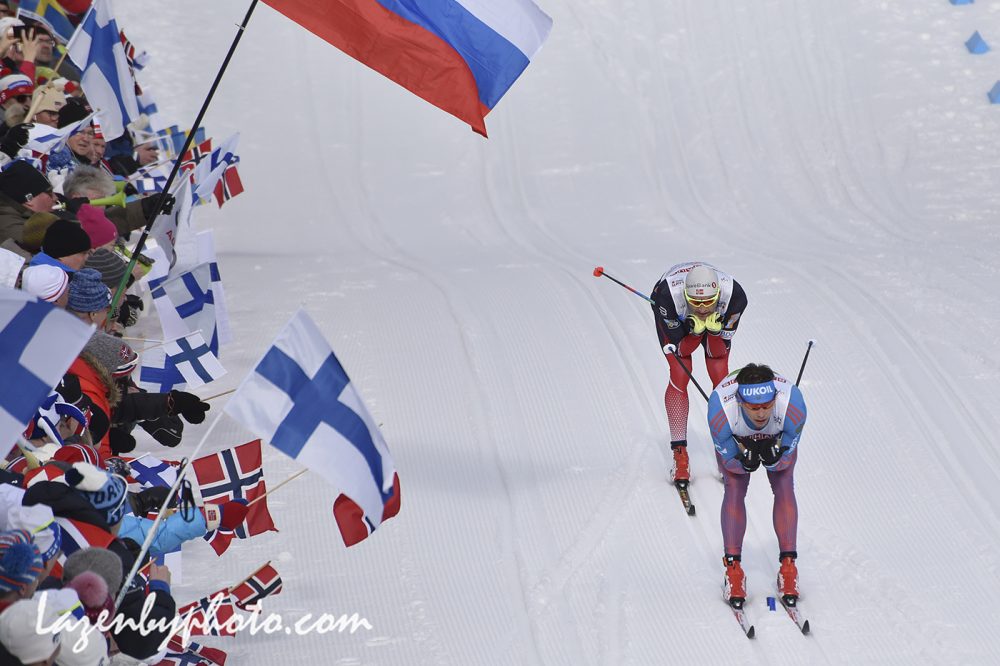
Norway’s Finn Hågen Krogh with the victory stoke as he wins the 4 x 10 k relay at the 2017 Nordic World Championships in Lahti, Finland, by 4.6 seconds over Russia’s Sergey Ustiugov (behind). (Photo: John Lazenby/Lazenbyphoto.com)
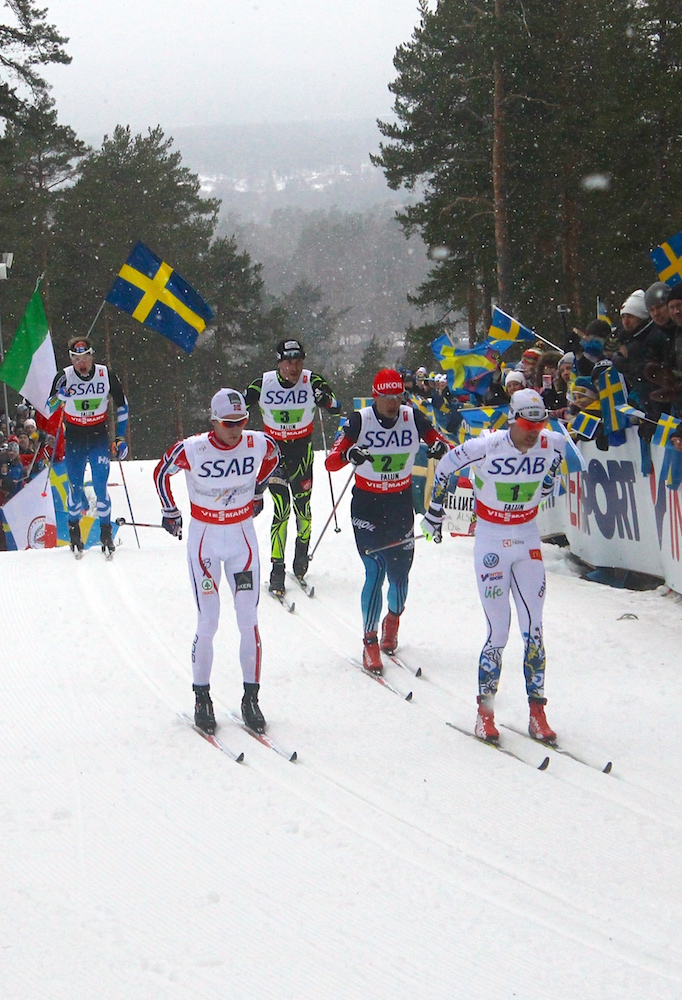
LAHTI, Finland — There were three medals up for grabs during Friday’s 4 x 10-kilometer relay at 2017 Nordic World Championships on Friday. Yet after the scramble leg, two distinct races: Norway and Russia’s dance for gold, and what eventually became a four-way tango between Finland, Sweden, Switzerland, and Germany for bronze and silver.
Russia’s Andrey Larkov and Norway’s Didrik Tønseth first strung out and then smoked the field late in their leg. By the tag to their second-leg skiers, Norway and Russia were twenty seconds up.
Russia’s Alexander Bessmertnykh leads Norway’s Niklas Dyrhaug as they sustain the break during the second leg of the 4 x 10 k relay at the 2017 Nordic World Championships in Lahti, Finland. (Photo: John Lazenby/Lazenbyphoto.com)
That margin grew to thirty seconds, as Russia’s Alexander Bessmertnykh and Niklas Dyrhaug finished Leg 2 and the transition to skating began.
Coming in just a half a minute later in third place, was Finland’s Iivo Niskanen, giving the fans a premature taste of the podium.
Racing the third leg was Norwegian Martin Johnsrud Sundby. Russia tried to match the Norway’s trump card with Alexey Chervotkin. The 21-year-old Chervotkin skied the third leg for Russia in both team relays that took place this season: the first in Nove Mesto, Czech Republic, the other in La Clusaz, France, where the team placed second both times to Norway.
However, the World Championship leg was the first time Chervotkin matched up against Sundby this year.
Late in the leg, it was unclear what Sundby’s strategy would be as the young Russian shadowed the 32-year-old Sundby move for move. With Sergey Ustiugov up for the Russians in the anchor leg against Norway’s Finn Hågen Krogh, many armchair-relay strategists would have thought the Norwegian’s line up ploy was a dud.
Not until 1.2 kilometers left in the leg did Sundby make a sufficient gap. At that point, the time spread from silver to gold was only eleven seconds. Not exactly a huge buffer for Krogh.
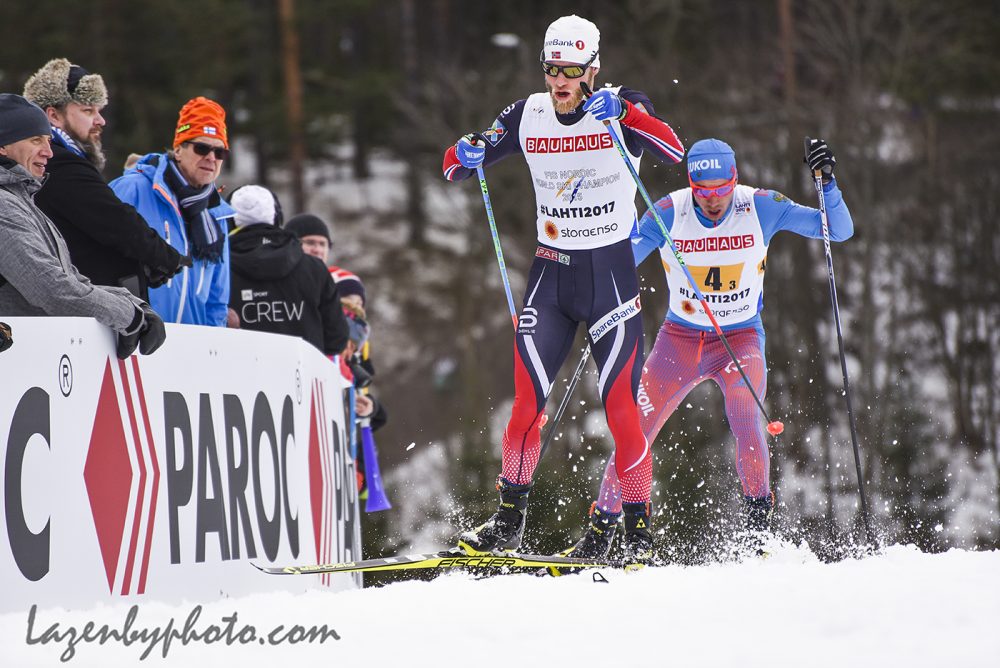
Norway’s Martin Johnsrud Sundby, marked by Russia’s Alexey Chervotkin (4), during a critical third leg of the 4 x 10 k relay at the 2017 Nordic World Championships in Lahti, Finland. (Photo: John Lazenby/lazenbyphoto.com)
By Sundby’s tag to the anchor skier, he had gifted Krogh a 17.7-second margin for error. The rhetorical question at the start of the fourth leg: when will Ustiugov catch Krogh?
“He’s the worst the worst guy you can have in back of you,” Krogh said during a press conference, referring to Ustiugov. “He made the race tough for me.”
At 1.3 k into that fourth leg, Ustiugov was 8.8 seconds back. In another 1.2 kilometers, it ballooned again to 11.6 seconds, and then it contracted again to 5 seconds with 3.8 k to go. But until the finishing stretch, when Krogh rounded the final turn with a 100-meter lead on the Russian, was Norway a sure win.
Krogh crossed first in a time of 1:37:20.1 hours for the ninth-consecutive Norwegian championship 4 x 10 k relay gold. Finishing 4.6 seconds later in second place was Russia’s Ustiugov.
“It’s not just for us, it’s the whole team,” Sundby said during a press conference of their ninth world-champs relay gold. “It’s for the waxers, it’s for the trainers. When you go the relay for the Norwegian team, you feel you’re going for your country. So it’s a massive victory for us.”
What kept the capacity crowd engaged was not so much the battle for gold and silver, but the fate of the on-again, off-again Finns.
Let’s back up to when Niskanen tagged off to Finnish skier Lari Lehtonen for the first freestyle leg. At that point, the Finns were in third, a solid 15 seconds ahead of France in fourth place, 32 seconds ahead of Switzerland in fifth, roughly 55 seconds ahead of Germany in sixth, and almost a minute ahead of Sweden in seventh.
“We are individual athletes, and you have to focus on your own leg,” Sweden’s Johan Olsson said after the race. “Both me and Daniel [Rickardsson] thought the medal chance was over when we had done two legs.”
The first sign that something was awry for the Finns was a restless home crowd. What may have been perceived as a plush-time cushion for Lehtonen was in fact cardboard thin.
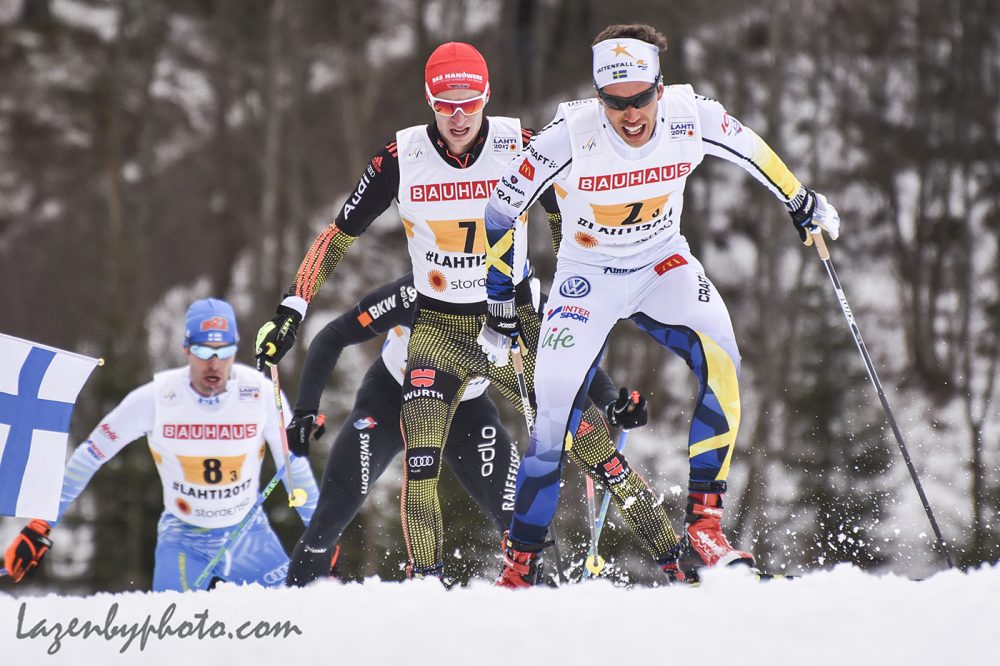
Sweden’s Marcus Hellner (r) leads Germany’s Florian Notz (7), Switzerland’s Dario Cologna (behind Notz), and Finland’s Lari Lehtonen (8) during the men’s 4 x 10 k relay at the 2017 Nordic World Championships on Friday in Lahti, Finland. (Photo: John Lazenby/Lazenbyphoto.com)
Sweden’s Marcus Hellner and Switzerland’s Dario Cologna were on the hunt. Seemingly an afterthought, Hellner skied the fastest third leg, animating the race for bronze by pulling Sweden back into contention.
These four teams — Finland, Germany, Switzerland, and Sweden — stuck together through the exchange into the fourth leg until the last headwall climb, called Indian Hill.
It was then that Finland’s Matti Heikkinen hop-stepped around Germany and Switzerland, bringing Sweden’s Calle Halfvarsson with him.
“I know that Matti will go on the last uphill and it was good game for me to go after him,” Halfvarsson said during the press conference.
The two appeared to have dropped Switzerland’s Curdin Perl, until Perl miraculously slotted behind the Finn-Swede duo. Finland entered the final 100-meter stretch in a sprint for bronze.
One errant pole plant as Heikkinen ramped up his gear, causing him to fall to the ground was Finland’s loss and Sweden’s gain. Halfvarsson crossed third for Sweden (+2:31.8) and Perl fourth for Switzerland (+2:32), and Finland ultimately crossed fifth (+2:42.4).
(Story continues below)
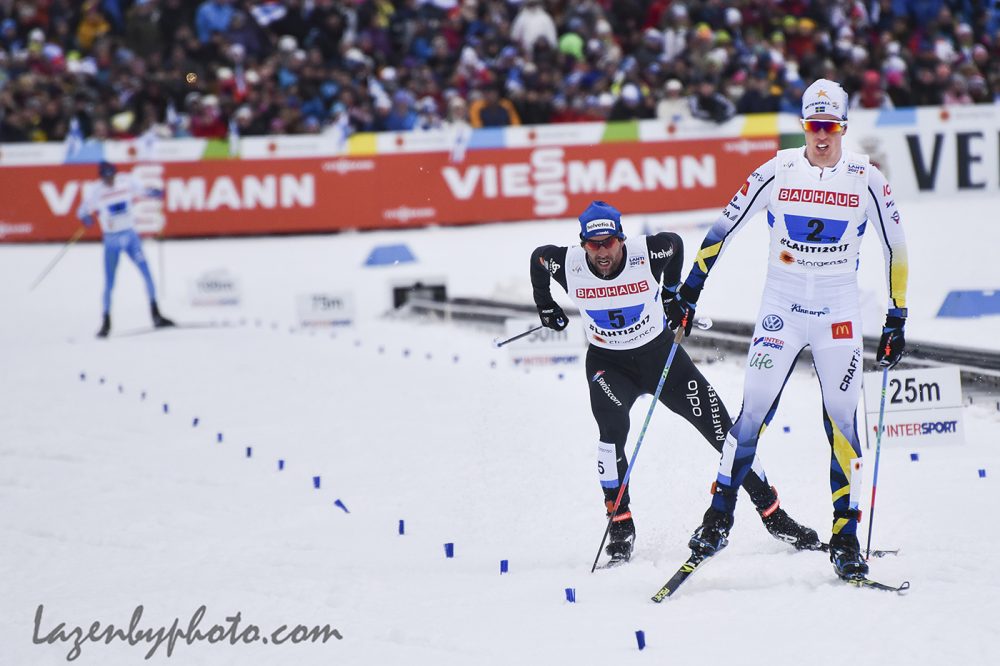
Sweden’s Calle Halfvarsson (2) crossing the line in third place, ahead of Switzerland’s Curdin Perl (5) in fourth at the finish of the men’s 4 x 10 k relay at the 2017 Nordic World Championships in Lahti, Finland. Finland’s Matti Heikkinen (far left) is seen after righting himself due to a errant pole plant. (Photo: John Lazenby/Lazenbyphoto.com)
The U.S. fielded a team comprised of Kyle Bratrud, Erik Bjornsen, Tad Elliott, and Simi Hamilton. Bratrud scrambled the first classic leg for the Americans, handing off to Bjornsen in 11th, 1:28.2 minutes behind the leader.
“I was definitely more nervous for this one because I was starting,” Bratrud said afterward.
While this is the second World Championships for Bratrud, a 24-year-old member of the Central Cross Country (CXC) Team, Friday was the first time he raced the scramble leg in a relay — he raced the third leg for the U.S. in the 2015 world champs 4 x 10 k relay in Falun, Sweden. Though he eventually lost contact with the front group, Bratrud was happy he was able to hold on for as long as he did, even if it caused him a yellow card for a technique violation.
“It was nice to at least see the front before they really picked up the pace,” Bratrud said.
“Props to Kyle on the yellow card,” Elliott wrote in an email. “Scrappy out there.”
Tad Elliott racing the third leg of the U.S. men’s 4 x 10 k relay at the 2017 Nordic World Championships on Friday in Lahti, Finland. (Photo: John Lazenby/Lazenbyphoto.com)
While Bratrud had company for approximately one lap, Bjornsen raced completely alone.
“It’s not the position you necessarily want to be in, but took it for what it was worth and tried to charge up to the group in front of me, which was [the Czech Republic’s Lukas] Bauer and [Germany’s Jonas Dobler],” Bjornsen said.
“But I mean…they were moving fast,” the 25-year-old U.S. Ski Team member added. “I tried to mentally just keep pushing, but it’s tough to be out there by yourself. I felt pretty good, it’s just a different type of race.”
Bjornsen tagged to Elliott, for the Americans’ first freestyle leg. He skied the eighth-fastest third leg, 1:47 behind Hellner.
“I was also getting great splits from the coaches on making ground on the group in front of me,” Elliott wrote.”I wanted to catch them, I just didn’t really get there for Simi to save it all for his sprint. Simi skied one hell of a leg.”
Elliott handed off to Hamilton, the anchor leg for the U.S.
“By the time he tagged off to me, I think I was 10 or 15 seconds from [the Czech Republic, Kazakhstan and Italian teams],” Hamilton recalled. “They fortunately started pretty conservatively, which was nice for me.”
Those three teams were in fact 16 seconds ahead of Hamilton. He eventually closed that distance, putting the U.S. in contention for a top 10.
“I wanted to start fast and see if I could make up some time on them,” Hamilton siad. “And I did, I ended up catching them by the top of the climb after the tunnel. So I was psyched about that.”
However, when Hamilton came through for his fourth and final lap, the hill-laden course had taken a toll on his legs. He finished in 10th (+5:31.3), just half a second ahead of the Czech Republic’s Petr Knop in 11th (+5:31.8).
Canada’s Alex Harvey racing the third leg of the men’s 4 x 10 k relay at the 2017 Nordic World Championships on Friday in Lahti, Finland. (Photo: John Lazenby/Lazenbyphoto.com)
“That last lap my legs were definitely feeling it a little bit and those guys are all really good climbers,” Hamilton said. “I couldn’t quite make the moves that I wanted to in the last kilometer because I was a little whupped by then … but I was still able to pick off Czech Republic at the finish. Maybe not the best day for us, but still a day that we were fighting.”
Canada’s team of Graeme Killick, Devon Kershaw, Alex Harvey and Lenny Valjas finished 12th, after being lapped and thus pulled from the race on Valjas’s final leg.
In January of this year, Canada raced to a historic third place at the Ulricehamn World Cup relay in Sweden.
“It just wasn’t our day,” said a dignified Valjas after Friday’s relay. “We’re all in shape, it’s just none of us were on our A-game today and that’s what it takes to be fighting in this.”
Erik Bjornsen (U.S. Ski Team) racing the second leg of the men’s 4 x 10-kilometer relay at the 2017 Nordic World Championships on Friday in Lahti, Finland. (Photo: John Lazenby/Lazenbyphoto.com)
Norway’s Martin Johnsrud Sundby (l) well ahead of the field as he double poles toward the finish in Saturday’s 15 k classic mass start, which he won by 2.2 seconds over Russia’s Sergey Ustiugov (third from r) while Finland’s Matti Heikkinen (second from r, ahead of Ustiugov) placed third at the Tour de Ski Stage 6 in Val di Fiemme, Italy. (Photo: Fischer/Nordic Focus)
Six laps. Three climbs per lap. Fifteen-kilometer classic mass start. If you’re in it to win it, where do you make your move?
That was the kind of calculating Norway’s Martin Johnsrud Sundby was doing throughout Saturday’s Stage 6 mass start, the second-to-last stage of the 2017 Tour de Ski, in Val di Fiemme, Italy. Every time he rounded the 2.5 k loop, the man he needed to beat — Russia’s Sergey Ustiugov — was right there, either leading or within a few strides of first.
Through five Tour stages, the 24-year-old Ustiugov was unbeaten. Could he be beat? Yes, Sundby thought, but it was going to take some brains as well as brawn.
He had to be patient, despite being extremely frustrated with his race on Friday, when he placed 14th in the 10 k freestyle in Toblach, Italy. That put him more than a minute and a half behind Ustiugov in the overall Tour with two stages to go.
“Yesterday’s race was really bad and it is good I could win today,” Sundby said, according to an International Ski Federation (FIS) press release. “I was little bit conservative at the beginning. I wanted to win some bonus seconds. I had some power left and I am happy about victory.”
He attacked on the last lap just before the 13.9 k mark, after pulling up alongside Ustiugov on the first long climb out of the stadium, while Switzerland’s Dario Cologna did the same on the other side of the Russian in the Tour leader’s bib.
Norway’s Martin Johnsrud Sundby glances back to make sure he’s out of reach during the final kilometer of the men’s 15 k classic mass start at Stage 6 of the Tour de Ski in Val di Fiemme, Italy. (Photo: Fischer/Nordic Focus)
Sundby’s move wasn’t obvious then, but it was along a long false-flat, where he began dropping the field with an unmatched double pole. Heading into a tricky descent before the final climb, Sundby had successfully broken away and frequently checked back to make sure Ustiugov wasn’t anywhere near him.
Ustiugov and two of his Russian teammates, Andrey Larkov and Alexander Bessmertnykh, continued to lead the chase, followed by Cologna, Finland’s Matti Heikkinen, Norway’s Niklas Dyrhaug, and even Italy’s Francesco de Fabiani had worked his way into the mix.
Up that last steep climb, Cologna switched from the right to the left tracks suddenly, appearing to cut off Heikkinen, who moved outside the tracks to get around him. A few strides later, Dyrhaug stepped outside the right tracks to get around Ustiugov, but Ustiugov wasn’t having it. He stepped out as well, forcing Dyrhaug to file back in behind him. All of this was shaping up to be a fight for second; Sundby was too far gone.
The second-ranked man in the Tour, Sundby finished in 40:40.0 minutes, while Ustiugov caught a draft and out-double poled the chase pack for second place, crossing 2.2 seconds later. That still puts Ustiugov 1:12 minutes ahead going into the final climb (yep, he’ll start 1:12 minutes ahead of anyone else in the 9 k freestyle hill climb up Alpe Cermis), but at least for Sundby it’s not 1:34.
But as Ustiugov said Friday, “For Martin, a minute does not mean anything … The main thing is not to lose all that has been so hard-earned in these five races.”
“Today’s performance gives me a different starting point in tomorrow’s race,” Sundby told NRK. “I need a little miracle tomorrow, but I’m not going to quit before I cross the finish line.”
Finishing 0.6 seconds behind Ustiugov on Saturday, and nearly being taken out by the Russian at the finish when Ustiugov collapsed sideways across the line, was Heikkinen in third (+2.8). Fourth through eighth place were all within 1.1 seconds of the podium, with de Fabiani taking fourth (+3.2), Larkov fifth (+3.3), Dyrhaug sixth (+3.5), Cologna seventh (+3.8), and Bessmertnykh eighth (+3.9).
After that, there was a 6-second gap Norway’s Hans Christer Holund in ninth (+9.9), Sweden’s Marcus Hellner finished 10th (+10.3), France’s Jean-Marc Gaillard 11th (+13.6), Sweden’s Jens Burman 12th (+14.9), and France’s Maurice Manificat 13th (+16.3).
Russia’s Sergey Ustiugov (r) leads his Russian teammates Alexander Bessmertnykh (23) and Alexey Larkov (l) during the men’s 15 k classic mass start at Stage 6 of the Tour de Ski in Val di Fiemme, Italy. (Photo: Fischer/Nordic Focus)
The fact that Ustiugov finished second was largely in part to his teammates, Larkov and Bessmertnykh, who drove the pace and helped box out competitors up front, especially early in the final lap. Ustiugov even drafted one of them on the final descent into the stadium before switching to an open lane in the finishing straight and double poling to the front of the chase pack.
“I am grateful to my teammates,” Ustiugov said, according to a loose translation. “If they did not help me, one of them could have won the mass start. Tomorrow’s race? We’ll see. In any case, it will be interesting. I understand perfectly … what is waiting for me, despite the fact that I was only passed once on the final uphill.”
One thing Saturday showed: the Russian is beatable. Last year, Sundby won the climb, both as the first man at the top and with the fastest time up the 9 k grind. France’s Robin Duvillard, who is not competing in this year’s Tour, was second (+7.2) for time of day, and Heikkinen was third (+11.8).
Ustiugov as the fourth starter clocked the 13th-fastest time, 47.6 seconds behind Sundby. Of note, American Noah Hoffman was 15th (+56.4) and Canada’s Alex Harvey 16th (+1:07.4) for final-climb time.
Ustiugov ended up third overall in the 2016 Tour, arriving at the top near four minutes after Sundby.
Russia’s Sergey Ustiugov (front, in Tour leader’s bib) leading early in the men’s 15 k classic mass start on Saturday, along with Canada’s Alex Harvey (l) at Stage 6 of the Tour de Ski in Val di Fiemme, Italy. (Photo: Fischer/Nordic Focus)
“… I think he’s in better shape now,” Harvey said on the phone Saturday about Ustiugov. “So I think those two guys [Ustiugov and Sundby] will stay in front, and Sundby probably second. I think it will be just a really good fight…”
On Sunday, Harvey will start sixth in this year’s final climb, 2:42 minutes behind Ustiugov and 38 seconds behind Cologna, who is third overall.
“I am third at the moment with a lead of more than 20 seconds, that surely looks positive, but it’s a long flat section before the climb,” Cologna told Swiss broadcaster SRF. “It’s almost a minute to Sundby, and he is not a bad climber, either. So I really have to look how I can defend my third place. That’s the goal for tomorrow.“
Harvey entered Saturday’s 15 k classic mass start in fourth overall but dropped two spots when he finished 19th, 38.7 seconds after Sundby. Also slated to start ahead of Harvey on Sunday are Heikkinen, who is fourth overall (+2:33) and Manificat in fifth (+2:34).
“Manificat will try early on the hill, and then Heikkinen. I’m sure they’ll be pushing really hard down the flat to kind of close that 26-, 28-second gap that they have on Dario [Cologna],” Harvey anticipated. “… When you see someone up the hill, like 10 seconds, it seems like they’re three meters ahead, always. So I think that it’s a good position to be in, for Heikkinen especially. My guess for the podium is probably Ustiugov, Sundby, and Heikkinen, but I’ll be in there, too, so we’ll see.”
On Saturday, Harvey surged to the front of the pack early, leading at 1.1 k, with superior skis on the uphills, he said. Also up there with him was Romania’s Paul Constantin Pepene — sort of a surprise at this point in the Tour.
“The Romanian guy started really fast and then he blew up right away,” Harvey said, of Pepene falling off the pace after 2.5 k. “There was a prime in the second lap early on … and I think I had one of the best grip out there today, so on that steep hill it was pretty easy for me to just run in the track and get that prime [for 15 bonus seconds].”
Alex Harvey (Canadian World Cup Team) en route to 19th in the men’s 15 k classic mass start on Saturday, which puts him sixth overall in the Tour de Ski with one stage remaining in Val di Fiemme, Italy. (Photo: Salomon/Nordic Focus)
Heading into Lap 3, Harvey said the wheels started to come off.
“When we lapped into the stadium, I was starting to get kind of yo-yoed a bit near the end of the group,” Harvey recalled. “And then tried to fight my way back up on the climbs, but I was getting yo-yoed a bit, and then the elastic just broke.”
Fewer than 5 seconds out of first at 5 k while skiing in seventh, Harvey was down to 15th by the end of the next lap, yet still within 7 seconds of Ustiugov in first.
Early on the fourth lap, he was 15 seconds back in 18th, just ahead of Great Britain’s Andrew Musgrave and Harvey’s teammate Devon Kershaw in 19th and 20th, respectively. Another three seconds back, a third Canadian, Graeme Killick was skiing in 25th (+18.7) at 8.6 k.
“I actually didn’t know he was there until he just passed me, but yeah, I skied with him for a bit,” Harvey said of Kershaw, who passed him shortly after.
Harvey recalled that Kershaw “got kind of tangled up with a Russian in the herringbone part, and then I think he said he lost our group there.”
Kershaw could not be immediately reached for comment after Saturday’s race.
The start of Lap 5 saw Harvey 10 seconds back from the leaders in 18th and Kershaw another five seconds back in 24th, with Killick following roughly three seconds later in 26th. Harvey was nearly 20 seconds behind one lap later, skiing in 17th, and he closed the race out in 19th (his worst result after placing 11th on Friday in the Toblach 10 k) of the Tour.
“I don’t know. The body was good,” Harvey said.
As for Sunday: “Oh I’m ready,” he said. “I kind of want revenge after today.”
“Alex is a competitive guy and is hungry,” Canadian World Cup coach Ivan Babikov said, according to a Cross Country Canada press release. “He will be in a group of about four guys who are all good climbers. Dario is always strong, but anything is possible.”
Kershaw finished the race in 27th (+1:21.1) and Killick 32nd (+1:31.0). They will start the final climb in 23rd (+7:19) and 37th (+11:25), respectively.
“Coming into the Tour this year the priority races for me to target were the 10km in Val Mustair and the 15km tomorrow in Val di Fiemme,” Kershaw wrote in an email on Friday. “… [The 15 k mass start] will be a real battle royale and it’s the crux of this tour for the top 10. A lot of really strong guys are grouped close together and aside from Ustiugov who has made a mockery of this years event I would say it’s wide open.
“What that means is that with the two bonus sprints on course and the time at the line – there is 45sec available – there will be a lot of hungry racers gunning for it. Blend that with a difficult and punishing course here in Val di Fiemme and I think this race will be blown open pretty good,” Kershaw anticipated. “I hope to have a good start and really just feel good in the body because you are going to need that for sure if you want to have a good race.”
“It is a tough course and the guys are pretty tired but they dug deep today,” Babikov said Saturday, according to the press release. “We might have missed it a bit with the skis. We may have gone with something a bit too sticky.
“It was really hard-packed snow and this is a tough course to get the skis right,” Babikov added. “Ideally you want to have good kick and a fast glide, but it is a gamble on a course this tough. The tracks were firm and icy but there were some sections where there were no tracks and others with powdery snow. We will debrief on it tonight.”
The lone American to finish, Noah Hoffman landed in the points for the second-straight stage in 30th (+1:17.1) after skiing in 34th for the first two-thirds of the race. By 12.5 k, Hoffman was up into 29th, right behind Russia’s Petr Sedov in 28th and about 50 seconds behind the leaders.
“I actually felt like I skied the second half pretty well,” Hoffman said on the phone. “I was able to make contact with that group that contained all the way up to 22nd place by the end. I didn’t really lose that much time … But I mean, yeah, certainly not a standout result. I kind of feel like a broken record, when every race I’m like, ‘Well, there were some good signs and I’m optimistic that it’s going to come around, but it’s not here yet.’ That’s kind of where I’m at.”
Hoffman will start the final climb — a race he hopes to place in the top 15 in for time of day — in 30th (+9:42).
“I’ve been top 20 on time on day a couple times, but I’m kind of frustrated, I feel like I haven’t shown what I can really do up a climb like that,” he said. “It’s a stage that was built for me, especially if I have help down in the valley, which I do tomorrow, because I’m starting with Sedov and that Swede [Viktor Thorn right behind me].
“So I will definitely rely on some help to get to the base of the climb, and then I feel like once we get there, then I just need to use my energy and show what I can do,” Hoffman added. “I think I can move up. Certainly a spot or two would be great, but there’s some pretty good time gaps [ahead of me]. But I would love to be at least top 15 for time on day, and I feel like that’s something I can do if I show my aerobic capacities.”
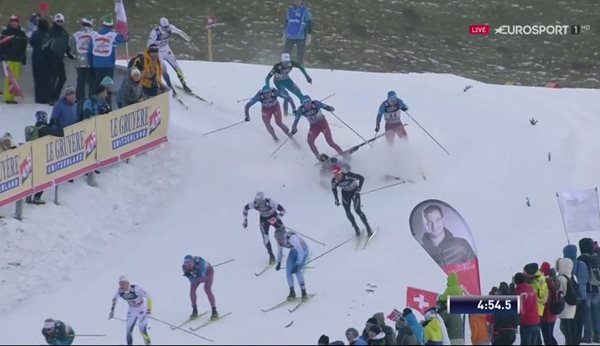
Erik Bjornsen’s crash caught on camera during the first lap of the men’s 15 k classic mass start at Stage 6 of the Tour de Ski on Saturday in Val di Fiemme, Italy. (Photo: CCC/Eurosport screenshot)
American Erik Bjornsen started the race but crashed on the first lap on a climb which plagued top competitors in the women’s race as well.
According to Hoffman, he and Bjornsen watched the women’s race on TV in the athletes’ lounge before their race.
“And it was in that exact same spot, Kalla and Pärmäkoski went down. … That corner does not ski challenging when you’re alone, but it’s a corner that when you get into a pack, it transforms a bit,” Hoffman recalled. “There was just an ice patch that opened up. I kind of couldn’t believe it when Erik went down, I was like, ‘Oh my god, that is exactly what we just watched Pärmäkoski and Kalla do.”
Hoffman was behind Bjornsen at the time and narrowly avoided a pileup Russians he created.
“I believe [Erik] broke a pole, but I have not had a chance to talk with him about why he decided to drop out,” Hoffman said of Bjornsen pulling out of the race at the halfway point at the end of the third lap.
Bjornsen could also not be immediately reached for comment.
Finn Hågen Krogh (l) crossing the line ahead of Russia’s Sergey Ustiugov to give Norway the win in the men’s 4 x 8 k relay, the first of the World Cup season, in La Clusaz, France. (Photo: Fischer/NordicFocus)
Eight years ago, France’s Maurice Manificat and Jean-Marc Gaillard waved to the French cheers of their country’s fans as they climbed onto the men’s World Cup relay podium in La Clusaz, France. The two — along with their former national-team teammates, Vincent Vittoz and Emmanuel Jonnier— had secured the final podium spot by less than a minute, just barely missing out on second place.
Little did they know as they climbed down that it would be close to a decade later before they would reach a relay podium again during the regular World Cup season.
On Sunday, for the first time since December 2008, both Manificat and Gaillard — joined this time by their teammates and current French national-team members, Alexis Jeannerod and Clement Parisse — reclaimed their podium spot in the men’s 4 x 8-kilometer relay, once again against the backdrop of La Clusaz.
“It was a great day for our team,” Manificat said, according to an International Ski Federation (FIS) press release. “Everybody did an awesome job on their legs. I knew Finn [Hågen Krogh] and Sergey [Ustiugov] would be the biggest opponents today on the last leg. My plan was to ski with them and eventually go away. Finn and Sergey were stronger but it is great to finish on the podium.”
Starting in Row 2 behind Russia’s Evgeniy Belov, Gaillard skied the first classic leg for France, holding tightly to a third place for much of the first part of his race, behind Belov and Norway’s Didrik Tønseth.
By the 3.5 k mark, Pål Golberg of Norway’s second team and Sweden’s Emil Jönsson had overtaken the lead and Gaillard was getting pushed back to fourth then fifth and eventually seventh.
Yet the Frenchman’s skis proved faster than most in the field and by 6 k he had regained his position in third. Belov had also found his way back to the front. As the group rounded for their final lap Goldberg charged the group to the exchange zone, putting Norway’s second team on the attack.
Gaillard ultimately tagged off in sixth to Jeannerod for the second classic leg. Norway’s first team came through in seventh, handing off to Martin Johnsrud Sundby. Russia I tagged off in second to Alexander Legkov.
It didn’t take long, however, for Sundby to put Norway’s first team back in the lead. By the 2 k mark it was his red bib that led the chase pack, with the Norwegian double poling on skate skis. Within the next 2 k, however, Italy’s Francesco de Fabiani, Legkov and Sweden’s Jens Burman had swallowed up Sundby, while Jeannerod now sat in seventh.
With 2.5 k to go of the second leg, de Fabiani quickened the pace and Sundby struggled to keep up while double poling the course climbs.
The second exchange came down to a battle between Italy and Norway’s second team, with Norway’s Niklas Dyrhaug outsprinting de Fabiani to be the first through. Russia’s first team exchanged in third, while France I was now positioned in fifth. Sundby was the last of the chase pack to come through in ninth, tagging off to Anders Gløersen for the first freestyle leg.
“It’s necessary to take a proper stance for the classical diagonal technique,” Sundby said told VG. “I did that today by getting a real beating.”
As the first freestyle leg began to unfold, it was Sweden’s Martin Johansson who led the charge, not far behind was Russia’s Alexey Chervotkin and France’s Parisse. Also working his way back into the mix — despite the 20 meters Sundby had lost on the lead group — was Gløersen of Norway’s first team.
In fact, by the 3 k mark, Gløersen had propelled himself to the front and taken command of the lead.
Norway’s Ander Gløersen leading the third leg of the men’s 4 x 8 k relay on Sunday at the World Cup in La Clusaz, France. (Photo: Fischer/NordicFocus)
“Anders did a great job on his leg and put us back in contention,” Finn Hågen Krogh, the anchor for Norway’s first team, said according to a FIS press release.
With the lead returning to Norway, France, Russia, and Sweden were back in the hunt. The 4 k mark found a front group of seven nation’s relay teams — Norway I, France I, Germany, Sweden, Russia I, Finland, and Italy.
Rounding the corner for the final exchange, it was Norway I, followed by Sweden, and Russia. Parisse, who tagged off to Manificat, came through in fifth.
The anchor for Russia’s first team, Sergey Ustiugov, wasted no time moving to the front of the group to set the pace. The six other frontrunners followed closely behind, with Krogh and Germany’s Lucas Bøgl positioned in second and third respectively.
Then came the waiting game. The group slowed, Ustiugov and Krogh casting a few glances over their shoulders to see who would make the first move. Ultimately it was Ustiugov first. The Russian began to push the pace around the 3 k mark, initiating a scramble. Yet within another kilometer, Ustiugov slowed giving the lead back over to Krogh.
“In my leg I wanted to save some energy and gave everything in the last corner and in the finish stretch,” Krogh said, according to a FIS press release.
The front group had now split in two, with Germany, Norway I, France I, and Russia I breaking away. Sweden, Finland and Italy had fallen behind.
As they approached the final course climb, the real sprint began with Krogh and Ustiugov going head-to-head straight to the last 100 meters. In a lunge to the line, Krogh bested Ustiugov by two tenths of a second for the overall win in a time of 1:11:25.7. Crossing 7.7 seconds later was Manificat, securing France on the podium in third.
“I gave everything I had in the finish,” Ustiugov said, according to a FIS press release. “The speed increased in the last two laps. It is always disappointing to lose, but Finn was very strong on the home stretch. But it is still a very good result to be second and to share the podium with my teammates.”
Neither Canada nor the U.S. fielded a men’s relay due to illness. Racing will resume Dec. 31 in Val Mustair, Switzerland, for Stage 1 of the 2016/2017 Tour de Ski.
The men’s relay podium at the La Clusaz World Cup on Sunday, with Norway in first (c), Russia in second (l) and France with its first World Cup podium in eighth years in third (r). (Photo: Fischer/Nordic Focus)
Left to right: Finn Haagen Krogh (NOR), Martin Johnsrud Sundby (NOR),and Hans Christer Holund (NOR) on the podium after the men’s 30 k skiathlon on Sunday in Lahti, Finland. (Photo: Fischer/Nordic Focus)
When the pattern of weekend after weekend podium wins is broken, missing top spots can serve as a wake-up call.
The Norwegian men’s ski team saw this first-hand after Russia claimed three victory titles last week in Sweden. With redemption in mind, Norway locked in on this weekend’s World Cup competitions in Lahti, Finland.
“We needed to come back from three Russian victories last week,” Norwegian Martin Johnsrud Sundby, the overall winner of the men’s 30-kilometer skiathlon on Sunday in Lahti, said in a post-race interview with FIS. “We were pretty mad about that. So we had a talk last night that we were going to fight back today.”
The Norwegians commandeered Sunday’s 30 k podium, after also taking the top three spots in Saturday’s sprint. The first five skiers across the finish line on Sunday all sported the red suits of Norway, a quintet spearheaded by Sundby in a time of 1:10:3.0.
Sundby Falls During First 15 k Classic Leg
Even while headed to his 13th individual World Cup win of the season, Sundby was not immune to the challenges presented by the Lahti skiathlon. Fresh snow that continued to cover the course and a crash tested him during the 30 k distance.
The start of the men’s 30 k skiathlon on Sunday in Lahti, Finland. (Photo: Fischer/Nordic Focus)
“I tried to create quite good speed in the first couple laps as usual, a bit more difficult for sure when it’s snowing,” Sundby said. “I had a crash with a Russian guy in the second loop. It was a bit painful so I used a couple of laps to recover.”
While Sundby recovered from his fall, France’s Maurice Manificat took control of the pace for the next two 3.75 k classic laps.
“Martin [Sundby] was falling on the second lap,” said Hans Christer Holund, who finished third (+8.0), during a post-race press conference. “When he was falling it looked like the French were trying to get ahead and just go. I was a bit surprised that the [French] were going so hard in the beginning.”
First to the ski exchange and the first skate skier on course–followed closely by Sundby and French teammate, Jean Marc Gaillard–Manificat managed to make the king of distance struggle, even if just for the next two skate laps.
“Manificat did a great job setting the pace,” Sundby said during a post-race press conference. “He was going hard. He didn’t want any help. He just kept pushing. From my point of view, the pace was quite tough.”
Still not tough enough, however, to hold off Sundby for long. By 23.7 k the Norwegian was back in the front and the French man began to fade. Saturday’s second place finisher in the sprint, Finn Hågen Krogh of Norway, moved in behind Sundby, while fellow Norwegians Didrik Tønseth and Holund held onto their two teammates in the lead.
Martin Johnsrud Sundby (NOR) crosses first in the men’s 30 k skiathlon on Sunday in Lahti, Finland. (Photo: Fischer/Nordic Focus)
By the final course climb, with Krogh still clinging on, Sundby knew he needed to make his move soon, if he hoped to secure the win.
“I didn’t want to come into this last 100 [meters] with him,” Sundby said during a press conference, referring to Krogh. “But I had to try and the last uphill is quite long and tough. So, I just said to myself ‘yeah, you just go 100 percent and see what happens.’”
The race leader’s ‘100 percent’ effort proved potent. He continued his lead into the stadium, crossing the finish line 4.9 seconds ahead of second place finisher, Krogh.
“Usually the day after the sprint you are almost more tired than after a distance race,” Krogh said during a post-race press conference. “That’s why I was kind of surprised that I did so well today because I felt a bit tired after the sprint yesterday. To finish second today is a really good surprise for me.”
Holund out-lunged teammate Tønseth by six tenths of a second for third, 8.0 seconds behind Sundby. Niklas Dyrhaug of Norway finished fifth, (+45.0), and Manificat, the first non-Norwegian, crossed in sixth (+49.0).
“I had fire in classic & so good skis!” Manificat tweeted after the race. “In skate I tried more but I loss too much energy!”
Maxim Vylegzhanin of Russia, who won the Falun 10 k classic, finished 10th in the skiathlon (+2:09.6), just ahead of Sweden’s Marcus Hellner, who may be finally coming back into race form after a difficult year.
Bjornsen Best American Finish in Skiathlon, 27th Overall
While some of Sunday’s skiathlon racers struck from the front, others chose to sink their teeth in and hang on from behind. Erik Bjornsen (U.S. Ski Team), the first American to cross the finish line on Sunday in 27th overall (+2:59.2), went with the latter.
“I was feeling like I was pacing it pretty well in the classic,” Bjornsen said in a post-race interview. “It was easy for me to kind of sit up there in the top 20. The plan was to try to hold that as long as I could in the skate.”
After switching to skate skis, Bjornsen found himself battling for position in a pack of close to 20 other skiers.
“It was important to be in the front of that group,” Bjornsen said. “I wasn’t there so I was definitely getting the slingy effect,” he added, referring to his pack position and need to slow for the downhills, but ‘hammer’ the uphills to stay with the group.
Erik Bjornsen (USA) celebrates as he crosses the finish line during the men’s 30 k skiathlon on Sunday in Lahti, Finland.
“I wasn’t in the most efficient spot, but I was happy with the finish,” he added.
With World Cup points from the skiathlon 30 k, Bjornsen remains excited for his next series of races: the Ski Tour Canada.
“It will be my second tour this year, so I hope to ski through the whole thing,” he said, “and make sure I can go to each race feeling recovered and ready to go.”
The two other Americans who raced in Sunday’s skiathlon, Noah Hoffman and Scott Patterson, finished in 36th (+4:14.3) and 52nd (+6:04.0) respectively, after getting caught up in an early crash.
“Noah and I both got in a crash like 100 meters from the start,” Patterson said. “I mean, it’s hard to fight back when the pace is so fast up front. I picked up some places, but not as many as I wanted. Still shooting for that first top 30, so I’ll have to try again in Canada.”
As the first distance leader after U.S. nationals, Patterson will race the Ski Tour Canada in March as well.
Hoffman, who also broke a pole during Sunday’s fall, managed to move up almost 30 places after the tangle.
“I felt really good during the skate portion,” Hoffman said. “I was moving up I had some good guys to ski with, but at that point I was too far back to do anything. It’s two weekends in a row that I’ve gone down, I’ve got to be better at staying on my feet.”
After a fall in last Sunday’s 15 k mass start in Falun, and a crash in Sunday’s skiathlon, Hoffman is ready to steady his skis and put his race fitness back to the test.
“I got away from the other guys I was with at the top of the course and I’m looking forward to carrying that fitness through to Canada,” he said.
–JoJo Baldus, Harald Zimmer, & Chelsea Little contributed reporting
Martin Johnsrud Sundby thanks his lucky stars (and skis) after winning his fourth-straight individual race (and fifth race in a row) of the World Cup season on Saturday at the 30 k freestyle in Davos, Switzerland. He held off France’s Maurice Manificat (l) and teammate Anders Gløersen (r) for the win. (Photo: Fischer/NordicFocus)
If someone had to be a carrot, so to speak, Martin Johnsrud Sundby was the guy to go after in the men’s 30-kilometer freestyle individual start on Saturday at the World Cup in Davos, Switzerland.
Maurice Manificat of France started a minute behind the Sundby — and interestingly 30 seconds after Canada’s Graeme Killick — in bib 60 of 83. By the first timing point at 2.2 k on the 5 k course, Manificat had already put himself in a position to rival Norway’s defending overall World Cup champion.
But how long would it hold up?
One kilometer later, Manificat was just a tenth of a second faster than Sundby with the lead, and by 5 k, the he remained 0.2 seconds ahead in first.
Maurice Manificat pushed over every inch of the men’s 30 k freestyle individual start on Saturday in an effort to beat Norway’s Martin Johnsrud Sundby for the win.
“I started quite fast and had great skis,” Manificat told FIS after the race. “I was focused the entire time.
Manificat’s fast start held up as the 29-year-old Frenchman matched Sundby’s times for two-thirds of the six-lap race. Most of the time, despite not actually being able to see Sundby, Manificat had the edge — except for when Sundby was 0.6 seconds ahead at 10 k and then 0.3 seconds up 10 kilometers later.
That’s where Manificat’s race started to unravel. He later explained his back hurt for the final 10 k. By 22.2 k, he started to lose contact with Sundby, who was then eight seconds ahead at that checkpoint.
Sundby extended that gap to 9.5 seconds 1 kilometer later, then was 10 seconds ahead with 5 k to go. At 27.2 k, it appeared the race was over and in Sundby’s control, as the 31-year-old Norwegian led Manificat by 20.8 seconds.
Sundby went on to win by 20.7 seconds in 1:06.27.9, and Manificat held on for second place, 7.9 seconds ahead of Anders Gløersen of Norway. Gløersen won the shortened version of this race last year in Davos: the 15 k freestyle.
Throughout Saturday’s full-distance signature event, even tougher because it’s at altitude 5,000-plus feet above sea level, Gløersen had been in the hunt for a podium, skiing the same speed as Norwegian teammate Chris André Jespersen early. Both were about 18 seconds behind Manificat and Sundby at 8.2 k. Two kilometers later, Gløersen’s time still ranked third but Jespersen had dropped to fifth behind France’s Robin Duvillard.
An early starter in bib 22, Duvillard initially set the times to beat for the Norwegians following him. Duvillard’s teammate Jean-Marc Gaillard started 23rd and ultimately finished about 10 seconds faster than Duvillard, earning his seat in the leader’s chair until Norway’s Sjur Røthe in bib 34 crossed the line 1.3 seconds faster.
Gløersen topped Røthe by almost 15 seconds to take the lead, then was finally bumped to third by Sundby and Manificat. Røthe ended up fourth, Gaillard placed fifth, Norway’s Petter Northug came on strong later in the race to finish sixth (+46.2), Duvillard was seventh (+54.3), and Jespersen finished eighth (+1:03.5). Hans Christer Holund was the sixth Norwegian in the top nine in ninth (+1:07.5), and Switzerland’s Toni Livers placed 10th (+1:13).
Martin Johnsrud Sundby leads a train with some of his Norwegian teammates, including Petter Northug (56) on Saturday at the Davos World Cup 30 k freestyle in Switzerland. (Photo: Fischer/NordicFocus)
At the finish, Sundby appeared content with what he’d done — winning his fourth-straight individual race in as many distance races this season — without much showmanship. Truth be told, he was tired.
“I pushed a bit too hard the first 15 kilometers,” Sundby told FIS. “I did not feel that good after that. I was lucky I joined Sjur and Petter. Sjur did a great job in the fifth lap. I was able to catch some speed.
“The races in Davos kill me every year,” he added. “The last two kilometres were almost impossible to ski. I tried to ski easy on the way to the top but I was tired…”
“I’m glad that I won,” Sundby told VG, according to a translation. “This is the toughest [race] I’ve been in so far this year. This was no ‘walk in the park.’ ”
He would have preferred to have completed the course — lap after lap — with “steel control”, Sundby added, but that wasn’t in the cards.
“It was a tough race and Maurice had a hold on me…,” he said. “Today I had to fight. I luckily got good [skiing with] both Petter and Sjur the last two laps.”
The men’s 30 k freestyle podium at the World Cup in Davos, Switzerland, with winner Martin Johnsrud Sundby (c) of Norway, France’s Maurice Manificat (l) in second, and Norway’s Anders Gløersen (r) in third. (Photo: Fischer/NordicFocus)
Røthe explained he struggled to follow Sundby, but he stuck with the Norwegian train and it led him to fourth place.
“I asked Martin if he would pull a bit, but got no answer,” Røthe told VG.
Perhaps the most visibly gassed at the line, Manificat was initially frustrated with his 20-second loss, but he didn’t take long to recover, stand up and smile at the TV cameras. He had done his best and ended up on the podium.
“It is crazy to be on the podium again. It was great fight with Martin,” Manificat told FIS. “In the last two laps I had pain in my back. I was losing seconds on Martin and then I let it go…”
The last time Manificat reached the podium was last February in Östersund, Sweden, when he placed second in the 15 k freestyle at the pre-World Championships World Cup.
“We are delighted to be joining the fight,” Manificat said to VG about his French teammates, with three French skiers in the top seven.
As for what it will take to beat the Norwegians, he added, “We have to be in really good shape.”
Sweden’s Calle Halfvarsson leads Norway’s Petter Northug (c) and France’s Adrien Backscheider on the second-to-last major hill on the last lap of the men’s 4 x 10 k relay at 2015 World Championships in Falun, Sweden. Northug went on to edge Halfvarsson by 0.6 seconds for gold, Sweden took silver and France was 8.9 seconds back for bronze.
FasterSkier’s coverage of the 2015 FIS Nordic World Ski Championships in Falun, Sweden, is brought to you by the generous support of L.L. Bean, now featuring a complete line of Kikkan Randall training wear.
FALUN, Sweden — All of Calle Halfvarsson’s trash talking gave Petter Northug something to get fired up about in the last couple hundred meters of the men’s 4 x 10-kilometer relay at FIS Nordic World Ski Championships on Friday.
Trailing Halfvarsson down into the stadium and leading up to the final rise before the finish, Northug rode on the tails of the Swede and blew past him on the climb, before giving him the ultimate run on the descent toward the finish.
There, Northug, who had already racked up two golds at these championships (in the classic sprint and freestyle team sprint), V2-ed like a madman to keep the slightest edge on Halfvarsson over the finishing flat. The Norwegian did so, and Halfvarsson let up about 20 meters before the line to accept his defeat.
It’s a lesson as old as time: talk smack and be ready to deal with the repercussions. Halfvarsson had to settle for silver when he was leading the fight for gold, and then watch Northug shush him at the finish.
That’s right, Northug, the now 12-time world champion (with two Olympic golds as well), put his finger to his lips after crossing the line, looking at cameras rather than back at Halfvarsson to send a message to the Swede.
The French men’s relay team (right) skied the entire World Championships 4 x 10 k with the Norwegians (center) and Swedes, proving something to themselves and the ski world: they belong as championships medalists. (Photo: Falun2015.com/Flickr)
“When Calle crosses the finish line, [I wanted to] make it hurt so much that he takes [it] with him for a lifetime,” the 29-year-old Northug told NRK, according to a translation, after sealing the win for Norway in 1:34.18.5, six-tenths of a second ahead of Sweden.
So what exactly did Halfvarsson do to get him so riled? A year ago, he said he would beat Northug in a finishing sprint on home soil in Sweden. Unfortunately for Halfvarsson, in front of more than 41,000 spectators in Sweden on Friday, it didn’t happen.
The Swede led much of the last lap, countering Northug’s attack on the second-to-last major climb on the 2.5 k freestyle course while France’s Adrien Backscheider clung to the duo as well.
The three had skied on their own, a healthy distance away from Russia in fourth, since the end of the second classic leg. Sweden’s Johan Olsson had brought the team from seventh and 20 seconds out to first, ahead of France’s Maurice Manificat and Norway’s Didrik Tønseth, by the halfway point amid heavily falling snow — which lightened up considerably for the first skate leg.
“It was really nice to be able to exchange first,” Olsson said in a press conference, after tagging Swedish teammate Marcus Hellner with a 6.7-second lead on France’s third skier, Robin Duvillard. “I was a little bit worried before the race. Yesterday I didn’t recover so much after the 15 k race. Of course I’m really satisfied with my race and the other guys as well.”
After catching the leaders, Johan Olsson of Sweden (1) skied through to the lead on the second leg of the men’s 4 x 10 k relay in Falun, Sweden. Here he’s shown leading the third of four laps with Norway’s Didrik Tønseth (left) and Russia’s Alexander Bessmertnykh (2), and Maurice Manificat of France (3).
A two-time world champion, Olsson won Wednesday’s 15 k freestyle individual start by 17.8 seconds over Manificat in second, and Norway’s Anders Gløerssen took bronze, 19.2 seconds behind.
On Friday, Gløerssen skied the third leg for Norway, heading out 14.1 seconds after Hellner, and over the course of his four 2.5 k laps, he lifted Norway to first.
“I tried to set my own pace in the start and when I went out on the second lap, I was closing a little bit so I tried to speed up and close the gap,” Gløerssen said in the conference. “When I joined with the teams in front, I was a little bit tired so I tried to calm down. In the end i made a little attack just to see what happened.”
The result was Norway leading France by 3.8 seconds to start the last leg. Hellner tagged Halfvarsson in third, 6.4 seconds out of first.
“I think [Olsson] did a fantastic job and I was really satisfied with that gap, but I tried really hard but I wasn’t so strong today,” Hellner said. “The other guys were stronger and I lost some seconds to them.”
With one last skate leg to go, Northug led Halfvarsson and Backscheider out of the stadium. The Frenchman put himself in first for the first of two steeper climbs, both of which were used on the championships sprint courses, while Halfvarsson and Northug followed closely in second and third.
Meanwhile, Russia’s Evgeniy Belov pushed to catch the leaders, after his teammate Alexander Bessmertnykh brought his team from sixth to fourth on the second classic leg. Bessmertnykh finished his leg 32.4 seconds out of first and 18.3 seconds behind third. Alexander Legkov kept the Russians in fourth, tagging Belov about 40 seconds out of the mix.
From there, Belov — who ended up skiing the fastest anchor leg — cut the deficit in half early. Behind him, Italy’s Federico Pellegrino, Switzerland’s Toni Livers and the Czech Republic’s Petr Knop contended within a chase group. Germany’s Tim Tscharnke and Finland’s Ville Nousiainen skied together in eighth and ninth, and Simi Hamilton of the U.S. initially led Canada’s Lenny Valjas on the first of their fourth laps together in 10th and 11th.
Adrien Backscheider attacks around 3 1/2 k into his 10 k skate leg as the anchor for France in the men’s 4 x 10 k relay at 2015 World Championships in Falun, Sweden. He went on to place third behind Norway’s Petter Northug and Sweden’s Marcus Hellner, respectively.
About 3 1/2 k into the final 10 k leg, Backscheider decided to push the pace to ensure a medal. Russia was closing, or so he thought, and he didn’t want Belov to get anywhere near the top three.
“I started in second position and I just skied to make the gap with the Russian guy,” Backscheider told FasterSkier.
A 22-year-old bronze medalist from this year’s U23 World Championships, Backscheider’s timing wasn’t exactly spot on. While he slightly increased the distance to Belov to 26.7 seconds at 5 k and was seven seconds ahead of Halfvarsson and Northug at the halfway point, the Swede and Norwegian pulled him back in by the third lap.
On that same lap, Livers and Pellegrino two minutes behind the leaders dropped Knop, while Tscharnke and Nousiainen, Valjas and Hamilton, continued to ski in their own mini groups within the top 11.
With just over a kilometer to go, Northug upped the ante and tried to pass Halfvarsson on the first, longer climb. Halfvarsson stayed in front of him, while Backscheider matched them stride for stride in third over the top.
Not long after on the next steep uphill, Halfvarsson took his turn — looking at Northug and attacking at the base. Northug stuck on him, tucking behind him in second, while Backscheider hung on at the back.
“I didn’t want to be in front in the sprint hill; I wanted to stay in second, conserve power and I also didn’t want to [ski into] the wind,” Northug said in the press conference. “The last 150 meters was not that good, but I think it was pretty difficult today because it was really icy [in the finishing stretch].”
Racers had a mix of conditions, from light to heavy snow to in the classic portion, to hardly any precipitation for the skate legs. Organizers salted both courses beforehand to cope with the above-freezing temperatures and near-100-percent humidity, which has made the track increasingly soft throughout the week.
While most of the skate course was breaking down, the finishing straight was fast and hard-packed. There, Northug and Halfvarsson focused on skiing fast while staying on their feet.
“The most important thing is to cross the finish in first,” Northug said after racking up his fifth World Championships relay gold.
“You never know what’s going to happen in a relay, but we had a better chance this year on the last leg than in Sochi,” he added, referring to last year’s Sochi Olympics, in which the Norwegian men placed fourth behind Sweden, Russia and France, respectively. “It feels good to be back on top again. … It’s a lot of pressure on the Norwegian team before a relay. We knew before the championships that only gold makes the Norwegians satisfied.”
The defending Olympic relay champions, which came 0.6 seconds short of gold on Friday, Sweden took silver with essentially the same four-man lineup (except Halfvarsson in place of Lars Nelson, who scrambled for the team in Sochi).
Daniel Richardsson of Sweden and Niklas Dyrhaug of Norway leading the men’s 4 x 10 k relay in Falun, Sweden.
This time around, Richardsson led Swedes out instead, finishing his first leg in seventh behind Canada’s Alex Harvey in first, Finland’s Sami Jauhojaervi in second and Kazakhstan’s Alexey Poltoranin in third. Norway’s Niklas Dyrhaug tagged in fourth, followed by Germany’s Johas Dobler and Russia’s Maxim Vylegzhanin, respectively.
While the top six were within 5 seconds of one another at the first exchange, Richardsson was 20.5 seconds back in seventh. (France’s Jean-Marc Gaillard was another 0.7 seconds back in ninth, behind Italy’s Francesco de Fabiani in eighth.)
“Yesterday I was a little bit worried that we wouldn’t take a medal at all,” Olsson said. “We know that Norway is the team to beat, and with Petter as the last leg, he’s almost Mr. One-Hundred Percent at the finish. … We’re satisfied with the medal, but of course we would be more satisfied with the gold.”
For Halfvarsson, it was personally his first medal of his home championships. Two years ago at World Championships in Val di Fiemme, Italy, the Swedish men’s relay — with the same team and order — placed second to Norway by 1.2 seconds.
After Friday’s race, Halfvarsson realized his mistake.
“[Northug] came into my draft behind and got better speed and knew exactly how he’d run into the [downhill corner before the finish],” Halfvarsson told HD.se, according to a translation.
“I had trouble keeping track of where he was, then suddenly he just takes off. It might have been better to get in back of him before the stadium.”
He acknowledged that Northug was stronger, as did Backscheider, who finished 8.9 seconds back in third for bronze for France.
“The finish was hard — I need more experience to have a better finish,” Backscheider said at the press conference.
Regardless, France was pleased to repeat its bronze medal following the 2014 Olympics.
“We believed that it is possible,” Manificat said in the conference. “Championships is always a surprise, but we fight for this and … it’s really perfect.”
Russia’s Evgeniy Belov in fourth tries to close the gap to the top three, on his first of four laps in the men’s 4 x 10 k relay at 2015 World Championships in Falun, Sweden.
Belov finished fourth for Russia, 31 seconds after Norway, and Livers skied away from Pellegrino to finish fifth for Switzerland, 2:03 behind Norway and 24.2 seconds ahead of Italy in sixth.
Tscharnke and Nousiainen raced to a photo finish for seventh, in which Germany had the edge, while the Czech Republic placed ninth 5.6 seconds later.
Canada’s Valjas held off Hamilton by 1.4 seconds for 10th (+3:03.5).
Norway’s prime minister, Erna Solberg, attended the race and personally congratulated her nation’s four-man team after the finish.
“I enjoyed it very much,” she told FasterSkier. “But it became a bit too exciting. I always want them to have a bigger lead in the last part, but of course Petter Northug is like this. He keeps it until the last 200 meters. … He always makes me nervous.”
The French men’s relay team (right) skied the entire World Championships 4 x 10 k with the Norwegians (center) and Swedes, proving something to themselves and the ski world: they belong as championships medalists. They might have been the happiest team in the race by the time 40 kilometers of racing were complete. (Photo: Falun2015.com/Flickr)
FasterSkier’s coverage of the 2015 FIS Nordic World Ski Championships in Falun, Sweden, is brought to you by the generous support of L.L. Bean, now featuring a complete line of Kikkan Randall training wear.
FALUN, Sweden– When the French men’s ski team won bronze in the relay at the Olympic Games in Sochi, Russia, last year, they made history. Never before had the French made the relay podium in a championship event, and team members Jean-Marc Gaillard and Maurice Manificat said they were crying from joy.
But that medal came with a caveat: Norway, despite being heavy favorites, famously missed the wax for large portion of the Sochi Games. And so, once the event was over, the French cross-country skiers vowed to do it again, and this time with no asterisk.
“We were thinking about it since last spring,” Gaillard told FasterSkier at the finish of today’s World Championships 4 x 10 k relay in Falun, Sweden. “We knew that the Norwegians had not so good skis in Sochi and we were a little bit lucky. So we were just thinking about how to have a medal in Falun, but in a regular race.”
French dreams came true today when the team of Gaillard, Manificat, Robin Duvillard, and Adrien Backcheider repeated in bronze – with Norway at the top of the podium and Sweden second.
The French were closer to first place (just 8.9 seconds) than they were to fourth. It was a clear, decisive accomplishment for a team with just a fraction of the resources of the Swedes, Norwegians, or fourth-place Russians, and from a country where cross-country skiing is hardly a popular pastime.
“In the finish we had a medal, and that was a very great thing for the French ski team,” said 22-year-old anchor Backscheider. “It’s a dream.”
Jean-Marc Gaillard of France (left) following Russia’s Maxim Vylegzhanin in the opening leg of the 4 x 10 k relay in Falun, Sweden.
It was a true team effort, with all four skiers contributing to the overall result. Gaillard had the weakest leg – “not the best race in my career” – and tagged off in ninth, 21.2 seconds behind Alex Harvey of Canada.
But after that, Manificat, the silver medalist from the 15 k skate earlier in the Championships, set to work.
Following along with Johan Olsson of Sweden, Manificat first caught the lead pack. Then, as Olsson put in an incredible push and fractured the group, Manificat tried to go behind him. He wasn’t able to hold onto the Swede, but entered the exchange zone more than seven seconds clear of third-place Norway. Next to Olsson, Manificat had the second-fastest split time for his leg.
By that time, Robin Duvillard was thinking that the podium was definitely attainable. Rather than focus on Norway or Sweden, he tried to extend the gap to the Russians, who were skiing in fourth place. By putting in his time pulling the lead trio (Duvillard caught Marcus Hellner of Sweden, and then the pair was caught by Norway’s Anders Glöersen), he was able to put another eight seconds into the Russian team and come one step closer to securing a podium spot.
“Maurice did a great job in the second lap, and for me it was – it was not to think, I had to just follow Marcus and it was just amazing,” Duvillard said. “Then I tried to push and make the gap bigger to the Russians. We were just here to take medals, we didn’t care if it’s gold, silver, or bronze. And the last one [Backscheider] is young. I took responsibility, and it was good because the Russians pushed really hard on the first two loops.”
Robin Duvillard of France pushing the pace on the third leg of the relay.
Backscheider took the tag in second place, just ahead of Norway. He had recently returned from Kazakhstan, where he placed third in the 15 k skate at Under-23 World Championships, and had also turned in an admirable 19th-place finish in the World Championships 30 k skiathlon.
But skiing with the Norwegian and Swedish anchors, Petter Northug and Calle Halfvarsson, was another story. Nobody was quite sure what he could do.
Backscheider skied like a pro, however, and stuck with the superstars until the very finish. In fact, at times he pushed the pace and even began to drop them.
“I couldn’t stop because the Russian guy would come,” he said. “I tested the other guys, Northug and Halfvarsson. But they were very strong. I have to have more experience at the final sprint to compete there.”
In the end it was bronze for France, 8.9 seconds behind Norway. They were far from disappointed not to win gold. Their goal was a medal, no matter what color.
“Today it happened, and it’s just unbelievable,” said Gaillard, still ebullient from the team’s success.
“We knew that we were in good shape,” Duvillard said. “But in the relay, many things can happen. You can break a pole, fall, or have not good skis, or just find some team better than us.”
Despite wearing bib three as the Olympic bronze medalists, Duvillard asserted that there was no external pressure for the team to medal.
“We only took one medal in our history,” he said. “For us we are not here to defend something.”
22-year-old Adrien Backscheider of France leads Norway’s Petter Northug and Sweden’s Calle Halfvarsson in the final kilometers of the World Championships 4 x 10 k relay in Falun, Sweden.
That might be because, despite the recent success of the French team and the earlier success of stars such as Vincent Vittoz, cross-country skiing doesn’t get much press in France.
“Don’t worry, it changes nothing,” Gaillard laughed about the result. “That’s not the biggest sport for sure in France. It’s maybe the 25th sport. Maybe we have some place in the newspaper tomorrow. But a little one.”
The oldest member of the team at 34 years of age, Gaillard has put in his time on the World Cup circuit since 2002. And he has found success – individual podiums in Canada, Russia, Italy, and the Czech Republic, as well as relay podiums starting in Davos, Switzerland, in 2007.
But doing it at a championships event, with a team, is something special.
“It’s not that I deserve it, but I can feel that I know what is a medal and what is a good result,” he said. “If you are 20 years old when you get some medal, you think it’s easy and everything is possible. But when you don’t get a medal until you’re 44 years old, you can appreciate it. Really, it was a good idea to continue my career after the age of 30!
“With the team it’s more fun,” he continued. “When you have a medal individually, you can’t share with everybody because for sure you have some guy on the team who is disappointed about the race. When it’s a relay, it’s crazy because everybody is happy. You can really share it with the team.”
The men might get a few accolades back in France, but that’s not why he races, Gaillard said.
“The most important is to have fun with the team, and get the best results we can have,” he explained. “We can move mountains, sometimes even when you don’t have much support of your country. I think we have a good spirit in the team and I’m sure we train as much as the other ones. We have good conditions for training in France, nice mountains, everything. We just don’t have the money that the other teams have. So it really shows that everything can happen, even if you are not in the really strong country.”
Stay tuned for a complete international report and detailed reports on North American results.
Russia’s Maxim Vylegzhanin (l) and Switzerland’s Dario Cologna (r) go head to head for first in the finishing stretch of the men’s 30 k skiathlon on Saturday at the 2015 World Championships in Falun, Sweden. Behind, Canada’s Alex Harvey (second from l) and Norway’s Didrik Tønseth battle for third. The spectator grand total for the day was 44,300 people. (Photo: FlyingPointRoad.com)
FasterSkier’s coverage of the 2015 FIS Nordic World Ski Championships in Falun, Sweden, is brought to you by the generous support of L.L. Bean, now featuring a complete line of Kikkan Randall training wear.
FALUN, Sweden — The Canadian team chef better get cooking. After promising cakes in exchange for medals at 2015 FIS World Ski Championships, the man by the first name of Mattias will have to get working on his second batch following Alex Harvey’s second medal in as many races so far in Falun.
When the team hired the Swedish chef for the two-week championships, some of its athletes requested cakes, according to Canadian World Cup Team member Ivan Babikov.
“He joked back, ‘Well if there will be medals, there will be cakes,’ ” Babikov said. “Now he makes more cakes for Alex to celebrate with another medal.”
Babikov’s teammate, Harvey became the first Canadian to rack up two medals at a single Nordic World Championships, and he did so in the first two races. Harvey, 26, found a final gear to rise from fourth to third in Saturday’s 30-kilometer skiathlon, passing Norway’s Didrik Tønseth late in the finishing stretch for bronze.
Alex Harvey (Canadian World Cup Team) leads up Mördarbacken early in the classic portion of the men’s 30 k skiathlon, ahead of Estonia’s Aivar Rehemaa (52), Russia’s Evgeniy Belov (2), Switzerland’s Dario Cologna, and Norway’s Niklas Dyrhaug (5) among others. Harvey went on to place third for his second-straight medal of the 2015 World Championships in Falun, Sweden. (Photo: FlyingPointRoad)
After spending most of the six-lap race in the lead, Harvey was pleased to end up third, 1.6 seconds behind the winner, after Switzerland’s Dario Cologna attacked the last time up the most grueling climb on the course: Mördarbacken. Russia’s Maxim Vylegzhanin went with him, and Tønseth eventually latched onto the two leaders with just over two kilometers remaining.
Meanwhile, Harvey in fourth concentrated on reining in the leaders, while Cologna and Vylegzhanin duked it out up front. On the last major climb, Vylegzhanin maneuvered around Cologna and boxed him out over the top before descending into the stadium.
The defending Olympic champion (in both the skiathlon and 15 k classic), Cologna hung on tight, but wasn’t able to get ahead of the Russian, as Vylegzhanin sealed his first World Championships title in 1:16:25.9 hours, 0.4 seconds ahead of Cologna.
“I simply don’t have the words to describe how happy I am over this gold medal,” said Vylegzhanin, a three-time runner up at World Championships (twice in the 50 k freestyle mass start and once in the 30 k pursuit), during a press conference. “It has been a really long journey here.
“Throughout the race it seemed like everyone around me was really, really strong,” he added. “I gave it everything I had in the final spurt and didn’t really get the feeling that it was enough for gold until I passed the goal line.”
Harvey finished 1.6 seconds back in third and 1.8 seconds ahead of Tønseth in fourth. France’s Maurice Manificat took fifth (+10.2), and Calle Halfvarsson finished as the top Swede racing for 44,300 adoring spectators in sixth (+22.8).
After slipping about seven seconds back from the three leaders with about 1 1/2 k to go, Harvey charged hard to close the gap, and nearly caught them on the second-to-last climb. While Cologna and Vylegzhanin skied out of reach, Harvey trailed Tønseth closely, passing him 5 seconds before the finish.
“It was so mushy and I was starting to not see clearly,” Harvey recalled, noting that his legs felt extremely spent after 15 k of classic followed by 15 k of skating on Falun’s notoriously tough course — and in soft conditions on an above-freezing afternoon. “I knew my legs were not 100 percent, so I wouldn’t have an amazing sprint, but it was good enough to grab one place, that was good for the podium.
“I had two medals in my career in World Championships, and now I have two in three days,” he added after achieving his fourth medal. “It’s crazy.”
“I had two medals in my career in World Championships, and now I have two in three days. It’s crazy.” — Canada’s Alex Harvey after winning bronze in Saturday’s skiathlon
An early leader with Finland’s Iivo Niskanen, Harvey skied in second for much of the first few kilometers before following Sweden’s Lars Nelson, France’s Jean Marc Gaillard and Swedish race-favorite Marcus Hellner, respectively, at the 5 k checkpoint.
As the climbs began on the second classic lap, Gaillard initiated a break from the large lead group, and Nelson went with him. Nelson looked back at one point to gauge the space behind them and nearly tripped up in the tracks, but he regained his composure and the two skied together up front until about 8.5 k. There, Harvey at the front of the chase pack caught them.
“I was trying to see if guys would want to break away. When I saw that it was Gaillard and Lars Nelson, I mean, they are good skiers, but not the favorites, I decided not to go with [them],” Harvey said.
Had it been someone like Cologna or Russia’s Evgeniy Belov “or some guys I think can go all the way, then I would have pushed it to break away [with them],” he added. “The plan was to try to break away if it was possible, but it just didn’t happen.”
Instead, Harvey aimed to control the pace from the driver’s seat, leading Nelson into the stadium at the end of 10 k. With one 5 k classic lap to go, 25 men remained within eight seconds of the lead and 18 of them were 3 seconds from Harvey.
By 11.5 k, Niskanen was back up front again, just ahead of Harvey, and Tønseth held his position in third while Nelson skied in fourth. Vylegzhanin hovered in fifth while Cologna was a few seconds back in seventh. Throughout the next lap, the lead switched several times between the frontrunners, including Tønseth and Gaillard, but by the ski change at 15 k, Harvey was back in first.
He and Gaillard entered the transition simultaneously, and Harvey emerged 0.3 seconds faster. On the following skate lap, the Canadian sensed something he hadn’t felt during the classic — his body wasn’t feeling so great. In fact, it hadn’t felt very good in freestyle races this season, he later explained.
Canada’s Alex Harvey leads Russia’s Evgeniy Belov (2) and the rest of the lead pack the first of three times skating up Mördarbacken around 18 k in the men’s 30 k skiathlon at 2015 World Championships in Falun, Sweden. (Photo: FlyingPointRoad)
Harvey reasoned his best chance for staying in the race required that he keep leading, and he did so for the next five kilometers.
“[I decided] I am going to stay in the front and go slow on the climbs, because that is where I am weak in skating, and try to do that for as long as I can,” Harvey said.
By the end of the first skate loop, he led 15 men within seven seconds of him through the stadium.
With two laps to go, the Canadian sprint silver medalist started to show some wear as Hellner moved to the front ahead of Belov, Norway’s Niklas Dyrhaug, Tønseth, Vylegzhanin, Cologna, and Harvey, respectively. At 21.3 k, Harvey was 4.5 seconds back in seventh.
Even there, though, Canadian National Team Head Coach Justin Wadsworth wasn’t concerned.
“[Leading is] what he did a lot last year in the skiathlon that he won here in the World Cup Finals, and he said he felt like that was the way he wanted to do it,” Wadsworth said. “He wanted to control and not let people make surges, and he knows that a lot of people respect him right now … no one attacked him; they knew he was one of the favorites. When you can play or use that as your advantage, I think it’s huge.”
“When Hellner went on the second lap, I just had to drift back,” Harvey explained. “If I pass the line, it just doesn’t come back. [My leg started to cramp], so I just had to feather it a little bit.”
That same lap, by the second-to-last climb, Harvey worked his way back up front while the two Russians in the mix — Belov and Vylegzhanin — clung tight to him.
Wadsworth noticed how Harvey one-skated (V2-ed) most of the course while others relied on the more labor-intensive offset (V1).
“The speed was slow enough that he could do that,” Wadsworth said. “He knew he was saving himself and he knew the legs were going to get tired at the end no matter what.”
Hellner led the last time through the lap zone, followed by Belov, Harvey, Vylegzhanin, Dyrhaug, Gaillard, and Manificat, in that order. Cologna came through with the pack, 2.3 seconds back in eighth, just ahead of Halfvarsson, Tønseth and Norway’s Petter Northug.
With 5 k remaining, Cologna advanced to third early in the lap to prepare for the final push. Meanwhile, Harvey skied in seventh leaving the stadium, then rose to third once more before the start of the big climbs.
There, Cologna made what he hoped would be the game-changing attack: “I knew that I’m strong in the uphill so I was not sure what I have to do and when I have to go, but in the end I was in front on Mördarbacken the last time,” he told FasterSkier. “So I said, I will try everything, and I think it was the right tactic.”
Tønseth worked hard to get back in contact with Cologna and Vylegzhanin, who immediately went with him up the remainder of the hill, while Harvey and Manificat fell off the pace in fourth and fifth.
Along the next flat, Harvey decided to go hard in pursuit of third place or better.
“You’ve just got to be selfish; I made [Manificat] work on the flat and downhill stuff to get the draft and then as soon as we hit the next little hill, I just went by him and I went full blast,” he said.
Harvey dropped Manificat and bridged the gap to Tønseth on the penultimate climb. Up front, Cologna let up slightly to prepare for the finishing showdown with Vylegzhanin.
“I let him go in the last uphill because I thought maybe it’s a little better to relax on the last downhill to focus for the sprint, but I was not able to pass him again in the finish,” Cologna said. “Vylegzhanin was still there and a little bit fresher at the end.”
Despite missing out on gold by four-tenths of a second, Cologna was happy with silver.
“It’s always great to win a medal,” he said. “Everybody wants to be in good shape and to win, so it was a very good start for me, these championships, and it’s good to have the medal already in the first race. Now I’m looking forward to the next one.”
For Canada, ‘The biggest thing is redemption’
A few seconds behind, Harvey concentrated on staying on his feet before going for bronze.
“I was first trying to just stay on my skis because my legs were pretty jammed,” he said.
“It’s a great day for me. Hard to believe,” he said in a Cross Country Canada press release. “The skis were fantastic. I had really good training over the summer, and I think the wax team are doing such a great job, it’s hard for me not to be on the podium these days.”
“We’re so pumped about this,” Wadsworth said. “I think we came into the day really feeling like Alex could win the race, but realistically, how his legs are doing skating these days, a medal today is as good as gold. We couldn’t want anything more.
“The biggest thing is redemption for our wax team,” he added. “We really battled after Sochi last year, and we added some new people and took a lot of time in the summer to meet together and to get communication working. There’s been some hiccups through the winter, but we’ve kept really pushing to get on top of it and it’s paid off. That’s the thing that’s the most exciting.”
Babikov, who placed 23rd on Saturday after skiing up from 30th at the transition, said the team was beyond excited for Harvey — even when some of them weren’t personally having their best races.
“Compared to Alex’s medal, [23rd is] not so good, but I’m just really happy and pumped for him,” Babikov said. “Every single person on the team … we’re just so psyched. It’s the best world championships so far for Cross Country Canada. We’re so happy for Alex. It’s good for us, it’s good for our team, it’s awesome that one of the best guys in the world is on our team and we train together.”
“It’s the best world championships so far for Cross Country Canada.” — Ivan Babikov, Canada’s second man in Saturday’s skiathlon in 23rd
For Harvey, it was his fourth World Championships medal of his career. In 2011, he won the classic team sprint with Devon Kershaw, and in 2013, he was third in the individual classic sprint — the event he claimed silver in two days ago.
Wadsworth noted the impact this had on the program after Canada took home one medal between the last two previous championships (2013 World Championships and the 2014 Olympics).
“To have two medals [in Falun], it’s more [about] showing that we do have one of the best programs for waxing and we’ve invested a lot in it,” he said. “We’ve also done things that are a little bit different than other teams or the U.S. by having a little bit smaller team. We’re here to get medals and this is what’s going to help our program in the long run, where we can put it back into development and other things. We have to go for it at these big events like this.”
While Canada’s plan for Sunday’s team sprint was originally to start Harvey and Lenny Valjas, Wadsworth explained that would likely change out of a need to rest Harvey.
On Saturday night, Jess Cockney and Valjas were listed to start.
“It was [going to be Alex] and Len, but the way his legs were kind of acting at the end of [today’s] race, we’re … thinking that he might not do it and start to recover for the 50 k, maybe use the relay as a tuneup for that,” Wadsworth said.
During Saturday’s race, Babikov explained he struggled with the sugary conditions during his classic leg and couldn’t blame it on his skis.
“[Alex and I] had the same skis prepared so I think it was just me, I was just struggling with those conditions,” he said. “Maybe I was too tight … Most of the time in the skiathlon I have a problem with classic so I maybe worked too hard to stay with the pack so that made me too tired. That’s why I was surprised I felt so good in skate.”
A minute behind Harvey at the halfway point, Babikov had the seventh-fastest transition time and immediately started picking off places during the freestyle leg. Twenty-eighth at 20 k, he was up to 23rd at 21.3 k.
“[I came into the ski change] ten or 15 seconds behind [Italy’s Roland] Clara, some Germans [Jonas Dobler and Florian Notz] and some Japanese athletes [Keishin Yoshida and Akira Lenting],” he said. “I think I was with [Finland’s Sami] Jauhojaervi. I started fighting them and catching them one by one, and the group kind of exploded … I worked my way up. It took me half a lap to catch that group ahead of me, maybe on the Mördarbacken, I caught them.
“I had a good feeling skating and was feeling pretty satisfied with my skate part,” Babikov concluded after finishing 2:43.8 behind Vylegzhanin in 23rd.
For the rest of World Championships, he was looking forward to the 15 k freestyle “and maybe the relay,” he said.
Norway’s Anders Gløersen won Saturday’s 15 k freestyle in Davos, Switzerland for his first World Cup distance win. Pictured here, the 28-year-old celebrates a 2013 sprint win. (Photo: Fischer/Nordic Focus)
Anders Gløersen had planned to sit out Saturday’s World Cup 15-kilometer freestyle interval start in Davos, Switzerland in order to rest for Sunday’s sprint. However, as fate would have it, several teammates came down with illness and Gløerson was placed on the start list.
It turns out fate was in the Norwegian’s favor, as he earned his first World Cup distance victory in convincing fashion.
An early starter with bib 15, Gløersen maintained a consistent pace throughout the majority of the course. While his 2 k time put him in 49th position, the Norwegian was able to increase his speed to give him the fourth fastest time at 12.8 k. It was in the last 3 k, however, where Gløersen won the race.
Crossing the line with a time of 34:27.9, the 28-year-old endured a long wait in the leader’s chair before he officially won. Although he had skied the race of a lifetime, the field’s strongest competitors were still to come, including teammate Martin Johnsrud Sundby, who won last week’s 15 k classic on the same course.
But as time went on, one famed name after another – from hometown-favorite Dario Cologna to Petter Northug – failed to match Gløersen’s effort.
In bib 81, Sundby was the last starter for the men and nearly equalled Gloersen’s times at each split. At the 12.8 k mark, Sundby was only 0.5 seconds off of his teammate’s time. However, as Sundby rounded the corner into the stadium it was clear that he was nowhere near Gløersen.
Knowing that he had skied a near-unbeatable pace in the final kilometers, Gløersen started realize that the victory was his.
“When I saw Martin Sundby behind me after 12.8 km I started to believe I could win. I knew I had a very good final part of the competition,” he said to FIS in a post-race interview.
Gløersen, who has earned victories in four previous World Cup spirnts, said that he was surprised by the result, but that he had high expectations before Saturday’s race due to his increased distance training.
“I have been training for 15 km free technique. This is my first victory in a distance competition and it means a lot for me,” he said to FIS.
Behind Gløersen in second was Northug, who finished 4.8 seconds off the winning time. Northug skied in the top-ten through the majority of the race and then delivered a characteristic strong finish to overcome all but Gløersen.
Northug also said he was surprised by his result.
“I did not feel that good today and I did not think I was fighting for podium. My plan was to keep the high pace from the highest point to the stadium. I felt I had some power left after the two first laps. I had very good last 3 k,” he said to FIS.
Northug told NRK Sport that he knew he was battling Gløersen and fifth place finisher Jean-Marc Gaillard throughout the race, but had no idea it was for the win – or even a podium position.
The finish is Northug’s season-best in a distance race. His best previous finish this winter was in Lillehammer where he had the 14th fastest time in the 15 k classic to give him 15th overall in the mini tour.
Unlike Gløersen and Northug, third place finisher Chris Andre Jespersen did not have a strong finish. At the 12.8 k mark he was the race leader, roughly five seconds ahead of Gløersen and Sundby. By the time he crossed the finish line, however, he was 10.4 seconds back.
“I’m really satisfied with the third place but I was hoping for more. I have never had a good feeling in such a high altitude. The whole race was quite good for me but the last 2 km were really difficult,” he said to FIS.
Jespersen told NRK Sport in a post-race interview that he placed his pole between his legs twice in the final kilometers, with both incidents resulting in a fall. Jespersen said that the falls may have cost him the win, but considering the time he lost, the 31-year-old was pleased to have finished on the podium.
Following Jespersen was Calle Halfvarsson of Sweden in fourth (+11.6), Gaillard in fifth (+13.8), and Sundby in sixth (+14.9). Despite a strong start to the 15 k and a desire to gain his first World Cup victory in his native Switzerland, Cologna finished his day in 10th (+17.1).
The 15 k was the last distance competition of period one racing on the World Cup. As skiers take a short break before starting the Tour de Ski, Sundby is the men’s World Cup leader followed by teammate Finn Hågen Krogh and Hafvarsson in second and third. After today’s race, Northug and Gløersen have advanced to fourth and ninth positions.
Northug explained to NRK that he’s looking forward to the remainder of the season as he searches to find his top form.
“Now I’ll relax and prepare for the Tour de Ski. After the Tour my shape will hopefully get better and better, and in Falun I will have a good feeling for the first time this season,” he said.
World Cup racing continues Sunday in Davos with a 1.4 k freestyle sprint, where Gløersen will look to improve on his third place finish in the same event earlier this December.
The 46th annual Engadin Ski Marathon took place this past Sunday, March 9. The 42-kilometer skate race, which is part of the Worldloppet series, and included some 13,395 competitors, begins in Maloja, in south-eastern Switzerland, and ends in S-chanf. Though the course follows a valley downhill, losing a total of 150 meters (nearly 500 feet), that fact alone did not guarantee an easy race — on the contrary, most top finishers claimed this marathon to be one of their toughest.
On the men’s side, Anders Glørsen of Norway won in 1:35:05 hours.
“I am really happy,” Glørsen said after the race, according to a Worldloppet press release. “The Olympics were up and down for me, but afterwards I felt very good … I skied from St. Moritz to the finish [Saturday] to get familiar with the course, which I knew already from rollerskiing in the summer.”
Glørsen says he looked up all the results of the last 10 years and saw that nearly every year at least 10 people came in with the same time.
“So I knew that it would be a tight race and that I should be saving some energy for the finish sprint,” he explained. “I got a gap at around 5 k to go but a kilometer later, Jean-Marc [Gaillard of France] caught me and I was almost sure that he would be beating me in the finish as I was already pretty tired. But somehow he was tired too I guess, and so I could cross the finish line as first.”
Gaillard placed second, just 0.7 seconds later. This was Gaillard’s first Engadin, and he said that overall he is happy with his performance, “even though I was so close to winning.”
“Anders is a good sprinter and I was already pretty tired in the end, I didn’t really believe in my possibility to win,” Gaillard said. “Maybe that was what cost me the victory as apparently Anders was pretty tired, too. But it was a really nice race and I enjoyed skiing in this beautiful weather. I had a broken pole right before the uphill in St. Moritz, which was really a bad place for such a thing, but these things happen.
“Around 5 k before the finish, Anders got away from the group and got a gap,” he added. “I gave it a go and tried to catch him, which I did soon after. Somehow the others couldn’t follow, but I knew that we weren’t allowed to drop the pace as they weren’t far away. Unfortunately it didn’t work out with the first place in the end, but I am satisfied nevertheless.”
In third was Switzerland’s Toni Livers, who broke a pole shortly out of the start and had to change two or three more times before finding a suitable replacement.
“I lost faith,” Livers said. “I didn’t really believe in a podium place anymore, but I had a good position when it came to the last kilometers. I knew that only from Zuoz on, the race would really start, so I prepared for that. I pushed really hard as I was eighth when we came into the finish area, then fifth and then there was an open spot, I took it and pushed into first position. It was a tight fight with Romain Vandel [who finished 4th] and I am really happy that I could get my foot over the line in front of him in the end!”
On the women’s side, Finland’s Riita-Liisa Roponen won in 1:38.39.1, nearly 19 seconds ahead of Switzerland’s Bettina Gruber in second.
For Roponen, it was her second Engadin victory and third in the FIS Marathon Cup this season.
“Winning the cup with these three wins as well is really enormous,” Roponen said. “I had the goal to beat my record time from last year, but this didn’t work out, but I am nevertheless satisfied with my race. It was a really hard one, but mostly because I didn’t feel so good. I wasn’t even sure if I won when I crossed the finish line.”
Roponen hopes to be able to do more long-distance races next season, but would also like to take part in the World Cup if she is given the opportunity to do so. Roponen expects more competition in the women’s field next year and therefore suspects that it will become more difficult to gain the overall victory again.
Gruber said she was happy with second, considering how tough the mass start was.
“I was skiing a lot with Katrin [Zeller of Germany, who finished third] and we tried to catch Riita-Liisa, but she was already too far gone,” she said. “In the end I was able to out-ski Katrin in the finish sprint, so I am really satisfied. The Engadin Ski Marathon is a really nice race, but also a tough one, especially for the women who are skiing with all the men around and it’s so easy to break a pole or to fall.”
Zeller took third despite an early tangle. She didn’t start in the first line and got caught up in a crash from the get-go, consequently losing several places early on.
“Just getting back to the group again, somebody crashed right in front of me and I got a pole between my legs and got a big cut which hurt a lot,” she said. “Again, I tried to find the other girls, I moved left when the big group went right and visa versa in order to have more space and to move faster. I really felt good.”
Zeller said she believed a victory would have been possible for her and that she was disappointed with her result. She won the Engadin six years ago and was hoping to win again as the final of her career.
“A victory here would have been a really nice end,” she said. “I was skiing together with Bettina in the end and I knew that she was the better sprinter. I tried to pass her, but I was squeezed in and so I finished third.”
Zeller will go on to compete in the World Cup final in Falun, Sweden, later this week, which will act as the replacement “finale” she was looking for.
Holly Brooks of the U.S. Ski Team was the fourth female, 2:25 behind Roponen.
“Took myself out of podium contention w/big crash but happy w/wooden medal,” Brooks tweeted after the race. “Fun times at the Engadin.”
Matt Gelso (Sun Valley Ski Education Foundation) place 16th overall, just 11.7 seconds back from the winner, and Torin Koos (Bridger Ski Foundation/Rossignol) finished 87th (+4:21.1). Matt Briggs of Bend, Ore., finished 95th (+5:57), and Eric Packer (Stratton Mountain School T2 Team) finished 126th (+7:59.7). According to a report by Fast Big Dog, 80 Americans entered the race.
Among other top U.S. women, Katja Heinicke of Dallas placed 139th, and Robin McGee of Jackson, Wyo., was 170th.
Sweden’s Marcus Hellner jumps out of his skis after anchoring his country to victory in the men’s 4×10 relay at the Sochi Olympics.
FasterSkier’s coverage is made possible through the generous support of Rudy Project.
SOCHI, Russia — All the buzz about the Laura Cross-Country Ski & Biathlon Center at the 2014 Olympics the last few days has been about how bad Norway’s skis have been — in both nordic and biathlon.
On the flip side, not many asked the Swedes why they were finding success on the warm and slushy snow, that is until Sunday.
After becoming the first country to win both the women’s and men’s Olympic relays in 42 years (the Soviet Union was the last nation to do so in 1972), the question became why are the Swedish cross-country skiers so fast.
The oldest guy on Sweden’s 4 x 10-kilometer relay team, 34-year-old Johan Olsson replied that it was in large part thanks to their skis.
Hellner skiing in Sunday’s relay.
“I think the biggest reason is, of course, this kind of conditions here in Sochi,” the team’s third leg and three-time Olympian said in a post-race press conference. “Very, very warm conditions that make the waxing very tough that make big differences between the skis and technical teams. We have really succeeded here with the skis and that’s the part of the sport that gives us the speed that we’re standing on.”
On Sunday, official race temperatures were listed just above 40 degrees Fahrenheit, but with intense sun shining brightly on the venue and its 3.3 k men’s course, it felt a lot warmer.
The course had been salted and re-salted over the last few races, with warmer temperatures near 60 degrees late last week. Sunday was cooler but still a waxing nightmare for some trying to find the optimal skis for the first two classic legs.
Sweden found it, and the rest was literally history.
The defending men’s Olympic relay champions from 2010, Sweden repeated the feat of winning back-t0-back men’s relays like it did in 1984 and 1988. Sunday’s team skied away from Finland, Russia and France to do so, dropping Norway as well early in the race.
Marcus Hellner anchored the win with a comfortable-enough gap to take a small plastic flag from his teammate Anders Södergren, who helped Sweden win gold in the last Olympic relay, at the top of the last climb before the finish. Hellner, who also anchored the 2010 team, waved it proudly as he skated into the stadium and finished without anyone else around him in 1:28.42.
Reaching down to eject himself from his skis, Hellner, 28, ran toward his teammates to celebrate his third Olympic gold. Maxim Vylegzhanin secured silver for Russia, 27.3 seconds later, outlasting France’s Ivan Perrillat Boiteux by 4.6 seconds to the finish.
For France, it was their nation’s 100th medal in the Olympics and their second-ever medal in cross-country (following Roddy Darragon’s silver in the 2006 Olympic sprint). For Sweden, it was another gold for three of the four original teammates from 2010,
The french relay skiers celebrate their bronze medal in the men’s relay.
including Daniel Richardsson.
“It means a lot, especially in Sweden, the relays are really prestigious to win because it’s the team,” Olsson said. “We see also that our waxing team, they’re even more happy when the relay goes well. I think we should just focus on enjoying this moment … It’s a big thing to win on the most important day for the whole team.”
The victory came even after the team’s newest addition, Lars Nelson, 28, fell early in the first 3.3 k lap of the race. In 12th of 16 teams halfway through the lap at 1.7 k, Nelson was up to fourth by the time he passed through the stadium.
“Lars lost his ski, but after that, I saw him in the front of the pack and I saw that it was no problem for him,” said Richardsson, who shared the podium with Olsson two days earlier in the 15 k classic individual start. Olsson had placed second to Switzerland’s Dario Cologna, and Richardsson notched bronze.
His teammate looked comfortable and “really strong,” he recalled.
By the end of the first classic leg, Nelson tagged Richardsson in first, 0.3 seconds ahead of Finland’s Sami Jauhojärvi in second. Jean Marc Gaillard led off France in third, 9.6 seconds behind Nelson at the end of the first 10 k leg.
The top three had already gapped the field by nearly 12 seconds, as Curdin Perl led the chase for Switzerland, tagging off to Jonas Baumann in fourth. Another 3.5 seconds bad, Dietmar Nöckler put Italy in contention in fifth, Eldar Rønning tagged Norway close behind in sixth and Russia’s Dmitriy Japarov came through the exchange within a second later in eighth.
“Nelson impressed most,” Södergren told Aftonbladet, according to a translation. “It was most unexpected that he would try to [lead] in the first leg.”
Yet Nelson not only fought his way back to the front of the 16-team pack on the second lap, but he tried to string out the group in doing so.
“It was so impressive what he did,” Sweden’s Sara Lindborg said.
The tactic worked as Finland’s Iivo Niskanen remained the only one capable of sticking with Richardsson on the second lap. The two tagged off together, 17.3 seconds ahead of Lukas Bauer in third.
Russia’s Alexander Legkov entering the stadium on the third leg of the relay.
Bauer had a race of his own to get from seventh to third, picking off Italy’s Giorgio di Centa first, then Norway’s Chris Andre Jespersen. By his second lap, Bauer was up to fourth after passing Russia’s Alexander Bessmertnykh and leading him into the lap lanes. For the final time around the 3.3 k loop, the Czech focused on catching Maurice Manificat — the Frenchman who had stuck with the two leaders before falling 11 seconds off the pace by 8.3 k.
“I saw him, that he’s losing and he’s very, very tired,” Bauer said. “I was maybe 10 seconds behind him. He was my motivation to overpass him for sure. When I overpassed him it was long moment because I had no energy.”
“First I had in my mind that I’d ask him, ‘How is it going?’ Because my feeling was, this will kill him and after that I will have no problem,” he added. “But I have no chance to breath enough to ask him and after that I was focused only on last uphill.”
Manificat finished 6.3 seconds later to send his teammate, Robin Duvillard in fourth. Bessmertnykh put Russia in fifth, another 17.7 seconds back and di Centa tagged Italy in sixth, just 0.4 seconds behind Russia.
Meanwhile, the Norwegians had slipped to ninth, nearly 1:03 behind Sweden. Germany’s Axel Teichmann led Switzerland’s Baumann into the lap lanes in seventh and eighth, respectively, 55 seconds after Richardsson and 7 seconds ahead of Jespersen.
From there on out, Olsson started to put the hurt on — like he’s been known to do (see: 2013 World Championships 50 k).
Halfway through the first skate leg, the Swede skied away from Finland’s 26-year-old Lari Lehtonen over the top of the course. Seven seconds behind at 5 k, Lehtonen slipped to more than 22 seconds back at the end of the second lap — with saliva streaming out of his mouth as he ascended the last hill.
With one lap to go in the third leg, Olsson continued to widen the gap and the Finn became a victim of a hard-charging chase pack. France’s Duvillard caught him first at the top of the climb out of the stadium, then Martin Jaks of the Czech Republic. Along with Russia’s Alexander Legkov and Norway’s Martin Johnsrud Sundby, the group skied right through him.
Legkov continued to work his way up to second, ahead of Duvillard and Jaks, and came through the exchange 14.3 seconds after Olsson. Duvillard tagged another 4.3 seconds back in third, 23.5 seconds ahead of Italy in fourth.
Suddenly, Russia had become a medal contender after skiing in fifth — and leading the largest chase pack — for the better part of the
Russian team staff cheer on Maxim Vylegzhanin, the country’s anchor.
race. Legkov clocked the fastest third leg to do so, and the Russian fans started to go wild as they lined the course with flags, noisemakers, and an amplified version of “Rus-y-ya!”
Also Hellner set out less than 15 seconds ahead of Vylegzhanin, the tension began to build. Would he be able to hold the gap over the next three laps on an ever-softening course?
By the end of the first loop, the answer became pretty clear. Hellner was extending his lead over not only Russia, but France as well, with Perrillat Boiteux more than 30 seconds back in third.
Less than 2 k later, Hellner was 30 seconds ahead of Legkov and had a nearly 40-second margin with one lap to go. Meanwhile, Perrillat Boiteux struggled to hang onto bronze with Norway’s Petter Northug gaining from behind. Northug had gone from sixth to fifth with the third-fastest anchor leg.
But France held on, finishing 31.9 seconds behind Sweden and 37.8 ahead of Norway in fourth (+1:09.7).
Hellner skied up the last killer climb without anyone testing his grit, glancing back near the top then grabbing the flag from his teammate.
“I was really focused during the whole leg and I tried to not think so much about the gold,” Hellner said. “I suppose it was when I saw Anders with the flag that I was absolutely sure and I could enjoy on my way down to the stadium and enjoy the teammates that I have.”
At the finish, they all celebrated together: another gold for Sweden in one of their most successful Olympics to date.
“I tried to make some good-looking show there at the end,” Hellner told Aftonbladet, with a laugh. “I did not fall.”
Russia captured its first medal in eight races at its own Olympics, and President Vladimir Putin was in the stands to watch it happen. Bessmertnykh said the team wasn’t aware of his presence until after the race.
“When I finished my lap, I looked at the [big] screen — I saw him close up on the screen,” he said through a translator. “We were not warned about it. Certainly we were really pleased the Russian president wanted to watch our competition so we are really grateful to him.”
The Russians celebrate their silver medal.
Legkov said the day turned out exactly as he had envisioned it — with a medal — even after breaking a pole early in his skate leg.
“I was really anxious after that,” Legkov said through a translator. “That’s why my responsibilities grew even harder.”
Vylegzhanin had initially tried to catch Hellner on the first lap, but once he was halfway though the second loop, he reevaluated.
“After that it was a tactical struggle,” Vylegzhanin said through a translator. “I started fighting for second place.”
France was all smiles after the race with its first-ever relay medal. Gaillard said it was especially meaningful after so much speculation and pressure from the media to win medals, and with most of its hopes pinned on biathlon and nordic combined.
“There wasn’t much talk about the cross-country team,” he said. “We are all friends … and for us, for the French sport, this is a great day for skiing.”
“I’ve never cried from joy before,” Manificat tweeted on Sunday night, according to a translation. “This relay medal is the best thing our team has ever done!”
Switzerland’s Dario Cologna looks over at Sweden’s Marcus Hellner (not shown) before capturing his second Olympic gold in his first race of the 2014 Olympics — the 30 k skiathlon — on Sunday in Sochi, Russia. Hellner placed second while Norway’s Martin Johnsrud Sundby (l) and Russia’s Maxim Vylegzhanin (7) sprinted for third. Sundby won it but received a written warning for obstruction.
FasterSkier’s coverage is made possible through the generous support of Rudy Project.
SOCHI, Russia — In the wrong place at the wrong time three months ago when he slipped on ice while running with his coach, Guri Hetland, Switzerland’s Dario Cologna made sure he was in position to do something stellar on Sunday.
The possibility of whether Cologna, who tore three ligaments in his ankle in mid-November, could win his second Olympic gold at these Winter Games was never a question. He had already proven himself in his first World Cup race this season a week ago, where he nearly won the 15-kilometer classic individual start in Toblach, Italy — finishing second behind Russia’s Alexander Legkov by 2.9 seconds.
Cologna, 27, had done a total of five races this winter before that. On Sunday in the 30 k skiathlon, the first men’s race of the 2014 Olympics, Cologna had to tape his foot — and he was visibly limping at the venue — off his skis.
“The foot isn’t still 100 percent, but when I’m racing and with the tape it’s okay,” Cologna said in a post-race press conference. “Maybe when I’m sprinting, I still feel a little bit. … I’m in very good shape besides my foot.”
On the course, he was right in the mix throughout the seven-lap race, with four 3.75-k classic loops and three 5-k skate loops. Closer to the front of the pack for the first 7.5 k with guys like Norway’s Martin Johnsrud Sundby, Sweden’s defending Olympic skiathlon champion Marcus Hellner, Kazakstan’s Alexey Poltoranin, and Germany’s Hannes Dotzler, Cologna generally hung in the middle of the lead group, which started to break up by the transition.
Changing to his skate skis, Cologna came through the halfway point in 13th, 5.7 seconds after Sundby up front. Sundby took charge for most of the race, setting the pace and taking turns leading with Poltoranin, Dotzler, Hellner, Sweden’s Daniel Richardsson, and Austria’s Johannes Duerr. Another Swiss skier, Curdin Perl led early in the first lap, falling off the pace by about 30 seconds by the 15 k changeover.
With the fourth-fastest transition time, Richardsson was first out of the pits, and toward the end of the first skate loop, the top 12 had slowed with Hellner up front, followed by France’s Jean Marc Gaillard and Sweden’s Lars Nelson.
The lead group more or less stayed the same for the second-to-last lap, with Duerr leading into the last major climb before the stadium. With less than 5 k remaining, Richardsson went first down the screaming-fast descent before the long grind back up, followed by Duerr, Russia’s Maxim Vylegzhanin, Hellner, and Russia’s Alexander Legkov, respectively.
Minutes later, Sundby led them back toward the stadium and Hellner and Cologna got in position behind him. Heading into a slight rise before the final grueling climb, Cologna accelerated to second, ahead of Hellner, and Vylegzhanin led the chase to catch the lead three.
Making his way to first before the last leg-burner, Cologna put about eight meters into Hellner up the hill as Hellner chased him over the top. Sundby, Richardsson, and Vylegzhanin followed respectively down the curving descent toward the finishing straight — but by the time Cologna got there, the race was essentially his.
Cologna slightly glanced over his shoulder before crossing the line, just enough to see that he had secured gold in 1:08:15.4, four-tenths of a second ahead of Hellner in second.
Meanwhile, Sundby on the right and Vylegzhanin several meters to his left battled for third, with Sundby fading over into Vylegzhanin’s space just before the line. A second behind Hellner, Sundby edged Vylegzhanin by 0.1 seconds, causing some commotion and a jury meeting to determine whether Sundby obstructed him at the finish. He was given a written warning and kept his bronze.
The 2014 Olympic men’s skiathlon champion, Dario Cologna of Switzerland absorbs the fruits of his efforts and three months of recovering from an ankle injury that kept him from competing for the first half of the season.
After collapsing at the finish, Cologna rolled onto his back and sprawled out to catch his breath, then absorb the reality of what he had just done. In his first Olympic skiathlon at his second Olympics, he had won his second Olympic gold in the middle of a season he nearly had to write off to injury.
He never did — and that’s why he won.
“I did a lot to be ready here; it was not an easy season,” Cologna said in a post-race press conference. “I was very well prepared before the season, maybe the best shape ever. It was hard after this injury to lie in my bed and start training in the water and cycling and this boring stuff, but I did everything to be ready today and it was a very big day and very emotional for me to come back and win a gold medal. It’s my biggest thing I have won so far.”
Cologna cried at the finish, bringing his hands to his face while on the ground, then standing up with arms spread wide to embrace the moment and Olympic crowd. His coach cried, too.
“I did my utmost, I did my best,” Cologna said. “My coach told me to be prepared and of course the last several weeks were not as simple. It was not as easy to practice and train. I wasn’t sure if I would be able to start this race. I was really struggling, therefore I do believe I am just overfilled with emotions right now.”
Beyond tired at the finish, he said he struggled to stay on his feet, but focused on pressing forward. It would’ve been difficult for anyone to pass him at that point, and Cologna knew that; it was part of his strategy and final attack.
“I did everything so that nobody would overtake me at the finish line,” he said.
Hellner, who gave Sweden its second-straight silver of the Games after Charlotte Kalla placed second in the women’s skiathlon on Saturday, told Aftonbladet that he was also primed to attack on the last lap — he just wasn’t sure where.
“I waited until the last hill and did what I could there,” Hellner said, according to a translation. “But Dario was stronger and I was completely out of the legs at the top. … When I got to the last corner, I realized that I could do the medal, it was cruelly beautiful, it’s amazing.”
Perl, who placed 27th, 2:07 behind Cologna, said he was sure his teammate would medal in Sunday’s race.
“In yesterday’s interval, he was crazy,” Perl said.
Cologna’s gold medal was a gold for Switzerland, and his impact on the team far-reaching.
“I think that what Dario has done, he pushed cross-country so much in Switzerland,” Perl said. “It’s a bit easier to find good sponsors, and it’s also now big in the media. It’s getting cooler and cooler to be a cross-country skier in Switzerland.”
At the press conference, Sundby said he was most concerned about obstructing Vylegzhanin.
“I was so tired the last hundred meters, I didn’t even see the corridors; I had really big problems staying on my skis,” he said. “I would never ever do anything to obstruct any other skiers. I lost my balance the last 10 meters and as a result I probably changed lanes. I saw the pictures. I don’t think I obstructed or touched the skis of Maxim so hopefully he doesn’t feel like I destroyed his finish. For sure, from me it was not the purpose.”
Sundby, who was slightly in front of Vylegzhanin when he started to falter, got to keep his bronze.
“He did not feel that he was obstructed and he didn’t notice when he came to the finish line,” Sundby said. “I would feel really bad if he thought I was obstructing him from the bronze medal. I am sad that this happened. I’m really upset about it, and I never hoped for this kind of event.”
After Vylegzhanin in fourth, another Russian Ilia Chernousov placed fifth, 13.6 seconds behind Cologna. Gaillard was sixth (+14.4), Richardsson seventh (+16.3), Duerr eighth (+16.6), France’s Maurice Manificat ninth (+18.2) and the 28-year-old Nelson 10th (+22.3) in his first Olympics.
Jean Marc Gaillard picked up the win at a late-season marathon in Norway, along with Therese Johaug. Photo courtesy of Skarverennet.no.
Unless you’ve been living under a rock, you probably noticed that Vincent Vittoz Vittoz said au revoir to life as an athlete. The great French hope had his worst season since 2002, finishing (for him) a measly 23rd in the overall World Cup rankings. Vittoz had some good races – he finished fourth in the final climb in the Tour de Ski and third in the 20 k pursuit in Lahti – but he wasn’t his old medal-winning self.
While the most famous Frenchman might have had a disappointing season, his teammates Jean Marc Gaillard and Maurice Manificat continued to show solid speed on the World Cup circuit. Gaillard moved up from eleventh to ninth in the overall rankings on the back of a sixth-place effort in the Tour de Ski and eighth in World Cup Finals.
As for Manificat – who is also getting his masters in biology – he actually slipped eight places to thirteenth in the rankings, mainly due to a slow start to the season. He failed to wow in the first period of racing and then slogged through the Tour de Ski to finish 17th. But as the season progressed, Manificat upped his game, starting with a podium in Rybinsk, adding a very respectable 6th-place finish in the World Championships classic, collecting another podium in Lahti, and finishing to fifth in World Cup Finals.
And oh yeah: a quick biathlete, Alexis Boeuf, showed up and finished 20th in the sprint in Davos.
The French men capped the season off with a bang. At a FIS race in Tana, Norway, Manificat and Gaillard turned the podium into a Sami Jauhojaervi sandwich, and then they took the top two places in Finland’s Tour de Barents. Maybe they need to work on their peaking plan?
While the men have had a solid 1-2-3 punch for the last several years, the French women have not found as much success. With solid results but no star power, they maintained their ninth-place ranking from the previous season. Laure Barthelemy broke into the red group for the first time, finishing the year ranked 23rd overall. She’s a solid all-around skier, but a bit stronger in sprints: the high point of Barthelemy’s season was making two finals (one in the Toblach stage of the Tour de ski and the other in Liberec) and then just barely missing the final at World Championships, where she qualified eighth and finished seventh. Aurore Jean was the next Frenchwoman in the final rankings, far below in 46th place – tant pis.
What You Need To Know for This Season
Vittoz will be on the sidelines this time around.
The entire coaching staff looks different, thanks to the retirement of head coach Roberto Gal. Vittoz has taken the reins for the French “B” team. With only a few athletes on the “A” squad, look for the venerable Vincents (his technician is even better, Vincent Meilleur) to work some magic on the young guns. Hopefully he isn’t too bus to groom the kids for success: according to his twitter feed Vittoz has also been getting feted in La Clusaz, walking with donkeys, and vacationing in Morocco. The team’s structure has also shifted, so the big question for this year is whether the changes will lead to improvements or backsliding. In particular, look to see whether the sprinters, who now have their own training group, will improve.
Ah, the sprint team. The French are in the unusual position of having an Olympic silver medalist on their team, but having virtually nobody expect them to win anything. Roddy Darragon hasn’t done much recently except make a really fancy website with no content. Cyril Miranda had a couple of good seasons, but last year ended up 50th in the sprint cup. If France makes a splash, it will come from younger athletes.
On the women’s side, Karine Laurent Philippot took last season off to have a baby, but this year she’s back. She had two World Cup podiums a few years back and in the 2009-10 season collected two top-10 finishes in longer races. With Barthelemy appearing to be developing into a sprinter, Laurent Philippot could take over as the lead distance skier on the women’s squad.
The team trained on their glacier in Tignes earlier this fall and in Ramsau, and have also checked out the ski tunnel in Oberhof – where Manificat tried his hand at moviemaking, with pretty decent results (although the lip-syncing needs some practice). The “A” squad is currently in Sweden, rollerskiing, but the U23 team decided to stay in France, and are reportedly skiing in Tignes. A Gallic advantage?
Another advantage for the French: Robin Duvillard’s father cooks the team dinner, and apparently it’s very good.
Who You Should Watch
For the women, look to see whether Barthelemy – who made a huge step last season – can become a more consistent presence in sprint semifinals and finals on the World Cup circuit. Also check for up-and-comer Aurelie Dabudyk, who was a steady presence in the top 20 at U23 Championships last year. Dabudyk finished fourth in the overall Alpen Cup standings – two other Frenchwomen were on the podium, but as the youngest of the threesome, Dabudyk probably has the most room to improve.
On the men’s side, the boring truth is that Manificat and Gaillard will continue to double-team the World Cup field. If Gaillard can have a better start to this season and carry a bit more momentum, he could climb further up the rankings. Manificat, meanwhile has said that he is aiming for a podium in the overall. “The podium in the overall World Cup is my main objective and this requires a very good Tour de Ski and podiums and victories over the various stages of the World Cup,” he told ski-nordique.net.
The French “B” squad is full of men who could make a breakthrough. They put three racers in the top ten of the Alpen Cup standings, and one of the newest additions is 20-year-old Renaud Jay, younger brother of the Olympic medalist biathlete Vincent Jay.
Skarverennet 2011: Therese Johaug (NOR) and Jean Marc Gaillard (FRA). Photo courtesy of Skarverennet.no.
Jean Marc Gaillard (FRA) dropped Frode Andresen (NOR), Chris Jespersen (NOR) and Espen Harald Bjerke (NOR) in a fierce sprint to the finish line. But for a long time, Gaillard was not sure he’d be able to catch the 2011 World Champion of the 30K freestyle: Therese Johaug.
“I really didn’t think we would be able to catch her, but all of the sudden, we were right on her tails,” said Gaillard, who raced Skarverennet for the first time Saturday.
“It was a fantastic experience,” Gaillard said to Norwegian TV station NRK after the race.
New this year, Skarverennet featured a pursuit-style event in the elite class, where the elite women were given a 12-minute lead on the elite men, and the first elite skier – male or female – would be the race winner.
Johaug pulled off a surge midway through the race where she dropped the entire women’s field, and was not chased down by the elite men until the last seven kilometers. The foursome consisting of Gaillard, Bjerke, Jespersen and Andresen caught Johaug just prior to the long descent to the finish at Ustaoset. By the time they arrived in the stadium area, the battle for first place was between Gaillard, Andresen and Jespersen.
Gaillard crossed the finish line first, clocking in at 1:44:07, with Jespersen in second place and Andresen in third, both a tenth of a second behind Gaillard.
“Of course, it was bittersweet to lose the prize money, but I feel like I pulled off a good race,” Jespersen said after the race. The winner received 100,000 Norwegian kroner, almost $20,000.
Biathlete Andresen was disappointed with his third place.
“In Skarverennet, the winner takes it all – you get the money and a car for a whole year,” he said to the Norwegian biathlon web site Strafferunden.no after the race.
Bjerke was fourth, 42 seconds behind Gaillard. Emanuel Jonnier (FRA) was fifth in a second sprint finish with teammate Vincent Vittoz, 5 minutes and 44 seconds behind Gaillard for their very last world-cup level event. Jonnier and Vittoz, who have spent over a decade on the French national team, are retiring after this season.
Johaug crossed the finish line in 2:00:33, almost a full seven minutes ahead of Marit Bjørgen, who was the second female. Martine Ek Hagen was third, another two and a half minutes behind Bjørgen.
“I have not trained for three weeks, and the conditions were soft and challenging,” Johaug said to NRK after the race.
Petter Northug also participated in the race, but did not finish among the top contenders. According to the race organizers, Northug took his time and even stopped to greet the recreational skiers along the way. He finished in 71st place.
The race featured unseasonally springish conditions, and putting on the race was only possible with the generous efforts of the course volunteers who have been working around the clock the last week to add snow to the lower parts of the course, drain creeks away from the trail.
“We could have raced in bikinis,” Johaug said to NRK, commenting on the warm weather.