From the FasterSkier archive — posts syndicated from athletes’ and coaches’ own blogs between 2004 and 2012, kept online as published. Current coverage is at fasterskier.com.

Tag: Jean Philippe Le Guellec

  • The Next Le Guellec? Grandbois Canada’s Third IBU Youth World Champ

    The Next Le Guellec? Grandbois Canada’s Third IBU Youth World Champ

    Canada’s Leo Grandbois (Biathlon Estrie) racing to gold in his first IBU Youth World Championships race on Wednesday, the 12.5 k individual, in Brezno-Osrblie, Slovakia. He hit all of his targets for the first time in a race to win by nearly a minute and 15 seconds. In doing so, he became the third Canadian biathlete to win gold at Youth World Championships. (Photo: IBU)

    It was raining hard on Wednesday at the biathlon stadium in Brezno-Osrblie, Slovakia. Like, cats and dogs, “des grenouilles” (frogs, in French), or “junge Hunde” (puppies, in German).

    But that didn’t stop Leo Grandbois, a German-born Canadian biathlete racing at his first International Biathlon Union (IBU) Youth World Championships, from having the race of his life.

    Grandbois, 17, who was born in Munich and lived there for a year before moving to Lennoxville, Quebec, was one of four youth men named to Biathlon Canada’s Youth/Junior World Championships team. Wednesday marked his first 12.5-kilometer individual race in the youth division, and he explained after that his success derived from his focus — and his skis.

    “The range had a bit of wind and the tracks were really wet, but I had really good skis,” Grandbois wrote in an email after.

    The ninth starter out of more than 100 in the youth men’s race, Grandbois was the only one to knock down all 20 of his targets. He had never cleaned a race before, and he did it in a four-stage race. Without any one-minute penalties added to his total time (there are no penalty loops in individual races, just time penalties for each miss), he clocked the fastest time at the finish in 32:56.6 minutes. That time stood while nearly 90 others finished after him, with nobody coming within a minute of his time.
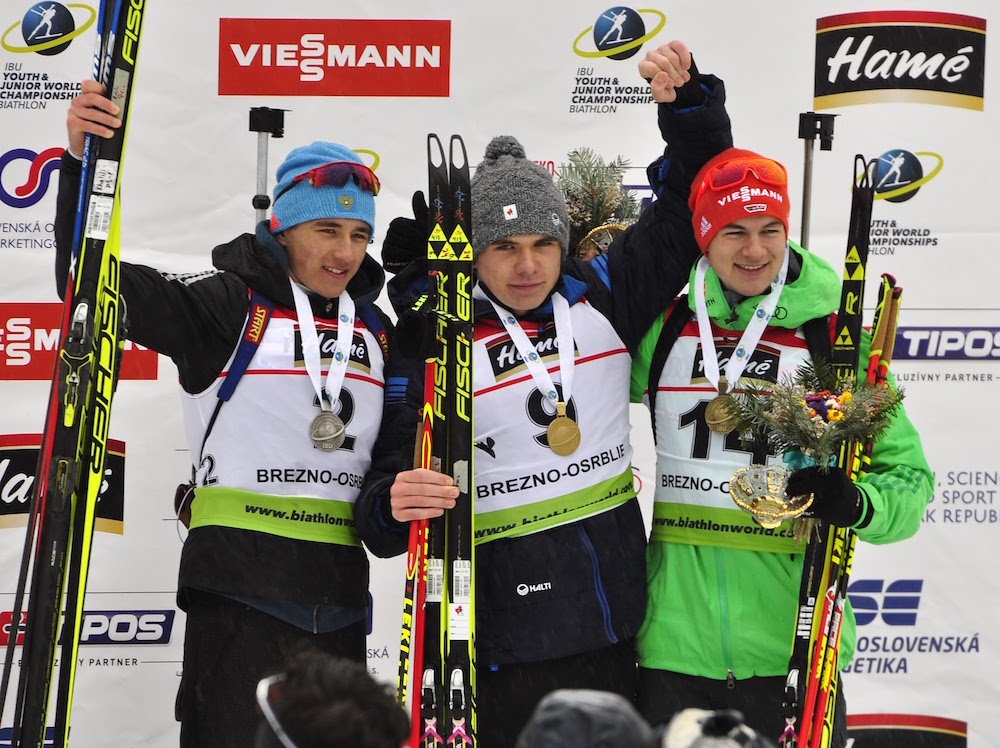
    The youth men’s 12.5 k individual podium after the first race of 2017 IBU Youth/Junior World Championships in Osrblie, Slovakia, with Canada’s Léo Grandbois in first (c), Russia’s Said Karimulla Khalili (l) in second, and Germany’s Danilo Riethmüller (r) in third. (Photo: Airat Aitniakov)

    Russia’s Said Karimulla Khalili started in bib 2 and enjoyed a brief moment as race leader, before Grandbois bested his time by 1:14.9 minutes. Khalili took the silver medal despite three penalties (1+0+1+1), and Germany’s Danilo Riethmüller captured bronze (+1:21.5) with three penalties as well (2+1+0+0). Besides Grandbois, who shot 100 percent, only one racer shot 95 percent: Italy’s Cedric Christille in fourth place (+1:44.5; 1+0+0+0).

    “I always go for the win when I race,” Grandbois wrote. “But I was aiming a top 10.”

    With the victory, Grandbois became the third Canadian to win a gold medal at Biathlon Youth World Championships, according to a Biathlon Canada press release. Kurtis Wenzel, of Calgary, is a two-time world champion: first in the 2009 youth sprint and later in the 2012 junior individual. Jean-Philippe “JP” Le Guellec, who previously coached Grandbois, started the trend by winning the 2004 Youth Worlds sprint.

    “Before I came here I looked at JP’s results on the internet, and read in the newspaper about his win in 2004,” Grandbois told Biathlon Canada. “It has always been my goal to be like him so to follow that path and do what he did is an amazing feeling.

    “The nicest message I received today was from JP,” he continued. “He told me how proud he was of me and to keep working hard. I have been smiling since I received that message.”

    And it wasn’t just the shooting that went exceptionally well for Grandbois on Wednesday; he posted the third-fastest ski time. In an email to FasterSkier, he explained that the hilly course in Osrblie suits him. “My kind of course,” he wrote.

    “Everything was perfect for me today, I was focused on the range and tried to do like at training,” he explained. “I had some great legs, too!”

    He told Biathlon Canada that he had worked on improving his shooting over the last three weeks.

    “When I went to bed last night and woke up today, I just had a good feeling I could do something great today,” he said. “I had complete focus and concentration on the range. The hard work over the last few weeks in training really worked today.”
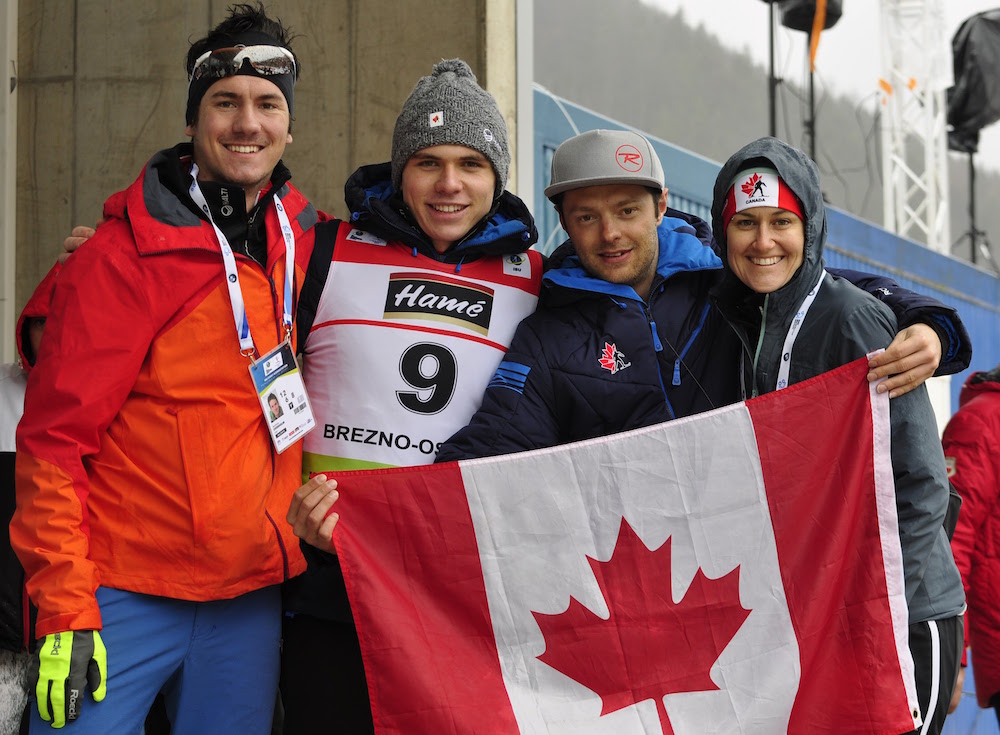
    Leo Grandbois (9) with his support crew, including wax techs Andrew Chisholm (l) and Andrzej Lesnik (second from r) and Canada’s head coach Jacqueline Akerman (r), after Grandbois won gold in the 12.5 k individual on the first race of his first IBU Youth World Championships in Osrblie, Slovakia. (Photo: Airat Aitniakov)

    In a post-race interview with Junior IBU Cup media, he thanked his supporters: “I want to thank first my coaches at home, my parents who always supported me and all the team who did a great job for the race, the skis, thank you.”

    When FasterSkier asked what this gold medal means to him, he explained it came down to all the passion and training he had put in.

    “I am probably the most happy man on earth today!” he wrote.

    Last year at Youth Olympic Games (YOG) in Lillehammer, Norway, Grandbois finished 22nd in the sprint, 25th in the pursuit and 16th in the mixed relay, a team event. At his first Youth World Championships, he said the field was bigger in comparison.

    According to Biathlon Canada High Performance Director Eric de Nys, Grandbois has been on the national team’s radar for a few years. Biathlon Canada started a Shooting Stars program this season and Grandbois was one of 16 athletes invited to “train, test and develop” with the national team.

    “Trajectory wise it identifies both a good skier and fantastic shooter under pressure,” de Nys observed of Grandbois’s performance on Wednesday. “This was Leo’s first time shooting clean and to do it a Worlds…..awesome.  Extremely happy for Leo and his support in QC.”

    Cervenka, Levins Land Top 20

    Leading the U.S. men on Wednesday was Vasek Cervenka, who has spent the better part of the last two seasons training in Nove Mesto, Czech Republic. The Boulder, Colo., native (who lives in Grand Rapids, Minn.) raced to 16th (+4:19.5) with five penalties (0+2+2+1).

    In his second Youth Worlds, his goals coming into the opening individual race had been to hit all of his targets and ski technically well. Placement-wise, he wanted a top 10.

    “The conditions were good in the morning, but a light rain started one and a half hours before the race and has continued the rest of the day,” Cervenka explained. “This made the course tricker over time as it was slowing down the skiing quite a bit. The rain also interfered with the shooting on the range.

    “I am a little disappointed today in my shooting knowing I can do better, also knowing a clean shooting would have brought me up to 2nd place,” he continued. “I felt good skiing but bonked on my last two loops.”

    After he cleaned the first prone stage, Cervenka’s time ranked third. One loop later, with two misses in the first standing stage, his split ranked 10th, which dropped to 23rd after the third stage. He recovered to 18th by the start of his last loop, and ultimately finished 16th for his best non-relay result at his second Youth Worlds. Last year at YOG, Cervenka had a previous best result of 20th in the pursuit.

    “As happy as I am with my improvements from last year to post this top 20, it still stings for me to miss a few shots too many, knowing where I could have placed if they went down,” he wrote.

    Also for the U.S., Jacob Pearson finished 49th (+7:45.3) with four misses (0+2+0+2), Alex Kilby was 75th (+9:51.1) with five penalties (1+0+1+3), and Camren Nielsen 91st (+14:36.9) with 11 misses (3+4+2+2).

    Canada’s Adam Runnalls finished 41st (+7:04.8) with eight penalties (1+2+4+1) and Thomas Hulsman was 57th (+8:19.0) with five misses (2+0+2+1). Robert Kreitz did not finish.

    Also on Wednesday, the youth women opened the championships with the 10 k individual, where American Chloe Levins raced 14th with three penalties (1+1+1+0). France’s Lou Jeanmonnot-Laurent shot 19-for-20 (0+1+0+0) to win the race in 34:00.9, and Levins finished 3:05.6 minutes off her winning time. None of the 90 women who finished the race shot clean.

    For Levins, a Middlebury student-athlete who plays collegiate golf in the fall and the spring, 14th was her best non-relay result at her third Youth Worlds.

    “Everything is possible, especially in an individual race,” she wrote in an email after. “The range is windy here in Osrblie, so good shooting is rewarded. … There’s no funny business on the track in Osrblie. It’s straight up, straight down, and flat into the range. The course demands power and strength, which I think is an advantage for me.

    “Today, it was important not to let the weather get in your way,” she added. “Sometimes it’s difficult to feel excited and fresh when it’s pouring rain, as it was today; those who shut it out of their mind are usually better off. Despite the conditions, our wax technicians prepared very good skis that moved really quickly through the saturated snow.”

    Last year at YOG, Levins broke through with a fourth place in the pursuit.

    “It is difficult to judge from one race, but the level of competition at this year’s Youth World Championships compared to last year’s Youth Olympic Games seems very similar,” she observed. “There are many familiar faces, and today there were even some repeating champions. I’m comfortable with the level of competition.”

    Moving forward to three more races in Osrblie (the sprint, pursuit and relay), Levins explained she took a lot of positives from Wednesday.

    “It’s not my best biathlon competition ever, but it’s certainly not my worst,” she wrote. “It’s a short way from the bottom to the top in this game, so I’m happy to have stayed above ground today. The result is fine, but I’m more happy to be able to say I did good work today.”

    Asked what she’s studying at Middlebury, Levins explained that she’s started pursuing neuroscience and economics “with a little bit of German for fun. My German professor loves that I have the opportunity to converse with native German speakers on a daily basis,” she wrote.

    (When Grandbois was asked if he speaks German, he replied, “Yes … but not perfect.”)

    Sharing the podium with Jeanmonnot-Laurent was Russia’s Kristina Egorova in second (+52.4) with one standing miss as well (0+1+0+0). Sweden’s Elvira Karin Öberg notched bronze (+1:16.1) with two penalties (0+0+1+1).

    Also for the U.S., Grace Gilliland finished 46th (+6:28.9) with four penalties (1+1+1+1), Amanda Kautzer was 53rd (+7:14.3) with eight misses (2+1+4+1), and Helen Wilson was 62nd (+9:00.5) with six penalties (1+2+2+1).

    Canada’s Shilo Luca Rousseau finished 54th (+7:29.9) with five misses (2+0+1+2), Frédérique Pérusse was 77th (+11:54.6) with nine penalties (1+4+1+3), and Elise Sauve 78th (+12:07.1) with seven misses (2+2+2+1).

    IBU Youth/Junior World Championships continue Thursday with the opening junior competitions: the women’s 12.5 k and men’s 15 k individual.

    Results: Youth men | Youth women
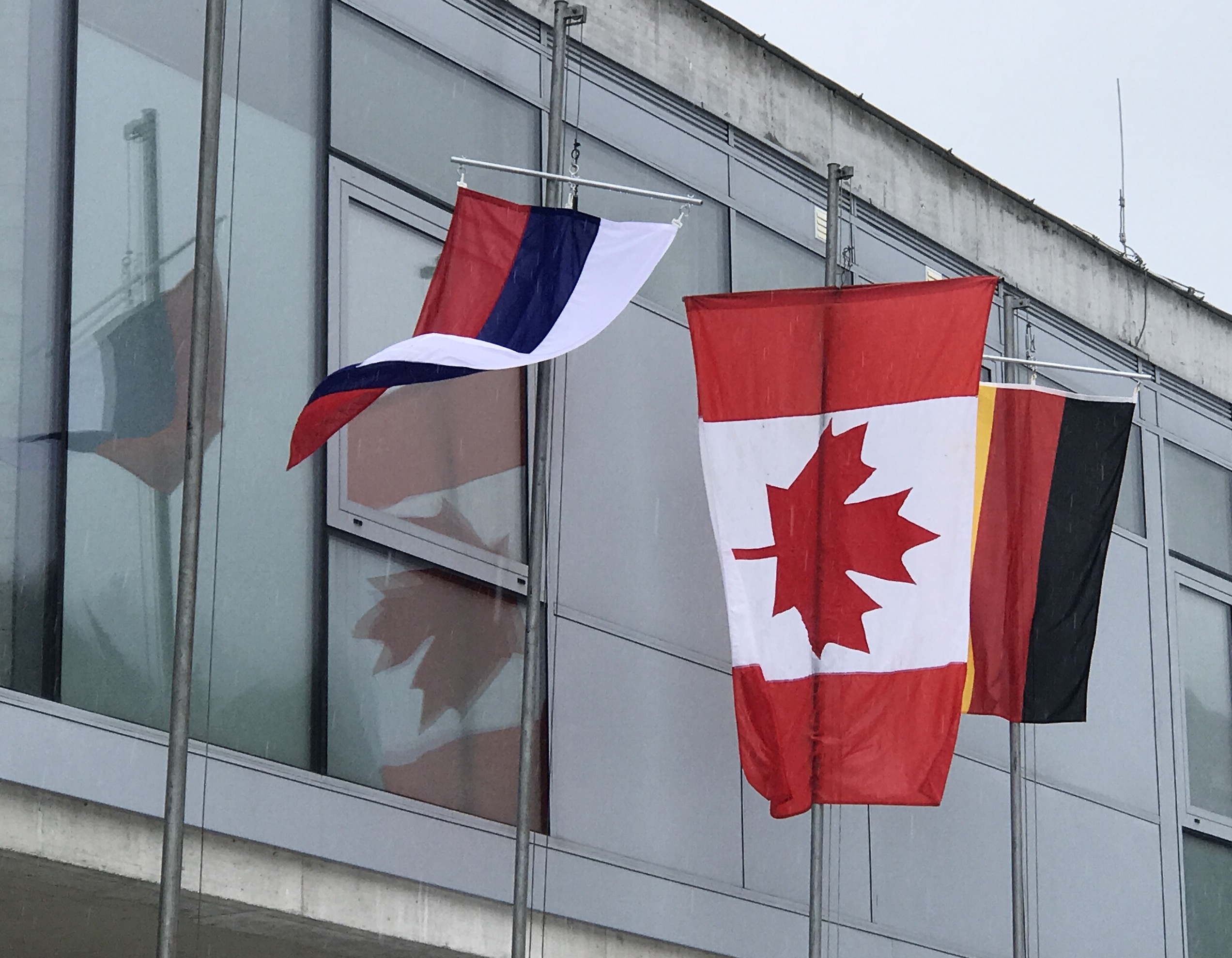
    The Canadian flag flying high above the biathlon stadium in Osrblie, Slovakia, after Leo Grandbois won the youth men’s 12.5 k individual, the first race of 2017 IBU Youth/Junior World Championships. Russia took second and Germany third. (Photo: Terri Dickson)
  • What Smith’s Win Means in Terms of the Green for Biathlon Canada

    What Smith’s Win Means in Terms of the Green for Biathlon Canada

    Nathan Smith celebrates after becoming just the second Canadian man to ever win a biathlon World Cup, after winning Saturday's 12.5 k pursuit in Khanty-Mansiysk, Russia. (Photo: Biathlon Canada/NordicFocus.com)
    Nathan Smith celebrates after becoming just the second Canadian man to ever win a biathlon World Cup, after winning Saturday’s 12.5 k pursuit in Khanty-Mansiysk, Russia. (Photo: Biathlon Canada/NordicFocus.com)

    When Nathan Smith crossed the finish line of Saturday’s 15 k mass start in Khanty-Mansiysk, Russia, he became just the second Canadian man in history to win a World Cup biathlon competition.

    Smith had already had a record-breaking season. He won silver in the 10 k sprint at World Championships in Kontiolahti, Finland, making him the first Canadian man ever to medal at a Championships. It was the first podium of his career, but certainly not the last.

    So when he finished fifth in the sprint in Khanty-Mansiysk, 34 seconds out of the win, Canadian staff knew that something special might happen in the following pursuit.

    “I think he actually had a better opportunity for a good race in the [Khanty] pursuit versus after the second place after the World Championships,” Biathlon Canada High Performance Director Chris Lindsay said. “I think that the excitement and the novelty of what was an incredibly important result [at World Champs]… really didn’t set him up well for being able to carry through on the second day of racing.”

    But in Khanty-Mansiysk, Smith was able to rely on a season’s worth of near-podium experiences, and he raced like someone who belonged at the top. That netted him a 24-second win.

    “It feels really good to have a second medal on the results,” Smith said after the race. “It gives a little bit more credibility to my World Champs medal, like it wasn’t just a fluke. I can consistently put down medal-potential results.”

    Plenty of North American biathletes have shown the ski speed needed to win a World Cup, but it takes more than just speed to actually do it. By coming so close a few times this season, Smith learned to do what it took on Saturday – for instance, leading Martin Fourcade and Anton Shipulin around the course.

    Canadian head coach Matthias Ahrens cheering from the range during Saturday's race. Because of budget concerns, Biathlon Canada only sent two staff members - Ahrends and head service tech Tom Zidek - to support the team in Khanty-Mansiysk.
    Canadian head coach Matthias Ahrens cheering from the range during Saturday’s race. Because of budget concerns, Biathlon Canada only sent two staff members – Ahrens and head service tech Tom Zidek – to support the team in Khanty-Mansiysk.

    “The more time that you can play up at the front of the pack, the more you realize that there’s not so much difference between what the top athletes are doing on the ski trail compared to what guys in the top 30 are doing,” Lindsay said. “When you need to step in front of somebody and take the lead, you don’t second-guess the choice to do it. Whereas the first time you’re up at the front of a pack skiing with athletes who are your peers but also in some ways your heroes, it can be difficult to assert yourself.”

    Watching the win happen already had direct consequences for the team: Rosanna Crawford said that it immediately motivated her to do better, and later the same day she went out and climbed from 28th place to 13th in the women’s pursuit, her best result in weeks.

    “Not only is a big step forward for him to prove to the World that he can be a consistent podium contender, but it’s also great for our team and will be a big motivator for us all when we start training again this spring,” said Smith’s teammate Brendan Green, who finished 23rd in the pursuit. “Nathan and I have been training together since we were 14 years old and it’s been awesome to see his progress over the years and especially in the last couple of seasons.”

    Funding… Or Not

    While earning a win instead of only a second-place finish might seem like an even bigger boost in the profile of Canadian biathlon, the national team’s biggest funding partner doesn’t see it that way.

    Own The Podium (OTP), and public-private partnership which determines high performance funding for Canadian sports, focuses only on medal-worthy results at World Championships and Olympic Games, and does not consider podiums in regular season races as criteria for funding a sport.

    “Medals at the World Championships and the Olympic Games are really what counts,” Lindsay said. “Our funding partners and our performance partners love to see that we are getting those medals at the critical competitions and are happy other evidence of success. Certainly medals and top-5’s, top-8’s consistently are signs of other success, but if that success can’t translate into success at the World Champs and Olympic Games they aren’t counted with the same weight.”

    Luckily, Smith won that silver medal at World Championships. If Biathlon Canada sees an increase in OTP funding next year, it’s likely thanks to that – and that might be why Smith’s finish there was so exhaustingly significant. When he got the medal, he knew what it meant to his team, which has not had a World Championships or Olympic medal since the time of Myriam Bédard in the early 1990’s.

    Biathlon Canada has a miniscule budget, with $1.1 million for 2013-2014 for high performance including salaries. Not only is the sport not massively popular in the country – a North American problem also faced by U.S. biathlon – but without any of those championship medals to call on, it seemed to fall at the bottom of OTP’s priority list.

    Last February, the Banff-based Crag and Canyon reported that the federation has been running a deficit for the last five years, and wrote that “This year’s deficit amount falls somewhere between $100,000 and $150,000.”

    While budget problems plague North American biathlon, Canada has it harder in some ways. For instance, according to the U.S. Biathlon Association’s 2013 990 Form, USBA paid over $368,000 to its three highest-paid employees combined (head coach Per Nilsson, High Performance Director Bernd Eisenbichler, and shooting coach Armin Auchentaller); Biathlon Canada had just $375,000 (which translates to less than $300,000 U.S.) for all its high performance staff combined, including the director, coaches, and technical staff.

    That leads to situations like the team had last weekend, when it sent only its top three athletes to the far-flung Siberian venue of Khanty-Mansiysk instead of a full team. And to support them, only Ahrens and head service tech Tom Zidek were flown to Russia.

    “Tom was up until 11 last night at the site testing, and then the shuttle service stopped before he got to the bus,” Smith said after his winning pursuit. “So he had to walk an hour back to our hotel. That’s the level of commitment that can make a big difference in the end for our results.”

    It’s satisfying to win when other countries have ten times the staff and orders of magnitude more money available for high performance.

    “It feels kind of good,” Smith said. “It’s like we’re right in their faces. Some of those teams have guys who basically just stand around and hold jackets and I don’t know, keep seats warm. On our team, even when we have a full support squad, like at World Champs, everyone is pretty busy doing stuff. We’re still a small team even then.”

    But it’s also frustrating. What might be possible with a bigger budget? Ahrens wish he could find out.

    “I definitely would say it is frustrating, mainly because the competitiveness of the biathlon World Cup,” Ahrens said. “It is just amazing how strong the field is, both on the men’s and the women’s side. You have thirty athletes really fighting for the podium and compared with other sports, where you really have maybe five contenders fighting for a podium. It’s gone to such a high level that there is no  country out there not doing this very professionally. It’s getting tighter and tighter. If you just look at the results from yesterday in the sprint, the top 60 were within two minutes. A year ago or two years ago, that was usually around 2:30, so it’s amazing how the sport is developing.”

    That’s why the hope is so strong that OTP will recognize Smith’s results and reward the team that helped him get there.

    “The fact that he medaled at World Championships in Finland is huge and I really hope this will help boost our federation’s funding a bit,” Jean Philippe Le Guellec, the last (and first) Canadian man to win a World Cup, wrote in an email. “The next step is to have others follow his footsteps.”

    Not Alone

    As it happens, that doesn’t seem too far-fetched.

    When Le Guellec earned Canada’s first-ever male World Cup win in Östersund, Sweden, in December 2012, Smith was competing in the same 10 k sprint race. He finished 61st, just one spot away from qualifying for the next day.

    Le Guellec was an obvious choice to be the guy to finally do it for Canada. He had already notched a best-ever result for a Canadian man at the Olympics in Vancouver in 2010, finishing sixth; in Sochi, Russia, in 2014, he upped that mark to fifth place.

    It was with appreciation but also dismay that the biathlon community said goodbye to Le Guellec when he retired after the Sochi Games. But the gold the team had been mining was still right there in the team he had been part of, the Quebecois star explained.

    “Funny, because I was told it was the end of an era when I retired,” Le Guellec wrote in an email on Sunday. “But this is simply, and clearly, the start of a new one… I was ecstatic but not surprised. With the season he had last winter and the effort he puts in training, I had hopes that he would do well this season. He’s the most consistent of us all as well. Knocking at the door often in the beginning of the season was making it a question of time until he climbed on the podium. I’m just pumped for him it happened sooner rather than later AND repetitively!!”

    Smith isn’t the only Canadian who might be showing up on the podium next year. Rosanna Crawford came close this year, finishing fourth and fifth at the beginning of the season; Megan Heinicke had four top-15 performances; and Brendan Green was one of the most consistent performers after Christmas, having only two results out of the top 30 and finishing in the top 21 in every race at World Championships.

    “It’s the same with Brendan [Green] and Rosanna [Crawford],” Smith said. “They are pretty consistently at the level where if they have a really good race, they could podium too.”

    Lindsay and Ahrens agreed that Canada’s pipeline is in better shape than it often has been in the past.

    “I’m really happy and not just by those two senior athletes who have really gone to the top of the pack, but also our upcoming younger athletes like the two Gow brothers, Macx Davies,” Ahrens said. “They have put a lot of effort of course in training, but they are part of our achievements. I look at the two Gows as being a really important part of our relay team…. If I look at this, it’s actually the younger athletes now, they’re coming in at a higher level then the young athletes came in ten years ago.”

    Ahrens has personally seen the long-term development it took to get Smith to the top of the podium. Despite being hired as head coach only in 2010, he has known Smith much longer.

    “I must say for me, it’s just an amazing experience,” Ahrens marveled. “Especially Nathan and Brendan, I started coaching them 10 years ago when they were still juniors, when I took the position for junior national team coach. So I really appreciate that I could grow with them and they could grow with me, and it has been an amazing journey up to this point.”

    He hopes that means that some of the newer team members will eventually follow in Smith’s footsteps.

    “That is always my hope, and I believe in that,” said the head coach. “Hopefully they stay with the sport and they can be supported enough that they can afford staying in the sport. That’s always a challenge for us. I think too often, athletes drop out too early. We know the highest performance age is, while it’s getting younger, it’s still around 27 years of age.”

    Smith is 29 years old, and he was 26 when he watched Le Guellec climb to the top step of the podium on a windy afternoon in Sweden.

    He hopes that his own success can do the same thing for the younger members of his team.

    “You can make surprises happen,” he said. “[JP] surprised everyone that week; I surprised everyone last week. Neither of them should have been surprises, because JP had been close to the podium many times, but it really sinks in when someone actually does it. Then you see, oh yeah, I train with him. I can beat him in time trials sometimes. There’s no reason why I couldn’t podium either.”

  • Smith Soars into Canadian History with World Champs Silver, Breaks Up Bø Brothers in Sprint

    Smith Soars into Canadian History with World Champs Silver, Breaks Up Bø Brothers in Sprint

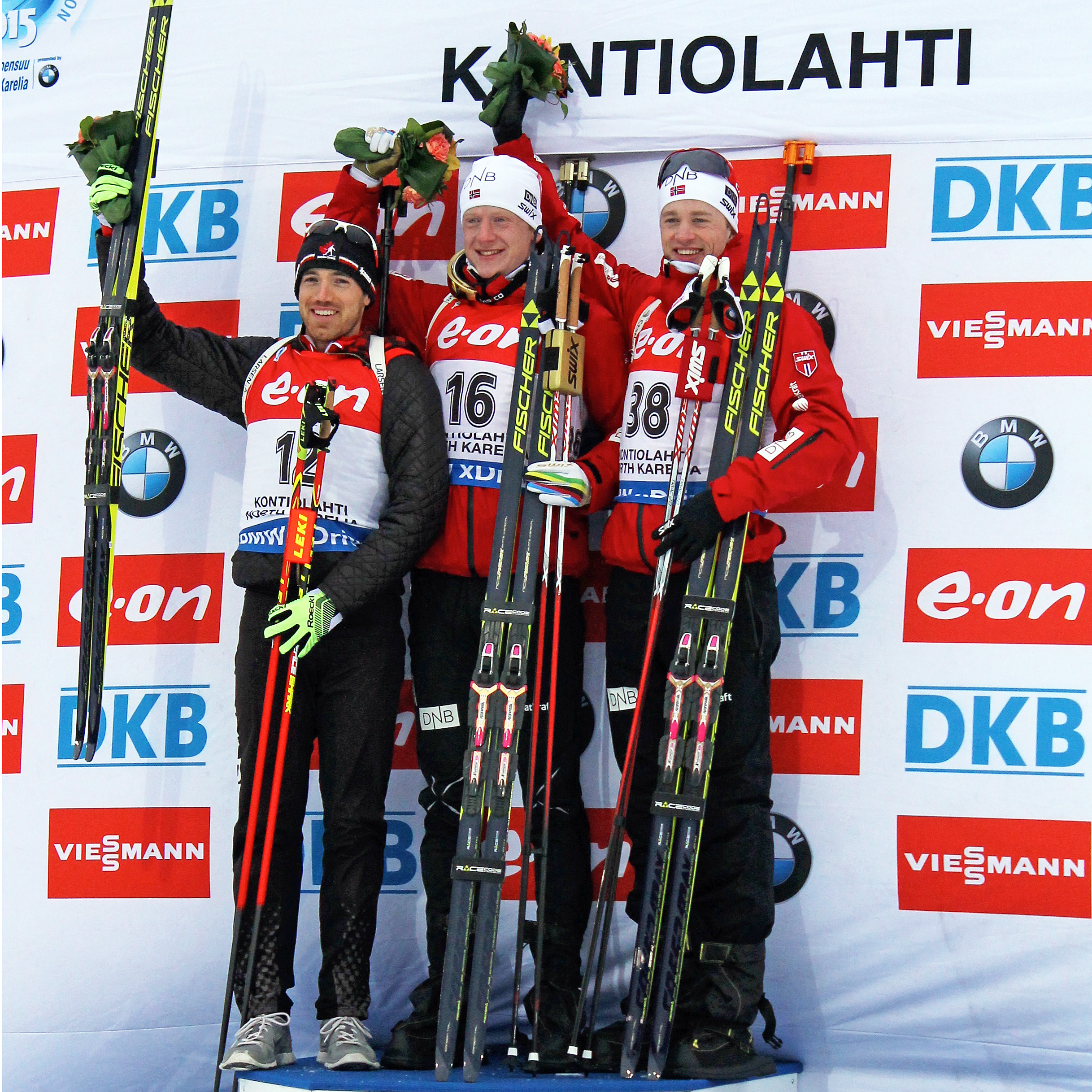
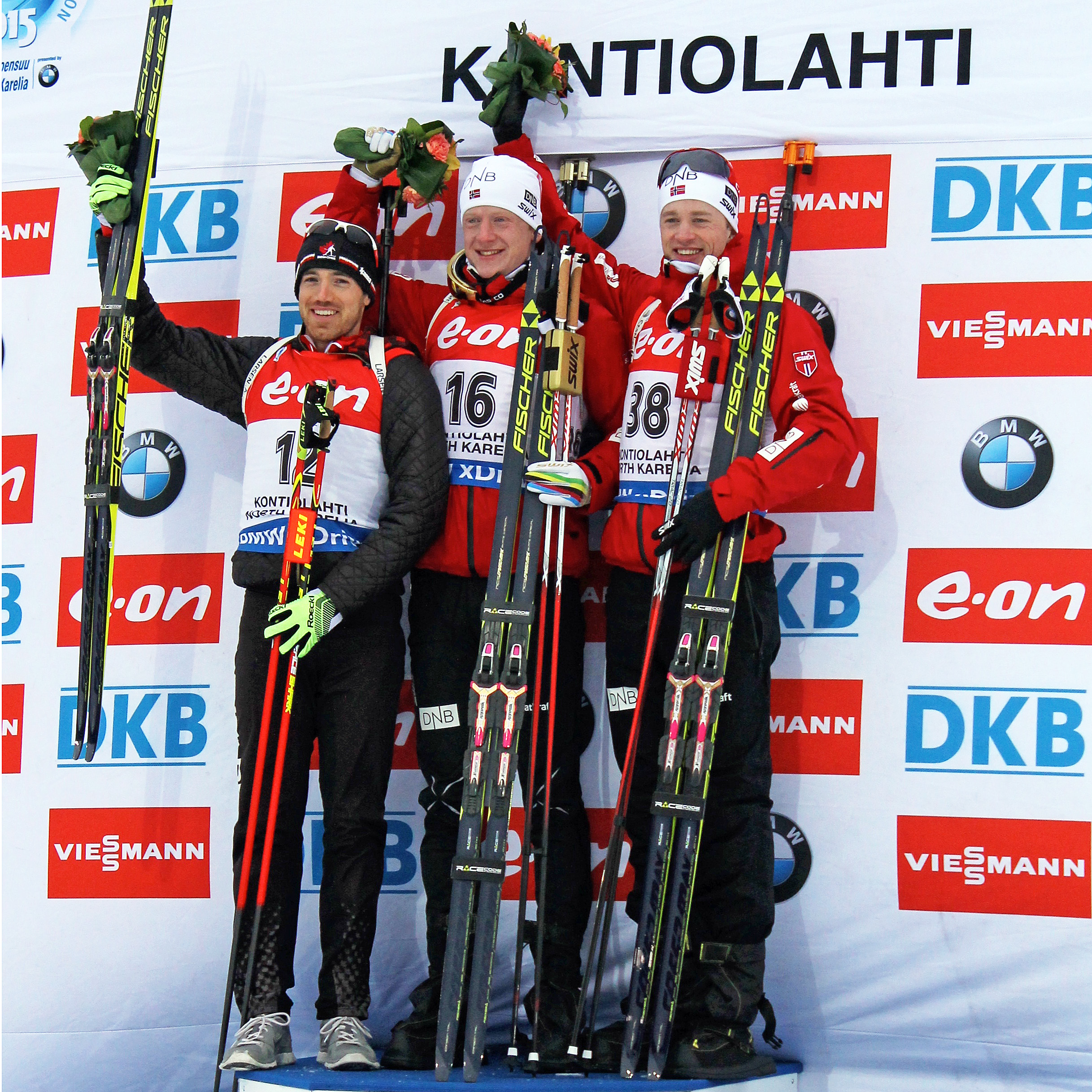
    Nathan Smith (l) on the 2015 IBU World Championships 10 k sprint podium on Saturday with Norwegian brothers Johannes Thingnes Bø (c) and Tarjei Bø (r) in Kontiolahti, Finland. Smith placed second for Canada's first-ever men's podium at World Championships.
    Nathan Smith (l) on the 2015 IBU World Championships 10 k sprint podium on Saturday with Norwegian brothers Johannes Thingnes Bø (c) and Tarjei Bø (r) in Kontiolahti, Finland. Smith placed second for Canada’s first-ever men’s podium at World Championships.

    KONTIOLAHTI, Finland — As Norwegian brothers Johannes Thingnes Bø and Tarjei Bø prodded and joked with each other on the podium of the men’s 10-kilometer sprint at IBU World Championships on Saturday, Nathan Smith simply grinned from the second-highest step on the podium.

    Finally, after the first round of many congratulations to come, it was starting to set in for the 29-year-old Canadian.

    Smith had just done something no other Canadian male had done before: he medaled at World Championships. Not only did he place in the top three, he finished squarely in second, 12.1 seconds behind winner Johannes Thingnes Bø, and 13.2 seconds ahead of Bø’s older brother Tarjei for silver.

    “When Johannes was 16, 17 years old he started winning Junior World Championships and he was following my steps all the time,” Tarjei, 28, reminisced in a post-race press conference. “We talked about this a lot during the summertime when we were at home training together. We love to compete and we love to fight each other, but still we are the team against the rest of the world so today is a big day for us.

    “We beat the world almost — it was only Nathan who came between us so congrats to him,” he added with a laugh.

    Everyone laughed.

    Nathan Smith (Biathlon Canada) racing to Canada's first men's medal at IBU World Championships on Saturday in the 10 k sprint in Kontiolahti, Finland. Smith achieved silver for his first career podium at the World-Cup level. (Photo: Fischer/NordicFocus)
    Nathan Smith (Biathlon Canada) racing to Canada’s first men’s medal at IBU World Championships on Saturday in the 10 k sprint in Kontiolahti, Finland. Smith achieved silver for his first career podium at the World-Cup level. (Photo: Fischer/NordicFocus)

    Then there was Smith, a regular top-10 contender on the World Cup for the last two seasons, but unlike the Bøs, someone who had never tasted the podium before. Going into World Championships, his personal best was fifth in the pursuit on Nove Mesto, Czech Republic, just under a month ago.

    “It’s overwhelming,” Smith said of the attention he received Saturday as soon as the results were final. “I knew I could have some good races, but you never really believe it until you do it. It’s hard to explain, it feels great though.”

    All that came after shooting slump in January, when Smith placed 78th in an IBU World Cup sprint in Antholz, Italy.

    “I took some time away from my rifle and then I came back into Nove Mesto and Oslo and my shooting was right up there again so I had a lot of confidence with my shooting,” he said after hitting nine of 10 targets on a windy range in Kontiolahti on Saturday.

    “My skiing’s been pretty consistent all year. I haven’t had too many days where I’m dying out there, so I knew if I had an average day and nine or 10 here with the wind, that it could be really good.”

    Yet after starting 12th and taking the lead at the finish by 30 second, Smith wasn’t exactly sure what “really good” would amount to. He was bumped down one place by 21-year-old Johannes Thingnes in bib 16, but after that, no one came close.

    Based on World Championships rules for “unusual weather conditions,” the grouping system that determined starting order was altered for Saturday to allow nations with competitors ranked in the top 50 on the World Cup to enter “any draw group they choose.”

    Naturally, with a salted course for the just-above-freezing temperatures and the forecast for snow later in the day, the top men decided to go first. And out of 127 competitors, Smith was close enough to the front that it worked out for him as planned.

    Nathan Smith (Biathlon Canada) racing to Canada's first men's medal at IBU World Championships on Saturday in the 10 k sprint in Kontiolahti, Finland. Smith achieved silver for his first career podium at the World-Cup level.
    Nathan Smith approaching the range at the IBU World Championships 10 k sprint on Saturday in Kontiolahti, Finland. Smith went on to place second for a historic silver for the Canadian men’s program.

    With a headwind coming into his first shooting, he took note of the gusts from his right side and clicked a couple to the right. After hitting his first three prone shots, Smith felt the wind pick up even more, so he shaded, which led to perfect 5-for-5 shooting.

    “I got a little lucky for my last hit,” Smith recalled.

    That put him in second after prone, and he went on to ski the sixth-fastest second lap (out of three). In his second-and-final stage, Smith missed one, which was a success considering two men in the entire field finished the race with perfect 10-for-10 shooting (Tarjei being one of them).

    “I tried so hard in standing; I didn’t just whip though it and throw some shots away,” Smith said.

    However, he posted the sixth-fastest range time in standing to finish the race as the fourth fastest on the range overall. On skis, he was seventh fastest overall on course.

    “I worked really hard on the skis,” he added.

    “We beat the world almost — it was only Nathan who came between us.” — Tarjei Bø, Norway’s sprint bronze medalist

    “Before the race, Nathan knew that this course suited him,” Canadian national team coach Roddy Ward explained. “He doesn’t like gradual climbs, but the steeper climbs he feels comfortable with — offset. There’s quite a lot of that here. So he was pretty confident out there and he definitely looked like he had really good fitness.”

    Ward was out on course for most of the race while Canadian head coach Matthias Ahrens was in the range. But before he ventured out, he caught a glimpse of Smith whipping through the stadium.

    “I watched Nathan go around and I thought to myself, ‘Nathan’s gonna be a hero back home after this race,’ ” Ward predicted. “And then I said, ‘Don’t jinx it!’ and then I said, ‘I can’t  jinx it.’ I was pretty confident. He knew he was in good shape, too. I think he had pretty good confidence, but hey, he’s on the podium for the first time ever in a World Championships so of course it’s a bit of a surprise.”

    Like many who have followed Smith’s progression, from breaking out at the 2014 Olympics with three top-15 results in Sochi, Russia, Ahrens knew it was a long time coming.

    “With his good shooting and efficient shooting — shooting usually very fast — and then given that he had really good ski speed today, he was already looking quite solid, quite early,” Ahrens reflected. “[He has] the shooting efficiency, he shoots accurate, but also very fast. He’s always on the top five in the World Cup in that particular category when you analyze the race. His skiing has improved over the last three years and he’s now at a point, if everything comes together, then he can be on the podium.”

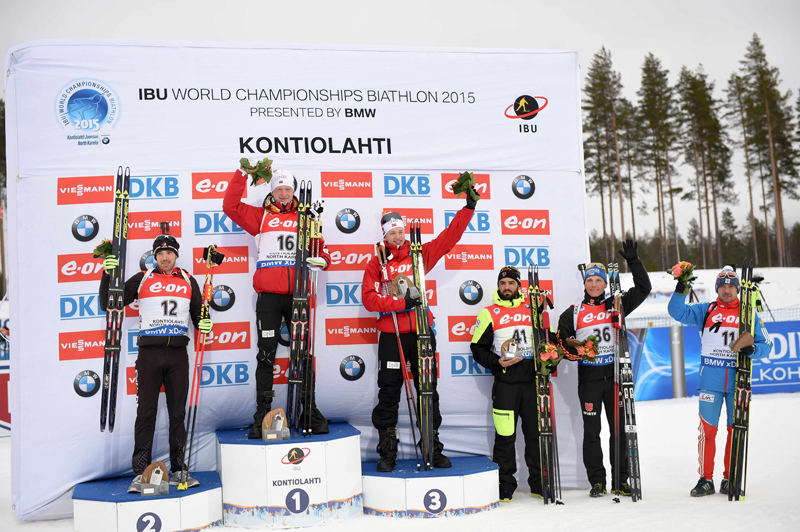
    The men's 10 k sprint podium at 2015 IBU World Championships in Kontiolahti, Finland. From left to right: Silver medalist Nathan Smith (Canada), gold medalist Johannes Thingnes Bø (Norway), bronze medalist Tarjei Bø (Norway), Simon Fourcade (France) in fourth, Erik Lesser (Germany) in fifth, and Evgeniy Garanichev (Russia) in sixth. (Photo: Fischer/NordicFocus)
    The men’s 10 k sprint podium at 2015 IBU World Championships in Kontiolahti, Finland. From left to right: Silver medalist Nathan Smith (Canada), gold medalist Johannes Thingnes Bø (Norway), bronze medalist Tarjei Bø (Norway), Simon Fourcade (France) in fourth, Erik Lesser (Germany) in fifth, and Evgeniy Garanichev (Russia) in sixth. (Photo: Fischer/NordicFocus)

    So the snowflakes fell at the right time and right place for Smith, who made history for Biathlon Canada. Previously, no man had medaled at World Championships, and Smith followed up on the success of former teammate Jean-Philippe Le Guellec, who won a World Cup sprint in 2012 in Östersund, Sweden, and retired after last season.

    Retired biathlete Myriam Bédard holds the Canadian women’s and overall record with two golds from the 1994 Lillehammer Olympics and another from 1993 World Championships.

    “I think how things started for our team was having Jean-Philippe Le Guellec leading our young men to success in the way that he actually was the first one on the podium, winning a World Cup, and that gave them confidence that really they all could do it,” Ahrens said. “That made a big mental breakthrough to our team, to the men, in many ways. The confidence, being able to do it in racing, but also what it takes in training to get there.

    “It shows the younger athletes what is possible when they put the work in, when they put the belief in,” he added.

    The silver medal was also huge in terms of future funding for Biathlon Canada. On the heels of Cross Country Canada’s Alex Harvey racking up silver and bronze at the FIS Nordic World Ski Championships last month in Falun, Sweden, biathlon essentially had to bring home some hardware as well to ensure an adequate budget from Own The Podium — Canada’s governmental branch of sport funding — for next season.

    “This is important for our funding because we are just actually judged by medals at World Championships or Olympic Games,” Ahrens explained. “Therefore it’s a very important step in the right direction.”

    “It shows the younger athletes what is possible when they put the work in, when they put the belief in.” — Biathlon Canada Head Coach Matthias Ahrens on Nathan Smith’s silver-medal performance

    To his own surprise, Smith reached that marker in the first individual race of 2015 World Championships. Going into Saturday’s race, he later explained he would have been happy with a top eight. Three years ago, he wasn’t sure how much longer he’d last as a professional biathlete.

    “Going into the Olympics last year, I was thinking it was going to be my last year,” Smith explained. “I was like, I’m going to do whatever I can to get to the Olympics.”

    Two summers ago, he made some significant tweaks to his training and preparation. He targeted his weaknesses and honed in on them, like uphill rollerskiing. He made his own rifle stock, which he currently uses, and started doing things he had never done before, such as dry firing.

    “We always say that North Americans in general are late developers compared to the Europeans,” he observed. “We’re, like, five years behind them in development. I think it just takes a bit longer when we’re isolated in Canada.”

    As of Saturday, Canada’s on the map. Smith went head to head with top skiers like Russia’s Evgeniy Garanichev, who started 11th and led after a clean prone, as well as Johannes Thingnes, and was fast enough to hold off Tarjei, who posted two perfect stages.

    Like Smith, Johannes Thingnes had one standing miss, and started 16th to come through each checkpoint with the consistently fastest times. At the end of the day, the Norwegian had the fastest course time as well.

    “It was maximum of what we could expect today, two brothers on the podium for the first time and also my first [World Championships] gold medal in my first [individual] start,” Johannes Thingnes said in the press conference. “So it could not have been better.”

    After the press conference, Smith said he hadn’t talked to his parents yet — they were on a bike trip in Argentina.

    “Usually they wake up really early in the morning to watch [my races], but I don’t think they have reliable internet there so we’ll see when they find out,” he said casually. “I’ll send them an email.”

    Three Canadian Men Make Pursuit

    Also for Canada, Brendan Green placed 21st (+1:14.3) with a single standing penalty and Scott Gow was 50th (+2:06.2) with one prone miss and one standing miss, to qualify for the pursuit. The youngest man on the team, Christian Gow finished 73rd (+3:11) in his World Championships debut. After starting 109th, he faced some of the toughest, slowest conditions of the men’s race and came away with three penalties — one in prone and two in standing.

    Canada's Brendan Green on his way to 21st in Saturday's 10 k sprint at IBU World Championships in Kontiolahti, Finland. He'll start Sunday's pursuit 1:14 behind the race leader.
    Canada’s Brendan Green on his way to 21st in Saturday’s 10 k sprint at IBU World Championships in Kontiolahti, Finland. He’ll start Sunday’s pursuit 1:14 behind the race leader.

    “I just figured that if I felt decent on the skis and I knew I’d have to have some good shooting, probably at least eight, maybe nine out of 10, and I thought that was really possible,” Christian explained. “But the wind was a bit tricky and I think I gave away a shot prone. Standing was just tough. I felt really unsettled. Every time I lined up on the target, the wind seemed to push me away.”

    On his way to the starting line, Christian realized that Smith had all but secured second.

    “I couldn’t even believe it,” he said. “We know as a team we’re quite strong, and Nathan and Brendan especially have been really really close to the top. … I think sometimes they underestimate themselves a little bit … I knew they could hit the podium with the right race. When I started, that’s when I realized he was going to hold that because that’s when all the threats were coming in [and] his time was better than theirs. That was awesome.”

    “I saw [Nathan] clean prone and I saw him leading standing with one miss,” said older brother, Scott Gow, 24, who started 55th. “I thought, ‘Oh, maybe he’ll do well.’ He stayed up there. It was motivating to try and go out there and put in a good ski race and aiming to shoot as well or as better than him. It was more motivating to see him do so well.”

    Personally, Scott said he had hoped for a top 30.

    “That’s my personal goal at every race,” he said. “Today, with the wind the way it was I figured 80 percent, 90 percent shooting would [be enough], and I made the low end of that. The skiing suffered a little on the last lap. I was just kind of tanked.”

    Not long after Smith started, Green took to the course and ended up tying Belgium’s Michael Roesch for 21st.

    “I’m a little bit disappointed and I was hoping for better skiing,” Green said. “With the shooting I had on a day like today, I would expect a better result. It wasn’t a disaster, it was just the skiing wasn’t quite there. I’m not sure why that is. I’m set up well for the pursuit.”

    In Sunday’s 12.5 k pursuit, Green will start alongside Roesch, 1:14 behind Johannes Thingnes, while Smith will head out 12 seconds after the race leader in second.

    “Obviously in a pursuit, I’m going to have an advantage over everyone except Johannes, so that’s an advantage,” Smith said in the press conference. “But there’s so many guys breathing down our necks that I’ll have to fight really hard to maintain it.”

    “Everything is possible,” said Tarjei, who will start 25 seconds behind his brother. “Two races now, two medals [for Norway], and same with my brother, so I have to win tomorrow to catch up with him. No chance.”

    “It’s kind of funny,” Smith said of being sandwiched between the Bø brothers. “I do feel a little left out, but I’m happy for them.”

    Results

  • Québec Biathlon National Team Center to Close, Paquet’s Position Eliminated

    Québec Biathlon National Team Center to Close, Paquet’s Position Eliminated

    Jean Philippe Le Guellec of Canada headed in for fifth place in the 10 k sprint at the Olympic Games in Sochi, Russia, this winter. His longtime coach and training center have both been defunded by Biathlon Canada.
    Jean Philippe Le Guellec of Canada headed in for fifth place in the 10 k sprint at the Olympic Games in Sochi, Russia, this winter. His longtime coach and training center have both been defunded by Biathlon Canada.

    Biathlon Canada is closing its Eastern training center at Valcartier and has so far not renewed the contract of Jean Paquet, a coach with the team since 2007.

    During the Sochi Olympics Paquet speculated that he might not have a job after this season. Biathlon Canada High Performance Director Chris Lindsay confirmed last week that the position Paquet formerly held has been eliminated, although Paquet did not respond to repeated requests for comment (Edit: he now has; see the interview here).

    “Following our high performance plan, the program that we had been running under Jean Paquet will no longer continue,” Lindsay said. “With JP [Le Guellec]’s retirement, and with only one Québec athlete making any of our national team criteria, we do not feel that we can justify, unfortunately, having a full-time coaching position there.”

    While Lindsay said that the board of directors and Executive Director Joanne Thompson had been involved in the decision, Thompson declined to comment, writing in an e-mail that decisions on staffing and training centres wouldn’t be finalized until after April 28th.

    However, national team head coach Matthias Ahrens also confirmed the changes.

    “It is correct that the Jean’s National Team Coach position was not renewed based on that we closed the National Training Centre in Quebec which was primarily based on Jean Phillipe LeGuellec who retired this season,” Ahrens wrote in an e-mail.

    According to Lindsay, Biathlon Canada will at the moment function with two coaches, a reduction from the three-man staff of last season. Matthias Ahrens will remain head coach and Roddy Ward will stay as an assistant coach. As with all things Canada, funding relies on Own the Podium, a non-profit which allocates money based on its assessment of a sport’s medal potential.

    “We find out our 2014-15 funding levels this summer, and we are hopeful that OTP will see the benefits of a third coach in the program,” Lindsay later wrote in an e-mail, although he did not elaborate on whether that would be Paquet.

    Paquet’s Work

    Paquet led the training group of senior Québec athletes out of the Centre d’Excellence Myriam Bédard, in Valcartier. The site also houses Québec’s provincial team of junior biathletes and seniors who are not part of the national team, coached by Martin Tremblay.

    Paquet is perhaps best known for his role as the day-to-day coach of Jean Philippe Le Guellec, who owns Canada’s best Olympic finishes by a man with sixth place in Vancouver and fifth place in Sochi. Le Guellec was close to doing even better, but while leading the 2014 Olympic pursuit he crashed on a dangerous corner and broke a ski. He had long planned to retire after the Sochi Games.

    “In the last two years, we covered immense ground to be able to achieve the best performances possible at the Games,” Le Guellec, who had not heard about Paquet’s contract, wrote in an email. “We literally worked on many aspects even up until the last day before the first race. With the way that I was able to ski along the fastest in the world and outshoot the field in many races, it felt like I was at the top of my game.”

    Two other mainstays of Québec biathlon, 2010 Olympian Marc-Andre Bédard and Claude Godbout, did not meet national team criteria after this season. Their plans are not yet concrete, but Bédard told FasterSkier earlier this spring that “we still want to race and we plan on doing a different approach this year, we’ll both do what we want more then what we’re suppose to, so that might be interesting.”

    That leaves Audrey Vaillancourt as the lone Québec athlete on the national team. The Open European Champion at 15 k this season, Vaillancourt wrote in an e-mail from Peru, where she’s spending her spring break from training, that she was unsure what was happening with the Québec center.

    “I don’t know all that much about the ‘official’ status of the training center for next year, but I know for sure that it won’t affect the support I get since my provincial coach/team will still be training there, and I will also spend a lot of time in Canmore with the rest of the national team,” she wrote.

    Vaillancourt and Le Guellec were recently honored as Biathlon Canada’s Athletes of the Year.

    Meanwhile, Paquet – an eight-time World Championships competitor and 1992 Olympian – was nominated for Gala Sports Québec’s international coach of the year award, up against cross country ski coach Louis Bouchard and canoe/kayak coach Frédéric Jobin.

    That underlies the respect he has earned for his athletes’ performances, which Le Guellec elaborated on.

    “Jean retired from racing in 2005,” he explained. “I could imagine making the leap to coaching World Cup athletes is quite the learning curve when he took us up in 2007. He’s very reserved, so he never was one to speak from a first person point of view, or to impose his own point of view as being gospel truth, which I really respect. But I have no doubt a lot of his own experience and learning as an athlete was transferred to his teachings as a coach. I would say he definitely had a big role in my approach to training and psychology of training.”

    Centralization Push

    According to Lindsay, the loss of Paquet’s position is due at least in part to OTP.

    “Jean’s position was funded by OTP for the sole purpose of coaching JP,” Lindsay wrote in an email. “With JP retiring the funding has ended.”

    However, Lindsay also told FasterSkier that closing the Québec training center (and with it Paquet’s position) was not a financial decision.

    “I would characterize this as a performance-based decision,” he said. “We have been over the past two seasons working at centralizing our training system as much as possible in order to provide the best opportunities for success for our athletes, and a significant part of that has been trying to get as many of the athletes centralized as we possibly can.”

    One of the hallmarks of Lindsay’s tenure has been the push for centralization: having all of the country’s athletes together in one place, in this case Canmore, and on one training program. He says is the best ways to make a small group of geographically disparate athletes faster.

    “We’re not dealing with a huge number of athletes period, so having all of our national team athletes together and able to train together on a daily basis, we feel is an important part of continuing to provide a challenging environment,” he said.

    But for Le Guellec, Paquet may have provided some of that fire.

    “He was always slightly more demanding towards me than I was with myself,” Le Guellec wrote. “Which simply showed he really believed in my ability. Being able to see that shared ambition year in and year out really helped me grow … He’s really helped me work even harder and harden up!”

    Lindsay said he believes in the value of a daily group training sessions for athletes at the international competition level – and that group, he finds, may no longer exist in Québec.

    Lindsay said that the organization’s high performance plans for the last two years have been moving in the direction of eliminating the Valcartier center. Some resources, like electronics and equipment, will be transferred to Tremblay’s provincial team, where Vaillancourt will train when she’s away from Canmore and which supports a strong junior community.

    “If we were in a situation where we were in, say, central Europe, we would have the ability to meet up with other athletes on a regular basis, and unfortunately this just doesn’t happen,” Lindsay said. “Centralization can provide that. And the choice of Canmore as the place to do that is pretty easy.”

    Le Guellec does not agrees that centralization is the right approach.

    “Biathlon Canada approached me a few times to move out West,” Le Guellec wrote. “I had already bought a house with my -[future] wife at the time and I wasn’t going anywhere after making that commitment … Too many variables outside of training environment have to be also considered and [I feel] to not consider them is short sighted on the elements that create the big picture. Which is why I chose to train at home.”

    However, there may yet be a role for Paquet with the organization next year. For instance, Paquet was a mainstay on the World Cup circuit, and may be able to gain a position as a coach there if not as a coach of a daily training group. Lindsay wrote that the goal was to have two coaches at each weekend of racing, but that Ahrens and Ward should not have to attend every race through the entire grueling World Cup season and that the organization would be looking for “relief” coaches.

    “Since he was a valued staff member on our World Cup tours, we still hope to have him as a contracted coach on the IBU Cup and some World Cup tours,” Ahrens said of his longtime co-coach on the circuit.

    Le Guellec, for one, also hopes that Paquet can find another meaningul role in the organization.

    “That is really a shame to put someone like him aside,” Le Guellec wrote. “It’s not like we have tons of resources of his level in Canada. Although, this could also be of his own decision. In which case, I feel the same way, but I also respect his decision.”

  • Despite Early Errors, Canada Outsprints Fourcade for Best-Ever Relay Finish

    Despite Early Errors, Canada Outsprints Fourcade for Best-Ever Relay Finish

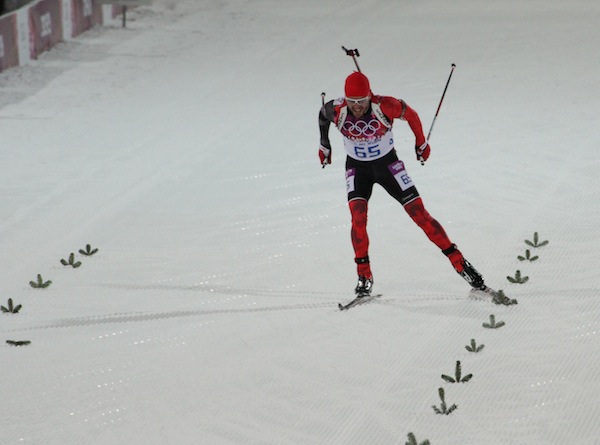
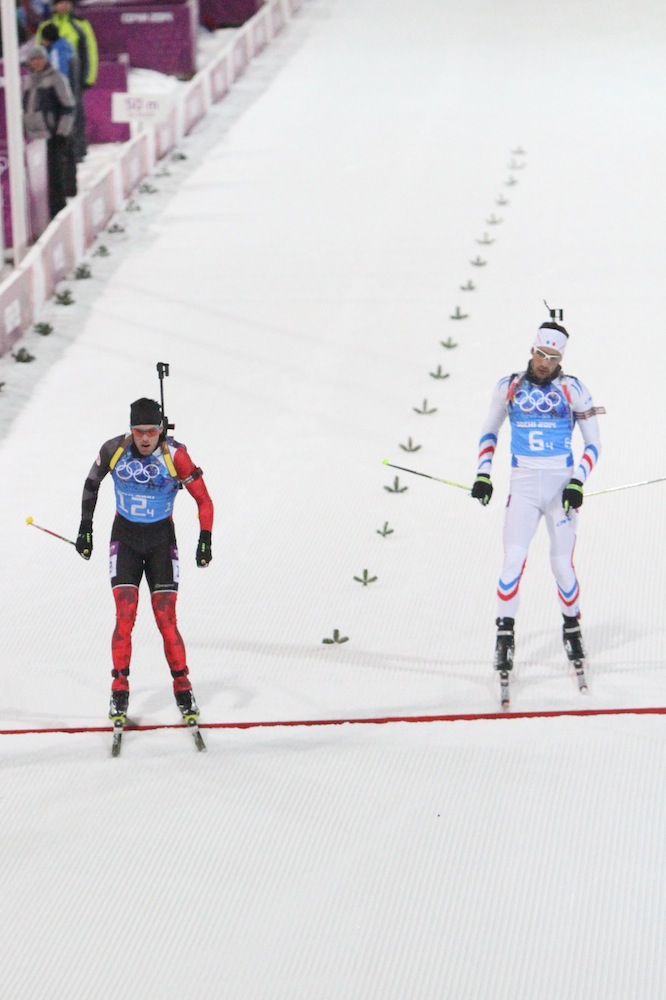
    Nathan Smith of Canada secured seventh place for his relay team, besting Martin Fourcade of France at the finish.
    Nathan Smith of Canada secured seventh place for his relay team, besting Martin Fourcade of France at the finish.

    FasterSkier’s coverage is made possible through the generous support of Swix.

    KRASNAYA POLYANA, Russia – Usually when you’re trying to fend off Martin Fourcade at the end of a race, it’s for the win.

    But today’s Olympic men’s relay – the last biathlon event of the Games – didn’t go quite the way it usually does for France, who had seven spare rounds but was more undone by slow ski times. And it certainly didn’t go as planned for Canada. Jean Philippe Le Guellec led part of the race but then got shaky in his standing stage and ended up skiing a penalty loop, dropping the team to 16th. He gained back a few spots with strong skiing by the time he tagged off to Scott Perras, and the team continued to climb through the rest of the relay.

    So there they were: by the anchor leg of the relay, Canada’s Nathan Smith left the range in seventh place, and French anchor Martin Fourcade 11 seconds behind in eighth.

    “We were watching Nathan go up the last hill, and we had [wax tech] Tom Zidek on top of that hill. “The feedback from Zidek was that Nathan was pushing as hard as he can, and this is good. Then the radio went silent. Then the radio came back on again and said, oh shit, Fourcade is going.”

    Brendan Green moved the team from eighth to sixth.
    Brendan Green moved the team from eighth to sixth.

    Partway around the loop, Fourcade – who won two gold medals at this games and is a several-time overall World Cup champion – caught Smith. But from then on, it was even. In fact, Fourcade seemed to be playing tactical.

    “It seemed like he was holding back a little bit – he was drafting me a little bit on the last lap,” Smith said. “He didn’t want to pass me on the last uphill. So I saved a little bit too for the end. To be sure that he wouldn’t outsprint me.”

    Smith led on the downhill into the stadium, and wouldn’t let Fourcade past as they cruised across to the far end.

    “Nathan was not going to let it go without a fight,” Lindsay said. “Whether it’s by an inch or a mile, it’s all that counts.”

    It was a battle coming back down the finishing stretch, but Smith emerged victorious to salvage seventh place for Canada, a best-ever finish in an Olympic relay. The team finished a minute and a half behind the winning Russians, with one penalty loop and ten spare rounds compared to eight spares by Russia and even fewer by the other podium teams, Germany and Austria.

    So did Smith think he was going to win that sprint against the best biathlete in the world?

    “I thought I had good chances,” Smith said. “I’m usually pretty good at sprint finishes.”

    After Le Guellec’s shooting woes, Scott Perras took over and skied a flawless leg, using one spare in prone and none in standing and skiing his way up to eighth place. He made an impressive move leaving the range after standing, passing a group of racers on the inside of a corner and leading them to make up time on the leaders.

    “I knew we were fairly close to the top three so I didn’t care what position I was in,” Perras said. “I just wanted to close down that time to the top three even if it meant they were going to pass me later on.”

    From there, Brendan Green used a spare in each stage to move up to sixth before Smith took over for the final anchor leg.

    On one hand, the result was a bit disappointing based on what the Canadians thought they were capable of.

    “Last year we were top eight at World Champs, to do that again, it wouldn’t be our potential but it would show some really good consistency,” Perras said. “I definitely woke up this morning thinking a top three was possible, probably third more than first, but just after the mixed relay I knew Nathan and JP had rested and they’re already in good shape and their shooting has been so solid this year so I was pretty confident.”

    But it was still a best-ever result, and carried all the accolades that come with that.

    “This is redefining where the new basement on performance has to be for the Canadian squad,” Lindsay said. “Eighth is the new norm. If we’re getting less than eighth, we’re doing something wrong.”

    Results

  • 10ieme de sa Dernière Course Individuelle JO, Le Guellec Se Prépare Pour Son Retour et Championnats Canadiens

    10ieme de sa Dernière Course Individuelle JO, Le Guellec Se Prépare Pour Son Retour et Championnats Canadiens

    Jean Philippe Le Guellec in the final individual competition of his long international career.
    Jean Philippe Le Guellec in the final individual competition of his long international career.

    FasterSkier’s coverage is made possible through the generous support of Swix.

    Note: This is another in our growing library of bilingual articles. For the English version, scroll down.

    KRASNAYA POLYANA, Russie – Jean-Philippe Le Guellec a terminé au 10e rang de sa dernière course individuelle aux Jeux olympiques de Sotchi. Après avoir fini cinquième dans le sprint 10km en ouverture des Jeux, la malchance a frappé Le Guellec avec une chute dans la poursuite et une course en demi-teinte au 20 km individuel.

    Malgré tout, ces résultats à Sotchi ont été assez bons pour lui permettre de gagner sa place dans l’épreuve de départ de masse de 15 km aujourd’hui, sa dernière course individuelle, pas seulement sa dernière aux Jeux olympiques, mais également au niveau international. En effet, Le Guellec prendra sa retraite après les JO et ne retournera pas sur le circuit de la Coupe du monde pour compléter la saison.

    « Pour moi ça se termine ici les courses individuelles », a dit Le Guellec après la course. « La raison étant que je voulais vraiment finir à la maison pour les Championnats canadiens. Biathlon Canada a mis les Championnats canadiens en même temps que les Coupes du monde. Donc, ça ne valait pas la peine pour moi d’aller en Europe pour faire une Coupe du monde et revenir après ça dans l’Est. Je fini à la maison. »

    Il espérait sortir un très bon résultat pour conclure sur une bonne note une carrière exceptionnelle. Dès les premiers tours de ce départ de masse, Le Guellec était sur la bonne voie pour réaliser une grande performance. À chacun des tirs couchés, il était le deuxième plus rapide. À la mi-course, il occupait toujours la deuxième place, en tête du peloton à la poursuite d’Emil Hegle Svendsen, le Norvégien qui a finalement triomphé quelques centimes devant le Français Martin Fourcade.

    Il semblait en bonne position pour la bataille pour une médaille tout au long de la course. « Au niveau du ski je me sentais quand même en forme, ce n’était pas la grosse forme, mais ce n’était pas pire considérant les conditions, », a commenté Le Guellec.

    Le Guellec trying to push it over the Sochi course's high point.
    Le Guellec trying to push it over the Sochi course’s high point.

    C’était avant qu’une erreur d’inattention ne vienne lui compliquer la vie à son troisième passage au pas de tir. « Je ne fermais pas mes caches-neiges et avec la neige qui tombe présentement comme on le voit ça a fait glacer ma mire avant », a dit Le Guellec. « Quand je suis arrivé au premier debout, j’avais rentré mon chargeur, chargé une balle et je me suis rendu compte que je ne pouvais pas tirer parce que ma mire était obstruée par la glace. »

    Il a dû sortir la balle, souffler dans sa mire pour corriger son erreur. Habituellement, Le Guellec prend 23-24 seconds pour abaisser les cinq cibles lors d’un tir debout. Aujourd’hui, ça lui a pris 42 secondes. Son entraineur Jean Paquet a dit à FasterSkier qu’une médaille était réalisable aujourd’hui, mais Le Guellec devait pour ce faire tirer « avec vitesse et sans erreurs. » Malheureusement, ce n’était pas « avec vitesse ».

    « Après ça avec une cible de ratée au dernier pas de tir aussi avec la forme que j’ai aujourd’hui, c’est sûr que c’est coûteux », a expliqué Le Guellec.

    Il n’avait pas d’amertume dans sa voix quand il a commenté l’excellent résultat de Brendan Green qui a terminé en 9e position tout juste devant lui. « Brendan avait l’avantage de voir où on était et il a poussé plus fort en haut de la montée. Ça fait qu’il est arrivé vraiment rapidement dans la descente, il avait plus de momentum finalement pour passer en avant. »


    Terminer dans les dix premiers en compagnie d’un coéquipier en plus, ce n’est pas la pire des façons de terminer. Mais… « En tout et partout, c’est sûr que j’aurais préféré arrivé neuvième, mais de traverser la ligne avec Brendan » il a rigolé.

    Le relais masculin samedi est la dernière épreuve de Le Guellec. Une fois les Jeux de Sotchi complété, il retournera au Canada pour terminer sa carrière. Il trouve important de boucler la boucle parmi les siens. « Ça l’a un petit côté émotionnel si on veut, mais je voulais finir à la maison parmi mes amis et la communauté canadienne de biathlon. Finir à la maison, Charlo [NB] c’est là que j’ai fait les Jeux du Canada et c’est l’année où je me suis joint à l’équipe nationale », a dit Le Guellec faisant référence à la tenue des Championnats canadiens à Charlo au Nouveau-Brunswick.

    Questionné sur les conditions de neige particulières dans la station russe, il a admis ne pas avoir été trop surpris. « Ça, c’est vraiment Sotchi, la dernière semaine et demie ce n’était aucunement représentatif. C’est comme ça ici d’habitude et là on est dedans! », faisant éclater de rire les journalistes.

    Le brouillard a davantage déjoué ses plans. «Ç’a tellement été une montagne russe les derniers jours parce qu’arrivé ici, tu t’attends à courser et tu ne courses pas et après ça c’est repoussé 5 heures plus tard. Tu arrives, non on course pas ça était ça 3-4 fois. »

    * * *

    Jean Philippe Le Guellec of Canada has finished 10th in his last individual race of the Olympic Games in Sochi. After having finished fifth in the 10 k sprint to open the Games, bad luck hit Le Guellec with a crash during the pursuit and a poor race in the 20 k individual.

    Despite all of this, the results in Sochi were good enough to earn him a place in the 15 k mass start today, which is limited to 30 entrants. It would be his last individual race not only at the Olympics, but also at the international level. Le Guellec will retire after the Olympic Games and will not return to the World Cup to finish the season.

    “For me this is the end of individual competition,” Le Guellec said after the race. “The reason is that I would really like to finish at home for Canadian Championships. Biathlon Canada is holding Canadian Championships at the same time as the World Cup. So it isn’t worth it for me to go to Europe to do the World Cup and then to come back after that. I will finish at home.”

    He hoped to have a good result to finish his exceptional career on a good note. And for the first laps of the mass start, Le Guellec was on track to have a great performance. In each of his prone stages, he had the second-fastest shooting time. Halfway through the race he was in second place, at the head of a chase pack hunting down Emil Hegle Svendsen, the Norwegian who finally beat Martin Fourcade of France by a few centimeters for a gold medal.

    It seemed like a good position in the fight for a medal. “With the level of my skiing I felt like I was in shape, it wasn’t the best shape, but it wasn’t the worst either considering the conditions,” Le Guellec said.

    That was before an careless error complicated life on his third trip to the shooting mats.

    “I didn’t close the cover on my sight and with all the snow that was falling like one saw, this froze over my sight,” Le Guellec explained. “When I arrived at the first standing stage, I put in the magazine, loaded a bullet, and then realized that I couldn’t shoot because my sight was totally blocked by the ice.”

    He had to remove the bullet and blow on the sight to melt the ice and correct his error. Usually, Le Guellec takes 23 or 24 seconds to go through the shooting process in a standing stage. Today, it took him 42 seconds. His coach Jean Paquet told Fasterskier that  amedal would have been possible today, but Le Guellec would have had to shoot “very fast and clean.” Unfortunately, this wasn’t very fast.

    “After this, and with a missed target in the last stage too, and with the form that I have today, it was definitely costly,” Le Guellec admitted.

    There was no hint of bitterness in his voice when he described the excellent result of his teammate Brendan Green, who finished in ninth position just ahead of him, after overtaking him on the final loop.

    “Brendan had the advantage of seeing where everyone was and he pushed harder at the top of the hill,” Le Guellec said. “This meant that he was going very fast on the downhill, and he had more momentum at the end to pass the ones who were in front of him.”

    With a teammate and in the top ten, that’s not a bad place to finish. Except… “all in all, I sure would have preferred to be ninth, but to cross the line with Brendan,” Le Guellec laughed.

    The men’s relay on Saturday will be the last race for Le Guellec. Once the Olympics are over, he will return to Canada to finish his career. It’s important to him to complete the circle with his friends.

    “This is maybe a little more emotional than you like, but I would like to finish at home among my friends and the Canadian biathlon community,” Le Guellec said. “To end at home, Charlo [New Brunswick] is where I did the Canada Games and it was the year when I joined the national team.”

    Results

  • With Two Top-Ten Finishes in Olympic Mass Start, Canadian Biathlon Proves Its Mettle

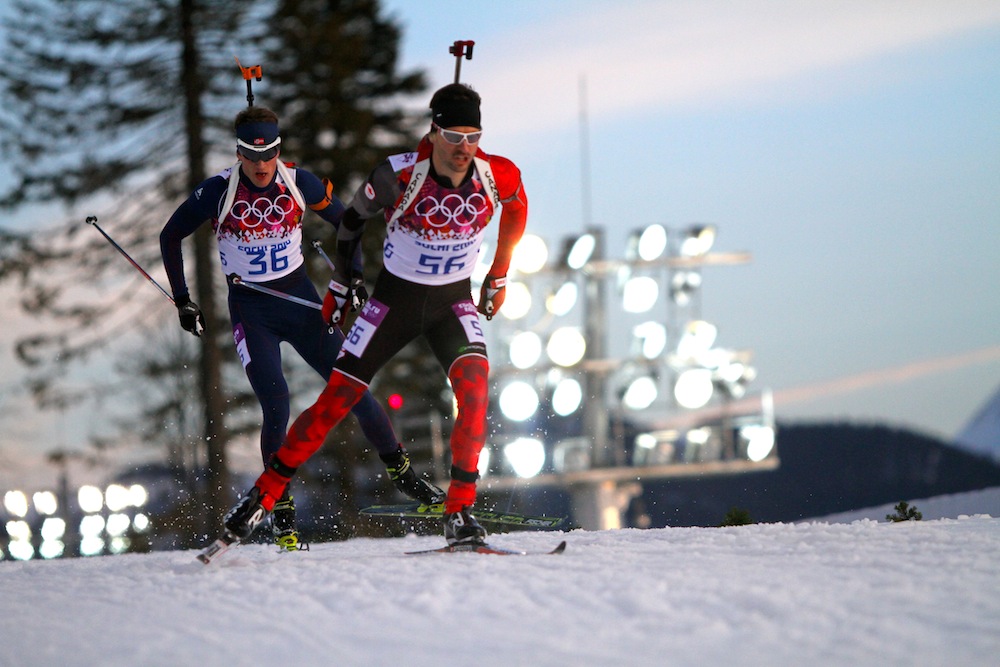
    Brendan Green (CAN) leading Tim Burke (USA) in the Olympic men's mass start. Green went on to place 9th, the best Olympic result of his career.
    Brendan Green (CAN) leading Tim Burke (USA) in the Olympic men’s mass start. Green went on to place 9th, the best Olympic result of his career.

    FasterSkier’s coverage is made possible through the generous support of Swix.

    KRASNAYA POLYANA, Russia – When three Canadian went to the start line of today’s 15 k mass start, they were already doing something big. Never before had so many Canadian men qualified for the format, which is limited to 30 racers, and definitely not at the Olympics.

    Like much that has happened to the Canadian team this week – Jean Philippe Le Guellec’s crash that broke a ski while he was leading the Olympic pursuit comes to mind – things didn’t work out perfectly. In a strange version of déjà vu, teammate Nathan Smith got tangled up with two other racers and crashed, also ripping a binding off his ski just as Le Guellec had.

    Neither Smith nor Simon Fourcade of France, also in the crash, finished the race. So while Canada may have started three men, they only finished two.

    But what a pair it was: Brendan Green passed Le Guellec on the final loop to finish ninth, while Le Guellec placed tenth (stay tuned for a separate story on Le Guellec later).

    “I think for the men, this is the best result [ever at the Olympics],” said Biathlon Canada Head Coach Matthias Ahrens. “I’m pretty sure.”

    It was particularly gratifying because it was the last individual race at the international level for Le Guellec, who is retiring at the end of this season. To finish in the top ten, along with a teammate, was one the best ways he could end – besides a medal, of course.

    “This is JP’s last hurrah, his last individual race,” Green said, adding that he gave Le Guellec a “big hug” in the finish pen. “So to finish in the top ten together, that’s special. And he has been a great role model for me, an inspiration. I’ve learned a lot from him over the years. It’s a nice way for him to go out.”

    The Canadian men have showed potential for top finishes throughout the Games so far. In the opening race, a sprint, Le Guellec placed fifth and Smith 13th. In the pursuit, Smith moved up to 11th. They knew, they said, that there was the opportunity to place several men in the top ten – or even better.

    “For sure that was our hope,” said Le Guellec’s coach, Jean Paquet. “Once we got in and we saw that we had one in the top five, and the other guys were skiing very well, well enough to finish in the top ten, yes, we were confident.”

    Jean Philippe Le Guellec pushing through "nightmare conditions" in today's mass start to finish 10th.
    Jean Philippe Le Guellec pushing through “nightmare conditions” in today’s mass start to finish 10th.

    Today, though? Maybe not. After having this race delayed for two days straight due to heavy fog that obscured the targets, the men woke up to see snow falling outside – heavy, wet snow. That didn’t make anyone particularly excited. Le Guellec later described them as “nightmare conditions” that don’t suit his technique.

    “After the races last week I knew my form was good,” Green said. “I knew the potential was there to have a better race. To be honest, I didn’t think it would come today with these conditions. I usually have a really tough time when the snow is deep and slushy, and that sort of thing. Usually this isn’t my game.”

    Yet he soon found himself right in the thick of things. Despite starting in bib 28, in the very last row of the mass start, and getting pinched in the first corner, Green started moving up.

    “Just the way the trains worked out, I was able to get in the mid pack early on,” he said. “There was a crash on the first downhill that took out Nathan. I was able to get around that okay. So I just tried to slowly work my way through.”

    With a penalty in each of the first two stages, Green was hovering around 20th. But he cleaned each of his standing stages to move into 17th, then 11th, and finally skied the sixth-fastest last loop to pass Le Guellec and Anton Shipulin of Russia, securing ninth place and the second-best international result of his career.

    Yet for Canada, there is a distinct sense of what might have happened. Just as in the pursuit, Le Guellec was skiing in the top six for a large chunk of the race. He was derailed by a penalty, but also by getting snow stuck in his rifle sight during the third stage, which required some work and gave him a 45-second shooting stage. Fast shooting is usually Le Guellec’s key to success. One stage earlier he had come in with a large pack, and cleaned his targets faster than anyone to move into second place.

    “It’s always a mixed feeling because they knew they were good, but they also knew they were close,” Paquet, a former athlete himself, said of Le Guellec and Green. “So they are disappointed about the small mistakes they did, like missing one shot too many. That’s what they are disappointed about. It’s a mixed feeling because they are so close, and they know they were right there.”

    Biathlon Canada is in serious need of medals, as its funding from Own the Podium is contingent on performance. Today was yet another might-have-been day.

    Brendan Green skied the sixth-fastest last loop to move into ninth place.
    Brendan Green skied the sixth-fastest last loop to move into ninth place.

    “I knew that we needed clean shooting,” Paquet said. “When I heard Brendan missing one and one, no. And I knew JP needed to be clean all four stages, and nice and fast. He had a shooting time of 45 seconds. We knew it needed to be a perfect race. It wasn’t there completely. Top ten is great, but we knew what we needed to have to finish even better.”

    But everyone involved was able to look at the positives of the men’s strong races.

    “Brendan’s performance today was just outstanding,” Biathlon Canada High Performance Director Chris Lindsay said after the race. “His ski speed was fantastic, especially for him with his history of weakness this season in standing shooting in the later part of the races. Seeing him be able to really tighten it up at the end was a clear indicator that the whole team is ready and set for the relay.”

    (Le Guellec and Smith have opted to sit out the mixed relay and rest up the men’s relay, which will be a priority race for Canada. After a time trial among the women today, Canada has selected Megan Imrie and Rosanna Crawford to team up with Green and Scott Perras in tomorrow’s mixed relay.)

    With Le Guellec retiring at the end of this season, it was particularly gratifying for the Canadians to see Green’s performance. He spent almost a year and a half recovering from a serious back injury, but has proved himself on the biggest stage in biathlon. That makes it easier for Green to guess that he’ll stay in the sport a few more years.

    “This season I had a lot of question marks with the back, and how the body would respond and feel, and that sort of thing,” Green said. “But I seem to be back in my old form and racing well. And when you’re racing well it’s a lot of fun. There’s a World Cup in Canmore in 2016. So I think if I’m healthy I’d like to race that, and bring my career full circle and probably end there.”

    And even though Smith didn’t finish the race, the very fact that he made it into the mass start in his first Olympics was a positive sign for Canada’s development pipeline. Smith had never made the top 30 in a World Cup race before this season, but had racked up seven such results before the Olympics even began. From the outside he would not have been a good pick to finish twice in the top 15 in this year’s Games.

    “We were not worried about Nathan’s performance at the end of last year, even though it was not on par compared to the season before with his three wins on the IBU Cup,” Lindsay said. “But everyone’s allowed to have an off year. We look forward to him being one of the role models and leaders for the next two years.”

    In fact, Lindsay said, having a mix of performances at this Olympics both from veterans like Green and Le Guellec and from newcomers like Smith is a strong advertisement for the federation’s development strategy.

    “It shows that the program is working, and that we need to continue putting efforts in the same way that we have been and not radically change what we’re doing,” Lindsay said. “The approach with one unified training center, a lot of focus in what the coaches are doing, and a lot of control given to those coaches, is what’s getting us the results. The longer we do this, the more results we’ll get.”

    Regardless of how the team got to where it is, Green is just happy to be part of a best-ever day.

    “We made some history today I guess,” Green said. “It’s so awesome. It’s a sign that we are strong and have some depth. And hopefully our future is bright.”

    Results

  • With Warm Conditions, Many Crashes, and No Freezing in Sight, Questions of Olympic Course Safety Return

    With Warm Conditions, Many Crashes, and No Freezing in Sight, Questions of Olympic Course Safety Return

    Mashed potato snow on the trails as Jean Philippe Le Guellec of Canada leads a pack of skiers in today's Olympic biathlon pursuit.
    Mashed potato snow on the trails as Jean Philippe Le Guellec of Canada leads a pack of skiers in today’s Olympic biathlon pursuit.

    FasterSkier’s coverage is made possible through the generous support of Rudy Project. 

    SOCHI, Russia – When Jean Philippe Le Guellec crashed on a fast downhill corner in today’s Olympic pursuit race, he was hardly alone.

    True, the crash may have been extra painful for Le Guellec, who was in the lead at the time with about half of the race under his belt. But two other athletes crashed on the same corner on the first lap, and then one crashed in the same spot a second time.

    “The course itself is very, very technical,” said U.S. Biathlon Association President Max Cobb, who is serving as the technical delegate for the Olympic biathlon races. “You go into these downhill corners pretty fast. You have to be really on it to get around them okay.”

    Course safety was brought up as a concern by athletes after the World Cup test event here last winter, when Russia’s Maxim Tsvetkov crashed on an S-turn and went flying over an embankment into the forest. Organizers have since removed that corner from the race course, but as athletes found today, that didn’t mean that the course got so much easier.

    The crashes were a new feature of Olympic racing, as the men’s sprint went off more or less without a hitch on Saturday. In Sunday’s women’s sprint, Ekaterina Shumilova of Russia crashed badly and broke the stock off of her rifle.

    Le Guellec chalked all the crashes up to the fact that the snow was considerably slushier than it had been for the previous men’s race on Saturday.

    “It was really hard today, it was completely different conditions,” he said. “It was super soft, unlike in the sprint. And it made it really hard to manage on the downhills, because the snow was really heavy and there were a lot of deep ruts. And it’s hard to step turn with little steps because you have to step really high to get over the ruts.”

    Other racers agreed that the skiing was quite challenging – and not just on that one corner where four of 59 racers crashed.

    “The downhill with the big corner there, I thought was okay,” U.S. biathlete Tim Burke said. “It was tricky for sure, especially if you’re going through three people wide. But it was doable. One of the other downhills, though, was so deep that it was just really tough to keep your skis going straight.”

    Race winner Martin Fourcade, too, nearly fell coming down the hill into stadium for the final time.

    The reason for the crashes – two of which came on the very first lap – seemed to be just that racers were not expecting such tough conditions. Besides the fact that they had not competed in such deep slush on Saturday, conditions seemed to have changed slightly since warm-up.

    “From where I skied today, I didn’t see how you could fall,” Le Guellec’s coach Jean Paquet said. “But with fast skis, with good speed… they will try to address it for sure, I’m thinking.”

    Cobb, however, said that there wasn’t much more that could be done.

    “The problem that we face is that it has been really warm for the past few days,” Cobb said after he finished up his work for the day. “Today it was plus five, plus six [degrees Celsius] during the day, and it didn’t really get below freezing last night. So the conditions are going to be soft. We have almost two weeks of racing going on here so we can’t really salt the course at this point, especially in a head-to-head race where conditions are the same for everybody.”

    While salting the course would initially freeze it up and speed up the conditions, Cobb explained that after about four days the course would begin to resemble “mashed potatoes.” He didn’t want to face those conditions for an entire week of racing, but said that salting the courses for Thursday and Friday’s individual competitions may be inevitable. He was hoping to at least make it through tomorrow’s women’s pursuit without using salt.

    There is no end in sight for the warm weather. Nighttime freezing is not forecasted until sometime next week.

    “It’s really hard to get a good course when it’s warming up all day,” Cobb said. “It’s a south-facing slope with really aggressive turns. I’m happy with how the organizing committee did everything that we asked, they got on the grooming as soon as possible and then got off it as soon as possible.”

    Burke suggested that some snow could be removed from the downhills, to make the slush less deep.

    “They could do the same thing they did on the uphills today,” Burke said. “They were really soft when we were warming up, and they kind of scraped them down to make it not so deep. But they just left the downhills the way they were, and I think they could definitely improve on that.”

    Cobb, however, indicated that the technique was already in use, and course officials had been hand-raking the downhills in between each lap of skiing. All that was left was to hope that the skiers could recognize and adjust to the conditions.

    While cross country skiers had today off from competition, the conditions and crashes in the biathlon race, situated on a trail system which adjoins the cross country venue, may indicate what’s to come for the world’s best skiers in tomorrow’s sprints and later in the week.

    “You definitely have to be tactically aware and smart when the conditions are bad,” Cobb said. “It’s hard because when it gets deep sometimes there’s a little bit of structure to the ruts underneath, so you step on what looks like a smooth surface, and actually it’s got something that’s not smooth underneath it. That can throw you…. The athletes, obviously they’re World Cup athletes and they’re good at it. Sometimes you make a mistake and sometimes it’s just bad luck to get caught in a rut that you couldn’t see.”

  • Dramatic Crash and Broken Ski Halt Le Guellec’s Run Towards Olympic Gold, but Smith 11th for Canada

    Dramatic Crash and Broken Ski Halt Le Guellec’s Run Towards Olympic Gold, but Smith 11th for Canada


    Jean Philippe Le Guellec of Canada was leading today's 12.5 k pursuit after 6 kilometers, before being undone by a crash.
    Jean Philippe Le Guellec of Canada was leading today’s 12.5 k pursuit after 6 kilometers, before being undone by a crash.

    FasterSkier’s coverage is made possible through the generous support of Rudy Project. 

    SOCHI, Russia – For six kilometers and ten targets, Jean Philippe Le Guellec of Canada could not have been having a better day.

    In his third Olympics, Le Guellec had finished fifth in Saturday’s sprint, a best-ever for a Canadian man. He started today’s 12.5 k pursuit just 9.7 seconds behind Ole Einar Bjørndalen of Norway, the winner of the sprint, and the top seven men formed a pack racing through the slushy course.

    Le Guellec cleaned his first prone stage quickly, moving into third place and skiing the second loop with the top racers. He was in third position coming into the range for the second prone stage, and not only cleaned, but did so with a speed that gave him a several-second lead as he headed out on course. In fact, on both prone stages, the Quebec native had the fastest shooting times of the entire field.

    But disaster struck for Le Guellec on the third loop, as he hit a patch of ice, lost his balance, caught an edge, and eventually fell, superman-style, sliding down into corner.

    “I decided to take the inside line, but I guess a lot of people were skid turning that turn on the first lap and there was a huge ice patch that I saw at the last minute and sent me flying,” he said.

    In one way, the Canadian was lucky compared to some of his competitors. At least three other racers fell on the same corner, including a Ukrainian who slid off over the embankment down to the next trail below; it took him maybe ten seconds to climb back onto the course.

    But while Le Guellec may have avoided that indignity, the consequences of his fall were just as big. He broke part of his ski and had to stop and get another.

    “In the second downill I bailed because my ski was actually broken,” Le Guellec said. “So then I had to wait to get a ski and it was f*cking downhill from there.”

    “Thank you to the Ukranian Tech who probably broke Usain Bolt’s 100m World Record to swap out my ski,” Le Guellec later wrote on facebook.

    Le Guellec stuck in the penalty loop.
    Le Guellec stuck in the penalty loop.

    By the time Le Guellec got skiing again, he had been passed by about 15 racers. And when he arrived on the shooting range again, his concentration was broken. After missing two of his five shots, Le Guellec shouted loudly in frustration as he left his shooting mat.

    “I would have been affected, so I’m guessing he was affected too,” Le Guellec’s coach Jean Paquet told FasterSkier from the shooting range. “He lost so much time, so for sure it affected somewhat his shooting mentally. And he probably had to work harder to get back with some people.”

    Adding insult to injury, Le Guellec missed one more shot in the final standing stage. After making it through the last loop of skiing, he finished in 26th place.

    Frustrated by how much the crash cost him – “honestly I want to punch a wall, and hopefully break through it” – Le Guellec was nevertheless honest about what it would have taken to win a gold medal, which was definitely not assured just by being in the lead at the race’s halfway point.

    “I was anticipating that the guys behind me were going to catch up at some point in that lap, and I mean, whatever—the race isn’t over until you cross the finish line, so I was definitely happy to leave the range in first, that’s definitely awesome,” he said. “But I wasn’t expecting to keep a lead for the rest of the race. I mean, it’s biathlon, so, that’s sport.”

    Although the crash looked painful, Le Guellec said that he was not injured. Biathlon Canada High Performance Director Chris Lindsay said that Le Guellec was checked for a concussion after the race, but that he checked out fine.

    With Le Guellec knocked out of contention, Canadian attention shifted to Nathan Smith. Starting 13th, the Olympic rookie immediately climbed into the top 10 with a first clean prone, and stayed there with a second one. At this point, Canada had Le Guellec in the lead and Smith in 10th.

    While Le Guellec was struggling with his broken ski post-crash, Smith flew by him in a pack of skiers. After spending some energy to catch onto the back, Le Guellec soon joined that pack. But Smith was in the position of top Canadian for good.

    “I didn’t know I was in the same pack as him,” Smith said. “I actually didn’t see him until my third shooting. I saw him in the penalty loop. I didn’t know he had crashed, I thought he had maybe one or two more penalty loops than me. I thought he just had maybe 17 instead of 19 [clean shots], which wouldn’t be good, but not a disaster.”

    Brendan Green at the top of a big climb.
    Brendan Green at the top of a big climb.

    Putting his teammate out of his mind, Smith focused and stayed hovering around the top ten. He missed one shot in the first standing stage, and after a penalty loop began to tire on his skis.

    “It was a good ski, but I did kind of die a little bit on the fourth lap,” Smith said. “I had a really tough time on that slushy hill coming out of the range.”

    But Smith said that the pace had felt conservative at the start, and that he usually feels better and better as a race goes on. That was true today, too, as Smith was able to gain a bit of pace back on the last loop and hang on to 11th place after he was passed by a surging Dominik Landertinger of Austria in the finishing stretch.

    “I’m really happy,” Smith said. “I think I can probably get into the [30-man] mass start now, which was a big goal of mine, especially if I can have a good individual too. I was kind of hoping for a top ten, but I’m really happy with what I got. I would have even been happy if I had dropped a couple of spots.”

    As it was, 11th place bettered his starting position by two spots, and continued a stellar opening series of the Olympics for the 28-year-old.

    “Nathan seems to be doing an excellent race,” Paquet said. “Nathan is outstanding. He has been consistent all season, and he’s just performing like I’ve never seen him before, and it’s really good to see.”

    Brendan Green started in 23rd position and had a rough go on the range, missing two shots in the opening prone stage and then one shot in each of the next two stages. But he cleaned the final standing to end on a good note and skied the 20th-fastest course time, good enough for 32nd place at the end of the day.

    “We are very proud if the whole team today,” Lindsay said. “Three men in the top 32 is a really strong day for us. It’s just hard seeing a first place lost in that manner. Now we’re prepping for the individual.”

    Despite the unfortunate conclusion of today’s race, Le Guellec was able to at least look forward to the individual – a format where he placed fourth in the opening week of racing this season – with bright prospects.

    “I was definitely confident, especially after that second prone,” Le Guellec said. “I was able to ski with the leaders also for these first laps, so yeah, the confidence is there.”

    -Nat Herz and Alex Matthews contributed reporting.

    Results

  • Le Guellec One-Ups Previous Olympic Best with Fifth in Biathlon Sprint; Three Canadians in Top 25

    Le Guellec One-Ups Previous Olympic Best with Fifth in Biathlon Sprint; Three Canadians in Top 25

    Jean Philippe Le Guellec of Canada headed into the finish of today's 10 k sprint at the Olympic Games in Sochi, Russia.
    Jean Philippe Le Guellec of Canada headed into the finish of today’s 10 k sprint at the Olympic Games in Sochi, Russia.

    FasterSkier’s coverage is made possible through the generous support of Rudy Project. 

    SOCHI, Russia – In Vancouver, Canada, four years ago, Jean Philippe Le Guellec made history in by placing sixth in the sprint, the best finish by a Canadian man in an Olympic biathlon race.

    After winning a World Cup sprint at the beginning of the 2012-2013 season, hopes were high that he could do even better for Canada here in Sochi, perhaps even winning the men’s team’s first medal (legendary fellow Québécois Myriam Bedard won bronze in 1992 and two golds in 1994).

    Le Guellec may not have gone quite that far in today’s 10 k sprint, but he came very close – and his eventual fifth-place finish still upped his Canadian record by one spot. Le Guellec cleaned all ten of his targets, had the fastest shooting time of the field in his prone stage, and skied the ninth-fastest course time to land 9.7 seconds behind Ole Einar Bjørndalen of Norway, who captured his sixth Olympic gold medal.

    “It definitely breaks the ice,” Le Guellec said of his performance. “If you think back to Vancouver, it was just awesome that I could shoot clean [today]. In Vancouver I had one penalty…. Performance-wise, [today] was an awesome race.”

    It wasn’t just Le Guellec who had team Canada smiling. In his first Olympic appearance, Nathan Smith finished 13th after also shooting clean. Brendan Green picked up a single penalty to place 23rd, while Scott Perras finished 74th with a frustrating three penalties.

    To accomplish his fifth-place result, Le Guellec had to stick to a very specific strategy. When the Canadians raced here in Sochi at the World Cup last season, Le Guellec told FasterSkier that he “definitely [had] my work cut out for me given the profile of the course.” The Canadian didn’t feel at the time that the huge hills played to his strengths as a skier.

    Nathan Smith of Canada finished 13th in the first Olympic race of his career.
    Nathan Smith of Canada finished 13th in the first Olympic race of his career.

    “The course is very difficult,” he said. “We have an uphill right here out of the range, and we have another really big uphill behind the range. And the downhills, there’s no rest on this course. It’s a continuous grind.”

    But with a conscious strategy – “you have to be disciplined” – Le Guellec completely turned things around in just a single season. Today he started conservatively, ranked just 25th after cleaning his prone stage. But little by little, he ratcheted up the ski speed. His middle lap was the eighth-fastest of the field, and his closing lap the sixth-fastest.

    “It’s really easy to start the race, be a little overzealous, and blow up on the third lap,” Le Guellec said. “It’s not something you want, because these hills are, pardon my French, it sucks. You don’t want to blow up in there. You really have to be careful.”

    By the time he left his standing stage, he was ranked fourth. With a bib 65, it was unlikely that he would be surpassed by later starters. He pushed as hard as he could on the final loop in his bid for Canada’s first men’s medal.

    “On the last lap I kept getting splits where I was two seconds from third, six seconds from first, and it was like that every time I passed one of the techs,” Le Guellec said.

    There was a lot of moving around in the final 3.3 kilometers of the race. Le Guellec put a few seconds on Simon Eder of Austria, who had been ranked third but dropped to seventh by the finish. However, Bjørndalen and Dominik Landertinger of Austria had even faster last laps and moved into first and second, respectively. Jaroslav Soukup of the Czech Republic, who had been the leader after the standing stage, ended up with the bronze medal and Anton Shipulin of Russia in fourth place.

    “Then when I crossed the line in fifth I was honestly a bit disappointed at first,” Le Guellec admitted. “But performance-wise I couldn’t have pushed any more on the last lap. I gave it my all and that’s the game, that’s sports.”

    With his clean shooting, it would have been reasonable to expect a better result than he’d had in Vancouver, where he attained a similar placing despite one penalty. But the Sochi shooting range is considered quite easy, with a gradual approach to the range and high retaining walls breaking the wind. The entire field had relatively strong shooting: the top 24 men were either clean or had a single penalty.

    Le Guellec is an expert shot. His sprint victory in Östersund, Sweden, in 2012 came when he cleaned his targets in windy conditions which tripped up the rest of the field. On this easy range, you might think that Le Guellec’s skills were less at a premium. Yet that’s not how he sees it.

    “On the contrary, I think that it’s really important to hit ten out of ten…. you look at [Bjorndalen] and he had one penalty,” Le Guellec said. “The others were without penalties. So what you have to do to win is just like any other course.”

    Now, the Canadians know that they can do what it takes to win.

    “Those two and a half or three weeks that we had in between [the World Cup and Olympics], you start to get restless and anxious,” Green said. “The last few days, we’re all here and just wondering if our form is there or not. I think today was a good sign that we’re skiing well. As long as you drop the targets, we’re capable of good results like JP and Nathan.”

    As for Le Guellec, his mind seemed to be fairly swimming with the possibilities he and his teammates had created for himself: Monday’s pursuit race is based on the results from the sprint. He will start 9.7 seconds out of the lead, Smith 36 seconds out, and Green 58 seconds out.

    The sprint and pursuit results, along with those from the individual race, will also be tallied into a Games-long ranking. The top 30 athletes from that list will be taken into the mass start competition. The top three Canadians have all positioned themselves well to earn that honor.

    “It’s going to be great leaving in fifth on Monday, with nine seconds to the lead,” Le Guellec said. “And after that, we have the individual, which is also a very promising race. Mixed relay, relay, you name it, we have so many events. The chances are there, you just have to jump on it.”

    Results


  • Alex Harvey: ‘Au Québec, C’est Vraiment Bon… C’est Vraiment une Vague des Jeunes’

    Alex Harvey: ‘Au Québec, C’est Vraiment Bon… C’est Vraiment une Vague des Jeunes’

    Alex Harvey of Canada celebrates after winning the World Cup sprint in Szklarska Poreba, Poland, in January. Photo: Fischer/NordicFocus.
    Alex Harvey of Canada celebrates after winning the World Cup sprint in Szklarska Poreba, Poland, in January. Photo: Fischer/NordicFocus.

    SOTCHI, Russie – Alex Harvey est maintenant le meilleur fondeur canadien, il est présentement classé huitième sur le circuit de Coupe du Monde et récent gagnant du sprint au Szklarska Poreba. Il est maintenant à Sotchi, avec l’équipe nationale s’entrainant pour les Jeux olympiques qui commenceront samedi. On lui a posé quelques questions lors d’une conférence de presse tenue aujourd’hui.

    FasterSkier : Jean-Philippe Le Guellec et toi vous êtes peut-être les plus grands espoirs pour une médaille canadienne dans les sports nordiques. Que peut-on dire sur l’état des sports nordiques au Québec en ce moment?

    Alex Harvey : Au Québec, c’est vraiment bon, les inscriptions pour les clubs augmentent chaque année. Les licences de compétition chez Ski de Fond Québec aussi augmentent chaque année. Depuis quelques années, c’est le Québec qui est la province gagnante au cumulatif des Championnats canadiens.

    Quand j’étais jeune, le Québec était troisième ou quatrième parfois. Maintenant, le Québec est redevenu premier au pays. Je pense qu’à cause de Jean-Philippe et moi, et aussi de plusieurs autres facteurs, il y a un effet boule de neige. Les jeunes choisissent le ski de fond ou le biathlon de plus en plus, au lieu du hockey ou des autres sports comme ça.

    FS : Oui, mais il n’y a pas beaucoup de Québécois sur les équipes nationales maintenant. Pourquoi? Comment peux-tu expliquer ça?

    AH : Je pense qu’il y avait eu une certaine période morte, mais maintenant les jeunes juvéniles, juniors sont forts. Par exemple, cette année aux Championnats mondiaux juniors, sur neuf athlètes, je pense qu’il y avait six Québécois. Deux tiers de l’équipe étaient donc du Québec. C’est vraiment une vague de jeunes, il faut attendre un autre ou peut-être même deux cycles olympiques avant d’avoir des Québécois en ski de fond et en biathlon, mais je pense que ça va fonctionner.

    FS : Après les Jeux olympiques, Jean-Philippe prendra sa retraite du sport. Est-ce que vous inquiétez de l’absence potentielle d’athlètes seniors, qui peuvent être des modèles?

    AH : C’est certain que Jean-Philippe a fait une grosse différence au niveau du biathlon, mais moi je prévois faire un autre cycle olympique. Il y a plusieurs jeunes seniors au Québec en ski de fond qui s’en viennent sur l’équipe nationale – alors pour nous en ski de fond, ce n’est pas trop inquiétant.

    FS : Si vous pouviez gagner une médaille, pour Québec – quels seraient vos sentiments personnels ?

    AH : C’est une médaille c’est pour le Canada en premier ! Pour nous les hommes en ski de fond, on n’a jamais remporté une médaille. Pour le pays se serait bon, évidemment pour le Québec aussi ça serait exceptionnel.

    *            *            *

    Alex Harvey is currently the top Canadian cross-country skier, ranked eighth in the World Cup overall score and the winner of the sprint in Szklarska Poreba. He is now in Sochi with the national team, which is preparing for the Olympics which begin on Sunday. We asked him a few questions at the end of a press conference today.

    FasterSkier: Together with Jean Philippe Le Guellec, you are the best hopes for a Canadian medal in nordic sports. What can you say about the state of nordic sports in Quebec today?

    Alex Harvey: In Quebec, it’s truly great, sign-ups to clubs are increasing every year. And competition licenses in Ski de Fond Quebec are increasing every year as well. For the last several years the cumulative score at Canadian championships has been won by the province of Quebec. When I was young, Quebec was third and sometimes fourth. Now it has become again the best in the country. I think that with Jean Philippe and me, and some other factors as well, it has been a real snowball effect. Young kids choose cross country skiing more, or biathlon, rather than hockey or other sports.

    FS: That’s true, but at the moment there aren’t so many Quebec skiers on the national team. What happened with that?

    AH: I think there was a certain dead period, but now it’s all about the youths. Juveniles, juniors. Like this year at World Junior Championships I think it was nine athletes who were brought, of which six were Quebecois. That is two thirds of the team who were from Quebec. It’s truly a wave of juniors. So we have to wait one or maybe two Olympic cycles before we can have these Quebecois in skiing or biathlon, but I think it will work.

    FS: Jean Philippe is retiring at the end of this season. Are you worried that there will not be so many senior athletes, who can be role models?

    AH: It’s certainly true that Jean Philippe has made huge difference in the level of biathlon, but for me I think I can summit another Olympic cycle. And the older juniors from Quebec will soon be coming onto the national team – so for us in cross country skiing, I don’t think there’s much reason to worry.

    FS: If you could win a medal for Quebec – what would your feelings be?

    AH: A medal is for all of Canada, first! For us in cross country skiing, we have never brought home a medal. Thus for the country it would be great, and obviously for Quebec it would be exceptional.


  • Canadian Men Sixth Despite Shooting Errors in Chaotic Relay Snowstorm; France and Fourcade Prevail

    Canadian Men Sixth Despite Shooting Errors in Chaotic Relay Snowstorm; France and Fourcade Prevail

    Martin Fourcade (FRA) racing earlier this season in Hochfilzen, Austria. Today he turned in a strong anchor performance to help the French men to a World Cup relay win.
    Martin Fourcade (FRA) racing earlier this season in Hochfilzen, Austria. Today he turned in a strong anchor performance to help the French men to a World Cup relay win.

    Weather in the mountains is unpredictable, and that certainly affected the World Cup biathlon field in Antholz, Italy, today.

    At 11:45 in the morning, the women’s relay field set off, in unassuming weather; by the time the second-leg skiers had come into the range for standing, a massive fog had rolled in that made it impossible to see the targets. The race was cancelled, mid-go.

    A few hours later, the men’s relay was delayed for 30 minutes and eventually started at 2:45 in the afternoon.

    “First the zero was delayed because fog similar to what the girls faced rolled in,” Canada’s Scott Perras explained. “They knew the race had to start by 3 otherwise they would run out of day light, and Antholz is not like some of the other tracks that have night races. There are no lights on the course.”

    It began raining when the men were zeroing – then it began to snow. Canada had as strong a start as anyone, with Jean Philippe Le Guellec cleaning all ten targets with no spare rounds. He left his standing stage in first place, but was overtaken by Germany, Norway, and France and tagged off in fourth place.

    “My training block over Christmas had been cut short with the extreme colds out east,” Le Guellec explained in an e-mail. “As such, top race form wasn’t the priority for today and I definitely felt it on the last lap! Talk about red lining an engine… That was pure suffering.”

    Le Guellec hopes that treating the race like training will allow him to tag off still in first if he’s in the same position in the Olympics.

    “Peak form will be the goal for Sochi and if I have the luxury and honor to lead a lap, I’m sure hoping that my form will carry me to the wire then,” he wrote.

    By the time the second-leg skiers like Perras took over up, thick flakes were falling all around them, slowing the track and obscuring targets. The difficult skiing took a double toll on the range.

    “It was not easy shooting today,” Norway’s Henrik L’Abee-Lund told NRK television. “My legs were like jello.”

    Andreas Birnbacher of Germany was in the lead coming into the standing stage, but used all of his spare rounds trying to knock down two pesky targets and still ended up skiing a penalty loop. L’Abee-Lund used two spare rounds and Perras all three.

    “I missed my targets in standing because I was little excited and the shooting seemed more solid than I expected, so I put three shots quickly too high,” Perras said. “From there I just told myself to calm down and make sure I have stopped on the target before pulling the trigger.”

    L’Abee-Lund moved into second behind Alexis Boeuf of France, the only one of the first group of racers to shoot clean. Despite using all three spare rounds, Perras escaped still in third position. It would have been surprising if he had been paying attention to his competitors, which he luckily was not.

    “Honestly I was pretty focused on myself in the range,” he said. “I was aware that the others were missing when I was shooting, but there is no way to know if they would have penalty loops or not. There was pressure but we are getting more and more used to this situation which is great!”

    As the skiers hit the trails, where snow was piling up in serious fashion, Boeuf looked especially beleaguered. He’d had the second-fastest first loop and the fastest second loop, but his final loop was just the 16th-fastest, more than 55 seconds slower over 2.5 k than Bjorn Ferry of Sweden, who had the fastest split. Known more as a shooter, Ferry was indeed perfect on the range, but was also the strongest skier and moved Sweden from 14th into fifth place.

    “The start of my race was very good, but I had a big problem on my last lap,” Boeuf said in the press conference. “I hope it will be better in Sochi, we will see. Today it was just a personal problem.”

    L’Abee-Lund blew by Boeuf to a 35-second lead by the handoff just 2.5 k later. Meanwhile, Perras tried to hold off Birnbacher, who finished up his penalty loop and made a move towards the front. He eventually passed Perras, who stuck with him until the exchange.

    “On my last lap I had a big smile at first, not because I was happy with my shooting but the relief from hitting that last shot felt exhilarating,” Perras said. “I was happy to still be in the game I didn’t think too much about what place I was in. I didn’t know hat Birnbacher was coming but I could not have done much more. I was gassed from skiing the first two laps on my own and trying to catch the leaders. When he went in front I just focused on keeping up.”

    The penalties continued to come fast and strong; on the third leg, Martin Eng took Norway out of the running with two penalty loops. On the fourth leg, Nathan Smith took two penalty loops of his own for Canada.

    Instead, at the front, it was France and Sweden who battled it out on the anchor leg, with both Martin Fourcade and Carl Johan Bergman shooting perfectly.

    “It was a really good fight,” Fourcade told the IBU in a video interview with the rest of the French team. “I wanted to drop him before the last loop, but Carl Johan was really strong on the shooting range, so I had to push really hard on the last loop.”

    Bergman didn’t get demolished by the powerful Frenchman (who said that “my legs and my skis weren’t the best of the year today”), but he couldn’t overtake him either. France took a 2.6-second win in the relay.

    Germany finished third, +38.8, and Norway fourth, +1:34.6. The Norwegian team was a “B” squad, as was the Russian team; the best racers from both countries are sitting out to prep for the Olympics.

    “I’m just happy to have done well today, but you can’t forget that two of the best teams in the world (Norway and Russia) were not here,” Martin Fourcade told French newspaper L’Equipe. “The important thing, that will be in two weeks in Sochi. We will fight for the gold.”

    Canada finished sixth, a best in the careers of any of the men involved. The team had been in fourth place at each of the first three handoffs (by Le Guellec, Perras, and Brendan Green) before dropping to sixth with Smith’s shooting woes.

    “I think in general we are happy with today,” Perras said. “We had never made a prize ceremony and our previous best was a 7th place. So far this year we have been 9th, 8th and 6th so we are happy with the trend. I think the biggest thing we will take away from today is that we prevailed despite all the chaos, and we put a little more high pressure experience in the bank.”

    Le Guellec agreed.

    “Considering a lot of spares, two penalty loops and that our skis weren’t great either: it’s an amazing result,” he said. “This is by far the best battle laid out by the team yet… this is a new level (girls and boys). You can tell everyone has worked very hard in the summer to bettering themselves and it has hugely paid off. I don’t think anyone was expecting such strong performance though! Again: fuel going into Sochi.”

    The U.S. did not field a team.

    Results


  • With Clean Four-Stage Pursuit, Le Guellec Climbs Back from Shooting Woes

    With Clean Four-Stage Pursuit, Le Guellec Climbs Back from Shooting Woes

    JP
    Jean Philippe Le Guellec racing in the 12.5 k pursuit on Sunday.

    RUHPOLDING, Germany – Jean Philippe Le Guellec is usually a pretty good shooter. How else could the Canadian have won a biathlon World Cup sprint last season and placed fourth in the opening individual competition of this season, something deemed a shooter’s race?

    But in the 20 k individual here on Saturday, he lost focus for an instant, and things fell apart. With three shooting stages completed, Le Guellec had a single penalty and was ranked in the top 30. A clean final stage would have placed him 13th.

    Instead, he missed three shots.

    “Everything was going good yesterday until that standing,” Le Guellec wrote in an e-mail on Sunday. “It’s pretty much an isolated event.. beginners’ mistake even. It’s like I vizualised the bout just before coming in the range and then my brain just shut off and I was on autopilot… and the end result was what it was…”

    Luckily, he managed to sneak into the top 60 anyway, placing 52nd, and qualify for the 12.5 k pursuit the next day. There, Le Guellec knew how to turn things around. He shot flawlessly, hitting all 20 of his targets and moving from 52nd to 32nd.

    “The approach today was simply to stay present (like I usually am) for every bout and do like I’ve worked on during Christmas, which visibly paid off and I’m totally stoked!” he wrote.

    The Canadian team had recently arrived back in Europe from Canada, and Le Guellec felt better and better on his skis as the week went on as well. He had the 35th-fastest ski time in the individual and the 34th-fastest in the pursuit.

    “I felt a good deal better on the skis too, which helped,” he wrote. “I’ve been having a hard time getting over jetlag this week and felt a little off bit in [Thursday’s] relay and the individual, although the ski times were respectable. So it was nice to feel a little more energetic today.”

    Team Canada had a much-improved day in the pursuit in general, with Nathan Smith using a single penalty to climb to 16th place, tying the second-best result of his career.

    “As a whole, the team did awesome today with solid shooting and skiing,” Le Guellec wrote. “[Smith] getting up in the top 16 again is totally sweet. Definitely motivating with the approach of game time in a few weeks.”

    Game time? After getting the errors out of his system, Le Guellec, who placed sixth in the sprint at the last Olympics in Vancouver, is feeling more ready for Sochi.

    “Moving into Sochi, I’m happy to see things I worked on during Christmas pay off already (more noticeably in shooting),” he wrote. “The plan now is to simply race the relay in Antholz and get a solid block of training in since it was cut short by the extreme cold back home before leaving for Europe… All in all, still some things to work on, but I think we’re all in a good place right now. Just have to keep working it and stay focused!”

    pursuit results & main race report

  • Canadians In The Points, Using Ruhpolding to Ramp Up for Sochi

    Canadians In The Points, Using Ruhpolding to Ramp Up for Sochi

    Rosanna Crawford (bib 26) chasing Anais Bescond of France and Tiril Eckhoff of Norway in the pursuit.
    Rosanna Crawford (bib 26) chasing Anais Bescond of France and Tiril Eckhoff of Norway in the pursuit.


    RUHPOLDING, Germany – Some things on the World Cup this weekend definitely haven’t gone as planned for the Canadian team.

    Let’s start with the conditions. There’s more snow than in Oberhof last week (which the World Cup team skipped anyway, giving the starts to its B squad instead), but the snow here is scarce, icy, and intermittently salted. That wasn’t what Megan Heinicke, for one, was hoping to come back to.

    “I was somewhat disappointed with my skiing in both the relay and today’s race,” she wrote in an e-mail after the 15 k individual. “A part of it is that icy conditions like today are a weakness for me and have always been a challenge.”

    She was feeling “energized and fit”, but wasn’t able to translate that directly into skiing on the course.

    Then, there were struggles on the range. Nathan Smith and Jean Philippe Le Guellec both had four penalties in the 20 k individual on Saturday, too many for a top result (they finished 40th and 52nd).

    Rosanna Crawford and Megan Heinicke had good individual races on Friday, but then had four penalties in the pursuits this morning. That meant that they weren’t able to capitalize on their 26th– and 30th-place starting positions, and were relegated to 37th and 48th.

    But all is not lost: nearly every athlete came away with something to be happy about, including a top-20 finish by Smith (more on that later). It started with the relays: on Wednesday, the women placed 12th, and on Thursday the men had a strong eighth-place showing. Both teams had only just arrived from Canada, and were still dealing with jetlag, leaving them happier with the performances than they might have been otherwise.

    Women

    More positive things came on Friday, after the women’s individual race, starting with Rosanna Crawford.

    “I think it was a pretty good ski time, and 17 is the best I’ve ever shot in an individual,” she said at the finish. “So I have to be happy with that. It’s too bad about my first prone, but, it happens.”

    Megan Imrie skiing with Olga Zaitseva of Russia in the pursuit.
    Megan Imrie skiing with Olga Zaitseva of Russia in the pursuit.

    Crawford was also simply happy to be racing and hitting the points at all. She thought back to last season, when she finished 65th in the sprint here.

    “This is a lot different than last year,” she said. “I remember at these races last year I was feeling reallllly awful. So I’m happy that I didn’t dig myself too deep in December. I think I just wasn’t used to that many races last year. It was 11 races, whereas this year it was 10 for me. I think I am just overall fitter.”

    Heinicke was also feeling good about where she’s at, after a few seasons where she’s been plagued by illness in the middle of the racing season.

    “I have struggled a lot with health over the past few years and this was the first Christmas break since 2008 that I didn’t get sick!” Heinicke wrote of her winter break. “So I was pretty happy about that.”

    Heinicke lives in Altenberg, Germany, with her family. Since the Canadian team skipped Oberhof and the rest of her teammates were back home in Canada, she took the opportunity to compete in the IBU Cup races in Ridnaun, Italy. It was an ideal warm-up for this weekend’s World Cups, although not for the reasons she had expected.

    “The IBU Cups were important for 2 reasons – one was that they were used as some intensity at the end of a training block and the other was race shooting,” she wrote. “I struggled to bring together standing shooting before Christmas and I did a lot of high quality shooting training over the break. I wanted to use the IBU Cups as a chance to boost my confidence a bit!”

    In the pair of sprints, Heinicke placed seventh with two penalties in the first, and 20th with three penalties in the second. Racing on biathlon’s second-tier circuit, she said the goal is to get on the podium, which she thought she could have done with better shooting.

    “The shooting was obviously did not go as planned, but in retrospect I am glad I raced there because I think I learned from the mistakes I made and have shot much better here in Ruhpolding,” she wrote.

    Scott Perras attacking a hill in the pursuit alongside Andi Birnbacher of Germany.
    Scott Perras attacking a hill in the pursuit alongside Andi Birnbacher of Germany.

    Both women were happy that Olympic qualification is over, for various reasons. Crawford knew for a long time that she was already qualified, but was waiting for her boyfriend, Brendan Green, to complete his own criteria. He eventually won a series of trials races just before Christmas to secure his spot.

    “The break was really nice,” Crawford said. “The first week was super stressful with Brendan’s trials, I think I would have been less stressed if I had been racing myself! It’s a weird feeling. I have a lot more sympathy for my parents now.”

    Heinicke completed her criteria in December, which has taken a huge weight off her shoulders.

    “I actually expected myself to feel more relaxed with the Olympic qualification settled and done, but I have realized that a lot of the pressure I feel comes from myself, my own high standards and my own frustration when I do not meet my standards,” Heinicke wrote. “It is definitely good to be in a ‘safe’ position right now where I can choose to take more risk without feeling like I should always play on the safe side.”

    Megan Imrie placed 58th in the individual and used three penalties to ski her way up to 39th in the pursuit, sneaking into the World Cup points.

    Audrey Vaillancourt, racing in place of Zina Kocher who is competing at skiing Olympic trials, placed 62nd in the individual with two penalties, narrowly missing the pursuit.

    Men

    After their successful relay, the Canadian team had a bit of a downer as they had to send Brendan Green back to the IBU Cup. With only three starting spots on the World Cup this season, they aren’t able to carry a full team.

    “Even though they are all qualified for the Olympics, they can’t rest too much,” head coach Matthias Ahrens said. “They have to fight for these three spots a little bit.”

    Scott Perras had the best performance in the 20 k individual, using two penalties to place 36th. His teammates Smith and Le Guellec were saddled with those frustrating four penalties each.

    It was particularly dangerous since for the first time since 2003, the individual was being used as the basis for a pursuit. Usually, pursuits are based off of sprint races. With four minutes of penalty time, it would not have been surprising to miss the pursuit, especially since the field usually shoots very well in Ruhpolding with its downhill range approach and minimal wind.

    Nathan Smith in the pursuit.
    Nathan Smith in the pursuit.

    “The shooting is usually really good for the field,” Smith said after the individual. “So this is a mediocre race [for me], I’d say.”

    Still, he was feeling like his performance was coming together after the team’s travel over to Europe.

    “The relay was the first real race thing I’d done in a few weeks,” he said after the individual. “Other than that I’d just been doing intensity by myself, so it was good to get in shape for today. I’m not surprised that I felt better today.”

    And he wasn’t concerned about his shooting, either.

    “My shooting has been feeling solid, I think,” he said. “There’s nothing wrong with my shooting, it’s just that two bouts didn’t go perfect.”

    That turned out to be a very accurate assessment. In the pursuit this afternoon, both he and Le Guellec shone on the range, surpassing Perras even though he started far in front of them. Le Guellec shot clean to move from 52nd all the way up to 32nd, and into the points; Smith had a single penalty and passed Alexei Volkov, yesterday’s second-place finisher, in the final kilometer to seal 16th place, tying the second-best finish of his career.

    “It was a really good race,” he said at the finish of the pursuit. “One of my best for the year. I think skiing was pretty similar to yesterday, but my shooting was a lot better, so that’s what made the difference.”

    With three penalties, Perras stayed solid and moved into 35th, leaving all three Canadians in the points on the day.

    It wasn’t easy, either – the iciness that Heinicke had complained about on Friday broke down into granular, sometimes deep snow by the time the men raced today.

    “Some spots were kind of deep – well, not deep, but just slow I guess, on the flatter parts,” Smith explained. “And the uphills were icy. But some of the women said it was icy for them too. On the last lap I had to pass the Russian on the last uphill, and he was on the softer part, which was a bit better. I had to go on the icy part, which was tricky.”
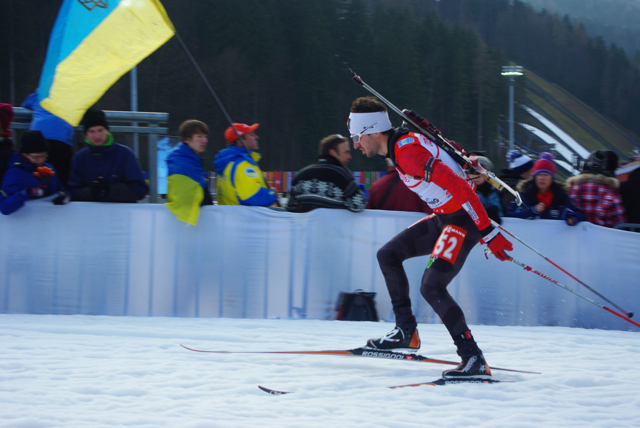
    So, with one weekend remaining until the World Cup takes a break until the Olympics, the Canadians are feeling positive for the last three starts.

    “We approach it like any other race, you warm up, you put the rifle on your back, you try to hit the targets,” Crawford said of pre-Olympic racing. “But maybe we have a little bit of load during these races. That could be a little bit different.”

    Results:

    men’s individual & pursuit

    women’s individual & pursuit

  • With New Energy after Olympic Team Finalized, Canadian Men 8th in Ruhpolding Relay

    With New Energy after Olympic Team Finalized, Canadian Men 8th in Ruhpolding Relay

    Jean Philippe Le Guellec shot clean to tag off in sixth place after a strong leadoff leg.
    Jean Philippe Le Guellec shot clean to tag off in sixth place after a strong leadoff leg. Here he leads Alexis Boeuf of France and Michal Slesingr of the Czech Republic.

    RUHPOLDING, Germany – There are a number of things that the Canadian biathlon team has done differently than their competitors coming into this week’s World Cup race series.

    First of all, as usual, the “A” team skipped the last weekend of racing in Oberhof in order to enjoy some more time at home, for both recovery and a training block. On the one hand, that means that they were a little less race-ready for today’s 4 x 7.5 k relay than other teams that already have three races under their belts in the new year.

    “Considering that we only arrived on Sunday and it’s still within our jetlag period, everybody was sort of so-so feeling,” head coach Matthias Ahrens told FasterSkier.

    But a good athlete can take potential negatives and turn them into positives. Scott Perras? Missing last weekend didn’t bother him in the slightest. In fact, he thought it might be an advantage.

    “We’re pretty used to it, and who really wants to go to Oberhof anyway?” he said, hushing his voice so no Germans would get offended. “And I think it gives us an edge, because people start to get run down and tired during the week. Whereas we should feel better, because we’ve only been here for four days.”

    Regardless of how the pros and cons balanced out, the team managed a successful relay, finishing eighth with eight spare rounds and no penalty loops, 1:17 behind the winning Austrian team.

    Scott Perras keeping his feet on one of the course's downhills. The snow was dirty and at times deep.
    Scott Perras keeping his feet on one of the course’s downhills. The snow was dirty and at times deep.

    Le Guellec had a strong first leg, shooting clean and tagging off in sixth, 16 seconds off the pace. Perras thought that he skied well, and he did – he had the fifth-fastest course time of any of the second-leg skiers.

    “But my shooting was, I think I should have shot a little better,” he said.

    With four spare rounds, Perras dropped the team to eighth, but Green was there to pick them back up. He used only a single spare and brought Canada back to sixth position. Smith needed two spares in prone and bounced back down to eighth, a position he maintained for the rest of the race.

    Things didn’t go perfectly. But they went well enough, and the team seemed pleased enough.

    “I’m very happy,” Ahrens said.

    Olympic spirit

    The other thing that is different is that the Canadians have already finalized their Olympic team. They will send four men: Jean Philippe Le Guellec, Brendan Green, Nathan Smith, and Perras. That’s the team that raced today.

    And getting team naming out of the way lifts a huge weight from the athletes’ shoulders – none more so than Green, who had a tough route to qualifying this fall with several races where he was just portions of a percentage point outside of the times he needed to qualify. Failing to do so on the World Cup, he had to fly back to Canada and earn his spot in a series of trials races against the best other Canadians.

    “It’s so sweet, I can’t even describe it in words,” Green said of racing without the specter of qualifying looming over him. “It was such a stressful few months before Christmas. I was pretty deflated after Hochfilzen, being so close to qualifying. I was feeling mentally drained when I got back to Canmore, but I was able to recharge and refocus for trials, and they went, well, they couldn’t have gone much better. It was pretty much perfect. So that’s a huge relief and I’m just really happy to be back racing.”

    Even for Le Guellec and Perras, who were pre-qualified before the start of the World Cup season, having everything official just feels different.

    Brendan Green approaches the range.
    Brendan Green approaches the range.

    “The first tour really wasn’t fun because of it, even though I was done, it just wasn’t fun,” Perras said of all the stress his teammates were going through. “So I’m excited to just be here with the Olympic team and get racing again.”

    Smith and Perras, who will be competing in their first Olympics in Sochi, might be even more excited than the rest of the team, who raced on home turf in Vancouver. Some of the Olympic promotional commitments, like a team naming ceremony last week at the Olympic cauldron in Canada, could seem like they were getting in the way of what was really important: physical preparations for the Games.

    “If anything, it’s just like, what are your priorities in the next 40 days?” Perras asked. “it was pretty cool but I just wanted to get back racing.”

    But he also admitted how cool it was to be at an event like that, and have it sink in.

    “I think that Nathan and I were the only first-time Olympians, so it was more special for us,” he said.

    These may be the same four guys that were on the World Cup in the first period, but now they have a different thing going on: they are a team.

    “It definitely changes the energy a little bit,” Green said. “Now I feel like, now that I’ve earned my spot, it’s just a little different and I can just go about business without any further consequences.”

    Ahrens saw it in his athletes, too.

    “For sure, for feeling as one team now, having that load away makes a difference that they can concentrate more on the team,” he explained. “Especially for the relay.”

    Watching the youngsters

    Nathan Smith heading out on course.
    Nathan Smith heading out on course.

    While the World Cup team was at home training and getting fêted in Calgary, a new generation of Canadian biathletes were gaining some World Cup experience in Oberhof. The IBU Cup squad was used to fill the start quotas, including a few experienced athletes like 2010 Olympian Marc-André Bédard, but a few first-timers as well: Macx Davies, who finished 42nd in his inaugural start, and Julia Ransom and Emma Lodge.

    The World Cup squad was watching the races with bated breath. In a way, it might have inspired them a little bit, too.

    “We all train together,” Perras said. “I mean, I remember my first World Cup, so I was pretty excited, especially for Macx because he trains with us all the time. I was telling him how cool Oberhof was going to be. It was cool to see what he could do. It makes you think how lucky we are to be where we are still at.”

    So does this mean it’s ready for the current Olympic team to step aside? While Le Guellec, at least, has concrete plans to retire after this season, a few others might stick around.

    “I hope to compete,” Perras said. “I think, last Olympics when I didn’t make it I committed to four more years. Now it’s just one year at a time. I’d really like to be at the World Cup in Canmore in 2016, but that would be my last season I think.”

    Maybe some of the newcomers like Davies will be on his team.

    “I hope so!” he laughed. “They’re already nipping at our heels, so hopefully I’m racing with them, not them instead of me!”

    results – international race report

  • Despite Good Performances, North American Men Struggle to Gain Spots in Hochfilzen Pursuit; Smith the Lone Big Mover

    Despite Good Performances, North American Men Struggle to Gain Spots in Hochfilzen Pursuit; Smith the Lone Big Mover

    Lowell Bailey (left) and Jean Philippe Le Guellec (far side of pack) climb a hill early in the race, as U.S. head coach Per Nilsson takes video.
    Lowell Bailey (left) and Jean Philippe Le Guellec (far side of pack) climb a hill early on, as U.S. head coach Per Nilsson takes video.

    HOCHFILZEN, Austria – The five North American athletes who qualified for today’s men’s 12.5 k World Cup pursuit each had their work cut out for them if they wanted to meet their goals. After the sprint on Friday was disrupted by a snowstorm, the results didn’t fairly reflect each athlete’s performance (more info: stories about the Canadian and U.S. teams).

    Lowell Bailey of the United States had been frustrated to end up out of the top ten – and off the podium even – despite clean shooting and what he felt was good skiing. Teammat Tim Burke had made the podium the weekend before in Östersund, Sweden, but placed 24th in the sprint here. Ditto on Canada’s Jean Philippe Le Guellec, who had placed fourth in the individual in Östersund but 13th on Friday despite a single penalty.

    Then there was Nathan Smith and Brendan Green, each trying to complete their Olympic qualification for Canada. Green had come so close in the sprint – he needed a top 30, and finished 31st, just 0.1 seconds away from his mark. It seemed like the pursuit would offer a second chance to make that qualification.

    Green needed more if he wanted to finish his qualification – a second top-16 finish (Green already had two of three top-30’s, a different way to qualify from the two top-16’s that Smith had already collected one of). But starting late in the pursuit, he had been hammered by the snowstorm and placed 48th. Getting his criteria in the pursuit was obviously going to be tough.

    Nathan Smith on the move for Canada.
    Nathan Smith on the move for Canada.

    But in the end it was Smith who came the closest to knocking off his goals: with a single penalty and the ninth-fastest isolated pursuit time, he moved all the way up to 27th. Now, instead of a top-16 to complete his qualification, he needs a top 30 in the final week of racing instead.

    The rest of the men struggled for various reasons. Or, if you ask Burke, maybe they didn’t even struggle. They just didn’t have great results.

    “I was happy with the shooting and the performance, it’s just that everyone was shooting really well,” Burke said. “So it was tough. I guess I would have thought that with two penalties I would have been in the top 15 for sure… A day like today I feel like I performed really well, but I’m 21st. Not exactly a result that I’m too excited about, but I’m happy with the performance and I think I’m headed in the right direction.”

    Burke said that thing that was strange about this pursuit was that it was based off the unusual results from the sprint. That meant that there were a lot of fast, strong athletes starting later in the order than usual – and so simply shooting well wasn’t enough to move up. The normal rules didn’t apply.

    “We saw some people towards the end of the race with really low bib numbers who were struggling,” he said. “I think they benefitted a lot in the sprint. In that way it was definitely different.”

    For Le Guellec, this certainly played a role – his four penalties dropped him to 32nd – but the schedule was also unusual.

    “I think it was a weird pursuit because they spread it out with the relay in middle,” he said. “Being the third race, you know, the relay is usually the last race, and 7.5 k you can do even if you’re dying a little bit. But with 12.5 k as the last race in a three-in-a-row race weekend, it’s pretty rough.”

    After saying that he “didn’t consider himself worthy of an interview,” Le Guellec explained that he just didn’t have it in his legs for such a long effort today.

    “Skiing was good for the first two laps, but then I just died in the third lap,” he said. “I just couldn’t maintain pace with whoever was passing me… I was talking with Lowell and it can go both ways, either you’re going to feel good, or you’re going to die. I died.”

    Bailey also had four penalties, and finished just ahead of Le Guellec in 30th.

    And Green, too, spent more time in the penalty loop than he would have preferred. Three missed shots left him in 43rd, Olympic qualification criteria still incomplete. If Canada does not qualify four men for the Olympics by the end of racing next weekend in France, they will face a trials series back in Canmore just a few days later.

    So for many of the men, it was a frustrating ending to an imperfect weekend in Hochfilzen, which also saw both men’s relay teams come close to best-ever performances.

    At this point in his career, Burke said, he tries not to get too hung up on the results, and to think about how he’s feeling. But it’s hard and he’s not always successful.

    “It’s funny,” he mused. “Last weekend I had a podium, but this weekend I actually felt better. I think that’s a really good sign going into the final week of racing before Christmas.”

    Results / international race report

  • Le Guellec Surprises Self with Fourth Place in Ostersund World Cup; Smith Career-Best 16th

    Le Guellec Surprises Self with Fourth Place in Ostersund World Cup; Smith Career-Best 16th

    Jean Philippe Le Guellec starting the pursuit in Ostersund last year, in bib 1 after winning the sprint. In today's individual race, he was fourth.
    Jean Philippe Le Guellec starting the pursuit in Ostersund last year, in bib 1 after winning the sprint. In today’s individual race, he was fourth.

    JP Le Guellec did not head to the start line in Östersund, Sweden, today, thinking he could win a race like he did at this venue last year. In the sprint last season, he became the first Canadian man to win a World Cup biathlon race. But was that in the cards today, the first individual race of the new season?

    “Definitely, not!” Le Guellec laughed when talking about his pre-race expectations. “This time of year – we’re kind of secluded in North America, and we can’t compare with the Europeans, so it’s hard to have an idea. And even trials in Canmore, things weren’t really super great, especially ski-wise. Shooting was decent I guess. So I guess all I’m saying is that I didn’t come in here super confident.”

    Yet he spent half the race in podium position and ultimately ended up fourth, eleven seconds from the podium and 25 seconds out of second place. Martin Fourcade of France blew the field out of the water; as one of only two men to clean all 20 targets in the 20 k individual, he won by over two minutes.

    Besides the result, there are definite similarities to Le Guellec’s sprint victory last season. For instance, the wind was strong and unpredictable, and managing that challenge was key. Only three top-20 finishers had more than two penalties; Le Guellec had just one.

    “It was just a matter of hitting your targets and hoping they would go down,” Le Guellec said in an interview with FasterSkier. “And I managed that as well. I had a little struggle on my last standing. I was four for four, and it was a major gust that came in for that fifth target. So I had to work for that one a little bit more than the others, but to shoot 19 for 20 on a day like this, you can’t hope for much better.”

    Le Guellec had a few other guesses about why he’s had particular success in this northern Swedish town in the last few years. A strong shooter, he often does well in difficult conditions. The course profiles are also similar to one of his home courses, which he said plays to his advantage. But perhaps most importantly, he does well as the season kicks off.

    “I was just super psyched to race,” Le Guellec said. “I train to race, not because I like training. I think that’s probably the main reason why I do well early in the season, is that I’m so eager to start racing.”

    Teammate Nathan Smith, fresh off the IBU Cup where he stood on the podium last Saturday, also had a good day, finishing 16th with three penalties.

    “Nathan skied like a beast today,” Le Guellec said.

    Smith had the 21st-fastest ski time, and an especially speedy last loop – the 10th-fastest on the day. He had a lot of motivation: Smith is trying to qualify for the upcoming Olympics, and the most surefire way to do so is to get two top-16 finishes or three top-30 finishes in this first period of racing. That’s why he pushed so hard on the last lap, he said – he was racing for that top-16.

    “I felt like I was skiing pretty conservative today, so I was pretty surprised how high my course ranking was,” Smith said. “But I’m not going to complain about that. Before today I didn’t have any criteria done, but I knew I could, if things went well, finish the criteria before Christmas. But I haven’t done a top-30 before, so I knew it wouldn’t be easy. After today I feel like it’s pretty realistic to finish the Olympic criteria.”

    When Smith was second in the IBU Cup opener last week, coach Roddy Ward talked about how different his attitude towards training has been this season and how much he has improved. The big dividends continued today with not only the step towards Olympic qualification, but a career-best finish by 22 places.

    He worked hard on the last shooting stage, a standing stage, after struggling a bit in the previous prone.

    “I obviously missed two on my second prone, which felt a little out of control,” he said. “I was frustrated about that. But I was surprised when the guys out on course told me that I was 20-something. I thought, okay, I must be skiing really well. I really thought I had to clean the last standing and then I’d be able to make the criteria. I really focused hard to get them all down.”

    Le Guellec had a similar experience; in the individual format, each missed shot is penalized by a minute of added time, rather than a penalty loop which typically takes 20-25 seconds.

    On such a gusty, unpredictable day, that was a very real danger. But the teams were somewhat prepared for it, since the weather has been unusual ever since they arrived in Ostersund.

    “This year is particularly windy for this place,” Le Guellec said. “Ever since we got here it’s been this way. Every day that we’ve trained, we’ve been dealing with these winds. That’s a lot better preparation than if we got here and it was mild, and then boom, it just starts to go crazy like that.”

    Racing continues for the men on Saturday with a 10 k sprint.

    results

  • Before the Last Hurrah, Le Guellec Finds Motivation in Change

    Before the Last Hurrah, Le Guellec Finds Motivation in Change

    J.P. LeGuellec finished 10th overall in the 20 k individual at 2013 World Championships. Photo: Nordic Focus/Biathlon Canada.
    J.P. LeGuellec finished 10th overall in the 20 k individual at 2013 World Championships. Photo: Nordic Focus/Biathlon Canada.

    A lot of athletes, if you ask them how long they’ve been working towards the Olympics, might say their whole lives. Or, if they’re veterans or barely missed the cut last time around, they might say the last four years.

    For Jean Philippe Le Guellec, 2014 will really be the culmination of something special: four years ago in Vancouver, where the Canadian biathlete placed sixth in the sprint, he decided that he would keep competing until Sochi, and that’s it.

    More than three quarters of the way there, Le Guellec is still near the top of his sport – he won his first World Cup race last season – and is sticking to his plan even though his recent success could easily have enticed someone else to keep racing.

    “I’ll be starting a family, for one, and then going back to studying for two, and then seeing how that develops,” he said in an interview last week. “I don’t have any concrete plans for now. I’m looking to study in business administration at university and hopefully a little background graphic designing as well. Hopefully a line of work within these two parameters.”

    Having known for four years that this would be it does add a bit of motivation, and it’s making the upcoming season even more exciting and meaningful for the Quebec-based athlete.

    “Knowing the end is approaching especially allows me to indulge and appreciate every aspect of the training/racing life I’ll be experiencing this year,” he later wrote in an e-mail. “I find pretty cool how much I’ve evolved as an athlete even over the last two years (definitely hugely since 2010).”

    With all that in mind, Le Guellec has made major changes this year to improve himself as a biathlete. It began with a two-week camp in Canmore with Swedish skier and technical coach Peter Larsson.

    “We were just looking at video from how I was skiing just a year ago at World Championships in the Czech Republic, and there’s a pretty drastic change,” Le Guellec reports. “We’ve pretty much tried to go here and there to better our preparation. It’s refreshing, and it’s motivating in general to be training this year with all these changes.”

    He’s also shifted some aspects of his shooting and increased his focus on his strength program. And After the spring camp with Larsson, Le Guellec also headed to Canmore in July, where he came out on top in the team’s annual multi-discipline “testival” (Rosanna Crawford won the women’s rankings).

    Right now, he’s in Ramsau, Austria, skiing on the glacier with the men’s “A” team: Brendan Green and Scott Gow. Scott Perras was supposed to attend as well, but as he recently wrote on his FasterSkier blog, he has been struggling with form and needs to rest and carefully manage his training.

    “It’s the smallest team ever,” Le Guellec said.

    But that doesn’t mean it’s not a good one. It’s not just Le Guellec who has made changes: the whole squad, he says, is faster and stronger than before and making significant changes. Look for a different Canada next season, not the one that seemed to fizzle as the 2013 season drew to a close.

    “I’ll be really curious to see how it goes this year,” Le Guellec said. “Guys are getting really strong and it won’t be a one-man show this winter. With Brendan back on full throttle and Scott Gow, who shows a lot of potential and Scott Perras had some good results last year too, I think the men’s team will be doing really well this winter.”

    On the Dachstein glacier, the three men mostly train separately, navigating the trains of hundreds of skiers. It’s tough enough to ski at the right level on your own, without having to match paces with a teammate.

    “If you manage to squeeze in in between packs, then you can do your own thing,” Le Guellec explained. “But sometimes you get caught up and that gets annoying because you have to wait for the proper time to be able to pass. Everyone is going super slow and you can’t just outright sprint, because then you’ll blow up.”

    Why might that be? The Dachstein sits at 2700 meters above sea level, or almost 9,000 feet. The town of Ramsau itself is at just 3,300 feet, so the team avails itself of a local biathlon facility for afternoon training. There, the trio of Canadians can actually train together, with a lot of attention from the coaching staff.

    When the team arrived, the glacier was perfect, Le Guellec said. Sparking, sunny, with mid-January-like conditions. Then, the trademark fall rain set in. While it was never too soggy or foggy to head up the mountain, things got a little less enjoyable.

    “Now the glacier is still white, which is fun, but the conditions are a lot softer and a lot slower,” Le Guellec said.

    While Le Guellec is working on his improved technique on-snow, more motivated than ever, and enjoying the glacier time, this might be a good reminder of why he’s hanging up the skis. He has been a full-time senior athlete since 2005, which adds up to a lot of flights across the ocean and time away from family.

    “It’s especially hard being from North America, I guess,” Le Guellec said. “Being European would be different.”

    While Le Guellec makes a habit of being honest in his interviews, that doesn’t mean that he gets stuck dwelling on the downsides of his profession. This year he will go fast, have fun, and that will be that: one last hurrah.

    “It’s pretty sweet to be able to think I’ll be able to retire on a high, a better athlete, and knowing my coach and I will have turned new stones to get better,” he wrote in an e-mail. “In the words of James Hetfield: ‘No remorse, no regrets!’”


  • Burke and Cook Shoot Straight to Biathlete of the Year Honors

    Burke and Cook Shoot Straight to Biathlete of the Year Honors

    Tim Burke and Annelies Cook, the 2013 Biathletes of the Year. Photos: USBA/Nordic Focus.
    Tim Burke and Annelies Cook, the 2013 Biathletes of the Year. Photos: USBA/Nordic Focus.

    Male Biathlete of the Year: Tim Burke (USA)

    In a season with many highlights, Burke easily had the most of all North American athletes – capped by a silver medal in the 20 k individual at World Championships in Nove Mesto, Czech Republic. It was the first American medal at World Championships since 1987 when Josh Thompson earned silver, also in the 20 k. Burke landed 10th in the year-end World Cup rankings as well as snagging third in the discipline rankings for both individual and mass start racing.

    Tim Burke skiing with Andreas Birnbacher of Germany at World Championships.
    Tim Burke skiing with Andreas Birnbacher of Germany at World Championships.

    It’s no yellow bib, but it was easily Burke’s best season in years. Besides the medal at World Championships, he was remarkably consistent from month to month on the World Cup, even despite a mid-season illness. After starting with two top-20’s in the opening weekend in Ostersund, Sweden, Burke had picked it up with a fourth-place finish in the Pokljuka sprint in mid-December, then a third-place finish to get on the podium in the mass start the same weekend.

    At the end of the season he was still going strong, placing fourth in the mass start in Oslo in early March, fifth in the individual in Sochi a week later, then fourth again in the very last race of the season in the Khanty-Mansiysk mass start.

    And that’s to say nothing of the many solid relay legs he turned in over the course of the season, including when the U.S. placed fifth in Oberhof, Germany.

    Burke’s ability to be a podium threat week in and week out was what earned him top honors this year.

    Honorable Mention: Jean Philippe Le Guellec and Sean Doherty

    We’ve already written about U.S. junior Sean Doherty, who earned our Junior of the Year honors for winning a world title in the youth category as well as two silver medals. That dominance was extremely impressive and could easily earned him this honor as well – but let’s show the seniors a little love too, because there were plenty of great performances to go around.

    Canada’s Jean Philippe Le Guellec made it tough to pick a winner in this category. He set his country’s biathlon world afire at the very first venue of the season, when he won the 10 k sprint in Ostersund. Arguably, his performance was a sign of things to come: watch out, biathlon, North America is back.

    But while he provided Canada with some badly-needed inspiration, Le Guellec was not able to replicate that result for the rest of the season, or to be as consistently within striking distance as Burke. However, with tenth in the individual and 15th in the pursuit at World Championships, he had a strong season and was a closer runner-up for this award.

    Female Biathlete of the Year: Annelies Cook (USA)

    As we’ll discuss later, this was an incredibly difficult award to pick, as several North American women had remarkably similar results and year-end rankings. But while Annelies Cook didn’t have the best single performance of the year, what made the 28-year-old stand out was the incredible breakthrough that she showed on the World Cup.

    Annelies Cook. Photo: USBA/NordicFocus.
    Annelies Cook. Photo: USBA/NordicFocus.

    Of Cook’s twelve best career performances, ten have come this season, including her first top-20’s. That mark fell in Antholz, Italy, halfway through the season, but Cook also shone brightly in the pre-Olympic races in Sochi, Russia, where she finished 18th in the sprint and 14th in the individual.

    The ability to take a big step and become a consistent performer for the team should be a an inspirational message to athletes of all stripes. She ended up ranked 45th in the world – last season she was 83rd – and scored points in eleven races at seven different venues.

    Honorable Mention: Susan Dunklee, Rosanna Crawford, and Zina Kocher

    But the category this year was ridiculously close. In the final World Cup standings, Susan Dunklee (USA) was 40th, Rosanna Crawford (CAN) 44th, Cook 45th, and Zina Kocher (CAN) 48th. None of the four women had the results that distinguished the North American men’s winners, but this is remarkable progress. Since 1999, the last year that World Cup Total Score data is easily accessible from the IBU website, not once has both the U.S. and Canada put two women in the top 50. In fact, in many of those years, neither team even put one woman in the top 50.
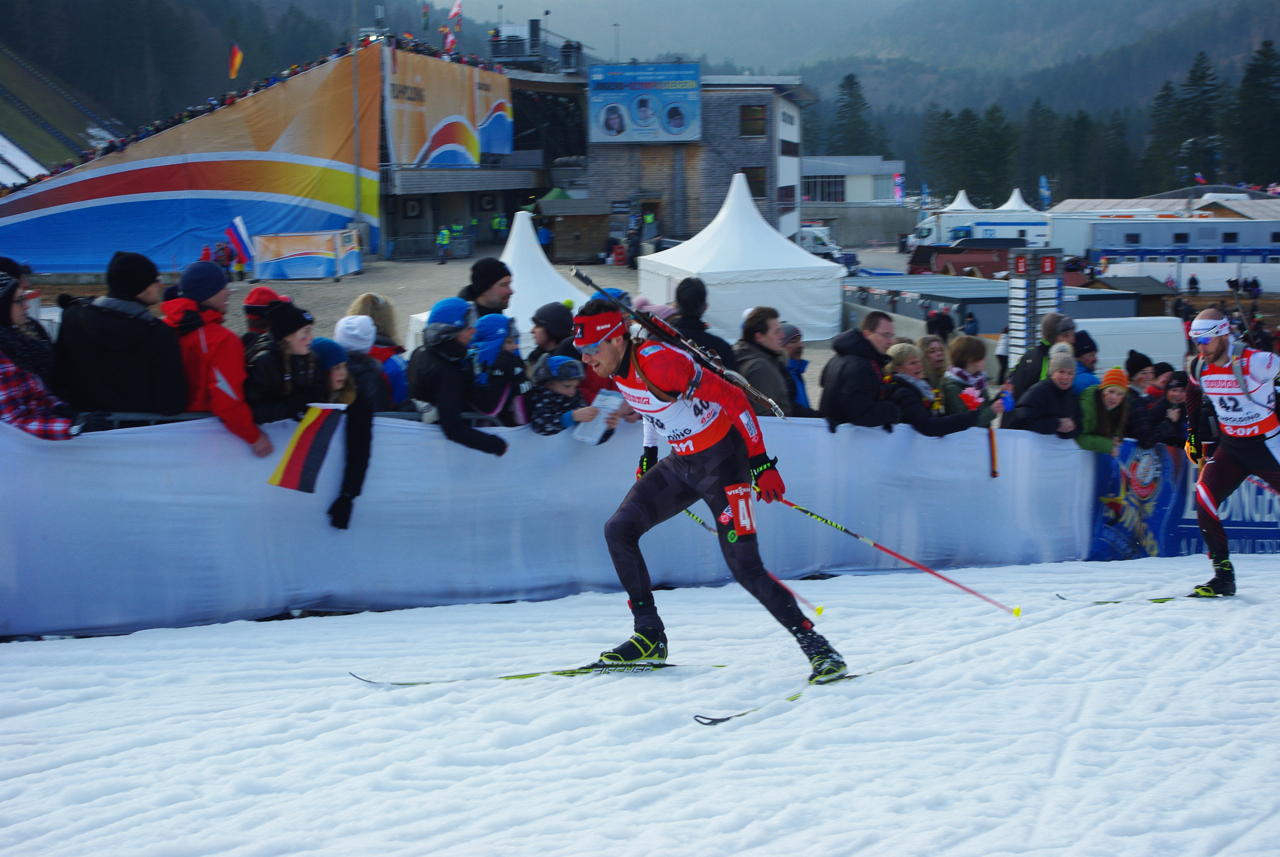
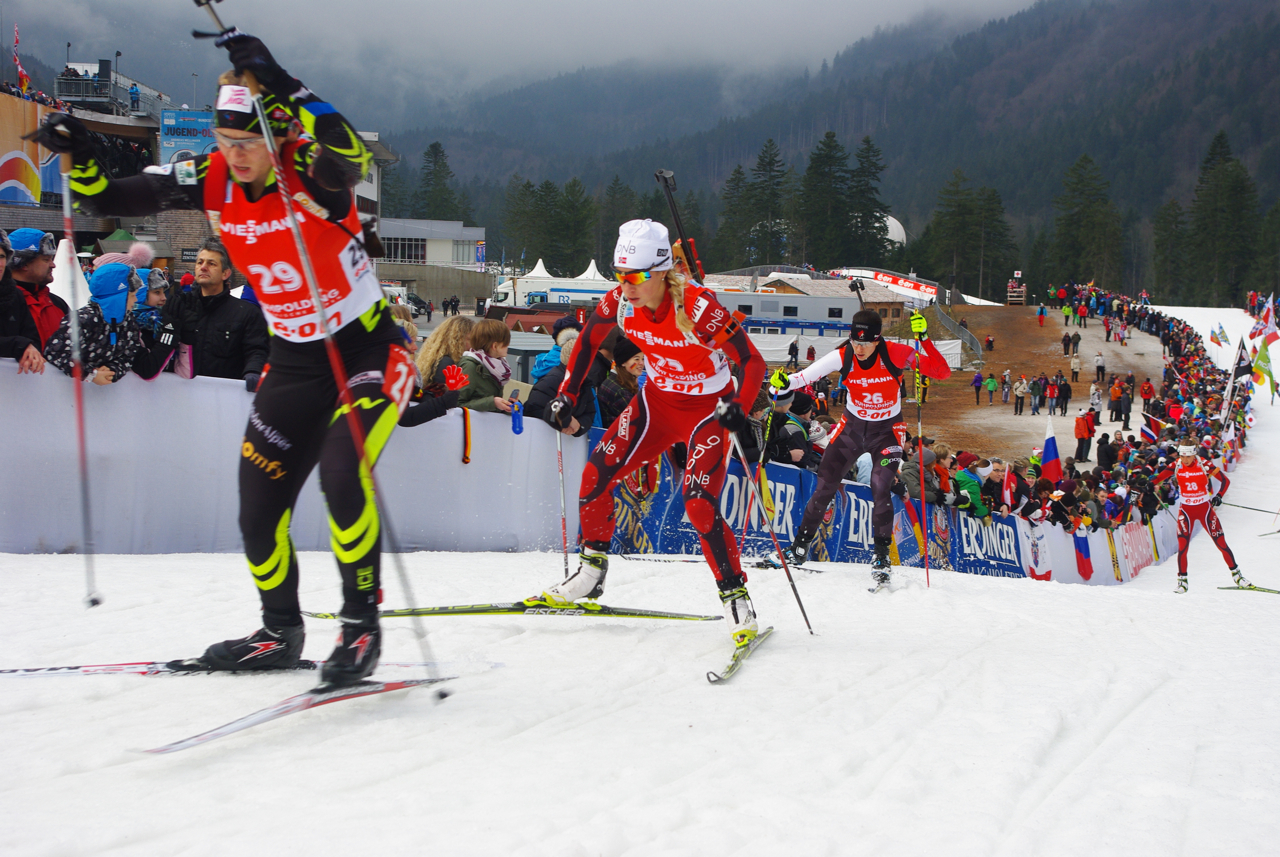
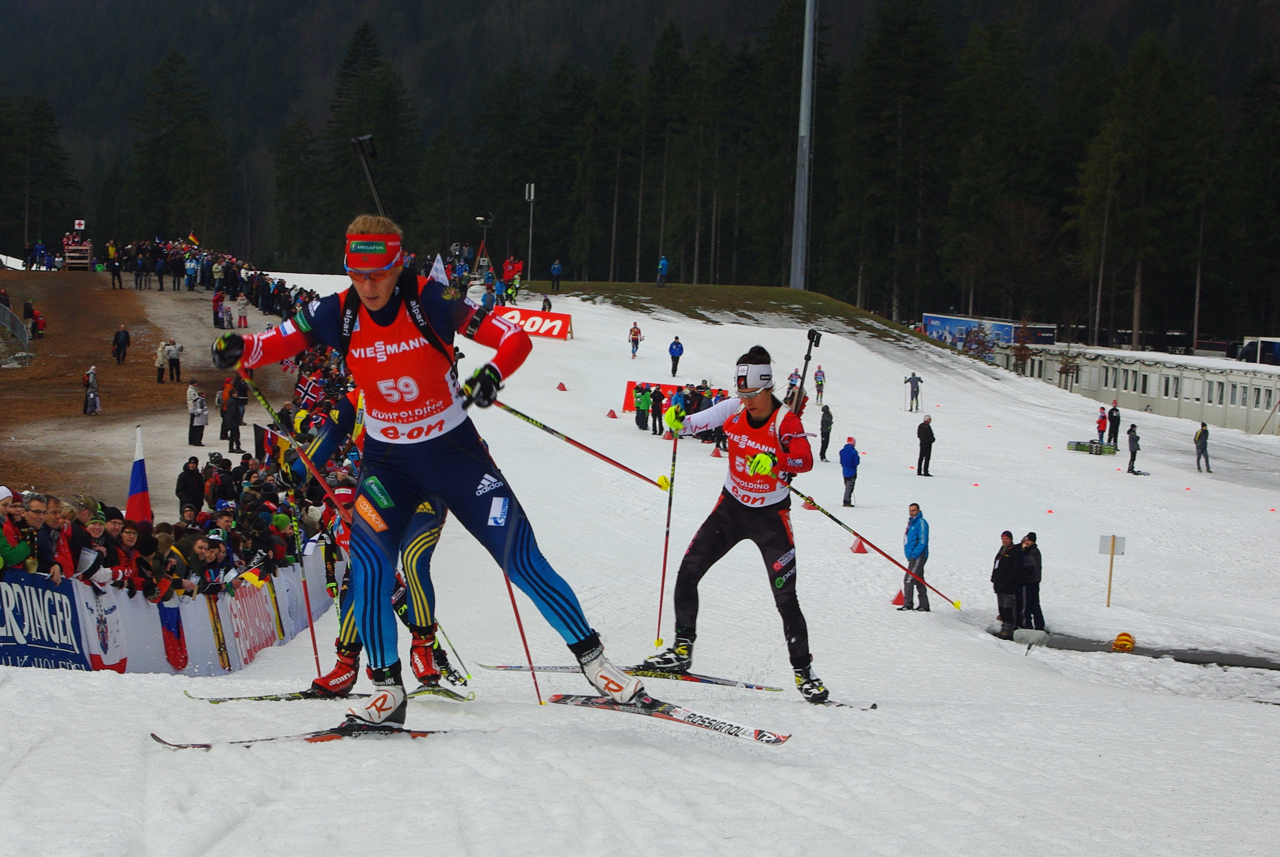
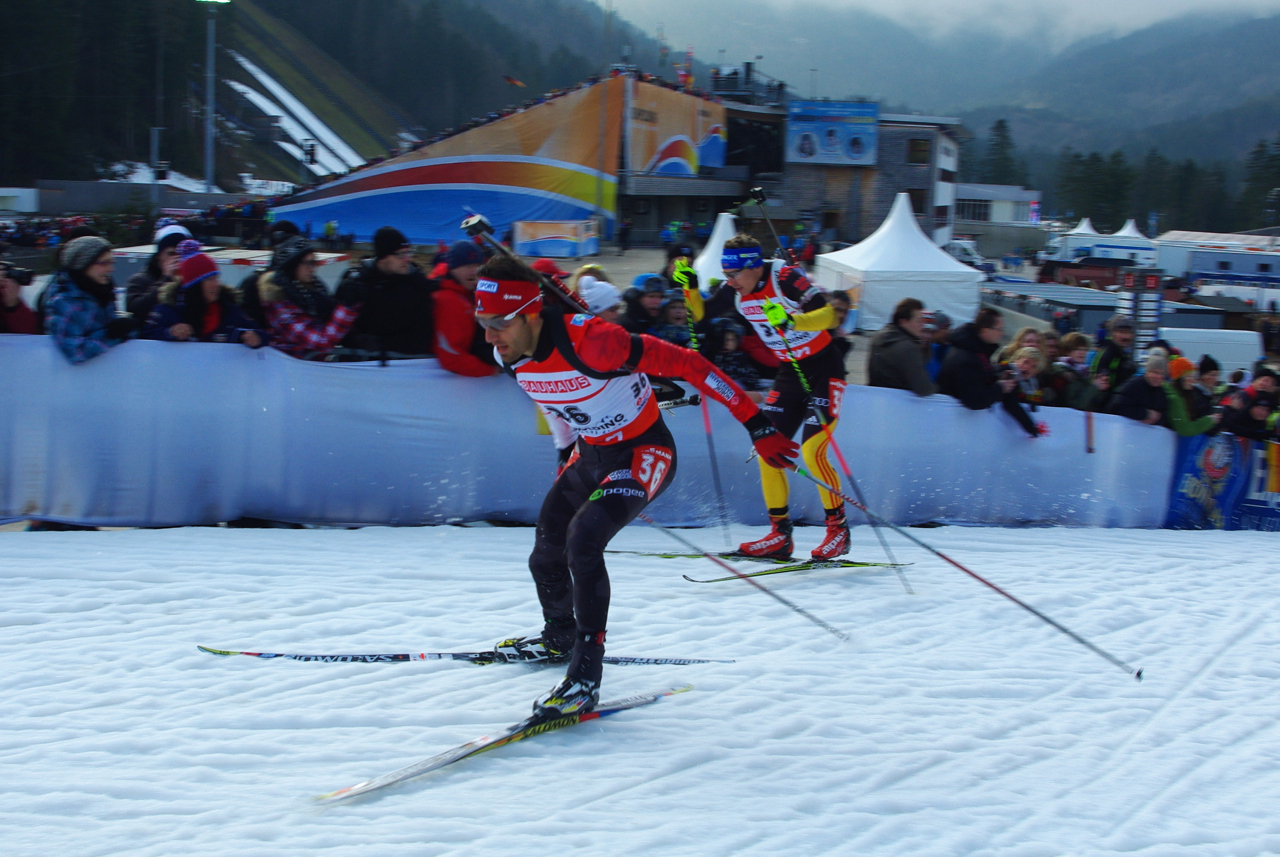
    Congratulations on the progress, ladies.

    Dunklee had the best individual performances of the year, placing seventh in the 15 k individual in Sochi; she also did the best at World Championships, where she was 15th, also in the individual. The top-ranked American last season, it was a solid sophomore effort for Dunklee, who is a relative newcomer to the World Cup circuit, and her performance throughout the year proved that the fifth-place finish at 2012 World Championships was no fluke.

    And like Cook (and Burke), her strong showing on the Sochi trails was, hopefully, a sign of things to come when the Olympics roll around next season.

    Crawford, meanwhile, had an even bigger breakthrough than Cook; the Canadian had never actually scored World Cup points before this season, but she did so six times, including with a staggering 12th-place finish in the sprint in Pokljuka, Slovenia, and with a 17th-place showing in the individual at World Championships. But Crawford was mostly an early-season athlete; aside from the World Championships finish, her other five points-scoring races all came in either Pokljuka or Hochfilzen, both in mid-December.

    Finally, it’s easy to forget Kocher’s success early in the season because she had a rough go at the end – and it’s particularly easy when one considers the regular top results Kocher saw last year, which just didn’t materialize in 2013. But in Ostersund, she placed tenth in the sprint, the second-best North American finish of the season, and like Crawford she scored points on six separate occasions.

    Congratulations to all these biathletes on a great 2013.

    medal-final-layer-2013Previous Winners:

    2011
    Lowell Bailey (USA)
    Sara Studebaker (USA)

    2010
    Tim Burke (USA)
    Zina Kocher (CAN)

    2009
    Tim Burke (USA)
    Zina Kocher (CAN)

    2008
    Tim Burke (USA)
    Caitlin Compton (USA)


    See also:

    Adaptive Skier of the Year

    Nordic Combined Skier of the Year

    Breakthrough Skier of the Year

    Continental Skier of the Year

    Junior Skier of the Year

    Rookie of the Year

    Collegiate Skier of the Year


  • Two-Time World Youth/Junior Champion, Wenzel Calls It Quits at 22; Schultz Joins Him on the Bench

    Two-Time World Youth/Junior Champion, Wenzel Calls It Quits at 22; Schultz Joins Him on the Bench

    Canadian biathlete Kurtis Wenzel after the first and only World Cup biathlon race of his career, in Sochi, Russia, in March. Courtesy photo.
    Canadian biathlete Kurtis Wenzel after the first and only World Cup biathlon race of his career, in Sochi, Russia, in March. Courtesy photo.

    Just one week ago, Canadian biathlete Kurtis Wenzel told FasterSkier that winning his first national championship was “a perfect way to end the season.”

    Hidden inside that statement, though, was a bigger one: Wenzel contacted Fasterskier yesterday to announce that he is ending his career as a biathlete. The 22-year-old had raced in his first World Cup only a month or so before.

    And he joined another national team member in calling it quits. After a difficult season where her body never really got going, Melanie Schultz also decided to hang up her skis and move on. Both were probably outside shots for the 2014 Olympics, and would have had to fight hard to unseat more seasoned World Cup veterans.

    So it’s not so much the Olympics where Canada will feel the loss, but rather what comes after – for instance, what if there’s a spate of retirements by older athletes, as often happens after a Games?

    “Athlete recruitment and athlete retention are definitely two issues we face, being such a marginal sport to start with,” World Cup winner Jean Philippe Le Guellec told FasterSkier in an e-mail.

    Upward Trajectories…

    Melanie Schultz racing in Canmore last year. Photo: Michael Potter.
    Melanie Schultz racing in Canmore last year. Photo: Michael Potter.

    Wenzel’s biathlon career was marked by ups and downs: in 2009 he won the World Youth Championships sprint, then in 2011 took the year completely off from biathlon after feeling overwhelmed. He was as surprised as anyone else when he came back to win the World Junior Championships individual race in 2012.

    The rags-to-riches-to-rags-to-riches story was certainly one of the most compelling of a 2012 Championships that also featured the first win by an athlete from the Netherlands; it was a good year for underdogs.

    “I was really excited to be racing in the international scene again and lucky I could have one of my best races so far this year at Worlds,” he said at the time.

    Yet in his first senior year, 2013 put the young Canadian back at the bottom of the heap. He did an IBU Cup tour and then, by the end of the season, had begun to climb upwards, starting the World Cup relay in Sochi, Russia and then winning the national championship pursuit. As he earned more and more start rights, it seemed like he might be able to mimic the path of Scott Gow, who finished his junior career just one year before Wenzel and was the youngest competitor to make the pursuit race at World Championships.

    So the Sochi trip could have been a preview for an Olympic bid next year, but Wenzel says he realized he no longer felt that drive.

    “I don’t actually dream of going to the Olympics anymore,” he said. “When I realized that, the decision was easy. However, I was very luckily to live out my long time fantasy of racing a World Cup in a packed stadium. I am also luckily to have had such a great support network of people to help me through my career and with this decision. I cannot thank them enough!”

    Wenzel had first considered retirement back in December, but knew he wouldn’t decide anything final until the end of the season.

    “Now I have had some time and it still feels right,” he said.

    As for Schulz, the 27-year-old struggled to find her ski speed at the beginning of the season. A few health issues had slowed her down during dryland, and when she hit the IBU Cup she couldn’t get going. Concluding that her body had just had too much training over the past few years, she spent a month relaxing in southeast Asia, hoping that the rest would help her find some energy.

    But upon returning to the sport later in the winter, Schultz still couldn’t get up to full speed.

    “After nine years of focused training and racing where I continually pushed myself to my limit and beyond, it was apparent my body and mind were saying, ‘Enough!’” Schulz wrote on her website. “Listening to my intuition, I decided it was time to hang up my skis and rifle for good and give myself a much needed and much deserved rest. I definitely have mixed feelings about my decision, as I imagine most athletes do when they retire from sport.”

    The departure comes just one year after Schultz seemed to be really making a leap in results; she was named Biathlon Canada’s Female Athlete of the Year in 2012, and also received the Ruedi Setz award for “exemplary standards of sportsmanship and significant contribution to the development of biathlon.”

    … Aren’t Enough

    Le Guellec, who is the same age as Schultz but has been involved in the sport much longer, has seen athletes come and go from the national team – mostly, go.

    But the spate of younger athletes calling it quits seems a bit new to him. For one thing, there wasn’t always such a strong cohort of older athletes to fight against for starting spots. He explained that back in 2004, both junior and senior athletes qualified to receive financial support from Sport Canada. Now, the national team is “saturated,” Le Guellec said, making it much harder for younger athletes to get paid.

    “In this day and age, we have a full flock of seniors all getting carded by Sport Canada,” he said. “So if you’re a youth, a junior and even a senior, you have to train and race on your own dime for the most part: season in, season out. When you add up the costs for a full year of training, it can’t surprise you that that can be a deal breaker after a certain time.”

    Just making it as far as Wenzel and Schultz did requires a large and diverse support network, and both said they appreciated the many people that had made their careers possible.

    “I want to say a HUGE THANK YOU to all my sponsors, coaches, teammates, support staff, family, friends and fans of my biathlon career for the last nine years,” Schultz wrote on her website. “I wouldn’t have been able to accomplish all I have without all of you!”

    Both athletes were part of Canada’s national team last season, but that’s hardly a guarantee of financial security.

    “I’m not aware of numbers for budgets and such,” Le Guellec said, “but I guess comparing our federation to a family of say 14 kids while being a single parent on welfare could be pretty spot on. They’re in a situation where they have very little money to make an entire sport run in a huge country. Their biggest challenge is, unfortunately, finding the resources to fund development squads, camps, cut costs for travel to competitions and so, and so and so on… with pennies.”

    Biathlon Canada could not be reached for comment.

    Having a significantly more robust senior national team is obviously a boon to the sport. But it’s just one reason that young athletes might look at the years ahead and begin to wonder if they can hang on for long enough to finally reach the top: Gow, Wenzel, and teammates Yolaine Oddou and Audrey Vaillancourt were unusual in their ability to translate success at the junior level to World Cup starts in just a year or two, but none spent the entire season on the top circuit.

    And while none of the debuts went badly, it’s a tough transition to make. Le Guellec thought that seeing the real level of competition might make athletes think differently about what lay in store in the coming years.

    “Having an Olympic dream is nice,” he said. “Being motivated is also nice. Resources and passion aside, I’ve seen athletes be exposed to the international field and it can be very intimidating. It doesn’t take a math degree to start adding up the work you’ll need to do in order to climb the ranks – plus this is a process that can be long. I wouldn’t say they scare off, but when you add up points 1 and 2, maybe its just a lot of work for not much in return to at least help you through it.”

    All of that is, of course, harder when you are from North America. The amount of time spent on the road is difficult for many athletes, who may not return home to see their families for months at a time.

    Wenzel confirmed that after one long tour in Europe this year, he was a bit overwhelmed.

    “The decision was spurred by a combination of my difficulty dealing with life on tour and a desire to expand the other parts of my life that were put on the back burner,” he said.

    Next Steps

    The most common thing that athletes give up is school, and that’s where Wenzel will be headed in the fall, if all goes well.

    “I will hopefully be studying economics at the University of Calgary, but I still have to apply,” he said. “I have done a couple courses at U of C before and I was accepted into the Kinesiology program, but I realized that’s not what I would like to study.”

    A few elite-level biathletes and skiers have been able to make school work, somehow, while still competing on the World Cup: Alex Harvey is in law school, Astrid Jacobsen is in medical school, Maurice Manificat is studying biology. But Wenzel knew that he couldn’t be like them, at least not with any level of success.

    “I have definitely been putting school on hold because of training,” he explained. “It would have been impossible for me to hold down my job in Calgary, go to school in Calgary and train properly in Canmore. I am also a horrible procrastinator at times so correspondance courses wouldn’t have worked for me. Honestly, this winter was the first time I really started looking forward to going to school. I think that helped make the decision for me.”

    Schultz, meanwhile, will be transitioning from part-time to full-time work as a patent agent at an intellectual property firm in Canmore.

    “I’m transitioning into the life of a non-athlete,” she wrote on her website.

    That’s never an easy transition, but Wenzel hopes to stay involved with the sport just enough not to miss it. Coaching was a possibility, he said.

    And training.

    But just “a little bit.”