Tag: Jean-Philippe Leguellec

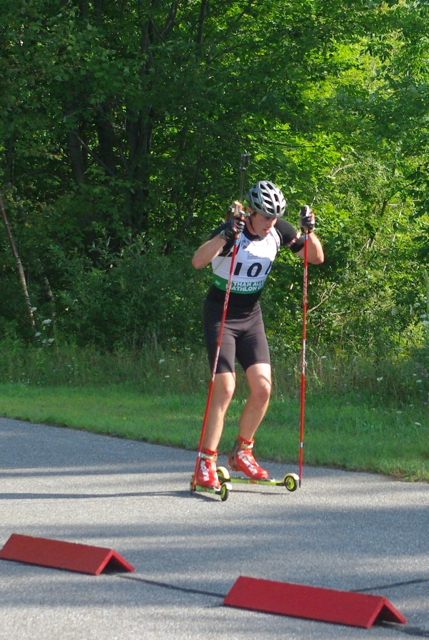
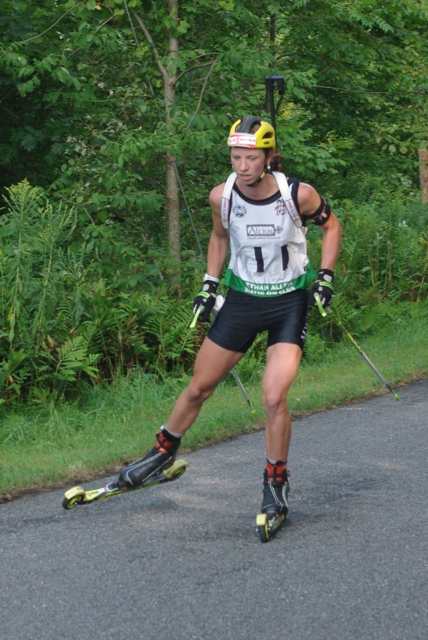
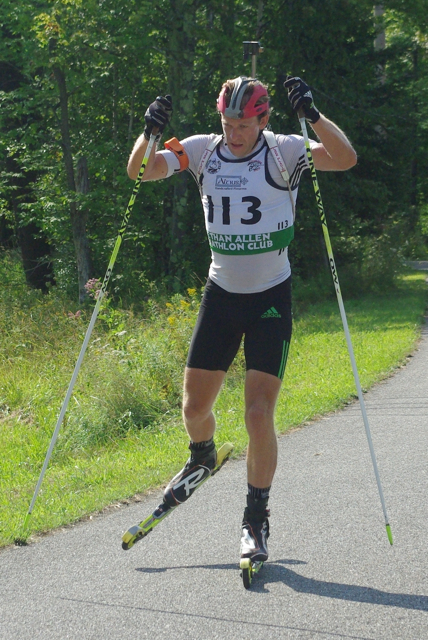
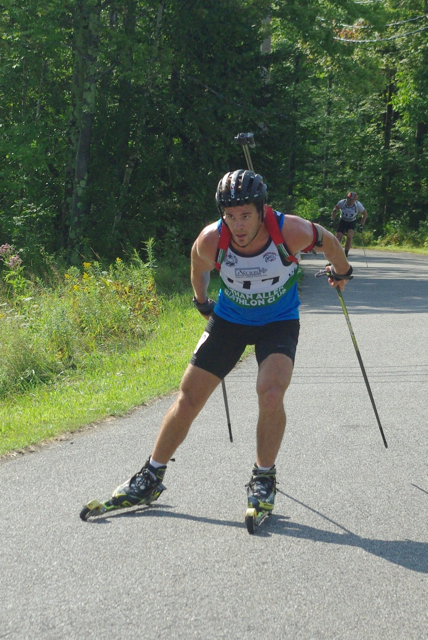
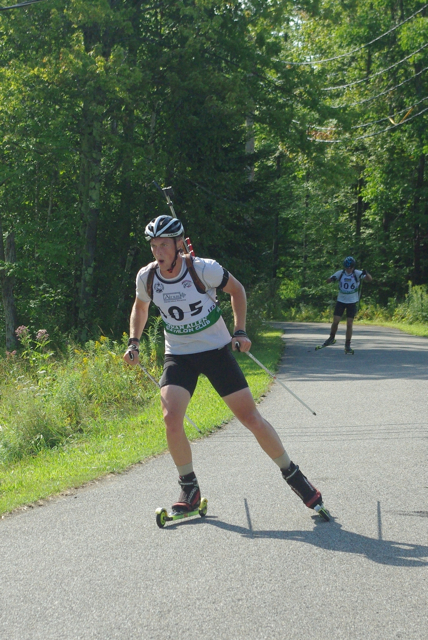
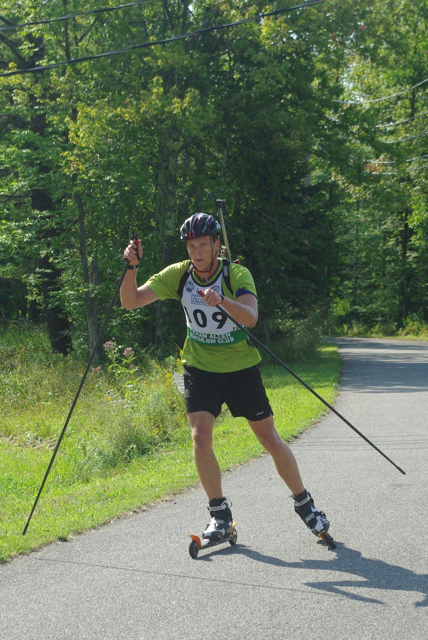
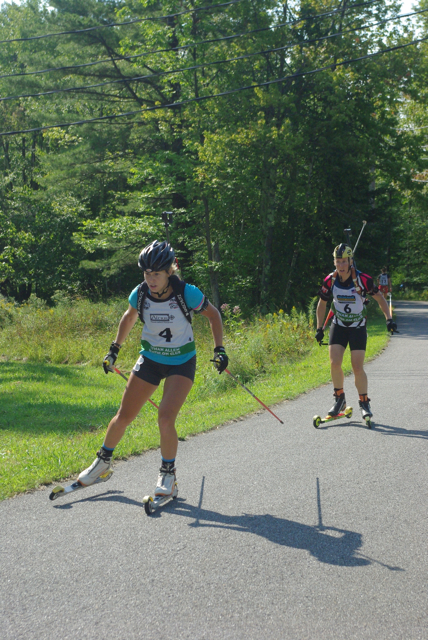
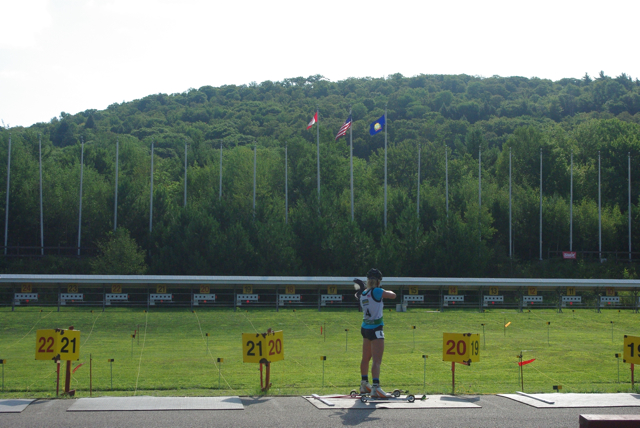
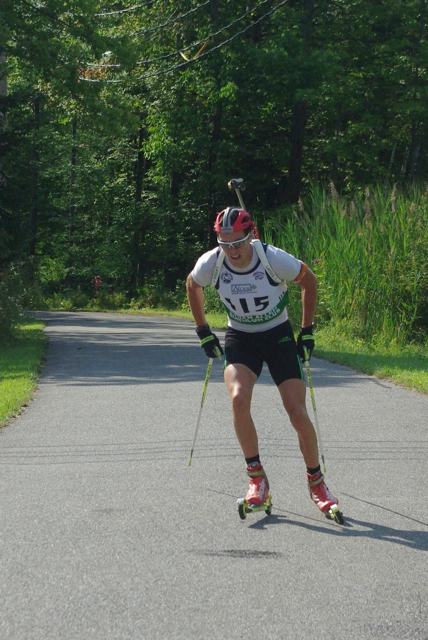
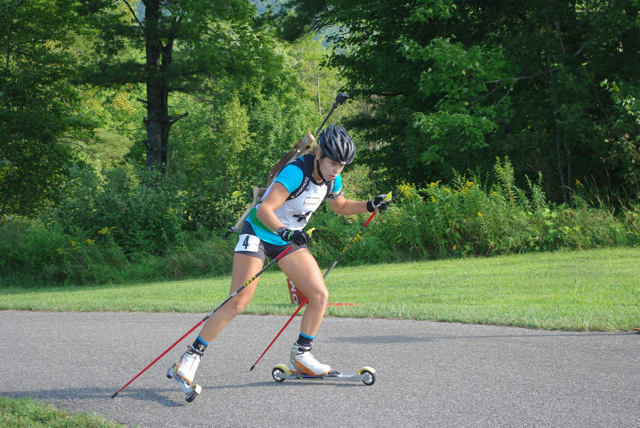
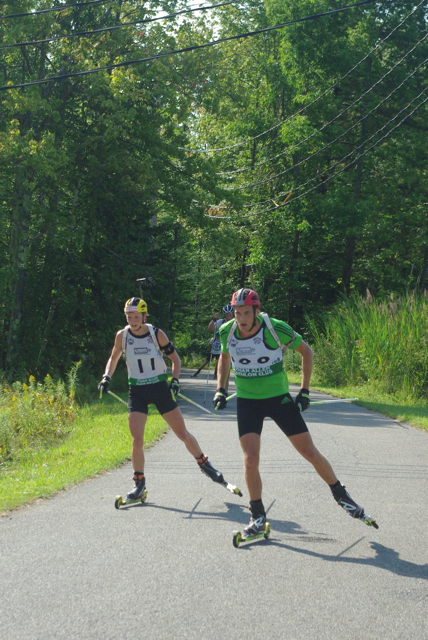
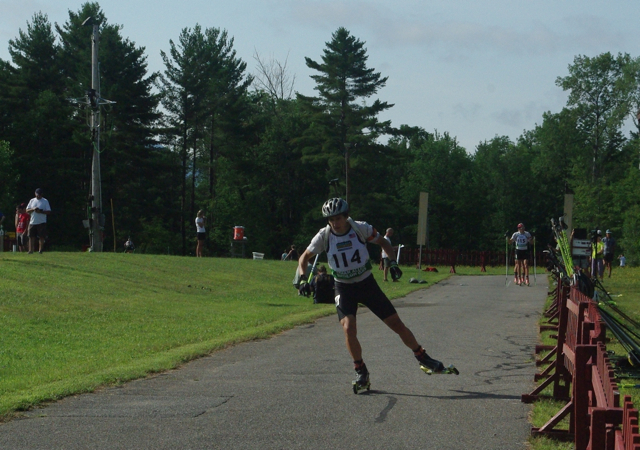
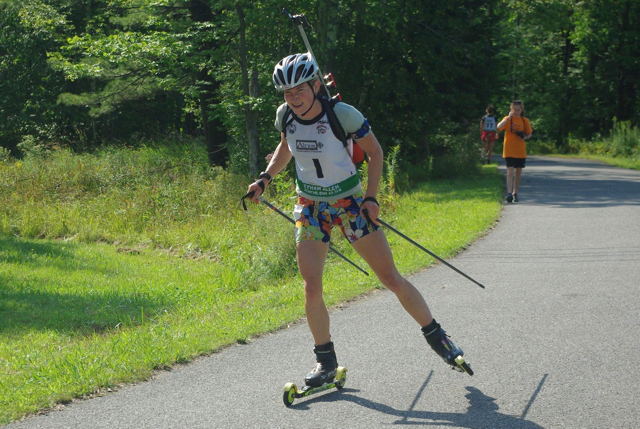
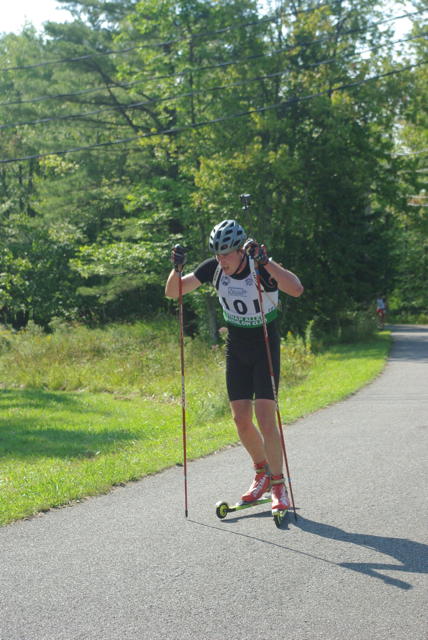
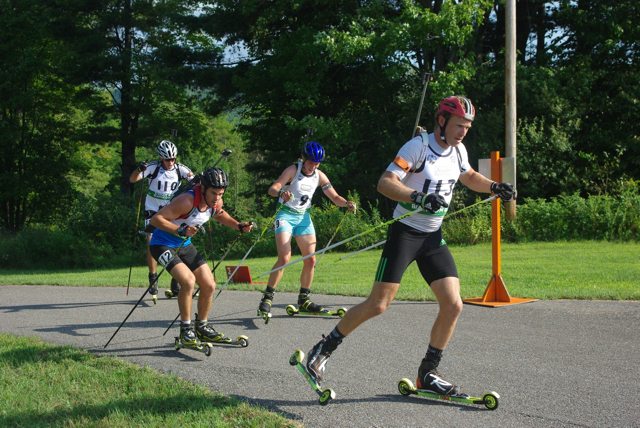
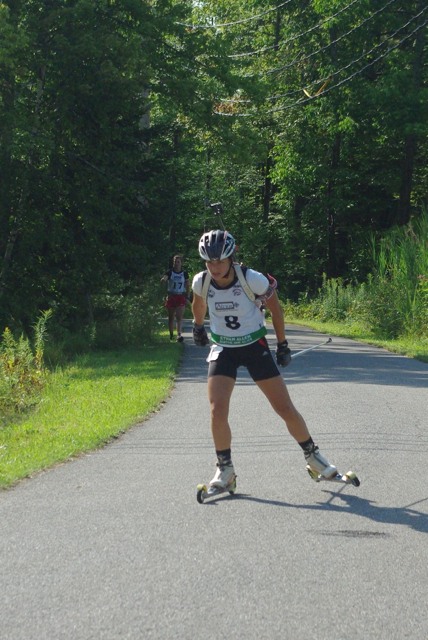
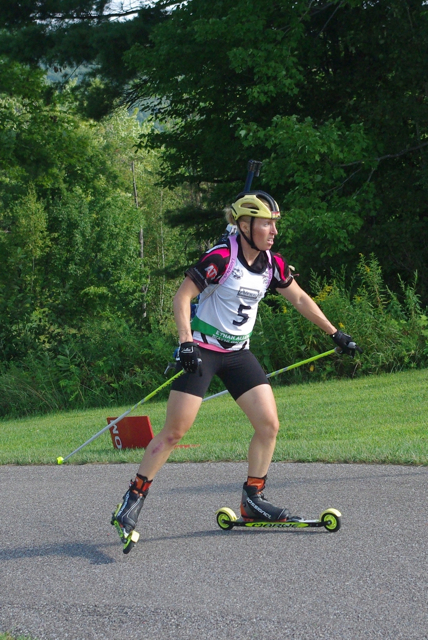
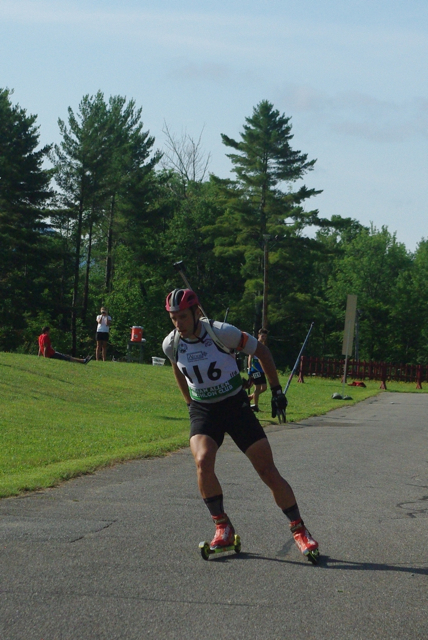
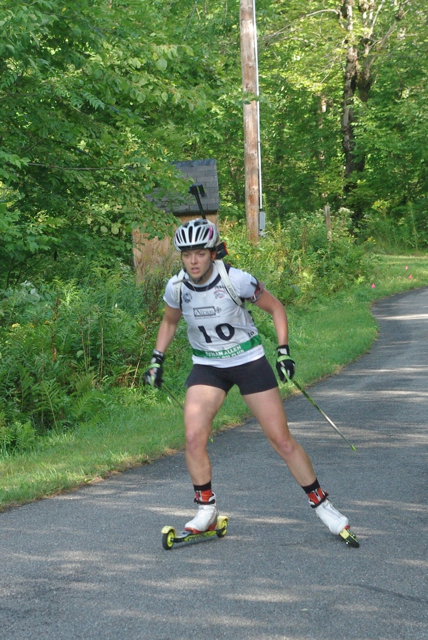
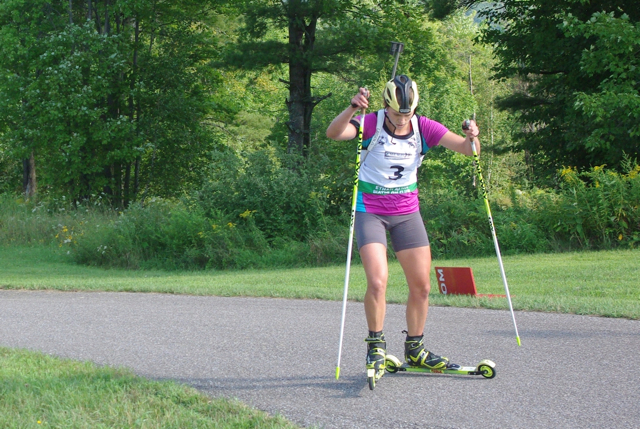
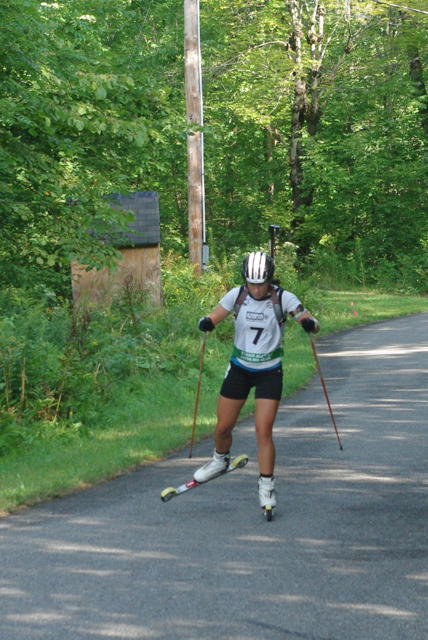
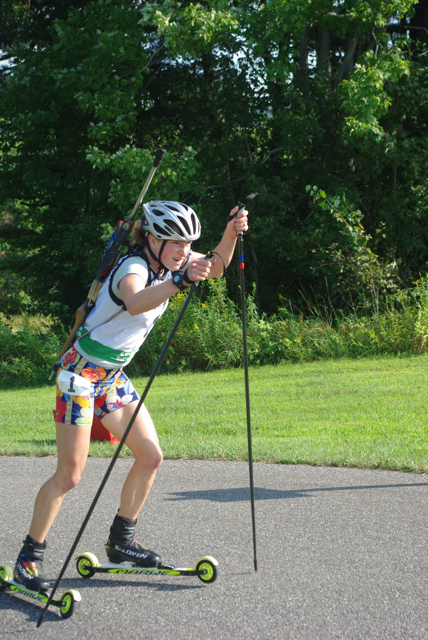
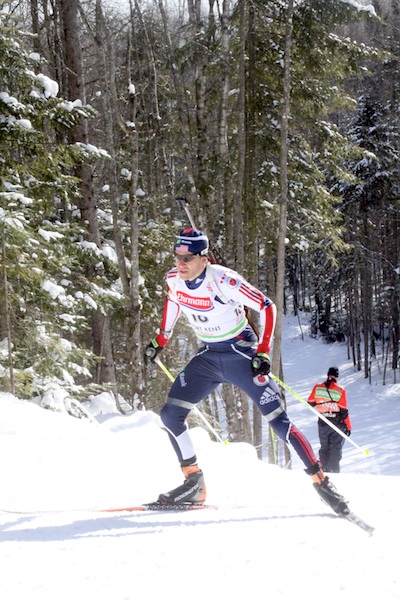
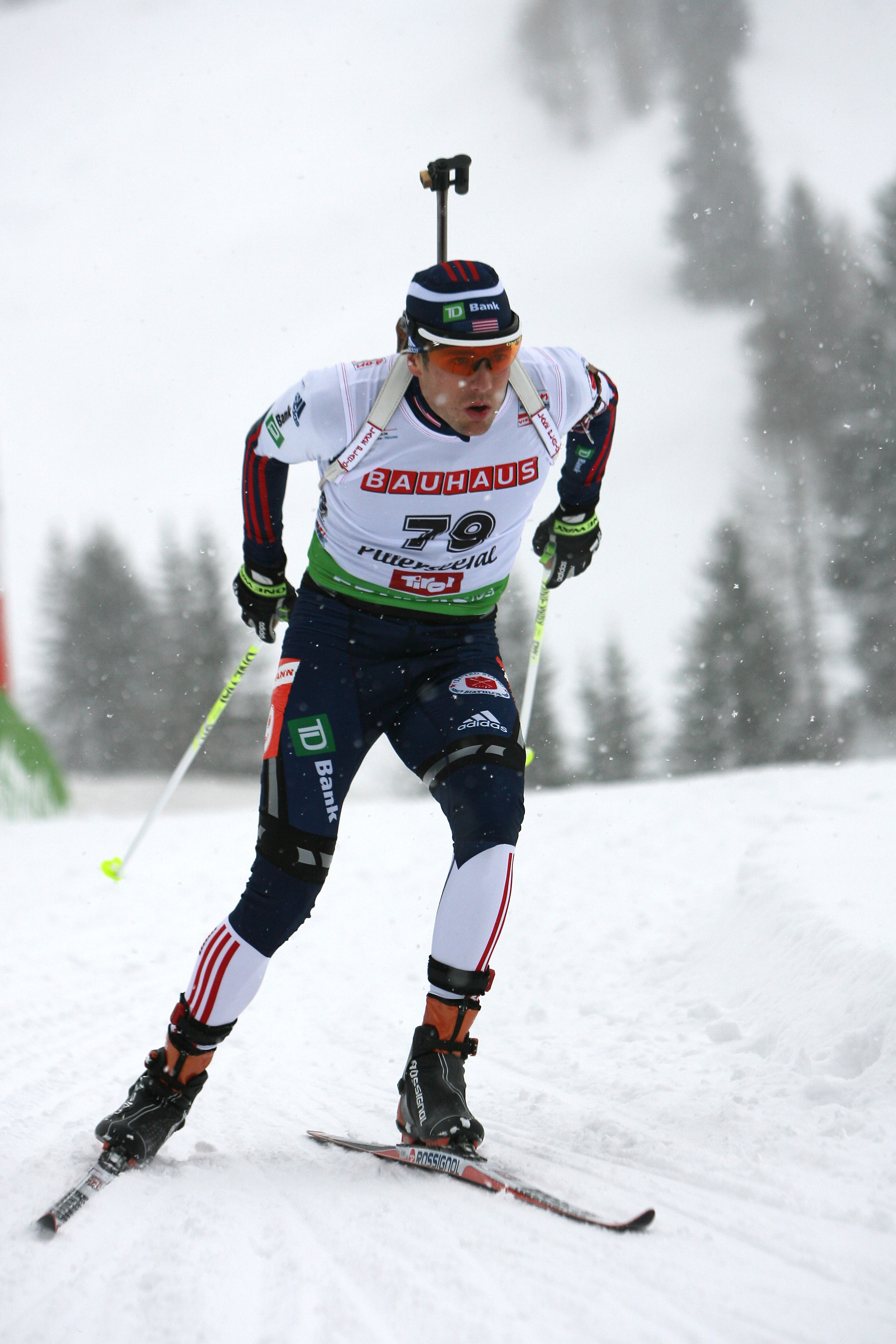
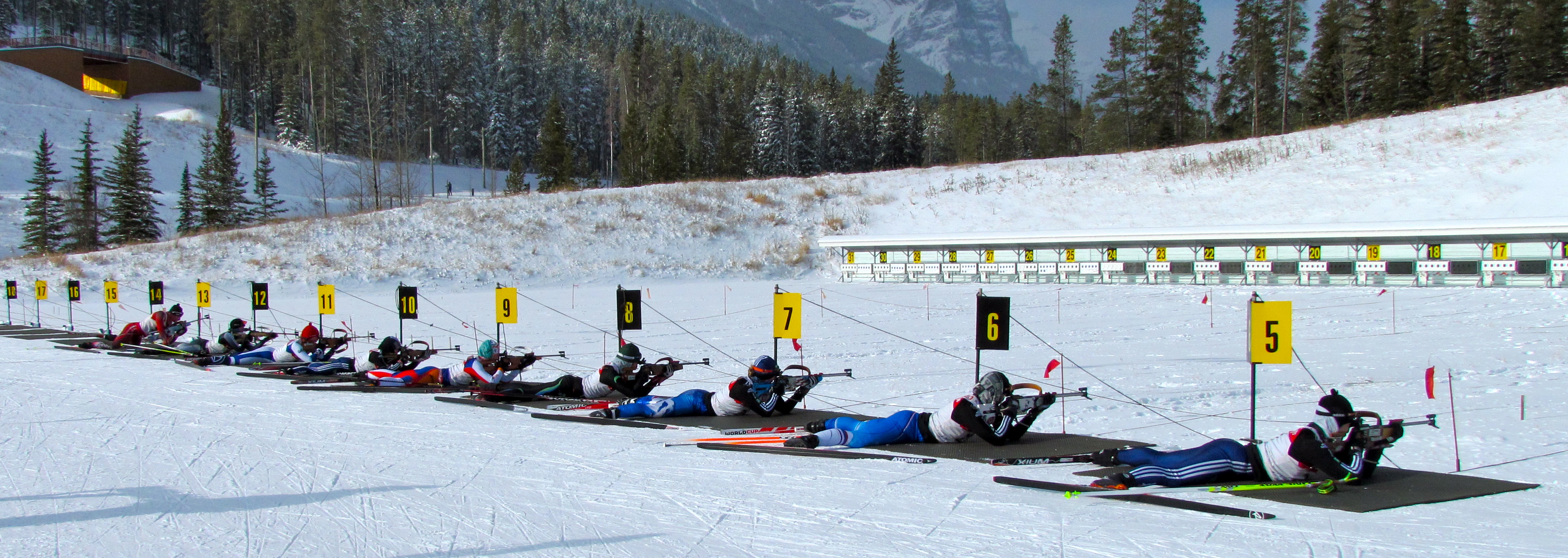
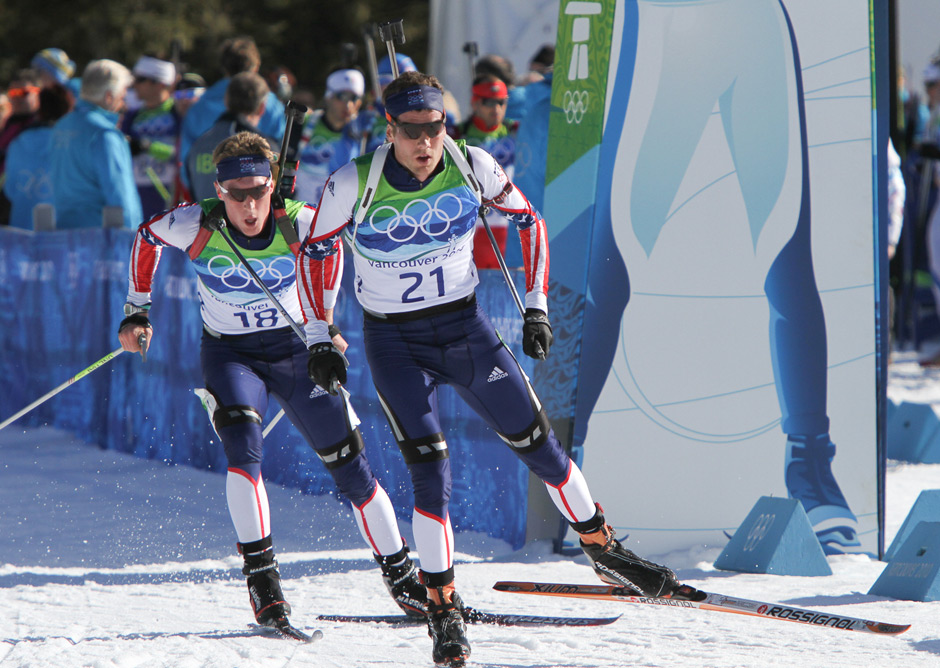
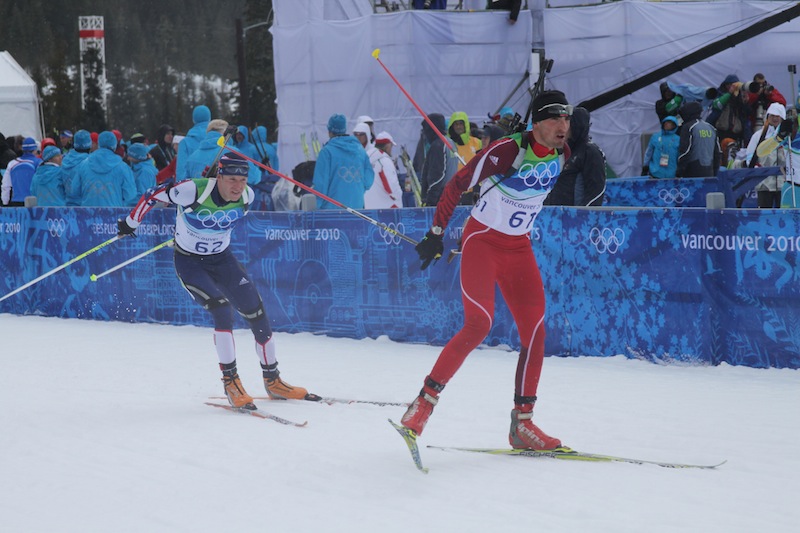
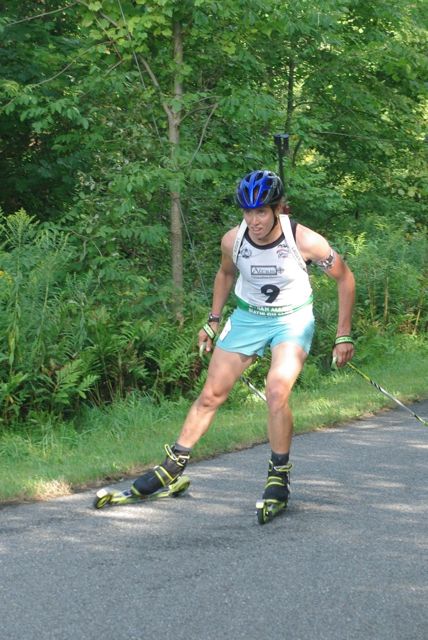
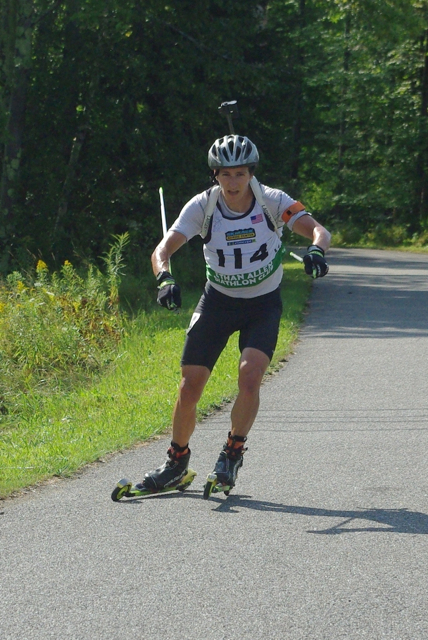
  • Photo Gallery: North American Rollerski Biathlon Championships

    Photo Gallery: North American Rollerski Biathlon Championships

    JERICHO, Vermont – With the entire U.S. senior field and several top Canadians donning bibs this weekend, there was plenty of excitement at the Ethan Allen Firing Range in Jericho, Vermont. In the senior divisions of the North American Rollerski Biathlon Championships, the men’s races were characterized by close finishes, with Tim Burke outsprinting JP Le Guellec for the pursuit title, Ethan Dreissigacker edging Lowell Bailey by one second for fourth, and Sara Studebaker besting teammate Annelies Cook by three seconds for third place in the women’s race.

    But close finishes weren’t the only thing that made the races notable. With over 70 junior and senior competitors, event is one of the largest summer biathlon gatherings in North America, and the Ethan Allen Biathlon Club has graciously played host for many years.

    “It’s fun to see all the young people,” Le Guellec told FasterSkier. “It’s North America at its best.”

    FasterSkier was on site on Saturday; here’s a gallery of our photos from the event.

    Race reports: men / women

    Results: sprintssenior pursuitsjunior pursuits

  • Burke, Le Guellec Trade Shots, Wins at North American Rollerski Biathlon Championships

    Burke, Le Guellec Trade Shots, Wins at North American Rollerski Biathlon Championships

    Tim Burke (USA) leads Vincent Blais (CAN) in Saturday’s Sprint in Jericho, Vermont.

    JERICHO, Vermont – Just how excited was Jean-Philippe Le Guellec to make the drive from Quebec, Canada,  down to Vermont this weekend for the North American Rollerski Biathlon Championships?

    “Let me put it this way,” he said. “I was supposed to go on a fishing trip this weekend and I ended up cancelling on my friends because I was so happy that Tim [Burke] and Lowell [Bailey] were here. These guys are in the top at the World Cup and I think that it’s nice that in North America we have that kind of performance.”

    If anyone would appreciate this sacrifice, it’s Burke and Bailey, who are fishing enthusiasts themselves. And Burke was similarly enthusiastic about the chance to compete against Canada’s top biathletes.

    “I didn’t realize that they were coming down actually until I saw them yesterday,” Burke admitted. “But it’s great that they come down. I time trial against everyone else here pretty often in the summer, so it’s really nice to have some new faces, especially ones of that caliber.”

    Le Guellec made the most of his trip, winning Saturday’s 10 k sprint race by ten seconds over U.S. National Team member Leif Nordgren despite having two penalties to Nordgren’s one – which seemed to surprise him.

    Jean Philippe Le Guellec en route to a sprint win on Saturday.

    “Skiing felt horrendous,” he said after cooling down from the sprint. “During the race I thought that Tim was right ahead of me in bib numbers, so when I got on the range in prone and saw that he wasn’t even there it was like, ‘oh, my God.’ I forgot that he was three bibs ahead. If I had caught him, that would have been a problem for Tim! But still, skiing didn’t feel so great.”

    In Sunday’s four-stage, 12.5 k pursuit, the tables were turned, with Burke starting 18 seconds behind Le Guellec. On the first prone stage, Le Guellec missed two shots to Burke’s one, setting up a showdown that lasted the rest of the race. Both men cleaned the second prone, and then collected one and two penalties in the pair of standing stages. At the finish, Burke edged the Canadian by just a single second.

    “It’s really motivating,” Burke said on Saturday of having the Canadians around. “There’s no substitute for putting on the bib.”

    Nordgren, like Burke, had five penalties in the pursuit; although he cleaned the first stage, the late misses dropped him to third place. But it was still a strong showing for the youngest man on the national team – and an important one, if he wants to race on the World Cup this winter. Several of the top U.S. athletes are pre-qualified to a training camp in Sweden before the opening World Cup races, and Nordgren is vying for one of a few remaining open spots that will be decided based on this weekend’s races and two time trials in Utah this fall.

    “These races matter for me!” he told FasterSkier. “I have to qualify here. I’m not taking them too seriously, but it does feel nice.”

    Nordgren was enthusiastic about his single penalty on Saturday, and particularly the fact that he had cleaned in prone, which he says is usually he weaker position. But like Le Guellec, he didn’t think that his skiing was spectacular.

    Leif Nordgren leaving the start on Saturday.

    “The skiing didn’t feel so well – I just tried to stay pretty even, I guess,” Nordgren said. “I didn’t have a lot left to push on the last loop, but I didn’t push that hard on the first or second, either. So it was kind of mediocre skiing, but it worked out well for shooting. I came in fairly recovered for both standing and prone.”

    In Saturday’s sprint, there was a gap of almost 50 seconds to fourth-place Ethan Dreissigacker of Craftsbury, Dartmouth College, and the Ethan Allen Biathlon Club. But he was followed closely by Bill Bowler, an American who is training partly with the Biathlon Alberta Training Center, in fifth, and national team and Maine Winter Sports Center athlete Russell Currier, who was sixth. The three men started the pursuit separated by just one second, with U.S. national team racer Lowell Bailey another three behind them.

    And while Bowler dropped back, slowed down by penalties, it was an exciting race til the end for the other three. With Dreissigacker collecting six penalties to the seven by Bailey and Currier, he had a much-needed upper hand. Dreissigacker snagged fourth place again, and once again it was by one second, this time over Bailey.

    It was the first weekend of senior racing for Dreissigacker, who is entering his senior year at Dartmouth and had a top finish of 20th in the sprint at last season’s World Junior Championships in Kontiolahti, Finland.

    “I shot a lot better than I’ve been shooting in training lately,” Dreissigacker said.

    As for whether he’ll focus on biathlon this year, he said his plans were “all up in the air.” He was interested in making a trip to Open European Championships, but doubted that he would spend a significant amount of his winter traveling. With only a year left of school, Dreissigacker wants to finish. As such, he’s been doing “mostly skiing training” this summer.

    After a weekend in Jericho, the biathletes were exhausted, but pleased.

    “It’s tough,” Burke said on Saturday of the annual rollerski championships. “It seems like at Jericho we always get some sort of extreme weather, and it was really hot today, which made it pretty tough… and we don’t really take a break for these first races, we train right through it and it’s a little tough. You’re always a little more fatigued. But you feel that way in the winter sometimes too, so it’s good to be prepared.”

    Le Guellec was going home happy, too.

    “Jericho itself, it’s so nice to rollerski here – it’s like skiing in the winter,” he said. “And it’s fun to see all the young people. It’s North America at its best… I’ll be retired in two years, so I’ll go fishing every weekend after that.”

    Results: sprint / pursuit

  • A Series of Contract Extensions at Rossignol

    Rossignol Group is delighted to announce that its best athletes have extended their contracts up to the Sochi Olympic Games in 2014.

    Heading the list is Carl-Johan Bergman, double medalist at the Ruhpolding World Championships in 2012.

    Third in sprint and second in pursuit, the Swede has demonstrated his ability throughout the season, even wearing the yellow jersey of the World Cup leader in December. “The decision to continue with Rossignol was simple. To achieve my goals, I need the best skis and Rossignol is without doubt the best manufacturer for my skiing style. To be at my best, I need good support and Rossignol’s Team Service produces the best skis on the market year after year. I love that! With the new X-IUM boots and the new X-IUM WCS skis, I am ready to go in search of Olympic medals!

    On the other side of the Atlantic, the American and Canadian leaders have also decided to extend their journey with Rossignol. Canadian Jean-Philippe Leguellec and Americans Lowell Bailey and Tim Burke will be proudly competing in Rossignol’s colors.

    Tim Burke: I am continuing my association with Rossignol because I have 100% confidence in them. They always get me the best equipment. I am also very impatient to find out about the most recent innovations to be introduced. Rossignol is forward looking and goes on improving its products, good as they are already.

    We wish all of them a level of success to match their sports ambitions and the faith they have in our products.

  • Mixed Results for N. American Men in Fort Kent; Perras Hits Career Best

    Mixed Results for N. American Men in Fort Kent; Perras Hits Career Best

    Canadian Scott Perras racing on Thursday in the sprint in Fort Kent.

    Fort Kent is only 50 miles from Presque Isle, but competitors in the biathlon World Cups were greeted with an entirely different environment when the circuit picked up and moved northward on Monday.

    Swirling winds and grinding courses were the challenges in Presque Isle; frigid temperatures and one massive hill welcomed athletes in Fort Kent.

    On the Canadian and American teams, members hail from locations across the entire continent—from Lake Placid and Quebec to Alberta and Alaska—so it makes sense that the shift in conditions would lead to a shuffling in results.

    After being led all last week by Lowell Bailey (USA) in Presque Isle, it was Scott Perras (CAN) taking over the mantle of top North American biathlete in the 10 k sprint in Fort Kent.

    Skiing through temperatures that struggled to break zero degrees Fahrenheit, Perras missed just one shot over two stages to race to 30st place—the best World Cup result of his career.

    Bailey followed in 31st, with two penalties, with Jean Philippe Leguellec in 36th, with two misses. After skipping last weekend’s races to recover from an illness, American Tim Burke was 47th; he hit his first seven shots before crumbling and missing his last three.

    “The first time I missed, I knew I missed just a little bit on the right,” he said afterwards. “The last two shots felt really good—I was just shocked.”

    American Lowell Bailey in action.

    With a massive hill just 250 meters out of the start, the 3.3-kilometer Fort Kent sprint loop was every bit as difficult as anticipated, Bailey said. He called the initial climb possibly “the biggest hill I’ve ever seen on a biathlon course.”

    “It’s one of those climbs where you get to where normally you would finish a climb, and you look up and you’re only halfway,” he said. “It’s brutal—there’s nothing else to say about it.”

    The temperature was three degrees at the start of the race, which made the going even tougher. So tough, in fact, that American Jeremy Teela—like Burke, dealing with sickness—elected not to start the race after completing his warm-up.

    Normally, Teela’s scratch would have opened up a spot for another American to compete, and the team indeed had selected an alternate—23-year-old Russell Currier, who hails from nearby Stockholm.

    Currier had been informed by U.S. team staff that he’d have the day off if he didn’t hear anything before 9:40, with the race starting at 11:30. But Teela’s decision came so late that the Americans were unable to reach Currier after trying his home and cell phone, and the start spot went unused.

    “That was a pity for him, for sure; he would have loved to race here,” said Per Nilsson, the head coach of the American team—noting that next time, he would have the alternate on site. “This is unique—I’ve never been [where] somebody’s called in [so] close.”

    Despite a home crowd that didn’t hit estimates – a rough tally pegged the number of spectators at no more than 500 – the Americans still qualified all four of their starters for Saturday’s pursuit, led by Bailey.

    While his 31st place was respectable, Bailey still couldn’t hide his frustration at his result in Fort Kent—especially after notching a 16th in the pursuit in Presque Isle last week.

    The race came down to a miss on Bailey’s final shot of the day, which could have cost him as many as 10 places.

    “I went for it, and it would have been nice to hit that,” he said. “I think I just got ahead of myself, mentally. I was sort of leaving the range before I took that last shot, I think.”

    While Perras’s result was only one spot better than Bailey’s, the Canadian had a little more to be excited about.

    In the sprint in Presque Isle last week, Perras was a discouraging 61st out of 72 starters, even though he racked up just two penalties—not a good sign leading into World Championships in March.

    On Thursday, though, Perras’s shooting was even better—he had just one miss—and more crucially, his ski speed was competitive. He had the 37th-fastest course time out of 71 starters—24 spots better than in Presque Isle—including a final lap that was the 15th-best.

    Afterwards, Perras said that he is slowly getting out of some volume training that he did the week before Presque Isle, in Canmore.

    “It was a lot of slow stuff. To get everything firing again takes some pretty hard workouts,” he said.

    After hitting 31st-place twice over the course of his career, Thursday was the first time that Perras had cracked the top 30.

    “Finally, it’s three-zero,” he said.

    Burke, meanwhile, will have to wait a little longer for his form. He said he finished his last round of antibiotics Thursday morning, and the sprint in Fort Kent was his first World Cup since competing in Italy three weeks ago. His speed on skis was not where it normally is—close to the top 10—but Burke was optimistic that he could be ready in time for World Championships.

    “For sure, I’m pretty far behind right now—I haven’t had really hard training in three weeks,” he said. However, he added, “I feel like [in] another three weeks, I can get there pretty quick.”

    Link to full results.

  • Fourth Straight Norwegian Win in Biathlon, but It’s Not Who You’d Expect

    Fourth Straight Norwegian Win in Biathlon, but It’s Not Who You’d Expect

    Tim Burke (USA) finished 23rd in the World Cup sprint held in Hochfilzen, Austria, on Friday. Photo: USBA / nordicfocus.com.

    For the fourth straight race, a Norwegian biathlete stood atop the World Cup podium.

    Was it 36-year-old veteran Ole Einar Bjorndalen? Or perhaps the overall World Cup leader, Emil Hegle Svendsen?

    Those would be smart guesses, but they’d also be wrong. Instead, it was their teammate, 22-year-old Tarjei Boe, who was the second-fastest skier on Friday and shot clean. Boe has never graced a World Cup podium before, much less won a race. But in the sprint, held in Hochfilzen, Austria, he bested the field by a solid 27.5 seconds.

    Sergui Sednev of Ukraine finished second after missing one shot. Alexis Boeuf of France was third, climbing the World Cup podium for just the second time in his career.

    Most of the field had to contend with heavy snowfall, which slowed both skiing and shooting times as competitors struggled to make out the targets through the snow. The back of the field seemed to have it the worst, at least in terms of skiing. Conditions slowed considerably as more and more snow built up.

    Boe told IBU News that he had actually felt better in Ostersund, Sweden, last week, but he thought that he handled the conditions better than the other men.

    “I was pretty lucky in the first two laps, but in the third loop, it started to snow really hard,” he said. “I thought that I would lose the victory because of that. Then I increased my lead from 20 to 25 seconds and knew that I could handle the conditions.”

    Boe was excited for his first victory, which was also the first time he had topped his two more famous teammates.

    “It is pretty cool,” he told IBU News. “It is the first time that I beat both of them in a World Cup. If you beat them, you are at the podium because they are up there all of the time. Emil is in such good shape these days that I have to do better shooting than him to be up there.”

    And that was indeed the case. Svendsen had the fastest ski time of the day, as has been his habit lately, but missed one shot in each shooting stage. Despite those misses, he was only 0.5 seconds behind Boeuf, narrowly missing the podium.

    Meanwhile, Boeuf had to contend with disappointment himself – he fell on a downhill on the last loop. Since he was less than six seconds behind Sednev, this almost certainly cost him second place.

    When he talked to IBU News, though, Boeuf was philosophical about the error.

    “It might have been better, but I fell down, not on a turn, but a perfectly straight place,” he said. “My ski just turned the wrong way and I was down. I lost some seconds there, but that is biathlon… You know, in biathlon one day you can be on the podium and the next day be last.”

    Tim Burke of the U.S. and Jean-Phillipe Leguellec of Canada finished 23rd and 27th, continuing a string of solid but unexceptional results from last weekend. With two misses each, the pair has been nothing if not consistent so far in the early season, collecting several top-30 finishes.

    Burke was frustrated with the race, saying that he had made a huge mistake in choosing the third U.S. starting position. He had assumed that it would snow for the entire race and that by the time he started, at least the track would be skied-in. Instead, the going got slower as the day went on.

    “Today felt like a flashback to the sprint race at the Olympics,” he told FasterSkier in an e-mail. “The good thing for tomorrow is that I am not too far back and everyone will ski through the same conditions. I will be looking to take out some of my frustrations from today during tomorrow’s race.”

    Leguellec said in a Biathlon Canada press release that he felt good today.

    “I felt a lot better skiing today than I did last weekend, but feel doesn’t mean you actually go faster,” he said. “I guess it just hurts less. My skis were bombing but my two misses cost me a lot. I’ll be in a good spot for tomorrow’s pursuit. Hopefully I can shoot well and climb up some spots.”

    Brendan Green had the next Canadian finish, placing 35th with one missed shot.

    “Starting in bib #1 meant I was breaking trail for the first loop,” he told FasterSkier in an e-mail. “I suffered more time loss on that loop than I would have liked, but the next two loops were better once the track had been skied in, and the shooting was solid today which I was very happy with. I’m sitting in a good position heading into tomorrow’s pursuit so I’m looking forward to that race and hopefully moving up in the standings.”

    Green hadn’t had an impressive weekend in Ostersund, finishing 65th and 74th. Friday’s result was a relief, he said.

    “Ostersund was a bit of a rough go for me with a disappointing showing on the range. My skiing was in pretty good form there, but without good shooting that doesn’t mean much. Hochfillzen has been a nice change from the cold temperatures and parasites in Ostersund, and I had a couple days earlier on in the week to regroup and bring more focus to my shooting. There’s still a long season ahead, and I’m confident that my best form is still yet to come.”

    Nathan Smith also qualified for the pursuit, riding clean shooting to a 54th-place finish. Scott Perras rounded out the Canadian results by finishing 92nd.

    For the Americans, Lowell Bailey shot clean and finished 55th, and will join Burke in the pursuit tomorrow. Leif Nordgren, Jeremy Teela, and Russell Currier finished 70th, 89th, and 94th. All struggled on the range, with Nordgren and Teela missing four shots each and Currier seven out of ten.

  • Bjoerndalen Bests Svendsen in Thrilling Ostersund Pursuit

    The first big chinks in Ole Einar Bjoerndalen’s armor showed up at the 2010 Olympics, where his two-medal performance was eclipsed by the three podiums collected by his Norwegian teammate, Emil Hegle Svendsen.

    Bjoerndalen, 36, was charitable at the time, as befitted a living legend with nearly three-dozen World Championships medals to his name. And there was no sense that he felt threatened by Svendsen—after all, the three medals that Svendsen won in Vancouver represented his career total, while Bjoerndalen has nine more in his quiver.

    But after Svendsen’s red-hot start to the year, in which he won the first two World Cup races of the season over Bjoerndalen in Ostersund, Sweden, one could sense Bjoerndalen’s grip on the sport loosening just a little—and he didn’t like it. After his crash on the final corner of Saturday’s sprint gifted Svendsen the win, Bjoerndalen was furious, angrily throwing his poles to the ground and storming out of the finish pen.

    So while Bjoerndalen’s victory in Sunday’s pursuit wasn’t much in the grand scheme of things—he has a whopping 92 World Cup wins to his name—he seemed to relish it a little more than usual, as it finally gave him the opportunity to put Svendsen, 25, back in his place. At least for now.

    After hanging doggedly with Svendsen for three quarters of the 12.5 k pursuit in Ostersund, matching him shot for shot, Bjoerndalen dropped his teammate on the final shooting stage, when an errant bullet by Svendsen went low and left. With one penalty to Svendsen’s two, Bjoerndalen was free and clear to ski in for the win.

    “I knew exactly what Emil was shooting. I heard every shot hit the target, so I knew he missed two,” Bjoerndalen said.

    Slovenia’s Jakov Fak was third, but he finished a full minute back, and never challenged the two Norwegians. Jean Philippe LeGuellec was the top North American in 13th, with one penalty, and Tim Burke was the top U.S. biathlete, in 32nd.

    The focus of the television cameras rarely strayed from the top two, though, as the race was a battle between Bjoerndalen and Svendsen from the gun. Biathlon pursuit races are handicapped using the results from a sprint, usually held a day or two earlier, and on Sunday, Svendsen left first, with a four-second advantage over Bjoerndalen. France’s Martin Fourcade, a strong podium threat, started third, but four penalties over the course of the day took him out of contention.
    Pursuits feature four shooting stages, but by the time Svendsen finished his first loop and glided into the range, Bjoerndalen had already closed the gap. The two slung off their rifles, took their prone positions side-by-side, and both shot clean. They left the range together, Bjoerndalen shadowing Svendsen, whose skiing had been slightly faster in races earlier this week.

    The two Norwegians went stride-for-stride on the second lap, and the third, too. They were also nearly flawless in shooting—both cleaned the second stage, and had just one penalty on the third.

    The fourth lap would be the difference-maker: if Svendsen could equal Bjoerndalen in the shooting, it was unlikely that the elder Norwegian would be able to hold on for the final lap. But after matching the veteran through four shots, Svendsen’s very last bullet was off-target, leaving Bjoerndalen the opening he needed. Afterwards, Svendsen blamed his inaccuracy on the weather.

    “I had a little bit of trouble in standing. The wind was a problem,” he said. “When you are so close to winning…the worst thing is missing that last shot.”

    Svendsen had to ski one more penalty loop than Bjoerndalen, which set him back more than 20 seconds. That was enough time for Bjoerndalen to ease up when he neared the finish line, pointing, as he passed by to the spot in the corner where he crashed on Saturday.

    ““I took a little break there today, so I could look at that place,” he said.

    Afterwards, the tension between the two Norwegians boiled over, as Svendsen called Bjoerndalen “cowardly” for not once taking the lead.

    “I would certainly [think] that he should contribute a little, but he was apparently not interested,” Svendsen told the Norwegian broadcaster NRK.
    Bjoerndalen acknowledged that he had spent minimal time in the wind, but that, he told NRK, was a tactic he’d learned from years of racing in cross-country competitions.

    “I was not as strong as he was—I had to run my race,” Bjoerndalen said.

    Despite Bjoerndalen’s win on Sunday, though, Svendsen still leaves Ostersund with the yellow bib of the overall World Cup leader. He said that he’s not interested in giving it up, though with Bjoerndalen just six points behind, Svendsen will surely have his hands full next week.

  • Svendsen, Bjorndalen, and Fourcade Repeat on World Cup Podium

    Much to Ole Einar Bjorndalen’s chagrin, his Norwegian teammate Emil Hegle Svendsen beat him for a second straight race.

    As Bjorndalen crossed the finish line in second place, 3.9 seconds behind Svendsen at the end of Saturday’s 10 k World Cup sprint, he threw his poles onto the ground in frustration and rolled his eyes at the cameraman.

    Bjorndalen held the lead at the 8.4 k checkpoint, but fell on the final downhill coming into the stadium. It was his first fall in a race since 2001.

    Svendsen had the fastest course time on the day by a large enough margin that even missing one shot didn’t cost him the win. The next three finishers – Bjorndalen, Martin Fourcade of France, and Jakov Fak of Slovenia – all shot clean, but couldn’t match Svendsen’s ski speed.

    Although he said in a press release that he felt “unstoppable,” Svendsen also had a bit of sympathy for his teammate.

    “I was sure that Ole would beat me when I saw that he had such good ski speed,” Svendsen said. “One man’s luck is another man’s death, I guess. I felt sorry for him when he fell, but I also thought, ‘that is good for me.’”

    Svendsen finished the 2009-2010 World Cup season with the yellow overall leader’s bib, and it looks like he might hold onto it for quite some time.

    The main competitor who could steal it away appears to be Bjorndalen, who had the win practically sealed Saturday and was only 19 seconds back on Thursday.

    “It was actually a really good race today for me, shooting clean,” Bjorndalen said in a press release. “The best for me in many years. I was in fantastic shape and had great skis, but I need to learn how to keep standing up on them.”

    He later told NRK, the Norwegian state TV station, that the race was lost, and there was nothing he could do after the crash.

    “I was in good form, and hit everything. So it went fine. I felt like I had control [of the race]. But in order to win, everything has to fall into place.

    “It was fun to see so many teammates up there,” he added.

    And indeed, the Norwegians had another strong showing Saturday, with Svendsen, Tarjei Boe, Lars Berger, and Bjorndalen owning the four fastest course times. In the final results, Boe and Alexander Os finished fifth and sixth. At the next World Cup series in Hochfilzen, Austria, the Norwegians will be heavy favorites in the men’s relay.

    Looking at the short-term picture, though, Fourcade believes he has a chance to win in Sunday’s pursuit race. He will start only 14 seconds behind Svendsen and will wear the red bib, meaning that he was the leader in the pursuit discipline last season. (In biathlon, besides the overall yellow bib, each race format also has its own red bib leader.)

    “I will start the pursuit with the red bib for the first time in my career and my aim is to keep it,” he said. “But I am sure that Emil and Ole are not really okay with this.”

    Meanwhile, Fak had one of his best races to date, missing the podium by a mere three seconds. He finished third in the Olympic sprint in Vancouver, when conditions strongly favored early starters. At the time, he raced for Croatia; he has since switched to join the Slovenian team. His only other podium came in the 2009 World Championships in Korea. With an eighth place finish Thursday and fourth place on Saturday, Fak is drawing attention as a force to be reckoned with this season.

    And American Tim Burke improved on Thursday’s showing as well, moving up to 18th place Saturday. He told FasterSkier in an e-mail that he felt better and is gradually recovering from the stomach problems that were a result of a parasite infection from Ostersund’s drinking water.

    Burke had the ninth-fastest course time, and said that his real nemesis today was the cold. After shooting clean in the prone stage and beginning his second loop in ninth place, he encountered problems in the standing stage.

    “My hands really paid the price,” he told FasterSkier. “I had a pretty bad case of frostbite on some of my fingers, and this really made things difficult with the shooting. I literally could not feel my trigger at all in standing. Some shots went a little earlier than expected, but the last two took a long time. My range time was around 15 seconds longer than my average in standing.”

    Burke spent 25 more seconds shooting than did Boe, which would have translated to ten places on the results sheet.

    Nonetheless, he felt good about his performance Saturday and was optimistic heading into Sunday’s pursuit.

    “I will start less than 20 seconds out of the top 10 tomorrow, so a good result is not far away,” Burke said. “The temps are also finally suppose to warm up, so I am hopeful that I will regain some feeling in my fingers!”

    Canada’s Jean-Phillipe Leguellec finished two seconds and one place behind Burke. He missed a single shot in the standing stage.

    Lowell Bailey finished 38th and shot clean. He was the last North American to qualify for tomorrow’s pursuit race, which will have only 60 starters. His skiing was not particularly strong, but he said in a U.S. Biathlon press release that he is trying a new training strategy this year, and is not focusing on skiing fast in the early season.

    “The skiing will get better with more races,” he said. “As for the shooting, I’m happy about that. I struggled a bit in the trials in Canmore, but this range here with the downhill approach seems to fit me quite well.”

    Nathan Smith and Brendan Green of Canada finished 69th and 74th, while Americans Russell Currier, Leif Nordgren, and Jeremy Teela finished 80th, 84th, and 89th.
  • Barnes, Leguellec Win Last Biathlon Trials Races; Seven Named For Races in Europe

    Barnes, Leguellec Win Last Biathlon Trials Races; Seven Named For Races in Europe

    The women's field in a prone stage during the mass-start race in Canmore, Alberta on Friday. Photo: Seth Hubbard.

    Independent U.S. biathlete Tracy Barnes and Jean-Phillipe Leguiellec, a member of the Canadian national team, won mass start races in Canmore, Alberta on Friday. It was the end of a three-race series put on by the U.S. Biathlon Association (USBA) to select American athletes to send to World Cup and IBU Cup trips.

    In the women’s race, Barnes had the cleanest shooting on the day, missing only two targets in four stages, which translated to an 18-second win over Anneliese Cook, a former member of the USBA development team. Cook missed one shot in each stage. Tracy’s sister Lanny Barnes finished third with three misses, 49 seconds behind Cook.

    Yolaine Oddou of Canada finished fourth, narrowly edging out USBA’s Haley Johnson by only five seconds. Laura Spector, the winner of the first two races, finished sixth. Both Johnson and Spector were hampered by poor shooting, missing nine and seven shots, respectively. Oddon made up for slower skiing by missing only three shots. The most disappointed athlete at the end of the day was almost certainly USBA’s Susan Dunklee, who missed eleven targets, including all five in the last stage. She finished eleventh.

    In the men’s race, Leguellec, who finished 6th in the sprint at the Vancouver Olympics, took the win by nineteen seconds over USBA’s Russell Currier. Marc-Andre Bedard, who won Thursday’s race, finished third. Lowell Bailey of USBA was fourth, and Bill Bowler, an American competing independently, was fifth; each of the top five athletes had five misses on the day and were separated only by their skiing. They were followed by USBA’s Zach Hall, who finished sixth with three misses.

    After the race, USBA named the athletes who had been selected for the World Cup and IBU Cup trips. Selection was based on percent back, and each athlete’s best two performances were used.

    Spector was the lone woman selected for the World Cup, where she will join Sara Studebaker, who was prequalified. With victory in the first two races, Spector was a clear winner at the trials, and the decision wasn’t a difficult one.

    For the men, Currier and Bailey were picked to join Tim Burke, Jeremy Teela, and Leif Nordgren on the World Cup. Currier led the points standings, but Bailey was a discretionary pick. The USBA wrote, “The [International Competition Committee] in selecting Lowell Bailey noted that he had very strong results over the summer/fall and had been sick before the trials so was not at his best for the races. They also noted that he has played a very important role in World Cup Relays and that his experience there will be helpful to the team.”

    The USBA also picked four athletes to send to early-season IBU Cup races in Europe, the level of competition just below the World Cup. In the past, an early-season IBU Cup trip has not been funded, and this was a decision made for athlete development. Tracy Barnes and Cook will be sent on the IBU Cup trip for women, and Bowler and Hall will represent the men.

    The World Cup season begins in Ostersund, Sweden, December 1st.

    The men's field early in the race. Photo: Seth Hubbard.
    The women's field early in the race. Photo: Seth Hubbard.
  • Burke and Kocher Repeat as FasterSkier Biathletes of the Year

    Burke and Kocher Repeat as FasterSkier Biathletes of the Year

    Biathlete of the Year

    In any normal year, this award would be as straightforward as they come.  On the men’s side, Tim Burke (USA) is head and shoulders above the North American field.  And despite inconsistent performances, Zina Kocher is the only woman who can threaten to crack the top-20.

    But this was an Olympic year, and Olympic results count more than World Cup or World Championship races – at least to the public.  Neither Burke nor Kocher stepped up at the Games, while Jean Phillippe LeGuellec (USA) entertained the home crowd with impressive racing and a great attitude.

    And so the decision was not easy.  How much should the Olympics count?  Do 3 or 4 great races on the biggest stage take precedence over a season’s worth of top caliber racing?

    Biathlete of the Year (men):

    Tim Burke (USA).  Burke started the 2010 season with a bang, placing 2nd in the first World Cup race of the year in Sweden.  He followed that up several days later with a 3rd.

    Burke has been knocking on the World Cup podium door for several years, and finally broke through in a big way.  He continued to race well, placing 10th in his next start, and placing in the top-20 in each of his first ten races, including seven top-10’s.

    He was back on the podium in early January, placing 2nd yet again, this time in Oberhof, Germany.  At one point, he even took over the overall World Cup lead.

    Entering the Olympics as a strong medal contender, Burke faltered in a big way at Whistler Olympic Park.  A victim of a mid-race snowstorm, the first two races were a wash and he left Canada cracking the top-40 just once.  Uncharacteristically poor shooting led to his downfall.

    He finished the season with some strong performances – 5 of 7 races in the top-25, including an 11th in the season finale.  Despite the Olympic disaster, Burke is one of the top biathletes in the World.  He finished the season ranked 14th in the overall World Cup standings, and his three podium finishes was unprecedented.

    With the award, Burke has now won all three FasterSkier Biathlete of the Year Awards.

    Tim Burke on the World Cup podium (Photo: U.S. Biathlon)

    Honorable Mention

    Jean Philippe LeGuellec (CAN).  LeGuellec bounced all over the result sheet this winter, with results ranging from 10th to 124th.  Like Burke, he started the season well, placing 10th and 12th in the first two World Cup events.  He ultimately cracked the top-25 ten times over the course of the season, but saved his best racing for the Olympics.

    Finishing before the snow that wrecked havoc on the field, LeGuellec took 6th in the opening event of the Games – the sprint.  He followed that up with an 11th in the pursuit, impressively shrugging off a starters error that had him starting too soon, and resulted in a midrace time adjustment.

    He kept his streak going with a 13th in the individual, before struggling in the mass start event, placing at the back of the field.  Not only did LeGuellec race well, he did it with style, saluting the fans, and seemingly enjoying every minute of his Olympic experience.  He finished the season ranked 30th in the world.

    LeGuellec waves to the fans at the Olympics.

    [poll id=”42″]

    Biathlete of the Year (women)

    Zina Kocher (CAN).  Kocher had her best season since 2007, ranking 31st in the overall World Cup.  She finished in the top-25 ten times, and the top-15 four times.  The high point came in December in Pokljuka, Slovenia, where she placed 4th in the pursuit.

    Like Burke she is a repeat winner of this award, capturing the title last year, and also like Burke, she struggled at the Olympics, finishing 65th and 72nd in her two starts.

    Zina Kocher (CAN) racing at the Olympics.

    [poll id=”43″]

    Previous Winners

    2009
    Tim Burke (USA)
    Zina Kocher (CAN)

    2008
    Tim Burke (USA)
    Caitlin Compton (USA)

    Award Schedule:

    Thursday, April 15 – Rookie of the Year
    Friday, April 16 – Collegiate Skier of the Year
    Monday, April 19 – Adaptive Skier of the Year
    Tuesday, April 20 – Continental Skier of the Year
    Wednesday, April 21 – Biathlete of the Year
    Thursday, April 22 – Nordic Combined Skier of the Year
    Friday, April 23 – Performance of the Year (cross-country, biathlon, nordic combined)
    Monday, April 26th – Cross-Country Skier of the Year

    FasterSkier Awards 2010
  • Hauswald Triples Up in Oslo; Tcherezov Takes Win in Mass Start

    There’s one way to guarantee yourself a good result in a biathlon race: hit all the targets.

    In the men’s 15 k mass start World Cup in Oslo, Russia’s Ivan Tcherezov was the only one of 30 starters to do so, and he won, by 26 seconds, over Austria’s Christoph Sumann and Norway’s Emil Hegle Svendsen.

    From the first loop and first shooting stage, Tcherezov was in the hunt, ensconced in a big group and trailing only Svendsen, Simon Fourcade (FRA), Austria’s Daniel Mesotitsch, and Germany’s Arnd Peiffer.

    By the end of his third clean shooting stage, he was alone—the nearest competitor was Germany’s Andreas Birnbacher, some 20 seconds back.

    Tcherezov never blinked, and never gave his rivals a chance to get back in the race. He said he was struggling on his skis on the “very wet and soft” course, but since nobody else could muster fewer than two misses, the Russian skied to the line essentially unchallenged.

    Sumann had a decent-sized gap over Svendsen, but the latter had to work for his podium place over Birnbacher—the only one collected by a Norwegian male this week. The two left the range for the last time with Birnbacher leading by a few seconds, but Svendsen managed to close the gap and pass the German before the finish to claim third by a few seconds.

    Tim Burke (USA) was with the leaders through two shooting stages, then faltered with two misses in the third round and three in the fourth, ending up in 23rd, nearly two and a half minutes down.

    He said the huge effort to stay with the leaders left him unsteady in the range.

    “I skied with the group up front there, but that was completely out of my league,” he said. “I tried every tactic I had. Nothing worked. I was just too tired in my legs to really hit the targets….That was probably one of the worst standing shootings in my career.”

    While the rest of the U.S. team heads home from Norway, Burke will travel to Khanty-Mansiysk, Russia, for the final World Cup weekend. Currently 14th in the World Cup overall standings, he’ll be looking to maintain that position, or move up.

    Canada’s Jean-Philippe Leguellec was one spot behind Burke in 24th, with two penalties.

    Hauswald Hits the Triple

    While Tcherezov demonstrated one way to win, Germany’s Simone Hauswald took her victory the hard way in the women’s 12.5 k.

    Single penalties in each of her first two shooting stages put her more than thirty seconds off the lead, behind a train of her German teammates led by Andrea Henkel.

    After the two misses, Hauswald said, “I kept my focus, knowing that the race is over after the third and fourth shooting [stages] are over.”

    Hauswald is the fastest woman on the biathlon circuit right now, and even though there were a handful of her competitors who shot clean today, none of them could stop the German from winning her third race in a row. She cleaned both of her standing stages, wresting the race from Henkel after the latter had a miss in her last shooting round.

    Hauswald held on to win by 15 seconds over Vita Semerenko (UKR) and 22 over Magdalena Neuner (GER).

    “I cannot believe what I have done in the last three races,” she said. “Maybe it is the perfection of doing biathlon: body, mind, and soul together.”

    Zina Kocher of Canada was the only American starter, and she had a nightmare day. Nine penalties left her just over seven minutes back.

  • LeGuellec Continues Run While US Struggles

    LeGuellec Continues Run While US Struggles

    Jean Philippe LeGuellec (CAN)

    Jean Phillipe LeGuellec (CAN) is making the most of Canada’s first home Olympics in 22 years.  With his 13th place finish today, he has now finished 6th, 11th and 13th on winter sports biggest stage.

    He once again thrilled the home crowd with his strong skiing and solid shooting, finishing 2:24 behind winner Emil Svendsen of Norway.

    LeGuellec overcame a slow third lap to finish strong.  “I slowed down a little and focused on my rhythm…On the fourth and fifth laps I was just behins Svendsen and it gave me a push.”

    His third lap ranked 44th in terms of ski time, but his fifth and sixth were 13th and 16th respectively.

    He missed just two shots, the same as silver medalist Ole Einar Bjorndalen (NOR) – one each in prone and standing.

    “It was most difficult with the wind for shooting. I made no mistakes at the beginning, but even with my two penalties, I am satisfied.”

    Oh Canada!

    LeGuellec will be in a good start position for the mass start, and will look to continue his strong run.

    The day was less successful for the Americans.  Medal hopeful Tim Burke had his third consecutive disappointing finish of the Games.  The first two were a result of the snow squall that hit during the sprint, but today it was poor shooting.

    After three shooting stages Burke was battling for the top-20 with two misses and fast skiing.  But three missed targets in the final stage dropped him back to 49th.  A fast ski loop moved him back up to 45th at the finish.

    “The middle of the race went really well.  I started feeling better and better every lap with my skiing, so I’m happy about that, but the three penalties at the end – that was a bad end of the day.”

    Overall he posted the 15th best ski time, but his range time was quite slow, and the continued shooting issues concerning.  Burke has not shot well in any of his race at the Olympics thus far, and will need to turn things around if he is to compete for a medal in the mass start.

    “The first two days I was pretty frustrated with the skiing.  I felt like I really wasn’t on form and that sometimes makes it harder for me to shoot,” Burke said after his race.

    “He was really pissed off because he was screwed by the weather for two races,” said US Coach Per Nilsson. “But we talked about it the other night – we need to restart from zero and take every opportunity.”

    “Today I felt like I was really starting to pick it up…feeling more normal, but I can’t say why I missed three.  I really wasn’t tired or nervous.”

    And he is quite pleased with how the skiing came around today.  “The positive thing today is how I felt skiing and I have two more days before the mass start, and you will see a man with nothing to lose in the mass start.  It will be go big or go home.”

    Nilsson added “Tim was back in good running shape today, so if there is something positive it is that.”

    With three World Cup podium finishes in the first half of the season, the goal of an Olympic medal seemed within reach.

    Tim Burke and Wynn Roberts come through the stadium.

    Burke told FasterSkier that he has not been feeling any additional pressure and is confident he can turn things around.

    “It hasn’t been easy.  I had really high expectations coming here after a strong season, but things just haven’t been going very well.”

    Unfortunately for the US, Burke’s disappointing performance was the best of the day.

    Lowell Bailey finished 57th with four penalties.  He got off to a good start, ranking 16th after the first shooting and the 31st best ski time.  But he may have started too fast.  He missed two shots the next time through the range, and his skiing slowed dramatically.

    Jay Hakkinen’s Olympic struggles continued as well.  The Alaskan native finished 76th, undone by 7 misses.

    The final starter was scheduled to be Jeremy Teela, but he was a late scratch due to a head cold. Backup Wynn Roberts, who was not scheduled to start any races at the Games got the call at 9:00 AM the morning of the race.

    “It was totally out of the blue this morning [getting the call to race].  I rode the bus up to Pemberton to visit my family and didn’t get back until 12:30.”

    He has been preparing for each race as though he would be competing.  Yesterday was easy training and the day before, intervals.

    Roberts, a key component of US plans for the 2014 Games got his first Olympic race out of the way.  He struggled on the range, missing 8 targets and finishing 86th.

    “When asked if he felt any nerves, Roberts responded “For sure. The first couple of shooting stages I was [nervous], and then on my third shooting I kind of got in a rhythm, but I was getting pretty tired by the last stage and couldn’t focus on it.”

    “It was cool for him,” said Nilsson. “He is one of the guys we see for the next games.”

    But Nilsson would have liked to see better shooting from the rookie. “Eight misses – we would expect a little better.”

    The 21-year-old also got to ski with Burke when the veteran came by later in the race.

    Only 30 athletes race the mass start.  The top 15 in the overall World Cup get spots.  The remaining 15 are filled based on results from the last week.  Burke earned a spot based on his World Cup standing, while Teela squeaked in, taking the 28th spot, despite missing today’s race.

    Nat Herz contributed reporting.

  • With Gold on the Line, Starters Drop the Ball

    Two biathletes won gold medals in biathlon today, each of them with an inspiring performance.

    But sadly, the focus on Tuesday wasn’t the skiing—it was a pair of serious errors committed by organizers in the men’s and women’s pursuit that potentially altered outcomes of both races.

    In the women’s event, three athletes were sent out late, resulting in the replacement of the race referee, according to Norbert Baier, the International Biathlon Union (IBU) official responsible for overseeing today’s starts. But it didn’t help: in the men’s edition, Canada’s Jean-Philippe Leguellec and the U.S.’s Jeremy Teela jumped the gun as well.

    None of the athletes affected skied fast enough to win a medal, even after results were corrected. But Sweden’s Anna Olofsson-Zidek was just eleven seconds from bronze after her time was adjusted, while Leguellec was skiing as high as second place during his race, before missing some key shots.

    There’s no telling exactly how things would have played out without the errors. But start times make a big difference in a pursuit, when athletes are skiing against each other in their real positions—as opposed to an individual race, when they’re going against the clock.

    “In a head-to-head race, that’s not right. They should have stopped the race, in my opinion, and re-started,” said Per Nilsson, the U.S. head coach. “This should not happen at the Olympic Games, for sure.”
    Afterwards, surrounded by a dozen reporters, Baier tried to describe what went wrong.

    In the women’s race, the athlete ahead of Olofsson-Zidek, Darya Domracheva (BLR), tried to leave her gate early before being pushed back by the official in her lane. The tussle was registered as an extra start by the timing equipment, which led to the errors with Olofsson-Zidek and the two athletes behind her before organizers noticed a problem.

    Baier said that the IBU switched race referees between the women’s and men’s races in an effort to make the start go more smoothly. But somehow, Leguellec and Teela ended up in each other’s lanes (there are three for a pursuit start), and each started thirty seconds too early.

    While the problems went mostly overlooked in the morning’s race, coaches in the range noticed something was wrong as soon as Teela and Leguellec went out too early. The Swedes shouted at the organizers to stop the race, while others hurriedly engaged Baier in a dicussion.

    By the time the men were on the second of five laps, the American and Canadian coaches had been notified of the mishap and a resulting thirty-second time addition for each athlete. Nilsson said that he in turn let Teela know while he was still on course.

    Learning of the penalty changed the dynamic of the competition for him, Teela said.

    “When you hear that you’re going to get a time addition, I don’t know, it ruins—by then it’s a different strategy,” he said. “I was making a lot of risks [earlier in the race] when I was with Ole Einer [Bjoerndalen]…if I had known I was going against the clock, I would have played it a little bit different.”

    Leguellec said that he was aware of the mistake as soon as he stepped out on course, but he took a more sanguine view. He was clearly given a boost by the head start, as it allowed him to ski with the leaders and feed off the energy from an unaware and ecstatic home crowd.

    “It was a good race,” Leguellec said. “I had a really aggressive first prone shooting and came up in second, obviously because I came out a bit too soon off the start gate, but whatever. It was still pretty fun to be in that pack.”

    His next remark cut to the heart of the problem.

    “I wasn’t feeling all too peppy in the ski,” Leguellec said, “but I was always around fast people that kept me in the game.”

    Mishaps like this one have happened before—Nilsson mentioned a similar incident that occurred at a World Cup in Russia.

    But at the Olympics, where the stakes are so high, there’s more pressure on officials to get it right—especially after some wild snow conditions skewed the results from the first men’s race on Sunday.

    Baier himself acknowledged that there were warning signs, like when last night he was informed by the local organizer that the volunteers in charge of the start were inexperienced.

    But today, he said that the men’s race shouldn’t have presented a challenge, since the gaps between starters were relatively large, making things easier to organize.

    “I can’t understand why this could happen—it was so easy to start today,” Baier said. “It was really a very bad day for us.”

    For the athletes, though, who have prepared for these Games for four years, the damage was done. Teela wasn’t cutting organizers a whole lot of slack.

    “I have a job to do,” he said, “but they have a job to do, too.”

    Topher Sabot contributed reporting

  • Snow Wreaks Havoc on Olympic Biathlon Races

    Snow Wreaks Havoc on Olympic Biathlon Races

    Snow falling hard as Magnus Jonsson gets underway.
    Snow falling hard as Magnus Jonsson gets underway.

    American hopes for a medal in the men’s 10k biathlon sprint fell about as hard as the snow did in the middle of today’s race.

    25 minutes into the event, the steady drizzle that came down throughout the morning morphed into a wild snow squall, slowing the skiing drastically and effectively squashing the chances of anyone still on course.

    The medalists in the race—France’s Vincent Jay, Norway’s Emil Hegle Svendsen, and Croatia’s Jakov Fak—all were among the first ten starters, the winners of what U.S. Head Coach Per Nilsson called a “lottery.”

    “Independent of what wax you had, you had no chance,” Nilsson told FasterSkier. “Wet, aggressive, new fallen snow—that’s the slowest you can get.”

    Snow Hat
    Snow falls on the hat of this biathlon spectator.

    Most of the top men were seeded at the front of the race, but anyone who had to ski through more than a couple of minutes of the heavy snow had an insurmountable task before them.

    American Jeremy Teela, in bib number thirteen, was probably the last one to escape: despite two penalties, he still placed ninth.

    Tim Burke (USA) - 47th place.
    Tim Burke (USA) – 47th place.

    Burke was not so lucky. He had clean tracks for his first of three 3.3k laps, and looked to be in decent position after a single penalty in the prone stage. But by the time he came back around for the standing, the squall had set in with full force. He missed two more shots, and ended up in 47th—barely qualifying for Tuesday’s pursuit.

    The effect of the snow was epitomized by Jay Hakkinen’s performance. Despite not missing a single shot, the Alaskan had to set out in the worst of it, and ended up over three minutes back from the French winner.

    “It’s just mountain weather,” he said. “I just went out to fight as hard as I can. It’s frustrating, but the good thing is I held it together in the shooting.”

    Bailey chasing Vladimir Iliev.
    Bailey chasing Vladimir Iliev.

    Lowell Bailey, the fourth American starter, faced the same brutal conditions. He also shot clean, but still finished back in 36th. All four Americans made it into the top-60, guaranteeing themselves positions in Tuesday’s pursuit.

    Canada’s lone competitor, Jean Philippe Leguellec, got lucky by drawing the eighth starting spot, then maximized the opportunity by missing just one shot, in the standing. He actually led the race after the first shooting stage, but slowed by the penalty loop, ended in sixth.

    After a week of hype, the weather at Whistler Olympic Park finally delivered today, with a huge impact on the outcome of the race. But Nilsson still didn’t see a problem with hosting such important races at a venue known for its erratic weather.

    “This was, unfortunately, pretty extreme,” he said. But still, “it can happen everywhere.”

    Some excited fans in the stadium.
    Some excited fans in the stadium.