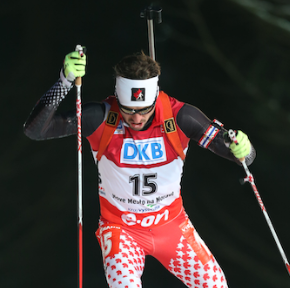
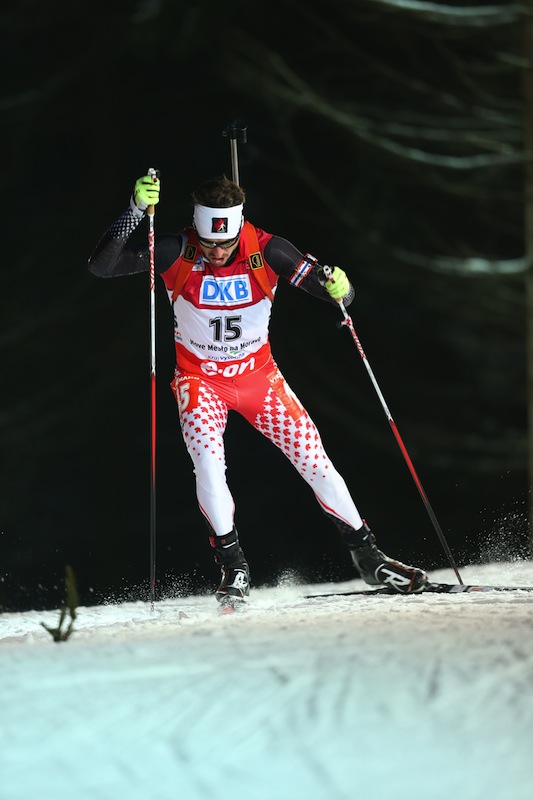
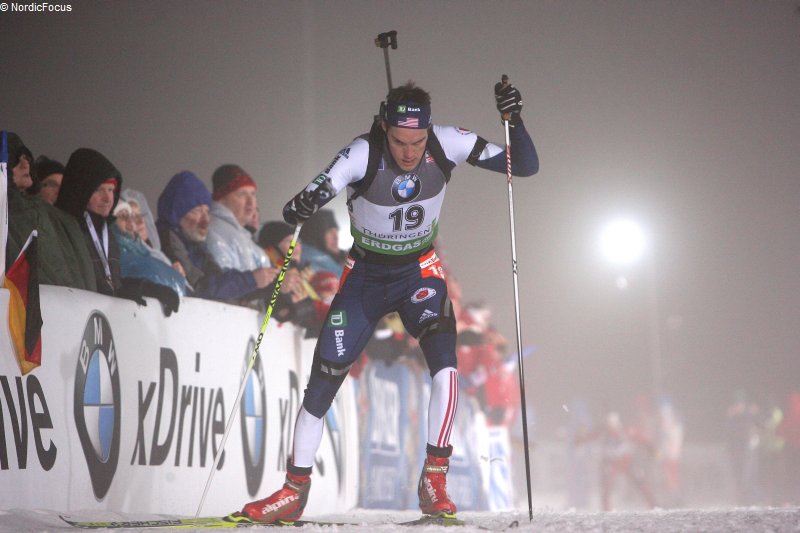
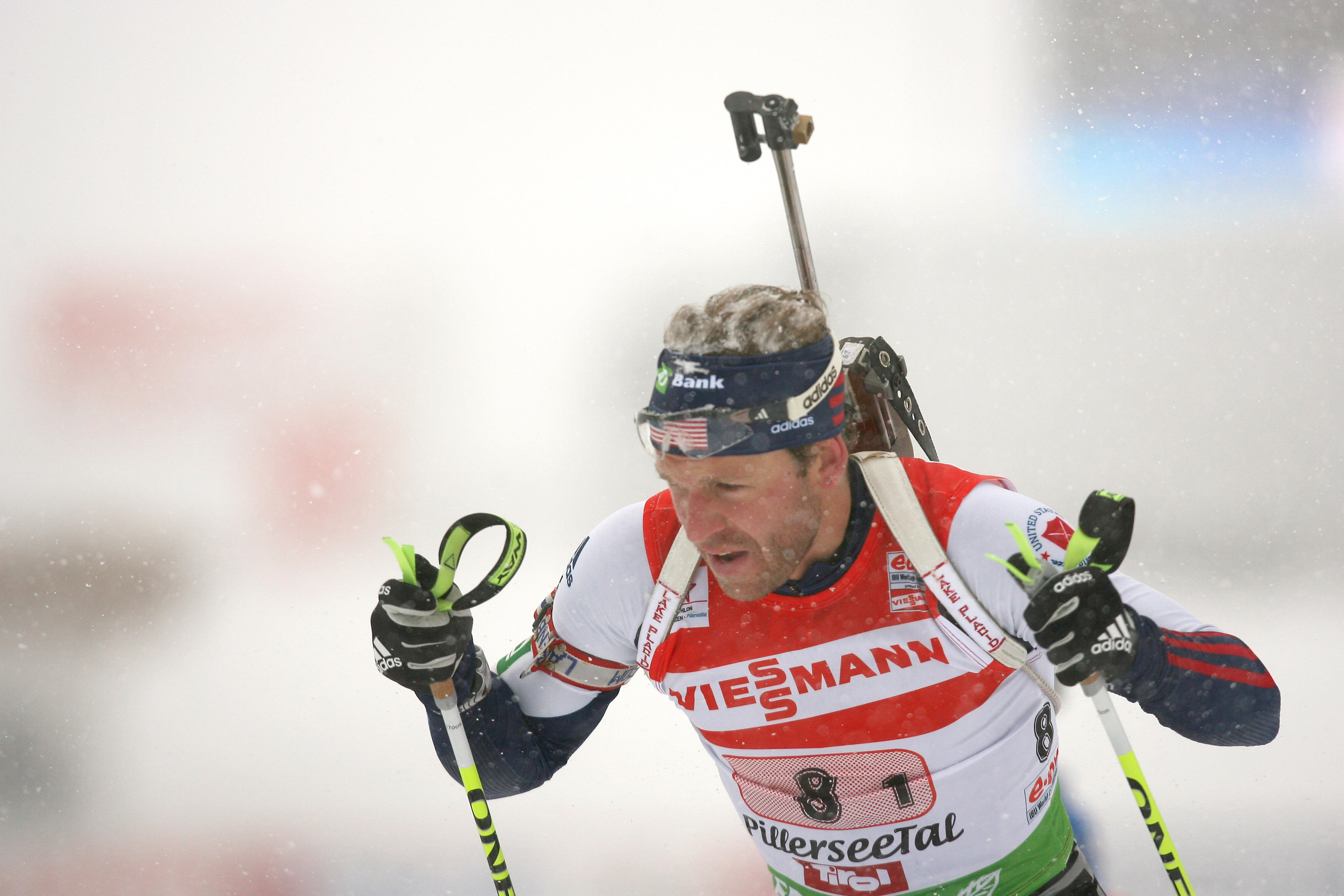
J.P. LeGuellec finished 10th overall in the 20 k individual at World Championships on Thursday to lead the Canadians. Photo: Nordic Focus/Biathlon Canada.
American Tim Burke stole the North American spotlight at World Championships in the 20 k individual on Thursday, but Canada’s Jean Phillippe LeGuellec had a respectable showing of his own about a minute back. The Canuck finished tenth overall to lead his team in Nové Město na Moravě, Czech Republic, with one penalty in the final stage and crossed the line 1:48 behind Martin Fourcade’s (FRA) top mark. LeGuellec was “pretty happy” with the outcome considering his ski form was not what he wanted it to be.
“Unfortunately I didn’t feel all that great on my skis today,” he wrote in an email. “I realized this with the very first climb and alarms went off. My tactic quickly shifted to being able to shoot clean and fast. Crunching down on time in the range would help compensate slightly for the time lost on the tracks.”
LeGuellec posted a first-lap course time that ranked in the 50s, but thanks to shooting clean, and quickly (the third-fastest in the field), he left the range in 24th after the first stage. With only one error in total for the rest of the race LeGuellec saved what could have been a worse result, but he still wondered what could have been had he felt better on his skis.
“Considering the ski shape today, I’m happy with the race I pulled off,” he said. “But also disappointed considering an average ski time in the individual would have helped me climb higher in the top 10. But it’s definitely a good result if I look at the ups and downs of this season.”
Scott Perras finished next for the Canadians in 26th, 3:20 back with two errors. Like LeGuellec he had hoped to feel faster on the track, but reasoned that he did what he could in the 20 k with what he had.
“It’s important to me that I am able to perform at the biggest event of the season and I wasn’t able to do that in the sprint,” Perras said. “I am happy with today but not satisfied if that makes sense, my skiing slipped a little bit for these World Championships and that is a tough thing to accept but once I did I was able to focus on what I could do to get the most out of [it].”
Scott Gow finished 31st for the Canucks in 31st, 3:36 back with one error, and Nathan Smith took 63rd with three errors (+6:41).
On a team level Perras noted that the Canadians had one of their best days ever on Thursday, shooting 91% as a group.
“I am super proud of our team today,” he said. “We pulled ourselves into the top 15 overall ranking and probably had one of our best days as a team at World Championships.”
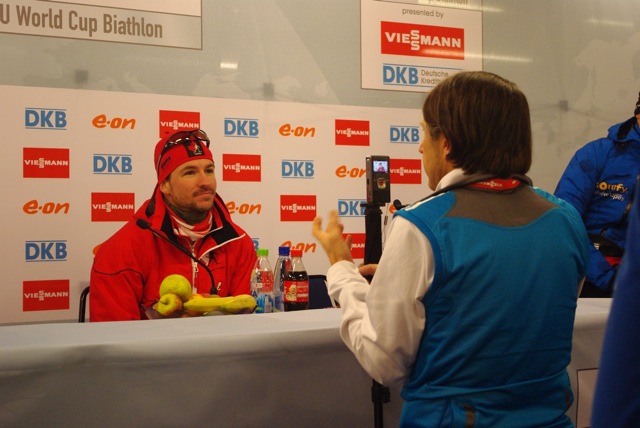
Jean Philippe Le Guellec of Canada does a video interview after claiming his first World Cup win, an 18-second victory in Ostersund, Sweden.
ÖSTERSUND, Sweden – The way some people look at it, today definitely didn’t present ideal conditions for biathlon. With gusty, raging wind that flapped at the international collection of flags here in the stadium and chilled athletes and spectators alike, shooting was a challenge.
Emil Hegle Svendsen of Norway and Martin Fourcade of France, who dueled through last season in pursuit of the overall World Cup crown, each missed three shots. Lowell Bailey of the United States missed two, but said that unlike any other race, he wasn’t disappointed – he was actually happy.
Then there was the cold, which only arrived recently to Sweden. The temperature was officially listed as around 15 degrees Fahrenheit, but with the wind it felt much colder. While that would be tough enough for skiers, biathletes can’t wear mittens or thick gloves because it impedes their trigger fingers, and they have to raise their glasses to shoot.
“It is [hard on] the fingers and the eyes, the feet, everything,” said Alexis Boeuf of France. “So we have to find a solution.”
But rather than consider the difficulties presented here in Östersund, Jean-Philippe Le Guellec of Canada looked at the conditions a little differently.
“When it’s windy, it’s always a window of opportunity,” he told FasterSkier after finishing the World Cup10 k sprint. “Luckily that arose today.”
The Quebec native seized the bull by the horns and shot clean, one of only two men in the 103-athlete field to do so. Not only that, but he skied well – well enough to land in first place, with a sizeable 18.1-second lead over Boeuf.
“If this hangs on, it’s going to be a huge day,” Le Guellec told FasterSkier when there were still racers finishing.
Le Guellec was just the 38th starter, but the 2/3 of the field that started after him was unable to match his performance. Alexis Boeuf of France, who finished just a minute before, was able to come close – he skied faster – but had collected a penalty in standing and was left in second. Christoph Sumann of Austria, starting back in bib 75, also had a penalty in standing, but was able to eke out third place, 6.7 seconds behind Boeuf.
As Le Guellec related in the press conference, he didn’t actually know he was in the running; through two laps his coaches only told him “good job” and that he was having a good race.
“I didn’t know actually, leaving the range,” he told FasterSkier at the finish. “When I passed my coach over there after the range, Tom was saying – I didn’t hear the position, but he said something about five seconds. And then when I was near the top a bit further, he said, ‘You’re in first, you’ve got five seconds!’ And then…”
Despite only having five seconds early in the 3.3 k loop, he managed to extend that lead significantly – perhaps because Florian Graf of Germany faded. After being in podium position, Graf slipped to fourth place. Boeuf, on the other hand, put in a hard charge like Le Guellec’s and moved from being ranked sixth leaving the range to finishing as the runner-up.
“Today it was windy,” Boeuf said in the press conference. “I decided before the race to be as calm as I could be, and I worked really hard to put the bullet in sight. To finish with four and five, I’m okay with this.”
It was just the fourth World Cup podium for the 26-year-old Frenchman, whose sole victory came at lightly-attended races in Fort Kent, Maine, in 2011.
A decade older and the owner of an Olympic silver medal, Sumann seemed even happier than Boeuf to be on the podium. Over both the short and long term, his results have been bouncing around: last season was a disappointment for the entire Austrian team, and on Wednesday he placed 34th in the 20 k individual, despite shooting the same score as the winner, Martin Fourcade of France.
“I had a quite good relay on Sunday, good skiing, and then a really disgusting performance on Wednesday that I couldn’t explain,” Sumann said in the press conference. “It was horrible from the beginning on, the shooting was good but the skiing… not. But today was better than the days before. And the speed was good. It was more than I expected.”
Along with teammate Dominik Landertinger’s second-place performance on Wednesday, the Austrian team is off to a much better start this year, which is a relief for everyone involved.
“It’s very important,” Sumann said. “We had a really, really bad season last year. The whole season was not the best we’ve had, but there were a lot of changes this summer. A new coach, a new system with just one team, so we’re going hard. But every year you don’t know where you are at the beginning, and it’s a good feeling that you’re back.”
But the day belonged to Le Guellec, who earned Canada its first ever win by a male biathlete. The previous best, according to Biathlon Canada, was a sixth-place finish by Glen Rupertus back in 1993.
And Le Guellec was showing some relief of his own to finally be having a good season, much like Sumann. He contracted mononucleosis after the Vancouver Olympics – where he finished sixth in this same event – and as he told FasterSkier this spring, he’s finally feeling like he’s 100 percent again, two seasons later.
“Physically – how can I put this – the strain feels the same [now],” Le Guellec explained at the finish line. “I’m pushing just as hard as I did last year, as I did two years ago. But the speed that you’re going, that’s different. It’s like comparing a Ferrari to a Hyundai Accent. They’re both going at 3,000 rpm, but one is going 200 miles an hour. So that’s the difference.”
That’s how he managed to gain so much ground on the last loop – a feeling he is not familiar with from the last few seasons.
“I don’t know what happened there!” Le Guellec laughed.
As for how he managed to knock down all ten targets, the Canadian shrugged. He just tried to pretend it was practice, he said.
“I stayed totally relaxed through my standing,” he reported. “Especially since I had struggled in standing in [Wednesday’s] individual, so I thought, just do what you usually do in training. Stay relaxed and just shoot ‘em down. I was still trying to ski really relaxed on the last lap. At that point it’s a definite good race, and so I wanted to get in there and work hard, and get into the finish having given everything.”
Stay tuned for more on Le Guellec’s race and the significance for the Canadian team.
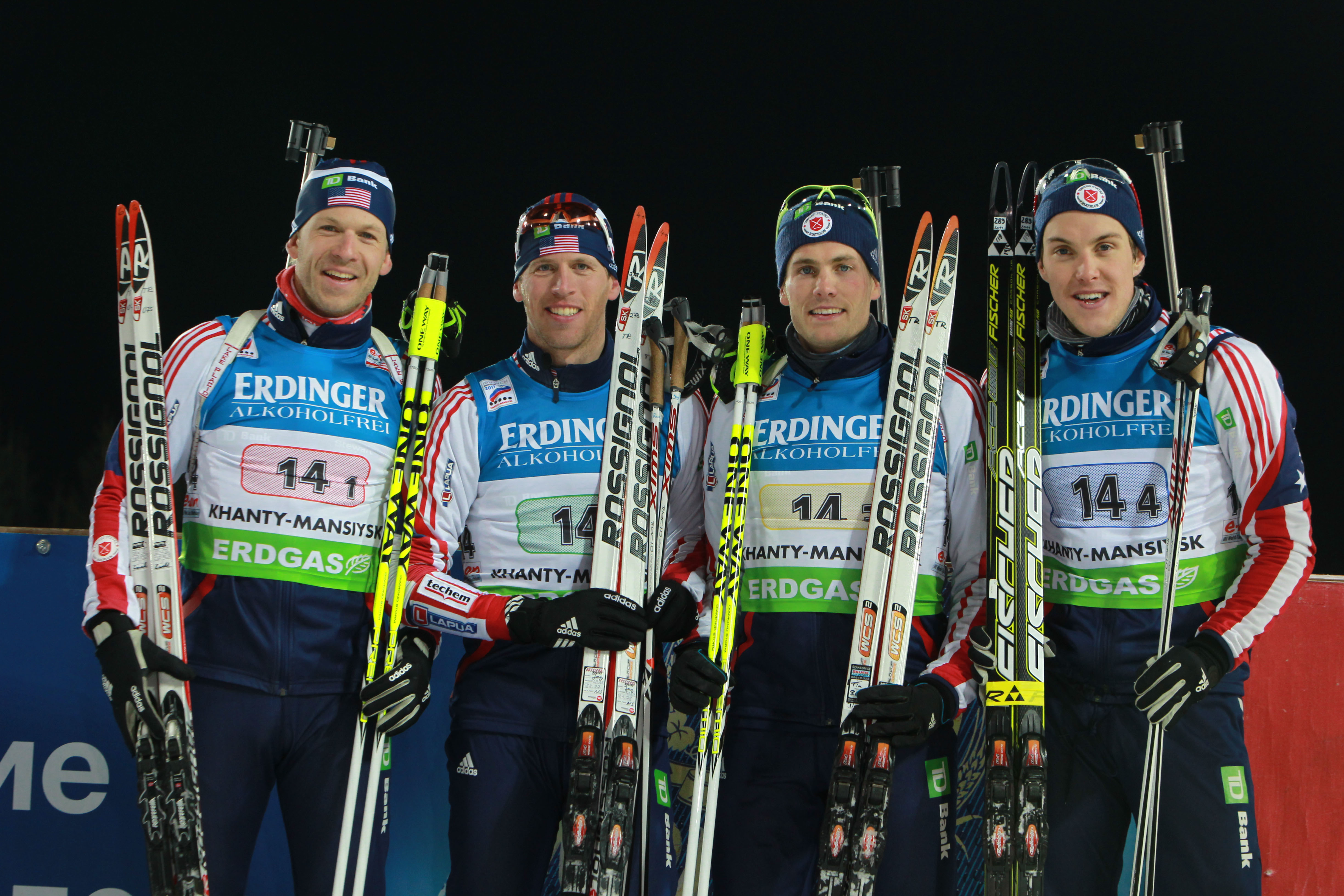
The U.S. team: Lowell Bailey, Jay Hakkinen, Tim Burke, Leif Nordgren. Photo: nordicfocus.com courtesy of USBA
Was U.S. biathlon head coach Per Nilsson enthusiastic about his team’s relay finish at World Championships on today?
“BEST EVER!” he wrote in an e-mail on Friday evening. “[It’s] fun to show that we have a team that can fight on the highest level in the world.”
While the entire team had a strong performance in Khanty-Mansiysk, Russia, on Friday – leadoff skier Lowell Bailey tagged off in fifth place – Leif Nordgren was again the hero, skiing the fastest anchor leg and passing Olympic medalists Michael Greis of Germany and Christoph Sumann of Austria en route to a photo finish for fifth place.
In the end, Nordgren came up short – he finished just two hundredths of a second behind Markus Windisch of Italy, and the U.S. had to be content with sixth.
Not that they had a hard time doing that.
Nordgren's photo finish. Courtesy of USBA.
“We have had better World Cup finishes, but it’s the best World Championships finish ever for the men’s relay!” wrote an ecstatic Max Cobb, President and CEO of the U.S. Biathlon Association.
In addition to finishing higher than any other U.S. team in history, the Americans were a mere ten seconds away from the podium, surely the closest they’ve ever come to earning a team medal.
Lowell Bailey started out the historic day for the U.S. It was a hectic mass start, with at least three crashes or tangles in the first kilometer. Then on the second loop, Bailey broke a pole.
Despite using three spare rounds – a number which in most relays would have been hugely detrimental – Bailey handed off in fifth place. His success was in part thanks to his third-fastest ski time of all the scramble skiers, but also because a number of other teams struggled on the range as well – of the twenty-two teams which finished, only eight used fewer than three spare rounds on the first leg.
When Jay Hakkinen took over, he used three spare rounds in prone. Once again, this would usually be the death knell for a U.S. (or any other) relay, but today, the team only dropped to eighth. Over the rest of the leg, Hakkinen was able to claw his way back into seventh, only forty seconds behind the leader.
Next up for the U.S., Tim Burke turned in the fourth-fastest last loop; in combination with his two spare rounds in standing, the team dropped back to eighth, just over a minute behind Norway and Germany.
Nordgren was the U.S. anchor, and all eyes were on the 21-year-old, who had been having an exceptional World Championships so far. With two top-thirty finishes, he was the only American qualified for the mass start the next day.
After the prone shooting, Nordgren had used two spares – a painful pair, after missing his one remaining target with the first spare and having to try again. The same thing happened in standing, and the U.S. was sitting in eighth place still.
“I missed my first extra in both prone and standing,” Nordgren told FasterSkier. “Of course it’s a bummer, and a little frustrating, but you just have to put that behind you and focus on the next shot. There’s really no time to think about it.”
Instead of thinking, he put in a furious charge over the last 2.5 kilometers.
“Leaving the range, I was in eighth place, right behind Austria and a few seconds down from Germany,” he said. “Italy was about 18 seconds ahead. I wasn’t quite sure what to do, I didn’t even know what place I was in so I just pushed a little and caught up to Germany and decided to wait. I skied with him for almost the entire last loop.”
Burke. Photo: nordicfocus.com courtesy of USBA. More photos below the article.
Nilsson was proud of his youngest athlete.
“Leif took down Greis and Sumann on the last loop and was amazing,” he said.
But Nordgren wasn’t done yet.
“Going into the final uphill was the first time I even saw the Italian. He looked like he was hurting, so I went for it. I made a big push and caught him about 100 meters before the finish. But I made my sprint for the line just a little late, and it came a little faster than I anticipated.”
In the end, he was two hundredths of a second behind Windisch, in what Cobb said was the closest finish on the World Cup this season.
“We actually finished sixth, [but] they put us in fifth for a couple of minutes after the finish,” Nordgren said. “Then I guess they took a closer look at the photo and bumped us back. That’s alright though, we’ll survive. I’ve never been in a photo finish before so that was really cool! To come up on the losing side is a bummer of course, but its just a race, there will be more.”
While Nordgren’s performance was the highlight of the day, it took four solid legs to get him to where he finished: the best U.S. result at World Championships, ever.
The U.S. also placed sixth in the relay at the 1972 Olympics.
Canadians Solid in 11th
While the Canadians have had better races, their eleventh-place finish was still deemed a success.
“As a whole, this was a very good performance,” said third-leg skier Jean-Phillipe Leguellec. “It was a very tight relay today and each of our legs were in the heat of the action. We ended up using only six spare rounds, and finished 1:36 behind the leading team… Even the relay where we came in seventh, two years ago, we were 4:30 back and did a penalty loop! I guess that just shows exactly how different one race can be to another and how much shooting can change everything.”
The team put in a steady effort, with Brendan Green, Scott Perras, and Leguellec handing off after each of the first three legs in ninth place.
Green in particular had some excitement on the trails, as he scrambled in the hectic mass start.
“That seems to be how the relay starts more or less typically are,” he told FasterSkier of the chaos. “I think because the bigger climbs weren’t until the last third of the loop, the pack was able to stay a little tighter than normal which resulted in more broken poles and mix ups than usual.”
Green had one of the slowest shooting times in the prone stage, but said that it was all part of the plan.
“The two previous races of the Championships for myself did not go well at all, so I was really focused on today and wanted to finish the week off with a solid performance,” he explained. “I’ve been struggling in the range lately with my prone shooting, so today I needed to take my time in the range for the first bout of shooting and be sure of my shots. My slow prone meant I had to play catch up, but I was confident in my standing and was able to shoot clean and catch back up.”
Perras used two spare rounds in prone, but then cleaned standing with no extra shots.
“We were the closest we had ever been to the leaders in a World Cup relay so to do this at a World Championships is great,” he said in a Biathlon Canada press release. “Being 10th at the Olympics and 11th at Worlds shows we can be with the best on a good day.”
Leguellec used one spare round and Nathan Smith two, dropping the team to 11th place.
Overall, the Canadians tied for the fewest number of spare rounds of any team in the field, something that everyone was proud of.
“As a team we shot very well which was exactly what we needed to do as a couple of the guys on the team aren’t feeling 100% at the moment,” Green said. “This way we were able to stay in the game the whole race. It was an exciting race from start to finish for us, with the time gap being tight for a relay, so all in all I think the team had fun out there and we are satisfied where we finished.”
Leguellec agreed.
“All in all we’re very happy with how our World Championships ended. It was a very satisfying team effort today and we can now move on to finishing the season.”
Bailey, leading Italy in leg one, ironically enough. Photo: nordicfocus.com courtesy of USBA.Bailey heading through the stadium. Photo: nordicfocus.com courtesy of USBA.
Leif Nordgren (USA) racing through the fog in the men's sprint. Photo: nordicfocus.com courtesy of USBA.
Oberhof, Germany, has been kind to the Canadian biathlon team so far this year.
After the men finished 11th in the relay on Wednesday, they had a banner day on Friday with finishes of 14th, 16th, and 34th from Brendan Green, Jean-Phillipe Leguellec, and Scott Perras.
With a mass start competition coming up on Sunday, the team is feeling good.
“With Brendan’s 14th place, we both managed to squeeze in the mass start race this Sunday,” Leguellec said in an e-mail.
“This is a historical first for Canada to have two men in the mass start. The selection criteria changed this year, which allowed us to get in. The mass start used to be only for the top 30 athletes in the general ranking. Now, the first 25 are pre-selected with five open spots to the next five athletes in the race before any given mass start. So Brendan and I [snagged] the 4th and 5th spots, and we get to start!”
Leguellec was among the leaders early in the race after shooting clean in prone, but missed two shots in standing to fall back a few places. He wasn’t alone in his struggles on the range: only four men shot clean over two stages.
“In both stages, the range was pretty foggy,” Leguellec said. “It was at the point where, through my sight, I could not see the targets very well, so I pretty much had to guess where they were and had to lend an ear to hear them fall or hear my miss.
“My ski shape was on point,” he continued. “It’s nice to feel good on the boards again… All in all, I’m very happy with my 16th place. I seem to be getting back on track and turning the page over the rough first tour ending before Christmas.”
Green shot one better than his teammate, missing one shot in prone and cleaning the standing stage. At the end of the day, he beat his more decorated countryman by eight seconds and two places. His result tied his best-ever World Cup performance, matching a finish from Antholz, Italy last season.
“I was decent on the skis, but the shooting really came together today despite the conditions,” Green said in a Biathlon Canada press release. “I have been pretty tired coming out of the last training block so I wasn’t sure what to expect, but I shot well today and it was a good result.”
And Perras had his fourth-best career result. He managed the foggy conditions well, missing one shot in each shooting stage.
Mar-Andre Bedard, freshly promoted from the IBU Cup squad, finished 72nd with five penalties.
For the Americans, the change in mass start format was less positive.
Tim Burke is ranked in the top 30, so under the previous guidelines, he would have started the race on Sunday. But with the new rules, he is not ranked highly enough to get an automatic start slot, and his 31st-place finish today didn’t get him in, either.
“I am very frustrated that I will not be in the mass start even though I am ranked in the top 30 overall,” he told FasterSkier. “I feel like I have the fitness to have a top result now, but hopefully my time will come.”
Nevertheless, he was pleased with his race, despite missing three shots in prone and one in standing.
“I was very happy with my performance today,” Burke said. “This was probably the best performance that I have had this season. Unfortunately, the race was somewhat of a lottery with huge clouds of fog rolling through the shooting range at times. I could not see anything when I came in for prone. I was actually very happy to hit two targets, considering that I would shoot when I saw a shade of darkness.”
Lowell Bailey was next for the U.S. His four penalties presented a challenge, and he finished 52nd. Leif Nordgren missed as many shots in prone alone, and one more in standing, and finished 66th.
Norway’s Tarjei Boe missed only one shot over the entire race and collected a 16-second win over Arnd Pfeiffer of Germany; it was his third individual victory of the season, and Boe will retain the yellow overall leader’s bib after this weekend.
“Everyone asked me about the fog after the race today,” he told IBU News. “I really did not notice it so much in standing, shooting on lane thirty. In prone, the targets were gray but I could see them. I took two breaths between each prone shot so my brain could concentrate better. It was a bit slower than normal, but was a good tactic today.”
Racing continues on Saturday with the women’s sprint.
Lowell Bailey leads off the U.S. relay in Hochfilzen, Austria, on Sunday. Photo: U.S.B.A. / nordicfocus.com.
At the first handoff of the men’s World Cup biathlon relay in Hochfilzen, Austria on Sunday, it looked like Norway might not be able to turn in the performance that everyone expected of them.
Then Ole Einar Bjorndalen took over, and things went back to normal.
Alexander Os, Norway’s first-leg skier, can be forgiven for turning in a less-than-perfect performance. Conditions were stacked against him, with huge wind gusts that held the range’s indicator flags at perpendicular and heavy snowfall that made the targets appear 80 percent white at times.
“It continued to dump snow similar to the last the last few days, and the gusting wind once again made the shooting a challenge which many teams struggled with,” Canadian biathlete Brendan Green told FasterSkier.
The conditions made Bjorndalen’s performance – and Norway’s turnaround – all the more impressive. He cleaned both shooting stages with no extra rounds and had the fastest ski time on the first two of his three loops. After receiving the tag in 10th place with a 36-second deficit, he handed off to teammate Emil Hegle Svendsen in a completely different situation: the Norwegian was now even with Klemen Bauer of Slovenia and had a sizeable lead on the rest of the teams.
Svendsen, a double winner in Ostersund, Sweden, last week, continued the trend, and added thirty seconds to Norway’s lead. Tarjei Boe, who had already won both the sprint and pursuit this weekend, came into the stadium the final time, didn’t have to push himself to hold onto the win, and by the time he finished, the Austrians were almost a minute behind.
The Norwegians have truly dominated the World Cup so far this season. In Ostersund, Svendsen won the individual and the sprint, with Bjorndalen passing him near the end of the pursuit for a victory of his own. Here in Hochfilzen, Boe won both the sprint and pursuit races. In addition, Norway has picked up three second-place and three fourth-place results in the five non-team races.
Boe summed up his team’s dominance well in an interview with IBU News.
“That is pretty awesome,” he said. “Everyone in our team is smiling. It is good that the whole team feels like they are winning together.”
Austria’s second-place finish had its basis in solid skiing, but it was the home team’s shooting that put them ahead of the rest of the field. The Austrians were one of only three teams to avoid the penalty loop in the gusty conditions, and, incredibly, used only four spare rounds to do it. The next best-shooting team used seven.
France finished third, thanks to a last-minute sprint by Martin Fourcade, who passed Germany’s Michael Greis. Sweden was just two seconds behind in fifth.
The North American teams had a rough time both skiing and shooting, and ended up with less-than-satisfying results: the Canadians were 16th and the Americans 20th. There has been increasing pressure on the teams to turn in strong relay performances after American Tim Burke’s stint as the overall World Cup leader last year and Canadian Jean-Phillipe Leguellec’s inspired performances at the Vancouver Olympics. But on Sunday, neither team was able to be as competitive as they had hoped.
The Canadians seemed to be off to a promising start, with Brendan Green tagging off in eighth place, just thirty seconds behind the leader – and ahead of Norway, a somewhat surprising situation.
“I felt good on course, and was able to ski a strong leg,” he said in an e-mail. “My shooting was solid which I was happy about, and being able to tag off to my teammate in a pack not too far from the lead was exactly what I had hoped for.”
But it didn’t last. Nathan Smith, Canada’s next skier, used all six spare rounds and still hit the penalty loop three times, leaving the team in 18th place. And after Scott Perras left one standing target up, the team was sitting in 19th.
“Unfortunately our luck with the shooting didn’t hold up,” Green said. “But everyone skied strong, which shows that we have the ability to be in the running when our shooting is more together. As a team we are not happy with this result, but we are working the bugs out and are excited for our next relay opportunity.”
Leguellec was able to provide a strong finish, with the seventh-fastest anchor leg. He used four spare rounds to clean all the targets – not ideal, but a start.
“I didn’t really have a strategy per se today, I guess it was to simply do my race and stay out of the penalty loop,” Leguellec told FasterSkier. “I’ve been looking for that sweet sensation you get when you’re in your zone, and I guess I was able to find it a bit today in skiing. Shooting was good since I didn’t do any loops, but my standing was a struggle. In the end, I just wanted to keep it steady in skiing and make up spots on the range.”
He was more philosophical about the team’s final result, and pointed out that the Canadians have had plenty of mediocre relays before: Leguellec has been part of twenty-one relay teams as a senior, and only two have finished in the top ten.
“The race in its whole wasn’t the best we’ve had, but wasn’t the worst either. 16th is kind of an average considering we did two penalty loops. We’re going to play around with our start order until World Championships to see what works best for this fairly new and young team.”
The Americans had trouble right out of the gate, with Lowell Bailey visiting the penalty loop after his standing stage and tagging off to Burke in 17th. Burke had the seventh-fastest ski time for his leg, but his standing stage was a disaster. After using all three spare rounds, he still had to ski three penalty loops. As a result, his strong skiing was unable to gain the team a single place.
Leif Nordgren, the youngest and least experienced member of the U.S. team, was the only one who managed to avoid the penalty loop, but it took him five of a possible six spare rounds to do it, and his shooting time was one of the slowest of all the third-leg skiers. As a result, the U.S. actually fell one more spot, to eighteenth.
Nordgren was unable to find the positives in his performance.
“It was pretty much a total shit show today,” he told FasterSkier in an e-mail. “Being the only American to not hit the penalty loop makes me feel worse than it does good. The relay is a total team competition. Even though my race wasn’t as bad as everyone else’s, I still feel like I let down the team.”
To finish things off, Jeremy Teela gave the team one last visit to the penalty loop, and the U.S. slipped to twentieth place.
“I can’t really speak for the other guys, but I didn’t think the conditions were super tough,” Nordgren said. “It was just a day when everyone had almost the worst race possible.”
It was Nordgren’s first World Cup relay, and he hopes that the next one will be different.
“I was maybe a little nervous looking at the start list, looking at all the other guys who were skiing the third leg,” he said. “I was thinking, ‘well if Lowell and Tim have a good day, I will have to race these guys head to head.’ It didn’t come down to that today, but hopefully someday it will.”
Next week, the World Cup moves to Pokljuka, Slovenia, and the U.S. is relieved to be saying goodbye to Hochfilzen.
“Overall, I think we’re all ready to put this week behind us,” Nordgren said. “I’ve never raced in Pokljuka. But I’m excited to get the opportunity, and hopefully it will go better than this week.”
This year we expanded the Performance of the Year Award to include three different categories – cross-country, biathlon, and nordic combined.
XC Performance of the Year (men):
This season featured a number of outstanding performances, and for the first time we breaking out the award into three categories – cross-country, nordic combined, and biathlon. The challenge, like in many of the other awards, is how to weigh Olympic results.
The Olympics are the most prestigious event in skiing, and the biggest stage. So regardless of field strength, weather, or other incidentals, an Olympic result is worth more than anything else.
Deveon Kershaw (CAN). Kershaw’s performance in the Olympic 50km event was one for the ages. Racing in front of a home crowd, Kershaw put himself in position to sprint for a medal, he came up just short crossing the line just meters, and all of 1.6 seconds, behind gold medal winner Petter Northug (NOR). Kershaw was outlunged by Tobias Angerer (GER) for 4th.
The result matched Ivan Babikov’s 5th in the Olympic pursuit as the best Olympic result ever by a Canadian man.
Petter Northug celebrates his victory while Angerer and Kershaw lunge for the line.
Honorable Mention
Ivan Babikov (CAN). As mentioned above, Babikov finished 5th in the 30km Olympic pursuit, just 9.1 seconds out of the win and 6.3 seconds from a medal. This was the second time in the Games that Babikov set a new Canadian mark for best male Olympic result.
Kershaw gets the nod only because he was a bit closer to a medal. Babikov fell off the pace at the end, and was not in contention for a medal in the final sprint.
Canadian Men’s Olympic Team. The team had a stellar Olympics. In the pursuit, led by Babikov’s 5th, they placed 5, 8,9, and 16. Babikov was also 8th in the 15km, and Gray 18th in the 50k.
And the Team Sprint duo of Alex Harvey and Devon Kershaw placed 4th in that event. While no medals were won, it was by far the greatest Olympics ever for the Canadian men.
Andy Newell (USA). Newell placed 3rd in the World Cup classic sprint in Drammen, Norway, an impressive feat considering that classic sprint events in Norway are without doubt the toughest fields on the circuit.
Kris Freeman (USA). In a nation with a dearth of World Cup distance skiers, Freeman’s 4th in the Kuusamo 15km stands out. Freeman just missed his first World Cup podium by just 2.2 seconds, and again demonstrated that when he is on, and has his blood sugar dialed in, he can compete with anyone.
[poll id=”45″]
XC Performance of the Year (women):
Unlike the men’s award, the women’s version is easy – at least in relation to the skier. The issue, is what performance was the best.
Kikkan Randall (USA) was easily the top North American woman this season, and she had a number of impressive performances. She had an excellent Olympics, with great results in every even she started, and she finished on the podium in the pre World Championship World Cup in Oslo.
Kikkan Randall (USA). Randall’s podium performance in Oslo gets the nod. She was leading entering the homestretch, and while she was unable to hold off a red hot Marit Bjoergen (NOR), Randall’s performance shows she is still one of the best skate sprinters out there. This bodes well for World Championships.
Randall was the dominant North American once again.
Honorable Mention
Kikkan Randall (USA). Randall’s 8th place in the Olympic classic sprint was a career-best in that event, and set a new mark for top finish ever by an American woman xc skier in the Olympics, bettering her own marl set in 2006.
Kikkan Randall (USA) and Caitlin Compton (USA). Randall and Compton teamed up to finish 6th in the Olympic Team Sprint, turning in a gutsy performance.
Sara Renner (CAN). Renner thrilled the hometown crowd with a surprising 3rd place finish in the World Cup classic sprint in Canmore just prior to the Olympics. This was Renner’s first World Cup podium since 2006, and demonstrated that she still had the sprint speed to compete in the finals.
[poll id=”46″]
Biathlon Performance of the Year (men):
Tim Burke (USA). Burke climbed onto the World Cup podium for the first time this season, finishing 2nd twice and 3rd once. His 2nd place finish in the 20km individual in Ostersund, Sweden, gets the nod as the top biathlon performance of the year.
Burke finished 35.5 seconds behind winner and eventual overall World Cup winner, Emil Svendsen of Norway. The race, early in the season, was the first of the three podium results for Burke, and catapulted him to a new level – from a very good biathlete capable of skiing in the top-10, to a legitimate threat to win races, and a strong medal contender in Vancouver.
Tim Burke racing in Ostersund (photo USBA/Nordicfocus.com)
Honorable Mention
Jean Philippe LeGuellec (CAN). LeGuelle had an excellent Olympics, capped by a 6th place finish in the sprint event. LeGuellec actually led the race after the 1st shooting stage. While this competition was unusual due to a mid-race snow storm, LeGuellec still just 33.7 seconds behind overall World Cup winner and multiple Olympic medalist Emil Svendsen (NOR) who took 2nd.
Jeremy Teela (USA). Teela placed a season-best 9th in the same Olympic sprint event.
[poll id=”47″]
Biathlon Performance of the Year (women):
Zina Kocher (CAN). Kocher finished an impressive 4th in the women’s 10km pursuit in Pokljuka, Slovenia. She was 23 seconds off the podium, and the only woman in the entire race to shoot clean.
Honorable Mention
Lanny Barnes (USA). Barnes turned in the best North American Olympic biathlon performance in the 15km individual, placing 23rd. The veteran Barnes was her usual sure-shot on the range, cleaning the 20 targets. After the final shooting stage she was ranked 16th.
[poll id=”48″]
Nordic Combined Performance of the Year
In a season that included World Cup victories and four Olympic medals, picking the top performance is not easy. But gold trumps all else.
Billy Demong (USA). Demong became the first American to win a championship gold medal in any of the Nordic sports when he captured the top spot in the large hill competition at the 2010 Olympics. Demong and teammate Johnny Spillane worked together to hunt down Austrian Bernhard Gruber before Demong used a powerful attack on the final climb to open up a gap for the win.
Demong and Spillane working over Gruber
Honorable Mention
Johnny Spillane (USA). Spillane finished 2nd to Demong in the large hill event at the Olympics, following Demong’s attack with one of his own while laying claim to his third medal of the Games.
Johnny Spillane (USA). In the normal hill competition, Spillane also finished 2nd, losing out to Jason Lamy Chapuis (FRA) in the final sprint.
Brett Camerota (USA). Camerota, the least experienced member of the US team in the Olympic Team Compeition, did his job and then some. Camerota moved the US into first, and most importantly, did let any of the other top teams to completely close the gap.
Kontiolahti, Finland – Russian Ivan Tcherezov, who missed out an an individual medal at the Olympics, settling for a bronze in the relay, got a measure of revenge, winning the men’s 10km sprint in Finland.
Darya Domracheva (BLR) the bronze medalist in the individual competition in Whistler won the omen’s 7.5km event, shooting clean on her way to an 8.4 second victory over Olga Zaitseva (RUS).
Emil Hegle Svendsen (NOR) winning one of his Olympic medals.
Tcherezov had a perfect day on the range, one of only four men in the top-16 to shoot clean. He edged Norwegian Emil Svendsen by just 6.8 seconds. Svendsen, winner of three medals in Whistler, also was perfect on the range.
Martin Fourcade (FRA) rode the second fastest ski time to 3rd place, overcoming two misses.
Tim Burke led the US men in 22nd, missing one shot each in prone and standing. Lowell Bailey finished 38th. He shot clean, but struggled skiing, turning in the 75th best time on course. Leif Nordgren also shot well, with just a single miss. Nordgren, racing in just his third World Cup race, had the 74th best ski time.
Jean Philippe LeGuellec led the Canadian men in 31st. LeGuellec, who had an excellent Olympics, misssed two shots, both in standing. After cleaning prone, he was in 2nd. He skied well – 18th best on the day, but faded somewhat on the last loop.
Brendan Green was 62nd, Nathan Smith 67th, and Scott Perras 73rd for Canada.
In the women’s race, Domracheva skied fast (2nd best on the day) and shot clean – a recipe for victory. Zaitseva made up eight seconds on the range, but that was not enough to close the gap.
German veteran Kati Wilhelm was 3rd, 13.5 seconds back. She also shot clean on her way to her second podium of the season.
Magdalena Neuner (GER), winner of three medals in Whistler, finished 5th despite two misses. She was the only woman in the the top-8 to miss a shot. Neuner did take over the overall World Cup lead from Helena Jonnson (SWE). Jonnson was 9th today with one miss, and has yet to regain her pre-Olympic form where she won four races and finished 2nd in three others.
Zina Kocher led the Canadian women with a strong 20th place finish. Kocher rebounded from a disappointing Olympics to post her fourth top-20 result of the season.
“I had a decent performance today and have climbed back into that top group where I belong after a disappointing Olympics,” said Kocher, who missed just one shot in her second of two trips to the range. “Hitting that last target would have put me in the top-10, but I’m in a good spot for opportunities in the pursuit.”
Megan Imrie followed up an excellent leg in Friday’s mixed relay with her best-ever finish in an individual World Cup. She place 32nd with one miss in each prone and standing while skiing very well (22nd).
Megan Tandy wass 4th and Rosanna Crawford 57th for Canada.
“As a team we reached a few milestones today and that is something we are very proud of,” said Zina Kocher, who created a nude calendar last year as a fundraiser with her four teammates. “I think we are continuing to progress, and we are starting to see that bold, beautiful biathlon girl power.”
Sarah Studebaker finished 58th for the US with one miss. Lanny Barnes was 78th with three misses.
Racing continues on Sunday with a 10/12.5km pursuit.
Burke, LeGuellec, Bailey, Kocher and Imrie all qualified for the pursuit.