From the FasterSkier archive — posts syndicated from athletes’ and coaches’ own blogs between 2004 and 2012, kept online as published. Current coverage is at fasterskier.com.
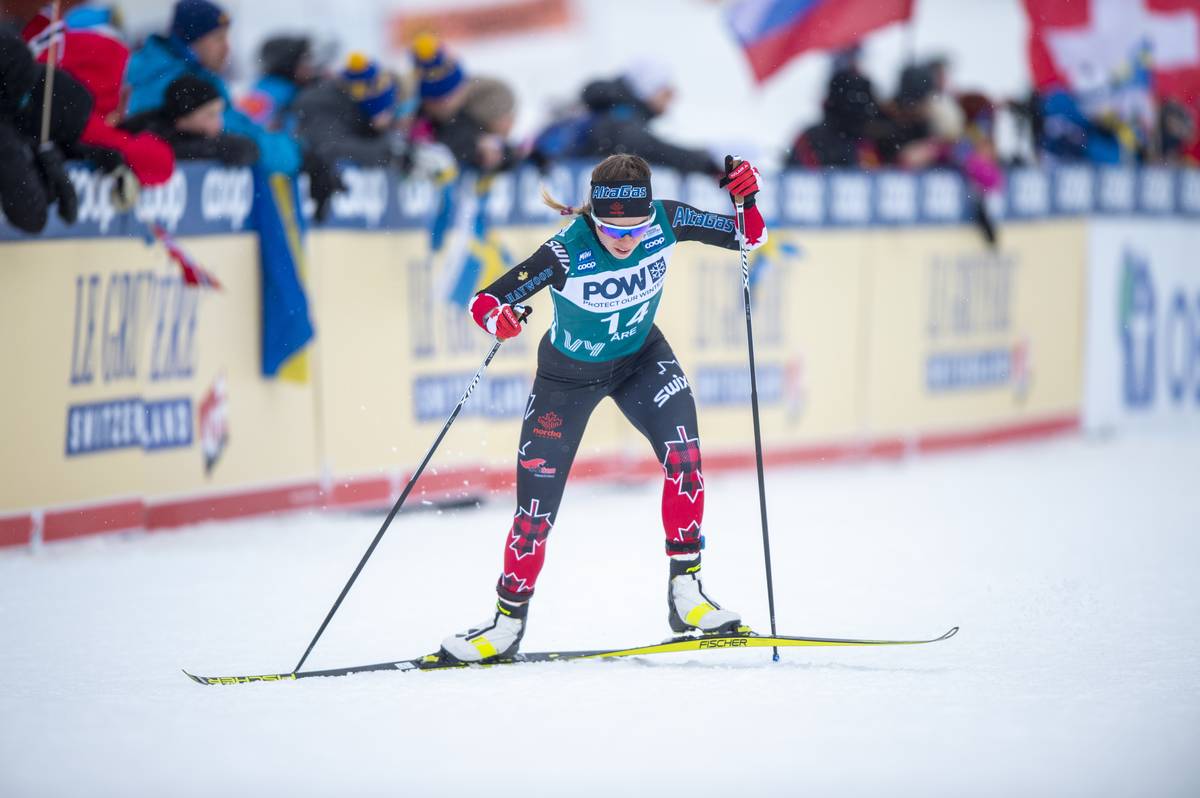
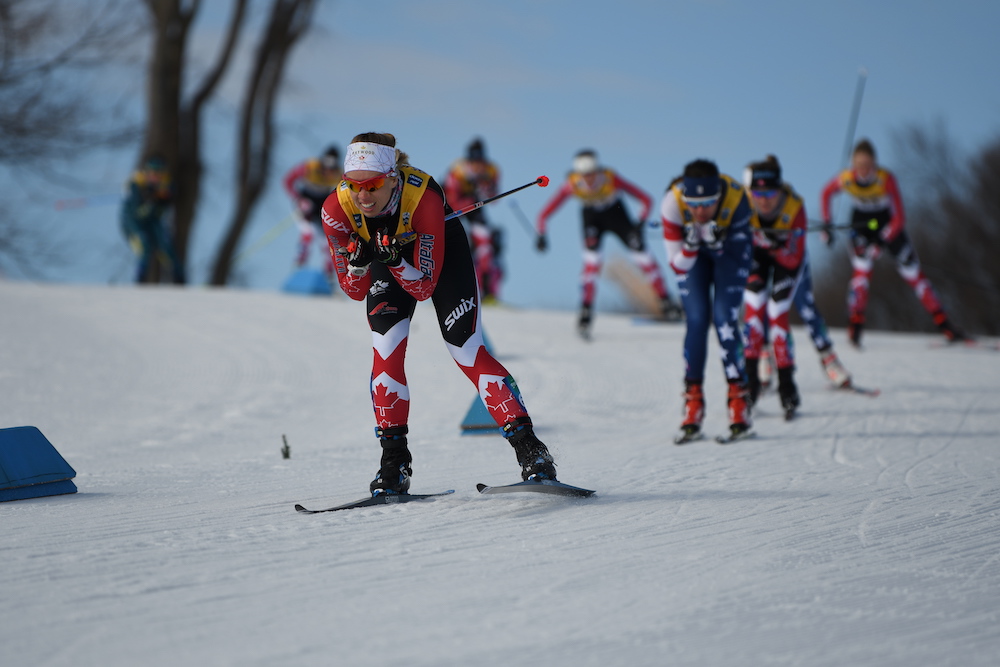
Katherine Stewart-Jones flying the flag during the Ski Tour 2020 in Åre (SWE). (Photo:NordicFocus)
Nordiq Canada’s first major change announcement on November 16th was the decision to cancel the Period I trip to Lillehammer, Dresden, and Davos. (The Lillehammer races have been postponed, and have not been officially rescheduled.)
“For us, it was chatting with our medical experts, assessing the situations here at home and what we were seeing happening overseas,” said Nordiq Canada’s High Performance Director Kate Boyd. “We had never planned to go to Ruka. And then when Lillehammer was postponed to a later time that left two race weekends, and we felt it better that we would stay home, train, get strong. And get a sense of how the protocols were rolling out overseas.”
Those World Cup Covid-19 prevention protocols got their first test in Ruka with varying reports as to the success level. While all the countries were originally satisfied with the plans, it seems that on-site rule interpretation was different than some countries expected. Pierre Mignerey (FIS race director, who is from France) and Norway’s cross-country manager, Espen Bjervig, expressed their differing viewpoints to Norwegian broadcaster NRK shortly after Norway decided to stay home for December.
Mignerey also explained to NRK that one reason some countries might feel more free to criticize FIS safety initiatives relates to business opportunities away from the World Cup for some.
“It is important to understand that for many nations, competing in the World Cup is the only way to do their job and promote their sponsors,” said Mignerey according to a translation. “Norway does not come to the World Cup, but can arrange national competitions that go on TV. They have no chance of that in countries other than Norway, Sweden and Finland.”
After Ruka, Norway, Sweden, and Finland withdrew from the December World Cups. The Norwegians held a national level competition this past weekend in Lillehammer, site of the aforementioned postponed World Cups. Consider that opportune exposure for Norwegian athletes and sponsors – the opportunity cost of missing a World Cup for some is cushioned when the domestic event is broadcast nationally.
Here in Canada, Jeff Ellis, the Partnership and Events Coordinator at Nordiq Canada, commented that the withdrawal of teams like Norway, comes close to a time when that team’s leadership had advocated for maintaining the Lillehammer World Cups as scheduled for December 4-6.
“What Norway has decided to do will be an interesting study on how it affects other teams’ decisions,” said Ellis. “It’s interesting that less than three weeks ago Norway was fighting hard to keep the Lillehammer World Cups with the Head Coach saying we must race as much as possible.”
Canadian reactions to the Period I modifications range from anger to relief. Norway’s, Sweden’s, and Finland’s race departures come on the heels of Nordiq Canada gutting their own race calendar on November 30. Below are the major announcements from the November 30 announcement.
All FIS-sanctioned domestic cross-country ski events scheduled across Canada for the 2020-21 season are cancelled (Divisions will continue to determine the relevance and possibility of hosting scaled-down local events that meet regional health and safety guidelines);
Canadian World Championship Trials scheduled for Whistler, B.C. (January 7-10) are cancelled;
2021 Canadian Ski Championships (March 14-20) planned at the Nakkertok Nordic Ski Centre in the Ottawa-Gatineau region are cancelled;
2021 World Para Snow Sport Championships scheduled for February 7-20 in Lillehammer, Norway have been postponed to January 2022;
When asked about feedback on the recent Canadian World Cup trip cancellation and the subsequent cancellation of FIS races in Canada, Boyd tactfully replied “We have a very passionate community.”
She sees the strong opinions as an opportunity.
“When you’ve got a community as passionate as ours, it can be an incredible force to move us forward, when we’re all moving in the same direction. So I’m hoping that with a good plan and strong communication with that group that we can turn that bus around.
“We’re going to try our best to get to Europe to compete, but we’ll be assessing regularly what we can and can’t do. Always with the athlete safety first and foremost.”
The loss of World Cup opportunities matters. Start spots for Canadian skiers at the Beijing Olympics depend on results from two seasons, including this current season.
“We recognize that we stand a better chance of securing more spots for Canada if we do get to Europe, and have good races and score well in the nation’s points,” added Boyd. “So that is certainly a deciding factor for us to get over to Europe when we can, when it’s safe to do so. We want to give our athletes about as many opportunities and the best opportunities to compete, especially at Games.”
As far as the cancellation of FIS sanctioned racing in Canada, Boyd suggested the move simplified an already complex pandemic-rattled season. “We figured we’d take the FIS heat off and allow the provinces to host events, when and how they can,” said Boyd. “And it also removes the need for athletes to have to travel outside of provinces to try to get the points.”
During the summer, Nordiq Canada decided to split the traditional NorAm (Continental Cup) series into East and West series, respectively, to reduce travel while increasing the probability that events could be held. This change was also part of a multi-year project to reduce the cost of race travel for Canadian skiers.
The season plans started shifting with the downgrading of the first four East/West NorAm races in December from FIS to regionally sanctioned events. This happened one by one in the first half of November as it became clear that inter-provincial travel for sports events would not restart before the new year. Each province has its own rules which change as the active COVID-19 case load changes.
In early November when Nakkertok was cancelled, it was illegal to drive across the bridge from Ottawa to ski, affecting roughly half of the host clubs’ members. The Canmore event, for example, scheduled for December 12th and 13th, could have proceeded with Alberta, Saskatchewan, and Manitoba skiers in attendance, but without BC and the Yukon athletes. Each of the named provinces has since tightened rules further.
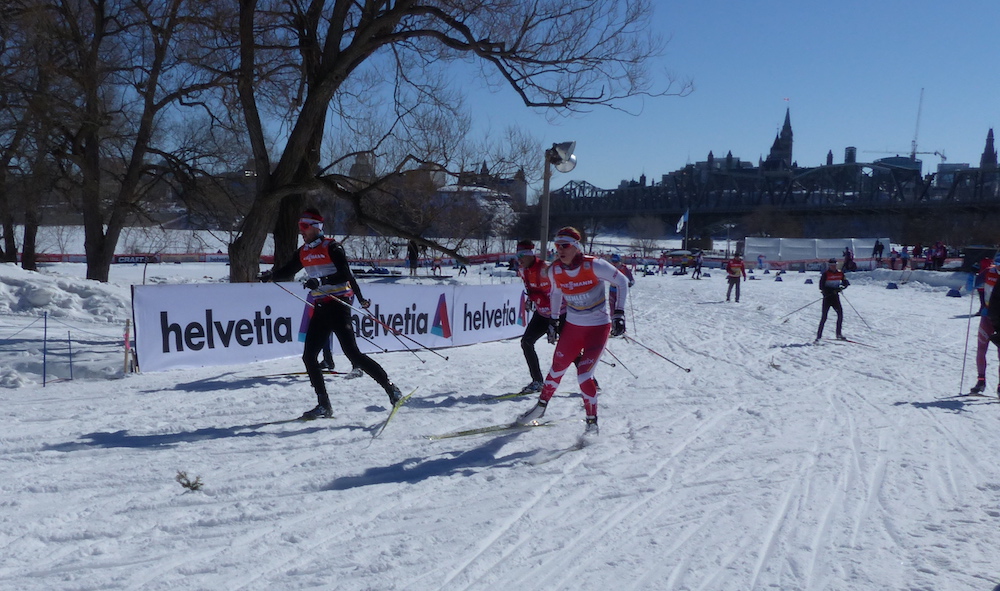
Ottawa (Ontario) is in the background as national team member Dahria Beatty skis beside an old teammate before the Gatineau (Québec) stage of Ski Tour Canada in 2016. (Photo: Peggy Hung)
By mid-November, it seemed unlikely that Whistler Olympic Park’s Organizing Committee would be allowed to host U23 and Junior World Trials in January. Cancelling now allows the High Performance Committee to start work on new selection criteria that doesn’t include any head to head races. This Trials event was also the test event for 2023 U23/JW World Championships; cancelling early should make it easier to move the test to 2022.
While this mass cancellation greatly helps with provincial rules compliance and simplifies application of the fluoro ban in Canada, it also comes with consequences. There will be no Continental Cup leaders to receive partially funded World Cup starts in Period I next season. It may have longer term effects on Canada’s status with FIS.
Team selection for international trips and next year’s national team will be different too.
“I know one of the questions that will likely come in is just how we’re going to be selecting the team,” Boyd said. “And we’re working on that right now with our high performance committee. Without Junior trials happening in Whistler, we’ll have to, to look at the information that we have available to us. And pick the fairest and most competitive team that we can send over to Europe to compete.”
For now, it appears regional races may skew in favour of interval starts to manage group size limits. According to Ellis, this format may have an upside.
“This is my personal opinion, but I think we [Canada] have traditionally been weak at Interval Start,” said Ellis. “We seem to need that push from others around us to see what we can do. Whether that be in sprint heats, mass start or pursuit start. Our successes usually begins there. A season of interval starts and learning how to really push oneself could be really valuable.”
National Team coach Erik Bråten told FasterSkier last May he felt many Canadians were relying on the group to pace training sessions.
“There are a lot more organized trainings here then I am used to, with programs having 4-6 sessions a week together in addition to camps,” said Bråten. “I think a lot of athletes will learn a lot about intensity control and focus in training these next few months. And when we are allowed to be in bigger groups again, let’s use that focus and self awareness to have even better group sessions then we did before.”
The NorAm series still carries the name from when it was truly a Continental Cup, with races in Canada and the USA. Once the SuperTour series started in the U.S., the NorAm series was left as a Canadian series with an outdated name.
“In terms of reducing travel there will always be the need to get our best skiers together a certain amount of times a year. Geography is our reality and we can’t avoid having to travel for top level events,” Ellis wrote. “The FIS Regional Cup series was an attempt this season to get away from the NorAm calendar but with the cancellation of FIS events we didn’t get a chance to see how that goes”
Ellis is bound at every turn by FIS rules but he doesn’t want to be limited by the past.
“In terms of what directions we are looking at, we will be looking at whether our NorAm (Continental Cup) series was achieving what it is designed to do. I’d like to see us stick with regional FIS events where teams could choose to race south of the border if financially and competition-wise that makes more sense. We would still need to get together a few times a year for Trials, Nationals etc. But maybe a NorAm series doesn’t need to dominate the calendar. In the end it’s just the Open category that is FIS sanctioned and it has the Continental Cup tag just like OPA or Scandinavian Cups.”
Boyd is open to new ideas in her role with the team.
“This is how Canada has done it in the past, but it’s a new era, right? And new opportunities to see where we can just…. How do we make the Canadian system exceptional, but also make it really clear and transparent. And so people know what it is going to take to be on the national team and to compete for Canada.”
Fluoro Wax Ban in tier 2 racing
Canada is moving forward with their fluoro ban this season
. It is a small change from last year’s LF-only racing below the Continental Cup and World Cup level (tier 1 aka FIS-sanctioned).
“This pause in FIS competitions gives everyone another season to prepare for the fluoro-free future of the sport,” added Ellis. “All signs point to us having a hand held fluoro tracker device for next season. We will be able to check at the start line for fluorinated wax products on skis and athletes will be not allowed to start that race. It should be noted that fluoros are a banned substance this season at all Nordiq Canada sanctioned events and will be at the FIS sanctioned ones next season. Putting them on skis is a banned performance enhancing substance. In general I am not worried about our competitive ski community trying to cheat the system but some will and I look forward to catching them.”
NC is also looking at virtual racing.
“We are looking at a number of options,” said Ellis. “Strava obviously plays well into very specific site competitions. We certainly have many skiers who are very familiar with that data tracking service and I think it plays well into running virtual events this season. Specifically, Loppets where we can’t have large groups starting together. Having the multiple segments over the course of a long distance event could engage more people that wouldn’t necessarily make a traditional podium. Best first lap, fastest final 100m or uphill and downhill challenges. Primes during a mid race segment. Lots of great options. The iSki tracking app is also something we are taking a look at. Could we have a Nordic Challenge that is over a 10 day period or the entire season where we see who can ski the most kms. Although it won’t be a normal year there are a lot of opportunities for us to try new things.”
COVID-19 Outbreaks
The Dawn of a New Frozen Thunder Classic Sprint Day in 2018. A trip back in time to when mass start racing was an everyday activity (Photo: Ivan Babikov)
The first widely publicized North America outbreak in cross-country skiing occurred in Canmore this November. A group that had travelled to Canmore for on-snow training at Frozen Thunder had a number of people test positive. Canada has fairly strict privacy laws on medical issues, which limits how much anyone can share about individual cases. As a result, Boyd was limited in what she could say and FasterSkier is limited in how much we can share.
“It was contained to one cohort,” said Boyd. “Which, I think, considering everybody that was out skiing at Frozen Thunder, I think it demonstrated that it’s not something that we saw evidence as transmitting [outdoors] in our sport.”
Many teams took the opportunity to train at Frozen Thunder. Canmore Nordic Centre’s policy during FT was only 100 skiers permitted on-trail at any single time.
“I think that the protocol that we have for our outdoor training for our team seems to be working well,” said Boyd about skiing at the centre. “Yeah, it was a group that did travel here to train and so not necessarily under the team’s purview.”
This is the finish we all dreamed of. The final climb of the Nationals course at Sovereign Lake on April 2nd. The women would have finished the 30km in -6C air, -10C snow, about an hour before this photo was taken.
The ski world has been rattled by COVID19 and Canada is no different. One thing hasn’t changed, the new year starts on May 1st and brings changes.
Nordiq Canada’s CEO Shane Pearsall resigned effective May 22nd. In the press release below, Nordiq Canada (NC) describes ‘mixed emotions’ about Pearsall’s decision to focus on family time in the pandemic era.
Stéphane Barrette, NC’s Directeur du développement des athlètes et entraineurs, will be acting CEO. Barrette’s work on a partnership with XC Ski Nation to produce a series of videos and his effort to start a new club, Ski de fond Montréal, are two visible projects from a person better known to coaches and clubs than to athletes and fans.
Dave Dyer, who directed cross-country events for many years and shared the work with Jeff Ellis this past season, officially retired March 31st. Dyer was CCC Race Director for all of Ellis’ racing career and had several title changes during his 18 years in the role before ending as Events Director. Ellis is now in sole charge of event planning, which, Ellis said, will be a bit different this year.
“This current crisis is a real opportunity to examine what it takes to put on an event. Where can we reduce the financial risks for all while providing well run, efficient competitions?” — Ellis
As is almost traditional in Canada, there are protests over the National Team Selection. The High Performance Committee (Joel Jaques for NC, Erik Bråten as head coach, two athlete reps, and 14 coaches from across the country) decided to use the original selection criteria despite the loss of the end of the season. This criteria was focussed on developing a team for 2026 and the HPC interpretation is summarized here.
One of the results was that Katherine Stewart-Jones was dropped from the team. Stewart-Jones is the current COC leader after either winning or being top Canadian in six NorAm events in December, finished 29th overall in the Scando Tour from Sweden to Norway, earned a first and second at an OPA Cup in Italy, and was looking dialed-in for the World Cup Final in her new home of Canmore when FasterSkier saw her training in March. She was born in 1995, and that matters.
“Discretion was available to athletes born in 1996 and after,” Pearsall told FasterSkier on May 2nd, and summarized the thinking behind it as “we’ve got an eye on 2026.” (Pearsall’s own retirement didn’t come up in the talk about what is new for the coming season, it would be announced six days later.)
An athlete born in 1995 or earlier needed to score two WC top 20’s, or one WC top 12, or finish the season with 22 or more WC points. In the shortened season, only Dahria Beatty met this criteria with 23 points over five WC weekends. Cendrine Browne and Maya MacIsaac-Jones also earned WC points this season, but not enough to rejoin the National team.
The social media storm on selection was inflamed when NC deleted the original posts to make a correction, which also deleted many highly emotional comments.
Multiple athletes have protested the selections; FasterSkier will have more when the hearings are complete and athletes are free to talk. Maybe the Norwegian system of full coaches’ discretion, no protest process, would cause less controversy? Or maybe not, if you ask Martin Johnsrud Sundby fans. Either way, we can be sure that lots of people are passionate about the sport.
Full-time student Jess Cockney was happy to win again in Canmore. (Photo: Doug Stephen)
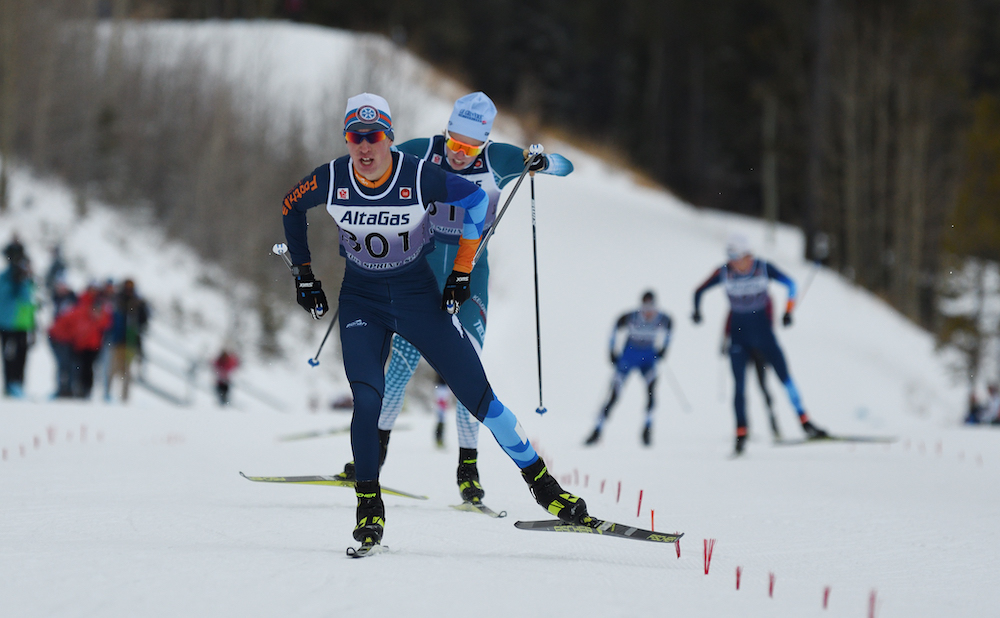
The NorAm series fully lived up to the North American Cup label in Canmore Friday with 1.3km free technique sprints to kick off a combined NorAm, SuperTour, and Mexican National Championships weekend.
Full results for the weekend are on zone4, including live results every day. Friday featured sprints for the older age groups only (282 racers): Saturday is interval start classic, and Sunday’s race an interval start free.
Before the races, there was chatter about the importance of increasing the level of competition and a dash of fear that the American visitors would school the host country. The competition level was up and fear was not needed this day. The open women’s final featured two Germans, two Canadians, and two Americans before the open men’s final skewed Canadian. (Heat brackets and final results.)
Julia Richter takes the win ahead of Katherine Stewart-Jones and Katharine Ogden. (Photo: Doug Stephen)
There are a few race videos in @NordiqCanada’s Instagram story.
Nordiq Canada’s new Events Coordinator Jeff Ellis took time from his Race Director role to shoot video interviews with the top athletes, including the first ever Mexican National Champion Rodrigo Rangel Fernandez. Edited versions of some of these interviews are also on @NordiqCanada’s Instagram.
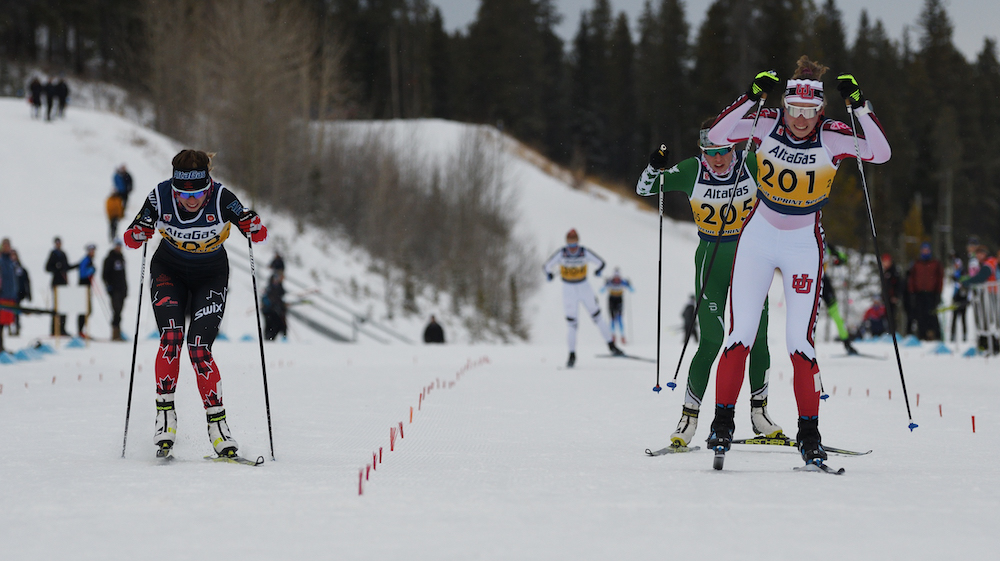
University of Utah’s Julia Richter won the qualifier and all the heats to take the win in 3:10.52, 0.08 seconds ahead of the national team’s Katherine Stewart-Jones and 0.63 seconds clear of Dartmouth’s Katharine Ogden.
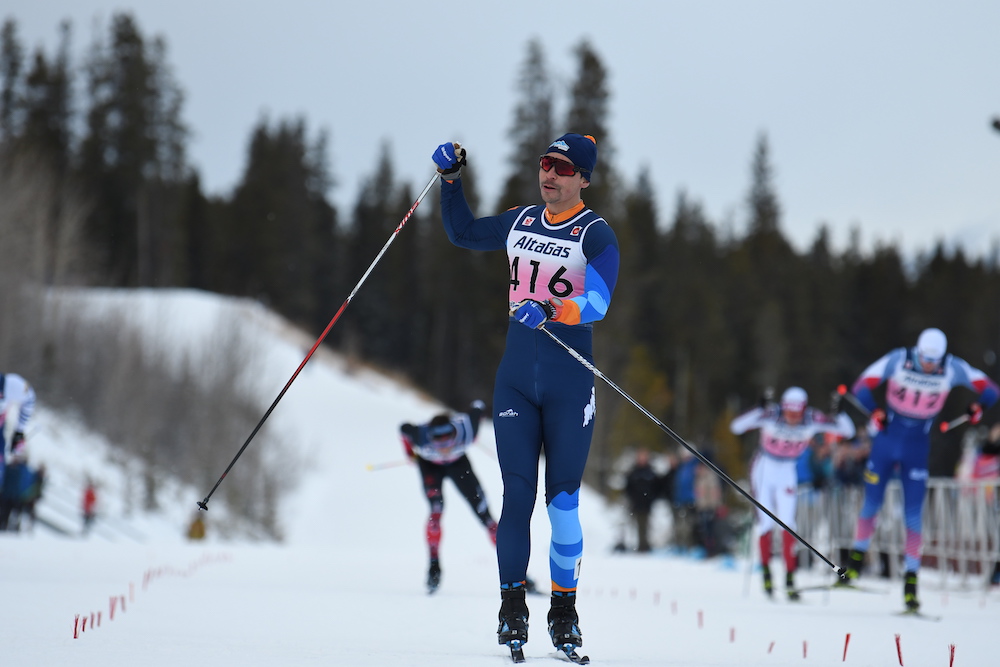
Full-time student Jess Cockney (Team ULLR) turned in another solid sprint performance at home, winning the men’s final in 2:46.18, over two seconds ahead of SVSEF Gold Team’s Peter Holmes and Canadian National Team member Graham Ritchie.
National team junior Anna Pryce qualified 4th overall before winning all her heats. She finished the 1.3km final in 3:18.40, 0.38 seconds ahead of AWCA’s Elizabeth Elliott and 0.43 seconds from CNEPH’s Liliane Gagnon. Seventy-three U20 women competed, making that cohort the largest age group.
Xavier McKeever (Team ULLR, CNST) won the U20 sprint after qualifying 20th overall. His 2:42.02 bested Telemark’s Ian Williams by 0.85 seconds and ULLR teammate Joe Davies by 5.30 seconds.
The first Mexican National Championship sprint featured four athletes. Rangel Fernandez won comfortably in 3:37.33, completing a major step forward for the federation in Mexico. Vadovų paieška, personalo atranka, mokymai vadovams ir darbuotojų paieška primumesse.lt
Canmore-based photographer Doug Stephen was in the thick of the action. Athletes can use full-resolution photos from his gallery if they credit ‘Doug Stephen’ or @vr45photography.
Katherine Stewart-Jones leads BSF’s Erika Flowers in the quarter final. (Photo:Doug Stephen)
Hosting a World Cup gives the host country an extra 10 ‘nations group’ starts. (Photo: Doug Stephen)
Canada is moving into a new era in skiing. An era with less World Cup podiums and more emphasis on developing future podium athletes.
“Train at what you want to be good at. If its climbing, climb. If it is chess, play chess. Ski training has many elements of course, but in the end the best training to race fast is to race.” — Erik Bråten, National Team Head Coach
In the near future, more Canadians will spend more time racing in North America. The trip criteria is clear that any athlete who wants to stay on the World Cup all season has to demonstrate multiple top 12 finishes. Team selection follows the same path.
For this season, there are six World Cup race days in North America. Canada gets ten Nations Group start positions for the five race days hosted in Canada plus a bonus of another ten Nations Group starts in Minnesota. With these starts available, Nordiq Canada (NC) seems very comfortable skipping the first two World Cup weekends in Ruka and Lillehammer. Three Canadians, however, Emily Nishikawa, Dahria Beatty, and Russell Kennedy, will race in Davos and Planica. Smaller than usual teams are expected again in the new year.
The overall picture is three less World Cup weekends than last season, and fewer athletes all the way through. That doesn’t mean less racing, but it does mean less travel.
The era when the top US skiers came up to Canada to improve their FIS points seems to have ended. At that time, US skiers were excited to find more competitive events to push them harder. For the last few years, it has been Canadian skiers who are happy to get pushed out of the top five by foreigners.
For the last few years, Canada and the US have cooperated to increase the level at select weekends with joint NorAm/SuperTour events. While this adds work for the organizers, the athletes have universally been excited to reach across the border. Both NC and US Ski & Snowboard (USSA) seem happy with the development potential.
“It’s a lot cheaper to race south of the border than fly to Europe”, NC’s new Events Coordinator Jeff Ellis told FasterSkier, explaining that it was cheaper for both athletes and the team. The shorter trips also allow more days training at home where the athletes have a higher level of support.
“Merging a select few Canadian and American Continental Cup events helps strengthen the competitive field,” USSA’s Bryan Fish wrote in an email to FasterSkier. “Both the Scandinavian Cup and Alpen (OPA) Cup have eight nations involved in their respective Continental Cup series. Their robust competitive fields are a strong method of preparing their next generation.”
For 2020, NC decided to hold nationals right after the World Cup Finals in Canmore. Scheduling nationals three days later and six hours drive away at Sovereign Lake makes it possible for all the top Canadians to attend which raises the level of competition and gives younger athletes more exposure to senior level speed.
The same factors were also important when USSA was planning SuperTour finals.
“Most of North America’s strongest World Cup athletes remain in Europe for a majority of the season so they have the best chance to succeed at the World Cup level,” Fish wrote. “This is critical for their success on World Cup, however that can leave a gap in competitive strength in North America.”
Combining SuperTour finals and Canadian nationals into a single event will raises the level of competition. It also creates another opportunity for younger athletes to combine in a single trip a full week of racing and the chance to be trailside at the World Cup.
In the future, NC may revisit other European series as a way to add more rungs to the ladder to the World Cup. “Having development trips to Europe, and doing other kinds of racing could be interesting: If it’s OPA cup, or Scandinavian cup, or whatever it is.” Bråten said.
Kikkan Randall (bib #52) might have had her first classic day of the season on a race course, but the real action was in the younger categories.
There is also a push to add more races in every region. Tier 2 events like the Sovereign Open, might draw a few big names, like Caitlin Gregg, on their way to the opening NorAm/SuperTour the following weekend in Canmore. But, the main goal of the event was to provide one or two extra race days for 300 young regional skiers.
The National Team is committed to a hands-on approach. They are modeling best-practices and enhancing institutional knowledge by working directly with clubs at lower levels of the development pyramid. Recently, Bråten, along with some National Team athletes, assisted with club youth and masters programs during an on-snow camp at Sovereign Lake before the NorAm/SuperTour kickoff. High Performance Manager Joel Jaques, who is also the waxing lead for Canada, hosted a waxing talk and demo for the local coaches and athletes. (The FIS announcement claiming they will implement a fluoro ban next season came four days before the demo and changed the planned content, as applying powders will not be required next season.)
Another (apparent) first this season is having full National Team members who are outside the Canadian system. Sam Hendry attends the University of Utah and Rémi Drolet studies at Harvard.
Sam Hendry leads Graham Ritchie in the 10km free. (Photo: Doug Stephen)
“This has provided me with some awesome opportunities and an incredible team,” Hendry wrote during Nordiq Thunder. “It was really nice for me to have the chance to come home and ski on snow in Frozen Thunder especially with the lack of snow in Utah.”
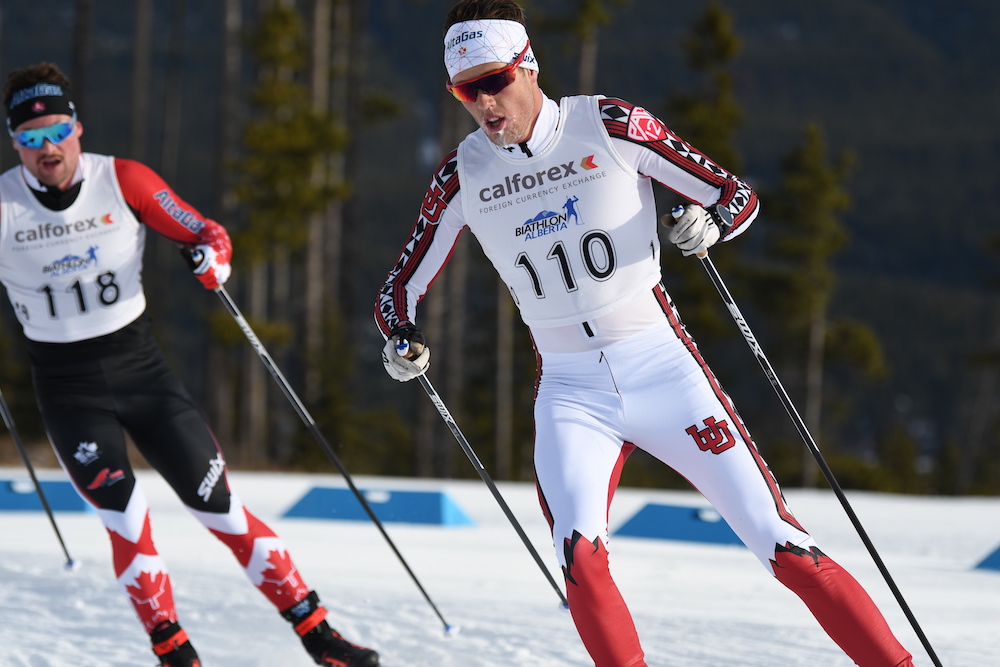
Utah is a perennial powerhouse — winning the NCAA team title in 2017 and 2019. Utah is (relatively speaking) close to Canmore, which makes it easier for Hendry to connect with his home team.
“Sam is at Utah, so he has a personal coach, but I’m communicating with Miles [Havlick, Utah’s coach],” Bråten said, “and we have a good relationship.”
Harvard might be a top school for physics, but it is less well known as a skiing centre.
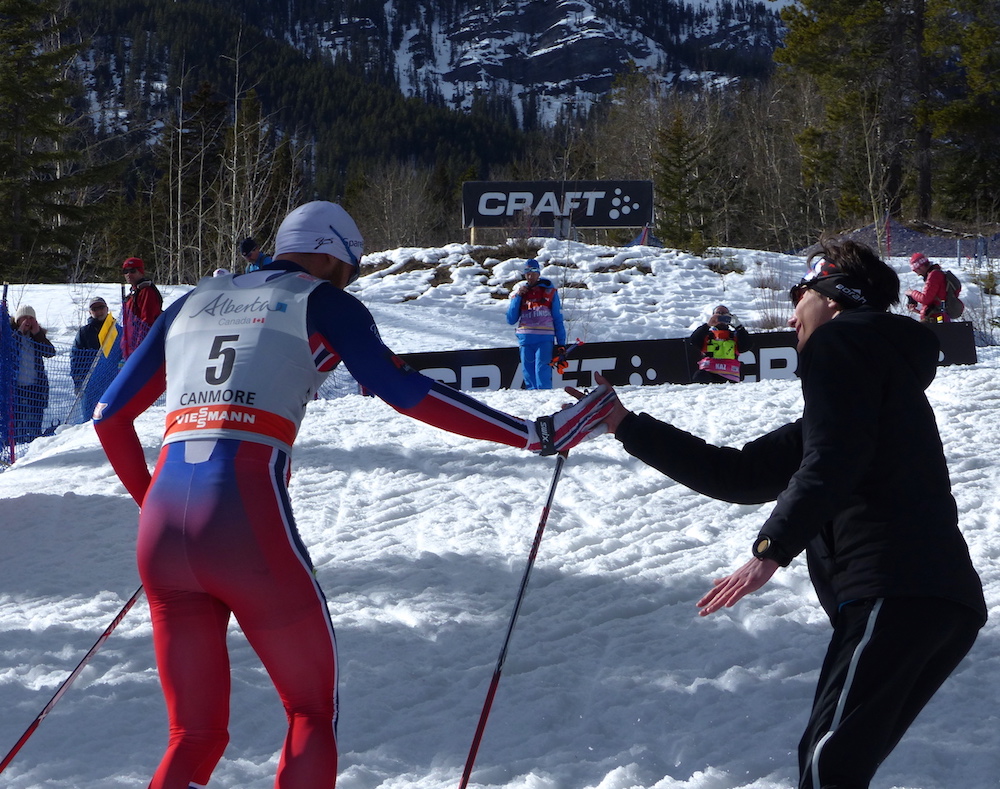
Time Machine: Petter Northug (NOR) (l) high fives Rémi Drolet (spectator) as he finishes his final lap during the men’s 1.5 k classic sprint at the Ski Tour Canada on Tuesday in Canmore. (Photo: Peggy Hung)
“On paper, Rémi is by far the best skier [at Harvard],” Bråten told FasterSkier, “but I think he sees that value of having that team around.”
Those paper results include ranking 7th of 23 North Americans in the 2019 World Cup final mini-tour in Québec, narrowly edging out American Gus Schumacher as the top overall junior.
“At Harvard, we are lucky to be led by head coach Christopher City and assistant coach Jefferson Tucker, ” Drolet said. “They are fantastic people, as well as coaches, and I have very much enjoyed working with both of them this fall. I am also continuing to work very closely with my coach at Black Jack, Dave Wood, and I am also talking regularly with Canadian National Team head coach Erik Bråten. I have to say that it is interesting to be working with four different coaches, but things have been going well so far, and everyone seems happy to collaborate in making sure my preparation for the season is as good as it can be!”
While Canadians view Harvard as a more expensive education than local universities or full-ride scholarships at NCAA schools, Drolet explained the reality at one of the top-ranked physics programs in the world.
“As an Ivy League school, Harvard College offers neither academic nor athletic scholarships. However, they do offer financial aid scholarships which ensures that all Harvard students pay what their families can afford without going into debt.
“This program has worked out very well in allowing me to pursue an education, which from the outside, is often viewed as having an excessively high price tag.”
Drolet has an ambitious racing calendar, which doesn’t include Nationals even though it is just four hours drive from his hometown.
“The college racing circuit starts for real in mid-January with the Harvard Carnival. Afterwards, I will be racing at the UVM Carnival/Supertour in Craftsbury, followed by the Canadian World Junior Trials Races at Mt. Sainte-Anne.”
The easiest path to qualify for World Cup starts is a top result in Mt Ste Anne, as that weekend has two routes to selection.
“If all goes well at trials, I will hopefully be headed to Germany for the World Junior Championships after racing at a few more Carnivals,” continued Drolet. “I would also be very happy to qualify for some more World Cup starts during the North American circuit at the end of the season, and if there is time for it all, I would love to go to the NCAA Skiing Championships in Bozeman, Montana.”
While this might sound easier than the full NorAm/SuperTour schedule, it’s coupled with demanding academics.
“Training long hours at university while attempting to stay competitive with all of the students who may not have such a major commitment outside of school is certainly a challenge, but it is one that Harvard has allowed me to meet successfully so far.”
Asked about the National Team working with US schools going forward, Bråten had a simple answer.
“This is one of the questions where I will be most likely listening more than I’m speaking when we take a decision.”
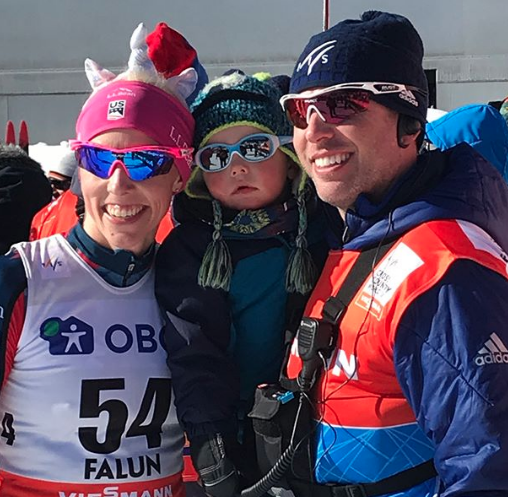
Kikkan Randall poses with her husband Jeff Ellis and their son Breck after her final race in Falun. (Photo: Instagram @kikkanimal)
The “First Tracks” series highlights the pregnancy, postpartum, and parenting experiences of noteworthy athletes in cross-country skiing in various stages of their professional careers. The sharing of these experiences can benefit athletes in any stage of their career, whether they are an elite or recreational skier, by demonstrating that it is very possible to return to skiing, competition, and an active lifestyle with a growing family. The series will include the physical challenges of being an athlete during and after pregnancy, balancing family life with skiing, and the joy that starting a family can bring. This is part two of Randall’s “First Tracks”. You can read part one here.
***
After Kikkan Randall delivered her son, Breck Stuart Randall Ellis, on April 14th of 2016, she began her return to racing.
“The one thing that kind of struck me as I was doing all of it, is that because I wasn’t racing while I was pregnant, I felt like I was taking my maternity leave before the baby came,” said Randall in a call, “because as soon as the baby came, it was time to get back into training.”
Randall described the adjustment of incorporating motherhood into her lifestyle as a professional athlete as a “cool mind shift”, and expressed gratitude for her support system for enabling her to spend lots of time with her new baby while still putting in the training hours she needed to pursue her goals.
“I had looked forward to being a parent for a long time, but I was completely blown away with how awesome it was,” said Randall. “From the moment he came into the world and you quickly realize – as a skier, my life had really been all about me, pretty selfish, because it has to be for performance. Pretty quickly it was all about him and I had to find a way for it to be about me in between.
“It was a change in perspective too in knowing that my training time wasn’t unlimited,” she added. “So the time that I got to be out there I was really grateful for, and I wanted to make the most of it so that when I could come back and be with Breck I still could make the most of that time.”
Kikkan Randall kisses her five-month-old son Breck after a training session with teammate Sadie Bjornsen. (Photo: Instagram @kikkanimal)
While Randall’s capacity for high volume training while pregnant may seem super-human, her recovery process brought her closer to the mortal realm.
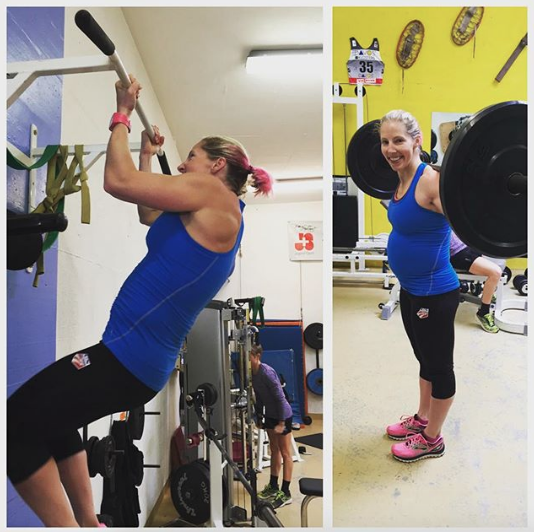
“After the birth, there was just a bigger recovery process than I had anticipated,” admitted Randall. “I was still able to do three sets of eight pull-ups about a week before Breck was born, I was feeling really strong at the end of my pregnancy. So I thought, oh man when I have this baby and the extra thirty pounds come off, I’m going to be whipping out pull-ups right and left! I think I waited about four days or maybe it was a week and I was like okay, I’m going to try some pull-ups now, and I could barely do four!”
During pregnancy, a woman’s uterus grows to between an astronomical 500 to 1000 times its original size, from about the size of a pear to approximately the size of a watermelon. In addition to relocating the remainder of the mother’s internal organs, this growth puts a major strain on the core muscles that stretch to accommodate the growing baby and on the pelvic joint, which widens to aid the delivery of the baby. The body also produces a hormone called relaxin throughout pregnancy which allows ligaments to stretch and joints to loosen more easily as the body expands. This hormone is present in the body for 12 or more weeks after pregnancy, meaning women are at an increased risk of joint injury during the immediate postpartum period.
Because of the stretching of core muscles, many women develop a condition known as diastasis recti, which is a weakening of the connective tissue in the abdominal wall leading to a separation of the rectus abdominis, more commonly thought of as the muscles that make up a “six pack”. The degree of separation is measured by the number of fingers that can be inserted through the gap to the transverse abdominal muscles lying below. In severe cases, the condition needs to be rectified with a surgery similar to the treatment of a hernia.
“When I started doing exercise after the birth, I was relying on all the bigger muscles [rather than utilizing the core], and I ended up injuring my back about a month after Breck was born,” Randall shared. “So then I started going to Pilates classes and working with a physical therapist that specializes in postpartum stuff to really work to re-engage. I had about two fingers worth of separation between my abs, but thankfully, I have a really strong lining underneath it, and I was able to bring it back to about a half-finger gap.
Kikkan Randall hikes with her newborn son Breck. (Photo: Instagram @kikkanimal)
“The core strength, for sure, took a bit to come back,” Randall continued. “I think part of it was coordination and strength. And then, really for the whole first year, I didn’t feel like I had the tension in my joints like I had before… So things like really quick speeds, sprinting off the line, that stuff, just took a while to come back and that was a surprise.
“On the flip side, I couldn’t believe how strong I felt aerobically right off the bat. Within a week or so, I was testing things out on the ski erg and that felt pretty good, and I was getting on the bike, and that was good. We just made a really gradual approach back into training in the first three months, and I really was very cautious and easy with myself for those first six weeks, and then very gradually built back.”
While the non-weight-bearing nature of cross country skiing might provide benefits to a body in recovery, Randall realized that the multi-faceted training for her sport at the elite level made resuming her normal regime a slow process.
“We brought classic in first, thought that was going to be a little easier on the body than skating,” Randall explained. “And we realized how complicated ski training is as we were trying to introduce one thing at a time so we could really tell that I was passing a stage before moving onto the next. But when you’ve got classic, skate, running, biking, strength training, and then that at all these various intensities, it was really like, oh man, where do we even start.
“We started very simply with using biking as a way to keep up my aerobic intensity,” she continued, “then started with some really easy classic skiing and gradually worked up the volume. When that was going well we added a little bit of intensity. Then once classic was going well, then we did the same thing with skating. So I think it was three or four months before I was back to doing most of my normal training modes.”
Not all of her training modes were easy to reintroduce.
“Running took me a while,” Randall expressed, “probably six or seven months to get back into because I did have that separation in the front of my pelvic bone. I had started trying to run small amounts in my neighborhood thinking staying close to home would be good, but I was doing it on pavement. Then, later on, I had much better success building up my running on the trails, so I really think the surface mattered. I was able to do a lot of uphill running, striding, and stuff with poles, that was a really good way to reintroduce the impact on my legwork.”
Despite resuming a high volume training load, Randall was able to breastfeed her son for the first eight months after giving birth, a commitment that required a lot of planning.
“It was a blend of just timing feedings and going off for training and coming back and feeding him again and doing a lot of pumping,” Randall shared. “I did two short four-day camps on the glacier, so for that period, I was away from him. Thankfully, I had done a lot of extra pumping early on when I was producing more milk than he was eating, so I had a stockpile. So then, my husband was able to give Breck the stockpiled milk, and while I was on the glacier I was also pumping every few hours so I was building up a new stockpile.
“So that was kind of funny to be in the middle of the night in the back corner pumping, then leaving camp with this whole cooler full of frozen breastmilk,” Randall laughed. “Then I kind of weaned off on breastfeeding right as the race season was starting.”
Producing enough milk to sustain a growing baby adds a unique load on the body and requires approximately an additional 500 calories.
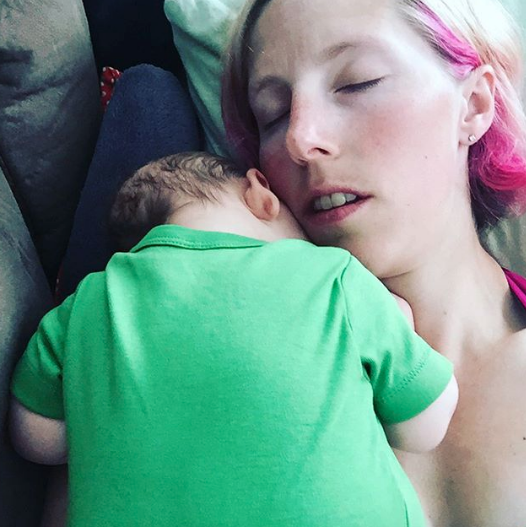
Kikkan Randall shares a photo of herself with her newborn son captioned “Naps between training just got a whole lot better.” (Photo: Instagram @kikkanimal)
“I didn’t really notice it,” Randall stated gratefully. “I didn’t find myself more tired. I was trying to drink a lot to keep my hydration up, but I never really felt like I got out of whack that way. I was enjoying the opportunity to eat the extra calories. Overall, I was pleasantly surprised at how well I was able to balance it with all the training that I was doing.”
While breastfeeding did not cross her mind as a source of impedance for her recovery between training sessions, Randall did have some concerns about the lack of sleep during the first few months of Breck’s life. However, she found it to be much less detrimental than anticipated.
“I had been wearing this device for a full year leading into pregnancy, then I wore it through my pregnancy and after – it measures the quality of my sleep and my recovery. I thought that I was going to see a huge decline, but I saw some of the best numbers I’ve ever seen!” Randall exclaimed. “So I think that the super mom powers you get, just the happiness factor… so even though I was getting less sleep, when I was sleeping I was sleeping really effectively, so it didn’t seem to have an impact on my training.”
In reflecting back on her pregnancy and postpartum experience overall, Randall saw both advantages and disadvantages to being a skier, versus a professional athlete in a different sport.
“I think our training as skiers is very complementary to what you do for pregnancy because of the low impact nature of it,” Randall stated. “Being able to ski a lot was really beneficial and I could bike and do all these different activities that contribute to the same goal, which was great. I could see being just a runner being challenging.
“I do however see a difference in the return,” she continued. “I followed a couple athletes like [professional cyclist] Kristin Armstrong who came back incredibly strong after the birth of her child and won gold medals. I was just thinking about how biking is so one dimensional and so linear, it would be so easy to hop on the bike and get back in shape because it’s all aerobic and it doesn’t matter the tension [in muscles and joints] as much. So some sports may be easier that way… Skiing was just so challenging with all the different pieces to figure out.
“But overall, there were a lot of other world cup athletes that all did it around the same time as me and everybody came back strong,” she concluded. “So I think it’s very doable.”
As Breck’s half-birthday approached, so did the World Cup season. Randall headed to Europe with her teammates once again after eighteen months away from racing.
“At six months, that was about a month before the season started, I was feeling strong, training with the team, doing time trials,” Randall remembered. “I thought I was really ready to go, and then when the race season started, that was when I got the reality check that being away from race intensity for several months takes a little while to come back. I think that was also in relation to the tension in my muscles.
“So the first three months of the race season were pretty challenging, I had to be really patient,” she added. “Then when I hit about the ten-month [postpartum] mark, I felt a really big change, and then another big change at a year.”
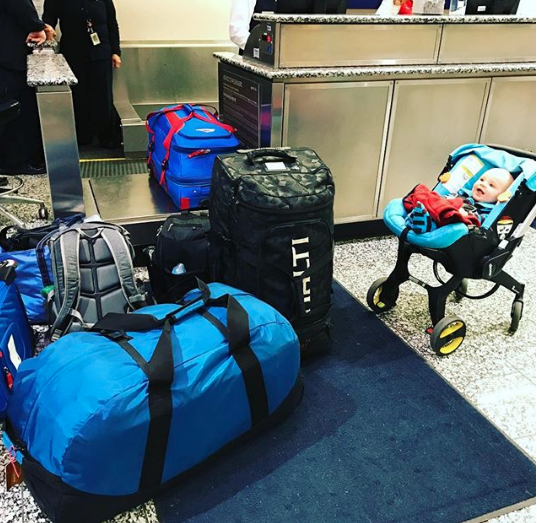
Kikkan Randall’s son Breck waits happily next to their bags as they depart for a winter in Europe for the World Cup Races. (Photo: Instagram @kikkanimal)
Apart from the physical challenge of being prepared to race at the highest level at seven months postpartum came the logistical challenge of traveling across the Atlantic for a winter on the road with an infant. What was their secret to success? Not dwelling too much on it.
“We didn’t really think too much about how we were going to do it,” Randall admitted. “We just decided that we wanted to do it and therefore we were going to figure it out. Some people were like, ‘how did you travel five-months on the road in Europe while ski racing?’ And I was like, ‘I don’t know, we just did it! And it was awesome!’ We schlepped a lot of gear around and just made it work and it was really an awesome experience for us all together.”
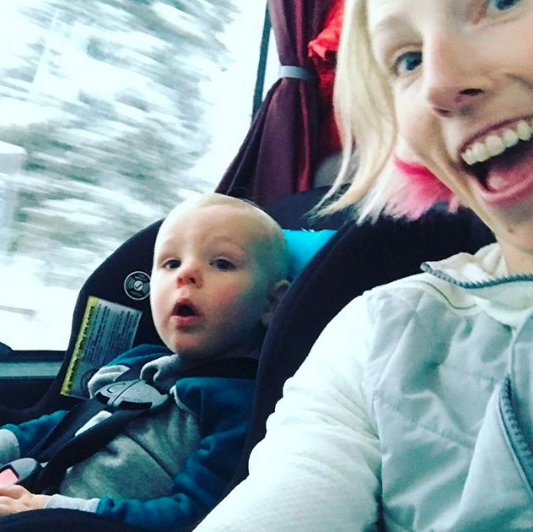
The World Cup moves between countries on a weekly basis, meaning regular flights, bus and train rides, and time changes. While this schedule might make any traveler weary, Breck seemed to handle it without too many problems.
Kikkan Randall travels with her son, Breck, between World Cup race venues. (Photo: Instagram @kikkanimal)
“I don’t know that we’ll ever know the answer to the question of whether he is just a good easy-going, even-keel kind of kid, that’s just good for anything, or whether it was that early in his life we started taking him on trips, so that’s all he knows,” said Randall. “He ended up being a great traveler, even long van rides and being on big busses with the world cup field. He just went along with it.
“The time change, however, was quite difficult,” she continued. “It probably took us a good two or three weeks to get on a routine. When we went over he was starting to only wake up two or three times a night, I really wasn’t feeding him too much during the night. When we got over there, he started waking up five or six times a night. And because we had teammates all around us and I didn’t want to disturb them, we were doing whatever it took to keep him happy through the night. But then it would be one in the morning and he was wide awake like ‘let’s play!’ Then at three in the afternoon, we couldn’t keep him awake to save our lives.”
Luckily, Breck was born amidst a small baby boom on the World Cup, so Randall was not alone in navigating this experience. Marit Bjørgen of Norway, Aino-Kaisa Saarinen of Finland, and Katja Visnar of Slovenia all gave birth during the 2015-2016 ski season as well.
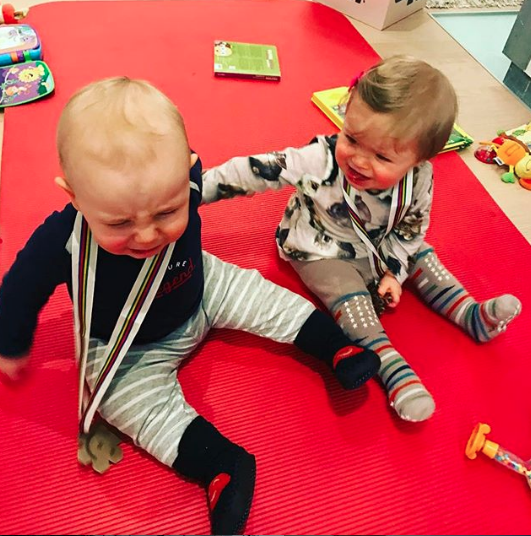
Kikkan Randall’s son, Breck, and Aino-Kaisa Saarinen’s daughter, Amanda, play with their matching bronze medals from the World Championships in Lahti, Finland. Randall captioned the photo, “It’s okay Breck, you’ll win gold next time.” (Photo: Instagram @kikkanimal)
“My Finnish friend [Saarinen] who is a World Cup skier and had a baby just a few weeks after me highly recommended that we do sleep training,” Randall explained. “So about three weeks into the season, we were in Switzerland and we were finally in an apartment so we wouldn’t disturb anyone around us and we committed to three or four nights of sleep training. And it was mostly done by Jeff – I got to sleep through it because I was racing – but he committed to letting him cry for longer and longer intervals and within about four nights, he was completely sleeping through the night, and from then on it was a huge game changer for us.
“We actually found it a lot more challenging the second year when he was between a year and a half and two years old because then he wanted to move a lot more and he was more aware of what’s going on and it was harder to keep track of him on the long travels.”
In addition to family and friends, Randall was grateful for babywearing and carrying gear during her preparation for and travel during the race season as it made it easier to bring Breck along for some sessions and to get him from place to place more easily while on the road.
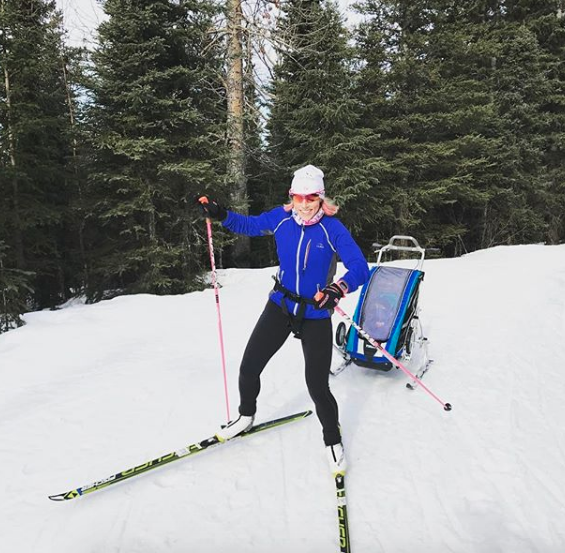
“We got a Thule chariot right away,” Randall explained. “That was super awesome because with the infant harness we could suspend him in there from pretty early on. I could use it to get out for walks and later runs. Then we could pull him behind the bike, and then we could pull him skiing.
“We found it really useful in Europe in the winter because we could just pack him in there all nice and
Kikkan Randall tows her son, Breck, in their Thule Chariot. (Photo: Instagram @kikkanimal)
warm, protected from the snow and wind and rain, then whoever we had with us helping take care of him could just take him out for these great walks all the time,” she continued. “That was a really great tool, I mean we’re still using it a ton.”
“That’s been one of the toughest parts of this breast cancer deal so far,” Randall shared. “We were so excited to expand our family after the Olympics ended, and now that’s on hold for at least a couple more years. We were fortunate that we were able to do some fertility treatment before I started chemo, so we have one little embryo as a backup plan. It just gives us some hope that in case my fertility has been wiped out by the chemo, that gives us one shot maybe. And there’s no guarantee that the chemo does wreck my natural fertility. So we’ll find out in a couple years when hopefully I can take a break from the anti-hormone stuff.
Kikkan Randall displays her newly bald head and tireless positivity after undergoing her second round of chemotherapy. (Photo: Instagram @kikkanimal)
“With that aside, it makes me really grateful that we have Breck,” she continued, “because I know how much I love being a parent and the fact that I get to do that with Breck is so amazing. I think if I hadn’t had any children and was facing this, it would be a lot harder.
“Also, you hate that it takes something like this to change your perspective, but we’re just really appreciating every day with Breck now, and the fact that we get to just focus on him, because sometimes when you have another kid then you have to shift your attention to two kids,” Randall added optimistically. “So we’re just going to really enjoy doing stuff with Breck and it makes me appreciate how much I love being a parent and making the most of every day that I have. And I’m staying hopeful that I get to go through this whole experience again, even if it’s not on the original timeline that I imagined.”
Finally, Randall was asked what message she would share with a fellow skier who is pregnant or thinking about starting a family.
“Approach this new situation with a curiosity and really just listen to your body,” Randall encouraged. “But have the confidence that your body is pretty tough and it is used to doing a lot, and probably the best thing that you can do for yourself and the baby is to just keep doing what you’re doing. I really think that when you’re used to getting a lot of exercise, and as an athlete, you’re used to taking good care of yourself, just keep doing that through pregnancy.
“Enjoy it!” she added. “Notice what’s different and unique, and also have the confidence that when the baby comes, it may take the patience of a couple of months to get your body to come back around again, but it will and you’ll be stronger than ever. I think it’s really exciting to be able to blend athletics and being a parent whether you’re doing it at the elite level or just someone who is worried about continuing to be athletic after having kids, it really works out great.”
The “First Tracks” series highlights the pregnancy, postpartum, and parenting experiences of noteworthy athletes in cross-country skiing in various stages of their professional careers. The sharing of these experiences can benefit athletes in any stage of their career, whether they are an elite or recreational skier, by demonstrating that it is very possible to return to skiing, competition, and an active lifestyle with a growing family. The series will include the physical challenges of being an athlete during and after pregnancy, balancing family life with skiing, and the joy that starting a family can bring.
Kikkan Randall shares time outside with her one week old son, Breck. (Photo: Instagram @kikkanimal)
As she was the only U.S. Olympian and mom in PyeongChang and the first female American skier to start a family during her professional career, Kikkan Randall has led by example in the realm of training through and recovering from pregnancy. Her gold medal demonstrates that it is completely possible to return to competition after pregnancy stronger than ever. While Randall acknowledges how fortunate she was to have an uncomplicated pregnancy through which she could train at a level most would find astonishing, her experience should instill confidence in women that hope to remain active during and after pregnancy in order to maintain the active lifestyle to which they are accustomed.
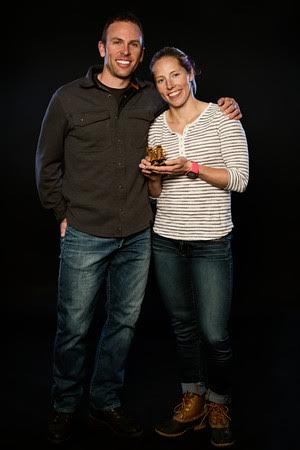
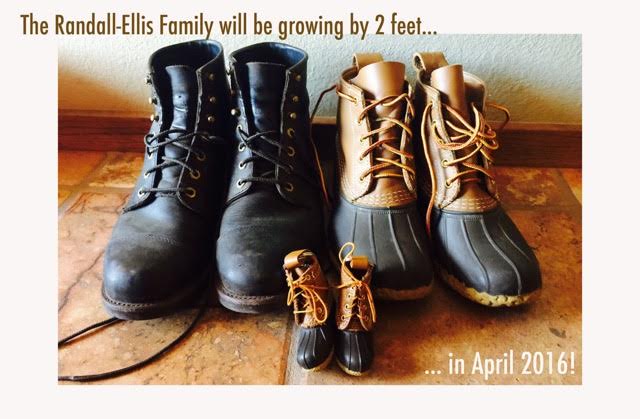
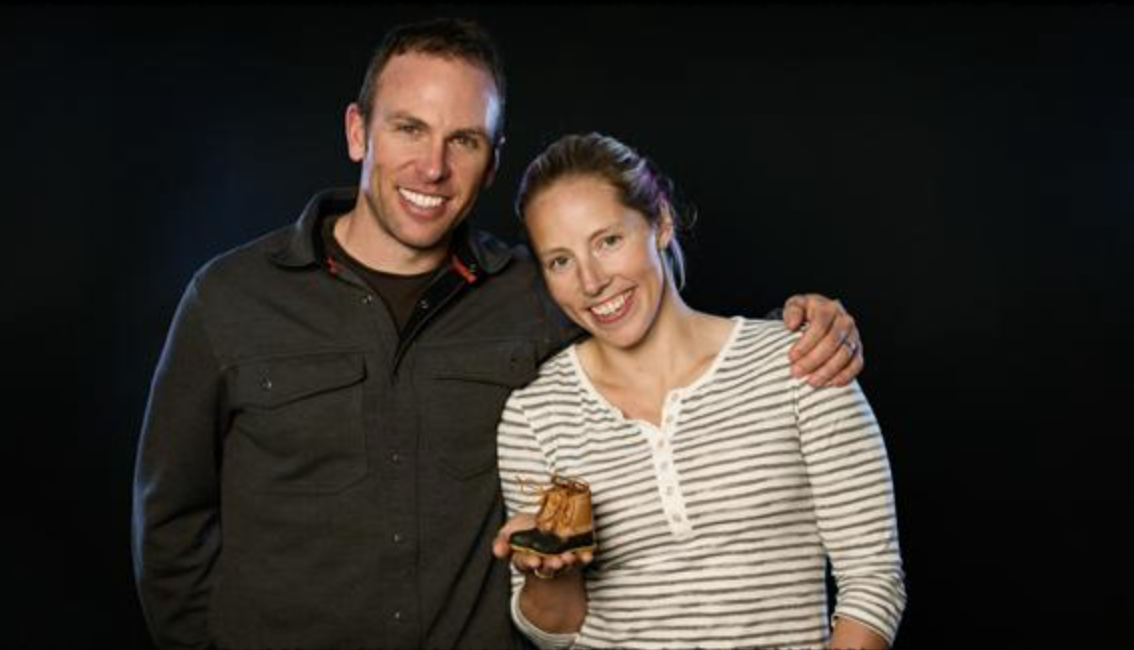
Randall and her husband, Jeff Ellis, knew that they wanted to start their family in 2016. As that was not a World Championship year and it was not an Olympic year, the timing was ideal for her to miss a season on the World Cup. As the couple began trying to conceive, Kikkan was able to maintain her normal training volume without worrying about its effect on her fertility, still participating in team camps and following her training plan. In fact, she discovered she was pregnant shortly after returning from a training camp in Norway.
“A few weeks before that, Jeff had gotten a Diet Coke can on the airplane and it said ‘dad’ on it,” Randall shared in an interview. “There were just some funny things that ended up being a premonition or something.”
Kikkan Randall announced via social media that she and her husband, Jeff Ellis, were expecting their first child in April 2016. (Photo: Instagram @kikkanimal)
Once the couple found out they were pregnant, Randall’s training plan adapted to accommodate the new toll on her body, however, it did not change as much as one might think.
“Up until the point I found out that I was pregnant, I was training full bore as if I was preparing for the season ahead,” said Randall. “Once I found out I was pregnant, the goal shifted slightly in that I was no longer trying to be in top physical shape for the race season, but I was curious about how much training I could do. So as long as I followed how my body felt, I continued doing intervals twice a week, strength training twice a week, long things. I really continued the training as normal, although I did notice in that second month quickly the extra load on my system. All of a sudden stuff just felt harder.”
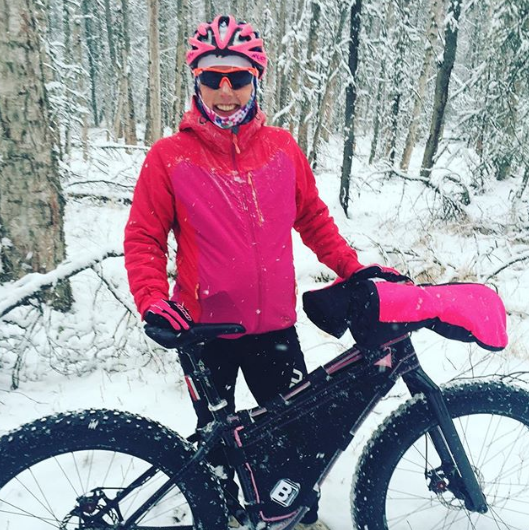
Kikkan Randall using snow biking as one of her training modes at eight months pregnant. (Photo: Instagram @kikkanimal)
Despite things feeling more challenging, Randall was able to maintain a high training load throughout her pregnancy. She typically trained twice a day all the way through her third trimester, incorporating running, both skate and classic skiing, snow biking, and strength workouts. Once she was in the later stages of pregnancy and her belly had grown substantially, she avoided exercises that required jumping because of the added load on her joints and those that required her to lie on her back for long periods of time, which is recommended to pregnant women as the pressure on the inferior vena cava, one of the major arteries responsible for returning blood from the lower extremities to the heart, can restrict blood flow and cause complications.
“Around the seven month mark, running started to get pretty uncomfortable,” shared Randall. “I had a little bit of separation in the front of my pelvic bone. I did some running on an anti-gravity treadmill which helped a bit, and then after a while, I was like okay, I don’t need to push it anymore. So I didn’t run that last month and a half of pregnancy. I did some hiking, especially where I could finish on an uphill and not do too much downhill.”
One thing that challenged Randall was the lack of information pertaining to high-level athletes training through pregnancy. As it is difficult to conduct medical studies on pregnant women and so few elite athletes had chosen to get pregnant during their professional career, there was a dearth of resources explaining what she should and should not do.
“That part wasn’t as cut and dry as I would have liked,” she said. “I was asking a lot of questions to a lot of people, but there wasn’t a lot of stuff out there that was concrete about what you can or can’t do. Thankfully, my doctors were supportive. They said, ‘Keep doing what you’re doing because that’s what your body is used to. Just listen to it.
“My strength training coach had actually been through a pregnancy the year before herself, so she was helpful in knowing what the load on the body would be and modifying strength plans slightly,” she continued. “My personal coach, Erik Flora, was really helpful because he’s been with his wife through three pregnancies, so we worked together to design a training plan that was appropriate. I looked for stories on the internet of other elite athletes that had gone through it. I reached out to Lauren Fleshman, the runner, she gave me some tips. But a lot of it was just experimentation.”
Kikkan Randall shares photos of herself strength training at 22 weeks pregnant with the caption “I guess I don’t need to add a weight vest anymore!”(Photo: Instagram @kikkanimal)
Randall seemed to handle pregnancy in stride, adjusting to the changes in her body well and looking forward with anticipation. Her only emotional hurdle was simply remaining home during the winter, rather than the heading to Europe for the World Cup race season.
“It was a little bit difficult, I had to miss a season of racing,” Randall shared. “When all my teammates left for the season and I was up in the middle of the night watching them, I really missed the racing and being there together with them.
“But I was also really excited to be a parent,” she continued. “I was really excited with how the process [of pregnancy] was going. I was pleasantly surprised with how much I was able to do and how I felt.”
Randall also handled the uncertainty of what her recovery would look like with the positivity and resilience for which she is known.
“I think I went into it with the right mindset,” she said. “I had four Olympics up to that point and a very successful career, so I knew that if for some reason I wasn’t able to come back, I could still be satisfied with my career and I think that took a lot of the pressure off. I was also pretty optimistic and confident that I would come back as strong as ever and I had a lot of really great support. The ski team was really supportive, my sponsors were supportive, my husband was really supportive. So I just looked at it with a lot of optimism and excitement.”
Perhaps a challenge unique to the world of professional athletes for whom training and racing is their career, maternity leave takes a new shape as women are not able to perform at their normal level during or immediately after their pregnancy. This extended leave has been met with mixed results as more an more professional athletes are choosing to start their families during, rather than after, their career. As aforementioned retired track athlete Lauren Fleshman illuminated, pregnancy is not always well-received by sponsors, since the athlete’s need to step away from high-level training and competition for at least a year decreases the visibility of the sponsored products.
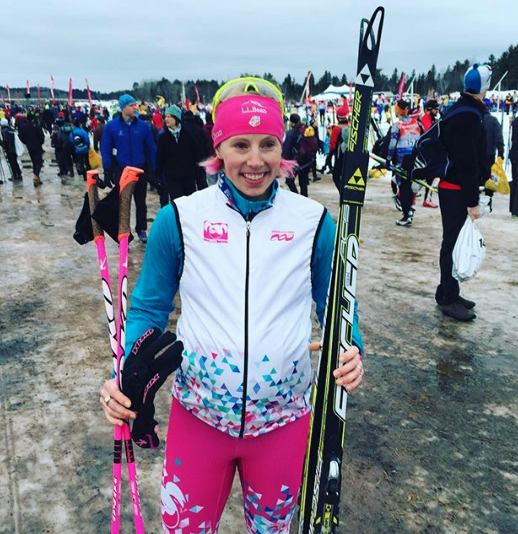
Kikkan Randall sports a Fast and Female race vest at the start line of the 2016 Birkie. Randall appeared on behalf of one of her sponsors, Fischer Sports. (Photo: Instagram @kikkanimal)
Luckily, Randall’s experience in this regard was quite positive.
“I was proactive with all my sponsors,” said Randall. “I alerted them that ‘hey, we’re going to try to have a kid in the next year. So if I do, how can we renegotiate or keep our relationship going?’ Recognizing that they wouldn’t get the benefit of me out there racing and getting in the results, being on the podium, and getting them the exposure that way, I just proposed other ways that I could be valuable to them. Whether it was writing content for their website or social media, whether it was doing in-person appearances. So with each of my sponsors, I came up with a unique set of things that I could do since I was going to be home, not going to be away racing all the time, and they were really receptive to that. So it just took some creativity on my part. “I think everybody was really psyched to see that I wanted to continue racing, that I wasn’t seeing this as an either-or option, so everybody was really supportive,” she continued.
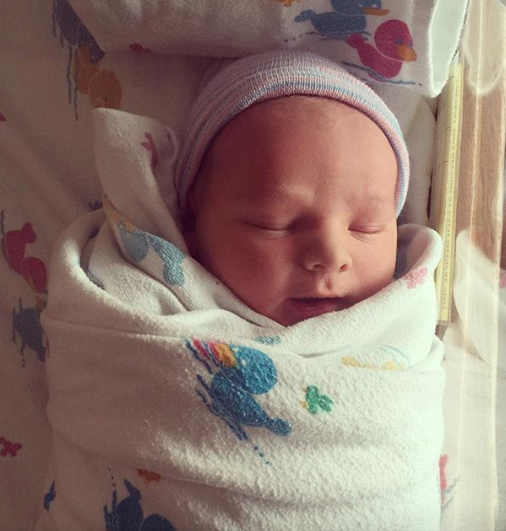
Kikkan Randall announced the birth of her son, Breck Stuart Randall Ellis, born April 14th, 2016. (Photo: Instagram @kikkanimal)
Randall also felt that pregnancy is handled fairly within the International Ski Federation (FIS) in terms of her ability to preserve her World Cup starts after a year away from racing.
“When you let FIS know that you’re going to be missing a season, they put it into the same category as if you were injured,” Randall explained, “which some people really take offense to because they say ‘Pregnancy isn’t an injury.’ But that was just a technicality, basically, what they do is allow you to freeze your points so that when you come back, there is a slight penalty for not having raced the previous year, but you don’t have to start from zero again which is really nice. So I was pretty happy with that process; it was really easy to just let them know, and then my points were frozen and when I came back, things got restarted again, so that was really good.”
Randall gave birth to her son, Breck Stuart Randall Ellis, on April 14th of 2016. Because Randall possesses a genetic blood clotting factor, she had been on a blood thinner throughout her pregnancy as a precaution. In order to keep her labor and delivery a bit more controlled, the doctors advised her to be induced when she reached full term at 39 weeks.
“They had done a procedure in the office the day before, so by the time I got to the hospital and they hooked me up to the monitors, I was already having super mild contractions, which I couldn’t quite even feel yet,” said Randall.
“They started me on one unit of Pitocin over half an hour… that got things going real quick!” she laughed. “It kind of skipped the slow build up stage and I went into having contractions every 90 seconds pretty intense and that was making me throw up, which was causing more contractions. So I battled through that for a couple of hours, trying all of the various techniques and everything.
“Then the doctors checked me and I hadn’t made a single millimeter of progress,” she continued. “Basically, because it was so intense, I was kind of fighting myself. So after a few hours of that without making any progress, we started talking about an epidural, because my doctor really thought that would just help me relax. And at that point, I was pretty open to the idea. So I got an epidural, and then for the next few hours, I was able to sleep a bit and that did allow me to relax, so the next time she checked I was ready to go.”
From there, Randall’s delivery went smoothly. Breck entered the world at a whopping 8lbs 11oz, 21 inches in length.
“I had a great team,” Randall concluded. “My husband was there, I had a midwife and my doctor, and some great nurses involved. So, yeah, at 7:47 – we didn’t know what we were having, so it was a fun surprise, and the rest is history!”
Stay tuned for part two in which Kikkan shares her return to training after pregnancy, traveling on the world cup with Breck, and how parenting has changed since she retired and has been undergoing treatment for breast cancer.
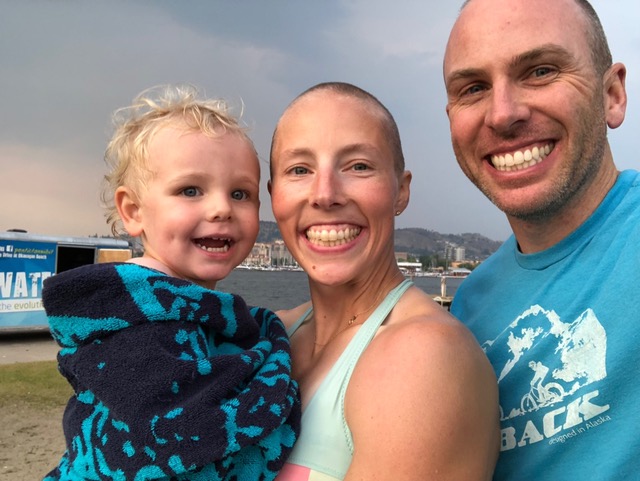
Kikkan Randall (c) with her son, Breck, and husband, Jeff Ellis, in Penticton, British Columbia. (Courtesy photo)
Day by day. That’s how Kikkan Randall is approaching her battle with breast cancer after being diagnosed about three months ago. Now more than 50 days into her treatment — with six rounds of chemotherapy over an 18-week span — Randall, 35, is becoming more familiar with the ugly side effects and adjusting to her new normal.
While beating what is believed to be Stage 2 cancer remains the Olympic gold medalist’s biggest challenge yet, it’s not dampening her spirits — even on the extremely rough days, of which there have been many.
After Round 2 of chemo, Randall returned to her family in their new home of Penticton, British Columbia, where she quickly came down with a nasty cold. That cold required a visit to a local clinic and antibiotics, and Randall now wears a mask on airplanes to fend off germs while flying to and from her cancer treatments in Anchorage, Alaska.
“Getting the head cold on top of going through the worst days of the chemo cycle has definitely been one of the most uncomfortable weeks of my life,” Randall explained in an email to FasterSkier. “It’s mostly because I have no control and I have no idea how well my immune system can clear the cold. Normally I would be optimistic that it would just be a tough couple of days but now I just have to wait and wait.”
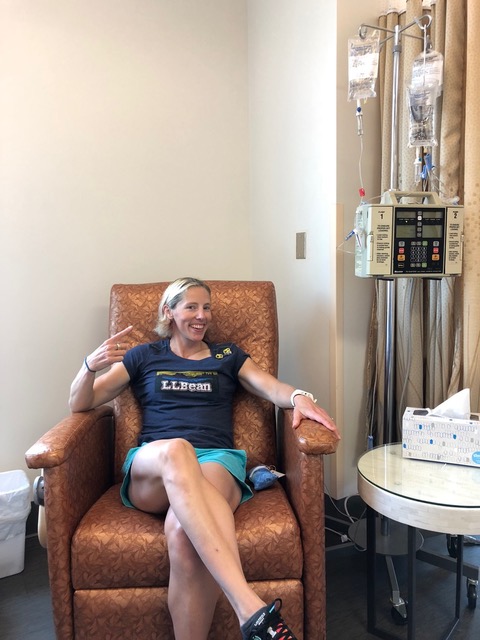
Kikkan Randall during her first chemotherapy infusion at the Providence Alaska Medical Center on July 9 in Anchorage. (Courtesy photo)
She eventually kicked the cold and got her voice back, just in time for Round 3 of chemo on Aug. 22. After what she called a “quick 36-hour trip to Anchorage,” she was back in Penticton on Aug. 23. So far, Randall explained on her daily video blogs that her current three-week round is going better than the previous two.
“Just getting used to my haircut … got a nice little fuzz growing on top,” she said in her Day 51 video posted last Wednesday, just over a month after she shaved her head for the first time.
“Definitely giving me a greater appreciation for all the guys out there and gals that deal with this,” she continued with a smile. “But I have to say it is pretty low maintenance so I guess I should just embrace it.”
Two weeks after receiving her first chemo infusion in July, Randall noticed she was losing her hair in clumps. She promptly went wig shopping with friends and scheduled an appointment with her hairdresser in Anchorage to get ahead of the hair loss.
Randall spoke with FasterSkier on the phone from Anchorage on July 26, the day after she initially asked her hairdresser to shave it all off.
“I sat in the chair and she said, ‘Are you ready?’ and I said, ‘Let’s do it,’ ” Randall recalled. “Three minutes later, I had a buzz cut, and I think I actually handled it better than I thought I would. It was kind of interesting to watch it, to feel it, and to be like, OK, now we’ve got that taken care of. Now we can move onto the next step.”
The next step and every passing day has proved to be an unknown. Oncologists never know exactly how a patient will react to treatment, as “everybody seems to react differently,” Randall explained.
“But in a lot of cases what you experience the first round is what you will generally feel like over the next subsequent rounds,” she continued. “Some of it will be a little bit cumulative, like the fatigue I’m sure will add up a little bit, but I also really think that staying active through this as much as I can will really help. I’ve noticed already that even on days where I don’t feel very good, if I get out and do something, it at least keeps my mind off of how bad I feel and I think it helps me process everything better, both physically and mentally.”
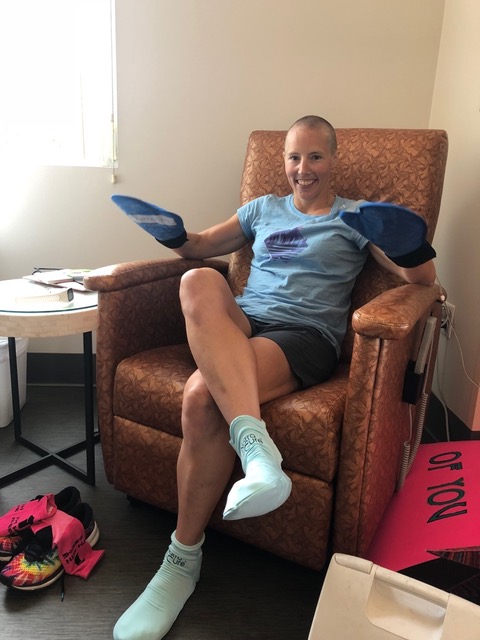
Kikkan Randall wearing ice mittens and socks to prevent neuropathy during a chemo infusion at the Providence Alaska Medical Center in Anchorage. (Courtesy photo)
As she approaches the halfway point of her chemo treatment — the first proactive step to eradicate the cancer (which was initially found in her breast and one lymph node), Randall has continued to make an effort to get outside and moving every day. Some days, that’s as much as a run with former training buddies or even intervals, and other days, it’s about playing with her 2-year-old son, Breck.
Ever since announcing her diagnosis on social media, Randall has been promoting AKTIV Against Cancer, a Norwegian nonprofit that she became involved with six or seven years ago without having any direct ties to cancer. According to Randall, the organization funds research on how physical activity can affect cancer treatment and creates supportive environments for patients to work out together, both in and out of the hospital.
“It falls along with what I believe is that physical activity is pretty much good for everything, so I was happy to support them as an athlete, but now that I actually have cancer myself, I have a little deeper connection,” she said. “I’ve committed personally to staying as active as I can through this, but I think in partnering with them, we can share the message on a bigger platform, and I’m looking forward to learning more about the research that they’ve done and also to continue to fundraise and promote awareness for getting other hospitals to have these places and rooms and programs that encourage cancer patients to be active.”
“I’ve committed personally to staying as active as I can through this…” — Kikkan Randall, on her cancer diagnosis
Randall continues to ride her bike to and from the Providence Alaska Medical Center in Anchorage. During a recent layover, she worked out in a Vancouver gym. And early in the treatment, she asked if she could use a stationary bike or treadmill during the several-hour-long infusions. While her oncologist and nurses ultimately encouraged her not to (“the nurses felt it would be hard to keep an eye on me for any reactions I might have to the medication”), the bottom line is: Randall is still plugging away at a rate that would put most people to shame.
After her last round of chemo in mid November, she’s hoping tests will reveal that her tumor has shrunk or disappeared altogether. That would make surgery “more straightforward”, she explained, yet she’ll still have to decide which type of surgery to undergo. Her options range from a lumpectomy (removal of the tumor and some surrounding tissue) to a unilateral or bilateral mastectomy (removal of one or both breasts).
“If you do the double [mastectomy], the idea is you’re taking out the most breast tissue as possible, which is where a second breast cancer would most likely come back so it gives you a slightly better piece of mind,” Randall explained. “You don’t have to be screened quite as much after the fact because there isn’t breast tissue for it to come back to, and then from there, you can decide whether you go the double route and wear prosthetics or whether you go a reconstruction route … so there’s a lot to consider between now and then between what I want to do for maintaining the lifestyle and all the activities I want to do.”
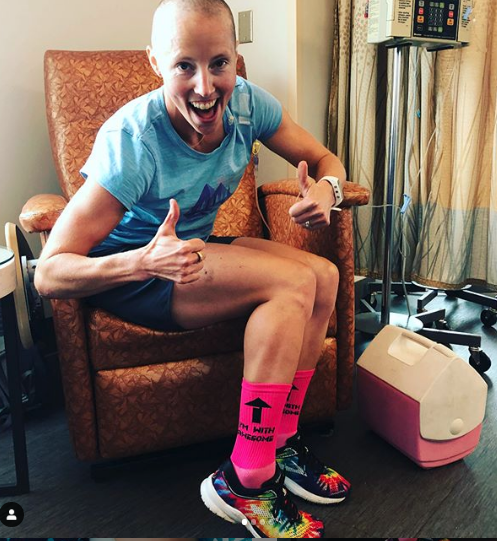
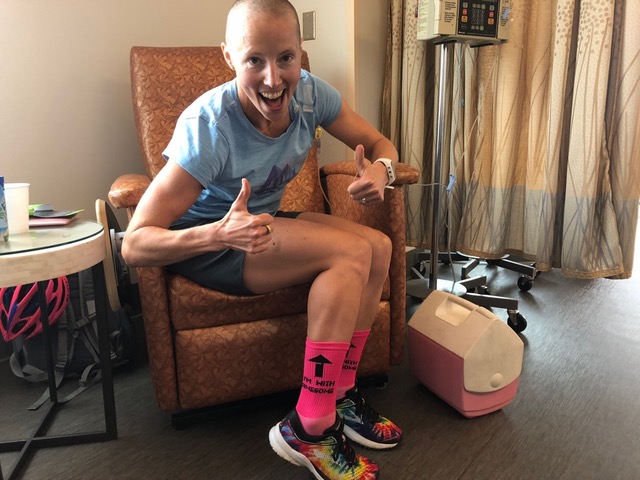
Kikkan Randall staying positive with pink socks and rainbow shoes during her second round of chemotherapy on July 31 at the Providence Alaska Medical Center in Anchorage. (Courtesy photo)
Through all of this, she’s learned that her tumor responds to estrogen, progesterone and HER2 (human epidermal growth factor receptor 2)/neu protein, and is initially being treated with two chemo drugs to specifically target the HER2/neu. That should help stop the growth of the tumor, and after chemo, Randall will start taking anti-estrogen and anti-progesterone meds.
Leading up to all of this, she and her husband had been hoping to expand their family.
“We were just starting to try for kid number two and definitely excited to have more kids so finding out about this thing, the diagnosis, and then knowing I needed to start chemo pretty soon, we didn’t have much of a window to work with,” she explained of her diagnosis in early June.
Later that month, before starting chemo in July, she sought fertility treatment in Seattle. There, Randall received a round of injections to stimulate egg production in her ovaries. That produced one embryo, which is being preserved in case the cancer treatment makes pregnancy difficult later on.
“There’s no guarantee that the chemo will knock out my natural fertility, but it’s nice to know that there’s at least a small chance for the future,” Randall said. “It’s going to be challenging because the type of breast cancer that I have, I will have to be on some anti-estrogen and anti-hormone treatment for probably five to ten years even after the chemo and everything is done, so that’s going to be a little bit tricky to figure out a pregnancy in there, but at least we kind of have a backup plan.”
While Randall repeats her multiple-leg commute between Penticton and Anchorage (a 1- to 1.5-hour drive from Penticton to Kelowna, B.C., followed by a two-stop, roughly 4.5-hour flight to Anchorage) every three weeks, she’s also staying involved in several work engagements, including with Fast and Female and as a new board member of the National Nordic Foundation.
“Everyone’s been so supportive, like the IOC, the USOC [U.S. Olympic Committee], they’ve been telling me to take as much time to make my health the number-one concern, and the same with Fast and Female, we wanted to get some stuff going this summer and fall and we’ve just had to postpone it a little bit,” she said in July. “The door’s open if I have the energy to work on some of that stuff, but if I can’t, I have the time to just focus on recovery. … And then the period after surgery is kind of up in the air in terms of what I’ll be able to do. I’m just trying to be creative; I’m hoping to be able to do stuff, maybe not as much in person but maybe I can contribute to things, whether it’s writing or interviews or projects. I’m just going to ride it out and see where it goes.”
Back in Penticton, her husband, Jeff Ellis, has been “doing the single dad thing”, as Randall put it, while she’s away for treatment. As she retired from racing this spring, Ellis transitioned from his marketing job with the International Ski Federation to sales and marketing with Swagman bike racks. He initially took some time off from Swagman when Randall was first diagnosed before deciding to leave his job and be home full time.
“Ultimately when Jeff said, ‘Hey, this has put things into perspective for us. I need to be home to help Kikkan out,’ they were definitely very understanding of that,” Randall said of Swagman.
Ellis recently started his own business as an independent marketing contractor, called the Jeffrey MW Ellis Group.
“He’s actually helping me with the ‘Kikkan Brand’ while I’m going through treatment and he’s picked up a few more small clients as well,” Randall explained.
Asked why she went public with the diagnosis in early July and what’s driven her daily video updates every day since, Randall said she never could have kept it private.
“I’m not very good at faking things, so I knew once I showed up in Anchorage when I wasn’t supposed to be here, people would start to ask questions and wonder what was going on and I was going to have to start bowing out of things,” she said. “I also felt like, especially Anchorage, especially Alaska, but really just so many people have supported me through my career and they really care what’s going on. So I kind of felt like they’d want to know what was going on with me. It’s always good to celebrate the good things, but I think it’s also important to share the really human moments, and I thought it was really good to show that you could be an Olympic gold medalist and four months later find out you have breast cancer.
“I think it’s important for a lot of people out there that are battling through this, it makes them feel like, this happens to all of us,” she continued. “I learned 10 years ago when I shared my story about blood clots that it helped people. … I kind of felt like, if me going through this can have a positive impact by sharing my story, then I’m happy to do so. I don’t feel like there’s anything I need to hide; I’m willing to share this.”
“It’s always good to celebrate the good things, but I think it’s also important to share the really human moments. … You could be an Olympic gold medalist and four months later find out you have breast cancer.”
One of Randall’s sponsors started a GoFundMe online fundraiser to help with some of her out-of-pocket medical and travel costs, and in a little over a month, it had generated more than $37,000 dollars toward a $45,000 goal. According to the site, any funds that exceed the associated expenses of Randall and her family will be donated to AKTIV Against Cancer.
“It’s been amazing,” Randall said of the community support in light of her diagnosis. “I got to come back after winning the gold medal, and of course I feel like our profile was higher than it had ever been — people were so excited and wishing me congratulations everywhere I went, but this has blown that out of the water. So many people have reached out, whether it’s over social media or messages through my website or cards arriving in the mail, people stopping me in the grocery store, they’re sharing their stories. Breast cancer’s way bigger of a deal than I ever appreciated.
“My traditional income as a ski racer was coming to an end anyway and I was going to be relying on being able to travel and do speaking engagements and things like that for some projects over the next year, and I won’t be able to do that now,” she said of the fundraiser. “It’s hard to put into words, but I just feel so supported. I’ve been reading through all those messages on the tough days and then trying to reach out to as many people as I can to say thanks.
“It’s unfortunate that it takes a situation like this to be able to appreciate the amount of people that do support me in that way,” Randall added. “But like I said, I’m blown away, I’m so grateful for it and it’s definitely going to help me through this.”
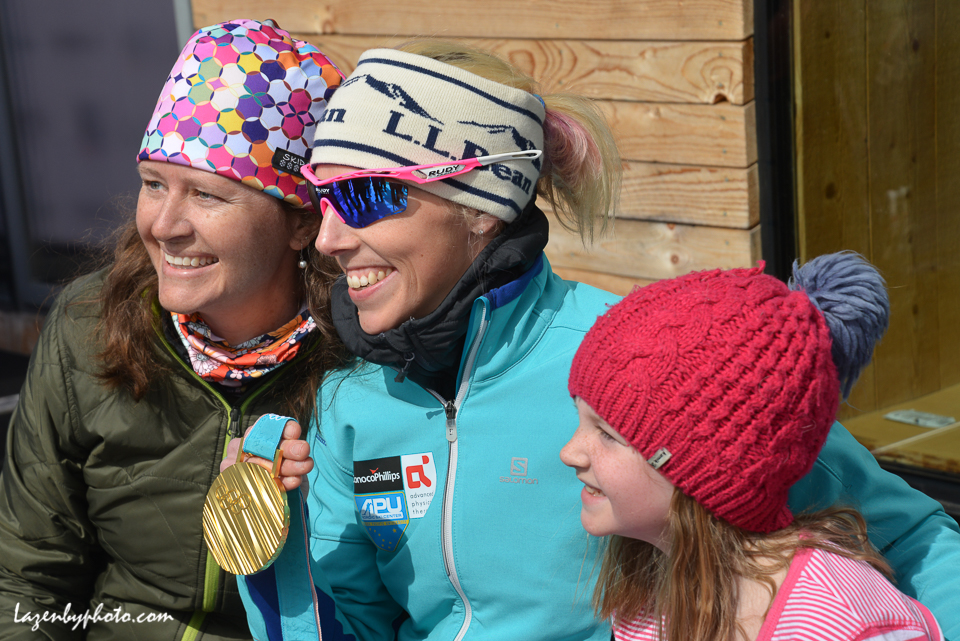
Kikkan Randall (c) with young fans and her Olympic gold medal after the 10 k freestyle mass start at 2018 SuperTour Finals in Craftsbury, Vt., this past March. (Photo: John Lazenby/Lazenbyphoto.com)
On Wednesday, Kikkan Randall went public with the news that she was recently diagnosed with breast cancer.
“Although we caught it early and the prognosis is good, my life will change quite a bit in the coming months,” she wrote on Facebook.
Randall received her first round of chemotherapy on Monday at the Providence Alaska Medical Center in Anchorage, Alaska, the city where she grew up. After winning Olympic gold in February with U.S. teammate Jessie Diggins then retiring from the U.S. Cross Country Ski Team this spring, she and her husband, Jeff Ellis, and their 2-year-old son, Breck, moved to Penticton, British Columbia. Jeff had a new job, and they hoped to expand their family there, according to the Anchorage Daily News (ADN).
As she spoke with the ADN inside her parents’ Anchorage home on Wednesday, shortly after announcing her diagnosis on social media, Randall, a 35-year-old three-time World Championships medalist, three-time Sprint World Cup champ and 13-time World Cup race winner, remained optimistic. While doctors won’t know the scope of the cancer until they operate, they believe its in an early stage, Stage 2, she said.
The ADN reported that Randall will have six rounds of chemotherapy with one infusion every three weeks. She rode her bike to the hospital on Monday wearing her rainbow-colored “happy shoes” and is hoping she can use a treadmill or stationary bike during future infusions, which take hours. She already emailed her oncologist to see if that was permissible.
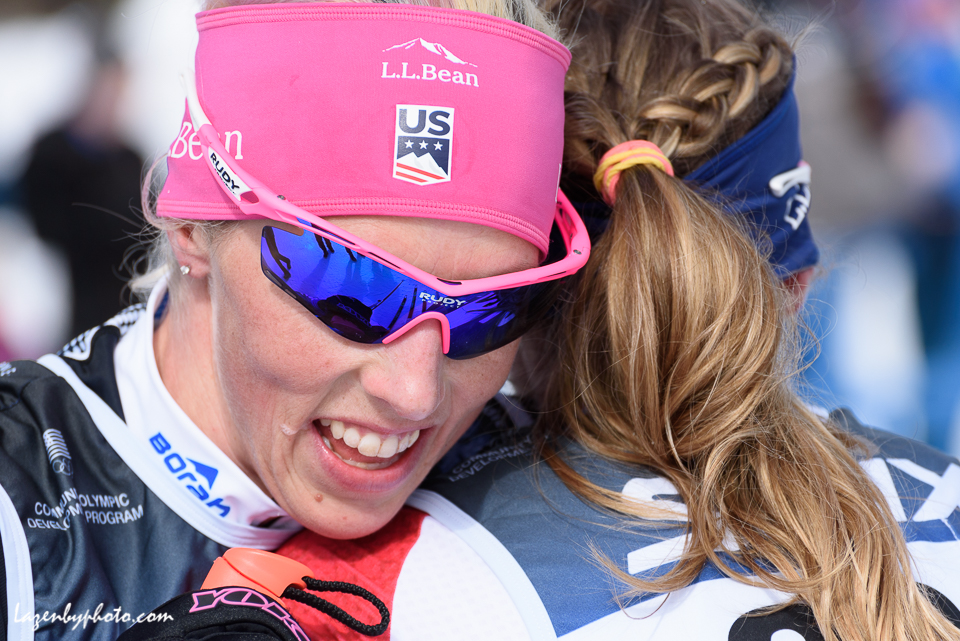
Kikkan Randall (l) and Jessie Diggins embrace after the finish of the women’s 10 k freestyle mass start on March 24 at 2018 SuperTour Finals in Craftsbury, Vt. Diggins won and Randall placed third. That was Randall’s second-to-last race before retiring from skiing. (Photo: John Lazenby/Lazenbyphoto.com)
“I haven’t heard anything back yet but if they’re open to it, I’d be willing to try it,” Randall told the ADN.
After chemo, she’ll have surgery, but Randall was unclear what that would entail. It could be anything from a lumpectomy to a double mastectomy.
In her interview with the ADN, Randall explained that she doesn’t have a family of breast cancer. Between chemo sessions, she’s hoping to return to her new home in B.C.
Since discovering two pea-sized lumps on her breast on Mother’s Day, May 13, Randall underwent a mammogram, an ultrasound and a biopsy, then received the news that she had cancer while in Sweden for a wedding less than a month later. In that time, she told the ADN she’s felt everything from “denial and disbelief and frustration, but I always come back to the same skills I’ve used in my athletic career,” she said. “I need to focus on what I can control. I need to be positive and optimistic.”
“… It’s so surreal for me because I just won a gold medal four months ago and I just was feeling on top of the world,” she said. “Life is going to kind of forever change.”
Kikkan Randall after placing third in the freestyle sprint at 2017 World Championships. (Photo: Fischer/NordicFocus)
Randall is widely recognized for her trademark pink hair, a color she wrote “has taken a on new chapter in my life” and one she plans to keep throughout treatment, even in the form of wigs. Randall has been involved in breast cancer awareness projects in the past, but previously used her pink locks to attract attention to her sport. Then pink became her good-luck charm.
Looking forward, she’s already coined a term for herself post-treatment: “Kikkan 2.0”.
“I’ll take this on like I have taken on anything else,” she told the ADN. “I think Kikkan 2.0 could be pretty awesome.”
She noted on social media that she’ll be using her blog, Kikkan.com, to provide updates during her “upcoming journey,” as she put it.
(Update: On Thursday, Randall’s friends started an online fundraiser to help with her medical costs. As of Friday, they had raised nearly $17,000 toward a $45,000 goal. For more information, visit www.gofundme.com/support-kikkan039s-fight)
Kikkan Randall explores new rollerski terrain in Penticton, B.C., earlier this month, following her family’s move to Canada. (Photo: Kikkan Randall/Instagram)
As discussed last week in Part I of this interview, Kikkan Randall’s first-ever FIS race (that is, a race sanctioned by the International Ski Federation) occurred at U.S. nationals at Soldier Hollow in January 2000. Randall was 17 years old, the single youngest finisher in the race. Other athletes had been born in the 1960s and are now at least 48 years old. Randall raced in a first-generation Gold 2002 training suit for the fledgling Alaska Pacific University (APU) ski program. Every skier in the race had a FIS number starting with a 1.
Fast-forward 18 years and nearly 600 FIS races later. Randall’s final FIS race was the 30-kilometer classic mass start at 2018 Spring Series this past March in Craftsbury, Vermont. She crossed the finish line in third, leading out a four-racer chase pack to claim the final podium spot in the final race of her career. She followed U.S. Ski Team (USST) teammate Jessie Diggins and USST and APU teammate Sadie Bjornsen, who took first and second in a tight finish.
Randall was the oldest skier in the race by five years. She was the only athlete whose FIS number started with a 1; everyone else’s FIS number began with a 3. Earlier that week Randall’s competitors in the 10 k freestyle included Anchorage junior Molly Gellert (23rd overall), who had not yet been born when Randall did her first FIS race.
And even among the 30 k podium finishers, Diggins famously got Randall’s signature on a piece of cardboard at 2008 Junior Nationals in Anchorage, after Randall had run out of posters to sign before Diggins got to the front of the line. Bjornsen likewise looked up to Randall as a junior skier, then moved to Alaska to train with her at APU. Randall’s been doing this for a long time.
And when it was over, and when Randall had crossed her final finish line, she stood on the podium in a bespoke pink USA/APU suit, and sprayed champagne over her teammates. The next morning, she woke up as something other than a professional skier for the first time in nearly 20 years. She celebrated by leading a Fast and Female session in the area a few days later.
And, perhaps most significantly of all, she inspired an ice-cream flavor in her honor. Gold & Glory debuted at Anchorage microcreamery Wild Scoops in early April, in advance of a “Welcome Home Olympians” celebration in nearby Town Square. The concoction involved “a sweet cream base with homemade GOLDen Graham toffee crunchies + pink strawberry sauce streaks,” store owner Elissa Brown explained on Instagram. “Topped with pink sprinkles and ‘gold medals’ while supplies last.”
The ice-cream honor was the only thing in a month of awards and media attention that threatened to make the preternaturally poised Randall lose her focus. “Wow,” said a clearly surprised Randall upon being asked by a FasterSkier reporter about the significance of having an ice-cream flavor named for her. “That’s quite an honor. I do love ice cream; I’ll have to go check that out.”
Gold & Glory Kikkan Randall commemorative ice cream at Wild Scoops microcreamery in Anchorage, Alaska. (Photo: Julie Kentch)
Later that afternoon, Randall headlined the Welcome Home celebration for 16 local Olympians and Paralympians who had competed this year in PyeongChang. (Thanks to Paralympic alpine skier Andrew Kurka and his PyeongChang gold and silver, there were a healthy three Olympic medals in attendance. Another dozen or so local former Olympians joined the crowd, including skiers Nina Kemppel and Adam Verrier.)
Randall rode in on a pink fire truck. She joined the cheerleaders from her high school alma mater, East Anchorage High School, in dancing to the school fight song. She accepted the Skis To The City from Anchorage Mayor Ethan Berkowitz, then sprayed a pink streak in Hizzoner’s hair. She listened as Alaska’s senior senator, Lisa Murkowski, praised the accomplishments of all the Olympians and told them that Alaska was proud of them.
Finally, Randall took the microphone and addressed a crowd of hundreds filling Town Square on a blustery, raw, sub-freezing April afternoon. Hordes of local junior skiers clambered on to the snowbanks immediately in front of the stage to gaze up at her, Anchorage Junior Nordic hats on their heads and rapt admiration in their eyes.
“This is so amazing for us,” Randall said, “to come back to Alaska, finally, after a long and hard season traveling the world, to come back and get to celebrate with all of you guys that have been such an important part of making this gold medal and this Olympic team happen. We couldn’t be more proud to represent the state of Alaska.”
She praised the support of the community and of her teammates, and detailed all the contributions from others that had made success possible.
Randall ended her remarks by forecasting a bright future for American skiing: “It’s been a fairytale ending to an amazing journey. And now that my career’s coming to a close, I can’t wait to see what this next generation is going to do. Because they know it’s possible, we know we have the community and the support system to make it happen, and they’re going to take this far beyond. This may be the first medal in women’s cross-country, but it’s not going to be the last.”
So that’s what’s next for U.S. skiing, but what’s next for Randall? Part II of this interview answers those questions.
Note: The following story is based on an in-person interview with Randall in late April. FasterSkier’s narrative is in bold; everything else is a direct quote from Randall.
So, what comes next? Randall largely answered this question last fall; go back and review the second half of this FasterSkier article for the full version of this answer.
The short version is that she’s going to serve on the International Olympic Committee (IOC) Athletes’ Commission, take on a larger role with Fast and Female, and finish up her MBA through Alaska Pacific University (the school, not the ski team). Oh, and by the way, along with husband Jeff Ellis, parent their son, Breck Stuart Randall Ellis, while settling into the family’s new home in Penticton, British Columbia. And maybe it’d be nice to earn a living, too.
Randall is asked whether the preview version of her new career, as written out last fall, is still accurate. Here’s what she had to say:
Yes. That’s still the tentative plan.
The gold medal, of course, has opened up some new opportunities to do some more motivational speaking, which I really enjoy doing, and would love to have a couple opportunities nationally a month to do that.
So that’s one part adding to the mix, and then the IOC role has turned out to be a little more than I knew I was getting into. I didn’t realize I would be on the USOC [United States Olympic Committee] Board of Directors, and so actively involved with other groups that kind of funnel into the IOC. So figuring out how to manage the time commitment there, given that it’s all volunteer.
And my source of income, which has been racing, is now shifting, so figuring out how to do all these things that I’m passionate about, and I love, and I want to contribute to, but still be able to provide for my family.
… And then realizing there’s only 24 hours in a day, and I want to be a good mom, and I want to be physically active, and still see my husband, and do all these other things. So it’s going to be – after the last 20 years being pretty darn predictable, it’s now a whole new scheduling challenge and energy-management challenge. But, there are so many good things to look forward to, that I think will help me transition out and give me really good focus, new passions.
I’ve heard that some athletes really struggle after they retire because you are so passionate about your sport, and it gives you so much structure and daily accomplishment, that when you don’t have that anymore, you can really just kind of go into a mental tailspin. So having these great things already lined up that are going to be really engaging and fun to work on I think will be really helpful.
Randall may be understating things somewhat when she talks about the structure and daily accomplishment of being a full-time athlete; she has trained twice a day, 48 weeks a year, for most of the past 20 years, and duly recorded every workout. That’s a lot of daily structure.
But there is also a certain broader rhythm to the seasons that attaches to this lifestyle – starting up training again in May, volume in June, intensity in the fall, and so on. Randall is asked, in an interview conducted in late April, what it is going to feel like to not be beginning a new training year next week on May 1, or to spend a complete summer uninterrupted by training blocks on Eagle Glacier, or to spend mid-November somewhere other than far northern Scandinavia for pre-World Cup races. Randall is quick to acknowledge the magnitude of the change, while still concluding that it’s time to move on.
You know, I’ve been surprised at how quickly I’m starting to realize that it’s gonna feel pretty weird. I did my last race, just coming up on the one-month mark, and, while I’ve been excited to finish a great career, to be able to now go and do new opportunities and things, it is kind of settling in, the fact that I won’t have the excuse to go out and train twice a day, and do all these exercises. And most importantly, that I won’t be meeting up with my teammates, who have really just become such close friends, and coaches and everything.
So I know it’s going to be a pretty dramatic stretch, and April has been kind of a free pass, in that it’s always kind of the time of year when we are flexible. It’s felt pretty normal so far, but as next week starts, and summer drags on, I’m sure it’s going to be pretty strange.
But all good things come to an end, and I think it’s still the right time to transition out, so it just gives me a greater appreciation for what I’ve been able to do, and recognizing what parts of that life I want to continue forward – you know, I want to stay active and fit, and it’s just going to be a new challenge of how to figure out how to do that, while balancing everything else.
That challenge, for an elite athlete, often involves coming to grips with the fact that they still love moving and being outside, yet by definition will spend the rest of their life older and slower than when training was their full-time job.
Two models for how to negotiate this post-career period (which, it should be noted, represents multiple decades and the majority of one’s life) are suggested, the Adam Verrier model and the Nina Kemppel model, corresponding to two local former Olympians.
Briefly put, Verrier moved to Anchorage after his college ski career ended, qualified for the 1994 Olympics, then stayed in Anchorage and basically never stopped racing. He has won nearly every notable trail race in southcentral Alaska, and placed on the podium of the 50 k Tour of Anchorage, the unofficial citizens race championship for the state of Alaska, eight times between 1995 and 2007, including three victories.
Kemppel, by contrast, raced in four Olympics from 1992–2002, then ultimately returned to Anchorage after earning an MBA outside of Alaska. She has lived here for years, and presumably remains quite active, but does not seem to have entered an official running or skiing race since returning to Anchorage. “I’ve become more and more of a weekend warrior because of my job,” Kemppel told the Anchorage Daily News in a 2012 article noting her return home.
Randall is asked with which pole of post-career racing she envisions being more closely aligned.
I probably hope for something in between. I am already recognizing that with family commitments and some of the – I mean, the gold medal changed the reality a lot, in terms of what opportunities are available, and my position with the IOC is going to be very busy. So while I love the idea of just staying super-fit and doing all that, it’s going to be a challenge to be able to do that. But I also love being able to be active every single day, so I hope to be able to build that into my new life.
As far as racing goes, I don’t have any real plans in the near future. I’ve always been interested in trying some mountain biking stuff, and I think it’d be cool to dabble with some new sports. There’s a big triathlon community down in B.C. where we’re going to be, so maybe that’s something to get into. [Randall has at least one victory and four runner-up finishes in Anchorage’s Gold Nugget Triathlon, one of the largest and longest-running women’s-only triathlons in the country.] Having races in the future is a good motivation for just making sure you get out the door every day, and you have a plan of what you’re working towards. So I like that idea, but I don’t need to necessarily keep racing at a high level all the time.
And ski racing-wise, it would be fun to do some events I’ve never done, like the Birkie and stuff, but I don’t know at what level I’ll be racing.
But I do really enjoy racing, I love the opportunity to just get out there with everybody, put the bib on, and go push yourself, so I think I’ll continue to do some of it.
[Randall has often spoken of shifting into a race gear or finishing gear when she is racing well, or of being unable to make that shift when she is not. She is asked what it’s going to be like, two months or two years from now, when she’s at the point in a race when all of her training and experience tell her that it’s time to make that shift, but her body won’t let her do what her mind wants to.]
I’m sure that’s going to be tough. Thankfully the number of years I’ve been competing, I think I do have a nice window of time where that’s not going to just disappear overnight. But I can tell already, in the last month where I haven’t done a whole lot, and all of a sudden jumping into doing things a little harder again, it’s like, Whoa, what are you doing? So yeah, I’m sure it’s going to be tough to not be as fit as I would have been in the last 20 years… but that’s just the way it goes.
That world-class fitness was not easily won. Over the course of her career, Randall increased her annual training hours consistently and substantially, from roughly 300 in high school to nearly 800 by the height of her career, adding in intensity along the way. “You hadn’t trained hard enough if you hadn’t started crying,” Randall once told Outside Magazine of 2008, “the year of intensity.” (It is worth noting that 2008 also saw Randall undergo two surgeries for the blood clot that nearly killed her. But they were both in April, so presumably she didn’t miss too much training. She would win her first World Championships medal, Liberec, Czech Republic, in February 2009.)
But when asked what she won’t miss about this lifestyle, the first thing Randall mentions is not the staggeringly difficult Level 4 bounding workouts, but rather the simple quotidian drudgery of preparing for and completing two workouts a day, every day, over and over and over again.
I think always having to do two workouts a day. Over the last couple of years, especially once we had Breck, it was hard at times, to just go, I’ve got to change my outfit again, I’ve got to go out there, maybe the weather’s not great, and I know I’ve got two hours to log. And just putting in the amount of time out there – it got tough. So some of that part I won’t miss, just having to do it all the time.
Having the time open and available for new things now, not having to just constantly change outfits – into training clothes, out of training clothes. And traveling with so much gear. It’s just been nice to do a couple trips now where I just pack a couple things, and off you go, not have to drag a ski bag all around the world.
The APU men pushing each other during a workout at an Eagle Glacier training camp, July 2015. (Photo: Zuzanna Rogers)
Going up on the glacier was always – it was such a great training environment, and it was such an amazing resource to have, but you could never really appreciate it in the moment when you’re up there. When you’re on Day 2, and you’re staring down five more days of just what you know is going to be a lot of hard training, and just knowing you have nowhere to go, you’re stuck up there, you’re away from your family. And so, I won’t miss, again, just having to do that … at the same time, I think I’m quickly going to miss the opportunity where I got to do that.
So it all comes into perspective: When you’re in the midst of it, you can’t wait to be done with it and not have to do it anymore, but then quickly you realize, like, what a cool opportunity it was.
Now that Randall is no longer in the midst of it, she has one heck of a formidable resource: 20 years’ worth of training logs and data. And she has saved all of it, too, starting with a log provided by her high school coach, Harry Johnson, at the East High Cross-Country Team, and continuing through to more recent versions contained in an array of spreadsheets.
Unsurprisingly for an athlete who has spent much of her career raising others up along with her, Randall is decidedly magnanimous when asked what she plans to do with all this training data.
Erik [Flora] has all my logs, so he has all that data, and he’s of course free to use it however he sees fit. The U.S. Ski Team also has all my logs. I know they’ve already integrated a lot of stuff into their planning for the development pipeline, and kind of what we’ve learned.
So yeah, it’s all open and available to those guys to use because I hope that my career can help just make the road better for the next group coming through. Because I learned a lot off of what people before me did, and what worked for them and what didn’t work for them, and then we kind of progressed that forward. And I think already we’ve been able to create a totally better training environment than when I even started. So keep pushing it forward, and I’m glad that that information’s out there.
And it’s pretty fun to be able to get to the end of it now, and look back over the progression and the work, and what went well, what didn’t, and all that stuff.
And I’m so glad that I recorded all that, because part of my log, too, is comments on training every day, and that in a sense is a diary for me, because I haven’t really recorded that anywhere else. And now that my career spans so long, it’s so nice to be able to go back and read through that, and realize what was going on in my life day-to-day, through all the years and the training. And it also helped my relationship with my coaches, to best understand what was going on with me, and to be able to adapt the training around that.
While presumably no athlete has ever said that the physical hardware itself was the point or the telos – as opposed to the hard work that went into winning a race, the pride of accomplishment, the friendships made along the way, etc. – the fact remains that Randall’s personal trophy case is extensive. There’s an Olympic gold medal, for one. But also three World Championships medals. And three Sprint Cup Crystal Globes. And a medal for third overall in the 2012/2013 World Cup standings. And 29 World Cup podium medals.
Randall is asked where all these awards currently are, and what she plans to do with them.
I’d love to find ways to get it out there. It’s been so fun, just carrying around the gold medal already, sharing it with everybody; it’s something for people to see, to look at. One of my crystal globes is at the L.L.Bean store in a case, so that’s already kind of being shared. The other two right now are just kind of sitting at home in their carrying cases. And I’m not sure exactly where my World Championships medals are; they’re packed somewhere in the move. But it would be fun to, I think, have some displays out, share it around.
Kikkan Randall with her third consecutive Sprint World Cup Crystal Globe, 2014. (Photo: Fischer/Nordic Focus)
Because, now that we’re kind of starting fresh with the new home in B.C., and as Breck grows up, and Jeff has some incredible accomplishments of his own, I would love our family space to be a little bit about our future, and not so much about my past in particular. So if I can get my awards in places that can inspire others, and people can share that piece of history, I think that would be better than just having it at my home somewhere.
I’d love to see something here at APU, to really celebrate the connection of what we do with the ski team, so that everyone knows about it, gets to feel a part of it. And then the Alaska Sports Hall of Fame, of course, at the airport is a pretty cool demonstration, and who knows where else in town we can have some sort of display maybe. Anchorage certainly deserves a lot of the credit for this.
As Randall observed, her focus in life is currently on the future of her family. But it’s worth noting that her husband, Jeff Ellis, was no athletic slouch himself; he was a World Cup skier for Canada who scored a podium in an Alpen Cup race as well as multiple podia in NorAm races. All of which begs the question, what will Randall and Ellis do when an 8-year-old Breck tells them he wants to do a local running race, or an 11-year-old Breck announces he wants to join a junior ski team?
I would like to follow a lot of the lead that my parents had for me, in that they really felt like they wanted to let me direct the choices. And so when I got interested in something, and wanted to do it, I was welcome to try it.
And then the rule was, once I signed up for something, I was committed to that for at least that season. And a lot of times, I would get excited, sign up for something, and then get into a few days of practice and go, ‘Yeah, I don’t think I want to do this.’ But my parents were like, ‘No, you committed to it, so you’re going to see it through to the end of the season. And then once the season is over, if you want to move on to something else, you’re more than welcome.’
So I think I’d like to follow a similar thing with Breck – introduce him to some things that, you know, both Jeff and I are interested in, because we’d love to let him have a similar experience, but let him guide it. If he’s interested, he can keep doing it; if not, he can move on to something else, and just kind of learn that, once you commit to something, you’ve got to see it through.
And then we’ll just see where it goes from there. I hope to be supportive of whatever direction he takes, and if he gets excited about competitive things and training and wanting to take that route, just support him along the way. So we’ll see.
And finally, the woman who was, famously, the only mom on Team USA at PyeongChang (less fun fact: it was ultimately too expensive for Randall and Ellis to bring Breck to South Korea with them, and he spent the Games with his grandparents in Canada), who nursed an infant from birth through the first month of the 2016/2017 World Cup season and who spent two winters traveling through Europe with a child and a ton of baby gear in tow, is asked how much 2-year-old Breck understands about Mommy’s job.
I think the coolest part right now is, because he’s not necessarily going to be aware of the specifics of what I do, he’s just been around it. He enjoys watching people ski by, he wants to put on skis himself and try it. He’s just kind of being unconsciously subjected to the lifestyle and the people, and that’s been really fun.
And the night before the team sprint, I was Facetiming with him – he was back in Canada with Jeff’s parents – and I said, you know, “Tomorrow Mommy’s got a big race at the Olympics, do you have anything to say?” And he just said, “Gooooooooo!”
And I think he was saying “go,” because my mother-in-law has coached him a little bit to say “Go go Mommy!” So he was kind of saying “go,” but at the same time it almost sounded like, “Gooooooold!”
And last year at World Championships, when he was just 10 months old, he was playing with the bronze medal, and then this year I gave him the gold medal, and he actually kind of looked at, and then he just dropped it and walked away. And since then he’s seen it around a lot, so he’s getting a little bit more interested in it … but he won’t realize what it is for a while, but I think it will be really cool to show him that he was a part of it, and it will be interesting to see what his take on it is later on.
I know that Kateřina Neumannová – I thought it was such a cool moment, and I was there in Torino when she won the 30 k, and her two-year-old daughter came running out to the finish area. I just always loved the image of that.
So a couple years ago, when I first got my pink Kikkan poles, she got in touch and said, “Kikkan, I need a pair of your poles.”
I’m like, Kateřina Neumannová’s getting in touch with me? Like, ‘Whoa, you’re my hero.’ And she’s like, ‘My daughter just absolutely thinks you are amazing, you are her favorite racer, and if I can get a pair of your poles for her birthday, she’s trying to decide between tennis and ski racing right now, and I’m hoping she’ll choose skiing, hoping that this will help.’
And I was like, ‘But does your daughter know who you are? And she’s like, Yeah, it’s kind of a she could care less who I am kind of thing, I’m just her mom.’
[Randall sent the poles to Neumannová. They were appreciated:]
https://www.instagram.com/p/zo3zfijSt7/
So it will be funny to see what Breck’s reaction is to it all. I think it’s cool that he got to be a part of it, and we’ll get to show him the pictures and everything. But what he’s going to really grow up with is knowing me as his mom, beyond the career. So the focus gets to be on our family and on him.
* * *
Disclosure: The author is an Alaska Pacific University masters skier who grew up doing Anchorage youth sports in the same generation as Randall; they skied together in Anchorage Junior Nordic in the early 1990s.
U.S. Ski Team members Jessie Diggins (l) and Kikkan Randall hold the American flag during a victory “lap” down the homestretch after placing second and third, respectively, in the women’s freestyle sprint at 2017 Nordic World Championships in Lahti, Finland. (Photo: John Lazenby/Lazenbyphoto.com)
ANCHORAGE, Alaska — Kikkan Randall is approaching a season full of lasts: her final season as a full-time athlete, her final season on the World Cup, and, she hopes, her fifth and final Olympics. Her main focus these days is resolutely on the future, but she took some time earlier this month to speak with FasterSkier about her summer training and what comes next.
Summer training
Randall’s final summer of training was anchored by the same thing as most of the 17 summers before it: multiple weeklong training camps on Eagle Glacier, the Alaska Pacific University (APU) facility in the Chugach Mountains above Girdwood, Alaska. But this summer saw Randall take only two trips to the glacier, instead of the three camps attended by most of the APU team.
In place of a third glacier camp, Randall traded a short helicopter ride for a long plane flight and traveled to Sweden for a 12-day training camp with the Swedish national team. It was Randall, fellow U.S. Ski Team (USST) member Liz Stephen, and 10 women from the Swedish team, Randall explained in a phone interview.
https://www.instagram.com/p/BXk2D1rj0W2/
Randall began her trip with three days in Östersund, Sweden, with Anna Haag and Stephen, who was coming from the Blink rollerski festival in Gjesdal and Sandnes, Norway. Then came three days in Åre with the full Swedish national team, as well as USST Women’s Coach Matt Whitcomb. The remaining days of camp were spent with the full Swedish team near Vålådalen. The whole thing made for a “really sweet” 12-day training block, Randall recalled.
American skiers were hardly receiving invitations to train with Scandinavian national teams at the start of Randall’s career, but such exchange programs are now relatively commonplace. This was not Randall or Stephen’s first such trip to Sweden, and Jessie Diggins joined the Norwegian national team for a camp last summer.
“I think it’s also a strong testament to our nation, and our program as a good partner to Norway as well,” Whitcomb previously said about the invitation, as well as speaking highly of both Diggins and the Norwegians.
“We’re all training at a high level now,” Randall says when asked whether she sees similarities or differences between American and Swedish training. “We’re all doing very similar types of training, loads of training.”
But even if the training quality and quantity are comparable, the logistics are different, reflecting the simple fact that the U.S. is more than 20 times larger than Sweden, with top-level skiers spread out across five time zones and thousands of miles.
“The real difference for me and what stands out is just the lifestyle of it,” Randall reflects, “and how the Scandinavians never have to travel more than three or four hours away from home. They get together for camps once every three weeks. They’re in camp but they’re these shorter camps and then they go home. Whereas for us, we have the geographical challenges of so much more travel, that when we get together, we have to get together for longer to make it worthwhile, but that of course changes the exact kind of training we can do within a camp, so that part’s varied a little bit.”
The difference isn’t just academic, but rather bears on the type of training that can be done in a group environment. “This camp we went to was an aggressive training schedule,” Randall notes, “and I don’t think it would be smart to necessarily take that schedule and bring it back to the U.S. and replicate it because just the way we live is a little different.”
https://www.instagram.com/p/BXay55rD8oi/
Randall found a valuable training stimulus from the camp, and appreciated the chance to “rub elbows with those guys, be like, OK, I may train a little differently, but I’m on track, versus having to wait seven months between race seasons and not knowing where the heck you are.”
But even more than the reality check on training and fitness, she says that it helps to have local friends in Europe when the Americans are on the road and living out of a suitcase for four months at a stretch.
“I think the biggest benefit” of this offseason training exchange “is that we get to know them as people,” Randall notes. “When we’re on the World Cup, then all of a sudden we have these friends on other teams. If we do need a weekend off and want to go to a home, we can go home with them and get a little break or we see them and we go out for jogs together. It’s pretty cool because I’ve developed lifelong friends now and I look forward to continuing to visit beyond just these training years. I think that shared experience is what really makes it special to me.”
The final World Cup season and the Olympics
It’s tough for any American skier to spend that long away from home. But Randall, with husband Jeff Ellis and support from family members on both sides, is upping the logistical ante by bringing along a toddler. The couple’s son, Breck Stuart Randall Ellis, turns 18 months old next month, and will be spending his second winter on the World Cup circuit.
“Our plan is to pack up early November and head over as a family,” Randall says of their approach for the 2017/2018 season. “We’ve got most of the winter figured out. We’ve got a few more apartment-style accommodations lined up this year. We know with a busy year-and-a-half-year-old, it’s going to be a little harder to contain him in a hotel room. We’re trying to set up the best kind of situation for our family.”
https://www.instagram.com/p/BMy2IR8A_q3/
Randall and Ellis have most of the winter already dialed in, but there’s still one large hole left in their schedule: PyeongChang. “The challenge we’re really wrestling with right now is with what to do about the Olympics,” Randall notes.
Randall is certain that she wants to have her child with her in South Korea if at all possible. “Ideally I’d have Breck at the Olympics,” she says.
Looking back to the 2017 World Championships, Randall says, “I think that was a really positive force having him with me at Lahti, but it’s looking to be exorbitantly expensive to be able to have him in South Korea nearby. We’re looking for accommodations, figuring out can we possibly afford this, and if not, what are some other options? We don’t have a clear answer on that one yet. Outside of that we’re looking forward to a totally fun winter altogether.”
It’s no secret to any parent that traveling with kids is tough. Alaska parents arguably learn this as well as anyone, just because it’s so darn far to travel anywhere from The Last Frontier. (Figure three hours’ flying time from Anchorage to Seattle alone, in the shortest flight that most Alaska kids ever take. And forget driving; that’s a 2,400-mile roadtrip.) It’s tempting to think that a four- or five-time Olympian would have an easier time of things, but Randall recounts challenges and choices that are relatable to any parent.
“It’s an interesting dilemma,” Randall analyzes, “just thinking about it from all sides, because on one hand, it was my choice to have a baby and with that comes different logistical challenges than when you don’t have children. At the same time, I am a strong contributing member of this team, I hope I can contribute to some Olympic medals, and for me to perform at my best, like I said, it was always a really positive influence to have Breck around while I was competing at the World Championships. It would be awesome if I could be able to have him there with me so that I could be in the right state of mind and perform really well. It’s, ‘Do I need to shoulder all the cost myself or can I get some support from the [United States Olympic Committee] or from the U.S. Ski Team?’ At this point it’s going to be fairly challenging to make it happen on our own.”
Complicating matters for anyone who hopes to stay outside of official athlete housing, as of this spring the PyeongChang area was reportedly facing a severe shortage of Olympic accommodations. These problems had not been alleviated as of earlier this month.
Skiing and parenting
Randall speaks candidly about the tradeoffs of doing her job effectively versus being available to her child, a balancing act instantly familiar to any parent. Breck was not with her in Sweden for last month’s 12-day training camp; Randall and Ellis “felt like that wasn’t a super-long stint,” and Breck was able to stay with Ellis and grandparents in Canada while Randall focused on training in Sweden. Randall was also solo at spring camp in Bend (also 12 days), and at each of the two Eagle Glacier camps (6–7 days each).
https://www.instagram.com/p/BY4X5ePHdm9/
“It has actually been a pretty challenging summer,” Randall notes. “I’ve had to be away from him a lot more than I had to be last year. I think I’m willing to do this now because I know it’s my last season. I can’t imagine doing it really any longer.”
She continues, “I’m glad he’ll be with me most of the winter and in Park City [at a USST training camp next month], because it’s getting tougher and tougher to be away, even though it’s nice for training and recovery and sleep and rest. I definitely miss him.”
If athletic training is, generally, a balancing act, then training while parenting is a balancing act while riding a unicycle backwards and juggling flaming knives. If those knives could at any moment start having a meltdown because they couldn’t find their preferred socks or a favorite toy. (Good thing Randall knows how to ride a unicycle.) Choosing between having your child be with you or with a supportive spouse is one such tradeoff. Choosing between more effective recovery and more effective parenting is another such tradeoff, one that Randall has to negotiate at least twice a day as a parent and an athlete.
“The hardest part for me,” Randall analyzes, “is when I’m tired and I come home [from training] and I know that the most productive thing for me is to recover, take a nap, get some time off my feet, to make the next workout effective and do my job, in a sense. But I also have this little boy who wants my attention and I love spending time with him, and it’s been a challenge this summer to navigate that and find a happy medium. I think some days I end up being more of a mom and some days I can, with the support of my husband and my parents, I can be a focused athlete.”
Randall and Ellis have made it work for a year, but Randall doesn’t want to have to make those choices much longer. “Like I said, I can wrap my mind around doing this one more year to make a final push at this Olympics, but that’s why I can’t think about doing it any longer, because I want to be able to not have that dilemma anymore.”
https://www.instagram.com/p/BHGIHlggsXM/
(Randall perceptively acknowledges that this dilemma never really goes away: “I know that while I look forward to not having the restrictions of a ski racer’s life for my family next year, I know that there’ll be, getting back to a more normal life of a job and wanting to fit in training and family and how all that’s going to work. I think it’s an issue a lot of parents face.”)
After PyeongChang
Randall remains committed to her goals for this season, and is working hard to achieve them. But she has also begun to think about what happens next.
So what to do following a nearly two-decade career as a professional athlete? Get involved in athlete representation, of course.
Randall is one of six athletes currently running for two open spots on the International Olympic Committee (IOC) Athletes’ Commission, a representative body established in 1981 for the purpose of representing athletes and their concerns within the IOC context. The commission’s mission is “to ensure that the athletes’ viewpoint remains at the heart of the Olympic Movement decisions,” says its website.
Elections will be held in February 2018 during the Olympics.
Randall has spent many years as a cross-country representative to the FIS Athletes’ Commission, which plays a comparable role relative to the International Ski Federation (FIS), but has not previously served on the IOC commission.
“Why do you want to do this?” Randall is asked.
“That’s a good question,” she replies. “Because it is an eight-year commitment. … I definitely asked myself if I want to go from being committed to a ski racer’s life, finally be retired from competition, and then go right into another eight-year commitment, but I really have enjoyed the athlete representation work I’ve done over the last eight years. I think to take that experience and expand it to the IOC level would just be really interesting.”
Randall has a politician’s poise as she explains why she wants to continue her involvement with the Olympics: “I think now is a great time to get involved and help strengthen the Olympic movement, get it back to a point where it’s being a good force in the world, because I want to see the Olympics still be important for my children, still be important for your children,” she tells a FasterSkier reporter who is also a parent. “I don’t want to see the Olympics go away. I’m hoping I can blend my experience having been an athlete at four Olympics, hopefully number five coming up, and then also having worked on the other side, representing the athletes, being in the business side of the sport, and I just think it would be a really cool way to stay involved.”
But she also seems authentically committed when she talks about the potential of the Olympics as a force for good.
“Bringing the world together every two years for an Olympic Games just creates so much goodwill amongst our global community and it inspires everybody to really find the best in themselves in a fair and clean way, which I think is really good for humanity.”
Norway’s Astrid Uhrenholdt Jacobsen, another candidate for the IOC Athletes’ Commission, racing to bronze during the women’s 10 k classic at the 2017 Nordic World Championships in Lahti, Finland. (Photo: John Lazenby/Lazenbyphoto.com)
As noted, there are six Winter Olympics athletes in the running for two open spots on the Athletes’ Commission. The other five candidates are Spanish skeleton racer Ander Mirambell, Finnish hockey player Emma Terho, Chinese long-track speedskater Zhang Hong, Italian luger Armin (“Il Cannibale”) Zöggeler, and Norwegian cross-country skier Astrid Uhrenholdt Jacobsen.
Randall does not reject a suggestion that the presence of both her and Jacobsen could to some extent split the “Nordic vote.”
“By having two cross-country skiers in the mix, it does have the potential to dilute the vote,” she notes. But she continues, “I think you can also look at it as we now have two ponies in the race. Both of us in the election and there’s probably a better chance that a cross-country athlete will make it to the IOC Commission. That’s good odds.”
Randall is quick to call Jacobsen, with whom she has previously trained on Eagle Glacier as an invited guest of the North American Women’s Training Alliance, an “accomplished person,” who “put a lot of thought into taking on this role.” But she diplomatically notes that Jacobsen “is coming from one side of getting involved in the athlete representation side, at least in an international way, for the first time. I’m coming from the side where I’ve been involved. It’ll just be interesting where people land on who they want to put forward.”
What comes next: Retirement and Canada
First things first, Randall officially plans to retire after this season. “I haven’t done an official press release,” she notes, “but I’ve definitely talked about it to plenty of people. Most people know that’s my plan.”
That leaves Randall and her family (Ellis has spent the past five years working as marketing support manager for the World Cup, but would presumably no longer want to spend all winter in Europe without his wife and son) needing jobs, and a place to do them.
What she’ll be doing next year is “also a very good question,” Randall says. “We’ve been talking about that as a family for a while.”
Randall notes that Ellis “has been very supportive,” pointing out that he moved to Alaska 10 years ago for her sake and has supported her once he retired from his own ski career. “We’ve always talked about once I retire from skiing to be open to chasing some career opportunities for him,” Randall notes. “He’s Canadian; maybe that meant moving to Canada and experiencing that for a while.”
The couple were exploring their options this spring when “an opportunity fell into our lap”: Ellis was invited to apply for a job with Swagman, a bike rack company based in Penctiton, British Columbia, about a four-hour drive east of Vancouver.
“It was total long shot because they were looking to fill the position in April of this year,” Randall notes. But Ellis applied anyway, “just to see what would happen.” He got the job. They were willing to hold it open for him for roughly a year, till April 2018, if he would be willing to move there. Penctiton it is for the Randall–Ellis family.
(Ellis was born in Orangeville, Ontario, and is a Canadian citizen. As the child of an American and a Canadian, Breck has dual citizenship. Randall is working on the immigration paperwork to gain legal residency in Canada as the spouse of a Canadian national.)
While Ellis works for Swagman, as well as parenting, Randall will be pursuing at least two other projects, as well as parenting.
Kikkan Randall (left) and former Canadian national team member Chandra Crawford (32) leading the Fast and Female forerunners before the classic sprint at Stage 5 of the 2016 Ski Tour Canada in Canmore, Alberta. (Photo: Fischer/NordicFocus)
For one, she wants to be able to devote more attention to Fast and Female, a nonprofit sports advocacy group that, its website explains, aims at “keeping girls healthy, happy and active in sports through their teens by introducing them to inspiring athlete role models.” (You may have seen one of their Champ Chats in a ski community near you, particularly if you are the parent of a preteen or young teenager girl.) Randall is the U.S. leader of an international organization that was founded by Canadian skier Chandra Crawford in 2005.
“We’ve kept the U.S. side in a maintenance mode for the last few years,” Randall notes of Fast and Female, “since my time’s been limited, but since now that I can work on it more full time, I look forward to helping grow the U.S. organization maybe to the level that they’ve been operating in Canada. That’s a project on the horizon, depending on how this IOC athletes’ election goes. Should I get that position, that’s going to be a commitment. I want to be able to be flexible around that.”
And for another, she plans to finally get that degree. Randall graduated summa cum laude from East Anchorage High School in 2001 [around the time of the below throwback photo], then has been working on her undergraduate degree in business from Alaska Pacific University (the school, not the ski team) ever since.
https://www.instagram.com/p/BDtGVFmDSqk/
Randall has three classes left at this point. She plans to combine that with a flexible MBA program that recognizes the value of work experience, and to graduate from APU, with both a bachelor’s and a master’s degree in hand, by 2019.
Randall will attend the APU classes through a mix of online learning and intensive class blocks held in Anchorage. She looks forward to staying involved with the Anchorage and APU ski communities, and hopes that the MBA program “kind of creates a blend, allows me to move on to our next step … but also keeps me connected” with Anchorage as she goes through this period of transition.
Looking back and looking ahead (mostly just ahead)
But Randall has a lot of things to get through first in the next six months: her last Park City camp, her last World Cup season opener, (presumably) her last Olympics, her last World Cup race, and so on.
She’s spending much more energy these days training hard than stopping and reflecting, though the significance of some of these “lasts” isn’t lost on her. “I’ve got big goals I’m working towards this year,” she says. “I have my head down a lot of the time working toward that. Though when I was leaving the glacier, knowing it was the last camp, it hit me a little bit.”
But then she adds, “I really do want to take this year in, enjoy it, of course, leave everything I have on the table. I think I have a good perspective now. I got a little practice run the year I was pregnant because I stepped away from the racing season and I got to really appreciate what I love about racing and about training and about my team. This last two years, I think it’s given me the perspective to slow down a little bit and enjoy it because it will be over before we know it.”
Bottom line, Randall says, “Everything I love to do I get to do one more time, and everything that has been hard and maybe I don’t love doing, I only have to do it one more time.”
Randall made this final comment while driving back from the day’s first workout on a blustery and raw Tuesday in September. She made no mention of the weather, but it was a day when the first big fall storm of the season was rolling out of the Gulf of Alaska; a cold rain fell all day, temperatures stayed in the 40s, and the local paper warned of winds gusting to 45 miles per hour, nearly twice that in the mountains. Going back to her freshman year of high school, Randall has trained through the last 21 Alaska autumns.
Kikkan Randall relaxing with her son, Breck. (Courtesy photo)
Welcome to “17 Questions for 2017″, where we are catching up with American and Canadian national-team members before the beginning of the winter season.
***
2013 World Champion Kikkan Randall took last season off from the World Cup circuit and in April had her first child, a son named Breck with husband, Jeff Ellis. Since then she has been getting back to training and is looking for a successful return to the sport’s highest level, where she won the Sprint World Cup three times.
“I know there’s parts that are going to be really challenging, just getting back into shape and trying to still be able to handle that high load with this new lifestyle, but on the other hand, I feel refreshed,” she told FasterSkier in May. “My body is refreshed from a little break, my mind is refreshed and that could open totally new doors.”
Randall is back to training with the APU team — frequently alongside Sadie Bjornsen — and at camps with the U.S. Ski Team. Randall reportedly won the team’s sprint time trial in Park City last weekend.
1. Biggest change in your life in the last five or so months since the ski season ended?
Hmm, let me think about that, A BABY BOY!!!!
2. Biggest change in your training?
For the first time in a long, long time, I have had to build my training from the ground up after Breck’s birth. I’ve added one mode of training at a time and then gradually built up the volume and intensity. It’s been a gradual progression over six months to get back close to normal.
3. Major areas of improvement you’ve seen so far?
APU training mates, l-r: Chelsea Holmes, Kikkan Randall, Rosie Brennan, Rosie Frankowski, and Becca Rorabaugh. (Photo: Kikkan Randall)
My aerobic capacity feels really strong from all the distance and threshold training I’ve done over the past year.
4. Whom you’ve been working closest with this offseason (coaches or training partners)?
It’s been really fun and invigorating to be back with both of my teams, the APU team and the US Ski Team. I’ve been working daily with my coach of 10 years, Erik Flora, as well as great support from the National Team coaches and always insightful advice from my husband Jeff 🙂
5. Best trip in the last five months (and why)?
Visiting my husband’s parents in Collingwood, Ontario, this summer. My sister-in-law had a baby boy last summer and it was the first time the cousins got to meet. We got some nice chill time at the lake and some great miles on the road bike. So great to see the family growing.
6. Favorite cross-training?
I did a lot on my mountain bike early in the summer to get my body reacquainted with training. It was fun to do some longer rides and epic climbs!
7. Favorite non-athletic activity or pastime this summer?
Playing with my son! I can’t believe how much fun I’m having just watching and holding him. The time is already going by too fast!
8. Song that was your jam this summer?
“Can’t Stop the Feeling” – Justin Timberlake
Jessie Diggins and Kikkan Randall, World Champions in the 2013 Team Sprint.
9. All-time favorite race moment?
Crossing the finish line in Val di Fiemme World Championship Team Sprint and celebrating with Jessie [Diggins] and the Team!
10. First thing you pack in your bag when you leave for Europe?
Aeropress coffee maker!
11. Venue/event you’re most excited to visit this season?
Excited to get back to Davos (one of my euro favs) and also excited to see the new venue in Ulricehamm, Sweden.
12. Who will win the World Cup title this year?
I’d love to see Ingvild Flugstad [Østberg] continue building on her success from last year and put a strong sprinter on the top of the World Cup!
13. Biggest sacrifice you feel you’ve made choosing this career path?
The limitations my schedule puts on my family in terms of a daily schedule (not many late nights) and hard to attend weddings, family vacations, etc.
14. If you could change one thing about your sport, what would it be?
Kikkan Randall with her son, Breck, and family on a vacation in Ontario. (Courtesy photo)
I wish skis were less of a make or break. It’s always tough when you feel you have all the training and capacity to make a big result and then the skis just aren’t competitive. It’s rare when that happens but it can be a real bummer!
15. What did you have for breakfast this morning?
A big egg scramble with Canadian bacon, peppers, onions, mushrooms, spinach and cheddar cheese. Complemented with cinnamon sugar toast!
16. In 5 years, I’ll be ____?
A family woman making my way through a totally new phase in my life, discovering my next challenge and passion beyond ski racing and hopefully inspiring others to live healthy active lifestyles!
17. In 50 years, I’ll be ____?
Energetic, active and chasing my grandkids around!
“We’ve really lucked out and had an early warm spring,” she said in early May. “All the trails have dried out already … the leaves are green and the air temperatures has been great so wonderful time of year to get out for lots of walks, which I’m so grateful for.” (Courtesy photo)
“I feel so light and happy these days,” she posted on Instagram, with the hashtag, “#Breckreation” (Courtesy photo)
(Courtesy photo)
(Courtesy photo)
“Breck is an official Healthy Futures ambassadors with me now, helping inspire kids to ‘Get out and Play. Everyday!’ ” Randall wrote. (Courtesy photo)
June 1. That’s the date Kikkan Randall’s had in her head for a while now, and it has nothing to do with a milestone or a checkup involving her first child.
That’s when she’s getting back at it.
“I know I’m not going to be able to jump right in cold turkey to what I’ve been doing in the past so it’s going to be a gradual build,” Randall said on the phone from Anchorage, Alaska, earlier this month, about three and a half weeks after baby Breck was born.
“Just talking with Erik [Flora], my coach, we’ve been trying to set it up so there’s different little stages to clear before moving onto the next thing,” she explained. “First building up the volume and then adding the intensity as each intensity feels good and then hopefully be a kind of normal training rhythm by the end of July into August.”
Normally when she’s home for the summer, Randall, a four-time Olympian and three-time overall Sprint World Cup champion, trains with her team, Alaska Pacific University (APU), about four times a week. The rest of the week she trains solo or in small groups, and this summer, she plans to do a little of all of the above.
With her coach, Randall has formulated a plan that works for her, her husband, Jeff Ellis, and most of all, Breck.
“This first time at home has been so wonderful, just to have no schedule and spend some time getting to know Breck and be here for him,” she said. “That’s been great, but I also know that I miss training so it’ll be nice to have a blend where, it’s not like I have to disappear off to work for 8 to 10 hours and then miss him all day. I can go out and do my work and come back and be with him and then go out and do it again.”
For the coming 2016/2017 race season, the 33-year-old Randall, who has been competing at the sport’s highest level since she was 19, plans to spend the entire winter in Europe on the World Cup circuit. That will involve traveling with Breck, her parents and in-laws at times, and eventually an au pair. Jeff will be there, too, as he works for the International Ski Federation (FIS) Cross Country marketing support.
“We’re going to rely on our parents a little bit, they’re going to come over in intervals on certain weekends and periods and then there’s going to be a point in the middle of the season where we’d like to find a European-based nanny to help out,” Randall said.
Kikkan Randall and her U.S. Ski Team teammates and coaches after she won her third-straight Sprint World Cup Crystal Globe at the end of the 2013/2014 season. (Photo: Fischer/Nordic Focus)
With the challenges of coordinating caregivers comes the cost of traveling with at least one extra person, like a nanny, on the circuit. While Randall retained her spot on the U.S. Ski Team’s A-team based on her FIS world ranking and Red Group status from two seasons ago and could potentially have much of her room-and-board costs covered by FIS, she anticipated the need to make different arrangements.
“While I want to be as much a part of the team as I can, I don’t want to be disruptive and I think living in a hotel room with a baby for a whole year would be challenging,” she said.
For the holiday break in late December, Randall and her husband reserved a condo in Davos, Switzerland, for a more-homey alternative and they are hoping to find a similar setup in Sweden before World Championships in Lahti, Finland.
“We’ve started to formulate a plan, but we have a lot to learn, but we’re excited we get to bring [Breck] on this journey,” she said. “And our parents, we’re lucky that they’re able to assist and that’ll get us going, and we’ll learn the ropes as we go.”
It’s a Boy!
On April 14, after 13 1/2 hours of labor, Randall gave birth to her son, Breck Stuart Randall Ellis. The gender was a surprise, but they had a boy name ready.
A few years ago, Jeff did a mountain-bike race called the Breck Epic in Breckenridge, Colo.
“He came back with all this stuff, a T-shirt, a belt buckle and it said the name of the race on it and I thought, ‘Oh Breck, that sounds really cool! That could be a good name,’ ” Randall said. “So we just kind of had it tossed around for a while and when it came time to narrow it down, we just liked the sound of it. It’s kind of unique, but still simple.”
Breck’s middle name, Stuart, is his grandfather’s first name, dad’s middle name and great grandmother’s maiden name.
“It relates back to a royal clan in Scotland, apparently, so that’s got some fun family history,” Randall said.
His second middle name is Randall, and Ellis is his last name.
“The whole process has been so fun,” Randall reflected. “The pregnancy went great and toward the end, the anticipation was building and building, and we ended up inducing my labor so things progressed pretty quickly that day, so it was kind of fun to get to the point that we were pushing him out…”
(Ed. note: Fun and childbirth aren’t usually part of the same sentence, but we digress.)
“When he came out and he got put on my chest, that’s such a strong emotion at that point, it’s hard to put into words…,” she continued. “I kind of felt like it was the end of a ski race, particularly something like the Tour de Ski where it’s so hard and so painful and you’re pushing, but you just want to get to that finish line and then when you do it’s just like that bliss of laying in the snow, of course one hundred times greater, but kind of that similar feeling.”
So what’s harder — the hardest ski race she’s ever done or giving birth?
“It was a different kind of pain than I’ve ever experienced before,” Randall said of the latter. “I was curious to see how it would feel to the toughest race or VO2max test or tough intervals or something like that, but instead of being like a lactic-acid burning pain, it was almost like a flu, crampy kind of pain and I think the hardest part was just not knowing when it was going to end.”
It eventually did end and Breck, 8 pounds, 11 ounces, was born. Within two weeks he was back up and slightly heavier than his birthweight — thriving in his new world — and in the 90th percentile for length and 60th for weight.
“He’s a little string bean; he has big feet,” Randall said with a laugh. “He’s got a really good temperament, doesn’t get too fussy …He loves to be in the front carrier or the Chariot, that instantly puts him to sleep. I think he was used to riding along with me for the nine months.”
Now a month-and-a-half old, he’s up to 11 pounds and out of the newborn outfits and diapers.
“He’s awake a lot of the day now and even giving us some involuntary smiles,” she wrote in an email. “Can’t wait until the real ones start!!”
Six-Week Marker
This week, Randall goes in for her six-week checkup, at which point she’s hoping the doctor will give her the “all-clear.”
So far, she’s done some easy rollerskiing and biking the last three weeks, in addition to walking and “testing the waters” with the SkiErg.
“I feel like I’m healing up pretty well. I’ve been pleasantly surprised with how intact my abs feel and everything still feels like it has good tensions so I’m happy about that,” she explained. “… I’m trying to really keep this first six weeks as just an opportunity to heal and get my body ready to train, but just being careful so I don’t risk getting injured.”
Regardless of how anxious she is, Randall asked the doctor to give it to her straight and what the most conservative approach is to returning to physical activity.
“I have definitely been antsy and wanted to test things a little bit so it’s nice to have that voice in the back of my head that says, ‘No, just go on six weeks, be careful,’ ” she said. “I also have been in touch with Marit a little bit and she said to be cautious about coming back. She maybe feels like she pushed it a little bit.”
Three months after having her first child, Norwegian legend Marit Bjørgen injured her hip while jogging in March, having previously completed a 42-kilometer ski race. She and Randall have exchanged some text messages in the time since.
“I think you need to be cautious for caution’s sake,” Randall said. “But it’s so hard because you’ve essentially taken off a weight vest and you feel light.”
In terms of goals, Randall’s focused on getting in shape for the U.S. Ski Team (USST) camp in Anchorage in mid-July. She figured that would give her six weeks of training beforehand. That Eagle Glacier camp will likely be her first time on snow.
Randall with Breck in the front pack during a spring walk in Anchorage, Alaska. (Courtesy photo)
Beyond that, she plans to spend most of her summer and fall at home, with the exception of the USST October camp in Park City, Utah, and a trip north of Toronto to visit Jeff’s parents. Asked if she’ll take Breck along for some workouts (i.e. in one of her two Thule jogging strollers or in a front or back pack), Randall said she’d like to.
“I could get in some good workouts with him, which would be fun, and Jeff will be along as well so we can do it as a family, and then there will be some times when I can just get out the door and do a workout and get right back. I think it’ll be a nice balance,” she said. “I have a lot of really good training opportunities right out my door for times where I just really need to go get in a workout and be right back and hopefully I’ll be able to join in some team sessions with APU as well, but that will really depend on how [Breck] is adapting to the schedule. Hopefully I can get it in that way, but we’ll have to just wait and see.”
Come fall, she plans to start the season in Europe with the rest of the team on the World Cup in late November. Her goal is to be in top shape by February for World Championships.
“Other than that it’s going to be a lot of playing it by ear and seeing how my body responds to things,” she said.
After a year off and now a mother, will she be the same racer? Randall said she’s not sure.
“This is a big question mark right now. There were certainly days where I was training while pregnant and as we got toward the end it was getting harder and harder and I felt a little more disconnected from those days when I was in peak shape. I just started to feel like, ‘Woah, getting back to that level is going to be challenging and racing every weekend and every discipline is going to be hard,’ ” she reflected. “Then on the other hand, I hear these amazing stories of women who say they only got stronger when they came back, training with that weight vest for at least six months of the pregnancy, and those nice physiological adaptations that you have throughout the pregnancy and then of course the change of focus, the fact that you don’t take your training time for granted any more, you maximize the time you have and you have this other thing in your life that is so important that you don’t sweat the small stuff.”
Her friend and fellow Olympian James Southam told her that having a child gave him new motivation to do his best and set a good example.
“I’m really curious to see how it feels,” Randall said of racing. “I know there’s parts that are going to be really challenging, just getting back into shape and trying to still be able to handle that high load with this new lifestyle, but on the other hand, I feel refreshed. My body is refreshed from a little break, my mind is refreshed and that could open totally new doors.”
Randall’s not alone. Several other top World Cup women have also had their first children in the last year, including Finland’s Aino-Kaisa Saarinen (in early May), Slovenia’s Katja Višnar (last November) and Bjørgen (in December). FIS has taken notice and is initiating new rules that give caregivers (i.e. a nanny) World Cup accommodation travel rates and access to venues, according to Randall.
FIS Cross-Country Event Coordinator Sandra Spitz said she could not comment on the changes until after the FIS Congress in early June.
“I’m not really sure how to explain why this kind of [baby] boom hasn’t happened in the past,” Randall said. “This [past] year, it’s probably no coincidence that there was no major championship, if anyone had to miss a season this was the one to do it and you still have two years now leading into the Olympics. But we certainly had years like this in the past, so why now? I don’t really know how to explain that, but I think it is really cool, but I think it’s maybe becoming a little bit more acceptable. Maybe teams and sponsors are being a little bit more supportive so it’s not this scary unknown … There’s a support system for that.”
She’s hoping this group of women, all of which plan to continue competing, can prompt change and show that one can continue with their career after starting a family, rather than have to chose one over the other.
“I think [FIS is] recognizing, too, that it’s worth their while to keep the top athletes in the sport versus them leaving to have a family,” she added. “Any way you can encourage that is good for everybody.”
As she held Breck in her arms, he cooed and grunted; she laughed and reviewed the last few weeks.
“I don’t think I could’ve imagined just how happy and content I would be,” she said of motherhood. “When he’s just as cute as can be cuddled up, sleeping on my shoulder or when he’s just spit up for the third time and we’ve had to change his outfit and he’s spit up all over me, I seem to just really love every moment of it. And also how relaxed I’ve been able to be through it. I feel like I enjoy every moment and I’m just loving it.
“It’s so crazy how your life really does change in an instant,” she continued. “You go from being completely independent to now always having this responsibility, but suddenly I can’t imagine that that life would be satisfying anymore because it’s so fun.”
Sophie Caldwell (c) became the third U.S. woman to win a World Cup race on Tuesday at Stage 4 of the Tour de Ski in Oberstdorf, Germany. The U.S. Ski Team member won the classic sprint ahead of Norwegians Heidi Weng (l) and Ingvild Flugstad Østberg (r), the latter of which leads the Tour de Ski standings.
Note: This is an initial post about American Sophie Caldwell’s World Cup victory on Tuesday at the Tour de Ski in Obertsdorf, Germany. Stay tuned for more in-depth reports about the women’s and men’s classic sprints.
Correction: This article has been updated to reflect the fact that Caldwell became the third U.S. woman to win a World Cup. Alison Kiesel (formerly Owen-Spencer) won the inaugural women’s World Cup event in December 1978 at Mount Telemark in Wisconsin.
***
OBERSTDORF, Germany — Sophie Caldwell saw the opportunity in the final roller of a hill in the women’s 1.2-kilometer classic sprint final on Tuesday and she seized it, overtaking the last Norwegian in her sights and holding off Heidi Weng by one-tenth of a second to win Stage 4 of the Tour de Ski.
“It feels really good,” Caldwell, a 25-year-old member of the U.S. Ski Team, told FasterSkier in an in-person interview after the race. “It has been a while since I have been on the podium and that is the first sprint I have ever won. So I am psyched, I never thought it would come in a classic sprint so that was a pleasant surprise.”
A native of Peru, Vt., and daughter of the Stratton Mountain School’s nordic director Sverre Caldwell, Caldwell has been on the World Cup podium once before — in a freestyle sprint in March 2014 in Lahti, Finland. There, she placed third after teammate Kikkan Randall, who won, and Slovenia’s Katja Visnar in second. Two U.S. women had never before shared a World Cup podium.
On Tuesday, Caldwell continued to make U.S. history, becoming the third American woman, after Randall and Alison Kiesel, to win a World Cup race. Caldwell is also the first U.S. woman to win a World Cup classic sprint.
No stranger to sprint finals, she had reached the finals (thus placing in the top six) in two of the last three sprints (all of which were freestyle) before Tuesday. The only one she missed, she did so by just one place in seventh in Toblach, Italy. She has now placed in the top seven in four consecutive sprints.
“I knew I had some really good skis today and my strengths are usually tricky downhills because I didn’t like to snowplow and I don’t get freaked out by them,” Caldwell said of Tuesday’s classic sprint.
“I was probably the last person who woke up this morning and thought this would happen,” she told FIS media coordinator Jeff Ellis (Randall’s husband) in a post-race interview. “I’m thrilled.”
“We know Sophie is among the best downhill skiers in the world,” U.S. women’s coach Matt Whitcomb said. “These conditions today are like, growing up in New England, skiing through slob it’s no big deal. She got to the tops of climbs and attacked over them rather than backing off, and that was a big difference-maker today. But what really stood out was that she was climbing with the best of the world today.”
Caldwell stayed on her feet all day, even in the final when Sweden’s Ida Ingemarsdotter came close to nicked her skis. Ingemarsdotter began to snowplow on a washed-out descent, which caused problems in several heats — including those of Caldwell’s U.S. teammates Ida Sargent and Jessie Diggins. In the final, Caldwell scooted around the snowplowing Ingemarsdotter and moved into third behind Norway’s Ingvild Flugstad Østberg — the overall Tour de Ski leader — and Weng. She proceeded to pick both Norwegians off to take the win.
Earlier in the day, Sargent avoided a crash in the first women’s quarterfinal to place third in that heat. But finishing 10.36 seconds behind Østberg as the winner of that quarterfinal, Sargent did not advance to the semifinals.
Neither did Diggins, who got hung up in a snowplow snafu by Sweden’s Hanna Falk on that same downhill in the fourth quarterfinal. The back of Falk’s skis caught Diggins and both went down. Diggins finished fifth in that heat, 26.22 seconds behind Norway’s Therese Johaug, who won that quarterfinal. Falk crossed the line 50 seconds back in sixth.
At the end of the day, Sargent placed 15th and Diggins 21st. Also for the U.S., Rosie Brennan again narrowly missed qualifying in 35th, Sadie Bjornsen did not make the quarterfinals in 44th, along with Liz Stephen in 49th, and Caitlin Gregg in 53rd.
In terms of overall Tour standings after four of eight stages, Diggins ranks 10th (+4:33.4), Bjornsen slipped out of the top 10 to 13th (+4:53.7), Caldwell is up to 14th (+5:23.7), Stephen is 25th (+6:22.1), Caitlin Gregg 39th (+8:12.6), Brennan 42nd (+8:33.1), and Sargent 45th (+8:47.3).
Racing continues in Obertsdorf on Wednesday with the women’s 10 k classic mass start and men’s 15 k classic mass start.
“[I] plan on racing tomorrow as long as … I have had a bit of a race hack, so as long as that doesn’t get any worse,” Caldwell said.
(Her boyfriend Simi Hamilton had to skip Tuesday’s sprint and thus withdraw from the Tour due to illness.)
“I plan on racing tomorrow and then probably dropping out,” she continued. “There is a small chance I would do the 5 k in Toblach [Italy on Friday], but kind of taking it a day at a time. I won’t go past Toblach.”
Kikkan Randall running near Park City, Utah, earlier this week before she publicly announced she was pregnant with her first child. “Great to enjoy a few more sunny warm days as we count down to winter!” she wrote. (Photo: Kikkan Randall/Instagram)
For at least the last year and a half, Kikkan Randall has publicly noted her desire to start a family with her husband Jeff Ellis. Their dream became a reality approximately 13 weeks ago, when Randall became pregnant with their first child. She found out four weeks later, and just this week, Randall and Ellis announced via a U.S. Ski & Snowboard Association (USSA) press release that they were expecting in April 2016.
FasterSkier reporter Jason Albert spoke with Randall, 32, on Friday — a day after the news hit social and mainstream media.
(To listen to complete interview, click “play” arrow below.)
“It was really hard to keep the secret over the last few weeks, but we wanted to get through the first trimester…,” Randall explained.
Kikkan Randall and her husband Jeff Ellis recently announced they are expecting their first child in late April 2016. Randall, 32, will skip the 2015/2016 season, but plans to return for 2016/2017. (Photo: Sarah Brunson/USSA)
She waited until the U.S. Ski Team’s dryland camp in Park City, Utah, which started earlier this week, to tell her teammates.
“My husband and I baked a cake that was half blue and half pink, frosted it, and then wrote, ‘We’re expecting a baby’ on it,” Randall said. “At one of the team dinners we just nonchalantly put it out there and said, ‘Hey guys, there’s dessert for everybody,’ and let people wander over and see it and have that initial surprised reaction. … Once they saw it they immediately came over and gave us congratulatory hugs.
“The response has been amazing,” she added. “It’s incredible how fast word spreads through social media.”
While she’s experienced some nausea, Randall said she’s feeling pretty good and is still training with the team. She plans to scale back and will not race this season. Meanwhile, Ellis will continue to work for International Ski Federation (FIS) Cross Country, managing website content and social media while traveling to all the World Cup stops from late November through early March.
“Lucky for us our timing worked out so he should wrap up a little over a month before the due date,” Randall explained in an email.
“It’s pretty cool that you can continue your career and you can start a family,” she explained in the podcast, adding that she plans to race through the 2018 Olympics.
“I’m definitely motivated to go after medals one more time,” Randall said.
Kikkan Randall announced via social media on Thursday that she and her husband, Jeff Ellis, are expecting their first child in April 2016. (Photo: Kikkan Randall)
About the Author: New to the FasterSkier team,Jason Albert lives in Bend, Ore., and can often be seen chasing his two boys around town. He’s a self-proclaimed audio geek. That all started back in the early 1990s when he convinced a naive public radio editor he should report a story from Alaska’s, Ruth Gorge. Now, Jason’s common companion is his field-recording gear.
Kikkan Randall and her husband Jeff Ellis recently announced they are expecting their first child in April 2016. Randall, 32, will skip the 2015/2016 season, but plans to return for 2016/2017. (Photo: USSA)
PARK CITY, UT (Oct. 15, 2015) – World Champion cross country ski racer Kikkan Randall (Anchorage, AK) is planning to take a break from competition this season. Randall and husband Jeff Ellis announced to her teammates this week that they are expecting their first child in April. Randall will skip the upcoming season, but plans to come back strong for the World Championship year in 2016-17 and keep her eyes focused on the 2018 Olympics in PyeongChang.
Kikkan Randall racing last season at the final World Cup classic sprint in Drammen, Norway. Randall, 32, will miss the 2015/2016 season as she is expecting her first child. (Photo: Fischer/NordicFocus)
Randall, 32, who has also won three season-long World Cup sprint titles, was glowing with the news as she talked to teammates gathered in Park City for the Team’s final pre-season conditioning camp.
“After Sochi, I thought a lot about my future and the goals I still want to achieve,” said Randall. “I was always committed to continue racing, but Jeff and I also wanted to start a family. We felt this was a good time. I’m excited about becoming a mother, but am also looking forward to coming back to race in 2017.”
Randall plans to spend some time at selective World Cups this season as a spectator to maintain contact with the sport. Her husband, who serves as a marketing support manager on the FIS Cross Country World Cup tour, will continue to travel on the circuit this winter.
Randall, a 14-year veteran of the U.S. Cross Country Ski Team, is one of its most decorated stars in history with three World Cup titles and two World Championship medals, including gold in the team sprint from 2013, pairing with Jessie Diggins (Afton, MN).
“Finding a way to balance an athletic career and being a mother has been a goal of hers for some time, so rewarding to see it come together for her,” said Head Coach Chris Grover. “As much as we will miss Kikkan’s leadership on the World Cup tour, we know that she will be back in 2016-17. The Team is very excited for Kikkan and Jeff.“
“I plan to maintain my same athletic direction when I come back, skiing both sprint and distance,” Randall said. “I’m especially looking forward to the freestyle sprint at World Championships in Lahti, where I’ve won before, and the team events in PyeongChang.”
“If anyone has the tenacity and the drive to return to World Class form after starting a family, it is Kikkan,” added Grover. “She understands the hard work and the form that is necessary to be a Champion, and she is already showing the determination to return to the sport and to win. The Team is already looking forward to having her back in training camps next summer and we’ll be looking to her for big results in 2017 and 2018.”
Randall is continuing to participate with the Team at its dryland and roller ski camp in Park City until late October.
Kikkan Randall skating to 22nd in the 2015 Tour de Ski prologue in Oberstdorf, Germany. (Photo: Marcel Hilger)
For the first time in probably five years, Kikkan Randall had the rare opportunity to open birthday and Christmas presents with her family, including her parents, younger sister, aunt and uncles, before they were four months old and waiting for her return in April.
On the phone from Anchorage on Tuesday, Randall said that she had enjoyed catching up with family and friends in the few days she had been home. First, she intended to take a couple days off, “laying low” and hanging out with her family before gradually getting back into a training rhythm and ramping up the intensity in an effort to pull out her season-best results at World Championships in Falun, Sweden.
Tuesday afternoon, she had just returned from snow biking.
“I haven’t been out skiing yet and I think [the snow is] a little bit limited for skiing, but snow biking is great, fantastic,” she said with a laugh.
Randall explained the decision to return home in the middle of the winter for the first time since 2011, when she traveled to Anchorage before Oslo World Championships, came up two or three days before she left Europe.
“It was actually Erik’s idea,” she said. “We made the arrangements pretty quick. [U.S. Ski Team Head Coach Chris] Grover was great; he helped me change my plans and drove out of his way to bring me to Munich and drop me off.”
As a result, Randall is skipping the next two World Cup weekends in Otepää, Estonia, and Rybinsk, Russia, before everyone gets a two-week break from the World Cup, which resumes again on Feb. 14 with a classic sprint in Östersund, Sweden.
She’ll fly to Östersund on Jan. 26 and train there with her husband, Jeff Ellis, who is working for the International Ski Federation’s (FIS) media department at the Otepää and Rybinsk World Cups, until her next race.
“[It’s] always good to get some quality time with your husband while on the road,” Randall said.
Meanwhile, the rest of the U.S. Ski Team will hold a pre-World Championships/pre-Östersund camp in Davos, Switzerland. Randall opted to Sweden because she wanted to train at sea level.
“I’ll meet up with everyone again when they come for the [Östersund] World Cup,” she explained.
FasterSkier:How does it feel to be back?
Kikkan Randall: It definitely feels pretty surreal to be back. I’ve had many dreams when I’m on the World Cup where I come home and then all of a sudden I’m like, ‘Oh, I’m home! I’ve gotta go back!’ so it feels kind of like a dream right now because I don’t think I’ve been back in the winter for probably five years. But it’s been really nice, I’ve just been hanging out with my family, taking a couple days off training and just laying low and having fun spending time with them. I got to open some Christmas presents and birthday presents the other day that were going to be waiting for me until April, so that was kind of fun, and then now that I’ve had a few days to get my feet on the ground, I’ll ease back into training.
FS:How did you make this decision to come home?
KR: Before Christmas, the last couple races in Davos, I felt like I was making really small steps forward back to kind of race form. We had a nice long break over Christmas and I just did some conservative training and then we knew the Tour de Ski would be a good test to see where things are at. I got through a few races of the Tour, and again I was making maybe small steps but not the big jump that I’d hoped.
Then we had to look at the big goals of the year [at World Championships] in Falun, and I wanted to make sure I could try to make a drastic change in my racing before then, and to keep kind of eking along on the World Cup, we felt like small changes were possible, but really figured a change in scenery, a change in pace, and a time to actually come home where you can actually recover and recharge was the best way to ensure good performances in Falun.
It wasn’t an easy decision to leave the racing circuit, especially with sprints coming up in Otepää and Rybinsk, but with Falun being my big goals, I wanted to really try to make a drastic change. It’s worked for some athletes in the past, and even though it’s a long [way to] travel, home is always the best place to be to get your motivator back.
“Home is always the best place to get your motivator back.” — Kikkan Randall
FS: Were you open to the idea when Flora brought it up?
KR: I think we talked about it two or three days before I left so it was a pretty quick turnaround. When he first proposed it, I could see the merits in it, but I wasn’t ready to just leave the circuit. I felt like I was pretty firmly on the fence in terms of whether to come home or whether to stay. So I just kind of did another race or two to kind of see where I was at and talked to a few people then just kind of decided, OK, I think home is the best way to do it. As soon as I did, I felt a little bit of relief I guess and I think that confirmed that it was the right decision.
FS: Had you originally planned to train in Ramsau, Austria, after leaving the Tour de Ski early then race both World Cups in Estonia and Russia?
KR: That had definitely been the plan. It had always been part of our plan to only race five stages of the Tour, because I did want to race in Otepää, so it was going to be Ramsau and then up to Otepää and then onto Rybinsk, and then I had already started to change my plans a little bit — originally I was going to go to Davos with the team before world champs, but then decided I would rather have some time at sea level leading into the championships to really dial things in. So I had already started to look at going to Sweden early, skipping Davos, so that’s kind of the plan I’ll pick up on from when I go back.
Kikkan Randall racing to 42nd in the 5 k classic at Stage 4 of the 2015 Tour de Ski. She completed five stages before ending the Tour and leaving Europe for 16 days. (Photo: Fischer/Nordic Focus)
FS: Of the races so far this season, which stick out as bright spots or signs of improvement over others?
KR: From the ways things started off in Ruka, the sprint there actually wasn’t so bad, it was decent [she was 16th in the classic sprint].
But then Lillehammer was quite a ways off where I wanted to be so I felt like we were really building back from there [she placed 43rd in the skate sprint and 63rd in the 5 k classic, and 58th overall in the Lillehammer mini tour].
The first weekend in Davos was a little bit better, but still not quite right [she was 20th in the skate sprint], and then the weekend after that in the sprint where I got into the semifinals I started to feel a little bit more like my normal self [she placed ninth], so those were improvements.
At the Tour, the skate prologue was decent [22nd], the skate sprint was decent [10th], the classic races were not great [44th in the 10 k classic, 42nd in the 5 k classic], and I think part of that was they weren’t my best conditions and not my best formats. So I think the skating’s going well, but I feel like I don’t have all my gears and so that’s when I knew I needed to make a change.
FS: How fatigued are you feeling at this point?
KR: It’s been really subtle and that’s been the hardest thing. It’s not been like in the past where I’ve gone through a really hard training block and been super [spent], so it’s been hard to manage, so now we’re just going to be super sensitive to it and hope it goes OK.
FS:What’s your plan, training-wise, for the next week or so before flying to Sweden?
KR: I go back on the 26th so from now until then I’ll just get back into a good training rhythm, nothing crazy just to make sure my body’s in a good place. Then when I go back to Sweden, I’ll have almost three weeks before the World Cup in Östersund, so that’s a good training period to actually work on fine tuning things with some good interval training and then hopefully rest a little bit going into [the] Östersund [World Cup]. And off we go. So I think it’s still a good amount of time between now and Falun and we’ve got some good plans to put in place. And then we’ll just do the best we can and see what happens.
FS: You said the last time went home in middle of season was five years ago?
KR: I guess it was 2011 before Oslo World Championships. FS: Was that planned and did it work well for you?
KR: It was. It did actually. I felt like I came into pretty good form at the World Championships there so since that worked it made this decision a little bit easier.
(There, she placed ninth in two team events — the classic team sprint and 4 x 5 k relay — was 18th in the 30 k freestyle mass start, 26th in the individual skate sprint and 32nd in the 10 k classic.)
FS: Looking ahead to this weekend, will you be waking up to watch the sprints in Otepää? And how are you feeling about missing out on that classic sprint and team sprint?
KR: The team has been skiing really well and I have the utmost confidence that they’re going to keep that confidence going so I’m going to leave it to them to do their thing. For me, I’m here at home to truly take a break from the World Cup scene so I don’t really have any big plans to get up in the middle of the night to watch the races. I know it’ll go well and I’ll look forward to catching up with them and their stories when I see them again in a few weeks.
FS:How are you feeling about your classic sprinting in advance of the individual race at World Championships?
KR: I know if I can get my body into a good place then all the rest of that stuff kind of takes care of itself. I can’t make any specific efforts at this point, just try to get in some good, quality training and if I show up in a good place, then I’ll give it what I have and what will happen, will happen.
FS: How excited are you for the skate team sprint in Falun?
KR:I’m very excited. When I already switched my attention onto this season, that was obviously one of the biggest goals. I want to be in a good position to be on that team and to defend our title. The fact that skating’s been going a little bit better is encouraging. That’ll be motivation over these next couple weeks. … The 4 by 5 relay has always been a big target. We’ve been wanting to go after a medal in the championships for that. Again, I’d love to be in a position to be on that team and contribute to helping us fight for a medal.
Mark Iverson (Rossignol) leads Reese Hanneman (APU) in the AK Skimeister Challenge on April 5. A runner-up in the inaugural race last year, Iverson went on to win and the defending champ Hanneman took second. (Photo: Girdwood Nordic Ski Club/Facebook)
When you think of athletes like Kikkan Randall, Mark Iverson and Reese Hanneman, alpine skiing doesn’t necessarily jump to mind. But the three U.S. nordic skiers proved last Saturday that they’re masters of many trades at the second-annual AK Skimeister Challenge in Girdwood, Alaska.
A four-time U.S. Olympian, Randall, 31, won the individual women’s race at Alyeska Resort by more than 16 minutes in 59:53.01. The only U.S. Ski Team member in the field, she bested the field eight women, including two juniors.
Iverson, also 31, outlasted Hanneman, his former teammate at Alaska Pacific University (APU), by 2:46.25 minutes for his first win in the multi-sport event in 50:17.72. Twenty-four men and three junior men competed individually in the race, which also includes three-person teams.
“I’ve planned on doing this race all year,” Iverson wrote in an email. “I raced it last year (the first year for this race) and was 2nd. I was hoping to improve on that this year. I think anyone who is a skier is drawn to this type of race. It’s a great way to test and compete across disciplines and compete alongside alpine skiers and cyclists.”
The race began outside Alyeska’s midway lodge with a Le Mans start, where participants ran about 100 meters uphill to their skis — in their boots and all — before clicking into their alpine equipment and racing more than 2,000 vertical feet down.
“I grew up alpine skiing in Steamboat Springs [Colorado] and even raced a few years when I was younger,” Iverson explained. “I’m really comfortable on alpine skis, but what really helped me on the run was being able following Charlie Renfro, an APU Junior coach, good friend of mine and a really good alpine skier, down the course. We were 1-2 after the uphill sprint and he was able to show me the line the whole way down despite loosing his pole right at the start.”
While he was first to the bottom, Hanneman, who was first to the top, wrote in an email that he “got hosed because for some reason I took forever to get clicked into my alpine skis. It was a sidehill with fresh snow, and I burned up quite a bit of time. I felt like such an idiot, like I had never clicked into alpine skis before.”
By the time Hanneman started downhill, Iverson and Renfro were long gone.
From there, racers transitioned to a 6-kilometer cross-country ski. Iverson, a technically retired racer who skis for Rossignol, knew he needed to get as far ahead of Hanneman as possible in the alpine leg before the skate ski. Hanneman, 24, was coming off a classic-sprint victory at SuperTour Finals and bronze in the U.S. Distance Nationals 50 k classic in Anchorage just over a week ago. Hanneman also won the overall SuperTour title — which comes with World Cup starts early next season.
The defending Skimeister champ from the first race in 2013, Hanneman first caught Renfro, then Iverson within the a kilometer or so of the nordic ski, and Hanneman and Iverson remained together for the rest of it.
“[Mark] is in pretty good xc ski shape right now, and I knew that if I had an epic ski leg maybe I could put like 15 seconds on him,” Hanneman wrote.
“I got out of the transition a little ahead of Reese and starting pulling away on the groomed section of course,” Iverson wrote of the final snow-bike leg. “But I know he’s a strong biker mountain biker as well, so I stayed nervous on the 2nd 2/3rds of the course which was all single track. I never wrote him off.”
Iverson won by nearly three minutes, and Hanneman took second, about four minutes ahead of John Novak in third and Renfro another 14 seconds back in fourth.
“Frankly my body was just too tired to really want to go that hard,” Hanneman explained. “[Mark] just slowly pulled away from me on the couple mile long climb.”
Since the 50 k a week earlier, Hanneman wrote that he mostly went alpine skiing and cross-country skied once.
“I figured that the difference between feeling good and feeling bad in the xc ski would be mostly negated by the fact that my legs would be searing from coming straight into it right from a 4 minute, almost 3000ft alpine run,” Hanneman wrote. “I was pretty much right on… Once I was able to get all that lactic acid out my legs a couple k’s in, I started feeling better…”
Not Bad for a ‘Retired’ Guy
After the 2014 AK Skimeister Challenge (from left to right): Jack Novak, Mark Iverson, Charlie Renfro, and Galen Johnston. (Photo: Mark Iverson)
Iverson, who placed 19th in the 50 k, retired from elite racing last spring. While working full-time at the Anchorage-based Skinny Raven sports store, he jumped into a couple of nordic races last winter, including the American Birkebeiner in Wisconsin and the four races at Spring Series in Anchorage.
“It’s been a little weird stepping away after the best season of my career,” Iverson said. “The hardest part was not heading out to West camp to see and train with all the people you’ve been out there with for years. I did a lot of mountain running last summer, and pretty much only roller skied when I was asked by Brent Knight or Reese. It’s different not training full time, but I’ve been at it long enough to be able to carry some good fitness. I just went into every race to have fun. I’ve always done best when I didn’t feel any pressure.”
That’s what made him happy about his results this year, including 10th in the 15 k at SuperTour Finals, 18th in the Birkie, and fourth in a 15 k skate FIS race in December (after University of Vermont senior Scott Patterson, Hanneman, and Eric Packer of the Stratton Mountain School T2 Team, respectively).
As for his spring, summer and winter plans for 2014, Iverson said, “Work is getting busier and busier, but I plan on doing a lot of biking and mountain running. Come winter I think I’ll have a similar schedule of racing as I did this year: ski my favorite marathons for and race locally for Rossignol. You have to stay in shape somehow, right?”
Hanneman stated the Skimeister was an event that was more about “fun, off-the-cuff, non-standard competition,” which was a nice way to end the season, but most importantly, it raised money for Challenge Alaska, “an incredible organization that does a lot of awesome thing for people with disabilities,” he wrote.
“This event is so sweet because it is perfect for this time of year,” he added. “It’s pretty laid back, and because of all the different stuff going on within the race no-one really knows exactly what they’re doing. I think part of its appeal is that it is totally unrefined, and it feels kind of like an adventure. And then theres all the free food, music, and a big party afterwards.”
Hanneman is headed to northern Alaska on April 19 to volunteer with NANA Nordic, which shares nordic skiing with children in rural villages.
“It will be my 5th visit to a village with the program, and I am so stoked for it!!” Hanneman wrote.
Other than that, he’s trying to keep a low profile. “I have tried to make very few plans this spring. I want to give myself the chance to just kind of follow what my mind wants to do, in an attempt to let myself heal from the intense last few months of racing and traveling. Right now I am really starting to realize just how exhausted I really am.”
Kikkan Randall with her husband Jeff Ellis before the second-annual AK Skimeister Challenge last Saturday. Randall won the women’s race by more than 16 minutes. (Photo: Girdwood Nordic Ski Club/Facebook)
Queen of the Mountain
Randall won the Skimeister title in her first try, after her husband Jeff Ellis competed in last year’s edition and her U.S. Ski Team/APU teammate Holly Brooks won the women’s race that same year. Randall signed up for the event a couple weeks ago, she explained.
“I had backcountry skied a few times earlier in the week and got an afternoon at Alyeska of resort skiing,” Randall wrote in an email. “So I got in a little practice. But I still feel out of touch and out of shape for real alpine skiing. The course was set pretty much like a real downhill and the all mountain skis I was using are better for turning. I got more comfortable as I made my way down the mountain, would have been sweet to have a practice run before the race. My legs were burning pretty good by the bottom!”
By the time she got to the nordic portion, Randall explained that she felt tired and had trouble skiing fast. “But I warmed into it, the trails were in great shape and it was fun to catch some boys!”
Still out front, she managed to solidify the win on what she called the “most challenging” bike leg.
“The first half was on a cat track with a soft layer on top, which really worked the legs,” she wrote. “Then we got into the woods on some icy single track and I was being pretty tentative. It was a funny feeling to not be maxing out aerobically but still not able to go any faster.”
Back home after a long season, Randall did not make the trip to Washington, D.C, last week to meet the President and First Lady at the White House on April 3.
“I decided to stay home this time and have just been enjoying some nice days at home with Jeff after a busy winter,” she wrote. “So I’ve been in town all week, doing a few public appearances and catching up with friends.”
Jeff Ellis, who recently started a marketing-support job at FIS, interviewing his wife, Kikkan Randall, on Dec. 1 in Kuusamo, Finland. (FIS Inside the Fence video)
Ever wonder who’s on the other end of the International Ski Federation (FIS) Cross-Country Twitter feed? This season, that would be Jeff Ellis.
Just over two weeks ago, the husband of American superstar Kikkan Randall stepped into the roll of FIS Cross-Country Marketing Support and assumed responsibility of the federation’s website, Facebook and Twitter accounts. From here on out, or at least until his contract runs out at the end of March, Ellis will be the one behind all the social media and multimedia coming out of cross-country skiing’s governing body.
Sounds like a good gig. In an email, Ellis wrote he heard about the opportunity “through the grapevine” in the middle of last season. FIS was looking to hire someone who spoke English so he applied in February and learned he was hired in June.
While he didn’t know exactly what he’d be doing until the World Cup season nearly began, Ellis officially jumped in Nov. 19 with some behind-the-scenes work. By the second weekend of racing, he was on camera.
“It is a position that will evolve every week,” Ellis wrote after debuting his ‘Inside the Fence’ series with a GoPro video following his wife around the Kuusamo sprint course.
He hopes the series will become a weekly staple on FIScrosscountry.com and give an exclusive view of the lives of athletes, coaches, wax techs and course preparation.
“With no official TV coverage in North America there is little opportunity for [North American] followers of the sport to see anything but highlights,” Ellis wrote. “Although we cannot provide the race footage, hopefully it is possible to give people a taste of the World Cup experience.”
In his second video, Ellis interviewed Randall after she placed a career-best second in the Kuusamo 5 k freestyle last Saturday.
“You head to Canada after these races … I hear you have a very good-looking Canadian husband,” said Ellis, a native of Orangeville, Ontario.
Randall paused and then smirked.
“Yes, you know, I guess I have that special Canadian connection,” she said.
That kind of moment was what prompted Ellis to apply in the first place. Now, he gets see Randall all winter as opposed to communicating with her from their home in Anchorage, Alaska.
“The 5 months apart last winter was a long stretch and for the foreseeable future while Kikkan is racing that would become the norm,” he wrote. “With this job I will see her all winter, and at the same time for my own future be able to add to my resume great work experience.”
Ellis most recently worked for Alaska Medical Solutions, which he started this past summer for its flexibility. Before that, he produced online content and multimedia for SkiTrax for nearly a year and has worked in the marketing department for Brooks Running Shoes in Canada since 2004.
“I ran the athlete sponsorship program [there] until the end of 2010,” Ellis explained. “That is where my marketing background comes from. Also, I worked with the Australian ski team for the 2009, 10, 11 seasons on the World Cup. So I have a familiarity with the circuit and the life of those not racing.”
Kikkan Randall getting some help from two Ski & Snowboard Club Vail juniors to hold the hefty Crystal Globe, which she won as the World Cup sprint champion last season. (Courtesy photo)
When Kikkan Randall talks about being injured, her tone matches the description of any other day: the sun is shining; life is good.
For more than two months, the 29-year-old U.S. Ski Team (USST) veteran has been healing a stress reaction in her right foot by wearing a walking boot outside of training. An MRI five weeks ago revealed she needed to dial back her workout efforts to 50 percent and stay away from certain activities, such as skiing and running.
As if that wasn’t hard enough for a nordic skier, let alone the defending World Cup sprint champion, Randall discovered last Wednesday that she wasn’t completely in the clear. Follow-up imaging with Dr. Tom Clanton at The Steadman Clinic in Vail, Colo., revealed that her stress reaction – a weakening of the bone in her foot – had become a stress fracture. The good news was it was already healing.
One day before the start of the final USST dryland camp in Park City, Utah, Randall spoke on the phone Monday about her injury and plan of attack for the season ahead. She had just finished a 2 ½-hour mountain bike ride in Park City with her husband, Jeff Ellis, and said she was enjoying spending some extra time with him.
Meanwhile she aimed to stay patient with about six and a half weeks to go until the World Cup opener Nov. 24 in Gällivare, Sweden. Last week, doctors estimated it would be eight or nine weeks before she could resume race-pace intensity.
“That puts me right about when the race season is supposed to start,” Randall said. “I’m hoping I’ll be in at least a good enough place to be able to compete in those races. I don’t know what kind of shape I’m going to be in because I won’t be able to do full-on intervals for a while still, maybe four or five weeks from now, so I’m going to have to change my goals a little bit.”
***
FasterSkier:What kind of goals do you have at this point?
Kikkan Randall: Those first races will have to be to build back up and get in shape, and hopefully be in a good place by Tour de Ski. … Tour de Ski was one of the big goals and I think that’s still a good possibility to go there and perform well. It’ll be fun to see the World Cup races in Sochi (Jan. 1-3) and maybe have some good performances there, but really probably the biggest goal of the season is focused around World Championships and using the second half of the season to test things out and figure out what works well. That’ll give me something to work on next year.
FS:What are you specifically aiming for at World Championships (Feb. 20-March 3 in Val di Fiemme, Italy)?
KR: I’d like to make the final in the classic sprint. I’d like to have our team fight for a medal in the team sprint. I think we can put together a relay, the 4-by-5 k in the top six. This will be the first championships where I’m almost more excited about the team goals than my own. I mean, I obviously want to race well myself, but I’m excited about what we can do as a team. That’ll give me some extra motivation in rehabbing this foot injury, too, knowing that I really want to be there and competing with the team in February.
FS:How did you react to discovering your stress fracture last week?
KR: I think overall it was a positive visit. They did see some new bone growth in the area where the fracture is so they felt that was a good sign, and I can gradually start building back into training, but it’s going to be a pretty gradual process. With skiing, it’s quite challenging because we have so many things to reintroduce – skating, classic, running, strength training – so it’s still going to take me many weeks to build back in, but at least we saw some progress.
That helps knowing just by reducing my training and taking the impact off my foot that it was able to heal, so that makes me feel good going forward. If I behave myself and gradually reintroduce things, then I’ll be in a good place by the time we race. It’s still hard because five weeks of it was an easy target to focus on, and it would’ve been nice to put my five weeks in and jump back in to be being totally normal, but I know that if I continue to be a little bit patient, the season is long. Even if I’m not racing quite as well as I want to the first period, the biggest races are still in the second half of the season. So I’m just kind of focusing on that and focusing on what I can do and using this as a time to work on some of my weakness, and hopefully we’ll all be laughing about this in a few months.
FS:Who are some of your biggest supporters?
KR: Everybody, really, has been incredibly supportive. It was [U.S. women’s coach] Matt Whitcomb that kind of finally sat down with me at the end of the Swedish camp and said, ‘You know, look, this is obviously an issue that’s not going away; as hard as it is to slow down, let’s deal with it now so that you’re good to go by the season.’ So I credit him a lot with getting me to finally do something about it. When I came back to Anchorage, [Alaska Pacific University coach] Erik [Flora] was really supportive, and Jeff and my parents, and then my teammates keep checking in on me and pumping me up and stuff. I’m really lucky to have so many good supportive people around.
FS:How’s your Achilles injury in your left foot?
KR: That’s actually gotten a lot better. That’s the one thing I could work on over the last five weeks because all the PT I was doing was primarily to heal that up. It’s feeling really good, and I think slowly reintroducing running and skiing back in is going to be really good for that injury to make sure it’s totally healed, too.
FS:What’s your training plan moving forward?
KR: I got the clearance to return to normal volume so that’ll be good, and then I can start adding in a little classic striding to begin with. While I’m down here in Park City, I’m going to take advantage of the AlterG [anti-gravity] treadmill they have here to start reintroducing running and combine that with pool running to help build the running back in. If that all goes well, in maybe three weeks I can start adding in a little bit of skating and then a little bit of classic intensity. If all that goes well, I can start doing a little skate intensity and a little running intensity.
FS:You anticipated not being able to do the USST testing at the Center of Excellence (COE) this week. Will you be able to join the team for any workouts?
KR: I’ll be able to join them a few sessions this week because classic skiing, I can, for sure, double pole and I can add in a little striding. I’ll be at the strength center at the same time, but then a few of the workouts will be on my own.
FS:Do you still have to wear the walking boot?
KR: I put two solid months into the walking boot and luckily they said I can actually stop wearing it unless I feel like my foot needs a rest. I did wear it [Sunday] at Fast and Female because I knew that once I got around everyone jumping and playing and dancing, I’d want to do it too, and they said absolutely no jumping until probably after the Tour de Ski so, I put the boot on so I wouldn’t be tempted.
FS: How was the Fast and Female event in Park City?
KR: We had a blast as usual. Those events are almost four hours long and there’s a lot of energy going around so you definitely feel a little worn out by the end of the day, but it’s totally worth it. The girls, you can just tell, they’re having so much fun. They’re like sponges soaking up every word the ambassadors say so you can tell we’re making a big difference.
We had, I think, 75 girls age nine to 19 and then about 30 ambassadors. Between the parents and everybody, we had probably 120 people there, which I think is a pretty significant size.
FS:We’ve seen photos of you and the kids holding your Crystal Globe. Do you bring that everywhere?
KR: With the [U.S.] Ski Team, this is kind of the last interface before the season starts so they asked me to bring it down so we could do some photos and things. I pulled it out when we went over to the Ski Club Vail and it worked out to have it at Fast and Female [Sunday]. It’s not the easiest thing to just haul around, but it is really fun to share with everybody. … I’d say it’s about 20 pounds probably in the box that it comes in. It’s kind of an awkward size; you have to hold it off your hip a little bit.
It is definitely covered in fingerprints right now because when I was at home [in Anchorage, Alaska] I was doing a bunch of visits to elementary schools, and I was letting the kids all rub the Globe on their way out of the gym and then everybody got to touch it [Sunday]. It’s going to need a good Windex cleaning in a little bit.
FS: When will you leave Park City (with the rest of APU, which isn’t going to the USST camp in Canmore, Alberta)?
KR: Next Thursday I’m headed back to Alaska and hopefully we’ll be able to get on snow pretty soon after.
FS:What else have you been up to since arriving in Utah?
KR: We went to a friend’s wedding this weekend [in Sundance]. (Former APU/U.S. World Cup team member Katie Ronsse married Justin Libby).
It was a great time. Sundance is beautiful and it was really fun because I haven’t seen Katie in a while. She’s going to PT school in Salt Lake now. It was a great wedding, good time, and it was so nice of them to plan it conveniently around the training camp.