From the FasterSkier archive — posts syndicated from athletes’ and coaches’ own blogs between 2004 and 2012, kept online as published. Current coverage is at fasterskier.com.
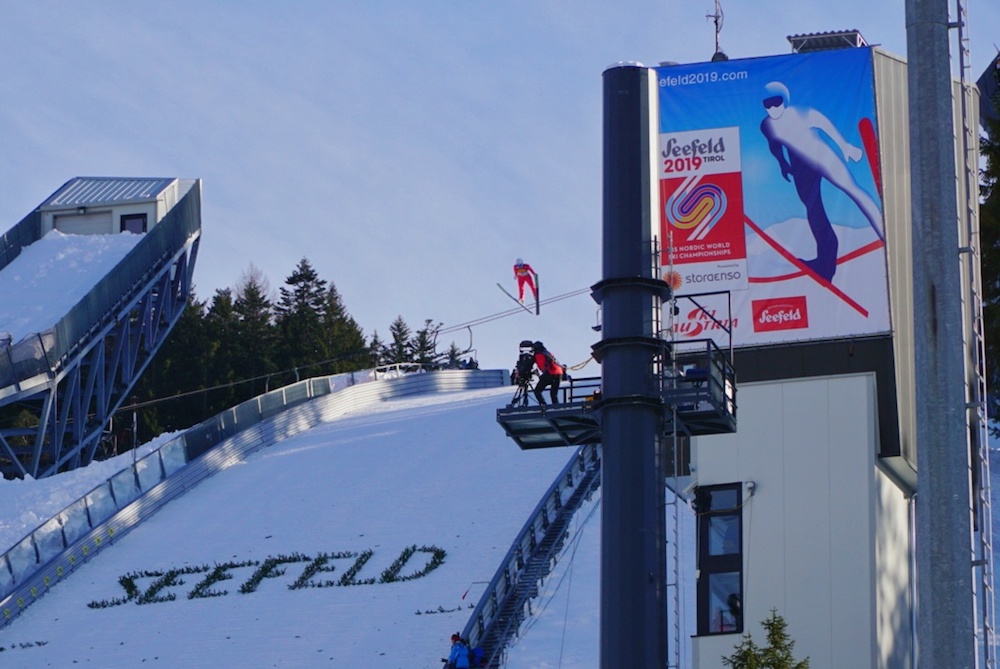
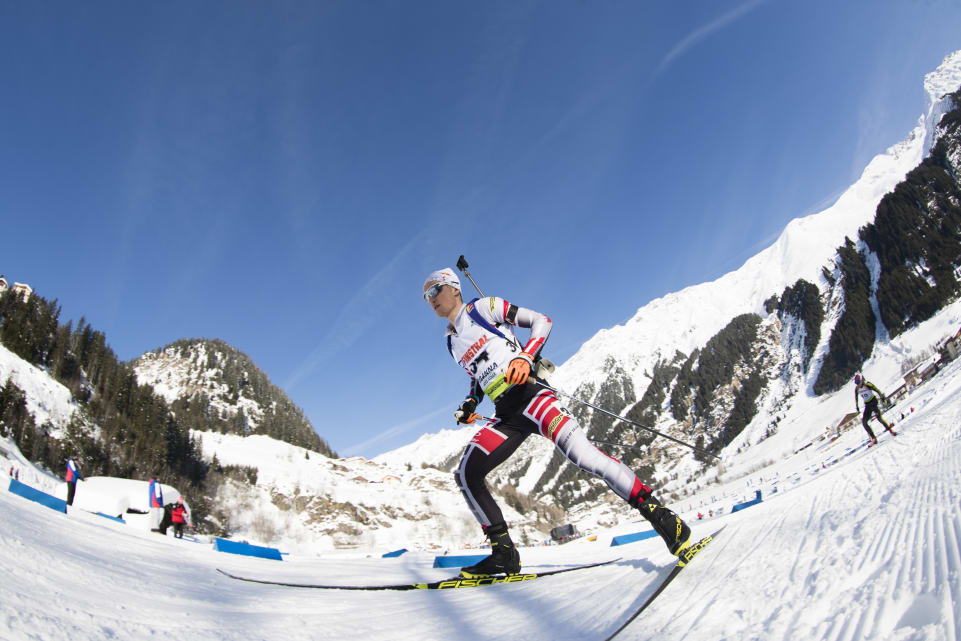
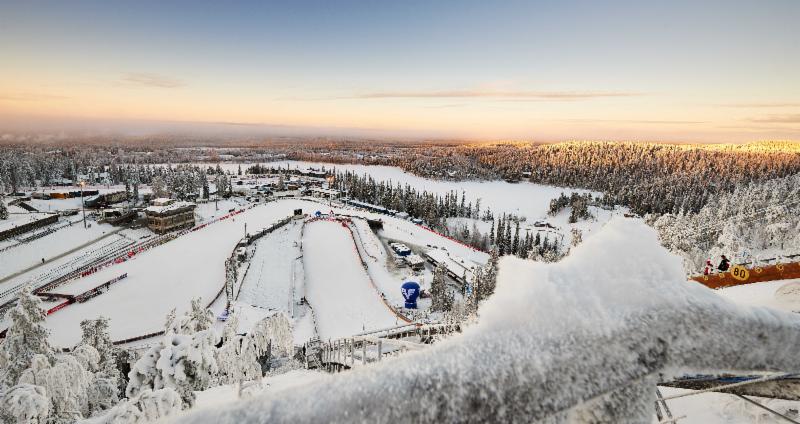
The jumping portion of the Nordic Combined World Cup Seefeld Triple on Friday in Seefeld, Austria. (Photo: Garrott Kuzzy / LumiExperiences.com)
Nordic Combined World Cup (Seefeld, Austria): Individual normal hill/5 k
On the first of the three-day Seefeld Triple Nordic Combined World Cup, Japan’s Akito Watabe took the win and Taylor Fletcher was the top American in 28th in the individual normal hill/5-kilometer Gundersen on Friday.
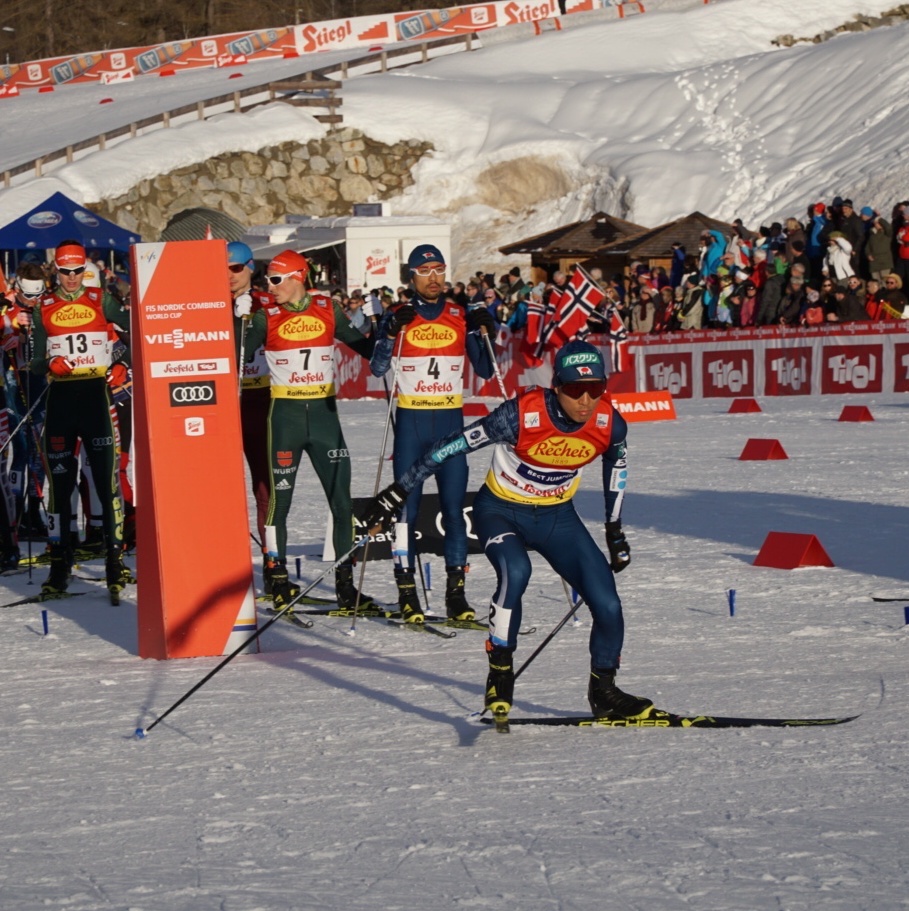
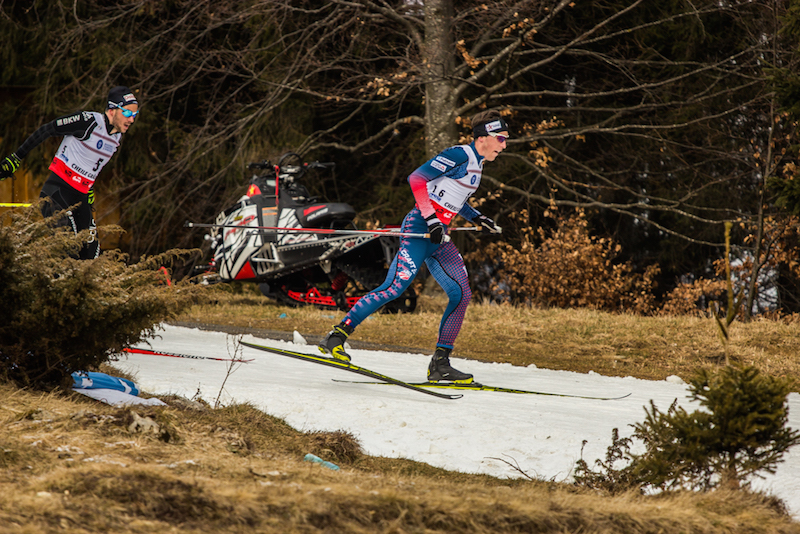
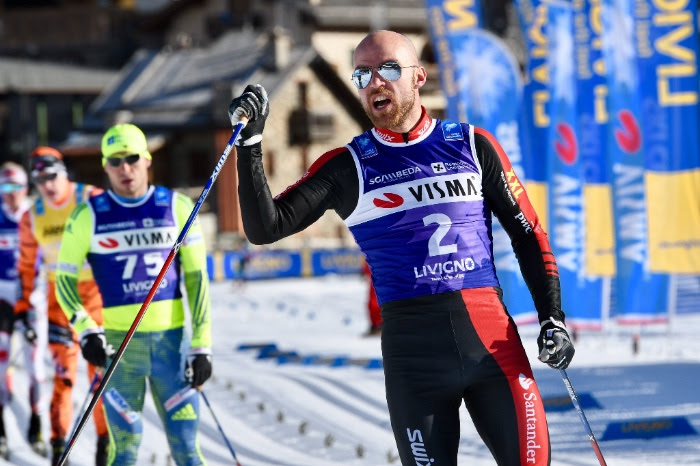
Japan’s Akito Watabe heading out of the gate second in the 5 k Gundersen on Friday at the Seefeld Triple Nordic Combined World Cup in Seefeld, Austria. Watabe went on to win the race by half a second. (Photo: Garrott Kuzzy / LumiExperiences.com)
Watabe put himself in second in the jump portion and started the 5 k ski race 21 seconds behind Norway’s Jarl Magnus Riiber in first. Watabe caught Riiber and beat him at the finish line, taking the win in 11:22.3 minutes, while Riiber followed 0.5 seconds back in second place. Germany’s Fabien Rießle followed in third, 32.4 seconds out of first, after starting the 5 k in sixth and 1:03 minutes back.
Norway’s Jan Schmid jumped to third and ended up fourth (+37.8). Watabe’s brother, Yoshito Watabe placed fifth (+47.2), losing one place in the ski race after jumping to fourth.
Two Americans competed, with Fletcher jumping to 30th and ending the day in 28th, and Jasper Good finishing 52nd (+3:45.6) after jumping to 49th. Both are headed to the 2018 Olympics next month in PyeongChang, South Korea.
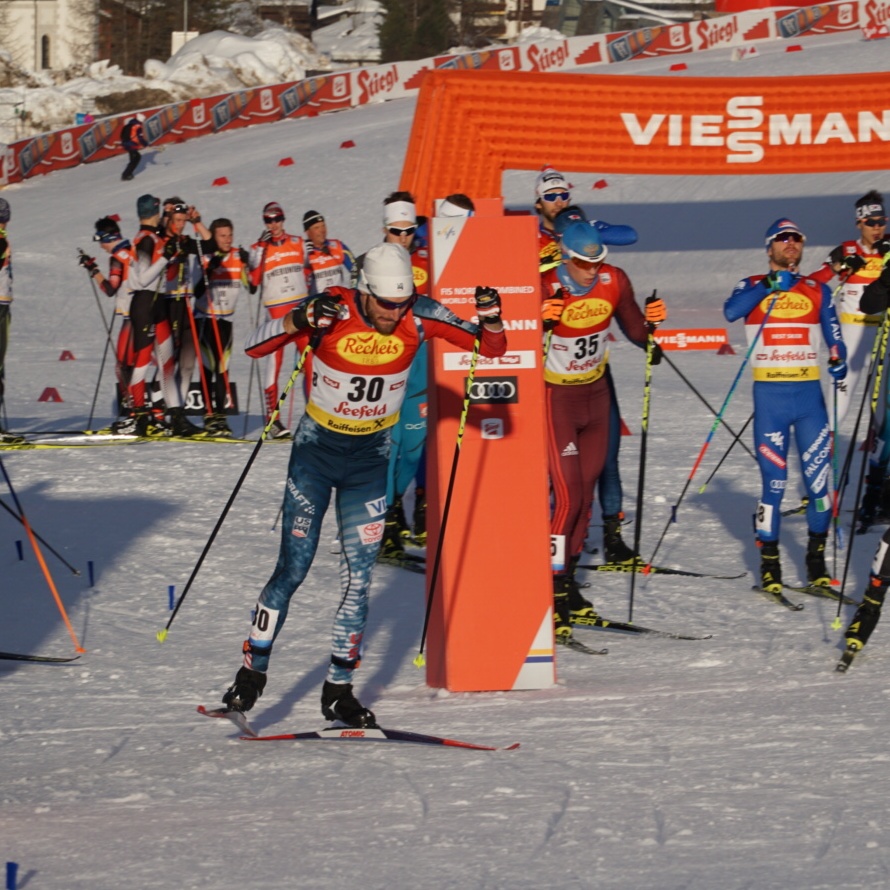
Taylor Fletcher (USA Nordic) starting the 5 k Gundersen on Friday at the Seefeld Triple Nordic Combined World Cup in Seefeld, Austria. He started in 30th and finished 28th. (Photo: Garrott Kuzzy / LumiExperiences.com)
***
U.S. SuperTour (Craftsbury, Vermont): Classic sprints
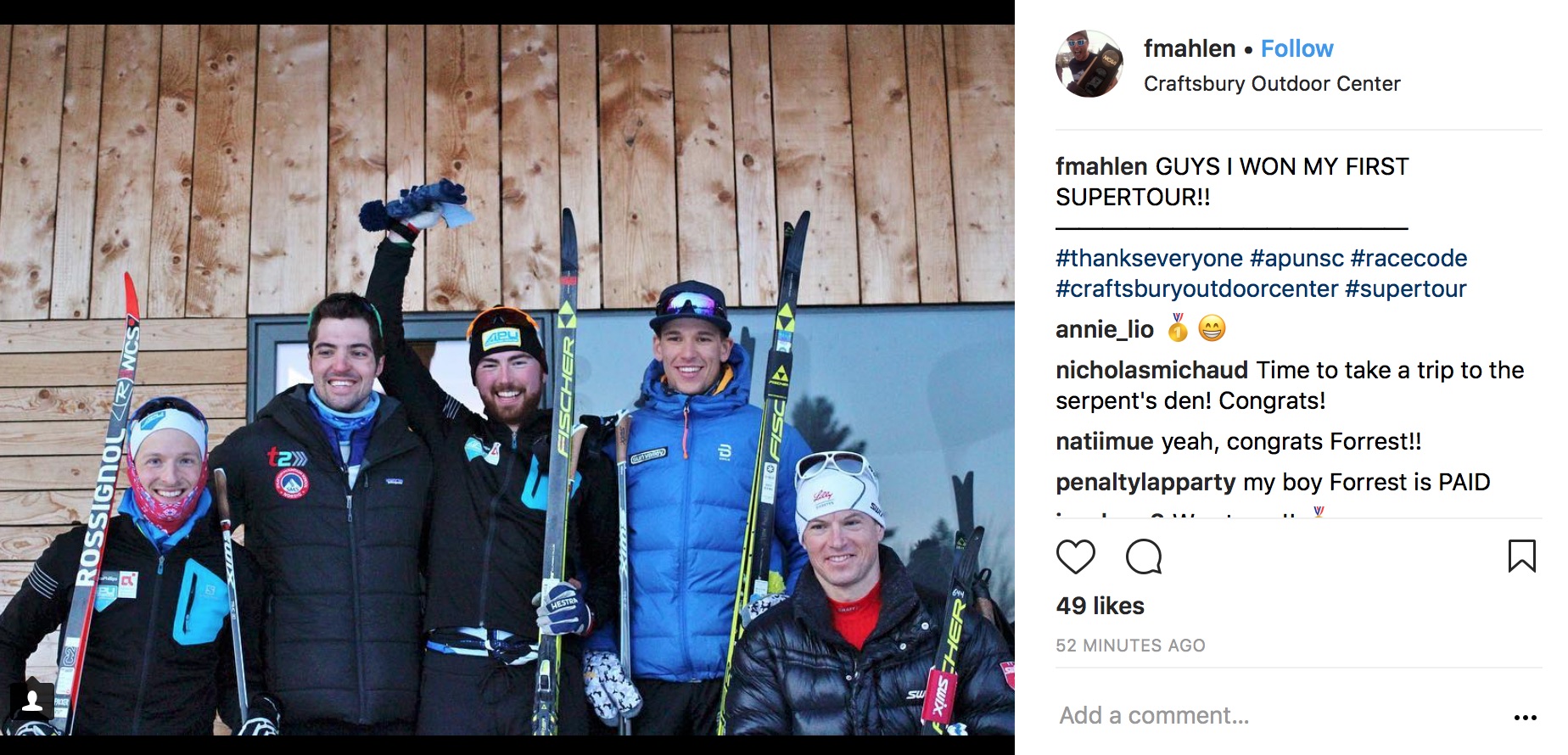
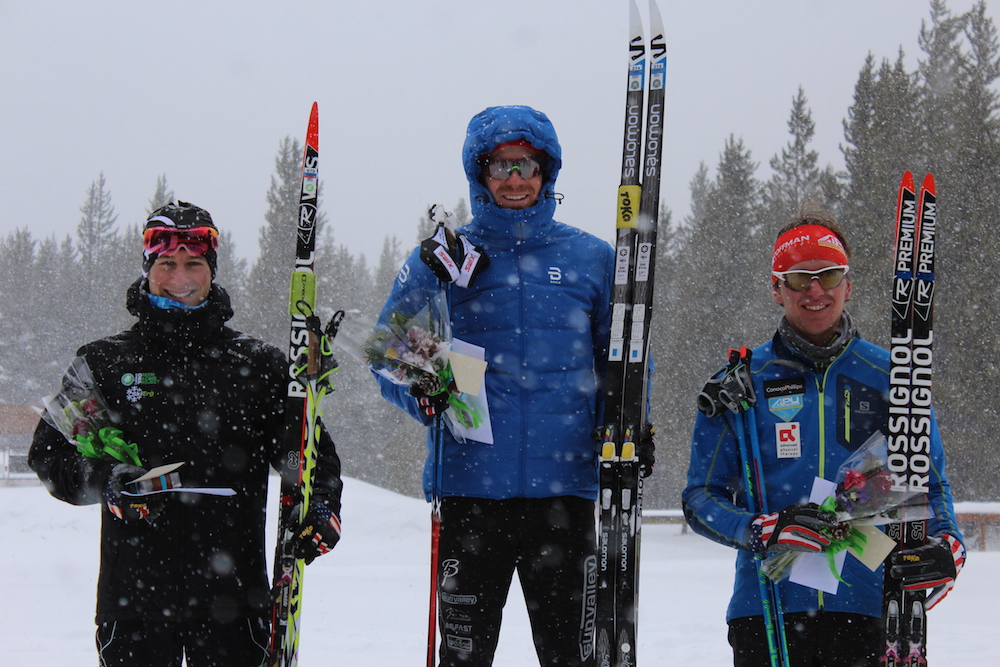
Forrest Mahlen (APU) celebrates his first time atop the SuperTour podium on Friday after winning the men’s 1.4 k classic sprint final in Craftsbury, Vermont. (Photo: Forrest Mahlen/Instagram)
Kaitlynn Miller and Forrest Mahlen won their respective classic-sprint finals at Friday’s SuperTour in Craftsbury, Vermont.
The 1.4-kilometer classic sprint kicked off a three-day race weekend at the Craftsbury Outdoor Center. On Saturday, the Craftsbury Marathon will be held (not a SuperTour event), followed by 5/10 k freestyle SuperTour races on Sunday.
Miller, of the Craftsbury Green Racing Project, started Friday by winning the women’s qualifier. She went on to win both her quarterfinal and semifinal before topping the final as well in 3:40.9 minutes. Also on Friday, it was formally announced that Miller was named to the U.S. Cross-Country Ski Team’s Olympic squad, which will compete in PyeongChang, South Korea, Feb. 10-25.
Kelsey Phinney, of the Sun Valley Ski Education Foundation (SVSEF), placed second in the women’s final, 0.63 seconds back, and Felicia Geisor (CXC Team) was third (+1.67). Erika Flowers, of the Stratton Mountain School (SMS) T2 Team placed fourth (+3.2), Canada’s Olivia Bouffard-Nesbitt (Rocky Mountain Racers) — fresh off NorAm Western Canadian Championships last weekend in Alberta — finished fifth (+5.46), and Alaska Pacific University (APU) skier Rosie Frankowski (who also made the U.S. Olympic team) placed sixth (+6.27).
On the men’s side, APU’s 24-year-old Mahlen qualified fifth, then won his quarterfinal and semifinal before taking the final for his first-career SuperTour win in 3:06.81. Ben Saxton (SMST2) initially won the qualifier and won his quarterfinal as well before placing second to Mahlen in the first semifinal. Saxton ended up 0.55 seconds back in second place in the final, just three-hundredths of a second ahead of Kevin Bolger (SVSEF) in third place (+0.58). Another half second back, Kris Freeman followed in fourth, just 1.09 out of first, Eric Packer (APU) was fifth (+1.39) and Canada’s Andy Shields (Lappe Nordic), who also competed at Western Canadian Championships last weekend) sixth (+8.99).
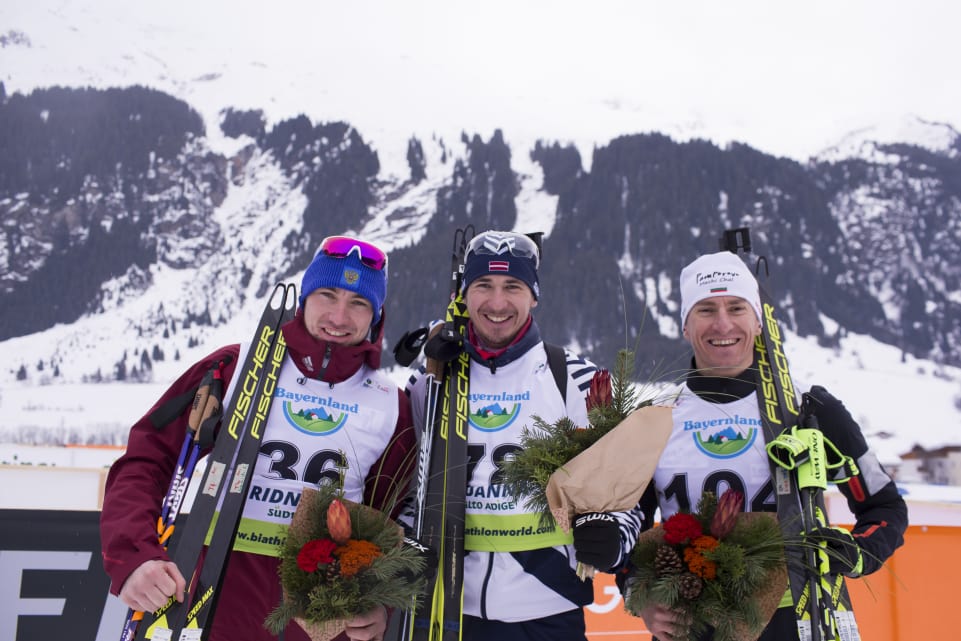
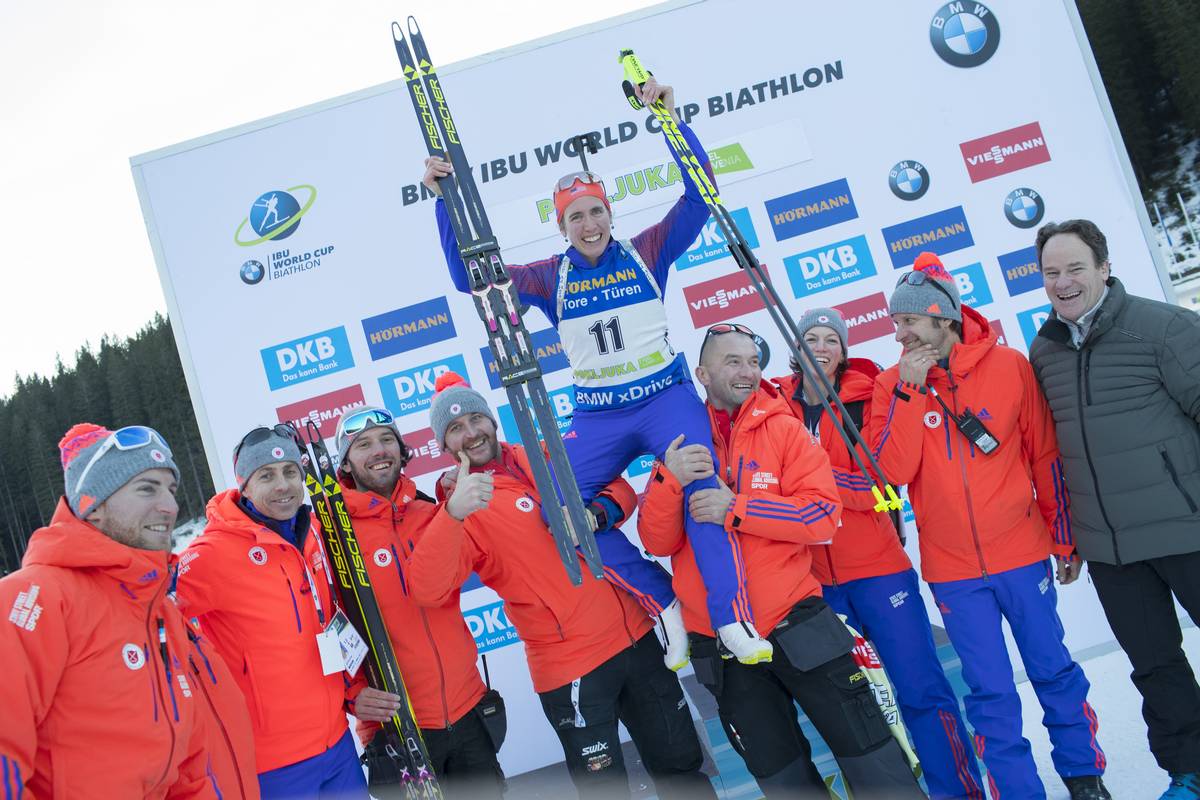
The men’s 10 k sprint podium at IBU Open European Championships, with Latvia’s Andrejs Rastorgujevs (c) in first, Russia’s Alexander Loginov (l) in second, and Bulgaria’s Krasimir Anev (r) in third. (Photo: IBU/Biathlonworld)
IBU Open European Championships (Ridnaun-Val Ridanna, Italy): Men’s and women’s sprints
Canada’s Macx Davies led the North Americans on Friday on Day 2 of the International Biathlon Union (IBU) Open European Championships in Ridnaun, Italy, placing 27th in the men’s 10-kilometer sprint with 9-for-10 shooting (1+0). Davies finished 1:32.3 minutes behind Latvia’s Andrejs Rastorgujevs, who took the win in 24:03.0 with a single penalty as well (0+1).
Russia’s Alexander Loginov placed second, 5.5 seconds back, with one penalty (1+0), and Bulgaria’s Krasimir Anev shot clean to finish third (+24.5).
“At the [last] World Cup in Anterselva [Italy], I have had a difficult time in the shooting range, and so I spent a lot of time in the last few days working on my shooting,” Rastorgujevs told the IBU after. “Today it was clear that all this hard work paid off. It is also a great motivator for Olympic gold.”
For Davies, who’s also headed to the Olympics next month, the result tied his best individual result this season after he placed 27th in an IBU Cup sprint earlier this month in Osrblie, Slovakia.
Canada entered four in the men’s race, with Carsen Campbell finishing 75th (+2:34.6) with one miss (0+1), Aidan Miller placing 91st (+3:18.2) with three penalties (1+2), and Matt Hudec finishing 119th (+4:31.6) with four misses (1+3).
Five American men raced, with Alex Howe finishing 53rd (+2:15.1) with one penalty (1+0), Jake Brown 84th (+3:02.0) with four misses (1+3), Jakob Ellingson 85th (+3:07.0) with one miss (1+0), Max Durtschi 111th (+3:50.1) with four misses (3+1), and Paul Schommer 114th (+3:59.8) with four penalties (2+2) as well.
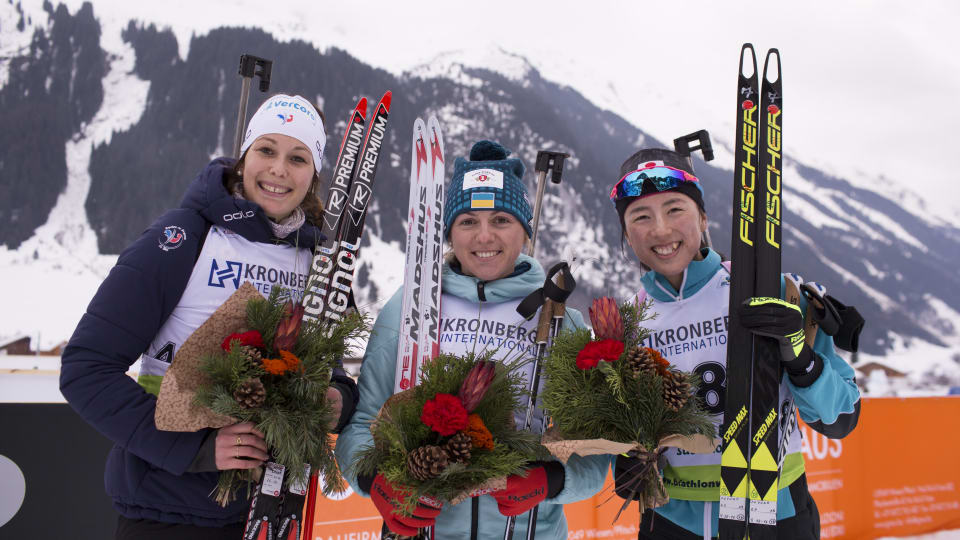
The women’s 7.5 k sprint podium at IBU Open European Championships in Ridnaun, Italy, with Ukraine’s Iryna Varvynets (c) in first, France’s Chloé Chevalier (l) in second, and Japan’s Fuyuko Tachizaki (r) in third. (Photo: IBU/Biathlonworld)
In the women’s 7.5 k sprint that followed, Chloe Levins of the U.S. was the top North American in 59th, 2:01 behind the winner Iryna Varvynets of Ukraine. Varvynets shot clean and posted the fastest finishing time of 20:54.1, 12.5 seconds faster than France’s Chloé Chevalier, Wednesday’s 15 k champion who had one miss (0+1) on Friday and ended up second. Japan’s Fuyuko Tachizaki reached the podium in third (+15.5) and was one of four women in the top five that shot clean (only Chevalier did not).
“After the individual competition on Wednesday, I was not at all happy with my shooting,” said Varvynets, who placed fifth in the 15 k. “Today I therefore concentrated especially hard in the shooting range. It was my luck that not many finished without errors, otherwise it would probably not have been enough for the victory.”
“Two races, two medals — it could not have gone better for me,” Chevalier said. “In the standing shooting I missed the first disc and got a little nervous, but thankfully, there were no further errors.”
Tachizaki called the bronze medal a “big dream come true”.
“The focus of my season had been the Olympics and I ‘only’ took part in Ridanna as part of the preparations, but with this result I have exceeded everything I have achieved so far,” she said. “At the end of the race I did not only fight hard in the track, I was already dreaming of a medal. Now I’m in seventh heaven.”
Levins had one miss in each stage (1+1), as did fellow American Maddie Phaneuf, who finished 63rd (+2:19.0) with two penalties. Clare Egan followed in 70th (+2:34.2) with four misses (3+1), Deedra Irwin was 85th (+3:38.1) with four penalties (1+3) as well, and Jennie Bender 97th (+5:52.8) with six misses (3+3).
Two Canadians started the race, with Sarah Beaudry finishing 76th (+3:02.9) with four misses (1+3). Erin Yungblut did not finish.
Open European Championships continue Saturday with the men’s and women’s pursuits. The top 60 from the sprint qualify, which, for the North Americans, means Davies, Howe, and Levins.
The championships end Sunday with single mixed and mixed relays.
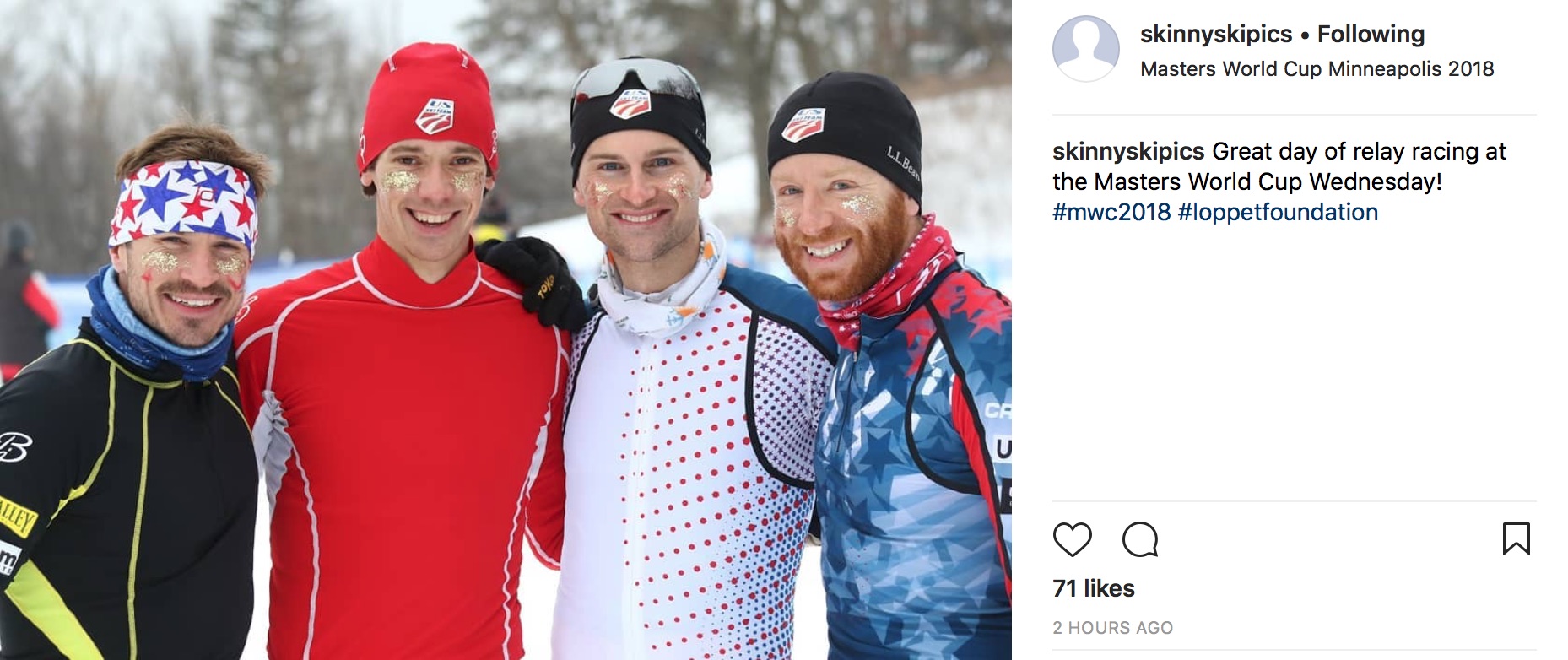
Matt Liebsch (l) and his men’s age-group “1” 4 x 5 k winning relay team on Wednesday at 2018 Masters World Cup in Minneapolis, Minnesota. (Photo: SkinnySki/Instagram)
2018 Masters World Cup (Minneapolis, Minnesota): 4 x 5 k relays
Matt Liebsch, 34, anchored the winning relay of the youngest men’s age group (AG 1) at 2018 Masters World Cup on Wednesday, crossing the line in 45:57.2 minutes (the fastest relay time of the day) and teaming up with fellow Americans Christopher Harvey, Mark Johnson and Zach Varty. Two teams competed in that age group’s 4 x 5 k relay, with Italy finishing second, 1:22.6 minutes back.
The U.S. won all five women’s 4 x 5 k relays on Wednesday, and eight total between the men’s and women’s age groups. Finland had the second-most relay victories with five in the men’s categories.
Canada won the men’s AG 4, beating out four other teams with Gabriel Babin, Bruce Macneil, Luc Tremblay, and Michel Labrie, who finished the 4 x 5 k in 49:41.9. Germany placed second (+36.4), and the U.S. third (+54.1).
Piotr Bednarski, head coach of Loppet Nordic Racing, which is based out of Theodore Wirth Park, anchored the men’s AG 5 to a win in 49:39.1, with teammates Rune Harkestad, Dennis Paul and David Sjogren.
Masters World Cup continues with 15/30/45 k classic distance races on Thursday at Wirth Park.
Day 4 Age Group (AG) 4 x 5 k Relay Winners
Men:
AG 1: USA (Christopher Harvey, Mark Johnson, Zach Varty, Matt Liebsch) 45:57.2
AG 2: Finland (Jouni Leinonen, Mika Kilpeläinen, Johan Gustafsson, Joachim Gustafsson) 47:53.4
AG 3: Russia (Ivan Batyutenko, Andrey Lushnikov, Sergey Degtyarev, Aleksandr Pushkarev) 46:43.3
AG 4: Canada (Gabriel Babin, Bruce Macneil, Luc Trembley, Michel Labrie) 49:41.9
AG 5: USA (Rune Harkestad, Dennis Paul, David Sjogren, Piotr Bednarski) 49:39.1
AG 6: USA (Milan Baic, Odd Bersvendsen, Kent Murdoch, Barry Makarewicz) 48:48.3
AG 7: Finland (Heikki Ruokonen, Tapio Tikkanen, Timo Pullinen, Aito Pennanen) 51:56.3
AG 8: Finland (Leino Nisula, Pauli Halonen, Yrjo Teravainen, Harri Makela) 54:58.4
AG 9: Finland (Veikko Piirainen, Tapio Ikaheimonen, Paavo Raisanen, Vaino Paakko) 58:18.9
AG 10: Finland (Alpo Virtanen, Tapio Wallenius, Jouko Laiho, Riku Kyllonen) 1:02:39.7
Women:
AG 1: USA (Kathleen Dewahl, Tamra Kornfield, Davya Flaharty, Gina Chythlook) 56:49.3
AG 2: USA (Bonnie Weiskopf, Kim Rudd, Mary Mckelvey, Mary Wellington) 56:23.9
AG 3: USA (Elizabeth Youngman, Kelly Milligan, Jan Guenther, Kelly Skillicorn) 56:23.6
AG 4: USA (Kate Ellis, Magdenla Bowen, Joann Hanowski, Muffy Ritz) 1:00:33.6
AG 5: USA (Gabriele Andersen, Constance Meek, Dagmar Eriksson, Kati Campbell) 1:14:23.4
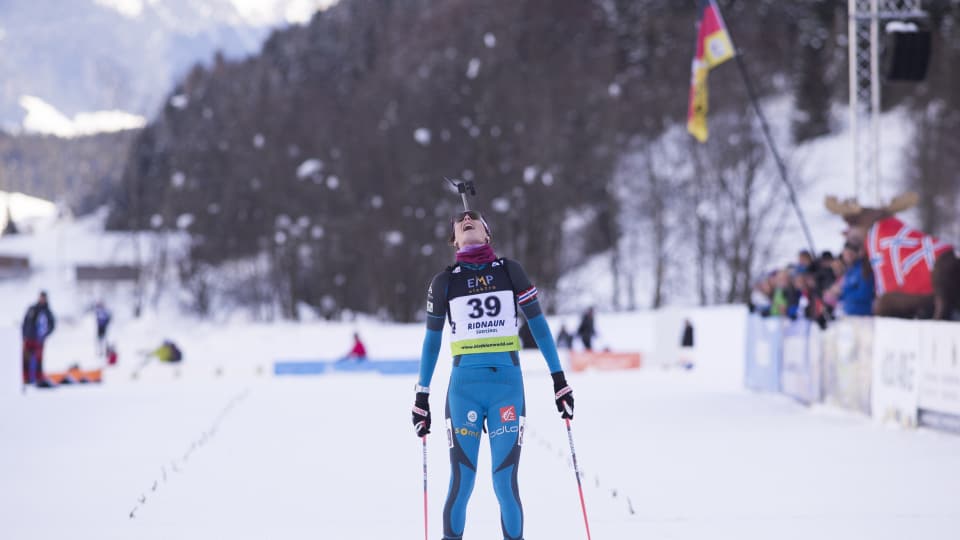
France’s Chloe Chevalier after winning the women’s 15 k individual on Day 1 of IBU Open European Championships in Ridnaun, Italy. (Photo: IBU/Biathlonworld)
IBU Open European Championships (Ridnaun-Val Ridanna, Italy): 15/20 k individual
The International Biathlon Union (IBU) Open European Championships opened Wednesday in Ridnaun (Val Ridanna), Italy, with several North Americans competing in the women’s 15- and men’s 20-kilometer individual races.
Austria’s Felix Leitner racing to the win in the first race of 2018 IBU Open European Championships, the men’s 20 k individual, on Wednesday in Ridnaun, Italy. (Photo: IBU/Biathlonworld)
Canada’s 23-year-old Carsen Campbell raced to 19th in the men’s 20 k, shooting 19-for-20 (1+0+0+0) and finishing 3:18.5 minutes behind the winner, Austria’s Felix Leitner, who clocked the fastest time in 53:32.8 — also with one penalty (0+0+0+1).
Leitner, 21, won by 43 seconds over Tomas Krupcik of the Czech Republic, who also had a single penalty in the last standing stage (0+0+0+1) and placed second.
Germany’s Philipp Horn reached the podium in third (+56.6), with 19-for-20 shooting as well (1+0+0+0).
According to an IBU press release, Leitner is one of the youngest athletes to win the 20 k, the longest race on the circuit.
“I had many problems with my shooting lately, but today it was probably the best in the last two seasons,” Leitner said, according to the release. “I believed in myself and knew that I have to run fast from the beginning, and if the shooting would be as good as during the training, I could be in the top.”
Campbell, of Biathlon Canada’s National “Z” Team, was the top North American in 19th in his second trip to Open European Championships. Previously, his best individual result was 64th last year.
Paul Schommer led the U.S. men in 46th (+5:22.6) with three penalties (0+1+1+1). Max Durtschi also shot 17-for-20 (1+0+1+1) and ended up 56th (+6:18.5), Jakob Ellingson followed in 58th (+6:23.5) with two penalties (0+0+1+1), and Jake Brown finished 74th (+8:06.7) with seven penalties (1+1+3+2). Alex Howe did not start.
For Canada, Macx Davies, a senior national team member who is headed to the Olympics, placed 67th (+7:32.7) with five penalties (2+2+1+0). Matt Hudec was 96th (+12:00.5) with six penalties (0+2+1+3), and Aidan Miller 105th (+14:49.0) with nine penalties (2+1+1+5).
In the women’s 15 k that followed, Sarah Beaudry, of Biathlon Canada’s Senior National Team as well as Olympic team, was the top North American in 23rd, 4:55.6 out of first. Beaudry, 23, shot 18-for-20, with her two misses coming in the first prone (2+0+0+0).
France’s Chloe Chevalier won the women’s race, with spring-like temperatures around 6 degrees Celsius, in 46:32.9 with a single penalty, also in the first stage (1+0+0+0). The second- through fourth-place finishers all shot clean, with Italy’s Alexa Runggaldier placing second (+47.7), Russia’s Victoria Slivko taking third (+55.9) and Ukraine’s Yuliia Zhuravok missing the podium by half a second in fourth place (+56.4).
“After that penalty in the first prone, I relaxed and did not worry about the result,” Chevalier said after, according to an IBU press release. “I just enjoyed being out on the tracks on a beautiful sunny. Maybe the key to success is relaxing and not worrying about the result.”
Two Canadian women entered the event, with Erin Yungblut finishing 83rd (+13.19.9) with eight penalties (2+3+1+2).
Chloe Levins was the top American woman in 60th (+7:18.6) with four penalties (1+2+1+0), and Maddie Phaneuf, who made US Biathlon’s Olympic team, followed in 65th (+8:10.8) with four misses as well (1+2+0+1). Deedra Irwin finished 82nd (+13:15.8) and Jennie Bender was 87th (+15:05.0), both with 10 penalties apiece.
Open European Championships continue Friday with the men’s and women’s sprints, followed by pursuits on Saturday and relays on Sunday.
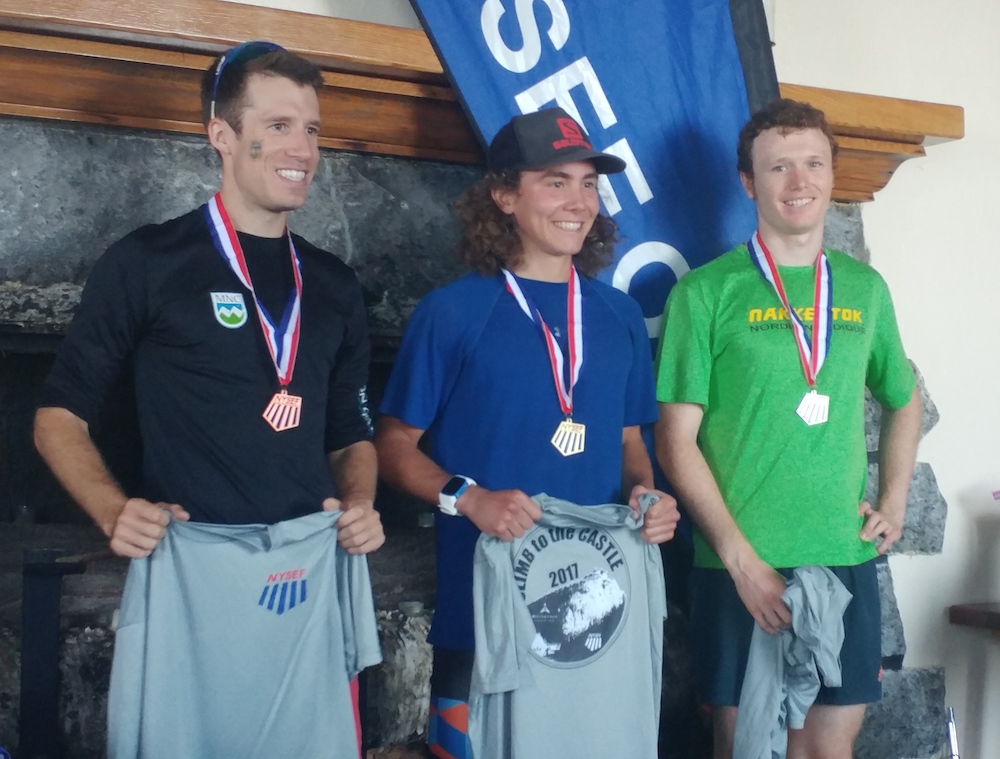
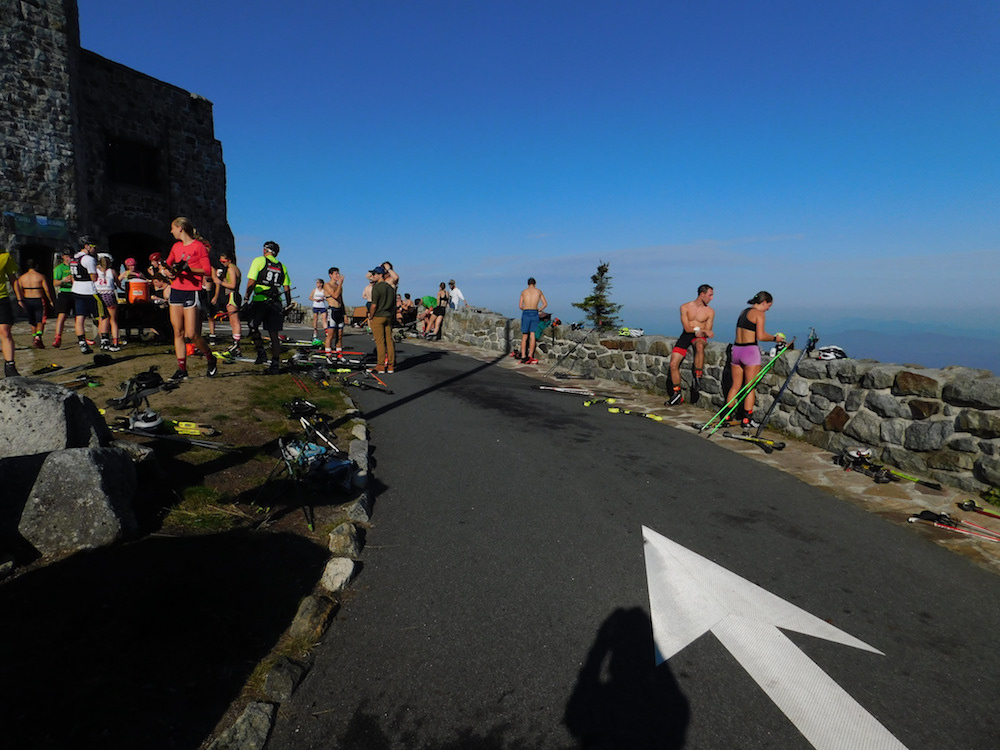
The men’s top three finishers at NYSEF’s 2017 Climb to the Castle on Sunday, Sept. 24, at the top of Whiteface Mountain in Wilmington, N.Y., with winner Jake Brown (c) of US Biathlon, runner-up Aidan Kirkham (r) of Nakkertok Nordic, and Mansfield Nordic Club Head Coach Adam Terko (l) in third.
(Note: This article has been updated with comments from Adam Terko in regards to rollerski safety.)
WILMINGTON, N.Y. — On what may be the hottest day in memory for the annual Climb to the Castle (C2C) rollerski race, hosted by the New York Ski Educational Foundation (NYSEF) up Whiteface Mountain, Jake Brown and Jennie Bender were fastest to the top. Both have spent at least part of their summer training with the US Biathlon Association (USBA) in nearby Lake Placid, N.Y.
Brown, a 25-year-old USBA X-Team member, finished the five-mile climb up Whiteface’s toll road on Sunday in 39:01.9 minutes, more than five minutes clear of runner-up Aidan Kirkham, a Canadian racer with Nakkertok Nordic, who finished in 44:16. Adam Terko, Mansfield Nordic’s head coach and executive director, placed third in 45:35.7.
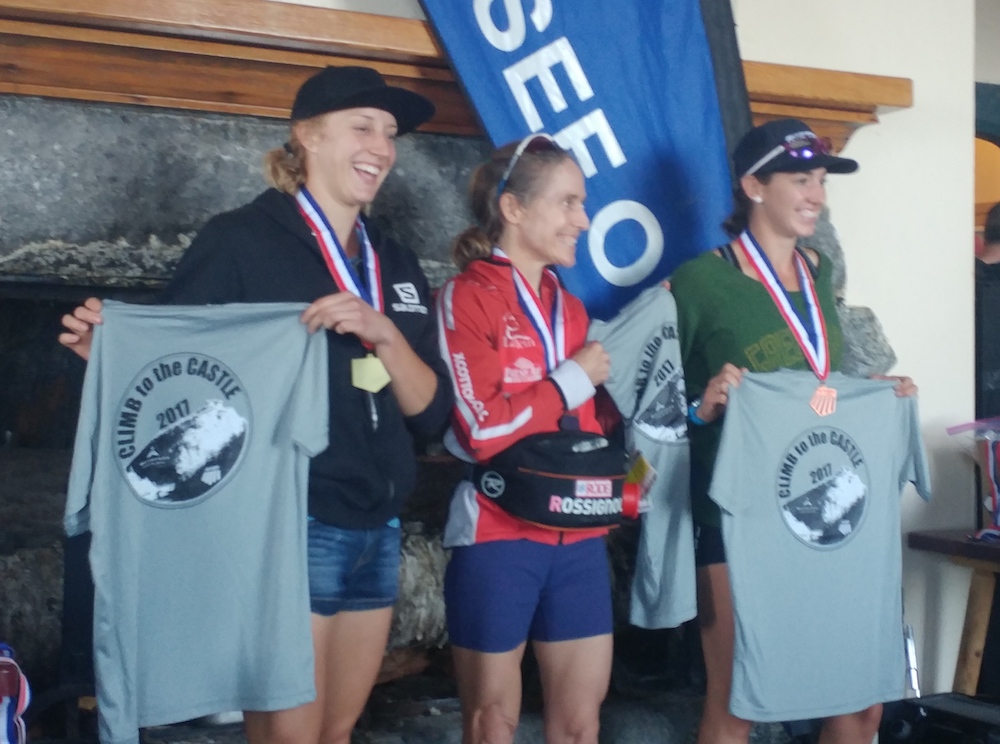
Bender, 29, racing under the team name of “The Dark Side”, which she later explained was a joke, topped the women’s race in 48:59.4. She finished 21.5 seconds ahead of 51-year-old (no, that’s not a typo) Sheila Kealey, who skis for XC Ottawa and coaches for Nakkertok. Deedra Irwin of the Sun Valley Ski Education Foundation (SVSEF) was third woman in 51:13.5.
“I had put my name in the registration as ‘Darth Vader’, but they changed it on the other end,” Bender wrote in an email. “When I am in Bozeman MT I train with Bridger Ski Foundation, and when I am in Lake Placid, I train with USBA.”
At the tollgate at 7 a.m., the temperature was already 66 degrees Fahrenheit with clear skies. With mild weather the previous two days, the pavement was dry for 83 skiers who rolled to the start line. At the castle at the summit an hour later, temperatures were upwards of 70, making an already grueling race even more fatiguing.
The men’s and women’s races played out quite differently. According to Kirkham, Brown led “off the start and gapped the whole field.”
Familiar with the territory in and around Lake Placid, which has become an annual training camp for Nakkertok, based out of Ottawa, Kirkham said it was one thing to ski the toll road in Zone 1 and another to race it.
“I wanted to pace it well, and I think I did that,” he added. “I didn’t want to go too hard off the start because there’s no chance to recover on a course like this. … Once I got to the last mile I knew I could try to pick it up a little bit. But I was pretty tired. Just getting to the finish felt good.”
Having completed five or six C2Cs, Terko said experience was his advantage. But he didn’t exactly have a race plan.
“The field can vary wildly,” Terko said of the level of competition. “You’re never really sure how the start’s going to play out. I found myself near the front and there wasn’t a ton of US Ski Team or US Biathlon folks.”
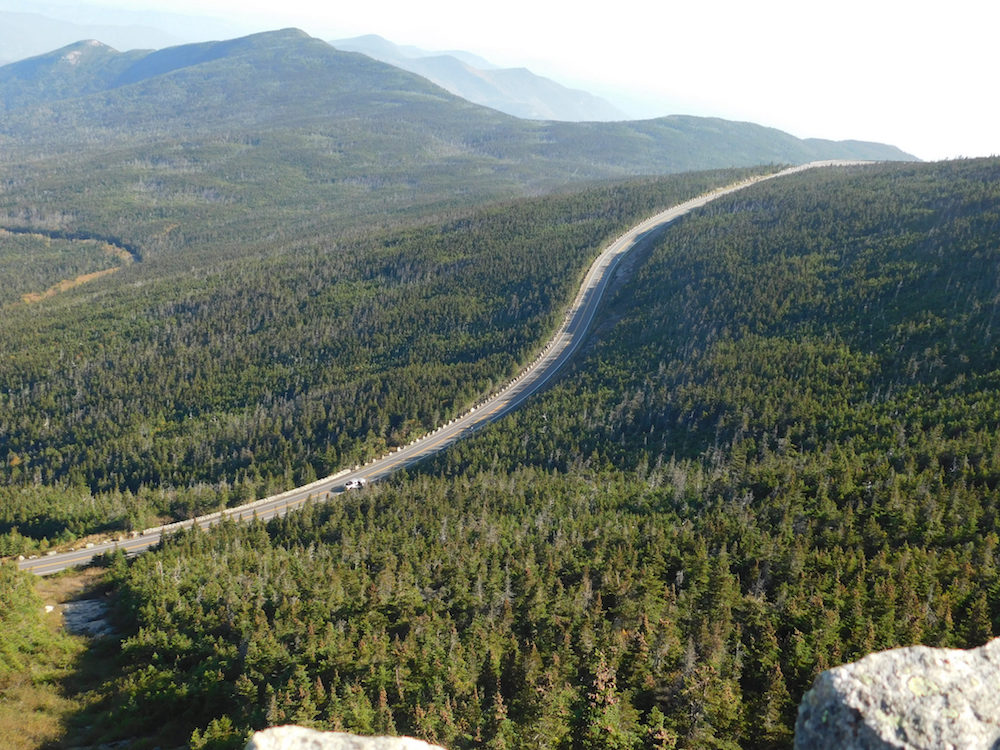
Looking down at the Whiteface Veterans Memorial Highway, a five-mile toll road to the top of Whiteface Mountain in Wilmington, N.Y., as seen on Sunday, Sept. 24, for the 2017 NYSEF Climb to the Castle rollerski race. (Photo: NYSEF)
As recently as a few years ago, the U.S. Ski Team held annual dryland training camps in Lake Placid and competed at the C2C. But that camp has been replaced by an on-snow camp in New Zealand. This year, US Biathlon’s top athletes recently spent several weeks training in Germany.
“Jake Brown was right off the front so I realized that this could be a good day and I might as well try and hang in there,” Terko added.
While Terko skis and rollerskis plenty with his athletes, he says it’s not always adequate training for a race like this.
“As a coach, it’s more about generally making sure the workout is going well for the athletes,” he explained. “I’ve made an effort the last few weeks to get out after practice and ski around in the dark myself.”
(Terko later clarified in an email that he was referring to Mansfield Nordic’s primary training venue, a paved and lit rollerski loop at Camp Ethan Allen in Jericho, Vermont. “Rollerskiing in the dark there is pretty standard as opposed to being in a dangerous road situation which I of course do not advocate!” he wrote.)
As for Brown, a Northern Michigan University graduate student who is currently living and training with US Biathlon in Lake Placid, he had a slightly different recollection of the start on Sunday.
“It wasn’t so much I dropped everyone. It was more like I just slowly pulled away,” Brown said. “Within the first 400 meters, I had a small gap. The gap got bigger and bigger as we went along. Maybe by the first mile, I couldn’t hear anyone behind me.”
Sticking to his own race, he resisted the temptation to look behind.
“I was trying to get a good effort today on the skis,” he continued. “I was hoping that some of the faster junior skiers would have some fast rollerskis and be able to push me, but pretty much right from the get-go I was on my own, so I was just trying to keep the pedal to the metal and make it a good effort, which gets tough at the end. It definitely helps to know the course.”
The women’s top three finishers at NYSEF’s 2017 Climb to the Castle on Sunday, Sept. 24, at the top of Whiteface Mountain in Wilmington, N.Y. (From left to right) Jennie Bender in first, Sheila Kealey (XC Ottawa) in second, and Deedra Irwin (SVSEF) in third.
In contrast, the women’s race swapped leaders. Clare Egan, a USBA national-team member and Craftsbury Green Racing Project (CGRP) member finished fifth (+5:02.4) after leading early.
“I did lead a little bit at the beginning,” Egan said. “Jennie, Sheila and I were together for the first 1.5 or 2 miles, and then Jennie and Sheila pulled away, and I got caught by Deedra and Zoe [Williams].”
“From doing this race in the past, the order doesn’t usually change so much after the first mile or so,” she explained. “It’s just so hard to make up gaps on this grade. I wanted to try to hang on for as long as I could and stay in front the whole way, but I wasn’t able to do that. So it was very hard work out there, and I didn’t have what it takes to stay with Jennie and Sheila. Respect to them.”
Irwin explained in a post-race email that her plan was to pace off Bender and Egan and stick with them for as long as she could.
“Jennie and Sheila pulled away just around mile two, I think,” wrote Irwin, a SVSEF Gold Team member who was invited to train with US Biathlon (following its Talent ID Camp) in Lake Placid this fall. “My race went really well. I’m really happy with my result. This was my first time doing Climb to the Castle. I didn’t really know what to expect, it’s a tough climb!”
Blue skies and no snow post-race at the castle atop Whiteface Mountain in Wilmington, N.Y., at the 2017 NYSEF Climb to the Castle on Sept. 24. (Photo: NYSEF)
“Every year I did it, Liz Stephen did it, and it went out really, really fast,” she said of the U.S. Ski Team member who holds the women’s course record of 41:50. “Really hard at the beginning, and then people dropped off, but today’s pace was a good pace.”
Kealey described wanting to keep a consistent rhythm all the way to the top. She spent much of the race trading off with Bender.
“And then I managed to get a gap,” Kealey said. “I had a gap on [Bender] almost until the last 800 meters, and then she caught me. She was hurting, but she put the guns on at the last bit and just pulled away. She skied really well.”
Reflecting on her win, Bender said, “It wasn’t snowing, and it wasn’t freezing, so that was awesome. My V1 has been getting a lot better. It was a small crowd, but I was stoked to feel good for the whole duration. I haven’t done this race in a long time. I did it probably in college, and it’s fun to see the giant progression since then.”
She explained that she’s been working with US Biathlon in Lake Placid more this summer.
“I think in the big picture, it’s fun to see that I’m not just a sprinter,” she said.
On her race plan, Bender said, “The biggest thing, you have to pace it and not go out too crazy. We kind of started splitting up a bit, and I was going back and forth between first and second throughout the race. First with Clare, then with Sheila and then, near the last 200 to 400 meters, that tunnel, which is always so crazy with the wind, we both were like, ‘Oh.’ We were feeling it.”
“I saw someone coming up behind us,” Bender continued. “I thought it was Clare, I didn’t realize it was Jake. And then I sprinted it in to the finish. I was stoked to get in under 50 minutes.”
Bender, Egan, Irwin, and Brown all skied on matched Marwe rollerskis that they also used in time trials, Bender said.
Zoe Williams, the fourth-place woman (+2:18.8) from Nakkertok and Carleton University, said she wasn’t sure what to expect for her first C2C.
“About 15 minutes in, I kind of all of a sudden realized that it was all uphill,” Williams said. “I was like, ‘Whoa, what have I got myself into?’ But it was fun. I was following Deedra for most of it. I was trying to match her tempo.
“The last mile was tough because you can see the castle,” she added. “I really wanted to try to stick with the lead pack as long as I could.”
“We’ve had every kind of weather possible,” she said. “It’s just fun to see everybody out there getting ready for winter.”
“It was really a blessing to have this awesome weather,” Brown concluded. “Normally you come up here and [the castle] is in the clouds, even if it’s sunny down low. It’s cool to do something here with NYSEF and show our support from US Biathlon.”
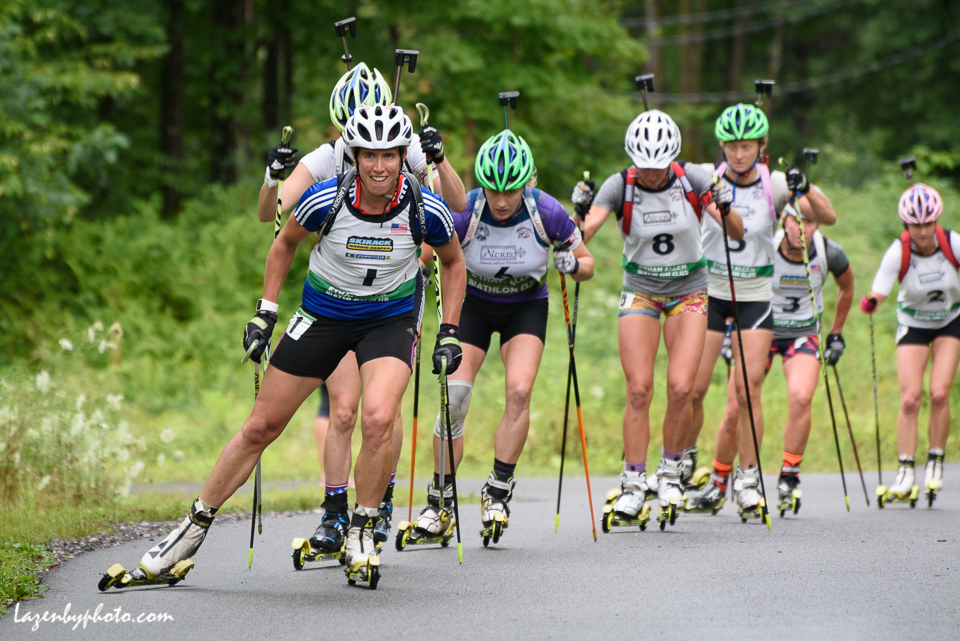
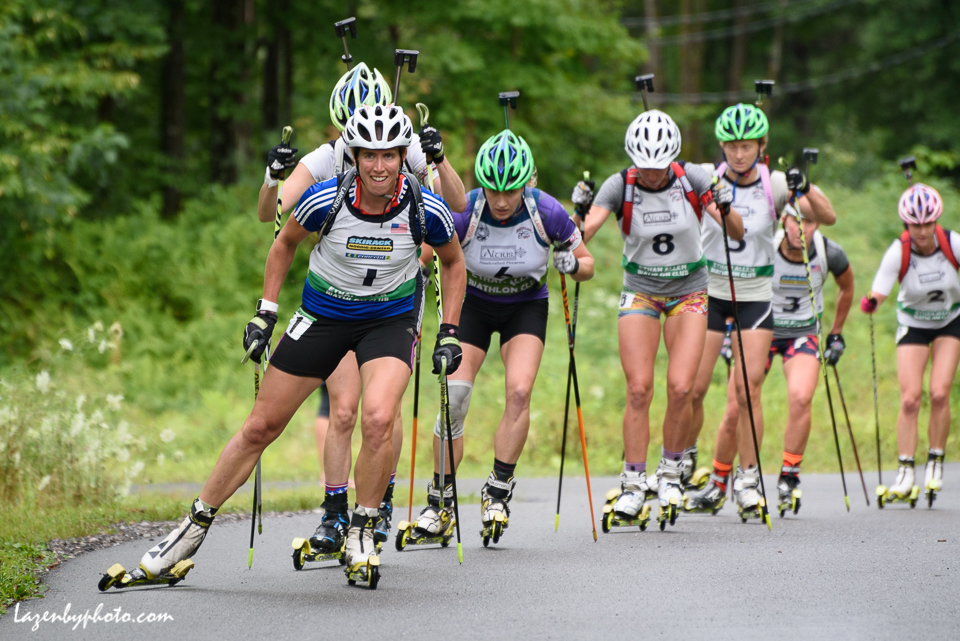
Susan Dunklee (USBA/CGRP) leading the pack in the women’s mass start on Sunday, Aug. 13, at USBA Rollerski Championships in Jericho, Vt. She won by nearly 47 seconds. (Photo: John Lazenby/Lazenbyphoto.com)
Special thanks to John Lazenby for providing photos from 2017 US Biathlon Rollerski Championships in Jericho. For a full gallery, click here.
Note: This article has been updated to include comments from Lowell Bailey, Susan Dunklee and Bernd Eisenbichler.
***
This past weekend, the US Biathlon Association (USBA) Rollerski Championships returned to Jericho, Vt., for two days of racing at the Ethan Allen Firing Range inside a National Guard military base. Just as it has in the past, the format included men’s and women’s sprints on Saturday followed by mass starts on Sunday, and this year, the races drew nearly 100 competitors from across the U.S. and even some from Canada.
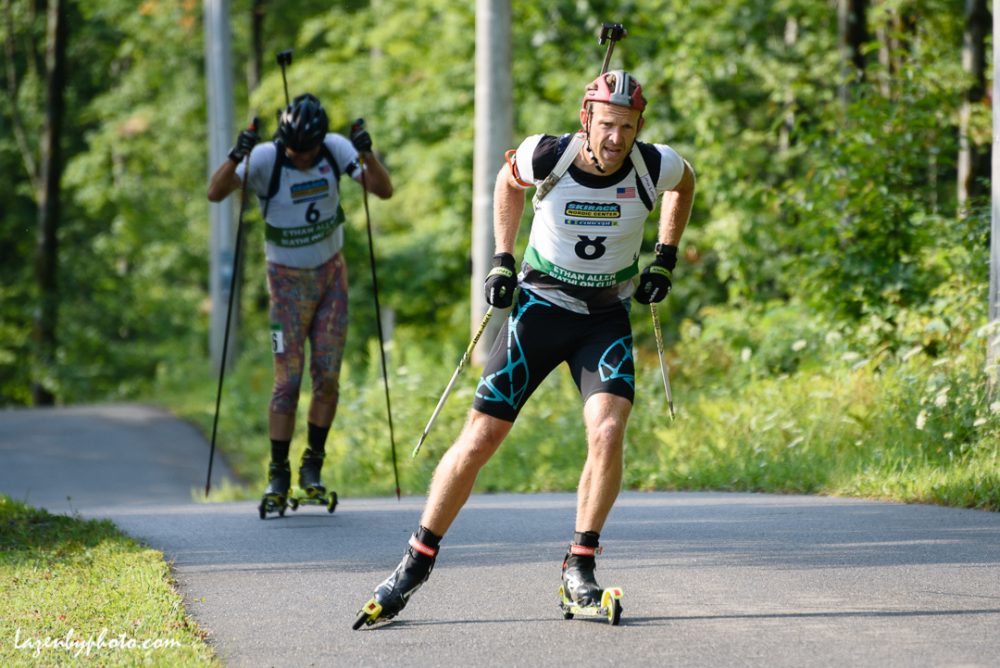
US Biathlon’s Lowell Bailey (r) on his way to winning the men’s sprint at US Biathlon Rollerski Championships on Aug. 12 in Jericho, Vt. (Photo: John Lazenby/Lazenbyphoto.com)
A perennial winner at Jericho, Lowell Bailey won the senior men’s 10-kilometer sprint on Saturday in 24 minutes, 58 seconds with a single standing penalty (0+1).
“Summer nationals is a good chance to assess where you are in the training season,” Bailey wrote in an email. “Of course, roller skiing is quite a bit different than on-snow skiing, and it is important to keep that in perspective when assessing the results. However, I’m happy with the way the weekend went and I feel like I am on track in terms of where I want to be in the training season.”
Fellow US Biathlon A-teamer Sean Doherty placed second, just 5.2 seconds back, with two prone misses (2+0). Rounding out the top three, Biathlon Canada’s Nathan Smith (the lone Canadian in that race)placed third, 21.4 seconds behind Bailey with a single standing miss as well (0+1).
Another 0.2 seconds back in fourth overall, Travis Cooper of National Guard Biathlon was the third American after shooting two prone penalties (2+0). A total of 23 racers competed in the senior men’s event on Saturday, compared to 11 in the senior women’s sprint. (Other categories included girls, boys, youth, junior, and masters.)
Susan Dunklee (US Biathlon/Craftsbury Green Racing Project) racing to a win this past Saturday, Aug. 12, in the women’s sprint at US Biathlon Rollerski Championships in Jericho, Vt. (Photo: John Lazenby/Lazenbyphoto.com)
In the women’s 7.5 k sprint, Susan Dunklee, of US Biathlon and the Craftsbury Green Racing Project (CGRP), won despite five penalties (2+3) in a time of 22:10.7.
In an email, Dunklee described the conditions as “very hot and muggy.”
“Between that and the uphill range approach, these races have some of the most difficult shooting conditions we see all year,” she explained in an email.
“I’ve been working on learning new wind shooting skills this summer,” Dunklee wrote. “It has been going well in practice but truly trusting those skills under race pressure is a mammoth challenge. The goal is to build that trust before winter. My shooting percentages weren’t great this weekend, but I am happy about the way I stuck to my work plan on the range.”
Dunklee finished 46.9 seconds clear of her teammate and runner-up Joanne Reid (USBA/Colorado Biathlon), who had a miss in each stage (1+1).
A minute behind Dunklee, Kelsey Dickinson, representing Craftsbury’s Collegiate Summer Team, placed third with four penalties (3+1). No Canadian senior women competed on either day.
On Sunday, racers returned to the range for the men’s and women’s mass starts, where Dunklee proceeded to take another victory with a time of 40:12.8 and seven penalties (1+2+2+2).
Her teammate Clare Egan (USBA/CGRP) placed second, 23.6 seconds back with five misses (1+0+2+2), while Dickinson repeated in third (+33.8) with five penalties as well (2+0+1+2).
Biathlon Canada’s Nathan Smith (14) leading US Biathlon’s Lowell Bailey (l) up a climb in the men’s mass start on Sunday, Aug. 13, at US Biathlon Rollerski Championships in Jericho, Vt. Smith went on to win by 21.3 seconds over Bailey. (Photo: John Lazenby/Lazenbyphoto.com)
In the men’s mass start, Smith cleaned two stages and tallied three penalties (1+0+0+2) en route to the win in 38:09.8. Bailey finished 21.3 seconds back in second after three misses (1+0+1+1), and his teammate Tim Burke (USBA) took third (+1:09.8) with five penalties (2+1+2+0).
“I was happy with how the first day of racing went, but I definitely could have been more aggressive in the Mass Start’s standing stages,” Bailey reflected. “The wind came up during the shooting and I let that distract me a little bit when I should have stayed with my planned cadence and shooting speed.”
“With faster shooting, I may have been able to catch Nathan’s wheel and contended for the win on the last loop,” he continued. “As it was, those two standings left me with an insurmountable gap for the final loop.”
Paul Schommer was the third American in fourth overall (+1:23.0) with six misses (2+1+2+1).
The USBA Rollerski Championships typically serve as the first of two weekends of trials (the other being in October) for US Biathlon in selecting a pre-World Cup training camp group. From that group of athletes, the U.S. usually fills out its early season International Biathlon Union (IBU) World Cup roster.
In an email, USBA Chief of Sport Bernd Eisenbichler explained that two athletes particularly stood out with their performances this weekend.
“On the women’s side Kelsey Dickinson and on the men’s side Travis Cooper made a big improvement compared to last year and even last season and both will get rewarded for that with a camp invitation to [Lake Placid] in mid-September to work with the A Team and the National Team Coaches,” Eisenbichler wrote.
“I was happy to see a very competitive men’s field and a growing women’s field as well,” he continued. “We could see, that it was the first real races this summer and as Jericho is a pretty hard range to shoot at, we saw a good reminder what to work on still, especially on the shooting side. The A Team comes from a really long and hard block of training, so they weren’t fresh at all going into the races, so for sure, you make a few mistakes more, as if you would be preparing fully for a race weekend like you would e.g. do for a [World Cup] weekend.”
US Biathlon’s Sean Doherty (front) and Lowell Bailey (12), along with their competitors, taking aim during a prone shooting stage of the men’s mass start at 2017 USBA Rollerski Championships on Aug. 13 in Jericho, Vt. (Photo: John Lazenby/Lazenbyphoto.com)
Ben Lustgarten and Jennie Bender are FasterSkier’s 2017 American Continental Skiers of the Year.
With the 2016/2017 season officially in the rearview, FasterSkier is excited to unveil its annual award winners for this past winter. Votes stem from the FS staff, scattered across the U.S., Canada, and Europe, and while not scientific, they are intended to reflect a broader sense of the season in review. This set of honors goes to outstanding American skiers competing primarily, but not exclusively, at the Continental Cup level.
Before the start of the 2016/2017 ski season, Ben Lustgarten sat down to meet with his new coach, Pepa Miloucheva of the Craftsbury Green Racing Project. After being based out of Sun Valley during the previous year, the Burlington, Vt., native had returned to the Green Mountain State to live and train an hour and half east of his hometown in Craftsbury.
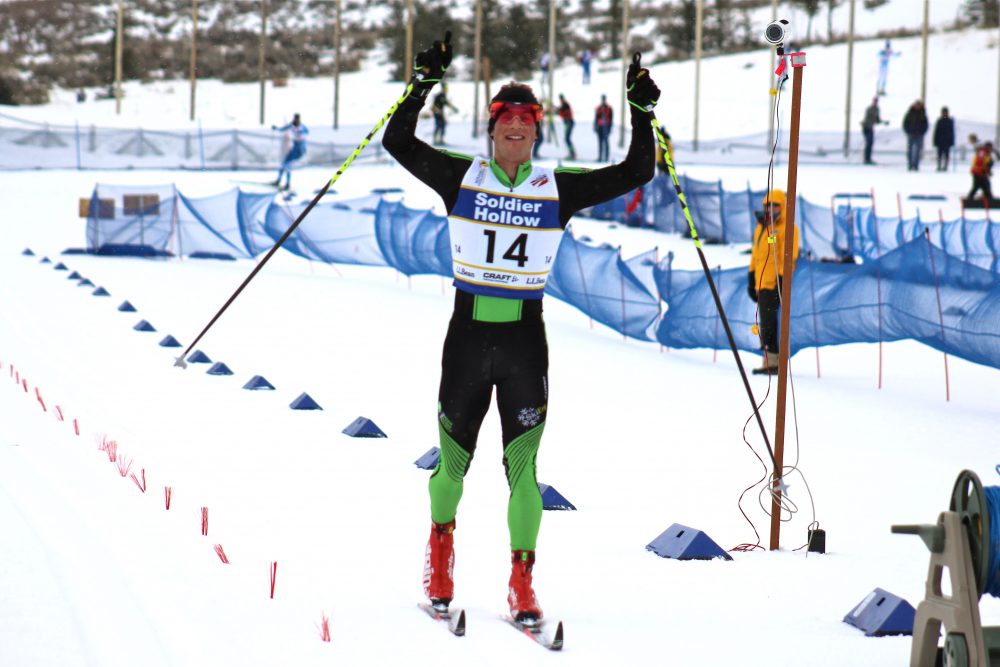
Ben Lustgarten (14) celebrating his first career win at the domestic level with a national title in the men’s 30 k classic mass start at 2017 U.S. nationals at Soldier Hollow in Midway, Utah.
With Miloucheva, he outlined some of his aims for the season. Two specific goals sat at the top of his list: 1) qualify for the Period III World Cup races in Otepää, Estonia, and 2) qualify for the 2017 World Championships in Lahti, Finland.
Lustgarten’s ambitions were high. Prior to this year, the 24-year-old had never won a SuperTour race. In fact, before this year he had never even stood on a SuperTour podium.
But past season stats were not a deterrent to Lustgarten. He went on to achieve both of his top two goals, qualifying for World Champs and ending Period II as the overall SuperTour leader, granting him Period III World Cup starts.
However, it’s not so much the races that Lustgarten qualified for that makes him deserving of FasterSkier’s U.S. Continental Skier of the Year Award. It’s the races it took to get him there.
Prior the 2017 U.S. Cross Country Championships, Lustgarten’s best U.S. national’s finish was sixth. He had never advanced beyond the quarterfinals in a SuperTour sprint, let alone win. But by the end of the season, all those numbers changed.
In December, he raced to his first ever SuperTour podium finish, placing second in the men’s 15-kilometer classic event during the Bozeman SuperTour.
In January, during the Auburn SuperTour in Truckee, Calif., he not only advanced for the first time from the quarterfinals in a SuperTour sprint (the only other time he had advanced past the quarterfinals before that was two weeks earlier at U.S. nationals, where he finished fifth in his semifinal, 10th overall), he won his semifinal and eventually, the final.
“Top of the podium in a sprint! I never thought I’d see the day…” Lustgarten captioned a photo of himself atop the podium following the competition.
And before winning his first ever sprint, Lustgarten also earned his first national title, finishing the men’s 30 k classic race at U.S. nationals this year as the top male.
“This was something I only dreamed of,” Lustgarten wrote in a blog post in March of his victory in the men’s 30 k mass start event. “I crossed the line 1st, I was in shock and so excited. I was so happy that both of my parents were there watching and cheering, it was one of the best moments of my life!”
Jennie Bender, Bridger Ski Foundation
“Sometimes you just need to shake and bake out there…”
That’s what the Bridger Ski Foundation’s Jennie Bender wrote in an email to FasterSkier after she won the women’s classic sprint at this year’s U.S. Cross Country Championships.
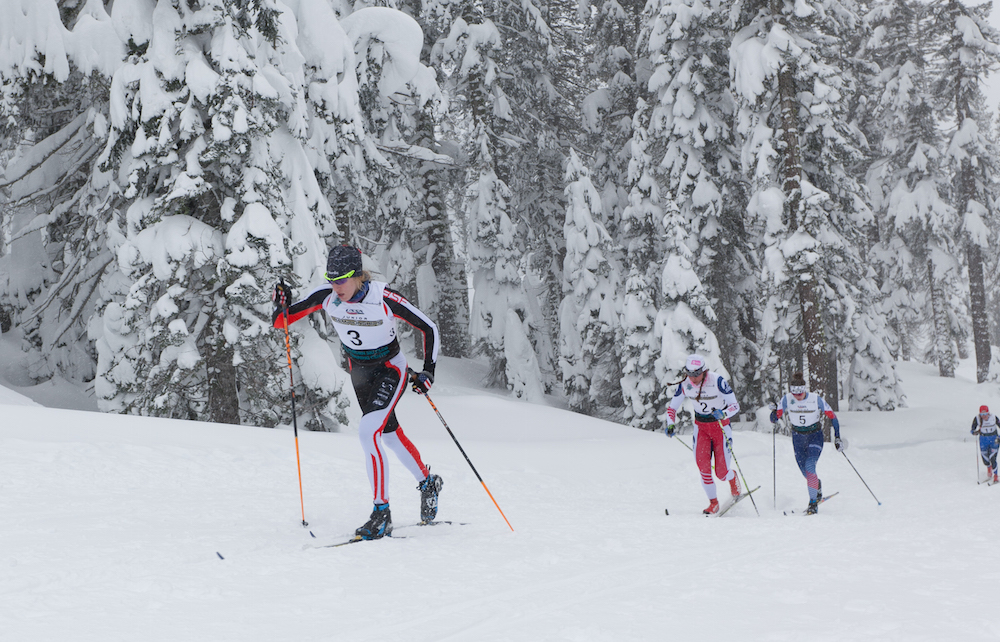
Jennie Bender (3) of the Bridger Ski Foundation leading Stratton’s Julia Kern (2) and Sun Valley’s Deedra Irwin (5) during a sprint semifinal at the SuperTour in Truckee, Calif. Bender went on to win the semifinal, as well as the final.
And while Bender’s name is certainly not a new one to the top of the results sheet, the 29-year-old’s accomplishments this season made her a top pick for FasterSkier’s 2017 U.S. Continental Skier of the Year.
She started her SuperTour season with a win, taking both the women’s qualifier and the final during the opening races in West Yellowstone, Mont.
“My goal is to do better in qualifying, and I did that today, so that was a big win for me,” Bender said during an interview back in December.
The following day she placed fourth in the women’s 10 k classic competition, her best 10 k finish since her third place finish in the event back in 2014.
She raced to 12th in the 10 k freestyle at this year’s U.S. Cross Country Championships, her second best finish since 2012.
A little less than two weeks later, she competed in the Auburn Ski Club SuperTour in Truckee, Calif., where she won the women’s classic sprint. She finished up her SuperTour season with a third place finish in the women’s sprint in Ishpeming, Mich.
“I did today what I really wanted to do here,” Bender said back in January of her win in the women’s classic sprint. “I feel strong in my distance also. I feel a lot more put together as a whole athlete this year, which is pretty exciting.”
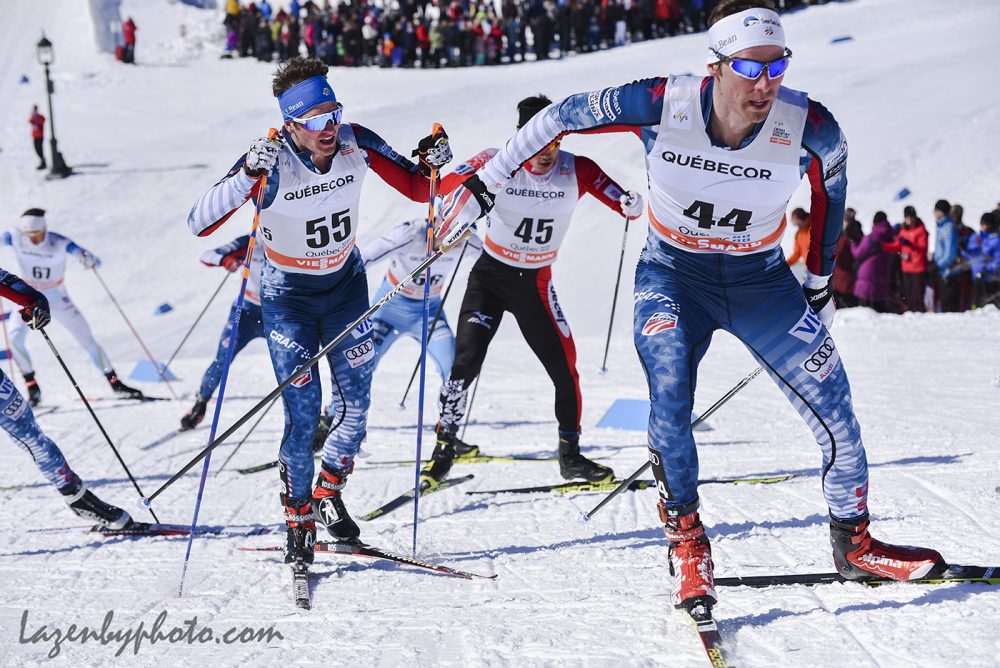
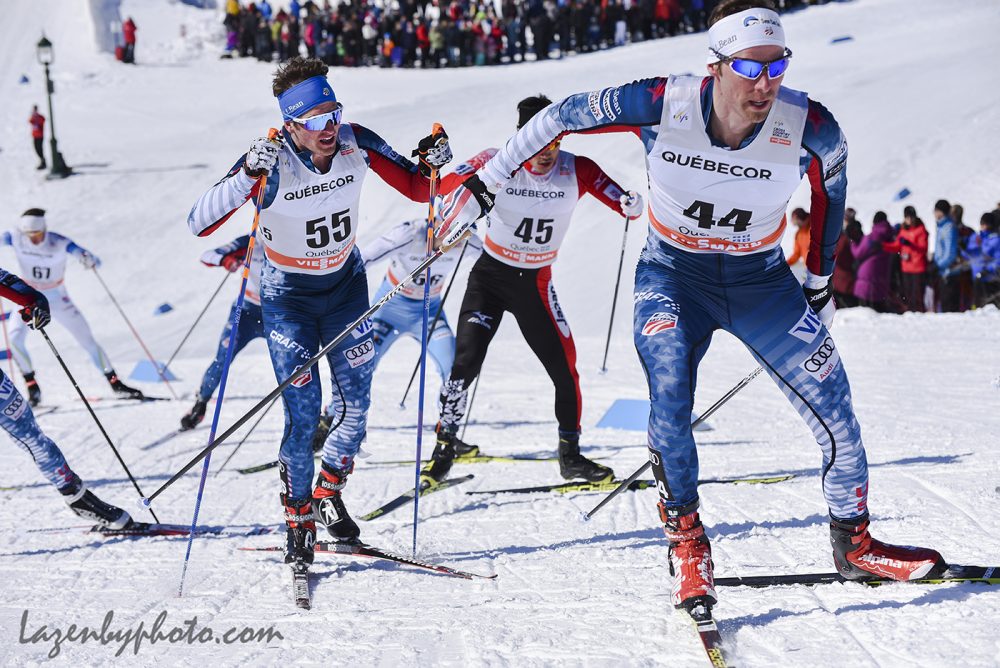
Andy Newell (44) skiing with fellow American David Norris (55) during the men’s 15 k freestyle pursuit at World Cup Finals on Sunday in Quebec City. Norris finished the World Cup Finals mini tour in 43rd overall, but placed 27th for time of day, while Newell held his starting position in 44th. (Photo: John Lazenby/Lazenbyphoto.com)
After the 2017 World Cup Finals mini tour drew nearly 60 North American competitors and tens of thousands of spectators to Quebec City two weekends ago, it’s only fitting that we share the quotes from some of the athletes you haven’t heard from yet (and some you have). Here is a collection of some of the most interesting comments from the U.S. World Cup and Nation’s Group skiers at World Cup Finals. There were 27 in total, although two women — Kikkan Randall and Liz Stephen — did not race due to feeling under the weather.
And here are our race reports (with links to results at the bottom of each) from March 17-19:
“It’s actually like a dream come true. It’s so so much fun. I wish I could do this every day because it’s the best experience I have ever had.” — Erika Flowers (Stratton Mountain School Elite Team)
“I was a little bummed out last year. I was pretty close but didn’t get to come [to the Ski Tour Canada], but it feels good to be here. Last time I came to be Quebec it was super awesome, mind-blowing awesome, so it’s nice.” — Becca Rorabaugh (Alaska Pacific University), who last raced World Cups in 2012 in Quebec and Canmore
On making the jump to the World Cup:
“This is my first World Cup weekend, feels awesome. It was a great experience to be in front of the home crowd of familiar faces, and now for next time I have goals and expectations and it will be really fun.” — Julia Kern (USST D-team/SMS Elite), after the pursuit
On racing close(r) to home:
“It’s so awesome to be back here in North America. I feel like every fourth person here knows my name and it’s an incredible atmosphere. This season hasn’t been what I was hoping for, but it’s just fun to finish it off in a place like this.” — Noah Hoffman (USST/Ski Club Vail)
“It’s really awesome. We only live, like, four hours away from here so we drove up, and it’s really nice to have people cheer for you on course people who that know your name.” — Liz Guiney (Craftsbury Green Racing Project)
“Certainly any time I was struggling I could tune into some American voices shouting my name or coaches and various fans. It’s really great. A good atmosphere our here.” — Caitlin Patterson (CGRP)
“I think I might be closer to Europe than home still. Still have a long ways to go, but I am really excited to head home tomorrow.” — Rosie Brennan (USST/APU)
On goals for World Cup Finals:
“I wanted to ski with confidence because I think it is really easy to get intimated out here, so kind of just went into it with, ‘Today is my race. I am going to ski my race and enjoy the day.’ And I was trying to really good technique and not put myself out of it from the get-go. So it was good. I felt great.” — Flowers, after the mass start
“I’m just trying to finish my season strong, but I feel like I haven’t really recovered from Europe at all, still pretty tired, but I thought I skied well. I almost crashed here but I managed to stay on my feet. I don’t feel like I am skiing super fast right now so I am just trying to do everyhting I can to do as well as I can.” — Ben Lustgarten (CGRP), after the sprint
“Try to hang in there, see what I can do. I haven’t done a World Cup distance race in quite a long time.” — Rorabaugh
“My goal is to improve on where I was last year.” — Kaitlynn Miller (CGRP), who finished last year’s Ski Tour Canada in 41st overall (she placed 52nd in this year’s World Cup Finals mini tour)
On mini-tour formats:
“Yesterday was just really bad, and when there are only three days in a tour, it’s hard to make up for one really bad day. But I am really happy with getting in the sprint heats, and today was a little better.” — Brennan, after the pursuit
“My only goal today was not get lapped, so went out hot for three laps and kind of puttered it in, but finished, and that was the goal. I’m more of a sprinter so it was good to just get through this tour.” — Cole Morgan (Sun Valley Ski Education Foundation), after the pursuit
Sophie Caldwell (17), of the U.S. Ski Team and SMS Elite Team, racing to 38th in the 10 k classic mass start on March 18 at World Cup Finals in Quebec City. Switzerland’s Nathalie von Siebenthal (30) went on to finish 35th.(Photo: John Lazenby/Lazenbyphoto.com)
On mass starts:
“Dude, that’s what I am excited for. … We’ve got a lot of fast distance skiers [on the U.S. team], and hopefully we can work together and push each other.” — Lustgarten, after the sprint
“I tend to prefer classic races and I think a mass start is going to be really exciting.” — Kaitlynn Miller (CGRP), after the sprint
“We knew to expect the accordions and it still caught me completely off guard when we were going into that little bump up there and we came to a complete stop. I think that might’ve been one of the first times in a race that I’ve really come to a complete stop. I know it happens in the guys’ field a lot when they’re all together, but somehow usually the women spread out. So that was a little dicey.” — Caitlin Patterson, after the mass start
“Honestly, I made a rookie mistake and thought that we had four laps, so we turned into the finish and I was like, ‘What? We’re done?’ But it was a good experience and it is good to practice that because in a big fast field like this. it starts hot and you just have to be ready to go and hopefully we can bring that back to the SuperTour and practice that a bit more often.” — Flowers
“It was fun to mix it up. It was pretty hard with the mass start, starting toward the back. There were definitely a couple times where I came to a complete stop, but it was a good experience.” — Jack Hegman (SVSEF)
On pursuits:
“This was definitely one of my favorite events. Really fun to have a cool format with the pursuit and chasing people down.” — Paddy Caldwell (USST D-team/SMS Elite)
“[This was] probably the worst race I’ve had all year, but that’s what happens sometimes. … I had a good race yesterday and today it just wasn’t going.” — Matt Gelso (SVSEF)
On starting in a pursuit wave:
“It was fun. For how small the wave was it was still rather hectic. The course is narrow in parts, which makes it really hard, and I probably expended more energy than I needed to. Maybe I went a little too frantic in that. But it was good though, it’s a really beautiful day here, and they have done a really good job, and I am super pumped. Our techs worked super hard. Yeah, everything was great.” — Chelsea Holmes (APU)
“I wanted to basically think of it as a mass start race from the wave and it was good. I felt like I was able to make the breaks where I wanted to.” — Brian Gregg (Team Gregg/Loppet Nordic Racing)
On skiing with teammates:
“I was working with David [Norris] and Scott [Patterson] for most of the race, and two other guys so that was really fun, and fun to work as group and try to put down a fast time.” — Paddy Caldwell, after the pursuit
“I started three people in front of the wave, so I knew they were going to catch me, but that was fun because we got to ski a pretty fun 15 k with a lot of U.S. competitors. Me and Simi skied a lot together and Brian Gregg and it was fun to finish it off in the sun with some teammates skiing 15 k.” — Andy Newell (USST/SMS Elite), after the pursuit
“I was actually skiing with my teammates, Simi and Andy, for a while. We were rotating through and trying to catch some of the guys ahead of us and make sure the big pack right behind us wasn’t going to catch us.” — Gregg, after the pursuit
“It was super fun skiing with all the U.S. girls in a pack together.” — Kern, after the pursuit
On idols:
“The highlight was definitely being in a sprint heat with Jessie, ’cause I really look up to her and growing up she was my idol. To race with her in my first Wold Cup was really fun.” — Kern, after the pursuit
On falling down and getting back up:
“I fell twice … I fell right out of the start and caught up on someone’s pole, and then on one of the downhills slid out on someone’s ski. The first time I was like, ‘Oh, I can come back from this?’ The second time was like, ‘You’ve got to be kidding me!’ Ugh. But overall this weekend has been pretty fun. It’s so fun to race in Canada, and the conditions could not be better. So I kind of have to get over my own poor race and enjoy the process.” — Jennie Bender (Bridger Ski Foundation), after the pursuit
Sadie Bjornsen (U.S. Ski Team) leads Sweden’s Charlotte Kalla and the rest of a chase pack during the women’s 10 k freestyle pursuit on the last day of 2017 World Cup Finals, where she placed 10th overall with the fifth-fastest time of day. (Photo: John Lazenby/Lazenbyphoto.com)
On the course:
“The course is really different than what we are used to skiing. These are not World Cup-designed trails. There are not the huge hills that we are used to. [They’re] really punchy, short, steep hills. It probably doesn’t suit my strengths super well, but it is the type of skiing I need to be able to do and its such a great atmosphere right here in the city and I wouldn’t want to be anywhere else.” — Hoffman, after the mass start
“I like that there were short, punchy climbs where you had to put your head down and hammer, and then fun downhills.” — Guiney, after the mass start
“The course was really great. It’s kind of a technical course, so you have to think about how you’re going to ski each area and between this headwind, tailwind, all the corners, crests of hills, and I think I skied it fairly well. Smoothly. I felt like I was missing a little bit of power out there, so it wasn’t the best of sprint qualifiers, but it was OK.” — Caitlin Patterson, after the sprint
“The course is awesome, and it’s really fast out right now so it skis really smooth. It’s a really fun qualifier, so I am sure it would be really fun heats. The course for the distances races look good, too. They’re going to be nice with 3 k laps.” — Rorabaugh, after the sprint
“It was pretty flat, lots of double pole and it was a good course.” — Hegman, after the mass start
On conditions:
“These really firm tracks made it harder to track-hop, especially on the fast downhills because you’re just kind of wobbly and it’s a little bit sketchy, so you’re always looking for the fastest line but also having to keep in the tracks. It was a little tricky. Always a mental game and a physical game out there.” — Caitlin Patterson, after the classic mass start
“I think it was hard to nail the kick yesterday as it was warming up quickly. Today I had really fast skis, they were like stupid-fast, which was awesome. Just great conditions to ski in.” — Sophie Caldwell (USST/SMS Elite), after the skate pursuit
“They have been great all weekend. Pretty consistent, fast, and the snow is transforming a bit today. A little different than yesterday … but overall it has been really good.” — Flowers, after the pursuit
“It did the same thing it did yesterday, got a little wetter and a little slower throughout, but I had good skis so it was nice. Just had to get up those tough climbs and glide out the downhills.” — Morgan
“It was all right, felt pretty slow, especially finishing, you’re like, ‘Man, someone’s gonna come by me,’ but it was just slow for everyone. It was hard work out there. Not too many hills, but snow made you work.” — Scott Patterson
On finishing out the season:
“No great results this weekend, but last year at this time and previous year, I was just totally dying off, so one of my goals this year was to try to build through the season, and my fitness is definitely not dropping, if anything it is still building right now. So I am happy. Even though I am not skiing where I want to right now, it gives me a good platform for next year, and that’s kind of what I wanted for this year.” — Newell, after the pursuit
“It’s hard to complain when your racing in blue-bird skies and it’s fast snow and there’s 10,000 North American fans out here so it was really cool. I just focused on catching some good rides and ski hard where I could and having fun.” — Simi Hamilton (USST/SMS Elite), after the pursuit
On season highlights:
“Toblach, for sure, that was the highlight of the year for me. I love racing there and I felt great that weekend. I felt great going into Worlds, but that was obviously really frustrating with falling in that corner … that was for sure a bummer, but it was still a great experience being at Worlds at Lahti. Every season, there’s always bumps and ups and downs, but … I have had seasons in the past by the end of the year I am ready to take a serious period kind of away from training and racing and right now I feel a little bit different. I am ready for a break but also ready for the training season, and I know some really specific, concrete things I need to work on, so I am psyched to start tackling those and just get back to it.” — Hamilton, who placed second in the World Cup freestyle sprint on Jan. 14 in Toblach, Italy, for his fourth-career individual podium
On their season overall:
“I am really satisfied with it. It was really solid. I don’t think there was that one standout result that can sometimes make a season, but I think I had very consistently good results and that’s something I’m proud of, and I look forward to building up off that.” — Sophie Caldwell
“Overall I actually had a really good season. In February I got a concussion so the last month has been a bit rough, but I am trying to finish out strong.” — Bender, who had a non-skiing related injury when a hockey puck struck the back of her head
“It’s been up and down. I think I had some great results and that’s really fun, and then definitely some days where I’d like to improve off for next year.” — Flowers
Marit Bjørgen (7) celebrates her victory over Norwegian teammate Heidi Weng during the women’s 10 k classic mass start on Saturday at World Cup Finals in Québec City. (Photo: John Lazenby/Lazenbyphoto.com)
When it comes to distance classic events, at least this season, Norway’s Marit Bjørgen is calling the shots. She completed her undefeated streak in 10-kilometer classic competitions (in both individual or mass starts), winning her fourth in a row on Saturday at World Cup Finals in Québec City.
Starting in bib No. 7, Saturday’s eventual mass-start winner was skiing just outside of the top 10 for the first kilometer, following two U.S. skiers, Sadie Bjornsen in eighth and Jessie Diggins in fifth. Setting the pace from the front were Norwegian teammates Heidi Weng and Ingvild Flugstad Østberg.
In another half a kilometer, Bjørgen moved to an outside lane and tucked past Sweden’s Ida Ingemarsdotter and Stina Nilsson. The maneuver moved her from 12th to fourth by the bottom of the third major downhill. And within the next climb, the classic queen had changed tracks and strode her way to the front, overtaking Weng.
Right to left: Norway’s Marit Bjørgen leads her teammates Heidi Weng and Ingvild Flugstad Østberg during the women’s 10 k classic mass start on Saturday at World Cup Finals in Québec City. (Photo: John Lazenby/Lazenbyphoto.com)
From there, the race for the win became one about Bjørgen.
While the Norwegian stayed put up front, Finland’s Krista Pärmäkoski, who started the day ranked 22nd in the mini tour, began gaining ground from the back. At 3.3 k the eventual third-place finisher, Pärmäkoski, who had crashed earlier in the race, was skiing 8.1 seconds back from the leader in 21st. In another kilometer, she had moved up ten places and was within 5.3 seconds of Bjørgen.
“I fell today after the start and I had to fight hard to ski back to the leading group,” Pärmäkoski said during an International Ski Federation (FIS) interview.
While Pärmäkoski managed to move up, Diggins, who had been within striking range of the podium, had slipped 19th. The American explained that, while her energy felt good throughout the race, the real struggle came from her lack of kick.
“I had many races when I had outstanding skis this year, arguably the best in the world,” Diggins said. “I guess at some point, it was natural to fall on the other side of that. You can’t nail it every time.”
Despite ideal conditions for spectators — clear, blue skies and a strong sun that sent temperatures soaring into the mid-30’s Fahrenheit (about 2 degrees Celsius) by midday — it was a tricky one for classic waxing.
“Our wax techs work so hard, they are under incredible pressure,” Diggins added. “We did the best we could, we tested as well as we could, and it was a huge struggle for me out there today. But I’m ready for tomorrow. I know at the end of the season, everyone is tired, I just want a good race to finish it off. In skating, you don’t have to worry about kick, so I’ll go out and fight.”
As Diggins dropped back, a trio of Norwegians spearheaded the front. Around the halfway point, Bjørgen, Weng and Østberg began their breakaway, foreshadowing an all-Norwegian podium.
But what they hadn’t counted on, least of all Østberg, was Pärmäkoski. The Finn had decreased her distance from the Norwegians within the next kilometer by another 4 seconds, now merely a meter away from the top three.
“I was really fighting and hoping for a podium,” Østberg told FasterSkier. “I actually felt strong and strong enough but there was three girls stronger than me so, fourth is also good.”
With less than four kilometers to go, Østberg took a pull at the front, but it wasn’t long before the lead was back to Bjørgen.
“I think Marit and I did an awesome job in the front,” Østberg said. “Marit for sure did most of the job, but I tried to help and tried to keep up the speed in the leading group because there was someone chasing behind and I knew that she had some power left at the end of the last lap.”
Left to right: Norwegians Heidi Weng and Marit Bjørgen and Finland’s Krista Pärmäkoski on the podium for the women’s 10-kilometer classic mass start on Saturday at World Cup Finals in Québec City. (Photo: John Lazenby/Lazenbyphoto.com)
As the four headed into their final kilometer, Bjørgen and Weng steamed off the front, while Pärmäkoski passed Østberg and locked into third. The two Norwegians cornered into the finishing stretch together, but Bjørgen’s double pole proved too strong for Weng and she crossed first in a time of 24:23.6.
Weng crossed 0.6 seconds later for second place, and Pärmäkoski finished 2.9 seconds back in third, while Østberg was 4.9 seconds off the podium in fourth.
“I have been winning all of the distance, so I’m happy with that,” Bjørgen said. “I was fighting for my position from the beginning, so I wasn’t in front before 2 kilometers, and then I wanted to speed up and then I saw the group was smaller and smaller. A good finish, so I am happy.”
A day after Weng locked up the Overall World Cup title, she clinched the Distance World Cup season-long title as well on Saturday. For Sunday’s pursuit, the last World Cup race of the season, Weng has a 1-second head start on Bjørgen in the 10 k freestyle pursuit.
Bjornsen Top American in 15th; Nishikawa Top Canadian in 37th
The top North American woman on Saturday was U.S. Ski Team (USST) member Sadie Bjornsen in 15th (+29.9).
Bjornsen and Diggins had been skiing with the top 10 for the first 3.3 k loop. As Diggins began to fall back, Bjornsen continued to race within and around the top 10. Bjornsen, like Diggins, also explained she had trouble slipping.
“I just couldn’t get up that hill,” Bjornsen said, referring to one of the course’s final climbs. “I started slipping so much, I was trying to keep it together. I made the mistake of wanting to go on the steep part of the climb, because I wanted to follow Kalla, but it was super hard to kick there, so it was a bit of a mistake … But I didn’t lose too much time on the group in front of me for tomorrow, so I’m excited.”
American Sadie Bjornsen (13) racing alongside Norway’s Kathrine Rolsted Harsem (14), ahead of Sweden’s Charlotte Kalla (27) and Stina Nilsson (1) and Norway’s Maiken Caspersen Falla (2), during the women’s 10 k classic mass start on Saturday at World Cup finals in Québec City. Bjornsen went on to place 15th. (Photo: John Lazenby/Lazenbyphoto.com)
Bjornsen will start Sunday’s pursuit 1:10.4 minutes after Weng. While she admitted that classic races used to be her favorite, Bjornsen has embraced the fact that she can perform well in either discipline and attributed part of that newfound confidence to the depth of the women’s team.
“In 2011, we knew that Kikkan was good, but we didn’t know that we could be good,” Bjornsen said. “Each year, a new person on the team is discovering that they have podium potential, and they belong here. Yesterday, for example, for Rosie to make it into the heats is just crazy, the lift it gives the team, or Julia making her first World Cup points.
“We talk a lot about what we can do to improve together, and that’s different from 2011, because we’re not like, ‘OK, we have to do what Kikkan is doing,’ ” she continued. “Now we can speak with each other, and have an idea of what we can do.”
Diggins finished Saturday’s mass start in 27th (+1:06.9) followed by her teammate Sophie Caldwell in 38th (+1:56.0).
“I felt pretty good. I haven’t done much distance racing this year so it was fun to hop in one,” Caldwell said.
Following Caldwell, was Caitlin Patterson crossing in 44th (+2:39.9), Liz Guiney 45th (+2:43.3), Kaitlynn Miller 47th (+2:46.5), Chelsea Holmes 48th (+2:48.4), Rosie Brennan 50th (+2:48.8), Julia Kern 52nd (+3:05.5), Erika Flowers 55th (+3:37.2), Becca Rorabaugh 57th (+3:39.5), and Jennie Bender 58th (+3:41.9).
“I was happy with the result,” Guiney said. “I got in a little bit of a pile out of the start. I didn’t expect it to stop, but other than that it was good. I had fast skis and good kick so I was happy.”
Brennan explained that she broke a pole on her first lap.
“I was fighting my skis a lot and fighting myself, then fell and broke a pole and then it was not a good race,” she said.
For Canada, Emily Nishikawa led the team in 37th (+1:51.7). She explained that while she once again finished outside the points (top 30), a result is not so much her ultimate goal as a feeling.
“I have just been out of the top 30 a lot this year … it has been really close” Nishikawa said. “Everyone always bases it on top 30 is good and anything other than that is not that good. But I just kind of focus on my own self and if I have been skiing well I am happy with that.”
Nishikawa further indicated that being able to race the final World Cup competitions in front of a home crowd is indescribable.
“I can’t wipe out the smile of my face, it’s hard to put into words just how special it is to race in your home country,” she said.
Cendrine Browne, of the Canadian U25 Team and CNEPH, after finishing 41st in the women’s 10 k classic mass start on Saturday at World Cup Finals in Québec City. (Photo: John Lazenby/Lazenbyphoto.com)
Following Nishikawa was Cendrine Browne in 41st (+2:28.2). Despite getting caught early on in the competition, Browne is satisfied with her position heading into tomorrow’s pursuit and hopes to move up into the top 30.
“Unfortunately, I got stuck behind on the first uphill, which prevented me from staying with the leading group,” Browne said. “I felt I could of stayed with them, I felt strong and relaxed. At the start of the last lap though, I was leading my pack, which made it harder for me. I still managed to distance myself from the skiers behind, but I was unable to catch those in front. I was caught up between two groups. Anyway, it’s good news for tomorrow.”
Also competing for Canada, Dahria Beatty finished 53rd (+3:15.4), Annika Richardson 54th (+3:36.3), Katherine Stewart-Jones 56th (+3:38.1), Frédérique Vézina 59th (+3:43.6), Annika Hicks 60th (+3:45.6), Sophie Carrier-Laforte 61st (+4:05.9), Andrea Dupont 62nd (+4:05.9), Katherine Weaver 63rd (+4:27.9), Alannah MacLean 64th (+4:29.4), Sadie White 66th (+5:31.1), Lisle Compton 67th (+5:34.3), Mia Serratore 68th (+5:58.6), and Laura Leclair 69th (+6:46.2).
Alex Harvey racing in the men’s 15 k freestyle pursuit at Stage 4 of the Ski Tour Canada last year in Quebec City. (Photo: FlyingPointRoad.com/NNF)
For the second-straight year, the World Cup’s season-ending races will be held in Canada, with Québec City hosting 2017 World Cup Finals, this Friday through Sunday. Canada initially announced a roster of 30 (15 women, 15 men) for the three-day mini tour, and the U.S. selected 27 (15 women and 12 men), with both countries maximizing their Nation’s Group “home” quota for the event in downtown Québec City.
Note: On Tuesday, Cross Country Canada (CCC) announced it would be releasing a revised roster “due to some CPL points errors in calculations,” according to a press release. On Thursday, FasterSkier confirmed that the list included the same 15 women and 15 men that were originally published on FasterSkier.
And on Wednesday, Quebec organizers announced that the times of each race would be moved back an hour “upon FIS recommendation” to satisfy international broadcast schedules. The updated times are listed below.
2017 World Cup Finals race schedule (updated Wednesday):
(All times Eastern Daylight Time)
Friday, March 17: Freestyle sprint (qualifier starts at 11:45 a.m.; heats at 2:15 p.m.)
(Note: Jenn Jackson of Lappe Nordic declined her spot)
Men:
Alex Harvey (World Cup A-team)
Devon Kershaw (World Cup A-team)
Len Valjas (World Cup A-team)
Jess Cockney (World Cup B-team)
Graeme Killick (World Cup B-team)
Knute Johnsgaard (NST U25 Team/AWCA)
Russell Kennedy (Canmore Nordic/Team R.A.D.)
Gareth Williams (Junior NST/Telemark)
Andy Shields (Lappe Nordic)
Bob Thompson (NTDC Thunder Bay)
Joey Foster (Team Hardwood)
Julien Locke (NST U25 Team/AWCA)
Evan Palmer-Charrette (NTDC Thunder Bay)
Brian McKeever (Canadian Para-Nordic Ski Team)
Ricardo Izquierdo-Bernier (CNEPH)
USA
Women:
Kikkan Randall (U.S. Ski Team A-team/APU)
Sadie Bjornsen (USST A-team/APU)
Liz Stephen (USST A-team)
Caitlin Patterson (CGRP)
Rosie Brennan (USST B-team/APU)
Erika Flowers (SMS Elite)
Jennie Bender (BSF)
Julia Kern (USST D-team/SMS Elite)
Liz Guiney (CGRP)
Kaitlynn Miller (CGRP)
Chelsea Holmes (APU)
Becca Rorabaugh (APU)
Jessie Diggins (USST A-team/SMS Elite)
Sophie Caldwell (USST A-team/SMS Elite)
Ida Sargent (USST A-team/CGRP)
(Note: Katharine Ogden, of the SMS Elite Team and U.S. Ski Team D-team, declined her spot due to “ongoing stomach issues,” according to U.S. head coach Chris Grover. Guiney was the first alternate as she was next on the SuperTour list.)
Men:
Andy Newell (USST A-team/SMS Elite)
Noah Hoffman (USST B-team/Ski Club Vail)
Erik Bjornsen (USST B-team/APU)
Matt Gelso (SVSEF)
David Norris (APU)
Ben Lustgarten (CGRP)
Cole Morgan (SVSEF)
Patrick Caldwell (USST D-team/SMS Elite)
Jack Hegman (SVSEF)
Brian Gregg (Team Gregg/Loppet Nordic Racing)
Scott Patterson (APU)
Simi Hamilton (USST A-team/SMS Elite)
A view from the steep hill on the sprint course with the stadium area in background, as seen during training last year in Quebec City, one day before the third stage of the 2016 Ski Tour Canada. (Photo: John Lazenby/Lazenbyphoto.com)
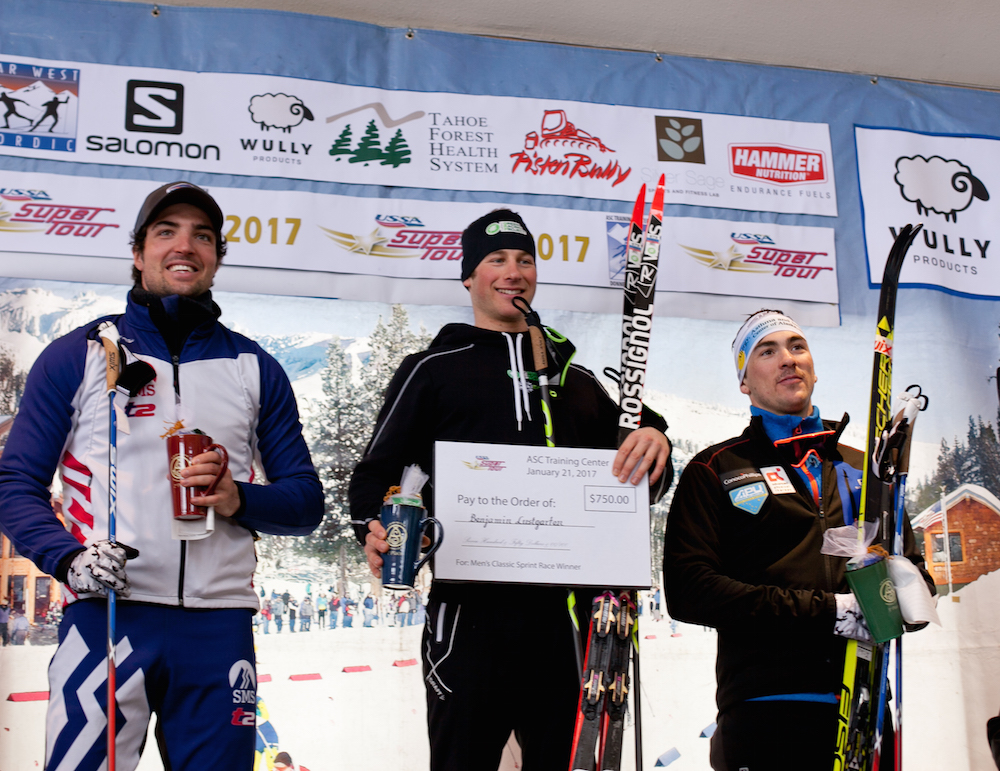
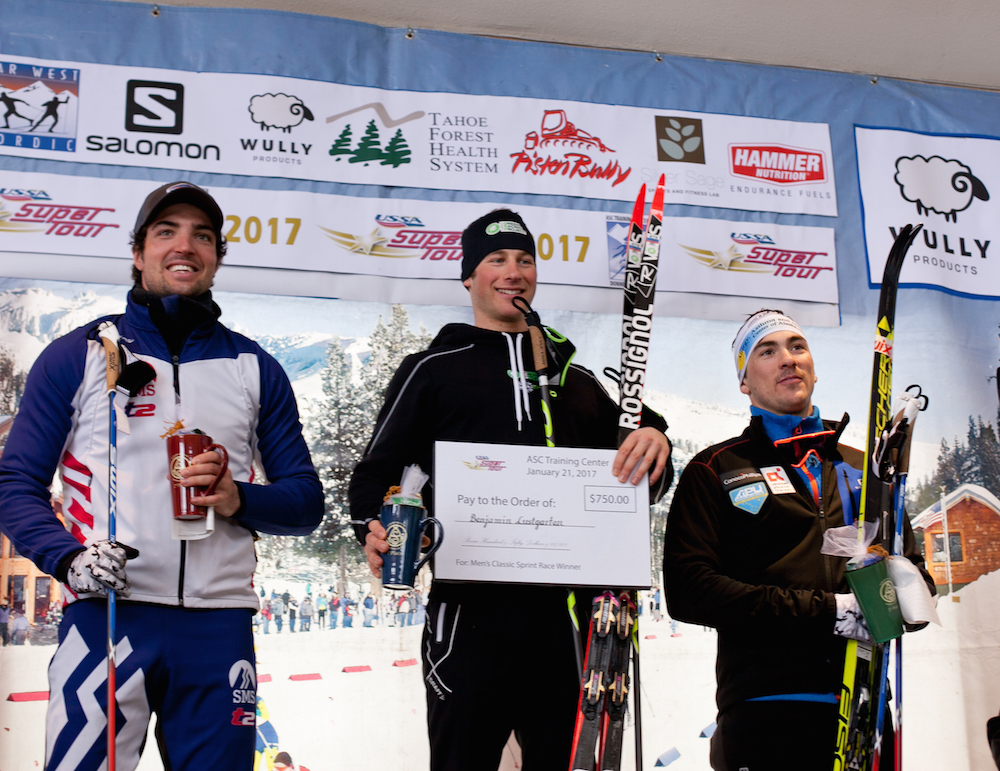
Ben Lustgarten (Craftsbury Green Racing Project) with his $750-dollar check for winning the men’s SuperTour classic sprint on Saturday near Truckee, Calif. Stratton’s Ben Saxton (l) placed second and APU’s Reese Hanneman (r) was third.
Lustgarten, of the Craftsbury Green Racing Project, raced to a 1.58-second victory in the men’s A-final at the Auburn Ski Club in Soda Springs, Calif., finishing in 3:03.4. Ben Saxton, of the Stratton Mountain School (SMS) Elite Team, placed second, and Reese Hanneman, of Alaska Pacific University (APU), was third (+2.77).
Hannenman’s younger brother Logan also reached the final and placed fourth (+4.5), Dakota Blackhorse-von Jess (Bend Endurance Academy) was fifth (+5.86), and the third APU skier in the final, Tyler Kornfield sixth (+18.69).
Blackhorse-von Jess started the day off as the fastest qualifier in 2:58.8. Saxton qualified second, 4.1 seconds back, Logan Hanneman qualified third (+4.2), and Lustgarten fourth (+6.5). Blackhorse-von Jess went on to win his quarterfinal and place second in his semifinal, while Lustgarten and Saxton both won their quarterfinals and semifinals.
Jennie Bender (3) of the Bridger Ski Foundation leading Stratton’s Julia Kern (2) and Sun Valley’s Deedra Irwin (5) during the second women’s classic sprint semifinal at Saturday’s SuperTour near Truckee, Calif. Bender went on to win the semifinal, as well as the final.
In the women’s A-final, Jennie Bender of the Bridger Ski Foundation, coming off a classic sprint win at nationals, scored another victory in 3:29.07. She edged Craftsbury’s Kaitlynn Miller by just seven-hundredths of a second, and Stratton’s Julia Kern placed third (+3.42). Racing at home, Hannah Halvorsen (Sugar Bowl Academy) finished fourth (+3.88). Craftsbury had three in the women’s final with Caitlin Patterson in fifth (+3.93) and Heather Mooney in sixth (+27.35).
Miller proved to be the woman to beat throughout the day, winning the qualifier in 3:30.9, along with her quarterfinal and semifinal. Kern qualified second (+3.2) and Bender third (+4.6). Bender went on to win her quarterfinal and semifinal as well before facing off with Miller in the final.
NorAm Western Canadian Championships (Whistler, B.C.): 10/15 k classic
It was interval-starts day at Western Canadian Championships at Whistler Olympic Park and national-team veteran Emily Nishikawa completed the four laps of the women’s 10 k classic in 30:35.5 to win ahead of teammate Dahria Beatty, 16.5 seconds behind. Maya MacIsaac-Jones completed the national team and Alberta World Cup Academy (AWCA) sweep in third (+1:36.5).
Sovereign Lake’s Hannah Mehain, of the national junior team, was the top junior for the second-straight day in eighth overall (+3:22.1).
In the men’s 15 k, Lappe Nordic’s Andy Shields won the six-lap race in 40:34.2, showing some of the form that won him the NorAm overall last season. National-team member Jess Cockney collected his second-straight podium, finishing second, 4.3 seconds behind Shields. Evan Palmer-Charrette (NTDC Thunder Bay) completed the podium in third (+55.1).
FIS Cross-Country World Cup (Ulricehamn, Sweden): 10/15 k freestyle
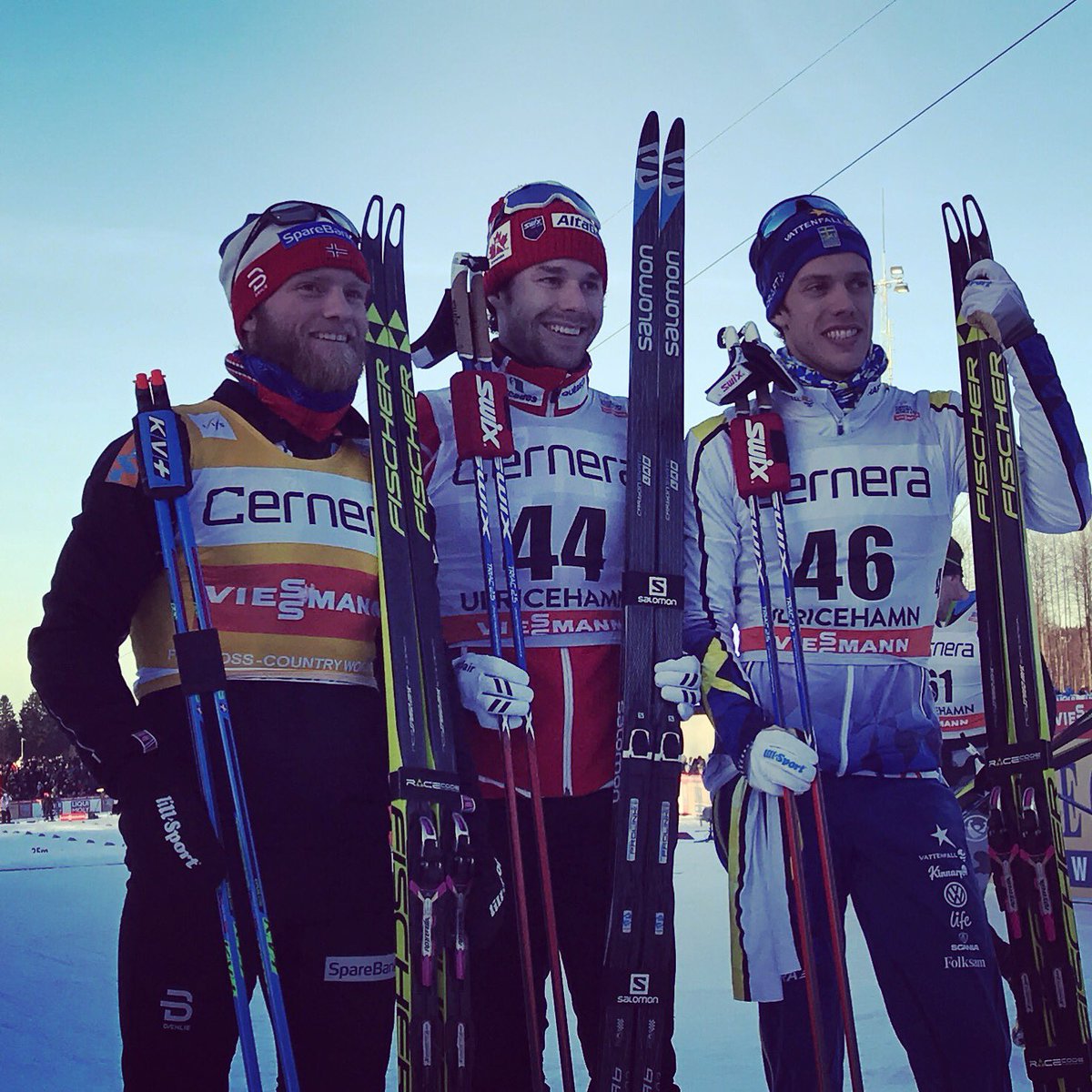
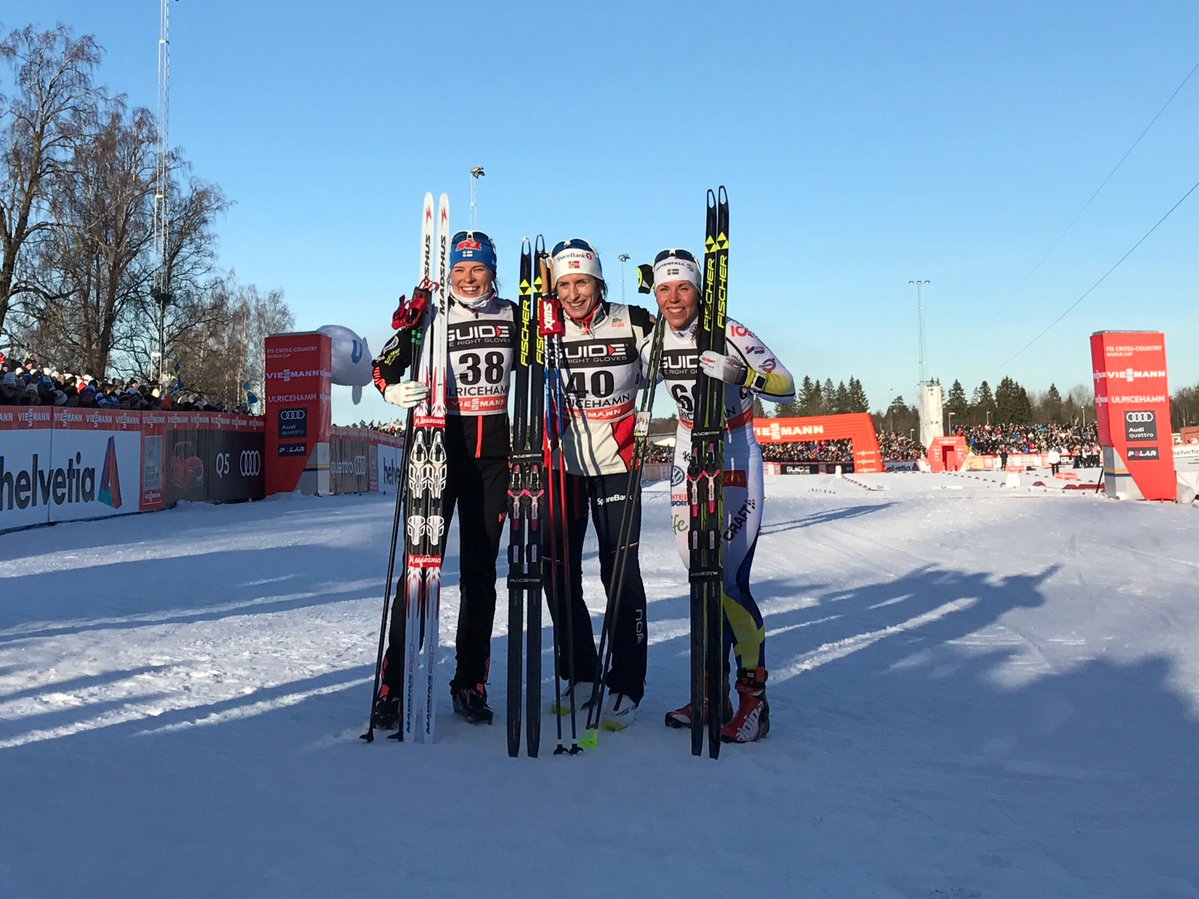
The men’s 15 k freestyle podium at Saturday’s World Cup in Ulricehamn, Sweden, with Canadian winner Alex Harvey (c), Norwegian runner-up Martin Johnsrud Sundby (l), and Sweden’s Marcus Hellner (r) in third. (Photo: FIS Cross Country/Twitter)
First individual win of the season (second straight, after winning last weekend’s team sprint), fifth individual victory of his career. That’s the latest news on Canada’s Alex Harvey, who won the World Cup men’s 15-kilometer freestyle individual start on Sunday in Ulricehamn, Sweden, for his first victory in a 15 k skate race and fourth individual podium of 2016/2017.
To say Harvey is on a roll is an understatement. On Saturday, he beat Norway’s Martin Johnsrud Sundby by 6 seconds after starting a minute behind the Norwegian defending World Cup champion. Harvey’s fastest time across the line in 32:46.2 held up through 76 finishers, with Sweden’s Marcus Hellner coming somewhat within range after starting a minute behind him. Hellner ended up 14.3 seconds back from Harvey at the finish for third place, behind Sundby.
Switzerland’s Dario Cologna missed the podium by 0.5 seconds in fourth (+14.7), and Norway’s 24-year-old Daniel Stock broke through in fifth (+16.2) for his first World Cup top 20.
Great Britain’s Andrew Musgrave placed sixth (+18.7), Sweden’s Daniel Rickardsson was seventh (+25.0), Norway’s Finn Hågen Krogh eighth (+32.2), Russia’s Petr Sedov ninth (+33.9), and Japan’s Keishin Yoshida 10th (+34.2).
American Erik Bjornsen landed in the points as he tied Norway’s Simen Andreas Sveen for 28th (+1:09.2), leading fellow U.S. Ski Team members Noah Hoffman, who placed 41st (+1:28.8), and Simi Hamilton in 53rd (+1:56.2). Also for the U.S., Matt Gelso, the Period 1 SuperTour leader from the Sun Valley Ski Education Foundation (SVSEF) Gold Team, finished 68th (+3:00.3).
Harvey’s Canadian World Cup teammates Len Valjas finished 35th (+1:17.7) and Devon Kershaw 38th (+1:22.2). Knute Johnsgaard (Canadian U25 Team) did not start.
The women’s 10 k freestyle podium on Saturday in Ulricehamn, Sweden, with Norwegian winner Marit Bjørgen (c), Finland’s Krista Parmakoski (l) in second and Sweden’s Charlotte Kalla (r) in third. (Photo: FIS Cross Country/Twitter)
In her first World Cup race in over a month and at a brand-new World Cup venue, Norway’s 36-year-old Marit Bjørgen returned to her winning ways, topping the women’s 10 k freestyle on Saturday in Ulricehamn.
Bjørgen started 40th out of 61 finishers and took the lead from Finland’s Krista Parmakoski at the finish with a time of 23:46.3 minutes. Parmakoski, who started a minute ahead of her in bib 38, ended up second, 10.7 seconds back. Sweden’s Charlotte Kalla reached the podium for the second time this season in third (+24.9).
“It is always great to win,” Bjørgen said, according to an International Ski Federation (FIS) press release. “I stayed at home for five weeks and was training. It is great to come back with a victory. I know that the training I had done was good. It was an amazing atmosphere today by the course. There were people cheering everywhere.”
Norway swept fourth through sixth with Astrid Uhrenholdt Jacobsen in fourth (+25.7), Ragnhild Haga in fifth (+32.3) and Heidi Weng in sixth (+34.0).
American Jessie Diggins raced to seventh (+34.9), ahead of Sweden’s Hanna Falk, who recorded her best distance result in eighth (+36.4). Norway’s Ingvild Flugstad Østberg finished ninth (+44.8), and Germany’s Sandra Ringwald was 10th (+56.6).
“I didn’t have the snappy good feelings I was hoping to have in my body today, but it was a solid race,” Diggins wrote in a post-race email to FasterSkier. “It’s always hard when you know that on your best days you are capable of more, but at the same time we had great skis, and it was really fun for me to be able to ski with my teammates today!”
The U.S. had three in the top 20 and four in the top 30 with Sadie Bjornsen in 12th (+1:00.5), Liz Stephen in 16th (+1:07.3) and Rosie Brennan in 24th (+1:30.7).
Cendrine Browne as Canada’s lone woman in the race achieved 35th (+1:52.0) for her career best in an individual race. Also for the U.S., Kikkan Randall placed 40th (+1:59.6) and Liz Guiney of the Craftsbury Green Racing Project 52nd (+2:33.2).
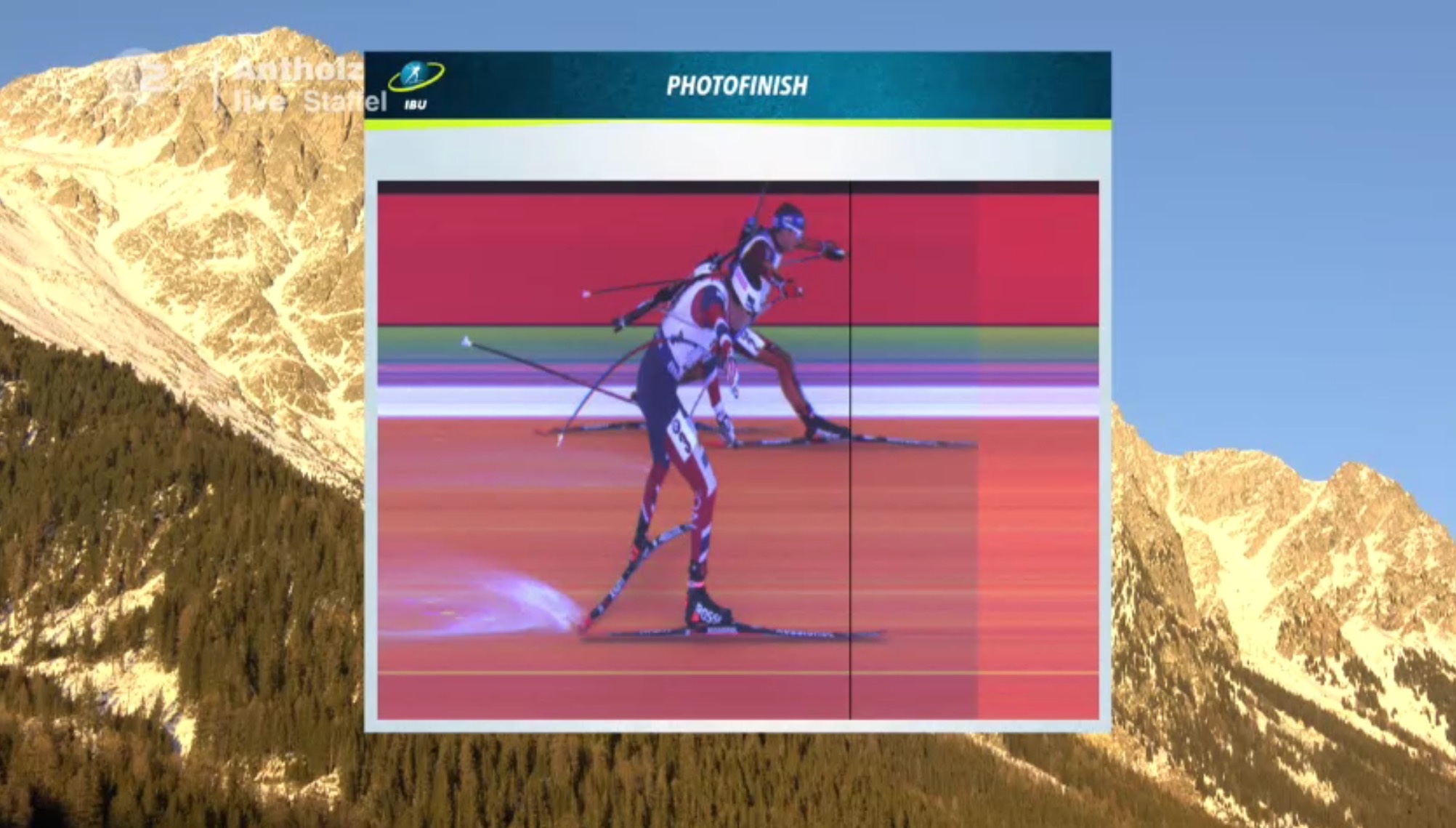
The photo finish of the men’s 4 x 7.5 k relay on Saturday at the IBU World Cup in Antholz, Italy, with Germany’s Simon Schempp outlunging Norway’s Emil Hegle Svendsen. (Photo: ZDF broadcast screenshot)
For the U.S. men, top six was a target for the 4 x 7.5 k relay on Sunday in Antholz, Italy, according to US Biathlon Men’s Coach Jonas Johansson.
Mission accomplished. In the final team event before 2017 World Championships, Lowell Bailey, Leif Nordgren, Tim Burke, and Sean Doherty combined for sixth, finishing 1:04.9 minutes behind the German winners. The Americans used a total of 10 spares but avoided the penalty loop, as did the Germans who used seven spares to clean the eight-stage race and won it in 1:13.57.2.
Germany’s Simon Schempp narrowly outlasted Norway’s Emil Hegle Svendsen in the finishing stretch to secure the victory for Germany (with teammates Erik Lesser, Benedikt Doll and Arnd Peiffer) by one-tenth of a second. Norway finished second with nine spares and no penalties (with Lars Helge Birkeland, Henrik L’Abee-Lund, Johannes Thingnes Bø, and Svendsen), and Russia secured third (+33.6) with nine spares and zero penalties as well (with Maxim Tsvetkov, Evgeniy Garanichev, Dmitry Malyshko, and Anton Babikov).
Ukraine used a total of just five spares and had zero penalties for fourth (+46.7), and Austria took fifth (+49.2) with eight spares and no penalties, after Austria’s Dominik Landertinger skied away from Doherty on the final loop and finished 6.9 seconds ahead of him for fifth place.
For the U.S. men, sixth was close to their team-best fifth with the same lineup in last year’s World Cup relay in Presque Isle, Maine. The same group also took sixth in Ruhpolding, Germany, last year as well.
With all four making US Biathlon’s World Championships team, announced Saturday, they will likely be aiming for a best championships result early next month in Hochfilzen, Austria.
Canada (Christian Gow, Scott Gow, Macx Davies, and Brendan Green) finished 16th (+4:13.8) on Saturday with two penalties and 11 spares. Scott Gow skied them up to 15th by the second exchange but they dropped to 18th after Davies had two penalties on the third leg. With Green anchoring and using just one spare, they recouped two places before the finish.
In the women’s race, Germany’s Nadine Horchler achieved a lifetime dream with her first World Cup win, after starting in bib 30 and earning her start as a reserve athlete. Germany took first and second with Laura Dahlmeier in second, and the Czech Republic’s Gabriela Koukalova placed third. Susan Dunklee of the U.S. was the lone North American starter and finished 24th after leading at the start of the second loop.
FIS Nordic Combined World Cup (Chaux-Neuve, France): Individual large hill/10 k
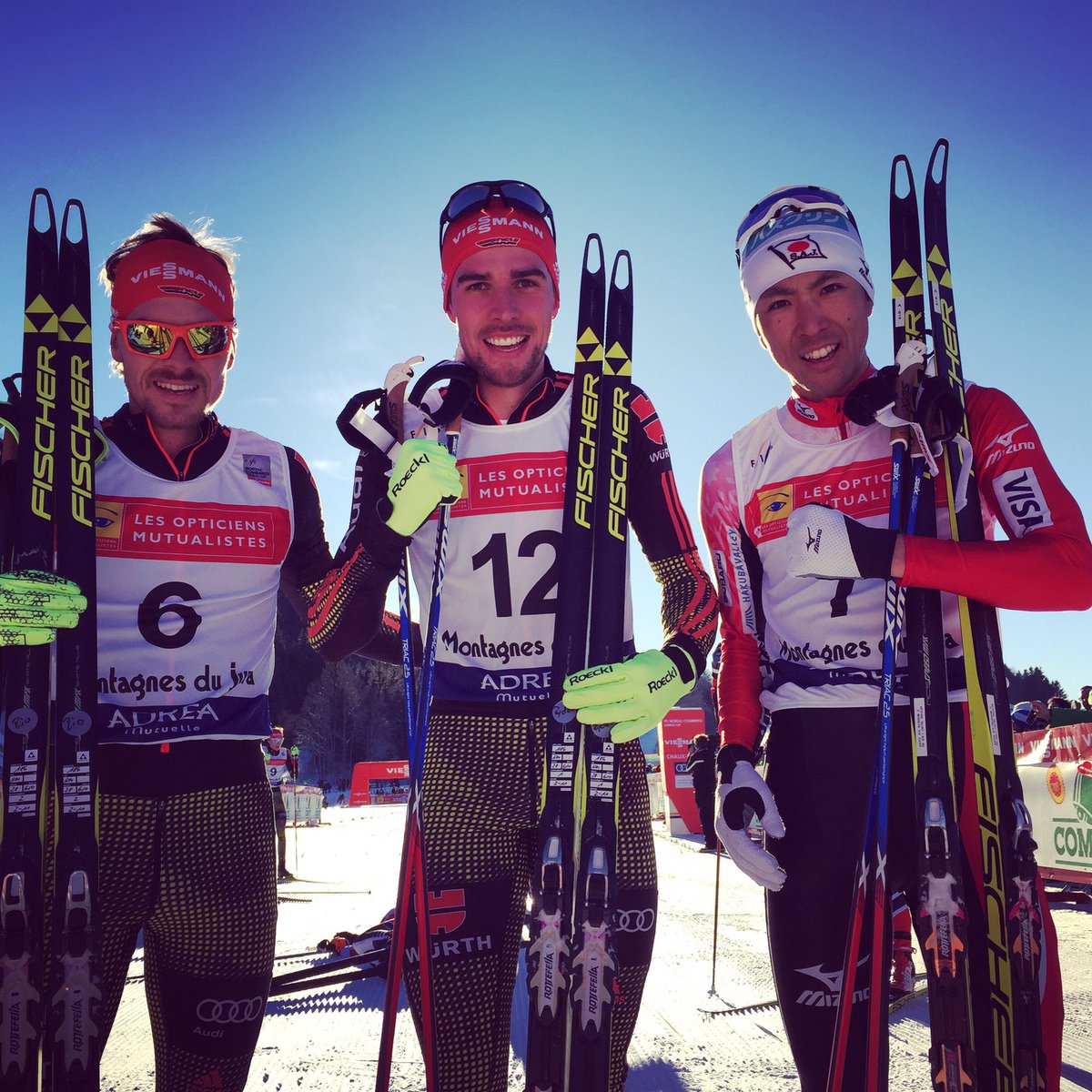
Saturday’s Nordic Combined World Cup podium in Chaux-Neuve, France, with German winner Johannes Rydzek (c), German runner-up Fabian Rießle (l) and Japan’s Akito Watabe (r) in third. (Photo: FIS Nordic Combined/Twitter)
The first part of Saturday’s Nordic Combined World Cup individual large hill/10 k competition was a shining moment for U.S. Nordic Combined skier Ben Berend, who jumped to second for a total of 127.5 points, trailing only Norway’s Jarl Magnus Riiber with 139 points in Chaux-Neuve, France.
Berend flew farther than Germany’s Eric Frenzel, who jumped to third on the Chaux-Neuve large hill.
Later in the day, they started the 10 k Gundersen in that order, with Riiber heading out first, followed by Berend 46 seconds later, then Frenzel 53 seconds back in third.
Germany’s Johannes Rydzek started 1:15 minutes back in 12th and skied the fastest 10 k to take the victory at the finish (in 23:01.7). He held off his German teammate Fabian Rießle by 2.8 seconds for the win, after Rießle started sixth and 1:01 back. Japan’s Akito Watabe reached the podium in third (+5.7) after jumping to seventh and starting the race 1 second behind Rießle.
Frenzel ended up fourth (+8.3), and the fourth German in the top five, Björn Kircheisen improved to fifth (+22.6) after starting 11th.
Riiber dropped to 15th (+54.0), and Berend fell outside the top 30 to end up 32nd (+2:26.0) with the 39th-ranked course time.
Berend finished 12.2 seconds ahead of his U.S. teammate Taylor Fletcher, who placed 34th (+2:38.2) after the jump put him in 48th.
Bryan Fletcher was 49th after the jump but did not start the 10 k.
The Nordic Combined World Cup continues Sunday in Chaux-Neuve with another large hill/10 k.
Ski Classics #5: La Diagonela (Zuoz, Switzerland): 50 k classic
[UPDATED] Under “blue skies, no wind and perfect track conditions” in the Swiss Engadin Valley on Saturday, according to a Ski Classics press release, Russia’s Ilya Chernousov and the Czech Republic’s Kateřina Smutná won the men’s and women’s La Diagonela, respectively, in Zuoz, Switzerland.
Chernousov, of Team Pioneer Investments, and Tord Asle Gjerdalen (Team Santander) led a large pack of men into the final major climb on the 50 k course. There, Gjerdalen attacked and Chernousov matched him, accelerating away from his competitors up the last steep pitch to the finish, according to the press release. He finished in 2:03:39.6 hours, holding off Gjerdalen by 1.5 seconds, while Øystein Pettersen (Team BN Bank) finished third (+3.0).
In the women’s race, Smutná (Team Santander) pushed to break up the field around the halfway point, where the men caught the women. Britta Johansson Norgren (Lager 157 Ski Team) hung with Smutná, but lost contact over the last 5 k. After finishing second in the last two Ski Classics races, Smutná took the win by 1:03.2 minutes in 2:20:49.2. Nordgren finished second, ahead of Sara Lindborg (Team Serneke) in third, who finished more than three minutes later (+4:17.4).
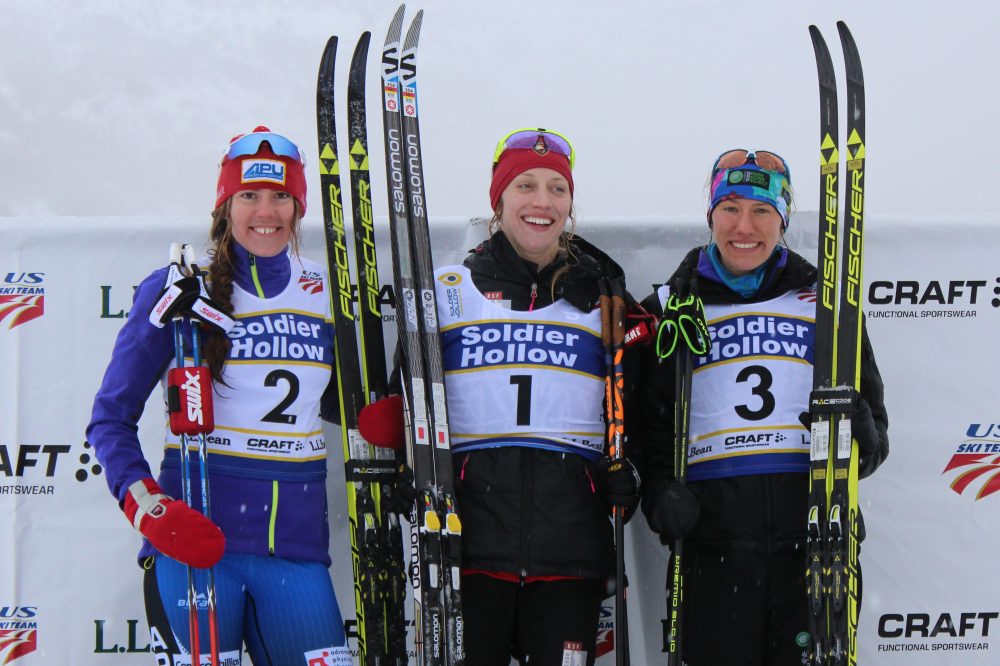
Left to right: Alaska Pacific University’s Becca Rorabaugh, Bridger Ski Foundation’s Jennie Bender and Craftsbury Green Racing Project’s Kaitlynn Miller on top of the podium for the women’s 1.3-kilometer classic sprint on Sunday at U.S. nationals in Midway, Utah.
MIDWAY, Utah — There was a dampness in the room, and an odor that clung to the walls like plastic. Yet athletes continued to enter, with one after another pulling open the doors to the Soldier Hollow venue (SoHo) volunteer building. Once inside, many made a beeline for the race committee’s makeshift front desk. Race bibs and start lists, however, were not what they sought.
Close to an hour had passed since the final female starter had finished Sunday’s 2017 U.S. Cross Country Championships classic sprint qualifier; most bibs were stretched inside out over warmup jackets and start lists tucked away in side pockets.
Alaska Pacific University’s Becca Rorabaugh during the qualifier for the women’s 1.3-kilometer classic sprint on Sunday at U.S. nationals in Midway, Utah.
Athletes who did work their way to the race committee counter requested something else: trash bags.
Stepping outside and surveying the stadium at U.S. nationals, it didn’t take long to realize why.
Rain was falling heavily down, turning the prior day’s powdery trails into moisture-rich snow. Spectators were sporting ponchos and raincoats, as were a few athletes who had them on hand. Those who did not were settling for a synthetic alternative.
“I had on four jackets and a trash bag,” Jennie Bender of the Bridger Ski Foundation (BSF) told FasterSkier on Sunday. “It warmed up by almost 40 degrees [Fahrenheit] since Saturday’s race.”
Sunday’s warmer race temperatures created anything but consistency for the women’s 1.3-kilometer classic sprint. Though snow fell prior to the women’s qualifier, by the time Bender, who was the first of the 264 women to start, the precipitation had stopped.
Yet many women, including Bender, still ran into trouble near the top of the last hill on the women’s sprint course.
“At the top of that hill, I had to come to a stop and stomped the snow off,” Bender said.
Numerous others had similar difficulties. A few even fell, including U.S. Ski Team Development Team member Hannah Halvorsen (racing for the Sugar Bowl Ski Academy), who still qualified 14th (and advanced all the way to the semifinals before finishing in 11th overall).
Bender qualified ninth, 6.23 seconds back from the top winning qualifying time of 3:24.45, posted by Kaitlynn Miller of the Craftsbury Green Racing Project (CGRP).
Miller, who is now based out of Crafstbury, Vt., and spent four years prior racing for Bowdoin College in Brunswick, Maine, jokingly indicated that the weather wasn’t anything she couldn’t handle, coming from the East Coast.
Kaitlynn Miller of the Craftsbury Green Racing Project leading her semifinal during the women’s 1.3 k classic sprint on Sunday at U.S. nationals in Midway, Utah.
“I was thinking, ‘U.S. nationals in Park City, it’s going to be sunny and powdery, right?” Miller said during a post-race phone interview.
“Not quite,” she added with a laugh.
Another party who found herself somewhat bemused by the conditions was Becca Rorabaugh, of Alaska Pacific University (APU), who qualified in 22nd overall. The Fairbanks, Alaska, native has spent plenty of hours on Eagle Glacier, where the weather she’s encountered makes Sunday’s soppy, snowy ones look like paradise to her.
“I have to give some credit to Eagle Glacier,” Rorabaugh said. “Dealing with sleet and rain mix is something we practice every time we’re out there, inadvertently.”
Rorabaugh further indicated added that the conditions created less pressure to perform.
“It’s kind of a crazy thing that we were all hanging out in the rain, waiting to ski a one kilometer lap over and over again,” Rorabaugh said. “The situational humor of the weather, I think it takes the stress out of a race day.”
Bender said that learning to ‘roll with the punches’, particularly on sprint days, is a skill set she’s learned over the years.
“You can’t control the weather,” Bender said. “[Today] was about figuring out what I could control: my warmup, what I was wearing to stay warm … just staying calm, but mentally engaged.”
Bender’s calm-and-controlled approach appeared to carry her through the heats. She went head to head with the University of New Mexico’s (UNM) Krista Niiranen in her quarterfinal, eventually taking the win. Also in her quarter was Rorabaugh, who crossed third behind Niiranen earning one of two lucky loser spots.
In her semifinal, Bender once again went up against Niiranen, but for a while, was not in the front.
“She was skiing really strong,” Bender said. “I think she was gripping really well, but my skis were working a little better on the downhills and that ended up working in my favor.”
Bender passed the UNM skier by the end of the final downhill that curved into the finishing stretch, taking the semi win as well. Another racer who took the wins in both her quarter and semi was Miller.
“My forte within classic skiing is the running-up-the hill thing,” Miller said. “So having two running uphills [on the course] definitely played to my advantage for sure.”
Miller’s fast-paced semi also helped Anne Hart of the Stratton Mountain School (SMS) Elite Team and Rorabaugh earn the two lucky loser spots in the women’s sprint final.
“It’s kind of a crazy thing that we were all hanging out in the rain, waiting to ski a one kilometer lap over and over again. The situational humor of the weather, I think it takes the stress out of a race day.” — Becca Rorabaugh (APU) on Sunday’s conditions
It was Bender, Niiranen, Hart, Rorabaugh, Miller, and Canada’s Dahria Beatty who made it all the way to the start of the final. Bender, Niiranen and Miller took it out hard off the gun, taking the front through the first major climb. Beatty and Hart sat in fourth and fifth, while Rorabaugh clung onto the group in sixth.
By the time the group had rounded descended and cornered into the second major course climb, Bender had broken off the front by a slight margin, while Miller charged furiously behind followed by Niiranen, Hart, Rorabaugh, and Beatty.
At the bottom of the final downhill, however, the six racers had merged back together, with Bender only a couple meters ahead. Rorabaugh had maneuvered her way into third alongside Beatty, while Miller tucked in second, and Niiranen motioning to double pole in fourth.
Jennie Bender (l) of the Bridger Ski Foundation during her semifinal of the women’s 1.3-kilometer classic sprint on Sunday at U.S. nationals in Midway, Utah. She went on to win the final for her fourth national sprint title.
Since the course was new to the venue, Rorabaugh explained that “everyone is thinking on their feet. There’s nobody who’s got any tried-and-true tactics, you’re all just going with your gut.”
Rounding into the final stretch, Bender moved into the inside track, while Rorabaugh took the one just behind to her left. Miller jumped in behind Rorabaugh and Niiranen the far outside right.
However, Bender was able to hold off any attacks for the overall win — her fourth-career national sprint title — in a time of 3:30.7. Bender won the freestyle sprint at nationals last year in Houghton, and the freestyle sprint the last time U.S. nationals were held at Soldier Hollow in 2014. The year before that, also in SoHo, she won the 2013 nationals classic sprint.
Crossing second was Rorabaugh and Miller took third.
Miller, who won her first U.S. national title in last year’s classic sprint indicated that if anyone would have told her she’d be standing on a national classic-sprint podium two years in a row, she “wouldn’t have believed them.”
“Now, it shows it wasn’t a fluke,” Miller said of her national podiums. “There’s a little bit of consistency with it being the second year in a row and that’s exciting to see.”
Bender, who had her eyes specifically set on today’s classic race, will now turn her focus to the week’s races.
“I did today what I really wanted to do here,” Bender said. “I feel strong in my distance also. I feel a lot more put together as a whole athlete this year, which is pretty exciting.”
Women return to the SoHo trails for a 20 k classic mass start on Tuesday, Jan. 10.
The last time U.S. nationals were held at SoHo: Start of the women’s 20 k freestyle mass start at 2014 U.S. Cross Country Championships at Soldier Hollow in Midway, Utah.
The domestic trials for the FIS Nordic World Ski Championships team begin at Soldier Hollow on Saturday morning. Not officially, but in practice that’s pretty much the case. That’s one implication of the numbers and points system used to help determine who competes for the U.S. at next month’s races in Lahti, Finland. Here, FasterSkier previews the races and considers the subtle math behind U.S. championship-team selection.
The races
The women race a 10-kilometer freestyle individual start at 10 a.m. local time on Saturday, followed by the men in a 15 k freestyle at noon. Sunday brings a full classic sprint (men’s qualifying starting at 10 a.m., women’s qualifying at 11 a.m., and sprint heats starting at 12:30 p.m.). Then Tuesday, Jan. 10, brings classic mass starts, 20 k for women and 30 k for men, starting at 10 a.m.
A qualification-only, freestyle-sprint type event rounds out the week on Thursday, Jan. 12. (Why no heats? Because of overall demands on local volunteers and an elementary school housed at the venue. The national championship skate sprint will be held at U.S. SuperTour Finals, a.k.a. Spring Series, in March in Fairbanks, Alaska.)
Social media shows several inches of fresh snow currently on top of a manmade base at Soldier Hollow in Midway, Utah.
FasterSkier will be on site throughout the week, providing live updates and reports on the races.
What’s at stake
Bragging rights, for one. All racers like to win, and the week’s first three events are all national championships. Also money: $1,200, $600, and $300 for podium spots in each of the distance races and sprint. It’s no Qaniq Challenge money, but it’s no small sum, either.
Paddy Caldwell (Dartmouth/SMS/USST) racing to 21st in the men’s 15 k freestyle at 2016 U23 World Championships in Rasnov, Romania. (Photo: Logan Hanneman)
But beyond who takes home the medals and the money this week, the races are also important for determining who gets to compete in higher-level races later this season. Skiers under 18 are competing for spots on the Scandinavian Cup Team. Skiers slightly older are competing for spots on the U.S. team for U23/Junior World Championships, which will also be held at Soldier Hollow Jan. 30-Feb. 5. And at the highest level, there are spots up for grabs on the World Championships team for Lahti next month. Probably.
As FasterSkier previously explained, the U.S. Ski and Snowboard Association (USSA) looks first to athletes’ performance on the World Cup in light of objective standards, and then potentially applies discretionary picks. After objective and discretionary selection, then “any remaining positions” for the Lahti team “may be filled by considering the athlete ranking highest on the 2017 Championship Selection List.” (As FasterSkier previously parsed, technically speaking the document says that remaining positions may be filled rather than will or shall be filled, meaning that USSA would not be strictly required to name a leading domestic skier to the team if it did not want to.)
Filling out the team: Objective and discretionary selections
So who’s already in from the U.S. Ski Team (USST)? One woman for sure, five more women basically guaranteed, one man basically guaranteed, then one woman and two men on the bubble.
On the women’s side, Jessie Diggins has automatically qualified for Lahti twice over with her fifth- and sixth-place sprint finishes in Davos and Val Müstair.
Behind her, five more skiers were well within the top 50 in either the sprint or distance World Cup standings following Wednesday’s pursuit race in Oberstdorf: Sophie Caldwell (12th in sprint standings), Sadie Bjornsen (15th in distance standings and 16th in sprint), Ida Sargent (33rd in sprint), Kikkan Randall (32nd in distance and 38th in sprint), and Liz Stephen (42nd in distance).
Jessie Diggins celebrates finishing fifth in the Davos skate sprint. (Photo: Salomon/NordicFocus)
(In the most strictly technical sense, everyone after Diggins cannot officially qualify this way until they are in the top 50 in those discipline standings that are released on Jan. 16. But – barring some extremely statistically improbable races by all eight women immediately below Stephen in the distance rankings – they should all qualify then with ease.)
Rosie Brennan was 56th in the distance standings Wednesday, five points – one solid race – away from the top 50. She got that race in Toblach on Friday, moving up to 47th in the distance standings after finishing 23rd in the 5 k skate.
For the men, Simi Hamilton is currently 41st in the sprint standings, and should be well within the top 50 on Jan. 16.
As of Wednesday, Erik Bjornsen ranked 53rd for distance, four points out of 50th, and 55th for sprinting. Noah Hoffman was 67th in the distance standings. Hoffman moved up to 60th following his 25th-place finish in the 10 k skate in Toblach on Friday.
USST Women’s Coach Matt Whitcomb told FasterSkier in July that athletes who were on the bubble for World Championships selection “going into the Tour de Ski” would “need to make a pretty important decision. And that is whether or not to go back to U.S. championships and qualify domestically, or to take a chance and go with what they know and qualify in the Tour de Ski, and the sprint weekend after the Tour de Ski in Toblach.” Whitcomb added, “And so there are a great number of options both domestically and internationally on the World Cup, that I think we feel is as fair as can be.”
But in practice, all USST athletes discussed above have remained in Europe rather than race at U.S. nationals. Diggins, both Bjornsens, Stephen, Caldwell, Randall, Hamilton, and Hoffman raced at least the first two stages of the Tour de Ski. Sargent and Andy Newell, joined by Hamilton and Caldwell, will compete in OPA Cup races in Planica, Slovenia, this weekend, USST Head Coach Chris Grover told FasterSkier by email last week.
APU skier Scott Patterson made roughly the inverse decision in deciding to start the 2016/2017 season in this country (he had hoped for World Cup starts as last year’s SuperTour distance leader, but was not offered them for the first period of racing). Describing conversations between himself, Grover, and APU Coach Erik Flora, Patterson wrote to FasterSkier in November, “One of the most important points brought up was regarding qualification for world championships in Lahti. The selection criteria favors domestic racing for men due to the difficult objective criteria and weaker World Cup performances relative to the women. In accordance with the criteria I will be looking for some extremely strong early season results so that I can hopefully head to Europe in January and not return until after World Cup finals.”
Regardless of who qualifies off the World Cup via objective standards, USSA may then make discretionary selections. FasterSkier previously surveyed the guidelines for the exercise of this discretion.
Briefly put, USSA has almost unlimited discretion under the listed criteria. And if those criteria give USSA insufficient discretion, a catch-all provision lets USSA make discretionary selections for nearly any other reason if it feels like the objective criteria won’t work: “Other unanticipated failure of objective criteria to select an athlete likely to achieve competition results consistent with USSA program goals for World Championships.”
Filling out the team: SuperTour leaders and bonuses for nationals podiums
After objective and discretionary selections, that leaves this country’s top domestic racers skiing against each other for (probably) one remaining spot per gender.
Before the season began, FasterSkier wrote in a preview article that “American cross-country skiing does not have a trials system.” Kris Freeman (Team Freebird), a man who has been selected to 12 U.S. Olympic or World Championship teams (up to 15 if you include World Juniors teams) since 1998, politely begged to differ, writing in a comment to the FasterSkier Facebook site after the article was posted (see final two sentences in particular):
Both FasterSkier and Freeman are technically correct. Given the numbers involved, Freeman is probably more correct. That is, there is no official trials system, but U.S. Nationals this year is getting pretty close to one.
The World Championships Selection List is based on an athlete’s best two finishes in a single discipline, distance or sprint (qualification round only), across the 2016/2017 SuperTour to date, including the four races at U.S. Nationals. But first through third at the December SuperTour races were worth 30, 25, and 21 points, respectively. Because of the additional Nationals-only bonus points that will be awarded this week, first through third in the next four races count for 45, 35, and 26 points, respectively. Best two races, from the entire season to date, wins.
So Freeman is correct that the “normal” SuperTour events were, if not meaningless, maybe less meaningful in light of the potentially dispositive points available for nationals podium finishes. (There are of course other advantages to being the season-long SuperTour leader, and the December races still count toward that.)
In practice, two firsts at nationals would be unsurpassable by any combination of other races. Same for a first and second at nationals. Indeed, two seconds at nationals is a better result than two firsts in December. Two thirds at nationals beats two seconds from last month. The bonus points for nationals podiums are certainly significant digits.
Matt Gelso (SVSEF) racing to his second-straight victory at the West Yellowstone SuperTour in the men’s 15 k classic in December 2016.
Matt Gelso (Sun Valley Ski Education Gold Team) and Liz Guiney (Craftsbury Green Racing Project) come into nationals as the SuperTour leaders to date, Gelso by a profound margin. Although both have World Cup start rights in Europe later this month by virtue of that status, both athletes will compete in at least the first three races in Soldier Hollow, Gelso and Guiney told FasterSkier earlier this week.
The current SuperTour discipline leaders are Gelso for men’s distance, with 55 points, and Ben Saxton (SMST2) for men’s sprint, with 50 points. Jennie Bender (Bridger Ski Foundation) leads the women’s sprint standings with 55 points, while Katharine Ogden (Stratton Mountain School/USST D-Team) has 50 points to lead the women’s distance standings. These are not unimpressive point totals, which may become relevant if no single athlete puts together two podiums at nationals.
The first race at Soldier Hollow begins at 10 a.m. Saturday morning. The U.S. team for Lahti is tentatively scheduled to be announced on Jan. 23.
Team R.A.D.’s Russell Kennedy (r) powering through the snow to finish at the top Canadian in ninth in the men’s 15 k freestyle on Sunday, Dec. 11, at the Sovereign Lake NorAm/SuperTour. (Photo: Marie-Éve Bilodeau-Corriveau)
VERNON, B.C. –The combined Noram/SuperTour last weekend at Sovereign Lake, British Columbia, produced some exciting skiing and some challenging photography conditions with almost non-stop snowfall both days. Some of our best photos that didn’t make the two-day race recap are included below, but first, a little background and feedback:
The NorAm circuit has not been a fully North American circuit since 2006. This year, Canada and the U.S. planned two combined NorAm/SuperTour events in Bozeman, Montana, and Sovereign Lake, B.C. With the relocation of the Bozeman event to West Yellowstone, Sovereign Lake became the only combined event of the season.
While many athletes dream of a return to the glory days of this series, the 2006/2007 birth of the SuperTour coincided with a second Continental Cup quota spot, allowing each country to send one “COC” leader of each gender. Effectively, each country became a “continent” in the eyes of the International Ski Federation (FIS). Combining the two series could reduce North America to one COC position per gender.
FasterSkier asked athletes and organization leaders what they thought of the 2016 combination of the early season NorAm and SuperTour:
“I think what became very clear last year [in] the discussion with the coaches and the Canadian people, instead of trying to send to our athletes East to West, maybe it’s better to send them North to South. In terms of saving cost, obviously, and more competition between better athletes, [this] is better to improve the quality of our athletes in Canada and the US.” — Robert Lazzaroni, U.S. Ski & Snowboard Association (USSA) nordic domestic program director
“If you back to the NorAm races, when we used to do them with the U.S., when Devon Kershaw was racing Justin Wadsworth … ‘x’ number of years later, the one guy is coaching the other guy. Crossing over generations is very important.” — Thomas Holland, Cross Country Canada (CCC) high performance director
“The altitude at West Yellowstone is too high to use it as a selection race for the Canadian team.” — Holland, on applying the FIS limits to selection races.
“I think it’s an incredible opportunity. I think we as North Americans don’t get the opportunity to have such a competitive field and I think coming together and making each other better is super important and think there’s just so much more to learn.” — Julia Kern, Stratton Mountain School (SMS) Elite
“I really like it. This has been a very well-run, well-organized event. It’s really fun to race against other athletes, more people than the usual SuperTour field. It would be awesome to have more.” — Kaitlyn Miller, Craftsbury Green Racing Project (CGRP)
“I can’t express to you how much I love it and how happy I am. I’ve been telling everyone I run into that I absolutely love it, and I would wish that the entire circuit could be combined the way it is today. I know that logistically, that’s not totally possible, but it’s so good for us, it adds such a depth of field. It’s just so much more fun, I love it. Yeah, I love it.” — Olivia Bouffard-Nesbitt, Alberta World Cup Academy (AWCA)
“I think it’s awesome. I think we should do more of these, for sure. Rossland and Silver Star and Canmore, it’s always beautiful snow and great grooming, and a really hilly, challenging course. I think all three of those have some really good terrain; it’s always fun to come up here and get a little bit different than our usual back courses back home.” — Jennie Bender, Bridger Ski Foundation (BSF)
“It’s been great. I’ve been amazed at the professionalism here. They’ve put on an amazing event. For us in North America, we have it unique that we are separate from Europe and it’s cool to be able to challenge each other against the Canadians, and I think we should have more of it.” — Heather Mooney, CGRP
“It’s just great. In sport and in skiing, I always believe that you need to race against the best. That’s why we’ll be racing in Europe in February. It’s a super good idea, and I don’t know why we didn’t do it earlier. They’re so close to us, so we need to race against them, and they need to race against us.” — Antoine Briand, Pierre-Harvey National Training Centre (CNEPH)
“I think it’s incredible. Last year at our athlete meeting at Canadian Nationals, I made that point very strongly a couple times. I raced U.S. nationals in Houghton last year. That was an awesome event, I thought. Having a higher level of competition benefits everyone and then when we get to racing deeper fields in Europe, we’re not caught quite as offguard.” — Evan Palmer-Charrette, Thunder Bay National Team Development Centre (NTDC)
“I think it’s awesome. I think it’s better for both the Americans and the Canadians. Everybody that I’ve talked to likes it. It raises the level of competition, we’re still competing for SuperTour points and NorAm points respectively. It just makes a deeper, faster field.” — Reese Hanneman, Alaska Pacific University (APU)
“It raised the level of competition a lot, brings everyone’s game up, I think it’s good for North American skiing.” — Cole Morgan, Sun Valley Ski Education Foundation (SVSEF)
“It’s the best, we need to do this all the time. It’s so good to mix it up and see all of our best racers. I think if you look back generations, guys like [Chris] Jeffries and [George] Grey and Kersh [Devon Kershaw], like [Ivan] Babikov, they cut their teeth on a combined circuit. I think their success on the world cup is definitely in part due to that. I hope we get a couple more opportunities to keep racing each other.” — Ben Saxton, SMS Elite (Note: Jeffries is the AWCA head coach, Grey placed eighth in the skiathlon at the 2010 Vancouver Olympics, Kershaw was second overall in the 2012 World Cup, and Babikov is one the Canadian World Cup coaches.)
“I think it’s a great idea. It’s really nice to get some deeper fields, to get the Americans and Canadians racing together. It wasn’t so fun to watch the podium here, to watch it filled up with Americans, but when all the Canadians go down in the semi, that was happens. We’ll be down at US Nationals for sure.” — Angus Foster, NTDC Thunder Bay
“It’s really good, because the level is really high with the U.S. Good for us to see other skiers, and other fast guys.” — Alexis Dumas, CNEPH, the second Canadian and 15th overall in the men’s 15 k
“I love it! I think it’s like the best thing for our sport. The camaraderie, and also you learn so much from your peers, it’s super important and so valuable.” — Chelsea Holmes, APU
“I love it, I hope we do more. I think it’s awesome for everyone involved.” — Katharine Ogden, SMS Elite
“I love it. It’s fun having a bigger field and a new venue. I love Silver Star, this place is hard to beat.” — Erika Flowers, SMS Elite
APU’s Reese Hanneman earned the NorAm leader’s big in Saturday’s sprints. (Photo: XTS Photography)
Three Canadians won’t be advancing to the A final. CNEPH’s Simon Lapointe (standing) watches NTDC TBay’s Angus Foster try to stand up with Lapointe’s ski stuck through his bib. Evan Palmer-Charrette is more interested in breathing after getting the wind knocked out of him. (Photo: XTS Photography)
Bend Endurance Academy’s Nick Michaud passes the 83% test during the heats. (Photo: XTS Photography)
Denver U and Finland’s Jasmi Joensuu powers to a 17th place qualification. (Photo: XTS Photography)
Cole Morgan and Reese Hanneman are easily through to the A final. (Photo: Russell Kennedy)
SMS Elite’s Katherine Ogden was the top junior with her second overall in the 10km free. (Photo: Marie-Éve Bilodeau-Corriveau)
Junior Gareth Williams found the one hour drive worthwhile, qualifying 27th overall and top junior, before winning the junior men heats. (Photo: XTS Photography)
FasterSkier was on the scene, learning how to spell Joensuu’s hometown of Kuortane. (Photo: XTS Photography)
Get your hot chocolate here! (Photo: XTS Photography)
The open women’s A final. (Photo: XTS Photography)
Angus Foster (309) untangles himself after a semifinal crash at the Sovereign Lake NorAm/SuperTour on Dec. 10, as his NTDC Thunder Bay teammate Evan Palmer-Charrette tries to get his breath back. The ski through the bib belongs to Simon Lapointe. (Photo: Shelley Woodman)
Vail’s Tad Elliot leads Brian Gregg to third and fourth place. (Photo: XTS Photography)
APU’s Jack Novak can hear his teammate Scott Patterson coming up fast on his way to victory. (Photo: XTS Photography)
Two each from NTDC TBay and Dartmouth on the final climb of the loop. (Photo: XTS Photography)
Three skiers on three different laps. Canmore’s Sebastian Boemler-Dandurand leads Dartmouth’s Paolo Takagi-Atilano and APU’s David Norris. (Photo: XTS Photography)
SVSEF’s Matt Gelso leads Denver U’s Lars Hannah through the falling snow. (Photo: XTS Photography)
Team R.A.D.’s Russell Kennedy (r) powering through the snow to finish at the top Canadian in ninth in the men’s 15 k freestyle on Sunday, Dec. 11, at the Sovereign Lake NorAm/SuperTour. (Photo: Marie-Éve Bilodeau-Corriveau)
AWCA’s Olivia Bouffard-Nesbitt in the lap lane on her way to a second day as top Canadian. (Photo: Marie-Éve Bilodeau-Corriveau)
CNEPH’s Antoine Briand stretches for the last lucky loser spot in semifinal 1. (Photo: Russell Kennedy)
Sovereign Lake’s junior Hannah Mehain was 20th overall in the 10 km free. In the sprint, she qualified 8th overall before easily winning the junior A final. (Photo: Jeff Bassett)
APU’s Reese Hanneman (315) leading down the finishing stretch of the Sovereign Lake NorAm/SuperTour men’s classic sprint final on Dec. 10, with Sun Valley’s Cole Morgan (r), the University of Denver’s Moritz Madlener (behind Hanneman), Stratton’s Ben Saxton (behind Morgan), and Sun Valley’s Matt Gelso (behind Madlener) chasing. (Photo: Doug Stephen)
VERNON, B.C. — It might’ve been the first Canadian NorAm of the season, but the Americans made it all about themselves in what also doubled as their second stop on the U.S. SuperTour circuit this past weekend at the Sovereign Lake Nordic Centre.
U.S. skiers kept Canada off the podium in the classic sprints and freestyle intervals starts on Saturday, Dec. 10, and Sunday, Dec. 11, with Olivia Bouffard-Nesbitt, of the Alberta World Cup Academy (AWCA) and Canadian U25 Team, coming closest in fourth on Day 1.
On Saturday, Bouffard-Nesbitt started off the very first NorAm race, a 1.2 k classic sprint, with a qualifying win. She went on to advance in second in her quarterfinal and third in her semifinal, before finishing fourth in the A-final, 1.49 seconds out of first.
American Julia Kern of the Vermont-based Stratton Mountain School (SMS) Elite Team (formerly the T2 Team) won the women’s final in 3:17.04, after qualifying fifth and placing second in both her quarterfinal and semifinal. Kern led two Craftsbury Green Racing Project (CGRP) teammates, Liz Guiney and Kaitlynn Miller, in second (+0.67) and third (+0.91) on the podium, respectively.
Olivia Bouffard-Nesbitt (AWCA) leads the Americans through the bridge turn in the women’s classic sprint A-final on Saturday, Dec. 10, at the Sovereign Lake NorAm/SuperTour. Stratton’s Julia Kern (second from r) made a tactical choice more than a minute earlier, which gave her the inside position on Craftsbury’s Kaitlynn Miller (l) and the advantage she needed to win. (Photo: Peggy Hung)
Bouffard-Nesbitt led the six finalists into the finishing straight after opening up a wide gap at the top of the second climb.
“Yeah, those Americans,” Bouffard-Nesbitt told FasterSkier after the race. “I was in first until we hit the final finishing straight, and then I just got out-double poled by three of the girls.”
Kern, a U.S. Ski Team Development Team member and Dartmouth student, credited tactical choices for her victory.
“In the quarterfinal, I made the mistake of not taking the outside, which turned into the inside turn on the second downhill,” Kern said.
The second downhill on Sovereign’s sprint course has a gentle right turn leading into a high-speed left, followed by the long climb and then two sharp left turns to the finish. Keeping control of the inside for the last three turns gave Kern the ideal position to take the second skied-in finish lane to cross the line first.
Guiney followed Kern to second, leaving Miller with the fresh snow in lane three.
“I was in third the first half of the course, just stayed in the mix,” Miller said of the final. “I really like the striding hill at the end.”
Despite being slowed in the final straight, Miller loved the conditions.
“This course is really nice, the conditions are awesome,” she said. “I love all the fresh snow. We had really great skis today, so that always helps.”
While Bouffard-Nesbitt was disappointed that there wasn’t a Canadian on the podium, she was happy with her day.
“I haven’t really sprinted this year,” she said, referring to a stress fracture in her foot that put her on crutches for several months this summer. “The intensity I’ve done since I’ve been back on my feet has been almost exclusively controlled Zone 3.”
The fourth American in the top five, Jennie Bender of the Bridger Ski Foundation (BSF) qualified third and finished fifth overall (+3.8). The SuperTour leader after West Yellowstone’s first two races of the season, she was disappointed with fifth.
“It was a tough field out there,” Bender said. “It’s a really short course, lots of turns, three different 180-degree turns. I kind of got swallowed up on the last downhill and lost a little gusto.”
Asked if she was tempted to double-pole the course, Bender laughed and said, “I was! I might of been interested to do it during the qualifier, but I was third, and yeah, I’ll keep the striding.”
A third Craftsbury skier in the A-final, Heather Mooney qualified ninth and went on to finish sixth in the final (+19.84).
“It’s a really fun course, fun with lots of transitions,” Mooney said. “Off the start of the final, I was really excited that we had three from our team. I just didn’t quite have it at the beginning, caught back up a little bit, but I was definitely on and off the back of the pack. Came in last, but it was a good day.”
All six of the women’s B-finalists were American, with Becca Rorabaugh of Alaska Pacific University (APU)ultimately placing seventh, Erika Flowers (SMS Elite) eighth, Mary O’Connell (CGRP) ninth, Jessica Yeaton (APU) 10th, Mary Rose of the Sun Valley Ski Education Foundation (SVSEF) 11th, and Anne Hart (SMS Elite) 12th.
“I definitely wasn’t skiing as fast as I would like to be,” MacIsaac-Jones said, “but I am definitely just happy to be racing and on snow.”
She was eliminated after placing fifth in her quarterfinal and skipped the 10 k freestyle on Sunday for a distance training session instead.
***
The men’s final on the first downhill at the Sovereign Lake NorAm/SuperTour on Dec. 10 near Vernon, B.C. Sun Valley’s Cole Morgan leads Denver’s Moritz Madlener, CNEPH’s Antoine Briand, Sun Valley’s Matt Gelso, and Stratton’s Ben Saxton Saxton in pursuit of APU’s Reese Hanneman (not shown). (Photo: Peggy Hung)
The men’s classic sprint shared the same 1.2 k course and the same American domination of the podium after a semifinal crash took three Canadians out of contention.
Reese Hanneman (APU) double poled to the win in 2:38.08 after qualifying 15th. Cole Morgan (SVSEF) and Ben Saxton (SMS Elite) rounded out the podium in second (+0.87) and third (+1.92), respectively.
“I had a really bad qualifier, for me. I chose a classic ski,” Hanneman said of his qualification round. “But I think [grip wax] was much slower, as the heats showed.”
He described the A-final as fast from the start.
“I had a decent start; I was in second behind Cole up until the top of the first climb. I made a pass, double poled by him, and I was kind of leading into the big climb,” Hanneman recalled.
“Then he and I were side by side, one and two, with a little gap. Then up the steep pitch, he took the lead and I tucked in behind him and just followed him over the bridge. I was able to close down the gap and then pass him and then turn on the jets coming in the final double-pole section.”
Morgan, who won the qualifier and was one of the four others on skate skis in the final, was also pleased with his tactics.
“I did the same tactic as I did in every heat, try to be in second place coming into the big downhill before the last hill,” Morgan said. “[I] was able to lead over the top, but didn’t have the same finish as Reese did.”
Saxton double poled all four laps, as did Hanneman, Morgan and many of the top men.
“I think that was the faster call, but it was definitely a physical task those last heats there,” Saxton said.
Another double poler in the final, the University of Denver’s Moritz Madlener ended up fourth (+1.92) after qualifying third.
“Considering how much we trained the last couple of weeks, it was a great result,” he said.
For Madlener, who is originally from Germany, this marked his first visit to Canada.
“This is German territory. The last time there was a World Cup here, the first five were Germans,” he said, probably not realizing that it was 11 years to the day since that 30 k pursuit event.
The lone finalist on grip wax, Matt Gelso (SVSEF) finished fifth (+3.88) after winning his crash-marred semifinal. Antoine Briand of the Pierre-Harvey National Training Centre (CNEPH) was the lone Canadian in the A-final, with a lucky loser time that was faster than Gelso’s winning time from the other semifinal.
Angus Foster (309) untangles himself after a semifinal crash at the Sovereign Lake NorAm/SuperTour on Dec. 10, as his NTDC Thunder Bay teammate Evan Palmer-Charrette tries to get his breath back. The ski through the bib belongs to Simon Lapointe. (Photo: Shelley Woodman)
For a few Canadian athletes, the crash in the second semifinal was the defining moment of the day. Only 50 metres into the race, Gelso used his inside position in the tight pack to pull in front of Angus Foster, of the Thunder Bay National Team Development Center (NTDC), but Gelso skied over Foster’s ski, triggering a chain reaction.
“[Gelso] got through, but I went down, had two other Canadians go down with me,” Foster said after. “Probably the hardest crash we’ve ever had.”
Foster fell sideways in front of NTDC teammate Evan Palmer-Charrette.
“I just got unlucky, [Foster] fell right in front of me, and I just pitchforked over him, got the wind knocked out of me pretty bad,” Palmer-Charrette said. “Unfortunate, but that’s racing.”
CNEPH’s Simon Lapointe was the third skier in the tangle. Lapointe got up quickly, but a broken binding required him to wait for a coach to run over with a spare ski.
Palmer-Charrette was slow to get up, leaving Foster pinned in place. Foster finished the heat with three holes in the back of his race bib and likely a few ski-shaped bruises underneath.
Lapointe, one of the top Canadians sprinters, was the most frustrated with the semifinal crash. He left the finish area with a quick French-language “nothing to say” before going on to win the B-final by 1.06 seconds over Palmer-Charrette in 2:43.31.
None of the three Canadians protested to the jury member at the finish. Asked directly about whether there was cause for a protest, Foster said “That wasn’t a clean move, but that happens. People make mistakes. Still frustrating, but….”
Gelso was surprised to find only one skier with him at the top of the second climb. “We both went for a track at the same time, and I don’t know what happened,” Gelso said later, “but I’ve been on both ends of that.”
Everyone interviewed spoke favorably of the combined NorAm/SuperTour weekend.
“It’s really nice to get some deeper fields, to get the Americans and Canadians racing together,” Foster said. “It wasn’t so fun to watch the podium here.”
APU’s Scott Patterson leading Canadian junior Ty Godfrey (Team R.A.D.) during the men’s 15 k freestyle interval start on Sunday, Dec. 11, at the Sovereign Lake NorAm/SuperTour. (Photo: Peggy Hung)
Day 2 at Sovereign proved to be more populated with Americans sweeping the top five and nearly the top 10 in the men’s and women’s distance freestyle interval starts.
In the men’s 15 k, Scott Patterson (APU) topped the field by 13.2 seconds with a winning time of 40:00.2. Gelso reached the podium in second — his third this season in four SuperTour races — and Tad Elliott (Ski Club Vail) placed third (+26.6).
The U.S. swept the top eight with Brian Gregg (Team Gregg) in fourth (+54.8), Paddy Caldwell (SMS Elite/Dartmouth/USST) in fifth (+1:20.5), Ben Lustgarten (CGRP) in sixth (+1:27.4), Madlener in seventh (+1:31.3), and Kyle Bratrud (CXC Team) in eighth (+1:33.5).
Russell Kennedy of the Canmore-based Team R.A.D. was the top Canadian* in ninth (+1:38.8), and John Hegman (SVSEF) finished 10th (+1:44.2).
(*While Kennedy lives and trains in Canada, he is originally from Truckee, Calif.)
Out of 112 finishers in the men’s race, nearly 50 were American, and two were Australian national team members.
“Gelso’s definitely in good shape so it was good to hear splits out there that I was leading,” Patterson said. He started in bib 94 behind Gelso in bib 80.
“Fifteen k skate’s kind of been my game, one race I can always fall back to and know I can ski pretty fast,” Patterson added.
Asked about the event doubling as a SuperTour, he said it added competition.
“I would have loved to see the Canadians in West [Yellowstone], but it’s a weird course, makes sense to skip it,” he said of the SuperTour’s usual first stop on the circuit (one of the few places in the U.S. with reliable early season snow) at the Rendezvous Ski Trails in West Yellowstone, Mont. The SuperTour opener was originally scheduled for Bozeman, Mont., which would have been a NorAm as well, but moved because of low snow.
“It’s always fun to have a bunch of people that you don’t know all that well,” Patterson added. “This is my first time in Silver Star and it’s been great. Real winter, and we’ve been lacking that in Anchorage [Alaska].”
After spending a good chunk of last season in Europe on the World Cup, Patterson noted that even those venues tend to rely on manmade snow.
“It’s nice to have dumping snow out here,” he said.
“I think the third lap, things started to slow down,” Patterson added about the race itself. “I was getting ice through my glasses and eyes. It made things feel a little more closed in, feel like it’s snowing harder. I think it slowed down a little bit, but maybe that’s just getting tired, too.”
Sun Valley’s Matt Gelso (front) charging a false flat on his first lap of the men’s three-lap 15 k freestyle on Dec. 11 at the Sovereign Lake NorAm/SuperTour, followed by Welly Ramsey (Ford Sayre). (Photo: Peggy Hung)
Gelso recalled a slower last lap as well, but was pleased with his effort.
“It’s a great course, and it was fun,” he said.
Gelso was strongly in favor of combining the two North American circuits whenever possible, recalling a conversation he had with some U.S. and Canadian national-team members at 2015 World Championships.
“Devon Kershaw and a bunch of the Canadians and Americans were staying in the same hotel, and we were talking about how cool … instead of having one Canadian, one American that goes to the World Cup on the Continental Cup, why [doesn’t the International Ski Federation] give North America three spots for Canada and the US, and all of our races are together?” he said. “Sometimes it will be three Americans, sometimes it will be three Canadians, sometimes it will be two and one, whoever’s racing fast. The more we are racing together, I think the better we’re going to fare internationally.”
“I mean, we’re friends with these guys, we know who they are,” Elliott said of racing with Canadians. “Michael Somppi, Kevin Sandau, they’ve been visited us at U.S. nationals last year. Silver Star’s gorgeous, great skiing, great course, well-run races, so it’s always a pleasure to visit here.”
Elliott, a former U.S. Ski Team distance skier, described feeling surprised with his effort on Sunday after what he called a “great sprint” in West Yellowstone (in which he placed 14th) followed by a head cold, which forced him to skip the West Yellowstone distance race.
“I rested all week indoors, and I felt incredible today,” he said.
Kennedy in ninth called his race a solid start, but had hoped to finished a “little higher up.”
“The U.S. guys are skiing super-strong right now, you could just see it out there,” Kennedy said. “I thought I was skiing pretty well, and then got some splits off of Gelso, and OK, they’re moving. I am hoping when we have [World Championships] trials in Park City, we’ll be a little bit more up there, but we’ll see. It’s good to have that competition, too. You can’t rest anywhere, you have to push everywhere, so that’s good.”
Asked about the NorAm/SuperTour combo, he was also positive.
“It’s good for us to have the extra competition and it’s good to race new faces,” Kennedy said. “Especially in sprints, you get used to the same tactics from the same people. When you have someone new, it’s nice to have to adjust your tactics and be prepared for what they’re going to do when you don’t know them as well. In distance, it’s really cool to have new guys to chase. I can kind of know the Canadians, what’s happening with them, but I was chasing down David [Norris] today, and he kind of surprised me how strong he was on the last lap, it was good to have that extra push, for sure.”
The second-fastest Canadian man of the day, Alexis Dumas (CNEPH) placed 15th (+2:13.1).
“I feel really fast on the one-skate, and the uphill was good, too,” Dumas said after. “I improved a lot my offset this summer, so it was good for this course.”
In terms of season goals, he’s looking to qualify for U23 World Championships, where he’d like to achieve a top 20.
***
Chelsea Holmes leads Erika Flowers at the 5 k mark of the women’s 10 k freestyle interval start on Sunday, Dec. 11, at the Sovereign Lake NorAm/SuperTour. (Photo: Marie-Éve Bilodeau-Corriveau)
In the women’s 10 k, Chelsea Holmes (APU) took the win in 30:42.9, topping the time of the race’s previous leader, Katharine Ogden (SMS Elite) by 13.4 seconds. Stratton had two on the podium with Flowers in third, 36.4 seconds back from Holmes.
“The course was really hard, but my techs and coaches gave us really good skis,” Holmes said after. “Today, I had the most amazing team, all the boys finished and they were cheering so hard.”
Holmes started 30 seconds after Flowers and 1 minute behind her APU teammate Rosie Frankowski.
“Chelsea started right behind me, and her and Frankie [Frankowski] and I all skied together for most of it, which made it a lot more fun cruising through the snow,” Flowers recalled. “We had a good little crew going, so it was hard, but hard with friends.”
Frankowski finished with Holmes and 59.9 seconds off her winning time in sixth place, behind Gregg in fourth (+40.8) and Rose in fifth (+51.7). APU had three in the top seven with Rorabaugh in seventh (+1:09.8). Craftsbury’s Guiney placed eighth (+1:17.9), Deedra Irwin (SVSEF) was ninth (+1:18.4), and Kern, Saturday’s sprint winner, 10th (+1:24.8).
For the second day in a row, Bouffard-Nesbitt was the top Canadian woman, placing 13th (+1:51.8). Of the top 20, the U.S. swept all but three places: 13th, 18th with NTDC’s Annika Richardson, and 20th with Sovereign Lake’s own Hannah Mehain. (Both Richardson and Mehain belong to Canada’s Junior National Team.)
“I’ve never had an easy race at Silver Star,” Bouffard-Nesbitt said after Sunday’s 10 k. “It was really hard as usual. To be honest, all morning, I feel pretty wrecked from yesterday’s race. Whole body, that sprint really took a toll on me. I was kind of just trying to play the hand I was dealt the best I could, make the most of it. I think I’m happy with it.”
Asked how she felt about being the top Canadian for the second-straight day, albeit outside the top 10, she replied, “Let’s say, bittersweet. Obviously, we want to have Canadians represented at the top of these fields, among the Americans, but of course I’m happy to be top Canadian.”
Regardless, she was glad to have the competition.
“We not coming here to have easy wins; we’re coming here to be challenged,” Bouffard-Nesbitt said. “I’m very happy to have them here, and I’m very happy when they can show us what fast racing looks like.”
Sixty-two women finished the distance race, and about half were American. Most of the NorAm field is headed to Rossland, B.C., for next weekend’s NorAm, which is not a SuperTour and will not count toward the U.S. Ski & Snowboard Association’s (USSA) national ranking list.
Olivia Bouffard-Nesbitt of the Alberta World Cup Academy (AWCA) leads the American train around the bridge corner into the finish straight in the A-final of Saturday’s NorAm classic sprint at Sovereign Lake in British Columbia. She went on to finish fourth behind Julia Kern (second from r), Liz Guiney (back left) and Kaitlynn Miller (l), respectively. (Photo: Peggy Hung)
Welcome to The Rundown, your quick primer of need-to-know information about the day’s racing. We’ll be updating this digest as the day goes on with additional results, photos and quotes. The Rundown is NOT a race report; stay tuned for complete race reports later today with interviews from the day’s top racers.
***
Canadian NorAm/U.S. SuperTour at Sovereign Lake: Classic sprint
[UPDATE] U.S. skiers filled the open category podiums on the first fully North American NorAm event in recent years on Saturday at Sovereign Lake near Vernon, B.C. With NorAm points, SuperTour points and FIS points on the line there was a great turnout of the top skiers.
In the open women’s 1.2-kilometer classic sprint, Julia Kern of the Stratton Mountain School (SMS) won in 3:17.04 after qualifying fifth. Liz Guiney of the Craftsbury Green Racing Project (CGRP) finished second, 0.67 seconds back, and her CGRP teammate Kaitlynn Miller rounded out the podium in third (+0.91). Olivia Bouffard-Nesbitt (Alberta World Cup Academy) was the top Canadian in fourth (+1.49) and the lone Canadian in the final. Jennie Bender (Bridger Ski Foundation) placed fifth (+3.8) and Heather Mooney was sixth (+19.84).
On the same 1.2 k course, Reese Hanneman (Alaska Pacific University) made up for his 15th qualifying time to take the men’s final win in 2:38.08. Cole Morgan of the Sun Valley Ski Education Foundation (SVSEF) took second in the final (+0.87) after winning the qualifier, and Ben Saxton (SMST2) was third (+1.92). Matt Gelso (SVSEF) finished fifth (+3.88), after precipitating a semifinal crash that took three Canadians (Angus Foster, Simon Lapointe and Evan Palmer-Charrette) out of contention, but didn’t result in a protest. The lone Canadian man in the final, Antoine Briand (Pierre-Harvey Training Centre) placed sixth (+11.98).
Susan Dunklee being hoisted up by her US Biathlon support team at the IBU World Cup in Pokljuka, Slovenia, after tying her career-best result in a pursuit. Dunklee placed fifth on Saturday for a season best as well. (Photo: USBA/NordicFocus)
Another day at the front of the pack, and another day of (nearly) perfect shooting for Susan Dunklee, who raced from 11th to fifth for her first flower ceremony (top six) of the season at the IBU World Cup in Pokljuka, Slovenia.
Dunklee (US Biathlon) cleaned the first three of four stages in Saturday’s 10-kilometer pursuit to move into second with one standing stage remaining. In that final shooting stage, she had her first miss of the day, yet still left the range in second, 22 seconds behind Germany’s Laura Dahlmeier in first. Dunklee finished out the race with the 21st-ranked course time on the last loop (her first-loop time was the fastest in the 56-woman field) and placed fifth, 24.1 seconds behind Dahlmeier — who won her second-straight race in Pokljuka. Dahlmeier finished first in 30:43.1 despite two prone misses on the second stage, which put her as far back as fifth (0+2+0+0). Finland’s Kaisa Mäkäräinen finished second, 16.8 seconds back, with two penalties as well (0+0+1+1), and Eva Puskarcikova of the Czech Republic reached the podium in third (+18.7) with a single miss followed by three clean stages (1+0+0+0). One spot ahead of Dunklee, reigning World Cup champion Marie Dorin Habert of France clawed her way up to fourth (+18.8) after starting 17th, with one penalty (0+0+1+0).
For Dahlmeier, it was her 10th World Cup victory and fifth in a pursuit.
“My motto is ‘Scheiß da nix, dann feid da nix’,” Dahlmeier told Germany’s ZDF, which vaguely translates to “Don’t worry be happy,” or “Just do it.”
“That was worth gold today. I was a bit surprised about my two misses in prone. Apparently I already had an aberration in the first stage, then I clicked [adjusted the sights] and was a bit surprised that the two misses still happened,” she added. “… Then came the standing shooting, and there I tried to keep calm again. The race is only over once you cross the finish line, and that became true again today. I am happy that the race flipped again like this.”
Canada’s Julia Ransom cleaned three consecutive stages before missing two on the last standing. She finished 34th for the second day in a row, 2:33.5 behind Dahlmeier. Rosanna Crawford placed 49th with three penalties (2+1+0+0) and Clare Egan of the U.S. was 56th with six misses (2+0+1+3). Canada’s Megan Tandy, with seven penalties (1+1+3+2) did not finish.
In the men’s 12.5 k pursuit, the first man out of the start, Martin Fourcade of France, held his lead to the finish, hitting all 20 targets and winning in 30:27.4. Norway’s Emil Hegle Svendsen rose from fourth at the start to second at the finish (+6.0) with clean shooting as well, and Russia’s Anton Shipulin placed third for the second-straight day (+6.2), with one penalty in the last stage (0+0+0+1).
Friday’s sprint runner-up, Johannes Thingnes Bø of Norway, ended up fourth (+48) with two misses on the last stage (0+0+0+2), Germany’s Simon Schempp placed fifth (+59.8) after starting sixth, and had one miss (0+0+1+0), and Michael Rösch of Belarus cleaned for sixth place (+1:21.0) after starting 16th.
Lowell Bailey (US Biathlon) finished 18th (+2:01.6) for the second day in a row, with one prone penalty in the first stage (1+0+0+0).
Biathlon Canada’s Christian Gow picked off two places for a new career best in 31st (+2:41.7) with a single prone penalty (0+1+0+0).
Tim Burke placed 42nd (+4:09.8) for the U.S. (after starting 53rd) with five standing penalties (0+0+2+3), Canada’s Scott Gow finished 48th (+4:39) with five misses as well (2+1+0+2), and the third Canadian in the race, Brendan Green was 57th (+5:36.4) with five penalties (+5:36.4).
Norway’s Ingvild Flugstad Østberg (c) won her first World Cup race of the season on Saturday in the 15 k freestyle individual start in Davos, Switzerland. Joining her on the podium: Norway’s Heidi Weng (l) in second and Finland’s Krista Parmakoski (r) in third.
Norway’s Ingvild Flugstad Østberg is back on top of the podium after a 7.9-second win in Saturday’s 15-kilometer freestyle in Davos, Switzerland, over — you guessed it — her teammate Heidi Weng.
Østberg started 38th (out of 59) and led at every split to take the win in 37:44.4, her first this season and her first in a 15 k. Weng started a minute ahead of her in bib 36 and ended up second, while Finland’s Krista Parmakoski notched third (+16.7) for her third podium of the season, ninth in her career and second skate podium.
The next fastest woman, American Jessie Diggins finished 37.6 seconds off the podium in fourth (+54.3), ahead of Russia’s Yulia Tchekaleva in fifth (+1:00.5) and Switzerland’s Nathalie von Siebenthal in sixth (+1:05.6). Ragnhild Haga of Norway was seventh (+1:10.8), Finland’s Riitta-Liisa Roponen eighth (+1:21.4), Italy’s Ilaria Debertolis ninth (+1:32.2), and Sweden’s Anna Haag 10th (+1:35.5).
The U.S. had two in the points with Liz Stephen in 28th (+2:17.5). Kikkan Randall was 2.3 seconds outside the top 30 in 33rd (+2:30.2), and Caitlin Patterson placed 44th (+3:21.6). Rosie Brennan did not start.
Emily Nishikawa led Canada in 34th (+2:33.5) for her best result this season, Dahria Beatty was 42nd (+3:15.2), and Cendrine Browne 54th (+4:07).
Weng remains the Overall World Cup leader by 70 points over Østberg, Parmakoski ranks third, and Norway’s Marit Bjørgen, who is not competing this weekend in Davos, is currently fourth.
[UPDATE] In the men’s race earlier on Saturday, Martin Johnsrud Sundby racked up another victory in Davos’s 30 k freestyle, beating his fellow Norwegian Anders Gløersen by 13.7 seconds with a winning time of 1:07:31.6 hours. Gløersen took second for his first podium in a year (he was third in the Davos 30 k last December) and Finland’s Matti Heikkinen reached the podium for his second-straight race in third (+25.7).
Canada’s Alex Harvey placed 12th (+1:29.4) and his teammate Graeme Killick notched 21st (+2:24.2) for his second-best World Cup result (after placing 19th in a skiathlon last March at the Ski Tour Canada).
Devon Kershaw was the next top North American in 43rd (+3:52.9), six seconds ahead of the lone American in the race, Noah Hoffman in 44th (+3:58.9). Canada’s Andy Shields placed 64th (+6:33.9).
Matt Gelso (SVSEF) topping the SuperTour podium for the second-straight day on Sunday in West Yellowstone, Mont. Joining him on Sunday’s 15 k classic podium: CGRP’s Ben Lustgarten (l) in second and APU’s Scott Patterson (r) in third.
WEST YELLOWSTONE, Mont. — It was the type of day every alpine enthusiast dreams about: fresh powder snow that keeps falling down.
For cross-country skiers gearing up to race the first classic distance races of the SuperTour season, it was the type of day that creates questions: more or less kick? Chance a step out of the track or stay settled in? To double pole or not to double pole?
With nearly an inch of fresh snow covering much of the 5-kilometer race loop by the time the men’s field hit the Rendezvous Ski Trails on Sunday for the 15 k classic event, a few skiers opted to forego kick wax altogether and pole through the powder.
Matt Gelso (SVSEF) racing to his second-straight victory at the West Yellowstone SuperTour on Sunday in the men’s 15 k classic. In two SuperTour races this season, he’s undefeated.
Scott Patterson of Alaska Pacific University (APU) was one skier who saw kick wax as costing him seconds. The 28th skier out of the start, Patterson proved his double-pole strength, catching his APU teammate Logan Hanneman — who started 30 seconds ahead of him — within the first 2 k.
However, by the second time Patterson reached the high point of the course, another blue-suited skier was closing in. Matt Gelso, of the Sun Valley Ski Education (SVSEF) Gold Team, who started 30 seconds after Patterson, was now striding within 15 meters of the APU skier.
“I didn’t know how the [other] double polers were doing because the only double poler I saw was Scott,” Gelso, 28, told FasterSkier after. “Anybody could have a bad day at anytime, so I was like ‘OK, maybe Scott is having a bad day or maybe double pole wasn’t the right call.”
Still a fairly early starter in the field, Gelso didn’t see the gap he was closing between himself and Patterson as a sign of securing the win. He continued to drive through the blowing snow, even after passing by Patterson.
“It was hell of a day out there,” Gelso added. “On that third lap I came through … passed a few people and then it was like the track was blown in and it looked like no one had skied by in like 15 minutes.”
Completing his third and final 5 k lap, Gelso finished in a time of 42:57, taking the top spot with a little over half the men’s field still on course. As each consecutive skier completed the 15 k, Gelso’s only challenger came from Ben Lustgarten, of the Craftsbury Green Racing Project (CGRP), who finished 32.2 seconds back in second.
“Baring being super blown out from yesterday[’s sprint], I was expecting to be up there, in the top fighting for it with some guys because I knew my fitness was good,” said Gelso, who also won Saturday’s 1.3 k freestyle sprint. “But … I didn’t realize I had a lead like that.”
With his back-to-back wins at this weekend’s SuperTour opener, Gelso sees his season and training as heading in the right direction.
Ben Lustgarten (CGRP) racing to the highest point of the course during the men’s 15 k classic on Sunday in West Yellowstone, Mont.
“I always want to be up there, you don’t train to come in 10th,” Gelso said. “World Cup starts are always a goal …i t’s [also] a World Championship year. … I am sure not the only person out here whose overarching goal for the season is to go to world champs. I went two years ago and it would be pretty cool to go again.”
In second place on Sunday, Lustgarten also hopes to earn World Cup starts. With that in mind, he will focus in on the upcoming Canadian NorAm/SuperTour races taking place this upcoming weekend at the Sovereign Lake Nordic Centre in British Columbia.
“As of now Matt has a great start to the season, so I will need a great few races next weekend to make Period 2,” Lustgarten wrote in an email. “If not I always have Nationals to do well at.”
Rounding out the men’s podium in third was Patterson, 1:16.8 seconds back from Gelso.
“The third time I double poled up Telemark Hill I looked over at some of the guys striding and thought I wouldn’t have minded trading with them,” Patterson reflected. “But you know, whatever you decide, you have to go to the start line and have the confidence you made the right choice.”
About two seconds behind Patterson, Kyle Bratrud (CXC Team) placed fourth (+1:18.9), and Kris Freeman (Team Freebird) finished fifth (+1:40.2). Completing the top 10, David Norris (APU) placed sixth, Brian Gregg (Team Gregg) was seventh, Ben Saxton (SMST2) eighth, Tyler Kornfield (APU) ninth, and Rogan Brown (SVSEF) 10th.
(Article continues below)
The women’s 10 k classic podium at the SuperTour in West Yellowstone, Mont., with (from left to right) Katharine Ogden (SMS) in second, Liz Guiney (CGRP) in first and Kaitlynn Miller (CGRP) in third.
Guiney Gets the Ball ‘Rolling’ with First SuperTour Win
In the women’s 10 k classic on Sunday, Craftsbury’s Liz Guiney (CGRP) took first, claiming her first ever SuperTour victory.
Guiney covered the two-lap 10 k in a time of 33:52.8, besting second-place finisher Katharine Ogden, of the Stratton Mountain School (SMS) and U.S. Ski Team D-team, by 7.7 seconds.
Craftsbury Green Racing Project (CGRP) skier Kaitlynn Miller leading Caitlin Gregg (Team Gregg) during the women’s 10-kilometer individual start classic race on Sunday in West Yellowstone, Mont.
“Obviously there’s an opportunity to lead the SuperTour,” the 25-year-old Guiney told FasterSkier on Sunday. “[But] I’m kind of just taking it one race at a time … I’m happy with where my fitness is right now and am just going see if I can keep it rolling.”
Ogden, who recently turned 19, saw her performance as a sign of improvement in her classic skiing.
“I struggled a little bit with classic racing last year so this is a really encouraging result for me,” Ogden said after. “I actually love West Yellowstone … I was petty excited, psyched [when the races were moved here].”
The second Craftsbury GRP racer on the podium, Kaitlynn Miller placed third, finishing 28.4 seconds behind Guiney. While many racers may not have been rejoicing over Sunday’s snowy conditions, Miller explained that a 10 k classic individual race in fresh powder primed her performance.
“This is kind of my favorite race format and favorite race conditions,” Miller said after.
Miller, who started 30 seconds behind Caitlin Gregg (Team Gregg), had caught Gregg by the start of the second lap, and the two skied together for the rest of the race.
“Honestly, I didn’t get a single split during the whole race,” Miller said. “I heard like, Craftsbury’s doing really well and some enthusiastic cheering so I figured things were going well, but mostly I was just out there going for it and having fun.”
Gregg finished fifth, 1:01.1 behind Guiney and 32.7 seconds behind Miller. Saturday’s skate sprint winner, Jennie Bender placed fourth, 42.4 seconds out of first. Rounding out the top 10, Petra Hyncicova of the University of Colorado-Boulder (CU) placed sixth, Merete Myrseth (University of Utah) was seventh, Christina Rolandsen (CU) eighth, Erika Flowers (SMST2) ninth, and Guro Jordheim (Utah) 10th.
With her first SuperTour win packed away, Guiney is excited to get the rest of the season ‘rolling’, especially the upcoming U.S. nationals, which will be held in Park City, Utah, from Jan. 7 to Jan. 12, 2017.
“Soldier Hollow is kind of my home course, having grown up in Park City,” Guiney said. So I’m excited to race in front of my family and friends and hopefully have some fast races.”
From left to right: Saturday’s third-place finisher Reese Hanneman (APU), winner Matt Gelso (SVSEF) and runner-up Tyler Kornfield (APU) on the podium at the men’s SuperTour 1.3-kilometer freestyle sprint on Saturday in West Yellowstone, Mont.
WEST YELLOWSTONE, Mont. — With a little less than a kilometer left, the pack started to panic. Saturday marked the first SuperTour sprint of the season and the gap Sun Valley Ski Education Foundation (SVSEF) Gold Team veteran Matt Gelso had put on the five other skiers in the men’s sprint final was not getting smaller.
The winner of last year’s SuperTour sprint season opener, Reese Hanneman of Alaska Pacific University (APU), saw the nearly 15-meter lead Gelso had established halfway through the 1.3-kilometer men’s freestyle sprint final heat as a sign.
Tyler Kornfield (APU) racing during the qualifier of the men’s SuperTour 1.3-kilometer freestyle sprint on Saturday in West Yellowstone, Mont.
“I was in third or fourth thinking, ‘Uh, OK, we better start closing this down,’” Hanneman said during an in-person, post-race interview.
“Basically in the final it was five sprinters and then Matt,” Hanneman said. “So I think he knew that he had to go out like … and then I think none of us thought that [Gelso] could hold it all the way. … It was really impressive skiing by him to just go for it the whole time.”
Yet, as Gelso began to climb the final hill of the course on the Rendezvous Ski Trails, he proved his gap on the other five finalists would take a strong challenge to beat. Hanneman pushed around Morgan, Saxton and Blackhorse-von Jess, while racing behind his teammate Kornfield. The two APU racers began gaining on Gelso, but not soon enough.
With 100 meters to go, Gelso, a 28-year-old SuperTour regular best known for his distance skiing, left the two sprint champions chasing, and crossed the finish line first in a time of 2:36.85 for his first SuperTour sprint win.
“I was pretty fired up,” Gelso said after. “I didn’t know going into the semifinal and final if [leading from the start] was going to still work … but I had the body and the skis to stay consistent with my plan.”
Crossing 1.94 seconds after Gelso was Kornfield, who indicated that his second-place finish was his best performance on the West Yellowstone sprint course since the start of his sprint career.
“The first year [I raced] here I didn’t even qualify,” Kornfield said after. “This is the first year I’ve moved on from the quarters…[last year] I got taken out and I took Eric Packer out too.”
“I think none of us thought that [Gelso] could hold it all the way … It was really impressive skiing by him to just go for it the whole time.”— Reese Hanneman (APU), on Matt Gelso’s sprint performance Saturday
The final podium finisher for the day was Hanneman, finishing 2.27 seconds after Gelso and 0.33 seconds out of second place.
“I didn’t feel that good in the qualifier,” Hanneman said. “I was skiing a couple gears lower than I needed to be but then I started feeling better in the heats … I think after today I’ll definitely wake up and feel a little bit better.”
The final three finishers included Saxton in fourth (+5.1), Morgan in fifth (+5.34) and Blackhorse-von Jess in sixth (+22.85).
In the women’s 1.3 k freestyle sprint, it was Jennie Bender of the Bridger Ski Foundation (BSF), who took first, besting SMST2’s Erika Flowers and Annie Hart.
Bender, 28, started the day by winning the women’s qualifier in 3:08.76, holding off Hart by three hundredths of a second.
“My goal is to do better in qualifying, and I did that today, so that was a big win for me,” Bender said. “I love this course and I hope to repeat last year, get back to Europe and race some World Cups.”
From left to right: Saturday’s third-place finisher Annie Hart (SMST2), winner Jennie Bender (BSF), and runner-up Erika Flowers (SMST2) on the podium at the women’s SuperTour 1.3-kilometer freestyle sprint in West Yellowstone, Mont.
After winning the qualifier, Bender’s course time only got faster. She won her quarterfinal in 3:08.24 and her semifinal in 3:06.86. By the time she finished the women’s final in first, she had covered the 1.3 k course in 3:04.78, almost four seconds faster than her qualifying time.
With a strong headwind challenging many of the racers who chose to lead, Bender decided in her final to follow the other finalists for the first half of the course before making her move.
“There’s a lot of wind happening so … you kind of have to play with the wind and whether or not you want to be the only one blocking it or not,” Bender said of the heats. “I led my quarter, and I was like ‘Holy sh*t, I took all the wind myself!’ so I was trying to kind of mess around with sitting behind people the next two heats, and that felt way better.”
While Bender’s plan for the final was to tuck in and conserve for the first half, then surge to the front in the second half, Hart decided to lead out of the start.
“Because we had some big headwinds [today] … the debate was whether to lead or follow,” Hart said. “I went into the rounds and decided to lead most of them, because I ski better generally when I kind of feel like I’m in control.”
Hart skied at the front of the pack up until the course’s last climb, where her teammate Flowers passed her on the right side and Bender cruised by on her left.
“I just, one, didn’t have much energy left, and two, there really wasn’t anywhere to go,” Hart said of her attempt to hold onto the lead. “I typically don’t do very well in West Yellowstone, so this year was by far the best first race I have had … I will take it.”
Jennie Bender (1) of the Bridger Ski Foundation leading her semifinal during the women’s 1.3-kilometer freestyle sprint on Saturday in West Yellowstone, Mont.
Rounding the final turn, Bender took the inside lane while Flowers remained to the far outside left. The two raced head-to-head through the final 100 meters, lunging to the line for a photo finish.
Bender was eventually awarded the win and Flowers took second by a mere 0.09 seconds. Hart crossed in third, 1.94 seconds behind Bender.
“I needed a lane, so I moved outside early and zoomed up the hill as fast as I could, and then into the finish,” Flowers said of final move up the course’s last climb. “I don’t think I quite realized I was as close to Jennie as I was until about ten feet from the finish line. It was exciting, I’ve never thought of myself as a sprinter, so it was fun to do well.”
“She was behind me the whole time until that hill,” Bender said of Flowers. “And you just save so much energy, due to headwind, so I think that helped both of us. It’s funny, we talked about it before our quarter — she was in my quarter, I was like, ‘it’s better drafting,’ and it worked out!
“I feel pretty fit compared to previous years, I would say, and I’m hoping for a good season,” Bender concluded.
Also in the final was Hannah Halvorsen of the Sugar Bowl Ski Academy and U.S. Ski Team in fourth (+2.0), APU’s Chelsea Holmes in fifth (+3.86), and University of Colorado-Boulder (CU) skier Petra Hyncicova in sixth (+4.53).
Jessie Diggins (U.S. Ski Team) won the second individual World Cup of her career on Saturday in the women’s 5 k freestyle in Lillehammer, Norway, beating four Norwegians by 4.8 seconds or more. (Photo: USSA Nordic/Twitter)
Welcome to The Rundown, your quick primer of need-to-know information about the day’s racing. We’ll be updating this digest as the day goes on with additional results, photos and quotes. The Rundown is NOT a race report; stay tuned for complete race reports later today with interviews from the day’s top racers.
***
U.S. SuperTour opener in West Yellowstone: Freestyle sprints
[UPDATE] The U.S. domestic season opened in West Yellowstone, Mont., with 1.3-kilometer freestyles on Saturday, and Matt Gelso and Jennie Bender emerged as the day’s winners.
Gelso, of the Sun Valley Ski Education Foundation (SVSEF) Gold Team, won the men’s final, and two Alaska Pacific University (APU) skiers, Tyler Kornfield and Reese Hanneman, joined him on the podium in second and third, respectively.
In the women’s final, Bender, of the Bridger Ski Foundation (BSF), held off Stratton Mountain School (SMS) T2 teammates Erika Flowers and Anne Hart, who placed second and third, respectively.
[UPDATE] Americans Lowell Bailey and Susan Dunklee led their teams in 13th and 27th, respectively, and five North American men and four women finished in the top 60 of Saturday’s sprint to qualify for Sunday’s pursuits in Östersund, Sweden. Oh, and France’s Martin Fourcade won his third-straight race (in as many races this season) and his second individual race for his 51st career victory. France made it a double with Marie Dorin Habert winning the women’s sprint.
There aren’t many 5-kilometer skate races on the World Cup schedule. But when they do come around, Jessie Diggins makes sure to capitalize.
The 25-year-old U.S. Ski Team member and Minnesota native rocketed to the second victory of her World Cup career on Saturday, winning the women’s 5 k freestyle in Lillehammer, Norway, in 12:40.3 minutes and by nearly 5 seconds ahead of anyone else.
After winning her first individual World Cup last season in a 5 k freestyle in Toblach, Italy (then reaching the podium three more times in individual races through March 2016), Diggins achieved her first podium of the season in the fourth race of 2016/2017.
She started 34th of 76 finishers, with top-dog Norwegians like Heidi Weng (who won Friday’s classic sprint) and Marit Bjørgen behind her. Diggins trailed slightly at the first 0.8 k checkpoint, but she drew the race’s attention at 2.2 k, where she overtook Norwegian Astrid Uhrenholdt Jacobsen’s time by 2.1 seconds. At the finish, Diggins bumped Jacobsen out of the leader’s chair by 16.4 seconds, and the American would sit in that seat for the rest of the day.
Except she didn’t sit much. Diggins chatted with teammates and team staff, smiled and waved at cameras, and bustled about the finishing area. After her closest challenging, Weng in bib 60, finished 4.8 seconds off her time in second place, Diggins knew she had done it. Bjørgen had already finished and was third (+15.8), Jacobsen fourth (+16.4), and yet another Norwegian, Ingvild Flugstad Østberg fifth (+17.2).
She hugged Weng and told her she had a great race at the finish.
“Before I started, I knew it!” Weng said to her of Diggins’s win.
Diggins smiled, and later stood on the podium between Weng and Bjørgen.
“I’m so happy with my day today. I’m so lucky to have the most amazing team,” Diggins said in a televised interview with FIS. “When you get to train with such cool people, that belief, that confidence, it opens up opportunities. And I had such a great opportunity.
“My coaches and staff work so hard. so when they gave me this opportunity I really had to take it,” she continued. “… It means a lot that when everything goes right you can ski with the best in the world. Hopefully this will mean a lot back home because I’m not special or different in any way. If I can do it, all the little kids back home, they can do it, too!”
While Norway occupied four of the top five, the team had six in the top 10, with Ragnhild Haga in eighth (+31.2) and Kari Øyre Slind in ninth (+32.0). Finland’s Krista Parmakoski placed sixth (+26.9) and Laura Mononen was 10th (+36.1), and Russia’s Yulia Tchekaleva placed seventh (+27.7).
The second U.S. woman in the top 15, Sadie Bjornsen broke through her pattern of 17th in the last three races and place 14th (+41.8). Liz Stephen (USST) scored points in 26th (+51.2) in her first “distance” race of the season.
Caitlin Patterson placed 38th for the U.S., Rosie Brennan (USST) was 48th, and Sophie Caldwell (USST) 59th, and Ida Sargent (USST) 67th.
Canada’s Cendrine Browne (NST U25 Team) 50th, Emily Nishikawa (World Cup B-team) 52nd, and Dahria Beatty (NST U25 Team) 62nd.
Diggins is now third in the mini-tour standings through two days of racing (21.6 seconds behind Weng in first and 0.9 seconds behind Østberg in second), with just Sunday’s 10 k classic pursuit to go, and Bjornsen improved to 12th.
Calle Halfvarsson (c) gets the win for the second day in a row, while teammate Marcus Hellner (l) is pleased to be on the podium for the first time this year. Russia’s Sergey Ustiugov third in the 10 k skate in Lillehammer. (Photo: FIS Cross Country/Twitter)
In the men’s 10 k classic to start the day, Calle Halfvarsson of Sweden made it two in a row, winning the first distance race of the mini tour by 0.8 seconds over teammate Marcus Hellner. The competition is the second day of the World Cup mini-tour, which will conclude on Sunday with a classic pursuit. Halfvarsson also won the classic sprint on the first day of racing. For Hellner, it’s a strong result for the former World Champion after two straight seasons where he only stood on the podium once a apiece.
Russia’s Sergey Ustiugov slotted into third with a hard closing kilometer, moving from fifth place and nearly nine seconds back at 8.3 k to the podium and only 6.7 seconds behind Halfvarsson at the finish.
That left Norway off the podium, but the home team swept the next three places with Finn Hagen Krogh (+7.4), Simen Hegsted Kruger (+13.2), and Martin Johnsrud Sundby (+13.5).
Alex Harvey was the top Canadian in 10th place (+23.5). Devon Kershaw and Lenny Valjas finished 40th (+1:16.7) and 42nd (+1:19.1), respectively, with Graeme Killick 64th (+1:46.6) and Knute Johnsgaard 73rd (+2:22.0). Bob Thompson and Andy Shields rounded out the Canadian roster in 88th and 89th.
Noah Hoffman led the way for the U.S. men, just outside the points in 33rd (+1:08.6). Erik Bjornsen was 45th (+1:22.2), followed by Simi Hamilton 69th (+1:55.8) and Eric Packer 78th (+2:28.7).
Visma Ski Classics: La Sgambeda 30 k Classic in Livigno
Tord Asle Gjerdalen (Team Santander) crosses the finish line first in Sgambeda in Livigno, Italy, on Dec. 3, 2016. (Photo: Visma Ski Classics)
The Visma Ski Classics series began last weekend in Pontresina, Switzerland, with 8 k time trials. Racing continued this weekend just down the road in Livigno, Italy, where racers competed in the second race in the series, La Sgambeda. Skiers encountered superb conditions and firm tracks following cold temperatures the night before.
In the women’s race, a mass start over five laps of a 6 k course, Britta Johansson Norgren of Team Lager 157 took the narrow victory over Katerina Smutná of Team Santander, reversing their finishing positions from Pontresina a week before. Norgren finished 1.3 seconds ahead of Smutná after the two of them broke away from the main pack on the course’s final hill. Sara Lindborg of Team Serneke secured third, 17.4 back of Norgren.
The men raced on the same five-lap, 30 k course as the women. The men’s race also came down to a breakaway on the final climb. Tord Asle Gjerdalen of Team Santander took the narrow victory, rebounding from his sixth-place finish in the Pontresina prologue. Ilya Chernousov of Team Pioneer Investments was 1.3 seconds back. Team Leaseplan’s Petter Eliassen was third (+2.7) after leading most of the race.
Norgren and Gjerdalen are now leading the individual standings, with Gjerdalen’s Team Santander the top team, as the Ski Classics series approaches a month-long holiday break. Racing resumes in early 2017.
The Ruka stadium from above in Kuusamo, Finland. (Photo: Toko)
Welcome to The Rundown, your quick primer of need-to-know information about the day’s racing. We’ll be updating this digest as the day goes on with additional results, photos and quotes. The Rundown is NOT a race report; stay tuned for complete race reports later today with interviews from the day’s top racers.
***
West Yellowstone FIS Races: 5/10 k classic
Scott Patterson (APU) double poling to the win in the men’s 10 k classic FIS race on Saturday in West Yellowstone, Mont. (Photo: Ian Harvey/Toko)
Scott Patterson of Alaska Pacific University (APU) continued his winning streak on Saturday, topping the 10-kilometer classic FIS race at the Rendezvous Ski Trails in West Yellowstone, Mont. (In the two FIS races he’s competed in — the other being a 7.5 k freestyle last weekend in Fairbanks, Alaska — Patterson is undefeated.) He won Saturday’s classic race in 22:12.2 minutes, more than 20 seconds ahead of runner-up Matt Gelso, of the Sun Valley Ski Education Foundation (SVSEF), who placed second (+20.8). Ben Lustgarten, of the Craftsbury Green Racing Project (CGRP), improved on his fifth-place finish in Friday’s 10 k freestyle, reaching the podium in third (+23.4).
David Norris (APU) placed fourth (+30.0), Kevin Bolger (University of Utah) was fifth (+33.1), and Ben Saxton, of the Stratton Mountain School (SMS) T2 Team,was sixth (+38.9). Petter Reistad, of the University of Colorado-Boulder (CU), finished seventh (+45.7), Daniel Streinz (Mountain Endurance Sports) took eighth (+49.9), Friday’s winner Paddy Caldwell, of SMS, Dartmouth College and the U.S. Ski Team (USST), was ninth (+56.0), and Martin Mikkelsen (Utah) placed 10th (+1:00.8) out of 70 male finishers.
In the women’s 5 k classic, Craftsbury’s Liz Guiney took the win in 13:06, edging Utah freshman Merete Myrseth by just 0.3 seconds. Friday’s 5 k freestyle winner, Katharine Ogden (SMS/USST) reached the podium again in third (+11.1), Jesse Knori (CU) was fourth (+13.5), and Erika Flowers (SMST2) fifth (+18.2) on her 27th birthday.
Kaitlynn Miller (CGRP) took sixth (+21.8), Christina Rolandsen (CU) was seventh (+21.9), Petra Hyncicova (CU) eighth (+24.1), Guro Jordheim (Utah) ninth (+28.9), and Jennie Bender, of the Bridger Ski Foundation, 10th (+31.2), out of 74 female finishers.
While this weekend’s FIS races are over, West Yellowstone will host again next weekend, as Bozeman SuperTour organizers announced Friday afternoon that it was moving its races to West, its southern neighbor, because of a lack of snow. Next weekend’s SuperTour races will be the first of the season, featuring the originally planned freestyle sprints on Saturday, Dec. 3, and 10/15 classic races on Sunday, Dec. 4.
Katharine Ogden (SMS/USST) racing to third in the women’s 5 k classic FIS race on Sunday in West Yellowstone, Mont. (Photo: Ian Harvey/Toko)
Erika Flowers (SMST2) racing to fifth in the women’s 5 k classic FIS race on Saturday in West Yellowstone, Mont. (Photo: Ian Harvey/Toko)
Kaitlynn Miller (CGRP) racing to sixth in the women’s 5 k classic FIS race on Saturday in West Yellowstone, Mont. (Photo: Ian Harvey/Toko)
Deedra Irwin (SVSEF) racing to 11th in the women’s 5 k classic FIS race on Saturday in West Yellowstone, Mont. (Photo: Ian Harvey/Toko)
Anne Hart (SMST2) racing to 12th in the women’s 5 k classic FIS race on Saturday in West Yellowstone, Mont. (Photo: Ian Harvey/Toko)
Jessica Yeaton (APU) racing to 15th in the women’s 5 k classic FIS race on Saturday in West Yellowstone, Mont. (Photo: Ian Harvey/Toko)
Scott Patterson (APu) racing to first in the men’s 10 k classic FIS race on Saturday in West Yellowstone, Mont. (Photo: Ian Harvey/Toko)
Matt Gelso (SVSEF) racing to second in the men’s 10 k classic FIS race on Saturday in West Yellowstone, Mont. (Photo: Ian Harvey/Toko)
Matt Gelso (SVSEF) racing to second in the men’s 10 k classic FIS race on Saturday in West Yellowstone, Mont. (Photo: Ian Harvey/Toko)
Ben Lustgarten (CGRP) racing to third in the men’s 10 k classic FIS race on Saturday in West Yellowstone, Mont. (Photo: Ian Harvey/Toko)
Ben Lustgarten (CGRP) racing to third in the men’s 10 k classic FIS race on Saturday in West Yellowstone, Mont. (Photo: Ian Harvey/Toko)
David Norris (APU) leading Nick Power (157), of the Bridger Ski Foundation, during the men’s 10 k classic FIS race on Saturday in West Yellowstone, Mont. Norris placed fourth and Power was 19th. (Photo: Ian Harvey/Toko)
David Norris (APU) racing to fourth in the men’s 10 k classic FIS race on Saturday in West Yellowstone, Mont. (Photo: Ian Harvey/Toko)
Ben Saxton (SMST2) racing to sixth in the men’s 10 k classic FIS race on Saturday in West Yellowstone, Mont. (Photo: Ian Harvey/Toko)
Ben Saxton (SMST2) racing to sixth in the men’s 10 k classic FIS race on Saturday in West Yellowstone, Mont. (Photo: Ian Harvey/Toko)
Cole Morgan (SVSEF) racing to 12th in the men’s 10 k classic FIS race in late November in West Yellowstone, Mont. (Photo: Ian Harvey/Toko)
Welly Ramsey (Farmington Ski Club) racing to 23rd in the men’s 10 k classic FIS race on Saturday in West Yellowstone, Mont. (Photo: Ian Harvey/Toko)
Welly Ramsey (Farmington Ski Club) racing to 23rd in the men’s 10 k classic FIS race on Saturday in West Yellowstone, Mont. (Photo: Ian Harvey/Toko)
***
FIS Cross-Country World Cup in Ruka: Classic sprint:
Sweden’s Stina Nilsson (top and bottom center) won her first World Cup classic sprint on Saturday in the first race of the 2016/2017 World Cup season. Norway’s Maiken Caspersen Falla (bottom right) placed second and Heidi Weng (bottom left) was third. (Photo: FIS Cross Country Twitter)
Sweden’s Stina Nilsson and Norway’s Pål Golberg emerged as the big winners on Saturday in the first race of the 2016/2017 FIS Cross-Country World Cup season, winning the women’s and men’s 1.4-kilometer classic sprint finals, respectively, in Kuusamo, Finland.
After qualifying second, Nilsson won both her quarterfinal and semifinal before dethroning Norway’s Maiken Caspersen Falla in the final. Falla had not lost a World Cup classic sprint since February 2015 (two seasons ago in Östersund, Sweden). Falla won her quarterfinal and placed third in her semifinal, advancing to the final as a lucky loser with Finland’s Krista Parmakoski. There, Nilsson held off Falla by 0.17 seconds and won the final in 3:21.61. Heidi Weng was the second Norwegian on the podium in third (+0.69), finishing ahead of two Russians, Natalia Matveeva (4th, +3.18) and Yulia Belorukova (6th, +8.94) and Parmakoski (5th, +5.12).
“This is also my first victory in classic so I’m very, very happy,” Nilsson told FIS in an on-air, post-race interview.
Norway’s Pål Golberg (r) crossing the finish line a few ski lengths ahead of his competition in the men’s classic sprint final on Saturday at the World Cup opener in Kuusamo, Finland. Sweden’s Calle Halfvarsson placed second, and Norway’s Johannes Klæbo edged Sweden’s Teodor Peterson (l) for the final podium spot in third. (Photo: NRK screenshot)
In the men’s final, Golberg surged past his competitors on Ruka’s infamous final climb and held off Sweden’s Calle Halfvarsson by 0.75 seconds for the win. Golberg found out on Wednesday of this week that he had been tapped for the sprint, after fellow Norwegian Petter Northug opted out of this weekend.
“I knew my shape was good, but the skiers from the national team are good skiers so that’s why I wasn’t supposed to be here but Petter got sick so that’s why I’m here,” Golberg told FIS in a post-race interview. “In the quarterfinals, I had a pretty bad climb [on the final hill]. I lost a few spots so I decided to stay more in the back in the semifinals and that worked out.”
The men’s classic sprint podium in the first World Cup race of the season on Saturday in Kuusamo, Finland: Norway’s Pål Golberg (c) placed first, Sweden’s Calle Halfvarsson (l) was second, and Norway’s 20-year-old Johannes Klaebo (r) was third. (Photo: FIS Cross Country Twitter)
After placing fourth in his quarterfinal, Golberg advanced as a lucky loser. In the semifinals, he placed second to ensure his spot in the final. He won the final in 2:54.12, Halfvarsson was second (+0.75) and Norway’s 20-year-old JohannesKlæbo captured his first World Cup podium in his second-ever World Cup in third (+0.87). Sweden’s Teodor Peterson narrowly missed the podium in fourth (+1.06), Russia’s Alexander Panzhinskiy was fifth (+8.22), and Norway’s Finn Hågen Krogh finished more than a minute later in sixth (+1:12.58).
In her comeback season after having a baby last December, Norway’s Marit Bjørgen placed 10th after finishing fifth in her semifinal (she qualified in 10th and was second in her quarterfinal). Another top Norwegian, Ingvild Flugstad Østberg placed seventh on the day after placing third in the Bjørgen’s semifinal.
The top American, Sadie Bjornsen posted the seventh-fastest qualifying time then finished the day in 17th overall. She placed fourth in her quarterfinal. Also for the U.S. Ski Team, Sophie Caldwell placed 20th (after qualifying in 30th then placing fourth in her quarterfinal), Ida Sargent was 23rd (qualified 23rd and was fifth in her quarterfinal), and Jessie Diggins 26th (13th in the qualifier, sixth in her quarterfinal).
The lone North American man in the heats, Alex Harvey of Canada placed 25th overall after qualifying in 28th then placing fifth in his quarterfinal. The two men directly ahead of him in his quarterfinal, Russia’s Anton Gafarov and Golberg, placed third and fourth respectively, and advanced to the semifinals as lucky losers.
In the morning’s sprint qualifier, Parmakoski andKlæbo posted the top times.
Parmakoski notched a 1.14-second qualifying win, ahead of three Swedish sprinters.Nilssonand Ida Ingemarsdotter finished second and third, +1.14 and +2.40 respectively. Their teammate Hanna Falk qualified in fourth (+3.70) ahead of Justyna Kowalczyk of Poland (+3.93).Østbergwas the top Norwegian, qualifying in sixth (+4.05).
Sadie Bjornsenled the U.S. team by qualifying in seventh (+4.41). Three teammates joined her in the quarterfinals:Diggins(13th, +6.27),Sargent(23rd, +10.28), andCaldwell(30th, +11.84).
A fifth U.S. Ski Team (USST) member, Rosie Brennan missed the heats in 44th (+15.28), and in her return to the World Cup after a year of maternity leave, Kikkan Randall (USST) finished 52nd, tied with Craftsbury’s Caitlin Patterson (+19.75). For Canada, U25 Team skiers Dahria Beatty raced to 50th (+18.80), followed by Cendrine Browne in 62nd (+26.05).
Klæbo eked out a narrower victory in the qualifier, edging Russia’sPanzhinskyby just 0.81 seconds. Marko Kilp of Estonia qualified third, +2.01, followed by two Finns: Ari Luusua (+2.18) and Anssi Pentsinen (+2.22).Petersonof Sweden rounded out the top six (+2.31).
The lone North American qualifier wasHarveyin 28th (+6.94). His Canadian teammates were left out of the heats: Len Valjas 54th (+11.28), Devon Kershaw 63rd (+12.28), Knute Johnsgaard 69th (+13.46), Bob Thompson 80th (+17.64), Jesse Cockney 83rd (+19.52), and Andy Shields 91st (+25.07).
Simi Hamilton did not start for the U.S., and according to U.S. coach Matt Whitcomb, he is fighting a small cold. Andy Newell led the team in 40th (+7.74), shortly followed by Erik Bjornsen in 42nd (+7.81). SuperTour leader Eric Packer of Alaska Pacific University finished 78th (+17.30).
The World Cup continues Sunday with the 10/15 k classic individual starts in Ruka.
FIS Nordic Combined World Cup in Ruka: Individual Large Hill/10 k
In the first Nordic Combined World Cup competition of the season, also in Kuusamo, Akito Watabe of Japan won the jumping round with a total of 145 points. Johannes Rydzek of Germany jumped into second. After jumping Bryan Fletcher was sitting in 32nd place for the U.S. and Ben Berend in 38th. The Americans started the cross-country race 3:54 and 4:08 behind Watabe.
In the 10 k Gundersen start, Fletcher improved to 23rd and Berend did not start. Fletcher finished 4:06.5 behind the winner of the day, Rydzek, who won in 27:31.7. Germany took the top two spots on the podium with Eric Frenzel in second (+34.1). Frenzel skied the fastest course time in 26:52.8, moving up six spots after ranking eighth in the jump.
Norway’s Jørgen Graabak placed third (+45.6) and Watabe ultimately finished seventh (+1:23.5). The World Cup continues Sunday in Kuusamo with another large hill/10 k individual competition.
Katharine Ogden (SMS/USST) racing to an 11-second win in the women’s 5 k freestyle FIS race on Friday in West Yellowstone, Mont. (Photo: Ian Harvey/Toko)
The first official cross-country ski races of the season in the Lower 48 were held Friday in West Yellowstone, Mont., and for the first time in a long time, they weren’t U.S. SuperTour races.
But they were International Ski Federation (FIS) sanctioned and once again a big part of the West Yellowstone Ski Festival, which has been known to attract 3,500 skiers and has been an early season tradition for more than 30 years.
Paddy Caldwell, of the U.S. Ski Team’s D-team, Dartmouth College and the Stratton Mountain School (SMS) T2 Team, won the men’s 10-kilometer freestyle on Friday at the Rendezvous Ski Trails. He bested nearly 90 in the men’s race, putting down the fastest time in 20:32.4 minutes, which was 26.7 seconds ahead of runner-up Rogan Brown, of the Sun Valley Ski Education Foundation (SVSEF). Mads Strøm, a Norwegian-born University of Colorado-Boulder (CU) senior and two-time NCAA champion, placed third, 31.1 seconds behind Caldwell.
Just 0.2 seconds off the podium, Sun Valley’s Jack Hegman placed fourth (+31.3), and Ben Lustgarten, of theCraftsbury Green Racing Project (CGRP), was close behind in fifth (+32.4), as was Silas Talbot, of the Bridger Ski Foundation (BSF) Elite Team, in fifth (+37.4).
Rounding out the top 10, Karsten Hokanson (Montana State University) placed seventh (+53.6), Patrick Johnson (Far West) was eighth (+56.7), and Norway’s Petter Reistad (CU) and Welly Ramsey (Farmington Ski Club) tied for ninth (+57.6). Oscar Ivars (University of Utah) took the next spot in 11th (+1:01.5).
In the women’s 5 k freestyle, Katharine Ogden, another U.S. Ski Team (USST) D-team member who trains with SMS, took the win. She beat out CU’s Petra Hyncicova, originally from the Czech Republic, by 11.8 seconds with a winning time of 11:45. One of Ogden’s training partners, Erika Flowers (SMST2) placed third (+13.3).
Craftsbury’s Liz Guiney took fourth (+19.4), Jennie Bender (BSF) was fifth (+22.4), Mary Rose (SVSEF) sixth (+27.0), Anne Hart (SMST2) seventh (+32.8), Christina Rolandsen (CU) eighth (+34.7), Kaitlynn Miller (CGRP) ninth (+36.5), and Hannah Halvorsen (Sugar Bowl Elite Team/USST D-team) 10th (+36.8) in a tighter women’s field, which included 76 finishers.
FIS racing continues at the Rendezvous Trails on Saturday, with 5/10 k classic races scheduled.
In related news, the first SuperTour races of the season — which were supposed to take place next weekend, Dec. 3-4 — were canceled. At the top of the Bridger Ski Foundation’s SuperTour event page, it now reads: “Bozeman SuperTour Cancelled: Due to lack of snowfall the races are not able to be run.” The SuperTour opener doubled as the first races of the Canadian NorAm season as well.
Just like in the U.S., Cross Country Canada (CCC) intended to use Bozeman as part of its selection races for 2017 World Championships and the Continental Cup leader (COC) World Cup spots. Now instead of considering an athlete’s best three results out of seven race days, CCC will consider three out of five.
“Bozeman was part of our NorAm COC series selection process; however now that Bozeman is cancelled it’s not in the picture,” CCC High Performance Director Thomas Holland wrote in an email to FasterSkier on Friday night.
“Are you ready for some more West Yellowstone fun? ‘Cuz we’re hosting the SuperTour next weekend December 3 & 4,” the post read. “Saturday Freestyle Sprints, Sunday 15k/10k Classic; 5k U16 Classic. Registration site is in progress but will be on ysfraces.athlete360.com. And can you volunteer? Send us a message at info@skirunbikemt.com to give us your info. Thanks!”
“The altitude at West Yellowstone is too high to use it as a selection race for the Canadian team – will not count for the FIS COC series,” Holland wrote.
We’ll post more information as it becomes available.
(From left to right) BSF skiers Silas Talbot, Jennie Bender, Paul Everett, Logan Diekmann, and Max LaChance during a rollerski in Bozeman, Mont. (Photo: Austin Caldwell)
The pale wood grain of a wax trailer’s interior walls and the sound of a power-tool firing up can only hold one’s attention for so long, especially if that someone has the coaching gene. As the grandson of John Caldwell, a former U.S. Ski Team (USST) head coach, and son of Sverre Caldwell, the Stratton Mountain School (SMS) nordic director and head coach, it may be no surprise that John — who goes by his middle name of Austin — Caldwell, also heard the call to coach.
After spending this past winter working for Caldwell Sport as a wax technician, Austin, a 24-year-old Dartmouth grad, wanted a challenge and change. Not only in his work, to include a greater focus on interactions with athletes, but in his whereabouts as well.
“I really enjoyed working with Zach and Amy [Caldwell] wax-teching last year,” Austin said on the phone while in Bozeman, Mont. “But part of me wanted to spread my wings a bit and try some new place outside of the east and outside of Vermont where I’ve lived all my life.”
Austin, Sophie and Isabel Caldwell (l-r) during their Christmas visit to Europe in 2013 to see Sophie race on the World Cup circuit. (Photo: Sophie Caldwell/sophiecaldwell.blogspot.com)
Growing up in Peru, Vt., alongside his two sisters Isabel and Sophie Caldwell (the latter of which is a USST member), skiing was not just what Austin spent his spare time doing. It was the family mealtime topic of choice; it was how vacations were spent with relatives — his uncle Tim Caldwell, a four-time Olympian, and cousins are all avid nordic skiers as well.
Surrounded by skiing his entire life, Austin did not want to give it up anytime soon. When the head coaching position for the Bridger Ski Foundation (BSF) elite nordic program opened up and his cousin, Anya Caldwell-Bean, BSF’s U18/U20 junior coach, told him of the opening, he saw an opportunity to not only stay involved with skiing, but further himself and his experiences in it.
“I loved wax-teching last year, that was really fun, but I also enjoyed coaching in the past for junior skiers,” Austin said. “My dad is a coach and I’ve always been interested in coaching … so now I get to coach and wax tech.”
Stepping into his new role and responsibilities as the head coach for the BSF elite team — his first coaching position of this caliber — Austin is aware of the challenges that rest ahead for himself and his athletes. Prior to this year, his work with athletes involved coaching juniors last year in Putney, Vt., and at SMS youth summer camps over the past five years.
“I have gained most of my understanding of coaching from my relationships with Sverre, Ruff Patterson, and Zach and Amy Caldwell,” Austin wrote in an email, referring to his father, college coach, and first cousin once removed (and his wife), respectively. “Those four have been great mentors and in the process they have taught me almost everything I know about skiing.”
Bridger Ski Foundation (BSF) 2016/2017 Roster:
Elite Team Jennie Bender
Silas Talbot
Nick Power
PG/Collegiate
Paul Everett
Max LaChance
Nick Matelich Summer Collegiate
Noah Anderson
Logan Diekmann
Currently eight athletes will work with him during the summer and throughout the season. Three athletes, Jennie Bender, Silas Talbot and Nick Power comprise the elite team, and five others make up the post-graduate crew, with a few of them heading to college in the fall and being replaced with new post grads for the upcoming school year.
“We’ll have some kids taking classes and then partway through the winter, people will be going different ways depending on how they do [during the season],” Austin explained. “So that will be, as far as managing at that point, that will be one of the bigger challenges.
“But I think it’s something all teams face,” he added. “Just having kids at different levels and different age groups as well.”
On a personal level, Austin admits one of his biggest adjustments so far has been learning Bozeman’s trails and rollerskiing roads, as well as not getting the team or team van lost in Montana’s mountains.
“For me, I guess the biggest challenge that everyone has been helping me with is finding my way around Bozeman and finding new routes for rollerskiing,” Austin said. “Every week I’ve been trying kind of to add a new place to rollerski … because it’s important to switch it up.”
“I plan on staying in the ski world for as long as I can, so far BSF and Bozeman have been great and I plan on remaining here for the coming years.” — Austin Caldwell on becoming BSF’s elite head coach
But even if navigating Bozeman has been a bit of a learning process during the beginning stages of his coaching career, the city and a well-established elite program were two of the draws that pulled Austin to apply and eventually take the position.
“Having a strong program in place and being in Bozeman were the two main factors [why I considered working with BSF],” Austin said. “I also talked with Dragan [Danevski, BSF’s head coach and program director] and with my cousin Anya and it just seemed like it would be a good fit.”
With the goal to remain involved with skiing for as long as possible, Bozeman and BSF struck Austin as the ideal program and place to be a part of.
“I plan on staying in the ski world for as long as I can, so far BSF and Bozeman have been great and I plan on remaining here for the coming years,” he wrote in an email.
Danevski respectfully declined to comment on Austin’s hiring. In the last two years, the BSF elite team has weathered several coaching transitions, most recently with the departure of Bernie Nelson — the team’s coach since the fall of 2014.
In his first season as an elite head coach and with eight athletes to oversee, his greatest ambition involves pushing his athletes to their full potential. Talbot, 23, Austin’s former classmate, co-captain and fraternity brother at Dartmouth College, and now an athlete for the BSF elite team, saw the transition to having Austin as a coach as uniquely strong.
“For myself, it has been hugely beneficial to have Austin coaching because he knows my athletic background so well,” Talbot, originally from Anchorage, Alaska, wrote in an email. “He already knows my strengths and weaknesses (which are especially prevalent in the dryland season), and so there is no need to build up the trust and/or understanding between us from scratch. In short, having someone I know well as a coach makes the adjustment to the new program — something that for many after college is a tough step — much easier.”
Bridger Ski Foundation elite and post-graduate athletes during a classic rollerski in Bozeman, Mont. From left to right: Max LaChance, Nick Power, Logan Diekmann, and Silas Talbot. (Photo: Austin Caldwell)
Entering her fourth year on the BSF elite team, Bender also found Austin a positive addition to BSF and the greater Bozeman area.
“Austin waxed for me during the last few World Cups at the Canadian Tour this past March, and I was instantly impressed with his professionalism,” Bender wrote in an email. “Austin taking the head Elite/PG coach position is a great attribution to not only BSF, but to the Bozeman ski community as a whole.”
So far, Austin too, cannot ask more of his athletes and training group. The higher level of focus and preparation he finds evident with the BSF elite and PG level athletes gives him confidence in the season and performances to come.
“I think the key to success is having a group that motivates each other and pushes each other,” Austin said. “And I’m very excited about this training group we have going into the summer. They’re all working very hard and they’ve come together really well. It’s like they’ve been training together a lot longer than three weeks … everyone in this group is always trying to push the limits and do everything they can do to get better.”