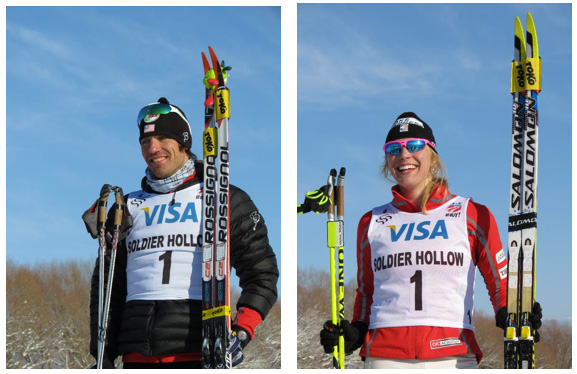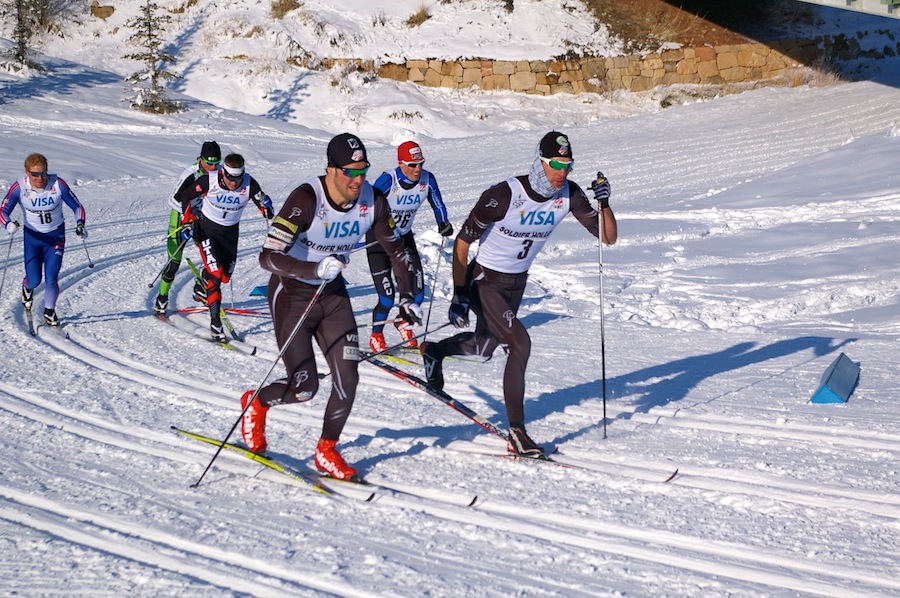
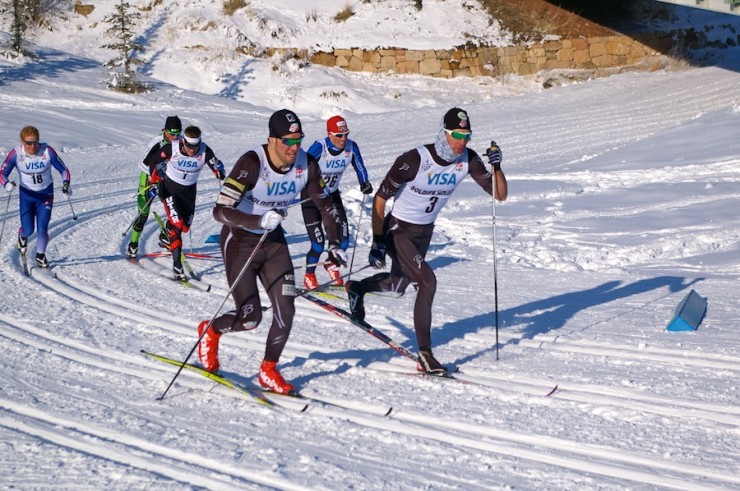
MIDWAY, Utah – Tactics were the name of the game in Wednesday’s classic sprint at Soldier Hollow on the first day of racing at the 2013 U.S. Cross Country Championships. Some of the best didn’t have them completely dialed in, and with that, they failed to move on.
U.S. Ski Team member Erik Bjornsen, who finished eighth after being eliminated in the quarterfinals, racked it up as a learning experience. At least racers like him will have another shot on Tuesday with the skate sprint – and they’ve got two distance races before that. But enough about the future, let’s get to what we didn’t fit in Wednesday’s race recaps.
On tactics:
“I thought I could break some people on this first uphill, and that wasn’t the case. I went out hard and lead it over the top, and Torin [Koos] and Matt [Gelso] were right behind me and they slingshotted past me like everybody said they would.
I think everybody’s learned that you can’t be leading over that hill unless you really have a gap. Skyler Davis did it a couple times today, but there wasn’t a lot of other people, well the girls were, but that’s a little different. Number one thing is not lead over the top.” – Erik Bjornsen (Alaska Pacific University/USST), 21st
“The beginning is probably the most rough because it’s where the panic sets up coming around the turn, you really can’t drop back too much. … On the down you just need to be top three. So I seemed to catch up on the downhill. I passed Sophie [Caldwell] and I was like, ‘Woah, OK.’ ” – Jenny Bender (Central Cross Country), women’s winner
“The qualifier was really funny. I didn’t do any double-poling warmup, and for the first time, it didn’t feel good and I was concerned about it. But then once we got into the heats the first quarter, I tried tactics but I was a little frustrated because even though we’re back in the U.S. and could be skiing easy, it’s good practice to go hard. So then in the semi, I was like I’m just gonna go for it.” – Sadie Bjornsen (APU/USST), 2nd
“I was just trying not to be the leader at the top of the hill, basically. The draft was so important that it was important to be around second or third on the downhill to make sure you get the advantage in the draft. And then just having a strong double pole; it’s a long finishing stretch. … Because of the way it skis tactically, it was nice to relax. Normally when girls race, we just go as hard as we can the whole time and last one standing wins sort of thing. So it was fun to ski in there and move a little bit and then just really give it over the top of the last hill into the finish.” – Rosie Brennan (APU), 3rd
“[I] definitely tried to get behind people because that’s such a key point to get that draft. And yeah it was just trying to hang in there in the finishing stretch. For sure, it’s a lot longer, like, you can see the finish, but then its like am I there yet? But it’s a great finish for sure.” – Kate Fitzgerald (APU), 4th
“All today I knew my strength was not necessarily the double-pole finish, so throughout the day I tried to put some time in on the hills and I felt great for most of it. My arms just felt dead on that final stretch. … Usually my strategy is not to lead, this is more for skate sprints because I have a pretty good finish kick so I hold on the end of that. But classic sprinting is a little different, especially for the double-pole finish.” – Sophie Caldwell (Stratton Mountain School T2 Team), 5th
On whether or not to use skate skis:
“Qualification was good, it was really cold and I decided to still use the skating skis to use the upper body. It wasn’t the best choice, but I wanted to take that opportunity to know that I could do that in the final, and I ended up opting to go with the kick wax instead. Obviously it was a pretty good choice.
“I think it would’ve been an OK choice to go with skating as well, but I just had the idea that I know how to win this on the kick wax.I had a pretty good idea that I would race against some of the other guys in the heats, and I was like, ‘OK, this is where they’re gonna be really good, but I think I can do this better than them.’ ” – Torin Koos (Bridger Ski Foundation/Rossignol), men’s winner (qualified third on skate skis, won A-final on classic boards)
“I double poled most everything until that last hill and when Torin [Koos] came up beside me, he was afraid I was on no-wax skis so he’s like, ‘Are you double poling?’ because he figured if I was double poling he needed to be leading going into that. I didn’t answer him, but he quickly figured it out when I started striding.” – Erik Bjornsen, who stuck with classic skis
On feeling good:
“In Bozeman, I finished a heat and I wanted to weave around like this (wavers on her feet), and today I felt back to normal. I was kinda jazzed, like, ‘Oh, this is a good sign. I don’t feel completely dead.’ So you know, one heat at a time.” – Bender
“I felt good today. I’m really low on racing. I’ve only done two sprints and both those the health was not good. I was just trying to race for qualification reasons. So this is kind of like a start to the season because it’s only the second of the year. I’m really looking to build on this. … My health’s good. Coming back into race shape. ” – Koos
“I’ve been feeling better. We had some races at home [in Sun Valley, Idaho] and I’ve been getting some rest and feeling pretty good. Ready for the 15 k, for sure.” – Mike Sinnott (Sun Valley Ski Education Foundation), 2nd
“[These] last five days are the best I’ve felt all year so I have to take that as a real good sign for the next week and the next couple weeks.” – Skyler Davis (SMS/USST), 4th
“I’m pretty excited that’s the best I’ve done at nationals ever. I find it ironic because I didn’t think classic sprinting was my forte. … Maybe as a team we did enough double-pole sprinting this summer, … but this summer my goal was to work on my distance racing and my threshold.” – Becca Rorabaugh (APU), 6th
“I was feeling pretty well, been out at altitude for a while so didn’t hurt as much as Bozeman or Yellowstone because those were really bad.” – Ben Saxton (F.A.S.T. Performance Training), 5th
“I was feeling really good at home [in Durango, Colorado], had a great holiday and had some awesome training. My twin brother’s up here helping me test with Team HomeGrown. I had a great holiday training with those guys and had a few down days the last couple days, but feel like I’m coming back now. It’s the best classic sprint qualifier I’ve ever had, just missed the top 30 so I’m stoked.” – Tad Elliott (Ski & Snowboard Club Vail/Team HomeGrown/USST), 39th
“I felt good, I felt powerful. The [SuperTour] races in Bozeman and West Yellowstone were pretty similar to this, but those races I felt pretty weak and I didn’t have the speed. I felt like I had the speed today and whatever it was it just didn’t work out.” – Tyler Kornfield (University of Alaska Fairbanks), last year’s national classic sprint champ, 42nd in Wednesday’s qualifier
On keeping results in perspective:
“I was pretty frustrated after the races in Montana, but I mean, it’s a long season. This happened before, it happens to everyone. You just need to get through it, stay focused stay calm and relaxed. … I’m going to have to adjust my goals, but I still have big goals.” – Kornfield
“I did have some people, a few this summer, that I got angry at who told me to write the year off. I’m pretty stubborn so having something you can’t control is extremely frustrating no matter what it is, but at the same time, to come to terms with what you can’t control is an interesting process. I think that’s what I’ve been: more relaxed and I’ve come into a lot of races with a neutral mentality. I still have goals, but it’s possibly been helpful because I had no expectations.” – Bender
“I always just try to go into races with, I mean, just be myself and we’ll see how the rest of it plays out. A lot of factors on the day, skis and tactics and everything, worked really well for me. The next sprint will be a lot different and next meet will be different. Just changes it up, I guess.” – Saxton
On Soldier Hollow:
“I did my first World Cup here, my first Olympics here, my first national championship here, and so I was looking forward to coming back. It kind of feels like it’s coming full circle, and it’s really cool that it’ll be this year and next because no matter what, the organizers here do a phenomenal job. The course is always in very fair shape. As an athlete it makes you feel like what you do is respected.” – Koos
“It’s great. That’s a great course, it’s a fantastic venue, you know, racing with a bunch of my friends. … These bibs are not as tight as the ones in Rumford (puts on podium bib). That’s nice. Good-fitting bibs are nice.” – Dakota Blackhorse-von Jess (Bend Endurance Academy), 3rd
“SoHo always pumps out a lot of snow and you can see, it’s pretty wild. The course is in great shape, two feet of snow everywhere pretty much.” – Leif Zimmermann (BSF), 48th
“I knew some of the guys wanted to keep skiing in Europe; I wanted to be here, though. That was kind of the plan all along. If I was really killing it early season that might have been an option, but knowing how good Noah [Hoffman] and Kris [Freeman] are doing, they go the Tour [de Ski] starts and I’m here. Both win-win situations. I’m happy to be here and these are big races. I always want to try do well at national champs.” – Elliott
***