From the FasterSkier archive — posts syndicated from athletes’ and coaches’ own blogs between 2004 and 2012, kept online as published. Current coverage is at fasterskier.com.
This coverage is made possible through the generous support of Marty and Kathy Hall and A Hall Mark of Excellence Award. To learn more about A Hall Mark of Excellence Award, or to learn how you can support FasterSkier’s coverage, please contact info@fasterskier.com.
Moa Ilar (SWE) carries Sweden’s flag across the finish line in Sweden I’s dominating win in the World Cup Mixed Relay from Engadin, Switzerland. (Photo: Authamayou/NordicFocus)
Right now, Sweden is on a roll. Soon, Norway will be back at full-force. The top of the field is definitely getting ready for a World Championship showdown in a few weeks. In the meantime, World Cup organizers continue staging races, hoping that top competitors will be attracted by the allure of World Cup points and prizes.
This time of year (the middle of the World Cup season) is all about mathematics for the top contenders. How big a gap exists between a racer and their closest rivals? Are those rivals racing this weekend? How many points are available in events and bonus sprints? Who’s sick? Who’s injured? Who’s surging in the standings? Who’s relaxing at home with their feet up?
Jessie Diggins (USA) is dealing with a persistent injury (plantar fasciitis) that limits her ability, especially in Classic skiing (she actually double poled the entire Sprint qualifier last week in Les Rousses). Diggins could’ve chosen to race one of today’s Freestyle relay legs, but none of her closest rivals in the season-long World Cup overall race were competing today in Engadin. That makes for a perfect opportunity to take a break from the stresses of racing. Time to rest, time to heal, time to get ready for more important races on the horizon.
Likewise, Johannes Hoesflot Klaebo (NOR) enjoys a comfortable lead in the World Cup Men’s overall standings, and none of his closest rivals are racing the relay in Engadin. Time for him to put his feet up.
Even in the absence of a number of the sport’s biggest stars, Engadin hosted a highly competitive World Cup Mixed Relay. Sweden I (Jens Burman, Emma Ribom, Edvin Anger, Moa Ilar) surged to the front in the relay’s third leg and never looked back, coasting to victory ahead of Norway I (who came from well behind the field to claim second) and Switzerland I (who came from even farther back) t claim a podium spot in front of an elated Swiss crowd.
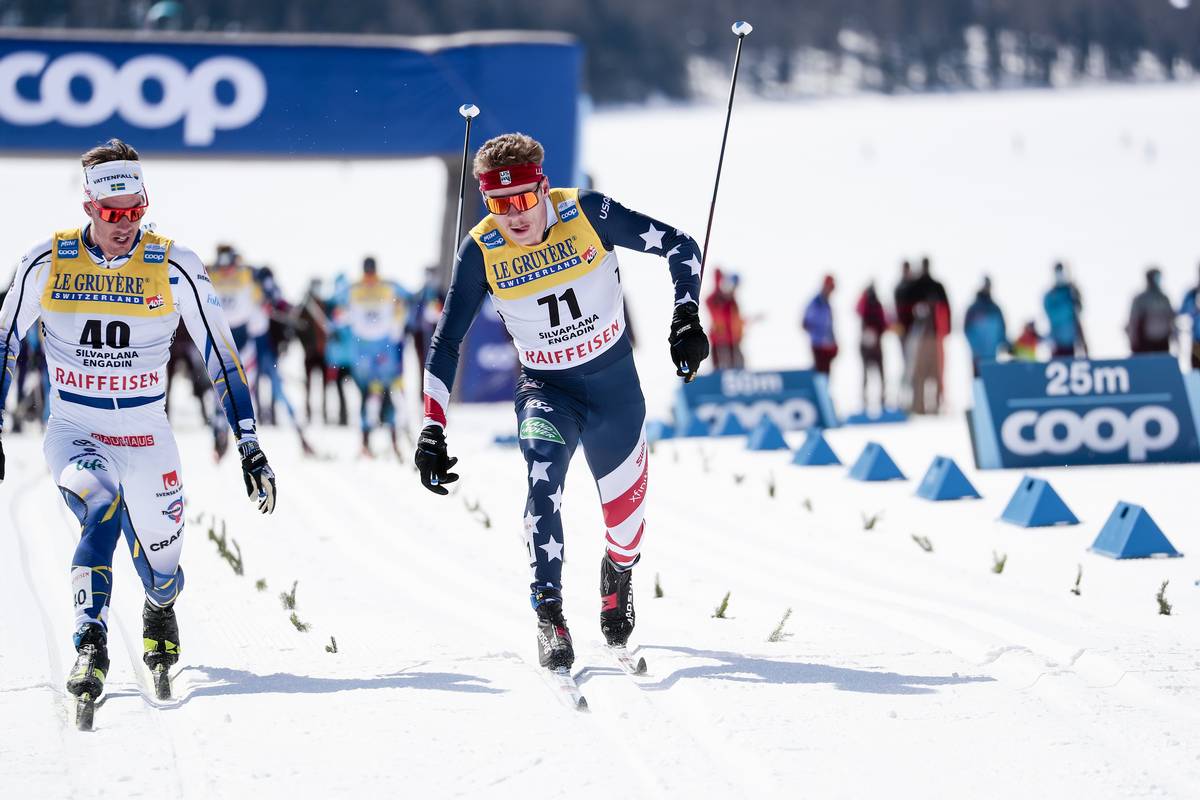
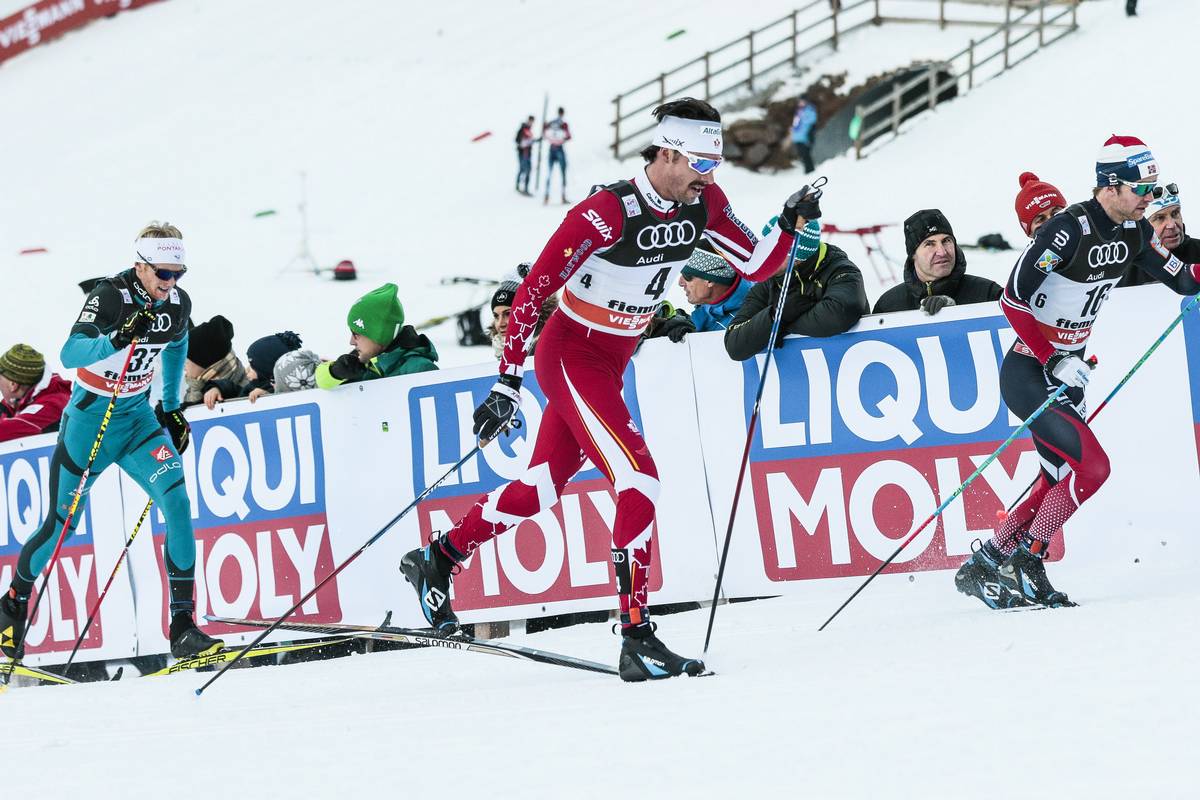
Canada I (Antoine Cyr, Katherine Stewart-Jones, Olivier Leveille, Lilian Gagnon) would contend among the leaders throughout the day, finishing and impressive sixth. Canada II (Remi Drolet, Alison Mackie, Stephen Thomas, Sonjaa Schmidt) would finish 11th. American teams would struggle from the start, ultimately finishing 14th (Zanden McMullen, Julia Kern, Ben Ogden, Sophia Laukli) and 16th (Luke Jager, Kendall Kramer, JC Schoonmaker, Sammy Smith).
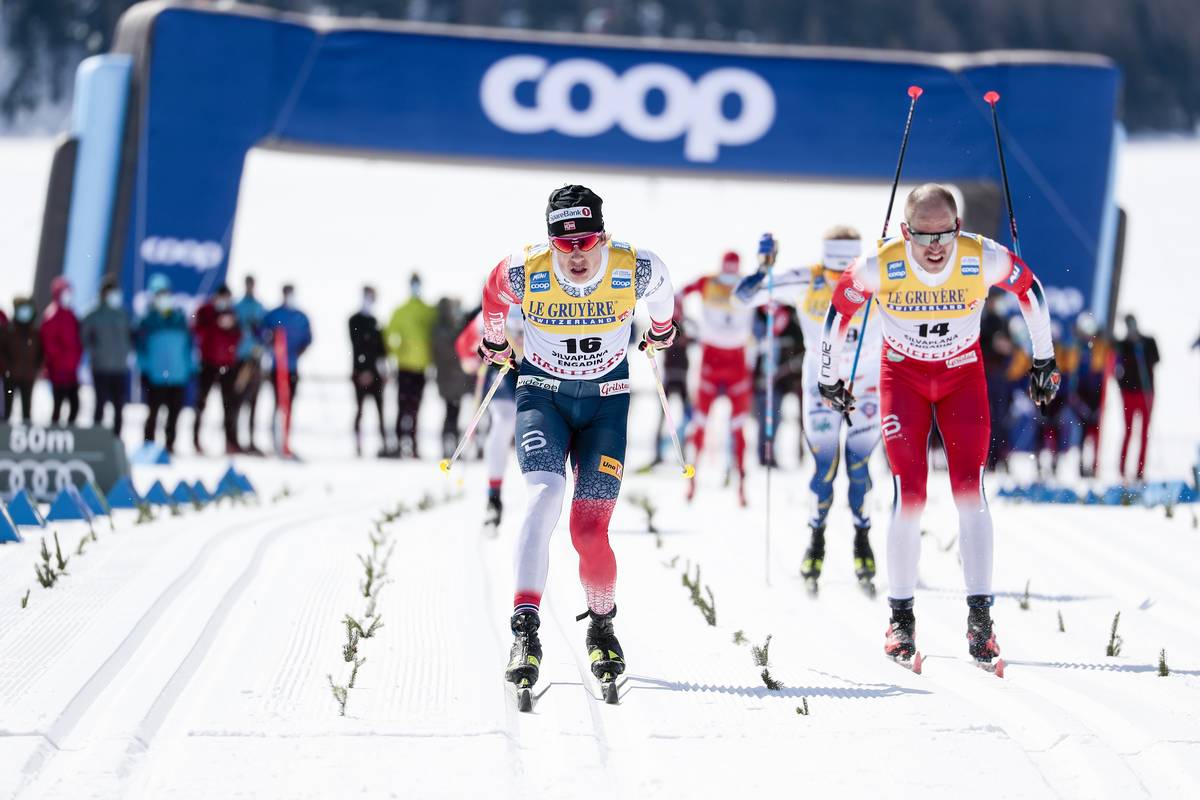
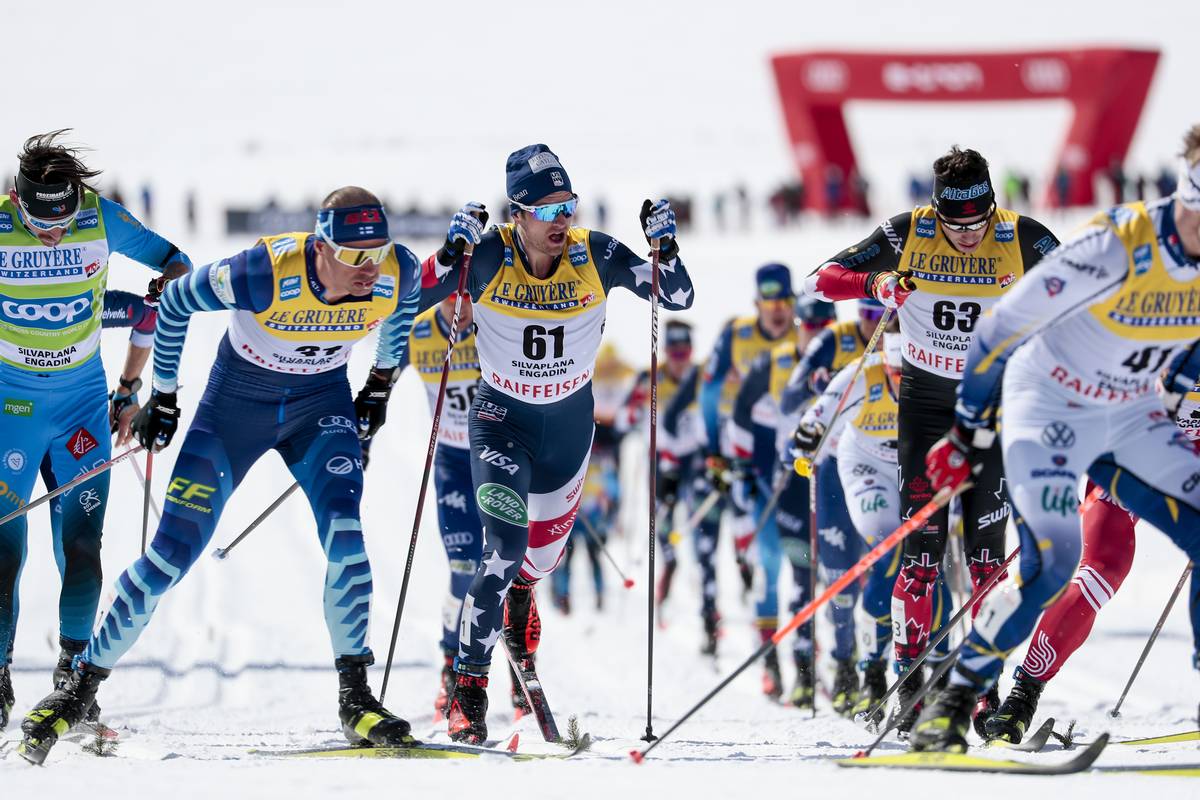
Iivo Niskanen (FIN) and Paal Golberg (NOR) animated the early part of the Engadin Mixed Relay, joined at the front by Antoine Cyr (CAN) who continues to earn the respect of the World Cup field. (Photo: Authamayou/NordicFocus)
Mixed Relay
FIS Mixed gender relays are staged on a revolving basis—one weekend men go first and third, women second and anchor; the next time the starting slots are reversed. In Engadin, Men would lead off, Women would bring it home.
Nineteen teams—including two teams each teams from Norway, USA, Sweden, Canada, and Switzerland—comprised the field that would race four 5 kilometer legs (two laps/skier over a 2.5 kilometer course). Engadin is a broad, flat valley surrounded by soaring Alpine peaks. The course wound around the flats, and offered only two significant climbs. The pace was likely to be fast . . .
“People are going to take it out hot,” predicted Canada’s Remi Drolet. “It’s going to be really hard right from the gun, so, conserve as much energy as possible for the second lap, and try to have my team in a good position.”
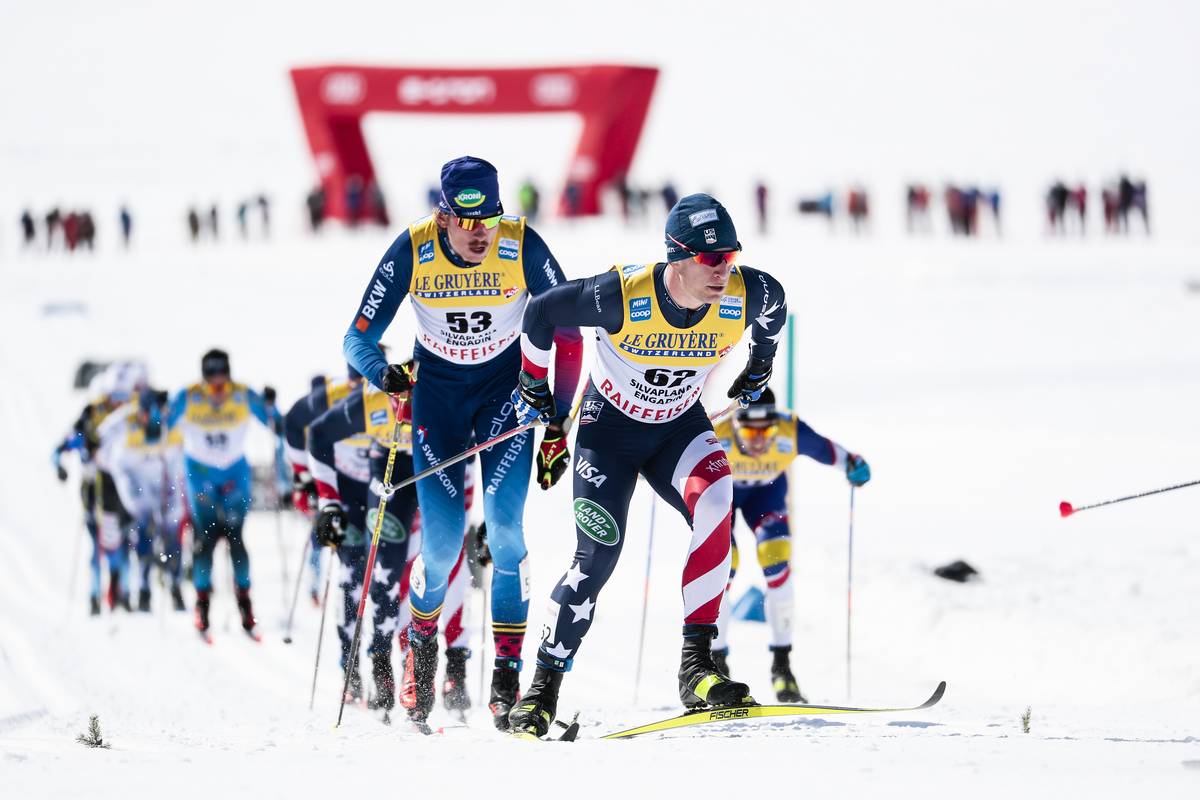
At the start, Norway, Finland, Sweden, and Germany filled the front row. The initial pace was lightining fast, led by Norway I’s Paal Golberg (recently named to the Norwegian squad for the World Championships). The race course quickly faded to two Classic lanes, filled by Golberg and Finland I’s Iivo Niskanen. Canada I’s Cyr and Sweden I’s Jens Burman managed to matched the pace of the lead group, followed by Sweden II and Switzerland II. USA I (Jager) and USA II (McMullen) held positions in the top ten.
Niskanen and Golberg managed to separate themselves as they entered the exchange zone. The race at the front would continue to be hotly contested. By the time USA II (Kramer) and USA I (Kern) took the hand-off, they were already well behind the pack of contenders.
Emma Ribom (SWE), Jasmi Joensuu (FIN), (l-r) drove the pace in the relay’s second leg, setting up Sweden to take the lead in Leg 3. (Photo: Authamayou/NordicFocus)
Second Leg
Still in Classic technique for the second leg, Jasmi Joensu maintained her lead for Finland I, pursued closely by Sweden I (Emma Ribom), Norway I (Nora Saness), Switzerland I (Anja Weber), and Canada I (Katherine Stewart-Jones). Remarkably, Austria (Therese Stadlober) also managed to race up to the lead group. She powered through the group and set out in pursuit of Joensu and Ribom.
By the end of the second leg, the field had mostly shattered with only the top two racers racing in close company to one another. Everyone else was well spread out behind them. But skiers in pursuit of speed and placings often find a way to group up. This relay would definitely not end up being an every-skier-for-themselves affair.
Joensu handed off to Remi Lindholm while Ribom handed off to Edvin Anger. Not far behind, Stadlober tagged Benjamin Moser another 15 seconds ahead of Saness tagging Iver Tildheim Andersen, a Freestyle specialist with something to prove (having been recently overlooked for spots on the Norwegian World Championship Team).
Edvin Anger (SWE) continued to display the momentum that launched him to a Classic Sprint victory las week in Les Rousses, out-dueling Remi Lindholm (FIN) to hand Sweden I a lead at the end of Leg 3. (Photo: Authamayou/NordicFocus)
Third Leg
Anger quickly caught Lindholm, and the two set about putting additional distance between themselves and Moser. Anger’s pace ultimately began to unravel Lindholm who could not match the momentum surging under Anger’s skis at this juncture in the World Cup sesason. Sweden I forged on alone as Lindholm was swallowed up by an accelerating Andersen.
At this point, Sweden I appeared to be on its way to the win, while second place would be decided among Norway I, Austria, and Finland I. That’s when Moser came back to life, using the course’s second uphill to quickly put time into Andersen (who had doubtless given a lot just to catch this group). At the final exchange, Anger enjoyed a broad and comfortable lead over Moser, Andersen, and Lindholm.
Anchor Leg
Anger tagged off to Moa Ilar while Moser tagged Katharina Brudermann, the youngest skier in the Austrian lineup who might’ve felt especially vulnerable with Norway I’s Kristin Austgulen Fosnaes chasing just a few seconds behind. Fosnaes made good on that threat, quickly catching—and gapping— Brudermann who was quickly absorbed by a charging group battling for the third step on the podium. Norway II (where the heck did they come from?) was led by Anne Kjersti Kalvaa, followed closely by Switzerland I (Nadine Faehndrich), Finland I (Vilma Ryytty), and Canada I (Liliane Gagnon), and Switzerland II (Marina Kaelin).
Ilar coasted home for the win, a well deserved victory for Sweden I. Faehndrich had looked well positioned to sprint with Fosnaes, but somewhere in the final kilometer Fosnaes managed to separate herself from the Swiss skier. Norway I took second place, while Faehndrich still managed to hold on to third place ahead of Norway II.
Team Sweden (Moa Ilar, Edvin Anger, Emma Ribom, Jens Burman) celebrates on the podium in Engadin, Switzerland after their victory in the FIS World Cup Mixed Relay. (Photo: Authamayou/NordicFocus)
Goms! These races, in Switzerland, were unambiguously awesome. Wipeouts, sun, fondue, North American podiums and breakout performances. And an Alaskan guest who watched the races firsthand.
We really went above and beyond the call of duty this week — we’ve got sounds from the side of the trail and even a profanity-laced tirade from Devon if you stick it out to the end of the show. We’ll be on scene at the next round of World Cups, which are in a couple of weeks in Canmore, Alberta.
A sincere thank you to everyone who’s generously pitched in to support us over the past few weeks. Email us at devon@fasterskier.com and nat@fasterskier.com. We’ll be back soon.
The men’s 4 x 10 k relay itself lacked for drama, but fortunately there’s plenty going on in the Norwegian team for us to talk about. Devon and Nat are back to break down Russia’s convincing win in the relay, the most disappointing silver ever for Norway and a gold-like bronze for France.
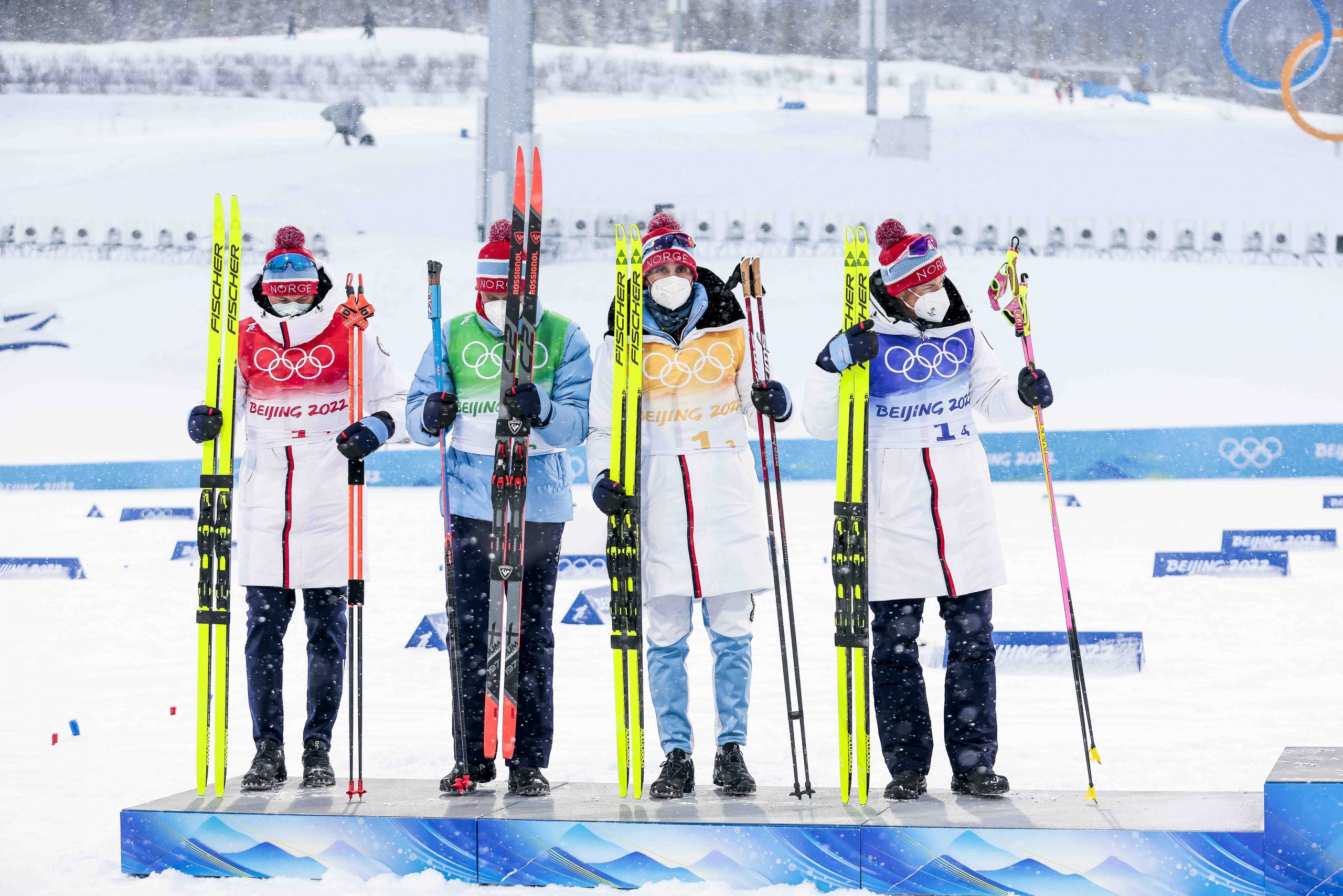
Emil Iversen (NOR), Paal Golberg (NOR), Hans Christer Holund (NOR), Johannes Hoesflot Klaebo (NOR), (l-r) were the only team not celebrating their medal after the 4 x 10 k relay (Photo: NordicFocus)
Jens Burman (SWE) races the Olympic15 k classic, but gains attention from a viral video on his snack sampling. (Photo: NordicFocus)
What has gone viral in China, however, is a Swedish cross-country skier’s snacking habits. Jens Burman, 27, has racked up more than a half-million views on the Chinese social video platform Bilibili.
“I thought, ‘This must be a joke. What’s going on?’ But it was true,” said Tomas Pettersson, the veteran cross-country ski columnist who dubbed the phenomenon “Burmania.”
Burman is a “cool, relaxed guy” from the typically staid northern Sweden, said Petterson, and he’s been publishing an increasingly popular vlog — though it’s not quite as popular as the one run by Norwegian superstar Johannes Høsflot Klæbo.
Upon arrival in Beijing, Burman posted an innocuous-seeming 13-minute video about a day in his life at the Olympic Village. It included a segment where he availed himself of some of the local Chinese cuisine — snacks, to be specific.
First was the oddly-branded “Powers Easy for Life,” which came in an extra-inflated bag that Burman, in English subtitles, described as “stone hard.”
The review: “I thought it would be crisps. But hard to explain…A mix of cheese doodles and corn biscuits.”
Next was the strawberry Swiss roll: “juicy,” and “just like a Swedish roll cake.” Last came the Panpan-waffles, which were not “like the waffles I’m used to.”
Jens Burman samples a strawberry Swiss roll cake in a video that went viral on Chinese social video platform Bilibili. (Screenshot Bilibili)
“More like a sponge cake, but not as sweet,” he said. “Nothing special.”
After Burman published the video, he said, he started hearing from people on Instagram that it had “millions of views” on a Chinese platform.
“I didn’t understand,” Burman said in an interview after placing eighth in his race Friday. “But then I got a link, and I saw that my video was big on the Chinese version of YouTube.”
Petersson, the columnist, said he wasn’t sure exactly where the video appeared. But a non-exhaustive search by FasterSkier/the Anchorage Daily News, with the help of a few Chinese volunteers, turned up the minute-and-a-half long snack tasting clip on Bilibili, with nearly 500,000 views.
Among the hundreds of commenters was one who fretted Burman could gain weight by the end of the Olympics. Another suggested an alternative career as a food blogger. Another wanted to take Burman out for spicy noodles.
In the end, Burman said, the virality may not amount to much, since most viewers caught it on Bilibili instead of Burman’s channel on YouTube.
But, he said, “it’s fun they actually saw my video.”
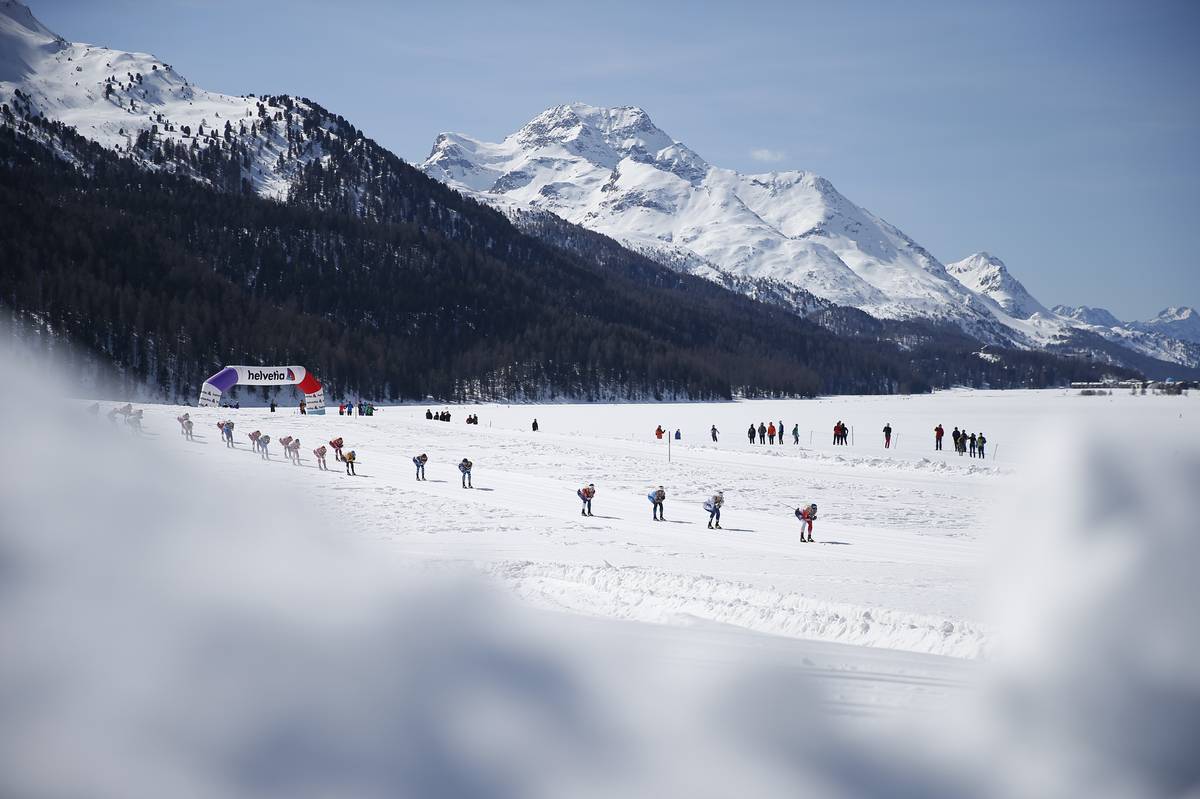
Engadin, Switzerland – a stellar backdrop for the men’s 15 k mass start classic. (Photo: NordicFocus)
This World Cup coverage is made possible through the generous support of Marty and Kathy Hall and their A Hall Mark of Excellence Award. To learn more about A Hall Mark of Excellence Award or to learn how you can support FasterSkier’s coverage please contact info@fasterskier.com.
It’s the last hurrah, folks. Roughly a year after the COVID-19 virus achieved its global pandemic title, the World Cup finds itself at the end of a season that once looked as if it may not happen in the first place. Though four competitions — Lillehammer, Nové Město, Oslo, and Beijing — were cancelled or postponed, the World Cup toured through Europe from November to March without any known significant outbreaks. All things considered, they pulled off a bold and robust competition schedule.
Leaving the unpredictable spring conditions at the World Championships in Oberstdorf, Germany, the cold, crisp tracks and an Alpen backdrop looked like a wintery treat during today’s 15-kilometer mass start classic event. The picturesque venue, home to the Engadin Ski Marathon, is nestled in the Engadin Valley of Switzerland just south of St. Moritz in the town of Surlej. Pristine conditions, bluebird skies, and high mountain air; what more could you ask for in a final stop?
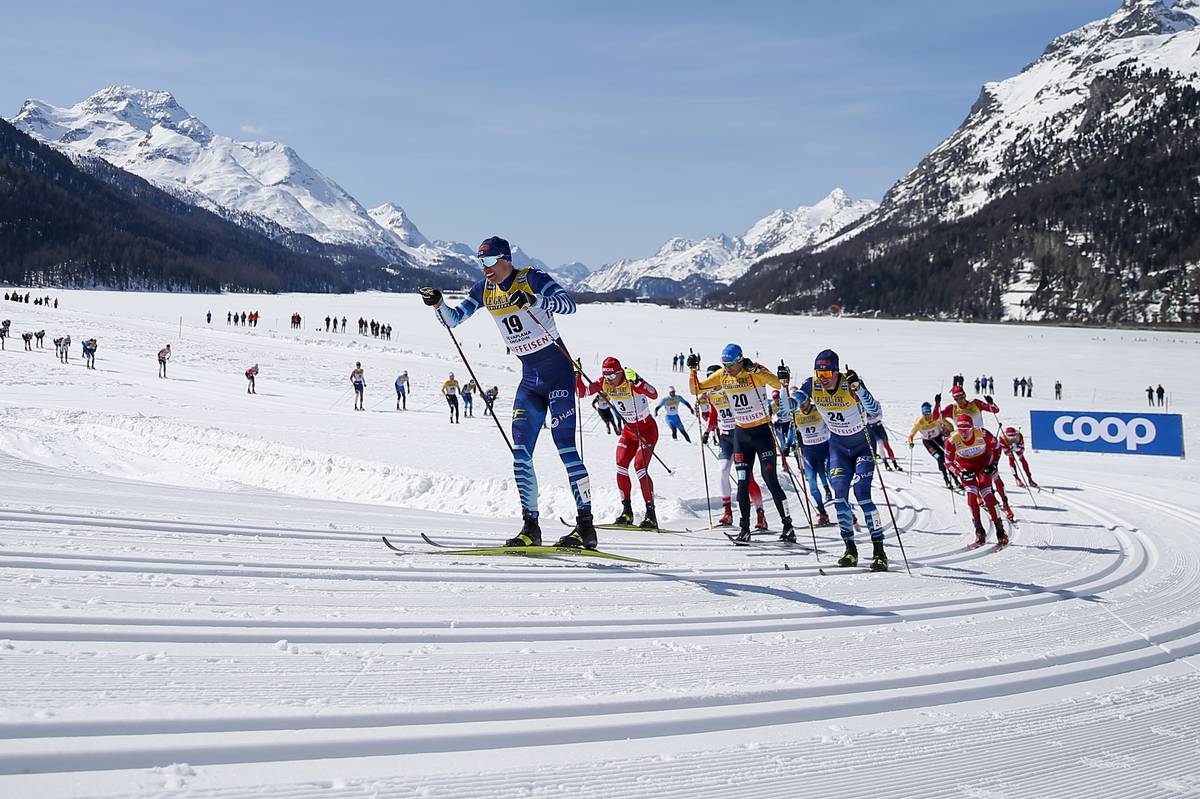
Iivo Niskanen leads the way midway through the 15 k mass start classic in the Engadin Valley of Switzerland. (Photo: NordicFocus)
As the dust settles from the World Championship, in particular the conclusive result of the men’s 50k classic just six days ago, eyes were on the 24-year-old duo up front with 5k to go. To put it clearly, we mean Norway’s Johannes Høsflot Klæbo perhaps looking for redemption after his disqualification for obstruction and loss of the World Championship gold medal versus Russia’s Alexander Bolshunov. The Russian also felt robbed of this medal as the interaction with Klæbo in the finishing stretch resulted in a snapped pole, consequently losing him ground to Emil Iversen and leaving him with silver.
With the field staying tight over the first 10 k on Saturday, it was on Bolshunov to move early and avoid setting up a repeat opportunity for Klæbo to sit and kick in his signature style. Time and again, Klæbo the World Champion and Olympic gold medalist in the classic sprint has demonstrated his potential to, quite literally, run away from the field in the final 400 meters, rocketing down the final stretch to clinch the win. Though Bolshunov is the overall World Cup winner for the third year running, it would not behoove the Russian to face off with Klæbo in this way.
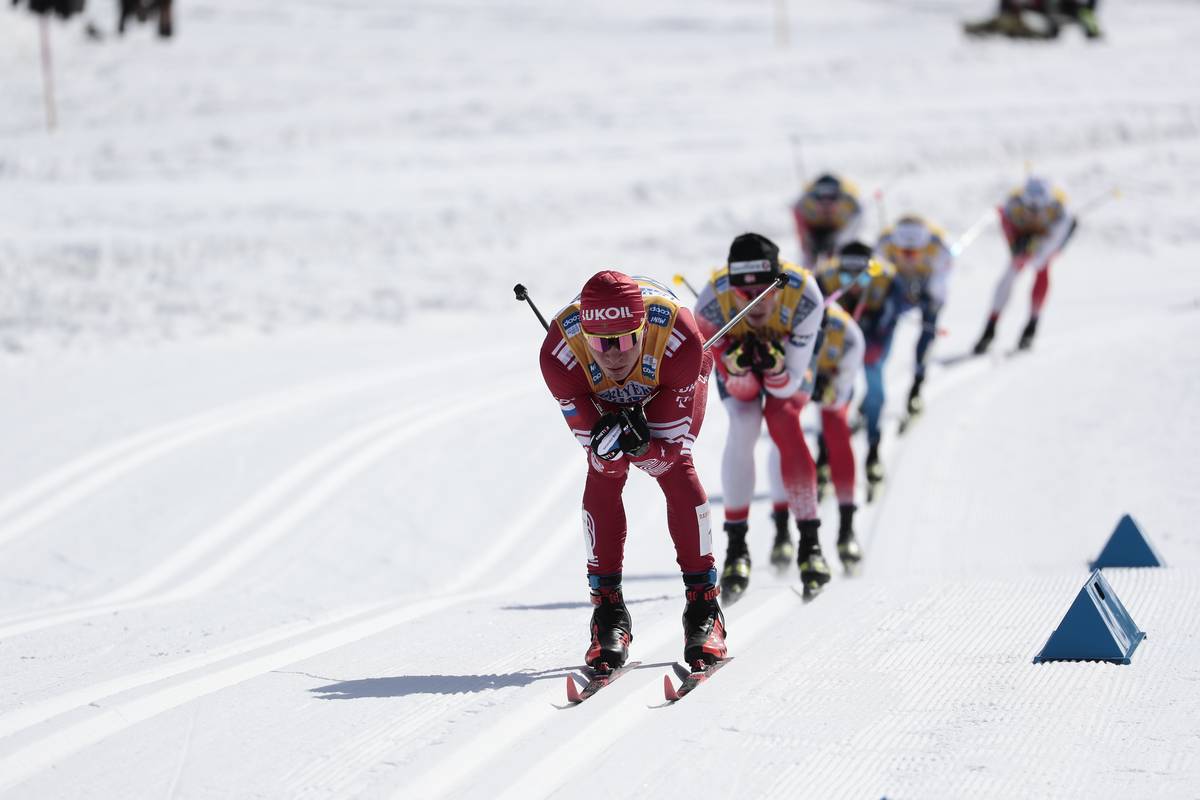
Alexander Bolshunov leads the way in the 15 k classic, with Johannes Høsflot Klæbo drafting on his tails. (Photo: NordicFocus)
And he knew it. Crossing the bonus sprint checkpoint at 10 k, Bolshunov and Klæbo were side by side. But as the leaders kicked and glided into their final lap, Bolshunov began to surge off the front. At 11.4 k, he had only a second gap ahead of Klæbo who attempted to match the pace. But, by 2 k later, the winner was clear. Bolshunov had a 24.9 second gap at 13.8 k, while Klæbo had allowed the chase group to catch back up, letting go of a win and setting himself up for a sprint finish for second place.
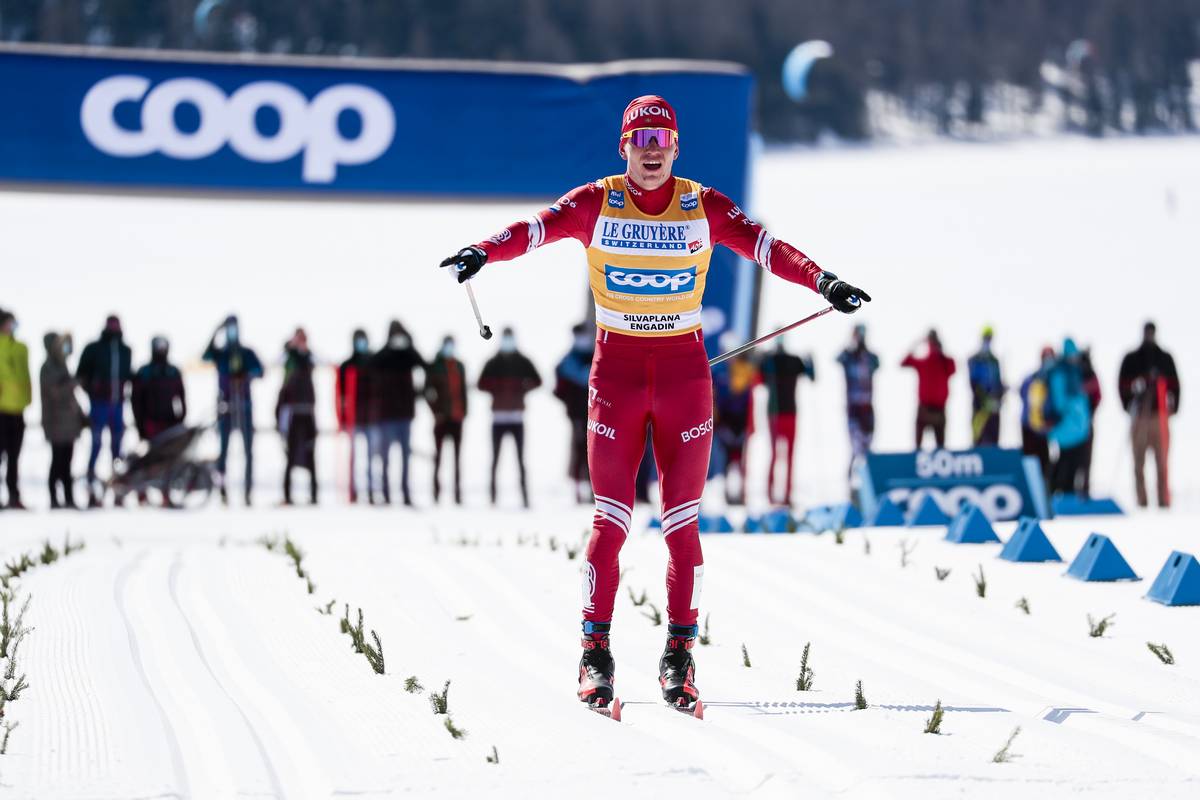
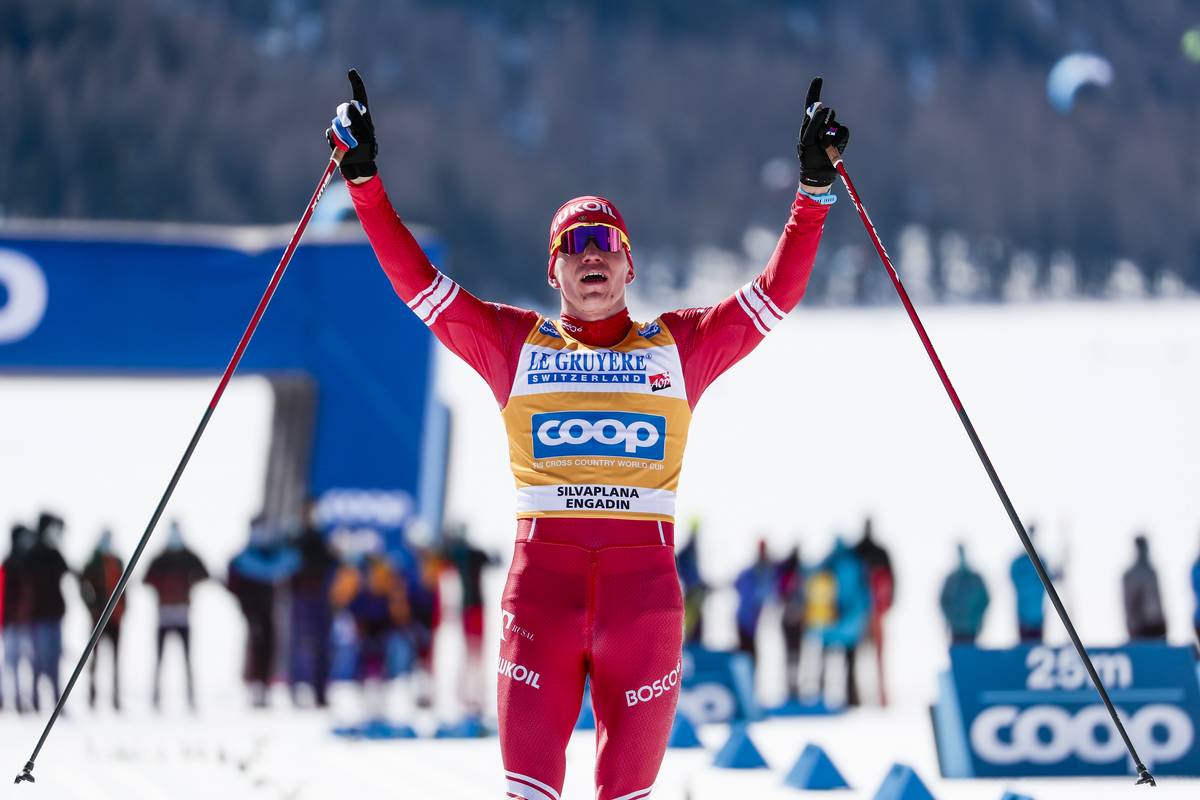
Despite his lead, the Russian kept his foot on the gas all the way to the finish stretch where he raised his arms to soak in his achievement and coasted through the finish in 34:07.1.
Bolshunov coasts through the finish without challengers at the 15 k mass start classic in the Engadin Valley of Switzerland. (Photo: NordicFocus)Alexander Bolshunov takes the win in the 15k classic in Switzerland. (Photo: NordicFocus)
“I really like St Moritz,” Bolshunov told FIS through a translator after the race. “I was very pleased with the conditions here and feel it is one of the best places I have been skiing and training. About the race, I was really happy with the result and happy that now we have again hard winter conditions and that I could push hard on this course. I am very happy to take the victory.”
The remainder of the podium was less certain, with Klæbo heading toward the stadium with a pack of seven men. Utilizing his aforementioned signature, Klæbo engaged his sprint gear to move up to the front of the group, coming into the final 100 meters alongside his teammate Pål Golberg. Klæbo held Goldberg off by half a ski length for second (+18.5), leaving Goldberg in third (+18.9).
Johannes Høsflot Klæbo edges out teammate Pål Golberg for second place. (Photo: NordicFocus)The 15 k classic men’s podium in the dreamy Engadin Valley. Alexander Bolshunov (RUS) took the win ahead of Johannes Høsflot Klæbo (NOR) and Pål Golberg (NOR). (Photo: NordicFocus)
Sweden’s Jens Berman took 4th (+20.0), with Simen Hegstad Krüger of Norway in 5th (+21.2), Artem Maltsev of Russia 6th (+24.2), and Iivo Niskanen of Finland 7th (+27.4). Hans Christer Holund brought up the rear for the first group of chasers in 8th (+31.2).
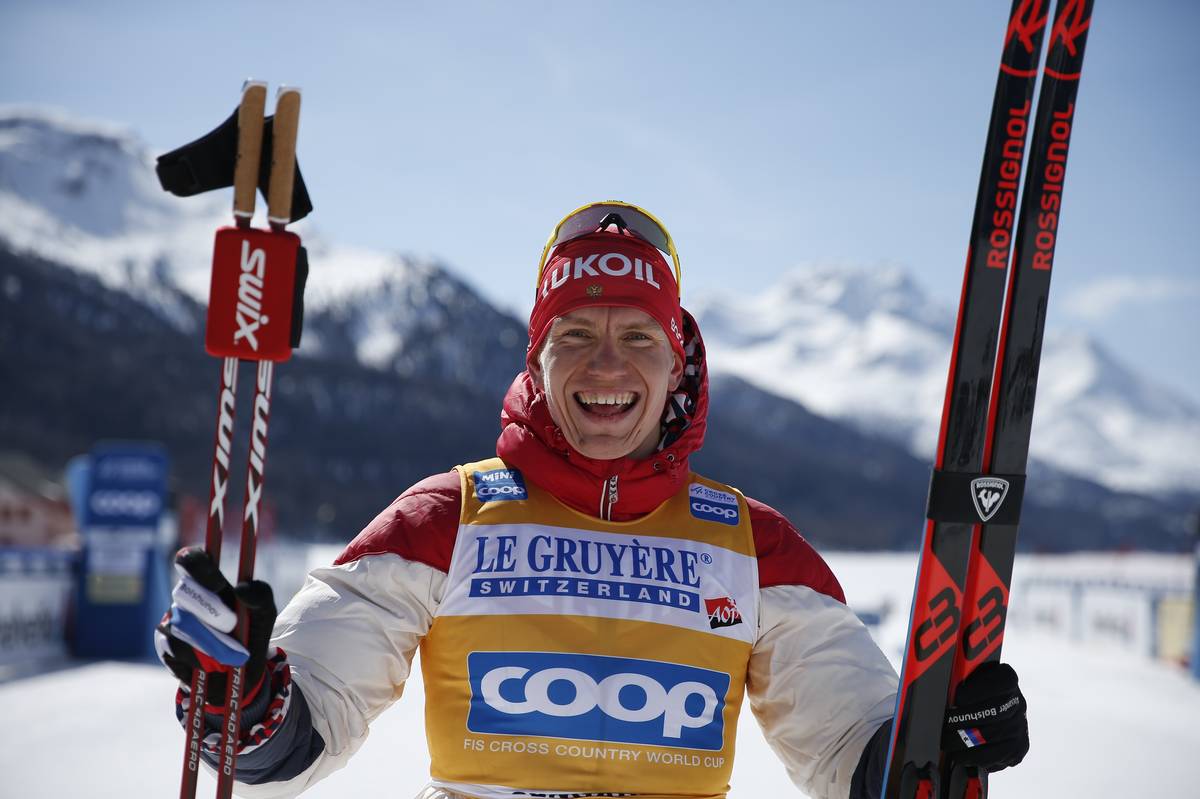
Alexander Bolshunov celebrates his 9th World Cup distance win this season at the final stop in the Engadin Valley of Switzerland. (Photo: NordicFocus)
With this 23rd World Cup win under his belt — nine from this season alone — Bolshunov joins Norway’s Peter Northug as joint-fourth on the all-time list. He is the first male skier to win three consecutive World Cup crystal globes, tied for the second-most distance globes in his collection with Norway’s Martin Johnsrud Sundby who also holds three. Only the Swiss champion Dario Cologna outranks Bolshunov, with four distance globes.
Antoine Cyr (CAN) tucks into the draft of Jean Marc Gaillard (FRA) during a career-best race in the 15 k classic in Switzerland. (Photo: NordicFocus)
Turning to the North American results, Antoine Cyr took 21st for Canada (+54.5), nailing his best individual result of his career. This is the second season on the Senior National Team and racing at the World Cup level for the 22-year-old who hails from Gatineau, QC.
As the dense cluster of skiers from the mass start slowly began to thin out, Cyr skied his way up from 45th and 23 seconds back at the halfway mark to 21st and just 9 seconds behind the leaders at the 10 k checkpoint. Holding his ground in this group over the last 5 k, Cyr crossed the line just behind Andrew Musgrave of Great Britain.
“I had a really good race today — it is the first time I have earned World Cup points, so it’s pretty exciting,” wrote Cyr in a post-race email. “I knew it was a good course for me but I was starting far back on the grid and had to make up a lot of spots on the third lap, then the fourth lap I was just hanging with the pack I was skiing with. I am really happy with the results but I know I have even more to give as I am a rookie on the World Cup and just getting used to the way it races here. I am excited for tomorrow and what is to come!”
Graham Ritchie (CAN) crosses the line just behind Andrew Young (GBR) at the 15 k mass start classic in the Engadin Valley. (Photo: NordicFocus)
Also racing for Canada, Russell Kennedy took 35th (+1:17.0), Rémi Droulet 67th (+2:57.1), and Graham Ritchie 71st (+3:25.5).
David Norris navigates mass start chaos in the 15 k classic in Surlej, Switzerland. (Photo: NordicFocus)
For the US squad, David Norris was the top finisher, leading the way in 41st (+1:31.4).
“Our transition from World Champs to the Engadin went smoothly,” wrote Norris in a post-race email to FasterSkier. “I’ve spent this week previewing the new courses here in the Engadin and trying to recover from the 50km last week. Up until Wednesday my legs were still pretty heavy from my final effort in Germany. I’m in a good place now and race preparation on Friday felt good.
“I didn’t know what to expect going into today’s race. The course is quite flat and there was a pretty strong wind all morning. I chose the wrong skis for this morning so I consistently lost ground on a few crucial descents that fed into long double pole sections where you didn’t want to be alone breaking wind. When the guys up front started to stretch out the pack I was still pretty far back. I wasn’t strong enough to move forward so the last two laps my group seemed to pick guys off who were fading, but otherwise I think we bled time to the packs ahead of us. It was a fun race, but I know this is far from a great performance for me. Time to start thinking about tomorrow’s 50km – I’m real excited for Sunday!”
Hunter Wonders skis to 47th in the 15k classic in Surlej, Switzerland. (Photo: NordicFocus)
Ben Ogden throws his boot for 51st alongside Johan Haeggström of Sweden. (Photo: NordicFocus)
Next up for the Americans, Hunter Wonders crossed the line in 47th (+1:45.4) closely followed by Gus Schumacher in 48th (+1:46.1). Ben Ogden took 51st (+1:51.5) with Scott Patterson 53rd (+1:58.8), Kevin Bolger 60th (+2:11.5), and Johnny Hagenbuch rounding it out in 72nd (+3:39.7). The race saw 82 finishers.
Scott Patterson (bib 52) and Ben Ogden on course during the 15 k mass start classic in Surlej, Switzerland. (Photo: NordicFocus)
Johnny Hagenbuch on course between two Canadians during the 15 k mass start classic in the Engadin Valley of Switzerland. (Photo: NordicFocus)
Racing continues tomorrow with a pursuit start 50 k freestyle.
She’s back. Therese Johaug celebrates after winning the 2018 FIS 10-kilometer classic in Beitostølen, Norway.
After an 18 month suspension for a positive out of competition positive doping test, during which Norway’s thirty-year-old Therese Johaug could build hour upon hour of base fitness and fine tune the engine with no race-stress, she arrived in Beitostølen, Norway on Friday and didn’t skip a beat.
In temperatures hovering around 32 degrees Fahrenheit, and low-level clouds descending on the course, Johaug established herself as the early season favorite amongst a deep Norwegian National Team in Beitostølen’s FIS season opener 10-kilometer classic race.
As the 52nd starter in a 60-skier field, Johaug never let off the throttle.
The race was tight at the 1-kilometer time check, with national team skier Ingvild Flugstad Østberg marking the fastest time over Johaug by only 0.9 seconds. With nine kilometers to go, it was all Johaug, as she clocked the fastest times at the remaining checkpoints.
Up by 4.3 seconds at 2.2k, the time back to the second fastest skier grew to 15.5 seconds at the race’s midpoint for Johaug. By the finish, Johaug did as she has done many times before, winning by a comfortable margin. She won in 25:42.6 minutes. Østberg, who ranked third in the World Cup overall last season, placed second (+23.9). Kari Øyre Slind was third (+59.8)
Therese Johaug ready to start it all over again after her 18-month suspension.
“It was special being here today,” Johaug told Norwegian broadcaster NRK according to a translation. “It feels incredible to back in the xc family again. To come up here and meet all the people that I’ve been skiing with for so many years, hear the cries from the crowds out in the course and the splits, it was a special feeling. It was so much. I was nervous before the start, but when I got started I really didn’t want it to end. I could have skied an extra lap.”
The opening Beitostølen FIS races are the early season proving grounds for Norway’s elite cross-country athletes. The top-10 in the women’s race was riddled with names World Cup fans are familiar with.
Astrid Uhrenholdt Jacobsen skied to fourth (+1:21.3), Haga Ragnhild fifth (+1:33.1), Anna Svendsen sixth (+1:42.8), and Heidi Weng, winner of last seasons overall World Cup finished seventh (+1:58.7).
Annika Taylor, a former University of New Hampshire skier now skiing for Great Britain, raced her way to 21st (+3:49.3).
In similar conditions, the men raced a 15 k classic. Like the women’s field, it was a Norwegian who’s who of elite class skiers. But unlike Johaug setting an increasing time margin over any contenders, the men’s race was tight, separated by only 15 seconds for the top-five skiers 5 k into the race.
At that point, with Didrik Tønseth in first and Emil Iversen in second, only a sliver of time, 0.1 seconds, differentiated the two. Martin Johnsrud Sundby and Johannes Høsflot Klæbo were gapped by 12.2 and 12.7 seconds respectively, as they skied through the time check in third and fourth place. Sjur Røthe came through in fifth (+15.8).
Iversen, in bib 141, kept it close, setting the initial times to beat. Tønseth started three skiers back in bib 144. Through 10k, the two were still evenly matched: with Tønseth up by 3.4 seconds over Iversen.
The men’s 15 k classic podium for the 2018 FIS opener in Beitostølen, Norway. Didrik Tønseth (NOR) in first, Norway’s Emil Iversen (left) in second, and Sjur Røthe (right) of Norway third.
Tønseth won the race in 36:08.6 minutes, with his winning margin of 12.4 seconds over the second place Iversen only solidified in the closing kilometers. Røthe gradually moved up and finished third (+29.3).
Sundby skied to fourth (+37.5), Hans Christer Holund fifth (+1:07.4), and Klæbo sixth (+1:17.5). British skier Andrew Musgrave finished seventh (+1:26.3). Musgrave is historically a stronger skate skier.
One hundred and forty-three skiers finished the men’s race.
Of note, thirty-two-year-old Petter Northug Jr., now a seemingly timeless presence on the Norwegian ski scene, was disqualified for classic technique violations. Prior to his DQ, Northug had been skiing in the top-20 for much of the race. Sundby was given a verbal warning for a classic technique violation.
Several Canadians raced the 15 k classic. Russell Kennedy was the best placed Canadian finishing tied for 23rd (+2:37.6). Brian McKeever was 68th (+4:06.6), Ryan Jackson 110th (+5:39.1), Maks Zechel 113th (+5:56.5).
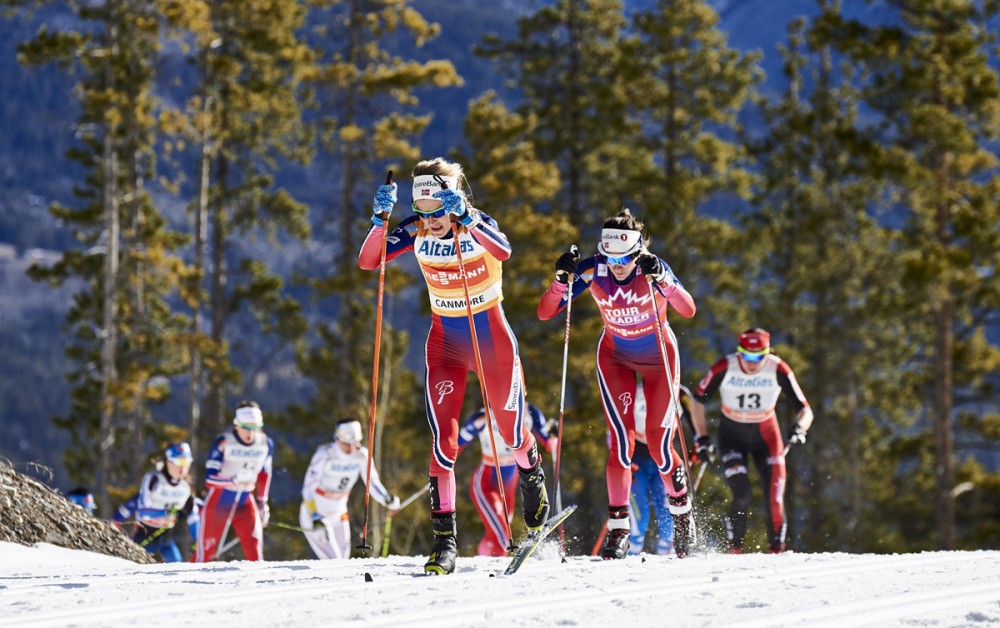
Norwegians Therese Johaug and Heidi Weng, (l-r) during the 2016 women’s 15 k skiathlon in Canmore, Alberta. (Photo: Fischer/NordicFocus)
Welcome to The Rundown, your quick primer of need-to-know information about the day’s racing. We’ll be updating this digest as the day goes on with additional results, photos and quotes. The Rundown is NOT a race report; stay tuned for complete race reports later today with interviews from the day’s top racers.
***
FIS cross-country Beitostølen, Norway: 10 k/15 k classic
The race results are in from today’s 10-kilometer individual start classic FIS race in Beitostølen, Norway. The first of the season Beito races are used as a test pad for Norwegian athletes to gauge fitness and for some to make the rare jump to a coveted and scarce World Cup start.
Off of her suspension for using a banned substance, Norway’s Therese Johaug skied like she’d never been gone. Johaug was suspended for 18 months due to her violation.
Johaug fired off the 10 k winning in 25:42.6 minutes. Ingvild Flugstad Østberg was second (+23.9). Rounding out the podium was Kari Øyre Slindin third (+59.8).
Astrid Uhrenholdt Jacobsen skied to fourth (+1:21.3), Haga Ragnhild fifth (+1:33.1), Anna Svendsen sixth (+1:42.8), and winner of last seasons overall World Cup, Heidi Weng finished seventh (+1:58.7).
The men skied a 15 k classic race Friday in Beitostølen. Didrik Tønseth won in a time of 36:08.6 minutes. In second was Emil Iversen (+12.4), while Sjur Røthe placed third (+29.3).
Martin Johnsrud Sundby skied to fourth (+37.5), Hans Christer Holund fifth (+1:07.4), and Johannes Høsflot Klæbo sixth (+1:17.5).
British skier, although based in Norway, Andrew Musgrave finished seventh (+1:26.3).
One hundred and forty-three skiers finished the men’s race. Of note, Petter Northug Jr., now a seemingly timeless presence on the Norwegian ski scene, was disqualified for technique violations.
Several Canadians raced the 15 k classic. Russell Kennedy was the best placed Canadian finishing tied for 23rd (+2:37.6). Brian McKeever was 68th (+4:06.6), Ryan Jackson 110th (+5:39.1), Maks Zechel 113th (+5:56.5).
Bruksvallarna, Sweden cross-country: 5 k/10 k freestyle
In Bruksvallarna, Sweden FIS racing began with a 5 k freestyle for the women. Three of Sweden’s star skiers took the podium spots. Ebba Andersson won the tight race in 9:57.1 minutes, finishing only 2.6 seconds ahead of second place skier Charlotte Kalla. Known for her sprinting prowess, Hanna Falk was third (+15.7).
One hundred and twelve skiers finished the race.
For the men, after skating 10 k, the race was a tie for first. Sweden’s Jens Burman and Karl-Johan Westberg skied the fastest time. Both crossed the line in 19:11.0 minutes for the win. Japanese skier Keishin Yoshida placed third (+9.5).
Daniel Rickardsson, of Sweden, skied to fourth (+12.9).
Canada’s Len Valjas (l) and American Andy Newell scrambling during the first leg of the men’s 4 x 10-kilometer relay on Sunday at the 2018 Olympics in PyeongChang, South Korea. (Photo: FlyingPointRoad)
PYEONGCHANG, South Korea — Zooming in on the leaders of Sunday’s nordic race, the Olympic broadcast stream focused on a red Norwegian suit set against the backdrop of Russian maroon. The televised showdown presented for the men’s 4 x 10-kilometer relay final leg was shaping up to be between the Olympic Athletes from Russia and Norway: Denis Spitsov verses Johannes Høsflot Klæbo. As the two skiers struck out for Lap 2 of 3 of the final 10 k leg, both spectators and screen apprehensively followed.
Had the camera panned 250 meters ahead, it might have caught the flurrying ski tails of American Noah Hoffman, dashing the top of the 3.3 k lap’s initial climb. Around 45 seconds earlier, Hoffman had been tagged into the race as the anchor leg for the U.S. men. His hot start was not just for show or a final push to the front. If he wanted to prevent the U.S. team from an eliminatory pull, he would need to stay ahead of Spitsov and Klæbo.
A cat-and-mouse game between the leaders certainly could buy the U.S. skier a little more time to pad the time gap. But until then, he sifted a reductionist race: Stay in the game. Don’t get caught by Klæbo.
American Noah Hoffman anchoring the U.S team during the men’s 4 x 10-kilometer relay on Sunday at the 2018 Olympics in PyeongChang, South Korea. (Photo: FlyingPointRoad)
“The highlight for me was watching these guys stick with their guys,” Canada’s Len Valjas said of his relay teammates in a post-race interview with FasterSkier. “And another one was watching Noah stay away from Klæbo. We were all yelling, cheering for him. That was amazing.”
The relay had more than one race in the works. Hoffman staying in front of Klæbo was one. Canada’s Graeme Killick catching Sweden was another.
After Valjas scrambled the first classic leg, he came through the exchange in 10th, handing off to Killick for the second classic leg. As Killick headed out for his first lap, Sweden was four places and 38.3 seconds ahead.
The 28-year-old Canadian, in his second Olympics, was by no means deterred. Working kilometer by kilometer, Killick strode past the Czech Republic’s Martin Jaks, Germany’s Thomas Bing and eventually Sweden’s Daniel Rickardsson.
After moving up three places, Killick went through the second exchange in seventh with the seventh-fastest time, passing off the race to Russell Kennedy. Going into Leg 3, 2.6 seconds separated the Canadians from the tag between Sweden’s Rickardsson and Marcus Hellner. All said and done, Killick had made up 40.9 seconds to catch and pass Sweden.
“Everyone, I think, skied to a higher level today,” Killick told FasterSkier after. “We were all able to dig deep for our teammates and make sure we pass off in good position.”
“Anything can happen in a relay and that’s one of the reasons it’s always exciting to get on the start line and do your best,” Killick continued. “When I tagged off Russell, he was with Hellner … It was cool to see everyone dig so deep and just fight for the team.”
Racing Canada’s third relay leg, Kennedy, a 26-year-old Olympic rookie, held tight to Hellner through the first lap. And again through the second. And through the first half of the third. It was not until around the final major climb, that Hellner broke away from Kennedy’s red maple-leaf suit.
Canada’s Graeme Killick racing the second leg of the men’s 4 x 10-kilometer relay on Sunday at the 2018 Olympics in PyeongChang, South Korea. He brought the team from 10th to seventh with the seventh-fastest second-leg time. (Photo: FlyingPointRoad)
“I was psyched when I saw GKill killed it, and gave me an amazing position,” Kennedy said after. “But I was also a bit nervous because … I was walking to the line with Hellner and I was like, he’s an Olympic champ. I got to stick with him and hold on, and that’s what I did. I just locked on, the wax techs gave me amazing skis today, and I held on as hard as I could. He threw in a sprint at the top of the hill, blew me up, but I was psyched to have made it almost three laps with him.”
Hellner has two relay gold medals from the Olympics, one from 2014 and another from 2010, as well as two 30 k skiathlon golds from the 2010 and 2014 Games. The 32-year-old Swede is also a multiple-time World Championships medalist with several top-10 World Cup 15 k freestyle results. While Kennedy considers himself more of a sprinter, Sunday’s performance may perhaps change his perspective.
“I was just thinking, don’t blow. Do it for the team,” Kennedy said. “I knew that if I could hand off to Knute in a good position, were were in a really good position for us. Can’t ask for much more than that. I gave it everything for sure. I was just happy we caught the Slovakian guy so Knute had someone to ski with. But yeah, amazing day for me, for sure. I felt really good.”
Canada’s Knute Johnsgaard (12) racing the final leg of the the men’s 4 x 10-kilometer relay on Sunday at the 2018 Olympics in PyeongChang, South Korea. He anchored the team to ninth for its second-best Olympic relay result. (Photo: FlyingPointRoad)
After skiing the seventh-fastest third leg, Kennedy came through the exchange in eighth and handed off to teammate Knute Johnsgaard, also in his first Olympics, for the final freestyle leg. Johnsgaard kept the Canadians ahead of the Czech Republic, staving off Kazakhstan until the final kilometer and a half.
“It was pretty tough for me, especially the sprint hill,” Johnsgaard, 25, said. “We knew it was going to be hard. We did the best we could.”
Canada finished in ninth, 3:41 seconds off first, which was taken by Norway’s lineup of Didrik Tønseth, Martin Johnsrud Sundby, Simen Hegstad Krüger, and Klæbo in a time of 1:33:04.9. The ninth place ties the country’s second-best Olympic relay result, which was set at the Calgary Games in 1988. Canada’s best relay finish was in 2010 when the team placed seventh with Devon Kershaw, Alex Harvey, Ivan Babikov, and George Grey.
Harvey opted not to race Sunday’s relay, and Johnsgaard started in his place.
In last year’s World Championships team relay in Lahti, Finland, with Harvey on the team, the Canadians were lapped out of the race.
“We’ve had some terrible luck with relays. I think we did great today,” said Valjas, a 29-year-old two-time Olympian. “It’s not our A-team; we knew that coming in. I think we performed amazing and I’m super happy with how it went. Especially all these guys staying with some serious big names in cross-country skiing. I’m impressed, these guys were fighting hard and I’m proud of all of them.”
Alongside the Canadian’s solid team performance, the U.S. had several personal highlights. Scrambling in the first leg was American Andy Newell in his second race of the week (after placing 37th in the individual classic sprint) and potentially, the 32 year old’s last Olympic race.
“The sprint day was really disappointing, because I knew I had a lot more to give in the qualification. To be just out was frustrating, I know I had a much better result than that in me, and my body is feeling better than that result,” Newell told FasterSkier on Sunday. “To be able to come back and get another start, it was great.”
Having scrambled in Olympic relay races before, Newell explained that allowing the pace to burn off the front was part of his plan. Through the first lap he was 2.3 seconds off the lead pace. Around 5 k, he was racing with Canada, Estonia, Austria, the Czech Republic, Switzerland, and Germany around 6 seconds back. With around one lap to go, Kazakstan’s Alexey Poltoranin bulldozed to the front and began pushing pace. Newell stuck to his racing plan.
“It’s a high-pressure event. Somebody who has raced first legs for their country before, talk about being nervous the night before, when you know you’re going to go off and the rest of the team’s counting on you,” Newell said. “Relays … there’s so much national pride, no matter what team you come from. Whether it is a Norway/Sweden rivalry or and Canada/U.S. rivalry, they all go back and have their history.”
“I probably haven’t raced a 10 k in probably over a month, talk about nerve racking,” Newell continued. “To step to the line with Poltoranin, some of these guys, when you know they are much better 10 k classic skiers than I am.”
Poltoranin has reached the World Cup podium numerous times in distance classic races. On Sunday, Newell came through the exchange in 12th, 1:28.8 minutes behind Poltoranin in first.
“I just have to go and be like, ‘A minute twenty back, it feels like a bad race, but these guys are the best in the world. … It sounds bad, but we have to do what we call damage control a little bit, try to ski with the guys we can ski with, and put our team in the best position we can,” Newell explained.
American Resse Hanneman racing the second leg of the men’s 4 x 10-kilometer relay on Sunday at the 2018 Olympics in PyeongChang, South Korea. In his first Olympic race, after being tagged in 12th, he came through the second exchange in 14th. (Photo: FlyingPointRoad)
He passed off to American Reese Hanneman for the second classic leg. The event was Hanneman’s debut Olympic race. The 28-year-old Alaska native was called on to the team as the first alternate.
“Skiing with the top 13 classic skiers in the world … for me, it became apparent that I was going to have to really focus and make it hurt to minimize the time I was going to lose to them,” Hanneman said. “I could barely see or stand up by the end of it. I’m not happy with how I performed, but I’m happy with how deep I was able to dig.”
Hanneman tagged off to Scott Patterson in 14th, who then took the American’s first freestyle leg. Creeping up on Patterson were the race leaders. He geared up through all three of his laps, holding off both Norway’s Simen Hegstad Krüger and Russia’s Alexey Chervotkin.
“All the coaches were out there going, ‘You’ve got two minutes. You’ve got 1:39,’ just the whole way,” Patterson said, referring to his time back to the leaders. “It’s not the direction you want to be getting splits, but that’s where we were.”
“Also, we knew with Erik [Bjornsen] sitting out, with Simi [Hamilton] sitting out, with Paddy [Caldwell] sick, we knew were in a little bit of a tough shape for today, so not getting lapped was a bit of goal going in,” Patterson added.
With Hoffman anchoring the final three laps, the Americans achieved their goal. Don’t get caught by Klæbo became ‘Klæbo can’t catch me.’
“They weren’t charging their second lap — my first lap — but I knew they would be charging on the last lap and I knew I needed every second I possibly could, so I went out hard,” Hoffman said. “I was just viewing it as a 6.6 k race. Like the last lap doesn’t matter at that point, just got to get there. I did everything I could and it was close but I am pretty psyched that we as a team made it.”
The Americans finished the relay in 14th (+9:24.2) out of 14 teams.
“You never know how its going to go down,” Hoffman said of relays. “Unless you are scrambling you don’t know what the start is going to be like, where you’re going to be, if you’re going to be alone, if you’re going to be with people, you got to be adaptable, you got to be able to make your own plan out there.
“This was my first time ever anchoring a relay so that’s pretty cool experience,” Hoffman added. “I had a lot of support finishing. … Even though we were a long ways back the crowd seemed to stick around for me, which was pretty fun.”
Johannes Høsflot Klæbo anchoring the Norwegian men’s 4 x 10 relay to gold on Sunday at the 2018 Olympics in PyeongChang, South Korea, while Denis Spitsov (background) celebrates silver for the Olympic Athletes for Russia. (Photo: FlyingPointRoad)
For a while in the men’s 4 x 10-kilometer relay on Sunday, it looked like the Russians might run away with the win. But that was just two classic legs and 20 k into the race, with a lot more racing to come.
While Kazakhstan’s Alexey Poltoranin had handed off in first at the first exchange, just ahead of Andrey Larkov of the Olympic Athletes from Russia, Italy, France and Norway skied together behind them, with Norway’s Didrik Tønseth trailing off the back, 18 seconds behind.
On the next classic leg, Russia’s Alexander Bolshunov put a hurt on the field. Within the first 3.3 k lap, he was 25 seconds ahead of Kazakhstan’s Yevgeniy Velichko in second, who was followed closely by Italy, Norway and France in third through fifth. Sweden’s Daniel Rickardsson had fallen farther behind to more than a minute back in sixth place, after his teammate Jens Burman lost contact with the lead group on the first leg.
By the second exchange, Russia was 24.5 seconds clear of second place, while Italy’s Francesco de Fabiani tagged Giandomenico Salvadori in second, France’s Maurice Manificat tagged Clement Parisse in third (+28.0), and Norway’s Martin Johnsrud Sundby tagged Simen Hegstad Krüger in fourth (+32.1). Kazakhstan’s Velichko had fallen off the pace and was another 19 seconds back in fifth.
Over the next 10 k, the first skate leg, Krüger and Parisse reeled in Russia’s Alexey Chervotkin, catching him before the end of their second lap. One lap later, Krüger came through the final exchange in first, tagging Johannes Høsflot Klæbo 0.4 seconds ahead of France in second. Chervotkin tagged Russia’s anchor Denis Spitsov in third, 16.2 seconds back, while Finland’s Matti Heikkinen passed Italy’s Salvadori on the last climb to put Finland in fourth (+58.6).
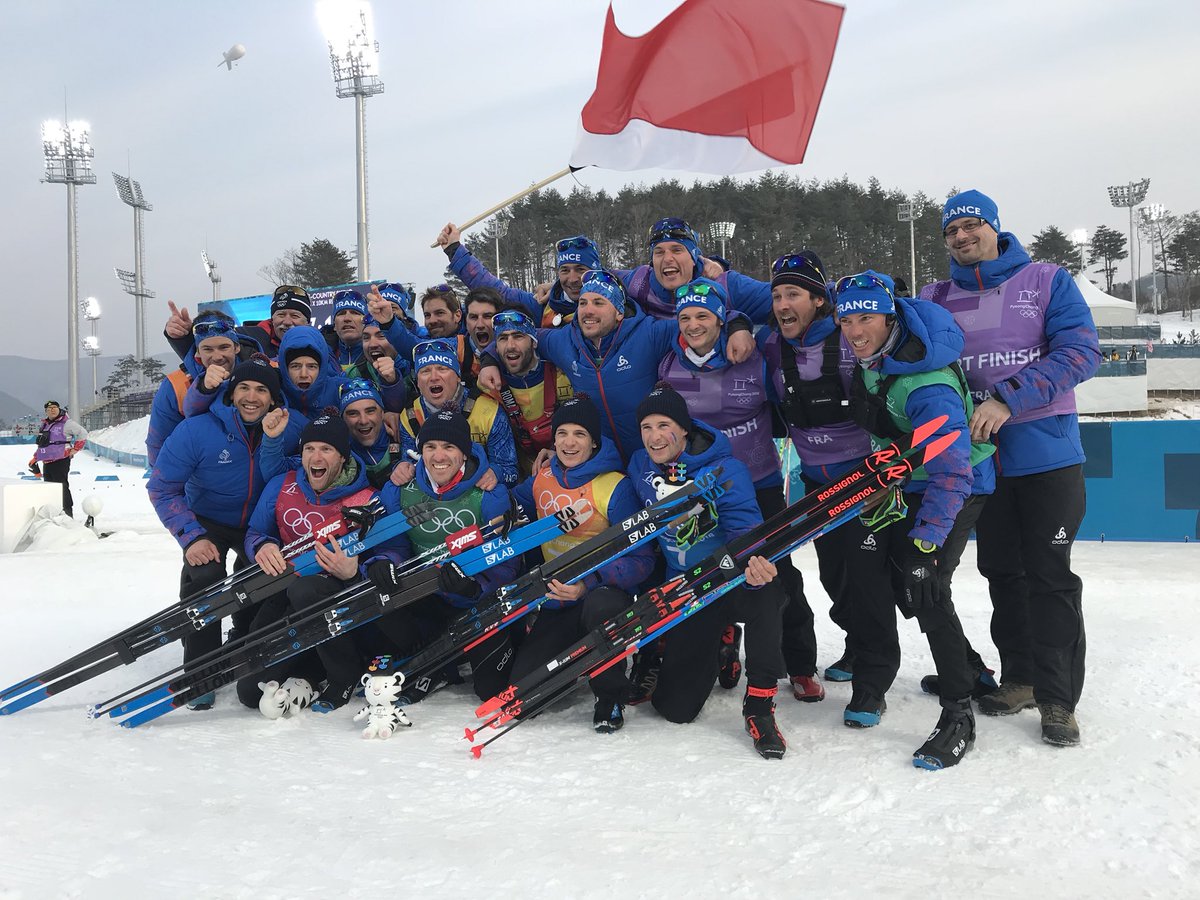
Team France celebrates its bronze-medal finish in the men’s 4 x 10 k relay at the 2018 Olympics on Sunday in PyeongChang, South Korea. (Photo: FIS Cross Country/Twitter)
Early in the final leg, France’s Adrien Backscheider took the lead ahead of Klæbo. The two held Spitsov off until the end of the second lap, where Spitsov came through the stadium first to start the final loop. Spitsov and Klæbo soon upped the pace, dropping Backscheider, and shortly after the 8.27 k checkpoint, Klæbo truly put the jets on to accelerate away from Spitsov. He dropped the Russian on a climb just before the final uphill, where it was clear that the gold was Norway’s.
As he sped down into the stadium, Klæbo relaxed his arms, skied to the sideline and took a flag from the stands. He looked back for a moment and then crossed the finish line first in 1:33:04.9 hours, while Spitsov followed 9.4 seconds later for silver for Russia. Backscheider held on for bronze (+36.9) as his team exuberantly celebrated with him at the finish.
Finland placed fourth (+1:40.5), Sweden fifth (+2:05.6), Germany sixth (+2:08.2), Italy seventh (+2:35.2), and Kazakhstan eighth (+3:31.4). Canada was ninth (+3:41.0) for its second-best Olympic relay result (with Len Valjas, Graeme Killick, Russell Kennedy, and Knute Johnsgaard), and the U.S. finished 14th (+9:24.2), out of 14 teams, with Andy Newell, Reese Hanneman, Scott Patterson, and Noah Hoffman.
France’s Martin Fourcade lunging for his second gold of the 2018 Olympics in PyeongChang, South Korea, winning the men’s 15 k mass start on Sunday. (Photo: FlyingPointRoad)
Martin Fourcade is the champion once again. Six days after he won the 12.5-kilometer pursuit for his first gold in PyeongChang, the 29-year-old Frenchman did it again in the men’s 15 k mass start on Sunday, winning in a photo finish at the line.
He took charge on the first loop, leading the field into the range for the first prone shooting. There, Fourcade shot a penalty and slipped to 19th, but it wasn’t over.
Clean shooting on the second prone brought him up to eighth, 9.4 seconds out of first. Germany’s Benedikt Doll took that lead at that point after his second stage without a miss. Meanwhile Norway’s Johannes Thingnes Bø shot three misses on that second stage and dropped out of contention.
One loop later, Fourcade moved into first with a clean standing. He left the range about 1 second ahead of Germany’s Simon Schempp and 2 seconds ahead of Germany’s Erik Lesser, after both made it through the first three stages without a miss. Doll missed one to slip to seventh, almost 30 seconds behind.
After Fourcade and Schempp exchanged leads over the next loop, Lesser moved into first just before the final shooing, Going head to head, Fourcade and Schempp both missed one while Lesser missed two. Fourcade and Schempp still left the range in first and second, respectively, separated by 0.4 seconds, while Lesser slipped to fifth, 22.5 seconds back.
Doll left the range in third (+19.2) after cleaning and Norway’s Emil Hegle Svendsen moved into fourth (+21.9) with a clean standing stage as well.
In the end, Fourcade outlunged Schempp for the win in 35:47.3 minutes, with Schempp finishing less than a tenth of a second behind for silver, and Svendsen beat out Lesser in the finishing stretch by 0.4 seconds to claim bronze, 11.2 seconds behind, while Lesser settled for fourth (+11.6). Doll followed them in fifth (+18.8), Austria’s Julian Eberhard placed sixth (+30.7) with three penalties, Norway’s Erlend Bjøntegaard seventh (+32.1) with two misses, Norway’s Tarjei Bø eighth (+34.6) with three penalties, Sweden’s Jesper Nelin ninth (+34.6) with two misses, and Slovenia’s Jakov Fak 10th (+36.1), just ahead of the Czech Republic’s Ondřej Moravec in 11th (+36.3), with one miss each.
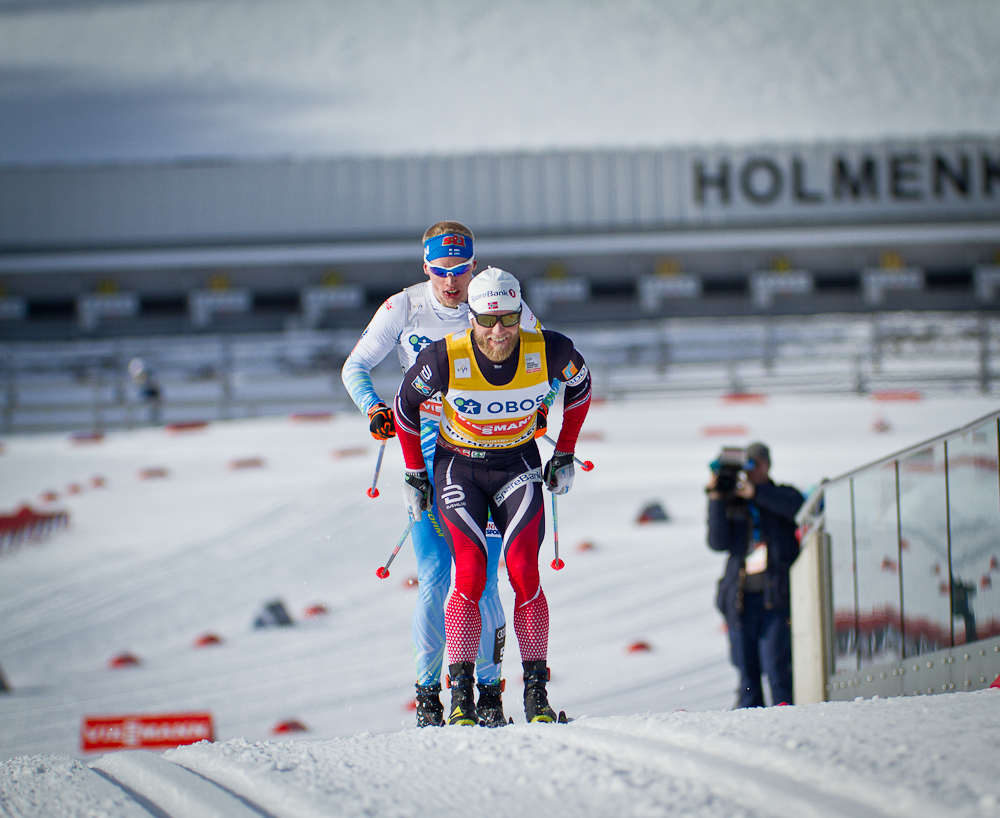
Norway’s Martin Johnsrud Sundby exits the stadium as Finland’s Iivo Niskanen shadows during the men’s 50-kilometer classic mass start on Saturday at Holmenkollen in Oslo, Norway.
OSLO, Norway — Here’s something dizzying: six times around an 8.3-kilometer course with a total vertical gain of just over two thousand meters. In non-metric terms, all 47 finishers on Saturday’s Holmenkollen 50 k classic race accumulated roughly 6,574 feet of climbing.
On the sharp end of the race for most of those kilometers were Norway’s Martin Johnsrud Sundby and Finland’s Iivo Niskanen. They were the animators for the hordes of Norwegians lining the course — in some places four deep.
Around 16 k, the lead group was seven strong with a host of skiers dangling just off the back. Up front there were the alphas — Niskanen and Sundby — and a heavy hitter gang including Norway’s Sjur Røthe, Niklas Dyrhaug, Hans Christer Holund, Sweden’s Jens Burman, and the defending 50 k world champ, Canada’s Alex Harvey.
This went down on a day when the views from Holmenkollen were almost limitless, Oslo Fjord shimmered and the storied venue’s atmosphere was buoyant. The air temps were an above-freezing blend of hello-spring and we’re-not-sure-we-want-you-gone winter. In other words: perfect.
Finland’s Iivo Niskanen leads Norway’s Martin Johnsrud Sundby during the Holmenkollen 50 k classic in Oslo, Norway.
It was also a day to see if risk could play out with good fortune. What could go wrong with such a backdrop?
Niskanen left Lahti World Championships with two medals: a gold in the 15 k individual classic and a bronze in the classic team sprint, both of which were confidence boosters. With speedy skis and his kick not waning, he rolled the dice passing through the stadium after two 8.3 k laps. No ski change.
The six skiers behind opted for fresh skis. With new fluoros and fresh kick, they also found themselves in Niskanen’s wake as he made a break while the others exchanged.
“When Niskanen didn’t change at the second lap, it made Sundby chase really hard to close the gap to him,” Harvey told FasterSkier after the race. “Then that kind of blew the pack apart.”
Niskanen threw down in Sundby’s castle. For a bit, it looked like the challenge might stick. At 18.8 k, Sundby was down 15.4 seconds.
When Niskanen made his break, the gap back to Sundby was really a static line when it came to Niskanen building a lead. By 22.5 k, Sundby latched back on. The reward for Niskanen’s no-ski-switch gamble was that it became a two-skier race for 2017 Holmenkollen 50 k title.
Late in the race at 47.5 k when Sundby made a break and built a six-second lead, the gap to Niskanen was still tenuous as the waning kilometers clicked off. But Sundby’s surge was enough for the win. First is first whether by one second or a minute.
After 50 k, all that climbing, all the Norwegian-flag waving, and all the Carlsberg beer consumed by fans along the course, 9.9 seconds separated the winner Sundby from runner-up Niskanen. Sunday skied the 50 k in 2:02:59.7.
With the win, Sundby locked some things up: he secured both the Overall World Cup and Distance World Cup crystal globes. This season’s overall win makes it Sundby’s third of his career (not counting the his overall World Cup win in 2014/2015, which he was stripped of because of a doping violation concerning his use of asthma medication).
“It was a tough pace right from the beginning today,” Sundby told the International Ski Federation (FIS) after the race. “When Iivo broke away and I was able to get back to him, we worked well together and I actually convinced him to change skis with me on the fourth lap. He was going to change on third lap but I told him I would lead and we could get away together. He’s the 15 k world champ in classic and it was a tough fight with him.”
For Niskanen, Saturday’s second place was his best World Cup 50 k result and marked his best Holmenkollen 50 k classic. In 2014, he placed fourth and was 12th in 2016.
“After the fourth lap we both switched skis and it meant that I had fresh skis to battle with Martin,” Niskanen told FIS. “He was really strong today. I didn’t have any chance in the last uphill. He was running like Mo Farah. I’m happy with second but my goal was for the victory. You have to have a good race to be on the podium and I think I made a good race today but Martin was better. “
The podium’s third step wasn’t decided until after five skiers lunged at the line. Russia’s Alexander Bessmertnykh won the photo finish for third (+1:15.2) ahead of Røthe in fourth, (+1:15.2) and Dyrhaug in fifth (+1:15.2).
A five-deep pack fighting for third place in the Holmenkollen men’s 50 k classic on Saturday in Oslo, Norway. Norway’s Hans Christer Holund (6) leads Canada’s Alex Harvey (behind, in red).
Also part of that multi-skier lunge was Harvey, just 0.2 seconds back in sixth (+1:15.4).
Asked about the Niskanen-Sundby breakaway and how that unfolded in the chase pack, Harvey lumped praise onto others.
“After that we tried to chase, but it wasn’t me doing the chase, it was mostly Hans Christer Holund,” Harvey said. “He was really strong today, probably the strongest of us all … But then after that the gap was too big, it was just a matter of not letting the guys behind us catch up and get ready for the final sprint.”
Harvey has contested the Holmenkollen 50 k classic on three other occasions. His best result prior to Saturday was 13th. “It was one of my best races here ever, so that was a great day,” he said.
Next up for Harvey is a trip back home to Quebec for World Cup Finals. He’ll land in Canada ranked third in the World Cup overall with 844 points. Finland’s Matti Heikkinen sits fourth with 837 points.
The next best North American was U.S. skier Scott Patterson (Alaska Pacific University). Patterson placed 28th (+7:18.8). Most recently, Patterson scored World Cup points after placing ninth in the 30 k skiathlon in PyeongChang, Korea.
Jonas Baumann of Switzerland (27) leads U.S. skier Scott Patterson (APU) during the Holmenkollen 50 k classic in Oslo, Norway.
Saturday was more of a final exam; the Holmenkollen 50 k remains a big test. (Many big names were present in Oslo that had skipped the pre-Olympic World Cup in PyeongChang.)
It was Patterson’s second-ever World Cup 50 k after racing at Holmenkollen last year, where he placed 32nd in another 50 k classic.
“It was pretty good, it could have been better,” Patterson said of his top 30 this year. “I had a little crash on the sixth lap that was frustrated because I lost a little group. Then also, one time when I went through an exchange, most of my group didn’t so I kind of lost that little, there was a group not too far in front of me that I really wanted on, but couldn’t quite get up there.”
Patterson explained this was a bottom-line race: he’s here to score World Cup points.
“I was kind of sitting in 27th for a while and at that point, [U.S. coach] Matt [Whitcomb] and some others kept giving me splits and it was, like, 45 second up to the top 20,” Patterson added. “And at that point, I was aiming for that instead. But I’m pretty happy with some points, it’s the first time I’ve scored points in Europe, so I’m psyched.”
Whitcomb had praise for all four U.S. skiers entered in the race: David Norris (APU) placed 35th (+9:56.4), Noah Hoffmann (USST) 38th (+11:02.6), and Ben Lustgarten (Craftsbury Green Racing Project) 46th (+18:44.7).
“It was definitely a day that we were happy with as a staff,” Whitcomb said on the phone. “It was inspiring to see four starters and four finishers in the Holmenkollen. It’s just an accomplishment of itself, to start the thing and finish it. … Of particular note was Scott Patterson’s race. He’s been in the points before, most recently in Korea, but this was really his first big time landing in the points, he came from the 30’s and worked his way into the 20’s early in the race. It was a nice step up from his 32nd last year.”
Alaska Pacific University’s David Norris (36), representing the U.S., strides out of the stadium followed by Canada’s Devon Kershaw (26) during the Holmenkollen 50 k classic mass start in Oslo, Norway.
Of note, it was Norris’s first European World Cup; he skied two World Cups in Canada back in 2012.
“This was my first World Cup in Europe, and I don’t know if it’s ignorant or not, but I want to try for top 30, get points, and come back here,” Norris said when asked about his goals coming into the race. “To have a shot on the US Ski Team, you have to be able to show that you can top 30 on a given day, and that’s my goal, to be on that team, so I’m setting my goals high, to top 30 in everything I can.”
Also for Canada, World Cup Team member Devon Kershaw placed 33rd (+8:59.4), and Russell Kennedy (Canmore Nordic/Team R.A.D.) was 47th (+20:16).
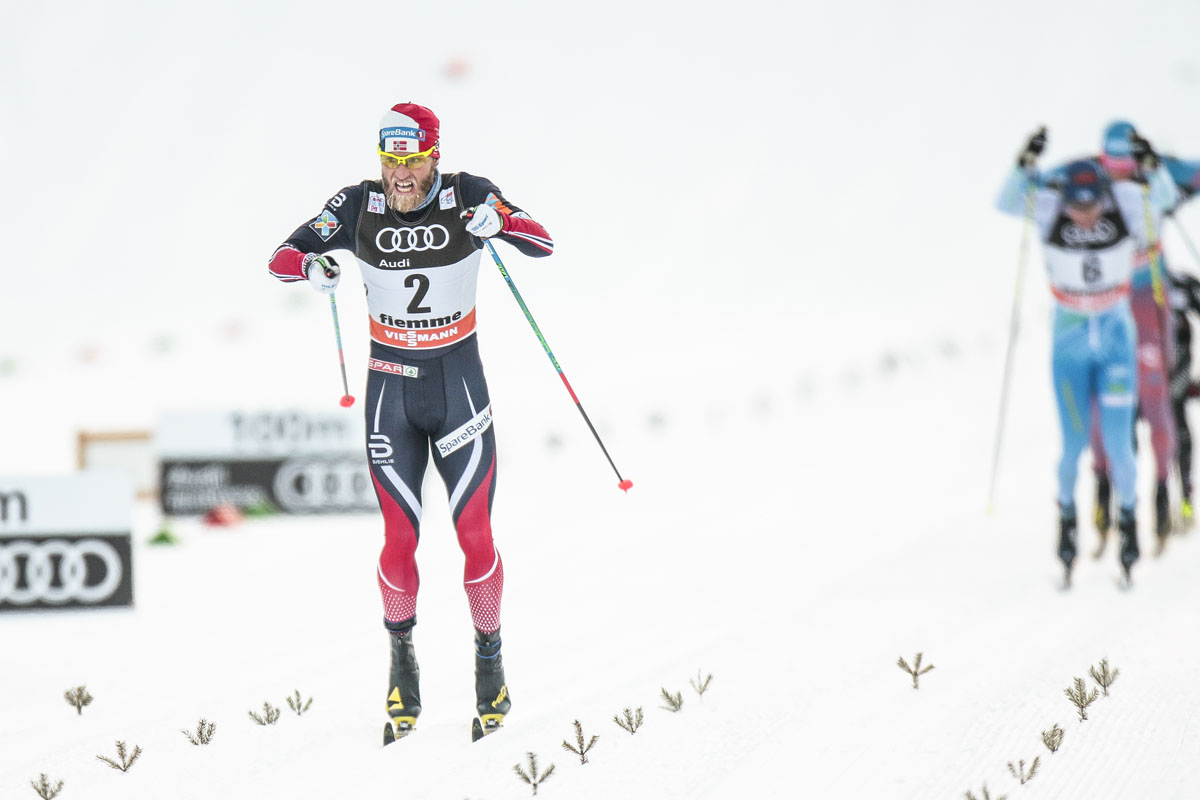
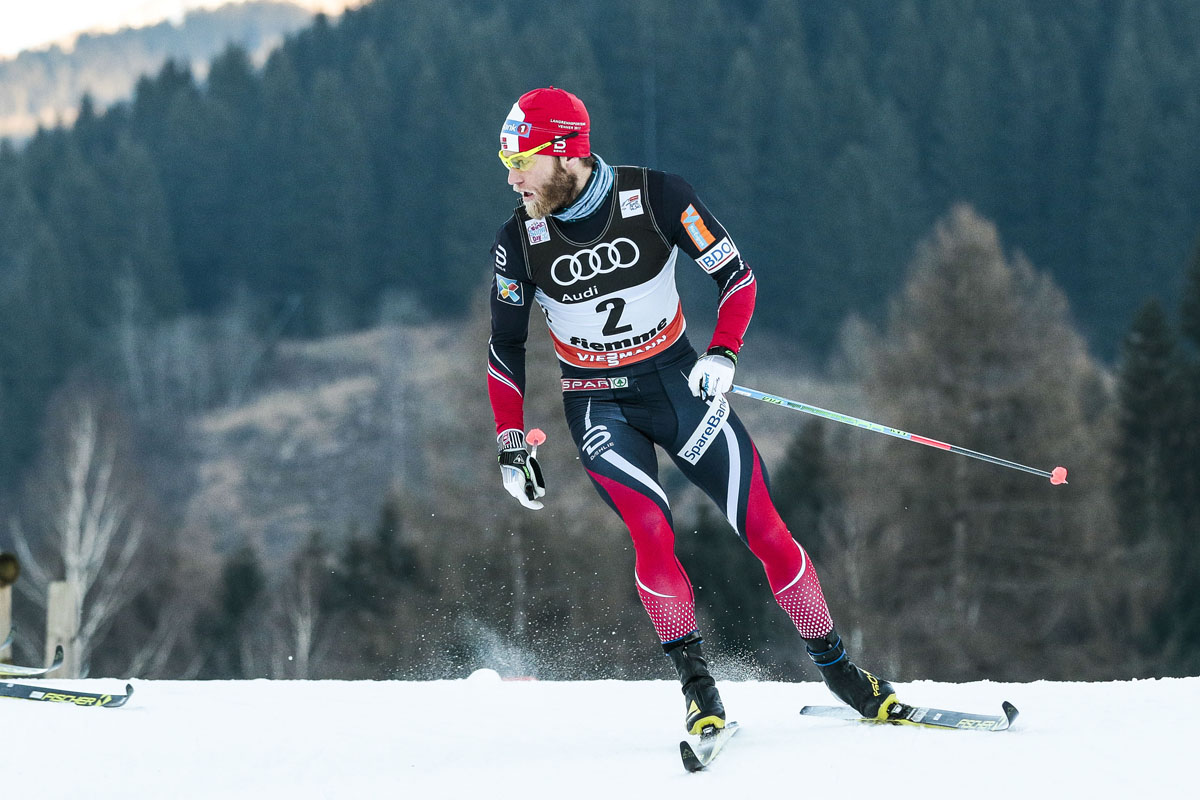
Norway’s Martin Johnsrud Sundby (l) well ahead of the field as he double poles toward the finish in Saturday’s 15 k classic mass start, which he won by 2.2 seconds over Russia’s Sergey Ustiugov (third from r) while Finland’s Matti Heikkinen (second from r, ahead of Ustiugov) placed third at the Tour de Ski Stage 6 in Val di Fiemme, Italy. (Photo: Fischer/Nordic Focus)
Six laps. Three climbs per lap. Fifteen-kilometer classic mass start. If you’re in it to win it, where do you make your move?
That was the kind of calculating Norway’s Martin Johnsrud Sundby was doing throughout Saturday’s Stage 6 mass start, the second-to-last stage of the 2017 Tour de Ski, in Val di Fiemme, Italy. Every time he rounded the 2.5 k loop, the man he needed to beat — Russia’s Sergey Ustiugov — was right there, either leading or within a few strides of first.
Through five Tour stages, the 24-year-old Ustiugov was unbeaten. Could he be beat? Yes, Sundby thought, but it was going to take some brains as well as brawn.
He had to be patient, despite being extremely frustrated with his race on Friday, when he placed 14th in the 10 k freestyle in Toblach, Italy. That put him more than a minute and a half behind Ustiugov in the overall Tour with two stages to go.
“Yesterday’s race was really bad and it is good I could win today,” Sundby said, according to an International Ski Federation (FIS) press release. “I was little bit conservative at the beginning. I wanted to win some bonus seconds. I had some power left and I am happy about victory.”
He attacked on the last lap just before the 13.9 k mark, after pulling up alongside Ustiugov on the first long climb out of the stadium, while Switzerland’s Dario Cologna did the same on the other side of the Russian in the Tour leader’s bib.
Norway’s Martin Johnsrud Sundby glances back to make sure he’s out of reach during the final kilometer of the men’s 15 k classic mass start at Stage 6 of the Tour de Ski in Val di Fiemme, Italy. (Photo: Fischer/Nordic Focus)
Sundby’s move wasn’t obvious then, but it was along a long false-flat, where he began dropping the field with an unmatched double pole. Heading into a tricky descent before the final climb, Sundby had successfully broken away and frequently checked back to make sure Ustiugov wasn’t anywhere near him.
Ustiugov and two of his Russian teammates, Andrey Larkov and Alexander Bessmertnykh, continued to lead the chase, followed by Cologna, Finland’s Matti Heikkinen, Norway’s Niklas Dyrhaug, and even Italy’s Francesco de Fabiani had worked his way into the mix.
Up that last steep climb, Cologna switched from the right to the left tracks suddenly, appearing to cut off Heikkinen, who moved outside the tracks to get around him. A few strides later, Dyrhaug stepped outside the right tracks to get around Ustiugov, but Ustiugov wasn’t having it. He stepped out as well, forcing Dyrhaug to file back in behind him. All of this was shaping up to be a fight for second; Sundby was too far gone.
The second-ranked man in the Tour, Sundby finished in 40:40.0 minutes, while Ustiugov caught a draft and out-double poled the chase pack for second place, crossing 2.2 seconds later. That still puts Ustiugov 1:12 minutes ahead going into the final climb (yep, he’ll start 1:12 minutes ahead of anyone else in the 9 k freestyle hill climb up Alpe Cermis), but at least for Sundby it’s not 1:34.
But as Ustiugov said Friday, “For Martin, a minute does not mean anything … The main thing is not to lose all that has been so hard-earned in these five races.”
“Today’s performance gives me a different starting point in tomorrow’s race,” Sundby told NRK. “I need a little miracle tomorrow, but I’m not going to quit before I cross the finish line.”
Finishing 0.6 seconds behind Ustiugov on Saturday, and nearly being taken out by the Russian at the finish when Ustiugov collapsed sideways across the line, was Heikkinen in third (+2.8). Fourth through eighth place were all within 1.1 seconds of the podium, with de Fabiani taking fourth (+3.2), Larkov fifth (+3.3), Dyrhaug sixth (+3.5), Cologna seventh (+3.8), and Bessmertnykh eighth (+3.9).
After that, there was a 6-second gap Norway’s Hans Christer Holund in ninth (+9.9), Sweden’s Marcus Hellner finished 10th (+10.3), France’s Jean-Marc Gaillard 11th (+13.6), Sweden’s Jens Burman 12th (+14.9), and France’s Maurice Manificat 13th (+16.3).
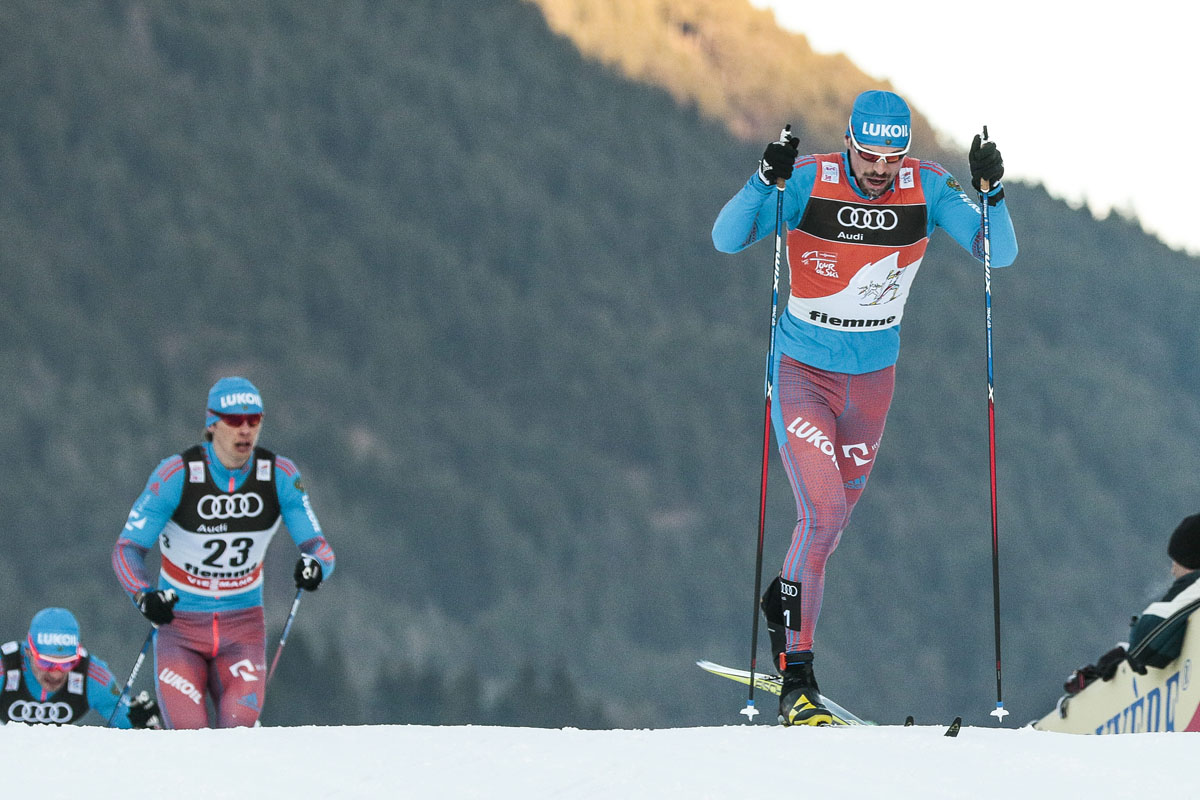
Russia’s Sergey Ustiugov (r) leads his Russian teammates Alexander Bessmertnykh (23) and Alexey Larkov (l) during the men’s 15 k classic mass start at Stage 6 of the Tour de Ski in Val di Fiemme, Italy. (Photo: Fischer/Nordic Focus)
The fact that Ustiugov finished second was largely in part to his teammates, Larkov and Bessmertnykh, who drove the pace and helped box out competitors up front, especially early in the final lap. Ustiugov even drafted one of them on the final descent into the stadium before switching to an open lane in the finishing straight and double poling to the front of the chase pack.
“I am grateful to my teammates,” Ustiugov said, according to a loose translation. “If they did not help me, one of them could have won the mass start. Tomorrow’s race? We’ll see. In any case, it will be interesting. I understand perfectly … what is waiting for me, despite the fact that I was only passed once on the final uphill.”
One thing Saturday showed: the Russian is beatable. Last year, Sundby won the climb, both as the first man at the top and with the fastest time up the 9 k grind. France’s Robin Duvillard, who is not competing in this year’s Tour, was second (+7.2) for time of day, and Heikkinen was third (+11.8).
Ustiugov as the fourth starter clocked the 13th-fastest time, 47.6 seconds behind Sundby. Of note, American Noah Hoffman was 15th (+56.4) and Canada’s Alex Harvey 16th (+1:07.4) for final-climb time.
Ustiugov ended up third overall in the 2016 Tour, arriving at the top near four minutes after Sundby.
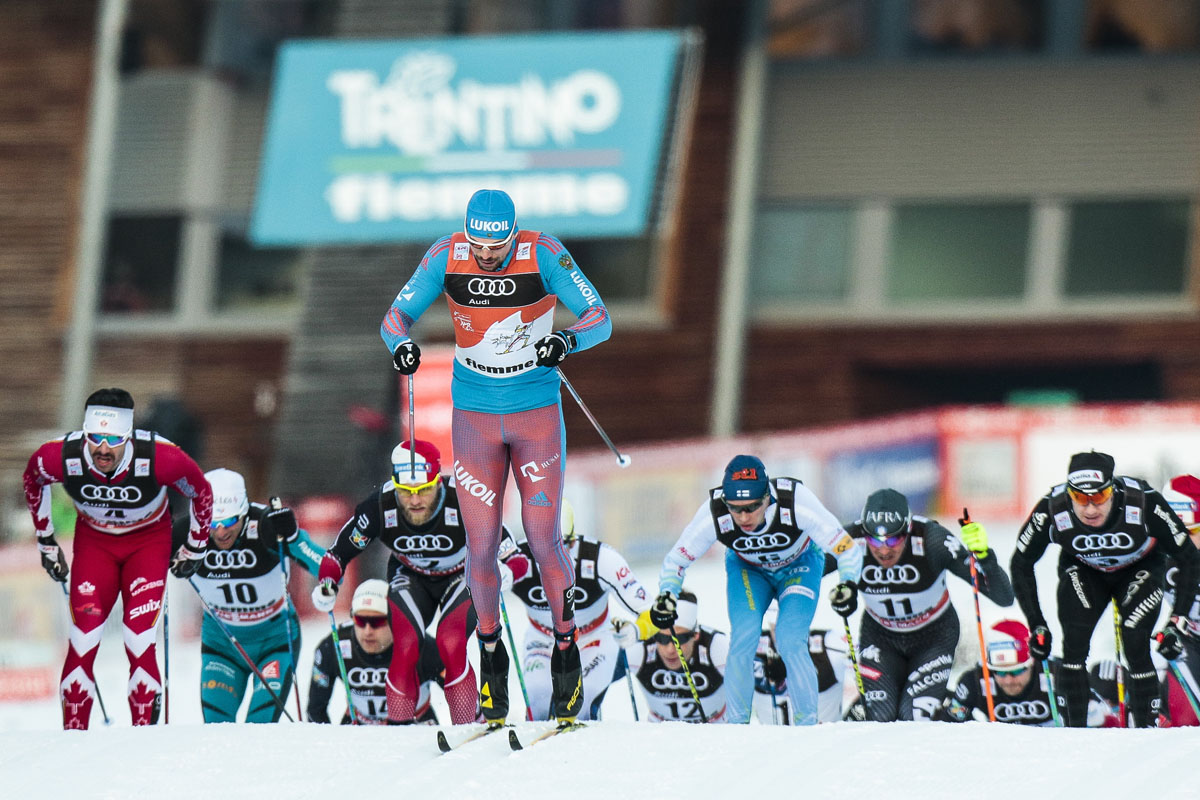
Russia’s Sergey Ustiugov (front, in Tour leader’s bib) leading early in the men’s 15 k classic mass start on Saturday, along with Canada’s Alex Harvey (l) at Stage 6 of the Tour de Ski in Val di Fiemme, Italy. (Photo: Fischer/Nordic Focus)
“… I think he’s in better shape now,” Harvey said on the phone Saturday about Ustiugov. “So I think those two guys [Ustiugov and Sundby] will stay in front, and Sundby probably second. I think it will be just a really good fight…”
On Sunday, Harvey will start sixth in this year’s final climb, 2:42 minutes behind Ustiugov and 38 seconds behind Cologna, who is third overall.
“I am third at the moment with a lead of more than 20 seconds, that surely looks positive, but it’s a long flat section before the climb,” Cologna told Swiss broadcaster SRF. “It’s almost a minute to Sundby, and he is not a bad climber, either. So I really have to look how I can defend my third place. That’s the goal for tomorrow.“
Harvey entered Saturday’s 15 k classic mass start in fourth overall but dropped two spots when he finished 19th, 38.7 seconds after Sundby. Also slated to start ahead of Harvey on Sunday are Heikkinen, who is fourth overall (+2:33) and Manificat in fifth (+2:34).
“Manificat will try early on the hill, and then Heikkinen. I’m sure they’ll be pushing really hard down the flat to kind of close that 26-, 28-second gap that they have on Dario [Cologna],” Harvey anticipated. “… When you see someone up the hill, like 10 seconds, it seems like they’re three meters ahead, always. So I think that it’s a good position to be in, for Heikkinen especially. My guess for the podium is probably Ustiugov, Sundby, and Heikkinen, but I’ll be in there, too, so we’ll see.”
On Saturday, Harvey surged to the front of the pack early, leading at 1.1 k, with superior skis on the uphills, he said. Also up there with him was Romania’s Paul Constantin Pepene — sort of a surprise at this point in the Tour.
“The Romanian guy started really fast and then he blew up right away,” Harvey said, of Pepene falling off the pace after 2.5 k. “There was a prime in the second lap early on … and I think I had one of the best grip out there today, so on that steep hill it was pretty easy for me to just run in the track and get that prime [for 15 bonus seconds].”
Alex Harvey (Canadian World Cup Team) en route to 19th in the men’s 15 k classic mass start on Saturday, which puts him sixth overall in the Tour de Ski with one stage remaining in Val di Fiemme, Italy. (Photo: Salomon/Nordic Focus)
Heading into Lap 3, Harvey said the wheels started to come off.
“When we lapped into the stadium, I was starting to get kind of yo-yoed a bit near the end of the group,” Harvey recalled. “And then tried to fight my way back up on the climbs, but I was getting yo-yoed a bit, and then the elastic just broke.”
Fewer than 5 seconds out of first at 5 k while skiing in seventh, Harvey was down to 15th by the end of the next lap, yet still within 7 seconds of Ustiugov in first.
Early on the fourth lap, he was 15 seconds back in 18th, just ahead of Great Britain’s Andrew Musgrave and Harvey’s teammate Devon Kershaw in 19th and 20th, respectively. Another three seconds back, a third Canadian, Graeme Killick was skiing in 25th (+18.7) at 8.6 k.
“I actually didn’t know he was there until he just passed me, but yeah, I skied with him for a bit,” Harvey said of Kershaw, who passed him shortly after.
Harvey recalled that Kershaw “got kind of tangled up with a Russian in the herringbone part, and then I think he said he lost our group there.”
Kershaw could not be immediately reached for comment after Saturday’s race.
The start of Lap 5 saw Harvey 10 seconds back from the leaders in 18th and Kershaw another five seconds back in 24th, with Killick following roughly three seconds later in 26th. Harvey was nearly 20 seconds behind one lap later, skiing in 17th, and he closed the race out in 19th (his worst result after placing 11th on Friday in the Toblach 10 k) of the Tour.
“I don’t know. The body was good,” Harvey said.
As for Sunday: “Oh I’m ready,” he said. “I kind of want revenge after today.”
“Alex is a competitive guy and is hungry,” Canadian World Cup coach Ivan Babikov said, according to a Cross Country Canada press release. “He will be in a group of about four guys who are all good climbers. Dario is always strong, but anything is possible.”
Kershaw finished the race in 27th (+1:21.1) and Killick 32nd (+1:31.0). They will start the final climb in 23rd (+7:19) and 37th (+11:25), respectively.
“Coming into the Tour this year the priority races for me to target were the 10km in Val Mustair and the 15km tomorrow in Val di Fiemme,” Kershaw wrote in an email on Friday. “… [The 15 k mass start] will be a real battle royale and it’s the crux of this tour for the top 10. A lot of really strong guys are grouped close together and aside from Ustiugov who has made a mockery of this years event I would say it’s wide open.
“What that means is that with the two bonus sprints on course and the time at the line – there is 45sec available – there will be a lot of hungry racers gunning for it. Blend that with a difficult and punishing course here in Val di Fiemme and I think this race will be blown open pretty good,” Kershaw anticipated. “I hope to have a good start and really just feel good in the body because you are going to need that for sure if you want to have a good race.”
“It is a tough course and the guys are pretty tired but they dug deep today,” Babikov said Saturday, according to the press release. “We might have missed it a bit with the skis. We may have gone with something a bit too sticky.
“It was really hard-packed snow and this is a tough course to get the skis right,” Babikov added. “Ideally you want to have good kick and a fast glide, but it is a gamble on a course this tough. The tracks were firm and icy but there were some sections where there were no tracks and others with powdery snow. We will debrief on it tonight.”
The lone American to finish, Noah Hoffman landed in the points for the second-straight stage in 30th (+1:17.1) after skiing in 34th for the first two-thirds of the race. By 12.5 k, Hoffman was up into 29th, right behind Russia’s Petr Sedov in 28th and about 50 seconds behind the leaders.
“I actually felt like I skied the second half pretty well,” Hoffman said on the phone. “I was able to make contact with that group that contained all the way up to 22nd place by the end. I didn’t really lose that much time … But I mean, yeah, certainly not a standout result. I kind of feel like a broken record, when every race I’m like, ‘Well, there were some good signs and I’m optimistic that it’s going to come around, but it’s not here yet.’ That’s kind of where I’m at.”
Hoffman will start the final climb — a race he hopes to place in the top 15 in for time of day — in 30th (+9:42).
“I’ve been top 20 on time on day a couple times, but I’m kind of frustrated, I feel like I haven’t shown what I can really do up a climb like that,” he said. “It’s a stage that was built for me, especially if I have help down in the valley, which I do tomorrow, because I’m starting with Sedov and that Swede [Viktor Thorn right behind me].
“So I will definitely rely on some help to get to the base of the climb, and then I feel like once we get there, then I just need to use my energy and show what I can do,” Hoffman added. “I think I can move up. Certainly a spot or two would be great, but there’s some pretty good time gaps [ahead of me]. But I would love to be at least top 15 for time on day, and I feel like that’s something I can do if I show my aerobic capacities.”
Erik Bjornsen’s crash caught on camera during the first lap of the men’s 15 k classic mass start at Stage 6 of the Tour de Ski on Saturday in Val di Fiemme, Italy. (Photo: CCC/Eurosport screenshot)
American Erik Bjornsen started the race but crashed on the first lap on a climb which plagued top competitors in the women’s race as well.
According to Hoffman, he and Bjornsen watched the women’s race on TV in the athletes’ lounge before their race.
“And it was in that exact same spot, Kalla and Pärmäkoski went down. … That corner does not ski challenging when you’re alone, but it’s a corner that when you get into a pack, it transforms a bit,” Hoffman recalled. “There was just an ice patch that opened up. I kind of couldn’t believe it when Erik went down, I was like, ‘Oh my god, that is exactly what we just watched Pärmäkoski and Kalla do.”
Hoffman was behind Bjornsen at the time and narrowly avoided a pileup Russians he created.
“I believe [Erik] broke a pole, but I have not had a chance to talk with him about why he decided to drop out,” Hoffman said of Bjornsen pulling out of the race at the halfway point at the end of the third lap.
Bjornsen could also not be immediately reached for comment.
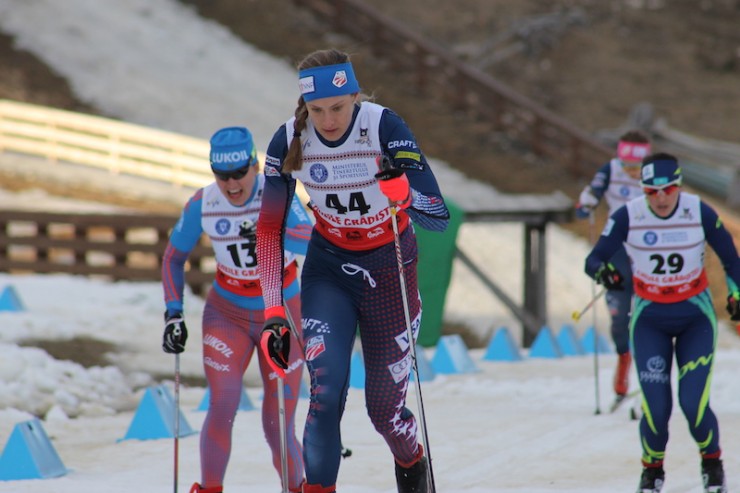
Katharine Ogden (SMS/USST) racing to 13th in the 5 k classic at Junior World Championships in Rasnov, Romania. (Photo: Pete Leonard)
Julia Kern (SMS/USST) racing to 18th in the 5 k classic at Junior World Championships in Rasnov, Romania. (Photo: Pete Leonard)
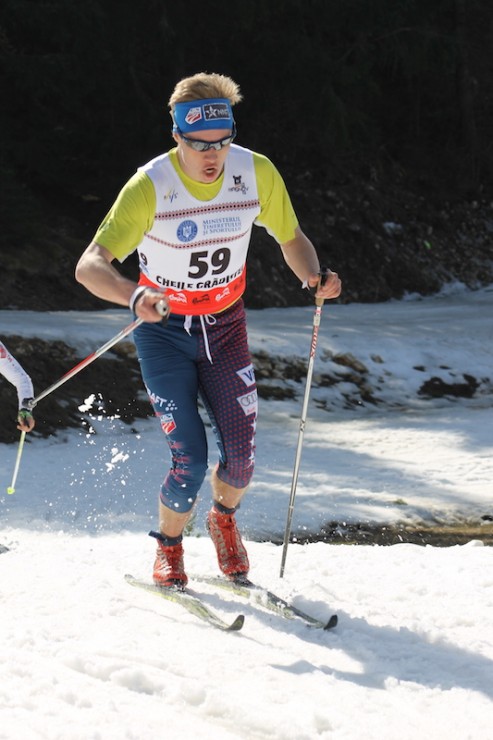
Adam Martin (NMU) racing to a American-leading 23rd in men’s 15 k classic at 2016 U23 World Championships in Rasnov, Romania. (Photo: Pete Leonard)
Kyle Bratrud (CXC) racing to 29th in the men’s 15 k classic at U23 World Championships in Rasnov, Romania. (Photo: Pete Leonard)
Cully Brown racing to 35th in the men’s 10 k classic at Junior World Championships in Rasnov, Romania. (Photo: Pete Leonard)
Kristen Bourne racing to 40th in the women’s 10 k classic at U23 World Championships in Rasnov, Romania. (Photo: Pete Leonard)
Felicia Gesior racing to 41st in the women’s 10 k classic at U23 World Championships in Rasnov, Romania. (Photo: Pete Leonard)
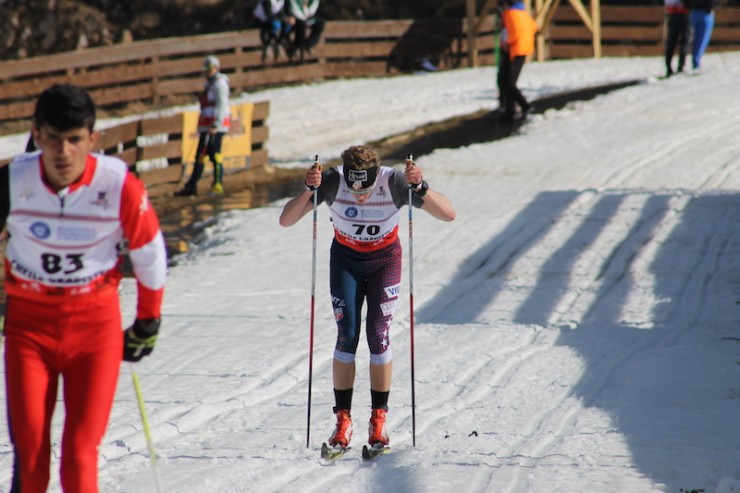
Ian Torchia racing in the men’s 10 k classic at Junior World Championships in Rasnov, Romania. He placed 43rd and went on to notch 15th in the 15 k freestyle there. (Photo: Pete Leonard)
Henry Harmeyer racing to 65th in the men’s 10 k classic at Junior World Championships in Rasnov, Romania. (Photo: Pete Leonard)
Katharine Ogden didn’t worry too much about the slush at Junior World Championships on Tuesday. She tested her skis once, remained confident in her kick and resolved to “hammer the whole thing” because 5 kilometers is pretty short, the 18-year-old Stratton Mountain School and U.S. Ski Team D-team member explained in an email.
“I didn’t notice too much of a change in the conditions between laps, although by my second lap I’m not sure I would have noticed much, it was definitely a sufferfest out there,” she wrote.
Ogden raced to 13th in the 5 k classic individual start on the second day of U23/Junior World Championships in Rasnov, Romania, leading the U.S. team on a classic distance day with temperatures in the mid-to-upper 50 degrees Fahrenheit.
American Katharine Ogden (6), of the Stratton Mountain School and U.S. Ski Team, chases Germany’s Antonia Fraebel during the junior women’s 5 k classic at the Junior World Championships on Tuesday in Rasnov, Romania. (Photo: FIS Nordic JWSC & U23 WSC)
The sixth starter, Ogden finished 56.8 seconds behind the winner Marte Mæhlum Johansen of Norway, who completed the two-lap race in 15:34. In Ogden’s second junior world championships, the result was her third best after placing sixth in the 10 k skiathlon and 11th in the 5 k freestyle last year in Almaty, Kazakhstan.
“I’m psyched about my race and I’m hoping to carry the momentum into the skate 10k which is a much better event for me,” she wrote of Thursday’s race. “I’m mostly focused on the skate race here.”
When asked how Rasnov compares to Almaty, Ogden explained they are “pretty similar in some ways but completely different in others.
“Almaty was a huge industrial city while Rasnov is a small rural mountain town,” she wrote. “The low snow has been common to both venues, however the situation is much worse here in Romania. It’s pretty awesome that we get the opportunity to travel to these crazy places and race because neither place is one that I would ordinarily get to experience.”
Finishing 21.2 second off her teammate’s pace and 1:18 behind the winner, Julia Kern (SMS/USST) notched her second-straight top 20 in as many races at this year’s junior worlds.
Kern finished 18th, and like Ogden, whose time ranked 18th at the halfway point, Kern sped up on her second lap to improve from the 24th-fastest split at 2.5 k.
“Honestly, my plan was to feel it out as I went along because when I saw the first starters lap, they looked like they were in a lot of pain and that it was super slow and grueling,” Kern wrote in an email. “I also had talked with my coach Matt Boobar about water ‘feeds’, where he would dump cold water on me while I was racing so I could cool off a little. I found the cold water helped me cool off a little in the heat.”
She started the race 26th out of almost 80 junior women and felt the conditions were likely similar for everyone: “hot, wet, slow, and slushy,” she wrote.
“Quickly after I had started out, my body set into a pace automatically that was appropriate,” Kern explained. “Is was so slow out there that it was really hard to go significantly faster without wasting a lot of energy; it was almost like the speed you were going was hard to change. … I definitely didn’t feel like I was having a good race just by how slow I was skiing, but I guess the results showed otherwise.”
Her goal had been a top 25, so 18th place exceeded that.
“I am very happy with my result today and pleasantly surprised!” she added. “The coaches had done a great job giving splits out on course, but I knew that when they said I was top 20, there were plenty of fast girls still behind me. It is hard to tell how I feel about the actual race because I don’t think it felt good for anyone; it was all about who could fight through the pain the fastest.”
Finishing 5.3 seconds behind the winner, Norway’s Lotta Udnes Weng placed second for the second-straight day and Germany’s Antonia Fraebel took third (+10.7).
Canada’s Hannah Mehain racing to 44th in the women 5 k classic on Tuesday at Junior World Championships in Rasnov, Romania. (Photo: FIS Nordic JWSC & U23 WSC 2016/Facebook)
Canada’s Marie Corriveau placed 37th, 2:04.8 behind the winner, and explained in an email that she found it difficult to push hard in the slushy conditions.
“I am not used to skiing in those conditions,” Corriveau, of the Pierre-Harvey National Training Centre in Quebec City, wrote. “I know it was the same for everybody, but usually I take advantage because of my good technique, but today it was almost impossible to ski well.
“I am not feeling bad [about] my race, because i know I gave everything!” she added. “For sure, I would expect better for a 5km classic, but with the circumstances, I am pretty happy with this 37th place!”
Behind her, Canada’s Hannah Mehain placed 44th, Natalie Hynes was 58th and Sadie White 62nd. For the U.S., Vivian Hett placed 48th, and Leah Lange was 52nd.
Three Americans in the U23 men’s 15 k classic finished in the top 30, with Adam Martin of Northern Michigan University leading the way in 23rd. Paddy Caldwell (Dartmouth/SMS/USST) placed 27th and Kyle Bratrud (CXC) was 29th.
Unlike the junior women, who raced two laps, the men rounded the 2.5 k loop six times. A few men opted to double pole on skate skis and two of them, including Canada’s Julien Locke, were disqualified for violating classic technique.
“Preparing for this race presented some challenges I haven’t encountered before,” Martin, who previously raced at 2014 Junior World Championships in Val di Fiemme, Italy, wrote in an email. “To preserve snow, race organizers only allowed athletes to ski in short time periods on Sunday and Monday. I don’t think this affected me as I was able to pick my skis and execute the intervals I had planned, but it was definitely something new.”
A bird’s eye view of the race course at U23/Junior World Championships in Rasnov, Romania. (Photo: FIS Nordic JWSC & U23 WSC 2016/Facebook)
The 21st starter out of approximately 70, Martin recalled the snow feeling significantly slower on his third lap.
“I usually make an effort to start very hard, but considering the conditions, my focus was more on being relaxed at the beginning,” he explained. “I am happy with that strategy because it didn’t take long to feel the effort.”
Considering this was his personal best at a world championships, after placing 26th in the 10 k classic at 2014 junior worlds, Martin wrote that it felt great to improve.
“But to be honest it’s hard for me to celebrate too much when there are 22 guys beating me by up to three minutes at the event,” he added after finishing 3:02.2 behind the winner, Jens Burman of Sweden, who took gold in 40:02.
Russia’s Alexey Chervotkin was 26.8 seconds back in second place, and Norway’s Mikael Gunnulfsen placed third (+36.6).
In an email to FasterSkier, U.S. Ski Team Chris Grover recently explained that Martin had turned down World Cup starts for the Ski Tour Canada. In his place, there is one opening on the men’s roster that can be filled with an “outstanding performance” at U23 World Championships.
“As a collegiate skier … I think in some sense NCAAs is my only obligation each year for NMU,” Martin wrote of his decision to decline the spot. “Furthermore, I think I have some improvements I need to make especially in sprinting before I am ready to race a World Cup. Finally, I’m very excited to race some fast guys at NCAAs in a few weeks; I think they will be very high quality competitions.”
Finishing 25.2 seconds back from Martin on Tuesday, Caldwell placed 27th (+3:27.4) in his second U23 World Championships (after placing 15th in the 15 k freestyle and 20th in the 30 k skiathlon in Almaty last year). He started 19th and hung in the top 30 throughout his six laps.
Also in his second appearance at U23 worlds, Bratrud, in bib 22, notched his second-career top 30 after placing 19th in the 15 k freestyle last year. On Tuesday, he finished 3:46.1 back after posting faster splits earlier in the race.
Canada’s Scott James Hill racing to 36th in the men’s 15 k classic at U23 World Championships in Rasnov, Romania. (Photo: FIS Nordic JWSC & U23 WSC 2016/Facebook)
“The race course today was pretty insane,” Bratrud wrote. “Originally it resembled Eagle glacier [in Alaska] which had me pretty stoked but as the race went on it broke down pretty bad. I’m not sure I have ever raced in conditions like that. Definitely an experience. Maybe the longest 15k I have ever done, at least feeling wise.
“I have been targeting these races my whole season so I was definitely disappointed with my result, but all things considered I am not super worried,” the 23-year-old Minnesota native added. “I didn’t feel great warming up and I generally don’t classic well in these type of conditions nor have I raced on them this year or more then a handful of times in my entire career. The wax techs worked extremely hard to give us great skis in these extremely challenging conditions. I am really looking forward to the skate race and the races moving forward [this season] in Germany and Italy.”
About 16 seconds outside the top 30, Canada’s Scott James Hill placed 36th (+4:03.3), Jack Carlyle was 42nd, and Alexis Dumas finished 53rd.
American Logan Hanneman was 55th, coming off 15th place in the freestyle sprint on Monday. He started 53rd, the latest of the North Americans aside from Locke, of Canada, who started 59th but was disqualified for skating.
In the junior men’s 10 k classic, Norway’s Johannes Høsflot Klæbo claimed his second-straight gold in 28:57.8. Coming off three medals at the Youth Olympic Games, South Korea’s Magnus Kim (who is half Norwegian) placed second, 11.2 seconds back, and Finland’s Lauri Lepisto earned bronze (+25.4).
American Cully Brown finished 35th (+2:01.9), Ian Torchia was 43rd, Thomas O’Harra 54th, and Henry Harmeyer 65th for the U.S.
Ryan Jackson was the top Canadian in 46th, followed by Antoine Blais in 52nd, Joey Foster in 56th, and Philippe Boucher in 67th.
In the U23 women’s 10 k classic, Heather Mooney, a former Middlebury skier, was the top American in 38th (+4:27), just ahead of Canada’s Frédérique Vezina in 39th (+4:31).
Russia’s Anastasia Sedova won gold in 28:49.4, while Germany’s Victoria Carl finished 13.1 seconds back in second, and Petra Novakova of the Czech Republic was third (+17).
Also for the U.S., Kristen Bourne placed 40th, Felicia Gesior was 42nd, and Kelsey Phinney 44th.
Canada’s Kendra Murray finished between Gesior and Phinney in 43rd, Jenn Jackson was 45th and Sophie Carrier-Laforte was 46th.
Jasper Good (U.S. Nordic Combined) racing to a career-best 11th in his fourth Junior World Championships on Tuesday in Rasnov, Romania. (Photo: Romina Eggert/Facebook)
Also on Tuesday, 19-year-old Jasper Good raced to 11th for U.S. Nordic Combined in the normal hill/10 k Gundersen. In his fourth Junior World Championships, it was his first individual top 20.
Fifteenth on the hill, he posted the 13th-fastest ski time to finish 11th, 3:48.9 behind the winner, Austria’s Bernhard Flaschberger. Germany’s Vinzenz Geiger crossed the line nearly a minute later in second (+59.6). Germany’s Terence Weber held onto third (+1:08.5) by three-tenths of a second over Eero Hirvonen of Finland in fourth.
“This year’s World Junior Championships are full of schedule changes and an extreme lack of snow here in Rasnov,” Good wrote on his Facebook page. “We were able to get the first individual competition off yesterday and I had a career best finish of 11th place! I didn’t ski my best race, but I was able to move up from 15th after jumping! I’m happy with this and excited to improve in the next competition! “
Also for the U.S., Stephen Schumann placed 31st, Jared Shumate was 37th and Koby Vargas 44th.
Racing continues Thursday with the cross-country 10/15 k freestyle individual starts, replacing the skiathlons. Friday’s junior relays have been shortened to 4 x 2.5 k for the women (and remain 4 x 5 k for the men), and Wednesday’s nordic combined event was postponed.
Nordic combined has two remaining competitions: the normal hill/5 k on Thursday and normal hill/4 x 5 k team event on Friday.
Organizers unload snow onto the course Wednesday during the off-day at U23/Junior World Championships in Rasnov, Romania. (Photo: FIS Nordic JWSC & U23 WSC 2016/Facebook)
Russia Roman Kaygorodov racing to his first Junior World title on Sunday in the 10 k classic individual start in Val di Fiemme, Italy. (Photo: Fiemme2014)
Note: This article has been updated to include comments from Canadians Ricardo Izquierdo-Bernier, Scott Hill and Katherine Stewart-Jones.
Russia went out on a high note on the last day of individual racing at Junior World Championships in Val di Fiemme, Italy, with Natalia Nepryaeva and Roman Kaygorodov winning the women’s 5- and men’s 10-kilometer classic individual starts, respectively, on Sunday.
Russia’s 18-year-old Natalia Nepryaeva celebrates her 2.7-second victory in Sunday’s 5 k classic individual start, her first title at Junior World Championships in Val di Fiemme, Italy. (Photo: Fiemme2014)
For Nepryaeva, 18, the victory was her first at the world championships and she did so by edging Sweden’s Sofia Henriksson by 2.7 seconds in 14:05. Another Russian, Anastasia Sedova rounded out the podium in third, 13.6 seconds after her teammate.
“I am exhausted, but winning a gold medal in a world championship is an incredible satisfaction,” Nepryaeva told FIS after the race. “I kept focused on my pace throughout the whole race, although I wasn’t sure I was going to be able to climb the last uphill. There was another girl in front of me and I kept skiing really close to her to keep control of my pace. I am really happy for the other girls in my team too, it’s a great day for Russia.”
For Henriksson, 19, the silver marked her first individual podium at her fourth Junior World Championships.
“I feel so happy today because I have been struggling for this medal for so long,” she told FIS. “In 2012 in Erzurum in the 5km Classic I finished fourth, only one second behind the bronze medal. It feels good to break up the three Russians.”
As Nepryaeva and Henriksson passed through the intermediate checkpoints, it was clear they were gunning for top two. Nepryaeva narrowly prevailed on a hilly and challenging course at Lago di Tesero, leading four Russians in the top six, with Alisa Zhambalova in fourth (+16.4), Germany’s Julia Belger in fifth (+24.2) and Russia’s Yulia Belorukova in sixth (+27.4).
In the men’s race, Kaygorodov, 18, won his first race at the championships in 26:36.9 for his first title (and podium) as well, beating Swedish runner-up Jens Burman by 5.5 seconds. Norway’s Petter Reistad was another 0.3 seconds back in third.
“I can’t believe it!” Kaygorodov told FIS. “In the first part I didn’t want to push too much, the snow was pretty slow and I wanted to save most of my energy for the last lap. When I finished this race I was totally exhausted, and for me this result will be unforgettable.”
Burman said he felt like he had good power and energy throughout his race.
“I think that was a good race for me,” he told FIS. “I don’t do anything in particular to get encouragement or motivation, I only think I have to go fast.”
Canada’s Ricardo Izquierdo-Bernier leads a teammate in the 20 k skiathlon on Jan. 31 at 2014 Junior World Championships in Val di Fiemme, Italy. (Photo: Ricardo Izquierdo-Bernier)
France’s Jules Lapierre and Valentin Chauvin were fastest through the first checkpoint, but Kaygorodov picked it up for the last half of the race and put time into his competitors over the final kilometers.
Lapierre ended up fourth (+12.9) and Chauvin placed seventh (+18.4), while Sweden’s Simon Lageson placed fifth (+13.5) and Marcus Ruus took sixth (+16.9).
Monday’s relays were the final races on the schedule, with Sweden winning the women’s 4 x 3.3 k, defending their title from last year with Anna Dyvik, Henriksson, Maja Dahlqvist, and Jonna Sundling.
Canada placed 10th with Frédérique Vézina, Dahria Beatty, Anne-Marie Comeau, and Katherine Stewart-Jones. The Americans finished 12th of 14 teams with Nichole Bathe, Marion Woods, Stephanie Kirk, and Sloan Storey.
Norway won the men’s 4 x 5 k with Eivind Krane Heimdal, Reistad, Johan Hoel, and Eirik Sverdrup Augdal. The U.S. men placed 12th of 18 teams, with Adam Martin, Lars Hannah, Thomas O’Harra, and Patrick Caldwell Canada was 13th with Ricardo Izquierdo-Bernier, Alexis Dumas, Scott Hill, and Benjamin Wilkinson-Zan.
Two Canadians in Individual Top 15
Izquierdo-Bernier (Fondeurs Laurentides), who’s living in France with his family until August, when he’ll return to Montreal, notched 14th in the 10 k on Sunday.
In an email, he xplained his goal was top 20 in one race at his first Junior World Championships.
“I had identified the skiathlon to be my best chance to accomplish it, but bad skies in the classic part ruined my race … it’s part of cross country,” he explained of the preceding race, in which he placed 57th. “Sunday morning I had no expectations, my only goal was to do a good race in classic and keep a steady pace for the 2 laps. Up to now this year in classic, I didn’t have any good race and the result of Sunday morning surprised me a little!”
Throughout the 10 k, he focused on managing himself and his effort.
“I knew that I had a good race but I was not expecting to finish in the top 20,” Izquierdo-Bernier wrote. “After the race I was watching the screen with the timings, as the other skiers were ending their race and my time was staying tin the top ones. As the last racer finished, I was very happy and my goal was achieved.”
Izquierdo-Bernier moved to the French Alps, specifically the Vercors, for his father’s sabbatical year.
“Last summer I trained at the training center in Québec and when I came to France I trained 2 months with some French athletes and had finalised my preparation alone with a personal coach,” he explained.
Dahria Beatty (Alberta World Cup Academy) racing to 29th in Friday’s 10 k skiathlon at Junior World Championships in Val di Fiemme, Italy. She notched 15th in the 5 k classic on Sunday. (Photo: FlyingPointRoad.com/Proceeds go to the National Nordic Foundation)
The lone Canadian man in the top 40, he shared a personal best in the top 15 with Dahria Betty of the Alberta World Cup Academy (AWCA), who was 15th in the women’s 5 k.
For Beatty, 19, the result was her best in three world championships after she placed 20th in the freestyle sprint on Jan. 29. She explained in an email that her goal was top 15.
“I am really happy to have achieved that,” Beatty wrote. “The 5k classic was the race I was most looking forward to as I prefer classic races to skate races. I’d like to think I can be both a sprinter and a distance skier, and I hope that I showed that with my 20th place finish in the skate sprint the first day!”
Her plan for the 5 k was to start fast but relax on the climbs, then push hard over the remaining parts of the course.
“I didn’t push enough on the second last climb in the skiathlon Friday so I made sure not to make that mistake again today and went all all out up the climb at 3.5km,” she wrote. “All along I was getting splits that I was leading at my bib, which is what I was hoping for. It’s always great to cross the line in first and see your name with a 1 beside it even if you know it won’t last. I had the chance to sit in the winners chair for a minute too which is always great!”
The 2014 U.S. women’s Junior World Championships team (Photo: Sloan Storey)
Two Americans tied for the best U.S. result of the day in 26th: Nichole Bathe (University of Alaska-Fairbanks) and Adam Martin (Northern Michigan University). For both, it was their first top 40 at their first world championships.
“My goal going into to today’s race was to top 40 and to just feel like I was skiing strong and to really leave it all out there,” Bathe wrote on Sunday. “I didn’t know what place I was in while racing, I went off third so there where only two girls started ahead of me so I just went out as hard as I could and tried to hold on and set down a time that would hold to a certain extent.”
After breaking through with her first podium at U.S. nationals a month ago, Bathe explained that results like third-place in the nationals classic sprint gave her confidence, but she also knew she would be racing at another level internationally.
“I knew … these girls … are the fastest juniors in the world and that it was going to be tough to even hang in there,” she wrote. “I’m feeling pretty good about where I am at, I’m looking ahead to the next couple weekends of racing leading into the end of the collegiate year knowing that those are going to be some tough races so I’m just gonna try and keep everything going for another month and a half and hope that it all goes well.”
Martin wasn’t sure how he’d stack up in the 10 k after placing 40th in the preceding 20 k skiathlon on Jan. 31. He thought top 30 “would be cool,” but tried not to dwell on results — instead focusing on having a strong race in difficult conditions. He remembered seeing the thermometer read 8 degrees Celsius (46 Fahrenheit) at one point.
“The race was back seeded with the best ranked skiers starting last, so I tried not to think too much about splits, but they did help me gauge that I was picking up a few spots towards the end,” Martin wrote. “I was pleased when I saw that I was 26th. More so, I was happy that I was 1:24 off of the leader. While this certainly is a notable amount of time back in a 10k, it seems like a margin that I can hopefully work with.”
About 3 1/2 seconds after Martin, Caldwell (Dartmouth College) placed 29th. Two days earlier, he notched 10th in a 20 k skiathlon.
Woods, a University of Vermont freshman, placed 34th, and her U.S. teammate Storey (University of Utah) was 43rd.
Canada’s Katherine Stewart-Jones (Nakkertok) finished 36th, Anne-Marie Comeau of the Pierre-Harvey Training Centre (CNEPH) was a second behind in 38th. Also of CNEPH, Vézina finished 51st of 72 women.
Stewart-Jones wrote in an email that she was aiming for top 25 and felt good before falling on a downhill after the first 2 k.
“After that I really picked it up,” she added. “I have had a lot of fun so far. … I also improved my placings in every single race, so it is encouraging to see that improvement!”
Comeau, 17, wrote than her goal was to have fun and give 100 percent. She had already placed 21st in the 10 k skiathlon, and two years ago at Junior Worlds, she was 18th in the skiathlon.
“I’m happy about the result,” she wrote Sunday. “I felt good during my race and I gave all that I had! I think that’s important.”
Also for Canada, Hill (NDC Thunder Bay) placed 45th, Dumas (Skibec) was 1.2 seconds behind in 46th, and Wilkinson-Zan (NDC Thunder Bay) placed 66th of nearly 100 men.
“Going into this season I had my sights set on a top 10 at world juniors,” Hill wrote in an email. “Unfortunately I wasn’t feeling that great leading into the championships and I knew that I wasn’t going to get to the top 10 unless I was in good race shape.
Rain before his race, which made the snow wet and heavy and ruined the tracks on the hill made things tougher.
“I knew I wasn’t capable of reaching my original race goal but I was still hoping for a top 30 so I was disappointed with where I ended up,” he explained. “I have been disappointed with my racing in Italy but I really like the venue and courses, more than last year in the Czech Republic. This year I was solely focused on my racing and results compared to last year where I was more just trying to get experience. My season has been good up until now and I hope I can rest up and finish the season on a strong note at nationals.”
Among the U.S. men, Hannah (Steamboat Springs Winter Sports Club) finished 57th in the 10 k and Cole Morgan (University of Vermont) was 68th.


 This coverage is made possible through the generous support of Marty and Kathy Hall and A Hall Mark of Excellence Award. To learn more about A Hall Mark of Excellence Award, or to learn how you can support FasterSkier’s coverage, please contact info@fasterskier.com.