From the FasterSkier archive — posts syndicated from athletes’ and coaches’ own blogs between 2004 and 2012, kept online as published. Current coverage is at fasterskier.com.

Tag: Jeremy Teela

  • Germany Sweeps PyeongChang Large Hill/10 k; Fletcher 17th Once More

    Johannes Rydzek (5) leading his two German teammates, Fabian Rießle (6) and Eric Frenzel, as well as Norway’s Jarl Magnus Riiber toward the finish of the nordic-combined large hill/10 k competition on Tuesday at the 2018 Olympics in PyeongChang, South Korea. They finished in that order, with Germany sweeping the medals. (Photo: FlyingPointRoad)

    FasterSkier would like to thank Fischer Sport USA, Madshus USA, Concept2, Boulder Nordic Sport, and Swix Sport US for their generous support, which made this coverage possible.

    ***

    It was a total team effort on Tuesday for Germany in the second nordic-combined individual event of the 2018 Olympics in PyeongChang, South Korea, with Fabian Rießle, Johannes Rydzek and Eric Frenzel, with the help of Austria’s Wilhelm Denifl, chasing down Japan’s Akito Watabe and Norway’s Jarl Magnus Riiber about 6 kilometers into the 10 k race.

    Earlier on Tuesday, Watabe had put himself in first with the best-ranked jump on PyeongChang’s 142-meter large hill. He started the 10 k Gundersen in first, just 1 second ahead of Riiber, who had jumped to second, just 0.3 points behind Watabe.

    (Riiber had actually jumped farther with a distance of 139 meters, compared to Watabe’s 134-meter jump, and scored identical marks from the judges but lost points for wind compensation.)

    Germany en route to a complete sweep of the podium in the men’s nordic-combined individual large hill/10 k on Tuesday at the 2018 Olympics in PyeongChang, South Korea, with Johannes Rydzek (5) leading Fabian Rießle (6) and Eric Frenzel (4). They went on to place first, second and third, respectively. (Photo: FlyingPointRoad)

    Behind them, Denifl started the 10 k race 16 seconds out of first, Frenzel surged out of the start 24 seconds back, Rydzek 31 seconds behind, and Rießle 34 seconds back.

    While Watabe led Riiber off the front for the first two laps of the four-lap race, the three Germans caught Denifl before lapping through the stadium for the first time at 2.5 k. From there, 16 seconds behind the leaders, the four-man group worked to reel in first and second place and did so by 6 k.

    The lead pack then became six as Riiber and Watabe continued to position themselves up front at the 7.5 k mark.

    On the final lap at the 8.58 k marker, Watabe charged to the front in his move to reclaim first. After taking the lead on an uphill, it wasn’t long after until he found himself skiing with three others alongside him: Riiber, Rydzek and Frenzel.

    Then, Watabe slipped behind Riiber and the group closed in around him. Watabe clipped a ski, apparently with Rießle, who didn’t stumble, but Watabe did and dropped to the back of the pack. For Watabe, that was the end. For Germany, it was the beginning.

    Frenzel led the charge up the final climb with Rydzek and Rießle behind him while Riiber tried to keep pace. Riiber slotted into fourth over the top and the foursome flew down into the stadium, with Rydzek coming out of the draft in first and leading Rießle, Frenzel and Riiber to the finish, respectively.

    They finished in that order, with Rydzek taking gold in 23:52.5 minutes, 0.4 seconds ahead of Rießle in second place and 0.8 seconds ahead of Frenzel in third. Riiber crossed 2.8 seconds back in fourth, and Watabe ended up fifth (+12.5).

    Germany had four in the top seven with Vinzenz Geiger in seventh (+50.1), behind Finland’s Eero Hirvonen in sixth (+22.1).

    “I looked up to the video wall and saw the first three: all Germans,” Geiger recalled in a post-race interview with German broadcaster ARD. “That made me really happy, and of course I can also be happy about my seventh place.”

    Frenzel had previously taken gold and Watabe silver in the first nordic-combined event of the 2018 Olympics, the normal hill/10 k on Feb. 14. Riiber was fourth for the second-straight competition.

    Bryan Fletcher en route to 17th in Tuesday’s large hill/10 k competition, tying his best result at the 2018 Olympics in PyeongChang, South Korea. (Photo: FlyingPointRoad)

    American Bryan Fletcher repeated his result from the normal-hill competition as well, placing 17th on Tuesday, 1:42.9 minutes behind Rydzek in first. Fletcher had started the 10 k 2:04 minutes back in 23rd based on his jump. His teammate Ben Berend started 8 seconds behind him in 24th. Ultimately, Fletcher raced up to 17th with the 10th-fastest course time while Berend slipped to 39th (+4:28.2).

    “The second I was in the air I knew I had a good one,” Berend told FasterSkier after the jumping portion of Tuesday’s competition. “Because when you do it right, you’re just flying, and I was really high and I was pulling away towards the bottom of the hill and so I knew, but I couldn’t feel any wind or anything. I was just so psyched, trying to enjoy every second of it.

    In his first Olympic race, American Ben Berend on his way to 39th in the large hill/10 k competition at the 2018 Olympics in PyeongChang, South Korea. He started the day by jumping to 24th, which he said was his best competition jump of the season. (Photo: FlyingPointRoad)

    “I haven’t had that many good jumps this season so I’ve just been searching for that,” Berend explained. “It’s funny, it’s so easy when you are doing it right and it’s so hard when you’re lost, and so I finally felt like, that might have been my best jump of the season, honestly, so what are the odds of doing that at the Olympics? That’s pretty cool.”

    Tuesday was the 22 year old’s first Olympic competition after he sat out the first individual event because his jumping had been going poorly in training, he said. (Each team can only start four athletes per event. Taylor Fletcher sat out Tuesdsay’s competition.)

    “I definitely was a little nervous for tonight, even though there is no pressure on me,” Berend said. “… Our coach [three-time U.S. Olympic biathlete Jeremy Teela] texted us, he’s actually our cross-county coach, he’s back at home, and he just said, ‘You guys have nothing to lose. Don’t be scared to fail.’ So that’s kind of our mindset here, and it was good; it kind of works for me.”

    American Bryan Fletcher (23) skiing with Norway’s Jørgen Graabak (19) during the cross-country race of Tuesday’s individual large hill/10 k competition at the 2018 Olympics in PyeongChang, South Korea. Fletcher went on to finish 17th while Graabak placed 10th. (Photo: FlyingPointRoad)

    After the race, Bryan Fletcher, who had skied up to 13th by 7.5 k, recalled pulling a chase group for most of the four laps. He ended up 17th, 3.2 seconds shy of 16th place, behind Japan’s Go Yamamoto.

    “I went all in and just tried to make up as much ground as possible,” Fletcher told FasterSkier after. “I was hopeful and optimistic that I’d have the legs at the end. I knew that they were going to come around me with a pretty hard attack, and both of the guys that were with me have great finishing sprints, so I tried to pace myself a little bit, but I also knew that 17th or 10th or whatever you could get up to, it doesn’t really matter unless you’re on the podium so I was really going all in. … Unfortunately it didn’t work out, but I’m happy with how I skied and happy with the performance I had on the course today.”

    American Ben Loomis racing to 40th in the large hill/10 k competition at the 2018 Olympics in PyeongChang, South Korea. (Photo: FlyingPointRoad)

    Just behind Berend, his teammate Ben Loomis finished 40th (+4:38.8), up from 43rd in the jump, and Jasper Good followed in 43rd (+5:50.2), up from 46th.

    “It was kind of tough jumping … [and] hard to start the race at the back, but overall it was a good race by me and I felt pretty good out there,” Loomis said after. “Regardless of how I have and how I continue to do here, there’s a lot to take away and I’m learning a lot about how to better refine my preparations and just stay relaxed out there and just really put my best foot forward.”

    Nordic combined at the 2018 Games will conclude with the 4 x 5 k team event on Thursday.

    Results: Jumping | Final

    — Jason Albert and Harald Zimmer contributed

    American Jasper Good racing to 43rd in the large hill/10 k competition at the 2018 Olympics in PyeongChang, South Korea. (Photo: FlyingPointRoad)
  • USA Nordic Transitions as Jarrett and Schafer Step Down

    USA Nordic Transitions as Jarrett and Schafer Step Down

    U.S. Nordic Combined’s 2011/2012 team members (from left to right) Billy Demong, Bryan Fletcher and Taylor Fletcher with head coach Dave Jarrett at Soldier Hollow in Midway, Utah. (Photo: USSA)

    Listed at the bottom of a U.S. Ski & Snowboard Association (USSA) press release announcing U.S. Nordic Combined Head Coach Dave Jarrett’s retirement are his coaching highlights. It’s a long list defined by two things: Olympic and World Championship medals and longevity. Jarrett will forever be linked with the iconic names of U.S. nordic combined, including Billy Demong, Johnny Spillane and Todd Lodwick. His coaching legacy rewinds back to the 2002/2003 World Cup season.

    Before that, as a nordic-combined athlete, Jarrett was a member of the U.S. Ski Team from 1992-1996 and is a two-time Olympian. He’s a lifer. And for lifers, separation from what they have always known remains difficult.

    “I have been doing it a long time both as an athlete and and a coach,” Jarrett, 46, told FasterSkier on the phone. “It is now of those things where all of sudden it hits you, like, you are tired. You’re not able to go give everything and do everything. And certainly, it’s hard to justify a lot of time on the road. Missing family things, but also on the athletic side you are not able to give to the athletes everything that you need to give.”

    Until 2014, USSA managed the U.S. Nordic Combined Team. The team is now run by USA Nordic, yet Jarrett’s position has remained under USSA’s umbrella — they continued to pay his salary. With the 2014 split, Jarrett’s responsibilities grew as he took on both coaching duties as well as some of the logistics of running a team.

    Dave Jarrett, head coach of U.S. Nordic Combined, during the 2013/2014 season. (Photo: USSA)

    “Honestly, it’s amazing he lasted as long as he did,” U.S. Nordic Combined A-team member Bryan Fletcher said on the phone from his home in Park City, Utah. “He’s definitely a trooper, for sure. It was pretty intense because he was still employed by USSA and still had bosses there, but he also had bosses on USAN and had obligations on both sides of the coin. That combined with continuing his education research for coaching stuff, it adds up quick. And then doing all the travel logistics for not only World Cup but for World Cup and B-team and then having to be there in person, it was insane.”

    Taylor Fletcher, another longtime U.S. Nordic Combined athlete and Bryan’s younger brother, also noted the stress on Jarrett.

    “He had definitely been challenged … he had to go from a full-time coach to a full-time coach and a team manager,” Taylor explained on the phone. “He was in charge of doing a lot of the fundraising, and all the aspects to keep our sport alive in the U.S. And that really took a toll on him and that was definitely difficult on all of us. But also, I think it put way more weight on his shoulders than he really needed.”

    Diminishing funds correlates to increased non-coaching responsibilities for coaches, less on-snow time and more connecting the non-competitive dots for athletes. Jarrett weathered that type of job description metamorphosis. Ski coaching at the elite international level is an all-encompassing life, and he lived it for 15 years.

    “For me and my wife, we got married while I was still an athlete and so this is a lifestyle, the only lifestyle we have ever really ever known,” Jarrett said. “Both of my children were born in 2002 and 2004. Again this is a lifestyle that’s all they have ever known.”

    Demong, USA Nordic’s executive director for the last year, has spent nearly his entire international-skiing career under Jarrett’s wing. The two became teammates back during the 1996/1997 season when Demong bumped up to national-team status.

    “DJ had a good understanding of physiology, so he and I bonded over that in the beginning,” Demong said. “Especially given the fact at the time we had a really good team culture developing but we didn’t have the physiological expertise in our training programs and that sort frustrated both us. So we sort of found a commonality there right out of the gate.”

    After completing his competitive career, Jarrett went on to earn a degree in exercise physiology and kinesiology from the University of Colorado. He was able to bring his education into play as he joined the coaching ranks.

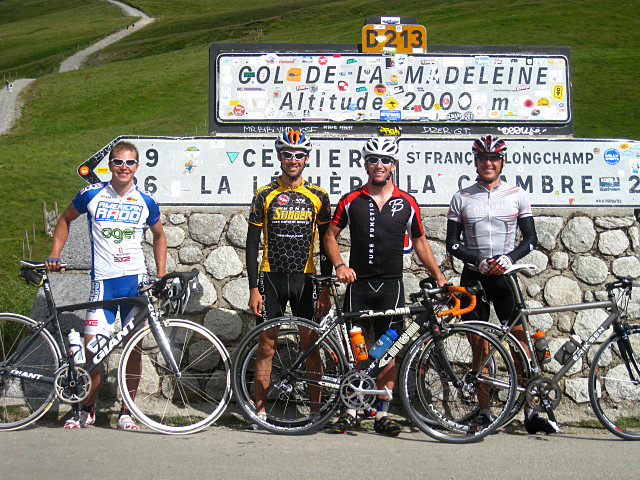
    The U.S. Nordic Combined team takes a break at the top of the Col de la Madeleine during a 2009 training camp in nearby Courchevel, France. From left to right: Bill Demong, Johnny Spillane, coach Dave Jarrett, and Todd Lodwick (Photo: USSA)

    “When he came back to coaching it was really a breath of fresh air,” Demong said about Jarrett’s academic and nordic-sports knowledge. “We had built this great culture and were all working really hard, but we still didn’t have the plan training-wise that I felt we needed.

    “Going back to my high-school running days, we peaked when we wanted to peak for states and federations, and when we were doing our nordic training I felt like we were sort of doing what other nordic-combined skiers did, which was get up, ski, or get up, go jump, have lunch, go ski, go home,” he continued. “And DJ brought a ton of new ideas and concepts that he had learned in school as well as from networking with other sports. DJ really helped pioneer a lot of things on the physiological side and take our team from good culture, talented hard working athletes, to champions.”

    Jarrett plans to open a strength and agility center in Heber, Utah, where he lives with his wife and children, the youngest of which will be entering eighth grade; his oldest will be a freshman in high school. As with any change, he said he looked forward to what the opportunity might bring and remaining close to his family. Yet looking back, Jarrett said he’d miss the small daily aspects of the sporting life.

    “It’s the everyday victory I’ll miss,” Jarrett said. “I’m psyched to see the work that the athletes are putting in. The work that the coaching staff are putting in to see those everyday victories — those personal best, in testing, first time getting Continental Cup points, or first time getting World Cup points, or a World Cup podium. You can say the hardware is why you do it for sure, but I will miss is the everyday camaraderie and training.”

    U.S. NoCo Moving Forward

    Demong said the program remains stable heading into an Olympic season; Jarrett had been discussing a transition for the past several seasons.

    “It had been something that has been on my radar for awhile and DJ certainly communicated early enough for me to to start planning, and quite honestly, we do have a good safety net,” he said.

    U.S. Nordic Combined Assistant Coach Martin Bayer will step into the role of head coach. Bayer hails from the Czech Republic and began coaching domestically in the U.S. in 2000. He is currently based in Planica, Slovenia.

    Demong said Bayer is entering this position with the institutional knowledge to make the coaching change seamless.

    “Martin has worked his way up through the club system to the development team coach,” he said. “He has basically coached everybody onto the national team with the exception of Bryan, who is just a little bit older. So he has already a great relationship with all the athletes that are on the team. He knows all the athletes in the pipeline. …  He knows the environment and he is familiar with how we operate, and there is a level of trust both from my end and with the athletes.”

    Nick Huber will remain the program’s head ski-jumping coach. On the cross-country side of the sport, former U.S. national-team biathlete Jeremy Teela is advising the team. “He has agreed to come in and help us with domestic cross-country coaching and plan writing,” Demong said.

    Jon Schafer, who had been U.S. Nordic Combined’s high-performance director for the last year, has also stepped down.

    “Jon is a great and a good friend and very very exceptional high-level strategic thinker,” Demong said. “I think our organization is not at the point right now where we can take advantage of his talents and capacities fully, and quite honestly, we just need more boots on the ground. At this point, we are not going to fill that position. He has, however, written us a very detailed plan that we will be using as a road map going forward. It is a living document. For us, it is like everything from recruitment to medals and everything in between as it relates to coaches, education, and national-training centers.”

    A business executive, Schafer brought management experience to USA Nordic, and on the sporting side, he was previously an elite-level rower and coach.

    “My decision to step down was a very difficult one and one that I most certainly did not take lightly,” Shafer wrote in an email. “I loved working with the athletes and even after my departure, I am still very concerned about their success. It can be very difficult working in an environment of highly constrained resources, in particular with almost no support from USSA.

    “Every position or idea simply cannot be funded and every shot has to be a kill,” he continued. “People are going to disagree about the best ways to spend highly limited funds and the tighter the budget, the harder it is to balance all of the different agendas. The organization has a lot of operational needs and the executive director and a few members of the board felt it was more important to have staff selling t-shirts, writing newsletters, marketing copy and other very ‘boots on the ground’ tasks, than a High Performance Director setting strategy and working with coaches and athletes at a higher level. I disagreed with this approach and since they couldn’t afford both, I tendered my resignation. I think this move is good for everyone, as the overall organizational dynamic proved to be a bit too bruising and tumultuous for an honest, easy-going, soft-spoken Midwest boy like me. I want to be very clear here too — my departure was a smooth and respectful one on both sides and I wish them nothing but the best.”

    Always the jokester, Schafer (FasterSkier’s gear-review guru) added, “One big upside of this change for me too, is I now anticipate having much more time to write about how long you can wear your underwear without washing it. And perhaps teaching my Great Dane to finally respond to his name.”

    The U.S. Nordic Combined team will meet in early May for an all-team camp, which will include all staff and any athlete with a chance of qualifying for the Olympics.

    “It’s really going to be focused on learning more about ourselves, learning more about each other, learning how to communicate better and be tougher,” Demong said of the camp.

  • Biathlon Veterans Teela and Barnes Back on the World Cup, Hoping for Olympic Comebacks

    Biathlon Veterans Teela and Barnes Back on the World Cup, Hoping for Olympic Comebacks

    Lanny Barnes (USA)
    Lanny Barnes competing in the World Cup sprint on Friday.

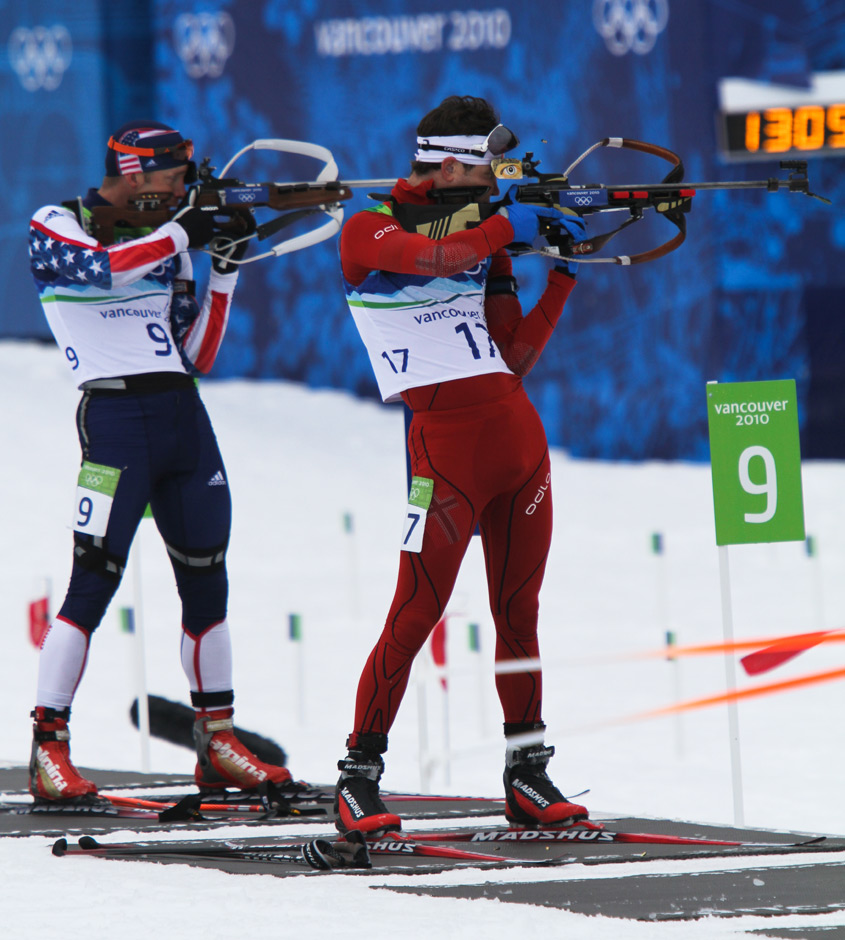
    HOCHFILZEN, Austria – Four years ago at the Vancouver Olympics, the best American results in biathlon came from a pair of veterans: Jeremy Teela, who placed ninth in the sprint in the best-ever finish for a U.S. biathlete at a Games, and Lanny Barnes, whose 23rd-place finish in the sprint was a historical record for a U.S. woman.

    You might not have seen much of either racer last season, but they’re still around – and in fact, you might say they are making their comebacks. Both Teela and Barnes were on hand this weekend for World Cup racing after spending most of last year on the second-tier IBU Cup circuit. In Friday’s sprint, they both placed 65th, just outside the cut for Sunday’s pursuit. But on Saturday they upped their games and turned in strong relay legs: Barnes helped the U.S. women finish eighth, the best result since she joined the team more than ten years ago, and Teela tagged off after the third leg in sixth (the U.S. men eventually finished 11th, but closer time-wise to the podium than they often are).

    Were these the best performances of their careers? Certainly not. But for a pair of athletes who didn’t get to see this level of competition much last season, it’s a step in the right direction.

    “You might say that everything since Vancouver was a down season,” Teela laughed. “But I’ve had a really good season of training.”

    Like Barnes, he is hoping to qualify for the upcoming Sochi Olympics. It would be the third Games for Barnes and the fourth for Teela – definitely his last, he said.

    After Vancouver, Teela began spending more time on other aspects of his life. Maybe most importantly, he now has a child. That changes your priorities a lot, he said. He was still training hard, but wanted to spend time with his family. That’s the main reason he’ll retire at age 37 at the end of this season.

    This year? All of that is suspended temporarily while he tries to go for it one more time.

    “An Olympic year is always extra motivation,” Teela said. “Oh yeah.”

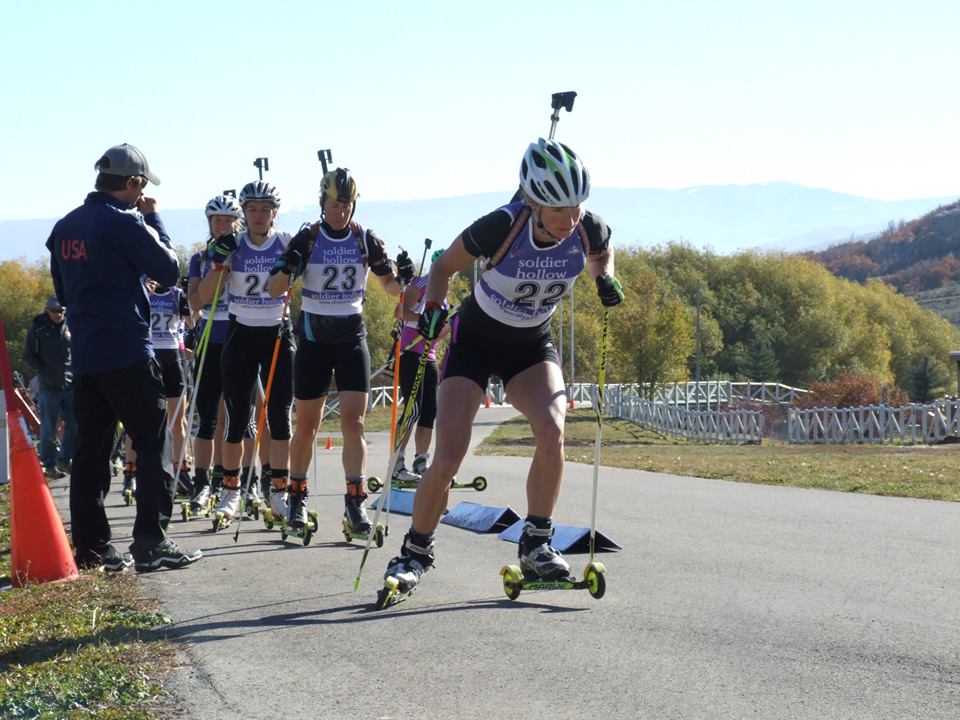
    Both athletes qualified through rollerski races in Jericho, Vermont, and Soldier Hollow, Utah, to take part in a national team trip to Sweden this fall in advance of the race season. There, they raced in the IBU Cup openers. Teela did well enough to earn an immediate promotion to the World Cup.

    Barnes wasn’t so lucky – she started off with a strong race, placing 13th in the opener, but in the second sprint shooting woes knocked her way out of contention. So she spent a second weekend on the IBU Cup while Hannah Dreissigacker got the World Cup starts. But Barnes stayed consistent in the next IBU Cup races, placing 16th and 18th, and got a promotion (the U.S. now has five women traveling with the World Cup despite only having four start spots).

    “It feels good,” Barnes said on Friday of her first World Cup start of the season. “That was one of my goals for the year, was to climb my way back up.”

    While Teela has fatherhood to deal with, Barnes and her sister Tracy faced a different challenge. This spring they had surgery for compartment syndrome, a painful condition that affects the lower legs, particularly in skating. They are now back to 100 percent and feeling better than ever.

    “It’s night and day,” Barnes said. “I was trying to explain to a lot of people how it’s like for ten or twelve years, or maybe my whole career, I’ve learned how to not push in my legs, because I haven’t been able to use them. And now I have to remind myself to actually push with my legs. So I have to work with my technique to keep stepping on them.”

    The fresh snow on Friday’s course tested her legs seriously for the first time this season – if they were ever going to feel painful, the heavy, slow conditions would have done it. But Barnes reported that there wasn’t pain, just a struggle to adjust her technique to the conditions and her new legs. That means she can focus all of her energy on racing well and making the Olympics.

    “It’s always a struggle when you come back from surgery and you’re basically the bottom of the pond,” she said. “So it’s nice to finally be back here and having a chance to fight.”

    Fight they will have to, if the pair want to compete in Sochi. Three athletes – Tim Burke, Lowell Bailey, and Susan Dunklee – are already qualified for the Games. Two more will be picked after this pre-Christmas World Cup period. Teela said he hopes to be that guy so he can avoid the post-Christmas selection trials process, the more painful route towards Olympic qualification.

    Barnes is up against Annelies Cook, Sara Studebaker, and Dreissigacker, among others who may qualify for a January IBU Cup tour that serves as the last set of trials. Cook has the best result of the trio so far and is likely to snag the automatic qualification spot; Studebaker is also a 2010 Olympian, while Dreissigacker is a newcomer to the team who placed in the top 60 at last year’s World Championships.

    For Teela, the main rival for qualifying off the World Cup is Leif Nordgren, a young but veteran World Cup and World Championships racer who is the habitual anchor for the U.S. relay team. The Americans also have Sean Doherty – last year’s World Youth Champion – on the tour, but his results so far don’t make him competitive for the Olympic spot. Racers like Russell Currier, Wynn Roberts, and Jay Hakkinen will vie for the spot available through IBU Cup qualification.

    “He’s 18 years younger than I am,” Teela laughed of traveling with Doherty. “I mean, technically, I could be his father. But it’s great to have the young guys here pushing. Sean is going to be a great biathlete in the future, I just hope he doesn’t expect it to come too fast.”

    Regardless of whether he makes the Olympics or not, Teela is hoping for big things from his team.

    “Tim Burke is so strong and so focused,” he said. “He’s a real threat for the overall. He could medal in any race. Me, I still feel like I could get a medal, but I can’t be so good for the whole season like Tim. I’m focusing everything on being my best for three weeks, for the Olympics, and hopefully that is enough.”


  • Podium Contenders, U.S. Men’s Relay Takes 11th in Sprint Finish

    Podium Contenders, U.S. Men’s Relay Takes 11th in Sprint Finish

    U.S. scramble leg Lowell Bailey racing in the pack of Saturday's 4 x 7.5 k relay at the IBU World Cup in Hochfilzen, Austria. The U.S. men went on to place 11th.
    U.S. scramble leg Lowell Bailey (second from r) racing in the pack of Saturday’s 4 x 7.5 k relay at the IBU World Cup in Hochfilzen, Austria. The U.S. men went on to place 11th.

    HOCHFILZEN, Austria – Speaking after he finished the third leg of the World Cup 4 x 7.5 k relay on Saturday, Jeremy Teela was prophetic about what would happen, even though he had tagged off in sixth.

    “Any time you have Lowell [Bailey] and Tim [Burke] in start positions one and two for a relay, they might come in first place and tag off, and you might come in tenth,” he said. “You just go for it. It’s a relay and yeah, you want to be safe, but not too safe.”

    The U.S. men certainly went for it today, and the team was in podium position for much of Bailey and Burke’s legs over the first half of the competition. The name of the game was to shoot well and be ready to attack – and even a few spare rounds here or there did not set them back too far. For instance, Bailey used one spare in standing, but moved from seventh coming out of the range to third when he tagged off to Burke.

    “I went out of standing with a 10-second gap to close, so I really pushed on the first part of the loop, and I just didn’t quite have it on that last climb, but I tried to keep Tim within contact,” he said. “I would have liked to clean, but at the end I was able to get out and shoot that extra round quickly and get back up with the leaders, so I was happy with that.”

    For his part, Burke stayed right in that spot until his own standing stage, when he used two spare rounds and then had an unfortunate mishap with a pole, dropping it as he picked it up from the shooting mat. He had to turn around as he skied off, retrieve the pole, and then try to catch up to the leaders. It didn’t work as well as it had for Bailey, and he was left skiing his last loop alone as Ole Einar Bjørndalen of Norway hammered away at the lead.

    US Biathlon's Tim Burke pushing as the second legs of the U.S. men's relay at the IBU World Cup in Hochfilzen, Austria. The Americans went on to place 11th.
    US Biathlon’s Tim Burke pushing as the second legs of the U.S. men’s relay at the IBU World Cup in Hochfilzen, Austria. The Americans went on to place 11th.

    The two spares? Those weren’t too much of a problem. As it happened, much of the field struggled on that stage, with many spare rounds used by everyone. In the midst of that second leg, the snow really started to come down on the course.

    “I was really happy to hear that,” Burke said of the clangs of bullet not meeting target. “The mats were pretty snowy and slippery. So that wasn’t the easiest. But it wasn’t windy or anything. It could have been a lot worse.”

    Bjørndalen, for instance, also used two. It was the pole that bothered Burke more than anything.

    “It’s something that – I’ve never done that before,” he said. “That cost me getting a ride with that group, which would have been key. The way the course is, you kind of go down for half of it and then turn around when you hit the bottom really rested after being in the draft. So that was tough. I managed to limit the damage.”

    Teela used two spares as well, and kept the team in sixth place although he struggled to keep up on the final loop.

    “The relay felt good, but it’s a short race, and I kind of died,” he explained. “I need to get a little bit stronger to be able to push harder.”

    The big question mark was Leif Nordgren, the team’s usual anchor leg who sat out the sprint because he’s been feeling sick.

    “Leif is back to anchor,” Burke said after he finished his own leg. “We’ll see – he’s been more or less on bed rest all week. Maybe he’ll be super rested, you never know with those things!”

    Lowell Bailey follows Germany's Daniel Boehm during the first leg of the men's relay at the IBU World Cup in Hochfilzen, Austria, where the U.S. men placed 11th.
    Lowell Bailey (l) follows Germany’s Daniel Boehm during the first leg of the men’s relay at the IBU World Cup in Hochfilzen, Austria.

    Teela, too, seemed to have confidence.

    “Normally, in the past, before Leif came on strong, I used to be the anchor,” he said. “But Leif has really come along and he’s super fast with a really good kick.”

    Nordgren, in all honesty, probably did better than you might expect for someone who just two days ago was going on a short jog, which was at that point a victory. He hasn’t been training much, but skied the 14th-fastest anchor leg. He also used two spare rounds in each shooting stage.

    “Race went okay for me considering,” Nordgren wrote in an email. “I’ve been sick all week, today was my second time on skis all week, so I wasn’t expecting too much. I could tell though in the last kilometer or so though that I hadn’t trained at all. I am really disappointed to have let the team slip so far down after the great races put together by the other three.  But that’s how it was today.”

    Neither his shooting nor his skiing were among his best in relay performances, but one alone may have kept the U.S. in the top six.

    “This is one of the closest relays I can remember, with 11 teams only 1:25 behind the leaders, that’s how high the level of the field is now,” Nordgren wrote. “I know that we’ll be in better shape getting closer and closer to the Olympics, so I’m excited to see what future relays bring this season.”

    As it was they finished 11th, but at the back of a sprint finish which also included eighth-place Switzerland. They were 25 seconds out of the top six.

    Throughout the race, the team had just tried to stay smart. Part of that came on the shooting range.

    “I tried to stay in my own shooting and do my own thing even though people shoot really fast in that last stage,” Bailey said.

    “A good day means you’re sleeping when you’re shooting,” Teela said, agreeing with the sentiment that staying calm was key. “You’re not thinking. Once you wake up from your shooting sleep slumber, things go wrong. Once your brain gets involved, it can cause problems. So it was normal good shooting for me. I just did the thing I’ve been doing for 18 years.”

    The other part of the stay-smart strategy was not to lead. And so that’s why you could see Bailey sitting in second place for much of the first and second loops of the course.

    “I tried to just hang with the person I was with,” he said. “I tried to stay in second. I felt like going into the lead with some of the headwinds wasn’t a good advantage. I could save some energy by drafting a little bit. So that’s why the pace was really slow in the first lap. I probably could have pushed ten seconds but I don’t think it would have gotten me much. You always have to make that decision in the first leg.”

    Results

  • Eleven U.S. Biathletes Picked for Pre-World Cup Camp in Sweden, Key in Olympic Qualifying

    Eleven U.S. Biathletes Picked for Pre-World Cup Camp in Sweden, Key in Olympic Qualifying

    Hannah Dreissigacker leaves the start in Tuesday's sprint at Soldier Hollow while Lanny Barnes and Sara Studebaker wait on deck. Photo: Gordon Vermeer.
    Hannah Dreissigacker leaves the start in Tuesday’s sprint at Soldier Hollow while Lanny Barnes and Sara Studebaker wait on deck. Photo: Gordon Vermeer.

    After four rollerski races’ worth of battling, eleven biathletes have been selected to attend U.S. Biathlon’s fall training camp in Östersund, Sweden, to prepare for the World Cup season. The camp is also an important step in the Olympic qualification pipeline, as early-season World Cup results are one way to snag a trip to Sochi.

    Six athletes – 2013 World Championships silver medalist Tim Burke, plus teammates Lowell Bailey, Leif Nordgen, Susan Dunklee, Annelies Cook, and Sara Studebaker – were prequalified for the Sweden camp. Hannah Dreissigacker and Jeremy Teela, both also members of the national team, were the trials winners after competing in Jericho, Vermont, this summer and then Soldier Hollow, Utah, last week.

    Lanny Barnes, an Olympian who underwent compartment syndrome surgery at the end of the 2013 season, was added as a discretionary pick. The Durango-based athlete who trains with her sister under the team name Twin Biathletes was the next-ranked woman in the trials standings.

    On the men’s side, national team veteran Jay Hakkinen earned a discretionary nod, with USBA High Performance Director Bernd Eisenbichler noting that the Alaskan was highly ranked in the trials and “actually beat Jeremy in three races.”

    Sean Doherty, the 18-year-old who won three medals including one gold at World Youth Championships last season, also got the nod as a discretionary pick. The New Hampshire native trains with Algis Shalna in Jericho, Vermont.

    How to Qualify: It’s Complicated

    These eleven athletes aren’t necessarily the ones headed to Sochi, but booking a ticket to Europe certainly gives them an advantage in a multi-step process which provides several ways to qualify.

    Importantly, the team’s top three racers – Burke, Bailey, and Dunklee – are already pre-qualified based on results from the last season of World Cup racing. They met criteria such as a top 30 ranking in the Total Score or two top-15 finishes in World Cup and World Championships racing.

    The U.S. has spots for five men and five women, although the team can only start four athletes in each competition. It’s unclear whether they will bring the full roster of five or not.

    The next way the U.S. will try to fill its team is based on the first period of World Cup racing. After the openers in  Östersund kick off on November 24, the IBU World Cup will move to Hochfilzen, Austria, and then to Annency, France. Rosters for those races will be determined by performance at the pre-race training camp, while athletes not picked for the World Cup will be sent to the second-tier IBU Cup circuit, with the opportunity to move back and forth based on current performance.

    In these early World Cups, a top-30 finish is good enough to be added to the Olympic team. Up to three men and three women can be selected to the team by the end of December, counting Burke, Bailey, and Dunklee – so one more man and two women can qualify this way. If more athletes have top-30’s, the ones with the best results will be picked. Conversely, if no athletes in a given gender reach the top-30, the athlete with the single best result will be added anyway.

    Of the athletes who will go to Sweden and haven’t pre-qaulified for Sochi, Nordgren, Cook, and Studebaker all had top-30 finishes last season.

    For the remaining spot or spots on the Sochi roster, athletes will have one last chance to fight their way onto the team in January. Importantly, it’s also possible for athletes who did not make it to the Sweden camp to step in on this part of the process: trials races held in December will select a few more racers to join the IBU Cup circuit, where they will join any non-qualified athletes from the fall World Cup and IBU Cup squads.

    In this final step, Americans will compete in Ridnaun, Italy, or Altenburg, Germany, and also potentially in time trials. The best athletes will be selected using a percent-back ranking from three of four races and time trials. USBA also allows one discretionary pick per gender for the Olympic team.

    Performance Notes: Women’s Team Looking Strong

    Eisenbichler said that he was very happy with the level of performance by his women’s team, and also that it was relatively easy to identify Dreissigacker and Barnes as the two women who should be added to the roster for Sweden. Dreissigacker won the sprint in Jericho this summer as well as the final sprint in Soldier Hollow; Barnes was second in the last Soldier Hollow sprint. Her sister Tracy had better performances in Jericho, but did not compete in Soldier Hollow.

    More importantly, Dreissigacker and Barnes turned their performances up a notch in the last competition, going 1-2 while both shooting clean. Barnes is a veteran and traditionally one of the best shooters on the circuit; Dreissigacker is a relative newcomer to the sport after coming in as a skier.

    “That was really important to see, that even with a fair amount of pressure in that last race they shot clean,” Eisenbichler said in an interview on Saturday. “This is the first time for Hannah.”

    Eisenbichler was also pleased with his pre-qualified athletes. Dunklee cleaned in a sprint win on Tuesday, where Cook was second and Studebaker third. Cook didn’t compete in the final race; she tweaked a nerve in her neck, and since she didn’t have to qualify through the races, Eisenbichler said it was “safer not to take any chances.” The problem has since been fixed and she is back to training.

    He called Studebaker’s two third-place finishes in Soldier Hollow “solid” and was gratified to see that the women’s team had improved considerably since Jericho.

    “Opposite of Jericho, the women really were shooting very well,” he told FasterSkier. “I don’t want to seem overoptimistic, but I’m really happy with where the team is right now.”

    Men Knocking at the Door

    Eisenbichler was also enthusiastic about the performances from Bailey, who has swept all four of the trials races, and from Burke and Nordgren, who were often close behind.

    “I think that once these three guys get to the World Cup, they will be able to be having some really good results right away,” he explained.

    After that, though, the committee’s job was considerably harder in making discretionary selections for the Sweden trip. Teela was the trials winner based almost entirely on a single exceptional performance where he cleaned his targets to place third in the first Soldier Hollow sprint.

    Hakkinen and Doherty were fourth and fifth in the final sprint, behind the three pre-qualified men. Hakkinen was consistent throughout the four trials races, but these strong performances late in the game and under pressure certainly helped the pair earn their discretionary nods.

    National team member Russell Currier and National Guard biathlete Wynn Roberts also had top-six finishes in Soldier Hollow; both also raced well in Jericho, where Currier was second in the sprint and Roberts seventh, but the fifth American. They found themselves just on the outside when the final rankings were tallied.

    “There were a lot of guys in the mix for that fourth spot on the trip, like five or six of them,” Eisenbichler said. “Even the ones that didn’t make it, I think will have good performances if they go to the IBU Cup in January. It’s going to be very competitive.”

    Doherty’s selection was probably the most surprising. He did not compete in Jericho due to illness, but had a stellar final sprint in Soldier Hollow.

    “Sean’s preparation this year has been great,” Eisenbichler said. “Compared to his progression in October last year, he has made huge improvements. We really thought that sending him to Sweden will be the best thing for his development as a biathlete.”

    Link to Trials reports and results:

    Soldier Hollow

    Jericho: men – women

  • As U.S. Biathlon Hones Focus on Sochi, Small Group Named to 2014 National Team

    As U.S. Biathlon Hones Focus on Sochi, Small Group Named to 2014 National Team

    This is a scene the U.S. hopes will play out at the Olympics: Tim Burke on the podium after earning silver in the 20 k individual at 2013 World Championships in Nove Mesto, Czech Republic. Photo: Nordic Focus/USBA.
    This is a scene the U.S. hopes will play out at the Olympics: Tim Burke on the podium after earning silver in the 20 k individual at 2013 World Championships in Nove Mesto, Czech Republic. Photo: Nordic Focus/USBA.

    The last five years have seen the size, resources, and focus of the U.S. biathlon team rise and fall, then rise and fall again. There have been shifting standards on what constitutes an “A” team performance, how much discretion is used, the size of the “B” team, and even how late into the season athletes are added to the team.

    But the 2014 season is different for one huge, glaring reason: Sochi, Russia, which will host the Olympic Games.

    And so, in an effort to be the absolute best it can be at the Games, the U.S. Biathlon Association is sinking all of its resources into a skeleton crew of elite seniors as the big event draws near.

    “That’s definitely what we’re doing, and what the [U.S.] Olympic Committee is willing to support,” USBA President Max Cobb told FasterSkier last week. “We will have a very different strategy for the 2014-15 season than we have now, that’s very clear… [but] that’s the approach we’re taking this year.”

    Four men and four women were recently nominated to the “A” team for the 2013-2014 season, and just three athletes in total to the “B” team. It’s the smallest squad that the U.S. has nominated in years.

    The group is headlined by Tim Burke, who won silver in the World Championships 20 k individual in Nove Mesto, Czech Republic, last season.

    He is joined on the “A” team by Lowell Bailey, Russell Currier, and Leif Nordgren. The four men qualified automatically for “A” status by finishing fifth in the World Cup 4 x 7.5 k relay in Oberhof, Germany, in January. A top-seven relay result is specified as one of several possible qualification criteria in the national team criteria.

    On the women’s side, Cobb said that Susan Dunklee, Annelies Cook, and Sara Studebaker all met individual qualification criteria for the “A” team, while Hannah Dreissigacker, who started her first World Cups partway through the season, was a discretionary pick.

    Susan Dunklee had the best U.S. women's result of the season, placing seventh in the 15 k individual at the Sochi World Cup - where the team previewed the Olympic venue. Photo: USBA/NordicFocus.
    Susan Dunklee had the best U.S. women’s result of the season, placing seventh in the 15 k individual at the Sochi World Cup – where the team previewed the Olympic venue. Photo: USBA/NordicFocus.

    “We looked at her results and she had two top-20 finishes on the IBU Cup, and we thought she had a strong performance in the relay at World Cup 6 and at World Championships, so for the future, she has the ability to contribute,” Cobb said of Dreissigacker, who along with Dunklee is also affiliated with the Craftsbury Green Racing Project. “She had a top-60 at the World Championships and had competitive international ski times, so that was really good.”

    Dreissigacker’s inclusion is also notable as it is the first time in recent memory that four women have been named to the “A” team. Cobb hoped that having a larger training group, more comparable to the atmosphere on the men’s team, would propel the women to greater success.

    “We’re really excited about the progress of the women’s team,” he said. “I think that having those four women training together throughout the season is really going to drive things to an even higher level, and be a big step forward for the coming season.”

    All eight “A” team athletes competed at World Championships, where they collected four top-20 results and an additional eight top-40 finishes – all of which bodes well for next year’s Olympic Games. The only two athletes not to score points at World Championships were Dreissigacker, for whom it was the first trip to the sport’s second-biggest stage, and Currier, who proved his abilities last season when he collected two individual top-ten performances on the World Cup.

    B-Team Veterans

    Unusually for a national team, the “B” level is filled only with veterans – all of whom have had Olympic success in the past. While none of the three achieved particularly strong international results last season, USBA is hoping that they can be in the mix come trials and make the teams more competitive.

    For the women, Lanny Barnes is the sole “B” team nominee. After a mediocre year where she started on the World Cup and then saw some IBU Cup action, she and twin sister Tracy Colliander, herself a 2006 Olympian, underwent surgery for compartment syndrome. On their website they wrote that the injuries had been bothering them for a long time; they are already back on skis.

    “It seems like their surgery was successful and that they were pretty quickly back able to get around again, unlike Tim’s surgery, where he was off his feet for a long time,” Cobb said. “So that’s really positive, and we’re hopeful that it will be good and that their results will come back up. But the truth is that the results really weren’t strong for either one of them this season, so there was no rationale for bringing them on to the A team.”

    Can he do it again? Now a dad, Jeremy Teela finished ninth in the sprint at the 2010 Olympics.
    Can he do it again? Now a dad, Jeremy Teela (left) has his work cut out for him if he’s going to repeat his ninth-place finish from the sprint at the 2010 Vancouver Olympics.

    Also on the “B” team are Jay Hakkinen and Jeremy Teela, two long-time national team veterans. Along with Lanny Barnes, Teela had the best U.S. results at the 2010 Olympics. The men hope to make one last Games this winter.

    “Having spoken to both of them, they are both very concentrated and focused,” Cobb said. “You know, Jeremy welcomed his first son into the world just before the season began, and I think that he took a necessary break from the rigors of training and preparing for international competition, and he still went on and had fairly close selection races with Jay. So he was already able to compete successfully with Jay, and for both of them the big challenge is what they can make happen for this year going into the Olympics. And I think both of them will really put everything they have into it.”

    This year, the “B” team designation has little benefit in the way of training or off-season support; while in the past it has been a group of athletes who live and train in Lake Placid, many of the veterans prefer to train out of their own home bases. In addition, more of the camps than usual will be limited to the “A” team.

    “It’s less ‘B’ team participation than we had last year,” Cobb said. “But there has always been a difference, there have always been camps where only the ‘A’ team was invited. We have the camps where we are using rollerski competitions to qualify athletes for the on-snow training camp in Sweden, and there we will have support for the ‘B’ team athletes, but other than that, this year most of the camps will be only the ‘A’ team.”

    Further Cuts to Development

    What the “B” team lacks this year is the usual crop of younger athletes who are rising through the ranks. Given the team’s funding situation, Cobb said, there just wasn’t the possibility to include development in this year’s national team. The team is so small, has no new members, and only one under the age of 25.

    “We are very cognizant of the fact that it is very hard right now to be a developing biathlete in the United States,” Cobb said. “It’s very difficult to stay in the sport. That said, we think that the strategy that we’re taking to give the leading group of athletes everything they need to be successful will be one that results in longer-term prosperity for all of us.”

    The team nominations came with an announcement that the junior national team will be named at a later date, and Cobb mentioned that USBA is particularly excited about the development trajectories of younger athletes like Casey Smith, Anna Kubek, Tara Geraghty-Moats, and newly-minted Youth World Champion Sean Doherty.

    The national team money going towards development this year will be some token amount for a junior team, the details of which are yet to be announced; it will help athletes like Sean Doherty, 2013 Youth World Champion in the pursuit and twice a silver medalist. Photo: UBSA/NordicFocus.
    The national team money going towards development this year will be some token amount for a junior team, the details of which are yet to be announced; it will help athletes like Sean Doherty, 2013 Youth World Champion in the pursuit and twice a silver medalist. Photo: UBSA/NordicFocus.

    But the athletes left in the lurch are those that are old enough to be out of the junior ranks, but who weren’t seen to have much of a shot in this Olympic cycle. Katrina Howe of the Maine Winter Sports Center, Wynn Roberts of the National Guard, Bill Bowler (who has headed north of the border to train with the Biathlon Alberta Training Center), and Mark Johnson of Mount Itasca spring to mind, as all made international tours this season or last season. In addition, Corrine Malcolm was not re-named to the national team.

    Several younger athletes, too, are just negotiating the transition out of the junior ranks. Without development funding from USBA, it’s tough to know how many might make it through the end of the next Olympic cycle, after a raft of current national team members will have presumably retired.

    Cobb, however, stressed that biathlon is not alone in this challenge.

    “We’re not the only sport in the country that’s really challenging from a financial standpoint to continue to progress in,” he explained. “Unfortunately it’s not that uncommon. I actually just spent a day and a half with [USOC Chief of Sport Performance] Alan Ashley and had some great conversations about long term strategies from the Olympic Committee that could try to change that, to bring more resources to bear on developing sports so that it’s not so challenging for good athletes working their way up through the system.”

    Future Goals

    If all goes well in Sochi, Cobb hopes that success will bring more money to the program and allow them to re-establish a better development program. And that includes, among other things, once again reaching out to the ski community in search of new biathletes – a strategy that worked well for Dartmouth College graduates Studebaker, Dunklee, and Dreissigacker.

    “Seeing the success from Susan, Sara, and Hannah, we envision being able to reach out again to collegiate athletes and be able to offer them the opportunity to be able to jump into biathlon,” Cobb said. “We recognize that we have really limited resources, and we need to focus them this year as concentrated as possible on success in Sochi, and if they are successful there, that will only help us to have a broader development program in the year after.”

    In the meantime, he hopes that the few club teams that exist in the U.S. can continue to shoulder the burden of funding developing athletes.

    “On the positive side, we still have some good clubs,” he said. “I know that Raleigh Goessling and Casey Smith will spend some more time at Maine Winter Sports Center, and Katrina Howe is there. The Craftsbury program is really offering athletes another opportunity in biathlon now, and that seems to be growing – Algis Shalna is putting a fair amount of time into that project as well now.”

    There are a few other reasons to be optimistic, too. For instance, Burke’s silver medal is an additional carrot in continuing negotiations to attract new corporate sponsors.

    “There’s no question that it’s made– we had started some of the discussion with companies before Tim’s medal, and that really helped continue those discussions,” he said. “I think that the results we have this season are good and are compelling and will help that process, and there are active proposals on the table now that are into third-round discussions.”

    Finally, skiing on the whole is seeing exponentially more success in the United States, and, Cobb hopes, that added visibility can help each of the sports that fall under the nordic umbrella.

    “It’s also coming at a time when the cross country team and nordic combined are also very successful, more successful than we’ve been,” Cobb said. “But in general, it brings the attention back to nordic sports, and that is really, really helpful, especially going into Sochi. I know NBC is going to be very focused on Kikkan [Randall] in Sochi, and I think that will be of great benefit to nordic sports generally, and to biathlon as well.”

    2013-2014 U.S. National Team:

    Men “A”:

    Lowell Bailey, Lake Placid, NY

    Tim Burke, Paul Smiths, NY

    Russell Currier, Stockholm, ME (Maine Winter Sports Center)

    Leif Nordgren, Marine, MN

    Men “B”:

    Jay Hakkinen, Kasilof, AK

    Jeremy Teela, Park City, UT

    Women “A”:

    Annelies Cook, Saranac Lake, NY (Maine Winter Sports Center)

    Hannah Dreissigacker, Morrisville, VT (Craftsbury Green Racing Project)

    Susan Dunklee, Barton,VT (Craftsbury Green Racing Project)

    Sara Studebaker, Boise, ID

    Women “B”:

    Lanny Barnes, Durango, CO (Twin Biathletes)

  • With Home-Field Advantage, North Americans Flex Their Muscles at Canmore IBU Cup Races

    With Home-Field Advantage, North Americans Flex Their Muscles at Canmore IBU Cup Races

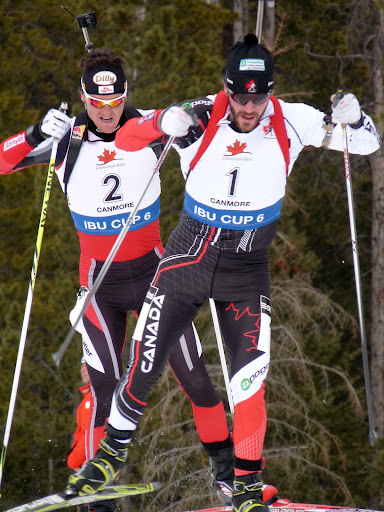
    Canada's Marc-Andre Bedard leads Austria's Friedrich Pinter in Canmore on Saturday. Photo: Michael Potter.

    Last year, the world’s best biathletes got a taste of northern Maine when the World Cup made stops in Fort Kent and Presque Isle.

    This season, the top racers are staying firmly ensconced in Europe. But instead of letting the sport get too comfortable on what could be considered its home turf, the International Biathlon Union (IBU) sent their eponymously named IBU Cup circuit across the Atlantic, and for the last week the “second World Cup” has been contested in Canmore, Alberta.

    For the Canadians, bringing the races to their country has been huge. But even the Americans got behind the effort. Continental solidarity was high.

    “This is as close to home as I will ever get for an international competition and I’m still in the Rockies, so it feels like home here,” said U.S. biathlete Lanny Barnes, a native of Durango, Colorado, who podiumed in Canmore. “The Canadians have put on some great races and are always very welcoming to the U.S. team. This is probably one of the most beautiful venues on the world.”

    Melanie Schultz takes a corner against the backdrop of the Canadian Rockies. Photo: Michael Potter.

    On both Saturday and Sunday, the athletes competed in sprints – 7.5 k for women, 10 k for men, a prone and a standing shooting stage apiece. On Wednesday, they doubled their distance for individual races, which featured four shooting stages instead of two and a one-minute penalty for each missed shot. On Thursday, it was back to sprints, and the penalty loop if the athletes made any errors.

    Over the four days of racing, North Americans picked up three wins, three more podium finishes, and a total of 21 top-tens.

    “These races have been great for Canadian biathlon,” Biathlon Canada High Performance Director Chris Lindsay told FasterSkier.

    Nathan Smith, who raced to all three of the Canadian wins at the races, agreed.

    “These were the highest caliber races to be held in Canada outside of the Olympics in recent history,” he said. “It’s good for publicity and getting new people involved in the sport. Our team got a lot of medals and top-6 results here… you can feel the team’s momentum.”

    Other athletes confirmed that there was a loud fan base for the weekend races, although they lamented lower midweek attendance.

    “It was too bad none of the schools came out to watch on the weekdays, but we still have a good number of people out there cheering,” said Canadian biathlete Rosanna Crawford. “Hopefully this will lead to World Cups being held in Canmore.”

    Men’s Races: Domination By Smith

    Three-time Olympian Robin Clegg placed ninth in Saturday's sprint. Photo: Michael Potter.

    The story of the week – not only for the Canadian team, but for the circuit itself – was the near-total domination by 26-year-old Calgary native Smith.

    Smith, who trains in Canmore, started out by winning the opening sprint by a mere five seconds over Russia’s Sergey Klyachin; Norwegian Martin Eng, who has an 11th-place World Cup finish to his name, was another second and a half behind.

    In the next sprint, Smith shot clean and extended his lead, this time finishing 40 seconds ahead of Friedrich Pinter of Austria. After sitting out the individual race, Smith made it three-for-three with a four-second victory over Pinter in Thursday’s race.

    “To have my first IBU win in Canmore was… amazing!” Smith told FasterSkier. “I’ve been training here since I started biathlon. I know a lot of the volunteers, so I’m proud that I could reward them in a small way for all their hard work over the years.”

    Smith’s path to dominance really started at IBU Cup races in Obertilliach, Austria in December, where he placed third in a 10 k sprint, the first podium of his career.

    “The bronze I got in December in Obertilliach was very special,” Smith said. “That was the first time I’d ever put good skiing and shooting together in an international race.”

    After two more top-ten finishes in IBU Cup action in January, Smith made a brief jaunt onto the World Cup himself, producing a top result of 47th in a sprint in Antholz, Italy. When he returned to Canada for these races, he knew he could once again be near the top.

    “All year I had been having really good time trials amongst the national team and I was hoping for a breakout performance,” he said.

    He got it, and even though Canadian events are sometimes lightly attended by international teams, in this case Smith still had to beat out the IBU Cup’s best. Pinter, for example, has a handful of World Cup podiums to his name and owns a World Championships relay medal; the top three racers in the overall IBU Cup standings were also in the mix.

    “The big difference here is how the pack thins out a little farther down the result sheet,” Smith said. “I think it was mostly the slower skiers who were missing. I think my races wouldve been at or very near the top if in Europe…. I was within striking distance of first at the IBU cup in Italy twice except my shooting wasn’t as good.”

    Being in familiar surroundings, Smith explained, helped achieve his career-best performances.

    “I knew I would have a little leg up on a lot of the other competitors because I got back to Canmore a couple weeks before the first race,” Smith said, before laughing it off. “Fair is fair though, since most of the time its the other way around!”

    In the first sprint, Smith was joined in the top ten by three-time Olympian Robin Clegg, who missed two shots to Smith’s one and finished 55 seconds back in ninth.

    In the second two sprints, it was Marc-Andre Bedard who kept him company, placing seventh and fifth.

    “I had great races, but it didn’t feel like it,” Bedard said of his results. “I think I’m getting in better shape, and it’s just starting to feel good. There were quite a bit fewer people here than in Europe, so that helps the results for sure, but compared to the top guys my ski times are really better [than earlier this season].”

    Bedard liked the atmosphere in Canmore, but said that if he could get absolutely everything he wanted, the races would be on the other side of the country: “It was pretty cool, but I’d love to race at home in Quebec once in my life at an international race!”

    Jeremy Teela led the U.S. men, finishing 11th, 13th, 25th, and 12th.

    Women’s Races: Depth and Consistency

    Canada's Yolaine Oddou was the first North American woman to hit the podium. Photo: Michael Potter.

    The North American women couldn’t match Smith’s domination. They did, however, have something else going for them: depth. While a Canadian or American woman never topped the podium, Canadians Yolaine Oddou and Megan Heinicke and American Lanny Barnes all took their turns on the lower steps. Twice, the North Americans placed five women in the top ten.

    In the opening sprint, Rosanna Crawford led the way in eighth followed one second later by Oddou in ninth; four more North Americans packed the top twenty.

    “I was a bit disappointed in the race Saturday with the missed shot in prone,” said Barnes, who placed 12th. “You can’t afford to miss on a day like that with perfect conditions. The great thing was we had another opportunity on the same course and same race format to give it another go on Sunday.”

    With a fire in her belly, Barnes stepped up her game in the second sprint – as did the rest of the North Americans. Oddou placed third, Barnes and Heinicke tied for fourth, and Crawford and American Laura Spector placed ninth and tenth.

    Success continued in the weekday races, with Heinicke placing second and Barnes third in the individual, and then Crawford placing sixth in the sprint and leading teammate Melanie Schultz, Spector, Heinicke, and American Tracy Barnes in a six-through-ten sweep.

    At 21 years old, Oddou is in her first season of racing on the IBU Cup, and these were her best results by far. Crawford is a 2010 Olympian, but also considered the races to be highlights.

    “It was great to be racing in my home town, and I had my best results of the season and great shooting in all the sprint races,” Crawford told FasterSkier. “I was top Canadian two out of three sprints so that was very exciting for me.”

    For Crawford, there was a little added motivation, as her mother had just been through surgery for breast cancer but still managed to get out on the trails to cheer.

    “Things had been pretty stressful for me leading into these races,” Crawford said. “But she is such a strong and amazing women and is one of the main reasons I have made it this far in biathlon. She was out there everyday with her cow bells and cheering louder than anyone else!”

    Lanny Barnes was the most consistent of the Americans, and was particularly pleased with her podium finish on Wednesday.

    “I knew I was in race because I could practically hear the announcer everywhere on course and our staff kept giving me splits of leading the race,” said Barnes, who led through the first half of the race and then regained her lead on the penultimate loop before tiring before the finish.

    “I probably started out a little harder than I wanted to, and lost a little time in the end, but was happy that my skiing is coming around,” she explained. “I was bummed that [twin sister] Tracy wasn’t right in there with me, but she is just getting over a cold otherwise I think she might have give me a run for the money!”

    Tracy Barnes told FasterSkier that due to illness she had taken the races “one day at a time,” and was happy, though not thrilled, with her performances.

    “I’ve placed in the top ten several times this season and know I’m capable of it,” she said.

    Race results

  • USBA Names Twelve Athletes to Pre-World Cup Training Camp in Sweden

    The United States Biathlon Association has named six men and six women to attend a pre-World Cup training camp in Sweden in November. The camp will be used to divide the team further into a World Cup team and a group traveling to the IBU Cup, a coordinated international race circuit are one level below the World Cup.

    The national A-team athletes, including Tim Burke, Jay Hakkinen, Leif Nordgren, Lowell Bailey, Sara Studebaker, and Laura Spector, were prequalified for the training camp. Other athletes were chosen based on the results of the North American Rollerski Biathlon Championships in Jericho, Vermont this summer and from time trials held at Soldier Hollow, Utah last week.

    Three-time Olympian Jeremy Teela headlined the additions to the team, and was joined by fellow national team member Bill Bowler to round out the squad of six men. All but Bowler have experience at either the Olympic Games or World Championships, and the four A-team men worked together to notch a remarkable sixth-place finish at 2011 World Championships. Both Burke and Teela have stood on the World Cup podium before, while Hakkinen and Bailey have top-ten finishes to their names.

    On the women’s side, Studebaker and Spector each notched top-twenty World Cup finishes last season. They will be joined by Tracy and Lanny Barnes of Durango, Colorado, who were the top qualifiers based off of time trial results. The twin sisters are not members of the national team although they have each competed in at least one Olympics, with Lanny Barnes posting the best U.S women’s result in a decade at the 2010 Games in Vancouver. National team members Susan Dunklee, who achieved top-ten results on the IBU circuit last year and Annelies Cook, who competed in the 2011 World Championships in Khanty-Mansiysk, Russia, round out the team.

    Both the men and women will receive four starting spots on the World Cup circuit this season, so at least two men and two women will be sent to the IBU Cup following the training camp in November.

  • Bailey Wins Twice at North American Rollerski Biathlon Championships (updated)

    Bailey Wins Twice at North American Rollerski Biathlon Championships (updated)

    Lowell Bailey racing in Saturday. Photo: Elizabeth Garaghty.

    The United States Biathlon Association (USBA) held their biggest summer event in Jericho, Vermont this weekend: the North American Rollerski Biathlon Championships, which crowned men’s and women’s champions in four different age categories as well as the masters men’s division.

    “Things went wonderfully,” said John Madigan, president of the Ethan Allen Biathlon Club, which hosted the races. “It is such a close and fabulous community in biathlon and it is always special when we can have all the top U.S. biathletes racing here in Vermont.”

    Despite the event’s name, no Canadian teams were in attendance, making the races an all-American affair. The U.S. national team was at the end of a week-long camp in Jericho, and comprised most of the senior field. In the junior races, athletes traveled from as far away as Alaska to attend the races.

    “I think the Canadians missed a great opportunity to race at the highest level at one of the best rollerski venues in the country, but they had not put it into their training plan at the beginning of the year,” Madigan said.

    On Saturday, the biathletes faced a scorcher of a sprint. The races were short – 7.5 k for women and 10 k for men, with just two shooting stages. With 80-degree weather, bright sun, and 80-percent humidity, many athletes struggled to adapt.

    Tracy Colliander. Photo: Judy Geer.

    “Heat has always been a challenge for me and it was definitely pretty intense for the Saturday race,” national team member Lowell Bailey wrote in an e-mail. “Even with extra attention to hydration, I was still pretty dizzy by the end. I think almost everyone had the same experience.”

    2006 Olympian Tracy Colliander said that the women had just as much trouble with the hot temperatures.

    “The heat was a big factor in these race,” she told FasterSkier. “The biggest thing was to try to avoid overheating as long as possible. It was inevitable that you were going to overheat, but if you could delay it, you were better off.”

    Bailey managed to triumph over his heat troubles in the sprint. He and Bill Bowler had the best shooting for the men – only a single penalty each – but Bailey was the faster skier, and picked up the win by 56 seconds. Jeremy Teela was another 38 seconds behind after missing three shots, and gave the national team a sweep of the podium.

    Tim Burke, who is recovering from compartment syndrome surgery, finished sixth after missing eight shots.

    “I was trying some new sites on my rifle but unfortunately I only received them the day before so I did not really have a chance to test them,” Burke said. “I decided the race would be the perfect situation to test them. I learned right away that they don’t work for me!”

    Burke’s skiing was solid, and he was confident that he would be back in top race shape by December despite missing a large amount of ski-specific training this spring.

    In the women’s race, Sara Studebaker picked up the win. Studebaker and Tracy Colliander had one penalty each; Colliander finished 15 seconds back, with her twin sister Lanny Barnes in third with two penalties.

    Sara Studebaker. Photo: Judy Geer.

    “Yesterday was good for me,” Studebaker wrote in an e-mail. “I was really happy with my shooting, and managed to keep things together with the skiing for most of the race despite the heat. It was super humid both days and it definitely took a toll on people.”

    While she was happy to win, Studebaker didn’t want to read too much into her victory. As a member of USBA’s “A” team she is prequalified for the first period of World Cup racing and is taking the long view.

    “For me, it’s certainly nice to see some good results right now, but that’s never been to goal,” she said. “I’m really focusing on December, and not having to qualify for the World Cup gives me good opportunity to treat these races like training and just get some more races under my belt without the stress.  In all, training has been going really well for me.  I’ve been trying some new things with my shooting and working a lot on ski technique.”

    Sunday brought a simulated pursuit – although the athletes started in the order they finished on Saturday, they were separated by thirty seconds instead of the time gaps from the previous race. For Studebaker, the 15-second advantage would have been nice to hold onto.

    “I think today [the heat] just caught up to me,” she wrote. “My prone shooting was solid, but by the time I got to standing I was pretty tired and just couldn’t keep things going. It was a tough one for sure.”

    Pursuits feature four shooting stages – two prone and two standing. For the women, these stages are spread over 10 k. Studebaker missed seven shots and finished in sixth place.

    Mark Johnson, 5th place in the sprint. Photo: Elizabeth Geraghty.

    With the previous day’s winner faltering, Barnes stepped up and took the win by a solid minute over her sister. Of all the women, Barnes shot the best: she had only a single penalty to Colliander’s four. The best shooting in the men’s field was four penalties as well. The twins, who do not have national team support, have been the best American shooters for several years – and have turned heads when they appear on the World Cup circuit as well.

    “We are where we want to be leading up to the next set of trials in Utah,” Colliander told FasterSkier. “It’s still early in the summer though and there is a lot of work to be done still before the season. We don’t want to be rocket fast right now, we want to be fast in the winter. You can’t look to seriously at results in the summer like this, but you can gauge how you feel and what you still need to work on before the snow flies.”

    National team member Laura Spector, who is finishing up her last term at nearby Dartmouth College this summer, finished third with seven penalties.

    “I’ve been training in Hanover during the week and go to Jericho for combo training on the weekend,” Spector said of her summer schedule. “It’s been pretty standard, and I just try to fit the training sessions in between classes and homework.”

    In the men’s race, Bailey stuck to his winning ways, this time beating teammate Leif Nordgren by 17 seconds over 12.5 k of skiing despite having five penalties to Nordgren’s four.

    “The races went pretty well,” Bailey said in a characteristically humble e-mail. “I have changed around my training a bit over the last month and I was happy to see that I was still able to perform well given those changes.”

    But like Studebaker, he was careful not to take his victories to seriously.

    Annelies Cook, 5th place in the sprint and 4th in the pursuit. Photo: Elizabeth Geraghty.

    “As far as these races are concerned, I think it’s hard to look at summer results and make assumptions or predictions about the upcoming winter,” Bailey said. “I’m happy with the way this weekend went, and it is a good affirmation of the work I’ve been doing. However, it’s important to keep things in perspective: my focus is on the December World Cups and eventually World Champs in Ruhpolding later this winter.”

    Norgren, who is the youngest member of the national team, was pleased with his second-place finish.

    “The skiing was pretty fast,” he said. “I’ve made a lot of improvements this summer in both technique and strength so I was happy with how the skiing went. As to where I was last summer, I’d say I’m way ahead of there now!”

    Bowler edged out Teela for the final spot on the podium, giving the national team another sweep.

    What’s next for the biathletes? The “A” team will be traveling to Europe for a training camp, while the rest of the squad will stay in the U.S.

    The next races at Jericho will be the International Biathlon Union’s North American Summer Biathlon Championships, which pair running with shooting. It’s unlikely that any winter biathletes will be competing.

    Results from the weekend can be found here.

    Lanny Barnes in the start. Photo: Elizabeth Garaghty.
    Lowell Bailey leading Mark Johnson in the sprint. Photo: Elizabeth Geraghty.
    Susan Dunklee (l) and Annelies Cook on the range in the sprint. Photo: Elizabeth Geraghty.
  • US Just Misses Top Half in Presque Isle Mixed Relay

    US Just Misses Top Half in Presque Isle Mixed Relay

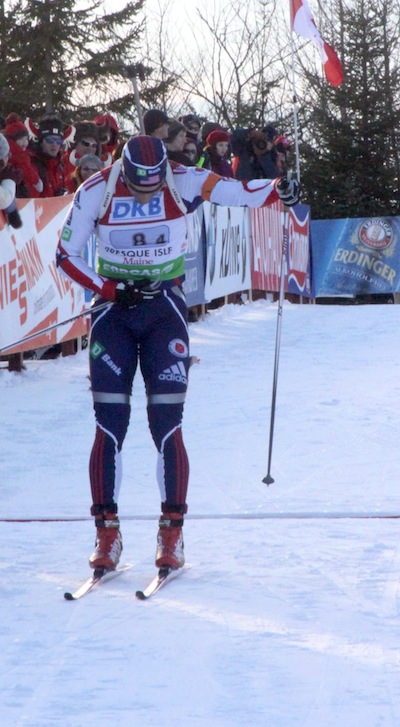
    Jay Hakkinen (USA) in action in Saturday's Presque Isle mixed relay.

    It’s not often that the U.S. biathlon team gets to race a relay in front of a home crowd—in fact, it hasn’t happened in more than seven years.

    So when the American squad of Sara Studebaker, Haley Johnson, Jay Hakkinen and Jeremy Teela took to the course in Presque Isle in Saturday’s World Cup mixed relay, the race was just as much for the hundreds of red-white-and-blue-clad spectators as it was for the athletes themselves.

    “It’s about them, too,” Teela said.

    The Americans were aiming for the top half of the field of 12 teams, and up until the very last shooting stage, things were going to plan. Teela, the anchor, was locked in a duel with the last Swedish skier, Fredrik Lindstrom, for the sixth position—and he wasn’t having trouble holding the pace.

    “[Lindstrom] was very easy to ski with—I knew I had much better shape than he did,” Teela said.

    But when the two came in to shoot standing, it all unraveled, as Teela had to use all three of his spare rounds and still left one of his five targets untouched. He had to take a trip to the penalty loop—a relatively rare occurrence in a relay race—while Lindstrom used just one extra round and easily wrapped up the sixth spot, relegating the Americans to seventh.

    Some avid fans (Yeah, we know they're backwards–we caught them facing that way.)

    Teela skied hard into the finish, thanking the Presque Isle faithful with a bow, but he still said that he was “upset” with his race. The misses in the final shooting stage, he said, came despite feeling “very good” in the range.

    “I was very aggressive, and sometimes aggressive works, and sometimes it doesn’t,” Teela said. “That’s what confidence and experience is supposed to help you with.”

    While Teela’s collapse came in full, clear view of the spectators, he wasn’t the only American who struggled on Saturday. Johnson, in the second leg, didn’t have to ski any penalty laps, but she did need all three of her extra rounds for both shooting stages.

    “It takes four athletes…to make a great relay,” Teela said. “Two of them were really good.”

    The teammates Teela was referring to were Studebaker and Hakkinen, who both skied stellar legs. Studebaker hung with the leaders through her first of three trips around the women’s two-kilometer loop, and used just a pair of spare rounds over her two shooting stages.

    Hakkinen, meanwhile, needed just one spare round in the third leg, moving the American team up from tenth place to eighth place in the process. After struggling with illness in the early season, the veteran is getting his legs under him, as demonstrated by his racing on Saturday and his 28th in Friday’s sprint.

    “The more time I have, the better I can be,” he said. “I need training. I need races.”

    Haley Johnson in the range.

    The Americans will be back in front of the Presque Isle faithful one last time in Sunday’s pursuit. While the fans’ numbers didn’t seem much larger than on Friday, when they tallied somewhere in the low thousands, they didn’t lack for enthusiasm.

    The crowd—which included three shirtless young men with chests emblazoned with ‘U,’ ‘S,’ and ‘A’—cheered every time the Americans came through the stadium, no matter their position.

    On Sunday, they’ll have a chance to shout for what could be another groundbreaking result, after Studebaker’s 14th place on Friday. She’ll start in that position in the pursuit, and with just one minute separating her from Helena Ekholm, the first starter, Studebaker certainly has a chance to move up. While some top athletes opted to sit out the mixed relay to be more rested for the pursuit, Studebaker said she wasn’t worried.

    “I feel confident in my ability to come out here and race, and just kind of flush it all out and go again tomorrow,” she said.

    One thing that will help? The fact that Studebaker was able to stick to the leaders for her first lap on Saturday.

    “It gives you that confidence that you can ski with those girls,” she said. “Maybe I can’t do it for three full laps, at their pace, in a sprint race, but I’m getting there. And I think that’s a really good thing.”

  • Germany Takes Prime Time Mixed Relay in Presque Isle

    Germany Takes Prime Time Mixed Relay in Presque Isle

    The start of Saturday's mixed relay in Presque Isle, ME.

    Germany’s biathlon team is deep enough that most other countries have their hands full even when they field their best athletes. But in Saturday’s mixed relay, many only put forth their second string—and the result was predictable.

    With a crowd of up to five million watching a rare prime-time broadcast back home, the German squad of Kathrin Hitzer, Magdalena Neuner, Alexander Wolf and Daniel Boehm raced to a convincing 30-second win in Presque Isle, ME, topping France and Russia.

    The U.S. team was seventh—a decent result, but one that could have been better without a late collapse in the range by the anchor, Jeremy Teela. Canada was 12th of 12 teams, after struggling to overcome some lethargic skiing.

    The mixed relay is a relative rarity on the World Cup—Saturday’s was only the second of the year for the circuit. Every country starts two men, then two women, with each taking two trips to the shooting range: prone, then standing.

    To make the race more competitive, the athletes are allowed to use up to three extra rounds per shooting bout—in effect, giving them eight chances to hit five targets. Any targets still standing after eight shots, though, result in penalty loops, which don’t happen often.

    Germany's Magdalena Neuner leaving the shooting range.

    With three races in three days in Presque Isle, a number of top athletes opted to skip the mixed relay, to stay fresh for Sunday’s pursuit. Out of the top five men’s and women’s finishers from Friday’s sprint, only two—Russia’s Ivan Tcherezov and Italy’s Michela Ponza—started on Saturday.

    In Neuner and Hitzer, however, Germany ran two of its very best women. While the relay roster is ultimately a coach’s decision, Hitzer said, both she and Neuner wanted to race.

    “I think tomorrow, on the track, I’ll think, ‘oh no, I feel the competition from yesterday!’ But the relay is always a cool race,” she said. “We traveled around half the world, and some are still having a little bit of a problem with jet lag. For me, it’s okay.”

    As for Neuner, according to German team doctor Jan Wuestenfeld, “Magdalena wants to run every race.”

    “She’s so strong, she can do it,” he said.

    Wolf and Boehm are not exactly the cream of the crop of German men, but they’re both still decent; each has a World Cup podium to his name. As Wuestenfeld put it, “when you are in Germany, in the national team, you are a world-class biathlete.”

    Combined with their female partners, Wolf and Boehm surely served as an appealing draw for the country’s biathlon-mad television audience.

    Biathlon is rarely shown in prime time in Europe: during the race, U.S. Biathlon CEO Max Cobb told FasterSkier that “sports has its place, and it’s not now.” But according to Cobb, the Presque Isle schedule was shifted to move the mixed relay to Saturday, when the European Broadcast Union convinced its member stations to show the race in the evening. German television channels were hoping to draw as many as five million viewers; they had correspondents conducting trailside interviews with the team’s athletes even before the mixed relay had concluded.

    “This is huge,” Cobb said.

    From the start of the race, the Germans didn’t disappoint, with Hitzer going back and forth with France’s Marie Laure Brunet at the front. The two women each used just two spare rounds total, and finished their legs together, with Hitzer tagging to Neuner and Brunet tagging off to Sophie Boilley.

    Neuner is among the very best biathletes on her skis, and she’s tough enough to beat even when she’s not shooting well. On Saturday, she was. Like Hitzer, she used just two spare rounds total, and when Boilley needed three on

    Neuner doing a post-race interview with German television.

    the first stage alone, Neuner was gone. She skied into the transition alone, almost a full minute in front of all the chasers, and by that point, the Germans appeared to be set up either for a dominating win, or a devastating collapse.

    As it happened, neither of those outcomes transpired. As France made a late push with some strong shooting—they needed just one spare round combined for third leg Vincent Jay and anchor Alexis Boeuf—both German men turned in serviceable performances to hold a lead that dwindled just enough to make things interesting.

    Heading into the final shooting stage, Boehm was still roughly half a minute up on Boeuf, and hit four targets with his first five shots. When Boehm missed with his first extra round, he had the crowd—and likely the entire German nation—holding its breath. But everyone exhaled when he knocked over the final target with his next bullet.

    “He can shoot very good, and very fast, and clean, but it was a lot of pressure for him, I think,” Hitzer said afterwards. “I know how it is to feel that.”

    France skied in for a clear second place, thanks to the solid showings by Jay and Boeuf; Russia’s Maxim Tchoudov just bested Italy’s Christian de Lorenzi in a sprint to the finish.

  • American Men 9th in Biathlon Relay, Best Result in a Year – With Photos

    American Men 9th in Biathlon Relay, Best Result in a Year – With Photos

    Leif Nordgren raced a strong second leg for United States, tagging off in fifth place. Photo: nordicfocus.com courtesy of USBA.

    It’s not as if the U.S. men’s biathlon team hasn’t shown its potential this year: Lowell Bailey led the beginning of the last relay before missing too many shots to maintain his position, and Bailey has had a number of top-20 finishes in individual races, while Tim Burke has two top-20’s and Leif Nordgren shot clean to finish 35th in the very first World Cup race of the season.

    But still, the biathlon world was pretty surprised with the performances the Americans were able to turn in at the beginning of Sunday’s 4 x 7.5 k relay in Antholz, Italy.

    Bailey kicked things off for the U.S., skiing with the lead pack through two loops. He cleaned in prone and then used one spare round in standing. Bailey left the range in fifth place, ten seconds behind Anton Shipulin of Russia.

    But with 2.5 k left to ski, he wasn’t finished yet. While unable to make up any time on Shipulin, Bailey rampaged through the rest of the field, passing the likes of Norway’s Emil Hegle Svendsen, currently ranked second in the overall World Cup standings, and tagged off to Leif Nordgren in second place.

    “Lowell’s first leg was excellent: good skiing and good shooting,” U.S. Head Coach Per Nilsson told FasterSkier. “This week is the strongest Lowell has been in many years.”

    It’s not unusual for an underdog team to have a strong leadoff leg in a relay, only to falter as the race goes on. Would the U.S. be able to maintain their position at the top of the field? All eyes turned to 21-year-old Leif Nordgren, who was starting the fifth World Cup relay of his young career. Nordgren showed his capabilities in that first race in Oestersund, Sweden, this year, but since then had been unimpressive.

    But Nordgren didn’t disappoint. In the first loop, he skied with a pack of skiers from countries known as biathlon powerhouses. He used two spare rounds in prone, leaving the range in sixth place, but only lost four seconds on Norwegian biathlon legend Ole Einar Bjorndalen in the second loop.

    It might have seemed like the effort would tire Nordgren enough to result in a disastrous standing stage. But he only used one spare round and left the range in fifth place, a position he maintained until the handoff.

    “Leif also made a really good race on the second leg,” Nilsson said. “He did not lose much to the ‘king of biathlon’ Björndalen.”

    It was undeniably one of the best performances of his career so far, and bodes well for the future of U.S. biathlon.

    “It was really fun to race here,” Nordgren said in a U.S. Biathlon Association (USBA) press release. “I missed my first extra in prone- that wasn’t good, but besides it was a great race. I was happy that I still had some energy left on the last loop and stayed up front there.”

    Jeremy Teela, a three-time Olympian, skied the third leg. His experience showed: he cleaned prone with no extra rounds and was still in fifth place after the first loop. But a trip to the penalty loop after the standing stage dropped the team to ninth, a position that Tim Burke was unable to change as the anchor leg. He repeated Teela’s performance by cleaning prone and then using all his spare rounds in standing and still skiing one penalty loop.

    “Teela and Burke were okay, but not perfect,” Nilsson said. “That shows that if all four have a really solid race we are up there. We changed the order of the men a little bit from the past… That was a good result for us and shows that we have the level to fight for the top six at least.”

    With the result the U.S. scored much-needed Nations Cup points and moved up to 12th in the rankings.

    “Overall we are happy with the progression toward the World Cups in Presque Isle and Fort Kent, Maine, and the World Championships in Russia, and are confident that we will perform on a good level,” Nilsson said. “We are especially happy with the ski speed. During this break we have time to adjust and work on the shooting part a little more.”

    At the front of the race, Germany’s third-leg skier Arnd Pfeiffer moved his team into the first place and anchor leg Michael Greis extended the lead to 18 seconds over the day’s biggest surprise, Italy.

    “I was warming up so I did not follow the whole competition before my leg,” Greis said in a press conference. “However, I realized that my teammates had done a very good job and it was up to me to finish the job.”

    Full Results

    Jeremy Teela (USA) leads Olympic gold medalist Bjorn Ferry (SWE) in the third leg of the relay. Photo: nordicfocus.com courtesty of USBA.
    The start of the relay in front of 14,000 fans in Antholz, Italy. Photo: nordicfocus.com courtesy of USBA.
    Leif Nordren (left) and Lowell Bailey celebrate exceptional relay legs. Photo: Viktoria Franke/USBA.
  • Rupholding Courses, New for 2012 World Champs, Get Rave Reviews

    Rupholding Courses, New for 2012 World Champs, Get Rave Reviews

    The new stadium in Ruhpolding, Germany, has a great view of the shooting range.

    When the small town of Ruhpolding, Germany, bid to host biathlon’s 2012 World Championships, they knew they had their work cut out for them.

    “Preparations for the World Champs 2012 start now,” said Mayor Claus Pichler in August 2008 when Ruhpolding won the bid. “I got plenty of feedback from the delegates at the IBU Congress.”

    And they have been busy ever since, completely renovating and reconfiguring the area’s stadium as well as giving the trails a facelift. All of the work was unveiled last weekend when Ruhpolding hosted the fifth weekend of IBU World Cup racing.

    Swedish head coach Wolfgang Pichler – a Ruhpolding native and Claus’s brother – was proud of the changes which had been made.

    “I think the stadium here is the best in the world,” he told IBU News this weekend. “Our goal was to make big progress; if you look at everything, the tracks and buildings . . . you will see that this is a step forward for our sport.”

    If so many upgrades were needed, why was Ruhpolding chosen at all? Mayor Pichler had a few ideas. He hypothesized that the selection committee knew that the town of just over 6,000 would pull out all the stops to host an amazing event.

    “Ruhpolding and biathlon are more or less the same,” Pichler told IBU news last week. “We have done so much to develop this sport. It is not an exaggeration to say that Ruhpolding is the cradle of modern biathlon and the sport is deep in my heart. I would like our home town to remain that cradle for the future; we will contribute our part so that biathlon remains the winter sport number one all over the world.”

    With the caveat that a number of women complained about the difficulty of one of the downhills – Helena Ekholm of Sweden even said that she “really hated” it – most of the athletes seemed to like the new courses. Here’s a roundup of reactions from the World Cup field, beginning with North America’s best biathletes and finishing with international stars.

    Jeremy Teela (USA)

    “The new venue is very nice – there are lots upgrades for the spectators,” the three-time Olympian told FasterSkier. “The range moved a little left and back it seems. The courses have become a little harder, with some down hills that are more technical, which takes away from the recovery you’d normally get. I would highly recommend coming to watch next years World Champs; the atmosphere in Germany for biathlon is like no other.”

    Laura Spector (USA)

    “I am a fan of this course because climbing tends to be one of my strengths and there are a number of long, steep hills,” America’s top female biathlete said in an e-mail. “The downhills are tricky and I’ve skied them many times over the course of the week to get more comfortable, but it also depends on the weather and snow conditions. I think it’s a great choice of venue because so many biathlon fans attend the races here.”

    Tim Burke (USA)

    “Competing here in Ruhpolding is definitely very exciting with all of the fans,” last year’s early-season World Cup overall leader told FasterSkier. “They had 89,000 total fans for the week, which creates an incredible atmosphere. Unfortunately, the course here at Ruhpolding is by far my least favorite course on the World Cup. You almost never have to work for more than 30 seconds before you get a break. It is basically jump skating up a steep hill then resting over and over again. I will definitely have to make some changes to my training if I want to compete for a top spot next year at World Championships.”

    Scott Perras (CAN)

    “The new course is pretty good; actually I like it a lot,” Perras said in an e-mail. “It still has the difficulty of the old course, but with better flow so it is all around more enjoyable. The uphills are still covered with fans but they are not as close as in previous years; it seems they widened the trails and with many of the trails being two-way, it’s not as intimate as before, when you would grind up steep climbs and you could feel the breath of the fans.

    “The most disappointing thing about Ruhpolding is that the weather is never consistent and rarely fair for the entire field. Even though they sell over 100,000 tickets a weekend I would rather see solid winter conditions and less fans. That being said, the organizing committee really is on the ball with salting the course and everything turned out well [this weekend].”

    Magdalena Neuner (GER)

    “It took us a few days to get acquainted with the new courses,” the two-time Olympic gold medalist told IBU News. “We were pretty critical in the beginning about the very hard downhill. But it depends a lot on the conditions with the weather. I am basically pretty happy that the most dangerous parts will not be that difficult next year for the World Championships. Nevertheless I think the stadium is very nice for both the athletes and fans.”

    Emil Hegle Svendsen (NOR)

    “It is an amazing stadium,” the Olympic gold medalist and current second-place man in the overall standings said in a press conference. “I think it is for sure one of the best. Most important for the athletes the tracks are good and wide . . . they have built something amazing and I am really looking forward to the World Championships here next year. I think it is going to be something very special.”

    Andrea Henkel (GER)

    “[The downhills] were for me a little bit too tough,” the 2007 overall World Cup winner said in a video blog from Ruhpolding. “I made it very safe from loop to loop and on each loop got more afraid… the new stadium is very well-planned, I think. They have a huge gym with lots of bikes for warming up and cooling down, which was good yesterday [when it was pouring rain]. The track is fine, everything is very hard, which is good for me on the uphills but it is maybe a little too hard on the downhills. Maybe they will change it before the World Championships next year.”

    The Ruhpolding venue is nestled in the Alps.
  • Ferry Is Golden Again in Ruhpolding Pursuit; Bailey Sneaks Into Top 30

    Ferry Is Golden Again in Ruhpolding Pursuit; Bailey Sneaks Into Top 30

    Bjorn Ferry (SWE) smiles at the camera after his victory.

    Ruhpolding, Germany, has been both kind and cruel to Olympic gold medalist Bjorn Ferry of Sweden.

    On one hand, the summer before his Olympic victory, he crashed while rollerskiing at the venue. The impact broke his collarbone and he had to have surgery and give up a period of training.

    But on the other, Ruhpolding is his second home.

    “I have trained here three times every year for the past ten years, so I have spent more than a year here,” Ferry said in a press conference. “After the Olympics and World Championships, this is the biggest win in biathlon, the pursuit in Ruhpolding.”

    Did his rollerski crash do anything to shake his confidence at this week’s World Cups?

    Lars Berger (NOR) led for much of the race.

    “No,” he said, laughing. “Today we went the opposite direction from the roller track, so I was confident on the downhills.”

    And on the uphills, too: Ferry (whom FasterSkier interviewed earlier this year) used perfect shooting and an aggressive attack on the last loop to win Sunday’s pursuit, despite starting from bib eight, almost a minute behind Lars Berger, the winner of Friday’s sprint.

    Berger attacked out of the start and had one of the fastest ski times of the day. After three shooting stages, he was still in the lead despite having missed two shots. But in the last standing stage, he racked up three penalties and removed himself from contention for the win.

    While Berger was visiting the penalty loop, the race opened up. Ferry, Martin Fourcade of France, and Michael Greis of Germany all shot clean in the final stage, and they left the range with Greis in the lead. They were followed closely by Tarjei Boe of Norway, the current overall World Cup leader, and Ivan Tcherezov of Russia. The 26,000 spectators settled in for what promised to be an exciting finish.

    Ferry shattering the chase pack near the finish.

    And they weren’t disappointed. After skiing together for a brief time, the group was broken apart when Ferry attacked going up one of the hills. For a moment, it looked like Fourcade was going to be able to stay with him. But then Ferry dropped him, too, and was able to hammer his way to the finish uncontested. He even had time to stand up and celebrate at the finish, pumping his fist and skiing across the line on one foot as the four skiers behind him fought for their spots on the podium.

    At the end of the day, Fourcade was second, and Greis was just barely able to hold off the charging Tcherezov and Boe; the three were separated by less than a second.

    It was Fourcade’s third second-place finish in as many races, and his consistency allowed him to move up to third place in the overall World Cup rankings, breaking up the Norwegian party at the top. Ole Einar Bjorndalen, who had been in third place, did not race in the pursuit. Boe and Emil Hegle Svendsen still own the top two spots.

    “I knew after Oberhof that I was in good shape and hoped to do well this week,” Fourcade told IBU News. “But you can never say that you will be on the podium for the third time. Biathlon is not an exact science.”

    That’s a sentiment that was echoed by Jeremy Teela, the third American finisher in the race who moved up from bib 58 to finish 41st. His impressive improvement was matched by Lowell Bailey, who moved from 50th to 29th, and Tim Burke, who improved from 56th to 36th.

    When asked why all three men had better performances than they were able to muster in the sprint, Teela said it was a “hard question.”

    “Sometimes as a group we perform better on certain days, I’m not sure why,” he told FasterSkier.

    Today was definitely one of those days, as Burke and Bailey had three penalties and Teela two. Bailey and Burke also had the 15th- and 17th-fastest ski times of the day.

    “I guess today the three of us were starting in the back, so we had nothing to lose,” Teela said. “Normally this mentality takes some pressure away. You can let your body do what it normally does in training without the brain getting in the way.”

    While their late start positions might have helped them relax, Burke was disappointed that they had started at such a disadvantage, because it meant that even strong races couldn’t get them better results.

    “Today was definitely a really solid day for the team,” he said in an e-mail. “We all moved up quite a bit, but unfortunately we all started a little too far back in the pack to have a top result. The reason for our success today was definitely the shooting. As a team, we had less penalties today than in the sprint, despite shooting twice as much. Hopefully this will help us all get back in the flow for next week.”

    It’s pretty likely, as both Bailey and Teela had their best of weeks of World Cup results so far this year here in Ruhpolding. Bailey finished 16th in Wednesday’s individual, and led the team in each race of the series.

    With finishes of 58th and 41st in the sprint and pursuit, Teela seems to be coming into form after a frustrating December World Cup campaign in which his top finish was 77th and he never made a pursuit.

    Teela said that he had been hit hard by a parasite in the Ostersund drinking water (FasterSkier covered the story) and had never recovered.

    “It really brought me down… looking back on it now I should have gone home after World Cup 1 to rest and train,” Teela said. “Instead I continued to race World Cups 2/3. Over Christmas break I was able to rest and train again. The form seems to be coming back I’m looking forward to putting together some top results that will contribute positively to our team.”

    Brendan Green led the Canadians with a 40th-place finish. Scott Perras finished 48th and Marc-Andre Bedard 52nd.

    Full results

  • US Biathlon Preview: 2010-11 (corrected!)

    US Biathlon Preview: 2010-11 (corrected!)

    (Note: FasterSkier initially made an error and reported that Lanny Barnes was not re-named to the National Team. Since then, we have corrected the article – it was in fact her sister, Tracy, who was not re-named. FasterSkier apologizes for the error.)

    Last year was a historic season for U.S. biathlon. In late December, Tim Burke captured the yellow World Cup leader bib, and continued to wear it through part of January; it was the first time an American had ever led the World Cup standings. Then, in Vancouver, Lanny Barnes posted the best Olympic results for an American woman since 1994, finishing 23rd in the 15 k individual.

    Burke is back, and with his teammates he is ready to attack the World Cup circuit. The men had a European training camp this summer and are positioned for one of their best seasons in years.

    The women, though, are another story. While none of the talent has left the sport, Lanny Barnes’ sister Tracy was not re-named to the national team, and is instead fending for herself. And while the men will take a full relay team’s-worth of athletes to the World Cup, the U.S. Biathlon Association (USBA) has decided to take only two women to most of the World Cups – even though they were given three starting slots in each race. The flip side of this decision is that they will fund two athletes to compete in the IBU cups, which USBA views as a better opportunity for athlete development. The women’s team is as fast as ever, but with fewer World Cup starts, it will be tougher for them to create the strong results that the USBA says it must see to justify sending a full team.

    But for both men and women, there are many opportunities for success this season. Read on to learn about the athletes you might be seeing in the news this winter.

    Men

    Walt Shepard and Kevin Patzoldt retired from the sport, but other than that the men’s team is much the same as it was last year. With several Olympic veterans on the squad as well as a couple of young guns, the men’s team has all the bases covered. Tim Burke, Jeremy Teela, and Leif Nordgren are pre-qualified for the first period of World Cups, while the rest of the team will contest the final spots at this week’s trials in Canmore, Alberta.

    Bailey.

    Lowell Bailey

    Bailey grew up outside of Lake Placid, New York, and was one of the few biathletes to pursue a collegiate skiing career before turning pro. He led the University of Vermont Catamounts on the eastern carnival circuit before returning to biathlon and competing in the Torino and Vancouver Olympics. His best Olympic result came back in Torino, where he was 27th in the individual race, and he’s had several top-20 finishes on the World Cup in the last several years. Bailey is also a talented musician – go hear him play and sing if you have the chance.

    Burke.

    Tim Burke

    Burke, of Paul Smiths, New York, is the biggest name in U.S. biathlon right now. With a couple of podium finishes on the World Cup last season, his performance led Americans to set some pretty high expectations for the Olympics: would Burke take home a medal? However, at the Olympics, he didn’t have his best races, partly due to the tough conditions in the opening individual race, which favored early starters. His top finish was 18th in the mass start. This year, Burke will be attacking the World Cup with renewed vigor – and as Olympic gold medalist Bjorn Ferry of Sweden told FasterSkier, now that Burke knows what he’s capable of, he could be very dangerous indeed.

    Russell Currier

    Currier is one of the younger members of the team, but he still has a lot of experience, having competed in 2 World Championships. Training out of the Maine Winter Sports Center last year, Currier showed the ability to jump in ski races, even classic ones, and hold his own against strong competition. This year, though, he was re-named to the U.S. team, and Currier won’t be doing much ski racing. Fitness is his strong suit, so his success largely depends on having a good day on the range.

    Jay Hakkinen

    Before Burke, Hakkinen was the “next big thing” in American biathlon. In Torino, he was the leadoff skier for the U.S. relay, and tagged off in first place; the relay ultimately finished 9th. More recently, he competed in Vancouver – his fourth Olympics – with a top finish of 54th place in the sprint. Hakkinen is clearly one of the elder statesmen of the team, but that doesn’t mean that he doesn’t have a few more great finishes in him.

    Hall.

    Zach Hall

    Hall, originally from Nikiski, Alaska, only picked up biathlon three years ago, after graduating from Dartmouth College. All things considered, Hall has made impressive strides since then, and he is training with a very competitive U.S. team. He’s clearly learning from the best, and last year he got his first World Cup start, finishing 85th in an individual race in Antholz, Italy. Hall has been improving every year, so look for him to make big jumps this season.

    Nordgren.

    Leif Nordgren

    FasterSkier ran a Pros of Tomorrow piece on Nordgren, so read that to learn everything you need to know about the 21-year-old prodigy. But here’s the short story: Nordgren captured a bronze medal at the 2008 World Junior Championships, and last year he got his first World Cup starts, finishing in the mid-60’s in a pair of individual races. His goals for the season are getting more experience on the World Cup, qualifying to race the pursuits, and maybe even scoring some World Cup points.

    Roberts.

    Wynn Roberts

    A four-time World Junior Championships competitor, Roberts, like Nordgren, is originally from Minnesota – the heartland of U.S. biathlon, if you will. And like Nordgren, he’s relatively young. Still, he got a start at the Vancouver Olympics last year, finishing 86th in the individual race.

    Teela.

    Jeremy Teela

    At 34 years of age, Teela is the other elder statesmen of the team. He has competed in three Olympics and a staggering 13 World Championship events, and has four top-10 finishes in World Cup competition. Last season, he had the top U.S. result in Vancouver, finishing ninth in the sprint. Teela has consistently been one of the best in the U.S., and this year should be no different.

    Women

    The biggest surprise on the women’s team is that neither Lanny nor Tracy Barnes, twin sisters, were initially named to the team. Lanny, however, was added partway through the summer, and Tracy is attending trials in Canmore this week to try to sneak her way back onto the World Cup, or at least the IBU Cup circuit, which is biathlon’s equivalent of the Continental Cup. Other than that, the U.S. team is more or less the same as last year, minus the development squad, which got cut for both men and women – but since the women’s squad is smaller, had a greater overall impact on the women’s team size. Sara Studebaker is the only woman who pre-qualified for the early-season World Cups.

    Lanny Barnes.

    Lanny Barnes

    Lanny is perhaps the most experienced member of the women’s team. Besides her record-setting performance in Vancouver, which allowed her to squeak back onto the team, she also raced in the Torino Olympics in 2006, where she finished 64th in the individual race. Her 15th-place finish in a World Cup in 2006 is one of the best in recent history for a U.S. woman. Originally from Durango, Colorado, the Barnes twins are the best shooters on the U.S. team, and some of the fastest shooters on the World Cup in general. The younger members of the women’s team benefit from Lanny’s presence, but she’s not just a teacher – she can kick butt and win races, too.

    Dunklee.

    Susan Dunklee

    Dunklee came to biathlon late, after skiing for Dartmouth College and helping them to the 2007 NCAA Championship. In the last two years, though, she’s had some impressive results, and her shooting has come a long way; in March, she earned her first North American championship. Dunklee barely missed the cut for the Olympics last year, and this season she’s even more determined to get World Cup starts. She’s also trying a new arrangement where she lives and trains with the Craftsbury Green Racing Project in Craftsbury Common, Vermont, while still attending the team camps – so stay tuned to see if that will make the difference in her results.

    Johnson.

    Haley Johnson

    Johnson, of Lake Placid, took a break from biathlon to ski race for Bates College before returning to the sport several years ago. Last season, she finished 21st in a World Cup in Slovenia, and the year before, her top finish was 23rd. Johnson, a 2010 Olympian who at 28 is the oldest member of the team, could be the one to lead the American women to top-20 finishes on the World Cup, but first she has to qualify to race them – so check results from the trials races in Canmore this week.

    Spector.

    Laura Spector

    Spector is the youngest member of the women’s team, but that doesn’t mean she’s inexperienced. She was named to the Olympic squad last year, and she has started in two different World Championships as well. This year, Spector focused intensely on her skiing, and it paid off – she’s clearly one of the fastest women in the U.S., and even skied to a victory at the Climb to the Castle rollerski race this fall by besting several U.S. Ski Team athletes. Spector is attending Dartmouth College for part of each year, making her achievements all the more impressive.

    Studebaker.

    Sara Studebaker

    Studebaker dabbled in biathlon as a junior before taking time off to attend Dartmouth College where, like Dunklee, she contributed to the 2007 NCAA championship effort – and was named All-American in the process. Since her return, Studebaker has been on a tear, finishing 34th in the individual race at the Vancouver Olympics and starting a dozen World Cups. As the only pre-qualified athlete for this year’s first period of World Cups, she has the luxury of not competing at trials and instead focusing fully on preparing to race fast on the international stage.

  • USBA Chief Max Cobb Podcast: Olympics, 2011 World Cups, Development, and More

    Tim Burke capturing the yellow jersey of World Cup overall leader was one of USBA's highlights of the 2009-2010 season (Photo: Nordic Focus/USBA)

    For the U.S. Biathlon Association (USBA), the winter of 2010 was one of ups and downs. High points included Tim Burke’s podium performances in the early season, which culminated with his donning of the yellow bib of World Cup overall leader after a race in Slovenia. The Olympics were less successful, with Jeremy Teela’s ninth-place leading the way—but the team’s dissatisfaction with a single top-ten is a testament to how far the program has come in recent years.

    Executive Director Max Cobb has worked for USBA on and off for over 20 years, and has been through thick and thin with the organization. He sat down with me in March at the North American Biathlon Championships in Fort Kent to rehash the year and discuss the sport more broadly. As Chief of Range at the Olympics in Vancouver, he had an intimate view of the snafus in the pursuit races there, and with two biathlon World Cup races coming up in the U.S. next year, he was able to give us a few of the details on those. Cobb also discussed some of the challenges of operating a single-sport governing body, as well as development.

    [podcast]http://images.fasterskier.com/2010/04/Max-Cobb-Interview2.mp3[/podcast]

  • Olympics Lead 2010 FasterSkier Performances of the Year

    Olympics Lead 2010 FasterSkier Performances of the Year

    Performance of the Year

    This year we expanded the Performance of the Year Award to include three different categories – cross-country, biathlon, and nordic combined.

    XC Performance of the Year (men):

    This season featured a number of outstanding performances, and for the first time we breaking out the award into three categories – cross-country, nordic combined, and biathlon.  The challenge, like in many of the other awards, is how to weigh Olympic results.

    The Olympics are the most prestigious event in skiing, and the biggest stage.  So regardless of field strength, weather, or other incidentals, an Olympic result is worth more than anything else.

    Deveon Kershaw (CAN).  Kershaw’s performance in the Olympic 50km event was one for the ages.  Racing in front of a home crowd, Kershaw put himself in position to sprint for a medal, he came up just short crossing the line just meters, and all of 1.6 seconds, behind gold medal winner Petter Northug (NOR).  Kershaw was outlunged by Tobias Angerer (GER) for 4th.

    The result matched Ivan Babikov’s 5th in the Olympic pursuit as the best Olympic result ever by a Canadian man.

    Petter Northug celebrates his victory while Angerer and Kershaw lunge for the line.

    Honorable Mention

    Ivan Babikov (CAN).  As mentioned above, Babikov finished 5th in the 30km Olympic pursuit, just 9.1 seconds out of the win and 6.3 seconds from a medal.  This was the second time in the Games that Babikov set a new Canadian mark for best male Olympic result.

    Kershaw gets the nod only because he was a bit closer to a medal.  Babikov fell off the pace at the end, and was not in contention for a medal in the final sprint.

    Canadian Men’s Olympic Team.  The team had a stellar Olympics.  In the pursuit, led by Babikov’s 5th, they placed 5, 8,9, and 16.  Babikov was also 8th in the 15km, and Gray 18th in the 50k.

    And the Team Sprint duo of Alex Harvey and Devon Kershaw placed 4th in that event.  While no medals were won, it was by far the greatest Olympics ever for the Canadian men.

    Andy Newell (USA).  Newell placed 3rd in the World Cup classic sprint in Drammen, Norway, an impressive feat considering that classic sprint events in Norway are without doubt the toughest fields on the circuit.

    Kris Freeman (USA).  In a nation with a dearth of World Cup distance skiers, Freeman’s 4th in the Kuusamo 15km stands out.  Freeman just missed his first World Cup podium by just 2.2 seconds, and again demonstrated that when he is on, and has his blood sugar dialed in, he can compete with anyone.

    [poll id=”45″]

    XC Performance of the Year (women):

    Unlike the men’s award, the women’s version is easy – at least in relation to the skier.  The issue, is what performance was the best.

    Kikkan Randall (USA) was easily the top North American woman this season, and she had a number of impressive performances.  She had an excellent Olympics, with great results in every even she started, and she finished on the podium in the pre World Championship World Cup in Oslo.

    Kikkan Randall (USA).  Randall’s podium performance in Oslo gets the nod.  She was leading entering the homestretch, and while she was unable to hold off a red hot Marit Bjoergen (NOR), Randall’s performance shows she is still one of the best skate sprinters out there.  This bodes well for World Championships.

    Randall was the dominant North American once again.

    Honorable Mention

    Kikkan Randall (USA).  Randall’s 8th place in the Olympic classic sprint was a career-best in that event, and set a new mark for top finish ever by an American woman xc skier in the Olympics, bettering her own marl set in 2006.

    Kikkan Randall (USA) and Caitlin Compton (USA).  Randall and Compton teamed up to finish 6th in the Olympic Team Sprint, turning in a gutsy performance.

    Sara Renner (CAN).  Renner thrilled the hometown crowd with a surprising 3rd place finish in the World Cup classic sprint in Canmore just prior to the Olympics.  This was Renner’s first World Cup podium since 2006, and demonstrated that she still had the sprint speed to compete in the finals.

    [poll id=”46″]

    Biathlon Performance of the Year (men):

    Tim Burke (USA).  Burke climbed onto the World Cup podium for the first time this season, finishing 2nd twice and 3rd once.  His 2nd place finish in the 20km individual in Ostersund, Sweden, gets the nod as the top biathlon performance of the year.

    Burke finished 35.5 seconds behind winner and eventual overall World Cup winner, Emil Svendsen of Norway.  The race, early in the season, was the first of the three podium results for Burke, and catapulted him to a new level – from a very good biathlete capable of skiing in the top-10, to a legitimate threat to win races, and a strong medal contender in Vancouver.

    Tim Burke racing in Ostersund (photo USBA/Nordicfocus.com)

    Honorable Mention

    Jean Philippe LeGuellec (CAN).  LeGuelle had an excellent Olympics, capped by a 6th place finish in the sprint event.  LeGuellec actually led the race after the 1st shooting stage.  While this competition was unusual due to a mid-race snow storm, LeGuellec still just 33.7 seconds behind overall World Cup winner and multiple Olympic medalist Emil Svendsen (NOR) who took 2nd.

    Jeremy Teela (USA).  Teela placed a season-best 9th in the same Olympic sprint event.

    [poll id=”47″]

    Biathlon Performance of the Year (women):

    Zina Kocher (CAN).  Kocher finished an impressive 4th in the women’s 10km pursuit in Pokljuka, Slovenia.  She was 23 seconds off the podium, and the only woman in the entire race to shoot clean.

    Honorable Mention

    Lanny Barnes (USA).  Barnes turned in the best North American Olympic biathlon performance in the 15km individual, placing 23rd.  The veteran Barnes was her usual sure-shot on the range, cleaning the 20 targets.  After the final shooting stage she was ranked 16th.

    [poll id=”48″]

    Nordic Combined Performance of the Year

    In a season that included World Cup victories and four Olympic medals, picking the top performance is not easy.  But gold trumps all else.

    Billy Demong (USA).  Demong became the first American to win a championship gold medal in any of the Nordic sports when he captured the top spot in the large hill competition at the 2010 Olympics.  Demong and teammate Johnny Spillane worked together to hunt down Austrian Bernhard Gruber before Demong used a powerful attack on the final climb to open up a gap for the win.

    Demong and Spillane working over Gruber

    Honorable Mention

    Johnny Spillane (USA).  Spillane finished 2nd to Demong in the large hill event at the Olympics, following Demong’s attack with one of his own while laying claim to his third medal of the Games.

    Johnny Spillane (USA).  In the normal hill competition, Spillane also finished 2nd, losing out to Jason Lamy Chapuis (FRA) in the final sprint.

    Brett Camerota (USA).  Camerota, the least experienced member of the US team in the Olympic Team Compeition, did his job and then some.  Camerota moved the US into first, and most importantly, did let any of the other top teams to completely close the gap.

    [poll id=”49″]

    Previous Winners

    2009
    Kikkan Randall (USA)
    Alex Harvey (CAN)

    2008
    Kikkan Randall (USA)
    Andy Newell (USA)

    Award Schedule:

    Thursday, April 15 – Rookie of the Year
    Friday, April 16 – Collegiate Skier of the Year
    Monday, April 19 – Adaptive Skier of the Year
    Tuesday, April 20 – Continental Skier of the Year
    Wednesday, April 21 – Biathlete of the Year
    Thursday, April 22 – Nordic Combined Skier of the Year
    Friday, April 23 – Performance of the Year (cross-country, biathlon, nordic combined)
    Monday, April 26th – Cross-Country Skier of the Year

    FasterSkier Awards 2010
  • LeGuellec Continues Run While US Struggles

    LeGuellec Continues Run While US Struggles

    Jean Philippe LeGuellec (CAN)

    Jean Phillipe LeGuellec (CAN) is making the most of Canada’s first home Olympics in 22 years.  With his 13th place finish today, he has now finished 6th, 11th and 13th on winter sports biggest stage.

    He once again thrilled the home crowd with his strong skiing and solid shooting, finishing 2:24 behind winner Emil Svendsen of Norway.

    LeGuellec overcame a slow third lap to finish strong.  “I slowed down a little and focused on my rhythm…On the fourth and fifth laps I was just behins Svendsen and it gave me a push.”

    His third lap ranked 44th in terms of ski time, but his fifth and sixth were 13th and 16th respectively.

    He missed just two shots, the same as silver medalist Ole Einar Bjorndalen (NOR) – one each in prone and standing.

    “It was most difficult with the wind for shooting. I made no mistakes at the beginning, but even with my two penalties, I am satisfied.”

    Oh Canada!

    LeGuellec will be in a good start position for the mass start, and will look to continue his strong run.

    The day was less successful for the Americans.  Medal hopeful Tim Burke had his third consecutive disappointing finish of the Games.  The first two were a result of the snow squall that hit during the sprint, but today it was poor shooting.

    After three shooting stages Burke was battling for the top-20 with two misses and fast skiing.  But three missed targets in the final stage dropped him back to 49th.  A fast ski loop moved him back up to 45th at the finish.

    “The middle of the race went really well.  I started feeling better and better every lap with my skiing, so I’m happy about that, but the three penalties at the end – that was a bad end of the day.”

    Overall he posted the 15th best ski time, but his range time was quite slow, and the continued shooting issues concerning.  Burke has not shot well in any of his race at the Olympics thus far, and will need to turn things around if he is to compete for a medal in the mass start.

    “The first two days I was pretty frustrated with the skiing.  I felt like I really wasn’t on form and that sometimes makes it harder for me to shoot,” Burke said after his race.

    “He was really pissed off because he was screwed by the weather for two races,” said US Coach Per Nilsson. “But we talked about it the other night – we need to restart from zero and take every opportunity.”

    “Today I felt like I was really starting to pick it up…feeling more normal, but I can’t say why I missed three.  I really wasn’t tired or nervous.”

    And he is quite pleased with how the skiing came around today.  “The positive thing today is how I felt skiing and I have two more days before the mass start, and you will see a man with nothing to lose in the mass start.  It will be go big or go home.”

    Nilsson added “Tim was back in good running shape today, so if there is something positive it is that.”

    With three World Cup podium finishes in the first half of the season, the goal of an Olympic medal seemed within reach.

    Tim Burke and Wynn Roberts come through the stadium.

    Burke told FasterSkier that he has not been feeling any additional pressure and is confident he can turn things around.

    “It hasn’t been easy.  I had really high expectations coming here after a strong season, but things just haven’t been going very well.”

    Unfortunately for the US, Burke’s disappointing performance was the best of the day.

    Lowell Bailey finished 57th with four penalties.  He got off to a good start, ranking 16th after the first shooting and the 31st best ski time.  But he may have started too fast.  He missed two shots the next time through the range, and his skiing slowed dramatically.

    Jay Hakkinen’s Olympic struggles continued as well.  The Alaskan native finished 76th, undone by 7 misses.

    The final starter was scheduled to be Jeremy Teela, but he was a late scratch due to a head cold. Backup Wynn Roberts, who was not scheduled to start any races at the Games got the call at 9:00 AM the morning of the race.

    “It was totally out of the blue this morning [getting the call to race].  I rode the bus up to Pemberton to visit my family and didn’t get back until 12:30.”

    He has been preparing for each race as though he would be competing.  Yesterday was easy training and the day before, intervals.

    Roberts, a key component of US plans for the 2014 Games got his first Olympic race out of the way.  He struggled on the range, missing 8 targets and finishing 86th.

    “When asked if he felt any nerves, Roberts responded “For sure. The first couple of shooting stages I was [nervous], and then on my third shooting I kind of got in a rhythm, but I was getting pretty tired by the last stage and couldn’t focus on it.”

    “It was cool for him,” said Nilsson. “He is one of the guys we see for the next games.”

    But Nilsson would have liked to see better shooting from the rookie. “Eight misses – we would expect a little better.”

    The 21-year-old also got to ski with Burke when the veteran came by later in the race.

    Only 30 athletes race the mass start.  The top 15 in the overall World Cup get spots.  The remaining 15 are filled based on results from the last week.  Burke earned a spot based on his World Cup standing, while Teela squeaked in, taking the 28th spot, despite missing today’s race.

    Nat Herz contributed reporting.

  • Ferry Navigates Tough Biathlon Field, Claims Gold

    Ferry Navigates Tough Biathlon Field, Claims Gold

    Bjorn Ferry (SWE) – Gold Medal

    After several athletes in the men’s 12.5k biathlon pursuit started early, Swedish coaches were seen yelling at event officials, trying to get them to stop the race.

    You can bet they’re glad nobody listened, as one of their athletes, Bjorn Ferry, caught and passed France’s Vincent Jay on the final loop to take gold.

    Ferry become the first Swede in 60 years to win Olympic gold in biathlon, coming out on top in a race featuring starter errors, numerous changes in the top-3, and some great comebacks.

    The biathlon pursuit format is one of the most exciting events in endurance sports. With athletes starting based on finish time from the sprint, and four shooting stages, the 12.5km race is a nonstop extravaganza of excitement. Each shot can change the race, and with five 2.5km ski laps, there is plenty of time on course to make up ground.

    Christoph Sumann (AUT) took silver, the first Olympic medal for the Austrian veteran, and Vincent Jay, the gold medalist in Sunday’s sprint, held on for the bronze.

    The story getting all the attention, however, was the error by race officials that allowed American Jeremy Teela and Canadian Jean Phillippe LeGuellec to start 30 seconds early. A full report on this issue can be read here.

    Ferry, wearing bib 8, at first looked confused as he watched Teela at number 9 take to the course ahead of him, then started arguing with the starter and pointing at the video monitor counting down start times. But once he was on course, he focused on the task at hand.

    Jay, who won the sprint, in part aided by a mid-race snowstorm, led out, closely followed by Emil Svendsen of Norway. Svendsen closed the 12-second gap by the first shooting stage, and LeGuellec, aided by his 30 second “bonus,” was not far behind. All three athletes shot clean and with several others missing shots, LeGuellec headed back on course just ahead of Svendsen, buoyed by a roaring crowd unaware of the 30 second time penalty.

    From this point on, Jay was the only constant in the top-3. The chase was on, and the rest of the field gunning for the medals.

    Emil Svendsen (NOR) on the range for prone.

    Jay skied away from Svendsen on the third lap when the Norwegian missed a single target in the second prone stage, while a number of the usual big guns, starting further back due to the funky conditions on Sunday, started climbing in the standings.

    Simon Eder (AUT), Sumann, Micahel Greiss (GER) and the amazing Ole-Einar Bjorndalen, all starting outside the top-10, moved consistently through the field with a combination of solid shooting and fast skiing.

    Ferry started slowly, posting just the 42nd fastest time for the first loop, but from there on he turned on the jets, and paired with flawless shooting in the first three stages, put himself in medal contention. His big move came in the range during the first standing stage. With his nearest competitors, including Jay, missing at least one target, the tall Swede suddenly found himself in 2nd, just 5.5 seconds back.

    That is the allure of biathlon. So much can change so quickly. Ferry entered the range for the third time, even with Sumann, and 25 seconds down on Jay. But both Sumann and Jay missed a shot and it was a whole new race.

    His skis were running well, and he was able to ski relatively relaxed for the first half of the race. With Jay now in his sights, he wasted no time closing the gap

    “It was in the 4th loop that I began to think ‘now I can win this race,’” Ferry said while describing his day.

    The Frenchman held on for that lap, and the two were even for the final standing shooting. With the crowd nearly drowning out the pop of the rifles, and the smell of gunpowder strong in the air, the two men shot for the gold. Ferry missed first, but Jay was unable to take advantage. They headed out, still together, for a penalty lap.

    “In the penalty loop I saw that he [Jay] was tired, so I went full speed directly from the start on the final loop,” said Ferry.

    And Jay could not hang. Ferry skied away, opening a large gap, and the only question was whether Jay could hold on to the silver.

    Christoph Sumann (AUT)

    Sumann was coming fast. He ended the day with the second fastest ski time, and he easily made up the 16 seconds, blowing by Jay and skiing clear to the silver. The race ended just in time for Jay, who crossed the line 2.8 seconds ahead of Eder.

    Sumann was helped a bit by an unlikely choke by Bjorndalen. The Norwegian was in third entering the final shooting stage, 7 seconds up on the Austrian. But Bjorndalen, who had shot clean all day, missed two shots to Sumann’s one, and was out of medal contention.

    “It wasn’t a great day for me physically,” Jay told media at the post-race press-conference. “After my gold medal, there were many demands on my time. But that is to be expected, and I tried my best to stay on the podium. I am perfectly satisfied with the bronze today.”

    Ferry, who was part of the Swedish relay team that barely missed a medal in 2006, didn’t see his performance as any sort of redemption. “That was also a great race. Our goal was always to make the medals, and then we were so close, and that showed we could make it. My goal remained to make a medal…you have to believe in yourself, and today I did it.”

    Sumann overcame a stomach bug that has bothered him for some days. “I went straight from the toilet to the start line,” he laughed, but not joking. It didn’t seem to affect his performance or his enjoyment of the experience.

    “Of course I am” he said in response to a question of whether he was having fun. “I wasn’t so depressed after the sprint. I did not have a good race, but I had a good result – 12th place at the Olympic games was my third best ever. The expectations for today were not that big as I was 1:30 down. I tried to be calm and do my best, and I had really good skis today.”

    He was also impressed with Bjorndalen, who just missed a medal, after starting in 17th. “I think he did a good job, since he came down from 17th. But I could hear him on the range next to me, crying, after his two misses,” he said laughing. “I had one, so I said to myself ‘I am good shape to be in front of him at the finish line.’ But he did a very good job. Obviously 17th in the sprint was not good for him – he is a 5-time Olympic medalist – and he did much better today, and 7th from 17th is very good.”

    Ole Einar Bjorndalen (NOR) at the finsih.

    LeGuellec continued to shoot very well, and ended the day with just two penalties. Each time he left the range, the crowd greeted him with a roar. But unfortunately he was not really in the running for the medals, due to the starting error. He still ended the day in 11th, and coupled with his 6th on Sunday, is off to a great start at his home Olympics.

    “I came out of the start gate a little early, but whatever, it is still fun to be in that pack,” LeGuellec said. “And I kept it together for the standing, which is really the turning point of the race. I wasn’t feeling all too peppy in the skiing like in the sprint, but I was always around fast people that kept me in the game.”

    LeGuellec on course.

    His skiing time was just the 46th best on the day, but he still scored another 30 World Cup points – unlike cross-country, biathlon Olympic races do count toward the World Cup standings.

    Teela had a different perspective on the starting issue. “In this race you race head-to-head, not against the clock. So when you hear you are going to get a time addition, it really changes things. At that point it is a different strategy. If I knew I was racing against the clock from the start I would have played it a little differently.

    Teela coming through the stadium.

    “This never happens,” he continued, clearly upset and baffled. “Maybe some guy will push out a second or two early, but when they let you out a complete person ahead, that never happens.”

    Teela skied up as high as 7th in terms of physical place, buoyed by clean shooting in prone, but his actual place was somewhere just out of the top-10. Two misses on each of the standing stages ended his chances at the top-10 though he finished a still solid 24th.

    “I didn’t feel as good as Sunday, and when this happened [found out about his time penalty], it just zapped the energy out of me.

    “It’s a real big bummer. For each athlete it happened to, we will be upset, but this will blow over by tomorrow morning, but for me, I will hang on to it for a couple more days.”

    Lowell Bailey (USA) maintained his position, starting and ending in 36th. He had three penalties and the 33rd fastest ski time.

    “I was happy with my performance. I stayed in it until the end, and happy to be here fighting it out.”

    Bailey shot clean in the sprint, but was foiled by the mid-race snowstorm.

    Tim Burke continued to struggle on the range, missing five targets. He was treating the race as a training run given he started back in 46th. His ski time was still 26th best. “I really had no expectations for this one, but I will be looking for the podium in the mass start.”

    The final American starter, Jay Hakkinen, missed six shots and finished 57th. “Just a really bad day,” he said at the finish.

    Complete Results

    Nat Herz contributed reporting.

    Teela and Bjorndalen on the range.

  • With Gold on the Line, Starters Drop the Ball

    Two biathletes won gold medals in biathlon today, each of them with an inspiring performance.

    But sadly, the focus on Tuesday wasn’t the skiing—it was a pair of serious errors committed by organizers in the men’s and women’s pursuit that potentially altered outcomes of both races.

    In the women’s event, three athletes were sent out late, resulting in the replacement of the race referee, according to Norbert Baier, the International Biathlon Union (IBU) official responsible for overseeing today’s starts. But it didn’t help: in the men’s edition, Canada’s Jean-Philippe Leguellec and the U.S.’s Jeremy Teela jumped the gun as well.

    None of the athletes affected skied fast enough to win a medal, even after results were corrected. But Sweden’s Anna Olofsson-Zidek was just eleven seconds from bronze after her time was adjusted, while Leguellec was skiing as high as second place during his race, before missing some key shots.

    There’s no telling exactly how things would have played out without the errors. But start times make a big difference in a pursuit, when athletes are skiing against each other in their real positions—as opposed to an individual race, when they’re going against the clock.

    “In a head-to-head race, that’s not right. They should have stopped the race, in my opinion, and re-started,” said Per Nilsson, the U.S. head coach. “This should not happen at the Olympic Games, for sure.”

    Afterwards, surrounded by a dozen reporters, Baier tried to describe what went wrong.

    In the women’s race, the athlete ahead of Olofsson-Zidek, Darya Domracheva (BLR), tried to leave her gate early before being pushed back by the official in her lane. The tussle was registered as an extra start by the timing equipment, which led to the errors with Olofsson-Zidek and the two athletes behind her before organizers noticed a problem.

    Baier said that the IBU switched race referees between the women’s and men’s races in an effort to make the start go more smoothly. But somehow, Leguellec and Teela ended up in each other’s lanes (there are three for a pursuit start), and each started thirty seconds too early.

    While the problems went mostly overlooked in the morning’s race, coaches in the range noticed something was wrong as soon as Teela and Leguellec went out too early. The Swedes shouted at the organizers to stop the race, while others hurriedly engaged Baier in a dicussion.

    By the time the men were on the second of five laps, the American and Canadian coaches had been notified of the mishap and a resulting thirty-second time addition for each athlete. Nilsson said that he in turn let Teela know while he was still on course.

    Learning of the penalty changed the dynamic of the competition for him, Teela said.

    “When you hear that you’re going to get a time addition, I don’t know, it ruins—by then it’s a different strategy,” he said. “I was making a lot of risks [earlier in the race] when I was with Ole Einer [Bjoerndalen]…if I had known I was going against the clock, I would have played it a little bit different.”

    Leguellec said that he was aware of the mistake as soon as he stepped out on course, but he took a more sanguine view. He was clearly given a boost by the head start, as it allowed him to ski with the leaders and feed off the energy from an unaware and ecstatic home crowd.

    “It was a good race,” Leguellec said. “I had a really aggressive first prone shooting and came up in second, obviously because I came out a bit too soon off the start gate, but whatever. It was still pretty fun to be in that pack.”

    His next remark cut to the heart of the problem.

    “I wasn’t feeling all too peppy in the ski,” Leguellec said, “but I was always around fast people that kept me in the game.”

    Mishaps like this one have happened before—Nilsson mentioned a similar incident that occurred at a World Cup in Russia.

    But at the Olympics, where the stakes are so high, there’s more pressure on officials to get it right—especially after some wild snow conditions skewed the results from the first men’s race on Sunday.

    Baier himself acknowledged that there were warning signs, like when last night he was informed by the local organizer that the volunteers in charge of the start were inexperienced.

    But today, he said that the men’s race shouldn’t have presented a challenge, since the gaps between starters were relatively large, making things easier to organize.

    “I can’t understand why this could happen—it was so easy to start today,” Baier said. “It was really a very bad day for us.”

    For the athletes, though, who have prepared for these Games for four years, the damage was done. Teela wasn’t cutting organizers a whole lot of slack.

    “I have a job to do,” he said, “but they have a job to do, too.”

    —Topher Sabot contributed reporting