From the FasterSkier archive — posts syndicated from athletes’ and coaches’ own blogs between 2004 and 2012, kept online as published. Current coverage is at fasterskier.com.
We’ve reached the summit of the Alpe Cermis. The Tour de Ski has concluded.
Nat needed a break after covering U.S. Nationals, so Jess Cockney jumps on to guest co-host with Devon. Send us your feedback at devon@fasterskier.com and nat@fasterskier.com. We’ll be back soon.
In this episode, Devon and former Canadian National Team member Jess Cockney discuss the intricacies of Saturday’s skate sprint and Sunday’s team sprint in Ulricehamn, Sweden.
Jessie Diggins in yellow – continues to lead the overall World Cup. (Photo: NordicFocus)
The stage has been set, the first few acts are over, yet the curtain has not closed — Jessie Diggins with a third place in Saturday’s sprint brings her closer to securing the World Cup overall as the season enters it’s last month and a half of racing. No other way of putting it, Diggins looks in-form and formidable.
Oskar Svensson (SWE), and Gleb Retivykh (RUS), (l-r) closing down on a tight finish. (Photo: NordicFocus)
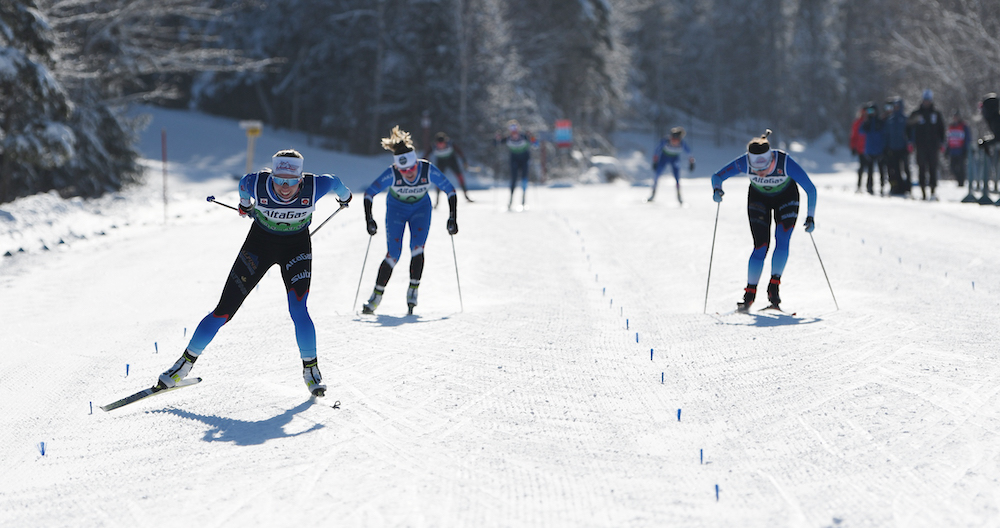
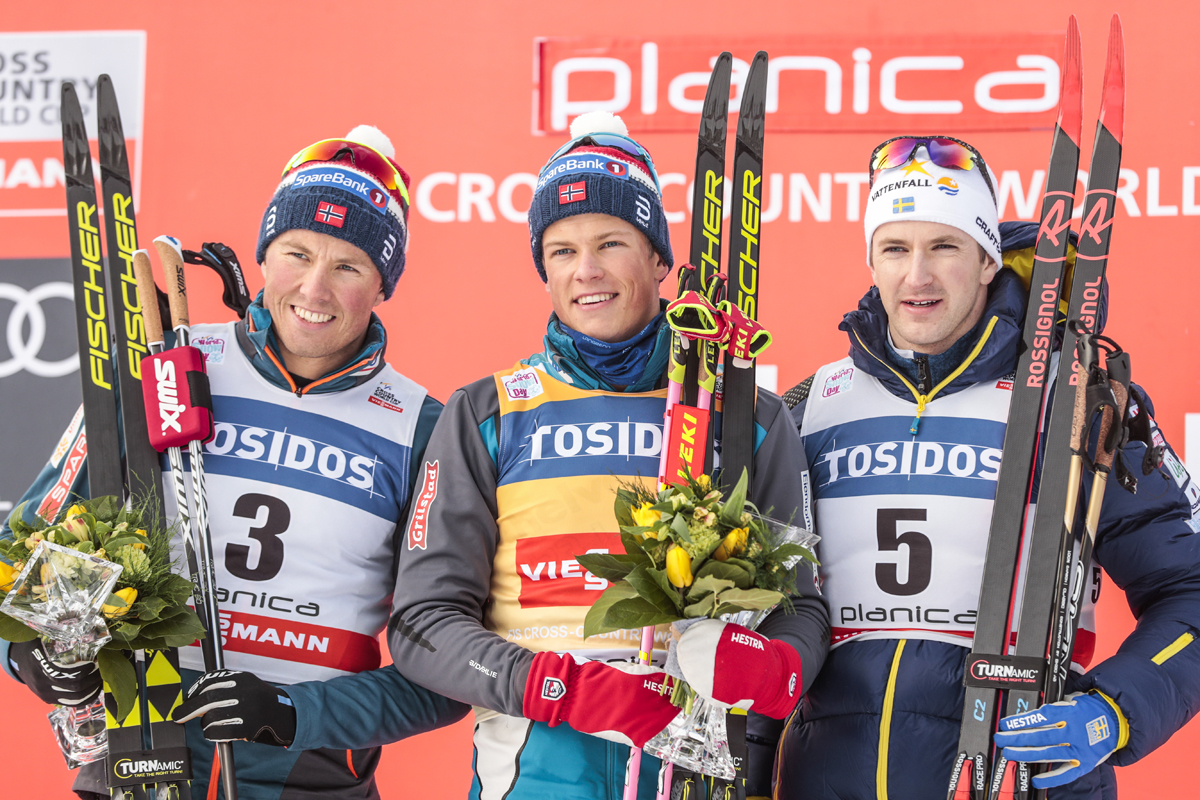
The men’s skate sprint saw a slimmed down Norwegian squad locked out of the final and Oskar Svensson of Sweden sweep in for another win. And Sunday, that was team sprint day – we’ll let Kershaw and Cockney drill down on the merits of that race. You’ll hear some Yin and Yang.
And as a bonus, we get a brief oral history of perhaps the most Canadian of things, the xc-ski air guitar. The origin myths you hold close to your heart may be dispelled.
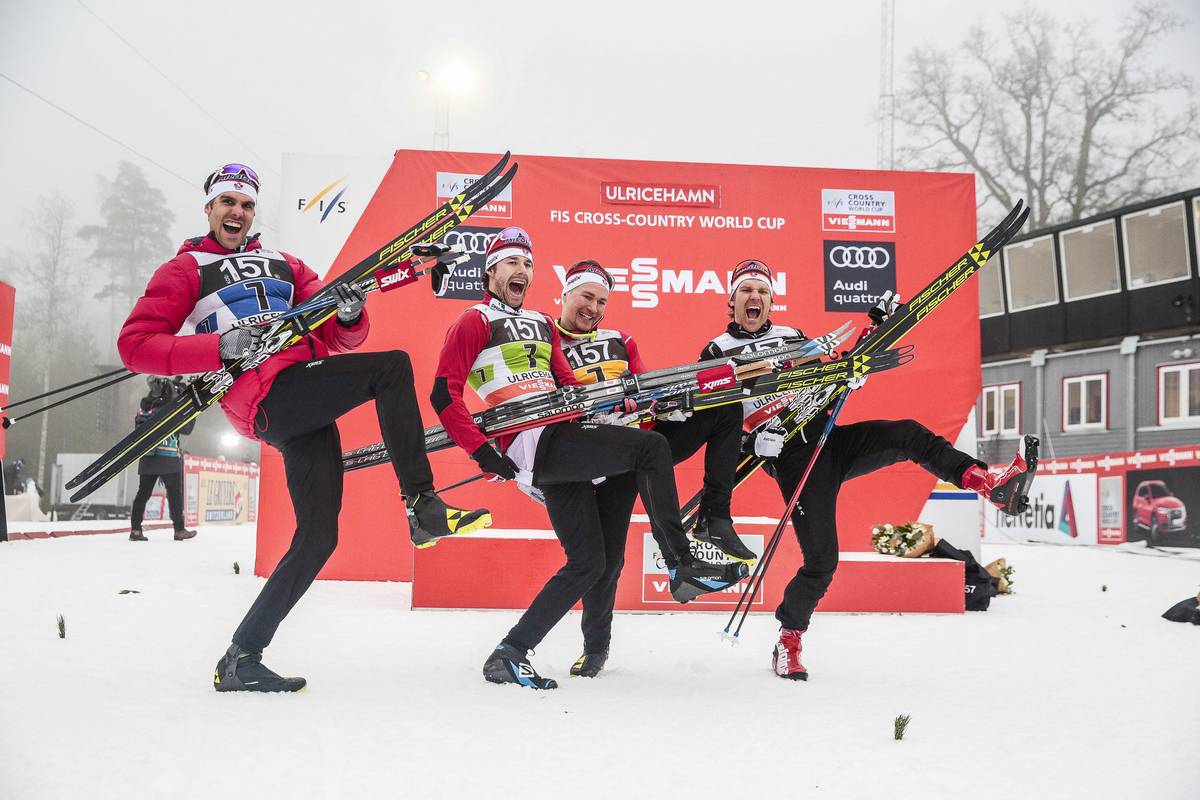
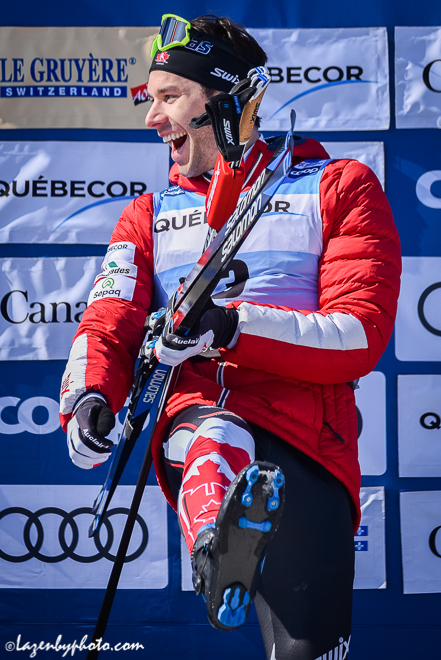
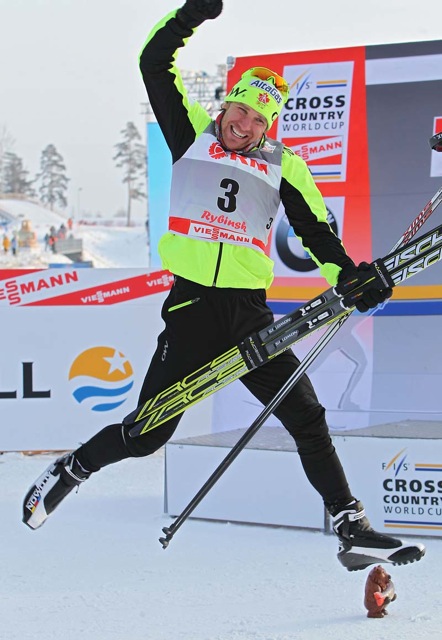
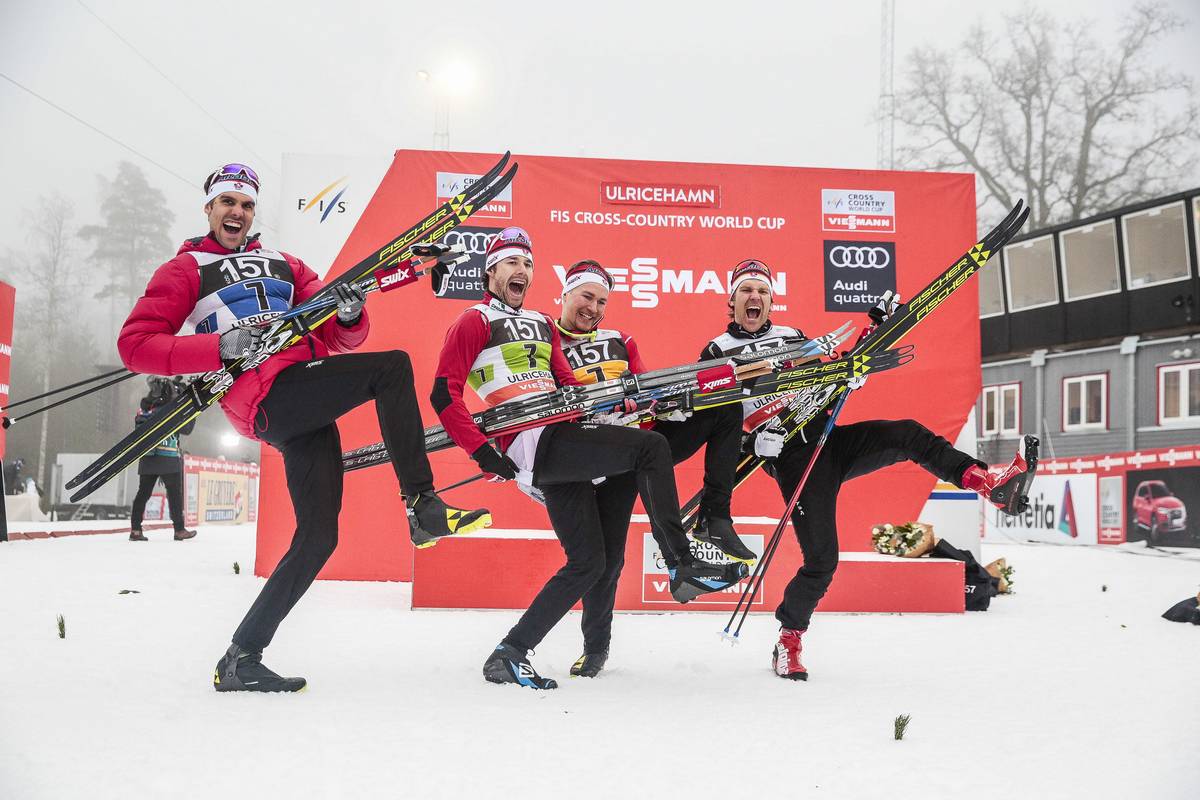
The Canadian men’s relay (hair band or boy band?… after placing third for Canada’s best World Cup result in the 4 x 7.5 k, with (from left to right), Lenny Valjas, Alex Harvey, Knute Johnsgaard, and Devon Kershaw. Guitar vintage- 2017. (Photo: Salomon/NordicFocus)One more riff: Harvey’s “air -guitar” remains in tune. (Photo: John Lazenby/lazenbyphoto.com)Kershaw celebrating and channeling Pete Townshend after winning a race in Russia in February 2012. Photo: Fischer/Nordic Focus.
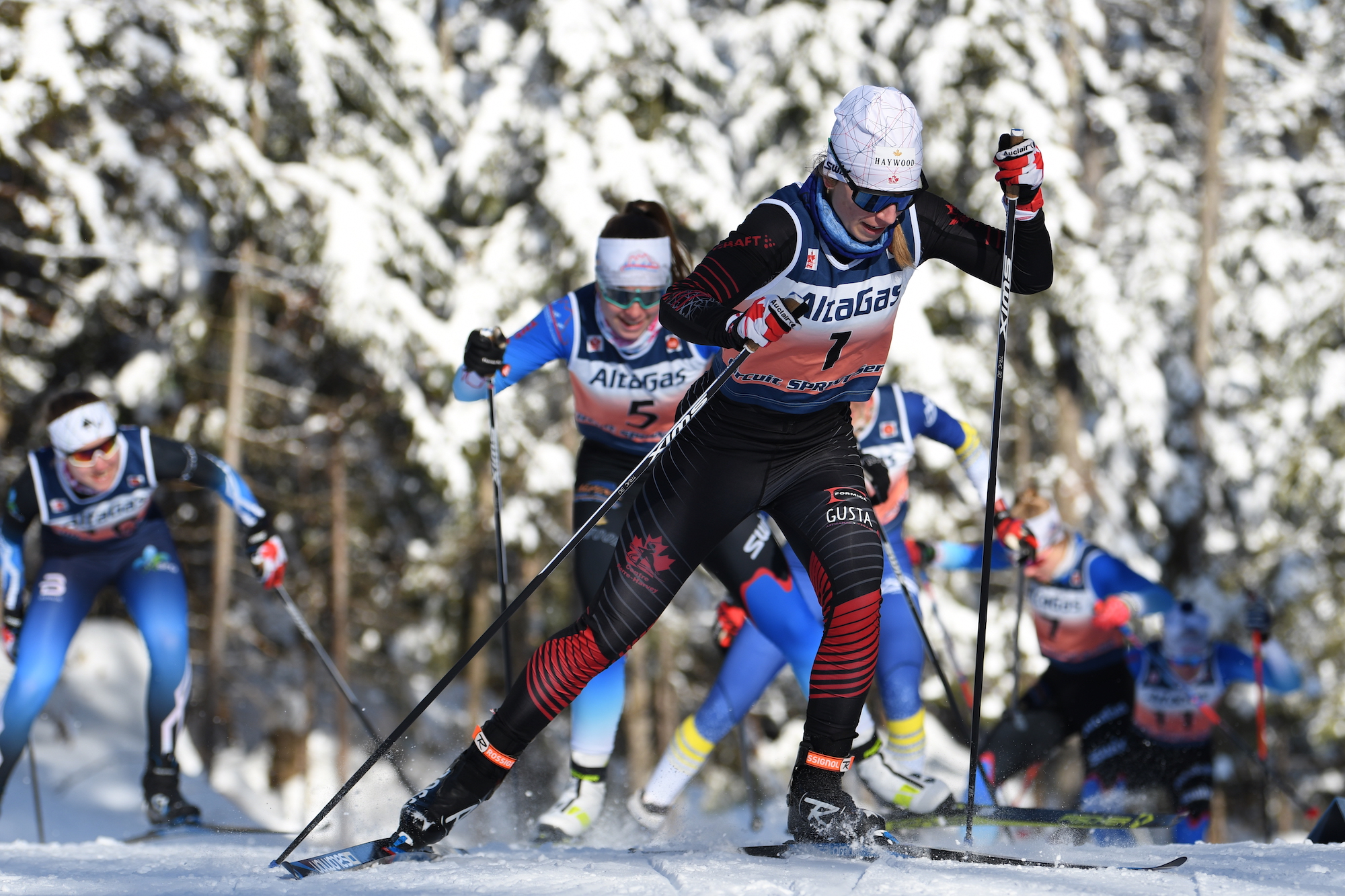
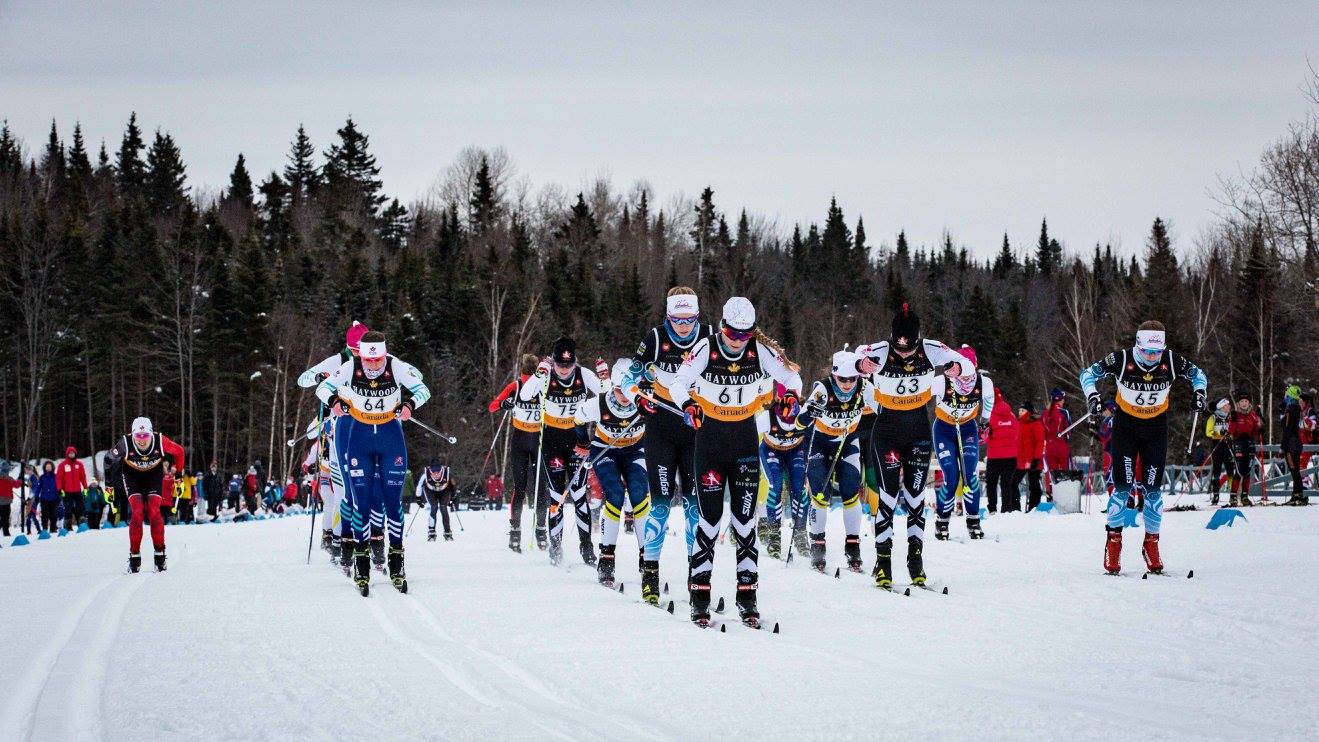
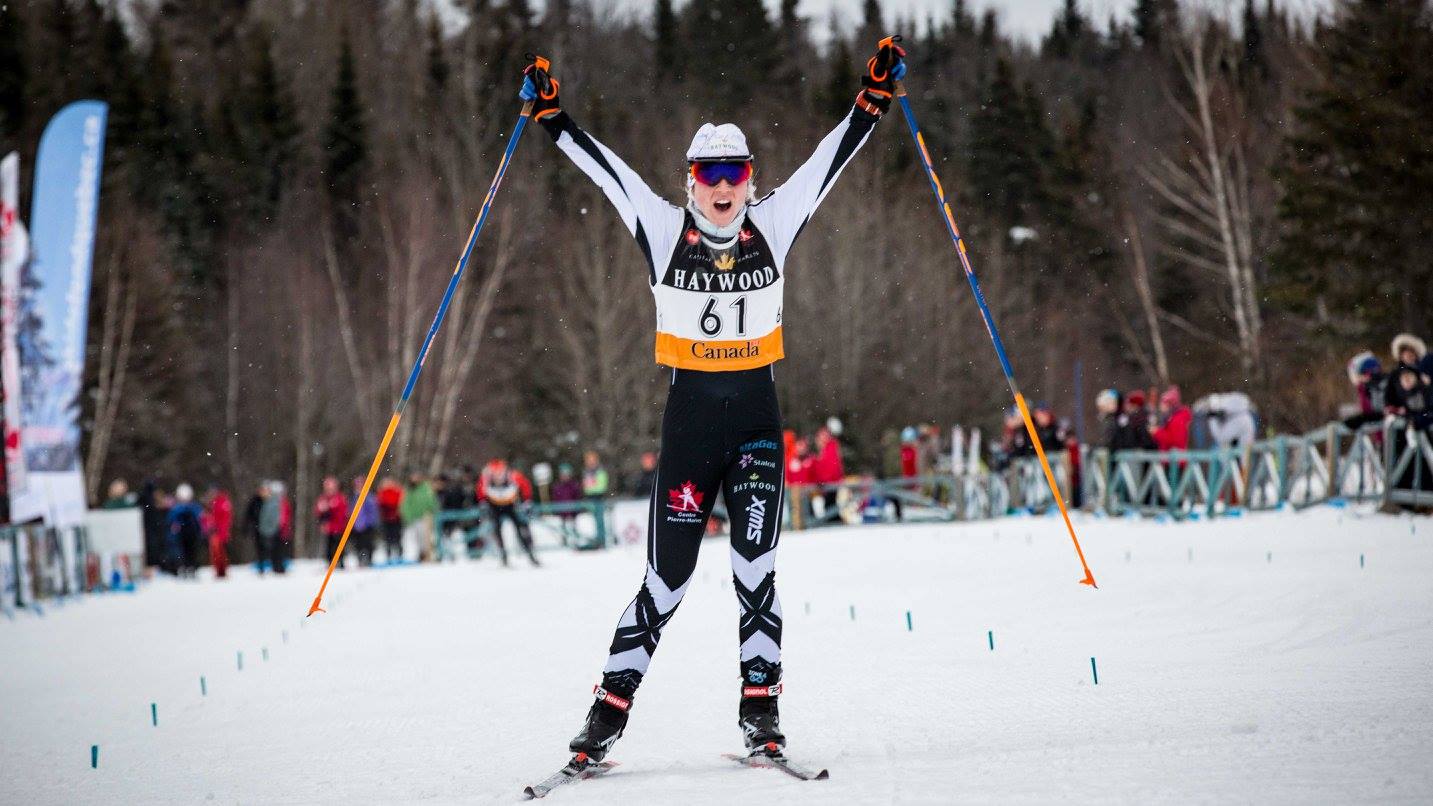
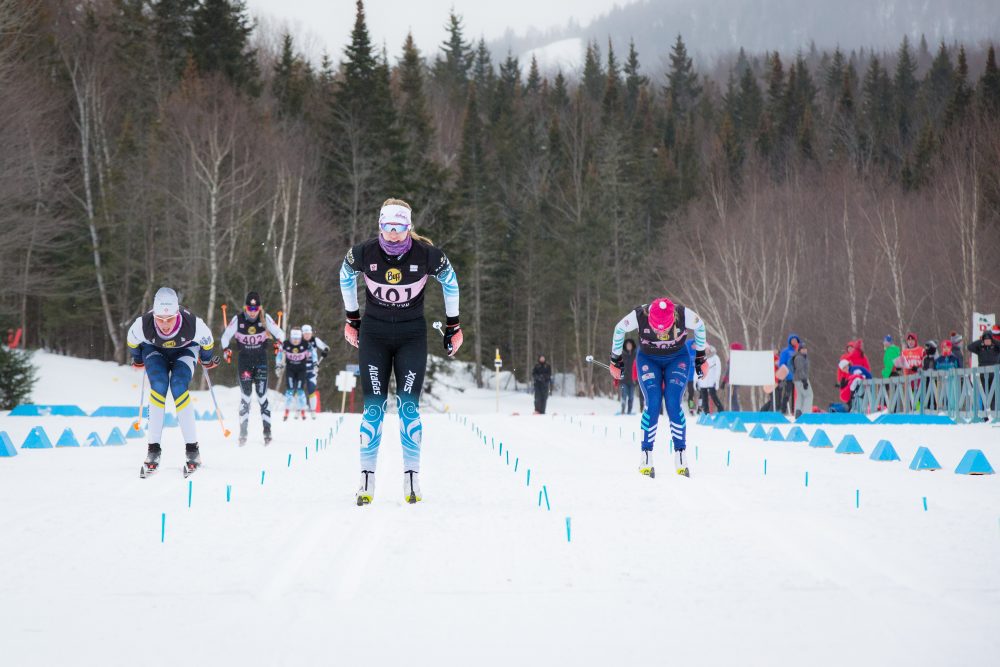
Cendrine Browne leads her semifinal at MSA Trials. (Photo: Doug Stephen)
In Canadian domestic ski racing, it doesn’t get much bigger than this. Mont Sainte-Anne (MSA) is hosting the NorAm weekend that also serves as U23/U20 World Championships qualification and has special significance in selection for World Cup starts.
Any skier who hasn’t already qualified for World Cup period 4 has had this event as a major focus for the season. The only certain paths to National Team selection for next season start with top 30 results on either the World Cup or U20 World Championships. Most of these paths start at MSA Trials.
For U20 and U23 selection, the top finisher in each of the three races is guaranteed one of the 18 to 20 places on the trip to Oberwiesenthal, Germany, with a pre-camp in Norway.
And finally, the weekend is a NorAm, which means COC leader points are on the line.
On Thursday, the action started with free technique sprints on a short but difficult course. Men, women, and U20’s all skied the same distance. Nordiq Canada’s Jeff Ellis continued the tradition of winner’s interviews, FasterSkier has the unedited videos below.
Elizabeth Elliott in charge of the U20 final. (Photo: Doug Stephen)
CNEPH’s Cendrine Browne won the qualifier in 3:04.79 before winning three heats to dominate on her home trails, finishing the final in 3:01.37. Browne’s teammate Laura Leclair was second, 0.53 seconds back, for the top U23 finish ahead of Emily Nishikawa at 0.76 seconds. The presence of distance specialists Browne and Nishikawa on the podium is evidence of the sprint course’s difficulty.
For the U20 women, AWCA’s Elizabeth Elliott qualified 4th overall and swept the heats to win the final in 3:06.85. Her teammate Benita Peiffer was second, 1.66 back, narrowly ahead of Black Jack’s Molly Miller at 1.81 seconds.
For the men, NTDC Thunder Bay’s Graham Ritchie recovered well from his time in Europe to win in 2:35.69 after qualifying second, grabbing the top U23 finish along the way. Team ULLR’s Jess Cockney continued to redefine the word ‘retired’ in second place, 0.52 back. TBay’s Pierre Grall-Johnson who converted on his latest qualification win with his first open category podium, was third at 0.76 seconds.
Graham Ritchie taking advantage of the downhill finish for the win. (Photo: Doug Stephen)
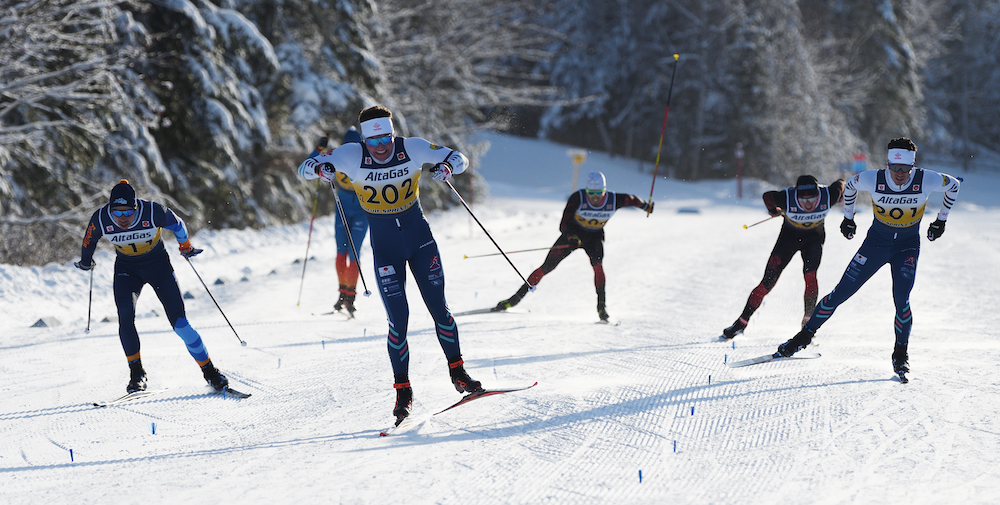
The U20 men provided no surprises, with the favourites front and centre in the final. Black Jack and Harvard’s Rémi Drolet dominated the day, sweeping through to the final to win by 2.57 seconds in 2:34.75. ULLR’s Xavier McKeever was second after qualifying 29th overall for 5th U20, with teammate Tom Stephen taking bronze a further 1.09 back.
Speculating on selections using the criteria documents always comes with a risk of error. That said, Leclair, Ritchie, Elliott, and Drolet should definitely be eligible for Obwiersenthal. Peiffer and McKeever should be selected as the 5th U20 athletes.
Photographer Doug Stephen has a gallery for the Sprints and Official Training. Athletes are welcome to download and use full resolution images if they give credit to ‘Doug Stephen’ or @vr45photography.
Rémi Drolet leads Xavier McKeever, Kai Meekis, and Tom Stephen in the U20 final. (Photo: Doug Stephen)
Nové Město, Czech Republic served up a traditional rock’em sock’em pursuit series on the World Cup. Saturday featured a 10 k/15 k interval start skate, followed by a 10 k/15 K classic pursuit. Bolshunov and Johaug were the clear fitness outliers but some great races within the race unfolded. And yes, how about those big baggy bibs? Part art-class smock part moo-moo, it was not a good race look. But we digress. To break it all down, former Canadian National Ski Team member Jess Cockney joins Devon for the show.
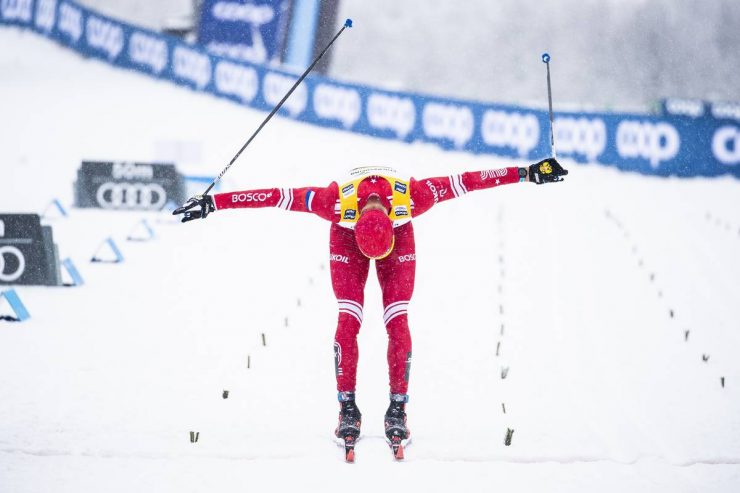
Take a bow: Alexander Bolshunov (RUS) also takes the win in Nové Město. (Photo: NordicFocus)
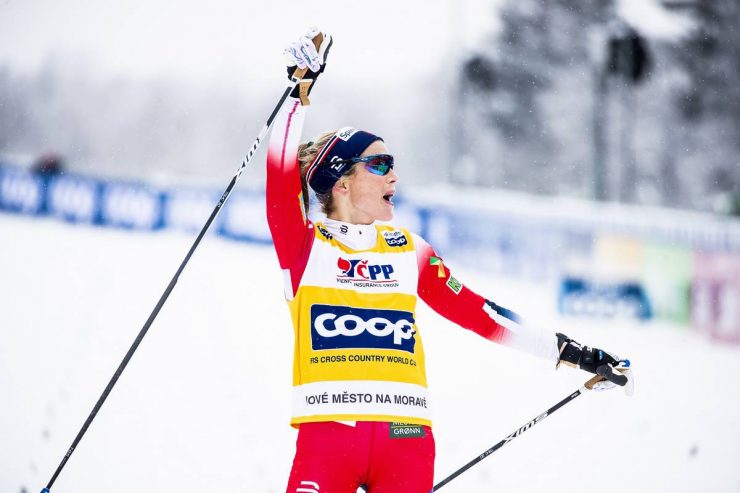
The champion in Nové Město: Therese Johaug. (Photo: NordicFocus)
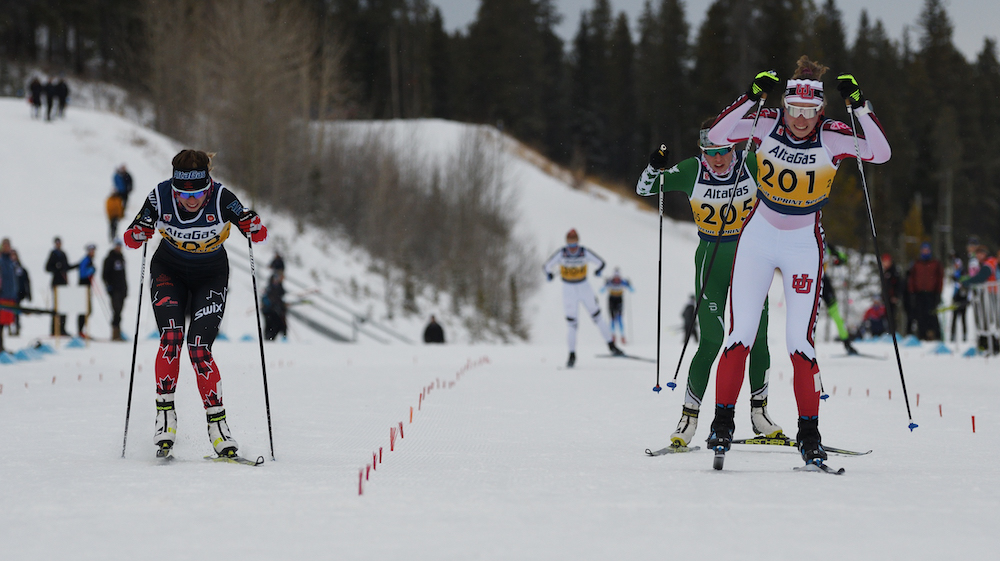
Full-time student Jess Cockney was happy to win again in Canmore. (Photo: Doug Stephen)
The NorAm series fully lived up to the North American Cup label in Canmore Friday with 1.3km free technique sprints to kick off a combined NorAm, SuperTour, and Mexican National Championships weekend.
Full results for the weekend are on zone4, including live results every day. Friday featured sprints for the older age groups only (282 racers): Saturday is interval start classic, and Sunday’s race an interval start free.
Before the races, there was chatter about the importance of increasing the level of competition and a dash of fear that the American visitors would school the host country. The competition level was up and fear was not needed this day. The open women’s final featured two Germans, two Canadians, and two Americans before the open men’s final skewed Canadian. (Heat brackets and final results.)
Julia Richter takes the win ahead of Katherine Stewart-Jones and Katharine Ogden. (Photo: Doug Stephen)
There are a few race videos in @NordiqCanada’s Instagram story.
Nordiq Canada’s new Events Coordinator Jeff Ellis took time from his Race Director role to shoot video interviews with the top athletes, including the first ever Mexican National Champion Rodrigo Rangel Fernandez. Edited versions of some of these interviews are also on @NordiqCanada’s Instagram.
University of Utah’s Julia Richter won the qualifier and all the heats to take the win in 3:10.52, 0.08 seconds ahead of the national team’s Katherine Stewart-Jones and 0.63 seconds clear of Dartmouth’s Katharine Ogden.
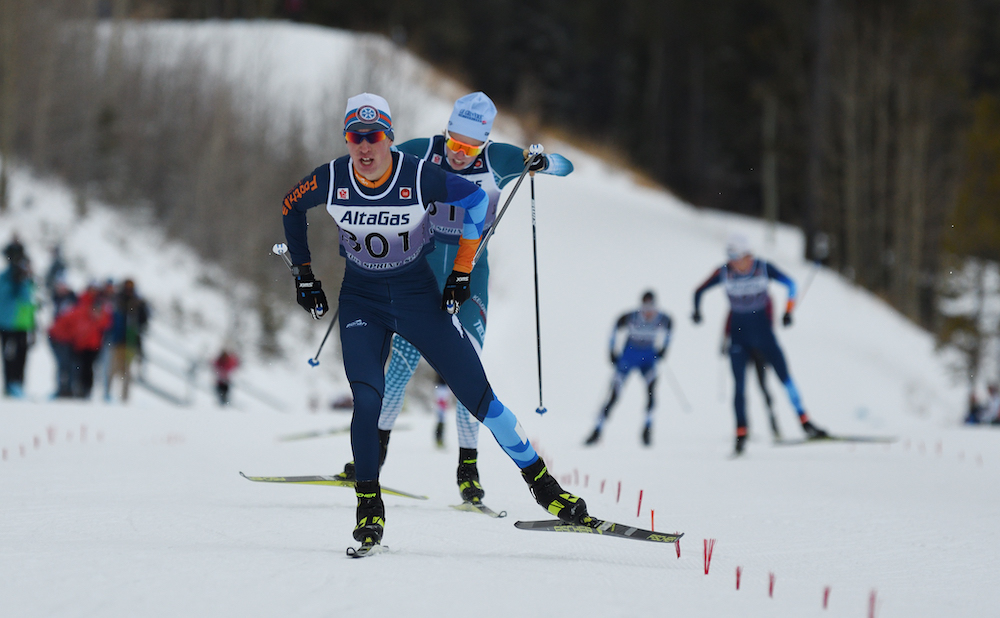
Full-time student Jess Cockney (Team ULLR) turned in another solid sprint performance at home, winning the men’s final in 2:46.18, over two seconds ahead of SVSEF Gold Team’s Peter Holmes and Canadian National Team member Graham Ritchie.
National team junior Anna Pryce qualified 4th overall before winning all her heats. She finished the 1.3km final in 3:18.40, 0.38 seconds ahead of AWCA’s Elizabeth Elliott and 0.43 seconds from CNEPH’s Liliane Gagnon. Seventy-three U20 women competed, making that cohort the largest age group.
Xavier McKeever (Team ULLR, CNST) won the U20 sprint after qualifying 20th overall. His 2:42.02 bested Telemark’s Ian Williams by 0.85 seconds and ULLR teammate Joe Davies by 5.30 seconds.
The first Mexican National Championship sprint featured four athletes. Rangel Fernandez won comfortably in 3:37.33, completing a major step forward for the federation in Mexico. Vadovų paieška, personalo atranka, mokymai vadovams ir darbuotojų paieška primumesse.lt
Canmore-based photographer Doug Stephen was in the thick of the action. Athletes can use full-resolution photos from his gallery if they credit ‘Doug Stephen’ or @vr45photography.
Katherine Stewart-Jones leads BSF’s Erika Flowers in the quarter final. (Photo:Doug Stephen)
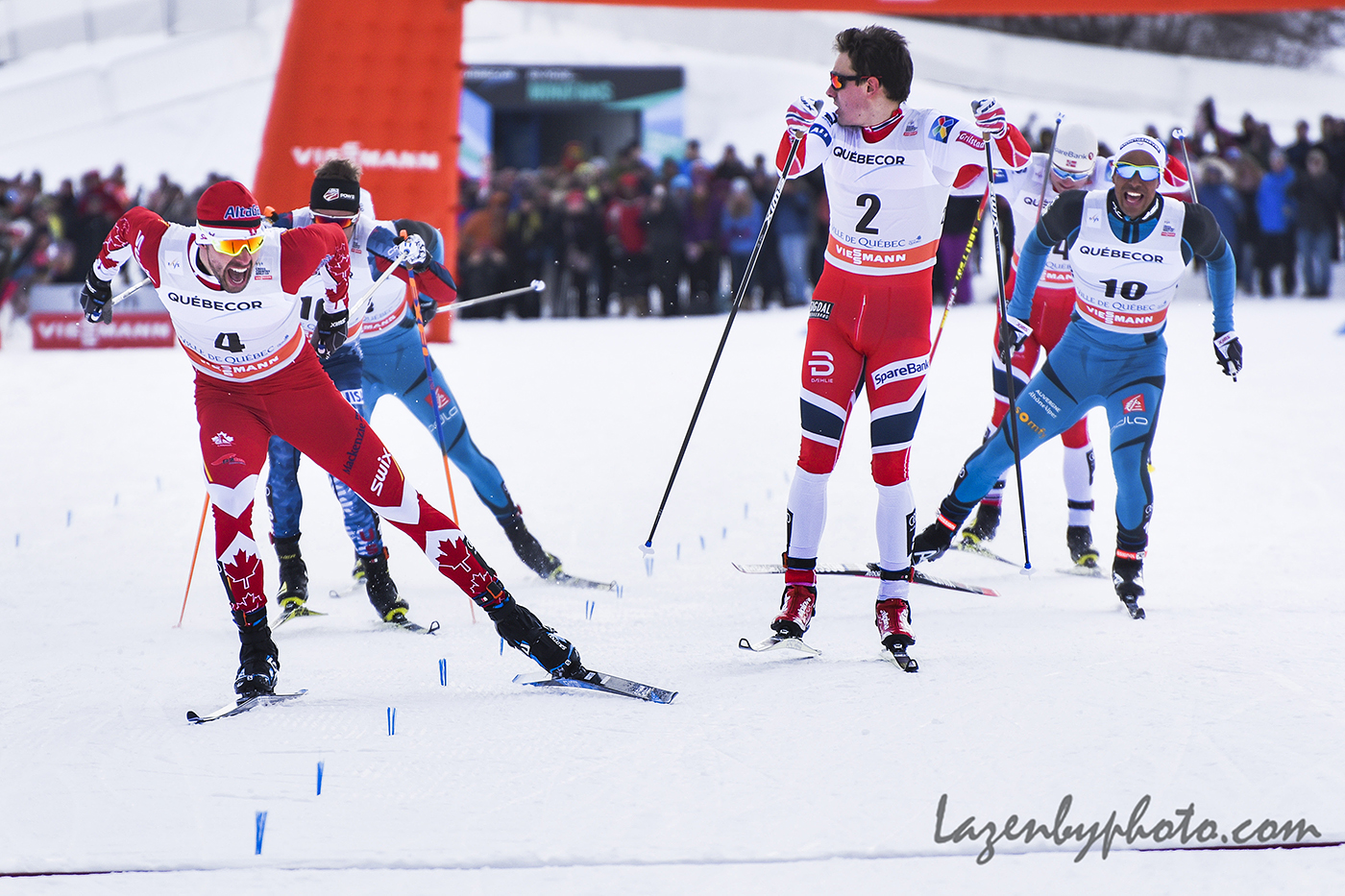
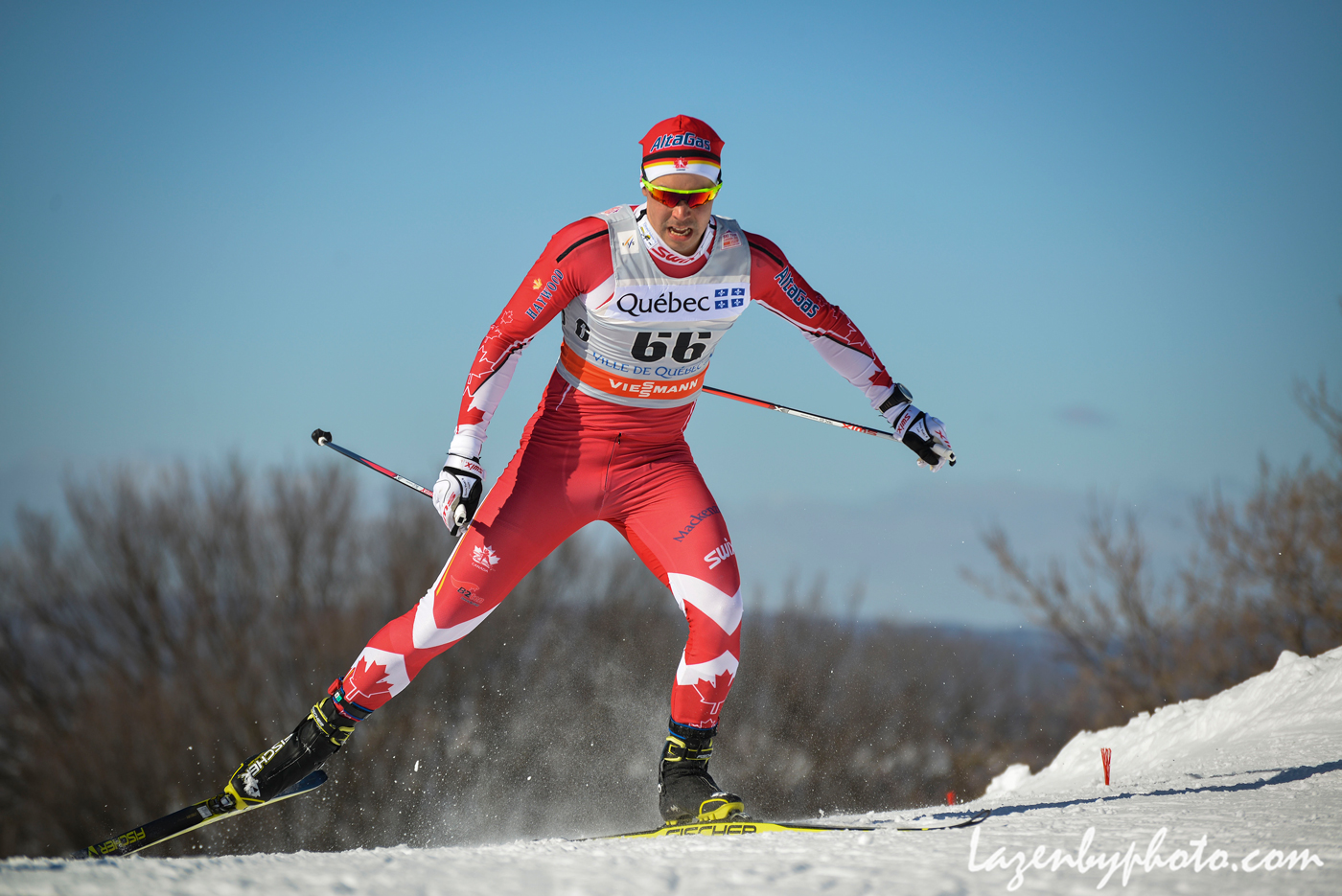
Canada’s Alex Harvey (l) coming on strong in the finishing stretch to outlast Norway’s Finn Hågen Krogh (2) by 0.31 seconds for the win in the World Cup Finals freestyle sprint on Friday in Quebec City, while France’s Richard Jouve (10) races to third, just ahead of American Simi Hamilton (behind Harvey) in fourth. (Photo: John Lazenby/Lazenbyphoto.com)
Welcome to FasterSkier’s World Cup Preview, where we check in with the top-10 teams from last year’s FIS Cross Country World Cup tour before the season starts. The World Cup begins with a classic sprint in Ruka, Finland on Nov. 24th.
***
Canada
Overall in Nations Cup Last Year: 10th
Women’s Ranking 2017/2018: 18th
Men’s Ranking 2017/2018: 8th
Canadians to Watch:
Canada has shape-shifted it’s world cup team as part of a larger restructuring of its high performance program. With fewer resources and a funding system tied to championship medals, contraction has been a major theme for Cross Country Canada (CCC).
Let’s begin with Quebec’s bread and butter: Alex Harvey. At thirty-years-old, Harvey remains podium-elite. He scored five podiums last season, including a win in Falun, Sweden’s 15-kilometer pursuit. Omni-present in the front of the pack, Harvey positioned himself for sustained success in 2017/2018. Like last year, Harvey plans on racing the full World Cup in 2018/2019. After placing third in the Tour de Ski and fourth overall in the World Cup final standings, CCC and fans alike have high expectations for Harvey.
Emily Nishikawa and Cendrine Browne earned period 1 starts as the top ranked distance skiers. Expect them at period 1 stops in Beitostolen, Norway and Davos, Switzerland.
The COC leaders for period 1, Andy Shields and Olivia Bouffard-Nesbitt, have guaranteed start rights through FIS rules.
Dahria Beatty, Maya MacIsaac-Jones, and Katherine Stewart-Jones will begin the season racing in North America.
Who’s Missing:
Devon Kershaw, Jess Cockney, Knute Johnsgaard, and Graeme Killick all retired at the end of the Olympic cycle.
Pre-season Results:
Many top-ranked Canadians turned up at the Frozen Thunder races. As the races were not used for selection, nearly all of the top athletes treated them as race intensity.
In the Frozen Thunder king’s court sprints and free technique distance races, Valjas was 3rd and 4th, Shields was 2nd and 11th, Locke was 5th and DNS, Beatty was 1st and 2nd. Nishikawa completed the sprint qualifier, placing 2nd, before withdrawing . She won Frozen Thunder’s distance competition.
News of Note:
Harvey claims he is excited as the season approaches.
“I’m feeling great right now,” Harvey wrote in an email. “I was able to execute the plan pretty much to the dot this year, no injury or illness slowed me down and I have a fun time the whole Summer and Fall! As per usual, I’m a slow-ish starter so the first goal of the season for me will be the Tour de Ski.
“The big goal for me this season is the World Championship in Seefeld. I’m focusing on the skiathlon and the 50k where I’m going to defend my world title to the best of my abilities! Right behind Worlds are World Cup Finals in Québec City, so that’s a huge motivating factor for me to wrap up the season at home once again just like we did in 2017.”
Valjas also plans on a gradual build up to his form after his rough season last year. “This summer was a tough one,” Valjas wrote after the Frozen Thunder sprints. “My back was in need of some serious rest and recovery, so I took 2.5 months almost completely off. I ran and biked a bit, but no roller skiing. I am expecting the start of my season to be a little slow, but I plan to race myself into top shape once again come World Champs.”
For the athletes who aren’t consistent podium threats on the World Cup, the season outlook is less clear.
CCC CEO Shane Pearsall was feeling optimistic about the season when he spoke to FasterSkier on November 8th.
“I’m thrilled,” he said of a week in which CCC hired a new national team coach, finalized the World Cup head coach role, and finally published a long awaited selection criteria. “I think it’s one of those things where you need fresh blood,” Pearsall said, while acknowledging the short term delays and difficulties inherent in that choice.
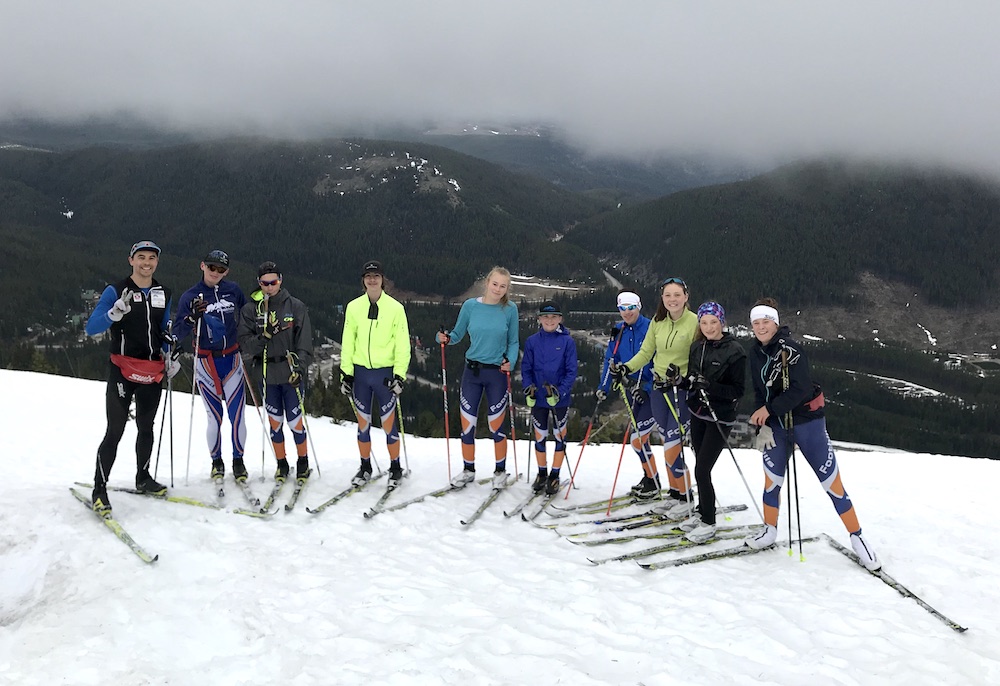
Jess Cockney (l) and Foothills Nordic skiers on top of Apex, outside of Penticton, British Columbia, on May 19. After retiring from professional skiing this spring, Cockney has been helping out as an assistant coach at Foothills Nordic. He’ll study full time at the University of Calgary this fall. (Courtesy photo)
Strength. Balance. Agility. Jesse Cockney had all of those qualities as a child growing up in Yellowknife, Northwest Territories — just like most Inuit kids — according to his father, Angus. But what he could do with that talent was what Angus hoped to nurture.
Since he had put his son on skis at age 3, Angus reflected in an email that he “knew then that [Jess] had incredible potential to succeed.”
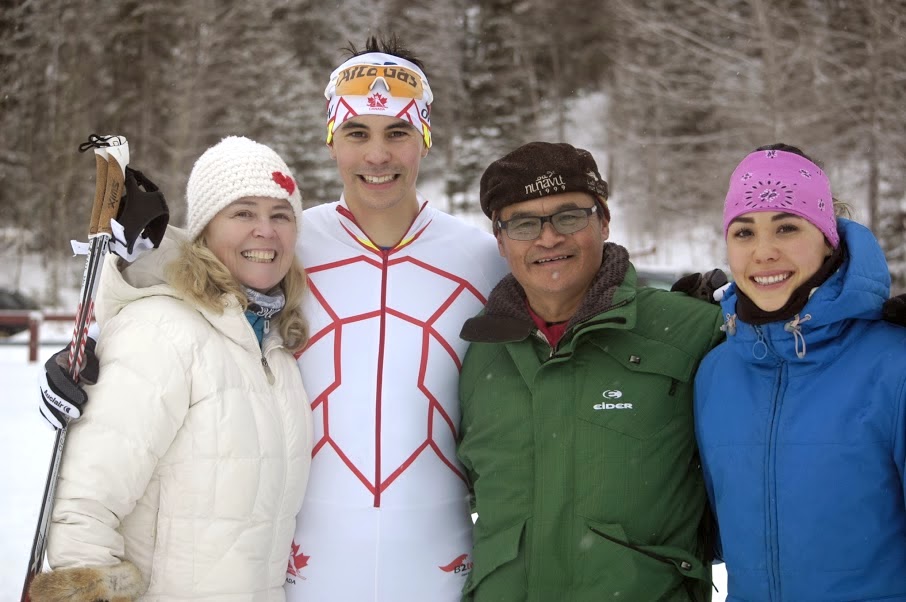
Jess Cockney and his family after the 2014 Olympic trials in Canmore, Alberta, with his mother, Trish, father, Angus, and sister, Marika. (Courtesy photo)
And so the Cockneys moved to Canmore, Alberta, when Jess was 7. That included Jess’s mother, Trish, and his sister, Marika. According to Angus, a former competitive skier and junior national champion in 1973, ’74 and ’75 (who spent two months skiing to the North Pole in 1989), the move was about giving Jess “a better opportunity to succeed as it had the right environment with the Nordic Centre and a community full of support with like-minded kids and parents. In other words, we wanted him around a healthy environment.”
It was an easy transition, Angus explained. Canmore was more conducive to training with milder temperatures than Yellowknife and a wealth of experienced coaches and athletes.
More than two decades later, Jess credited his dad for helping him reach the highest level of cross-country skiing. A two-time Olympian, Cockney, now 28, has spent 11 years on Canada’s senior national team and two more on the junior national team. He achieved a sixth-place finish in a classic sprint at U23 World Championships in 2011, as well as four individual top-10 finishes on the World Cup.
“The big reason that I have cross-country skied at this level and really understood at an early age what it meant to pursue racing at a high level was definitely because of Dad,” Cockney said on the phone in April. “He took skiing to a high level as a junior and didn’t carry on after his junior career but stayed really involved with the sport and with racing, too.”
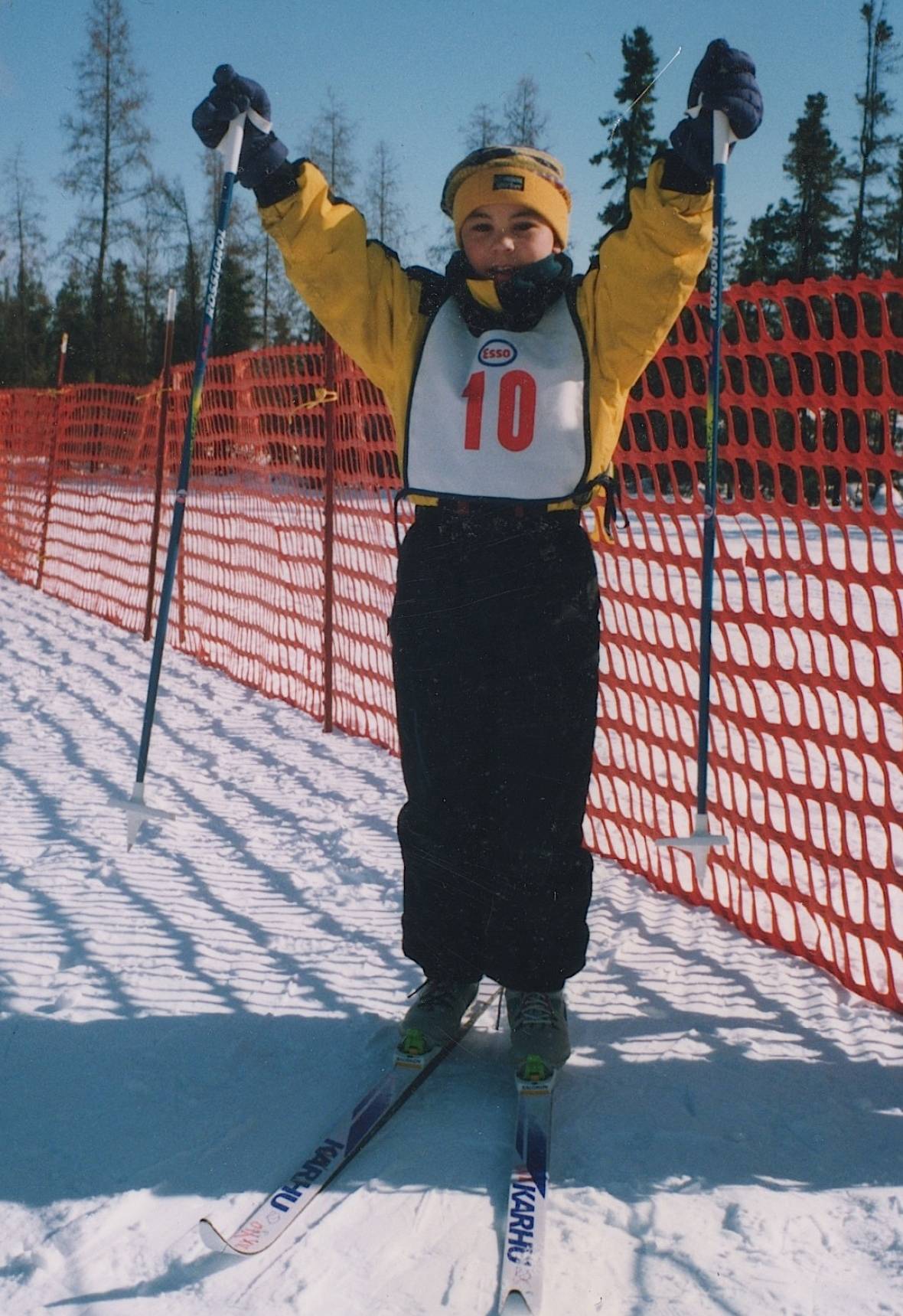
Jess Cockney enjoying some on-snow time as a youngster. (Courtesy photo)
He emphasized how special it was to share moments like shuffling on skis at a young age with his dad to seeing him on the side of a World Cup course, calling out splits and taking pictures.
“It’s pretty fun to be able to share that time together, because skiing means so much to both of us,” Cockney said. “I’m quite happy that my career has worked out as well as it has and that Dad has been able to be there for so many of the good days with it, too.”
After six years of traveling across Europe on the World Cup circuit (as well as to places like Sochi, Russia, and PyeongChang, South Korea, for the Olympics), Cockney retired from professional skiing this spring. It was a decision that had been on his mind for the better part of the last two seasons, he explained. Toward the end of the PyeongChang Olympics in February, he felt what he described as a mental “decompression” and a natural ending to his career, which solidified his decision.
“I know how much mental energy it takes to commit towards the training year and the travel for the racing season,” Cockney said. “I had a blast doing that for so many years and I just didn’t think that I was going to be sharp enough or motivated enough. I’m just happy to have such a great season as a final year with the Olympic team and being together with so many of my teammates from over the years at those Games. It just feels like the time is right and I’m excited to do something else.”
Annika Hicks (Alberta World Cup Academy) racing in the 2016 Frozen Thunder sprint qualifier in Canmore, Alberta. (Photo: Glen Crawford Production Services)
While currently renovating his home in Canmore with his girlfriend Annika Hicks (as well as his dad, skier Bob Thompson, and another friend) and assistant coaching at Foothills Nordic, Cockney plans to start classes at the University of Calgary this fall. He was accepted into the university’s political-science program this spring.
Hicks, who previously trained out of the Alberta World Cup Academy (AWCA) in Canmore, will also be studying full time at the University of Calgary. She is halfway through her studies there toward a science/kinesiology degree in exercise and health physiology. Like Cockney, she explained in an email that she’s been “on the fence” about continuing with skiing for the last two years.
“I wanted to stop skiing on my terms and with a healthy relationship with the sport,” Hicks, 26, wrote. “I have no regrets and am happy to have that closure. I’m grateful to have had the opportunity to ski race for so long.”
In her career, she started 15 World Cup races, competed at two U23 World Championships and 2011 Junior Worlds, tallied at least three podiums at Canadian senior nationals (including two second-place results at 2018 nationals in March), and ended this season as the second-ranked Canadian woman overall on the NorAm circuit.
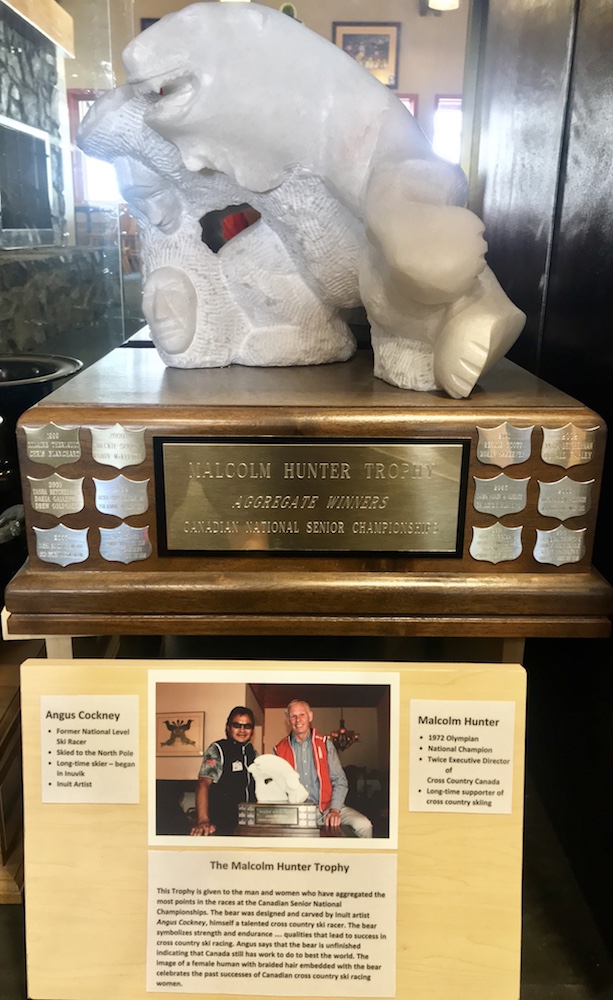
The Malcolm Hunter Trophy for aggregate winners of Canadian senior nationals, designed by Angus Cockney, as seen in the Canmore Nordic Centre day lodge. (Photo: Cross Country Canada)
Cockney also finished the second on the overall NorAm aggregate points list. After winning both the freestyle sprint and 15 k freestyle pursuit at this year’s nationals, he also was also awarded the Malcolm Hunter award — a trophy his dad made — as the aggregate male winner at nationals.
“It was a great way to end the season and end the career,” Cockney said. “I’d never won the nationals aggregate before so that was a big thing for me to do … To get that in my last stab at it was pretty sweet.”
Angus pointed out that his son’s aggregate win was also special because of where it took place.
“It was in Thunder Bay [Ontario] where Canada lost my good friend/foe in the late great Reijo Puiras,” Angus wrote. “He too was passionate for cross country and especially made time for and congratulated Jess whenever he could. And, Jess was presented the Malcolm Hunter trophy; a trophy I created and Malcolm was my former coach who brought me to victory in the stormy ice-cold 1975 Canada Winter Games. Therefore, it was very befitting for Jess to go out that way. He came back and told me, ‘Dad, I won the trophy you made.’ ”
Choosing nordic
Looking back, Angus explained that his proudest moment of Jess was was when his son consciously chose to pursue cross-country skiing at age 11.
“I believe he would have made the National Hockey League if he wanted to but I’m glad he picked the greatest sport in the world,” he wrote. “For Jess, I’m proud on how he has become well respected as a person in the community and abroad. Of course too, he showed he belonged on the world’s stage with a number of top ten finishes on the World Cup circuit but was especially proud of him as the second qualifier here in Canmore in 2012 sprints. He certainly had the community a buzz. As a Father/Son duo though, I’m proud too on how we are the only Father/Son duo to win our respective Canada Winter Games; 1975 and 2009.”
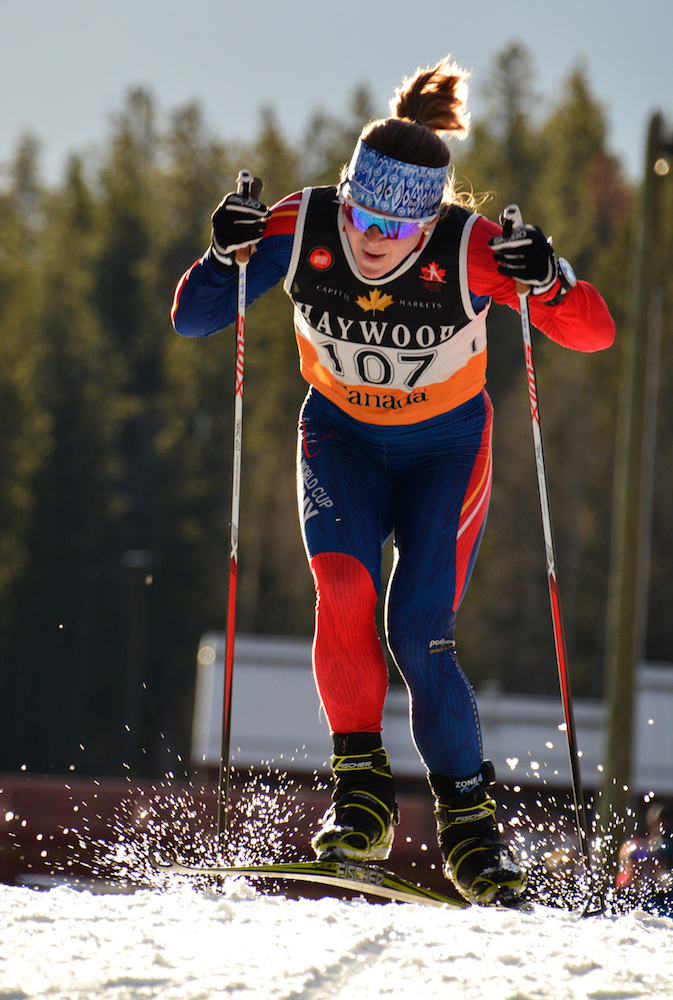
Jess Cockney racing to 29th in the freestyle sprint qualifier at Stage 3 of the 2016 Ski Tour Canada in Quebec City. He went on to reach the semifinals and finish the day in 10th. (Photo: John Lazenby/Lazenbyphoto.com)
Cockney had a number of standout moments at the World Cup level, the first of which came at home in Canmore in December 2012, when he placed ninth in a World Cup skate sprint. Then, late in the 2015/2016 season in Quebec City, he raced to 10th in the Ski Tour Canada’s skate-sprint World Cup stage. The next winter, he notched two more individual top-10 results: first in a classic sprint at the 2017 World Cup in PyeongChang and then in another skate sprint in Quebec City.
Those top 10’s effectively earned him a spot on Canada’s 2018 Olympic team as well as its 2017/2018 World Cup A-team.
“The time in Canmore, for sure, was such a special race for me,” Cockney reflected of his career-best World Cup result. “That was really big because it went well and my family was all there and it was just really a great surprise kind of day.”
Another race he’ll never forget was the 50 k mass start at the 2014 Sochi Olympics, a race he had never expected to enter.
“Just the way that people got sick and things don’t work out for other teammates, I was able to start it, and I was just so happy to be able to race that massive race at the Olympics,” he said. “That’s just such a big deal for me in my career, to have raced it and finished it.”
Phil Widmer (CNST/AWCA) leads teammate Jesse Cockney (second from l), Dakota Blackhorse-von Jess (Bend Endurance Academy) and Canadian Para Nordic skier Brian McKeever (r) in a classic-sprint heat at 2013 Frozen Thunder in Canmore, Alberta. (Photo: Pavlina Sudrich)
He recalled his time with the AWCA and transitioning from the NorAm to international racing with peers like Kevin Sandau, Michael Somppi, Chris Hamilton, Graeme Killick, Graham Nishikawa, Brent McMurtry, Drew Goldsack, and Phil Widmer.
“So many fun Phil battles,” Cockney reflected. “Now that that group is still there with Bob Thompson making his way — it’s great to see that group is still getting stronger with that tail end of younger guys in that group. … Probably my biggest highlight is the relationships that I’ve been able to foster and have come from skiing, for sure, is the people and the time that we’ve shared together.”
Besides his dad and his fellow competitors, he credited his high-school training group, the Banff Ski Runners, and its coach Anders Lenes, as well as Mike Cavaliere as major influences.
“We had so many good guys my same age, and really the time with friends was actually just time training so it was the perfect atmosphere for a couple of us to take it really far,” Cockney said of the Banff team.
“My coach right after Anders, Mike Cavaliere, definitely had a really big impact in fostering that next level of belief for me, from going from a good skier in Western Canada to trying to be the best that I could be in Canada,” he continued. “And then setting goals to reach potential in the international scene, too, with time together at World Juniors and Under 23’s and early in my World Cup and my first Olympics we were still working together.”
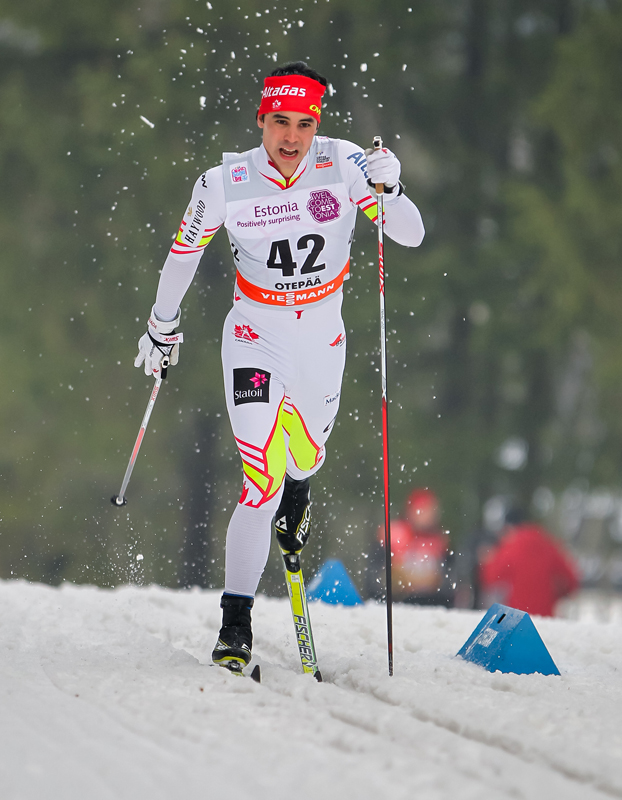
Jess Cockney racing in a 2015 World Cup classic sprint in Otepää, Estonia. (Photo: Fischer/NordicFocus)
Asked what it was like growing up on the national team and how the sport has shaped him, Cockney was introspective.
“I’m definitely softer spoken or maybe more considerate at this point,” he said. “Really what I’ve gotten to understand is respecting everybody’s hard work in sport and understanding what someone’s going through; we don’t really get it all the time.
“I’m a little bit more — I’d just say not as brash or just a little bit more reserved,” he continued. “I learned some hard lessons from being just a little bit too mouthy or a little bit too, maybe even arrogant. The time in sport has really shaped a lot of who I am, probably more than I realize. I’m super appreciative of the people who’ve been a part of that, just being such great people, and how they carry themselves, [and] emulating that where I can in life.”
A longtime member of Canada’s senior development team, Cockney was promoted to World Cup B-team status in recent years and spent his last season as an A-team member. So while funding has become tighter within Cross Country Canada (CCC) since 2014, Cockney said he had the unique experience of increased financial support in the last couple years.
“I started supporting myself for World Cup opportunities in 2014 and paying out of pocket for the whole thing, and then by this year I was getting more support from the whole team,” he explained. “My seasons have been consecutively getting more and more financially feasible, so I’m lucky it was trending in that direction and I was able to be a little bit better financially as the years went by.”
With further budget cuts for CCC expected, Cockney said his retirement wasn’t motivated by the prospects of self-funding. He is one of four men from last year’s Canadian World Cup Team who have decided to retire (the other three being Devon Kershaw, Knute Johnsgaard and Graeme Killick.) Alex Harvey and Len Valjas are the lone returners to the 2018/2019 World Cup A-team.
“Alex and Lenny and Graeme and I, we’ve been going to nationals together since I think, like, 2004,” Cockney reflected. “So it’s been a really long time together and more and more time with Devon at the top level of the sport. I was roommates with Knute for a while last year so we really felt like we’re a tight-knit group of guys and it was fun. They’re not just teammates, they’re friends that are now going to be part of our life for the rest of our time out of sport.”
The next steps
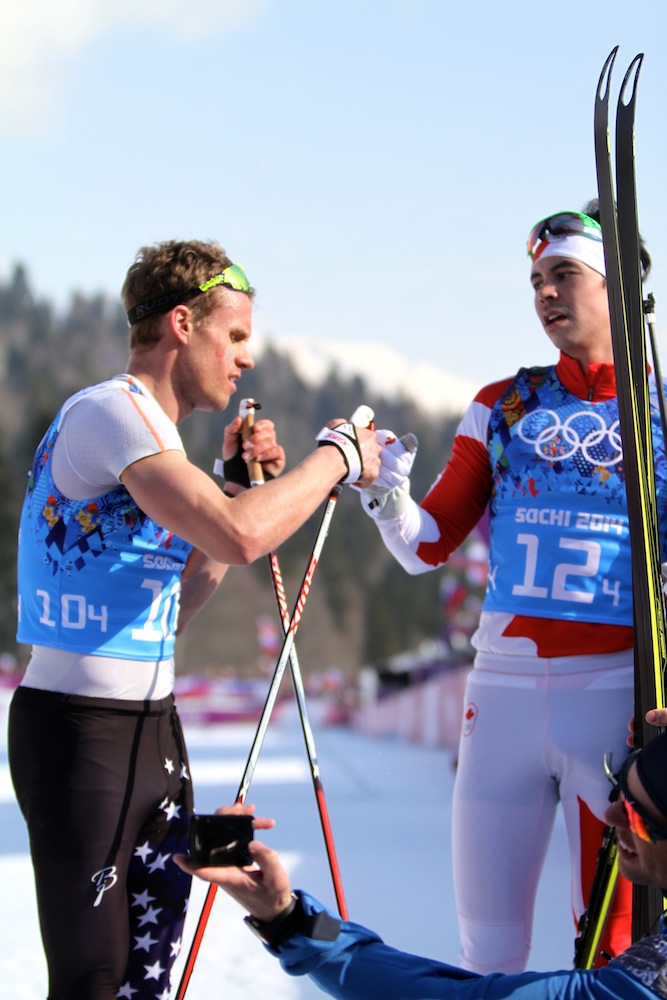
Canada’s Jesse Cockney (l) and American Simi Hamilton bump fists after anchoring their countries’ relay teams at the 2014 Olympics in Sochi, Russia.
In mid-April, Cockney said his permanent break from racing hadn’t really sunk in yet. A month later, he was coaching Foothills Nordic athletes at a training camp in Penticton.
Asked what piece of advice he’d give up-and-coming skiers, he said it was “cheesy”, but simply to be true to oneself.
“At the end of the day, it’s your name on the results and you’ve got to be able to be the one driving the train and figuring things out,” he said. “It’s a brutally honest sport, and we’re judged with a clock. It’s your name next to that time, so be true to yourself and enjoy the process so much. … In cross-country skiing, the process is 95 percent of the sport, and 5 percent of it is competing… Just having a real love for the training, the relationships, the places that you go, that’s the biggest thing.”
And as he parts ways with CCC, he stressed the importance of club programs in the development pipeline as they helped cultivate his career (Cockney grew up skiing with Foothills Nordic).
“The club systems were really strong in Canada and could provide athletes with a lot of support through different points in their career, and I think we’ve really put a big focus on the training centres, taking up the mantle with that,” Cockney said. “If clubs were able to be more supportive, be more things to athletes at different points in their career, I think that you would start to see an improvement in just the health of the sport across the country. The more places people can ski at a high level, or whatever level they feel they want to, without moving, without uprooting themselves, I think that’s the best thing. It’s not always feasible for someone to pick up and move to a training centre and change their life. If there’s a club in town that they can pursue their goals in sport, then that’s the best way to get people sticking with the sport.”
As for his future endeavors and adventures, Cockney predicted that he probably wouldn’t rollerski for fun. Rather, he was looking forward to mountain biking in the Bow Valley, going fishing and enjoying “a few more outdoor pursuits that are for myself” and a slower pace. “I think that will be good for me,” he said.
“[I’m] definitely keen to get going with something else in life,” he said. “It’s been an absolutely amazing time in sport for me and I achieved pretty much everything that I would’ve wanted to in a career and I had a great time doing it … but it’s going to be a challenge, for sure, because it’s been so long since I was doing school consistently. … Just looking forward to a new challenge.”
(Note: This article has been updated to reflect that Len Valjas was nominated to the B-team, rather than the A-team as previously stated.)
On Thursday, Cross Country Canada (CCC) announced its national-team nominations for the 2018/2019 season via a press release.
Canada’s Alex Harvey celebrating on the podium after placing second in the World Cup men’s 15 k freestyle mass start in Seefeld, Austria, last season. (Photo: Salomon/NordicFocus)
Notably, the World Cup A-team is made up of one man — Alex Harvey — after three athletes from last year’s World Cup A-team retired (Devon Kershaw, Jess Cockney and Knute Johnsgaard). Graeme Killick, of last season’s World Cup B-team, also retired. Len Valjas was nominated to the B-team, a demotion, he said, that was a result of him ending his season immediately after the PyeongChang Olympics.
“The reasoning is that I … didn’t show up to [the World Cup in] Drammen, is that I didn’t follow what the team said,” Valjas told FasterSkier on May 22. He explained he had a broken spine, which required rest and rehabilitation.
On the women’s side, Dahria Beatty was renominated to the World Cup B-team, while Emily Nishikawa and Olivia Bouffard-Nesbitt were not.
All five of last year’s U25 Team were renominated to the national team, with Cendrine Browne and Julien Locke making the jump to the World Cup B-team, while Katherine Stewart-Jones, Maya MacIsaac-Jones and Gareth Williams were renominated to the U25 Team. Also on the U25 development squad, Antoine Cyr was promoted from the junior national team, and Graham Ritchie earned his first national-team nomination.
The World Cup team will once again be led by co-coaches Ivan Babikov and Louis Bouchard.
On the Para-Nordic side, the World Cup Team grew by one despite the retirement of Chris Klebl. Six athletes and two guides were nominated to the Para-Nordic World Cup Team, while two were renamed to the Development & Prospects Team. Four other athletes round out the team as part of the Prospects Team.
Canada’s Devon Kershaw racing at 2017 World Cup Finals in Quebec City, where he finished 26th in the 15 k freestyle pursuit and 19th for time of day in the last race of the 2016/2017 season. (Photo: John Lazenby/Lazenbyphoto.com)
On April 26, Devon Kershaw posted a photo on social media of Alpina boots hanging on a line. The next day, he spoke on the phone with FasterSkier from his new home in Lillehammer, Norway, after a day of running around outside with his 15-month-old daughter, Asta Isabel.
Kershaw was tired, but in a good way. For the first time in 17 years, he was ready for a new challenge, a new focus and much more time with his daughter and wife, Kristin Størmer Steira, a former standout Norwegian skier.
Three years after Steira left professional cross-country skiing and pursued a career in business, starting with her master’s degree in business management, Kershaw is following suit and headed back to school. The 35-year-old Canadian hung up his boots to quietly announce his retirement after about a month of deliberation.
“I was really keen to keep ski racing, to be honest,” Kershaw said. “I had the motivation to go one more year, and in my head, I wanted to race one more season, but as things progressed in the spring, there were a lot of different factors that just made it seem like, oh man, it doesn’t look like it’s gonna be super realistic at this point.
“I struggled with that, when you feel like you still have more in the tank,” he continued. “But at the same time, it’s a bit of a double-edged sword in the sense that it’s been a fantastic career.”
Kershaw was quick to reflect on his roots as a kid growing up in Sudbury, Ontario, “a mining town with a small but passionate skiing community,” as he put it. He also reiterated how proud he was to represent Canada for 17 consecutive seasons, first as a junior national team skier for two seasons starting in 2001, then as an under-23 national team member in 2003, and finally as a full-fledged World Cup Team member starting in 2004.
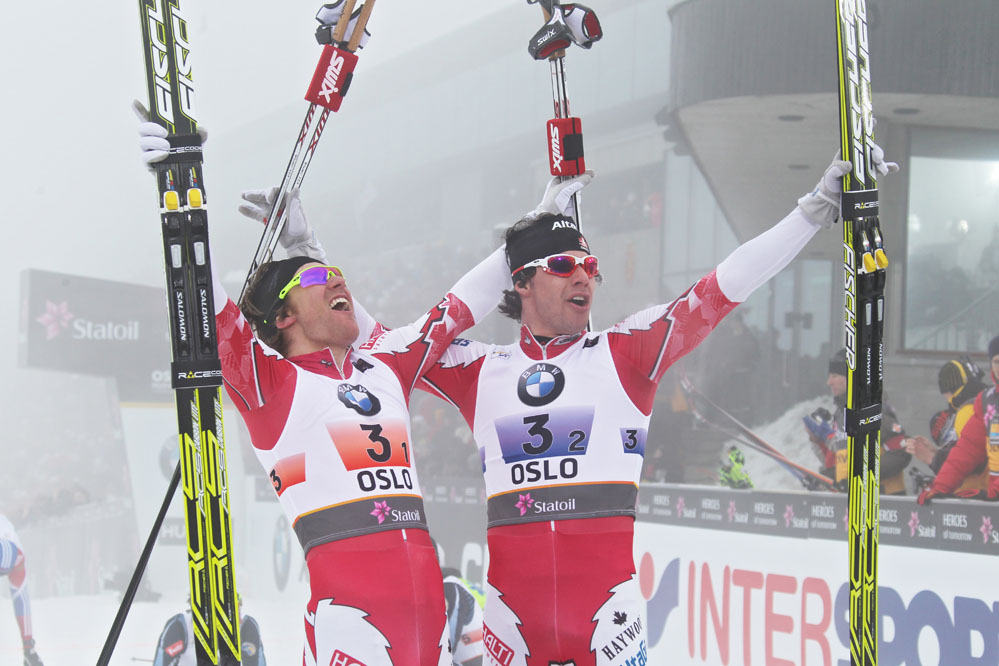
Devon Kershaw (l) and Alex Harvey celebrate their 2011 World Championships gold in Oslo, Norway. (Photo: Fischer/NordicFocus)
His career included three World Cup wins and 14 podiums, and a gold medal at 2011 World Championships with teammate Alex Harvey in the classic team sprint. Kershaw finished the 2011/2012 World Cup season ranked second overall and second in the distance rankings.
When he reflects on those accomplishments, he still has a hard time believing that all happened to him.
“So instead of focusing on being bummed at the situation or a bit frustrated with the state of things in Canadian skiing right now, I have to look back with a smile,” Kershaw said. “I feel just so privileged and grateful to have had the opportunity to be part of a real movement for men’s skiing in Canada.”
Kershaw said he was left with unanswered questions this spring during a transitionary period at Cross Country Canada (CCC). The team’s budget was undetermined, camps were not yet set in stone, and Kershaw said his decision — which he wanted to make by May 1, the start of the new training year — became about energy management.
“Part of managing your energy properly is putting all of your energy and focus into training, and if you’re being pulled with uncertainty or being stressed about uncertainty, that will come back, the World Cup will exploit that,” he said.
According to CCC Chief Executive Officer Shane Pearsall, High Performance Director Thomas Holland had planned to retire this past March, yet has stayed onboard as an advisor until CCC fills the position. Pearsall said the hiring process is still ongoing and will hopefully be wrapped up by next month. He confirmed that CCC has yet to finalize its budget and doesn’t anticipate being able to do so until a government minister signs off on the amount from Own The Podium (OTP), one of its primary funding sources, in July. Pearsall explained that they expect to have a better sense of national-team finances in mid to late June.
Typically, the team’s budget is determined in May, but because of necessary “quad reviews” following the Olympics, which took place before CCC met with OTP, the process was delayed by about a month. Pearsall did not elaborate on how significantly the budget would be decreased from last year, but said, “It’s certainly tighter than last year.”
Kershaw said he needed to pay about $25,000 Canadian dollars in team fees if he wanted to continue racing this year, up from $15,000 last year. That didn’t cover the cost of living, which he figured to be around $55,000 Canadian, for a grand total of $80,000.
“The financial burden is big, and moving forward the financial burden went from big to 100 percent paying for every cost,” Kershaw said. “So all travel, accommodations, everything. … I’ve just been in the sport a long, long time, and from a directional standpoint, I’m not sure we’re moving in a direction that will yield sustainable results at this point in time, but I understand it is difficult when you’re under such financial duress to create a sustainable program. But from a vision standpoint, I think there’s a lot of questions that remain unanswered, and it’s late in April. The fact of the matter is the rest of the world has all of the holes plugged — if they have holes in their boat — because May 1 is the new year of every ski program. And we’re just constantly slow and off the mark with that.”
Budget cuts had been expected as Canada’s World Cup Team missed performance benchmarks throughout last season. The team finished 2017/2018 with just two men scoring World Cup points (top 30) in distance races: Harvey and Kershaw. Two men (Harvey and Julien Locke) scored in World Cup sprints. On the women’s side, Dahria Beatty landed one World Cup sprint top-30 last season, and Cendrine Browne was the top Canadian woman in a distance race with a 27th place for time of day in the last race of the season.
Meanwhile, Alex Harvey led the team with four World Cup podiums, including third overall in the 2018 Tour de Ski, and a top result of fourth place at the 2018 Olympics. He finished his season in fourth in both the Overall and Distance World Cup standings. But Harvey’s results alone weren’t enough to buoy the whole team for another winter.
“Throughout my entire career, it’s almost unfathomable to think that the season ends and that’s the stat line,” Kershaw said of the team’s overall results. “It wasn’t so long ago that we had over 16 World Cup podiums in a season. The truth hurts, as [former Canadian coach] Tor-Arne Hetland once said, but things go in waves and this is the reality that we live in right now.”
Despite the prospect of self-funding, Kershaw didn’t feel pressed into retirement. Several of his teammates have decided to retire as well, including Graeme Killick, Jess Cockney and Knute Johnsgaard, but Kershaw said they weren’t forced, either.
“You can choose to work and you can choose to hustle for money; there are ways to make it,” he said. “No one’s forced into it. I could keep skiing if I wanted to, but I think the stark choice you’re faced with is, maybe perhaps some people are like, I can’t really see a path to international success currently, and that’s what I think is sad…”
‘A dream scenario’
When Kershaw moved to Canmore, Alberta, in 2001 and entered Canada’s elite skiing scene, Cross Country Canada (CCC) was entering a fruitful period. At the 2002 Olympics, Beckie Scott was proclaimed winner of the women’s 10-kilometer pursuit (now called the skiathlon), becoming the first North American woman to win an Olympic gold. At 2005 World Championships, Sara Renner earned a sprint bronze to become the first North American woman to medal at World Championships. Scott and Renner teamed up for silver in the team sprint at the 2006 Olympics in Turin, Italy, where yet another Canadian woman, Chandra Crawford, won the individual skate sprint for Canada’s second-straight gold in as many Winter Olympics. Scott finished that 2005/2006 season ranked second overall in the World Cup, just 16 points behind Norway’s Marit Bjørgen in first.
Devon Kershaw (r) with Graham Nishikawa in 2013. (Photo: Devon Kershaw)
Kershaw made his Olympic debut in 2006.
“Coming into Torino, we were quoted in the newspaper as being like the world’s most anonymous men’s ski team,” he said of the Canadian men’s team that year. “We weren’t really ‘on the map,’ but I’ve just been so grateful and lucky to have such a great group of guys around that really welcomed me in.”
He credited his former roommate and teammate Chris Jeffries as well as other Canadian competitors of his time, including George Grey, Gordon Jewett, Dan Roycroft, Sean Crooks, Dave Nighbor, Phil Widmer, Brent McMurtry, and Graham Nishikawa (who’s still racing), for having a major impact on the formative stages of his career.
“[There were] so many athletes in Canmore that tried hard, wanted it bad, and loved ski racing and training,” Kershaw reflected. “That’s a dream scenario for a young athlete to come into a community like that and be welcomed into that environment.”
Less than a month after the 2006 Olympics, he notched his first World Cup podium by placing third in the Borlänge, Sweden, skate sprint. In doing so, he became the first Canadian male cross-country skier to reach the podium since Pierre Harvey (Alex’s father) in 1988 and the first ever to medal in a World Cup sprint.
“I had no idea who Pierre Harvey was,” Kershaw said of his younger self.
Pierre Harvey had previously won the 1988 Holmenkollen 50 k as well as two other World Cup distance races and the Norwegian Birkebeiner, making him the most successful Canadian male skier before Kershaw.
“He could walk into the room and I would not recognize him,” Kershaw continued. “Even his results, I had heard that he had five World Cup podiums and that seemed pretty cool, but that’s all I knew about him.”
Kershaw’s second World Cup podium came early in the 2006/2007 season in a skate sprint in Munich, Germany. That same day, Crawford — whom he was dating at the time — placed third in the women’s sprint.
Devon Kershaw after being tagged by his Canadian teammate Alex Harvey (l) in the freestyle team sprint at the 2010 Olympics in Vancouver, B.C. They went on to finish fourth.
At his second Olympics in 2010, Kershaw finished fifth in the 50 k classic mass start for the best individual Olympic result for a Canadian male nordic skier. That record stood until Alex Harvey, who burst onto the World Cup scene in 2008, bested it with a fourth place in the 50 k classic at this year’s Olympics in PyeongChang, South Korea.
Kershaw and Harvey also teamed up to place fourth in the freestyle team sprint at the 2010 Olympics.
Kershaw’s first World Cup win came in a skate sprint during the 2011 Tour de Ski. He finished that Tour in seventh, and the next year, came back to place fourth overall in the 2012 Tour de Ski (TdS). Kershaw started all 12 editions of the TdS, a record he shares with France’s Jean-Marc Gaillard.
Harvey scored his first individual World Cup podium in a 50 k classic in 2009 and won his first World Cup race (a 3.3 k freestyle prologue) at the TdS in 2012.
“Then next thing you know, Alex and I are sharing a podium on some World Cups,” Kershaw reminisced. “Two Canadians on one podium in the World Cup, like, really? And then you win World Championships and I’m on the overall World Cup podium, and then next thing you know, Alex has been on the overall World Cup podium a few times and also now 50 k world champion. It’s crazy. It’s insane. From nothing. From no results. The journey has just been amazing. … I never would’ve thought Canada would, I mean, how could you? We had Pierre Harvey and that’s it in, like, a hundred years of international ass-kicking.”
Kershaw credited his initial World Cup breakthrough as a 23-year-old skier in Borlänge to Dave Wood, Canada’s national-team coach at the time.
“I came into a team with a coach that you could call at midnight. He’d do anything for you,” he said of Wood. “There was no way I would’ve stepped onto the podium in 2006 without him, and Mike Cavaliere, too, my first-year senior, Mike was my coach. We had staff that was just committed to the core for the cause and I’m incredibly grateful for that.”
‘A hell of a season’
Canadian head coach Justin Wadsworth (r) giving splits to Devon Kershaw at 2012 World Cup Finals in Falun, Sweden.
Of his coaches, Kershaw gave special credit to Justin Wadsworth. A three-time U.S. Olympic cross-country skier who became Canada’s head coach in the spring of 2010, Wadsworth coached Kershaw for five seasons, and the two developed a close friendship.
“When Justin came into the national team, the level of professionalism and excitement and freshness that he brought … I don’t know if you call it luck or happenstance or just the right place, right time,” Kershaw reflected, alluding to his 2011 World Championships gold with Harvey and his 2012 Overall and Distance World Cup podiums. “Justin’s best results as a coach were me and my best results as an athlete were when I was coached by Justin. Talk about an amazing relationship there.”
“The main thing that I really appreciated with Devon, and I think he would say the same thing about me, is that we could be honest with each other and talk about hard things and enjoy the good times when we had them,” Wadsworth said on the phone last week. “… It’s cliche, but when I was talking to Devon the other day about his retirement, it’s not about the medals or the performances or whatever, it’s about your times together on the road.”
One of Kershaw’s biggest moments came at those 2011 World Championships in Oslo, Norway, where he and Harvey beat out Norway’s Petter Northug and Ola Vigen Hattestad by 0.2 seconds for gold on the Norwegians’ home turf. They had done so after Kershaw lost one of his skis early in the race, Wadsworth pointed out.
“His ski fully came off and he had to put it back on and get back into the race,” Wadsworth said. “Just the whole day was pretty incredible. That was a great, great opportunity for us, and the guys cashed in.”
Devon Kershaw (l) and Alex Harvey with their World Championship gold medals at the 2011 World Championships in Oslo, Norway.
In a difficult-yet-strategic move to conserve for that race, Kershaw and Harvey both sat out the 15 k classic the day before.
“With anybody else running the ship, there’s no way I would’ve trusted that [decision],” Kershaw said of Wadsworth’s call. “But I trusted Justin’s leadership and we went all-in, and the next thing you know we won World Championships. I mean, are you kidding me? How can you get a better start to the next quadrennial? And Justin as a first-year head coach of a national team, that’s gotta go down as maybe the best season ever for a first-year North American coach of a national-team program.”
He and Wadsworth reiterated the crucial foundation that Wood had laid.
“Dave Wood had done a really good job with the athletes leading into that period, mainly focused on building a big base and doing a lot of hours and also doing a lot of time at altitude,” Wadsworth explained. “And when I took over the position, I saw that both Alex and Devon were really primed and had a really good response rate to altitude, and all we had to do was fine tune a little bit of strength training and intensity. I was really excited to work with both those athletes and saw that they had a lot of potential.”
For Kershaw, Wadsworth’s “American swagger … was magic for me,” he said. During the 2011/2012 season alone, he stood on the podium 10 times, with four top-three finishes in seven races at the 2012 Tour de Ski.
“It was a hell of a season for me,” Kershaw said.
‘Best sand-digger ever’
He went on to compete at two more World Championships and two more Olympics. This past season, Kershaw finished in the top 30 in eight World Cup distance races, with a top result of 19th in the 30 k skiathlon in Lillehammer, Norway. While struggling with lung issues, he finished 26th in the 50 k classic at the PyeongChang Olympics.
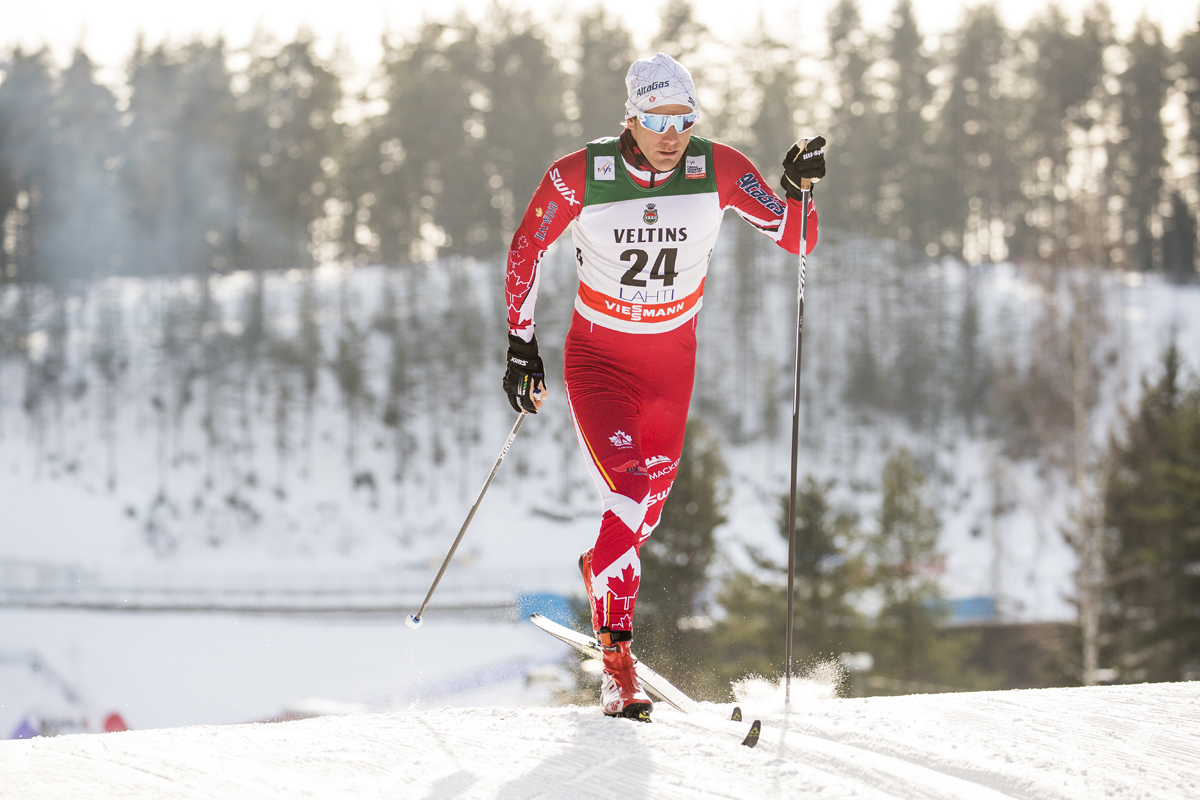
Devon Kershaw racing to 25th in the World Cup 15 k classic this past March in Lahti, Finland. (Photo: Fischer/NordicFocus)
“We worked to get that under control and it was manageable but it never felt good like it felt prior to 2015,” Kershaw said his health over the last three seasons. “In PyeongChang, it was a calamity of bad luck. When we got there it was minus 20 [Celsius], and this makes me sound so soft, because I’m from northern Ontario so you’d think I’d know, but it was really cold. I did some intervals and it aggravated my lungs and it was super windy and dirty and a lot of sand blowing around, and that really flared up my asthma to the point that I was wheezing badly.”
His breathing troubles also affected his sleeping and took most of the two-week Olympics to manage. At one point, he had a chest X-ray to make sure it wasn’t pneumonia.
“It was sporting asthma,” he said. “… It took all the way to the 50 k to kind of get it 70 percent.”
While he noted he was left wanting more from a performance standpoint at both his final Olympics and in his final season, Kershaw also acknowledged that he’s his biggest critic.
“That’s been probably the biggest detriment to my entire career; I’m the best sand-digger ever,” he said. “I am disappointed in the sense that I work really hard and I train hard and I prepare well, and it didn’t go exactly as planned. … When you’ve competed in the top 10 for as many years as I have and on the podium, of course that becomes your bar that you hope to achieve, but at the same time … when you’re in the top 30 in the results page, you’re in the race at least. And I’m proud of the fact that in almost all classic races, not every, but most, I was in the top 30 and ‘in the race’.
“Am I satisfied? In my life I’ll probably never be satisfied, that’s just how it goes,” he added with a laugh. “But am I somewhat proud of maintaining a fairly competitive level? Yeah, absolutely.”
Wadsworth reflected that Kershaw was one of the best athletes he had ever seen, even “physiologically as good as Alex [Harvey]” at the peak of his career.
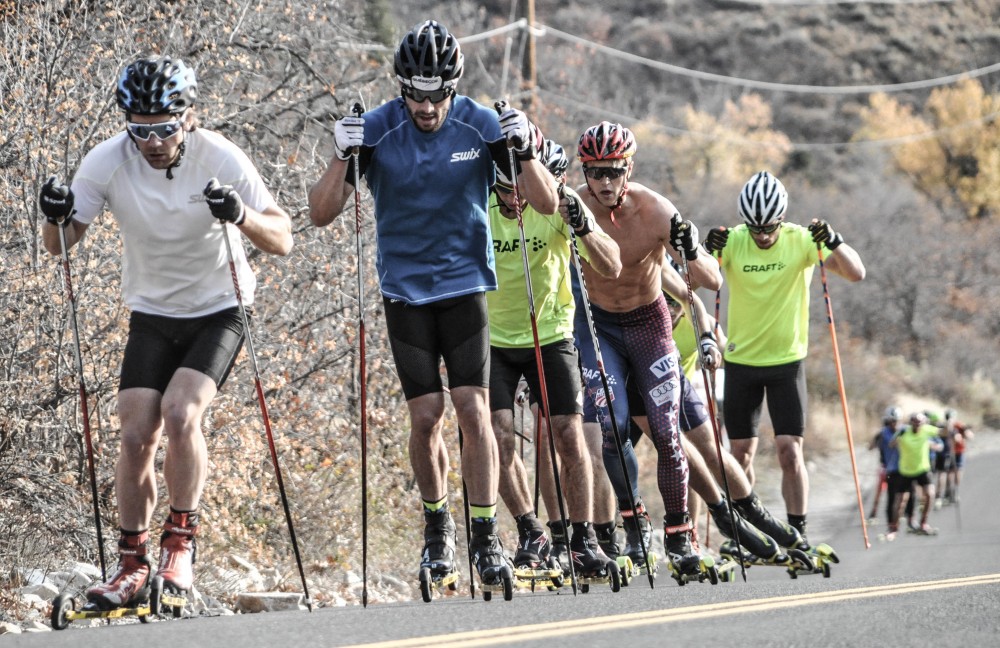
Left to right: Canada’s Devon Kershaw leads his teammate Alex Harvey and U.S. Ski Team members Noah Hoffman, Erik Bjornsen and Simi Hamilton during a Level 3 interval skate session up Snake Creek Canyon in Midway, Utah, during their respective teams’ 2016 training camps in Park City, Utah. (Photo: Matt Whitcomb)
“Devon’s a very intelligent person and sometimes he might’ve overthought things and lacked in confidence, and as a coach that’s really frustrating to see because you know how good they are physically,” Wadsworth said. “And when he was on mentally, too, in training, when he was at his very best, he had total confidence and could destroy anybody in any workout.”
He recalled a hill-bounding workout with the Norwegian team in which Kershaw was literally leaps and bounds ahead of everybody else — even Martin Johnsrud Sundby and Russia’s Ilia Chernousov, who joined the training session.
“He was just shelling everybody,” Wadsworth said. “So when Devon was at his best like that and mentally confident and relaxed, he was a real force of nature. Unfortunately that didn’t always translate into the racing season, but in 2012 he put it all together and had a tremendous year. … If he had the confidence the whole time, he would’ve been almost unbeatable, in my opinion, but it takes the whole package all the time, and he was among the greats there for a while.”
‘Younger, faster, better dog’
And then there was Harvey, another one Kershaw’s of his best friends and longtime roommates.
“I’ve spent more nights in a room with him than my wife or any girlfriend I’ve had,” Kershaw joked. “… He was eager to learn, he chased me for years, he was always a hard worker, too. He trained really hard, he believed in himself, and I still am in total awe of that. I’ve never met anybody as confident as him. It’s too bad that didn’t rub off on me, but that’s been great to be around.”
He likened Harvey’s addition to the team as a family adopting a puppy.
“You know when your parents get a puppy because your dog is 10 years old? He’s kind of slowing down a little bit and then you see that old dog get fired up and run again and jump around and play; that’s me,” Kershaw said. “And I’m so grateful that my owners got a younger, faster, better dog to hang out with because it was so inspiring.”
Several times over the last few years, Kershaw has said that witnessing Harvey make Canadian history has been one of his biggest reasons for staying in the sport.
“He, for sure, has kept me in this probably longer than I should’ve,” Kershaw said. “I just love traveling with him and seeing what he can accomplish and training with him and seeing that professionalism.
“There’s no question he’s the best Canadian skier ever, that’s not even close,” he added. “… I just feel so honored that I got the chance to see it all happen, from his last-year junior when he did his first World Cups and then all the way though I’ve been with him.”
The Canadian men’s relay after placing third in January 2017 in Ulricehamn, Sweden, for Canada’s best-ever World Cup result in the 4 x 7.5 k relay. From left to right: Lenny Valjas, Alex Harvey, Knute Johnsgaard, and Devon Kershaw. (Photo: Salomon/NordicFocus)
In an email, Harvey explained that he and Kershaw first met in the fall of 2005 at a training camp at Sovereign Lake, British Columbia. Harvey was on the junior team and Kershaw a senior, but the whole team stayed at the same hotel.
One morning, Kershaw accidentally took Harvey’s poles from the hotel. Harvey had to track him down on the ski trails to get them back.
“That was the first time I talked to him and to me it’s just perfect because that’s so Devon,” Harvey wrote.
Later that season on March 7, 2006, Kershaw made history with his first podium. That same day, Harvey won his first national title in the 10 k classic at Canada’s senior national championships as a 17-year-old junior.
“I guess our friendship was meant to be before we even knew it!” Harvey wrote.
When the two became teammates, Harvey immediately took to imitating Kershaw, both in training and racing.
“He took me under his wings and he has a big part in the athlete I became today,” Harvey wrote, likening Kershaw to a big brother. “I feel very privileged to have spent all that time with him. I think we became such close friends because we are both very driven athletes and we don’t accept any compromise. We’re both huge fans of our sport, ‘nor-dorks’, so we also love to talk about everything from altitude training to who is seeing who on Tour.”
Kershaw’s decision to retire didn’t surprise Harvey.
“I think it’s a mix of a few things,” Harvey wrote. “… Probably this biggest reason, he has a little girl at home. I know this winter was extremely hard on him. Not seeing Asta Isabel was pure torture, I think I would have done the exact same if I was him.
“I will miss a lot of things about Devon,” he added. “He’s always there to give good advice about everything and anything. He knows so much about all that is going on in the world, probably the most well-read person I know. He’s kinda my news source. I’m still amazed by how indecisive one can be. This brought a lot of laughter throughout the years. I have so many memories from the last 10 years with him. Seeing him dominate the World in 2012 was just amazing but also very eye-opening for me. He raised the bar for all North American skiers that year and I’m very thankful for it.
“We both lived great emotions in high accomplishments and huge disappointments. I’d like to think I helped him get through these upsets and I can say he definitively helped me get through mine. A page turns in the life of Devon Kershaw but knowing the man, I’m not worried about what’s gonna come next.”
Without Kershaw, Killick, Cockney, and Johnsgaard on the men’s team, Harvey acknowledged that next winter will be “very different” for him on the World Cup.
“All these guys are calling it a career and I’m super proud of what all my friends accomplished,” he wrote. “I’m excited to try to help the next generation step it up and fill the shoes of the previous generation. … Also, after 10 years on Tour I’ve made some friends on other teams so I’m not too worried. I’m just excited to step into a bit of a mentor role for our next generation.”
Onto the Next
As for Kershaw, he didn’t rule out coaching future generations of Canadian skiers, but he said he was focused on getting an education first. In just over a week, he’ll start a course that requires 20 hours of classes a week — all in Norwegian — for what he anticipates will take six months. The course is essentially an advanced version of Norwegian as a second language, and foreigners must pass it to pursue a degree in Norway.
After that, Kershaw plans to apply to universities “and hopefully study forever,” he said with a laugh. “Not forever, but study, and I want to stay involved in skiing in any way I can and I want to help the next generation get better.
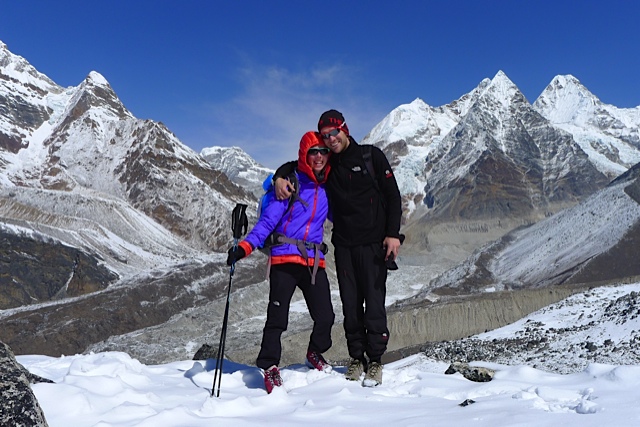
Kristin Størmer Steira (l) and Devon Kershaw during a day hike on one of their acclimatization days. The couple got engaged in 2014 after summiting Mera Peak during a three-week trek in Nepal’s Himalayas. (Photo: Devon Kershaw)
“First things first, I have to get my Norwegian at a level where I can sit through a lecture and write an essay at a decently good level, at least good enough that my wife doesn’t have to rewrite it, she can just correct it,” he explained.
Asked what he’d like to study, Kershaw said medicine, specifically orthopedic surgery, has always intrigued him. (As a junior skier, Kershaw took undergraduate classes at the University of Calgary until 2006, but those credits have since expired.)
“But now I’m 35 and I’m going to have to do all of this in my third language,” he acknowledged. “So for now, I’d say that that’s still my first choice and I’m exploring what it would take.”
If not medicine, he’d like to pursue a degree in “some kind of science physiology, and then in a totally shifted way, if I have a panic attack and be like, ‘Science is too hard after ski racing forever,’ then I am interested in economics and economic theory and business to some degree…”
Regardless of which path he choses, he’ll be doing it in Norway, Kershaw said.
“I don’t mind the challenge. … It’s intimidating in a way, but it’s also really exciting,” he said. “Kristin’s family [who lives in Lillehammer] is just so fantastic and to see how happy my daughter is here, to have her family, to have family around her and everything for the short term, and I hope to be educated in Norway.”
Asked if he’ll jump into any ski races this season, Kershaw was quick to respond, “No.” But he will continue skiing. The beauty of the sport and the struggle, as he put it, is what’s kept him in it so long.
“Imagine just having a singleness, a purpose, a goal that’s just there in your face and then you get to wake up every day and do the things you absolutely love to do,” he said. “… I adore cross-country skiing. I just think it’s such a peaceful, beautiful exercise, and the technique and the flow of it all. … You’re just skiing through the woods peacefully, gliding over snow, over all the terrain you can cover. It’s a beautiful, zen-like endeavor, and I think that’s what’s kept me in it this long. And the people, the Canadian ski community, the world ski community, really. I’ve met so many inspiring people and beautiful people and worked with a lot of absolute experts and I’ve had brilliant teammates and brilliant coaches.”
And because of skiing, he met his wife and started a family in Norway.
“I have a daughter with a woman that I love and respect and am in total awe of every day of my life and without ski racing there’s no way that would’ve ever come to fruition,” he said. “There’s the biggest gift right there, as cliche and Hallmark as that sounds, it’s true.”
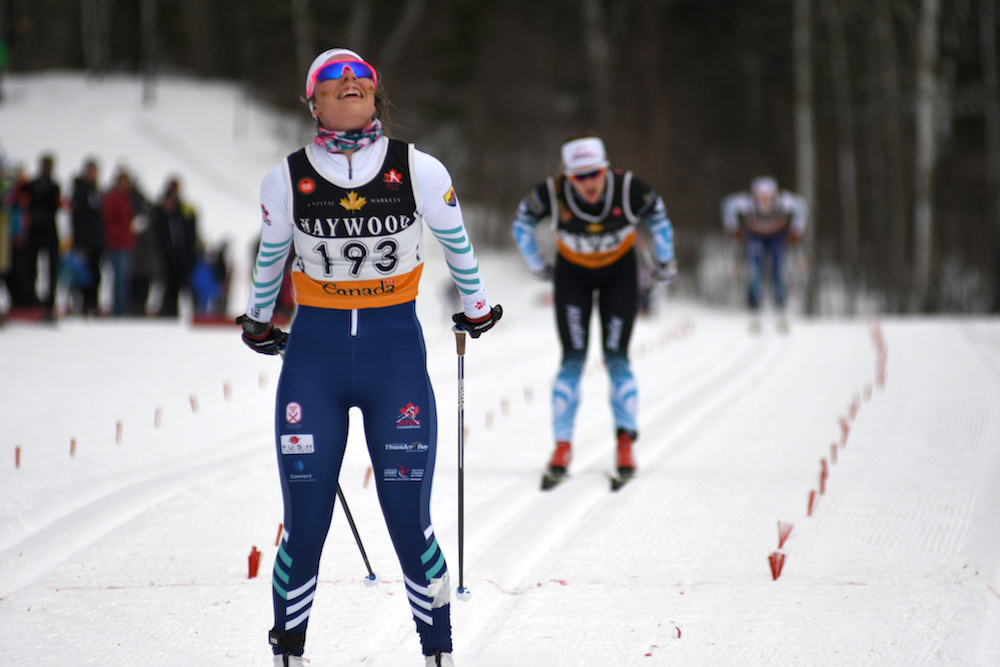
Katherine-Stewart Jones (193) of NTDC Thunder Bay soaks up her win in the women’s 30 k classic mass start on Saturday at 2018 Canadian Ski Nationals in Thunder Bay, Ontario, just 2.3 seconds ahead of Annika Hicks (AWCA) in second. (Photo: Doug Stephen)
(Note: This article has been corrected to reflect that Evan Palmer-Charrette won his second national title last weekend.)
2018 Canadian Ski Nationals (Thunder Bay, Ontario): 30/50 k classic mass starts
On the final day of racing at Canadian Ski Nationals in Thunder Bay, two National Team Development Centre (NTDC) Thunder Bay athletes topped the podium on their local trails at the Lappe Nordic Centre on Saturday. Katherine Stewart-Jones and Evan Palmer-Charrette won national titles in the women’s 30-kilometer and men’s 50 k classic mass starts, respectively.
Stewart-Jones, 22, who is also a Canadian National U25 Team member, won the women’s 30 k for her first national title by 2.3 seconds over Annika Hicks of the Alberta World Cup Academy (AWCA) with a time of 1:33:50.7 hours. NTDC Thunder Bay had two women on the podium with Alannah Maclean finishing third, 10.2 seconds behind her teammate. Stewart-Jones had previously placed second in the freestyle sprint last Wednesday at nationals.
“Am I happy or am I happy????” Stewart-Jones, 22, wrote on Instagram following her win “Beyond stoked to finally get a National Champs Title in the 30km”
Stewart-Jones also started the week with a win in the classic team sprint with Nakkertok club teammate Zoë Williams on March 10.
Also in the top 10 of Saturday’s 30 k, Olivia Bouffard-Nesbitt of Rocky Mountain Racers (RMR) raced to fourth (+18.3), Frédérique Vézina of the Pierre-Harvey National Training Centre (CNEPH) placed fifth (+19.2), American Caitlin Gregg finished sixth (+1:25.5), Sadie White (NTDC Thunder Bay) was seventh (+2:48.3), Williams (Nakkertok) eighth (+3:40.4), Laurence Dumais (AWCA) ninth (+4:30.4), and Katie Weaver (Hollyburn) 10th (+6:47.7).
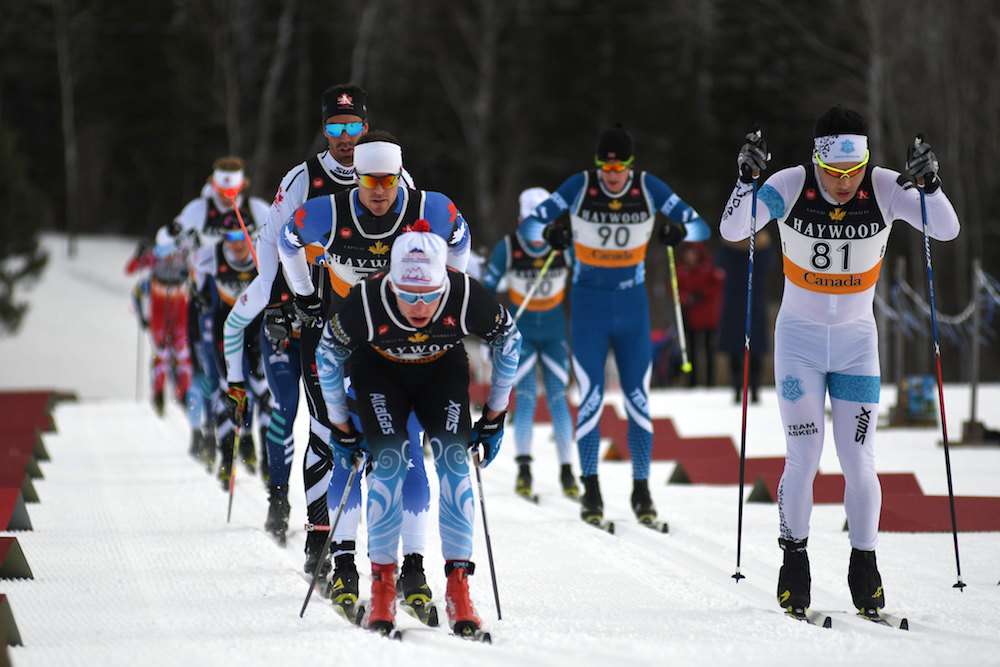
Jack Carlyle (l) of the AWCA and Ryan Jackson (81) of BXC leading the men’s field in Saturday’s 50 k classic mass start on the last day of 2018 Canadian Ski Nationals in Thunder Bay, Ontario. (Photo: Doug Stephen)
In the men’s 50 k, Palmer-Charrette, 23, who grew up racing at Lappe Nordic, tallied his second-straight podium (after placing third in the skate sprint) with a win in 2:16:44.1. The national title was his second after Palmer-Charrette was the top Canadian in last year’s classic sprint at nationals in Canmore. On Saturday, he finished 9.8 seconds ahead of Scott Hill of Barrie Cross Country (BXC) in second place, and BXC had two on the podium with Ryan Jackson in third (+14.6).
The top three separated from the rest of the pack, with Julian Smith (NTDC Thunder Bay) finishing 2:40.1 back in fourth, Michael Somppi (AWCA) following in fifth (+2:45.2), then Bob Thompson (NTDC Thunder Bay) in seventh (+2:57.2), Andy Shields (Lappe Nordic) in seventh (+3:13.6), Alexis Dumas (CNEPH) in eighth (+3:20.6), Jack Carlyle (AWCA) in ninth (+3:21.9) and Jess Cockney (AWCA/Canadian World Cup Team) in 10th (+5:20.5).
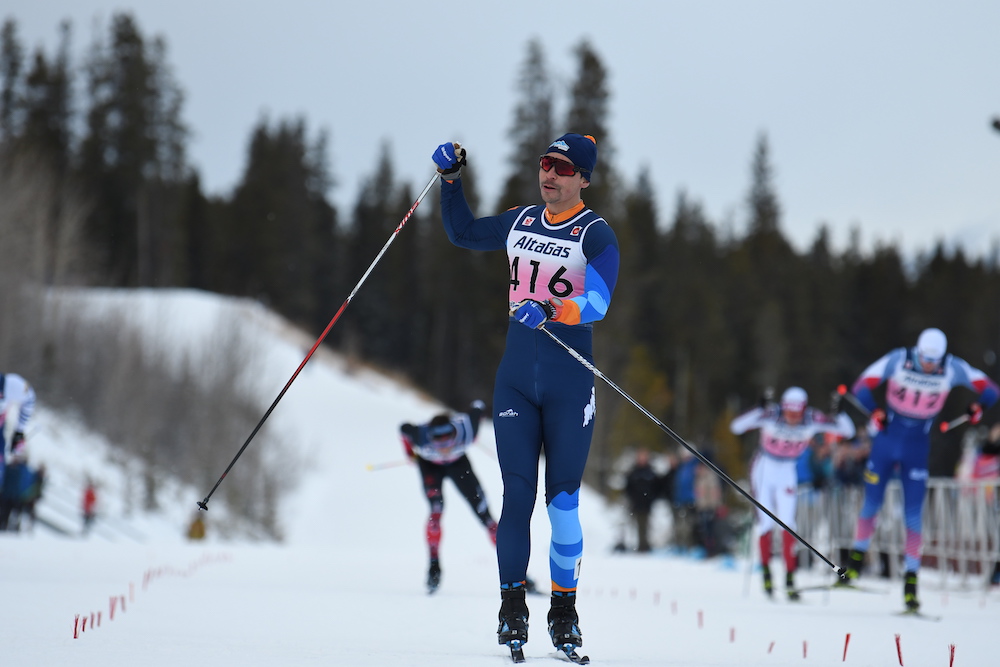
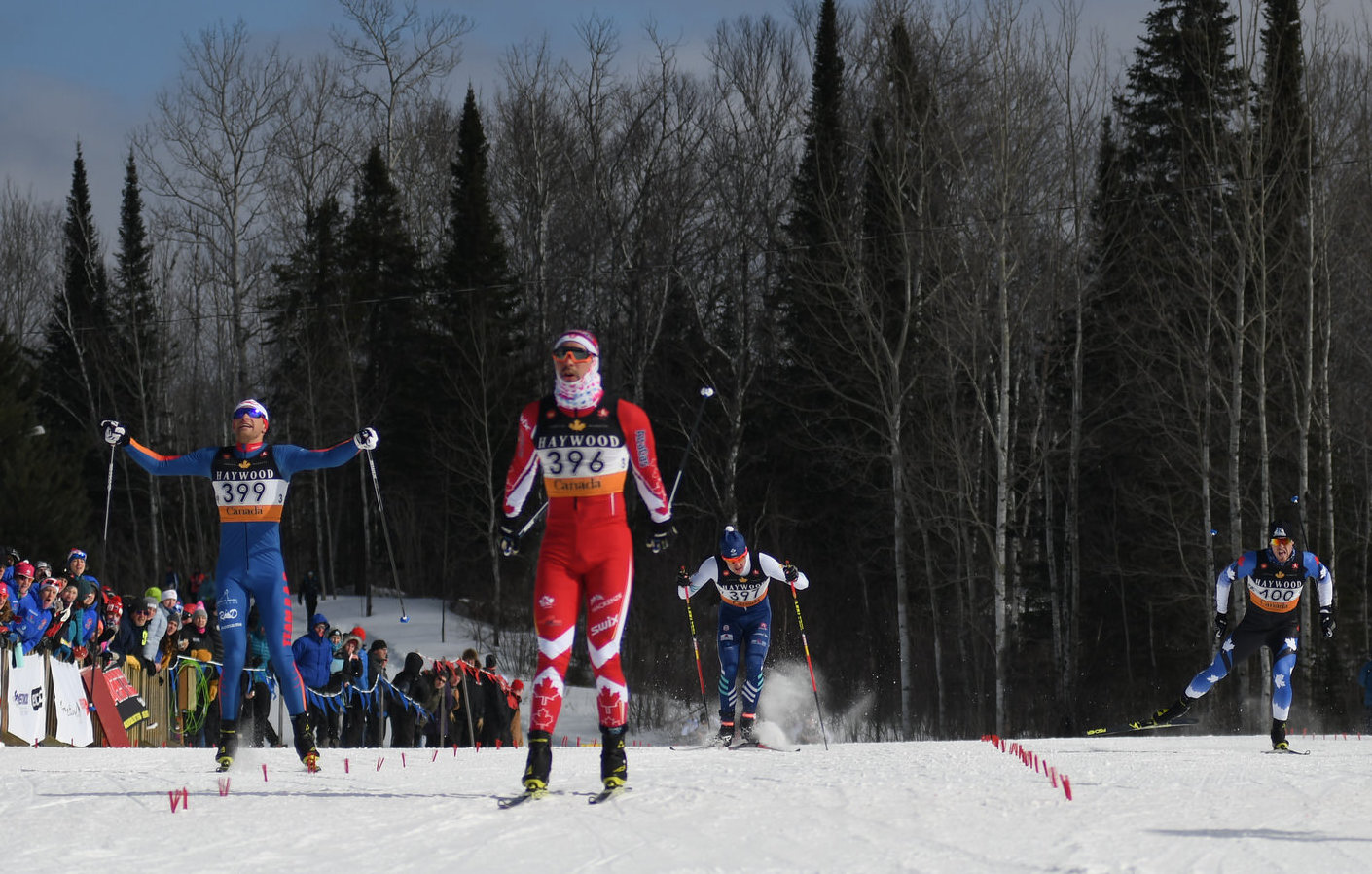
Jess Cockney (396) after winning the men’s 15 k freestyle pursuit at 2018 Canadian Ski Nationals, ahead of Ty Godfrey (l), Michael Somppi (r) and Evan Palmer-Charrette (second from r) in Thunder Bay, Ontario. (Photo: Doug Stephen)
Canadian Ski Nationals (Thunder Bay, Ontario): Freestyle pursuits and sprints
Ski Nationals continued Tuesday and Wednesday at Lappe Nordic in Thunder Bay, with 10- and 15-kilometer freestyle pursuits (based on Sunday’s 5/10 k classic interval starts) followed by sprints.
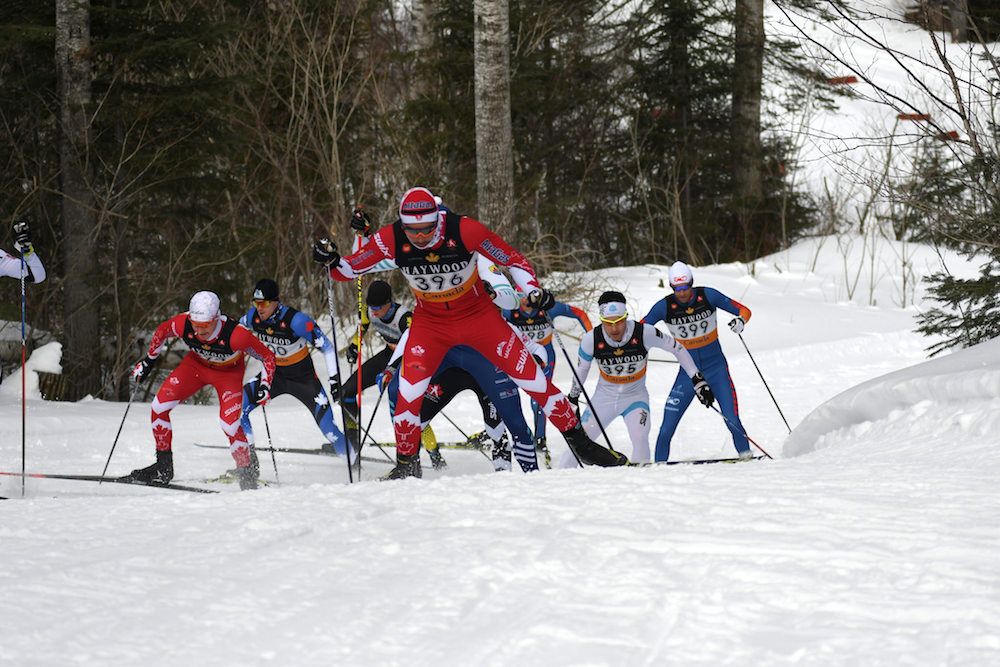
Jess Cockney (396) leading the men’s 15 k freestyle pursuit on Tuesday at 2018 Canadian Ski Nationals in Thunder Bay, Ontario. He went on to win the pursuit as well as the freestyle sprint the next day. (Photo: Doug Stephen)
On Tuesday, Jess Cockney of the Canadian World Cup Team and Alberta World Cup Academy (AWCA) raced to first in the men’s 15 k freestyle pursuit, up from sixth after the 10 k classic. His cumulative time for the two races was 1:04:06.7 hours, just 1.2 seconds ahead of Ty Godfrey of Team R.A.D. in second. (Godfrey previously placed ninth in the 10 k classic.) Michael Somppi, who grew up skiing with Lappe Nordic and now trains with the AWCA, completed the podium in third, 2 seconds behind Cockney, after placing 10th in the classic race.
Just behind Somppi, another local skier Evan Palmer-Charrette, of Lappe Nordic and the National Team Development Centre (NTDC) Thunder Bay, placed fourth in the pursuit (+2.8). Antoine Cyr and Alexis Dumas, both of the Pierre-Harvey National Training Centre (CNEPH), finished together in fifth (+11.5) and sixth (+11.6), respectively, ahead of Knute Johnsgaard (World Cup Team) in seventh (+13.4), Scott Hill of Barrie Cross Country (BXC) in eighth (+16.3), Reed Godfrey (Team R.A.D.) in ninth (+31.8), and Ryan Jackson (BXC) in 10th (+38.9).
The fastest 15 k skate time of the day was clocked by Somppi in 36:54.5. Ty Godfrey had the second fastest time of day, just 0.2 seconds back, while Cockney’s freestyle time ranked third fastest (+4.9).
Olivia Bouffard-Nesbitt (Rocky Mountain Racers) racing to second overall (first Canadian) in the women’s 10 k freestyle pursuit on Tuesday for her second national title of the week at 2018 Canadian Ski Nationals in Thunder Bay, Ontario. (Photo: Doug Stephen)
American Caitlin Gregg, of Central Cross Country (CXC), Team Gregg and Loppet Nordic Racing, won the women’s 10 k freestyle pursuit by more than a minute in 43:12.4, after placing second in the 5 k classic. The winner of Sunday’s classic race, Olivia Bouffard-Nesbitt of Rocky Mountain Racers (RMR) scored her second-straight title as the first Canadian in the pursuit, placing second overall, 1:03.4 behind Gregg. Annika Hicks (AWCA) was the second Canadian in third overall (+1:16.3), up from fifth in the classic race.
Gregg clocked the fastest 10 k skate time in 27:51.6, while Vézina was second fastest on the day, 1:06.5 back. Hicks had the third-fastest time, 1:07.3 back from Gregg.
On Wednesday, Cockney racked up his second-straight national title with a victory in the 1.4 k freestyle sprint final. Cockney edged Andy Shields (Lappe Nordic) by 0.83 seconds for the win in 2:39.87. Just three-hundredths of a second behind Shields, Palmer-Charrette reached the podium in third (+0.86), Somppi followed in fourth (+2.14), Julian Smith (NTDC Thunder Bay/National U25 Team) finished fifth (+4.3) and Sebastien Boehmler-Dandurand (Stefan Kuhn HP Team) placed sixth (+11.81).
Shields won the qualifier to start the day in 2:44.54, while Cockney was the second-fastest men’s qualifier, 1.39 seconds off Shields’s time. Shields went on to win his quarterfinal and place second in the first semifinal, while Cockney was second to Smith in both the fourth quarterfinal and second semifinal.
Maya MacIsaac-Jones (l) and Katherine Stewart-Jones (r) go head to head for the win in the women’s freestyle sprint final on Wednesday at 2018 Canadian Ski Nationals in Thunder Bay, Ontario. MacIsaac-Jones won it by 0.05 seconds. (Photo: Doug Stephen)
MacIsaac-Jones won the women’s skate-sprint final in 3:06:68, five-hundredths of a second ahead of Stewart-Jones in second. In a race for third, Maclean took it (+4.82), ahead of Gregg in fourth (+5.01). Hicks placed fifth (+7.22) and Zoë Williams (Nakkertok) was sixth (+9.12).
MacIsaac-Jones topped the women’s qualifier by 5.78 seconds in 3:12.87. Mathilde Petitjean of Club Nordique Mont Sainte-Anne (C.N.M.S.A.) qualified second, and Maclean was 6.42 seconds back in third.
MacIsaac-Jones then won the first quarterfinal and placed second to Stewart-Jones in the first semifinal. Stewart-Jones finished second to Bouffard-Nesbitt in the second quarterfinal, and Maclean won the second semifinal over Gregg, after finishing second to Gregg in the fifth quarterfinal.
Nationals conclude with 30/50 k classic mass starts on Saturday.
Patrick Stewart-Jones (l), skiing for his club team Nakkertok, and Scott Hill (r) of Barrie Cross Country (BXC) going head to head in the men’s classic team sprint on Saturday at Canadian Ski Nationals in Thunder Bay, Ontario. Nakkertok won and BXC placed second. (Photo: Doug Stephen)
Canadian Ski Nationals (Thunder Bay, Ontario): Team sprints + 5/10 k classic
Canada’s 2018 Ski Nationals opened this past weekend at Lappe Nordic in Thunder Bay, Ontario, with classic team sprints on Saturday followed by 5- and 10-kilometer classic interval starts on Sunday.
Nakkertok topped the podium in both the open men’s and women’s team sprints. In the men’s final, Nakkertok’s Dominique Moncion-Groulx and Patrick Stewart-Jones won by 1.95 seconds over Barrie Cross Country (BXC) in 14:50.79. BXC’s Ryan Jackson and Scott Hill teamed up for second place, and Skibec’s Alexis Morin and Antoine Brand raced to third (+2.57).
Katherine Stewart-Jones (22), skiing for her club team Nakkertok, while leading Annika Richardson (Hollyburn Ski Club) and Mathilde Petitjean (r) of C.N.M.S.A. during the women’s classic team sprint at 2018 Canadian Ski Nationals in Thunder Bay, Ontario. (Photo: Doug Stephen)
The Stewart-Jones family was also a big winner on Saturday, with Nakkertok’s Zoë Williams and Katherine Stewart-Jones (Patrick’s sister) racing to first in the women’s final in 13:04.72. They finished 2.37 seconds ahead of Katie Weaver and Annika Richardson of the Hollyburn Ski Club in second place, and Marie Corriveau and Mathilde Petitjean of Club Nordique Mont-Sainte-Anne (C.N.M.S.A.) raced to third (+7.42).
On Day 2 and the first official day of Canadian Ski Nationals, Hill (BXC) took his second-straight win of the weekend, topping the men’s 10 k classic with a time of 26:45.1 for his first senior national title. He finished 7.2 seconds faster than Alexis Dumas, of the Pierre-Harvey National Training Centre (CNEPH) in second, and an early race leader, Knute Johnsgaard of the Canadian World Cup Team, placed third (+12.0)
Johnsgaard clocked the fastest split at the race’s halfway point, while Hill’s 5 k time was almost 10 seconds slower. But over the final 5 k, Hill’s lap time was nearly 22 seconds faster than Johnsgaard’s. Dumas skied a consistent race, with the fourth-fastest first lap and second-fastest second lap.
Knute Johnsgaard (Canadian World Cup Team) racing to third in the men’s 10 k classic on Sunday at Canadian Ski Nationals in Thunder Bay, Ontario. (Photo: Doug Stephen)
Jackson (BXC) finished fourth (+14.7), and Jess Cockney of the Alberta World Cup Academy (AWCA) and Canadian World Cup Team placed fifth (+22.2). Leading the National Team Development Centre (NTDC) Thunder Bay on its home trails was Evan Palmer-Charrette in sixth (+24.8), and Lappe Nordic’s Michael Somppi (AWCA) placed seventh (+29.1). Gareth Williams of Telemark Nordic and the Canadian U25 Team finished eighth (+39.5), American Brian Gregg (CXC/Team Gregg/Loppet Nordic Racing) was ninth (+44.7), and Jack Carlyle (AWCA) 10th (+49.5).
Olivia Bouffard-Nesbitt of Rocky Mountain Racers (RMR) collected her first senior national title with a 13.3-second victory in the women’s 5 k classic. She finished in 15:07.5, ahead of American Caitlin Gregg (CXC/Team Gregg/LNR) in second, while Katherine Stewart-Jones (NTDC Thunder Bay) was the second Canadian and third overall (+17.9).
NTDC Thunder Bay had two in the top four with Alannah Maclean in fourth (+19.8). Annika Hicks (AWCA) followed in fifth (+22.2), Frédérique Vézina (CNEPH) was sixth (+30.8), Sophie Carrier-Laforte (Skinouk) seventh (+33.0), Maya MacIsaac-Jones (RMR/Canadian U25 Team) eighth (+37.4), Laura Leclair (CNEPH) ninth (+58.1), and Williams (Nakkertok) 10th (+1:07.2).
Nationals continue Tuesday with 10/15 k freestyle pursuits, followed by skate sprints on Wednesday and 30/50 k classic mass starts on Saturday.
Canada’s Len Valjas after earning the first lucky loser spot for the semifinals in the men’s 1.4-kilometer classic sprint at the 2018 Olympics in PyeongChang, South Korea. (Photo: FlyingPointRoad)
PYEONGCHANG, South Korea — Flashback to pre-Pyeongchang.
In the weeks leading up to the 2017 World Championships in Lahti, Finland, Canadian Len Valjas sustained an injury to his back during a gym workout in Davos. He traveled to Finland, unsure if the incident would prevent him from racing at world champs. Eventually, he started both the men’s individual and team sprint for Canada.
But his back, and subsequently his breathing, never quite fully recovered for the event.
The Canadian continued to work at rehabilitating his back through the spring and summer. In the fall, however, he experienced relapse. For the most part, leading up to that point had been able to work through any discomfort. A tweak in November left him turning to various medical tests and MRIs to see what went wrong. Eventually, the issue boiled down to his thoracic spine.
“It just feels like there is a rubber band around my chest,” Valjas added after the Seefeld sprint. “When it’s flared up and tight it just takes longer to take a deep breath. I honestly can’t go any higher than [Zone] 3 and my body can’t go on any slower breathing.”
Canada’s Len Valjas (26) racing during the second semifinal of the men’s 1.4-kilometer classic sprint at the 2018 Olympics in PyeongChang, South Korea. (Photo: FlyingPointRoad)
In the Seefeld sprint, Valjas ended the day in 40th. After a cooldown, he returned to the team’s hotel and began his two-week training countdown for the Pyeongchang individual classic sprint, one of his main targets at the 2018 Olympic Winter Games.
When the morning of the men’s 1.4-kilometer classic sprint arrived on Tuesday, Valjas was still experiencing pain in his back.
“I woke up and I was having trouble breathing, the rib wasn’t moving well,” Valjas told FasterSkier in PyeongChang on Tuesday.
“The last month leading up to this, I’d train a little bit, push it too far, then have a little setback,” he added.
Then something popped. Literally. After a morning run on Tuesday prior to the qualification rounds, the Canadian took a moment to lay on a foam roller.
“I don’t know what moved, popped, but I just lay there for five minutes, kind of arching my back and I stood up and I could breathe,” Valjas explained. “I try to not lie on my back like that because I could really piss it off — any time you’re lying on something kind of sharp with a broken back, it might not totally help — but it’s the only reason I was able to ski today.”
While his Canadian teammate Alex Harvey did not advance past the qualifying round (finishing the day in 32nd, 0.26 seconds away from qualifying and 9.41 off of the fastest qualification time, which was set by Finland’s Ristomatti Hakola in 3:08.54), Valjas advanced to the heats in 26th (+8.57).
Slotted in the fourth quarterfinal, the pressure was on for the 29-year-old Valjas if he wished to advance to the semifinal, either automatically or as a lucky loser. Italy’s Federico Pellegrino had set a fast pace in Quarterfinal 2 and incidentally, the second heat still held the lucky loser time as Valjas’s quarterfinal lined up at the start.
Already qualified for the semis were the likes of Norway’s Johannes Høsflot Klæbo, Sweden’s Teodor Peterson, Norway’s Pål Golberg, Finland’s Hakola and Russia’s Alexander Bolshunov.
Names to take note of at the start of Valjas’s heat included Norway’s Emil Iversen, Sweden’s Oskar Svensson and Russia’s Alexander Panzhinskiy.
Off the gun, and out of the start tracks, Valjas was squeezed to the inside. Each V-board brought a cringe from the crowd; it appeared as if he nearly nicked each one as the six quarterfinalists made their way into the first climb. As they crested over the top, the looming 6-foot-5 figure of Valjas was last.
Heading into the second climb, the order remained pretty close to the same: Iversen led, while Svensson chased milliseconds behind. Panzhinskiy, Germany’s Sebastien Eisenlauer and Slovakia’s Peter Mlynár comprised the middle. The last suit to crest the quarterfinal’s final climb, Canada.
“On the hill, I wasn’t fastest to the top by any means, I was gapped, but I just made sure to push over the top,” Valjas said. “I knew the techs gave me the fastest skis out there … and I just let the skis roll.”
As the skiers rounded into the descent back toward the stadium, Valjas began to move up. He slungshot around Eisenlauer and Mlynár and with 150-meters to go he was positioned in fourth. As Oskar and Svensson battled for first and second, Valjas and Panzhinskiy fought for third and fourth. The clock was ticking. Current lucky loser time posted at 3:11.95.
In the final lunge to the line, Valjas bested Panzhinskiy by 0.28 seconds to take third in Quarterfinal 4 in a time of 3:10.87. One more heat to go to see if he would retain his coveted lucky loser position.
Hamilton’s Quarterfinal
In the fifth and final heat, it was Finland’s Martti Jylhä, Lauri Vuorinen, Germany’s Thomas Bing, France’s Baptiste Gros, Russia’s Alexey Vitsenko, and American Simi Hamilton.
Hamilton had qualified in 19th (+7.59), and in the fifth quarterfinal, he held a good position heading into the first climb, sitting in fourth. Tag-teaming the front was Jylhä and Gros. As the group descended to corner into the second climb, however, Vuorinen’s skis clipped the back of Hamilton’s. Both the American and the Finn went down, taking out the Russian’s pole in the process.
“Coming out of that corner everyone wants to go left, because that gives you the best line for getting up and over that second climb. So we were all kind of aiming for that lefthand track,” Hamilton said. “I figured that I could at least stay left of the track going into that corner. Then maybe run past people out of the track.
American Simi Hamilton (19) racing in the fifth quarterfinal of the men’s 1.4-kilometer classic sprint at the 2018 Olympics in PyeongChang, South Korea. (Photo: FlyingPointRoad)
“But it just squeezed way, way, way too tight on the left; we all came together at the wrong time,” he continued. “And I think my skis, my tips got skied over. My skis just kind of stopped dead and my body kept going.”
By the time Hamilton and Vuorinen were able to stand back up again, Gros and Jylhä were cresting the top of the course’s brutal climb. Vitsenko just received a new pole. Jylhä and Gros ultimately finished the quarterfinal in first and second, respectively. Hamilton was the fourth across the line in his heat, ending the day in 20th.
“I’m bummed for sure,” Hamilton said. “But, you know, you got to look forward to the team sprint. I’m psyched about ski racing and psyched about this team. I know we have a lot of momentum, and so just look forward to the next race.”
Onto the Semis
With all five quarterfinals complete, Valjas earned the first lucky loser spot and advanced to Semifinal 2. Similar to his quarter, the Canadian skied toward the back of the pack through the first climb. As they swept through the first descent toward the second course climb, Valjas positioned himself into fourth. Cresting to the final down, Canada was in the mix.
When the group returned to view for the final descent, however, Hakola had taken the lead. Sweden’s Svensson was close behind followed by a small gap and then Valjas. The Canadian pulled hard, but Hakola and Svensson finished 1-2 respectively and claimed the automatic advance spots. The high speed of the first semifinal, which Klæbo won, produced the final’s two lucky losers. Valjas was out, but not without giving spectators in the stands and at home a maple-leaf show. He ended the day in seventh for Canada’s best result in two Olympic cycles.
“Really proud to be chosen to represent Team Canada at my second Olympics!” Valjas posted on Instagram prior to the start of the 2018 Winter Games. “Thank you to my family, friends and supporters. I am so grateful to all the people that have helped me reach this point.”
Bjornsen in the Mix
The third and final North American man to qualify besides Valjas and Hamilton was American Erik Bjornsen, who snagged the last spot in 30th (+9.15). Bjornsen entered Quarterfinal 1, which featured Peterson, France’s Richard Jouve, Kazakhstan’s Alexey Poltoranin, Italy’s Maicol Rastelli and Tuesday’s eventual gold medal winner, Klæbo.
Erik Bjornsen (U.S. Ski Team) racing to 42nd in the men’s 30 k skiathlon on Sunday at the 2018 Olympics in PyeongChang, South Korea. He went on to place 25th in the classic sprint on Tuesday.(Photo: FlyingPointRoad)
“Whether it was Klaebo or someone else … I am just thinking how I can get to the front,” Bjornsen said.
Bjornsen cornered into the final uphill to the far left, taking the inside track through the climb. As he strode the course’s last grueling up, he indicated his energy “felt great.” However, the opportunity to move to the front as he had hoped eluded him.
“I was feeling pretty comfortable up this first hill and was hoping that I could find a hole out there somewhere, never really came, so had to lay it down the last 100 meters,” Bjornsen said.
The final stretch saw Bjornsen pegged up against Jouve and Poltoranin. In the end, the three-way sprint finish for third — behind Klæbo in first and Peterson in second (+1.14) — went to Jouve (+1.31), followed Poltoranin in fourth (+1.51) and Bjornsen in fifth (+1.63). That put Bjornsen 25th on the day.
“I just don’t have the top speed for that,” Bjornsen said. “I am more of a distance guy, but I mean I am happy to be feeling good and I think that is a good sign for the races to come.”
Two other Americans raced Tuesday’s classic sprint, with Andy Newell finishing outside the top 30 in 37th and Logan Hanneman 42nd. Following Valjas and Harvey’s performances, Jess Cockney finished in 35th, just 0.85 seconds outside of qualification.
“I felt really good, I executed a really good plan,” Cockney said. “Just came up short.”
Also competing in the sprint was Canada’s Russell Kennedy, who finished in 54th. Following the able-bodied Winter Games, Kennedy will attend the Paralympic Winter Games taking place this March in Pyeongchang as a guide for Canada’s legendary Paralympian, Brian McKeever.
“It’s a strategy course,” Kennedy explained on Tuesday of the 1.4 k sprint track. “If you go too hard, you can lose a lot in the second half and for me that is what happened today.”
Men’s cross-country returns on Friday for the Olympic 15 k freestyle event.
Russell Kennedy (46) with a Canadian wax tech before Tuesday’s classic sprint qualifier at the 2018 Olympics in PyeongChang, South Korea. (Photo: FlyingPointRoad)
Top 30. It’s a tough mark to make at the World Cup level, let alone the Olympics. On Tuesday, the U.S. and Canadian teams each entered four men and four women in the classic-sprint qualifiers at the 2018 Olympic Games in PyeongChang, South Korea.
American Logan Hanneman racing to 42nd in the men’s 1.4-kilometer classic sprint qualifier at the 2018 Olympics in PyeongChang, South Korea. It was his first Olympic race. (Photo: FlyingPointRoad)
Three American women and two American men qualified, but Ida Sargent, Andy Newell and Logan Hanneman did not. Sargent finished the women’s 1.25-kilometer qualifier in 33rd, 1.78 seconds out of the top 30, Newell missed it by 1.67 seconds in 37th the men’s 1.4 k qualifier, and Hanneman finished 42nd.
For Canada, one man qualified: Len Valjas. Alex Harvey tied for 32nd and missed the cutoff by just 0.26 seconds. Jess Cockney placed 35th, 0.85 seconds out of 30th, and Russell Kennedy was 54th. Three Canadian women started, but none qualified. Emily Nishikawa, best known as a distance skier, led them in 34th, 2.73 seconds out of 30th, for her career-best sprint result. Dahria Beatty placed 42nd and Cendrine Browne was 51st.
Then there was Jessica Yeaton, who races for Australia but trains with Alaska Pacific University in Anchorage, Alaska. Yeaton finished the qualifier in 48th. Ahead of her, the Czech Republic’s Petra Hyncicova, the two-time defending 2017 NCAA champion who skis for the University of Colorado Boulder, finished 45th in her first Olympics.
Here are some quotes from the North Americans who caught up with FasterSkier in the mixed zone after Tuesday’s qualifier:
On race feelings:
“I felt really good, I executed a really good plan, and yeah, just didn’t pan out.” — Jess Cockney (Canada), 35th
“It wasn’t great. It was a really hard course, and it was quite windy today, and I just didn’t feel like I could get my body up to the speed I need to be going at on this course was working. I just felt a little of that distance-race pace today so that was too bad because I am always hoping to make the heats on a stage like this, but just didn’t have it today.” — Dahria Beatty (Canada), 42nd
On strategy:
“I knew this first climb was going to set everything else up, and you have to had already been in it. You can’t get to the top of the hill and think you’re going to ski yourself back into it — that’s half the course right there. I executed that really well and came up short.” — Cockney
On PyeongChang’s sprint course:
“There’s a monster climb in it and also dealing with the wind — it’s definitely a tough course, but it skis really nice and it’s a well-designed course, so it’s fun to ski.” — Emily Nishikawa (Canada), 34th
“It’s a really hard course, lots of climbing and pretty steep, so I am really proud of my teammate Emily, who did her best-ever sprint result, so that is really inspiring. Hopefully I will get there one day, too, because she is a distance skier as well.” — Cendrine Browne (Canada), 51st
“After shortening it from the course they had last year, they essentially took out the only downhill in the first half of the course. Especially with the wind today, you had to work half ay into the downhill, so there wasn’t any rest until the top of the course at about 2.5 minutes, so it was a real endurance course.” — Beatty
“It’s really hard. I skied it last year and it was actually harder on the boys’ course, so this first hill was a little better ‘cuz it sort of cuts out the part where you start slipping, but at the same time it cuts out all that rest from your tuck down. This time you’re shooting straight into the second hill, which is really hard.” — Jessica Yeaton (Australia), 48th
Canada’s Russell Kennedy racing to 54th in the men’s 1.4-kilometer classic sprint qualifier at the 2018 Olympics in PyeongChang, South Korea. (Photo: FlyingPointRoad)
“I think it’s more than hard, it’s just a strategy course. If you go too hard, you can lose a lot in the second half, and for me that is what happened today.” — Russell Kennedy (Canada), 54th
On the wind:
“I feel like you get a huge gust every now and then … It’s definitely windy the whole time, but then sometimes you run into something crazy and it’ll be like, ‘Whoa,’ and it throws you back a little bit. But it’s sort of the same conditions for everyone. You can’t control when it’s going to have a big gust.” — Nishikawa
“Definitely the conditions are tough and the wind doesn’t help when you get a head gust and then a tail wind and throw off your tempo and stuff, but it’s a very smart thinker’s course I think.” — Kennedy
On looking forward:
“It’s a long championships. You can’t dwell on a bad race too long, even a good race, like there’s always another one in a day or two so you have to take the time to learn from the race, or if you’re really pumped or really upset you can take a few minutes to process that, but not much longer than that really.” — Nishikawa
“Today I wasn’t expecting much from the result, but I was more thinking about how well I wanted to ski the course, so I really wanted to ski well and push hard in preparation for the 10 k skate, which is my favorite race, so I am really looking forward to that. Today was more of an intensity to prepare myself for my favorite race.” — Browne
On the Olympic experience so far:
“It’s been awesome. It’s been the best 10 days ever so far. I’ve had so much fun. The racing’s been good, nothing amazing, nothing terrible though, so it’s just been a really good experience overall.” — Yeaton
On Monday, Cross Country Canada announced its 2018 Olympic cross-country ski team for the upcoming Winter Games in PyeongChang, South Korea. The team includes 11 athletes: seven men and four women.
According to the press release, “each of the 11 athletes met the standard for nomination to the Canadian Olympic Committee under Cross Country Canada’s Internal Nomination Procedures for the 2018 Olympic Games, and in the process form a talented squad replete with veteran leadership and podium potential.”
“This is a team that has evolved from a group of talented athletes excited to be on the start line into a group of determined high-performers focused, and confident, in their ability to achieve international podium results,” Cross Country Canada (CCC) High Performance Director Tom Holland said in the press release. “Led by our men’s team of Devon, Alex and Lenny over the last two quadrennials, we are in the podium hunt, and will continue to push towards getting Canada back on the Olympic podium at the Nordic venue.”
As the press release points out, Canada has three Olympic medals in cross-country skiing, starting when Beckie Scott earned the gold medal at the 2002 Salt Lake City Games. She added a silver Olympic medal to her collection in 2006, placing second in the team sprint with Sara Renner. Also in 2006, Chandra Crawford won gold in the Olympic skate sprint in Turin, Italy.
Annika Hicks of the Alberta World Cup Academy (AWCA) leads Zina Kocher (Foothills Nordic) and Laurence Dumais (AWCA) in the women’s 10 k classic mass start on Saturday, Jan. 20 at the NorAm Western Canadian Championships in Red Deer, Alberta. (Photo: Doug Stephen)
The NorAm series moved west to Red Deer, Alberta, for Western Canadian Championships last week from Friday, Jan. 19 to Sunday, Jan. 21, with freestyle sprints, classic mass starts and relays at the River Bend Recreation Area trails.
Each year, the NorAm circuit features both ‘Westerns’ and ‘Easterns’, which are intended to be regional championships so that the younger athletes have the opportunity to experience high-level racing closer to home.
Easterns has been hosted by Nakkertok for 10 of the last 11 seasons. As the venue is within reasonable driving distance of 12 million Canadians, Eastern Canadian Championships has grown dramatically and is often the largest cross-country skiing Continental Cup event in North America with over 700 racers annually.
On the other hand, Westerns visits different venues each year. With only 11.2 million Canadians living in the three Western time zones (spanning British Columbia, Alberta, Saskatchewan, Manitoba, Yukon, Nunavut, and the Northwest Territories), travel is always a limiting factor and the fields are much smaller. There were 403 finishers in Saturday’s classic event.
While this year’s Westerns marked Red Deer Nordic’s first time hosting a NorAm, the club has a rich history in biathlon. Red Deer is also the hometown of retired biathlete Zina Kocher, who transitioned to cross-country skiing this season and was the NorAm series leader at the start of the weekend.
Here are some quotes from the top finishers at the three-day Western Championships:
Freestyle Sprints
“In the final I took the lead from the beginning, was challenged by Zina [Kocher] in the last 200m but was able to come through in the end.”
— Olivia Bouffard-Nesbitt (Canadian National Ski Team/Rocky Mountain Racers), won qualifier and A-final
“[It] didn’t go exactly as I had planned in my head, I got too excited coming into the last downhill and went side by side to Olivia when I maybe should have stayed behind. I’m not a very good sprinter to the line, I feel like I’m going fast & giving it all but the last 100m are definitely not my strong point 😜”
— ZinaKocher (Foothills Nordic), 2nd in qualifier and A-final
“With only 2 heats it was a bit strange too…I have found that I improve as the heats progress. Unfortunately we just didn’t have many women out there this weekend competing.”
— Kocher, on her fourth cross-country sprint race
“I had a big focus towards the qualifying and I was stronger today than other days in Canada this year. I was happy to ski the way I planned in the heats, the course was very twisty and hard to pass so leading was important from the start.”
— Jess Cockney (Canadian World Cup Team), qualified 2nd and won the A-final. He’s eyeing the sprints at the upcoming PyeongChang Olympics and will finish his preparation in Canmore
“Starting position was super important. Jess skied well and is pretty hard to beat in the finish. I had actually intended to race how Jess raced it so it was kinda weird to watch someone else race the strategy I was thinking of.”
— Russell Kennedy (Team R.A.D.), qualified 1st and finished 2nd in A-final
Classic Mass Starts
“The classic race was a lot of fun, it was exciting for everyone to have a mass start with the open, junior women, and junior girls. I skied in 3rd or 4th for the first two laps and then unintentionally found myself in the lead starting the last lap. That was not my plan but at that point no one else would take the lead, so I skied in front until the final 100m with Annika on my tails and she out-skied me at the end. It was a good fight.”
— Bouffard-Nesbitt, 2nd place
“Olivia, Annika & I broke away from the pack fairly early on… (not sure when, maybe around the 1st lap it was only the 3 of us). I felt good especially in double pole sections. Maybe my best 10k classic thus far … being that it was my 3rd 10k classic race. Still working on the running herringbone sprints, which is where I unfortunately lost Olivia & Annika middle of the last lap. That technique is tricky to grasp!”
— Kocher, 3rd place
Andy Shields (Lappe Nordic) leads Russell Kennedy during the men’s 15 k classic mass start at Western Canadian Championships in Red Deer, Alberta. Shields went on to win by 9 seconds over Kennedy. (Photo: Doug Stephen)
“We had a huge advantage with my skis and took full advantage of them. I felt great and was able to put in a monster move of the final climb.”
— Andy Shields (Lappe Nordic), 1st
“I’m really proud of my classic race since I applied my own kick wax! The Caledonia coach, Graeme Moore, is a Red Deer native and SkiGo tech rep, did a great job with testing and took we took a slightly different route than other teams chosing what types of grip wax to use. I ended up going out on a mix of four different brands of grip wax. For glide I was on all SkiGo so I fufilled my role as SkiGo rep that way.”
— Shields
“I was pretty happy with my classic race. Was feeling a little flat since I was sick for so long leading up to it but was happy with how my fitness has held together. It was a good day with a pretty fun trail. I pushed kinda early to break the group down a little. Three of us ended up at the front and I lead a little to much on the 3rd lap but held in for a second place!”
— Kennedy
“I skied the start of the classic race the way I wanted but made some tactical errors at the end that left me with not enough juice in the last k. I tried to make a break on the last lap from Andy and Russell but I put too much into it and when I couldn’t drop them I had nothing left for when the next attack came.”
— Scott Hill (BXC), 3rd
Relays
“I’m thrilled that relays were added, despite the fact that I won’t be taking part this weekend. I think that one relay per season is a great addition because in the past, Canadians only got to race relays at World Juniors/ U23s or senior Championships.”
— Bouffard-Nesbitt
“Relays are great! We don’t get to do enough of them. A fun event that’s a little more low key. They always create interesting race situations.”
— Shields
“Its awesome. It’s a good chance for the younger athletes to learn from the older and for teams that don’t usually work together to work together. Plus I think it is good to do 5km every now and then as they are super hard and really good intensity!”
— Kennedy
“I really like the addition of a relay on the NorAm. I know that some of the older athletes who are racing a lot and are focused on scoring NorAm points choose to sit the relay out but still having prize money provides a nice incentive. I think having a relay for the younger categories though is really positive and I saw an energy and enthusiasm in the chalet yesterday for the race that you don’t see before an individual race. I think one relay per season is great for the senior categories but I think more would be great for the younger categories.”
— Hill
Red Deer in General
The start of the Red Deer school loppet in 2000. From left to right: Kocher (no hat), Graham Vanderwater (Alberta team), Kit Richmond (red hat, RMR, future NCAA champion), and Drew Goldsack (future Olympian, already too fast to catch his face!). (Photo: Zina Kocher)
“[I] had a lot of fun out there and was really great to end my career right where I began. Haven’t raced on these trails since I was 17, so it feels really special. My dad also brought my grandma out to watch me & it’s the first time she’s ever seen me race so that was very special as well. Lots of faces too that I’ve reconnected with today. [I] did a short session with Red Deer Nordic yesterday afternoon, great to be able to give back and provide a little bit of insight. I thoroughly enjoy being able to do this.”
— Kocher, after Friday’s sprint
“I also thought the race course was really fun. … There was very little snow in Red Deer, but the race organisers and volunteers still produced a great race course for us. I was really impressed. The volunteers were all very enthusiastic, the day before the distance race I came across a crew of eight or nine volunteers with shovels and two volunteers driving piles of snow around the entire course covering any bare or rocky spots.”
— Bouffard-Nesbitt
“Red Deer has been great! I’ve been wearing two hats this weekend: I’m helping Caledonia Nordic with waxing and obviously trying to race too. It been a lot of early mornings out testing and busy evenings prepping skis so have been managing my energy as best I can.”
— Shields, who doubles as the SkiGo rep for Canada
Easterns vs. Westerns
“I think Easterns are a pretty special event, garnering equal or greater racer turnout than Nationals. I don’t think any other competition will be able to rival Easterns, but it would be nice if Westerns drew a few more senior athletes than it did this year. I think Westerns was a big success for the junior categories.”
— Bouffard-Nesbitt, originally from Morin Heights, Quebec, and currently lives in Canmore
“It’s nice to have the variety of race formats offered by Westerns and Easterns. It’s too bad there’s no more 30km at Easterns. It was one of my favorite races of the year.”
— Shields
“Westerns just can’t compete with the number of skiers that compete at easterns but I think its still an important race for those skiers out west that don’t make the trip to easterns. Having it later in the season might help with more athletes from the east going out.”
— Hill, originally from Toronto
Highlights
“Memory lane on the Riverbend tracks. Really enjoyed the new changes that have been made, a lot of great work has been done by the Red Deer crew. Was a great skate ski track for today’s relay – great flow & steep uphills. … Awesome to0 that my grandma was able to escape from the hospital & watch me compete in the skate sprints!”
— Kocher
“It was fun to fight out the heats with Jess [Cockney], he is an excellent tactician and I think I learn a lot from him every time we race.”
— Kennedy
“We are positive and we all work well together. We also had some amazing training camps together so I am sure that helped!”
— Kennedy, on whether becoming a guide to Brian McKeever has made him faster. Kennedy and Graham Nishikawa will share guiding duties for McKeever at the PyeongChang Paralympics and have both been prominent on the NorAm podium this season
“I was in and out of Red Deer pretty quick so I didn’t get to see too much but racing in a new place is always fun and I got drive around a big truck which was awesome.”
— Hill
Skiing doesn’t start or end with the Olympics. Kye Kocher (blond hair) shows his sister Zina how it is done in the Red Deer school loppet. (Photo: Zina Kocher)
Annika Hicks in the yellow NorAm leader’s bib leads Zina Kocher (52), Olivia Bouffard-Nesbitt (56) and Laurence Dumais (62) in the women’s 10 k classic mass start at Western Canadian Championships on Saturday in Red Deer, Alberta. Hicks went on to win by 2.5 seconds over Bouffard-Nesbitt. (Photo: Doug Stephen)
Western Canadian Championships (Red Deer, Alberta): 10/15 k classic mass starts
On Day 2 of the NorAm Western Canadian Championships in Red Deer, Andy Shields of Lappe Nordic won the men’s 15-kilometer classic mass start and Annika Hicks of the Alberta World Cup Academy (AWCA) topped the women’s 10 k classic mass start.
Andy Shields (1) leads Russell Kennedy during the men’s 15 k classic mass start at Western Canadian Championships on Saturday in Red Deer, Alberta. Shields went on to win by 9 seconds over Kennedy. (Photo: Doug Stephen)
Shields won the open men’s race by 9.4 seconds in 40:14.4, while Russell Kennedy (Team R.A.D.) placed second for the second-straight day. Scott Hill, of Barrie Cross Country (BXC), reached the podium in third, 14 seconds out of first.
Friday’s freestyle sprint winner, Jess Cockney (Canadian World Cup Team) placed fourth (+48.5), Michael Somppi (AWCA) followed in fifth (+49.4), and Jack Carlyle (AWCA) was sixth (+52.4). Just 0.1 seconds after Carlyle, Remi Drolet (Black Jack) was the top junior in seventh overall (+52.5), Sam Hendry (Team R.A.D.) was the second junior in eighth (+52.9), Patrick Stewart-Jones (AWCA) finished ninth (+55.0), and Antoine Hebert (AWCA) 10th (+55.2).
The open women’s race was closer in the race for first place, with Hicks capturing her first NorAm win in 28:51.0, 2.5 seconds ahead of Olivia Bouffard-Nesbitt (Rocky Mountain Racers) in second. All three women that reached the podium in Friday’s sprint returned to it on Saturday, with Zina Kocher (Foothills Nordic) placing third (+23.8). (On Friday, Bouffard-Nesbitt won ahead of Kocher in second and Hicks in third.)
Laurence Dumais (AWCA) finished fourth on Saturday (+58.4), Kaia Andal (Caledonia Nordic) was the top junior in fifth overall (+1:07.6), Molly Miller (Black Jack) finished sixth (+1:08), Alana Brittin (Revelstoke Nordic) seventh (+1:24.4), Amanda Thompson (Whitehorse Ski Club) eighth (+1:26.6), Paiga Latta (Sovereign Lake Nordic) ninth (+1:48.6), and Beth Granstrom (Revelstoke Nordic) 10th (+1:50.3).
Western Canadian Championships conclude Sunday with freestyle relays (women’s 3 x 3.75 k and men’s 3 x 5 k).
FIS Cross-Country World Cup (Planica, Slovenia): Classic Sprints
The men’s classic sprint podium at the World Cup in Planica, Slovenia, on Saturday, with Norway’s Johannes Høsflot Klaebo (c) in first and his teammate Emil Iversen (l) in second and Sweden’s Teodor Peterson (r) in third. (Photo: Fischer/NordicFocus)
Stina Nilsson and Johannes Høsflot Klæbo won the classic sprints against the backdrop o the Julian Alps in Planica, Slovenia, retaining leadership of their respective Sprint Cup standings.
In the women’s race, Nilsson outgunned Maiken Caspersen Falla of Norway in the final uphill, and then pulled away in the finishing straight. Kathrine Harsem of Norway, who had won the qualifier, also pulled past Falla, claiming second place and the first individual World Cup podium of her career. Harsem crossed the line 1.27 seconds behind Nilsson, and Falla another 0.54 seconds back. After skiing near the front at the beginning of the final the U.S. Ski Team’s Jessie Diggins placed fourth, +3.81. Sweden’s Anna Dyvik was fifth, +4.45, and Norway’s Heidi Weng sixth.
U.S. sprinter Sophie Caldwell finished the day in ninth after placing fifth in her semifinal heat. Teammates Ida Sargent and Sadie Bjornsen didn’t make it out of the quarterfinals; Bjornsen was caught up when Germany’s Sandra Ringwald crashed, and as a result finished a distant fifth in her heat for 21st overall. Sargent finished 23rd.
Julia Kern qualified in 43rd (+14.28), Rosie Brennan 49th (+15.87), and Caitlin Patterson 53rd (+17.56). No Canadian women raced.
In the men’s final, Klæbo simply pulled away from the field, as he had done in most heats all day since winning the qualifier by 2.75 seconds. Emil Iversen was the closest to staying with him; after Klæbo eased up at the finish, his Norwegian teammate crossed the line just 0.64 seconds back. Sweden’s Teodor Peterson claimed third, +8.14, teammate Oskar Svensson fourth, +11.8, Norway’s Eirik Brandsdal fifth, +19.77, and Russia’s Gleb Retivykh sixth, +27.08.
For the U.S. both Simi Hamilton and Andy Newell placed fourth in their quarterfinals, after qualifying 16th and 23rd, respectively. They ended the day in 19th and 20th.
A large contingent of U.S. men competed, with the Alaska Pacific University duo of Logan Hanneman and Tyler Kornfieldnarrowly missed advancing to the heats, finishing 35th (+13.55) and 38th (+13.96), respectively. Teammate Reese Hanneman was 51st in the qualifier (+17.99) and Craftsbury GRP’s Ben Lustgarten 59th (+19.41).
A Canadian delegation also raced, with Julien Locke leading the way in 62nd (+21.26), Dominique Moncion-Groulx 65th (+22.70), Bob Thompson 66th (+24.48), and Antoine Briand 70th (+27.20).
The third NorAm of the season in Mont Sainte-Anne (MSA), Québec, was also a Canadian selection event for next month’s Olympics in PyeongChang, South Korea, as well as Junior and U23 World Championships, which start later this month in Goms, Switzerland.
The original schedule of racing from Saturday, Jan. 6, to Tuesday, Jan. 9, with a backup race day on Wednesday had to be modified when Saturday and Sunday were colder than International Ski Federation (FIS) safety rules allow.
Cendrine Browne (CNEPH/Canadian National U25 Team) celebrates her decisive win in the women’s 15 k skiathlon on Jan. 8 at Mont Sainte-Anne NorAm Trials in Quebec. (Photo: Mario Walker/NorAm MSA 2018 Facebook)
The classic sprint was moved to Friday, Jan. 5, for the open categories only. The skiathlon was moved to Monday, the freestyle sprint moved to Tuesday, and the classic interval start races rescheduled for Wednesday.
The senior men’s races saw a new winner each day, while Cendrine Browne of the Pierre-Harvey National Training Centre (CNEPH) and Canadian National U25 Team won both women’s distance races (the 15 k skiathlon and 10 k classic) and placed second in the skate sprint. She also finished fourth in the classic sprint (and second in the classic-sprint qualifier) to essentially earn one of the remaining spots on the Canadian Olympic team.
Another CNEPH skier, Antoine Cyr was a big winner in the junior division, winning three out of four races.
While you’ve already heard about the news (and did you catch these Junior/U23 Worlds team announcements?), below you’ll find athlete quotes from each race day.
***
Classic Sprints
The most probable spot remaining on the Canadian Olympic team was reserved for the top female sprinter at trials in the same discipline that will be contested in PyeongChang: the classic sprint. Browne, who had spent the first month and a half of the season in Europe on the World Cup and considers herself much more of a distance skier, qualified second and finished fourth in the A-final to earn that spot.
World Cup team member Dahria Beatty, also of the Alberta World Cup Academy (AWCA), who had previously met qualifying criteria for PyeongChang, won both the qualifier and all of her heats. National team member Julien Locke (Canadian U25 Team/Black Jack) edged out Russell Kennedy (Team R.A.D.) for the A-final win, but Kennedy won the tiebreaker for an additional quota spot at the Olympics, if Canada gets it.
Dahria Beatty (401) of the AWCA/Canadian U25 Team en route to a win in one of her heats in the women’s classic sprint on Jan. 5 at Mont Sainte-Anna NorAm Trials in Quebec. (Photo: Mario Walker/NorAm MSA 2018 Facebook)
“It felt quite cold today with the wind and humidity but I believe it was only -14c. The course was in good condition.”
— Beatty (1st), on the conditions
“When I was doing my intervals on the course the day before the race I felt rushed and bogged down on the herringbone and steep striding sections. I made sure to really focus on how I was going to ski each section technically. On this course that allowed me to be relaxed in my qualifier and ski faster than if I was rushing. I am pleased that I was able to stick to my plan and the heats went well. I led my quarter and semi and then in the final I put myself in a comfortable position off the start and attacked on the climb and led the second half of the race”
— Beatty on strategy
“I didn’t have as much confidence in my fitness and I put a lot of pressure on myself to try to execute the perfect race. The snow was faster out of the track so that is where I tried to ski. I was out of the track and picked up a technique infraction around one of the final corners in my quarter final. I’m very disappointed in myself.”
— Olivia Bouffard-Nesbitt (Rocky Mountain Racers/Canadian National Team), about her first race in 11 months after an injury ended her 2016/2017 season early. She skied a strong semifinal to qualify for the A-final, but was disqualified for a technique infraction in her quarterfinal
Julien Locke (National U25 Team/Black Jack) qualifying second in the men’s classic sprint on Jan. 5 at Mont Sainte-Anna NorAm Trials in Quebec. (Photo: Mario Walker/NorAm MSA 2018 Facebook)
“I was quite relaxed coming into these trials. There was obviously a lot on the time, but at the end of the day, it’s just a ski race like any other. I knew that I had been racing well and was confident that I was in strong form. I was aware that both the qualifier and heats were up for consideration and was ready to fight hard in both.”
— Locke (1st in the A-final, 2nd in the qualifier), on his mental approach
“The track was in excellent condition yesterday. After having done a race-prep intensity Wednesday evening in slow, soft, heavily-falling snow, the track felt considerably easier on race day. The atmosphere on the course was fantastic. Lots of excitement and a wall of sound at the start and up the 2nd climb.”
— Locke
“I played the 1/4 final conservatively, following the Andy and Scott around the course before coming through on the final straight. I decided to be more offensive in the semi and started at a strong pace and skied from the front. With all of the twists in the 2nd half, I wanted to be out of trouble. It took a while to get the body feeling good but by the time the final came around, I knew that I was feeling strong. I pushed the pace from the start and attacked the course to the end. It was great to have the track to myself to just put my head down and ski fast.”
— Locke on his tactics
Russell Kennedy (Team R.A.D.) qualifying first in the men’s classic sprint on Jan. 5 at Mont Sainte-Anna NorAm Trials in Quebec. (Photo: Mario Walker/NorAm MSA 2018 Facebook)
“I have had good fitness this year so I used the first two heats to try some strategies knowing Julian has a really good end kick. That being said the whole final could have taken a win so I just wanted to make sure I was near the front so I could take a podium since I knew that would be my best chance.”
— Kennedy (1st in qualifying, 2nd in A-final)
“To be honest I don’t like reading criteria so I didn’t really realize how important it was. I was more interested in racing to my best ability and coming up with a course strategy with my coach Alain [Parent]!”
— Kennedy, on his mental approach
“Happy with my result. I was on crutches the day before and didn’t think I would be able to start so pretty happy with the outcome.”
— Evan Palmer-Charrette (NTDC Thunder Bay; 4th in the A-final)
***
Skiathlon
Canadian World Cup Team members Knute Johnsgaard (170) and Jess Cockney (179, behind) leaving the ski exchange halfway through the men’s 30 k skiathlon on Jan. 8 at Mont Sainte-Anna NorAm Trials in Quebec. (Photo: Mario Walker/NorAm MSA 2018 Facebook)
“It felt really good to take the win today. Even though I’ve met criteria for the Olympics I know people were starting to question my deserving of the spot, and rightfully so. I think I was letting that get to me until today when I finally just raced one for Knute and not to prove anything to anyone else.”
— Knute Johnsgaard (Canadian World Cup team; 1st) on winning the mental game
“We had a solid group of 5 or 6 guys right through most of the race and of that group I was pretty confident I could take it if it came down to a sprint.”
— Johnsgaard
Jack Carlyle (AWCA) leading Knute Johnsgaard (directly behind) and Graham Nishikawa (162) during the men’s 30 k skiathlon on Jan. 8 at Mont Sainte-Anne NorAm Trials in Quebec. (Photo: Mario Walker/NorAm MSA 2018 Facebook)
“I am very excited about the race today, this is my first time getting a senior podium on the NorAm and that means a lot to me. I tried to just sit in the group and stay relaxed on the classic portion, and for the skate I wanted to stay near the front of the group.”
— Gareth Williams (Telemark Nordic/National U25 Team; 3rd)
“I am really happy with how my race went today! Throughout the classic portion, all the racers stayed pretty close together. I kept my place near the front of the pack, taking advantage of the draft of the skiers in front of me to save energy. On the last uphill before the downhill finish I managed to pull away from the girl I was skiing with and from there it was just a sprint to the finish! Since we don’t have many opportunities to race Skiathlons in Canada I was happy I had the chance to race this one!”
— Natalie Hynes (Whitehorse Ski Club), who won junior women’s 10 k skiathlon to earn trip to Junior Worlds
Antoine Cyr (92) celebrates his first NorAm win in the junior men’s 20 k skiathlon on Jan. 8 at Mont Sainte-Anne NorAm Trials in Quebec. (Photo: Mario Walker/NorAm MSA 2018 Facebook)
“I found myself alone with about 30 sec lead on the chasing pack. After the exchange, I paced the 10 km well and was able to keep a strong lead. When I crossed the finish line I was guaranteed a spot for Europe !! I jumped in my mom and my sister arm (they came down all the way from Gatineau to see me) I was so happy and then I celebrated with the rest of the team.”
— Antoine Cyr (CNEPH), on earning a Junior Worlds spot with his first NorAm junior win
***
Freestyle Sprints
Dahria Beatty (AWCA/National U25 Team) racing to fourth in the women’s skate sprint qualifier on Jan. 9 at Mont Sainte-Anne NorAm Trials in Quebec. She went on to win the A-final for her second-straight NorAm sprint win. (Photo: Mario Walker/NorAm MSA 2018 Facebook)
“In today’s final, Maya [MacIsaac-Jones] started fast and Zina [Kocher] really attacked the climbs. I tried to make sure I was always sitting in 2nd or 3rd behind those two until the second last climb where I pushed the flat section at the top to go into the twisting downhill behind Zina. I was able to overtake Zina on the last little bump before turning back into the stadium, allowing me to take the best line into the finish.”
— Beatty (1st), on tactics
“I felt soooooo tired!!! After the quali, I was wondering if I should do the heats. But as discussed with my coach Louis [Bouchard], my preparation for OWG has started and this sprint was a part of it.”
— Browne (2nd), on feeling the pain on Day 3
“The final was rough, I got pushed and cornered but that’s part of the game in sprints! The tactic was to give everything I had left. I thought that maybe I would finish last of my heat because my legs were so heavy! But it turned out that I still had some energy left because I passed Maya and Zina in the last 150 meters to finish 2nd!”
— Browne
Zina Kocher (Foothills Nordic) in the women’s skate sprint on Jan. 9 at Mont Sainte-Anne NorAm Trials in Quebec. She finished third in the A-final. (Photo: Mario Walker/NorAm MSA 2018 Facebook)
“In the final though I wanted to be in 2nd or 3rd for the final downhill because the draft was so important. But it didn’t work out that way. I ended up first and so I just kept going as hard as I could, & then was passed on the downhill by Daria. So I just tried to get into her draft and hold on. I lost it a bit though in the turnaround & mini downhill to the straightaway finish line & Cendrine was in my draft and had a bit more to give than I did in the last stretch to the line.”
— Zina Kocher (Foothills Nordic; 3rd), on the tactics that got her to the podium
“Hannah Mehain led us off the start and there was some jostling for position between myself, Catherine [Reed-Métayer] and Hannah. It’s a good course to be out in front, or at least in the top two, so with Hannah making a big effort to lead the start I tucked in behind. I knew I had excellent skis thanks to our amazing support team so was confident that I would be able to make a move on the downhill and push over the small hill into the finish straight!”
“I’m happy with the heat skiing again today but I’m still needing to find the top level for the qualification. I’m confident I can get to the right speed but it hasn’t been totally there yet this year.”
— Jess Cockney (Canadian World Cup team; 1st)
Bob Thompson (303) leading his skate-sprint quarterfinal, ahead of Alexis Dumas (318) and Philippe Boucher (313) and others, on Jan. 9 at Mont Sainte-Anne NorAm Trials in Quebec. (Photo: Mario Walker/NorAm MSA 2018 Facebook)
“Olivier [Hamel] was strong today and led out both my Quarter and Semi-finals to some really quick heat times. In the final there were a couple crashes that worked in my favour so I was able to claim second spot on the podium despite running out of gas well before the finish line.”
— Andy Shields (Lappe Nordic; 2nd), on the heats
“The group stayed mostly together through the first two climbs with the main push happening on the long second climb. Knute had an unfortunate crash at the bottom of that hill and [Ricardo Izquierdo-Bernier] had a crash on the last downhill. I was then in third behind Andy with Jess in front and just a bit too far back to challenge Andy for second.”
— Bob Thompson (NTDC Thunder Bay; 3rd) on the A-final
***
Classic Interval Starts
Ricardo Izquierdo-Bernier (CNEPH) racing to first in the men’s 15 k classic on Jan. 10 at Mont Sainte-Anna NorAm Trials in Quebec. (Photo: Mario Walker/NorAm MSA 2018 Facebook)
“This morning I was pretty motivated after my fall in the final of the sprint yesterday. I started fast knowing the course well [having] trained on it the last weeks. This help me very much to pace myself! The second half I just tried to keep my pace to the finish.”
— Ricardo Izquierdo-Bernier (CNEPH; 1st), on using local knowledge to get his first senior win at NorAms and a trip to U23’s
“Just rushing to airport. Happy with my week overall in MSA. Shape is good. Skis were good. Will keep improving into Korea for Paralympics.”
— Graham Nishikawa (Canadian Para-Nordic Team; 3rd)
“What a weekend! I felt great and I know I will feel even better during the Olympics. My preparation is on point! I did not think that I would perform so well in the two sprints, that was a surprise for me!”
— Browne (1st)
Katherine Stewart-Jones (NTDC Thunder Bay/Canadian U25 Team) racing to second in the women’s 10 k classic on Jan. 10 at Mont Sainte-Anna NorAm Trials in Quebec. (Photo: Mario Walker/NorAm MSA 2018 Facebook)
“There was a lot on the line today and I left it all out there.”
— Katherine Stewart-Jones (NTDC Thunder Bay/U25 Team), after her second place earned her a trip to U23’s, and the possibility of PyeongChang
“What really did it for me in this race was the last double pole section about 1 km before the finish. I knew I needed to make up a couple of seconds so I double poled as quickly and as hard as I could using the circular double pole technique that my older sister Heather taught me.”
— Mehain (1st junior woman), who ensured a trip to Junior Worlds
“I felt no stress going into the race and I just wanted a fun race. It was sunny and super nice weather. so I decided to go as hard as I can for as long as I can and see what would happen. After 2 km I had a split and I was leading by 25 second.”
— Antoine Cyr (CNEPH; 1st junior man), on feeling relaxed on the way to his third win in three days
***
Did Not Start
On Friday, there were five DNS in the heats and another seven in the qualifier. The number of DNS rose by the day.
“I’m battling a cold and a calf injury I sustained on Thursday before the classic sprint in crash/pile up. I actually started [the skiathlon Monday] but shortly into it realized despite trying to tell myself it I was good to go it was the wrong decision to start given how my body is doing. As for the other 22 athletes, there certainly is a bug going around here. As well some people decided to rest given the change in schedule.”
— Palmer-Charrette
Olivia Bouffard-Nesbitt (Rocky Mountain Racers) racing to ninth in the women’s 10 k classic on Jan. 10 at Mont Sainte-Anne NorAm Trials in Quebec. (Photo: Mario Walker/NorAm MSA 2018 Facebook)
“There have been so many DNS’ this week! I think for everyone it has been partly strategic and partly due to health. These are trials races for everyone so a lot of people are trying to give themselves the best chance possible in their strongest event. Especially with everyone getting sick or feeling like they are getting sick or trying to fight through sickness, skipping a race meant one more day of recovery to prepare for the rest of the week. In my case, my body was not recovering from the sprint effort on Friday and I was also fighting off some action in my sinuses. I didn’t feel well enough race to Monday.”
— Bouffard-Nesbitt
“It’s a really tough set of races here which is probably why you’re seeing so many folks DNS. Starting three days straight of racing with the 30km yesterday saps the body in a big way. Our heats ended late in the afternoon today so there’s not as much time for recovery going into tomorrow’s 15km classic. All I can do is get the recovery wheels spinning in preparation for tomorrow’s 15km classic.”
— Shields
“I’m really happy with my classic sprint. I was feeling really good. Unfortunately that race was really exhausting because it was a super cold day, I’ve been fighting a cold since Sunday night which is tough considering how important this weekend was. Monday was rough, I was not feeling very good. I decided to take Tuesday off to rest and recover for today which paid off in the end.”
— Stewart-Jones
***
What Happens Next
“I was disappointed with how my season started and was struggling to find my race form during WC period 1, so I came home for Christmas to regroup and build up towards the Olympics in February. … I head back over to Europe Jan 15th for our Olympic prep camp and the Seefeld World Cup.”
— Beatty
Anne-Marie Comeau (Université Laval) racing to third in the women’s 10 k classic on Jan. 10 at Mont Sainte-Anne NorAm Trials in Quebec. With the best results after Cendrine Browne in the two distance races at trials, she is the next pick for the Olympic team. (Photo: Mario Walker/NorAm MSA 2018 Facebook)
“This week has been a huge disappointment for me but I’m still so eager to get more training in me and get to a point where I can deliver performances I know I’m capable of.”
— Bouffard-Nesbitt
“It’s hard to judge World Cup level racing until you’ve been there and seen how competitive it is for yourself. Some of the races in December where it looks like I’m getting crushed, I might have actually won a Noram, its a completely other world of competition over there. Nevertheless I think my shape is coming around for the games.”
— Johnsgaard
“This has guaranteed me a spot for U23 Worlds, but the following days are still important to ensure I can start in more than just the Skiathlon. Some of the stress has been released today but it will still be full charge into the next two days!”
— Williams
“The preparation for Pyeongchang is is coming along and seeing speed in the heats is encouraging and the 15km classic [on Wednesday] will be great training for my next block back in Canmore too.”
— Cockney (who changed his mind the next morning and skipped the classic day)
“On the DNS front. I didn’t race today so I could rest up as I am leaving for Dresden this afternoon for all the period 2 world cups. The trip is now, myself, Julien Locke, Dominique Moncion Groulx and Antoine [Briand]. Antoine was added after Russell [Kennedy] had to pull out due to sickness since the weekend. After Dresden we will have one day stop in Ramsau, then Slovenia, and then I will be in seefeld for a few days before the rest of the team arrives from Livigno.”
— Thompson on competing at this weekend’s Dresden World Cup
“I will be representing Canada from this Sunday all the way till 25 of February racing in Europe. A dream come true for me !! I can’t really believe it yet.”
— Cyr
Antoine Cyr (92) celebrates his first NorAm win in the junior men’s 20 k skiathlon on Jan. 8 at Mont Sainte-Anne NorAm Trials in Quebec. (Photo: Mario Walker/NorAm MSA 2018 Facebook)
The senior men’s NorAm skate sprint podium, with Jess Cockney (c) in first, Andy Shields (2) in second and Bob Thompson (3) in third, along with Olivier Hamel in fifth, Knute Johnsgaard in sixth and Ricardo Izquierdo-Bernier in sixth in Mont Sainte-Anne, Quebec. (Photo: Mario Walker/NorAm MSA 2018)
The Mont Sainte-Anne (MSA) NorAm weekend continued Tuesday with freestyle sprints, which counted toward Junior and U23 World Championships team selection only.
In the women’s 1.3-kilometer sprint, Dahria Beatty, of the Canadian World Cup Team and Alberta World Cup Academy (AWCA), won every heat to take her second win of the MSA NorAm, after winning Friday’s classic sprint. According to a timing error, in which the clock was started well before athletes left the start, the A-final was more than a minute slower than the fastest heat of the day (the second semifinal, which Cendrine Browne won in 3:34.33, ahead of Zina Kocher in second). Beatty won the final with a time listed as 4:39.44.
“Most definitely we did not ski that much slower, if it was slower,” Kocher wrote in an email after the race. “My legs were on fire & we were all fighting to give it everything!”
Monday’s skiathlon winner, Browne, of the national U25 Team and Pierre-Harvey National Training Centre (CNEPH), took second overall, 0.52 seconds back, and Kocher (Foothills Nordic) rallied for her first podium of the week in third (+2.44). The day’s fastest qualifier, Maya MacIsaac-Jones, of the U25 Team and Rocky Mountain Racers (RMR) finished the day in fourth (+2.93), Laura Leclair (CNEPH) followed in fifth (+4.78), and Sophie Carrier-Laforte (Skinouk) finished sixth (+30.43).
The junior women’s NorAm podium in Mont Sainte-Anne, Quebec, on Tuesday, with Annika Richardson (c) in first, Elizabeth Elliott (2) in second, and Catherine Reed-Métayer (3) in third. (Photo: Mario Walker/NorAm MSA 2018)
Annika Richardson, of the Canadian national junior team and National Team Development Centre (NTDC) Thunder Bay, won the junior women’s sprint in 3:42.10, ensuring a return to Junior World Championships this year. Elizabeth Elliott (Revelstoke Nordic) finished 3.27 second back in second, and junior qualification winner Catherine Reed-Métayer (Skibec/National Junior Team) reached the podium in third, 4.9 seconds back.
In the men’s 1.35 k skate sprint, World Cup Team member Jess Cockney won the A-final by a commanding 3.5 seconds in 2:56.39, ahead of Andy Shields (Lappe Nordic) in second. Bob Thompson (NTDC Thunder Bay) continued his consistent season in third place (+4.1). Olivier Hamel (CNEPH) followed in fourth (+8.93), Monday’s skiathlon winner Knute Johnsgaard (World Cup Team) finished fifth (+14.9), and Ricardo Izquierdo-Bernier (CNEPH) placed sixth (+35.77).
Johnsgaard won the qualifying round in 2:57.37, just 0.01 seconds ahead of Hamel in second. Thompson was 2.46 seconds back in third.
In the junior men’s A-final, Antoine Cyr (CNEPH) took his second consecutive win, finishing first in 3:03.81. Graham Ritchie (NTDC Thunder Bay) placed second (+1.2) and Étienne Hébert (AWCA) third (+1.99).
The Hanneman brothers after Friday’s skate sprint at 2018 U.S. Cross Country Championships in Anchorage, where they live and train with Alaska Pacific University. Reese Hanneman (l) won the men’s final and younger brother Logan (r) won the men’s qualifying round.
U.S. Cross Country Championships (Anchorage, Alaska): Freestyle sprints
Caitlin Patterson racked up her second-straight national title at this year’s 2018 U.S. Cross Country Championships and Reese Hanneman topped the men’s freestyle sprint final on Friday at Kincaid Park in Anchorage, Alaska.
In the first of two sprints at 2018 U.S. nationals, Patterson, the Craftsbury Green Racing Project (CGRP) skier who won the women’s 10-kilometer freestyle on Wednesday, posted a 3.56-second win in the women’s 1.5 k freestyle sprint final on Friday.
After qualifying 12th, 5.76 seconds back from Anne Hart of the Stratton Mountain School (SMS) Elite Team, who won the qualifier in 3:22.10, Patterson won both her quarterfinal and semifinal, both times ahead of University of Denver (DU) junior Jasmi Joensuu in second.
The two advanced to the final, where Patterson reached the finish line first once more in 3:20.93, about 3 1/2 seconds ahead of Joensuu in second and 4.19 seconds ahead of Petra Hyncicova, a senior at the University of Colorado Boulder, in third. Craftsbury had two in the final with Kaitlynn Miller placing fourth (+4.35). U20 skier Hannah Halvorsen of Alaska Pacific University (APU) and the U.S. Ski Team (USST) finished fifth (+7.66), and Kelsey Phinney of the Sun Valley Ski Education Foundation (SVSEF) placed sixth (+9.78).
Hart won her quarterfinal then placed third in the first semifinal, behind Miller, who won that heat, and Hyncicova in second, to miss advancing to the final. Hart had won the qualifier by 1.78 seconds over Joensuu in second.
In the men’s 1.6 k skate sprint, Logan Hanneman (APU) won the qualifier in 3:07.4. Kevin Bolger (SVSEF) qualified in second (+0.48), and older brother Reese Hanneman (APU) was third (+1.13).
In the quarterfinals, Reese won his heat by 0.19 seconds ahead of his teammate Tyler Kornfield, and Logan finished second, 0.42 seconds behind U18 skier Gus Schumacher (Alaska Winter Stars), as the winner of the first quarterfinal. Bolger won the fourth quarterfinal.
Reese raced to another win in the second semifinal, 0.17 seconds ahead of Bolger in second. APU’s Eric Packer won the first semi, 1.66 seconds clear of Zak Ketterson of Northern Michigan University (NMU) in second. Logan finished fifth in that semifinal, 4.48 seconds out of first, trailing Dakota Blackhorse-von Jess (Bend Endurance Academy) in third and Schumacher in fourth.
In the final, which included three APU athletes out of six total, Reese nipped Bolger by just eight-hundredths of a second for the win in 3:11.33. APU had two on the podium with Kornfield in third (+0.88). Ketterson finished fourth (+1.92), Packer was fifth (+2.34), and DU sophomore Eivind Romberg Kvaale was sixth (+14.08).
U.S. nationals racing continues Sunday with the 20/30 k classic mass starts.
The men’s classic sprint podium at 2018 Canadian NorAm Trials on Friday at Mont Sainte-Anne, Quebec, with Julien Locke (second from r) in first, Russell Kennedy (r) in second, Bob Thompson (c) in third, Evan Palmer-Charrette (second from l) in fourth, and Dominique Moncion-Groulx (l) in fifth. (Photo: Canmore Nordic Ski Club/Instagram)
Canada’s NorAm Olympic trials opened Friday at Mont Sainte-Anne in Beaupré, Quebec, with Dahria Beatty (Canadian World Cup Team/Alberta World Cup Academy) winning the women’s 1.35-kilometer classic sprint and Julien Locke (Canadian U25 Team/Black Jack) topping the men’s 1.35 k classic sprint final. While Beatty has already secured her spot at the 2018 Olympics in PyeongChang, South Korea, Locke has not — but the win didn’t ensure he’ll be selected to the team. In a tiebreaker, it looks like he is second on the men’s sprint list at trials to Russell Kennedy, of Canmore Nordic/Team R.A.D.
Based on its published nomination procedures for the 2018 Olympic Games, Cross Country Canada (CCC) will consider both qualifying and final results in its “sprint selection ranking process”. In the men’s qualifying round on Friday, Kennedy qualified first (in 3:02.81 minutes) and Locke followed in second (3.06 seconds back). Kennedy later placed second to Locke in the men’s final. Effectively, that meant they were tied, should CCC select another male sprinter to its Olympic team. But the tiebreaker is the qualifying round, which Kennedy won.
To reach the final, Kennedy placed second in his quarterfinal, behind Ricardo Izquierdo-Bernier of the Pierre-Harvey National Training Centre (CNEPH), and Locke was second in his quarterfinal as well, behind Andy Shields of Lappe Nordic. All four automatically advanced to the semifinals, where Kennedy posted a 1.12-second win over Bob Thompson, of the National Team Development Centre (NTDC) Thunder Bay, and Locke edged Jess Cockney (of the Canadian World Cup Team, who prequalified for PyeongChang) by 0.34 seconds.
In the final, Locke notched a 1.17-second win over Kennedy, crossing the line first in 3:04.16. Thompson took third (+2.49), Evan Palmer-Charrette (NTDC Thunder Bay) was fourth (+5.74), Dominique Moncion-Groulx (AWCA) was fifth (+7.2) and Cockney sixth (+55.97). Len Valjas, who is recovering from a shoulder injury and is prequalified for PyeongChang, won the men’s B-final for seventh overall.
In the women’s race, Beatty qualified first in 3:41.55, then won both her quarterfinal and semifinal before topping the final as well in 3:45.02, 0.64 seconds ahead of Maya MacIsaac-Jones (U25 Team/Rocky Mountain Racers) in second. Katherine Stewart-Jones (U25 Team/NTDC Thunder Bay) finished third (+1.2) in the final, Cendrine Browne (U25 Team/CNEPH) was fourth (+4.58), Annika Hicks (AWCA) fifth (+10.21), and Andrea Dupont (RMR) sixth (+12.18).
Browne posted the second-fastest qualifying time, 3.13 seconds back from Beatty. Olivia Bouffard-Nesbitt (RMR) qualified third (+8.08), but was disqualified in her quarterfinal. MacIsaac-Jones qualified fourth (+8.49), putting her total points for the day — based on CCC’s selection ranking — at 6. Browne scored 6 points as well (for qualifying second then finishing fourth overall), but with the better qualifier, Browne is expected to be deemed the winner of that Olympic sprint spot. Laura Leclair (CNEPH) qualified fifth (+10.57), and Stewart-Jones ranked fifth (+13.8) in the qualifying round.
NTDC Thunder Bay’s Katherine Stewart-Jones (l) and CNEPH’s Cendrine Browne, both the Canadian U25 Team, after the NorAm Trials classic sprint at Mont Sainte-Anne, Quebec. (Photo: Mario Walker/NorAm MSA 2018 Facebook)
Browne won her quarterfinal by 1.5 seconds over Hicks, and the two met again in the semifinal, which Browne also won, this time by 2.81 seconds over Hicks. MacIsaac-Jones posted a 0.25-second quarterfinal win over Dupont, then finished second in her semifinal, 0.22 seconds behind Beatty.
Fresh off racing Period 1 of the World Cup, Browne, 24, is best known as a distance skier, but she’s been on the NorAm sprint podium before. She last won a sprint qualifier and finished second overall at two years ago at the Canmore NorAm in December 2015.
In an email, CCC High Performance Director Thomas Holland confirmed Browne and Kennedy were the sprint-selection winners next in line for Olympic quota spots.
“Cendrine has officially been named the winner of the Olympic sprint selection event.
The only catch is that Cross Country Canada’s official selection cannot be announced until FIS (the international ski federation) announces its final quota re-allocation at the end of January.
The most recent version of the FIS quotas, dated yesterday morning (Friday) allocates only eight quotas for Canada. IN THEORY, that quota could be lowered further still, in which case certain named athletes could be left out.
Which is why Cendrine will have to wait until late January to shout her news from the rooftops!
Her victory in the sprint selection is doubly important as it puts her in the Number 3 spot on the women’s team, behind Dahria Beatty and Emily Nishikawa, according to Amendment #2 of Cross Country Canada’s Olympic selection criteria.
If the FIS quota were to be lowered to 7, for example, it would be the women’s distance winner who would lose out.”
The NorAm trials for Olympics as well as Junior and U23 World Championships resume Monday with skiathlons, followed by skate sprints on Tuesday. Sunday’s 10/15 k classic individual starts were postponed to Wednesday.
Tim Burke shooting clean in standing for his second-straight stage en route to a fourth-place finish in the men’s 10 k sprint on Friday at the IBU World Cup in Oberhof, Germany. (Screenshot: ARD broadcast)
In his first race of the new year, Tim Burke raced to fourth — his best result in four years — in the men’s 10-kilometer sprint at the International Biathlon Union (IBU) World Cup in Oberhof, Germany.
The 35-year-old American started 22nd out of 103 and shot clean to cross the finish line in third, 20.1 seconds behind France’s Martin Fourcade, who also shot clean and finished in 25:03.3 minutes — a time that would hold up against the entire field as the fastest and give the Frenchman his second win of the season.
Fourcade had bumped early race leader Norway’s Johannes Thingnes Bø to second, after Bø missed two targets on his initial prone stage then cleaned standing (2+0), but skied the fastest overall course time to reach the podium. Burke’s time was 9.9 short of Bø’s.
Ultimately, Norway’s Emil Hegle Svendsen as the 58th starter bumped Bø to third and Burke off the podium, finishing second, 8.1 seconds behind Fourcade, also with clean shooting.
Canada was led by Scott Gow in 32nd (+1:48.7), who had a single standing penalty (0+1), and his brother Christian Gow finished 36th (+1:50.3) with one standing miss as well (0+1). Brendan Green was 57th (+2:30.4) with three penalties (1+2), and in his first European World Cup race, Carsen Campbell finished finished 94th (+4:05.3) with two misses (2+0).
The U.S. started two men on Friday, with Sean Doherty finishing 84th (+3:24.4) with four penalties (3+1).
The Oberhof IBU World Cup continues Saturday with the men’s and women’s pursuits.