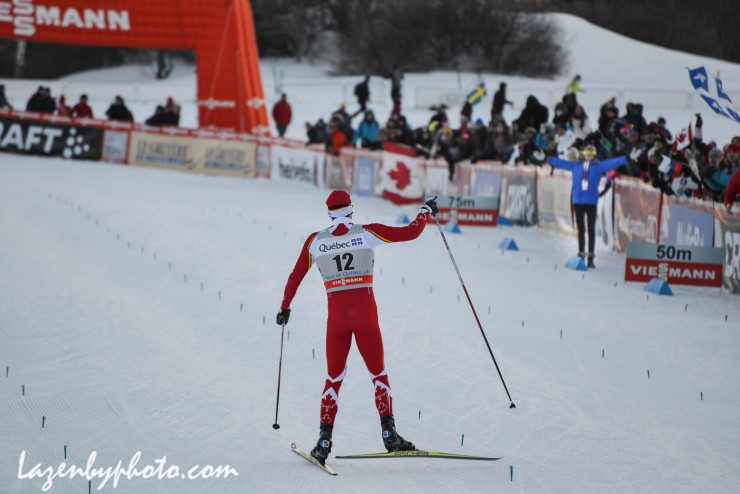
Longtime Canadian racer Jesse Cockney joins us to recap a surprisingly exciting men’s pursuit race at the World Championships in Planica, Slovenia.
We’ll be back tomorrow. Send your questions to devon@fasterskier.com and nat@fasterskier.com.
From the FasterSkier archive — posts syndicated from athletes’ and coaches’ own blogs between 2004 and 2012, kept online as published. Current coverage is at fasterskier.com.

Longtime Canadian racer Jesse Cockney joins us to recap a surprisingly exciting men’s pursuit race at the World Championships in Planica, Slovenia.
We’ll be back tomorrow. Send your questions to devon@fasterskier.com and nat@fasterskier.com.
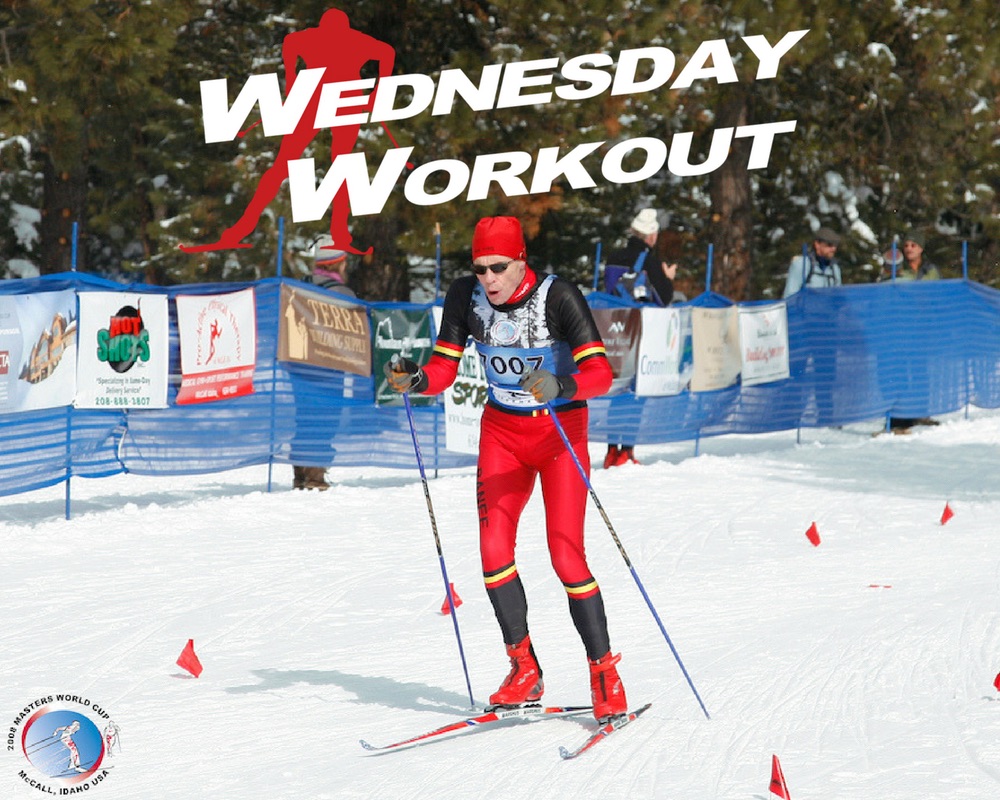
(Note: The following workout was submitted to FasterSkier by Everett Fee of Canmore, Alberta. If you’d like to share a workout of your own and the story behind it, please email alex@fasterskier.com with the subject line: ‘Wednesday Workout submission’.)
***
Competitive cross-country skiing is a great lifelong sport. I came late to the party, skiing in my first Masters World Cup when I was 63. I am now 73 and looking forward to being in the thick of things in 2021 when the Masters World Cup races will be in my hometown of Canmore — I’ll be a youngster in the M10 (75-79) age class!
I got into both XC skiing and rock climbing soon after moving to Winnipeg in 1972. They were complimentary sports — we used skis to explore the SW margin of the Canadian Shield in search of unclimbed granite cliffs that we approached by canoe on climbing trips in summer. I enjoyed skiing the occasional loppet but, in truth, climbing was what I was keen on; when there was no snow on the ground I didn’t think about skiing.
((Some accounts of those days are available online (ELA climbing guide) or in the Canadian Alpine Journal (CAJ v. 65 (1982), p. 24; 66 (1983), p. 98).)
After a sabbatical year in 1979 in distant mountains (the Pyrenees, the Alps, Morocco, and Chile), the remainder of my Winnipeg years were focused on climbing trips: Mexico, Yosemite, the Red Rocks, the Dolomites, Ecuador, Nepal, and, most frequently, the Canadian Rockies.
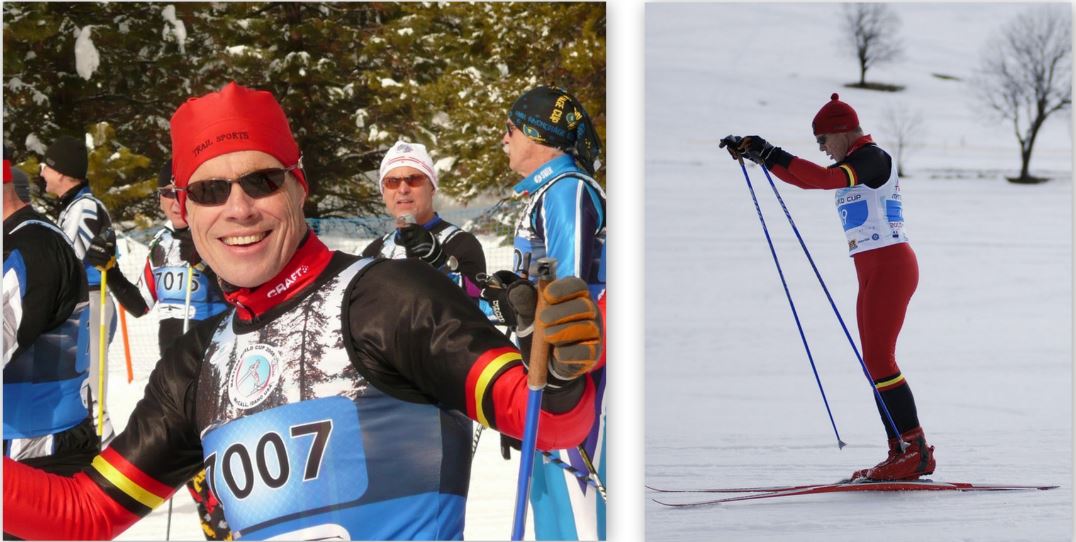
When I retired in 1997, moving to Canmore in the heart of the Canadian Rockies was a given. Now, 21 years later, the focus of my summers is training for and thinking about XC skiing. This transformation happened for several reasons. First, because I’m a lazy fun hog I couldn’t resist the five months of carved-in-marble grooming at the Canmore Nordic Centre, which is only 10 minutes from our house. The venue for the 1988 Calgary Olympics XC races and a regular stop on the World Cup XC circuit since 2005, it was so easy to ski there 100 days each winter. And all that skiing gave me the fitness I needed to tackle long-held climbing objectives such as Mount Alberta.
Another thing that drew me to XC skiing is the people I met on nordic-centre trails. A lot of them were masters skiers who trained seriously during the dryland months for racing in Canadian Nationals Masters and Masters World Cup in the winter. They encouraged me to dream big, too. In considering this, it became clear that I would have to seriously upgrade my haphazard approach to training (basically, a lot of random skiing in the winter and climbing in the summer).
lioresal, erythromycin, ofloxacin online
So in 2007 I joined the Banff Ski Runners (BSR), a small Norwegian-style club coached by Anders Lenes and signed up for the club’s six-days-per-week training program. Anders had skied on the Norwegian National Team for seven years, won Junior World Championships gold, silver, and bronze medals and had several top-10 finishes in World Cup races. He came to Canada in 1975 to prepare the national team for the 1976 Olympics and was on the Canadian national team coaching staff until 1984, during which time he worked with many great athletes, including Shirley and Sharon Firth, Burt Bullock, Esther Miller, and Angela Schmidt. He started coaching the Banff Ski Runners in 2000 and by 2007, the year I joined, he had transformed this small neighborhood Canmore club into a dominant force nationally. The juniors were ripping it up at Canadian nationals and shooting for the big leagues., and two of them (Graeme Killick and Jesse Cockney) went on to ski on the Canadian national team for two Olympic cycles.
In a recent FasterSkier article on his retirement from the Canadian national team, Cockney highlighted the importance of Anders and BSR in his development as a junior.
It was a real treat to train year round with this small group of about a dozen elite juniors. Although I started training with BSR too late in life (at 62) and had too little natural talent to finish above the middle of the pack in my Masters World Cup races, training with BSR was essential to getting me to the starting line in those events.
Anders’s BSR dryland program was highly varied — we rollerskied, hiked, trail ran, road biked, and (my favorite) ski walked. The unquestioned heart of the program was weekly intensity workouts. Among the different intensity workouts that we did, the one that had the most positive effect on my fitness is what Anders called “Russian intervals”: three sets with each set having three approximately one-minute, maximum-effort sprints separated by 30-second rests. This workout builds lactate tolerance:
The workout: Russian Intervals
The course: A hill 45-60 meters high (or stairs if that’s all that’s available)
Warmup: 15 to 30 minutes of easy (Zone 1-2) jogging (striding hills to keep heart rate low) followed by a nonstop lap or two of the intervals course in Zone 2-3
The intervals: Three sets of 3 approximately 1-minute, maximum-effort sprints separated by 30 seconds of rest and a minimum of 2 minutes rest between sets
Warmdown: 30 to 45 minutes jogging at a very easy pace (zones 1 to 2)
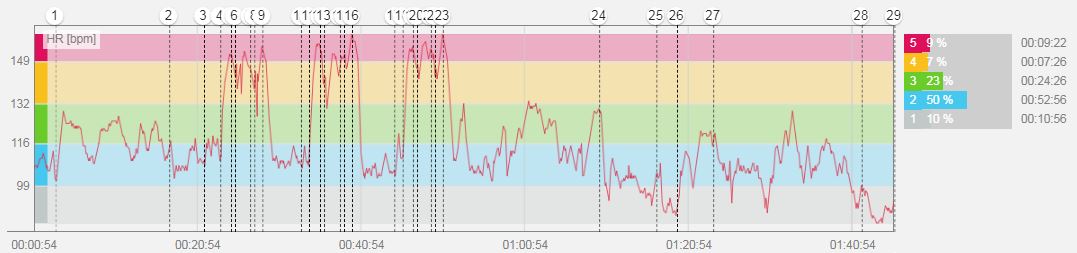
The goal of this workout is to train the body (and mind!) to go hard when flooded with lactate. Done properly, this workout hurts (bent over gasping after each of the three sprints in a set).
Be aware that this is an extremely demanding workout that should be introduced into the dryland season only after building a solid aerobic base. When Anders retired from coaching in 2013, I decided that it was also time for me to move on and I’ve been training on my own since then. I generally follow the BSR dryland program, with a bit more rest to accommodate my aging infrastructure. I make sure to do an intensity workout every week and occasionally make a mistake. Last year, overly keen to get started, I started doing Russian intervals in May and was ambushed in mid-summer when my iliacus hip muscle seized up so bad that just walking was a problem for most of a week! This year, the first third of the dryland (May and June), I’ve been doing “building intervals” as recommended by Olivia Bouffard-Nesbitt in another Wednesday Workout.
This fun workout, which just tickles the AT threshold, really hits the easily neglected, sub-threshold AT zone. The past month’s three-, four-, five-, and six-minute building interval workouts have me to the point where I now feel it’s time to start doing Russians.
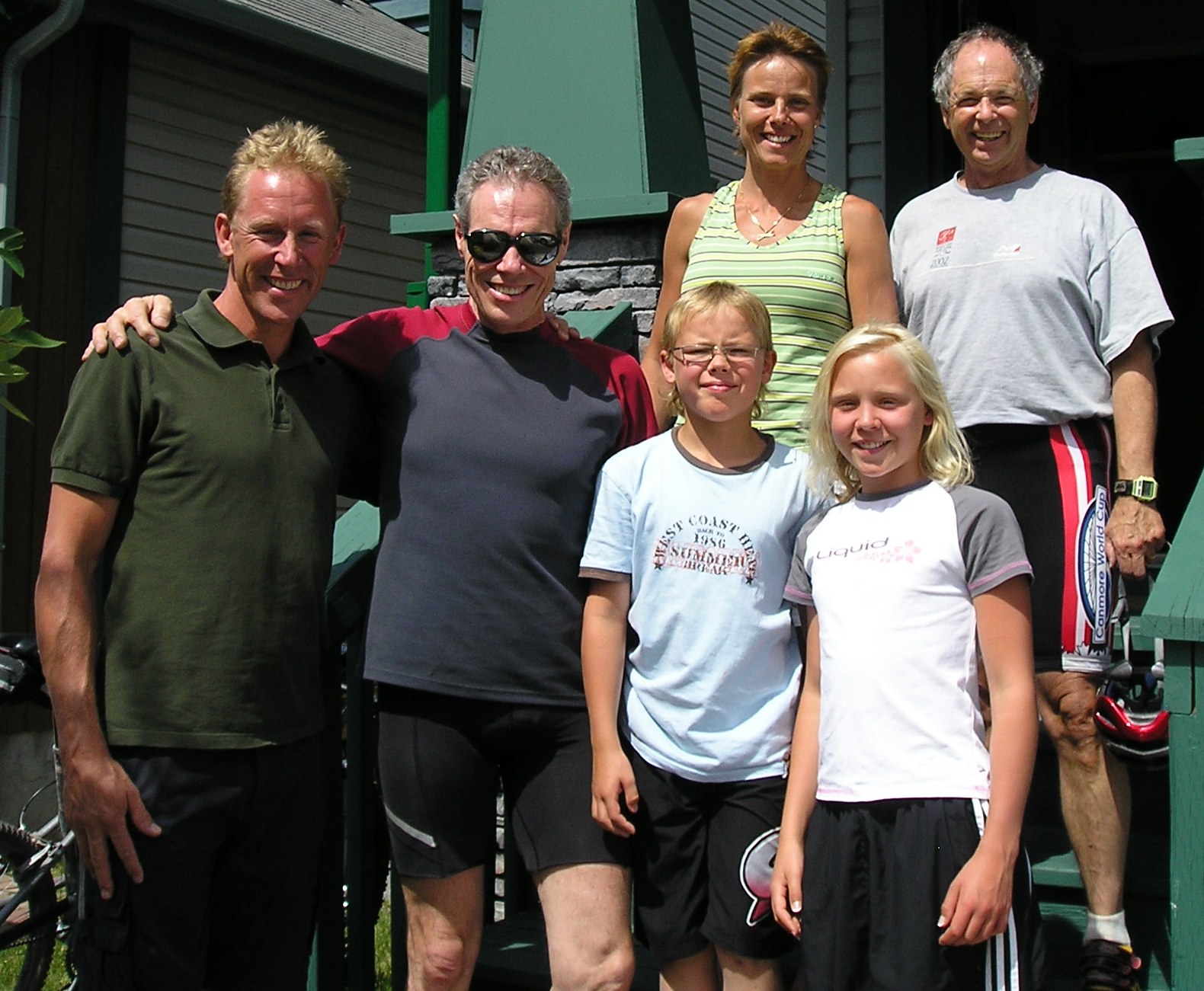
[As an aside, the great Swedish champion Gunde Svan brought his family to Canmore for the summer in 2006. Through my friend Rob Mackenzie, who had met Gunde during the 1988 Olympics, I was able to spend most of a day hanging out with Gunde and his family. This amazing experience added fuel to the fire building under my growing passion for XC skiing.]
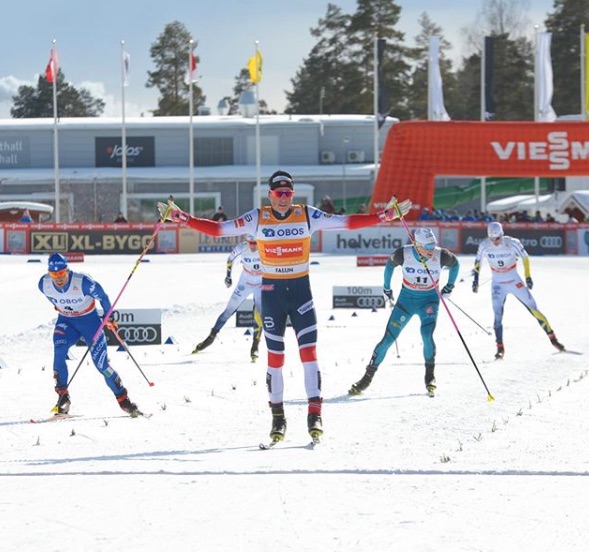
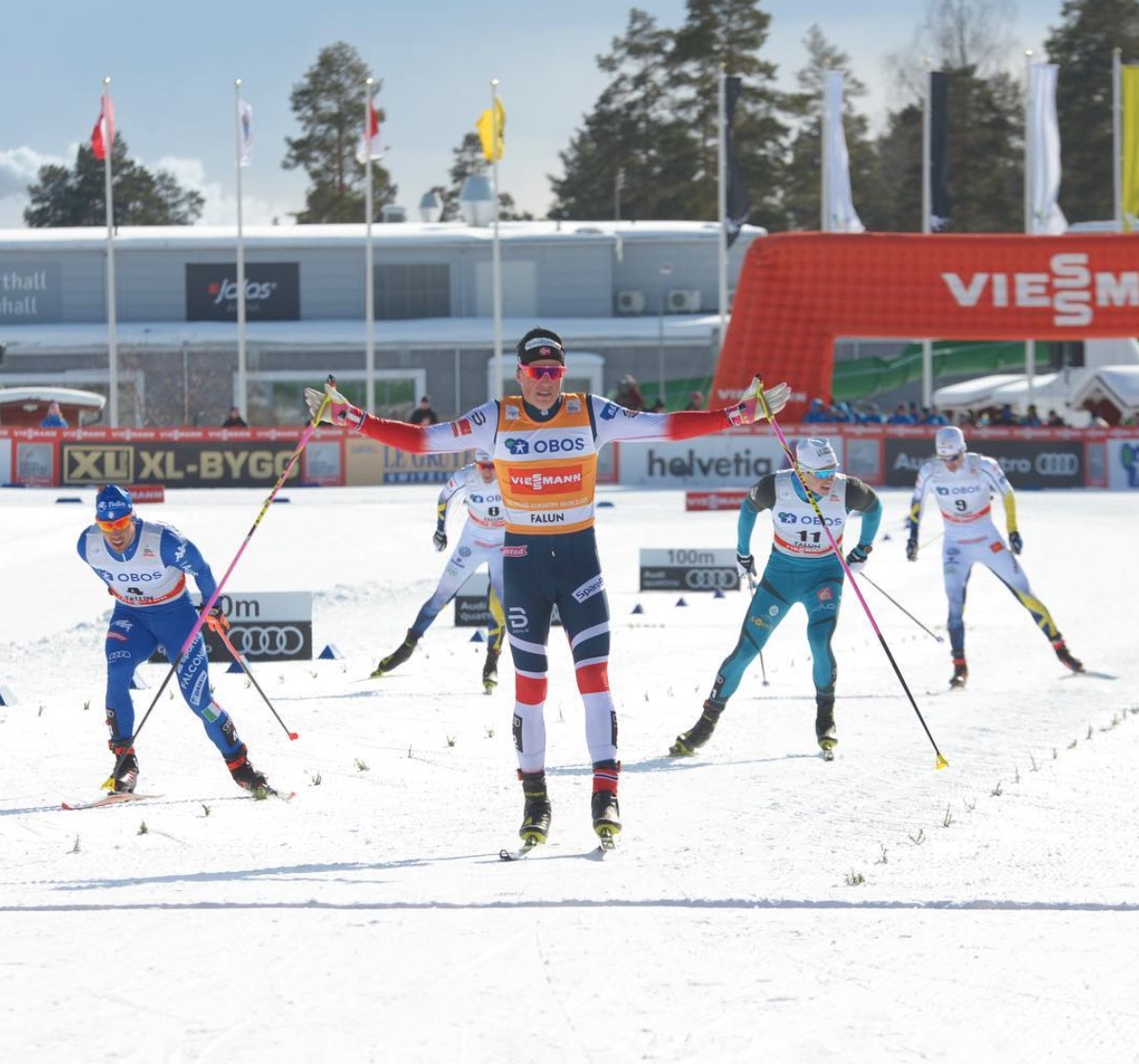
At 21 years old, Johannes Høsflot Klæbo of Norway had already locked up his second-consecutive Sprint World Cup Crystal Globe several weeks ago. A down-to-the-wire, season-ending finale for the sprint globe was out of the question. Klæbo has simply been that good. Out of 11 sprint races this season, Klæbo won the seven out of the nine sprints he contested. He placed second and third, respectively, in the other two. One word to describe it all: dominant.
Post-PyeongChang, where Klæbo racked up three gold medals, the young Norwegian has continued to roll. Although he had a blip in Lahti, Finland, where he placed third in 1.6-kilometer freestyle sprint, Klæbo was clutch again in Drammen, Norway. And the seventh win previously mentioned, that came on Friday during the 1.4 k skate sprint, which served as the opening stage of the three-day World Cup Finals mini tour in Falun, Sweden.
Russia’s Alexander Bolshunov won Friday’s qualifier in 2:36.23. Klæbo placed second (+0.46). Clearly, the Norwegian’s form was still on after steamrolling since the opening World Cup weekend in Kuusamo, Finland, on Nov. 24.
Beyond settling for second in Friday’s qualifier, Klæbo won the first quarterfinal, the first semifinal and the final. In the final, as he faced off with Italy’s Federico Pellegrino, Sweden’s Oskar Svensson and Teodor Peterson, France’s Lucas Chanavat, and Finland’s Ristomatti Hakola, Klæbo’s tactics would initially appear timeworn but effective.
Here’s how the Norwegian’s earlier tactics played out and eventually caught the spellbound finalists off guard. In Klæbo’s quarterfinal, also featuring Pellegrino, the pack of six skiers kept tight until the course’s final V1 climb. At 1:40 into the race, American Simi Hamilton, who had qualified in 13th (+4.1), came around the pack, pushed over the top and led out the string of skiers. Klæbo sat in fifth place. At 2:02 minutes, Klæbo and the group closed on Hamilton. Pellegrino led around the top of the final corner heading into the finish straight, then it was Hamilton followed by Klæbo. Stepping around the corner, and gliding out, Pellegrino and Klæbo unleashed a fifth-gear free skate and separated themselves from Hamilton. Klæbo and Pellegrino finished first and second, respectively, and Hamilton third. That put Hamilton 14th overall on the day as his time was not fast enough to move on as a lucky loser.
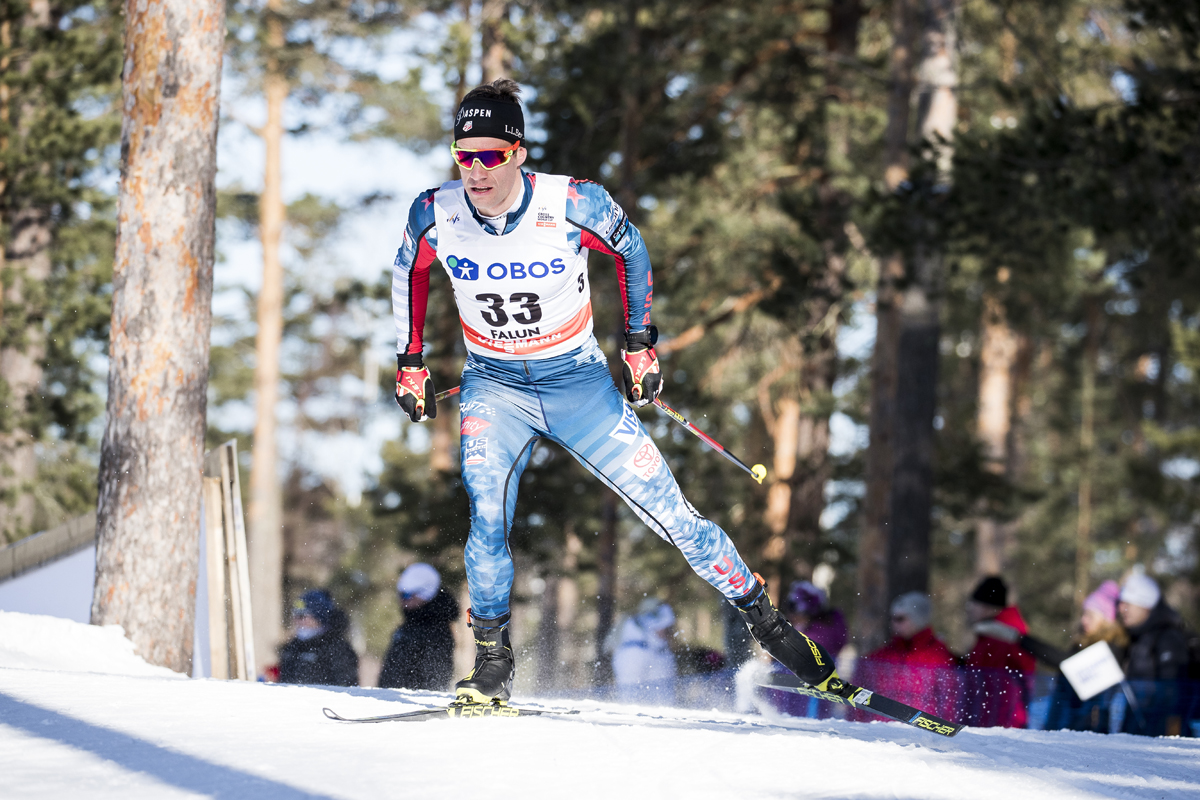
“With Simi, we took an aggressive approach today,” U.S. Ski Team coach Matt Whitcomb told FasterSkier in person after. “We threw him in with Klæbo and Pellegrino in the quarters and thought that he could potentially beat one of those guys and advance, or potentially be a lucky loser.
“He just got too tactical over the top of the last hill, so the lucky losers came from heats down the road,” Whitcomb continued. “And, Simi, unfortunately, ended up going over the hill in first and almost was able to hold it off. It was really impressive that he was able to hang onto third, but not enough for today. When he gets tactical, it tends to not be your lucky loser heat.”
On to the semis. In the first semifinal, Klæbo again allowed others, primarily Bolshunov, to do the pacing work. Bolshunov shot off the start like a starved thoroughbred chasing its first meal. Knowing Klæbo can close, the Russian hammered with a high-turnover tempo no other skiers could match. Bolshunov couldn’t pull away, but he could control for much of the semifinal.
As much as Klæbo can hide, he stalked in the back. Again, on the small hill before the finish, while Bolshunov faded, the Norwegian went. Right on cue Klæbo nailed his finish, outdueling second-place skier Peterson (+0.21), third-place Pellegrino (+0.32), and Ristomatti in fourth (+0.59). Bolshunov finished fifth (+3.10).
Coming into the final, Pellegrino, Hakola, and Peterson had already been schooled in Klæbo’s Falun-sprint scheme during the semi. After watching Bolshunov burn up taking a flyer off the front, that race strategy seemed unwise. But allowing Klæbo to draft in the pack had also proved futile.
Study Klæbo all you want. There’s still much to learn.
Up and over the first indecisive climb during the final, Klæbo paced behind Sweden’s Svensson. Stepping around a corner and into the course’s second hill, only 48 seconds into the race, Klæbo sent it: hop-skate style.
Klæbo’s burst of speed scorched the skiers behind. Initially, the others were caught off guard and failing in their response. Cresting the course’s third hill, Klæbo kept up the furious pace. One minute and 50 seconds in, Klæbo had nearly a thirty-meter gap over a chasing Chanavat.
The win was never in doubt at this point. It was as if Klæbo wanted to include a new chapter in his young career’s book of dominance. On Friday, Klæbo proved he could win a sprint by accelerating with nearly a kilometer to go. There was no fade. There was no catching up from behind. (Klæbo did pull up before the line to celebrate as Pellegrino came flying toward the finish.)
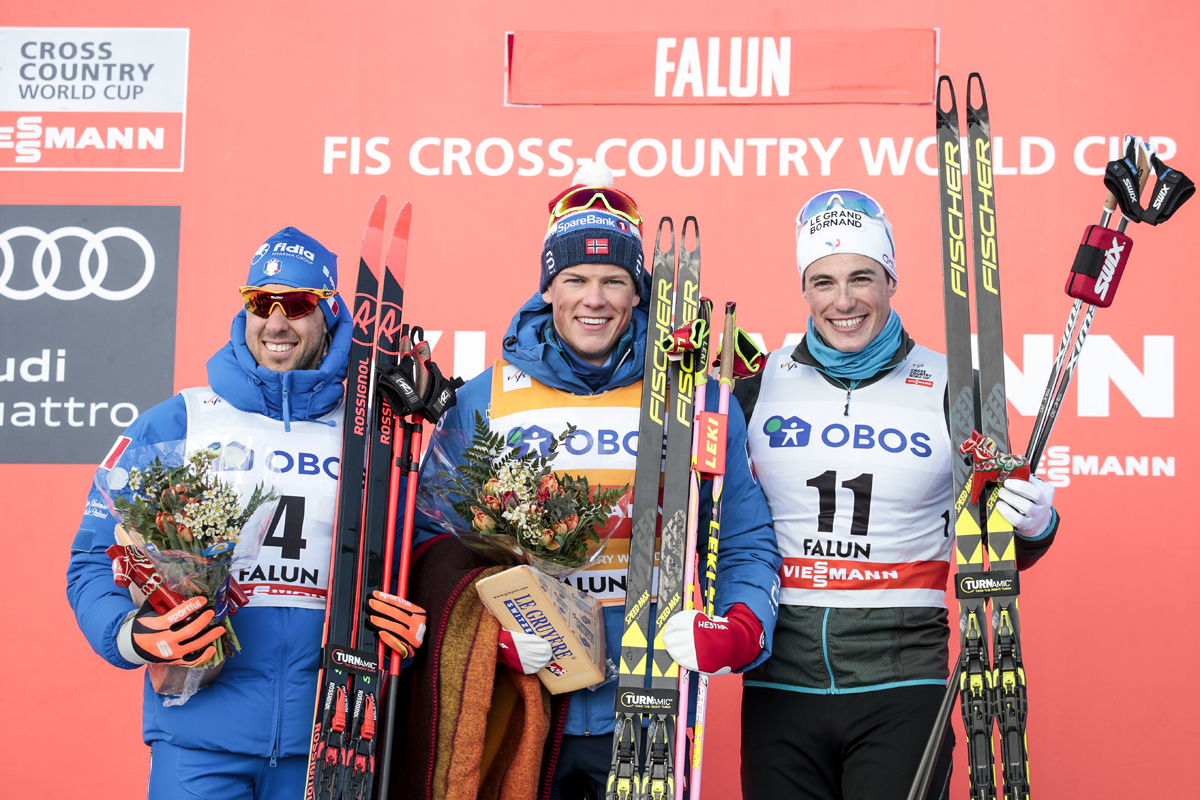
Klæbo won the final in 2:37.03 minutes. Pellegrino was second (+0.39), Chanavat third (+1.76), Ristomatti fourth (+3.26), Svensson fifth (+3.88), Peterson sixth (+6.17). Klæbo earned 50 World Cup points for the win. Heading into the two final World Cup races of the season, a 15 k classic mass start on Saturday and a 15 k skate pursuit Sunday, Klæbo leads the Overall World Cup standings by 272 points over fellow Norwegian Martin Johnsrud Sundby. The winner of the entire weekend will get 200 World Cup points, so it’s safe to say Klæbo has that overall Crystal Globe locked up as well.
“I learned after Lahti that I needed to be away from Pellegrino if there was a long downhill with a fast finish so I attacked on the first climb today in the finals to make sure that I was far enough ahead before the finish,” Klæbo told the International Ski Federation (FIS) after the race. “It’s just been an incredible season with my second sprint globe and the Olympics. But I am focused on also taking home the overall crystal globe and will fight the next two days to make sure I get it.”
Bolger Reaches Quarterfinals
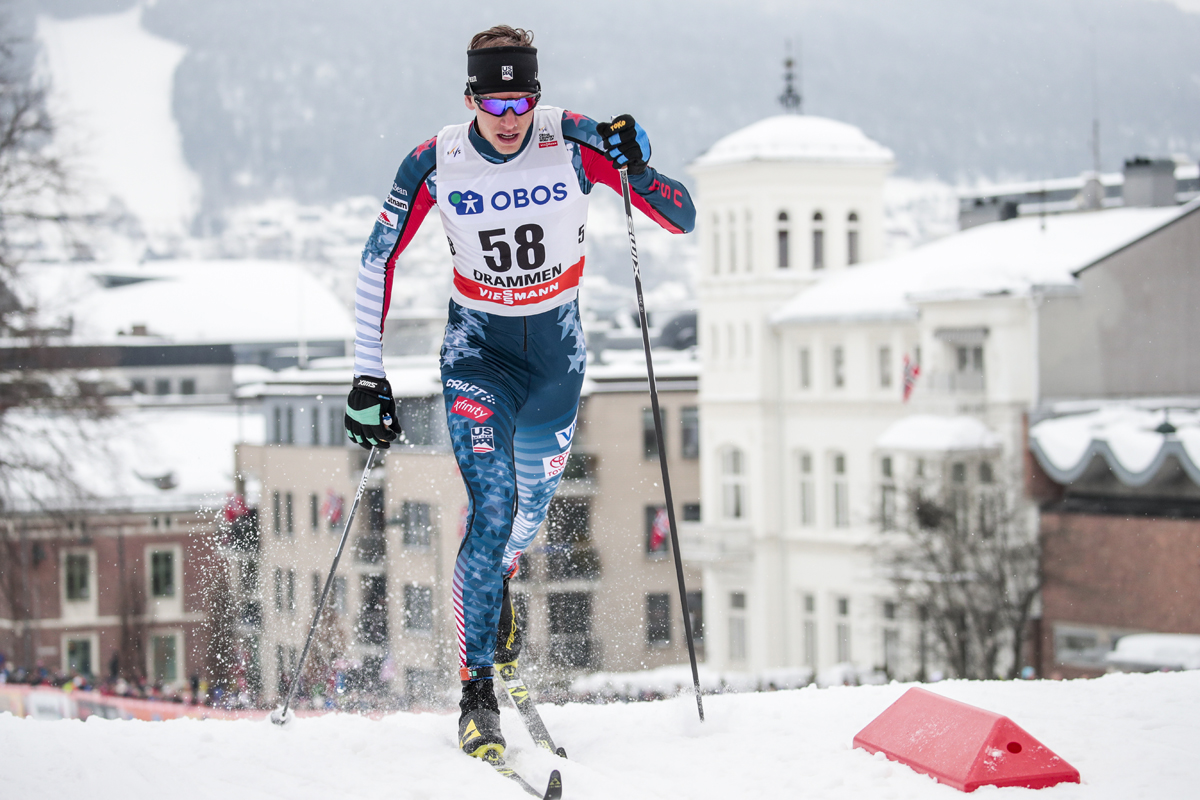
Along with Hamilton, Kevin Bolger was the only other North American to move onto the heats. In his third-career World Cup sprint, the Sun Valley based skier qualified in 29th and placed 30th overall after finishing sixth in his quarterfinal, 2.21 seconds behind Peterson in first.
In his World Cup debut two weeks ago, Bolger previously placed 11th overall in Lahti’s skate sprint. He went on to finish 50th in Drammen’s classic sprint. Bolger also skied to 52nd in last weekend’s Holmenkollen 50 k skate race.
“Qualifying, I was super excited,” Bolger, 24, told FasterSkier in Falun. “Obviously, it’s super early in these World Cups for me, so just qualifying is insane. Super fired up when that happened and just tried to kind of repeat what I did in Lahti, and didn’t work out, but I felt a little bit tired, maybe shaken out by the 50 k a little bit still, from Holmenkollen.”
Bolger is a recent graduate of the University of Utah and is in his first season as a professional skier. He skis with the Sun Valley Ski Education Foundation in Utah.
“I just came to Sun Valley this year so my coach Chris Mallory changed my tactics coming into sprints,” Bolger said about his early season work on qualifying. “I definitely, mentally and physically, been doing a lot of things differently. And just kind of going in with these World Cups, it’s a lot of pressure to do well. But at the same time, there are no expectations, really, so you just gotta go in with an open mind and hopefully, you don’t want to expect too much. So you just go in and do what you can.”
Whitcomb seemed as stoked as Bolger at his early World Cup success.
“Thrilling to see Bolger qualify in his second skate sprint,” Whitcomb said. “Being two-for-two in skate sprinting this year, in just a short tour with us and so fun to watch his excitement as a rookie, getting in there and mixing it up. I think it’s a unique course and it’s also the end of the long season for him as well, and just didn’t quite have the gear over the last hill, is what it looked like. But he by no means is getting blown out and it’s really exciting for the future.”
Also for the U.S., Erik Bjornsen missed qualifying by five-hundredths of a second in 31st, Andy Newell placed 43rd, Paddy Caldwell was 60th, David Norris 84th, and Scott Patterson 87th.
For Canada, Julien Locke placed 32nd, just 0.06 seconds out of qualifying, Alex Harvey was 34th, Devon Kershaw 74th, and Graeme Killick 81st.
Racing continues Saturday at World Cup Finals with a 15 k classic mass start for the men.
Results:

FasterSkier would like to thank Fischer Sport USA, Madshus USA, Concept2, Boulder Nordic Sport, and Swix Sport US for their generous support, which made this coverage possible.
PYEONGCHANG, South Korea — Johannes Høsflot Klæbo. Search the Norwegian’s name in the International Ski Federation (FIS) web databank and it appears at the top of nine of the 13 World Cup races he has entered this season.
For many, Klæbo is more than just the name of Scandinavia’s most recent nordic speedster. It is a verb. Cross-country skiing argot has come to embrace the idea of pulling a “Klæbo” or deciding to “Klæbo” a course.
On Tuesday at the Alpensia cross-country venue in PyeongChang, his name gained even more light in the glimmer of cross-country skiing stardom. He raced to a convincing win in the men’s 1.4-kilometer classic sprint at the 2018 Winter Olympics amidst freshly falling snow and frigid winds. While most racers were bundled in buffs, Klæbo kept his distinct coiffed hair sans hat.
The victory earned Norway its third gold medal of the Games and Klæbo’s first Olympic medal. The 21 year old’s win is also the youngest gold-medal performance in the history of cross-country at the Olympics.
But even a name like Klæbo takes pause to credit those who predate his success. His name has not always dominated nordic-news headlines. There were others before him. Looking back 12 years, Klæbo can recall the the individuals he aspired to be like. There were names that he as a 9 year old heard again and again; ones that he looked up to, that motivated his desire to not only to compete at an Olympic games, but to put forth a gold performance of his very own.
“When Petter [Northug] was doing [cross-country skiing] so well from 2006, it’s been a big inspiration for me,” Klæbo said during a post-race press conference.

Petter Northug, Jr., is one of Norway’s most decorated male cross-country skiers to date. In 2006 at the age of 20, Northug won three Junior World Championship titles. At the time, Klæbo was Northug’s junior by a little more than a decade. Northug went on to compete at two Olympic Games, coming away with two gold medals in 2010.
“When you’re starting to go in high school and you’re looking forward and looking up to people doing it well in championships, you really want to do the same,” reflected Klæbo, who is mainly coached by his grandfather. “You want to do it your way. To be able now to cross the finish line first and get an Olympic gold medal. It’s quite an unbelievable feeling.”
On Tuesday, his Olympic win was secured in the top of the final climb. Though the sprint finalists were led out of the start by Russia’s Alexander Bolshunov, who’s also 21, Klæbo stuck to the Russian’s ski tails.
Holding tightly to Klæbo was Italy’s Federico Pellegrino. Finland’s Ristomatti Hakola, who posted the top time in Tuesday’s qualifying round in a time of 3:08.54 minutes, as well as Norway’s Pål Golberg and Sweden’s Oskar Svensson, also followed as they made their way up the initial ascent.
“Bolshunov was quite strong in the start of the final there; he was pushing quite hard for the first uphill,” Klæbo said. “My plan was always to be able to run fast in the last uphill and to be able to get the gap and turn around on the top there.”
Klæbo crafted his plan perfectly. While Bolshunov’s maroon suit strode in first through the first major hill and the second course climb, Klæbo crouched patiently just behind. As they approached the final hill, the distinct bouncing stride of Klæbo came into play.
The pitch intensified and so did Klæbo. At the halfway point, the Norwegian and Russian fought side-by-side. Just before the peak of the hill, Klæbo made his move. He pushed around Bolshunov and pressed the pace in the front.
Rounding back toward the stadium, it was the Norwegian in first with close to a two-meter gap on the two skiers chasing him down: Bolshunov and Pellegrino. In a pack of three behind them were Golberg, Svensson and Hakola.
The final descent featured Klæbo on his own. He cornered the final turn without anyone close to him and double poled to the 50-meter mark, checking back several times before slowing his pace. With arms outstretched and a pink gloved wave to the crowd, he crossed the finish line first in a time of 3:05.75.
The battle for second came down to Pellegrino and Bolshunov. The 27-year-old Italian, in his second Olympics, double poled. The Olympic rookie from Russia matched him. Pellegrino, the overall Sprint World Cup champion from two seasons ago (Klæbo won the Sprint Crystal Globe last year), is better known for his dominance in the freestyle sprints. However, that didn’t prevent him from gunning to the end.

“I knew that I could always talk about me like an outsider for today. This was a good thing,” Pellegrino said at the press conference. “But in Ruka when I catch the final and I think that the track was so similar with a strong uphill I started to think about a medal. Then I worked a lot during this winter for improving my classic side.”
Exactly one month ago, Pellegrino achieved the rare feat of beating Klæbo in a World Cup freestyle city sprint in Dresden, Germany.
“I had only one goal for these Olympics, that was to return to Italy with one medal,” Pellegrino said on Tuesday.
The medal would come in the color of silver. Pellegrino outlunged Bolshunov by 0.02 seconds to claim second (+1.34) place and his first Olympic medal. Bolshunov’s bronze medal is also the Russian’s first of Olympic caliber. Previously this season, Bolshunov had reached the World Cup podium five times, always in third place. Two of those races were sprints.
“If I may be frank I have not yet internalized this medal,” said Bolshunov, who’s competing at these Olympics as part of the “Olympic Athletes of Russia” delegation.
“It’s only been a little while, so I have to basically understand what has happened,” he continued. “But I am very happy to be here, and I am very happy to have achieved this result.”
Norway’s Golberg finished fourth (+3.81) and Sweden’s Svensson fifth (+7.73), while top qualifier Hakola finished the final in sixth (+20.72).
Click here for North American article.
— Jason Albert, Gavin Kentch, Ian Tovell, and Harald Zimmer contributed


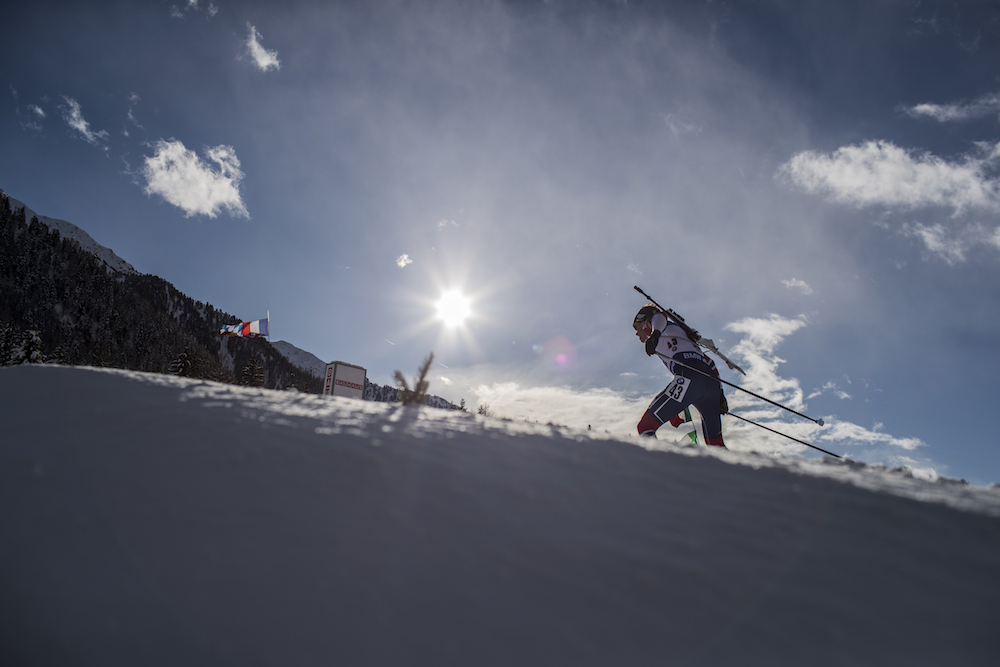
IBU World Cup (Antholz, Italy): Men’s 10 k sprint
One prone penalty wasn’t enough to keep Johannes Thingnes Bø from his third-straight victory (and ninth this season, including relays) as the 24-year-old Norwegian won the men’s 10-kilometer sprint on Friday at the International Biathlon Union (IBU) World Cup in Antholz, Italy.
Bø started 42nd of 109 men and had to navigate tricky wind conditions, along with the rest of the field. After missing one target in the prone shooting, Bø left the range in third, 4.8 seconds behind the race leader at the time, Austria’s Julian Eberhard, and 2.6 seconds behind his Norwegian teammate Lars Helge Birkeland in second.
Throughout the race, Bø set the fastest course times and took a sizable lead over Birkeland and Eberhard after standing, which he cleaned and left the range 33.5 seconds ahead of Birkeland, who had also hit all five standing targets. Eberhard missed two to slip 1:11.6 minutes back.
Bø went on to cross the finish line in 23:19.3 minutes, faster than France’s Martin Fourcade (who started behind him in bib 48 and cleaned both stages), as Fourcade finished 12.8 seconds back in second.
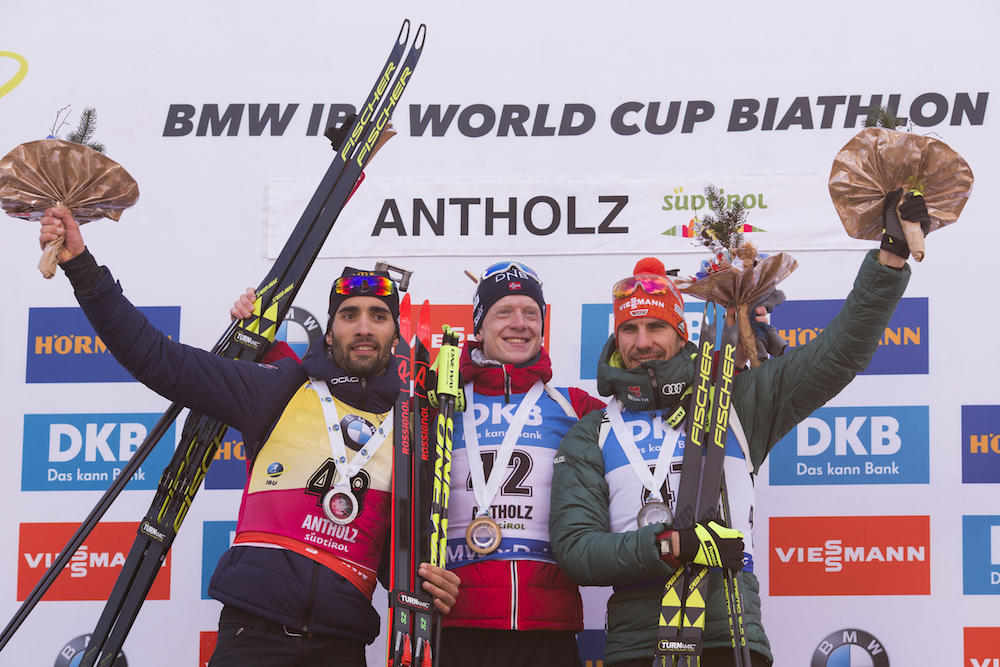
Germany’s Arnd Pfeiffer started 47th, just ahead of Fourcade, and raced to third (+42.2) with clean shooting as well.
“In the sprint, you almost always have to shot clean,” Bø reflected after, according to an IBU press release. “After my prone miss, I knew a podium would be hard, but you never know; you fight hard. With zero in standing, I knew there was a chance … I had the times from the start and knew I had good speed today … Martin is almost always stronger than me on the last lap, but today I was not tired.”
Fourcade pointed out that this was his best sprint result in Antholz, a high-elevation venue at some 5,200 feet above sea level, since 2011, “so I am pretty satisfied,” he told the IBU.
Pfeiffer told German broadcaster ARD that he latched onto Fourcade for the last loop.
“At least I was clean on the shooting range today, that was not so easy,” Pfeiffer said, according to a translation. “I am pretty proud I managed to do that today. This was not my best day on the course, even if the position might insinuate something else. I had to toil quite a bit, and was lucky that Martin came by for the final [loop], who also wasn’t in his top shape today.
“In the end of course the result was great, I haven’t been on the podium in an individual-start race so far this season,” Pfeiffer continued. “So I am happy about 100 percent shooting accuracy and hopefully being on the podium if everything works out.”
Russia’s Anton Shipulin missed the podium by about four seconds in fourth (+46.3) with one standing miss (0+1), France’s Emilien Jacquelin placed fifth (+53.7) with clean shooting, Birkeland ended up sixth (+1:07.8) with zero penalties as well, Eberhard was seventh (+1:21.7) with two misses (0+2), Russia’s Anton Babikov eighth (+1:27.8; no penalties), Vladimir Chepelin of Belarus ninth (+1:32.3; one penalty), and the Czech Republic’s Ondrej Moravec 10th (+1:35.4; no penalties).
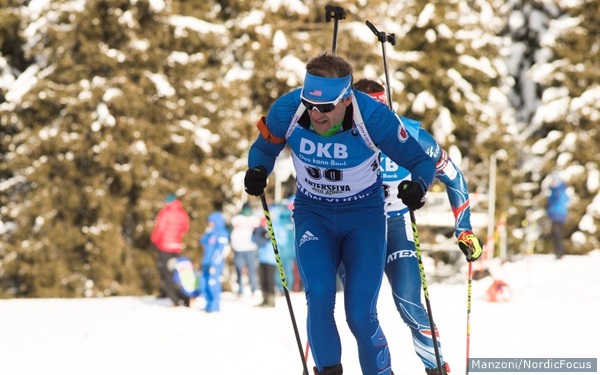
Three out of five Americans qualified for Saturday’s pursuit, with Lowell Bailey leading them in 41st (+2:22.0) after one standing miss (0+1). Notably, he had the fifth-fastest overall shooting time.
Tim Burke was just another 0.4 seconds back in 43rd (+2:22.4) with three penalties (1+2), and Leif Nordgren finished 50th (+2:33.1) with two penalties (1+1) and the second-fastest overall shooting time and third-fastest range time.
Russell Currier missed the top 60 by 5 seconds in 63rd (+2:55.4) with two misses (1+1), and Sean Doherty finished 75th (+3:15.9) with four penalties (3+1). All five men were recently named to US Biathlon’s Olympic team.
Macx Davies, who was selected to Biathlon Canada’s Olympic team, was the top Canadian in 66th (+2:58.2) with three misses (1+2). Carsen Campbell finished 82nd (+3:27.9) with two penalties (2+0), Matthew Hudec was 89th (+3:40.6) with one miss (0+1), and Aidan Miller 107th (+5:00.3) with five penalties (3+2).
The men’s and women’s pursuits will be held Saturday in Antholz at 7:15 a.m. for the women and 9 a.m. for the men EST. Watch live on the Olympic Channel.
***
Western Canadian Championships (Red Deer, Alberta): Freestyle sprints
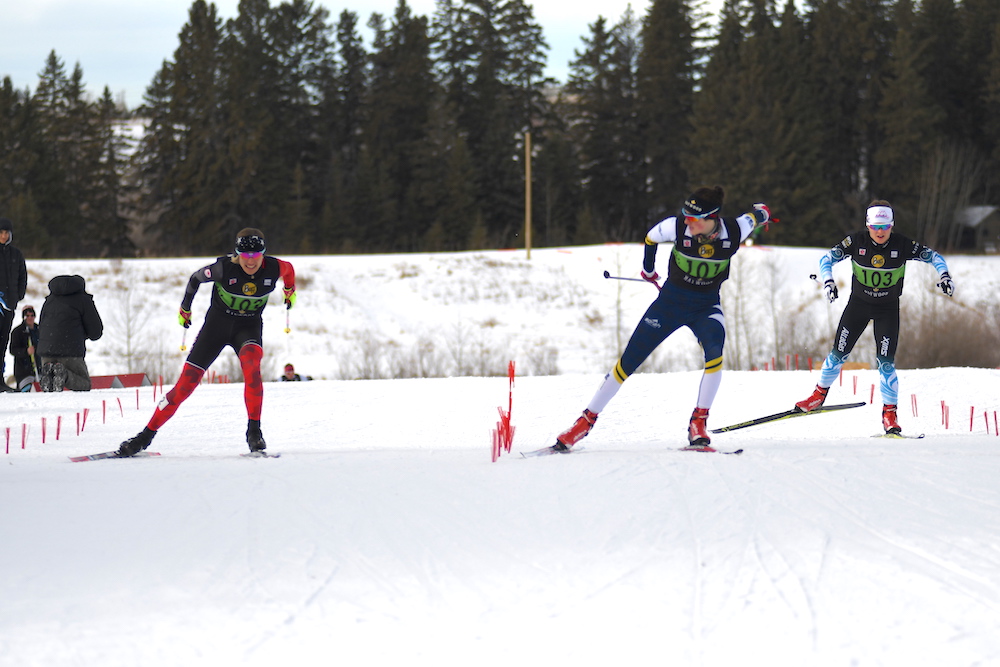
The NorAm series shifted west to to Red Deer, Alberta, for the fourth weekend of racing.
Olivia Bouffard-Nesbitt (Rocky Mountain Racers) won the women’s 1.2-kilometre freestyle sprint A-final in 3:09.12, edging out Zina Kocher (Foothills Nordic) and Annika Hicks (Alberta World Cup Academy) by 0.4 and 0.77 seconds, respectively. They qualified in the same order in a small women’s field of 20. Organizers opted to skip the quarterfinals and pinned the top 10 women from the qualifier in two semifinals.
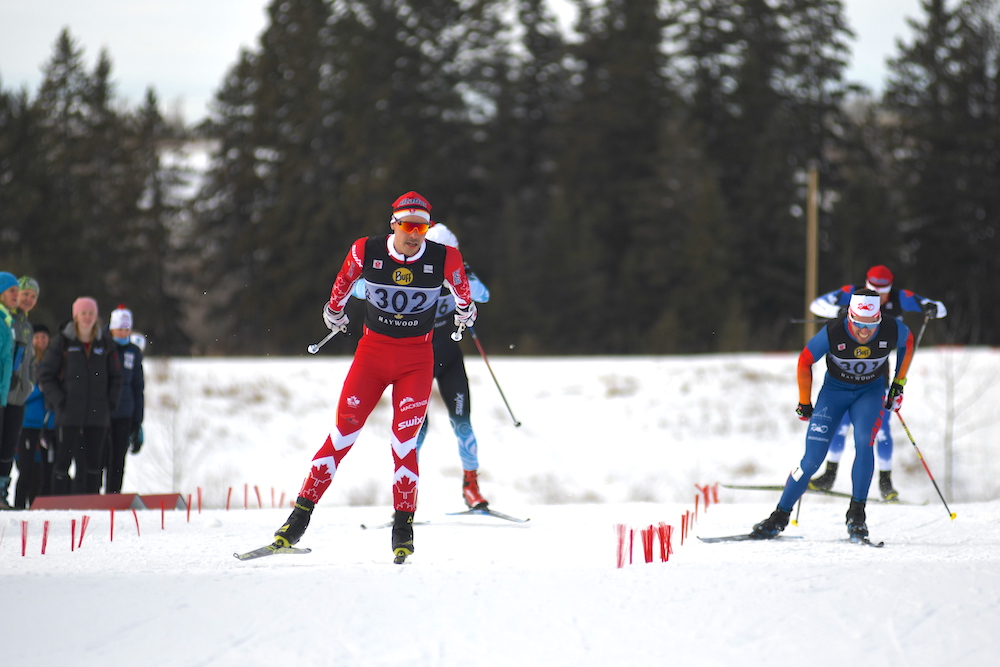
The men’s 1.2 k qualifier had 38 starters, and 22 advanced to the quarterfinals. After qualifying in second, 0.16 seconds off the top time set by Russell Kennedy (Team R.A.D.), Jess Cockney (Canadian World Cup Team) won his quarterfinal and semifinal and ultimately the men’s final in 2:24.29, 1.09 seconds ahead of Kennedy in second. Patrick Stewart-Jones (Alberta World Cup Academy) grabbed his first podium of the season, taking third (+1.70).
Western Canadian Championships usually draw a smaller field than Easterns: more Canadians live within reasonable driving distance of Eastern Canadian Championships (hosted by Nakkertok in Cantley, Quebec) than live in all three times zones of western Canada combined.
With many of the top athletes in Europe doing final elevation camps for the Olympics and U23s/Junior World Championships, the Western Championships’ open and junior categories were particularly small this year with 287 athletes total.
Results: Qualifier | Heats | Complete results

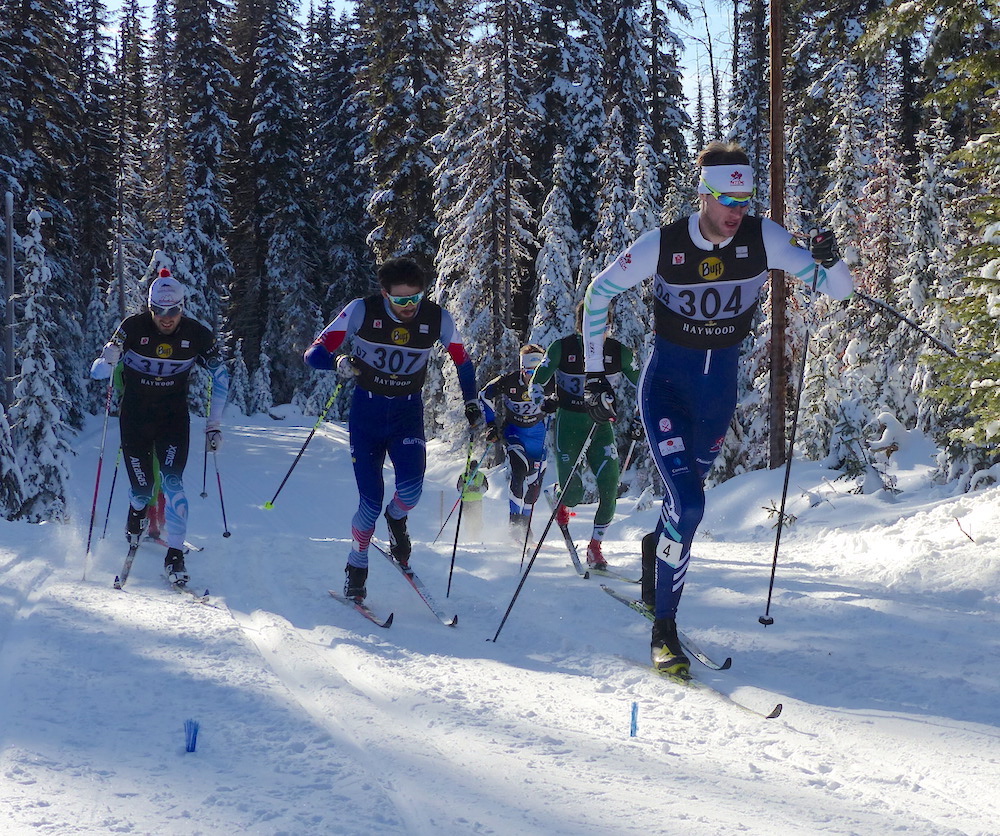
NorAm/SuperTour (Sovereign Lake near Vernon, British Columbia): Classic sprints
On the opening day of the NorAm Continental Cup series in Canada (which doubled as a U.S. SuperTour), American Kaitlynn Miller of the Craftsbury Green Racing Project (CGRP) started Saturday with a nearly three-second win in the classic-sprint qualifier at the Sovereign Lake Nordic Centre, then went on to win her quarterfinal and semifinal before topping the final as well.
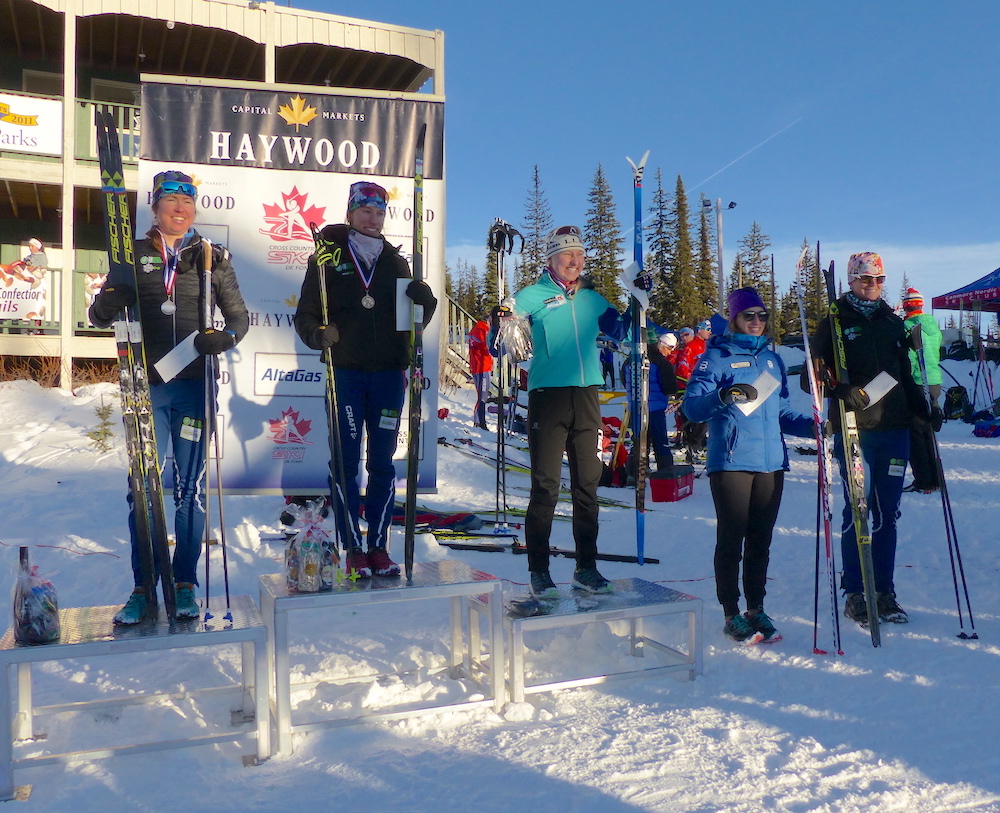
Miller was the fastest women’s qualifier by 2.87 seconds on the 1.3-kilometer course with a time of 2:59.39. Ultimately, she won the final in 2:57.53, 0.93 seconds ahead of her teammate Caitlin Patterson in second and 2.59 seconds clear of the third American on the podium, Hannah Halvorsen of Alaska Pacific University (APU) and the U.S. Ski Team (USST) D-team, in third place.
Halvorsen previously qualified third behind Kelsey Phinney, of the Sun Valley Ski Education Foundation (SVSEF) in second. Phinney finished fourth in the final (+2.85), while a third Craftsbury skier, Liz Guiney placed fifth (+3.53). The lone Canadian in the six-woman final, Sophie Carrier-Laforte of the Pierre-Harvey National Training Centre (CNEPH) placed sixth (+4.38).
Thompson Fends Off Five Americans
Of the six racers in the men’s 1.3 k freestyle sprint final, five of them were American. Bob Thompson, of the Thunder Bay National Team Development Centre (NTDC), bested them all for the win in 2:29.31, just 0.03 seconds ahead of Ben Saxton, of the Stratton Mountain School (SMS) Elite Team, in second place. Cole Morgan (SVSEF), the qualifying winner who had so far dominated all of his heats, ended up third overall, 0.48 seconds behind Thompson.
Sun Valley and APU each had two athletes reach the men’s final with Jack Hegman (SVSEF) taking fourth (+0.51), and APU’s Reese Hanneman and Tyler Kornfield placing fifth (+7.75) and sixth (+7.9), respectively.
To start the day, Morgan posted the fastest men’s qualifying time in 2:31.00, while last weekend’s SuperTour skate sprint winner Nick Michaud, of the Bridger Ski Foundation (BSF), qualified in second, 0.78 seconds back. Americans took the top-three qualifying spots with Logan Hanneman (APU) in third (+1.59), while Thompson was the top Canadian qualifier in fourth (+2.34).
Morgan won both his quarterfinal and the first semifinal to advance to the final, along with Thompson who placed second in that semifinal (and placed second to Hegman in the quarterfinals). Saxton won the second semifinal (after finishing second to Logan Hanneman in the quarterfinals) and Kornfield was second behind Saxton in that semifinal to automatically advance to the final. Reese Hanneman and Hegman made it to the final as lucky losers after placing third and fourth, respectively, in the first semifinal.
***
IBU World Cup (Hochfilzen, Austria): Men’s and women’s pursuits
Norway’s Johannes Thingnes Bø notched his second-straight win in Hochfilzen after Martin Fourcade of France missed three on the final shooting stage of the men’s 12.5 k pursuit on Saturday. Bø, who started the race 12 seconds ahead of Fourcade in second, cleaned the final standing stage to leave the range nearly a minute ahead of Slovenia’s Jakov Fak in second. Meanwhile, Fourcade, who had been skiing in first just ahead of Bø before the last stage, dropped 1:19 minutes back to fifth.
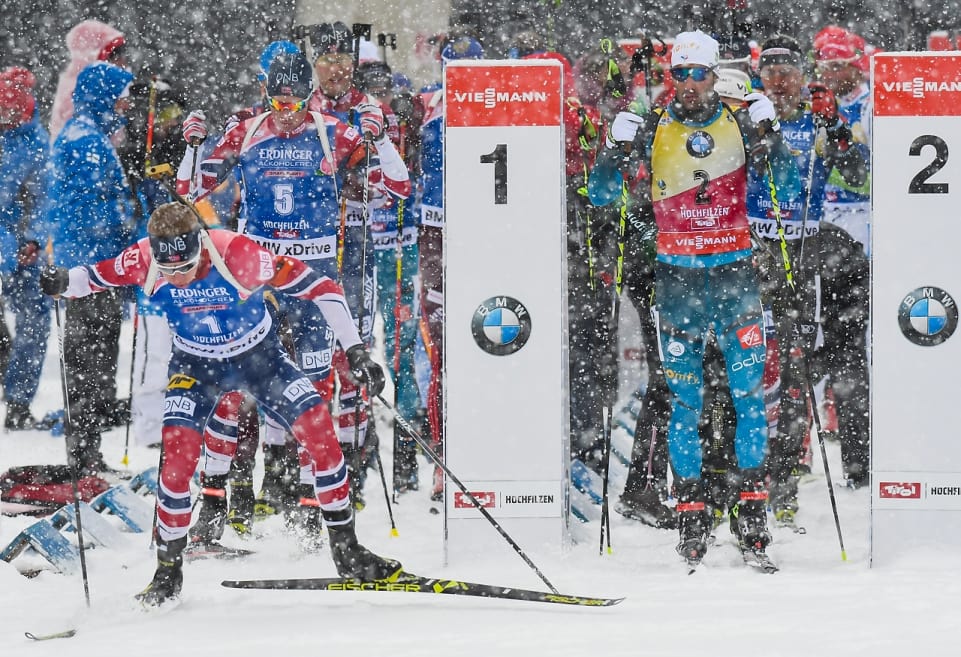
While Bø skied the win in 36:41.1 minutes and Fak, the third starter, finished 58.8 seconds later in second place, Fourcade made up two places on the final loop to place third (+1:10.0) after passing Germany’s Simon Schempp and Russia’s Maxim Tsvetkov.
Schempp settled for fourth (+1:10.5), and Bø’s older brother, Tarjei Bø, passed Tsvetkov as well to claim fifth (+1:11.9), while Tsvetkov finished sixth (+11:12.3).
On another snowy afternoon in Hochfilzen, Johannes Bø had three penalties, two of which came in the first stage (2+0+1+0). Fak was one of four men in the race with just one miss (0+0+1+0) — no one cleaned — while Fourcade missed five (1+0+1+3). Schempp had four penalties (3+1+0+0) but held onto his starting position in fourth, Tarjei Bø improved from 14th at the start to fifth with just two misses (1+0+1+0) and Tsvetkov raced up from 20th to sixth with a single miss (1+0+0+0).
American Sean Doherty tied his second-best World Cup result in 17th (+2:12.8) after starting 23rd and 1:39 out of first. He had two penalties (1+0+1+0).
Canada’s top finisher, Nathan Smith placed 31st (+3:02.2) after starting 19th and missing three shots (1+1+0+1). His teammate Brendan Green rose to 33rd (+3:15.7), up from 52nd at the start, with three penalties as well (1+0+1+1).
Four Canadians qualified for the pursuit, with Scott Gow placing 48th (+5:08.4) with seven penalties (1+1+3+2). His younger brother Christian Gow crossed next in 49th (+5:13.7) after missing five (+5:13.7).
The other American man in the race, Lowell Bailey placed 36th (+3:20.6), up from 53rd, with three misses (0+2+1+0).
Kuzmina Gets First Win in Three Years
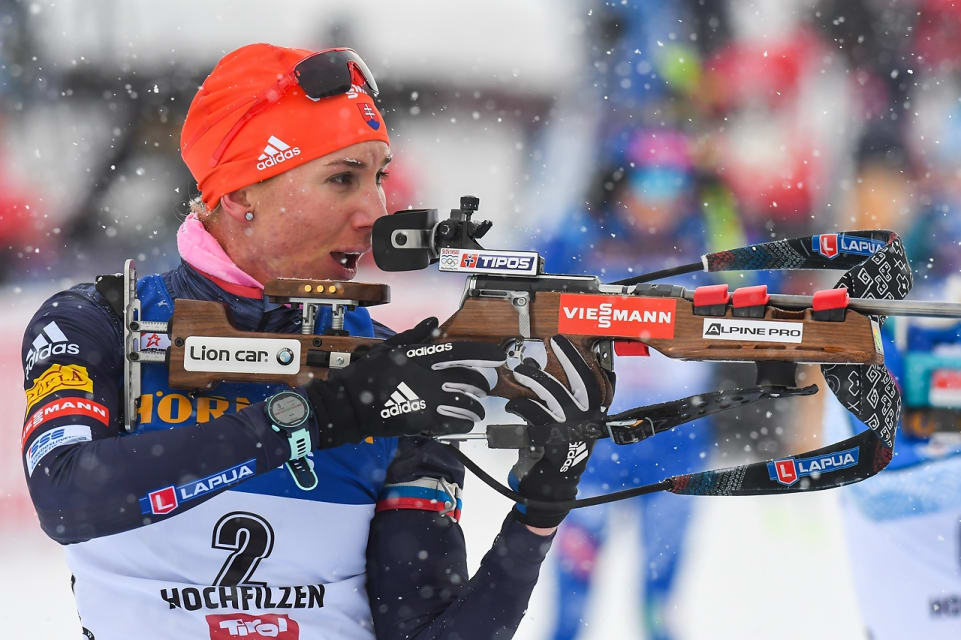
In the women’s 10 k pursuit that followed, Slovakia’s Anastasia Kuzmina overcame a 22-second starting deficit to win her first race in three and a half years, shooting 19-for-20 (1+0+0+0) and finishing in 34:31.2. Kuzmina (the sister of Russia’s Anton Shipulin) started second behind Friday’s sprint winner Darya Domracheva of Belarus. Domracheva had a single miss as well in Saturday’s pursuit (0+0+1+0) but slipped to second after her penalty in the first standing stage, while Kuzmina cleaned the last three stages to take the win.
Domracheva settled for third (+11.8) and Finland’s Kaisa Mäkäräinen rose to second (+10.2) after shooting 18-for-20 (1+0+0+1) and skiing the fastest course time to rise from her starting position in sixth.
Italy’s Dorothea Wierer slipped one place to fourth (+51.6) after starting third and missing two (1+0+0+1), while Norway’s Marte Olsbu raced up from 13th to fifth (+58.2) with a single penalty (1+0+0+0). Ukraine’s Yuliia Dzhima improved from 20th to sixth (+1:08) with one miss as well (0+0+0+1).
Canada’s Emma Lunder achieved her second-best career World Cup result in 27th (+2:31.6) after starting 42nd and cleaning three stages after missing one in the first prone (1+0+0+0). Her teammate Rosanna Crawford improved from 49th at the start to 39th at the finish (+3:44.3) with four penalties, one in each stage (1+1+1+1).
The U.S. had one woman qualify for the race, Clare Egan, who finished 53rd (+5:21.6) with seven penalties (2+2+2+1).
For the third and final day of World Cup racing in Hochfilzen, the men’s and women’s relays will be held Sunday.
***
FIS Cross Country World Cup (Davos, Switzerland): Freestyle sprints
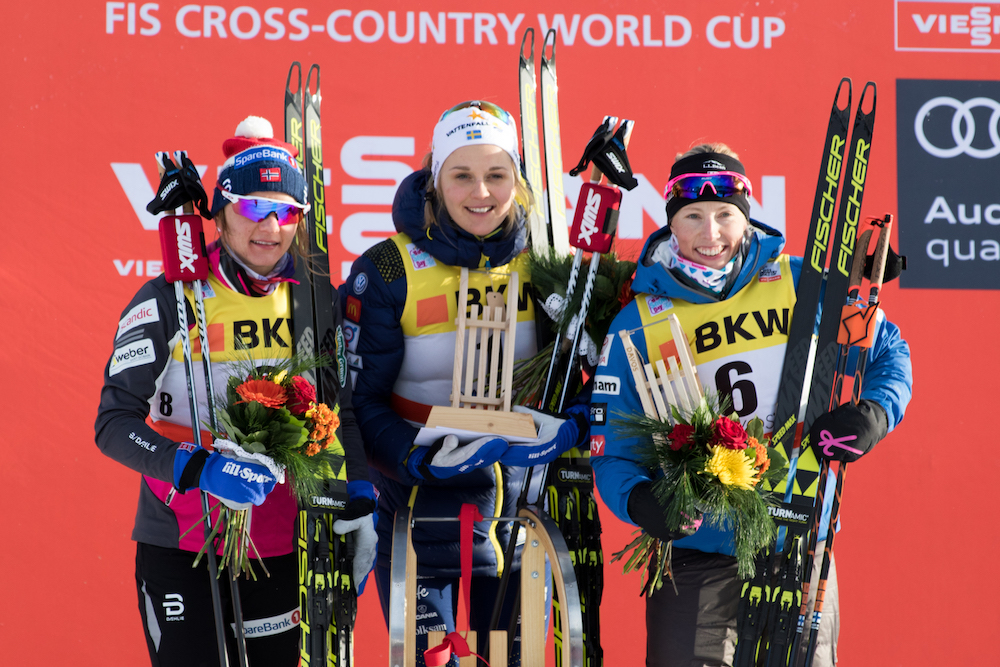
Kikkan Randall returned to the podium on Saturday in the first freestyle sprint of the 2017/2018 World Cup season, placing third in the women’s 1.5-kilometer skate sprint behind Sweden’s Stina Nilsson and Norway’s Maiken Caspersen Falla, respectively, in Davos, Switzerland.
Americans made up half of the women’s final, with Jessie Diggins racing to fourth and Ida Sargent sixth, with Norway’s Ingvild Flugstad Østberg between them in fifth.
Nilsson started the day by winning the qualifier in 2:51.71 minutes, while Østberg had the second-fastest qualifing time, 2.57 seconds back. Switzerland’s Nadine Fähndrich posted the third fastest qualifying time (+2.73), and for the U.S., Diggins qualified fourth (+3.37), Sargent fifth (+3.78), Randall sixth (+4.11), Sophie Caldwell ninth (+4.87), and Sadie Bjornsen in 11th (+5.38).
Nilsson then won her quarterfinal and the first semifinal before outlunging Falla by eight-hundredths of a second for the final win in 2:47.99. Randall (who won her quarterfinal and advanced to the final as a lucky loser in third in the first semifinal) finished 2.53 seconds after Nilsson for third overall, and Diggins (who won both her quarterfinal and the second semifinal) was 4.41 seconds back in fourth. Østberg finished 5.62 seconds back in fifth, and Sargent crossed the line 14.49 seconds back in sixth.
Caldwell placed eighth overall after winning her quarterfinal then placing fourth in the second semifinal, behind Diggins, Sargent and Germany’s Sandra Ringwald, respectively. Ringwald did not advance to the final, either, for seventh overall. Bjornsen placed 13th on the day after finishing third in her quarterfinal.
Also for the U.S., Julia Kern (U.S. Ski Team D-team) finished in 57th in the qualifying round, 16.55 seconds out of first.
Dahria Beatty was the top Canadian in 53rd (+15.53), followed by Katherine Stewart-Jones in 55th (+16.18) and Cendrine Browne in 64th (+18.27).
In the men’s 1.5 k skate sprint, Norway’s Johannes Høsflot Klæbo rocketed to his sixth-straight win in as many World Cup races this season, topping the qualifier in 2:23.10 (by 1.27 seconds over France’s Lucas Chanavat and 1.73 seconds over Italy’s Federico Pellegrino in third) then winning his quarterfinal and semifinal comfortably before capping the day with a victory in the final in 2:28.07. Pellegrino placed second in the final, 1.8 seconds back, and Russia’s Alexander Bolshunov tallied his third podium of the season in third place (+4.64). Finland’s Ristomatti Hakola placed fourth (+5.39), France’s Richard Jouve was fifth (+8.65) and Russia’s Gleb Retivykh was sixth in the final (+18.34).
Americans Andy Newell and Simi Hamilton both qualified for the heats in 10th and 12th, respectively. Hamilton went on to place ninth overall after finishing second in his quarterfinal (behind France’s Renaud Jay) and fifth in the second semifinal (which Hakola won). Newell’s day ended in the quarterfinals, where he placed fifth, 2.44 seconds behind Klæbo, who won that heat. Overall, Newell was 21st.
Canada’s Alex Harvey qualified for the heats in 21st and went on to place 23rd overall after finishing fifth in his quarterfinal, 1.14 seconds behind Retivykh in first.
Also for Canada, Julien Locke missed qualifying in the top 30 by 1.07 seconds in 36th (+7.84). Russell Kennedy placed 48th (+9.39), Knute Johnsgaard was 52nd (+10.35), Jess Cockney 54th (+10.83), Devon Kershaw 63rd (+11.78).
For the U.S., Erik Bjornsen finished 58th (+11.12) and Paddy Caldwell 108th (+24.04) in the qualifier.
Results:

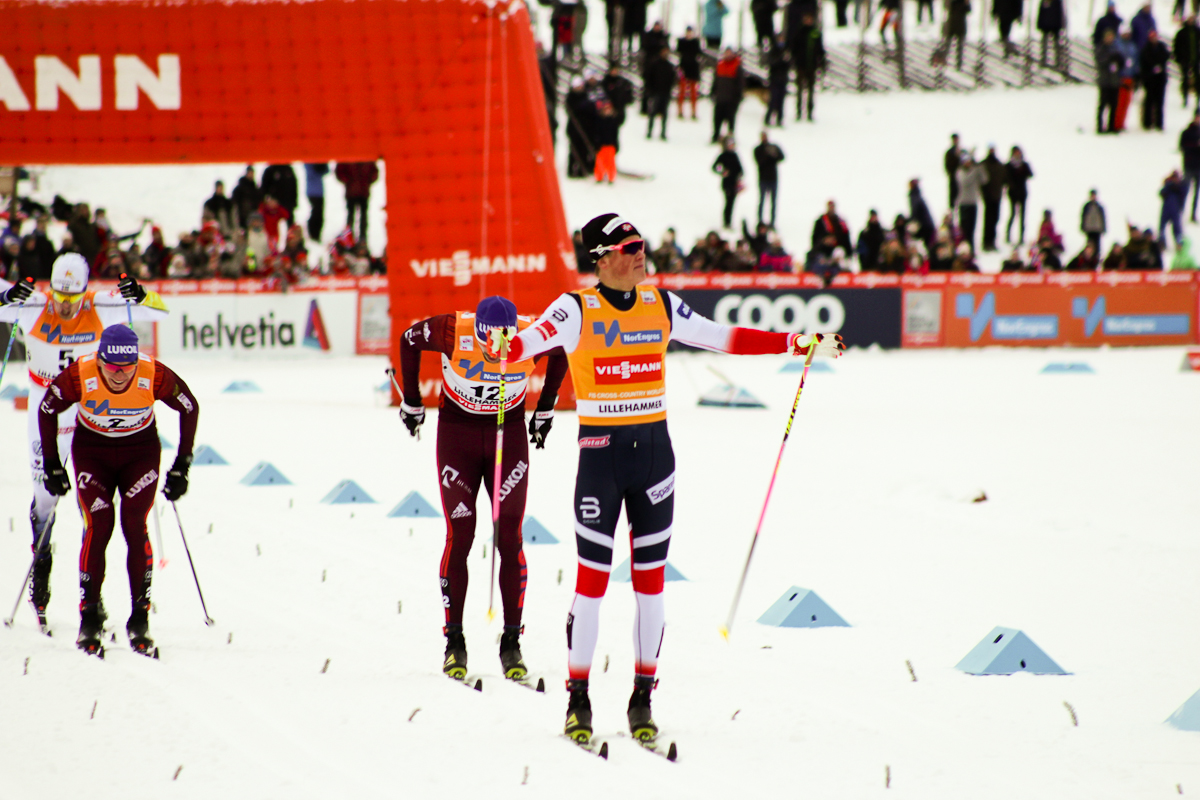
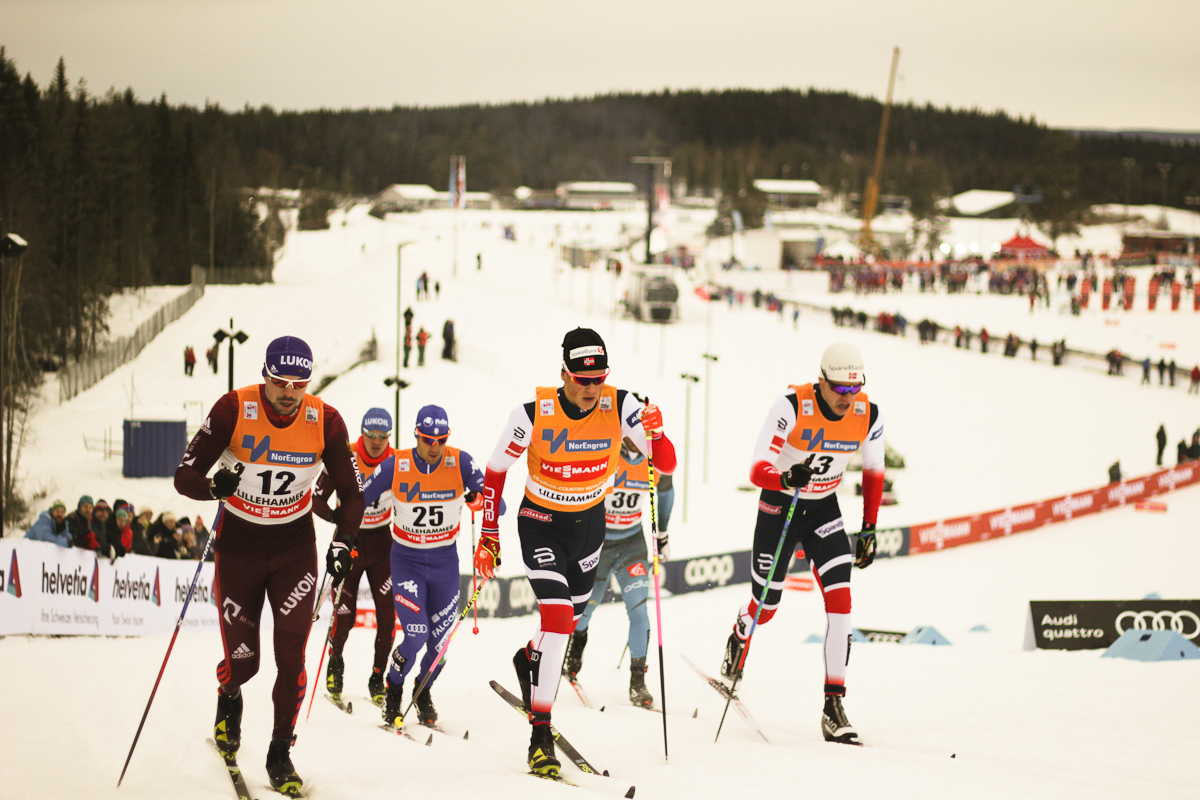
Smack dab in the heart of the nordic sport world in Lillehammer, Norway, the World Cup began its second weekend of the 2017/2018 season with a kick-and-glide bang on Saturday. The men contested a 1.5-kilometer classic sprint on a course featuring a flat run into and out of a three successive climb-descent combo.
At 21 years old, Norway’s Johannes Høsflot Klæbo remains peerless.
Is it the lungs? His up-tempo, high-output running style? For all the winning since his World Cup debut in 2016, Klæbo must be prematurely aging his rivals.
As last season’s overall Sprint World Cup winner and last weekend’s Ruka Triple dominator, 2017/2018 is starting off as a continuation of the nascent Klæbo era.
Klæbo has four wins in four races this season as he out-toed Russia’s Sergey Ustiugov by 0.83 seconds to win Saturday’s sprint. Another Russian, Alexander Bolshunov, was third (+1:29). Calle Halfvarsson from Sweden placed fourth (+1.64), and off the back were Norwegians Emil Iversen in fifth (+8.20) and Sondre Turvoll Fossli in sixth (+17.30).
Ustiugov’s exploits are well documented — he skied to five medals at 2017 World Championships, three silvers, and two golds. But like Klæbo, Bolshunov appears to be an authentic, albeit young challenger for future podiums and overalls on the World Cup. He’ll turn 21 on Dec. 31. Bolshunov won the 30 k skiathlon and 15 k freestyle and placed second in the classic sprint at last season’s U23 World Championships. After the Lillehammer sprint, Bolshunov is positioned second in the overall World Cup standings with 252 points — 22 points ahead of Norway’s Martin Johnsrud Sundby in third. (Sundby did not race in Saturday’s sprint.)
But the narrative has been all Klæbo.
With 400 points, Klæbo’s foundation for building an early season hold on the World Cup overall is strong.
From the start on Saturday in Lillehammer, it was another stellar performance from the Norwegian in the qualifier: Klæbo won in 3:28.99 minutes with 4.31 seconds on Bolshunov, the next closest competitor.
Klæbo’s winning margin was slimmer in the quarterfinals, but it only amounted to a tease. He bested Ustiugov in the first quarterfinal by 0.17 seconds. In semifinal 1, there was a flip-flop: Ustiugov won, besting Klæbo in second place by 0.25 seconds.
Saturday’s conditions in Lillehammer featured fresh snow, which placed a premium on remaining in the skied-in tracks, maximizing glide without stepping into the slower snow. The final hill and descent into the finishing straight played a key part in Saturday’s winning tactics. Klæbo was mindful of the endurance aspect for Saturday’s sprint and tried tempering his effort until it mattered.
“I changed the plans a little bit in the final and tried to be second in the last downhill,” Klæbo said during the post-race press conference. “And then Ustiugov came before the last uphill there and it was going pretty fast I was just trying to keep up with him and be second on the last uphill there and to push hard and finish.”
With his latest win, Klæbo becomes only the second male skier to win the first two World Cup sprints of the season. In 2008/2009, Norway’s Ola Vigen Hattestad won the first three sprints that season. Klæbo remains the youngest World Cup sprint winner, according to the International Ski Federation (FIS).
Alex Harvey was the lone North American to qualify in the top 30, placing 22nd, 11.89 seconds in back of Klæbo.

At last weekend’s Ruka Triple in Kuusamo, Finland, Harvey finished just off the podium for fourth place in the pursuit and in the overall mini-tour standings. In the first of the three stages there, the classic sprint, Harvey placed 21st. After placing 28th overall in Saturday’s classic sprint in Lillehammer, Harvey stated he was unconcerned about his early season sprint speed.
“I am not really tired, I just don’t have enough speed at that time of the year, but it’s like that every year,” Harvey said. “I am slow before Christmas. I have good endurance but not much speed so that’s what I had today … I feel good about going into tomorrow’s race, it is a totally different race, a 30 k [skiathlon]. In Kuusamo it was kind of the same in the sprint, I was kind of shaky, but then the distance races were good. I am looking forward to the 30 k.”
Harvey’s day ended in the quarterfinals when he placed sixth in the fourth heat, 3.06 seconds behind Norway’s Pål Trøan Aune, who won that quarterfinal.
For the U.S. Ski Team (USST), Erik Bjornsen skied to 35th, 13.61 seconds behind Klæbo in the qualifier and 1.06 seconds out of 30th. Andy Newell finished 38th (+13.89), and Scott Patterson finished 74th (+27.99).
“Disappointing to not make it past the qualifier,” Bjornsen emailed. “The Norwegians were on one today, qualifying 12 guys in the heats, leaving only 18 spots for the rest of the world. Warming up I could feel I didn’t have the snap I needed. I’m excited for a mass start race tomorrow though. It will be great to go head to head in some distance racing.”
Notably absent from Saturday’s sprint was USST sprinter Simi Hamilton.
“It was a disappointing day for the guys,” USST coach Matt Whitcomb said on the phone. “Andy and Erik were close. They were not flanked by Simi who has been battling GI issues since Kuusamo. He has had quite a bug. He skied 30 minutes yesterday and about an hour and a half just walking around on his skis today. We are trying to build him back to strength. But he knocked down very hard by a bug.”
For Canada, those skiers outside the top 30 were Jesse Cockney (Canadian World Cup Team) in 57th (+17.59), Len Valjas (World Cup Team) in 59th (+18.24), Julian Locke (National U25 Team) in 61st (+19.99), and Russell Kennedy (Team R.A.D.) in 63rd (+20.98).
Racing continues Sunday with a 30 k skiathlon for the men and a 15 k skiathlon for the women.
Results: Men’s final | Men’s qualifier
— Aleks Tangen, Harald Zimmer and Gabby Naranja contributed
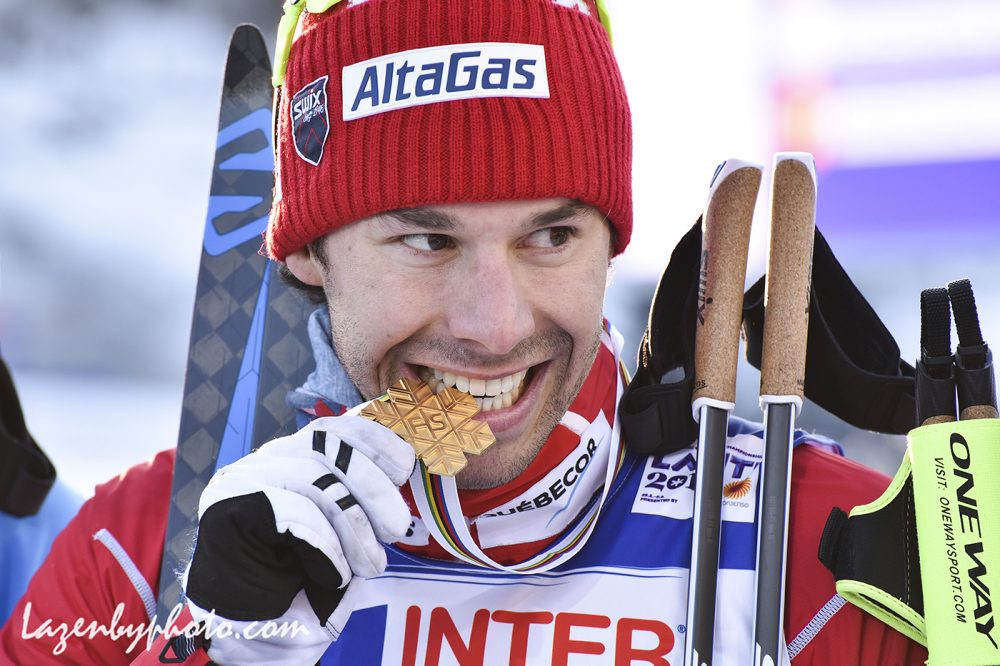
Welcome to World Cup Windup, where we check in with the top-10 teams from last year’s FIS Cross Country World Cup tour before the season starts with the Ruka Triple in Kuusamo, Finland, on Nov. 24. Last but not least, Canada!
CANADA
Overall in Nations Cup Last Year: 10th
Women’s Ranking 2016/2017: 14th
Men’s Ranking 2016/2017: Sixth
Who’s Back:
Alex Harvey, World Champion, runner-up in the Distance Cup, and third in the overall World Cup; Len Valjas, with seven World Cup top-20’s last season and Harvey’s partner in crime for team sprints; Devon Kershaw, top-10 in a Tour de Ski stage; Knute Johnsgaard, who teamed up with the previous three for a World Cup relay podium; Jesse Cockney, who had two sprint top-10’s. Other starters on the first period of World Cups are World Cup top-30 finishers Dahria Beatty, Cendrine Browne, Emily Nishikawa, Graeme Killick, and Julien Locke, and NorAm leaders Katherine Stewart-Jones and Russell Kennedy.
Who’s Missing:
No major retirements.
Pre-Season Results:
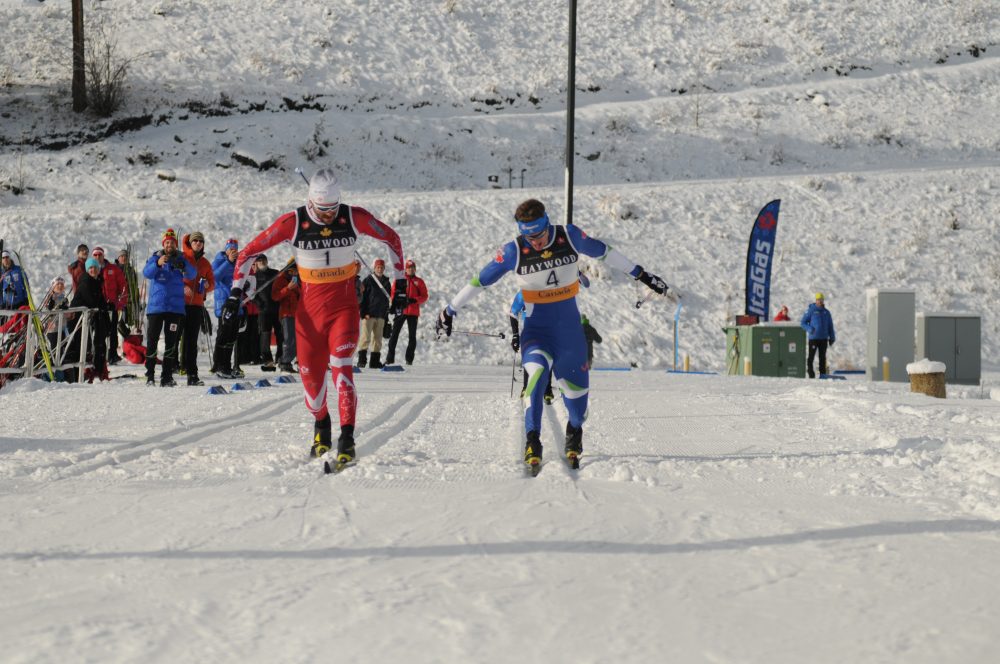
The Canadians first competed at home in Canmore on the Frozen Thunder loop, with Lenny Valjas and Dahria Beatty winning the sprint, and Julien Locke earning his World Cup spot by crushing the qualifier. Valjas also won the distance race at Frozen Thunder, and Beatty finishing second behind American Chelsea Holmes.
Then this past weekend, they were in Gällivare, Sweden. Devon Kershaw was the best Canadian in the distance races, finishing 12th in the 10 k skate on Friday. “I changed various things with my training this year so it’s exciting to see how my body feels in the beginning of a new season,” Kershaw wrote. “… My goals are really to just be calm and execute well – which means going into the racing with no expectations other than to ski as technically well as possible while working on the whole pacing thing (which can be challenging at the beginning of the season when you don’t have that many races in the body).” Russell Kennedy finished 48th and Lenny Valjas 49th. In the 5 k skate the same day, Emily Nishikawa finished 26th. The next day, she placed 51st in the 10 k classic, while Kershaw finished 20th in the 15 k and none of his teammates broke the top 50.
In Sunday’s classic sprint, Dahria Beatty made the women’s quarterfinals and ultimately ended up 22nd. Valjas also made the heats, but likewise did not advance, finishing 29th; on the outside looking in were Julien Locke (39th); Knute Johnsgaard (40th), Russell Kennedy (43rd), and Jesse Cockney (48th) in a field of 114 men.
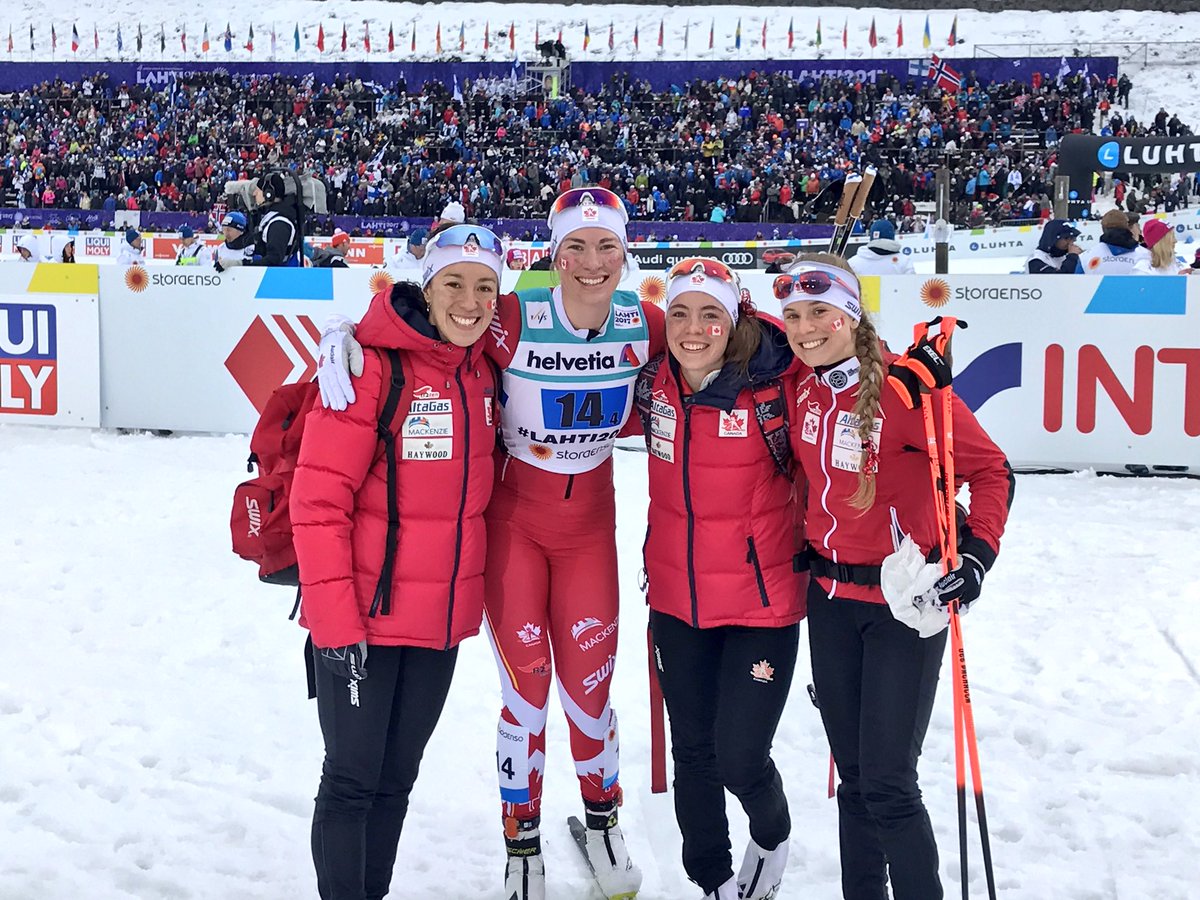
Recent Drama:
While the rest of the team started the season in Sweden, Alex Harvey and Cendrine Browne headed to Davos, Switzerland. In a recent interview with La Presse, Harvey said his goal is to race in six events at the 2018 Oympics. “As a Canadian, I know that a medal at the Olympics would cause a bigger impact than any other medal,” he said. “But I don’t do this for recognition. I do it because I’m keen to set goals and work hard to try to reach them. ”
Katherine Stewart-Jones got a concussion when she crashed her bike two months ago, and had to miss a substantial amount of training. She wrote about the mental challenge on her blog: “The hardest thing about the recovery was feeling helpless. I wanted answers. I wanted to know how long it would take for me to recover and what I needed to do to get better. I would set myself timelines but every time I would reach them, I would end up feeling discouraged. In the end, it was exhausting and stressful, a mix of feelings that are not helpful for recovery.”
You can also check out our October interview with Jesse Cockney.
Best Social Media Presence:
Russell Kennedy is a fabulous photographer, so his Instagram page is not to be missed.
The Canadian women’s team also just started a team Instagram page where you can check up on the progress and whereabouts of the different team members.

Another good place to keep track of the team when they are on the road is through coach Ivan Babikov, who regularly posts photos, race results, and video on Instagram and Twitter.

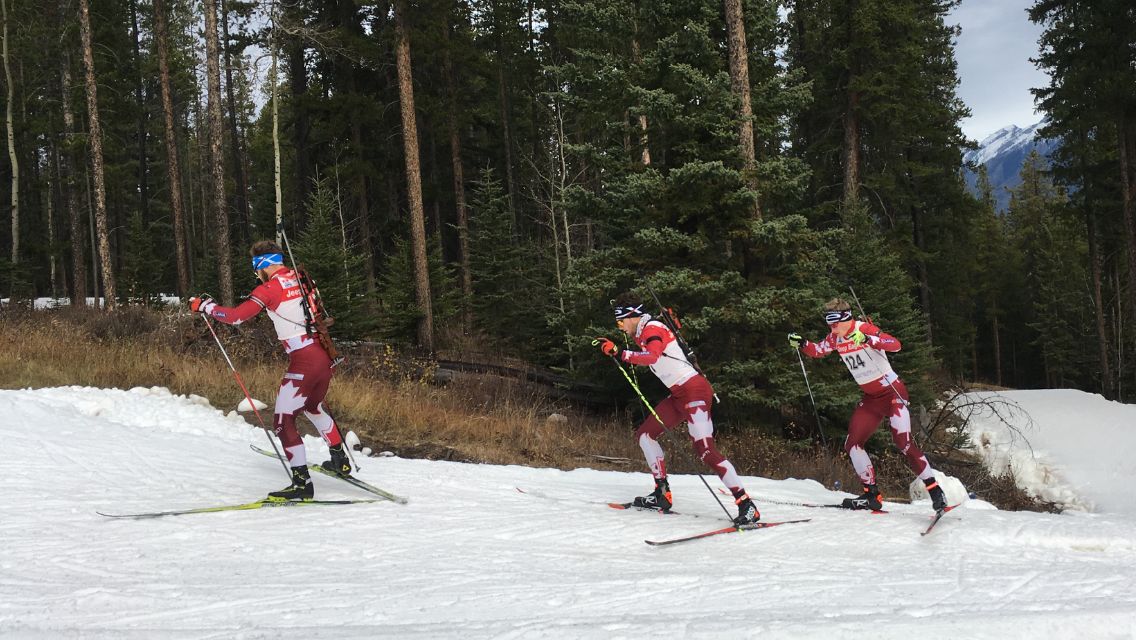
Frozen Thunder is back, but it’s not the same Frozen Thunder you knew before.
Every year, snow is stored all summer at the Canmore Nordic Centre in Canmore, Alberta, and rolled out in October to provide local ski and biathlon teams with on-snow training opportunities. This year, the loop has changed.
“It feels good to be back on the snow after such a long time away,” Biathlon Canada’s Nathan Smith wrote in an email. “The loop has been lengthened and improved. There is a steeper climb now, which means mandatory offset.”
“They’ve set a new track compared to previous years which is much better for training,” Cross Country Canada’s Jesse Cockney agreed.
Biathlon Canada Head Coach Matthias Ahrens explained that the changes were needed to make the loop more comparable to courses used in international competition. National teams for both biathlon and cross-country skiing will be using competitions on Frozen Thunder to pick their World Cup teams, so they wanted the course to be difficult.
“We were doing intensity Monday,” Ahrens wrote in an email. “The athletes started skiing on Saturday and have not really experienced much challenge to adapt from rollerskiing. We are in the last preparation phase before the first World Cup happens in four weeks, and the training volume is reduced now, but the intensity increased to do the final race sharpening.”

Aside from national team athletes and World Cup hopefuls, the loop has been home to high school racers, families and masters teams.
“The reason you will see a lot of athletes wearing bibs is actually that we have training times for elite athletes from 8-noon, Monday–Friday, since the National and Development Teams have a big stake in funding Frozen Thunder as early season training venue,” Ahrens explained. “Only those who have contributed money to Frozen Thunder get bibs and are allowed to ski in the mornings, just a way to control who is on it. On weekends and afternoons it is open to the public.”
“It was a quiet start to Frozen Thunder with a lot of teams away, so that was lovely to enjoy the new track (a fun turn and more climbing) and not play Rush Hour,” wrote Erin Yungblut, a Canmore-based biathlete. “I think it’s really exciting to have so many teams and talented athletes out… I love being able to ski behind others and learn from as many as I can.”
Among that group is the Space Dogs Ski Club masters team.

“For our masters performance group, getting on early snow is probably equal parts technical advantage and motivation/excitement,” wrote Dasha Gaiazova, a Space Dogs coach and former Olympian. “We are grateful that we, and many other skiers of all abilities have an opportunity to train on early snow so close to home. I also believe it makes the Frozen Thunder project more self-sustainable, through sale of general public ski passes, early season ski lessons, and providing great visibility for the sport of cross-country skiing in Canmore.”
Frozen Thunder is getting busier. The Canadian National Ski Team returned from a training camp in Park City, Utah — Cockney had done a shorter camp, thus returning home and getting some extra time on snow. The Canadian biathlon squad already had its first time trial on the course on Thursday. The U.S. biathlon team is also in town now for an on-snow training camp, and the two teams will have joint competitions on Nov. 7-10. Meanwhile, next Wednesday and Friday the cross-country team will hold a classic sprint and skate distance race.
Below, a roundup of some more reactions to getting back on snow before the start of the season:
“It is super fun to be back on snow – rollerskiing is great training, but it simply isn’t the same! I am here in Banff to spend time with my husband before I hit the road for winter racing. I would love to be training with my APU crew in Alaska (there really is no place like Alaska… and yes I am biased as it has and will always be home), but I have been super busy going between Alaska and Banff this summer and I felt it was more important to have this short time with my husband and limit travel these last couple weeks. Not to mention, the Bow Valley is very close to my heart. The terrain in Canmore is great training, lots of transitions and a new stair-stepping climb – they fit a lot into that 2 k loop.”
— Chelsea Holmes, Alaska Pacific University
“Getting on snow the day after returning home from Park City camp was an awesome transition, but I’m quite tired after the time at altitude so I’ll take a couple easy days to get energy back now. I wasn’t so much planning my shorter camp around more time on snow, I was just being careful with energy this late in the training season. As it turns out I may have overdone it anyway in Park City, but it was a really good call to come home and try to recover a bit sooner than the rest of the gang.”
— Jesse Cockney, Canadian National Ski Team
“It’s so amazing to be back on snow again; I still can’t get over how lucky we are to live and train in Canmore with such an epic facility. The transition back to snow has been pretty quick and easy for me as I did a lot of yo-yo camps up at the Haig Glacier this year, so I’m used to icy starts/soft sugar underfoot. Racing definitely feels closer now, and I couldn’t be more excited. I literally have zero pressure or expectations on myself, as I’ve come to realize I’m pursuing biathlon because I love the challenge of it… and the results will be what they are. I don’t think I’ve ever expanded this much [as a person] so quickly. It sounds corny, but I’m finally starting to figure out how to control the controllable and forget the rest of it.”
— Erin Yungblut, Rocky Mountain Racers
— Nathan Smith, Biathlon Canada National Team
“With not getting onto the Haig Glacier because of snow melt, our team hasn’t been on snow since May. The transition was easy for me this year and it feels like second nature to be back on snow. I will admit to the first couple of strides feeling like skis are quite long, but that didn’t last long… It was a bit sad while they were pushing out Frozen Thunder, because we had about three days of rain. So far it is holding up nicely and we just have to hope that colder temps are in the forecast.”


Last Olympics, the first for Canadian cross-country skier Jesse Cockney, went almost exactly wrong.
In Sochi, Russia, Cockney slumped to 53rd in the sprint — his signature event — missing the heats by 6.5 seconds in a lighter field than many World Cups (at the Olympics, no country can enter more than four athletes).
“I honestly believed I would be better — I didn’t imagine I would be that far behind,” Cockney said in an interview with FasterSkier last month. “I had great races at the [Olympic] trials in Canmore. After the training camp we did, we raced the World Cup in Toblach [Italy], and that was by far the best distance race I ever had. The trend was in the right direction to perform at the Olympics.”
It wasn’t a necessarily psychological flake-out, stage fright, or anything like that. Cockney has numbers, and he knows that something in his training and peaking just didn’t add up back in 2014.

“We have blood tests we do before competitions,” he explained. “That was probably the seven-year low for all of my blood numbers, coming into those races two days before the sprint. So something was pretty missed in terms of the physiological preparation for Sochi, and it totally reflected itself in the race results and the feelings.”
Coming into 2018, Cockney has already met Cross Country Canada’s qualification criteria for the Olympics in PyeongChang, South Korea. And he’s looking for different results this time, different feelings.
“I’ve had four years to learn, and I hope we learned,” he said.
Nearing the halfway point of last season, it didn’t seem at all obvious that Cockney would end the year qualified for PyeongChang. Cockney only finished two World Cup races before the Christmas break, with a top finish of 78th in the 15 k classic in Ruka, Finland.
That’s a far cry from the top 30’s, top 16’s, and top 6’s that are needed for Cross Country Canada’s various levels of qualification criteria.
“It was a comedy of errors last year,” Cockney admitted. “The fitness than the results would show. Some of the external factors I let play into the results too much. The race in Kuusamo, there was a snowstorm before the sprint, which threw me off. In Davos, I fell in the qualifier. So I have no idea what that day would have looked like.”
But he secured start rights for the World Cups in PyeongChang, which served as a preview of the Olympic courses. Because the travel was so substantial in the middle of the season and just a few weeks before World Championships, many top athletes didn’t attend the races. Cockney knew he had an opening for top results.
“Very often my often my strength is skiing in the heats and finding opportunities and openings in the heats,” he explained. “It’s very difficult for me to get into the heats. So I knew I really wanted to take advantage of being in the heats.”

Cockney qualified 16th and then won his quarterfinal. He ended up 10th on the day, halfway to the two top-16 sprint results he would need to make the Olympic team.
His season continued with a trip to World Championships, where he finished 47th.
“Last year basically every single race I did was a trials for the next race,” he said. “I was pretty much always hearing from the coaching staff before a weekend that if I didn’t do well this weekend I wouldn’t get to start next weekend, or if I don’t do well here I won’t get to go to World Champs, or something else. It just became that every day was racing for something else and not actually being present.”
That changed when Cockney came home to compete in World Cup Finals in Quebec, the last World Cups of the season. But he didn’t feel great.
“I was quite tired by the end of the World Cup season,” he admitted. “Actually, the intensity before we left Canmore to go to Quebec at the end of the season, it was probably the worst intensity that I did all year. Ivan [Babikov] and I were doing a workout together in Canmore and I couldn’t finish the workout — I was so tired, I had no energy in my legs. I guess I was a little apprehensive going into the World Cups in Quebec.”
Cockney found some magic, though, qualifying 28th in the sprint, and taking second in his quarterfinal in a photo finish with Norway’s Johannes Høsflot Klæbo, who later that day became the Sprint Cup winner based on a season of World Cup success.
At the end of the day, Cockney was 10th again, and had made the Olympic criteria.
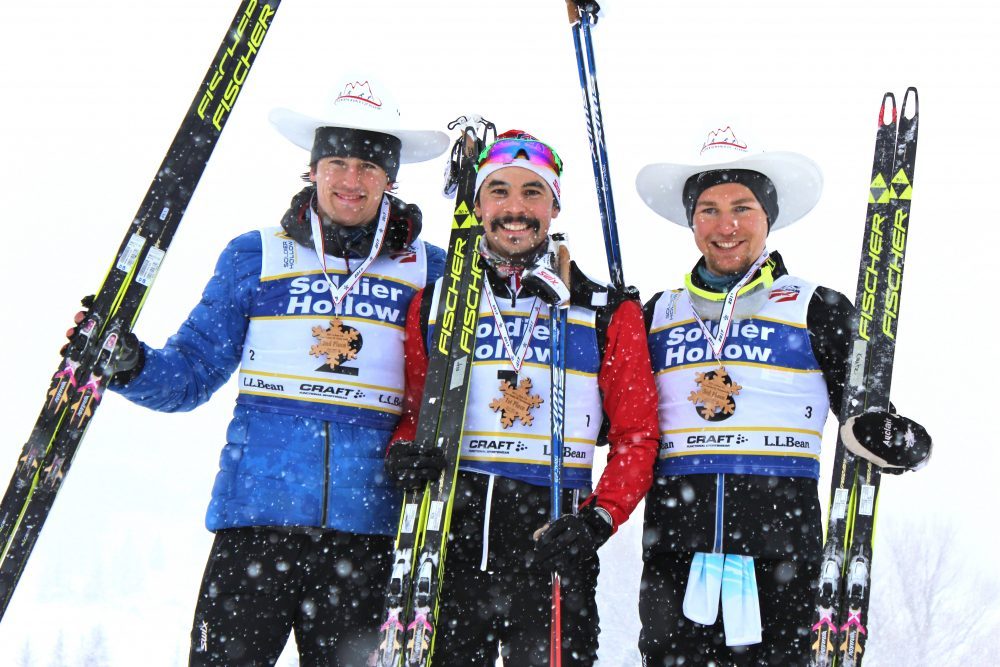
“On the day, my legs were feeling good, and it’s a course that I like, with the long flowing speed sections and a big high-speed finish around the corner,” he said.
Having hit those criteria and secured World Cup starts for next season as well, Cockney is looking forward to having a very different perspective on his upcoming races.
“That’s a pretty big bonus for Period I and the rest of the year,” he said of being qualified. “I can just race. And that’s pretty often when people’s best results come, when they are just present and focused on the day.”
When Cockney gets to PyeongChang, he will have an advantage many top athletes will lack: prior experience at the venue. Just a handful of men’s sprinters who competed in the PyeongChang World Cups are expected to make their countries’ Olympic teams (Cockney’s teammate Len Valjas is another one of them).
“Nothing really compares to being there,” Cockney said of the decision to take the travel. “I think that was really valuable to get a chance to go and see the courses first hand, to see what it’s like to have a sustained climb – the last climb is quite difficult. It’s hard to tell on the video but it’s quite steep. So I’m pretty happy that I was able to see the course.”
Building towards the Olympic season, that preview has allowed Cockney to keep a laser focus on the PyeongChang sprint.
“I have a loop in Camore on the World Cup trails that I’ve kind of adopted,” he explained. “Mentally it is the Olympic course in PyeongChang. I do most of my warmups for the strength sessions running and ski bounding on that section, and visualizing that I’m not in Canmore, that I’m in Korea skiing on snow and finding the best lines. Just trying to picture myself on those climbs, and hopefully mentally getting more and more confident and comfortable.”

That’s one thing Cockney is doing to look towards Olympic success. Another is learning from whatever got him to a physiological low in Sochi.
“I will spend less time at altitude before these Olympics,” he said. “And take a big step back in terms of training volume and intensity, and make sure that I’m rested and that my body isn’t in that recovery panic mode that it was in Sochi.”
So far, training this year has been nothing out of the ordinary, just a continuation of the plan that got him here.
“I think I’ve just been patient with the training,” Cockney explained. “It has been pretty steady. We haven’t had many highs or lows with anything. I’m letting the bulk of the training year build towards February.”
Getting better at sprint qualifiers is also a goal, so that he can have more opportunities to find good lines in the heats.
“Over the last two years I’ve been trying to get back to training a bit more volume, trying to get some capacity in a different way,” he said. “I [need to] have the stamina to ski at a high speed in the qualifier, not just for 30 or 45 seconds well, but I have to be strong for 3 ½ minutes in a qualifier. And that comes for sure just from capacity and I’m trying to work on that.”
Cockney went to Italy for a national team camp, but other than that it has been a lot of training in Canmore, the adopted home of the Yellowknife, Northwest Territories, native.
He is not part of a National Development Training Center, and instead has been training primarily with the other Canmore-based members of the national team.
“We can be our own team with Lenny, Knute [Johnsgaard], Graeme [Killick], and myself,” Cockney said. “[World Cup coach] Ivan [Babikov] is there for all the workouts we need to go. We have a good small group so that means we are pretty flexible… I’d say every workout there’s someone who is strong and can pace the group and make sure that there’s high-quality speed we can feed off of.”
But a rotating cast of characters have joined them at different times.
“It has been a really strong training group over the summer, and we have kind of opened the workouts to anyone in town who wants to train with us,” he continued. “So a lot of athletes from [Alberta World Cup Academy] are doing workouts with us, and some athletes who are unsupported who are training on their own in Canmore.”
And more recently, Cockney escaped the smoke brought by major wildfires and headed East.
“I got back to Canmore… [and] it was still quite smokey in the air,” he said of early September after the Italy camp. “This block of training was pretty important with the intensity, so we made a last-minute decision to come to Quebec, be with Alex [Harvey], get some time at lower altitude, and make sure that we didn’t miss any workouts because of the smoke. It has been a productive period, with hard workouts with Graeme and Alex.”
At the moment, Cockney is headed to Park City, Utah, for a national team training camp. He will cut it a bit shorter than some teammates to try to avoid too much fatigue from altitude, and then have a few weeks in Canmore before the season starts.
He said he’s looking forward to those weeks, where he can train but also get good family and friend time before heading to Europe.
Because from there, it’s race time, and Cockney is hoping for solid results on the World Cup before Christmas.
“The big goal is to be racing into the semifinals again,” he said. “Having good strong days, seeing the speed of the World Cup again and racing at a good level. Probably in terms of which courses to target, I think Lillehammer [Norway] and Davos [Switzerland] are good courses for me. The last time I raced in Lillehammer I think I was 34th or 32nd or something, so close to making the heats. In Davos I have been in the heats before. So those are to big weekends for me, with goals to get into the semifinals those days.”
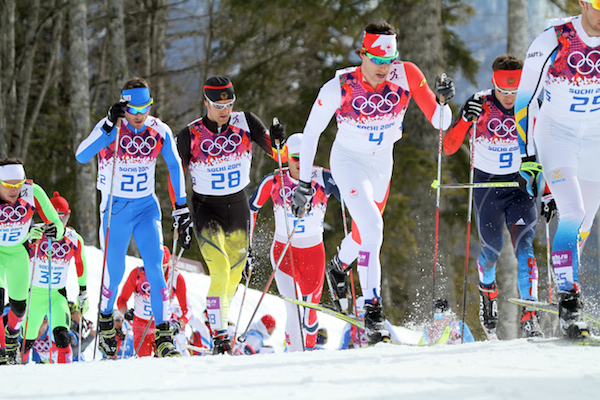
As athletes enter their final preparations for the Olympic season, some Canadian cross-country skiers have a pretty good idea that they’ll be heading to PyeongChang, South Korea, in February to compete.
That’s because they have already achieved nomination objectives that will put them on the final ranking list from which the team will be picked. If more than 12 athletes – the maximum team size – meet criteria, then a second selection process will proceed to pick only the top-ranked athletes.
“If you had too many people, you’ve got to rank them on their best results and the team could be full,” Cross Country Canada High Performance Director Tom Holland said in an interview. “But that’s not likely to happen.”
In other words: six men and two women can feel pretty safe that they are heading to PyeongChang.
Other details of the Olympic team selection process are still unpublished. The location, dates, and formats of the final Olympic Trials races are being discussed, but have not been finalized. Those competitions will be used to bring the roster up to 11 or 12 athletes – with a minimum of four athletes of each gender – if that isn’t accomplished on the World Cup.
“We have to do an amendment to this criteria for final qualifying in Canada, which will be in January,” Holland said. “That piece isn’t complete yet. That’s something I have to send out to the committee and work those details through… With the men we’ve almost met the max, and we could probably only take one more. Whereas with the women, we’ll probably taking at least five, [so] there’s at least three more spots for women.”
Who’s (Most Likely) In
Several athletes have already met the “Primary Qualifying Criteria”. That group is headlined by Alex Harvey, who won his first individual World Championships gold medal last season in the 50 k in Lahti, Finland.
There are several ways to meet the primary criteria, all at World Cup or World Championships races. All consider, for scoring, only the first four finishers from each country – for example, removing the fifth (or higher) Norwegian athlete on the results list and moving everyone else up accordingly. For purposes of brevity, this will be called “Olympic-style scoring” for the rest of this piece.
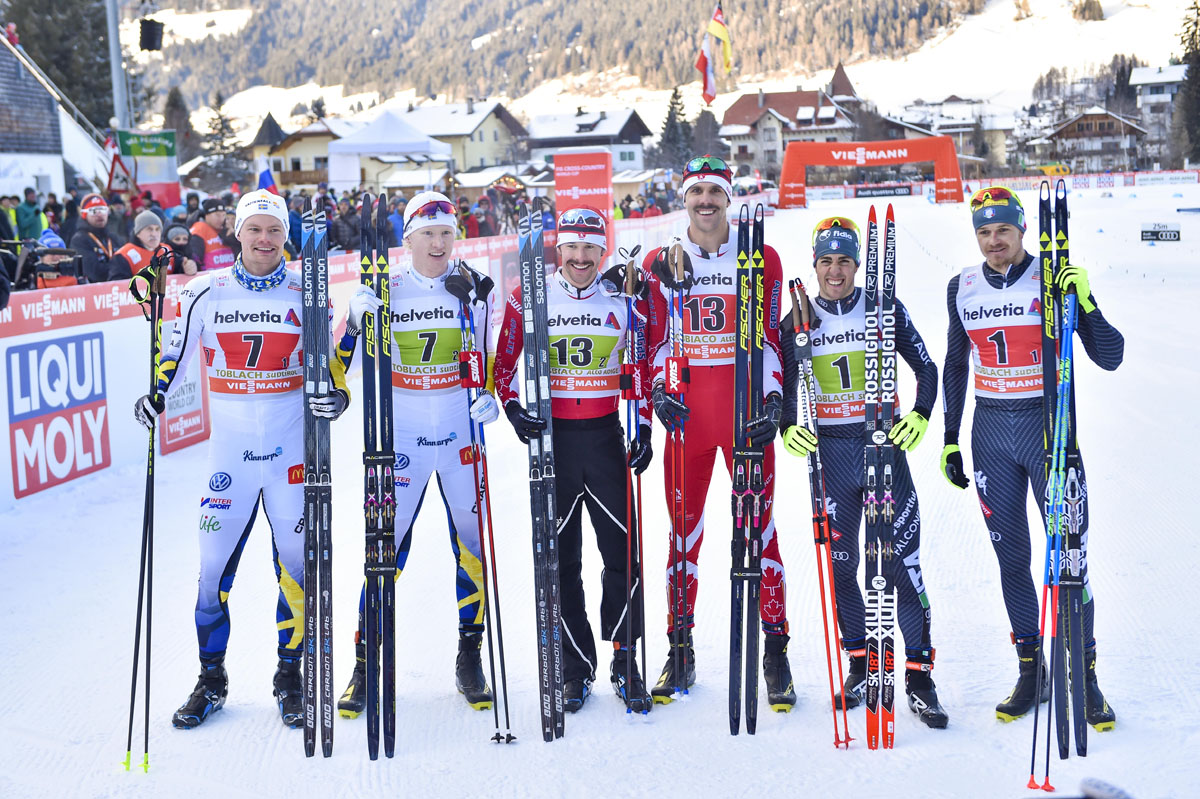
With that scoring metric, sprinters must achieve one top-6 result or two top-16 results to make the list. In distance races, athletes with one top-12 or two top-16 results, or two results with FIS points under 10, make the list. Members of a podium relay or team sprint effort will all make the list. And, in a special nod to the disciplines which will be contested at the Olympics, an athlete with a top-16 distance result and a top-16 classic sprint result will make the list.
Harvey meets most of those requirements individually. Thanks to Canada’s third-place relay in Ulricehamn, Sweden, Devon Kershaw, Knute Johnsgaard, and Len Valjas join him on the nomination list.
Of the group of four, Valjas is the only athlete other than Harvey who has also met the individual standards and would have qualified without the relay result (or a team sprint win with Harvey in Toblach, Italy), thanks to sprint results of 13th in Lillehammer, Norway; 14th in Davos, Switzerland; 16th in Val Mustair, Switzerland; 10th in Falun, Sweden; and fourth in PyeongChang, South Korea.
Jesse Cockney has also met the individual nomination standards by finishing 10th in World Cup sprints in both PyeongChang, South Korea, and Quebec City, Canada.
“So there’s [five] athletes that have met those criteria,” Holland said. “And then we move onto what’s called an ‘Alternate Qualifying Criteria A.’ In this criteria, they have to be three times in the top 30.”
Alternate A, or Next On The List
A number of athletes have met this next set of criteria.
Dahria Beatty finished 25th in the sprint in Davos, 26th in the 10 k mass start in La Clusaz, France, and 29th in the sprint in Otepaa, Estonia.
Graeme Killick finished 21st in the 30 k skate in Davos. He also had a few near-top-30’s which, with Olympic-style scoring, turn into top-30’s: 33rd in the 10 k mass start in Val Mustair, 32nd in the 15 k mass start in Val di Fiemme, Italy, and 32nd again in the same event in Quebec City.
And Emily Nishikawa did it with finishes of 39th in the Lillhammer 10 k, 34th in Davos, and 37th in the Quebec City mass start, all of which are top-30’s with Olympic-style scoring.
For these athletes, selection is not guaranteed. If more skiers meet the “Primary Qualifying Criteria” in December and January World Cups, they would get preference and those who only met “Alternate Qualifying Criteria” would get bumped down.
Holland doesn’t envision that happening, though.
“There’s nobody that skied at that level,” he said of the possibility that an athlete not already mentioned would pop a top-six or top-16 World Cup result in December. “If you haven’t done it once last year, it’s going to be hard to do it… But it’s not impossible.”
There are several athletes who are on their way to meeting the “Alternate Qualifying Criteria A,” leaving open the possibility that the list of athletes meeting those requirements would be long enough that it would have to be winnowed down by ranking athletes according to their best results.
Cendrine Browne finished 26th in the World Championships mass start 30 k. She also placed 35th in the 10 k skate in Ulricehamn, a result which turns into a top-30 with Olympic-style scoring.
Julien Locke placed 20th in the sprint in Quebec City, and Bob Thompson placed 30th.
(Thompson also placed 31st in PyeongChang, South Korea, a result which would be top-30 with Olympic-style scoring; several other Canadian athletes also finished in the top 30 that weekend. But their results won’t count towards Olympic qualification due to a depth-of-field calculation explained in a separate article.)
So the list of athletes meeting “Alternate Qualifying Criteria A” could grow.
“We have men that have top-30 World Cup sprints, so they could do it,” Holland said. “But I don’t expect on the women’s side [other than Browne] — we don’t have anybody that’s done any, so [for them] it’s going to be hard to do it three times.”
Access to Points Races
A fair number of athletes will have opportunities to work on qualifying criteria this winter, as Canada is planning to send a full team to Period I.

“We don’t want to take more than 12 [athletes],” Holland said. “That’s seems to be the magic number for us, because we know we can support that. So we are going to take at least four women and seven or eight men.”
That’s the biggest chance athletes will get to avoid a nerve-wracking trip to Olympic Trials. While the selection document states that the qualifying period goes through January 21, in reality all of the World Cup-based qualifying will be done by Christmas.
That is because the Canadian team only takes a small squad to the Tour de Ski, the first set of World Cups after Christmas. The selection criteria for 2017-2018 national team trips has not yet been posted on the CCC website, but in the 2016-2017 season, athletes had to achieve one top-12, two top-20s, or three top-30s in Period I in order to head to the Tour de Ski.
In other words, anyone objectively qualifying for the Tour de Ski will have met some Olympic nomination criteria already.
There is a way to reach the Tour without those top results – according to the criteria, athletes could be added to the team by discretion if they had scored World Cup points. In other words, for athletes with one or two top-30 finishes, it is up to coaching staff whether they would be brought along or not.
Killick competed in the Tour de Ski last season through this mechanism – he had a lone top-30 result in Period I. Then he collected two more Olympic-style scoring top-30’s at the Tour de Ski.
Those were the results that allowed Killick to meet the Olympic nomination criteria through “Alternative Qualifying Criteria A”, but this year, athletes in a similar position might not be so lucky.
First of all, the Olympic Trials races are likely to be scheduled at roughly the same time – “around January 6th to 10th,” Holland said. So athletes would have to choose whether to risk a trip to the Tour de Ski, versus closing things out at Olympic Trials.
And secondly, the Tour vs. Olympic Trials decision may not even be a choice. Holland indicated that if an athlete were close to qualifying but had not yet met the Tour de Ski standard – which could be very possible since last year’s Tour de Ski criteria specified World Cup points, not the adjusted, four-athletes-per-country scoring of the Olympic selection – they would not be offered the chance to finish things off in Europe.
“We’re not going to take a whole pile of people to the Tour de Ski to try to qualify,” Holland said. “It’s better to do it in Canada head to head.”
And so, although the selection document states that qualifying can be done through January 21st, Holland did not seem to consider the Tour de Ski or post-Tour World Cups in Dresden, Germany, and Planica, Slovenia, when discussing how athletes can qualify.
“By the 10th [of January] you want to have your team picked,” he said. “You want to have your logistics, ideally you want that whole team to go to the Seefeld World Cup [January 27-28], and move to PyeongChang and get them in their training mode for the Games.”
The Rest of the Process
That means that for at least a few woman and perhaps one or two men, it will come down to the Trials races that Holland says will be held at Mont Sainte Anne.
“We’re probably only looking for one man,” Holland said of the number of athletes that would be selected from those races. “We’ve had men who have scored World Cup points in sprint but not distance so odds are we’ll be looking for a sprinter. On the women’s side, it depends what happens on the World Cup. Cendrine Browne two out of three [top-30’s] so she could make that criteria in December. So on the women’s side it’s a little more open. I think we’re looking for both sprint and distance athletes, and if Cendrine makes it in December we’d only be looking at two women.”
After that, selected athletes will refocus and begin preparing for their Olympic experience.
“After the Tour de Ski, we’re going to skip the next two World Cup weekends,” Holland said of the team’s top athletes. “Then they’ll be training at altitude, probably in Livigno for the most part, and then they’ll go to the World Cup in Seefeld [Austria] with the whole Olympic team. The ones that come from Canada might just come over prior to Seefeld and spend some time in Davos [Switzerland], or something like that.”
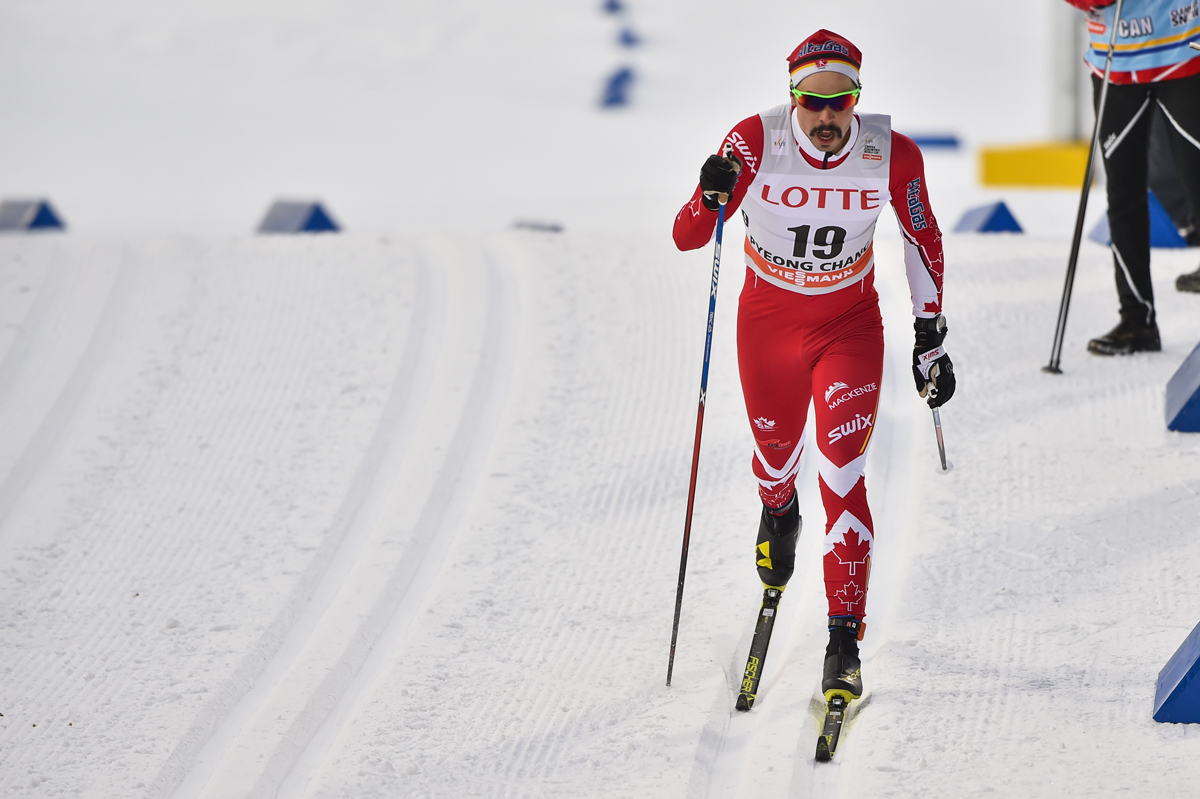
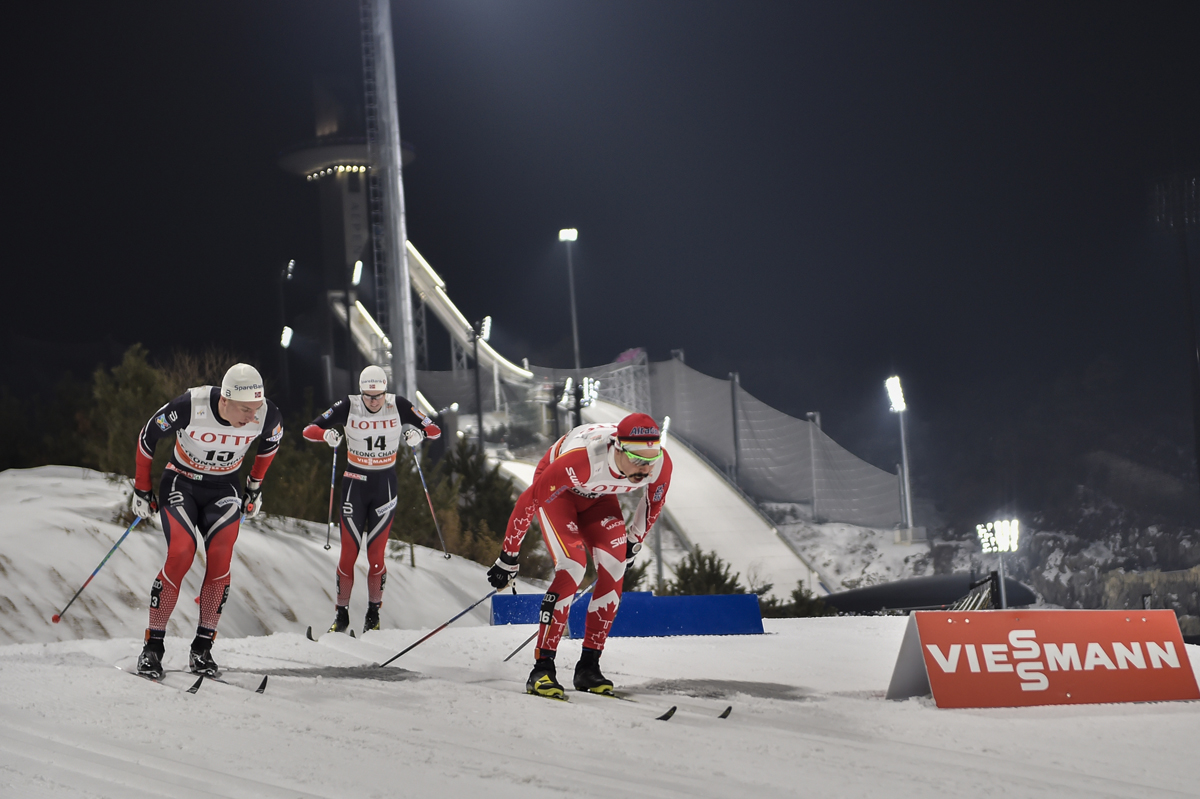
As Cross Country Canada (CCC) looks at which athletes have made progress on qualifying for the 2018 Olympics in PyeongChang, South Korea, listing those with top-30 World Cup finishes is a good place to start.
But there are a few athletes with those results that don’t come up in conversation.
Simon Lapointe finished 27th in the sprint and Bob Thompson 31st in the World Cup sprint in PyeongChang, South Korea last season – a result that would be bumped up top top-30 status if the Olympic-style scoring employed by CCC for selection, which counts only the top four athletes from each country, removed “extra” Russians from the results.
Paralympic legend Brian McKeever finished 29th in the skiathlon in PyeongChang. And for the women, Annika Hicks and Sadie White finished 26th and 29th (out of 29) in the skiathlon, and 32nd and 34th in the sprint (in a field of 36) — which with Olympic-style scoring would become top-30 finishes.
By a provision in CCC’s criteria, these results won’t count towards nomination to the Olympic team.
“In order to maintain equity and fairness in this selection process, the HPC reserves the right to exclude, or to count only partially, the results of any World Cup event with a weak depth of field,” the criteria state. “The CCC Selection Committee will be charged with evaluating the depth of field in this circumstance based on comparative analysis of World Cups over two seasons (2015-16 and 2016-17). The CCC Selection Committee will bring forth to the HPC any such recommendation to exclude, in whole or part, a World Cup event. This analysis of depth of field will consider time behind the winner (FIS points), an analysis of the top 6, top 12 and top 16 individual athletes or team events in the race based on World Cup ranking, World Cup points, total FIS points of athletes in the race and any other factors that allow for a fair and equitable World Cup depth of field analysis.”
With such a criteria, it’s fairly clear that finishing last in a World Cup race with only 30 athletes would not count towards Olympic qualification.
But in terms of determining what would count, how CCC actually analyzes race results is multifaceted and not entirely transparent.
“It is always best to look at as many data factors as possible when analyzing depth of field – weak depth of field can vary at the same World Cup event depending on gender and type of race,” CCC High Performance Director Tom Holland wrote in an email.
He emphasized that the depth-of-field assessment is rarely used, citing PyeongChang as the only set of World Cups in the last Olympic cycle where results had been excluded for team qualification.
What Results Count as Competitive
Holland and the selection committee looked at different slices of the PyeongChang results. There are multiple ways to meet Olympic qualifying criteria: a top-six sprint result, a top-12 distance result, two top-16 World Cup results (all deemed “Primary Qualification Criteria”), or three top-30 World Cup results (deemed “Alternative Qualification Criteria”). The level of competition at each of these results cutoffs was considered.
And according to Holland, the men’s races were competitive at the top end but not in the middle or bottom of the fields. That’s why Jesse Cockney, who finished 10th in the PyeongChang sprint, can count that as one of his two top-16 finishes and meet CCC nomination criteria – but Thompson, for instance, can’t count the result as his second of three top-30’s.
(Thompson finished 30th in the World Cup Finals sprint in Quebec City in March, and now needs two more top-30’s for a shot at making the Olympics.)
“What would be looked at varies between the Primary and Alternate A Criteria,” Holland wrote. “For the Primary Qualifying Criteria, the depth of field analysis being considered is top 6–16; World Cup ranking of athletes, particularly the number of red group athletes in the race would be the critical starting point of analysis, next would be time behind these athletes compared to similar placing in other [World Cup] events.
“For the Alternate A Criteria, we are only looking at top 30 results counting top 4 per nation,” he continued. “The average top 30 [World Cup] FIS points over the past 2 seasons in that particular race distance per gender is a good indicator to start the analysis. Being in top half of the field (usually, but not always) and the number of top 30 ranked athletes in the race also need to be considered.”
When asked whether it was appropriate to apply a depth-of-field adjustment differently within the results of the same individual race, the Canadian Olympic Committee (COC) declined to address the specific situation.
“The COC provides national sport federations with a Guide to Drafting Internal Nomination Procedures (INP), which offers a framework, practical advice, and examples they can use in their drafting, interpretation, and implementation of their INP,” COC Manager for Corporate Communications Ricky Landry wrote in an email.
“The COC then reviews all INPs to ensure that they comply with the COC Team Selection Policy, the Olympic Charter and other applicable COC rules and policies. Also, the COC reviews INPs to ensure the qualification and nomination timelines fall within COC and Organizing Committee (OCOG) deadlines. In general terms, the COC Team Selection Policy recognizes the NSF’s authority in setting qualification criteria appropriate for its sport and in determining which athletes and support personnel will be nominated to the COC Team Selection Committee for selection to the Canadian Olympic Team.”
End result: for Lapointe, Thompson, and McKeever, their results were not enough to count towards Alternate Qualification Criteria. For Cockney, 10th was good enough for Primary Qualification Criteria.
“I’ve got the spreadsheet… there were only nine out of the top 30 sprint group [on the start line] at that event,” Holland said in an interview earlier this summer. “So the depth of field and if you look at FIS points, it wasn’t there. But if you look at the top 10, it’s a little more legitimate.”
There were only seven seeded World Cup sprinters on the start line in PyeongChang. All of them bested Cockney in qualification but he beat two of them, Baptiste Gros of France and Simi Hamilton of the United States, in the final results.
That might be important, as Holland indicated that qualification versus heats racing were not necessarily considered in the same way.
“If an athlete does well in the heats, I would be inclined to put more emphasis on the heats,” he wrote.
Transparency and Athlete Expectations
While it was clear to all that the depth of field in PyeongChang would be looked at carefully – Canada was not bringing most of its top athletes, and neither were other countries – the outcome of that analysis wasn’t known.
That marks a major difference from this aspect of the criteria to the rest of CCC’s criteria. It’s fairly clear what athletes have to do to meet World Cup-based criteria: they have to hit certain results, and after a race they can look at the results sheet and immediately know whether they can check that box or not.
At the end of that process, any remaining spots on the roster will be filled at Olympic Trials. Again, there it will be clear what finish is required to be named to the team.
Going into the PyeongChang World Cups, athletes knew that a top-30 might not cut it, but what exactly they would have to do to have a result count towards Olympic qualification was unclear.
“A lot of people didn’t go, so I believe they only counted a top 20 result,” Thompson said in an interview last week. “But I didn’t know that. There was a little bit of awareness that you had to do better than top 30, like maybe making the top 12 would be more respected.”
Likewise, because the method of assessing depth-of-field is not a single mathematical formula that is evenly applied, even glancing at the results after a race may not make clear which athletes in the field had attained qualification standards and which hadn’t.
“In the last few years, I haven’t paid so much attention to what selection criteria is worth in terms of specific scenarios,” Cockney said in an interview this week. “It’s not usually up to us what is deemed a usable race or a competitive race… I can’t decide who the competition is. I can just decide to ski. That’s the attitude I was taking in Korea – just to try to do my best and have a strong day, and thankfully I was able to put together a good day.”
That’s just part of the game, Holland seemed to suggest, saying in an interview that athletes “should have been aware” that normal qualification standards wouldn’t apply before even leaving on the trip to South Korea.
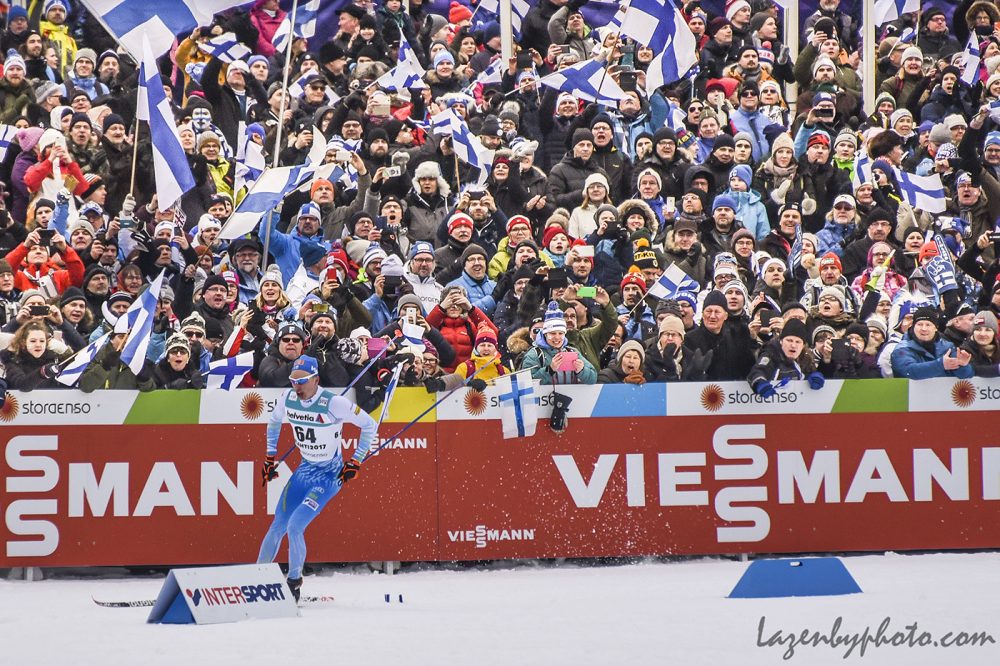
LAHTI, Finland — Through the first seven medal races of 2017 Nordic World Championships, the hometown Finns came close. There was Krista Parmakoski’s skiathlon silver. There was the spectacular Finn non-win when Finland’s Iivo Niskanen and Norway’s Emil Iversen tumbled 200 meters from the line during Sunday’s classic team sprint. At the moment of the tangle, Niskanen was primed to pass Iversen for what appeared to be a golden performance.
Instead of a cheer concluding the sprint, a collective exhale deflated the crowd: Niskanen and teammate Sami Jauhojärvi ultimately settled for bronze. While it wasn’t the result they had hoped for, it remained the 25-year-old Niskanen’s first World Championships medal.
Another race on Wednesday brought another Finnish opportunity. On a 34-degree Fahrenheit day with moist tracks and low-hanging clouds, gold was up for grabs.
During the men’s 15-kilometer classic individual start, Niskanen channeled whatever bitter taste remained from his team sprint near-win into a controlled and sufficient pace. After 1.5 k, Niskanen ranked fourth — from then on, he was the fastest through every remaining timing point, and first when it mattered most. Niskanen won in 36:44 minutes.
Norway’s Martin Johnsrud Sundby finished 17.9 seconds off his time for silver. Sundby’s teammate Niklas Dyrhaug clocked in 31.3 seconds back for bronze, his first-career individual championships medal.
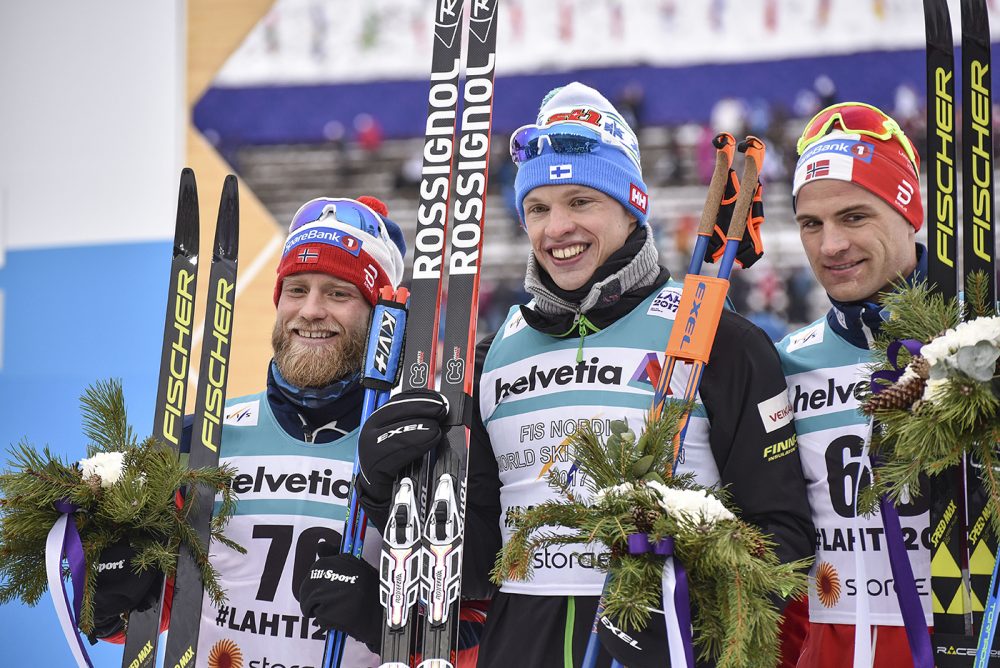
“It’s for sure a really good team, Norway, and it’s a hard fight in all the places for every distances,” Dyrhaug said at the post-race press conference about making Norway’s 12-man World Championships team. “I have been a reserve for the skiathlon and the team sprint. I have been here since Otepää — ten days now. I have been ready so when I got the chance in the 15 k, yeah, I am happy to show everybody that I am in really good shape and I have something in world champs to do.”
The 15 k classic appears an odds maker’s nightmare. It remains a fickle distance and technique with a million and one variables. There’s the course profile, the athlete’s classic technique to consider — do they thrive on headwalls or stridable terrain, double poling? The wax. The snow type. The venue’s altitude. Then there’s the pacing — go out hard? Look for negative splits? Ski it like a true distance race, not an elongated sprint?
A single 15 k classic win at a championship or World Cup level evidently doesn’t mean more will come your way. Of the 133 starters on Wednesday, Finland’s Matti Heikkinen remains the only athlete who had won a 15 k classic at a World Championships or Olympics (at 2011 World Championships in Oslo, Norway, he won the gold in this event). Not since the ’54 and ’58 championships has an athlete won two world titles in this event.
Niskanen and the 15 k classic are sympatico and eventually he may buck the consecutive-winner’s curse. Niskanen has three career World Cup podiums: all in the 15 k classic. There’s two wins — both in Kuusamo, Finland, and a second place at the last pre-championship World Cup race last month in Otepää, Estonia.
That doesn’t mean the Finn isn’t flawless.
“Many times, in many races I have started too hard for the first two kilometers,” Niskanen said after the race.
His too-early, hot-pacing issues were remedied Wednesday as he left nothing to chance. Niskanen suggested he’d had a Lahti champs dress rehearsal to test his pacing strategy.
“It was good to race here before on the Scandinavian Cup and learn the track, today I’m ready,” Niskanen said.
Back on Jan. 8, Lahti hosted a Scandinavian Cup 15 k classic. Like today, Niskanen won over another Norwegian, Johannes Høsflot Klæbo (+5.8).
“Today I planned to do a half kilometer and push hard,” Niskanen said on Wednesday. “After a kilometer and a half, I was quite fresh and got quite easily a gap and pushed as hard as I can. Everyone is cheering you and so then you don’t actually feel the lactate as normal. I had a difficult last kilometers, but it was one and a half to go I just thinking about myself, ‘Now we are not going to lose 20 seconds anymore.’ ”
That losing 20-seconds remark referred to his Scando Cup race. During that 15 k, he was 17 seconds up on Klæbo with 3 k remaining. He actually lost 12 seconds to Klæbo on that final sector, not 20, but Niskanen recognized the trend — slowing down in the final push.
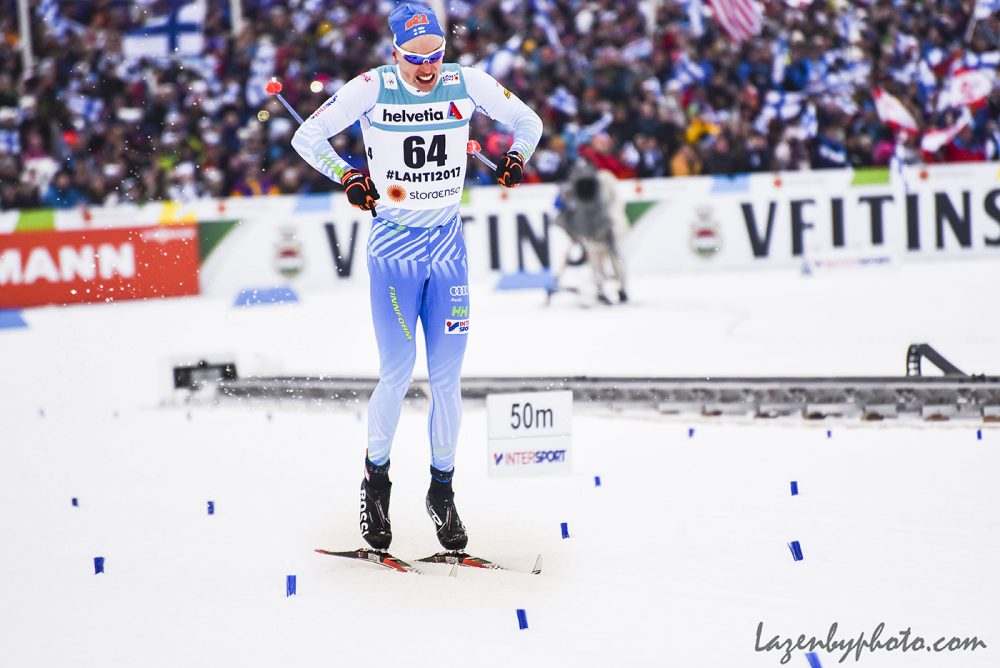
Although young, Niskanen has struggled with repeated sickness and overtraining. Promoted as a potential World Cup overall contender, Niskanen’s three 15 k classic victories remain the sole podiums highlighting his World Cup resume.
“It has been many hard years and I said when I wake up, ‘I feel healthy today and I have hope’,” Niskanen said. “I have gotten easily sick for many years and over training, maybe I have been training too much and too hard during the last years. But this year I have trained more than ever, but I have not raced in every weekend.”
The higher-volume, limited-racing recipe worked. This season, the Finn tailored his race schedule — not too much, not too little. To date, he’s raced 11 World Cup races.
“The goal was to win here in Lahti and be in the best shape here and we see it with my gold,” Niskanen said.
Norway’s Sundby remains a World Cup benchmark— he’s a mutiple overall Crystal Globe winner and leads this year’s standings. But for the reigning overall World Cup winner, an individual championship gold (at world champs or the Olympics) still eludes him.
“I think my race was really good, I felt so fast out there,” Sundby said after the race. “And then I was 20 seconds behind, I don’t believe it. It was tough for the mind to motivate myself for fighting today, but I did what I thought was one of my best race ever at this distance.”
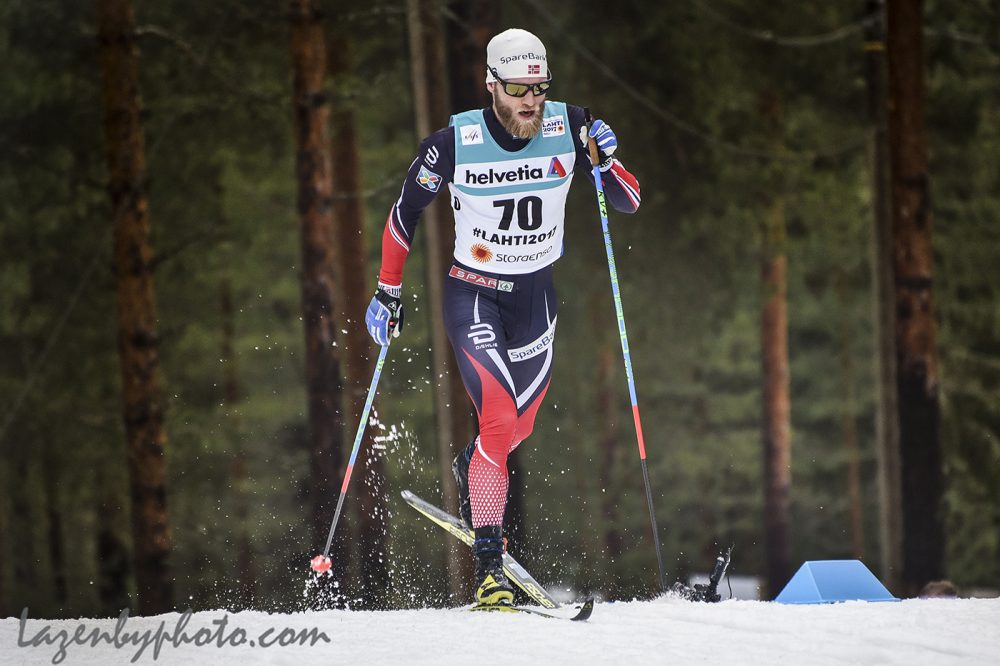
Asked if he felt demoralized knowing he was 20 seconds down grinding away on Lahti’s wooded tracks, Sundby explained how he attempted to remain in the hunt.
“It is not so difficult in the World Champs … [Niskanen] did the race here in the Scan Cup a few months ago, where he for sure lost a lot of seconds in the last 3.75,” Sundby added. “And I tried to motivate myself. I said, ‘He will meet the wall, he will meet the wall, you just have to push.’ I felt good, I felt good all the way and tried to gain seconds but it was nearly impossible today.
“It is an amazing performance Iivo showed us today, everybody,” Sundby said of his Finnish protagonist. “You have to appreciate a really good sportsman. Also with some things that happened before here in the world champs, maybe in the team sprint, and it’s called karma. Today he showed everybody.”
Best World Champs Finishes for Bjornsen in 18th, Bratrud in 33rd
While Niskanen took the overall victory on Wednesday, American Erik Bjornsen walked away with a win of his own. Two days earlier, the 25-year-old Washington native had raced to a historic fifth place in the classic team sprint with his U.S. Ski Team (USST) teammate Simi Hamilton for the best team-sprint result for the U.S. men’s program. Before that, the team’s best was seventh place in 2015.
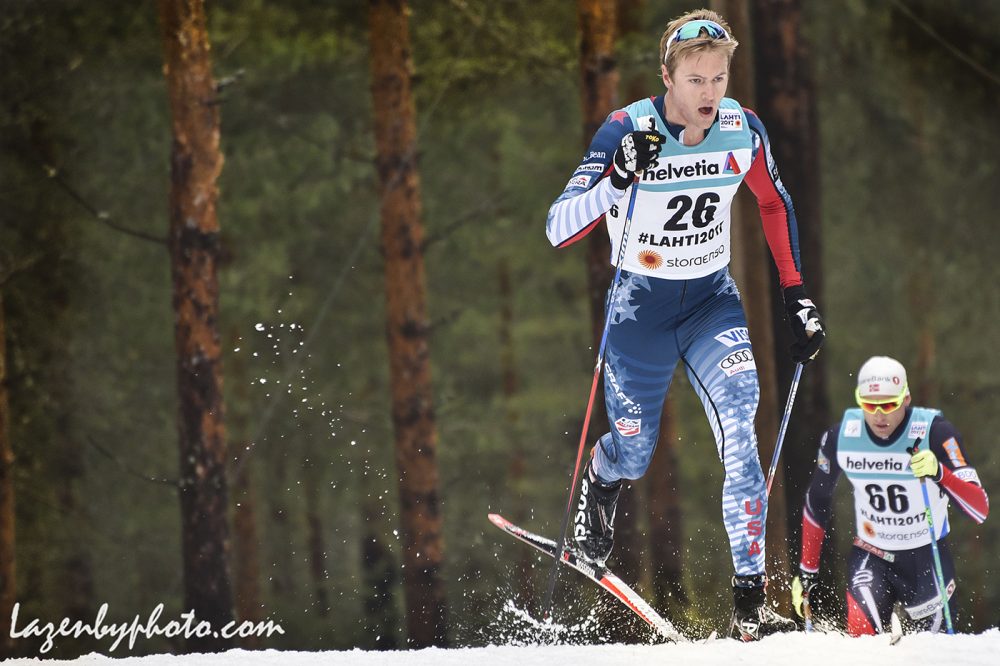
Bjornsen had raced the anchor leg for the U.S., challenged by names like Norway’s Johannes Høsflot Klæbo, Russia’s Sergey Ustiugov and Wednesday’s eventual 15 k winner, Niskanen.
Despite some of the heavy hitting names that challenged Bjornsen on Sunday, he found himself in the mix (two of his laps were the fifth fastest and one the fourth fastest of all second-leg skiers).
“In the team sprint the other day, you saw some of the best skiers, I mean, I was skiing with Iivo Niskanen, who has a good shot at winning today, and I felt pretty comfortable skiing with some of those guys,” Bjornsen after Wednesday’s race. An early starter in bib 26, he initially finished third before being bumped 15 places to 18th (+1:56.7).
“I definitely went into the [15 k] race with quite a bit of excitement from the team sprint,” he said.
Bjornsen added that the energy he was able to find during the team sprint is something he sees as working it’s way into his longer-distance efforts.
His performance in the 15 k appears to prove that, as he finished in the top 20 for his best individual World Championships result. The finish also ties his best individual World Cup result — he placed 18th three years ago in a 15 k in Toblach, Italy. The finish was also the best championships result of an American in the men’s 15 k classic since Kris Freeman placed fourth at Liberec world champs eight years ago.
Bjornsen explained that a slight bonk toward the end of his first lap caused him to put on the brakes briefly, though he found he was ultimately able to pick his pace back up before finishing.
“I went for it in the beginning, for sure, and I think I had a pace for the first lap that would have been pretty similar to some guys in the top ten,” Bjornsen said. “Then I kind of hit a little bit of a wall there, a little bit through the first lap, and struggled for a couple of kilometers … then I was able to pick up a little bit of steam before the finish.”
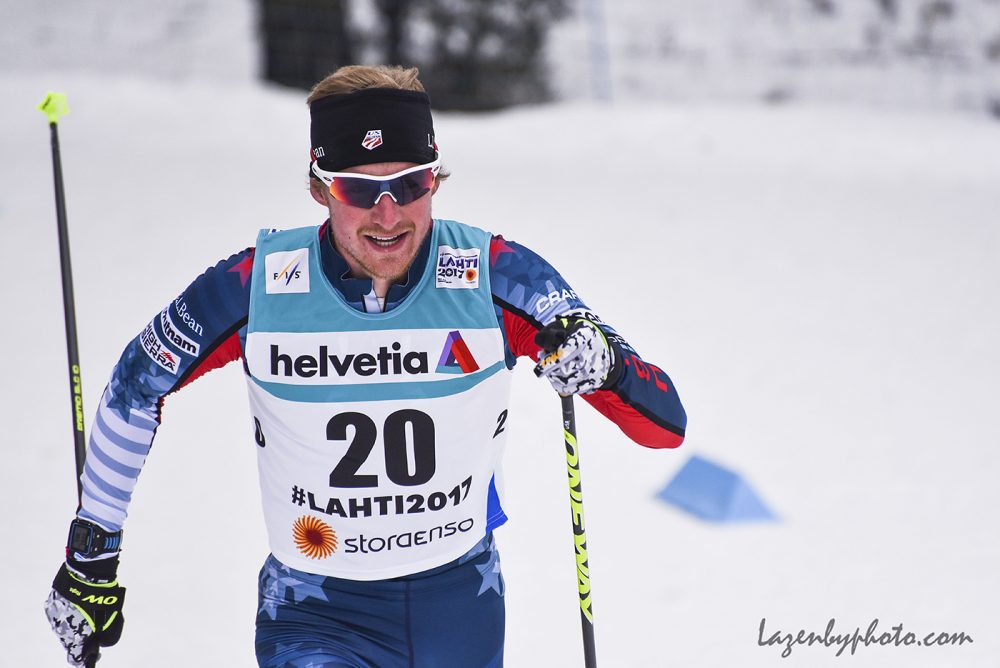
“I mean hopefully I can just continue to improve and be able to keep that pace up the whole way and then I think it can come together for me,” he added.
The second American to finish on Wednesday was Kyle Bratrud in 33rd (+3:11.5). Bratrud’s result was 20.7 seconds out of the top 30 and marks his best individual result at his second World Championships and career best at the World Cup level.
Seeing himself as a stronger skater, Bratrud, 24, of the CXC Team, entered Wednesday wanting to test his ability to push his classic-technique limits.
“I think I’m a little more confident in skate skiing, so classic I figured I had nothing to lose,” Bratrud said after. “I basically just went as hard as I could from the gun … to see if I could hang on.”
While the decision resulted in Bratrud having to ease up during some of the climbs, he indicated that managed to recover well enough on the descents to regain control.
“The course is pretty rolly and I was dying a lot on the uphills,” he said. “On the downhills I was getting some recovery and and all of a sudden I’d feel good again, but I’d get to the next hill and I’d be totally dead.
“It was kind of a roller coaster of energy, but I just tried to keep my legs moving as fast as I could,” he added.
With Wednesday also being his mother’s birthday (both his parents made the trek to Lahti to watch him race), Bratrud was thankful for the opportunity to race before throngs of fans, even if the names most were yelling didn’t belong to him.
“This is pretty awesome to not even be able to hear yourself breathing because it’s so loud,” Bratrud said “I love when people are cheering, even if it’s not for me.”
Two other Americans competed on Wednesday, with Andy Newell (U.S. Ski Team) finishing 50th (+4:21.7) and Ben Lustgarten (Craftsbury Green Racing Project) 55th (+4:56.9).
With his USST teammate Noah Hoffman out due to sickness, Newell explained that he was then slotted to race Wednesday’s classic event.
“It was fun to get a 15 k in at the championships like this, it’s unfortunate that Hoff wasn’t feeling good so I had to come in and take his spot,” Newell said after.
Adding that much of his goals are geared towards races scheduled to take place next season –particularly the 2018 Olympics in PyeongChang, South Korea — Newell is not too concerned with numerical results.
“I felt OK in a few places, but definitely lost too much time out there. I’m just kind of going after a feeling. It wasn’t a great day, but I didn’t feel awful, either,” Newell said. “I’m hoping to build on this year and kind of use this year as a platform to be at my best by the Olympics. I’m not worried too much about results, just trying to feel good when I can.”
Lustgarten indicated that he had been dealing with a bout of food illness prior to Wednesday. Unable to eat much in the days leading up to the race, the 24 year old had difficulty tapping into his normal race speed.
“I was just blown. I tried to ski really smooth and then on the the steep stuff, I tried to ski really light and I tried not to throw up,” Lustgarten said. “I’m probably at 70 percent right now and I’m just trying to ski as well as I can here. … It’s a great experience and it was cool to hear the crowd going, I just wish I could ski like I was a month ago.”
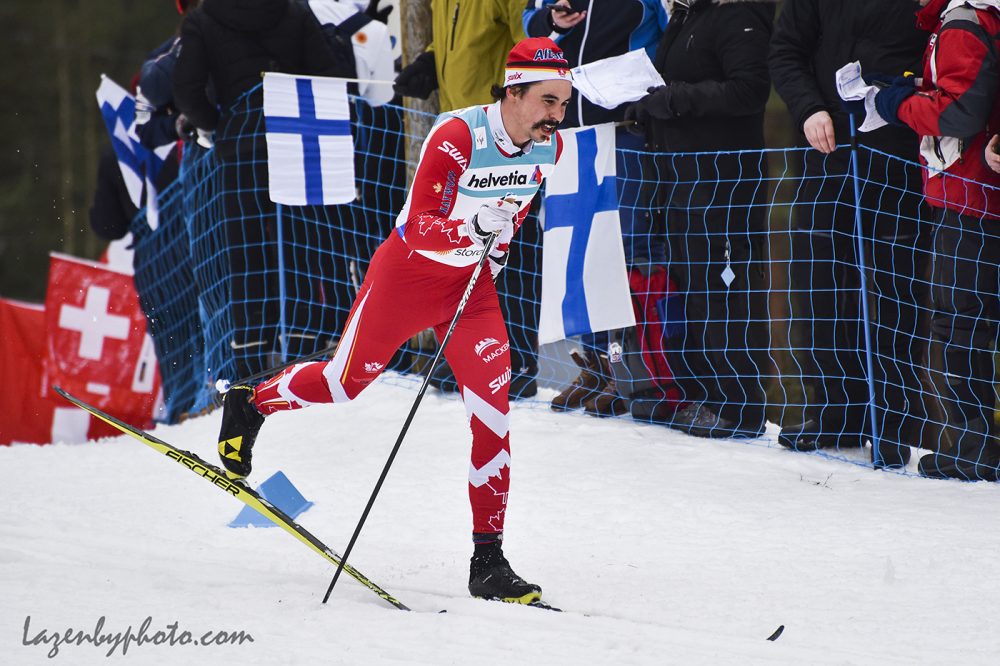
Canada was led by Devon Kershaw in 35th (+3:24.8). The next Canadian to finish was Knute Johnsgaard in 56th (+5:00.7), followed by Jess Cockney in 65th (+6:20.7).
“I don’t think I pushed as hard as I should have. … Mentally, maybe I wasn’t totally zoned in, but I was happy to do a distance race in front of a big fan base like this in Finland for the hometown favorites, so that was good,” Cockney said.
This being Johnsgaard’s first world champs experience, the 24 year old was happy with how he race his third individual event of the week.
“I just went out at a pace I thought I could sustain for 15 k and kept that pace pretty steady I think and was able to push hard and kind of sprint up the last hill,” Johnsgaard said. “I felt like I paced it as well as I could, so I’m pretty satisfied with my race.”
— Gerry Furseth and Harald Zimmer contributed
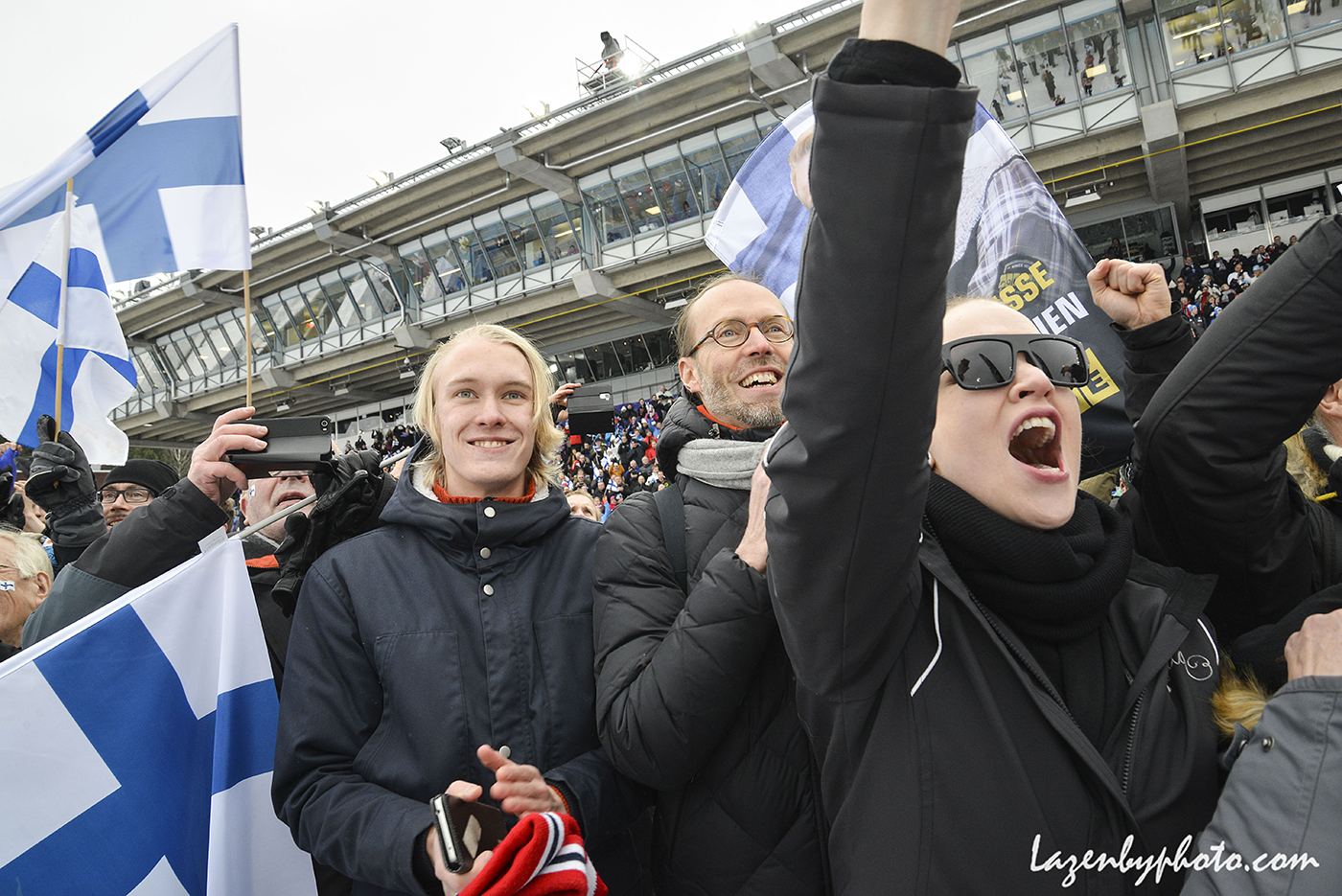

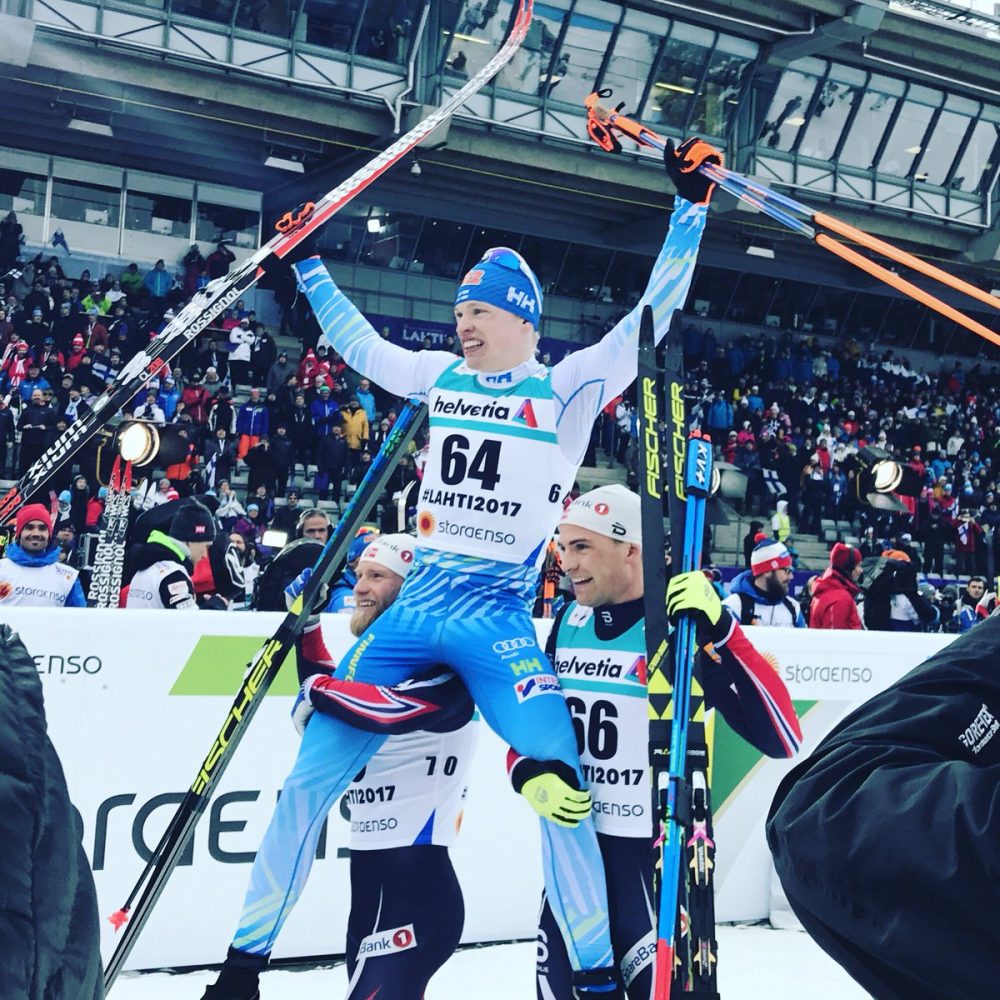
FIS Nordic World Championships (Lahti, Finland): Men’s 15 k classic
After narrowly missing the victory in Sunday’s classic team sprint, Finland’s Iivo Niskanen got his gold, winning Wednesday’s men’s 15-kilometer individual classic start race at the 2017 Nordic World Ski Championships on Wednesday in Lahti, Finland. Niskanen covered the course in a time of 36:44.0, besting Norway’s Martin Johnsrud Sundby by 17.9 seconds.
Starting in bib 64, Niskanen didn’t take long to ski in the top spot, posting the fastest time from the 4.7 k mark until he finished. He held off Sundby, as well as Norwegian Niklas Dyrhaug, who started a minute behind Niskanen in bib 66 and ultimately finished in third (+31.3).
Missing the podium by 10.5 seconds was Russia’s Alexander Bessmertnykh in fourth, 41.8 seconds behind Niskanen’s winning time. Placing fifth (+53.2) was Didrik Tønseth of Norway. Russia’s Andrey Larkov took sixth (+53.2), while kazakhstan’s Alexey Poltoranin placed seventh (+1:06.3). The second Finn to finish in the top ten was Sami Jauhojaervi in eighth (+1:09.7). Ninth (+1:10.6) went to the former 2015 World Champion, Johan Olsson of Sweden, and his Swedish teammate, Calle Halfvarsson rounded out the top ten in tenth (+1:15.0).
Erik Bjornsen led the U.S. men, placing 18th (+1:56.7) after starting in bib 26. The second American to finish was Kyle Bratrud in 33rd (+3:11.5) followed by Andy Newell in 50th (+4:21.7) and Ben Lustgarten in 55th (+4:56.9).
Devon Kershaw led the Canadians, placing 35th (+3:24.8). Knute Johnsgaard was the next Canadian, finishing 56th (+5:00.7), followed by Jesse Cockney in 65th (+6:20.7).
The women’s 4 x 5 k relay takes place Thursday. The U.S. is slated to start (in no particular order): Jessie Diggins, Kikkan Randall, Liz Stephen, and Sadie Bjornsen.
***
FIS Nordic World Championships (Lahti, Finland): Nordic Combined large hill/10 k
Germany’s Johannes Rydzek racked up win #3 in as many nordic-combined competitions at the 2017 Nordic World Championships in Lahti, Finland, winning the individual large hill/10-kilometer Gundersen start on Wednesday.
The last individual competition of the championships began with Austria’s Mario Seidl jumping the farthest at 132.0 meters and earning 137.3 points. His Austrian teammate, Wilhelm Denifl finished second in the jumping portion, earning 125.7 points. Japan’s Akito Watabe was third for the jumping, with 123.8 points.
Competitors returned later in the day for the 10 k cross-country portion, with Rydzek racing to first after starting a minute back in fifth. Rydzek won the 10 k event in a time of 26:41.6. Just 4.8 seconds later, Watabe captured silver after starting 54 seconds back. The bronze medal went to France’s François Braud, who also started 54 seconds back and finished 13 seconds off Rydzek’s time.
Four U.S. Nordic Combined Team skiers contested the event. Bryan Fletcher led the Americans finishing 31st (+3:58.3), after jumping to 31st and starting 2:39 back. His brother, Taylor Fletcher was the second American to finish the cross-country portion, racing to 36th (+4:55.6) after jumping to 51st and starting 4:26 back.
Ben Berend jumped the farthest for the Americans in 21st, and raced to 40th (+5:08.6) after starting 1:55 back.
The 21-year-old explained during an interview with FasterSkier that he sees his recent success in jumping as a result of not overthinking his efforts on the hill.
“Basically, I’ve just turned my mind off,” Berend said. “I didn’t take training yesterday, I’ve just been kind of not jumping as much as I usually do, and like when I’m at home I’m not thinking about ski jumping, I just kind of go up and do it and it’s working right now, and so I’m not going to change any of that. I’m just having fun, it’s been a blast.”
Adam Loomis finished the day in 44th (+5:47.9) after jumping to 45th and starting 3:29 back.
Canada’s Nathaniel Mah jumped to 52nd and finished the day in 52nd.
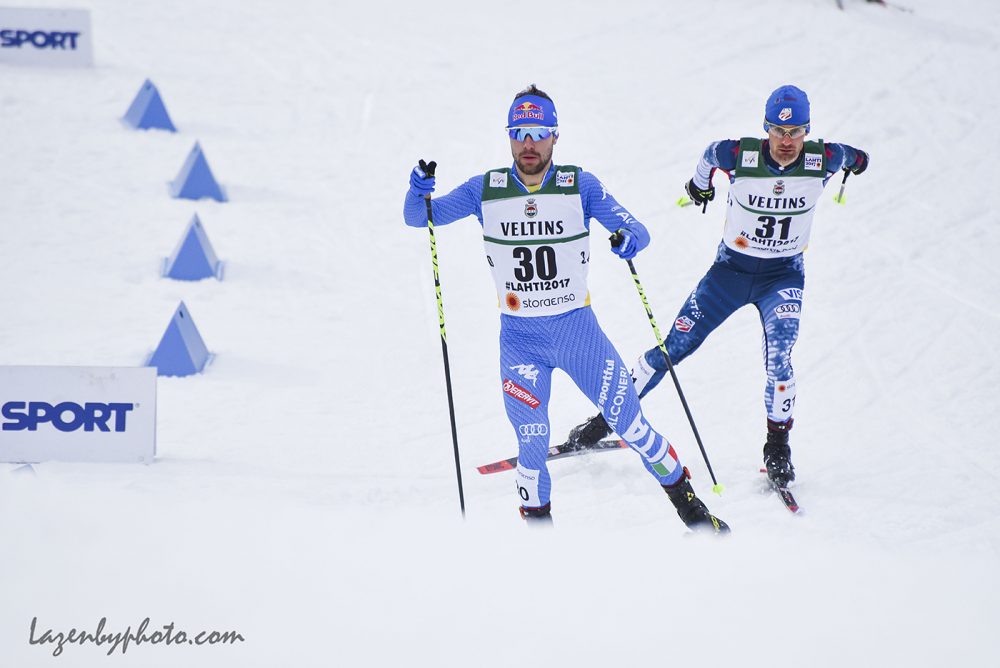
Results: Jumping | Final results

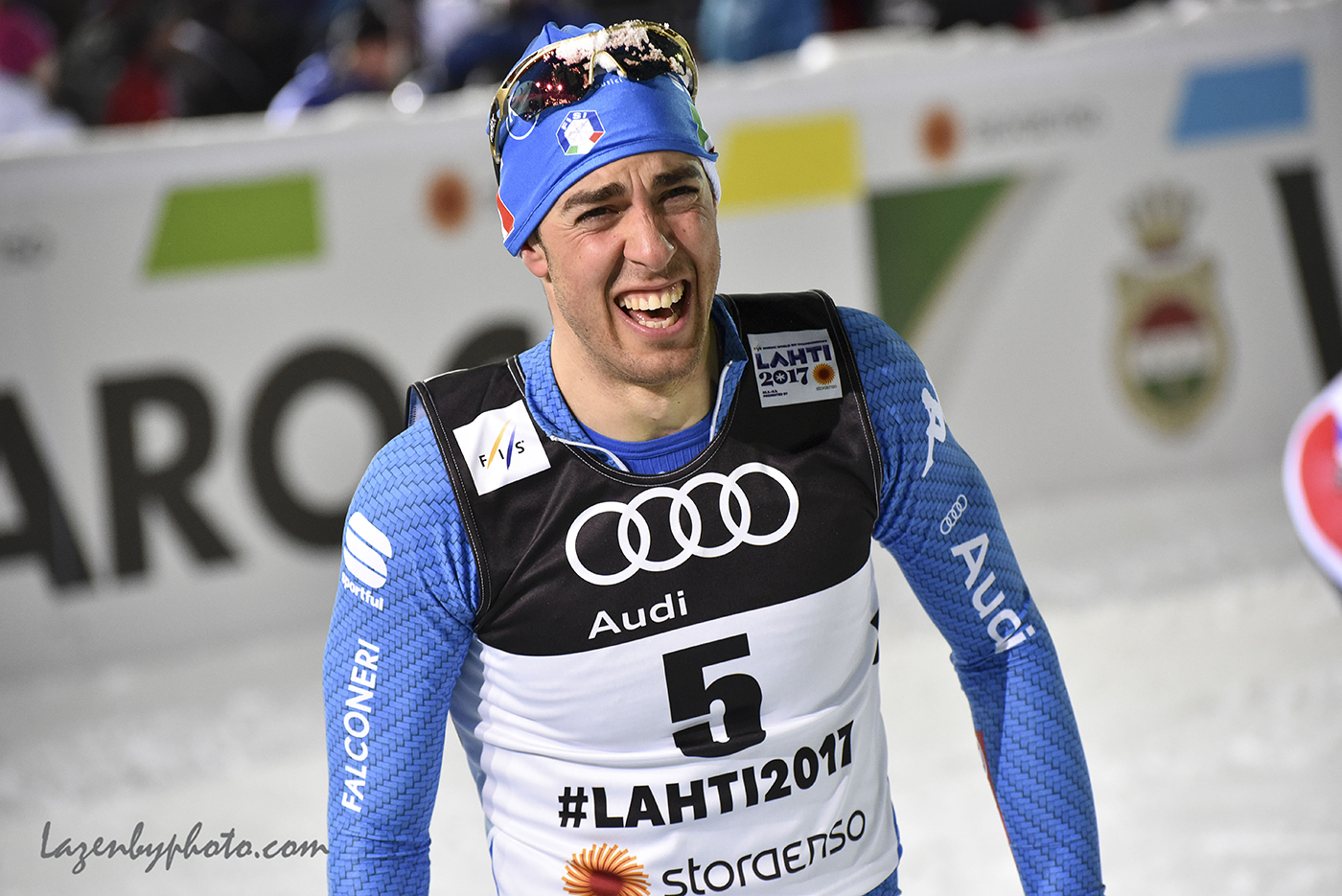
LAHTI, Finland — Up until the final 100 meters of Thursday’s race, it looked as if the 2017 Nordic World Championships sprint title belonged to Russia’s Sergey Ustiugov.
In fact, Ustiugov had won the qualifier in a time of 3:11.72 minutes, a commanding 2.7 seconds over Norway’s Finn Hågen Krogh. The Russian reigning Tour de Ski champion placed second in his quarterfinal by a mere 0.19 seconds. He was second again in his semifinal in a three-way photo finish, in which Italy’s Federico Pellegrino came out on top, Ustiugov took second and Norwegian Johannes Høsflot Klæbo was third.
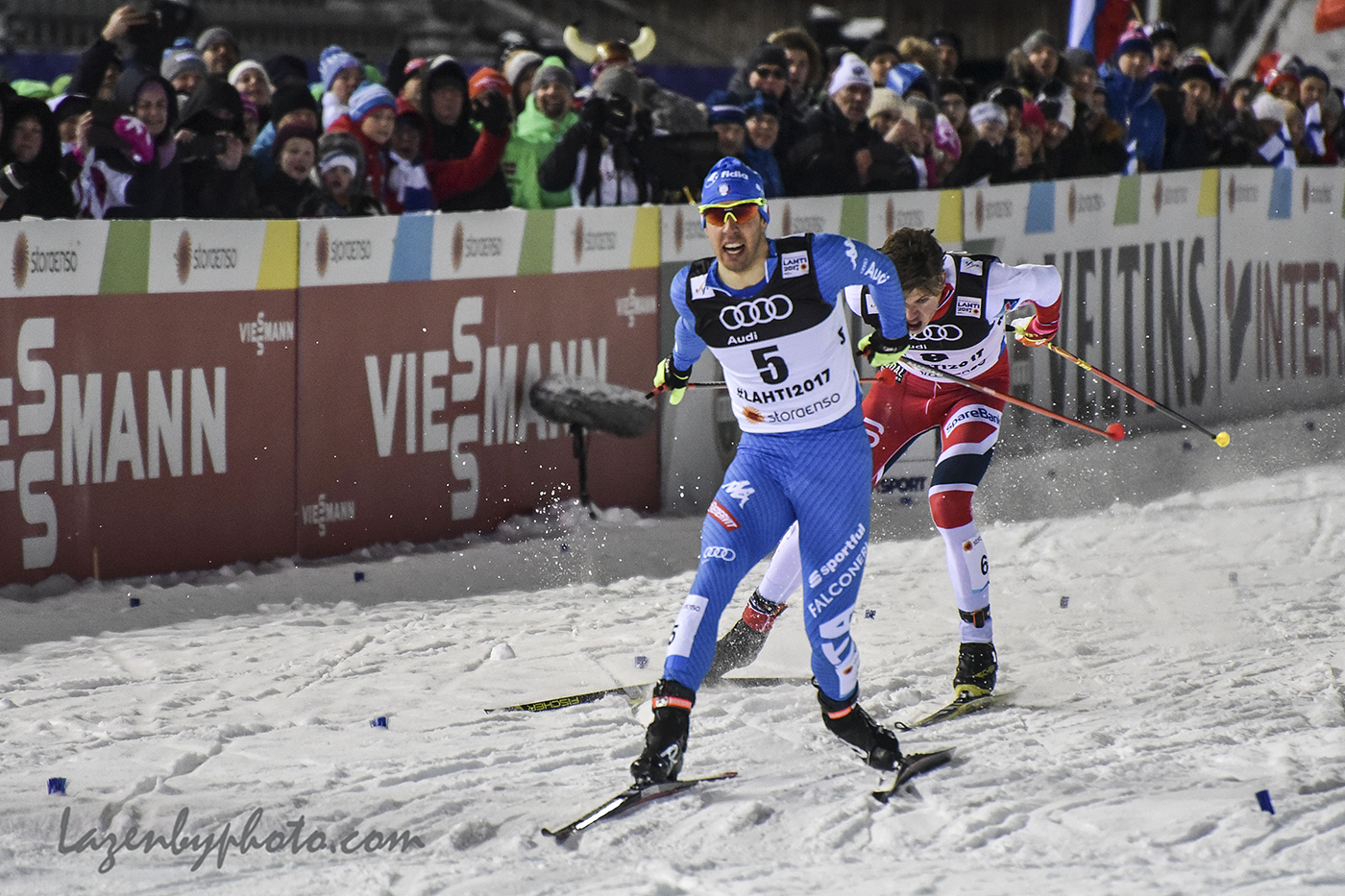
Coming down the homestretch of the men’s 1.6-kilometer freestyle sprint final, Ustiugov seemed to have learned his lesson: race your own race, let the rest play catch up.
But charging from behind was Italy’s defending Sprint World Cup champion. As Pellegrino surged, Ustiugov faded. The end result was a repeat of their semifinal: Pellegrino in first in 3:13.76, Ustiugov second (+0.15), and Klæbo third.
His Norwegian teammates Krogh and Petter Northug finished fourth (+0.67) and fifth (+12.13), respectively. Fan favorite, Ristomatti Hakola of Finland placed sixth (+12.28).
Ustiugov was visibly frustrated within moments of crossing the line and letting the World Championship title slip away. World Cup sprint leader Pellegrino, along with his scores of yellow-hat-clad fan club, celebrated his win as if it were never in doubt.
“Last year here, I was in the final against five Norwegian athletes,” Pellegrino said during a post-race press conference. “And I tried to attack in the last uphill. I was in the front of the group in the last downhill and then I finished fourth. So this year I was just thinking, don’t be the first on the last downhill.”
The marks Pellegrino’s first individual World Championships medal. The 26 year old previously earned bronze in the 2015 World Championships freestyle team sprint with teammate Dietmar Nöckler in Falun, Sweden.
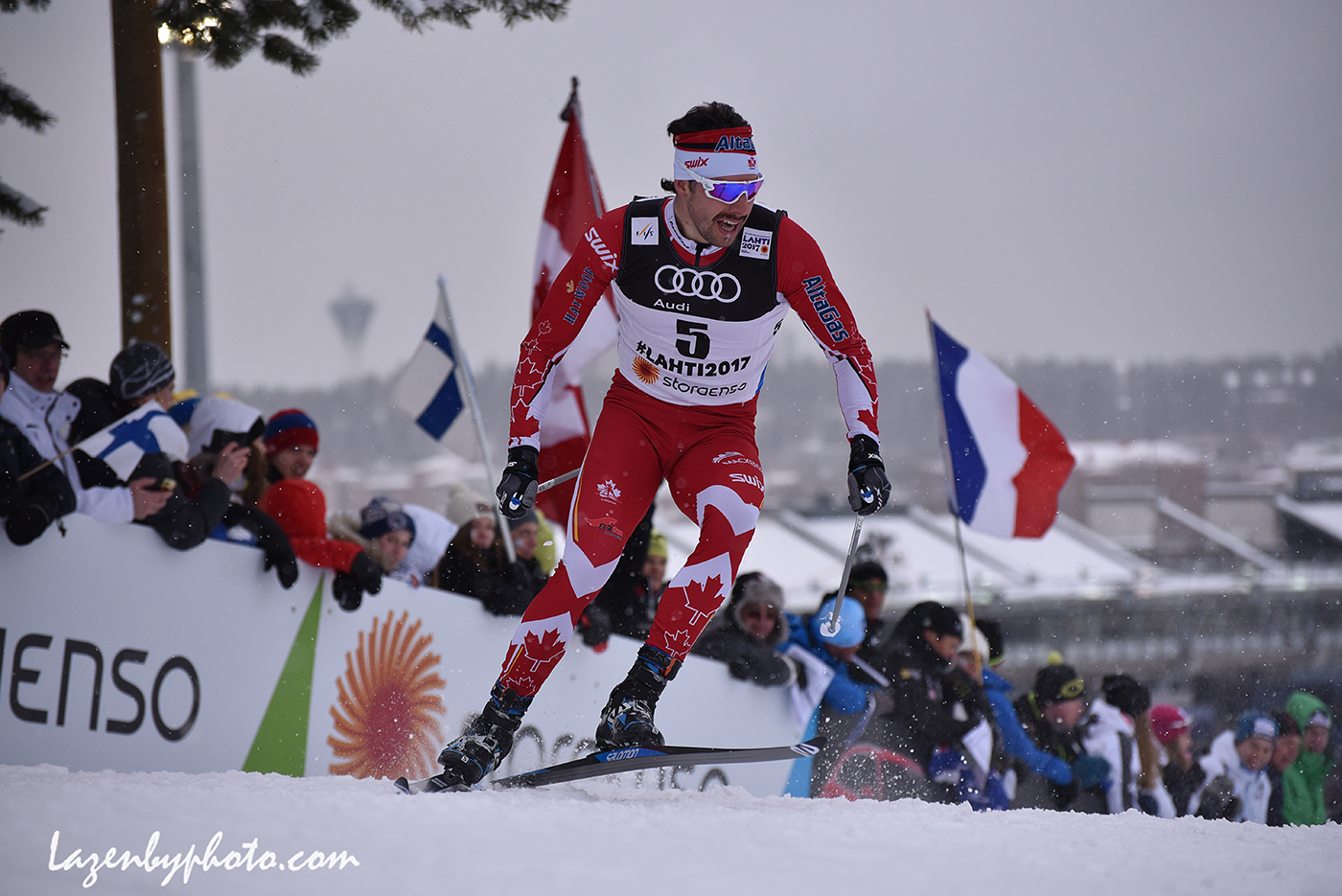
The top North American on Thursday was Canada’s Alex Harvey in 12th. Harvey advanced all the way to the second semifinal, and for a moment looked like he might make a move on the final long climb to position himself within the top two.
“The power was good, but with this fresh snow, it’s really tough to go outside the race line,” Harvey said after. “Usually this is one of those courses where you can make a lot of moves. But today, because everybody was skiing in the middle, that made the track much faster, but on the side the fresh snow was slow. So for my style of racing, it was hard to come from the back.”
According to Harvey, by the finishing stretch Poland’s Maciej Staręga had moved out of his lane ahead of him. In an attempt to maneuver back around Staręga, Harvey unintentionally skied over Norwegian Emil Iversen’s skis, causing Iversen to crash. The jury relegated Harvey to last in the heat.
Moving forward, Harvey said he was looking forward to Saturday’s 30 k skiathlon, where he believes he has his best chances at a world champs medal. Harvey has four World Championships medals: one gold from the 2009 classic team sprint (with Devon Kershaw), one silver from the 2015 classic sprint, and bronze in the 2013 classic sprint and 2015 skiathlon.
Three other Canadian men did not qualify, with Jess Cockney finishing 47th (+16.82), Len Valjas one place behind in 48th (+17.16), and Knute Johnsgaard in 53rd (+18.39).
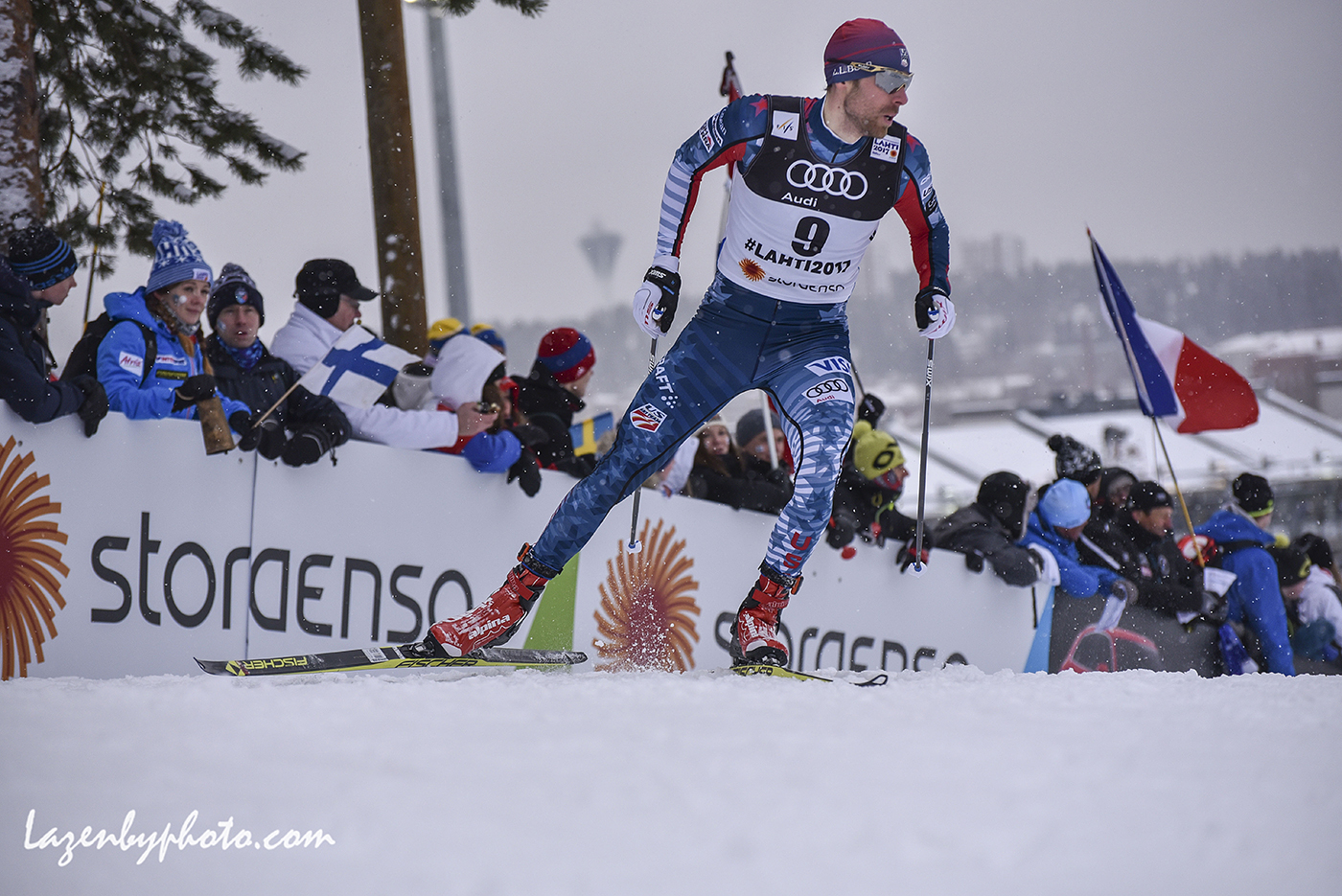
For the U.S., Andy Newell ended up 21st after placing fifth in his quarterfinal, 1.75 seconds behind Krogh, who won that heat. Newell started his day by qualifying in 20th.
“I’m feeling healthy and strong, I definitely have come not to take anything for granted these days,” the 33-year-old U.S. Ski Team veteran said of his international-skiing opportunities. “So I am healthy and injury free. … I am happy to be here and happy to get some World Championship races in. I am pretty motivated to try to ski fast, so we will see what the week brings.”
Two U.S. men reached the heats, with Simi Hamilton landing 11th in the qualifying round. But with a lot of good U.S. luck on Thursday, there was some bad.
“We had some bad luck out there with Simi crashing,” U.S. Ski Team Head Coach Chris Grover said. “[Simi] was really disappointed because he had obviously been targeting this race for a long time. But he knows that that’s part of sprinting, too. And that for the times when you do make it to the podium and to the A-final, it makes those appearances that much more special when you do those have those kind of results, knowing that there are going to be these hard days in between.”
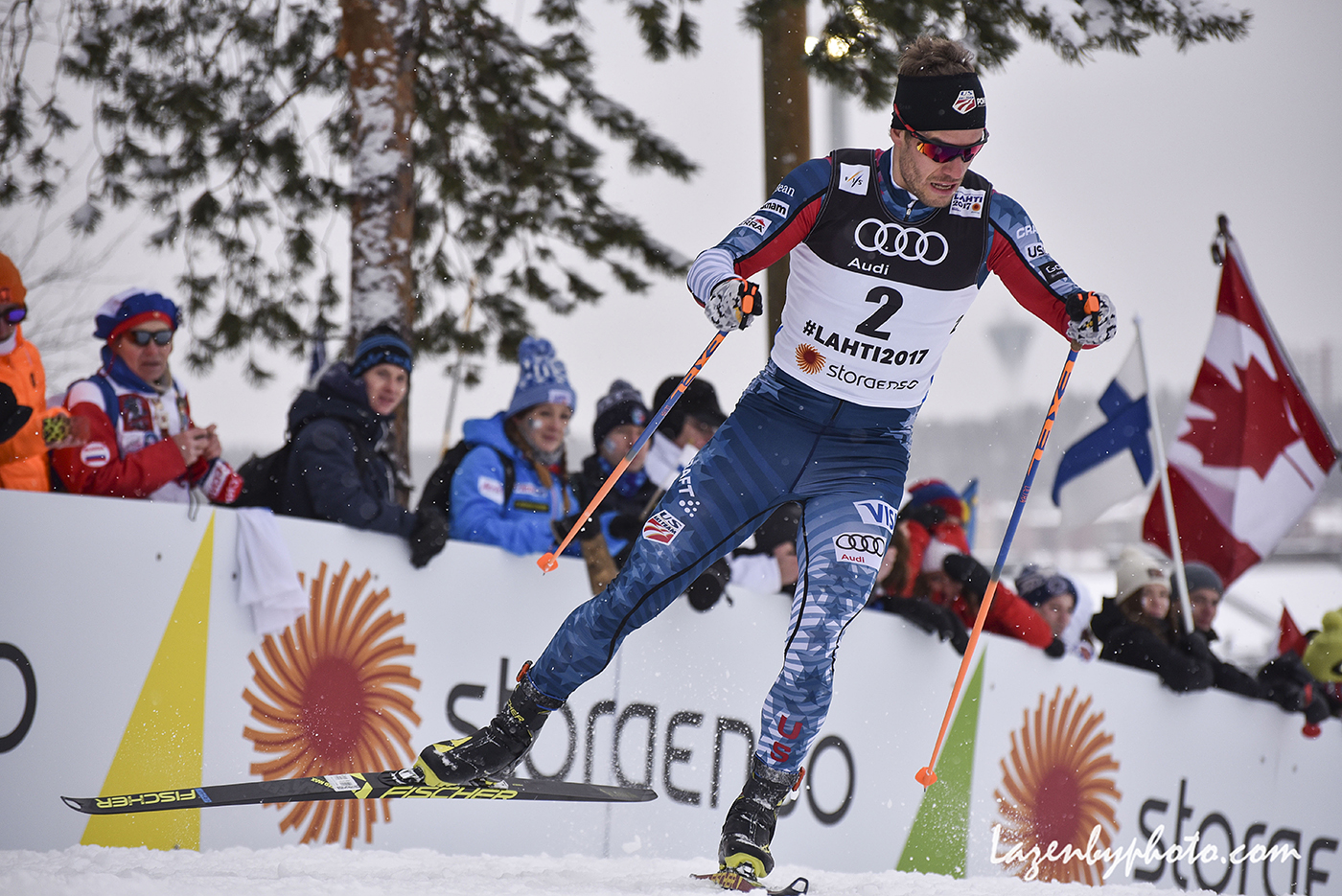
After skiing within reach of the top three with space to move into the top two, Hamilton fell during the final descent into the stadium and ultimately finished sixth, 35 seconds behind Pellegrino, who won that quarterfinal. He placed 28th on the day.
“I was feeling good … and made a good move to get kind of in the mix with everyone leading down the downhill, so I was kind of biding my time,” Hamilton, 29, said. “And we started down it, I went to pass [France’s Richard] Jouve on the right, and then I don’t know whether we tangled skis or I hooked my tip in the powder … and I just tried to take a little skate with my right to get a little more momentum over the bump, and maybe just hooked my right tip and face-planted.”
Hamilton plans on racing in the classic team sprint on Sunday. The U.S. started four men in the sprint, with Erik Bjornsen finishing 36th in the qualifier, 2.22 seconds out of the top 30 needed to qualify, and Cole Morgan 54th (of 156 in the men’s field).
For Morgan, 22, of the Sun Valley Ski Education Foundation, Thursday marked his World Championships debut and the only race he will compete in at this year’s world champs. He planned to return to the U.S. within the next few days.
“It’s wild,” he said of the experience.
Lahti’s lower elevation contrasted greatly with many of the races Morgan has raced in so far this season. “I haven’t raced at sea level yet this year, and it’s a different feeling.”
— Harald Zimmer, Chelsea Little, and Alex Kochon contributed
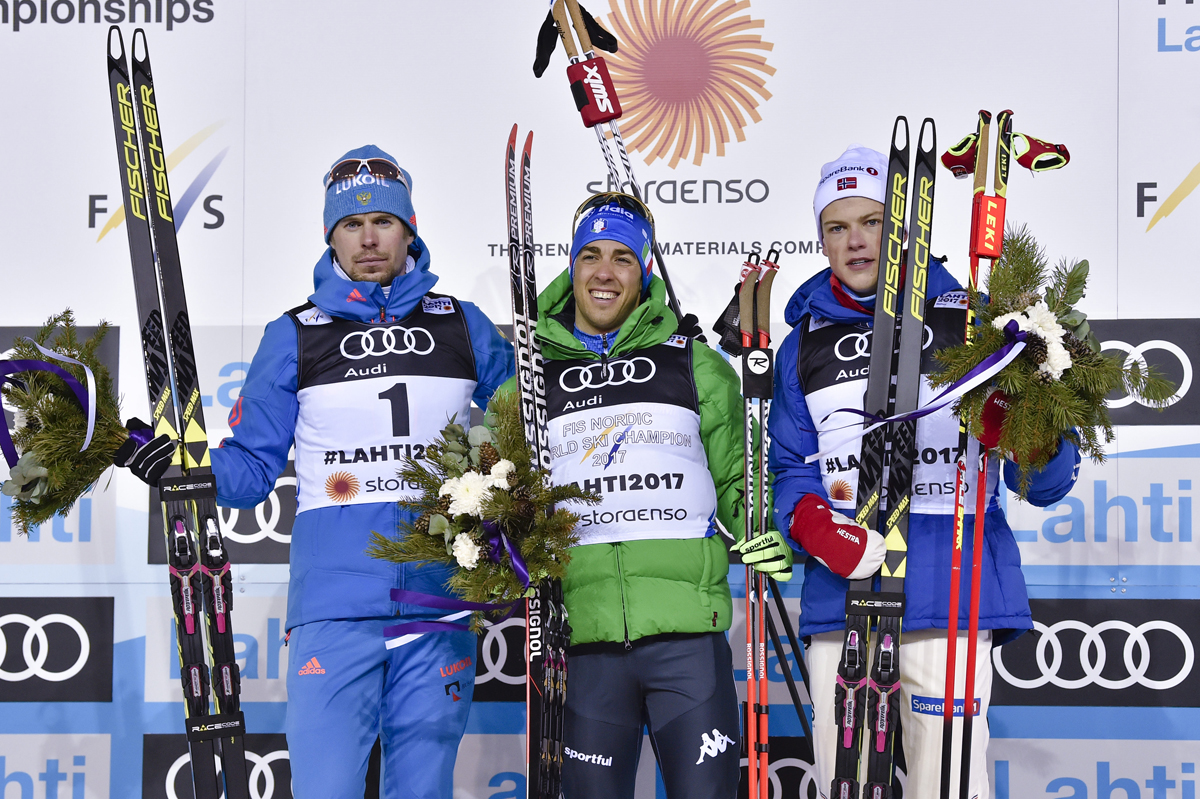
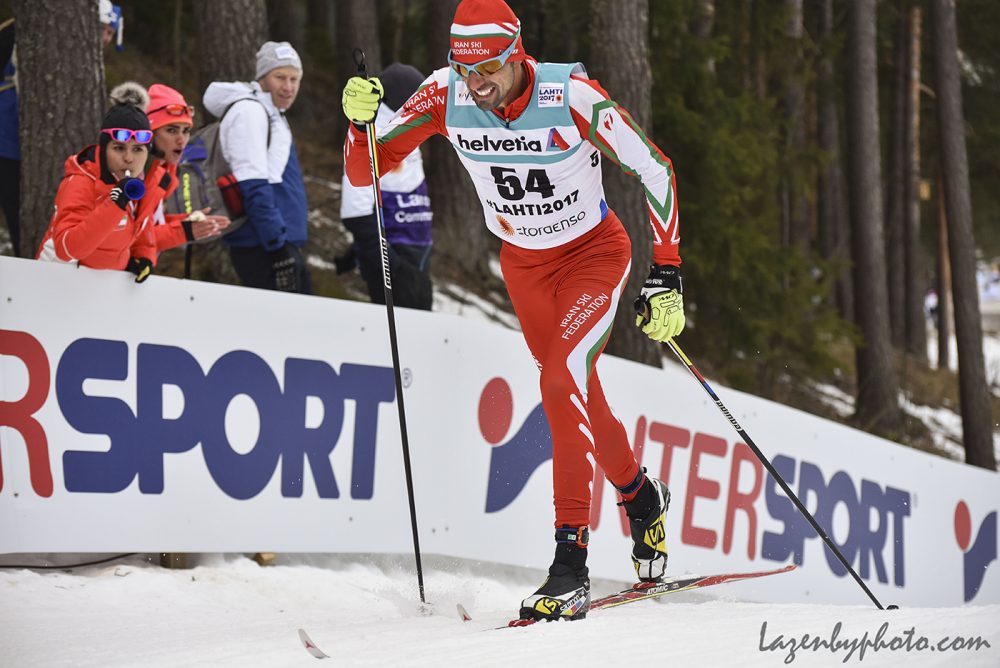
LAHTI, Finland — Yesterday’s lick of blue sky winter sun was fleeting, as Lahti woke to overcast skies and buzz that new snow was imminent. Race time temps hovered around 24 degrees Fahrenheit, but with 78-percent humidity and a brisk wind — some would say ripping — blowing out of the west, it felt wind-brief cold.
Wednesday’s kickoff events were an opportunity for volunteers, camera crews and even hundreds of local Finnish school children who spectated, to test the venue’s preparedness in a soft opening. For both the men and women on Wednesday, athletes from non-traditional ski countries — skiers without the prerequisite International Ski Federation (FIS) points — raced in 5/10-kilometer classic qualifiers for the 2017 FIS Nordic World Championships distance races. All registered racers are able to contest Thursday’s freestyle sprint qualification. However, only the top 10 from Wednesday’s men’s 10 k and women’s 5 k classic individual starts would qualify for Lahti’s distance events.
In both races the list of representative countries vying for precious world-champs starts was a testament to FIS’s attempt to market a more globalized brand. There was Ecuador, Brazil, Lebanon, Venezuela, and India to name a few. A colorful splash of international pizazz. But in the end, all these aspiring skiers had to qualify on a championship-level course.
On the women’s side Iceland’s Elsa-Gudrun Jonsdottir took the win, completing the the 5k loop in 15:23.9. Nansi Okoro from Bulgaria skied to second place (+20.1) with Australia’s Katerina Paul third (+34.2).
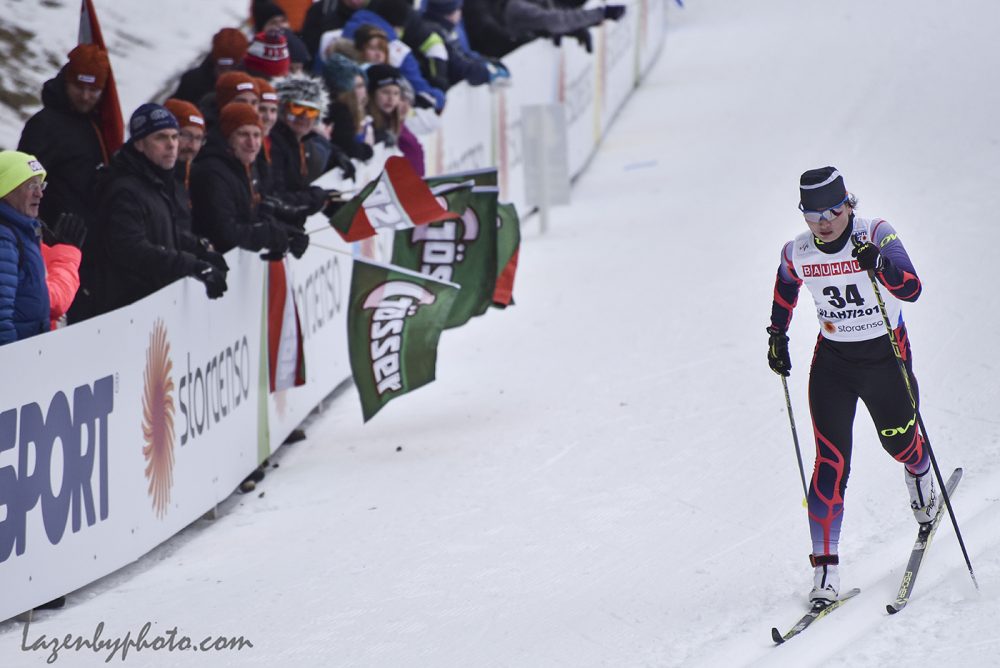
Top-10 Women’s Qualifiers:
In the men’s 10 k classic, Croatia’s Kresimir Crnkovic took the win in the non-medal event, covering the course in a time of 26:21.5.
Finishing 55.6 seconds back was Lithuania’s Deividas Klisevicius in second place. Rounding out the men’s podium in third (+1:05.5), was Achbadrakh Batmunkh of Mongolia.
Top-10 Men’s Qualifiers:
***
Lahti 2017 Freestyle Sprint
Seasoned heavy hitters to World Championships first timers will make their way to the race the venue on Thursday for the second World Championships event: a 1.4 k freestyle sprint.
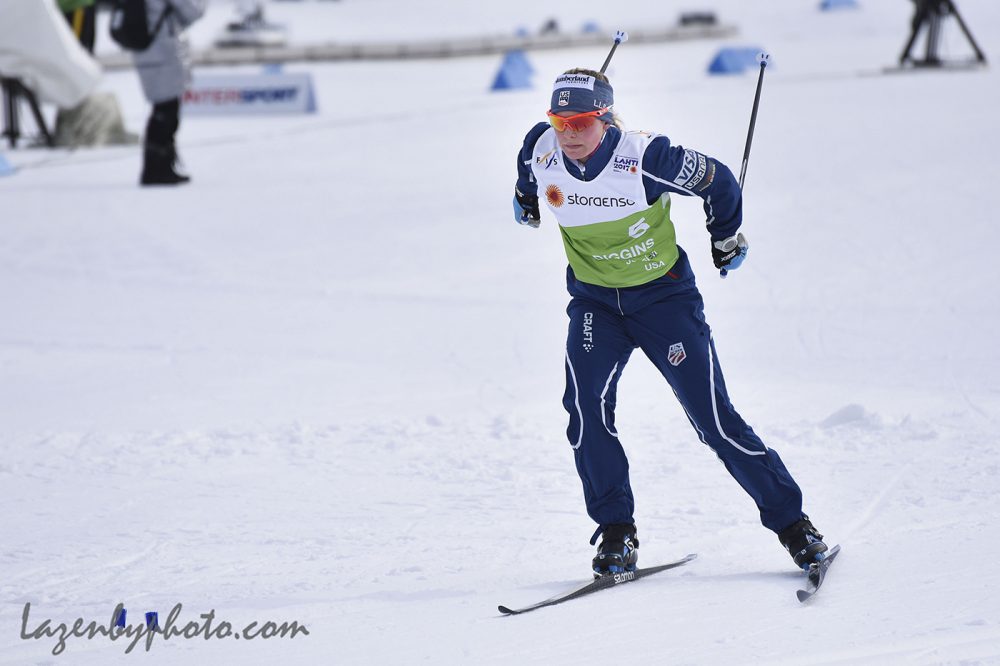
In the women’s field, Sweden’s Stina Nilsson and Norway’s Maiken Caspersen Falla rank as the top-two favorites following this World Cup season. For the past three freestyle sprints Nilsson has entered, she has placed first, her most recent victory this past Saturday in Otepää, Estonia. Falla, however should not be counted out, she took the win in last year’s freestyle sprint held in Lahti, Finland, while American Jessie Diggins claimed second.
For the men, Italy’s Federico Pellegrino emerges as the top non-Scandinavian favorite for the sprint. He won the most recent freestyle sprint in Falun, Sweden, last month and placed second in this year’s Tour de Ski Stage 1 freestyle sprint.
Many men, however, will be vying Pellegrino for the top spot. This includes Norwegians Johannes Høsflot Klæbo, Finn Hågen Krogh, Emil Iversen, as well as Russia’s Sergey Ustiugov, to name a few.
U.S. Freestyle Sprint Entries:
Women
Men
Canada Freestyle Sprint Entries:
Women
Men
Qualification start lists: Women | Men
***
Behind the scenes on Wednesday, FIS President Gian Franco Kasper was part of a press conference that in part discussed the latest doping news: the five Russian skiers who appealed to the Court of Arbitration in Sport (CAS) had been denied immediate reinstatement to race.
Sarah Lewis, FIS Secretary General made this statement regarding Norwegian star Therese Johaug’s doping case. “The other one on the table is the Norwegian Anti-Doping Agency’s decision that was issued last week in the case of Therese Johaug,” Lewis said. “It was received by FIS on the 14th of January. The present status is that it is being studied by FIS doping panel and this will continue until the 7th of March and at that time a communication will be issued. In the meantime, FIS has got no further statement to give on this case.”
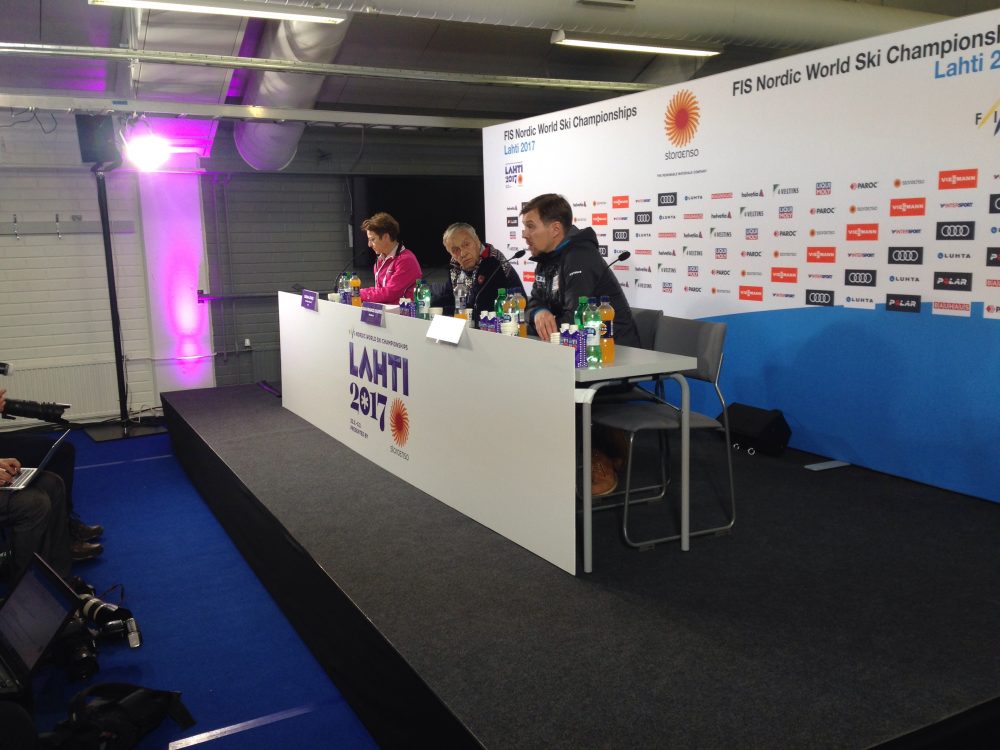
That part of the press conference was administrative. Then during a question-and-answer period a journalist asked this of Kasper: “You gave an interview to The New York Times where you said the sport is clean and the athletes have been irritated with that quote from you. How do you respond to the criticism that’s been thrown your way?
(The most recent comment from Kasper in the Times was this past November. He reportedly said, “We need to stop pretending sport is clean. It’s a noble principle, but in practice? It’s entertainment. It’s drama.”)
Kasper was blunt and stern in his response. “Well don’t forget this, your colleague from The New York Times, she wrote whatever she wanted,” Kasper said during the press conference. “Her question to me was, it must really disturb or hurt the sport of skiing in particular cross country? I said of course it hurts our credibility of sport in general and also skiing is damaged by all the open cases we have at the moment. But at the end for the public watching at home, the Olympics in particular, it’s still the drama that comes up, the joy if you win, disappointment if you lose, that is part of the game. It’s more or less a mirror of the social world … I never said it doesn’t matter for the importance of the Games, of course not.”
Later on Wednesday, Kasper was part of a group that met with athletes to discuss his response to halt doping in nordic sport.
***


https://www.instagram.com/p/BP7QjWEgYnI/?taken-by=sophiecaldwell&hl=en
“We are 7 hours behind you in Pacific time (and a day ahead),” U.S. Ski Team Head Coach Chris Grover wrote in an email from South Korea on Monday. But as his email hints, tracking time and day when criss-crossing time zones and arranging a phone call can be befuddling. So another way of stating what Grover wrote is that KST, or Korea Standard Time, is 17 hours ahead of the time at this reporter’s location in Bend, Ore.
The call went down on Monday at 5 p.m. Pacific Standard Time. Just so we’re all straight, that was Tuesday, 10 a.m. KST.
With all that travel, staying rested, staying fast and staying healthy are primary concerns for athletes and coaches traveling on the usually Eurocentric World Cup.
“When you look at the U.S. team it is primarily a European-based team,” Grover said on the phone. Many U.S. athletes have been in Central Europe since mid-November. Maybe there’s a +1 hour difference from Central European Time (CET) when a race is hosted in, say, Finland. Most athletes haven’t had to deal with constant time-change jolts.
As a pre-Olympic World Cup (the 2018 Winter Games will be held in PyeongChang, South Korea), organizers wanted athletes and team support to have an easy transition upon arrival. The races — a classic sprint on Friday, skiathlon on Saturday and freestyle team sprint on Sunday — are being held in the late afternoon or evening; at times compatible with Europe’s television market.
Although the Korean times are atypical for Euro-based World Cups, they do correspond to the “physiological” times dictating when skiers are primed for racing. A 6 p.m. KST race is the equivalent of a 10 a.m. race in France.
“It actually plays well for athletes coming from Europe because they can acclimate less because they can sleep in,” Grover said of how the time-zone change shouldn’t be a dramatic shift for the U.S. team. “They can sleep in for quite a while, get up late, have a late lunch, race, and then have a late dinner and shift their whole normal schedule further back in the day. So I’d say the primary strategy we are employing, but not every athlete can do it, or do it super effectively, but we are trying basically to keep these guys on a European time zone as much as possible while they are over here.”
Yet remaining healthy while traveling and living abroad has been a puzzle for many skiers. On the flight over and while staying in hotels, Grover preaches good hygiene: wash hands and use hand sanitizer when hand washing isn’t convenient. The U.S. also asks that hosting hotels take precautions like disinfecting rooms prior to team’s arrival to help minimize germ exposure. In addition to these precautions, Grover had athletes consult face to face with a U.S. Ski Team (USST) nutritionist when the athletes were in Ulricehamn, Sweden, in mid-February. It was another aspect of monitoring athlete health.
“[The nutritionist was] making sure everybody was doing OK nutritionally, making sure they are doing OK with their body composition,” Grover said. “It is one thing to monitor those things in the U.S. when everybody is in the training mode, it is another things when you move to Europe and all of sudden you are on a different diet pretty much every week and you are competing full time. … So everybody had a good check in there. If people needed a supplement of vitamin D or iron, or what have you, or to improve part of their nutritional program, then we addressed that a couple weeks ago. That’s one way that we are trying to stay healthy.”
Another aspect of the quick-turnaround PyeongChang trip is transporting gear and making good and efficient use of the USST ski techs’ time while on the ground at the future Olympic venue.
“We brought all of our own equipment; we had nothing here,” Grover explained. “This is the first time we have been here during the winter. That was of course one of the challenges is the logistics and the expense of moving all of our necessary gear over here. And all teams are obviously in that same boat.”
(Story continues below)
https://www.instagram.com/p/BP7EbKzDuWS/?taken-by=hoffnoah&hl=en
The three U.S. coaches (Grover, Matt Whitcomb and Jason Cork) and four techs that made the trip to PyeongChang are there first to prepare athletes and skis for the three-race stop. But it’s also double duty in terms of Olympic prep. The USST staff will remain an extra day, the athletes depart for Europe next Monday, to further advance their venue-specific data set. Grover said this trip will remain the only USST testing trip prior to the 2018 Games.
“We have definitely taken lessons that we have learned from Vancouver [and] from Sochi,” Grover said of the team’s de-emphasis on longer term, on-site testing. “You can definitely over test a bit in a place and kind of get heading in wrong directions that are not so applicable a year later when you have a different composition on the track between, say, manmade and natural snow, for example. … So the testing that we really want to do is important, but it is more on the fundamentals of structure of grinds, of base layers, that sort of thing.”
The U.S. brought six current USST athletes to South Korea: Sophie Caldwell, Ida Sargent, Liz Stephen, Andy Newell, Simi Hamilton, and Noah Hoffman. Grover stated the remaining national-team members opted for a different schedule and did not make the trip.
Matt Gelso and Liz Guiney earned start rights as Period 1 SuperTour leaders. According to Grover, the U.S. team invited two additional athletes as well, Caitlin Patterson (Craftsbury Green Racing Project) and her brother Scott Patterson (Alaska Pacific University).
Neither of the Patterson siblings were selected for the upcoming World Championships in Lahti, Finland. Yet Grover stated he believed both deserved PyeongChang starts — specifically in the skiathlon.
“They both had been sick immediately prior to the nationals and then actually the first part of the nationals as well. Especially in Scott’s particular case,” Grover explained. “But both had been skiing well not only in the early season this year, but also in the late season last year. Caitlin was taking World Cup points distance at the end of last year and at the beginning of this year in Kuusamo as well.”
In Scott’s case, Grover mentioned he remained one of the top U.S. distance skiers behind USST members Erik Bjornsen and Hoffman.
“The next guy that was getting close to perhaps breaking through to the top 30,” Grover said. “We wanted to find an opportunity to give them a distance start and to see what they could do.”
The Canadians have also arrived in Asia. Coach Charles Castonguay, of the Pierre-Harvey National Training Centre, will be leading the team in South Korea, assisted by five Canadian team World Cup techs and Tom Holland, Cross Country Canada’s high-performance director.
Representing Canada in the women’s races will be Annika Hicks (Alberta World Cup Academy) and Sadie White (NTDC Thunder Bay).
On the men’s side, national-team members Len Valjas and Jess Cockney, Para-Nordic Ski Team member Brian McKeever, Bob Thompson (NTDC Thunder Bay), Julian Locke (Alberta World Cup Academy/National U25 Team), and Simon Lapointe (CNEPH) were slated to start Friday’s sprint in South Korea.
In an email, Castonguay explained that team selection was premised on two criteria: 1. World Cup results (such as a top 30, which Len Valjas achieved), and 2. Classic sprint results and distance results from U.S. nationals last month (excluding athletes who were selected for Junior and U23 World Championships).
“Some athletes, who were also selected for senior [World Championships] in Lahti declined PyeongChang, like Knute [Johnsgaard], to get a better preparation for Lahti,” Castonguay wrote. “So we went down the rank list to select people for Korea.”
Racing begins on Friday with the men’s and women’s classic sprints.


***
Jesse Cockney has a knack for turning in big performances on home soil: his major breakthrough came in 2012, when he qualified second and finished ninth in the World Cup sprint in Canmore – his hometown since age seven – in just the sixth World Cup start ever in his career.
Last season, Cockney competed in World Cups in Europe without making the heats, then made a splash by finishing 10th in the Quebec City skate sprint as part of the Ski Tour Canada. This year Cockney is looking for more World Cup successes and recently earned his way onto Cross Country Canada’s Period I World Cup tour.
1. Biggest change in your life in the last five or so months since the ski season ended?
I spent the summer running a waffle cart with my girlfriend at Canmore’s mountain market.
2. Biggest change in your training?
Last year I made a big change in my training and moved to Quebec City for the summer and this season I’ve been back in Canmore full time.
3. Major areas of improvement you’ve seen so far?
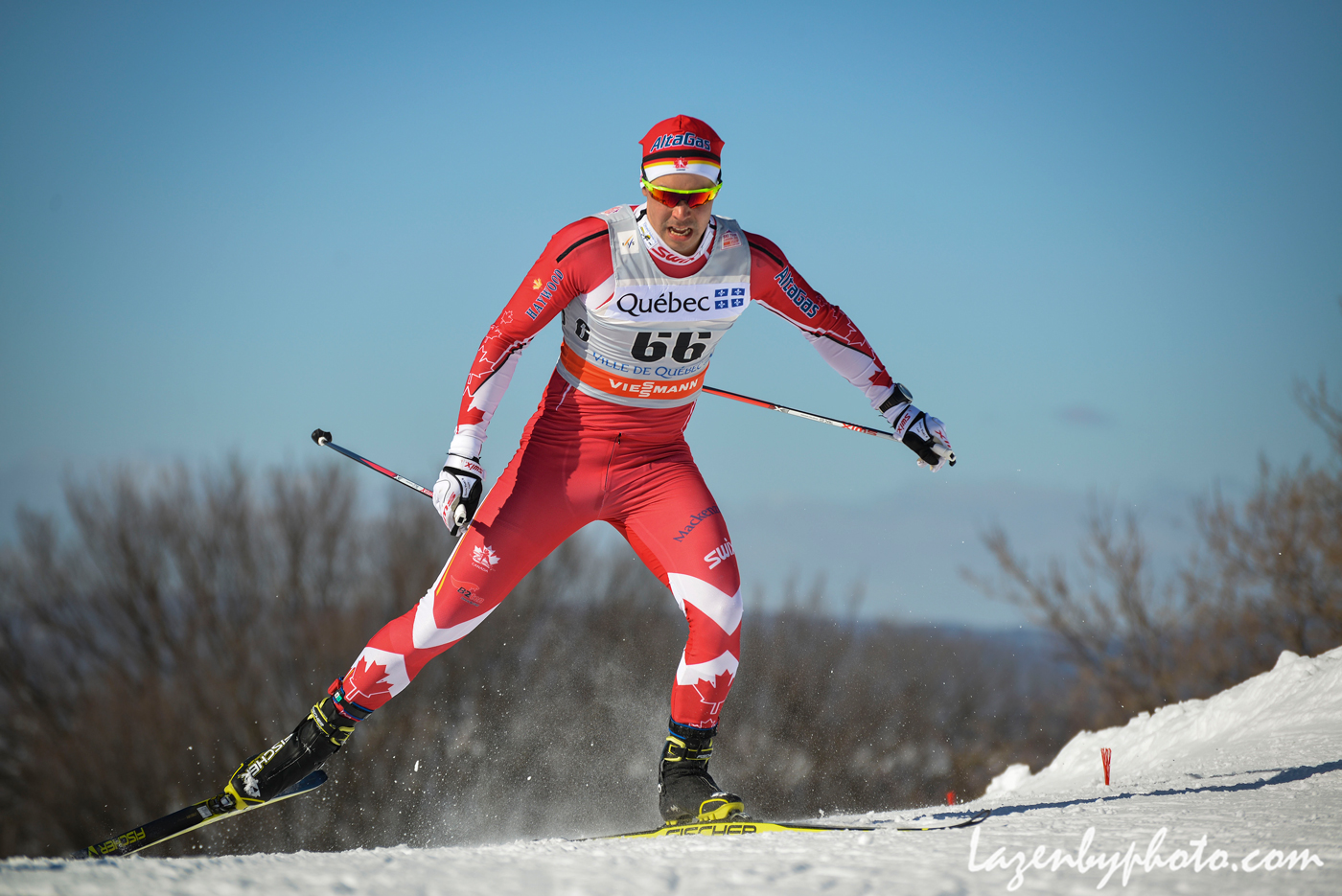
So far this year I’ve felt a big improvement in base fitness.
4. Whom you’ve been working closest with this offseason (coaches or training partners)?
Lots of time with my roommate Knute.
5. Best trip in the last five months (and why)?
Watertown National park with Graeme Killick in June for training. It was our first time to the park and we had some very productive volume days.
6. Favorite cross-training?
Fishing
7. Favorite non-athletic activity or pastime this summer?
Fishing
8. Song that was your jam this summer?
Whatever CKUA was playing.
9. All time favorite race moment?
When my teammate Gord Jewett won the 2010 Olympic trials at Sovereign lakes.
10. First thing you pack in your bag when you leave for Europe?
Skis
11. Venue/event you’re most excited to visit this season?
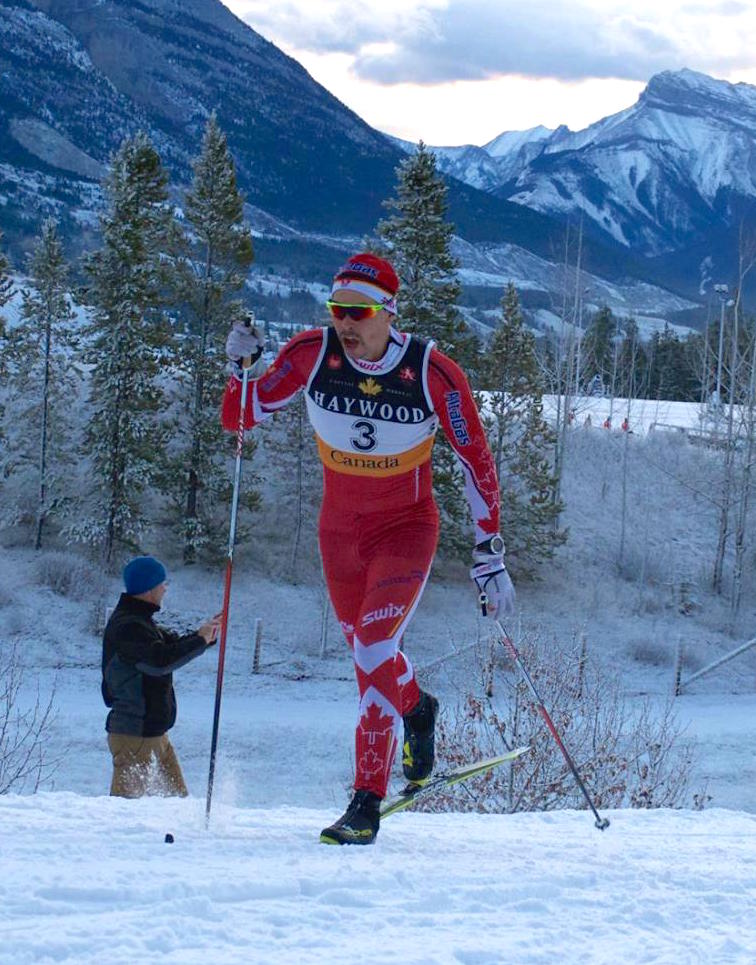
Canmore nordic centre for the team sprint at 2017 Ski Nationals.
12. Who will win the World Cup title this year?
[Martin Johnsrud] Sundby and [Ingvild Flugstad] Oestberg
13. Biggest sacrifice you feel you’ve made choosing this career path?
I wouldn’t want to be anywhere/doing anything else.
14. If you could change one thing about your sport, what would it be?
I’d change our earnings, closer to the NBA salary cap per nation.
15. What did you have for breakfast this morning?
Scrambled eggs, toasted bagel, coffee and an apple
16. In 5 years, I’ll be ____?
Getting learned at school.
17. In 50 years, I’ll be ____?
Still figuring it out.


Olympic and Paralympic veterans lead next generation of elite skiers into new season
CANMORE, Alta. — Focused on winning medals at all levels, Cross Country Ski de Fond Canada named its 2016-17 National Ski Team loaded with promise for 2018 & 2022 Olympics and Paralympics Games on Tuesday.
Feeding off a successful ending to the inaugural Ski Tour Canada where the squad celebrated countless personal and season-best performances, seven Olympians, including six men and one woman, will lead the charge for the Canucks.
Led by Alex Harvey (St-Férréol-les-Neiges, Que.), who captured two medals last season, a high-powered group of athletes including Len Valjas (Toronto), Ivan Babikov (Canmore, Alta.), and Devon Kershaw (Canmore, Alta.) will form the World Cup A Team. Two other athletes who posted breakthrough performances during the Ski Tour Canada, Jesse Cockney (Canmore, Alta.), and Graeme Killick (Fort McMurray, Alta.), will make up the World Cup B Team with Emily Nishikawa (Whitehorse) leading the Canadian women on the elite squad.
World Cup A Team
World Cup B Team
With a focus on developing the next generation of elite skiers, Cross Country Ski de Fond Canada also selected seven athletes for its Under-25 Team who will split time racing World Cups, international development level races, and Haywood NorAms in Canada. Three athletes who cracked the top-30 on the World Cup last year while racing the Ski Tour Canada will headline this group of seven including Whitehorse skiers Dahria Beatty and Knute Johnsgaard, along with Maya MacIsaac-Jones (Athabasca, Alta.). They will be joined by Olivia Bouffard-Nesbitt (Morin Heights, Que.), Cendrine Browne (St-Jérôme, Que.), Katherine Stewart-Jones (Chelsea, Que.), and Julien Locke (Nelson).
U25 Team
The governing body for cross-country skiing in Canada also announced seven athletes who combined to win nine medals last year, will return to the Para-Nordic Ski Team. Athletes include: Brian McKeever (Canmore, Alta.) and his guides Graham Nishikawa (Whitehorse) and Erik Carleton (Canmore, Alta.); Mark Arendz (Hartsville, P.E.I.), Brittany Hudak (Prince Albert) and Paralympic champion, Chris Klebl (Canmore, Alta.). Emily Weekes (North Vancouver), who bolted onto the international para-nordic scene one year ago with multiple podium performances will continue her progression on the Development Team.
Para-Nordic Ski Team
Para-Nordic Development Team
“We obviously have a great line-up of athletes that combines veteran experience with youthful energy and drive,” said Tom Holland, high-performance director, Cross Country Ski de Fond Canada. “I think our elite athletes proved last year they have what it takes to continue delivering medal-winning performances, while our next generation of athletes are steadily developing and demonstrating a promising future for our program.”
Holland and his high-performance selection team also identified one dozen athletes who will compete on the Junior National Ski Team. Athletes include:
Junior National Ski Team

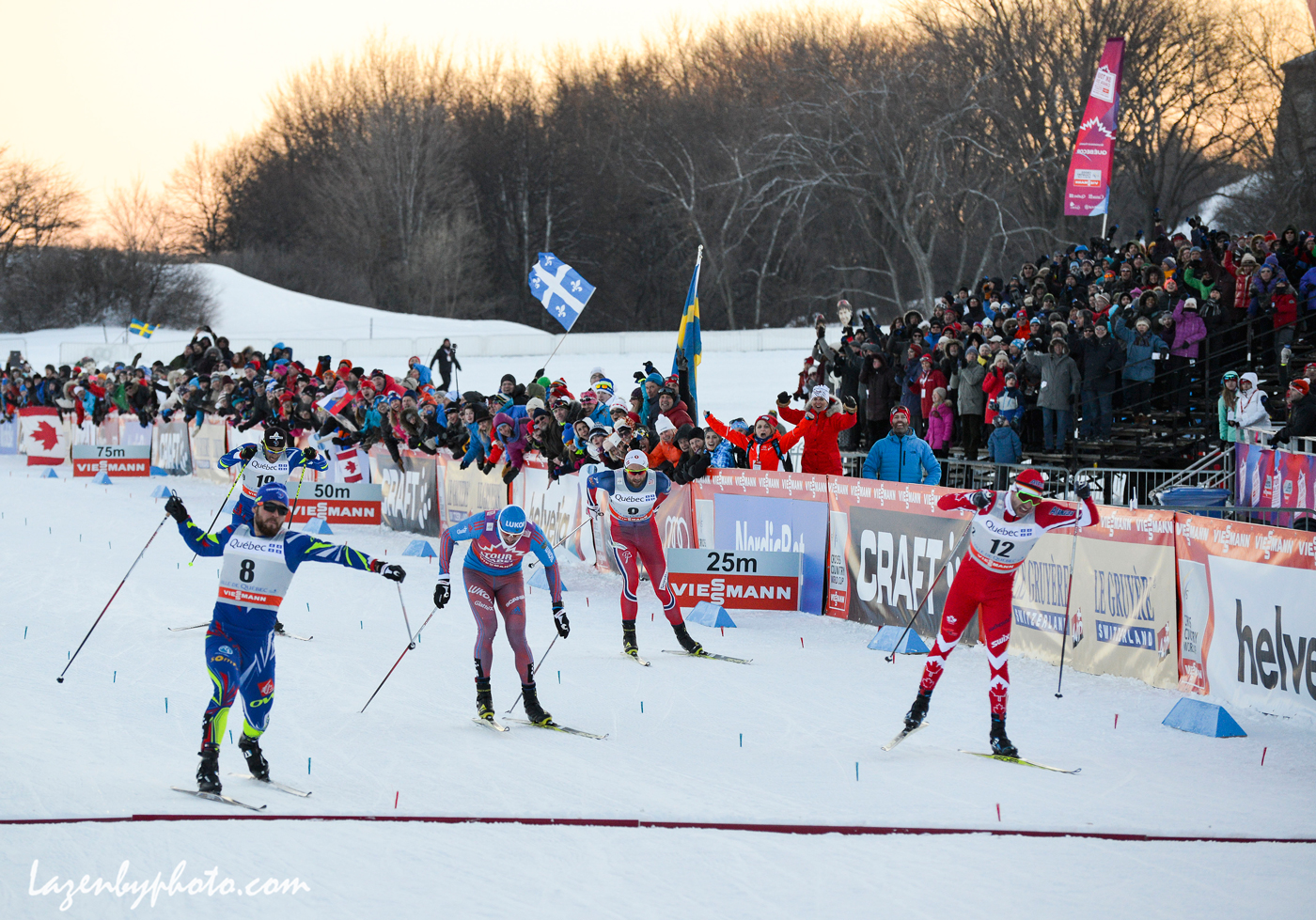
Ce fut une bonne journée pour accrocher votre chapeau.
Quick translation from French — “It was a good day to hold onto your hat.” On Friday, it was also a good day to understand French, as two native French speakers from countries thousands of miles apart, finished 1-2 in the 1.7-kilometer freestyle sprint at the third stage of the Ski Tour Canada in Quebec City.
France’s Baptiste Gros won the men’s final in 3:36.26. It was Gros’ first ever World Cup victory and his fourth career podium. The other French speaker, and local boy done good, was Canada’s Alex Harvey skiing to second (+0.55), for his fifth-career sprint podium. Overall Tour leader, Russia’s Sergey Ustiugov finished third, 0.79 seconds behind the winner.
The hat-holding reference made earlier wasn’t for the victorious Francophones or the hell-bent pace of the day, or any strong winds. It was for this: On Friday’s sprint course, outside the gates of Old Quebec City on historic ground called the Plains of Abraham, World Cup-level speeds were matched with racing rife with World Cup-level scuffling. During the quarterfinals, semifinals and finals, skiers had to endure cold-induced lung burn, but also a six-person deep scrum of skiers aggressively attempting to position themselves.
Here’s a few anecdotes of the carnage. The second men’s quarterfinal featured two North Americans: U.S. Ski Team sprinter Andy Newell, who qualified 23rd and Canadian Jess Cockney who qualified 29th. Add in Italy’s Federico Pellegrino, Andrew Musgrave of Great Britain, Sweden’s Teodor Peterson, and the day’s winner Gros and it became a perfect storm to start off the tumult.
At 2:54 in, Newell looked fresh as he slotted behind Gros in first. The two bumped boots and suddenly Newell was down. Pellegrino, a breath behind Newell, tripped and buckled over the American.
In the next heat, quarterfinal 3, Norway’s Finn Hågen Krogh, wearing bib number 1 as the day’s fastest qualifier, led for most of the heat. Out front, Krogh looked comfortable, even sublime.
At 3:04, still leading, but with the heat’s eventual winner Frenchman Richard Jouve seemingly riding his tails, just as he crested a hill from a furious V1, Krogh tripped.
And another image: Erik Bjornsen, also of the U.S. Ski Team (USST), moments after crossing the line in quarterfinal 5 (Bjornsen qualified 27th and placed fourth in the heat), got into a brief altercation with Great Britain’s Andrew Young, who placed third. Young was seen on TV cameras pushing Bjornsen first and Bjornsen pushed him back.
However, one skier able to navigate all this unscathed was second-place skier in the fifth quarterfinal, Harvey. It was his day to cash in his chips.
Bon Ski
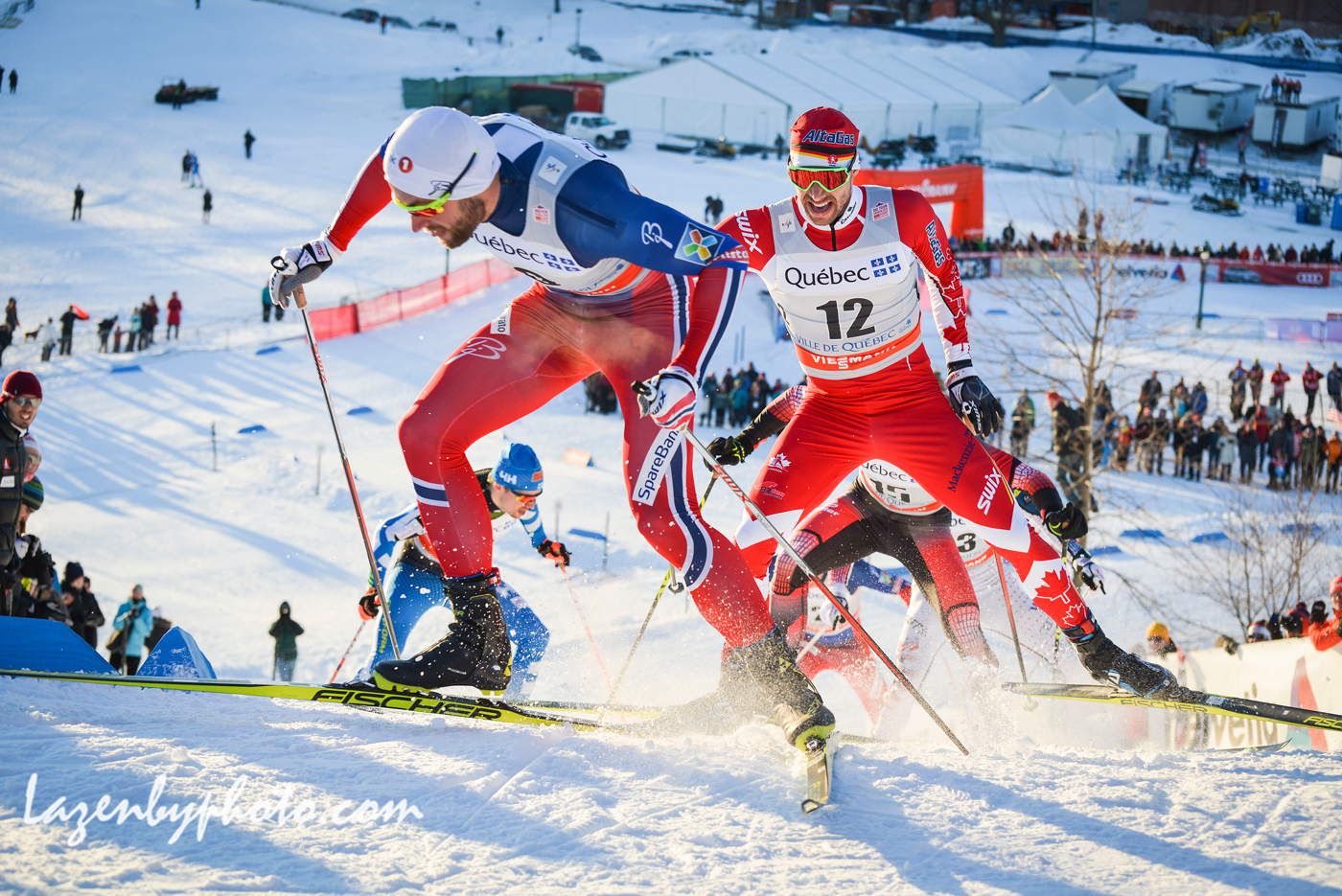
No doubt about it, Harvey is a local. He grew up about a 40-minute drive north of Quebec City in Saint-Ferréol-les-Neiges, Quebec. He’s part of Canada’s skiing royalty. His father Pierre was a Canadian Olympian in both cycling and cross-country skiing. There’s the family name to uphold and honoring the home crowd. But sometimes the pressure of performing in front of friends and family can get to athletes. That wasn’t the case for Harvey on Friday.
Instead of buckling under expectations, he rose to the occasion.
Although an all-around skier, Harvey has struggled this year to qualify in the sprints. Here’s his 2015/2016 sprinting rundown in terms of qualifying: Harvey has qualified in only four sprints this season; three of which were in classic technique. The first freestyle sprint he qualified for this season was earlier this week in the first stage of the STC in Gatineau, Quebec. Harvey last podiumed in a skate sprint in Szklarska Poreba, Poland, two seasons ago in January 2014.
Call today a breakthrough or a perfect alignment of timing and place. Either way, Harvey skied like he owned the course.
Friday, Harvey made it a personal two-peat. He began his day qualifying for his second-straight skate sprint. In Quebec, he was 12th in qualifying, 4.63 seconds off of Krogh’s best time of 3:33.14.
Then he finished second in his quarterfinal and first in his semi to cruise to the finals. As each round progressed Harvey noted he could sense the crowd’s energy.
“After each round, the crowd got louder and louder,” Harvey said after the race. “The fans were amazing, they gave me wings.”
Wings are a good way of describing the lightness one feels when a collective mass of people are willing the win. Harvey flew to a semifinal win in 3:40.68, besting Norway’s Petter Northug by 0.14 seconds.
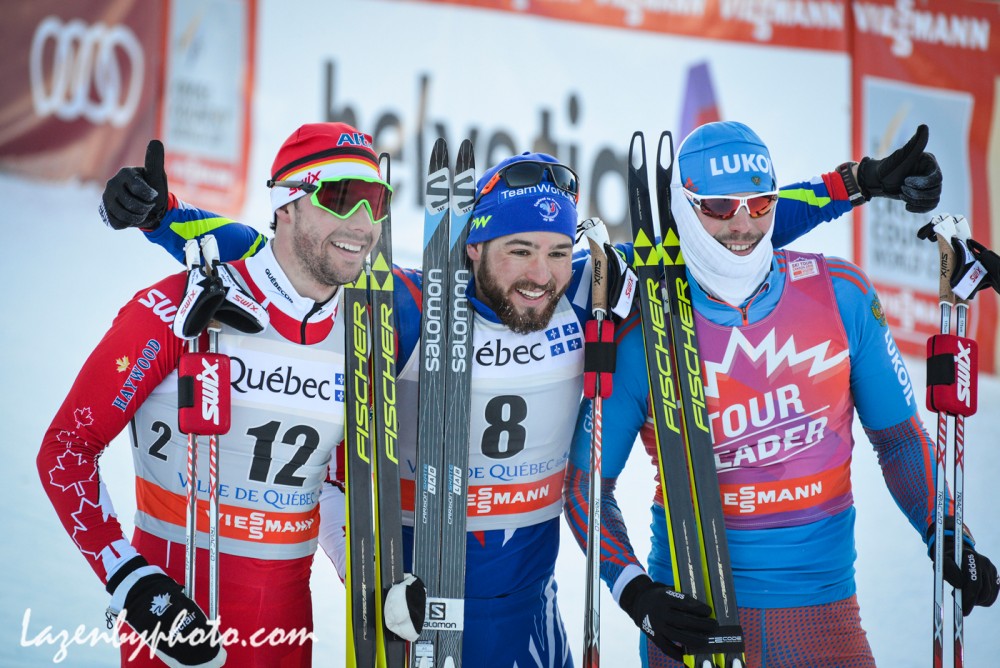
In the final, it was Gros, Ustiugov, Northug, Poland’s Maciej Starega, Jouve, and Harvey lined up as a northern sun kissed only the tallest buildings in Quebec City. By finals time, the course was shaded and looking cold.
Ustiugov started out hammering in front and Northug kept the tension high as he shadowed in the rear. A minute in, Harvey skied just to the side, in third, keeping a lane open for an acceleration. Thirty seconds later, he was nearly side-by-side with Ustiugov as they skied along the old city’s fortress-like walls.
By 2:30, there was no doubt, Harvey was on form. He matched a steamrolling Ustiugov up a decisive climb. Cresting the top, it looked for a moment that the Russian would run away with a sizable lead. But Harvey kept the finish in sight amongst the deafening crowd.
In the home stretch the Canadian slingshotted to the outside around Ustiugov who was on fumes as he faded to third. Elusively charging up on the inside was Gros, taking the win.
“At the top of the last uphill, I was right behind Ustiugov in the best position possible,” Harvey said about coming so close to the win. “I thought I could win this one, but then Baptiste passed me on my right and surprised everyone.”
Harvey even outclassed the master of outclassing on the final sprint, Northug. Evidently, Harvey winked at the Norwegian in the finishing pen.
“Few people can say they were faster than Northug in the last hundred meters of a sprint finish,” Harvey explained in a press conference. “He’s the best finisher since 2006, so it was my way of telling him I could hang with him!”
Harvey, winner of four World Championship medals, two of which came in individual classic sprints, could have been off some competitors’ radars this season. In Canada, during the final race series of the World Cup season, it’s Harvey making the statement.
“Right now, I’m in the best shape of this season,” Harvey said. “That was the goal.”
Historically, it has been a bit rough for the Canadians racing in Quebec. The last time the World Cup visited the city, back in 2012, Harvey had the best showing for the Canadians in the individual skate sprint in 21st place. Then a week later in a skate sprint in Canmore, Alberta, Harvey didn’t qualify in 52nd.
Fast-forward to 2016: Friday was a big day for the Canadians.
Harvey moved up two spots into fourth overall in the Tour standings — 1:56.8 back from Ustiugov, who continues to lead the Tour. Northug is second overall (+16.7), and Iversen is third (+24.3).
One parent asked after the race if they were confident their son would make it to the finals was Alex’s father Pierre.
“No! He didn’t do it once this season, but you dream of that one time where you can do it in front of your friends and family,” Pierre Harvey told FasterSkier. “He’s on a cloud right now. … During the Tour de Ski, they were tough moments for Alex. At one point, I thought he would call saying he’s coming back home. With all the waxing setbacks, it’s hard when you’re training like crazy.”
Canadian Head Coach Justin Wadsworth, for one, wasn’t surprised with the result.
“Alex can podium in every day on the right day,” Wadsworth wrote in an email. “His skating has come up a notch, most likely due to the surgery he had last spring, but he’s always been solid in every aspect of WC [World Cup] racing.”
Last spring, Harvey had surgery on his iliac arteries in both legs to relieve pain that worsened in hilly skate races. He went on to start the season with a confirmation it was the right move: he placed second in the 10 k skate at the World Cup opener in Finland.
As for how he commanded Friday’s final on home turf, Wadsworth said, “He knew where he had to be and when he had to be there, and stuck to this perfectly. He is one of the best tactical skiers out there. This course had a couple choke points, and if you were back on those it was hard to move into the right position toward the finish.”
He stressed the importance of Harvey’s podium for the team, at home with its coaches, wax techs and a large number of athletes representing Canada as well “many whom have not had a chance to be part of a WC podium before,” Wadsworth wrote. “It’s been a really great working team of staff here that normally don’t work together, so having something to celebrate together is important.”
“He is one of the best tactical skiers out there.” — Canadian head coach Justin Wadsworth, on Alex Harvey’s second place in Friday’s freestyle sprint
Cross Country Canada’s new CEO, Pierre Lafontaine told FasterSkier that a strong program is built success by success.
“I think it’s a sum of things, you know,” Lafontaine said. “Like Alex’s position and he is getting better and better as the season goes on. It’s powerful. It’s powerful that it happened at home in front of Canadians. We got two guys in the top twelve that’s powerful. Two or three days ago we had three guys in the top 30, one girl scored [points] that had never scored before. So it’s by hosting at home, it empowers these kids to push themselves even more.”
The celebration for Harvey’s second place was noted by sprint winner Gros.
“It’s funny because it’s almost as if Alex won today!” Gros said after the race.“It’s a big deal for him, he didn’t perform well this season in sprints. He’s looking to do well on the overall rankings, while I’m primarily focused on freestyle sprints. So you could say, I’m a ‘casse-pieds’ [ translation: pain in the neck!]”
Having skied on the World Cup since 2014, this was Gros’ first World Cup win. He’s placed third once, and second on three occasions.
“It’s funny because it’s almost as if Alex won today … So you could say, I’m a ‘casse-pieds’ [pain in the neck!]” — France’s Baptiste Gros, 25, after winning his first World Cup on Friday in Quebec City
“In the past, I placed second in a World Cup, I kept finishing second, but I really wanted to win and I knew I had better chances in freestyle,” Gros said. “This morning, it was my last chance to win a freestyle sprint this season, so I told myself ‘I got to win today!’
“I find it magical! To do a course on the Plaines d’Abraham, with the crowd and the city laying in the background, it’s so surprising. We’re not used to that kind of crazy atmosphere.”
Other North Americans in the Heats and Beyond
Canada’s Cockney eked into the heats by qualifying 29th, 8.48 seconds out of first and 0.52 seconds ahead of 30th. Once in the heats, Cockney made the most of it.
He skied a stellar quarterfinal assuring himself a place in the semis by finishing second, 0.54 seconds back from Gros as the winner of that second quarterfinal. That was the heat where Newell tumbled out of contention.
Cockney raced in the second semifinal and finished in fifth (+2.49). Ustiugov won that semi in 3:37.42.
Post-race, Cockney, a 26-year-old National Senior Development Team skier, was elated with his 10th place on the day.
“Man, I have had a really hard go of it this year,” Cockney said. “Nothing was working at the start of the year … So this is a big lift. I’m really happy with that. Skiing a semifinal is always awesome. Nice to have a two heat day again.”
This was Cockney’s third time qualifying in a sprint and only his second time racing in a World Cup semifinal. His other semifinal came in 2012 at the skate sprint in Canmore, where he raced to ninth overall.
For American Simi Hamilton, who raced to second in Stage 1 sprint three days earlier, anything was possible. Hamilton qualified 13th. Again proving he’s no fluke, Hamilton won quarterfinal 4 in a photo finish with Finland’s Martti Jylhä.
In his semifinal, which Harvey won, Hamilton finished fourth (+0.86). Although Hamilton was a sliver from automatically advancing by placing first or second, his semifinal was just over three seconds slower than the first semifinal. As a result, no lucky losers advanced from Hamilton’s semi.

The U.S. sprinter told FasterSkier that Friday’s rounds were difficult.
“It was crazy, it was really hard,” he said. “A minute-fifteen longer than pretty much anything.”
Hamilton also mentioned he felt better as the day progressed.
“It didn’t feel great qualifying, but felt better in my quarter and actually felt good in my semi,” he said. “But I really wanted to conserve energy early on so you know we had a really slow heat. I was happy just kind of tucked in towards the back, and focusing on relaxing.”
Hamilton also referenced a make-or-break move by Northug in his semifinal that he didn’t have an answer for. “Petter made a move at the top of the first climb,” Hamilton said. “I was little too far back and I didn’t react to it quick enough. So I when I tried to get back up and bridge that gap, when we got to the second climb here, I actually felt really good on the climb, and put a bit of a surge to see what would happen. But I couldn’t really go anywhere so I had to just hoped for the best coming into the finish.”
Hamilton finished the day eighth overall.
Another U.S. skier in the top 20, Bjornsen ended up 20th overall for a career-best in an individual World Cup sprint.
The skier from Washington’s Methow Valley, who lives and trains with Alaska Pacific University (APU) in Anchorage, qualified in 27th. Bjornsen was ultimately bumped from competition when he placed fourth in his quarterfinal, 2.56 seconds behind heat winner Emil Iversen of Norway.
In his interview with FasterSkier, Bjornsen mentioned the compact nature of the group in his quarterfinal.
“Like most of them, it was pretty tight,” Bjornsen said. “Hard to make passes. I kind of went for a fast start out of it so I felt like I was in a pretty good position. I was just not quite strong enough to have that surge to make to that semifinal.”
Asked about his brief finish-line scuffle with Young, who finished third, 0.18 seconds ahead of him, Bjornsen said, “There was just quite a bit of tangle the whole time. We were just stepping all over each other’s stuff, and we were both just disappointed at the end. It’s all fine. We talked right afterward in the pen so it’s all good.”
Team veteran Newell had a tough run in the quarters. He got there by qualifying 23rd. Yet in his heat, the second quarterfinal, he tripped up while skiing behind Gros.
“Disappointing crash, ’cause I felt this is actually kind of a fun course,” Newell told FasterSkier afterward. “I thought I skied a good heat, tactically well. I was feeling strong and ready to attack the last hill. So it’s too bad with the crash. Greatly disappointing, but what can you do?”
Newell described his tangle and nasty spill in more detail. “I was behind Baptiste [Gros], I came out of the draft, and we both started to skate at the same time. So we bumped boots, you know? I went down hard. Nobody’s fault. It’s what happens.”
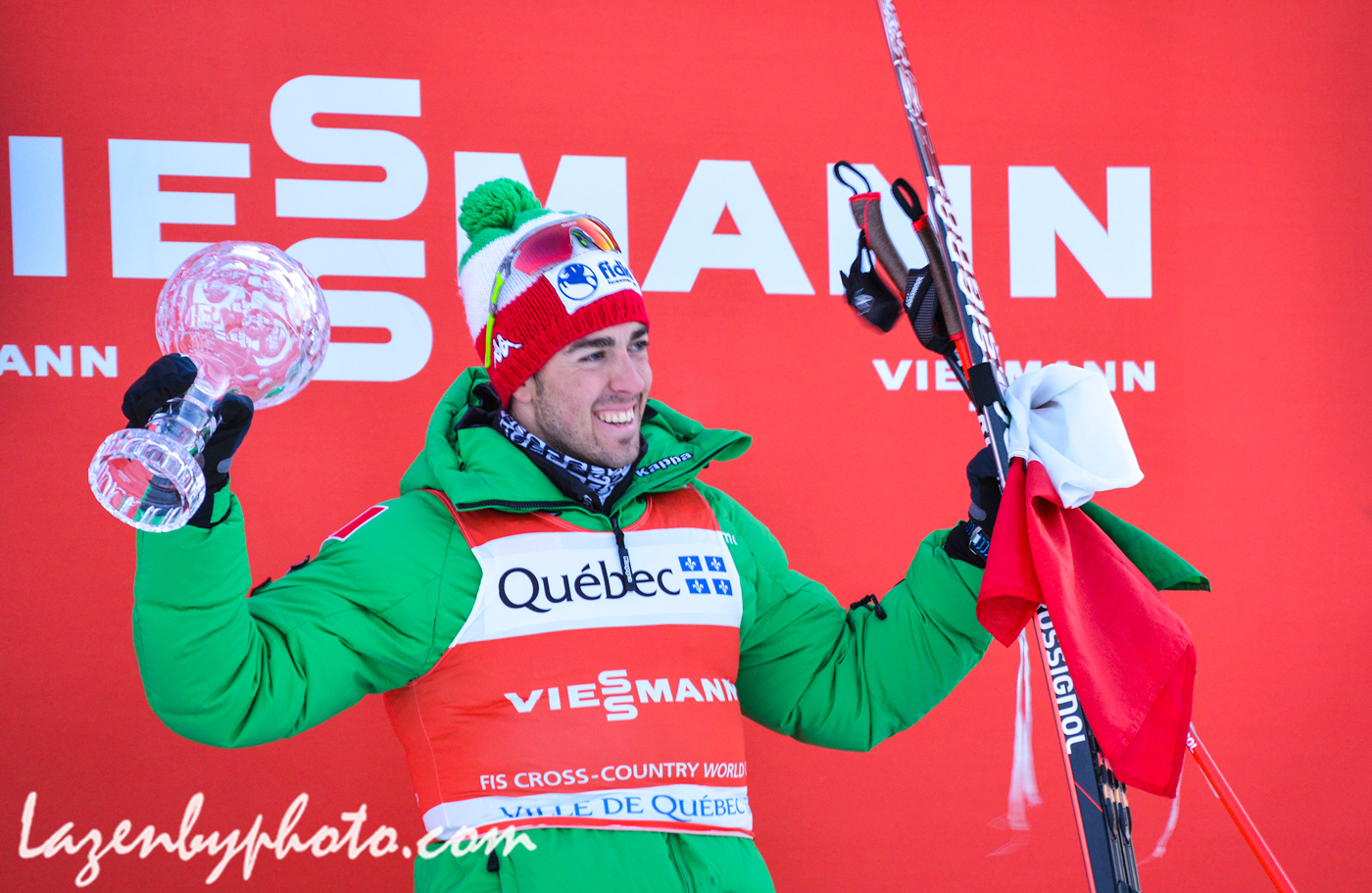
Newell sat stunned for a few moments and finished sixth in the heat, 52 seconds out of first. Pellegrino recovered quicker and ended up fifth, 2.73 seconds behind Gros as the winner.
That put Newell in 29th and Pellegrino in 21st overall; for Pellegrino, it was enough to secure his first Sprint World Cup Crystal Globe and he became the first non-Scandinavian male to win the season-long title. (He needed to finish in the top 22 to do so.)
As of late, Newell has tried to jump start what he has considered to have been a difficult season.
“Just trying to take it one day at a time,” Newell said. “I am obviously not in my best shape right now. I’m kind of suffering a little bit, and just trying to make it through the season. It hasn’t been a great last month for me. I haven’t been sick, I’ve just not been feeling very good. So that’s hard, at the end of a season, when you are not feeling well. It’s no fun to race when you are not at your best. It’s one of the hardest things for an athlete to do. So just trying to make it through some of these races. And then, yeah, take it one day at a time.”
Also for the U.S., Reese Hanneman (APU) placed 45th, Eric Packer (APU) was 48th, Dakota Blackhorse-von Jess (Bend Endurance Academy) 64th, Noah Hoffman (SSCV/USST) 65th, Scott Patterson (APU) 70th, Tad Elliott (SSCV) 76th, Brian Gregg (Team Gregg) 79th, Matt Liebsch (Gear West) 80th.
Also for Canada, Len Valjas (CNST) finished 38th, Devon Kershaw (CNST) 53rd, Knute Johnsgaard (AWCA/CNST) 54th, Andy Shields (NDC Thunder Bay) 56th, Michael Somppi (NDC Thunder Bay) 59th, Patrick Stewart-Jones (AWCA) 68th, Graeme Killick (CNST) 71st, Ivan Babikov (CNST) 72nd, (Russell Kennedy (Canmore Nordic) 73rd, Kevin Sandau (AWCA) 74th, Bob Thompson (NDC Thunder Bay) 78th, and Simon Lapointe (Skinouk) 81st.
The STC continues Saturday with Stage 4, the men’s 15 k and women’s 10 k freestyle pursuits in Quebec City.
Results | Qualifier | Tour standings (through Stage 3)
— Gerry Furseth, François Léger Dionne, Harald Zimmer, and Alex Kochon contributed