From the FasterSkier archive — posts syndicated from athletes’ and coaches’ own blogs between 2004 and 2012, kept online as published. Current coverage is at fasterskier.com.
We had to take a break after our three-week Olympic sprint, but we’re back to catch up on a couple of weeks of World Cup racing.
Devon and Nat take a quick run-through of events in Sweden, Finland and Norway. We’ll be back after the marathons at Holmenkollen.
Reach us at devon[at]fasterskier.com and nat[at]fasterskier.com.
A reminder: This is a homegrown podcast done by two guys working long hours and late nights. We also paid real money to be in Italy for the Olympics. If you can, support the show and FasterSkier’s ongoing coverage with a voluntary membership.
Help Support Our Olympic Coverage!
FasterSkier had our own Nat Herz on the ground at the Olympics, which, to be honest, was a very big financial lift for us. If you value the thoughtful work and access FasterSkier provides at championships like this one, please consider becoming a Voluntary Subscriber. Your support directly fuels the work we do to cover the people, places, and moments that make our sport special.
This coverage is made possible through the generous support of Marty and Kathy Hall and A Hall Mark of Excellence Award. To learn more about A Hall Mark of Excellence Award, or to learn how you can support FasterSkier’s coverage, please contact info@fasterskier.com.
Today wrapped up three days of racing in Trondheim, Norway, where the 10 k Classic individual start race was contested this morning. The “10 k” race name was a bit of a misnomer, as the actual distance raced was 11 kilometers. The American women have set a blistering pace this season: Rosie Brennan finished second in this event three weeks ago in Ruka. Jessie Diggins’ Classic skiing this year has looked especially crisp. So, hopes were high for the American squad.
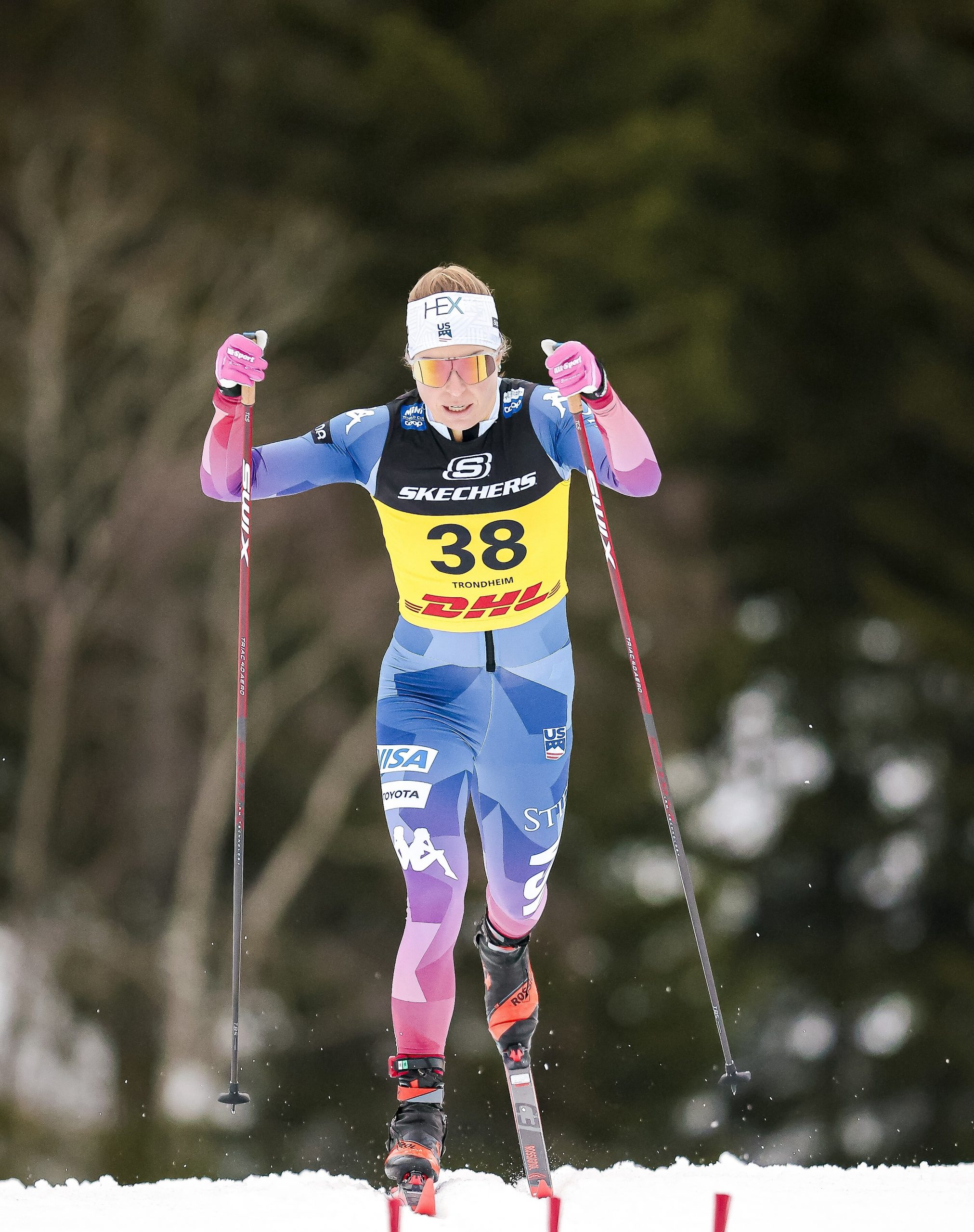
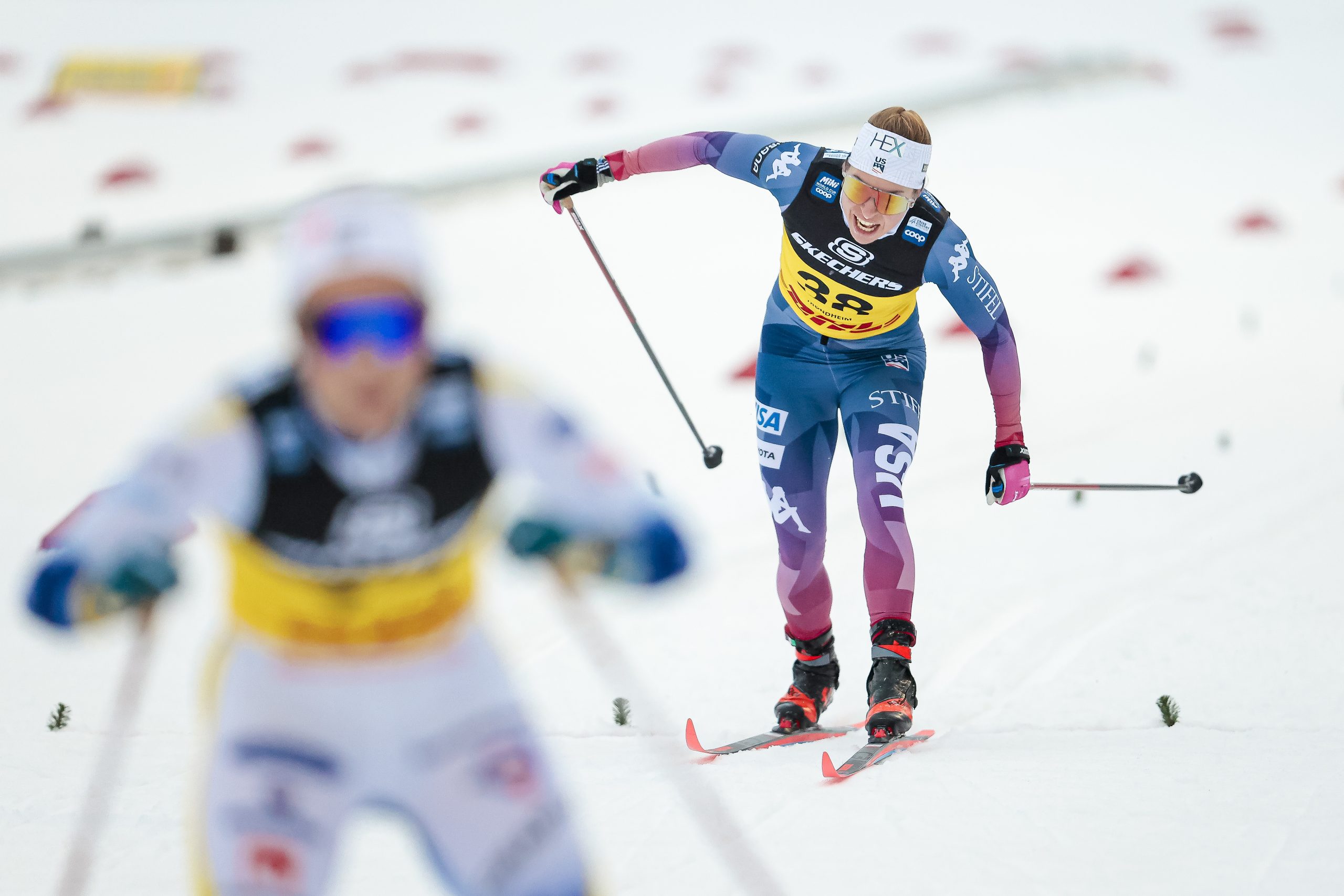
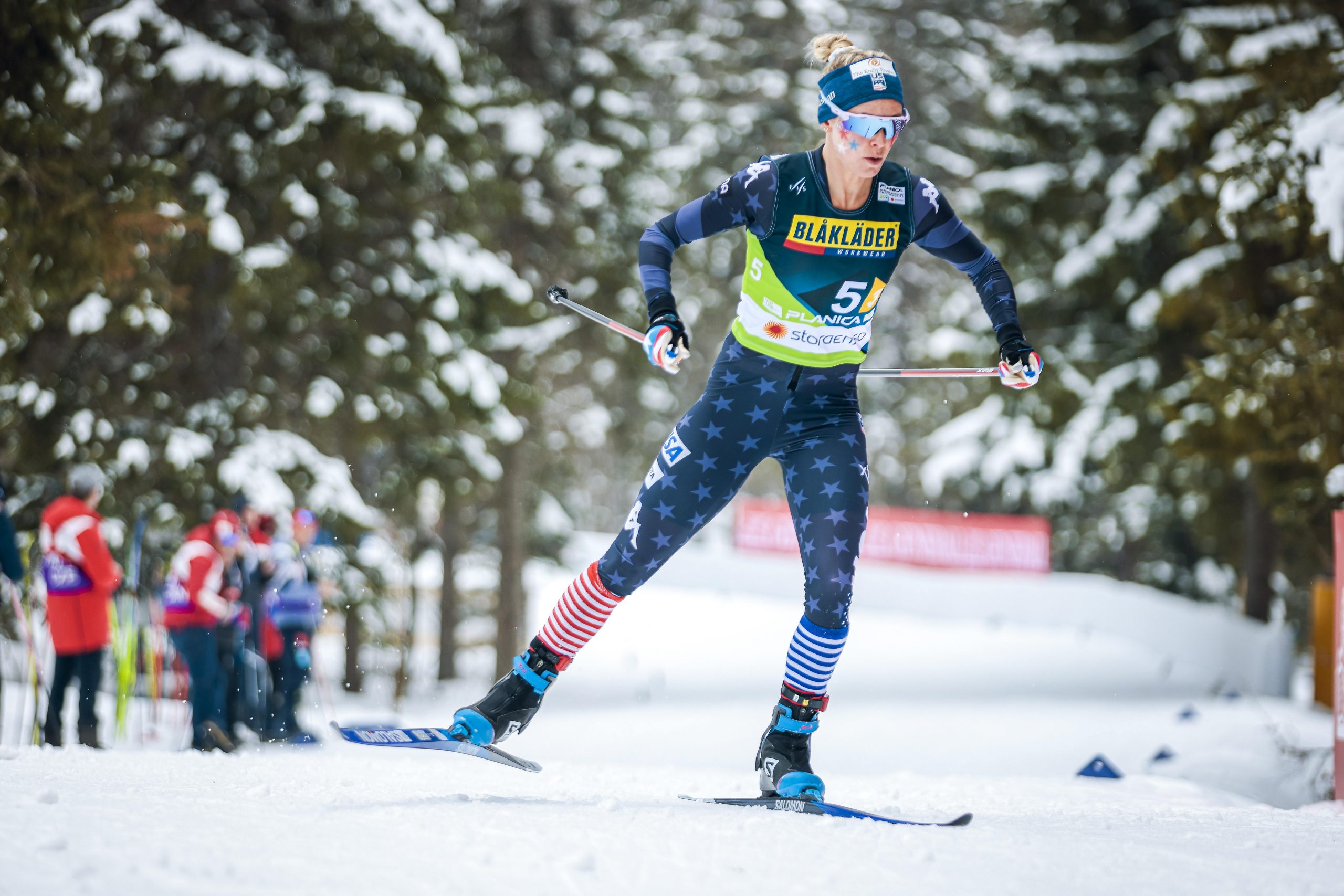
It was another great Classic race day for Rosie Brennan (USA). She finished second. (Photo: NordicFocus)
Standing in their way were the ever-present Swedish women: Ebba Andersson (SWE) took first in the same race where Brennan had finished second, and Frida Karlsson (SWE) was nipping on Brennan’s heels in that race. But Karlsson was a last minute DNS on Sunday in Trondheim, and was substituted with Johanna Hagstroem. Naturally, whenever there’s a Classic race of some distance, oddsmakers will factor in Kerttu Niskanen (FIN); the Classic expert has won all of her five individual World Cup victories in 10 k Classic Individual Start races!
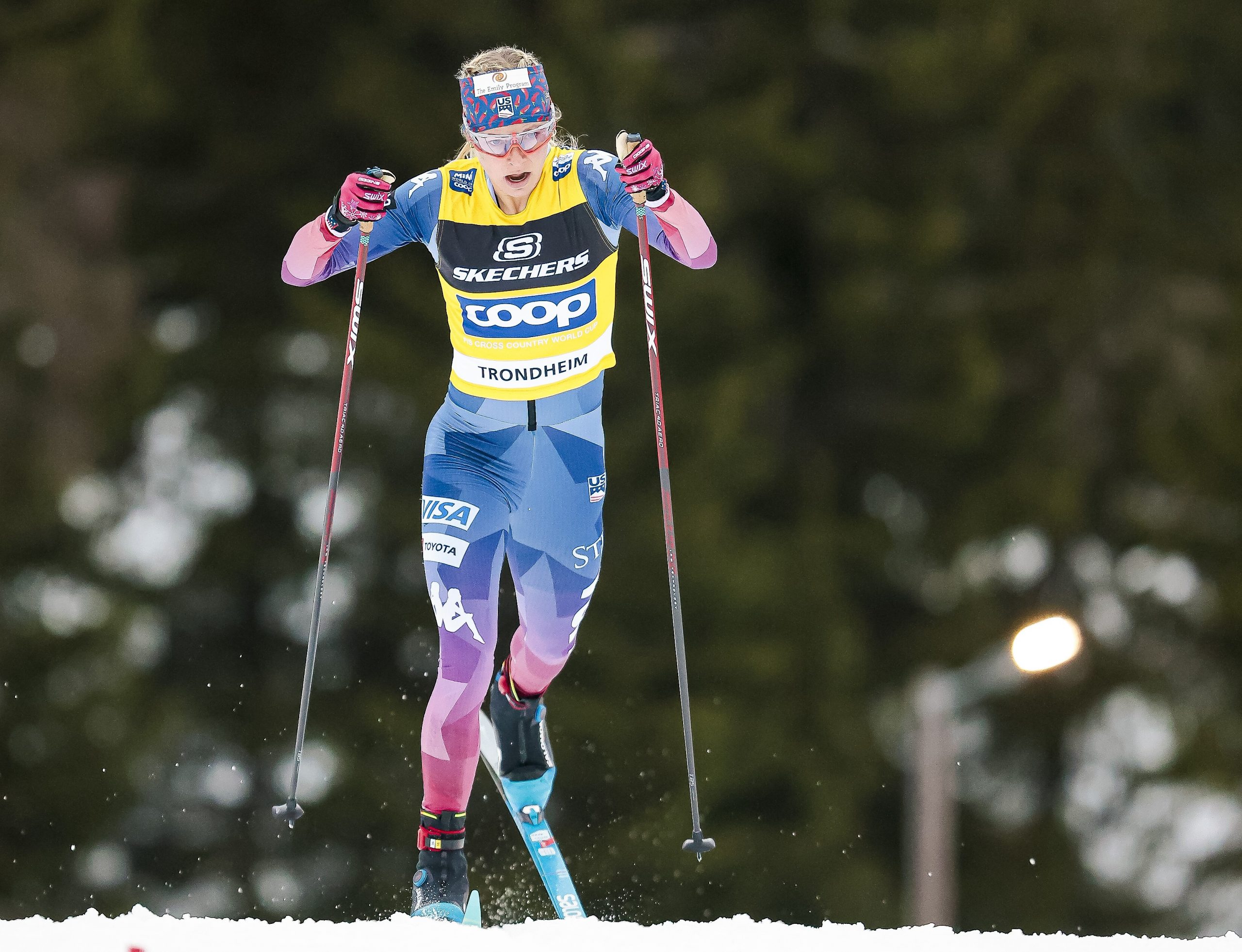
Diggins had another excellent Classic performance, finishing fourth. (Photo: NordicFocus)
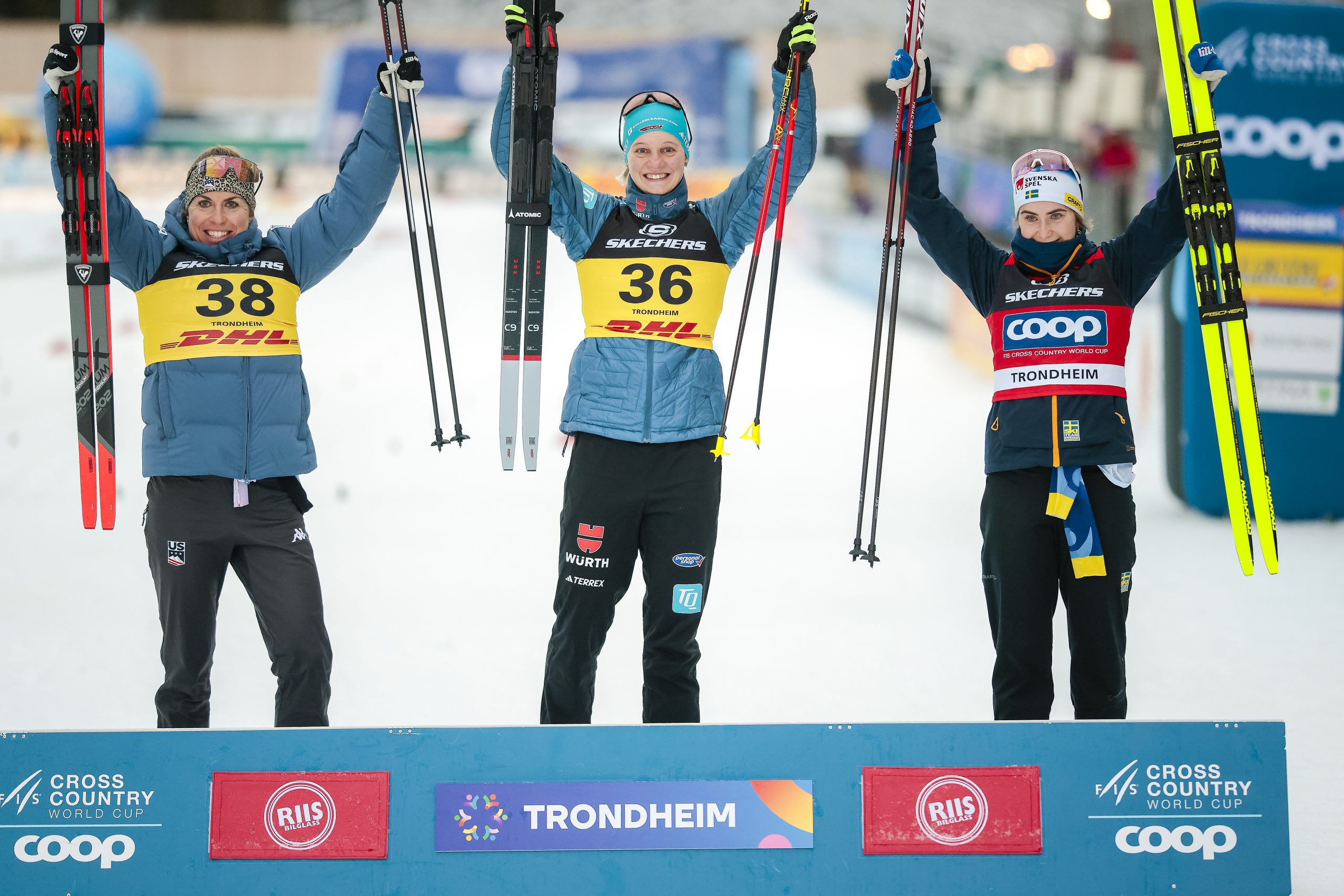
In another warm day in Trondheim—temperatures in the mid-30s and Classic tracks glazed—it was Victoria Carl (GER) taking the win and making German history. Brennan repeated her second place Classic performance, and Ebba Andersson (SWE) came in third.
Jessie Diggins missed the podium by seven seconds, finishing fourth. Other American finishers were Novie McCabe, 25th and Alayna Sonnesyn, 48th. Sophia Laukli missed the weekend of racing due to illness.
The top Canadian was Katherine Stewart-Jones in a very impressive 18th. The other Canadian finisher was Amelia Wells in 51st.
Women’s 10 k Classic Interval Start
Warm conditions meant that it was another klister day for skiers. Under the new fluoro rules, in individual start races competitors need to have their skis turned in 30 minutes before their start time: another change to which skiers and technicians are being forced to adapt. “Later starters don’t have access to the race course for testing with their technicians,” U.S. coach Chris Grover told FasterSkier. “When the race starts they close the course—and with conditions like we have now—that means there’s almost no other skiing available, so the tests that you’ve done are earlier on.” Conditions with the warm weather were variable. Grover described it as “sugary with ice underneath, with glazing tracks.”
Rosie Brennan (USA) had a relatively low bib number for the seeded athletes which made her one of the early pre-race favorites to go through time checks. Niskanen started shortly behind her. Diggins was in an excellent starting position, getting bib number 56 with only a handful of serious contenders starting behind her. Diggins has said in the past that she doesn’t usually listen to split times during the race but, with today’s lineup, she would be able to hear reports of the progress of most of her competition ahead of her. The crowd gave Diggins an enthusiastic cheer to send her off.
Early on, Astrid Oeyre Slind (NOR) set the standard with the fastest time at the two kilometer mark. But Carl (GER) quickly supplanted her taking a nine second lead. Carl has been skiing well; she had her first World Cup podium last week and had extra motivation today. No German—East, West, or Unified; male or female—has ever won a World Cup 10 k Classic individual start race. That was about to change . . .
Brennan was only two skiers behind Carl and would be able to chase her throughout the day. Brennan was third when she went through the two kilometer mark but, as other skiers came through, she dropped to fourth. As the seeded skiers continued to pass the two kilometer mark, Carl’s time continued to hold. When Diggins passed the timing mark, she was in fourth, and after the rest of the pack went through, she had dropped to sixth.
Carl continued to set the standard as she progressed to the 3.4 kilometer mark. As the top skiers passed through, Carl’s mark was still unmatched. But the question lingered as to whether she had gone out too hard?
Slind then put in a turn of pace and moved into second only three-tenths of a kilometer later. It was already a pitched battle for second and third but, shockingly, no one was putting a dent into Carl’s lead.
Carl’s lower start number meant that she would finish ahead of most of the other skiers in contention. When she crossed the finish line, she had a whopping 47 second advantage over the skiers who had already finished. It was a massive margin that seemed untouchable, but most of the top contenders were still on course. Brennan, Diggins, Andersson, and Slind were still lurking.
Brennan had another great race. But it was Victoria Carl (GER) who made history today. (Photo: NordicFocus)
One by one, the top-ranked skiers crossed the finish. One by one, they each fell short of Carl. They were gut-wrenching moments for the German as she stared on in disbelief while her time continued to hold. When Brennan came through the finish, she was 19.6 seconds behind Carl, in second place, but several of the top skiers were still on course.
Niskanen finished after Brennan, but she never really factored into the leaders’ chase today. She was third as she crossed the finish line, but it was clear that her time wouldn’t hold up. She ended up fifth.
Andersson seemed to have one of the best chances to top Carl. But as she came into the stadium her pace began to lag, and the clock told the story that, for the time being, Carl remained safe. Andersson pushed hard in the last several meters but couldn’t displace Carl. Andersson’s time was good enough for third, 21.6 seconds behind Carl, and only two seconds behind Brennan, who remained in second.
Now it was Diggins’ turn to see if she could dislodge Carl. At the 8.9 kilometer mark she was in third, 20 seconds off the lead, and at 9.8 k she had drifted to 23 seconds back. It was clear before she entered the stadium that Diggins would not be able to match Carl’s time. Diggins turned in a final burst trying to find the podium but crossed the line fourth. She was seven seconds behind Andersson, and 28 seconds away from Carl.
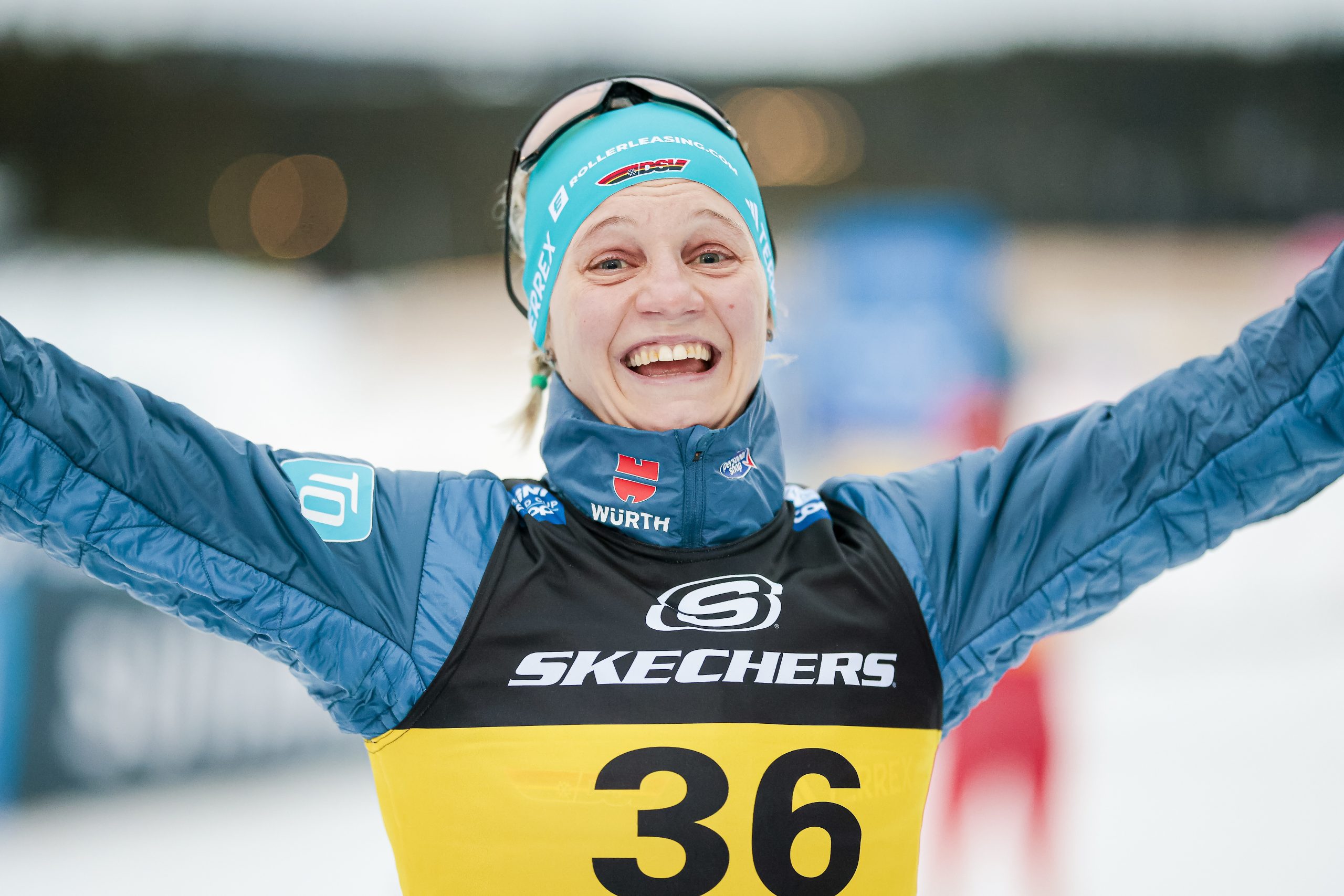
It was an emotional win for Victoria Carl (GER); a mixture of tears and joy as she took her first victory on the World Cup, and the first for Germany in a 10 k Classic Interval Start race. (Photo: NordicFocus)
Carl shook her head as she saw finisher after finisher unable to match her time. After Diggins crossed the line, Carl’s victory was secured. She cried in disbelief as she not only found her first World Cup victory but made history for Germany.
After the race Carl commented that she started a little slowly to save energy. She said her first World Cup victory was unbelievable. “It was crazy!’” she beamed. “The whole team is on fire, we had very good skis.” It was clearly an emotional moment for Carl who finally found victory after 138 World Cup starts.
Another Classic podium held special meaning for Brennan. “Getting another Classic podium is great,” She told FasterSkier. “It’s reassuring that my Classic is good, that [the prior podium] wasn’t a fluke. I’m feeling really strong in Classic. I felt like if I pushed like I did yesterday, there would be a good chance at a podium.”
Even though Brennan got faster as the race went on, it wasn’t a tactic. “I didn’t intentionally increase my pace,” Brennan said. “I tried to start very hard, but I’m just not good at starting hard. Sometimes it takes me a little to get going, and find a relaxed state to get the most out of my skiing.”
Like Brennan, Diggins turn of speed in the second half of the race was not strategic. She said, “I think certain sections of the course suited me better. The sections where you had to herringbone in sugar were challenging for me; that’s still a technique that I’m really working on. That’s probably my biggest weakness. So I tried to really hammer the sections where I was able to.”
The tricky conditions were challenging, but the Americans seemed happy with their skis. “The service team absolutely hit it out of the park today,” Grover told FasterSkier. “They figured it out … the kick, the glide, the structure, we had really good skis all day.” Brennan concurred: “My skis were pretty good,” she said. “When I started I had some slips and kind of panicked, but I think that was me just not skiing my best. When I found my groove and my rhythm, I felt great. I love klister skiing”
For Diggins, today was a new strategy for kick wax. She said, “I’ve been working on having the confidence to not ask for an additional kick wax bump. Yesterday I did, and that might have been part of why my glide was so slow on the Classic side. So today, I was … all right, I’m going to ski with confidence, if this blows up in my face, at least I tried something different. In testing the skis were good and I’m going to assume they are going to stay good, and they did! I was really impressed with our skis”
American skiers once had to deal with the label of being primarily Skaters; that’s no longer the case. Grover said, “Both [Brennan and Diggins] have made really nice improvements in their Classic technique”. He continued that, “Rosie and Jessie have put in a lot of time on the technique, and it’s paid off already. There have been a lot of comments trickling back to us that both those athletes have made a lot of adjustments … noticing the improvements they’ve both made.”
Another point of pride for team USA which Grover pointed out, was that the Americans are in third place in the Nations Cup standings. Another huge achievement for the U.S. as they currently hold a lead over Finland, Germany, and France.
Rosie Brennan (USA), Victoria Carl (GER), Ebba Andersson (SWE), (l-r) took the podium in the 10 kilometer Classic. Carl was able to make history as the first German to win a 10 kilometer Classic individual start race. (Photo: NordicFocus)
This World Cup coverage is made possible through the generous support of Marty and Kathy Hall and A Hall Mark of Excellence Award. To learn more about A Hall Mark of Excellence Award, or to learn how you can support FasterSkier’s coverage, please contact info@fasterskier.com.
With the mounting success of the American women’s cross-country program, the one prize continuing to elude it has been a major championship relay medal. In some ways, it has become an obsession with team USA, an obsession they were looking to check off the list after today; however, the Americans were not the only country focused on the relays. Norway and Sweden are bitter rivals in relay events, and considerable national pride hangs in the balance each time the event is run. Norway has won five of the last six Women’s World Championship relays; even so, Norway would be seeking redemption after missing the podium in the last Olympics. Sweden has finished second to Norway in four of those five World Championship relays; Sweden is understandably tired of looking up on the podium at its Scandinavian neighbor. Germany would also be on a mission to prove that its Olympic silver medal was not a fluke.
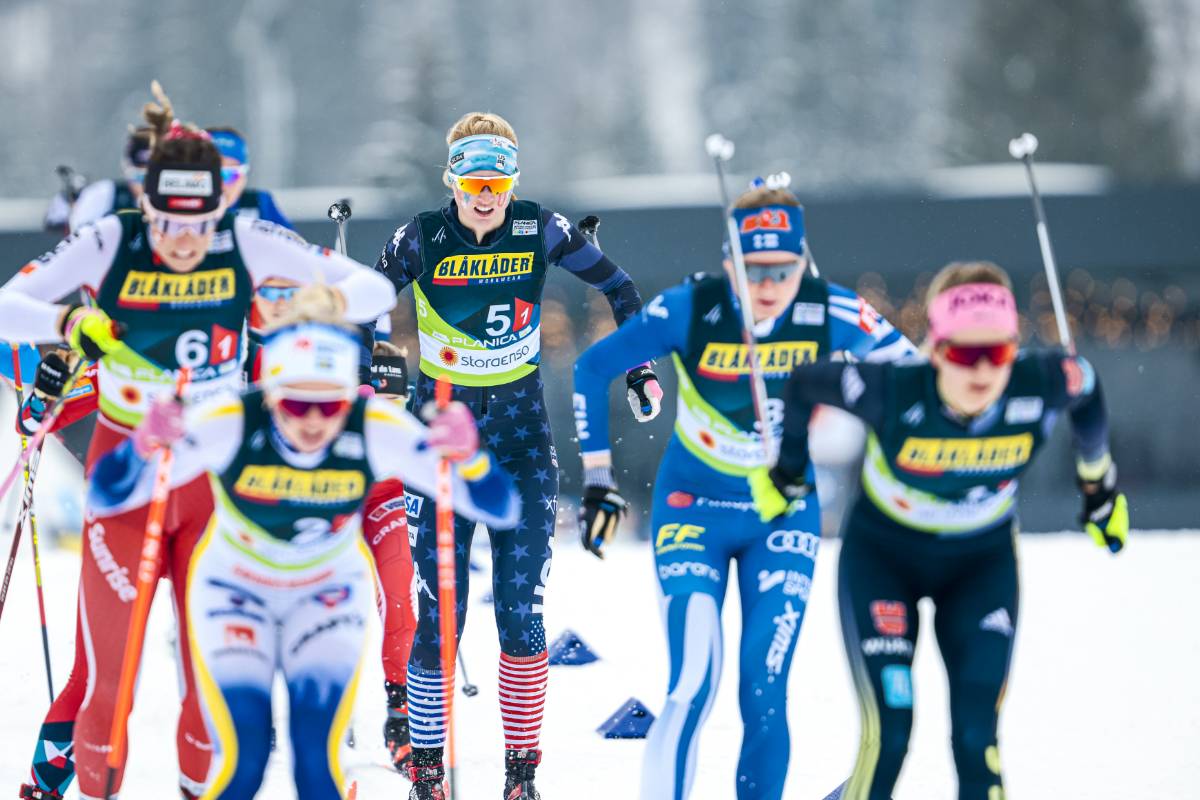
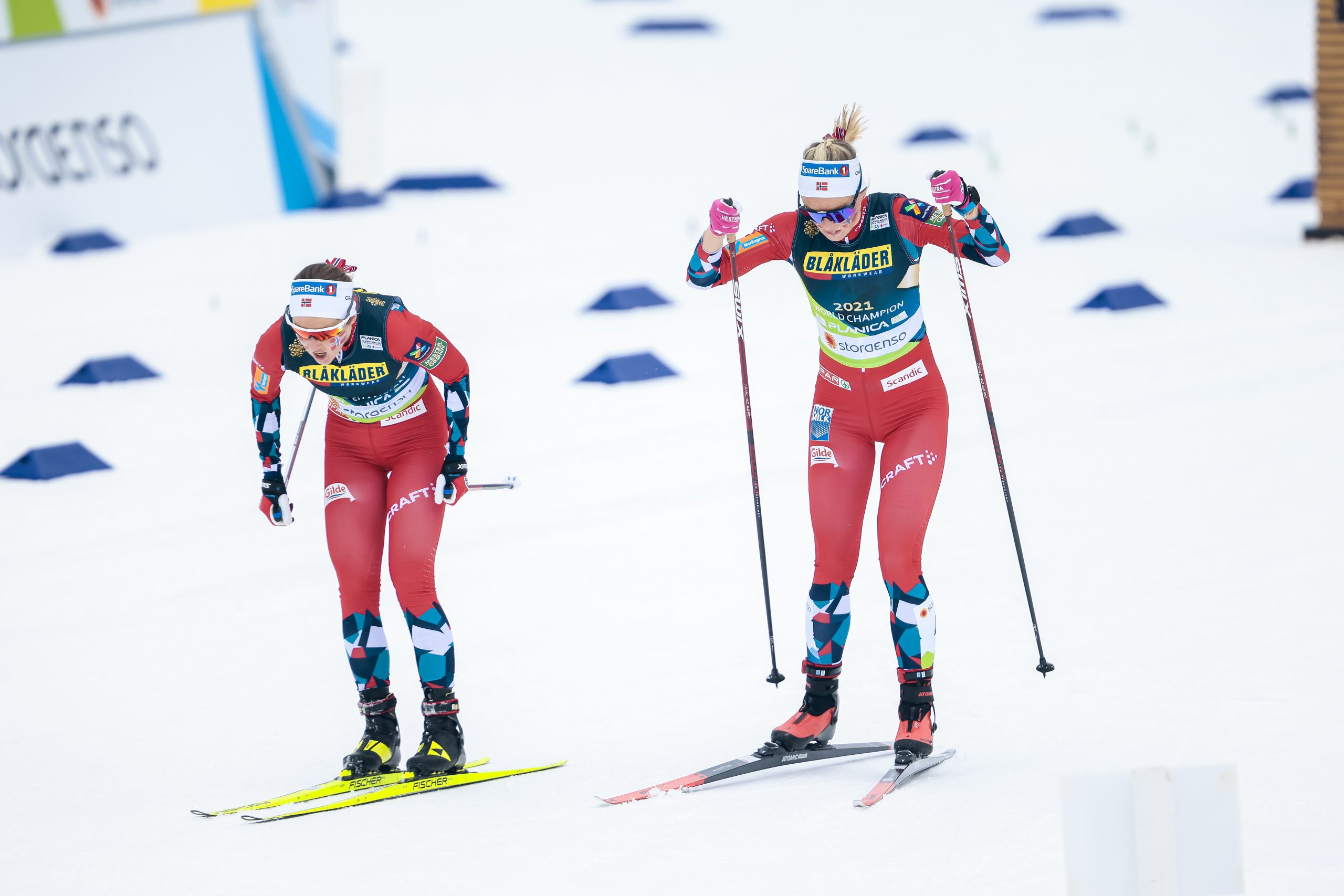
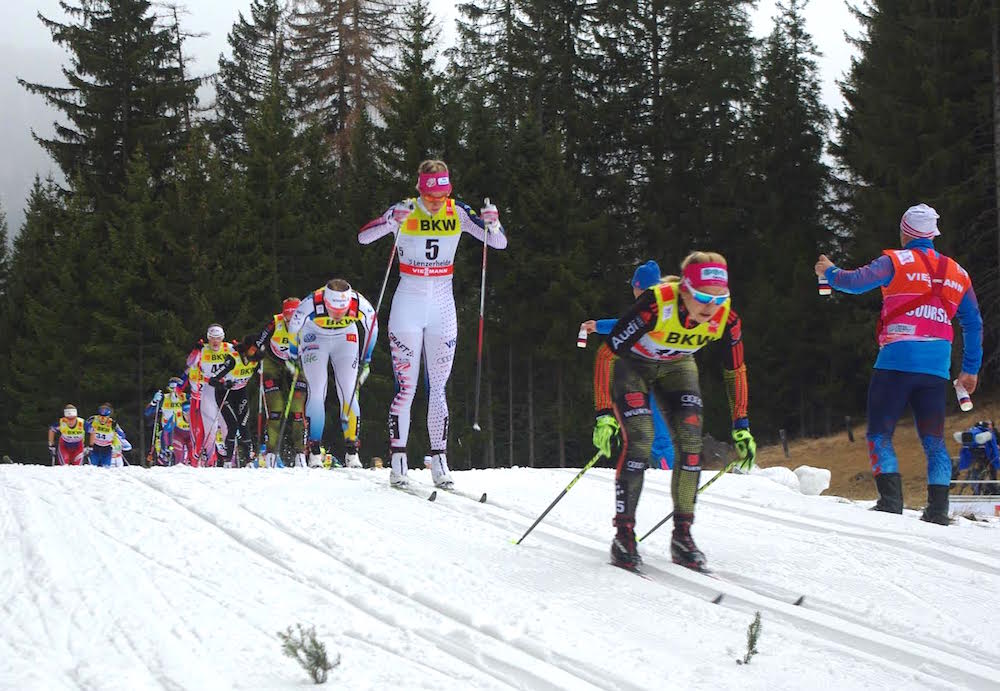
Wearing bib no. 5, Hailey Swirbul (USA), battled in the lead pack at the start of the 4×5 kilometer Relay. (Photo: NordicFocus)
After the drama on the race had concluded, Norway had redeemed its national pride taking first place. Germany proved that it was for real by virtue of its second place finish. Sweden’s stars couldn’t match Norway’s and Germany’s intensity, and took home the bronze. Team USA simply could not keep pace with the world’s best teams and finished fifth. Team Canada skied to eighth place.
World Championship Women’s 4 x 5 Kilometer Relays
Hailey Swirbul took the leadoff leg for USA. One kilometer into the race, the field was still bunched together with Emma Ribom (SWE) setting the pace. At about 2.5 k, Ribom established a gap taking five skiers with her. Swirbul was in the second group; it was clear at times that her skis were slipping. “The team skied on hairy skis for the Classic leg,” said US.. coach, Chris Grover. “Klister was icing, kick wax wasn’t quite enough. Skiing hairies is a real art… if you haven’t had a lot of experience on that it can be a challenge. Hailey did great; she kept it close.”
Ribom continued to stretch the field, reducing the lead group to Sweden, Norway, Germany, and Finland. At 4.4 k, Weng sprinted into the lead setting a blistering pace that fractured the lead group providing Norway with a tiny lead at the first exchange.
Rosie Brennan (USA) fought hard through the second Classic leg, but her bad luck continued at these World Championships as she broke a pole during the race. (Photo: NordicFocus)
To start the second leg, Weng handed off to Astrid Oeyre Slind (NOR), who had less than a second lead over Ebba Andersson (SWE), and Kerttu Niskanen (FIN). Swirbul was 21 seconds off the lead when she handed off to Rosie Brennan. Katharina Hennig (GER) pushed to the front with Slind; they were setting the pace, and doing so at a brisk level. It was then that classic expert, Kerttu Niskanen (FIN), took the lead and pushed the pace, gracefully employing her textbook Classic technique. Meanwhile, Brennan continued to fall back, visibly slipping on the uphills. Drama ensued toward the end of the second lap when Hennig turned up the pace. When Andersson tried to match it, she stepped on her pole, breaking it. This mishap saw her drop to the back of the lead pack and cost her valuable energy and momentum.
Skiing the second leg, Kerttu Niskanen (FIN) used her beautiful Classic form to give Finland a shot at a medal. (Photo: NordicFocus)
Though having already fallen out of medal contention, heartbreak struck again for Brennan: she slipped in the same spot where Andersson had slipped, stepped on her own pole as Andersson had done, and suffered the same demoralizing result: a broken pole. Two kilometers later, she had fallen 46 seconds behind the leaders, and the handwriting was on the wall for team USA. After the race, Brennan told FasterSkier that she didn’t have an explanation for what happened. She said that she didn’t feel the pole break affected her much. “I did it right in front of Matt [Whitcomb] and it was an uphill,” Brenan said. “I don’t think it was a deal-breaker for us today.” Jessie Diggins (USA) also expressed that she didn’t think the pole break made much difference in the big picture. “It was a good place to do it [break a pole],” she said.
Jessie Diggins (USA) skied as hard as she could, but the Americans just couldn’t keep pace with the best teams in the world. (Photo: NordicFocus)
At the exchange into the third leg, Germany and Finland were locked in a dead heat. Norway and Sweden were a few seconds back in third and fourth, respectively. Jessie Diggins took the exchange 48 seconds behind the lead group and 43 seconds from a podium spot, a seemingly insurmountable gap to close in only five kilometers. In the lead group, Frida Karlsson (SWE) shot to the front; by the two kilometer mark she had nullified the leaders’ advantage and had thrust herself into first. But the push had proved costly, as Ingvild Flugstad Oestberg (NOR) then surged to the front and began to set an even faster pace. Oestberg’s acceleration shattered the lead pack with Finland’s Eveliina Piippo falling off the back. Karlsson began to fade and at 14.4 K dropped to third while Germany’s Pia Fink occupied second place.
Ingvild Flugstad Oestberg (NOR), hands off to Anne Kjersti Kalvaa (NOR), on the final relay leg. Norway proved too powerful for the rest of the world. (Photo: NordicFocus)
At the anchor leg exchange, Oestberg handed off in first to Anne Kjersti Kalvaa (NOR) with a 6.2 second advantage over Germany’s Victoria Carl and 14.9 seconds over Sweden’s Maja Dahlqvist. Diggins tagged Julia Kern (USA) almost 50 seconds behind the leader, and 35 seconds from third place. The Americans’ medal hopes were fading fast, and Kern was given the impossible task of needing to gain 35 seconds in five kilometers for a medal.
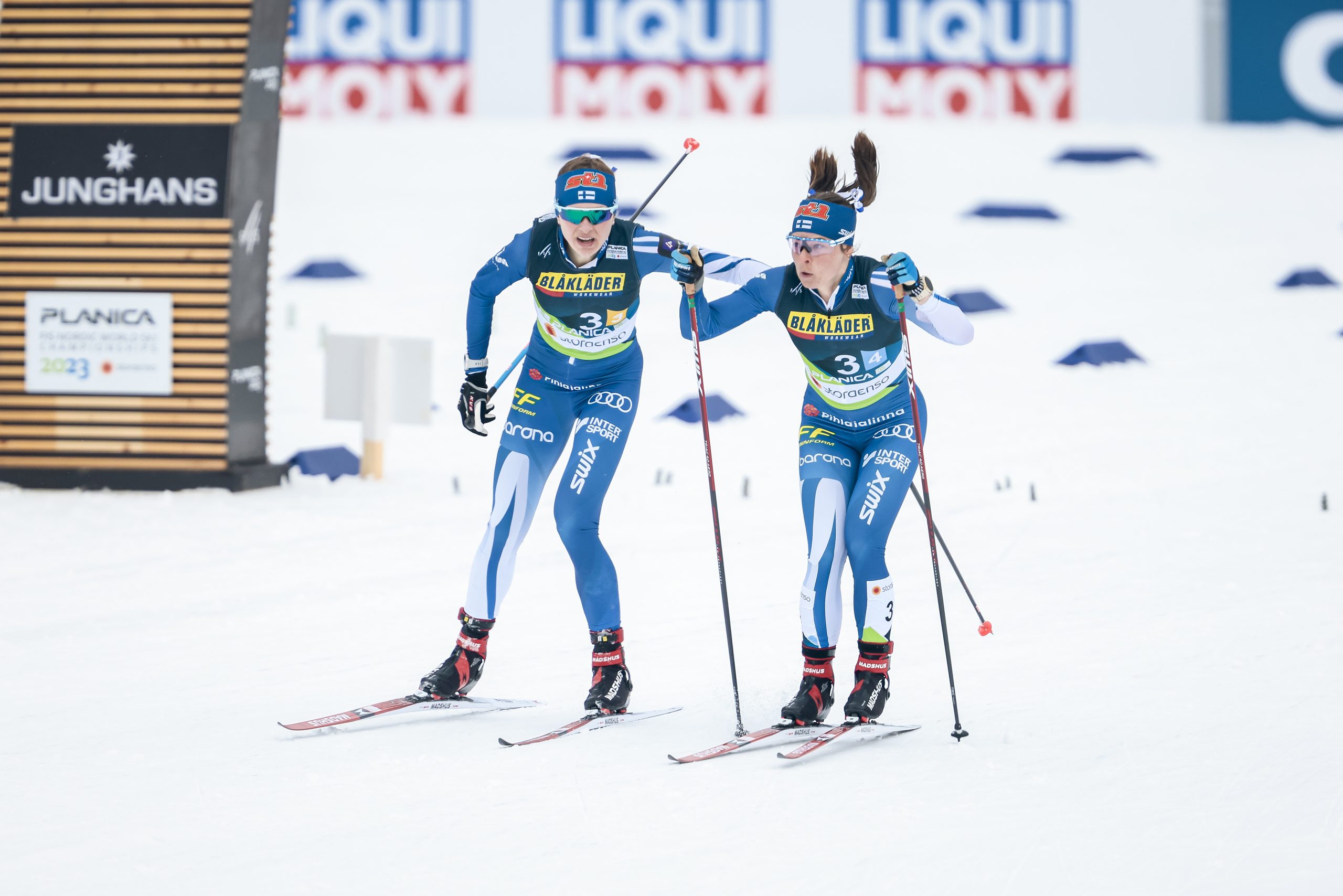
Eveliina Piippo (FIN) tags Krista Parmakoski (FIN) who briefly gave Finnish fans hope for a medal, but it was not to be. (Photo: NordicFocus)
But at the front of the race things were being turned upside down as Krista Parmakoski (FIN) surged past Sweden’s Dahlqvist into third place. Unbelievably, at this point in the race, the star-studded Swedes were sitting off the podium. Norway’s Kalvaa continued to surge and at 19.4 k had stretched her lead to over 20 seconds, with Germany’s Carl comfortably in second. Finland’s Parmakoski was still in third with Sweden’s Dahlqvist sitting in fourth.
Kalvaa powered to the finish line taking the win for Norway. Carl took second for Germany. Dahlqvist put in a turn of pace in the last half kilometer to save face for Sweden, taking third. Finland was pushed back to fourth and USA finished fifth; 1:34 off the lead.
After the race, Swirbul talked to FasterSkier. “ It was an honor to have a spot on the team,” she said, placing some blame on herself for the team’s performance. “I knew I had a chance to give Rosie someone to ski with, and I really wanted to do that for her today and I didn’t make it happen…I blame myself for it.” She continued that she was prepared for the lead teams to break away early. “I found myself in a position I had hoped to not be in…suddenly you look up and there’s a gap, and it’s really hard to close that back.” Swirbul said that she, “was mentally prepared to really suffer…we know what’s possible…it will happen.”
Brennan told FasterSkier that, she saw Hailey trying to close the gap and was inspired by that. “I tried to harness some of that and find balance between skiing my own race and taking a chance.” Brennan added that “it’s definitely hard when you have four of the best skiers working together, and you’re alone.”
Diggins told FasterSkier’s Nat Herz that her plan was to “hope they weren’t [skiing] together in the front…Unfortunately, Ingvild went on a flyer…, if she hadn’t of done that… I think I was starting to make up time.” Diggins offered addtiional perspective on the potential of the American women’s team: “We know we’re there; we just need all the things to fit together and need a little bit of luck.” Diggins commenting on Swirbul’s lead leg said that, “You can’t put a relay on one person’s shoulders…it’s four people skiing it. Just like you can’t take all of the credit yourself, you can’t take all the blame yourself. I’m nothing but proud of how these girls skied.”
U.S. coach Chris Grover observed that, “the fact that you saw some of the best skiers in the world, like Frida at the edge, and Ebba at the edge tells you about the quality of the athletes that were competing,” said Grover. “We don’t have any podium finishers in Classic with any of our athletes…at the end of the day, we know we generally need to put our strongest skiers in legs two and three because that’s where the other teams are stacking up their big horsepower.” He also added that “the other teams know they can’t let off the gas, that this [Classic leg] is the place to put distance on USA.”
In a surprise, Grover also informed FasterSkier that Diggins would not race the 30 kilometer Classic race on Saturday. “Jessie is going to start to get ready for Holmenkollen,” he reported.
At the end of the day, Norway had redeemed itself in the fight for relay supremacy, and Germany proved it belonged at the top of the rankings. Sweden—a heavy pre-race favorite—had to satisfy itself with a third place finish. Team USA—a sentimental favorite with the fans—would have to watch the medal celebration from the sideline. High expectations would not be satisfied with a fifth place finish as the Americans would have to continue to search for the right formula to solve the relay riddle that still eludes them.
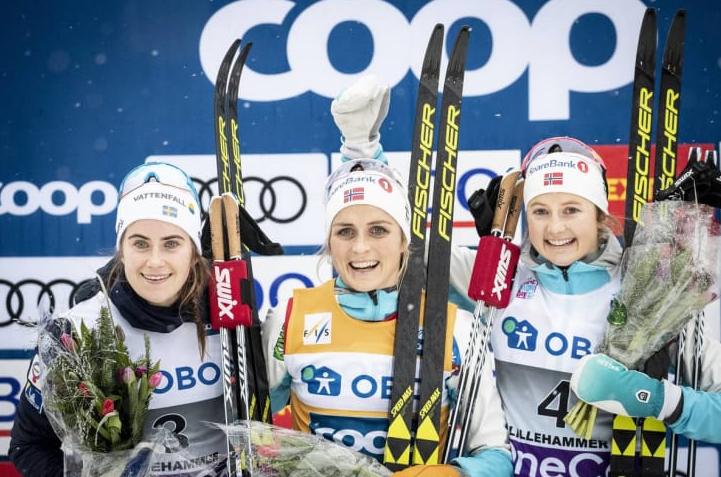
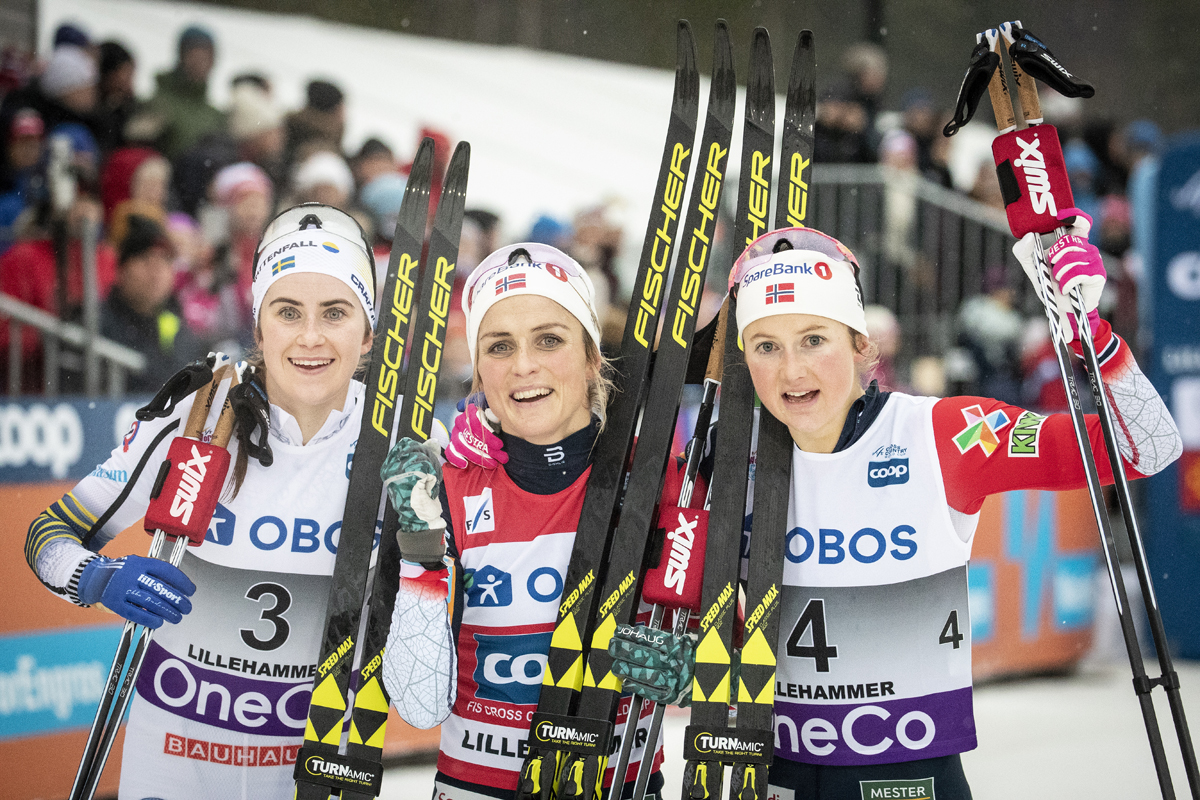
The women’s podium after the women’s 10 k classic pursuit in Lillehammer, Norway. Therese Johaug of Norway (center) won, Ebba Anderson from Sweden (left) placed second, and Ingvild Flugstad Østberg of Norway was third. (Photo: Fischer/Nordic Focus)
Here’s a sentence we might see routinely this season as the World Cup distance races transpire. Norway’s Therese Johaug wins again!
In Sunday’s 10-kilometer classic pursuit race in Lillehammer, Norway, Johaug set an unmatched pace to win her second race of the weekend and the overall in Lillehammer’s three-race series.
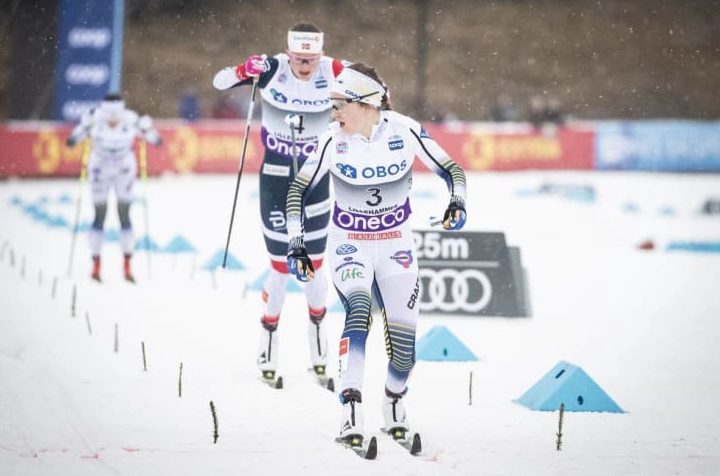
Sweden’s Charlotte Kalla lead off the race, starting a spartan two and a half seconds ahead of Johaug. Kalla led the first lap, with Johaug tight on her heels.
On the first major climb, which kicks about 3 k into the 5 k loop, it appeared Johaug was struggling with her kick wax. With slight micro-adjustments when firing the muscles, if there was any kick-wax deficit, it did not slow her down. Kalla and Johaug skied through the first lap mark together. Soon thereafter, Johaug tightened her grip on the win by stretching the time back to a just-hanging-on Kalla. By 7.2 k, Kalla had bled 15.7 seconds to Johaug.
Johaug continued her unrelenting pace throughout the second lap. Kalla continued to lose time whereas Kalla’s teammate, Ebba Andersson, who began the race 14 seconds back, began to make ground on Kalla.
Sweden’s Ebba Andersson takes second place over a charging Ingvild Flugstad Østberg from Norway in Sunday’s 10 k classic pursuit in Lillehammer, Norway. (Photo: Screenshot from FIS-Ski.com)
Andersson was able to close the gap between Kalla and herself between the 7.3 k and 8.3 k mark. By 8.3 k, Andersson had put a 6.4 seconds buffer between herself and Kalla. Behind Kalla, Norway’s Ingvild Flugstad Østberg kept the third podium step within her sights. On the last climb before the finish, Østberg caught and passed Kalla and began gaining time on Andersson.
Johaug won in a time of 29:25.5 minutes. Andersson and Østberg finished neck-and-neck, with the Swede taking second (+16.8), and Østberg third, only 1.1 seconds back. Kalla finished fourth (+23.1).
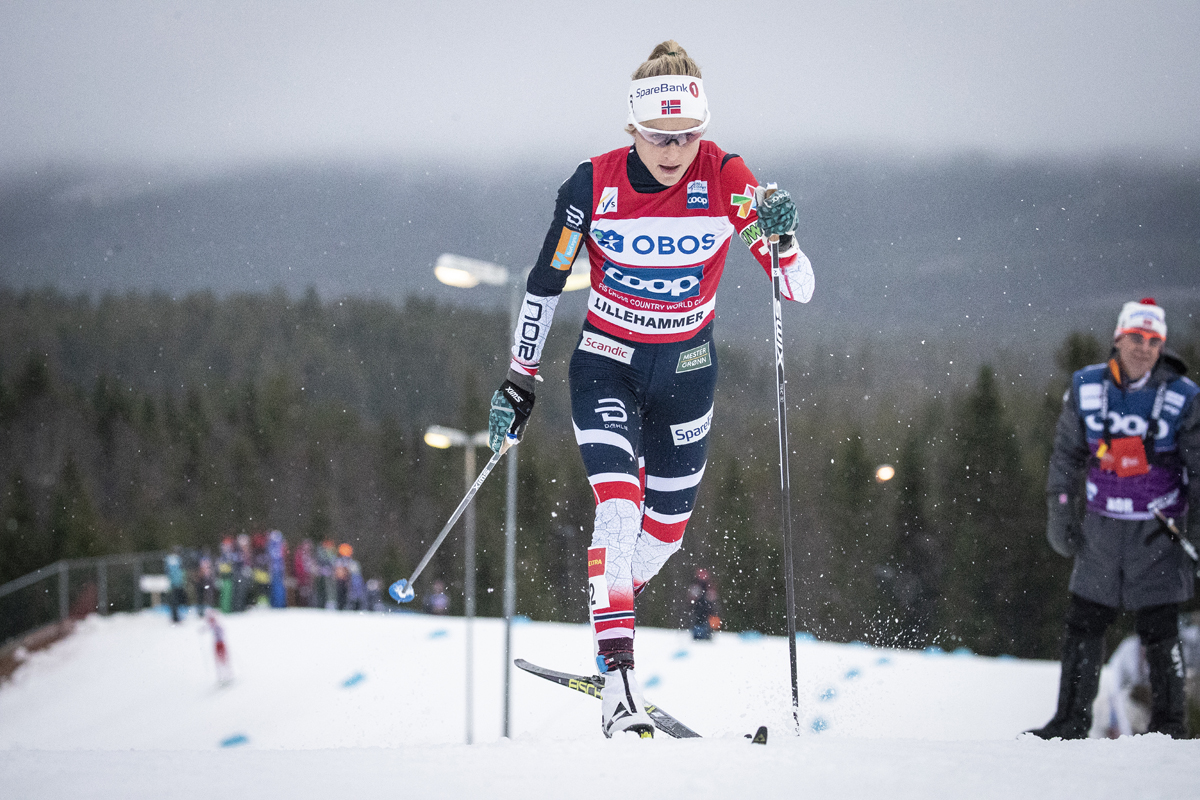
Norway’s Therese Johaug on her way to claiming her third World Cup distance win of the season. Here she steamrolls up a hill in the women’s 10 k classic pursuit in Lillehammer, Norway. (Photo: Fischer/Nordic Focus)
Sadie Bjornsen of the U.S. Ski Team, after a strong start to the season, is eighth overall on the World Cup. On Sunday, Bjornsen was one of three U.S. women in the top-15. Bjornsen started Sunday’s pursuit in 7th and finished in 10th with a time of 31:57.2 minutes.
Staring 50 seconds back, Bjornsen lost time on course to the leaders. She ultimately finished 2:21.7 minutes behind the winner, Johaug.
“It was definitely a tough race out there, I had pretty slick skis, so it was just a matter of trying to stay positive and herringbone as much as I could and it was definitely a difficult course to be struggling on,” Bjornsen told FasterSkier in the Lillehammer mixed zone.
Bjornsen had intended to link up with the skiers beginning ahead of her. But the tough conditions foiled her strategy.
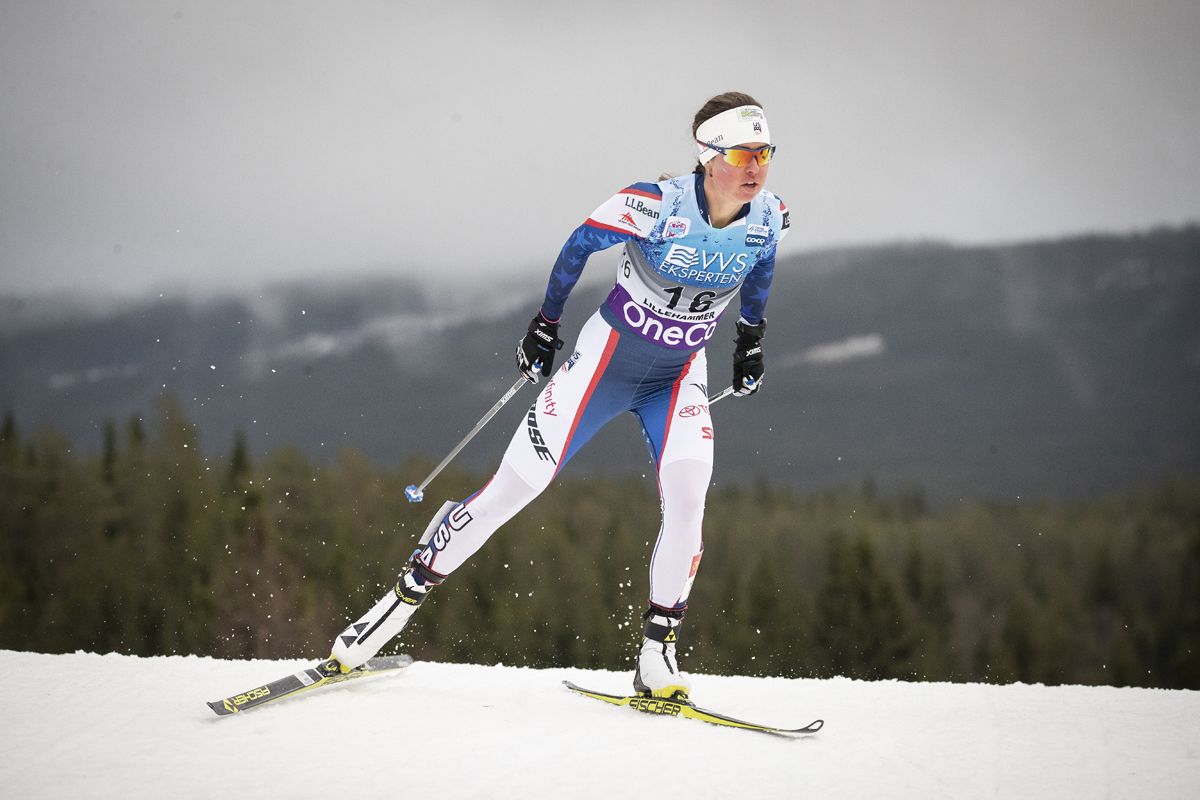
Sadie Bjornsen during Saturday’s 10 k freestyle in Lillehammer, Norway. Sunday’s race was a 10 k classic pursuit. (Photo: Fischer/Nordic Focus)
“My plan was to try to catch Krista Pärmäkoski and Ragnhild Haga in front of me and try to ski with them and I kind of yo-yo’d with Haga the entire time, so that was definitely really hard,” Bjornsen said. “I was kind of in No Man’s Land, not skiing with anyone, and when Stina Nilsson went by I was not able to stay with her pace. It was going uphill and I was having to herringbone, so it was kind of sad to not catch on to that chain. But I tried to just keep fighting the whole way.”
U.S. Ski Team World Cup Coach Matt Whitcomb confirmed Bjornsen was thin on kick. “I mentioned I thought our team did better than most today with regards to wax and skis. Whitcomb said. “I do think Sadie was a little bit lean on kick, and think she was on form. She was ready to climb up today and I just don’t think we gave her what she needed to to make it happen.”
Rosie Brennan (APU) and Jessie Diggins (USST) began Sunday’s race in 13th and 14th respectively, 1:25 minutes behind Kalla. The U.S. pair was able to ski together for the majority of the race in a pack with Norway’s Heidi Weng, and Russia’s Yulia Belorukova.
By the finish, Diggins was able to gain one place to end up 13th (+2:42.4). Brennan lost three places in the finishing stretch to take 15th (+2:46.0).
“I struggled to compose myself on that last climb, and don’t have much of a sprint finish, so lost a place or two there,” Brennan told FasterSkier after the race,
“It was a good race, not a great race, but yeah I’m happy that I had a good group to skate with and I was able to hang in there”, Brennan told FasterSkier. “[I was] able to ski comfortably in a group and feel comfortable with some pretty strong girls and it was super nice to be able to ski with Jessie [Diggins] for a lot of it. “When it’s someone you train with more often it’s a little bit more comfortable, and her strength is on the downhill and that’s my weakness, so it’s nice to be able to follow someone.”
Whitcomb noted Brennan’s marked improvement and return to form after her struggles with an illness last season.
“It’s really fun to watch from the side of the trail, an athlete that has had to deal with, and sort of had to harness so much patience,” Whitcomb reflected. “She spent so much of last season, the better half of the second part ill, and so she’s really had to settle down, recover and then get herself back in shape. These things happen over the course of months, and she had that patience, and she put in the work after she recovered and now she’s being rewarded for it, and it’s really fun to sit back and just watch an athlete be so stoked with how they’re feeling out there.”
Caitlin Patterson during Saturday’s 10 k freestyle in Lillehammer, Norway. Sunday’s race was a 10 k classic pursuit. (Photo: Fischer/Nordic Focus)
Caitlin Patterson (Craftsbury Green Racing Project) started in 31st, 2:37 minutes behind Kalla and finished 35th, five and a half minutes behind Johaug. Throughout the race, she hovered between 27th and 32nd place, but she crashed on a downhill during her second lap and lost places.
“I was crushing it on the downhills until then and I consider myself pretty good at cornering, but I just momentarily caught a glimpse of a two girl in front of me, got too excited, lost focus, and stepped in some slush that I wasn’t expecting or something,” Patterson told FasterSkier after the race.
Racing continues on the World Cup next weekend with events in Beitostolen, Norway.
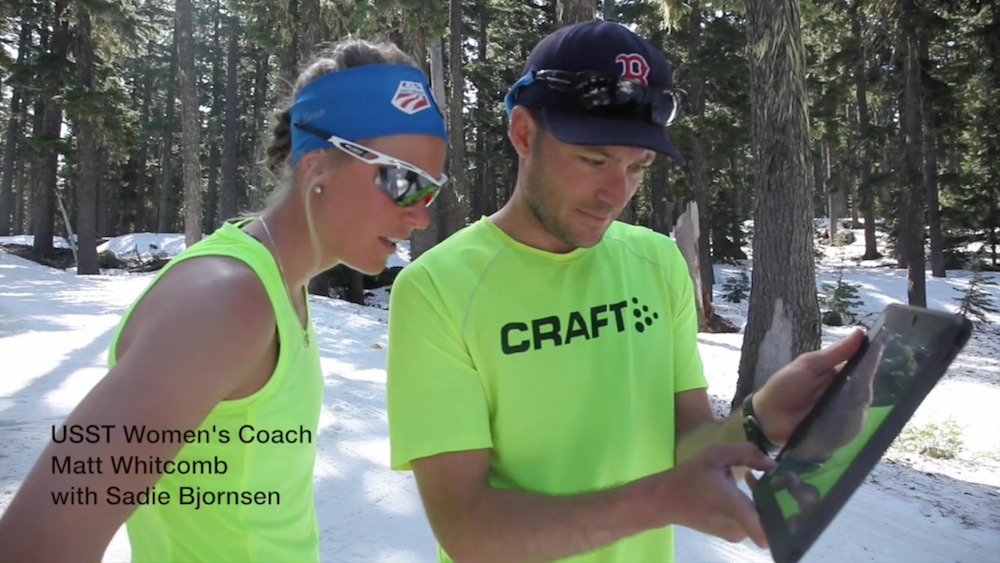
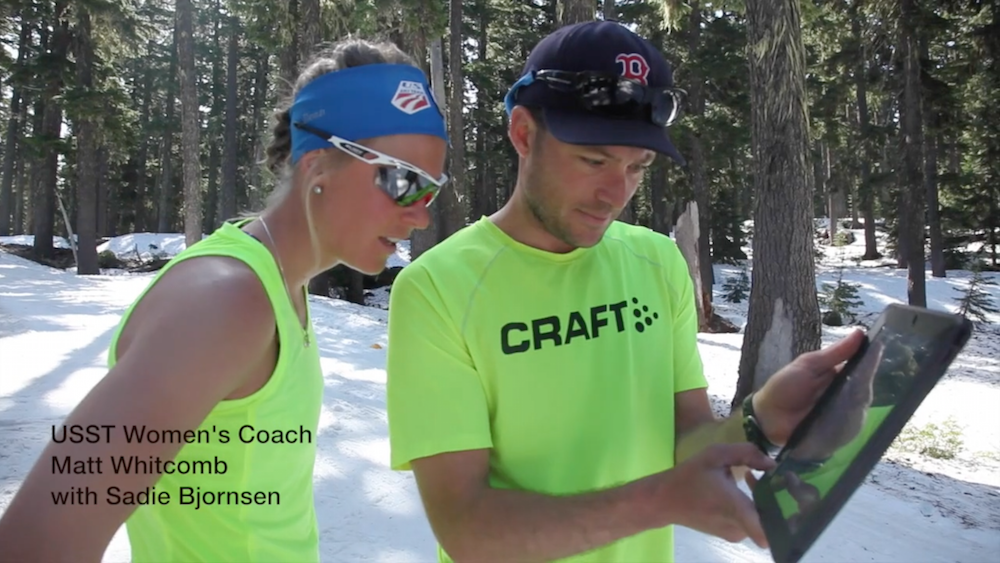
U.S. Ski Team Women’s Coach Matt Whitcomb (r) reviews video with Sadie Bjornsen on some climbing technique Wednesday at a training camp in Bend, Ore. (Click here for video)
BEND, Ore. — On Wednesday, the U.S. Ski Team (USST) headed out to ski with some Bend springtime essentials: klister (they were classic skiing), shorts or tights, tank top, sunglasses and SPF 30.
In Bend for an on-snow camp — the first of the 2016/2017 season — the USST is focused on high-volume training loads and an opportunity to fine-tune technique.
As the team gathered in Mt. Bachelor’s nordic lodge, USST women’s coach Matt Whitcomb cued up a video for the team to view. For three minutes it was silence as the they observed World Cup footage of master cross-country technicians — no surprise that one skier highlighted was Norway’s Martin Johnsrud Sundby. On view and dissected by Whitcomb’s keen eye was the ugly-duckling of moving up steeps while classic skiing: the herringbone.
After Whitcomb summarized what he saw as the key herringbone take-aways, the team hit the sun and snow.
The men’s team was up first, cycling up and down a steep and sustained section of track. Whitcomb explained the portion of trail they had chosen for the technique session was reflective of some tricky trail sections in Falun, Sweden, where skiers must transition quickly from striding to herringboning and back to striding.
Erik Bjornsen, fresh off a World Cup campaign where he showed improved results in the later half of the season, worked with head coach Chris Grover on the finer points of uphill efficiency. Equipped with iPads, the coaches were able to video each skier and provide real-time feedback.
During the technique drill, Ian Torchia, the newly minted USST development team member and Northern Michigan University student-athlete, benefited from mirroring USST veteran Andy Newell’s refined classic skiing. After skiing behind Newell, Torchia spoke with USST Development Coach Bryan Fish, who offered concrete suggestions to tweak his skiing.
As the men’s team skied off, the women trickled in and began their technique drills. USST A-team member Sadie Bjornsen worked closely with Whitcomb, focusing on driving her knee forward and to “bound” as she high-tempoed up the track.
Bend Camp is historically a time for skiers and coaches to review logistics for the coming year and begin the process of waking the body up. It’s also at camps like this where the coaching staff can observe skiers early in the training season and provide advice as they head back to their home clubs to work with non-USST coaches.
After wrapping up the session, FasterSkier caught up with Jessie Diggins and Newell. Diggins has turned a corner in terms of her sprint and distance skiing; she ranked eighth overall this season on the World Cup. Loving the day with the sun and snow, Diggins noted it’s good to be back in Bend.
Newell, who only months ago mulled retirement or a reduced World Cup schedule, said he was rejuvenated and glad to be skiing in May and motivated for the grind ahead.
The USST will remain in Bend for another week of on-snow training.
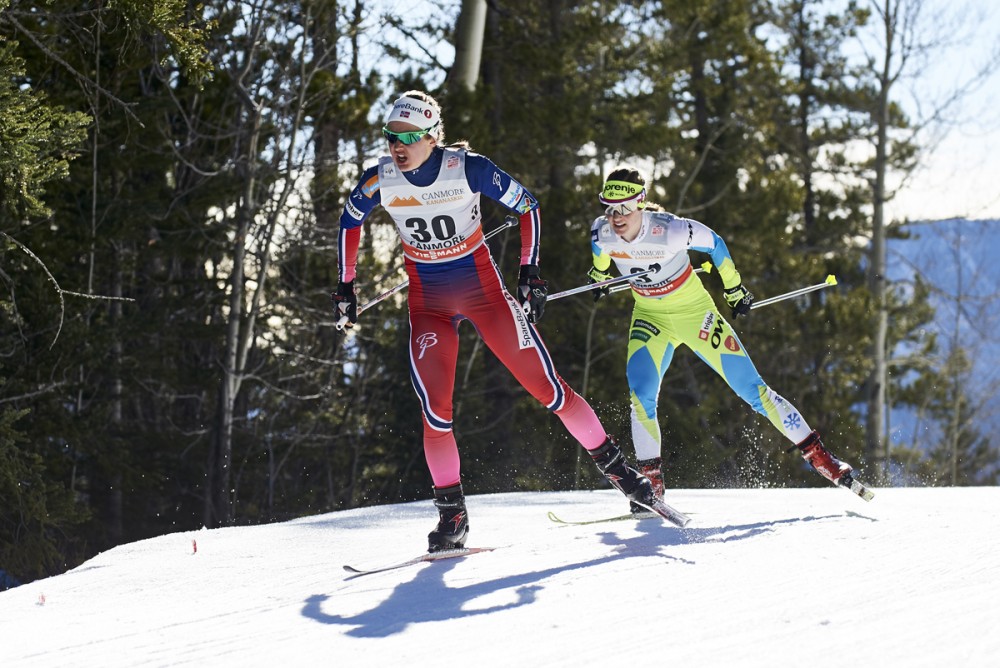
Norway’s Ingvild Flugstad Østberg leads Slovenia’s Alenka Cebasek during the women’s 10 k freestyle at Stage 7 of the Ski Tour Canada in Canmore, Alberta. Østberg went on to win the stage by 23 seconds over her teammate Heidi Weng. (Photo: Madshus/NordicFocus)
CANMORE, Alberta — High-alpine sun, firm snow and fast tracks were a Canmore Visitor’s Center dream during the Ski Tour Canada’s (STC) Stage 7 freestyle individual-start races on Friday. It was also a dream day for Ingvild Flugstad Østberg of Norway.
Hers is a name all over the top-three results during this year’s World Cup season. Østberg has podiumed in 18 individual races this year, one of which included a distance win at the Tour de Ski’s 5-kilometer freestyle pursuit in Lenzerheide, Switzerland.
In the women’s 10 k freestyle on Friday, Østberg crushed the field to win her second race of the season and a coveted Alberta World Cup Academy cowgirl hat along with it.
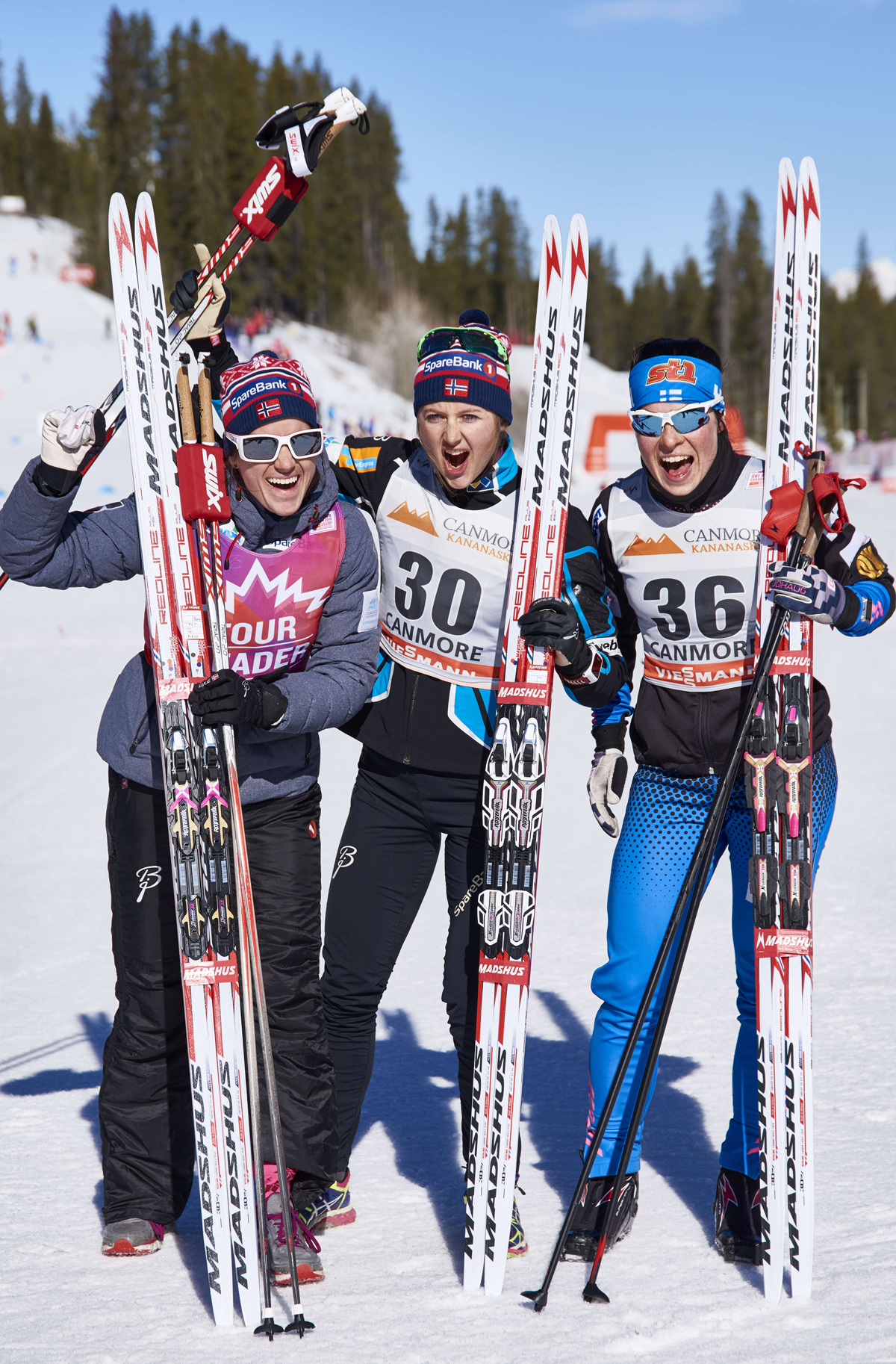
Finland’s Krista Parmakoski (r) broke up an all-Norwegian sweep of Friday’s 10 k freestyle podium, placing third behind Norwegian winner Ingvild Flugstad Østberg (c), and runner-up Heidi Weng (l) also from Norway, in Stage 7 of the Ski Tour Canada in Canmore, Alberta. (Photo: Madshus/Nordic Focus)
“The hat is perfect,” Østberg told FasterSkier. “I thought I was going to win a hat the other day when I started the sprint, but then I got this cool belt buckle. Now I got the hat so that is perfect. So that was motivation today.”
The western wear may not be the most conventional nordic head gear, but Friday, Østberg looked like she could have sported the new lid along with her lycra and still dominated.
Østberg climbed, glided the flats and hopped-stepped up the steeps faster and more efficiently than anyone in the 53-women field. The 10 k course took Østberg all of 23:20.1 minutes to complete and she gapped her nearest competitor, teammate and second-place skier Heidi Weng, by a stunning 23 seconds. Finland’s Krista Parmakoski was third, 24.5 seconds back, besting fourth-place skier Norway’s Kari Øyre Slind, by 0.1 seconds.
“This was unbelievable,” Østberg said in the post-race press conference. “I never thought I was going to win this kind of competition, 10 k skate individual start. I thought that was my weakest kind of competition, But today was perfect.”
Østberg was second at the first time check, and first at the second and third checkpoints. By 6.9 k, she was already 24 seconds up on Norway’s Therese Johaug. Despite her obvious speed on the course, Østberg explained she remained in a comfortable zone, within her limits.
“I was so focused on doing my best and focusing on the technique, and tried not to ski fast,” Østberg told FasterSkier. “It was like I felt my speed was average. I guess that is when you ski fast. I heard that I was fighting second and third place. I thought that was good. With two kilometers left my coach said you are fighting for the win. And then I was like, ‘Oh my God, are you kidding me?’ And then all of a sudden I was 23 seconds ahead, that is crazy. I thought it was my weakest kind of race. Turns out that I win, and it is my best. Crazy.”
Looking at Østberg’s podiums from the past few years, it’d be easy to compartmentalize her as a sprinter; a one-dimensional skier who would likely podium on sprint day, but could be feast or famine — most often famine — on distance days.
“Many years now that I am a sprinter, but I’ve always said I am not a sprinter,” Østberg explained to FasterSkier. “Don’t call me a sprinter because I want to be an all-around skier and I want to do good in all kind of distances.”
The 25 year old is mindful that she has a model on the Norwegian team.
“I see Marit Bjørgen and I see that it is possible, and I see myself in her or I see that I am like her, the same type,” Østberg said. “I’ve also said that I want to fight for medals in distance races. When I was in Sochi, I said I want to fight for it on the next Olympics. So I am ahead of my development, how do you say, my goals. This is kind of earlier than I thought I was going to be good in distance races, but it is so fun, I can ski fast and skating and classic and short and long races. Sometimes when Therese wins by one minute, you feel like she is so strong that you can never be as good as her. Today I see it is possible.”
“Sometimes when Therese wins by one minute, you feel like she is so strong that you can never be as good as her. Today I see it is possible.” — Norway’s Ingvild Flugstad Østberg, after her second win of the season, the 10 k freestyle at Stage 7 of the Ski Tour Canada
Johaug, who sits second overall with one stage to go, exactly 30 seconds behind Weng, found herself in a spot she rarely visits; off the podium in sixth place, 40.1 seconds behind Østberg. Not only was Østberg as good as Johaug, she proved next year Norway could have a four-way fight for the overall Crystal Globe — there’s Johaug, Weng, Bjørgen, and now Østberg.
Norway’s Heidi Weng racing to second in the women’s 10 k freestyle at Stage 7 of the Ski Tour Canada in Canmore, Alberta. Here she’s seen leading Canadians Cendrine Browne (4) and Annika Hicks (31). (Photo: Madshus/NordicFocus)
This year, Østberg is second in the World Cup overall standings with 2051 points. Johaug is first with 2235 points.
Weng, third on the overall World Cup standings and first in the Ski Tour Canada (STC), knew the race was Østberg’s, but the STC could be hers.
“I start very slowly I think, but in the last lap I wasn’t very tired and Ingvild was so strong, so that’s good,” Weng said in the press conference. “I take some seconds to Therese and that was very good to hear. It’s been a good day.”
By placing second on Friday, Weng earned a 10-second time bonus, and a buffer from the always charging Johaug heading into Saturday’s final stage, a 10 k classic pursuit.
Diggins Digs in
Norway, Norway, Norway, Norway reads the STC’s top-four women’s overall standings. Finland, Norway, Finland, Finland, Sweden reads sixth through 10th. Sandwiched in between all that Scandinavian power, fifth overall, is U.S. skier Jessie Diggins.
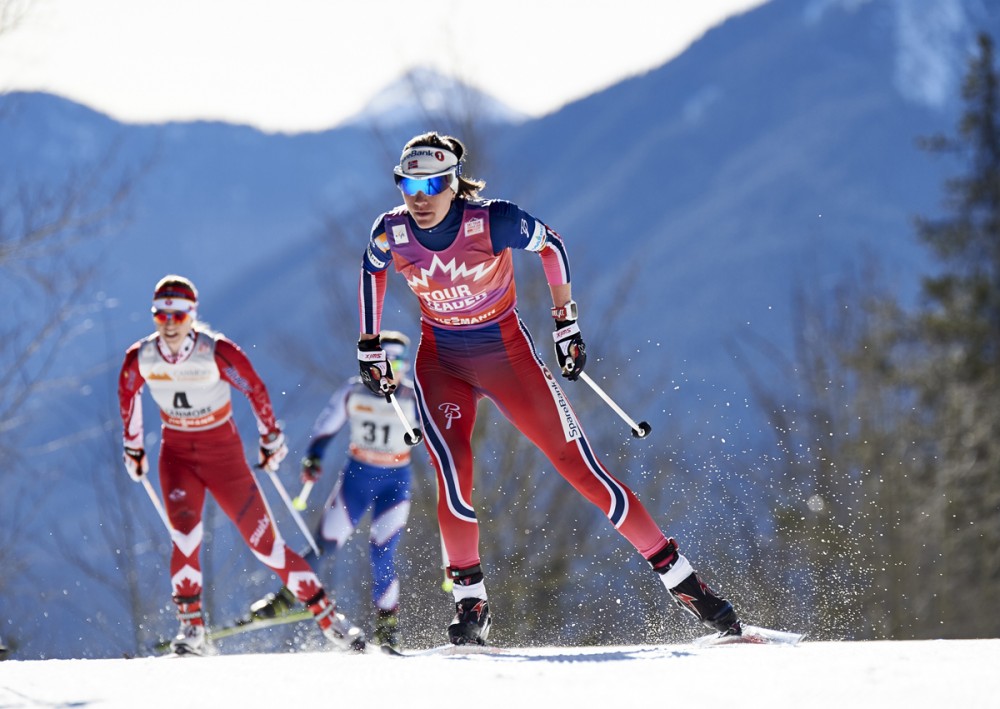
Now a top-10 staple, Diggins skied aggressively on the twisting, technical, and energy-sapping course. Her three official time splits were fifth, sixth and sixth place. When the day’s serious challenger’s had finished, Diggins was fifth on the stage, one spot and 7.5 seconds ahead of Johaug.
Diggins explained each day on a Tour is unique. One day the body is good, the other, maybe bad.
“You know, I felt better than the last race,” Diggins said. “Not as good as I was hoping to feel, but also you just don’t know during the Tour. You just have to get out there and do the best that you can. You’re body is going to feel awesome or it’s not and it was a solid race. Not what I was hoping for, but it’s OK. It kind of goes in waves out there you feel good, you recover, or you don’t.”
U.S. Ski Team members Jessie Diggins (l) and Ida Sargent (r) racing to fifth and 38th, respectively, during the women’s 10 k freestyle at Stage 7 in Canmore, Alberta. (Photo: Salomon/NordicFocus)
The other grinding tour on the World Cup calendar is the Tour de Ski. It features the mother of all hill climbs, the Alpe Cermis, as it’s final stage. That beasty climb is atypical on the race circuit. Diggins noted that Saturday’s stage, a pursuit, will have its own drama, but a drama most skiers are more familiar with than those on the Cermis.
“A hill climb, it’s like not ski racing,” Diggins said. “It’s its own category. It’s totally, totally different. With the hill climb, you’re either really good at it or you’re not and people change by minutes. I mean minutes are made up and lost out there and it’s going to be more like seconds [on Saturday].
“It will be very interesting to see it as a normal pursuit race instead of a hill climb and I think that you might see less dramatic shifts, unless there’s some explosion out there,” she added. “I think it’s more fair in the interests of ending a tour. If you’re ending overall it’s nice to end it with a race that we do all year, instead of something we do once a year. I think it’s probably the most fair way to do it.”
Sadie Bjornsen, also of the U.S. Ski Team, skied to 17th on the stage (+1:25.0).
“It was okay,” Bjornsen said of her race. “It wasn’t great, but I went as hard as I could with all the rest of my energy. Seven days in, I’m tired. My second lap itself felt considerably slower than the first one and I think it was just hard to fight from the back of the pack today for those top positions.”
Her sensations were spot on. Bjornsen skied her first 5 k lap in 11:57.3. Bjornsen’s second 5 k was approximately three quarters of a minute slower.
Despite the interval start and a two lap course, Bjornsen skied on her own for much of her race.
“I didn’t really ski with anybody,” Bjornsen said. “I was kind of skiing on my own most of the day today, which with skate skiing, that’s been is a battle that I’m trying to figure out. I find that if I can skate behind somebody I can figure out the skate pacing. But today my goal was to work on my individual pacing and see what I could do. You know I feel like maybe I went out a little too hard and got tired, but at this point in the Tour, why not send it and see what you can do.”
With a solid race on the final stage, Bjornsen’s stars could align — she’s currently 11th overall in the Tour (+6:35.4), one spot out of the top 10 and 47 seconds behind tenth place Charlotte Kalla from Sweden.
“I’m really excited,” Bjornsen said. “Tomorrow is going to be, probably one of the toughest races of the year — and maybe in my life. We’ll see what can happen. It’ll be fun. Although honestly every race here in Canmore has felt somewhat like that hill climb. At this point it’s almost the same thing as a hill climb.”
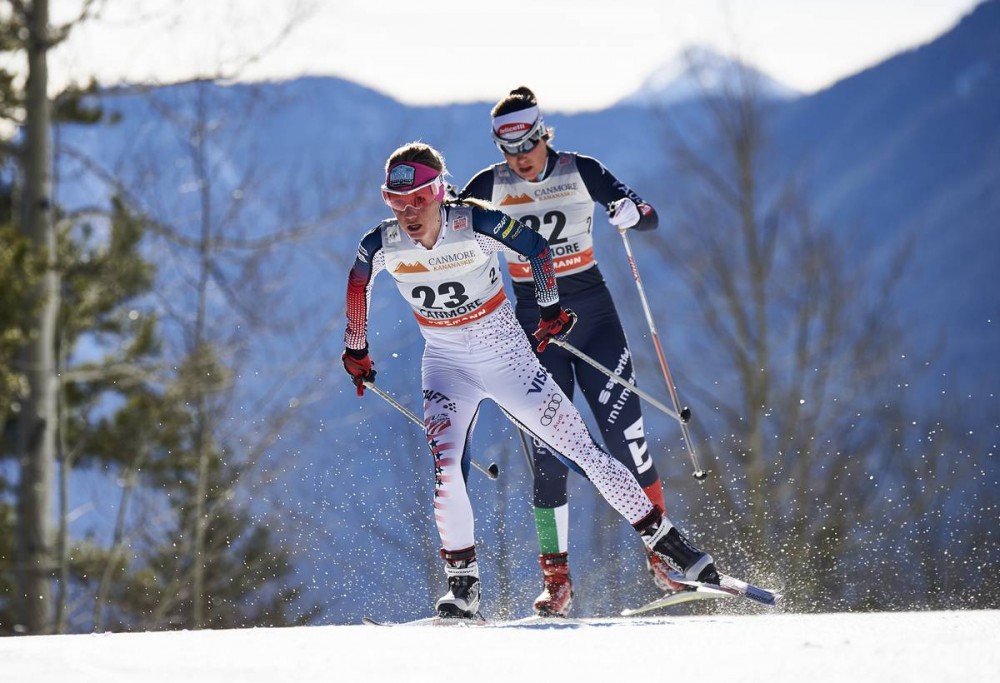
Caitlin Gregg (U.S. Ski Team/Team Gregg), leads Italy’s Giulia Stuerz during the women’s 10 k freestyle at Stage 7 of the Ski Tour Canada in Canmore, Alberta. Gregg placed 19th for her season best. (Photo: Madshus/NordicFocus)
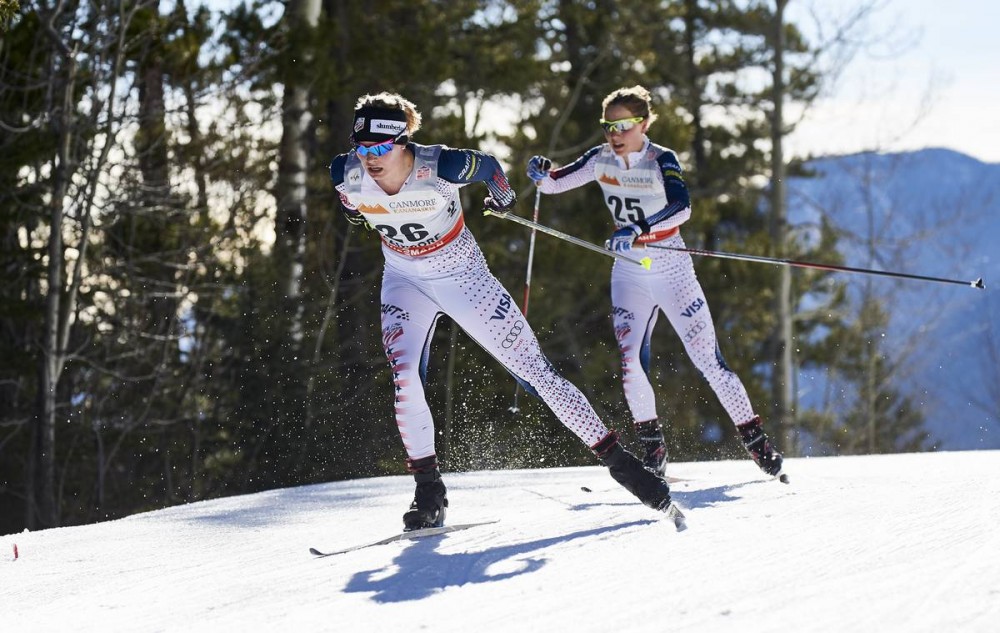
The third U.S. Ski Team (USST) women in the top 20 was Caitlin Gregg, 19th and 1:26.9 out of first.
“Today was awesome,” Gregg said. “My best finish of the season. Pretty psyched. Really, really close to the top 15 and you know I think considering I did a lot of racing in the last couple, last week. And after coming back from the Birkie, I feel like kind of on top of the world. That’s pretty sweet.”
Asked if she thought the renowned 50 k race set her up for success as the STC, “I would say probably not,” Gregg said. “I mean maybe, if we had a 30 k in here, it could have been. But it’s a lot of shorter racing and it’s just a different kind of racing, a different kind of event. But I’ve been pretty happy with my range, I suppose, of my ability. I was pretty close to qualifying in the sprint last week in skate. Then today to be a solid 19th. I think it speaks volumes to just the older you get, the more you can do in terms of length, but then keeping that speed going. So I’m pretty happy.”
Starting in bib 23, Gregg’s checkpoint split times reveal a consistent race: 20th, 19th and 18th.
“To be honest I wanted to go out kind of conservatively, which doesn’t seem to happen for me,” Gregg said.
She gained ground steadily on the women in bib 22, Italian Giulia Stuerz — Gregg’s new World Cup ally.
“But I was really lucky,” Gregg admitted. “I met up with an Italian girl, I caught her from 30 seconds ahead of me. She pushed me really well in the second lap. We worked together and I think it was her first time ever in the points. We raced together now in the mass start back in Quebec and we raced together I think in the skiathlon. We’re kind of joking, we’re like teammates now. We’re just pushing each other every race to get better and better. So I have a friend in Italy. … I’m known to make a lot of friends on and off the trails and so it’s always fun when they help you get your best and you help them get their best.”
After the stage, Gregg is 34th overall (+14:17.6)
The last North American in the top 30, and well within it, was Alaska Pacific University (APU) skier Chelsea Holmes. On Friday, Holmes earned her first World Cup points by placing 22nd (+1:35.1).
Chelsea Holmes (APU) racing to a World Cup carer best of 22nd during the women’s 10 k freestyle at Stage 7 of the Ski Tour Canada in Canmore, Alberta.
Despite her World Cup career best, Holmes admitted she felt less than optimal. “But I think everyone did,” Holmes said. “Which is something you have to remember.”
Holmes made her European World Cup debut this season on Jan. 16 in Planica, Slovenia.
“This year when I was in Slovenia, I had a hell of a time, I was so distracted by all the impressive people,” Holmes said of the high-octane international racing. “I just try to not pay attention to anyone else, it’s really hard otherwise. It’s really easy to get caught up in everything else going on around you.”
Seven stages through, Holmes has proven each day is unique and each race day begins with a blank results sheet.
“I thought about what I wanted to do and I knew it was going to be really tough today because the skiathlon was super rough,” Holmes said. “I definitely knew the first kilometer was like, ‘This is not going to go well.’ ”
She recalled U.S. Ski Team Women’s Coach Matt Whitcomb and APU Head Coach Erik Flora telling the team the night before that you don’t have to feel good to ski well.
“So you just have to keep going, I guess,” Holmes said.
Holmes will keep going. She has the privledge of racing the STC’s last stage on Saturday. She currently is 32nd overall (+13:39.9).
Also for the U.S., Rosie Brennan placed 31st, 0.8 seconds out of 30th (for 25th overall). Just over a week after her World Cup debut, Katharine Ogden, of the Stratton Mountain School (SMS) and USST D-team, placed 34th. Ida Sargent, of the Craftsbury Green Racing Project (CGRP) and USST was 38th, Annie Hart (SMST2) 39th, Kaitlynn Miller (CGRP) 41st, and Jennie Bender (Bridger Ski Foundation) 49th.
Leading the way for Canada, Emily Nishikawa (Canadian Senior Development Team) placed 35th (+2:11.3). Dahria Beatty, of the Alberta World Cup Academy (AWCA) and national U23 team, was 40th, Olivia Bouffard-Nesbitt (CNST) 42nd, Cendrine Browne, of the Pierre-Harvey Training Centre (CNEPH) and U23 team, 44th, Maya MacIsaac-Jones (Rocky Mountain Racers) 46th, Annika Hicks (Canmore Nordic) 48th, Sophie Carrier-Laforte (CNEPH) 52nd, and Jenn Jackson (Thunder Bay National Development Centre) 53rd.
Racing continues for the women on Saturday with the final stage, a 10 k classic pursuit.
— Gabby Naranja, Gerry Furseth and Alex Kochon contributed
The all-Norwegian women’s classic sprint podium at Stage 5 of the Ski Tour Canada, with Maiken Caspersen Falla (c) in first, Ingvild Flugstad Østberg (l) in second, and Astrid Uhrenholdt Jacobsen (r) in third.
CANMORE, Alberta — The Canadian Rockies were an intimidating backdrop for the fifth stage of the Ski Tour Canada (STC) on Tuesday at the 1.5-kilometer classic sprint. The mountains surrounding Canmore rise and lift and simply dominate the valley. It’s as if nothing else matters. It’s hard to look away.
Like those mountains, Norway’s Maiken Caspersen Falla commanded the World Cup sprint show. Coming down the homestretch during the finals, you couldn’t ignore her. She won the final in 4:09.26 minutes to earn the win and honor of standing atop two podiums — after the race, she was awarded the Sprint Crystal Globe, which she had secured earlier during the STC’s Stage 3 freestyle sprint.
Joining Falla on Tuesday’s sprint podium were two of her teammates, after Astrid Uhrenholdt Jacobsen has placed second, 7.07 seconds behind her, and Ingvild Flugstad Østberg took third (+8.66).
Finland captured fourth and fifth with Krista Parmakoski (+18.03) and Anne Kyllönen (+19.07), respectively. U.S. Ski Team (USST) member Jessie Diggins placed sixth, 21.96 seconds behind Falla, for her first final and best result in a World Cup classic sprint.
Norway’s Maiken Caspersen Falla powers down the homestretch to win Tuesday’s classic sprint final by 7 seconds over teammate Astrid Uhrenholdt Jacobsen (behind) at Stage 5 of the Ski Tour Canada in Canmore, Alberta.
The time gaps were huge and were a quantifiable way of defining what the Canmore crowds witnessed in the final: an uncontested Falla 20 to 30 meters ahead of her closest competitors as she raised her hands across the line.
The win capped an astonishing streak. Falla is undefeated in classic sprints since she began with a win last March in Drammen, Norway. Sophie Caldwell of the U.S. Ski Team (USST) won the classic sprint during this year’s Tour de Ski, but Falla did not start that day.
In the post-race press conference, Falla spoke of how she comes for one thing: the win.
“When I am starting a ski race I am always wanting to win,” she said. “My shape is so good, and I know I have the possibilities to stand on top of the podium. You never know when you get the possibility again. When your shape is so good you just have to enjoy it and do the best you can.”
Her best was the best in the end. But in the morning qualifier, Østberg, who will finish second-overall in the Sprint World Cup standings, qualified first, nearly a full five seconds ahead of Falla, the second qualifier.
Østberg seemed to be on cruise control until the final. She won the first quarterfinal by almost 2 seconds and the first semifinal by half a second. If the old fable about the tortoise and the hare has anything to do with World Cup sprinting, then Østberg was the hare.
In the final she faded and faded in Falla’s wake. Remember those big time gaps — 7.07 and 8.66 seconds back to second and third.
“It was a tough final a tough sprint today,” Falla said at the press conference. “It was a long course and we had to fight to the end. The three of us [Falla, Østberg and Jacobsen] got some meters and Maiken got some meters on me. On the last uphill we had to fight all the way to the finish. It was so hard I didn’t have any power left at the end. It was a great day for Norway and we had great skis. I’m in good shape and had great skis. It was a great day here in Canmore.”
Three Norwegians lead the women’s classic sprint final up a climb out of the stadium, with Ingvild Flugstad Østberg (1) up front, Astrid Uhrenholdt Jacobsen (5) and eventual winner Maiken Caspersen Falla (second from r). Falla won the final by 7 seconds over Jacobsen, and Østberg placed third in Canmore, Alberta. (Photo: Peggy Hung)
Runner-up Jacobsen mentioned a dicey sweeping righthand corner racers had to navigate at top speed. She addressed the corner because she remains in third overall in the STC’s standings. Norwegian Heidi Weng still holds the Tour lead in 1:04.04.5, with teammate Therese Johaug just 3.1 seconds behind in second overall. Both Johaug and Weng fell separately on that corner in their quarterfinals and placed 16th and 17th, respectively, on the day.
“Before the quarterfinals they put some salt out on the curb,” Jacobsen said. “I was a bit prepared for going in and out of the salt, when I came out of the salted area there was a lot of snow and I think that’s what took [Johaug and Weng] out, and also a lot of the guys. It was a difficult curb.
“I was really bummed they fell,” she added. “It’s always more fun to ski more fairly against each other. I think Therese and Heidi will be not really tired tomorrow. So maybe they will run out the same tomorrow and not look back. You have to ask tomorrow maybe it was a good thing that they fell for them.”
Diggins Can Stride
Diggins posted the best North American result and a career best in a classic sprint. Qualifying in 13th, 14.58 seconds behind Østberg’s winning time of 3:41.61, Diggins charged to a quarterfinal win in the first heat of the day. She placed fourth in the first semifinal, the fastest of the two semifinals by five seconds. Diggins moved into the finals as a lucky loser.
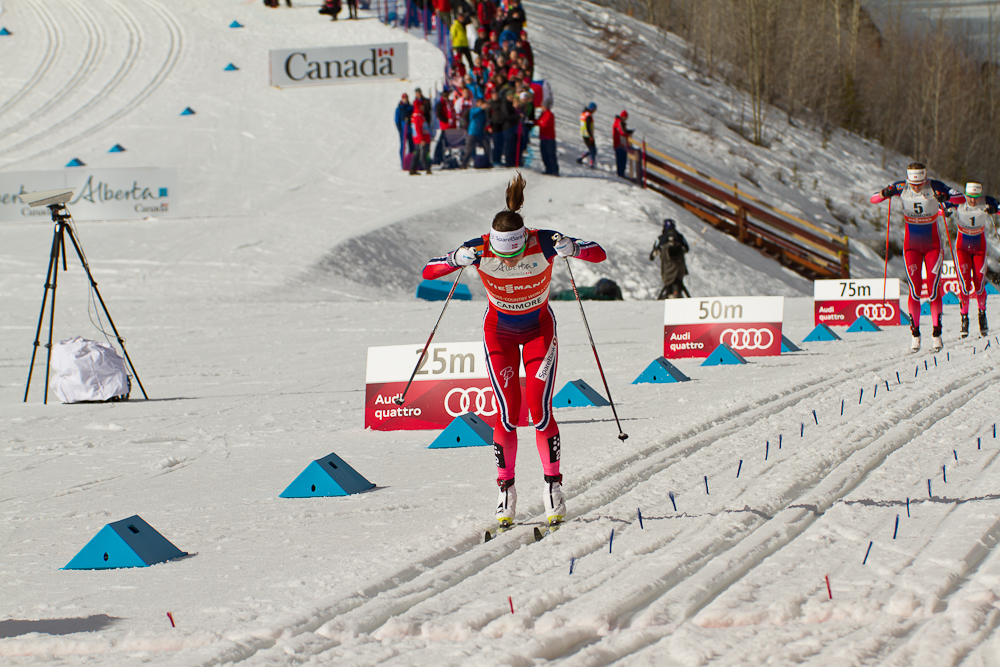
Jessie Diggins (U.S. Ski Team) strides to sixth in the Ski Tour Canada’s Stage 5 classic sprint on Tuesday in Canmore, Alberta.
But luck has nothing to do with her consistency this season.
“I went into the season with my one of my big goals was to qualify in a classic sprint because until this year I had never done it,” Diggins said in an in-person interview afterward. “So getting to be in a final, it was like, ‘What?’ ”
Diggins praised the wax techs for her slick skis on what was undoubtedly a tricky day. Think sun, then clouds, and some flurrying. Firm tracks in the morning deteriorated, melted, and in places became non-existent as the snow broke down.
“It was obviously a very tricky day, it started snowing at one point, what do you do in that situation? But I think they handled it really well and did a great job and I was really impressed with the service team,” Diggins said.
Asked if she was nervous before the final, she remarked she simply felt good.
“Mostly just happy because in a tour, to make the final is really important because of the bonus time,” Diggins said. “I was like, going into today if there is anyway I can make the semis that would be great because the closest I could get to the front, the better the time. Getting to make the final I was like, ‘Yes.’ ”
Diggins was a fan favorite in Canmore.
“It was so cool that whole hill was chanting my name,” she recalled. “They were like ‘Jessie!’ ‘Jessie!’ I wish I was skiing faster because they are so psyched. I just got really tired at the end.”
For Diggins moving forward, it’s all sixes. Entering Wednesday’s sixth stage, the 15 k skiathlon, she ranks sixth overall, 1:39.8 minutes behind Weng.
Sophie Caldwell (USST) placed 11th overall in Tuesday’s STC Stage 5 classic sprint in Canmore Alberta.
Caldwell ended up 11th in the sprint after qualifying in ninth (+12.42). Despite fighting a cold, Caldwell reached the semifinals as a lucky loser, but was eliminated in the first semifinal, finishing sixth behind Diggins.
“I’ve been sick since the [Quebec] sprint day,” Cadwell told FasterSkier. “I was starting to feel like it was starting to go away and then when we traveled it went to my head. I am definitely feeling better today than yesterday.”
With a small cough and some congestion, Cadwell is still undecided if she’ll continue the STC.
“I haven’t made that call yet. I think who knows, it is a lot easier for me to feel good for a sprint than it is for a distance race. It could be a stretch to try to keep racing. But we will see,” she said. “Best-case scenario, I raced it out of me and I should try again, but that might be wishful thinking.”
Cadlwell mentioned she has never finished the Tour de Ski. “That’s a noble pursuit going into the [STC] … You have to be on top of everything, recovery, refueling, etc. That takes a while to learn,” she said.
A day after her 22nd birthday, Canadian U23 Development Team member Dahria Beatty had a breakout performance. Tuesday marked Beatty’s 13 World Cup start. Of those 13 races, six have been sprints, Beatty has never qualified. That changed in Canmore. The Whitehorse native created her own fate by qualifying 29th (+18.95).
Seated in the fourth quarterfinal, which was won by Jacobsen, Beatty said she was encouraged to head up to the front.
“It was awesome, I have never started so fast in my life,” Beatty recalled. “I didn’t know what happened. I had a lot of energy and coaches were saying, ‘Race and don’t be afraid to go to the front.’ So I found myself at the front in the beginning and then the climb.”
Canada’s Daria Beatty (r) racing alongside overall World Cup leader Therese Johaug of Norway en route to a World Cup career best of 15th in Tuesday’s classic sprint, Stage 5 of the Ski Tour Canada in Canmore, Alberta. (Photo: Peggy Hung)
Beatty was in the quarterfinal where Johaug fell. And when the Norwegian crashed and subsequently hammered to make contact once she righted herself, it motivated Beatty. “I just kept pushing hard and Johaug took a tumble so she was able to pull me back to contact a little bit. My skis were running really well.”
With good form and good skis, Beatty fed off the crowd and knowledge of Canmore’s trails.
“I pushed really hard and missed out on the lucky loser position by I think 0.3 of a second,” Beatty said. “It was by far my best result ever … My best result at World Juniors is [15th] so to have that on the senior World Cup level is amazing.”
The result was a confidence booster.
“I’ve not had so much experience yet. You always feel a little bit like maybe I’m not quite good enough to be here,” Beatty said. “But having a day like this makes me go, even if some days aren’t that great. There is something in there that I can be able to compete at this level and that’s nice to know.”
“I didn’t know what happened. I had a lot of energy and coaches were saying, ‘Race and don’t be afraid to go to the front.’ So I found myself at the front in the beginning and then the climb.” — Dahria Beatty, 22, after placing 15th in Tuesday’s classic sprint for her first World Cup top 30
American Sadie Bjornsen raced to 18th. Already establishing herself as an elite racer among the World Cup ranks, she too, like Diggins, has a top-10 overall rank heading into Wednesday’s skiathlon. Ninth overall in the Tour, Bjornsen said her day played out with the good and the bad.
“I felt really good in the warmup and the qualifier was a little interesting,” Bjornsen said. “It just didn’t feel like my greatest. And the heats, it was like everything went pretty well and the finish coming down the hill I just lost a bit.”
As the STC moves onto its last three stages, Bjornsen is talking like a seasoned veteran; matured, centered, and able to navigate the highs and lows.
“The Tour de Ski, you just have to keep your head down and roll through disappointment just right through to the next day,” Bjornsen explained. “If you are excited you try to not get too excited, but use it towards having some confidence in the next race … In Canmore with such hard courses, and the high altitude … I’ve been just telling everyone I’m getting ready for the war.”
American Ida Sargent qualified 18th and placed 22nd overall in the STC’s Stage 5 classic sprint in Canmore, Alberta.
The fourth American and USST member to qualify for the heats was Ida Sargent, who posted the 18th fastest qualifying time (+15.51). Sargent ended up 22nd on the day after finishing fifth in the first quarterfinal. Asked about her race, Sargent deadpanned, “It felt like a sprint.”
She also was able to articulate what the day was like for most athletes: a relentless course, slow conditions, and the unwavering altitude.
“It was just a tough day out there,” Sargent said. “The conditions were really slow this afternoon and there wasn’t really any recovery. It was just tough.”
Also for North America, Americans Annie Hart (Stratton Mountain School T2 Team) and Kaitlynn Miller (Craftsbury Green Racing Project) finished in 36th and 38th respectively. They were followed by Rosie Brennan (USA) in 41st, Olivia Bouffard-Nesbit (CAN) 42nd, Emily Nishikawa (CAN) 44th, Katherine Stewart-Jones (CAN) 46th, Caitlin Gregg (USA) 47th, Cendrine Browne (CAN) 50th, Jennie Bender (USA) 51st, Jenn Jackson (CAN) 52nd, Maya MacIsaac-Jones (CAN) 53rd, Katharine Ogden (USA) 54th, Sophie Carrier-Laforte (CAN) 56th, Chelsea Holmes (USA) 57th, Annika Hicks (CAN) 59th, Alannah Maclean (CAN) 60th, and Liz Stephen (USA) 61st.
Racing continues Wednesday with the sixth stage of the Tour, the women’s 15 k skiathlon and men’s 30 k skiathlon.
— Gabby Naranja and Gerry Furseth contributed reporting
Jessie Diggins after finishing sixth in Tuesday’s classic sprint final in Canmore, Alberta, for her career best in a World Cup classic sprint. With three stages to go in the Ski Tour Canada, Diggins ranks sixth overall. (Note: Diggins changed her suit between the qualifier and the heats)
Sadie Bjornsen (U.S. Ski Team) skiing to 13th in the 15 k classic mass start, Stage 2 of the Tour de Ski on Saturday in Lenzerheide, Switzerland.
If there’s one word that sums up the recent performances of several members of the U.S. women’s cross-country team, it’s consistency. In Stage 2 of the Tour de Ski, the women’s 15-kilometer classic mass start, Jessie Diggins and Sadie Bjornsen proved particularly consistent in their pacing, consistent in their technique, and consistent in their results on Saturday in Lenzerheide, Switzerland.
On a day when Norway swept the podium, with Therese Johaug taking the win in 41:26.4, Diggins placed 12th, 2.44.7 minutes back, and Sadie Bjornsen finished in 13th less than a second later (+2:45.3). Liz Stephen, who started in bib 62, climbed with a vengeance up the leaderboard, finishing 20th (+3:15.2). Also for the U.S. team, Sophie Caldwell placed 34th (+4:17.8), Caitlin Gregg was 39th (+4:49.3), and Rosie Brennan finished in 41st (+5:03.6).
The buzzword, consistency, is a baseline many athletes aspire to. The ability to obtain solid results again and again, not to tax the psyche and the body with roller coaster performances can seem ethereal.
“That’s been my goal the last couple years, to be a consistent racer, and of course it’s really fun when you have your huge breakthrough races,” Bjornsen said in a post-race phone interview. “Sometimes I get frustrated that I didn’t have those like top-10’s or top-5’s, although, I’ve been having couple top 10’s this year. So that’s actually been my goal since working with [Alaska Pacific University coach] Erik Flora, is to be a consistent racer.”
Saturday’s 15 k classic was a grind-it-out race. The kind of race where one’s consistency could manifest with a solid result.
From the starting gun, Diggins and Bjornsen kept with the high pace. At the 5.6 k checkpoint, the duo clocked through in 11th and 12th, respectively. At 10 k, Diggins, in 13th, led out a group that included Bjornsen a few seconds back in 17th.
Sadie Bjornsen in the “pain train” during the 15 k classic mass start, Stage 2 of the Tour de Ski in Lenzerheide, Switzerland.
“I knew that they were doing a parade lap and there is that corner down there — I knew had to really had to gun it like the first 2 k or else I’d get shuttled to the back and then never be able to get around,” Diggins said. “So I just decided my goal was to out as hard as I could the first bit and then try to settle into this kind of L4 pace, that’s just under my race pace because I know at altitude, if I blow up I’m dead.”
Diggins did keep it balanced between heavy on the throttle and subtly dialing it back.
“I know that if I’m able to really be good and relaxed and comfortable, then I can really power-stride,” Diggins added. “This is a really good course for me so I was literally thinking, ‘Right, left, right,’ kind of like glide it out and stay relaxed.”
Keeping Diggins in her sights was motivation for Bjornsen.
“That made it extra fun because when she was quite a ways in front of me and sometimes I was catching her so we were just kind yo-yoing,” Bjornsen said. “Seeing your suit is a helpful thing. … You kind of have an extra motivation because your teammates are real humans. So you know you can race at the same level and be with them.
“When you look up and you see a Norwegian suit, sometimes I get turned off a little bit because they are just amazing,” she added. “So when it’s your teammate, with me, it’s an encouraging little voice in my head.”
Yo-yoing or not, Bjornsen held on. She finished just behind pace-setter Diggins, which put her eighth in the Tour standings after two stages. Diggins is currently ninth.
For Diggins, after placing eighth in Friday’s skate sprint, staying with the front pack was a goal from the outset. Like Bjornsen, who found motivation seeing a stars-and-stripes suit ahead of her, Diggins found motivation having a teammate along for the ride.
“It was really sweet. I knew that Sadie was with me so that was awesome because it was like, ‘All right’ and the two of us we were going around passing people together,” Diggins said. “Pretty cool.”
Liz Stephen began the day in 62nd, but worked her way into 20th at the finish of the 15 k classic mass start in Lenzerheide, Switzerland. She’s currently 27th in the Tour de Ski rankings after Stage 2.
For Stephen, the harder the course, the steeper the hills, the more she likes it. She described Saturday’s course as “kind of a course that eats at you each lap,” she said in a post-race in-person interview. “So if you are patient, people just keep coming back to you.”
Not known for her sprinting, Stephen started the day in bib 62. In order to rise to 20th in the 15 k, Stephen reeled in skier after skier.
“I didn’t want to ski my bib again. It’s been 62 two days in a row now. So I think I’m done with that,” she said.
As the Tour transpires, she’s aiming for better bib numbers with each race.
“I was certainly getting tired by the end , but I think that’s the right pacing strategy … here, you don’t want to be saving a whole ton,” Stephen said. “No need to really conserve any energy, in my opinion, any day of the Tour.
“As the tour builds it’s in my favor,” she added. “If I’m just patient and don’t look too much at each day’s results, but rather what the goal is at the end of the Tour, I think I will stay positive and I’m in a really good place to be able to move up.”
For Bjornsen, who has never completed a full Tour de Ski, she’s entering new territory. But her consistency thus far this season, has her looking forward to the pain to come.
“At that point like everybody is just in a pain train,” Bjornsen said. “I think that the most fun part about it is anytime you are feeling exhausted or tired — like today when I went out to warm up, my legs just felt awful — you literally can just tell yourself everybody is feeling the same way.
“It’s not only the sprinters doing the sprint race and just the distance skiers doing the distances, everybody is having to do everything,” she added. “It’s just a matter of who wants to hurt enough. I don’t know, I love the idea of it.”
The idea of the multi-stage tour as a test of strategy, fitness and suffering can pivot and become a misery. At the end of the day, consistency may not always win the day, but it does win the Tour.
Racing continues Sunday with the women’s 5 k and men’s 10 k freestyle pursuits.
Johaug, the Tour leader, will begin first. Bjornsen, now eighth in the Tour, will start 3:03 behind in bib 8. Diggins will start in bib 9, two seconds later.
Friday’s fourth-place sprint finisher, Caldwell will wear bib 23, starting 4:25 behind the leader. For Stephen, it’s no longer bib 62, she’ll start 27th (+4:27). Gregg will start 38th, 5:55 back, Brennan will go out 42nd (+6:09), and Ida Sargent will start 47th (+6:31).
The United States women capped a highly successful start to the 2014 World Cup campaign, leaving Finland after three days of racing as the fourth ranked squad in the world.
Kikkan Randall kicked things off on Friday with a second in the classic sprint. The next day Sadie Bjornsen placed seventh in the 10k classic, before the women wrapped up the weekend with yet another strong showing in the 10k skate pursuit.
Randall led the way once again, moving up from her start position of 7th to finish 5th overall, outsprinting Norwegian Astrid Jacobsen and Russian Yulia Tchekaleva at the end.
She told FasterSkier that she skied with the two women most of the race after they closed up from a few seconds back. A large chase pack formed, but the trio broke away with a strong move at the beginning of the third 2.5k lap.
They skied clear, switching off leads and continuing to stay ahead of any chasers. According to Randall, Jacobsen attacked on the second-to-last hill, but the two others were able to hang. All three tried to get clear on the final steep ascent into the stadium, with Randall gaining the edge over the top.
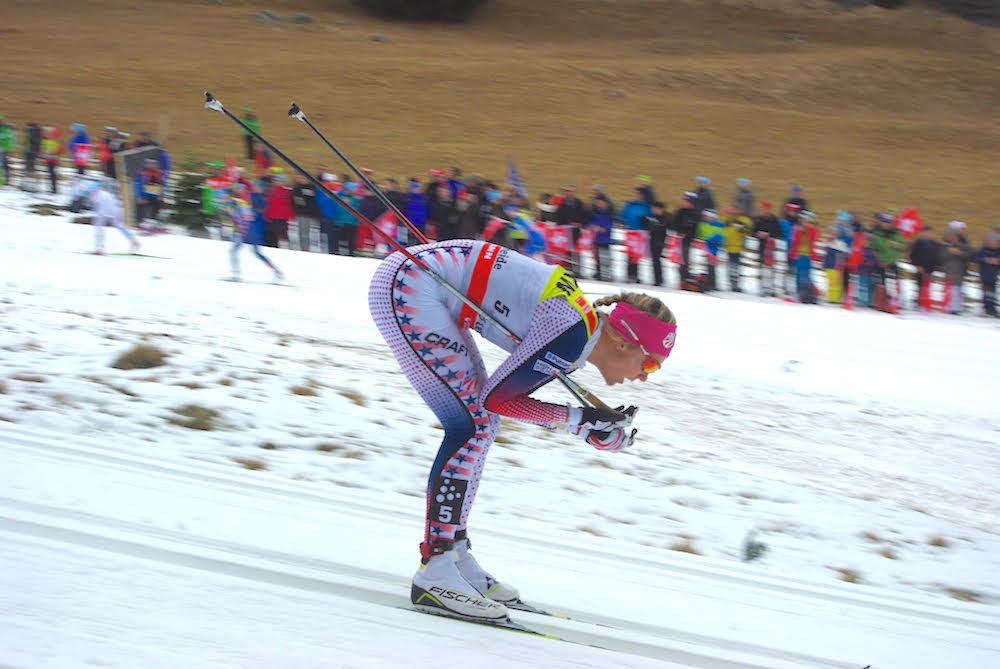
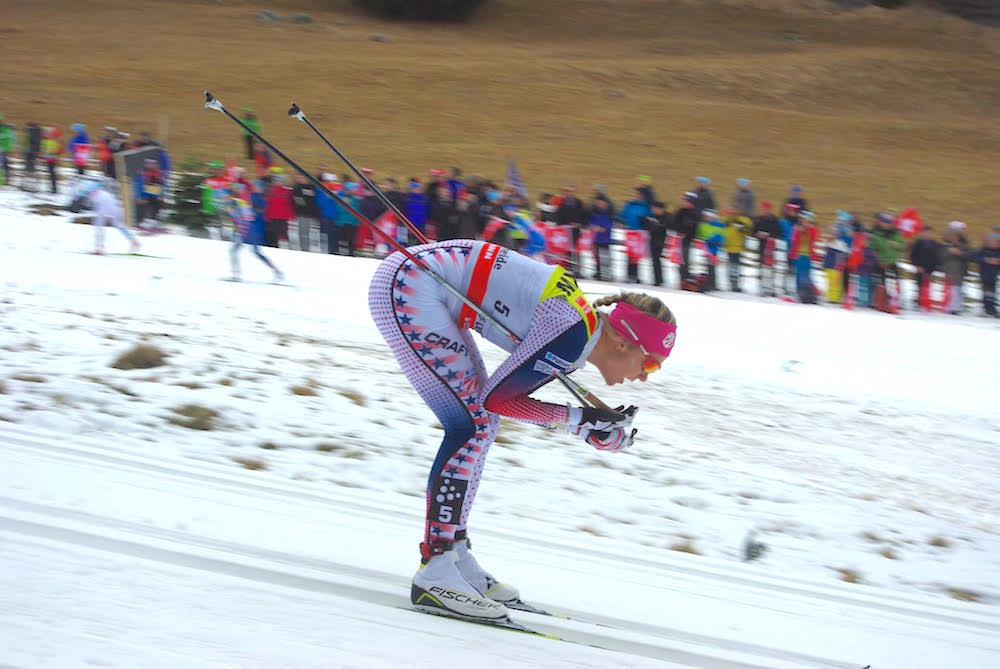
Randall racing in Saturday’s 5k classic. Photo: Fischer / Nordic Focus.
“All three of us fanned [on the final hill] out and really went for it,” Randall said. “I took the lead on the climb and by the time I got to the top, I had moved from second into the front, but my legs were definitely pretty tired…Astrid was able to of hang on the back when we came off the final turn.”
Matching up with Randall in the final 100 meters of any skate event is not for the faint of heart. The best skate sprinter in the world, she pulled away from Jacobsen, tired legs or no.
Overall, Randall was positive about her performance, especially in comparison with the 5k classic the day before. While her result in that race was a none-too-shabby 15th, she described herself as a different person.
“When I classic ski, I feel like I’m focusing so hard just to try to use what I have, and in skating today, it just felt so natural and my body felt really good,” Randall explained. “I just got in a good pack and felt really strong through the whole race.”
The last two years, the final day of the Ruka Triple has been a classic race, and Randall, along with a number of her teammates, was happy to finish up with a skate leg.
In both 2012 and 2013 she entered the final pursuit in good position, but said with the classic, she had just tried to hold her pace. Today was a different story, and Randall added that ” I love the confidence I have in skating right now.”
US Ski Team head coach Chris Grover also pointed to Randall’s execution of strategy as a key to her success. She stayed patient, and sticking to the plan of “not trying to go out too hard too early, not trying to bite off too much in terms of trying to climb the ladder too far too fast.”
If Randall was pleased to finish up the Finnish junket with a freestyle event, Jessie Diggins and Liz Stephen would have to be termed ecstatic. While both women have improved their classic skiing, they still prefer skating, and their results were there as a clear demonstration.
Diggins bounced back from a tough start to the weekend, when she crashed in the sprint, and crashed hard again warming down, to ski all the way up to 24th form a start position of 46th.
“I was just happy to finally have a distance skate race,” Diggins responded when asked about her day. Her early season racing and time trials have all been classic, so the chance to take some names in her preferred technique was welcome.
But if passing 22 skiers on the up-and-down Kuusamo course wasn’t hard enough, Diggins partially reprised her famed World Championship gold medal performance when she lost a pole just four kilometers in.
Another skier stepped on her basket, pulling off not only the pole, but her entire glove as well. She picked up a new shaft half a kilometer later, not one of her own, but roughly the right height, with a biathlon style strap. But Diggins was not willing to stop to get a new glove. She told FasterSkier that she didn’t want to risk losing contact with the pack.
The result? A heavily frostbit hand and the 8th fastest time of the day. Diggins said that the pain of racing six kilometers in frigid Kuusamo actually added fuel to the fire.
“I was just kind of pissed off about it, because it was really messing with my mojo, freezing my hand,” she explained.
That energy was channeled into the final sprint, and capped an impressive comeback.
Grover saw her initially slip back after losing the pole, but was impressed to see her rally and get back into the top-25.
She was also happy to stay on her feet after the crashes on the sprint course. She entered the 5k classic “really scared” of the fast downhill corner.
“I was truly terrified for the first time in a longtime about a downhill,” Diggins said. “There’s this right hand pretty fairly fast corner in the 5k course that shouldn’t’ve been a big deal but because I crashed so hard on it the day before in cool down, I had to go visualize that corner like 20 times and actually walk down it the morning of.”
She made it through unscathed, and felt confident on the 2.5 k skate course, which featured a different decent — one that is plenty fast but fairly straight.
“If you’re in the tracks it’s a straight shot, so you just get in your tuck and you’ll be ok,” Diggins described.
And as a skier who feels she needs to “work her way into the season,” she is pleased to get a strong race under her belt.
Stephen started the day with even more ground to make up, but she was still gunning for the top-30.
Stephen showing her skate form in the World Cup Finals.
She headed out on course in bib 67, well over two minutes down on the leaders. But she told FasterSkier she likes to be hunting.
“I absolutely love pursuit starts,” she said. “It’s actually really fun to start in 67th because there’s a lot of people out there racing, and you’re pretty much passing or working with somebody to pass people the whole time. And that’s a pretty fun way to ski for me.”
And with a course well suited to her strengths – had V1 climbing – the day was set up for success.
She ended up making up a remarkable 35 places before the finish, and while she just missed her goal of the top-30, was still pleased with her performance.
With so many skiers to get by, she didn’t end up skiing with anyone else for very long.
“I was kind of on a mission…and I wasn’t about to wait around with anyone for so long. I was just going,” Stephen said. She joined Randall and Diggins near the top of the time of day rankings, placing 9th, giving the US 7th, 8th and 9th in those standings.
Despite her strong race, Stephen was still only the fourth American across the line. Bjornsen, who started right behind Randall in 8th, did a fine job in race that does not play to her strengths.
A better classic skier, especially in the distance events, Bjornsen stayed in the top-20, placing 17th overall.
“It was a little bit intimidating going into it, both the course and the people I was surrounded by in the start,” Bjornsen told FasterSkier. “I went into it trying to stay positive the whole time and do what I could do. It went well with all things considered.”
Grover was a bit more effusive, saying “A great job by Sadie. She really held some ground there to stay up in 17th. She had fallen back to about 21st at one point and then she came rallying back and passed two or three ladies right at the end.”
With World Cup points awarded for time of the day as well as the overall mini-tour standings, the US did quite well. Like Stephen, Holly Brooks just missed getting into the top-30 in the overall, placing 34th, but her effort was good for 26th on the day.
The team is now looking ahead to Lilllehamar, where for the first time in recent memory, and perhaps ever, the US women will field two full relay squads, with Ida Sargent, Sophia Caldwell and Rosie Brennan all ready to go.
“To see everybody ski so well today, with Sadie’s strong performances the last couple of days, I think we’re in a good place to have a good performance next weekend,” Randall said. “We look forward to the relays more than anything else, so we’re definitely fired up.”
Diggins said her hand should be fine. After the race it was swollen and painful, but no dangerous black. She should be ready to go next weekend, and the team is hoping to keep rolling.
“Everybody has confidence like we belong, and it feels good for us because all the other teams are here with their big wax trucks, and their army of support staff, and you know as a smaller team we’re just right in there, holding our own,” Randall said.
— Matt Voisin and Pasha Kahn contributed reporting



 This coverage is made possible through the generous support of Marty and Kathy Hall and A Hall Mark of Excellence Award. To learn more about A Hall Mark of Excellence Award, or to learn how you can support FasterSkier’s coverage, please contact