Tag: Jessica Diggins

  • Emma Ribom Repeats in Ruka Sprint

    Emma Ribom Repeats in Ruka Sprint

    This coverage is made possible through the generous support of Marty and Kathy Hall and A Hall Mark of Excellence Award. Learn more about A Hall Mark of Excellence Award—or about supporting FasterSkier coverage—by contacting info@fasterskier.com

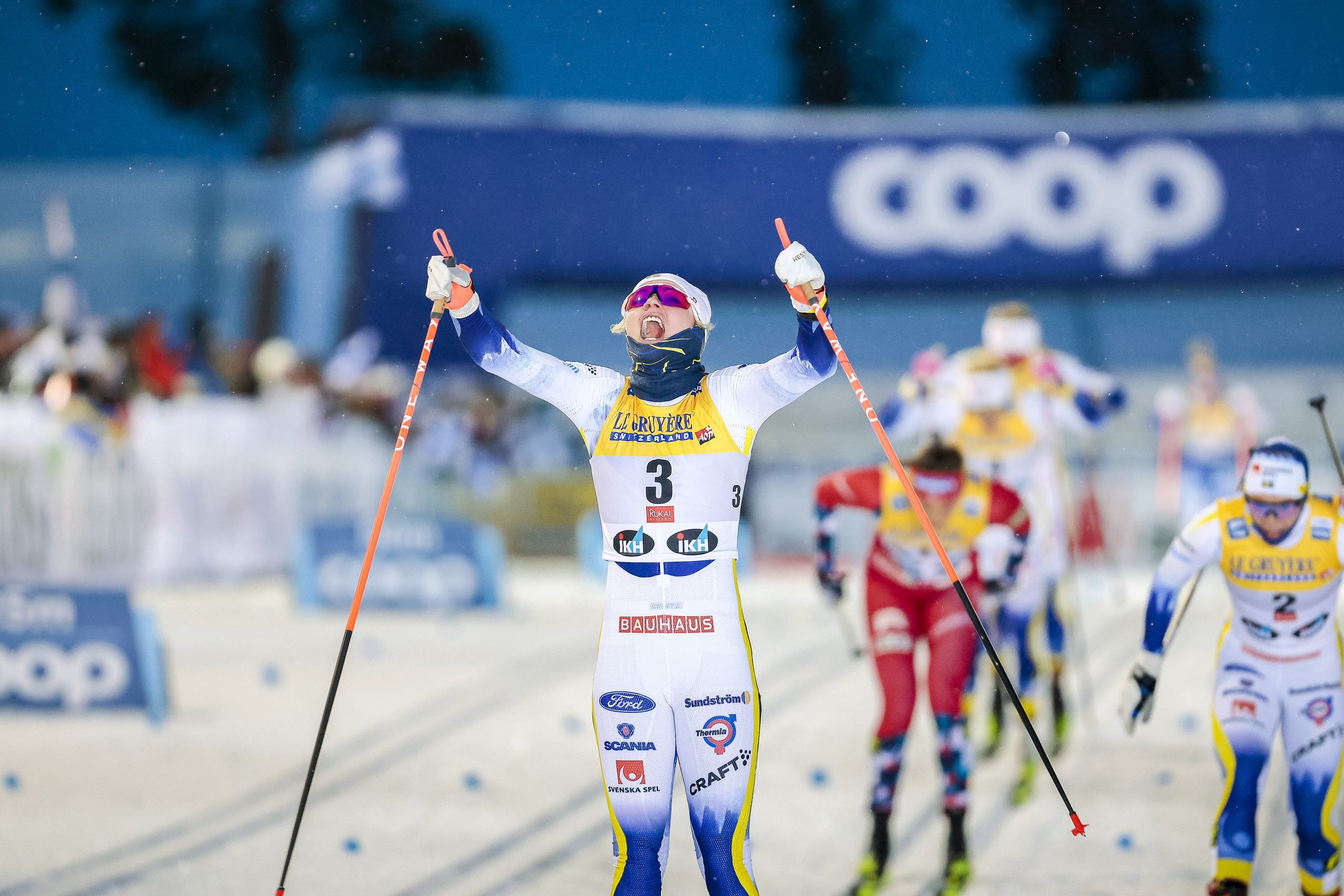
    Emma Ribom (SWE) led the strong Swedish contingent in repeating her Ruka World Cup sprint win of a year ago. (Photo: NordicFocus)

    Today, in the near perpetual darkness of Finland’s early winter, the classic sprint competition announced the dawn of the new World Cup season. The new season brings with it a new rule—perhaps the most significant rule change since skating was allowed—the much awaited fluoro ban, and the associated anxiety over testing protocols. Also affecting race outcomes is the continuing Russia ban.

    But the more things change, the more they stay the same in women’s sprinting. Emma Ribom (SWE) repeated last year’s victory taking the classic sprint title in Ruka for the second year in a row. Sweden also continued its domination of women’s sprinting placing four skiers into the finals with Jonna Sundling taking second. Norway only placed one skier into the finals, Kristine Skistad, but it was enough to find the podium as Skistad took third. Skistad picked up where she left off from last season having had a tremendous late season showing having won the last four sprint events last year.

    The American contingent had a good day placing three skiers into the heats. Rosie Brennan, qualified 8th, Julia Kern qualified,18th, and Jessie Diggins qualified 12th. Other Americans who did not qualify were Novie McCabe finishing 43rd, and Lauren Jortberg finishing 45th. Canadians Katherine Stewart-Jones finished 40th, and Amelia Wells finished 46th.
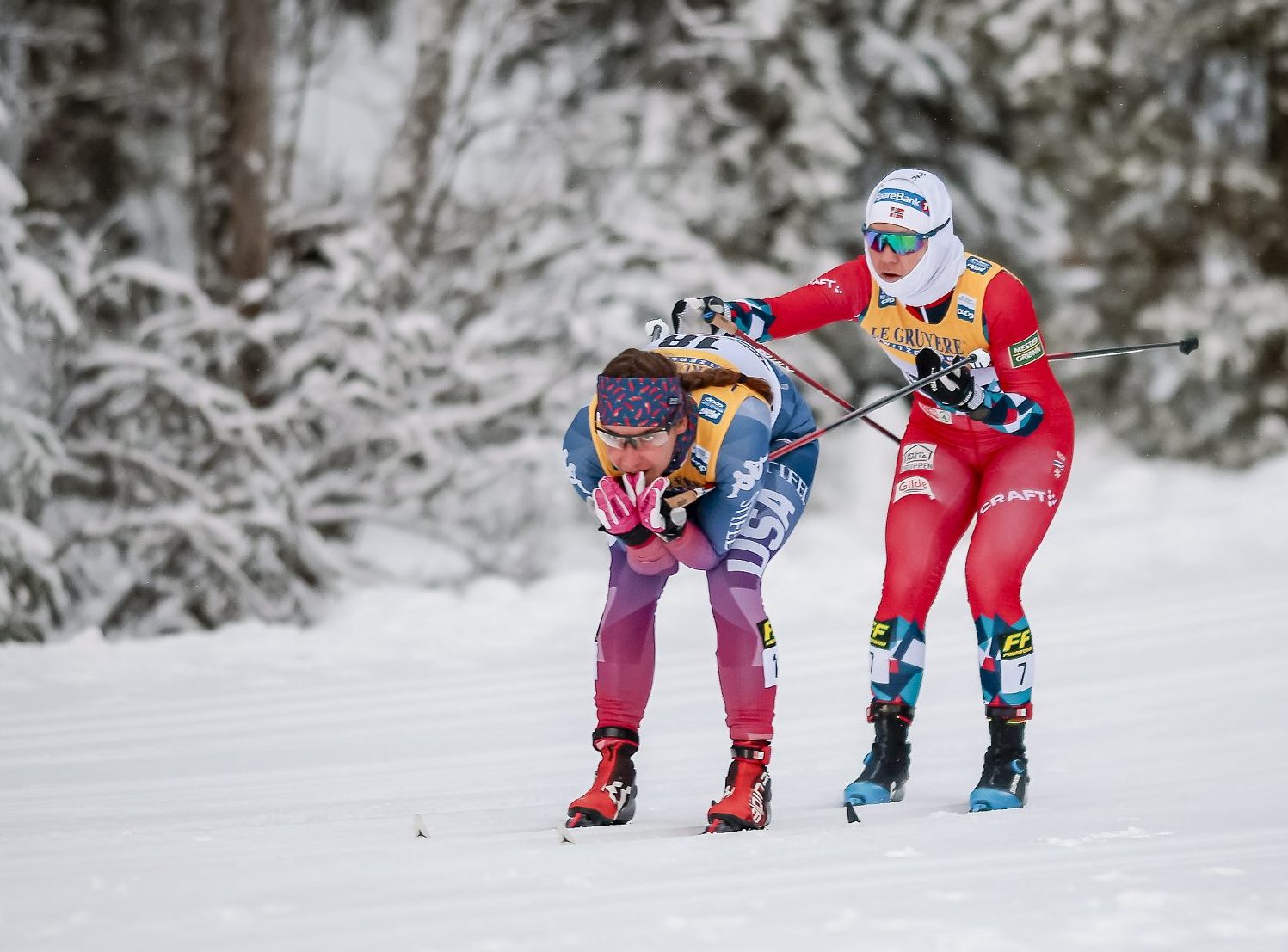
    Julia Kern (USA) looked great in her quarter final, but was unable to advance out of her semifinal. (Photo: NordicFocus)

    All three American qualifiers performed well in their heats and moved into the semis; for a while, it looked like there might be a strong American presence in the finals. But then the Swedish freight train asserted its dominance.

    Kern and Brennan were together in the first semifinal, but couldn’t push through to the top. Kern finished fourth and Brennan finished fifth. Kern nearly advanced to the finals as her time tied her for a lucky loser spot to the hundredth of a second, but due to a complex tie-breaking formula she was unable to advance. Kern finished eighth overall and Brennan ninth.
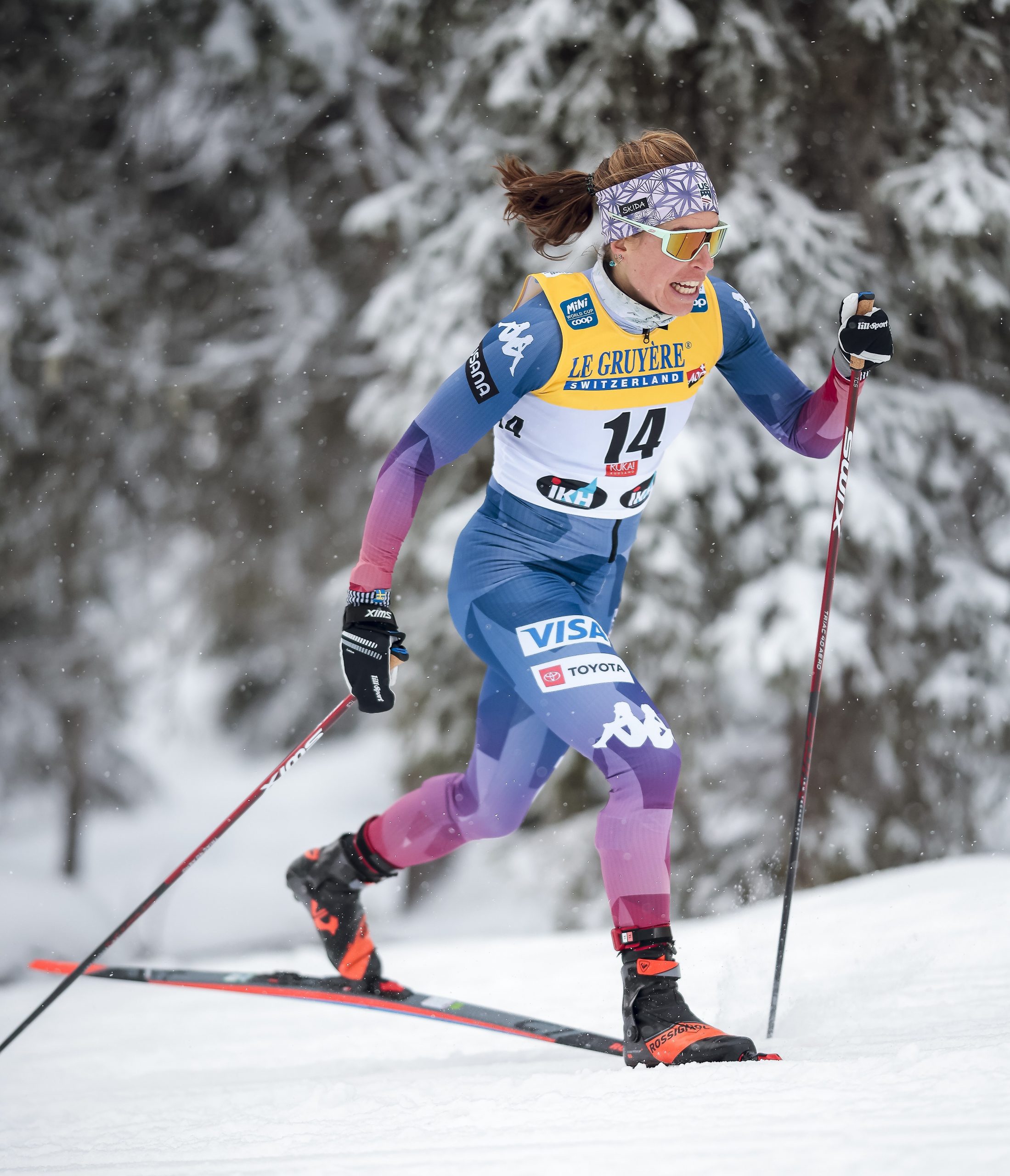
    Rosie Brennan (USA) also looked strong, finishing second in her quarterfinal heat. But, like the rest of the Americans, she could not advance out of the semifinals. (Photo: NordicFocus)

    Diggins looked great in her quarterfinal, crushing the field in her heat and setting expectations high by putting up the fastest quarterfinal time of the day. She looked strong at the start of her semifinal—leading at the half-way point—but couldn’t sustain the pace and failed to advance out of the semifinal. She would finish seventh overall.

    It was a good day for team USA with the team’s coach, Matt Whitcomb, describing the team’s performance as “better than expected. This exceeded our average Ruka day.” Whitcomb pointed out that on the first day of racing the American team might be at a bit of a disadvantage. “I don’t like to make excuses,” he said. “But the Scandinavians have been racing already for a while longer than we have.”

    The day clearly belonged to Team Sweden despite the shocking debut of last year’s crystal globe sprint winner, Maja Dahlqvist (SWE), who failed to qualify for the heats. When all was said and done, Sweden showed it’s still the team to beat in women’s sprinting, and the Americans continued to be knocking on the podium door.

    The biggest non-story of the day was day one of racing with the fluoro ban. No one was sanctioned for a fluoro infraction and the cold snow rendered the lack of fluoros a non-issue. This outcome was due to the hard work of all teams’ wax technicians. “Today we were really seeking to nail the process with everyone getting their first starts under their belts,” Whitcomb said. “Our stress meters were slightly higher than normal.” Whitcomb was able to provide insight into the new fluoro protocols. “We’re nervous about this [new fluoro rules], but FIS has really done their homework.”

    “Yesterday, our whole team showed up at 3:00 p.m.” Whitcomb continued. “And we did a dry run of the entire process.” Whitcomb also shared that some of the major ski powers have their own fluoro testing machines, which cost about $30,000 a piece, which the U.S. does not have the resources for. He mentioned that the Austrians were generous enough to loan the American’s their machine for two days to test all of their skis.

    Whitcomb described the race day testing protocol: “Skis are tested before and after racing with different tolerances for before and after a race to allow for post race contamination,” he said. “For sprints, skis are tested before qualifications. Skis are then tested after qualification and we can take them back to the truck to re-wax for the heats. For the heats, they’re tested again before the quarterfinals, and after the finals. For a classic race, an athlete can bring two pairs of skis to the start, have them both tested, and then choose which pair to race on. Clean tested skis are held in a green zone which FIS and volunteers control. If a tested ski exits the green zone or the race course, they are out for the day. On classic race days, techs are allowed to modify kick wax, under FIS supervision, while skis are in the green zone.”

    It’s a lot to process, but teams and racers seem to have adjusted well. It’s been a lot of work. Whitcomb said they spent three weeks just cleaning the wax truck, including scrubbing down light bulbs. It certainly isn’t the end of the fluoro story, though. Whitcomb pointed out that skis with deeper structure which have been used for warm conditions can be cleaned, but that fluoros can rise out later and a ski can fail the test. If a ski tests positive, the racer is disqualified for the day. “As I understand it, if any of the skiers’ sets of skis test positive, that skier is not permitted to start.”

    It’s a brave new world for waxing, but for day one, it went off without any glitches.

    Women’s Classic Sprint RESULTS
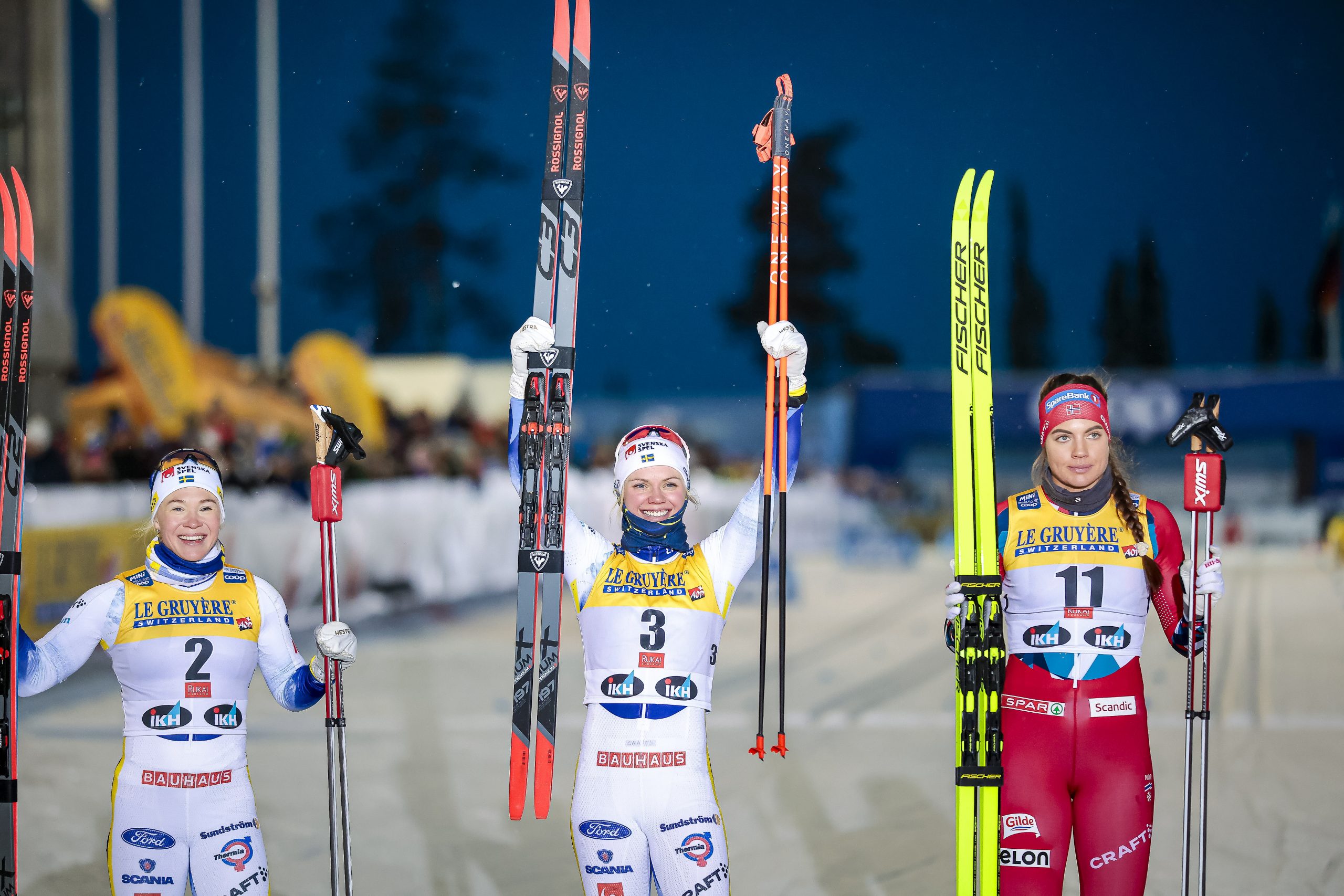
    Jonna Sundling (SWE), Emma Ribom (SWE), Kristine Stavaas Skistad (NOR), (l-r) take the podium in the season opener in Ruka, Finland. (Photo: NordicFocus)


  • Randall, Caldwell Finish in Top 10 in Val Müstair Skate Sprint

    Randall, Caldwell Finish in Top 10 in Val Müstair Skate Sprint

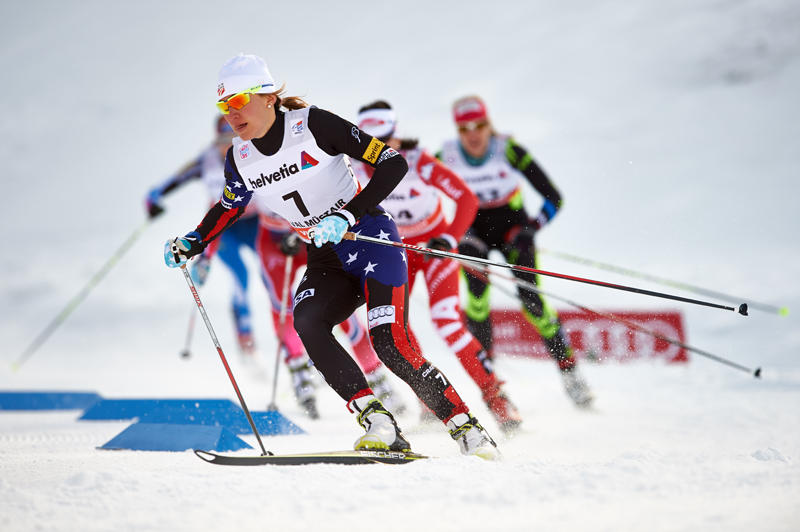
    Sophie Caldwell (USA) shows her cornering skills in Val Mustair (SUI). (photo: Fischer/Nordic Focus)
    Sophie Caldwell (USA) shows her cornering skills in Val Mustair (SUI). (photo: Fischer/Nordic Focus)

    While she may not be back to her winning ways, American Kikkan Randall still put together a solid performance during the women’s Tour de Ski 1.4 k freestyle sprint in Val Müstair, Switzerland.

    “It was fun to return to Val Müstair where I had a great performance two years ago. We didn’t get to compete under the lights this time but it was sunny and beautiful,” she wrote in an email to the press. Randall won that Tour stage, a freestyle sprint on the first day of 2013, over Weng and Norway’s Ingvild Flugstad Østberg.

    Randall took care of business during qualifying, finishing 13th and +8.77 behind Norwegian Marit Bjørgen (3:38.62), who would win the final heat and earn her third straight Tour victory. The 32-year-old then finished third in the final and fastest quarterfinal heat of the day to earn a lucky loser spot, +1.95 behind Norway’s Heidi Weng (3:36.35).

    “[The Norwegians] set a hard pace the whole heat and I did my best to stay in close,” Randall wrote. “I tried to come out of the draft off the final turn but didn’t put together a great final sprint … Thankfully it was good enough for lucky loser.”

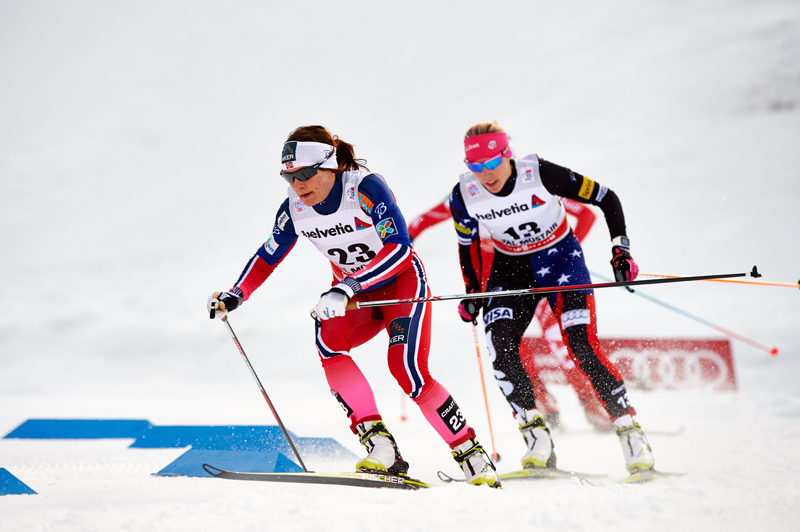
    Maiken Caspersen Falla (NOR) and Kikkan Randall (USA), (l-r) during the heats in Val Mustair (SUI). (photo: Fischer/Nordic Focus)
    Maiken Caspersen Falla (NOR) and Kikkan Randall (USA), (l-r) during the heats in Val Mustair (SUI). (photo: Fischer/Nordic Focus)

    In the semifinal, Randall maintained a position in the back of the pack throughout the race, but Østberg set a pace that prevented her from making a decisive move. She finished the heat in fifth, 3.20 behind Østberg (3:35.84), and ended up tenth overall.

    While Randall was disappointed that she did not have the strength to keep up with the Norwegians, she wrote that she was happy to be close to advancing to the final.

    “I still haven’t quite found all my gears yet but it’s good to keep getting in hard efforts and inching my way back to top form,” she explained.

    Meanwhile, American Sophie Caldwell had a fine day of her own. The 24-year-old qualified in seventh (+7.16) before winning her quarterfinal heat. In a moment reminiscent of her semifinal heat in Sochi, when she defeated Østberg in a photo finish by 0.01 seconds, Caldwell narrowly outlunged Italy’s Gaia Vuerich to win by 0.05 in 3:42.25.

    Caldwell explained over the phone that she made the tactical decision to remain behind Norway’s Therese Johaug, who “is not known for her sprint finishes,” and Vuerich, who Caldwell has often competed against in sprint finishes. She made her move on the final stretch, setting up another exciting battle with Vuerich.

    “I think one of my strengths has always been the final stretch in sprinting for as long as I can remember, and I’m not sure why that is; I just find an extra gear there and have a pretty quick sprint finish,” Caldwell said.

    United States Ski Team Head Coach Chris Grover expanded on Caldwell’s race over the phone, saying that during one of the major turns on the first lap she took a less icy, outside line while all the other skiers took an inside line. He said Caldwell’s line was not the ideal one for carrying momentum.

    However, “to her credit, she saw that preferred line during the race and the second time down when she came to the finish she just nailed that [corner], and was able to catapult into a position where she was able to go and win the quarterfinal,” Grover said.

    Grover said Caldwell has the unique ability to preserve and create speed through a transition instead of gripping or locking up and losing speed.

    “She really sets herself up to carry a lot of momentum out of the corners and I think that is really one of her strengths,” he continued.

    Caldwell explained her tactics for the semifinal, saying she wanted to stick with the leaders for as long as possible. She stayed true to her tactics and spent most of her semifinal behind the leaders, though failed to challenge Bjørgen or Sweden’s Stina Nilsson down the stretch – “they opened up a bit of a gap on me on the uphill,” Caldwell said. She finished in third, 1.24 seconds behind Bjørgen (3:39.04).

    Unfortunately, the fast pace of the second semifinal prevented Caldwell from moving on as a lucky loser. She finished seventh overall, which is her best World Cup result of the season. Especially after a summer during which she broke both of her elbows, she is happy about where she is.

    “I’ve been really psyched about how things have been going lately. I feel like I’ve been taking a big step each weekend, and doing a little better and a little better in sprints, and I think physically I’m getting stronger,” she explained.

    American Sadie Bjornsen is in ninth place on the Tour after finishing 13th overall on Tuesday. She had a strong qualifier, finishing in 12th (+8.64), before being outsprinted for the second-place spot by Norwegian Ragnhild Haga at the finish of her quarterfinal heat. She finished 3.44 seconds behind Østberg, who comfortably won the heat in 3:39.58.

    Grover said it was a great qualification for Bjornsen, especially after the frustrations of the last sprints in Davos, where she failed to qualify in two consecutive weekends.

    Meanwhile, American Jessica Diggins qualified in 26th and ended up 23rd overall after finishing fifth in her quarterfinal heat (+4.66) behind Nilsson. She skied off to a fast start and was in first place until about halfway through the race, “but by her own admission I guess she ran out of a bit of gas,” recalled Grover.

    Results

    Tour de Ski overall standings

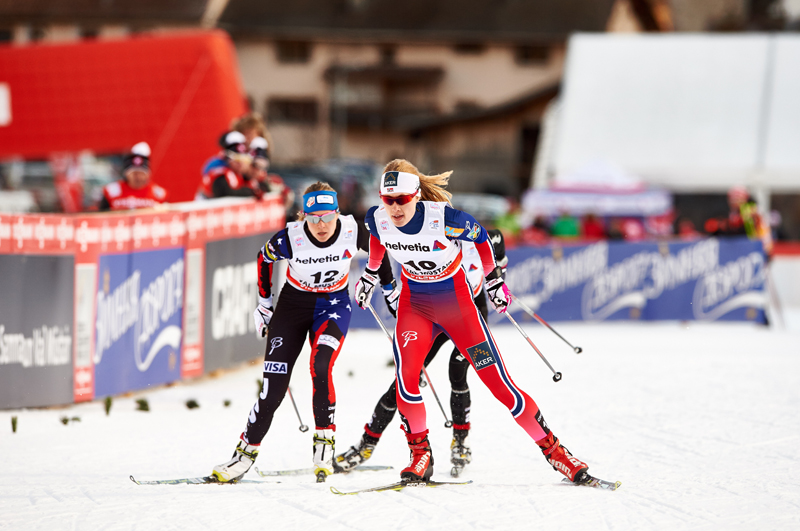
    Sadie Bjornsen (USA) and Ragnhild Haga (NOR), (l-r) during today's Tour de Ski action in Val Mustair (SUI). (photo: Fischer/Nordic Focus)
    Sadie Bjornsen (USA) and Ragnhild Haga (NOR), (l-r) during today’s Tour de Ski action in Val Mustair (SUI). (photo: Fischer/Nordic Focus)