Tag: Jessica Jerome

  • Ski Flying’s Glass Ceiling

    Ski Flying’s Glass Ceiling

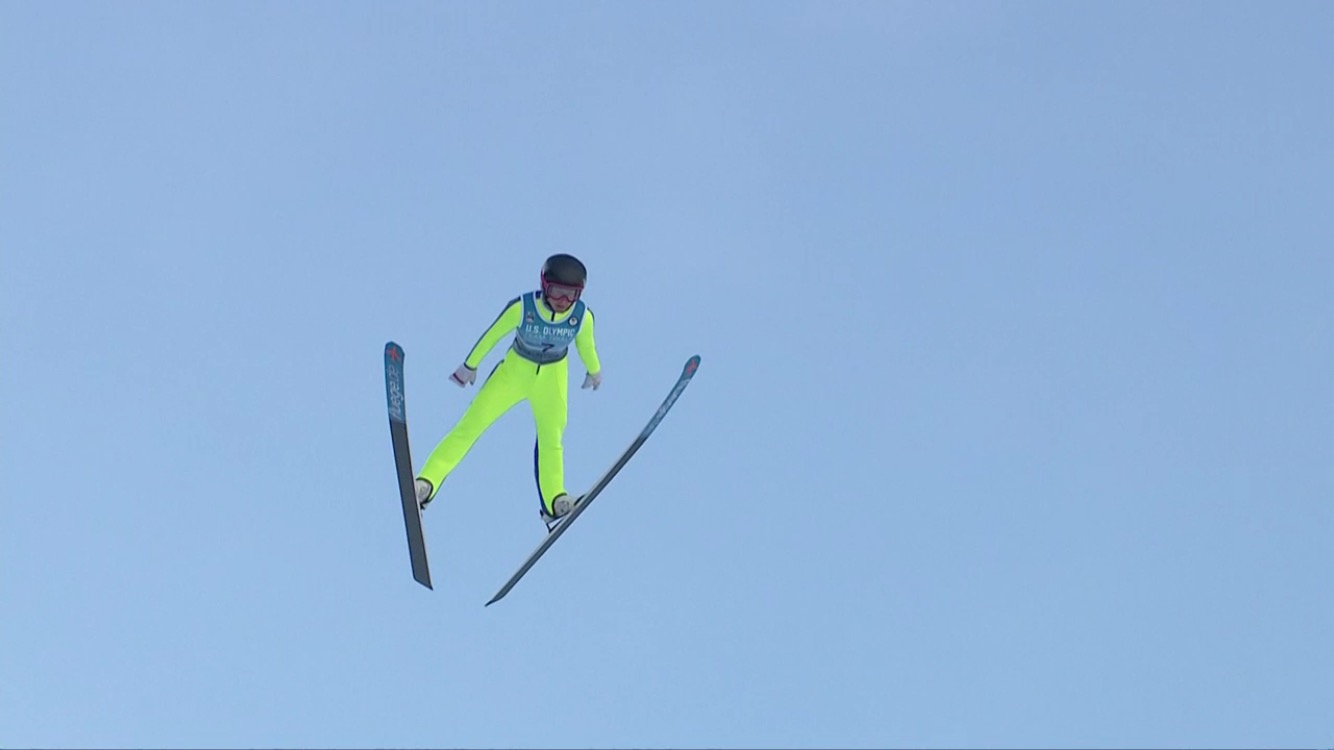
    Sarah Hendrickson, jumping in this photo, is a FIS athlete representative to the Ski Jumping Committee. (Courtesy photo)

    Let’s start with some basic gender equality facts in skiing.

    The first women’s downhill at the Olympics was in1948. Women were awarded Olympic medals in combined (one downhill run and two of slalom) beginning eight years earlier in 1936. FIS has awarded a women’s World Championship in downhill since 1931. The FIS database marks 1967 as the first year for an official FIS World Cup downhill race for both men or women.

    It’s a different narrative in ski jumping. FIS sanctioned ski jumping began for men during the 1979-1980 season. It took three more decades for women’s ski jumping to be recognized by FIS. The first women’s FIS World Cup ski jumping competition for women was held in 2011. American Sarah Hendrickson won. The first World Championships in ski jumping for women was awarded to another American, Lindsey Van, in 2009. Men, on the other hand, have been ski jumping in the Winter Olympics since their inception in 1924. The IOC welcomed women’s ski jumping at the Olympics in 2014.

    This story though is about Ski Flying. But we’ll tie it back into alpine skiing later on.

    Ski Flying is a close relative of ski jumping. Essentially, they are the same beyond the size of the jump. Ski Flying jumps are larger. Athletes soar farther on these jumps. Ski Flying is not an Olympic sport, however, FIS has sanctioned a World Championships in the discipline since 1972 – but only for men.

    “Anybody who knows ski jumping even a little bit, you have a small hill and a big hill, and those are usually around a K90 and a K95 or K125. Ski Flying is jumping off anything that is above a K155,” said Jessica Jerome, a former U.S. ski jumper and Olympian. “There are six of these hills in the world, and only five of them are usable. It’s not a set K point or jump size. Basically, it’s ski jumping but just more of everything — it’s more speed it’s more flight time.”

    Recently, if you’ve been following Jerome on Twitter, her Tweets about Ski Flying may have caught your attention. Here’s one poignant tweet: “Safety is not, and will NEVER be a valid argument @FISskijumping. I have seen some trash ski flying from forejumpers and other small nations. I think what you guys are afraid to say is you must have a penis to fly?”

    Jerome was responding to an April 19 FIS press release and the decision made by the FIS Ski Jumping Calendar Planning Committee to not schedule the first-ever women’s Ski Flying competition next season. “No Ski Flying yet for the women next winter,” claimed the press release. The two reasons given by FIS for not allowing women to participate in Ski Flying were safety and issues with calendering an event.

    One of the five operable Ski Flying hill towers in the world sits above Vikersund, Norway. The local Vikersund organizing committee recently proposed to host a FIS women’s Ski Flying event concurrent with a men’s jump next season. The proposal was voted down 9-7 by the FIS Ski Jumping Calendar Planning Committee.

    “I can not believe that this comes from adults,” said Norwegian National team ski jumping coach, Christian Meyer, in a translated Dagbladat article. “We have jumped a big hill for a long time. Also in Granåsen in Trondheim, you can jump 145 meters. We have been doing this since 2013. For the history-less, I can also inform you that a lady jumped 200 meters in Kulm in 2003. At that time, Daniela Iraschko-Stolz was a test jumper. At that time, both equipment and technology were inferior. Still, it was zero problem to jump 200 meters for a girl.”

    Maren Lundby, a twenty-six-year-old two-time Olympic ski jumping champion, and the 2019 and 2021 ski jumping World Champion, has been an outspoken critic of the decision. Active on Instagram, Lundby released a terse video with a singular message: The Girls Want to Fly.

    The April 19 FIS statement on women’s Ski Flying claimed women would be introduced to Ski Flying incrementally. “The next step will be the women’s World Cup on the HS 147 hill in Willingen in the 2021/22 winter season,” read the statement. “The Muehlenkopf-hill in Willingen, [Germany] is considered a small flying hill, the perfect introduction to Ski Flying hills.”

    That specific jump will be the largest yet used in an official women’s FIS ski jump competition. FIS goes on to claim, “The experts want to have these competitions first and then make a decision concerning Ski Flying events next winter.” FIS does not clarify who the “experts” are.

    The U.S. representative to the Ski Jumping Calendar Committee is Park City based, Alissa Johnson. A now-retired ski jumper, Johnson is a former world top-10 ranked jumper and is a certified international technical delegate (TD). She voted to approve women’s Ski Flying in the 9 to 7 vote.


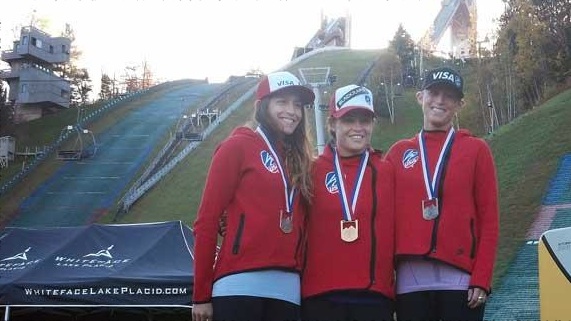
    A vintage shot of then 2009 World Champion Lindsey Van (middle) celebrating a U.S. Ski Jumping title along with teammates Jessica Jerome (left) and Alissa Johnson (right) in Lake Placid. (Photo:ORDA-Jon Lundin)

    “I think there have been safety concerns, like if you have a full World Cup field,” said Johnson of the sub-committee’s discussion on the issue. “So their safety concern was not so much for the top tier athletes, I think probably it’s safe to say they were referring to the top 10 or 15 depending on their age and World Rank. I think the safety concern is more directed at the back end of the field.”

    The step up to Ski Flying should not be understated. The speeds achieved, and the distances jumped are greater than those on Ski Flying hills. The fact exists that ski jumping has been accessible to men far longer than women. It renders down to simply more opportunities for men and a greater number of male athletes perceived to be capable of Ski Flying.

    With fewer opportunities to Ski Fly, the progression some women need to make technically and mentally to handle much larger hills is restricted. Johnson explained that to her knowledge, only seven women internationally have been allowed to Ski Fly – all as forerunners or test jumpers at men’s events.

    According to Johnson, during the sub-committee meeting, some voting members were against approving the Vikersuznd round of Ski Flying because the field of women jumpers able to competently Ski Fly would be too small.

    “I think women, in general, need advancements, but I also feel like the top-tier women can jump, and can jump safely,” said Johnson. “But I think a lot of the discussion came down to this: can we justify calling a World Cup a World Cup if it has less than 30 athletes?”

    One solution to cull the women’s field for a potential Ski Flying event was to evaluate the women’s field mid-season after they had jumped on the large hill in Willingen, Germany.

    Former U.S. jumper Sarah Hendrickson is one of two athlete reps to the FIS Ski Jumping Committee. (Courtesy photo)

    Sarah Hendrickson, a twenty-six-year-old now-retired U.S. Olympian, and World Champion serves as one of two athlete reps to the FIS Ski Jumping Committee — a role she has served in for five years. Hendrickson explained that Norway’s Vikersund Ski Flying proposal, presented to the FIS Ski Jumping Calendar Planning Committee by Norway’s representative Clas Brede Bråthen, was both supported by Norway’s government and framed as an opportunity to raise the market value for women’s jumping.

    “So Bråthen is stating it from a very business-money point of view, which I think is fantastic because marketing and sponsorship are important factors for FIS,” said Hendrickson. “They’re complaining during this meeting that they need to raise the viewership. Bråthen clearly explained here’s one way to increase the viewership and gain popularity in ski jumping, and some listening in were simply like ‘yeah no’.”

    Hendrickson was further disheartened by the step-by-step approach suggested for women to gain experience on incrementally larger ski jumping hills. Absent from the discussion, according to Hendrickson, was what precise objective criteria the decision-makers were looking for to determine if a woman was capable of Ski Flying. Hendrickson recalls Bråthen trying to clarify what specific criteria the women had to meet to be certified to Ski Fly. Despite Bråthen’s questions, Hendrickson said no answer regarding a more structured method for assessing able-to-Ski-Fly women was forthcoming.
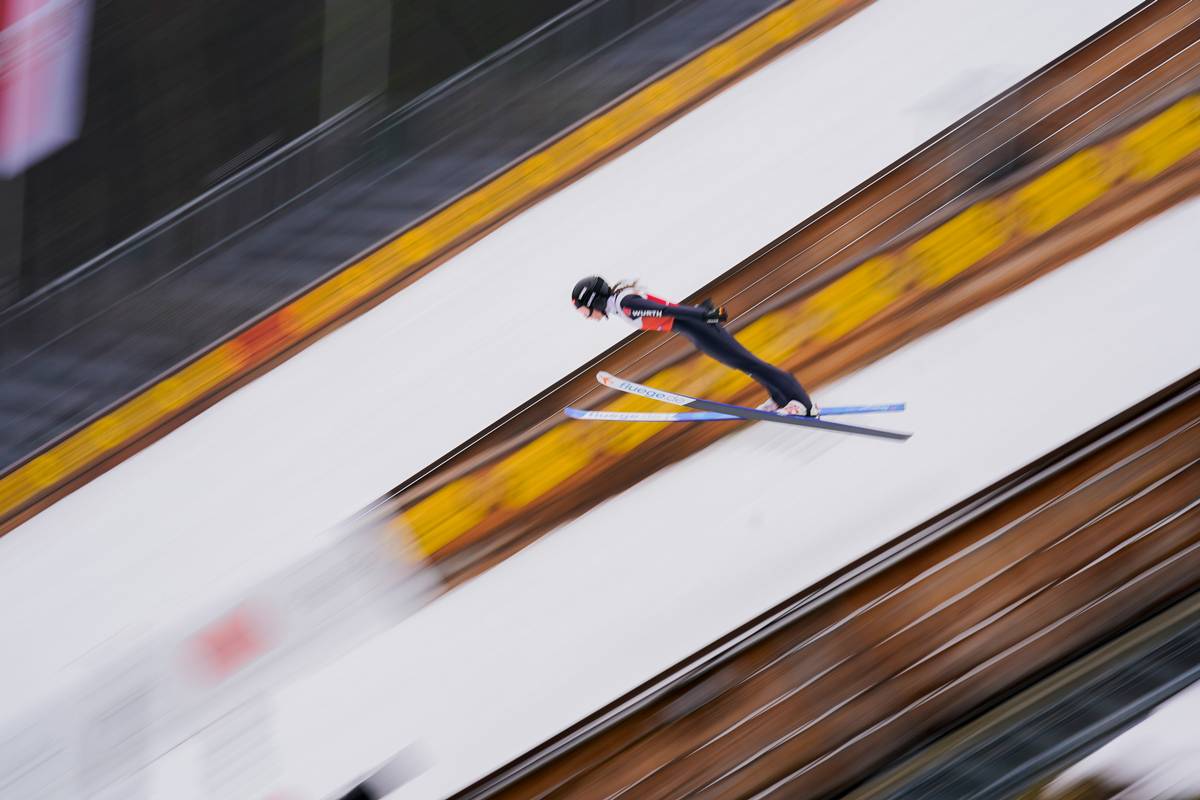
    Cindy Haasch of Germany(GER) – jumping during the FIS nordic world ski championships nordic combined women’s individual Gundersen. (Photo: NordicFocus)
    How Safe is Safe?

    The notion that safety remains a concern falls flat for many athletes and observers of the sport. “I’m female, I didn’t get into the sport because I knew it was the safest sport,” said Hendrickson. “We love ski jumping because there’s a risk of danger, there’s a risk of challenge. We know there’s a risk, there’s just as much a risk jumping off a small hill as a big hill.”

    Johnson, the voting member for the U.S. on the Ski Jumping Calendar Committee, expressed that individual athletes were the real experts in terms of determining Ski Flying readiness.

    “At the end of the day, I think safety concerns should come down to the technical delegates that are appointed to those competitions on any given weekend,” reasoned Johnson. “It should come down to the coaches, but ultimately, it should come down to the athletes. Because regardless of whatever my coaches are saying, if I don’t feel safe, I won’t be safe. I think the safety argument has to come down to those individuals jumping. It’s so individualized. In the broad scheme of things, FIS and our TDs can host a fair and safe event for all athletes.”

    The obvious long-term opportunity cost for limited Ski Flying opportunities for women is clear: fewer women might be ready to Ski Fly. If it is desired to increase the size of an experienced, and therefore “safe”, women’s Ski Flying field, then more women need the chance to Ski Fly.

    “Safety is a non-issue, it’s not a thing,” said Jerome about a women’s ability to Ski Fly. “Because if safety were an issue, then first of all, why are you letting anybody participate if safety is an issue? It doesn’t matter whether it’s a male or a female or whatever. It’s a human being and it’s either going to be safe or it’s not. So if you’ve decided it’s safe for men, then it should be safe for certain women as well.”

    Jerome went on to clarify that women who have demonstrated high technical proficiency and have the appropriate mental calmness to fly off large jumps should be allowed to Ski Fly. “It’s not one of those things where they’re going to fill quota spots for Ski Flying because you have to take it a little more seriously,” said Jerome.

    Let’s circle back to the historical information mentioned at the top. Women have participated in downhill at the FIS World Championships since 1931. Beyond alpine skiing, of which downhill is a sub-discipline, FIS is responsible for sanctioning several winter sports considered to be potentially unsafe. Among them are snowboarding, freestyle, and freeskiing.

    Perhaps FIS has data unavailable to the public regarding the inherent fragility of women compared to men that were rectified for downhill in 1931 but remain current for Ski Flying in 2021? Considering safety, the downhill is still among the diciest of the FIS disciplines. As noted, FIS does not discriminate by gender in that event. Women race downhill. And they race on courses at extreme speeds, over sometimes water injected snow.

    However, between the 2014/15 and 2016/17 race seasons, data from the FIS Injury Surveillance Ssyetem 2006-2018, found women were more likely than men to suffer time-loss injuries on the alpine World Cup. Ask American stars Lindsey Vonn (retired) and Mikaela Shiffrin, the women played through and they played on. Women were not kept from competing due to safety concerns.
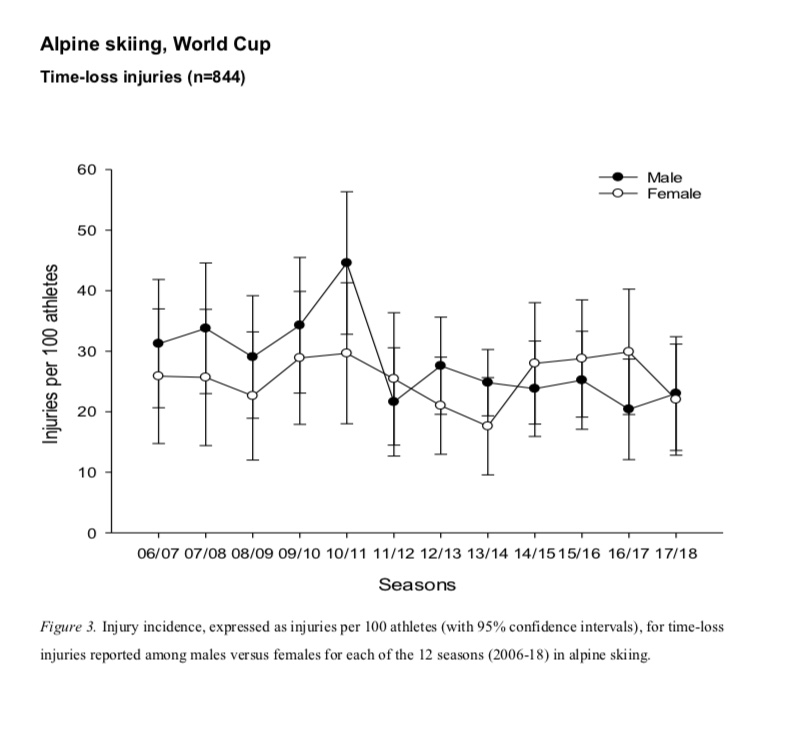
    Over the same period, 2014-2018, FIS concluded men and women suffered about the same number of injuries ski jumping at the World Ski Championships and Olympics.
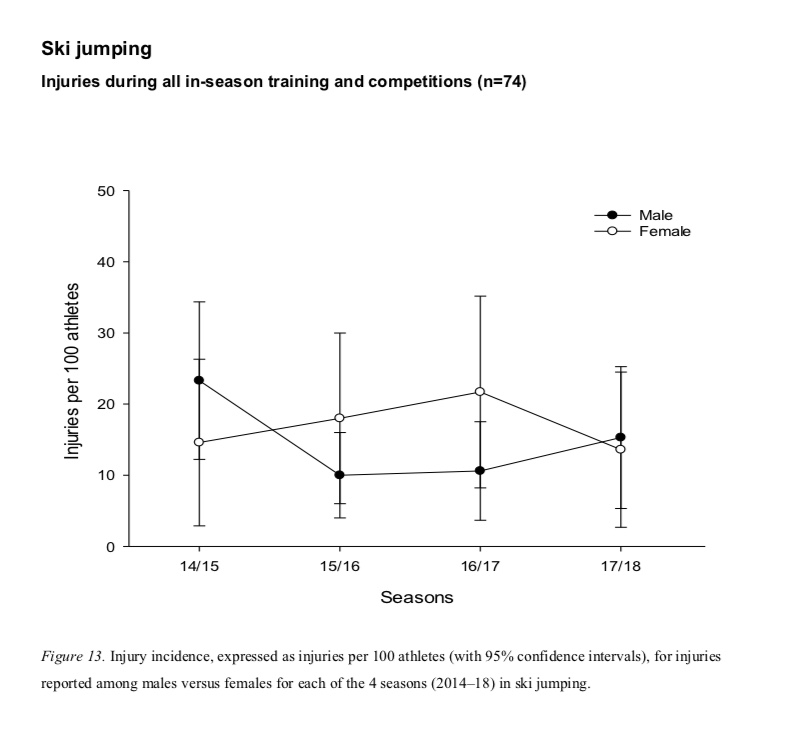
    Of the total number of injuries through 12 seasons of the FIS disciplines (with ski jumping data from four seasons), 7.8% of all injuries suffered on the alpine World Cup were nervous system or concussion injuries. The same category accounted for 6.8% of injuries in ski jumping. Fractured bone/stress injuries comprised 22.3% of all injuries on the alpine World Cup. 14.9% of injuries in ski jumping were fractured bones/stress injuries.
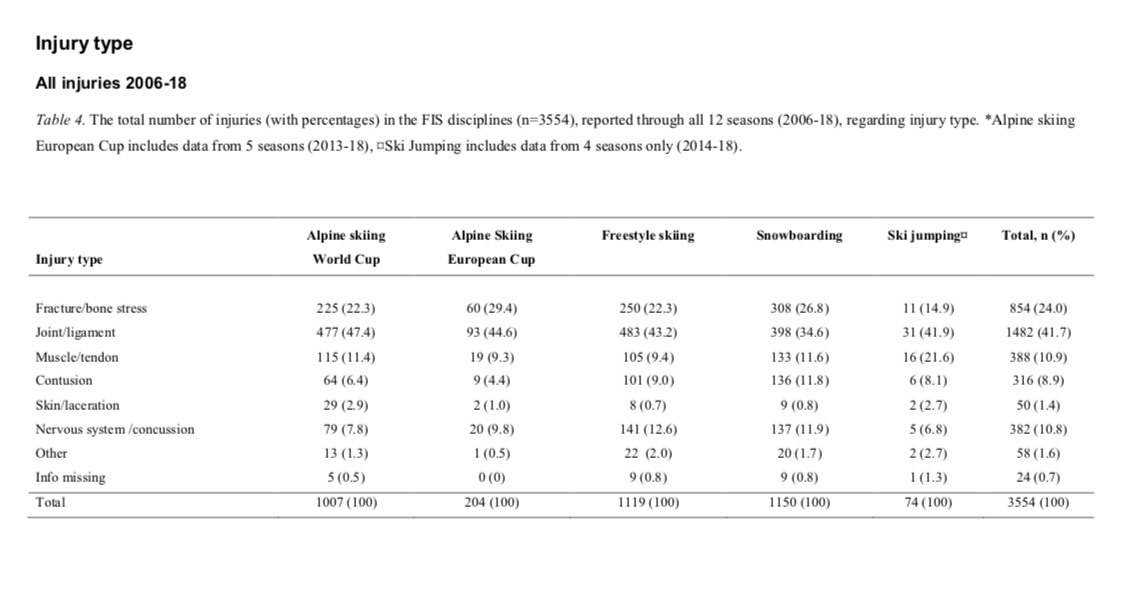
    On the surface, alpine skiing, at this elite level, appears more dangerous than ski jumping. Broadcast contracts for alpine skiing are much larger than those for ski jumping. Considering safety data, or the potential for yard sale crashes, the scheduling of FIS alpine events for men or women has not been deterred.

    Across the spectrum of elite sport, the ceiling remains opaque for female athletes. Considering ski jumping, at the 2018 Winter Games, men had three unique events, the women one — an individual event on the normal hill. The legacy of discrimination extends to the first modern Olympics in 1896. The Games’ founder, Pierre de Coubertin is quoted as saying, “No matter how toughened a sportswoman may be, her organism is not cut out to sustain certain shocks”.

    Again, according to FIS and their World Championships, those “shocks” somehow disappeared in the downhill for women in 1931 but persist for women in 2021 when it comes to FIS sanctioned Ski Flying competitions. FasterSkier requested an interview with a FIS representative. This story will be updated when we receive a reply.

    When it comes to prize money on the ski jumping World Cup, a woman’s jump is worth less than a man’s jump. FIS rules provide at least 10,000 Swiss Francs to be awarded to the men’s winner of a ski jumping World CupThe winner of a women’s FIS World Cup ski jumping event earns at least 3,800 Swiss Francs. Women, who sometimes fly further than men, earn 62% less for their winning efforts.

    On the men’s side of World Cup ski jumping, the top-30 earn prize money; the top-20 earn a paycheck for women. A quick check of the field size at a joint men’s and women’s competition in Râșnov, Romania in mid-February had 39 women in the field and 48 men, respectively.

    Pay equity and safety aside, which are important issues, women have been allowed to chase the FIS dream in the alpine skiing realm for 90 years. (Although Lindsey Vonn was never granted the right to compete against men.) Women ski jumpers, for the time being, have to wait through at least another winter for the chance to Ski Fly in a FIS competition.

    The wait, no matter how short or long is difficult, said Hendrickson. She explained that during the most recent Ski Jumping Calendar meeting she unmuted her audio and challenged the committee chair when they insisted there was “no rush” to get women Ski Flying.

    “I explained that the Olympics are next year and a lot of women are going to retire after next year and they’ll never get a chance to Ski Fly,” said Hendrickson. “So it might not be a rush to you, but for someone who’s an athlete, that is looking to retire and now could not have this lifelong dream because they’re a girl is pretty devastating.”


    *The latest information posted on the FIS site lists numerous nations as comprising the FIS SKI Jumping Calendar Planning Committee. They include Austria, Russia, Norway, Slovenia, Poland, Japan, USA, Sweden, Korea, Italy, Canada, France, Switzerland, Czech Republic, Netherlands, Germany, Finland, and Turkey.

  • Demong Gets It Done in Placid with Ninth National Title; Van and Alexander Dominate Ski Jumping

    Demong Gets It Done in Placid with Ninth National Title; Van and Alexander Dominate Ski Jumping

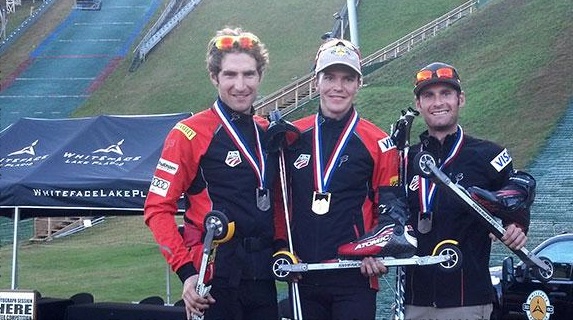
    Olympic Champion Billy Demong shares the podium with teammates Taylor and Bryan Fletcher after winning his ninth career U.S. title. (Photo: USST/ORDA-Jon Lundin)
    U.S. Nordic Combined’s Billy Demong (c) shares the podium with teammates Taylor (l) and Bryan Fletcher after winning his ninth national at U.S. Nordic Combined Championships on Sunday in Lake Placid, N.Y. (Photo: USST/ORDA-Jon Lundin)

    Consistency is key when it comes to nordic combined. Third in the morning jump at the U.S. Nordic Combined Championships on Sunday in Lake Placid, N.Y., national-team staple Billy Demong went on to win the 10-kilometer rollerski with the third-fastest time at the Olympic Jumping Complex, holding off teammates Bryan and Taylor Fletcher by 11 seconds in 25:47.8.

    According to Steamboat Today, Demong started 16 seconds behind jump leader Todd Lodwick, another U.S. Nordic Combined veteran. Lodwick started four seconds ahead of Aleck Gantick and ultimately placed fifth after Demong, Bryan Fletcher, Taylor Fletcher and Brett Denney, respectively. Bryan and Taylor started nearly a minute behind in seventh and eighth, respectively.

    Taylor passed his brother and edged him for second by 0.3 seconds. Denney finished 31.1 seconds behind Demong in fourth and Lodwick was fifth (+1:14.5), reportedly slowed by asthma.

    It was Demong’s ninth national title in what may very well be his last U.S. championships. The 33-year-old Lake Placid-area native plans to retire after the 2014 Sochi Olympics.

    “No doubt, this was my best race of this summer,” Demong said in a U.S. Ski Team press release. “This was a solid start to where I want to be right now.”

    Most threatened by the idea of Lodwick sprinting to the finish or Taylor Fletcher catching him and skiing away, Demong said he tried to ski his own race.

    “I just wanted to ski an even split and stay just 10 to 15 seconds in front of [Taylor] so he didn’t have the opportunity to break away from me,” he explained. “It seemed like that worked out. He pulled within 10 seconds of the last lap, but I had enough energy to hold that gap to the finish line.”

    Best of all, Demong said the dryland results indicate that the team’s in good shape overall.

    “There were four to five guys who could have won so I think that our team is exceptionally strong, even stronger than four years ago,” he said. “That’s the most important thing to me.”

    The U.S. Nordic Combined squad is headed to Europe on Monday for its final overseas training camp before the World Cup season starts next month.

    “We had some good results,” head coach Dave Jarrett told Steamboat Today. “It was difficult conditions and this hill is hard. We didn’t do very well jumping, but we have jumped well here, so this was just one of those days.”

     2009 World Champion Lindsey Van celebrates her U.S. Ski Jumping title along with teammates Jessica Jerome and Alissa Johnson in Lake Placid. (ORDA-Jon Lundin)

    2009 World Champion Lindsey Van (c) celebrates her U.S. Ski Jumping title along with teammates Jessica Jerome and Alissa Johnson on Sunday in Lake Placid, N.Y. (Photo: USST/ORDA-Jon Lundin)

    Van, Alexander Take Jump Titles

    Also on Sunday in Lake Placid, 2009 world champion Lindsey Van (Women’s Ski Jumping USA) and Nick Alexander (USA Ski Jumping) notched national titles on the K90 Olympic normal hill at the U.S. Ski Jumping Championships. For Van, it was her 16th title and Alexander’s second.

    “This validates all of the hard work that I’ve been putting in all this summer,” Alexander said in a U.S. Ski Team press release. “Now I just have to appreciate today and work even harder heading into the wintertime.”

    “I had fun today and jumping is about fun,” Van said. “I started jumping well a couple of weeks ago. It’s nice as I was struggling a couple of years. It was nice to feel the rhythm of ski jumping again.”

    Earlier this summer, U.S. Women’s Ski Jumping world champion Sarah Hendrickson, who is recovering from knee surgery and did not compete on Saturday, and USA Ski Jumping’s Nick Fairall won the large hill competitions in Park City, Utah.

    Van tallied the two longest jumps of the weekend of 92.0 and 96.5 meters to top teammate Jessica Jerome, who was second, and Alissa Johnson in third. Alexander soared 99 meters on both rounds, the longest of any man, to beat teammates Fairall in second and Anders Johnson in third.

    Video from WPTZ News Channel 5

    Results

  • U.S. Ski Jumping, NoCo Nationals This Weekend: What to Know

    For the fifth-straight year, the U.S. Ski Jumping and Nordic Combined Championships are about to take place in the middle of summer with events Saturday and Sunday in Park City, Utah.

    U.S. Nordic Combined teammates working out during a June training camp in Park City, Utah. Defending national champion Billy Demong (c) is seeking his ninth U.S. title at the U.S. Ski Jumping and Nordic Combined Championships this weekend in Park City. Johnny Spillane (l) was last year’s runner-up at nationals, and Bryan Fletcher (r) placed third. (Dave Jarrett courtesy photo)

    The nation’s best, including defending champions Billy Demong and Jessica Jerome, will descend on the Utah Olympic Park ski jumps in Park City and Soldier Hollow ski area in Midway for two days of dryland competition, according to the USSA website.

    Here’s what you need to know about this weekend’s nationals:

    What: 2013 U.S. Ski Jumping and Nordic Combined Championships

    Where: Park City

    When: Aug. 4-5 (Ski jumping starts at 8 a.m. Saturday; nordic-combined rollerski final at 1 p.m. Saturday)

    Favorites: 

    • Demong, an Olympic gold medalist and eight-time national champion who won last year’s nationals in Fox River Grove, Ill.
    • Jerome, who also has eight U.S. titles and won on the large hill last year.
    • Peter Frenette of Saranac Lake, N.Y, large-hill defending champion with three national titles to his name and two top-10 finishes in FIS Continental Cups this summer
    • Anders Johnson of Park City, who won the normal-hill title last year and has three Continental Cup top-20s this summer
    Of note: The reigning women’s ski jumping World Cup champion, Sarah Hendrickson will miss this year’s nationals along with Lindsey Van, the 2009 World Champion, to recover from planned surgeries. Hendrickson won her first U.S. title last year on the normal hill.
    Last year’s results:
  • Female Ski Jumpers to Compete in First World Cup on Saturday

    Members of the Visa Women’s Ski Jumping Team will make history Saturday by competing in the first-ever International Ski Federation (FIS) World Cup competition held for women’s ski jumping.

    Jessica Jerome, Sarah Hendrickson, Alissa Johnson and Abby Hughes (all of Park City, UT) will represent the U.S. in Lillehammer, Norway. Lindsey Van, 2009 World Champion, is recovering from ankle surgery in October and will not compete this weekend.

    Organizers are expecting nearly 50 jumpers from 15 nations to compete Saturday. Lillehammer is the start to the 14-event season, hosted at nine venues in seven countries. The tour ends in March in Oslo, site of last season’s World Championships.

    Women ski jumpers have competed on the lower-tiered Continental Cup for seven years. In 2010, the FIS approved a World Cup circuit for women to debut in the 2011/2012 season. In April 2011, the International Olympic Committee (IOC) finally added a women’s ski jumping event to the Olympic Winter Games beginning in Sochi, Russia in 2014. Also, the inaugural Youth Olympic Winter Games will be held in Innsbruck, Austria, in January. It will be the first IOC-sanctioned event to include women’s ski jumping on the program.

    “This is a very special time for women’s ski jumping,” said Deedee Corradini, Women’s Ski Jumping USA president. “A World Cup circuit is extremely significant for these talented women and it means better venues, more broadcast time for events, and higher quality all-around.”

    Paolo Bernardi, WSJ-USA international head coach, is expecting a tight competition this weekend as teams from around the world are aiming for victories on the inaugural World Cup circuit. “I’m looking forward to the new challenge this year and helping the team show their potential.”

    After Lillehammer, the Visa Team heads to Notodden, Norway, Dec. 9-10 for a Continental Cup competition.

    Women’s Ski Jumping USA is the primary support group for the VISA Women’s Ski Jumping Team and aims to foster development level athletes throughout the U.S. WSJ-USA, a 501c3 foundation, also advocates for equality for women and girls in sports.

    ###

    Press release: Women’s Ski Jumping USA


    Women’s Ski Jumping USA is the primary support group for the VISA Women’s Ski Jumping Team and aims to foster development level athletes throughout the U.S. WSJ-USA, a 501c3 foundation, also advocates for equality for women and girls in sports.

  • Frenette and Jerome Take U.S. Titles

    PARK CITY, UT (July 30) – Olympic ski jumper Peter Frenette (Saranac Lake, NY) took his third straight U.S. title Saturday at the U.S. Ski Jumping Championships in Park City. Jessica Jerome took the women’s crown for her eighth career U.S. title.

    Frenette, who swept the large and normal hill at U.S. Championships last year, beat the field by 11 points. Jerome beat out the women’s field by jumping almost ten meters further than anyone else in both her round one and round two jumps. 2009 World Champion Lindsey Van (Park City, UT), who swept both titles last season, was third.

    “Training has been going great, and it was awesome that I was able to carry it over to today,” Frenette said. “I’m really happy with my results and how everything played out.”

    Jerome, who had the longest single jump of the day for both men and women – 127.5 meters – was pleased obviously pleased with her performance.

    “I’ve been skiing really well in training this season,” Jerome said. “I felt confident going into this U.S. Championships and it just seemed to fall into place. We’re a really tight knit group so we continue to push each other to be the best. I just felt really good today.”

    Frenette posted the second-best jump, flying a meter shy of Jerome’s mark – 126.5 meters.

    Normal hill and nordic combined U.S. Championships will continue at Norge Ski Club at Fox River Grove, IL. on Oct. 1.

    OFFICIAL RESULTS
    U.S. Championships
    Park City, UT – July 30, 2011
    Ski Jumping – Large Hill
    (Jump distances in meters) total points
    Men

    1. Peter Frenette, Lake Placid, NY (124.5m, 126.5m) 250.3
    2. Chris Lamb, Lake Placid, NY (122.5m, 123.5m ) 239.3
    3. Bryan Fletcher, Steamboat Springs, CO (120.5m, 122.5m) 234.9

    Women
    1, Jessica Jerome, Park City, UT (127.5m, 126.5m) 242.2
    2. Sarah Hendrickson, Park City, UT (118.5m117.5m) 217.8
    3. Lindsey Van, Park City, UT (116.5m, 116.5m) 214.9

    Official Results
    http://www.nsfparkcity.org/ 

    Source: USSA

  • Jerome Jumps Through Fog to Lead U.S. at Worlds

    OSLO, Norway – Jessica Jerome (Park City, UT) led U.S. women’s ski jumpers in a thick as pea soup fog that proved unnerving for many as the FIS Nordic World Ski Championships in Oslo hit day two with the women’s jumping event. Gusty winds engaged the athletes in a battle of wills against Mother Nature. Jerome was 14th.

    Defending World Champion Lindsey Van (Park City, UT), who had been strong in training, jumped short in the first round and failed to make the top 30 cut.

    Held at the famed 106-meter Midstubakken normal hill, the massive crowd of over 10,000 could not see the flyers until they hit the outrun. Instead, all eyes, were viewing the big screen in the finish. Yet neither the fog, nor even a bit of rain, seemed to deter the best women’s ski jumpers in the world from putting on an amazing display of athleticism in challenging conditions.

    It was the second time for women’s ski jumping in the World Championships. And, once again, the International Olympic Committee (IOC) was keeping close watch for possible inclusion in 2014. International Ski Federation President Gian Franco Kasper expressed his optimism that the IOC will decide favorably. A total of 43 athletes from 15 nations took part – a big jump from 2009.

    Austrian jumping legend Daniela Iraschko, back from an injury that sidelined her for two weeks, leapt to a pair of 97 meter jumps to take the win with style points all in the 18’s. Silver went to Italian Elena Runggaldier, while World Junior Champion Coline Mattel of France took bronze.

    Jerome was off the pace in the first round with an 84 meter jump but followed it up with an improved 90 meter ride to place 14th.

    Jerome echoed the sentiments of many jumpers by noting, “The weather was not amazing. For the last three days we’ve been training well with good weather. Unfortunately, on the day that it counted, it wasn’t the best. I didn’t do what I am capable of.”

    After the first round, Alissa Johnson (Park City, UT) stood seventh with a jump of 91 meters. But her second jump came in short at 81 meters dropping her to 20th. Sarah Hendrickson (Park City, UT) had a first round jump of 90.5 meters and added an 84 meter ride that put her in 16th.

    “It’s about as hard as it could get for any jumper today,” Johnson said. “Conditions like this are everywhere but you can’t do anything about the weather. Every jump I have taken on this hill has gotten progressively better and I felt really relaxed. I was happy with my first jump. I didn’t, by any means, expect to be in the top 10. My last jump wasn’t awesome, but I am still happy to be here.”

    The reigning World Champion from Liberec in 2009, Van had a first round jump of 75 meters, which failed to qualify her for a second ride.

    “I caught a wicked sidewind on my jump,” said Van.

    Competition at the World Championships continues Saturday with the opening nordic combined event and the women’s 15k pursuit.

    OFFICIAL RESULTS
    FIS World Nordic Ski Championships
    Oslo, Norway – Feb. 25, 2011
    Normal Hill

    Gold: Daniela Iraschko, Austria, (97.0, 97.0), 231.7
    Silver: Elena Runggaldier, Italy, (97.5, 93.5), 218.9
    Bronze: Coline Mattel, France, (92.0, 97.0), 211.5

    14.  Jessica Jerome, Park City, UT, (84.0, 90.0), 177.8
    16.  Sarah Hendrickson, Park City, UT, (90.5, 84.0), 177.0
    20.  Alissa Johnson, Park City, UT, (91.0, 81.0), 169.0
    24. Abby Hughes, Park City, UT, (86.5, 83.0), 156.5
    34. Lindsey Van, Park City, UT, (75.0), 61.4

    For complete results: www.fis-ski.com

    Source: USST

  • Defending Champ Van Leads Worlds Team

    PARK CITY, UT – Reigning World Champion Lindsey Van (Park City, UT) will lead a team of six U.S. ski jumping athletes at the International Ski Federation’s 2011 Nordic World Ski Championships in Oslo, Norway Feb. 25 – Mar. 5. The U.S. Ski and Snowboard Association (USSA) announced the World Championship Team that qualified through the Continental Cup circuit on Tuesday.
    Van will be joined by four fellow Women’s Ski Jumping USA athletes, all hailing from Park City, at the top of the ski jumping hill as they soar off the jump to open the Championships on Feb. 25. Among these athletes are Continental Cup standout Jessica Jerome and up-and-comer Sarah Hendrickson. With Van as the defending champion, the U.S. was able to name five athletes to compete in Oslo.

    “The women have proven that they can be on the podium in any competition and Lindsey has a real opportunity to defend her World title,” said USSA’s Nordic Program Director John Farra. “In addition to Lindsey, both Jessica Jerome and Sarah Hendrickson have had outstanding seasons. This will be a very competitive U.S. women’s team.”

    Jerome, who has been at the top of the women’s circuit for many years, has a win and three podiums this season. She was sixth at the 2009 World Championships and has been going head-to-head with Van all season. Sitting side-by-side, Jerome and Van are in third and fourth in the overall Continental Cup standings.

    Hendrickson comes to World Championships having earned her second Continental Cup win earlier in the season. She also led the Continental Cup for the first series of early season competition in Europe.

    Peter Frenette (Saranac Lake, NY) will be the lone American man at World Championships. The 2010 Olympian is coming into the event strong. After finishing second in a Continental Cup in Sapporo, Japan, Frenette scored the best U.S. World Cup finish in over seven years with an 18th .

    “Peter has had a bit of a breakthrough year and we are looking to continue his development and education as an athlete,” said USA Ski Jumping Coach Clint Jones. “He has shown that at any moment he is capable of long jumps that can compete with the best in the world.”

    The World Championships will take place in the heartland of the sport in its most treasured venue, the Holmenkollen Ski Stadium. The jumps were recently rebuilt in anticipation of the World Championships. Hundreds of thousands of spectators are expected for the Championships, with the ski jumping events among the most popular.

    2011 U.S. Ski Jumping World Championship Team
    (both hometown and club)
    * Indicates current student in U.S. Ski Team partnership with Westminster College

    Men
    Peter Frenette, Saranac Lake, NY (USA Ski Jumping/New York Ski Education Foundation)

    Women
    Sarah Hendrickson Park City, UT (Women’s Ski Jumping USA/Park City Nordic Ski Club)
    Abby Hughes, Park City, UT (Women’s Ski Jumping USA/Park City Nordic Ski Club)
    Jessica Jerome, Park City, UT (Women’s Ski Jumping USA/Park City Nordic Ski Club) *
    Alissa Johnson, Park City, UT (Women’s Ski Jumping USA/Park City Nordic Ski Club) *
    Lindsey Van, Park City, UT (Women’s Ski Jumping USA/Park City Nordic Ski Club) 

    2011 Ski Jumping World Ski Championship Schedule
    Oslo, Norway

    Fri., Jan. 25 – Women’s HS 106
    Sat., Jan. 26 – Men’s HS106
    Sun., Jan. 27 – Men’s Team HS106
    Thurs., Feb. 3 – Men’s HS134
    Sat., Feb. 5 – Men’s Team HS134

  • Austria’s Iraschko Get’s Fourth Win, Jerome Second

    Dec. 17, 2010 — Light snowfall was the backdrop for competition at the K90 hill Friday in Notodden, Norway where Austria’s Daniela Iraschko won her fourth Continental Cup competition in a row this winter season. And Visa Women’s Ski Jumping Team member Jessica Jerome reached the podium for a third time this winter by taking second place.

    Iraschko jumped 97.0 and 95.5 meters; Jerome 94.0 and 91.5 meters and Italy’s Elena Runggaldier leaped from 10th to 3rd place after the second round (90.5 and 96.5 m). Visa Team member Lindsey Van was second heading into the second round, but fell to seventh after her second jump (94.5 and 90 meters).

    Jerome is currently in second place overall and is having one of the best seasons of her career. She’s more confident and consistent, saying, “I know what I need to do to keep improving and jumping farther, so every day I am looking forward to expanding on what I’m already doing right. The entire team is doing so well as a whole. The motivation keeps growing and our jumps keep getting better.”

    Jumpers from seven different countries were in the top 10 spots Friday, another indication that athletes and competition is getting even stronger and more widespread.

    The COC continues Saturday in Notodden and then takes a holiday break before resuming competition in Schonach, Germany on Jan. 8, 2011.

    Continental Cup
    Notodden, Norway
    Dec. 17, 2010
    Women’s HS98

    1. Daniela Iraschko, Austria (97, 95.5) 2542. Jessica Jerome, USA, (94, 91.5) 242.53. Elena Runggaldier, ITA, (90.5, 96.5) 242

    7. Lindsey Van, USA, (94.5, 90) 235.516. Sarah Hendrickson, USA, (87.5, 88.5) 21720. Alissa Johnson, USA, (83.5, 88.5) 208
    24. Abby Hughes, USA, (85.5, 86.5) 202
    30. Nita Englund, USA, (83.5, 79) 18032. Nina Lussi, USA, (80) 8838. Avery Ardovino, USA, (76.5) 8139. Karin Friberg, USA, (78) 80.5(top 30 after first round jump in second round)

    Source: WSJUSA

  • Van Leads U.S. Jumpers in Norway

    NOTODDEN, Norway – Defending World Champion Lindsey Van (Park City, UT) continued to be a factor in the women’s Continental Cup Saturday finishing fourth in the final competition of a two-day event.

    Van, who had jumps of 88.5 and 91.0 meters, moved from ninth after the first jump to finish fourth followed by Abby Hughes (Park City, UT) in sixth. Hughes, who was in second after the first jumping round, was held in snowy conditions and registered jumps of 91.5 and 86.5 meters.

    The winner was Coline Mattel of France who had jumps of 90.5 and 92.0 meters to overtake Austria’s Daniela Iraschko, who has won four events in a row.

    Jerome and Van are currently second and third in the overall Continental Cup standings.

    The women’s Continental Cup circuit now takes a Holiday break.

    OFFICIAL RESULTS
    December 18, 2010
    Notodden, Norway
    HS 100

    1. Coline Mattel, France,  (90.5, 92.0), 238.5
    2. Daniela Iraschko, Austria, (90.0, 93.0), 230.0
    3. Melanie Faisst, Germany, (94.5, 87.0), 228.5
    4. Lindsey Van, Park City, UT, (88.5, 91.0), 227.0
    5. Line Jahr, Norway, (89.0, 91.0), 226.0

    6. Abby Hughes, Park City, UT, (91.5, 86.5), 223.0
    7. Jessica Jerome, Park City, UT, (90.0, 87.5), 216.5
    20. Sarah Hendrickson, Park City, UT, (75.5, 87.5), 188.0
    21. Alissa Johnson, Park City, UT, (80.5, 83.0), 185.0

    32. Karin Friberg, Roseville, MN, (78.5, 65.0), 136.0
    36. Avery Ardovino, Park City, UT, (71.5), 70.0
    37. Nina Lussi, Lake Placid, NY, (71.0), 67.5
    39. Nita Englund, Florence, WI, (69.5), 61.5

    For complete results: www.fis-ski.com

    Source: USSA

  • Jerome to be inducted into Ski Jumping Hall of Fame

    U.S. Women’s Ski Jumping Team veteran Jessica Jerome and legendary women’s coach Larry Stone will be inducted into the American Ski Jumping Hall of Fame (ASJHF) on Dec. 5, 2010.

    This is the second year in a row that ASJHF will include women athletes. Last year, reigning World Champion Lindsey Van and pioneering jumpers Dorothy “Dottie” Graves, Theresa Altobelli and Karla Keck were inducted. The hall of fame inducts still-active competitors who’ve won U.S. national championships and/or those who are Olympians.

    Jerome said she’s elated to be part of the American Ski Jumping HOF and adds that she’s been greatly influenced in her career by those in the HOF.

    “This is quite an honor which I was not expecting, and I am thrilled,” Jerome said. “It is wonderful that jumpers in the U.S. are such a tight-knit group of people of all ages who are all equally passionate about the sport.”

    Jerome is a seven-time U.S. national champion with 17 Continental Cup podium finishes and a sixth-place result in the inaugural World Championship event in 2009 in Liberec, Czech Republic. She is currently ranked seventh in the 2010-11 Continental Cup standings. Jerome has a career-best 138-meter leap on one of her favorite hills, the Lillehammer K120, on her résumé. She is studying economics at Westminster College in Salt Lake City.

    Long-time coach Larry Stone was instrumental in getting the women’s ski jumping program off the ground — especially in Lake Placid, New York.  Stone coached Van early on in her career.

    The HOF induction ceremony will take place at the St. James Hotel in Red Wing, Minn., on Dec 5, 2010. Jerome and Stone join nine other inductees:

    • Nick Alexander — 2010 U.S. Olympic Team

    • Bill Demong — 1998 U.S. National Ski Jumping Champion and U.S. Olympic Team (NC) in 2002, 2006, 2010

    • Stan DuRose — ski jump designer, many years of service to Central Division and National Ski Association

    • E.O. “Buck” Erickson — premier ski jumping writer from Iron Mountain, Mich.

    • Peter Frenette — 2010 and 2011 U.S. National Champion and 2010 U.S. Olympic Team

    • Dave Hicks — 1965 U.S. National Champion and 1964 U.S. Olympic Team

    • Sig Malvik — Exceptional Ski Jumper — Outstanding Meritorious Service

    • Alfred Ohrn — 1925 U.S. National Class “A” Champion

    • Dick Rahoi — U.S. 1956 & 1960 U.S. Olympic Team

    Learn more at http://www.americanskijumping.com/

    Source: WSJUSA

  • Three U.S. Jumpers in Top 10; wind wreaks havoc in Oslo comps

    Oslo, Norway — Jessica Jerome overcame erratic winds and a number of course holds and restarts to tally a pair of fourth-place finishes to lead the U.S. Women’s Ski Jumping Team in Continental Cup competition over the weekend in Oslo, Norway – site of the upcoming Nordic World Championships in February.

    Jumping took place amidst continuing construction surrounding the famous K120 Holmenkollen and K95 Midtstubakken jumps in the Norwegian capital as it readies to welcome the Nordic skiing world this winter.

    “The design of the new (Holmenkollen) complex is really cool and modern,” said U.S. team member Abby Hughes. “We heard the plan is to build four more ski jumps in that area and make a sports park, with k10 k20 k40 and k60 (jumps) along with a ropes course, swimming area, cross country trails and so on. Hopefully the important things — such as roads, stadiums, and the ski jumps — will be ready for the World Championships.”

    Despite all the construction in the new-look Holmenkollen, an old foe – wind – will continue to wreak havoc with competitions held there. Officials stopped and started Saturday’s event four times because of changing winds, and most jumpers battled a strong tailwind that severely limited flight distance.

    The one jumper who benefited from a headwind Saturday was Austria’s Daniela Iraschko, who swept last weekend’s two-competition stop in Lillehammer. Iraschko’s first effort Saturday measured a whopping 114.5 meters, more than 8 meters longer than the hill size for the competition (106). “She dropped like a rock and landed pretty hard and whiplashed onto her back,” Hughes said. “Because she (dragged her hands), it didn’t count as a hill record.”

    Iraschko flew a more modest 93.5 meters on her second jump, tallying a 241.5 score to edge France’s Coline Mattel in second. Jerome, who began dialing in her technique last week in Lillehammer with two top-five finishes, jumped 92.5 and 88.0 meters for a 203.5 score, good for fourth. Lindsey Van was right behind in fifth, Alissa Johnson was seventh, and Hughes ended up 13th.

    “All of us had pretty good first-round jumps considering the air was so bad,” Hughes said. “For the second round, we had lower speed and even more inconsistent air. Jessica had another good jump, Lindsey fought her way through the conditions, Alissa put two good jumps together, and I felt like my technique was consistent, however the tailwind over the knoll was very strong and didn’t help me at all.”

    Iraschko, Mattel and Germany’s Juliane Seyfarth finished 1-2-3 on Sunday, with Iraschko the only jumper to twice jump more than 100 meters. Jerome flew 100.5 her first time down and easily maintained fourth place in the final standings. Van (10th), Hughes (14th) and Johnson (20th) rounded out the U.S. placers.

    France’s Mattel maintained her lead in the Continental Cup standings with 503 points, with Iraschko in second with 400. Austria’s Jacqueline Seifriedsberger is third. Sarah Hendrickson of the U.S., who didn’t compete in Oslo, is sixth, followed by Jerome in 10th and Johnson in 13th place.

    The women’s Continental Cup circuit moves to Falun, Sweden, next weekend (Sept. 25-26) for two competitions.

    Oslo HS 106

    Saturday, Sept. 18

    1. Daniela Iraschko, Austria (114.5, 93.5) 241.5

    2. Coline Mattel, France (101.0, 93.0) 234.0

    3. Jacqueline Seifriedsberger, Austria (95.5, 92.0) 222.0

    4. Jessica Jerome, Park City, UT (92.5, 88.0) 203.5

    5. Lindsey Van, Park City, UT (89.0, 88.5) 199.0

    7. Alissa Johnson, Park City, UT (89.5, 86.5) 192.5

    13. Abby Hughes, Park City, UT (91.5, 80.5) 182.0

    Sunday, Sept. 19

    1. Daniela Iraschko, Austria (104.0, 106.0) 248.2

    2. Coline Mattel, France (100.0, 99.5) 230.9

    3. Juliane Seyfarth, Germany (103.5, 95.0) 220.6

    4. Jessica Jerome, Park City, UT (100.5, 92.5) 214.6

    5. Jacqueline Seifriedsberger, Austria (94.5, 93.0) 210.1

    10. Lindsey Van, Park City, UT (88.0, 95.0) 195.9

    14. Abby Hughes, Park City, UT (91.5, 92.5) 192.3

    20. Alissa Johnson, Park City, UT (94.0, 82.5) 177.3

    Source: Women’s Ski Jumping USA

  • Jerome Hits Stride, Podiums in Lillehammer

    Jessica Jerome of the U.S. Women’s Ski Jumping Team found her way back onto the podium, while teammate Lindsey Van made a successful return to Continental Cup competition over the weekend in a pair of events in Lillehammer, Norway.

    The competitions were held Saturday and Sunday on the HS 104 hill in Lillehammer. Jerome, having finished second on back-to-back days on this hill in 2008, found it to her liking once again Saturday, finishing in third place behind Austrians Daniela Iraschko and Jacqueline Seifriedsberger. Jerome posted jumps of 93 and 97 meters and finished with 248.5 points. Iraschko won Saturday’s competition with 268 points, which included a second jump of 106.5 meters, a hill record jump that was “really amazing and really fun to watch,” according to Jerome.

    “Since it was an afternoon comp and a little rainy, the air was doing some weird things and some people weren’t as fortunate as others,” Jerome added. “(My third place) is my best result in about two years now, so I was really satisfied with that. … (Saturday) was overall a pretty good day for the Americans.”

    Van, the reigning World Champion in women’s ski jumping from 2009 — the first time a women’s champion was crowned in the sport — took last season off to give her mind and body a break. Saying it felt good to be excited about ski jumping again, Van posted back-to-back sixth-place finishes over the weekend, the second-best U.S. finisher both days behind Jerome (Jerome finished fifth in Sunday’s competition). Van most recently jumped in competition in late July in Park City, Utah, capturing the large and small hill titles at the U.S. National Championships.

    Abby Hughes, who has been working to gain confidence in tricky wind conditions for the past couple of seasons, punched a pair of top-15 results in Lillehammer (13th Saturday, 10th Sunday). “It’s one of my huge mental blocks, but there are a few things I am doing so that I don’t think about the wind,” Hughes said. “I write notes on my hand, just key trigger words that help me mentally assess what I need to be doing on the end of the take off. (Coach) Kjell (Magnusson) just really wants me to ‘just do it.’ My technique off the hill really impresses him; it’s translating it to the hill that’s really challenging.”

    Alissa Johnson won a Continental Cup event in Lillehammer in 2008, but struggled to uncork a big jump this time, finishing 22nd on Saturday and 17th on Sunday.

    Iraschko completed the weekend sweep Sunday by cruising to victory over France’s Coline Mattel, outdistancing her my more than 20 points. Norway’s Line Jahr finished third. Mattel did grab the lead in the Continental Cup standings with 343 points. Seifriedsberger sits in second with 280. Sarah Hendrickson, who didn’t compete in Lillehammer, leads the U.S. women in fifth place.

    The Continental Cup season continues Sept. 18-19 with two events in Oslo, Norway.

  • Frenette, Van Large Hill Champs

    PARK CITY, UT – The 2011 backcountry.com U.S. Ski Jumping Championships wrapped up Sunday morning with the large hill competition. Both Peter Frenette (Saranac Lake, NY) and Lindsey Van (Park City, UT) won their second U.S. Championships title of the weekend. This marks Van’s 15th U.S. Championship title and Frenette’s second.

    The men’s competition was eventful, with Frenette crashing on the landing of his first jump of 139 meters. Frenette combined a second jump of 133 meters to top nordic combined athlete Brett Camerota (Park City, UT). Anders Johnson (Park City, UT) rounded out the podium, grabbing his second third place finish of the weekend.

    “My first jump was a really good, but it was from too high of gate. I went really far and landed too flat, so I wasn’t able to stand,” said Frenette. “It’s just nice to have good results early in the season and to go to Europe with momentum.”

    Van stomped the furthest jump for the women, with her second jump of 124.5 meters. Van’s second jump pushed her onto the top step of the podium ahead of Jessica Jerome (Park City, UT), the leader after the first jump. Sarah Hendrickson (Park City, UT), who turned 16 today, finished the day in third.

    “Everyone has been so competitive and that’s good for our team and our sport,” said Van. “We’re pushing each other every jump and everyone is improving. It keeps it interesting for everyone.”

    The large hill competition results will be used to seed the cross country portion of the 2011 backcountry.com U.S. Nordic Combined Championships. After the jumps, brothers Brett Camerota and Eric Camerota (Park City, UT) take the top two starts heading into the cross country race. Todd Lodwick (Steamboat Springs, CO) is in fifth place, followed by Bryan Fletcher (Steamboat Springs, CO) in sixth and Billy Demong (Vermontville, NY) in eighth. Also competing from the U.S. Ski Team are Taylor Fletcher (Steamboat Springs, CO), Nick Hendrickson (Park City, UT) and Brett Denney (Steamboat Springs, CO). The second half of the event will be held at Soldier Hollow, beginning at 6 p.m.

    OFFICIAL RESULTS

    2011 backcountry.com U.S. Ski Jumping Championships

    Park City, UT

    Large Hill

    Men

    1. Peter Frenette, Saranac Lake, NY, 260.60

    2. Brett Camerota, Park City, UT, 256.90

    3. Anders Johnson, Park City, UT, 239.80

    4. Eric Camerota, Park City, UT, 230.20

    5. Todd Lodwick, Steamboat Springs, CO, 224.90

    6. Bryan Fletcher, Steamboat Springs, CO, 203.40

    8. Billy Demong, Vermontville, NY, 197.40

    9. Mike Glasder, Cary, IL, 190.20

    11. Nicholas Fairall, Andover, NH, 177.90

    16. Nick Hendrickon, Park City, UT, 147.30

    18. Taylor Fletcher, Steamboat Springs, CO, 146.60

    31. Brett Denney, Steamboat Springs, CO, 55.80

    Women

    1. Lindsey Van, Park City, UT, 226.00

    2. Jessica Jerome, Park City, UT, 220.10

    3. Sarah Hendrickson, Park City, UT, 206.20

    4. Alissa Johnson, Park City, UT, 197.70

    5. Abby Hughes, Park City, UT, 195.90

    Source: USSA