From the FasterSkier archive — posts syndicated from athletes’ and coaches’ own blogs between 2004 and 2012, kept online as published. Current coverage is at fasterskier.com.
It’s likely that today’s guest needs no introduction. Over the last decade, she has steadily worked to become the most decorated American cross country skier in history. As she gained more recognition beyond the niche of cross country skiing, she began to use her platform to become an advocate for causes she felt passionately about, opening up about her own experience struggling with an eating disorder and working hard at recovery through the Emily Program, and also becoming an athlete ambassador for Protect Our Winters (POW) to advocate for policy changes to combat climate change.
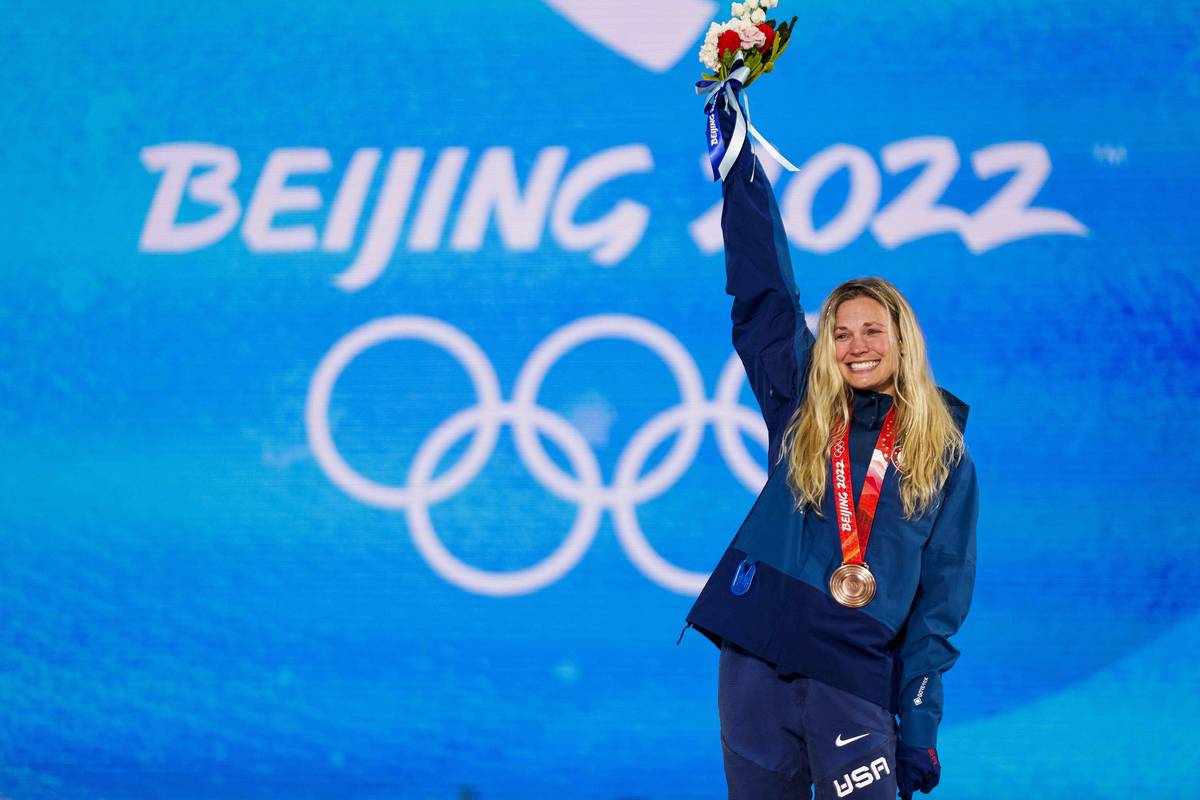
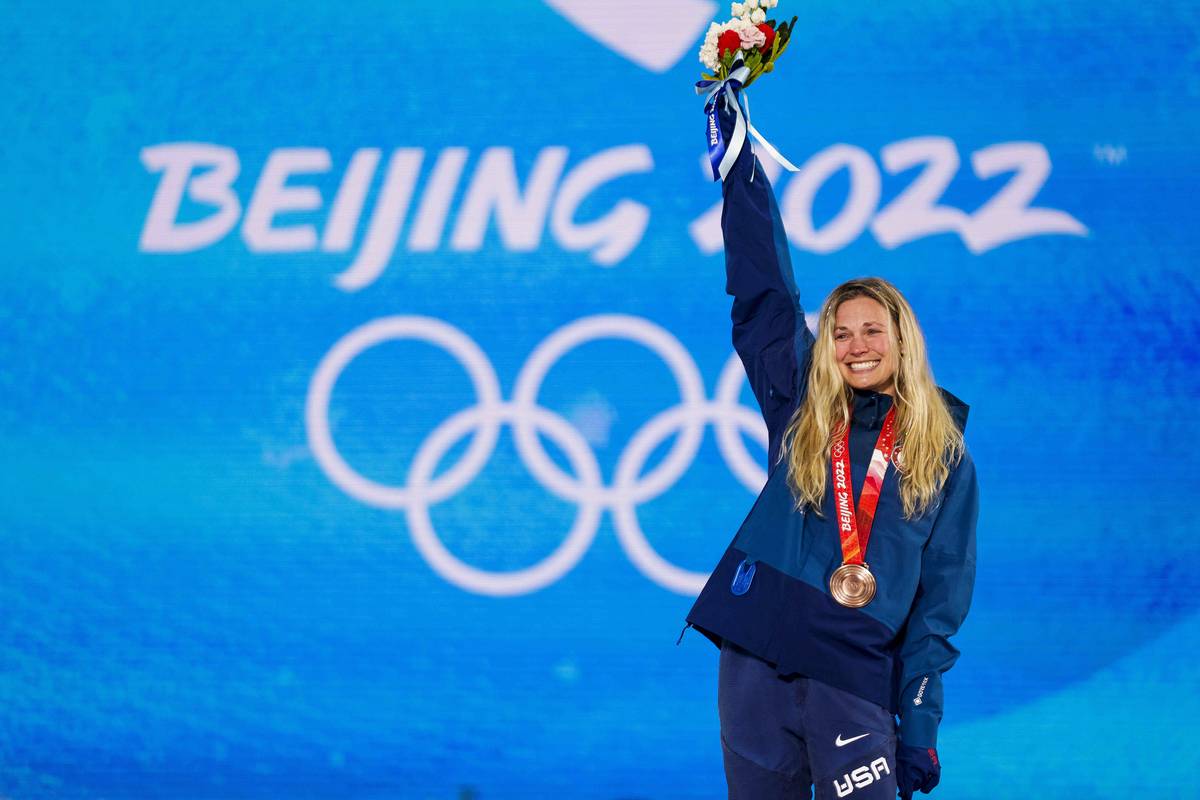
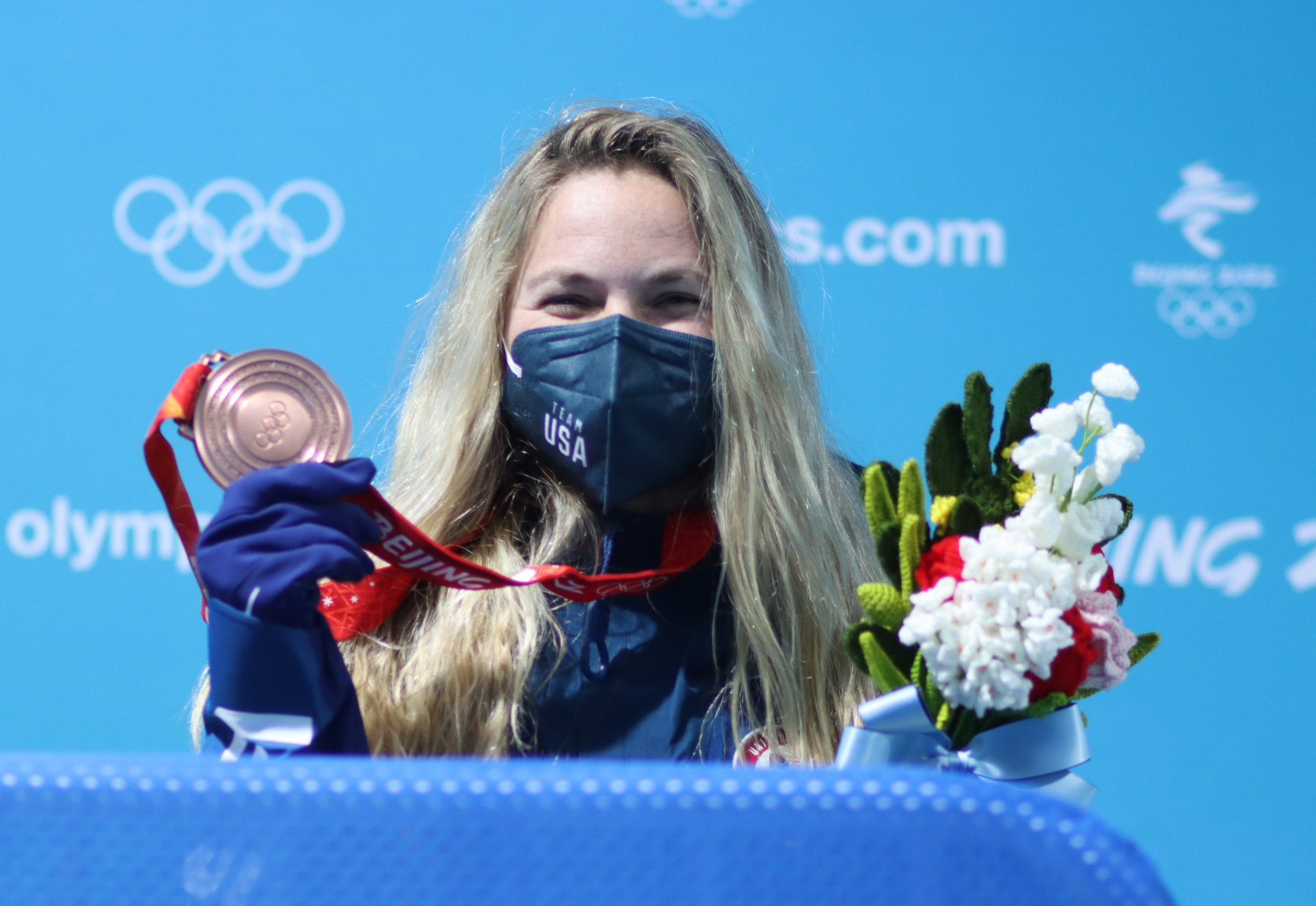
Jessie Diggins takes Olympic bronze in the individual freestyle sprint in Zhangjiakou. (Photo: NordicFocus)
Heading into the Olympics in February, Jessie Diggins received more media attention than ever before, landing on the cover of Sports Illustrated and having her profile featured on major news outlets like the New York Times. There was an entire category for her career highlights on the Olympic cross country ski tab on NBC’s Peacock streaming platform.
From all of the coverage focused on Diggins surrounding the Games, one comment in particular received attention and push back from the athlete community. The line in a February 8th story in the NY Times suggested that Diggins looked “like a sprite in her racing suit,” comparing her body to her competitors’ who had “massive shoulders and thighs.” It was seen as inaccurate, inappropriate, and potentially harmful to those reading it.
To discuss the topic of body comments in sports journalism and why they might be harmful in the broader scope of athlete mental health, the Nordic Nation podcast recently hosted a discussion among the panel of Rosie Brennan, Corrine Malcolm, Brian Metzler, and Nat Herz, who span the breadth of athlete and media representative. Following the conversation, FasterSkier received feedback that the topic had already been given enough attention, and it remained clear that there was not unanimous understanding of why commenting on athletes’ bodies was deemed problematic.
Seeking to add clarity to this side of the story, along with her own perspective as someone who has experienced an eating disorder and since become an advocate for awareness and support in that realm, Diggins reached out to FasterSkier asking to add her voice to the conversation.
To be clear, neither Diggins nor FasterSkier aims to “cancel” NY Times author Matthew Futterman, nor to attack the NY Times for running the comment. The purpose of this discussion was to consider how a comment on an athlete’s body might be triggering to a reader who is primed to fall into the eating disorder trap, and how writers, parents, coaches, and teachers can be mindful of the impact and importance of what they say.
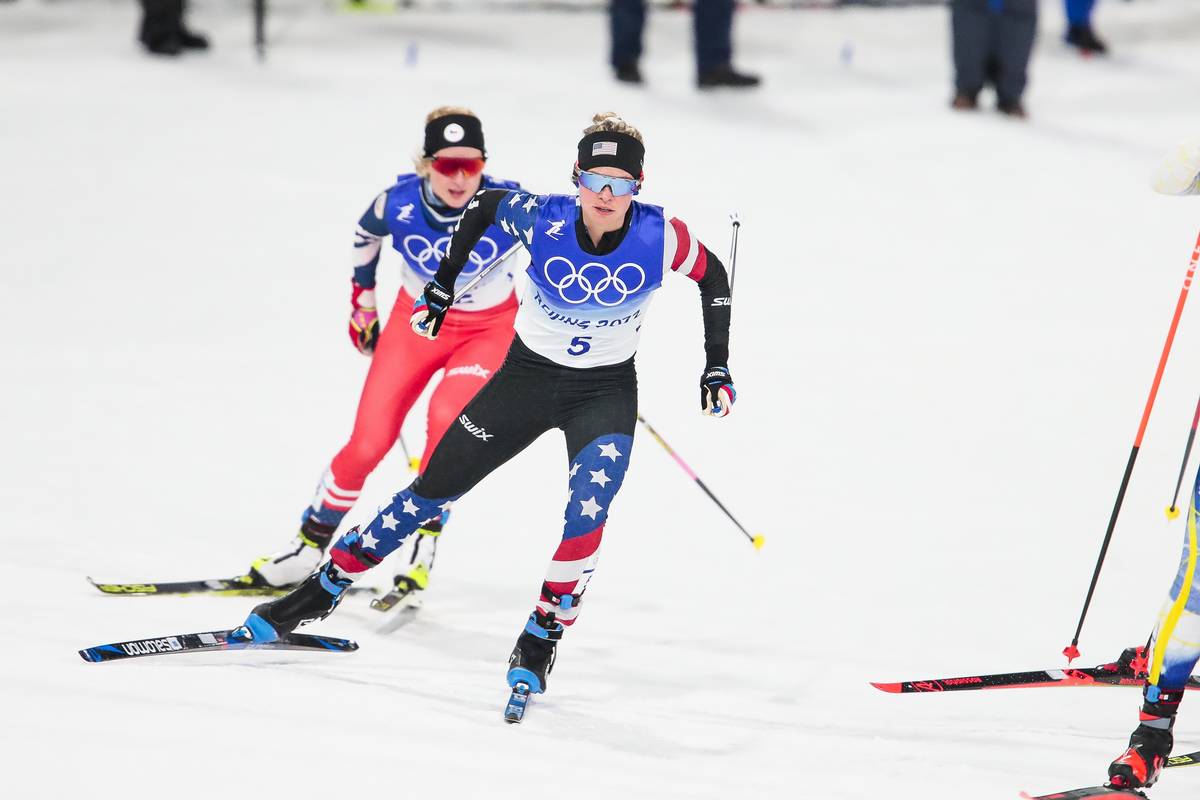
Jessie Diggins races through the heats during the Olympic freestyle sprint in Zhangjiakou, China. (Photo: NordicFocus)
Diggins also reflects on the 2021/2022 race season and what was an historic string of Olympic appearances. She discusses the success of the US Ski Team as a whole, in particular, the younger generation of athletes like Novie McCabe, Sophia Laukli, Ben Ogden, JC Schoonmaker, and Gus Schumacher, who have transitioned onto the World Cup over the last two seasons and earned spots on the 2022 Olympic Team.
Thanks for listening.
Additional Resources and Related Reading & Listening:
WithAll Foundation and the What to Say Campaign. As discussed in the episode, Diggins and Gus Schumacher participated in a live discussion with this organization on March 31st titled “What America’s Top Athletes Know About Health & Performance”, which can be viewed here.
The Emily Program: A leader in eating disorder treatment and outreach, and partner of Diggins’
FasterSkier also shared two OpEd pieces surrounding this topic, one from our own contributor Ben Theyerl and a second from reader Ivy Spiegel Ostrom, highlighting individual responses to the NY Times comment and underlying issues of body comments in the media, along with another separate OpEd by Rachel Bachman Perkins on the prevalence of eating disorders and disordered eating in sport.
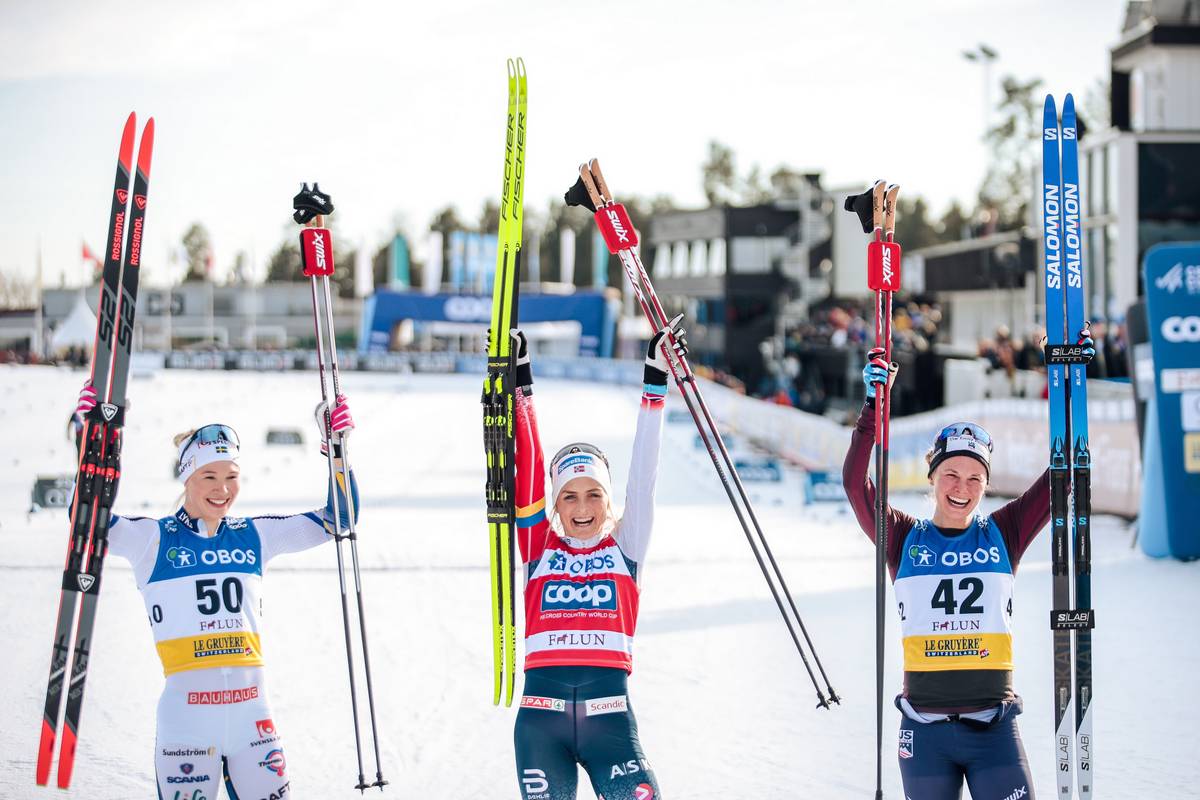
Jessie Diggins races onto the podium in the 10 k free during the 2021/2022 World Cup Finals in Falun, Sweden. Norway’s Therese Johaug took the win, with Sweden’s Jonna Sundling in second. (Photo: NordicFocus)
ZHANGJIAKOU — Patrick Moore is a cheerful accountant from Edmonton, Alberta. Tim Baucom spends his summers working sales for a Vermont plank flooring company. Oleg Ragilo runs a cosmetic shop in Estonia with his wife.
Jessie Diggins, the American cross-country ski star, couldn’t have won her Olympic bronze without them.
Jessie Diggins earns an Olympic bronze medal in the 1.5 k freestyle sprint. (Photo: NordicFocus)
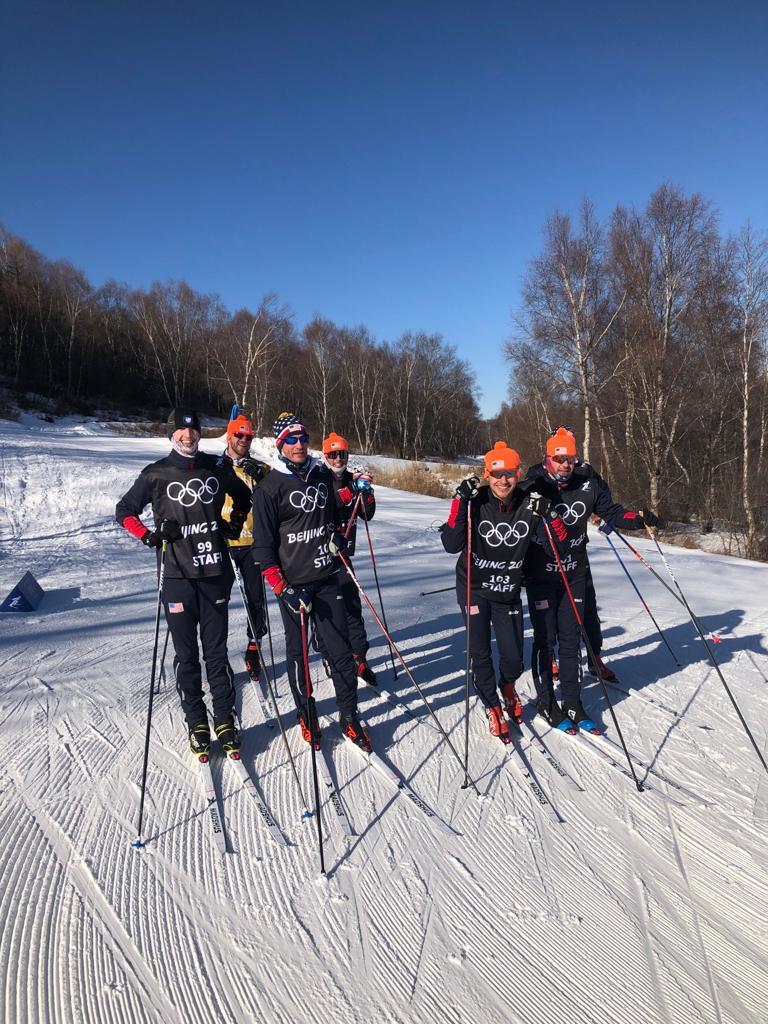
Moore, Baucom and Ragilo all belong to America’s nine-member ski service team here — a mix of mostly paid staff and a couple of volunteers like Moore.
“I can’t speak highly enough of their work ethic — they’ve been out here every single day, hours and hours and hours, probably skiing like 50 k a day,” Diggins said after finishing eighth Thursday in her third race of the Games. She added, referring to her medal-winning ski: “They delivered such a clutch performance the other night.”
The service crew is charged with the complicated, high-stakes work of choosing the right skis and wax for the snow conditions in Zhangjiakou, the mountain resort town outside Beijing where Olympic cross-country events are taking place.
The task sometimes can make the difference between an average day and a medal.
But the work, which happens in drab tan buildings off a corner of the stadium, is relatively anonymous — except when things go wrong.
“I think it’s sometimes hard for people at my regular job what I look like here,” said Moore, the accountant. “And it’s probably hard for people at this job to understand what I look like there.”
The U.S. wax staff arrives in Zhangjiakou. From left to right, Patrick Moore, Andrew Morehouse, Bjorn Heimdal, Tim Baucom, Chris Hecker, Jason Cork, and Eli Brown. (Photo courtesy fellow technician, Karel Kruuser)
The U.S. service team is composed of a mix of Americans and Europeans — including Ragilo, who previously waxed for superstars in Estonia and is something of a legend there.
To appreciate the crew’s work requires a quick lesson in ski technology.
Cross-country ski bases — the part that slides across the snow — are generally made of a plastic called polyethylene, or p-tex. The material has tiny pores, somewhat like a sponge, which means it absorbs wax that’s ironed or rubbed in by technicians; the excess can be scraped off to leave what appears to be a smooth plastic surface.
Manufacturers produce different waxes to help the skis slide faster in different conditions: warmer or colder, natural snow or man-made.
The waxes are typically layered, and they can be applied in different ways — ironed in, rubbed in with a corkor even a spinning wool cylinder attached to a drill, for example.
Technicians can also enhance the gliding potential of skis with metal tools that press tiny, intricate patterns into the bases, known as structure. Then there are the skis themselves, which are built stiffer or softer to suit snow conditions. American athletes each brought dozens of pairs to the Olympics — perhaps 300 total.
Sorting through each of those variables and identifying the best skis, waxes and structures takes hours and hours of testing. U.S. service team members arrived in Zhangjiakou a week before the first race, and got to work.
“None of us are scientists,” said Baucom. “But we just tinker around with all this stuff.”
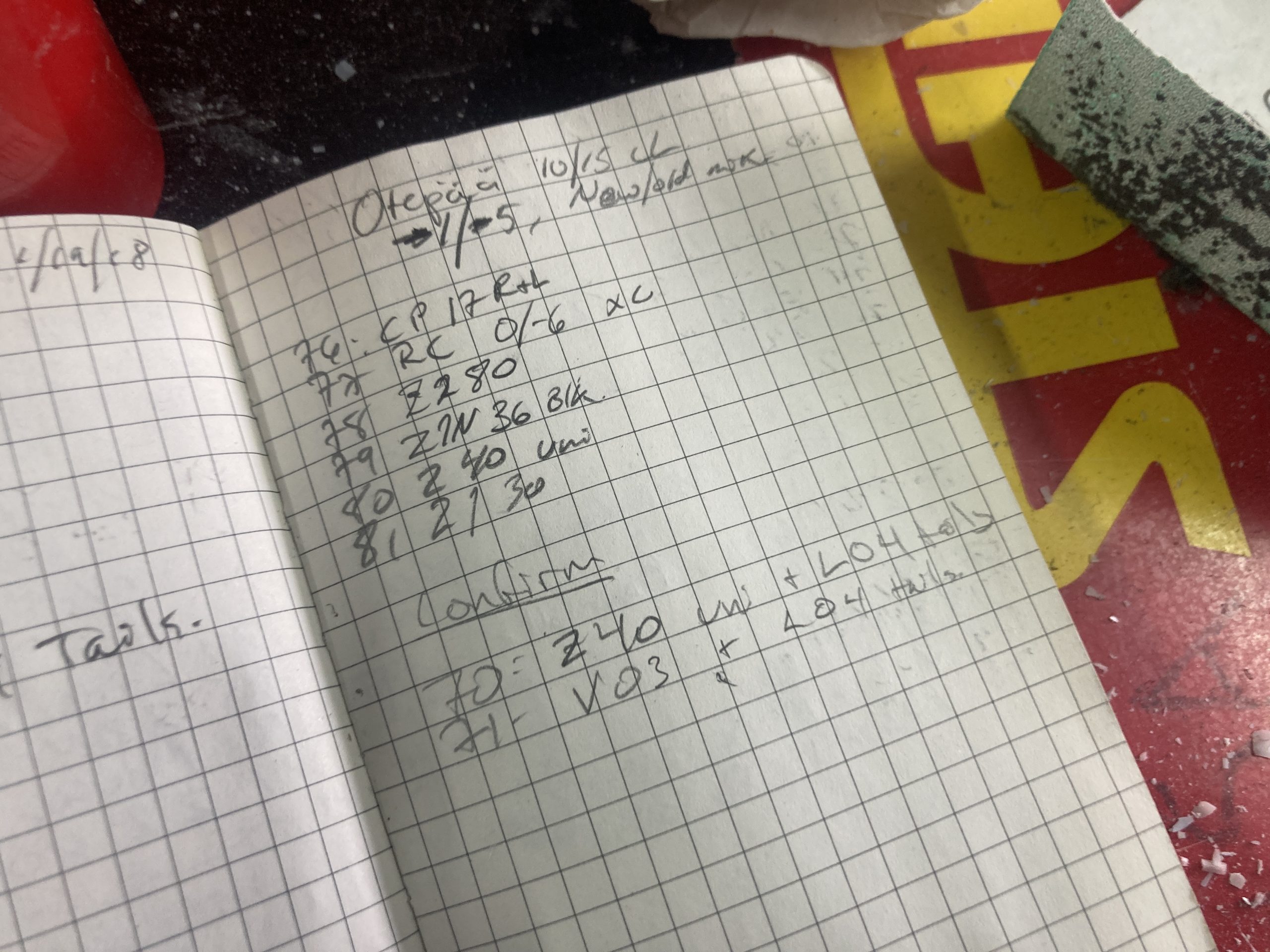
Old entries in a U.S. wax technician’s notebook keep track of the many iterations tested en route to a winning selection. (Photo: Nat Herz/FasterSkier-ADN)
The crew spends its first day or two skiing the race courses, setting up gear and getting a feel for the place. Then, they start testing the first layers of waxes and the best methods for applying them, as well as durability: How far can they ski before the wax starts losing potency?
Most of the testing is done by feel, with two technicians gliding down a hill, side by side, on two pairs of skis with different waxes to see which pair is faster. The American technicians can ski 30 kilometers a day or more; some or the Scandinavian teams with larger staffs have workers whose sole job is testing and can ski twice that far.
When race day arrives, the U.S. team may have tested 50 or 60 types of glide wax, and a similar number of kick waxes, which skiers use to grip the snow and push themselves uphill.
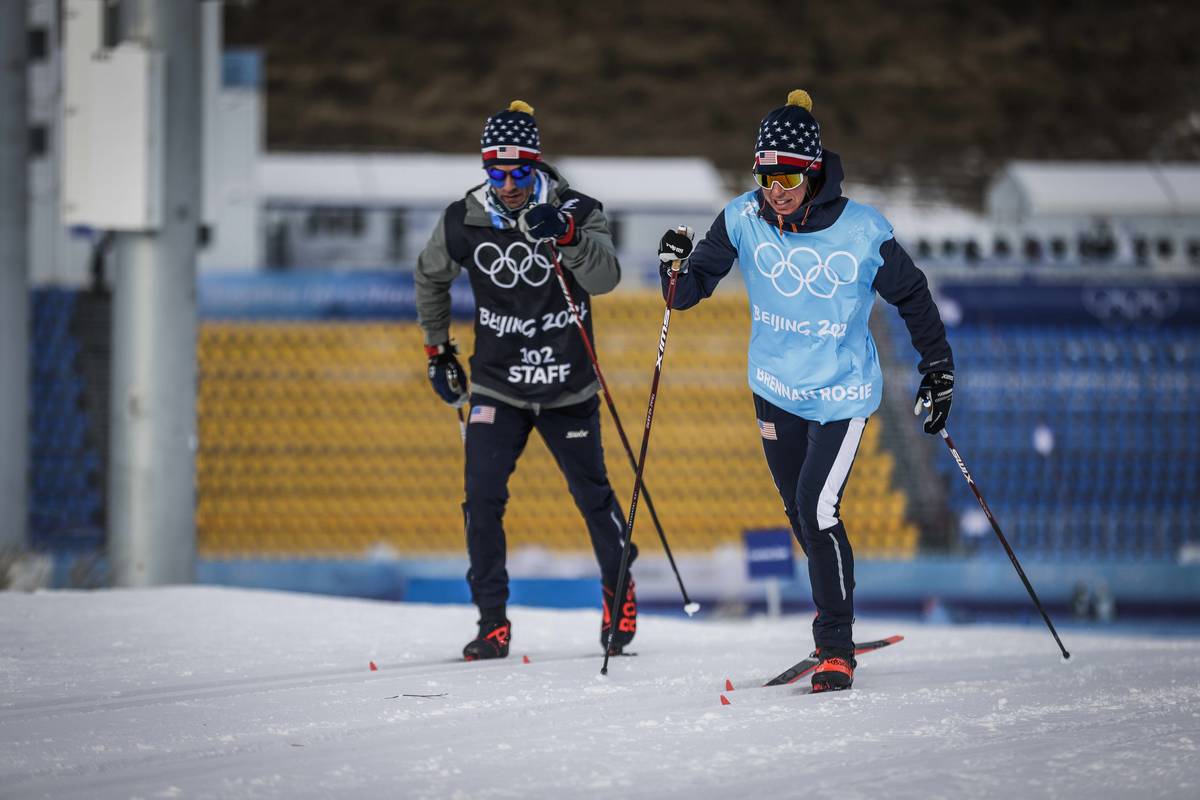
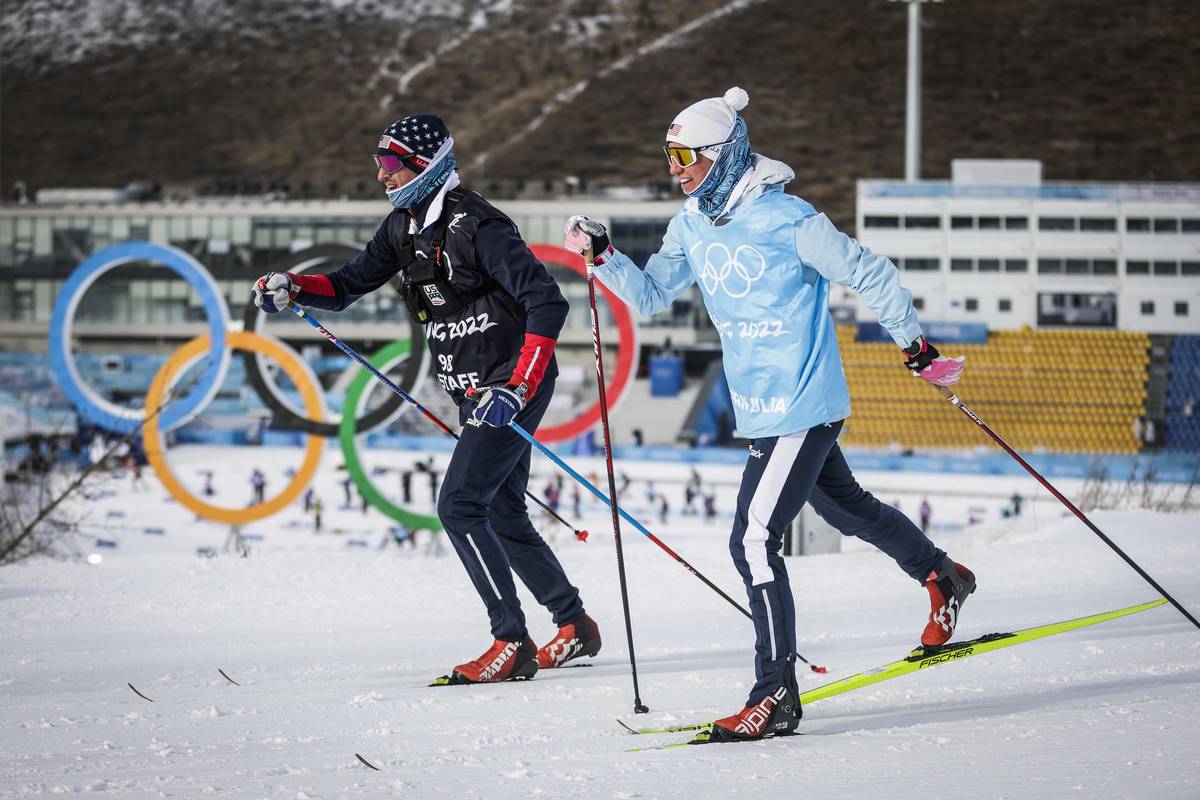
Olympic team staff test skis and wax Friday, February 4, 2022 at the Zhangjiakou National Cross-Country Skiing Center. (Nat Herz/FasterSkier-ADN)
They’ll narrow that number to perhaps 16 waxes to test in the hours before the gun goes off. Athletes, who are paired with the technicians, will also test a handful of pairs of skis before a race to see which are fastest.
The Americans aren’t typically expecting to find a magic bullet that makes their skis the best in the field, said Baucom, the U.S. team’s head of glide waxing in Zhangjiakou.
“You always want to have skis that are ridiculous, and make you look good,” he said. “But really, our goal is to have competitive skis. And it seems like in these conditions, as far as I can tell, almost every team has had pretty competitive skis.”
Rosie Brennan tests skis with her tech, Bjørn Heimdal, before the opening 15 k skiathlon. (Photo: NordicFocus)
The area is not far from the Gobi desert and gets minimal precipitation, so skiers are racing mostly on manmade snow. Before the Games, Baucom heard about storms that deposited sand on the trails that ruined skis.
But so far, he said, the skiing at the Olympics has been quite good, even if the snow is a little dirty and wears away wax a bit more quickly than usual.
“It’s not throwing us for a loop as far as being very different from other really cold, dry snow that we’ve raced on,” Baucom said. “It’s abrasive, but it’s not, like, crazy.”
Ski preparation at the elite level can be something of an arms race: On the European World Cup cup circuit, bigger teams, including the U.S., travel with huge trucks that have been outfitted as roving wax rooms at a cost of $500,000 or more. Those trucks, however, did not make the trip to Zhangjiakou.
Scandinavian teams spend more money on ski service and have bigger workforces, which can sometimes produce inequities. At the World Championships in Germany last year, the U.S. technicians had an especially tough day in the women’s pursuit race, where the skis they gave athletes were too slow to be competitive. Baucom described the feeling as “gut-wrenching” for the staff.
Julia Kern prepares for the 15k skiathlon with her wax technician, Eli Brown. (Photo: NordicFocus)
When things go wrong, the U.S. team will often collect skis after the race and retest, to see what went wrong.
At the Olympics, though, conditions have been stable and relatively straightforward for waxing, even after a flurry of fresh snow Saturday morning. So far, the American athletes have had few complaints.
“It feels good to know that everyone has a pretty fair shot,” Diggins said. “I’m just so grateful to our staff, because we win as a team.”
Jessie Diggins earns a historic bronze medal in the women’s freestyle sprint, becoming the first American woman to earn an Olympic medal in an individual cross country ski event. (Photo: Nat Herz/FasterSkier-ADN)
The first.
With a perfect storm of tactics, technique, and peak race form, Jessie Diggins fought to the line to finish third behind Swedish sprint phenoms Jonna Sundling and Maja Dahlqvist in the women’s 1.5-kilometer freestyle sprint. This historic result makes her the first American woman to win an Olympic medal in an individual cross country ski event.
“It’s overwhelming, but in a good way,” Diggins said in the press conference. “It’s just really emotional for me because this really belongs to the whole team. It has taken so many years to get here, to have us come and have an individual medal. And that’s something that doesn’t happen alone. It doesn’t happen without a lot of help. So I’m just so thankful for our team – it’s been a lot of people working really hard for a long time.”
Her bronze medal adds to a collection started in 2018 when she won gold with Kikkan Randall in the freestyle team sprint in PyeongChang. Diggins is now the second American in history to win an individual Olympic medal in cross country skiing, the first was Bill Koch who earned silver in the 30 k during the 1976 Games in Innsbruck, Austria. She is the only American cross country skier to earn multiple Olympic medals.
Diggins entered the 2022 Games as a medal favorite, with the eyes of the media creating undeniably feeding external pressure and expectations. To handle these pressures, Diggins’ approach was quite different from the “eye on the prize” medal-focus one might expect.
“For me, it was just important to make sure I could still focus on the process. And so I wasn’t focused on winning, I wasn’t focused on metals, I was just focused on doing my best every single day. So I could come here prepared and happy and in a good place.”
And it worked.
Click a photo to view as a slideshow.
Jessie Diggins (Photo: NordicFocus)
Jessie Diggins (Photo: NordicFocus)
Jessie Diggins (Photo: NordicFocus)
Jessie Diggins (Photo: NordicFocus)
Swedish Women Earn Silver and Bronze
In their first Olympic appearance, Sweden’s Jonna Sundling and Maja Dahlqvist went one-two in the freestyle sprint.
For those who have followed the sport over the last Olympic cycle, seeing these women atop the podium was no surprise. The two were partners in the freestyle team sprint during the 2021 World Championships in Oberstdorf, Germany, where they controlled the race from the front, adding a final surge to take the win ahead of Switzerland and Slovenia.
It might have been more surprising for them not to have earned these medals.
Click a photo to view as a slideshow.
Jonna Sundling (SWE) (Photo: NordicFocus)
Maja Dahlqvist (Photo: NordicFocus)
The women’s freestyle sprint podium (Photo: NordicFocus)
Maja Dahlqvist (SWE) (Photo: NordicFocus)
Jonna Sundling (SWE) (Photo: NordicFocus)
Klæbo, Pellegrino, and Terentev Collect Men’s Medals
The men’s sprint also saw familiar names earning gold and silver medals.
Norway’s sprint champion Johannes Høsflot Klæbo put on a thrilling show to bring home a gold medal in the men’s freestyle sprint, defending his 2018 Olympic title. His day nearly ended in the semifinal, when he laid off the gas before the line, taking second to Italy’s Federico Pellegrino, with the third and fourth skiers in the heat crossing the line just 0.14 and 0.18 seconds behind him. Had he not been in the top two, he would not have moved on to the final round.
Since his Olympic gold in 2018, which was contested classic, Klæbo won the freestyle sprint in the 2019 World Championships in Seefeld, Austria, repeating his victory in the classic sprint during the 2021 World Championships in Oberstdorf, Germany. He has won 40 World Cup sprints since he stepped up to that level at 20-year-old in 2017.
Earning silver was a man who has become accustomed to standing next to Klæbo on the podium. Italy’s Pellegrino earned the silver medal in the 2021 World Championships in Oberstdorf, after winning the freestyle sprint in 2017 during the World Championships in Lahti, Finland, before Klæbo’s rise to stardom. Pellegrino also earned silver during the 2018 Olympic Games in PyeongChang, again standing beside the young Norwegian.
With a World Cup podium resume that dates back to 2011, Pelle has long been a freestyle sprint contender at the international level. Despite a slow start to the current season, it would have been unwise to rule him out as a medal favorite in Beijing.
Click a photo to view as a slideshow.
Johannes Høsflot Klæbo (NOR) (Photo: NordicFocus)
Johannes Høsflot Klæbo (NOR) (Photo: NordicFocus)
Federico Pellegrino (ITA) (Photo: NordicFocus)
Federico Pellegrino (ITA) (Photo: NordicFocus)
Federico Pellegrino (ITA) and Johannes Høsflot Klæbo (NOR) (Photo: NordicFocus)
At 22-years-old, Alexander Terentev (ROC) added a fresh face to the podium. Terentev made headlines after upsetting Klæbo in the opening World Cup sprint in Ruka, Finland last November, winning the qualifier and continuing through the rounds to beat the Norwegian at his own game: the sit and kick. His power was unmatched on the day, bringing to the line a ski length ahead of Klæbo for the win.
Terentev is the 2021 U23 World Champion in the classic sprint, though his win in Ruka is his only World Cup podium – for the time being.
Click a photos to view as a slideshow.
Alexander Terentev (ROC) (Photo: NordicFocus)
Alexander Terentev (ROC) (Photo: NordicFocus)
Adding to the excitement of the medal ceremony, athletes enjoyed live musical performances that echoed through the amphitheater.
This World Cup coverage is made possible through the generous support of Marty and Kathy Hall and the A Hall Mark of Excellence Award. To learn more about A Hall Mark of Excellence Award or to learn how you can support FasterSkier’s coverage please contact info@fasterskier.com.
The History:
A survey of the last five Olympic cycles shows a clear trend in American women’s sprint results: upward. In the 2002 Games in Salt Lake City, no Americans qualified in the freestyle sprint. Tessa Benoit was the top qualifier in 38th, with an up-and-coming Kikkan Randall next for Team USA in 44th. Randall was then 20 years old.
In the freestyle sprint four years later in Torino, Randall was the only American to qualify for the heats. She was 10th in qualification, then moved to 9th in the final standings. Switching to classic for the 2010 Games in Vancouver, Randall again qualified in 10th to be the only American in the heats, this time racing her way up to eighth.
And then there was Sochi.
The 2014 Games in Sochi were a turning point for the American squad, with all four women qualifying inside the Top-30 in the freestyle sprint. This time, a new name topped the list for qualification: Sophie Caldwell in 9th. Not to be overlooked, USA also had Jessie Diggins 12th, Kikkan Randall 18th, and Ida Sargent 25th.
Racing in her first Olympiad, Caldwell (now Hamilton) entered uncharted territory as she won her quarterfinal to advance into the semis, which she finished in a thrilling boot slide to be 0.1 seconds behind heat winner Ingvild Flugstad Østberg of Norway. Though she crashed in the final, she again moved the needle upward for the Americans by finishing sixth in the final heat.
The remaining American women also finished inside the Top-20, though none made it beyond the quarterfinals. Diggins was 13th, Randall 18th, and Sargent 19th.
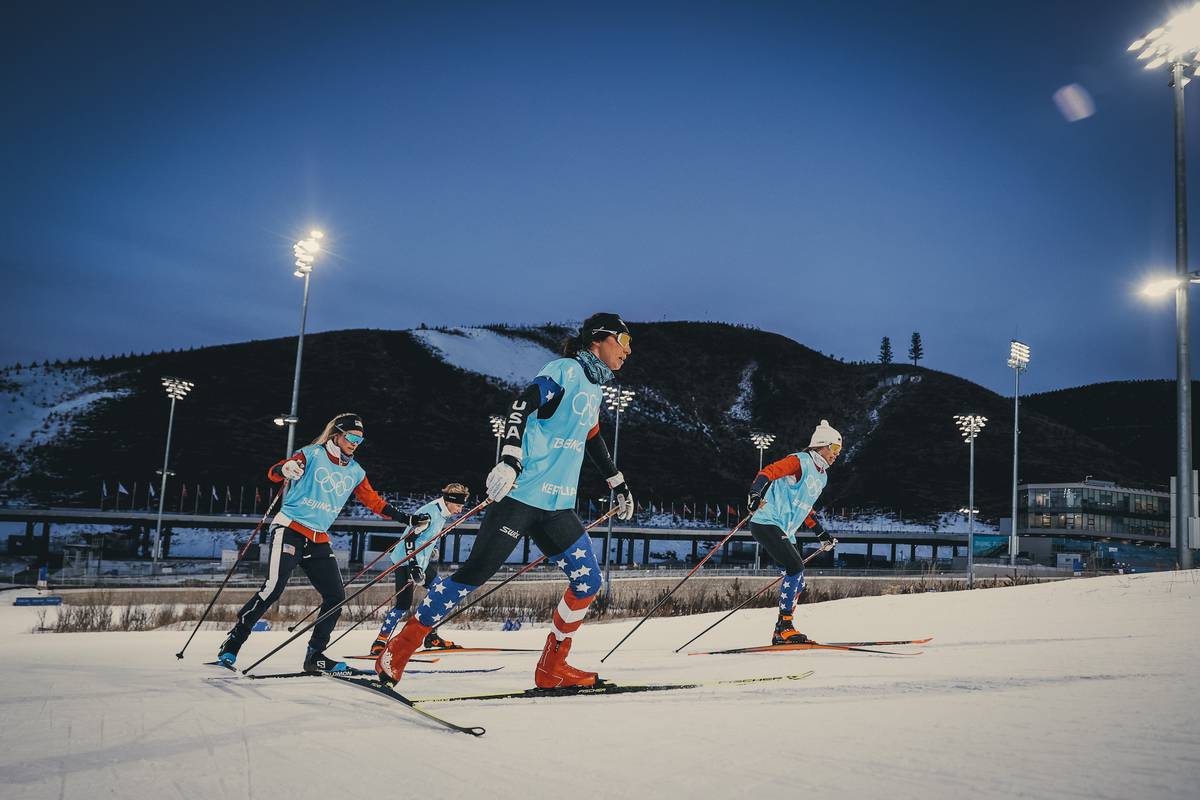
The American women’s sprint team prepares for the individual freestyle sprint. (Photo: NordicFocus)
Carrying momentum from these Games through the next Olympic quad, the Americans had three women in the Top-30 for the classic sprint in PyeongChang in 2018, with Sargent just outside in 33rd.
This time it was Diggins in 7th – the top Olympic qualification result of any American woman – with Sadie Bjornsen 9th, and Caldwell 12th.
Despite it being her weaker technique, Diggins raced with confidence, landing in second in both her quarter and semi to advance automatically into the final. Losing touch with the leaders, Diggins repeated Caldwell’s historic result to finish 6th overall.
Perhaps a less apparent victory, Caldwell also raced into the semis, finishing 8th overall after taking third in her semi and missing a lucky loser spot in the final by just 0.18 seconds. Bjornsen was eliminated in her quarter after taking third in her quarter, on the wrong side of the lucky loser mark, but just barely, to end her day in 14th.
Fast forward four years and get excited.
Rosie Brennan (USA) on her way to the 2nd fastest time during qualification. (Photo: NordicFocus)
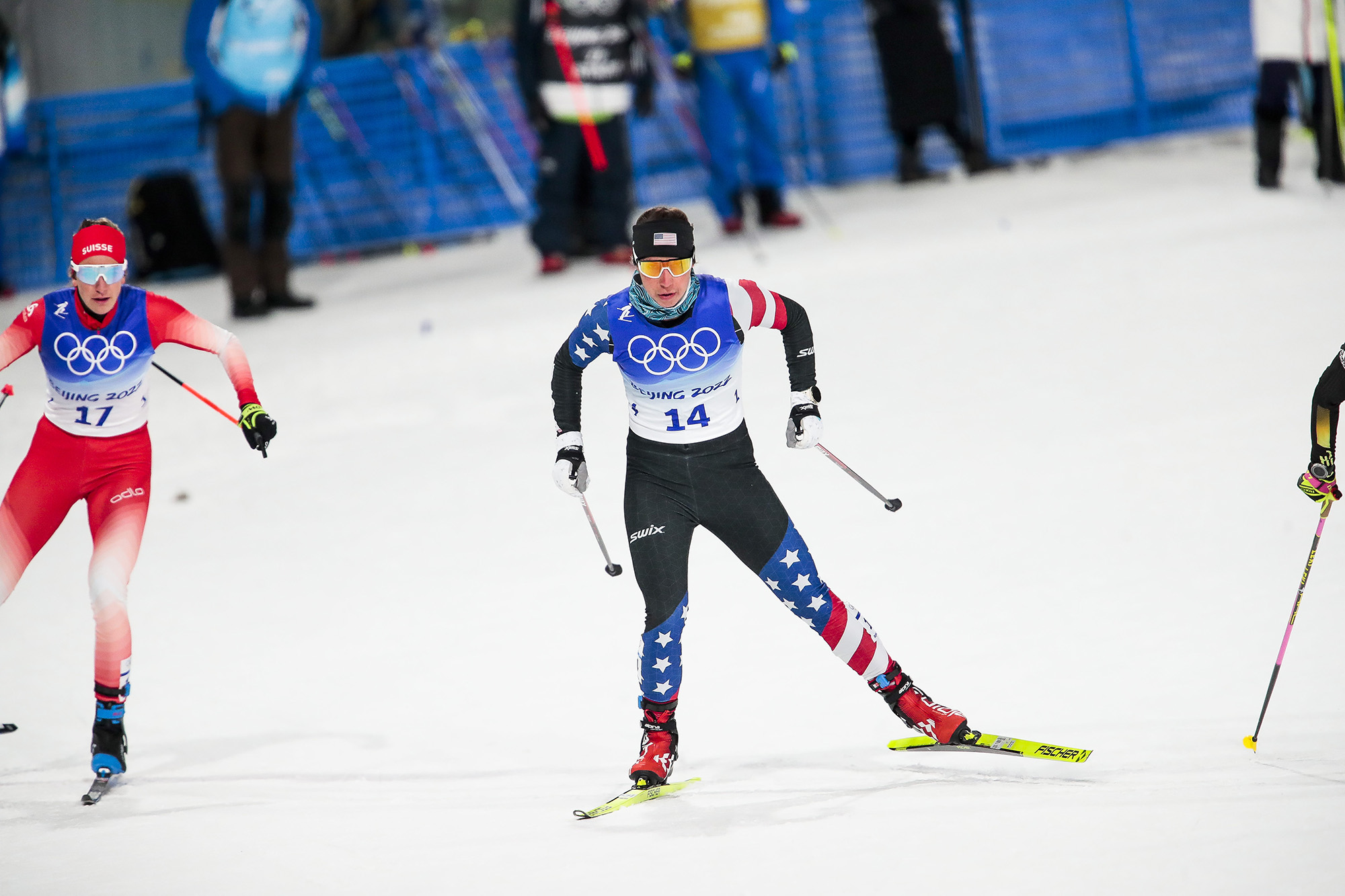
Sweden’s Jonna Sundling smashed the qualification round of the 1.5-kilometer freestyle sprint, setting the mark at 3:09.03. The next name on the list? Rosie Brennan in second (+5.80), ahead of Nadine Fähndrich (SUI) in third (+6.62), Yulia Stupak (ROC) fourth (+7.98), and… Diggins in fifth (+8.69).
Have you been reading closely? Both Brennan and Diggins both exceeded the previous best result in qualification from any American woman in history.
Also posting a strong qualifier, Julia Kern was 14th in qualification (+11.66), rebounding from Saturday’s skiathlon which left her wanting more. The final American starter, Hannah Halvorsen, finished 43rd (+20.10) in qualification – outside the Top-30, but still above Randall’s result from her first Olympic Games 20 years ago.
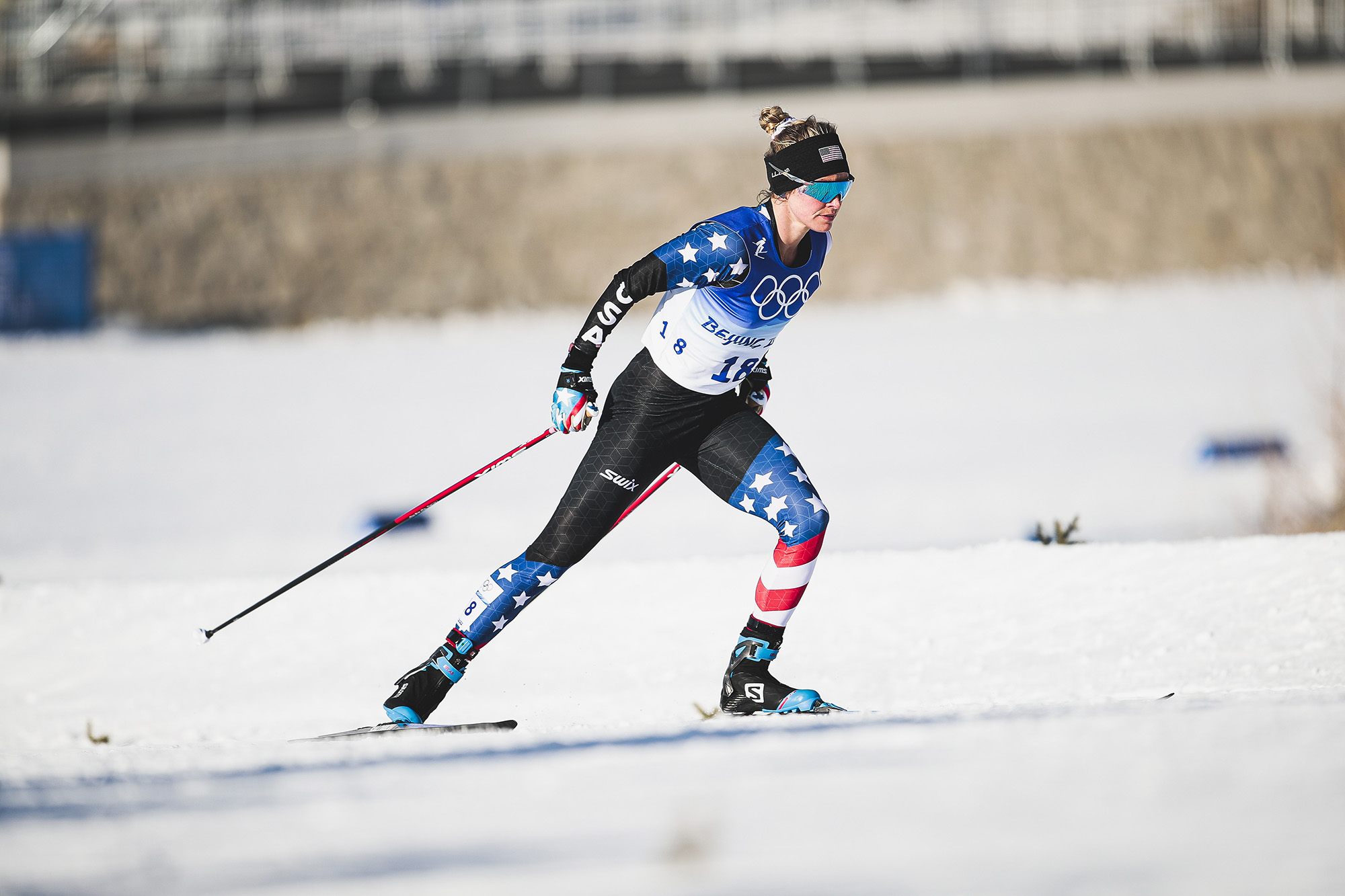
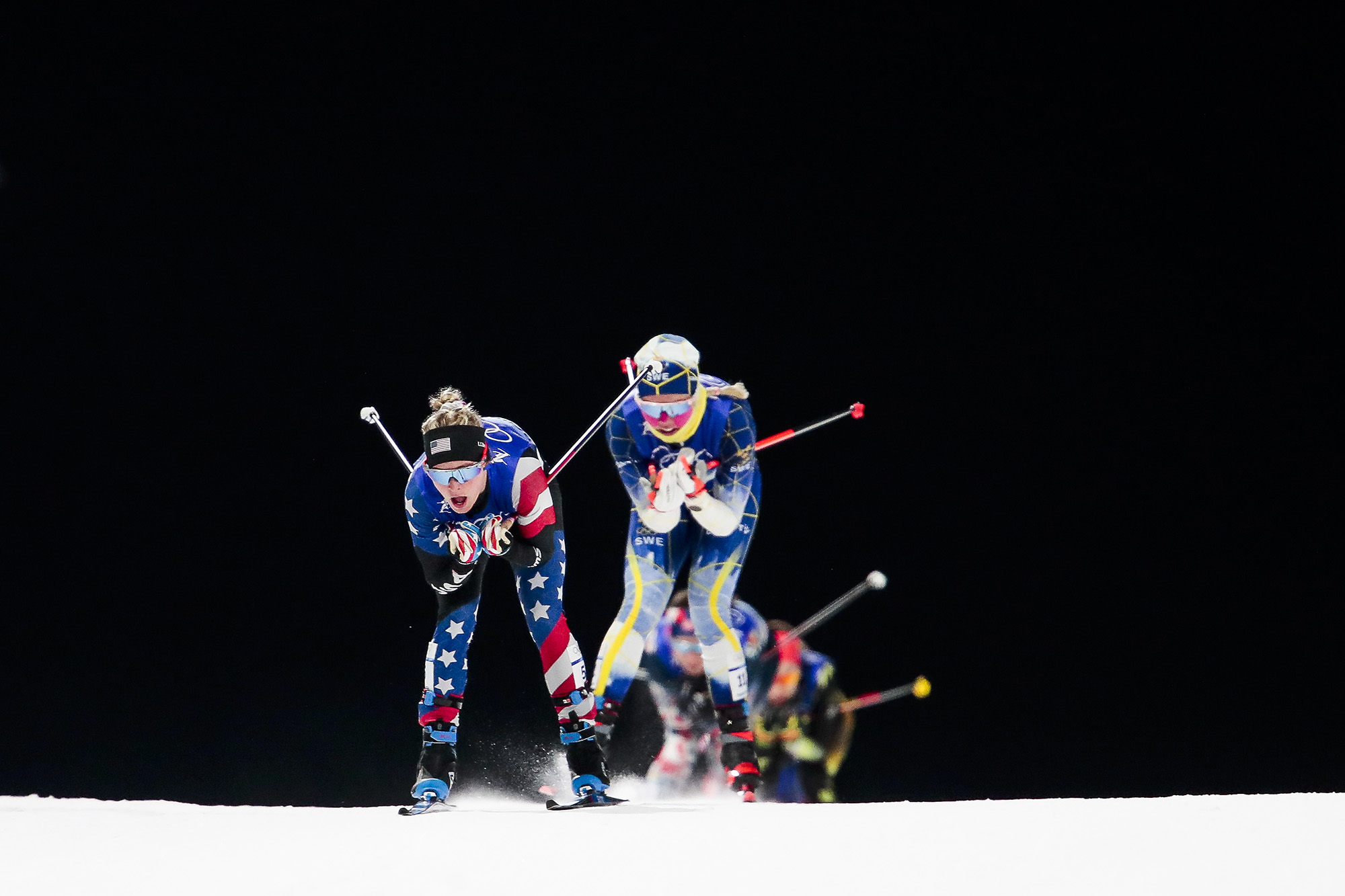
Jessie Diggins (USA) skis the 5th fastest time during qualification. (Photo: NordicFocus)
You may be wondering about the spread of times; the top-10 were nearly 11 seconds apart. After a quick descent out of the stadium, the course in Zhangjiakou features a 30-meter climb – nearly 100 vertical feet – followed by a sweeping downhill that leads back toward the stadium. From there, athletes face a 14-meter climb back into the stadium, finishing with a gradual rise to the line. Combined with cold dry snow, these factors can contribute to an above-average spread amongst the top qualifiers.
Here we go: the heats.
Brennan lined up alongside Sweden’s Sundling in the first quarterfinal heat. With nerves running high, a false start brought the six women back into the gate after the first starting beep. On the second go, the women pushed through the wands cleanly, but on one of her first doublepole pushes, Brennan caught the edge of her boot, dropping down to her knees and losing any momentum she had picked up as the field rocketed away from her.
Not willing to let the day end there, Brennan collected herself and focused on the task at hand, regaining contact with the group at the bottom of the climb and grinding her way into second position, looking strong as she crested the top of the hill just behind Sundling and rounded the curve to head into the descent.
After stumbling out of the start, Rosie Brennan (USA) charges back to the front of her quarterfinal heat. (Photo: NordicFocus)
Given the effort required for such a comeback, would there be enough left in the tank for the B-climb or had the matches been burned early? With Sundling holding steady in the lead Brennan was challenged by Slovenian sprint champion Anamarija Lampic as the women pushed up the final climb, but found another gear for a commanding second-place finish, +2.4 behind Sundling, but +0.7 ahead of Lampic, who would advance as a lucky loser.
The second heat featured medal favorite Maja Dahlqvist of Sweden, who qualified in sixth. Norway’s Tiril Udnes Weng set the pace, leading up the A-climb with Dahlqvist alongside, and Russia’s Natalia Nepryaeva on their tails. Powering out of the B-Climb, Dahlqvist held the advantage at the front, while Nepryaeva and Weng slid over the line in a photo finish for second and third. A closer look showed Weng’s boot accelerate as she reached forward, just in time to nip Nepryaeva at the line by 0.03 seconds for the automatic advancement to the semifinal. The second heat was six seconds slower than the first, leaving Nepryaeva out of the running for a lucky loser spot.
A fast third heat saw Nadine Fähndrich of Switzerland and Maiken Caspersen Falla advance automatically, pulling Germany’s Victoria Carl over the line as the second lucky loser.
Dancing and smiling in the start gate, Diggins got out with a clean start, positioned near the front and looking powerful as the women headed into the downhill curve out of the stadium. Around this curve, she was pushed to the outside as she skied defensively to dodge potential snags with the other skiers’ equipment, leaving the curve near the back of the pack.
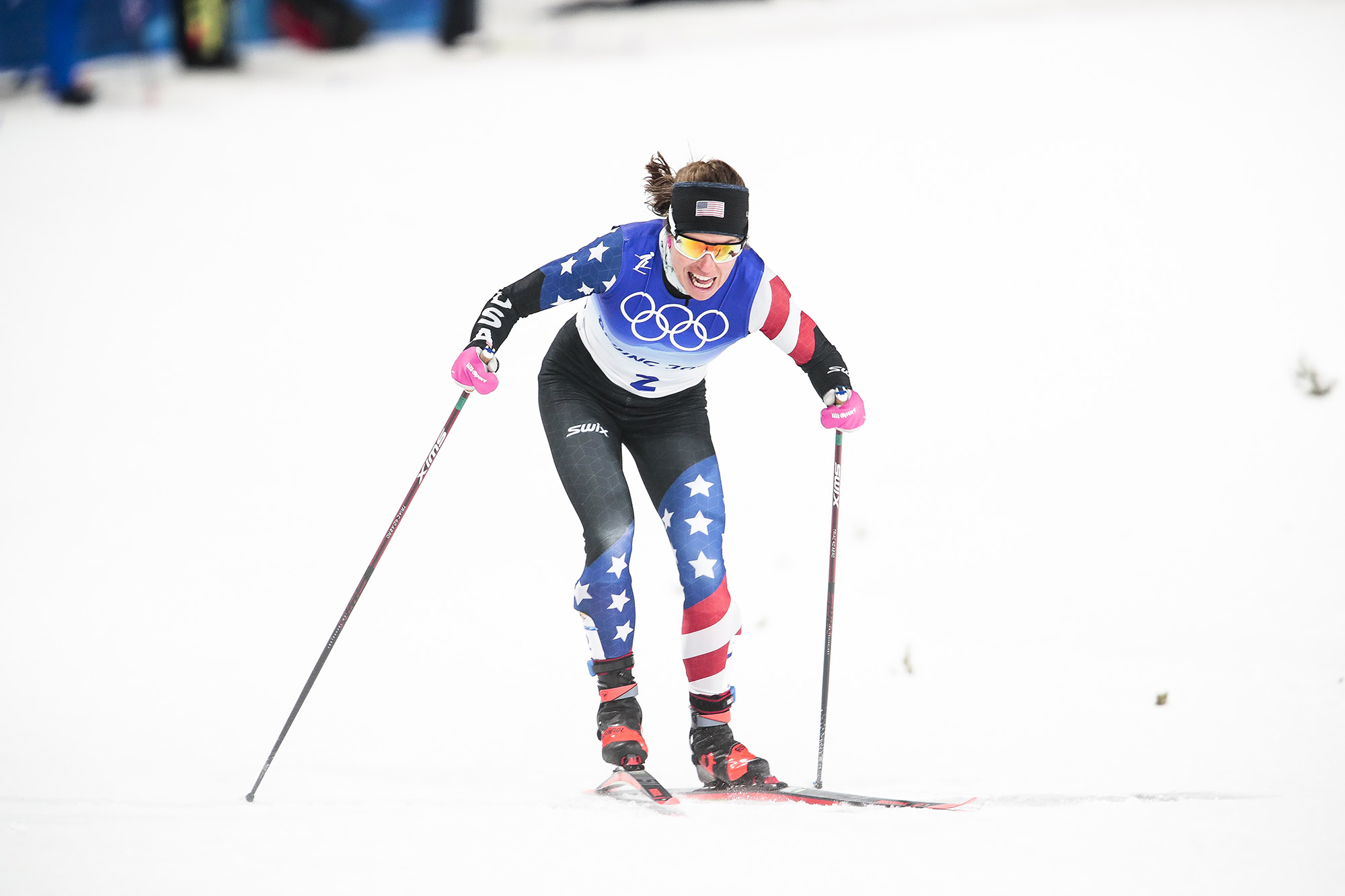
Jessie Diggins (USA) leads Emma Ribom (SWE) in the early rounds. (Photo: NordicFocus)
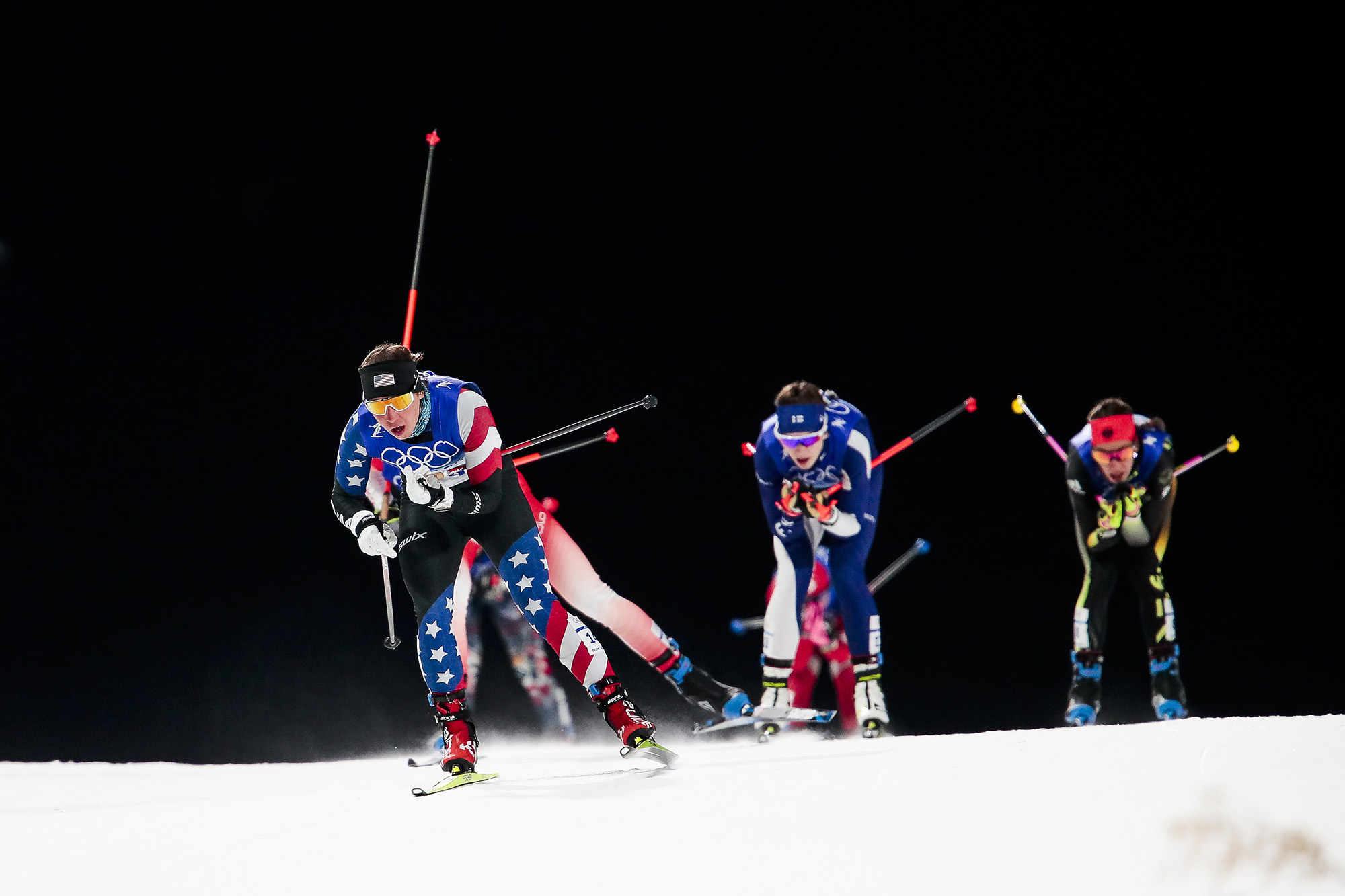
Then, Diggins put on a show up the climb. Steadily moving up along the outside, she was perfectly balanced in a crisp V2 while other were in V1, catching the Swedish leader Emma Ribom. Leading over the top, Diggins kept the pace high to take the sting out of other sprinters. Carrying momentum out of the descent and again holding a strong V2 up the B-Climb, Diggins carried her lead through the finish to win by over 2 seconds, with Ribom next. There was no doubt that Diggins was looking good heading into the semi.
In the final quarter, Julia Kern pushed the pace in the first half, positioning herself in the lead as the pack headed out of the climb. She held her position through the downhill and around the hard right turn, carrying momentum into the hill. Perhaps paying for her efforts early on, Kern was dropped on the final climb as Veronika Stepanova (ROC) and Sofie Krehl (GER) broke away before heading into the stadium. Kern kept herself in the fight, staying in contact with Alina Meier (SUI) through the false flat to the finish, but ended up fourth in the heat, +3.5 back from the leader and behind the mark needed for a lucky loser spot in the semis. A gusty and tactical performance in her first Olympic sprint appearance.
Julia Kern (USA) led her quarterfinal early during the individual freestyle sprint. (Photo: NordicFocus)
To regroup: we now have two Americans in the semi, matching the previous best result from 2018.
Lining up in the first heat of the semis, Brennan got out of the start smoothly, tucking into the back of the back to safely descend out of the stadium and carry momentum out of the left-hand bend and into the A-climb.
Following the effective, albeit unforeseen, strategy from her first round, Brennan pushed her way up the A-Climb, moving from sixth place into the lead. The American kept the effort high as she pulled Sundling, Dahlqvist, Fähndrich. Brennan charged the downhill, stepping powerfully around the right hand bend to head into the B-climb at high speed. In the second climb, the two Swedes, Sundling and Dahlqvist, worked their way around Brennan, with Fähndrich also accelerating. No relief until the finish, Brennan did not let up in the undulating terrain that follows the B-climb, rounding the final curve in fourth place just behind Dahlqvist.
After setting a fast pace for the heat, Rosie Brennan finishes fourth in her semifinal to advance as a lucky loser. (Photo: NordicFocus)
Sundling stretched out the spread of the top-four in the final stretch to take the win in 3:11.94, with Fähndrich second, Dahlqvist third, and Brennan fourth, +1.35 behind Sundling. Brennan’s efforts to keep the pace hot contributed to a lightning fast heat, with Sundling’s time nearly four seconds faster than the top finish in the quarterfinal. This left Brennan in good standing for a lucky loser spot in the final, but she would need to hold her breath to see what the second heat would decide.
The second semi was quick out of the gate, with Sweden’s Ribom leading up the start of the A-climb. Diggins was comfortably tucked into the pack, beginning to set her race plan into action as she V2ed steadily up the side of the track, holding her form longer than the others as she moved into the lead. Nearing the high point, Diggins switched to a rapid tempo V1 with Norway’s Falla matching pace to head out of the climb in first and second.
Diggins sat in a low tuck at the front, stepping around the sweeping left-hander and heading into the B-Climb with Ribom and Falla trying to match pace and challenge at the front. Ribom moved ahead near the top of the climb to lead into the final curve. Diggins sat on the Swede’s tails, with Stepanova alongside. A bobble zapped some of Diggins’ momentum and could have been devastating, but the American kept her composure and stayed upright, staying in contact with Ribom as they headed into the finish lanes.
With Ribom in the lead, Diggins powered toward the finish line to secure a second place auto-qualifier spot for the final. She crossed the line +0.4 behind Ribom’s mark of 3:15.22, with Falla and Stepanova crossing in third and fourth a few meters back.
As the second heat times were roughly four seconds slower than the first, Brennan could let out a sigh of relief. The second lucky loser spot was now hers.
And now, we watch history unfold. Two American women in the final, as Brennan and Diggins set a new mark for the stars and stripes.
The final lineup saw Sundling, Dahlqvist, and Ribom racing for Sweden, alongside Diggins and Brennan, with Fähndrich representing Switzerland in red.
Emma Ribom (SWE), Nadine Faehndrich (SUI), Rosie Brennan (USA) and Maja Dahlqvist (SWE), (l-r) get up to speed at the beginning of the women’s individual sprint final. (Photo: NordicFocus)
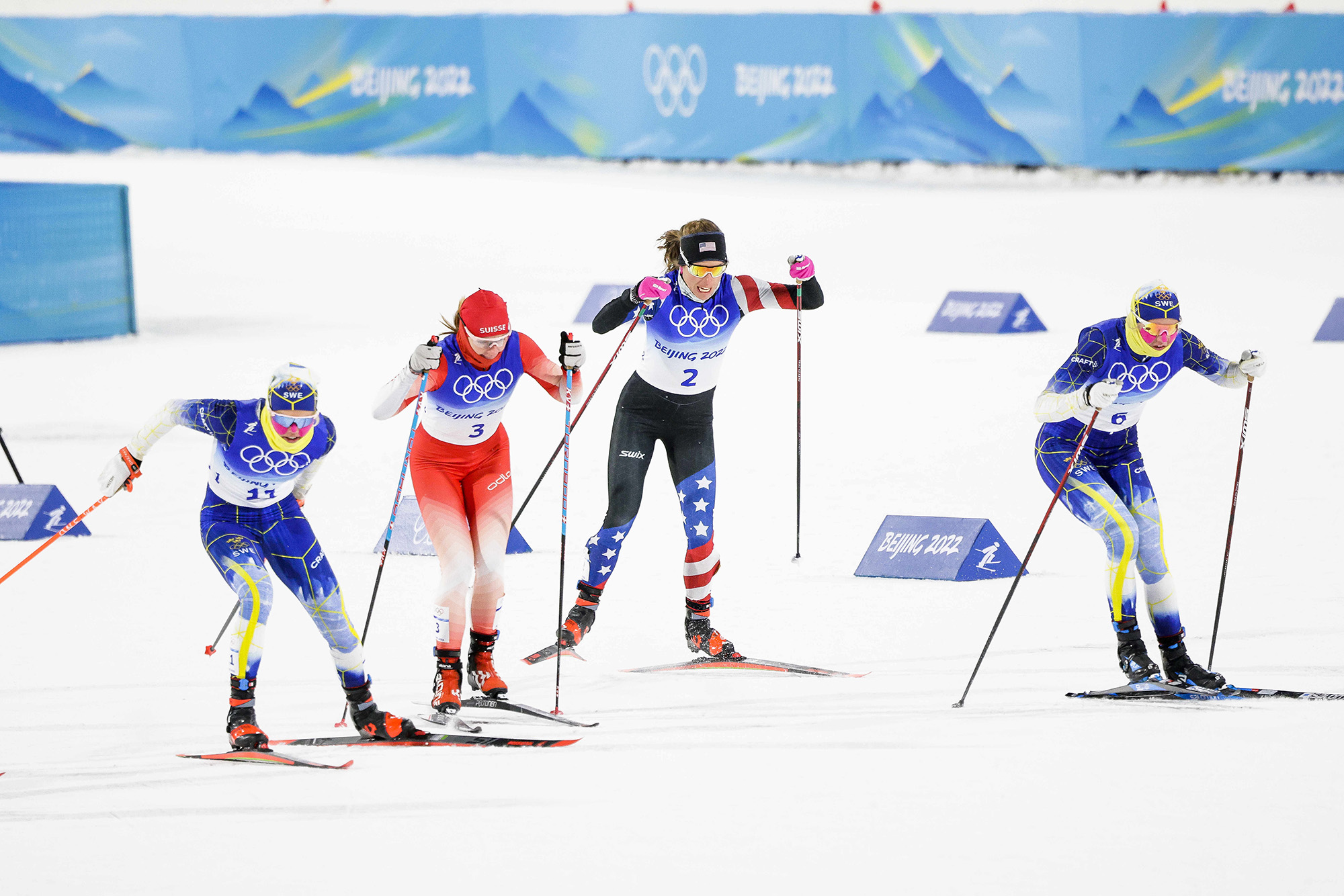
Taking charge from the start, Sundling skied with authority, smoothly leading her teammates Dahlqvist and Ribom up the A-climb to put Sweden in first through third heading out of the climb. Diggins was fourth as they crested the high point, with Fähndrich on her tails and Brennan just behind.
Utilizing the speed of her skis and her strength in the downhill, Diggins moved up alongside the Swedes in the descent, looking for position heading into the final climb. Maintaining her command of the race, Sundling rocketed off the front to gap the remaining five women who all remained in contention for a medal leaving the climb.
Ribom quickly fell off the pack, leaving Dahlqvist leading a tight group of four over the undulating terrain that led to the final bend before the stadium. Diggins and Brennan looked to be boxed out as they headed around the final curve in third and fourth, respectively, but the Americans were patient versus panicked, which could put them at risk of a fall.
Coming out of the curve, Diggins accelerated around Fähndrich to challenge Dahlqvist for the silver medal. Brennan followed her teammate to surge past the fading Swiss athlete, setting the stage for a three-way sprint for two podium positions.
Sundling had gold on lock, nearly three seconds ahead as she crossed the finish line in 3:09.68.
Jonna Sundling (SWE) with a commanding victory in the individual freestyle sprint comes to the finish with Rosie Brennan (USA) in the background on her way to fourth. (Photo: NordicFocus)
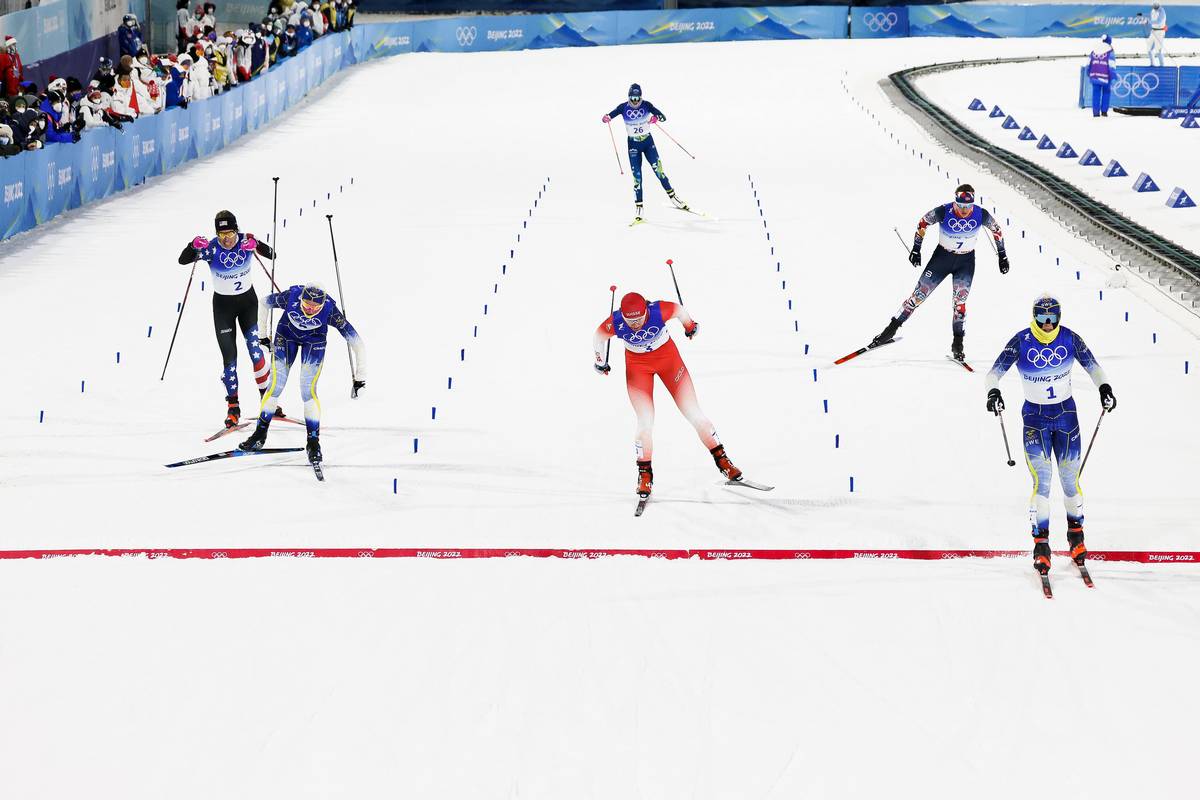
In her wake, Dahlqvist and Diggins were taking it to the line, with the Swede carrying a slight advantage in the final meters. Still, with Brennan close behind and both Fähndrich and Ribom off the back, the Americans were almost guaranteed their first individual medal in history.
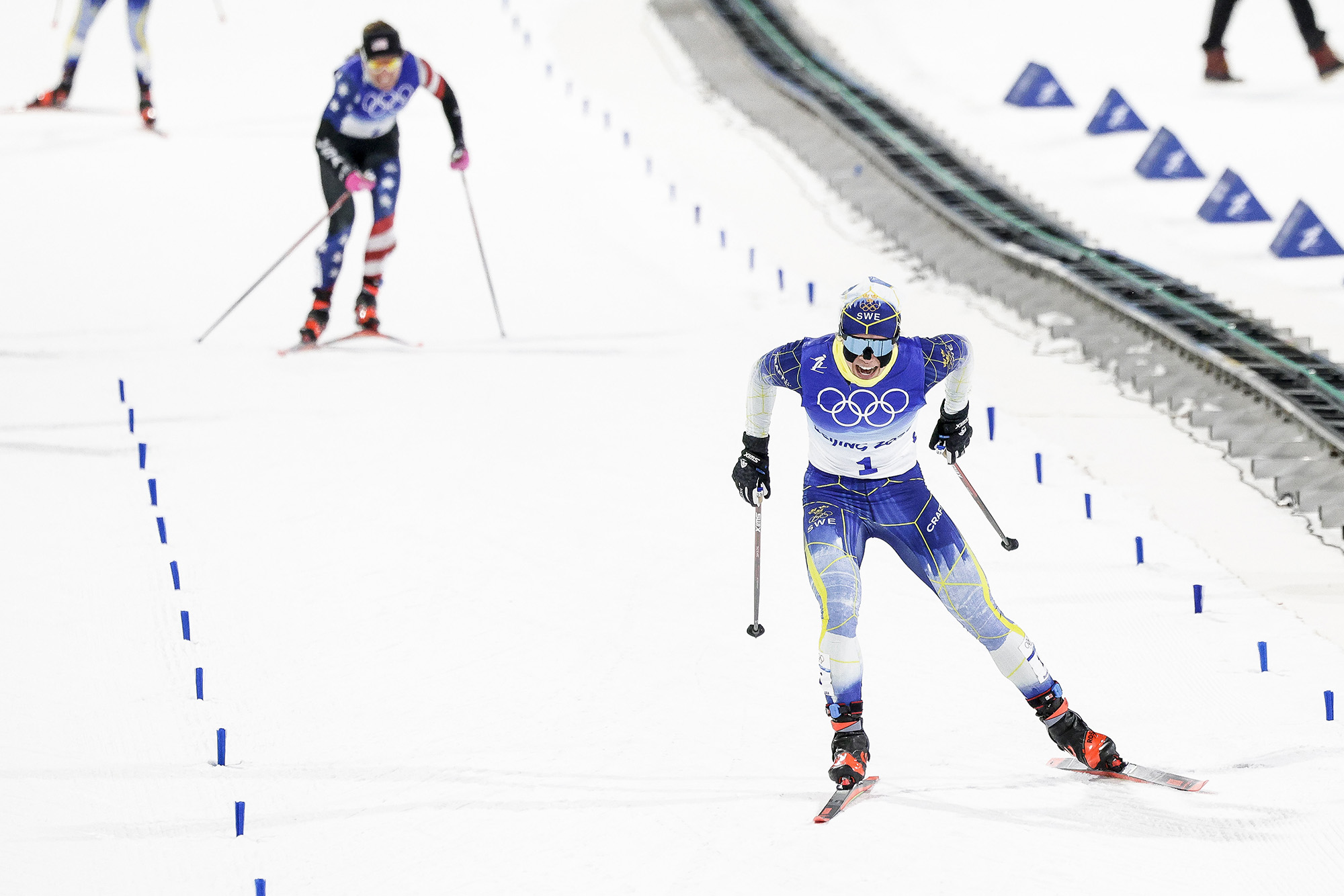
Skiing their fastest splits of the day, Dahlqvist held her ground to the silver medal (+2.88), with Diggins on her right, less than a ski length back for bronze (+3.16).
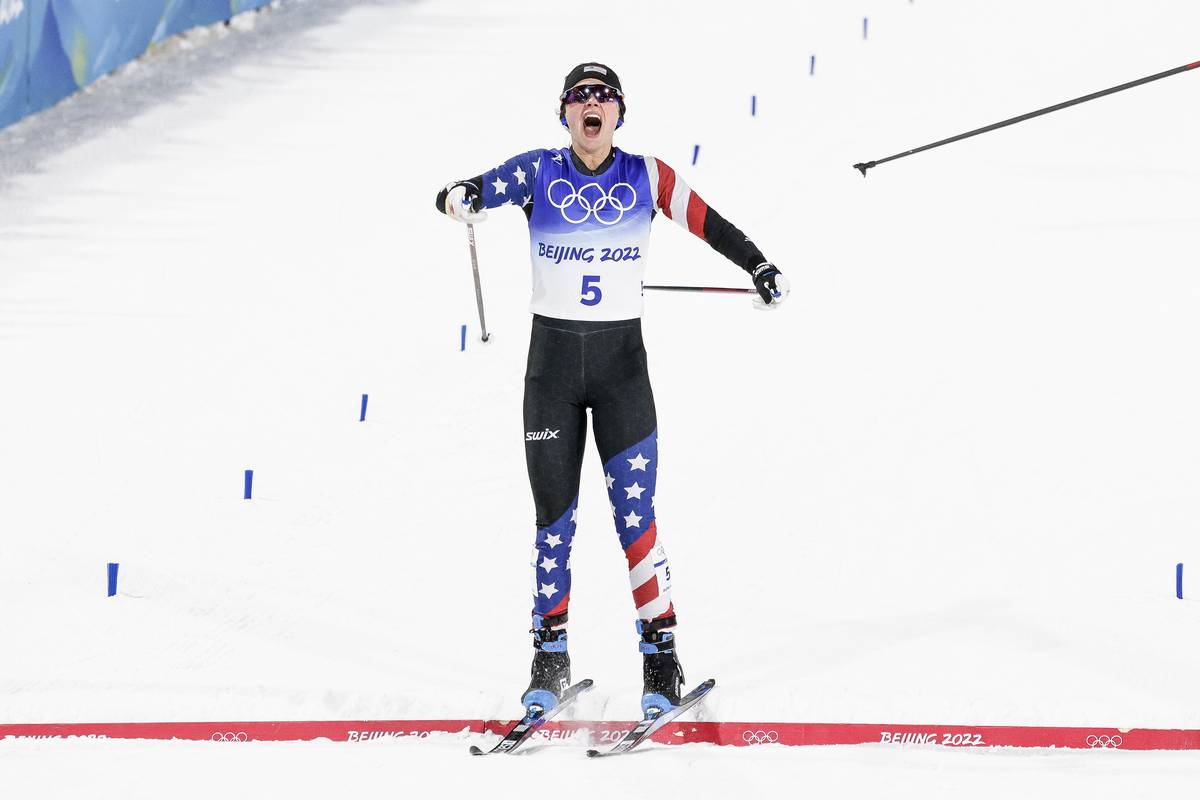
Jessie Diggins crosses the line in third to earn the first individual Olympic medal in women’s cross country ski history. (Photo: NordicFocus)
Just over a second back, Brennan crossed fourth (+4.49), for the second best individual finish in American women’s history. The Americans maintained a gap to Fähndrich in fifth (+7.21) and Ribom sixth (+11.11).
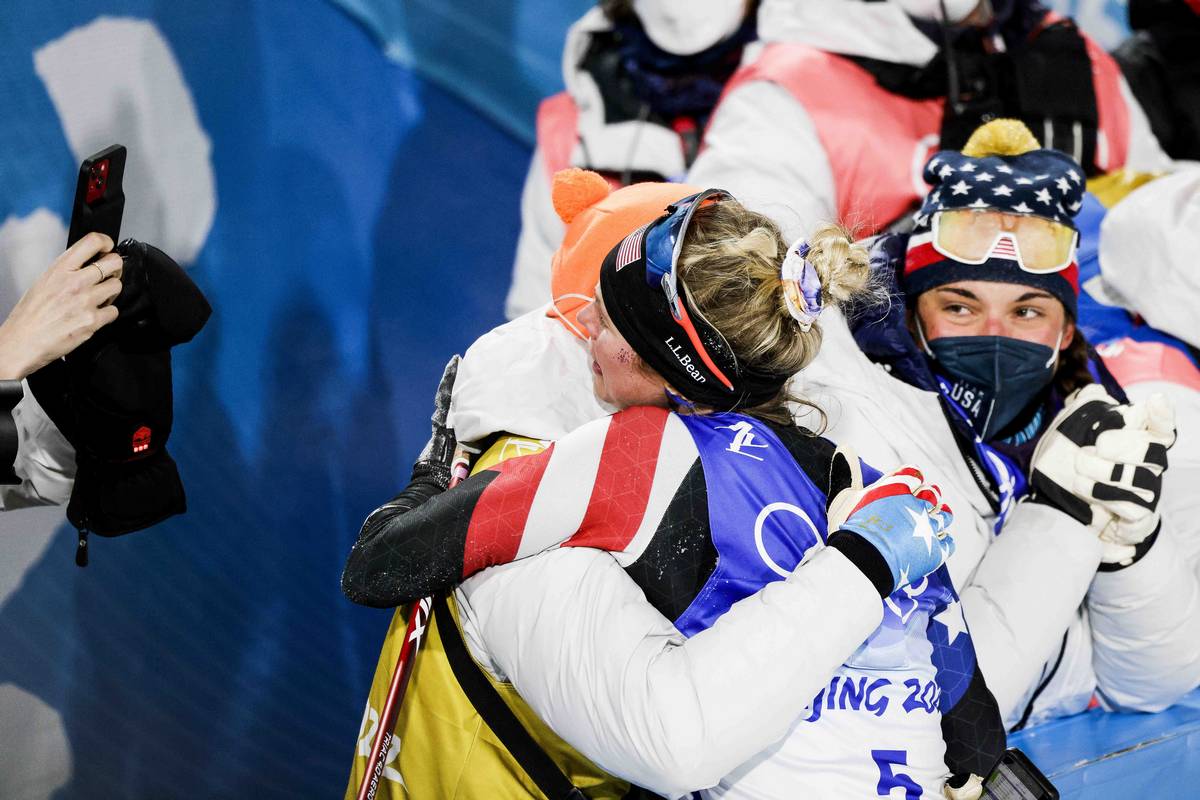
Diggins collapsed to the ground, overcome by the emotion of what she had accomplished. Perhaps a testament to her team-centric approach, she was heard saying, “Good job, Rosie!” between gasps, as she got back to her feet to immediately hug the coaches, support staff, and teammates that lined the edge of the course.
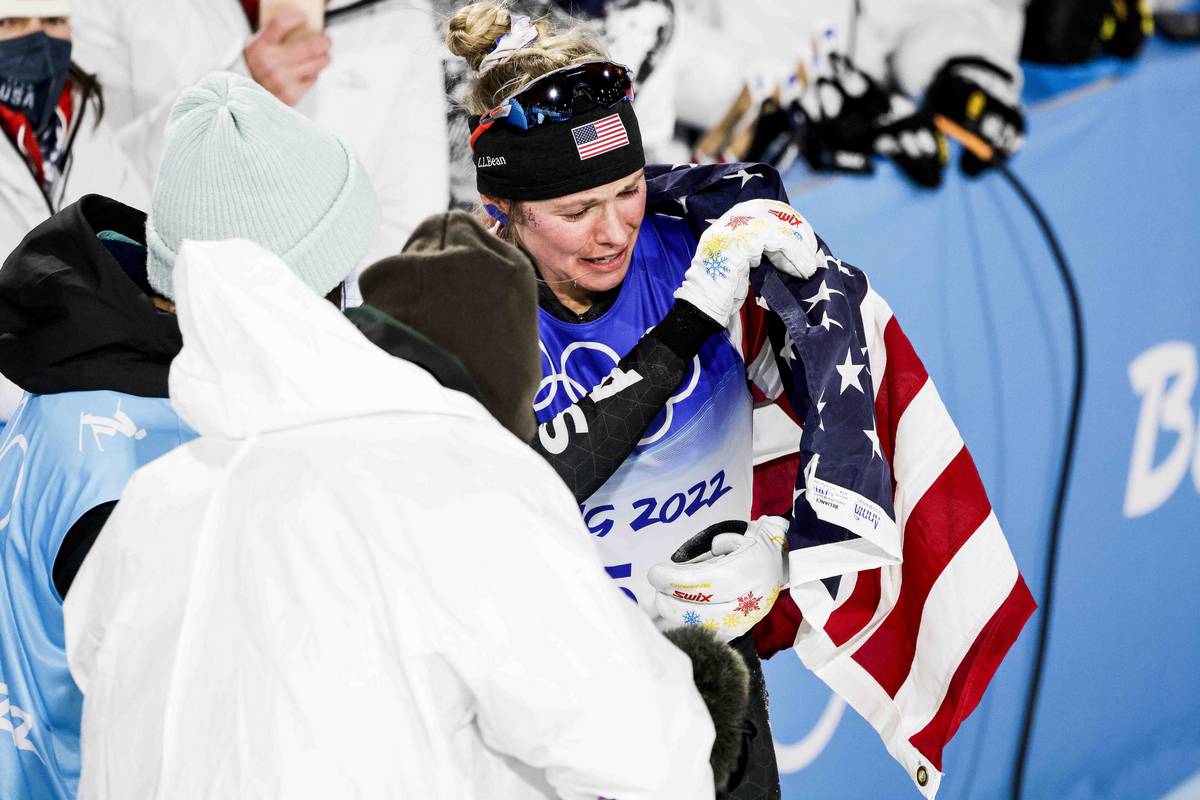
Jessie Diggins hugs her coaches and teammates after finishing third in the individual freestyle sprint in Zhangjiakou. (Photo: NordicFocus)An emotional Jessie Diggins wraps the American flag around her shoulders after taking bronze in the freestyle sprint. (Photo: NordicFocus)
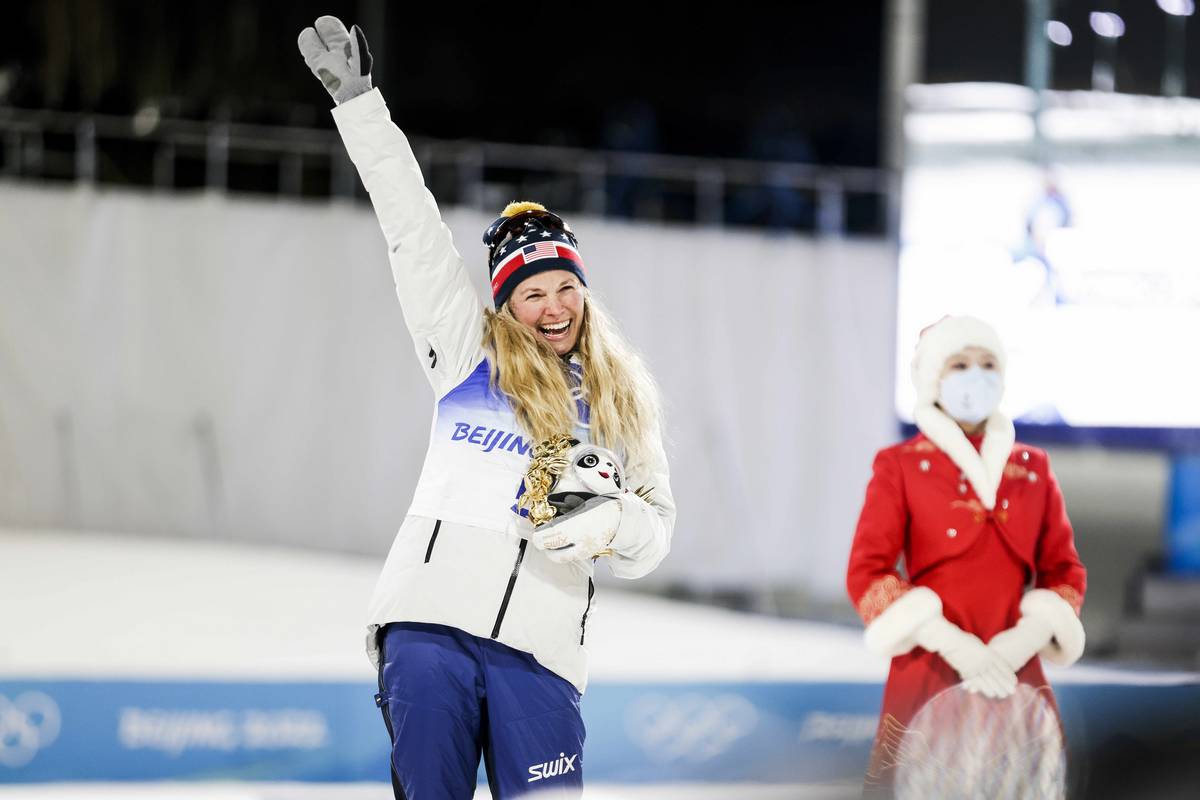
Tearfully wrapping an American flag around her shoulders, Diggins was aglow as she savored the moment before heading back to the finish to stand alongside Sundling and Dalhqvist for the podium shot.
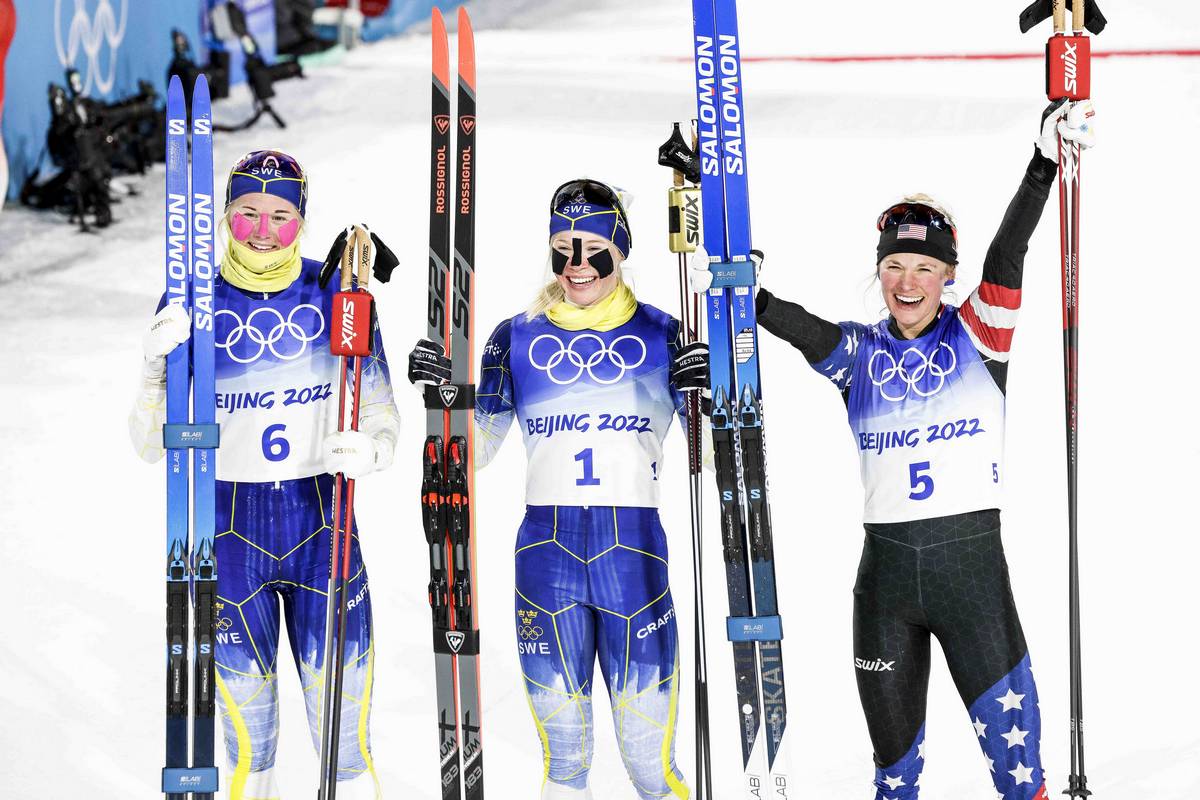
Jonna Sundling (SWE) takes gold in the freestyle sprint, ahead of Maja Dahlqvist (SWE) and Jessie Diggins (USA). (Photo: NordicFocus)
Though she was the one whose name would be highlighted in history books, Diggins focus on the importance of those around her remained at the forefront as she celebrated the many victories of the American team in today’s event.
“It was so cool to be there with Rosie,” Diggins said in the mixed zone. “She’s skiing so amazingly well… and I’m just so grateful. That’s the overwhelming emotion, because it takes so much from such a huge team to make this happen. And we had obviously amazing skis, but also amazing teammates for years and years and years, helping me train, pushing me, supporting me – amazing coaches, amazing volunteer staff. You can’t even imagine how much it took from so many people, and so I’m just so thankful because I feel like this medal belongs to about 1000 different people. And I hope they really feel that and know that.”
Jessie Diggins takes Olympic bronze in the freestyle team sprint. (Photo: NordicFocus)
Of her approach to the course, Diggins gave a simple response, acknowledging that she has a way of blacking out while having great races, “which is really annoying,” she laughed, “because I’d love to be able to remember exactly what I did.”
“I was just so focused on trying to push as hard as I could,” Diggins explained. “Just trying to ski as well as I could and stay balanced. The snow felt a little greasy, so especially in the finishing lane, just trying to put as much power as I could into every single push. And honestly, that’s all I can remember.”
Jessie Diggins (USA) on her way to the USA’s first ever individual women’s medal in the Olympics. (Photo: NordicFocus)
Perhaps the FasterSkier audience needs no reminder that Diggins came into the 2022 Games as a gold medalist, having won the freestyle team sprint with Kikkan Randall in 2018, a day that brought many Americans, including this writer, to tears. Diggins was asked to reflect on the last four years, and the progress she’s made in her career.
“The last four years, I’ve really found my voice,” Diggins said confidently. “I’ve really found a lot of my purpose, and I feel like I’ve grown a lot. But also, I’m exactly the same person in pretty much every other way. I think one of the big things has been dealing with is the pressure and expectations, because there’s been a lot of it, and it hasn’t been easy. So for me, I think it was such a victory just to make it to the final and know that I’m skiing well. I came into this as prepared as I could be, which one of my biggest goals was to come in prepared. The second goal, cross the finish line with nothing left. And the third goal was to just have fun, and keep focusing on the process, because that’s what gets me where I am today. Like win, lose, or draw, it’s just focusing on the process and, and executing those process goals to the very best of my ability, because then I’m always proud of how I finished. I’m just proud of this effort today as I was at the skiathlon, even though they were different outcomes.”
Jessie Diggins was all smiles as she passed through the mixed zone following her bronze medal performance in the women’s individual sprint. (Photo: Nat Herz/FasterSkier-ADN)
Fourth place at the Olympics – fourth in the world on its most prestigious stage – is both a truly incredible feat and perhaps the most challenging final rank to wrap one’s head around. The “wooden medal”, just shy of the Olympic hardware skiers dream about from their youth.
“Fourth place was hard,” Brennan said honestly in the mixed zone. “You feel really happy and also frustrated at the same time. I have a lot of mixed emotions about it. But I did everything I could today, and maybe not everything went perfectly my way. But I have to be happy with that at the end of the day.”
Jessie Diggins (USA) and Rosie Brennan find their position in the early moments of the women’s final. (Photo: NordicFocus)
Asked what she would have said if four years ago, someone told her she would be in this position, Brennan laughed, “I probably wouldn’t have believed it so much.”
She talked through a rough start to the day, sharing that she has always struggled with start gates and had spent the last six weeks practicing to ensure a clean start.
“So, there I was on the ground, I was like, ‘So much for all that practice.’ But I knew my strength was in the climb, so I just had to pull it back [together] and focus on the all the time I had left and see what I could do to try and make it up.”
On her approach through the heats, Brennan played to her strengths, recognizing she could take the lead, work the hills, and not let her heats unfold as a casual first 1200 meters with a tactical final sprint that might leave her in the dust.
“My strength lies more in the endurance aspect of it,” she explained. “I tried to just keep the pace high so that I could count on being a lucky loser – by having a fast heat time. So that was my strategy in the semifinal, and it worked. Once I got to the final, I tried to then be a little more smart about my racing. I tried to be patient and wait until the last climb. I was a little far back, so I kind of got the door closed on me to make it through. So I had to kind of adjust and go for a strong finish sprint, which isn’t always my strength. But I did all I could do.”
With Ben Ogden racing into the semis in the men’s race, it was an historic day for the American program as a whole. Speaking to this landmark day, Brennan concluded with an inspiring message for those who dream of following in their footsteps.
“I think it shows the growing depth in our country. And I hope it shows a lot of people just to have some patience and keep training, keep going for it. You never know where you’ll end up.”
Jonna Sundling (SWE) takes gold in her first Olympic appearance in the women’s freestyle sprint. (Photo: NordicFocus)
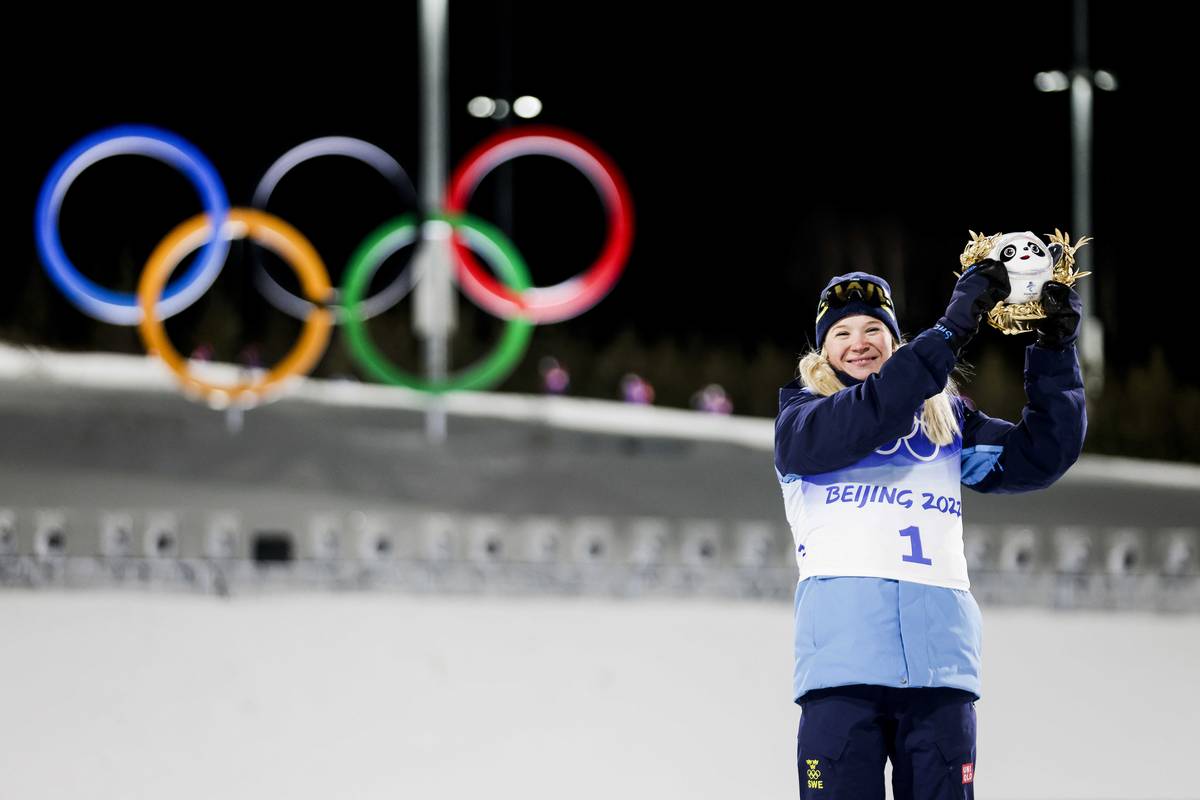
Taking a closer look at the winner, Sundling is the 2018 World Champion in the freestyle sprint. Returning from injury, she has built her way into the season. Though Dahlqvist has shined as the undefeated World Cup star for Sweden, Sundling has crept up alongside, taking second to Dahlqvist in the individual sprint in Dresden, and working together to win the team sprint. Sitting out the Tour de Ski, Sundling beat Dahlqvist in their next matchup in a Scandinavian Cup race in Falun, Sweden.
This is Sundling’s first Olympic appearance, though she and Dahlqvist will be a likely pairing in the classic team sprint next Wednesday.
Once the final rounds were complete, Kern’s final placement was determined to be 18th. This marks a significant step forward from her first appearance in the skiathlon, where she finished 53rd.
Julia Kern (USA), who finished in 18th place overall, pushes to the finish during her quarterfinal round. (Photo: NordicFocus)
“It was really tough out there, but a lot of fun to have a challenging course and give it my all,” Kern told FasterSkier in the mixed zone.
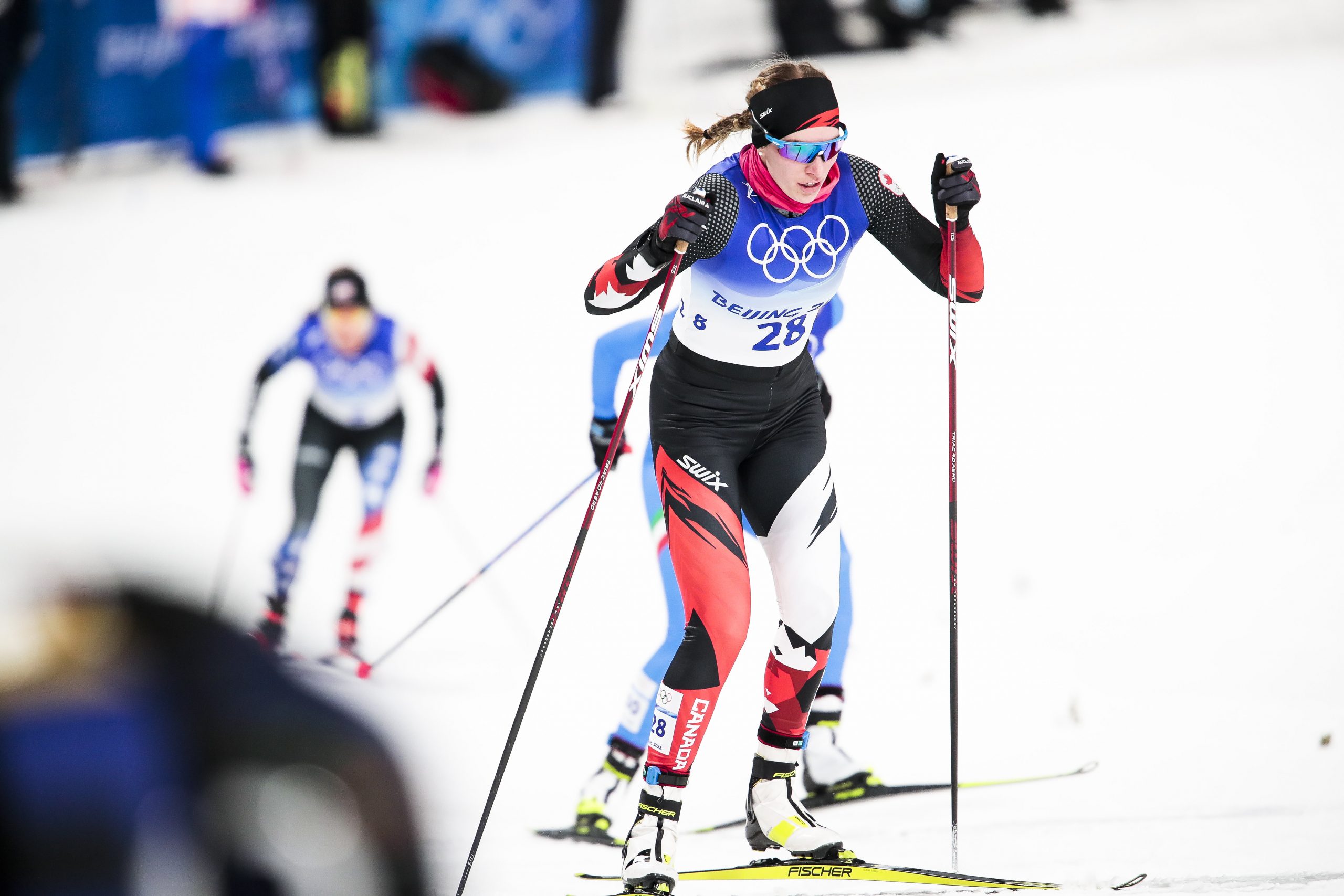
Dahria Beatty 28th in qualification (+14.51) to be the only Canadian woman to make the heats. Beatty raced in the first semifinal, where she finished fifth in the heat to finish 25th on the day.
Just 0.7 seconds off the top-30 mark, Cendrine Browne was 35th in qualification (+15.82) with Olivia Bouffard-Nesbitt close behind in 40th (+16.89). Laura Leclair rounded out the Canadian team in 58th (+26.28).
Dahria Beatty (CAN) races in the quarterfinals on her way to 25th place overall. (Photo: NordicFocus)
An Australian dual citizen who is a long-time APU team member, Jessica Yeaton was 52nd (+23.82) in the qualifying round.
Here’s Nat and Devon breaking down (and celebrating) an historic day for the U.S. A bronze medal for Jessie Diggins stands as the highlight – she’s the first American woman to win an individual medal – but there were several other steps taken forward by the men and women wearing stars and stripes.
In particular, Rosie Brennan popped the second fast time in qualification. Overcoming a bad pole plant-induced fall in her quarterfinal, she powered through to take second (to the eventual winner), building momentum each round to finish 4th, just meters behind Diggins .
Ben Ogden races the quarterfinal of the men’s freestyle sprint during the 2022 Beijing Olympic Winter Games. (Photo: NordicFocus)
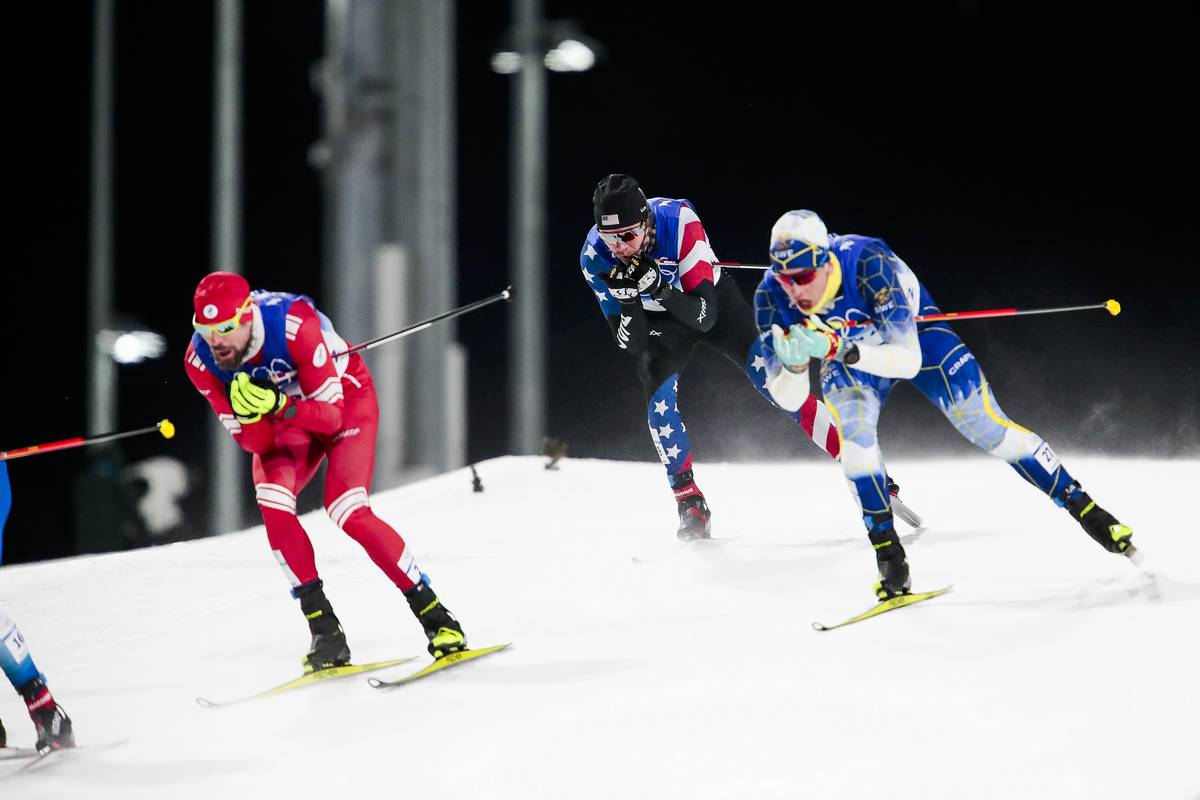
And you’ve got all four American men – also a record – in the Top-30, and Ben Ogden skiing into the semis to finish one second behind Pellegrino and Klæbo, landing in 12th as the top American men’s sprint finish in history.
So much more. Thanks for listening.
After stumbling out of the start, Rosie Brennan (USA) charges back to the front of her quarterfinal heat. (Photo: NordicFocus)