From the FasterSkier archive — posts syndicated from athletes’ and coaches’ own blogs between 2004 and 2012, kept online as published. Current coverage is at fasterskier.com.

Tag: Jessie Diggins gold medal

  • Insights From a Pre-Olympic Media Conference with Jessie Diggins

    Insights From a Pre-Olympic Media Conference with Jessie Diggins

    As January draws to a close, energy, excitement, and perhaps anxiety surrounding the rapidly approaching 2022 Olympic Games in Beijing is steadily building. In an effort to better manage her time and energy heading into these Games, Jessie Diggins offered a media conference facilitated by U.S. Ski & Snowboard cross country communications manager Tom Horrocks to answer questions about her preparation, outlook, and plans for the remainder of the time before the team heads to the athlete village in Zhangjiakou.

    Diggins began the conference with a comment on the team that has been named. Of the fourteen athletes named to the Olympic cross country team, just four have competed in past Games. Diggins is headed into her third Olympics with ten total Olympic races under her belt, while Rosie Brennan, Caitlin Patterson, and Scott Patterson competed only in the 2018 Games. In Pyeongchang, Brennan competed in just the skiathlon, while Caitlin Patterson raced in the skiathlon and 30k classic, and Scott Patterson raced in each of the three individual distance events plus the men’s relay. 

    Six of the athletes were born in the year 2000 or 2001. Overall, it’s a relatively young crop of athletes, many of whom have very limited experience racing at the international senior level compared to veteran-dense teams like Norway. 

    Diggins emphasized that the age and experience of the team should not be associated with what fans of the sport should expect to see in competition, adding that she is individually very excited to see what her teammates will do at the Games. 

    “Everyone’s working so hard,” she said. “And staying really cool in what is a stressful time – with COVID, and with variants, and with all the different paperwork and all the things that you need to do headed into any Olympics, but especially this one, given the extra hurdles with COVID… I think everyone’s doing such a remarkable job of not only handling all the extra stressors very well, but also still being excited and still seeing this as, ‘Okay, we’re gonna find ways to make this fun. Obviously, it will be different from Games in the past, and probably different from future Games too…’

    “I think we’re in a really good place, despite everything that’s happening in the world. And I think that’s kind of one of the things that the Olympics does for us is it lets us feel inspired and let go of all the stresses that we’re feeling in the moment. Or at least that’s what the Olympics I think is supposed to do.”
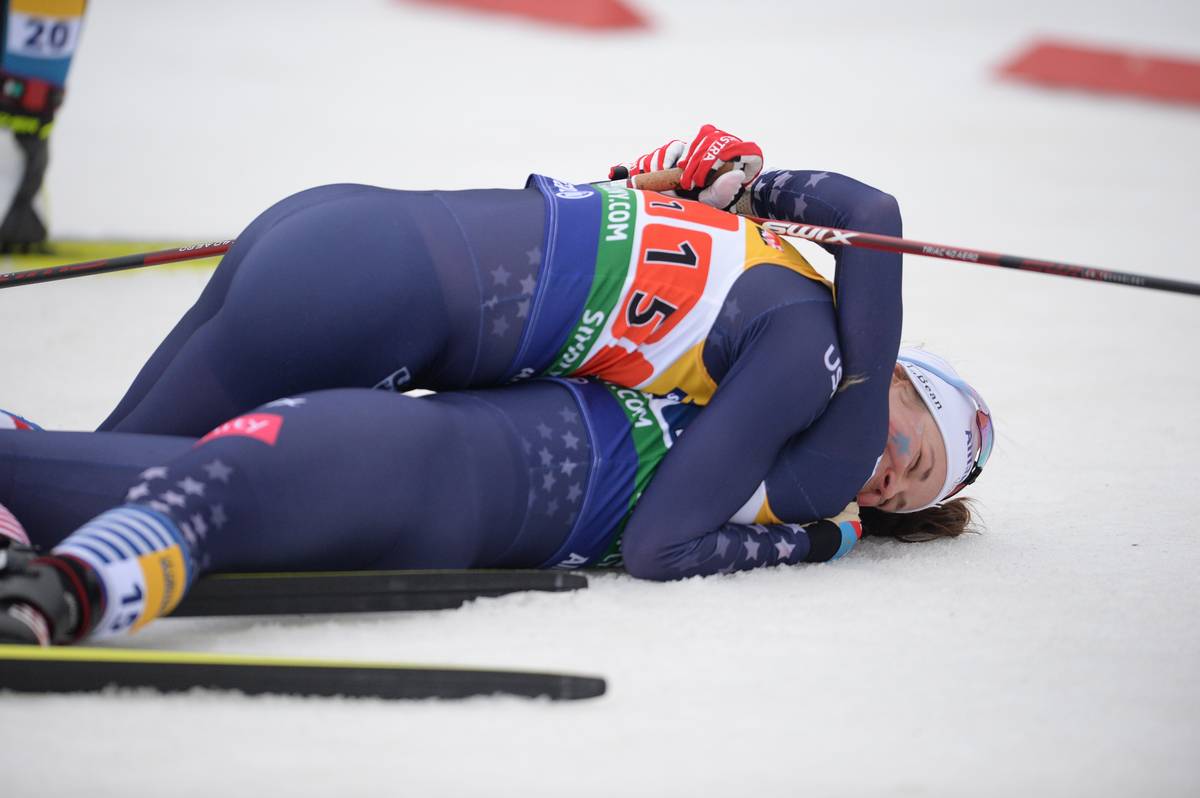
    Jessie Diggins embraces team sprint partner Julia Kern after the pair took second place in the freestyle team sprint in Dresden, Germany in December, 2021. (Photo: NordicFocus)

    Following the Tour de Ski, the members of the team who planned to remain in Europe began a recovery training block in Seefeld, Austria, which sits at roughly 3,800’, before moving to higher elevation to begin an altitude training camp. Having come down with a head cold during the final stages of the Tour de Ski, Diggins expressed the value of this recovery block, particularly in a location where her body was not further impaired by altitude-related physiological effects. 

    “Within two days after the tour, I was symptom free. Five days later, totally healthy and able to train totally normally again. So that was really, really nice to dip down in altitude and recover and feel like I absorbed everything that the tour brought in terms of training stimulus.”

    With the cancellation of the final two World Cups before the Olympics, the team headed to Livigno, Italy earlier than originally planned, earning them extra time training at a venue that sits at a nearly identical elevation to the competition venues in Zhangjiakou. Diggins expressed that this has provided the team with a variety of excellent training options, from challenging race courses to flat valley skiing ideal for recovery, all supported by a team of staff that includes wax techs, a chef, and a physical therapist.

    Acknowledging individual variation athlete-to-athlete, Diggins explained that overall the team’s preparations have looked “normal” in terms of how they would train and peak leading into another Championship. To account for the lack of races, the team has been building in simulations, including practicing events that have not been included in the World Cup calendar yet this season.

    “Yesterday, Julia and I did a skiathlon simulation,” Diggins shared. “It was awesome. It was really hard. And I’m so glad we did it. We had coaches going nuts – taking video, cheering for us. We had bibs on, we had pits set up, we had everything to simulate it, which was really nice, because we don’t get to do very many skiathlons anymore. And it was really cool to practice that pacing at altitude. That was really helpful.”
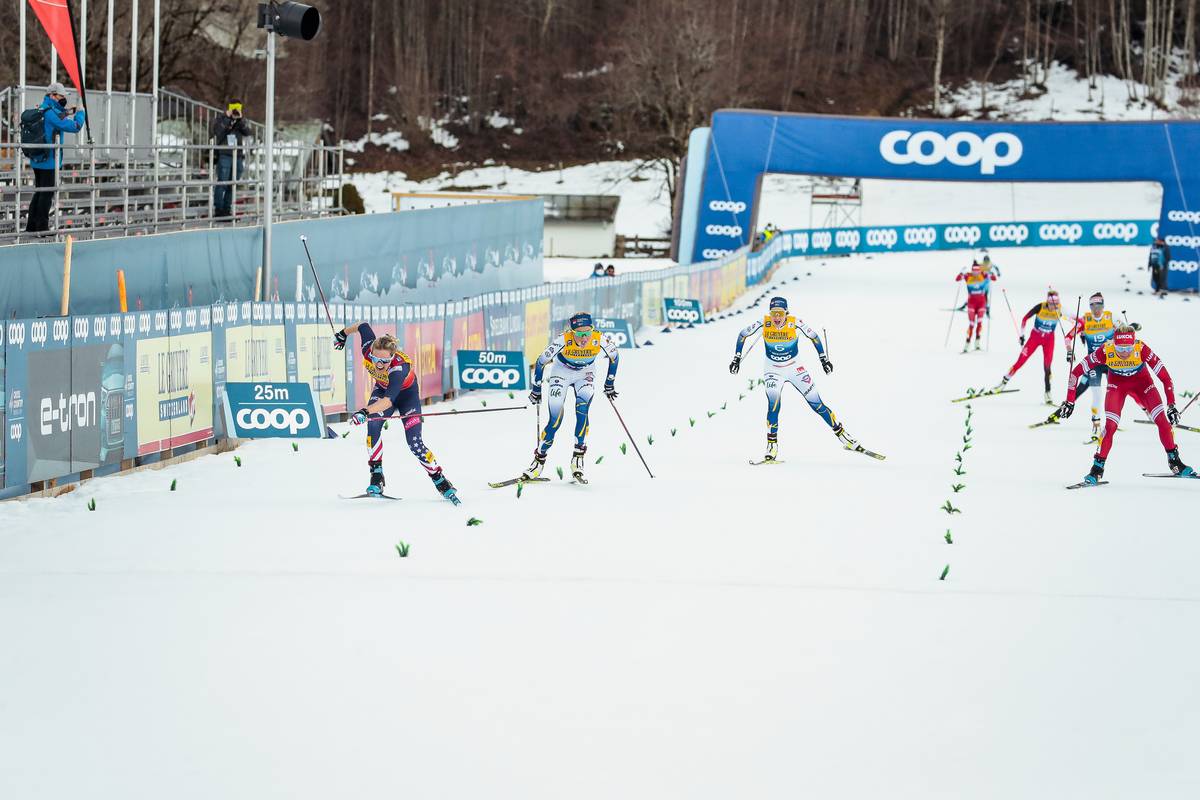
    With an epic free skate in the final meters, Jessie Diggins wins the thrilling 10-kilometer mass start freestyle in Oberstdorf, Germany during the 2021/22 Tour de Ski. (Photo: NordicFocus)

    In previous press conferences, Diggins has emphasized the importance of frequent racing in helping her reach her mental and physical peak during the season. She had planned to race in at least the first World Cups after the Tour de Ski in Les Rousses, France before they were canceled. With this piece of her plan suddenly removed, what would she do to replace these stimuli to ensure her preparations were unaffected? 

    While Diggins shared that she loves racing in France and had been looking forward to the races in Les Rousse, she quickly found a silver lining to the cancellation. And to the many setbacks she faced in the second half of the Tour.

    “[The cancellation was] kind of a huge blessing in disguise,” she stated affirmatively. “I was able to fully absorb the Tour and then build in a full training block and move up to altitude sooner. I felt like, ‘Whoa, actually, this is kind of perfect.’ This is how I would have designed it because I got in all the racing I needed to in terms of World Cups. Mentally, I felt like the tour was kind of the icing on the cake in terms of getting mentally strong. In terms of being able to push myself – being mentally there, being positive in any situation, all of that – that was the best preparation I could have ever asked for.”

    In terms of replacing the intensity of World Cup racing, Diggins expressed her confidence both in the training sessions the team has put together, and the ability of her teammates to push themselves and each other. 

    “I feel really fortunate because my greatest strength has always been being able to push myself no matter what. And so I was like, ‘Well, this is totally fine, because even if there aren’t World Cups, that’s not a problem.’ I pushed myself in our time trials so hard that I couldn’t feel my legs and I was tasting blood. And that was in a time trial with just one other athlete.”

    In year’s past, the Americans have collaborated with athletes from other nations when paths have crossed; for example, in December 2020, the Americans raced in a set of time trials with athletes from Russia, Italy, Switzerland and Germany while all were training in Davos following a canceled World Cup event in Lillehammer, Norway. In lieu of opportunities to face off on the World Cup, these collaborations have perhaps provided a measuring stick to see how an athlete’s fitness might compare at the international level. Did the lack of this type of opportunity affect Diggins mental preparation heading into her goal races in Zhangjiakou?

    “In terms of the lack of international feel, that’s also been a blessing in disguise, because everyone’s worried about germs. When you get more and more people [together], then you’re exposing yourself to more and more people who aren’t in your bubble. I can’t speak for how other countries feel, but for me, it’s made me feel very safe from a COVID perspective to say, ‘Nope! We’re just gonna keep this as tight as we can, and run some very small time trials.”
    Jessie Diggins wins the 10k mass start freestyle in Oberstdorf, Germany during the 2021/22 Tour de Ski. (Photo: NordicFocus)

    Staying in the COVID-vein, Diggins also fielded questions from Matt Futterman of the New York Times regarding her fear level and the tension among the team about getting COVID, which remains rampant. A positive result would be a “nightmare scenario”, in his words, for an athlete as it could prohibit travel to Beijing, admission to the Olympic bubble, and/or the ability to compete in the Games?  

    “It would be silly to pretend that that’s not a stressor, right? I think it’s important to acknowledge that, COVID, especially the variants, are everywhere. It seems like every day, you hear about an athlete or somebody getting sick, and so that is hard. But I think one thing that we’ve done really well is created a bubble with really strict rules that we feel really safe within.”

    Diggins explained that the team who is currently based in Livigno has minimal contact with those outside of their “bubble”. The chef is the only person from the group who goes to the grocery store, always while wearing a KN95. Otherwise, the small group only interacts with its members, not entering any buildings beyond the house they are staying in. Athletes who have recently flown over from the U.S. are staying in a separate apartment to quarantine for a week, before joining the larger team. 

    With reassurance from daily antigen testing and weekly PCR testing, they are living a monk-like lifestyle focused on heading out the door to train, and otherwise focusing on optimal nutrition, recovery, and logistical preparations for the Games.

    “We’re trying really, really hard to make sure we protect each other. So even when we’re in this house, when we leave the room, we have our mask on. So you’ll be hanging out in the living room and everyone has KN95s on. So it’s a lot. And I think you hear the phrase ‘out of an abundance of caution’ everywhere now, but I think that is what we’re doing – taking all the cautionary steps that we can.”

    Futterman acknowledged that for some, these protective measures can have an adverse effect on stress levels; rather than reassurance, the constant vigilance might leave an individual “freaked out”. Diggins affirmed that the decrease in risk relieved far more tension than the heightened awareness caused. 

    “It would be more stressful to feel like we’re just risking it… I think that wearing masks has actually lowered everyone’s tension level because you don’t have to wonder ‘what if?’ because we know that the masks work. So if you are wearing your mask, you don’t have to be stressed, because you’re doing everything that you can. I think that mentality of: ‘We’re going all in to protect not just ourselves, but each other’ is actually less stressful. Because if you’re the person who isn’t wearing masks and going into stores, and then you bring [exposure] into the team – that would be the actual nightmare scenario if you got someone else sick. So, for me, at least, and for the teammates here, so far that I can tell, it’s less stressful to just know that you’re doing everything possible.”
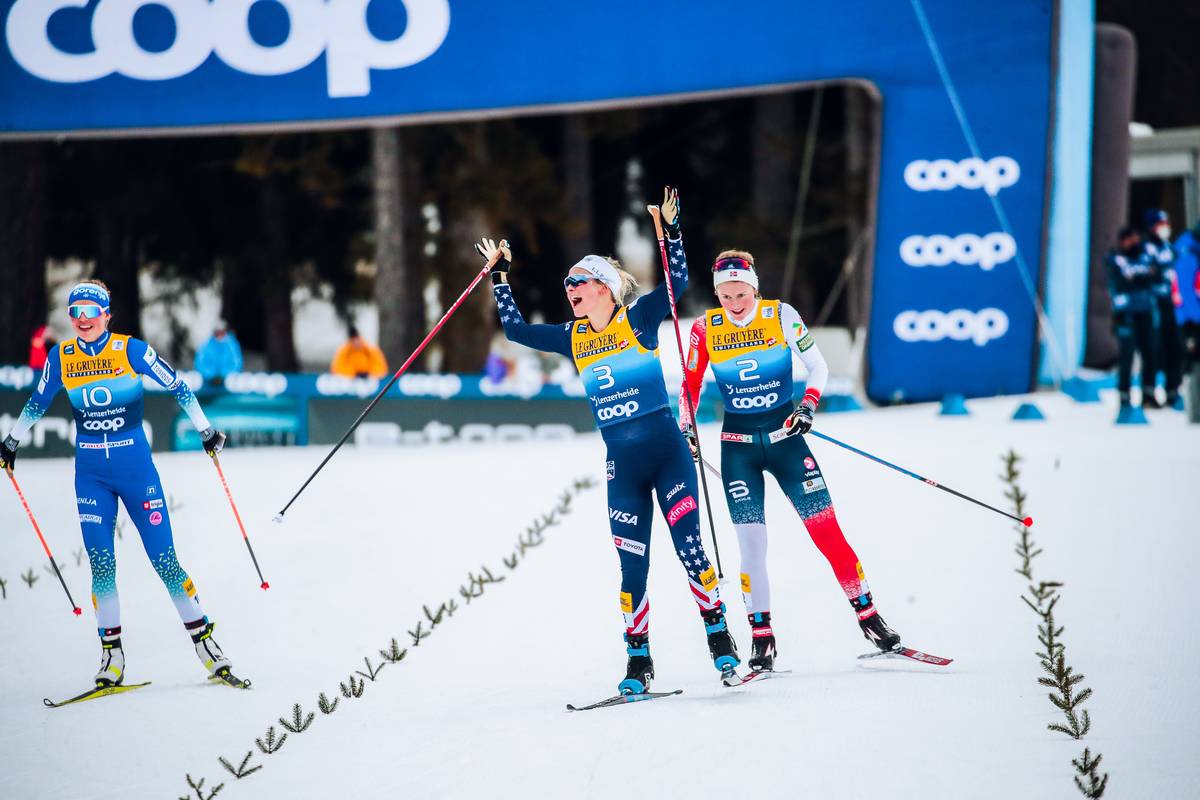
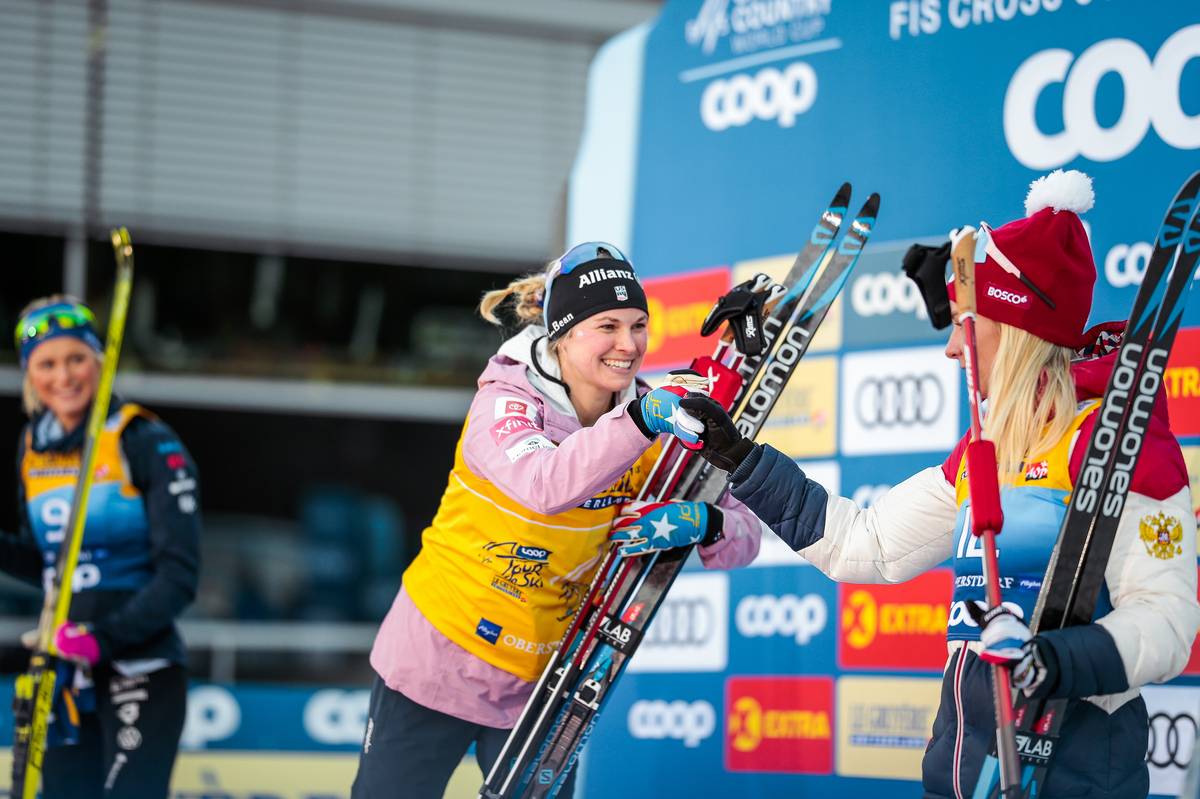
    Jessie Diggins wins the opening stage of the 2021/22 Tour de Ski, a freestyle sprint in Lenzerheide, SUI. (Photo: NordicFocus)

    While the team has carefully been collaborating in Livigno, it is unclear what the opportunities to be together and support one another will look like once they’re on the ground in China. Diggins shared her limited knowledge of what communication and time together might look like during the Games, responding to whether it might be more isolating than years past.

    “I think some of that we’re just gonna have to feel out once we’re on the ground and see and feel, after a week, what’s the situation here? How safe do we feel? How good is the WiFi in terms of having team meetings over Zoom instead of needing to find a place where we can do it in person and all wear masks. I think our team has been really, really good about masking protocols, so I do feel like there might be opportunities there.”

    In terms of lodging during the Games, Diggins shared that the team will be sharing a set of apartments with four athletes per unit, split between two bedrooms with a common area in between. 

    “So at least to be able to make a pod with three other people. Beyond that, we’ll just have to feel it out,” she concluded. 

    In terms of where we can expect to see Diggins on the start lists during the Games, that also remains to be determined, which is a slight shift from what Diggins shared following Period I, earlier this season. 

    “The original plan was to just race everything, assuming, of course, that I have start rights to do so. And then, earlier in the year, I was thinking, ‘I hear it’s really cool – which, yay! Love it. I hope it is cold. I want it to really be winter. But if it is incredibly cold, the way it was in Ruka, that becomes really draining, because you’re out there for so long. It’s not just the race; it’s the warm up, it’s the cool down. You’re outside going through the media zone, because you need to be outside because of COVID… But you’re out there for a while. So I think we’re going to look at the situation, once we’re on the ground and see, ‘What does the transport look like? How long does it take to get in and out of the venue? How cold is it? What kind of energy drain is this?’ And then we start making the plans on, ‘Does it make sense to do every single race? Or do I sit one out  in the middle and sort of store [energy] up?’ That said, traditionally, it’s been great for me to simply keep racing, it kind of takes care of itself. So I’m really excited for every single race and all these opportunities ahead, and I would I would love to be able to do that if it makes sense.”

    Diggins also fielded a variety of questions along the lines of comparing her feelings and preparations leading into these Games compared to the last two, given that she is both more experienced, and perhaps facing ever-increasing external expectations as she has steadily brought more attention to the sport. Diggins recently landed on the cover of both Sports Illustrated and Outside Magazines. 
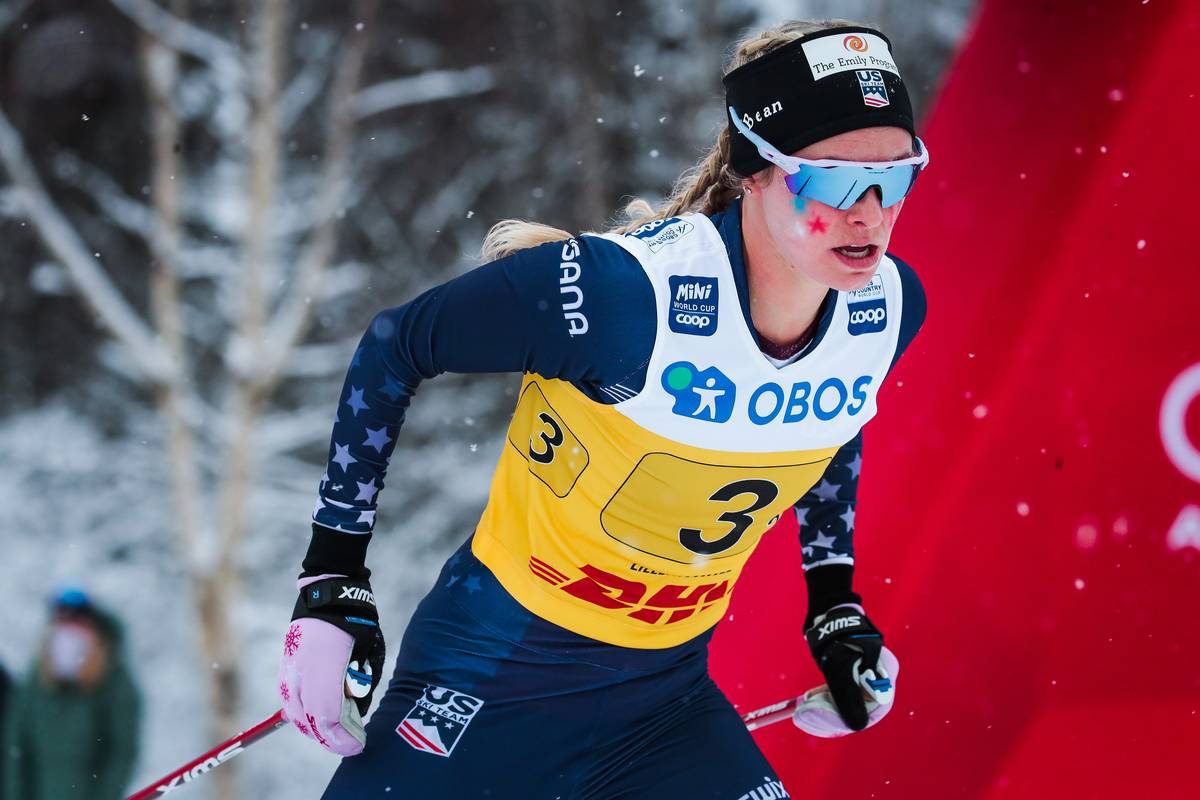
    Jessie Diggins races the third leg of the women’s 4 x 5-kilometer relay in Lillehammer in December, 2021. (Photo: NordicFocus)

    Many of these questions surrounded the pressure of being a defending Olympic Champion, who has since become a World Cup Overall Champion. Has this implied a steady building of pressure felt externally as more and more eyes will be focused on her in Beijing?

    “I think the pressures and expectations are definitely different,” Diggins reflected. “Headed into Sochi, I was coming in as a World Champion, (Diggins and Kikkan Randall won the team sprint in Val di Fiemme during the 2013 Championships.) but I felt that I didn’t have any eyes on me. I didn’t have any pressure to medal. I felt that – it was sort of a wonderful flying under the radar feeling of: ‘If I have a good race, awesome.’ Nobody expects anything. If I have a bad race, they’re like, ‘Cool, you’re young, whatever.’”

    With less focus on her first Olympic results, Diggins recalls a lighter atmosphere at the Sochi Games with more opportunities to explore a new place and attend competitions for other sport. This shifted as the internal and external pressure built to medal in 2018 in Korea.

    “And I do remember getting to go down to the coastal village [in Russia]… And I remember getting to go watch some of the biathlon races, so I actually got to go see other events. Then, in Pyeongchang, it was different because I came in with a lot of eyes and pressure and expectations. I never got to go see a single other event, because I was racing every single event of ours. So it was like race, recover, race-prep, race, recover, race-prep – it was just this cycle. So I felt that for me – I never went and saw the coast, I have no idea what South Korea looks like, someday I want to go back and see it and experience it. But I felt like it was very, very focused. And I know that in that way. Beijing will be the same. So for me, it’s not a huge shift…”

    While that focus may be a necessity for Diggins and other medal-favorite athletes at any Games, the pandemic and the resulting COVID-19 safety protocols that will be enforced in Beijing will likely make the isolated “race-prep, race, recover” cycle one all cross-country skiers will experience, regardless of how close their names will appear on results sheets. 

    “I am sad for my younger teammates, because I want them to have that first [Olympic] experience,” Diggins said somberly. “I know it will be a little bit different. At the same time they’re young and hopefully will have many Games in their future. So at some point, they’ll get that experience of getting to go and watch bobsled and hockey and figure skating and get a little bit of that feel of that huge team unity feeling, because I do think that was pretty cool. At the last two Games, you really felt connected to other sports. And one of my favorite things was like sitting in the Athlete Resource Center, watching a race with the bobsledders and hearing their reactions to our sport, and then watching their sport and then seeing how we react to their sport. It was so cool to feel really like the whole team USA was pulling together. So I hope that we find a way to still feel that, even though obviously, we’re going to be keeping our distance because keeping each other safe is paramount.”

    A silver lining of having more eyes, ears, and attention focused on Diggins is a proportionally larger microphone. Since earning a gold medal in 2018, Diggins has found her voice as an advocate, speaking out on topics ranging from eating disorders to climate change. 

    “My goal all along was to try to grow the sport and to try to do as much good outside of the race track as I possibly could. With my work with the Emily Program, Protect Our Winters, and the Share Winter Foundation, the goal is, ‘Let’s make this about more than just skiing.’ Because that way – win, lose, or draw – you’ve taken this time that you are in the spotlight and actually did something with it. And that does feel good. So in that way, it’s great to be one of the stars of Team USA, because that brings attention to mental health and climate change. And these things that I’ve been shouting about for four years – people are really listening.”
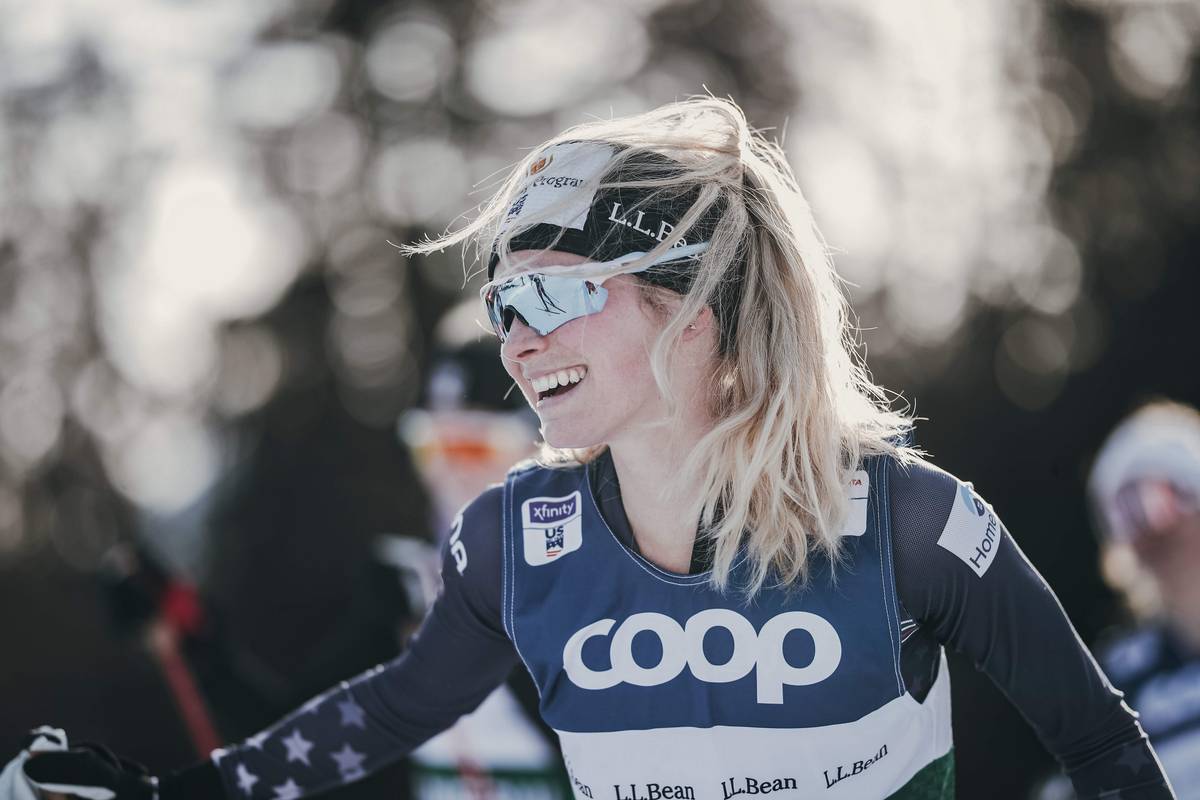
    With strong performances across all distances and race disciplines, Jessie Diggins is a medal favorite for the 2022 Beijing Olympic Games. (Photo: NordicFocus)

    “The flip side is, yeah, it is hard not to feel like there’s a lot of external pressure. But that doesn’t mean that I have to feel it. I know it’s there, and again – sort of like COVID – it would be silly to not acknowledge it. It would be silly to pretend that it’s not a thing. Of course it is. But for me, it’s more of like, ‘Whoa, what a cool, privileged place to be in. 15 year old Jesse would be so psyched to learn that this is how I’m coming into my third Olympics, let alone any Olympics.’ So for me, the key has been flipping it around and reframing it as an amazing privilege to get to carry this amount of pressure and hopefully show that it’s totally possible to come in and still be yourself; to care about the things you care about; to be a good teammate; and to just focus on what you can control. And you’ve just got to let the rest go.” 

    Perhaps the size and variety of media publications present at her conference is evidence on its own that Diggins has been identified, outright or otherwise, as an athlete to watch at the 2022 Games. Since the Pyeongchang Games, she has been on the podium in ten freestyle sprints, winning two. She was second behind Marit Bjørgen at the 30k freestyle at the Holmenkollen in March, 2018, the last time she competed in the event. 

    Diggins has raced three 7.5k/7.5 skiathlons in the last Olympic Quad, taking second to Norway’s Therese Johaug in December, 2019 and fifth place, behind an all-Norway podium plus Sweden’s Ebba Anderson in fourth, in January, 2021. And then there are the relays, for which she has been known since the beginning of her career. 

    Perhaps the only event where Diggins may not be considered a medal contender is the 10k classic. While she just one podium in this event over the last Quad, third place in Val Müstair in the 2020/21 Tour de Ski with a Norwegian-free field, she has cracked the top-10 enough times not to be ruled out. 
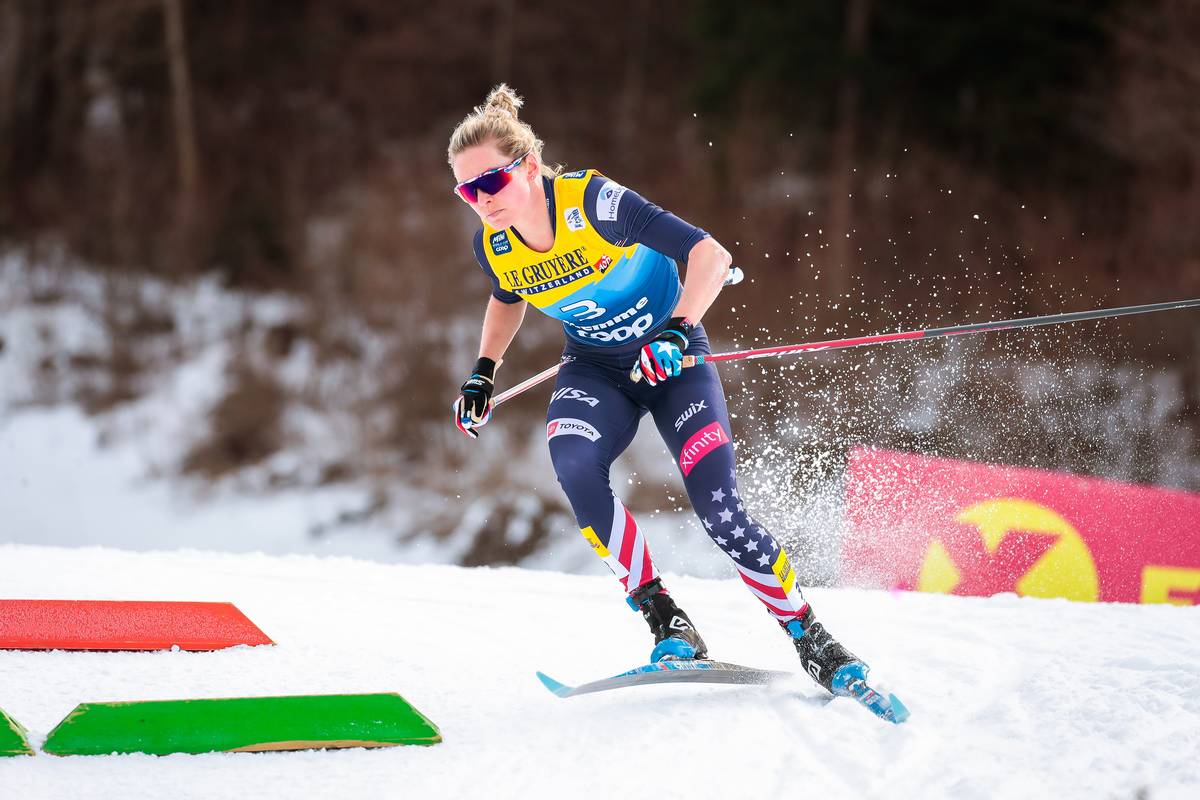
    Jessie Diggins skis to 13th in the 10-kilometer mass start classic in Val di Fiemme, ITA during the 2021/22 Tour de Ski. (Photo: NordicFocus)

    With these performances across all race disciplines and distances, it might be impossible for Diggins not to feel some amount of pressure heading into Beijing. She explained that managing this, for her, comes down to taking ownership and control over her definition of success. 

    “One thing to understand is that when it comes to pressure, there will never be a point where you are enough, if you start listening to it, right, because then it’ll be ‘Will you podium?’ to ‘Why didn’t you win?’ And at some point, it’ll be, ‘Why didn’t you win by more? Why wasn’t it more impressive?’ There’s no end point. 

    “So it’s better to not let my self-worth be determined by anyone other than myself. And that’s easier said than done. It’s something I’m obviously still working on with my sports psychologist, but I think it’s so important to say that I get to define what success looks like. And I’m the only one who gets to say that and nobody else. It’s important for me to [establish] ahead of time what that means. And so for me success at the Games means crossing the finish line with nothing left in the tank and knowing beyond a shadow of a doubt that I left it all out there. And that I feel confident I can do.”

    Diggins also proposed a definition that was multi-faceted, shifting the focus away from the outcomes on the podium or results list. 

    “The other thing success means is being a good teammate, like, Who are you off the snow? What kind of person? Are you? What do you stand for? How do you treat the people around you? That’s really important. And the third thing is, how did you prepare? Did you do everything possible? And not just in the last week or the last month? Or even the last year? The last decade of training for skiing? Have I put everything I have towards this? So I don’t have to wonder what if I had just committed? And if I can do all those things, and cross that finish line and look back and go, that was it? That was my best effort. And that was everything I had, then that will be success? And it doesn’t have to be a medal? It’d be great if it is. It will be fine, if it isn’t. Because at the end of the day, I know that whether or not you earn a medal is not within your control. You can’t control anyone’s effort, but your own. So I think that’s been so important for me in trying to deal with that kind of pressure.”
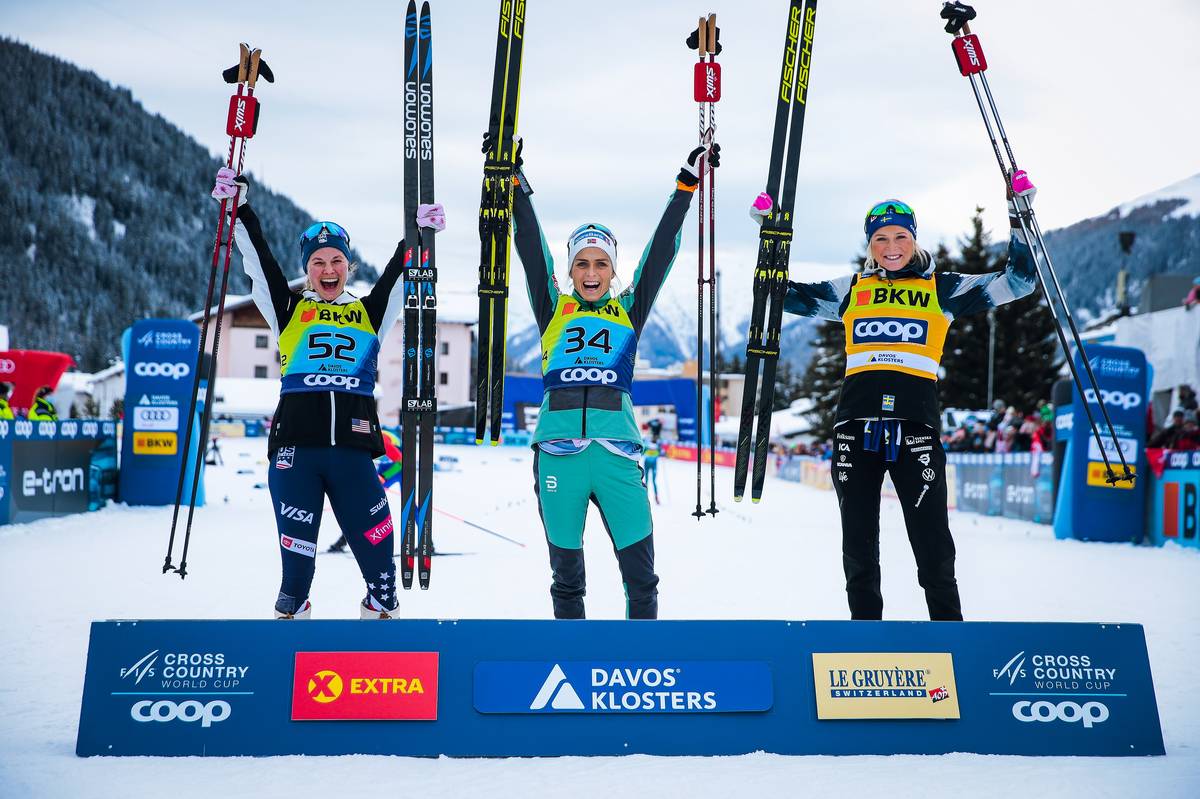
    Jessie Diggins takes second in the 10k free in Davos, behind winner Therese Johaug (NOR) and ahead of Frida Karlsson (SWE), both dominant distance skiers. (Photo: NordicFocus)

    Diggins concluded by sharing a quote that resonated with her from two-time Olympian and former national team coach, Pete Vordenberg. He said, “Every time you do something, it’s for the first time. And even if you do it again, it will be different. And you will be different. So enjoy it.”

    Unpacking this, Diggins explained, “I think that’s so important to remember because it’s not the same as Pyeongchang. And that’s okay. It’s going to be different. And it’s also going to be the first time I’ve ever been to this Olympics, because: different trails, different country, different year, different Jessie. So I think it’s important to remember that I don’t have to go in there defending anything. Nothing makes that medal and what I did four years ago disappear, and I won’t disappear if I don’t do it again.”

    Stay tuned for a few additional insights from Diggins coach and wax tech, Jason Cork, who also appeared at the conference. 
  • Jessie Diggins’ Lifelong Journey Toward the “Gold Medal Goal” of Eating Disorder Recovery

    Jessie Diggins’ Lifelong Journey Toward the “Gold Medal Goal” of Eating Disorder Recovery

    After appearing in ESPN’s Body Issue in June 2018, Jessie Diggins shared an impactful blog post, opening up publicly about her history of struggling with bulimia. In this raw piece, she shared how her perfectionist mindset coupled with the stress she was putting on herself in all areas of her life snowballed in her senior year of high school. Those pressures triggered her to turn to an eating disorder as a coping mechanism to help her feel a false sense of control in her fast-paced life. 

    Jessie Diggins partnered with the Emily Program, a leader in eating disorder treatment, during the summer of 2018. (Photo: Julia Kern)

    Since her post revealing her struggle with an eating disorder, Diggins has partnered with the Emily Program, the national leader in eating disorder treatment where she found the help she needed. Diggins now features the Emily Program logo on her headgear and has shared a deeper look into her recovery story through blog posts and the program’s podcast, Peace Meal. 

    FasterSkier connected with Diggins during her recent stint at the Snow Farm in New Zealand to take a deeper look into her journey through the phases of eating disorder recovery. We also examined the tools she employs to create healthy outlets for stress, and how the climate surrounding body image and mental health has changed during her time on the National Team. 

    Stepping back to the beginning, 17-year-old Jessie Diggins was a high achieving kid. As one might expect, she was not content to limit her focus solely on cross country skiing; she held herself to a high standard in all areas of her life. This Type-A wiring is often seen in endurance athletes and can be beneficial when it comes to following a training plan, analyzing progress, and creating a healthy routine that supports an athlete’s development. 

    But, the predisposition for a relentless focus on routine and excellence can also be a precursor for an eating disorder. As the saying that resonates with Diggins goes, “Genetics loads the gun, environment pulls the trigger.”

    “I put so much pressure on myself to get perfect grades, and to win all the races and to do all these extracurriculars in school,” Diggins recalled. “And all this came to a head [my senior year] which is what kicked off my eating disorder.”

    As Diggins evidenced, it is a misconception that eating disorders are solely about attaining a certain look, weight, or size. Though negative body image certainly plays a factor, they are an unhealthy coping mechanism to escape other stressors in a person’s life.  

    “Bottom line, it wasn’t really about food or about being lean for sport, it was about that feeling of ‘I have to be perfect or else I will probably just die. The world is going to end.’”

    It was at this point that Diggins began “using symptoms”, the terminology used in the realm of treatment to describe the unique behaviors associated with one’s disorders. Behaviors classified as symptoms for one might not be labeled as such for another. Diggins’ symptoms included restricting her food intake by gradually eating less and less by a margin that was outwardly difficult to detect, and purging by adding workouts outside of her normal training like a run after dinner and also making herself throw up. Because her disorder provided a feeling of control, she could not see that these symptoms were self-harming rather than supportive of her trajectory as a skier. 

    “Your eating disorder kind of hijacks your brain and makes you think, ‘No, I have to do this. This is totally going to work for me. This is part of my path to success.’”

    At first, as is commonly seen, Diggins did experience an increase in performance as her weight dropped, briefly increasing her power-to-weight ratio. But that improvement was short-lived as the effects of chronic malnourishment began to take effect. Diggins also entered a downward spiral of negativity surrounding her self-worth and sense of pride in her accomplishments. 

    “In the short term, I did have success, and yet I didn’t,” she recalled. “I was so unhappy — no race could make me happy anymore. Before, whether or not I was winning, it was just the simple feeling of, ‘I really pushed myself hard.’ That for me was great and I used to be able to feel that sense of pride in a job well done. With my eating disorder as this voice in my head, nothing gave me that pride anymore because all I ever heard was, ‘You’re too fat. You’re too slow. That wasn’t good.’ It was such a negative thing and it was as though my eating disorder was this thing that would attack every part of my performance.” 

    She described this time in her life as “brutal” as she felt defeated, yet unable to talk about what she was experiencing with anyone. Though her performances were still strong relative to her peers, she was racing far below her potential. 

    “I can say that because once I started fueling myself properly again, [my performance] just rocketed up to the next level. So even though I thought I was doing fine in the moment and I was thinking that this is probably as good as it gets, as soon as I started fueling well, I went from winning maybe one Super Tour to winning all of them the next year.” 

    Jessie Diggins shows what a well fueled muscular body is capable of. Diggins seeks to use her platform as an elite ski racer to raise awareness about eating disorders in sport and to inspire youth to take pride in what their well-fueled bodies are capable of. (Photo: Instagram @jessiediggins)

    As it is a complex mental disorder, the mindset of someone in the throes of an eating disorder can be difficult to understand for those on the outside. In Diggins’ case, it was as if her disorder had its own being, telling her what to do and robbing her of her joy. She described it as being akin to being trapped in an abusive relationship.

    “You feel like you need this thing and that you’re better off with it even though you know it might kill you someday and you just feel like you can’t get out of it. It was like I was married to my eating disorder in that way where it was definitely going to kill me someday, there’s no bones about that. No one really survives a healthy life with an eating disorder.”

    At this point, it has been nearly ten years since Diggins checked herself in for a two-month intensive course of treatment at the Emily Program after her senior year of high school — help she sought after a gentle confrontation by her concerned parents. While Diggins explained that this day program jump-started her journey toward recovery, her actual healing occurred through years of work and therapy. Though she no longer feels compelled to use symptoms, Diggins recognizes that she must remain cognizant of her self-destructive tendencies. 

    “Similar to if someone has a drug addiction or alcoholism, it’s not like, ‘Oh, you’re cured. You never have to think about this again ever.’ That’s just not realistic. You’re always going to have something you have to protect yourself against and maybe it’s something that you really struggle with, maybe it’s something in the far corner of your mind. It’s different for different people. There’s no one roadmap to recovery.”

    Diggins likened the recovery program she began to a “boot camp for training”, where one works intensely to start getting back in shape. Just like in sport, this boot camp might develop some basic fitness, but it is not the ticket to athletic prowess. 

    “Going into it, I was like, ‘Great! In two months, I’ll be totally good.’ And that’s just not how it works. You can’t just train for two months in skiing and be like, ‘Cool, now I’ll win all the races.’ It just doesn’t work that way.” 

    The primary goal of the treatment program at the Emily Program was for Diggins to get to the root of her disease by identifying why she felt compelled to use symptoms in the first place.

    “That is the hardest work that you have to do because you have to be ready to face whatever emotionally is going on that has led you to a place of having an eating disorder. For me, it was about stress and I felt like I had to be perfect all the time and I had such high standards for myself that there was a lot of anxiety. I felt like it was totally black and white, all or nothing, there was no grey area, which life isn’t like that.”

    Throughout her two months at the Emily Program, Diggins was able to continue her ski training. Although, her workouts were moderated to ensure her training was productive and targeted with her athletic development in mind rather than supplemental workouts that might be influenced by a need to burn more calories or escape the emotional toll of her therapy. As she explained it, she worked with her therapy team and coaches to determine what workouts were “symptoms” and what was her “normal” training load as a high-level athlete.

    “It’s important to define it that way because the way we train for cross country skiing, if I wasn’t an athlete, that would be a symptom — overexercising. Since I was following a training plan, it was just doing normal training, but if you weren’t an athlete and all of a sudden you were doing two-a-day workouts that were super long, that would maybe be classified as a symptom. So it’s important to figure out what is your ‘normal’, what’s within that realm, and what are you doing that is not normal that your eating disorder is making you feel like you have to do.” 

    As time went on, Diggins began to see a glimmer of hope that a healthy and successful life after her disorder was possible and her recovery process accelerated along with her speed on skis.

    “That’s when I was able to start committing to recovery. While I was really sucked into my eating disorder spiral, I couldn’t see that I was better off without it. But what the Emily Program did was help me realize, ‘Nope. It’s still going to be a lot of work to separate yourself from this eating disorder.’ But you’re finally able to see, ‘Oh yeah, I don’t need this to survive. In fact, I’m better off without it and now I’m ready to do the hard work.’”

    Diggins therapy helped her recall a time before her eating disorder “hijacked her brain”. This process allowed her to reflect on the positive body image she had as a child, and to believe that a return to this state was possible.

    Jessie Diggins (r) skies with her father and sister during her joyful youth when skiing was just for fun and body image was not something she dwelled on. (Photo: jessiediggins.com)

    “At one point I was fine without it, at some point again, I will once again be fine again without it. So it’s about having that trust.” 

    She came to recognize that she was using symptoms to numb the anxiety and stress that she felt from the pressure to be the best in all areas of her life. With the help of her therapists, Diggins began to create a toolbox of alternative positive coping mechanisms to replace these self-destructive tendencies. She also worked to be more forgiving of herself, rather than focusing on perfectionism.

    “That takes time — to build those tools, to create those tools, to realize what tools actually work for you and what doesn’t. Figuring out, what are the things that work for me? Then trying to recircuit your brain so that when that eating disorder voice is screaming at you to use symptoms, instead you can say, ‘Nope. I’m going to use this tool instead.’”

    Some of the strategies that worked for Diggins include taking a walk, practicing yoga, or talking to her mom or a friend on the phone. Though seemingly simple, changing her habits and mindset to override the voice of her disorder and default to these coping mechanisms. She also focused on creating a more positive inner dialogue to undo the damage of the eating disorder’s deprecation. 

    “Something that really helped me when I was in recovery was to pretend that you could look back on yourself as a three-year-old child. You would never turn to yourself as a three-year-old and say, ‘Oh my gosh. You’re so fat and you suck.’ You’d never say that to any child and hopefully, you would never say that to yourself. Just because you’re an adult, why should you get to say terrible things to yourself?” 

    After the two-month program, Diggins felt a distinct separation from her disorder and had identified a reliable set of tools to practice using in recovery. That is not to say the work was completed. Her recovery entailed repeatedly taking a few steps forward followed by a step back to slowly distance herself from her past. 

    “When I left the Emily Program, I went back on the road with skiing and it wasn’t like it was just perfect and fine and easy. It was sort of celebrating streaks of days that I didn’t use symptoms. At first, it was ‘I didn’t use symptoms for a whole day. That’s so great!’ And then something stressful would happen and I would use symptoms and I would start my streak over again. Then I would not use symptoms for a week and it would be a really big deal. 

    “Basically, the timeline between using symptoms would get longer and longer, so then I would be able to go a month or two or even half a year, and eventually, it got to the point where I can be like, ‘Oh my gosh. It’s been years since I’ve used symptoms.’ And that happened gradually over a five-year period where I became healthy and confident enough to always choose the non-self-destructive path.” 

    By the time her World Cup ski career began to take off, Diggins had developed the self-confidence and awareness to push out negative thoughts and behaviors, for which she expressed gratitude as her life — and body — became increasingly subject to public scrutiny. 

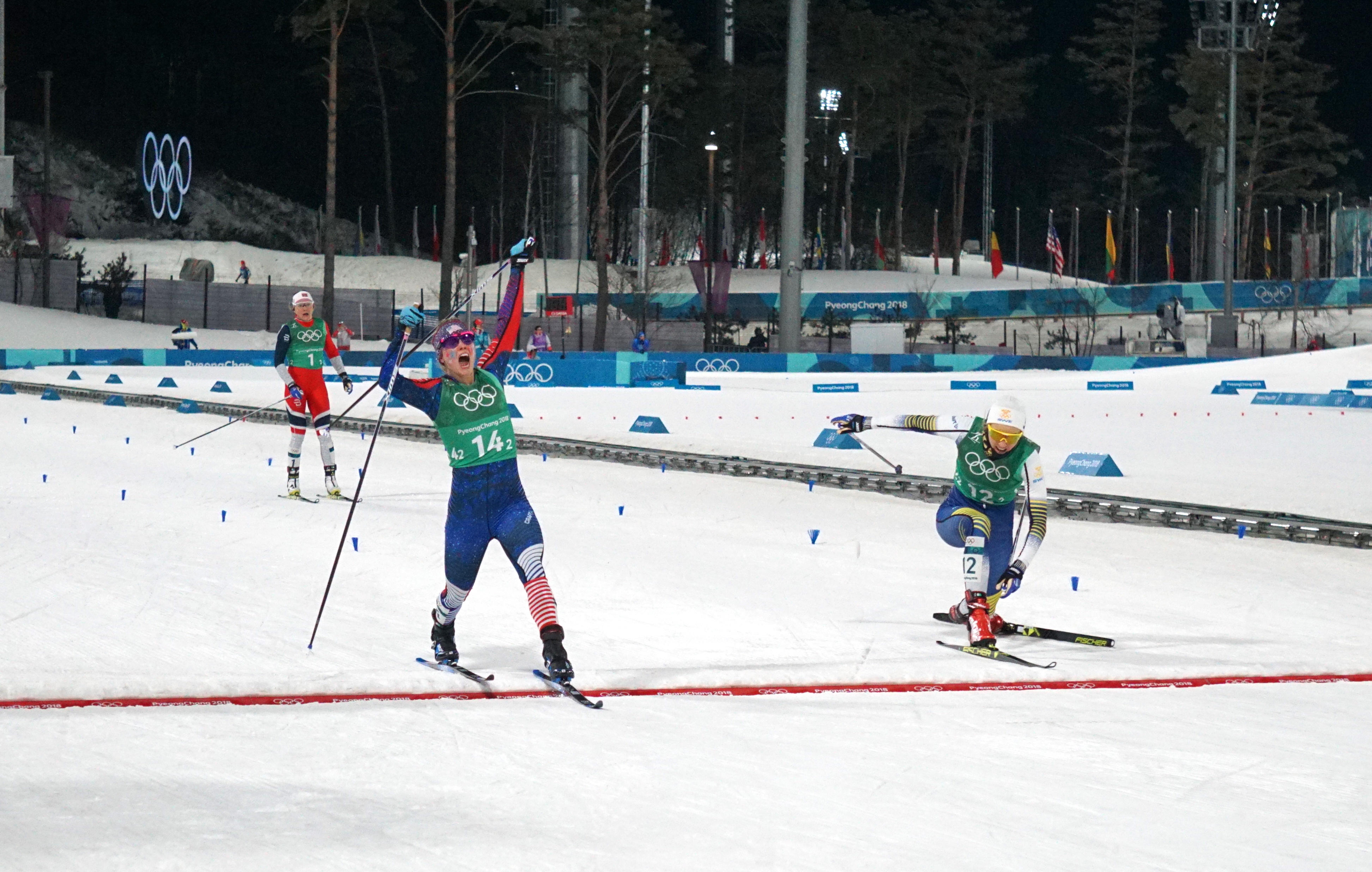
    Jessie Diggins (14) edges Sweden’s Stina Nilsson (r) for gold, while Norway’s Maiken Caspersen Falla (l) races to bronze, in the women’s freestyle team sprint final at the 2018 Olympics in PyeongChang, South Korea. (Photo: Noah Hoffman)

    “Thankfully, by the time I got to the Olympics, I couldn’t even remember the last time I had used symptoms, which is good because I was faced with probably the most stress I have ever had in my life. The entire country is watching your body in a spandex suit and feeling like they had the right to comment on it. That is maybe the worst nightmare for someone who has had an eating disorder. However, it had been so long since I had used symptoms, even if something happened or someone said something to me and I felt that voice of my eating disorder come up again and say, ‘You know what you should do? You should use symptoms?’ I could tell the voice ‘No’ and choose to do something healthy for me instead.”

    In her tenth year of the recovery process, her time at the Emily Program and her dependence on her eating disorder are increasingly distant for the 28-year-old. But, as she expressed, she will always need to remain on guard against her disease. To remain both accountable and supported, Diggins has created a support network around herself which includes her family, friends, and coaches. 

    “I have a really open relationship with all of my coaches. All the coaches on the National Team know my history and I feel like I could go up to any of them and say, ‘Someone said something to me and it’s really making me feel terrible and I need a hug. Or I need you to tell me what I did well in practice today so I can have something good to think about.’’

    Amidst 20-plus hour training weeks and an always-on-the-go lifestyle, the idea of maintaining a feeling of balance and avoiding the pileup of stress seems as challenging as the training itself. Diggins explained that since she has become accustomed to this lifestyle and load, it does not make it more challenging for her to feel at ease or maintain her separation from the disorder.  

    “The training I do now as an almost 28-year-old is pretty extreme, but my coach, [Jason] Cork and I make the plan, and it has been bumping up very gradually every year for the last ten years. It’s not like I just jumped into this. For me, this is actually normal and we can look at years of data and say, ‘Alright, this is within the realm of what we know your body absorbs.’ And we keep close tabs on that. I have this thing in my training log where every day I rank how tired I am, my mood, how well I slept, how much life stress today. We really track that and make sure that if we need to back down on training, we are. So I think that’s something that helps keep me balanced.”

    She continued that she also works with a sport psychologist weekly during the winter when the stress and pressure are highest, but also meets with her during the summer. 

    Jessie Diggins with coach Jason Cork during a rollerski in Lake Placid, N.Y. (Photo: Matt Whitcomb)

    “We set concrete goals that have nothing to do with results and nothing to do with what you look like or what other people think about you. The goals are like, ‘This New Zealand Camp, I’m really going to stay hydrated because it’s dry at altitude and it’s wintertime so you dry out faster. I’m really going to work on dialing in kick wax during these races.’ Goals that have nothing to do with your professional success, but have everything to do with it because if you meet those goals consistently, they add up to a really awesome product at the end. But having goals that keep you grounded with small attainable steps is really what helps me in life to stay more balanced.”

    This concept of focusing on smaller process-focused steps rather than the larger more intimidating goal has been essential in both her athletic career and her recovery journey.

    “If you look at the big picture, it’s like, ‘Alright. I’m going to try to win a gold medal at the Olympics.’ And it’s like, ‘Oh man! That is a really big goal. That is really stressful.’ But if you break it down and then all of a sudden you’re like, ‘This week, all I’m going to focus on is a few key intervals and really staying on top of hydration and maybe taking a nap every day.’ That’s not hard, and it makes you feel like you’re taking steps toward the big goal without stressing out from thinking about the big goal all the time.

    “It’s like my recovery from my eating disorder as well. Every week, there were small goals. It was never like, ‘Okay I’m never going to use symptoms again.’ That’s like the gold medal goal. There were all these smaller goals, like, ‘This week, I’m going to resist using symptoms at least three times and I’m going to use these three things to distract myself so I don’t use.’ Just tiny little steps where you could celebrate those wins along the way because you’re not going to get the big goal right away. I think that applies to anything in life, but especially in the realm of athletics or something really daunting and scary like recovery from an eating disorder or any addiction. It’s so important to have those little goals and to have people to be accountable to. 

    Diggins also works with a nutritionist regularly to make sure that she is meeting the energy demands of her training and to ensure that disordered habits are not sneaking in to prevent her from fueling optimally. 

    “I’ve worked for eight years with Susie Parker-Simmons at the USOC. I started working with her when I got on the US Ski Team. She’s been awesome because a lot of it is figuring out strategies for how not to get sick, how to boost your immune system, or you’re flying to a country where the food might mess with your stomach. All that sort of stuff. So it’s also very practical, but obviously, she understands pretty much everything about eating disorders and it was really helpful to have one more person on my team who knew my history and what was going to be challenging for me. And it was one more person who I knew was rooting for me and that I could be accountable to.”

    Apart from her own progress, Diggins has seen progress in the overall climate surrounding body image and healthy eating habits in the sport as a whole. She attributes some of this to the increasing number of positive role models for young girls in the sport.

    Jessie Diggins on course during the 5k skate at the 2011 Junior National Championships. Diggins won the OJ girls race by 51 seconds. (Photo: David J. Owen Photography)

    “Part of it is, we never used to have that many female coaches, and that can be really hard for a young girl in sport. I think the more women we have in leadership roles, the easier it may be for young women in particular to say, ‘Am I good enough the way I am? I need to talk to you about this.’ It might be easier to open up.”

    Diggins recalls initially not feeling comfortable opening up to her father, let alone her male coaches about her struggles with body image and self-worth when she was in high school. 

    “I love all of the coaches I’ve had. They have all been there for me as a friend, as a mentor, sometimes as a second parent. But it can be really hard for a seventeen-year-old girl to want to go talk to a man about not feeling great about her body. That’s just hard.” 

    She also attributes the improvement in tackling this issue to the increase in educational resources for coaches about eating disorders and the risk factors. Diggins recalled that when she was trying to qualify for World Juniors, there was not much information available. She expressed that this lack of awareness and understanding might make coaches less inclined to confront an athlete who they might be concerned about as they may not feel qualified to support that person or to connect them with appropriate care. 

    “How do you talk about something that you don’t understand? There’s just not enough educational materials out there. The mode of thinking at the time was, ‘If we just don’t talk about it at all, maybe it won’t be a problem?’ It obviously came from a place of good intention, but there just wasn’t enough information available.”

    In Diggins’ view, this lack of discussion contributes to the pervasiveness of eating disorders in endurance sports as it may inhibit someone who is struggling from asking for help. 

    “If it’s not talked about, then it becomes taboo, so then someone like me starts to have a problem and you feel like you really can’t tell anyone because now it’s this dirty little secret and I’m the weird one. When in reality, I don’t think I have met a person on this planet who hasn’t at some point exhibited either some signs of disordered eating or poor body confidence. It’s a universal human experience to at some point feel somehow dissatisfied with the body that you’re in.” 

    Overall, Diggins expressed that the climate and awareness about body image and disordered eating issues in cross-country skiing have improved since her time as a junior looking up to teammates that were trimming fat off of their meat at dinner and passing on hot chocolate. She also expressed that the dialogue about these issues is significantly more open and positive.

    “I think we’re getting to a point where if some athlete is feeling like, ‘I feel like maybe I’m supposed to be skinnier. I don’t know.’ Hopefully, they can go to their coach and say, ‘Okay. So I’m kind of worried about my body shape. Can we talk about this?’ And the coach can say, ‘Hey. I don’t feel like I’m qualified. Let me refer you to someone. I really care about you and I support you, let’s figure out who your person is. Thank you for trusting me enough to tell me that. I want to help you out.’” 

    For coaches who are interested in learning more about how to create positive and supportive dialogue on their teams or to express concern for an athlete who might be struggling, Diggins recommends utilizing resources from the “What to Say Initiative” launched by the WithAll Foundation, a nonprofit that focuses on advancing eating disorder support and prevention. She explained that though a coach cannot cause an eating disorder in an athlete, research suggests that the language used by prominent adults in a young person’s life can greatly influence that persons’ body image, self-esteem, and likelihood of developing an eating disorder. 

    “If you are primed to have one, you have the right brain wiring, maybe you’re super type-A, maybe you’re stressed out, maybe something happens in your life to set it off. It’s really important that adults who are in a position where they’re overseeing kids are aware of what they’re saying and what words they’re using.” 

    The What to Say Initiative offers coaches age-specific phrases to incorporate into their dialogue with their athletes to support healthy physical and emotional well-being. There are also tips for how to use these phrases naturally in conversation and prompts to spark self-reflection in the language that is already being used with the team. 

    Jessie Diggins features the Emily Program logo on her race headgear during the season. Diggins partnered with the Emily Program to raise awareness about eating disorders in sport and to inspire youth to take pride in what their well-fueled bodies are capable of. (Photo: Instagram @jessiediggins/Reese Brown)

    “You see athletes, especially in a sport like cross-country skiing, that are finding success on the World Cup in every body type. As a coach, you want to encourage athletes to celebrate the body that they are in and to know that they can find success in whatever their genetics has determined their body to look like.”

    For anyone currently struggling with body image or disordered eating, Diggins recommends reaching out to the Emily Program through their hotline  (866-673-8652). You will immediately be connected with a representative who will conduct a brief evaluative questionnaire to determine what level of care would best suit your individual needs. Additional information and resources are available at emilyprogram.com.

  • Nordic Nation: Two Words … Jessie Diggins

    Nordic Nation: Two Words … Jessie Diggins

    Post-PyeongChang, post-World Cup, it’s been a whirlwind tour for Jessie Diggins. Where hasn’t she been? As a recent Olympic gold medalist, her time and attention have been in high demand. Just a few of those commitments have involved the following: an appearance at the Minnesota State Capitol where she advocated for a Minneapolis World Champs. And just last Wednesday, April 25, Diggins was in Washington, D.C., on behalf of the Citizens’ Climate Lobby and Protect Our Winters (POW), lobbying members of Congress about the effects of climate change on winter snow sports.

    Jessie Diggins (U.S. SKi Team) after placing fourth in the women’s 10 k classic mass start at Stage 6 of the 2018 Tour de Ski (TdS) in Val di Fiemme, Italy. She went on to finish the Tour in third overall to become the first non-European woman to finish in the top three of the TdS. (Photo: Salomon/NordicFocus)

    Reflecting on her ski season, here’s the no-nonsense: Diggins simply crushed it. Lots of firsts. The Tour de Ski podium. The gold with Randall in the Olympic team sprint. Her second overall on the World Cup and third in the distance standings. More than $110,000 dollars in World Cup prize earnings alone. And all that face-time and the front-row seat as she led much of the Holmenkollen 30 k skate this year. You’ve got to love that midwestern chutzpah on the Oslo holy ground.

    We reached Diggins on April 26 while she was sitting in a Boston park enjoying some spring sunshine. In this interview, we run the gamut of topics from how she’s using her new post-Olympic gold platform to her thoughts on an outstanding World Cup season.

    inhalers online

    (To subscribe to the Nordic Nation podcast channel, download the iTunes app. If you have iTunes, subscribe to Nordic Nation here.)